When you flip on the weather report in the morning, do you ever wonder who the first weather reporter was? Well, In America that honor may well go to native Bostonian John Jeffries, who was born on this date in 1745 and who in 1774 began measuring the weather and making others aware of its importance. In 1784 he became the first to gather weather information during a hot-air balloon flight over London. If meteorological science is your thing, enjoy this day—and this poem by an anonymous British poet:
Whether the weather be fine Or whether the weather be not, Whether the weather be cold Or whether the weather be hot, We’ll weather the weather Whatever the weather, Whether we like it or not.
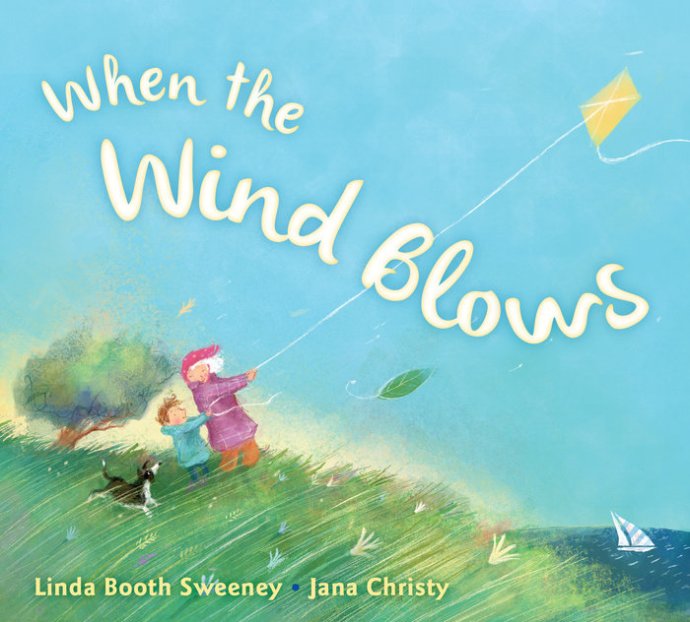
When the Wind Blows
Written by Linda Booth Sweeney | Illustrated by Jana Christy
A little boy peeks out of his rattling window as the wind sends chimes ringing and doors creeaaaking. Jumbled into their jackets the boy’s mom, baby sister, and grandmother go out to enjoy the day. They fly a kite while nearby bells clang and walkers stroll hand in hand. In the sweeping wind “Trees dance. / Spiders curl. / Mice shiver. / Leaves swirl.”
Image copyright Jana Christy, text copyright Linda Booth Sweeney. Courtesy of G. P. Putnam Sons
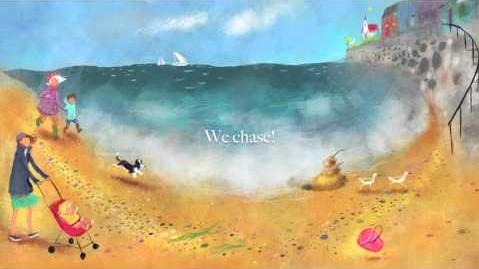
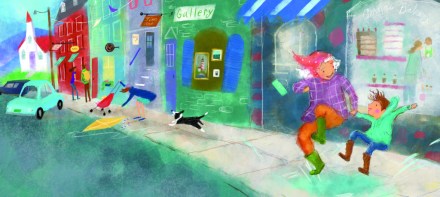
When the wind snatches the kite, the boy and his grandma chase after it amid clouds racing across the sky and seeds scattering to and fro. Running after the kite through waving beach grass, the family sees “Sails puff. / Boats wobble. / Gulls float. / buoys bobble.” Their pursuit takes them into town where they track down their kite lying on a sidewalk. When the wind blows on these narrow seaside village lanes, “Signs shake. / Lights jiggle. / Puddles splosh. / We giggle.”
With the kite safely in hand the foursome ventures to the park for some rolling, swaying, whirling play. But the day is graying—“Skies darken. / Thunder BOOMS. / Rain falls. / We zoom!” Back at home all is cozy as the family dries off and the little boy takes a bath. Tucked into bed the little boy and his mom cuddle while their pets curl up on the blankets. As they sleep, “Skies clear. / Stars gleam. / Earth sleeps. / We dream.”
Image copyright Jana Christy, courtesy of G. P. Putnam Sons
Linda Booth Sweeney’s charming tale of a day spent in the midst of a windy day perfectly captures the sights and sounds of such a gusty natural event. Sweeney’s eye for detail and talent for evocative verbs elevate the two-word lines in these short verses, letting readers fully experience the effects of a wild squall. Kids will appreciate the original imagery and love repeating the lyrical lines.
The blustery wind is evident in Jana Christy’s vibrant pastel illustrations, where clouds swirl in scribbles, flowers bow, and buffeted grasses protect small creatures. Everywhere, the wind flutters head scarves and clothing, bends signs, and tears hats and kites from unsuspecting hands. As rain approaches Christy’s skies acquire a gray, gauzy texture, and when the family again reaches home, the colors turn warm and bright, as comforting as a cup of tea or hot chocolate. Readers will be rewarded for lingering over the beautiful pages by seeing details and people carried over from page to page, uniting the story.
Ages 3 – 6
G. P. Putnam’s Sons, Penguin Group, 2015 | ISBN 978-0399160158
Meet Linda Booth Sweeney and find fun activities to extend the fun of When the Wind Blows on herChildren’s Books website. You can find detailed information as well as videos, podcasts, and activities about her Systems work onlindaboothsweeney.net.
Learn more about Jana Christy and view galleries of her children’s books and illustration and sculpture work on her website.
Watch this windblown book trailer by animator Xin Xin and Linda Booth Sweeney.
National Weatherperson’s Day Activity
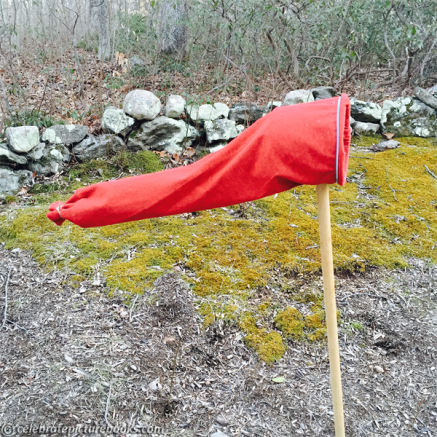
Catch the Wind! Windsock Craft
You can feel the wind in your hair and see it blowing through the trees, but can you actually catch it? You can with this easy-to-make windsock!
Supplies
1 large yogurt container (32 oz) or 1-pound deli salad container
1 long-sleeve T-shirt
Strong glue
Dowel, 5/8 diameter x 48-inches long or longer
String
Rubber band
sewing seam ripper or cuticle scissors
X-acto knife
Scissors
Directions
Remove the sleeve from a long-sleeve t-shirt with the seam ripper or cuticle scissors
Cut the shoulder off the sleeve by cutting straight across from the underarm seam
Cut 2 inches from the bottom of the yogurt container OR cut the bottom out of the deli container with the x-acto knife or scissors
With the x-acto knife or scissors, make a hole a little smaller than the diameter of the dowel about 1 inch from the rim of the container
Slide the container into the large opening of the sleeve
Fold about a ¾ -inch edge over the rim of the container and attach all along the rim with strong glue
Put the rubber band around the outside edge of the opening
Tie the bottom of the sleeve’s cuff together with the string
To attach the dowel: Option 1: leaving the t-shirt in place, push the dowel and material through the hole in the container. The t-shirt material will hold the dowel in place (I used this option). Option 2: cut a small hole in the t-shirt at the location of the hole in the container. Push the dowel through this hole and the hole in the container. Secure with strong glue
Stick your windsock in the ground in an open area where it can catch the wind. As the wind changes direction, you can turn your windsock so the opening faces the wind.
For 117 years the Audubon Society has held a bird count in North America, Central America, and South America from December 14 through January 5. The count is conducted by professionals and volunteers who sign up to monitor various areas designated in 15-mile-wide diameter circles. The information and statistics gathered help to keep track of bird populations and aid in protecting our beautiful feathered friends. During the snowy, cold winter months, remember to set out seed and suet for birds to eat. For more information or to get involved, visit the Audubon Society website.
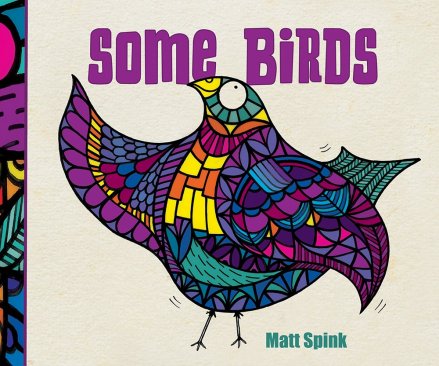
Some Birds
By Matt Spink
The variety of birds in the world is astounding! With their unique coloring, songs, and behaviors, our feathered friends provide entertainment and beauty wherever we are. Most times, we only need peer out the window or gaze into the sky to find a fascinating array of life. In his illustrated poem Matt Spink takes readers on a flight of fancy to show the charm, power, and even quirkiness of birds. “Some birds are big / some birds are small / and some birds are just incredibly tall,” the book starts.
Image copyright Matt Spink, courtesy Matt Spink
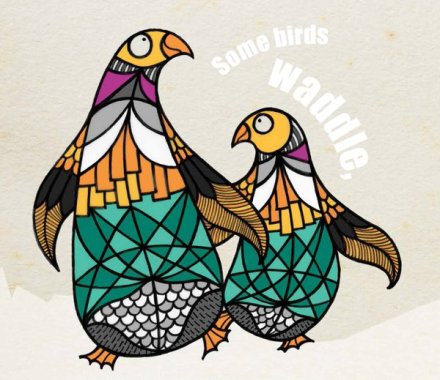
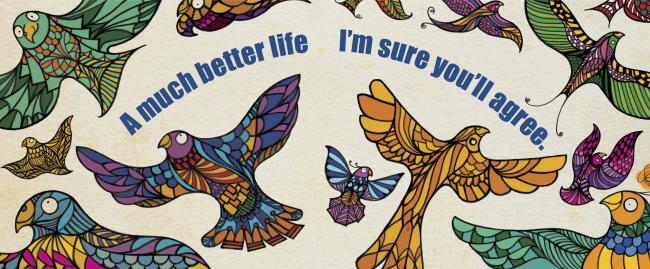
How do these birds get around? Sure, they fly but “some birds swoop,” others “soar high,” and still others walk or waddle or hop. And when they get hungry? “Some birds eat worms until they go pop!” Some birds get the itch to swim, tweet, squawk, or twitch, and while some cling to trees making rat-a-tat-tats, others build nests to escape “from sly cats.” Though some birds live in cages, “most birds are free. / A much better life, I’m sure you’ll agree.”
Image copyright Matt Spink, courtesy Matt Spink
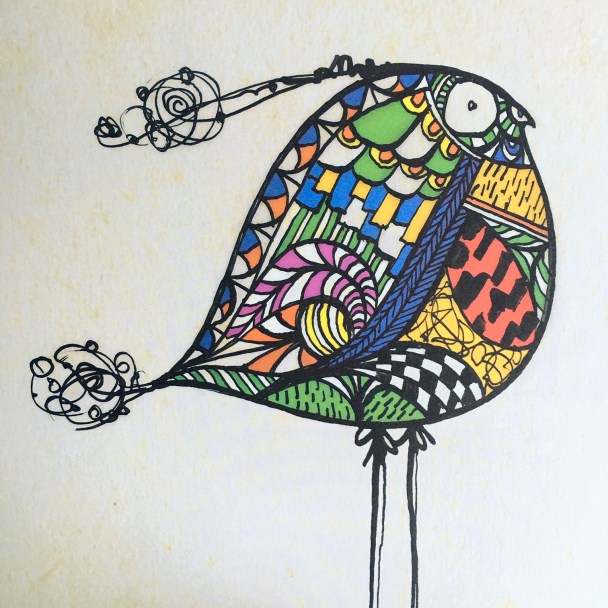
Matt Spink’s sleek birds, each as shining as a stained glass window and as detailed as an Amish quilt or Native American carving, embody the distinct personalities that make these creatures so endearing. With expressions that will make kids giggle and brilliant color combinations that will inspire their creativity, Some Birds is a page-turner. Teetering on loooong knitting-needle-thin legs, a little ball of a bird with a teeny beak and scroll-work head and tail feathers humorously spans two pages. A green-and-white quail with a frilly orange topknot cranes her neck to get a better look (at you, the reader?). Two psychedelic friends flutter and flap as they compare plumage.
Matt Spink’s Some Birds is a mosaic of wonder for young and older readers, and would make a vibrant addition to home bookshelves. After all, who among us does not yearn to “fly free?”
Image copyright Matt Spink, courtesy Matt Spink
Ages 2 – 5
Harry Abrams, 2016 | ISBN 978-1419720703
Christmas Bird Count Activity
Feathered Friends Coloring Page
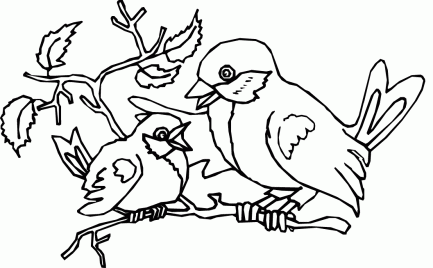
Watching birds flit and fly through the sky is a pleasure of being outdoors or just gazing through your window. Enjoy this printable Feathered Friends Coloring Page of a parent bird and their little one!
During the month of November we’ve celebrated picture books—those wonderful stories and works of art that open the world to children and adults in surprising and amazing ways. Creating home libraries for children as well as reading together every day is an important part of improving language development and literacy. The close bond formed between parents and other caregivers and children during quiet or boisterous reading times last a lifetime. If you have young children or even older kids who love the beauty of picture books, make every month Picture Book Month!
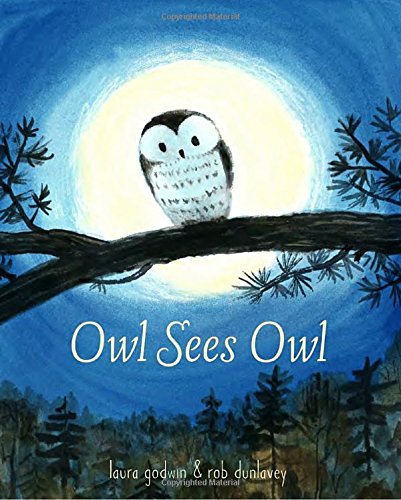
Owl Sees Owl
Written by Laura Godwin | Illustrated by Rob Dunlavey
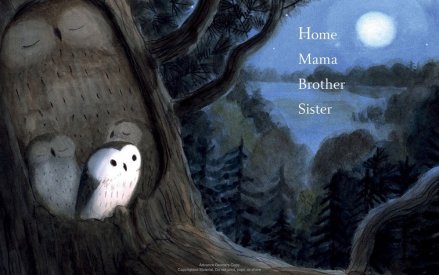
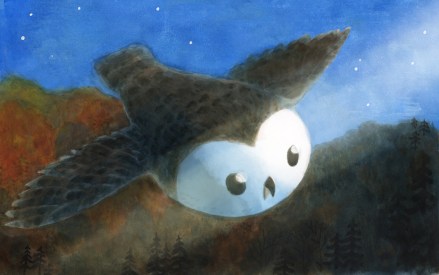
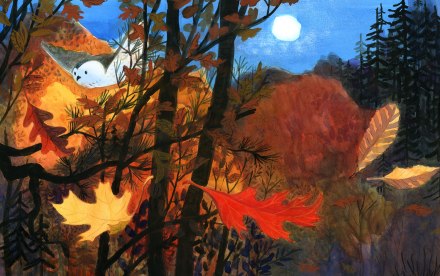
An adorable baby owl, wide awake in the full moonlight while its family sleeps, gazes out from its nest in a tree at the surrounding forest. The night is filled with “Home / Mama / Brother / Sister.” The little owl ventures out onto a sturdy limb. It knows “Tree / Nest / Hop / Look.” From its perch with a “Jump / Flutter / Flap / Fly” the owlet soars through the deep blue sky, its white face shining like the stars. It floats over autumn leaves while in the “Moon / Beam / Eyes / Gleam.”
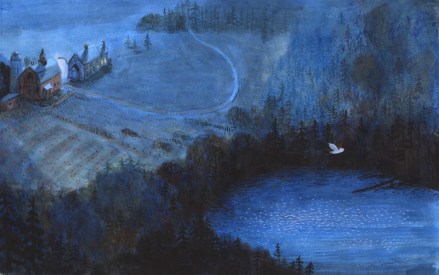
Down below other nocturnal animals have come out to play. On the farm the barn is quiet and dark while someone is stirring in the house. The baby owl passes them by with a “Soar / Glide / Swoop / Swoosh.” Something glistens in the midst of the forest, and the owl descends to investigate. “Owl… / Sees / Owl” in the rippled rings of the small pond.
Image copyright Laura Godwin, courtesy of Rob Dunlavey, robd.com
After a moment the owlet takes off with a quick “Swoosh / Swoop / Glide / Soar,” reversing its nighttime flight. Once more the curious baby passes over the star- and moonlit field, feeling bolder: “Scamper / Mice / Twinkle / Stars.” Deer perk up their ears and stare alert to the nearly silent woosh of the owl’s wings above. “Yellow / Red / Leaves / Fall as the owl zooms with a “Fly / Flap / Flutter / Jump toward “Sister / Brother / Mama / Home,” where Mama waits wide awake.
Image copyright Laura Godwin, courtesy of Rob Dunlavey, robd.com
Inspired by reverso poetry, Laura Godwin’s lovely Owl Sees Owl is a language- and emotionally rich story to share with young children. With only four words per two-page spread, Godwin tells the detailed adventure of an inquisitive baby owl who leaves home for a nighttime caper through woods and over farmland to a pond where it sees itself reflected in the mirror-like surface. In a minute the owl is back in the air for the trip home, reversing its path and also the order of the words. Godwin’s dynamic, lyrical words are joyful to read and allow for readers to linger over each page and talk about what they see, what the little owl is doing, and even whether a sentence such as “Fall / Leaves / Red / Yellow” is active or descriptive. The reverse nature of the story brings the baby owl’s adventure to a sweet, satisfying conclusion that children will love.
Image copyright Laura Godwin, courtesy of Rob Dunlavey, robd.com
Rob Dunlavey’s illustrations transfer the most beautiful clear, moonlit night to the page, creating a perfect quiet time or bedtime book for young children. The lush, dark woods rendered in deep olives, rusts, browns, grays, and blacks as well as the indigo sky highlight the gleaming moon, twinkling stars, and white feathers of the owl. In one spread deer appear in silhouette in the background as mice scamper over pumpkins in the foreground; in another fiery red, yellow, and orange autumn leaves make a spectacular backdrop to the owl’s outstretched wings. The central spread in which the owl sees its own reflection offers readers much to talk about. Is the owl startled? Wondering? Happy? Is the owlet going home for comfort or to tell of its amazing discovery? Kids will love lingering over each page to think and talk about all that is there.
Owl Sees Owl makes a wonderful gift for young children or children who love poetry and art. The book would be a welcome and often read addition to home libraries.
Ages 2 – 7
Schwartz & Wade Books, 2016 | ISBN 978-0553497823
To see a gallery of illustration work for picture books, nature sketches, and other artwork by Rob Dunlavey, visit his website!
Picture Book Month Activity
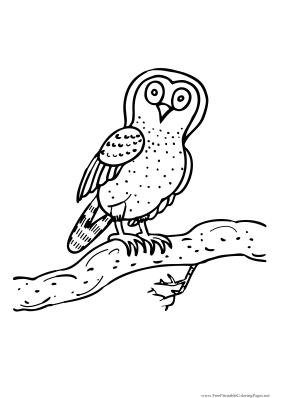
Barn Owl Coloring Page
This little guy looks ready for an adventure! Grab your pencils or crayons, color this printable cute Barn Owl Coloring Page, and give him a background to start his journey!
In 1895 while Wilhelm Conrad Rontgen was experimenting with cathode rays and glass, he noticed a glow coming from a nearby chemically coated screen. This led him to make an astounding discovery. He found that the electromagnetic energy that caused the glow—which he named X-rays—could penetrate human flesh, but not bone, thus allowing bone to be photographed. For the first time doctors could see inside the body without surgery. X-rays were first used during the Balkan War in 1897 to find bullets, shrapnel, and broken bones in soldiers. While X-rays were an amazing advancement for medical research and patient care, their danger was not readily understood. The novelty of this new technology was used by shoe stores as a fitting device in the 1930s through 50s until the harmful properties of radiation were better appreciated. Today, X-rays and the technology they led to are instrumental in diagnosing injuries and diseases and in targeting a medical response.
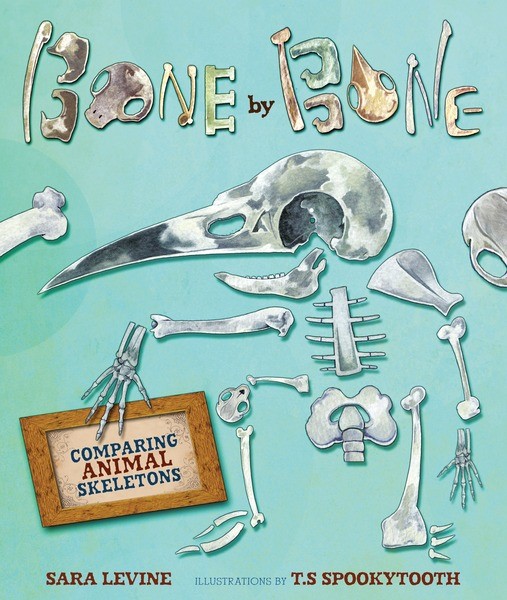
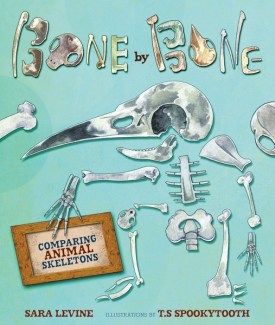
Bone by Bone: Comparing Animal Skeletons
Written by Sara Levine | Illustrated by T.S Spookytooth
Can you imagine if we sloshed through life like soup without a bowl? What would we set our hats on? Where would we carry our phones? How could we sit in class or the office or perform our favorite activities? And what would happen to our organs, our hair, our homes? It’s all a little disturbing! Fortunately, we don’t have to worry about that scenario because “we’re vertebrates, animals with bones. Our bones hold us up.” Phew!
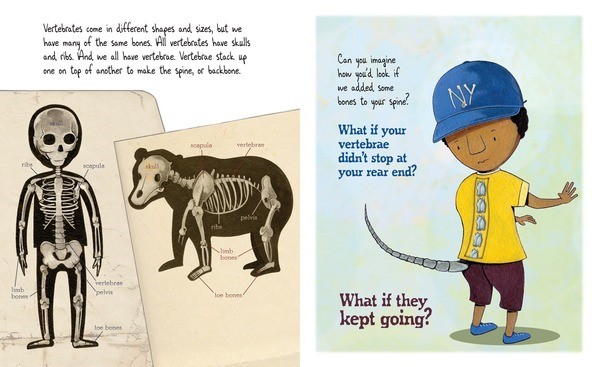
There are different kinds of vertebrates—mammals, reptiles, fish, and more—but many of our bones are similar. For example, “all vertebrates have skulls and ribs. And we all have vertebrae. Vertebrae stack up one on top of another to make the spine, or backbone.” Humans have vertebrae that end…well…you know where, but imagine for a minute if your vertebra kept on going. What if they poked a hole right through your shorts? Yes! You’re right—you’d have a tail. Tails are pretty helpful for some animals. They help them swim, communicate, even keep their balance.
Image copyright T. S Spookytooth, text copyright Sara Levine. Courtesy of Lerner Publishing
Good job! Let’s try again…how about if you only had a skull, vertebrae, and ribs. No arm bones; no leg bones. You’ve got it! A slithery snake! Nah…really…you’d look great! Okay, maybe you’d prefer if you had a skull, vertebrae, and arm bones—but no leg bones—and your nose was transferred to the top of your head. Sounds fishy? Maybe, but not quite. Oh! Did I give it away? Yep, you’d be a whale or a dolphin, and you’d use those powerful vertebrae to propel yourself to the ocean’s surface to grab a breath.
Imagine what kind of gloves and shoes you’d need if your “middle fingers and middle toes were so thick that they supported your whole body.” Hey, you’re good at this! It was a trick question. You wouldn’t need gloves, but you’d wear horse shoes (or no shoes if you’re a less domesticated animal like a zebra). Now, let’s take a trip through a room full of fun-house mirrors. What kind of animal would you be if your neck was reeeaally long and each vertebrae was “as big as your head?” Or if your legs were muuuuuch longer than your arms? Or your “finger bones grew so long that they reached your feet? Seeing those transformations is definitely worth the price of admission, right?
Image copyright T. S Spookytooth, text copyright Sara Levine. Courtesy of Lerner Publishing
But getting back to the bowl of soup: “Could you be an animal if you didn’t have any bones at all?” Sure! Some insects and sea creatures “have their hard parts on the outside,” and some are just “mushy.” Think of worms, slugs, and jellyfish, just to name a few. But bones make life more fun, don’t ya think? So if all vertebrates have bones, what makes humans different? Well, for one thing we (as well as some apes and monkeys) have opposable thumbs, which means that “we can move our thumbs in a special way that allows us to do many things, including turning the pages of a book,” using tools, and picking up objects. “Did you get that one? If so, give yourself a thumbs-up!”
An Author’s Note including more about bones, the types of vertebrates, a glossary, and resources for further reading follow the text.
With humor and a kid’s sensibility of the bizarre, Sara Levine presents an anatomy lesson that young readers will respond to. Juxtaposing individual bony features of humans and animals is a brilliant idea to give children perspective on the differences in animal skeletons and the uses of each unique trait. Levine’s quiz-like format engages readers, encouraging independent thought and active participation as well as building suspense for what transformation comes next. Kids will laugh and learn and be on the lookout for other ways human and animal skeletons differ as they become more aware of the natural world around them.
With illustrations of tailbones sticking out of pants, empty socks, two fingered hands and two toed feet, a neck that needs two scarves, and more, T. S Spookytooth illuminates what it means to be human in an animal world or an animal in a human world. Kids will laugh imagining themselves as Spookytooth depicts them with animal features and “Ewww” when their portrayal dissolves into a muddy mess. The accurate drawings of human and animal skeletons educate readers on the names and placement of particular bones.
The unique approach to the study of human and animal skeletons, the wide range of animals presented, and the enticing writing and illustrations make Bone by Bone: Comparing Animal Skeletons a wonderful choice for libraries and home bookshelves of budding scientists and nature lovers.
Ages 5 – 10
Millbrook Press, 2014 | ISBN 978-0761384649
To learn more about Sara Levine and her books, visit her website! You’ll also discover fun Bone by Bone activities to enhance your reading!
View a gallery of artwork by T. S Spookytooth, plus videos and more on his website!
X-Ray Day Activity
Dog Paw and Human Hand X-Ray Craft
X-rays are cool to look at, but they always stay at the doctor’s office! With this craft you can simulate an X-ray of a dog’s paw and a human hand!
Black chalkboard drawing paper, 8 ½ inches by 11 inches
White colored pencil
White chalk
Clear Plastic Report Sheet Protectors
Magnetic clip to hang your x-ray on the refrigerator or other metal surface (optional) OR
String or wire, adhesive squares, and clothes pins to hang x-ray on the wall (optional)
Scissors
Directions
Print the Human Hand and Dog Paw Templates (you may want to print two—one to cut and one to follow when transferring the bones to the black paper)
Cut the bones apart
Lay the bones on the black chalkboard paper
Trace the bones with the white colored pencil
Color in the bones with the white chalk
Slip the black paper into the plastic report sheet protector
If desired, hang the x-ray on the refrigerator with the magnetic clip or on the wall using string, adhesive squares and clothespins
Q & A with Author Sara Levine
Today, I’m thrilled to talk to Sara Levine about her writing as well as to learn about her early experiences with animals and to discover a kid’s-eye-view of women in science.
Your writing for kids is so infused with humor that really captures their attention. What were some of the books that you liked best as a child?
When I was younger, one of my favorite picture books was Katerine and the Box by Patricia Lee Gauch. I’ve noticed that this book has gone back into print; I was so happy to find it online. It’s basically about creativity. A girl and her friend keep finding new uses for a large cardboard box—a house, a car, a dance platform. I can still recall my feeling of excitement when hearing it read to me—it made me want to go make something. It’s actually a feeling very similar to what I have today when I think of a new idea for a book. There was also a book called Wisher, which was about difference—about a cat who dreamt he was really a fish. I remember that the illustrations were beautiful and somewhat scary—just done in blues, browns and yellows. As an older child, I loved Charlotte’s Web by E.B White, Lizard Music by Daniel Pinkwater and pretty much everything by Judy Blume.
I don’t suppose any of these books are like the books I write. I used to tell people that I liked my science and my books separate. I just wanted to go outside to learn about science. But, I wanted stories in my books. I don’t think there were any of the sorts of books I write about science out for kids when I was young. At least I didn’t find them. But if I had, I think I would have enjoyed them—the fact that they were funny and interactive. But here’s a picture book I LOVE that I found as an adult that is certainly infused with humor and captures a kid’s (and a grown-up’s) attention: Bark, George, by Jules Feiffer. I think this is currently my favorite picture book.
You grew up on a farm in Guilford, Connecticut. Can you tell me a little about the farm and how or if it influenced your current work?
Calling it a “farm” might be a bit of a stretch. My parents were two kids who grew up in Brooklyn and then moved to CT and decided to get some animals, cheered on by their enthusiastic offspring. First there was a goat, who got lonely. So then there was another goat. And they had a baby. And there was a chicken at school who needed a place to go for the summer. And then never went back to school… And so on. We ended up having over 100 named animals—a horse, a cow, peacocks, geese, a donkey and more. I loved taking care of the animals, with my siblings. It was a wonderful experience, one that I’m very grateful for. But it wasn’t at all lucrative. I think the only money made was by my brother who would sell extra eggs to his teachers.
How did it influence my current work? I’m not sure. Certainly my interest in animals is a lifelong one. I think the stories about the animals actually show up more in my writing for adults than in my picture books. The ideas for the books for children come more from teaching ideas that I think will translate well into a picture book format.
You have a doctorate in veterinary medicine and a masters in fine art. When and how did the two merge into your work as an author?
What a great question. I have always had this science side and this humanities side. A lot of my life, I’ve been struggling with how to balance and feed both sides of myself. It’s taken me a long time to find a way to merge the two interests, and it’s been very satisfying to do so in writing about science, especially for kids.
You offer four different school and library programs, all of which sound fascinating. Do you have any anecdotes from a presentation you’d like to share?
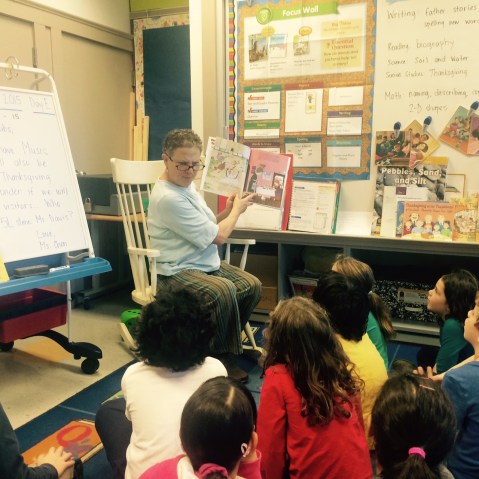
In one of my workshops, the one for Bone by Bone: Comparing Animal Skeletons, I bring in an articulated skeleton for the kids to see and a disarticulated skeleton in a box. The kids learn the bones, and I then hand them each a bone which they take up to the standing skeleton to figure out which bone it is, and then work together to put together the second skeleton on the floor. Inevitably, someone asks if the skeletons are real. They are. I literally found them in the closets, when I started my teaching at Wheelock. There are all sorts of questions about that, generated by the kids, and then, often, someone will ask if the skeletons are “boys or girls.” Recently, at a school near Boston, I was explaining to a group of second graders that both were female, that we could tell by the shape of the hips, and I heard one girl, going, “YES!” and pumping her arm up and down, in victory. The boy next to her says, “Why are you so happy? That means a girl died.” To which she responds, “That’s true. But it also means one more girl in science!”
Sara Levine leads a workshop at Cold Spring School
What’s the best thing about writing for kids?
I enjoy trying to think of engaging and interactive ways to teach something that hasn’t been taught before. I like the creativity involved. And, of course, reading it to the kids when I’m done and seeing them respond!
Students at Al Hamra Academy examine a skeleton
You also write articles for adults and were nominated for a Pushcart Prize in 2007. Can you tell me more about your writing for adults?
I write science related essays for adults. The writing comes more from my own experiences. I do have a handful of essays published. I think the one that was nominated for the Pushcart, “What Hands Can Do” is still available to read online. Here’s a link to it on Fictionaut. It’s about spaying a dog. And more, of course. I think my most successful essay is “The Body of a Cow” which originally appeared in the Massachusetts Review. It’s also on Fictionaut, if anyone wants to have a look. Eventually, I hope to work the essays into a memoir for adults.
What’s up next for you?
I have a book on dinosaur bones which will be published by Lerner next year. I also have three children’s books written which I’m trying to find homes for at the moment—one on animal classification (but interactive, written like a “do your own adventure” story), one on how plants communicate with animals, and one very funny one (if I can say so myself) called “Breakfast at the Omnivore Café,” which is about what animals eat. This one might never get published because it falls into the cracks between nonfiction and narrative fiction, but I haven’t given up on it yet. The book I’m currently working on is an attempt to explain climate change through stories of the carbon cycle. Doesn’t sound very interesting when put that way, but it’s written as an interactive story, and is also actually quite funny in parts, so I think kids will like it.
Since Celebrate Picture Books is a holiday-themed blog, I can’t let you get away without asking you what your favorite holiday is…
Passover. You get to tell a story to children in a way that is interactive and engaging for kids, AND it involves food. What could be better?
Thanks so much for chatting and sharing your unique perspective on the natural world, Sara! I, for one, would love to read Breakfast at the Omnivore Café—that would be one interesting menu, I bet! I wish you the best with all of your books!
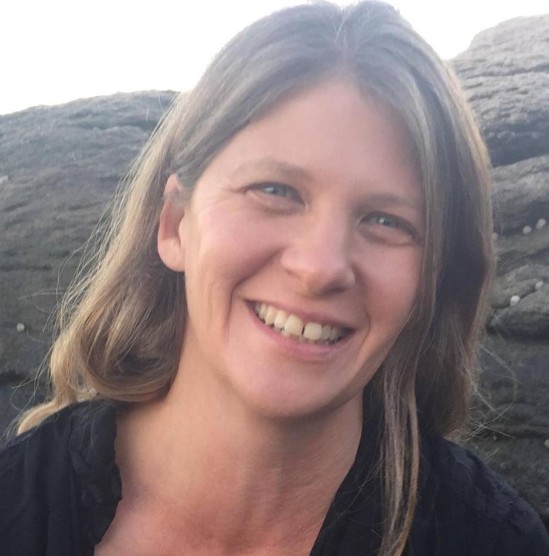
Sara Levine is an assistant professor of biology at Wheelock College and a veterinarian. Her science books for children include Bone by Bone: Comparing Animal Skeletons (2013) and Tooth by Tooth: Comparing Fangs, Tusks and Chompers (2016). Her third book, Fossil by Fossil: Comparing Dinosaur Boneswill be published in 2018. Bone by Bone: Comparing Animal Skeletons has received much recognition, including the Utah Beehive Book Award, selection as a Bank Street College Best Children’s Book of the Year, and finalist for the Cook Prize for best STEM picture book.
Sara also writes science-related essays for adults, one of which was nominated for a Pushcart Prize in 2007. Her writing has appeared in the Boston Globe, the Massachusetts Review, Bayou, and in the anthology And Baby Makes More. In addition to teaching college students, she has taught children’s environmental education classes for the Massachusetts Audubon Society and other nature centers in Massachusetts and Connecticut for over 15 years.
Sara holds a doctorate in veterinary medicine (DVM) from Tufts University, a master of fine arts degree (MFA) in creative nonfiction writing from Lesley University and a bachelor of arts degree (BA) in English from Haverford College. She is a native New Englander and lives with her daughter and their dogs and cat in Cambridge, Massachusetts.
Bone by Bone: Comparing Animal Skeletons and Sara’s other books can be found at:
Marking its 21st birthday, World Egg Day celebrates the health benefits of the humble egg—which offers the highest quality of protein available. An important dietary component for fulfilling the nutritional requirements of people living in both developed and developing communities, the egg is a versatile food, able to be eaten on its own or as a necessary ingredient in many recipes. Eggs are essential for fetal development, healthy brain development, maintaining concentration, aiding the immune system, and more. Today, enjoy eggs your favorite way!
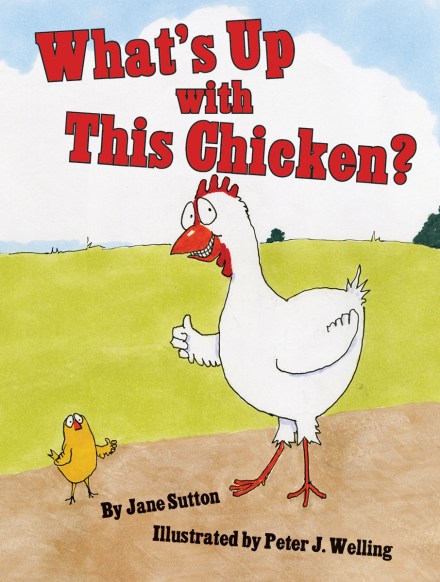
What’s Up with This Chicken?
Written by Jane Sutton | Illustrated by Peter J. Welling
When Sylvia goes out to the barn to collect the chicken’s eggs, something’s up with Trudy. She squawks and screeches when Sylvia tries to reach under her, but Sylvia takes it in stride and with humor: “‘Don’t get so egg-cited!’” she says “‘I’ll get your egg tomorrow.’” But the next day Sylvia is met with the same reaction. Trudy isn’t acting like the other chickens in Grandma’s backyard; if fact, she isn’t even acting like Trudy! “‘What’s up with this chicken?’” Sylvia wonders.
Image copyright Peter J. Welling. Courtesy of Pelican Publishing Co.
Image copyright Peter J. Welling, courtesy of Pelican Publishing Co.
While she and Grandma enjoy “omelets with eggs from Sue, Clara, Doris, and Olga,” Sylvia tells her about “stubborn Trudy.” Grandma doesn’t know what’s wrong either. The next morning Trudy is even more obstinate. Not only does she make a racket, she tries to peck Sylvia, and she puffs “herself up to twice her size.” Sylvia also notices “that Trudy left her roost just once a day to eat, drink, and poop. She was getting skinny.”
Sylvia decides Trudy must be hungry and tries to lure her off her nest by offering chicken feed, but while all the other hens “wolfed it down like chocolate,” Trudy remains firmly on her roost. Sylvia tries everything she can think of to move Trudy, but nothing works. That night she and Grandma consult The Big Book About Chickens. Here they discover that “‘Trudy is broody!’” Grandma reads on: “‘Broody hens stay on their eggs so they will hatch into chicks.’” But Sylvia and Grandma know that Trudy’s eggs are not the kind that hatch.
Image copyright Peter J. Welling, courtesy of Pelican Publishing Co.
Image copyright Peter J. Welling, courtesy of Pelican Publishing Co.
Sylvia realizes that Trudy just wants to be a mother, and she wishes there were some way to help her. She thinks and thinks and finally comes up with an idea. She runs to Grandma who thinks Sylvia’s plan is “an egg-cellent idea.” A few days later a box arrives with four eggs that would hatch. With thick rubber gloves, a dose of determination, and two tries, Grandma is able to lift Trudy off her nest. Sylvia makes a quick switch of the eggs, and “Broody Trudy settled down on the new eggs.”
Trudy grows thinner every day but she stays on her roost, rolling the eggs to keep them uniformly warm and even blanketing them with her own feathers. One day Sylvia hears peeping! Grandma and she are even in time to watch the fourth little chick peck its way out of its shell. They name the new “little yellow fluff balls Sophie, Danielle, Mildred, and Judy.”
Image copyright Peter J. Welling, courtesy of Pelican Publishing Co.
Trudy is a proud and protective mother, shielding them with her wings “like a feathery beach umbrella” and teaching them how to find food and water. Trudy goes back to her regular routine and begins gaining weight. As the chicks grow they get their own nests in Grandma’s coop. But one day Judy squawks and screeches. This time Sylvia knows exactly what’s up with this chicken!”
An Author’s Note about the real-life “Broody Trudy” that inspired the story follows the text.
With a deft and delightful understanding of the puns and humor that set kids to giggling, Jane Sutton has written a fun—and informative—story for animal lovers and anyone who loves a good, natural mystery. Through the well-paced plot and action-packed description, readers learn about a particular behavioral aspect of some chickens and the clever and sensitive way that Sylvia solves the problem. The close relationship between Sylvia and her grandmother adds charm and depth to the story, and their dialogue is spontaneous and playful.
Peter J. Welling’s bright, homey illustrations are the perfect accompaniment to the story. Animated Trudy shoos Sylvia away while the other chickens take dust baths, scratch for bugs, and look just as perplexed as Sylvia and Grandma. Humorous touches abound in Grandma’s choice of home décor and Sylvia’s printed T-shirts as well as in the facial expressions of the human and feathered characters. Trudy’s chicks are adorable, and readers will cheer to see Trudy fulfill her heart’s desire.
What’s Up with This Chicken is a wonderful read-aloud for younger kids’ story times and a fun romp that will keep older, independent readers guessing and wondering how it all comes out right up to the end. The likeable characters—both human and chicken—make this a book kids will like to hear again and again!
Ages 3 – 8
Pelican Publishing, 2015 | ISBN 978-1455620852
Discover more about Jane Sutton and her books on her website!
To view a gallery of artwork plus more books for readers of all ages by Peter J. Welling, visit his website!
World Egg Day Activity
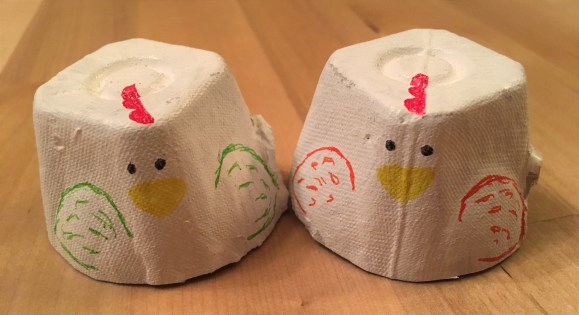
Egg Carton Chickens and a Basket Full of Games
With twelve little chickens you can come up with lots of games to play! This fun craft and game activity is eggs-actly what you need to start hatching some real fun!
Supplies
Cardboard egg carton
White craft paint
Markers: red, yellow, black for the face; any colors you’d like for wings and eggs
Paint brush
Scissors
Glue
Construction or craft paper in white and a color of your choice
Directions
Cut the notched flap off the egg carton and set aside
Cut the top off the egg carton
Cut apart all the egg cups and trim slightly so they sit flat
Paint the egg cups with the white paint, let dry
Add the face, comb and wings to the chicken with the markers. Make six chickens with one color wings and six chickens with another color wings.
From the egg carton flap cut thirteen small egg-shaped playing pieces
With the markers, decorate twelve of the eggs in pairs—each egg in the pair with the same design
Color one egg yellow and add a beak, eyes, and wings to make it a chick
Games to Play
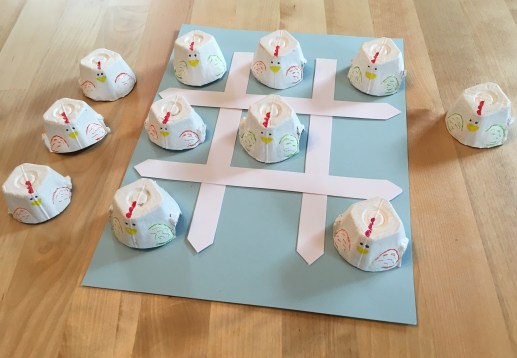
Tic-Tac-Toe (2 players)
On a 8 ½” x 11” piece of paper draw a regular tic-tac-toe board or make it fancy – like the picket fence-inspired board in the picture
To make the fence-inspired board on a colored background, cut 2 9-inch-long x 3/4-inch wide strips of white paper, cutting a pointed tip at one or both ends. Cut 2 white 8-inch x 3/4-inch strips of paper with a pointed tip at one or both ends. Glue the strips to the background.
Each player chooses a set of chickens with the same colored wings
Play the game as you usually do
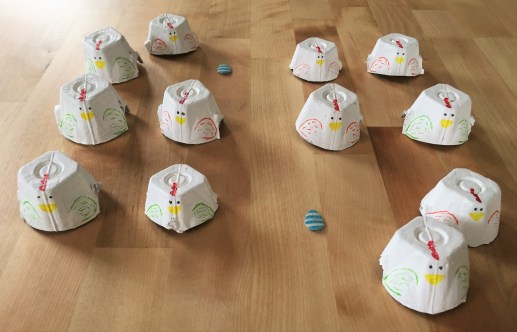
Find the Matching Eggs (2 or more players)
Have one player hide one egg under each chicken
Shuffle the eggs around and form them into three lines of 4 chickens each
Another player lifts one chicken at a time to find matching eggs. If the eggs don’t match, put both chickens back and start again
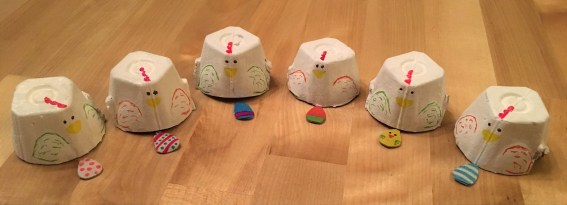
Where’s the Chick?
Use as many chickens and eggs as you want (fewer for younger children, more for older)
One player hides the chick under one of the chickens and eggs under the others.
Another player has three chances to find the chick
I’m sure you can also design your own games for your adorable chickens to play! With more chickens you can even make a checkers set or replicate another of your favorite board games!
Q & A with Author Jane Sutton
Today, I’m pleased to talk to Jane Sutton about her books, her journey as a writer, her family, and the joys and inspiration of being a new grandmother!
As someone who loves humor and was voted class comedienne in high school, what were some of the books you most enjoyed as a child and young adult?
Two of my childhood favorites were Dr. Seuss’s Horton Hatches an Egg and Robert Louis Stevenson’s A Child’s Garden of Verses. As a young adult, I was drawn to Virginia Woolf novels (I know–not exactly humorous, but most comedians are prone to depression).
You write both picture books and books for older children. What inspires or influences your stories?
My childhood memories have been the basis of many of my books—experiences and feelings. What’s Up with This Chicken? was inspired by a true story my friend-since-we-were-11 Fay told me about one of her backyard hens who refused to get off her eggs. I said, “This has to be a children’s book!” So I invented characters, had the child protagonist solve the problem, and snuck in a subtle message about the importance of empathy.
As someone who always wanted to write and who achieved the goal of becoming a published author, can you briefly describe your journey?
At a young age, I was encouraged by my teachers. They would be impressed by something I wrote and send me to show it to another teacher, which really pumped me up. I was an editor of my high school newspaper and after graduating from college had a job writing for a newspaper, wrote ads and press releases, and sold some stories for reading comprehension tests. My first book, What Should a Hippo Wear? was published when I was 29. I’ve had periods where everything I wrote was selling, and periods when nothing I wrote was selling. It’s a tough market!
What’s the best part about writing books for kids?
Well, I never wanted to grow up, and when I realized it was happening whether I liked it or not, I vowed to always remember what it felt like to be a child. Writing for kids helps me do that.
You conduct school presentations and workshops for kids from kindergarten age through grade 5, can you describe a funny or poignant anecdote from one of your events?
One school had a wonderful program that paired parents and their children as writing partners. The culminating event was a presentation by me about how to make writing come alive. Then the parent-children pairs displayed their books, and it was so lovely to see how much the experience meant to the adults and the children. They also loved showing me—the big famous author—what they’d written and I could sincerely point out parts of their writing that were especially effective. The whole thing made me ferklempt.
I read that you love elephants and collect elephant-inspired items. Can you tell me about one of your favorites?
One of my favorite elephants is gray and plastic (about the size of a toaster) and lives outside, in view of our kitchen window. My mother, who died in 2004, gave him to me and named him “Sabu.” He has survived about 18 New England winters so far, sometimes getting totally buried by snow and then poking out the tip of his trunk as the snow starts to melt. My mom asked me once if the elephant made me think of her, and yes, he surely does.
Talking about your mom makes me think of the strong relationship between Sylvia and her grandmother in What’s Up with This Chicken. Can you tell me about your own family?
My husband, Alan, taught a variety of grade levels spanning grades 1-6. He served as a science coordinator, curriculum developer, and teacher mentor. He’s written and co-authored six books for educators, four focused on science instruction and two about systems thinking. Currently, he coordinates the systems thinking program at a grades 5-12 public school and also presents workshops at meetings and conferences. We met in college and have been married for 41 years!
My son, Charlie, works for a coalition made up of organizations pushing for a better transportation system in Massachusetts. He’s worked in Massachusetts public policy since graduating from college in 2007. He married the wonderful Amberly, a nurse, in 2014, and they recently had a baby!
My daughter Becky is the director of an SAT tutoring program. Her company tries to make SAT tutoring as fun and effective as possible, so they try to match the kids with tutors who have the right personality for the student’s learning style. The SAT has completely changed in the last year, so they have had to retrain all of their tutors and rewrite all their curricula. For any tutoring program, building students’ confidence is key. So much of standardized testing is psychological.
I understand Becky also writes a blog for all of us grammarians who like a laugh once in awhile called Apostrophe Catastrophes: The Worlds’ Worst. Punctuation. Can you tell me a little about how she got started?
Yes, Becky does a great job with that blog. I love the examples she posts, and her comments are hilarious! She started Apostrophe Catastrophes almost 10 years ago after seeing an errant apostrophe on a giant cake at Governor Deval Patrick’s Inauguration. She pointed it out to the catering staff, and they had no idea what she was talking about, and then she started to notice misused apostrophes everywhere! Friends and family started taking pictures and sending them to her, and eventually, strangers from all over the world started sending in pictures! The Facebook group has almost 4,000 members now! Becky says, “I guess a lot of people share my love for proper punctuation.”
You’re a new grandmother! Can you tell me a little about your grandson?
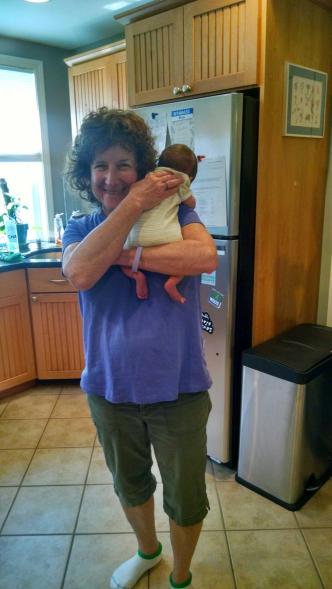
That’s a dangerous question! How much time do you have? Caleb is an adorable, cuddly little person. And he’s now a month old!
What is the best part about being a grandmother?
As a new mother, I was very anxious and questioned all my decisions. But as a grandma, there’s none of that anxiety. Being with my grandson is pure joy. And seeing how loving, confident, and tender my son and daughter-in-law are with the baby fills me even more love. And seeing him in my husband’s arms as he gazes down at him…I’m getting ferklempt again!
Have you thought about how being a grandmother might influence or inspire your future work?
You betcha! Stay tuned.
What’s up next for you?
My next book, a Passover-themed picture book, is scheduled for publication by Kar-Ben in the spring of 2018.
Since Celebrate Picture Books is a holiday-themed blog, I can’t let you get away without asking you a few holiday-related questions! So…
What is your favorite holiday?
I love Mother’s Day and Father’s Day because they are occasions for my husband and me to get together with our children. And there’s good eating involved.
Do you have an anecdote from any holiday that you’d like to share?
The first time I hosted Thanksgiving, rather than attending one at my parents’ house, my mother gave me very, very specific instructions about what to buy. For example, there had to be 2 Butterball frozen turkeys, both between 11 and 13 pounds. The reason for 2 is so that each of the 4 grandchildren could have a drumstick. My daughter and I were rummaging through the supermarket frozen case trying to find the exact acceptable weight for exacting Grandma. Our fingers were half frozen, and I admit that I kind of dropped a turkey on my daughter’s finger. The turkeys, by the way, were quite delicious.
How has a holiday influenced your work?
The festive, joyous celebration of Chanukah shows up in my 2 Chanukah picture books: Esther’s Hanukkah Disaster (Kar-Ben) and Aiden’s Magical Hanukkah (Hallmark).
Thanks so much for chatting, Jane! It’s been wonderful getting to know you. I wish you all the best with all of your books, and am looking forward to seeing your next book!
Connect with Jane Sutton on her website and catch up with her events and other fun activities on her blog!
What’s Up with This Chicken can be found at these booksellers:
Today is the day to unleash your inner poet – without thinking twice about it. What are the words in your heart or in your imagination? Write them down! You don’t have to be Shakespeare for your words, lines, thoughts, jottings – your poems – to have meaning and value. Then share them with family, friends, or even strangers. To celebrate today’s holiday you can also attend a poetry reading or enjoy a volume of verse – like today’s book!
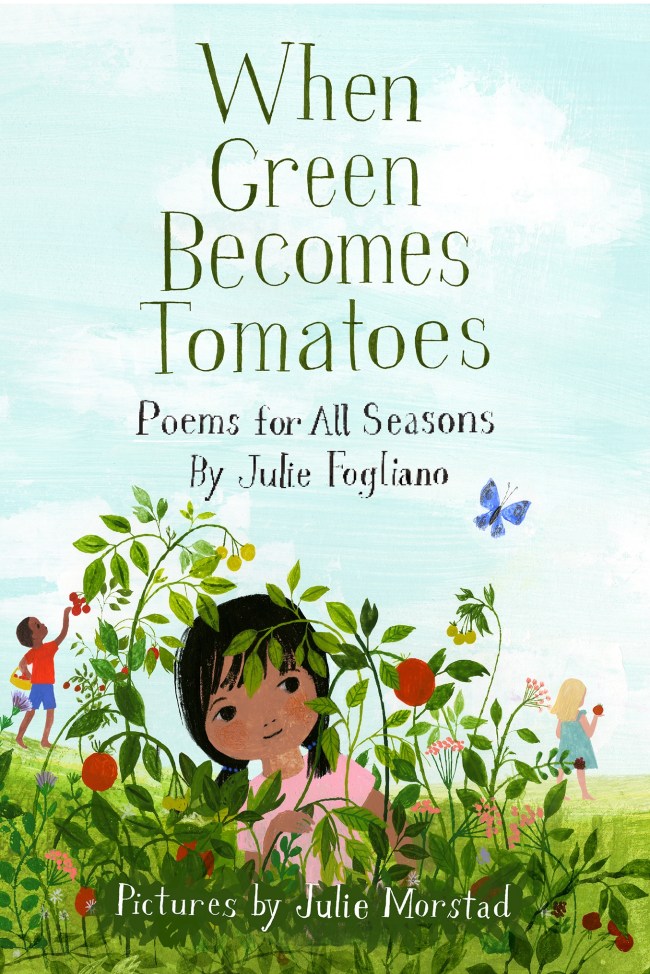
When Green Becomes Tomatoes: Poems for All Seasons
Written by Julie Fogliano | Illustrated by Julie Morstad
Sometimes you wish for just the right words to express a moment in time, a skip of the heart, or a glimpse of color that truly captures the elation, sadness, or awe you feel. Those words live on every page of When Green Becomes Tomatoes: Poems for All Seasons. Eachmonth of the year is represented by three to five dated poems that expose a nugget of inspiration or a spark of recognition about the natural world and our place in it.
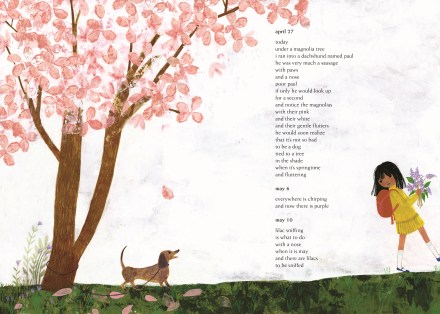
Spring begins its reawakening in the poem dated march 20, on which “from a snow covered tree / one bird singing / each tweet poking / a tiny hole / through the edge of winter / and landing carefully / balancing gently / on the tip of spring.”
Image copyright Julie Morstad, text copyright Julie Fogliano. Courtesy of us.mcmillan.com
Spring is slow in shaking off its winter coat, however, and march 22 finds “just like a tiny, blue hello / a crocus / blooming in the snow” Even though the days continue to dawn chilly and rainy, early flowers long to see the sun. On march 26: “shivering and huddled close / the forever rushing daffodils / wished they had waited.”
With the onset of April and no reprieve from the weather, everyone it seems is tired of the persistence of winter, which sticks around like a party guest who doesn’t know when to go home. On april 3 “today / the sky was too busy sulking to rain / and the sun was exhausted from trying / and everyone / it seemed / had decided / to wear their sadness / on the outside / and even the birds / and all their singing / sounded brokenhearted / inside of all that gray.”
Image copyright Julie Morstad, text copyright Julie Fogliano. Courtesy of us.mcmillan.com
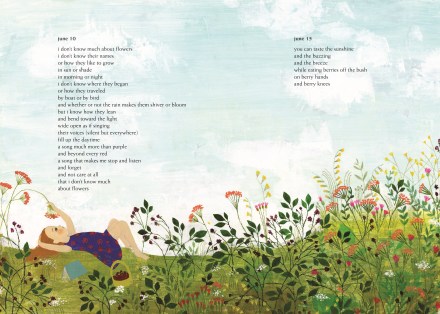
At last summer comes and on june 15 “you can taste the sunshine / and the buzzing / and the breeze / while eating berries off the bush / on berry hands / and berry knees.” The warm days also bring swimming holes and fireflies, and by july 10 “when green becomes tomatoes / there will be sky / and sun / and possibly a cloud or two…” and summer bursts with all the wonder that makes it such a yearned for season.
Then as summer wanes and the nights grow dark, september 10 makes you look into that deep vast space and think “a star is someone else’s sun / more flicker glow than blinding / a speck of light too far for bright / and too small to make a morning”
Image copyright Julie Morstad, text copyright Julie Fogliano. Courtesy of us.mcmillan.com
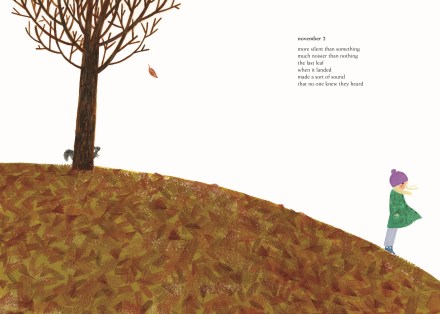
A nip in the air means Fall has come around again. It’s time for sweaters and pumpkins, and for the trees to rest. If you listen carefully, you may hear on november 2 “more silent than something / much noisier than nothing / the last leaf / when it landed / made a sort of sound / that no one knew they heard.”
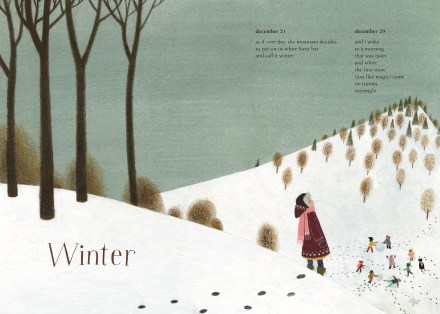
Then on december 21 “as if one day, the mountain decides / to put on its white furry hat / and call it winter” the season has changed, bringing with it crackling, cozy fires and snow, snow, snow. But this too offers its own enchantment on december 29: “and i woke / to a morning / that was quiet / and white / the first snow / (just like magic) came / on tiptoes / overnight.”
Image copyright Julie Morstad, text copyright Julie Fogliano. Courtesy of us.mcmillan.com
When Green Becomes Tomatoes begins and ends with a poem dated the same day—March 20, the vernal equinox—giving this book a cyclical form that echoes the passing of time. Julie Fogliano’s delicate and gentle poems are a perfect tonic for the busy, non-stop days the year becomes. Instead of letting the surprising, profound, or beautiful moments pass us by Fogliano gives readers a reason and a way to stop and fully enjoy them.
In Julie Morstad’s gorgeous watercolors of nature and the changing seasons, readers can almost feel the warm sunshine that feeds the vivid spring and summer blooms, the icy breeze that loosens the last leaf of autumn, and the fluffy blanket winter tucks around the earth. The multiethnic children in Morstad’s paintings are thoughtful, charming, and enchanted with the world around them, actively experiencing the marvels of each changing day.
When Green Becomes Tomatoes contains such lovely verses that readers will want to revisit them over and over – the way the seasons recur and we are always glad to welcome each one back. This volume of poetry would make a wonderful gift and a terrific addition to anyone’s bookshelf.
You’ll find a gallery of picture books, prints, and other illustrations on Julie Morstad‘s website!
Random Acts of Poetry Day Activity
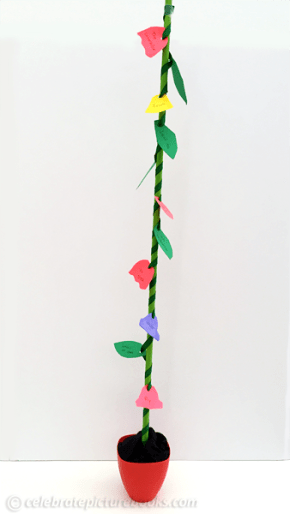
Grow a Poem Craft
A poem often grows in your imagination like a beautiful plant—starting from the seed of an idea, breaking through your consciousness, and growing and blooming into full form. With this craft you can create a unique poem that is also an art piece!
Supplies
Printable Leaves Template, available here and on the blog post
Printable Flower Template, available here and on the blog post
Wooden dowel, ½-inch diameter, available in craft or hardware stores
Green ribbon
Green craft paint
Green paper if leaves will be preprinted
Colored paper if flowers will be preprinted
Flower pot or box
Oasis, clay, or dirt
Hole punch
Glue
Markers or pens for writing words
Crayons or colored pencils if children are to color leaves and flowers
Directions
Paint the dowel green, let dry
Print the leaves and flower templates
Cut out the leaves and flowers
Punch a hole in the bottom of the leaves or flowers
Write words, phrases, or full sentences of your poem on the leaves and flowers (you can also write the poem after you have strung the leaves and flowers)
String the leaves and flowers onto the green ribbon (if you want the poem to read from top to bottom string the words onto the ribbon in order from first to last)
Attach the ribbon to the bottom of the pole with glue or tape
Wrap the ribbon around the pole, leaving spaces between the ribbon
Gently arrange the leaves and flowers so they stick out from the pole or look the way you want them to.
We love animals, but do we take care of them the way we should? Today’s holiday was established in 1931 to promote global awareness of animals and the issues surrounding their welfare. From pets to domesticated animals to wild creatures, humans must protect and advocate for their companions and fellow travelers on this earth. Issues such as pollution, habitat destruction, and poaching threaten the world’s wide variety of species, while closer to home spaying and neutering controls the population of feral animals that often suffer from a lack of resources.
The wildlife kingdom is majestic and awe-inspiring. Today celebrate the world’s animals by taking a trip to a zoo, aquarium, or animal preserve, consider adopting a shelter animal, or donating your time or talents to your favorite animal cause.
Pink is for Blob Fish: Discovering the World’s Perfectly Pink Animals
Written by Jess Keating | Illustrated by David DeGrand
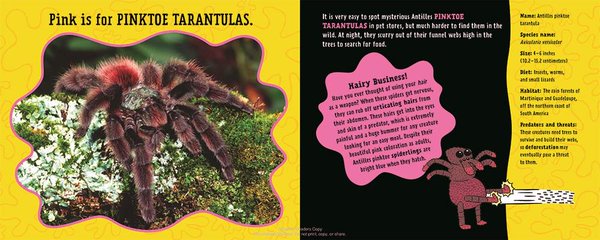
Pink is sweet like cotton candy, right? Pink is pretty like a rose, isn’t it? Pink is quiet like twightlight, don’t cha think? Well…yes, and…maybe not so much. You’d be pardoned for squirming in the presence of a pinktoe tarantula which is found in the rain forests of Matinique and Guadeloupe and can defeat predators with their spiky hairs, and if you can’t make heads or tails of the Pink Fairy Armadillo, which looks like a cross between a lobster tail and a shag rug, no one will blame you.
Text copyright Jess Keating, illustration copyright David DeGrand, courtesy of Penguin Random House
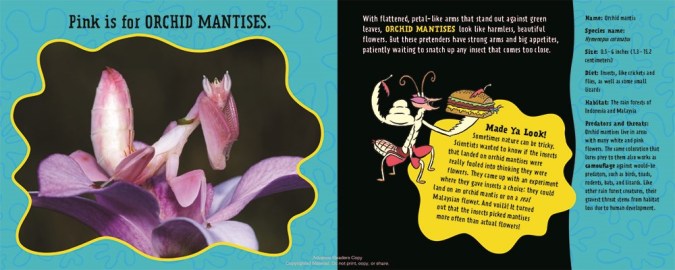
But the world is full of pink, and for each of these grimace-inducing bubble-gum-hued creatures there are plenty who simply take your breath away with their beauty. Imagine watching a duo-toned light-and-dark-pink Roseate Spoonbill take off and soar over marshland along America’s Gulf Coast or a river in South America or the West Indies like a valentine on the wind. You will likewise marvel when you see the delicate form of the Orchid Mantis. This variety of praying mantis found in the rain forests of Indonesia and Malaysia is so identical to real orchids that other insects can’t tell the difference and often land in the grasp of their tricky predator.
Text copyright Jess Keating, illustration copyright David DeGrand, courtesy of Penguin Random House
Seas and rivers also teem with pink wildlife. Pygmy Seahorses swimming in the waters of the South Pacific blend in to their coral surroundings like a spiky ball among hedgehogs. With white-and-pinkish bodies dotted with strawberry-colored knobs, these seahorses are perfectly camouflaged against predators. The rose-colored Amazon River Dolphin hunts for piranhas, crustaceans and bottom dwelling fish with its long snout in the freshwater rivers of South America. The rivers, lakes, and swamps of sub-Sahara Africa are home to Hippopotamuses, which “ooze thick pink oil all over their skin. This pink ‘sweat’ acts like an antibiotic sunscreen, so hippos can stay out in the sun all day without getting burned.” Imagine if you could do that!
Of course, there is also the Blobfish, recently voted as the world’s ugliest animal. But isn’t this little glob of gelatinous goo really so ugly it’s cute? Found in deep waters off the coasts of Australia and New Zealand, this fish survives where others cannot by simply opening its mouth and gobbling down whatever floats by.
With many more examples of pink wildlife in this captivating book, it’s guaranteed that after flipping through the pages of Pink is for Blobfish you will never look at pink the same way again!
Text copyright Jess Keating, illustration copyright David DeGrand, courtesy of Penguin Random House
Jess Keating highlights a host of fascinating pink animals in this volume that is sure to delight kids and get them excited about the world less seen. The first in the World of Weird Animals series, Pink is for Blobfish is loaded with scientific facts, remarkable trivia, and humorous asides to pique the interest of readers’ inner zoologist. Each two-page spread provides a spectacular up-close photograph of the animal, insect, or fish described as well as its common name, species name, size, diet, habitat, and predators or threats. Keating also taps into her audience’s love of the unique and even the bizarre with conversational paragraphs that reveal unusual habits, traits, survival mechanisms, and more for each creature featured.
David DeGrand lends his unique illustration style to the pages with funny cartoon portrayals of the creatures and one of their signature traits. These humorous depictions will not only make kids and adults laugh but will promote better understanding of each unique animal.
Pink is for Blobfish is a perfect addition to personal libraries for budding environmental scientists or anyone interested in the wider, wilder animal world and is an exciting title for school libraries and classrooms, where it could inspire scientific study.
Ages 5 – 10
Knopf Books for Young Readers, Penguin/Random House, 2016 | ISBN 978-0553512274
You’ll discover books, videos, creature features, resources, and lots more on Jess Keating’s website!
You will find the world of David DeGrand‘s art and comics on his website!
Pink is for book trailers—at least this one!
World Animal Day Activity
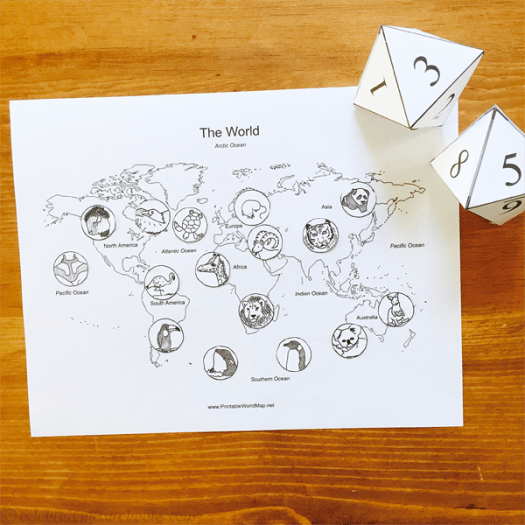
Play the Wonderful Wildlife Board Game! Animal tokens images copyright Conor Carroll
Wonderful Wildlife Board Game
Fascinating animals are found in every part of the world. Play this fun printable Wonderful Wildlife Board Game to match each animal to the area where it lives.
Print one set of 16 Wildlife Tokens for each player
Print two copies of the 8-sided die, fold, and tape together
If you would like, color the map and tokens
Choose a player to go first
Each player rolls both dice and places an animal on their map according to these corresponding sums of the dice below
The first player to fill their map is the winner!
1 = Flamingo – South America
2 = Emperor Penguin – Antarctica (Southern Ocean)
3 = Giraffe – Africa
4 = Bald Eagle – North America
5 = Ibex – Europe
6 = Kangaroo – Australia
7 = Panda – Asia
8 = Orca – Antarctica (Southern Ocean)
9 = Toucan – South America
10 = Buffalo – North America
11 = Koala – Australia
12 = Lion – Africa
13 = Etruscan Shrew – Europe
14 = Manta Ray – Pacific Ocean
15 = Sea Turtle – Atlantic Ocean
16 = Tiger – Asia
Q&A with Author Jess Keating
Today I’m tickled pink to talk to Jess Keating about her work as a zoologist and an author, her favorite animals, and a very cool holiday tradition.
In your work, your books, and your online presence, you bring kids and adults closer to the animal kingdom. What in your early years inspired you to become a zoologist?
I wish there was one poignant answer to this question! The truth is, all my life I’ve been enamored with animals. A physicist I admire once said this: The world is beautiful to look at, but it’s even more beautiful to understand. To me, that sums it all up perfectly.
As a kid, animals sparked my curiosity, my imagination, and even my creativity. The diversity they represent is so amazing to me—they all live their lives so differently, with different senses, abilities, and environments, yet it works perfectly for them. I instantly felt a kinship with them, and as a kid, I wanted to know everything about them.
As I got older and was able to really get into zoology, my goal shifted. The world of animals is so endlessly fascinating, and I now I want to take every opportunity to share it with others, especially young readers.
All animals are amazing, but do you have a soft spot for one particular animal or species? If so, why?
Now this is such a hard question! My favorite animal has always been the wolf. I was lucky enough to see one in the wild once, and it’s pretty hard to come away from that experience without believing in magic!
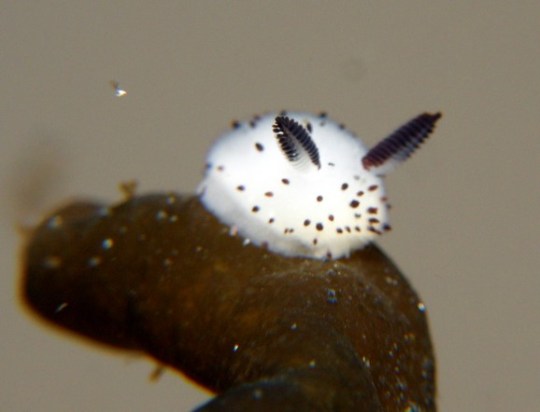
Lately, I also have a soft spot for nudibranchs! I included one (the Hopkins’ rose nudibranch) in my last book, but there are so many other species that we know so little about! As I mentioned above, it’s the diversity that takes my breath away. Some of them look like bunnies:
Image courtesy of crawl_ray on flickr.com
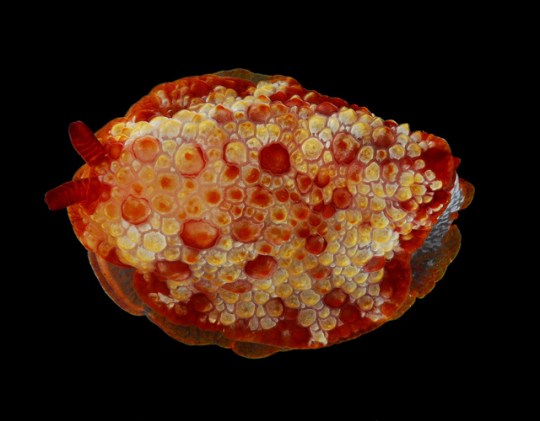
Some even look like pizzas!
Image courtesy of Arthur Anker on flickr.com
You do such a great job of reaching out to kids through videos, KeatingCreature on Twitter, your YouTube Channel: Animals for Smart People, personal appearances, and Skype visits. Can you describe a funny or favorite anecdote from one of your events?
Thank you for the Youtube shout out! I really hope teachers find my videos useful! As for a favorite event, when you mix animals and kids, the results are often hilarious. Usually, my visits involve a lot of dead things. I bring a collection of skulls, animal bones, and animal track castings with me. Every so often, we get lucky with some live specimens.
One of my favorite events was a library visit that involved a 10+ foot python. I had her resting on my shoulders (as you do), and I remember laughing because almost all of the adults in the room were skittish, backing off toward the door.
When I asked who else wanted to hold this lovely python, every adult shook their head. There was no way they were going near it! But then, a tiny six year old girl rushed up to the front, with a massive smile on her face. She wasn’t afraid at all as she held that snake—and I’m pretty sure that her big moment meant as much to me as it did to her!
What inspired you to write Pink is for Blobfish?
Pink is for Blobfish is a book so close to my heart! I know that sounds strange, because it’s essentially a book filled with weirdos!
As you can probably guess, I’ve been reading animal books my whole life. I loved them all, but what I really wanted was to write something that says as much about us as it does about the wild animals on each page. A book that not only shares amazing animals with kids, but also gets them thinking critically about how they view the world, especially regarding their assumptions and judgments. Pink is for Blobfish is my way of getting readers to look at gender expectations, while (hopefully) instilling them with a little wonder about the natural world.
There’s so much humor in your writing and videos. How does your love of comedy help you connect to readers?
The short answer is, I’m just a big ham and love making people laugh. There’s also the added bonus with nonfiction: we’re much more likely to remember something if we connect with it emotionally. My way of accomplishing that is to be funny and get kids laughing. Fiction or nonfiction, one of the easiest ways for me to reach readers is through a well-timed joke.
But, you can also get a little deeper with it. I once heard that Jim Carrey doesn’t think of his job as “making people laugh.” Instead, he views it as “freeing people from concern.” The minute I heard that, it resonated with me. For those few moments, when you’ve got a reader laughing, they’re free from any concern in their lives. It’s a reprieve, a bright moment. It’s true for us as adults too—it’s pretty much impossible to be stressed out when you’re reading about a pigeon that wants to drive a bus!
Now, when I approach my writing, I look for those moments. If I can make myself laugh, that’s half the battle.
What’s the best part about writing books for kids?
For both fiction and nonfiction, my favorite part is seeing the look on a kid’s face when you open a door for them into a whole new world. Sometimes, it’s the ridiculously colorful world of nudibranchs. And sometimes, it’s helping them to the realization that they aren’t alone, no matter how weird they feel.
What’s up next for you?
I’m so glad you asked! I just received F&Gs of the second book in the World of Weird Animals series! I can’t give away the title just yet, but I can say we are going to look at MONSTERS. This isn’t just going to be a book of creepy creatures. We’re going to dig into why we see certain animals as monsters, and how those judgments and assumptions affect how we think of them. I was blown away with the discussions that Pink is for Blobfish prompted with kids, and I can’t wait to see how they respond to this book!
I also have my first picture book biography, SHARK LADY, coming out next year! I’ve always been a fan of sharks, and I was thrilled to tell the story of Eugenie Clark, one of the world’s first female shark scientists. Eugenie is one of those incredible women that changed the world just by being her fearless self, and I am so eager to share this book with everyone. Look for it around June!
I can’t let you get away without asking you a few holiday-themed questions, so…
You told me that World Animal Day is one of your favorite holidays. Can you talk a little about that?
What could be better than a day devoted to animals!? World Animal Day is a day to chat about animals all over the world, and how we can best protect them and their futures. A funny thing happens when you start talking about animals in the global sense—you can’t help them without also helping us. Education and awareness can accomplish so much!
Do you have an anecdote from any holiday that you’d like to share?
I have one that ties in really well here! When I was a teen, I had a really cool Christmas tradition that I highly recommend to parents of animal lovers. On Christmas morning (or any special holiday morning for you!) I would go to my local humane society, bring treats, and walk the dogs. Usually, these centers have lots of volunteers, but busy holidays are often pretty slow for them and there’s not a lot of help. I guarantee the dogs will love the company, and you’ll get to spend an hour surrounded by wagging tails! You can’t lose.
Has a holiday ever influenced your work?
Yes! A very savvy bookstore (DDG Books!) organized a “Valentine for Blobfish” event when Pink is for Blobfish came out. So many young readers felt bad that the blobfish was voted the world’s “Ugliest Animal” (true story!) and they wanted to send him valentine cards to make him feel better!
Thank you, Jess! It’s been so much fun! I wish you all the best with all of your books and your other ventures!
Learn more about Jess Keating!
As a zoologist turned middle grade and picture book author, Jess Keating has been sprayed by skunks, bitten by crocodiles, and been a victim to the dreaded paper cut. Her MY LIFE IS A ZOO series earned two Kirkus stars, a Red Maple nomination, a Rocky Mountain Book Award nomination, and a spot on the LA Times Summer Book Pick List.
Her quirky nonfiction picture book series kicked off with PINK IS FOR BLOBFISH, with a sequel to follow in 2017. Her first picture book biography, SHARK LADY, will also be published in 2017.
Jess is also the creator, writer and host of Animals for Smart People, a Youtube series about animals, science, and nature. Subscribe today and bring Jess into your classroom!
Connect with Jess Keating:
You can find Jess on Twitter @Jess_Keating and on Facebook @JessKeatingBooks!
Pink is for Blobfish can be found at these booksellers

















 celebratepicturebooks.com