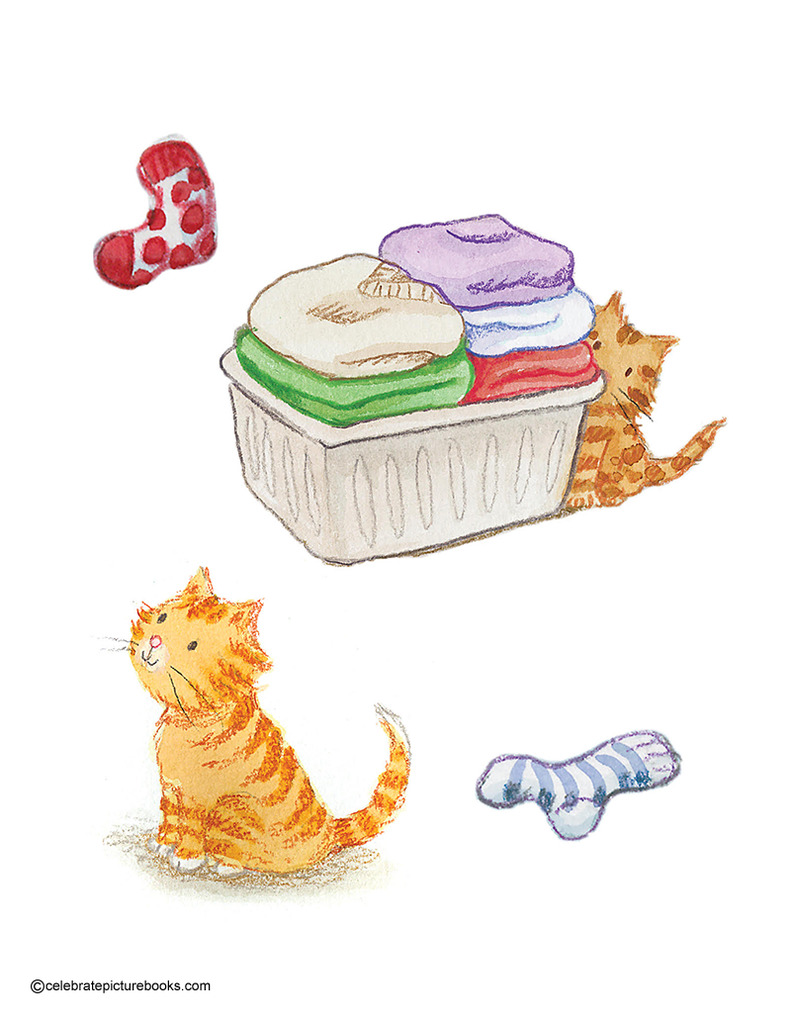
Today’s holiday recognizes that some things are just so fun or compelling that you want to do them again and again (ok, yeah…and maybe even again). So if you have a favorite song, show, or activity that you just can’t get enough of, hit that Repeat button and enjoy!
Before and After
By Jean Jullien
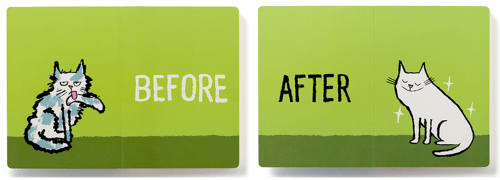
In this original and funny concept book, kids learn the idea of “before” and “after” with repeated examples of cause and effect. Opening the book, readers meet a Before soon-to-be mom and dad standing belly to belly. Turning the page, they see After, where a now-svelte Mom smiles as the baby hugs Dad, while riding atop a soft seat. Moving on, a rakish cat begins grooming her paw in a portrait of Before. Soon After she is sparkling clean, and her coat is smooth.
Copyright Jean Jullien, courtesy of Phaidon Press, 2017
Hmmm…what are those yellow sticks or straws or pasta noodles Before they become ?? Ha! Nailed it! After, those lines became a nice, hot, plate of spaghetti and meatballs! On the next page a child with very long hair is wearing a mischievous look Before. But—Ack! After, that hair has been cut very, very—did I mention very?—short, and the child’s expression is a little bugged out! What’s next? Way After—when the hair is back to its starting point and contentment reigns.
Copyright Jean Jullien, courtesy of Phaidon Press, 2017
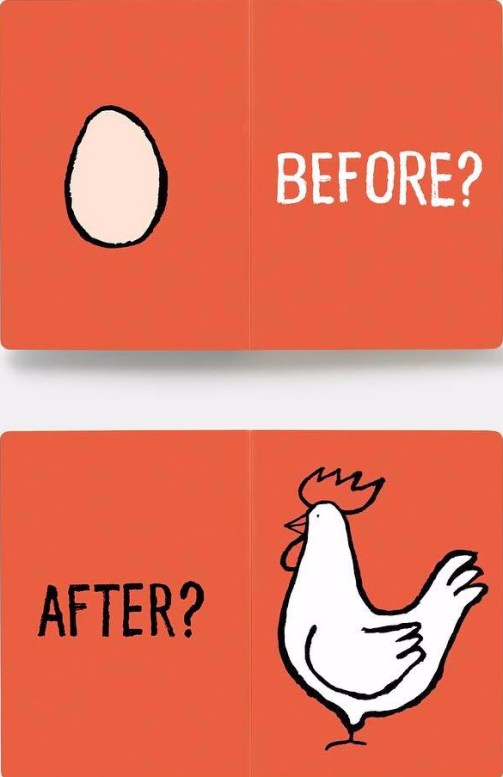
Are you a half-full or a half-empty kind of person? Either way the glass and bottle are partly full Before, and the glass and bottle are partly full After—but in differing amounts. Ah! The age-old question has made an appearance: Which came Before? The egg? And which came After? The chicken? Or is it the other way ‘round?
Copyright Jean Jullien, courtesy of Phaidon Press, 2017
At the amusement park, a dad and child—every hair in place—wait in the roller coaster car Before. The dad is all smiles; the child a little wary. After, they sport the wind-blown look, while the child is all smiles and the dad is a bit shaken up. So what caused this change? During—which was a loop-the-loop, up-and-down, high-speed, no-hands thrill! A summer day takes its toll on the girl in the next scene: Before, she arrives at the beach with her shades firmly in place. But After a day of fun in the sun, those shades have left a pale mask on her now-burned face.
Copyright Jean Jullien, courtesy of Phaidon Press, 2017
And so we have come to…The Beginning? Yep, that is definitely the beginning of a Dalmatian. Let’s flip the page and see…Ah, yes! And so we have come to The End! (Or the tail—however you’d like to look at it.)
Jean Jullien’s humorous concept book will have kids and adult readers giggling and wondering what comes next page after page. While the text is minimal, the images offer a wealth of opportunities for kids to build prediction skills and talk about how Before became After. The bold images and backgrounds from a modern color palette—as well as the double fold-out roller coaster spread—will engage readers and make Before & After as much an art book as a fun learning tool.
A fun take-along book on outings or for waiting times, Before & After can spur your own game of contrasts.
Ages 2 – 5
Phaidon Press, 2017 | ISBN 978-0714874081
View a portfolio of artwork by Jean Jullien on his website!
Repeat Day Activity
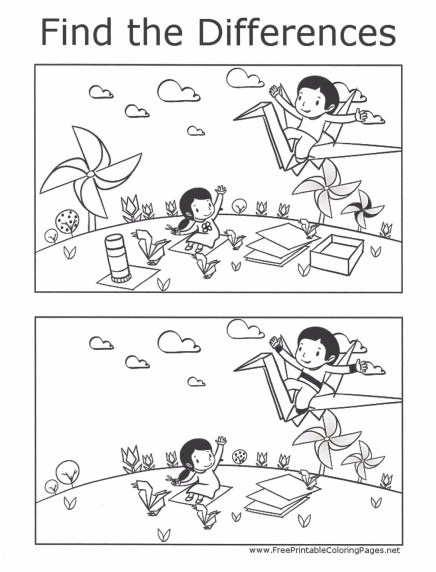
Flying Origami Find the Differences Puzzle
These two kids are making origami. While these pictures may look like repeats, there are ten differences. Can you find them all in this printable Flying Origami Find the Differences Puzzle?
When you love to read, you want to share the excitement that books hold. Get Caught Reading Month encourages people to pass along their love of all things written by asking folks to take pictures of themselves reading their favorite book and uploading those images to social media. Movie and TV celebrities, sports figures, authors, illustrators, teachers, mom, dads, grandmas and grandpas, and kids of all ages take part in this favorite annual event. Why don’t you?!
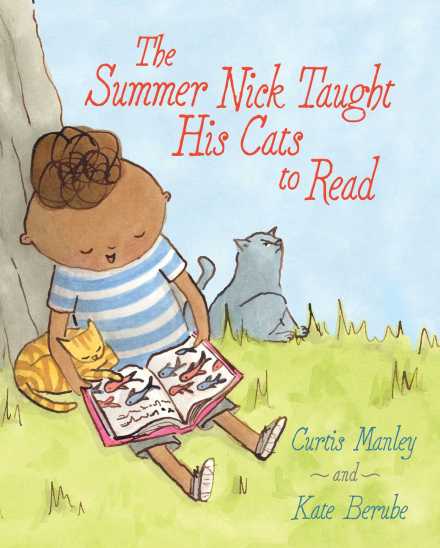
The Summer Nick Taught His Cats to Read
Written by Curtis Manley | Illustrated by Kate Berube
One summer Nick, Verne, and Stevenson did everything together. Nick is a little boy and Verne and Stevenson are two very different cats. Nick and Verne loved to spend time near the water—Stevenson tolerated it. Nick and Verne slept happily in a tent under the stars—Stevenson barely shut his eyes. While Nick rode his bike Verne eagerly sat in the front basket—Stevenson hunkered down in a box on the back. But when Nick sat down to read, both cats had similar ideas of fun—like lying on top of the book—and Nick could hardly read a sentence.
Image copyright Kate Berube, text copyright Curtis Manley, courtesy of simonandschuster.com
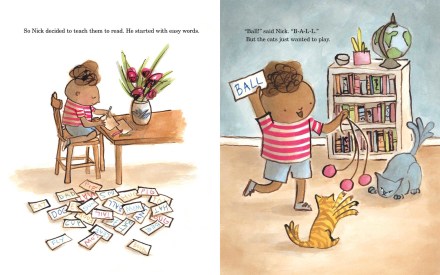
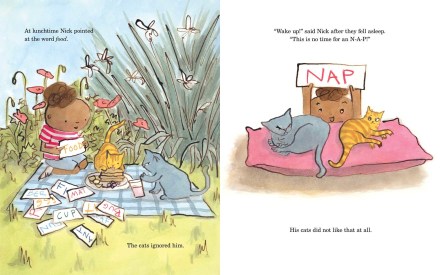
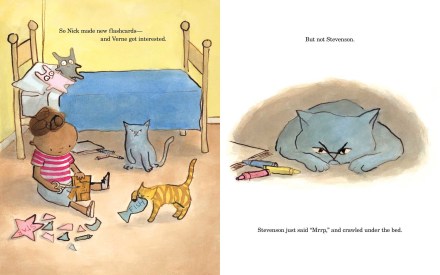
“So Nick decided to teach them how to read. He made flash cards and started with easy words” like “ball,” but Verne and Stevenson just wanted to play with the ball. While the three had a picnic on the lawn, Nick brought out his flashcards and “pointed to the word food. The cats ignored him.” When the cats snoozed Nick woke them with a sign. “‘This is no time for an N-A-P!’” he said. Neither cat responded well, so Nick tried a new tactic. He made word-shaped flash cards. Verne took a nibble of “F-I-S-H,” but Stevenson hid under the bed.
Image copyright Kate Berube, text copyright Curtis Manley, courtesy of simonandschuster.com
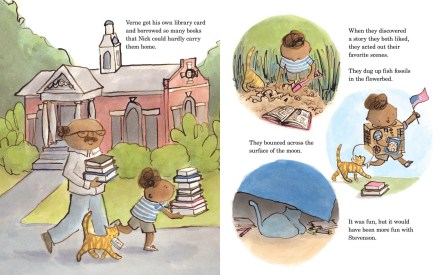
Nick began to see that Verne liked stories about cats and fish. “Verne loved fish. He followed along as Nick read, learning the sounds of the letters.” He even read by himself, discovering new stories, especially 2,000 Leagues Under the Sea. But Stevenson? When Nick spelled words for him, he merely ran under the porch, hissing. By this time Verne was reading so many books that he got his own library card and Nick needed help carrying all of his books home. Nick and Verne had fun acting out their favorite stories, but they missed Stevenson.
One day “Verne discovered a treasure under the bed—a great stack of Stevenson’s pirate drawings. “‘Wow!’” Nick whispered. “‘Stevenson drew a story.’” Nick and Verne put the pages together and began to write words to go with them. When the story was finished, Nick, Verne, and Stevenson “squeezed under the porch, gave Stevenson an eye patch, and read The Tale of One-Eyed Stevenson and the Pirate Gold. Stevenson listened and followed along. He didn’t run away. Or hiss. Not even once.”
Image copyright Kate Berube, text copyright Curtis Manley, courtesy of simonandschuster.com
Suddenly, Stevenson couldn’t get enough of books. Even before Nick woke up, Stevenson could be found with his nose in Treasure Island or another adventure book, and whenever Nick and Verne played pirates, Stevenson joined in. He helped bring down “scurvy mutineers” and found buried treasure. Now the three readers do everything together. They “hunt for dinosaurs in the lost world behind the garden…race around the yard in eighty seconds…and journey to the center of the basement.” And while they all like to read on their own, they also like it when someone reads to them. “Hmmm…,” Nick thinks, maybe next he could teach his cats to talk. “‘Meow,’ says Stevenson.”
Image copyright Kate Berube, text copyright Curtis Manley, courtesy of simonandschuster.com
Curtis Manley’s adorable tribute to reading and learning to read, using cats with very different personalities, is inspired. Just as some people respond more to the words while others are attracted by the pictures, Verne and Stevenson have their own relationships with books. The names of the cats and their preferred reading material are also reminders that books are personal, and disinterest in one type of story does not reflect disinterest in all stories. Manley’s text makes for a joyful read-aloud as his language and phrasing is evocative, lyrical, and imaginative.
In perfect accompaniment, Kate Berube brings this creative story to life, illustrating the tender relationship between Nick and his pets as well as emphasizing the humor and distinct personalities inherent in orange-striped Verne and smoky-gray Stevenson that influence their journeys to literacy. Depictions of the various books Verne and Stevenson are drawn to highlight the literary references in the trio’s further play. Readers will want to stop and peruse the page of library shelves, where such books as “Harry Picaroon and the Swashbuckler’s Stone”, “Harold and the Purple Canon”, “Millions of Rats”, and “Where the Wild Pirates Are” wait to be checked out in the Pirates section.
Kids will eagerly want to adopt The Summer Nick Taught His Cats to Read, and it will snuggle in nicely on children’s bookshelves.
Ages 4 – 8
Simon & Schuster Books for Young Readers, 2016 | ISBN 978-1481435697
Discover “the facts, fictions, poems, and numbers” of Curtis Manley on his website!
View a gallery of Kate Berube‘s art on her website!
Get Caught Reading Month Activity
Feline Fine about Reading Bookmark
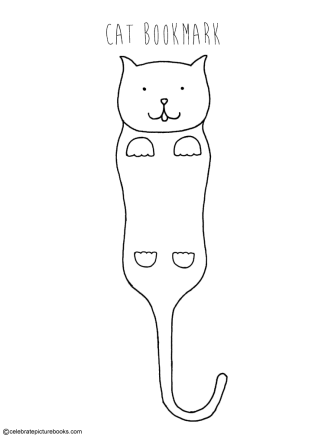
This want-to-be literary lion feels fine about reading! Let it hold your page while you’re away! Print your Feline Fine about Reading Bookmark and color it!
Admit it—you have a ton of questions. These days, don’t we all! Well, now’s the time to get them out there! Go on—even if you think it’s silly or it seems as if everyone else understands (believe me, they don’t!)—ask away! It’s only through questions that we learn the truth or make new discoveries. Little ones seem to come preloaded with questions, and each one is an opportunity for you to introduce them to our world!
Do You See My Tail?
By Anita Bijsterbosch
A bushy tailed animal hails readers from its place in the treetop—“Do you see my tail? Guess who I am!” A red-bellied bird, butterfly, cricket, spider, and ladybug are all standing by to find out too. Opening the flap, little ones are cheerfully greeted by a squirrel who is feeding its babies. “My babies live in a nest in a hollow tree. They like acorns,” the squirrel says. The young squirrels happily reach for the tasty nuts while their mom or dad says, “Hello, squirrel. Hello, sweet baby squirrels.’
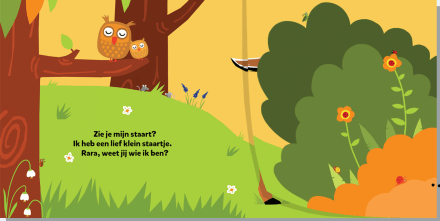
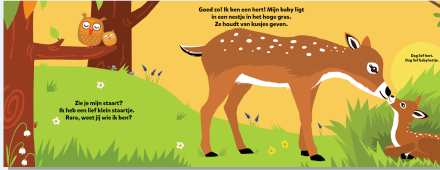
On the next page, a small, brown tail trimmed in black and white peeks out from behind a bush. “Do you see my tail?” the owner asks. “I have a cute little tail. Guess who I am!” Two sleepy owls, a pair of mice and adorable insects can’t wait to find out either. The open flap reveals a mother deer and her fawn who is “lying in a little nest in the high grass.” As the two give kisses, Mom says, “Hello, deer. Hello, sweet baby deer.”
Copyright Anita Bijsterbosch, courtesy of anitabijsterbosch.nl. Image from the original Dutch-language edition.
Next, a long black feathered tail pokes out from behind a tree. This tail belongs to a bird, and it’s fluffy babies are getting a nutritious worm snack. “How loudly they chirp,” the bird tells readers. Along with their meal, the babies get a little love: “Hello bird. Hello, Hello, sweet baby birds.” Turning the page, young readers see a flat brown tail dipping into the water. Inside the flap a beaver cuddles three babies who “are playing in a nest made of tree trunks and branches.”
“Do you see my tail?” the next animal asks. Who could that ball of fluff belong to? Lift the flap to discover an adult rabbit and four scampering babies “hopping around in a hole under the ground.” You can tell the rabbits hello! “Hello, rabbit. Hello, sweet baby rabbits.” A flip of the page reveals another part of the woods where a fiery red tail sways to and fro in the hedges, a woodpecker makes a hole in a nearby tree trunk, and tiny insects enjoy the day. Baby foxes “love to frolic” in their underground nest.
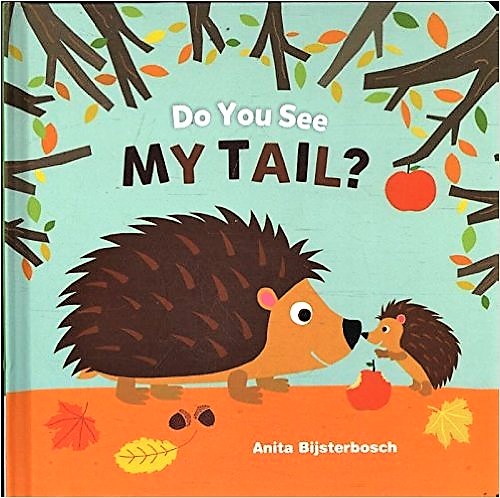
Can readers spot the next animal’s “teeny tiny tail” and guess who it belongs to? Under the flap they will find a hedgehog and three babies “sleeping and eating in a nest made of branches and leaves.” The hedgehogs love the apples that fall from the nearby tree. Say hello to the little hedgehogs! “Hello, sweet baby hedgehogs.”
Copyright Anita Bijsterbosch, courtesy of anitabijsterbosch.nl. Image from the original Dutch-language edition.
Anita Bijsterbosch’s charming lift-the-flap book introduces toddlers and young children to a variety of animals and their babies through one easily identifiable feature. Each invitation to guess is followed up by a positive, upbeat answer that rewards a little one’s efforts. Two more complete sentences reveal information about the animal’s home as well as a behavioral trait that mirrors the kind of fun or snuggling that young children like to do themselves. The repeated greeting to each animal and their “sweet” babies not only emphasizes the love that families have for each other, but also provides a gentle lesson in the singular and plural forms of each animal’s name. The rich choices, such as frolic, bushy, and hollow used throughout the story promote early language development.
Bijsterbosch’s colorful pages will enchant young readers as cute birds, insects, mice, and other small creatures join in the fun. The fold-out flap is large enough for a detailed depiction of each animal and their home, and the bright eyes and friendly smiles of the adult and baby animals invite children in to learn and play. Little ones will love to name the other creatures and talk about their different habitats. The open art style offers opportunities to count and to discuss concepts such as in, out, inside, outside, on, near, and far, which are the building blocks of early math literacy. Readers will also love looking for the little ladybug on each spread.
Do You See My Tail? would be a wonderful early addition to any toddler’s or young child’s home bookshelf.
Ages 1 and up
Clavis, 2017 | ISBN 978-1605373201
International Ask a Question Day Activity
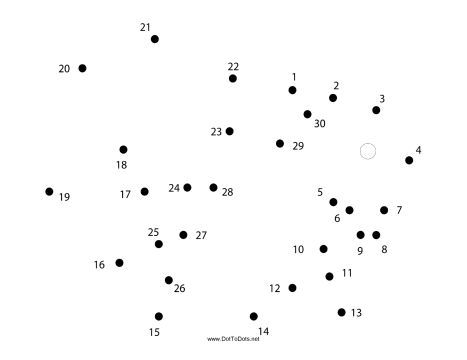
Cute Dot-to-Dot Pages
Can you guess what animals you’ll find when you connect the dots in these two printable Cute Dot-to-Dot Pages?
From the moment babies are born, they are learning. Talking and reading aloud to babies from the very beginning are crucial parts of helping their developing brain learn language and improves literacy in the years to come. Reading aloud to babies and older children for only 15 minutes a day makes a tremendous and beneficial difference to their future. Make reading time a special time with your kids, and with so many wonderful books available—like today’s book—you’ll have as much fun as they do!
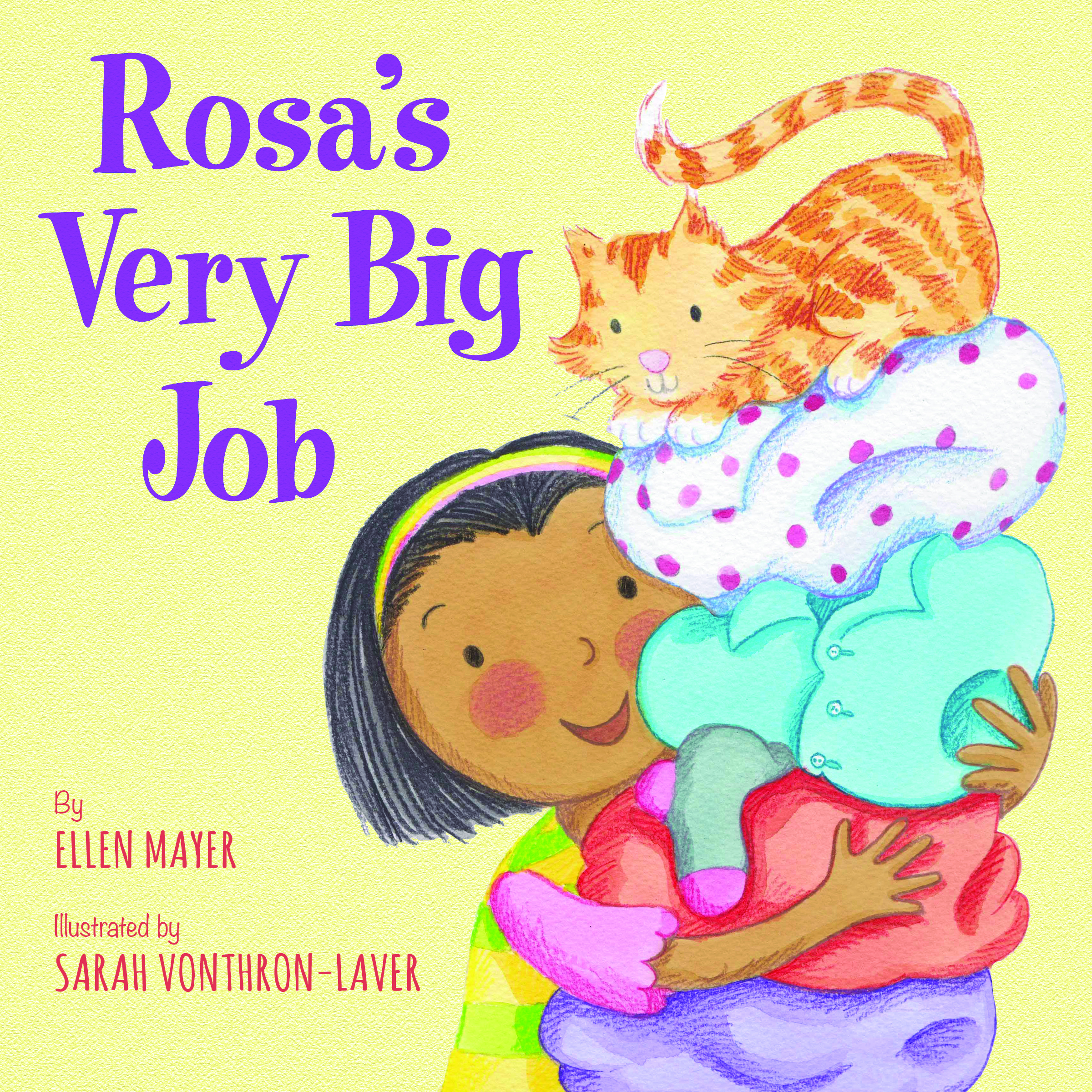
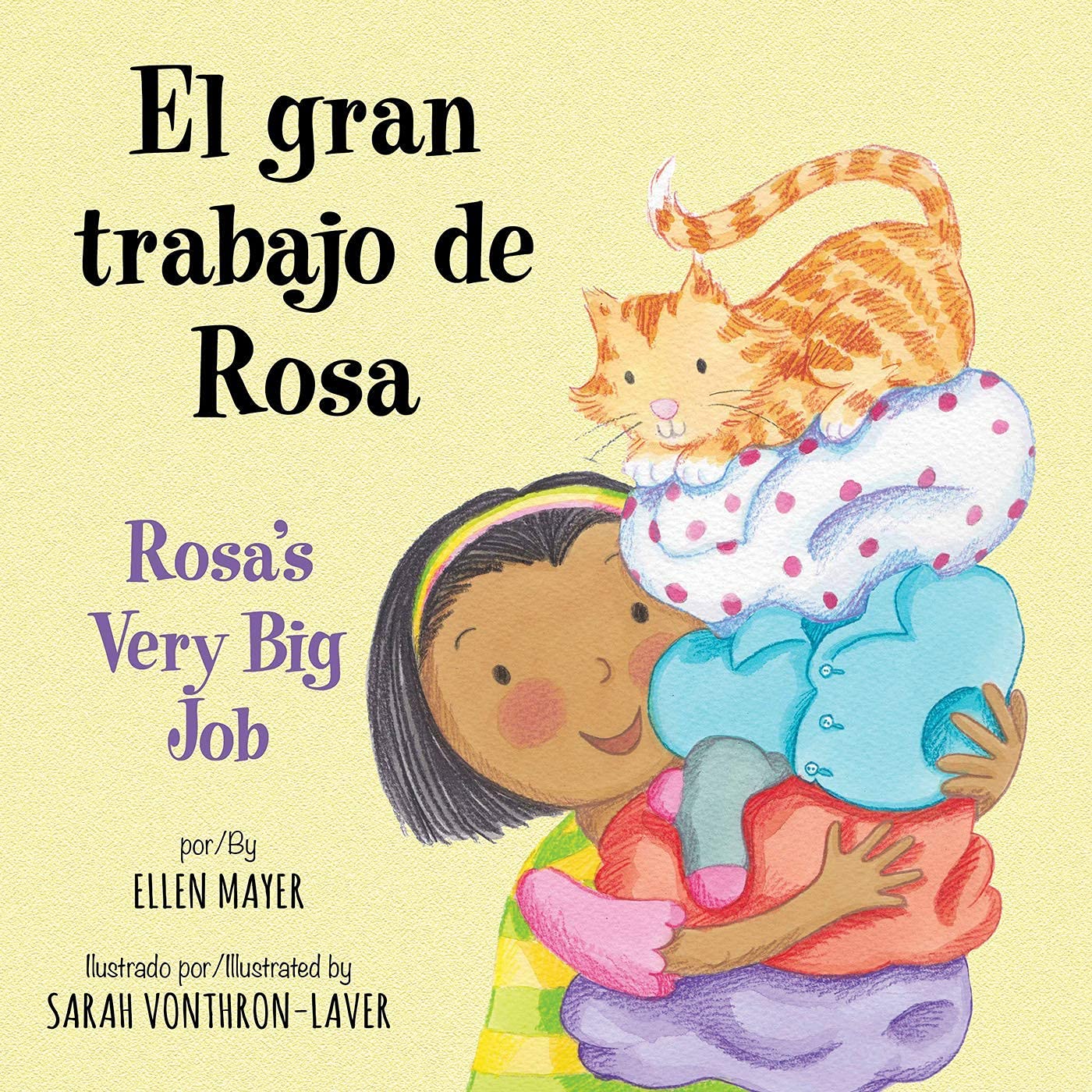
Rosa’s Very Big Job
Written by Ellen Mayer | Illustrated by Sarah Vonthron-Laver
Rosa may be little, but she has big ideas about how to help. While Mama is out shopping for groceries for that night’s dinner, Rosa decides to surprise her by folding and putting away the laundry. The basket is piled high with fluffy dry clothes, sheets, and towels. Rosa watches her grandpa reading the newspaper. “‘Please help me, Grandpa!’” she says. She tugs on her grandpa’s hands, trying to pull him out of his chair. “‘Come on, Grandpa! Get up.”
Image copyright Sarah Vonthron-Laver, text copyright Ellen Mayer, courtesy of Star Bright Books, starbrightbooks.com
Grandpa seems to have a little trouble managing: “‘It’s difficult to carry these enormous piles,’” he sighs. But Rosa knows that smaller armloads work better. Grandpa’s clothes come unfolded as he puts them in the drawer. “‘Be neat. Like me,” Rosa says, showing him her tidy stack. Poor Grandpa! He has to keep hanging up the same jacket over and over. “‘It’s difficult to keep this jacket from sliding off the hanger,” he says. Rosa has the answer: “‘Zip it up,’” she explains. “‘Then it stays on.’”
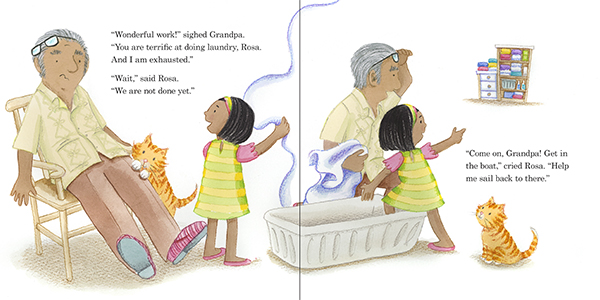
Grandpa sinks back into his chair. “‘You are terrific at doing laundry, Rosa. And I am exhausted,’” he says. But this is no time to quit—Rosa has big plans. As she steps into the now empty laundry basket, she exclaims, “‘Come on, Grandpa! Get in the boat. Help me sail back to there.’” Rosa points to the linen closet.
Image copyright Sarah Vonthron-Laver, text copyright Ellen Mayer, courtesy of Star Bright Books, starbrightbooks.com
Suddenly, the floor swells with ocean waves teeming with fish. Grandpa channels his inner sailor as he holds aloft a sheet as a sail. As the wind billows and they come perilously close to the kitchen table, he says, “‘It’s difficult to sail around this enormous rock!’” Contemplating the rising sea, he exclaims, “‘It’s difficult to sail over this enormous wave!’”
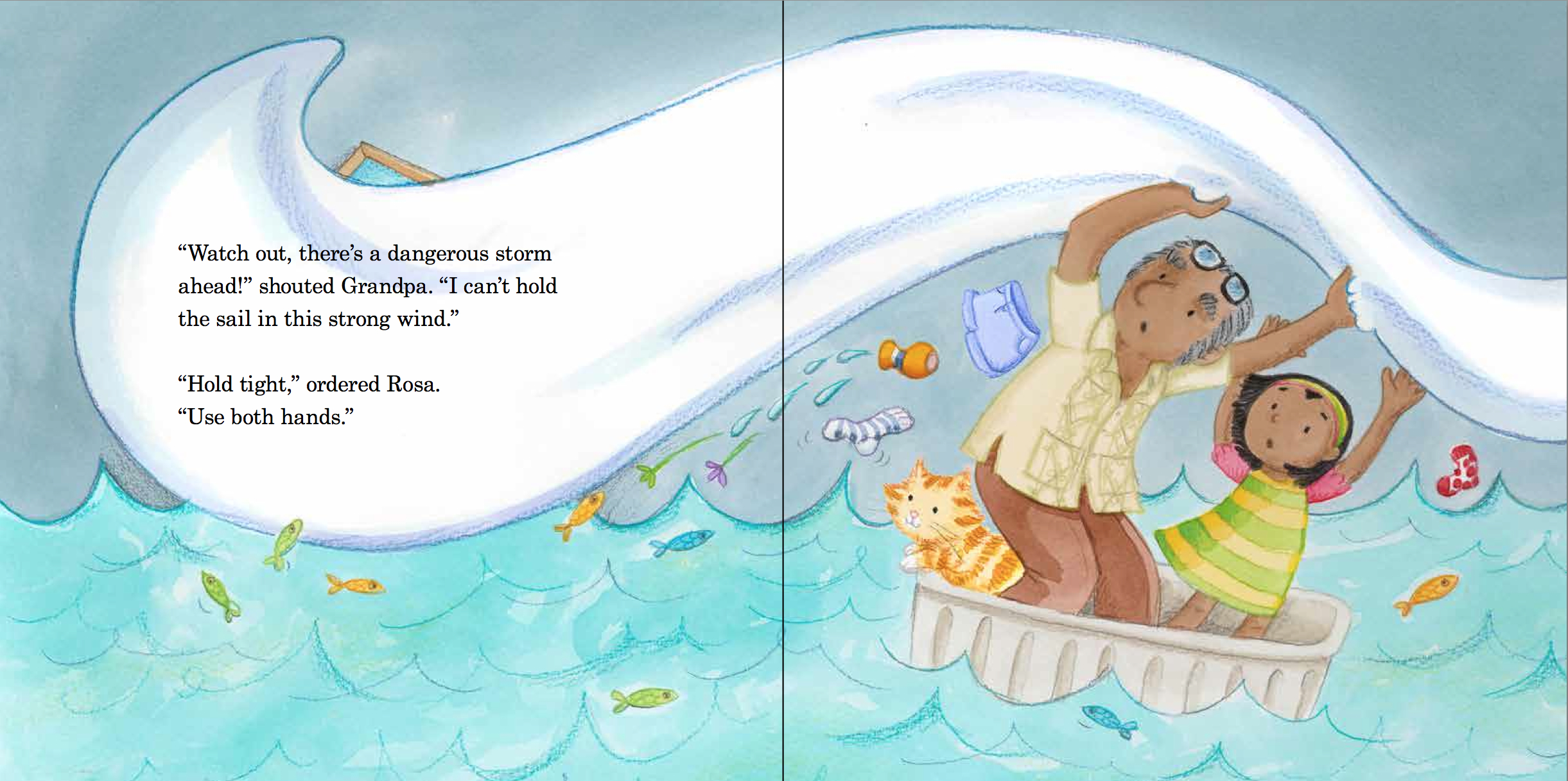
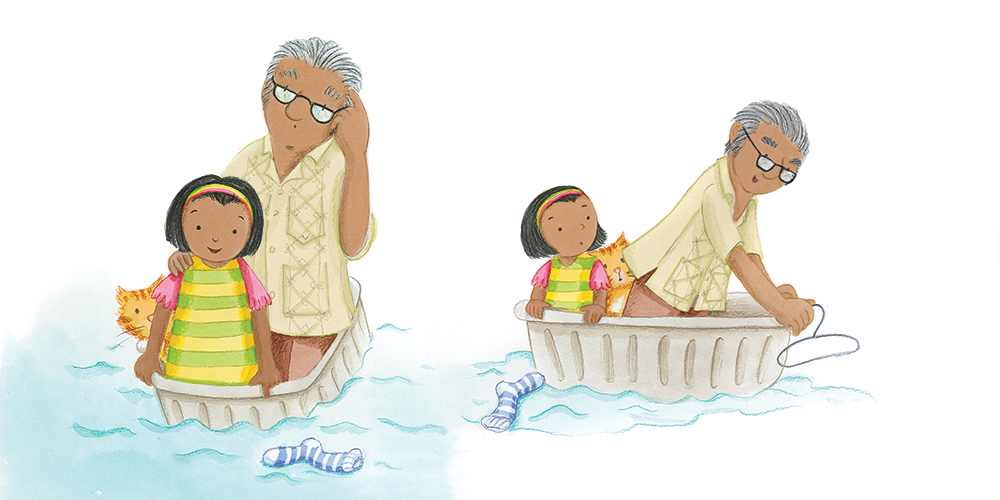
There’s a dangerous storm ahead, warns Grandpa, “‘I can’t hold the sail in this strong wind.’” Rosa is there to help and grabs one side of the sheet. “‘Hold tight,’” she orders. “‘Use both hands.’” At last the seas die down and Grandpa is ready to steer the laundry basket back to port, but Rosa has a more entertaining thought. Spying a sock on the floor, Rosa wants to catch the “enormous fish.” Grandpa obliges and picks up a hangar for a fishing pole. He holds Rosa as she stretches out over the edge of the laundry basket to land her fish.
Image copyright Sarah Vonthron-Laver, text copyright Ellen Mayer, courtesy of Star Bright Books, starbrightbooks.com
Just as Rosa nabs the fish, Mama comes home with her bags of groceries. She’s surprised to see that the laundry is not in the basket. Rosa runs to her and proudly explains, “‘We put all the laundry away. It was a very big job. We carried enormous piles. Grandpa dropped things. And I picked them up. It was very difficult for Grandpa. He got exhausted. But not me. I am terrific at laundry!’” Mama agrees that Rosa is a terrific helper. Then Rosa leads her mother to see the most surprising thing of all—the fish she has caught for dinner!
In her series of Small Talk Books® Ellen Mayer presents exciting stories for preschoolers full of imagination and rich language learning. Rosa’s Very Big Job introduces Rosa, a sweet girl bubbling with enthusiasm and the desire to help. The close relationships between Rosa, her mother, and her grandpa promote cooperation as well as effective modeling of speech patterns and a way to introduce larger words in an organic manner through play and common chores. Rosa’s inventive idea to turn the laundry basket into a boat is delightfully enhanced by her grandpa’s willingness to share in the story and expand on it. Humor, cheerful banter, and the easy camaraderie between Rosa and Grandpa invite young readers to join in the fun as they build confidence in their language learning.
Sarah Vonthron-Laver depicts Rosa’s afternoon with her Grandpa with joy and the spirited energy young children bring to everything they do. Grandpa is happy to spend time with his granddaughter, yet shows honest feelings of tiredness and frustration that spur on the plot. The transition from doing laundry to using the basket as a boat is as seamless as a child’s imagination, and the way Rosa and her grandpa use household items to create “sails,” “rocks,” “fish,” and “fishing poles” will give readers great ideas for post-reading play. Bright colors, an adorable kitten, and familiar surroundings welcome young children into the world of reading and expanded vocabulary.
Rosa’s Very Big Job would be a welcome addition to a young child’s bookshelf, not only for its fun story that kids will want to hear again and again, but for its leap into imagination that kids will want to replicate.
Dr. Betty Bardige, an expert on young children’s language and literacy development, provides tips for parents, grandparents, and caregivers following the text.
A bilingual Spanish/English edition is also available from Star Bright Books!
Ages 2 – 6
Star Bright Books, 2016 | ISBN 978-1595727497 (English edition) | ISBN 978-1595728500 (Spanish/English bilingual edition)
Discover more about Ellen Mayer and her books as well as book-related activities and literacy initiatives she’s involved with on her website!
To read an interview with Ellen Mayer about her books and her work, click here!
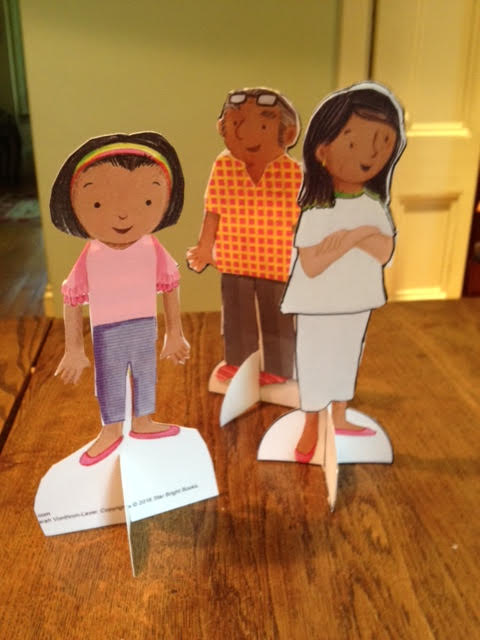
After you read the story, you can continue the fun with these Rosa and family paper dolls! Rosa loves helping out at home. She’s terrific at doing laundry – folding and putting away the family’s clothes, socks, and linens. You are terrific at helping too! Can you help Rosa, Mama, and Grandpa get dressed and ready for the day with these printable paper dolls? You’ll even find a laundry basket, socks, and Rosa’s sweet kitty to play with!
Print dolls on regular paper or card stock paper. Dolls printed on card stock paper may stand on their own with the supplied stand cross piece. For dolls printed on regular paper, you can cut the supplied stand templates from poster board or card stock and glue the dolls to the backing.
Rosa’s kitty and the laundry basket can also be attached to the supplied template if needed
Print clothes for each figure
Color the blank clothes templates any way you’d like
Cut out clothes and extra items
Fit outfits onto dolls
Make up your own stories about Rosa, Mama, and Grandpa!
YOU CAN FIND ROSA’S VERY BIG JOB AT THESE BOOKSELLERS
I must confess that today’s holiday is one of my favorites. Even as a kid I howled at the unintentional ridiculousness misplaced punctuation and poor editing created and absolutely loved diagramming sentences (I know, right?!). While the rules of grammar in any language may sometimes seem confusing and unnecessary, they help structure the language so what you write and say makes sense and exactly states your meaning. National Grammar Day was established in 2008 by author Martha Brockenbrough, the founder of the Society for the Promotion of Good Grammar.
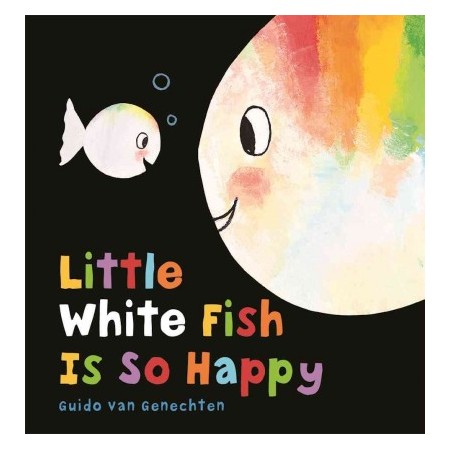
Little White Fish Is So Happy
By Guido Van Genechten
Little White Fish has been swimming on his own, but is so happy that his “mom is coming to get him.” Before he leaves, however, he wants to say “goodbye” to his many friends. “Bye-bye, snail in the shell,” he burbles. The “frog on the rock” also receives a happy “goodbye.” Little seahorse is playing under a leaf, but Little White Fish spies him.
Crab waves from behind a stone as Little White Fish swims by, and goldfish smiles at him from his spot “between the reeds.” As Little White Fish sends his friends a final farewell, they all stand “next to each other” to see him off. The best part of going home for Little White Fish, though, may be getting to swim “in front of” his mom!
In Little White Fish Is So Happy, young grammarians are introduced to a few of the most common prepositions, with clear visuals to reinforce their meaning. Bold type prompts adult readers to emphasize the prepositions and to expand on the idea by pointing out how the words apply to each particular sea creature. The endearing relationship among these friends will charm young children as the idea of being away from home is presented in an upbeat way that encourages independence while also reassuring little ones of parents’ love and attention.
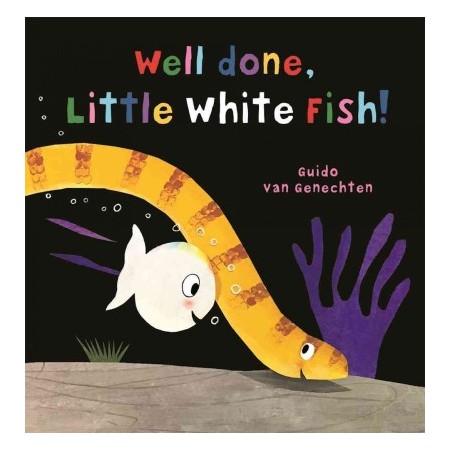
Well Done, Little White Fish
By Guido Van Genechten
Little White Fish is visiting his friends. First up is crab who is “can cut sea grass with his claws.” This is a pretty cool talent, and Little White Fish wonders what he can do. Turtle is strong enough to carry a rock on his shell, and “sea urchin easily does seven somersaults in a row. And Little White Fish? What can he do?”
Wow! Little jellyfish “can light up the dark.” Little White Fish is astonished; he knows he can’t do that. Starfish is like a ballet dancer when she stands on one leg. “Little White Fish doesn’t even have legs….” Little White Fish knows he must watch out for Octopus when he spits out ink, and he likes playing over and under with sea snake when he makes “a beautiful arch.”
And Little White Fish? He “can swim really well, even backwards and upside down!” Now it’s time for his friends to be amazed, and as Little White Fish swims around his group of friends, they all cheer and applaud his special talent.
Well Done, Little White Fish explores individuality as the small fish watches each of his friends demonstrate their talents. At first everyone seems to be cleverer, stronger, and more agile than he is, but when Little White Fish displays his swimming skills, he learns that he too is unique. Bold text points out each creature’s special ability and can also serve as a gentle lesson about verbs. Van Genechten’s adorable sea creatures, with their ready smiles and buoyant enthusiasm, will delight young children as they learn facts about nature while embracing these characters.
Guido Van Genechten’s Little White Fish books, including Little White Fish, Little White Fish Has a Party, and Little White Fish Has Many Friends, make a sweet series for the youngest readers. The spare text is lively and cheerful and makes use of the type of repetition that little ones respond to. The bold, multicolored and multilayered illustrations set on a black background are eye-catching. Small children will love the smiling sea creatures and the playful relationship among the friends.
Ages 2 – 5
Clavis Publishing, 2017
Little White Fish Is So Happy | ISBN 978-1605373263
Well Done, Little White Fish | ISBN 978-1605373270
Grammar Day Activity
Active Words Playtime
It can be fun to teach grammar by playing! Prepositions such as up, down, under, in, on, through, over, and out can provide opportunities for active fun inside or outside. A playground is a perfect place to demonstrate prepositions to kids while they climb, slide, crawl, and swing on the equipment.
Inside, all you might need is a large box or a homemade pillow fort to build your child’s vocabulary. Kids will love jumping up, crouching down, getting in the box or fort, getting out of the box or fort. Pillows or an open-ended box make a great tunnel to crawl through. You and your child can even make up a story to go along with the actions.
That old perennial favorite Simon Says is another great way to play with grammar, so get creative…and enjoy grammar!
Today’s holiday was established to give parents, grandparents, and caregivers a nudge to step back and look at our children and grandchildren as the unique individuals they are. Each child has a special personality and innate talents that combine to make them who they are. Today, celebrate each child’s exceptional character! Ask your children what they want from life, what their opinions are, and what is important to them. Then incorporate some of those things into your daily life!
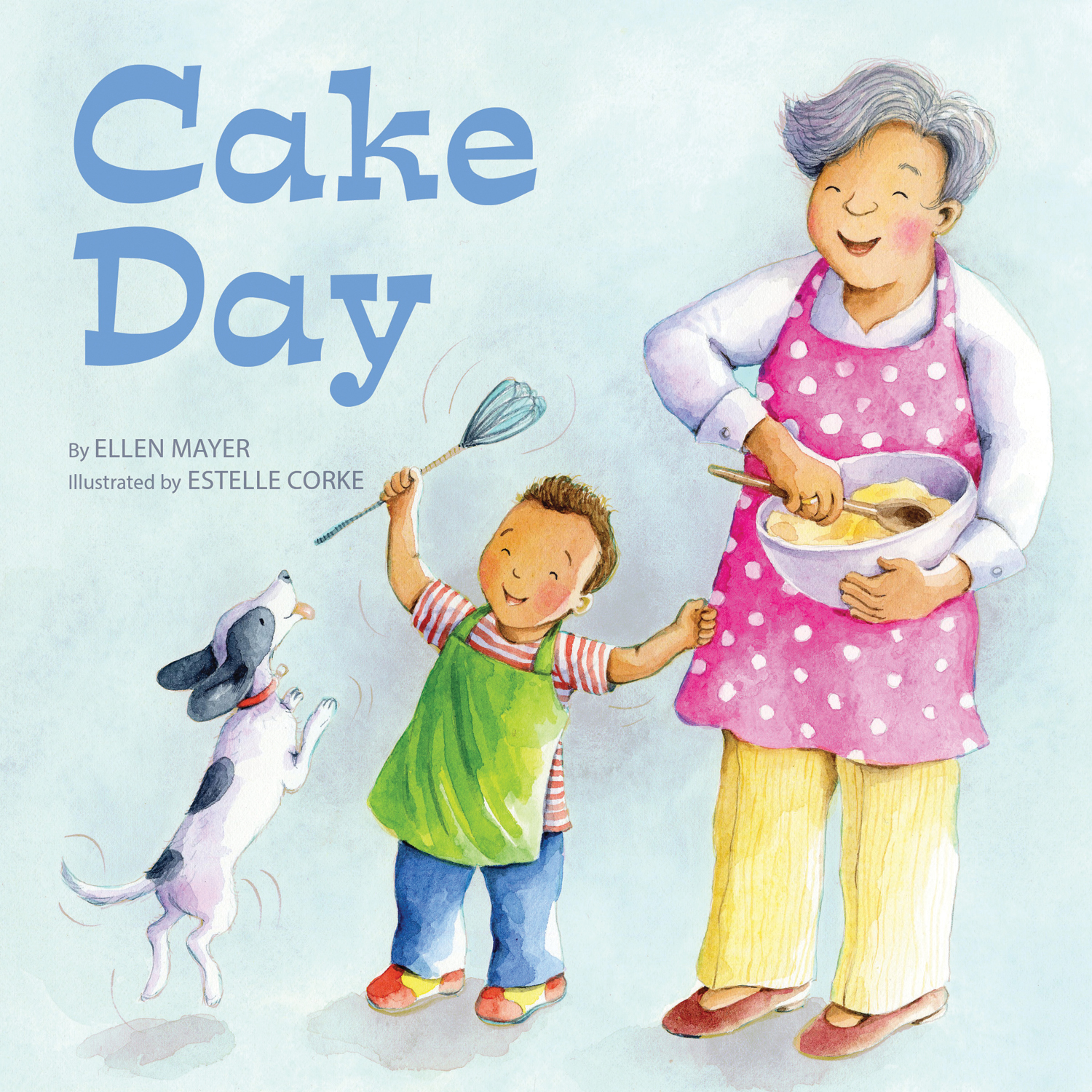
Cake Day
Written by Ellen Mayer | Illustrated by Estelle Corke
An adorable little boy runs to his grandma, excited that it’s “Cake Day!” “That’s right,” his grandma agrees, “Today we’re going to bake a cake!” The boy, hardly able to see over the counter, wants to be picked up and see what’s in the cabinet. His grandma happily obliges, and the pair carefully pick the ingredients for their cake together.
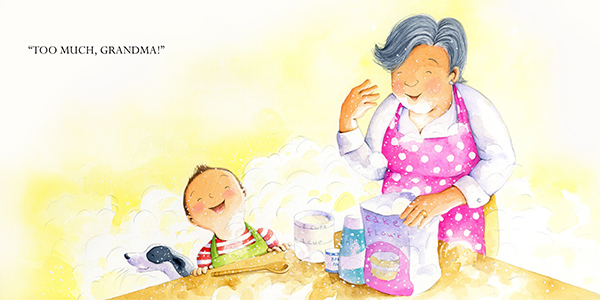
“‘Hmmm…we need flour, salt, baking powder, and sugar to make a cake,’ says Grandma.” With all the ingredients set on the table, the two start measuring. The little chef is eager and curious: “‘Cake Day! How much, Grandma?’” he asks. As Grandma pours the flour into the cup and a soft, powdery cloud envelops them, the delighted boy laughs, “‘Too much, Grandma!’” The two work happily side by side, with Grandma adding the eggs while her grandson pours in the milk.
Image copyright Estelle Corke, text copyright Ellen Mayer. Courtesy Star Bright Books, 2016
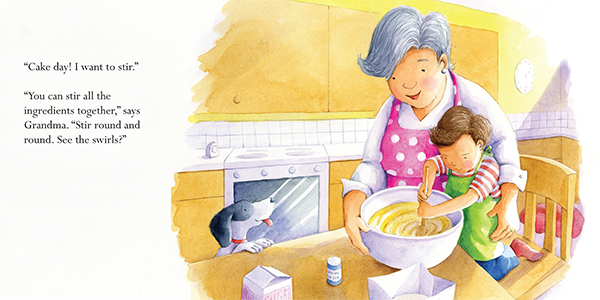
As the ingredients start to mesh, Grandma exclaims, “‘Look! What’s happening to the batter?’” The little boy wants to help it along and takes up the wooden spoon. Round and round he stirs, creating swirls in the yellow batter until it’s ready for the oven. “‘Bake day! Your turn, Grandma!” the boy says and stands wide-eyed as his grandma slides the deep pan into the oven.
Image copyright Estelle Corker, text copyright Ellen Mayer. Courtesy of Star Bright Books, 2016
The little boy and his dog settle in front of the oven to watch the cake bake. With keen expectation the boy asks, “‘Cake day! Ready, Grandma?” Grandma encourages her grandson’s inquisitiveness and explains the process: “‘We have to wait until the cake rises. The heat makes it rise. When you hear the timer go BEEP BEEP it will be ready.’” At last the cake comes out of the oven, but it’s not ready to be decorated yet. First, they must wait for it to cool.
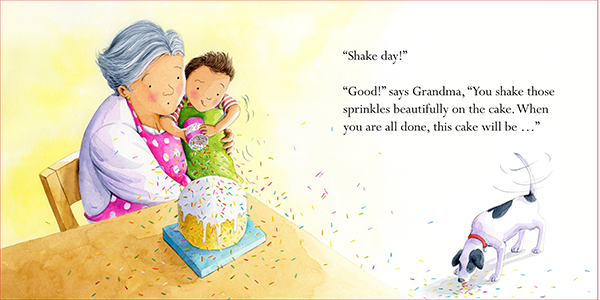
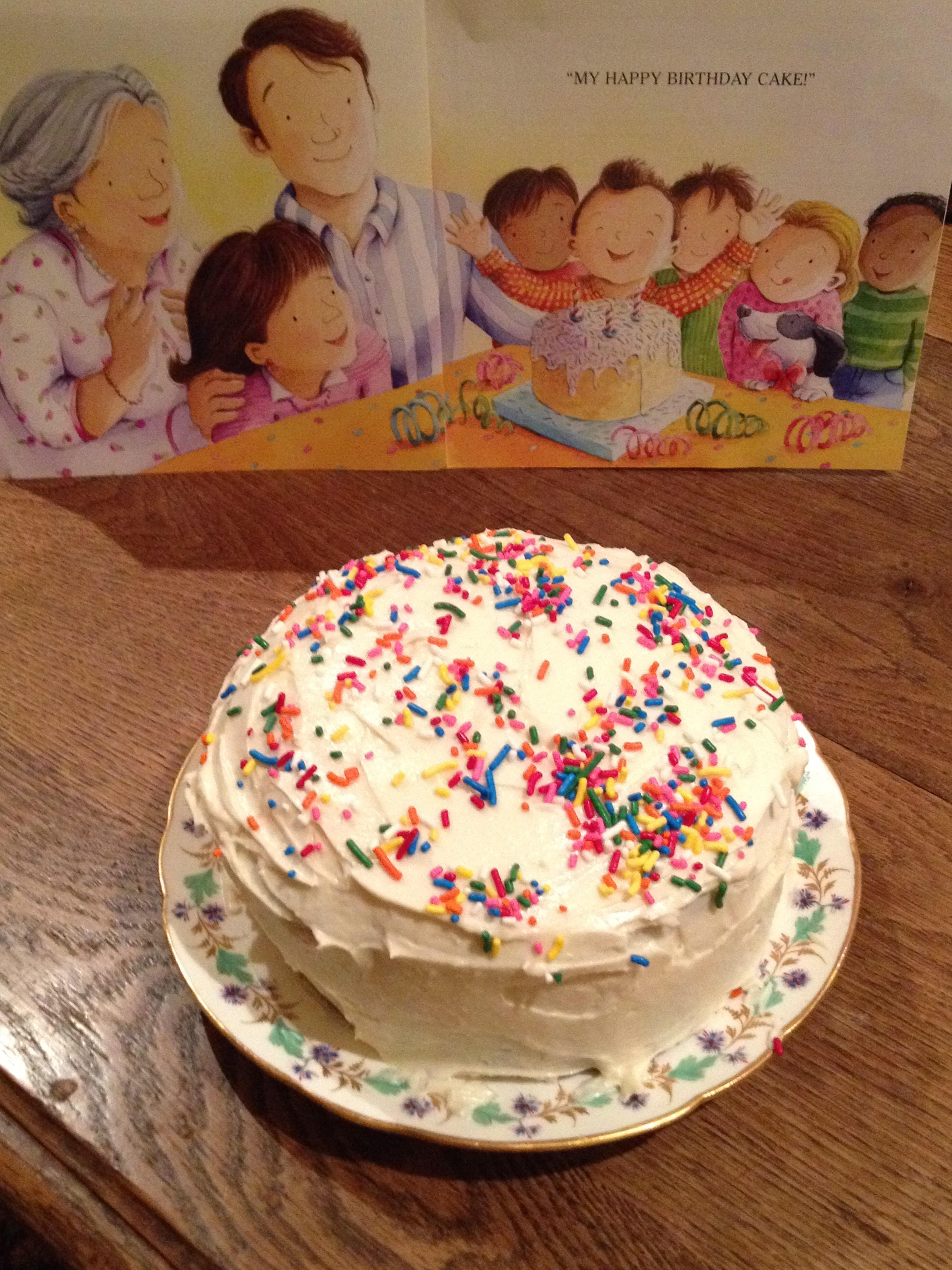
In a short time the high, golden cake can be iced and decorated. The little boy vigorously shakes a jar of sprinkles over the top, scattering a rainbow of colors across the white frosting. The cake is beautiful and just the right complement to the little boy’s Cake Day, Bake Day, Shake Day—Birthday!
Image copyright Estelle Corke, text copyright Ellen Mayer. Courtesy Star Bright Books, 2016
Ellen Mayer’s language-rich and playful story of a small child and his grandmother baking together is a wonderful introduction not only to reading but to the type of full-sentence conversational modeling that improves and increases literacy. The steps to baking the birthday cake flow organically and lyrically through the loving relationship between the little boy and his grandma, enticing young readers to learn more about the world around them and how it works. The repeated phrases “Cake day! Bake day!,” and “Ready, Grandma?” as well as the boy’s short statements offer opportunities for kids to read along and learn new vocabulary as they develop important language skills.
Estelle Corke’s cheery illustrations glow with enthusiasm and the close bond between grandmother and grandson. The grandmother lifts, steadies, and holds the boy while still allowing him to perform all the tasks he can. The little boy, in his green apron, delights in every aspect of the baking process, his eagerness expressed in his animated smile and lively participation. The homey kitchen is awash in inviting colors and objects that children will recognize. The clearly drawn boxes and jars of ingredients, kitchen tools, and furnishings offer readers a chance to practice their vocabulary and learn new words.
Ages Birth – 5
Star Bright Books, 2016 | ISBN 978-1595727466
To see more books by Ellen Mayer as well as language development and reading strategies for young children, visit her website!
Visit Estelle Corke’s website to view a gallery of her artwork!
Star Bright Books publishes fiction nonfiction, and bilingual “great books for great kids” and provides literacy resources for readers.
Celebration of Life Day Activity
Image copyright Ellen Mayer, 2016
Grandma’s Cake
Grandma and her grandson baked a delicious, special cake—and now you can too! Invite your child or children to help, and make a Celebration of Life cake decorated just the way they’d like! Here’s the full recipe that Grandma uses. Recipe courtesy of Ellen Mayer.
A Simple Sponge Cake Recipe
Ingredients
1 stick unsalted butter, softened, plus a little to grease cake pan.
1 1/2 cups sugar
2 cups all-purpose flour
1/4 teaspoon salt
2 teaspoons baking powder
3 large eggs at room temperature
2 teaspoons vanilla extract
3/4 cup milk
You will need: 3 mixing bowls:
1 to cream butter and sugar
1 to mix flour, baking powder and salt
1 in which to beat the eggs
A 7-inch diameter, deep cake pan
Directions
Butter pan and dust with flour.
Set the rack at the middle of the oven.
Preheat oven to 350 degrees.
Sift flour, baking powder, and salt into a bowl and set aside.
In large mixing bowl, beat butter and sugar until light and fluffy. In the third bowl, beat the eggs and add milk.
Add 1/3 of the flour mixture to butter mixture then alternate with the egg and milk mixture. Continue to alternate ending with flour mixture. Scrape bowl and beater often.
Add vanilla and mix well.
Pour batter into prepared pan and smooth top with a spatula.
Bake cake about 45 minutes. Insert knife or wooden skewer into the center. If it emerges clean, the cake is done. If not, bake for 5 more minutes.
Remove cake from oven and allow to set for 5 minutes.
Turn cake out onto a cake rack and leave to cool.
Grandma’s Favorite Frosting
8 oz cream cheese
1 1⁄2 cups confectioners’ sugar
1⁄4 stick butter
1 teaspoon vanilla extract
Blend all ingredients together with a mixer until smooth
Today’s observance was established in 1994 to promote family and community involvement in teaching and supporting children to read more. Family members can make reading a priority at home by sitting down together every day with a wide range of books and other reading material. By taking trips to the library and bookstores, children will also naturally pick up a love of reading. But families can’t do it alone. Kids acquire a drive to read when they see connections between books and their wider world. Fun book-related activities at schools, libraries, science centers, museums, and other places capture children’s attention and make them curious about reading more. Whether children are attracted by fiction or nonfiction, picture books or chapter books, novels or graphic novels, they should be encouraged to read. Universal literacy is a goal that can be accomplished.
About Small Talk Books®
Ellen Mayer’s Small Talk Books® feature young children and adults conversing (or adults speaking to children who are not talking yet) while they have fun, do chores, shop, and bake together. Their conversations demonstrate the kind of excitement and close relationships that encourage learning and language advancement. Each Small Talk Book® includes an accompanying note from Dr. Betty Bardige, an expert on young children’s language and literacy development and the author of Talk to Me, Baby! How You Can Support Young Children’s Language Development. The introduction discusses how children connect actions, words, and meaning as adults speak to them while doing particular jobs or actions.
Other titles in the Small Talk Books® series include Cake Day and Rosa’s Very Big Job. Each book makes a wonderful gift for baby showers, new parents, or anyone with young children in the family. They would be a welcome addition to any young child’s bookshelf as well as libraries and preschool classrooms.
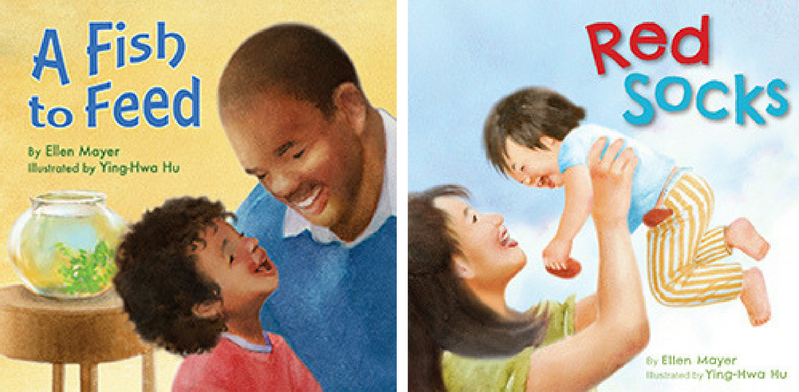
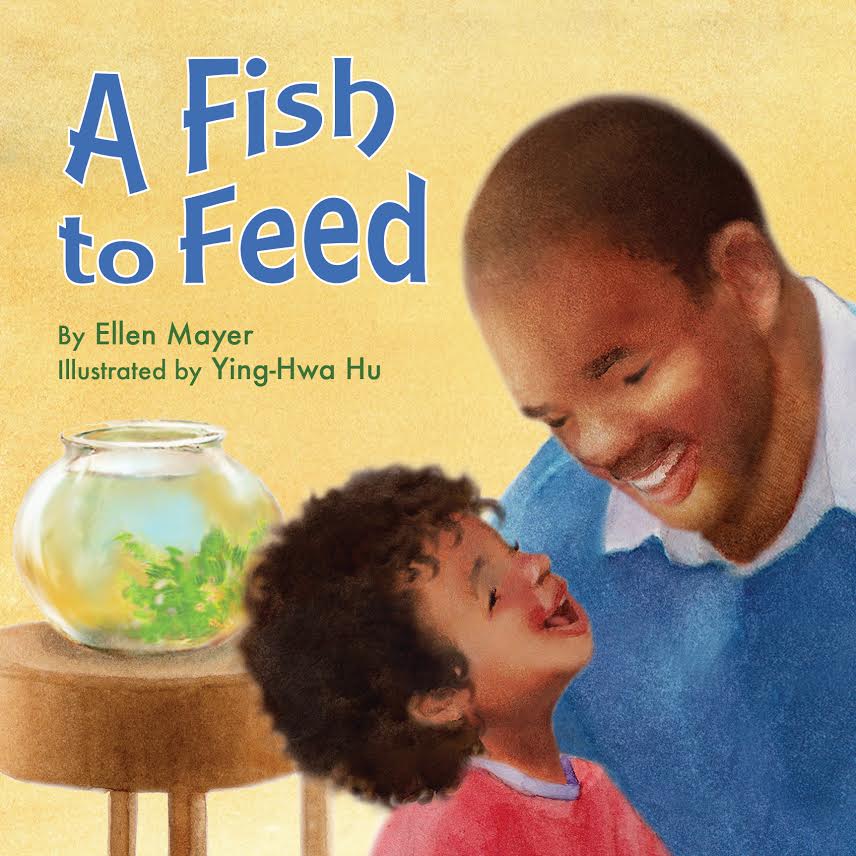
A Fish to Feed
Written by Ellen Mayer | Illustrated by Ying-Hwa Hu
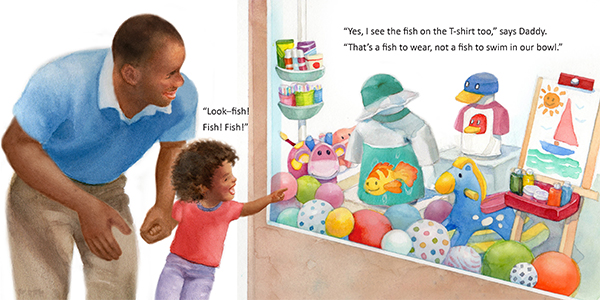
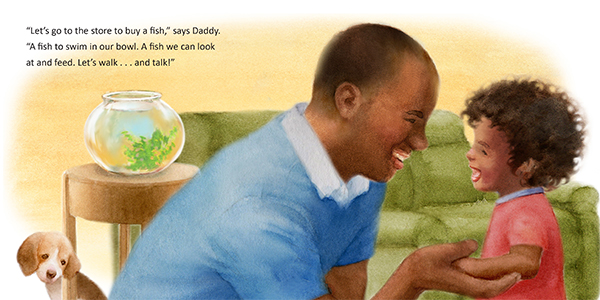
Dad plans a fun trip into town with his young child to buy a pet fish. He says, we will get “a fish to swim in our bowl. A fish we can look at and feed.” The pair are excited to go together and have time to “walk…and talk.” The two head out and soon pass a store. In the window the child sees a T-shirt with the picture of a fish on it and points. “Look—fish! Fish! Fish!” Dad reinforces the observation—“Yes, I see the fish on the T-shirt too.”—and further explains: “That’s a fish to wear, not a fish to swim in our bowl.”
Image copyright Ying-Hwa Hu, text copyright Ellen Mayer. Courtesy of starbrightbooks.com
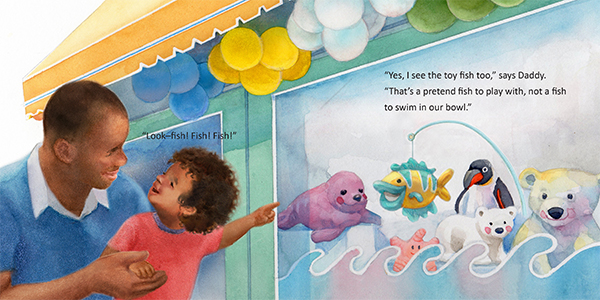
Going into the store, Dad and his youngster find another item with a fish on it. On a shelf is a backpack with a picture of a gold-and-yellow fish on the front pocket. This is a “fish to wear on your back,” Dad says, before going in search of a “fish to feed.” Next, the two come to a toy store. The child points to another fish—a fish on a mobile. “Look—fish! Fish! Fish!” the toddler exclaims. Dad affirms his child’s remark and expands on it using complete sentences that model conversation and increase vocabulary. They linger in the shop, finding other examples of fish.
Image copyright Ying-Hwa Hu, text copyright Ellen Mayer. Courtesy of starbrightbooks.com
“‘Now let’s go find a fish to feed,’ says Daddy.” They head out of the store and continue down the street. As they come to the Pet Shop, the little one shouts, “‘Look—fish! Fish swim!” Daddy echoes the excitement while praising his child. “‘You found a fish that swims!’” They take the goldfish home, where it swims happily in their bowl—a pet they “can love and feed.”
A Fish to Feed contains die-cut holes in the pages that kids will love peering through as they shop along on this adventure to find a special pet.
Image copyright Ying-Hwa Hu, text copyright Ellen Mayer. Courtesy of starbrightbooks.com
Ellen Mayer’s story of a dad and his child out for an afternoon together as they look for a pet to love offers adults and children such a sweet way to spend time with one another. The story, set in the familiar environments of home and stores and revolving around a close parent-child relationship, will engage even the youngest readers. The back-and-forth conversation between Dad and his child as they shop models ways in which adults can follow a child’s lead while providing language and literacy development. The abscence of gender-specific pronouns makes this a universal story.
Ying-Hwa Hu’s illustrations are vibrant and joyful. When Dad bends down to be at eye-level with his toddler as they talk, the close bond between them is obvious in their smiling and laughing faces. The shops are full of colorful toys, clothes, backpacks, and other items that will capture kids’ attention. Spending time looking at each page allows adults and children to point at the various items, name them, and talk about them.
Ages Birth – 5
Star Bright Books, 2015 | ISBN 978-1595727077
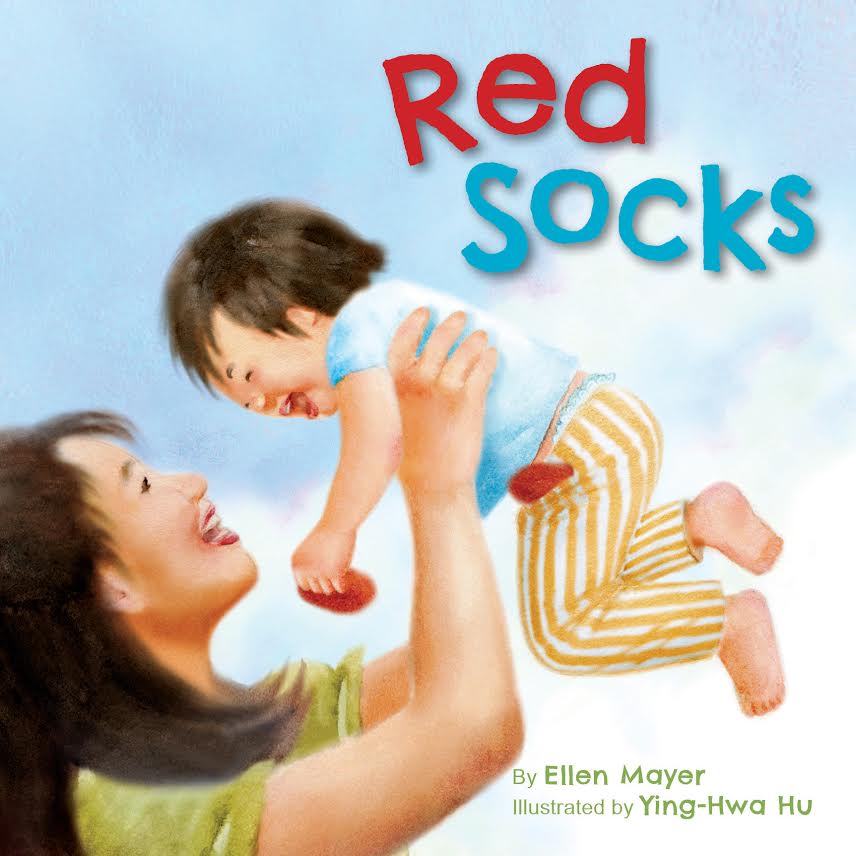
Red Socks
Written by Ellen Mayer | Illustrated by Ying-Hwa Hu
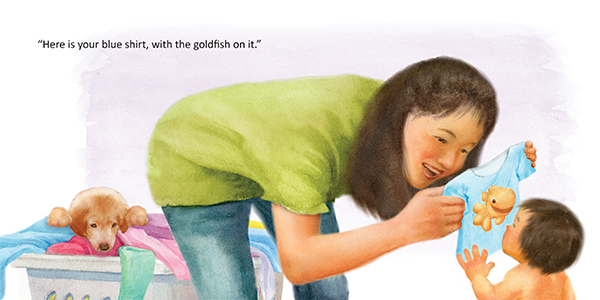
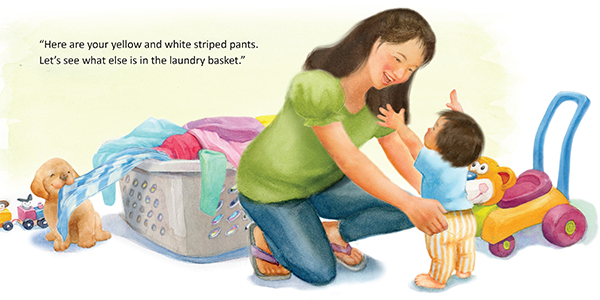
It’s laundry day and the clothes are all dried and soft and ready to wear. “‘Here is your blue shirt, with the goldfish on it,’” Mama says, pulling the top out of the basket and bending down to eye level to show it to her baby. Next, Mama describes the “yellow and white striped pants” she puts on her child. “‘Let’s see what else is in the laundry basket,’” she says.
Image copyright Ying-Hwa Hu, text copyright Ellen Mayer. Courtesy of starbrightbooks.com
Mama pulls a tiny red sock from the basket, but—“UH-OH!—where is the other red sock?’” Now it’s the baby’s turn to help. With a look down, the toddler shows Mama where the sock is. “‘You found the other red sock. Yay!’” she says, giving words to the baby’s action. She continues explaining while pointing to the sock poking out of the baby’s pocket: “‘It was hiding in your pants pocket!” Once the laundry is folded, Mama tells her child exactly what they will do next while she playfully slips the other red sock on the baby’s wiggling feet. “‘Let’s put that other sock on your foot. Then we can go play outside.’” As the baby flies in the swing outside, the red socks are brilliant dots against the blue sky.
Image copyright Ying-Hwa Hu, text copyright Ellen Mayer. Courtesy of starbrightbooks.com
Ellen Mayer’s simple and charming story of a particular moment in a mother and child’s day will immediately appeal to even the youngest reader. Familiar words coupled with clear, vivid illustrations will engage toddlers who are pre-talking and just learning language and concept development. The mother’s use of complete sentences as well as step-by-step descriptions of the activities the child sees and is involved in demonstrates how adults can converse with their babies and young children to encourage strong language and literacy skills. Free of gender-specific pronouns, Red Socks is a universal story.
Ying-Hwa Hu’s illustrations show a mother and child interacting on a typical day while they complete common chores and go outside to play. The mother and child portray a range of emotions and gestures, giving further depth to the understanding of the ideas and conversation presented. Kids will giggle at the adorable puppy who causes a bit of mischief on each page.
Ages Birth – 5
Star Bright Books, 2015 | ISBN 978-1595727060
To learn more about Ellen Mayer and her Small Talk Books® (including other titles: Cake Day and Rosa’s Very Big Job) as well as to find activities to accompany each book, visit her website!
Discover more about Ying-Hwa Hu and view a portfolio of her illustration work on her website!
Red Socks and Too Small to Fail
Red Socks was chosen by Too Small to Fail, an early literacy initiative of The Clinton Foundation to feature in their Wash Time is Talk Time project. Wash Time is Talk Time serves underserved communities and provides resources to turn time spent at the laundromat into an opportunity for families to talk together, read together, and learn together. Language-rich literacy resources will be delivered to more than 5,000 laundromats across the country.
Here’s a video from one fun afternoon with families, Ellen Mayer, and Ying-Hwa Hu during wash time!
National Family Literacy Month Activity
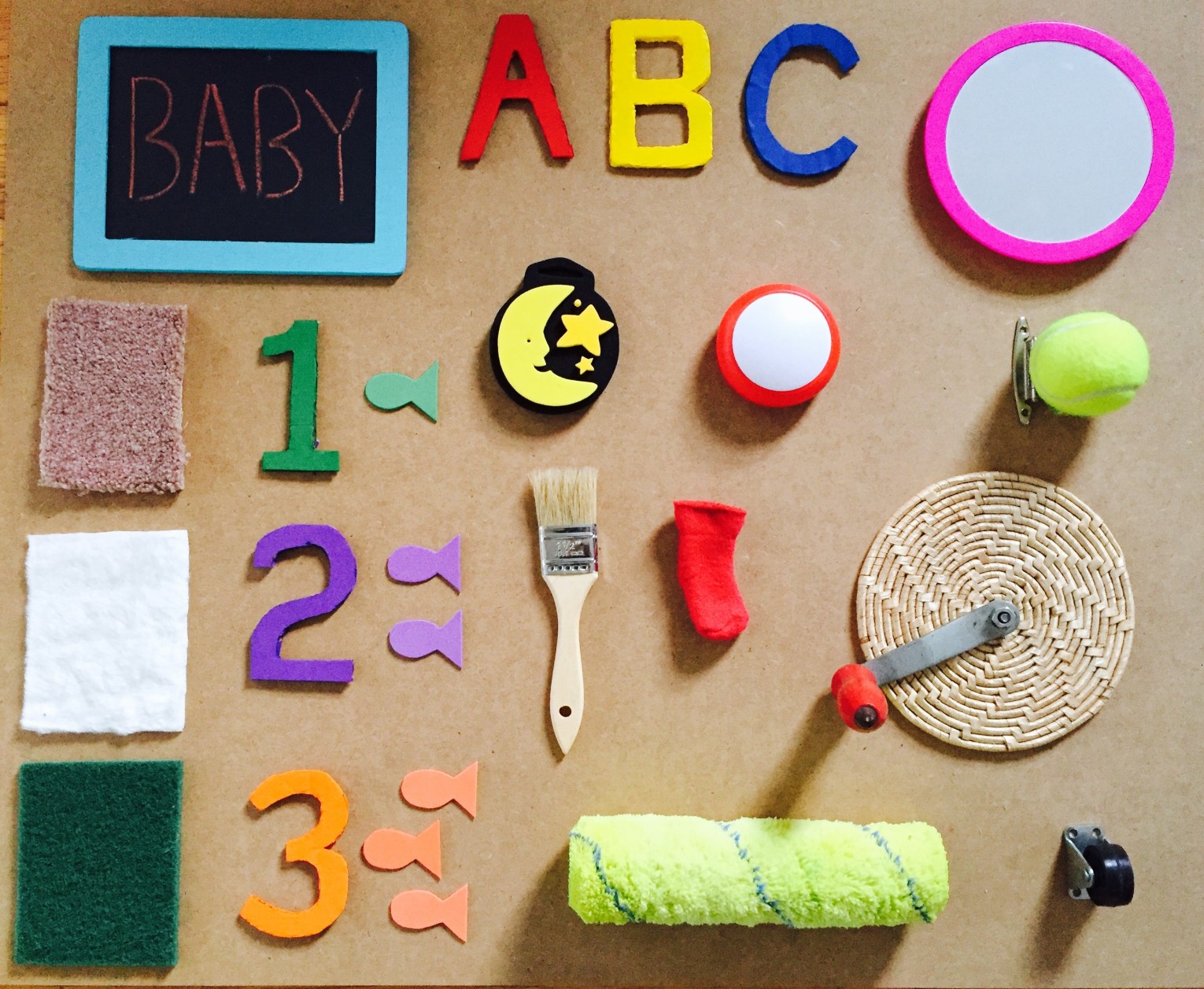
Child’s Sensory Board
Toys or objects that provide many opportunities for sensory experimentation and observation stimulate a baby and young child to learn while having fun. You can make a sensory board for your own child using household items and that have a variety of textures, sizes, shapes, and movement. When you create your own sensory board, you can personalize it for your child by adding their name, pictures of family members, and other special items. While you play with your child, take time to talk about all of the objects on the board, what they do, and how they work. Count the objects. If you include words or your child’s name, spell them outloud and say them. There are so many ways to use a sensory board. Even if children can’t yet talk, they are listening and soaking in the rich language learning you are providing!
**When making your board always ensure that you use items that are not a choking hazard or can catch tiny fingers. Make sure that items are firmly attached to the board. Never leave a baby unattended while playing.**
Supplies
A board large enough to hold the items you want to attach. Boards that can be used include: those found at hardware stores or craft stores; large cutting boards; shelves; old table tops; etc.
Sample items for your sensory board can be age appropriate and include:
Large swatches of various textured material. (I used fur, a scrubbing sheet, and a piece of carpeting)
Wooden or thick cardboard letters and numbers, painted in a variety of colors. Letters can be used to add a child’s name to the board.
Figures cut from sheets of foam or wooden figures found at craft stores in a variety of numbers that you can count with your child (I used sets of 1, 2, and 3 fish cut from foam to go along with the numbers 1, 2, and 3)
Mirror
Push button light
Chalk board to write on
Castor or other wheel
Door latches
Door knockers
Mop heads
Paint rollers
Cranks
Drawer handles
Hinges (I attached a tennis ball to a hinge that children can push back and forth)
Pulleys
Paint in various bright colors
Paint brushes
Scissors
Screws
Nuts and bolts
Velcro
Super glue
Directions
Assemble your items
Paint wooden or cardboard items
Arrange item on the board so that your baby or child can easily reach or manipulate each one
Attach items with screws, nuts and bolts, or super glue
Push button lights or other objects that take batteries can be attached with strong Velcro. Ensure items attached with Velcro are large and not a choking hazard.
Set up board where you and your baby or child can enjoy playing with it together












 celebratepicturebooks.com