September 18 – National Respect Day

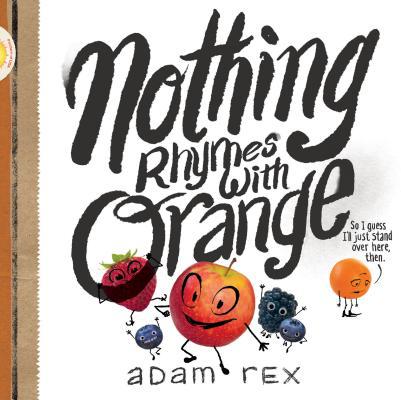
celebrate-picture-books-picture-book-review-nothing-rhymes-with-orange-cover

About the Holiday

Today’s holiday was established to help people focus on how they can be more respectful of others—family, friends, and strangers. It’s also a day to think about yourself. Do you respect yourself and your abilities? Self-respect is crucial for achieving your goals, both personal and professional. There are many ways to show respect. Good manners, listening to others, acknowledging others with a “thank you” or “great job,” and inclusion are only a few of the ways that people can start building the kinds of respectful relationships that lead to success.

Nothing Rhymes with Orange

By Adam Rex


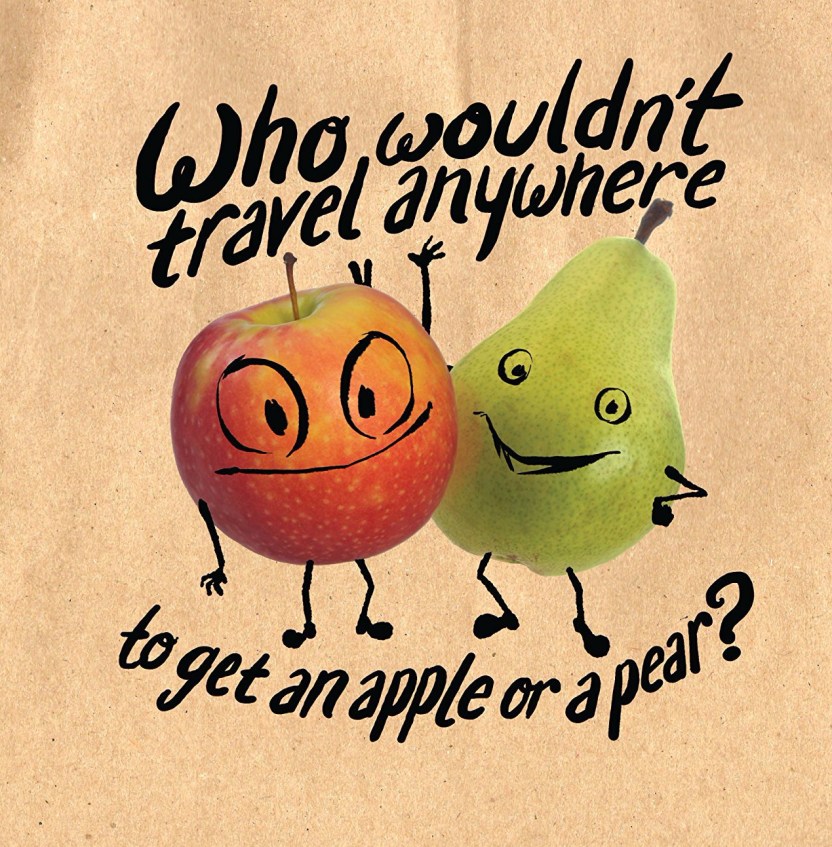
As the book opens, readers meet two smiling friends—an apple and a pear who ask the jaunty and rhyming question: “Who wouldn’t travel anywhere to get an apple or a pear?” A little purple fruit joins the fun with “And if a chum hands you a plum, be fair and share that tasty treat!” From the sidelines an orange watches in anticipation like a child waiting to leap into a twirling jump rope. When the banana and peach arrive, enjoying a beachside cabana, the orange takes the initiative and calls out, “Hey, are you guys going to need me for this book?”
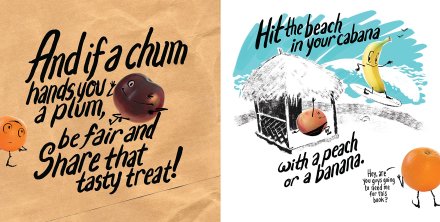
celebrate-picture-books-picture-book-review-nothing-rhymes-with-orange-plum

Copyright Adam Rex, 2017, courtesy of Chronicle Books

But the action continues with caped grapes and a kind of high-fiving dance party where all the cute fruit are cheering themselves on. The persistent orange peeks out from the background just to remind them that he’s there. As the fig admits that she’s not very big, the orange begins to catch on to the pattern of invitations, and his once-present grin begins to fade. With a shrug he acknowledges that “nothing rhymes with me, but…” he’d still like to be included.

If nearly getting sucker punched by a “peewee” kiwi’s “pucker punch” counts as being included, then the orange is front and center. But then a cantaloupe riding an antelope enters the scene with a dietary suggestion.”If you aren’t a fan of cantaloupe, then feed it to an antelope.” Not a fan of that rhyme? Well…the orange agrees with you, and he’s a little unsure about the quince on the next page too. But…back to the dance party, where all the newly introduced “cute fruit” are now cutting the rug.
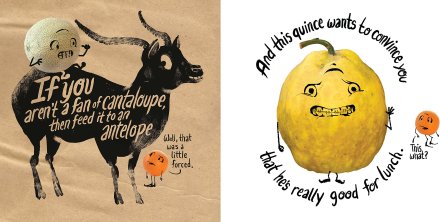
celebrate-picture-books-picture-book-review-nothing-rhymes-with-orange-cantaloupe

Copyright Adam Rex, 2017, courtesy of Chronicle Books

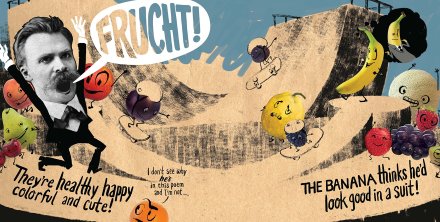
The produce seem to be losing control as they reach for rhymes. I mean, “you can keep them in a bowl or in a boot—fruit!” Really? Is it actually a good idea to eat out of a shoe? Poor Orange doesn’t “even know what that is.” Want a little philosophy with your fruit? Then try this on for size: “I think cherries are ‘the berries’ and a lychee is just peachy. Thus Spoke Zarathustra is a book by Friedrich Nietzsche.” Impressive!

That bit of nonsense just makes Orange mad, though. As Nietzsche throws his hands in the air and joins the festivities, Orange is nonplussed: “I don’t see why he’s in this poem and I’m not.” Good question! And now the banana again?! Didn’t he already have his turn? And the pear? Didn’t she get to lead the whole thing off? Maybe this is one of those circular plots…. Whoa! Here’s a twist—a wolf wants to take a bite of Pear. 
celebrate-picture-books-picture-book-review-nothing-rhymes-with-orange-frucht

Copyright Adam Rex, 2017, courtesy of Chronicle Books

But suddenly a transformation takes place that brings up some pretty deep questions: “then does that pear become a pearwolf when the moon is full and bright? Will the apple have to grapple with this pear with fangs and hair?” Now that the story has gone to the dark side, the orange decides he’s “glad he’s not part of it.” Yet, wait! A caped grape comes to the rescue, and Orange realizes that “this book is amazing.”

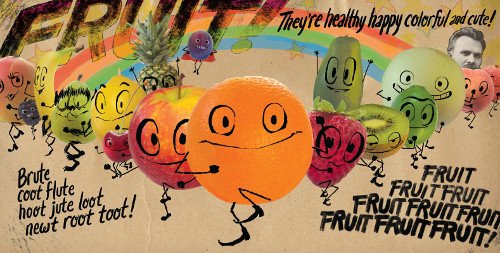
The cute fruit party is in full swing with a band, a singer, and a whole lot of dancing. The rhymes are coming fast and furious—some a bit better than others, according to Orange—and he decides to just hang out on the next page. There, though, as he stands alone and dejected and surrounded by lots of white space, Orange hears a cheery sound. It’s Apple with a welcoming rhyme: “But the fruit are feeling rotten, ‘cause there’s someone they’ve forgotten.” And while what Apple says next might not technically be a real word, it does the job with a little hip-hop beat: “It’s the orange. He’s really smorange. There’s no one quite as smorange as orange.”

This, of course, could go either way, so Orange asks for a little clarification and discovers that “smorange” means “totally awesome in every way.” And with that, the jam continues, with Smorange Orange out in front.
celebrate-picture-books-picture-book-review-nothing-rhymes-with-orange-smorange

Copyright Adam Rex, 2017, courtesy of Chronicle Books

Adam Rex’s cool, funny, and sophisticated riff uses the fact that the word orange has no rhyme to explore the ideas of exclusion and inclusion and show readers that there’s always a way to embrace others and make them feel good and part of the group. 

Rex has created very appealing characters in Orange and the others. Without a mean seed in their bodies, they’re just having fun and being a bit silly. In a very welcome plot turn, Apple and the other fruit recognize that Orange feels left out and come to him with a solution. Rex’s vivacious fruit are as cute as they think they are, and little Orange is endearing with his alternately easy smile and sad eyes. The addition of a dancing Friedrich Nietzsche is genius and will have both kids and adults laughing.
celebrate-picture-books-picture-book-review-nothing-rhymes-with-orange-apple-and-pear

Copyright Adam Rex, 2017, courtesy of Chronicle Books

Nothing Rhymes with Orange is a fantastic read-aloud for home and classroom story times. The book would be a much-asked-for favorite and would make a perfect gift or addition to home libraries.

Ages 5 – 8

Chronicle Books, 2017 | ISBN 978-1452154435

You’ll have a blast exploring the world of Adam Rex on his website!

National Respect Day Activity

celebrate-picture-books-picture-book-review-initial-letter-craft

Initial Respect Craft


Here’s an easy craft that you can make for yourself or as a gift for someone else. This Initial Respect Craft can be used as a decoration or as a bookend while it reveals all the qualities that you respect in yourself, a family member, or a friend.

Supplies

  • Wooden letter
  • Chalkboard paint
  • Chalk

celebrate-picture-books-picture-book-review-initial-letter-craft

Directions

  1. Paint the letter with the chalkboard paint, let dry
  2. On the letter, write words that reflect the qualities that you respect in yourself, in a family member, or in a friend
  3. Display your letter to remind yourself that you should always be treated and treat yourself and others with respect.

Picture Book Review

July 16 – National Personal Chef Day

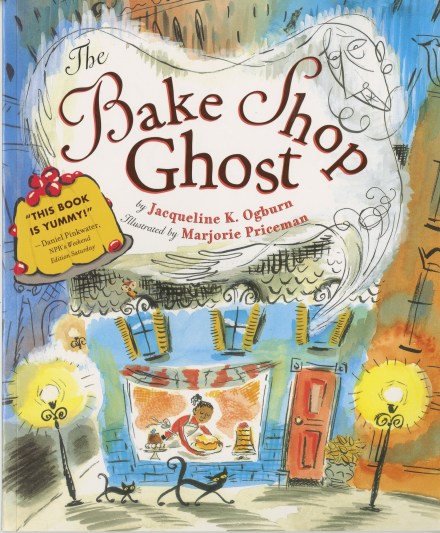
celebrate-picture-books-picture-book-review-the-bake-shop-ghost-cover

About the Holiday

National Personal Chef Day pays homage to all of the professional chefs and bakers who provide tasty and nutritious meals to families, organizations, and institutions around the country. Through their education, skills, and talent, these chefs enrich the lives of those who can’t cook for themselves and provide comfort for the people who love and care for them. If a professional or personal chef cooks meals for someone you love, take a moment to thank them today.

The Bake Shop Ghost

Written by Jacqueline K. Ogburn | Illustrated by Marjorie Priceman


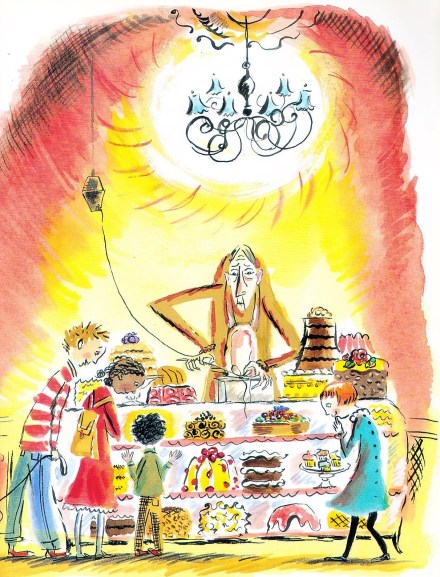
For all intents and purposes, Miss Cora Lee Merriweather is Merriweather’s Bake Shop and the bake shop is Cora Lee. “Her Mississippi mud pie was darker than the devil’s own heart,” and her sponge cake was as light as angels’ wings. Her bakery case is stacked with fluffy pies, flaky strudels, and cakes of every size and flavor. In fact, no one’s birthday is complete without a Merriweather cake to celebrate with.

celebrate-picture-books-picture-book-review-the-bake-shop-ghost-bakery

Image copyright Marjorie Priceman, 2008. Courtesy of Houghton Mifflin Harcourt.

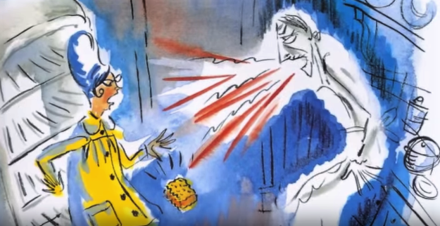
When Cora passes away, the congregation at her funeral weeps when the preacher reads the bake shop menu and everyone realizes that “all those luscious desserts were now only sweet memories.” It doesn’t take long, however, for a new baker to buy Cora’s business. Gerda Stein stocks the shelves with the ingredients for her strudels and cakes and starts baking, but the ovens burn every dessert, the refrigerator goes on the fritz, and Gerda hears ominous footsteps overhead and frightening clanking behind her. She slowly turns around and finds herself staring straight into the eyes of a ghostly Cora Lee Merriweather who shrieks, “Get out of my kitchen!”

celebrate-picture-books-picture-book-review-the-bake-shop-ghost-frightening

Image copyright Marjorie Priceman, 2008. Courtesy of Houghton Mifflin Harcourt.

The bake shop goes back on the market and is sold to Frederico Spinelli who is not afraid of ghosts—until the next day when he emerges from the front door drenched in powdered sugar and never returns. Sophie Kristoff, the marzipan queen, takes over next, only to be chased out by flying eggs, three pink marzipan pigs, and a bunch of marzipan grapes.

celebrate-picture-books-picture-book-review-the-bake-shop-ghost-annie-comes

Image copyright Marjorie Priceman, 2008. Courtesy of Houghton Mifflin Harcourt.

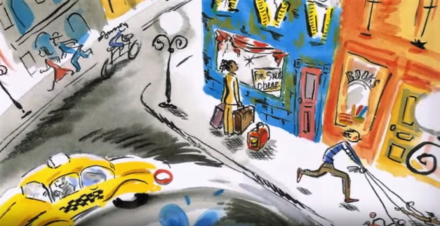
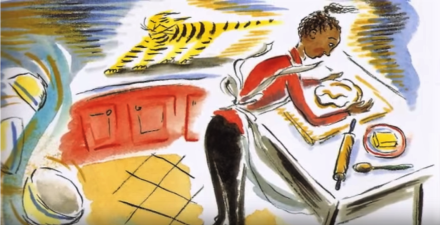
After her departure the shop stands vacant for years, growing dim and dusty. One day Annie Washington, fresh off her stint as a cruise ship pastry chef, strolls by the dilapidated storefront. She falls in love with it as soon as she steps through the door. Annie buys the old bakery and scrubs and polishes everything until it shines.

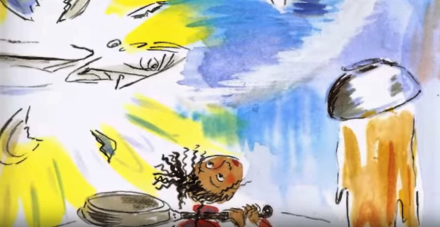
That night Annie goes straight to work on a puff pastry. Around midnight footsteps creak overhead, a cold wind sweeps the room, and mixing bowls topple to the floor. Annie keeps working. When she’s finished she dusts off her hands, turns around, and finds herself staring into ghostly eyes. “‘Miss Cora Lee Merriweather, I’ve been expecting you,” she says.

celebrate-picture-books-picture-book-review-the-bake-shop-ghost-haunting

Image copyright Marjorie Priceman, 2008. Courtesy of Houghton Mifflin Harcourt.

“Get out of my kitchen!” Cora says. But Annie is not intimidated. “This is my kitchen now,” she tells Cora. And what’s more, even though Cora may have been the best baker in the state, Annie tells her that she was the best pastry chef to ever sail on the Sea Star cruise ships. Come typhoon, tsunami, or shipwreck, she never left a kitchen until she was finished.

celebrate-picture-books-picture-book-review-the-bake-shop-ghost-annie-battles-cora

Image copyright Marjorie Priceman, 2008. Courtesy of Houghton Mifflin Harcourt.

Cora tries every trick in the book—she shrieks, flings utensils, rises up through the dough Annie’s kneading, shatters eggs, and as dawn breaks scatters a 50-pound bag of flour across the kitchen. All right, Annie says, “What can I do so you’ll leave me in peace?” Cora has a ready answer: “Make me a cake so rich and so sweet, it will fill me up and bring tears to my eyes. A cake like one I might have baked, but that no one ever made for me.” “Piece of cake,” replies Annie.

Annie makes every cake she knows and Cora critiques them. But none fill her up or bring a tear to her eye. Annie grows to respect the ghost’s advice, but she wants her kitchen back. After a month and hundreds of cakes, Annie is out of ideas. She goes to the library to research more recipes. There she finds a small book on town history, and after reading it, she knows just what kind of cake to bake.

celebrate-picture-books-picture-book-review-the-bake-shop-ghost-cora-lounges

Image copyright Marjorie Priceman, 2008. Courtesy of Houghton Mifflin Harcourt.

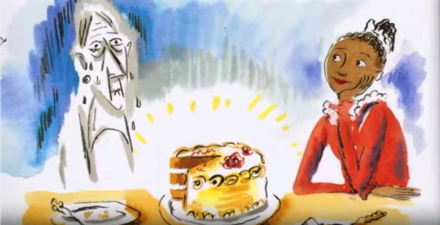
That night at midnight Cora appears, and Annie is ready. She lifts the cover on a very special cake. “Across the top, in piped icing, it read, ‘Happy Birthday, Cora Lee.’” The ghost looks at Annie with tears in her eyes. “‘How did you know?’” Cora asks. Annie reveals the secrets of her research then adds, “Besides, who ever makes a cake for the baker?” With tears streaming down her face, Cora eats her slice of cake. When Annie offers her another, she declines. “‘I do believe I’m full.’”

Now everyone in town enjoys Washington and Merriweather Bake Shop, where the cakes are almost as good as Cora’s. But they never suspect that Cora Lee helps out in the kitchen. And the most beautiful cakes? Those are the birthday cakes Annie and Cora make for each other.

celebrate-picture-books-picture-book-review-the-bake-shop-ghost-cake

Image copyright Marjorie Priceman, 2008. Courtesy of Houghton Mifflin Harcourt.

A recipe for Ghost-Pleasing Chocolate Cake follows the story.

The Bake Shop Ghost was first published in 2005 and made into a short film in 2009 starring Marianne Jean-Baptiste. Despite its age, however, this is a story that seems fresh every time it’s read. Jacqueline K. Ogburn plays out the story with such excellent pacing and details that the twist ending is a true surprise. Her descriptions of Cora Lee’s delicacies are mouthwatering and her metaphors just as downhome and tantalizing. Ogburn’s Annie will inspire young readers with her confidence, kindness, generosity, and enduring friendship. 

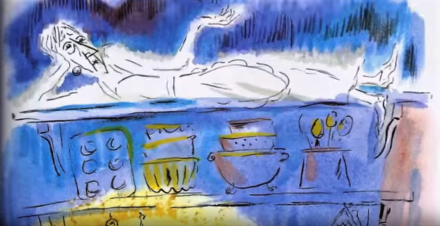
Marjorie Priceman illustrates The Bake Shop Ghost with verve and delicious colors that will make readers wish they could visit Merriweather’s to sample the desserts in the well-stocked cases. The sophisticated shop is no less inviting, with its delicate chandeliers, French café chairs, and homey details. Priceman infuses her pages with humorous details as well: as Cora is distracted with a sale, a dog licks icing off a wedding cake, and at Cora’s funeral the preacher, choir, and congregation shed copious tears as ethereal visions of the cakes they will miss float in the air. The scenes in which Cora’s ghost menaces the new shop owners are cleverly depicted with swoops of white that bear Cora’s face and hands floating above the disaster she causes.

Ages 4 -9

Houghton Mifflin Harcourt, Paperback edition, 2008 | ISBN 978-0547076775

National Personal Chef Day Activity

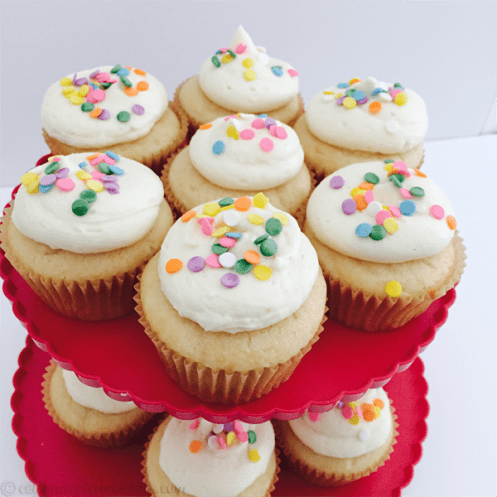
celebrate-picture-books-picture-book-review-cupcakes

Very Vanilla Cupcakes


This delicious vanilla cupcake recipe from Sally’s Baking Addiction would definitely please Cora Lee Merriweather—and they’ll become one of your favorite confections too!

Vanilla Cupcakes

  • 1 and 2/3 cup (210g) all-purpose flour (spoon & leveled)
  • 1/2 teaspoon baking powder
  • 1/4 teaspoon baking soda
  • 1/2 teaspoon salt
  • 1 cup (200g) granulated sugar
  • 1/2 cup (115g) unsalted butter, melted and slightly cooled
  • 2 large egg whites
  • 1/4 cup (60g) vanilla Greek yogurt (or plain; or regular yogurt; or even sour cream)
  • 3/4 cup (180ml) vanilla almond milk (or cow’s milk; or soy milk; or plain almond milk)
  • 2 teaspoons pure vanilla extract seeds scraped from 1/2 split vanilla bean1

Vanilla Bean Frosting

  • 1 cup (230g) unsalted butter, softened to room temperature
  • 4-5 cups (480-600g) confectioners’ sugar
  • 1/4 cup (60ml) heavy cream2
  • 1 teaspoon vanilla extract seeds scraped from 1/2 split vanilla bean1
  • Salt, to taste

Directions

  1. Preheat oven to 350F degrees. Line muffin tin with 12 cupcake liners. Set aside.
  2. In a medium bowl, mix together flour, baking powder, baking soda, and salt. Set aside. In a large microwave-safe bowl, melt butter in the microwave. Whisk in sugar – mixture will be gritty. Whisk in egg whites, yogurt, milk, and vanilla extract until combined. Split 1 vanilla bean down the middle lengthwise. Scrape seeds from half of the vanilla bean into batter. Reserve other half.
  3. Slowly mix dry ingredients into the wet ingredients until no lumps remain. Batter will be thick.
  4. Divide batter among 12 cupcake liners (or 24 mini) and bake for 20 minutes or until a toothpick inserted in the center comes out clean. Bake for 8-9 minutes if making mini cupcakes. Allow to cool.
  5. To make the frosting, beat softened butter on medium speed with an electric or stand mixer. Beat for about 3 minutes until smooth and creamy. Add confectioners’ sugar, cream, vanilla extract, and vanilla bean seeds with the mixer running. Increase to high speed and beat for 3 minutes. Add more powdered sugar if frosting is too thin or more cream if mixture is too thick. Add salt if frosting is too sweet (1/4 teaspoon). Frost cooled cupcakes (I used Wilton 1M piping tip). There may be leftover frosting depending how much you use on each cupcake.
  6. Store cupcakes in an airtight container at room temperature for up to 3 days and in the refrigerator up to 7.

Additional Notes

  1. If you can’t get your hands on vanilla beans, add an extra ½ teaspoon of pure vanilla extract instead.
  2. Strongly urged to use heavy cream. You may use milk or half-and-half, but heavy cream will give the frosting a thicker texture. I recommend it!

For ways to adapt this recipe and more scrumptious recipes, visit Sally’s Baking Addiction. I guarantee you’ll go back again and again!

Picture Book Review
June 20 – World Refugee Day

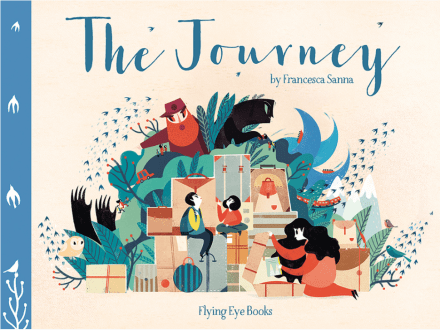
celebrate-picture-books-picture-book-review-the-journey-cover

About the Holiday

On World Refugee Day, first celebrated in 2001, we commemorate the strength, courage, and perseverance of millions of refugees. The annual commemoration is marked by a variety of events in more than 100 countries, involving government officials, humanitarian aid workers, celebrities, civilians and the forcibly displaced themselves.

The Journey

By Francesca Sanna 


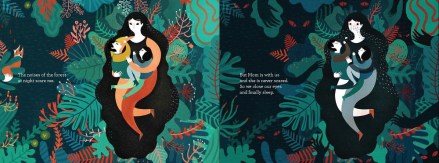
A child begins the story with a place—the family’s home in a city by the sea. The family used to visit the beach often, but not anymore, “because last year our lives changed forever,” the child reveals. “The war began,” the narrator says, turning their once-peaceful life into “chaos.” Not only was their city torn apart, the family was also, as “one day the war took [their] father.”

celebrate-picture-books-picture-book-review-the-journey-friend

Copyright Francesca Sanna, 2016. Courtesy of Flying Eye Books.

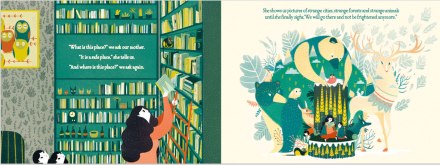
The child’s mother is afraid of the darkness that has descended on them. One of her friends told her that many people are leaving, escaping to another country with high mountains. The two children ask their mother where and what this place is. She answers that “‘it is a safe place’” an then shows them pictures that contain unfamiliar trees and animals. She sighs and tells her son and daughter, “‘We will go there and not be frightened anymore.’”

celebrate-picture-books-picture-book-review-the-journey-library

Copyright Francesca Sanna, 2016. Courtesy of Flying Eye Books.

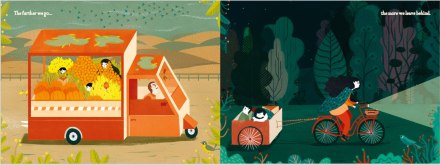
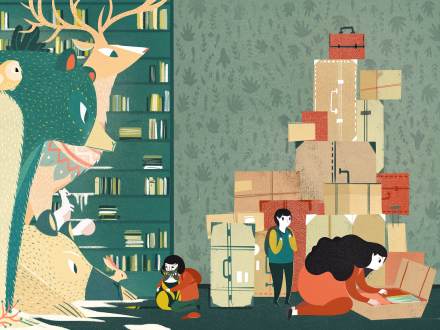
Even though the children don’t want to leave, they pack up all their belongings and say goodbye to their friends. They leave at night so they won’t be caught. They travel for many days, taking various modes of transportation. With each change the family must leave more and more of their things behind.

When they reach the border, they are met by an enormous wall that they must climb over. But before they can, a guard stops them and tells them they cannot cross, that they must go back. The family has nowhere else to go, however, and they are very tired. They find a spot in the woods to sleep, but the strange noises keep the children awake. Their mother tells them not to be afraid, and in her arms they finally fall asleep as she cries silent tears.

celebrate-picture-books-picture-book-review-the-journey-leaving-things-behind

Copyright Francesca Sanna, 2016. Courtesy of Flying Eye Books.

Suddenly, they hear shouting and see that the guards are looking for them. They run and run until they meet a man who takes them over the border. They come to the shores of a huge body of water that stretches far into the distance. The family must cross this water to be safe. They board a ferry loaded with other families and sail for days. On the way, they tell stories of the creatures who lurk in the waters below, “ready to gobble [them] up if the boat capsizes.” Other times they tell stories about magic fairies who live in the land they are going to—ones who have “magic spells to end the war.”

celebrate-picture-books-picture-book-review-the-journey-mother-protecting-at-night

Copyright Francesca Sanna, 2016. Courtesy of Flying Eye Books.

In the dawn light, the children and their mother finally see land. They are close to the place where they will be safe, the mother says, but it requires many more days of train travel across many more borders. On the journey the child watches birds migrating just as they are and hopes that one day, like the birds, they will find a new home where they “can be safe and begin our story again.”

Francesca Sanna’s moving compilation of true immigrant stories into a powerful narrative that speaks for so many provides a compelling and sensitive way to discuss the world’s refugee crisis with children. Sanna’s straightforward storytelling allows children to understand the cause and effect relationship of the war on those it displaces. Her focus on the length and difficulty of the family’s journey gives young children—for whom even short times and distances can seem long—a starting point for deeper comprehension. Sanna tempers frightening aspects of the story with her calm delivery and peppering of courage on the part of the mother and children along the way.

celebrate-picture-books-picture-book-review-the-journey-packing

Copyright Francesca Sanna, 2016. Courtesy of Flying Eye Books.

Sanna’s stunning and emotionally resonant artwork deftly presents the experiences of loss and love the story contains. Her use of the amorphous, seeping black images demonstrate the movement of the war and the ravages it imposes. Collage-like aspects to the illustrations gives readers much to talk about at varying age-appropriate levels. As the family’s journey begins, their suitcases and trunks filled with belongings are piled high, but as it continues, their luggage dwindles until only the most precious valuables remain—the two children and their mother. Sanna’s color pallet of oranges, reds, yellows, and greens are eye-catching and convey the urgency of the family’s plight. The final image of the mother, son, and daughter carried on the wind by a majestic bird offers the opportunity to talk about hope with young readers.

Ages 3 – 8

Flying Eye Books, 2016 | ISBN 978-1909263994

Learn more about Francesca Sanna and her work on her website!

World Refugee Day Activity

celebrate-picture-books-picture-book-review-welcome-sign

Learn to Say “Welcome” in Different Languages


With this printable Welcome sign, you can learn how to greet others in their native language!

Picture Book Review
June 15 – Smile Power Day

celebrate-picture-books-picture-book-review-welcome-barroux-cover

About the Holiday

We smile at people all day long, don’t we? I mean there’s 🙂  😀  🙂  😉  and so many more! But how about the real kind? Giving a warm smile to a friend, a stranger, or—especially—someone who looks as if they need one, makes everyone feel better! Today, be happy and welcome all with a smile!

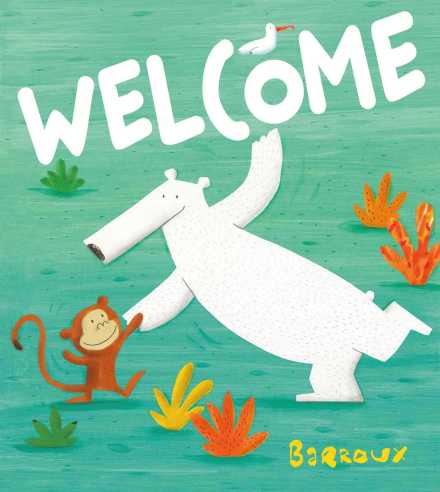
Welcome

By Barroux


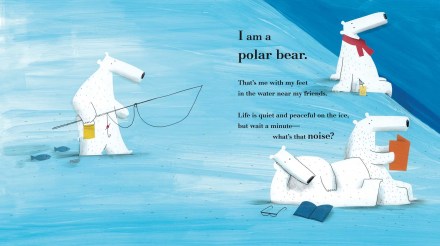
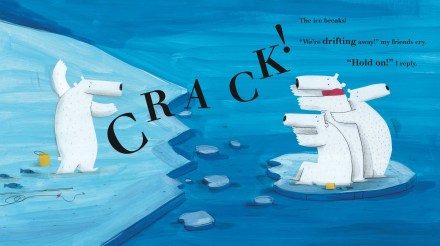
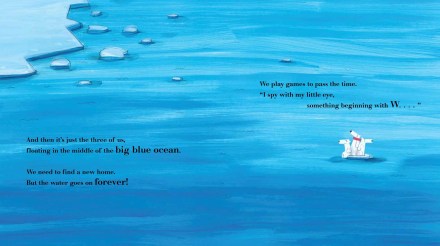
A polar bear is sitting on the edge of an ice floe enjoying some relaxing time with his friends when he hears an ominous noise. “CRACK! The ice breaks! ‘We’re drifting away!’” his friends cry. In no time at all the three polar bears are adrift in the middle of the sea in need of a new home. They float and float, but “the water goes on forever!” To pass the time the friends play games: “‘I spy with my little eye, something beginning with W…’”

celebrate-picture-books-picture-book-review-welcome-barroux-polar-bears-relaxing

Copyright Barroux, courtesy of little bee books and simonandschuster.com

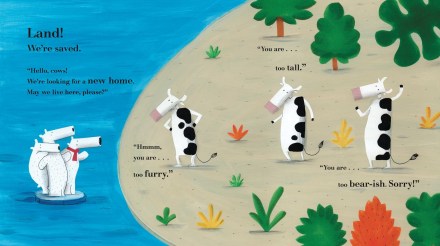
Perhaps days go by. The bears ride out a storm with dark skies and huge waves that threaten to sink them. It’s scary and the trio wants “to find a new home right now!” At last, their ice floe—smaller now—approaches a sandy shore. “Land! We’re saved,” cheer the polar bears. They ask the cows on the beach if they can live there, but the cows take exception. The bears are “too furry…too tall…and too bear-ish.” And with a “Sorry!” the cows turn the weary travelers away.

celebrate-picture-books-picture-book-review-welcome-barroux-ice-breaks-away

Copyright Barroux, courtesy of little bee books and simonandschuster.com

Once again on their own, the bears have no choice but to let the current steer them. With standing room for only one on their icy raft, they near another beach where a single panda relaxes on pillows in the midst of expansive land. “Yes! This could be our new home,” the polar bears shout. The panda ponders the situation for only a moment before stating, “‘…you are too many. Look around, there’s just not enough room! You can’t live here.’”

celebrate-picture-books-picture-book-review-welcome-barroux-polar-bears-meet-cows

Copyright Barroux, courtesy of little bee books and simonandschuster.com

As the polar bears continue on their journey, their “little ice boat has almost melted,” and they are running out of time. They bob next to a tall sea wall. “‘Help us!’” they plead. Behind the wall two giraffes lounge on the beach, too lazy to investigate the noise they hear. The ice floe has melted to a thin disk. The bears are hanging on and about to give up hope when they find an empty island. They jump to shore just in the nick of time and begin enjoying their new home.

celebrate-picture-books-picture-book-review-welcome-barroux-polar-bears-adrift

Copyright Barroux, courtesy of little bee books and simonandschuster.com

It’s not long before a dinghy floats into view with three monkeys on board. “‘Excuse me, we’re looking for a new home. Can you help us please?’” they ask. The polar bears stop their game of badminton and step forward. “‘Hmmm,’” they think. “‘You are…

Welcome!’”

With vibrant blue, full-bleed pages as wide open as the sea itself and three endearing long-nosed polar bears, Barroux has crafted a poignant tale with depth and far-reaching applications for readers of all ages. Inspired by the Syrian refugee crisis, Welcome stands on its own as an uplifting story of friendship and inclusiveness, but also offers an excellent means for beginning a discussion on the world events that children see and have questions about. Employing a bear’s first person point of view and incorporating a child-centric perspective on travel—from the humor of the I Spy game to the perseverance of the bears—Barroux sets just the right tone for his audience.

With sparse text and repetition of the bears’ simple request, the subject matter is handled with sensitivity, not fright, which allows children to understand that the theme of the story is relevant on many levels. Whether the “traveler” comes from near or far, is a classmate, teammate or neighbor, or is even the reader or someone else feeling adrift in a certain situation, children will see that all deserve welcome.

Ages 4 – 8

little bee books, 2016 | ISBN 978-1499804447

You can view a gallery of illustration work for children, adults, and more by Barroux on his website!

Smile Power Day Activity

celebrate-picture-books-picture-book-review-give-me-your-hand-puzzle

Give Me Your Hand! Puzzle


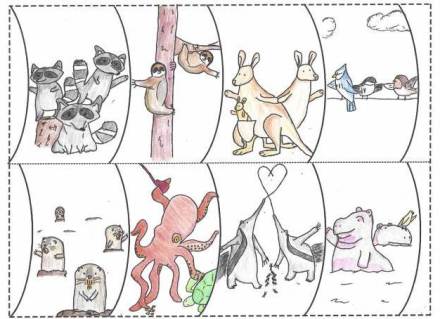
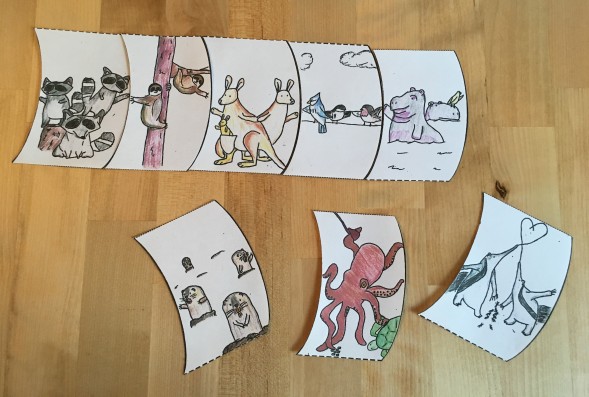
In this printable Give Me Your Hand! Puzzle, everyone is welcomed with a handshake. Offering friendship to all, the interchangeable pieces can be mixed and matched as the animals become buddies with one another.

Supplies

celebrate-picture-books-picture-book-review-UN-day-puzzle

Directions

  1. Print the puzzle: to make the puzzle sturdier: Print on heavy stock paper or glue the page to poster board
  2. Color the pictures with colored pencils or crayons
  3. Cut the pieces apart
  4. Switch the pieces around to make many alternate pictures

celebrate-picture-books-picture-book-review-UN-day-puzzle

Picture Book Review
June 8 – Upsy-Daisy Day

celebrate-picture-books-picture-book-review-a-crow-of-his-own-cover

About the Holiday

Do you wake up before the alarm or do you hit the snooze button a couple of times? Do you bound out of bed or do you pull the covers up tighter? Do you greet your family with a cheery “Good Morning” or do you mumble an incoherent “gmmmphngg?” If you’re more the latter type of person, then today’s holiday encourages you to be a happy “upsy-daisy” who starts the day with enthusiasm and an optimistic outlook. Beginning the day fresh as a daisy helps the whole day go better!

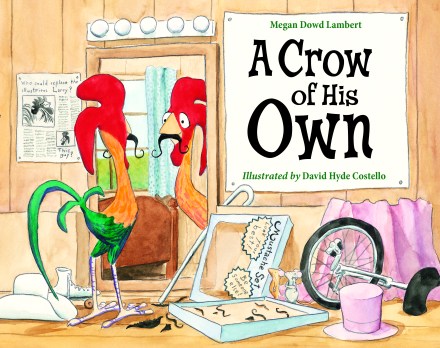
A Crow of His Own

Written by Megan Dowd Lambert | Illustrated by David Hyde Costello


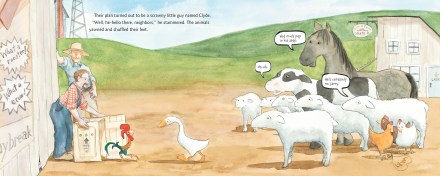
When fame and fortune came calling for Larry, the charismatic rooster of Sunrise Farm, the daily routine turned upside down. “The animals overslept and no one knew what to do.” But while the cow, horse, sheep, chickens, and goose fretted, Farmer Jay and Farmer Kevin had a plan. One day they gathered all the animals and introduced Clyde, the new rooster. Looking at the “scrawny little guy” as he stammered his hello, the cow, horse, and sheep expressed doubt in his abilities, already comparing him to their beloved Larry.

Roberta, the goose, stepped forward, however, and reassured him that “they just miss Larry.” When Clyde asked who Larry was, the animals gasped. “Only the best rooster ever,” claimed the sheep. “Take it straight from my mouth: he was more than that,” said the horse. “He was a genius,” the cow chimed in.” And the chickens? In the dirt they scratched a heart with Larry and XOX in the center.

celebrate-picture-books-picture-book-review-a-crow-of-his-own-clyde-joins-the-farm

Image copyright David Hyde Costello, text copyright Megan Dowd Lambert. Courtesy of Charlesbridge

Clyde was worried—how could he ever live up to Larry? Roberta tried to soothe him. “‘Larry wasn’t a genius…he just made quite a show of it.” Emboldened and with an inkling of what he needed to do, Clyde thanked Roberta and dashed off. “Clyde spent the whole day gathering props, designing his costume, and choreographing a sublime two-step.” As Clyde gave himself one last look in the mirror in his top hat and cloak, he had misgivings. “Could he put on a show of a crow?” He went to bed, but hardly slept at all.

celebrate-picture-books-picture-book-review-a-crow-of-his-own-sleeping

Image copyright David Hyde Costello, text copyright Megan Dowd Lambert. Courtesy of Charlesbridge

In the morning…well…Clyde overslept. The animals were not happy. “Who ever heard of a rooster sleeping in?” baaad mouthed the sheep. “What a worthless chicken,” complained the horse. And the cow had issues of her own. Once again Roberta came to Clyde’s defense. With a wagon full of new props and material, Clyde rushed away to prepare for the next day. Up bright and early and balanced on a unicycle atop the coop while surrounded by promotional signs, Clyde “opened his beak, and…promptly fell to the ground with an undignified croak.”

celebrate-picture-books-picture-book-review-a-crow-of-his-own-skating-ramp

Image copyright David Hyde Costello, text copyright Megan Dowd Lambert. Courtesy of Charlesbridge

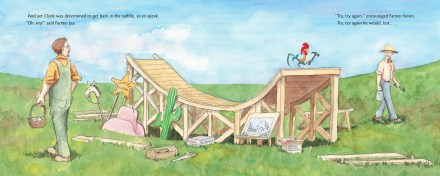
Poor Clyde! Humiliated and hurt he once again had to endure the slights of the farmyard animals, but their comments only spurred him on. Vowing to go bigger and better, Clyde built himself a ramp, ordered roller skates for birds and a parachute, and designed a colorful Western-themed set. “‘Oh, my!’” remarked Farmer Jay as he walked by. “‘Try, try again,’ encouraged Farmer Kevin.” But in the morning Clyde’s spectacular trick left him hanging upside down from the chicken coop, and the animals more “disgruntled and dismayed” than before.

celebrate-picture-books-picture-book-review-a-crow-of-his-own-ramp

Image copyright David Hyde Costello, text copyright Megan Dowd Lambert. Courtesy of Charlesbridge

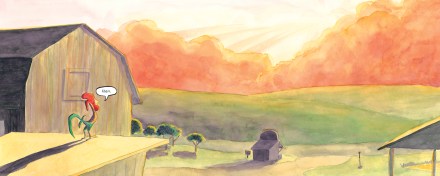
Clyde was distraught. “‘Forget about Larry.’” Roberta said. “‘Just crow your own crow.’” Clyde considered her advice. The next morning as the sky turned pink and orange with the rising sun, Clyde stood tall atop the chicken coop. He quietly cleared his throat and then—“COCK-A-DOODLE-DOO!” The newly awakened animals came running. Even Farmer Jay and Farmer Kevin came to see this new Clyde. The horse summed up their collective feeling: “It’s not so much like crowing, but crooning.” Roberta agreed. “‘Enough to give you goose bumps!’” she exclaimed. As an encore, “Clyde took a deep breath, gave a shake of his comb, and called out another crow of his own.”

celebrate-picture-books-picture-book-review-a-crow-of-his-own-sunrise

Image copyright David Hyde Costello, text copyright Megan Dowd Lambert. Courtesy of Charlesbridge

These days it’s nearly impossible for kids not to compare themselves or be compared to others—even those they’ve never met. All they need to do is jump on the Internet and discover that so-and-so has double, triple, or more friends and/or followers than they do; go to class and get their grade on that assignment they worked so hard on; or simply stand by their locker, go to lunch, or head out to gym and overhear the comments of other students. Avoidance isn’t the answer, but a good base of self-confidence and personal identity is. In A Crow of His Own Megan Dowd Lambert offers readers such a base in her entertaining and meaningful tribute to self-acceptance and love that hits all the right notes.

As soon as scrawny Clyde walks out of his crate to the scorn of his farm mates, kids will root for this underchicken. With a light touch and plenty of wordplay, Dowd deftly presents honest portrayals of the opposition Clyde is up against as well as Clyde’s distressed reactions. Clyde’s three attempts to act like Larry humorously demonstrate the difficulties of trying to be someone you’re not. When Clyde finally musters the courage to “crow his own crow” and is met with praise, readers will see that their own unique talents will find an appreciative audience.

celebrate-picture-books-picture-book-review-a-crow-of-his-own-sunrise-farm

Image copyright David Hyde Costello, text copyright Megan Dowd Lambert. Courtesy of Charlesbridge

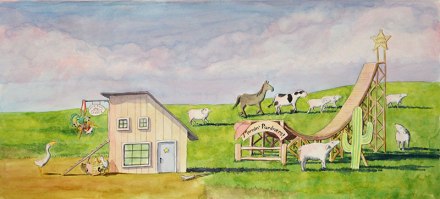
David Hyde Costello knows how to put on a show! His Sunrise Farm is a gentle, bucolic spread still under the thrall of Larry. Humorous details, such as the valentines to Larry the chickens draw in the dirt, the movie house-style posters on the side of the barn, and the surprised and exasperated expressions of the animals, testify to Larry’s enduring legacy. But careful observers will notice that while Larry is a rather bland white rooster with some black tail feathers, Clyde is distinctively colorful from his comb to his feet. Kids will giggle at Clyde’s increasingly complex morning shenanigans even as they sympathize with his plight. When Clyde finally reveals his magnificent crow, readers will cheer.

A Crow of His Own is a winner on so many levels. It offers parents and children a way to discuss and begin building the strong sense of self so important to a happy and successful life. The book also presents a positive visual representation of diversity, and in Roberta and Farmer Jay and Farmer Kevin it shows that finding support helps. And it does all of this in a story that stands on its own as a funny, laugh-inducing romp. Because kids will want to hear this story over and over, A Crow of His Own would be a wonderful addition to libraries and home book collections.

Ages 4 – 9

Charlesbridge, 2015 | ISBN 978-1580894470

To learn more about Megan Dowd Lambert, her picture books, her Whole Book Approach to Reading, and more visit her website!

On David Hyde Costello‘s website you’ll find a gallery of artwork, a portfolio of picture books, videos, and more!

Upsy-Daisy Day Activity

celebrate-picture-books-picture-book-review-chicken-craft

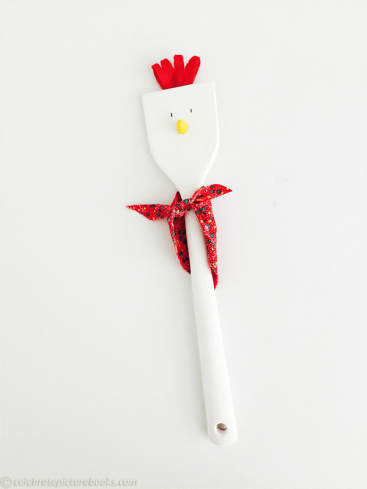
A Chicken to Wake Up To


A long-handled wooden turner makes a plucky decoration for your room or kitchen—and a great reminder to bring your passions to every job! In a few simple steps, you’ll have a cute companion you’ll want to crow about!

Supplies

  • Printable Comb and Scarf Template
  • Long-handled wooded turner, available in kitchen supply stores
  • Red felt, 2 inches by 2 inches
  • Yellow bakable clay
  • Fabric, 12 inches square
  • A small piece of white felt or fleece (optional)
  • White paint (or any color you would like)
  • Black marker
  • Fabric glue
  • Glue gun
  • Paint brush

celebrate-picture-books-picture-book-review-chicken-craft

Directions

  1. Paint the wooden turner, let dry
  2. Cut the scarf from the piece of fabric
  3. Make a beak from the yellow clay and bake it according to package directions

To make the comb

  1. Fold the felt in half and glue the end together with the fabric glue
  2. Cut short strips from the folded top of the felt, about ½-inch to ¾ -inch in length
  3. Round the corners of the strips slightly

To make the scarf

  1. Fold the fabric in half
  2. With the long, straight edge of the scarf template along the fold, cut out the scarf
  3. With the fabric glue, glue the two sides of the scarf together so that you have two “right” sides
  4. Let dry

To assemble the chicken

  1. Pinch the bottom of the comb together so that the strips open and the felt pleats a little
  2. With the glue gun attach the comb to the back of the painted turner, keeping the bottom pinched together
  3. Attach the beak to the front of the turner
  4. Draw eyes on the chicken with the black marker
  5. Tie the scarf around the neck of the handle, hold in place with a drop of glue in the back if necessary
  6. To make tail feathers in a turner with a hole in the handle, pinch together a small folded piece of white felt or fleece and push it through the hole in the handle of the turner.
  7. Cut or arrange to look like feathers

Picture Book Review
May 15 – Straw Hat Day

celebrate-picture-books-picture-book-review-miss-fannie's-hat-cover

About the Holiday

Straw hats are found in nearly every culture in the world and have been used since ancient times. Made from local materials, some are unique to and even iconic of the country in which they’re made. Woven loosely, straw hats can protect a person from the hot sun while also keeping their head cool. In rainy climates, tightly woven hats are good for staying dry. Of course, straw hats are a staple of women’s fashion and can be found in nearly every color and decorated with ribbon, flowers, feathers, beads, and more.

Miss Fannie’s Hat

Written by Jan Karon | Illustrated by Toni Goffe


“Miss Fannie has lots of hats. And each one is her favorite.” Miss Fannie is ninety-nine years old and has a closet full of hats that she has worn on special occasions throughout her life. When she tries on her “red felt with the big feather, she looks in the mirror and says ‘I just love this hat!’” It’s the same with her green velour hat that’s decorated with a fancy pin. She’s not the only one who loves her hats. When she wears them to church, people always tell her, “‘Miss Fannie, I sure do love that hat!’” But Miss Fannie has a favorite among her many hats: the pink straw with silk roses. Everyone else loves this hat too.

celebrate-picture-books-picture-book-review-miss-fannie's-hat-closet (2)

Image copyright Toni Goffe, text copyright Jan Karon. Courtesy of Puffin Books.

Miss Fannie is a tiny woman who now lives with her daughter, Wanda. Wanda takes good care of her mother. She makes her big breakfasts, and even though Miss Fannie always says its “way too much,” she always clears her plate. Every Saturday, Wanda helps her mother wash her hair in the bathroom sink. Miss Fannie is so small that she has to stand on a stool to reach. Afterward, Wanda rolls her mother’s hair in curlers, and on Sunday morning she “combs out her mama’s hair, which is all nice and soft and gray, like the feathers of a dove.”

Then Miss Fannie puts on make-up, dresses in her best clothes, and chooses a hat. Choosing can be difficult because “Miss Fannie has three black hats, two red hats, one green hat, two white hats, two navy hats, three beige hats, one brown hat, and the famous pink straw with roses. Because she never wears the same one twice in a row, some people think she has a whole closet full of hats. Which, of course, she does.”

One Sunday, Miss Fannie’s preacher comes to her with an earnest request. He asks her to donate one of her hats to the auction that will raise money to fix up the church for Easter. Miss Fannie wants to help, but how can she choose among her beautiful hats? When they get home, Miss Wanda helps her mother lay out all of her hats on the bed and dresser. Alone in her room, Miss Fannie looks over all her hats. As she holds each in her hand she remembers her past. “The green velour with the fancy pin was very, very old, and still very beautiful.” She had worn it during the great flood of 1916 when she “crossed the swollen river on a ferry to visit her mother and father. As she stood at the rail…a house had floated by, almost close enough to touch.”

celebrate-picture-books-picture-book-review-miss-fannie's-hat-breakfast

Image copyright Toni Goffe, text copyright Jan Karon. Courtesy of Puffin Books.

Next, she considers the red, wide-brimmed felt. The feather on this hat came from a hawk Miss Fannie had caught trying to nab one of her chickens. Then she picks up the brown velvet hat that “always reminded her of Flower, her grandmother’s cow.” She had begun milking Flower when she was seven years old and had learned to churn butter that was better than any found in a store. “Finally, Miss Fannie came to her most favorite hat of all: the pick straw with silk roses.” She had worn it every Easter for thirty-five years and it never failed to make her feel brand new. It was a tradition everyone else enjoyed too, “just as they looked for the tulips and daffodils to bloom in the spring.”

She puts the pink straw hat on, looks in the mirror, and sighs. “In her heart she did not want to giver her hat away. Not at all.” But as she places it back in its box and ties the ribbon, she discovers “she was very, very excited” about all the things it might be able to do. The old pipe organ needed fixing, there was a crack in the church bell, and the roof really needed to be replaced.

At the auction, when the preacher holds up Miss Fannie’s pink straw hat with the silk roses, “the bidding took off lickety-split.” With the bang of the gavel, the hat goes to a woman in the front row. The check she gives the preacher is “enough to really get things fixed,” Miss Fannie knows. She also knows “that she would not miss her favorite hat one bit.”

celebrate-picture-books-picture-book-review-miss-fannie's-hat-outside

Image copyright Toni Goffe, text copyright Jan Karon. Courtesy of Puffin Books.

On Easter morning Miss Fannie rises and fixes her hair. She looks at her hats—none of which seemed right. As she meets Wanda at the front door in her best dress, her best jewelry, her best gloves, and a white corsage, “Miss Wanda couldn’t believe her eyes. Her mama was going out the door without wearing any hat at all!” When they arrive at the freshly painted church, Miss Fannie and Miss Wanda are surprised and delighted to see pink roses planted everywhere around the building. “‘Oh, Mama!’ said Miss Wanda. ‘It looks just like your pink hat!’”

With tears in her eyes, Miss Fannie learns that they were able to fix the organ and the bell as well as planting all the roses. As the congregation looks on “they didn’t see an old woman at all. What they saw was a young girl with hair as soft as the feathers of a dove.” And now when people pass the church, they don’t see gardens of roses. Instead, they see Miss Fannie’s hat. “And it will always be her favorite.”

Jan Karon’s story of selfless love was a favorite in our house when my daughter was young. Not only is the well-paced narrative full of evocative sensory details, bits of history, and realistic dialogue, it centers around a unique plot involving the types of soul-searching decisions that are hard to make. No matter how many times we read the book, Miss Fannie’s choice to auction her favorite hat to benefit her church seemed to come as a surprise that both inspired and heartened. While the tale is primarily Miss Fannie’s, it is Wanda’s story of benevolence too as Karon affectionately describes the ways in which Wanda lovingly attends to her mother’s physical and emotional needs. Throughout Miss Fannie’s Hat, Karon demonstrates that a life well-lived is one abounding in joyous giving.

Toni Goffe takes readers into Miss Wanda’s home—and Miss Fannie’s memory—with his bright, delicate illustrations that fully satisfy little one’s love of realistic detail. My daughter enjoyed the textured feel to the images, where steam rises from a cup of tea and from the bathroom sink, Miss Wanda brushes out her mother’s soft hair, and the hats—made of velvet, velour, and straw and sporting feathers, flowers, nets, and ribbon—beg to be touched. In fact, with the first page and its tantalizing peek into Miss Fannie’s closet, readers will find themselves riveted to her hats and life story. Vignettes from Miss Fannie’s younger years as well as scenes of her now demonstrate her enduring courage and strength of character.

For kids who like to count, sort, and compare, a one-page illustration and a glorious two-page spread allow them to match the list of hats in the text with the contents of Miss Fannie’s closet. They are also invited to choose their favorite from among Miss Fannie’s hats.

Miss Fannie’s Hats is a wonderful story to share with young readers for its ideas of giving, multigenerational relationships, and friendship.

Ages 3 – 6

Puffin Books, 2001 | ISBN 978-0140568127

Discover more about Jan Karon and her books for children and adults on her website!

View a gallery of artwork by Toni Goffe on his website!

Straw Hat Day Activity

celebrate-picture-books-picture-book-review-hat-matching-game

Hat Matching Game


These hats come in pairs—or maybe even triplets—but somehow they’ve been mixed up! Can you find all the matching sets? Just put on your thinking caps and play this printable game!

Supplies

Directions

  1. Print two or more sets of cards
  2. Cut the hat cards apart
  3. Mix them up and lay them face down on the floor or table
  4. Choosing one card at a time, turn them over to try and find a match
  5. If the cards do not match, replace them face down and try again
  6. Continue play until all the hats have been matched

Picture Book Review
May 4 – Petite and Proud Day

celebrate-picture-books-picture-book-review-the-smallest-girl-in-the-smallest-grade-coverAbout the Holiday

Life’s not about how tall you are but about how big your heart is! Today we celebrate people who are 5’4” and under—the petite! There are many advantages to being on the smaller side—it’s easier to fit into tight spaces; airline, train, and other transportation seats are more comfortable; and we can blend into the crowd more easily when we’re having a bad hair day. All-in-all being petite is pretty perfect!

The Smallest Girl in the Smallest Grade

Written by Justin Roberts | Illustrated by Christian Robinson


Sally McCabe was so small that she was mostly overlooked. “She was the smallest girl in the smallest grade.” The other kids heard her name called every morning along with theirs, and they passed her in the hall on the way to class, but no one knew that “Sally was paying super extra special attention” to what went on around her. For instance, she noticed the kite someone had lost in the tree and had counted twenty-seven keys on the janitor’s ring.  She watched as the leaves turned “green to gold in the fall” and when “Tommy Torino was tripped in the hall.”

celebrate-picture-books-picture-book-review-the-smallest-girl-in-the-smallest-grade-classroom

Image copyright Christian Robinson, text copyright Justin Roberts. Courtesy of G. P. Putnam’s Sons.

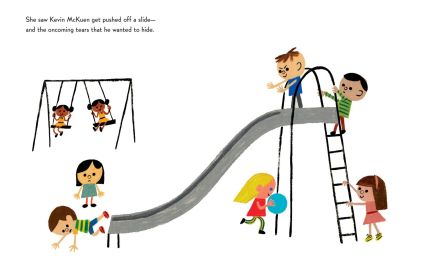
She saw wildflowers turn their face toward the sun and “was there when the stray cats who normally fought / conducted a meeting in the church parking lot.” On the playground she saw Kevin McKuen get shoved down the slide and knew of the “tears that he wanted to hide.” On Parent-Teacher day, too, she watched kids pulled down the hall by parents upset at what they had heard. But during all this, no one happened to see Sally watching or knew what that could mean.

celebrate-picture-books-picture-book-review-the-smallest-girl-in-the-smallest-grade-slide

Image copyright Christian Robinson, text copyright Justin Roberts. Courtesy of G. P. Putnam’s Sons.

Sally understood that these slights, mean words, and cruel actions kept building and building without any stop, and she finally decided that something must change. So one day during lunch she stepped out of line, stuck her hand in the air, and announced very loud, “‘I’m tired of seeing this terrible stuff. / Stop hurting each other! This is enough!’”

Some kids just giggled and ignored what she’d said, but many others joined in with their hands in the air. “Like waves rolling in, one after another— / first Molly rose up, then Michael’s twin brother. / It was Tyrone and Terence, then Amanda and Paul, / who pushed out their chairs and stretched their arms tall.” And they all felt connected “like the janitor’s keys. Fastened together with a heavy steel ring / that held all the secrets to unlock everything.”

celebrate-picture-books-picture-book-review-the-smallest-girl-in-the-smallest-jump-rope

Image copyright Christian Robinson, text copyright Justin Roberts. Courtesy of G. P. Putnam’s Sons.

After that day, things went back to normal—but with much welcomed kindness in small doses and places. Spaces were made for strangers to sit, doors held wide open, and many such “moments that get taken for granted—a wildflower appearing that no one had planted.” And so the world changed for this school and this town all because Sally was courageous and kind and paying attention.

Justin Roberts’ rhyming tribute to the empathy and bravery of one little girl who takes notice and makes a difference shows kids and adults that anyone can create change no matter who they are. Readers of all ages will recognize the hurts that Roberts chooses to include, good examples of the small and large acts that cause physical and emotional pain. The infectious rhythm and the inspirations of kindness—from the alley cats’ truce to wildflowers to keys (objects that at once have familiarity and deeper meanings)—give the book resonance far beyond the immediate reading.

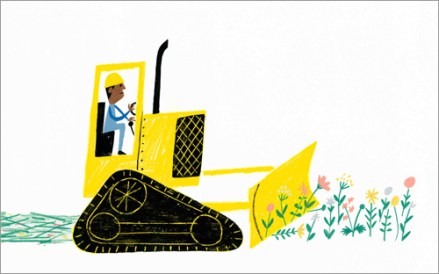
celebrate-picture-books-picture-book-review-the-smallest-girl-in-the-smallest-grade-bulldozer

Image copyright Christian Robinson, text copyright Justin Roberts. Courtesy of G. P. Putnam’s Sons.

Christian Robinson’s bright, wide-lens drawings of Sally’s schoolroom, cafeteria, and playground give young readers the same view Sally has, allowing them to also find the examples of arguing, pushing, whispering, and other slights that she reacts to. An illustration of Sally and her classmates sitting at their desks shows exactly how small she is in comparison to the other children; the rest of the pages demonstrate just how big her heart is. Each page offers opportunities for kids and adults to discuss the problems of bullying and options for how they can make a difference.

The Smallest Girl in the Smallest Grade is a wonderful reminder of how important each person is in making the world a happier place and would make an excellent addition to home libraries.

Ages 3 – 7

G. P. Putnam’s Sons, 2014 | ISBN 978-0399257438

Visit Christian Robinson’s website, where books and art are always fun!

Check out all the music, videos, activities, and other stuff by Justin Roberts on his website!

Petite and Proud Day

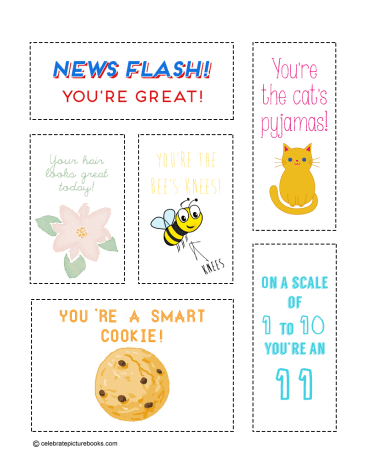
celebrate-picture-books-picture-books-review-kindness-cards

Kindness Cards


Being kind to someone can be as easy as slipping a friendly note into someone’s locker or backpack or leaving a card for a favorite teacher, bus driver, or librarian. If you notice someone who could use a pick-me-up, you could give them one of these cards too! Print out your Kindness Cards and start spreading some good cheer!

Picture Book Review