January 26 – It’s National Hobby Month

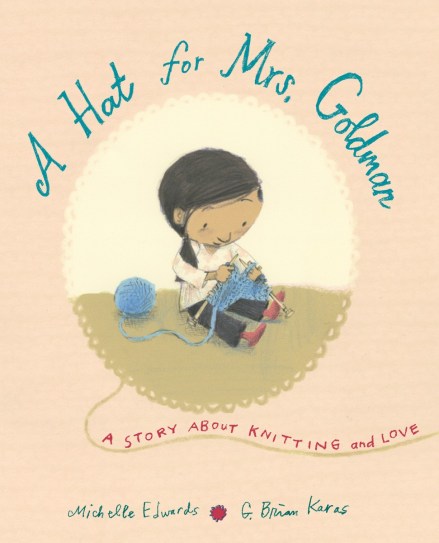
celebrate-picture-books-picture-book-review-a-hat-for-mrs.-goldman-cover

About the Holiday

If you like to take a break from the routine or pressures of the work day and sew, garden, or read, play music, dance, or draw, or if you’ve always wanted to learn a new skill or develop a talent, then this month is for you! During National Hobby Month take some time to research a skill, art, or discipline that strikes your fancy and get started!

A Hat for Mrs. Goldman: A Story about Knitting and Love

Written by Michelle Edwards | Illustrated by G. Brian Karas


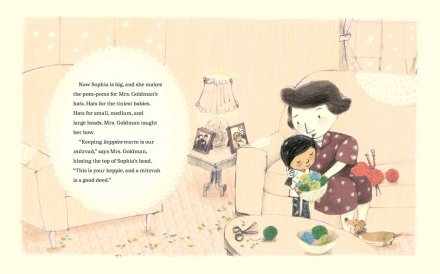
One of the first gifts Sophia received when she was a baby was a knitted hat from her neighbor Mrs. Goldman. Now that Sophia is more grown up, she helps Mrs. Goldman make pom-poms for the hats she knits for other babies, friends, and neighbors. “‘Keeping keppies warm is our mitzvah,’ says Mrs. Goldman, kissing the top of Sophia’s head. ‘This is your keppie, and a mitzvah is a good deed.’”

One day in late autumn Sophia and Mrs. Goldman walk Mrs. Goldman’s dog Fifi. While Fifi is kept warm in a dinosaur sweater and Sophia is cozy in the fuzzy kitten hat and mittens that Mrs. Goldman made them, Mrs. Goldman’s head and ears are unprotected in the icy wind. When Sophia asks her friend why she doesn’t have a hat, Mrs. Goldman tells her “‘I gave it to Mrs. Chen.’”
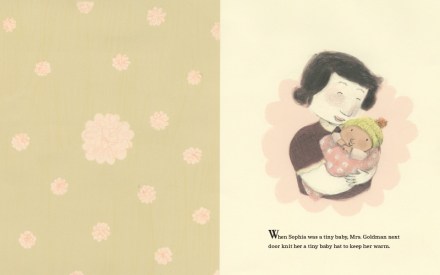
celebrate-picture-books-picture-book-review-a-hat-for-mrs.-goldman-sophia-as-a-baby

Image copyright G. Brian Karas, 2016, text copyright Michelle Edwards, 2016. Courtesy of Schwartz & Wade

Sophia begins to worry about Mrs. Goldman. Who will knit a hat for her? “Not Mrs. Goldman. She’s too busy knitting for everyone else.’” Last year Mrs. Goldman had tried to teach Sophia to knit, but it was too hard and took too long, so she decided to stick with making pom-poms. But Sophia thinks maybe it’s time to try again. She goes to her knitting bag and pulls out the hat they had started together. “The stiches are straight and even. The soft wool smells like Mrs. Goldman’s chicken soup.”
celebrate-picture-books-picture-book-review-a-hat-for-mrs.-goldman-pom-poms

Image copyright G. Brian Karas, 2016, text copyright Michelle Edwards, 2016. Courtesy of Schwartz & Wade.

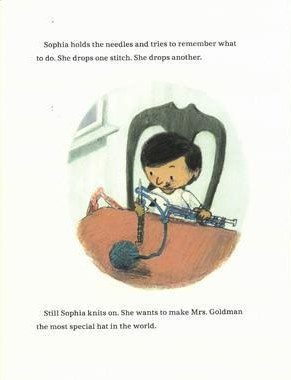
Holding the needles, Sophia thinks about what she was taught. Even though she drops stitches, she continues to knit. “She wants to make Mrs. Goldman the most special hat in the world.” The next day snow falls on Mrs. Goldman’s head as they walk Fifi. Sophia frets, and at home she begins knitting morning, noon, and night to finish her hat. Winter has set in and one day when the pair walk Fifi, “Mrs. Goldman wraps Mr. Goldman’s scarf around her head like she’s a mummy.” But the wind grabs it and rips it away. Sophia catches it, but shivers at the thought of how cold Mrs. Goldman must be.
celebrate-picture-books-picture-book-review-a-hat-for-mrs.-goldman-sophia-and-mrs-goldman

Image copyright G. Brian Karas, 2016, text copyright Michelle Edwards, 2016. Courtesy of Schwartz & Wade.

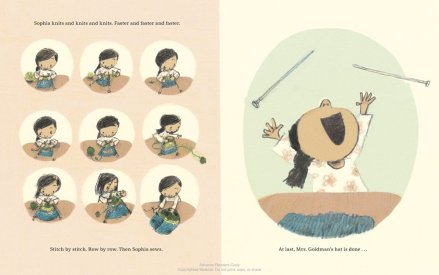
At home Sophia knits in a frenzy, adding row after row of stitches until the hat is finished. When Sophia looks at it, though, she finds holes where they shouldn’t be and lumpy and bumpy areas. She thinks what she has made looks more like a monster than a hat. Sophia takes out the box containing all the hats Mrs. Goldman has made for her, but they are much too small for Mrs. Goldman to wear. While Sophia’s mama and papa have hats made by Mrs. Goldman, she knows she can’t give those away.

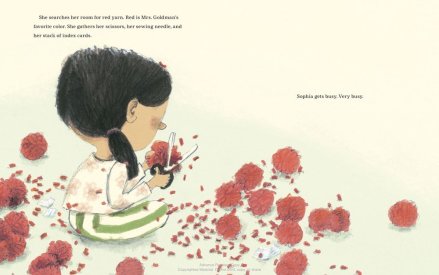
Sophia imagines all the hats she makes with her neighbor and how Mrs. Goldman always tells her that her pom-poms add beauty, and that “‘that’s a mitzvah too.’” Sophia’s heart swells. She finds red yarn—Mrs. Goldman’s favorite color—and her pom-pom making supplies and goes to work. When she is finished and the pom-poms are attached, “Mrs. Goldman’s hat is the most special hat in the world.”
celebrate-picture-books-picture-book-review-a-hat-for-mrs.-goldman-sophia-finishes-hat

Image copyright G. Brian Karas, 2016, text copyright Michelle Edwards, 2016. Courtesy of Schwartz & Wade

Sophia runs next door and surprises Mrs. Goldman with her gift. Mrs. Goldman hugs Sophia and tears come to her eyes. “‘Don’t you like it?’” Sophia asks, but she needn’t worry. “‘I more than like it, I love it,’ declares Mrs. Goldman. ‘Gorgeous. Like Mr. Goldman’s rosebushes. And you know how I love his roses.’” With a kiss for Sophia, Mrs. Goldman begins counting the twenty pom-poms on her hat—“each one made with love.” Mrs. Goldman slips the hat on her head. Now when she and Sophia take Fifi for a walk, Fifi wears her dinosaur sweater, Sophia wears her kitty hat and mittens, and “Mrs. Goldman wears her Sophia hat. Her keppie is toasty warm. And that’s a mitzvah.”

celebrate-picture-books-picture-book-review-a-hat-for-mrs.-goldman-giving-hat

Image copyright G. Brian Karas, 2016, text copyright Michelle Edwards, 2016. Courtesy of Schwartz & Wade.

Michelle Edwards’ heartwarming story of a little girl who sees that her friend is in need and determines to help draws on children’s natural generosity and shows readers that their efforts are recognized and appreciated. Edward’s gentle and well-paced storytelling allows readers to understand the events and thoughts that bring Sophia to once again attempt knitting. Sophia’s solution to use the pom-poms she knows she makes well (and with love) to cover the holes demonstrates not only the ingenious creativity of kids, but also the idea that love can fill the voids in life.
celebrate-picture-books-picture-book-review-a-hat-for-mrs.-goldman-blue-yarn

Image copyright G. Brian Karas, 2016, text copyright Michelle Edwards, 2016. Courtesy of Schwartz & Wade.

Brian Karas imbues the story of Sophia and Mrs. Goldman with a magical wonder that floats from page to page like the fluffy snowflakes that are the catalyst for Sophia’s mitzvah. A combination of full-page illustrations and snapshot images show days spent with Mrs. Goldman as well as the moments, hours, and days that adorable Sophia spends knitting her special hat. Sophia, tongue sticking out in determination, wields her knitting needs; she ponders her holey hat while imagining a frightened Fifi; and scraps of red yarn dot the floor and even sit atop Sophia’s head as she creates pom-pom after pom-pom. When Mrs. Goldman pulls the hat over her own head, kids will feel cheered, while adults may feel a small lump in their throat.

A Hat for Mrs. Goldman is a gem. Its tender portrayal of kindness, love, and close personal relationships makes it an outstanding choice for any child’s home library.

Ages 4 – 8

Schwartz & Wade, 2016 | ISBN 978-0553497106

Discover more about Michelle Edwards and her books, plus activities, recipes, and information on knitting on her website!

Enter a gallery of books, sketches, blog essays, and more by G. Brian Karas on his website!

National Hobby Month Activity
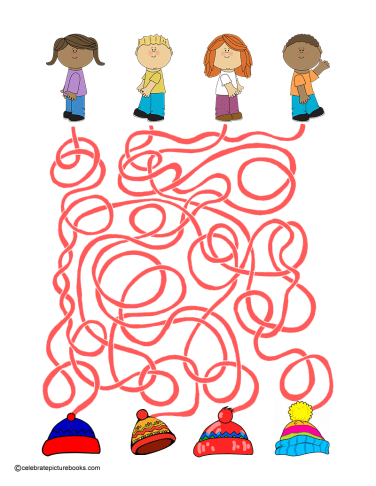
celebrate-picture-books-picture-book-review-winter-hat-match-puzzle

Winter Hat Match Puzzle


These kids have all lost their hats! Can you follow the paths in this printable Winter Hat Match Puzzle to reunite each child with the right hat?

Picture Book Review

January 5 – National Bird Day

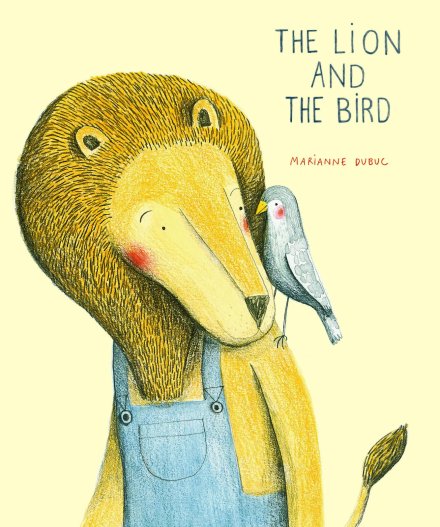
celebrate-picture-books-picture-book-review-lion-and-bird-cover

About the Holiday

Today’s holiday celebrates all our feathered friends from the birds in our backyards to the chickens and turkeys that provide us with food to the penguins of Antarctica. They include wild birds and those in captivity, either as pets or in zoos or other aviaries. National Bird Day was established to promote an awareness of issues concerning the safety, health, and protection of the world’s birds. To celebrate put out birdseed and suet for winter birds or learn a little more about the birds in your area.

The Lion and the Bird

By Marianne Dubuc


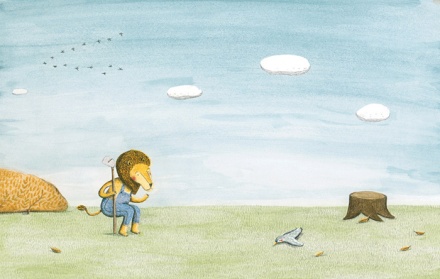
Lion was ready for a day in his garden and had just begun to hoe the rows when he spied a bird lying on the ground. “Oh, poor little thing,” Lion said. He felt he had to do something. He lifted Bird into his paws. Lion settled Bird on a tree stump and bandaged his wing.

celebrate-picture-books-picture-book-review-lion-and-bird-lion-finds-bird

Copyright Marianne Dubuc, 2014, courtesy of mariannedubuc.com.

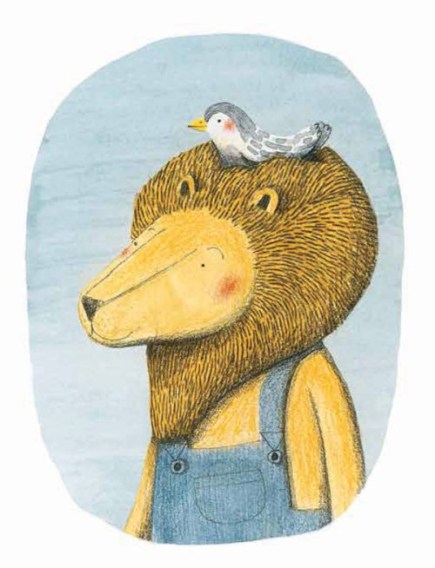
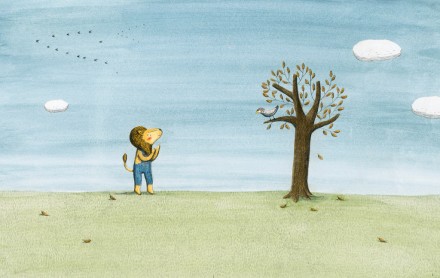
Just then Lion and Bird noticed that Bird’s flock was flying south for the winter. Without hesitation, Lion picked Bird up and placed him gently in his mane. ‘You won’t be cold here,” he told Bird. Then the two went inside Lion’s home, where there was a fire burning in the fireplace and a cozy atmosphere. Lion invited Bird to stay, saying there’s “plenty of room for both of us.”

celebrate-picture-books-picture-book-review-lion-and-bird-bird-in-mane

Copyright Marianne Dubuc, 2014, courtesy of mariannedubuc.com.

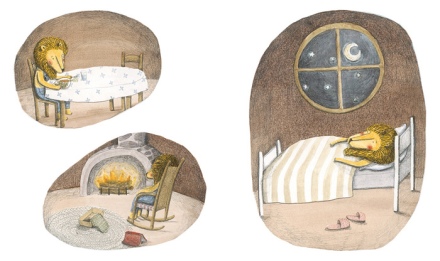
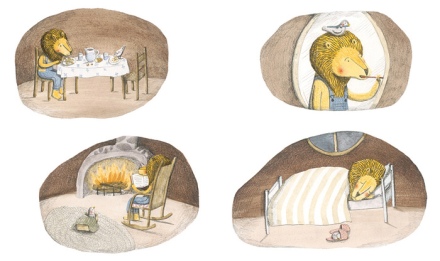
Lion and Bird ate dinner together, and Lion made a warm box for Bird to sit in next to his rocking chair in front of the fire. They sat side by side while Lion read. Then Lion brushed his teeth and Bird brushed his beak and they went to sleep. Bird found a comfortable bed in Lion’s slipper.

Autumn turned to winter with its snow and ice. But Bird was “snug and warm” nestled in Lion’s mane and under a special stocking hat Lion made. They went sledding and ice fishing and spent evenings reading by the fire. The snow piled high, but being with a friend made the winter feel less cold.

celebrate-picture-books-picture-book-review-lion-and-bird-lonely-lion

Copyright Marianne Dubuc, 2014, courtesy of mariannedubuc.com.

When spring returned the other birds did too. Bird pointed them out to Lion, and Lion told Bird he knew he had to join them. He watched his friend Bird fly off with his flock. “So it goes,” Lion thought. “Sometimes life is like that.” Still, Lion felt sad eating alone, with no one to read to, and without being able to say goodnight to Bird. In summer, Lion’s garden produced a good harvest of bright, red tomatoes, and he spent afternoons reading under his favorite tree.

celebrate-picture-books-picture-book-review-lion-and-bird-bird-stays

Copyright Marianne Dubuc, 2014, courtesy of mariannedubuc.com.

When autumn returned again, Lion wondered about Bird as he watched the flock flying south. Then he heard a familiar song. He looked and found Bird waiting on a branch of the tree. Once again Bird settled into Lion’s mane, and they went home to spend the winter together.

celebrate-picture-books-picture-book-review-lion-and-bird-bird-with-lion

Copyright Marianne Dubuc, 2014, courtesy of mariannedubuc.com.

Marianne Dubuc’s tender story of a deep and abiding friendship shows young readers that even distance and time cannot break bonds when love is shared between two people. Dubuc’s spare but profound text empathizes the warmth, attachment, and camaraderie felt between good friends. Her comforting words point to her poignant images in which Lion and Bird spend time together content in each other’s company. The idea that these two friends may not share the same language makes their devotion to each other all the more touching, and their consideration for each other’s feelings offers a moving lesson in kindness.

The Lion and the Bird is an enriching tale for quiet bedtimes and story times and provides a gentle way for parents, caregivers, and teachers to talk with children about friendship.

Ages 4 – 7

Enchanted Lion Books, 2014 | ISBN 978-1592701513

Discover a gallery of books and other illustration projects by Marianne Dubuc on her website.

National Bird Day Activity

celebrate-picture-books-picture-book-review-let's-go-birding-word-search

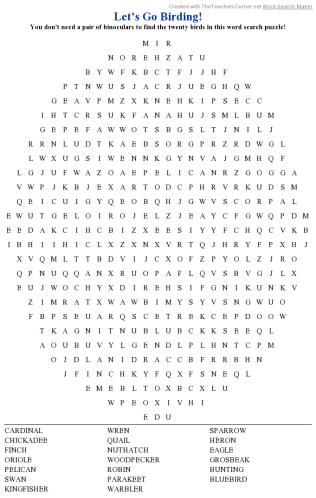
Let’s Go Birding! Word Search Puzzle


There are so many beautiful birds to celebrate on National Birding Day! You can find twenty kinds of birds without even going outside in this printable Let’s Go Birding! Word Search

Let’s Go Birding! Word Search Puzzle | Let’s Go Birding! Word Search Solution

Picture Book Review

 

December 13 – National Day of the Horse

celebrate-picture-books-picture-book-review-thelma-the-unicorn-cover

About the Holiday

Today’s holiday encourages people to commemorate the importance of the horse to the history, culture, and economy of the United States. The domesticated horse that we know today was first introduced by Spanish Explorers. As the country grew, horses became indispensable for transportation, farm and ranch work, and communications. The more than nine million horses that now reside in America depend on people for adequate food, water, shelter, and protection. On this holiday, consider donating to a horse rescue shelter near you.

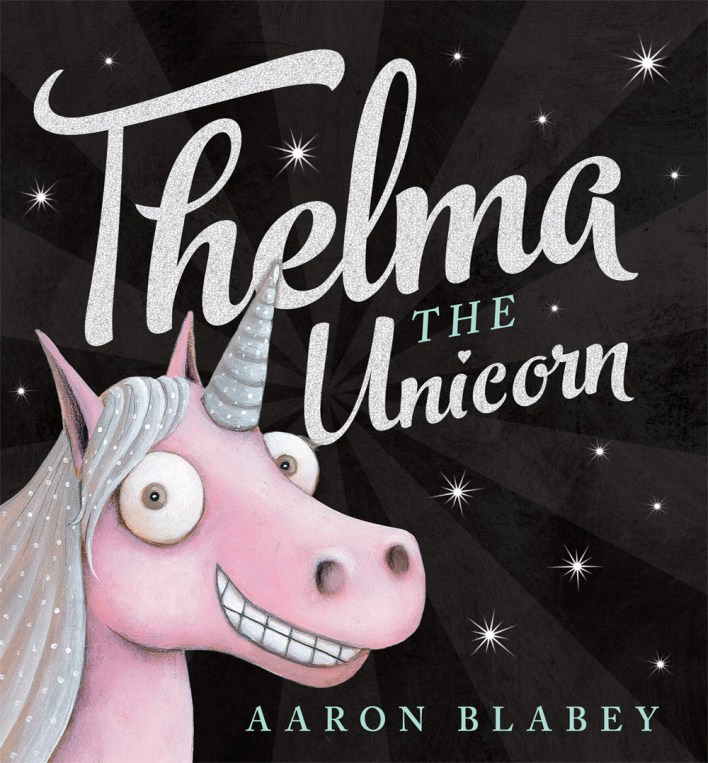
Thelma the Unicorn

By Aaron Blabey


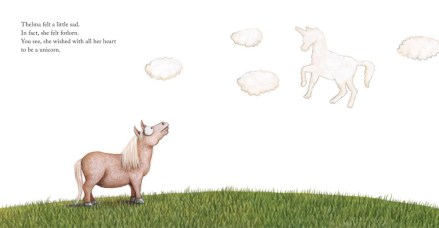
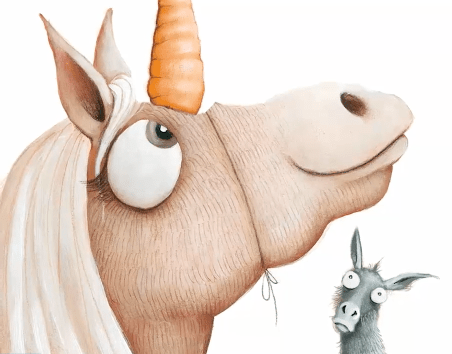
“Thelma felt a little sad. / In fact, she felt forlorn. / You see, she wished with all her heart / to be a unicorn.” Thelma was a little pony—brown and short and overlooked. Her best friend Otis told her, “‘You’re perfect as you are,’” but when Thelma compared herself to the sleek white mare on the farm, she said, “‘I’m not.’” Suddenly, she saw a carrot left over from dinner and had an idea.

celebrate-picture-books-picture-book-review-thelma-the-unicorn-wishing

Copyright Aaron Babey, 2017, courtesy of Scholastic Press.

She tied the carrot to her nose and told Otis, “‘I’ll say that I’m a unicorn! / It might just work… / who knows?’” At this very moment a truck driver passing by caught sight of this spectacle and careened off the side of the road. “As Thelma watched the swerving truck, / it very nearly hit her. / Would you believe that truck was filled / with nice pink paint and glitter?”

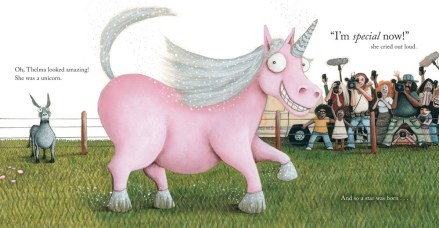
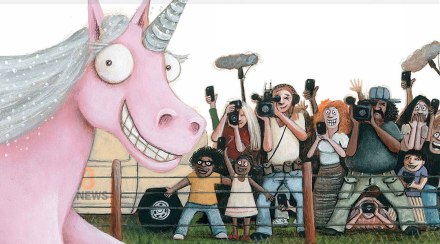
In the blink of an eye Thelma was doused in sparkles and had become what she always dreamed of. She was a unicorn and “special now!” Crowds lined up at the farm gate to see the pink unicorn. The media descended with their cameras and video recorders, and Thelma quickly became a world-wide phenomenon. Everywhere she went fans screamed her name, took pictures, waved signs, and wanted to be near her. She even got her hoofprint on the Walk of Fame.

celebrate-picture-books-picture-book-review-thelma-the-unicorn-becomes-unicorn

Copyright Aaron Babey, 2017, courtesy of Scholastic Press.

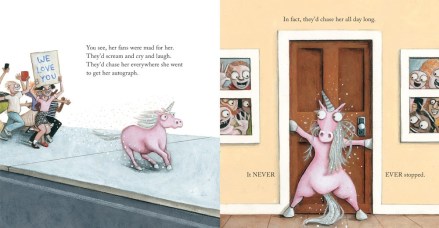
Thelma sailed to foreign ports on a ship named The Fairy Princess, attended by stewards who fulfilled her every wish. “But soon she found that so much fame / was kind of tricky, too….” Her fans mobbed her with crushing zeal, chased after her wherever she went, screamed, cried, laughed, and pointed whenever they saw her, and hounded her day and night for her autograph. “It NEVER EVER stopped.”

When Thelma asked “the screaming crowd” not to chase her anymore, they said “‘We’ll chase you all we want….We’re fans, so it’s allowed.’” Then there were there were the people who “were not her fans at all. / No, some were really mean. / And some just did the meanest things / she’d really ever seen.” Some threw eggs while she roller skated for charity and others held up signs reading “I don’t like unicorns” where she was sure to see them.

celebrate-picture-books-picture-book-review-thelma-the-unicorn-adoring-crowds

Copyright Aaron Babey, 2017, courtesy of Scholastic Press.

Back in her fancy hotel room, all alone and bedraggled, soaked in egg, and with her “horn” losing its luster, Thelma looked at a photo of Otis. “…she felt quite sad, / this famous little pony. / She said, ‘I thought that I’d feel great… / but all I feel is lonely.’” She decided to make a change. She washed off all the pink paint and sparkles and “ditched her magic horn.”

She left and “walked right past the crowd. / They didn’t even notice / She thought how nice that it would be…to see her lovely Otis.” As Thelma stood underneath a tree with Otis, “he asked about her trip.” “‘Oh, it was fun,’” she answered him, “‘But I’d rather be just me.’”

celebrate-picture-books-picture-book-review-thelma-the-unicorn-being-chased

Copyright Aaron Babey, 2017, courtesy of Scholastic Press.

Aaron Blabey’s cautionary tale of a pony who is granted her wish to be “more” than she is, deftly reveals the pitfalls of abandoning your true nature for what appears to be the perks of celebrity with a splash of humor and some no-nonsense honesty. Through Blabey’s smoothly flowing rhymes, readers see that being special is not based on a sparkly appearance that pleases false friends. Instead, each person is remarkable for their unique personalities and talents that true friends will appreciate.

Today’s social media-savvy children will recognize Blabey’s screaming crowds and overzealous fans and will come to understand, with Thelma, that being “in the pink” can be short-lived and glitter soon fades.

celebrate-picture-books-picture-book-review-thelma-the-unicorn-carrot-horn

Copyright Aaron Babey, 2017, courtesy of Scholastic Press.

Blabey’s distinctive illustrations portray Thelma’s transformation from “regular pony” to celebrity unicorn and back again with flair and all the bling that goes along with superstardom. The crowds are giddy, awed, obsessive, and adoring until the backlash starts, which Blabey portrays with candid examples. His final spreads in which Thelma goes unrecognized by her fans and is then lovingly welcomed back by Otis beautifully sum up the theme of the story.

Thelma the Unicorn provides readers and adults a wonderful opportunity to discuss the allure of changing oneself in order to fit in as well as the social media atmosphere that can be so influential in a child’s life. Blabey’s light touch coupled with his honesty makes Thelma the Unicorn a great choice for  home and classroom libraries.

Ages  3 – 7

Scholastic Press, 2017 | ISBN 978-1338158427

Scholastic Press sent me a free copy of Thelma the Unicorn to check out. All opinions are my own.

Discover more about Aaron Blabey, his books, and his art on his website

National Day of the Horse Activity

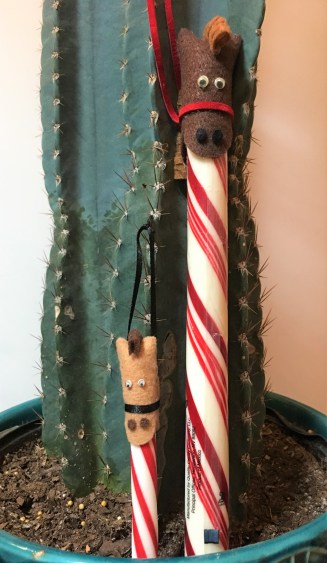
celebrate-picture-books-picture-book-review-horse-candy-stick-cover

Whoa! Candy Stick Cover


There’s no neigh-saying that this isn’t a cute way to give your favorite candy stick a bit of flair!  With a bit of felt and a few other supplies you can make this horse craft. Alternately, this craft can be used with a cardboard tube or wooden dowel.

Supplies

  • Large or small candy stick, cardboard tube or wooden dowel
  • Felt in whatever color you’d like for your horse
  • Felt in a another color for the mane
  • Black felt for the nostrils
  • Thin ribbon or leather lacing
  • Small googly eyes
  • Fabric glue or hot glue gun
  • Scissors
  • Tweezers

Directions

  1. Cut a piece of felt wide enough to wrap around the stick overlapping a little to glue together. It should be long enough to cover about 1 ½ inches of a small candy stick, about 2 ½ inches of a large candy stick, or about 3 to 4 inches of a cardboard tube or wooden dowel.
  2. Wrap the felt around the stick overlapping the edge about ¼ inch and leaving about ½ inch above the top of the stick.
  3. Glue the felt together along the overlapping edge to make a tube that fits the stick tightly

To make the ears

  1. Push down on the center of the back side of the felt that rises above the top of the stick
  2. Apply a drop of glue
  3. Push the center of the front edge of the felt into the glue
  4. The ears will stick up on the sides of the head

To make the horse’s nose and mouth

  1. Remove the felt head from the stick
  2. Pinch the end together
  3. Starting about ½ inch from the bottom, round the corners of the felt tube with the scissors

To make the nostrils

  1. Cut small circles from the black felt
  2. Glue them to the bottom of the horse’s nose
  3. Glue the googly eyes on the horse’s face

To make the mane

  1. Cut a strip of felt as long as the face by 1 inch wide for a large candy stick; about ¾ inch wide for a small candy stick
  2. Fold the felt in half lengthwise
  3. Glue the edges of the felt together, leaving the top unglued
  4. Snip fringe along the length of the felt
  5. Cut a small curve in the bottom of one end of the length of felt so it will fit over the top of the horse’s head
  6. Glue the rest of the length of felt down the back of the horse’s head

To add the reins

  1. Cut a length of narrow ribbon or leather lacing about 6 inches long
  2. Glue the center of the ribbon or lacing to the horse’s face above the nostrils at the level of the trimmed mouth around to the mane
  3. Tie the ends of the ribbon or lacing together

Picture Book Review

November 13 – World Kindness Day

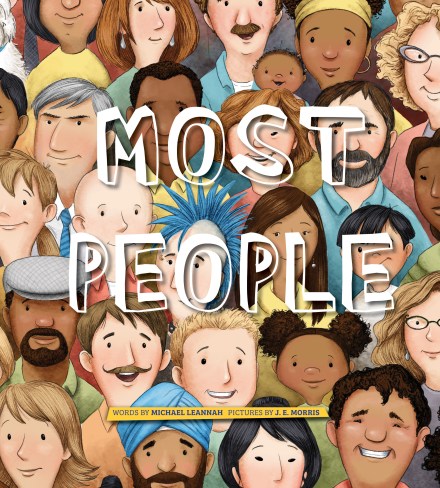
celebrate-picture-books-picture-book-review-most-people-cover

About the Holiday

Instituted in 1998 by a coalition of nations, World Kindness Day is an international celebration that encourages people around the world to be mindful of others through mutual respect, inclusion, empathy, and gratitude. To celebrate, people are asked to perform acts of kindness—big or small. A simple “hi,” a smile, or an offer of help or support goes a long way in making the world a kinder and better place to live in. But don’t limit your care and concern to just one day. Promoters of the holiday hope that kindness becomes infectious, inspiring good relationships every day of the year.

Most People

Written by Michael Leannah | Illustrated by Jennifer E. Morris


The world is full of people, and if you look around and really look, you’ll notice something amazing: most people are the same! Do you like to smile? Do you like to laugh? Yeah, me too. So do most people! In fact, “most people love to see other people smile and laugh too.” But how about when someone’s sad? Well, “most people want to help when they see someone crying” or when someone is in trouble. “Most people want to make other people—even strangers—feel good. Most people are very good people.”

Sure there are some people who do bad things, but the good people far outnumber the bad people. And bad people can change if they allow the “seed of goodness inside them…to sprout.” Actually, people are a lot like a garden. They love the Earth, and they love being warmed by the sun. Sometimes people “feel like a sour grape in a bunch of sweet grapes.” But you can help make them feel better just by being nice.

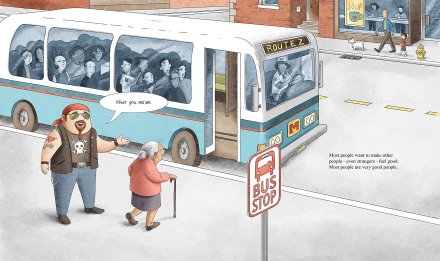
celebrate-picture-books-picture-book-review-most-people-biker

Image copyright Jennifer E. Morris, 2017, text copyright Michael Leannah, 2017. Courtesy of Tilbury House Publishing.

When you walk around your neighborhood or play at the park or go to the store, you see people doing the same things. They run and dance and hug their dogs; they read and sing and talk. When people like what someone is doing or wearing or saying, they compliment them. And it’s pretty hard to find someone who doesn’t “smile when they see a baby.”

Most people even like to hear the same words. I bet you know what those are. Right! “Most people glow when they hear or say ‘I love you.’” So when you’re out and about, it’s good to remember that you’re really among “very good people.”

celebrate-picture-books-picture-book-review-most-people-mountain

Copyright Jennifer E. Morris, 2017, courtesy of Tilbury House Publishing.

In today’s world with so many media and social media outlets, bad news often overshadows good news. It can be easy to begin thinking the worst—of things, places, and people. Michael Leannah and Jennifer E. Morris provide a reality check with their book that encourages children and adults to look around and make up their own minds about what they see. In his straightforward text, Leannah gives children easy-to-identify examples of emotions and behavior that they have themselves and can see in other people. He understands that shared experiences and feelings go beyond different clothing, hairstyles, or language to unite us.

This is where Jennifer E. Morris’s detailed and cheerful illustrations of a diverse community come in. Each spread offers a glimpse into a home or neighborhood to see what people are up to. The first pages invite readers into an apartment, where a mom, a little girl, and her baby brother are having breakfast. Out the big picture window, the sun is just creeping over the rooftops of other nearby apartment buildings. On the windowsill a mitten-shaped cactus seems to wave at the world.

celebrate-picture-books-picture-book-review-most-people-rooftop

Copyright Jennifer E. Morris, 2017, courtesy of jemorris.com.

The next spread shows a little boy laughing with his grandpa and grandma. The third spread takes these two families out into the neighborhood and reveals that the little girl and boy are friends. This is a busy community where many different people are engaged in various examples of kindness and inclusion. As the story progresses, children follow these characters as they go about their day. In this way, readers may have preconceived notions challenged—that biker with the tattoos? He’s really just a softy who watches out for an elderly woman—and they’ll see plenty of thoughtfulness in deeds that make a difference.

In the evening, it’s time to go back home to the boy’s apartment, where the décor includes a stone sculpture of a face that reminds readers of our common human history, Finally, up on the rooftop, the two friends’ families eat dinner together, while in the illuminated windows of the apartments below, the neighbors are seen enjoying their night.

Most People is an inspiring choice to start a discussion on diversity, empathy, and kindness as well as on analyzing what we hear and see in and on the news. The positive perspective is welcome and provides young readers with comfort and examples of how people in general and they specifically can make a difference with even simple heartfelt gestures. Most People is an excellent book for home, classroom, and library bookshelves.

Ages 5 – 8

Tilbury House Publishers, 2017 | ISBN 978-0884485544

Learn more about Michael Leannah and his books on his website.

You’ll find a gallery of illustration art by Jennifer E. Morris as well as activity pages on her website.

World Kindness Day Activity

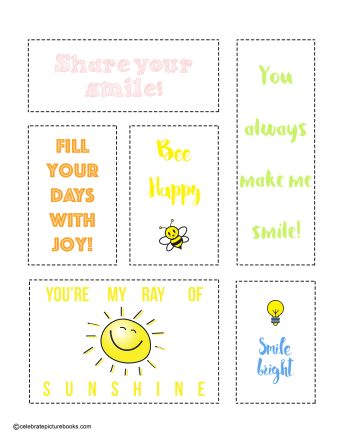
celebrate-picture-books-picture-book-review-smile-cards

Share a Smile! Cards


Being kind to someone is as easy as sharing a smile. With these printable Share a Smile! Cards, you can give someone a smile that they can carry with them all day long!

Picture Book Review
October 3 – It’s National Go on a Field Trip Month

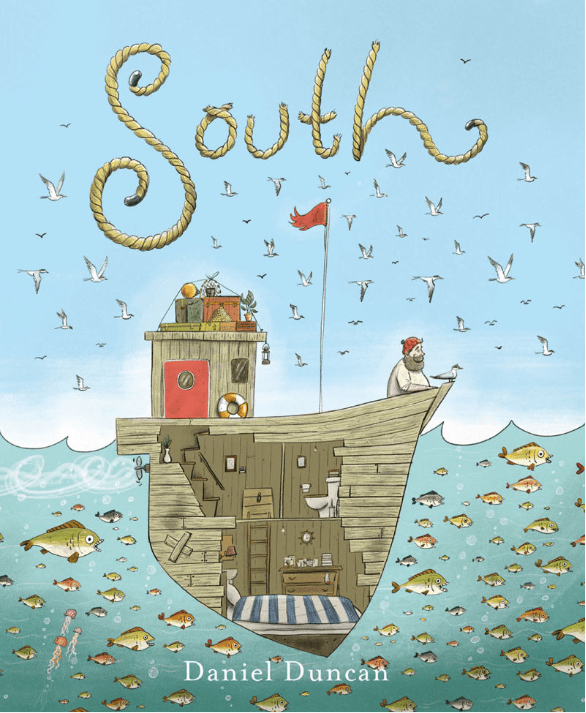
celebrate-picture-books-picture-book-review-south-daniel-duncan-cover

About the Holiday

As the leaves start turning red and yellow and the air becomes crisp and cool, thoughts turn to…field trips? Sure! Autumn is the perfect time to enjoy a bit of travel. For kids a field trip is a fun day away from the classroom, and for adults a little get-away can be refreshing and rejuvenating. With fall festivals, apple-picking, leaf-peeping, and other fun autumn activities, it should be easy to plan a family or group field trip.

South

By Daniel Duncan


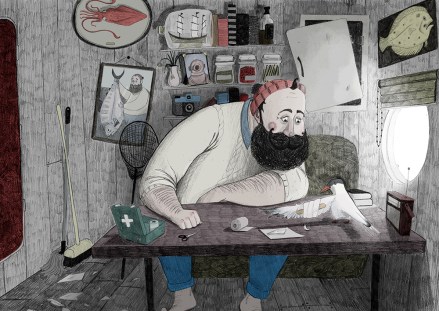
Out on the rolling sea, there was once a fisherman who sailed alone. His only company was his banjo and a small leafy plant. But one day the fisherman heard an unfamiliar noise and discovered an injured seagull taking shelter in the corner of the boat’s deck. The fisherman saw that the seagull’s wing was broken. He attached a splint and bandaged the wing, then “all that was left to do was wait.”

celebrate-picture-books-picture-book-review-south-daniel-duncan-bird-bandaged

Copyright David Duncan, 2017, courtesy of dunksillustration.co.uk.

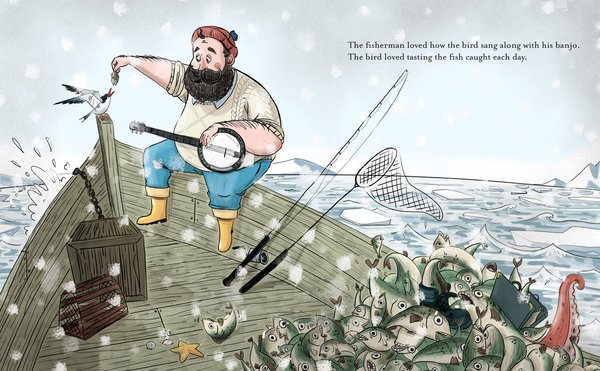
The seagull slept in a cozy nest fashioned from one of the fisherman’s shirts and gently placed in an open drawer. Now the fisherman had a companion, and he “loved how the bird sang along with his banjo.” For his part, the bird loved the continuous supply of fish. But winter was coming, and the fisherman knew that the seagull could not live on his boat forever. 

celebrate-picture-books-picture-book-review-south-daniel-duncan-bird-eating-fish

Copyright Daniel Duncan, 2017, courtesy of Harry N. Abrams.

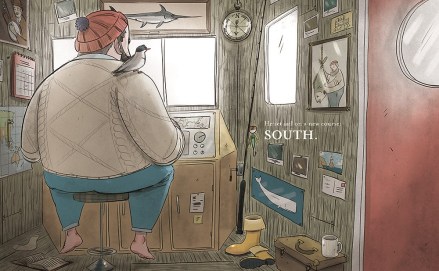
With the seagull perched on his shoulder, the fisherman hoisted anchor and “set sail on a new course: SOUTH.” The vast ocean stretched out in every direction as the little boat chugged along day and night. At last, peering through his telescope, the fisherman spied an island. The bird’s wing had healed, and “the fisherman knew that their journey together had come to an end.” With one last gentle stroke on the seagull’s head, the fisherman let his friend fly away to join the throng of other seagulls on the beach. Then “he set sail on a new course: HOME.”

celebrate-picture-books-picture-book-review-south-daniel-duncan-bird-on-shoulder

Copyright Daniel Duncan, 2017, courtesy of Harry N. Abrams.

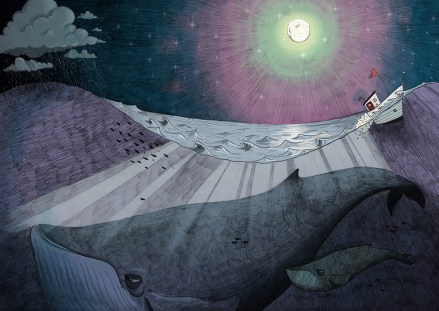
Daniel Duncan’s heartwarming story of friendship and letting go is a tender reminder that life is made up of short-term and long-term relationships, and that sometimes people (and animals) are brought together for a particular purpose. Even if some relationships are temporary, the memories and the feelings live on in our hearts. While Duncan’s story is focused on the seagull, readers must also wonder about the fisherman. At first he seems to be a loner, playing his banjo far out to sea without another soul around. But as the story develops through Duncan’s gorgeous detailed illustrations, the theme of family begins to take shape: the boat sails over a school of fish, is carried past a whale and her baby, and finally comes within sight of an island teeming with seagulls.

celebrate-picture-books-picture-book-review-south-daniel-duncan-whales

Copyright David Duncan, 2017, courtesy of dunksillustration.co.uk.

Early on, as the burly, bearded fisherman bandages the seagull’s wing, alert readers may notice a photograph tacked to the wall of the tidy cabin. Later, as he hangs a framed seagull feather on that same wall, readers can see the photo better and will realize that it is a picture of the fisherman, his wife, and his child. This realization gives the final line more significance, resonance, and joy. Like many families separated for long stretches by a parent’s job, the fisherman’s family is also waiting for him to come home so they can be together again.

Ages 5 – 7

Harry N. Abrams, 2017 | ISBN 978-1419722998

View a gallery of illustration work by Daniel Duncan on his website and blog!

National Go on a Field Trip Month Activity

celebrate-picture-books-picture-book-review-follow-the-open-road-maze

Follow the Open Road Maze


These kids are ready to go on a field trip, but first they have to get in the correct car! Help them find their way in this printable Follow the Open Road Maze.

Picture Book Review

October 2 – World Day of Bullying Prevention

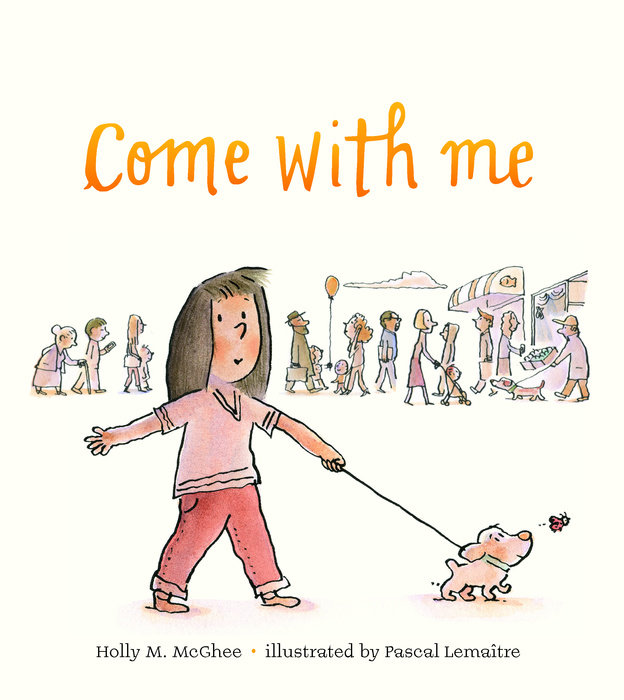
celebrate-picture-books-picture-book-review-come-wtih-me-cover

About the Holiday

Today’s holiday was established to raise awareness of the pervasive and growing societal problem of bullying and to bring people together to change the culture that allows for it to exist. It’s up to every individual to speak out against bullying in all its forms and for kindness and acceptance. For more information on what you can do or how you can find help, visit the STOMP Out Bullying website.

Come With Me

Written by Holly M. McGhee | Illustrated by Pascal Lemaître


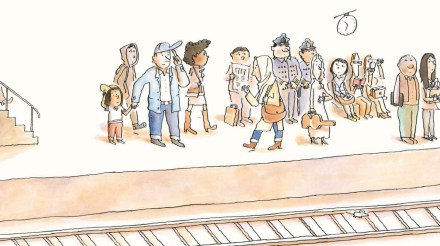
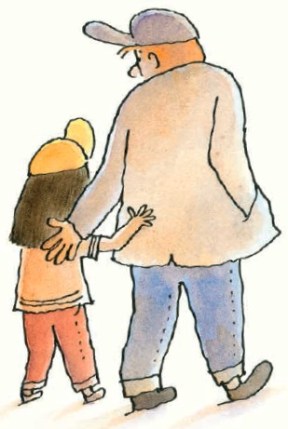
A little girl watches the television news, taking in all the “anger and hatred—people against people.” She was “frightened by everything she heard and saw and felt.” She wanted to make “the world a better place,” and asked her papa what she could do. He told her, “‘Come with me.’” They went outside and down the stairs to the subway platform. There, as they waited for the train, her father tipped his hat to those passing by. Seeing this, the little girl did it too.

celebrate-picture-books-picture-book-review-come-with-me-in-the-subway

Image copyright Pascal Lemaître, 2017, courtesy of G.P. Putnam’s Sons Books for Young Readers.

As they rode the train they were kind to the people around them. The little girl felt brave as she and her papa “won a tiny battle over fear for themselves and for the people of the world.” But the little girl continued to see stories of hatred on the news, so she asked her mother for advice. Her mama said, “Come with me.”

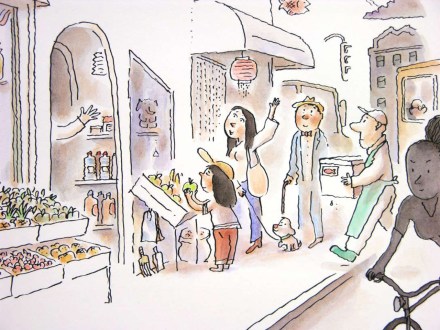
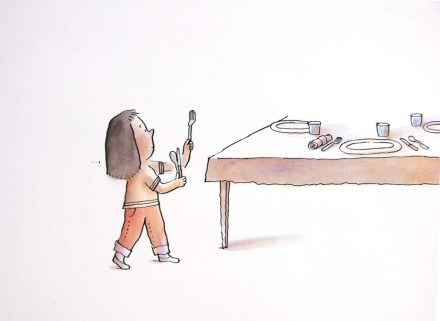
They walked down to the international grocery store on the corner with its bins full of fresh fruit and vegetables. There they met people from all over the world buying food for their meals and products for their homes. The little girl understood that “one person doesn’t represent a family or a race or the people of a land.” At home, while her mother cooked dinner, the little girl set the table as she always did.

celebrate-picture-books-picture-book-review-come-with-me-at-the-market

Image copyright Pascal Lemaître, 2017, courtesy of G.P. Putnam’s Sons Books for Young Readers.

As they ate, the girl scratched her puppy behind the ears and thought about what she had seen and done with her parents. She wanted to do something by herself and asked if she could walk the dog. Her parents looked at each other and decided to let her go to show their child and the world that “they would not live in fear.”

Just as the little girl was leaving her apartment, the boy across the hall opened his door. He wondered where she was going. “‘Come with me,’” she said. The two children were happy to be outside, and they began to understand that if they were “brave, gentle, strong—and kind…to one another and all living things,” the world would be a better place.

celebrate-picture-books-picture-book-review-come-wtih-me-setting-the-table

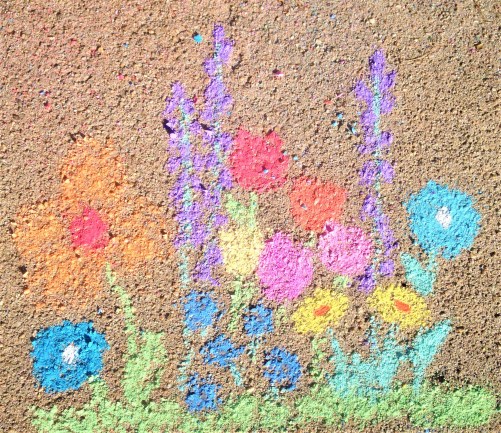
They smiled at a mother and her young son as the little boy pet her dog. Then the boy shared his box of chalk, and the three kids drew pictures on the sidewalk. The single flowers and hearts became a garden as more and more children joined in. From all around, doors opened and children and adults approached. They took a piece of chalk and bent down to add their own flowers to the growing picture.

What you do matters too—even if your part seems small, it makes a difference. Listen! The little girl is calling, “‘Come with me.’”

celebrate-picture-books-picture-book-review-come-with-me-drawing-flowers

Image copyright Pascal Lemaître, 2017, courtesy of G.P. Putnam’s Sons Books for Young Readers.

Amid all the noise and fear that children are exposed to comes Holly McGhee’s quiet and powerful book that shows them that even small gestures have great reach and make a big impact. Like self-seeding gardens, one small act can take root and grow, displacing the weeds of fear, anger, and misunderstanding. McGhee’s honest, lyrical text is refreshing as it demonstrates the role of adults as well as children in changing not only outward behavior but inner feelings as well. Young readers will want to accept the little girl’s invitation to change the world they live in.

celebrate-picture-books-picture-book-review-come-with-me-girl-and-papa

Image copyright Pascal Lemaître, 2017, courtesy of G.P. Putnam’s Sons Books for Young Readers.

Pascal Lemaître’s colorful line drawings on white backgrounds provide a sense of openness and clarity that is the perfect accompaniment to McGhee’s story. Lemaître’s city is vibrant and diverse, and as people go about their business, they smile at one another, happily interact, and are excited to join in the fun of chalk drawing. At home, members of the family watch TV, cook and eat dinner, and take care of their pet, just as families do around the world. Careful observers will note that as the little girl sets the table, she studies the fork—a single utensil made up of many tines that work together. Each of Lemaître’s pages likewise invites readers to take another look at their own homes and neighborhoods to see the goodness there and to work with others to make the world a better place.

Come With Me is a moving story that can comfort and inspire children who have questions and want to help. The book would be a welcome addition to classroom and home libraries.

Ages 5 – 8 and up

G. P. Putnam’s Sons Books for Young Readers, 2017 | ISBN 978-1524739058

Discover the world of Holly M. McGhee and her children’s and middle-grade books on her website

View a portfolio of illustration work for children and adults by Pascal Lemaître on his website.

View a portfolio of illustration work for children and adults on his website.

World Day of Bullying Prevention Activity

celebrate-picture-books-picture-book-review-friendship-chalk-garden

Friendship Chalk Garden


Just like the little girl in today’s book, you can make a positive change in the world through simple acts of kindness and cheer. Drawing a Friendship Chalk Garden is a great way to show your love, compassion, and courage—and to make your home, neighborhood, or school a better place!

Adults and kids, join in making a positive change! Draw a garden—or even just one flower— and post a picture on Twitter using the hashtag #FriendshipChalkGarden. Adults can help children post their pictures.

Here are some ideas:

  • Create your garden by yourself
  • Gather your friends
  • Invite other kids and adults in the area to draw with you
  • Ask your teacher to make it a class—or school—project

Places to Draw

Outside:

  • Find a spot in your driveway
  • Draw on the sidewalk outside your home or school
  • Use the school playground
  • Go to the park

Inside:

  • Use black or white poster board attached to the wall
  • Draw on the school blackboard or white board
  • Make flowers for a classroom or hall bulletin board

Picture Book Review
September 23 – International Rabbit Day

celebrate-picture-books-picture-book-review-old-lion-and-little-rabbit-cover

About the Holiday

With their little pink noses, long ears, and soft fur, rabbits make your heart melt. Today’s holiday was established to promote the protection and care of rabbits—both domestic and wild. Found in almost all types of environments—with more than one half of their total population living in North America—rabbits need protection from habitat destruction and predators. They are also a popular gift in spring, and families are encouraged to learn all about their needs and behaviors to determine if a rabbit is the best fit for the household. Because of their sweet, innocent nature, bunnies are often featured in children’s books. To celebrate the holiday, read a few of your favorites—including today’s book!

The Old Lion and the Little Rabbit

By Keiko Kaichi


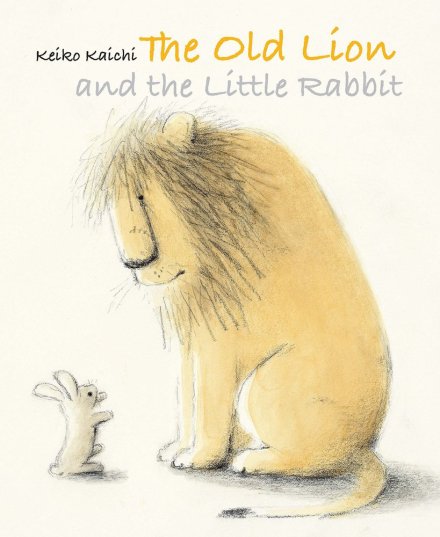
Once King of the Plains, Old Lion had given up his place in the herd to his sons and now lived a quiet life alone. One day while napping, he felt a tickle in his mane and smelled a tantalizing aroma nearby. Old Lion discovered a tiny baby rabbit sleeping peacefully in the soft fur of his mane. “‘Hey,’ Old Lion thought, ‘this little one won’t fill my belly. But if I let him eat enough, he’ll grow up to be big and delicious!’” So Old Lion gathered as much grass as he could and fed the baby rabbit well, all the while feeling hunger growing in his stomach.
celebrate-picture-books-picture-book-review-old-lion-and-little-rabbit-herd

Copyright Keiko Kaichi, 2017, courtesy of minedition.

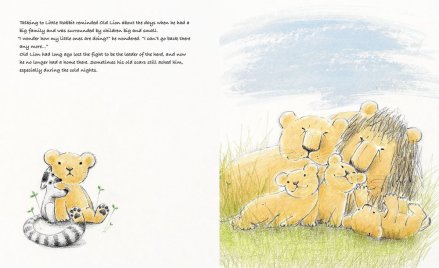
To pass the time between feedings, Old Lion told Little Rabbit about his younger days on the savanna. “Little Rabbit crinkled up his nose with joy when he listened to Old Lion’s stories.” When other animals saw Old Lion and Little Rabbit together, they couldn’t believe it. As Old Lion talked to Little Rabbit, he remembered his big family and the joy of having children around him. He wondered how they were doing. But he knew that he couldn’t go back once he had “lost the fight to be the leader of the herd. Sometimes his old scars still ached him, especially during the cold nights.”

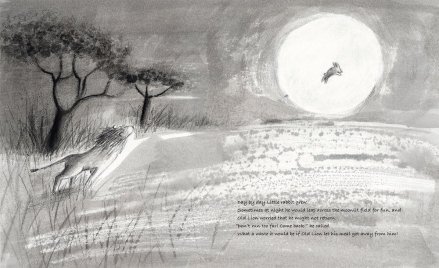
Now that Little Rabbit was growing bigger, he sometimes hopped far into the field, exploring just for fun. Then Old Lion worried that he might not come back, fearful that all his time and hard work would be wasted. He would call after Little Rabbit, reminding him to come back, and Little Rabbit always did.

celebrate-picture-books-picture-book-review-old-lion-and-little-rabbit-hopping-in-moonlight

Copyright Keiko Kaichi, 2017, courtesy of minedition.

They spent their days watching the other animals, Little Rabbit perched on top of the lion’s head in order to see better. As time went by, Old Lion began to wish he could be satisfied with a diet of plants and wondered about the unfamiliar feeling in his heart. “Could it be that he was starting to care about this little creature who trusted him so blindly? Such a thing made no sense. Still, he had to admit that something warm stirred in him when he saw Little Rabbit each morning.”

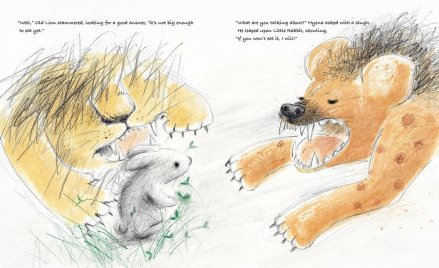
One day as Little Rabbit played among the weeds while Old Lion rested, Hyena came calling. When he saw the little bunny, he immediately asked to share in the delicious meal as he often did. Old Lion was taken off guard and stammered that Little Rabbit was not nearly big enough to make a meal of. Hyena protested and pounced. Old Lion found his former quick reflexes and “with one gulp he snatched up Little Rabbit into his jaws.”

celebrate-picture-books-picture-book-review-old-lion-and-little-rabbit-hyenna

Copyright Keiko Kaichi, 2017, courtesy of minedition.

With a bit of regret but admiration for his old friend, Hyena turned and skulked away. When they were alone, Old Lion opened his mouth wide and let Little Rabbit climb out. He saw that his tiny friend had suffered a cut on his paw and bandaged it carefully. Then he placed Little Rabbit on his head and began to walk in the direction of the wind. “He could no longer deny that he loved Little Rabbit.”

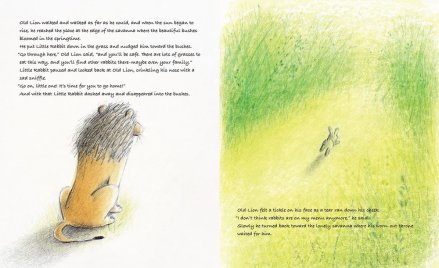
Old Lion walked and walked to the edge of the savanna, where bushes and tall grasses blossomed. He set Little Rabbit down gently and nudged him forward. “You’ll be safe” there, Old Lion told him. “You’ll find other rabbits there—maybe even your family.” Little Rabbit gazed at Old Lion sadly, but the lion reassured him that it was time to go home. Old Lion watched Little Rabbit bound away and “felt a tickle on his face as a tear ran down his cheek.” Then he turned and walked back to where his throne waited.

celebrate-picture-books-picture-book-review-old-lion-and-little-rabbit-letting-rabbit-go

Copyright Keiko Kaichi, 2017, courtesy of minedition.

Keiko Kaichi’s books masterfully tug at readers’ heartstrings with poignant stories populated with adorable characters that immediately inspire love and empathy. In The Old Lion and the Little Rabbit, the lion’s history is revealed naturally and at a pace that makes his transformation believable and all the more emotional. Just as do children within a family, Little Rabbit alters Old Lion’s life simply through trust and dependence. Children will respond to the growing love between Old Lion and Little Rabbit. They will also find the solution to the mystery established at the beginning both surprising and satisfying. Adult readers cannot be faulted for feeling a small lump in their throat when Old Lion unselfishly protects Little Rabbit from Hyena and then takes him to safety.

Kaichi’s acrylic and pencil drawings are both evocative of the golden savanna and filled with tender sentiments. Old Lion may once have been a fierce predator, but he is now a contemplative and caring elder statesman while Little Rabbit is a wee nubbin of cuteness. As he sits next to the much bigger lion, his tiny paw touching Old Lion’s arm, or collects a bouquet of weeds under Old Lion’s watchful gaze, Little Rabbit swells readers hearts.

Superb in every way, The Old Lion and the Little Rabbit would make a wonderful choice for home bookshelves as well as for public and school libraries.

Ages 3 – 7

minedition, 2017 | ISBN 978-9888341245

International Rabbit Day Activity

Adorable Bunnies Coloring Pages


Bunnies are such loveable little creatures that you just can’t help but say “Awwww!” when you see one. Here are two printable Adorable Bunnies Coloring Pages for you to enjoy!

Bunny Coloring Page | Three Bunnies Coloring Page 

Picture Book Review