November 1 – National Author’s Day & Interview with Author Linda Booth Sweeney

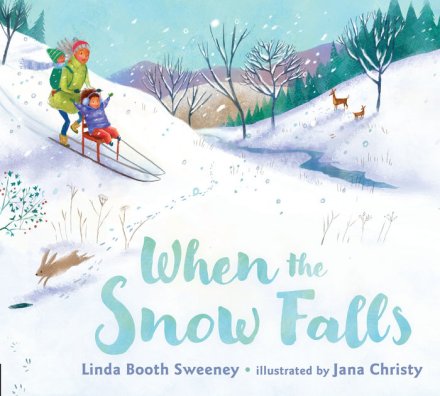
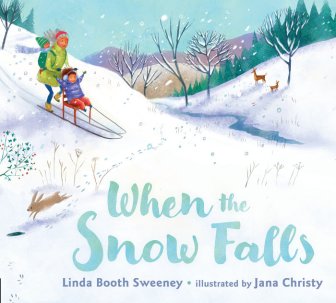
celebrate-picture-books-picture-book-review-when-the-snow-falls-cover

About the Holiday

There may be no better month to celebrate Author’s Day than in November. Not only is it Picture Book Month, but thousands of people set aside their usual routine to take part in NaNoWriMo or National Novel Writing Month, when writers try to complete at least a first draft of a novel in one month. To kick off all of this literary love today, we remember and honor American authors past and present. The holiday was instituted in 1928 by Nellie Verne Burt McPherson, president of the Bement, Illinois Women’s Club. An avid reader, she established Author’s Day to thank writer Irving Bacheller who sent her an autographed story in response to her fan letter. The day was officially recognized in 1949 by the United States Department of Commerce. McPherson’s granddaughter, Sue Cole, has promoted the holiday since her Nellie’s death in 1968 and encourages people to spend a bit of the day writing a note of appreciation to their favorite author.

When the Snow Falls

Written by Linda Booth Sweeney | Illustrated by Jana Christy


A little curly-haired girl and her younger brother wake up from a sleepover with Grandma to a magical sight. As they gaze out the big picture window in the little girl’s room, they’re dazzled to see “When the snow falls…Frost paints. / Skies gray. / Windows sparkle/ Snow? Yay!” There’s no school today, so Mommy and Daddy and Grandma bundle up and get the kids ready to head outdoors to take care of the farm animals.
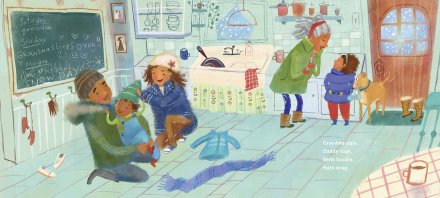
celebrate-picture-books-picture-book-review-when-the-snow-falls-kitchen

Image copyright Jana Christy, 2017, text copyright Linda Booth Sweeney, 2017. Courtesy of G. P. Putnam’s Sons for Young Readers.

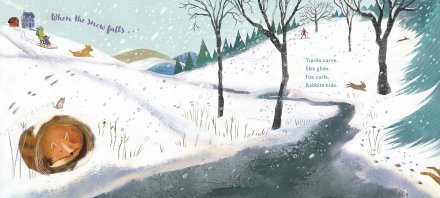
Soft flakes flutter down, piling into deep drifts and providing a little extra after-breakfast treat as “Boot sink. / Lashes flick. / Tongues tickle. / We lick.” In the barn the horses, puppies, and chickens are just as excited about the snowy day. Riding an old chair sled, Grandma and her grandchildren glide down the hill, following tracks left by lively rabbits and now-dozing foxes.

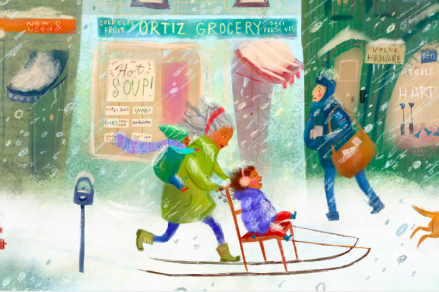
Deep in the forest the three take in the beauty: “Woods hush. / Fields glisten. / Wren sings. / We listen.” On the other side of the woods, people continue their daily routine but at a slower pace as “plows push” and “mountains grow.” Grandma and the kids slide into town, where people are hard at work keeping up with the storm: “Wheels crunch. / Shovels scoop. / Ice cracks! / Awnings droop.”
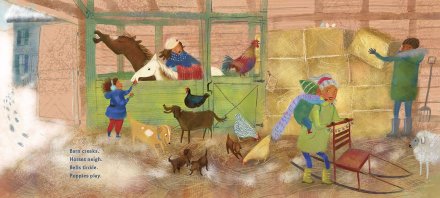
celebrate-picture-books-picture-book-review-when-the-snow-falls-barn

Image copyright Jana Christy, 2017, text copyright Linda Booth Sweeney, 2017. Courtesy of G. P. Putnam’s Sons for Young Readers.

The trio has reached Grandma and Grandpa’s house. They all grab shovels and help clear the walk. Now it’s Grandpa’s turn to have some fun. He takes his granddaughter by the hand, seats her little brother on a sled, and walk to the park. There, kids are making snowmen, building snow forts, and zipping down hills on their snow saucers. At the bottom of the hill everyone plops into the fluff and make snow angels.

It’s been an exhilarating, adventurous day, but twilight is on the horizon and now “toes tingle. / Lips quiver. / Cheeks glow. / We shiver.” As grandma calls from her front porch, the little girl and Grandpa, carrying his grandson, race toward home amid the swirling snowflakes. Inside, the light, warmth, and cozy comforts of warm soup, popcorn, and a crackling fire await. Later, the two kids enjoy quiet time with Grandma and Grandpa when “Cocoa warms. / Mittens puddle. / Day dawdles. / We cuddle.”
celebrate-picture-books-picture-book-review-when-the-snow-falls-fox

Image copyright Jana Christy, 2017, text copyright Linda Booth Sweeney, 2017. Courtesy of G. P. Putnam’s Sons for Young Readers.

With her brilliantly expressive staccato sentences—each only two words long—Linda Booth Sweeney evokes the sights, sounds, and joy of a care-free, snowy day. Each four-line, rhyming verse abounds with melodic verbs that spark readers’ imaginations and concrete nouns that in many places form delightful alliterative pairs that softly trip off the tongue. Readers will love the story line that takes them from a rustic farmhouse to Grandma and Grandpa’s cozy home through woods, over hills, past the highway, and into downtown all with the help of an old-style sled. Several verses full of snow day fun play out like a long afternoon spent with friends, leading naturally into the slower pace and loving comfort of the night spent with Grandma and Grandpa.
celebrate-picture-books-picture-book-review-when-the-snow-falls-sledding-with-grandma

Image copyright Jana Christy, 2017, text copyright Linda Booth Sweeney, 2017. Courtesy of G. P. Putnam’s Sons for Young Readers.

In glorious two-page spreads, the wind-swept snow swirls, spatters, and blankets the world in downy white fluff. Jana Christy takes children into the family’s large farmhouse kitchen where a blackboard announces Grandma’s Sunday sleepover as well as Monday’s snow day in place of the crossed-out piano lesson. The family steps out into the sparkling countryside where purple mountains form a backdrop for the barn and sheep pen. As Grandma and the kids start their journey, the forest, a quiet enclave of teal and greens, welcomes them. By the time they reach town, cars are stuck in snowdrifts, snow shovels scrape against the sidewalk, and kids are heading to the park.
celebrate-picture-books-picture-book-review-when-the-snow-falls-sledding

Image copyright Jana Christy, 2017. Courtesy of G. P. Putnam’s Sons for Young Readers.

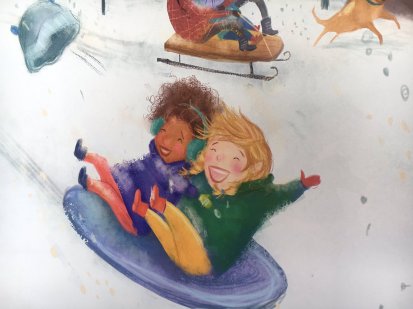
The thrill of playing in the snow is palpable as saucers zoom down hills, hats fly off, and hair blows in the wind. The final spreads of Grandma and Grandpa’s tidy home glow with love and laughter as the kids pull off their snow gear, their dog shakes off the snow, and they settle on the couch for cocoa and cuddles. The busy townspeople, happy playmates, and close-knit mixed-race family make When the Snow Falls a cheerful celebration of diversity.

When the Snow Falls is a joyous book to add to winter collections and would be often asked for during home, classroom, and library story times.

Ages 3 – 7

G. P. Putnam’s Sons Books for Young Readers, 2017 | ISBN 978-0399547201

Discover more about Linda Booth Sweeney, her books and her systems work, visit her website.

To learn more about Jana Christy, her art, and her books, visit her website.

National Author’s Day Activity
celebrate-picture-books-picture-book-review-sock-snowman-craft

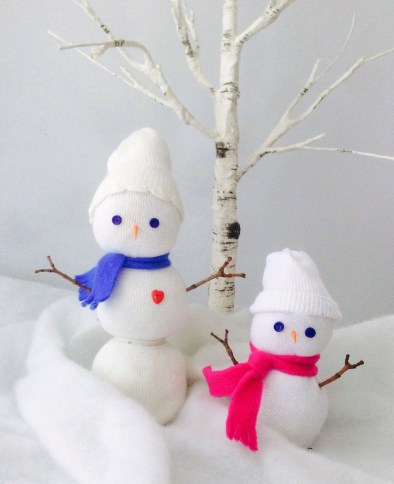
Snow Buddies

Even when there’s no snow, you can make yourself a snow buddy with this fun and easy craft!

Supplies

  • White dress ankle socks
  • Polyester Fiber Fill
  • Tiny buttons
  • Fleece or ribbon, enough for a little scarf
  • Toothpicks
  • Twigs
  • Orange craft paint
  • Cardboard
  • White rubber bands, one or two depending on the size of the snowman
  • Fabric or craft glue
  • Small hair band (optional)

Directions

To Make the Snowman

  1. Cut a circle from the cardboard about 2 inches in diameter for the base
  2. Place the cardboard circle in the bottom of the sock
  3. Fill the sock with fiber fill about ¾ full or to where the ribbed ankle cuff begins. Pack tightly while making a sausage shape. You can make your snowman different shapes with the amount of fill you use.
  4. Stretch out the cuff of the sock and tie it off near the top of the fill either with a loop knot or with the hairband.
  5. Fold the cuff down around the top of the filled sock to make the hat.
  6. Wrap a rubber band around the middle of the sock to make a two-snowball snowman. For a three-snowball snowman, use two rubber bands. Adjust the rubber bands to make the “snowballs” different sizes.

To Make the Scarf

  1. Cut a strip of fleece or ribbon 8 to 10 inches long by ½ inch wide
  2. Tie the fleece or ribbon around the neck of the snowman
  3. To Make the Nose
  4. Dip one end of the toothpick into orange paint, let dry
  5. Cut the toothpick in half
  6. Stick the toothpick into the head or top portion of the snowman

To Make the Arms

  1. Insert small twigs into each side of the body of the snowman
  2. You can also use wire or cardboard to make the arms
  3. Attach two mini-buttons to the face for eyes with the fabric or craft glue
  4. Display your Snow Buddy

Interview with Linda Booth Sweeney
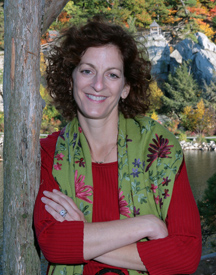
celebrate-picture-books-picture-book-review-linda-booth-sweeney

As the weather turns cooler, I’m happy to talk with Linda Booth Sweeney about the event that inspired her first book for children, a favorite wintertime activity, and how we can learn to see and benefit from systems.

How did you get started writing for children?

It seems like I’ve always been writing though it has taken me a long time to call myself a writer. During our last move, I discovered an old cardboard box from my parents’ attic.  After moving it literally for years, I finally opened it this summer. Inside there must have been 15 diaries and journals. When I looked at the dates, I realized that I started writing in those when I was about twelve and I really haven’t stopped. 
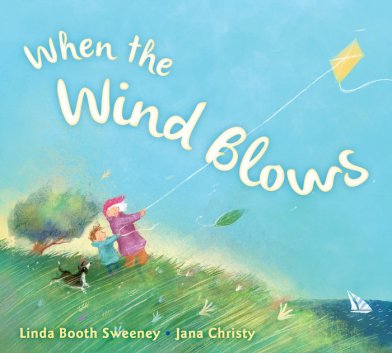
celebrate-picture-books-picture-book-review-when-the-wind-blows

I actually remember the exact day I began writing for children! Jack, my oldest son (now 19), was three. I was pushing him around Cambridge in one of those $20 pop-up strollers. We were a good fifteen minutes from home when a gale force wind blew in. The little canopy on this stroller snapped off and I remember feeling like the stroller lifted up off the ground. This was before cell phones so there was no calling for a ride. I put my head down and ran for home. Well, Jack loved that, and the wind blowing! He was bouncing up and down, pointing to everything he saw: signs rattling, balls rolling, hats flying.
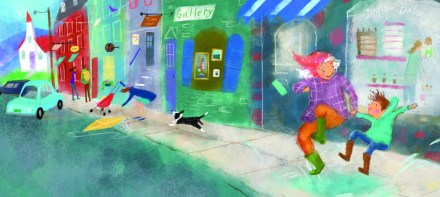
celebrate-picture-books-picture-book-review-when-the-wind-blows-city

Image copyright Jana Christy, 2017, text copyright Linda Booth Sweeney, 2017. Courtesy of G. P. Putnam’s Sons for Young Readers.

During his nap that afternoon, I flopped down at my desk, grateful we made it home in one piece. Jack’s excitement was contagious and his words were swimming around my head so I wrote them down. That was the beginning of my first children’s book, When the Wind Blows.

Using short, two-word phrases, your picture books are so evocative of actions outdoors and indoors as well as internal emotions. Can you describe your writing process?

I was mimicking the voice of a three-year old so the two words. Balls roll. Object and action. Noun and verb. It just made sense. In my other books like the one I’m working on now about the sculptor of the Lincoln Memorial, I am writing for older readers (ages 7-12). My sentences are longer. The book is inspired by big themes like being true to oneself, equality, social justice, and love for country so I find myself writing punchy sentences in the scenes and more lyrically the bridges, or the transitions, between scenes.

Do you remember your favorite picture book when you were a child?

As a little kid, I always loved Dr. Seuss books. My imagination was going full tilt as a kid. Dr. Seuss made me feel like the other worlds I created were not just okay but to be celebrated! As a nine-year-old, I devoured Encyclopedia Brown and anything by James Herriot.

Your first book for children, When the Wind Blows, takes readers on a jaunt through town on a blustery day. When the Snow Falls is a joyful romp through a winter day. What is it about weather that inspires you and your writing?

It’s the immediacy that weather brings. When the rain is pouring down or the snow is falling, that grabs my attention. Of course my attention is also on how to keep my fingers warm or my feet dry. But I can’t think of much else. I love that. I have to be in the moment. My favorite poet, Mary Oliver, captures this idea well in her “Instructions for living a life:
Pay attention.
Be astonished.
Tell about it.”

If you’re outside stomping in puddles or making snow angels, who needs to be on a phone? There’s a lot of research coming out that equates nature to a “vitamin” we all need. Richard Louv, the author of Last Child in the Woods: Saving Our Children from Nature-Deficit Disorder, says it well: “Just as children need good nutrition and adequate sleep, they may very well need contact with nature.” 
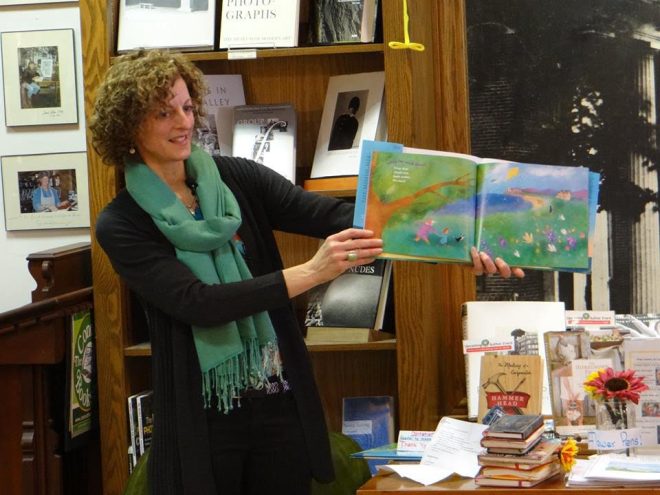
celebrate-picture-books-picture-book-review-linda-booth-sweeney

You mentioned in one of your blog posts that When the Snow Falls first took shape during “found time” during the winter of 2015 with its four nearly back-to-back snow storms. Do you have any advice for recognizing and taking advantage of found time not only for writers, but for anyone?

I think the biggest opportunity to enjoy found time comes when we’re willing to put down technology. Sure the photos we can take on our iPhone may be lovely but what if sometimes we are just there, fully present, open and even willing to be a little bored.  Maybe then we can be dazzled by the red Cardinal that lands on the white snowman or the hush that creeps in when no can one drive.

What is your favorite wintertime activity?

I love looking for snow art and especially love seeing it through the eyes of little ones. I’m always amazed by the “art” that forms during snow storms – polka-dotted fields, top hats on fence caps, intricate patterns on round porch tables, delicate animal tracks that look like instructions for some kind of dance move. 

And then of course there is cross country skiing with my family and my crazy friends.

Your other work involves Systems Thinking. Can you describe systems thinking and talk about your systems thinking work with children and schools?

Sure. Like a spider’s web, what happens on one part of the web affects every other part. The same is true of living systems. A pond, our family, our school, a city, the climate—these are all systems. They have two or more parts that interact over time. What’s really interesting is that these different kinds of systems share some similarities, and they can act in surprisingly similar ways. (You can learn more about my systems work here).

How does considering systems thinking and living systems benefit children and their education?

Systems thinking, or “Thinking about systems,” means paying attention to the interrelationships and patterns that surround us. My experience, and that of systems educators around the globe, shows that children are naturally attuned to this. They can read If You Give a Mouse a Cookie by Laura Numeroff and then recognize that same closed loop of cause and effect in their everyday lives.  

A few years back I wrote When a Butterfly SneezesA Guide for Helping Kids Explore Connections in our World as a resource for anyone who wants to help children think about interconnections in our world. Each chapter focuses on a favorite children’s picture book—like If You Give a Mouse a Cookie and The Sneetches by Dr. Seuss—and shows how to use the story to engage children in systems thinking. I just finished updating that book and the new version should be up and ready by next week!

To answer your question about how systems thinking benefits children, learning about systems, and about living systems in particular, can help children to make better decisions and avoid unintended consequences. It can also help them to develop a more compassionate and sustainable sensibility about what is beautiful and what is essential.

I always come back to the Joseph Campbell quote—“People who don’t have a concept of the whole, can do very unfortunate things.…”—and flip it: People—and especially children—who have a concept of the whole can do very fortunate things. If we encourage young people to look for the “whole” and not just focus on the parts, they will be geared toward seeing connections and will not see things in isolation. So much in our culture forces us into compartments. But just as we teach kids not to be victims of advertising, we can teach them to see beyond the obvious, to see the systems all around us.  

What’s up next for you? 

My next children’s book is a richly illustrated biography about Daniel Chester French, the sculptor of the Lincoln Memorial.  I am thrilled to be working with Shawn Fields a representational artist on this book.  The working title of the book is Monument Man, and that subject is very much a part of our public conversation at this point in our history. 

Thanks, Linda! Your books inspire us to look closure and pay attention to the moment, and I wish you all the best with them!
celebrate-picture-books-picture-book-review-when-the-snow-falls-cover

You can connect with Linda Booth Sweeney on:

Her Website | Twitter | Facebook | Linked in

You can find When the Snow Falls with these booksellers:

Amazon | Barnes & Noble | Books-a-Million | IndieBound | Penguin Random House

Picture Book Review

September 10 – Grandparents Day

celebrate-picture-books-picture-book-review-lotus-and-feathers-cover

About the Holiday

Today we celebrate the grandparents in a child’s life. A close relationship between children and grandparents can benefit kids in so many ways. When children spend time with grandparents they can discover family history, learn new hobbies, and always feel the unconditional love a grandparent has to give. Children also learn compassion and a long view of the world that inspires empathy and kindness for others – as the girl in today’s book shows. 

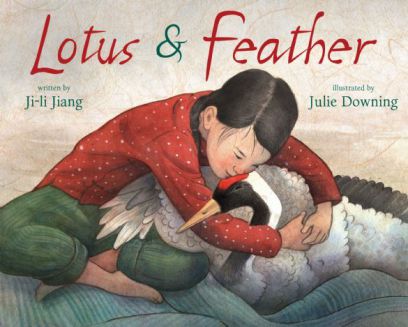
Lotus & Feather

Written by Ji-li Jiang | Illustrated by Julie Downing


Lotus was lonely since her winter illness had left her without a voice. The children at school “treated her like a strange creature,” and she was left without playmates or someone to keep her company on the walk home. She lived with her grandfather who made reed baskets and found solace when he took her to ride in his boat on the nearby lake. As he poled the boat through the still water, Lotus’ grandfather sadly pointed out how the lake had changed. No longer did the lotus flowers, fish, birds, or animals thrive. Instead, the landscape had “‘been ruined by greedy fishermen and hunters, and by ignorant people who took over the land where animals once lived.’”

celebrate-picture-books-picture-book-review-lotus-and-feather-lotus-meets-feathers

Image copyright Julie Downing, courtesy of Disney Hyperion

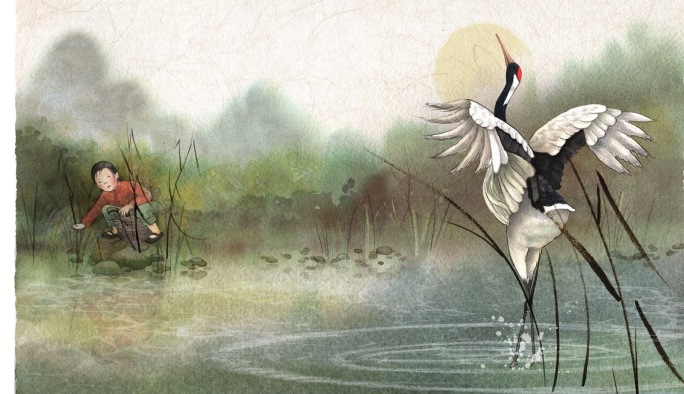
One morning while Lotus was out collecting reeds for her grandfather she spied a rare crane. It’s wide white “wings were edged with black feathers, like lace on a dress”…and “its head was crowned with a red top like a dazzling ruby.” As she watched a gunshot rang out. Unable to alert the hunter by shouting, Lotus banged on her bucket, frightening him away. Lotus rushed toward the wounded bird, picked it up and carefully brought it home to Grandpa.

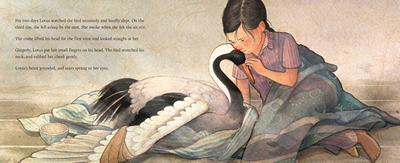
Grandpa tended to the crane’s injury and fed him rice soup while Lotus stroked the soft head. For two days, Lotus hardly slept as she took care of the crane. On the third day she fell asleep next to the crane, waking when he stirred and nestled her cheek. “Lotus’s heart pounded, and tears sprang to her eyes.” Lotus named the crane Feather. As it grew stronger she gathered food for it, and on the day Feather took his first steps, “Lotus jumped and swirled and hugged Grandpa blissfully.”

celebrate-picture-books-picture-book-review-lotus-and-feather-lotus-comforts-feather

Image copyright Julie Downing, courtesy of Disney Hyperion

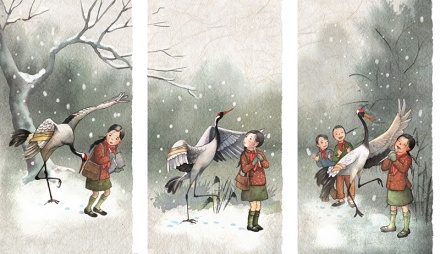
Soon Feather was following Lotus everywhere—even to school. After class Lotus would blow her whistle and Feather would come running and dance as Lotus played. The other children joined in, dancing and playing along every day. One night Lotus heard Feather crowing and woke to find that the village was flooded. Poling his boat through the streets, Grandpa shouted, Lotus banged her pail, and Feather crowed to alert the neighbors. “Over three hundred villagers were saved. Feather was the hero.” He became famous, and people wanted to hear his story again and again.

celebrate-picture-books-picture-book-review-lotus-and-feather-lotus-dancing

Image copyright Julie Downing, courtesy of Disney Hyperion

When Spring arrived Feather was still too weak to fly but he looked longingly at the birds migrating north. Lotus was frightened that her friend might want to leave them, but she “knew she would never separate him from his home and family.” One day Feather spread his wings and leaped into the air. Lotus realized that he had healed and knew it was time for him to leave. Grandpa and Lotus took Feather to the lake. Grandpa tossed Feather into the air, but he returned again and again. Grandpa gave Feather to Lotus. Lotus hugged Feather one more time and threw him into the sky.  

celebrate-picture-books-picture-book-review-lotus-and-feather-lotus-lets-feather-go

Image copyright Julie Downing, courtesy of Disney Hyperion

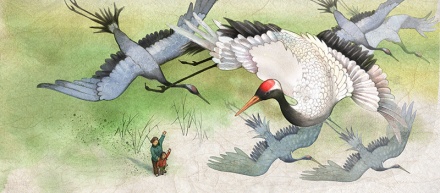
Holding back tears, Lotus watched as “Feather flapped his big wings and soared north, disappearing into the horizon.” Lotus and the other children missed Feather. They gathered together listening to Lotus play her whistle, imagining that Feather could hear them. One autumn morning, Lotus heard a familiar crow and rushed outside. There stood Feather with his family. Then Lotus gasped. The sky was filled with hundreds of cranes coming to the lake. Lotus blew her whistle, and the notes, “accompanied by the birds’ singing, echoed far, far away in the golden sky.”

celebrate-picture-books-picture-book-review-lotus-and-feather-lotus-waves-goodbye

Image copyright Julie Downing, courtesy of Disney Hyperion

Ji-li-Jiang’s tender story resonates on every page with love and friendship. The relationship revealed in Jiang’s tale exists not only between Lotus and Feather, but between readers and their environment. Beautifully interwoven throughout the plot, the idea of responsibility between friends, to the earth, and to ourselves makes Lotus & Feather a compelling book to read and discuss. Through lyrical passages and detailed storytelling, Jiang develops a deep, emotional bond between Lotus and Feather that readers will respond to. The heartwarming connection between Lotus and her grandfather brings comforting and another level of family commitment to the story.

Julie Downing’s stunning illustrations allow readers to walk, sit, worry, and cheer with Lotus as she finds and cares for Feather. Her sadness is palpable as she walks home from school past a group of classmates playing ball; in the corner of the dark lake, children will find bottles, cans, and other debris floating among the reeds; and Feather makes his debut with a graceful ballet. Readers will love watching the progression of Feather’s healing and Lotus’ reintegration into her circle of friends and will applaud when Feather and his family and friends return to the lake.

Lotus & Feather is a multi-layered story that will captivate readers. It is a must for public and school libraries and would make a beautiful addition to home libraries as well.

Ages 5 – 9

Disney Hyperion, 2016 | ISBN 978-1423127543

Discover more about Ji-li Jiang and her books on her website!

View a portfolio of artwork as well as other books by Julie Downing on her website!

Grandparents Day Activity


I Love Grandma and Grandpa!


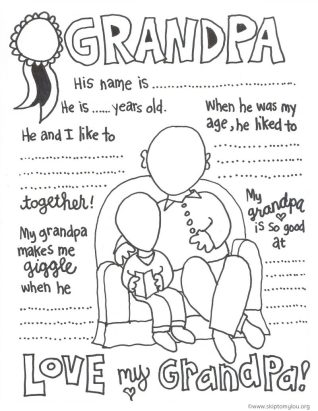
Grandparents are the best! On this special day, tell your grandparents what you love most about them and why with this printable I Love Grandma and I Love Grandpa Pages!

Picture Book Review

August 24 – It’s National Fishing Month

celebrate-picture-books-picture-book-review-skyfishing-cover

About the Holiday

During National Fishing Month individuals and families are encouraged to try their hand at this fun outdoor sport. Whether you catch and release or eat what you catch, casting your line, seeing the bobber wobble, and feeling that exciting tug on the fishing pole makes for a fun day.

Skyfishing

Written by Gideon Sterer | Illustrated by Poly Bernatene


A young girl’s grandpa sold his cabin on the lake and is coming to live with her and her family. When they pulled in to pick him up, he was ready and waiting with every fishing pole he owned in one hand and his tackle box in the other. But once he saw his granddaughter’s apartment in the middle of the city, he “realized there was nowhere to fish.”

celebrate-picture-books-picture-book-review-skyfishing-grandpa

Image copyright Poly Bernatene, 2017, text copyright Gideon Sterer, 2017. Courtesy of Abrams Books for Young Learners.

All during that fall and winter, the girl tried to engage her grandpa in new activities like building models and playing chess. But nothing was the same as fishing. Then in the spring, the little girl had an idea. She took her grandpa out on the fire escape with their fishing poles, and they cast their lines over the edge. At first nothing happened. But then Grandpa got a bite. He reeled it in… “Grandpa said he’d never seen one before, but there it was…A Flying Litterfish.”

celebrate-picture-books-picture-book-review-skyfishing-fire-escape

Image copyright Poly Bernatene, 2017, text copyright Gideon Sterer, 2017. Courtesy of Abrams Books for Young Learners.

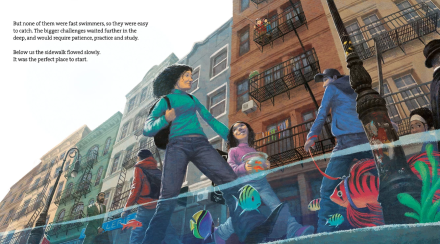
That green plastic bag on the end of the hook was just the beginning. After learning the rules—always return what you catch and “where there’s one fish, you can bet there will be more”—the two caught “Chimefish, and Signfish, Laundry Eels and even a Cold-air-square.” But all of those things were stationary and easy to catch. Down below, however, “the sidewalk flowed slowly”; it was a perfect place to practice trawling.

celebrate-picture-books-picture-book-review-skyfishing-sidewalk

Image copyright Poly Bernatene, 2017, text copyright Gideon Sterer, 2017. Courtesy of Abrams Books for Young Learners.

“Capfish were the first to bite. Then Songfish, Goldfish, and fish “from foreign shores.” As Grandpa and his granddaughter became more proficient, they reeled in “Furry Snappers” on leashes and “Hammerheads” drilling holes. Even a “Grillfish” was on the menu. Next, it was time to try their luck in the ocean of the street where larger and faster fish lived. Here, “Zoomfish, Mailfish, Glowfish, and more Yellow-stripers than [they] could count” waited.

celebrate-picture-books-picture-book-review-skyfishing-road

Image copyright Poly Bernatene, 2017, text copyright Gideon Sterer, 2017. Courtesy of Abrams Books for Young Learners.

There were also mammoth creatures like the “Stretchfish,” Waste-muncher,” and “Constructionfish,” but down below these—in the murky depths—lived the largest fish of all. Grandpa and his granddaughter studied just how to set their line, they lowered it slowly and were not surprised when they felt the tug of the…oh, no!…“Troublefish” with sirens blaring.

Quickly and quietly the two put their fishing poles away for another day. But summer vacation was just beginning, and it was time to join those city fish. “It was time to swim.”

celebrate-picture-books-picture-book-review-skyfishing-subway

Image copyright Poly Bernatene, 2017, text copyright Gideon Sterer, 2017. Courtesy of Abrams Books for Young Learners.

Gideon Sterer’s debut picture book gently and creatively addresses the issue of grandparents transitioning from their own home into another living situation. As an outdoor-loving grandpa comes to live with his family in the city, his caring granddaughter discovers a way for him to continue his beloved pastime while they also form a strong bond. Sterer’s clever idea of dry-land fishing along with his witty names for the fish found in the concrete depths will enchant readers and entice them to devise species of their own. The sweet ending in which both Grandpa and Granddaughter are ready to explore the city and new experiences together is satisfying and uplifting.

celebrate-picture-books-picture-book-review-skyfishing-hobbies

Image copyright Poly Bernatene, 2017, text copyright Gideon Sterer, 2017. Courtesy of Abrams Books for Young Learners.

With perfect pacing and a growing sense of wonder, Poly Bernatene leads children from Grandpa’s sparkling blue lake to his granddaughter’s city apartment to the first glimpse of their fire escape trophy. Children will be charmed by the ingenuity of the plastic-bag fish dangling on the line and, like the little girl in the story, will be hooked on what comes next. As the waters rise and the people and objects down below slowly transition to fish and other humorous sea creatures, readers will love exploring the watery world and learn to look at their own neighborhoods in a whole new way.

Ages 4 – 8

Abrams Books for Young Readers, 2017 | ISBN 978-1419719110

To learn more about Gideon Sterer and his books, visit his website.

Discover a gallery of artwork and books by Poly Bernatene for children, young adults, and adults on his website.

National Fishing Month Activity

celebrate-picture-books-picture-book-review-tackle-the-tackle-box-game

Tackle the Tackle Box Board Game


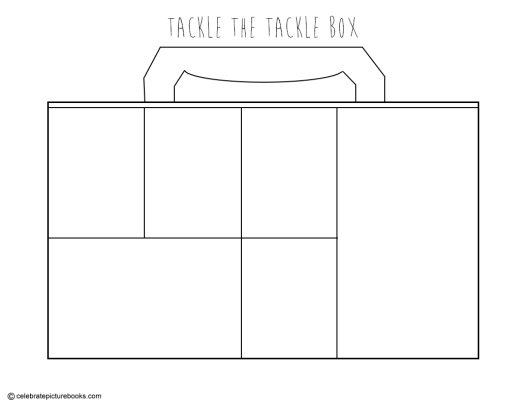
A good fisherman always needs a well-stocked tackle box. Play the Tackle the Tackle Box Game to earn lures, bobbers, hooks and more to fill your box. The first player to complete their set is the winner! For more fun, you can color the tackle box items any way you like. There are even three extra cards for you to draw your own tackle box items!

Supplies


celebrate-picture-books-picture-book-review-tackle-the-tackle-box-game-cards

Directions

  1. On card stock, heavy paper, or regular paper, print one Tackle the Tackle Box Game Board for every player
  2. On card stock, heavy paper, or regular paper, print one set of Tackle the Tackle Box Game Cards for every player
  3. Each player can color a set of playing cards
  4. Cut the cards apart
  5. Gather all the cards and set in separate piles
  6. Roll the die to determine who goes first, highest roll goes first
  7. The first player rolls the die, and adds the item that corresponds to the number on the die. The list is below.
  8. Play continues with each player rolling the die and collecting cards
  9. If the player rolls a number for a card that he or she already has, the die passes to the next player
  10. The first player to fix their tackle box is the winner!

Each number of dots on the die corresponds to these cards:

1: FISH LURES

2: HOOKS

3: WORMS

4: FISHING LINE

5: FLIES

6: BOBBERS

Picture Book Review

July 23 – Gorgeous Grandma Day

celebrate-picture-books-picture-book-review-what-can-your-grandma-do-cover

About the Holiday

If you’re a grandma, today’s your day! Grandmas have a particular beauty inside and out as they care for the children in their lives. Kids benefit from the love and knowledge grandmothers have to give, and grandmas can learn a bit from their grandkids too! To celebrate plan a special day with your grandkids!

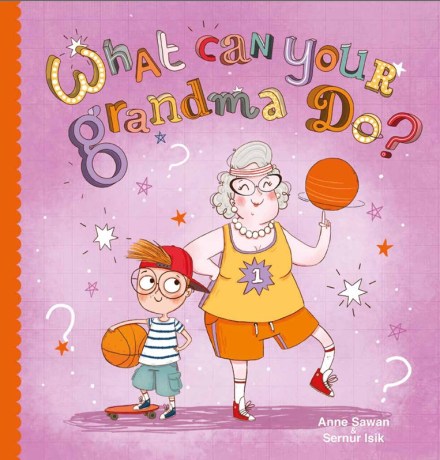
What Can Your Grandma Do?

Written by Anne Sawan | Illustrated by Sernur Isik


Jeremy’s class at school is going to hold a grandparents talent show to celebrate Grandparents Appreciation Week. All the kids are excited except for Jeremy. He “loved his grandma, but he wasn’t sure she had any special talent.” Stella thinks that her grandma, who’s a doctor, can demonstrate how to splint an arm. Jeremy remembers that his grandma put ice on his ankle when he twisted it playing basketball, but she’s not a doctor.

celebrate-picture-books-picture-book-review-what-can-your-grandma-do-painting

Image copyright Sernur Isik, 2017, text copyright Anne Sawan, 2017. Courtesy of Clavis Publishing.

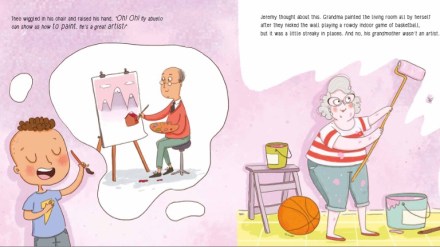
Theo’s abuelo is a great artist and can paint a picture for the class. Jeremy thinks about when the wall at home got nicked during an indoor game of basketball. His grandma repainted it all by herself, but she isn’t really an artist. How about cooking? Celeste is going to bring her Ye-ye, who’s a baker. “‘I am sure he could make us some chocolate cupcakes with sugar flowers on top,’” she says. Hmmm…Jeremy’s grandma makes great sandwiches, but she nearly burned down their apartment building when she left a roast in the oven while she and Jeremy went to play basketball. No, his grandma isn’t a chef.

celebrate-picture-books-picture-book-review-what-can-your-grandma-do-juggling

Image copyright Sernur Isik, 2017, text copyright Anne Sawan, 2017. Courtesy of Clavis Publishing.

It seems as if everyone’s grandma has some amazing talent. One dances ballet, and one can do the hula hoop. Another creates balloon animals, and yet another is great at dancing the salsa. “‘What is your grandmother going to do?’” Stella askes Jeremy. He just shrugs. That afternoon as Jeremy eats one of his grandma’s sandwiches, he tells her about the talent show. His grandma thinks it sounds like fun. Jeremy looks at his grandma. “‘Yes. Well…do you have any talents?’” he asks.

celebrate-picture-books-picture-book-review-what-can-your-grandma-do-basketball

Image copyright Sernur Isik, 2017, text copyright Anne Sawan, 2017. Courtesy of Clavis Publishing.

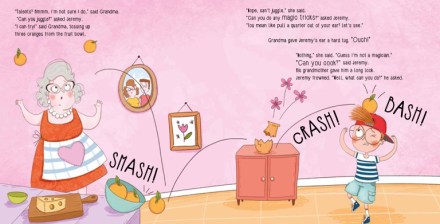
His grandma isn’t sure. She tries juggling, but the three oranges just bounce around the room and break a vase. She tries pulling a quarter out of Jeremy’s ear like a magician, but that just hurts. And they both know she can’t cook. They both feel a little sad as they try to come up with a talent, but Jeremy knows how to cheer his grandma up. He grabs his basketball and they head for the court.

celebrate-picture-books-picture-book-review-what-can-your-grandma-do-cheering

Image copyright Sernur Isik, 2017, text copyright Anne Sawan, 2017. Courtesy of Clavis Publishing.

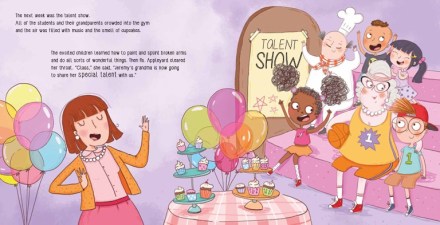
“‘Have you been practicing what I taught you?’” Jeremy’s grandma asks. She takes off down the court, running fast. “She dribbled the ball, took two giant steps, leaped into the air, raised the ball towards the rim, and…Whoosh!” Jeremy smiles. The next week Jeremy’s class gathers in the gym for the talent show. After the kids learned how to splint arms, paint pictures, dance, and do other “wonderful things,” their teacher announces that Jeremy’s grandmother is going to demonstrate her special talent.

She goes to the center of the court and begins to run. “She ran fast! She dribbled the ball, took two giant steps, leaped into the air, raised the ball towards the rim and dunked it right through the net.” Everyone cheers. “‘Oh yeah, that’s right,’” Jeremy says, “‘my grandma can dunk!’”

celebrate-picture-books-picture-book-review-what-can-your-grandma-do-cheering

Image copyright Sernur Isik, 2017, text copyright Anne Sawan, 2017. Courtesy of Clavis Publishing.

Grandmas and grandkids alike will love the close relationship between Jeremy and his grandma in Anne Sawan’s funny and heartfelt story. Her dialogue always rings true, and the open give and take between Jeremy and his grandma is sweet and leads to greater understanding between the two. Sawan’s portrayal of today’s grandparents as active professionals, talented, and hip is realistic and welcome. As Jeremy thinks about the mishaps his grandma has had, readers may giggle but also see that relationships aren’t based on perfection but on shared experiences.

Sernur Isik’s crisp, detailed illustrations are as vibrant as the grandparents depicted in this uplifting story. As the kids in the class reveal their grandparents’ particular talents, readers can see their obvious pride in and love for their family. Jeremy’s dilemma leads to humorous images of his grandma and her accidents, but kids will cheer along with the class as Grandma dunks the basketball like a pro.

What Can Your Grandma Do? Is a fun book for kids to share with grandparents. It would make a great gift and an enjoyable way to jump start a talk about hobbies and family history.

Ages 4 – 12

Clavis Publishing, 2017 | ISBN 978-1605373324

Discover more about Anne Sawan, her books, and her blog on her website!

Learn more about Sernur Isik and view a portfolio and sketchbook of her artwork on her website!

Gorgeous Grandma Day Activity

celebrate-picture-books-picture-book-review-floral-letter-border

Floral“I Love You Because…” Page


You and your grandma have a special relationship! Tell her why you love her by writing a letter or drawing a picture on this printable Floral “I Love You Because…” Page.

Picture Book Review

May 6 – Join Hands Day

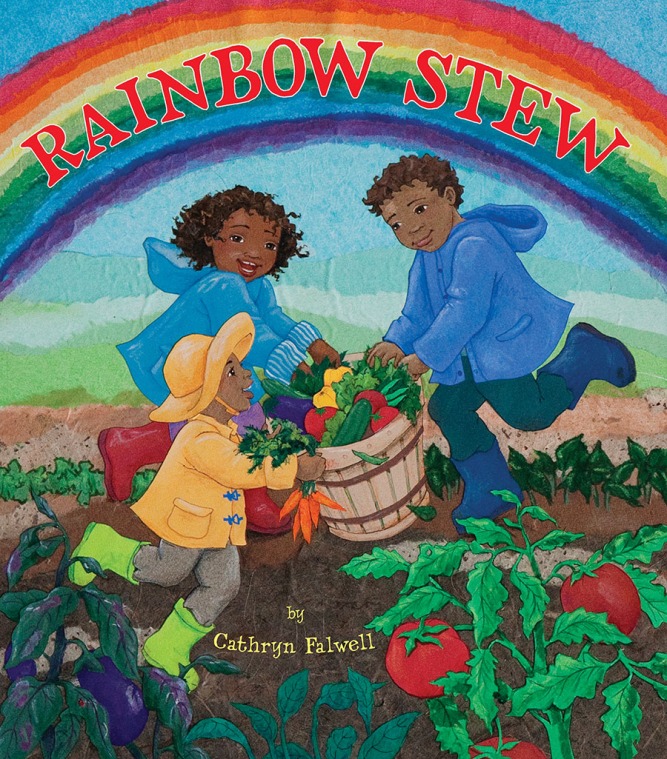
Rainbow Stew by Cathryn Falwell Picture Book Review

About the Holiday

Today’s holiday was instituted to foster better communication between the older and younger generations and to recognize the ways that all people, no matter what their age, can help each other. Many communities use this day to begin a dialogue between their elderly and their youth, getting young people involved in visiting care centers and older adults helping out at schools and other youth programs. Another great way to celebrate is for grandparents and grandkids to spend the day together!

Rainbow Stew

By Cathryn Falwell


Grandpa’s making pancakes for his three favorite kids—his granddaughter and two grandsons. The kids are excited to be visiting their grandpa where they can play outside all day long. On this particular day, however, rain spatters the windows, and the kids are disappointed: “Whimper, sigh, / cloudy sky, / is it too wet to play? / We don’t want to stay inside / because of rain today.” But their grandpa knows just what to do! “Let’s go and find some colors for my famous Rainbow Stew!” he suggests.

celebrate-picture-books-picture-book-review-rainbow-stew-picking-vegetables

Image copyright Cathryn Falwell, courtesy of rainbowstewbook.com

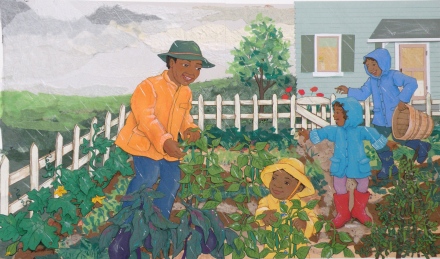
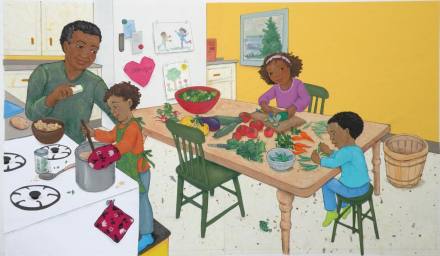
Out to the garden they run in their raincoats and hats. “Splish, splash, / puddle dash, / We bounce right out the door. / We’re off to find some red and green, / some yellow, orange, and more. / Grandpa shows us how to move / Between each garden row. / Lifting up the drippy leaves, /  we see what colors grow.” They collect green spinach, kale, and zucchini; yellow peppers, purple cabbage and eggplant, red radishes and tomatoes; brown potatoes; and orange carrots. After some muddy fun among the plants, the kids go inside, get dried off, and begin to prepare their colorful stew.

celebrate-picture-books-picture-book-review-rainbow-stew-playing-between-the-rows

Image copyright Catherine Falwell, courtesy of rainbowstewbook.com

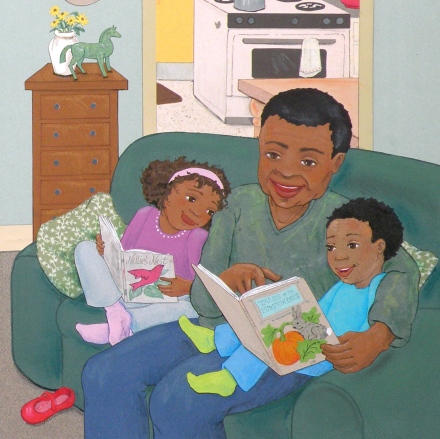
Peel, slice / chop and dice, / colors fill the pot. / Stir in herbs and water / and then wait till it gets hot.” While the pot simmers on the stove, Grandpa and the kids snuggle on the couch with favorite books, reading together until the stew has simmered to perfection. The family then sits down to a homemade, colorful, delicious lunch of Rainbow Stew. 

celebrate-picture-books-picture-book-review-rainbow-stew-playing-cooking-together

Image copyright Cathryn Falwell, courtesy of rainbowstewbook.com

Cathryn Falwell’s Rainbow Stew is a wonderful book to share with young children on many levels, offering opportunities for learning as well as playing. Introducing colors through familiar and delicious vegetables can get kids excited about gardening, cooking, even going to the grocery store. The rhyming verses each begin with an energetic couplet that kids will enjoy repeating or acting out. The bright colors of Grandpa’s house mirror the vividness of the garden vegetables, and young readers may enjoy matching the vegetables to items in the kitchen, living room, and more. 

Children will identify with the disappointment of the three siblings when they learn it’s too wet to spend the day outside as well as their glee at squishing in the mud. The close bond between the kids and their grandfather as they cook and read together is a strong anchor for this story and promotes early literacy.

celebrate-picture-books-picture-book-review-rainbow-stew-reading-together

Image copyright Cathryn Falwell, courtesy of rainbowstewbook.com

A recipe for Rainbow Stew follows the story. Reading Rainbow Stew, preparing the delicious dish, and doing the puzzle below makes for a fun rainy – or sunny – day!

Ages 4 – 7

Lee & Low Books, 2013 | ISBN 978-1600608476

Learn more about Cathryn Falwell and her books and art on her website!

To discover more about Rainbow Stew as well as activities to accompany the book, head over to rainbowstewbook.com!

Join Hands Day Activity

celebrate-picture-books-picture-book-review-UN-day-puzzle

Give Me Your Hand Interchangeable Puzzle


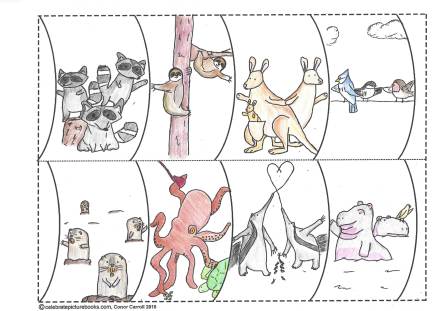
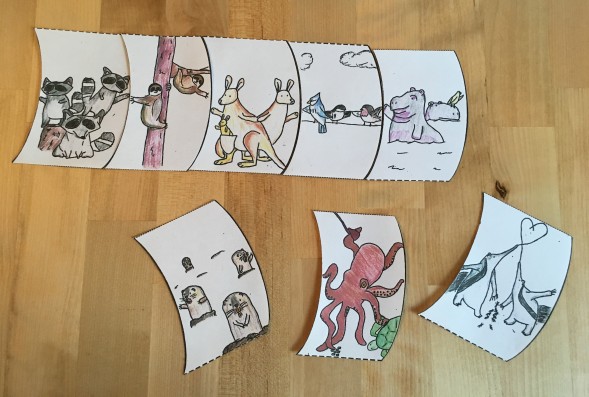
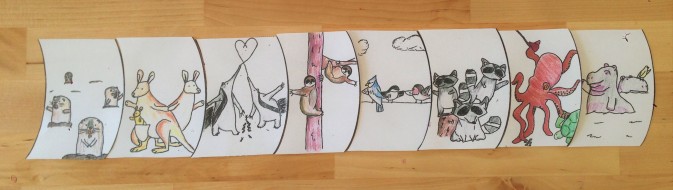
In this printable Give Me Your Hand! Puzzle, everyone is welcomed with a handshake. Offering friendship to all, the interchangeable pieces can be mixed and matched as the animals become buddies with one another. 

Supplies

celebrate-picture-books-picture-book-review-UN-day-puzzle

Copyright Conor Carroll, courtesy of celebratepicturebooks.com

Directions

  1. Print the puzzle: to make the puzzle sturdier: Print on heavy stock paper or glue the page to poster board
  2. Color the pictures with colored pencils or crayons
  3. Cut the pieces apart
  4. Switch the pieces around to make many alternate pictures
celebrate-picture-books-picture-book-review-UN-day-puzzle

Copyright Conor Carroll, courtesy of celebratepicturebooks.com

Picture Book Review
March 30 – It’s Music in Our Schools Month

celebrate-picture-books-picture-book-review-hana-hashimoto-sixth-violin-cover

About the Holiday

This annual holiday celebrates the benefits of music education in schools. With budget cuts looming in nearly every school district, the arts are often the first to go. But music inspires creativity and critical thinking and contributes to a better understanding of math and other subjects. School music programs also offer opportunities to children who may otherwise not be able to take lessons and explore their talent. To help out, contact your local school and see what you can do!

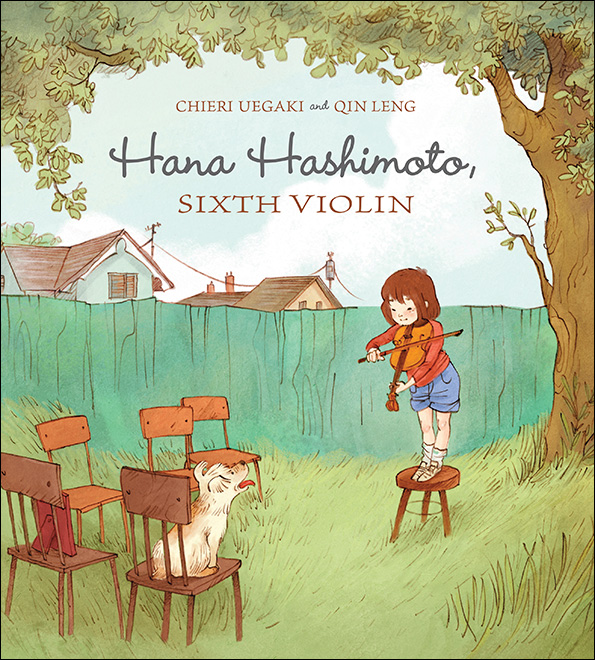
Hana Hashimoto, Sixth Violin

Written by Chieri Uegaki | Illustrated by Qin Leng


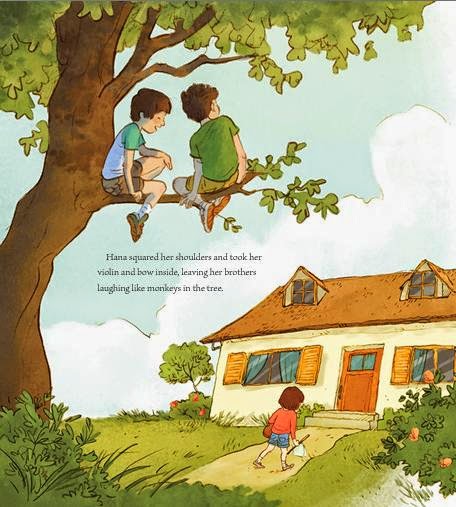
When Hana Hashimoto told her brothers that she had signed up to play her violin in the talent show, they laughed.  “‘That’s just loopy,’” Kenji said, and Koji added ‘‘You can barely play a note.’” They reminded her that it was a talent show and that she was just a beginner. But Hana didn’t listen. “It was true that she was still a beginner. She had only been to three lessons.” But playing the violin was in her blood. Her grandfather, Ojiichan, had once been Second Violin in a symphony orchestra in Kyoto, Japan and had even played for the Imperial Family.

celebrate-picture-books-picture-book-review-hana-hashimoto-sixth-violin-brothers-in-tree

Image copyright Qin Leng, text copyright Chieri Uegaki. Courtesy of Kids Can Press.

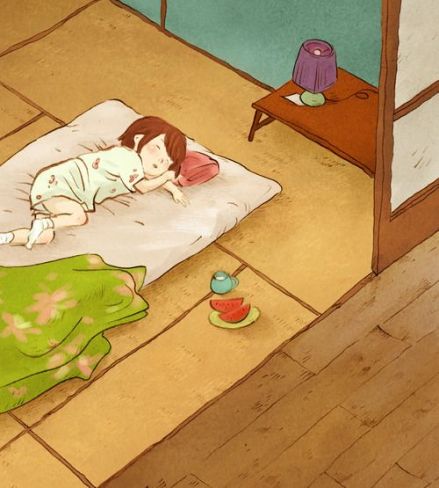
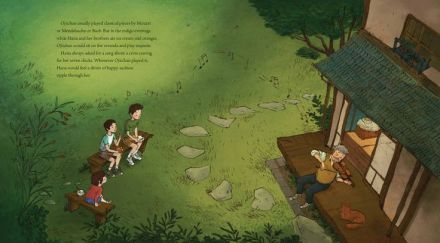
Hana had visited her grandfather that summer, and the sweet notes of his playing had coaxed “her awake as gently as sunshine” every morning. In the evenings her grandfather would take requests from Hana and her brothers. “Hana always asked for a song about a crow cawing for her seven chicks. Whenever Ojiichan played it, Hana would feel a shiver of happy-sadness ripple through her.”

celebrate-picture-books-picture-book-review-hana-hashimoto-sixth-violin-hana-sleeping

Image copyright Qin Leng, text copyright Chieri Uegaki. Courtesy of Kids Can Press.

Ojiichan’s playing was like magic. He could make the violin chirp like crickets, plink like falling raindrops, and send fireflies dancing. At the end of the summer, Hana had decided she also wanted to play the violin and her parents agreed. Hana practiced every day even though her brothers ran away with their hands over their ears. She played for her parents, for her dog, JoJo, and for a photograph of Ojiichan. Sometimes she pretended to play for “an audience so appreciative they called for encore after encore.”

On the night of the talent show, Hana waited backstage for her turn “with a walloping heart.” Five other violinists had already gone before her. Finally, she heard her name. As she strode across the stage as wide as a desert, she had a fleeting feeling that her brothers had been right—that her performance was going to be a disaster. But when she reached her spot near the microphone and gazed out at the audience, she saw her best friend and her parents smiling at her.

celebrate-picture-books-picture-book-review-hana-hashimoto-sixth-violin-listening-to-grandfather

Image copyright Qin Leng, text copyright Chieri Uegaki. Courtesy of Kids Can Press.

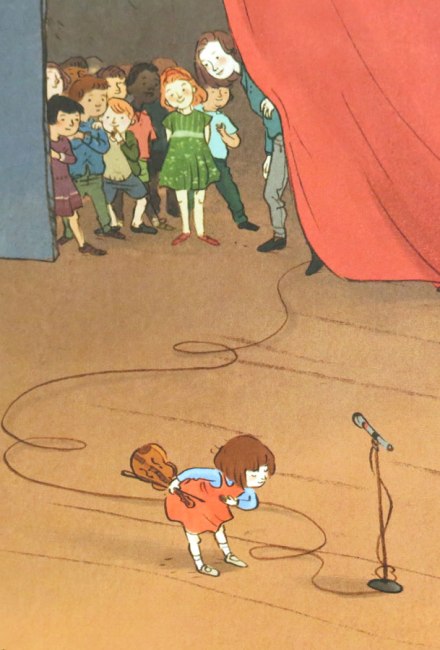
Hana took a deep breath and let it out. Suddenly, “everyone seemed to disappear beyond the light shining down on her like a moonbeam” and she remembered her grandfather’s words: “‘Gambarunoyo, Hana-chan.’ Do your best.” Hana told the audience, “‘This is the sound of a mother crow calling her chicks.’” She “played three raw, squawky notes.” Then she played the yowl of her neighbor’s cat at night and the plucky droplets of rain on a paper umbrella. Hana played a world of special sounds, from buzzing bees to squeaking mice to croaking frogs. When she had finished, she said, “‘And that is how I play the violin.’” Then she took a bow.

Later that night Kenji asked Hana for an encore, and she happily played her piece again. Next year, Hana thought, she might be able to play one of her grandfather’s melodies. Before she went to sleep, Hana played another piece she had been practicing. “She imagined that the notes would drift out through the window, past the bright rabbit moon and beyond, and Ojiichan would hear them and smile.”

celebrate-picture-books-picture-book-review-hana-hashimoto-sixth-violin-hana-bows

Image copyright Qin Leng, text copyright Chieri Uegaki. Courtesy of Kids Can Press.

Chieri Uegaki’s gorgeously told story of a little girl’s first performance with her new violin rings true on every page, from her being inspired by her grandfather to her own inspirational performance. Uegaki’s descriptions of the melodies that capture Hana’s heart are as beautiful as the music itself and are a joy to read. Hana’s continued self-confidence in the face of her brothers’ teasing and her own fear is a wonderful lesson for all children. The brothers’ support of Hana after the talent show is a welcome show of familial love, and the touching ending offers encouragement and happiness.

Young readers will love Qin Leng’s evocative illustrations that follow Hana on her musical journey. Notes from the violin pieces Hana admires float from page to page—from her grandfather’s home in Japan to her own room—tying together not only Hana’s fondness for the violin, but her love for her grandfather. Beautiful touches, such as an image of Hana reflected in a pastel blue rain puddle and a night sky twinkling with fireflies, mirror the wonder of childhood, when everything is new and possible.

Hana Hashimoto, Sixth Violin is refreshing encouragement for any child engaging in new experiences or activities. The book’s warmth and inventiveness make it a wonderful gift or addition to home libraries.

Ages 4 – 8

Kids Can Press, 2014 | ISBN 978-1894786331

Enjoy this Hana Hashimoto, Sixth Violin book trailer!

Music in Our Schools Month Activity

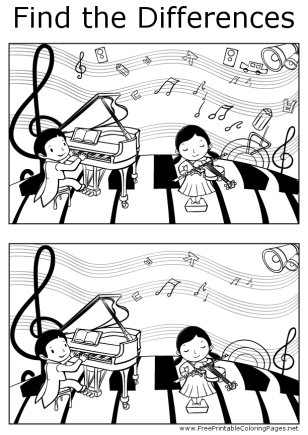
celebrate-picture-books-picture-book-review-kids-playing-music-find-the-differences

Musical Kids Find the Differences


These two kids are performing a duet! Can you find all of the differences in the second picture on this printable Musical Kids Find the Differences?

Picture Book Review

February 11 – It’s Bake for Family Fun Month

celebrate-picture-book-picture-book-review-baking-day-at-grandma's-cover

About the Holiday

Mid-winter is a perfect time to get out your favorite recipes, gather yummy ingredients, and bake with your kids! Not only does baking together teach valuable cooking skills, but it can bring a family closer. Talk about old family recipes and find new favorites. Of course the best part of baking together is eating the delicious treats afterward!
Baking Day at Grandma’s

Written by Anika Denise | Illustrated by Christopher Denise


Three little cubs bundle up in their winter coats, hats, scarves, and mittens and head out over the snowy hills to Grandma’s for baking day. Soon they see “past the pond so smooth and clear / little cottage drawing near.” A knock on Grandma’s door brings her closer, and when she opens the door the trio give her a kiss before entering the snug home.

celebrate-picture-book-picture-book-review-baking-day-at-grandma's-in-the-snow
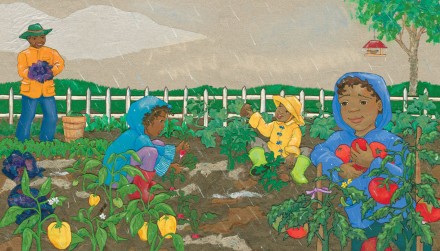
Image copyright Christopher Denise, courtesy of Philomel Books

After warming their toes by the fire, the young bears grab the cookbook, a mixing bowl, a spoon, and a whisk because “It’s baking day! / It’s baking day! / It’s baking day! / at Grandma’s!” As her little bakers stand on chairs to reach the table, Grandma passes out aprons and reads the recipe. Happily crowded around the bowl, the cubs with “wooden spoon and measuring cup, / mix the batter; stir it up. / Fold it gently in the pan, / lick the spoon because we can.”

celebrate-picture-book-picture-book-review-baking-day-at-grandma's-marching-around

Image copyright Christopher Denise, courtesy of Philomel Books

While they wait for their treats to bake, Grandma pours tummy-warming mugs of hot chocolate and one little bear draws a smiley face on the frosty window for a little chickadee to see. Grandma puts a record on her old Victrola, and as she sings the “soft and sweet skippy notes,” the cubs tap their feet. At last the kitchen timer rings, and the little bears dance arm in arm because “It’s baking day! / It’s baking day! / It’s baking day! / at Grandma’s!”

The chocolate goodies pop from the pan, and with icing and sprinkles are ready to be wrapped and tied with a red ribbon. Other treats get pretty bags, “each one marked with little tags.” The cubs are also bundled nice and warm, and with final hugs for Grandma, they are soon “Walking home under the moon. / Back to visit Grandma soon.”

celebrate-picture-book-picture-book-review-baking-day-at-grandma's-music

Image copyright Christopher Denise, courtesy of Philomel Books

Anika Denise’s sweet, rhyming story is as heartwarming as a cozy kitchen on a cold day. The buoyant rhythm is a joy to read, and Denise’s infectious repeated verse, “It’s baking day! / It’s baking day! / It’s baking day! / at Grandma’s!” invites little ones to join in the story. The bond between the three cubs and their grandma is full of love and hugs, and just like the young bears, readers will want to return again and again to Grandma’s house.

Christopher Denise infuses his winter landscapes and Grandma’s house with rich, warm colors that welcome readers into this special family baking day. The three cubs, wrapped in green coats and red knit caps, march with their sled over brilliant white snowy hills between their house and Grandma’s tidy log cabin. Inside, the rooms glow with golden sunshine, and it’s easy to see why the cubs love their attentive grandma so as she gently guides them in baking.

Newly available as a board book, Baking Day at Grandma’s is a book that young children will love to hear over and over at story time, naptime, or bedtime. It would also make an appreciated gift to or from a grandmother.

Ages 2 – 5

Philomel Books, 2016 | ISBN 978-0399171574 (board book) / 978-0399242441 (hardcover)

Learn more about Anika Denise and her books and find Reader Engagement and Activity Kits on her website!

Discover the illustrated world of Christopher Denise on his website!

Spend time baking with Grandma with this sweet book trailer!

Bake for Family Fun Month Activity

celebrate-picture-books-picture-book-review-cupcakes

Very Vanilla Cupcakes


This delicious vanilla cupcake recipe from Sally’s Baking Addiction would definitely please Grandma—and they’ll become your favorite confection too!

Vanilla Cupcakes

  • 1 and 2/3 cup (210g) all-purpose flour (spoon & leveled)
  • 1/2 teaspoon baking powder
  • 1/4 teaspoon baking soda
  • 1/2 teaspoon salt
  • 1 cup (200g) granulated sugar
  • 1/2 cup (115g) unsalted butter, melted and slightly cooled
  • 2 large egg whites
  • 1/4 cup (60g) vanilla Greek yogurt (or plain; or regular yogurt; or even sour cream)
  • 3/4 cup (180ml) vanilla almond milk (or cow’s milk; or soy milk; or plain almond milk)
  • 2 teaspoons pure vanilla extract seeds scraped from 1/2 split vanilla bean1

Vanilla Bean Frosting

  • 1 cup (230g) unsalted butter, softened to room temperature
  • 4-5 cups (480-600g) confectioners’ sugar
  • 1/4 cup (60ml) heavy cream2
  • 1 teaspoon vanilla extract seeds scraped from 1/2 split vanilla bean1
  • Salt, to taste

Directions

  1. Preheat oven to 350F degrees. Line muffin tin with 12 cupcake liners. Set aside.
  2. In a medium bowl, mix together flour, baking powder, baking soda, and salt. Set aside. In a large microwave-safe bowl, melt butter in the microwave. Whisk in sugar – mixture will be gritty. Whisk in egg whites, yogurt, milk, and vanilla extract until combined. Split 1 vanilla bean down the middle lengthwise. Scrape seeds from half of the vanilla bean into batter. Reserve other half.
  3. Slowly mix dry ingredients into the wet ingredients until no lumps remain. Batter will be thick.
  4. Divide batter among 12 cupcake liners (or 24 mini) and bake for 20 minutes or until a toothpick inserted in the center comes out clean. Bake for 8-9 minutes if making mini cupcakes. Allow to cool.
  5. To make the frosting, beat softened butter on medium speed with an electric or stand mixer. Beat for about 3 minutes until smooth and creamy. Add confectioners’ sugar, cream, vanilla extract, and vanilla bean seeds with the mixer running. Increase to high speed and beat for 3 minutes. Add more powdered sugar if frosting is too thin or more cream if mixture is too thick. Add salt if frosting is too sweet (1/4 teaspoon). Frost cooled cupcakes (I used Wilton 1M piping tip). There may be leftover frosting depending how much you use on each cupcake.
  6. Store cupcakes in an airtight container at room temperature for up to 3 days and in the refrigerator up to 7.

Additional Notes

  1. If you can’t get your hands on vanilla beans, add an extra ½ teaspoon of pure vanilla extract instead.
  2. Strongly urged to use heavy cream. You may use milk or half-and-half, but heavy cream will give the frosting a thicker texture. I recommend it!

For ways to adapt this recipe and more scrumptious recipes, visit Sally’s Baking Addiction. I guarantee you’ll go back again and again!

Picture Book Review