April 16 – National Stress Awareness Month

About the Holiday

Stress Awareness Month has been held every April since 1992, when it was founded by the Health Resource Network. The holiday aims to help people identify the stress factors in their own life as well as to assess how all members of their family are handling various pressures. The goal is for everyone—either individually or together—to look for ways to manage their feelings while adding positive changes to their life. Talking about pressures with kids and doing simple activities with them can often help lessen the load. Sharing today’s book is a wonderful place to start!

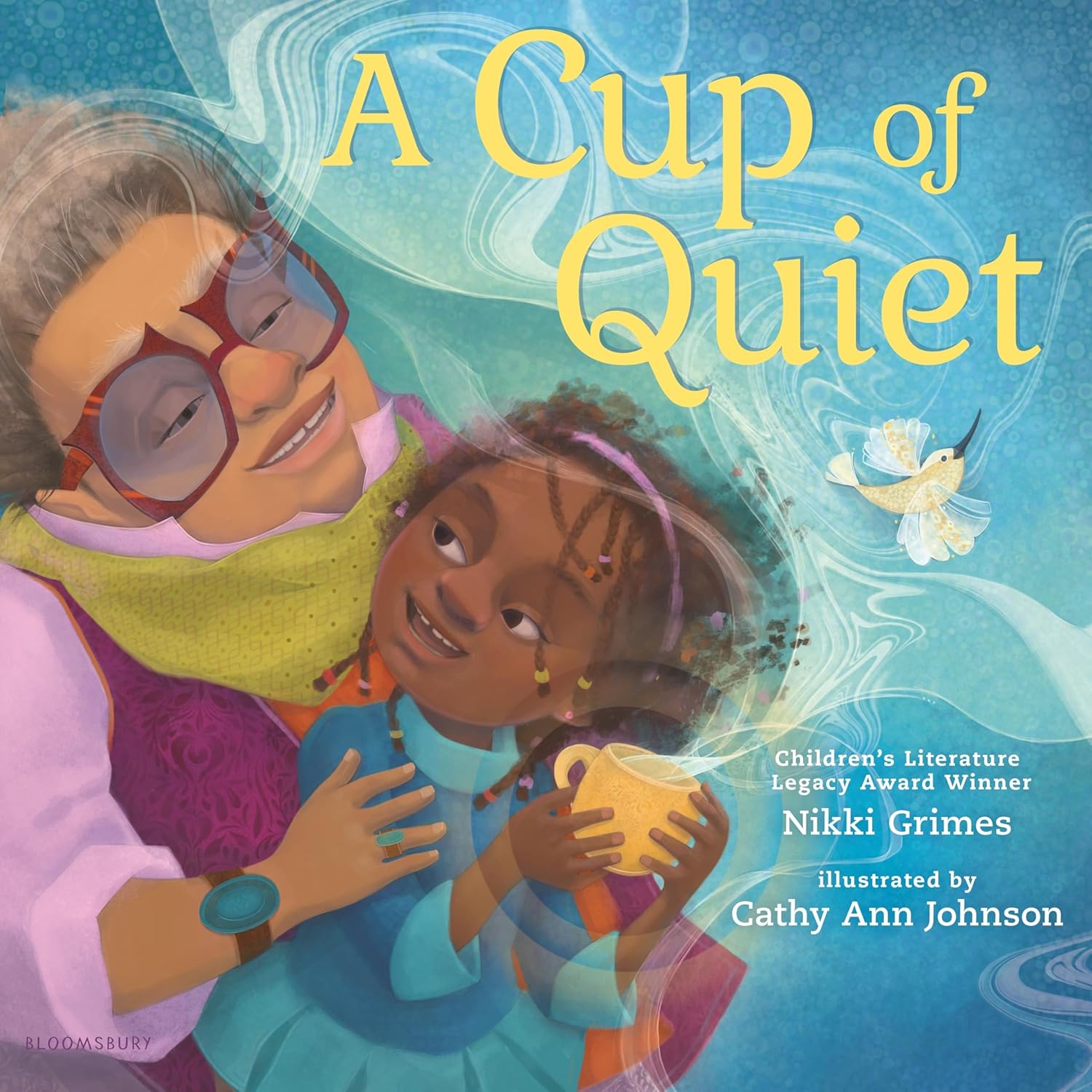
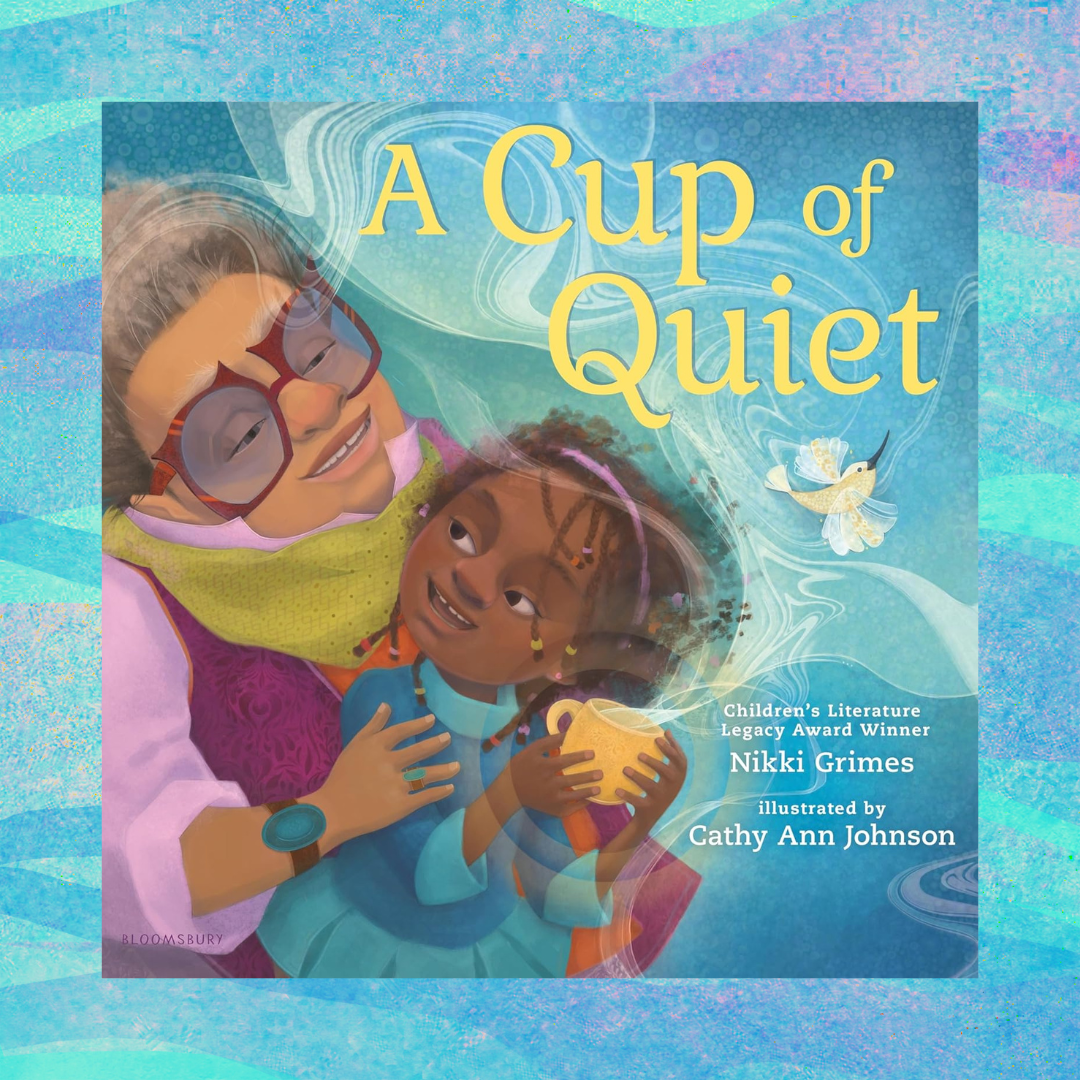
A Cup of Quiet

Written by Nikki Grimes | Illustrated by Cathy Ann Johnson

“You ever hear of smiles?” The young narrator’s talking about the two-week “summer camp” she gets to spend with her grandmother every June. In that breathless excitement of children, she reveals the visits give her and her Grandma time to “stitch sock puppets and put on shows, bake Martian Cake that tastes like banana bread and play tea party in the garden with my dolls.” But today, they’re acting out a story—that is until Grandpa’s hammering and loud music become just too much.
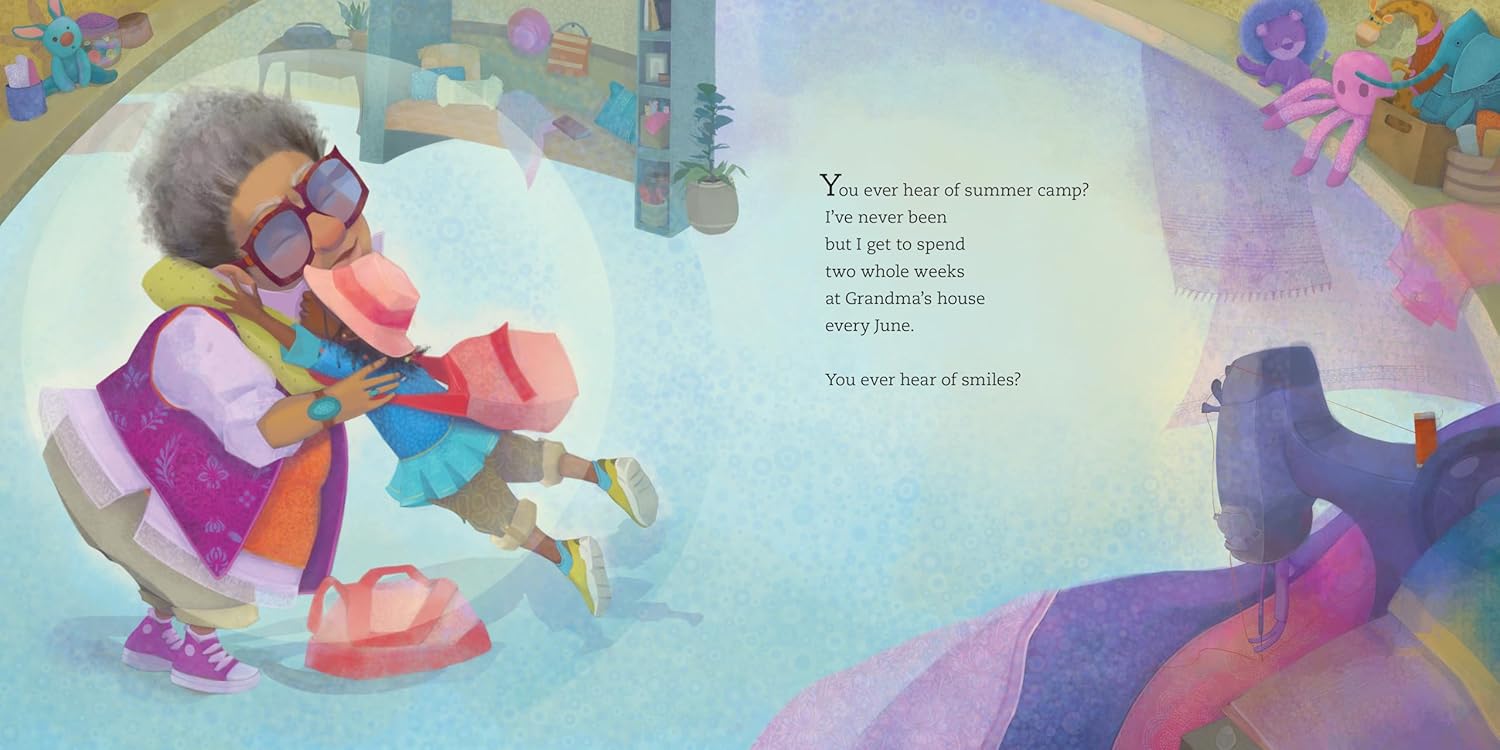
Illustration © 2025 by Cathy Ann Johnson, text © 2025 by Nikki Grimes. Courtesy of Bloomsbury Children’s Books.

Grandma flops into her chair with an “Ugh!” and tells her granddaughter she’s “thirsty for a cup of quiet.” This elicits a giggle and a bit of disbelief, but Grandma’s done with the noise and leads her granddaughter outside to the porch swing. But the city outside their house is just as noisy as Grandpa inside. A trip to the backyard garden is needed. Here, Grandma may be happy, but the narrator is getting fidgety.
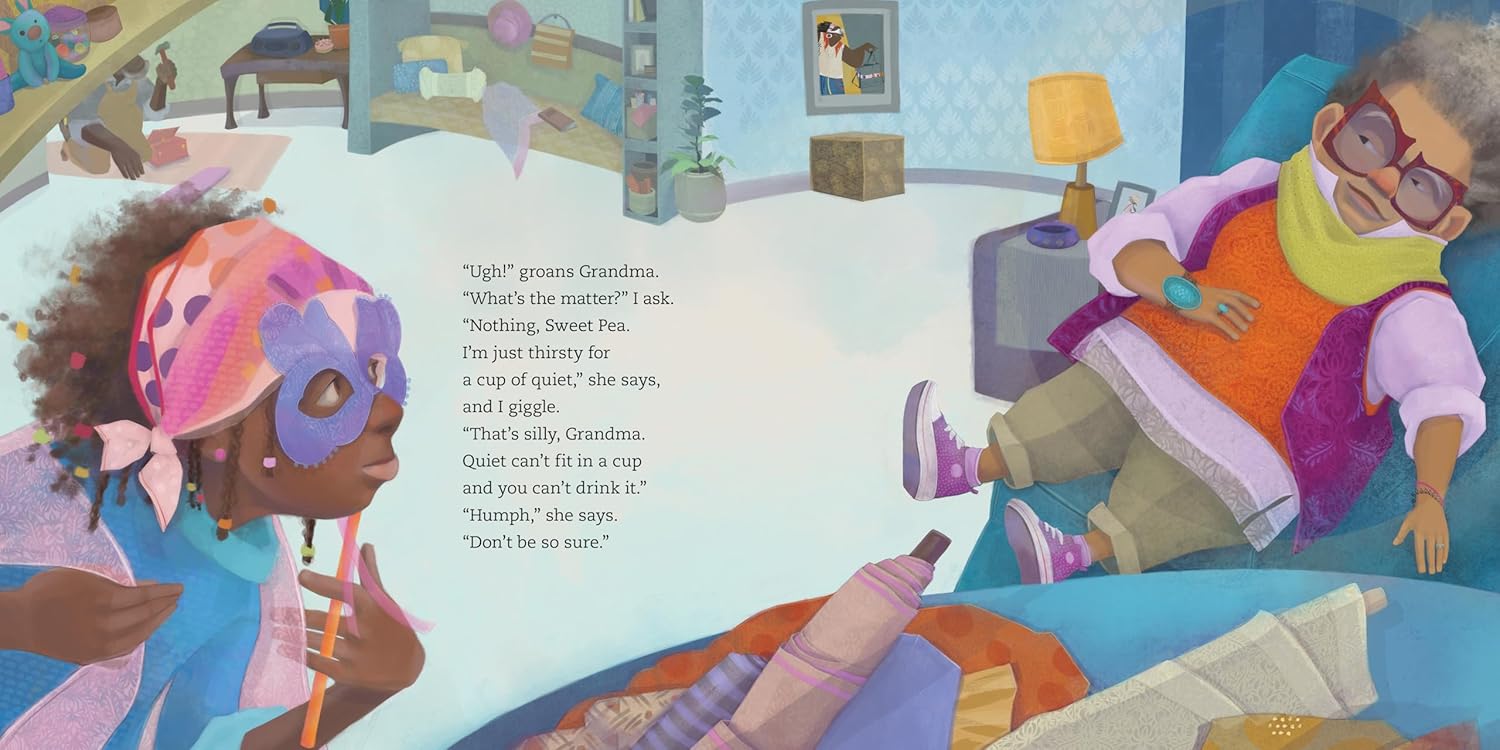
Illustration © 2025 by Cathy Ann Johnson, text © 2025 by Nikki Grimes. Courtesy of Bloomsbury Children’s Books.

Grandma gives her the side-eye and then hands her “an invisible cup” with instructions to “‘walk around the garden and fill this up with any sounds you hear.'” Up for this imaginative challenge, the girl first visits the rose bushes, where a bee is working and “snap[s] up a handful of his buzzing and drop[s] it in the cup.” On the ground below she sees a lizard and “spoon[s] up” the sound of its “scuttling across a dried leaf.” She begins paying more attention to the nature around her and listening harder to fill her cup.
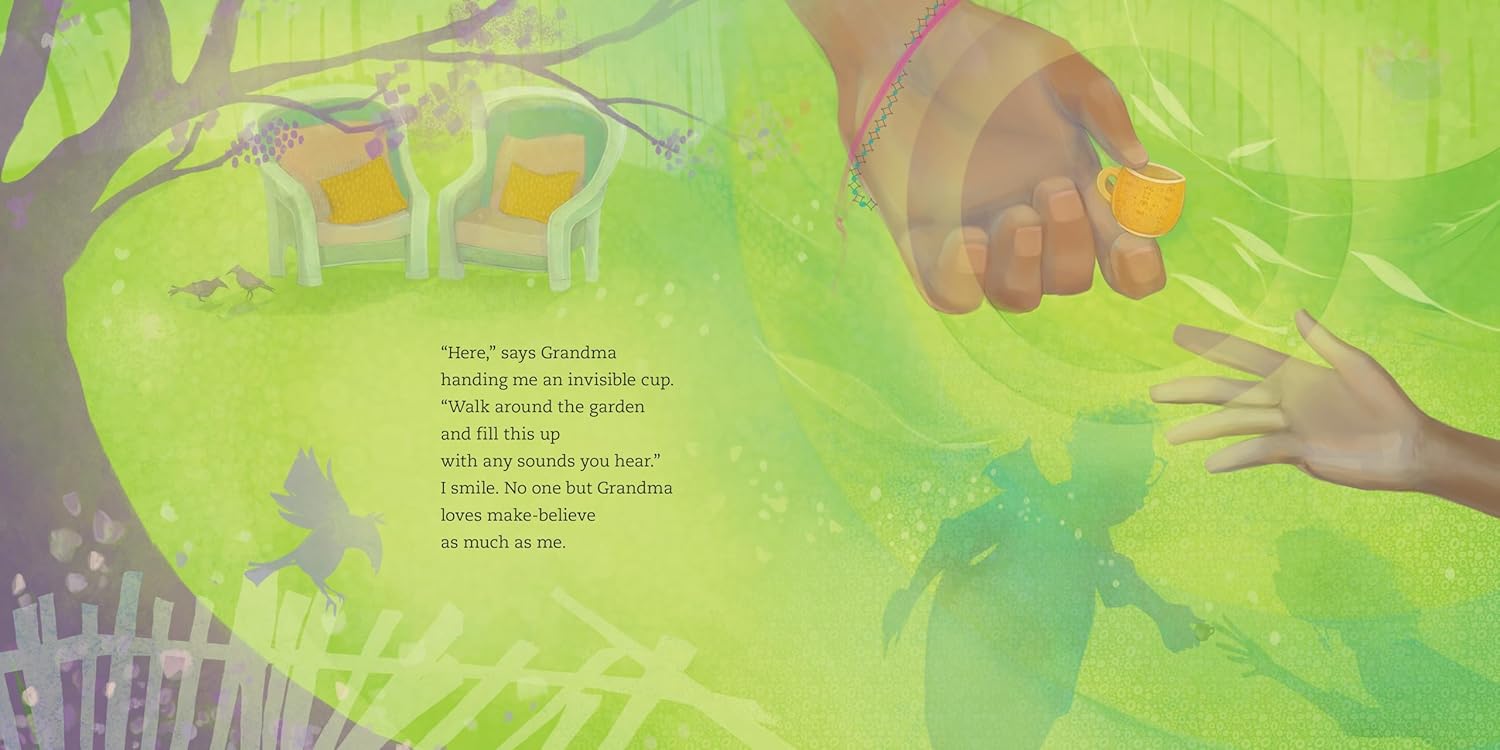
Illustration © 2025 by Cathy Ann Johnson, text © 2025 by Nikki Grimes. Courtesy of Bloomsbury Children’s Books.

A sudden thunderclap precipitates a downpour, but before she runs inside with Grandma, the narrator adds the first pings of raindrops on the roof to her nearly full cup. After drying off and changing, it’s finally time to enjoy a long sip from that make-believe cup. Ahhhh! So “‘refreshing!'” Her granddaughter thinks so too. Still, she has an observation: “‘… your quiet is awfully noisy!'” Grandma smiles and says, “‘I know, but Nature’s noise is peaceful, and I love that.'” Her granddaughter agrees—”You ever hear of perfect?”
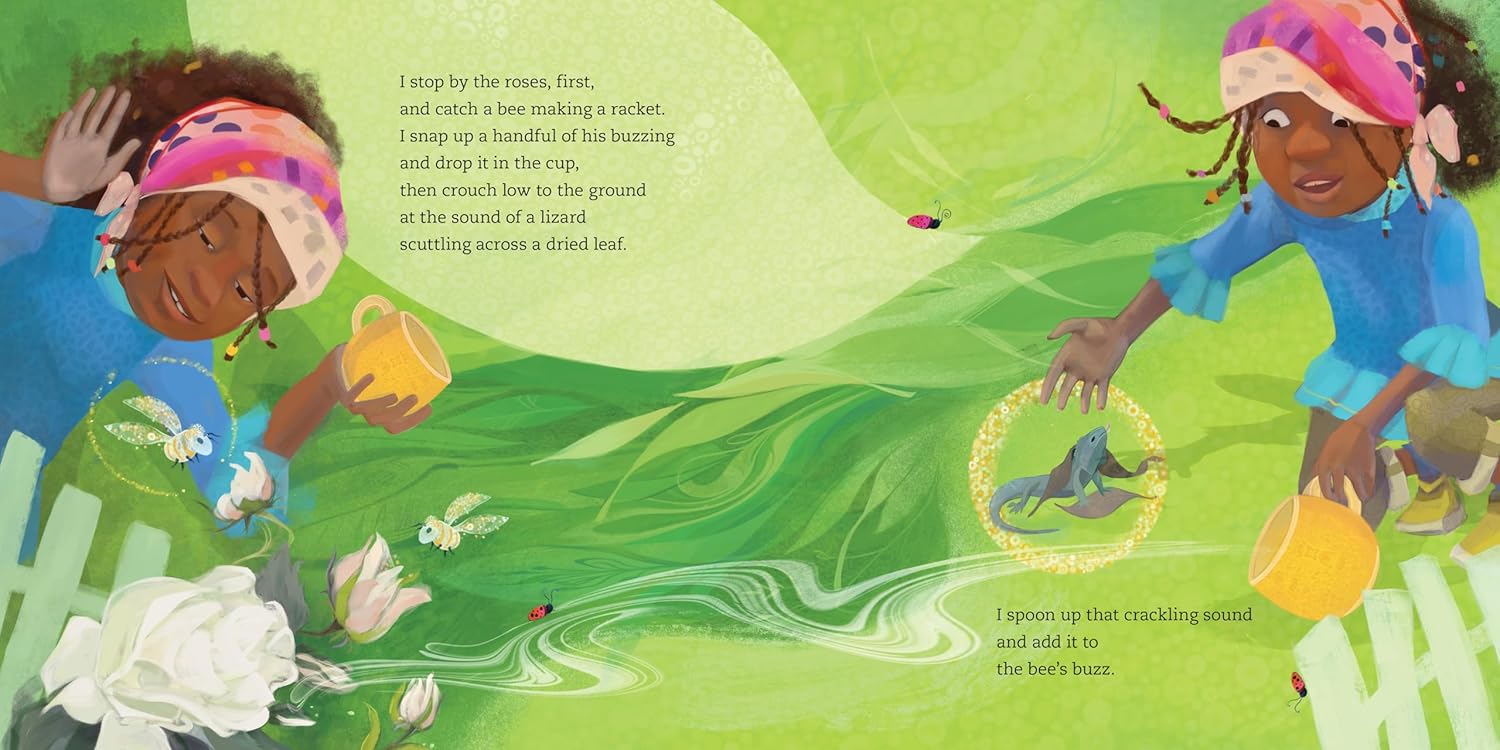
Illustration © 2025 by Cathy Ann Johnson, text © 2025 by Nikki Grimes. Courtesy of Bloomsbury Children’s Books.

Nikki Grimes invites readers to join in with a grandmother and granddaughter for a day of “summer camp” where love abounds. The easy banter between the two and affectionate gestures—such as Grandma’s playful tug on her granddaughter’s braid and the jump-into-her-arms hug the girl gives her grandma—immediately envelope both child and adult readers in this pair’s warm relationship. Grimes’ inventive call to interact with nature and find comfort there will have kids carrying their own imaginary cups to fill and spark other creative games and activities no matter where they live. 

Cathy Ann Johnson’s collage-style, mixed-media illustrations sweep readers into the creative and close-knit atmosphere of Grandma’s house during a week-long visit by her granddaughter. The vibrancy of the pair’s connection is shown through the colorful textures of the fabrics they use for crafting. The allure and importance of nature is likewise emphasized through the vivid greens and swirling motion in the grandmother’s back garden as well as the shimmering beauty of the creatures from which the girl collects sounds. The grandmother and granddaughter’s close bond is evident through their hugs, the way they sit close together (even touching hands while sitting in separate garden chairs), and the care Grandma provides after the rainstorm. The grandmother’s expressions are amusing in their honesty, and the look of wonder in the granddaughter’s eyes is inspirational.

Lyrical, playful, and full of love, A Cup of Quiet is a warm hug of a read aloud that adults and kids will love sharing again and again. The book is a must addition to school library, public library, and home collections.

Ages 3 – 7

Bloomsbury Children’s Books, 2025 | ISBN 978-1547610730

A Talk with Nikki Grimes
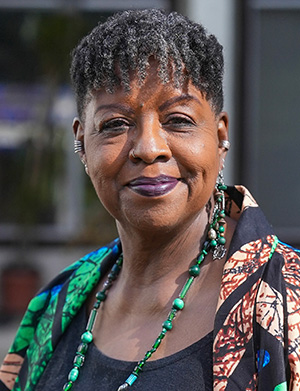
Photo Credit Marchel Hill

New York Times bestselling author Nikki Grimes was inducted into the Black Authors Hall of Fame in 2023. Her honors include the CSK Virginia Hamilton Lifetime Achievement Award, the ALAN Award for significant contributions to young adult literature, the Children’s Literature Legacy Medal, and the NCTE Award for Excellence in Poetry for Children. Author of the Coretta Scott King Award-winner Bronx Masquerade, and five Coretta Scott King Author Honors, she won the Printz Honor and Sibert Honofor her memoir Ordinary Hazards. Her latest titles include Garvey’s Choice:The Graphic Novel, a School Library Journal 2023 Best Book; Lullaby for the King, one of Book Riot’s 25 Best Christmas Books of All Time; and A Walk in the Woods, recipient of 8 starred reviews, and 11 Best Book listings for 2023, including the New York Times, NPR, and Smithsonian Magazine. Ms. Grimes lives in Corona, California. You can visit her at nikkigrimes.com.

Today, I’m honored to be talking with Nikki Grimes about the inspiration behind A Cup of Quiet, how she develops her characters, the joys and challenges of writing for multiple age groups, and much more!

A Cup of Quiet is a perfect book for adults and children to share, not only for outside noise but for times when life gets overwhelming.  Tell us about the inspiration for this story and a little about its journey to publication.

There’s a certain quality of quiet in nature that I’ve always found soothing. I need silence for my work because it allows me to concentrate fully when I write. But nature’s quiet is different. It’s rich with sound, but most of it requires you to pay close attention. To pick up the whir of a hummingbird’s wings, you have to be still, and you have to strain to hear it. The stillness that’s required is soothing, and the sounds you become attuned to are a healing balm. I wanted to write a story that celebrated those sounds, and the beauty of that kind of quiet.

In the early stages of the book, I’d go out to my garden and listen carefully, and I’d make mental notes of all that I heard that day. I’d jot everything down until I had a good list of sounds to play with.

My main character lived in the city and didn’t spend much time out in nature there, though she occasionally went to the park. But every summer, she’d travel out of the city for long visits with her grandmother who had a garden, and whose house was surrounded by trees, and greenery.

The story grew from there, and I knew immediately that I wanted Bloomsbury to publish the book, and I also knew intuitively who I wanted to illustrate—namely Cathy Ann Johnson. This teaming has proven to be perfect, all around.

If I had a cup to fill with quiet today, I’d add my cat’s little sleepy, dreamy purrs, the whoosh of cars passing my house, the rustle of squirrels in the trees, and a drop of water from my bubbling teapot. What would you put in your cup of quiet today?

I would put a bee’s buzz, the wind rustling leaves of a tree, the whir of a hummingbird’s wings—all the sounds I chose for A Cup of Quiet. Those are some of the sounds I listen for, and pay attention to, whenever I immerse myself in nature.

Cathy Ann Johnson’s mixed-media illustrations are a wonder of color, motion, humor, and the love between grandmother and granddaughter. What was your first impression when you saw her illustrations? Do you have a favorite spread?  Why is it a favorite?

First, I was over the moon for the grandmother! She had energy, and spunk, and style. I loved her!  And I loved her colors. Then, as I saw the book’s interiors, I was absolutely thrilled! Cathy Ann’s images, and their movements, were as lyrical as my own words. Our partnership on the page was the proverbial match made in heaven. I would be loath to choose a favorite spread.  Each one has its own magic.

A Cup of Quiet starts out “You ever hear of summer camp?”—a disarming introduction to the child narrator that’s so true to the way kids approach conversation. The dialogue in all of your work sings in this way with the kind of honesty, humor, emotion, and depth that makes your characters seem almost physically with the reader.  I’m curious about your process in developing your characters and stories.

My characters begin with a voice. I’ll hear a scrap of dialogue in my head—nothing extensive, just a few lines. The inspiration might come from the catalog of voices I’ve stored in memory over a lifetime of listening to people around me, or it might be the voice of a particular person in my life whose voice is special or one that has simply stayed with me for a long time. Either way, the voice feels familiar. I’ll jot down that scrap of dialogue as reference, then I’ll begin developing a character sketch and that character’s backstory. I never know how much or little of the backstory I’ll use, but that information guides me as I write. To nail the voice, I have to pay close attention. I climb into the character’s skin and look at the world from his or her perspective and write from that place, attuning myself to that character’s age, birth place, geographical region, quirks, fears—all of it guides me as I make decisions about what that character will say, how they’ll respond to various stimuli that shows up in the plot. If I step wrong, the character will bristle and call me out on it, almost audibly. “Do not put those words in my mouth! I would never say that!” or “I don’t speak like that!” It’s kind of eerie, actually. Characters can be very bossy!

You write books for all ages, from picture books to middle-grade to young adult. Can you talk a bit about the joys and challenges of each? What is one message you want readers in each age category to take away from your books? 

Each age format comes with its own set of limitations, constrictions, and also its own range of possibilities. I love mixing it up. Writing for different age groups keeps me on my toes. The picture book gives you very little room to develop character and plot, while, say, a young adult novel gives you so much unlimited space that you run the risk of overwriting, and of getting lost in the weeds of your plot, or tangled in the layers of your story. Being consistent with your tense or bookending your story in a way that is controlled and satisfying and that feels organic, is much more challenging in the long form of middle grade or YA storytelling.

Language choices are tricky, and different with each age group as well. You walk the line between accessibility and sophistication, between simplicity and complexity. The same variance is true of the emotional components appropriate for each age group as well. For those reasons, I think it’s wise to focus on one genre at a time until you work through the quirks of that genre and figure out a process that works for you. Then, by all means, go on and experiment with the next! It’s tough work, but I like that. For me, easy is boring!

As for your question about messages, I don’t write messages. I write stories. And a well-written story offers a number of ideas a reader might take away. It all depends on the particular reader. We bring ourselves to the page, as readers. Our own experiences, personalities, and what we need at a particular point in time, color what we see, what we notice, and what we ultimately take from a story. Of course, as the creator, I have a certain idea, or theme, I intend to weave into my story—and, by the way, it’s hard to know whether or not I’ve always succeeded—but I don’t worry about whether the reader will pick up on the specific note I had in mind. What matters to me is that, somewhere in the many layers of my story, readers find something valuable with which they resonate. Quite often, the things they find come as a surprise to me, but that’s okay. So long as they walk away with something of value to them, that’s all I can ask for.

While I read through your website, your generosity in sharing so much of your life really stood out.  I’m sure young readers and writers would love to know about when you first began writing and how you were recognized for your talent, having your first public reading when you were 13.  Could you share a little of our writing background with us?  What advice would you give to children and young adults who love to write and want to pursue it?

As I reference in my memoir Ordinary Hazards, and elsewhere, I started writing in earnest when I was six years old, and I did so because I would have burst, otherwise. I was so filled with the emotional and mental poison of anger, and pain, and confusion. I was desperate to get my feelings out, somehow. So, I began to pour those feelings onto a page. That’s how my writing began, but as I reached my teens, the idea of possibly pursuing writing as a career took root. I was encouraged by my father, by my sister, by the friends I dared share my poetry with, and later, by a couple of teachers.  At the same time, though, I also had peers who laughed me off the block for daring to dream of such a thing at all. But I decided early on to surround myself with other young people who nurtured dreams and goals of their own. Everyone else, I cut out of my circle. I refused to absorb the negativity of naysayers.

I encourage young people who have a heart for writing to read voraciously, and to read across genres.  Every genre has something to teach you, and the quality of your writing reflects the quality, variety, and breadth of your reading. So read, read, read.  

Next, write, write, write because writing is a muscle. You have to exercise that muscle if you want to become strong. There is no shortcut to excellence. And if you’re not going to pursue excellence, why even bother? Excellence is what your readers deserve. Remember: the world doesn’t need mediocrity, no matter what field you choose to pursue.

In addition to your many awards over the years, you received the Children’s Literature Legacy Award in 2017 and the Coretta Scott King-Virginia Hamilton Award for Lifetime Achievement Award in 2022. In 2023 you were inducted into the Black Authors Hall of Fame.  What does this recognition mean to you?

Recognition is affirmation, and who doesn’t appreciate that?  But an artist should never be satisfied to sit on their laurels. I use this recognition as fuel to keep pushing forward, to continue to stretch myself as an artist to try genres I’ve never attempted before, to explore forms of poetry I find challenging. Doing so keeps me alive, and grown, and excited about the work I’ve been doing professionally, now, for nearly 50 years. That way, even as I get old, my work never does!

What books of yours can readers look forward to next?

I have a new Dyamonde Daniel chapter book coming out in June.  It’s titled Loser, and it’s about healthy and unhealthy competition, and where to draw the line, especially when you’re competing with your best friend.

I also have a new picture book on the horizon, titled Stronger Than, a collaboration with Choctaw author, Stacy Wells and illustrated by E. B. Lewis, who I’ve worked with before. In this story, a Black Choctaw boy discovers the history of one ancestor who survived the Trail of Tears, and another ancestor who survived the Tulsa Race Massacre. Through their stories, he learns that he comes from stronger stock than he knew, and this knowledge helps him overcome one of his worst fears. I’m excited about both books, for very different reasons.

There are a few more books in production, as well, but it’s too soon to talk about those.

Is there a question I didn’t ask that you wish I had?  What would your answer be?

No. I think I’m about talked-out, for the moment!  This has been fun, though. And I hope you and the young readers in your life enjoy A Cup of Quiet.

Thank you so much, Nikki! It’s been terrific chatting with you! I wish you a wonderful spring and summer of nature’s refreshing quiet.
You can purchase A Cup of Quiet from these booksellers

Amazon | Barnes & Noble | Bookshop (discounted books and support for your local independent bookstore)

Picture Book Review

February 25 – Get Ready for Passover

About the Holiday

Passover is the Jewish spring festival that celebrates the Jews’ liberation from slavery in Egypt. The holiday begins on the fourteenth day of the Hebrew month Nisan, which is the first ecclesiastical month and occurs in March or April. Passover is observed for seven days in Israel and for eight days for Jewish people living outside of Israel. The holiday begins with a seder meal, at which family and friends gather to remember their history, eat symbolic dishes, and celebrate the joy of freedom. This year Passover is celebrated from April 12 – 20.

Thank you to Kar-Ben Publishing for sharing a digital copy of Zayde Babysits before Passover with me.

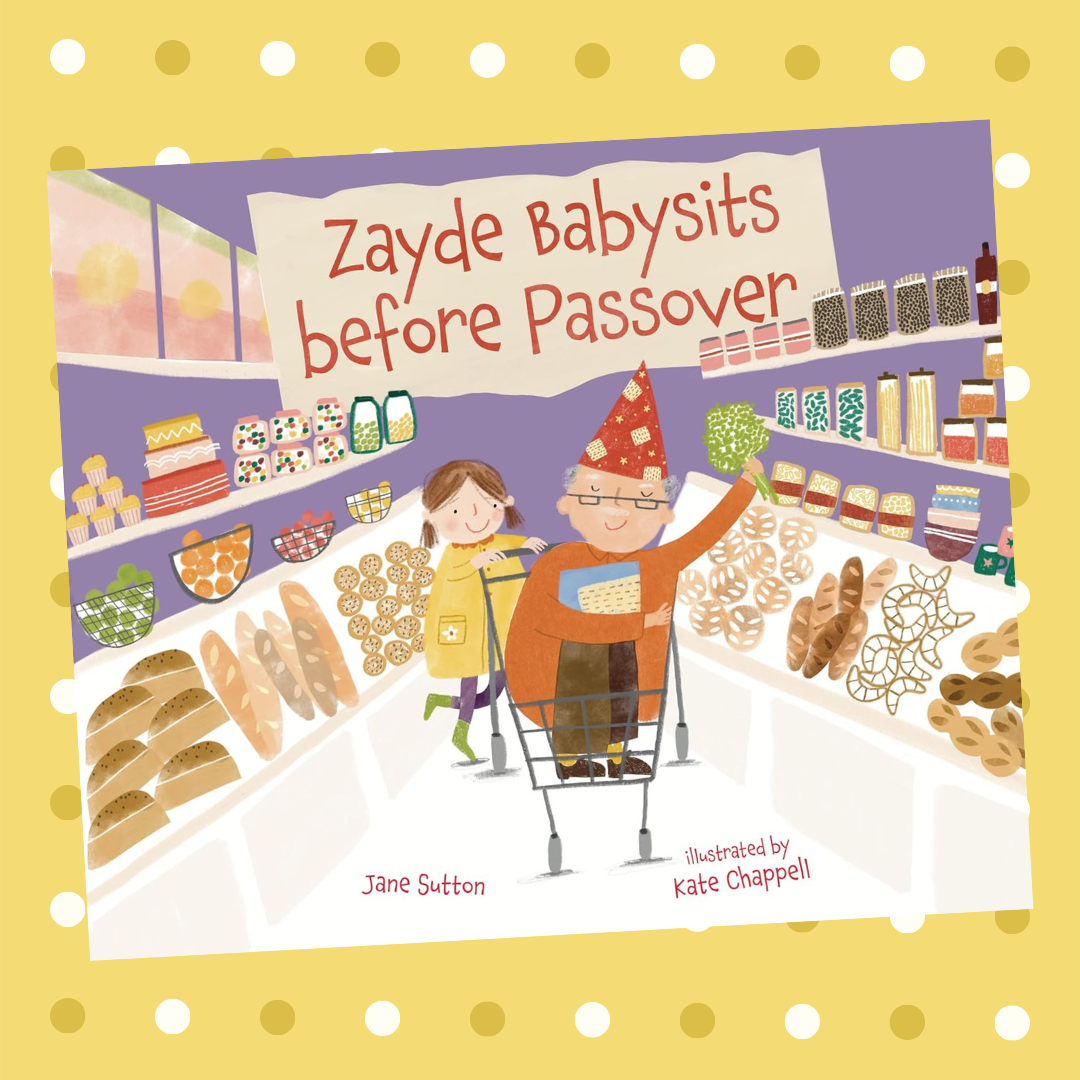
Zayde Babysits before Passover

Written by Jane Sutton | Illustrated by Kate Chappell


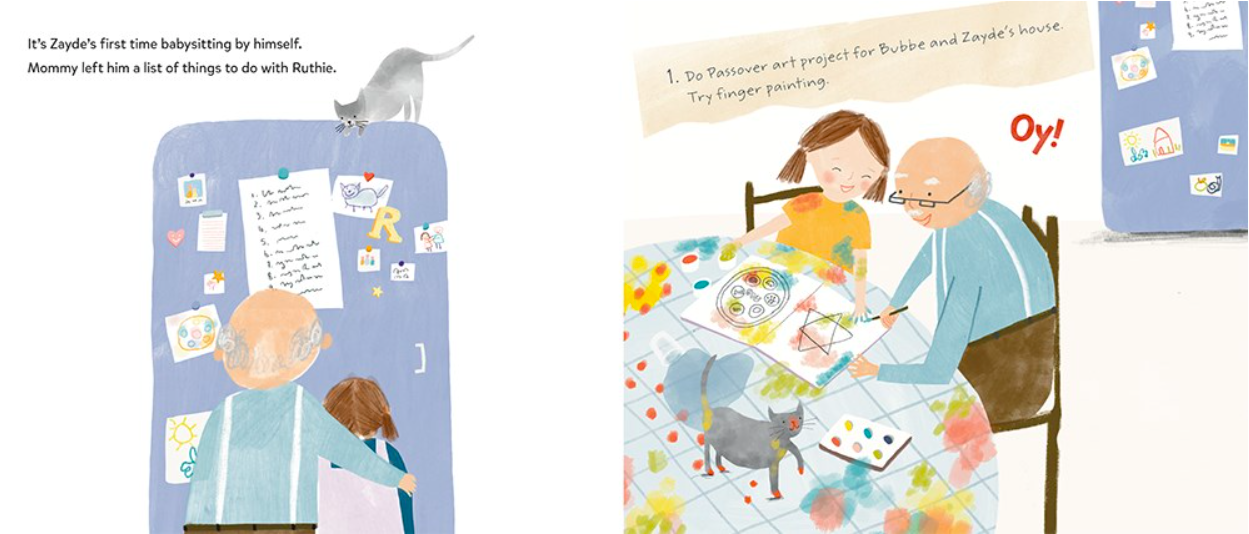
While Ruthie’s mommy and daddy go to Bubbe’s house to prepare for Passover, Zayde is staying with Ruthie at her house. It’s the first time Zayde has ever babysat Ruthie, but he doesn’t have to devise fun activities, or think up places to take her because there’s a long list of tasks to be accomplished stuck to the refrigerator.

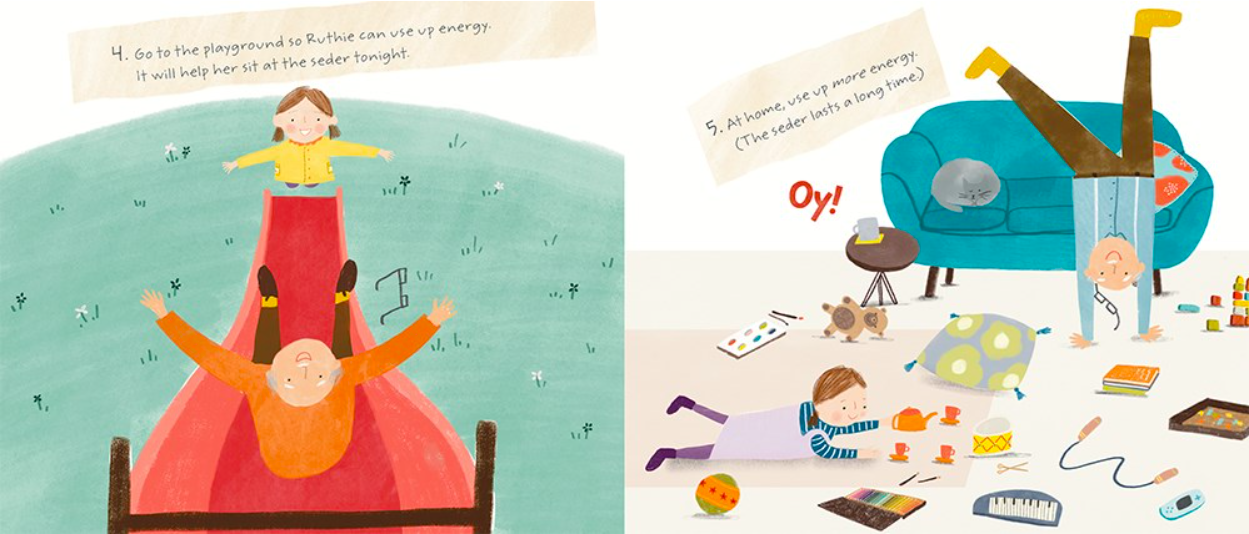
First on the list is to make a few Passover decorations for Zayde and Bubbe’s house. Ruthie’s mommy has suggested finger painting. “Oy!” exclaims Zayde, as the paint escapes the paper onto the tablecloth and Ruthie’s shirt, and even the cat, who joins the fun with some paw painting. The next chores on the list take Ruthie and Zayde into town—to the grocery store for parsley and to the playground “so Ruthie can use up energy” and sit still at the seder later that night. But who’s riding in the cart and who’s slipping down the slide?

Illustration © 2025 Kate Chappell, text © 2025 Jane Sutton. Courtesy of Kar-Ben Publishing.

Back home, Zayde’s been instructed to use up more of Ruthie’s energy, but here, too, who’s doing what is topsy-turvy. Even sweeping up any missed breadcrumbs in the kitchen finds Ruthie pulling Zayde out from under the cupboard. And when Mommy said they should eat a big lunch because dinner will be late, did she really mean that mountain of food? 

Following nap time and bath time, Ruthie and Zayde leave to meet up with the rest of the family. With Zayde leading the seder, it comes off without a hitch. “Ruthie asks the Four Questions. She sings ‘Dayenu’ and hums along with the other songs.” Bubbe’s matzah ball soup is yummy, and Ruthie even “finds the afikomen. Yay!” After everyone leaves, Ruthie tells Zayde she had fun that day and asks if he’ll babysit again. Of course Zayde’s answer is “‘I can’t wait!'”

Illustration © 2025 Kate Chappell, text © 2025 Jane Sutton. Courtesy of Kar-Ben Publishing.

Jane Sutton’s endearing, family Passover story is riotous fun as first-time babysitter Zayde goes all in while fulfilling his pre-Passover seder chores. Kids will enjoy chiming in with Zayde’s exclamations of “Oy!” as things go amiss and will love learning Passover traditions as they spend time with Ruthie and Zayde around town and at home. The burgeoning relationship between Zayde and Ruthie warms the heart.

Kate Chappell’s charming illustrations, juxtaposed with Sutton’s straightforward storytelling, bring to life Zayde and Ruthie’s playful antics and will have kids giggling from page to page. Images of the family’s Passover celebration are uplifting and tender.

A madcap and joyful story for families to share at Passover and whenever grandparents and grandkids get together, Zayde Babysits before Passover would make a wonderful gift and addition to home bookshelves as well as a delightful choice for school and public libraries.

Ages 4 – 9

Kar-Ben Publishing, 2025 | ISBN 979-8765619889

A Chat with Jane Sutton

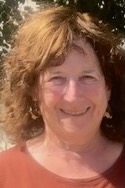
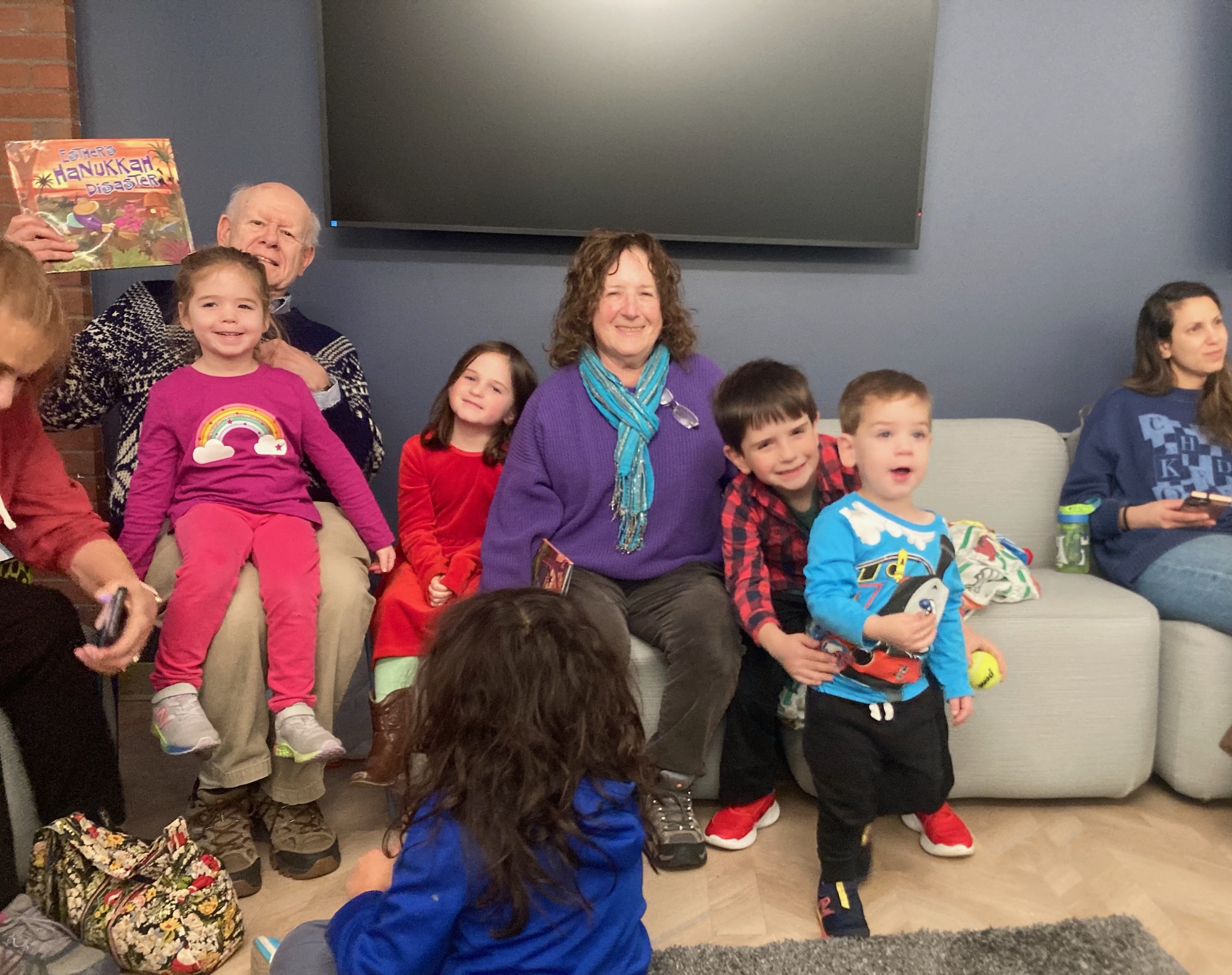
Jane Sutton is an award-winning author of picture books, including Gracie Brings Back Bubbe’s Smile, Paulie’s Passover Predicament, and Esther’s Hanukkah Disaster as well as novels for children. She grew up on Long Island and attended Brandeis University. Jane lives with her husband in the Boston area, as do their grown children and families. She is grateful to get lots of chances to babysit her grandchildren and hopes she makes fewer mistakes than Ruthie’s Zayde. You can visit Jane at jane-sutton.com.

I’m so excited to be chatting with you again about a new book, Jane! The last time we did an interview, it was for What’s Up with this Chicken? and you were a new grandmother to Caleb. So much has happened in the years since! You and your husband are grandparents to four grandchildren now who all live close to you. Has becoming a grandmother influenced the way you write or the subjects you write about?

Come to think of it, my last 2 books have been about a grandparent and a grandchild. And my next book was inspired by a grandchild. I guess it’s natural that I would write about my favorite subject, my grandchildren!

Kate Chappell’s illustrations are so whimsical and really highlight the humor in the story. Kate lives in London. Did you have much interaction with her during the publishing process? Do you have a favorite spread? Which one and what do you like best about it?

I agree. Her whimsical illustrations do just what you said! We didn’t interact directly. My suggestions for art went through the publisher. My favorite spread is also the cover, with Zayde sitting in the shopping cart as Ruthie pushes. It’s so silly and funny, and I love the details Kate includes. It’s my grandchildren’s favorite too!

The images on your blog from your family vacations and other fun times you have together are so infused with love and joy and really make me smile. They made me wonder—does it appear that any of your grandkids have inherited your sense of humor? If so can you share a story?

They’re all funny and witty in their individual ways. One joke that the oldest three grandchildren and I share started on a week-long family vacation. Each morning, we’d greet each other with big smiles while saying, “Not you again!”

How did you get started writing for children? When did you know that this is what you wanted to pursue?

In college I had an assignment in a sociology class to do something we’d always wanted to do and keep a journal about our experience as we did it. I chose to write a series of children’s stories and found that I enjoyed the writing immensely.

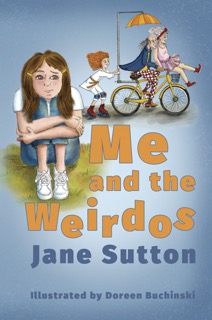
Not only do you write picture books, but you’ve written three middle-grade novels and a young-adult novel. You’ve recently revised and published a new edition of your popular middle grade novel, Me and the Weirdos, after it was turned into a musical by two high school seniors in Utah. I understand you attended the premiere of the play. Tell me more about this book and the experience of seeing it transformed into a musical.

In Me and the Weirdos, Cindy Krinkle feels like the only normal person in her family. She kind of has a point. Some examples: Her father rides a bike with an umbrella on it as he sings opera loudly and off-key. Her mother gargles with orange juice, and her sister has a pet sea urchin. Cindy’s plans to “un-weird” the rest of her family all backfire in amusing ways, and she eventually comes to appreciate them the way they are. Attending the musical was amazing. The lovely students who created it were so talented. They wrote the script and lyrics, composed the music, and directed the play with a middle school cast. The show was both entertaining and true to the book’s humor and message that it’s OK to be different.

It’s clear that you love sharing your love of writing and your books with kids through programs at schools and libraries. Can you give us a peek at what one of your presentations is like? Do you have an anecdote from any program that you’d like to share?

I share my writing process, including more or fewer details depending on the age group. I emphasize the importance of revision, something I strongly believe in and which makes teachers nod and smile. And lest writing seem like too much work, I make sure I express my joy in writing.

I believe young readers have another book to look forward to in 2026! Would you like to give them a little glimpse of what’s to come?

It will be my first board book, one I hope that will make people of all ages smile.

Thanks so much, Jane for this wonderful chat! It’s been terrific catching up! I wish you all the best with Zayde Babysits before Passover and can’t wait to see your board book. I’m sure it will bring a smile!

You can purchase Zayde Babysits before Passover at these booksellers

Amazon | Barnes & Noble | Bookshop (to support your local independent bookstore)

Picture Book Review
 

February 7 – National Send a Card to a Friend Day

About the Holiday

Today’s holiday is all about reaching out to a friend or family member with cheerful wishes or a reminder about how much they mean to you. Sure, texting is more immediate, but the sentiments get lost amid long scrolls of typed conversations, shared pictures, and links sent. A card or a letter is more permanent and easy to enjoy again and again without all the dizzying swiping, swiping, swiping to retrieve the message that meant so much to you. Sending cards is such a wonderful way for kids, especially, to keep in touch with friends, cousins, aunts and uncles, and grandparents. Today, encourage your children to share their feelings in a card or letter and get today’s book to read and inspire creative communication whenever your kids are missing a loved one.

Thanks to Tara Knudson for sharing a copy of Paper Wishes with me!

Paper Wishes

Written by Tara Knudson | Illustrated by Kirsti Beautyman

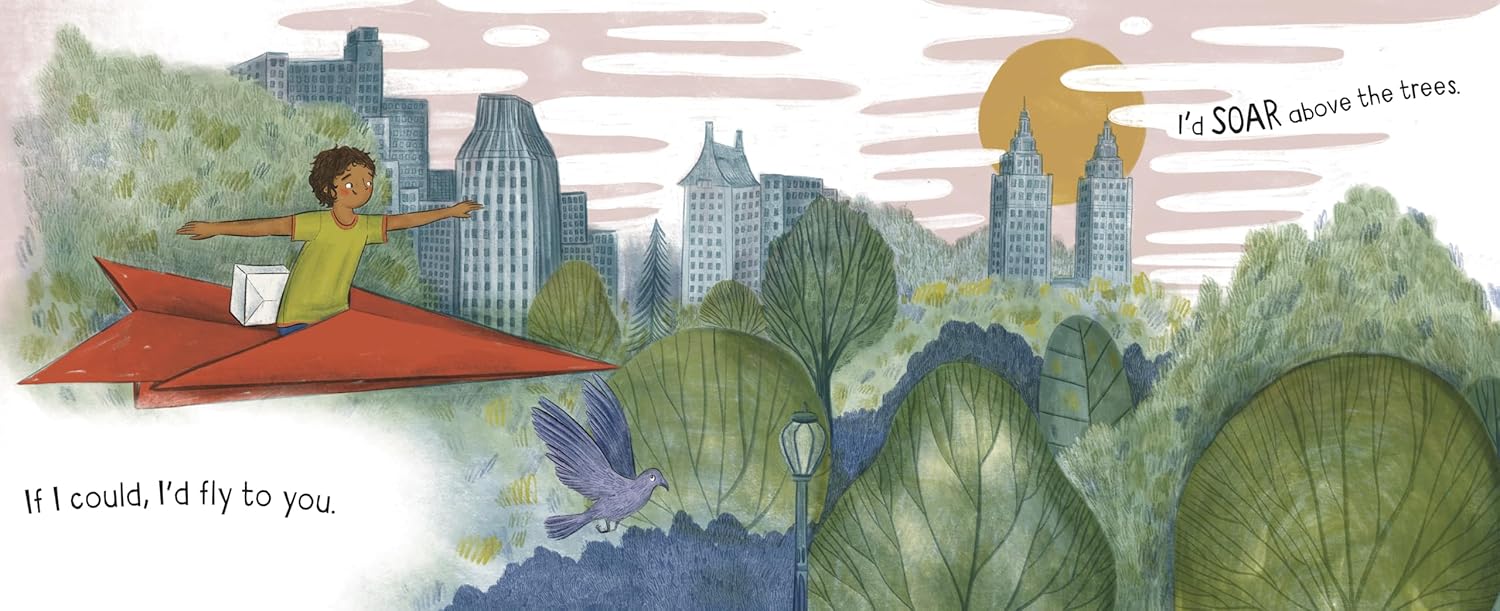
A child wistfully flies a paper airplane through their room, wishing they could fly, sail, take a train or drive to visit their grandparents and “bring a gift by hand.” Spying a piece of red paper on their desk, the child has an idea: Even though you’re far away, there’s one thing I can do. / Fold and crease . . . and fold again. / I made my gift for you!” With a few deft folds and tucks, the child creates an origami heart for their grandmother and grandfather.

Image copyright Kirstie Beautyman, 2024, text copyright Tara Knudson, 2024. Courtesy of Picture Window Books.

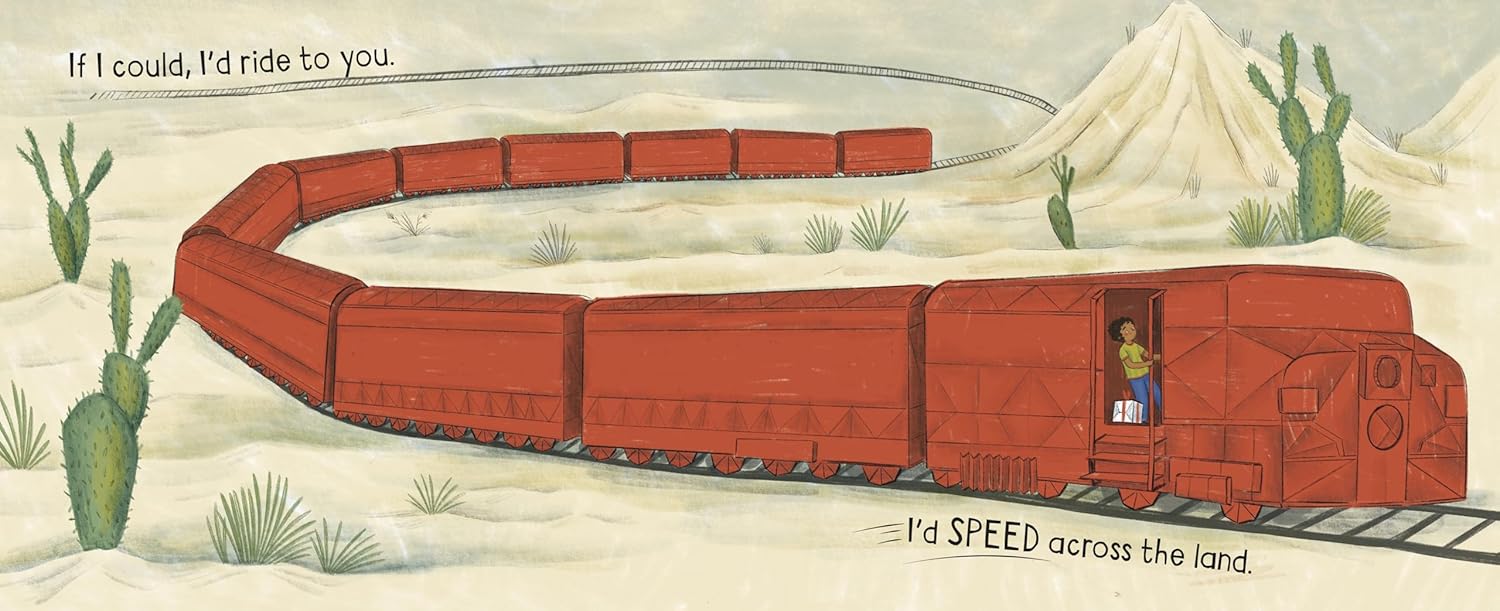
The child places the heart in an envelope and places it in the corner mailbox, sending “it on its way.” And then the waiting begins. Each day, they wonder “Is it on a truck? / Is it on a plane? / Is it on a boat? / Is it on a train?” and hope that their gift arrives safely. The child wishes they could see their grandparents’ reactions when they open the gift, and . . . through technology, the child and their grandparents get to share their smiles.

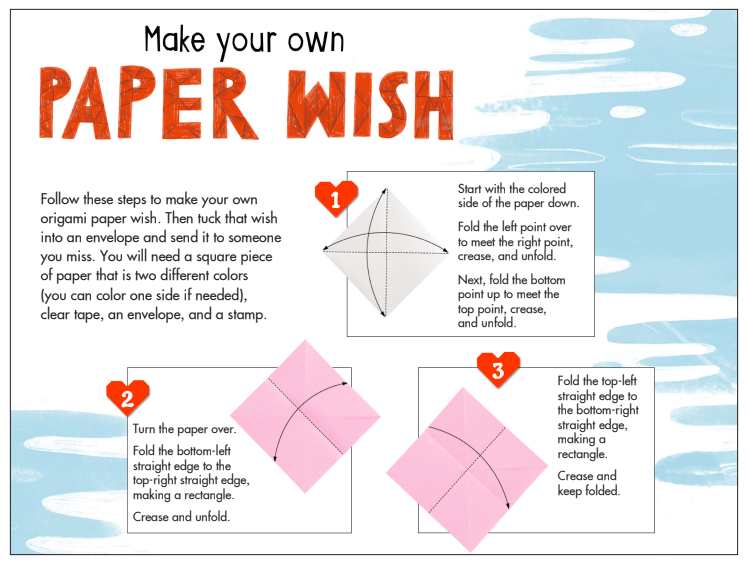
Easy-to-follow, illustrated instructions on how to make an origami heart follow the story.

Image copyright Kirstie Beautyman, 2024, text copyright Tara Knudson, 2024. Courtesy of Picture Window Books.

Tara Knudson’s touching and uplifting story will be treasured by children who miss seeing family members or friends and want to share stories, smiles, and love with them. Knudson’s lively rhymes and easy-flowing rhythms will captivate even the youngest children. Kids will enjoy reading along with the recurring phrasing and evocative vocabulary. Children who are eager gift-makers will love the inspiration in both the story and the included origami craft.

Kirsti Beautyman takes readers over a towering city, across choppy seas, winding past cacti in a sandy desert all the way to colorful townhouses on a shady street in a plane, boat, train, and truck cleverly drawn to mimic origami creations. Readers will immediately empathize with the child, whose expressions show a yearning to see grandparents again, happiness when close to them, pride in the gift they’ve made, and hopeful waiting to hear from family. Young readers are also reassured that family members or friends who are far away are thinking about and missing them too.

A tender, heartfelt, and inspiring read aloud that children will want to hear again and again, Paper Wishes would be an exceptional addition to home, library, and classroom collections.

Ages 4 – 8

Picture Window Books, Capstone Press, 2024 | ISBN 978-1684466184

About the Author

Tara Knudson is the author of multiple picture books, including Christmas Cookie Day, Fun Fall Day, and Valentine’s Day Treats. Tara is a former teacher who has been writing poetry since she was a young girl growing up in Chicago.

About the Illustrator

Kirsti Beautyman is an author and illustrator from the North East of England. After studying at Edinburgh College of Art and graduating in 2016, Kirsti turned her hand to illustrating children’s books and partook in the Picture Hooks Mentorship scheme in 2017. At the end of the scheme, Kirsti exhibited alongside her Mentor in the National Gallery of Scotland and was named “Picture Hooks Illustrator Of The Year”. Since then, she has continued to build on her career as a children’s book illustrator, and works from her studio, nestled away on the outskirts of Newcastle. Kirsti predominantly uses a culmination of digital, dry and wet media to create her illustrations… and is prone to leaving a vibrant jumbled mess in her wake.

National Send a Card to a Friend Day Activity

Paper Wishes Craft

Kids can make their own origami heart to give with the instructions in this Paper Wishes Instruction Sheet.

You can purchase Paper Wishes at these booksellers

Amazon | Barnes & Noble | Bookshop (to support your local independent bookstore)

Picture Book Review
November 20 — It’s Family Stories Month

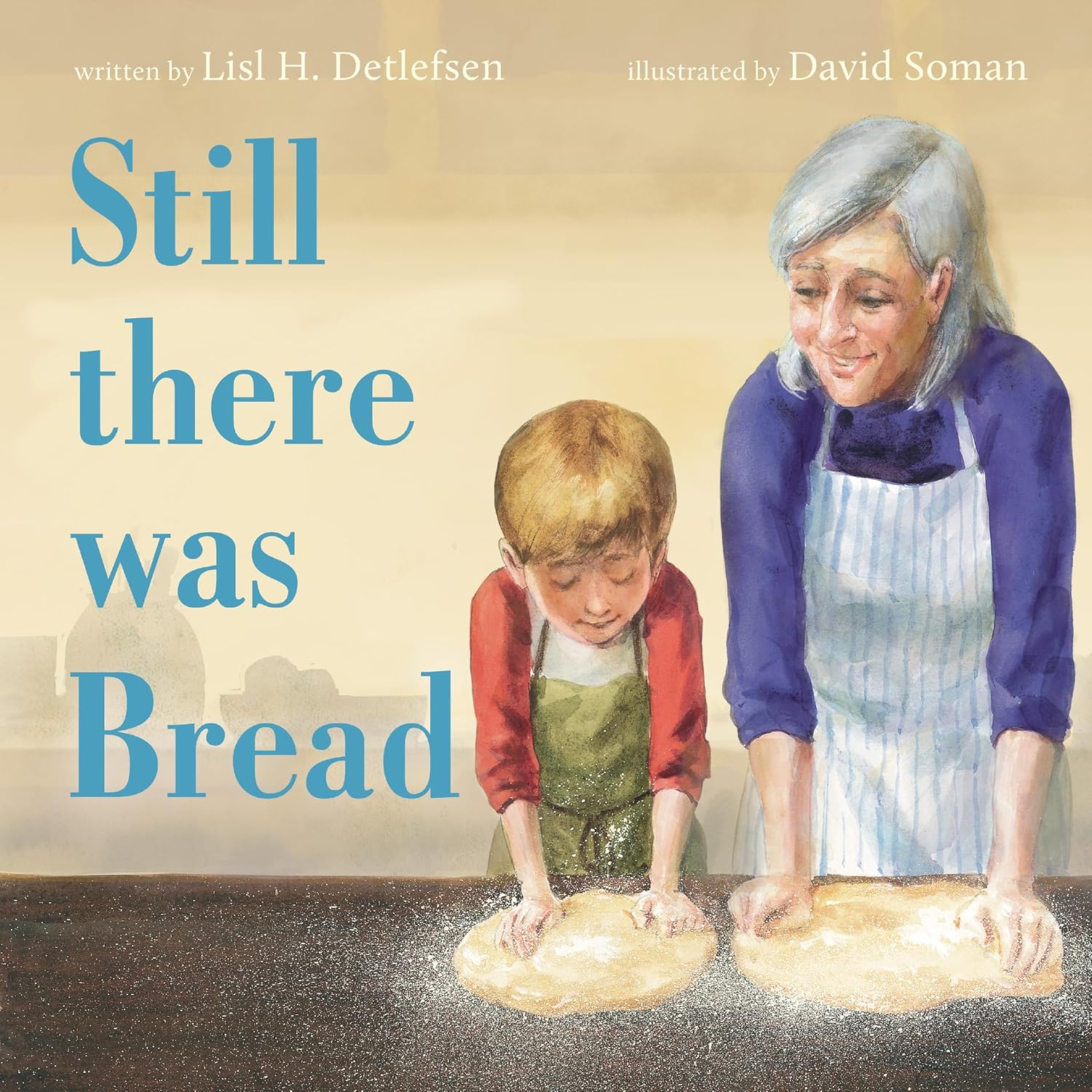
celebrate-picture-books-picture-book-review-still-there-was-bread-cover

About the Holiday

Do you have a favorite family story to tell or tradition to share? Then this month is for you! No matter if your stories are funny or poignant tales of a family member or they’re tied to a special recipe or heirloom, everyone—especially children—benefits by these reminiscences. Family Stories Month encourages people to gather together and engage in the tradition of oral storytelling, which has been part of people’s lives and cultures since ancient times. It’s a wonderful way to stay connected to your own family heritage and build bonds that last forever. 

Thank you to HarperCollins and Barbara Fisch at BlueSlip Media for sharing a copy of Still there was Bread with me for review consideration. All opinions on the book are my own.

Still there was Bread

Written by Lisl H. Detlefsen | Illustrated by David Soman


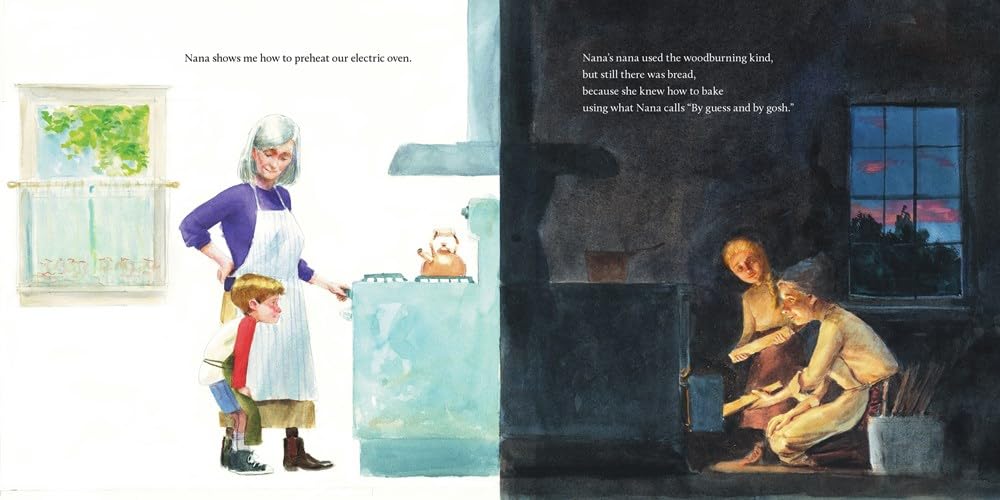
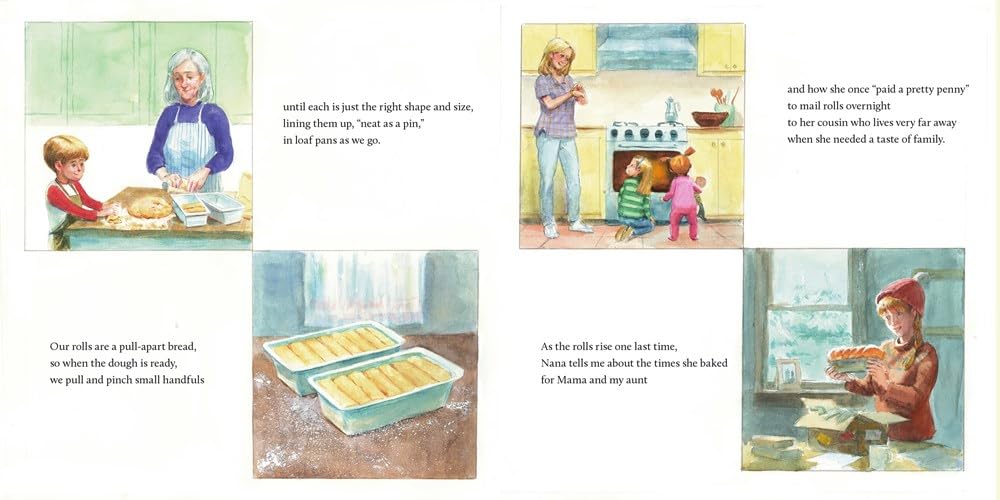
Nana comes to visit her daughter’s family and to teach her grandson—her “Little Pickle”—how to bake the family’s traditional pull-apart “Nana rolls.” Nana and Little Pickle gather the ingredients and turn on the oven while Nana talks about how “her nana had to collect eggs from the chicken coop and milk a cow to get what she needed” and stoke a woodburning stove to bake the rolls.

Nana and Little Pickle move on to combining the ingredients and easily mixing the dough in a stand mixer, a modern contrast to the child narrator’s great-great-grandmother using a wooden spoon. They knead the dough and put it in a bowl to rise in a sunny spot—no different from how it was done all those years ago.

celebrate-picture-books-picture-book-review-still-there-was-bread-stove-vs-woodburner

Image copyright David Soman, 2024, text copyright Lisl H. Detlefsen, 2024. Courtesy of HarperCollins.

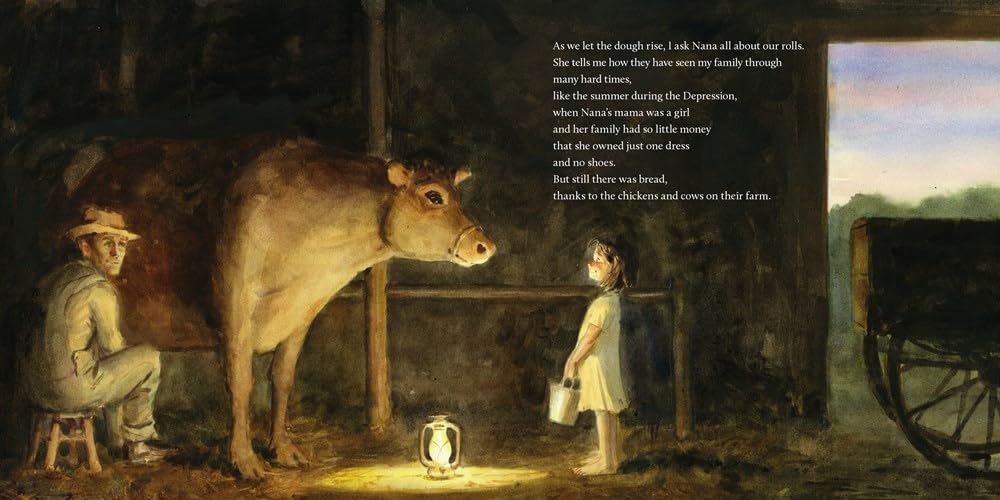
While they wait for the dough to rise, Little Pickle asks Nana to tell stories about the rolls they’re making, and she readily reveals how important their homemade bread was through lean times—like during the Great Depression, when “Nana’s mama was a girl and her family had so little money that she owned just one dress and no shoes. But still there was bread, thanks to the chickens and cows on their farm.” Or when Nana, herself, was a baby and “the whole house was quarantined because she and her daddy had something called polio,” but eggs and milk were delivered. This leads Nana to connect it to a recent quarantine, when people rediscovered the comforts of homemade bread.

celebrate-picture-books-picture-book-review-still-there-was-bread-barn-during-depression

Image copyright David Soman, 2024, text copyright Lisl H. Detlefsen, 2024. Courtesy of HarperCollins.

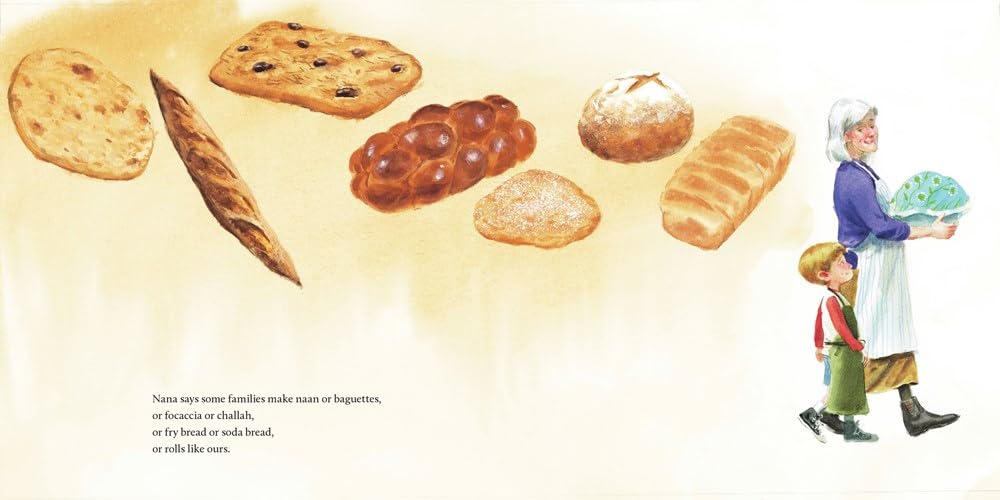
During the second rise of the dough, Nana and Little Pickle talk about the different kinds of bread people make with the “same simple ingredients” for “times they can be together, and times they can’t.” At last the dough is ready to pinch off and shape and put in pans. One more rising allows Nana to tell stories of how she baked bread for Little Pickle’s mom and aunt, and how she “‘paid a pretty penny'” to mail bread to a homesick cousin who was far away. 

celebrate-picture-books-picture-book-review-still-there-was-bread-different-kinds-of-bread

Image copyright David Soman, 2024, text copyright Lisl H. Detlefsen, 2024. Courtesy of HarperCollins.

Little Pickle asks Nana how many times she’s made the rolls, and she replies, “‘Who could say?'” She’s made them for sick neighbors and as gifts for a whole list of occasions. “‘All of them were kneaded. And needed,” she says. The rolls are finally ready to pop into the oven, and as they bake, their “toasty smell brings the rest of the family to the kitchen.” When the rolls are ready, everyone gathers around and “the kitchen becomes a blur of butter and honey and jam and laughter.” Little Pickle is happy and satisfied knowing that years from now “I will share our recipe and the stories that go with it with my kids or grandkids,” but for now whenever someone “needs a warm, fresh-baked hug, I’ll know just what to do.”

celebrate-picture-books-picture-book-review-still-there-was-bread-vignettes

Image copyright David Soman, 2024, text copyright Lisl H. Detlefsen, 2024. Courtesy of HarperCollins.

Filled with warmth, family love, and connectedness, Lisl H. Detlefsen’s Still there was Bread, is a heartening read aloud that will foster a child’s curiosity about the past as well as their own family history and long-held traditions while also being grounded in today. Deftly combining lyrical storytelling with the young narrator’s voice, Detlefsen has created a tale that appeals across generations. The rhythm and easy cadence of the text is as comforting as the homemade rolls depicted. 

David Soman’s pen-and-ink and watercolor illustrations shine for their realistic portrayals of home, the baking process, and especially the expressive faces and shared looks between family members, from Nana and Little Pickle to their ancestors. Soman’s soft textures and glowing lighting bring to life Nana’s stories about her grandmother, the Great Depression, and Nana’s early life. His use of vignettes coupled with full-page illustrations creates a rich tapestry from page to page, not unlike a family photo album. The final image of the family gathered around the dinner table, with Little Pickle, roll in hand and looking out from the page invites readers to join in on the “warm, fresh-baked hug” offered here. 

Still there was Bread would be a welcome addition to family gatherings, especially at holidays and family reunions, and is highly recommended for home, public library, and school library bookshelves.

Ages 4 – 8+

HarperCollins, 2024 | ISBN 978-0063216556

About the Author

Lisl H. Detlefsen is the author of a growing number of picture books, including Farm Boots, illustrated by Renée Kurilla, and At the End of the Day, illustrated by Lynnor Bontigao. She lives with her husband and two sons in a restored farmhouse on a family-owned cranberry marsh in Wisconsin. You can visit her online at lislhdbooks.com.

About the Illustrator

David Soman has illustrated many beautiful picture books, including The Impossible Mountain and the New York Times bestselling Ladybug Girl series, which he cocreated with his wife, Jacky Davis. He is an instructor at the School of Visual Arts in New York City and lives with his family in Upstate New York. Visit him at davidsoman.com.

Family Stories Month Activities

Celebrate Picture Books Family Story Starters 2

Family Story Starters


Getting together with family and/or friends over the holidays, for regular visits, or for other events? Have fun and get to know each other better with these story starters that can lead to fascinating memories and discoveries that build bonds. Use these Family Story Starters to prompt conversations or even play charades. Just print, cut, and place in a bowl or basket then have family members or friends randomly choose among them to get the fun going!

StoryCorps Logo

Connect with Others through Family Stories on StoryCorps

StoryCorps was established on the idea that everyone has an important story to tell and that listening to others’ stories helps us “believe in each other by illuminating the humanity and possibility in us all.” Since their founding in 2003, nearly 700,000 people across the country have recorded short recollections about their lives. Each story is accompanied by animation that helps listeners, and children especially, visualize the narrative. The stories are accessible on the StoryCorps website and in the U.S. Library of Congress. The StoryCorp online archive is “now the largest single collection of human voices ever gathered.”

A perfect way to celebrate Family Stories Month, to share our common bonds, and to introduce children to the wonders of storytelling, listen to some of the incredible stories on StoryCorps. You can also get involved in the project by recording your own family stories! Visit StoryCorps to learn more. 

celebrate-picture-books-picture-book-review-still-there-was-bread-cover

You can purchase Still there was Bread at these booksellers

Amazon | Barnes & Noble | Bookshop (to support your local independent bookstore)

Picture Book Review
October 24 – National Food Day

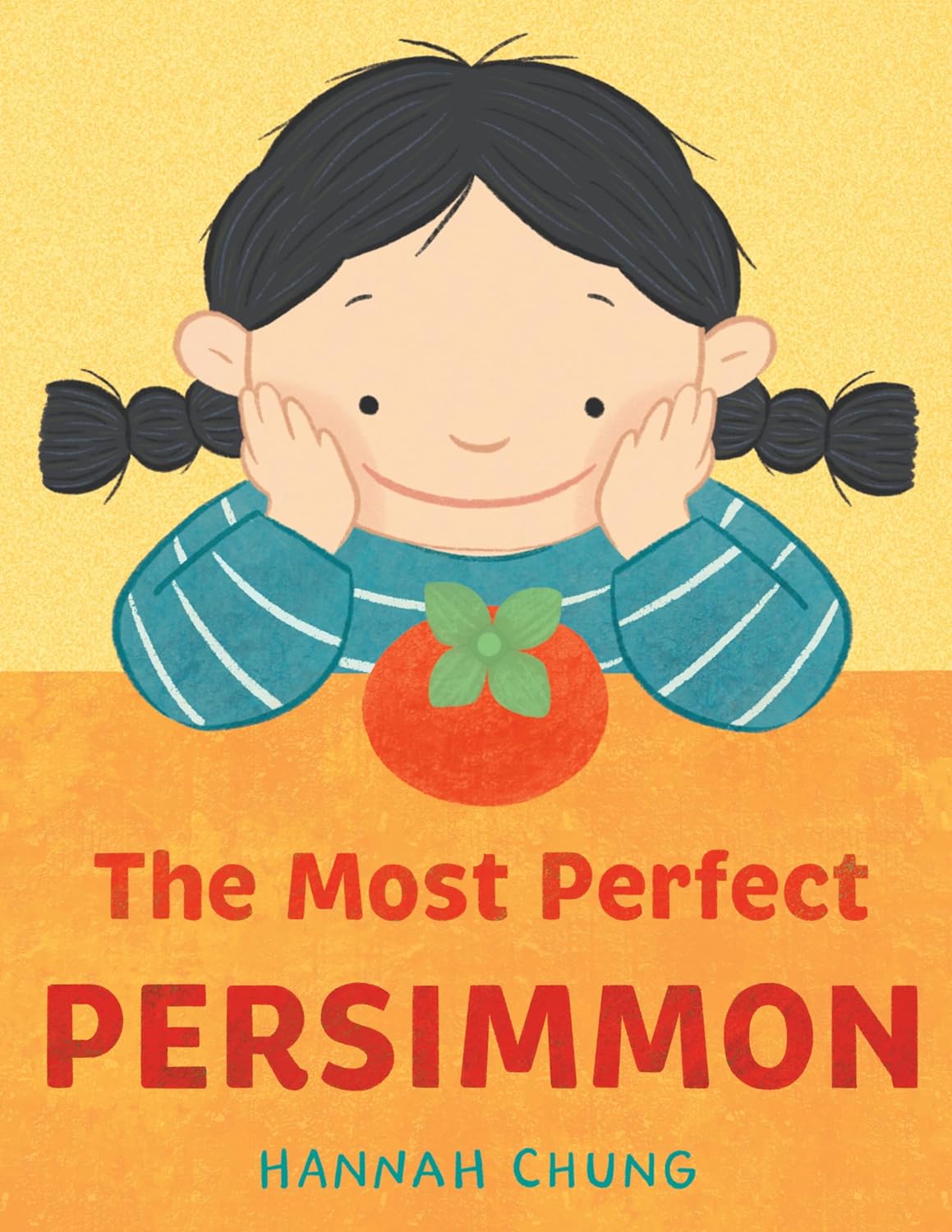
celebrate-picture-books-picture-book-review-the-most-perfect-persimmon

About the Holiday

Established in 2011 by the Center for Science in the Public Interest, National Food Day aims to raise awareness of nutrition issues and encourage people to “Eat Real.” Eating real means “cutting back on sugary drinks, overly salted packaged foods and fatty, factory-farmed meats in favor of vegetables, fruit, whole grains, and sustainably raised protein.” Prominent food activists help people discover where they can find food that is healthy and affordable. Another goal is to promote food production that is mindful of the environment, farm animals, and farmers. The efforts of National Food Day continue year round and culminate on October 24 with special events.

Thanks to Astra Young Readers for sharing a copy of The Most Perfect Persimmon with me for review consideration. All opinions on the book are my own.

The Most Perfect Persimmon

By Hannah Chung


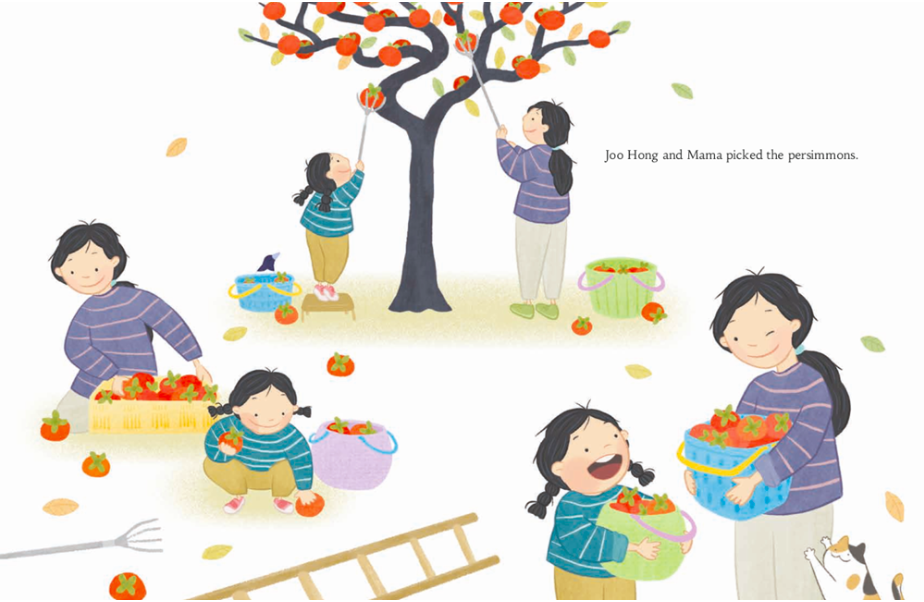
When Joo Hong gazed at the persimmons growing on the tree in her backyard, she saw the full moon, the glowing sun—perfection. She picked one, wanting to give it to her grandma, but her mother told her, Grandma’s visit was weeks away. Joo Hong wanted to taste that persimmon now, but when she took a bite, she discovered that the fruit wasn’t ripe yet. She decided to help the persimmon tree along by watering it, wrapping its trunk in a warm blanket on cool nights, and shooing away the magpies. At last they were ready.

celebrate-picture-books-picture-book-review-the-most-perfect-persimmon-picking-persimmons

Copyright Hannah Chung, 2024. Courtesy of Astra Young Readers.

This time when Joo Hong tasted one, it was “shiny on the outside. Soft and sweet on the inside. They were so perfect!” Joo Hong couldn’t wait to serve them to Grandma. But she would have to. Grandma’s visit was still a week away. It was so hard for Joo Hong to wait. But the persimmons were not waiting. They “got redder and started to show wrinkles. Some even had brown spots.” Joo Hong was upset even though her mother tried to reassure her that they were just ripening. Joo Hong hid the boxes of fruit from the sun and kept her cat away, but “the persimmons kept changing.”

celebrate-picture-books-picture-book-review-the-most-perfect-persimmon-grandma-visits

Copyright Hannah Chung, 2024. Courtesy of Astra Young Readers.

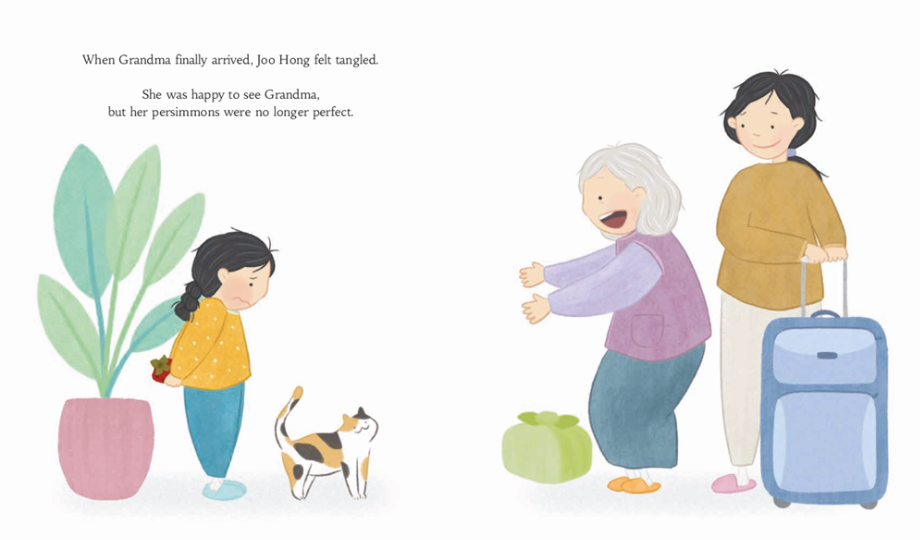
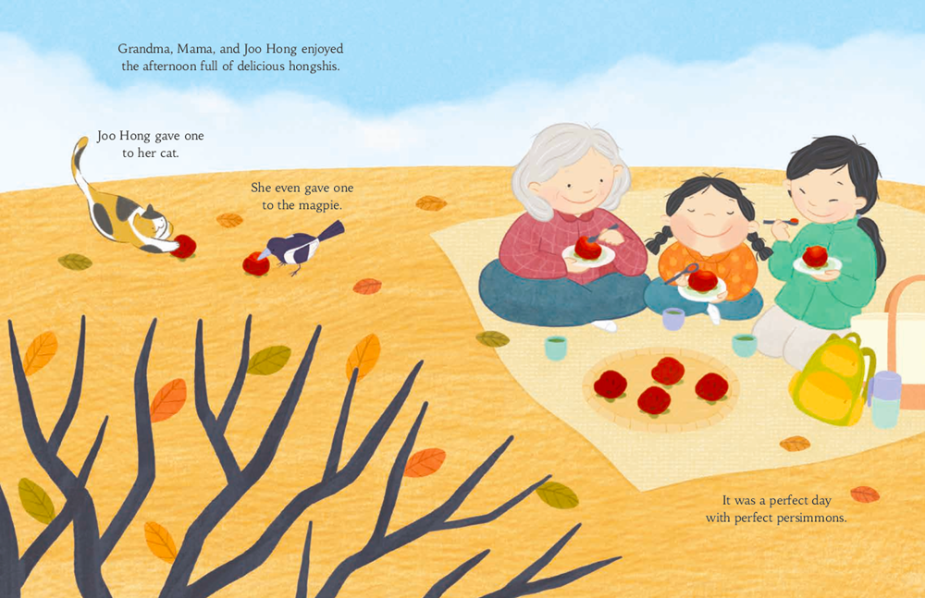
By the time Grandma arrived, the persimmons “were no longer perfect.” Joo Hong held out her gift with tears in her eyes. “Grandma Gave Joo Hong a big, warm hug” then took the fruit, peeled the skin, and gave Joo Hong a spoon. Joo Hong tasted it. It was delicious! Grandma smiled. “‘A persimmon becomes a hongshi with lots of love and care over time,'” she said, then exclaimed it was the best persimmon she’d ever eaten. Joo Hong was so excited that she gave a persimmon to her cat and even to the magpie. Then she and her mother and Grandma set out a picnic on this perfect day and enjoyed hongshis all afternoon.

An Author’s Note reveals Hannah Chung’s homegrown inspiration for her story. 

celebrate-picture-books-picture-book-review-the-most-perfect-persimmon-picnic

Copyright Hannah Chung, 2024. Courtesy of Astra Young Readers.

In her delightful and poignant debut picture book, Hannah Chung captures all the emotions of a young child with a big heart planning a special surprise for a beloved family member. From Joo Hong’s impatience for Grandma to arrive to her determination to ensure the persimmons are perfectly ripe to her tangled feelings and disappointed tears when Grandma does arrive and Grandma’s tender reassurances, Chung hits all the right notes, creating a story that kids and adults will love sharing and bond over.

Chung’s easy-to-understand, straightforward storytelling flows naturally and at a quick pace while also allowing readers to empathize with Joo Hong’s anticipation. In her bright, uncluttered illustrations Joo Hong’s facial expressions clearly show her changing feelings and make it simple for even the youngest children to understand how important the persimmon and Grandma are to Joo Hong. The relationships between Joo Hong, her mother, and her grandmother are sweet and tenderly drawn.

A perfect read aloud for story times as well as for bedtime, The Most Perfect Persimmon is a book that will be asked for often and is highly recommended for home, public library, and school library bookshelves. 

Ages 4 – 8

Astra Young Readers, 2024 | ISBN 978-1662620843

About the Author/Illustrator

Hannah Chung is an award-winning designer and entrepreneur in health care design for young patients. She is a frequent guest lecturer at universities and has presented at numerous conferences including TEDx and SXSW. Hannah spends her time both in Providence, Rhode Island, and Seoul, South Korea.

National Food Day Activity

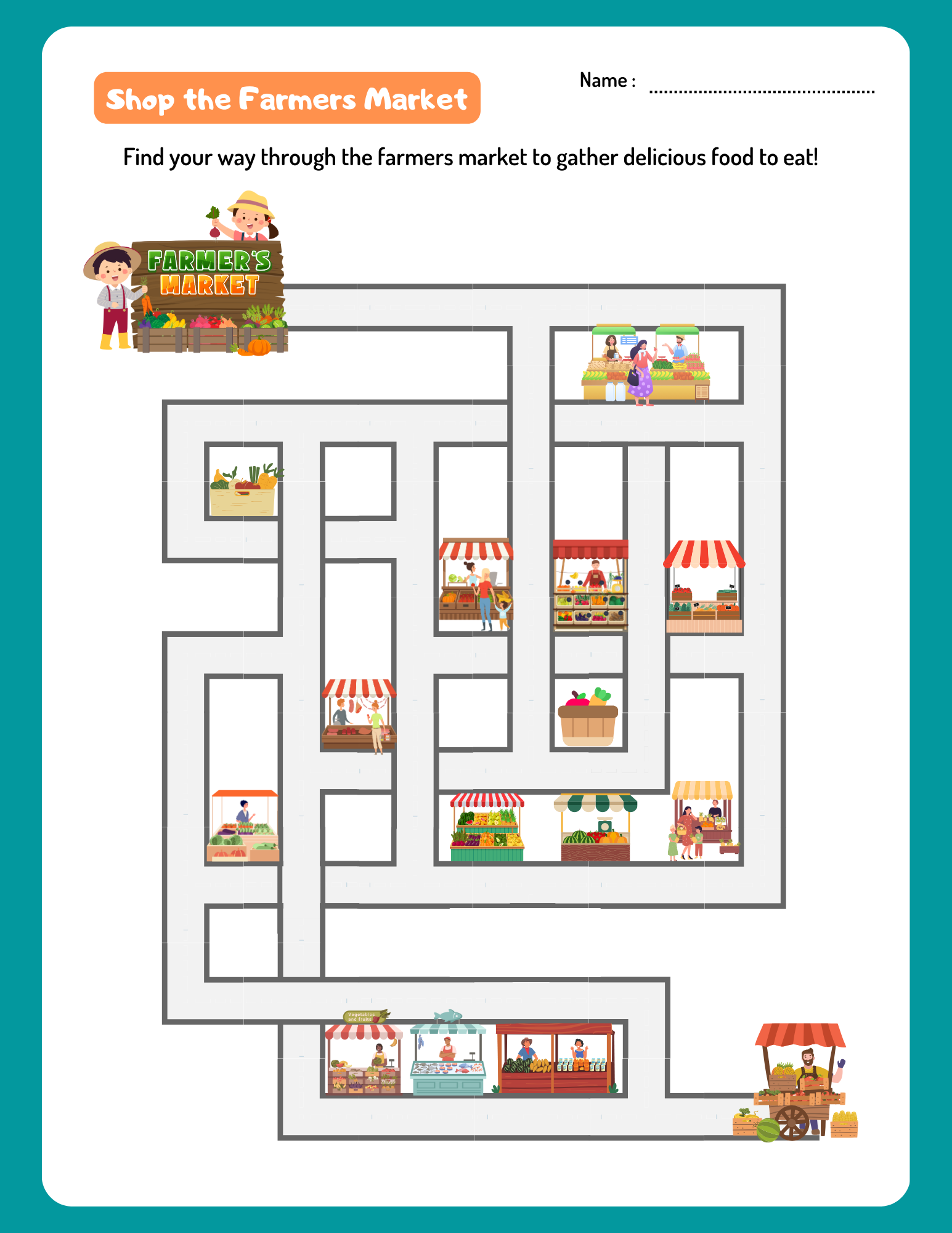
celebrate-picture-books-picture-book-review-shop-the-farmers-market-maze-with-border

Shop the Farmers Market Maze

It’s a perfect day to visit the farmers market! Find your way through the stalls to enjoy all the delicious food! 

Shop the Farmers Market Maze with no colored border | Shop the Farmers Market Maze with colored border

celebrate-picture-books-picture-book-review-the-most-perfect-persimmon

You can purchase The Perfect Persimmon at these booksellers

Amazon | Barnes & Noble | Bookshop (to support your local independent bookstore)

Picture Book Review
June 21 – National Seashell Day

celebrate-picture-books-picture-book-review-sora's-seashells-cover

About the Holiday

Seashells are natural wonders! Curved and fluted, bleached and delicately hued, shells provide homes, create pearls, house culinary delicacies, inspire crafts—and if you hold a conch shell to your ear, you can hear the ocean’s song.  National Seashell Day was established in 2016 by the beaches of Fort Myers and Sanibel in southwest Florida to commemorate the amazing presence of seashells in the area. But you don’t have to live in Florida to find or appreciate beautiful shells or celebrate the holiday. If you live near a beach, take a trip to walk along the shore and find some treasures. And anyone can become a armchair beachcomber by checking out some books or websites about seashells. Today’s book reveals just what a gift seashells—and children—are.

Thanks to Candlewick and Barbara Fisch at Blue Slip Media for sharing Sora’s Seashells with me for review consideration. All opinions on the book are my own.

Sora’s Seashells: A Name is a Gift to be Treasured

Written by Helena Ku Rhee | Illustrated by Stella Lim and Ji-Hyuk Kim


Every summer, Sora’s grandmother came to visit. The first thing Sora and Halmoni did together was go to the beach to look for seashells. They found all types and sizes of shells, but “Halmoni chose the prettiest shell and tucked it into her pocket.” Then as they left the beach, Halmoni left the shell on a bench. When Sora asked why they couldn’t take it home, Halmoni told her, “‘It’s a gift for anyone who sees its beauty.'” Sora wanted to take the shell, but she got on the bus without it.

When they went to the beach the next day, Sora was sad to see that “their” shell was gone. But Halmoni reminded Sora that it didn’t belong to them, that it was a gift. As she and Halmoni combed the beach for shells, Sora hid pretty shells in her pocket, and when she got home she put them in a jar. By the time Halmoni’s visit was over, Sora’s jar was full.

celebrate-picture-books-picture-book-review-sora's-seashells-Halmom

Image copyright Stella Lim with Ji-Hyuk Kim, 2023; text copyright Helena Ku Rhee, 2023. Courtesy of Candlewick.

At the end of summer, Sora began kindergarten. While most of the kids were nice, a few made fun of her name. They called it “weird” and asked if it wasn’t really “Sara.” Their taunting gave her a stomachache. Sora never told her parents, and the teasing continued. Then one day the family got news that Halmoni had died. As Sora’s parents told her, she “thought of all the summers ahead without her grandmother” and how “she would say her name, with a soft s and a gently rolled r.” Suddenly all of Sora’s pent up emotions flowed out. Crying, Sora said, “‘I want to see Halmoni. And I hate my name. I want to be Sara!”

To take comfort Sora and her parents drove out to the beach. As they walked along the shore, Sora’s mother picked up a beautiful pink shell—just the type that Sora loved—and held it in her hands. She told her daughter that “‘Sora means “seashell” in Korean'” and repeated Halmoni’s belief that “‘finding a perfect shell is like receiving a wonderful gift.'” It was Halmoni who had suggested the name Sora. Then Sora’s parents hugged her and said, “‘You’re our greatest gift, Sora.'”

celebrate-picture-books-picture-book-review-sora's-seashells-kindergarten

Image copyright Stella Lim with Ji-Hyuk Kim, 2023; text copyright Helena Ku Rhee, 2023. Courtesy of Candlewick.

The next week for show-and-tell, Sora brought her jar of seashells and told the class the meaning of her name. She then handed a shell to her teacher and to her friends. Then she came to the kids who teased her. She gave each of them a shell too. One boy said her name made sense now; another told her Sora sounded like a superhero. Sora was surprised. She smiled and said, “‘Thanks.'” When she returned to her seat, she felt like she was soaring. 

After school, Sora went back to the beach with her parents. She had one shell left in her jar. She took it out and placed it on the bench—a “gift for anyone who could see its beauty.”

celebrate-picture-books-picture-book-review-sora's-seashells-bench

Image copyright Stella Lim with Ji-Hyuk Kim, 2023; text copyright Helena Ku Rhee, 2023. Courtesy of Candlewick.

Helena Ku Rhee’s heartwarming, multilayered story introduces readers to themes of family, kindness, loss, belonging, and the power of looking for beauty in the people and things around us as her gentle and straightforward storytelling wraps readers in the love Halmoni and Sora share. Sora’s journey throughout the story is profound, condensing what can be a lifetime of experiences and lessons into an impactful message on kindness and a simple truth that everyone and everything contains beauty waiting to be discovered. Ku Rhee also reminds children and adults alike that open communication is the key to understanding and appreciating others.

Stella Lim’s watercolor and digital illustrations, based on sketches by Ji-Hyuk Kim, set the tone of Sora and Halmoni’s tender relationship with soft colors, wide ocean vistas, and quiet scenes at home. In contrast, the school room’s yellow walls and lime green rug, scattered play areas and supplies, and teasing boys seems to mirror the turmoil in Sora’s mind and heart. After she presents her show-and-tell, however, the greens and yellows are more muted, the children calm. Likewise, elsewhere in the story, Lim employs shadowing and light and dark shades to represent Sora’s emotions. 

A standout story that will resonate with readers—children and adults—and provide many opportunities for discussion, Sora’s Seashells is highly recommended for home bookshelves and is a must for all classroom, school, and public library collections. 

Ages 4 – 8

Candlewick, 2023 | ISBN 978-1536209938

About the Author

Helena Ku Rhee grew up in Los Angeles and has lived in various parts of the United States, Asia, and Europe. She is the author of the picture books Rosa’s Song and The Paper Kingdom, both illustrated by Pascal Campion, and The Turtle Ship, illustrated by Colleen Kong-Savage. Helena Ku Rhee currently lives in Los Angeles.

About the Illustrators

Stella Lim studied fine art and graduated from Kingston University. She based her work for Sora’s Seashells on sketches from Ji-Hyuk Kim. Stella Lim lives with her family in Seoul, South Korea.

Ji-Hyuk Kim is the illustrator of the New York Times bestseller Through Your Eyes: My Child’s Gift to Me by Ainsley Earhardt as well as many book jackets and covers. Ji-Hyuk Kim lives in South Korea.

National Seashell Day Activities

Celebrate Picture Books Seashell Beach Combing Game

Gather Seashells Board Game


Beachcombers love to find different kinds of shells! You don’t need to take a trip to the shore to fill this game board beach with shells! Grab your friends, siblings, or the whole family and start collecting!

Supplies

Directions

  • Print Seashell Game Cards
  • Cut the shells from the cards so they will fit on the Beach Game Board
  • Assign a roll of the dice (2 through 8) to each shell, ex. Roll a 6 and pick up the sand dollar 
  • Choose someone to go first and take turns rolling the die to collect shells for your Beach Scene Game Board
  • The first person to fill their beach with shells is the winner

Celebrate Picture Books Seashell Matching Game Playing Cards

Seashell Matching Game


With this game you can match two, three, or even more shells to test your memory!

Directions

  • Print two or more Seashell Game Card sheets
  • Cut the cards apart
  • Place them face down on the table and shuffle
  • Turn one card over then choose another to try to find a match. If unsuccessful turn them both over and try again until you’ve found matches for all the shells


celebrate-picture-books-picture-book-review-sora's-seashells-cover

You can find Sora’s Seashells at these booksellers

Amazon | Barnes & Noble | Books-a-Million

To support your local independent bookstore, order from

Bookshop

Picture Book Review
May 18 – It’s National Family Month

celebrate-picture-books-picture-book-review-Arletis-Abuelo-and-the-Message-in-a-Bottle-cover

About the Holiday

Established by KidsPeace, a private, not-for-profit organization dedicated to helping children and families since 1882, National Family Month is observed during the five-week period between Mother’s Day in May and Father’s Day in June. It coincides with the usual end of the school year, and raises awareness of the important role mothers and fathers as well as grandparents and extended family play as a support system for their children. To observe the holiday spend time talking with your kids about topics of importance to them and plan activities for fun and to help them achieve their goals.  

Thank you to Star Bright Books for sharing a copy of Arletis, Abuel, and the Message in a Bottle for review consideration. All opinions on the book are my own.

Arletis, Abuelo, and the Message in a Bottle

Written by Lea Aschkenas | Illustrated by Cornelius Van Wright and Ying-Hwa Hu


Growing up in Cuba, Arletis loved studying maps and wondering about the people and places beyond her island. “Her whole life took place on the long, unnamed street that ran in front of the unnumbered house, where she lived.” Some afternoons, she took the horse-drawn carriage that transported people around town to visit her abuela. While she was there, Abuela told her funny stories about her abuelo, who had died before she was born. Sometimes tears would form in Abuela’s eyes as she talked about her husband. Then “Arletis would suggest they pick the grapefruits that grew like miniature suns in the trees Abuela had planted when she was young” to make her favorite treat cascos de toronja.

celebrate-picture-books-picture-book-review-Arletis-Abuelo-and-the-Message-in-a-Bottle-carriage

Image copyright Cornelius Van Wright and Ying-Hwa Hu, 2023, text copyright Lea Aschkenas, 2023. Courtesy of Star Bright Books.

Arletis’s life was rich with delicious fruit that grew in trees along her street, swimming in the river when the heat became “so heavy and thick it rolled down the street in dizzying waves,” and playing her favorite game: choreographer, in which she, her cousin, and neighborhood kids danced to the music on the radio. Arletis loved her street, but sometimes she wondered if there was more. In another part of the world—off the coast of Sausalito, California—a man named Steve lived alone on the tugboat with which he had once made his living. While Steve was content on his tugboat, he too wondered if there was more.

celebrate-picture-books-picture-book-review-Arletis-Abuelo-and-the-Message-in-a-Bottle-abuela

Image copyright Cornelius Van Wright and Ying-Hwa Hu, 2023, text copyright Lea Aschkenas, 2023. Courtesy of Star Bright Books.

For Arletis’s eighth birthday, her parents rented a beach house for a weekend vacation to Playa Bailén, about 30 miles from home. On the bus ride there, Arletis, for the first time, saw the ocean that surrounded her island. On her birthday, Arletis took a walk along the beach and found a green bottle. The top was sealed with tape, and inside she could see a rolled up piece of paper. The paper turned out to be a letter written in a foreign language. Arletis was excited to realize that the bottle had come from another country.

Even though Arletis couldn’t read the words, she wrote a letter about “her life, about her family and her beautiful street. She asked every question she could think of about life in this other country” and she mailed it to the address provided at the bottom of the message from the bottle. When Steve received the letter, he immediately knew it was a response to his message in the bottle that he had given to a friend who was sailing down the coast and through the Panama Canal. The friend had dropped the bottle into the sea after he’d sailed into the Caribbean Sea.

celebrate-picture-books-picture-book-review-Arletis-Abuelo-and-the-Message-in-a-Bottle-Steve-on-tug

Image copyright Cornelius Van Wright and Ying-Hwa Hu, 2023, text copyright Lea Aschkenas, 2023. Courtesy of Star Bright Books.

Steve was thrilled to receive Arletis’s letter. He had begun studying Spanish and “had been wishing for someone to practice with.” Two months had gone by since Arletis had sent her letter when she heard the mail carrier call out her name and hand her an envelope. It was the first letter Arletis had ever received, and she handled it with great care. Steve had answered all her questions and even sent a picture of himself and his tugboat. Arletis thought Steve looked “old enough to be a grandfather. Arletis had always wished for a grandfather, so she decided to address her next letter, ‘Querido Abuelo Esteban.’ ‘Dear Grandfather Steve'” and invited him to visit her and her family one day.

Arletis and Abuelo Esteban began writing to each other monthly then in one letter, Abuelo Esteban said he would be coming for a visit. “Arletis couldn’t stop smiling.” When Abuelo Esteban arrived, he brought a gift. It was a map he had drawn “showing the path his bottle had taken, first on his friend’s boat and then on the wide open sea to Arletis’s island. It was the most beautiful map Arletis had ever seen.” During the five days that Abuelo Esteban spent with Arletis’s family, he played baseball with her friends, swam in the river, and enjoyed some of Arletis’s favorite foods. 

celebrate-picture-books-picture-book-review-Arletis-Abuelo-and-the-Message-in-a-Bottle-fruit

Image copyright Cornelius Van Wright and Ying-Hwa Hu, 2023, text copyright Lea Aschkenas, 2023. Courtesy of Star Bright Books.

On Abuelo Esteban’s last night visiting, Arletis’s mother and Abuela made a special dinner, complete with Arletis’s favorite dessert, cascos de toronja. Abuelo Esteban loved it too. He showed everyone pictures of his tugboat and the dock where it was moored. Arletis thought the dock looked just like a little island surrounded by water. When she asked Abuelo Esteban if he thought an island was a good place to live, he replied, “‘Yes, I think so. Especially if there is another island where you have family you can visit.'” 

Backmatter includes an Author’s Note that outlines how Lea Aschkenas first met Abuelo Esteban at the Sausalito library where she worked and learned about his story. She adds an update to the story about both Arletis, now an adult, and Steve, who has continued to visit his “familia de corazón”— his family of the heart. A recipe for cascos de toronja, glossary of the Spanish words found in the story, and a list of references for further reading, viewing, and listening in both English and Spanish are also included.

celebrate-picture-books-picture-book-review-Arletis-Abuelo-and-the-Message-in-a-Bottle-Steve-playing-baseball

Image copyright Cornelius Van Wright and Ying-Hwa Hu, 2023, text copyright Lea Aschkenas, 2023. Courtesy of Star Bright Books.

Lea Aschkenas’s gentle and uplifting story immerses readers in the sights, sounds, flavors, and warm hearts of Cuba. Her comprehensive storytelling is filled with the types of details about Arletis’s life that will captivate readers and resonate with their own love for spontaneous fun, favorite foods, and family relationships. Aschkenas’s lovely descriptive language—Cuba is an “alligator-shaped island,” boiled grapefruit pith for cascos de toronja is as transparent as “a see-through fish,” Arletis and Abuelo Esteban exchange letters “as regularly as the monthly full moon”—and Spanish words and phrases sprinkled throughout the text paint pictures in children’s minds of the special beauty of Cuba.

Through Cornelius Van Wright and Ying-Hwa Hu’s stunning watercolor illustrations, readers travel to Cuba to revel in the brilliant colors of the buildings and homes, the luscious hues of tropical fruit, the jewel-like water of the rivers and ocean, and, especially, the sunny smiles of the country’s people. When the story turns to the Sausalito dock where Steve lives, children see that the landscape is similar, with homes and businesses painted in pinks, yellow, red, and blue. Palm trees dot the skyline, and the ocean is as blue as the sky. Van Wright and Hu enchantingly capture Arletis’s wanderlust and her excitement to connect with Steve, with whom she immediately forms a grandfatherly bond. Images of Arletis cooking with her Abuela, dancing and playing baseball with friends, and sitting around the family dinner table with Abuela Esteban will charm children as they take this true story into their heart.

Wonderfully evocative and multilayered, Arletis, Abuelo, and the Message in a Bottle is a remarkable story of family, friendship, pride in one’s country, and the joys to be found in reaching out to others across the world. The book is a heartfelt choice for story times at home and school and would make an impactful addition to any classroom or homeschool geography or social studies curriculum. Arletis, Abuelo, and the Message in a Bottle is highly recommended for all home, school, and public library collections. The book is also available in a Spanish edition: Arletis, abuelo y el mensaje en la botella.

Ages 4 – 8

Star Bright Books, 2023 | ISBN 978-1595729699 (English Hardcover) | ISBN 978-1595729705 (English Paperback) | ISBN 978-1595729729 (Spanish Hardcover) | ISBN 978-1595729712 (Spanish Paperback)

About the Author

LEA ASCHKENAS has written book reviews and articles for Washington Post Book World, Los Angeles Review of Books, and Salon. She is also the author of a travel memoir, Es Cuba: Life and Love on an Illegal Island. She fell in love with Cuba and its people on her first trip to the island in the year 2000 and has been returning nearly every year since. Arletis, Abuelo, and the Message in a Bottle is her first book for children. Lea lives in Northern California where she works as a public librarian and teaches with the California Poets in the Schools program. Visit Lea at: leaaschkenas.com
About the Illustrators

CORNELIUS VAN WRIGHT and YING-HWA HU are a husband and wife children’s book illustration team. They have worked on many assignments together, but have also illustrated numerous projects and books individually. They have won a number of awards for their books. Their work has been exhibited at the Bologna Book Fair and the Society of Illustrators’ “The Original Art” show. Cornelius and Ying-Hwa live in New York City. You can learn more about Cornelius and Ying-Hwa Hu and their work at pencilmoonstudio.com. Visit Ying-Hwa Hu at yinghwahu.com.
celebrate-picture-books-picture-book-review-Arletis-Abuelo-and-the-Message-in-a-Bottle-cover

You can find Arletis, Abuelo, and the Message in a Bottle or the Spanish Edition, Arletis, abuelo y el mensaje en la botella, at these booksellers

Amazon | Barnes & Noble | Books-a-Million

Arletis, abuelo y el mensaje en la botella

Amazon | Barnes & Noble | Books-a-Million

To support your local independent bookstore, order from

Bookshop: English Edition | Spanish Edition


Picture Book Review