March 9 – Unique Names Day

celebrate-picture-books-picture-book-review-my-name-is-wakawakaloch-cover

About the Holiday

Unique Names Day was established in 1997 by Jerry Hill, a hobbyist in onomatology – the study of the etymology, history, and use of proper names – as part of Celebrate Your Name Week. The holiday celebrates uncommon or uncommonly spelled names and encourages those with unique names to always take pride in their name. One way to enjoy the day is to find out more about your name and how or why your parents chose it. You can have fun with names every day this week. Upcoming are Discover What Your Name Means Day, Nametag Day, Middle Name Pride Day, and Descendent’s Day. You can learn more about each daily holiday at Names Universe.

My Name is Wakawakaloch!

Written by Chana Stiefel | Pictures by Mary Sullivan


Wakawakaloch had a problem. Well, it wasn’t really her problem; none of the kids at school could pronounce or even remember her name. After another day in which her name was mangled (Oog called her “‘Walawala,’” Boog shouted “‘Look out, Wammabammaslamma!’” and Goog cheered her on during Club Club with “‘Swing, Lokamokatok!’”), Wakawakaloch was as angry as an erupting volcano.

celebrate-picture-books-picture-book-review-my-name-is-wakawakaloch-easy-club-club

Image copyright Mary Sullivan, 2019, text copyright Chana Stiefel, 2019. Courtesy of HMH Books for Young Readers.

When her parents asked what was wrong, Wakawakaloch said she wanted to change her name to Gloop. Pa thought Gloop was a good name, but reminded his daughter that her name had been “‘in family many, many moons.’” But Wakawakaloch was inconsolable. Not only could no one say her name right, but she never found it on any T-shirts. Ma and Pa thought there was only one thing to do—take her to see Elder Mooch.

Despite his leathery skin and aroma of “rotting mammoth poop,” Elder Mooch was an insightful Neanderthal. He started off with an ill-considered joke that set Wakawakaloch reaching for tissues from the nearby dispenser rock. But she poured out her heart and the fact that she wanted an easy name, one found on T-shirts. She could just imagine all of the heroic and adventurous things she could do with a name and T-shirt like that.

celebrate-picture-books-picture-book-review-my-name-is-wakawakaloch-easy-name

Image copyright Mary Sullivan, 2019, text copyright Chana Stiefel, 2019. Courtesy of HMH Books for Young Readers.

Elder Mooch looked at her and then bestowed his wisdom. He told her she was a “‘forward thinker’” but “‘must be a backward seer too.’” This bit of knowledge cost her two pigeons and left her smoldering. What did he mean by that? Later that night as she tossed and turned in bed, she caught a glimpse of the paintings on her wall. They showed her great-great-great-great-great grandmother Wakawakaloch “performing brave and heroic acts…. Little Wakawakaloch placed her hand on the ancient handprint of her mighty namesake. It was a perfect match.”

celebrate-picture-books-picture-book-review-my-name-is-wakawakaloch-cave-drawing

Image copyright Mary Sullivan, 2019, text copyright Chana Stiefel, 2019. Courtesy of HMH Books for Young Readers.

In the morning, Wakawakaloch was smiling. She no longer wanted to be called Gloop, and she told her parents that she was ready to help others. When the Roll-the-Boulder tournament came round, Wakawakaloch had her personalized T-shirt stand all set. Oog, Boog, and Goog thought her shirts for Chana, Sioban, Xavier, Eoghan were “‘Ooga booga’ (way cool).” Wakawakaloch had even made one for herself. Elder Mooch wanted to buy three, and when little Hoopaloopie came by, Wakawakaloch got to work on another shirt.

celebrate-picture-books-picture-book-review-my-name-is-wakawakaloch-tee-shirts

Image copyright Mary Sullivan, 2019, text copyright Chana Stiefel, 2019. Courtesy of HMH Books for Young Readers.

For all those kids who never find their names on shirts, mugs, necklaces, keychains, or other personalized items and who frequently hear the question, “How do you pronounce that?,” Chana Stiefel’s book is for you! This fresh tale will also resonate with any child who feels different for any reason. Wakawakaloch, with her strong personality, thoughtful introspection, and creative solution, is a character that readers will love and want to emulate. Stiefel deftly navigates this sensitive landscape with a combination of honest feelings and hilarious mispronunciations, prehistorical details, and descriptions. Readers will laugh all the way through but will also be absorbing the lesson that everyone should embrace their own “mighty” personality and be celebrated and recognized for their unique qualities.

In her vibrant illustrations, Mary Sullivan creates a comically anachronistic ancient world, where safety cones made of stone mark the playground, a stone telescope is aimed out the window, mail is delivered (this part may be accurate, I’d have to check), and cupcakes are eaten with forks. Kids will want to linger over each page to point out all of the funny elements that add depth and glee to this story. Wakawakaloch shows the feelings bubbling up inside her with furrowed brows, livid gestures, and ready tears, while the other kids cluelessly continue to distort her name even after being told the right pronunciation multiple times. Wakawakaloch’s visit to Elder Mooch is a funny take on therapy sessions, but his advice leads to a welcome image of contemplation and realization that makes Wakawakaloch appreciate her family history and also want to contribute to its—and society’s—advancement. Wakawakaloch’s T-shirt booth is sure to inspire kids to make their own shirt too.

A delightfully inventive story with many applications and prompts for further discussion as well as activities celebrating individuality, My Name is Wakawakaloch! will be a much-asked-for favorite on home, classroom, and public library shelves.

Ages 4 – 7

HMH Books for Young Readers, 2019 | ISBN 978-1328732095

Discover more about Chana Stiefel and her books on her website.

To learn more about Mary Sullivan, her books, and her art, visit her website.

Check out the My Name is Wakawakaloch! “ooga booga” book trailer!

Unique Names Day Activity

CPB - Name Jars standing

Love Your Name Organizer Jar


Everyone needs a place to store their special stuff! Here’s a way to recycle a plastic jar and make a cool organizer jar with your name on it. This organizer jar also makes a great gift for your friends!

Supplies

  • A large plastic jar, such as a peanut butter jar or mayonnaise jar, cleaned out and with the label removed
  • Acrylic multi-surface paint or markers
  • Chalkboard paint
  • Paint brush
  • Chalk

CPB - Name Jars on sides

Directions

  1. Paint a rectangle on the front of the jar with chalkboard paint
  2. Decorate the rest of the jar with paint, markers, or paper just the way you want! My green jar sports a friendly dinosaur!

celebrate-picture-books-picture-book-review-my-name-is-wakawakaloch-cover

You can find My Name is Wakawakaloch! at these booksellers

Amazon | Barnes & Noble | Books-a-Million

To support your local independent bookstore, order from

Bookshop | IndieBound

Picture Book Review

March 1 – National Reading Month Book Tour Launch for Agnes’s Place

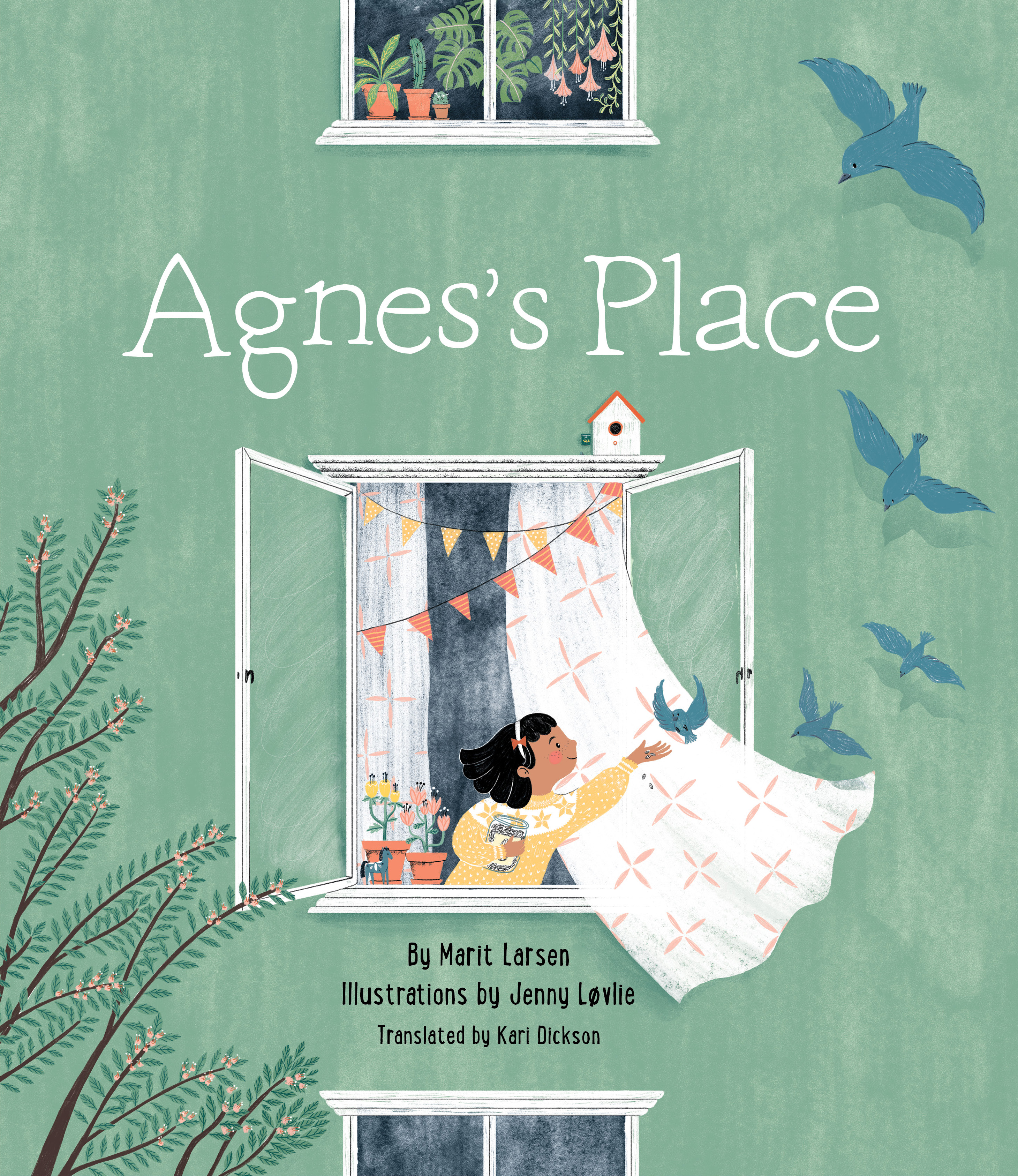
celebrate-picture-books-picture-book-review-agnes's-place-cover

About the Holiday

National Reading Month is a book-lover’s delight! With thirty-one whole days where taking extra time to read is not only allowed but encouraged can send one hurrying out to the bookstore or library to stock up! Kids love being read to, and setting aside time to read together every day builds strong bonds that can last a lifetime. The month is officially marked with special events in schools, libraries, bookstores, and communities that bring authors, illustrators, and educators together with kids. This year look for virtual events and make a plan with your kids to find new and old favorites books to share. 

Thanks to Amazon Crossing Kids and Blue Slip Media for sending me a copy of Agnes’s Place for review consideration. All opinions are my own.  I’m happy to be teaming with Amazon Crossing Kids and Blue Slip Media in a giveaway of the book. See details below.

Agnes’s Place

Written by Marit Larsen | Illustrated by Jenny Løvlie | Translated by Kari Dickson


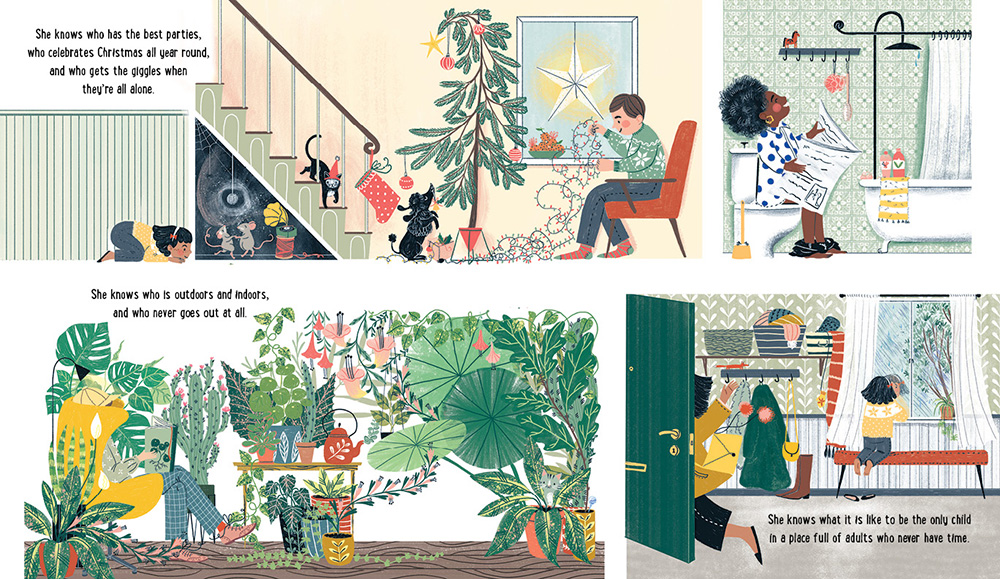
In a city of “so many buildings,” Agnes lives on a neat little street where the trolley passes by and a café and corner grocery welcome their customers. In her apartment building, Agnes “knows she is at home before she even opens her eyes in the morning. She knows who is baking, who is playing, and who is saying shush.” When she opens her window, the birds come for the seeds she feeds them because “she knows that the birds are hungry and that she is the only one who remembers.” Agnes knows about all of the residents of her building and especially “what it is like to be the only child in a place full of adults who never have time.”

One day when she looked out her window at the rain coming down, she noticed a girl standing next to her favorite puddle with a tall pile of boxes and belongings. Agnes wondered if she was moving in. She watched through the peephole in her door as the girl and adults carried boxes and bags up the stairs to the fifth floor. Excited, Agnes drew a large picture of the swings outside the building, and she wrote an invitation—“HERE”—with an arrow. Then, when things were quiet, she went upstairs and slid it through the letter box, where it came to rest under a chest of drawers. Agnes skipped down the stairs. “She felt her heart pounding in her cheeks and ears.” But, later, she sat on the swing alone, which felt lonelier than playing on the swings by herself.

celebrate-picture-books-picture-book-review-agnes's-place-tenants

Image copyright Jenny Løvlie, 2021, text copyright Marit Larsen, 2021. Translation by Kari Dickson, 2021. Courtesy of Amazon Crossing.

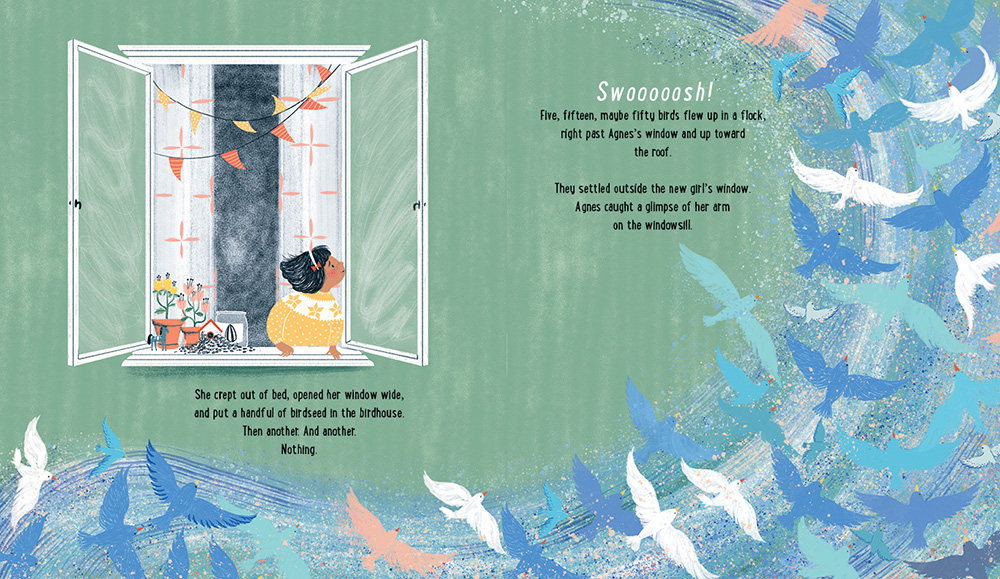
When Agnes woke up the next day, she felt that everything was the same… but completely different. When she went to the window to feed the birds, they flew past her and up toward the new girl’s window. Later, Agnes practiced new tricks on the swing. After that, she played with her toys while she watched the new girl on the swing. Her home “was somehow a new place now,” and all she could think about was the new girl: did she hear and see the same things Agnes did?

Every day, Agnes waited by the swings until it was time to go in. The new girl discovered Agnes’s puddle by herself. She did a lot of fun things, and if she saw Agnes at the market, Agnes couldn’t tell because she walked right by. When Agnes went to get Emilia’s newspaper from the mailbox to deliver as she did every day, she found the box empty. And when she went to visit Emilia, she found Emilia already doing the crossword puzzle.

Agnes ventured: “‘it is a bit strange, isn’t it, that you can just move into a place without asking everyone who lives there if they think it’s okay?’” Emilia said, “‘Well, now—we’ve all been new at one time or another. Even me.’” Then Emilia offered her a waffle, but Agnes thought “a waffle is not much comfort when you are five and have no secrets left to share.”

But coming downstairs, Agnes was suddenly face to face with the new girl. They were the same size and “both just as quiet.” Agnes’s sweater matched the new girl’s hat, and when Anna opened her hands the marbles inside glowed as if “she had the whole universe in the palm of her hand.” They laughed together as the marbles flowed down the stairs like waves. Then Anna grabbed Agnes’s hand and led her upstairs to the roof, where Agnes had never been before but which Anna had transformed with birdhouses and little lights, and they had a picnic of waffles and hot chocolate. “It turned out that Anna had her own secrets. And they were wild and wonderful.”

Amazon Crossing Kids aims to increase the diversity of children’s books in translation and encourage children to read from a wide range of cultural perspectives. Agnes’s Place was originally published in Norway.

celebrate-picture-books-picture-book-review-agnes's-place-birds

Image copyright Jenny Løvlie, 2021, text copyright Marit Larsen, 2021. Translation by Kari Dickson, 2021. Courtesy of Amazon Crossing.

Marit Larsen has written a complex and thought-provoking story about making new friends and the nature of friendship, about loneliness, a sense of loss, and feelings of discovery. As the only child in the apartment building, Agnes has been left to make her own way and find her own entertainment and routines—her secrets. She is excited to see a new girl moving in and immediately invites her to play. But when her picture goes unseen and Agnes’s secrets are one-by-one discovered and, in some cases, “taken” by Anna, Larsen introduces the idea of how mixed signals, disappointments, and unfulfilled expectations can affect one’s own sense of self and place in the world.

Of course, Anna doesn’t know about Agnes and can’t know that the puddle, the swings, the birds, and Emilia’s newspaper have been “hers,” and in one illustration Anna can be seen as lonely too. When Agnes and Anna finally meet up and they realize that they are alike in many ways, they quickly become friends, and together they can their world more “wild and wonderful.” The events in the story give readers and adults excellent opportunities to discuss commonly felt emotions surrounding friendships and new experiences and what someone could and/or would do in similar situations.

In her gorgeous matte illustrations rendered in soothing hues, Jenny Løvlie creates a charming neighborhood and apartment building, in which cutaways show Agnes’s neighbors baking, reading, and tinkering in their own apartments. Through snapshot images Løvlie shows the disconnect between Agnes and Anna, and clearly shows how Agnes’s initial excitement at making a friend turns to sadness and uncertainty when her invitation goes unanswered and her comforting daily routine is seemingly usurped.

The moment when Agnes and Anna meet, however, is infused with acceptance, understanding, and promise. The final two spreads in which Anna and Agnes climb to the roof and have a picnic are stunning for their color and the magic they inspire. Kids and adults will want to linger over each page to soak up all of the details that are so true to home life as well as the whimsical antics of a pair of mice. Readers will also love to point out all of the cats and other animals that appear throughout the pages.

A heartfelt and lovely story about new friendships and growing up set in a vibrant apartment community, Agnes’s Place would be a captivating addition to home, school, and public libraries for thoughtful story times.

Ages 4 – 8

Amazon Crossing Kids, 2021 | ISBN 978-1542026758

Marit Larsen is a Norwegian songwriter and musician. Agnes’s Place, her debut picture book, was first published in Norway and will also be published in Denmark and Italy. She currently resides in Brooklyn, New York. You can learn more about the author at www.maritlarsen.com and on Instagram: larsenmarit

Jenny Løvlie is a Norwegian illustrator. Her previous picture book, The Girls, written by Lauren Ace, was the winner of the Waterstones Children’s Book Prize. She currently lives in Cardiff, Wales. You can connect with Jenny Løvlie at www.lovlieillustration.com and on Instagram: lovlieillustration.

Kari Dickson is a literary translator from Edinburgh, Scotland. In 2020 she won the Mildred L. Batchelder Award for best children’s translation for Brown, written by Håkon Øvreås and illustrated by Øyvind Torseter. She holds a BA in Scandinavian studies and an MA in translation.

Agnes’s Place Giveaway

I’m happy to be teaming with Amazon Crossing Kids and Blue Slip Media in a giveaway of:

  • One (1) copy of Agnes’s Place written by Marit Larsen | illustrated by Jenny Løvlie

To enter:

  • Follow Celebrate Picture Books
  • Retweet a giveaway tweet
  • Bonus: Reply with your favorite childhood book for extra entry

This giveaway is open from March 1 to March 7 and ends at 8:00 p.m. EST.

A winner will be chosen on March 8. 

Prizing provided by Amazon Crossing Kids and Blue Slip Media

Giveaway open to U.S. addresses only. | No Giveaway Accounts 

celebrate-picture-books-picture-book-review-agnes's-place-cover

You can find Agnes’s Place at these booksellers

Amazon | Barnes & Noble | Books-a-Million

To support your local independent bookstore, order from

Bookshop | IndieBound

Picture Book Review
February 25 – It’s Bake for Family Fun Month

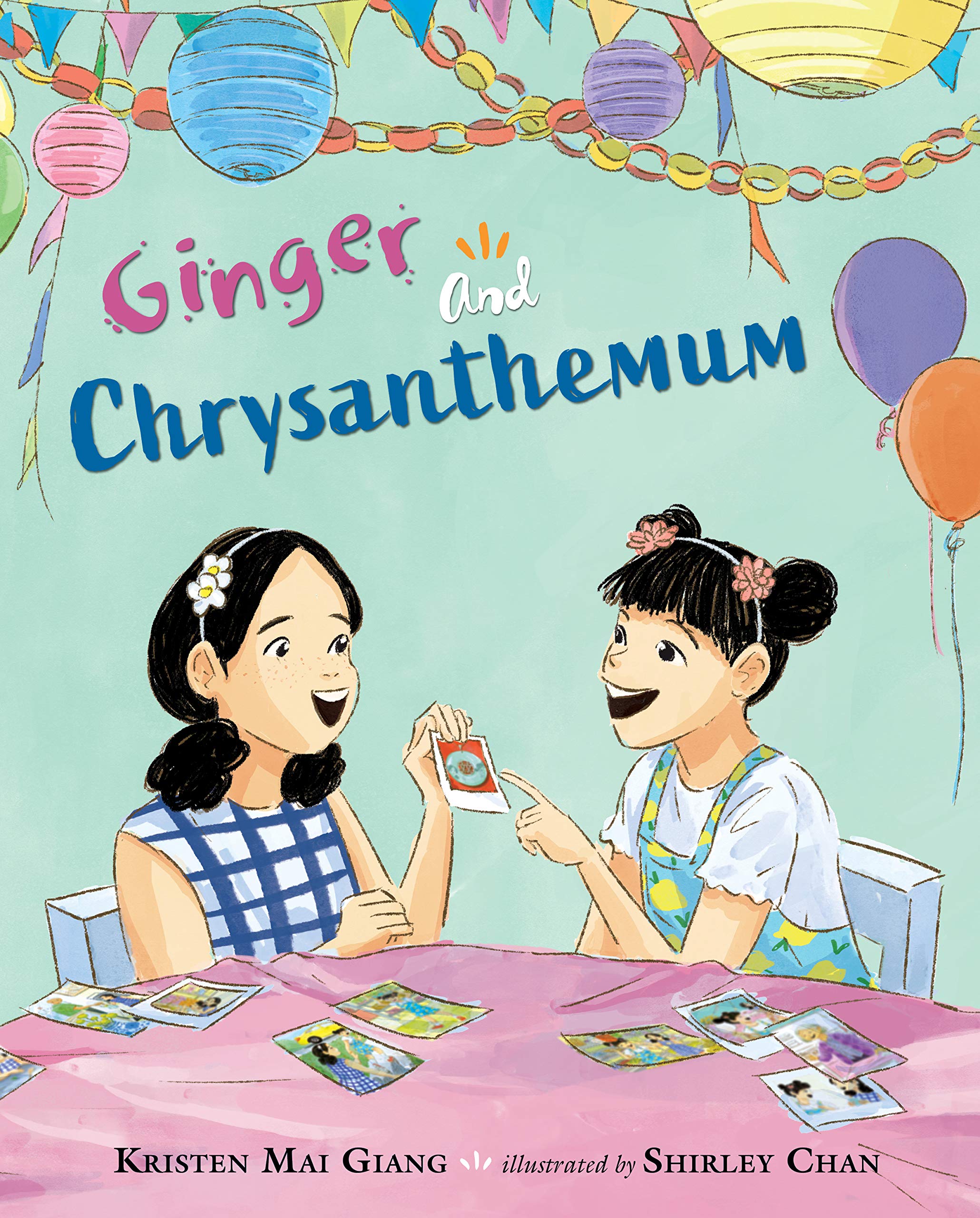
celebrate-picture-books-picture-book-review-ginger-and-chrysanthemum-cover

About the Holiday

Whether you and your family have always liked to bake together or you’ve found a new hobby in the past year, February is a great time to scour cookbooks or find recipes online and add some new taste sensations to your traditional favorites. Baking together teaches valuable cooking skills and is a creative way to engage with math. It can also bring your family closer as you talk about old memories that revolve around baking or cooking and make memories for the future. Of course the best part of baking together is eating the delicious treats afterward!

Ginger and Chrysanthemum

Written by Kristen Mai Giang | Illustrated by Shirley Chan


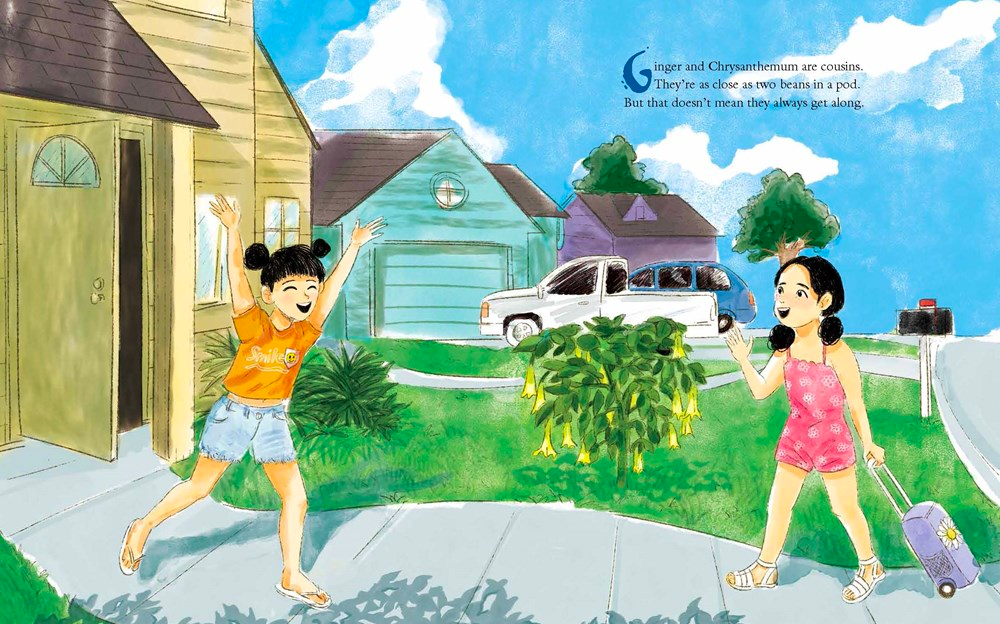
Ginger has come to visit her cousin Chrysanthemum. “They’re as close as two beans in a pod,” but they don’t always see things the same way. Today is their grandmother’s birthday, and they want to make it perfect. Chrysanthemum has made a list of things they must do. First, she says they must dress up. While Chrysanthemum puts on the tidy checked dress she brought along and slips on a matching headband and cool, white sandals, Ginger tries on everything in her closet.

celebrate-picture-books-picture-book-review-ginger-and-chrysanthemum-visiting

Image copyright Shirley Chan, 2020, text copyright Kristen Mai Giang, 2020. Courtesy of Levine Querido.

When Ginger’s ready, Chrysanthemum consults her list again and finds it’s time to shop for decorations and a gift and then head to Grandma’s New Asian Kitchen restaurant to decorate. Ginger doesn’t want to take time to read a list, though, and pulls her cousin out the door. They hurry to the market to do their shopping. Ginger finds paper lanterns in every color and thinks it’s fun to balance a stack of them on her head. Chrysanthemum knows Grandma loves flowers and chooses ginger and chrysanthemum flowers for the party. For Grandma’s gift, they buy a jade pendant.

One thing the cousins do agree on is that they love to help out at the grandmother’s restaurant. While each girl has their own favorite job to do, today they are decorating together. Ginger is running around hanging lanterns and Chrysanthemum  is carefully placing flowers on the tables when Grandma asks which of them would like to bake the birthday cake. Ginger has visions of making “an AMAZING cake with BLAZING candles” while Chrysanthemum says, “‘I’ll make a cake light and cool as a cloud.’” Grandma suggests they work together to make her green tea cake.

celebrate-picture-books-picture-book-review-ginger-and-chrysanthemum-utensils

Image copyright Shirley Chan, 2020, text copyright Kristen Mai Giang, 2020. Courtesy of Levine Querido.

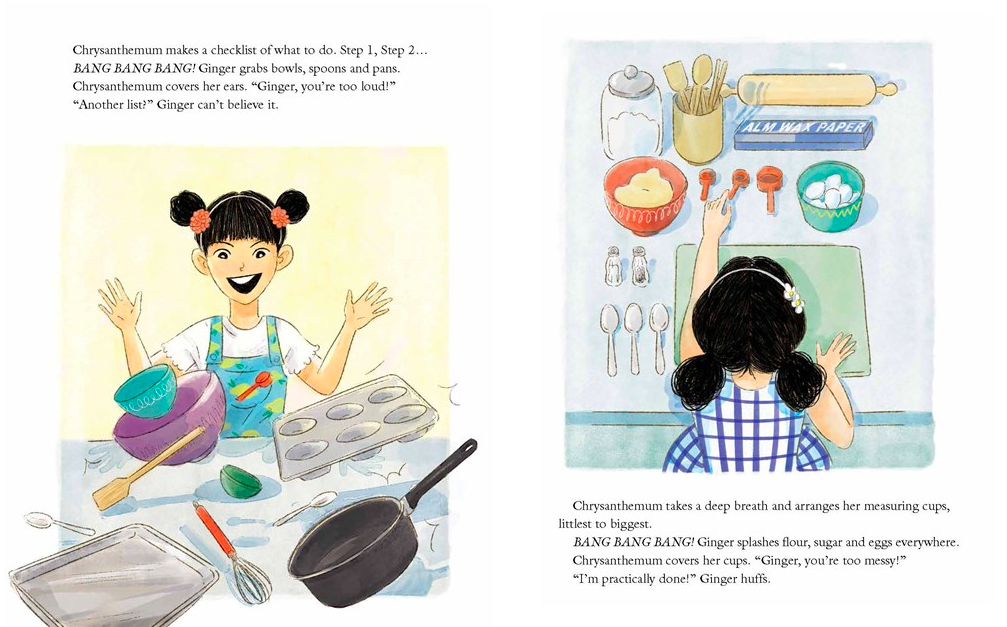
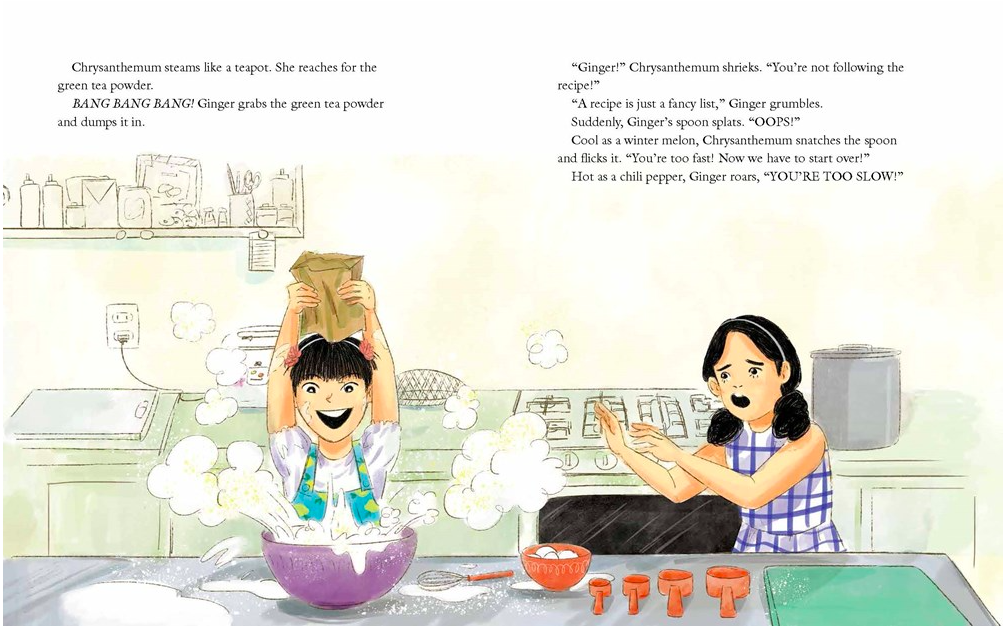
Ginger rushes around the kitchen, banging pans and rattling bowls; Chrysanthemum makes another list and patiently lays out all of her utensils and ingredients. Ginger is mixing the flour, eggs, and sugar with such vigor that the batter splashes everywhere. “‘Ginger, you’re too messy,’” Chrysanthemum tells her. Ginger is upset with how slowly Chrysanthemum is working. “Chrysanthemum steams like a teapot.”

Both girls reach for the green tea powder at the same time, but Ginger’s faster and dumps it in the bowl. Chrysanthemum yells at her cousin that she’s not following the recipe, but Ginger grumbles that “‘a recipe is just a fancy list.’” With the cake ruined, the girls take a break and decide to make another cake. But there’s no more green tea powder. They mull over the problem then Ginger suggests using chrysanthemum tea instead of green tea, and Chrysanthemum thinks of using ginger ice cream for the frosting. Ginger cleans up the mess while Chrysanthemum measures out the ingredients. “Ginger mixes. Chrysanthemum pours.” When they lick the spoon, the batter tastes delicious.

celebrate-picture-books-picture-book-review-ginger-and-chrysanthemum-baking

Image copyright Shirley Chan, 2020, text copyright Kristen Mai Giang, 2020. Courtesy of Levine Querido.

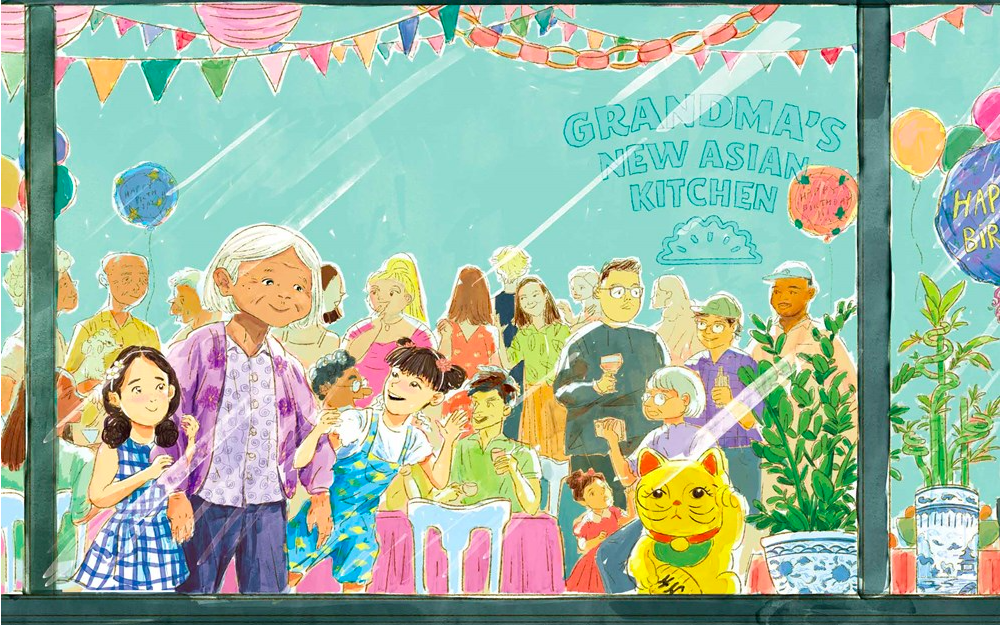
At the party, Chrysanthemum and Ginger take Grandma by the arms and lead her over to show her their cake. “The cake looks a little lopsided, the color slightly strange…. Ginger and Chrysanthemum hold hands – and their breath” as Grandma takes a bite. “She loves it!” She hugs her “little soybeans.” Then Ginger and Chrysanthemum share a slice. “Warm cake, cool icing. Perfect together. Like two beans in a pod.”

An Author’s note explaining the traditional Chinese belief that foods have warming or cooling characteristics and should, ideally, create a balance follows the text.

celebrate-picture-books-picture-book-review-ginger-and-chrysanthemum-party

Image copyright Shirley Chan, 2020, text copyright Kristen Mai Giang, 2020. Courtesy of Levine Querido.

In her entertaining story of two cousins with opposite personalities, Kristen Mai Giang cleverly uses the Chinese concept of warm and cool foods to create impulsive Ginger and precise Chrysanthemum. As the girls dress and shop for Grandma’s party, readers will be charmed by the cousins while giggling at their differences. When mishaps while baking Grandma’s cake fray their nerves and lead to angry words, Giang introduces a gentle lesson on how to get back on track and cooperation. While taking a break, Ginger and Chrysanthemum rely on their close relationship to come up with a solution that pleases them both. Kids will appreciate the ingenuity in their new recipe that combines both of their personalities and may be inspired to try making up a cake recipe of their own.

Shirley Chan clearly sketches out Ginger and Chrysanthemum’s opposite personalities in the first pages as Ginger stands in the middle of her messy room sporting a mix-and-match outfit appropriate for a rock star while Chrysanthemum channels a runway model in her perfectly accessorized dress. Spontaneous kids will identify with Chan’s depictions of Ginger playing around at the market while careful children will admire Chrysanthemum’s thoughtfulness in choosing just the right flowers. Chan’s images of the two spirited girls in the kitchen will enchant young readers, and the party scene is vibrant and inviting.

A creative and relatable story to inspire teamwork and a celebration of individuality, Ginger and Chrysanthemum would be an engaging addition to home, school, and public library collections.

Ages 4 – 7

Levine Querido, 2020 | ISBN 978-1646140015

Discover more about Kristen Mai Giang and her books on her website.

To learn more about Shirley Chan, her books, and her art, visit her website.

Bake for Family Fun Month Activity

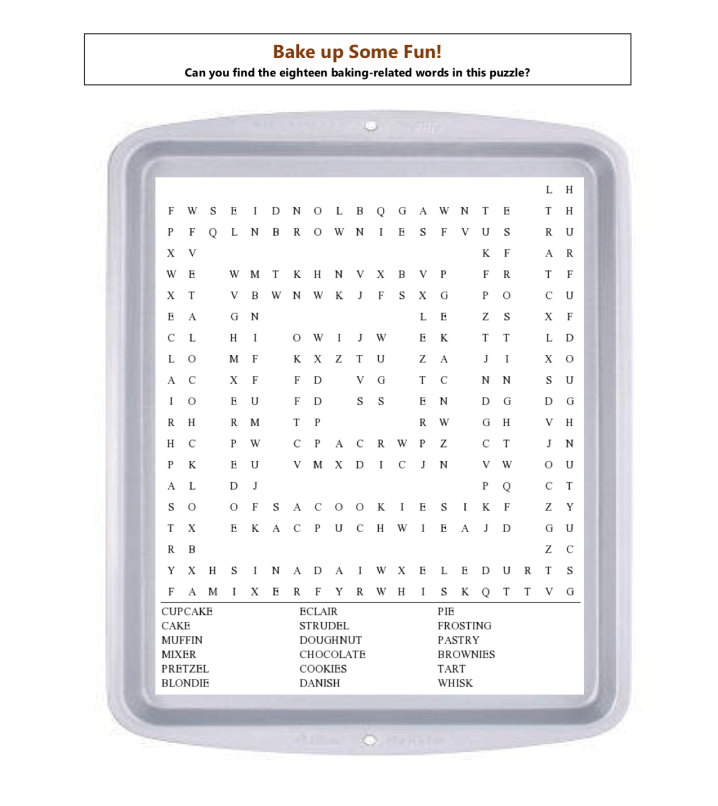
celebrate-picture-books-picture-book-review-bake-up-some-fun-word-search

Bake up Some Fun! Word Search Puzzle


Before this pan goes into the oven, can you find the eighteen baking-related words in this printable word search puzzle?

Bake up Some Fun! Word Search PuzzleBake up Some Fun! Word Search Solution

celebrate-picture-books-picture-book-review-ginger-and-chrysanthemum-cover

You can find Ginger and Chrysanthemum at these booksellers.

Amazon | Barnes & Noble | Books-a-Million

To support your local independent bookstore, order from

Bookshop | IndieBound

Picture Book Review
February 16 – Innovation Day

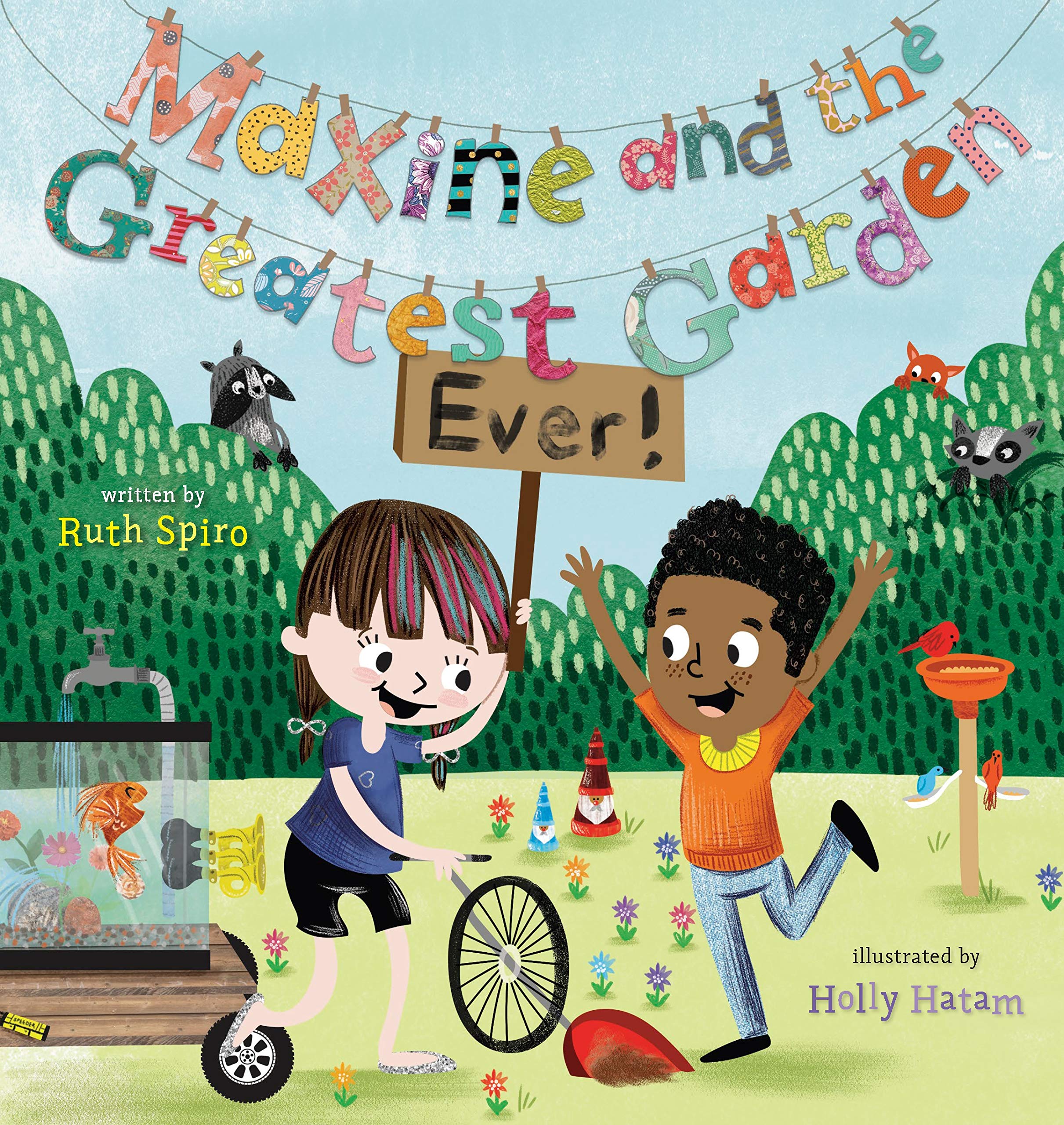
celebrate-picture-books-picture-book-review-maxine-and-the-greatest-garden-ever-cover

About the Holiday

Today we celebrate all those people who look at a problem and design a solution, or who just ask, “What if…?” and search for answers. The holiday was established by the Science History Institute in conjunction with the Society of Chemical Industry to help bring attention to those people who were not only producing technology, but were also pushing the envelope on what was possible. Each year, these two organizations coordinate to host Innovation Day. This year, restrictions and life-changing alterations needed to combat COVID-19, have sparked innovations both large and small at home, for business, at schools, and for medical researchers. Creative individuals have kept us entertained, given us hope, and kept things going even in the most difficult of times. To celebrate today, put on your thinking cap, look around you, and do something new, novel, and completely unexpected. Who knows…you may be the next great inventor!

Maxine and the Greatest Garden Ever!

Written by Ruth Spiro | Illustrated by Holly Hatam


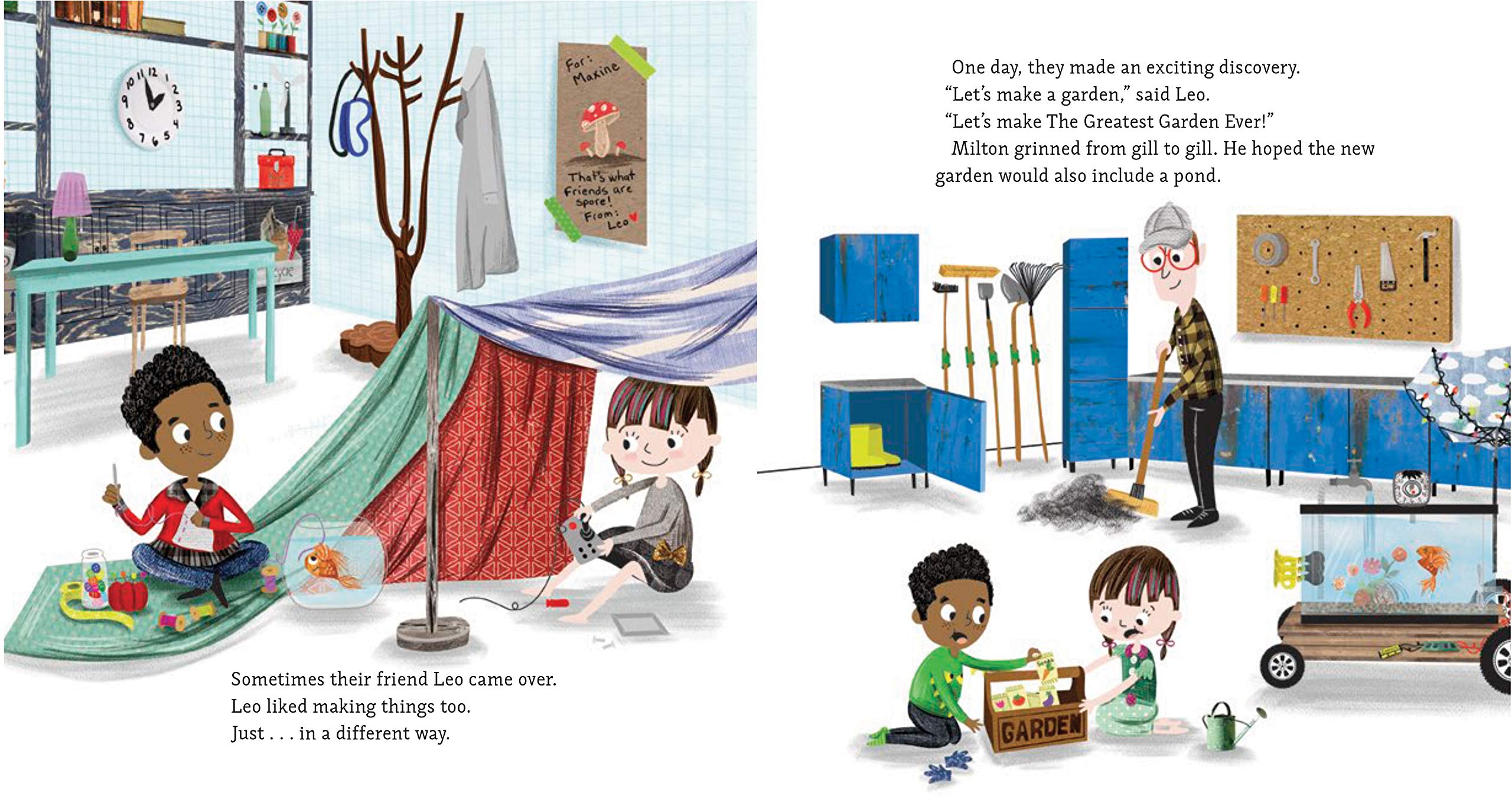
Maxine and her goldfish, Milton, were best friends, and Maxine loved thinking up creative scientific or technical ways to keep him fed, safe, and happy. “Maxine liked making things, and she especially liked making things for Milton. ‘If I can dream it, I can build it!’ she said.” Maxine’s other friend Leo also liked making things, but his creations were more arty.

celebrate-picture-books-picture-book-review-maxine-and-the-greatest-garden-ever-seeds

Image copyright Holly Hatam, 2021, text copyright Ruth Spiro, 2021. Courtesy of Dial Books.

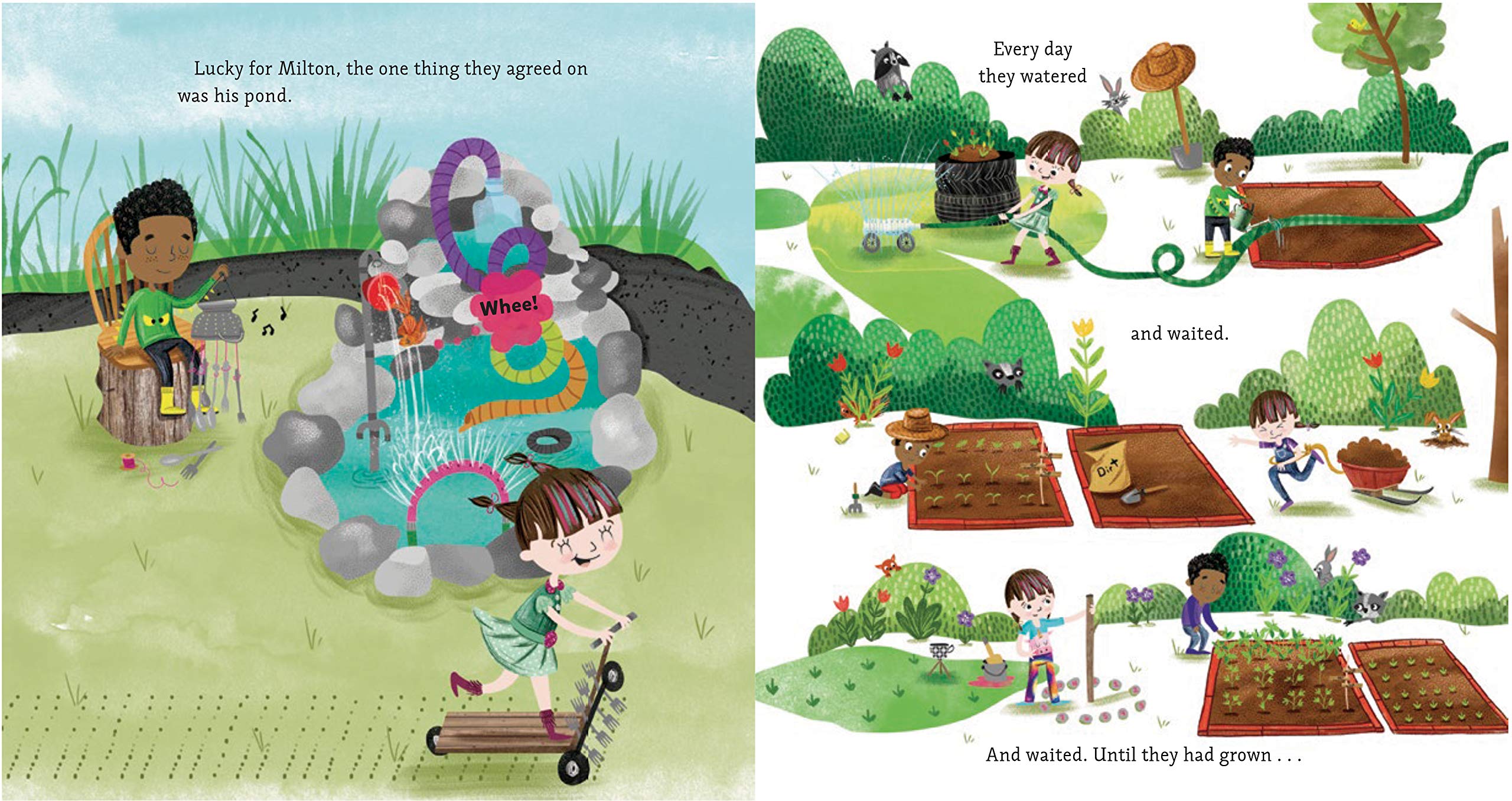
One day when Leo was visiting Maxine, they found packets of seeds and decided to build “‘The Greatest Garden Ever!’” Milton hoped the garden would have a pond just for him. Leo and Maxine drew up their plans. “Leo’s was pretty. Maxine’s was practical.” When they planted the seeds, Leo planted them far apart in large beds of soil. Maxine’s seeds were packed close together in pots made from old tires, barrels, toys, and even a chandelier. They both looked askance at the other’s seeds. They did, however, agree on Milton’s pond.

Every day they watered, weeded, and waited. At last, they truly did have “The Greatest Garden Ever!” There were vegetables and flowers, birdfeeders and a gazebo. The wild animals thought the garden was great too. One day, Maxine and Leo came to the garden to find nibbled carrots, radishes, and eggplants; pots were knocked over and little footprints were everywhere. Maxine wanted to make something to keep the animals away. “‘Something that looks nice?’ asked Leo. ‘Something that works.,’” said Maxine.

celebrate-picture-books-picture-book-review-maxine-and-the-greatest-garden-ever-pond

Image copyright Holly Hatam, 2021, text copyright Ruth Spiro, 2021. Courtesy of Dial Books.

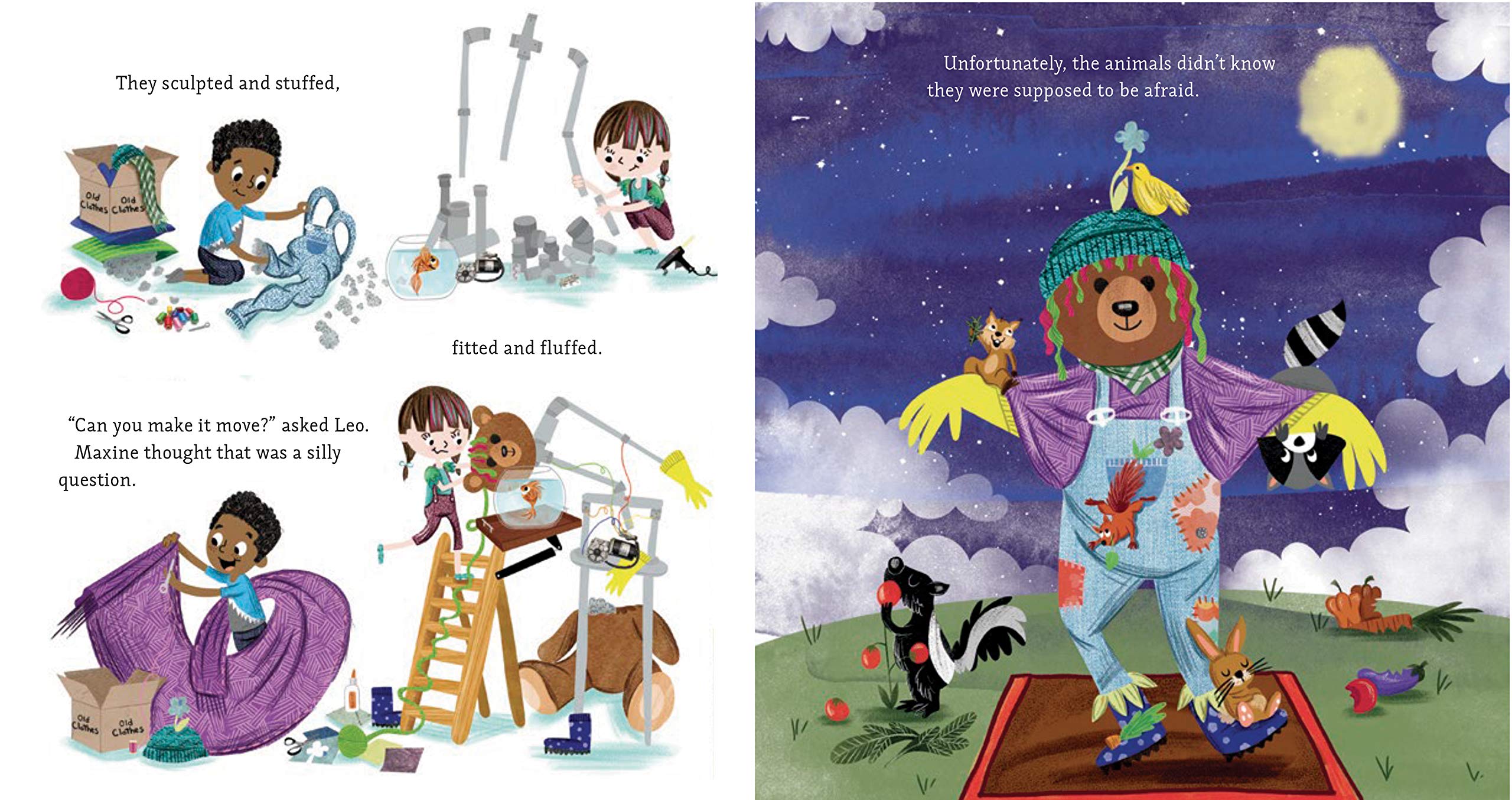
They decided to make a scarecrow. While Leo stuffed overalls and made a shirt, Maxine built a mechanical body for the big teddy bear that would wear them. But the animals didn’t think the scarecrow was very scary. While Leo thought the bear had done nothing, Maxine said that it had helped them know what didn’t work. They gathered new supplies and “then while Leo sewed, Maxine wrote some code.” This time the bear had laser eyes, moving parts, loud sounds, a shiny helmet, and a scary black dress. That night, though, the scarecrow was so scary that it made babies cry, dogs howl, and kept neighbors awake.

celebrate-picture-books-picture-book-review-maxine-and-the-greatest-garden-ever-scarecrow

Image copyright Holly Hatam, 2021, text copyright Ruth Spiro, 2021. Courtesy of Dial Books.

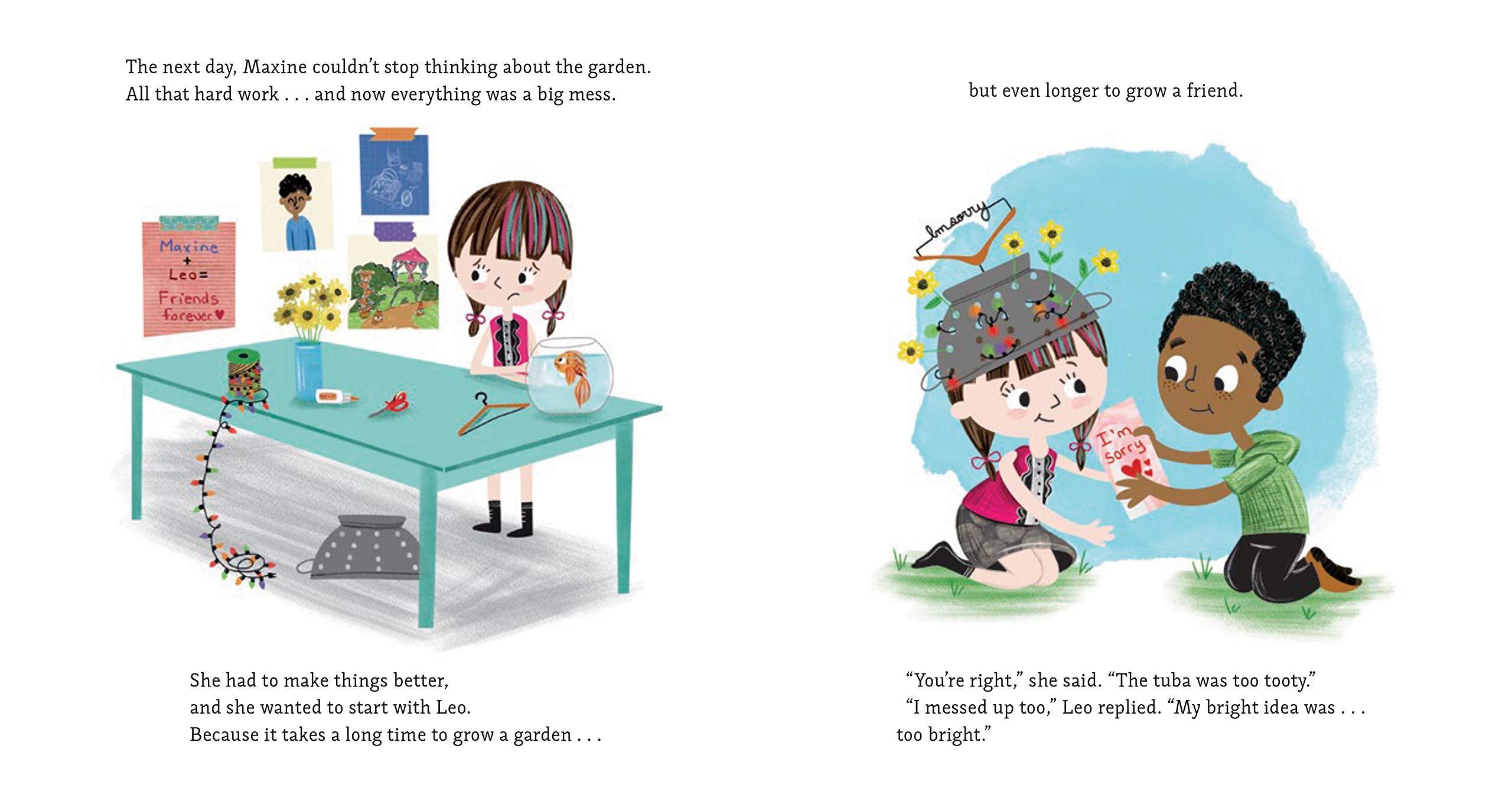
Leo blamed Maxine, and Maxine blamed Leo. At home, Maxine and Leo thought about the garden and what they’d said. Maxine wanted “to make things better, and she wanted to start with Leo. Because it takes a long time to grow a garden… but even longer to grow a friend.” When they met the next day, they both apologized. As they cleaned up the garden and shared the last of the lettuce, Maxine had an idea. She and Leo repaired, repainted, and replanted, and when they were finished, they invited their new animals friends to enjoy the garden with them.

celebrate-picture-books-picture-book-review-maxine-and-the-greatest-garden-ever-apology

Image copyright Holly Hatam, 2021, text copyright Ruth Spiro, 2021. Courtesy of Dial Books.

Ruth Spiro’s celebration of creativity, gardening, and friendship will enchant kids and show them that sometimes projects lead to try and try again cooperation before the original vision or a new idea is perfected. Through Maxine’s talent for engineering, coding, and inventing and Leo’s artistic abilities, Spiro shows readers that whatever their skills are, they can contribute to the success of any endeavor. When Maxine and Leo’s frustrations over the garden spill out into their relationship and an argument ensues, Spiro reminds kids that people and enduring friendships are more important than plans, projects, or events and that apologies and understanding keep relationships strong. Her charming narration, realistic dialogue, and periodic rhymes create a story that’s a joy to read aloud.

Holly Hatam’s vivid illustrations will keep kids lingering over the pages to catch all of her puns, Maxine’s inventions, and Leo’s crafts—many of which enterprising kids may want to try to replicate. Cheery Maxine with her red-and-blue streaked hair, bright eyes, and quick imagination is enthusiastic and confident, and Leo, wearing a dragon shirt any kid would love, is equally as confident and passionate about his talents. The garden is a visual treat, from its first planting to its early stages to its full-grown glory. Hatam’s vision for both of Maxine and Leo’s scarecrows is original and gleefully kid-centric. The final image of the shared garden at night is a spectacular celebration for all.

Both fans of Maxine and Milton’s first adventure in Made by Maxine and new readers of this little series will ask to hear Maxine and the Greatest Garden Ever! again and again. A rousing friendship story to engage kids in STEAM-related activities or to jumpstart ideas for those times when they’re are looking for something to do at home, Maxine and the Greatest Garden Ever! Is highly recommended for home, school, and public library collections.

Ages 4 – 8

Dial Books, 2021 | ISBN 978-0399186301

Discover more about Ruth Spiro and her books on her website.

To learn more about Holly Hatam, her books, and her art, visit her website.

Innovation Day Activity

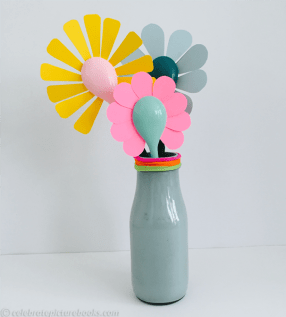
celebrate-picture-books-picture-book-spoon-flowers

Spoon Flowers Craft


It may not be time for gardening, but that doesn’t mean you can’t “grow” some flowers. With a little innovation, you can give anyone a bouquet with this easy craft!

Supplies

  • Colorful plastic spoons
  • Heavy stock paper or construction paper in various colors, including green for leaves
  • Multi-surface glue or hot glue gun

Directions

  1. Cut petals from the heavy stock paper or construction paper
  2. Glue the petals to the bowl of the spoon
  3. Cut leaves from the green paper (optional)
  4. Glue leaves to the handle of the spoon (optional)

celebrate-picture-books-picture-book-review-maxine-and-the-greatest-garden-ever-cover

You can find Maxine and the Greatest Garden Ever! at these booksellers

Amazon | Barnes & Noble | Books-a-Million

To support your local independent bookstore, order from

Bookshop | IndieBound

Picture Book Review
February 10 – It’s Plant the Seeds of Greatness Month

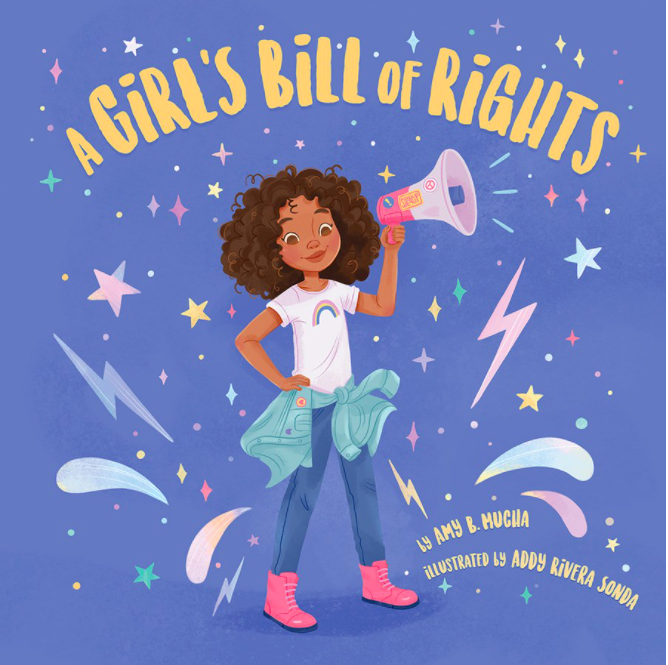
celebrate-picture-books-picture-book-review-a-girl's-bill-of-rights-cover

About the Holiday

Ideas and dreams lead to accomplishments and accomplishments can lead to greatness! And when does this all begin? In childhood as kids develop knowledge, skills, and confidence. Plant the Seeds of Greatness Month was established to help people remove barriers to their success and make changes to better their lives. To celebrate with your kids, talk to them about what they would like to achieve and what kind of support they need to make their dreams come true. Today’s book can help girls understand that they should always celebrate their talents and emotions and never feel second-best or accept impediments to their success. So, get started this month on planting – and nurturing – all the seeds of your greatness in your family or classroom.  


A Girl’s Bill of Rights

Written by Amy B. Mucha | Illustrated by Addy Rivera Sonda


In her super book that affirms a girl’s right to her own likes, dislikes, and feelings, Amy B. Mucha presents her story in the first person, allowing readers to internalize the affirming text and identify with her examples. The book opens with a Black girl talking about her skateboard and skateboarding for show and tell. The narrator states, I have the right to like what I like and love what I love.” In the front row of desks, Addy Rivera Sonda includes three more girls, including one who uses a wheelchair, ready to talk about their favorites: pets, soccer, and dance.

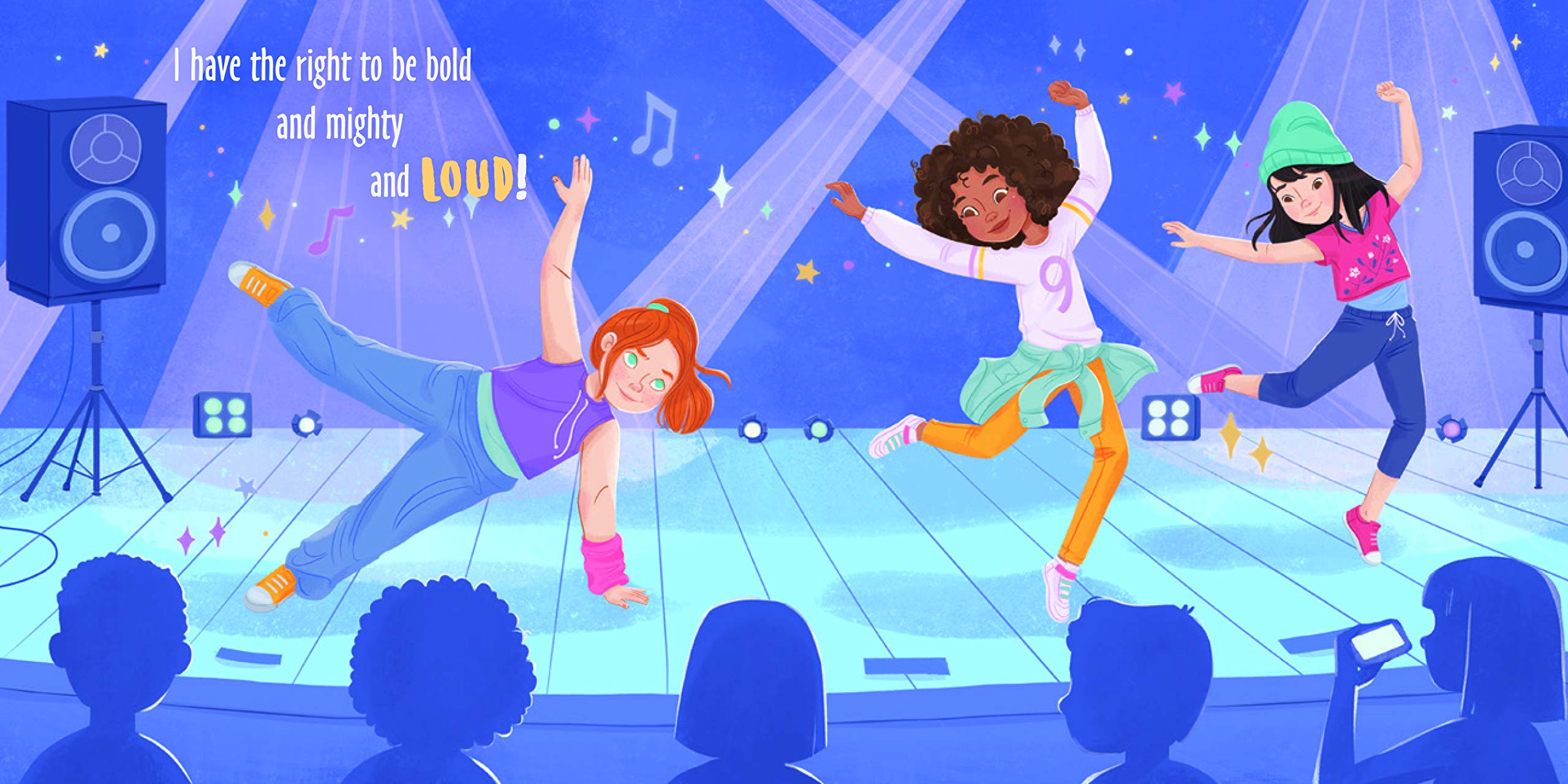
celebrate-picture-books-picture-book-review-a-girl's-bill-of-rights-dancing

Image copyright Addy Rivera Sonda, 2021, text copyright Amy B Mucha. Courtesy of Beaming Books.

As the girl’s vote for class president, readers are told that they have the right to think for themselves, make their own choices, and for their “Yes” to mean yes and their “No” to mean no. And if they feel disappointed or frustrated or happy, they can show their feelings without being chastised or made to feel it’s not appropriate.

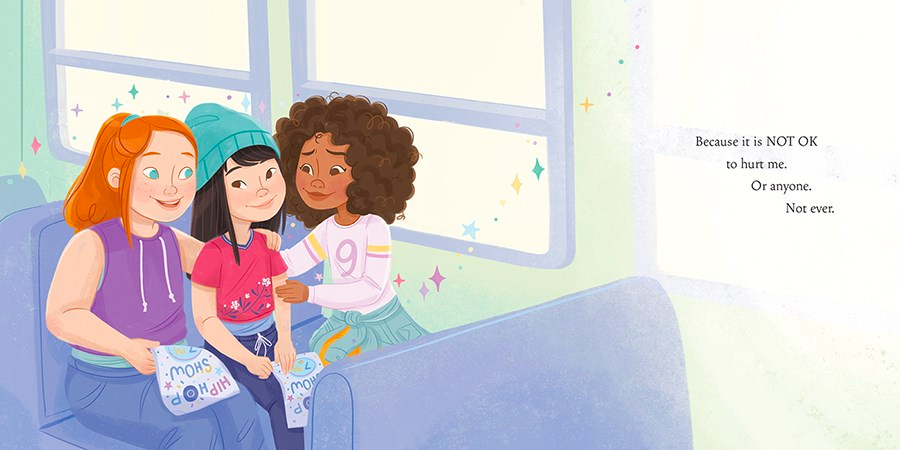
Girls are reminded that it’s okay to make mistakes, and that when it comes to making friends, they can choose their own as well as how they express their affection. Girl’s also learn that “if someone is hurting or disrespecting me, I have the right to say ‘STOP!’ and even the right to SCREAM it!’ Because it is NOT OK to hurt me. Or anyone. Not ever.” And every girl is reassured that she has the right to decide who she is now and what she will choose to do in the future; she’s reassured that she has the right to be herself.

celebrate-picture-books-picture-book-review-a-girl's-bill-of-rights-bus

Image copyright Addy Rivera Sonda, 2021, text copyright Amy B Mucha. Courtesy of Beaming Books.

In her straightforward , empowering text, Amy B. Mucha shows girls just how valuable they are. Through the examples I highlighted and many other common issues on which girls are criticized, ignored, or second guess themselves, Mucha delivers a strong message that their opinions, feelings, and preferences are valuable and should be heard. Periodic rhymes give the text a lyricism that flows easily from page to page. The number and range of rights that Mucha presents gives children and adults many opportunities to discuss these important and commonly faced experiences as well as their immediate and long-term effects on girls.

In her vibrant and expressive illustrations populated with a group of diverse girls, Addy Rivera Sonda shares clear images of girls doing what they love, adopting a look that reflects their personality, making choices, expressing their emotions, sticking up for themselves, and being proud of their accomplishments. From school to the soccer field to the stage to a party, Sonda presents uplifting examples of how this close-knit group supports each other. For girls, these images will resonate deep in their hearts. Boys reading or listening to the book—and this is a book every boy should know—will see how and why girls express a variety of emotions as well as behaviors on the part of others that are destructive to a girl’s self-esteem and autonomy. The final illustration showing all six girls happy to live as their true selves is a poignant and heartening vision for children to take away from this book.

A dynamic read to empower and celebrate girls, A Girl’s Bill of Rights is highly recommended for home, classroom, and public libraries.

Ages 4 – 8

Beaming Books, 2021 | ISBN 978-1506464527

Discover more about Amy B. Mucha and her books on her website.

You can connect with Addy Rivera Sonda on Instagram.

Plant the Seeds of Greatness Month Activity

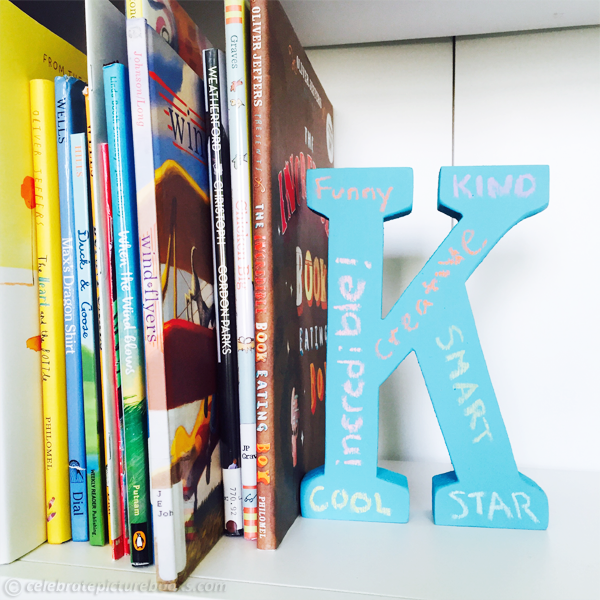
celebrate-picture-books-picture-book-review-initial-bookend

I Love Me! Initial Bookend


You can show your pride in your name (or play with changing it) with this easy craft that will keep all your books tidy on their shelf! This makes a great gift too!

Supplies

  • Sturdy wooden letter blocks in the child’s first and last initials. Or, if the child would like to try on a new name or nickname, the first letter of their new name.
  • Chalkboard or acrylic paint
  • Colored chalk
  • Paint brush

Directions

  1. Paint the letters, let dry
  2. With the chalk write words that describe you or names of your heroines and/or heroes
  3. Display your bookends

celebrate-picture-books-picture-book-review-a-girl's-bill-of-rights-cover

You can find A Girl’s Bill of Rights at these booksellers

Amazon | Barnes & Noble | Books-a-Million

To support your local independent bookstore, order from

Bookshop | IndieBound

Picture Book Review
February 9 – It’s Creative Romance Month

celebrate-picture-books-picture-book-review-bear-meets-bear-cover

About the Holiday

February, the month of love, is a perfect time to think up creative ways to surprise that special person in your life with a romantic gesture, exciting date night, or fun adventure that will add spice and fun to your relationship. With a little imagination you can find unique ways to show all the love that’s in your heart. 

I’d like to thank Bloomsbury Children’s Books for sharing Bear Meets Bear with me for review consideration. All opinions on the book are my own.

Bear Meets Bear

By Jacob Grant


Bear was waiting for the teapot he and Spider had ordered to arrive. It was exciting to think of getting something new delivered. At last the doorbell rang. When Bear opened the door, he found Panda, a delivery person he’d never seen before. She asked him to sign for his package, but Bear was smitten. “His heart beat fast…. He wanted to say something clever, or funny, or anything at all,” but he couldn’t.

celebrate-picture-books-picture-book-review-bear-meets-bear-delivery

Copyright Jacob Grant, 2020, courtesy of Bloomsbury Children’s Books.

The delivery woman asked for his signature again, and finally he was able to sign the sheet. He watched Panda peddle away on her delivery bike. Spider thought Bear’s predicament was quite funny. Bear rushed to his computer and ordered another teapot. Bear waited and waited. He watched out the window, hoping to see Panda’s delivery bike roll up.

celebrate-picture-books-picture-book-review-bear-meets-bear-waiting

Copyright Jacob Grant, 2020, courtesy of Bloomsbury Children’s Books.

Bear was just considering ordering another tea pot when he saw Panda coming up the walk. But when she handed him the box and asked him to sign, Bear just stood silently again. “Spider felt sorry for his friend.” Bear ordered another teapot and another and another. Never could he summon the courage to talk to Panda, even though Spider encouraged him. Standing among all of the boxes of teapots, Spider told him he should “invite her to tea” or “at least remember to breathe” when Panda came to the door.

Bear agreed. He would order one more teapot and talk to Panda when it arrived. Bear waited with anticipation. But when the doorbell rang, it wasn’t Panda standing there, but a “gruff raccoon.” “Bear’s heart hurt.” He bemoaned the missed opportunities and regretted all the teapots. Spider wanted to help. He wrote a note and headed out to find Panda. He went from door to door asking if anyone had seen her. Finally, he found her at Duck’s house.

celebrate-picture-books-picture-book-review-bear-meets-bear-sad

Copyright Jacob Grant, 2020, courtesy of Bloomsbury Children’s Books.

The next day Panda was excited to see Panda on his doorstep. She thanked him for his invitation to a tea party. Bear felt himself freeze, but then he told her he would be just a minute. He cleaned up the scattered teapots and welcomed her in. Soon Bear and Panda were chatting and laughing like old friends.

After Panda said goodbye, Bear thanked Spider and said that Panda was very nice but that they would “not be meeting for tea again.” It turned out that Panda didn’t like tea! Bear was nonplussed, but thought it was “all rather funny.” The next time he and Panda met, Bear served lemonade. And what about all those teapots? Bear held a yard sale!

celebrate-picture-books-picture-book-review-bear-meets-bear-tea-party

Copyright Jacob Grant, 2020, courtesy of Bloomsbury Children’s Books.

Fans of Jacob Grant’s Bear and Spider series know that Bear is often hesitant to put himself out there, to try something new, or even, sometimes, to leave the house. It might be because his feelings are so strong or he doubts himself  – or a little of both. Fortunately, Bear has his good friend Spider who supports him and gives him a nudge when he needs it. When Bear meets Panda and is smitten, he, like many people, can’t find the exact right words among all those feelings; a simple “hello” doesn’t seem like enough. Grant understands. Enter Spider, who offers a gentle dose of honesty and provides always-polite Bear with an opportunity to shine. When Bear discovers that Panda doesn’t like tea, Grant also shows readers that conditions don’t have to be perfect to make a new friend and that a little humor goes a long way toward smoothing things over.

Grant’s tranquil color palette and simple shapes make it easy for readers to immerse themselves in Bear’s feelings, empathizing with his all-too-human predicament while enjoying the comical collection of all those tea pots. When Bear watches out the window day after day, willing Panda to return only to be filled with fear and anxiety when she does, Grant perfectly captures that “oh no, now what?” emotion as Bear’s paws fly to his face and his eyes widen. Likewise, Bear’s regrets are palpable as, surrounded by boxes, he buries his head in the chair. Throughout, Spider is there, weaving his web, strumming his banjo, and watching out for Bear. Wordless images of Bear and Panda enjoying lemonade together and Bear’s yard sale let kids know it has all turned out all right.

A charming, poignant, and reassuring addition to the Bear and Spider series, Bear Meets Bear,  a story about overcoming emotions that hold us back, is highly recommended for home, school, and public library bookshelves.

Ages 3 – 6

Bloomsbury Children’s Books, 2020 | ISBN 978-1547604241

Discover more about Jacob Grant, his books, and his art on his website.

Creative Romance Month Activity

celebrate-picture-books-picture-book-review-ceramic-mug-craft

Create a Mug


If you’re kids are looking for a gift to make for a family member or a friend for Valentine’s Day or any time, a personalized mug makes a creative way to share a little love every time it’s used. 

Supplies

  • Plain ceramic mug
  • Bakeable markers or paint

Directions

  1. Design and color your mug
  2. Follow directions on the markers or paint to properly bake on your decoration and make it permanent.

celebrate-picture-books-picture-book-review-bear-meets-bear-cover

You can find Bear Meets Bear at these booksellers

Amazon | Barnes & Noble | Books-a-Million

To support your local independent bookstore, order from

Bookshop | IndieBound

Picture Book Review
February 3 – World Read Aloud Day and Interview with Andy Harkness

celebrate-picture-books-picture-book-review-wolfboy-cover

About the Holiday

Sponsored by global non-profit LitWorld and Scholastic, World Read Aloud Day encourages reading aloud to children not only today but every day. Reading aloud to children from birth is one of the best ways to promote language development, improve literacy, and enjoy bonding time together. Millions of people celebrate today’s holiday all across the United States and in more than one hundred countries around the world. Typically, special events are held in schools, libraries, bookstores, homes, and communities, and authors and illustrators hold readings and visit classrooms. This year, you can find virtual read alouds, live events on Instagram, Facebook, and Youtube, printable games, and book lists as well stickers, bookmarks, posters, and a reading crown to decorate, when you visit LitWorld.

Thanks go to Bloomsbury Children’s Books for sending me a copy of Wolfboy for review consideration. All opinions of the book are my own. I’m also thrilled to be teaming with Bloomsbury in a giveaway of the book. See details below.

Wolfboy

By Andy Harkness


The full moon hung in the sky like a golden, frosted cupcake. Down below in the darkened forest Wolfboy was on the prowl. “He was HUNGRY. ‘Rabbits, rabbits! Where are you?’ he howled.” But he could find no rabbits. He “sploshed” into the creek, but no rabbits answered his calls. Not only was he “HUNGRY,” now he was also “HUFFY.” He climbed to the top of a very tall oak tree and scoured the ground far and wide. No rabbits. In addition to being “HUNGRY” and “HUFFY,” Wolfboy had become “DROOLY. He needed rabbits.”

celebrate-picture-books-picture-book-review-wolfboy-creek

Copyright Andy Harkness, 2021, courtesy of Bloomsbury Children’s Books.

Perhaps they were hiding in the bog, but there he only saw three crocodiles swimming his way. It made Wolfboy feel “GROWLY.” He made a daring leap into Moonberry Meadow. Surely, the rabbits were here. But no. Wolfboy could hardly contain himself. “he was HUNGRY and HUFFY and DROOLY and GROWLY and FUSSY.” He stomped and thrashed and leaped and menaced. He was done with rabbits, and he let the world (and those skittish rabbits) know it.

celebrate-picture-books-picture-book-review-wolfboy-feast

Copyright Andy Harkness, 2021, courtesy of Bloomsbury Children’s Books.

But then he heard a rustle and a snap. He focused his attention and saw some tell-tail signs. “Wolfboy crouched low” just as a warren-full of little bunnies emerged into the clearing. Wolfboy showed his teeth. His roar shook the forest. “‘Rabbits, where have you been? You’re late for our feast!’” But the rabbits just giggled and brought out the moonberry pie they’d made him. In a frenzy Wolfboy “CRUNCHED and MUNCHED and GOBBLED and GULPED!” When the pie was gone, Wolfboy explained that he had just been so, well… HUNGRY. But now he felt better and there was one huge happy rabbit hug for dessert.

celebrate-picture-books-picture-book-review-wolfboy-happy

Copyright Andy Harkness, 2021, courtesy of Bloomsbury Children’s Books.

Andy Harkness’s cumulative tale will get kids, who well-know that ravenously hungry feeling, up and growling along as Wolfboy goes from Hungry to Happy with all the personality-changing gastronomical feelings in between. Harness’s dialogue-rich storytelling is a delight, ripe for dramatic read alouds. The forest setting, with its creek, bog, oak, and ravine, inspires evocative vocabulary that enhances the suspense. What could this sharp-toothed, famished Wolfboy want with the rabbits? There could only be one thing… or could there? The endearing ending reaffirms that those Hangry wolves in our homes need only a little (or a big) treat to return to their true puppy natures.

Visually stunning, Harkness’s illustrations, built with clay and then photographed, immerse readers in extraordinary textured, intricate, and shadowy landscapes that beg close study. Neon blue Wolfboy, with his furrowed unibrow, rows of chicklet teeth, and long arms that waggle in hilariously menacing poses will have kids laughing out loud. And where are those rabbits? On every page! The little animal cracker-sized bunnies pop up in the most surprising places, and you can bet that you’ll hear plenty of “there’s one!” “I see two!” and “Let’s count them!” as you turn the pages.

For kids who love raucous, laugh-out-loud story times, those who appreciate exceptional art and the wonders of claymation, and readers who prefer their beasts to be big softies, Wolfboy is a must for home, school, and public library collections.

Ages 3 – 6

Bloomsbury Children’s Books, 2021 | ISBN 978-1547604425

Discover more about Andy Harkness, his books, movie work, and art on his website.

Meet Andy Harkness

celebrate-picture-books-picture-book-review–Andy Harkness author photo

Andy Harkness is an award-winning art director who has worked on Moana, Frozen, and Wreck-it-Ralph, among other movies. After twenty-five years at Disney, he recently moved to Sony Pictures Animation. Andy’s first book, Bug Zoo, was published by Disney as an Artist Showcase Book in 2016. He lives in California with his family. You can connect with Andy on His Website | Instagram | Twitter  

I’m thrilled to be talking with Andy Harkness about his inspiration for Wolfboy, his process in creating the incredible illustrations, one of his biggest challenges, and more!

I think everyone can empathize with ravenously hungry Wolfboy! Where did the idea for your story come from?

I have always loved scary stories. In particular, werewolf stories. It’s the transformation that intrigues me. In 2005, I took a first pass at a story but it really didn’t go anywhere until my wife and I had children. We noticed an incredible transformation when they were hungry. Our little angels became little monsters. And the story of Wolfboy was born!

The shape of Wolfboy is so perfectly funny and menacing. Did his look undergo many revisions? How did you decide on the final design?

He went through so many revisions! Initially, he had a red striped shirt and blue jeans. Then he was a very detailed brooding character with huge hands and feet. When I was working on the rough design for the cover, I quickly drew him in blue. I wasn’t trying to design him at that moment but suddenly, there he was. He looked fierce but really funny. His final design is almost exactly like that quick sketch. One thing he always had was big pointy ears. I wanted him to be a very recognizable shape when he was small on the page.

CPB – Andy Harkness_Question 2

Which brings us to your stunning pages, which are all entirely made from clay. Can you take readers through your process of making the pages? How long did it take you to carve all the settings and characters? 

I start with a loose drawing that is projected onto a piece of glass, or is taped beneath the glass.

Andy Harkness_Question 3

Using super sculpey polymer clay, I sculpt as much as possible by hand and use a few tools for the smallest details. When the sculpt is done, it is positioned near a window to get interesting natural light and shadow on the surface. 

CPB - Andy Harkness_Question 3 process

Then it’s photographed and the colors painted in layers in photoshop. The trick is to do as little touch up to the clay as possible.  My fingerprints are literally all over this book!  Each sculpt was redone at least two times.  The first attempt was really for working out the problems so that the second attempt went smoothly.  From start to finish, the sculpts that are in the book were done over the course of a year.  Some took a day or two, others weeks, one took a whole year! I usually worked on several at the same time.

Andy Harkness_Question 3 process

Readers might be interested in this behind-the-scenes video I made showing how I created the shadowy tree illustration near the beginning of the book.

The colors and shadowing you achieve is amazing and really immerses readers in the suspense of the story and their own hunt for rabbits on each page. Do you have a favorite spread? Was there one that was the most difficult?

Great question and thank you! I am inspired by old black and white horror movies and really wanted to bring that dramatic lighting into the book. My favorite spread is when Wolfboy leaps over the steep ravine. I think the symmetry and how it’s lit from beneath make it feel like a stage. Very theatrical. The hardest spread by far was the “creaky old oak” spread. That sculpt was redone 6 times before I was happy. And the reflection in the water is sculpted as well. I worked on that one on and off for about a year.

You’re currently working as the Art Director on Vivo, coming from Sony Animation Pictures later this year and you’ve previously worked for Disney. In these positions you’ve helped create many kid-favorite blockbusters, such as Moana, Frozen, Tangled, and Wreck-it-Ralph among many others. Can you briefly describe for kids (and maybe future animation artists) the steps as an animated feature is conceptualized, designed, and ultimately put together? What was one of the biggest challenges you’ve faced on a movie you’ve worked on? One of the best surprises? 

It starts with a great idea. Early concept paintings are done to get everyone excited about the project. As the story develops, a visual style and color palette is created to support it. A character designer develops the characters while working closely with the production designer to make sure the shape language is consistent with the backgrounds. Then a literal army of talented modelers, riggers, animators, special effects artists, layout artists and lighters begin to build the world we see on screen. It’s an incredible undertaking actually.  If it’s done right, it’s like a finely tuned orchestra. 

The biggest challenge I’ve ever faced was designing Motu Nui, Moana’s home island. Everything was researched and done with the utmost respect for the culture. We had South Pacific advisors with us the whole time. Every plant and tree was what would have been there 3000 years ago. A botanist helped us make sure of that. From the positioning of the village in the valley, to the various fales (homes and other structures), everything was as accurate as we could make it. Armed with all that knowledge, I sculpted that island in clay.  That fragile sculpt is sitting in the Disney Archives today. The head of layout, head of environments, head of modeling, and myself won a VFX award for Outstanding Created Environment in an Animated Feature.  

The biggest surprise happened on my current show, VIVO. I had the opportunity to collaborate with one of my heroes, Sir Roger Deakins, on the lighting and color for the movie. Still can’t believe it!

In addition to writing and illustrating Wolfboy, you’ve also illustrated Bug Zoo and The Ballad of Nessie. What do you like best about being a writer and illustrator for kids?

I think for me it really boils down to hearing that a kid loves one of my books so much the cover has fallen off. It’s how I felt about certain books as a kid. They sparked magic in my mind and I hope to give that back now through my own books.

What’s up next for you?

Well first up, I hope to do another Wolfboy book!  After that I have several more children’s book ideas bouncing around in my head.  

I will probably be working on a few more animated films, but one day I really hope to focus solely on writing and illustrating children’s books.

Thanks so much for this wonderful chat! Your work is amazing, and I’m sure readers are thrilled to learn more about it. I wish you all the best with Wolfboy – I really hope there will be a second Wolfboy adventure!

World Read Aloud Day Activity

celebrate-picture-books-picture-book-review-WRAD-bookmark

I Love Reading Bookmarks


If you love to read then you know that sometimes you want to mark a favorite page or remember where you left off. With these special World Read Aloud Day bookmarks, you can do it in style! 

World Read Aloud Day Bookmarks to Color | Colorful World Read Aloud Day Bookmarks

You can find Wolfboy at these booksellers

Amazon | Barnes & Noble | Books-a-Million

To support your local independent bookstore, order from

Bookshop | IndieBound

Picture Book Review