September 10 – African Fabric Month

African Fabric Month™ was launched in 2016 by Lisa Shepard Stewart of Cultured Expressions, Inc. The celebration “promotes the artistic and practical uses of such fabrics as ankara prints, batik, kuba, adinkra, bogolan/mudcloth, korhogo, adire, kente, and more, and serves to honor and promote the cultures that create them.” While Stewart shares her love for African fabrics year round through special online and in-person events, this month-long holiday puts particular focus on the global positive contributions of the weavers and other textile artists of Africa. To learn more about the holiday as well as ongoing events and activities, visit culturedexpressions.com.

Thank you to Charlesbridge and Barbara Fisch at Blue Slip Media for sending me this book for review!

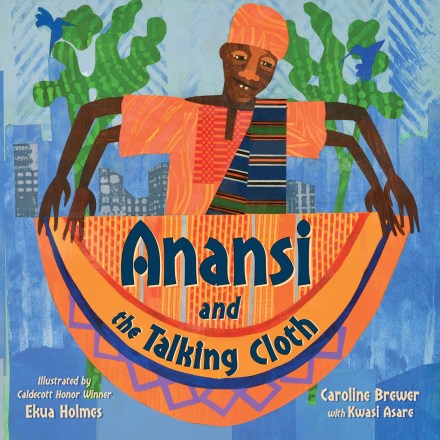
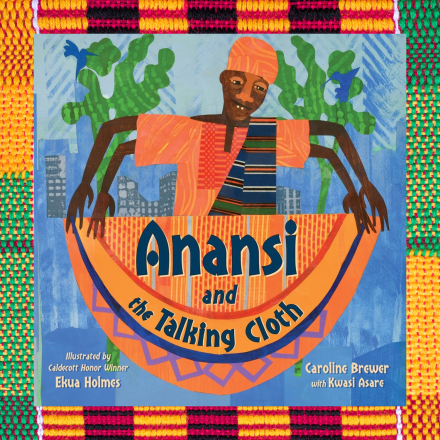
Anansi and the Talking Cloth

Anansi the spider, chief storyteller and trickster, lives in a city “well-known for its talented weavers, / who work their hands and feet in a fascinating fever” to create “kente, the talking cloth.” Each unique cloth made by the spider weavers tells a story revealing truths, courage, how to spread peace or the fact that “our families are more precious than gold.” The city brims with sunshine, vibrant foliage, music, and smooth transportation. Even the “rainbows glow with a sparkly dew.”
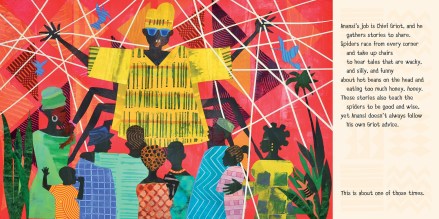
Illustration copyright © 2026 by Ekua Holmes. Text copyright © 2026 by Caroline Brewer with Kwasi Asare. Published by Charlesbridge copyright © 2026.

Even though Anansi gathers the spiders together to tell his wise tales, he doesn’t always adhere to them himself. For instance, while the spider weavers create unique and beautiful cloth by hand, many people “strut about in machine-made brands” that are cheap and quickly fashioned, but have no stories to impart—including Anansi himself! As time passes and the spider weavers’ sales slip, the weaving industry folds, and the once-vibrant community fades. The kente weavers cry, and Anansi wants to help.
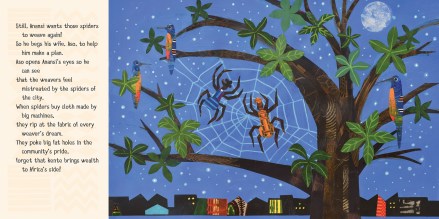
Illustration copyright © 2026 by Ekua Holmes. Text copyright © 2026 by Caroline Brewer with Kwasi Asare. Published by Charlesbridge copyright © 2026.

But Anansi resorts to his trickster ways and tries to scare the weavers into returning to their looms, but they aren’t fooled. With the help of his wife Aso, Anansi finally sees that the “weavers feel mistreated by the spiders of the city.” By buying machine-made cloth, they “rip at the fabric of every weaver’s dream” and destroy “community pride.” Anansi listens to his wife’s suggestions and calls the community together to thank the weavers, but is it too late to restore the sunshine, singing and dancing, vivid colors, and vibrant kente talking cloth to the once hip city?

Back matter includes an Author’s Note discussing the legends and history behind Anansi and kente cloth as well as an Illustrator’s Note about a trip Ekua Holmes recently made to Ghana.
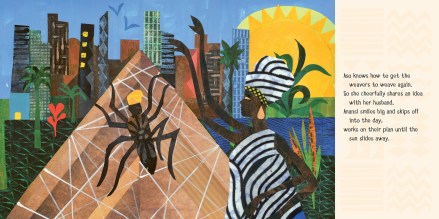
Illustration copyright © 2026 by Ekua Holmes. Text copyright © 2026 by Caroline Brewer with Kwasi Asare. Published by Charlesbridge copyright © 2026.

In Anansi and the Talking Cloth, Caroline Brewer, in consultation with master kente-cloth weaver Kwasi Asare, created an original Anansi story, which is at once as timeless as classic Trickster stories and as current as debate over fast fashion versus lasting quality. Brewer’s stylish storytelling weaves rhymes and the spirited rhythms of assonance, consonance, and alliteration to envelope readers in her magical imaginings of spider weavers creating valuable kente talking cloth—a term created by Brewer for the story. The jaunty cadence flows from page to page, making the story a joyful, riveting read aloud. Through Aso’s thoughtful answer to the weavers’ strike, Brewer also strikes a universal chord for showing respect and gratitude.

Ekua Holmes’ electrifying collage illustrations in glorious overlapping hues of blue, orange, red, green, and yellow bring the intricate patterns and vibrant colors of kente cloth to the page. Young readers will be awed by the spider weavers as they use their many arms and legs to weave talking cloth and be fascinated by images of people and spiders mingling in the city, shopping, dancing, making music, and gathering to hear Anansi’s stories.

With underpinnings in Ghanaian culture and the legacy of kente cloth production, Anansi and the Talking Cloth is a highly inventive and jazzy read aloud that is pure fun while also imparting the values of storytelling and guarding precious traditions. The book is a must for any public and school library collection and would be on frequent rotation for home story times.

Ages 5 – 8

Charlesbridge, 2026 | ISBN 978-1623544218

About the Authors

Caroline Brewer is an award-winning children’s book author, artist, environmentalist, literacy consultant, and creator of Nature-Wise, a program for students and teachers that blends literacy and nature exploration. Caroline is also author and illustrator of Harriet Tubman, Force of Nature and author of Say Their Names. She lives in the Washington, DC, metro area. Visit her at carolinebrewerbooks.com.

Kwasi Asare was born in Nsawam, near the capital city of Accra, Ghana, and is one of Africa’s most prominent and accomplished weavers known for kente cloth, the highly prized Ghanaian cloth that traditionally symbolizes royalty, honor, and leadership. For the United Nations’ fiftieth anniversary in 1995, he created a new kente cloth design. Until 2017, it replaced the original cloth created by Kwasi’s father, A. E. Asare. Visit him at kwasiasare.com.

About the Illustrator

Ekua Holmes was awarded a Caldecott Honor, Coretta Scott King’s John Steptoe New Talent Illustrator Award, Robert Siebert Award, and Boston Globe–Horn Book award for Voice of Freedom: Fannie Lou Hamer, Spirit of the Civil Rights Movement, her first illustration project. She won the Coretta Scott King Award for Illustration twice: Out of Wonder: Poems Celebrating Poets and Stuff of Stars. Visit her at ekuaholmes.com.
You can purchase Anansi and the Talking Cloth from these booksellers

Amazon | Barnes & Noble | Bookshop

February 9 – It’s Creative Romance Month

celebrate-picture-books-picture-book-review-bear-meets-bear-cover

About the Holiday

February, the month of love, is a perfect time to think up creative ways to surprise that special person in your life with a romantic gesture, exciting date night, or fun adventure that will add spice and fun to your relationship. With a little imagination you can find unique ways to show all the love that’s in your heart. 

I’d like to thank Bloomsbury Children’s Books for sharing Bear Meets Bear with me for review consideration. All opinions on the book are my own.

Bear Meets Bear

By Jacob Grant


Bear was waiting for the teapot he and Spider had ordered to arrive. It was exciting to think of getting something new delivered. At last the doorbell rang. When Bear opened the door, he found Panda, a delivery person he’d never seen before. She asked him to sign for his package, but Bear was smitten. “His heart beat fast…. He wanted to say something clever, or funny, or anything at all,” but he couldn’t.

celebrate-picture-books-picture-book-review-bear-meets-bear-delivery

Copyright Jacob Grant, 2020, courtesy of Bloomsbury Children’s Books.

The delivery woman asked for his signature again, and finally he was able to sign the sheet. He watched Panda peddle away on her delivery bike. Spider thought Bear’s predicament was quite funny. Bear rushed to his computer and ordered another teapot. Bear waited and waited. He watched out the window, hoping to see Panda’s delivery bike roll up.

celebrate-picture-books-picture-book-review-bear-meets-bear-waiting

Copyright Jacob Grant, 2020, courtesy of Bloomsbury Children’s Books.

Bear was just considering ordering another tea pot when he saw Panda coming up the walk. But when she handed him the box and asked him to sign, Bear just stood silently again. “Spider felt sorry for his friend.” Bear ordered another teapot and another and another. Never could he summon the courage to talk to Panda, even though Spider encouraged him. Standing among all of the boxes of teapots, Spider told him he should “invite her to tea” or “at least remember to breathe” when Panda came to the door.

Bear agreed. He would order one more teapot and talk to Panda when it arrived. Bear waited with anticipation. But when the doorbell rang, it wasn’t Panda standing there, but a “gruff raccoon.” “Bear’s heart hurt.” He bemoaned the missed opportunities and regretted all the teapots. Spider wanted to help. He wrote a note and headed out to find Panda. He went from door to door asking if anyone had seen her. Finally, he found her at Duck’s house.

celebrate-picture-books-picture-book-review-bear-meets-bear-sad

Copyright Jacob Grant, 2020, courtesy of Bloomsbury Children’s Books.

The next day Panda was excited to see Panda on his doorstep. She thanked him for his invitation to a tea party. Bear felt himself freeze, but then he told her he would be just a minute. He cleaned up the scattered teapots and welcomed her in. Soon Bear and Panda were chatting and laughing like old friends.

After Panda said goodbye, Bear thanked Spider and said that Panda was very nice but that they would “not be meeting for tea again.” It turned out that Panda didn’t like tea! Bear was nonplussed, but thought it was “all rather funny.” The next time he and Panda met, Bear served lemonade. And what about all those teapots? Bear held a yard sale!

celebrate-picture-books-picture-book-review-bear-meets-bear-tea-party

Copyright Jacob Grant, 2020, courtesy of Bloomsbury Children’s Books.

Fans of Jacob Grant’s Bear and Spider series know that Bear is often hesitant to put himself out there, to try something new, or even, sometimes, to leave the house. It might be because his feelings are so strong or he doubts himself  – or a little of both. Fortunately, Bear has his good friend Spider who supports him and gives him a nudge when he needs it. When Bear meets Panda and is smitten, he, like many people, can’t find the exact right words among all those feelings; a simple “hello” doesn’t seem like enough. Grant understands. Enter Spider, who offers a gentle dose of honesty and provides always-polite Bear with an opportunity to shine. When Bear discovers that Panda doesn’t like tea, Grant also shows readers that conditions don’t have to be perfect to make a new friend and that a little humor goes a long way toward smoothing things over.

Grant’s tranquil color palette and simple shapes make it easy for readers to immerse themselves in Bear’s feelings, empathizing with his all-too-human predicament while enjoying the comical collection of all those tea pots. When Bear watches out the window day after day, willing Panda to return only to be filled with fear and anxiety when she does, Grant perfectly captures that “oh no, now what?” emotion as Bear’s paws fly to his face and his eyes widen. Likewise, Bear’s regrets are palpable as, surrounded by boxes, he buries his head in the chair. Throughout, Spider is there, weaving his web, strumming his banjo, and watching out for Bear. Wordless images of Bear and Panda enjoying lemonade together and Bear’s yard sale let kids know it has all turned out all right.

A charming, poignant, and reassuring addition to the Bear and Spider series, Bear Meets Bear,  a story about overcoming emotions that hold us back, is highly recommended for home, school, and public library bookshelves.

Ages 3 – 6

Bloomsbury Children’s Books, 2020 | ISBN 978-1547604241

Discover more about Jacob Grant, his books, and his art on his website.

Creative Romance Month Activity

celebrate-picture-books-picture-book-review-ceramic-mug-craft

Create a Mug


If you’re kids are looking for a gift to make for a family member or a friend for Valentine’s Day or any time, a personalized mug makes a creative way to share a little love every time it’s used. 

Supplies

  • Plain ceramic mug
  • Bakeable markers or paint

Directions

  1. Design and color your mug
  2. Follow directions on the markers or paint to properly bake on your decoration and make it permanent.

celebrate-picture-books-picture-book-review-bear-meets-bear-cover

You can find Bear Meets Bear at these booksellers

Amazon | Barnes & Noble | Books-a-Million

To support your local independent bookstore, order from

Bookshop | IndieBound

Picture Book Review
June 15 – Fly a Kite Day

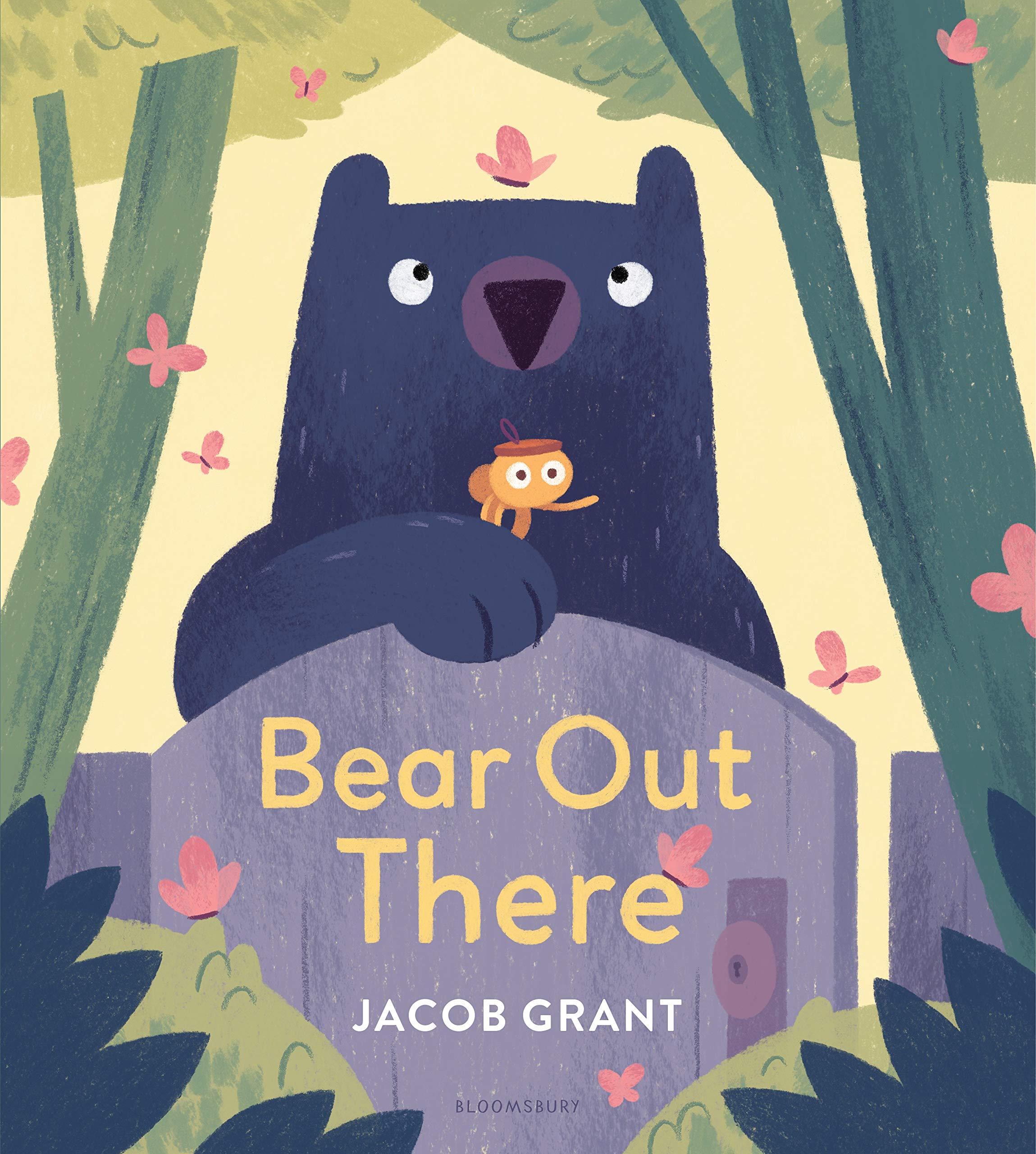
celebrate-picture-books-picture-book-review-bear-out-there-cover

About the Holiday

When Fly a Kite Day and Global Wind Day occur on the same day, you know it’s time to get outside and send a kite soaring. A terrific activity to do with kids – especially in this time of social distancing, kite flying is not only fun but it teaches concepts about the wind, flight, and distance. And if you make your own kite, kids get a lesson in design and engineering with some practice with tools thrown in too. So celebrate today with the kite of your choice and keep the fun going all summer long. 

Bear Out There

By Jacob Grant


While Bear had tea, Spider was showing him the kite he had made. “He was very excited to fly it out in the yard.” Spider loved everything about the outdoors—the sun, the gentle breeze, the plants, and even the bugs. Bear loved everything about staying indoors. He was looking forward to cleaning up his house and having another cup of tea.

celebrate-picture-books-picture-book-review-bear-out-there-new-kite

Copyright Jacob Grant, 2019, courtesy of Bloomsbury Children’s Books.

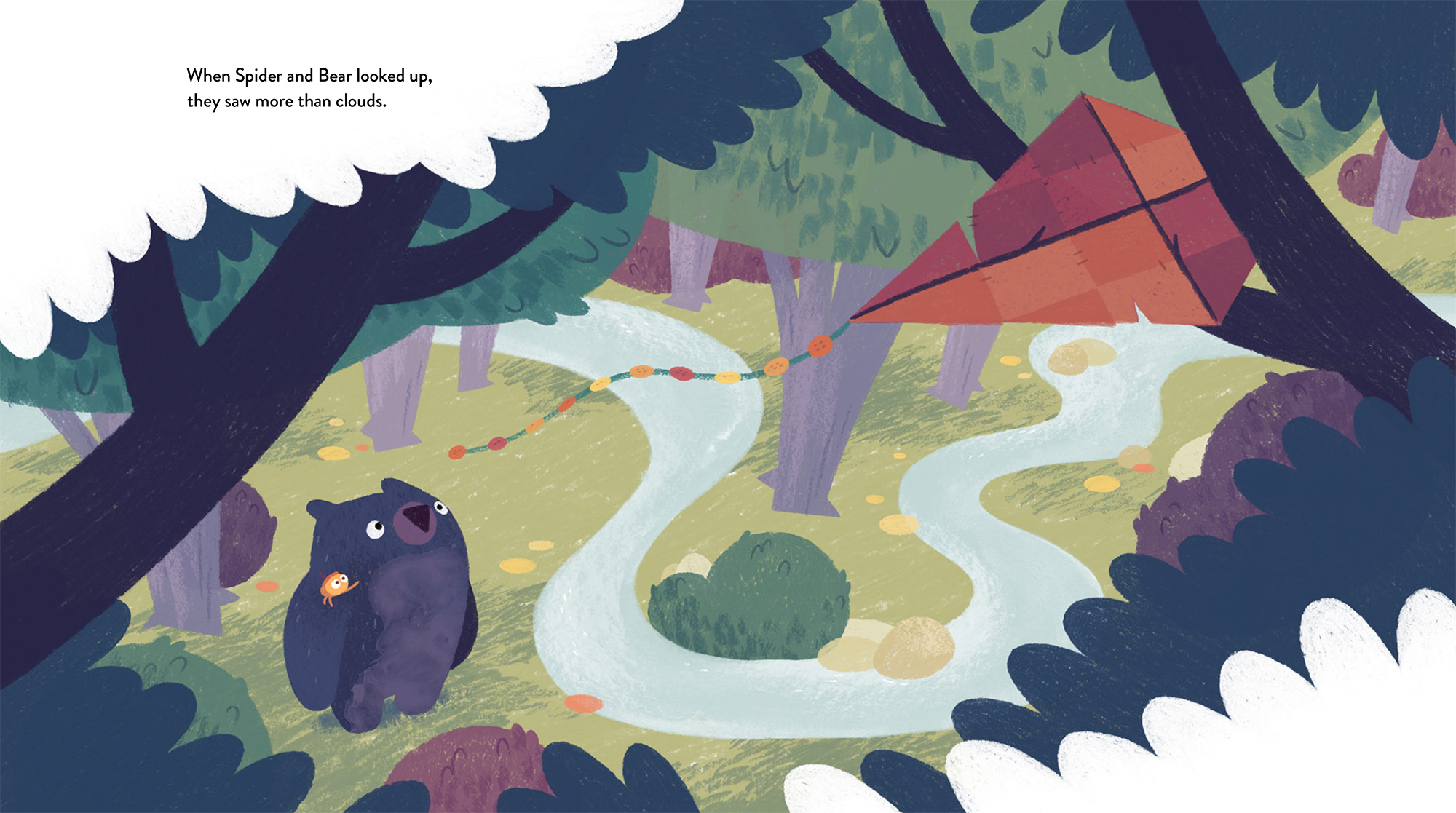
But then Spider’s kite took off on its own and because Bear was a good friend, he said he would help look for it. But he reminded Spider: “…you know I do not like the forest.” In fact, Bear did not like anything about the forest—the “filthy ground…the itchy plants…the pesky bugs.” Spider, on the other hand, thought a search through the forest would be fun.

celebrate-picture-books-picture-book-review-bear-out-there-heading-out

Copyright Jacob Grant, 2019, courtesy of Bloomsbury Children’s Books.

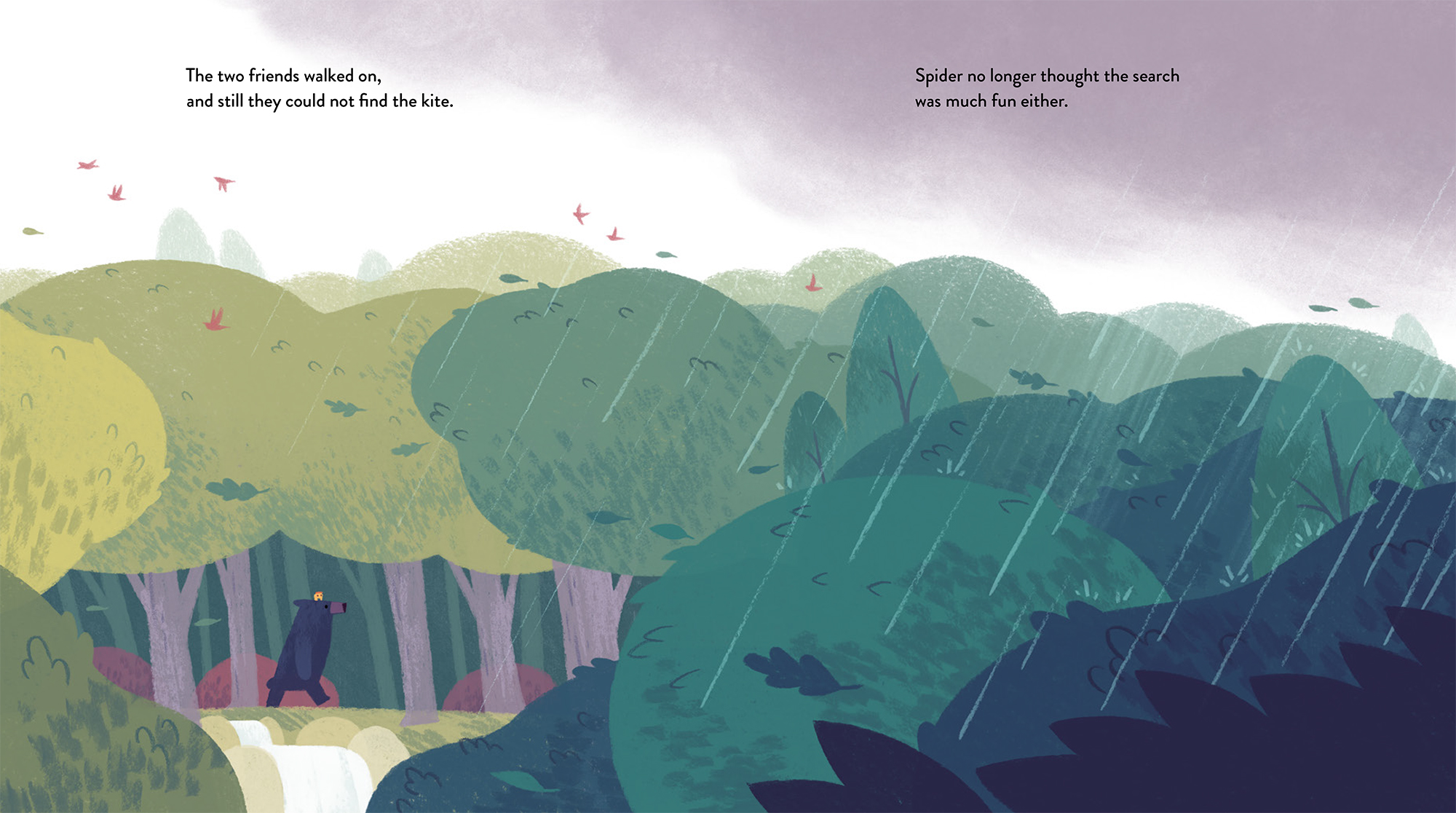
As they walked, Bear grumbled and complained about the fragrant weeds, the noisy owls, and all the other “unpleasant” things all around them. They had still not found the kite when it started to rain. Now, not even Spider was having a good time, and Bear was more miserable than before. “‘Surely this search cannot get any worse!’ he said. But it could.”

celebrate-picture-books-picture-book-review-bear-out-there-waterfall

Copyright Jacob Grant, 2019, courtesy of Bloomsbury Children’s Books.

Bear gave up. He was ready to go home and have a cup of tea in his comfy chair. But then he saw Spider sitting on a rock. Rain drops splashed off his tiny button hat and he looked bedraggled and disappointed. Bear relented. “‘Maybe we could look just a little farther,’” he said. Spider was happy just to be with Bear.

The rain lessened and Bear and Spider looked up at the clearing sky. There, stuck in the branch of a tree, was Spider’s kite. Back home, they soaked in a hot bath, patched the rips in Spider’s kite, made one for Bear, and, of course, had tea—which they enjoyed while flying their kites from Bear’s comfy chair out in the yard.

celebrate-picture-books-picture-book-review-bear-out-there-kite-found

Copyright Jacob Grant, 2019, courtesy of Bloomsbury Children’s Books.

Jacob Grant’s seemingly odd-couple friendship between a big black bear and an itty-bitty spider is as charming and comforting as it gets. While Spider loves the outdoors, Bear is a homebody; but when his friend needs help, Bear puts his own feelings aside to help. It doesn’t take long—only one page, in fact—for Bear to give up the tidy day he had planned for a tromp through the woods in search of Spider’s lost kite. As the hunt grows long and conditions worsen, Bear begins to grumble until he finally gives up. Again, though, one glance at disappointed Spider spurs him on to continue the search. And for Spider, just having Bear by his side makes things all right.

The dynamics between Bear and Spider are pitch perfect, mirroring the love and trust between parents and kids, best friends, teachers and students, and other adult-child pairs. A story isn’t a real story without change, and here, too, Grant offers an inspiring truism. The final scene in which Bear and Spider both enjoy flying kites while sipping tea and lounging in Bear’s chair shows the joy of sharing and embracing another’s favorite activity.

celebrate-picture-books-picture-book-review-bear-out-there-

Copyright Jacob Grant, 2019, courtesy of Bloomsbury Children’s Books.

Grant’s gentle, soft-hued illustrations are full of meaning and humor, of the forest’s allure that Bear doesn’t see, and of Spider’s feelings that he does. Although Bear is a neat-freak—scrubbing, dusting, and sweeping—he’s careful to leave Spider’s resting spots intact. In the woods, Bear grumbles about the smells, the noise, and the general unpleasantness while readers see a beautiful bouquet of flowers, a topsy-turvy turn of events in an owl’s nest, and a scenic panorama complete with waterfall and butterflies. Coming back to their home with its inviting pink teapot and orange chairs is the perfect antidote to any busy or stressful day.

Bear Out There is an endearing read and would be a favorite addition to home, classroom, and public library bookshelves for its sweet depiction of what true friendship between adults and kids or among children is all about. Readers won’t want to miss Jacob Grant’s first Bear and Spider adventure, Bear’s Scare.

Ages 3 – 6

Bloomsbury Children’s Books, 2019 | ISBN 978-1681197456

To learn more about Jacob Grant, his books, and his art, visit his website.

Fly a Kite Day Activity

celebrate-picture-books-picture-book-review-kite-maze

Soaring Kite Maze


The dips and rises your pencil takes through this maze is a little like the way a kite flies through the sky! Print your Soaring Kite Maze and enjoy!

celebrate-picture-books-picture-book-review-bear-out-there-cover

You can find Bear Out There at these booksellers

Amazon | Barnes & Noble | Books-a-Million 

To support your local independent bookstore, order from

Bookshop | IndieBound 

Picture Book Review

June 27 – It’s National Zoo and Aquarium Month

celebrate-picture-books-picture-book-review-be-nice-to-spiders-cover

About the Holiday

This month’s observance pays tribute to the role of zoos and aquariums and the work they do for education, conservation, and research to protect the world’s animals. As zoos and aquariums build exhibits that more closely resemble the animals’ natural habitats and offer interactive and hands-on programs, more visitors can learn about the environments and science of each amazing creature. These institutions are also reaching out with personal and online visits to schools by zoologists and other experts, increasing the interest in biology and animal science to students. Nearly 175 million people—50 million of which are children—visit zoos and aquariums each year. To celebrate today, visit your local zoo or aquarium!

Be Nice to Spiders

By Margaret Bloy Graham


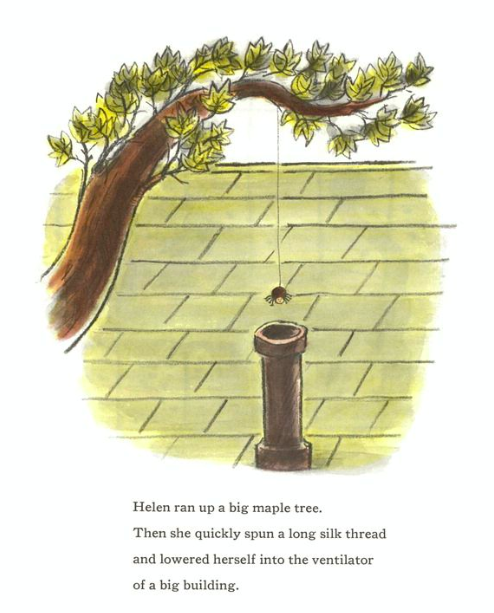
One morning as the Zoo Keeper was about to open the gate, he noticed a matchbox with a note attached to it. The “note read: ‘Please look after Helen. I’ve had her since she was a baby, but I can’t keep her anymore. We have to move to an apartment that won’t take pets. Thanks, Billy.” When the Keeper opened the box, out jumped eight-legged Helen. She scurried into the maple tree and then “quickly spun a long silk thread and lowered herself into the ventilator of a big building” that turned out to be the Lion House. The poor lions—a father lion, a mother lion, and four cubs—were beset by flies. “The lions were annoyed, but Helen was delighted. She loved to eat flies.” Right away she wove a big, sticky web. “One by one the flies got caught…. And one by one Helen ate them.”

celebrate-picture-books-picture-book-review-be-nice-to-spiders-matchbox

Copyright Margaret Bloy Graham, 1967, courtesy of HarperCollins.

After a week, the Lion House was free of flies and the lions were comfortable. Helen moved on to the Elephant House. She set up her web, and in a week the elephants were happy too. Next, Helen went to the Zebra House and after she “had caught all the flies there, the zebras were able to eat their hay in peace.” In fact, the zoo turned into a peaceful place for all the animals. Helen was very content too.

One morning, the Keeper called all the workers together and told them that the Mayor was coming for a visit that day. He wanted them to clean up all the cages and especially “‘get rid of all those spider webs.’” Joe said that he thought spiders were beneficial, but the Keeper thought the spider webs made the zoo look a mess. With their brushes, brooms, and hoses, the workers scrubbed the cages clean. When they got to the Camel House, they found one of Helen’s webs loaded with flies. He swiped at the web, but Helen had vanished.

celebrate-picture-books-picture-book-review-be-nice-to-spiders-Helen

Copyright Margaret Bloy Graham, 1967, courtesy of HarperCollins.

When the Mayor arrived, he declared that he’d never seen the zoo looking “‘so neat and the animals looking so well.’ Meanwhile Helen was still in the Camel House, hiding in a crack in the ceiling.” She was afraid to come out. Days passed and Helen grew hungry. Flies returned and began to bother the camels again. One night, Helen was so hungry that she came out and spun a web. She decided to stay in the Camel House—“she didn’t dare go anywhere else.” This was good for the camels, but not good for all the other animals.

celebrate-picture-books-picture-book-review-be-nice-to-spiders-roof

Copyright Margaret Bloy Graham, 1967, courtesy of HarperCollins.

The Keeper couldn’t understand what had happened. As he and Joe walked through the zoo, the animals and even the visitors were under clouds of flies and looking miserable. But then they went into the Camel House. Here there were no flies, and the camels were peaceful and happy. Then Joe spied one of Helen’s webs. “‘Look, Chief,’ Joe shouted. ‘Now I know what’s going on! See that spider up there? It’s eating all the flies…. Spiders are useful. That’s what I tried to tell you the other day.’”

The Keeper called all the workers together and told them about Joe’s discovery. He also had a new rule for the zoo: “‘Be nice to spiders.’ Soon the Zoo became famous for its happy, healthy animals, and Helen was treated like a queen.” One day, Helen even got her picture on the front page of the newspaper under the headline: “Local Zoo Named Best of Year; Three Cheers for Spider! Says Keeper.

celebrate-picture-books-picture-book-review-be-nice-to-spiders-zebras

Copyright Margaret Bloy Graham, 1967, courtesy of HarperCollins.

One of the people reading the newspaper was Billy’s dad. He showed the article to Billy, and the next day Billy went to visit Helen. He introduced himself to the Keeper, and then noticed something special in Helen’s web. It was an egg sac. “‘I bet there’ll be plenty of baby spiders soon,’” exclaimed Billy. And sure enough, a few days later Helen became the proud mother of lots and lots of little spiders. “From then on, Helen and her children and all the animals in the Zoo lived happily ever after.”

celebrate-picture-books-picture-book-review-be-nice-to-spiders-zoo

Copyright Margaret Bloy Graham, 1967, courtesy of HarperCollins.

Margaret Bloy Graham’s classic story has been a kid-favorite since 1967—I know it was a favorite of mine and I was happy to pull my Weekly Reader Children’s Book Club Edition copy out of my collection for this review. Billy’s sweet concern for his pet spider, Helen’s initiative in dropping into the Lion House, and the natural solution to the zoo’s fly problem all combine to make this a story that is ever-fresh and appealing to kids. Graham’s smooth and straightforward narration is sprinkled with realistic dialogue and builds to a suspenseful turn that is riveting to children. Kids with pets of their own will cheer when Billy learns that Helen is a hero. The idea of natural, environmentally safe solutions to pest control is still relevant and resonant today.

celebrate-picture-books-picture-book-review-be-nice-to-spiders-web

Copyright Margaret Bloy Graham, 1967, courtesy of HarperCollins.

Graham’s illustrations have lost none of their charm, in fact kids will be enchanted by the vintage look and adore little Helen who, with a smile on her face, snares plenty of flies in her webs. Readers will like seeing just how a spider goes about constructing a web and will enjoy spying where Helen is on each page. You can bet there will be a chorus of “noooo!” as a zoo worker raises his broom to sweep away Helen and one of her webs and an enthusiastic “yesss!” when Joe points out just how vital she is to the zoo. The illustrations also give adults and kids an opportunity to talk about how things have changed at zoos over the intervening years.

An impactful story with lots of heart, Be Nice to Spiders will be a favorite of kids who love spiders, zoos, and the environment.

Ages 4 – 7

HarperCollins, 1967

National Zoo and Aquarium Month Activity

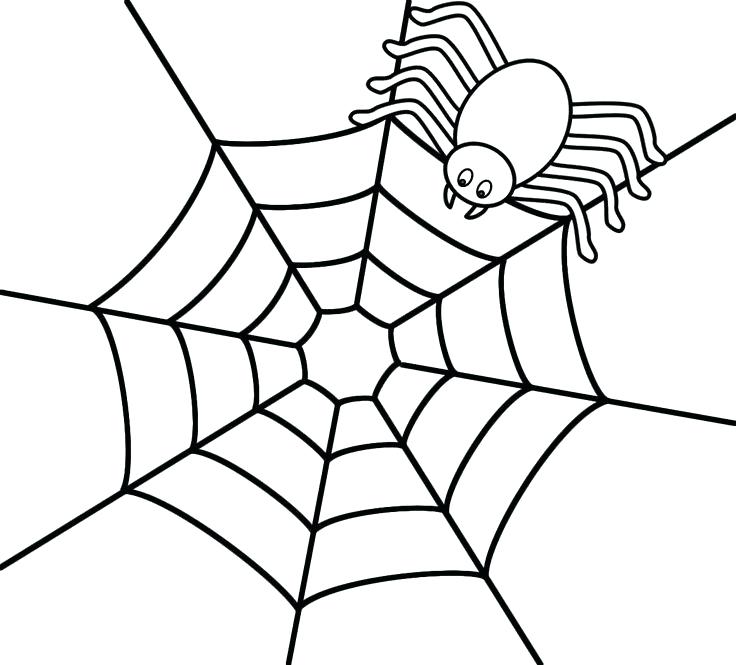
celebrate-picture-books-picture-book-review-spider-coloring-page

Splendid Spider Coloring Page

Having a spider in the house is lucky! Here’s an alert spider just waiting for some flies. Grab your crayons or pencils and feed him – or be a little silly. What else can this spider catch in his web?

Splendid Spider Coloring Page

celebrate-picture-books-picture-book-review-be-nice-to-spiders-cover

You can find Be Nice to Spiders at these booksellers

Amazon | Barnes & Noble | Books-a-Million | IndieBound

Picture Book Review