The AIUNAU, a non-profit dedicated to protecting all wildlife, established International Sloth Day in 2010 to raise awareness of the dangers facing these gentle animals who always seem to have a smile on their face. There are six species of sloth and two types—two-toed and three-toed. Each of the six species lives in its own unique habitat and has its own characteristics. While all species are seeing a population decline, the pygmy sloth is rated as “critically endangered” as there are fewer than 100 animals in existence. Sloths need protection from power lines, cars, and poachers who capture them to sell as pets as well as from other environmental issues that destroy their habitats. To learn more about the various species of sloths, visit AZ Animals.
Sloth’s Treehouse Inn
Written by Carrie Hasler | Illustrated by Christina Wald
Deep in the rainforest, a sloth named Santiago provided rest and comfort to animals from all over within the “gnarled branches that stretched to the sky” and “twisted roots that spread across the forest floor” of his Treehouse Inn. He was a caring innkeeper, always finding the perfect spot for each guest and their needs. One of his favorites was a blue morpho butterfly chrysalis that he gently checked on every day.
While there was usually plenty of room for everyone who visited, Santiago had noticed that his inn was getting crowded. When two toucans came looking for a place to spend the night, Santiago discovered why. The toucans told him that trees in large areas of the rainforest were being cut down, leaving the animals and birds nowhere to live. “The lush forest brimming with life was becoming nothing more than a swath of dirt and mud.” Hearing this made Santiago sad, and he found “he didn’t have the heart to turn anyone away,” so his Treehouse Inn was soon full.
But Santiago continued watching out for each one of his guests. He served tea every afternoon, provided games, and was happy to play slooow games of checkers with anyone who was willing. Before bedtime, Santiago told stories to young guests, who “didn’t seem to mind that the sloth was always the first to fall asleep, long before the story was over.”
Image copyright Christina Wald, 2022, text copyright Carrie Hasler, 2022. Courtesy of San Diego Zoo Wildlife Alliance Press.
The crowded conditions soon led to some squabbling among the guests. The howler monkeys complained loudly, and the tamarins hogged all the fruit. Santiago knew the animals needed more room; they needed homes. Most of all, he worried about where the butterfly would go when it finally emerged from its chrysalis.
One morning, Santiago awoke to see the beautiful butterfly looking back at him. “They both stayed still for a very long time, something the sloth happened to be very good at.” Then, in a flash, the butterfly took off and soared away. Wanting to see his friend one more time to say good-bye, Santiago climbed to the top of the tree. From there he saw how many trees had been cut down. But he also saw something else.
In the distance, he saw people planting new trees—saplings and seeds. Young trees were already growing, and other plants that made up the forest floor were also sprouting. “Filled with hope, Santiago couldn’t wait to tell the others.” As the trees and plants reclaimed their place in the rainforest, the animals found new homes, leaving the Treehouse Inn quiet once again. and “even though business was slow, its very fine innkeeper was happy just the way it was.”
The front endpapers offer fun facts about animals of the rainforest and the back endpapers offer a key to the types of animals found in a vertical, double-page spread midway through Sloth’s Treehouse Inn. Frontmatter provides a map of South America that highlights the location of the Amazon Rainforest while backmatter includes photographs, information about the rainforest, the causes of deforestation, and what individuals, environmentalists, and governments are doing to save the Amazon. There’s also a guide to how kids can help protect animals and plants in their own community.
Image copyright Christina Wald, 2022, text copyright Carrie Hasler, 2022. Courtesy of San Diego Zoo Wildlife Alliance Press.
In her well-crafted story, Carrie Hasler takes readers into the Amazon Rainforest—and to one tree in particular—to show them the vast array of wildlife and plants that call this unique region home as well as a major cause of habitat destruction. Through Hasler’s engaging storytelling, full of lyrical descriptions of the Treehouse Inn and its surroundings, kids meet Santiago, the innkeeper, who embodies the actual attributes of sloths in the wild—gentleness, caring, respectfulness to other creatures, and, of course, a slow, sleepy manner. Whimsical elements, such as the afternoon tea and games Santiago provides, will delight kids while inviting them to empathize with the growing number of guest who have lost their homes. Readers will also like following the progress of the blue morpho butterfly, whose departure leads to Santiago’s discovery of people’s work to replant the rainforest.
Christina Wald realistic illustrations burst with the color, light, and lush vegetation of the Amazon Rainforest. Each page will have readers lingering to view and appreciate the beauty of the rainforest and its denizens. As Santiago settles a group of poison dart frogs in just the right place to give them (and a tadpole) a pool and leaves to climb, the frogs appear as if they could simply hop out of the book. Turning from these types of gorgeous images, the two-page spread of trucks, machinery, and people with large saws cutting through the forest comes as a heartbreaking shock.
Wald’s show-stopping vertical illustration of the Treehouse Inn full of guests—from anteaters and tapirs below to a kinkajou, emerald tree boa, and hoatzin in the middle to a howler monkey and harpy eagle at the top—will have kids trying to spot all the creatures here and later in the book, while her clever checkerboard woven from leaves may inspire creative kids to make their own. The image of people replanting the clearcut forest area is inspiring and will prompt readers to learn more about how they can help.
An inspiring mix of fiction and nonfiction that will engage kids, Sloth’s Treehouse Inn would be a welcome addition to home bookshelves and is highly recommended for school and public libraries.
Ages 4 – 8
San Diego Zoo Wildlife Alliance Press, 2022 | ISBN 978-1943198139
Discover more about Carrie Hasler and her books on her website.
To learn more about Christina Wald, her books, and her art, visit her website.
International Sloth Day Activity
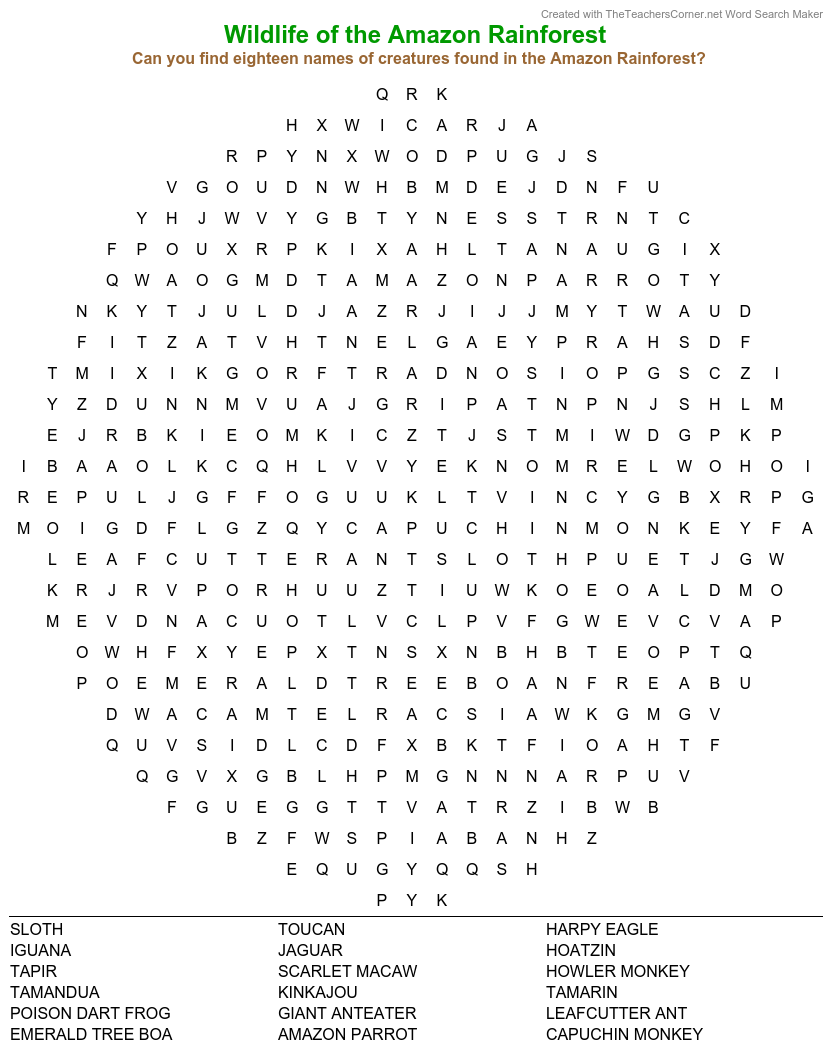
Wildlife of the Amazon Rainforest Word Search Puzzle
You’ll find eighteen names of creatures who call the Amazon Rainforest home in his printable puzzle
Thanks to Eerdmans Books for Young Readers for sharing a copy of Madani’s Best Game with me for review consideration. All opinions on the book are my own.
Madani’s Best Game
Written by Fran Pintadera | Illustrated by Raquel Catalina | Translated from the Spanish by Lawrence Schimel
“Our whole neighborhood knows it: no one plays soccer like Madani does.” Thus, a teammate of Madani’s begins the story about this friend who captivates the neighborhood (and sometimes it seems the whole world) with his barefoot ball-handling prowess. Madani has elevated the team’s game to “the best soccer we’ve ever seen.” After Madani has scored a “Gooooal!” the sound of the cheers soars above the playing field and “…crosses through doorways, rushes past the magazine stand, slips down alleyways, swirls around the fountain, and, growing fainter and fainter, climbs the steps up to Madani’s house.”
Image copyright Raquel Catalina, 2022, text copyright Fran Pintadera, 2022. Courtesy of Eerdmans Books for Young Readers.
There, his mother hears it and knows the cheers are for Madani. She wishes she could attend his games, but she’s a seamstress and has so many garments to sew by hand. After the game, Madani’s teammates can only imagine how much better he would play if he only had a good pair of cleats. Their team might even be able to beat the Southside team—their biggest rival.
Image copyright Raquel Catalina, 2022, text copyright Fran Pintadera, 2022. Courtesy of Eerdmans Books for Young Readers.
The members of the team know that Madani’s saving up money in a special tin that gets heavier every time he declines to buy a snack, walks to away games instead of riding the bus, and makes other sacrifices. They know that when the box is full, Madani’s going shopping. “…then our games will be better than ever!’” he says, and they all dream of the day Madani buys his new cleats.
Image copyright Raquel Catalina, 2022, text copyright Fran Pintadera, 2022. Courtesy of Eerdmans Books for Young Readers.
The big game against Southside is only a day away, but Madani doesn’t come to practice. Instead, his friends watch him head downtown with the tin under his arm. Without Madani at practice, the team falls apart, but they don’t worry. Finally, they thought, their dreams of new cleats and beating Southside would come true!
When Madani shows up at the game the next day, “he looks radiant,” but he’s still barefoot. His teammates question him about his new cleats, but Madani doesn’t know what they’re talking about. The money wasn’t for shoes but for a present for his mother so that “‘she’ll be able to finish her work faster and come watch me play every Saturday.’”
Image copyright Raquel Catalina, 2022, text copyright Fran Pintadera, 2022. Courtesy of Eerdmans Books for Young Readers.
Madani’s friends still don’t quite get it, but the game begins, and in moments Madani has already stolen the ball away from the Southside players, run downfield and scored. He looks into the stands, sees his mother, and shouts “‘This goal is for you, Mom!’” Madani makes another goal, but Southside scores too, and the game ends in a tie. It’s okay, though, Madani’s teammate says, “‘because now more than ever, everyone in the neighborhood knows … There’s no player like Madani!’”
Back matter consists of notes from Fran Pintadera and Raquel Catalina that reveal their creative journeys and connections to this story.
Image copyright Raquel Catalina, 2022, text copyright Fran Pintadera, 2022. Courtesy of Eerdmans Books for Young Readers.
Fran Pintadera, who based Madani’s Best Game on his experiences as a social educator in new immigrant housing, tells his story with open-hearted affection for his subject as well as the relationships between teammates and mother and child. Through his perceptive and humorously observed details and lyrical language, Pintadera captures the wide-eyed wonder of children in awe of a great player (or artist, singer, scientist, or other talent). When Madani gets the ball, readers will hold their breath along with the neighbors, traffic, and even pigeons while he entertains the crowd and scores a goal. Then the action begins again, but this time the suspense revolves not around the game but on what Madani will buy. The answer is joyous, affirming family devotion and revealing the pure giving nature of a child’s heart.
From their first introduction to Madani, smiling out from the page, his bare foot on a soccer ball, readers will be captivated by him, his teammates, his neighborhood, and the game. Raquel Catalina’s endearing pencil, gouache, and colored pencil illustrations charm with realistic images of kids on the soccer field surrounded by city onlookers. Catalina creates not only gorgeous visuals of Madani’s supportive neighborhood, but an almost auditory experience as well.
Readers can almost hear the players’ running feet, the sudden cheers, the flap of the rising pigeons’ wings, and – as the celebration reaches Madani’s mother’s ears – even the whisper of her sewing needle through the fabric on her knees. Catalina deftly weaves the theme of friendship, between people both young and old, throughout the pages, enhancing the bond between Madoni and his mom as well as Madani’s teammates’ understanding of the true importance of that long-awaited game.
A beautiful poignant, joyful, and affirming story of family and friendship, Madani’s Best Game is a read aloud that adults and kids will love to share over and over. The book is a must for all home, classroom, school, and public libraries.
Ages 5 – 9
Eerdmans Books for Young Readers, 2022 | ISBN 978-0802855978
You can discover more about Fran Pintadera and his work on his website and connect with him on Instagram.
To learn more about Raquel Catalina, her books, and her art, visit her website. You can also connect with her on Instagram.
You can connect with Lawrence Schimel and learn more about his writing and his translating work on Instagram and Twitter.
You can find Madani’s Best Game at these booksellers
Today, I’m celebrating the book birthday of Come On In: There’s a Party in this Book! with two holidays – Read a New Book Month and Friendship Month. I also have amazing interviews with author Jamie Michalak and illustrator Sabine Timm that really dive into the creation of this unique book. So, come on in!
Thanks go to Hippo Park and Deborah Sloan for sharing a copy of Come On In: There’s a Party in this Book! with me for review consideration. All opinions on the book are my own.
Come On In: There’s a Party in this Book!
Written by Jamie Michalak | Illustrated by Sabine Timm
Kids first meet the sweet lemon (yes, an adorably sweet lemon) at the center of this story peeking out from a cutout in the cover. The narrator, having revealed that “there’ a party in this book,” now invites Lemon to find it: “Come on, Lemon! Let’s go look.” So, a little uncertainly, Lemon knocks at a red door with a mouse door knocker. Once inside, Lemon, readers, and the narrator meet a jaunty cast of characters—suspender shorts atop three pillows, a paint-tube mouse on a bed, a curious sock on the top of a bunkbed, and a little pink-and-green house on more pillows.
image copyright Sabine Timm, 2022, text copyright Jamie Malachek, 2022. Courtesy of Hippo Park.
The scene sets Lemon and crew wondering… “Is this a mouse party? A pants, sock, and house party?” And the answer? “No! This is a game where we can’t touch the floor.” Ah! So the narrator says, “Lemon, keep looking. Try the next door.” Lemon tries another house, but there’s no party there either—just some fashionable cats and fruit.
image copyright Sabine Timm, 2022, text copyright Jamie Malachek, 2022. Courtesy of Hippo Park.
Hmmm… Lemon is getting a little discouraged. But the narrator gives Lemon a nudge, saying “This book is not done.” Although Lemon meets a group of friends at the beach, they’re not partying, just hanging out together. Lemon meets some pigeons and enters a kitchen, where a bear, a bunny, and a little toast dog made of bread are baking up treats. But there’s no party! Finally, “…Lemon’s back home. Does the book end right here, with her sad and alone?”
image copyright Sabine Timm, 2022, text copyright Jamie Malachek, 2022. Courtesy of Hippo Park.
But then Lemon has an idea! An idea that needs readers’ help to succeed! Lemon (and readers) are going to host the party for everyone they’ve met! There’s going to be cake and candy, decorations and games. “This is a big and a small, / have a ball party. / Hooray for new friends at the / come one and all party!” And what about readers? Everyone shouts, “Come on in!”
image copyright Sabine Timm, 2022, text copyright Jamie Malachek, 2022. Courtesy of Hippo Park.
Kids can’t help but get excited about joining Lemon in searching for the party promised on the cover. Jamie Michalak’s enthusiastic, inclusive storytelling speaks directly to them from the very first words as she exclaims “What?! There’s a party in this book?” As Lemon goes from door to door and page to page, readers follow, carried along on Michalak’s buoyant rhythm and rhymes that surprise—coming at the ends of lines but also sometimes in the middle, which keeps each page fresh and fun.
When Lemon returns home after not finding the party and hits upon the idea of being the one to host it, the promise that “there’s a party inside” is fulfilled in an unexpected way. An interactive page gets readers involved in the party preparations and will make them feel both included and empowered to invite others to their own party—or just to make new friends.
Sabine Timm’s illustrations, created with found objects, burst with childlike imagination and endearing personalities. Each page is a showstopper that kids and adults will want to explore together to soak up all the details. And you don’t have to stop there! Each character—from Lemon to the yarn cat and clothespin rabbit to the paintbrush dog and soccer-loving log boy (see Sabine’s answer to question 2 in her interview below)—offers up an opportunity for readers to have fun creating their backstories, imagining what they’re doing when Lemon first encounters them, and guessing what their favorite part of the party is. But wait! The party isn’t over yet! The front and back endpapers, full of tiny objects from the story, give families a super search-and-find game to do together.
Full of humor, whimsy, imagination, and the joys of inclusive friendship. Come On In: There’s a Party in this Book! will quickly become a family favorite to read again and again. The book would make a terrific gift and one you’ll want in your home, school, or public library collection.
Ages 4 – 8
Hippo Park, 2022 | ISBN 978-1662640001
Meet Jamie Michalak
Jamie Michalak is a children’s book writer, who loves toast, dogs, and toast shaped like dogs. She is the author of Come On In: There’s a Party in this Book! illustrated by Sabine Timm. Jamie’s other titles include the multiple starred reviewed Niki Nakayama: A Chef’s Tale in 13 Bites, co-written with Debbi Michiko Florence and illustrated by Yuko Kato-Jones; Dakota Crumb: Tiny Treasure Hunter, illustrated by Kelly Murphy; the Frank and Bean early reader series, illustrated by Bob Kolar, and the Joe and Sparky early readers series, illustrated by Frank Remkiewicz. She lives with her family in Rhode Island.
This story feels so fresh—whimsical, comical, and surprising. I’d love to have you talk about how your story came to be and your writing process for it.
Thank you! Long ago, I jotted down the title and idea for this story—an interactive picture book with a different party on every page that the reader was invited to join. But I never wrote it. Several years later, my agent, Victoria Wells Arms, told me that editor Jill Davis was looking for a manuscript for artist Sabine Timm. So I checked out Sabine’s irresistible art on Instagram.
I instantly fell in love with her characters and wanted to write a story that included as many of them as possible. That’s when my old idea for COME ON IN; THERE’S A PARTY IN THIS BOOK! came to mind. I wrote the story and threw a party for Sabine’s characters—cats wearing boots and fruits dressed in suits, pigeons named Fred, and dogs made of bread. As it turns out, this party was just waiting for the right guests to get it started!
The idea of anthropomorphizing everyday objects is so interesting, especially as it’s a practice universal to adults and kids. As a storyteller, do you think this is just part of human nature or do we learn it in childhood?
That’s a fascinating question! I’m not sure. But I do love how children and children book creators are always turning inanimate objects into characters. A hot dog and baked bean can be new friends who form a band called The Chili Dogs. Or the salt and pepper shakers might face off in a talent competition before dinner arrives. Life is more interesting when you use your imagination.
The story lends itself so well to the “search and find” fun of Sabine’s illustrations. Was this also part of your intention as you crafted the story?
It wasn’t, but you’re right! I discovered all of the seek-and-find elements, just like readers will, when I first saw Sabine’s illustrations. There are so many whimsical details that I spot new ones with every read.
Every page is so creatively put together, but do you have a favorite spread in the book?
The cats wearing boots spread is one of my favorites from any picture book ever. How did Sabine create a cat from a small ball of yarn and sassy plastic doll boots? I mean … the BEST!
What would you like kids to take away from the story?
Everyone is invited to this book’s party—and that’s what makes the last spreads, starring all of the characters, the most joyful of all. I hope that readers take away that parties are more fun when no one is left out.
Do you have any special events or other marketing planned that you’d like to tell readers about?
Here’s a video “Welcome to Sabine Timm’s Studio” that introduces readers to Sabine Timm and Lemon. Then Sabine gives a tutorial on how they can make a character of their own. a link to a video “Welcome to Sabine Timm’s Studio – the illustrator of COME ON IN.”
And here’s a short bit of animation showing closeups of the objects that make up the book cover.
I’m excited about several books coming out next year. The first is a picture book about a tiny treasure hunt set in a Parisian bookshop: DAKOTA CRUMB AND THE SECRET BOOKSHOP illustrated by Kelly Murphy (Candlewick Press). It’s the follow-up to DAKOTA CRUMB: TINY TREASURE HUNTER about an Indiana Jones-ish mouse. The third Frank and Bean early reader, FRANK AND BEAN: THE STINKY FEET MONSTER, illustrated by Bob Kolar (Candlewick Press), is a hilarious take on Bigfoot. And two Chicken Soup for the Soul for Kids books—THE SUNSHINE GARDEN, illustrated by Jenna Nahyun Chung, and PLAYDATE (WITH BEAR TOO?), illustrated by Katie Mazeika—will be released from Charlesbridge.
Thanks, Jamie, for taking time to chat with me todat! Finding new book of yours is always a reason to celebrate!
Meet Sabine Timm
Sabine Timm calls herself an artist, creator, beach-trash collector, flea-market lover, and photographer. She draws, paints, assembles and shares her work nonstop on Instagram. She lives in Dusseldorf Germany, but has fans from around the globe.
Hi Sabine! I’m so thrilled to have a chance to talk with you about your incredible illustrations! As your 168K Instagram followers would, I’m sure, agree, your adorable creations are not only awe-inspiring but always bring a smile.Can you tell readers how you got started doing this kind of art?
It’s hard to say when I started making art like this. I always had a big interest in playing with found objects. When I was a child, I collected various things from nature. Shreds, sticks, seeds, buttons I’ve found on the streets etc.
I always loved the fairytales of Hans Christian Andersen and I was very much inspired by the hidden life of things in his stories. Many years later when I became a mother myself we had holidays at the sea and me and my son made a beach walk. We found a lot of funny things…a broken flip-flop, a red-checked French-fries bag, sandblasted wood sticks, small rope pieces, bottle caps, shells, feathers, and stuff like this.
Together we started playing, and we made characters from this found trash. We transformed trash to treasures…through our eyes and visions the things got a second life. I was deeply fascinated by these experiences, and I continued in arranging and photographing characters like this.
Image courtesy of Sabine Timm
When you look at an object, do you immediately see its potential to become something else? I’m thinking of the sofa you made from crackers that appeared on your Instagram page recently.
When I work with found or everyday objects there two options. Sometimes the objects themselves are attractive (colour, shape, size) and while looking at these things I get an inspiration. For example, the Swedish bread that became an upholstered sofa.
Image courtesy of Sabine Timm
The other option is that I have the plan of creating a special character and I go around in my home or in my studio and look around for something that works.
I always try to look at the things around me with the eyes of a child. Forgetting about function and use, I enjoy playing and arranging.
For example the little tree trunk character from the book….I found the miniature soccer shoes at the flea market and I came back to my studio where I had a box with collected objects from nature. I immediately had the idea of a little tree trunk boy who loves playing soccer!
Image courtesy of Sabine Timm
Come On In! is your debut picture book. What were your first impressions when you read Jamie’s manuscript?
I was totally thrilled!!! All my characters united in such a wonderful story! When I read the lovely text for the first time I could hardly believe that Jamie has never been in my studio.
She pictured everything so detailed and gripping. Jamie wrote a charming story of cohesion and team spirit. I love the rhymes and the imaginative language.
I’m so happy to have in Jamie an author who empathizes so much with my characters. Come on In! invites everyone to have a great time together, and I was inspired from the first moment!
Your scenes in Come On In! are beyond adorable. Can you share a little bit about your process in creating them?
So let’s go into my studio . . .
Image courtesy of Sabine Timm
Here I will show you something about my working process. In the very first beginnings of this book, I started with sketches and scribbles to get an idea of the story and the characters.
When I want to build and arrange a scene, I usually start with the characters! When they “come to life“ I start playing and letting them interact with each other. I take a lot of test photos to see how it works.
Next step is building the background or finding the location. In the case of a cardboard background I recycle used boxes and cut them into the right size. I cut out windows and build doors and in the end I paint.
When I just have to find a nice location, I pack all my utensils and my camera. I never go out before checking the weather forecast (no rain and wind, please)!
For example, the scenery with the pigeons is arranged on my studio rooftop even though I had built a nice cardboard roof, but it didn’t work as I imagined. I changed my plans and placed all the pigeons on the real rooftop…this was an authentic and perfect place for a crazy party with sunflower seed snacks and drinks and music! Adding these kind of items is like the icing on the cake!
Image courtesy of Sabine Timm
Did you have a favorite part of the story to create an assemblage for? What made it stand out for you?
It’s hard to make a decision…each assemblage is unique and special.
Creating the characters of fruits and bread was a great fun. Working with edible materials is particularly appealing to me—it is easy to get and you can eat it up when the work is done. (I have to say…sometimes I can’t eat them when they are looking at me so sweetly.)
For the kitchen scene, I was so happy that I could use my lovely vintage furnishings I’d collected for my photo arrangements years before.
I found the perfect buns and cakes to assemble the characters—Mr. Bear looked like a fantastic pastry chef and little bunny girl in her crunchy dress was so photogenic! Very same with the fruits-in-suits scene—in the beginning there is just a bag with fruits and vegetables, and after a few hours you have a gallery of fruity friends!
Image courtesy of Sabine Timm
What are you hoping to inspire in readers with your illustrations?
I hope I can inspire the readers to realise that the best thing in life is coming together, having a good time, respecting each other, and celebrating the uniqueness of each being.
Lemon takes the initiative, and I hope she will empower the readers to do the same.
What would you like for children to take away from your illustrations in this book?
Children are so creative, and I would like for my illustrations to encourage them to play with anything they find around at home, in nature. or wherever. They don’t need to buy new and expensive Playmobil or Lego figures…just a lemon can become a friend.
Image courtesy of Sabine Timm
Thanks, Sabine, for sharing so much of your creative process and all of these images! I’m sure readers are excited to read the book—and to stretch their creativity! I wish you all the best with Come On In: There’s a Party in this Book!
You can find Come On In: There’s a Party in this Book! at these booksellers
Today is one of the best days of the year! Anyone who loves books will want to take the opportunity of the holiday to visit their favorite bookstore and buy one of those books you’ve been hearing and reading about. And why stop at just one? Winter is coming—that time when there’s nothing more cozy than snuggling in with a cup of tea or hot chocolate and reading late into the night. As the school year begins, children – even the youngest readers – benefit from having new books in their home libraries that reflect their changing interests and maturing thoughts. Take a little time to look through the offerings of your local bookstore and let your kids pick out some new favorites!
The Thank You Book
Written by Danna Smith | Illustrated byJuliana Perdomo
For little ones, “Thank you” may be one of the first phrases they learn when they begin getting out into the world. Thanking grandparents and other relatives, friends, teachers, librarians, store employees, and others becomes a part of every day. But for kids just learning manners and communication skills, prompts to say “thank you” may seem kind of random, confusing, and maybe even a bit intimidating.
Image copyright Juliana Perdomo, 2022, text copyright Danna Smith. Courtesy of Little Simon.
This is where Danna Smith’s delightfully cheery story about sharing your appreciation comes in. With charming rhymes, Smith answers the questions of why, when, and to whom thanks are appropriate while infusing her story with the positive feelings that thanking someone for their kindness instills in the thanker and the one being thanked.
Image copyright Juliana Perdomo, 2022, text copyright Danna Smith. Courtesy of Little Simon.
Smith begins with an inviting and easy-to-understand definition of thankfulness that will resonate with young children: “When someone is thoughtful or kind in some way, ‘thank you’ are two very nice words to say.” She then goes on to provide specific examples of times that gratitude is warranted as well as language to help kids express their feelings for specific acts of kindness. As illustrations show children engaged in various activities, readers discover they can say, “‘Thank you for helping.’ ‘Thank you for sharing.’ / ‘Thank you for teaching.’ ‘Thank you for caring.’”
Image copyright Juliana Perdomo, 2022, text copyright Danna Smith. Courtesy of Little Simon.
But is saying those types of words the only way to show your gratitude? Children (and especially those who are reluctant to talk with people they don’t know well or feel shy about speaking up) learn that there are other ways to show gratitude, including giving hugs, drawings, and tasty treats.
Smith then reveals a well-known secret about saying thank you that will make today’s inclusive kids happy to be part of an appreciative community: “If you start with one thank-you, you’ll find it will grow.” And, indeed, Smith finishes her story by assuring readers that kids all over the world are thanking others for their friendship and kindness.
Image copyright Juliana Perdomo, 2022, text copyright Danna Smith. Courtesy of Little Simon.
Danna Smith’s sweet board book, with its jaunty rhymes and enthusiasm for sharing gratitude is just the kind of story parents, teachers, and other adults will want to read with their little ones and little ones will want to hear again and again. Her open-ended phrasing allows adults and kids to discuss the types of people who are helpers, sharers, teachers, and care-ers, as well as those within their family and friends who are deserving of thanks and on which occasions. Smith also gives kids ideas for a wide range of ways to say thank you that may use their talents and mean more to them than words. These examples can also spark talks between parents, teachers, and other caregivers on other ways to show thanks. And what if you have a child who just feels appreciation deep inside? They are represented in these pages too.
Juliana Perdomo’s vibrant illustrations of kind acts by friends, parents, teachers, veterinarians, bus drivers, activity instructors, and others will enchant little ones and get them talking about all the times someone has done something nice for them. Readers of all ages can’t help but be filled with gratitude and good feelings when they’re greeted by Perdomo’s smiling and enthusiastic characters. Perdomo mirrors Smith’s text to give kids a concrete understanding of the concepts while filling her pages with cheer and heartfelt gratitude. The idea that saying thank-you can bring people together in a community and around the world is one that will excite kids and encourage them to show their appreciation.
Joyful and inspiring, The Thank You Book would be a favorite read aloud in any young child’s home library and is a must for all daycare, school, and public library board book collections.
Ages 3 and up
Little Simon, 2022 | ISBN 978-1665902922
Discover more about Danna Smith, her books, poetry, and paintings on her website.
Do your kids have someone they’d like to thank for a kind act, a gift, or just for being a loved family member or friend? This cheery Thank You postcard makes it easy for kids to show their gratitude and share their love to people close by or far away. This card is also perfect to share for the upcoming holidays!
It’s good to remind yourself periodically – or even every day – of all the things you have to be thankful for and all the acts of kindness you’ve received. This activity sheet gives children (and adults who want to participate with their kids) a place to collect all these “thank-you”–worthy experiences. Just write a word or short description inside the jar each time you feel thankful. You might even want to share your appreciation with the people whose names appear in your jar with a note, a picture, a hug, or a homemade craft to show how much they mean to you.
This Thankfulness Jar also makes a meaningful activity for Thanksgiving Day! Why not print a copy for each guest at your table, provide a pencil, and get everyone sharing what they’re thankful for this year!
Friendship Month was established by the Oddfellows (shortened from The Grand United Order of Oddfellows Friendly Society (GUOOFS)), an international fraternity that dates back to 1730s England with the hope of encouraging people to make friends. Now dedicated to philanthropy and charity, the Oddfellows still promote Friendship Month each September to urge people to spend more time with their friends, get in touch with those they haven’t seen or talked to in a while, and, especially, to reach out to others who are alone or need a friend. As school gets underway, there are plenty of opportunities for kids to meet new people and form friendships – some of which may last a lifetime.
I’d like to thank Carolrhoda Books and Blue Slip Media for sharing a copy of Big Bear and Little Fish with me for review consideration. All opinions on the book are my own.
Big Bear and Little Fish
Written by Sandra Nickel | Illustrated by Il Sung Na
At the fair, Bear approached the basketball game booth, where the grand prize was a huge teddy bear. It was almost as big as Bear, herself. But Bear took away the consolation prize: a goldfish. “It was small. It was very small. It was so small it lived in a bowl.” Bear peered into the bowl, but when Fish woke up and said “‘Hello, Bear. Is this my new home?'”, Bear only nodded, afraid her big voice would scare little Fish.
Image copyright Il Sung Na, 2022, text copyright Sandra Nickel, 2022. Courtesy of Carolrhoda Books.
When lunchtime came, Bear made herself a sandwich with syrup that was as gold as she was. Bear didn’t know what to feed Fish, who was orange and probably liked “carrot muffins … or tangerines and pumpkins.” After lunch, Bear always measured herself. Today, she was over nine feet big! Bear didn’t know how she could measure Fish, so she left home for her regular afternoon walk, wishing – and not for the first time – that Fish was a teddy bear.”
While walking, Bear contemplated how inconvenient Fish might find the outdoors. Things could fall into her bowl and get caught in her tail. If she had a teddy bear Bear thought again, she wouldn’t have to worry about such things as tails. Bear began to regret ever bring Fish home from the fair. When Bear got home again, Fish greeted her with a “‘Hello” and a comment on how much she liked their porch.
Image copyright Il Sung Na, 2022, text copyright Sandra Nickel, 2022. Courtesy of Carolrhoda Books.
In response, Bear gave Fish the bad news that she couldn’t stay. When Fish asked why, Bear laid out her reasons: Fish was orange and ate orange foods; Fish had a tail that made it impossible for her to go on walks with Bear; and finally that Fish was too small. Fish was undaunted. She pointed out that Bear was orange too, and when Bear inspected her belly, she agreed that it “was an orangey sort of gold” kind of “like a carrot muffin.” Fish then added that Bear had a tail, and when Bear looked over her shoulder, she saw a tiny tuft. As to the assertion that she is “small,” Fish was surprised.
Image copyright Il Sung Na, 2022, text copyright Sandra Nickel, 2022. Courtesy of Carolrhoda Books.
“Am I?” she asked then welcomed being measured. She stretched herself out, and Bear measured her: three inches long. Fish was happy with this result; she wasn’t so small after all. “‘I am not one inch. I am not two inches. I am three inches,'” she said proudly. Still, Bear couldn’t get over the idea that Fish was so tiny she had to live in a bowl.
But Fish was philosophical. “‘Don’t you live in a bowl too?'” she asked. Bear had never thought of it that way before, and as she looked around at the big, blue sky, she suddenly felt small too. Fish reassured her and offered another perspective on physical size compared to how big one could feel inside. Bear considered this and then decided she’d like to take another walk – this time accompanied by Fish. And so they set off in search of a very big carrot muffin.
Image copyright Il Sung Na, 2022, text copyright Sandra Nickel, 2022. Courtesy of Carolrhoda Books.
In her seemingly odd “fellows” friendship story, Sandra Nickel presents a multi-layered look at what it means to be a true friend. She cleverly offers readers a variety of lenses for them to engage in perspective, from the character’s viewpoints to their own. Bear, alone at home and on her walks, focuses only on herself. At the fair, she wants to win a teddy bear that is a twin to herself but for which she would not need to be responsible in any real sense.
Fish, however, immediately wants to interact with Bear. She talks to him and asks questions. At first, it may seem that Bear will simply ignore Fish, but the idea of her has begun to make Bear think and even worry (here, Nickel creates a complex mix of emotions that invites discussion). Equally thought-provoking are Fish’s counter arguments when Bear tells her she can’t stay. While promoting how similar they are, Fish prompts Bear to reevaluate her view of herself and the world she lives in. Once Bear realizes that she, too, can be considered small and that the full measure of a person (or Fish or Bear) is found inside oneself, she embraces Fish – responsibilities, friendship, muffins, and all.
Il Sung Na plays with perspective and color to subtly guide readers through the stages of this endearing friendship. As Bear walks home from the fair, dejectedly carrying Fish in her bowl, the hilly landscape is washed in shades of blue and the twiggy, leafy, mushroomy vegetation replicates an ocean bottom. This evocative effect continues throughout the book, prompting kids to find other similarities between Bear and Fish and their environments. Readers will also enjoy pointing out examples and comparisons of big and small.
An endearing and thought-provoking story that boosts self-confidence while promoting friendship, empathy, and new perspectives, Big Bear and Little Fish will become a quick favorite on home bookshelves, a go-to book for classrooms, and a must for school and public library collections.
Ages 4 – 8
Carolrhoda Books, 2022 | ISBN 978-1728417172
Discover more about Sandra Nickel and her books on her website.
To learn more about Il Sung Na, her books, and her art on her website.
Dive in to this book trailer for Big Bear and Little Fish!
Friendship Month Activity
Measuring Stick Craft
Bear and Fish loved getting measured. If you’re looking for a unique way to measure how big you are, here’s a craft for you! This nature-inspired measuring stick can keep track of your big and small growth spurts whenever you sprout up. You can even add leaves to record thoughts, favorite things, and other ideas as you age!
Supplies
50-inch wooden stake, available at craft stores
Dark and light green foam sheets or 45 – 50 small wooden leaves, available at craft stores
Green paint, light and dark
Black marker
Paint brush
Strong glue
Flower pot
Oasis or clay
Ruler
Pencil
Directions
Paint the wooden stake with the green paint, let dry
With the ruler mark the stake in 1-inch increments along the edge of the stake
How to Make the Leaves
If using wooden leaves, paint half light green and half dark green
If using foam, cut 1 3/4-inch-long tear-drop shaped leaves (half from light green foam, half from dark green foam), 45 – 50 or as needed
Cut two larger leaves, one from each color to decorate the top of the stake
Draw a line down the center of each leaf
For Measuring Growth:Write the inch 1 through 45 or higher on each leaf with the black marker, alternating colors
For Recording Ideas: You can write favorite ideas, hobbies, or hopes on the leaves too and measure your growth that way!
How to Attach the Leaves
Glue the leaves to the stake, attaching the odd-numbered inch leaves to the left side of the stake and the even-numbered leaves to the right side of the stake.
Attach half of the leaf to the stake, letting the tip stick out from the side
Glue the two larger leaves to the top of the stake
How to Store Your Yardstick
Put the oasis or clay in the flower pot
Stick the stake into the flower pot to keep it handy
To get a copy of Big Bear and Little Fish personalized by Sandra Nickel
Visit Watermark Books to request a signed and personalized copy. When ordering, simply note your desired dedication in the Comments section. Sandra will sign on September 24, 2022, so be sure to order in plenty of time.
You can also find Big Bear and Little Fish at these booksellers
National Food Bank Day was established by St. Mary’s Food Bank, the world’s first food bank, which was founded by John van Hengel in Phoenix, Arizona in 1967. The idea spread throughout the country, and now St. Mary’s Food Bank distributes 250,000 meals daily with the help of staff, volunteers, and partner agencies, making it one of the largest food banks in the United States. This year, a record number of families (nearly 150,000 in August alone) have sought help. Food banks across the country help millions of men, women, and children who live with food insecurity due to job loss, illness, and other circumstances. Many food banks offer educational opportunities that help people change their situation and begin anew. Often, those who have benefited from the programs return to volunteer and contribute to the very food bank that helped them. To learn more about St. Mary’s Food Bank, visit their website. To find a food pantry in your area to get help for yourself, to donate, or to volunteer, visit the Ample Harvest website.
I’d like to thank Albert Whitman & Company for sharing a copy of Saturday at the Food Bank with me for review consideration. All opinions on the book are my own.
Saturday at the Food Pantry
Written by Diane O’Neill | Illustrated by Brizida Magro
When Molly came to the table for dinner, she saw that they were having chili—again. She and her mom had eaten chili for two weeks straight. But there was “fancy milk too.” Molly smiled as her mom measured sugar and cinnamon into her glass and added milk.” There was only a splash of milk left when Mom put it back into the almost-empty refrigerator.
Tomorrow, Mom said, they’d go shopping. “Molly’s eyes lit up” as she imagined “chicken and spaghetti and ice cream.” But Molly’s mom tempered her expectations, saying that they’d be going to a food pantry. A food pantry, she explained, is “‘a place for people who need food…. Everybody needs help sometimes,’” she added. That night there was no warm milk before Molly went to bed and her stomach growled.
Image copyright Brizida Magro, 2021, text copyright Diane O’Neill. Courtesy of Albert Whitman & Company.
In the morning when Molly and her mom got to the food pantry there was already a line waiting for it to open. Molly had brought paper and crayons and sat down to draw. Then she saw a girl who was in her class at school. She called out a hello, but “Caitlin looked away.” When Molly ran over, Caitlin told her she didn’t want anyone to know that she and her grandmother needed help.
Molly went back to her mom, wondering if there was “something wrong with needing help.” She wanted to go home, but she was also hungry. Molly’s mom suggested she draw a picture, and the woman in front of them asked if she’d draw one for her too. Then everyone in line seemed to want a picture. Molly ran back to Caitlin to ask for help. Caitlin sat down and began to draw too.
Image copyright Brizida Magro, 2021, text copyright Diane O’Neill. Courtesy of Albert Whitman & Company.
When the door opened, Molly and Caitlin each had a picture for the woman who welcomed them in too. Molly noticed that her mom had to sign in before she got a cart and they could begin shopping. They didn’t do that at the grocery store. The shelves at the food pantry were stocked with items she recognized from the store they usually shopped with. She ran over and took a box of sugar cookies off the shelf, but her mom told her “‘They—the people in charge—they’ll want us to take sensible stuff.’” Molly felt embarrassed and couldn’t understand why the cookies were there if they couldn’t take them. She sadly returned them to the shelf. As they went to look for food, Molly thought her mom didn’t want to be seen there, either—just like Caitlin. In a whisper, Molly reminded her that everyone needs help sometimes.
They went through the store taking one can, bag, or box of the food they needed. Then Molly’s mom reached for a box of powdered milk. They could have fancy milk that night. When they got to the checkout desk, Molly and Caitlin found their drawings hanging on the wall. The man at the counter bagged their groceries and then handed Molly’s mom a box of sugar cookies. “‘Saw your little girl looking at these. She can have them, if that’s okay with you, ma’am,’” he said. Molly noticed that her mom looked like she might cry.
Image copyright Brizida Magro, 2021, text copyright Diane O’Neill. Courtesy of Albert Whitman & Company.
As they were walking home, Molly saw Caitlin and her grandmother coming the same way. They were all happy to discover that they were neighbors. Molly’s mom explained that she’d been looking for work since the factory closed, and Caitlin’s grandma said she’d been sick. Caitlin understood, but wished they didn’t have to shop at a food pantry. But then Molly told her that “everybody needs help sometimes” and reminded her that they had helped make the man at the checkout counter feel happy with their drawings. Caitlin hadn’t thought about it that way. She smiled. Then Molly invited her and her grandmother to have lunch with them—with sugar cookies for dessert.
Following the text, a note for parents, teachers, and other caregivers from Kate Maehr, the Executive Director and CEO of the Greater Chicago Food Depository, reveals more information about food insecurity, including recent statistics and a resource where people can find help and more information.
Image copyright Brizida Magro, 2021, text copyright Diane O’Neill. Courtesy of Albert Whitman & Company.
Diane O’Neill’s well-executed story about two families who need the help of a food pantry is a poignant reminder of the many people—perhaps even readers’ classmates—who face food insecurity every day. Through the experiences of Molly and her mother and Caitlin and her grandmother, readers discover what it’s like to go to bed hungry, miss out on treats, and feel ashamed to ask for help. As this is Molly and her mother’s first trip to a food pantry, Molly’s questions and observations well reflect children’s own or reassures those who are familiar with these important resources.
O’Neill’s straightforward storytelling emphasizes the fact that at one time or another everyone needs help and demonstrates simple ways that children make things better through their generosity, optimism, and acceptance. Molly and Caitlin’s budding friendship makes for an uplifting and hopeful ending and may spur readers to recognize need in their midst and extend kindness.
Through her realistic illustrations of two families in need of assistance from a food bank, Brizida Magro helps children see and understand what food insecurity and food pantries look like. At home, Molly and her mom eat small portions of leftover chili and the last full glass of milk. When Molly’s mom puts the carton in the refrigerator, the shelves are nearly empty, and Molly lies awake in bed, too hungry to fall asleep.
The line outside the food pantry is made up of people from all walks of life, and inside the displays of food replicate a grocery store with the exception of signs asking shoppers to take one item only. These images can lead to meaningful discussions on the enormity of the issue. When Molly and Caitlin draw pictures that cheer up everyone in line as well as the food pantry workers, kids will recognize not only different ways of helping but their own role in making the world a kinder place.
Empathy shines on every page of O’Neill’s necessary and welcome story. Saturday at the Food Pantry is timely, heartfelt, enlightening and a must-buy addition to home, classroom, and school and public library collections.
Ages 4 – 7
Albert Whitman & Company, 2021 | ISBN 978-0807572368
Discover more about Diane O’Neill and her work on her website.
The beginning of a new school year is a terrific time to celebrate Read a New Book Month—especially for kids. Whether their reading tastes have broadened, their reading level has changed, or they’ve discovered new and fascinating topics to explore over the summer months, there are new books just waiting for them! The books may be recently published—like today’s book—or just new to your child, there are countless fictional stories and nonfiction books ready to inspire learning, to laugh or cry with, and to share with friends. This month visit your local bookstore and library and stock up on books for your kids and everyone in the family!
The Boy and the Mountain
Written by Mario Bellini | Illustrated by Marianna Coppo
“There once was a boy who always looked at a mountain.” It was the first thing he looked at in the morning and the last thing he said good night to before going to bed. The boy loved to draw, and one day he “decided to draw the mountain.” His first attempt didn’t look anything like the mountain he saw out his window. When he looked closer, he realized “the mountain was covered with trees,” so he added trees.
Image copyright Marianna Coppo, 2022, text copyright Mario Bellini, 2022. Courtesy of Tundra Books.
Still, his picture wasn’t quite right. Next, he noticed the sky and clouds around the mountain and drew those, but his picture “still didn’t look the same as the real thing.” He tried drawing the mountain at different times of day and in different weather, but “he was never happy with what he had drawn.”
One day, the boy decided to get a closer look. He took his dog and headed out. One the way, he met a goat and drew a picture of it in his sketchbook. The goat decided to come along. When a flock of birds flew by, the boy drew those too. One bird left the flock to follow the boy and his dog and the goat. When they stopped at a stream for a drink of water, the boy drew that too.
Image copyright Marianna Coppo, 2022, text copyright Mario Bellini, 2022. Courtesy of Tundra Books.
It was fall, and the ground was covered in leaves. The boy “wanted to draw them all,” but even though he drew many of them, there was no way they would all fit on the page. He continued on up and up into the forest and beyond. Along the way, he picked up other followers, including a frog, a bear, and a beaver. When he had left the trees behind, there was very little to draw “until he looked more closely” and saw a tiny white flower poking up between some rocks. He drew it.
Image copyright Marianna Coppo, 2022, text copyright Mario Bellini, 2022. Courtesy of Tundra Books.
At last he came to the mountain’s peak. He sat down and flipped through his sketchbook, but he still wasn’t satisfied with his drawings. It was then that he became aware of the goat, the bear, the frog, the bird, the beaver, and a snail who had joined him. “‘Ohhh … hello!'” he said. They played until it was time to go home. The bear gave the boy a ride home on his shoulders. Once home, the boy promised that he would see them all again soon. That night before going to sleep, the boy drew the mountain again with his new perspective. This time his drawing was complete—and the boy was completely satisfied with it.
Image copyright Marianna Coppo, 2022, text copyright Mario Bellini, 2022. Courtesy of Tundra Books.
Mario Bellini’s thoughtful and well-paced adventure gently guides readers to consider not only their perspective on big and small topics of life but where and how they fit into the wider world. Just as children observe the world from their vantage points of home, school, and activities, the boy in the story looks at the mountain and tries to make sense of it by drawing it. Then, like kids slowly adding bits of what the world has to offer to their lives, the boy includes trees, clouds, and different times of day to his drawing. But he thinks there must be something more, and, now braver and more knowledgeable, he ventures out to get a better look.
Along the way he sees more of the world and interacts with what he encounters in the way that means the most to him. Some of these experiences turn out well, and others don’t, but he persists. When it appears that he’s finally come to the end of his journey, he sits down (alone, or so he thinks) and ponders his single-subject, disjointed pictures. When he finally notices all of the animals who have joined him on his trek and embraces them as friends, the boy discovers an interconnectedness that has been missing for him all along. At last, with his final drawing, the boy is able to be satisfied with his knowledge, understanding, and place in his world.
Marianna Coppo’s delightful rounded illustrations lend a quiet elegance to the story while allowing readers to view the boy’s drawings for themselves and then join him on his journey to see the mountain up close. Kids will enjoy noticing the animals that begin to populate the boy’s sphere, even while he is unaware that they are following him. The boy’s drawings of the river, the leaf-strewn forest floor, and the hidden mountain peak give kids and adults an opportunity to talk about times when things go wrong, when life seems overcrowded or overwhelming, and when goals seem elusive. Coppo also helps kids see that surprises can be found in the most unlikely of places as well as when you least expect them.
A multi-layered story that invites thought, observation, conversation, and discovery (of both the self and the world), The Boy and the Mountain would be a favorite read for quiet story times or as a prelude to any new experience at home or in school. The book is highly recommended for home bookshelves as well as classroom, school, and public libraries.