April 25 – Disability Book Week

About the Holiday

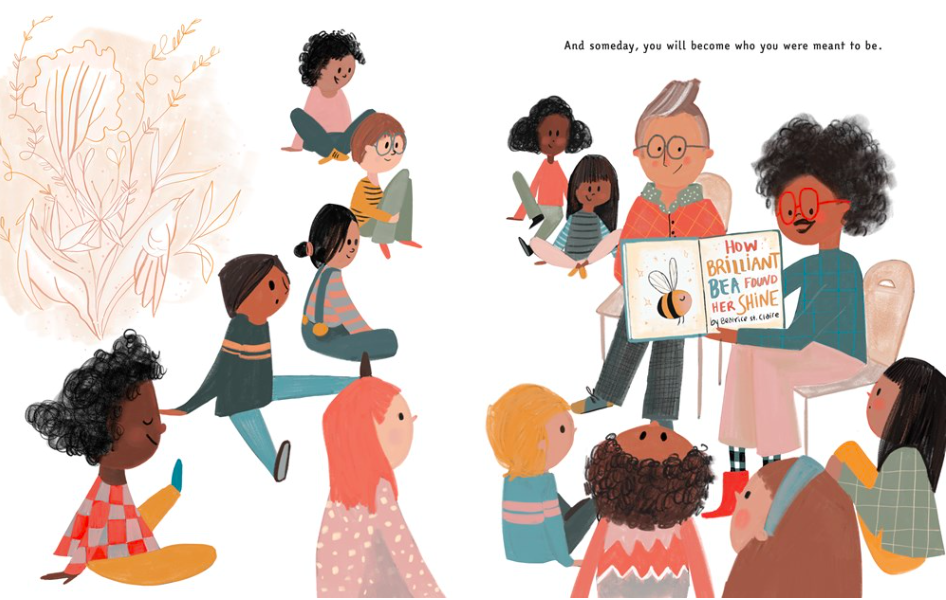
Disability Book Week encourages individuals all over the world to become more inclusive with what they read by reading a book that features characters with disabilities. It’s easy to participate! Individuals and families can pick up a disability-inclusive book to read. Libraries, schools, and bookstores can create a display of inclusive books. Hosting an author, illustrator, or disabled community member to do a reading is also a great idea. Other ways to help are to leave a review of books you’ve read and to talk about disability inclusion with your family or others. These ideas can all go a long way in raising awareness of how we think about disabilities and interact with people who are disabled.

To learn more about Disability Book Week and find lists of books for kids, teens, and adults as well as resources such as display signs to download, visit disabilitybookweek.org.

Thanks go to Beach Lane Books and Barb Fisch at Blue Slip Media for sharing a copy of this book with me.

Maybe Just Ask Me!

By Katie Mazeika


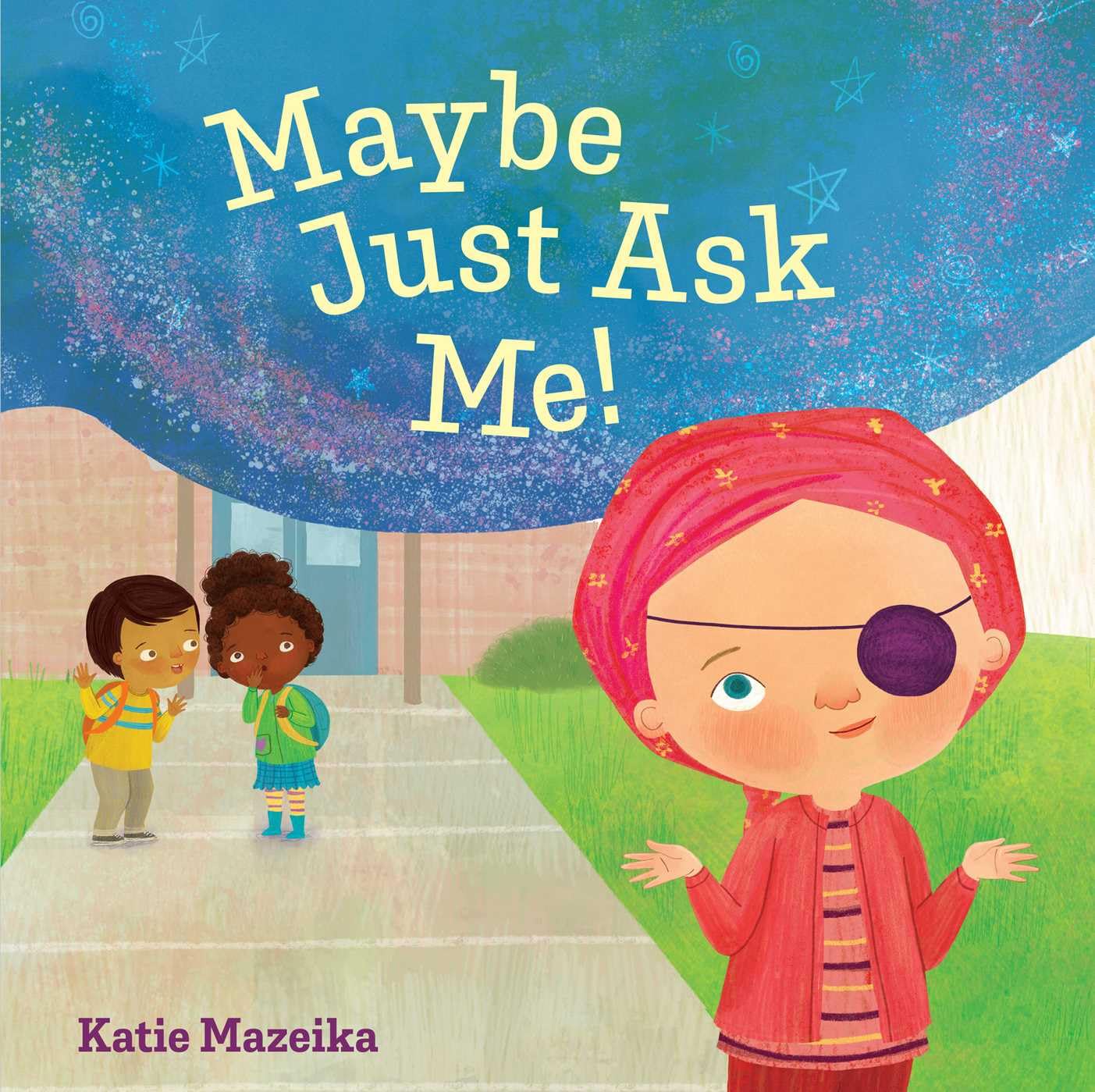
Mazie was starting at a new school, so she “put on her favorite scarf and wore her prettiest eye patch.” As she waved goodbye to her mom and walked into the building with other students, she was happy she’d be able to make new friends. But when she stood in front of her class to introduce herself, the kids’ questioning faces sent her hurrying back to her seat.
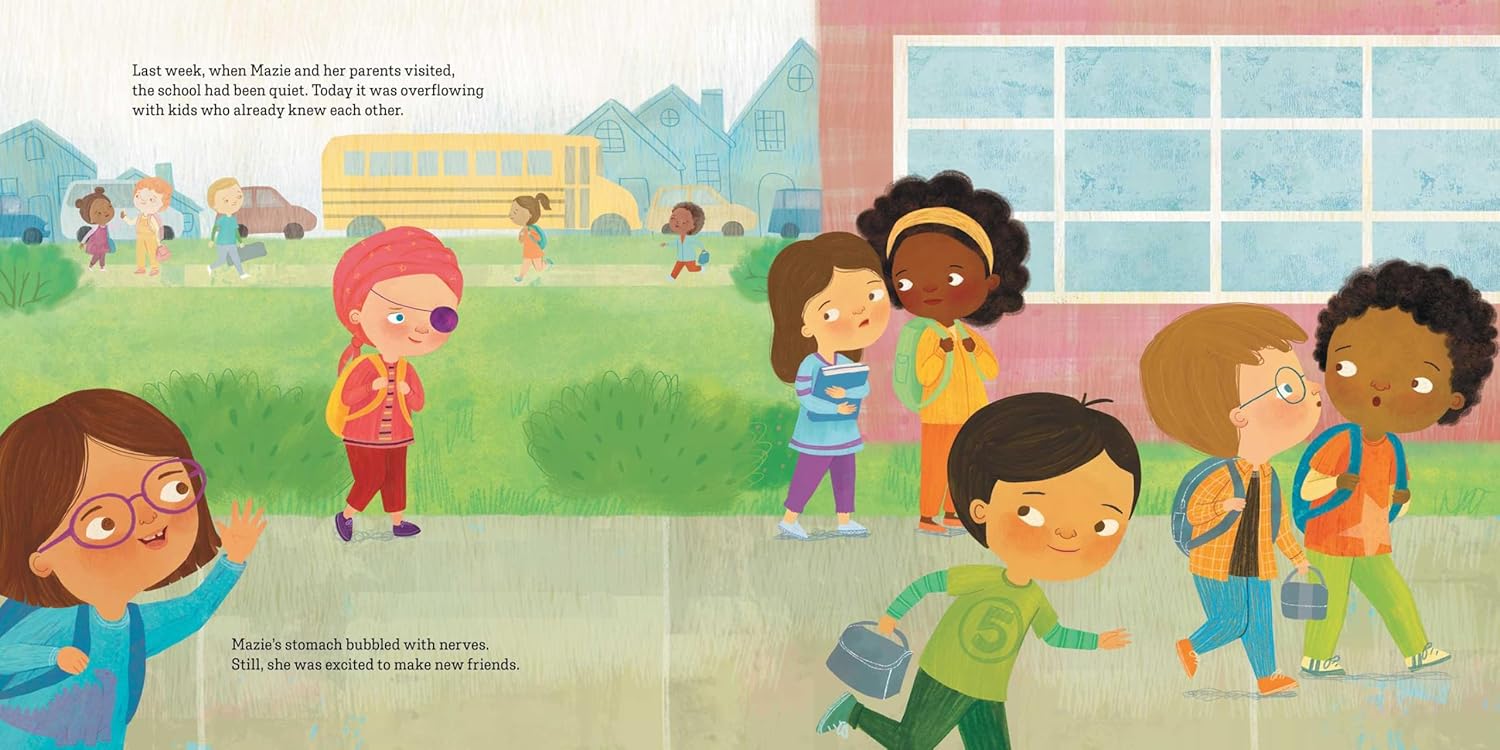
Text and illustration © 2025 by Katie Mazeika. Courtesy of Beach Lane Books.

During a science lesson outside, the wind caught Mazie’s scarf and sent it flying, exposing her bald head. While she tied it back on, she heard two of her classmates concocting a fantastical story as to how she’d lost her hair involving a circus and a fire-breathing performer. Before Mazie could say hi, they ran off. Mazie remembered that her dad “had said it might take a few tries.”

So while in line to wash her hands, Mazie tried again, but the boys in front of her were excitedly discussing the possibility that maybe Mazie had joined a “‘pirate crew, and that’s why she wears an eye patch.'” When they finally saw Mazie, they were embarrassed and wouldn’t look at her. At lunch, Mazie felt intimidated to break into the already-established group, especially because they were debating the pirate and circus ideas while creating yet another outlandish story. In fact, everyone had their own theories about what had happened to Mazie. 
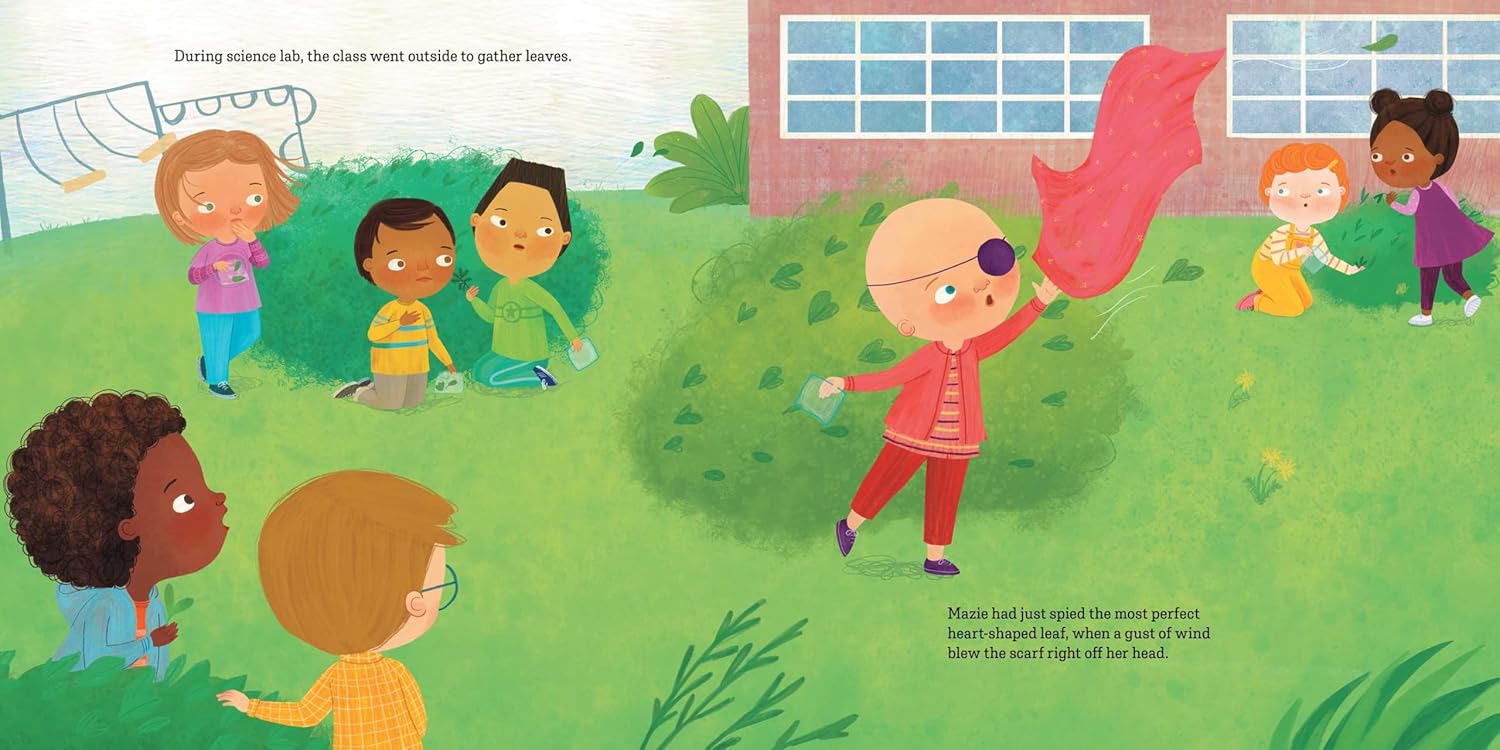
Text and illustration © 2025 by Katie Mazeika. Courtesy of Beach Lane Bo

Mazie began to think that no one would ever talk to her, but then she “remembered what she had learned last year” about being brave and not losing hope. So when the class went to the gym for P.E., she talked to the teacher then blew her whistle. When the kids all stopped to look, Mazie took to the bleachers to announce that she’d heard their stories and while she was “as daring as any circus girl” and “fiercer than a pirate,” if they really wanted to know the truth then “‘Maybe just ask me!'”

And the kids did want to know. They sat around her on the bleachers as she told them she’d been sick but that they had “‘never lost hope.'” Her classmates listened and realized that while their ideas had been way off, their new friend Mazie was “pretty brave. And a very good storyteller, too.”

Back matter includes Katie Mazeika’s own story of her experience with cancer at age three, during which she lost her right eye, as well as a discussion encouraging people to ask questions and engage in conversations with those with disabilities that show interest, concern, and kindness. Mazeika says, “. . . when we pretend not to see people with disabilities, we make them feel invisible” and “curiosity, with kindness, should always be allowed.” She also includes a list of how people can be supportive of those with disabilities.
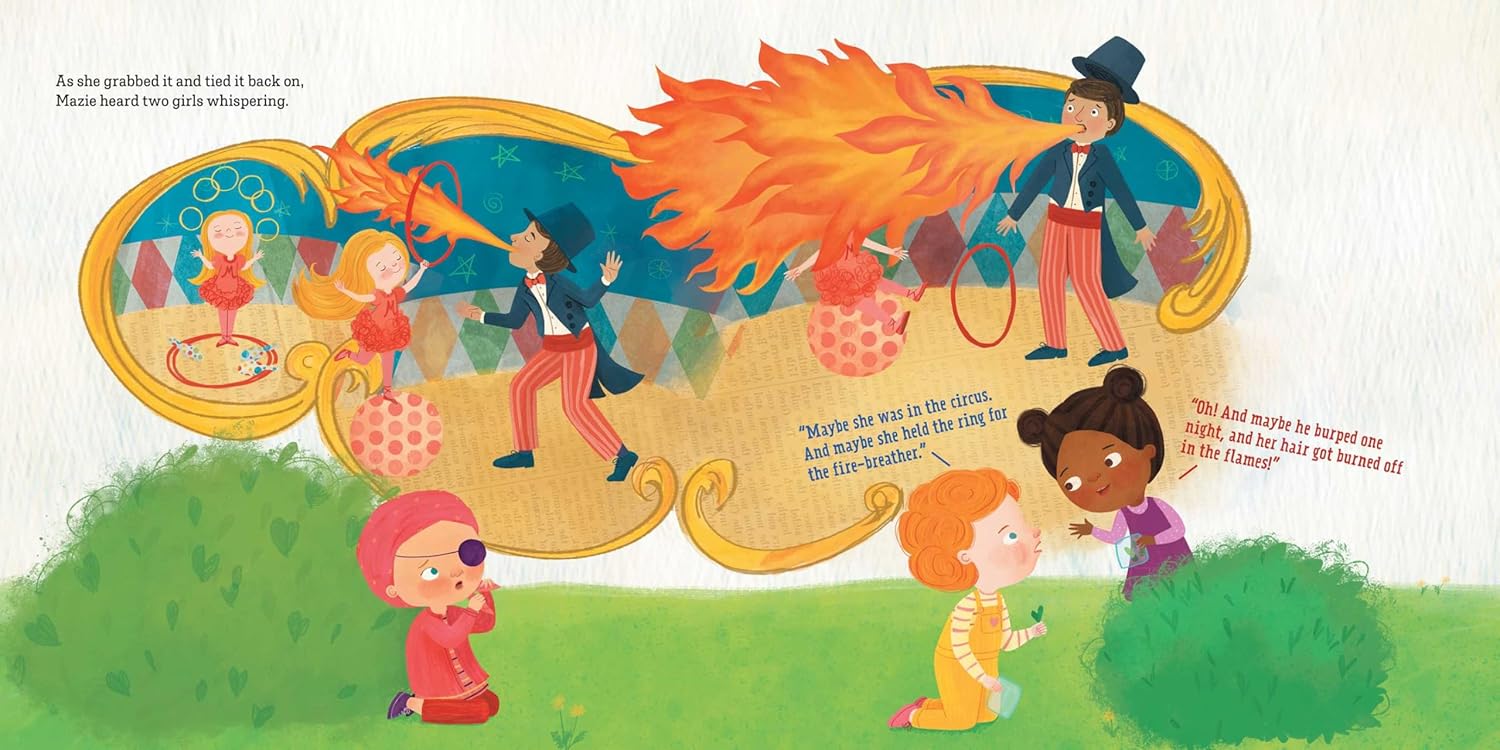
Text and illustration © 2025 by Katie Mazeika. Courtesy of Beach Lane Bo

In her heartfelt autobiographical story about her childhood experience with cancer, Katie Mazeika reveals to readers that not only is it okay to ask someone about their disability, it is welcomed. As Mazie’s classmates in her new school make up elaborate scenarios to explain her bald head and eye patch instead of asking what happened, they unwittingly isolate her from the group. When Mazie is finally able to make her voice heard, however, both Mazie and the class discover that honest dialogue paves the way to long-lasting friendships.

Mazeika’s colorful, textured illustrations are infused with emotion, imagination, and gentle humor that make the story immediately accessible to children. Young readers will feel empathy for Mazie as she bravely walks into a new school, knowing most eyes are on her, and becomes flustered at the front of the puzzled class. Mazeika depicts the kids’ theories in vibrantly detailed scenes, while also showing the impact they have on Mazie. When Mazie gets the chance to tell the real story, her battle with cancer is portrayed in a simple but powerful illustration of her and her doctor facing and dispelling a fire-breathing dragon. The final spread of Mazie surrounded by her new friends is uplifting.

Emphasizing hope, bravery, and empathy Maybe Just Ask Me! is a unique story and a must addition to all school and public library collections, pediatrician offices, and hospital gift shops.

Ages 4 – 8

Beach Lane Books, 2025 | ISBN 978-1665949897

Katie Mazeika is an author and illustrator with a BFA from the Columbus College of Art and Design. When she isn’t in the studio, she likes to spend time at the theater, in her garden, or getting lost in a good book. She is the creator of picture book biographies including Annette Feels Free and Beulah Has a Hunch!. She lives in Ohio with her family and two dogs. To learn more, and download a free curriculum guide, visit her website at katiemazeika.com. You can also find her on Instagram, Facebook, and Bluesky.

Disability Book Week Activity
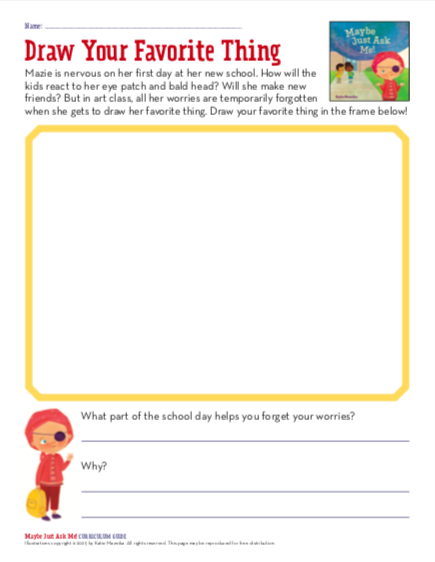
Text and illustration © 2025 by Katie Mazeika. Courtesy of Beach Lane Books.


Maybe Just Ask Me! Favorite Thing Activity


This Curriculum Guide for Maybe Just Ask Me! is full of ideas and activities for teachers, librarians and families to interact with the book and engage in some thoughtful drawing and writing about their own lives as well.

You can connect with Beach Lane/Simon & Schuster Kids on Facebook and on their website @simonkids
You can find Blue Slip Media on Bluesky, Facebook, and Instagram. To learn more visit their website @blue_slip_media 
 

You can purchase Maybe Just Ask Me! from these booksellers

Amazon | Barnes & Noble | Bookshop (discounted books and support for your local independent bookstore.

Picture Book Review

October 28 – It’s Dyslexia Awareness Month

celebrate-picture-books-picture-book-review-brilliant-bea-cover

About the Holiday

Dyslexia Awareness Month was first held in the UK in 2002 as a small movement of events organized through schools and businesses. In the ensuing years, it has grown to be recognized internationally, with programs, learning events, and public campaigns to bring messages and updates on improved inclusion and accessibility to communities around the world.

Developed in 1877 by German physician Adolph Kussmaul as “word-blindness,” the condition was first identified by German physician Oswald Berkhan in 1881 while studying the case of a young boy with severe issues in learning to read and write despite his high intellectual abilities. The condition was officially named “dyslexia” by ophthalmologist Rudolph Berlin in 1887.

Today, dyslexia affects from 5% to 10% of the world’s population. The theme for Dyslexia Awareness Month 2024 is “Until Everyone Can Read, and puts the focus on the latest research and resources for those with dyslexia and other learning differences as well as special activities for students, families, and communities.

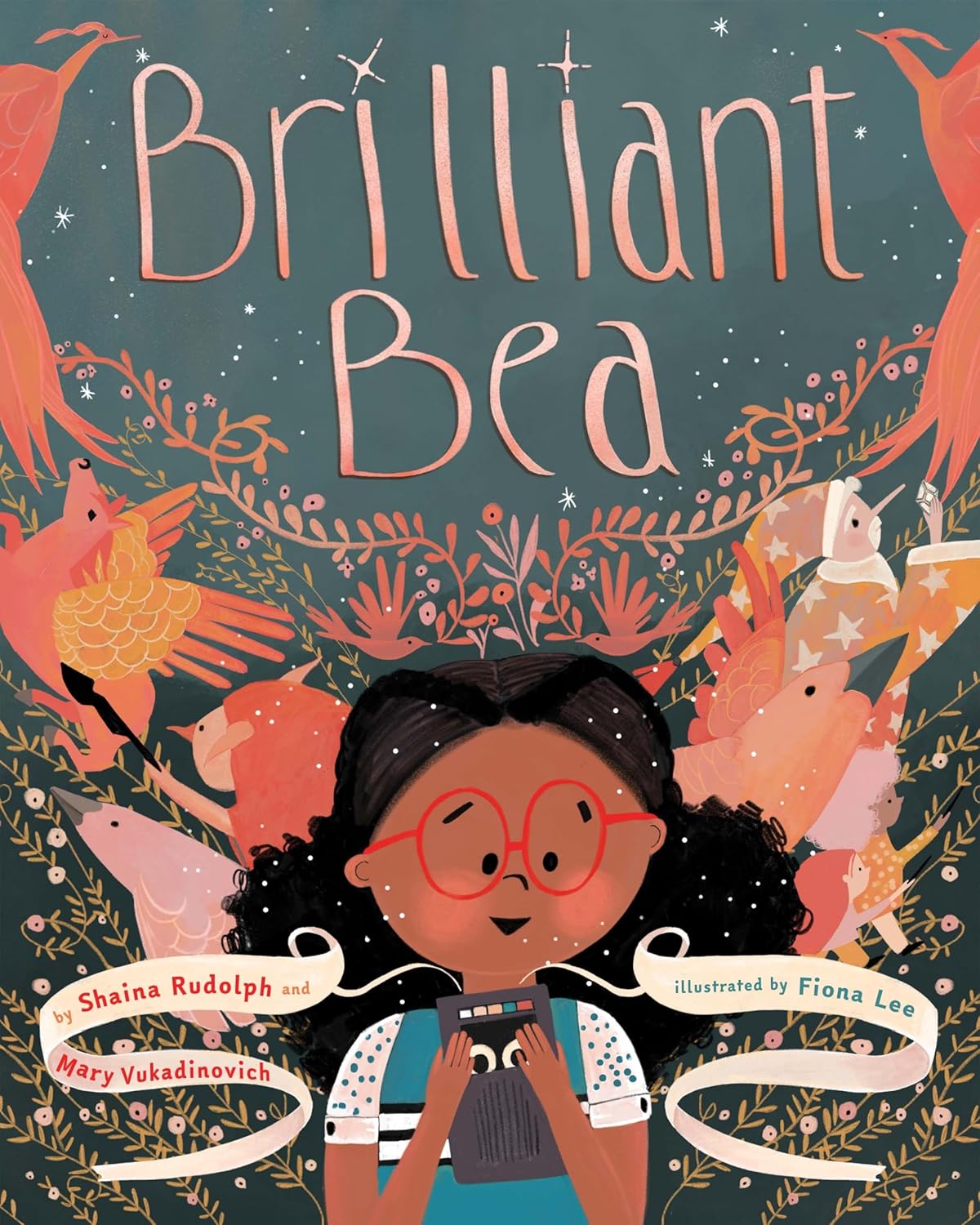
Brilliant Bea: A Story for Kids with Dyslexia and Learning Differences

Written by Shaina Rudolph and Mary Vukadinovich | Illustrated by Fiona Lee


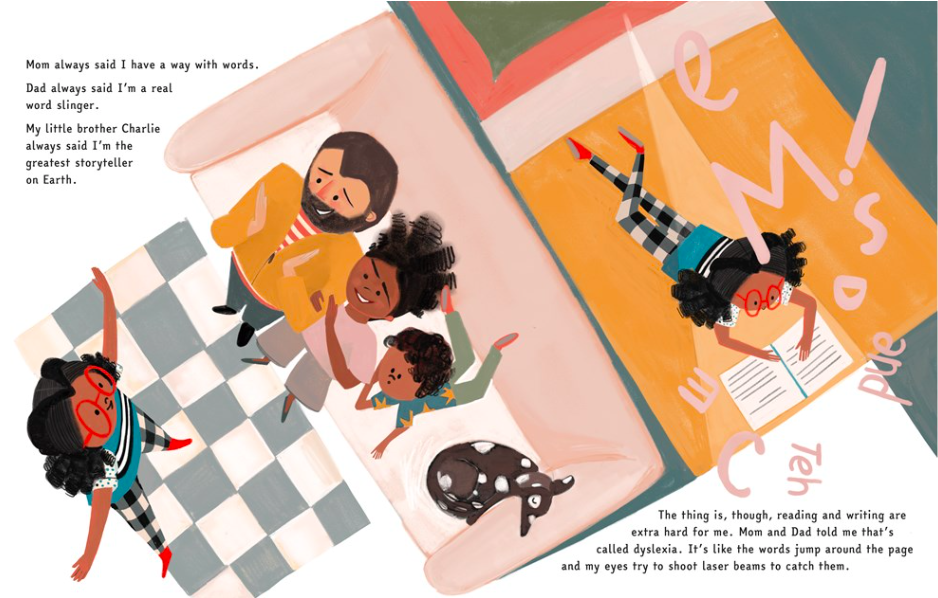
Bea had a big imagination. Her mom said she had “a way with words,” her dad said she was a “real word slinger,” and her brother thought she was “the greatest storyteller on Earth.” But reading and writing were “extra hard” for Bea. As she would describe it “words jump around the page and my eyes try to shoot laser beams to catch them.” Her parents told her it was dyslexia. Another thing Bea knew was that because she couldn’t finish her school work on time, she was stuck in the classroom at recess time—”stucker than stuck. Stuck in Stucksville, population: 1.”

Screen Shot 2024-10-23 at 2.28.03 PM

Image copyright Fiona Lee, 2021; text copyright Shaina Rudolph and Mary Vukadinovich, 2021. Courtesy of Magination Press.

Reading out loud made Bea want to melt into the floor, and when trying to write, she couldn’t get down the words she was thinking. One day her teacher, Ms. Bloom asked if she could read what she had written so far. “I woent let dullying bring me doun,” Ms. Bloom read then asked what “dullying” was. “Bullying,” Bea corrected her. Ms. Bloom smiled and kindly said, “I think you’ve figured it out with your brilliant brain, Beatrice. Bullying is dull.” Bea knew “brilliant” meant “super smart,” and, Ms. Bloom added, “it means bright and radiant.” Walking home that afternoon, Bea’s imagination and self-esteem soared.

Screen Shot 2024-10-23 at 2.26.42 PM

Image copyright Fiona Lee, 2021; text copyright Shaina Rudolph and Mary Vukadinovich, 2021. Courtesy of Magination Press.

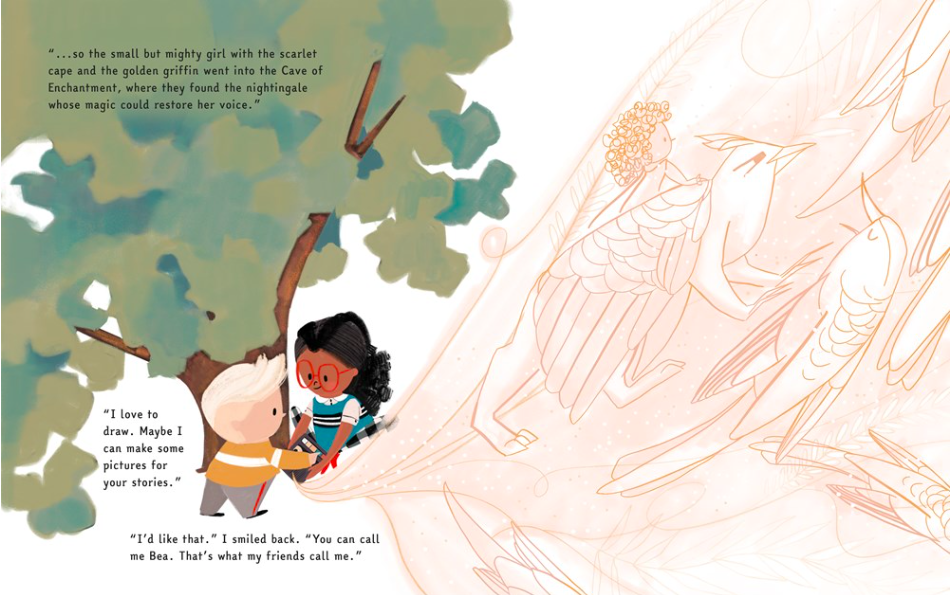
The next day, Ms. Bloom gave Bea a tape recorder. At recess Bea told one of her stories into the recorder. Her words flowed and attracted Rudy, who asked what she was doing. Normally, Bea “would shrivel up and just wish him away,” but today she played her story for him. Rudy offered to draw pictures for her story, and that afternoon, he helped her become “unstuck.”

Screen Shot 2024-10-23 at 2.27.07 PM

Image copyright Fiona Lee, 2021; text copyright Shaina Rudolph and Mary Vukadinovich, 2021. Courtesy of Magination Press.

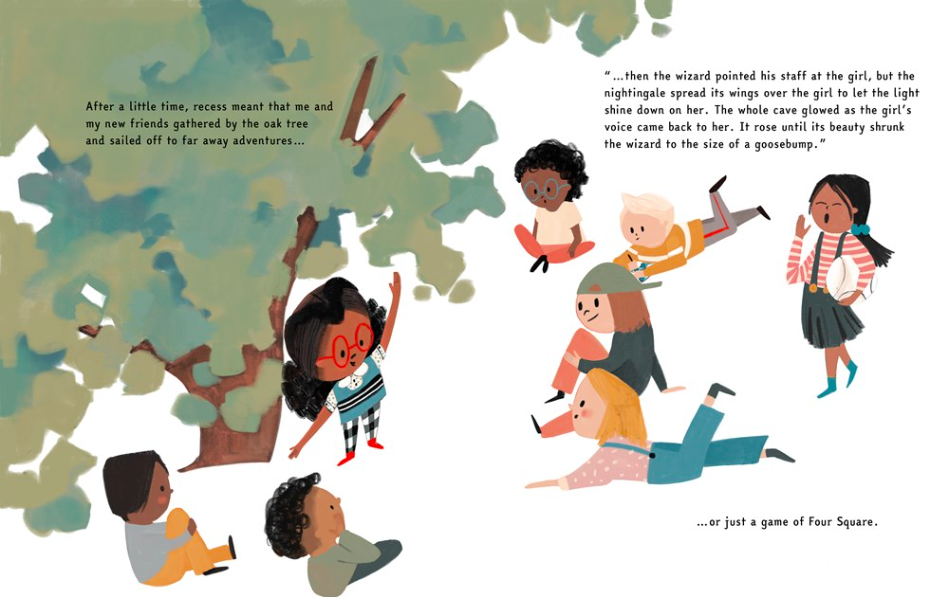
In the coming days and weeks, Bea attracted more friends. Sometimes they sat under the trees at recess to listen as she told her stories and sometimes they played on the playground. Now she wasn’t afraid of learning differently, and she and her best friend even created a comic book that Ms. Bloom copied and gave to all her classmates. And when Bea grew older? She became an author and even returned to Ms. Bloom’s classroom to read her book.

A superb and detailed Reader’s Note by Ellen B. Braatan, PhD, executive director of the Learning and Emotional Assessment Program at Massachusetts General Hospital and associate professor of psychology at Harvard Medical School, follows the story. In it Dr. Braatan outlines the insights into dyslexia that Brilliant Bea highlights, ways in which adults can engage children in conversations about dyslexia, what dyslexia is, and the symptoms of dyslexia, as well as methods of evaluation and treatment, including remediation and accommodation.

Screen Shot 2024-10-23 at 2.27.38 PM

Image copyright Fiona Lee, 2021; text copyright Shaina Rudolph and Mary Vukadinovich, 2021. Courtesy of Magination Press.

This engaging story about one girl’s experience with dyslexia is charming and insightful. Shaina Rudolph and Mary Vukadinovich highlight the difficulties children with dyslexia face with reading and expressing their thoughts in conventional ways as well as the impact their learning difference has on making friends and having the same advantages as their peers during a school day.

Through Bea’s talent for storytelling, Rudolph and Vukadinovich emphasize how dyslexic children (and adults) can excel in a wide range of disciplines, from writing to science to art to music to any field of endeavor because they see things differently. Bea’s teacher, Ms. Bloom, demonstrates how early recognition of dyslexia and other learning differences coupled with understanding, remediation, and accommodation can make school and any environment inclusive and successful for all.

Fiona Lee’s bright and uplifting illustrations use a variety of perspectives to help readers see how those with dyslexia see the world differently. Bea’s imagination and storytelling talent are reflected in the soft sketches that soar from her mind or off her notebook. Her frustration is clear, but so is her resilience and determination to succeed. When her teacher gives her the tape recorder, readers can see how life-changing such a simple and thoughtful act can be.

Young readers will embrace Bea and this story of a sweet, creative, and giving child who also happens to be dyslexic. The story and the back matter provide parents, educators, and other adults a helpful and meaningful way to allow dyslexic children to see themselves in a book as well as to explain this learning difference to classmates, friends, and others.

Brilliant Bea: A Story for Kids with Dyslexia and Learning Differences is a must addition to public and school libraries, pediatricians’ offices, and teachers’ programs. The book is highly recommended for home bookshelves as well.

Ages 4 – 8+

Magination Press, 2021 | ISBN 978-1433837418

About the Authors

Shaina Rudolph is an author of books for children, including All My Stripes and Brilliant Bea. Shaina is also a member of The Society of Children’s Authors and Illustrators. Additionally, she has been an educator for 15 years. Visit Shaina at shainarudolph.com.

Mary Vukadinovich has been working with students with language based learning differences and diverse learning need for the last 17 years. As a reading specialist in Los Angeles, Mary values her opportunities to teach students with unique learning profiles, including dyslexia. Above all, she enjoys watching a child’s confidence grow while learning to love to read. When Mary isn’t teaching or writing, she is reading and telling stories to her own two children.

About the Illustrator

Fiona Lee is inspired by color, strong-willed kids, and the unintentional humor of animals. Working both traditionally and digitally, she captures detail, texture, and life’s small moments. Trained as a Science Illustrator, her clients include Woods Hole Oceanographic Institution, UC Santa Cruz, and more. She lives in Vermont in a tiny house in the middle of a big hayfield.

National Dyslexia Awareness Month Activity

Screen Shot 2024-10-26 at 6.05.42 PM

Watch these Informative Videos

  1. Watch See Dyslexia Differently for a child-focused animated short that gives an overview of how dyslexia affects reading, writing, learning, and everyday activities as well as what strengths kids with dyslexia have, and highlights famous artists, inventors, singers, writers, scientists and more used the way they think differently to change the world.
  2. Listen to a group of young people describe their dyslexia in this video from Learning Ally.
  3. Hear Reading Horizons Dyslexia Specialist, Shantell Berrett describe various ways that dyslexics see words on a page and some remediation and accommodation aids.

celebrate-picture-books-picture-book-review-brilliant-bea-cover

You can purchase Brilliant Bea: A Story for Kids with Dyslexia and Learning Differences at these booksellers

Amazon | Barnes & Noble | Bookshop (to support your local independent bookstore)

Picture Book Review

December 3 – International Day of Persons with Disabilities

celebrate-picture-books-picture-book-review-we-want-to-go-to-school-cover

About the Holiday

Today we honor International Day of Persons with Disabilities, a holiday that raises awareness for people of different physical and mental abilities across the globe. The day was proclaimed an international holiday in 1992 by the United Nations in order to appreciate members of our society who are often marginalized or ignored because of their different abilities. Today we recognize the importance of creating a world in which everyone feels like an active, respected member and cultivating a society that is accessible and designed for all of us. To celebrate International Day of Persons with Disabilities learn more about the fight for disability education rights or talk to someone you know with a disability about their experiences. You can also visit the IDPWD website to learn about available services, resources, and how you can get involved. We Want to Go to School! is a perfect way to start a conversation with a child about education equality for people with disabilities.

Thank you to Albert Whitman & Company for sharing a copy of We Want to Go to School! with me for review consideration. All opinions on the book are my own.

Review by Dorothy Levine

We Want to Go to School!: The Fight for Disability Rights

Written by Maryann Cocca-Leffler | Illustrated by Janine Leffler


When Janine was born with a disability called cerebral palsy, she had lots of teachers to help her learn. With the aid from different instructors who helped build her speech, her muscles, and her hand coordination, Janine was able to learn, play, study, and graduate school with the rest of her peers. This would not have been true, however, had she been born a decade earlier. Before 1971, millions of kids with disabilities were banned from attending public schools.

celebrate-picture-books-picture-book-review-we-want-to-go-to-school-early-1970s

Image copyright Janine Leffler, 2021, text copyright Maryann Cocca-Leffler, 2021. Courtesy of Albert Whitman & Company.

Janine explains that the people in charge claimed that children with disabilities shouldn’t go to school with everyone else because it would take too much money to fund education for them, and that those with disabilities would distract the other children. They even tried to say children with disabilities wouldn’t be able to learn. The real reason so many children with disabilities had to stay home or in hospitals instead of going to school was because of people’s prejudice.

Many parents of Black children had also experienced discrimination when they were in school. Before 1954, Black children had to go to separate schools that were not given nearly as many resources or good teachers as the white kids received in public schools. Similarly, children with disabilities in some places could take a test to go to public school, but they then were placed in separate, or segregated, classrooms and not given the same quality of education as the other kids. “But in 1971 in Washington, DC, seven school-age children were tired of hearing NO! They wanted to go to school too.” When other families heard about the lawsuit these seven families had started, they joined in too.

celebrate-picture-books-picture-book-review-we-want-to-go-to-school-1971

Image copyright Janine Leffler, 2021, text copyright Maryann Cocca-Leffler, 2021. Courtesy of Albert Whitman & Company.

So many children were not receiving public education because of disabilities, that all together they could file a class action lawsuit, “which meant that it stood up for a lot of children. And I mean a LOT! 18,000 students from the Washington, DC, area were also not receiving a public education because of their disabilities. Try to imagine 18,000. Then try to imagine 8,00,000 (8 million)! That’s how many children in the United States weren’t getting an education because they had disabilities.”

celebrate-picture-books-picture-book-review-we-want-to-go-to-school-families

Image copyright Janine Leffler, 2021, text copyright Maryann Cocca-Leffler, 2021. Courtesy of Albert Whitman & Company.

Joseph C. Waddy, the judge on the case took eleven long months to deliberate over his decision – “On the one hand, he knew that it would cost a lot of money to provide an education to these children. On the other hand, shouldn’t schools be spending their money on ALL children?” – Finally, Judge Waddy decided, and the families won! “All across the country, millions of students with disabilities could finally go to school and get the education they needed and deserved.” The text concludes with one final note from Janine: “Thank you, Peter, Janice, Jerome, Michael, George, Steven, and Duane. You changed many lives…including mine.”

After the resolution of Janine’s recounting of this landmark case, a page entitled “About Disability Education Rights in the United States” provides more details on the key points for readers and educators. The informational spread includes a direct quote from Judge Waddy’s ruling and a timeline of important landmarks for disability rights and education. In personal notes from Janine Leffler and her mom, Maryann, the authors talk about their connections to the disabled community. This insightful page concludes with a personal note from the last surviving Plaintiff’s Attorney on the case: Paul R. Dimond.

celebrate-picture-books-picture-book-review-we-want-to-go-to-school-kids

Image copyright Janine Leffler, 2021, text copyright Maryann Cocca-Leffler, 2021. Courtesy of Albert Whitman & Company.

Janine Leffler and Maryann Cocca-Leffler collaborate to tell the important story of the Mills v. Board of Education of the District Columbia case that served as a critical turning point in the fight for disability education rights. Through Janine’s personal narration of the case, the two authors succinctly explain the unfolding of this history in terms that are engaging and easy to understand for young readers. Speech bubbles and intertwined text with illustrations make the story engaging and exciting for young readers to follow. On the page that states how many children with disabilities were not allowed to go to school in DC, and more widely across the US, the whole spread features 1,000 tiny faces of kids, to help readers fathom the enormity of 18,000 people, let alone 8 million. The children in the story represent a diverse crowd of races, genders, and abilities. A joy to read, and an essential story to learn. Education matters.

Ages 5 – 9

Albert Whitman & Company, 2021 | ISBN 978-0807535189

You can find an Educator’s Guide to download on the Albert Whitman & Company website here.

Discover more about Maryann Cocca-Leffler, her books, and her musical on her website.

To meet and learn about Janine Leffler and discover the books and other creative endeavors she has inspired, visit Janine’s Party.

celebrate-picture-books-picture-book-review-we-want-to-go-to-school-cover

You can find We Want to Go to School!: The Fight for Disability Rights at these booksellers

Amazon | Barnes & Noble | Books-a-Million

To support your local independent bookstore, order from

Bookshop | IndieBound

Picture Book Review

December 1 – Celebrating the Book Birthday of Dancing with Daddy

celebrate-picture-books-picture-book-review-dancing-with-daddy-cover

Dancing with Daddy

Written by Anitra Rowe Schulte | Illustrated by Ziyue Chen


Elsie was shopping for the perfect dress to wear to her first father-daughter dance. Should she choose the pink one that will make her look like a princess or the red one that’s the same color as her daddy’s soccer jersey? As her mom held them up, Elsie reached from her wheelchair and “grabbed the red dress and pulled it close. This one,” she thinks. “It’s perfect for dancing with Daddy.” She gets a matching bow headband and heads home as snowflakes flurried around them. Elsie was worried the dance would be cancelled.

celebrate-picture-books-picture-book-review-dancing-with-daddy-dress

Image copyright Ziyue Chen, 2021, text copyright Anitra Rowe Schulte, 2021. Courtesy of Two Lions.

At home, Elsie’s sisters, Daphne and Rosalie, raced to meet Elsie at the door while Daddy asked her if she picked out a good one. Elsie replied by touching the “special” picture square in her PODD communication book. After dinner – noodle bowls for Daphne and Rosalie and a push of food through a feeding tube for Elsie – the sisters went to Elsie’s room to see her dress and talk about the dance. Soon it was time for bed, and “Daddy read Elsie’s favorite bedtime book,” the Nutcracker. “As the dancer in the story twirled, Elsie’s heart did pirouettes. I can’t wait to see my dress spin,” Elsie thought.

That night Elsie dreamed about the dance, but the snow kept falling. In the morning, Elsie stared out the window with disappointment. She saw snow edging her window panes and heard the sound of snow shovels. She just knew the dance would be cancelled. Then her mom came in and told her “‘the dance is a go!'” All day the sisters practiced dancing and twirling and dipping Elsie’s wheelchair “until she found her groove.”

celebrate-picture-books-picture-book-review-dancing-with-daddy-practicing

Image copyright Ziyue Chen, 2021, text copyright Anitra Rowe Schulte, 2021. Courtesy of Two Lions.

At last the time came to get ready and leave for the dance. Daddy complimented all of his daughters on their dresses as they made their way to the dance hall. That’s when Elsie realized she didn’t have her bow. While crossing the parking lot, Elsie’s wheels got stuck in a snowbank, but Daddy pushed it through. Once inside, the other girls all reminded her of the dancer in her favorite book. She wished she had her bow and put her hand up to touch her hair. Reminded, her dad pulled the headband from his pocket and set it in place. Then he spun her around; “her ruffles took flight.”

celebrate-picture-books-picture-book-review-dancing-with-daddy-gym

Image copyright Ziyue Chen, 2021, text copyright Anitra Rowe Schulte, 2021. Courtesy of Two Lions.

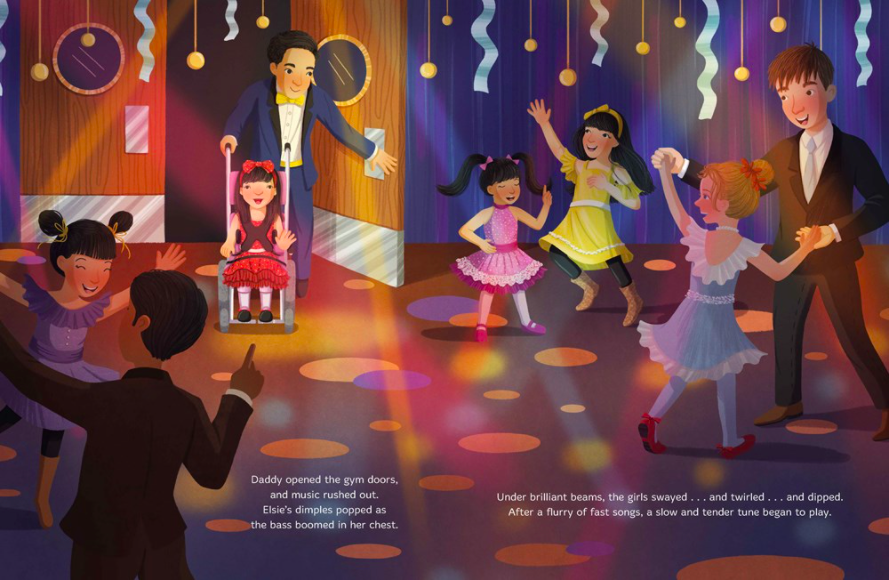
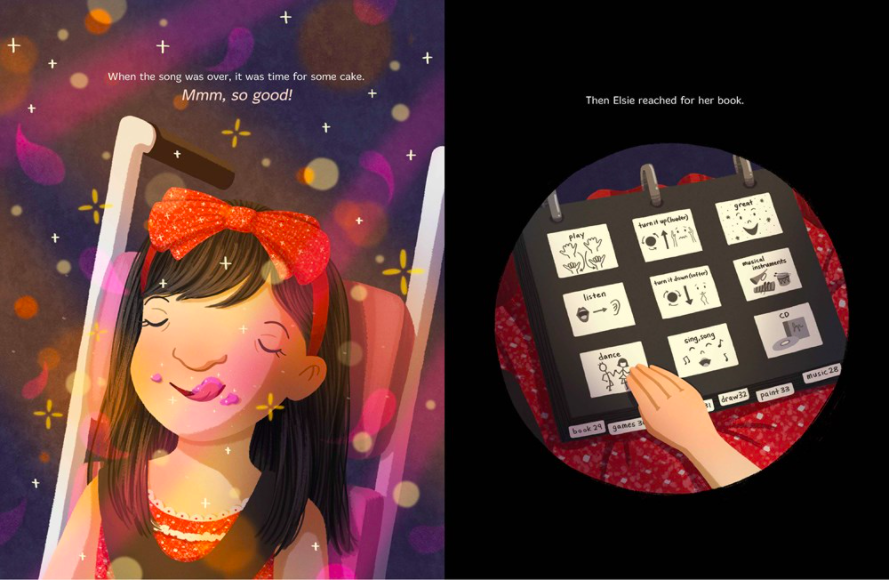
Inside the gym, the music boomed, and everyone was dancing. When a “tender tune began to play, Daphne and Rosalie took a break. Elsie’s daddy picked her up. “Elsie pressed her forehead against Daddy’s, and together they danced. He swung her high and held her tight. It was just like her dream, “except better.” Afterward, Elsie tasted the frosting from her piece of cake, then she touched the “dance” picture in her book. Elsie and Daddy returned to the dance floor and “joined Daphne and Rosalie under the lights and dance and danced into the night.”

An Author’s Note at the front of the book introduces readers to Wolf-Hirschhorn syndrome, its prevalence, affects, and the tools people with WHS use to eat, communicate, and get around.

celebrate-picture-books-picture-book-review-dancing-with-daddy-book

Image copyright Ziyue Chen, 2021, text copyright Anitra Rowe Schulte, 2021. Courtesy of Two Lions.

Inspired by her own daughters, one of whom has Wolf-Hirschhorn syndrome like Elise, Anitra Rowe Schulte’s story glows with family love, support, and encouragement. As Elise gets ready for a father-daughter dance, readers will get caught up in her excitement and universal concerns, such as choosing the “perfect” dress and whether a much-anticipated event will be cancelled because of adverse weather. Schulte’s evocative storytelling beautifully incorporates both emotion and factual information through the use of realistic, uplifting dialogue and intermittent lyrical lines that echo the movement and music of dance. Children also see that while Elsie may be nonverbal, her thoughts are like their own, just expressed differently.

Ziyue Chen’s lovely illustrations shine with sisterly camaraderie and family devotion. As the story opens and Elise chooses the red dress over the pink one by pulling it close, kids can read in her face and body language how important the dress, the dance, and surprising her dad are to her. Likewise, readers will share Elise’s excitement and her worries and celebrate the fun she has at the dance. Particularly moving are two mirrored illustrations: the first, a gorgeous image, lit by golden orbs and tiny stars, of Elise dreaming of the dance to come, and the second a tender two-page spread later on when her dream comes true. 

In her illustrations of Elise, Chen realistically depicts the facial features of children with WHS as well as the wheelchair, orthotics, feeding mechanism, and PODD books used by many. Children who use tools similar to Elise will be excited to see themselves represented in these pages, and others will be interested to learn about them and to meet Elise.

A joyous and heartfelt story of a loving and supportive family and which celebrates the common hopes and dreams of all children, Dancing with Daddy is highly recommended for home libraries and is a must for school and public library collections.

Ages 4 – 8

Two Lions, 2021 | ISBN 978-1542007191

About Anitra Rowe Schulte

Anitra Rowe Schulte has worked as a journalist for The Kansas City Star and the Sun-Times News Group, as a staff writer for Chicago Public Schools, and as a publicist. She is the mother of three beautiful girls, one of whom has Wolf-Hirschhorn syndrome and is the inspiration for Elsie in this book. She lives in the Chicago area, and this is her first picture book. Learn more about her at www.anitraroweschulte.com and follow her at @anitraschulte on Twitter.

About Ziyue Chen

Ziyue Chen is the Deaf illustrator of a number of children’s books, including Mela and the Elephant by Dow Phumiruk, How Women Won the Vote by Susan Campbell Bartoletti, and Rocket-Bye Baby: A Spaceflight Lullaby by Danna Smith. She lives with her loved ones in Singapore. Find out more at www.ziyuechen.com or follow her @ziyuechen on Instagram.

To see Ziyue Chen bring her illustrations to life on the page, watch these videos.

celebrate-picture-books-picture-book-review-dancing-with-daddy-cover

You can find Dancing with Daddy at these booksellers

Amazon | Barnes & Noble | Books-a-Million

To support your local independent bookstore, order from

Bookshop | IndieBound

Picture Book Review
September 2 – It’s National Friendship Month

celebrate-picture-books-picture-book-review-aven-green-baking-machine-cover

About the Holiday

Friendship Month was instituted about ten years ago by the Oddfellows – or, as they are officially called, The Grand Order of Oddfellows Friendly Society (GUOOFS) – an international organization dedicated to philanthropy and charity believed to have established in England in the 1730s. The holiday encourages people to spend more time with their friends, get in touch with those they haven’t seen or talked to in a while, and to reach out to others who are alone or need a friend. As school gets underway, there are plenty of opportunities for kids to meet new people and form friendships – some of which may last a lifetime.

Thanks to Sterling Children’s Books for sharing a copy of Aven Green Baking Machine with me for review consideration. All opinions about the book are my own.

Aven Green Baking Machine

By Dusti Bowling | Illustrated by Gina Perry


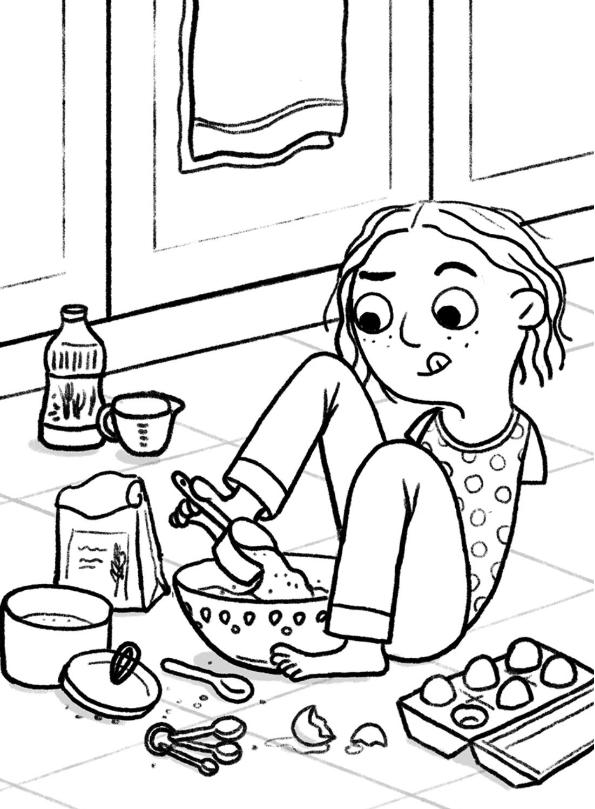
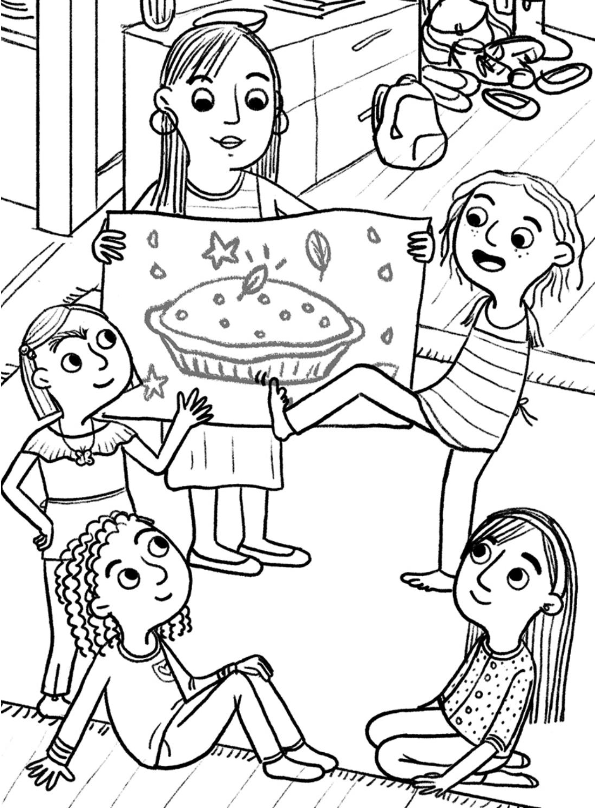
Hot off her stint as a sleuth, Aven Green has discovered another activity to conquer—baking! When she learns of a baking competition at the county fair the next weekend, Aven determines not only to enter, but to win the blue ribbon. She’s sure she will win because one, she’s an expert baker, having made a carrot cake last week; two, she’s a supertaster; and three, she has an excellent sense of smell. Now, as a pro, she calls her friends Kayla, Emily, and Sujata to come to her house prepared to each make a recipe of their choice. They will then choose which one to enter in the contest.

celebrate-picture-books-picture-book-review-aven-green-baking-machine-mixing

Image copyright Gina Perry, 2021, courtesy of Sterling Children’s Books.

With the girls all assembled at Aven’s house, they turn their attention to whose recipe to make first and focus on the ingredients Sujata brought to make her favorite Indian dessert, milk barfi. The other girls make fun of the dessert’s name, and Sujata retreats, crying, to Aven’s room. Aven’s mom appears to find out what happened. She asks the girls some pointed questions about whether they’d ever tried milk barfi before and if they had asked Sujata “what it tastes like or why it’s important to her.” She sends them in to Aven’s room to apologize. The friends make up and return to the kitchen to whip up the recipe, which Aven says smells like “spicy heaven.”

Next, they make Aven’s mint chocolate chip pie and then Emily’s peachy fluff, which Aven renames “peachy floof.” With these desserts all in the fridge, Kayla realizes they haven’t actually baked anything yet. And while the contest rules only call for an original dessert, Kayla thinks they should bake something. Aven suggests chocolate chip cookies until she discovers that the bag she thought held chocolate chips actually holds raisins for the raisin clafouti Kayla wants to make.

Aven has an unwavering loathing for raisins and tells Kayla, “‘Yeah, we’re totally not making that.’” The other girls defend Kayla’s choice. Hearing the shouting, Mom reappears and Kayla tells her how Aven won’t let her make clafouti—“‘raisin toefooty,’” Aven says, interrupting. Aven’s mom looks at her and tells her that she’s so disappointed in her behavior. Aven doubles down on her opinion and stomps off to her room to sulk. After the clafouti is in the oven, the girls all play together until it’s time to sample the desserts.

celebrate-picture-books-picture-book-review-aven-green-baking-machine-pie

Image copyright Gina Perry, 2021, courtesy of Sterling Children’s Books.

They love the Sujata’s milk barfi, and Emily’s peachy fluff turned out to be soupy—delicious, but more of a drink. Aven’s chocolate chip mint pie was deemed too minty, and Kayla’s raisin clafouti was declared the winner. Still, Aven wouldn’t try it. After everyone left, Aven’s mom sits down with her and explains that “‘the Aven I know would try something, even if she didn’t want to, so as not to hurt her friends’ feelings…. You did not act like a good friend.’”

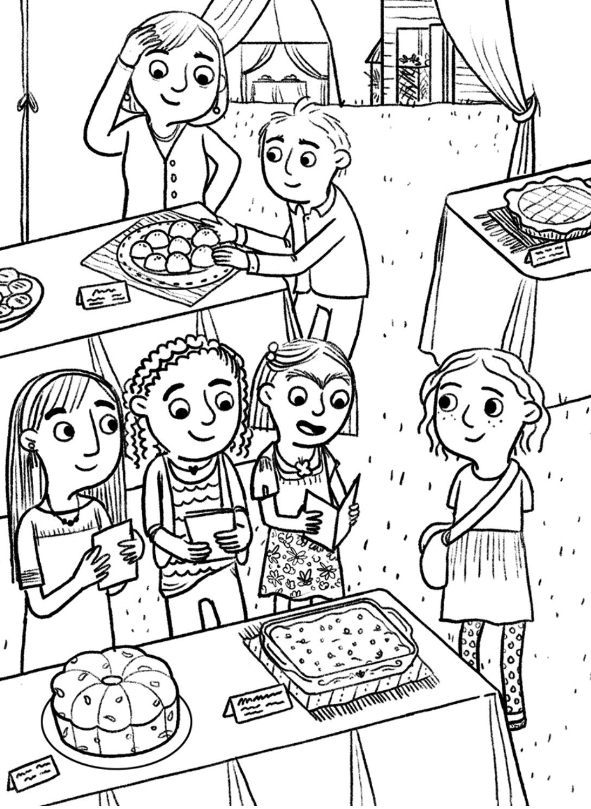
When Aven goes to apologize the next day at school, the other girls tell her they don’t want to enter the contest with her because she is “too difficult. ‘It’s your way or nothing,’” Emily tells her. As Aven sits alone on the playground, Ren comes over to see if she’s all right. Aven tells him about the contest and he tells her about his favorite dessert, manju—sweet bean paste steamed cakes. Aven makes a “yuck face” and Ren, sad, walks away. At home, Aven decides she’ll make something for the contest by herself and bakes a chocolate cake with mint frosting. But when the cake comes out of the oven, it is less than perfect. Aven cries because she knows she can’t win with that cake and her friends are all mad at her.

celebrate-picture-books-picture-book-review-aven-green-baking-machine-fair

Image copyright Gina Perry, 2021, courtesy of Sterling Children’s Books.

She goes to visit her great-grandmother, who gives Aven some perspective while making another unusual cake that Aven thinks she’s not going to like but ends up loving. The next day, Aven asks Ren to be her partner in the contest, telling his she wants to make manju. At first Aven is reluctant to try the steamed cakes they make, but one nibble later, she’s ready for more. She even decides that “from this moment in history until the end of time, I would forever be Aven Green, trier of new things, even the weirdest things anyone ever heard of.” The night before the contest, Aven made I’m sorry cards for Kayla, Sujata, and Emily, using all of her best stickers and glitter glue.

The day of the contest finally arrives. Aven and Ren make a fresh batch of manju and take it to the fair. Aven gives out her cards and wishes her friends good luck. They all wait to hear the judges’ decisions and… First place went to an apple caramel cake. Second prize went to a chocolate cream pie. And Third Place went to… Sujata, Emily, and Kayla for their raisin clafouti. Aven cheered and cheered for them, and when they left the stage, they offered Aven one of the yellow ribbons. She thought it would look lovely hanging on her wall, but she declined, telling her friends, “‘I didn’t win it. Not only that, but I had a bad attitude about the raisin clafouti, which did win.’”

Besides, Aven says, “‘I didn’t lose…. I won a whole new friend! And now I have my old friends back, too. Best day ever!’” Then she tasted the raisin clafouti, and even though she didn’t like it, she praised it for being an award-winner. Then the friends took in the fair and the bluegrass music, and Aven discovered another activity to conquer. “‘Watch out, world!’” she cried. “‘Here comes Aven Green, Music Machine!’”

A glossary of baking words found in the story as well as recipes for milk barfi, mint chocolate chip pie, peachy floof, raisin clafouti, tomato soup cake, and manju follow the text.

celebrate-picture-books-picture-book-review-aven-green-baking-machine-dancing

Image copyright Gina Perry, 2021, courtesy of Sterling Children’s Books.

Dusti Bowling’s second Aven Green story for young readers is infused with her protagonist’s distinct personality, infectious enthusiasm, and big heart. Realistic dialogue, situations, and emotions make it a book that will easily resonate with kids. While it’s easy to focus on the humor in Bowling’s story—which is delivered with snappy, rapid-fire dialogue and observations—the story also packs a punch in its message about the injustice of preconceived notions, the effects of thoughtless comments, ultra-competitiveness, and the true meaning of acceptance.

Just one of the joys of Bowling’s series is how Aven Green smashes wrong assumptions while being fearless and self-confident. Here, Aven discovers that while she promotes acceptance for herself, she must also extend the same appreciation to others. All of Bowling’s characters possess strong opinions, enough self-assurance to reject behavior that hurts, and the ability to recognize when they’ve been wrong and make amends. These qualities make them excellent role models for readers. As the girls separate into different teams for the baking contest and, ultimately, make a new friend, readers learn important lessons on standing up for oneself, making informed opinions instead of snap judgements, and what true friendship is all about.

Gina Perry’s engaging illustrations bring the story to life as readers see Aven cooking, eating, and creating cards for her friends with her feet as well as participating in all the other activities at school and the county fair. Her line drawings also capture the emotions of the characters as they argue, make up, and cheer each other on. Cameos by Aven’s mom and great-grandmother portray a steadying and caring influence.

Aven Green Baking Machine is a multi-layered story that will make kids think as they enjoy the humor, close relationships, and invitation to discover and bake recipes from around the world. This book is a good choice for kids and adults to read together while discussing the issues presented. Fans of the series will want to catch up on what Aven is conquering next and new readers will be happy to discover this empowering series.

Ages 6 – 8

Sterling Children’s Books, 2021 | ISBN 978-1454942207

Discover more about Dusti Bowling and her books on her website.

To learn more about Gina Perry, her books, and her art, visit her website.

celebrate-picture-books-picture-book-review-aven-green-baking-machine-cover

You can find Aven Green, Baking Machine at these booksellers

Amazon | Barnes & Noble | Books-a-Million

To support your local independent bookstore, order from

Bookshop | IndieBound

Picture Book Review
November 6 – It’s Picture Book Month

celebrate-picture-books-picture-book-review-awesomely-emma-cover

About the Holiday

Today’s picture books are amazing! Offering inspiration, characters that really speak to kids, moments to laugh out loud or reflect, glimpses into history, revelations in science, and much of the best art currently being produced, picture books defy their slim appearance with content that can change young lives. Reading a wide variety of books to children from birth on up is one of the most rewarding activities you can do. Make choosing the books to read a family affair! Kids love picking out their own books and sharing cozy and fun story times with you!

Awesomely Emma: A Charley and Emma Story

Written by Amy Webb | Illustrated by Merrilee Liddiard


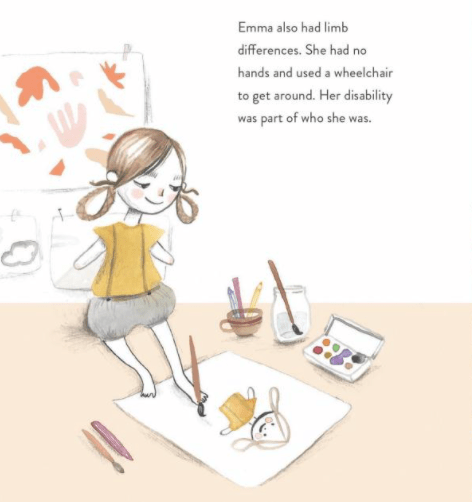
Emma loved making art of all kinds, she also loved laughing, her big sister, Chloe, and her mom and dad. Emma had limb differences. “She had no hands and used a wheelchair to get around.” When she drew or painted she held the pencil or paint brush with her toes. Today, Emma was painting a picture of herself. “Emma looked at her drawing and said, ‘No bodies are wrong. All bodies are right. We’re all different colors, sizes, and heights.’” Emma knew that her body worked differently, and she loved who she was.

celebrate-picture-books-picture-book-review-awesomely-emma-painting

Image copyright Merrilee Liddiard, 2020, text copyright Amy Webb, 2020. Courtesy of Beaming Books.

When Emma’s class went to the art museum, Emma hoped to find a painting by her favorite artist, Matisse, who also used a wheelchair. But when they got to the museum, there was no ramp out front for Emma to use. Instead, she and her teacher would have to go around back and meet up with the class inside. Emma felt sad and frustrated because she wanted to use the front door, but she put on a smile and reminded herself “‘My body works differently – I love being me! Because ME is an awesome thing to be.’”

celebrate-picture-books-picture-book-review-awesomely-emma-drawing

Image copyright Merrilee Liddiard, 2020, text copyright Amy Webb, 2020. Courtesy of Beaming Books.

Once inside, the kids raced all over the museum looking at the different types of art. At last, Emma found a painting by Matisse. Gazing at it, Emma dreamed that one day maybe her art would hang in a museum. Her musings were suddenly interrupted when Charley grabbed hold of her wheelchair and began pushing. Emma had to remind him that she liked to drive herself. Then at lunch, before she could even unpack her bag, Charley started doing it for her. And when they stopped to draw, Charley was right there again to help. It made Emma angry, and she told Charley to stop.

Charley apologized and said he felt bad about her not being able to use the front door and about other things Emma couldn’t do. Emma explained to him that everyone is different and that she loves who she is. Emma said that it was okay if she couldn’t do everything. No one can do everything, she told Charley. Then she reminded him of all the things she could do on her own and with her feet.

Suddenly, Emma had an idea. In her sketchpad she wrote a letter, and the whole class signed it. Before they left, Charley handed it to a museum worker. Several weeks later, a letter arrived for the class. In it the museum director agreed that there should be a ramp out front and promised to begin building one right away. Everyone cheered, and Emma “felt awesome.”

celebrate-picture-books-picture-book-review-awesomely-emma-museum

Image copyright Merrilee Liddiard, 2020, text copyright Amy Webb, 2020. Courtesy of Beaming Books.

Positive, straightforward, and empowering, Amy Webb’s book about a girl with limb differences and a strong sense of self-confidence and self-esteem is both a compelling story and an excellent way for adults and children to discuss the wide range of abilities people possess, inclusivity, and individuality. Emma, displaying talent, poise, and enthusiasm as well as the courage to speak up for herself, is a delight. She is a superb role model for all children.

Merrilee Liddiard’s charming illustrations show Emma as a regular kid, drawing, painting, at school with friends, and enjoying the trip to the museum—just differently. Her happiness and self-possession are evident in her expressions and interactions with her friends. When no ramp is available at the front door of the museum and Charley begins taking over, Emma’s expression registers her frustration, allowing readers to see and understand how these experiences make her feel. Images of Emma in her wheelchair and performing tasks with her bare feet demonstrate Emma’s independence and abilities.

Uplifting and inclusive, Awesomely Emma: A Charley and Emma Story is highly recommended and would be an inspiring addition to home bookshelves and is a must for school and public library collections. Don’t miss the first book in this series: When Charley Met Emma.

Ages 4 – 8

Beaming Books, 2020 | ISBN 978-1506464954

Discover more about Amy Webb and her books on her website.

To learn more about Merrilee Liddiard, her books, and her art, visit her website.

celebrate-picture-books-picture-book-review-awesomely-emma-cover

You can find Awesomely Emma: A Charley and Emma Story at these booksellers

Amazon | Barnes & Noble | Books-a-Million

To support your local independent bookstore, order from

Bookshop | IndieBound

Picture Book Review
March 27 – Quirky Country Music Song Titles Day

celebrate-picture-books-picture-book-review-talkin-guitar-cover

About the Holiday

Song titles can be evocative of so many emotions, and country song titles seem to take this fact to a whole nuther level. Sure, the travails of heartbreak may cause misery and despair, but I bet you can’t help smiling—just a little—when you read titles like this: I Would Have Writ You A Letter, But I Couldn’t Spell Yuck!, You Were Only A Splinter As I Slid Down The Bannister Of Life, and Did I Shave My Legs for This? So, today, celebrate by finding and listening to some quirky country songs that tickle your fancy.

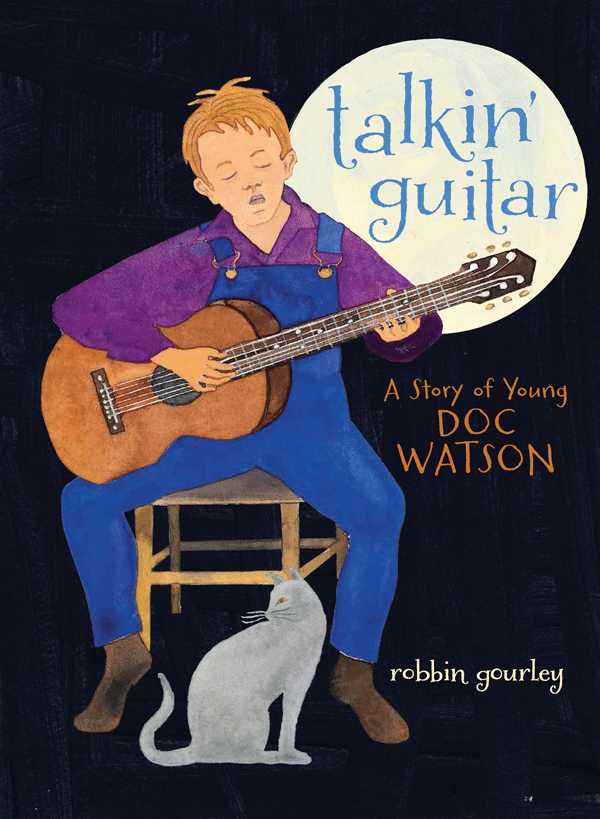
Talkin’ Guitar: A Story of Young Doc Watson

By Robin Gourley

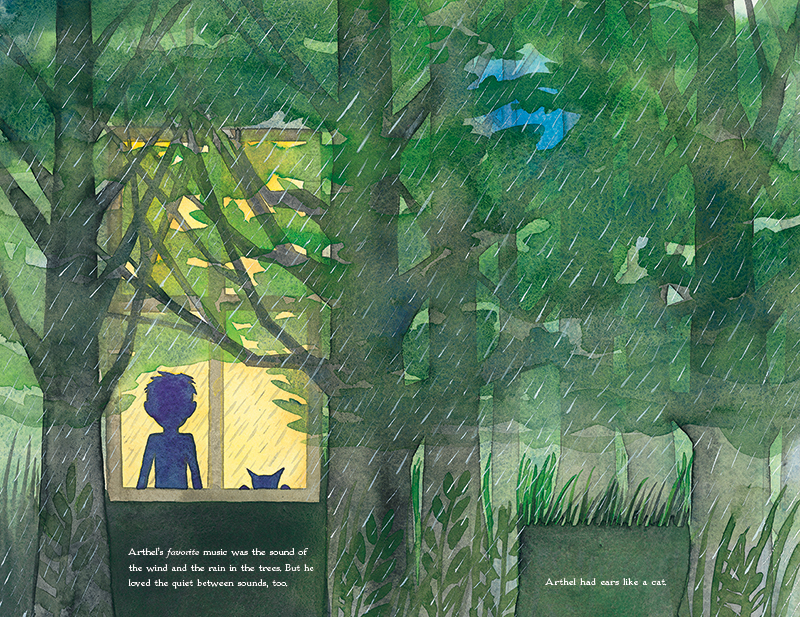
“Yonder, where blue mountains meet the sky, Arthel Watson was born into a world of music.” Music, for Arthel, was much more than his mama’s singing at the end of the day. It was the calls of animals and birds, the burbling river, the whistles of trains, and the clatter of farm machinery. He loved to listen to the rain and the wind and the silence between sounds too. “Arthel had ears like a cat. Maybe it was because he was blind.”

celebrate-picture-books-picture-book-review-talkin-guitar-rain

Image and text copyright Robbin Gourley, courtesy of robbingourley.com

Arthel just couldn’t help but make music whenever and wherever he could. Pots became drums, and cowbells rang like cymbals. Arthel even strung a steel wire across the barn door to strum. When Pappy gave him a harmonica, Arthel practiced until the screechy notes settled into a purr. When Pappy made him a banjo, he practiced until the “rusty door hinge” creak was replaced by spritely melody. One day when Arthel plinked out a few notes on his cousin’s guitar, his father made him a promise. “‘Son, if you can play a song by the time I git home from work, we’ll go into town and buy you your own guitar.’”

celebrate-picture-books-picture-book-review-talkin-guitar-played-guitar-everywhere

Image and text copyright Robbin Gourley, courtesy of robbingourley.com

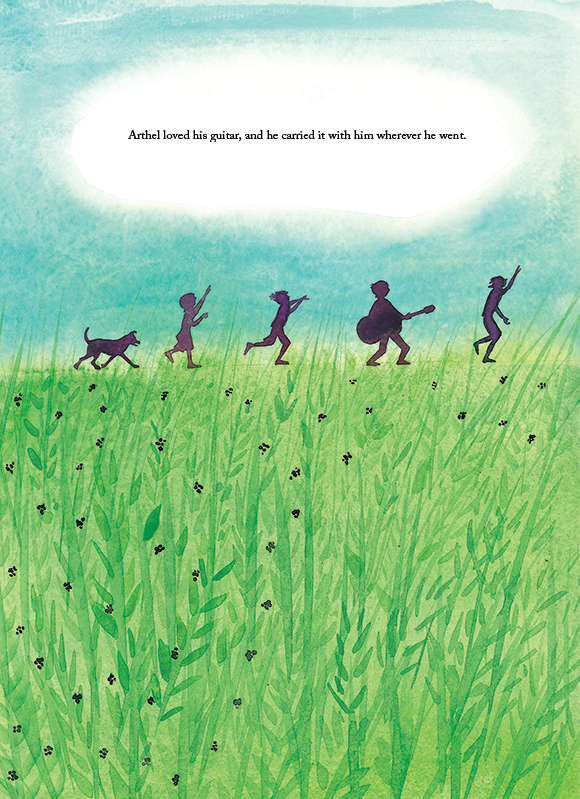
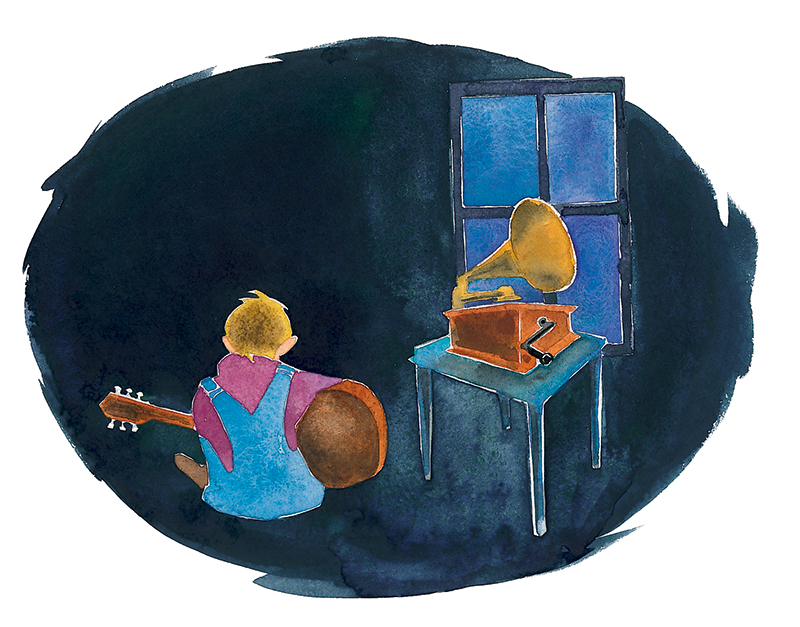
By the end of the day, Arthel had composed a “sweet, simple song” from the few chords he had learned. With a “belly full of butterflies,” he played it for his family and earned himself a guitar. From then on Arthel carried his guitar everywhere, learning from records at home and from songs on the radio. He memorized the rhythms of farm work and the songs of various animals, and between chores he practiced, practiced, practiced. “All those chores and all that practice made him sharp as a whittling knife and tough as a hickory.”

celebrate-picture-books-picture-book-review-talkin-guitar-listening-to-victrola

Image and text copyright Robbin Gourley, courtesy of robbingourley.com

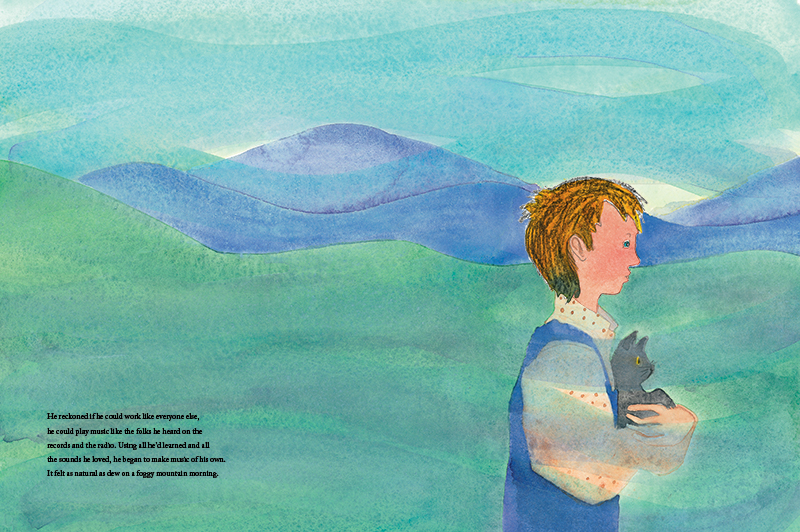
Arthel decided that if he could work just like everyone else, he could probably play music as well as the artists he listened to on records and on the radio. He began to compose his own music. “It felt as natural as dew on a foggy mountain morning.” Arthel played “what he couldn’t see. He could make his guitar sound like a muskrat or a groundhog or a ‘wooly boogie bee’” and sing the stories of the countryside he loved.

An Author’s Note following the text reveals more about Arthel’s life, the influences on his music, and how he earned the nickname “Doc.”

celebrate-picture-books-picture-book-review-talkin-guitar-inspired

Image and text copyright Robbin Gourley, courtesy of robbingourley.com

Robin Gourley’s heartening biography of Doc Watson is perfectly attuned to her young audience. Readers are introduced to Arthel as he soaks in the sounds of life around him and only learn several pages into the story that he was blind. His blindness is not mentioned again except for the subtle acknowledgement that “he reckoned if he could work like everyone else, he could play music like the folks he heard on the records and the radio”—which becomes universal inspiration for all. The emphasis that practice develops natural talent and pays off is also a great lesson for readers who may just be discovering their own talents.

Gourley’s soothing watercolors are suffused with the beautiful pastels of Appalachia, which was both home and muse to Anthel. Vignettes take readers inside Anthel’s home to discover the Victrola and the old radio that were his early teachers and introduce his family, who surrounded him with encouragement as he grew from a child to a young man—always with a guitar in his hands.

Ages 4 – 7

Clarion Books, 2015 | ISBN 978-0544129887

To discover more about Robbin Gourley, her books, and her art, visit her website!

Quirky Country Music Song Titles Day

celebrate-picture-books-picture-book-review-guitar-dot-to-dot

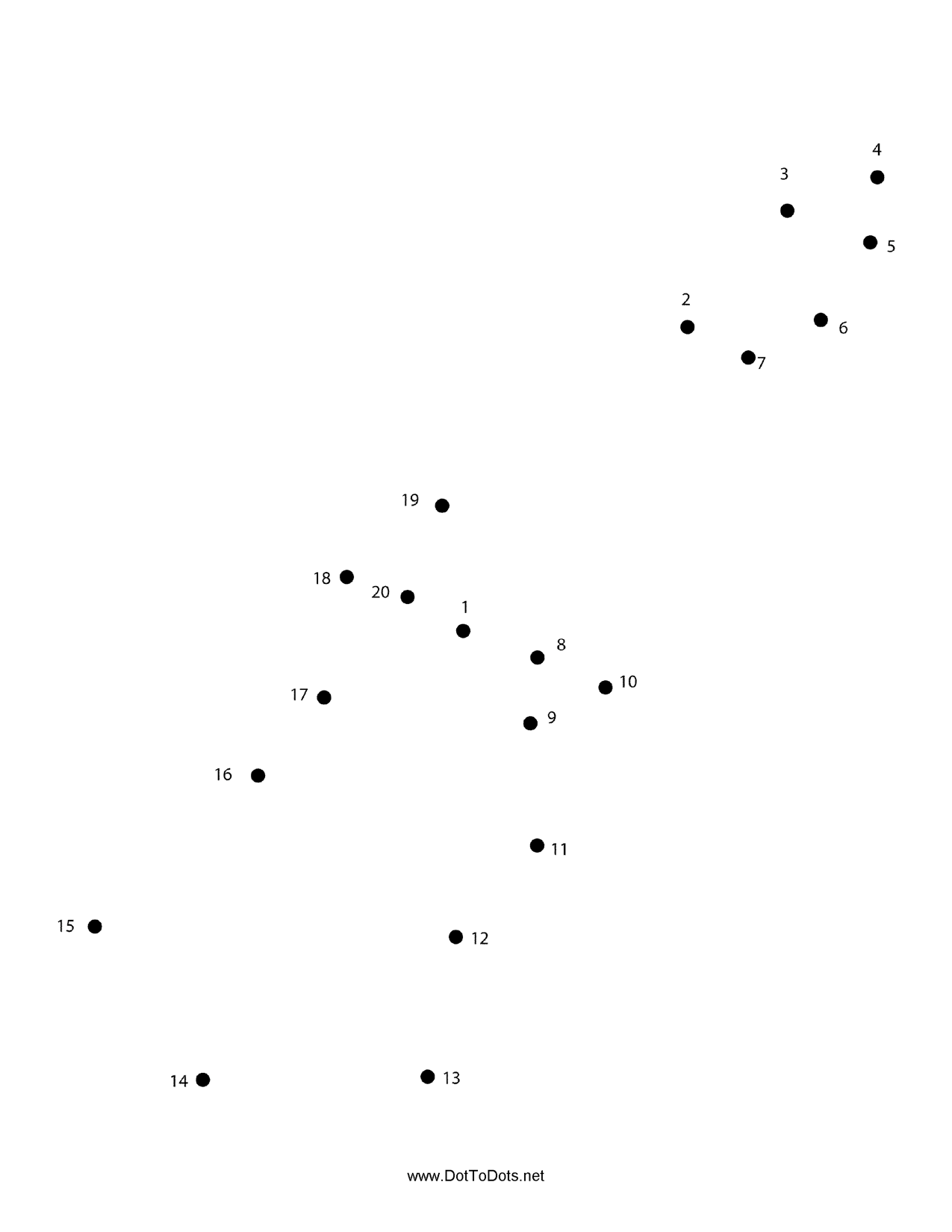
Musical Dot-to-Dot

When a musician follows notes, they create a song. What will you find when you follow the numbers on this printable Musical Dot-to-Dot?

Picture Book Review