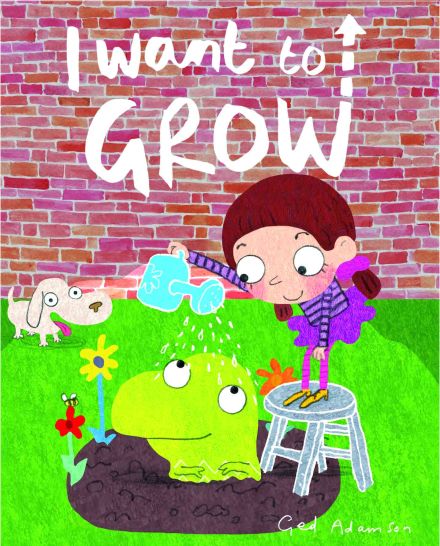
The Week of the Young Child is an annual initiative hosted by the National Association for the Education of Young Children to celebrate learning, young children, their families, and their teachers. Daily themes focus on ways that children learn. This year those included Music Monday, Tasty Tuesday, Work Together Wednesday, Artsy Thursday, and today—Family Friday, in which people are encouraged to share their family stories. Today’s book also takes a look at a common childhood topic through which kids learn about themselves and others.
I Want to Grow
By Ged Adamson
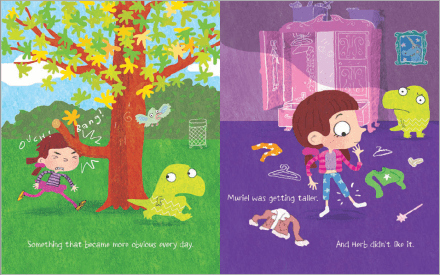
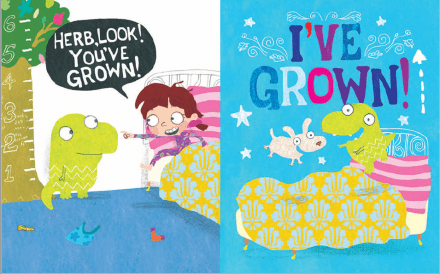
One day while Herb and Muriel were strolling through the neighborhood, Herb noticed something a little different. Every day this disturbing trend continued. The fact was impossible to ignore—“Muriel was getting taller. And Herb didn’t like it.” He didn’t mind that she could now see over the fence or reach things on high shelves, it was just that…well… “he wasn’t getting any taller himself.”
Copyright Ged Adamson, 2017. Courtesy of Boyds Mills Press
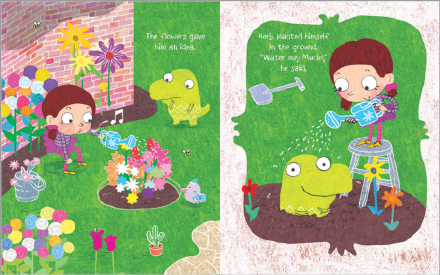
So Herb looked around for a way to rectify the situation. The flowers in Muriel’s garden were reaching for the sky. Perhaps planting himself in the ground would make him grow. But no matter how much Muriel watered him, nothing happened. He shook off the dirt and went to find Muriel. She was in the kitchen working with clay. Herb watched her roll a small piece of clay into a looong piece. That looked promising, so Herb asked for Muriel’s help. “She rolled him back and forth until her arms ached. But he didn’t get any longer. Just dizzy and a little queasy.”
Copyright Ged Adamson, 2017. Courtesy of Boyds Mills Press
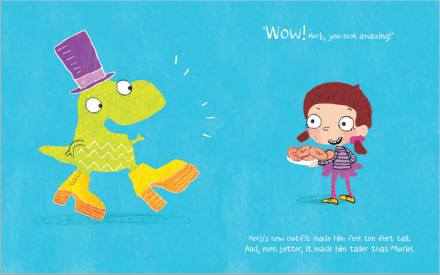
Maybe if he just willed himself to grow, he would, Herb thought. He stressed and strained until he was red in the face, but he remained as short as ever. Muriel knew Herb was having a hard time, so she made him a special treat of tea and doughnuts. When he approached, Muriel immediately recognized a difference. Herb was tall top and bottom. Both Herb and Muriel loved the new look—the high wedge shoes and top hat looked amazing! But standing and walking proved to be perilous.
Copyright Ged Adamson, 2017. Courtesy of Boyds Mills Press
Herb went to bed feeling a little dejected. In the morning, though, Herb had a pleasant surprise. When he went to wake up Muriel, she noticed something right away. Herb had grown! He was so excited that he “jumped and cheered.” Suddenly, Muriel realized that she had grown too. Herb could see that something was on her mind and asked. It’s “nothing, Herb. Nothing at all,” she said. “Let’s celebrate your new tallness!” And that is just what they did. After that Herb didn’t “worry about catching up with Muriel because he was growing!”
Copyright Ged Adamson, 2017. Courtesy of Boyds Mills Press
Ged Adamson’s wit and whimsy go a long way in assuaging childhood doubts and worries in his funny book. The issue of growth is a common one as siblings, friends, and classmates often compare themselves and watch as those around them grow taller or they themselves begin to outpace the rest. The uncertainty of being different can be troubling and set up unnecessary anxiety.
Adamson’s I Want to Grow offers kids reassurance that nature will take its course while also making them laugh at Herb’s attempts to speed the process. Muriel’s empathy and kindness toward Herb is another wonderful life lesson for readers navigating the quirks and changes of childhood. Adamson’s distinctive illustrations combine vibrant colors, sketched-in details, and sweet, round-eyed characters to enchant kids and boost both the humor and sweetness factor of this heartening story.
I Want to Grow is a great book to share with kids who may be feeling unsure about their height—or any such issue.
Ages 4 – 8
Boyds Mills Press, 2017 | ISBN 978-1629795850
Check out more about Ged Adamson, his books, and his art on his website!
Week of the Young Child Activity
Window Pane Terrarium
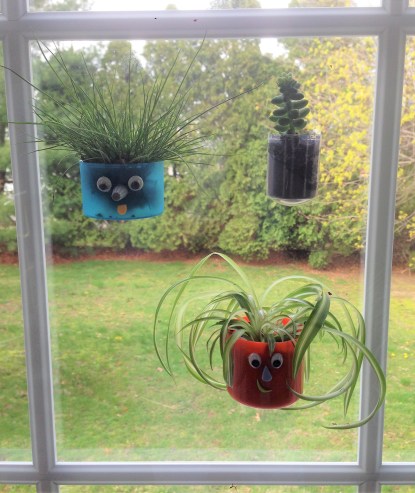
With this easy craft for spring and summer that combines creativity, recycled materials, a little science, and an opportunity to watch your efforts grow, you can turn a window pane into a little garden.
Supplies
Small, light recycled plastic containers with no lip – small cups or colorful tops from shaving cream or other such cans
Googly eyes, foam, paint or other materials to decorate the container
Soil
Seeds or small plants (small succulents, air plants, spider plants, and grass work well)
Adhesive Velcro mounting strips in an appropriate weight category
Spoon
Directions
Clean and dry containers
Decorate containers with eyes and foam to make faces, or in any way you wish
Fill container with soil
Add seeds or plants
Attach Velcro strips to back of container
Attach firmly to window pane
Alternately: line up containers on a window sill for a colorful indoor garden
Today’s holiday was established to celebrate the art of storytelling. Highlighting the tradition of oral storytelling, the day encourages families to get together and have fun remembering and sharing family tales. Reading together is another wonderful way to discover your own stories and those of others around the world.
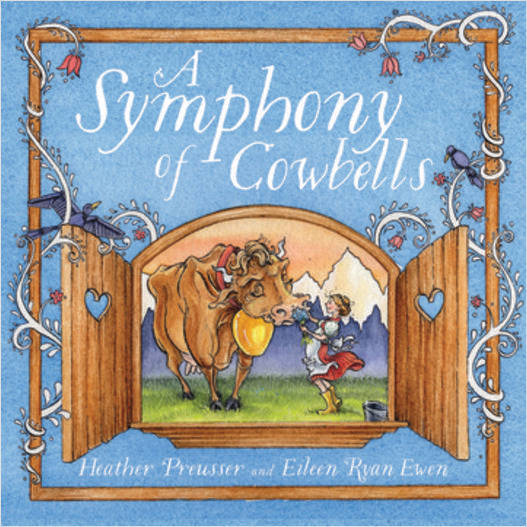
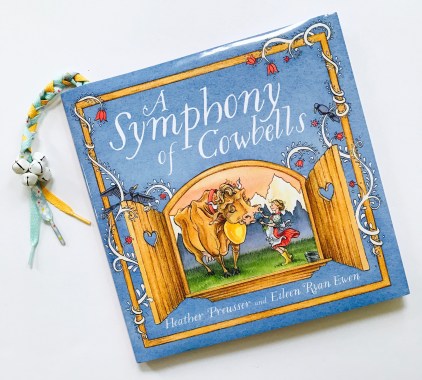
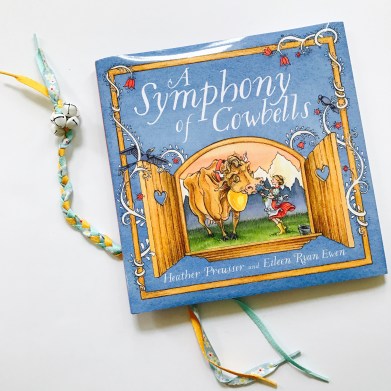
A Symphony of Cowbells
Written by Heather Preusser | Illustrated by Eileen Ryan Ewen
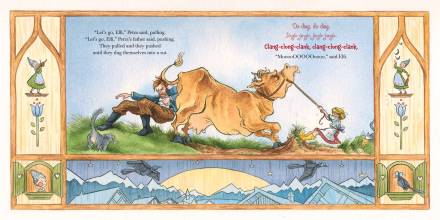
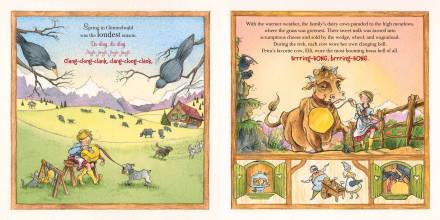
With the dawning of spring, Gimmelwald came alive with the “Da-ding, da-ding. Jingle-jangle, jingle-jangle. Clang-clong-clank, clang-clong-clank” of bells as the cows were led to the sweet, green grass in the high meadows. The cows’ milk would become “scrumptious cheese…sold by the wedge, wheel, and wagonload.” As Petra walked with her family’s herd, she led her favorite cow, Elfi, who “wore the most booming brass bell of all.”
Image copyright Eileen Ryan Ewen, text copyright Heather Preusser. Courtesy of Sleeping Bear Press.
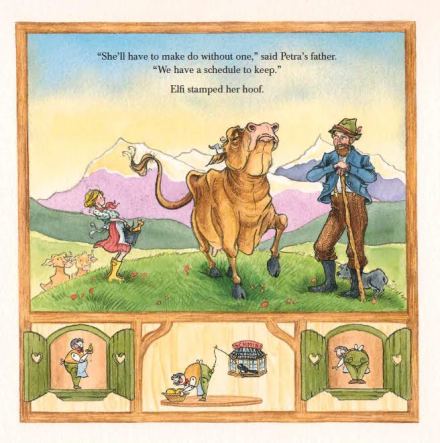
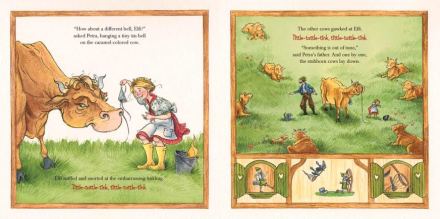
But one day Elfi’s bell was missing. Petra’s father told her they had a schedule to keep and that Elfi would have to go without her bell, but Elfi wouldn’t hear of it. She stomped her hoof and stood her ground. No amount of pushing, pulling or prodding could move Elfi from her spot. Petra ran and retrieved a tiny tin bell to hang around Elfi’s neck, but Elfi only “sniffed and snorted at the embarrassing tinkling. Tittle-tattle-tink, tittle-tattle, tink.”
Image copyright Eileen Ryan Ewen, text copyright Heather Preusser. Courtesy of Sleeping Bear Press.
Without Elfi to lead them, Petra’s other cows lay down in the meadow and refused to move as well. “‘No milk? No cheese? What’ll we do?’ Petra gulped.” She begged Elfi to get up, but Elfi simply gazed at Petra with “eyes wide as milk saucers.” Petra knew she had to find Elfi’s bell. She searched the house, looked in the barn, and combed the field, but didn’t find the bell. The sun went down, and “the stubborn cows remained rooted among the bellflowers.”
Image copyright Eileen Ryan Ewen, text copyright Heather Preusser. Courtesy of Sleeping Bear Press.
In the morning, Petra spied a crow with something shiny in its beak. She ran after it and discovered the bird’s huge nest high on a cliff. She was much too small to reach it, so she called her father, her mother, and a couple of neighbors. They piled on top of one another, and as Petra teetered on her mother’s shoulders, she reached into the nest and pulled out…Mr. Schmid’s pocket watch, Miss Baumann’s reading glasses, Farmer Felber’s wrench, Mother’s bracelet, Father’s keys, and…Elfi’s brass bell!
Petra skipped all the way to where Elfi and the other cows were keeping their protest, the brass bell announcing “Brrring-BONG, brrring-BONG. Brrring-BONG, brrring-BONG” all the way. When Elfi saw her bell, she danced with joy. Petra placed the bell over Elfi’s head and kissed her velvety nose. The other cows took notice. “On cue, they stood and moseyed up the mountainside….The symphony of cowbells was harmonious again—and LOUD. It was springtime in Gimmelwald after all.”
Image copyright Eileen Ryan Ewen, text copyright Heather Preusser. Courtesy of Sleeping Bear Press.
Heather Preusser’s enchanting Swiss tale of tenderhearted but stubborn Elfi will delight readers with its musical mystery and gentle humor. Kids will love hearing and reading along with the melodic verses of jingling cowbells sprinkled throughout the text. Preusser’s lyrical phrasing is as fresh as the mountain air and will transport children to the beautiful Swiss countryside.
A Symphony of Cowbells is a perfect example of text and illustrations working together to present the story and add layered details that elevate the reading experience. Eileen Ryan Ewen’s gorgeously detailed and charming paintings take readers to the heart of Gimmelwald, with its glorious mountain backdrop, quaint village architecture, and cozy homes decorated with Alpen cuckoo clocks, dainty curtains, and window boxes overflowing with flowers.
Along the way Ewen frames a consecutive story along the bottom of most pages. Through these panels, eagle-eyed readers will notice a curious happenstance occurring in Gimmelwald which just may explain a few things…. It’s not until the end, however, that kids discover the answer to the story’s mystery.
A Symphony of Cowbells is a captivating and humorous look at country life with a little science sprinkled in. Readers may be enticed to do a little more research into the animal behaviors that influenced the story. The book would make a lovely addition to any child’s home library.
Ages 5 – 8
Sleeping Bear Press, 2017 | ISBN 978-1585369683
To learn more about Heather Preusser and her book as well as see a video about the real Gimmelwald, visit her website!
Discover more about Eileen Ryan Ewen and view a portfolio of her illustration work on her website!
National Tell a Story Day Activity
Ring a Bell for Reading Bookmark
It’s easy to make a stylish bookmark that can ring out your love of reading while marking your page!
Supplies
3 shoelaces or ribbon of different designs
Small “sleigh” bells or other bells
Directions
Hold three shoelaces together and knot them together at the top
Braid the shoelaces together as long as you want your bookmark to be
At the end, string three or more bells onto the ends of the shoelaces and knot the shoelaces together to hold the braid closed.
Alternately, you can knot the braid at the end and tie a group of bells to the end.
The end with the bells becomes the top of the bookmark.
The month of April is set aside for people to recognize and appreciate the varied cultures and beliefs around the world. Instead of finding division and differences, we should celebrate the beauty and wonder of our multifaceted planet. This month offers a great opportunity to discover ways to incorporate acceptance and inclusiveness throughout your life.
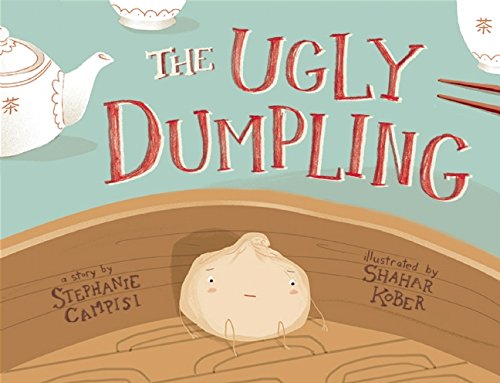
The Ugly Dumpling
Written by Stephani Campisi | Illustrated by Shahar Kober
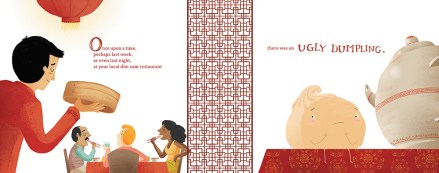
“Once upon a time, perhaps last week, or even last night, at your local dim sum restaurant…there was an ugly dumpling.” Sure, you might think all dumplings are ugly, but we’re talking about one particular ugly dumpling. It tried all sorts of tricks to make itself more attractive, but it still remained lonely and uneaten. It sat dejected until a cockroach traversing the kitchen caught sight of it and immediately fell in love.
Image copyright Shahar Kober, text copyright Stephani Campisi. Courtesy of Mighty Media Press.
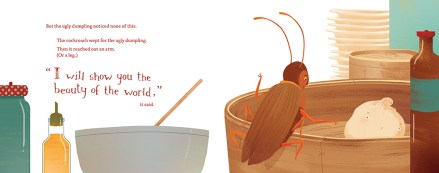
The cockroach “reached out an arm. (Or a leg)” toward the dumpling and offered to show it the beauty of the world. Together they traveled to cities near and far, experiencing them through culinary lenses—stacked-plate skyscrapers, piled-dishes skylines, and chopstick bridges that took them over flour mountains and folded-napkin peaks. Then, in a certain restaurant, the dumpling saw something astonishing! Not only one, but two, three, four, and more dumplings just like itself!
Image copyright Shahar Kober, text copyright Stephani Campisi. Courtesy of Mighty Media Press.
Suddenly the ugly dumpling realized that it was not a dumpling at all, but a “steamed bun—a golden-hearted, smooth-skinned steamed bun, exactly like all the other steamed buns in the world.” The ugly dumpling puffed with meaning, importance, and…yeast! The restaurant patrons and staff and even the other steamed buns took notice. The cockroach by the ugly dumpling’s side cheered to see its friend receiving so much attention.
Image copyright Shahar Kober, text copyright Stephani Campisi. Courtesy of Mighty Media Press.
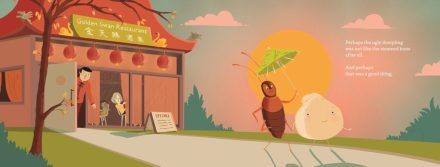
The people’s wide eyes and astonished expressions were not for the dumpling, however. Instead, they registered horror at the insect in their midst. The ugly dumpling was familiar with that look and did “something quite beautiful. It reached out an arm. (Or a leg.) And it led the cockroach out into the world, The beautiful, beautiful world.” And in that moment the ugly dumpling realized that it “was not like all the other steamed buns after all” and that “perhaps that was a good thing.”
Image copyright Shahar Kober, text copyright Stephani Campisi. Courtesy of Mighty Media Press.
Stephani Campisi’s The Ugly Dumpling is a fresh and delectable dish-up of the classic Ugly Duckling story for a new audience. Stuffed with charm and off-beat humor, this tale of friendship and diversity embraces all who feel at odds with their environment—with or without the recognition of why. Its sweet and insightful ending emphasizes the idea that finding your niche does not always mean fitting in with a certain crowd, and that having the courage to strike out on your own path leads to beautiful relationships and personal happiness.
Image copyright Shahar Kober, text copyright Stephani Campisi. Courtesy of Mighty Media Press.
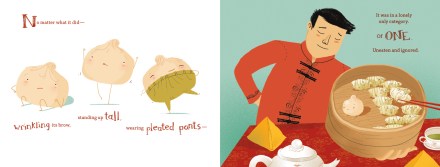
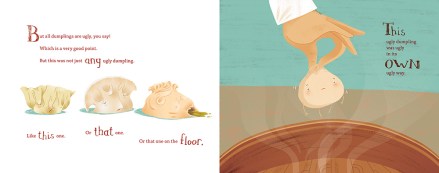
Shahar Kober’s dumpling is anything but “ugly.” His adorable puffed dough, lonely and ignored for not adhering to the mold, will melt readers’ hearts as he tries anything and everything—including green pleated pants—to fit in. Kobar’s stylish drawings are the perfect underscore to Stephani Campisi’s quick, dry wit—as in his rendition of three uglier-than-the-next dumplings—and if cockroaches were really as cute as Kober’s, we’d all set out a different kind of Roach Motel. A clever bit of typography transforms steam coming from a wok into the word HISS, and the restaurant scenes will make readers hungry for their favorite Asian eatery.
As readers turn to the last pages and watch the steamed bun and the cockroach leave the restaurant hand in hand (foot in foot?) under the shade of a paper umbrella, they will want to turn back to the beginning and start over again. The Ugly Dumpling is a must read and a wonderful addition to children’s bookshelves.
Ages 2 – 9
Mighty Media, 2016 | ISBN 978-1938063671
Get to know more about Stephanie Campisi and her work on her website!
To view a gallery of art by Shahar Kober for books, magazines, animation, and more, visit his website!
Check out the Mighty Media Press website for more about The Ugly Dumpling and a-dough-able coloring pages!
Take a look at the trailer for The Ugly Dumpling!
Celebrate Diversity Month Activity
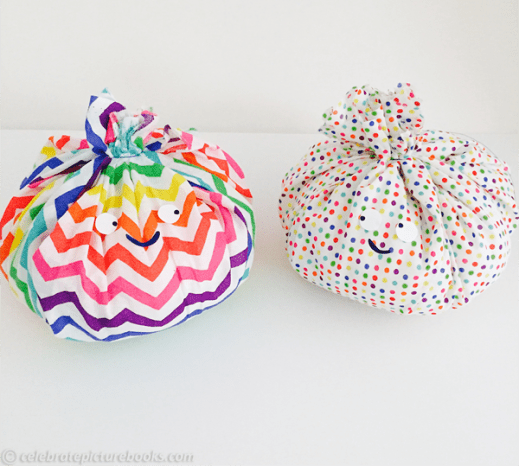
Embrace Your Inner Dumpling Plush
We are all beautiful “dumplings” in one way or another! With this easy craft you can create a huggable friend and show others what you’re made of!
Supplies
Square piece of cloth in any fabric and color. Size of plush depends on size of cloth (the plushes shown are made from 18”-square cotton fabric)
Poly fill (the plushes shown use about 1 1/8 ounces of fill)
White cloth for eyes and mouth
Twine or string
Fabric glue
Directions
Cut the corners from the square cloth to make a circular piece of cloth
Fill the middle with poly fill
Pull the edges of the cloth up and around the fill
Tie the top closed with the twine or string
To make the face, cut small circles and a mouth from the white cloth
We all know about the 5-7-5 rule of haiku poetry: the first line contains 5 syllables, the second line consists of 7 syllables, and the third line follows with 5 syllables. It seems easy as we count off the sounds on our fingers while we compose and say them. But haiku poems are so much more than the sum of their syllables. In those tiny nuggets of language are poignant emotions, unique observations of nature, and life’s wisdom. To celebrate today, read some haiku from the masters—or try your hand at this beautiful form of poetry.
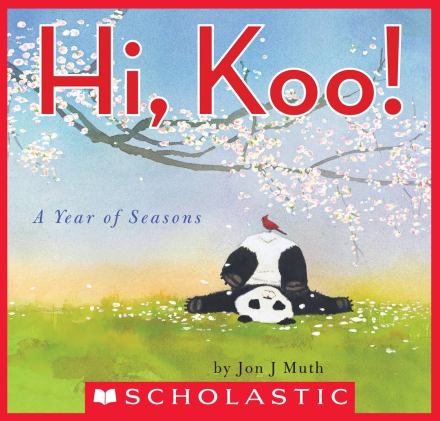
Hi, Koo! A Year of Seasons
By Jon J Muth
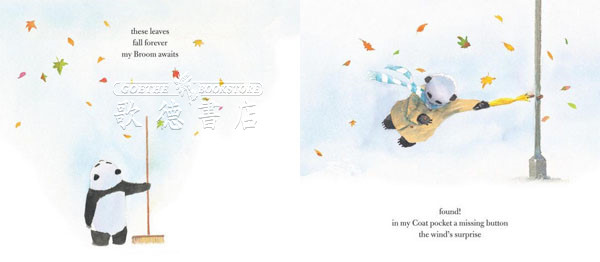
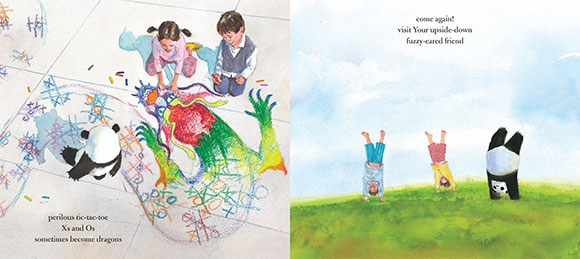
Jon J Muth’s beloved Zen panda, Koo, tumbles into a year of poignant, funny, and surprising kid-inspired moments in this lighthearted and spirited collections of haiku. As Hi, Koo opens, the gentle panda reaches for a golden, falling leaf that seems to be racing others as they softly plummet to earth. With his paw stretched into the air, Koo wonders, “Autumn, / are you dreaming / of new clothes?”
Image and text copyright Jon J Muth, 2014, courtesy of Scholastic Press.
As autumn turns blustery and rainy, Koo strolls outside with his umbrella, taking time to spin and twirl and recreate an iconic pose of joy on a lamp post before returning home. Koo licks his lips remembering his day: “Dance through cold rain / then go home / to hot soup.”
Image and text copyright Jon J Muth, 2014, courtesy of Scholastic Press.
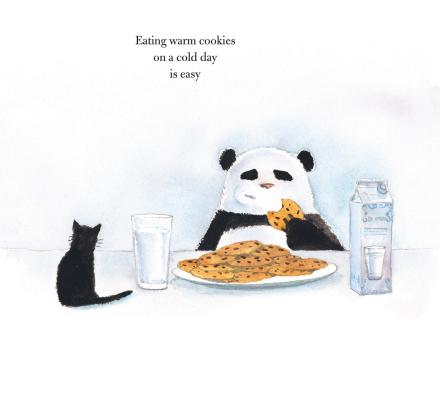
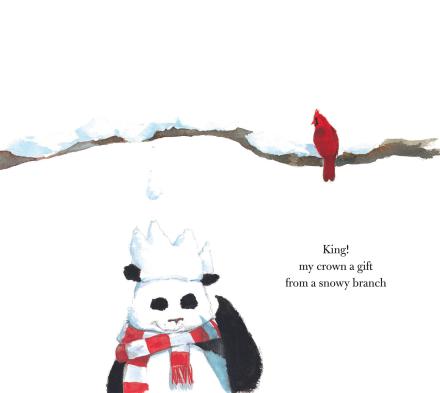
With winter come snow and mysteries and irresistible impishness. Rising from the piles of white fluff, a traffic sign is a tempting target: “snowball hits the stop sign / Heart beats faster / are we in trouble?” The storm leaves snowbanks hip-high on Koo—but smaller creatures? “In the snow / this cat vanishes / Just ears…and twitching tail.”
Winter’s early nightfalls and dusting snow showers invite quiet play and contemplation as “shadows getting Long / snowfall flutters around / the outside lamps.”
Image and text copyright Jon J Muth, 2014, courtesy of Scholastic Press.
Finally, warm weather soothes the sky, bringing “New leaves / new grass new sky! / spring.” The reawaking world inspires long walks in the lush forest, complete with food for the mind and little friends: “Reading aloud / a favorite book / an audience of sparrows.” But sometimes a step goes wrong, triggering a twinge of remorse that sensitive readers will recognize: “killing a bug / afterward / feeling alone and Sad.”
Image and text copyright Jon J Muth, 2014, courtesy of Scholastic Press.
Summer ousts all remnants of the coolness of spring, offering gleeful freedom both day and night. The deep, inky skies provide a backdrop to “Tiny lights / garden full of blinking stars / fireflies.” On a trip to the shore, even the sea becomes a playmate: “Water catches / every thrown stone / skip-skip splash!”
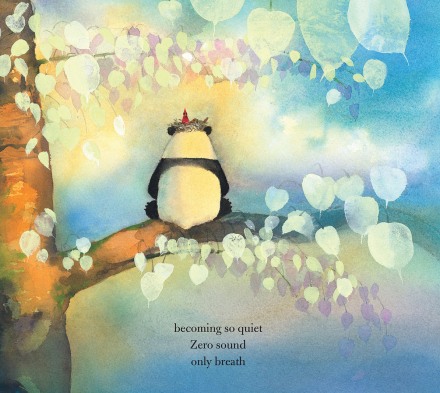
As autumn promises to roll around again, it is time to ponder another year. Just you “becoming so quiet / Zero sound / only breath.”
Image and text copyright Jon J Muth, 2014, courtesy of Scholastic Press.
In his introductory Author’s Note, Jon J Muth discusses the haiku form, which originated in Japan and “was made up of seventeen sound parts called on—divided into three lines with five, then seven, then five on. He reveals that English syllables and on are not equal and that haiku directly translated into English are often shorter than the 5-7-5 lines we are used to. In Hi, Koo! Muth employs this looser structure, capturing an instant in time “using sensory images.”
Muth’s verses will delight readers with their wisdom, wit, and winks to fleeting childhood ideas and actions that tend to be remembered long afterward—even into adulthood. Muth’s lovely watercolors—snapshots in various perspectives—tenderly depict the magical moments that make up a child’s year.
Ages 4 – 8
Scholastic Press, 2014 | ISBN 978-0545166683
International Haiku Poetry Day Activity
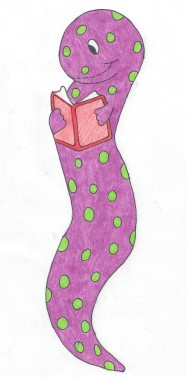
Friendly Bookworm Bookmark
If you love to read and write, you might think of yourself as a bookworm! Here’s a printable Friendly Bookworm Bookmark to keep you company while you read and mark your page when you have to be away.
One of the wonderful activities of spring and summer is gardening. As the sun warms, farmers and gardeners till their land and plant seeds with eager anticipation of the harvest to come. April is Gardening Month, and the second week is designated especially for vegetable gardening. Our meals would not be as tasty and nutritious without carrots, squash, peas, beans, peppers, potatoes, and all the rest of these colorful foods. Today’s container gardens give even reluctant gardeners great ways to grow their own—without the work of a large plot. Whether you enjoy gardening on a large or small scale, take the opportunity of this month to start planting the seeds of a rewarding hobby!
Rabbit Stew
By Wendy Wahman
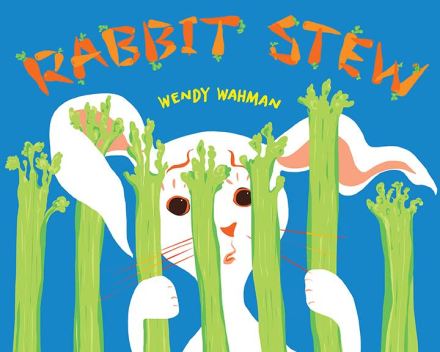
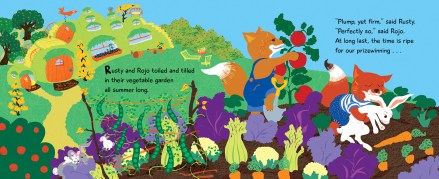
“Rusty and Rojo toiled and tilled in their vegetable garden all summer long.” But now the crops have ripened, and the two foxes are ready to enjoy the bounty of their hard work—so are their neighbors, the Rabbits. As Mommy Rabbit and the bunnies nibble away in a corner of the garden, Rusty gently squeezes the tomatoes and finds them “plump, yet firm.” “Perfectly so,” Rojo agrees as he lifts Daddy Rabbit from the carrot patch. “At last,” Rusty and Rojo exclaim, “the time is ripe for our prizewinning Rabbit Stew!”
Image copyright Wendy Wahman, 2017. Courtesy of wendywahman.com.
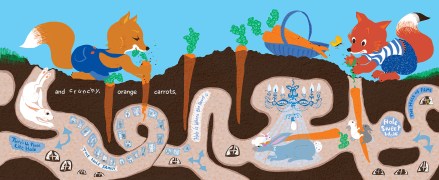
While Rojo picks “lean, green runner beans,” the Rabbits look on worriedly. Daddy tries to hide, but Rusty spies him in the wheelbarrow full of purple kale. Then, when the family dives back into their cozy “hole sweet hole,” they find that their convenient carrot snacks are being abruptly snatched away—only to be added to the pot of “splendid Rabbit Stew.”
Image copyright Wendy Wahman, 2017. Courtesy of wendywahman.com.
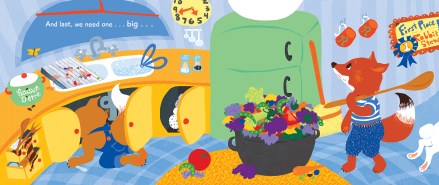
Next come raisins and celery “and roly-poly blueberries.” But what about those white and gray bits of fluff? Will they end up in the foxes’ buckets too? Of course “juicy red tomatoes, fresh sprigs of parsley, and sweet yellow peppers” are also musts for the foxes’ “finest-ever Rabbit Stew.” With the pot overflowing with colorful veggies, only one more thing is needed—“one…big…round…white…bowl…for our favorite Rabbit, Stew—and his family too!”
Image copyright Wendy Wahman, 2017. Courtesy of wendywahman.com.
With her fertile imagination and a clever play on words, Wendy Wahman offers up a delightful story that will have readers guessing until the very end. Along with the mystery and the yummy descriptions of each ingredient, Wahman presents a counting game for readers. As Rusty and Rojo pick their vegetables, children can count the ten runner beans on the trellis, nine purple kale leaves in the wheelbarrow, eight carrots from the burrow, and all of the other ingredients on down to one. But do Rusty and Rojo need one big white rabbit or something else? Kids will love the twist at the end and cheer to see Daddy Stew, Mommy Strudel, and their little bunnies—Dumpling, Biscuit, and Ragu—dining on the special meal grown and created just for them.
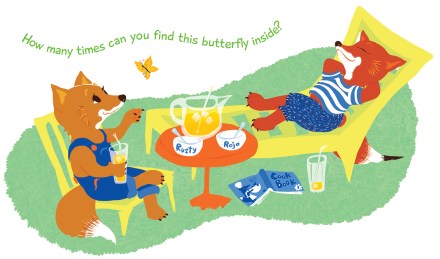
Everyone’s garden should look as deliciously vibrant as Wahman’s riotous patch of vegetables! The vivid colors jump off the page while providing texture and nuance to the illustrations. They also give kids another concept to learn and talk about. Little details, such as the tiny caterpillar and the yellow butterfly that follow the bunnies from page to page, as well as the fancy burrow lined with photos of friends and family will enchant readers.
Image copyright Wendy Wahman, 2017, courtesy o f Wendy Wahman.
Welcome themes of friendship, diversity, and inclusiveness can also be found within the illustrations and the story.
Rabbit Stew is a bright, humorously sly story that would be a wonderful addition to any child’s library. The book also makes a perfect companion for trips to the farmers market, on picnics, or to spur interest in home gardening. The attention to the details of what rabbits can safely eat, as well as the number and color concepts provided in the illustrations, makes Rabbit Stew a great choice for school story times and spring lessons.
Discover more about Wendy Wahman, her art, and her books on her website!
You’ll dig this Rabbit Stew book trailer!
Meet Author/Illustrator Wendy Wahman
Today, I’m really happy to be chatting with Wendy Wahman about her art, her books, her inspirations, and a really sweet school visit she had recently.
Your bio mentions that you worked for the Seattle Post-Intelligencer until 2009. Can you describe your work there?
I worked in the art department doing maps, graphics, info-graphics and illustrations for every section of the newspaper. Ninety percent of the work was on deadline, so I learned to think and draw fast.
Our poor beloved P-I. It was 146 years old when Hearst closed it down. About 150 of us went down with the ship. Best job I ever had. I miss the variety and culture and importance — and honesty — of journalism. I miss my P-I family, very much.
How did you get started illustrating and writing books for children?
I was really just snooping around for illustration work. I had an idea for a book on dog body language I wanted to do, but imagined ‘a real writer’ should write it. I sent out some of the dog body-language art samples and heard back from four major publishers. Laura Godwin at Henry Holt called me, and was so passionate about dogs and kids—and my art. She asked to see a dummy. What dummy, right? I had no dummy, just an idea and some art samples. I took two weeks off from the P-I and put together a dummy. Laura helped me tremendously, as did my brilliant writer husband, Joe Wahman.
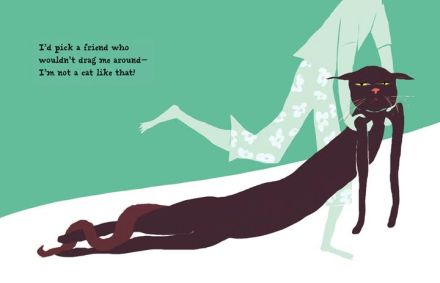
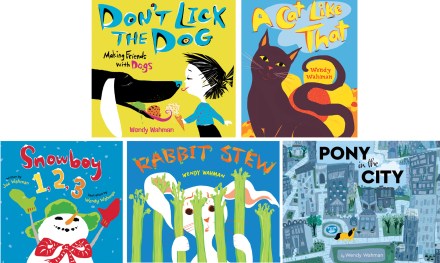
Don’t Lick the Dog is a how-to primer on being safe with dogs. We followed with the companion book, A Cat Like That. We never did do my dog body-language book. It’s sitting here patient as can be. “Good dog, book.”
Image copyright Wendy Wahman, Don’t Lick the Dog. Courtesy of Wendy Wahman.
Image copyright Wendy Wahman, A Cat Like That. Courtesy of Wendy Wahman.
Your art is so varied—from humorous to infographics to striking, serious editorial work. You also work with crisp, clean lines and beautiful textures. Can you talk about your process and inspirations?
Thank you so much, Kathy. Well. I sit and think and read a lot. Mostly I just look and try to distract myself from thinking too hard. I like to thumb through my Thesaurus. When I’m stuck, I try to remember to move away. This can be physically—exercise or a walk; mentally—read or look through books; or emotionally—play with my dogs or call somebody. I say, try, because too often I sit rooted, thinking, thinking. Better to get up and move.
What was the inspiration for Rabbit Stew?
I feed my dogs a homemade stew of meat & veggies. Long ago, I was stirring up an enormous batch of dog food, when “rabbit stew” fluttered to mind. Rabbit Stew is also a counting book, counting down veggies from ten to one. It’s also a color book. It was a challenge to find ingredients safe for rabbits, in different colors and not give it away. Like, rabbits love dandelions and they’re very good for them, but I only know a couple of people who would knowingly toss dandelions into the pot. No potatoes; they are toxic to bunnies, and cabbage isn’t good for them either.
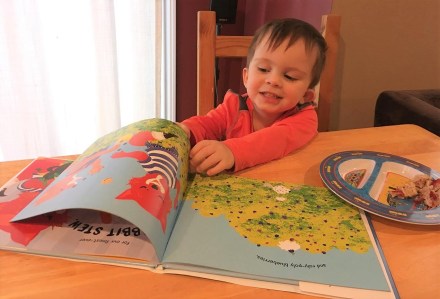
A happy fan enjoys reading “Rabbit Stew” with lunch! Photo courtesy of Wendy Wahman.
You give presentations at schools and libraries. Do you have an anecdote you’d like to share?
I did a school visit recently in southern California and got to take my mom to a presentation for 4th graders. I introduced her to the students, and they gave her a loud round of applause! Even more tender, when I was signing books (and the other stuff kids want signed), they asked if my mother would also give them an autograph. Is that the sweetest or what? Children can be so inspiring, healing, and wise.
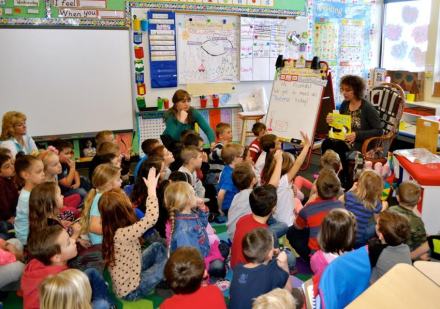
Wendy reads “Don’t Lick the Dog” to enthusiastic kindergarteners in Kennewick, WA. Photograph courtesy of Wendy Wahman
You also teach bookmaking to kids. That sounds fun and fascinating! Can you tell me a little bit about these classes?
I’m so glad you asked about these little books, Kathy. I love making them and sharing the process. Anyone can make one. I’ve taught them to kindergarteners through seniors. I call them “Insight Books,” because what comes out can be surprising, revealing, and often cathartic. Random lines inspire images and ideas. Some people write, others write and draw. Sometimes we collage. Even if you do nothing at all put look, the lines may stimulate ideas. These book are fun to make with a partner too.
What’s up next for you?
I’m very excited about my next book, Pony in the City (Sterling Publishers). Kevan Atteberry’s book, Swamp Gas, releases the same day, Sept. 9th, and we’re talking about having a co- launch party.
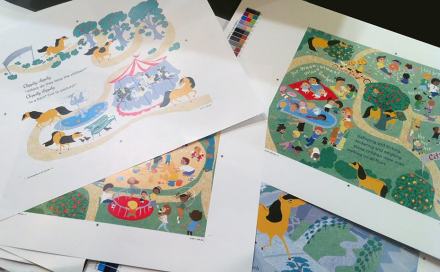
Image copyright Wendy Wahman. Proofs of “Pony in the City” (Sterling, releasing Sept. 9 this year) courtesy of Wendy Wahman.
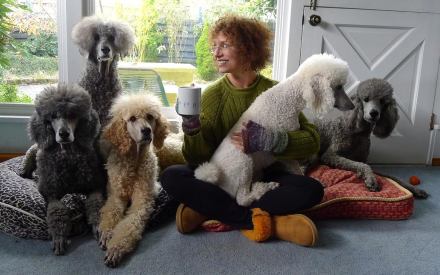
I’m working on Nanny Paws (Two Lions), a book inspired by my little white poodle, LaRoo, and the children next door. Here’s a picture of LaRoo and my other dog Jody with my friend Vikki Kaufman‘s poodles. Vikki is a breeder of beautiful silver and blue standard poodles. Vikki took the picture, can you tell? Her dogs are staring straight at her. Poor LaRoo. She is a shy girl and just wants to get away from the masses.
Wendy with LeRoo and Jody and Vikki’s TinTin, Nickel and Eureka.
I’m also working on a dummy for a beautiful story written by Joe, “One Bird” (www.joewahman.com). I’m doing the art for both Nanny Paws and Joe’s story in a new/old style for me: pencil and watercolor.
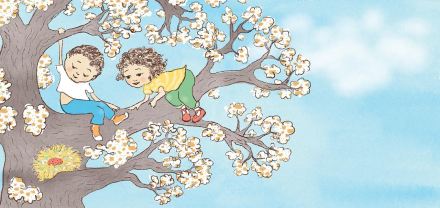
Image from “One Bird,” written by Joe Wahman, illustrated by Wendy Wahman. Courtesy of Wendy Wahman
Do you have a favorite holiday?
Thanksgiving.
Do you have an anecdote from a holiday you would like to share
If you come over for Thanksgiving, prepare yourself for a vegetarian feast. We don’t eat animals here — but we do make them big, round, splendid bowls of stew.
Thanks so much, Wendy! It’s been a lot of fun! I wish you all the best with all of your books!
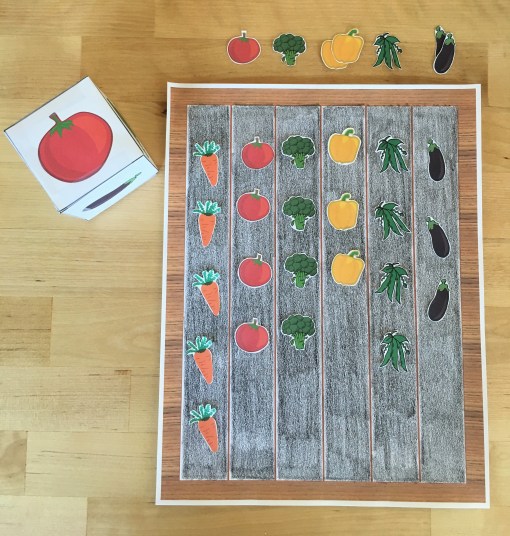
Object: The object of the game is for each player to fill their garden rows with vegetables. Depending on the ages of the players, the required winning number of rows to fill and the number of vegetables to “plant” in each row can be adjusted.
Print one Game Board for each player
Print one set of Playing Cards for each player (for sturdier playing items, print on card stock)
Print one Vegetable Playing Die and assemble it (for a sturdier die, print on card stock)
Cut the vegetables into their individual playing cards
Color the “dirt” on the Garden Plot with the crayon (optional)
Choose a player to go first
The player rolls the die and then “plants” the facing vegetable in a row on the game board
Play moves to the person on the right
Players continue rolling the die and “planting” vegetables until each of the number of determined rows have been filled with the determined number of vegetables.
The first person to “grow” all of their veggies wins!
Perhaps these days we should consider making every month Humor Month, but until that happens, enjoy as many laughs as you can during April. No matter what you find funny or how you express your sense of humor, this month’s holiday allows you to indulge the more ridiculous aspects of life!
Meet the McKaws
By Ged Adamson
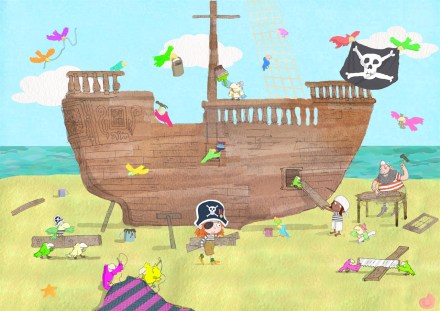
Captain Stan and Tiny McKaw, Stan’s parrot first mate, love everything about being pirates—“Sailing the seven seas, fighting battles, and searching for treasure! What could be better? Yes, life is pretty perfect for Stan and Tiny” until…Tiny’s parents come to visit. Mr. and Mrs. McKaw aren’t on board 5 minutes before the squawking begins. Mrs. McKaw takes exception to Stan: “‘He doesn’t’ look like much of a captain to me. He’s just a boy!’” And while Mr. McKaw is trying to apologize for his wife’s behavior, he lets out “a huge, disgusting BURP!”
Tiny’s mom is appalled at the state of the ship, calling it “a messy old wreck,” and Tiny’s dad starts in with a long, meandering story of his days as a pirate, complete with a treasure map, a deserted island, the Kraken, sword fights, canon fire, a treasure chest, and even a commendation. I think you get the picture. Problem is…Mr. McKaw never was a pirate.
Maybe a nice sit-down dinner will clear the air and get things started off on the right pegleg again. With a big grin the cook presents the special meal he has prepared in the McKaw’s honor, but after “just one mouthful, both the McKaws were violently sick. ‘Horrible! Horrible!’” cries Mrs. McKaw. The poor cook bursts into tears and runs back to the galley. Perhaps nighttime will bring a little relief. But no, Mr. McKaw snores and Mrs. McKaw nags in her sleep.
Image copyright Ged Adamson, courtesy of gedadamson.com
The next morning Captain Stan wakes up to the worst insult of all—guano dots his royal blue pirate coat. Even this offense, though, pales in comparison to what Stan sees next. Perched between his parents sits Tiny in a crisp white shirt and tie with his feathers slicked back. This is the last straw. “GET OFF MY SHIP!!” yells Captain Stan. Mr. and Mrs. McKaw waste no time in flying the coop, but there’s no respite for Captain Stan and Tiny for dead ahead is a colossal storm.
The ship is no match for the lightning, crashing waves, and fierce winds. The cook, the cabin boy, Captain Stan, and the remains of the broken brigand are washed into the roiling sea. “Just when all seems lost, however, Tiny gives a great SQUAWK! ‘It’s Mr. and Mrs. McKaw!’” cries Stan. “‘And my aunts, uncles, cousins…everyone!’” says Tiny. The parrots rescue everyone and fly them safely to nearby Blue Feather Island, which just happens to be Tiny’s home.
All the members of the parrot family help Stan build a new ship, and in the process he gains a new perspective on Mrs. and Mr. McKaw’s personalities. “Mrs. McKaw’s bossiness turned out to be very useful” as she delegates jobs, and Mr. McKaw keeps the crew entertained while they work “just by being Mr. McKaw.” The two are even hungry enough to eat up everything the cook prepares, much to his delight.
Image copyright Ged Adamson, courtesy of gedadamson.com
With a new ship finally complete, it’s time for the McKaws to take wing. Stan thanks them for all their help and apologizes for throwing them off his ship. On her part, Mrs. McKaw apologizes for being rude and thanks Stan for taking care of Tiny. And what about the new ship? It might be even better than the original with a bold parrot-emblazoned sail and a parrot figurehead pointing the way. As the crew sets sail, Captain Stan acknowledges, “‘You know, Tiny, I’m really glad I met the McKaws.’”
With the dash of a swashbuckler and the true aim of a compass, Ged Adamson depicts the high and low tides of family life in this high seas adventure. His humorous portrayals of personality traits that can drive family members crazy will resonate with kids and adults alike as they laugh through the travails Captain Stan and Tiny suffer during a visit by Tiny’s parents. In a sweet turn of events, though, Adamson reminds us that when storms come—in whatever form—the momentary squalls are forgotten, the anchor of family relationships is dropped, and everyone battens the hatches together.
Adamson’s vivid illustrations of Captain Stan in his sharp pirate garb, colorful (in more ways than one) Mr. and Mrs. McKaw, and the well-fitted wooden ship will delight pirate fans of all ages. Mr. McKaw’s imaginary stories are cleverly portrayed as chalk drawings on a black background, and the sea swirls with cool hues of blue and turquoise. Like Captain Stan, readers will be glad they have a chance to Meet the McKaws and will want them to visit again and again.
Ages 4 – 8
Sky Pony Press, 2015 | ISBN 978-1629146188
Discover more of Ged Adamson’s work on his website!
Meet Ged Adamson and learn about his inspirations, his writing life, and his other books in this funny and insightful Q & A!
National Humor Month Activity
Original Avast! Pirate Treasure Map Board Game design by Conor Carroll copyright 2016
Avast! Pirate Treasure Map Board Game
Playing board games together can lead to some pretty funny times. Enjoy this printable Avast! Pirate Treasure Board Game! It’s Arrgh-uably the best game on the seven seas!
Original artwork copyright Conor Carroll and Celebrate Picture Books, 2016
Directions
Print the Avast! Board Game pages (Options: print on white paper, parchment-colored paper, or on card stock. To make white paper appear old – as in the picture – paint with a tea wash before taping together. See directions for tea wash below)
Tape together the 4 pieces of the map. (Option: map pages printed on regular paper can be glued to a piece of poster board to make the game board more sturdy.)
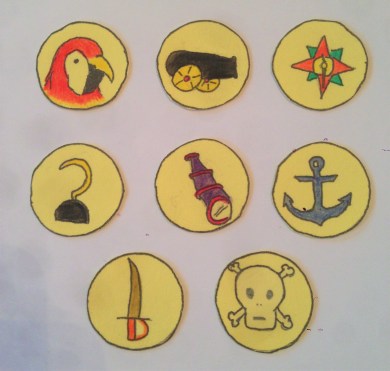
Print the Avast! Pirate Loot Tokens
Cut out the Avast! Pirate Loot Tokens
Print the Avast! Game Cards
Cut out the Avast! Game Cards
To use a tea bag to make the map look old:
Steep a black tea tea bag in 1/4 cup boiling water for 3 minutes
Squeeze the tea bag dry over the cup and discard
With the paint brush, paint the 4 pages of the map with the tea before taping them together
Let dry or dry with a hair drier set on Low.
To Play the Game
Each player chooses a Pirate Loot Token as their playing piece to move along the board
Shuffle and stack the Game Cards
Choose which player will go first
Players choose the top card from the pile and follow the directions to move spaces on the game board.
After moving, players should put their game card in a discard pile
If Game Cards run out before the end of the game, flip over the discard pile and use the cards again
The first player to arrive at the X on the map finds the treasure and is the winner!
Two species of today’s honored animal are found across America, Canada, and Eurasia. Known primarily for building dams in rivers and streams, the beaver is a fascinating animal in many ways. Perhaps one of the greatest natural conservationists, beavers use all parts of the trees they fell. The buds, bark, and leaves are consumed as food, and the rest is gnawed into smaller bits to be used as building materials. The dams, themselves, are helpful in preventing droughts and floods, restoring wetlands, and keeping the water clean. The beaver population has seen a decline for several decades, and today’s holiday aims to promote awareness of this beneficial animal in order to protect it.
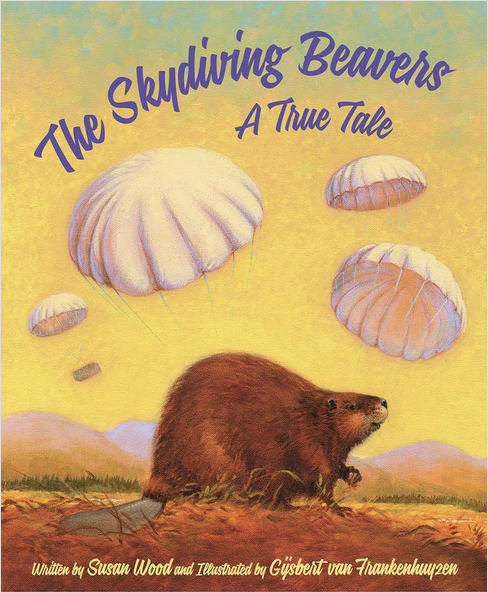
The Skydiving Beavers: A True Tale
Written by Susan Wood | Illustrated by Gijsbert van Frankenhuyzen
The time was post-World War II and families were eager to build homes and enjoy life again. In McCall, Idaho this meant that people moved to the shore of the beautiful lake, where they could fish, sail, waterski, and have fun. So roads were constructed, docks built, and land cleared. “Trouble was, that lakeside land had already been claimed. For decades—centuries, even—beavers had been the only ones doing the building there.”
Now, though, there was a turf war, of sorts. “Where the beavers once gathered wood for dams and food, now there were houses and people. And where the people tried to drive their cars, now water flooded the roads because of the dams.” Trees were also being “toppled left and right” by those busy beavers. Something needed to be done.
Image copyright Gijsbert van Frankenhuyzen, text copyright Susan Wood. Courtesy of Sleeping Bear Press
Elmo Heter had an idea. Elmo had experience with beavers from his job with the Idaho Department of Fish and Game. He knew that beavers needed open areas with lots of trees, rivers, and creeks—and no people. There was a place just like this many miles away. The Chamberlain Basin would be perfect for the beavers, but there was a problem—how could he move all those beavers “to a place with no roads, no railway, no airport, and no bus station?”
Elmo thought about loading them into boxes carried by horses or mules, but the rough trip would be too hard on both the beavers and the pack animals. Then Elmo remembered that there were piles of parachutes left over from the war going unused. “What if he dropped the beavers from a plane? Skydiving beavers? Well, why not?” Elmo decided.
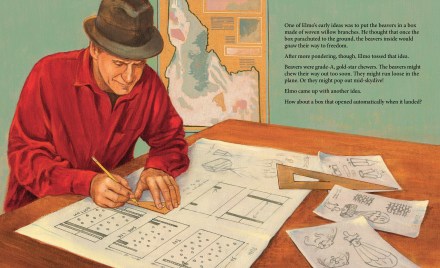
Elmo went to work to design a crate that could hold the beavers safely. His first idea was to build a box of woven willow branches. Once the boxes hit the ground, the beavers could gnaw their way out. But then Elmo feared that those champion chewers might escape before the box touched down. Next, he came up with the idea for a box that opened automatically when it hit the ground. After he created his box, Elmo found a beaver to test it.
Image copyright Gijsbert van Frankenhuyzen, text copyright Susan Wood. Courtesy of Sleeping Bear Press
He found his daredevil and named him Geronimo. Geronimo, cozy in his box, was loaded onto a plane, and as the plane flew low over the test field the box was dropped. “The chute bloomed like a buttercup, then caught the breeze….The box fell as gently as a mountain snowflake, landing softly on the grass.” Just as it was designed to do, the box opened and Geronimo scrambled out.
Elmo wanted to make sure his invention would work every time, so he tested it again and again. All this flying and skydiving seemed to agree with Geronimo. He soon began to treat it like a game, shuffling out of the box when the door opened and then crawling “right back in for another go.” Now that Elmo knew the plan would work, he gathered the beavers from McCall, put them in their special traveling crates, and headed for the Chamberlain Basin.
When they found the perfect spot, Elmo and his team prepared the chutes and let the beavers go. One by one the parachutes opened, and the beavers “wafted like falling leaves on the autumn wind to their new woodsy patch of paradise.” And who was the first pioneer? Why Geronimo, of course!
Image copyright Gijsbert van Frankenhuyzen, text copyright Susan Wood. Courtesy of Sleeping Bear Press
An Author’s Note following the text reveals more about this true story. It also discusses what scientists have since learned about the benefits of beavers to the environment and how communities now work with and around them. A list of interesting facts about beavers is also included.
Susan Wood’s story of a little-known event is a thought-provoking glimpse into early conservation efforts. Her conversational tone and lyrical phrasing enhance the tale, lending it suspense and personality that will draw readers in. Wood’s detailed descriptions allow children to understand the problems for the community as well as the concern for the animals that led to this historical event.
Gorgeous paintings by Gijsbert van Frankenhuyzen uncover the beauty of Idaho’s backcountry with its sparkling lakes and tree-covered mountains. Glorious sunsets fill the two-page spreads, turning the rolling hills pink and gold as beavers scurry near the shore building their dams. Readers will be intrigued by the clear and close-up views of Elmo Heter as he works on his plans to relocate the beavers. A table strewn with publications and photographs from World War II, set children in the time period, and his schematics of the box he designs as well as his workshop are plainly displayed. Kids can ride along with Geronimo as he climbs into his crate, travels by plane over wide-open vistas, and floats into the Chamberlain Basin at the end of a parachute.
The Skydiving Beavers would be a fresh addition to classroom environmental units to spur discussions on past, present, and future conservation science and will delight young readers interested in the natural sciences.
Ages 6 – 9
Sleeping Bear Press, 2017 | ISBN 978-1585369942
Learn more about Susan Wood and her books on her website!
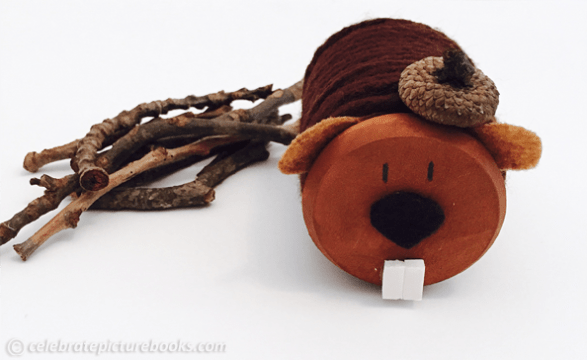
Cut two small pieces from the foam board, ½-inch long x 3/8 inch wide
When the spool is dry, glue the ears to the spool, leaving the ears sticking up over the rim of the spool
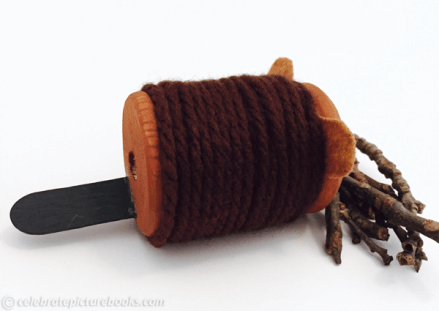
Glue one end of the yarn to the spool
Holding the spool horizontally, wind the rest of the yarn around the spool back and forth from front to back. Glue the end to the body of yarn. This will be the bottom of the beaver.
Glue the nose over the hole in the spool
Glue the teeth below the nose
Glue the flat edge of the craft stick to the back of the spool to make the tail