September 9 – It’s National Hispanic Heritage Month

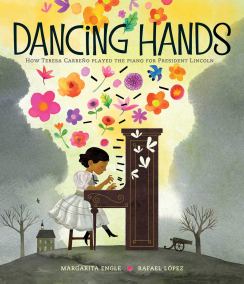
celebrate-picture-books-picture-book-review-dancing-hands-cover

About the Holiday

Beginning on September 15th  and running through October 15th, National Hispanic Heritage Month celebrates the contributions of those who come from or whose ancestors immigrated from Spain, Mexico, the Caribbean, Central America, and South America. Each year the holiday adopts a particular theme. This year’s theme is Hispanic Americans: A History of Serving Our Nation. From the military, to business and industry to culture, sports, and entertainment Hispanic Americans have made an important and indelible imprint on our country. First observed in 1968 as a week-long holiday, the commemoration was expanded to a month in 1988 under President Ronald Reagan. To celebrate, learn more about Hispanic Americans who have influenced our culture, attend a special event, and enjoy great books by Hispanic authors like today’s book! You can learn more about the holiday at the official Hispanic Heritage Month website.

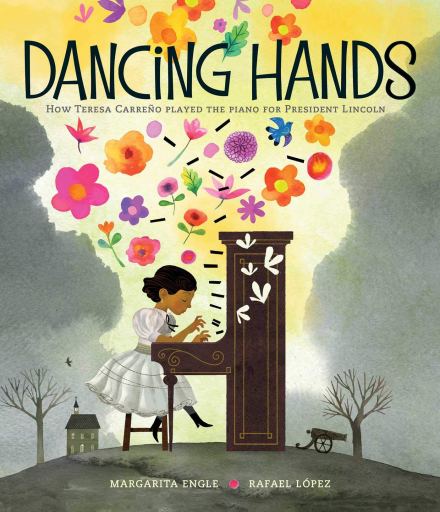
Dancing Hands: How Teresa Carreño Played the Piano for President Lincoln

Written by Margarita Engle | Illustrated by Rafael López


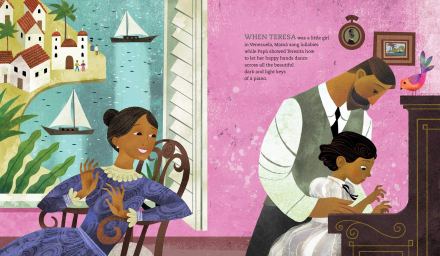
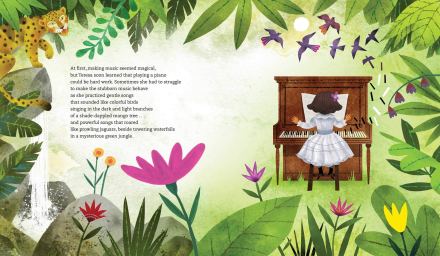
Growing up in Venezuela, Teresa listened to her mother’s lullabies and learned how to play the piano from her father. It wasn’t always easy “to make the stubborn music behave as she practiced gentle songs that sounded like colorful birds…and powerful songs that roared like prowling jaguars, beside towering waterfalls in a mysterious green jungle.” But by the time she was six, she was composing her own songs and at seven, she played in the cathedral.

celebrate-picture-books-picture-book-review-dancing-hands-papa

Image copyright Rafael López, 2019, text copyright Margarita Engle, 2019. Courtesy of Atheneum Books for Young Readers.

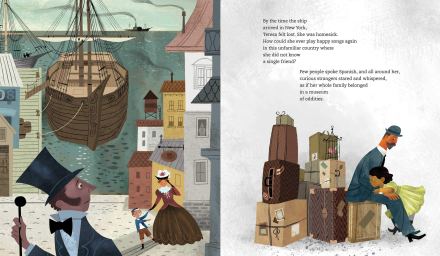
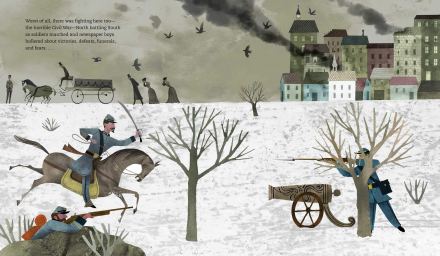
When Teresa was eight, however, her world was rocked by war, and she and her family escaped by ship to America. In New York, she felt lost among all of the strangers, who didn’t speak Spanish and gawked at her and her family as if they “belonged in a museum of oddities.” Even here, they had not escaped conflict as the Civil War waged, pitting the North against the South and family against family.

celebrate-picture-books-picture-book-review-dancing-hands-jungle

Image copyright Rafael López, 2019, text copyright Margarita Engle, 2019. Courtesy of Atheneum Books for Young Readers.

Teresa found refuge in her new piano and began to make friends with musicians who came to her home to listen and play along. Teresa practiced all types of music, “her strong hands accepting the challenge of life’s many dark and light moods.” She became well known as “the Piano Girl” and performed with big orchestras and in theaters. She became so famous that she was even invited to play for President Abraham Lincoln and his family at the White House.

celebrate-picture-books-picture-book-review-dancing-hands-cathedral

Image copyright Rafael López, 2019, text copyright Margarita Engle, 2019. Courtesy of Atheneum Books for Young Readers.

At the time Washington DC was awash in suffering, torn by war and weariness. President Lincoln’s young son had recently become sick and died. How, Teresa wondered, “could music soothe so much trouble?” Holding tightly to Papá’s hand, she entered the White House and was ushered into a room “as red as a storm or a sunrise.” As she sat at the piano, Teresa recalled past challenges and her discover that life was a “mixture of all sorts of feelings, happy and sad.”

celebrate-picture-books-picture-book-review-dancing-hands-ship

Image copyright Rafael López, 2019, text copyright Margarita Engle, 2019. Courtesy of Atheneum Books for Young Readers.

She began to play, but the piano was out of tune, “making her music sound ugly.” She stopped, but then President Lincoln requested she play his “favorite song, ‘Listen to the Mockingbird.’” This was a song Teresa could play on this imperfect piano. “Her fingers leaped across all the dark and light keys, improvising the way mockingbirds do, the melody changing as she went along.” Lincoln closed his eyes and was taken away on the soaring notes.

celebrate-picture-books-picture-book-review-dancing-hands-new-york

Image copyright Rafael López, 2019, text copyright Margarita Engle, 2019. Courtesy of Atheneum Books for Young Readers.

When the song ended, the President rose and applauded. He smiled at Teresa and she smiled back, understanding that “her music had brought comfort to a grieving family, at least for one brief, wonderful evening of dancing hands.” Teresa continued to share her gift with the world, always bringing “beautiful dark and light moments of hope” to her listeners.

A Historical Note about the life of Teresa Carreño follows the text.

celebrate-picture-books-picture-book-review-dancing-hands-war

Image copyright Rafael López, 2019, text copyright Margarita Engle, 2019. Courtesy of Atheneum Books for Young Readers.

Margarita Engle’s soaring biography introduces readers to an astounding woman who, even as a child, had not only a prodigious talent for the piano but a gift for understanding life as well. Engle, the 2017 -2019 national Young People’s Poet Laureate, infuses her story with beautiful lyricism and stirring metaphors that evoke the power of music in Teresa’s heart and hands. On these pages, music becomes a living thing, capable of forming friendships, soothing grief, providing escape, and offering hope. Engle’s focus on the meeting between Teresa Carreño and Abraham Lincoln is significant and offers inspiration to young readers. Like Teresa, who, concerned with playing just right, was presented with an imperfect piano but encouraged by Lincoln’s kindness, they too can learn that with a steady and courageous heart, anyone can use their talents to overcome challenges.

In Rafael López’s crisp, stylish illustrations, Teresa Carreño’s love of music and its emotional power serves as a counter point to the distress of war and anguish of grief. Using vibrant greens, pinks, oranges, and blues, Lopez surrounds Teresa with lush vegetation, dazzling birds, and the security of home. Muted variations of  these colors depict the bleakness of war. A moving image, washed completely in gray except for an approaching vivid bird and a tinge of soft rose dawn shows a mourning Abraham Lincoln alone in his office but soon to be comforted by Teresa’s music.

A beautiful and uplifting biography for kids of all talents, Dancing Hands: How Teresa Carreño Played the Piano for President Lincoln would be an inspiring addition to home, school, and public library bookshelves.

Ages 4 – 8

Atheneum Books for Young Readers, 2019 | ISBN 978-1481487405

Discover more about Margarita Engle, her books, and her poetry on her website.

To learn more about Rafael López, his books, and his art, visit his website.

National Hispanic Heritage Month Activity

CPB - Tortilla chips (2)

Homemade Baked Cinnamon Tortilla Chips


It’s easy to make these yummy tortilla chips at home! Why not invite your friends over and bake up a batch or two to enjoy while playing or reading together?

Ingredients

  • 2 10-inch flour tortillas
  • ¾ teaspoon cinnamon
  • 2 ½ tablespoons sugar
  • Butter

Directions

  1. Preheat oven to 350 degrees
  2. Combine the cinnamon and the sugar in a bowl
  3. Butter the tortillas
  4. Sprinkle the tortillas with the cinnamon sugar mixture
  5. Cut the tortillas into 8 pieces
  6. Place pieces on a baking sheet
  7. Bake in 350-degree oven for 12 – 15 minutes
  8. Chips will become crispier as they cool.

Makes 16 chips

celebrate-picture-books-picture-book-review-dancing-hands-cover

You can find Dancing Hands: How Teresa Carreño Played the Piano for President Lincoln at these booksellers

Amazon | Barnes & Noble | Books-a-Million | IndieBound

Picture Book Review

August 30 – National Frankenstein Day

celebrate-picture-books-picture-book-review-mary-who-wrote-frankenstein-cover

About the Holiday

Today’s holiday celebrates the birth of Mary Wollstonecraft Shelley, who in 1818 at the age of 18, penned one of the most influential books of all time. Considered the first modern science fiction novel, Frankenstein; or, The Modern Prometheus incorporates elements of horror, psychology, love, abandonment, and acceptance. These themes and Shelley’s enthralling storytelling created a book that is always current. During this 200th anniversary year of the publishing of classic novel, discover (or rediscover) the spellbinding thrill of reading Frankenstein.

Mary Who Wrote Frankenstein

Written by Linda Bailey | Illustrated by Júlia Sardà


Mary was a dreamer. She liked to spend time alone, thinking and imagining “things that never were.” Mary called these daydreams “‘castles in the air.’” Mary loved to write stories too, but her daydreams were even more thrilling. When Mary wanted to read and dream, she went to the graveyard and sat next to her mother’s grave. Mary’s mother had died when Mary was only 11 days old.

While Mary loved her father, she didn’t like the way he punished her. Mary didn’t like his new wife, either. Mary’s father is friends with many famous people, and he invites them to visit. One night “a writer named Samuel Taylor Coleridge recites a strange, eerie poem—The Rhyme of the Ancient Mariner. Mary loves such poems.” Even though she was supposed to be in bed, she hid and listened, shivering “with fear at the spine-tingling tale of a ship full of ghosts.” Forever after, Mary remembered that night and that poem.

celebrate-picture-books-picture-book-review-mary-who-wrote-frankenstein-town

Image copyright Júlia Sardà, 2018, text copyright Linda Bailey, 2018. Courtesy of Tundra Books.

By the time Mary was fourteen, she was unhappy at home and causing trouble. One night, when she was sixteen, she and her stepsister, Claire, ran away with a “brilliant, young poet” named Percy Bysshe Shelley. They traveled through Europe, one day finding themselves outside a “ruined castle. It’s called Castle Frankenstein. Such an interesting name! Does it stick in Mary’s mind?”

Eighteen months later, the three traveled to Switzerland, where they became friends with Lord Byron—the most famous poet in the world. One night as torrential storms crashed around Lord Byron’s house, he read ghost stories from Fantasmagoriana. After reading, Byron challenged his friends, who also included a doctor named John Polidori, to write a ghost story. Eighteen-year-old Mary, Percy Bysshe Shelley, and John Polidori accepted the challenge. But Mary could not think of a good story idea.

celebrate-picture-books-picture-book-review-mary-who-wrote-frankenstein-friends

Image copyright Júlia Sardà, 2018, text copyright Linda Bailey, 2018. Courtesy of Tundra Books.

Soon, Shelley and Polidori gave up on their ghost stories, but their talk of new scientific experiments excited Mary. “Electricity can make the muscles of a dead frog twitch. Could it bring a dead creature to life? The idea is both thrilling and frightening.” The idea captured Mary, but instead of a frog, she imagined “a hideous monster, made of dead body parts, stretched out—and coming to life!” Mary suddenly realized she had the idea for her ghost story.

It took nine months for Mary to finish her story. When it was published, some people thought it had been written by Percy Bysshe Shelley—they didn’t “believe young Mary could have done it! How could a girl like her come up with such a story?” But she was a writer, assembling bits and pieces, ideas, and scientific changes in her imagination until they turned into the book Frankenstein. In the two-hundred years since the novel was first published, the story has become a classic. It has sparked movies, inspired other writers, and become a favorite all around the world.

An extensive Author’s Note about Mary Shelley, her life, and inspiration as well as Linda Bailey’s thoughts on the story behind Frankenstein follows the text. A full-page portrait of Mary Wollstonecraft Shelley and a list of sources rounds out the informative backmatter.

celebrate-picture-books-picture-book-review-mary-who-wrote-frankenstein-graveyard

Image copyright Júlia Sardà, 2018, text copyright Linda Bailey, 2018. Courtesy of Tundra Books.

With atmospheric and riveting details, Linda Bailey captures the life of Mary Wollstonecraft Shelley and the influences on her imagination that resulted in Frankenstein. Bailey’s use of the present tense is inspired as it reflects the continued currency of the novel while encouraging today’s readers to embrace their “castles in the air.” Facts about Mary’s travels, new scientific discoveries, and favorite books sprinkled throughout the story inform readers on how the imagination combines experiences to create art.

One look at Júlia Sardà’s spellbinding cover tells readers that they are in for an extraordinary reading experience. Muted tones of red, green, gold, blue, and plum cloaked in black create a thrilling backdrop to Bailey’s story. Ghostly winged creatures fly over Lord Byron’s home on a stormy night, smoky monsters emerge from Fantasmagoriana, a frog sits up in its coffin, and the spectre of the monster leans over Mary and sleeps at her feet as she writes her novel. At once spine-tingling and cozy, Júlia Sardà’s illustrations will draw children into this superb story of a ghost story.

Mary Who Wrote Frankenstein is sure to spark the imagination of children who love literature, art, and writing. The book would be a thrilling addition to classroom libraries for literature and writing classes as well as an inspiring favorite on home bookshelves.

Ages 5 – 8

Tundra Books, 2018 | ISBN 978-1770495593

Discover more about Linda Bailey and her books on her website.

To learn more about Júlia Sardà, her books, and her art, visit her website.

Frankenstein Day Activity

celebrate-picture-books-picture-book-review-frankenstein-puzzle

Monstrously Good Puzzle


See if you’re a Frankenstein scholar by filling in this printable puzzle full of words and phrases about the novel!

Monstrously Good Puzzle | Monstrously Good Puzzle Word ListMonstrously Good Puzzle Solution

celebrate-picture-books-picture-book-review-mary-who-wrote-frankenstein-cover

You can find Mary Who Wrote Frankenstein at these booksellers

Amazon | Barnes & Noble | Books-a-Million | IndieBound

Picture Book Review


August 19 – World Photography Day

celebrate-picture-books-picture-book-review-Hector-cover

About the Holiday

Photography is all about providing information through images. A picture really can be worth a thousand words in capturing a moment of surprise, joy, danger, or sadness. Well-placed photographers, videographers, and cinematographers have given voice to some of society’s pivotal moments, allowing the whole world to witness change, sometimes as it happens. Today we celebrate the “art, craft, science, and history of photography,” as well as those photographers who often put themselves in danger to get the story as well as those who bring us much-needed lighter moments. To learn more visit the World Photography Day website.

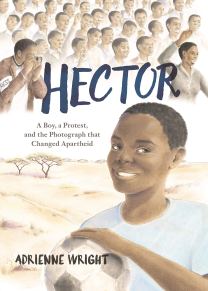
Hector: A Boy, a Protest, and the Photograph that Changed Apartheid

By Adrienne Wright

This powerfully emotional book opens with a recollection by Sam Nzima, the photojournalist who captured this pivotal event and a brief history of South Africa and the segregation and governmental restrictions that led up to the protest in 1976 which resulted in Hector Zolile Pieterson’s death. The compelling story, illustrated in graphic novel style, is broken up into three “chapters.”

celebrate-picture-books-picture-book-review-Hector-Hector

Copyright Adrienne Wright, 2019, courtesy of Page Street Kids.

The first introduces Hector, a twelve-year-old boy who loved playing soccer, watching movies, and visiting family. After his normal weekend chores, Hector would run errands for his neighbors to make a little money. Hector was happy, but things were changing at his school. The government had passed a law that instead of the international language English, black students must be taught half of their subjects in Afrikaans, a language derived from Dutch and spoken by descendants of the early Dutch settlers. This “added hardship to students and teachers in an already oppressive education system.” As he counted the money he’d made, his mother reminds him to count in Afrikaans, since that is what will be required in school.

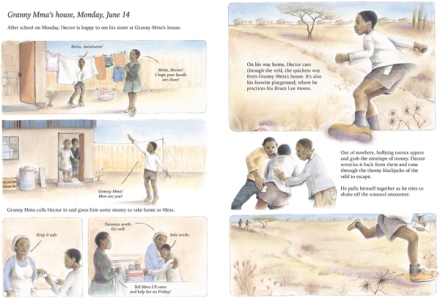
On June 14, 1976 Hector visited his granny Mma. When he left, she gave him some money for his mother. On the way home, he was waylaid by men trying to steal the money. Hector was able to escape with the money and decides not to worry his Mma by telling her. On June 16, Hector heads off to school, but when he gets there, he sees the students “chanting and singing” as they all march toward Orlando Stadium to protest the new Afrikaans law. “More students join in, and soon hundreds, then thousands of people are marching. Hector is swept up in the excited activity of the growing crowd.”

celebrate-picture-books-picture-book-review-Hector-june-14

Copyright Adrienne Wright, 2019, courtesy of Page Street Kids.

Ahead on the road the protesters see the police and a blockade. The students begin marching down another street. They wave signs and sing the “government-banned anthem, ‘Nkosi Sikelel’ iAfrica’—’God Bless Africa.’” The police confront the students, blowing their whistles, shouting, and throwing tear gas. Suddenly, Hector hears his sister, Antoinette’s voice warning him to run home. Shots ring out.

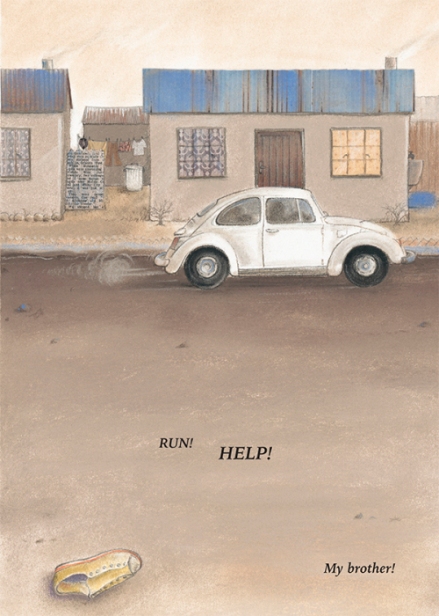
The second chapter introduces Antoinette, who on June 16 is leaving for school from Granny Mma’s house. She knows about the planned protest but says nothing to Granny Mma. She joins the crowd waving signs and chanting. Then “POW! Tear gas explodes in the air. Students scatter in all directions,” and Antoinette sees Hector. As they run for cover, they become separated. Shots ring out all around them. When the smoke dissipates, Antoinette sees a teenager running towards a car with a boy in his arms. “She can’t see the child’s face, but when she sees his shoe…”

celebrrate-picture-books-picture-book-review-Hector-protest-group

Copyright Adrienne Wright, 2019, courtesy of Page Street Kids.

Chapter three takes readers behind the lens of Sam Nzima’s camera. On assignment for The World newspaper, Sam is documenting the protest through his photographs. “The protest begins. / The students march. / Sam snaps photos…. / The police barricades go up. / The children sing. / Sam snaps photos. / The police shoot! / Sam snaps.”

The police see Sam taking pictures and confiscate his film. But Sam has hidden the most important roll in his sock. “His picture of Hector, Antoinette, and another student runs on the front page of the newspaper.” At Granny Mma’s house, Hector’s family grieves his loss; around the world “Hector lives on as a compelling symbol of the cost of apartheid and the change sparked by students that day.”

The final spread shows the black-and-white photograph of Mbuyisa Makhubu carrying Hector with Antoinette running alongside. Back matter includes a short discussion that expands on the events of June 16, 1976 and the years that followed in the fight against Apartheid. An Author’s Note; short biographies of Hector, Antoinette, Sam Nzima, and Mbuyisa Makhubu; and a glossary also follow the story.

celebrate-picture-books-picture-book-review-Hector-help

Copyright Adrienne Wright, 2019, courtesy of Page Street Kids.

Adrienne Wright’s gripping storytelling and evocative illustrations go hand-in-hand to present a full portrait of young Hector, his life, his sweet nature, and his dreams. His family’s close bonds and their concern for each other is evident in the dialog that accompanies images of Hector playing, helping Mma and Granny Mma, running errands, and interacting with his sisters. As June 16 dawns, Wright sketches a normal day, with Hector joking with his mother at home and his friend on the way to school.

As it did for Hector, the protest comes as a surprise for readers, sweeping them up into the action just as Hector was. Antoinette’s chapter is the shortest but gripping in its pacing that mirrors the turmoil of the day and her tragedy. As readers enter Sam’s viewpoint, they see, blocked off in vertical and horizontal frames, the pictures of celebrating and happy, yet serious students marching to make a difference. The moment of the shot is seen through Sam’s lens and clouded in smoke.

Wright’s use of overlapping storylines as she transitions from Hector’s account to Antoinette’s and then to Sam’s adds to the tension, drawing readers in and reinforcing their understanding of the atmosphere and what the students were protesting. The final, nearly full-page reproduction of the actual photograph is an unflinching look at the reality of that day, what it stands for, and its personal cost.

A profound narrative for teaching children about South African history, the costs of discrimination, and the personal stories involved in any conflict, Hector is an important book to add to school and public library collections.

Ages: The book is targeted for children from eight to twelve, but adults should be mindful of the maturity and sensitivity of readers. Hector would also be a compelling inclusion in middle school and even early high school social studies and history classes.

Page Street Kids, 2019 | ISBN 978-1624146916

To learn more about Adrienne Wright and her work, visit her website.

World Photography Day Activity

CPB - New Professionals Picture

News Professionals Clothespin Figures


Photojournalists and journalists cover the news and sometimes put themselves in danger to bring readers true stories of events happening around the world. With this craft, you can make these clothespin figures that honor the men and women who work to keep us all informed.

Supplies

Directions

  1. Draw a face and hair on the clothespin
  2. Cut out the clothes you want your journalist or photographer to wear
  3. Wrap the clothes around the clothespin. The slit in the clothespin should be on the side.
  4. Tape the clothes together
  5. Cut out the camera
  6. Tape one end of a short length of thread to the right top corner of the camera and the other end of the thread to the left corner. Now you can hang the camera around the figure’s neck.

Idea for displaying the figures

  • Attach a wire or string to the wall and pin the figure to it
  • Pin it to your bulletin board or on the rim of a desk organizer

celebrate-picture-books-picture-book-review-Hector-cover

You can find Hector: A Boy, a Protest, and the Photograph that Changed Apartheid at these booksellers

Amazon | Barnes & Noble | Books-a-Million | IndieBound

Picture Book Review
August 11 – It’s Elvis Week

celebrate-picture-books-picture-book-review-elvis-is-king-cover

About the Holiday

Each year during the week in August surrounding the date of Elvis Presley’s death, fans gather in Memphis and at Graceland, his home that is now a monument to The King to celebrate his music, movies, and legacy. Events include concerts, workshops, dances, the Ultimate Elvis Tribute Artist Contest, and more. The annual Candlelight Vigil, which attracts tens of thousands of fans, is held from the evening of August 15 to the morning of the 16th. Participants carry a candle as they walk up the driveway to the Meditation Garden, listening to his music and taking in memorials created by fans. To learn more about Elvis Week, visit the Graceland website.

Elvis Is King

Written by Jonah Winter | Illustrated by Red Nose Studio 


Elvis is King by Jonah Winter and Chris Sickels’ Red Nose Studio is an eye-popping wonder for fans of The King of Rock ‘n’ Roll wanting to share their love for Elvis with their kids. In short, lyrical chapters with dramatic titles that are cleverly reminiscent of the sensational headlines Elvis generated throughout his life (and even after), Winter peels back Elvis’s rags-to-riches story, encapsulating the depth of poverty, talent, and ambition that fueled his life. It’s all here—his birth “in a humble shack / on the wrong side of the railroad tracks, / the side where the poorest of the poor people live…;” his reason for being: singing; and the county fair talent show, where ten-year-old Elvis got his first taste of adoration and a “Fifth Prize!” award.

celebrate-picture-books-picture-book-review-elvis-is-king-school

Image copyright Red Nose Studio, 2019, text copyright Jonah Winter, 2019. Courtesy of Schwartz & Wade.

Kids walk into the hardware store with Elvis’s barefoot mama, who “with pennies she saved…/ buys her eleven-year-old birthday boy / the most important gift he will ever receive. / It will be the key to his salvation.” Elvis plays that guitar everywhere, “All. The. Time.” There’s the moment Elvis overheard gospel singing coming from the African American Church and “The First Cheeseburger Ever Eaten by Elvis.” And that question: Why peanut butter and banana sandwiches? The answer’s here too.

When the family moves to Memphis, it’s up to teenage Elvis to make the money by “working nights as a ticket taker at a movie theater.” Then, suddenly during those years, Elvis finds the “Weird Teenage Elvis” inside him. He dyes his blond hair black and waxes it into a wave. At a thrift shop he buys green pants, a pink shirt, and a checkered jacket. Then at the high school talent show, he “KNOCKS ‘EM DEAD with his song.” And not only that “something happens, something big, when he’s up there: / He is no longer shy! / He can be whatever he wants to be—let loose, go crazy!”

celebrate-picture-books-picture-book-review-elvis-is-king-memphis

Image copyright Red Nose Studio, 2019, text copyright Jonah Winter, 2019. Courtesy of Schwartz & Wade.

Along the way he falls in love, graduates from high school, and soaks up the sounds of the blues on Beale Street. For his mama’s birthday, he goes to Sun Studios, where anyone can record themselves singing. “(It also makes *real* records of big-time singers— / and Sly Elvis knows this.)” Elvis has his first recorded song for just $3.98. A bit later he gets the call he’s been hoping for from Sun Studios and discovers his signature sound and moves. The song—”That’s All Right”—plays on the radio, and where’s Elvis? Hiding out. Will people like it? Five thousand requests and fifteen replays in one night say Yes!

And when Elvis walks on stage for the first time to sing his song, he’s met with an “AVALANCHE of screaming—in a good way!” Goggle-eyed girls just want to be near him, and it’s the same no matter where he travels. This “Good-Lookin’ Heartthrob Elvis” is soon to lose his “One True Love, / his little darlin’, Dixie Locke. He uses that feeling, though, in a song—”Heartbreak Hotel” that “rises to number 1 on the pop charts.” So “What Is This Crazy Music, Anyway?” It’s not exactly country and it’s not exactly rhythm and blues. “It’s… / ROCK ‘N’ ROLL, baby. / And Elvis is its KING…!”

celebrate-picture-books-picture-book-review-elvis-is-king-beale-street

Image copyright Red Nose Studio, 2019, text copyright Jonah Winter, 2019. Courtesy of Schwartz & Wade.

Jonah Winter’s biography is in every way a loving tribute to Elvis Presley that also winks at his larger-than-life persona and the world’s obsession with him. Well-chosen adjectives presented in initial caps and attached to Elvis’s name, give titles to the phases of Elvis’s life and present an evocative way to show what and where he grew from and left behind on his rise to fame. Sprinkled with southern vernacular and touched with the cadence of a slow, considered southern drawl, Winter’s ingenious verses mirror song lyrics and echo themes that not only make up the country and blues standards that influenced Elvis’s music but that applied to his life. 

As always Chris Sickels’ Red Nose Studio artwork is nothing short of astounding. Each illustration is composed as a 3-D set handcrafted from polymer clay, wood, wire, fabric, and found objects. The intricate details and moving emotions, demonstrated in a look, by a gesture, and through perspective, give the illustrations a realism that goes beyond a photographic depiction to illuminate the heart of Elvis Presley’s story. Readers will want to linger over every page to absorb the cultural landscape and life-affirming moments that created The King of Rock ‘n’ Roll.

A joy to read aloud, Elvis Is King is an inspirational story for anyone with a dream, big or small. The personal, yet universal, story and phenomenal art make the book a stirring addition for home, school, and public libraries. 

Ages 4 – 8

Schwartz & Wade, 2019 | ISBN 978-0399554704

Discover more about Jonah Winter and his books on his website.

To learn more about the work of Chris Sickels and Red Nose Studio, visit his website.

Elvis Week Activity

celebrate-picture-books-picture-book-review-elvis-presley-coloring-page

Elvis Coloring Page


Elvis wowed audiences and movie goers with his moves and flair. This printable coloring page shows Elvis in of his well-known dance poses. In honor of Elvis Week, why not share Elvis is King, this page, and some of Elvis’s songs or movies with your kids?

Elvis Coloring Page 

celebrate-picture-books-picture-book-review-elvis-is-king-cover

You can find Elvis Is King at these booksellers

Amazon | Barnes & Noble | Books-a-Million | IndieBound

Picture Book Review
August 7 – National Lighthouse Day

celebrate-picture-books-picture-book-review-miss-colfax's-light-cover

About the Holiday

Lighthouses have been in use since the earliest days of sea-going vessels. Built to warn sailors of dangerous and damaging rocks and reefs, these sentinels are a picturesque and fascinating part of history. From man—and woman—tended lights to today’s automated systems, lighthouses are a beacon of inspiration and imagination.

Miss Colfax’s Light

Written by Aimée Bissonette | Illustrated by Eileen Ryan Ewen


In 1861 when Harriet Colfax’s brother fell ill and decided to leave Indiana, Harriet had two options: she could leave with him—after all she had come to Indiana with him and worked with him at their newspaper—or she could stay on as the lighthouse keeper of the Michigan City Lighthouse, making $350 a year. Most women might have chosen to leave, but Harriet did not want to give up her independence or leave her best friend, Ann. She took the job as lighthouse keeper even though many in town thought she was too weak or too inexperienced to do the work.

celebrate-picture-books-picture-book-review-miss-colfax's-light-Michigan-city-lighthouse

Image copyright Eileen Ryan Ewen, 2016, courtesy of sleepingbearpress.com

Harriet knew the ships on the sometimes wild waters of Lake Michigan—one of the northern United States’ Great Lakes—relied on the lighthouse to keep them from danger. Twice every night she had to carry “whale oil in a bucket up narrow stairs to the top of the lantern tower” to refill the light and then polish the Fresnel lens. During the day, she “cleaned and painted…varnished the woodwork and shined the brass…and wrote notes in her log.”

It didn’t matter if Harriet was tired or sick or if winter storms rocked the shore, Harriet’s work went on. In 1871 a beacon light was installed at the end of the Michigan City east pier. Now in addition to the main lighthouse, Harriet had to keep this signal lit too. To do so required a long walk down a wooden catwalk that jutted far out into the lake. At times the freezing water roiled and splashed over the catwalk, making the walk tricky and dangerous. By this time lard had replaced whale oil as fuel. While it was cheaper and easier to get, it also had to be heated to pour. Sometimes on frigid winter nights “the lard oil hardened in the cold and Harriet had to fight back through the wind to reheat the oil” on her stove.

celebrate-picture-books-picture-book-review-miss-colfax's-light-harriet-adding-oil

Image copyright Eileen Ryan Ewen, 2016, courtesy of sleepingbearpress.com

In 1874 the beacon light was moved to the west pier—farther away. Instead of being within walking distance, Harriet now had to “row a small boat across a creek, hike the far shore, and cross a longer catwalk to light the beacon light.” One night in 1886 storms raged as Harriet made her way down the west pier. “Driving sleet covered her coat with ice. Sand from the dunes along the lake pelted Harriet’s face, stinging her cheeks. Her boots slipped and slid on the catwalk.” Only moments after she finished filling the beacon light and stepped off the catwalk, “a deafening screech filled the air” as the beacon tower “ripped from its moorings and crashed into the lake.”

Harriet’s dedication to the Michigan City Lighthouse continued every day and every night for 43 years. People in town came to call the landmark “Miss Colfax’s Light,” and ship captains named it “Old Faithful.” Over the years her vantage point on the tip of the shore allowed Harriet to experience more than stormy seas. She also saw “brilliant sunsets, lunar eclipses, and silent, dancing northern lights. She saw tall-masted schooners with white sails give way to steamships of iron and steel.”

celebrate-picture-books-picture-book-review-miss-colfax's-light-meeting-a-ship-captain

Image copyright Eileen Ryan Ewen, 2016, courtesy of sleepingbearpress.com

In 1904, when Harriet was 80 years old, the Michigan City Lighthouse underwent a renovation. It acquired a fog signal, and the oil-burning mechanism was replaced with a steam engine and boilers with huge coal-fired furnaces that required several keepers. Although Harriet was sad to leave her life as a lighthouse keeper behind, she understood. With the same bravery that had brought her to the lighthouse, she opened the door and stepped out to what came next.

An author’s note about Harriet Colfax follows the text along with a glossary of terms used in the book.

celebrate-picture-books-picture-book-review-miss-colfax's-light-harriet

Image copyright Eileen Ryan Ewen, 2016, courtesy of sleepingbearpress.com

The life of Harriet Colfax needs no embellishment to reveal the kind of determination and dedication it took to keep the Michigan City Lighthouse shining. Aimée Bissonette tells this brave woman’s story straightforwardly, focusing on particular moments when her duties were increased or her resolve challenged. Harriet’s personal motto that kept her going: “I can do this” is repeated throughout the book, echoing the revolving beacon that shines continuously on the shore of Lake Michigan. Actual entries from Harriet’s log punctuate the text, lending authenticity and Harriet’s voice to the story.Children will be fascinated by this snapshot of American (and world) history.

Eileen Ryan Ewen’s action-filled paintings of Harriet and her work beautifully demonstrate to readers Harriet’s incredible will and perseverance under the most difficult circumstances. The narrow stairs of the lighthouse pose daunting in the middle of the night; the seas of Lake Michigan surge and lap at Harriet and the winds buffet her as she navigates the catwalk; and an exhausted Harriet stands at the stove melting lard to light the lens. Children interested in ships and the sea will find much here to excite their imaginations.

A captivating biography of a woman who lived life on her own terms long before there was support for her choices, Miss Colfax’s Light will inspire today’s kids and is highly recommended for home, school, and public library collections.

Ages 6 – 9

Sleeping Bear Press, 2016 | ISBN 978-1585369553

Meet Aimée Bissonette and learn more about her books and work on her website!

To view Eileen Ryan Ewen‘s portfolio, sketchbook, and other books, visit her website!

National Lighthouse Day Activity

celebrate-picture-books-picture-book-review-shining-lighhouse-maze

Shining Lighthouse Maze


Lighthouses protect ships from rocks, fog, and other dangers. Can you help the beam from the lighthouse reach the tugboat that is approaching in this printable Shining Lighthouse Maze? Here’s the Solution.

celebrate-picture-books-picture-book-review-national-archives-lighthouse-coloring-book-2018

National Archives Lighthouses from the Collection


If you’re fascinated by lighthouses, you’ll love exploring these drawings from the United States National Archives. Click below to download a pdf of lighthouses from around the country. 

The National Archives of the United States Coloring Book of Lighthouses

celebrate-picture-books-picture-book-review-miss-colfax's-light-cover

You can find Miss Colfax’s Light at these booksellers

Amazon | Barnes & Noble | Books-a-Million | IndieBound

August 2 – National Coloring Book Day

celebrate-picture-books-picture-book-review-the-crayon-man-cover

About the Holiday

A few years back adults discovered (or rediscovered) what kids already know—that coloring is fun! Not only is it fun, but letting your creativity turn a page from black-and-white to full-color is relaxing and satisfying. Today’s holiday was established in May 2015 by Dover Publications, a leader in the coloring book industry. In fact, Dover published the first coloring book for adults—Antique Automobiles Coloring Book—in 1970. You know how to celebrate today! Grab your box of crayons, your kids, and your friends and have a coloring party! To learn more about the holiday and download a free mini coloring book visit the Coloring Book Day website. You can find more coloring pages to download on the Crayola website. To learn more about the man who invented crayons, keep reading!

The Crayon Man: The True Story of the Invention of Crayola Crayons

Written by Natascha Biebow | Illustrated by Steven Salerno


Edwin Binney was an inventor who truly appreciated all the colors around him. In fact, “color made him really, really HAPPY!” Perhaps he loved color so much because all day long in the mill where he worked he was surrounded by nothing but black: “black dust, black tar, black smoke, black ink, black dye, black shoe polish. His company sold carbon black, a new kind of pigment, or colored substance, make from the soot of burning oil and natural gas.” Edwin worked with his cousin C. Harold Smith, and their company was called Binney and Smith.

celebrate-picture-books-picture-book-review-the-crayon-man-cardinal

Image copyright Steven Salerno, 2019, text copyright Natascha Biebow, 2019. Courtesy of HMH Books for Young Readers.

While Harold was the salesman, Edwin was the tinkerer who had made better pencils for writing on slate and a wax crayon that wrote on both paper and wood. His wife, Alice, thought he was just the person to create better crayons for kids. The existing crayons were too big and clunky, and artists’ crayons were too expensive.

Edwin gave it some thought and started experimenting with wax for substance and rocks and minerals for color. Then he and his workers fine-tuned their batches, adding only “a pinch of this pigment, a sploosh of that one, a little hotter, a little cooler…and voilà, LOTS of different shades!” Now, instead of being covered in black dust at the end of the day, “Edwin came home covered in color.”

celebrate-picture-books-picture-book-review-the-crayon-man-tea

Image copyright Steven Salerno, 2019, text copyright Natascha Biebow, 2019. Courtesy of HMH Books for Young Readers.

At the factory, Edwin’s team worked on their top-secret formula and finally poured the mixtures into “thin, crayon-shaped molds” to make crayons that were just the right size for children. Finally, in 1903, Edwin had the product he wanted. “He’d invented a new kind of colored crayon” and wanted a new name to go with it. Alice had just the right suggestion, and Crayola crayons were born.

The first boxes contained eight colors and sold for a nickel. As they shipped out to stores, Edwin wondered if the kids would like them. Children loved their fine points, clear lines, and long-lasting color. By this time, inexpensive paper was also available, so kids didn’t have to draw or write on slate tablets anymore.

celebrate-picture-books-picture-book-review-the-crayon-man-hopper

Image copyright Steven Salerno, 2019, text copyright Natascha Biebow, 2019. Courtesy of HMH Books for Young Readers.

At the St. Louis World’s Fair in 1904, Edwin’s Crayola crayons won a gold medal. As time went on, Edwin and his team made even more colors, many inspired by nature and even the flowers in Edwin’s own garden. Some of the colors you’ll find in a box today were given their names by children, including “macaroni and cheese” and “robin’s egg blue.” Now, kids all around the world can create just the picture they want, with lots and lots of color.

Back matter includes an illustrated description of the process of making Crayola crayons, an extended biography of Edwin Binney, and a bibliography of resources.

celebrate-picture-books-picture-book-review-the-crayon-man-workers

Image copyright Steven Salerno, 2019, text copyright Natascha Biebow, 2019. Courtesy of HMH Books for Young Readers.

Natascha Biebow’s quickly paced biography of Edwin Binney and the invention of Crayola crayons is a deft portrait of the man and his times that were on the cusp of and central to so many innovations that created the modern world. Biebow’s emphasis on Binney’s willingness to listen and match his inventions to people’s needs is a lesson on collaboration and the true spirit of invention for today’s future pioneers. In her fascinating and accessible text, Biebow relates the problems with late 1800s writing and drawing mediums while also building suspense on how Binney and his team created the new crayons. Children will be awed to discover the thought, experiments, and materials that went into those first thin sticks of color. Short paragraphs that explain more factual information about topics in the story, including carbon black, the availability of paper, European crayons, and pigments are sprinkled throughout the pages.

celebrate-picture-books-picture-book-review-the-crayon-man-field

Image copyright Steven Salerno, 2019, text copyright Natascha Biebow, 2019. Courtesy of HMH Books for Young Readers.

Steven Salerno’s color-drenched pages are beautiful tributes to the man who brought a new age of color into children’s lives. In a clever page turn, Edwin Binney stands in his garden with his arms outstretched appreciating the rainbow of flowers, the deep-blue sea, the light-blue sky, and a fiery red cardinal flying by. The next page takes kids into Binney’s mill, where he stands in the same position, but now seeming to bemoan the sooty environment. Salerno brings the time period alive for kids through hair and clothing styles and school and home furnishings. Several pages give readers a field trip into Binney’s secret lab to see the mechanics of making crayons at work. The front and end papers invite kids to give the wrapper-less crayons pictured a name based on their colors and then to make a drawing of their own.

A high-interest biography of the man who changed the way kids could interpret their world, The Crayon Man is a must for young inventors, artists, and thinkers as well as for classroom story times, social studies lessons, and art classes. The book would be a welcome addition to home, school, and public libraries.

Ages 6 – 9

HMH Books for Young Readers, 2019 | ISBN 978-1328866844

Discover more about Natascha Biebow and her books on her website.

To learn more about Steven Salerno, his books, and his art, visit his website.

National Coloring Book Day Activity

celebrate-picture-books-picture-book-review-Dragon-coloring-page

Cool Coloring Pages


You know what to do on Coloring Book Day! Here are three coloring pages for you to print and enjoy!

Cave kid Coloring Page | Dragon Coloring Page | Mermaid Coloring Page

celebrate-picture-books-picture-book-review-the-crayon-man-cover

You can find The Crayon Man: The True Story of the Invention of Crayola Crayons at these booksellers

Amazon | Barnes & Noble | Books-a-Million | IndieBound

Picture Book Review

July 4 – Independence Day

celebrate-picture-books-picture-book-review-mountain-chef-cover

About the Holiday

Today, the United States commemorates the signing of the Declaration of Independence on July 4, 1776 by delegates of the original 13 colonies, which asserted that the colonies considered themselves a new nation and no longer part of the British Empire. The day is traditionally celebrated with parades, picnics, and grand fireworks in cities and towns across the country or in one of our beautiful national parks. The holiday also provides the opportunity to remember and honor all the people who have come to America’s shores and have helped to build our nation. 

Mountain Chef: How One Man Lost His Groceries, Changed His Plans, and Helped Cook Up the National Park Service

Written by Annette Bay Pimentel | Illustrated by Rich Lo


Tie Sing, born in Virginia City, Nevada, grew up during a time when “America was a tough place to be Chinese.” Most worked in restaurants or laundries and were paid less than white employees. Tie Sing had big plans, though. “He got a job cooking for mapmakers as they tramped through the mountains, naming peaks. With sky for his ceiling and sequoias for his walls, he stirred silky sauces, broiled succulent steaks, and tossed crisp salads.” He quickly became known as the best trail cook in California.

celebrate-picture-books-picture-book-review-mountain-chef-Tie-Sing

Image copyright Rich Lo, 2016, text copyright Annette Bay Pimentel, 2016. Courtesy of Rich Lo at greatsketch.com.

In 1915 Steven Mather was trying to convince politicians to create a national park system even though many business people were against it. Mather invited journalists, tycoons, congressmen, and others to go camping for ten days to show them the wonder of America. He knew that the trip had to be perfect, so he hired Tie Sing as his chef. Tie Sing planned gourmet menus for breakfast, lunch, and dinner that would satisfy the 30 campers. Each day he rose before dawn, cooked eggs and sizzling steaks, and packed box lunches.

As the group hiked across beautiful scenery to the next site, Tie Sing and his assistant washed the dishes, put out the fires, packed the mules, and started the dinner’s sourdough bread. By the time Tie Sing arrived at the new campsite, it was time to begin cooking dinner. “He assembled sardine hors d’oeuvres, sliced juicy cantaloupe, and squeezed lemons to make tart-sweet lemonade. He grilled steaks and venison, fried fish and chicken, and baked sourdough rolls” as good as any fine restaurant. One morning Tie Sing was able to pack the mule early before he served breakfast. When he went back to the mule, however, he discovered it had wandered away—taking all of the best food with it.

celebrate-picture-books-picture-book-review-mountain-chef-setting-the-table

Image copyright Rich Lo, 2016, text copyright Annette Bay Pimentel, 2016. Courtesy of Rich Lo at greatsketch.com.

Steven Mather shrugged it off as he left for the day’s hike, but Tie Sing was upset. All of his planning was ruined. That night the dinner wasn’t as fancy, but it was delicious and topped off with “all-American apple pie.” The campers, happily satisfied, talked late into the night about the possibilities of a national park service. The next day, Tie Sing carefully led the mules along a narrow ridge. As the stones crumbled underneath their feet, one mule strayed too close to the edge. He tumbled backward and down the cliff. Bags, boxes, and food went flying. The mule got up and shook itself off, but much of the food, utensils, and equipment was lost.

Hours later Tie Sing limped into camp with “the battered boxes and bent knives and bruised apples he’d salvaged.” The men were ravenous; Tie Sing had to think quickly. He knew just how to use those apples, and under the glow of paper lanterns, the crew enjoyed the most delicious applesauce they’d ever had. Tie Sing knew his job was to fill the party with delicious meals, but “Steven Mather wasn’t the only one who loved the mountains; Tie Sing had the Sierra singing in his blood. He too planned to fill the campers with memories.”

celebrate-picture-books-picture-book-review-mountain-chef-mule-falls

Image copyright Rich Lo, 2016, text copyright Annette Bay Pimentel, 2016. Courtesy of Rich Lo at greatsketch.com

As the pots bubbled on the camp stove, Tie Sing “bent over tiny slips of paper and wrote in English and Chinese.” Following dinner he handed out fortune cookies, each one holding a handwritten message: “Long may you search the mountains.” “Long may you build the paths through the mountains.” “Where but in the mountains would such a man become a spirit with the mountains?”

In the months following the trip, the members of the group “wrote magazine articles, published books, and made movies about America’s national parks.” Steven Mather’s and Tie Sing’s efforts worked. On August 25, 1916 Congress created the National Park Service. “Today, if you visit Yosemite National Park, you can hike to Sing Peak. It was named for Tie Sing, a mountain-loving American who knew how to plan.”

Three pages of back matter, complete with photographs of Steven Mather’s and Tie Sing’s actual 1915 trip, answer readers’ questions about Tie Sing, how he kept food fresh in the mountains, details of the trip, and short bios on the members of the mountain party.

celebrate-picture-books-picture-book-review-mountain-chef-bent-silverware

Image copyright Rich Lo, 2016, text copyright Annette Bay Pimentel., 2016. Courtesy of Rich Lo at greatsketch.com

Annette Bay Pimentel’s fascinating and timely story of the establishment of the National Park Service highlights the contributions of a Chinese American dreamer who had big plans for himself and the country he loved. Her detailed storytelling enhanced by lyrical phrasing (a linen tablecloth is washed in an icy snowmelt stream and spread “brighter than white-water foam” over a table) reveals the marvel of Tie Sing’s art. Readers will be awed by the dedication and careful planning it took for the gourmet meals and elegant table settings to come together in such rough surroundings. As food and supplies are lost along the way, children will be held in suspense, wondering if Steven Mather’s and Tie Sing’s strategy worked.

Rich Lo’s beautiful detailed and realistic watercolors transport readers to the mountains and trails of early 1900s California. With vivid imagery Lo lets children see the day-to-day preparations that went into Sing’s meals as well as the dangerous conditions he faced. Lo captures the hazy purple majesty of the mountain peaks, the glow of the campfire in the dark of night, and the vastness of the California environment. Kids may well wonder how Sing managed to create a five-star restaurant atmosphere and menu in the wild, and Lo shows them how it was accomplished.

Mountain Chef gives a unique perspective on an important historical moment—one that still resonates today—and is a compelling book for any classroom as well as for kids interested in history, culinary arts, and the environment and for those who just love a good story.

Ages 6 – 9

Charlesbridge, 2016 | ISBN 978-1580897112 (Hardcover) | ISBN 978-1580899857 (Paperback, 2019) 

Discover more about Annette Bay Pimentel and her books on her website. You’ll also find a Teacher’s Guide for Mountain Chef.

Learn more about Rich Lo and view a portfolio of his artwork on his website!

Independence Day Activity

celebrate-picture-books-picture-book-review-National-Parks-Map

Majestic Parks Coloring Pages


The national parks are home to some of the most beautiful scenery in the country. You may not be able to visit all of these parks, but you can still enjoy their beauty while you learn a little about them with these printable coloring pages! Then check the map and see if there’s a park near you!

Mesa Verde National Park | Gates of the Arctic National Park | Hawaii Volcanoes National Park | Biscayne National Park | Acadia National Park | Everglades National Park | Rocky Mountains National Park | National Parks Map

celebrate-picture-books-picture-book-review-mountain-chef-cover

You can find Mountain Chef at these booksellers

Amazon | Barnes & Noble | Books-a-Million | IndieBound

Picture Book Review