September 29 – It’s Intergeneration Month

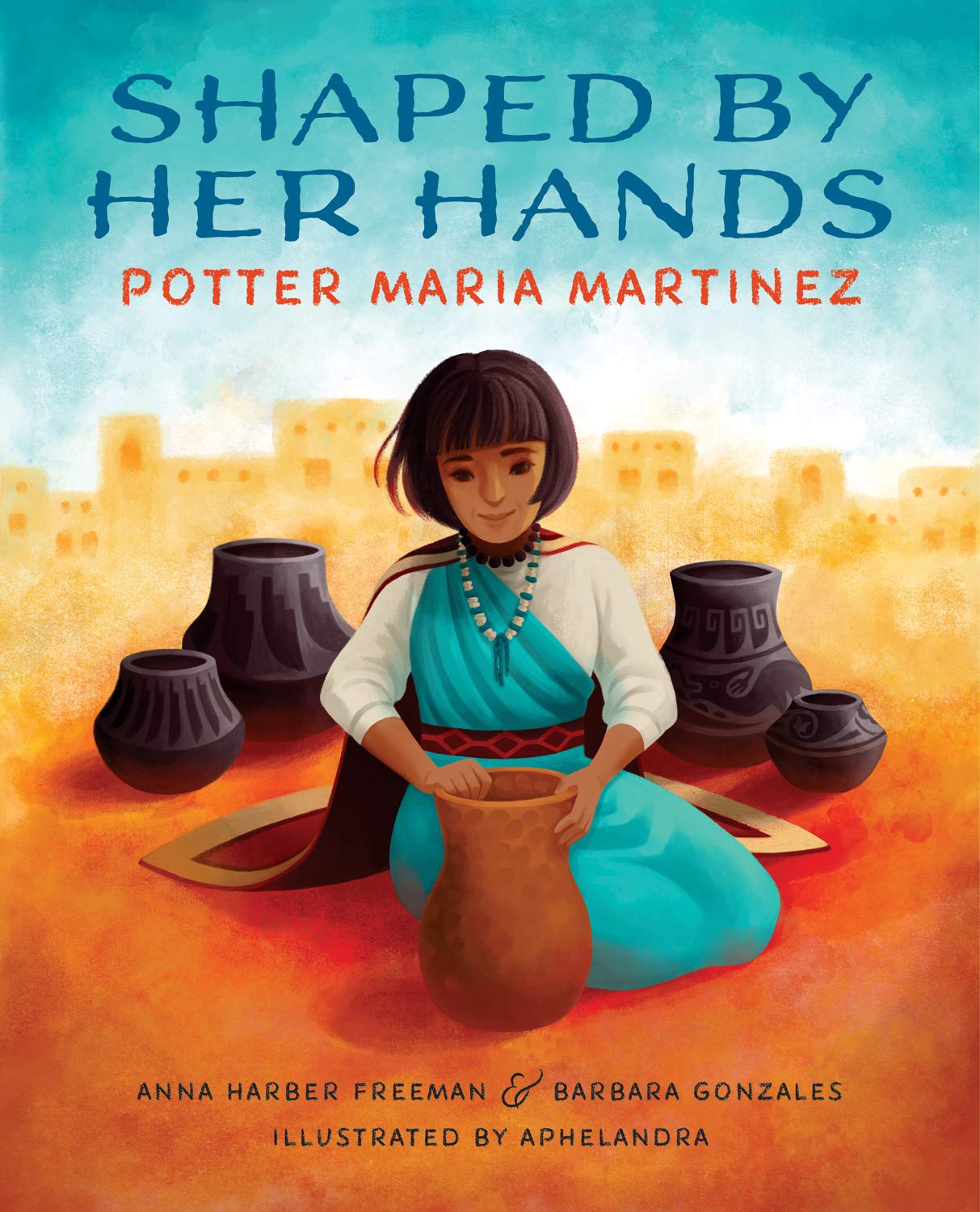
celebrate-picture-books-picture-book-review-shaped-by-her-hands-cover

About the Holiday

Cuddle ‘round for two loving holidays—Intergeneration Month and National Attend Your Grandchild’s Birth Day—which each encourage grandparents to be present figures in their grandchildren’s lives starting from birth! Already, many grandparents across the globe play active roles in caring for children. In the US alone, 4.8 million preschoolers were under the care of grandparents in 2011. Whether you are a grandchild, parent, or grandparent, it is important to support family and spread some love. Hug someone special today to celebrate this holiday. In honor of this day, we present a story about artist Maria Povika Martinez, co-written by her great-granddaughter. Her historical account teaches the importance of love, family, and the passing down of knowledge through generations.

Thanks to Albert Whitman & Company for sharing a copy of Shaped By Her Hands with me for review consideration. All opinions on the book are my own.

Review by Dorothy Levine

Shaped By Her Hands: Potter Maria Martinez (Part of the She Made History Series)

Written by Anna Harber Freeman and Barbara Gonzales | Illustrated by Aphelandra

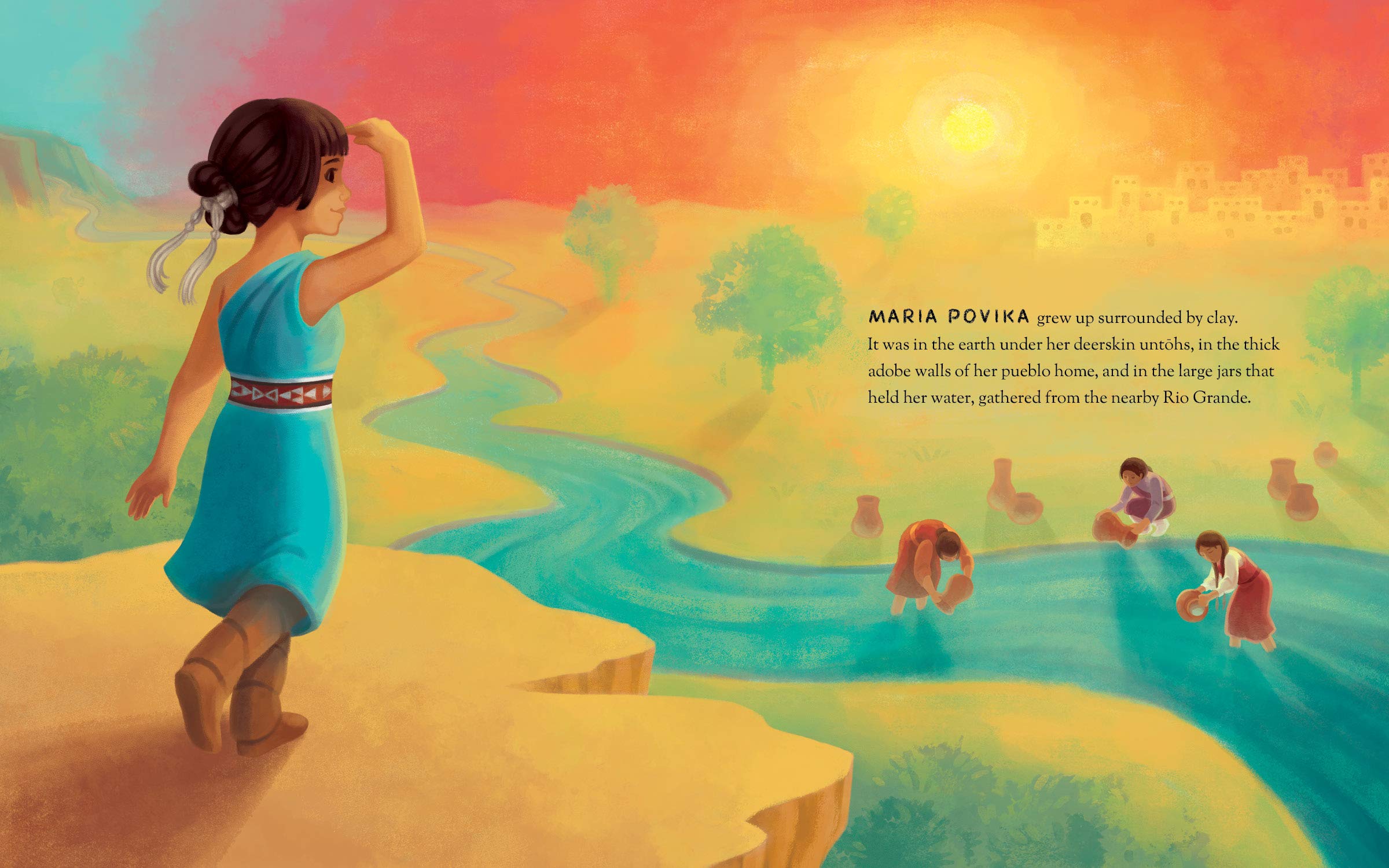
As a child growing up in the pueblo of San Ildefonso, New Mexico in the 1890s, Maria always loved clay. While her siblings played with straw dolls and her parents planted crops, Maria spent her time making clay pots. But, to her frustration, her pots would always crack when she set them out to dry in the sun. Maria’s aunt, or ko-ōo, Nicolasa offered to help and showed Maria “the centuries-old tradition of san-away.” Nicolasa still made clay pots using these traditional methods, even though more and more people were buying tin pots from stores. 

celebrate-picture-books-picture-book-review-shaped-by-her-hands-river

Image copyright Aphelandra, 2021, text copyright Anna Harber Freeman and Barbara Gonzales, 2021. Courtesy of Albert Whitman & Company.

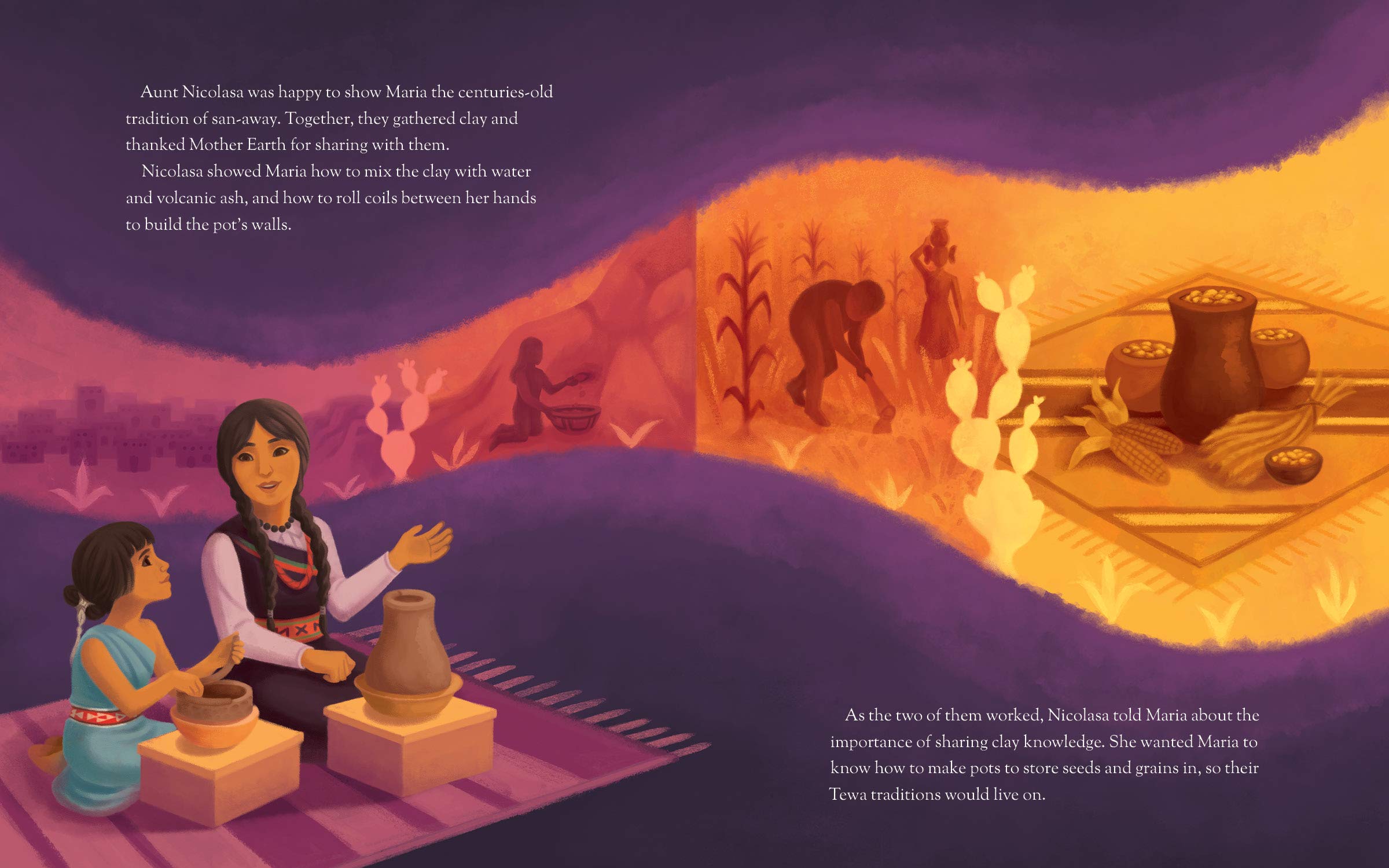
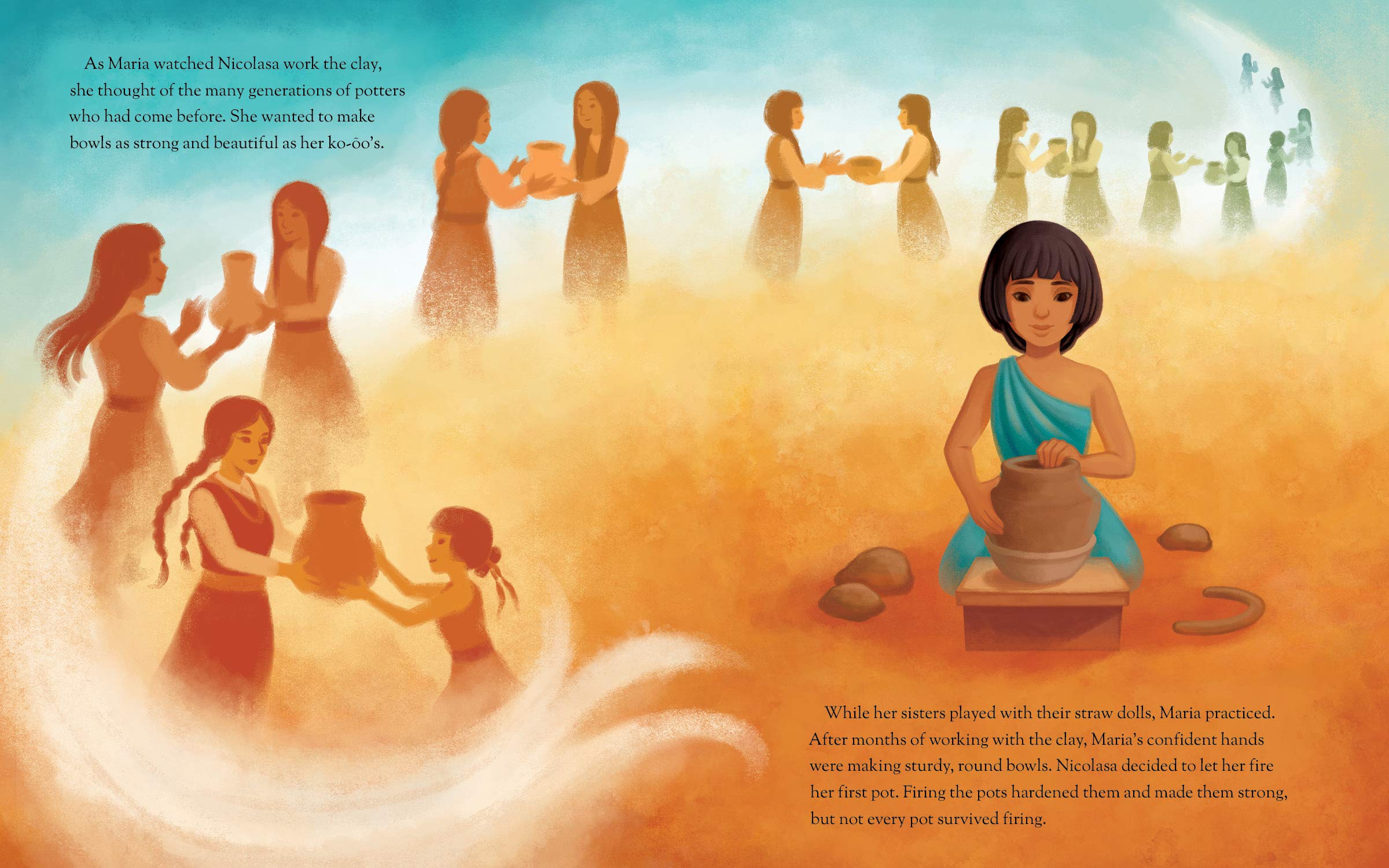
Nicolasa taught Maria how to coil the clay in circles and then lay the pots together on a fire to make them dry, solid, and strong. “As Maria watched Nicolasa work the clay, she thought of the many generations of potters who had come before. She wanted to make bowls as strong and beautiful as her ko-ōo’s.” Nicolasa and Maria thanked Mother Earth for the clay she shared with them. 

When Maria grew older, she continued to make pots and gained a reputation for her skilled work. One day in 1908, an archeologist named Edgar Lee Hewett came to visit Maria. He had discovered an old shard of black pottery in a dig nearby. Mr. Hewett wanted to know if Maria could recreate a pot in the similar style. She decided to take on the challenge.

celebrate-picture-books-picture-book-review-shaped-by-her-hands-Nicolasa

Image copyright Aphelandra, 2021, text copyright Anna Harber Freeman and Barbara Gonzales, 2021. Courtesy of Albert Whitman & Company.

After much experimentation, Maria and her husband, Julian Martinez, discovered a technique: “One afternoon, they tried smothering the fire to keep the smoke in. When they pulled out the pot, it was shiny, and black as a raven.” With this new method, Maria combined her own style with old traditions to create a new style of pottery that was marvelous. Mr. Hewitt took some of these pots Maria made. “He put one of the pots in the Museum of New Mexico, where he worked.” The others he took to shops in Santa Fe. To Maria’s surprise, they sold like crazy! Julian began to paint designs on the black shiny pots—decorations of serpents, feathers, and water—using a yucca-blade brush. 

As more and more pots sold, Maria and Julian taught the rest of her family and some friends to make the pots with them. They became so famous that many people across the country invited them to demonstrate their skills to others. When Maria’s husband died, she continued to make pots with her family. “First, her children came to paint the designs. Later, her grandchildren came to help with the painting and polishing. They made pots as a family, remembering to thank Mother Earth, and teaching new hands to form, polish, and design.” 

The story is followed by back matter that provides more information about Maria, the Tewa people, and the San Ildefonso Pueblo for readers. Both authors include a note about how they were influenced by Maria and why they believe it is important to share her story with young people today. 

celebrate-picture-books-picture-book-review-shaped-by-her-hands-generations

Image copyright Aphelandra, 2021, text copyright Anna Harber Freeman and Barbara Gonzales, 2021. Courtesy of Albert Whitman & Company.

The story is co-written by Barbara Gonzales, the great-grandchild of Maria, and Anna Harber Freeman, whose grandmother was a member of the Osage Nation and who is a lifelong fan of Maria’s work with degrees in multicultural education and art. Their biography of Maria Martinez shines with its lyrical, straightforward telling that reveals the deep history of the Tewa people as well as the meaning and uses of the pottery that Maria and her ko-ōo Nicolasa created by hand. The importance of passing down knowledge and traditions from one generation to another is organically woven throughout the story. Many readers will recognize Maria and Julian’s distinctive pottery and be inspired by the history behind it.

Aphelandra is a descendant of the Oneida Nation, and the daughter of a crafts artist and landscaper. She writes that she grew up surrounded by natural beauty and creativity, which can be seen in her illustrations. The illustrations in Shaped by Her Hands consist largely of soft yellow, green, and red hues. In the part of the story in which Maria is sent off to boarding school, the colorful tones found throughout the book are confined to a single window, depicting the feeling of entrapment and homesickness Maria felt. Aphelandra vividly weaves in the storytelling of past generations through her use of color, shadow and circular imagery. Her painted landscapes gorgeously depict the natural San Ildefonso scenery. 

This beautifully crafted tale shares the history of Maria Povika Martinez while introducing readers to Tewa people’s values of kindness, passing on of knowledge, and respect for elders and Mother Earth. An inspiring read for all children, especially those interested in artistic and creative endeavors, Shaped By Her Hands: Potter Maria Martinez is highly recommended for home bookshelves and a must for school and public library collections.

Ages 4 – 9 

Albert Whitman & Company, 2021 | ISBN 978-0807575994

Discover more about Anna Harber Freeman and her books on her website.

To learn more about Barbara Gonzales and her pottery and to view a video with Barbara and other artists discussing an exhibition of San Ildefonso Pueblo potters at the Museum of Indian Arts and Culture, visit the adobe gallery website.

You can learn more about Aphelandra, her books, and her artwork on her website.

Intergeneration Month Activity

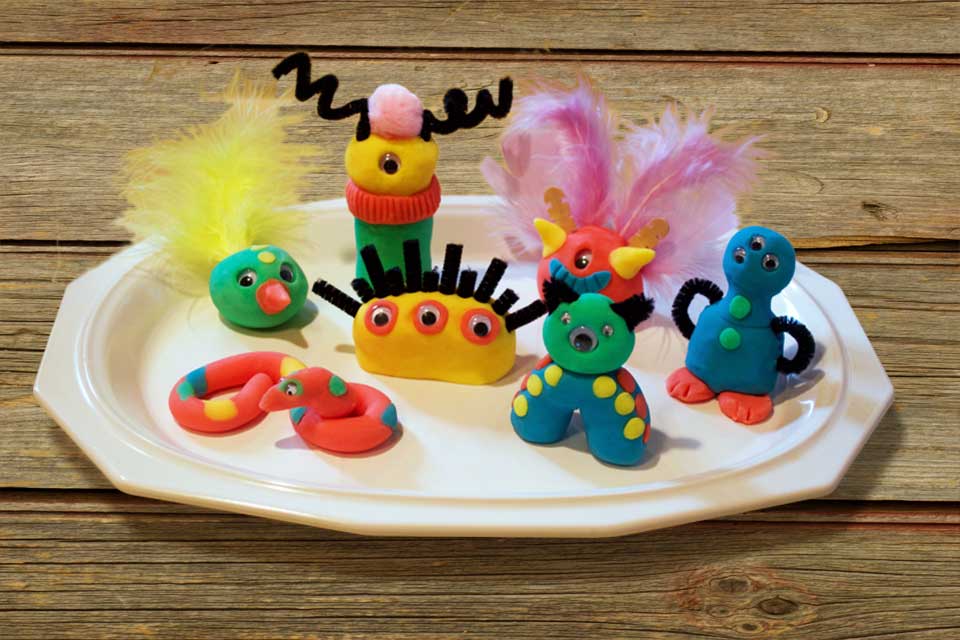
Highlights Kids Homemade Clay figures

Photo and craft sample by Madison McClain, courtesy of Highlights Kids (highlightskids.com)

This craft comes from Highlights Homemade Clay, by Marie E. Cecchini posted on April 12, 2016. You can find the post on the Highlights kids website.

Make your own homemade clay in honor of Maria’s art form then make your own pot or creation!

What you’ll need

  • 2 cups baking soda
  • 1 cup cornstarch
  • 1 ¼ cups water
  • Cooking pot
  • Food coloring (optional)
  • Wiggly eyes, chenille sticks, pompoms, feathers, etc. (optional)

What to do

Note: Food coloring can be added to the water before mixing in the other ingredients or can be added to the clay after it has cooled. Adding coloring later may be a little messier, but you can divide the clay and create different batches of various colors.

  1. Combine ingredients in the pot and cook mixture over medium heat, stirring until it thickens to a consistency like mashed potatoes.
  2. Let the clay cool
  3. Knead the clay until smooth.
  4. Make creations!
  5. Leave clay pieces in the sun to dry.

celebrate-picture-books-picture-book-review-shaped-by-her-hands-cover

You can find Shaped By Her Hands: Potter Maria Martinez at these booksellers

Amazon | Barnes & Noble | Books-a-Million

To support your local independent bookstore, order from

Bookshop | IndieBound

Picture Book Review
September 15 – International Dot Day

celebrate-picture-books-picture-book-review-the-dot-cover

About the Holiday

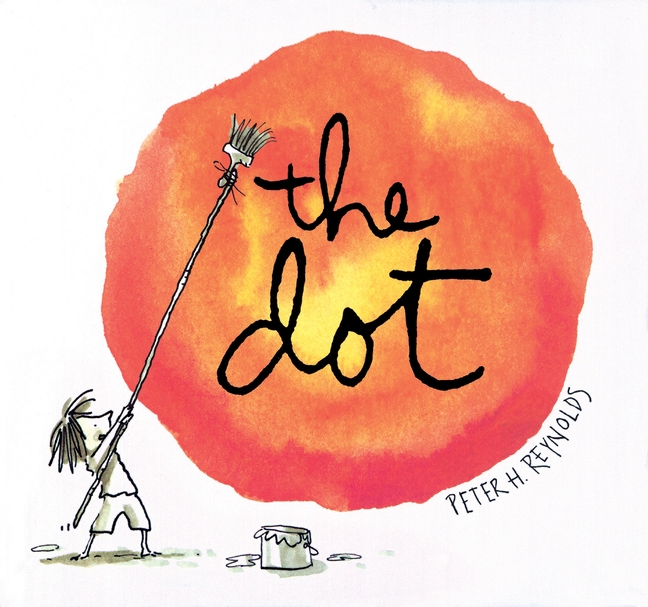
Usually, I match books to existing holidays. Today, though, I have the pleasure of posting a review of a book that established a holiday. On September 15, 2009 teacher Terry Shay introduced his class to Peter H. Reynold’s The Dot. From that one event grew a national and then an international celebration of creativity and the freedom to make art with your heart. All around the world, school children and adults are inspired on this day to make their mark and celebrate creativity, courage, and collaboration. For more information, to download posters, coloring pages, postcards, badges, and other resources and to join in on a live event starting at 10:00 a.m. PT, visit the International Dot Day website.

The Dot

By Peter H. Reynolds


At the end of art class, Vashti looked at her paper. It was still as blank as it was at the beginning of art class. Her teacher came over and took a peek. She saw right away that Vashti had drawn “‘a polar bear in a snowstorm.’” Vashti wasn’t fooled by the joke. “‘I just CAN’T draw,’” she said. But her teacher had a suggestion. “‘Just make a mark and see where it takes you.’”

celebrate-picture-books-picture-book-review-the-dot-vashti-jabs-paper

Copyright Peter H. Reynolds, 2003, courtesy of Candlewick Press.

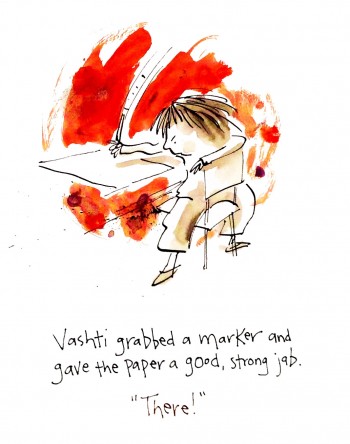
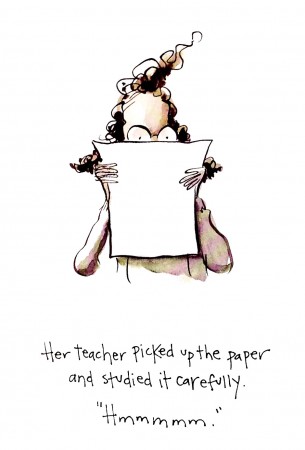
Vashti jabbed at the paper with a marker, making a dot right in the center. Her teacher studied her drawing carefully then told Vashti to sign it. That, at least, was something Vashti could do. She signed her name and gave the paper to her teacher. At the next week’s art class, Vashti was stunned to see her dot framed and hanging above the teacher’s desk. She looked at the tiny mark and decided that she could do better than that.

celebrate-picture-books-picture-book-review-the-dot-teacher

Copyright Peter H. Reynolds, 2003, courtesy of Candlewick Press.

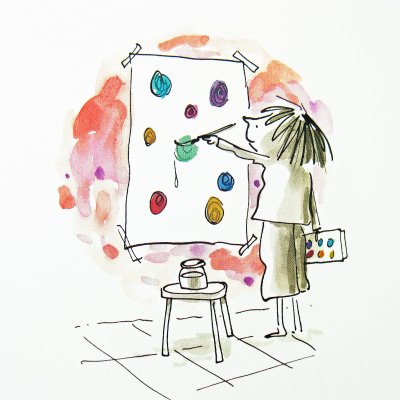
Vashti opened her watercolor set and began. She “painted and painted. A red dot. A purple dot. A yellow dot. A blue dot.” Then she discovered that blue mixed with yellow made a green dot. Vashti went to the easel and began painting lots of little dots in all sorts of colors. She realized if she could make little dots, she could make big dots. She knelt down on the floor with a big piece of paper and a big brush and created a huge dot.

celebrate-picture-books-picture-book-review-the-dot-experimenting-with-dots

Copyright Peter H. Reynolds, 2003, courtesy of Candlewick Press.

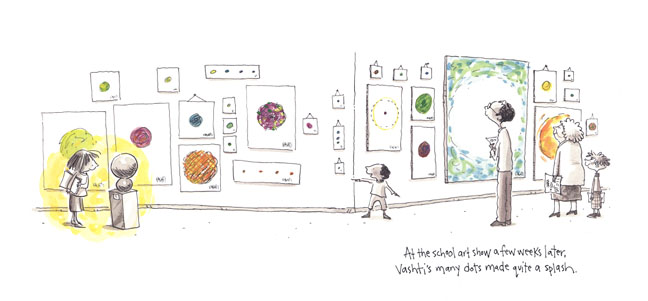
Then on an enormous canvas Vashti “made a dot by not making a dot.” At the school art show, Vashti’s dot paintings covered two walls and were quite a hit. Coming around the corner a little boy spied Vashti. He came close and told her, “‘You’re a really great artist. I wish I could draw.’” Vashti was encouraging, but the little boy said he couldn’t even “‘draw a straight line with a ruler.’”

Vashti wanted to see. She handed the boy a blank sheet of paper. With a quivering pencil, he drew a line and handed the paper back to her. Vashti studied the wavy line for a minute, and then gave the paper back. “‘Please…sign it,’” she said.

celebrate-picture-books-picture-book-review-the-dot-art-show-II

Copyright Peter H. Reynolds, 2003, courtesy of Candlewick Press.

Peter H. Reynold’s classic story of a little girl who believes she can’t draw is inspirational for anyone at any age who listens too closely to that voice in their head that stops them from letting go and doing. Whether it’s painting, writing, changing the décor of one’s house, updating a wardrobe, getting healthy, or even taking a class, the project often seems insurmountable. But what if you could start with a YouTube video, one step, a pair of earrings, a pillow, a word, or…a dot? Reynolds says you can! With his straightforward storytelling, Reynolds gives readers permission to play, experiment, and feel free.

celebrate-picture-books-picture-book-review-the-dot-little-boy

Copyright Peter H. Reynolds, 2003, courtesy of Candlewick Press.

Reynold’s familiar line drawings that sketch out adorable Vashti and her wise teacher are punctuated by the colorful dots that Vashti draws in profusion. Even Vashti, herself, is surrounded by circular auras of color throughout the story, reflecting her talent and creative spirit. The final scene of the art show gallery is a revelation, showing readers that one’s work or life work adds up to an impressive display of the self.

Through and through The Dot is charming, moving, and encouraging. It is a must addition to home libraries, public libraries, and classrooms.

Ages 5 and up

Candlewick Press, 2003 | 978-0763619619

To learn more about International Dot Day and find ideas and resources for classrooms, libraries, and booksellers, a variety of coloring pages to download, and a gallery of projects, visit the International Dot Day website

You’ll learn more about Peter H, Reynolds, his books, and his art as well as find lots of inspiration and creative tips on his website!

International Dot Day Activity

celebrate-picture-books-picture-book-review-dot-day-mini-poster

Make Your Mark! Mini-Poster Coloring Page


Grab your favorite paints, markers, crayons and Make Your Mark with this printable mini-poster from Peter Reynolds!

Make Your Mark! Mini-Poster

celebrate-picture-books-picture-book-review-the-dot-cover

You can find The Dot at these booksellers

Amazon | Barnes & Noble | Books-a-Million

To support your local independent bookstore, order from

Bookshop | IndieBound

Picture Book Review

August 19 – World Photography Day

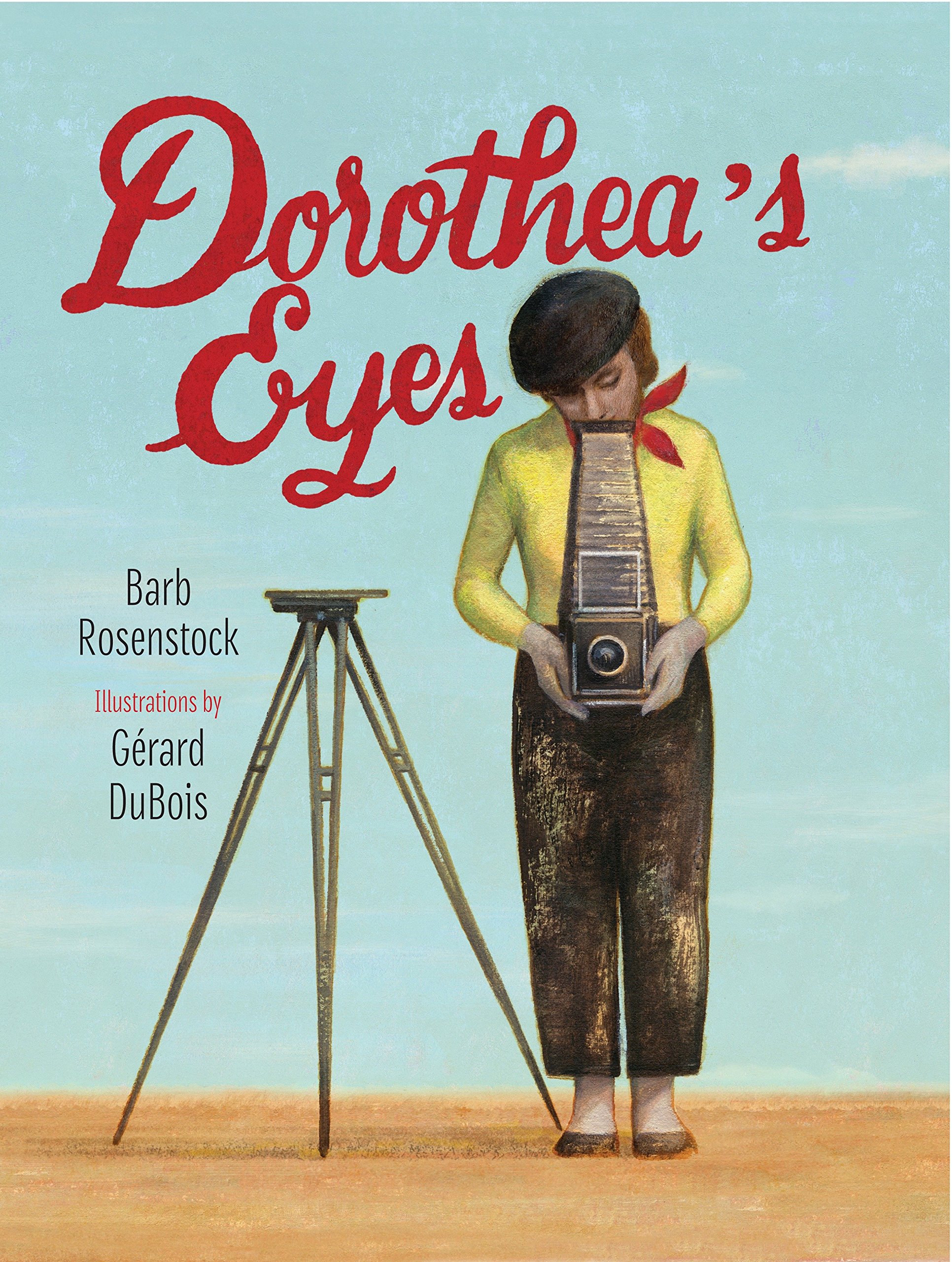
celebrate-picture-books-picture-book-review-dorothea's-eyes-cover

About the Holiday

Photography is all about providing information and emotion through images. A picture really can be worth a thousand words in capturing a moment of surprise, joy, danger, or sadness. Well-placed photographers, videographers, and cinematographers have given voice to some of society’s pivotal moments, allowing the whole world to witness change, often as it is happening. Today we celebrate the “art, craft, science, and history of photography,” as well as those photographers who often put themselves in danger to get the story and those who bring us much-needed lighter moments. To learn more visit the World Photography Day website.

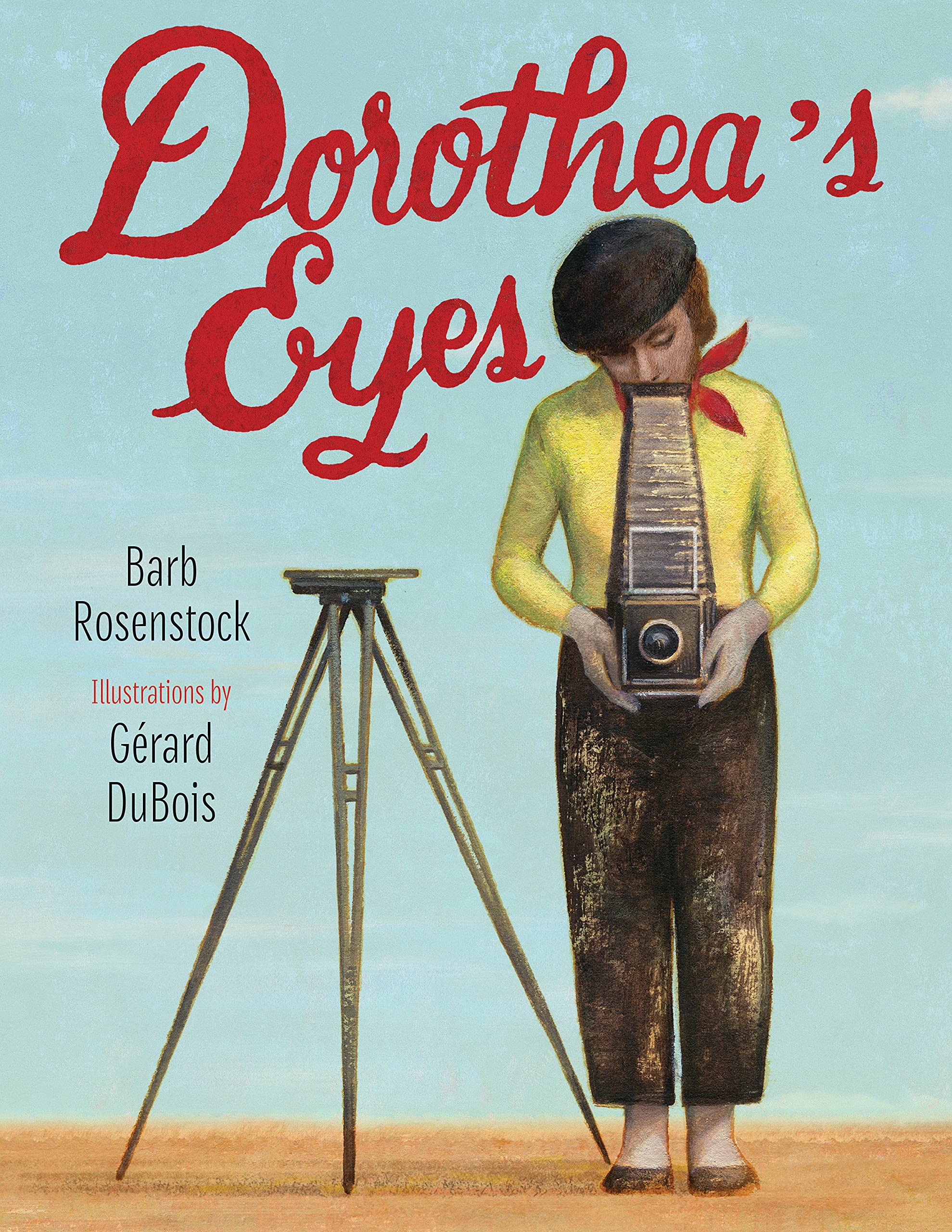
Dorothea’s Eyes: Dorothea Lange Photographs the Truth

Written by Barb Rosenstock | Illustrated by Gérard DuBois


When Dorothea Lange opens her green eyes, she sees things others miss. In the shadows, in patterns within the grain of wooden tables, in the repeated shapes of windows on a wall, and most especially in people’s faces. “Dorothea loves faces! When Dorothea looks at faces, it’s like she’s hugging the world.”

At seven years old Dorothea contracts polio, which withered her right leg and left her with a permanent limp. Other kids tease her and make her want to hide, and although her mother encourages her Dorothea pretends to be invisible. When her father leaves his family, her mother gets a job in New York and Dorothea goes to a new school. Because she is different, she feels lonely.

celebrate-picture-books-picture-book-review-dorothea's-eyes-great-market

Image copyright Gérard DuBois, 2016, text copyright Barb Rosenstock, 2016. Courtesy of Calkins Creek.

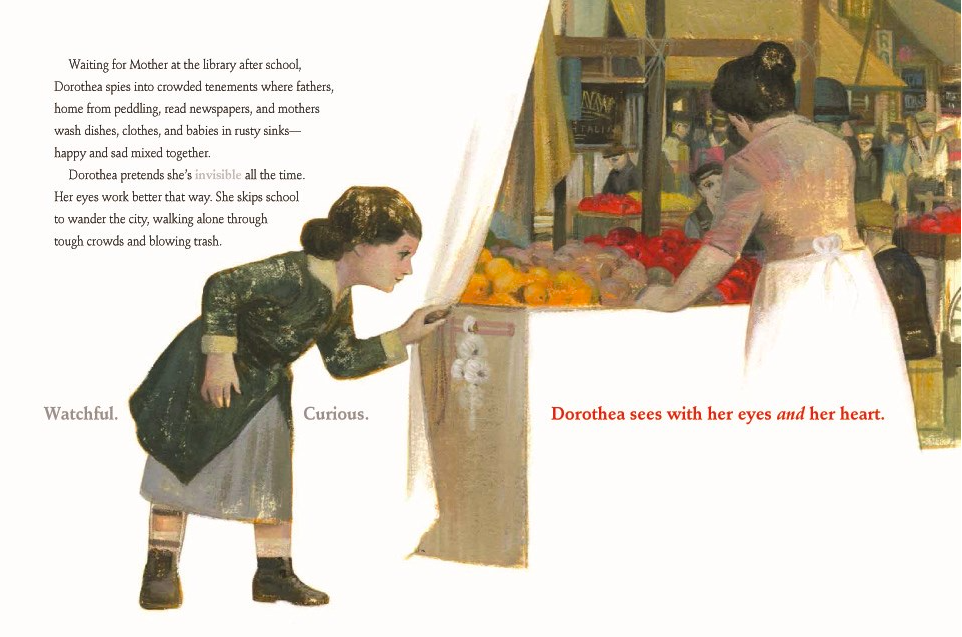
As Dorothea waits for her mother to finish work, she looks around her, spying “into crowded tenements where fathers, home from peddling, read newspapers, and mothers wash dishes, clothes, and babies in rusty sinks—happy and sad mixed together.” She begins to skip school to wander the city, gazing at it with her curious eyes and heart.

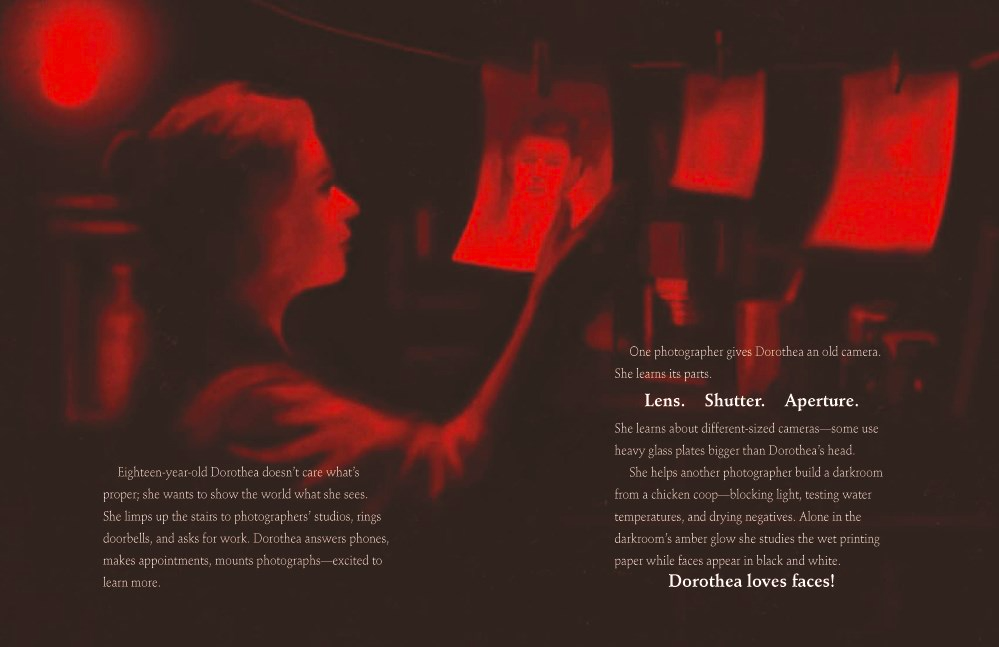
When Dorothea grows up she decides to become a photographer. Her family is surprised because it’s not a ladylike profession. She’s determined, thought, and works any job she can find in the photography industry, learning about cameras, darkrooms, negatives, and the printing process. “Alone in the darkroom’s amber glow, she studies the wet printing paper while faces appear in black and white. Dorothea loves faces!”

celebrate-picture-books-picture-book-review-dorothea's-eyes-great-dark-room

Image copyright Gérard DuBois, 2016, text copyright Barb Rosenstock, 2016. Courtesy of Calkins Creek.

As a young woman Dorothea travels west to San Francisco. There, her money is stolen, so she stays, gets a job, and starts her own portrait studio. Her work makes her famous and the richest families in California seek her out to take their photos. She makes money, gains friends, gets married, and starts a family of her own. But she always wonders, “Am I using my eyes and my heart?”

celebrate-picture-books-picture-book-review-dorothea's-eyes-great-depression

Image copyright Gérard DuBois, 2016, text copyright Barb Rosenstock, 2016. Courtesy of Calkins Creek.

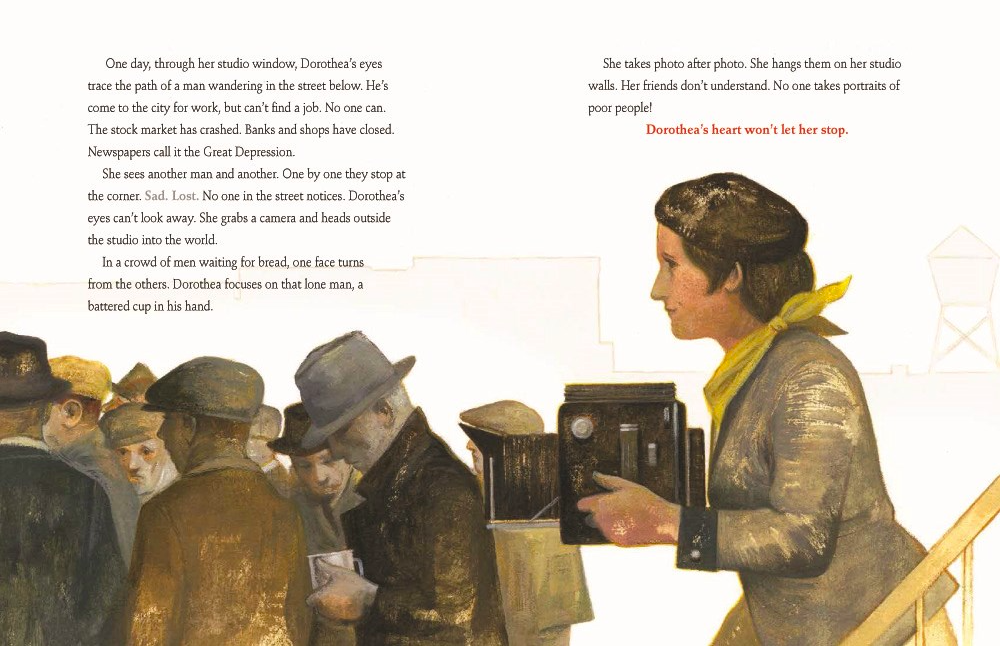
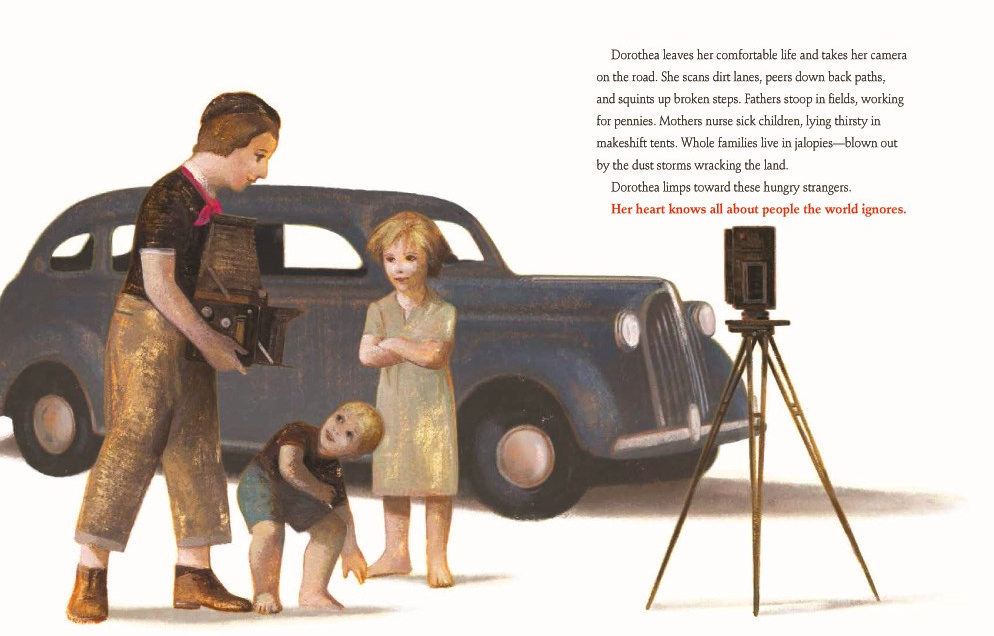
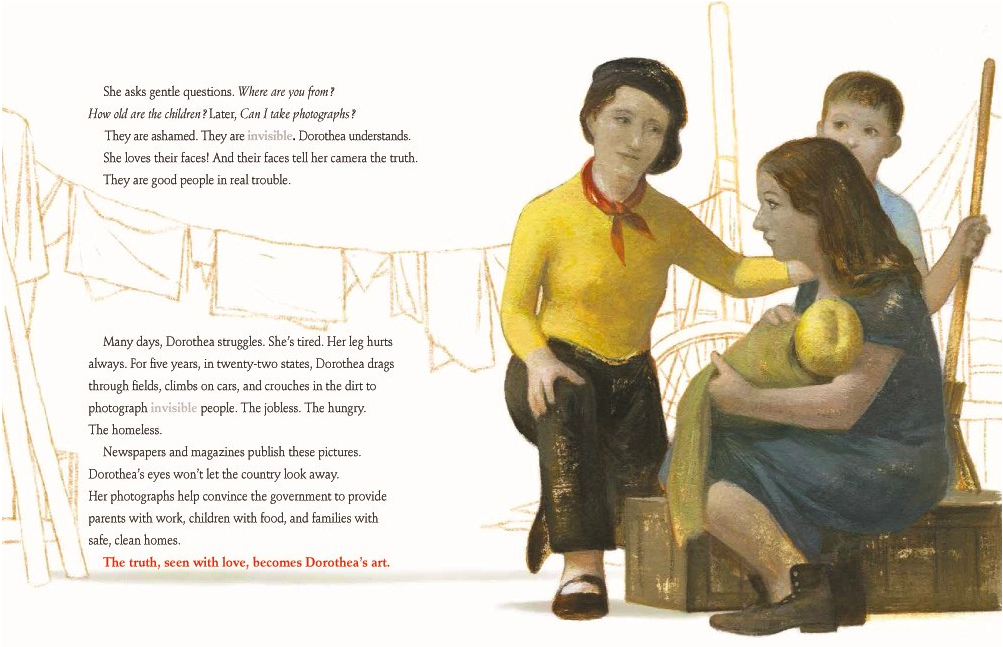
When the stock market crashes and the Great Depression sweeps the country, Dorothea focuses her camera on the desperate and the downtrodden. Her friends don’t understand, but Dorothea sees into these poor people’s hearts. She “knows all about people the world ignores.” For five years she goes out into the fields, peers into tents, documents families living in their cars, crouches in the dirt to reveal the stories of the people struggling with the devastation wrought by the Dust Bowl.

celebrate-picture-books-picture-book-review-dorothea's-eyes-kids

Image copyright Gérard DuBois, 2016, text copyright Barb Rosenstock, 2016. Courtesy of Calkins Creek.

Newspapers and magazines publish her pictures. “Her photographs help convince the government to provide parents with work, children with food, and families with safe, clean homes. “The truth, seen with love, becomes Dorothea’s art.” Dorothea’s photographs are still known today. Their subjects continue to help us see others with our hearts.

Backmatter includes six of Dorothea Lange’s most famous and recognizable photographs—ones that are still as riveting today as they were in the 1930s. Further information on her life and work is provided as well as sources where her photographs can be viewed, resources for further study, and a timeline of her life.

celebrate-picture-books-picture-book-review-dorothea's-eyes-san-francisco

Image copyright Gérard DuBois, 2016, text copyright Barb Rosenstock, 2016. Courtesy of Calkins Creek.

Barb Rosenstock brings Dorothea Lange’s vision to the page with love, honesty, and understanding in this excellent biography of a woman whose photographs defined the Great Depression and Dust Bowl era. Lange’s life-long connection to the poor and often overlooked people of the world is beautifully described and explained in a gentle, compassionate way that will resonate with children. Rosenstock’s language is lyrical with staccato sentences that echo the clicks of Lange’s shutter capturing life’s reality with her eyes and her heart.

Gérard DuBois’s illustrations are arresting and set Dorothea Lange’s story firmly in its historical and emotional landscape. Rendered in acrylic and digital imagery, they feature the muted colors and style of book illustrations from long ago. By placing the images of Dorothea, her family, and her photography subjects against white backgrounds, DuBois emphasizes Lange’s focus on the people she met and faces that inspired her. Distressed textures accentuate the troubled times and the anguish of both Dorothea and her subjects.

Ages 7 – 12

Calkins Creek, 2016 | ISBN 978-1629792088 (Hardcover, 2018) | ISBN 978-1635925630 (Paperback, 2022)

Paperback edition will be released on February 1, 2022. The book is available for preorder now.

Discover all the amazing books by Barb Rosenstock on her website!

View a portfolio of art and book illustration by Gérard DuBois on his website!

Enjoy a snapshot of Dorothea’s Eyes!

World Photography Day Activity

CPB - New Professionals Picture

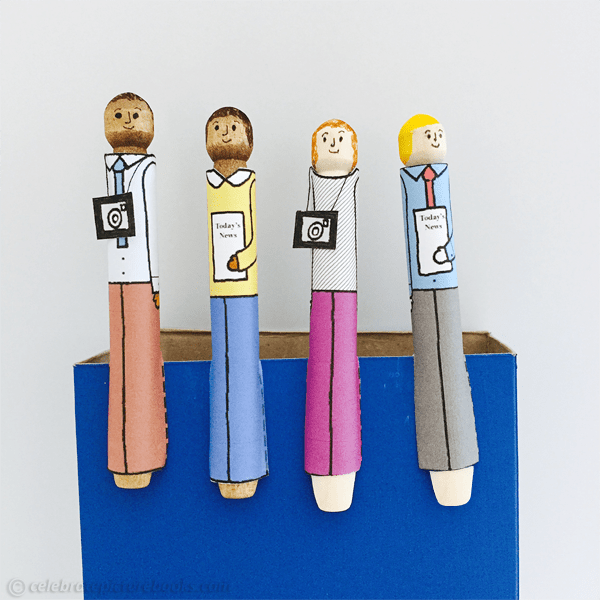
News Professionals Clothespin Figures


Make one of these clothespin figures that honors the men and women photographers and writers who work to keep the world informed.

Supplies

Directions

  1. Draw a face and hair on the clothespin
  2. Cut out the clothes you want your journalist or photographer to wear
  3. Wrap the clothes around the clothespin. The slit in the clothespin should be on the side.
  4. Tape the clothes together
  5. Cut out the camera
  6. Tape one end of a short length of thread to the right top corner of the camera and the other end of the thread to the left corner. Now you can hang the camera around the figure’s neck.

Idea for displaying the figures

  • Attach a wire or string to the wall and pin the figure to it
  • Pin it to your bulletin board or on the rim of a desk organizer

celebrate-picture-books-picture-book-review-dorothea's-eyes-cover

You can find Dorothea’s Eyes: Dorothea Lange Photographs the Truth at these booksellers

Amazon | Barnes & Noble | Books-a-Million

To support your local independent bookstore, order from

Bookshop | IndieBound

Picture Book Review

August 3 – It’s Family Fun Month and Interview with Jamie Michalak

celebrate-picture-books-picture-book-review-dakota-crumb-cover

About the Holiday

August is a perfect time to have fun with the family! The days are long and warm, and there are so many activities to discover. Get away from the heat at a pool, the beach, or on the cool shade of a forest path. Explore your adventurous side while camping or traveling to an unfamiliar town, or increase your knowledge by visiting a science, art, history, or other museum. As today’s book shows, a museum might just be the most adventurous place on your list! So, before school starts up for another year, get out there and have fun!

Dakota Crumb: Tiny Treasure Hunter

Written by Jamie Michalak | Illustrated by Kelly Murphy


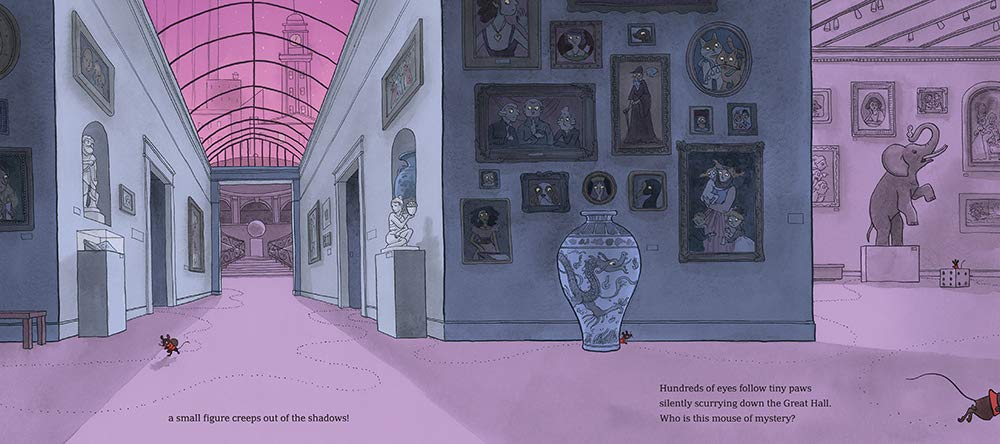
“In the great, big city, in the great, big museum, a clock tick-tocks past midnight.” The guards are on the watch, but they don’t see the tiny mouse that “creeps out of the shadows” and zig-zags her way through the galleries under the peering eyes of the art hung on the walls. Who is this explorer that carries a sack over one shoulder and has her eyes riveted on a map? It’s Dakota Crumb, and “for endless nights, Dakota has searched for a famous priceless treasure.

celebrate-picture-books-picture-book-review-dakota-crumb-great-hall

Image copyright Kelly Murphy, 2021, text copyright Jamie Michalak, 2021. Courtesy of Candlewick Press.

The map reveals that it is in “the Deepest, Darkest Cave. But perils lie ahead. Scurrying past knights in armor, Dakota spies a tiny masterpiece across the room. Using her rope, she swings and picks it up. She places it into her sack and continues on. Into the hall of giants she roams. The only movement is the maintenance worker cleaning the floor. Dakota scans the room and—“aha!”—discovers a forgotten statue. Trying to collect it, she’s nearly swept away with the day’s refuse.

Dakota consults the map again and crawls away. Her journey takes her “to the land of Egypt,” where Dakota is on the hunt for “the famous Purple Jewel of Egypt.” Dakota summons all her courage when she comes eye to claw with “A GIANT… EVIL EYED… MOUSE-EATING… CAT!” She hurries past and into the deep, dark cave. She climbs up, up and “Pull. Pry. Oh, my!”  grabs the treasure she’s been seeking—the Purple Jewel of Egypt. “Oh! how it sparkles!” As dawn colors the glassed rotunda, Dakota tiptoes home, her sack full.

celebrate-picture-books-picture-book-review-dakota-crumb-map

Image copyright Kelly Murphy, 2021, text copyright Jamie Michalak, 2021. Courtesy of Candlewick Press.

The museum opens, but not only for people. Around the corner, a “teeny-tiny door” welcomes visitors of another sort. These city dwellers—insects and mice, raccoons and squirrels, worms and pigeons await the opening of a new museum—the Mousehole Museum, where Dakota Crumb proudly presides over her carefully curated exhibits. The visitors enter and roam the galleries, marveling over all of the wonderful treasures they see. You’re welcome to join them too!

Following the story, Dakota Crumb invites readers to return to the museums—both big and small—to scour their rooms for forty-five items that are cleverly concealed.

celebrate-picture-books-picture-book-review-dakota-crumb-mousehole-museum

Image copyright Kelly Murphy, 2021, text copyright Jamie Michalak, 2021. Courtesy of Candlewick Press.

Charming from beginning to (ingeniously extended) end, Jamie Michalak’s Dakota Crumb: Tiny Treasure Hunter is sure to become a favorite of any child. Michalak’s crafty uses of the types of exhibits seen in major museums not only add intrigue to the story but will thrill those kids who are already museum lovers and entice others to visit their local museums. The hushed sense of suspense that infuses the pages as Dakota Crumb creeps from room to room gathering items in her bag will have kids eagerly turning the pages to discover the provenance of the Purple Jewel of Egypt. What is she doing with all of the things she finds? Michalak’s perfect answer will enchant every collector, artist, scientist, history buff, and explorer.

Kelly Murphy’s wizardry begins on the title page, where the museum is just about to close and they city dwellers are heading home in the purple twilight. Taking in the lush urban landscape, alert readers may pick up on details that tell them the fun is just beginning. As kids follow Dakota through the quiet museum, finding themselves searching for treasure just as she does, they see paintings, ceramics, sculptures, animal exhibits, and finally the regal Egypt room.

Murphy ingeniously incorporates items from the scavenger hunt list kids find at the end of the story into each page spread while adding humorous hints, realistic portrayals of famous exhibits, and even a comical nod to a common cleaning occurrence. But like many museum goers, readers may find themselves catch their breath when they enter the Mousehole Museum. Murphy’s well-imagined exhibits turn everyday items into masterpieces—and who’s to say they’re not? From toys to fasteners to snacks, containers, and trinkets and even an overdeveloped polaroid photograph, the displays in Dakota Crumb’s museum invites readers to look at their surroundings in a brand-new way.

A smart, witty, fun, and thought-provoking book, Dakota Crumb: Tiny Treasure Hunter is a superb book for introducing the excitement of museums to children and engaging them in observation as well as ideas on art, historical value, community inclusion, and collecting. All this and an imaginative scavenger hunt that challenges readers to be as intrepid a treasure hunter as Dakota Crumb. Sure to spark plenty of ideas for teachers, homeschoolers, museum educators, and libraries, Dakota Crumb: Tiny Treasure Hunter is a must for home, school, and library bookshelves as well as for museum gift shops.

Ages 3 – 8 and up

Candlewick Press, 2021 | ISBN 978-1536203943

Discover more about Jamie Michalak and her books on her website.

To learn more about Kelly Murphy, her books, and her art, visit her website.

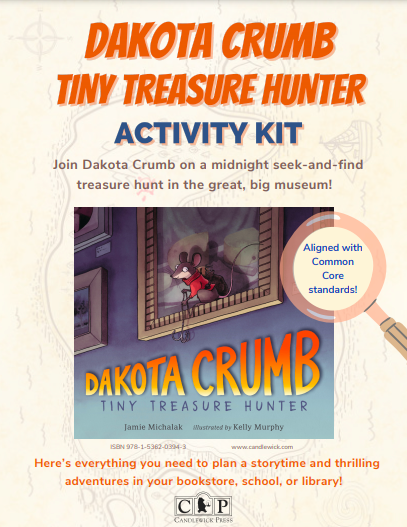
celebrate-picture-books-picture-book-review-dakota-crumb-activity-kit

You can download a Dakota Crumb: Tiny Treasure Hunter Activity Kit for teachers, families, librarians, or any book lover here or on the Candlewick Press website.

A Chat with Jamie Michalak

celebrate-picture-books-picture-book-review-dakota-crumb-author-jamie-michalak-headshot

Jamie Michalak is the author of many children’s books, including Dakota Crumb: Tiny Treasure Hunter, illustrated by Kelly Murphy; Frank and Bean, illustrated by Bob Kolar; the highly praised Joe and Sparky early readers series, illustrated by Frank Remkiewicz; as well as the forthcoming picture book Niki Nakayama: A Chef’s Tale in 13 Bites, co-written with Debbi Michiko Florence and illustrated by Yuko Jones, and many more.

When not writing, she can often be found singing off-key, drinking too much coffee, or hanging out with her two sons. Jamie lives with her family in Barrington, Rhode Island.

You can connect with Jamie on her website | Instagram | Twitter

Welcome, Jamie! I’m so happy to be part of your book tour for Dakota Crumb: Tiny Treasure Hunter! Visiting museums is one of my and my family’s favorite activities, especially when we travel. They always provide us with wonderful memories. Do you have a favorite memory from a trip you took to research one of your books?

When I was writing Dakota Crumb: Tiny Treasure Hunter, in which a mouse searches for tiny objects in a museum, I wanted to scout out the best places to hide them. So I decided to visit an art museum in Manhattan, and I asked my eight-year-old son to come along as my research assistant.

Within fifteen minutes of our visit, he tugged on my sleeve. He was looking up at me with an expression of shock and horror.

“What’s the matter?” I asked.

“Mom,” he whispered, looking around. “They’re not wearing ANY PANTS!”

I had no idea he hadn’t seen nude Greek or Roman statues before.

In any case, he learned a lot about art, found some perfect hiding spots for mice treasures, and went home with lots to tell his friends.

That’s fabulous! Kids’ reactions to new experiences are such treasures in themselves.

In your school and library programs you share your writing process and give lots of advice for kids and teachers on how to create characters and stories as well as talking about your books. They sound like a blast! This past year, you probably held more virtual programs than usual. What was one funny thing that happened during one of these events this year?

I ended all of my virtual visits with a sing-along of the “Jelly Donut Hole Song” from my early reader Frank and Bean, illustrated by Bob Kolar. I’d play the audio and share the lyrics on my screen, so the class could join in. (Keep in mind I couldn’t see the faces of any of the kids.) During one visit, I’m playing the song, kind of half singing along because I can’t carry a tune AT ALL. Also, I’m clapping every now and then. Aaaand at the very end, the teacher says, “Um, Jamie? We couldn’t hear the audio on our end.” So basically the kids only saw my big head and heard me humming one note or mumbling every other three words. This went on for at least two minutes! Awkward.

Well, that sounds like a story Frank and Bean would love! Perhaps this funny oops! will find its way into one of your books. Thanks for sharing these two humorous events that show just what a varied tapestry being a picture book author is!

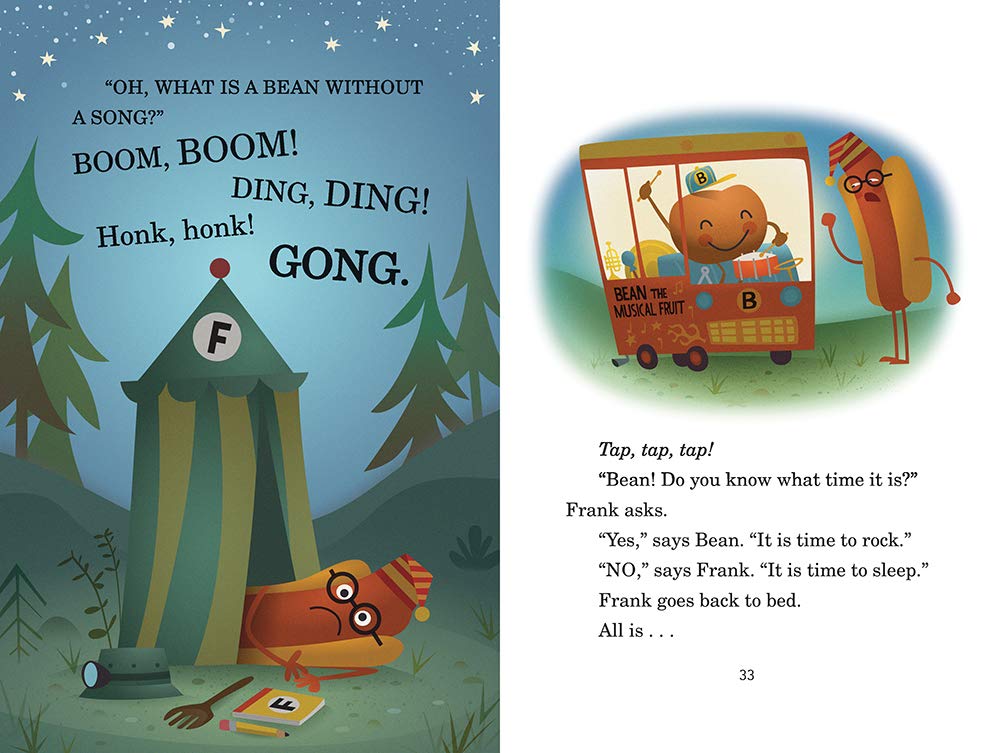
 Here’a a little more about Frank and Bean

celebrate-picture-books-picture-book-review-frank-and-bean-cover

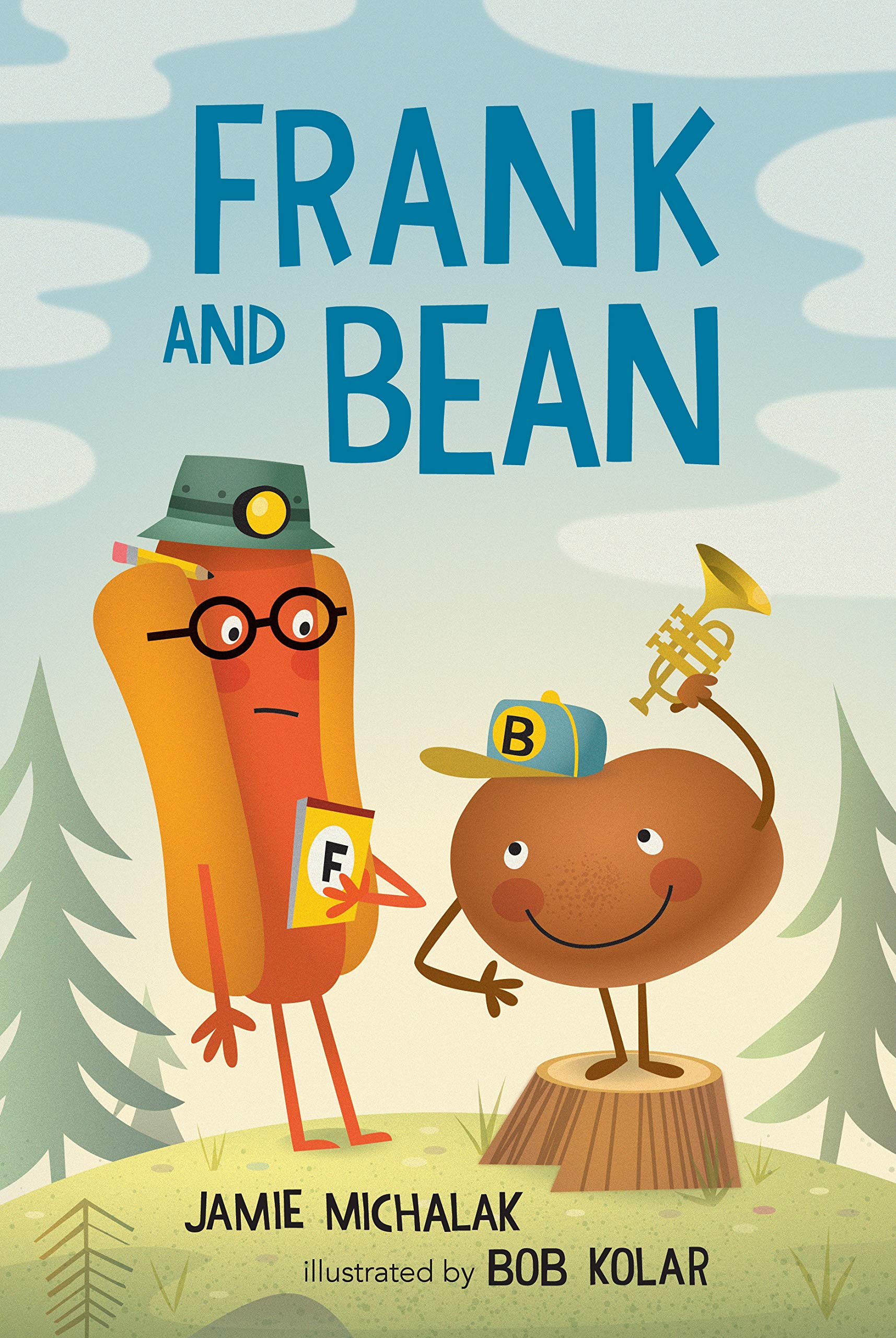
Written by Jamie Michalak; Illustrated by Bob Kolar

When the introspective Frank meets the gregarious Bean, can they find a way to make beautiful music together? Dry wit and hilarious illustrations introduce a new unlikely pair.

celebrate-picture-books-picture-book-review-frank-and-bean-tent

Image copyright Bob Kolar, 2019, text copyright Jamie Machalak, 2019. Courtesy of Candlewick.

Candlewick Press, 2019 | ISBN 978-0763695590

Early Reader; Ages 3-7

A 2019 Amazon Best Book of the Year

2019 Junior Library Guild Selection

Florida 2020-2021 SSYRA JR Award Nominee

Cybils Award finalist

Family Fun Month Activity

celebrate-picture-books-picture-book-review-dakota-crumb-tiny-treasure-hunt-game

Tiny Treasure Hunt

This treasure hunt from Jamie Machalak is just like Dakota Crumb’s, but with a twist! And it’s perfect for families to do together! Print and cut out this tiny treasure hunt checklist for your child, so they can gather the objects listed. Then ask them to share what they found, using three adjectives to describe each treasure. What does a button feel like? What does the tiny toy look like? (Magnifying glasses are optional!)

Tiny Treasure Hunt List

celebrate-picture-books-picture-book-review-dakota-crumb-cover

You can find Dakota Crumb: Tiny Treasure Hunter at these booksellers

Amazon | Barnes & Noble | Books-a-MillionBookshop 

Picture Book Review

July 20 – Celebrating Park and Recreation Month with Chana Stiefel

celebrate-picture-books-picture-book-review-one-question-interview-chana-stiefel-in-front-of-statue-of-liberty

Chana Stiefel is the author of more than 25 books for children, both fiction and nonfiction. Her most recent picture book is LET LIBERTY RISE (illustrated by Chuck Groenink, Scholastic, 2021), the true story of how children helped build the Statue of Liberty. Her next nonfiction picture book, THE TOWER OF LIFE, is the biography of Yaffa Eliach, a Jewish historian and survivor of the Holocaust who rebuilt her village in stories and photos to create the Tower of Faces in the U.S. Holocaust Memorial Museum in Washington, DC (illustrations by Susan Gal, Scholastic, 2022). Other picture books by Chana include MY NAME IS WAKAWAKALOCH!, illustrated by Mary Sullivan (HMH, 2019) and DADDY DEPOT, illustrated by Andy Snair (Feiwel & Friends, 2017).

You can connect with Chana Stiefel on Her website | Facebook | Instagram | Twitter

Welcome, Chana! I’m really glad to have you joining me for a one-question interview this summer! As the Statue of Liberty National Monument is part of the National Park System, Let Liberty Rise! is a perfect book for celebrating Park and Recreation month, which encourages people to get out and enjoy America’s beautiful national parks and all they have to offer. 

I know how much you love to connect with your readers. Can you talk about a poignant thing that happened during one of your visits this year?

My newest picture book Let Liberty Rise! How America’s Schoolchildren Helped Save the Statue of Liberty (illustrated by Chuck Groenink) launched from Scholastic on March 2nd. Soon afterward, I received a phone call from the youth director at a local synagogue asking if I’d be interested in doing an in-person reading to children on a Circle Line Cruise to the Statue of Liberty.

I nearly dropped the phone. 

“It will be socially distanced and everyone will be masked,” she said. “The event will be on Passover [the holiday of freedom]. Maybe you can talk to the kids about the meaning of liberty?”

“So let me get this straight,” I replied. “You’re asking if I would like to read my book about the history of the Statue of Liberty to children in front of the statue herself?” Having received my second vaccine, my answer was an emphatic, “YES! OMG, YES!” 

celebrate-picture-books-picture-book-review-one-question-interview-chana-stiefel-in-front-on-ferry

On April 1st, anchors away! My family and I joined over 100 people on the Circle Line’s maiden cruise in the wake of the Coronavirus, including Jim Morgan, owner of the Curious Reader bookshop, who helped me with a book signing. For the first time since the pandemic began, I shared with children (real, live children!) the story of how, in 1885, school children contributed their hard-earned pennies to build the pedestal of America’s most beloved statue. 

And then, there we were! Floating on a boat at the base of the Statue of Liberty. It was magical.

celebrate-picture-books-picture-book-review-one-question-interview-chana-stiefel-giving-talk

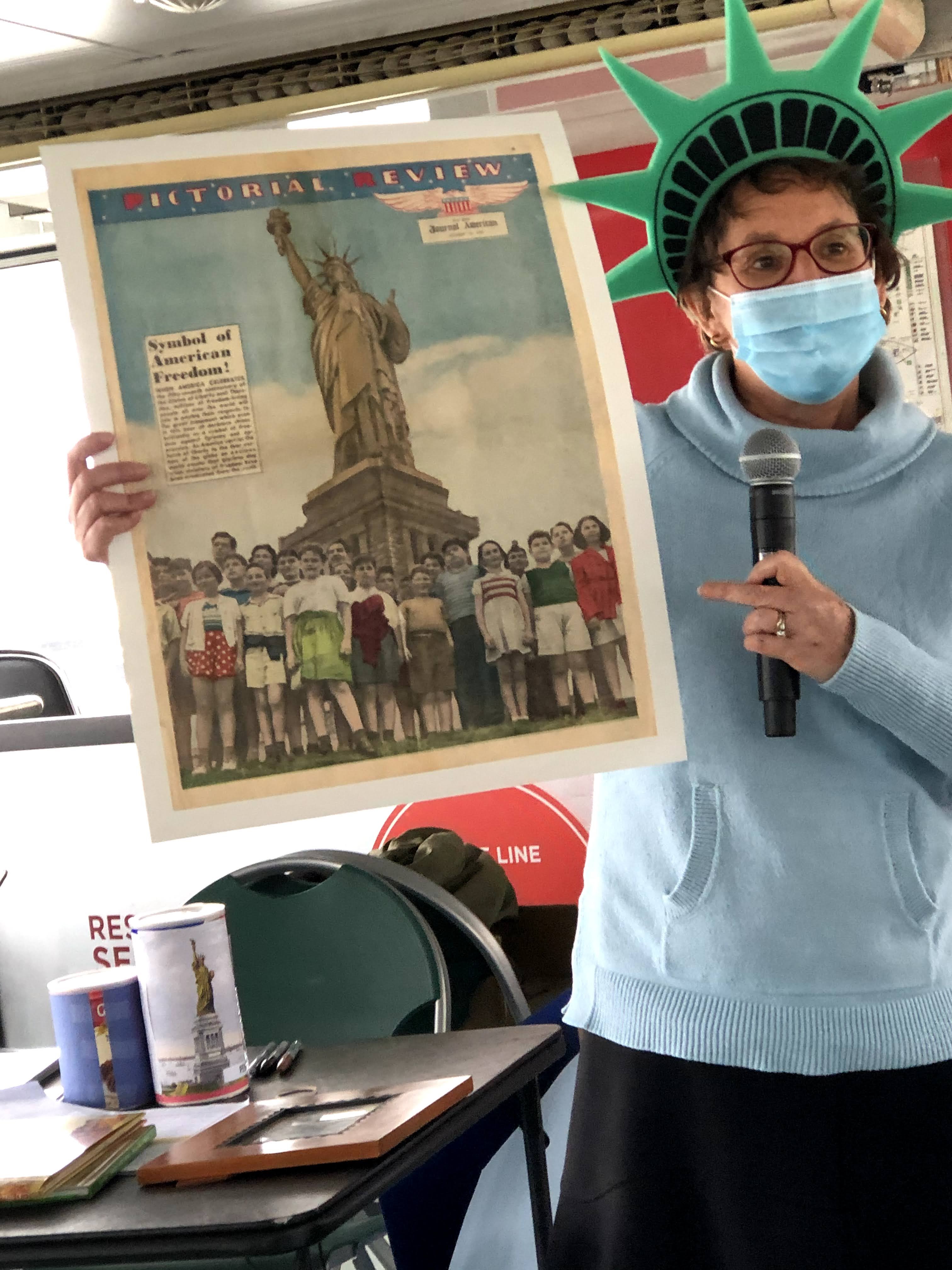
On our return to dock, I shared with the children the story of my late mother-in-law, Hannelore Guthof Stiefel, who escaped Nazi Germany as a young child. She arrived with her parents in New York City in 1941. One of our family’s most cherished possessions is a full page of the Journal American newspaper from October 24, 1943. It shows 11-year-old Hannelore in a red and white striped dress as a new immigrant standing with her classmates in front of the Statue of Liberty! Hannelore grew up and married my father-in-law Arnold Stiefel, also a German Jewish immigrant, who then returned to Germany as an American soldier. They moved to Bergenfield, NJ, where they became the 18th family to join Congregation Bnai Yeshurun (CBY)—the very same synagogue that invited me on the boat cruise. CBY, by the way, now has over 600 families! 

So there you have it: At the tail end of this terrible pandemic, a live reading to children at the base of the Statue of Liberty with my family’s immigration story.

Talk about liberty!

What a fabulous, unforgettable experience – for you and the kids! Thanks so much for sharing it and your wonderful pictures! 

celebrate-picture-books-picture-book-review-let-liberty-rise-cover

Let Liberty Rise! How America’s Schoolchildren Helped Save the Statue of Liberty

Written by Chana Stiefel | Illustrated by Chuck Groenink


When Lady Liberty arrived in New York after a long voyage from France, her unassembled parts sat in crates instead of standing tall over the harbor. Why? No one wanted to pay for the pedestal needed to give her a strong foundation. Upset about people’s disinterest, Joseph Pulitzer announced that he would publish the names of every person who donated to the cause – no matter how much or how little they gave. Children answered the call, and their pennies, nickels, and dimes rolled in, eventually adding up to the $100,000 needed to build the pedestal.

Now everyone could see America’s monument to “freedom and hope,” and the Statue of Liberty welcomed the immigrants who sailed to our shores in steamships from around the world. Today, Lady Liberty still stands “thanks to the contributions of people all across America — and children just like you.” 

celebrate-picture-books-picture-book-review-let-liberty-rise-face

Image copyright Chuck Groenink, 2021, text copyright Chana Stiefel, 2021. Courtesy of Scholastic.

Chana Stiefel raises children’s empowerment, excitement, and pride in what they can achieve in her uplifting true story of how children were instrumental in building the foundation for the Statue of Liberty. Her straightforward, conversational storytelling shines and the inclusion of quotes from children’s letters at the time will impress and charm today’s kids. 

Chuck Groenink’s delightful mixed-media illustrations inform readers on every page about the time period surrounding, the personalities involved in, and the scale of the project to build the pedestal for the Statue of Liberty. Images of kids donating their hard-earned change, knitting socks to sell, sacrificing candy and trips to the circus, and creating special clubs to raise money will remind today’s charitable readers that they are carrying on a proud tradition to make a difference to their community and their country. 

Ages 6 – 9

Scholastic Press, 2021 | ISBN 978-1338225884

Discover more about Chana Steifel and her books on her website.

You can learn more about Chuck Groenink, his books, and his art on his website.

Check out these other picture books and middle grade books by Chana!

celebrate-picture-books-picture-book-review-my-name-is-wakawakaloch-cover celebrate-picture-books-picture-book-review-daddy-depot-cover

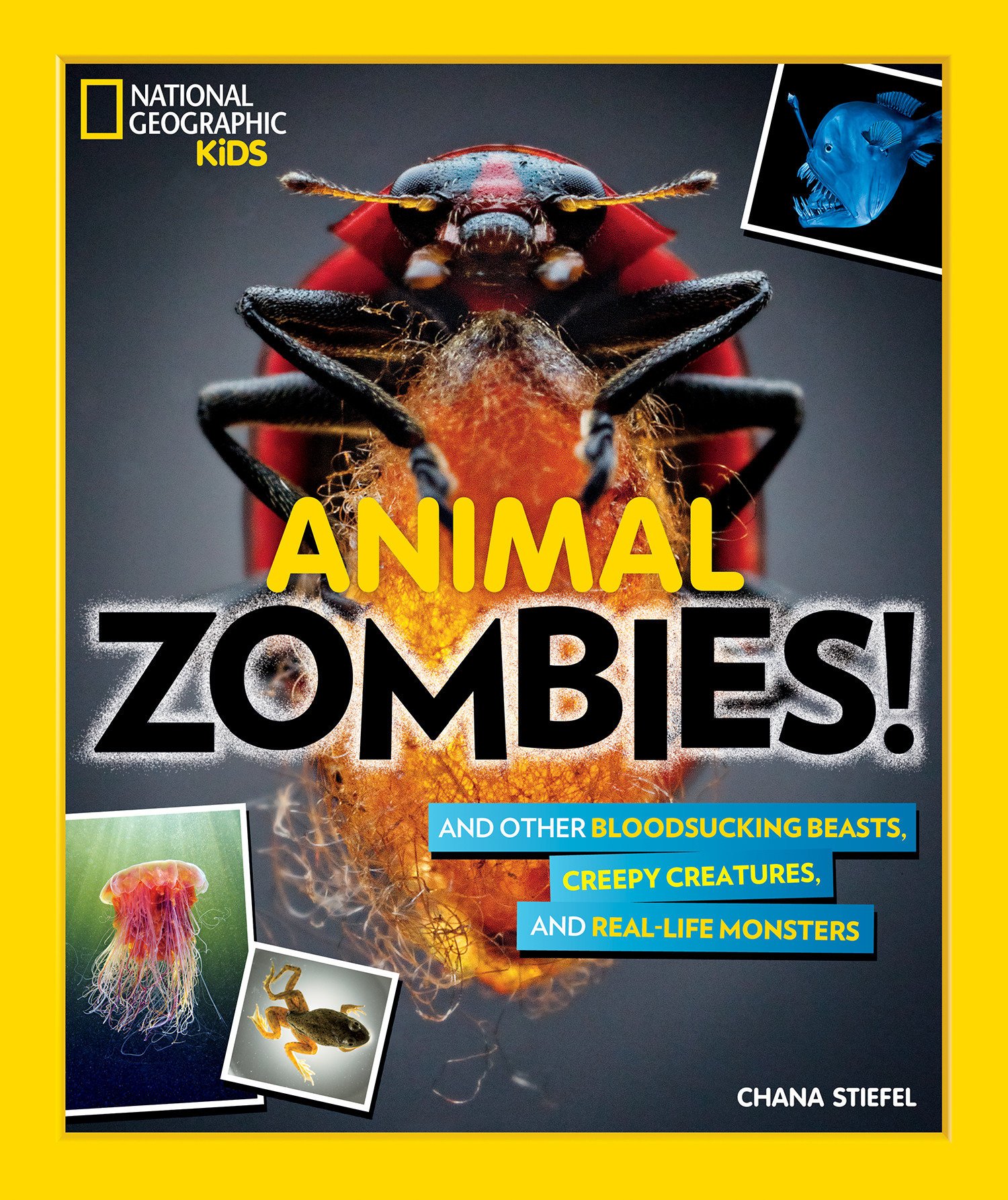
celebrate-picture-books-picture-book-review-animal-zombies-cover celebrate-picture-books-picture-book-review-tsunamis-cover

celebrate-picture-books-picture-book-review-let-liberty-rise-cover

You can find Let Liberty Rise! at these booksellers

Amazon | Barnes & Noble | Books-a-Million

To support your local independent bookstore, order from

Bookshop | IndieBound

Picture Book Review
June 11 – Making Life Beautiful Day

celebrate-picture-books-picture-book-review-the-color-collector-cover

About the Holiday

Today’s holiday was established by Apriori Beauty in 2015 to recognize all those people who make life more fun, meaningful, joyful—more beautiful—for someone else. This can be done in so many ways. Spending more time talking with someone lets them know you care. Sharing your talent for baking, art, music, gardening, home repair, or any skill with a friend, family member, or coworker brings joy to them and you. Even just giving a smile to those you meet can brighten someone’s day. Making someone else feel good will make life more beautiful for you too!

The Color Collector

Written by Nicholas Solis | Illustrated by Renia Metallinou


A boy notices a new girl, Violet, at school. He knows what it’s like to be the new kid, so he waves to her as she sits on a bench alone, reading. She gives him a small smile—he thinks—but doesn’t say anything. He knew that Violet lived near him because they always “walked home the same way,” although he “was on one side, she on the other.” She was “always quiet. Always alone.”

celebrate-picture-books-picture-book-review-the-color-collector-walking

Image copyright Renia Metallinou, 2021, text copyright Nicholas Solis, 2021. Courtesy of Sleeping Bear Press.

It was always the same until one day when the wind blew a red candy wrapper Violet’s way and the boy watched her pick it up and put it in her backpack. When she looked up, Violet saw the boy watching. “She looked at me,” he says. “She waved. Then her eyes went down and she turned the corner.” Now, the boy noticed how many things Violet picked up along the way home. “Bright blue cookie wrappers. Yellow pieces of paper. Green bottle caps. Red fall leaves. All disappearing into the gray backpack.”

celebrate-picture-books-picture-book-review-the-color-collector-paper

Image copyright Renia Metallinou, 2021, text copyright Nicholas Solis, 2021. Courtesy of Sleeping Bear Press.

One day the boy crosses the street and asks Violet what she does with the things she picks up. Violet invites him to come see. They come to a brownstone and up a few flights of stairs, Violet takes him inside her home and opens the door to her room. “Here in her room, the sun comes to shine,” the boy says. “It reaches in and makes her glow. It makes her collection glow as well.”

celebrate-picture-books-picture-book-review-the-color-collector-colorful-items

Image copyright Renia Metallinou, 2021, text copyright Nicholas Solis, 2021. Courtesy of Sleeping Bear Press.

What the boy sees—on the walls, the ceiling, the door—is “her sky, her beach, her village” recreated from the wrappers, paper, leaves, caps, and other bits she’s found. “We came here for a better life,” Violet tells the boy. “I miss home, though. I miss the sounds and smells. And I miss the colors.” The boy tells her the mural is beautiful. Then Violet tells him stories about her village, the people there, and the ocean. The boy and Violet “sit and talk. Then laugh. Then talk some more.” The boy sees that Violet is not so sad or alone anymore, and he’s glad to be her friend. When he leaves, he and Violet wave goodbye and “smile the same.” One the way home, the wind blows a red leaf his way. He picks it up and puts it in his backpack.

celebrate-picture-books-picture-book-review-the-color-collector-light

Image copyright Renia Metallinou, 2021, text copyright Nicholas Solis, 2021. Courtesy of Sleeping Bear Press.

Poignant and honest, Nicholas Solis’s multilayered story touches on friendship, loneliness, new experiences, immigration, creativity, and how acts of welcome, empathy, and kindness can change perspectives and bring joy to life. Told from the boy’s point of view in short, straightforward observations, the story captures readers’ emotions and curiosity as they walk with him and Violet, waiting to see why the reason for her collection. As days and maybe weeks or months pass before the boy speaks to Violet, readers on “both sides of the street” (those who are hesitant to talk and share as well as those who would like to get to know someone better) learn that friendship takes time, patience, trust, and sincere interest. 

Renia Metallinou adds visual eloquence to the story with his gray- and dun-hued illustrations, which pick up increasing hints of color as Violet and the boy grow closer to Violet’s house and finally explode with vibrancy when she opens the door to her room. The first clue of the importance of color to the “new girl” is in her name, and to punctuate this fact, Metallinou gives Violet purple hairbands for her braids. As Violet walks home on a parallel track to the boy, purple tints the pots and flowers decorating the sidewalk, a woman’s purse, and her dog’s collar as if to show that Violet is already assimilating and contributing to her new community.

After she picks up the red wrapper, red flowers, and accents dot the next page, and after the boy describes the blue, yellow, and green items she finds, the trees gain red and yellow leaves, container gardens overflow with greenery, an orange cat watches a trio of red-bellied birds, and blue curtains hang in a downstairs room. But it’s when Violet opens her bedroom door that the real magic happens.

Readers are treated to one more two-page spread of suspense, heightened by the boy’s look of wonder and Violet’s proud gaze. Surrounded by light, Violet smiles. Her gray-and-white-striped shirt turns green and yellow, her brown skin glows with joy. Then readers turn the page and, like the boy, step into a sun-drenched coastal village with candy-colored buildings, lush foliage, a sparkling sea, and a woman – perhaps Violet’s grandmother – looking toward the horizon, maybe looking for Violet herself. Metallinou has made Violet’s mural a masterpiece of art, life, longing, and love. As Violet’s stories pour forth, she and the boy discover how to let their true colors show.

A beautiful and evocative story about the power of friendship, empathy, and kindness, The Color Collector provides a unique and highly effective way for kids and adults to talk about feelings of loneliness, homesickness, making new friends, opening up to others, and many other feelings kids experience. The book could spark meaningful art projects for classrooms and homeschoolers and would be an excellent addition to home, school, and public libraries.

Ages 6 – 9 

Sleeping Bear Press, 2021 | ISBN 978-1534111059

Discover more about Nicholas Solis and his books on his website.

To learn more about Renia Metallinou, her books, and her art, visit her website.

National Making Life Beautiful Day Activity

celebrate-picture-books-picture-book-review-initial-bookend

Initial Bookend or Decoration


Today’s holiday is all about making someone feel special. With this easy craft, kids can make a gift for a family member, friend, or teacher that shows them why they think the person makes the world more beautiful. And don’t forget to make one for yourself too!

Supplies

  • Wooden letter block of the recipient’s first initial or both initials
  • Chalkboard paint
  • Chalk
  • Paint brush

Directions

  1. Paint the wooden letter with the chalkboard paint, let dry
  2. With the chalk, write words on the letter that you think best describe the person you’re giving it to
  3. Wrap and give your letter!

celebrate-picture-books-picture-book-review-the-color-collector-cover

You can find The Color Collector at these booksellers

Amazon | Barnes & Noble | Books-a-Million

To support your local independent bookstore, order from

Bookshop | IndieBound

Picture Book Review
March 16 – National Panda Day

celebrate-picture-books-picture-book-review-when-I-draw-a-panda-cover

About the Holiday

National Panda Day was established to raise awareness of the dangers faced by these favorite, adorable animals. Destruction of the vast bamboo forests on which pandas rely for food, coupled with their low birth rate has resulted in their being placed on the endangered list. Conservation groups as well as zoos and other animal sanctuaries are working to breed and protect these gentle black-and-white beauties. If you’d like to get involved, consider donating to a local zoo program or other environmental group.
Thanks to Simon & Schuster for sharing a digital copy of When I Draw a Panda for review. All opinions of the book are my own.

When I Draw a Panda

By Amy June Bates


A little girl, art box in hand, gazes at her full-wall blackboard and tells readers “I love to draw.” She tells them, though, that “when they say to draw a perfect circle, [hers] turns out a little wonky.” There are things she can draw perfectly, like a cloud or a flat bicycle tire, and to draw a panda she just keeps drawing circles until one appears. Then she gives it a personal touch and makes it hers.

celebrate-picture-books-picture-book-review-when-I-draw-a-panda-cloud

Copyright Amy June Bates, 2020, courtesy of Simon & Schuster/Paula Wiseman Books.

The panda also has its own style of drawing, which includes drawing a castle the left way “when someone tells him to draw a castle the right way.” The panda has his own interpretations of pictures people tell him to draw, and sometimes he gets distracted by something better, begins to daydream, and forgets what he was told to draw. The panda shows the girl how to draw a dragon from a squiggle.

celebrate-picture-books-picture-book-review-when-I-draw-a-panda-panda

Copyright Amy June Bates, 2020, courtesy of Simon & Schuster/Paula Wiseman Books.

The girl says that she has her individual way of drawing too, and “when they say to draw it ‘this way,’” she asks, “‘Why?’” When she does draw a picture the way they want her to, she changes it later. Sometimes people tell the girl her drawing won’t work or remind her to stay in the lines, but the drawings turn out just fine. And when people can’t figure out what she and her panda have drawn, they let it remain a mystery. The girl and her panda can draw quietly, but there are times when their pencils like to ROAR! Then they go willy-nilly, the girl says, to “somewhere that makes us happy.”

celebrate-picture-books-picture-book-review-when-I-draw-a-panda-hat

Copyright Amy June Bates, 2020, courtesy of Simon & Schuster/Paula Wiseman Books.

Amy June Bates celebrates the imagination and creativity of kids who, when given paper and freedom, will draw a unique picture every time, a masterpiece. Her storytelling in which the young artist counters the instructions of all of the “theys” who tell her to draw a “perfect” circle, castle, or other shape, is reassuring and uplifting to children who are proud of the artwork they do—artwork that is just what they want it to be. The girl’s honesty will resonate with readers of all ages who engage in the creative process, whether its art, writing, music, dance, inventing, or other discipline.

Bates’ own distinctive art shines in her illustrations of a child’s room that any kid will envy. One wall is painted completely with chalkboard paint, allowing her to give full expression to her imagination. Kids will appreciate the second and third spreads in which the girl demonstrates her “wonky” circles and then reveals that these become “perfect” clouds, ice cream cones, and flat tires. As the panda emerges from a great storm of squiggles, the girl’s imagination comes to life, and readers will cheer her on as she turns “the right way,” “something pretty,” and a “perfect” character or animal on their heads with panache and humor.

The front endpapers depict a series of familiar step-by-step diagrams that show how to draw a perfect circle, panda, princess, pirate, and more. The final diagram includes a fancy frame in which “something perfect” should be drawn. In the endpapers, these same diagrams appear covered in crayon scribblings, and the final frame holds a drawing of the girl herself.

Encouraging, freeing, and a delightful celebration of the ingenuity of children, When I Draw a Panda is a book kids will ask for again and again. This one’s a must for home, classroom, and public library collections.

Ages 4 – 8

Simon & Schuster/Paula Wiseman Books, 2020 | ISBN 978-1481451482

Discover more about Amy June Bates, her books, and her art on her website.

National Panda Day Activity

Screen Shot 2021-03-15 at 8.01.44 PM

Pick a Panda! Puzzle


Can you match the six twin pandas in this printable puzzle?

Pick a Panda! Puzzle

celebrate-picture-books-picture-book-review-when-I-draw-a-panda-cover

You can find When I Draw a Panda at these booksellers

Amazon | Barnes & Noble | Books-a-Million

To support your local independent bookstore, order from

Bookshop | IndieBound

Picture Book Review