April 3 – National Walking Day and Interview with Author Jane Whittingham

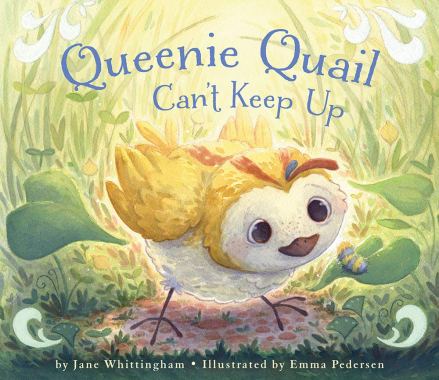
celebrate-picture-books-picture-book-review-queenie-quail-can't-keep-up-cover

About the Holiday

The American Heart Association established National Walking Day in 2007 to remind people of the benefits of taking a walk. Even twenty to thirty minutes a day can improve your health and wellbeing. If you have a desk job or spend long hours sitting, getting up and out can make you feel better and even more connected to your community. While walking through your neighborhood, the park, or the woods take time to notice interesting details and the beauty around you. Walking with a friend, your family, or a group can also be fun and motivating. So grab your sneakers and use today to spark a new habit that will pay dividends now and in the future.

I received a copy of Queenie Quail Can’t Keep Up from Pajama Press for review consideration. All opinions are my own. I’m happy to be partnering with Pajama Press in a giveaway of the book. See details below.

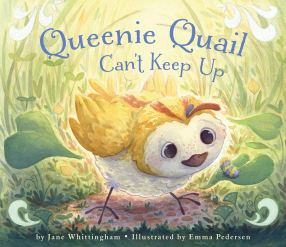
Queenie Quail Can’t Keep Up

Written by Jane Whittingham | Illustrated by Emma Pedersen


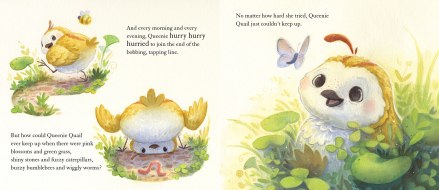
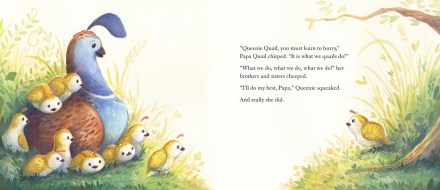
Twice every day Mama Quail led her ten chicks through the meadow, and while nine hurried and scurried along after Mama, Queenie, the smallest, always lagged behind. Mama and the other chicks chirped and cheeped for Queenie to “hurry hurry hurry,” but it was just so hard when there was so much to see. Queenie loved stopping to look at the “pink blossoms and green grass, shiny stones and fuzzy caterpillars, buzzy bumblebees and wiggly worms.”

celebrate-picture-books-picture-book-review-queenie-quail-can't-keep-up-bee

Image copyright Emma Pedersen, 2019, text copyright Jane Whittingham, 2019. Courtesy of Pajama Press.

Her papa admonished her to learn to hurry—“It is what we quails do!” he told her. And Queenie promised to try. She really did try too, but she just couldn’t pass by all her favorite things without stopping to enjoy them. One day, in addition to the blossoms, grass, stones, caterpillars, bees, and worms, Queenie spied a feather. And when she stopped to admire it, she saw “an unusual flash of orange.”

As Queenie watched, the “the furry orange slid softly, smoothly, silently through the green grass.” Queenie followed at a careful distance. Suddenly, Queenie saw that she was following a cat—a cat that was stalking her mama and brothers and sisters. Queenie knew just what she had to do. She raced down the path “hurry, hurry, hurrying,” chirping, cheeping, and warning her family.

celebrate-picture-books-picture-book-review-queenie-quail-can't-keep-up-hurry

Image copyright Emma Pedersen, 2019, text copyright Jane Whittingham, 2019. Courtesy of Pajama Press.

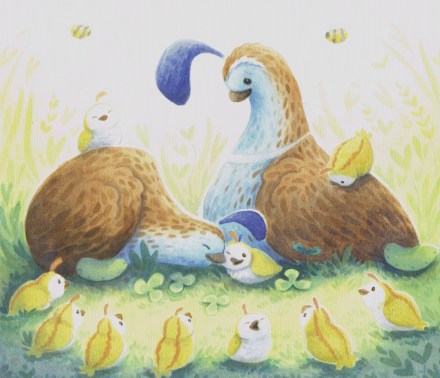
In the nick of time, Papa heard her and swooped down on the cat. Mama came running too. With a hiss, the cat jumped into the grass and fled. “‘You’ve saved us, Queenie Quail!’ Mama Quail chirped.” And Papa and her little siblings praised her too. Now, when the family heads out along the meadow trail and Queenie can’t keep up, they all ask, “‘What have you found, what have you found, what have you found?’” And they stop and hurry hurry hurry over to take a look too.

celebrate-picture-books-picture-book-review-queenie-quail-can't-keep-up-nuzzling

Image copyright Emma Pedersen, 2019, text copyright Jane Whittingham, 2019. Courtesy of Pajama Press.

Jane Whittingham’s story of an adorable quail who stops to smell all the roses is a charming, charming, charming read-aloud that adults will love sharing and kids will enthusiastically chime in on during the fun repeated phrases. Whittingham’s agile storytelling shines with lyrical rhythms and alliteration that bounce along like the little stars of her book. The gentle suspense will keep young listeners riveted to the story, and afterward they’re sure to join Queenie and her brothers and sisters in slowing down to enjoy the world around them.

Readers will immediately fall in love with Queenie and her siblings as Emma Pedersen’s cute-as-can-be, tufted quail babies race and bob along the trail to keep up with Mama. With expressive eyes and tiny beaks that form a perpetual smile, they nestle next to Mama and pile on top of Papa. As they watch out for Queenie, one or two often peer out at readers, inviting them along on their excursions. As the heroine of the story, Queenie is a sweetie, fascinated by everything she sees. Pedersen’s lovely gauche paintings are as fresh as a spring meadow and will entice kids and adults to take a nice slow walk together.

A unique and tender story that will have children entranced from the first page, Queenie Quail Can’t Keep Up will be a favorite on home, school, and public library shelves.

Ages 3 – 7

Pajama Press, 2019 | ISBN 978-1772780673

You’ll discover more about Jane Whittingham and her books as well as blog posts, interviews, and lots more on her website.

To learn more about Emma Pedersen, her books, and her art, visit her website.

Meet Jane Whittingham

celebrate-picture-books-picture-book-review-Jane-Whittingham-Interview-headshot

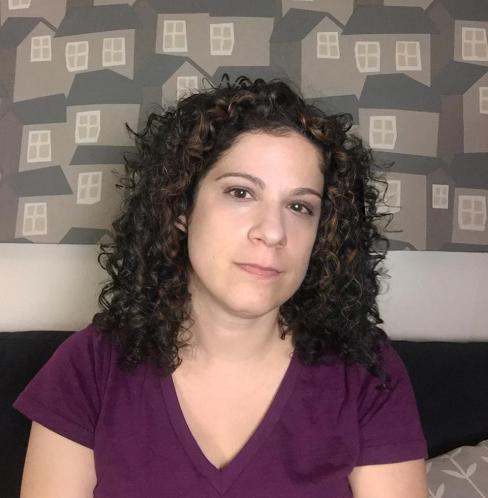
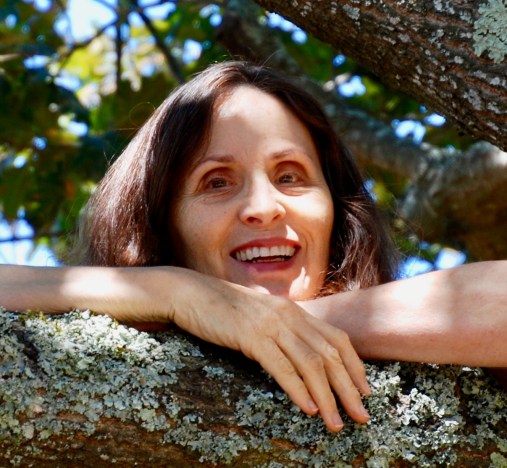
Today, I’m excited to be talking with Jane Whittingham an author and librarian from British Columbia, Canada, about the inspiration for her adorable quails, what she loves about being a librarian, and how nature features in her life and books.

I believe Queenie Quail Can’t Keep Up was inspired by your dad and a true story. Can you talk about that a little?

My parents moved to a small town on Vancouver Island when they retired, and their backyard is home to all sorts of wildlife, including families of quails that hurry and scurry here and there. My dad  always liked watching them, and he mentioned to me once that quails would make perfect picture book stars with their round little bodies and their amusing personalities and antics. Well, I was inspired! I’d never really thought much about quails, since we don’t have them where I live, so every time I visited my parents I would spend a bit of time watching the quails for inspiration.

Queenie, the little quail who is just too easily distracted to keep up with her siblings, is definitely inspired by me, and the fact that I’m always falling behind because I have to stop and look at everything! The book is a bit bittersweet to me because my father passed away before it was published, but I know he would’ve gotten a real kick out of it, and he would have probably introduced himself to everyone as my muse!  

Have you always liked to write? Can you talk a little about your process? Do you have a favorite place to write?

I’ve always been a writer, and even before I could physically write I was a storyteller. I was an only child and spent a lot of time using my toys to tell epic stories, which I would then recount breathlessly to my parents in an endless stream of words.

I don’t really have a process – like many people I fit writing around my full-time job (I’m a librarian) and into my busy life, so I snatch moments here and there whenever I can. I write on my phone, I write on scraps of paper, I write on my computer. I write on my commute, at coffee shops, and in grocery store lineups. You never know when inspiration will strike!

Besides Queenie Quail Can’t Keep Up,  you have two more very well-received books out from Pajama Press—Wild One and A Good Day for Ducks. The outdoors features in all of your books in some way. Are you inspired by the outdoors? What is your favorite outside activity or a memorable experience you’ve had?

I am absolutely inspired by the outdoors – even though my childhood wasn’t that long ago in the grand scheme of things, I do feel like I had a very different childhood than many kids experience today. I spent a lot of my free time outdoors, wandering or biking around the neighborhood with a band of kids, making (and falling out of) tree forts, playing kickball on the street, and turning local playgrounds into the settings for all sorts of imaginary worlds. My parents often had no idea where I was, but that was totally normal for the time—I never left the neighborhood, and they knew I would come home when it started to get dark.

Sometimes it feels like I grew up in a whole other era! Through my books I really want to encourage families to get outside, to explore, to learn through doing and through experiencing. Nature is such an incredible source of inspiration, of knowledge, of enjoyment, and even of healing, and we really miss out on so much by cooping ourselves up in front of our screens all day long!

In doing a little research for this interview, I raided your wonderful website and discovered that you made a few resolutions this year. One is to read outside your comfort zone, which includes murder mysteries, historical fiction, and narrative nonfiction. How is that going? Can you give me one mystery title in your comfort zone and one “departure” book you’ve dipped your toes (eyes?) into?

Oh dearie me, you’re holding me accountable! I recently finished a YA novel, which is very, very unusual for me—I never read young adult fiction even when I was a young adult, so this was a major departure for me! It’s called The Love and Lies of Rukhsana Ali, and tells the story of a young Muslim lesbian whose family discovers her secret girlfriend and sends her off to Bangladesh to straighten her out, as it were. It’s definitely an eye-opening look into a culture and experience very different from my own, and I really enjoyed it.

As for my taste in mysteries, I tend to favour the classic British who-dunnit style, with authors like Dorothy L. Sayers and Ngaio Marsh being particular favorites. I also really enjoy mysteries with historical settings, which allow me to check off two favorite genres at once!

Queenie is an adorable little quail! What was your reaction to seeing Emma Pedersen’s illustrations for the first time? In your blog post “Queenie Quail and the Road to Publication,” you talk about needing to cut your original manuscript. Can you describe one place where the illustration reflects the text that is no longer there? Can you describe a place where Emma included something that surprised or particularly delighted you?

I was absolutely floored when I first saw Emma’s illustrations, they’re beyond wonderful, and even more adorable than I ever could have imagined! It’s a funny thing, being a picture book author, because you craft these characters and this environment, and then you hand the whole thing over to a stranger to make real—it can be a bit nerve-wracking, not knowing what your little characters will end up looking like! I was immensely relieved when I saw Queenie and her siblings, and I think Emma’s classic artistic style perfectly complements my old-fashioned writing style.

One of the aspects of the text that was really shortened related to all the things that distracted Queenie on her daily walks with her family. I described the worms and the bees and the flowers in great detail, which turned out to be entirely unnecessary, since everything appeared so beautifully in Emma’s illustrations!

And as for an illustration that particularly delighted me, there’s a spread where Mama and Papa quail nuzzle Queenie as they thank her for saving the day, and the loving expressions on everyone’s faces really just melted my heart, I loved them so much!

What drew you to becoming a librarian? What is a favorite part of your day?

I am a children’s librarian for an urban library system here in British Columbia, Canada, and I’m responsible for developing and facilitating programming for children and families in an older residential neighborhood. I get to do a lot of fun things in my job—I lead story times for caregivers and their babies, facilitate writing and book clubs for tweens, and get to host and visit local preschools, daycares and elementary schools. I think my favourite part of the entire year is Summer Reading Club, which runs from June – August every year. We spend the entire year planning all sorts of exciting programs to get kids reading all summer long, and it’s so much fun! Sometimes I can’t quite believe I get to do this as my job. I also manage the physical collections in the library, organizing and weeding the books to make sure the collection is in tip- top shape and helps meet the reading needs of my community.

I was raised in a family of voracious readers and I love working with people, so librarianship always seemed like a natural fit, but it took me quite a while to get here. I worked in various jobs for about six years following my initial graduation from university, before finally feeling confident enough to take the plunge and go back to school to do my masters in librarianship. It was a real leap of faith, quitting a well-paying, stable but unfulfilling job to take a chance on a career that everyone around me said was dying out, but it’s certainly paid out for me, so far at least! I can’t stress enough that simply loving books is not enough of a reason to become a librarian, especially not a public librarian – you really do need to love working with people more than anything, because it’s definitely not for the faint of heart sometimes!

On your website you have a gallery of pictures from libraries you’ve visited. How many libraries have you been to? Which library is the farthest from home? Which was your favorite and why?

I love visiting libraries at home and abroad, I find so much inspiration from looking at how other libraries organize their collections, decorate their spaces, and plan their events. I’m not even sure at this point how many libraries I’ve visited. I need to update my website to include the ones I visited on my most recent trip to Nova Scotia, Prince Edward Island, and New Brunswick!

celebrate-picture-books-picture-book-review-Library-in-Nikko-Japan-Jane-Whittingham-Interview

Jane visits one of her favorite libraries – the Nikko Library – in Japan

celebrate-picture-books-picture-book-review-Bridge-in-Nikko-Japan-Jane-Whittingham-Interview

A view of a bridge and beyond in Nikko, Japan

Some of the furthest libraries I’ve visited have been in New Zealand and Japan (which I’ve visited on three separate occasions so far), though I’ve visited libraries in different US states and Canadian provinces, too. I don’t know that I have a single favorite library, but I do particularly enjoy visiting rural libraries – they can be so creative with their often-limited resources, and really do serve as the hearts and souls of their communities. 

What’s the best part about being a children’s author? Can you share an anecdote from an author’s event you’ve held or been part of?

I love everything about writing for kids! I really am a big kid at heart, which is why I’m a children’s librarian, too! I’ve had wonderful experiences reading my books to kids at different author events, and it’s so much fun to get everyone involved.

celebrate-picture-books-picture-book-review-author-visit-Japan-Jane-Whittingham-Interview

Jane and kids act out animals during an exciting author visit.

With Wild One I like to get kids to guess which animal they think the protagonist is pretending to be, and then we act out the animals together, which is heaps of fun, and with A Good Day for Ducks we act out all sorts of fun raining day actions, then talk together about all the things you can do, inside and outside, on a rainy day. I live in a very rainy place, so it’s important to find the joy in even the gloomiest of days! One of the most meaningful events I’ve done was a visit to a local children’s hospice, where I was able to connect with a small group of really amazing children who have been through so much in their short lives. To be able to share my stories with them, and listen to their stories, was an incredibly inspiring and moving experience.

What’s up next for you?

I’m not quite sure! I’ve got a couple of manuscripts that I’m still working on, and some that I’m waiting to hear back about from editors, so I don’t really know yet what’s coming down the pipeline. But I’ll always keep on telling stories, no matter what. 🙂

What is your favorite holiday and why?

My favourite holiday is definitely Christmas. I love Christmas. I love the music, the baking, the food, the decorating, the music, the family get-togethers, I love it all! I don’t actually do any of the decorating or baking or cooking myself, I mostly just listen to Christmas carols for a month straight and watch hours of Christmas movies on TV, but I love it all the same!

Thanks, so much, Jane! I’ve thoroughly enjoyed getting to know more about you and am sure readers have too! I wish you all the best with Queenie Quail Can’t Keep Up and all of your books!

You can connect with Jane Whittingham on:

Her website | Instagram

National Walking Day Activity

celebrate-picture-books-picture-book-review-whose-shoes-maze

Whose Shoes? Matching Puzzle

These kids are getting out and enjoying nature! Can you help them find the right shoes so they can start their adventures in this printable puzzle?

Whose Shoes? Matching Puzzle

celebrate-picture-books-picture-book-review-queenie-quail-can't-keep-up-cover

You can find Queenie Quail Can’t Keep Up at these booksellers

Amazon | Barnes & Noble | Books-a-Million | IndieBound

Picture Book Review

March 18 – International Ideas Month

celebrate-picture-books-picture-book-review-scampers-thinks-like-a-scientist-cover

About the Holiday

This month we celebrate something that you can’t see or hold but which is real all the same. What is it? An idea! Ideas are amazing things. They ideas fuel our arts, sciences, education, and home life. This month-long holiday invites all you would-be inventors and clever folk alike to think differently and pay attention to your brainstorms. So, write down those ideas you have while driving, while in the shower, when you’re daydreaming, or just as you turn off the light to go to sleep. You never know what they might become!

Scampers Thinks Like a Scientist

Written by Mike Allegra | Illustrated by Elizabeth Zechel


All the field mice gathered at the vegetable garden to play and eat, eat, eat. But one day an owl arrived, so the mice went off to the grassy fields far away where they were safe but not nearly as well-fed. “Still they all agreed that having a hungry belly was better than filling the belly of a hungry owl.” After that the mice kept their distance from the farm—all except Scampers, who hid nearby and watched the owl. She thought there was something a little suspicious about it since the owl never moved.

celebrate-picture-books-picture-book-review-scampers-thinks-like-a-scientist-band

Image copyright Elizabeth Zechel, 2019, text copyright Mike Allegra, 2019. Courtesy of Dawn Publications.

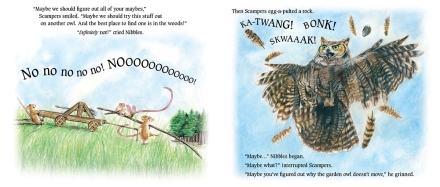
When Scampers’ friend Nibbles saw what she was doing, he was afraid for her safety. But Scampers was gung-ho on finding out what was going on. The next day they waved a rag-doll mouse above the cauliflower, but the owl stayed put. “‘Maybe owls can tell if a mouse is fake,’ Nibbles whispered.” That gave Scampers another idea. She jumped out and yelled “HELLO!” to the owl, but the owl didn’t blink. Nibbles thought maybe owls were hard of hearing, so Scampers put on her one-girl-band set. Nothing.

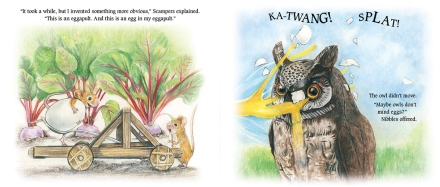
Next it was time to bring out the heavy machinery, but even when Scampers lobbed an egg at the owl from her homemade eggapult, the owl didn’t move. Nibbles thought that owls might not like eggs, but a soaring rock had the same result. Scampers decided it was time to try out all of her experiments on another owl—one they’d find in the woods.

celebrate-picture-books-picture-book-review-scampers-thinks-like-a-scientist-owl

Image copyright Elizabeth Zechel, 2019, text copyright Mike Allegra, 2019. Courtesy of Dawn Publications.

While Nibbles hid in the hollow of a tree, Scampers called out “HELLO!” “An owl’s head spun around.” The owl nabbed the rag-doll mouse in a snap, and he did not sit still for the eggapulted rock. “‘Maybe you’ve figured out why the garden owl doesn’t move,’” Nibbles said. Now it was time to explain it all to the other mice. With a glittery display, Scampers and Nibbles presented their findings.

As Scampers and Nibbles raced to raid the veggies, the other mice lagged behind, skeptical about what they’d heard. “‘Sometimes a new discovery is so amazing that others need a little time to accept it,’” Scampers told Nibbles. “‘So while they’re thinking it over, let’s eat.’”

Extensive back matter includes an illustrated description of how scientists think over a problem, more information about Great Horned Owls and field mice, suggestions for teachers on reading the book to students, ways teachers can discuss science and engineering practices, and four activities kids can do at home or in school that engage them in science, technology, engineering, and math learning.

celebrate-picture-books-picture-book-review-scampers-thinks-like-a-scientist-catapult

Image copyright Elizabeth Zechel, 2019, text copyright Mike Allegra, 2019. Courtesy of Dawn Publications.

In his clever story, Mike Allegra infuses the scientific method with enthusiasm, humor, and a problem that will engage kids. When the field mice are run out of their vegetable garden by an owl who has taken up residence on a fence post, readers will love following Scampers as she uses her logical mind and a few experiments to restore their food source. Through Scampers’ keen sense of observation and engineering know-how, kids see how to go about proving a hypothesis correct. As Nibbles eats away at Scampers’ results with the kinds of alternate theories scientists must disprove, children get caught up in the suspense and thrill of discovery that fuels scientific advancement.

Elizabeth Zechel’s field mice know how to feast—and how to get things done. With bright eyes and jubilant expressions, the mice chow down on corn and tomatoes, and as Scampers performs her experiments her joy in the process is evident. More timid Nibbles bites his nails, wraps his tail tightly around himself, tries to stop the eggapult in its tracks, and cowers in the crook of a tree as danger looms. Zechel’s detailed drawings realistically depict the garden, forest, and wildlife. Her two Great Horned Owls beautifully demonstrate the difference between the false one and the real one, which has focused and piercing eyes, soft textured feathers, sharp talons, and quick reflexes.

Perfectly aimed at young scientists with charming characters, fun language, and a glittery final report that mirrors school projects, Scampers Thinks Like a Scientist is a terrific addition to home, classroom, and library STEM collections.

Ages 4 – 7

Dawn Publications, 2019 | ISBN 978-1584696438

Discover more about Mike Allegra, his books, and his other writing on his website

To learn more about Elizabeth Zechel, her books, and her art, visit her website

National Ideas Month Activity

celebrate-picture-books-picture-book-review-Green-Onion-Jar-Day1

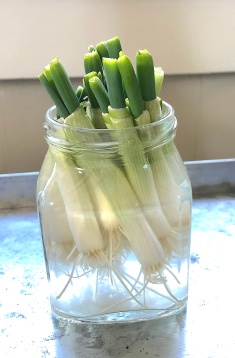
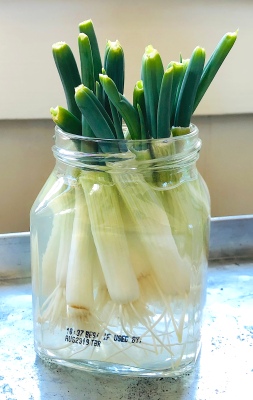
Green onions as they looked when put in the jar on Day 1

Green Onions Garden in a Jar


Kids will be wowed by this gardening experiment that shows results in as little as two days and just keeps getting more dramatic as the days go by.

Supplies

  • 1 or 2 batches of green onions (also called scallions and spring onions)
  • Jar
celebrate-picture-books-picture-book-review-Green-Onion-Jar-Day-2

Here’s how the onions looked two days later.

celebrate-picture-books-picture-book-review-Green-Onion-Jar-Day-3

Three days later, the green onions are really growing!

celebrate-picture-books-picture-book-review-Green-Onion-Jar-Day-4

In four days the stalks have gotten much longer and new shoots have appeared.

Directions

  1. Cut the stalks off of each onion so that the bulb and about two inches of stem remain. 
  2. Place all of the onions in a jar with the bulbs and roots in the water and the stalks above the rim of the jar
  3. Place the jar in a sunny spot and watch the onion tops grow taller day by day
  4. Harvest the stalks and enjoy them in a variety of recipes and as a substitute for chives

celebrate-picture-books-picture-book-review-scampers-thinks-like-a-scientist-cover

You can find Scampers Thinks Like a Scientist at these booksellers

Amazon | Barnes & Noble | Books-a-Million | IndieBound

Picture Book Review
March 3 – World Wildlife Day

celebrate-picture-books-picture-book-review-galapagos-girl-cover

About the Holiday

In December of 2013 the United Nations General Assembly proclaimed March 3rd as World Wildlife Day to promote awareness of our environment and the dangers to it. Every year a different theme is chosen to spotlight an area of the world, a particular species, or a group of activists. This year’s theme is “life below water for people and planet” and focuses on marine species, the importance of marine wildlife, and the issues affecting the health and survival of the ocean and ocean creatures. The day also celebrates successful conservation and sustainability initiatives. To learn more about the day, special events, and how you and your kids can get involved today and throughout the year, visit the World Wildlife Day website.

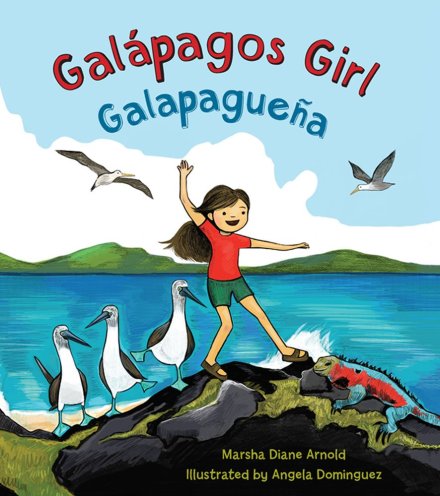
Galápagos Girl / Galapagueña

Written by Marsha Diane Arnold | Illustrated by Angela Dominguez | Translated by Adriana Dominguez


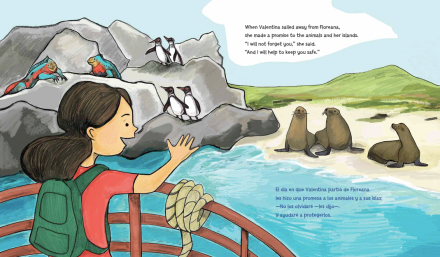
On the day when baby Valentina joined Mamá, Papá, and eleven brothers and sisters, even the sea lions, blue-footed boobies, and iguanas seemed to welcome her to the “island formed by fire.” Valentina loved growing up on the Galápagos Island of Floreana. She explored the lava rocks, where Sally Lightfoot crabs scuttled back and forth. She swam with dolphins and manta rays, and even played with penguins.

celebrate-picture-books-picture-book-review-Galápagos-Girl-crabscelebrate-picture-books-picture-book-review-Galápagos-Girl-crabs

Image copyright Angela Dominguez, 2018, text copyright Marsha Diane Arnold, 2018. Courtesy of Lee & Low Books.

“Valentina watched pink flamingoes wading near mangroves. Blue butterflies fluttering on the breeze. Red-and-green iguanas sneezing salt like tiny geysers.” The crashing waves, albatross, and finches created a symphony as Valentina stopped to rest on a grassy cliff overlooking the ocean. The lava lizards, blue-footed boobies, and twirling sea lions provided young Valentina with a variety of dance partners.

celebrate-picture-books-picture-book-review-Galápagos-Girl-iguana

Image copyright Angela Dominguez, 2018, text copyright Marsha Diane Arnold, 2018. Courtesy of Lee & Low Books.

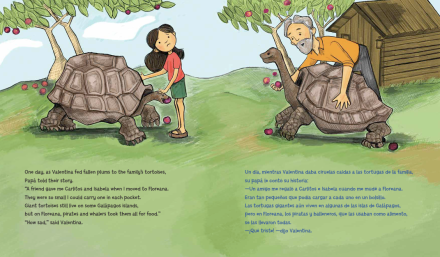
At home, Valentina’s family shared their home with two giant tortoises—Carlitos and Isabella. One day Papá told Valentina their story as they fed the tortoises plums that had fallen from their backyard trees. Papá had gotten Carlitos and Isabella from a friend when he first moved to Floreana. Although it was nearly impossible to imagine now that the tortoises were grown, at the time they were so small that they fit into Papá’s pockets.

celebrate-picture-books-picture-book-review-Galápagos-Girl-tortoises

Image copyright Angela Dominguez, 2018, text copyright Marsha Diane Arnold, 2018. Courtesy of Lee & Low Books.

There was also a sad note to Papá’s story. He said that while giant tortoises still lived on other Galápagos islands, pirates and whalers had wiped out the population on Floreana. Papá went on to tell Valentina that many Galápagos animals were in danger. They were “threatened by other animals that don’t belong here. Threatened by people who don’t understand how to care for our islands.” Valentina promised that she would always protect them.

When she was older, Valentina left the island to go to school. She didn’t want to leave her beautiful home, but Mamá told her that she was “ready to learn about the world beyond.” And Papá reminded her that “like our islands, you have a heart full of fire.” On school vacations, Valentina always came back to study the wildlife on the Galápagos islands. She had not forgotten her promise to keep them safe.

celebrate-picture-books-picture-book-review-Galápagos-Girl-going-to-school

Image copyright Angela Dominguez, 2018, text copyright Marsha Diane Arnold, 2018. Courtesy of Lee & Low Books.

After she graduated with a degree in biology, Valentina returned to the islands as a nature guide to teach visitors about the beauty and uniqueness of the Galápagos. Some visitors were even lucky enough to meet Carlitos and Isabella when the plums dropped from the trees and the two old tortoises returned from exploring Floreana to eat them. Because of Valentina’s commitment to the Galápagos, her visitors also made a promise to always remember and protect them.

Extensive backmatter includes an Author’s Note about Valentina Cruz, the tortoises Carlitos and Isabella, and the history of tortoises on Floreana. There is also information on the Galápagos as well as fun facts about all of the animals in the story. A bibliography of sources invites readers to learn more.

Each two-page spread presents the text in English and translated into Spanish by Adriana Dominguez.

celebrate-picture-books-picture-book-review-Galápagos-Girl-guiding-visitors

Image copyright Angela Dominguez, 2018, text copyright Marsha Diane Arnold, 2018. Courtesy of Lee & Low Books.

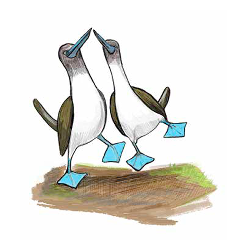
Marsha Diane Arnold’s lyrical and buoyant passages sing with the carefree joy Valentina felt as a girl exploring her beloved Galápagos and which brought her back home as a biologist to protect them. After seeing Valentina playing and swimming with the native animals and feeding Carlitos and Isabella, readers will also feel Valentina’s sadness at the dangers they face and want to make a positive difference to the environment and the world around them. Arnold’s dialogue-rich storytelling highlights the personal nature of the subject and will draw children into Valentina’s world.celebrate-picture-books-picture-book-review-Galápagos-Girl-blue-footed-booby

Saturated with glorious color, each of Angela Dominguez’s illustrations is a celebration of the splendor of the Galápagos. Playful sea lions, high-stepping blue-footed boobies, scampering crabs, and even a sneezing iguana will captivate young readers and inspire them to learn more about these creatures and the islands. Images of Valentina camping out to study the animals during school breaks will excite environmentally conscious kids, and pictures of Carlitos and Isabella happily munching on plums will generate smiles and “awwws.”

Galápagos Girl / Galapagueña will excite kids to learn more not only about the Galápagos region but about their own local environment, and the call to action will spark an enthusiasm for protecting the earth’s animals. The book would make an inspiring addition to home bookshelves and an excellent way to begin classroom discussions on environmental issues and science lessons. The engaging Spanish translation will delight Spanish-speaking and bilingual families.

Ages 4 – 8

Lee & Low Books, 2018 | ISBN 978-0892394135

Discover more about Marsha Diane Arnold and her books on her website.

Read an interview with Marsha Diane Arnold here.

To learn more about Angela Dominguez, her books, and her art, visit her website.

World Wildlife Day Activity

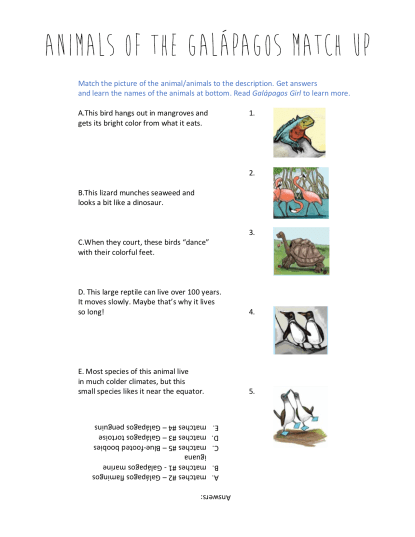
celebrate-picture-books-picture-book-review-animals-of-the-galapagos-match-up-puzzle

Animals of the Galápagos Match Up Puzzle


There are so many fascinating animals that live in the Galápagos! Can you match the picture of each animal to its description in this printable Animals of the Galápagos Match Up Puzzle? You can find and download the activity sheet from the Lee & Low Books website:

Animals of the Galápagos Match Up Puzzle

celebrate-picture-books-picture-book-review-galapagos-girl-cover

You can find Galápagos Girl / Galapagueña at these booksellers

Amazon | Barnes & Noble | Books-a-Million | IndieBound

Picture Book Review


February 27 – International Polar Bear Day

celebrate-picture-books-picture-book-review-the-little-polar-bear-cover

About the Holiday

Today we celebrate polar bears, the largest member of the bear family and a critical part of the Arctic ecosystem. These beautiful creatures spend much of their time at the edge of ice packs, from which they hunt for food. Their excellent sense of smell allows them to sense food up to a mile (1.6 km) away. Increasingly polar bears are under threat from changes in climate which are shrinking their habitat and affecting their quality of life. In honor of today’s holiday take time to research polar bears and consider donating to a cause for their protection.

Little Polar Bear

By Hans de Beer


At last little Lars is old enough to go hunting with his father, and they head out into the white, frozen expanse to find the perfect fishing spot. While Lars watched from the edge of an ice pack, his dad disappeared underwater for so long that Lars began to worry. When he finally surfaced, however, he brought with him a large fish for dinner. After dinner it was time to sleep. Lars’ father showed him how to build a wall of snow to lie behind that would protect him from the wind.

celebrate-picture-books-picture-book-review-little-polar-bear-lars-and-father

Copyright Hans de Beer, 2016, courtesy of NorthSouth Books.

During the night as Lars and his father slept, the ice cracked between them, sending Lars floating away by himself. When Lars woke in the morning, he discovered that he was alone and that the warm sun was melting his ice floe little by little. Just as the ice threatened to disappear entirely, a barrel floated by and Lars crawled on top of it. “Then a storm began to rage. As Lars clung to his bobbing barrel he missed his father and his pile of snow more and more.”

celebrate-picture-books-picture-book-review-the-little-polar-bear-sleeping

Copyright Hans de Beer, 2016, courtesy of NorthSouth Books.

By the time the storm subsided Lars was far from home. He found himself in a place with no snow or ice; instead “almost everything was green and the sun was very warm.” Lars left the barrel and padded onto the sandy beach. The hot sand burned Lars’ paws, and he ran to the nearby river to cool them. “But just as he was about to plunge in, a very big, tan animal sprung out of the water.” Frightened, Lars ran away, but the hippopotamus followed him and introduced himself. Henry had never seen a white bear, and Lars had never seen a tan animal.

Lars told Henry about his trip and how he wanted to find father. Henry didn’t know how to help, but he figured that Marcus the eagle would know what to do. With Lars on his back Henry started the long journey across the river, through the jungle, and over the mountains. On the way, Lars loved seeing all the different colors, creatures, and vegetation. He climbed trees, met a chameleon, and sniffed at a butterfly. When they came to the mountains, Henry had trouble climbing, but Lars scampered ahead and showed him where to step.

celebrate-picture-books-picture-book-review-little-polar-bear-lars-on-barrel

Image copyright Hans de Beer, 2016, courtesy of NorthSouth Books.

Finally, Henry couldn’t go any farther. He and Lars found a place to rest for the night. The view of the water made Lars homesick, but Henry reassured him. The next day, high on the mountain, Lars and Henry found Marcus. “The eagle looked at Lars and then said, ‘Well, well, a polar bear in the tropics! You’re a long way from home aren’t you, young man?’”

Marcus explained that he could indeed help Lars get home, but they would need the assistance of Samson. In the morning a gray whale swam near shore, and Lars climbed on his back. While Henry was happy that Lars could find his way home, he was also sad to see him go. He and Lars said goodbye to each other. As Henry looked on, Samson and Lars swam out into the open ocean with Marcus flying “along a bit to set them on their way.”

celebrate-picture-books-picture-book-review-little-polar-bear-lars-and-henry

Image copyright Hans de Beer, 2016, courtesy of NorthSouth Books.

After Samson had swum a long distance, icy cliffs once again appeared on the horizon. As they drew closer, Lars spotted his father standing at the edge of the ice scanning the sea. Lars called out to him, and Lars’ father couldn’t believe his eyes. In thanks for bringing back his son, Lars’s father caught a big fish and gave it to Samson. Lars and his father started toward home, and as they walked “Lars talked about all of the amazing things he had seen.” His father was astonished. “‘You didn’t meet anyone who was white?’” he asked. “‘Nobody, except a chameleon,’ said Lars, ‘but that doesn’t count.’” Lars laughed, but his dad couldn’t understand the joke.

celebrate-picture-books-picture-book-review-the-little-polar-bear-diving

Copyright Hans de Beer, 2016, courtesy of NorthSouth Books.

Hans de Beer’s sweet, adventurous little polar bear has been long beloved by young readers who have followed his journeys and escapades through many books. This favorite introduction to Lars, his father, and the North Pole was reissued in 2016 and is as timely now as when it was first published. De Beer’s straightforward story of a young bear suddenly taken away from home, surviving by instinct, and discovering new places, friends, and ideas, is at once exciting and comforting. As Lars finds himself in unfamiliar territory populated with animals and creatures he’s never seen before, he doesn’t shy away from the experience, but embraces the diversity of what he sees just as the tropical animals accept him. The kindness and camaraderie shared among the animals is a universal lesson for all.

Little ones love de Beer’s expressive animals and the caring interactions between them. Kids will laugh when Henry pops out of the river to say “boo!” and giggle to see Lars and the chameleon sticking out their tongues together. The soft pastel palette invites kids to linger over the pages and experience both the frozen tundra and lush jungle with the same awe as Lars. Readers will cheer when Lars is reunited with his father, but will also look forward to traveling with their new friend again in his other adventures.

Ages 3 – 8

NorthSouth Books, 2016 (Hardcover) | ISBN 978-0735842649

International Polar Bear Day Activity

CPB - Polar Bear scarf

CPB - Polar Bear Banner

Polar Bear Scarf or Banner

Polar bears aren’t cold in the winter—and neither should you be! Here are directions and printable templates for making a cute scarf to keep you warm, or—if you’d rather—a banner to warm up your room.

Supplies

  • Printable Polar Bear and Igloo Template
  • 1 Strip of blue fleece 4 ½ feet long x 7 inches wide for the scarf
  • 1 Piece of blue scrapbooking paper for a banner
  • Pieces of white, black, blue, and purple fleece or scrapbooking paper to make the polar bear, igloo, snowflakes, and ice floes.
  • String or twine for banner
  • Scissors
  • Fabric or paper glue

Directions for Scarf

To make the fringe at each end of the scarf

  1. Make 7 cuts about 4 inches long
  2. Tie a knot at the top of each fringe section

To make the pieces for the scarf or banner

  1. Trace the polar bear and igloo sections from the Printable Template onto white fleece and cut out
  2. Trace the two ice floes onto blue fleece and cut out
  3. Trace the door of the igloo onto blue fleece and cut out
  4. Trace the polar bear’s scarf onto purple (or any color) fleece and cut out
  5. Cut out round snowflakes
  6. Cut out a small circle from black fleece for the Polar Bear’s nose

On one end of the scarf

  1. Glue the smaller ice floe on one end of the scarf
  2. Tie the bear’s scarf around its neck before gluing the bear to the scarf
  3. Glue the polar bear onto the scarf with its feet on the ice floe
  4. Glue on the polar bear’s nose
  5. Make a small dot for the polar bear’s eye with a marker
  6. Glue snowflakes above polar bear

On the other end of the scarf

  1. Glue the bigger ice floe to the scarf
  2. Glue the three pieces of the large igloo to the scarf, leaving a little space between sections
  3. Glue the small white door of the igloo on top of the last two igloo sections
  4. Glue the small blue door onto the white door
  5. Glue snowflakes above the igloo

Directions for Banner

  1. Cut a point at the bottom of your banner
  2. Follow the directions above to trace the pieces of the polar bear and igloo from the printable template onto scrapbooking paper
  3. Follow the directions above to glue the pieces of the polar bear and igloo to your banner
  4. Attach string or twine to back of banner to make a hanger

celebrate-picture-books-picture-book-review-the-little-polar-bear-cover

You can find The Little Polar Bear at these booksellers

Amazon | Barnes & Noble | Books-a-Million | IndieBound

Picture Book Review
February 5 – Chinese New Year

celebrate-picture-books-picture-book-review-ruby's-chinese-new-year-cover

About the Holiday

Chinese New Year begins today—ushering in the Year of the Pig—and celebrations take place until February 19. Also known as the Spring Festival, the New Year is a time for festivities that include lion and dragon dances, fireworks, visiting friends and relatives, family meals, and special decorations. The New Year is the busiest travel season of the year as family members return home to spend the holiday with loved ones. The Chinese New Year celebrations end each year with the Lantern Festival. To learn more about the history of Chinese New Year, how to celebrate, and the signs of the zodiac, click here.

Ruby’s Chinese New Year

Written by Vickie Lee | Illustrated by Joey Chou


Every year Grandmother would come to visit Ruby for Chinese New Year. “Together they celebrated, eating special foods and making drawings for good luck.” But this year Grandmother couldn’t make the trip, so Ruby decided to visit her grandmother instead. As a gift, Ruby drew a picture of her family enjoying a special dinner. She put it into a red envelope and tucked it away in her pocket. Soon after leaving, Ruby spied Cat and Rat and asked if they would like to come along too. They did, but Cat wondered how they would “cross the meadow and the pond.” Ruby suggested that they ask Ox.

celebrate-picture-books-picture-book-review-ruby's-chinese-new-year-drawing

Image copyright Joey Chou, 2018, text copyright Vickie Lee, 2018. Courtesy of Henry Holt Books for Young Readers.

Soon, they found Ox, who was bringing rice cakes and candy to the farmer for the New Year celebration. When she heard that Ruby, Cat, and Mouse were going to Grandmother’s house, she offered to let them ride on her back. Just then, Tiger and Rabbit “bounded out of the bushes, streamers flying behind them.” They also wanted to go to Grandmother’s house, so Cat rode on Tiger’s back and Rat nestled between Rabbit’s furry ears, and they all headed down the path.

celebrate-picture-books-picture-book-review-ruby's-chinese-new-year-rat

Image copyright Joey Chou, 2018, text copyright Vickie Lee, 2018. Courtesy of Henry Holt Books for Young Readers.

They came to where Dragon and Snake “were making paper lanterns.” They were both excited to come along too. “Snake loved Grandmother and was happy to visit her,” and Dragon “was always ready for an adventure.” They packed up the lanterns they had made and the friends started off again. Horse and Goat were grazing in the nearby meadow, and they too wanted to come along. They picked flowers for Grandmother, and then the little parade was off.

celebrate-picture-books-picture-book-review-ruby's-chinese-new-year-ox

Image copyright Joey Chou, 2018, text copyright Vickie Lee, 2018. Courtesy of Henry Holt Books for Young Readers.

When Ruby and all the rest reached the pond, they saw Monkey and Rooster fishing for their holiday dinner from an overhanging branch. Grandmother’s house was just on the other side of the pond. Ruby was so excited that “with a leap and a bound, Ruby dove into the pond. She would swim to Grandmother’s. She was so close!” But when she jumped, the red envelope flew out of her pocket and drifted into the pond. All of the other animals dove into the pond to save Ruby’s gift. Monkey snatched it with his fishing hook, and Rooster flew across the water with the card in her beak. They all met Ruby on the other side of the pond and sadly showed her the drenched card. “‘Oh no,’ Ruby cried. ‘It’s ruined. Everything is ruined!’”

celebrate-picture-books-picture-book-review-ruby's-chinese-new-year-streamers

Image copyright Joey Chou, 2018, text copyright Vickie Lee, 2018. Courtesy of Henry Holt Books for Young Readers.

“‘It’s not ruined!’ cried Rooster.” And then each animal reminded Ruby that they had fish and flowers, lanterns and streamers, rice cakes and sweets, and most especially, “‘…we have our family,’ said Cat and Rat, looking toward the house.” Suddenly, Dog and Pig bounded out and “covered Ruby’s face with kisses and tickled her until she shrieked with joy.” The happy sounds brought Grandmother to the door. She was thrilled to see Ruby. When Ruby gave her the gift she thought was “ruined,” Grandmother assured her that it would dry and that seeing Ruby and all of her friends was “the best gift of all.” Then they all sat down at the long table decorated with streamers and lanterns and celebrated the New Year with a delicious dinner—“except for Cat, who had fallen fast asleep.”

Following the story, readers will enjoy learning one legend of the Chinese zodiac and discovering the  traits for each animal. Children will also find directions for making a paper lantern, a paper fan, and good luck banners.

celebrate-picture-books-picture-book-review-ruby's-chinese-new-year-pond

Image copyright Joey Chou, 2018, text copyright Vickie Lee, 2018. Courtesy of Henry Holt Books for Young Readers.

Inspired by one legend of the Chinese Zodiac and how each animal came to be included in the calendar, Vickie Lee tells an engaging cumulative story that keeps readers excited to discover who will be the next to join Ruby on her trip to Grandmother’s house. The fate of Ruby’s special gift reveals many truths about friendship and family as the animals work together to save the card and Grandmother reassures Ruby while showing her that love is the best gift of all. Readers may also enjoy talking about which of each animal’s trait—as found in the back matter—is reflected in their role in the story. Older children may like discussing references to Chinese New Year traditions and how Lee reimagined the legend to tell her story. And why is Cat sleeping through the delicious dinner? Legend has it that….

celebrate-picture-books-picture-book-review-ruby's-chinese-new-year-legend

Image copyright Joey Chou, 2018, text copyright Vickie Lee, 2018. Courtesy of Henry Holt Books for Young Readers.

Joey Chou’s delightfully cheerful illustrations are packed with action as each animal—included into the group in the order of the Chinese zodiac—adds a special ingredient to the New Year celebration. His lovely color palette sparkles with glowing reds, cool aquas, lush blues, and shadowy violets that create a homey atmosphere for this very special holiday. Scenes of togetherness and friendship include smiles and joy at being together as well as empathy for Ruby when her card gets wet.

A beautiful book to share with children for Chinese New Year and throughout the year, Ruby’s Chinese New Year would be a charming addition to home, school, and library bookshelves for its story and included activities.

Ages 4 – 8

Henry Holt Books for Young Readers, 2018 | ISBN 978-1250133380

To learn more about Joey Chou, his books, and his art, visit his website.

Chinese New Year Activity

celebrate-picture-books-picture-book-review-chinese-new-year-word-search

Chinese New Year Word Search Puzzle


Can you find the twenty Chinese New Year-related words in this printable puzzle?

Chinese New Year Word Search Puzzle | Chinese New Year Word Search Solution

celebrate-picture-books-picture-book-review-ruby's-chinese-new-year-cover

You can find Ruby’s Chinese New Year at these booksellers

Amazon | Barnes & Noble | Books-a-Million | IndieBound

Picture Book Review
January 25 – National Florida Day and Interview with Author B. J. Lee
celebrate-picture-books-picture-book-review-there-was-an-old-gator-who-swallowed-a-moth-cover

About the Holiday

Today, we recognize Florida—the 27th state to enter the Union. Did you know that Florida is home to the oldest established city in the country? Founded by Spanish explorers in 1565, St. Augustine remains a fascinating city that combines an intriguing history of religious settlements, pirate treasure hunters, and a tug of war over ownership among Britain, Spain, and France with the modern beauty of a thriving community. Of course, Florida is well-known as an international tourist destination for its theme parks, wide open beaches, and warm weather. The state is also home to animals, insects, and reptiles unseen in the rest of the United States—a fact that today’s book riffs on.

There Was an Old Gator Who Swallowed a Moth

Written by B.J. Lee | Illustrated by David Opie


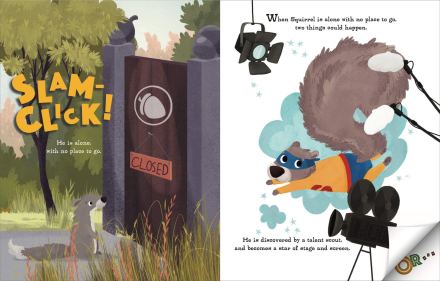
“There was an old gator who swallowed a moth. I don’t know why he swallowed the moth. It made him cough.” And with this culinary choice, readers are off on a wild jaunt full of suspense, humor, and big, sharp teeth. To catch that moth, the gator gobbled down a crab, but that scuttling bugger just filled his tummy with pain. To “nab the crab” the gator decided to “swallow an eel. / Quite an ordeal to swallow an eel!”

celebrate-picture-books-picture-book-review-there-was-an-old-gator-who-swallowed-a-moth-cough

Image copyright David Opie, 2019, text copyright B.J. Lee, 2019. Courtesy of Pelican Publishing Company.

But the eel didn’t help, and the cough persisted. What could the old gator do? He swallowed creature after creature to resolve a cascading number of problems until “he swallowed a manatee.” It was clear “he lost his sanity to swallow a manatee!” Because now that old gator’s stomach was getting pretty cramped. There wasn’t a lot of nabbing or catching going on in there, and there was still that moth to take care of. The distressed gator then spied just the enforcer that might get the job done and gulped it down too.

celebrate-picture-books-picture-book-review-there-was-an-old-gator-who-swallowed-a-moth-belly

Image copyright David Opie, 2019, text copyright B.J. Lee, 2019. Courtesy of Pelican Publishing Company.

After such a big meal, the gator needed a bit of a drink, and the lagoon looked so refreshing! Just then, when that old gator was fully…well…full, that pesky moth fluttered its wings and made the poor guy “cough! Cough! Cough!” And what did that one little last cough do? Well, let’s just say the story has a splashing…I mean smashing…ending!

celebrate-picture-books-picture-book-review-there-was-an-old-gator-who-swallowed-a-moth-last-cough

Image copyright David Opie, 2019, text copyright B.J. Lee, 2019. Courtesy of Pelican Publishing Company.

B.J. Lee gives the favorite cumulative rhyming There Was an Old Lady story a reptilian remodeling that kids will find irresistible as the old gator guzzles down a host of Florida denizens with hilarious results. Lee, an award-winning poet, has an engaging way with words and phrasing that creates surprising rhymes and rib-tickling rhythms. Clever alliteration and action-packed verbs move the story along at a clip that mirrors an alligator’s voracious appetite and will keep young readers on the edge of their seat to see which animal becomes the gator’s next snack. Kids may even enjoy trying to come up with their own rhyming line to add to the story.

celebrate-picture-books-picture-book-review-there-was-an-old-gator-who-swallowed-a-moth-last-moth

David Opie’s illustrations of the anguished alligator and his unsuspecting “remedies” are a hoot. Opie accomplishes just the right combination of suspense and humor with his juxtaposition between realistic depictions of the coastal animals and gut-busting portrayals of these creatures crammed into the gator’s belly. As the gator grows rounder and rounder, readers will be wondering how it will all end. The final spreads of the tormented gator are sure to elicit an “Oh!” or “Ew!” or two and plenty of guffaws.

There Was an Old Gator Who Swallowed a Moth is a fun and funny choice for story time, and its comical repetition will prompt enthusiastic read-alongs. The book would be a sunny choice for home, classroom, and public libraries.

Ages 5 and up

Pelican Publishing Company, 2019 | ISBN 978-1455624416

Discover more about B.J. Lee, her books, and her poetry on her website.

To learn more about David Opie, his books, and his art, visit his website.

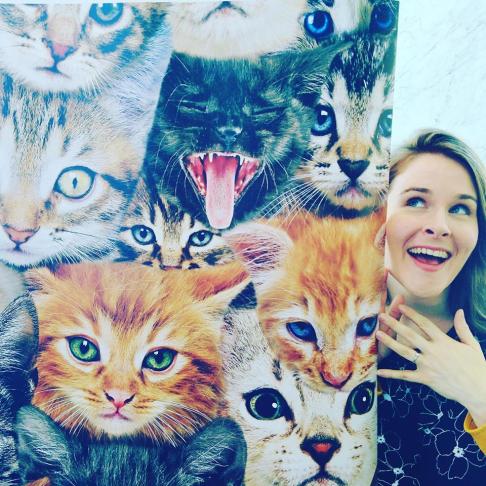
Meet Author B. J. Lee

celebrate-picture-books-picture-book-review-bj-lee-author-headshot

Thank you, Kathryn, for having me on your blog! There Was an Old Gator Who Swallowed a Moth is getting a lot of love and I appreciate that! I also appreciate that you asked me about my poetry since, even in my picture books, I try to incorporate some aspect of poetry, such as lyrical language, rhyme and, in the case of Gator, cumulative rhyme.

There Was an Old Gator Who Swallowed a Moth is your debut picture book. What drew you to creating a Florida-themed version of this well-known classic?

It wasn’t so much that I set out to write a Florida themed version of There Was an Old Lady Who Swallowed a Fly, it was more that I had a gator character in mind and he pretty much chose this classical structure.

Have you always loved to write? When did you publish your first poem? Can you tell readers a bit about your journey to becoming a published writer?

Yes, I have always enjoyed writing. My sixth-grade teacher encouraged me to write plays! But I didn’t really realize I was a writer until, as an adult, I started writing a novel, which I never finished because my health intervened. In 2006 I had a shoulder operation which left me with severe bicep tendinitis, and for two years I couldn’t write, couldn’t even hold a pencil. My husband said “Write something shorter. Write poetry.”  But I didn’t know how to write poetry. He had planted something in my mind, though. I started studying poetry and then began to write it. My first poem was published in the SCBWI Bulletin in 2010. And so, I became a poet quite by accident. In a way I’m almost grateful for the bicep tendinitis, because I would not have become a poet without that hiccup in my journey. And I’ve picked up the novel again, resurrecting it as a verse novel.
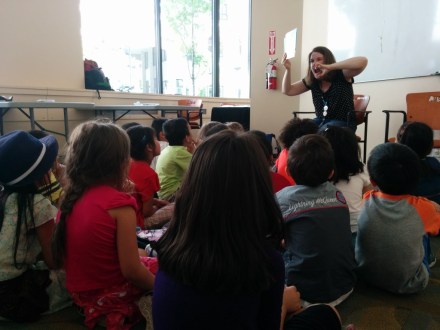
I wasn’t surprised when I saw that you worked as a librarian at the Boston Conservatory at Berklee and play the piano since your poetry has such a musical quality to it. Did you ever consider becoming a musician or songwriter? How does your musical background influence your poetry?

Thank you for saying that my poetry has a musical quality. I have heard that before but I am unaware of trying to incorporate any musicality into my poetry. I am a pianist, jazz singer, and even enjoyed a brief stint as lead singer in a local rock ‘n’ roll band. Recently, I have written some songs for a current work in progress in which the main character is a singer-songwriter.

What is your favorite form of poetry to write and why? Do you write poetry for adults as well as children? What do you find satisfying about both?

I enjoy writing many forms of poetry but I guess I like the challenge of writing in repeating forms, such as the villanelle, the triolet, the pantoum and the roundel. I blog at Today’s Little Ditty, where I am an authority on poetic forms. 

However, I am continually challenging myself to write new forms of poetry, like free verse and performance poetry such as rap. I have written poetry for adults; however, since I am a children’s author, I try to stick with children’s poetry, including work for very young children through young adult and have over 100 poems published in anthologies and magazines.

The breadth of subjects you’ve written about—from sea glass to termites to naughty poodles and so many more—is truly inspiring! Can you talk about how and why certain subjects spark your creativity and how you follow that to a completed poem?

As far as subject matter, I’m very interested in the natural world and animals, so those subjects often show up in my work. Sometimes I write to prompts from anthologists. Once I have a subject that begs a poem, I simply try to find the best form to present it. Sometimes the poem may not work at all, and I’ll have to select a new form. Sometimes poems just start in my head and I have to be very quick to capture them.

Your poetry appears in children’s magazines, including Highlights and Spider, in publications for schools and many others, and in anthologies such as those published by National Geographic and Wordsong. Do you ever hear from young readers about your work? Do you have an anecdote from a letter or reading event that you’d like to share?

Yes, I do hear from young readers, which is very gratifying. In one case a Vietnamese teacher contacted me telling me that her phonics students are using my poem, A Garden Prayer, to learn English. That was when I realized that my poetry has gone around the world.

In another case, a woman contacted me from St. John’s, Nova Scotia, to ask me if they could use my poem, Moored, on a sculpture in Bannerman Park for a woman who died at a young age and who had always loved sailing. Of course I said yes! The proposed sculptor is Luben Boikov.

celebrate-picture-books-picture-book-review-bj-lee-intreview-moored-image

I’ve read some of your very clever poems that have been finalists—and winners!—in the Think, Kid, Think! Madness Poetry Tournament held in April on thinkkidthink.com. Can you talk a little about the tournament and being an authlete?

Yes, the Think Kids Think March Madness poetry tournament is a wonderful event for children’s poets. I loved being an authlete and competing but it’s very difficult to write a quality poem in a short amount of time. It was like pulling college all-nighters!

Do you have any advice for aspiring poets—children or adults?

My advice for aspiring poets, both children and adults, is: find the metaphor.

What’s up next for you?

I’m currently writing a verse novel as well as picture books and poetry collections.

What is your favorite holiday and why?

My favorite holiday is Valentine’s Day because: love.

Can you talk about one of your poems that incorporates a holiday theme?

I’ve written a few holiday poems including “Groundhognostication,” which appears in National Geographic’s Poetry of US.

Thanks for this wonderful chat, B.J.! I’ve loved learning more about your poetry and other work. I wish you all the best with There Was an Old Gator Who Swallowed a Moth!

You can connect with B.J. Lee on:

Her website | Facebook | Twitter

National Florida Day Activity

celebrate-picture-books-picture-book-review-fabulous-florida-word-search-puzzle

Fabulous Florida! Word Search Puzzle


Find the names of twenty mammals, birds, reptiles, and insects in this printable puzzle.

Fabulous Florida! Word Search Puzzle | Fabulous Florida! Word Search Puzzle Solution

celebrate-picture-books-picture-book-review-there-was-an-old-gator-who-swallowed-a-moth-cover

You can find There Was an Old Gator Who Swallowed a Moth at these booksellers

Amazon | Barnes & Noble | Books-a-Million | IndieBound


January 24 – National Compliment Day

celebrate-picture-books-picture-book-review-giraffe-problems-cover

About the Holiday

Getting a compliment can make the world seem brighter. Maybe this is what inspired New Hampshire residents Kathy Chamberlin and Debby Hoffman to create National Compliment Day in 1998. How to celebrate today’s holiday is simple. Take a look around and when you see something about someone that you like, tell them! Does your friend’s sense of humor always lift your spirit? Tell them! Did your employee do a great job today? Tell them! Are your kids the light of your life? Tell them why! You don’t have to limit your compliments to friends and family either. Giving a compliment to someone you don’t know may just make a big difference in their day. So, today, be generous with those nice comments!

Giraffe Problems

Written by Jory John | Illustrated by Lane Smith


Giraffe was self-conscious about his neck—and why not? After all, it just seemed “too long. Too bendy. Too narrow. Too dopey” and “too” so many other things. All-in-all, he summed it up this way: “Yes, my neck is too necky.” Giraffe could feel everyone staring at it. He’d tried “dressing it up,” and hiding, but nothing made it better.

No other animals had such a ridiculous neck. Zebra’s was stylishly striped; Elephant’s was “strong and powerful, yet graceful”; and Lion’s was “adorned with a glorious mane of flowing locks.” Even the reassurances Giraffe’s mom gave didn’t make him feel better. In despair, Giraffe laid his long neck on a rock and sighed. But the rock turned out to be a turtle shell—with a turtle inside.

celebrate-picture-books-picture-book-review-giraffe-problems-zebra

Image copyright Lane Smith, 2018, text copyright Jory John, 2018. Courtesy of Random House Books for Young Readers.

What luck! Turtle had been watching Giraffe from afar and thought his neck was pretty spiffy. Turtle said, “Oh, how I wish my neck looked like yours! I’d get so much done in a day.” He longed to be able to look around properly and grab things that were high up. But instead Turtle was “saddled with this little excuse for a neck.” Turtle even demonstrated how far his neck could reach—which was not far at all.

Giraffe was nonplussed to find another neck sufferer. But they were happy to have found each other. Turtle introduced himself as Cyrus, and Giraffe said his name was Edward. In this spirit of camaraderie, Cyrus confessed a secret. “There is a hill in the distance, which you can surely see from your great vantage. I’ve stood on that very hill for seven straight days now staring skyward, watching as a single piece of fruit—a lone banana!—slowly changed from green to yellow, ripening.” Cyrus’s frustration poured forth as he explained how he’d spent sleepless nights waiting for the fruit to drop so he could taste just a bit of it. Then came the disappointment and self-recrimination as he revealed how foolish he felt as he stretched his “neck toward those greedy branches, only to be limited by my own physical shortcomings.” He topped off this soliloquy with a small smile.

celebrate-picture-books-picture-book-review-giraffe-problems-meets-turtle

Image copyright Lane Smith, 2018, text copyright Jory John, 2018. Courtesy of Random House Books for Young Readers.

Edward summed it up, just to be sure. “You want a banana from a tree.” That is indeed what Cyrus wanted. Easy as one, two, three, Edward plucked the banana from its branch and dropped it in front of Cyrus. Cyrus gobbled it up and declared it delicious. In thanks, Cyrus complimented Edward on his “impressive” neck that allows him “to do amazing things.” In return, Edward complimented Cyrus’s neck, saying “it’s elegant and dignified, and it works well with your shell. They each appreciated the other’s viewpoint then Edward had a suggestion for his new friend. Soon, each was smiling and complimenting the other on how they looked in their handsome bowties. And for the first time ever, both Edward and Cyrus felt good about their necks.

celebrate-picture-books-picture-book-review-giraffe-problems-bowties

Image copyright Lane Smith, 2018, text copyright Jory John, 2018. Courtesy of Random House Books for Young Readers.

Who knew animals have the same insecurities as people? Jory John, that’s who—much to readers’ benefit! John’s completely original story about a giraffe and a turtle who both despair about the state of their necks will make readers laugh out loud even as they empathize with these two endearing characters. Edward’s flowery reveries comparing his own imperfect neck to those of his fellow animals and Cyrus’s burst of vexation at the limits of his neck are hilarious—and, really, who doesn’t feel this vociferous sometimes? Following this, the friendship forged by Edward’s ease at fulfilling Cyrus’s simple request provides a satisfying ending that’s all the more charming for its modest honesty—and bowties.

celebrate-picture-books-picture-book-review-giraffe-problems-ties

Image copyright Lane Smith, 2018, text copyright Jory John, 2018. Courtesy of Random House Books for Young Readers.

When Jory John and Lane Smith team up, you always know you’ll be opening the cover to an exceptional experience. Here, sweet Edward juts onto pages with a neck so long that often only his head and neck, or body and neck, or just his neck appear. His attempts at disguising his most noticeable feature under neckties, behind palm trees, and in other natural surroundings will only make readers love him more. Edward is a born storyteller with a beautifully inlaid shell and an expressive face that makes his confession all the more touching. Alert readers will notice that the supposedly gawking animals all have their own unique features and perhaps are as self-conscious as Edward is. The muted and mottled browns, greens, reds, and golds that color the textured images are perfectly suited for the natural environment, and a gatefold page that flips up to let Edward procure the banana will delight kids.

Giraffe Problems is a must for fun story times as well as for when a child (or adult) needs a bit of a boost. The book would be an often-asked-for addition to home, classroom, and library bookshelves. And if you’re looking for more adorable animals with problems, check out Jory John and Lane Smith’s Penguin Problems!

Ages 3 – 7

Random House Books for Young Readers, 2018 | ISBN 978-1524772031

Discover more about Jory John and his books on his website.

To learn more about Lane Smith, his books, and his art, visit his website.

National Compliment Day Activity

Caring Compliment Cards


Sharing a compliment is a great way to brighten someone’s day and make new friends! With these printable cards, you’ll always have a sweet compliment at hand to give to a friend, a teacher, a librarian, or anyone who looks as if they need encouragement.

Compliment Cards 1 | Compliment Cards 2

celebrate-picture-books-picture-book-review-giraffe-problems-cover

You can find Giraffe Problems at these booksellers

Amazon | Barnes & Noble | Books-a-Million | IndieBound

Picture Book Review