October 25 – Celebrating the Book Birthday of Herbert on the Slide

celebrate-picture-books-picture-book-review-herbert-on-the-slide-cover

Thanks to Hippo Park Books and Deborah Sloan for sending me a copy of Herbert on the Slide for review consideration. All opinions about the book are my own.

Herbert on the Slide (A Hippo Park Pals Book)

By Rilla Alexander


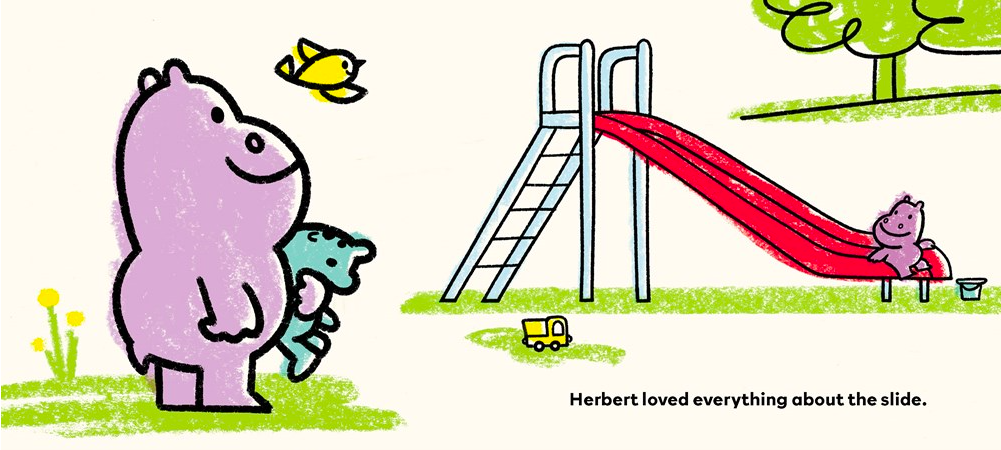
“Herbert loved everything about the slide.” Rilla Alexander’s first sentence speaks directly to the hearts of little ones who fully understand its simple, lovely truth. As Herbert climbs to the top, his teddy bear and truck in tow; settles in on his high perch; launches his “test run” with first Teddy and then truck—”clanky-clank-clank”—and finally counts down to his turn, kids will follow along, entranced by Herbert’s adventure and memories of their own.

celebrate-picture-books-picture-book-review-herbert-on-the-slide-love

Copyright Rilla Alexander, 2022, courtesy of Hippo Park.

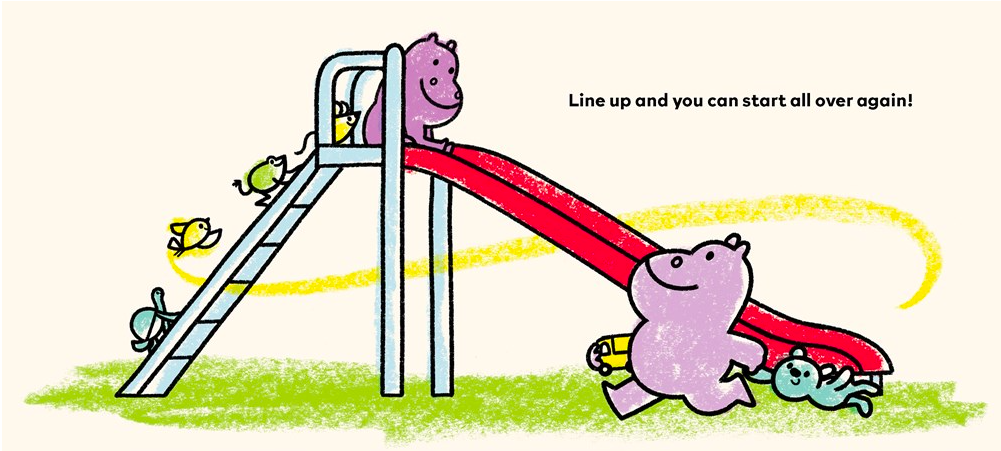
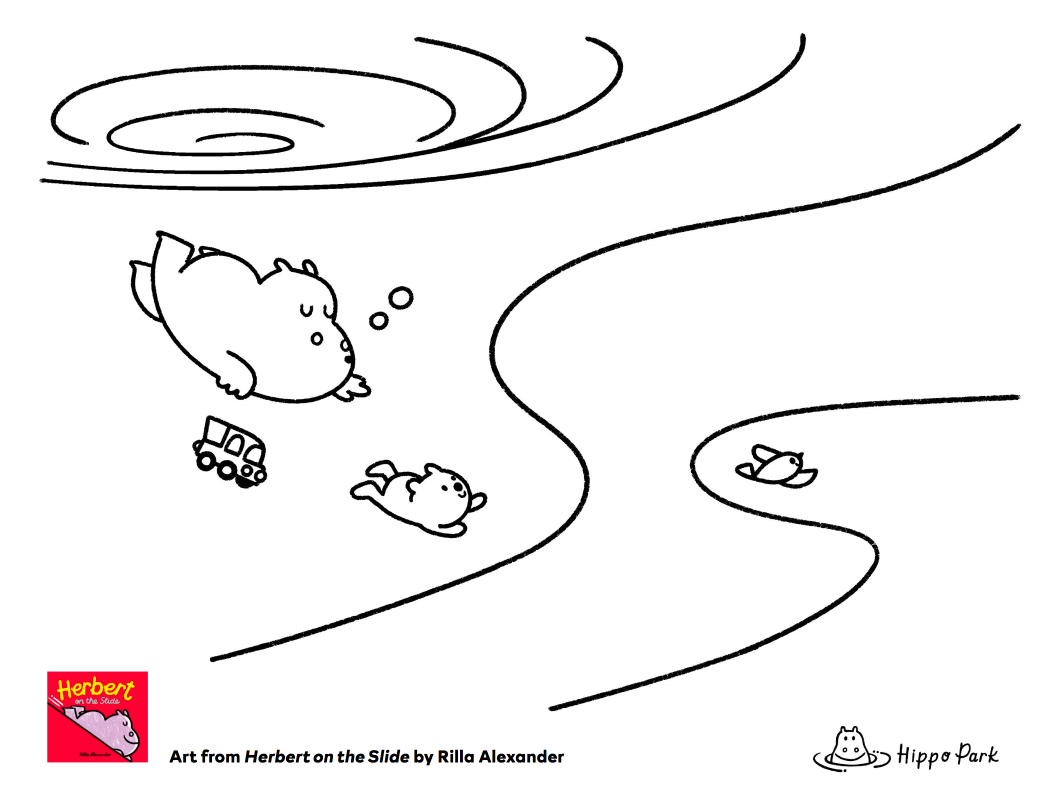
Of course, a slide is never just a slide, and Herbert goes “…again! And again! … sliding down, down, down…into his imagination!” One time, on his belly, “Herbert and Teddy are diving into a deep, purple sea!” Next time, “Herbert is a truck climbing up, up, up a mountain. Chug-chug-chug!” But Herbert isn’t the only one at the playground. His little sister is ready for her turn—and so is mouse and frog and turtle. There’s just one thing to do. “Line up and you can start all over again!”

celebrate-picture-books-picture-book-review-herbert-on-the-slide-over-again

Copyright Rilla Alexander, 2022, courtesy of Hippo Park.

Rilla Alexandra’s endearing story for little ones, matched page-by-page by her adorable, “awww”-inspiring art is snuggle-up story time reading at its best. Perfectly reflective of a child’s playfulness and imagination, Herbert on the Slide is not only a story that will captivate them time and time again but a wonderful entry into the world of literature.

A subtle subplot involves Herbert’s younger sister, Fiona (soon to be the star of her own Hippo Park Pals book, Fiona in the Sandbox, coming February 7, 2023). She is at first unidentified and only seen in the distance, heading to the sandbox with her pail, a detail sure to pique kids’ interest. She’s later heard telling Herbert—who, mesmerized by an imagined chase and its successful conclusion, is resting on the bottom of the slide—that it’s her turn. Turning the page, kids see that she’s sitting atop the slide with a line of other wanna-be sliders waiting behind her. Alexander’s encouragement for Herbert to get in line and start again is a gentle and reassuring life lesson.

Sweet smiles and a sunny ambiance welcome readers on every clean, slide-focused page. Each scene is colored with the texture of crayons in bright shades and with the “messy” enthusiasm of children’s art.

A Special Note: The book’s small size (5 1/4-inches by 4 3/4-inches) makes it a perfect take-along, easily slipped into a backpack, diaper bag, or even a pocket for picnics, snack time, or just reading-time fun at the playground, park, beach, farmers market, or anywhere waiting may be required.

Cute as a button and perfectly reflecting the excitement and imagination of children’s free play, Herbert on the Slide is a must for any baby’s or preschooler’s home bookshelf as well as for school and public library collections. The book would be a favorite story time read aloud for daycare, preschool, and kindergarten classrooms as well as for public libraries’ preschool programs. It would also make a much-loved gift for baby showers, new siblings, birthdays, and the holidays. 

Ages 2 – 5

Hippo Park Books, 2022 | ISBN 978-1662640117

Discover more about Rilla Alexander, her books, and her art on her website.

Herbert on the Slide Book Birthday Activity

celebrate-picture-books-picture-book-review-herbert-on-the-slide-coloring-page

Herbert on the Slide Coloring Pages


You can find three fun coloring pages from Herbert on the Slide to print on the Hippo Park homepage at Astra Publishing House or here.

celebrate-picture-books-picture-book-review-herbert-on-the-slide-cover

You can find Herbert on the Slide at these booksellers

Amazon | Barnes & Noble | Books-a-Million

To support your local independent bookstore, order from

Bookshop | IndieBound

Picture Book Review

October 24 – National Food Day

celebrate-picture-books-picture-book-review-mr-bear's-world-of-food-cover

About the Holiday

Established by the Center for Science in the Public Interest, National Food Day is celebrating its fourth anniversary with 8,000 events across the country, including festivals, film screenings, and even massive apple crunches. Other events will take place on university campuses, in public school systems, in restaurants, at farmers markets, and online. National Food Day aims to shed light on issues of food justice, including access to healthy food and food production that is mindful of the environment, farm animals, farmers, and food workers.

The holiday also aims to raise awareness of nutrition issues and encourage people to “Eat Real,” which means “cutting back on sugary drinks, overly salted packaged foods, and fatty, factory-farmed meats in favor of vegetables, fruit, whole grains, and sustainably raised protein.” Prominent food activists help people discover where they can find food that is healthy and affordable. Another goal is to promote food production that is mindful of the environment, farm animals, and farmers. The efforts of National Food Day continue year round and culminate on October 24. To learn more about the Center for Science in the Public Interest and National Food Day, visit the CSPI website. 

Thanks to Twirl Books and Barbara Fisch at Blue Slip Media for sharing a copy of Mr. Bear’s World of Food with me for review consideration. All opinions on the book are my own.

Mr. Bear’s World of Food

By Virginie Aracil


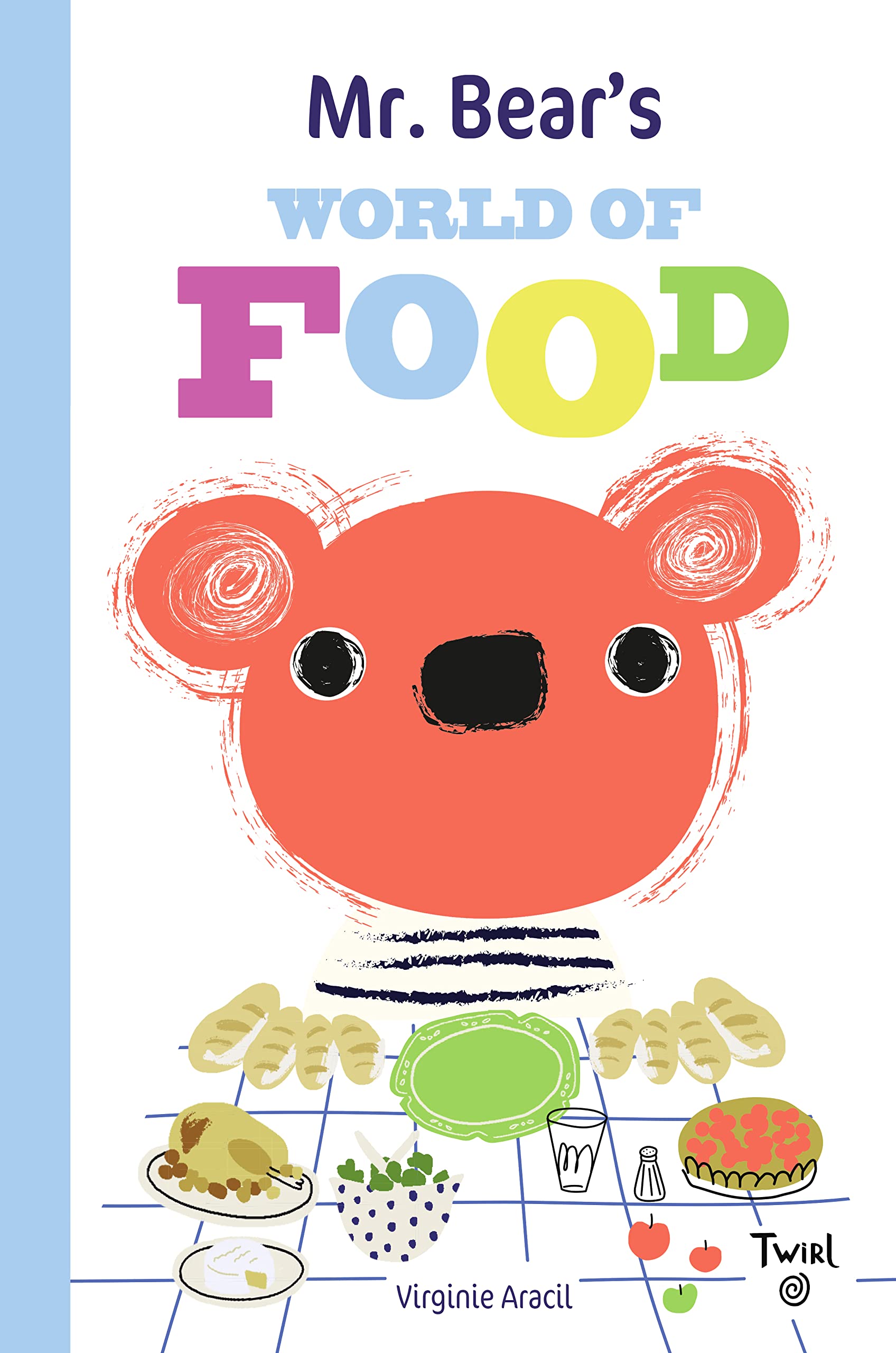
Do you have a little one who’s just discovering how many types of food there are? Is your child eager to try anything on their plate, or are they a bit more picky? No matter how your child interacts with food, they’ll be fasciated by Virginie Aracil’s whimsical Mr. Bear’s World of Food, a charming and boldly illustrated menu to tastes and flavors. 

Mr. Bear meets readers outside the Bakery, where’s he’s already bought a loaf of bread. “When I take a bite of bread all my senses wake up! What happens is wonderful,” he says. Young children may want to know what these senses are, and Mr. Bear is very accommodating in teaching them. Flaps at his ears, eyes, nose, mouth, hands, and heart reveal the five senses—and a sixth: “feelings.”

celebrate-picture-books-picture-book-review-mr-bear's-world-of-food-salty

Copyright Virginie Aracil, 2022, courtesy of Twirl Books.

Mr. Bear and a sweet muffin then invite kids to explore … well … foods that are Sweet, such as carrots, honey, sweet potatoes, candy, and more. Next, a saltshaker joins Mr. Bear to exhibit some Salty foods, like popcorn, cold cuts, and cod fish. Yum! But, sometimes, foods make your nose crinkle and your mouth pucker. Those would be foods that are Bitter, such as grapefruit or dark chocolate, and Sour, such as lemons, pickles, and others.

Ahhh! Now it’s time for some foods that just taste delicious and fill your tummy with warmth like roast chicken, roast beef, or scalloped potatoes. Feeling too warm now? Kids will enjoy cooling down with Fresh yogurt, cucumber, watermelon, or lettuce. Do you smell something? I smell something—something Pungent! It must be the blue cheese, sauerkraut, century egg, or durians. 

celebrate-picture-books-picture-book-review-mr-bear's-world-of-food-umami

Copyright Virginie Aracil, 2022, courtesy of Twirl Books.

Now perhaps it’s time for a dish that’s a little bland—but still tasty! Matzo bread, crackers, tofu, or mozzarella will hit the spot, along with a glass of water, of course! Mr. Bear has some Favorite Foods, including French fries, milk and cookies, and mac and cheese. And, finally, there are foods that are perfect for Sharing, such as pizza, kebabs, paella, and even that loaf of bread Mr. Bear bought at the beginning of this sensory trip!

Now that his tour through the different flavors and tastes is over, Mr. Bear has one last question for readers. In a large-scale, double-page pop-up, Mr. Bear, wearing a chef’s hat and coat, has arranged an array of foods in front of him and wonders, “What is your favorite food?” and “What do you want to eat today?” Kids will love answering and will most likely want to go back to point out their favorite dishes!

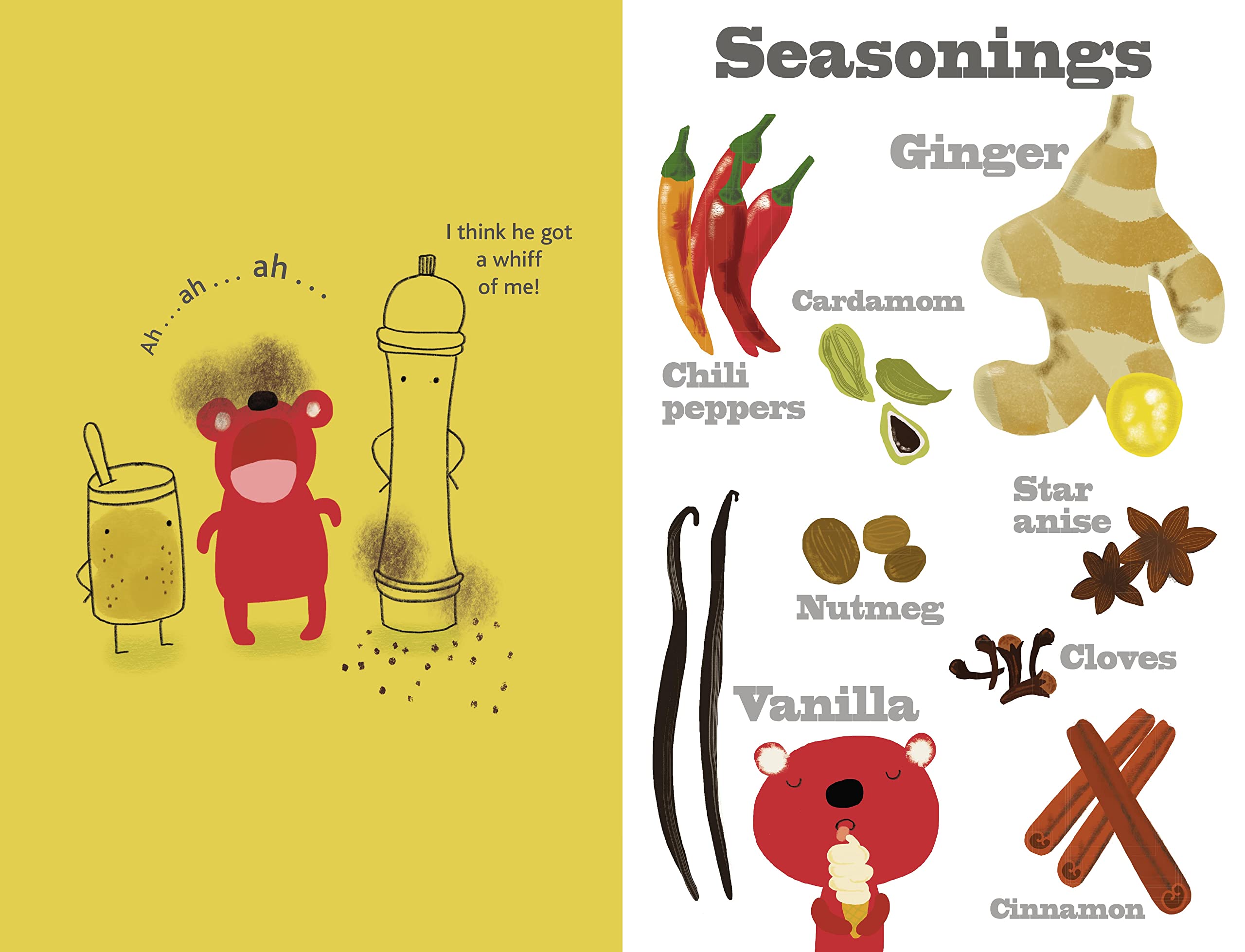
In addition to the above-mentioned categories, Mr. Bear also introduces kids to the flavors Umami, Rich, and Smoky. There’s also a page of Seasonings that highlight or enhance a food’s flavor, such as ginger and chili peppers. 

celebrate-picture-books-picture-book-review-mr-bear's-world-of-food-seasonings

Copyright Virginie Aracil, 2022, courtesy of Twirl Books.

Virginie Aracil’s delightful guide to foods and tastes from around the world is well conceived, with large and realistically illustrated images that immediately make each type of food recognizable and appealing to her young audience. Vivid colors and attractively designed pages of board book quality will hold readers’ attention while enticing them to try foods that might be unfamiliar to them. Children who are learning to recognize letters and those who are beginning to read will enjoy testing their new skills with the names of each food, which are presented in a prominent and clear typeface.

Each flavor profile is portrayed in a two-page spread. On the left Mr. Bear is joined by a representative of the category for a short, humorous conversation that will get little ones giggling, while the foods appear on the right. The size of the book is perfect for lap reading or for sharing on the floor or at a table, and an attached baguette-shaped bookmark will hold your place between tasting sessions.

A fun foodie adventure that’s sure to get kids excited about trying new foods and different tastes—and even going to the grocery store or farmers market—Mr. Bear’s World of Food would be a welcome addition to home bookshelves as well as to preschool and kindergarten classrooms, where it would make a terrific introduction to lessons about food and taste-testings. School and public libraries will also find it to be a popular choice among patrons.

Ages 3 – 5

Twirl Books, 2022 | ISBN 979-1036345173 (Board Book)

Discover more about Virginie Aracil, her other Mr. Bear books, and her design work on her website.

celebrate-picture-books-picture-book-review-mr-bear's-world-of-food-cover

You can find Mr. Bear’s World of Food at these booksellers

Amazon | Barnes & Noble | Books-a-Million

To support your local independent bookstore, order from

Bookshop | IndieBound

Picture Book Review

October 21 – My Name Is Not Ed Tug Book Tour Stop

celebrate-picture-books-picture-book-review-my-name-is-not-ed-tug-cover

I’d like to thank The Children’s Book Review and Amy Nielander for sharing a digital copy of My Name Is Not Ed Tug with me. 

My Name Is Not Ed Tug

By Amy Nielander


Edimorwhitimormiligimmus Tug knew where he came from and just where he fit into his family. After all, “he was named after his Grandpa Edimor,” who helped him learn how to spell his name with a tall tower of blocks; “his Great Uncle Whitimor,” who taught him how to play the accordion; his Aunt Mili,” who ran a butterfly farm; “and his Granny Gimmus,” who filled his tummy with warm, homemade soup.” Anyone hearing his name might think it was gibberish, but Edimorwhitimormiligimmus thought “it was perfect.”

celebrate-picture-books-picture-book-review-my-name-is-not-ed-tug-edimor

Copyright Amy Nielander, 2022, courtesy of West Margin Press.

School, of course, was a challenge since the other kids had a hard time spelling or even remembering his name. And his teacher, Ms. Mell, found that her mouth grew “quite tired” just trying to pronounce it. But one Monday, Ms. Mell announced that a new student, Ty, would be joining their class. Mrs. Mell had made name tags for each student to make it easier for Ty to remember their names, and she slapped one on Edimorwhitimormiligimmus’s shirt. When he looked, Edimorwhitimormiligimmus saw that the tag simply read “Ed.” He gazed at the tag with sadness. “Edimorwhitimormiligimmus Tug was shocked. He was perplexed. He felt like his heart had been stung by a giant bee. Twice.”

celebrate-picture-books-picture-book-review-my-name-is-not-ed-tug-Granny-Gimmas

Copyright Amy Nielander, 2022, courtesy of West Margin Press.

After school, Edimorwhitimormiligimmus went straight to his room and stayed there, thinking. When he emerged, he had a plan (and a very perfectly sized name tag taped to his sweater). The next day, he approached Ty, who was playing with puzzle blocks. He stood proudly, displaying his sweater, and introduced himself—his whole self. He slowly said each part of his name and, miraculously, Ty repeated it. Edimorwhitimormiligimmus “was so happy his curls bounced.” Then as he and Ty constructed a tall bridge with the blocks, he explained how he and his Grandpa Edimor “love to build things together”—and had even invented those blocks.

celebrate-picture-books-picture-book-review-my-name-is-not-ed-ty

Copyright Amy Nielander, 2022, courtesy of West Margin Press.

At lunch he did the same thing with the kids at his table, and they also repeated his name. To explain how important his Uncle Whitimor was to him, Edimorwhitimormiligimmus, he played his uncle’s favorite song on the accordion. When the class went out for recess, he told more kids about his Aunt Mili and pointed out, and they too learned his name.

On Tuesday, Mrs. Mell was out sick, and Edimorwhitimormiligimmus saw an opportunity to be kind and explain about his name. He and Ty delivered a steaming pot of Granny Gimmus’s soup to her doorstep and told her all about cooking with his granny. “The delicious soup warmed her heart.” Edimorwhitimormiligimmus’s plan worked. Now everyone, including Ms. Mell, knew—and used—Edimorwhitimormiligimmus’s full name.

celebrate-picture-books-picture-book-review-my-name-is-not-ed-soup-for-ms-mell

Copyright Amy Nielander, 2022, courtesy of West Margin Press.

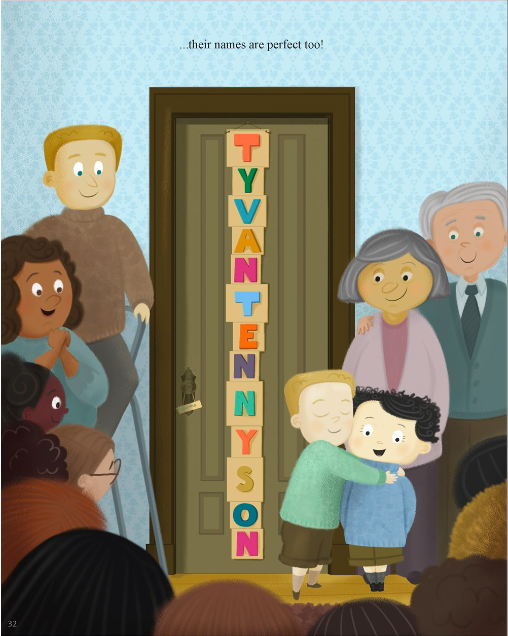
The experience prompted Edimorwhitimormiligimmus to come up with a new plan, a project to ensure all of his friends knew their names were just as perfect for them as Edimorwhitimormiligimmus was for him. And he and his classmates got started with the gift they made for Tyvantennyson to give him at his birthday party.

celebrate-picture-books-picture-book-review-my-name-is-not-ed-tyvantennyson-sign

Copyright Amy Nielander, 2022, courtesy of West Margin Press.

Amy Nielander’s heartwarming and affirming story will captivate kids from the first recitation of “Edimorwhitimormiligimmus Tug”—a name that initially elicits giggles but soon rolls smoothly off the tongue. As they learn how each piece of Edimorwhitimormiligimmus’s name reflects not only the family member he’s named for but also the special things they do together, readers will empathize with the pride he feels in his name and his disappointment when they can’t get it right.

While Nielander’s clever story revolves around one child’s name, there are many other important lessons for both kids and adults woven throughout. Children will understand that their names, personalities, heritage, talents, and dreams are perfect for them just the way they are. For adults, Ms. Mell’s dismissive mangling and shortening of Edimorwhitimormiligimmus’s name to “make it easier for all of us” reminds us that every child deserves to be really seen and accepted for who and everything they are.

Nielander’s illustrations are full of warmth and love, charm and humor as she introduces the unique talents of each member of Edimorwhitimormiligimmus’s inclusive and close-knit family. As Edimorwhitimormiligimmus puts his plan to teach each classmate and Ms. Mell his name into action, the children’s sweet faces and palpable excitement are infectious and will draw readers into this universal hug of a story. The surprise reveal of Ty’s full name and the collective gift the class makes him—with the promise of the same for each child—will delight readers and is sure to spur them to create name signs for themselves.

An engaging, multi-layered story about acceptance, self-esteem, family, and friendship, My Name is Not Ed Tug is a story kids will want to hear again and again. The book is highly recommended for home bookshelves and is a must for classroom, school, and public libraries.

Ages 4 – 8

West Margin Press, 2022 | ISBN 978-1513134871

Discover more about Amy Nielander, her books, and her art on her website.

Take a peek at the book trailer for My Name Is Not Ed Tug!


celebrate-picture-books-picture-book-review-my-name-is-not-ed-tug-cover

You can purchase My Name Is Not Ed Tug at these booksellers

Amazon | Barnes & NobleBookshop 

Picture Book Review


October 20 – International Sloth Day

celebrate-picture-books-picture-book-review-sloth's-treehouse-inn-cover

About the Holiday

The AIUNAU, a non-profit dedicated to protecting all wildlife, established International Sloth Day in 2010 to raise awareness of the dangers facing these gentle animals who always seem to have a smile on their face. There are six species of sloth and two types—two-toed and three-toed. Each of the six species lives in its own unique habitat and has its own characteristics. While all species are seeing a population decline, the pygmy sloth is rated as “critically endangered” as there are fewer than 100 animals in existence. Sloths need protection from power lines, cars, and poachers who capture them to sell as pets as well as from other environmental issues that destroy their habitats. To learn more about the various species of sloths, visit AZ Animals.

Sloth’s Treehouse Inn

Written by Carrie Hasler | Illustrated by Christina Wald


Deep in the rainforest, a sloth named Santiago provided rest and comfort to animals from all over within the “gnarled branches that stretched to the sky” and “twisted roots that spread across the forest floor” of his Treehouse Inn. He was a caring innkeeper, always finding the perfect spot for each guest and their needs. One of his favorites was a blue morpho butterfly chrysalis that he gently checked on every day.

While there was usually plenty of room for everyone who visited, Santiago had noticed that his inn was getting crowded. When two toucans came looking for a place to spend the night, Santiago discovered why. The toucans told him that trees in large areas of the rainforest were being cut down, leaving the animals and birds nowhere to live. “The lush forest brimming with life was becoming nothing more than a swath of dirt and mud.” Hearing this made Santiago sad, and he found “he didn’t have the heart to turn anyone away,” so his Treehouse Inn was soon full.  

But Santiago continued watching out for each one of his guests. He served tea every afternoon, provided games, and was happy to play slooow games of checkers with anyone who was willing. Before bedtime, Santiago told stories to young guests, who “didn’t seem to mind that the sloth was always the first to fall asleep, long before the story was over.”

celebrate-picture-books-picture-book-review-sloth's-treehouse-inn-Santiago

Image copyright Christina Wald, 2022, text copyright Carrie Hasler, 2022. Courtesy of San Diego Zoo Wildlife Alliance Press.

The crowded conditions soon led to some squabbling among the guests. The howler monkeys complained loudly, and the tamarins hogged all the fruit. Santiago knew the animals needed more room; they needed homes. Most of all, he worried about where the butterfly would go when it finally emerged from its chrysalis.

One morning, Santiago awoke to see the beautiful butterfly looking back at him. “They both stayed still for a very long time, something the sloth happened to be very good at.” Then, in a flash, the butterfly took off and soared away. Wanting to see his friend one more time to say good-bye, Santiago climbed to the top of the tree. From there he saw how many trees had been cut down. But he also saw something else. 

In the distance, he saw people planting new trees—saplings and seeds. Young trees were already growing, and other plants that made up the forest floor were also sprouting. “Filled with hope, Santiago couldn’t wait to tell the others.” As the trees and plants reclaimed their place in the rainforest, the animals found new homes, leaving the Treehouse Inn quiet once again. and “even though business was slow, its very fine innkeeper was happy just the way it was.”

The front endpapers offer fun facts about animals of the rainforest and the back endpapers offer a key to the types of animals found in a vertical, double-page spread midway through Sloth’s Treehouse Inn. Frontmatter provides a map of South America that highlights the location of the Amazon Rainforest while backmatter includes photographs, information about the rainforest, the causes of deforestation, and what individuals, environmentalists, and governments are doing to save the Amazon. There’s also a guide to how kids can help protect animals and plants in their own community.

celebrate-picture-books-picture-book-review-sloth's-treehouse-inn-bedtime-stories

Image copyright Christina Wald, 2022, text copyright Carrie Hasler, 2022. Courtesy of San Diego Zoo Wildlife Alliance Press.

In her well-crafted story, Carrie Hasler takes readers into the Amazon Rainforest—and to one tree in particular—to show them the vast array of wildlife and plants that call this unique region home as well as a major cause of habitat destruction. Through Hasler’s engaging storytelling, full of lyrical descriptions of the Treehouse Inn and its surroundings, kids meet Santiago, the innkeeper, who embodies the actual attributes of sloths in the wild—gentleness, caring, respectfulness to other creatures, and, of course, a slow, sleepy manner. Whimsical elements, such as the afternoon tea and games Santiago provides, will delight kids while inviting them to empathize with the growing number of guest who have lost their homes. Readers will also like following the progress of the blue morpho butterfly, whose departure leads to Santiago’s discovery of people’s work to replant the rainforest.

Christina Wald realistic illustrations burst with the color, light, and lush vegetation of the Amazon Rainforest. Each page will have readers lingering to view and appreciate the beauty of the rainforest and its denizens. As Santiago settles a group of poison dart frogs in just the right place to give them (and a tadpole) a pool and leaves to climb, the frogs appear as if they could simply hop out of the book. Turning from these types of gorgeous images, the two-page spread of trucks, machinery, and people with large saws cutting through the forest comes as a heartbreaking shock.

Wald’s show-stopping vertical illustration of the Treehouse Inn full of guests—from anteaters and tapirs below to a kinkajou, emerald tree boa, and hoatzin in the middle to a howler monkey and harpy eagle at the top—will have kids trying to spot all the creatures here and later in the book, while her clever checkerboard woven from leaves may inspire creative kids to make their own. The image of people replanting the clearcut forest area is inspiring and will prompt readers to learn more about how they can help.

An inspiring mix of fiction and nonfiction that will engage kids, Sloth’s Treehouse Inn would be a welcome addition to home bookshelves and is highly recommended for school and public libraries.

Ages 4 – 8

San Diego Zoo Wildlife Alliance Press, 2022 | ISBN 978-1943198139

Discover more about Carrie Hasler and her books on her website.

To learn more about Christina Wald, her books, and her art, visit her website.

International Sloth Day Activity

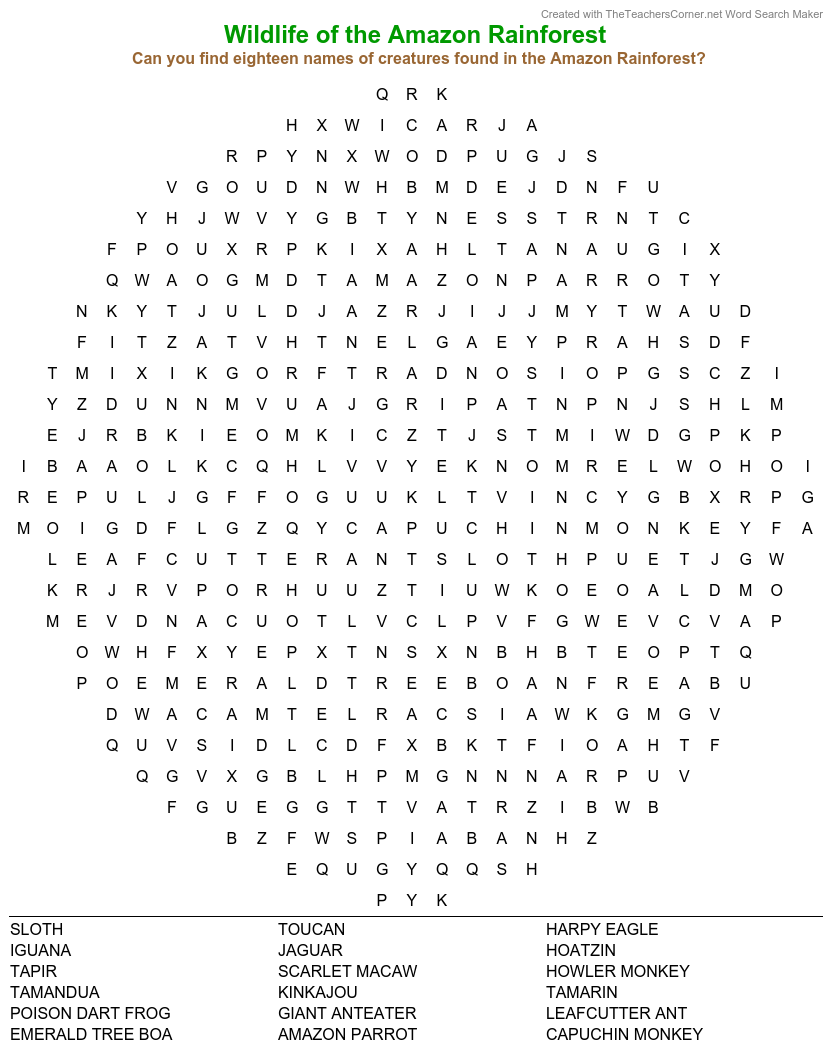
celebrate-picture-books-picture-book-review-amazon-rainforest-wordsearch-puzzle

Wildlife of the Amazon Rainforest Word Search Puzzle


You’ll find eighteen names of creatures who call the Amazon Rainforest home in his printable puzzle

Wildlife of the Amazon Rainforest Word Search Puzzle | Wildlife of the Amazon Rainforest Word Search Solution

celebrate-picture-books-picture-book-review-sloth's-treehouse-inn-cover

You can find Sloth’s Treehouse Inn at these booksellers

Amazon | Barnes & Noble | Books-a-Million

To support your local independent bookstore, order from

Bookshop | IndieBound

Picture Book Review

October 13 – It’s Positive Attitude Month

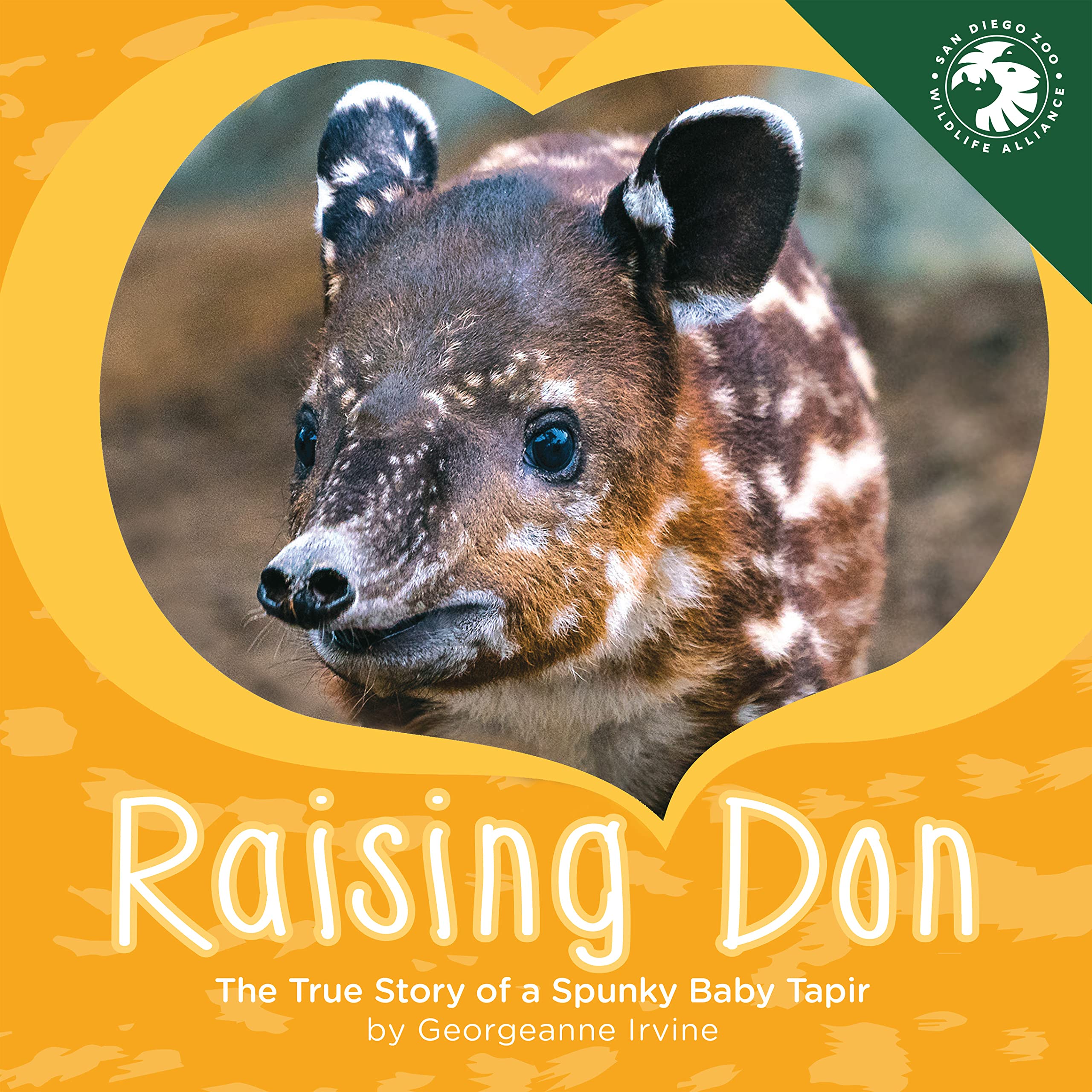
celebrate-picture-books-picture-book-review-raising-don-cover

About the Holiday

No matter how old (or young) you are there’s no getting around the fact that sometimes things are tough or don’t work out the way you planned. For kids, learning how to accept and even make the best of setbacks or disappointments is part of living a happier life. And that’s what Positive Attitude Month is all about. The holiday was established to encourage people to see the bright side of things since being upbeat can improve your health, lower chances of depression, make you more motivated, and lead to better relationships with family and friends. One way for kids to learn this skill is through reading, and today’s book—the true story about a little guy overcoming a few rocky patches of his own—is an adorable and joyful place to start. 

I’d like to thank the San Diego Zoo Wildlife Alliance Press and Blue Slip Media for sharing a copy of Raising Don with me for review consideration. All opinions on the book are my own.

Raising Don: The True Story of a Spunky Baby Tapir

By Georgeanne Irvine


Get ready to open Raising Don and fall in love with this little Baird’s tapir, an absolute cutie with the sweetest of personalities to match. From the first pages—which show the wildlife care team at the San Diego Zoo eagerly anticipating Don’s birth, describe the moment of lucky serendipity when one member of the team witnessed this exciting event, and then reveal that Don’s mother, Luna, as a hesitant “first-time mom” rejected her calf—readers will find themselves invested in the future of “this endangered Baird’s tapir born at the zoo in more than 30 years.”

As the wildlife care team takes over bottle-feeding Don, children learn about the extraordinary steps they took to provide Don with some of Luna’s milk while ensuring that each animal was treated with affection. Discovering that Luna enjoying being scratched with a soft scrub brush while being milked and Don being fed after first having “his back scratched and his face rubbed before he would take his bottle” and getting a belly rub afterwards will make readers with pets of their own smile at this universal favorite. 

celebrate-picture-books-picture-book-review-raising-don-baby-born

Copyright Georgeanne Irvine, 2022, courtesy of San Diego Zoo Wildlife Alliance Press.

Tapirs, kids learn, have noses that are “similar to an elephant’s trunk, only shorter.” Don used his little trunk “for smelling as well as picking up things like branches and bits of lettuce.” But Don was also as playful as any toddler and after eating “often grabbed the bottle with his tiny trunk and tried to run off with it!” Next, when Don was only a week old, the specialists introduced him to a shallow pool. Tapirs are good swimmers, but they need to be taught—just like kids.

In no time, Don was “running, jumping, and belly flopping into the pool.” He even liked to blow bubbles in the water with his trunk. Children then see photographs and read about how Don was gradually introduced to a deeper pond in the habitat where he would eventually live with guanacos, capybaras, and a llama—and, of course, rewarded with “extra back scratches and belly rubs for being such a good swimmer.”

Soon Don would be old enough to be moved to his habitat, so now it was time for him to make a friend. The wildlife care specialists picked out a sweet-tempered capybara, Bristle, with whom he “took naps in a cave, shared ficus leaf snacks, and soaked in the pond together.” Don also met an elderly tapir who, over time, taught him good manners and other particulars about being a tapir. 

celebrate-picture-books-picture-book-review-raising-don-pool-party

Copyright Georgeanne Irvine, 2022, courtesy of San Diego Zoo Wildlife Alliance Press.

But Don learned some other lessons about life too. Even when Don was a baby and the guanacos and the llama saw him through a fence, they didn’t like him. And when, later, Don approached them in the habitat, they bullied him in the way llamas do—by spitting and kicking at him. Don simply took to avoiding them and sticking with his good friend Bristle. 

In these first months of life, Don discovered his favorite foods and learned to accept regular examinations from the care specialists that would keep him healthy. “Tapirs have sensitive feet and need them looked at every day to make sure there aren’t any cuts, scrapes, or bruises.” As he grew older, Don became more independent and confident. He celebrated his first birthday with his favorite foods and a swim. Soon he’d be moving to the Nashville Zoo in Tennessee. “There, he would meet a female tapir and hopefully become a father someday.”

And what about Luna? She has given birth to and is taking care of Don’s sister, named Taiyari (which “means ‘our heart’ in the language of Mexico’s Huichol people”). Now, Don and his new best friend Juju, a female tapir, live in a spacious habitat with shade trees and a pond. Don, as you might imagine, has “won the hearts of his new caregivers,” and someday soon he and Juju will “become parents of their own precious calf, helping to bring more of these endangered animals into the world.”  

Back matter includes fun facts about tapirs, a map showing where they live, the dangers to wild tapirs, and a list of ten ways readers can do to help wildlife.
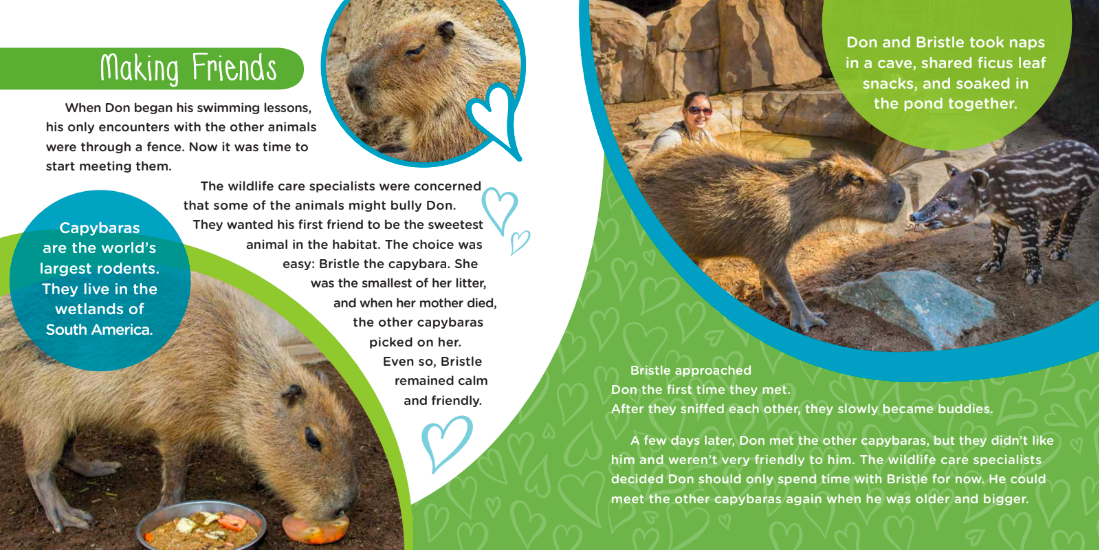
celebrate-picture-books-picture-book-review-raising-don-making-friends

Copyright Georgeanne Irvine, 2022, courtesy of San Diego Zoo Wildlife Alliance Press.

Full of joy, humor, and personality, Georgeanne Irvine’s story about one plucky tapir born at the San Diego Zoo will capture readers’ hearts. The fervent love felt by Irving and the wildlife care specialists for Don and all the animals at the zoo radiates from the pages. With lively language and detailed, yet easy-to-understand descriptions, Irving reveals the day-to-day attention Don enjoys as well as the ways the specialists became his surrogate mothers.

Children also learn about the thoughtful methods zoo caregivers use to introduce animals to their particular habitats, behaviors, diet, and other animals. Children will respond to the parallels between Don’s experiences while learning skills and making friends and their own, examples that provide wonderful teachable moments and opportunities to fully appreciate the natural world as well as their place and responsibilities in it.

Endearing photographs of Don from babyhood and throughout his first year allow readers to follow his progress and see first hand his adorable, spunky personality as well as how he learns to swim, discover favorite foods, make friends, gets health examinations, and finally moves to Nashville and meets a new best friend.

Nature nonfiction at its finest, Raising Don: The True Story of a Spunky Baby Tapir is sure to be a favorite choice for all animal lovers as a read aloud or for independent reading. The book offers a wide range of learning and discussion opportunities for teachers, educators, and homeschoolers and is a must-addition to home, classroom, school, and public library collections.

Ages 7 – 10 (Younger children will also enjoy this book as a read aloud taken in parts)

San Diego Zoo Wildlife Alliance Press, 2022 | ISBN 978-1943198146

To learn more about the San Diego Zoo and the San Diego Zoo Wildlife Alliance, visit their website.

About the Author

Georgeanne “George” Irvine has devoted her career to raising awareness about animals and wildlife conservation. She is director of publishing for the San Diego Zoo Wildlife Alliance, where she has worked for more than four decades, as well as the author of over two dozen children’s books about animals, including the award-winning Hope and Inspiration collection. Photographing and learning about animals in their native habitats are passions for George. Her worldwide adventures have taken her to many of the wildest places on Earth—from the jungles of Borneo and South America to the mountains of China and the forests of India to the Outback of Australia and the savannas of Africa. 

About the San Diego Zoo Wildlife Alliance Press

San Diego Zoo Wildlife Alliance Press is the book publishing division of San Diego Zoo Wildlife Alliance, a nonprofit international conservation leader, committed to inspiring a passion for nature and working toward a world where all life thrives. Through its publishing efforts, San Diego Zoo Wildlife Alliance Press seeks to motivate and inspire multiple generations to care about wildlife, the natural world and conservation.  

Positive Attitude Month Activity

celebrate-picture-books-picture-book-review-tapir-coloring-page

Tapir Mom and Baby Coloring Page


If you love Don, you’ll love this adorable coloring page created by Honduran graphic designer Jen Chibi! Just download and print—and don’t forget to give the baby stripes and spots like Don!

Tapir Mom and Baby Coloring Page

celebrate-picture-books-picture-book-review-raising-don-cover

You can find Raising Don: The True Story of a Spunky Baby Tapir at these booksellers

Amazon | Barnes & Noble | Books-a-Million

To support your local independent bookstore, order from

Bookshop | IndieBound

Picture Book Review

October 11 – Celebrating the Book Birthday of Madani’s Best Game

celebrate-picture-books-picture-book-review-madani's-best-game-cover

Thanks to Eerdmans Books for Young Readers for sharing a copy of Madani’s Best Game with me for review consideration. All opinions on the book are my own.

Madani’s Best Game

Written by Fran Pintadera | Illustrated by Raquel Catalina | Translated from the Spanish by Lawrence Schimel


“Our whole neighborhood knows it: no one plays soccer like Madani does.” Thus, a teammate of Madani’s begins the story about this friend who captivates the neighborhood (and sometimes it seems the whole world) with his barefoot ball-handling prowess. Madani has elevated the team’s game to “the best soccer we’ve ever seen.” After Madani has scored a “Gooooal!” the sound of the cheers soars above the playing field and “…crosses through doorways, rushes past the magazine stand, slips down alleyways, swirls around the fountain, and, growing fainter and fainter, climbs the steps up to Madani’s house.” 

celebrate-picture-books-picture-book-review-madani's-best-game-bare-feet

Image copyright Raquel Catalina, 2022, text copyright Fran Pintadera, 2022. Courtesy of Eerdmans Books for Young Readers.

There, his mother hears it and knows the cheers are for Madani. She wishes she could attend his games, but she’s a seamstress and has so many garments to sew by hand. After the game, Madani’s teammates can only imagine how much better he would play if he only had a good pair of cleats. Their team might even be able to beat the Southside team—their biggest rival.

celebrate-picture-books-picture-book-review-madani's-best-game-madani's-moves

Image copyright Raquel Catalina, 2022, text copyright Fran Pintadera, 2022. Courtesy of Eerdmans Books for Young Readers.

The members of the team know that Madani’s saving up money in a special tin that gets heavier every time he declines to buy a snack, walks to away games instead of riding the bus, and makes other sacrifices. They know that when the box is full, Madani’s going shopping. “…then our games will be better than ever!’” he says, and they all dream of the day Madani buys his new cleats.

celebrate-picture-books-picture-book-review-madani's-best-game-listening

Image copyright Raquel Catalina, 2022, text copyright Fran Pintadera, 2022. Courtesy of Eerdmans Books for Young Readers.

The big game against Southside is only a day away, but Madani doesn’t come to practice. Instead, his friends watch him head downtown with the tin under his arm. Without Madani at practice, the team falls apart, but they don’t worry. Finally, they thought, their dreams of new cleats and beating Southside would come true!

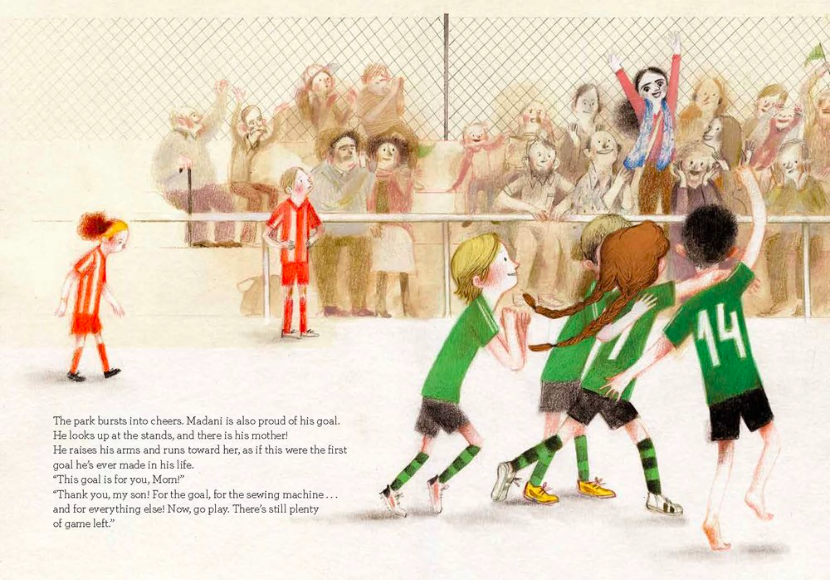
When Madani shows up at the game the next day, “he looks radiant,” but he’s still barefoot. His teammates question him about his new cleats, but Madani doesn’t know what they’re talking about. The money wasn’t for shoes but for a present for his mother so that “‘she’ll be able to finish her work faster and come watch me play every Saturday.’”

celebrate-picture-books-picture-book-review-madani's-best-game-mother

Image copyright Raquel Catalina, 2022, text copyright Fran Pintadera, 2022. Courtesy of Eerdmans Books for Young Readers.

Madani’s friends still don’t quite get it, but the game begins, and in moments Madani has already stolen the ball away from the Southside players, run downfield and scored. He looks into the stands, sees his mother, and shouts “‘This goal is for you, Mom!’” Madani makes another goal, but Southside scores too, and the game ends in a tie. It’s okay, though, Madani’s teammate says, “‘because now more than ever, everyone in the neighborhood knows … There’s no player like Madani!’”

Back matter consists of notes from Fran Pintadera and Raquel Catalina that reveal their creative journeys and connections to this story.

celebrate-picture-books-picture-book-review-madani's-best-game-mother-at-game

Image copyright Raquel Catalina, 2022, text copyright Fran Pintadera, 2022. Courtesy of Eerdmans Books for Young Readers.

Fran Pintadera, who based Madani’s Best Game on his experiences as a social educator in new immigrant housing, tells his story with open-hearted affection for his subject as well as the relationships between teammates and mother and child. Through his perceptive and humorously observed details and lyrical language, Pintadera captures the wide-eyed wonder of children in awe of a great player (or artist, singer, scientist, or other talent). When Madani gets the ball, readers will hold their breath along with the neighbors, traffic, and even pigeons while he entertains the crowd and scores a goal. Then the action begins again, but this time the suspense revolves not around the game but on what Madani will buy. The answer is joyous, affirming family devotion and revealing the pure giving nature of a child’s heart.

From their first introduction to Madani, smiling out from the page, his bare foot on a soccer ball, readers will be captivated by him, his teammates, his neighborhood, and the game. Raquel Catalina’s endearing pencil, gouache, and colored pencil illustrations charm with realistic images of kids on the soccer field surrounded by city onlookers. Catalina creates not only gorgeous visuals of Madani’s supportive neighborhood, but an almost auditory experience as well.

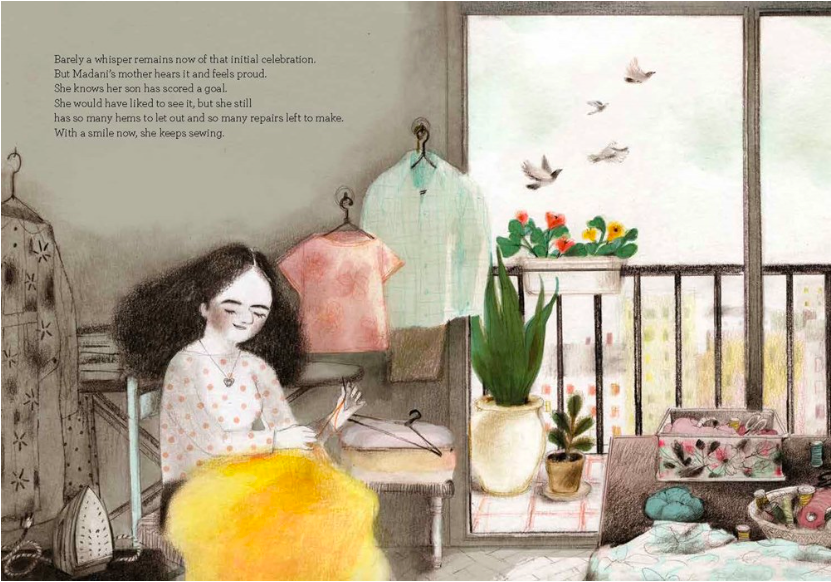
Readers can almost hear the players’ running feet, the sudden cheers, the flap of the rising pigeons’ wings, and – as the celebration reaches Madani’s mother’s ears – even the whisper of her sewing needle through the fabric on her knees. Catalina deftly weaves the theme of friendship, between people both young and old, throughout the pages, enhancing the bond between Madoni and his mom as well as Madani’s teammates’ understanding of the true importance of that long-awaited game.

A beautiful poignant, joyful, and affirming story of family and friendship, Madani’s Best Game is a read aloud that adults and kids will love to share over and over. The book is a must for all home, classroom, school, and public libraries.

Ages 5 – 9

Eerdmans Books for Young Readers, 2022 | ISBN 978-0802855978

You can discover more about Fran Pintadera and his work on his website and connect with him on Instagram.

To learn more about Raquel Catalina, her books, and her art, visit her website. You can also connect with her on Instagram.

You can connect with Lawrence Schimel and learn more about his writing and his translating work on Instagram and Twitter.

celebrate-picture-books-picture-book-review-madani's-best-game-cover

You can find Madani’s Best Game at these booksellers

Amazon | Barnes & Noble | Books-a-Million

To support your local independent bookstore, order from

Bookshop | IndieBound

Picture Book Review

Picture Book Revi

October – It’s National Book Month

celebrate-picture-books-picture-book-review-professor-wooford-mcpaw's-history-of-astronomy-cover

About the Holiday

Readers might say that every month is National Book Month, but October is especially set aside to highlight books and the love of reading. Fall is a book bonanza as publishers release new books in all categories, and the holiday gift-giving season beckons. Books, of course, make superb gifts for all ages! So whether you’re looking for a new or new-to-you book to read right now or new titles to give to the family and friends who will be on your list, this month is a perfect time to check out your local bookstore to see what wonderful books are on the shelves! This month is also a great time to discover books that get kids excited about history, science, and technology in a whole new way – like today’s book!

Thanks to Cicada Books for sharing a digital copy of Professor Wooford McPaw’s History of Astonomy with me for review consideration. All opinions on the book are my own.
Professor Wooford McPaw’s History of Astronomy

By Elliot Kruszynski


The study of astronomy harkens back to the earliest days of scientific discovery, when “civilizations in Mesopotamia, Persia, China, India and Greece all examined the night sky. With only the naked eye, they mapped out the stars and used the information they gathered to create calendars, navigate great distances and keep time.” So begins this comprehensive, detailed, and even humorous compendium of our skies, scientists and thinkers, equipment, and a look to the future.

Professor Wooford McPaw and his telescope sidekick, Teley, takes kids back to 3000 BC, when religious leaders determined the longest day of the year by tracking the sun’s progress through the arches and columns erected at Stonehenge, and speeds forward to 1000 BC, when people connected the stars, creating the constellations and stories about them.

celebrate-picture-books-picture-book-review-professor-wooford-mcpaw's-history-of-astronomy-aristotle

Copyright Elliot Kruszynski, 2022, courtesy of Cicada Books.

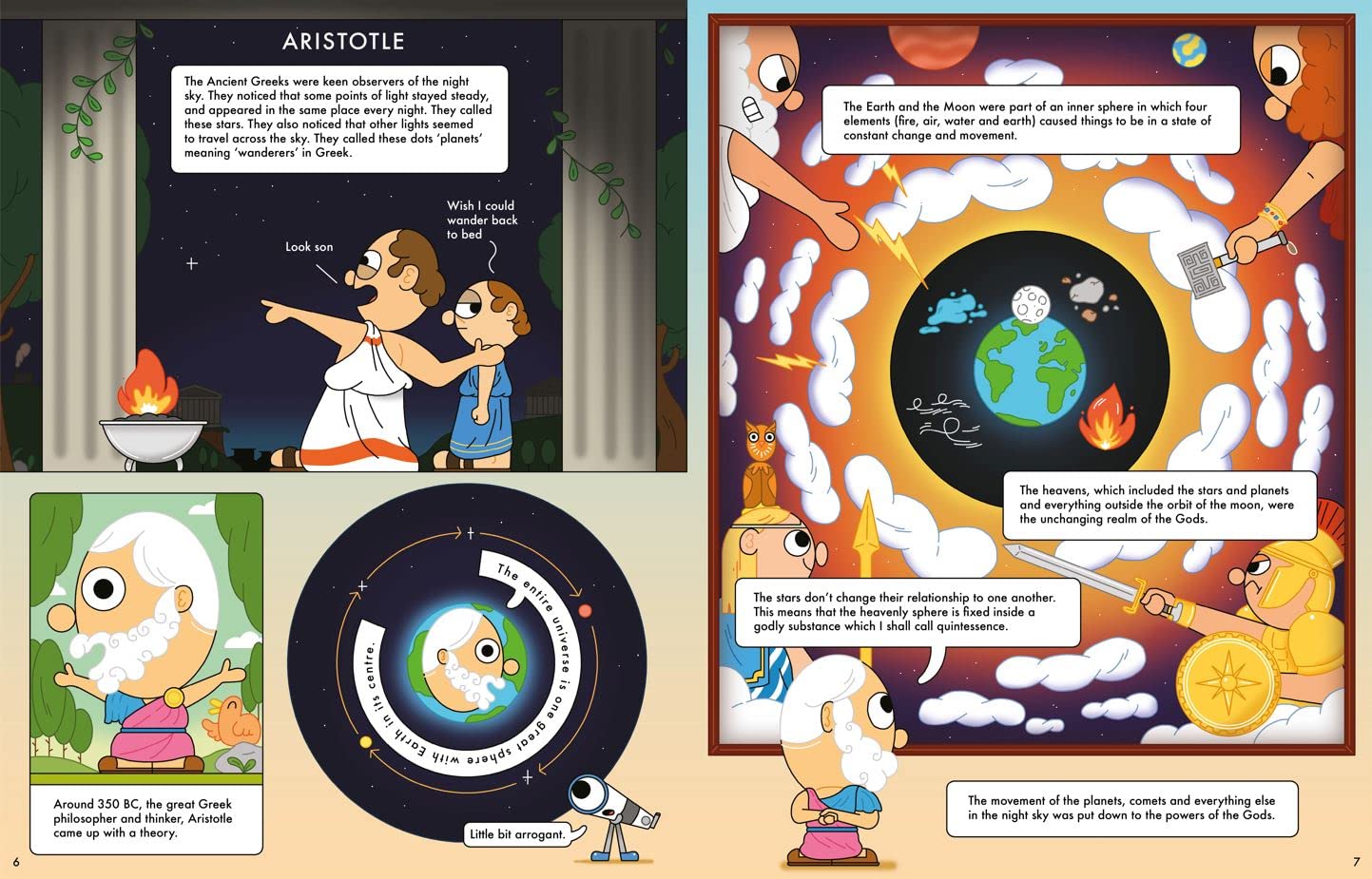
Kids then meet Aristotle and learn about his theories on the placement of the earth, the four elements, and the role of the gods in the universe. Then they discover the conflict between the teachings of Claudius Ptolemy around 140 AD and the discoveries of Nicolaus Copernicus in the 16th century, who left it to future scientists to explore his theory that that the earth revolved around the sun (and not the other way around). And what happened to those scientists? Well, children learn about Galileo Galilei, who, in addition to inventing the telescope, spent a good part of his life under house arrest for saying the earth and the planets did indeed revolve around the sun.

celebrate-picture-books-picture-book-review-professor-wooford-mcpaw's-history-of-astronomy-telescopic-history

Copyright Elliot Kruszynski, 2022, courtesy of Cicada Books.

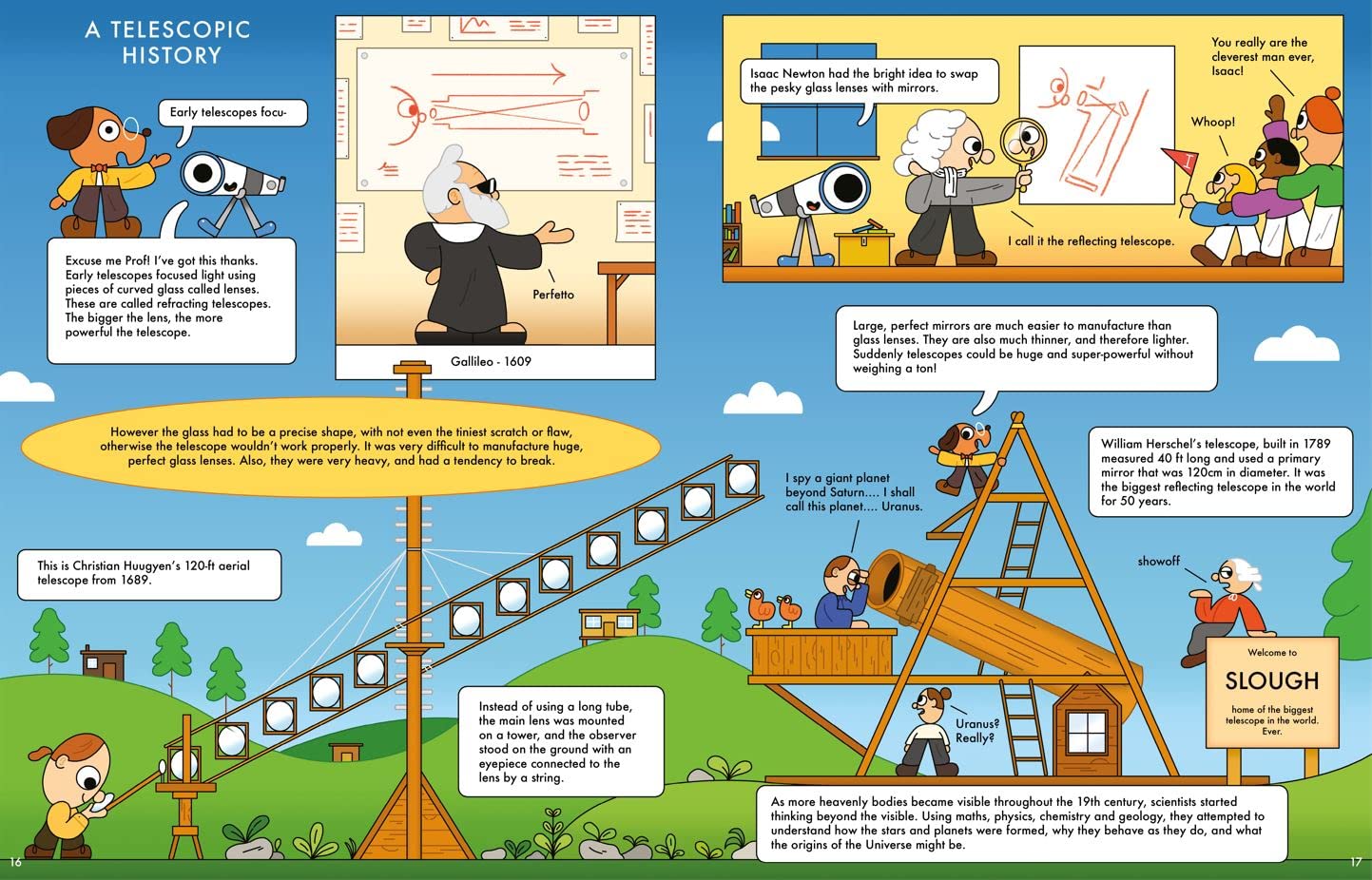
Professor Wooford introduces readers to Isaac Newton, whose “findings, along with the improvement of telescope technology, changed the way that humans (and for some dogs) looked at our planet.” What kind of telescope technology is the Prof talking about? He gives kids a run down from Galileo’s invention in 1609 to a switch from glass lenses to mirrors in the 1700s to today’s Hubble Space Telescope and James Webb Space Telescope. Here’s Teley explaining about lenses:

“Early telescopes, like the one Galileo invented, focused light using pieces of curved glass called lenses. The bigger the lens, the more powerful the telescope. They were called refracting telescopes. However the glass had to be a precise shape, with not even the tiniest scratch or flaw, otherwise the telescope wouldn’t work properly. It was very difficult to manufacture huge, perfect glass lenses. Also, they were very heavy and had a tendency to break.” Teley goes on to explain that it was Isaac Newton who “had the bright idea to swap the pesky glass lenses with mirrors,” which are much easier to make and are thinner and lighter, allowing telescopes to “be huge and super-powerful without weighing a ton.”

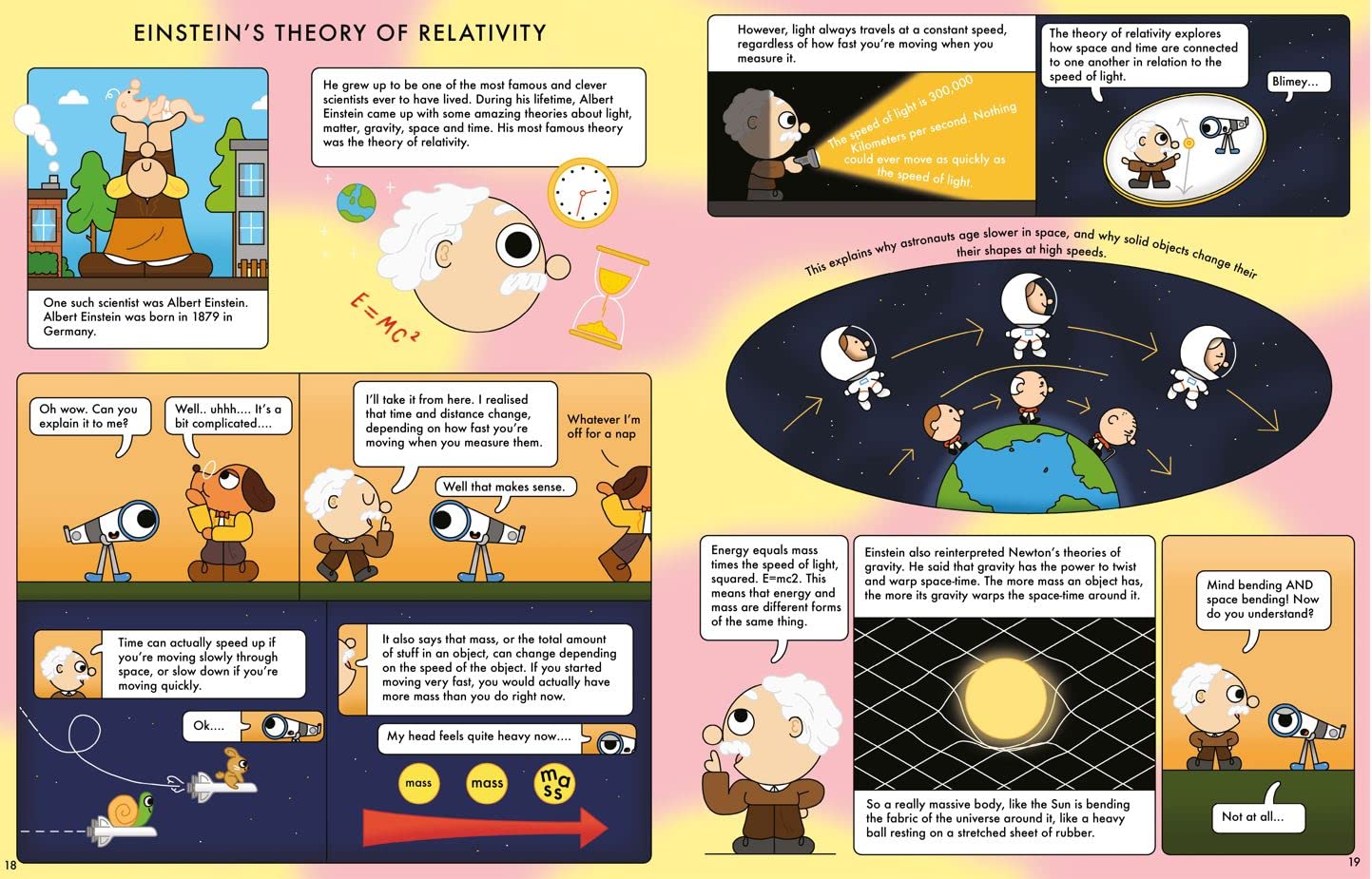
celebrate-picture-books-picture-book-review-professor-wooford-mcpaw's-history-of-astronomy-einstein

Copyright Elliot Kruszynski, 2022, courtesy of Cicada Books.

Albert Einstein travels back through time to explain his “mind bending and space bending” Theory of Relativity in terms that readers can understand. Then kids are launched into space—the space race, that is—where they learn about the advancements and setbacks of the Russian and American from 1957 to 1969, when the first moon walk occurred, as well as a weely … I mean … really unusual tradition among space-going astronauts.

celebrate-picture-books-picture-book-review-professor-wooford-mcpaw's-history-of-astronomy-space-probes

Copyright Elliot Kruszynski, 2022, courtesy of Cicada Books.

Children get info on different kinds of space probes from rovers to orbiters to interplanetary probes before blasting off into our solar system to find out about the planets (even little Pluto gets a cameo. But where is Earth and all of our other planets located? Professor McPaw explains: “Earth is located in a galaxy called the Milky Way. At its center is a supermassive black hole called Sagittarius A*, which contains as much mass as four million suns.” The prof goes on to teach kids about the three different shapes of galaxies, what dwarf galaxies are, how bigger galaxies cannibalize smaller galaxies, and where the term galaxy comes from.

celebrate-picture-books-picture-book-review-professor-wooford-mcpaw's-history-of-astronomy-black-holes

Copyright Elliot Kruszynski, 2022, courtesy of Cicada Books.

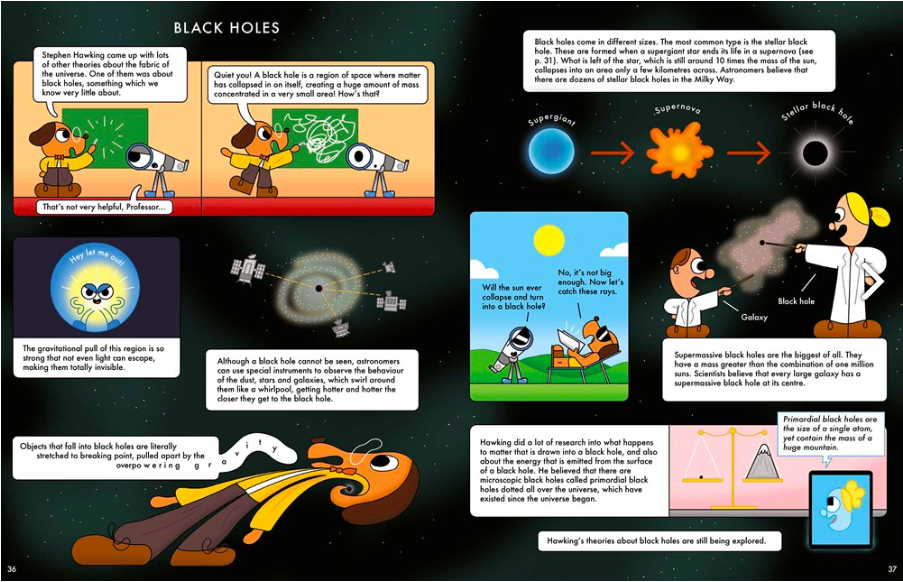
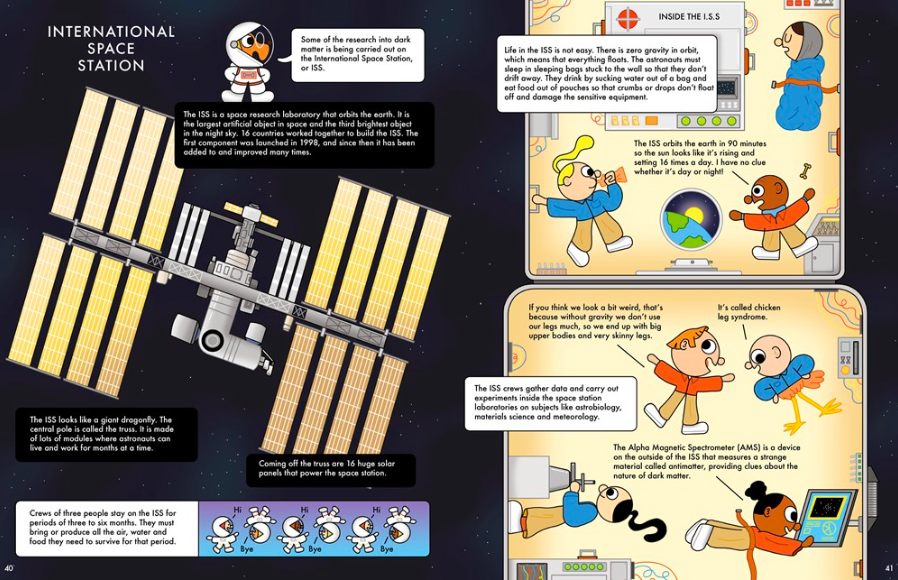
Professor Wooford McPaw and Teley also impart the same fascinating in-depth facts about stars, black holes, and dark matter. And what’s a trip into space without a ride on the International Space Station? Well, readers won’t find out because they get to explore the ISS and learn how the astronauts experience 16 sunrises and sunsets a day, sleep strapped to a wall, and develop “chicken leg syndrome” from not using their legs as much as their upper body in the no-gravity conditions.

By this time, kids are probably wondering about whether there’s life in other parts of the solar system or beyond as well as what the future might hold for astronomers, astrophysicists, other scientists, and even themselves. But are readers going to be abandoned in space? Not at all! Professor Wooford has thoughtfully included a Race to Earth “board game” on the last two-page spread that will get all astronauts … I mean readers … back home in time for dinner.

celebrate-picture-books-picture-book-review-professor-wooford-mcpaw's-history-of-astronomy-international-space-station

Copyright Elliot Kruszynski, 2022, courtesy of Cicada Books.

Elliot Kruszynski’s Professor Wooford McPaw’s History of Astonomy is just the kind of book that both kids who already love space and those who don’t yet know they do will devour, either bit-by-bit or all in one sitting. With affable hosts who give excellent easy-to-understand explanations, historical characters who add funny asides, and a quick-paced graphic-novel format, (title) will spark readers’ interest in learning all about the past, present, and future of astronomy. The book would make a perfect gift and very welcome addition to any home library. Educators and homeschoolers will find it a go-to text for introducing many scientific topics and an engaging way to heighten student’s eagerness for further research. School and public library librarians will find Professor Wooford McPaw’s History of Astonomy to be a favorite to recommend and to have on their shelves.

Ages 6 – 10 and up

Cicada Books, 2022 | ISBN 978-1800660236

To view a portfolio of work by Elliot Kruszynski and connect with him on Instagram, visit his website. 

National Book Month Activity

celebrate-picture-books-picture-book-review-rocket-to-the-moon-tic-tac-toe-game

Out of This World Tic-Tac-Toe Game

You can launch your own Tic-Tac-Toe Game with this set you make yourself! With just a couple of egg cartons, some crayons, and a printable game board, you’ll be off to the moon for some space-age fun! Opposing players can be designated by rockets and capsules. Each player will need 5 playing pieces. 

SUPPLIES

  • Printable Moon Tic-Tac-Toe Game Board
  • 2 cardboard egg cartons
  • Heavy stock paper or regular printer paper
  • Crayons
  • Black or gray fine-tip marker

DIRECTIONS

To Make the Rockets

  1. Cut the tall center cones from the egg carton
  2. Trim the bottoms of each form so they stand steadily, leaving the arched corners intact
  3. Pencil in a circular window on one side near the top of the cone
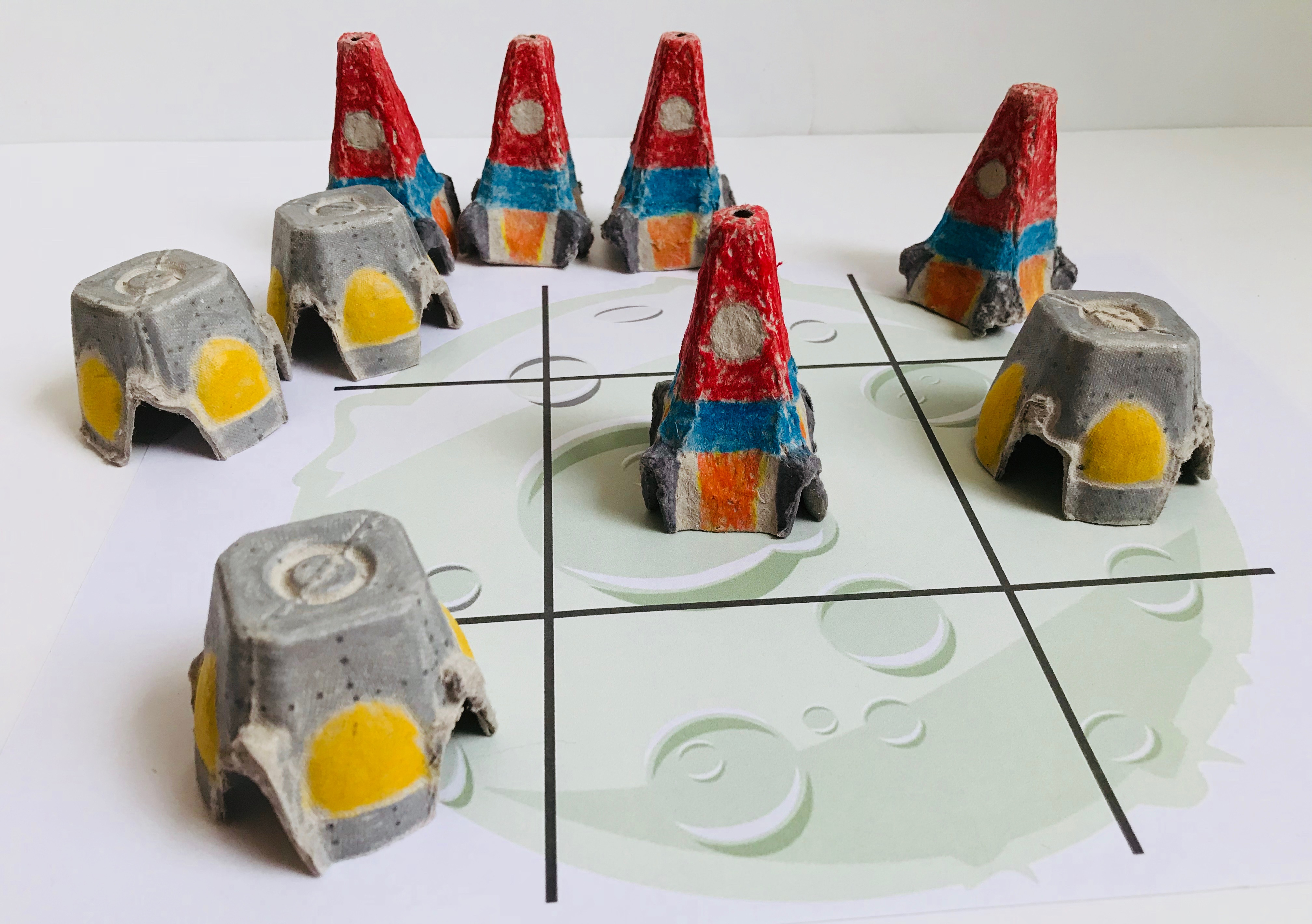
  4. Color the rocket body any colors you like, going around the window and stopping where the arched corners begin
  5. With the marker color the arched corners of the form to make legs
  6. On the cardboard between the legs, color flames for blast off

To Make the Capsule

  1. Cut the egg cups from an egg carton
  2. Color the sides silver, leaving the curved section uncolored. (If your egg cup has no pre-pressed curve on the sides of the cup, draw one on each side.)
  3. Color the curved section yellow to make windows
  4. With the marker, dot “rivets” across the capsule

Print the Moon Game Board and play!

celebrate-picture-books-picture-book-review-professor-wooford-mcpaw's-history-of-astronomy-cover

You can find Professor Wooford McPaw’s History of Astronomy at these booksellers

Amazon | Barnes & Noble | Books-a-Million

To support your local independent bookstore, order from

Bookshop | IndieBound

Picture Book Review