December 17 – Maple Syrup Day

celebrate-picture-books-picture-book-review-pancakes-cover

About the Holiday

Pancakes and waffles are great, but they’re even more delicious with maple syrup! That sweet, golden slooow-pouring topping that makes for a perfect breakfast (and breakfast-for-dinner meal) deserves its own holiday! Before you get out into the hustle and bustle of the weekend, why not celebrate a little with a tall stack and lots of maple syrup?!

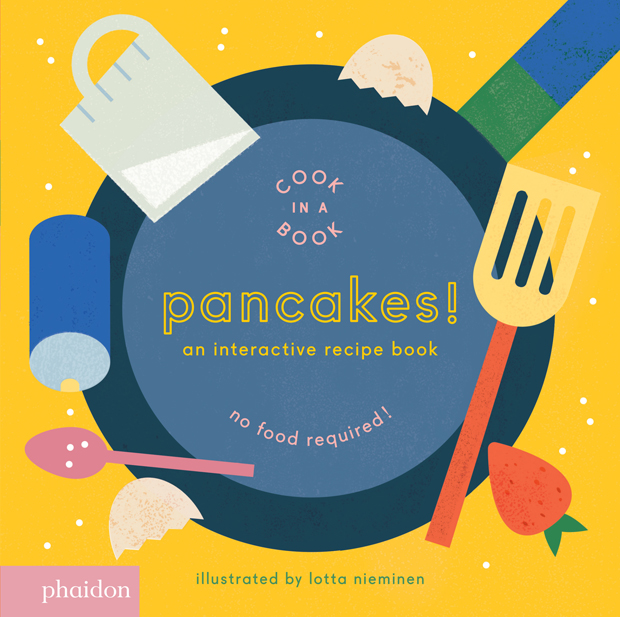
Pancakes! An Interactive Recipe Book

Illustrated by Lotta Nieminen


Sometimes a novelty book comes along that transcends the “kid” category and provides fun and “Ooooh!’ moments for readers of all ages. Pancakes! An Interactive Recipe Book offers just this kind of delicious excitement. Opening the cover is like walking into a cozy kitchen, finding your favorite recipe and gathering all the necessary ingredients. The first two-page spread presents in visuals and words the recipe and the utensils and other cooking items needed to make pancakes.
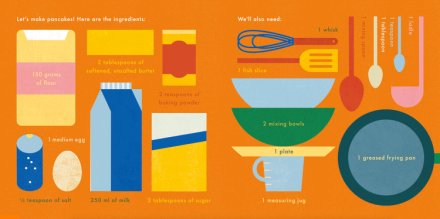
celebrate-picture-books-picture-book-review-pancakes-an-interactive-recipe-book-ingredients

Image copyright Lotta Neiminen, 2016, courtesy of phaidon.com

With the second two-page spread, cooking begins! A scoop of baking powder, two tablespoons of sugar, and half a teaspoon of salt are added to the bowl. But what about the cup of flour? Readers get to add that themselves with a pull tab that simulates the flour joining the other ingredients in the green mixing bowl. The clever cut of the opening and the mottled and powdery appearance of the illustrated flour gives the sensation of actual pouring.
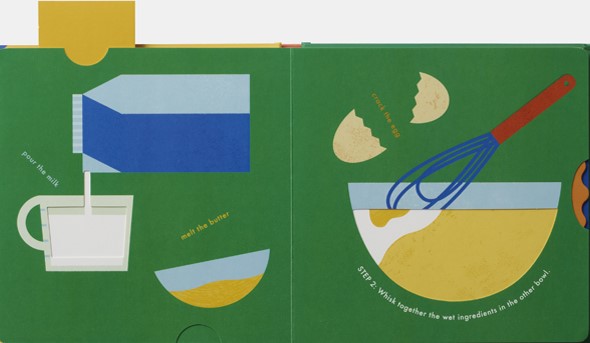
celebrate-picture-books-picture-book-review-pancakes-an-interactive-recipe-book-measuring-milk

Image copyright Lotta Neiminen, 2016, courtesy of phaidon.com

Next readers get to measure out the cup of milk with the help of a pull tab that gives kids control over the amount being served. Four marks on the side of the measuring cup provide an opportunity to talk about fractions and the ¼, ½, and ¾ lines that are also incorporated into real glass measuring cups or the separate cups that come as part of a set. Once the milk is ready, it goes into the mixing bowl with the melted butter and the egg.

Grab your whisk and get stirring! A wheel on the side of the page lets kids “combine” these wet ingredients from their individual parts into a cohesive yellow batter. Now that the batter is ready, it’s time for “STEP 4: Ladle the batter into separate circles in the hot, buttered frying pan.” Readers will love pulling the tab that releases the batter into the pan—leaving just a drop of batter to sizzle on its own (and you know how good those crispy drops can be!)
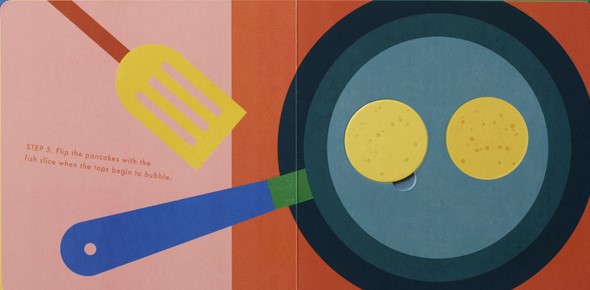
celebrate-picture-books-picture-book-review-pancakes-an-interactive-recipe-book-flipping-pancakes

Image copyright Lotta Neiminen, 2016, courtesy of phaidon.com

The batter is bubbling—which means it’s time to flip the flap jacks! As the spatula appears from the top of the page, kids can lift one of the little round yellow pancakes from the fry pan and turn it over. Ingeniously, the reverse side is delectably browned. A turn of the page invites by-now-hungry readers to follow “STEP 6: When both sides are browned, stack the finished pancakes on a plate.”
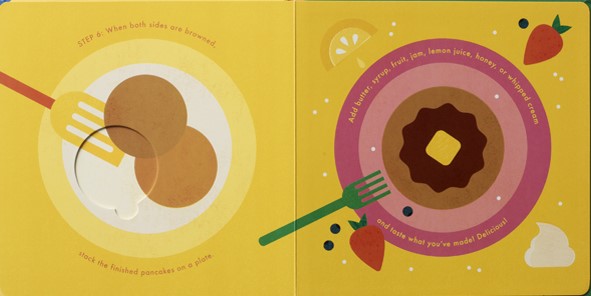
celebrate-picture-books-picture-book-review-pancakes-an-interactive-recipe-book-on-plate

Image copyright Lotta Neiminen, 2016, courtesy of phaidon.com

A pancake-sized round indentation on the plate just begs to be filled with the browned pancake from the previous page. Adding the pancake to the sunny plate, kids will feel as if they are holding the spatula and carefully slipping it atop a stack ready to be eaten. The last page encourages readers to “add butter, syrup, fruit, jam, lemon juice, honey, or whipped cream and taste what you’ve made! Delicious!”

Lotta Nieminen’s Pancakes! is so wonderfully conceived in its bold vibrant images and simple recitation of a pancake recipe. The crisp lines and absence of labels on the ingredients packages, puts the focus on the shapes, providing a chance for discussion of concepts such as rectangle, circle, half-circle, cylinder, oval, and triangle; flat and round; and bigger and smaller. Ideas such as hot and cold, measuring, pouring, mixing, stacking and others can also be introduced. The brilliant interactive elements invite kids and adults alike to play with this book over and over.

The sturdy board pages and convenient size make this a perfect take-along for trips to the market, picnics, appointments, siblings’ activities, or other outings where waiting is required. For kids and adults who like to help out in the kitchen, love to cook, or are attracted by all things culinary, Pancakes! An Interactive Recipe Book makes a terrific gift and must have for home bookshelves. 

Ages 2 and up

Phaidon Press, 2016 | ISBN 978-0714872834

To view a gallery of graphic design and illustration work by Lotta Nieminen, visit her website!

Maple Syrup Day Activity
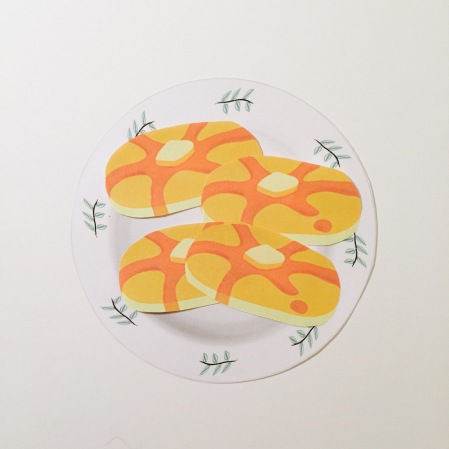
celebrate-picture-books-picture-book-review-pancake-game

Pancake Flip-Out


Pancakes are served in a stack because they’re so delicious each one doesn’t last long! This game gives you the chance to see how many pancakes you can flip onto a plate! You can play this game several ways:

To Play Pancake Toss

  1. Give each player the same number of pancakes and see how many they can toss onto the plate during their turn
  2. Make a target with the plate in the middle and draw 3 concentric circles around it. Hitting the target can earn you 20 points. Getting your pancake in the first circle around the plate earns you 15 point, the second circle is worth 10 points, and the third is worth 5 points. Rotate through the players as many times as you like and add up the points at the end. The player with the most points wins!
  3. Instead of tossing the pancakes with your hands, try throwing them with a spatula!
  4. Make up your own rules—and have fun!

To Play With Dice

  1. Choose a number of pancakes that each player must add to their plate—say, maybe, a baker’s dozen.
  2. Take turns rolling the dice and adding the number of pancakes rolled to the plate. The first player to reach the agreed-upon number is the winner.

Supplies

Directions

  1. Print enough copies of the Pancakes and Breakfast Plates for the game you choose and cut them out. Playing pieces can be printed on card stock or on paper. 
  2. If printing on paper, you can glue the pancakes and plate to poster board, cardboard, or foam to give the pancakes more weight for throwing and the plate more support
  3. Once dry, the game pieces are ready for fun!

Picture Book Review

December 16 – It’s Read a New Book Month

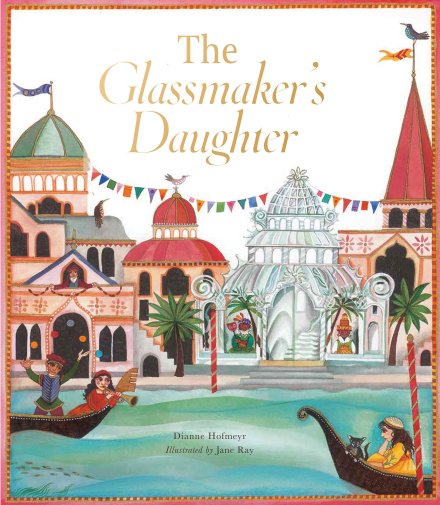
celebrate-picture-books-picture-book-review-the glassmaker's-daughter-cover

About the Holiday

With so many gift-giving opportunities this month, December is the perfect time to discover new books for any age! The delight, wonder, and shared experiences of great books is one of the best presents you can give. This month visit your local bookstore and pick out a special book for the loved ones on your list. (And don’t forget to treat yourself!)

The Glassmaker’s Daughter

Written by Dianne Hofmeyr | Illustrated by Jane Ray


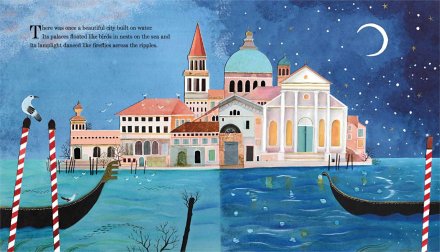
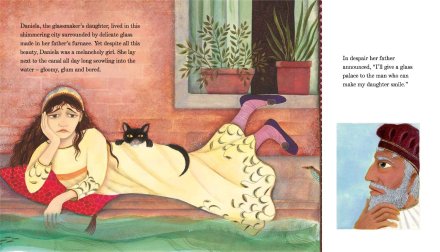
Have you heard about the wondrous city built on water? “Its palaces floated like birds in nests on the the sea and its lamplight danced like fireflies across the ripples.” In one of these beautiful buildings lived Daniela, the glassmaker’s daughter. You might think that Daniela would be happy to be surrounded by so much loveliness, but instead she spent her days staring glumly into the canal. Her father, wanting his daughter to be happy, offered a glass palace to the person who could make his daughter smile.”

celebrate-picture-books-picture-book-review-the glassmaker's-daughter-venice

Image copyright Jane Ray, 2017, text copyright Dianne Hofmeyr. Courtesy of Frances Lincoln Children’s Books.

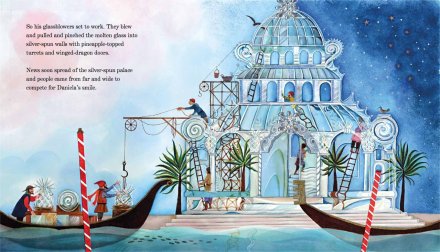
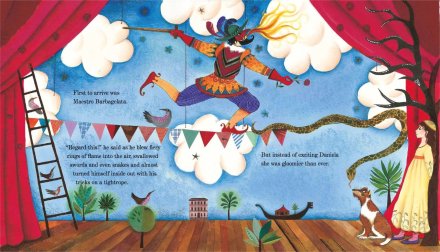
Right away he had his glassmakers begin construction. “They blew and pulled and pinched the molten glass into sliver-spun walls with pineapple-topped turrets and winged-dragon doors.” Soon people where coming from all over to try to make Daniela smile. First was Maestro Barbagelata, who could breathe fire, swallow swords and snakes, and do tricks on a tightrope. But his performance just made Daniela “gloomier than ever.”

celebrate-picture-books-picture-book-review-the glassmaker's-daughter-glum

Image copyright Jane Ray, 2017, text copyright Dianne Hofmeyr. Courtesy of Frances Lincoln Children’s Books.

Next the mask maker Donna Violetta Rufina Zangara arrived with a carriage full of masks made with jewels, birds’ eggs, shells and pearls, and peacock feathers. But Daniela was not enticed by these masks; in fact, they made her “glummer than ever.” Leonardo Leonino Grandi brought his fierce lion, which instead of amazing Daniela caused Leonardo to topple from his gondola into the water. “But even this didn’t bring a smile to Daniela’s lips.”

So many tradespeople, performers, tricksters, and adventurers were sure that they could make Daniella smile, but none of them succeeded. Daniela’s father was at a loss. But down in a corner of the glassmaker’s workshop Angelo thought he knew just what to do. He “longed more than anyone to make Daniela smile.” As he removed the hot glass from the furnace and began blowing it, he whispered, “‘Flux and fire.’” As he laid the glass flat and spread slivers of silver mercury on the surface, he chanted, “‘Mercury and tin,’” As he smoothed the slivers, he said, “‘Foiled and finished. And polished thin,’” When he finished “he sang his secret song again.”

celebrate-picture-books-picture-book-review-the glassmaker's-daughter-glass-palace

Image copyright Jane Ray, 2017, text copyright Dianne Hofmeyr. Courtesy of Frances Lincoln Children’s Books.

The other glassmakers scoffed when Angelo told them he was making something that would make Daniela smile. But with his gift carefully wrapped, Angelo went in search of Daniela. When he found her and she saw the glass in his hand, she rejected his gift. But Angelo told her to “‘Look again, Principessa. This is no ordinary piece of glass. It’s different. Look into it.”

Daniela did as she was told, and when Angelo asked her what she saw, Daniela described “a creature with a mouth like an upside-down slice of lemon and the eyes of a cross dragon.” She thought it was the funniest face she had ever seen. And right before her eyes, the face changed. The lips turned up and the eyes began to shine. “Daniela burst out laughing.” As she laughed, the newly made glass palace began to splinter and crack until the “entire palace fell to smithereens.”

celebrate-picture-books-picture-book-review-the glassmaker's-daughter-sword-swallower

Image copyright Jane Ray, 2017, text copyright Dianne Hofmeyr. Courtesy of Frances Lincoln Children’s Books.

Daniela’s father promised to build Angelo another palace if he would only tell him how his “magic glass” had made his daughter smile. But Angelo told him that Daniela had changed herself. “‘My glass only reflects what’s already there,’” he said. “‘Happiness is inside all of us. You only have to discover it.’” Daniela agreed, and laughed once more as she peered into the glass. The sound of her laughter set every bell in the city ringing. Men, women, and children began to laugh with her. They danced and played. Even the Grand Doge emerged from his palace to join in the celebration.

So if you hear the bells of Venice ringing, you know that Daniela is laughing, and if you “peep into a looking glass,” you will most likely see a smile on your face too.

A brief and fascinating history of glassmaking and mirror making precedes the story.

celebrate-picture-books-picture-book-review-the glassmaker's-daughter-mask-maker

celebrate-picture-books-picture-book-review-the glassmaker’s-daughter-sword-swallower

Written in the style of classic fairy tales, Dianne Hofmeyr’s story has a very contemporary message—one that is a timely reminder and allows young readers to embrace their power to determine their own happiness. Children may smile at the various attempts to please Daniela, but they—like Angelo—will also appreciate and understand that Daniela was searching not for outward but inward happiness all along.  

Jane Ray’s lush illustrations mirror the colors and atmosphere of Venice, as the performers don carnival masks and costumes, gondolas are poled along the canals, and the dark glassmaker’s workshop glows with molten glass. The delicate and lovely glass palace depicted at the beginning of the story shatters into shimmering shards in a two-page spread which makes dazzling use of iridescent paper accents. This stunning image is a beautiful metaphor for Daniela’s warmth breaking through her seemingly cold and fragile exterior when she finally smiles and laughs.

Ages 4 – 8

Frances Lincoln Children’s Books, 2017 | ISBN 978-1847806765

Discover more about Dianne Hofmeyr and her books on her website

Learn more about Jane Ray, her books, and her art on her website.

Read a New Book Activity

celebrate-picture-books-picture-book-review-I-love-to-read-coloring-page

I Love to Read Coloring Page


If you love books as much as this little bookworm, you’ll like coloring this printable I Love to Read Coloring Page!

Picture Book Review
December 15 – It’s Universal Human Rights Month

celebrate-picture-books-picture-book-review-school-days-around-the-world-cover

About the Holiday

December is Human Rights Month, an observance established by the United Nations in order to raise awareness of, promote, and protect the equality of the world’s citizens. Following World War II the United Nations General Assembly put forth thirty articles covering rights of education, freedom, health, and more. These articles serve to protect people in times of war and peace to help ensure that all people around the world are allowed to live in freedom and safety. It takes vigilance, compassion, dedication, and determination, but achieving the goal of equal human rights is a responsibility we all share.

School Days Around the World

Written by Margriet Ruurs | Illustrated by Alice Feagan


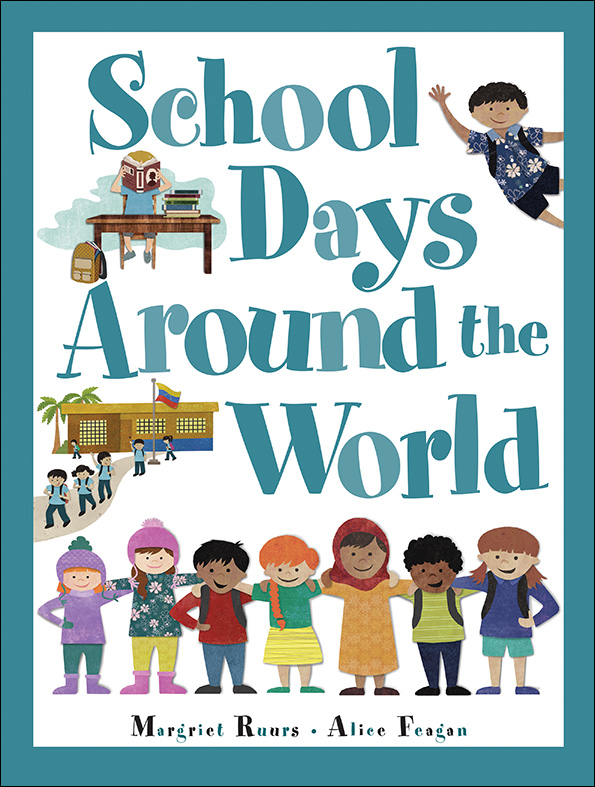
Every day millions of children around the world go to school, but schools can vary from place to place. Some classes are held in large buildings with libraries, science labs, and computer rooms while others gather in small buildings or even outside. “Schools around the world may be very different, but children everywhere like to have friends and learn new things.” In School Days Around the World, readers meet children from thirteen countries to learn what their educational day is like.

celebrate-picture-books-picture-book-review-school-days-around-the-world-violin.jpg

Image copyright Alice Feagan, 2015, text copyright Margriet Ruurs, 2015. Courtesy of Kids Can Press.

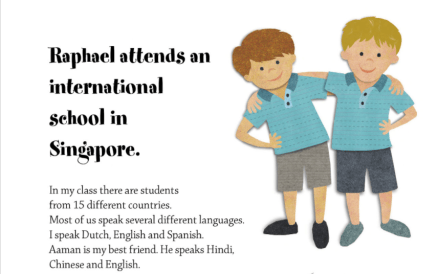
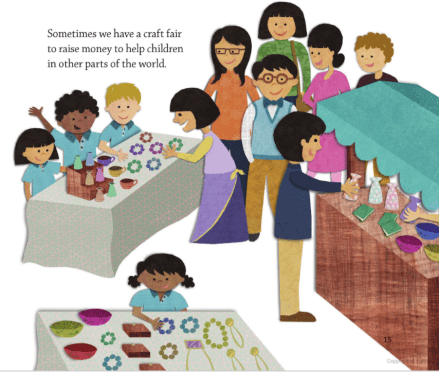
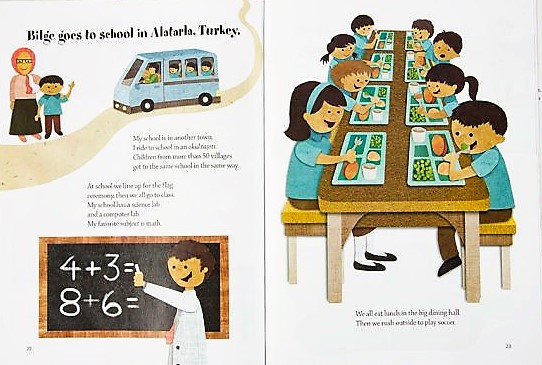
First, children meet Tamatoa, who attends school on Rarotonga, one of the Cook Islands in the South Pacific. Tamatoa arrives to school on a scooter just as the “thang-Thong-thang! of the wooden slit drum calls students inside. Tamatoa’s teacher is wearing flowers in her hair as she does every day. She teaches the children their Ura language, and in the afternoon they dance the hupa, the island’s traditional dance. In Singapore Raphael goes to an international school where the students speak many languages. Raphael knows Dutch, English, and Spanish. His best friend Aamon speaks Hindi, Chinese, and English. Raphael likes to read and write stories on the computer. Sometimes they “have a craft fair to raise money to help children in other parts of the world.”

celebrate-picture-books-picture-book-review-school-days-around-the-world-international-school

Image copyright Alice Feagan, 2015, text copyright Margriet Ruurs, 2015. Courtesy of Kids Can Press.

Marta walks to her school in Azezo, Ethiopi, even though she is blind. Her friend Ayana holds her hand tightly to help “her around potholes and cow patties.” There are so many students that there are two different sessions. Marta goes in the morning with 500 other children. There are 70 students in her class. They learn Amharic and about Ethiopia. At noon Ayana and Marta “hurry home to help feed the ox and cow and to fetch water from the village well.”

celebrate-picture-books-picture-book-review-school-days-around-the-world-china

Image copyright Alice Feagan, 2015, text copyright Margriet Ruurs, 2015. Courtesy of Kids Can Press.

Camilla is from Germany. Her older brother Johannes lives at a boarding school during the school year. He shares his room in an old stone house with three boys. Everyone eats together and cleans up afterward—just like in a family. In class he learns “about nature and science. They also learn how to sail.” Camilla can’t wait until it’s her turn to go to school.

If you visited Annika at school in Copenhagan, Denmark, you would probably spend most of the day outside. Some days the students take a bus to their forest school. There the “run and climb on an old boat.” They “play on swings and with a ball.” Outside they also listen to birds and learn about plants and insects and other parts of nature.

celebrate-picture-books-picture-book-review-school-days-around-the-world-craft-fair

Image copyright Alice Feagan, 2015, text copyright Margriet Ruurs, 2015. Courtesy of Kids Can Press.

While Annika enjoys spending cold days outside, Ana’s days are usually warm. She lives in San Luis, Honduras and walks an hour from her home in the hills to her new school. Inside, two teachers show the children how to read and write. Sometimes, Ana says, “a nurse visits our school. She teaches us how to brush our teeth and stay healthy.” One day a van delivers backpacks full of school supplies, books, and even running shoes.

In Alberta Canada, Shanika goes to a First Nations school where she learns her traditional Cree language along with math and language arts. After lunch, they hear stories, and elders teach them “powwow dances, drumming and how to raise a teepee. They also hold feasts where there are prayers, and the whole community shares tea, soup, bannock loaded with beans and cheese, and berries.

celebrate-picture-books-picture-book-review-school-days-around-the-world-turkey

You can also spend school days with Lu in China, Alina in Kazakhstan, Mathii in Kenya, Bilge in Turkey, Luciano in Venezuela, and Amy and Gwen in Alaska, USA.

 In her short, engaging stories based on the lives of real families, Margriet Ruurs takes readers globe-trotting with new friends to show readers a typical school day in cities big and small. The details of each child’s experience—both familiar and unique—help readers learn more about their peers, promoting greater empathy and understanding now and for a better future.

celebrate-picture-books-picture-book-review-school-days-around-the-world-dancing

Image copyright Alice Feagan, 2015, text copyright Margriet Ruurs, 2015. Courtesy of Kids Can Press.

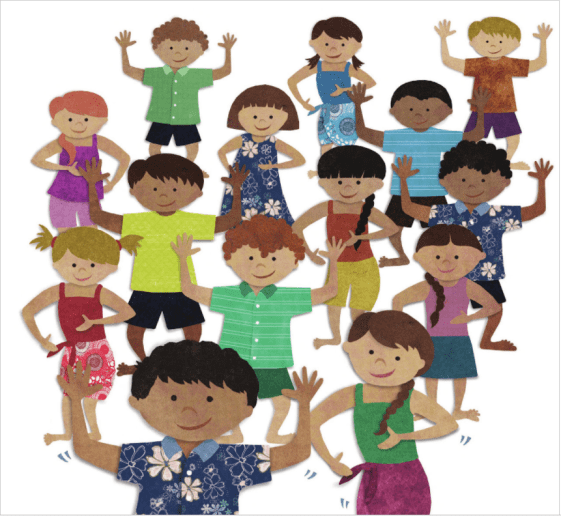
Alice Feagan’s cut paper collages are full of joy and personality as kids dance, play, read, and study together. While the students’ clothing, lunches, and school buildings may differ from country to country, readers will see that the enthusiasm to learn is universal. A world map at the beginning of the book points out where each featured child lives.

A discussion following the text gives teachers, homeschoolers, and individuals tips on using the book to expand on the stories told. A glossary provides definitions and a pronunciation key for the native words found throughout the book. School Days Around the World offers a wonderful opportunity to jumpstart lessons on world customs and geography.

Ages  3 – 8

Kids Can Press, 2015 | ISBN 978-1771380478

Discover more about Margriet Ruurs and her books as well as activities for teachers and readers on her website!

You’ll find more about Alice Feagan and a portfolio of her illustration work on her website!

Universal Human Rights Month Activity

celebrate-picture-books-picture-book-review-human-rights-month-coloring-page

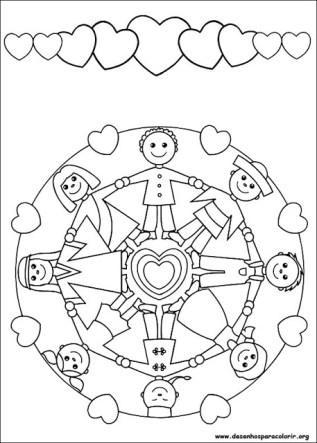
Friends Around the World Coloring Page


Having friends from all over the world is fun! Grab your colored pencils or crayons and enjoy this printable Friends Around the World Coloring Page!

Picture Book Review

December 14 – Monkey Day

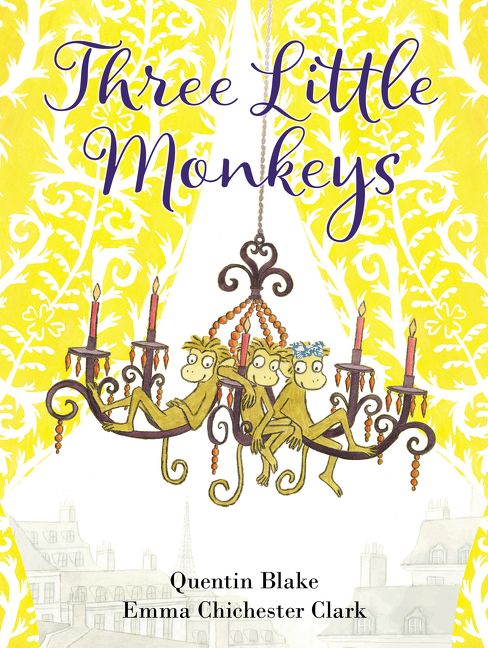
celebrate-picture-books-picture-book-review-three-little-monkeys-cover

About the Holiday

Today’s holiday actually got started with some monkeying around by art students at Michigan State University when Casey Sorrow wrote “Monkey Day” on this date on his roommate’s calendar. The idea sparked a real celebration with other art students and later became popularized through a comic strip that Sorrow and a friend published. Since then Monkey Day has become an international opportunity to raise awareness of primates and the dangers facing them. To celebrate today’s holiday, learn more about these mischievous animals, visit a zoo, or have a little fun in honor of these favorite animals!

Three Little Monkeys

Written by Quentin Blake | Illustrated by Emma Chichester Clark


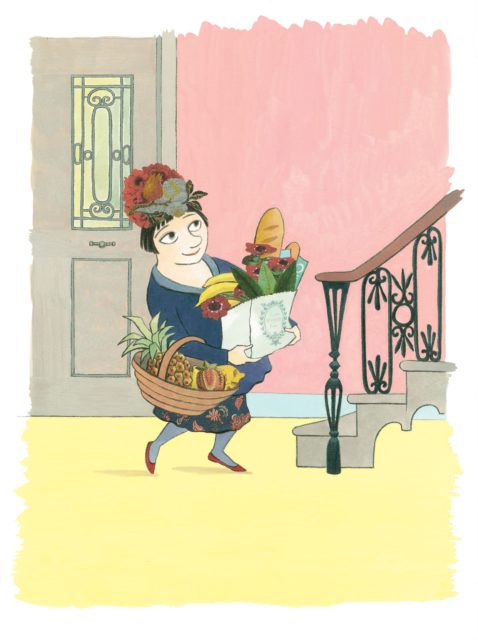
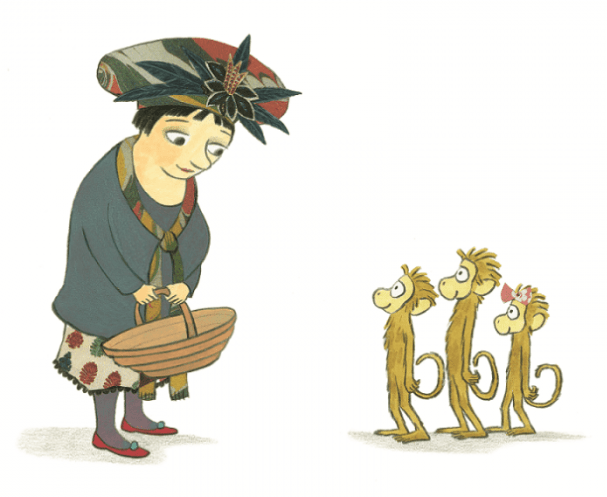
Whenever Hilda Snibbs came home, the first thing she did was call out “‘I’m home! Where are you?’” You  might think she was talking to her kids, her dog, or her cat, but she was actually addressing her three little monkeys whose “names were Tim and Sam and Lulu.” Hilda was sure to give them healthy snacks because “they were very lively.”

celebrate-picture-books-picture-book-review-three-little-monkeys-snack

Copyright Emma Chichester Clark, 2016, courtesy of HarperCollins.

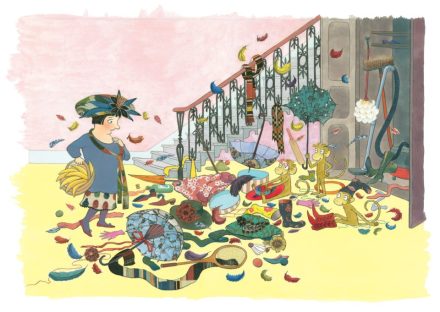
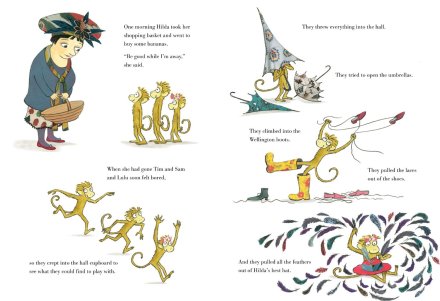
One day when Hilda went to the grocery store, the monkeys grew bored. They opened the hall closet and “threw everything into the hall.” They opened the umbrellas, tore the laces from all the shoes, and plucked all the feathers from Hilda’s favorite hat. When Hilda came home and saw the mess she had one thing to say: “‘I’m really very disappointed in such naughty little monkeys.” Tim, Sam, and Lulu just gazed at her silently.

celebrate-picture-books-picture-book-review-three-little-monkeys-hall

Image copyright Emma Chichester Clark, 2016, text copyright Quentin Blake, 2016. Courtesy of HarperCollins.

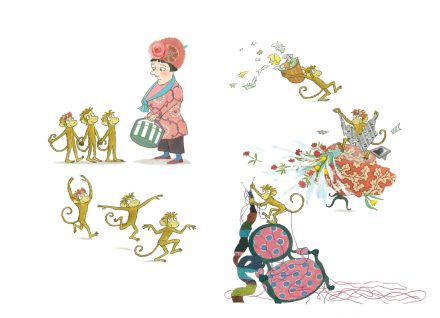
The next day Hilda went to the hat store. Before she left she told her little monkeys to be good. But as soon as she was out the door, they hurried to the living room to play. They upended the wastebasket, spilled the flower vase, tore the newspapers, and tangled Hilda’s knitting into knots. “When Hilda came home and went into the living room she found the most awful mess. There were flowers all over the place. And her poor knitting!” She admonished the little monkeys, but they just “looked at her with their big round eyes and said nothing.”

celebrate-picture-books-picture-book-review-three-little-monkeys-living-room

Copyright Emma Chichester Clark, 2016, courtesy of HarperCollins.

Needing more wool, Hilda headed into town the next day with a reminder to her monkeys to be good while she was away. But the kitchen was so enticing, and they tossed everything out of the cupboards, scattered the powdered soap, emptied the trashcan, and tipped the soup pan onto the floor. This time when Hilda got home, she became angry. “‘Great grief! How long can I put up with these terrible little monkeys?’” But Tim, Sam, and Lulu just smiled at her.

celebrate-picture-books-picture-book-review-three-little-monkeys-kitchen

Copyright Emma Chichester Clark, 2016, courtesy of HarperCollins.

The next day was market day again and once again the monkeys grew bored as soon as Hilda was gone. The bathroom was a perfect playroom with its toilet paper to unroll, toothpaste tube to squeeze, and shampoo to splash around. Hilda nearly tore her hair out when she returned to this mayhem. As she stared at her monkeys wrapped in toilet paper and sporting sudsy costumes, she cried, “‘Oh, for a peaceful life without these wicked little monkeys!’”

celebrate-picture-books-picture-book-review-three-little-monkeys-closet

Copyright Emma Chichester Clark, 2016, courtesy of HarperCollins.

Before going out the next morning, Hilda gave Tim, Sam, and Lulu a stern talking to. It was late when she returned and as she stepped through the door something seemed amiss. The living room was in perfect order, the kitchen was spotless, and the bathroom shone. Hilda broke down in tears. Something horrible must have happened to her three little monkeys. Her handkerchief was soaked through, and when she went to the closet to get a new one, she found Tim, Sam, and Lulu waiting quietly for her.

Hilda hugged them all and “that night…went up the stairs to bed with a happy heart.” As she got under the covers, she found herself lying on all her forks, spoons, and cans of sardines. “But that is the kind of thing you have to expect if you have three little monkeys.”

celebrate-picture-books-picture-book-review-three-little-monkeys-coming-home

Copyright Emma Chichester Clark, 2016, courtesy of HarperCollins.

Quentin Blake’s hilarious tale of three little monkeys has all the charm and style of classic storytelling that will set young readers giggling and eagerly anticipating each of Hilda’s trips into town. Adults with “little monkeys” of their own will anticipate the tenderhearted ending, and children will be delighted with the assurance of enduring love Hilda’s tears provide. A dramatic reading of Hilda’s increasing frustration with her mischievous charges will enthrall listeners as they gaze at the reader with the same sweet expression as Tim, Sam, and Lulu.

celebrate-picture-books-picture-book-review-three-little-monkeys-gazing

Copyright Emma Chichester Clark, 2016, courtesy of HarperCollins.

Emma Chichester Clark’s sophistcated illustrations begin on the endpapers, where Hilda is leaving her elegant brownstone under the watchful gaze of her little monkeys. Tim, Sam, and Lulu are as cute as can be as they happily eat their snack and give a hint of the shenanigans to come. With each new day, the monkeys get into more and more trouble, leading to wonderful, fully detailed two-page masterpieces of the mayhem they cause. Hilda’s growing consternation is clear in her facial expressions and gestures. Kids will love Hilda’s collection of hats and matching outfits and scenes of her home. When Hilda comes home to a pristine house, the brightly colored pages turn as gray as a cloudy day. The sunny hues return with the discovery of her precious little ones, and the bedtime surprise is a delight.

Ages 4 – 8

HarperCollins, 2017 | ISBN 978-0062670670

Discover more about Quentin Blake, his books, and his illustration work on his website

To learn more about Emma Chichester Clark, her books, and her paintings, visit her website.

Monkey Day Activity

celebrate-picture-books-picture-book-review-types-of-monkeys-word-search

Just Monkeying Around! Word Search Puzzle


Monkeys are interesting and fun to watch! Can you find the names of twenty-one types of monkeys in this printable Just Monkeying Around! Word Search Puzzle? Here’s the Solution.

Picture Book Review
December 13 – National Day of the Horse

celebrate-picture-books-picture-book-review-thelma-the-unicorn-cover

About the Holiday

Today’s holiday encourages people to commemorate the importance of the horse to the history, culture, and economy of the United States. The domesticated horse that we know today was first introduced by Spanish Explorers. As the country grew, horses became indispensable for transportation, farm and ranch work, and communications. The more than nine million horses that now reside in America depend on people for adequate food, water, shelter, and protection. On this holiday, consider donating to a horse rescue shelter near you.

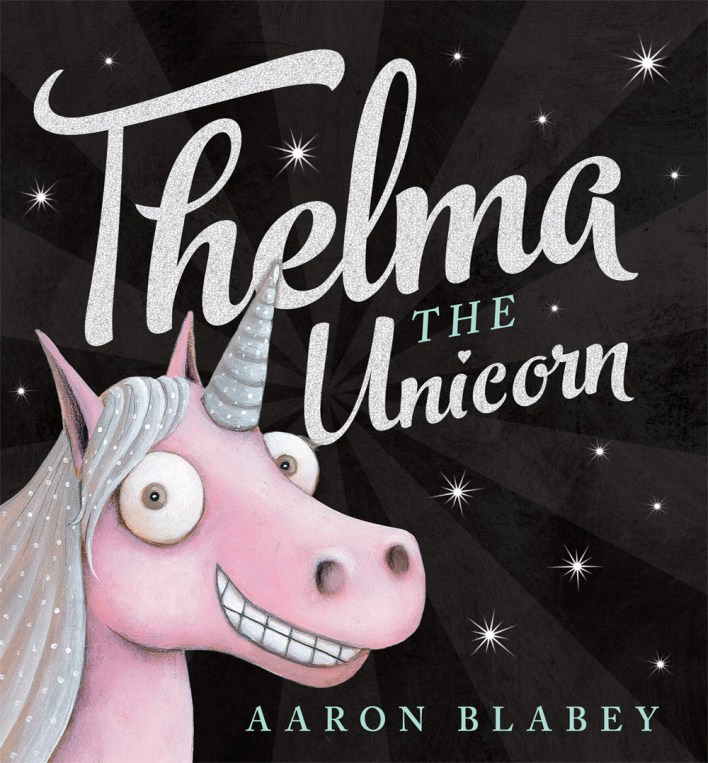
Thelma the Unicorn

By Aaron Blabey


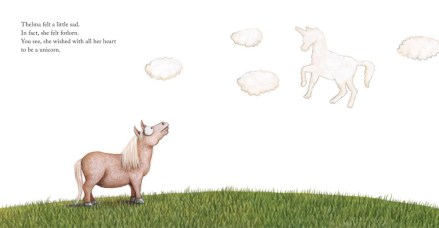
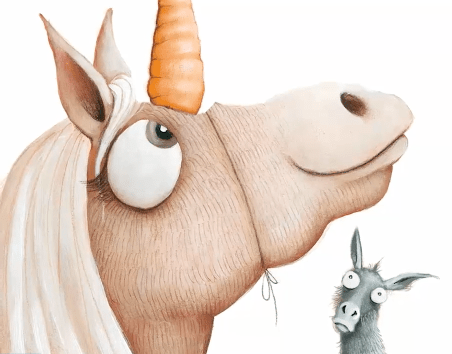
“Thelma felt a little sad. / In fact, she felt forlorn. / You see, she wished with all her heart / to be a unicorn.” Thelma was a little pony—brown and short and overlooked. Her best friend Otis told her, “‘You’re perfect as you are,’” but when Thelma compared herself to the sleek white mare on the farm, she said, “‘I’m not.’” Suddenly, she saw a carrot left over from dinner and had an idea.

celebrate-picture-books-picture-book-review-thelma-the-unicorn-wishing

Copyright Aaron Babey, 2017, courtesy of Scholastic Press.

She tied the carrot to her nose and told Otis, “‘I’ll say that I’m a unicorn! / It might just work… / who knows?’” At this very moment a truck driver passing by caught sight of this spectacle and careened off the side of the road. “As Thelma watched the swerving truck, / it very nearly hit her. / Would you believe that truck was filled / with nice pink paint and glitter?”

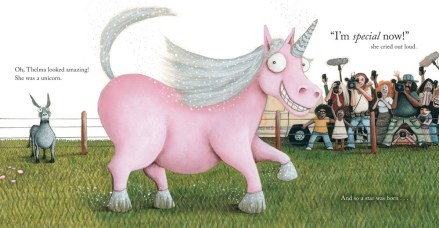
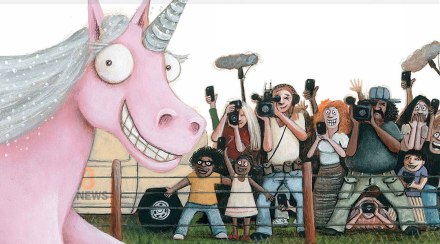
In the blink of an eye Thelma was doused in sparkles and had become what she always dreamed of. She was a unicorn and “special now!” Crowds lined up at the farm gate to see the pink unicorn. The media descended with their cameras and video recorders, and Thelma quickly became a world-wide phenomenon. Everywhere she went fans screamed her name, took pictures, waved signs, and wanted to be near her. She even got her hoofprint on the Walk of Fame.

celebrate-picture-books-picture-book-review-thelma-the-unicorn-becomes-unicorn

Copyright Aaron Babey, 2017, courtesy of Scholastic Press.

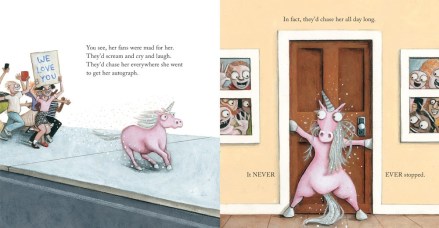
Thelma sailed to foreign ports on a ship named The Fairy Princess, attended by stewards who fulfilled her every wish. “But soon she found that so much fame / was kind of tricky, too….” Her fans mobbed her with crushing zeal, chased after her wherever she went, screamed, cried, laughed, and pointed whenever they saw her, and hounded her day and night for her autograph. “It NEVER EVER stopped.”

When Thelma asked “the screaming crowd” not to chase her anymore, they said “‘We’ll chase you all we want….We’re fans, so it’s allowed.’” Then there were there were the people who “were not her fans at all. / No, some were really mean. / And some just did the meanest things / she’d really ever seen.” Some threw eggs while she roller skated for charity and others held up signs reading “I don’t like unicorns” where she was sure to see them.

celebrate-picture-books-picture-book-review-thelma-the-unicorn-adoring-crowds

Copyright Aaron Babey, 2017, courtesy of Scholastic Press.

Back in her fancy hotel room, all alone and bedraggled, soaked in egg, and with her “horn” losing its luster, Thelma looked at a photo of Otis. “…she felt quite sad, / this famous little pony. / She said, ‘I thought that I’d feel great… / but all I feel is lonely.’” She decided to make a change. She washed off all the pink paint and sparkles and “ditched her magic horn.”

She left and “walked right past the crowd. / They didn’t even notice / She thought how nice that it would be…to see her lovely Otis.” As Thelma stood underneath a tree with Otis, “he asked about her trip.” “‘Oh, it was fun,’” she answered him, “‘But I’d rather be just me.’”

celebrate-picture-books-picture-book-review-thelma-the-unicorn-being-chased

Copyright Aaron Babey, 2017, courtesy of Scholastic Press.

Aaron Blabey’s cautionary tale of a pony who is granted her wish to be “more” than she is, deftly reveals the pitfalls of abandoning your true nature for what appears to be the perks of celebrity with a splash of humor and some no-nonsense honesty. Through Blabey’s smoothly flowing rhymes, readers see that being special is not based on a sparkly appearance that pleases false friends. Instead, each person is remarkable for their unique personalities and talents that true friends will appreciate.

Today’s social media-savvy children will recognize Blabey’s screaming crowds and overzealous fans and will come to understand, with Thelma, that being “in the pink” can be short-lived and glitter soon fades.

celebrate-picture-books-picture-book-review-thelma-the-unicorn-carrot-horn

Copyright Aaron Babey, 2017, courtesy of Scholastic Press.

Blabey’s distinctive illustrations portray Thelma’s transformation from “regular pony” to celebrity unicorn and back again with flair and all the bling that goes along with superstardom. The crowds are giddy, awed, obsessive, and adoring until the backlash starts, which Blabey portrays with candid examples. His final spreads in which Thelma goes unrecognized by her fans and is then lovingly welcomed back by Otis beautifully sum up the theme of the story.

Thelma the Unicorn provides readers and adults a wonderful opportunity to discuss the allure of changing oneself in order to fit in as well as the social media atmosphere that can be so influential in a child’s life. Blabey’s light touch coupled with his honesty makes Thelma the Unicorn a great choice for  home and classroom libraries.

Ages  3 – 7

Scholastic Press, 2017 | ISBN 978-1338158427

Scholastic Press sent me a free copy of Thelma the Unicorn to check out. All opinions are my own.

Discover more about Aaron Blabey, his books, and his art on his website

National Day of the Horse Activity

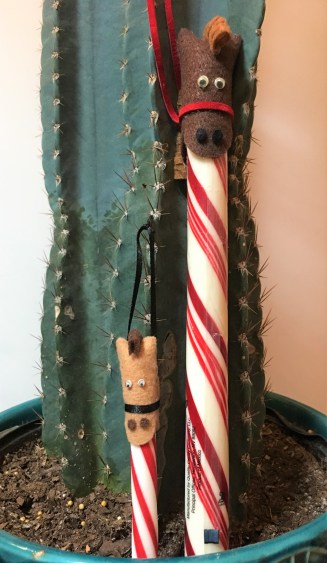
celebrate-picture-books-picture-book-review-horse-candy-stick-cover

Whoa! Candy Stick Cover


There’s no neigh-saying that this isn’t a cute way to give your favorite candy stick a bit of flair!  With a bit of felt and a few other supplies you can make this horse craft. Alternately, this craft can be used with a cardboard tube or wooden dowel.

Supplies

  • Large or small candy stick, cardboard tube or wooden dowel
  • Felt in whatever color you’d like for your horse
  • Felt in a another color for the mane
  • Black felt for the nostrils
  • Thin ribbon or leather lacing
  • Small googly eyes
  • Fabric glue or hot glue gun
  • Scissors
  • Tweezers

Directions

  1. Cut a piece of felt wide enough to wrap around the stick overlapping a little to glue together. It should be long enough to cover about 1 ½ inches of a small candy stick, about 2 ½ inches of a large candy stick, or about 3 to 4 inches of a cardboard tube or wooden dowel.
  2. Wrap the felt around the stick overlapping the edge about ¼ inch and leaving about ½ inch above the top of the stick.
  3. Glue the felt together along the overlapping edge to make a tube that fits the stick tightly

To make the ears

  1. Push down on the center of the back side of the felt that rises above the top of the stick
  2. Apply a drop of glue
  3. Push the center of the front edge of the felt into the glue
  4. The ears will stick up on the sides of the head

To make the horse’s nose and mouth

  1. Remove the felt head from the stick
  2. Pinch the end together
  3. Starting about ½ inch from the bottom, round the corners of the felt tube with the scissors

To make the nostrils

  1. Cut small circles from the black felt
  2. Glue them to the bottom of the horse’s nose
  3. Glue the googly eyes on the horse’s face

To make the mane

  1. Cut a strip of felt as long as the face by 1 inch wide for a large candy stick; about ¾ inch wide for a small candy stick
  2. Fold the felt in half lengthwise
  3. Glue the edges of the felt together, leaving the top unglued
  4. Snip fringe along the length of the felt
  5. Cut a small curve in the bottom of one end of the length of felt so it will fit over the top of the horse’s head
  6. Glue the rest of the length of felt down the back of the horse’s head

To add the reins

  1. Cut a length of narrow ribbon or leather lacing about 6 inches long
  2. Glue the center of the ribbon or lacing to the horse’s face above the nostrils at the level of the trimmed mouth around to the mane
  3. Tie the ends of the ribbon or lacing together

Picture Book Review
December 12 – It’s Cat Lovers Month

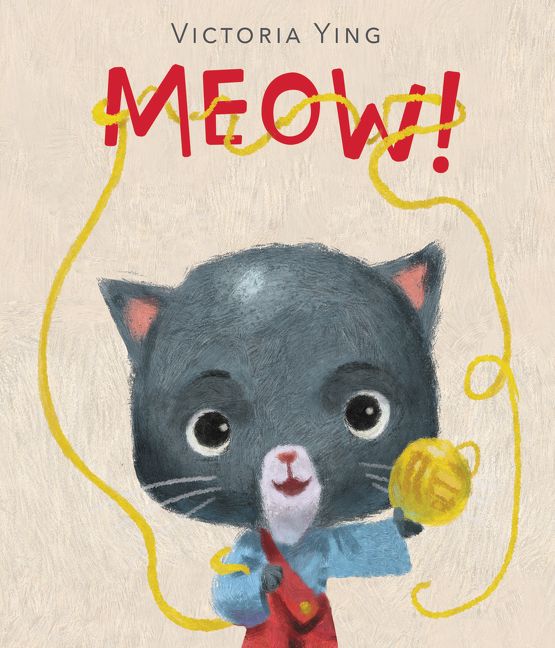
celebrate-picture-books-picture-book-review-meow!-victoria-ying-cover

About the Holiday

If you share a home with a cat, then you know how these furry friends can change your life. Whether you love them for their playful antics, for their companionship, or even for their independent spirit, your life just wouldn’t be the same without their daily presence. Cat Lovers Month is the perfect time to celebrate your cat or kitten with some extra attention and care. If you’re considering adopting a cat, visit your local animal shelter to give a cat a forever home.

Meow!

By Victoria Ying


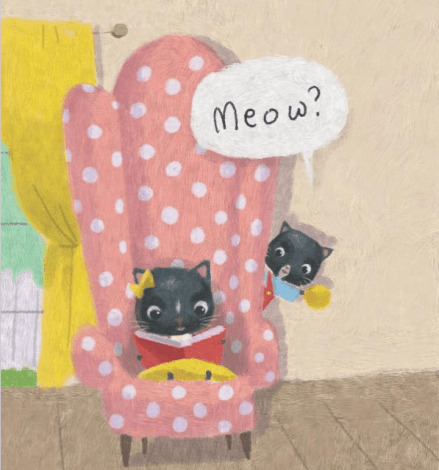
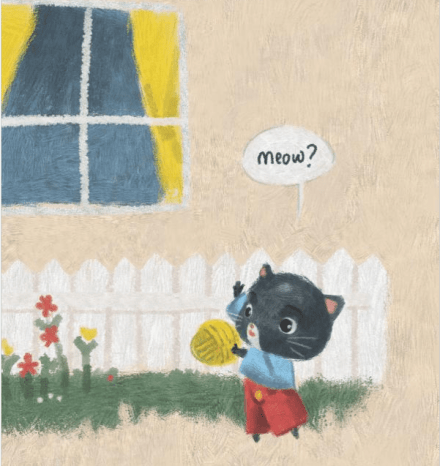
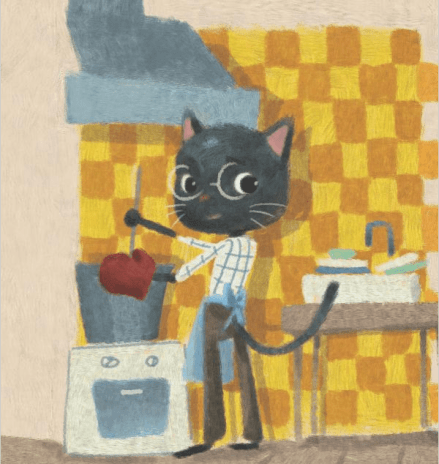
A little kitten finds his mom out in the garden planting seeds. He wants to play. “Meow?” he says, holding up a ball of yellow yarn. Next he tries his dad, who’s stirring up a big pot of something delicious on the stove. “Meow?” the little tyke asks.  Everyone seems busy in this house as the kitten’s sister ignores him while she reads her book in the tall-backed, polka dotted chair.

celebrate-picture-books-picture-book-review-meow-victoria-ying-garden

Copyright Victoria Ying, 2017, courtesy of HarperCollins.

“Mrreow…,” the disappointed kitten says. He begins to unwind the ball of yarn. If no one will play with him, he will show everyone how much fun they are missing (and maybe how upset he is too). Trailing yarn behind him, the kitten winds his way through the sitting room and around his sister’s chair, tangling yarn over the chandelier, around the flower in its vase, and around the little table it sits on.

celebrate-picture-books-picture-book-review-meow-victoria-ying-dad

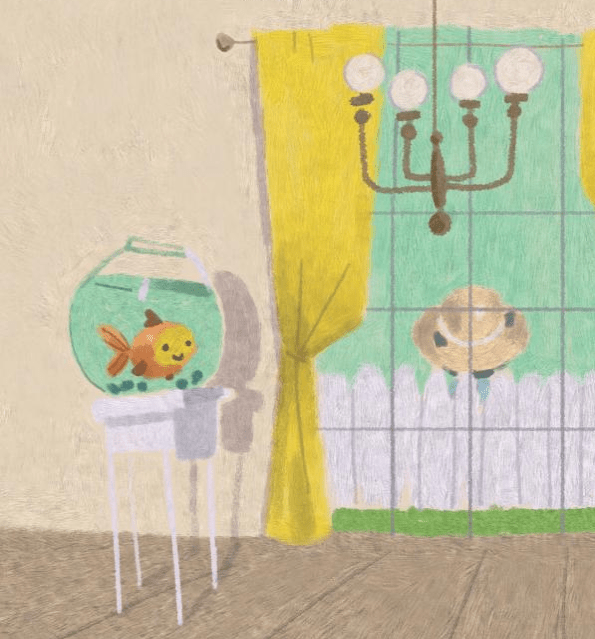
He nearly trips his dad as he carries a plate of snacks across the kitchen and then weaves in and out among the rows of flowers where his mom is working. “Meow!” But when he lassos and nearly knocks over the fishbowl with a loud “MEOOOW!!” everyone comes running. Mom and dad seat their little one in the time-out chair and give him a joint talking to: “Meow!!”

celebrate-picture-books-picture-book-review-meow-victoria-ying-reading

Copyright Victoria Ying, 2017, courtesy of HarperCollins.

The little guy didn’t mean to cause trouble. Are his parents really mad at him? What can he do? “meow…?” He really is sorry, “meow.” Dad and Mom understand. Dad hands his son a yellow cloth to clean up. The kitten mops up the spilled fishbowl water and begins rewinding his ball of yarn. His sister holds the tall chair as he reaches to remove the strings from the chandelier.

Mom lets her son help in the garden, and Dad shows him how to bake and decorate special mouse cookies, “meow!” Big sister scoots over and makes room for her brother in her chair and reads to him. “Meow!” Later the whole family enjoys the cookies and plays Cat’s Cradle with the yarn. After that it’s bath time and teeth-brushing time. Then with kisses and sweet dream wishes—“Meow. Meow…”—it’s bedtime. “purrrrr…”

celebrate-picture-books-picture-book-review-meow!-victoria-ying-cats-cradle

Copyright Victoria Ying, 2017, courtesy of HarperCollins.

Nearly wordless picture books don’t come much more adorable and full of emotion than Victoria Ying’s Meow! With only one syllable and well-placed punctuation, Ying presents the rollercoaster of emotion that little ones can feel when disappointed. Ying’s gauzy, textured illustrations are bright and inviting, and the facial expressions of each character perfectly portray the meaning behind their looks and meows—from hopeful and listening to surprised and frustrated to anger, reconciliation, and resolution.

Images of the family taking time to play with the littlest one are heartwarming and demonstrate a touching solution for restoring household harmony while showing children that they are loved and important.

celebrate-picture-books-picture-book-review-meow-victoria-ying-fish

Copyright Victoria Ying, 2017, courtesy of HarperCollins.

Meow! is a sweet and meaningful story that even the youngest readers will understand and appreciate. A dramatic reading of the various emotions involved in each “meow” as well as a bit of discussion and an invitation for little ones to read along can promote empathy and give children a voice for those feelings that are sometimes so hard to describe. Meow! would be a welcome addition to home and classroom bookshelves.

Ages 3 – 8

HarperCollins, 2017 | ISBN 978-0062440969

Discover more about Victoria Ying, her books, and her art on her website.

Cat Lovers Month Activity

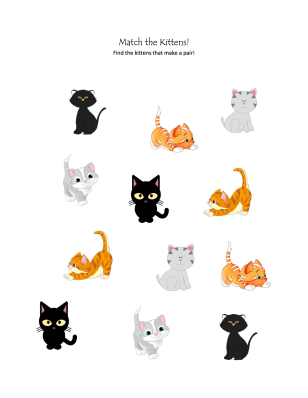
celebrate-picture-books-picture-book-review-cat-match-puzzle

Match the Kittens Puzzle


These playful kittens have gotten separated from their twin. Can you match them up again in this printable Match the Kitten Puzzle?

Picture Book Review

December 11 – It’s Write a Friend Month

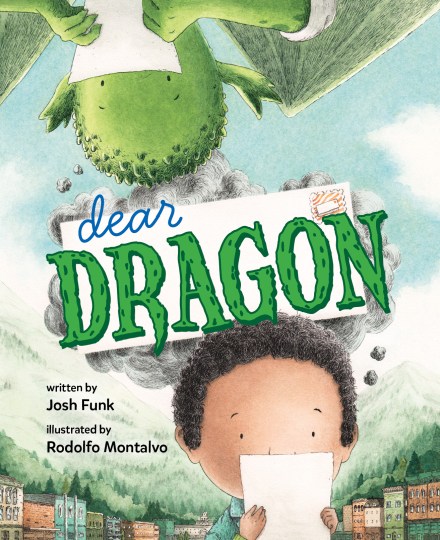
celebrate-picture-books-picture-book-review-dear-dragon-cover

About the Holiday

During the month of December people like to reach out to friends near and far and share the events of the past year. Write a Friend Month commemorates such communication and encourages writers to pick up a pen and paper and send a “real letter” full of intriguing details that inspire a response. Finding a letter or card in the mailbox still makes people smile. So, why not take a little time this month to write a letter to your friends?

Dear Dragon: A Pen Pal Tale

Written by Josh Funk | Illustrated by Rodolfo Montalvo


In a bit of cross-curriculum creativity, the teachers in two distinct school districts have combined the annual poetry units and pen pal projects. Not only do the kids get to make new friends, they must write their letters in rhyme. George Slair has been matched up with Blaise Dragomir. What George doesn’t know—but readers do—is that Blaise is a dragon; and what Blaise doesn’t know—but readers do—is that George is a boy.
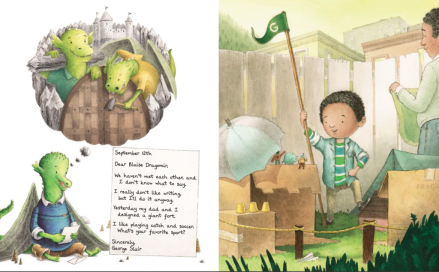
In his first missive, George begins boldly and honestly: “Dear Blaise Dragomir, / We haven’t met each other, and I don’t know what to say. / I really don’t like writing, but I’ll do it anyway. / Yesterday my dad and I designed a giant fort. / I like playing catch and soccer. What’s your favorite sport? / Sincerely, George Slair”
celebrate-picture-books-picture-book-review-dear-dragon-castle

Image copyright Rodolfo Montalvo, 2016, text copyright Josh Funk, 2016. Courtesy of Viking Books for Young People.

As Blaise reads the letter he interprets George’s cardboard box, blanket, and umbrella fort as a medieval stone fortress with an iron gate and whittled-to-a-point log fencing. Blaise writes back: “Dear George Slair, / I also don’t like writing, but I’ll try it, I suppose. / A fort is like a castle, right? I love attacking those. / My favorite sport is skydiving. I jump near Falcor Peak. / Tomorrow is my birthday, but my party is next week. / Sincerely, Blaise Dragomir”

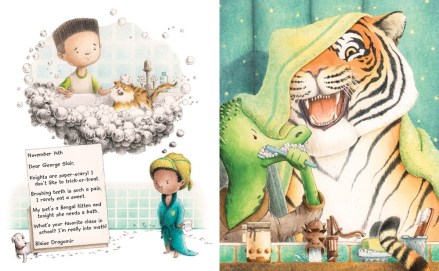
In his next letter, dated October 31, more earth-bound George tells Blaise that parachuting is awesome, that his dog destroyed his fort, and that he is trick-or-treating as a knight—a revelation to which Blaise has a visceral response. But what is scary to one pal is tame to the other. On November 14th Blaise relates: “Knights are super scary! I don’t like trick-or-treat. / Brushing teeth is such a pain, I rarely eat a sweet. / My pet’s a Bengal Kitten and tonight she needs a bath. / What’s your favorite class in school? I’m really into math!”

celebrate-picture-books-picture-book-review-dear-dragon-washing-kitten

Image copyright Rodolfo Montalvo, 2016, text copyright Josh Funk, 2016. Courtesy of Viking Books for Young People.

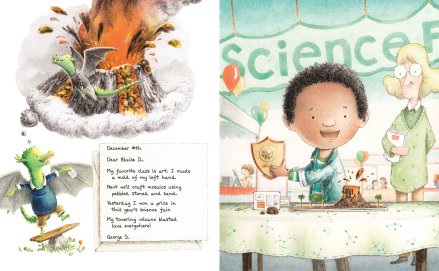
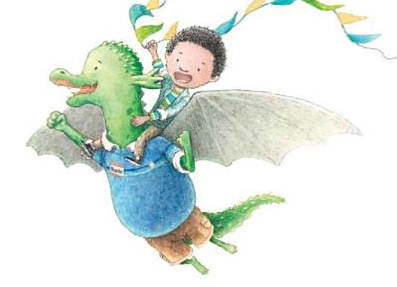
Reading December’s letter Blaise learns that George likes art and imagines George’s table-top volcano science project as a roaring, lava-spewing mountain. In January George is impressed to learn that Blaise’s father is a fire-breather. He conjures up images of a dad in a fancy, caped costume creating fire out of nothing while the truth is a lot more explosive. February brings word that there is a pen pal picnic planned for June, and in March Blaise tells George about a special outing with his dad: “Soon he’s gonna take me flying, once it’s really spring. / It’s such a rush to ride the air that flows from wing to wing.”

celebrate-picture-books-picture-book-review-dear-dragon-volcano

Image copyright Rodolfo Montalvo, 2016, text copyright Josh Funk, 2016. Courtesy of Viking Books for Young People.

Springtime also sees the two becoming better friends. The formal “Sincerely, George” or “Sincerely, Blaise” sign-off of the first letters has evolved into “Your friend”  as George expresses his wonder at Blaise’s parents: “Hi, Blaise! / Skydiving and flying? Wow, your parents rock! / I’m lucky if my father lets me bike around the block.” Then it appears that this project has been a success in all areas as George asks, “Once the school year’s over and this project is complete, / should we continue writing? ‘Cause it could be kind of neat….”

Blaise is all in. In his May letter, he writes, “Hey, George! / I’m psyched about the picnic and I can’t wait to attend. / Who’d have thought this pen pal thing would make me a new friend? / Writing more sounds awesome. I was gonna ask you, too! / I’ve never liked to write as much as when I write to you.”

celebrate-picture-books-picture-book-review-dear-dragon-sky-diving

Image copyright Rodolfo Montalvo, 2016, text copyright Josh Funk, 2016. Courtesy of Viking Books for Young People.

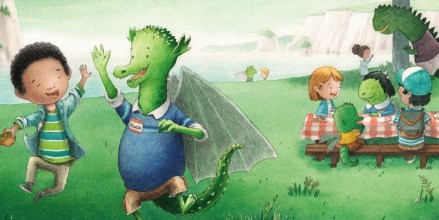
With a growing sense of anticipation, readers know that with a turn of the page June will come, and that June brings the long-awaited picnic. How will George and Blaise react when they see each other? As the kids approach the Pen Pal Picnic spot, their mouths hang open and their eyes grow wide. One even has his hands to his face. And as the dragons peek out from behind the trees, their mouths hang open and their eyes grow wide. One even has her hand to her face.

“‘Blaise?’” George ventures, as a slice of tomato drops from his hamburger. “‘George?’” Blaise presumes, although he wrings his tail. “‘My pen pal is a dragon?’”… “‘My pen pal is a human?’”

These two-page spreads say it all—or do they? Well, not quite…

Huge grins burst out as George and Blaise exchange high fives (and fours). The other kid- and-dragon pals are having a blast too! And the teachers? “‘Our plan was a success, my friend, or so it would appear!’ / ‘The Poetry and Pen Pal Project! Once again next year?’”

celebrate-picture-books-picture-book-review-dear-dragon-picnic

Image copyright Rodolfo Montalvo, 2016. Courtesy of Viking Books for Young People.

With his usual aplomb, Josh Funk charms with rhyme and reason in this clever tribute to friendship, diversity, and writing (on paper!). The letters between the two pen pals are endearingly kid-like, full of the subjects that are important in a child’s life, including pets, school, hobbies, and parents, which can be brilliantly open to interpretation—or misinterpretation. Blaise Dagomir and George Slair’s names are similarly inspired, and may introduce kids to the ancient legends of Saint George and the Dragon and the poem by Alfred Noyes, St George and the Dragon. Kids will enjoy seeing how George and Blaise’s friendship grows over the school year, evidenced in the openings and closings of their letters. The letters are a joy to read aloud as the rhymes swoop and flow as easily as Blaise soars through the air.

celebrate-picture-books-picture-book-review-dear-dragon-flying

Following the alternating sequence of the letters, Rodolfo Montalvo depicts each pen pal’s perception of the message along with the reality in his illustrations that are—as George exclaims—“as awesome as it gets.” Both characters are sweet and earnest, and while surprised by what they think the other’s life is like, happily supportive. The full-bleed pages and vibrant colors dazzle with excitement and humor and ingenious details. Kids will love the juxtaposition of George’s idea of Blaise’s Bengal “kitten” and the reality of a nearly full-grown tiger. The two views of fire-breathing will also bring a laugh, and readers will enjoy picking out features of the two homes. The final spreads build suspense as to how George and Blaise will react to each other, and the resolution is a delight.

One striking aspect of both the text and the illustrations is the similarity between the two pen pals. While their activities and experiences may be on different scales, they are comparable and understandable to each child. Likewise, everywhere in the paintings, Montalvo uses complementary colors to unite George and Blaise. This cohesiveness beautifully represents the theme of inclusiveness.

The fun dual-meaning rhymes and endearing illustrations make Dear Dragon: A Pen Pal Tale a must for kids’ (and dragon’s) bookshelves.

Ages 4 – 9

Viking Books for Young Readers, 2016 | ISBN 978-0451472304

From more books to activities for kids, there’s so much to see and do on Josh Funk’s website!

Discover the world of Rodolfo Montalvo’s books and artwork on his website!

Dear Reader, check out this blazing hot Dear Dragon book trailer!

Write a Friend Month Activity

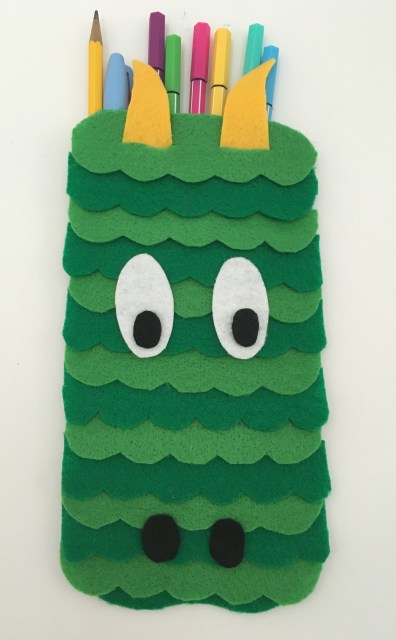
celebrate-picture-books-picture-book-review-dragon-pencil-case-front-eyes-down

Dependable Dragon Pencil Case


U-knight-ing all your pens, pencils, and other supplies in this Dependable Dragon Pencil Case will fire up your imagination! Have a blast making this fun craft!

Supplies      

  • Printable Dragon Pencil Case Template – Wings | Face
  • Sheets of felt, 8 ½-inch by 11-inch
  • 2 Dark green
  • 1 Light green
  • 1 white
  • 1 black
  • 1 yellow
  • 1 purple
  • Fabric Glue
  • Glitter glue or Fabric paint (optional)
  • Scissors
  • Velcro
  • Green Thread (optional if you would like to sew instead of glue your case)
  • Needle (optional, needed if sewing)

Directions

  1. Print the Dragon Templates
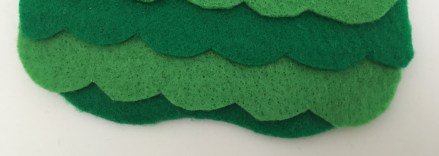
  2. Cut out alternating rows of scales from the dark and light green felt (7 each). For one row, cut a rounded top (instead of straight across) to make the top of the head (see picture). (One row of scales is longer so you can tile them. You will trim them later: see the double row of scales on the template for how the scales should look)
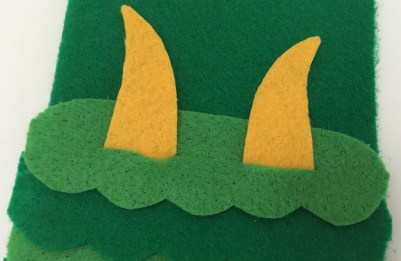
  3. Cut the eyes from the white felt, pupils and nostrils from the black felt, horns from the yellow felt, and wings from the purple felt. Set aside.

celebrate-picture-books-picture-book-review-dragon-pencil-case-top-of-head

To make the head

  1. Fold one dark piece of felt in half lengthwise
  2. Cut a wavy line along the bottom of the felt to make lips (see picture)
  3. Glue a ½-inch-wide strip along open side and along bottom (or you can sew it)

celebrate-picture-books-picture-book-review-dragon-pencil-case-bottom-snout

To add the scales

  1. Starting at the bottom, lay on row of scales a little above the wavy bottom. Glue the top to the base.
  2. Overlap an alternating green row of scales on the first row, glue the top
  3. Continue alternating dark and light green scales until you reach 9 inches
  4. Use the rounded row of scales for the top of the head (see how to insert horns before attaching top of head)

To insert the horns

  1. On the rounded row of scales, mark where you want the horns to be
  2. Cut two small slices in the felt where the horns will go
  3. Insert the bottoms of the horns into the slits

To finish the head

  1. Glue the top of the head to the base
  2. Trim any longer rows of scales to meet the edges of the base
  3. Add the eyes and nostrils to the face

To make the closure for the case

  1. Cut the base following the line of the rounded row of scales
  2. Glue or sew strips of Velcro along the inside edges

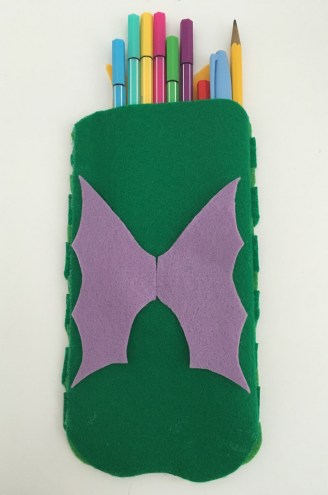
To attach the wings

  1. Turn the dragon case to the back
  2. Glue or sew the wings to the center of the back, attaching them at the center edge
  3. Outline the wings in glitter glue (optional)

celebrate-picture-books-picture-book-review-dragon-pencil-case-back

Picture Book Review