If you live in the Northern Hemisphere, fall has arrived! If you live in the Southern Hemisphere, welcome to spring! Today, the hours of daytime and nighttime will be equal, ushering in a changing of the seasons. For some that means cooler weather, shorter days, and preparation in nature for the long winter, which leads to our seeing the brilliant reds, yellows, and oranges in the leaves of certain trees. Watching the leaves fall, swirl in the breeze, and pile up in backyards can only mean that a favorite autumn activity is just a leap away!
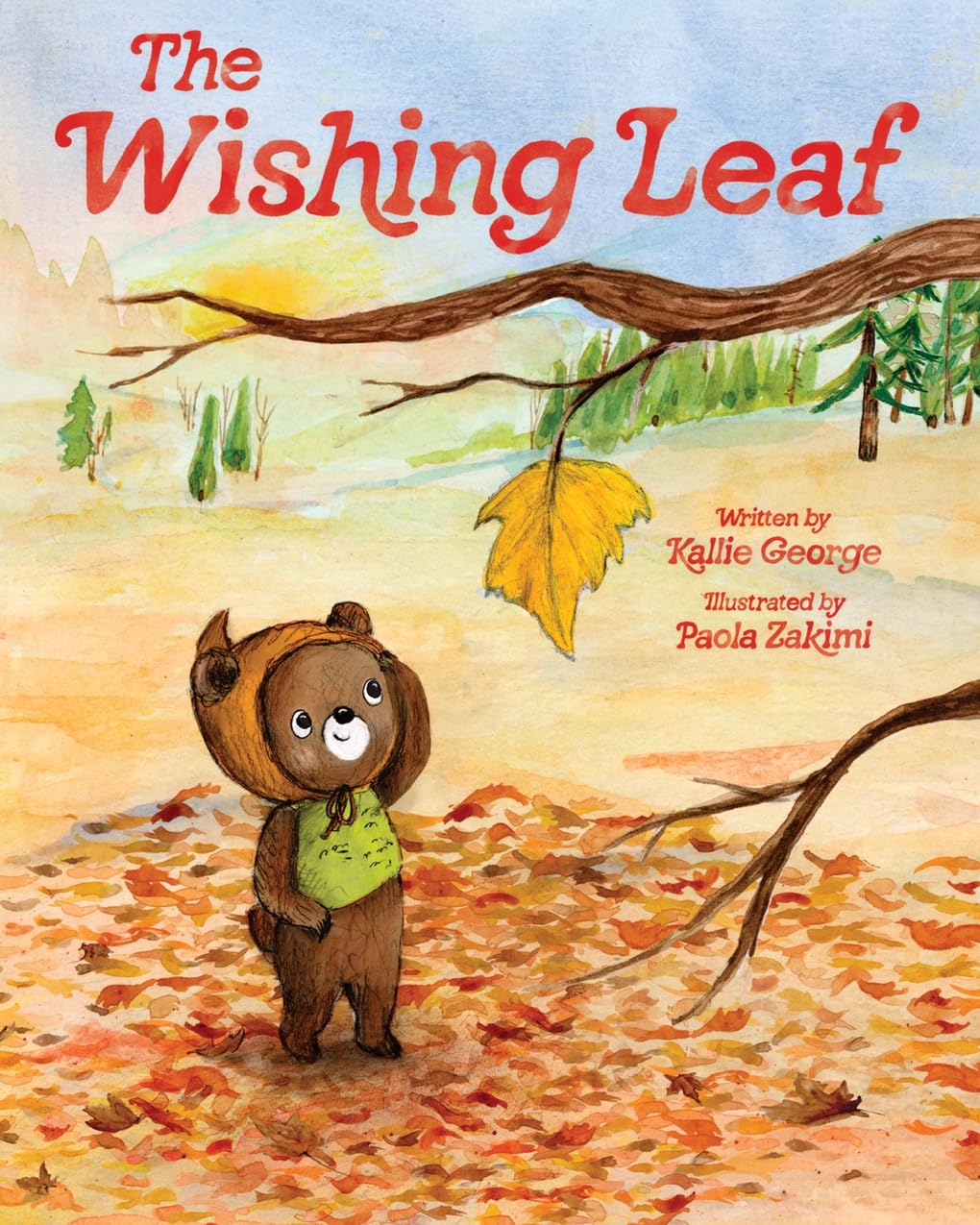
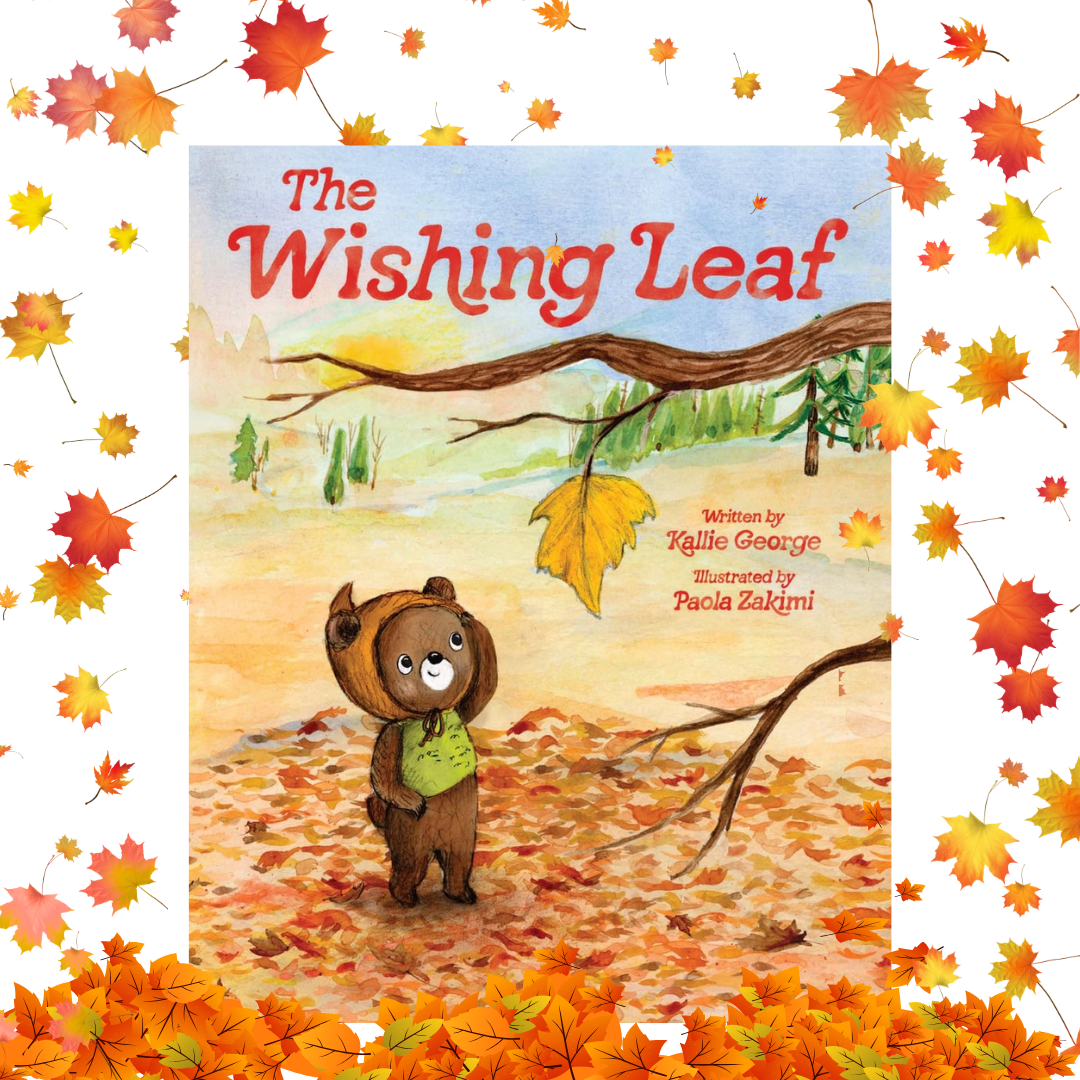
The Wishing Leaf
Written by Kallie George | Illustrated by Paola Zakimi
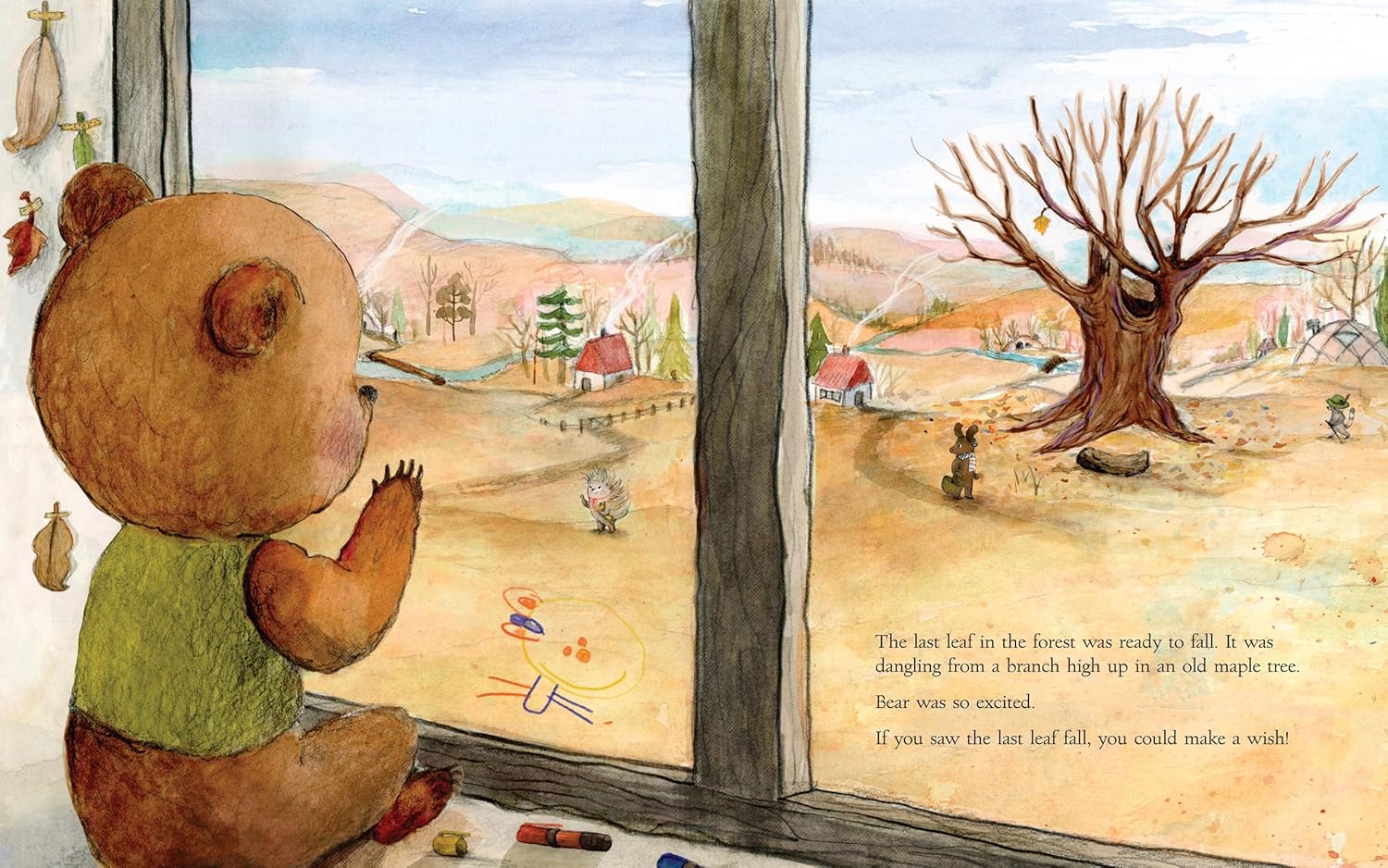
From his window, little Bear could see the very last leaf in the forest clinging to the old maple tree. He wanted to be sure to watch the leaf fall because he wanted to make a wish. When his mama told him it was time to go to sleep, Bear protested, and Mama relented with a kindly sigh.
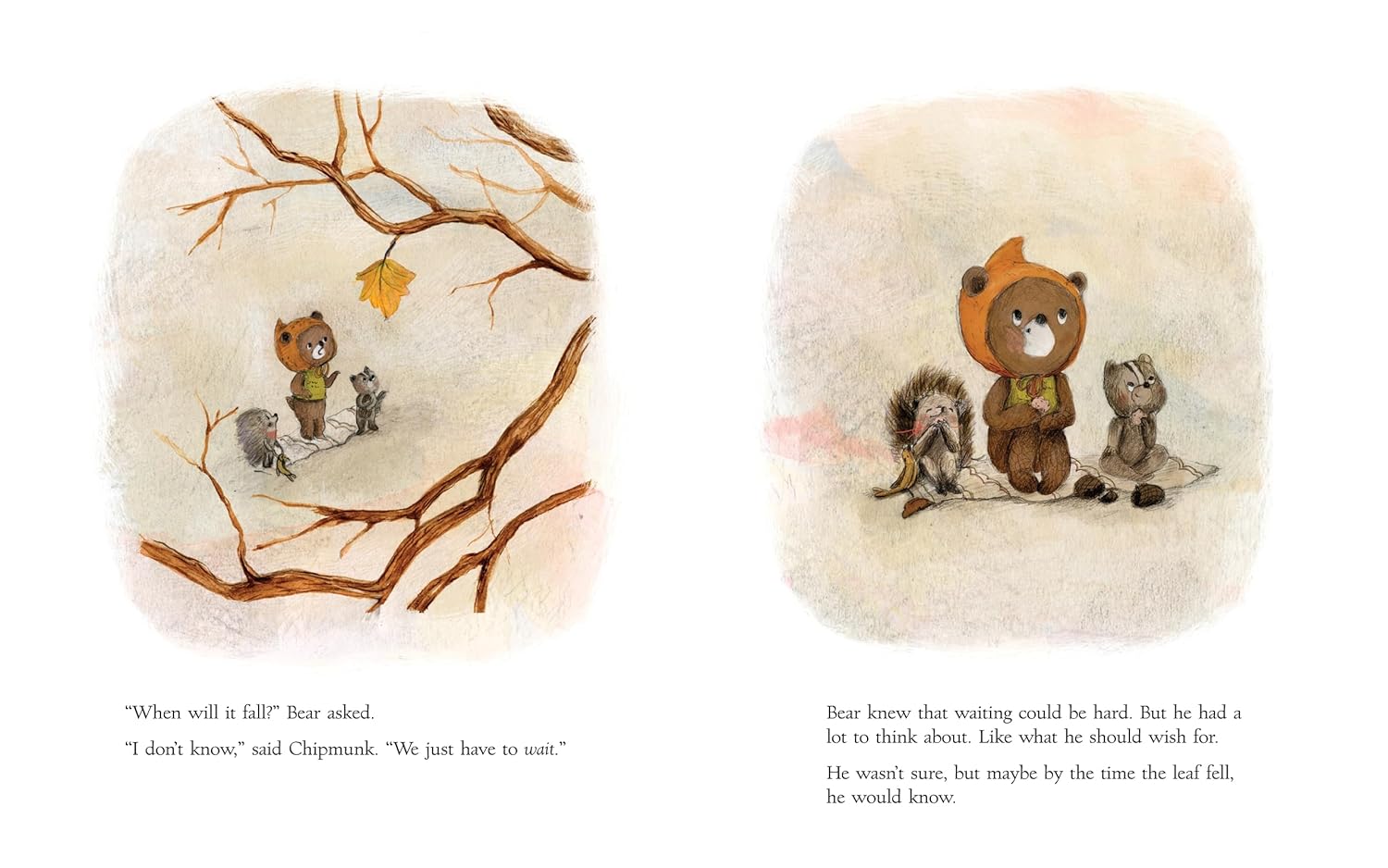
Bear joined his friends, who were standing or sitting under the maple tree, gazing up. Some had brought snacks, Porcupine had binoculars, and Raccoon had brought a camera. “The leaf was bright and golden like a star.” Bear sat on a blanket with Hedgehog and Chipmunk and started to wait. He passed the time thinking about what he should wish for.
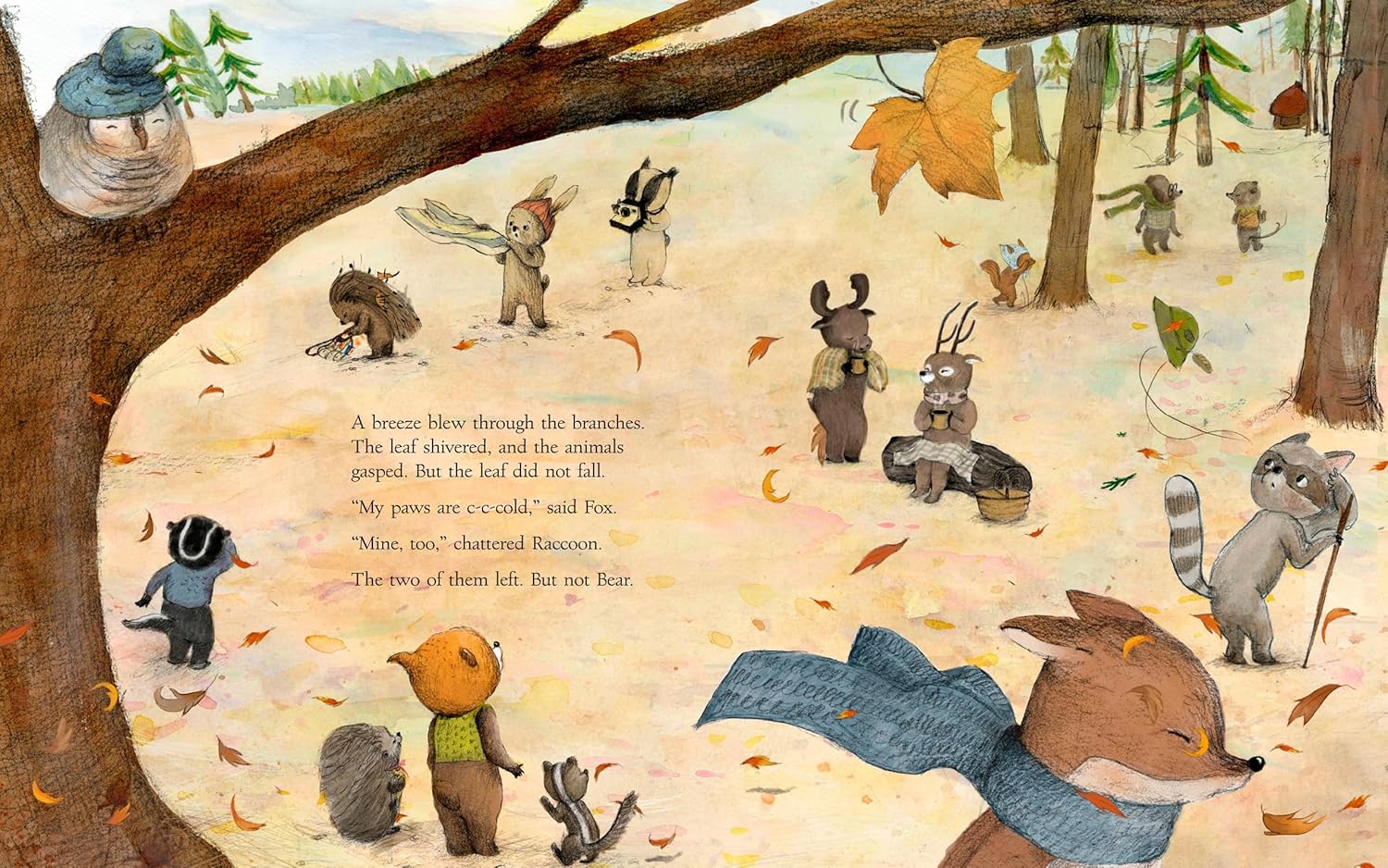
Soon, the air turned cold and while the leaf fluttered in the breeze, it still did not fall. Some shivering animals went home. When the sky darkened, more animals packed up and left. Snowflakes even began to fall and stick. Little by little the rest of the animals went home, even Chipmunk and Hedgehog, who wondered what she would have wished for if only she’d been able to see the leaf fall.
Only Bear was left, and he was growing sleepy too. He thought he might hear Mama calling him. “Bear yawned—a big, little bear yawn.” And just then “the leaf twisted . . . and tumbled, falling down, down, down, like a shooting star.” Bear “knew just what to wish for,” and his heart swelled as he imagined his wish coming true throughout the forest. When he turned to go home, Mama was there with a lantern and a snuggly hug. Back in his room, Bear was tucked into bed and drifted off to sleep.
Kallie George is a master at writing endearing children’s stories that remain always within your heart. Her characters are always adorable, caring, and imbued with childhood wonder. In The Wishing Leaf, George amplifies the feelings of giving that define fall and early winter with her story of a young bear whose first thoughts are for his friends. Readers will be charmed by little Bear’s wishEquating the golden leaf to a shooting star is a touching reminder that the magical can be found wherever you look. George’s sweet phrasing and charming dialog create a cozy read aloud that adults and children will want to share time and time again.
Paola Zakimi’s darling characters inhabit a lovely countryside, in which white smoke drifts from the chimneys of snug cottages, the hills and flowing river speak to the peaceful community, and the large, old maple tree stands waiting as patiently for its final leaf to fall as does little Bear sitting on his window seat, gazing out. Zakimi’s soft pencil and watercolor illustrations are adorably expressive, and her renderings of the warm relationship between Mama and little Bear as well as images of community members will inspire plenty of “Awwws.”
A perfect book for snuggly story times that also would make a much-loved gift, The Wishing Leaf is a must for home and library collections.
Ages 4 – 8
Abrams Books for Young Readers, 2025 | ISBN 978-1419772467
About the Author
Kallie George is an author, editor, and creative writing teacher living in Vancouver, British Columbia. She has written acclaimed books for children, including The Lost Gift; Secrets I Know; Duck, Duck, Dinosaur, and The Melancholic Mermaid, as well as The Magical Animal Adoption Agency series and The Heartwood Hotel series. She has also taught writing workshops for children and adults across Canada, as well as in South Korea, and she currently teaches at Emily Carr University. Visit her at kalliegeorge.com.
About the Illustrator
Paola Zakimi spent her childhood in cold Patagonia, Argentina. She studied arts and graphic design in Buenos Aires before moving to Villa Giardino, Cordoba, where she resides today. She is the illustrator of Estelle Laure’s Before the World Wakes, Meg Fleming’s Here Comes Ocean, Jacqueline Veissid’s Ruby’s Sword, as well as Newbery Medalist Cynthia Voigt’s Teddy & Co., among other picture books. Visit her at paolazakimi.com.
First Day of Autumn Activity
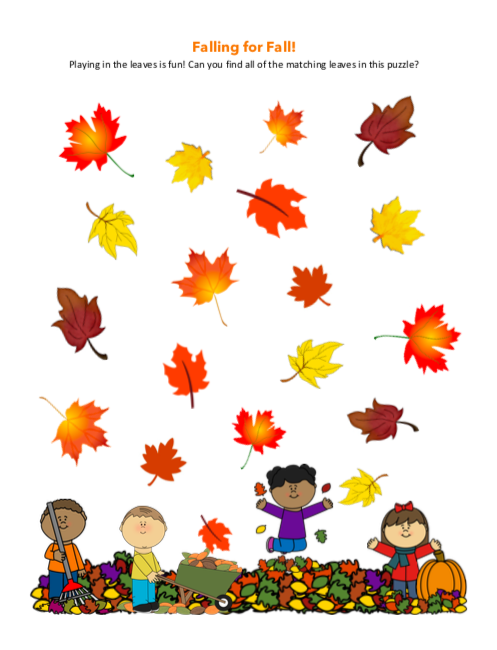
Falling for Fall Matching Puzzle
These kids are having fun in the leaves. Can you find the matching leaves in this printable Falling for Fall Puzzle?
You can purchase The Wishing Leaf from these booksellers
For children, picture books provide one of the best ways to interact with facts and feelings. Stories that speak to their experiences, both common and new, alongside illustrations that bring the story to life let them discover the world around them. Today’s stunning nonfiction books are loaded with illustrations or photographs that let kids see exciting details about science, history, biographies, nature, and so much more. This month, take a look for fiction and nonfiction picture books about your child’s passions to add to your home library. And be sure to check out today’s book that incorporates both!
Thanks to Star Bright Books for sharing a digital copy of Leaves to My Knees with me for review consideration. All opinions on the book are my own.
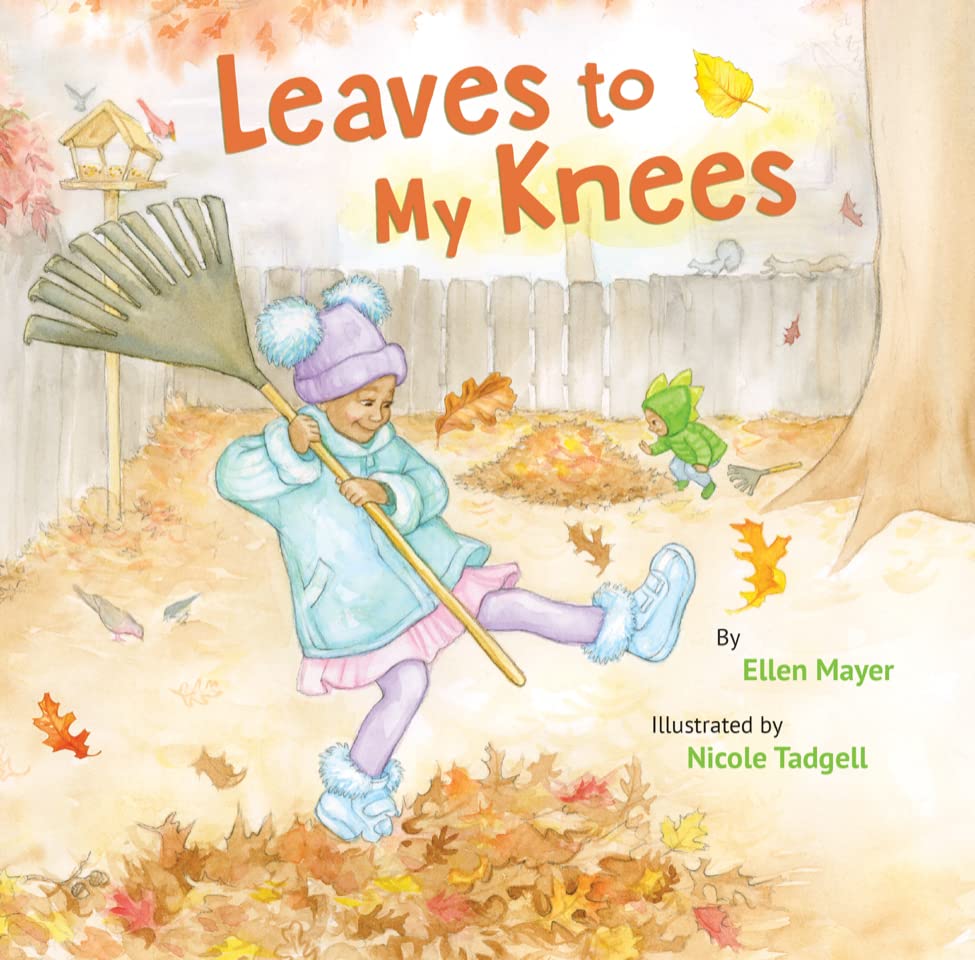
Leaves to My Knees
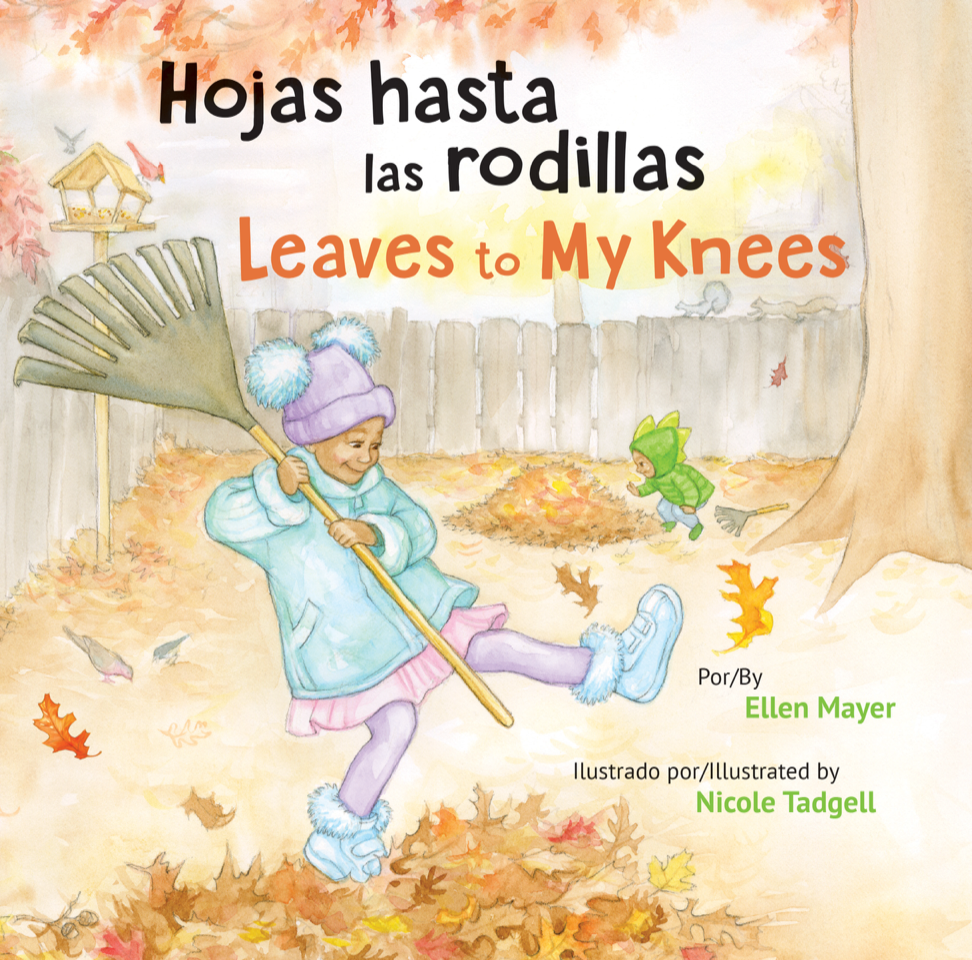
Hojas hasta las rodillas/Leaves to My Knees
Written by Ellen Mayer | Illustrated by Nicole Tadgell
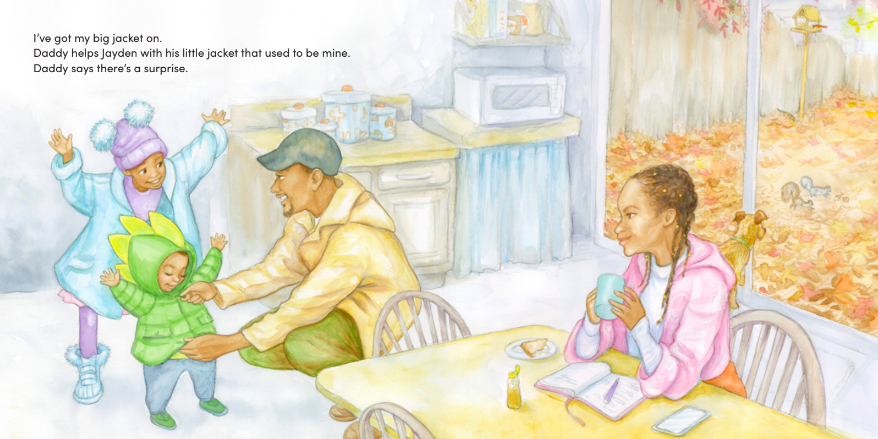
Daddy has a surprise for Camille and her little brother Jayden. They get dressed in their coats—big for Camille and little jacket with a stegosaurus hood for Jayden—and head into the backyard. There, Camille discovers her dad has gotten her a rake of her own. It’s not as big as Dad’s, but it’s bigger than Jayden’s little rake. It’s the perfect size for Camille.
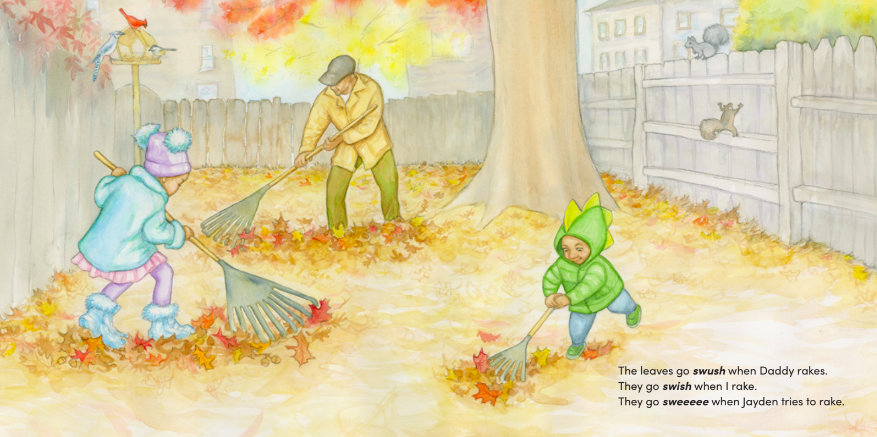
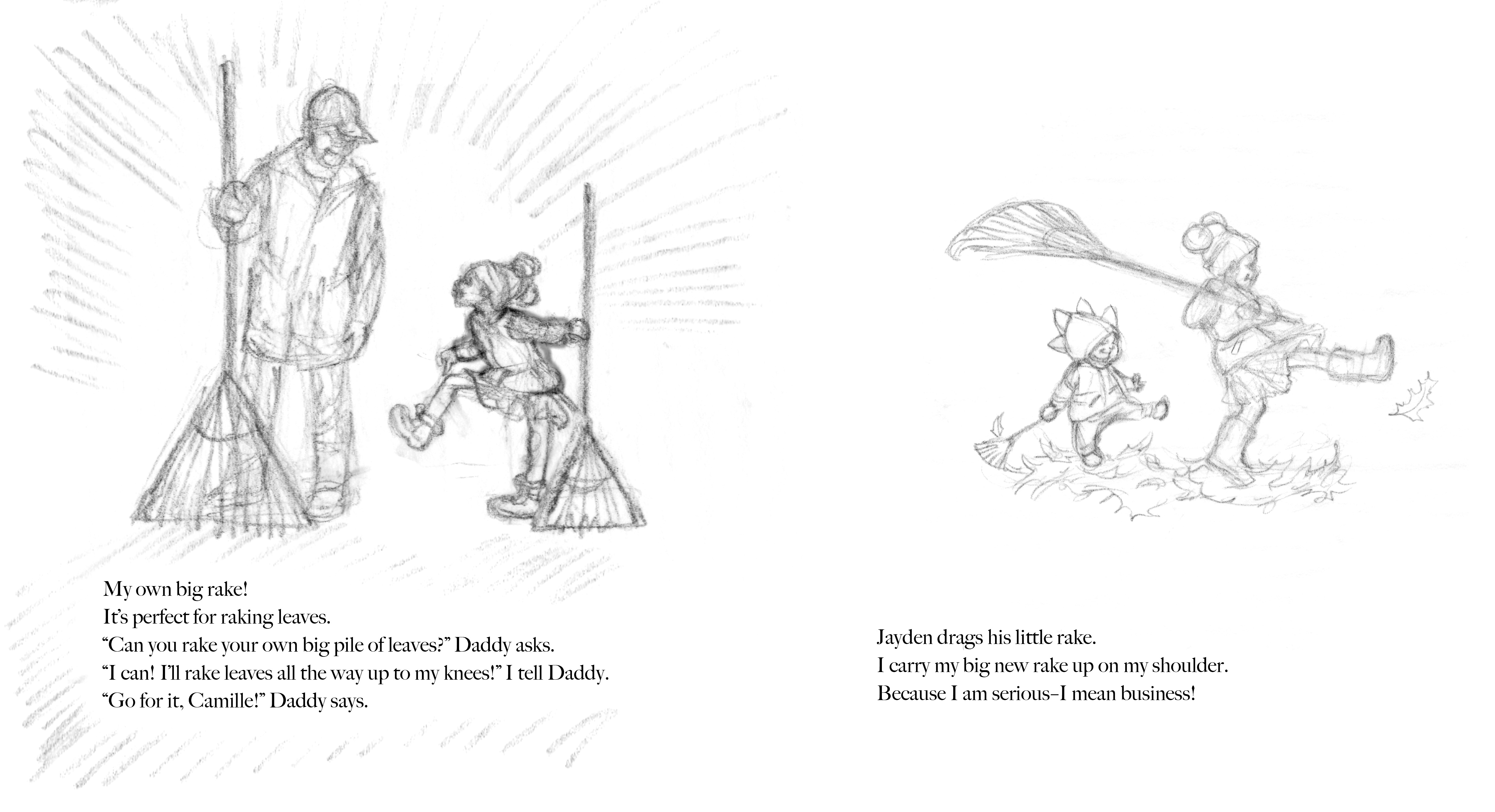
Camille marches right off to rake a pile of leaves. But not just any pile—she has a goal. “‘I’ll rake leave all the way up to my knees!’” she tells her dad. The three get working on the yard. Camille concentrates on gathering leaves, listening to the different sounds that the various sized rakes make: “The leaves go swush when Daddy rakes. They go swish when I rake. They go sweeeee when Jayden tries to rake.”
Image copyright Nicole Tadgell, 2022, text copyright Ellen Mayer, 2022. Courtesy of Star Bright Books.
Lurking under the leaves are twigs and acorns that clog up Camille’s rake. She worries that she’ll never be able to rake leaves to her knees. She calls for Daddy’s help, and together they clear Camille’s rake. “‘You’re good to go now, Camille,’” Daddy tells her. Back at it, Camille rakes and rakes. Then she steps into the pile she’s accumulated to measure it. Her pile only comes up to her ankles. Camille grabs her rake harder and with determination she collects more leaves. But wait! Jayden is stealing leaves from her pile to add to his! Camille guards her pile with her rake, and sends her little brother over to Daddy’s bigger pile. Camille checks her measurements again. Her pile has grown, but only up to the top of her boots.
Image copyright Nicole Tadgell, 2022, text copyright Ellen Mayer, 2022. Courtesy of Star Bright Books.
Camille rakes ‘bunches of leaves,” and her pile gets taller, until “‘Oh no! A BIG BREEZE!!’” sends lots and lots of leaves swirling “Whoosh!” into the air and scattered to the ground. “I will never rake leaves to my knees!” Camille thinks. And when she measures again, her pile is back to her ankles. Daddy encourages her to keep going, and Camille is committed to achieving her goal. She throws off her coat, grabs her rake, and works on gathering up all the leaves she had, plus more. At last, too tired to rake anymore, Camille wonders. Has she done it? “‘Time for measuring!’ says Daddy.”
Image copyright Nicole Tadgell, 2022, text copyright Ellen Mayer, 2022. Courtesy of Star Bright Books.
Camille relinquishes her rake to her dad then, holding her breath, steps into her pile. “‘TA-DA!’” Camille raises her arms in victory. She steps out, positions herself a good ways away, and winds up for the run and jump. “‘GO!’ yells Daddy. ‘GO!’ Jayden yells too.” Camille flies through the air and lands, laughing, into her pile. Then Jayden jumps in. And Daddy? He gives Camille “really big squeeze” for raking “leaves all the way up to [her] knees.”
A note for parents, teachers, and other caregivers written by Marlene Kliman, a mathematics learning expert and senior scientist at TERC, describes how the story incorporates the math of measurement and sizes and how adults can extend the lesson by pointing out elements in the book’s illustrations and while going about their day or doing common chores, such as cleaning up and sorting laundry.
Image copyright Nicole Tadgell, 2022, text copyright Ellen Mayer, 2022. Courtesy of Star Bright Books.
Ellen Mayer’s Leaves to My Knees has everything that makes a story a young reader’s favorite—a spunky main character that kids will identify with, an achievable goal, successes and setbacks, suspense, humor, and a child-propelled victory. And it all revolves around an early math concept that comes naturally to children and which invites playful learning not only during the fall, but any time of the year. Shoveling snow and making snowballs in winter, yard cleanup and gardening in spring, and building sandcastles and raking grass clippings in summer as well as in-home fun with laundry piles, toys, and other objects are all ways to extend the story.
Told from Camille’s point of view, the story also engages children’s emotions as they join in to cheer Camille on as her leaf pile grows and commiserate with her when it shrinks. The close relationships among Camille and her dad and little brother ring true with dialogue-rich storytelling that is always encouraging. Strong themes of determination and persistence will also appeal to parents and teachers, who can point to how many times Camille has to start over before accomplishing her goal and her positive, resolute attitude.
Nicole Tadgell’s exuberant illustrations shine with personality, and kids will immediately become invested in each character as Dad gets working on a big job that needs doing, Jayden runs, jumps, and copies his big sister, and Camille unwaveringly works on her pile of leaves. Camille’s setbacks are clearly depicted, along with her and her father’s facial expressions that give adults and kids an opportunity to talk about disappointment, frustration, perseverance, and feelings of accomplishment. Each image also demonstrates the math component of measurement and sizes in the story with various-sized rakes, the growing and diminishing leaf pile, big and little jackets, and other objects that invite comparison.
Tadgell’s soft-hued pages are infused with the feeling of fall and hum with activity as cardinals, blue jays, chickadees gather at the bird feeder, squirrels scamper up and along the fence, and leaves continue to float to the ground. Readers will love following little Jayden’s antics and be inspired by Camille’s wide smile as she enjoys the reward of all her hard work.
Leaves to My Knees is a multilayered read aloud infused with the enthusiasm and rhythms of childhood that kids will want to hear again and again. Its mathematics base and themes of determination and perseverance rewarded will appeal to parents, teachers, and other educators as a way to engage children in active, hands-on learning. The book is a must for home, classroom, school, and public library collections.
Ages 4 – 8
Star Bright Books, 2022 | ISBN 978-1595729590 (Leaves to My Knees) | ISBN 978-1595729613 (Hojas hasta las rodillas/Leaves to My Knees
Picture Book Month Activities
Coloring Pages and Teaching Guides
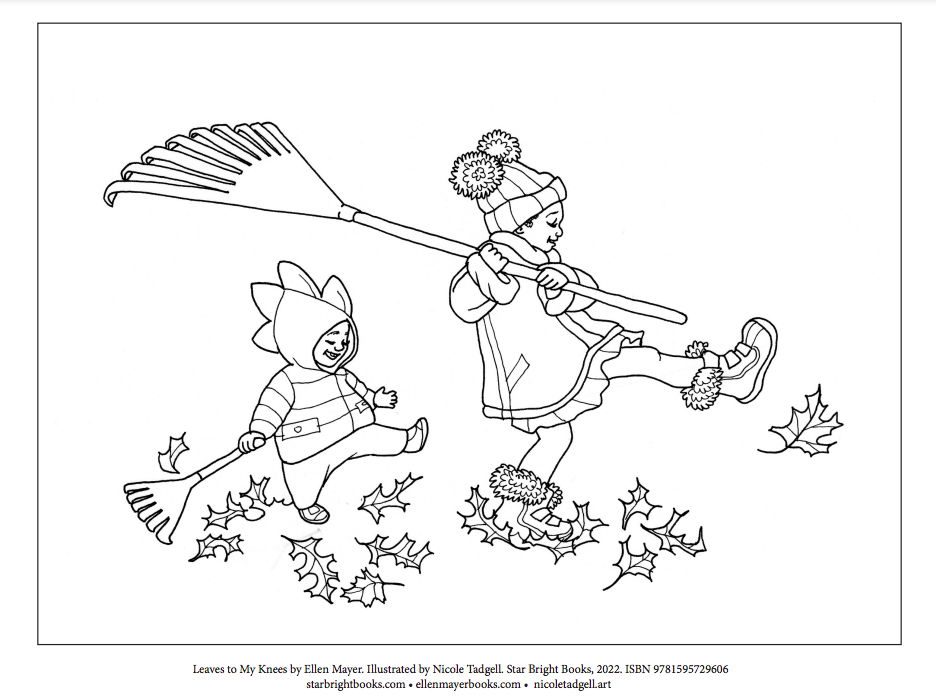
You can extend the fun and learning in Leaves to My Knees with these activities, which include three fun coloring pages from the story, a hands-on play-dough art and discovery activity, and a detailed educator’s guide for teachers, homeschoolers, parents, and other caregivers that offers multiple ways to use Leaves to My Knees to explore math, mathematical thinking, and reading comprehension through the story and beyond at home, school, and elsewhere.
Ellen Mayer is an award-winning author who writes picture books for babies and young children and the grown-ups who read to them. Leaves to My Knees is her ninth book for children. Her other math story books include Banana for Two and Clean Up, Up, Up!, two board books in her Small Talk Books® series with Star Bright Books.
For many years Ellen was an education researcher at the Harvard Graduate School of Education, studying how families are engaged in their children’s learning. She also worked as an early literacy home visitor with young children and their parents in a local affiliate of the ParentChild+ program. Now, Ellen volunteers as a visiting children’s book author with public schools and city-run playgroups in her local Cambridge and Somerville, MA, communities. Long ago she earned an M.Phil. in Sociology from Columbia University.
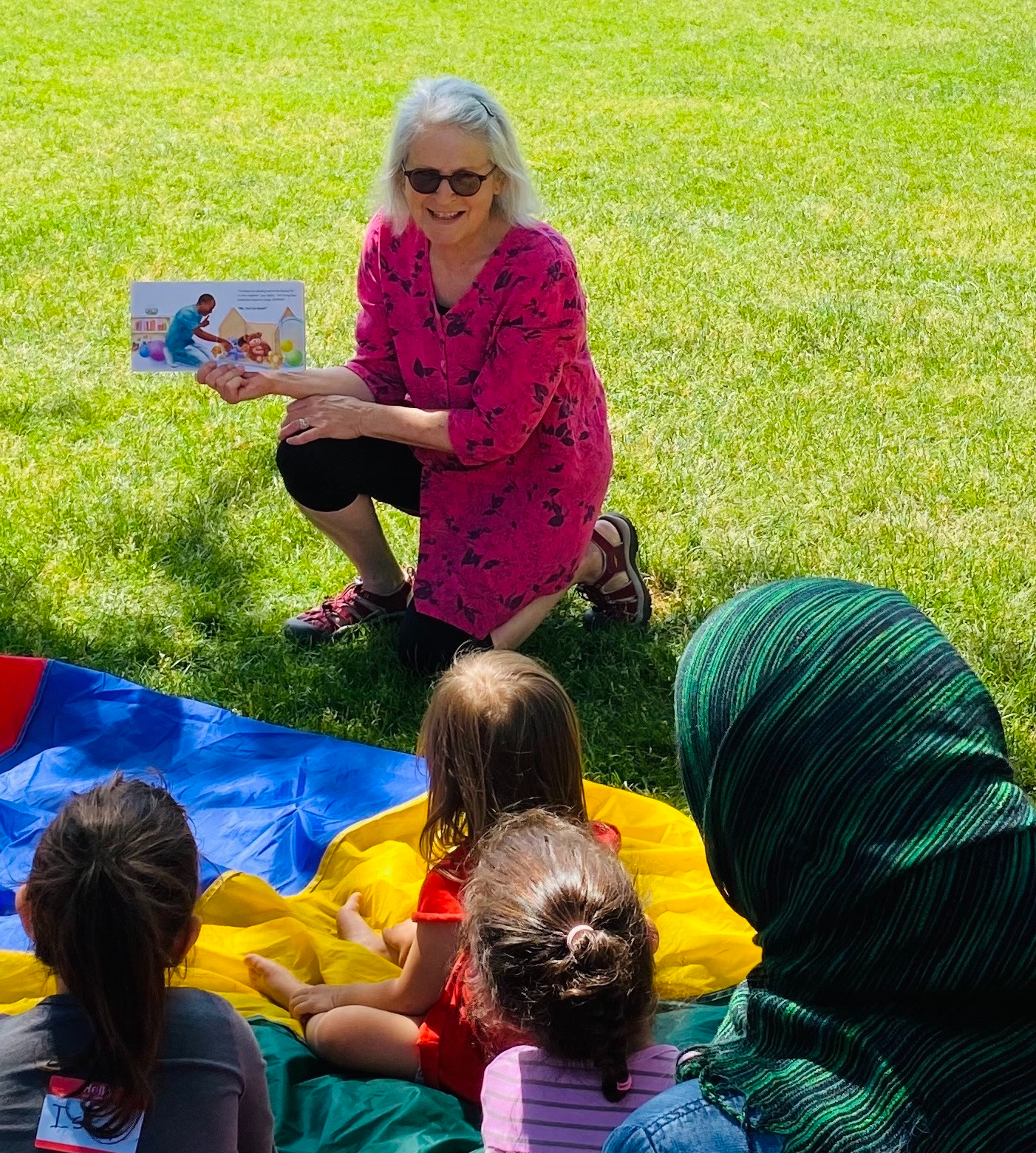
Ellen often collaborates with her musician husband in “Books + Banjo” reading and sing-along programs for young children. Ellen loves to rake leaves in the fall—especially when she has help from her grandchildren.
I have so many great memories of raking leaves with my kids when they were small. You really capture the fun and challenges of this favorite fall activity in your story. Were you inspired by your own family’s experiences in any way while writing it?
Very much so! Since the time our kids were very little they’ve joined us in the backyard for all sorts of yardwork. My daughter wanted to hold the rake from a young age, even as I did the less exciting early springtime rake of the lawn.
At first our trees didn’t yield much in the way of fall foliage, so we would haul a big bag of fallen leaves in from the tree out on the city sidewalk to have as leaves for play. The piles that resulted were often rather puny, only up to the ankles, as protagonist Camille would tell us.
But as the backyard trees matured, raking and jumping took off, much like in the story! I should add, too, that the sibling dynamic between our older daughter and younger son was also a source of story inspiration, influencing how I wrote the sister-brother characters here. Older sister was always the more determined and focused raker of the two, with younger brother taking it upon himself to annoy and distract her as much as possible, and generally try to steal the show, as was his lovable wont in those early years.
Marlene Kliman, an early math expert who is a Senior Scientist at nonprofit STEM education organization TERC in Cambridge, MA, has contributed a back matter note for parents and caregivers. In it she writes that Camille uses the math of measurement as she works at raking a knee-high pile of leaves and as she describes the sizes of things around her. Can you tell us how Camille and other young children approach measurement?
Preschoolers and toddlers, before they are ready to understand and engage in measuring with standardized units like inches and feet, try out measuring in their own ways. For instance, they compare the thing to be measured with an object or their body. Here, Camille measures the changing height of her leaf pile as it moves up her leg to her knees—first reaching up to her ankles, then up to her boots, but then back down to her ankles after a big breeze, then finally after some serious raking all the way up to her knees—where it’s the perfect size for jumping in. Young children naturally love to consider their world in terms of the different sizes of things. Throughout the story, Camille actively references the sizes of things all around her, whether it’s that big breeze or the size of her jacket, rake, and leaf pile in comparison with the smaller jacket, rake, and leaf pile that belong to her little brother, Jayden.
Today’s post celebrates this beautiful and exuberant cover! What was your first reaction to seeing the final cover art?
When I first saw the final cover I gasped! I love cover art that is inviting and also contains a little mystery to it. Here, Nicole created the most glorious, radiant, luminescent fall day, and I immediately wanted to join in the play. And what was that cute little dragon/dinosaur up to in the background? Definitely intriguing. Then, also, there are hints of the size-comparison math to come in the story in the form of the differently sized two rakes and three birds. The idea of “leaves to my knees” is there too, center stage. The joy and energy in this cover scene is palpable as the leaves float from the tree and Camille almost seems to be dancing in her leaf pile. Thank you so much for introducing this gorgeous cover into the world, Kathy!
Do you have another favorite spread in the book? Why is this one special to you?
Nicole creates this wonderful dance here in her art, from cover to close, with captivating facial expressions on each page. It’s hard to single out a favorite spread—there is something that takes my breath away on each page! But I keep returning to the one near the end where all is right with the leaf pile, the jump, and the siblings. Here, Camille and Jayden have flopped onto her pile and are luxuriating side-by-side on the big crackly bed of leaves, enormous matching grins on their faces. Maybe I was worried that Camille wouldn’t let the little mischief-maker into her pile? But she’s not shooing him anyway anymore—they are just celebrating together the joys of a fall leaf pile.
What would you like for kids and adults to take away from the story?
I hope they will come away with a warm feeling inside after spending time with this playful and loving family, a family that’s engaged in a fall chore, but one that is also enjoying a lot of fun and learning together. I hope they take away that math is everywhere around us, and that young children—all young children—love to measure and compare as they go about their day. I hope they take away the powerful image of a child of color, and a girl, as an active mathematician. There still aren’t nearly enough Camilles in the pages of picture books, and everyone—kids of all backgrounds listening to this story and all their reading adults too—need to see and normalize children of color and girls doing math.
Nicole Tadgell is an award-winning watercolor artist of more than 30 luminous picture books. Her books have received numerous honors, including the Christopher Award and the Children’s Africana Book Award. They have been included on the Smithsonian Notable Books for Children, the New York Public Library’s Best 100 Titles for Reading and Sharing, and many more notable lists. Born in Detroit, Michigan, frequent moves weren’t easy for Nicole, especially to new schools where she was the only Black kid in class. Art has always been both an escape and a labor of love for Nicole. Today, she brings stories to life while advocating for diversity in children’s literature. Nicole lives in Chesapeake, Virginia.
Can you share what attracted you to Ellen’s story from an illustrator’s point of view?
Because I often illustrate older children, I saw the opportunity to showcase two young children playing in autumn leaves. (My favorite season!)
Camille shows so much personality and determination on this cover image. Can you describe your process of designing and finalizing the cover?
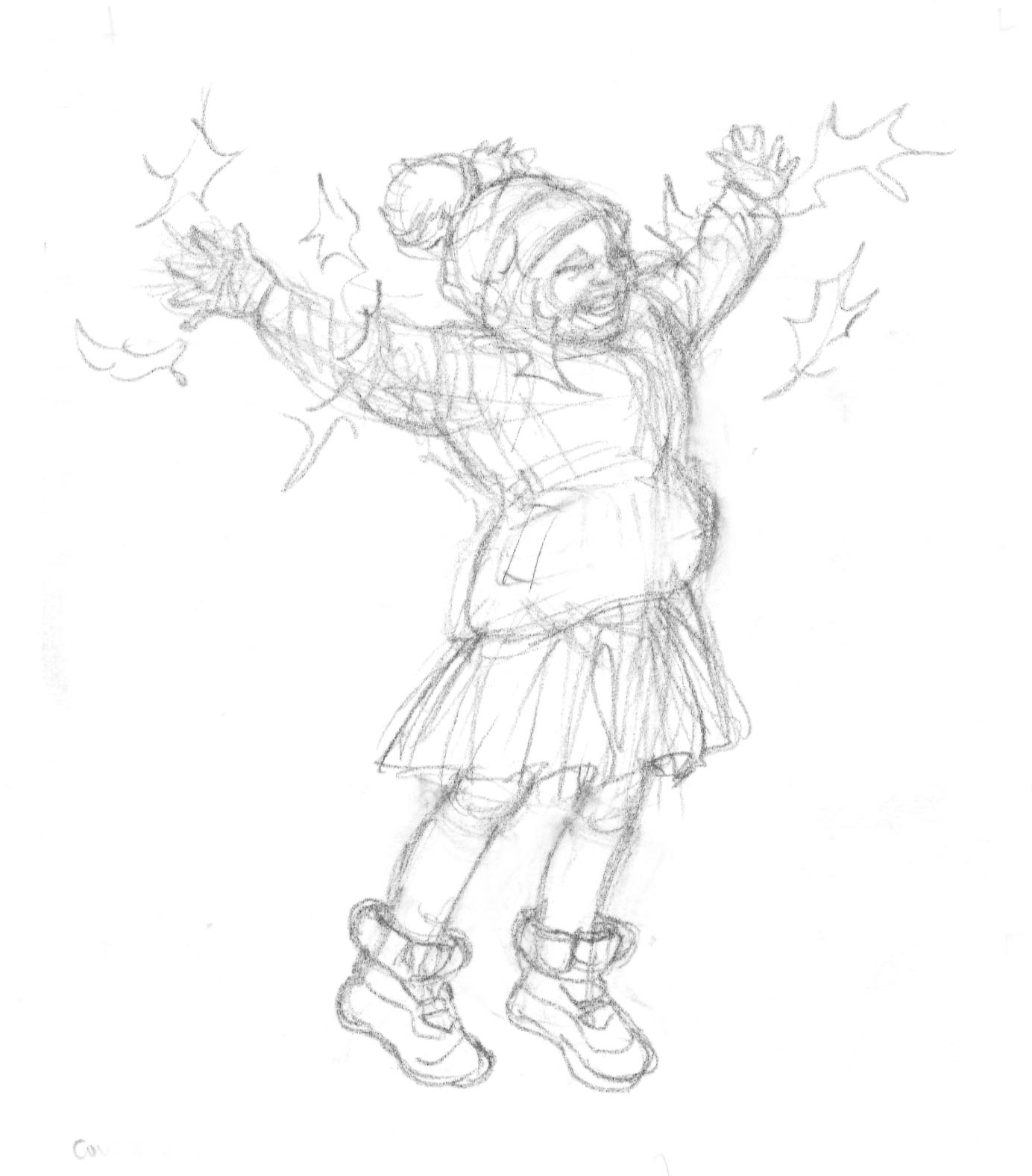
Covers can be a challenge, to be sure. There’s a compromise to paint what’s fun . . .
Image copyright Nicole Tadgell, 2022
. . . versus showing the audience what the book is about!
Image copyright Nicole Tadgell, 2022
Were you inspired by personal memories of raking leaves as you worked on this cover image and interior spreads? Do you have a story about raking leaves you’d like to share?
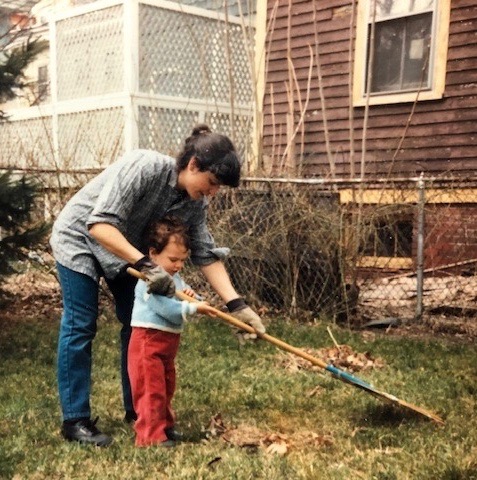
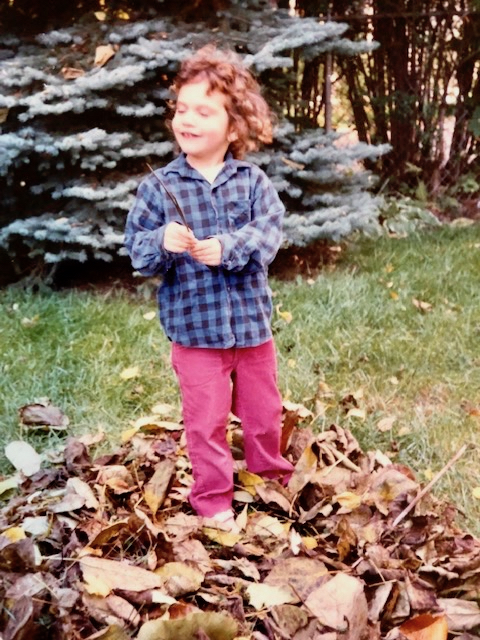
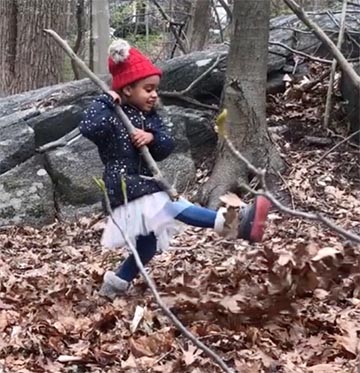
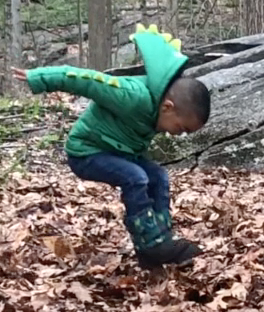
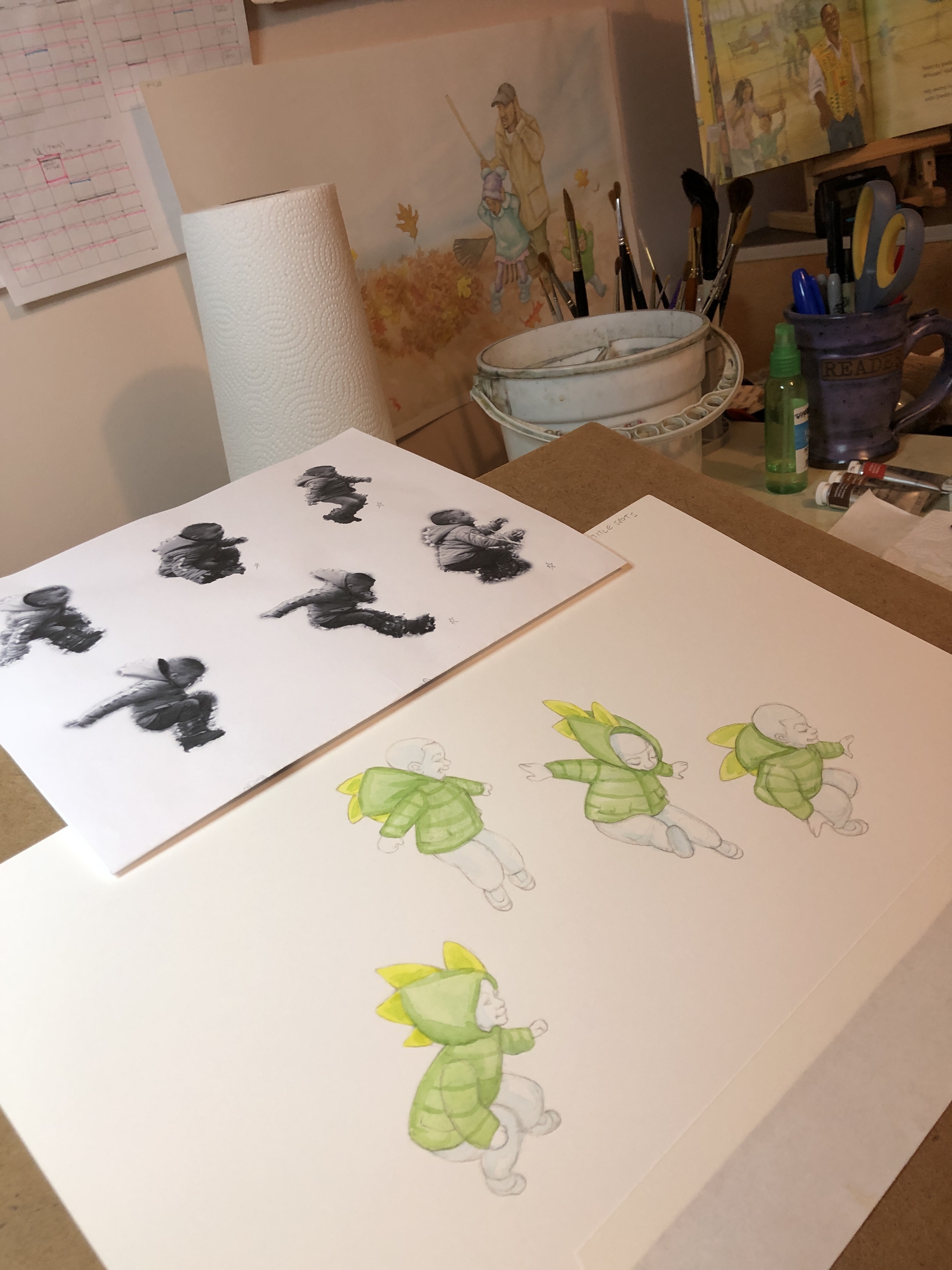
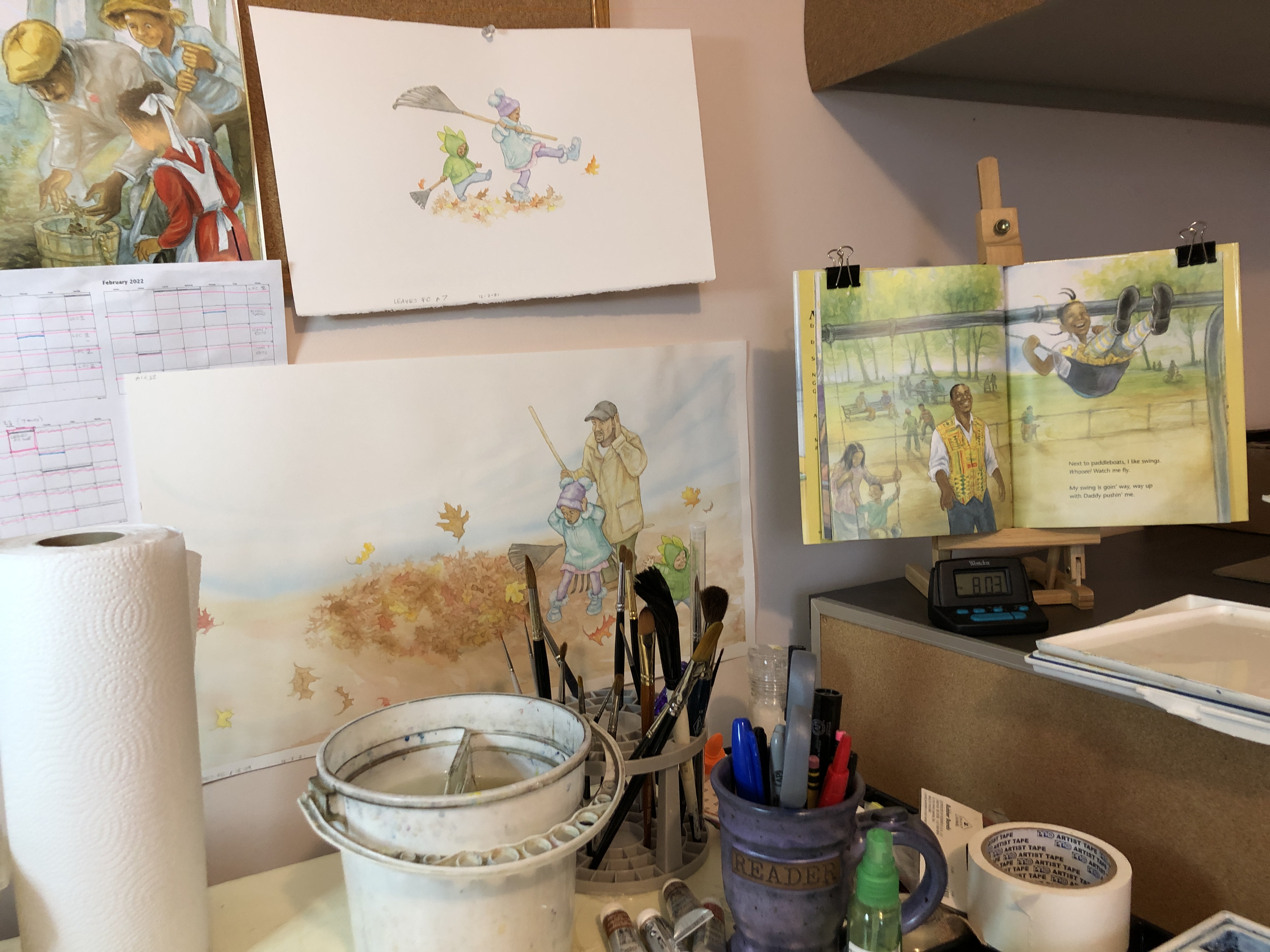
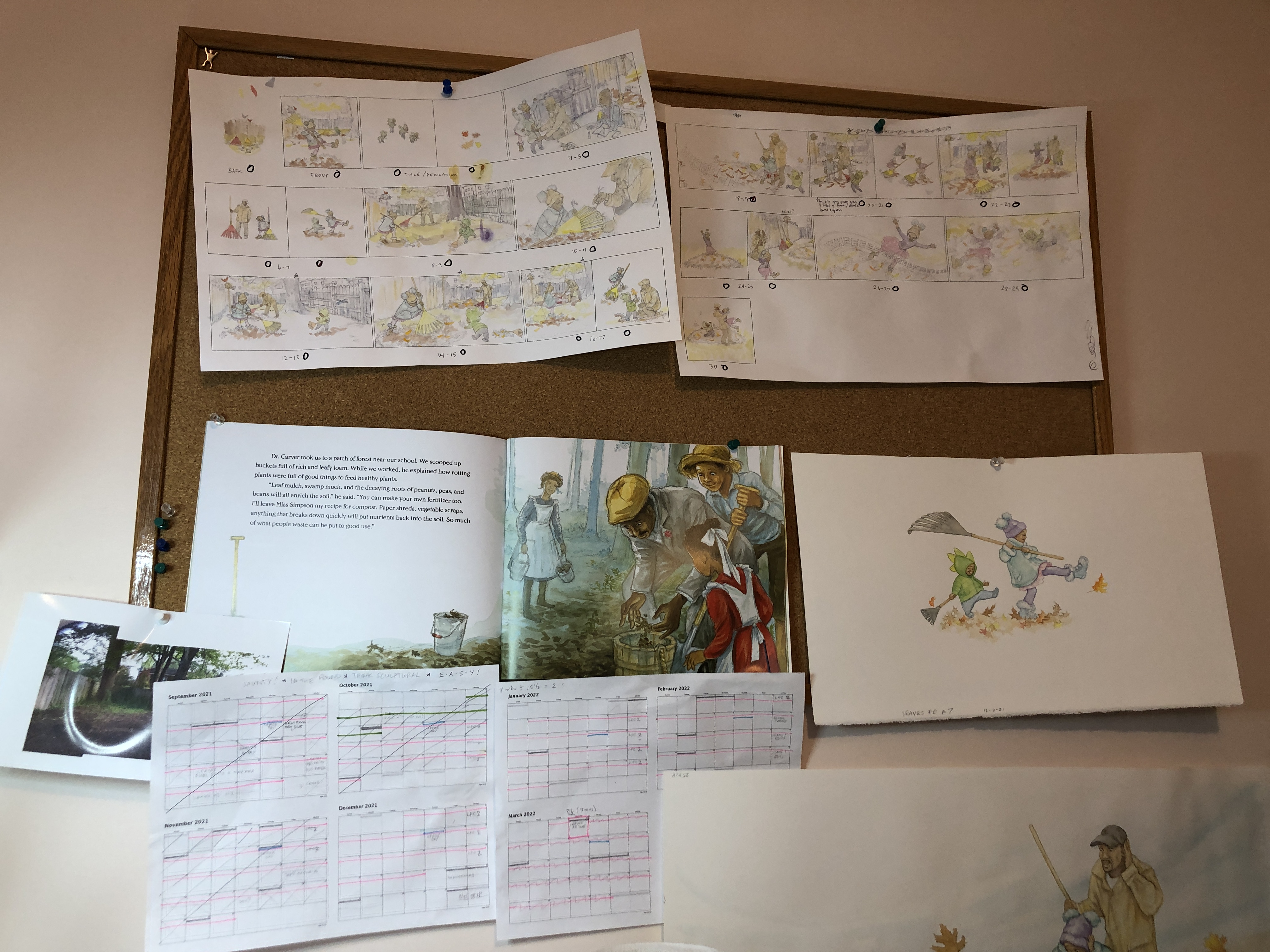
I admit I had grown-up thoughts about there being spiders in the leaves! I don’t have a clear childhood memory of that happening, but I’ve seen plenty of spiders in leaves as an adult. A fun story is about the models for this book! My sister’s friend has two kids the right age. Their Dad was wonderful—instead of taking pictures of the kids playing in leaves, he shot video so I could pause and sketch. They were perfect! Original down to Camille’s double pom-poms and Jayden’s dinosaur coat.
Image copyright Nicole Tadgell, 2022
The soft colors of your illustrations in Leaves to My Knees are really lovely. Can you talk about how you choose a color palette for your work in general and for this cover in particular?
Endless choices! It’s hard to decide. Knowing the season, I began with fall colors: reds, oranges, yellows. I felt that contrast would help our family stand out, so I chose cool colors for Camille and Jayden. I chose earth tones for Dad to make the kids stand out even more.
Image copyright Nicole Tadgell, 2022
Image copyright Nicole Tadgell, 2022
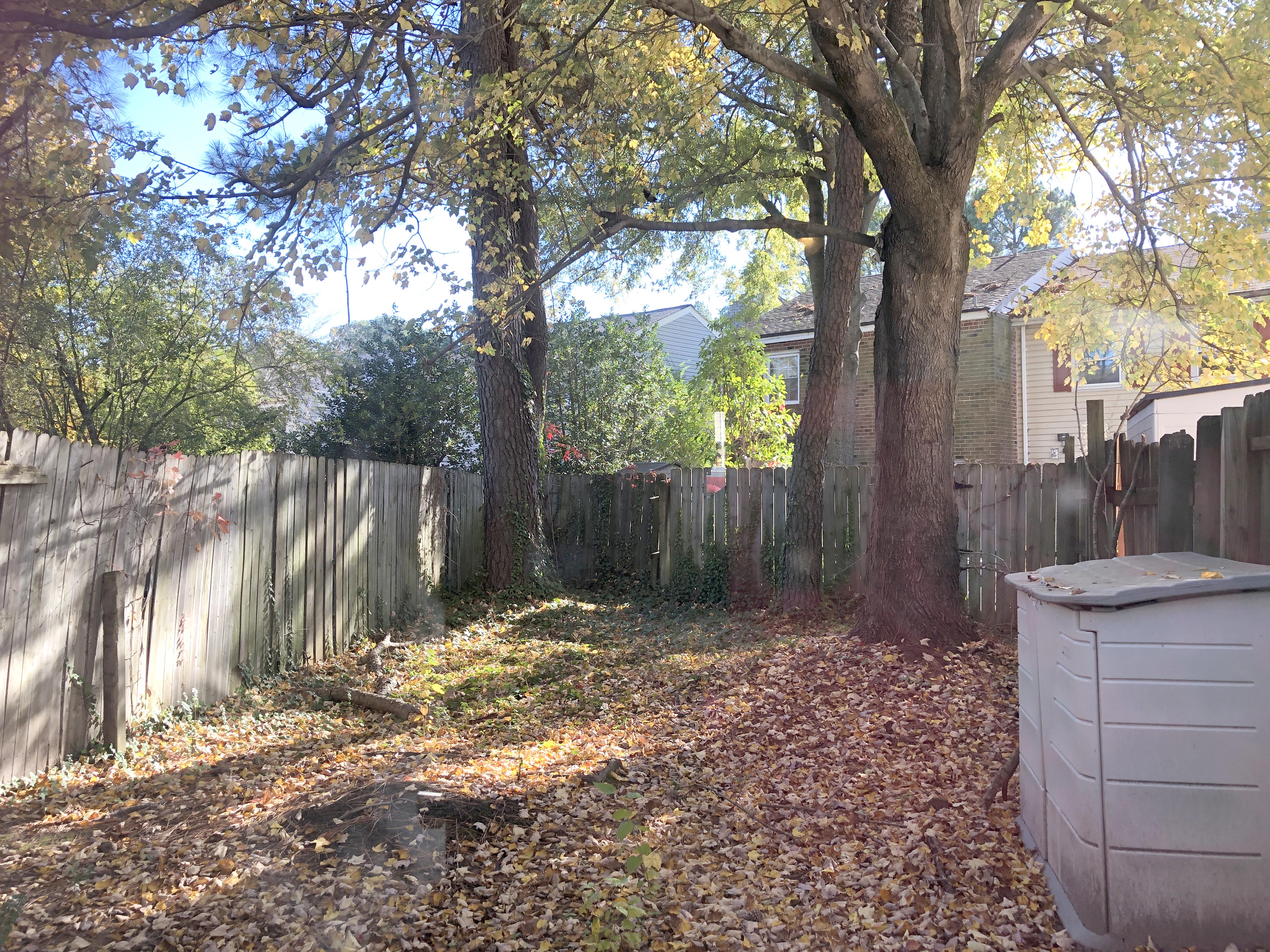
Interestingly, in the images I used for reference the real leaves had lost their color, so I just painted them colorful. I did make our Jayden a bit younger than the model’s age. For the backyard fence, I found a place nearby that had an interesting fence and small leaf-filled yard. I watched as cardinals flit between branches and squirrels chased each other, and inspiration came for the animal antics in the background!
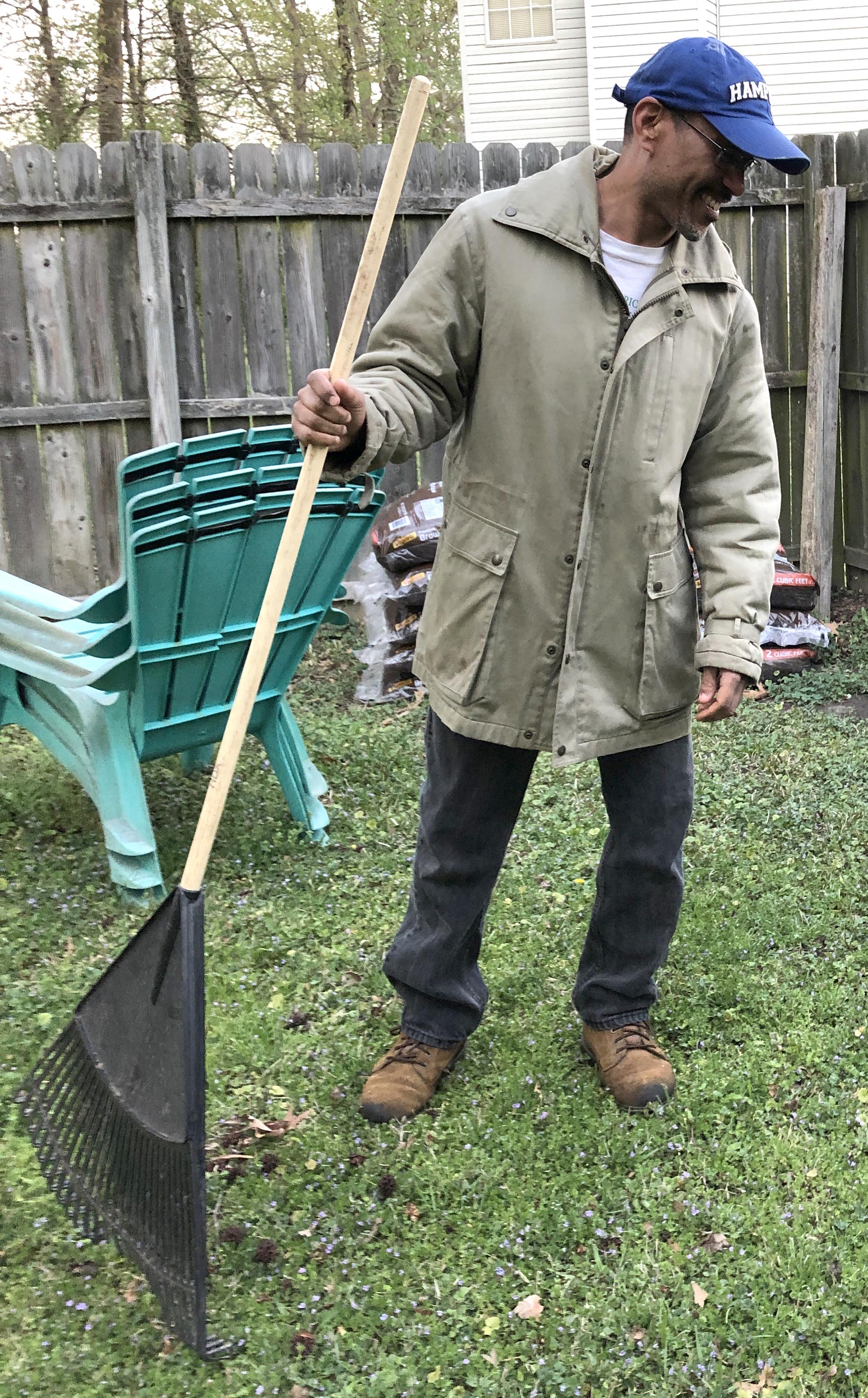
And finally, my partner Anthony was kind enough to pose as the dad in the book!
Now that picture book creators are more free to interact with readers, what are you most looking forward to in promoting Leaves to My Knees?
Fun! I love signing books for kids & personalizing.
In addition to celebrating a fun (and necessary) fall activity, Leaves to My Knees incorporates early math concepts of size and measurement. Can you give an example of how you depicted these ideas in your illustrations?
By using different sizes of the rakes and making sure the leaf piles matched the text (up to ankles, then knees).
I can almost feel the chill in the air and hear that crisp crunch of leaves underfoot that means it’s leaf-raking time!
Written by Ellen Mayer | Illustrated by Nicole Tadgell
Camille is determined to rake her own pile of leaves―all the way up to her knees! She swishes leaves to and fro, watching her pile grow bigger alongside the piles made by Daddy and her little brother, Jayden. WHOOSH! After raking leaves to the top of her boots, a giant breeze blows the pile back down to her ankles. But Camille won’t be stopped until she gets the job done––a knee-high pile, the perfect size for… jumping in!
Leaves to My Knees and Spanish/English bilingual Hojas hasta las rodillas/Leaves to My Knees are playful introductions to the early math concepts of size comparison and measurement. A note by researcher and mathematics learning expert Marlene Kliman explains how parents and caregivers can use the book to help young children explore different sizes and measurement in everyday environments.
I’m thrilled to be talking with Ellen Mayer and Nicole Tadgell today about this gorgeous cover and their adorable—and educational—book that will be available this fall, just in time for leaf-raking season!
Meet Ellen Mayer
Ellen Mayer is an award-winning author who writes picture books for babies and young children and the grown-ups who read to them. Leaves to My Knees is her ninth book for children. Her other math story books include Banana for Two and Clean Up, Up, Up!, two board books in her Small Talk Books® series with Star Bright Books.
For many years Ellen was an education researcher at the Harvard Graduate School of Education, studying how families are engaged in their children’s learning. She also worked as an early literacy home visitor with young children and their parents in a local affiliate of the ParentChild+ program. Now, Ellen volunteers as a visiting children’s book author with public schools and city-run playgroups in her local Cambridge and Somerville, MA, communities. Long ago she earned an M.Phil. in Sociology from Columbia University.
Ellen often collaborates with her musician husband in “Books + Banjo” reading and sing-along programs for young children. Ellen loves to rake leaves in the fall—especially when she has help from her grandchildren.
I have so many great memories of raking leaves with my kids when they were small. You really capture the fun and challenges of this favorite fall activity in your story. Were you inspired by your own family’s experiences in any way while writing it?
Very much so! Since the time our kids were very little they’ve joined us in the backyard for all sorts of yardwork. My daughter wanted to hold the rake from a young age, even as I did the less exciting early springtime rake of the lawn.
At first our trees didn’t yield much in the way of fall foliage, so we would haul a big bag of fallen leaves in from the tree out on the city sidewalk to have as leaves for play. The piles that resulted were often rather puny, only up to the ankles, as protagonist Camille would tell us.
But as the backyard trees matured, raking and jumping took off, much like in the story! I should add, too, that the sibling dynamic between our older daughter and younger son was also a source of story inspiration, influencing how I wrote the sister-brother characters here. Older sister was always the more determined and focused raker of the two, with younger brother taking it upon himself to annoy and distract her as much as possible, and generally try to steal the show, as was his lovable wont in those early years.
Marlene Kliman, an early math expert who is a Senior Scientist at nonprofit STEM education organization TERC in Cambridge, MA, has contributed a back matter note for parents and caregivers. In it she writes that Camille uses the math of measurement as she works at raking a knee-high pile of leaves and as she describes the sizes of things around her. Can you tell us how Camille and other young children approach measurement?
Preschoolers and toddlers, before they are ready to understand and engage in measuring with standardized units like inches and feet, try out measuring in their own ways. For instance, they compare the thing to be measured with an object or their body. Here, Camille measures the changing height of her leaf pile as it moves up her leg to her knees—first reaching up to her ankles, then up to her boots, but then back down to her ankles after a big breeze, then finally after some serious raking all the way up to her knees—where it’s the perfect size for jumping in. Young children naturally love to consider their world in terms of the different sizes of things. Throughout the story, Camille actively references the sizes of things all around her, whether it’s that big breeze or the size of her jacket, rake, and leaf pile in comparison with the smaller jacket, rake, and leaf pile that belong to her little brother, Jayden.
Today’s post celebrates this beautiful and exuberant cover! What was your first reaction to seeing the final cover art?
When I first saw the final cover I gasped! I love cover art that is inviting and also contains a little mystery to it. Here, Nicole created the most glorious, radiant, luminescent fall day, and I immediately wanted to join in the play. And what was that cute little dragon/dinosaur up to in the background? Definitely intriguing. Then, also, there are hints of the size-comparison math to come in the story in the form of the differently sized two rakes and three birds. The idea of “leaves to my knees” is there too, center stage. The joy and energy in this cover scene is palpable as the leaves float from the tree and Camille almost seems to be dancing in her leaf pile. Thank you so much for introducing this gorgeous cover into the world, Kathy!
Do you have another favorite spread in the book? Why is this one special to you?
Nicole creates this wonderful dance here in her art, from cover to close, with captivating facial expressions on each page. It’s hard to single out a favorite spread—there is something that takes my breath away on each page! But I keep returning to the one near the end where all is right with the leaf pile, the jump, and the siblings. Here, Camille and Jayden have flopped onto her pile and are luxuriating side-by-side on the big crackly bed of leaves, enormous matching grins on their faces. Maybe I was worried that Camille wouldn’t let the little mischief-maker into her pile? But she’s not shooing him anyway anymore—they are just celebrating together the joys of a fall leaf pile.
What would you like for kids and adults to take away from the story?
I hope they will come away with a warm feeling inside after spending time with this playful and loving family, a family that’s engaged in a fall chore, but one that is also enjoying a lot of fun and learning together. I hope they take away that math is everywhere around us, and that young children—all young children—love to measure and compare as they go about their day. I hope they take away the powerful image of a child of color, and a girl, as an active mathematician. There still aren’t nearly enough Camilles in the pages of picture books, and everyone—kids of all backgrounds listening to this story and all their reading adults too—need to see and normalize children of color and girls doing math.
Nicole Tadgell is an award-winning watercolor artist of more than 30 luminous picture books. Her books have received numerous honors, including the Christopher Award and the Children’s Africana Book Award. They have been included on the Smithsonian Notable Books for Children, the New York Public Library’s Best 100 Titles for Reading and Sharing, and many more notable lists. Born in Detroit, Michigan, frequent moves weren’t easy for Nicole, especially to new schools where she was the only Black kid in class. Art has always been both an escape and a labor of love for Nicole. Today, she brings stories to life while advocating for diversity in children’s literature. Nicole lives in Chesapeake, Virginia.
Can you share what attracted you to Ellen’s story from an illustrator’s point of view?
Because I often illustrate older children, I saw the opportunity to showcase two young children playing in autumn leaves. (My favorite season!)
Camille shows so much personality and determination on this cover image. Can you describe your process of designing and finalizing the cover?
Covers can be a challenge, to be sure. There’s a compromise to paint what’s fun . . .
Image copyright Nicole Tadgell, 2022
. . . versus showing the audience what the book is about!
Image copyright Nicole Tadgell, 2022
Were you inspired by personal memories of raking leaves as you worked on this cover image and interior spreads? Do you have a story about raking leaves you’d like to share?
I admit I had grown-up thoughts about there being spiders in the leaves! I don’t have a clear childhood memory of that happening, but I’ve seen plenty of spiders in leaves as an adult. A fun story is about the models for this book! My sister’s friend has two kids the right age. Their Dad was wonderful—instead of taking pictures of the kids playing in leaves, he shot video so I could pause and sketch. They were perfect! Original down to Camille’s double pom-poms and Jayden’s dinosaur coat.
Image copyright Nicole Tadgell, 2022
The soft colors of your illustrations in Leaves to My Knees are really lovely. Can you talk about how you choose a color palette for your work in general and for this cover in particular?
Endless choices! It’s hard to decide. Knowing the season, I began with fall colors: reds, oranges, yellows. I felt that contrast would help our family stand out, so I chose cool colors for Camille and Jayden. I chose earth tones for Dad to make the kids stand out even more.
Image copyright Nicole Tadgell, 2022
Image copyright Nicole Tadgell, 2022
Interestingly, in the images I used for reference the real leaves had lost their color, so I just painted them colorful. I did make our Jayden a bit younger than the model’s age. For the backyard fence, I found a place nearby that had an interesting fence and small leaf-filled yard. I watched as cardinals flit between branches and squirrels chased each other, and inspiration came for the animal antics in the background!
And finally, my partner Anthony was kind enough to pose as the dad in the book!
Now that picture book creators are more free to interact with readers, what are you most looking forward to in promoting Leaves to My Knees?
Fun! I love signing books for kids & personalizing.
In addition to celebrating a fun (and necessary) fall activity, Leaves to My Knees incorporates early math concepts of size and measurement. Can you give an example of how you depicted these ideas in your illustrations?
By using different sizes of the rakes and making sure the leaf piles matched the text (up to ankles, then knees).
I can almost feel the chill in the air and hear that crisp crunch of leaves underfoot that means it’s leaf-raking time!
If you live in the Northern Hemisphere, fall has arrived! If you live in the Southern Hemisphere, welcome to spring! Today, daytime and nighttime will be equal, ushering in a changing of the seasons. For some that means cooler weather, shorter days, and a slowing down in nature which leads to our being able to see the brilliant reds, yellows, and oranges in the leaves of certain trees. The phenomenon featured in today’s book. For others nature is just awakening, with all the beauty warm weather and new growth bring. Wherever you live, enjoy the activities and events the change in season brings!
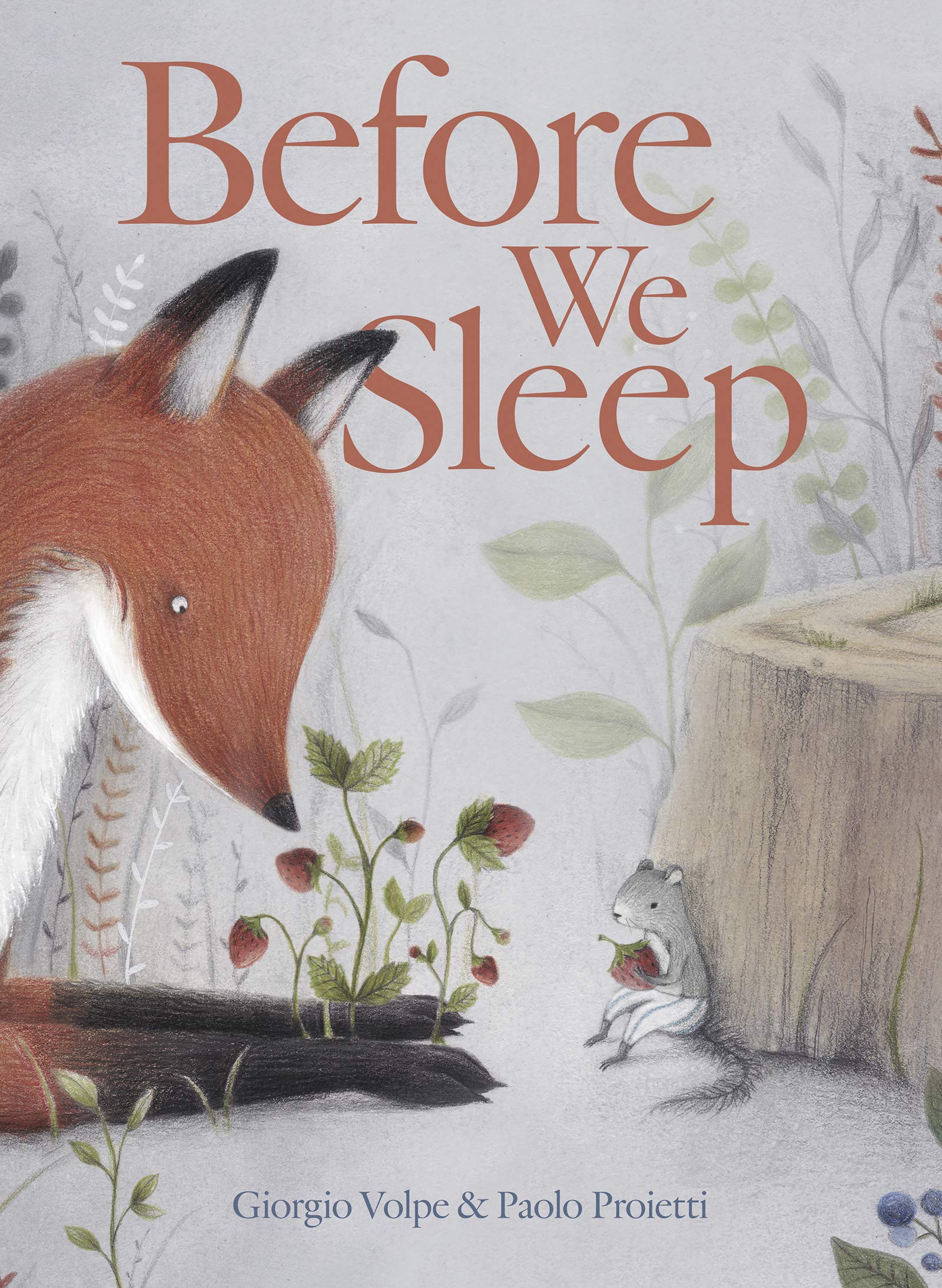
Before We Sleep
Written by Giorgio Volpe | Illustrated by Paolo Proietti
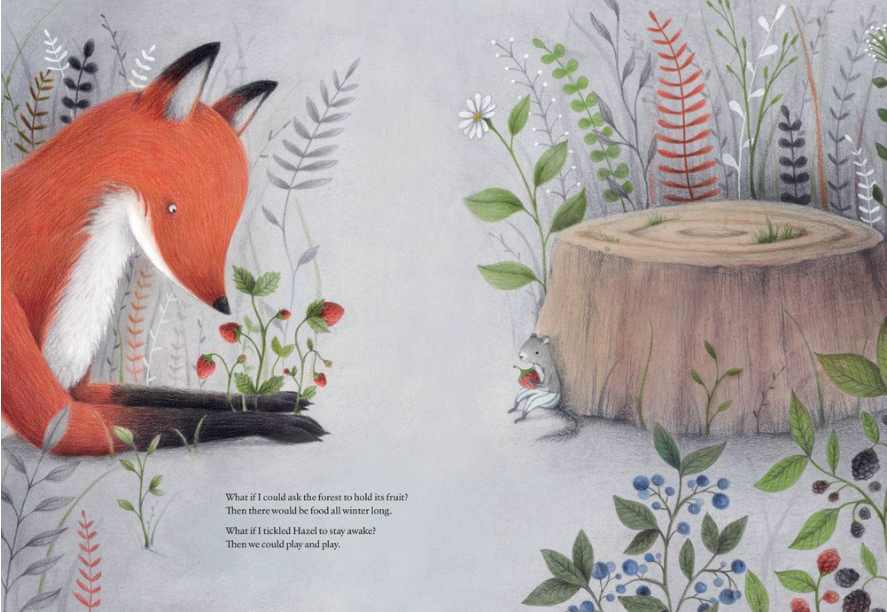
“As the season turned, the forest was dressed in new colors of rich amber, burned orange, and chestnut brown.” Little Red, the fox couldn’t wait to play hide-and-seek with his friend Hazel the dormouse because he would be so much harder to find. Little Red and Hazel also enjoyed jumping in the crisp, rustling leaves. “‘The leaves are laughing with us,’ said Hazel joyfully.” But there was one thing about autumn that Little Red did not like. He knew that soon winter would come and he would be lonely.
Image copyright Paolo Proietti, 2021, text copyright Giorgio Volpe, 2021. Courtesy of Red Comet Press.
Hazel was already getting ready to hibernate in her warm burrow. Little Red thought maybe this year Hazel would take a shorter sleep, but Hazel reminded her friend that, although she would like to keep him company, she couldn’t. Little Red thought of ways the earth could stay warm and nurturing, but his ideas, he knew, were just wishes. In fact, Hazel was already growing tired. She promised Little Red that come spring she would be back to play with him again.
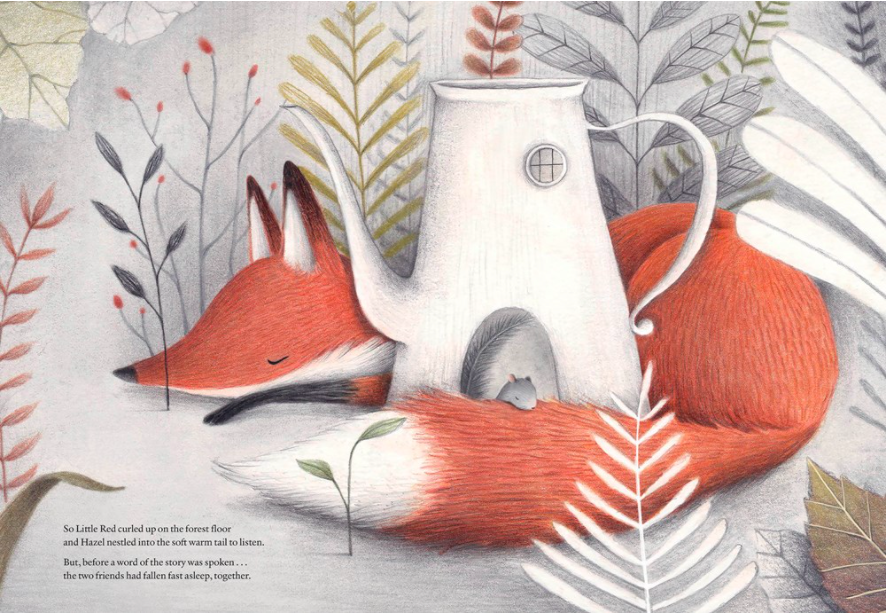
Little Red wanted just a few more minutes with his friend and asked if he could tell her a story. Little Red curled up next to her cozy burrow, and Hazel nestled into his soft tail to listen. “But before a word of the story was spoken . . . the two friends had fallen fast asleep, together.”
Note: Only first-person pronouns are used in this story, making the characters gender-neutral.
Image copyright Paolo Proietti, 2021, text copyright Giorgio Volpe, 2021. Courtesy of Red Comet Press.
Tranquil and soothing, Giorgio Volpe’s autumn friendship story floats on beautiful, evocative language that stirs memories of the fun fall offers while also reassuring readers that no matter what changes take place, love between friends always remains. Volpe’s story also touches on how friendships are built despite—or because of—individual differences. The sweet and comforting ending makes Before We Sleep not only a perfect fall read but a cozy bedtime story as well.
Paolo Proietti’s lush illustrations of a woodland dressed for autumn fuse realistic images of nature with delightful whimsy that mirrors the wistful tone of Volpe’s story and will charm readers. Proietti’s rich illustrations of fiery Little Red, adorable Hazel, and the plants, berries, nuts, and wildlife of the forest are set against lovely muted gray, blue, and sage backgrounds and invite readers to visit again and again.
A quiet and enchanting story for cozy fall days and dozy nights, Before We Sleep is highly recommended as a gift for family or friends and as an addition to home, school, and public library collections.
Ages 3 – 7
Red Comet Press, 2021 | ISBN 978-1636550046
To download a Before We Sleep Activity Kit and find video resources, visit Red Comet Press.
If you live in the Northern Hemisphere, fall has arrived! If you live in the Southern Hemisphere, welcome to spring! Today, daytime and nighttime will be equal, ushering in a changing of the seasons. For some that means cooler weather, shorter days, and a slowing down in nature which leads to our being able to see the brilliant reds, yellows, and oranges in the leaves of certain trees. The phenomenon featured in today’s book. For others nature is just awakening, with all the beauty warm weather and new growth bring. Wherever you live, enjoy the activities and events the change in season brings!
Leaf Jumpers
Written by Carole Gerber | Illustrated by Leslie Evans
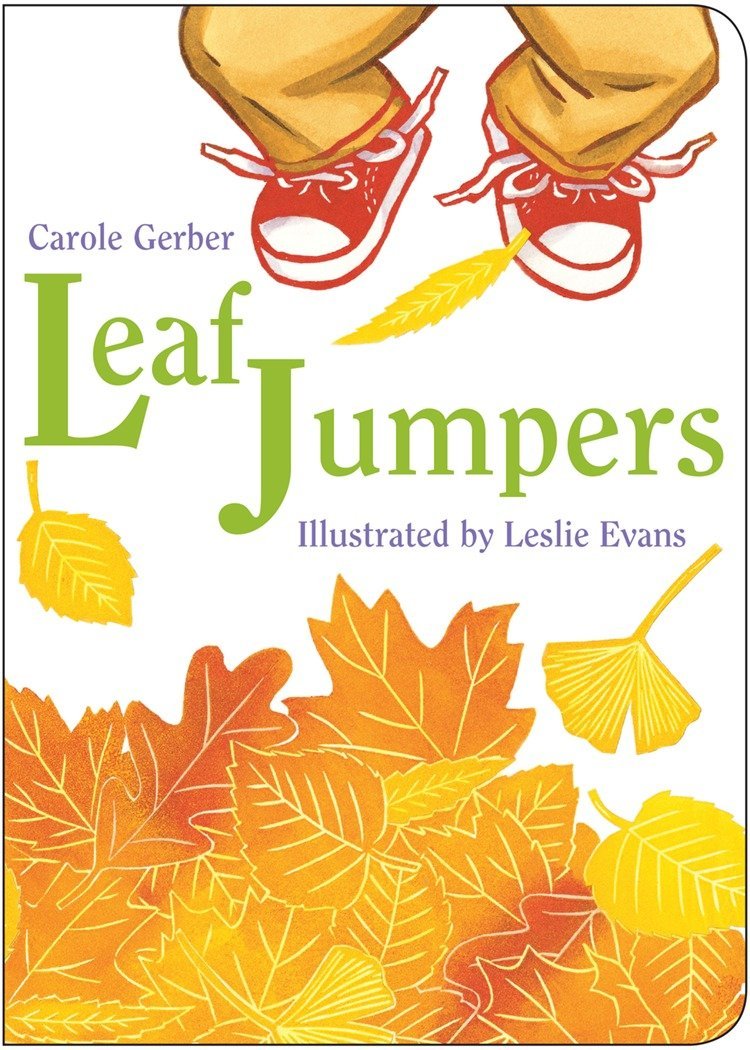
One of the marvels of autumn is watching the trees change their summer clothes for colorful cool-weather dress. In their classic, Leaf Jumpers, Carole Gerber and Leslie Evans teach young readers how to identify eight of nature’s beauties by the shape and fall color of their leaves. On a crisp afternoon, two children (and their dog) watch “a soft wind shake the trees. It lifts the leaves and sets them free.” As the leaves flutter down, the kids race to catch them in the air as they call out their names.
Image copyright Leslie Evans, 2004, text copyright Carole Gerber, 2004. Courtesy of Charlesbridge.
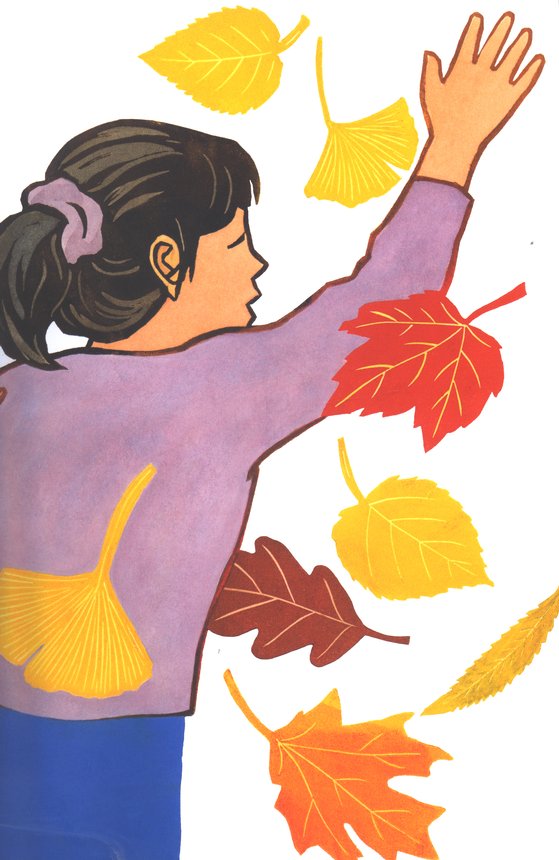
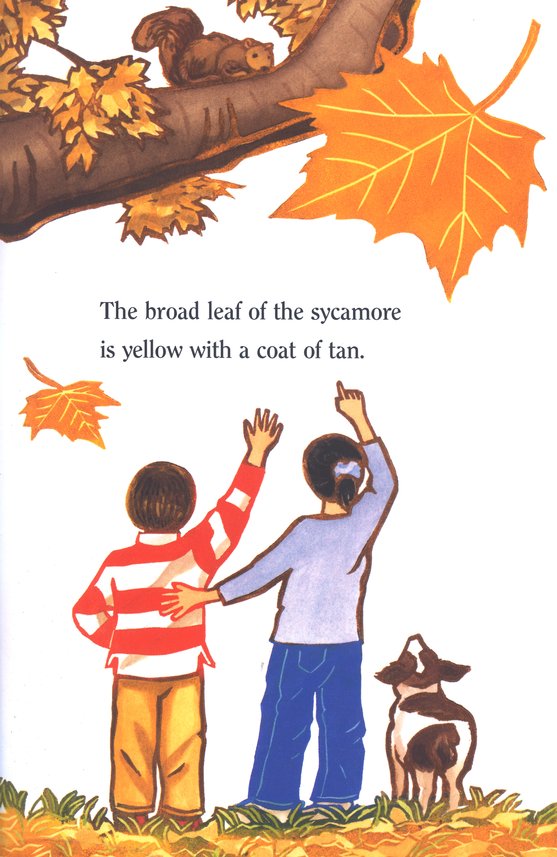
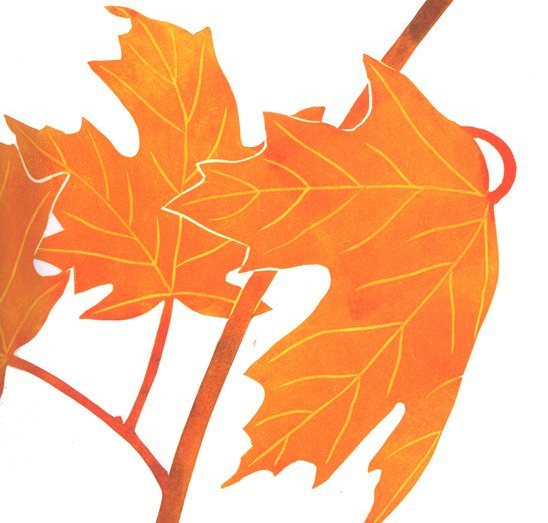
First come maple leaves “bright and vivid as a match.” Joining them, “the sugar maple’s leaves are orange, like pumpkins in a pumpkin patch.” The boy compares his hands to a white oak leaf and seeing birch leaves on the ground thinks they are as oval and sunny as an egg. Their dog likes hiding among the fringy yellow-green willow leaves, while the girl gently holds a ginkgo’s “wavy golden leaf” that’s “shaped just like a little fan.”
Image copyright Leslie Evans, 2004, text copyright Carole Gerber, 2004. Courtesy of Charlesbridge.
High up in the sycamore a squirrel crouches on a branch, camouflaged in the dense foliage. The boy and girl wave to it, and their dog, all attention, is ready for a chase. The kids pick up leaves by the handful and toss them into the air, dancing underneath. As the leaves land, the boy and girl giggle. “Leaf hats settle on our heads.” The girl grabs a rake and begins gathering the leaves, and when they are mounded deep, the three leap into the beckoning “pile of colors.”
Image copyright Leslie Evans, 2004, text copyright Carole Gerber, 2004. Courtesy of Charlesbridge.
With lyrical verses, Gerber invites kids to enjoy the fun that comes when the vibrant fall leaves blanket the ground. Her sprightly descriptions are just right for teaching even the youngest readers to recognize trees by the intricate details of their leaves. Smooth or jagged, thin or wide, red, orange, or yellow, each leaf has a story to tell. Gerber’s also compares the color or the shape of each leaf to something children are familiar with, helps them to remember and distinguish each type of leaf. But, of course, Gerber understands that for little ones, autumn leaves mean just one thing, and she celebrates kids’ excitement and creativity in her final pages, where the leaves become enticing playmates.
In her vivid illustrations, Leslie Evans spotlights each type of leaf while also infusing her pages with that giddy exhilaration that cooler weather and falling leaves creates in kids. The antics of the children’s brown-and-white dog adds humor as it hides in the willow leaves, anticipates a squirrel race, and frolics with the kids in the soft, welcoming pile. Touches of red, blue, violet and tan in the children’s clothing set off the dazzling leaves, producing a warm and cozy effect you’ll love snuggling up with.
Now in a board book edition, Leaf Jumpers makes a perfect book to have on hand at home to take along on fall trips to farmers markets and parks or on strolls around the block. It’s also a great book to share as leaves begin changing color and tumbling down and before those fun leaf-raking sessions. Leaf Jumpers is a wonderful resource for classrooms and libraries to include in their collections as well.
Ages 3 – 7
Charlesbridge, 2017 | ISBN 978-1580897822 (Board Book, 2017) | ISBN 978-1570914980 (Paperback, 2006)
Discover more about Carole Gerber and her books on her website.
To learn more about Leslie Evans, her books, and her art, visit her website.
Autumn Equinox Activity
Cinnamon Apples
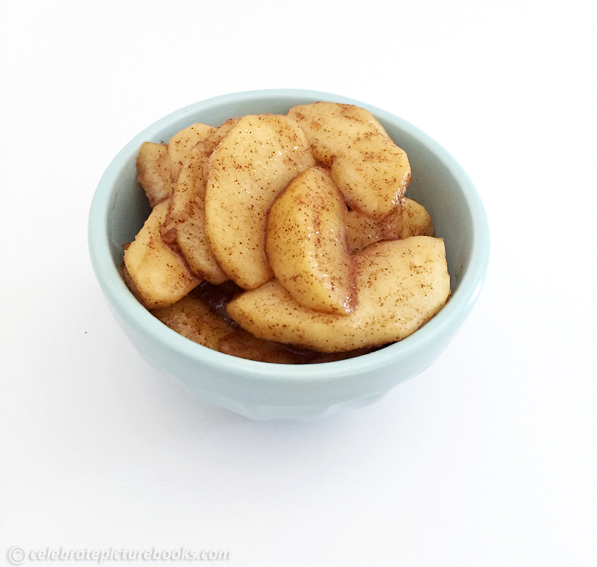
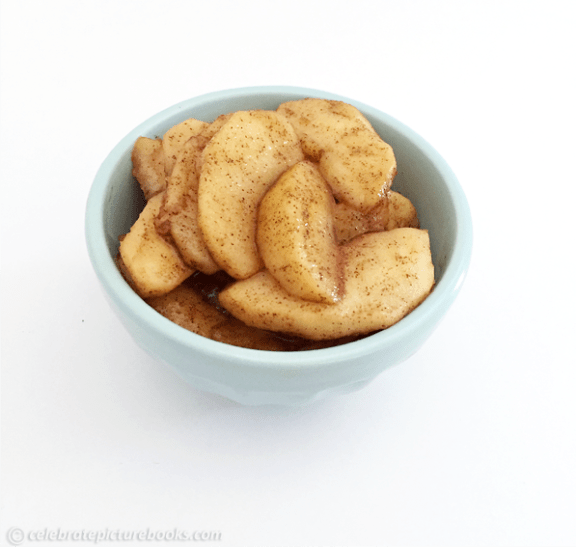
Warm apples sprinkled with cinnamon sugar is one of the most delectable treats of autumn. Here’s an easy recipe for making this delicious dessert or side dish.
Ingredients
4 cups of apples, Macintosh or Granny Smith apples are good choices
2 tablespoons brown sugar
1 teaspoon cinnamon
1/4 teaspoon lemon juice
Directions
Mix brown sugar and cinnamon
Peel and core 2 large apples
Thinly slice apples
Combine apples and cinnamon sugar/brown sugar mixture
Stir until well combined
Drizzle with lemon juice and stir again
Cook apples on the stove at medium heat for 8 to 10 minutes or until desired texture
Today’s holiday is steeped in the history of the apple industry in America, beginning with the work of John Chapman, known as Johnny Appleseed, who planted apple trees on his travels across the country in the early 1800s. Due to the popularity of apples and their ease of transportation, a variety of apples were being developed during the mid-to-late 1800s. While the “Ben Davis” apple was at the top of the list in 1880 for its resilience in tough growing climates and long shelf life, it wasn’t the tastiest of apples. As transportation from farm to store became easier and shorter, the Red Delicious emerged as the favorite. It held that position into the 1980s, comprising 75% of all apples grown in Washington state—one of the largest apple producers in the world. While other apple varieties have taken a bite out of the popularity of the Red Delicious, it is still the iconic apple—and the star of today’s holiday!
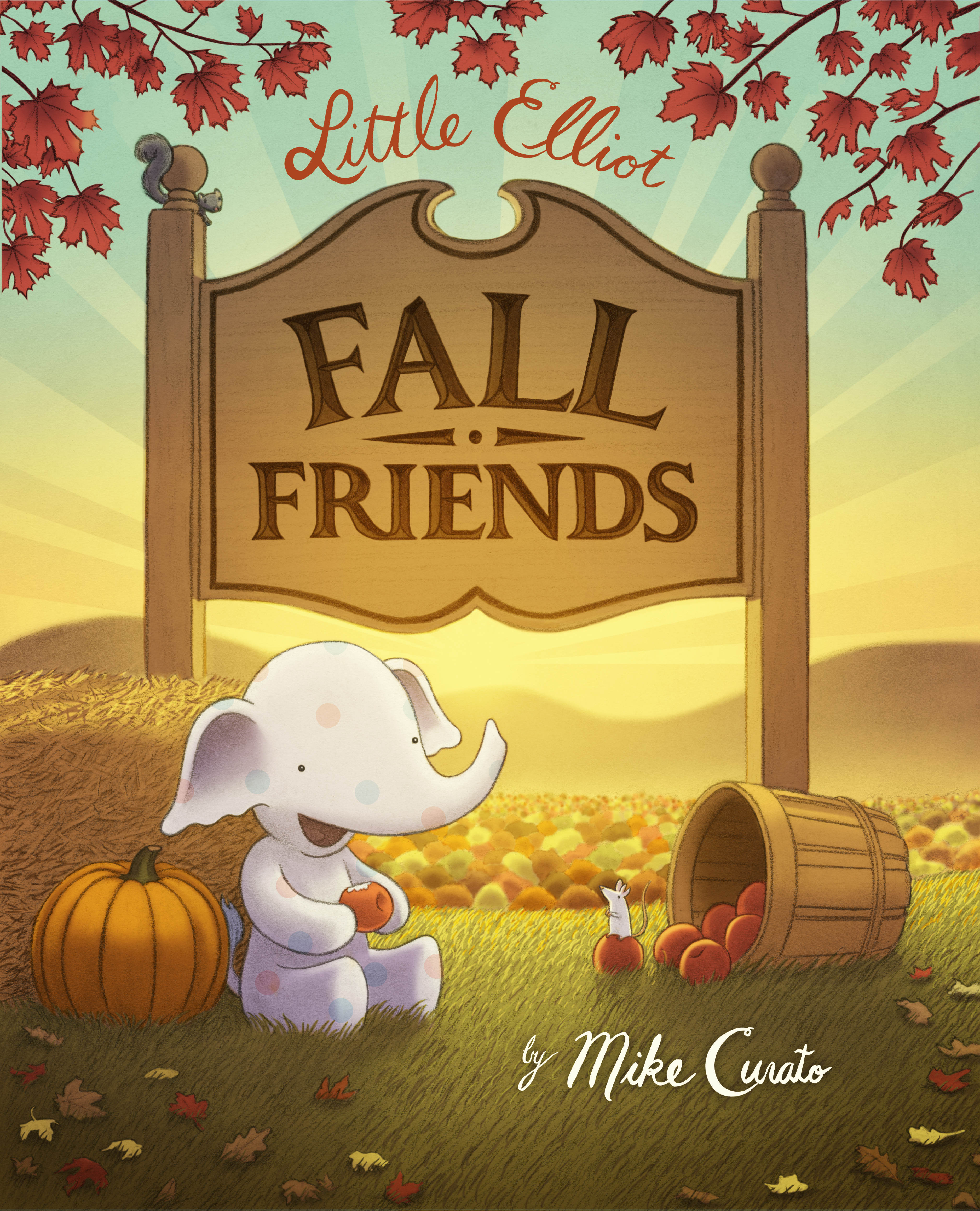
Little Elliot, Fall Friends
By Mike Curato
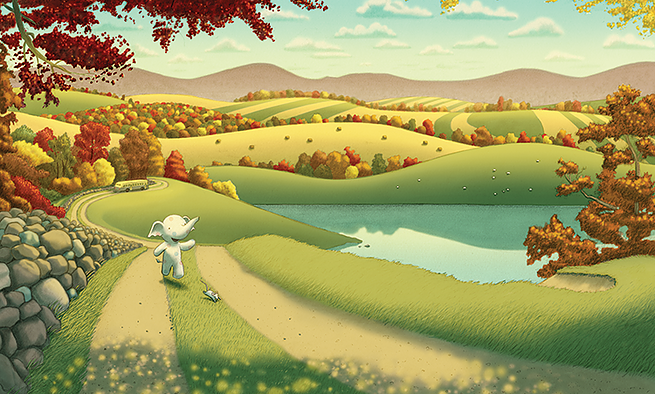
Little Elliot the elephant and his best friend Mouse loved the lights, action, and feel of the big city. Sometimes though “the city was too dirty, too loud, and too busy.” Mouse decided they needed a vacation, so they took a bus ride to the country. As they left the buildings and traffic of the city behind for the autumn leaves, rolling hills, and fresh air of the countryside, Elliot and Mouse felt refreshed.
Copyright Mike Curato, 2017, courtesy of mikecurato.com.
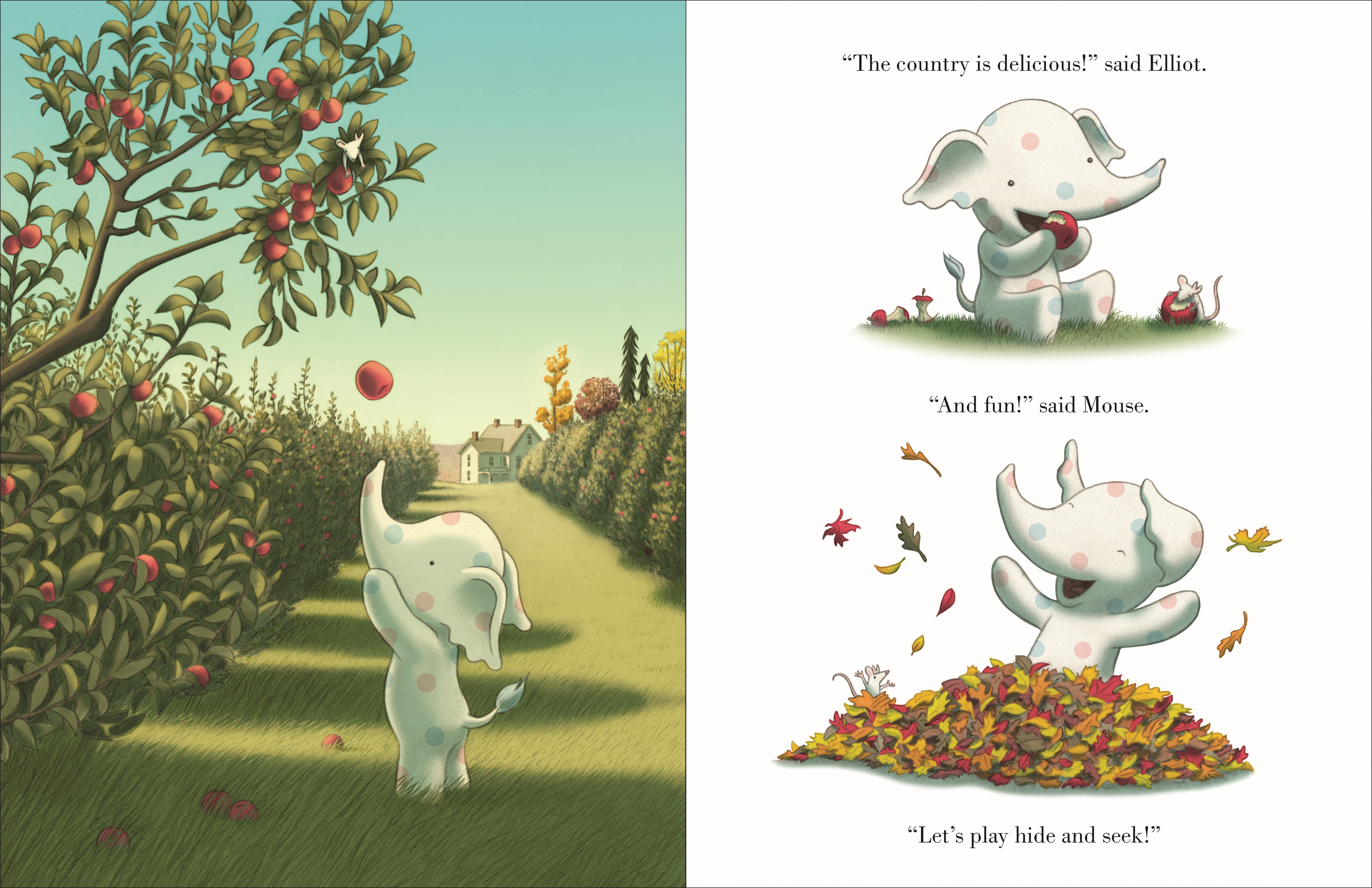
When the bus dropped them off, Elliot exclaimed, “‘Wow…the country is even bigger than the city!’” They ran up a hill and relaxed under a tree feeling “the breeze and the sunshine and the soft grass.” Soon, they began to get hungry. Down in an orchard below, they found some juicy red apples to eat. Taking a bite, Elliot thought, “‘The country is delicious!’” Mouse thought the piles of fallen leaves were pretty fun too.
Copyright Mike Curato, 2017, courtesy of us.macmillan.com.
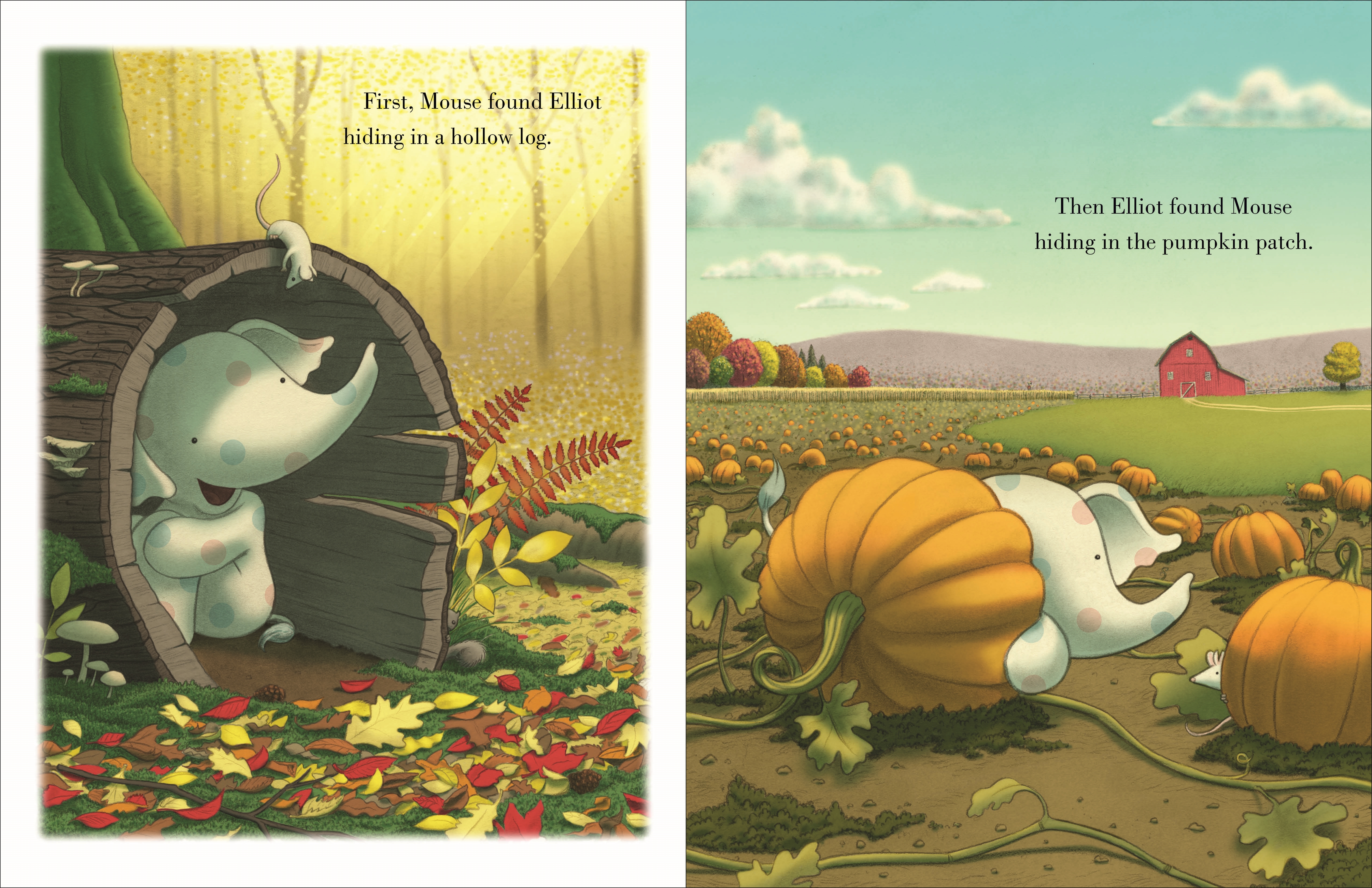
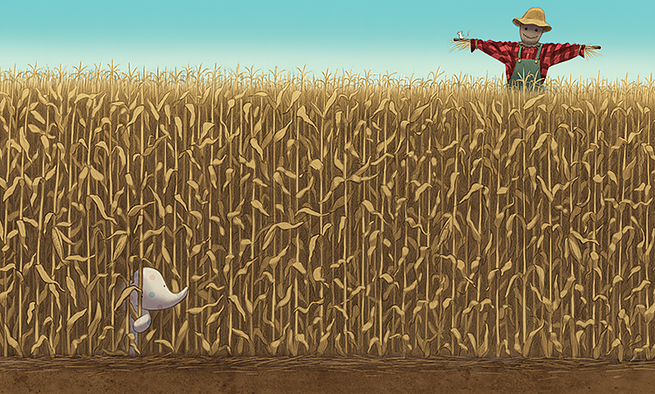
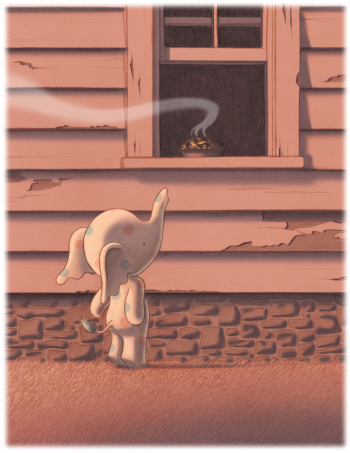
The two played hide-and-seek in the woods, in a pumpkin patch, and in a corn field, where tall brown stalks still stood. Elliot thought the corn field was the perfect hiding spot, but as the sun began to go down and no Mouse appeared to find him, he wondered where Mouse was. “Suddenly, Elliot smelled something delicious.” He followed the aroma out of the corn stalks and to a farm house, where he found a an apple pie cooling on a windowsill.
Copyright Mike Curato, 2017, courtesy of us.macmillan.com.
Elliot came closer, close enough to peek in the window. Just then Mouse jumped out from behind the pie. “‘I found you!’” he said. Elliot was excited to see his friend. It seemed that Mouse had been busy. When he couldn’t find Elliot, he knew just what to do. He made friends with the farm animals, and then they made a pie because Mouse knew that Elliot would follow his nose and come out of his hiding place. “‘Nobody knows me better,’ said Elliot.”
Copyright Mike Curato, 2017, courtesy of mikecurato.com.
Later, the pig, cow, horse, dog, and chicken gathered with Elliot and Mouse around the big picnic table “for a fall feast.” With apple cider served in mason jars, Mouse gave a toast: “‘To new friends!’” and Elliot added “‘And to new treats!’” They fell asleep on the soft hay in the barn, naming the stars that twinkled in the dark sky.
Copyright Mike Curato, 2017, courtesy of mikecurato.com.
Mike Curato’s Little Elliot books enchant little ones, and it’s easy to see why as Elliot and Mouse’s adventure into the countryside offers young readers all the comfort and camaraderie that best friends provide each other. The quietly simple and tender story is highlighted by Curato’s spectacular illustrations that combine the clear precision and details of photography with the playful softness of a favorite stuffed toy. Here and there clever designs in the images reflect the sunny tone and foreshadow the special treat Mouse uses to reunite with his best friend. The final nighttime spreads will fill children with wonder.
Copyright Mike Curato, 2017, courtesy of mikecurato.com.
Little Elliot, Fall Friends is a sweet, sophisticated book that fans of the series will want to add to their collection and new readers will embrace, while also eager to discover the other Little Elliot books: Big City, Big Family, and Big Fun. It’s a “can’t miss” for any child’s bookshelf.
Ages 4 – 8
Henry Holt and Company Books for Young Readers, 2017 | ISBN 978-1627796408
Discover more about Mike Curato and his books plus downloadable Little Elliot activity sheets on his website.
Eat a Red Apple Day Activity
Cinnamon Apples Recipe
Cinnamon apples are a delicious side dish to any meal! This tasty recipe is fun for kids and adults to make together.
Ingredients
4 cups of apples, Macintosh or Granny Smith apples are good choices
2 tablespoons brown sugar
1 teaspoon cinnamon
1/4 teaspoon lemon juice
Directions
Mix brown sugar and cinnamon
Peel and core 2 large apples
Thinly slice apples
Combine apples and cinnamon sugar/brown sugar mixture
Stir until well combined
Drizzle with lemon juice and stir again
Cook apples on the stove at medium heat for 8 to 10 minutes or until desired texture













 celebratepicturebooks.com