January 1 – Global Family Day

About the Holiday

A desire for world peace is an idea that most people can agree on and that many around the globe are working toward. One way to bring this about on a direct and personal scale is to build and strengthen families and communities. Which brings us to today’s holiday and what Global Family Day is all about. Today’s holiday has its underpinnings in the United Nations General Assembly’s January 1, 2000 launch of the International Decade for the Culture of Peace and Non-Violence for the Children of the World, which revolved around the idea that some day, in the future, there could be a time when there is no more war on the planet. Because the launch was so successful, the United Nations decided to make it an annual event called Global Family Day. Today’s book, which brings families together through 30 international cultural tales contains the seed for more understanding and peace among individuals and communities.

Thank you to Bloomsbury Children’s Books for sharing a copy of this book with me for review!

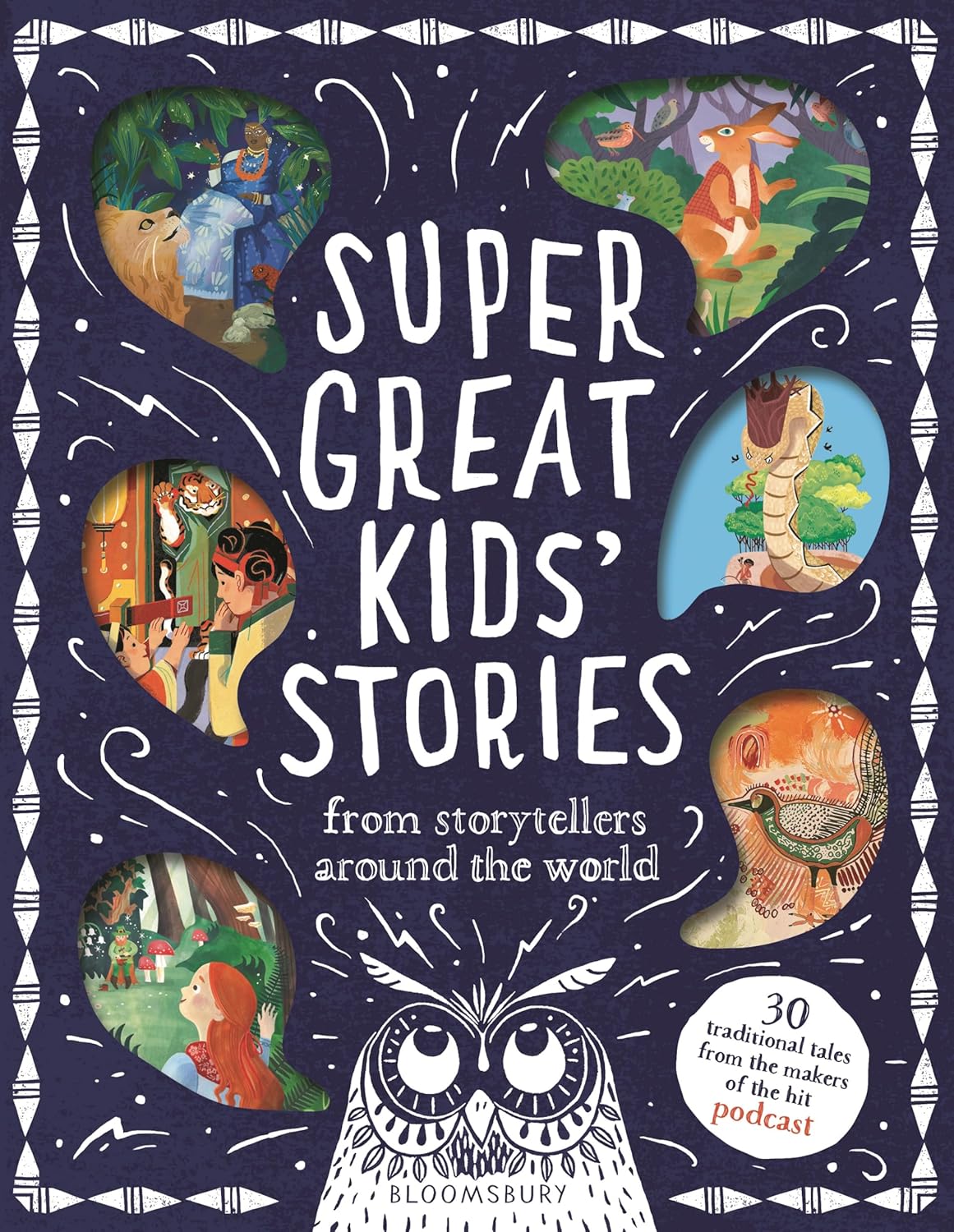
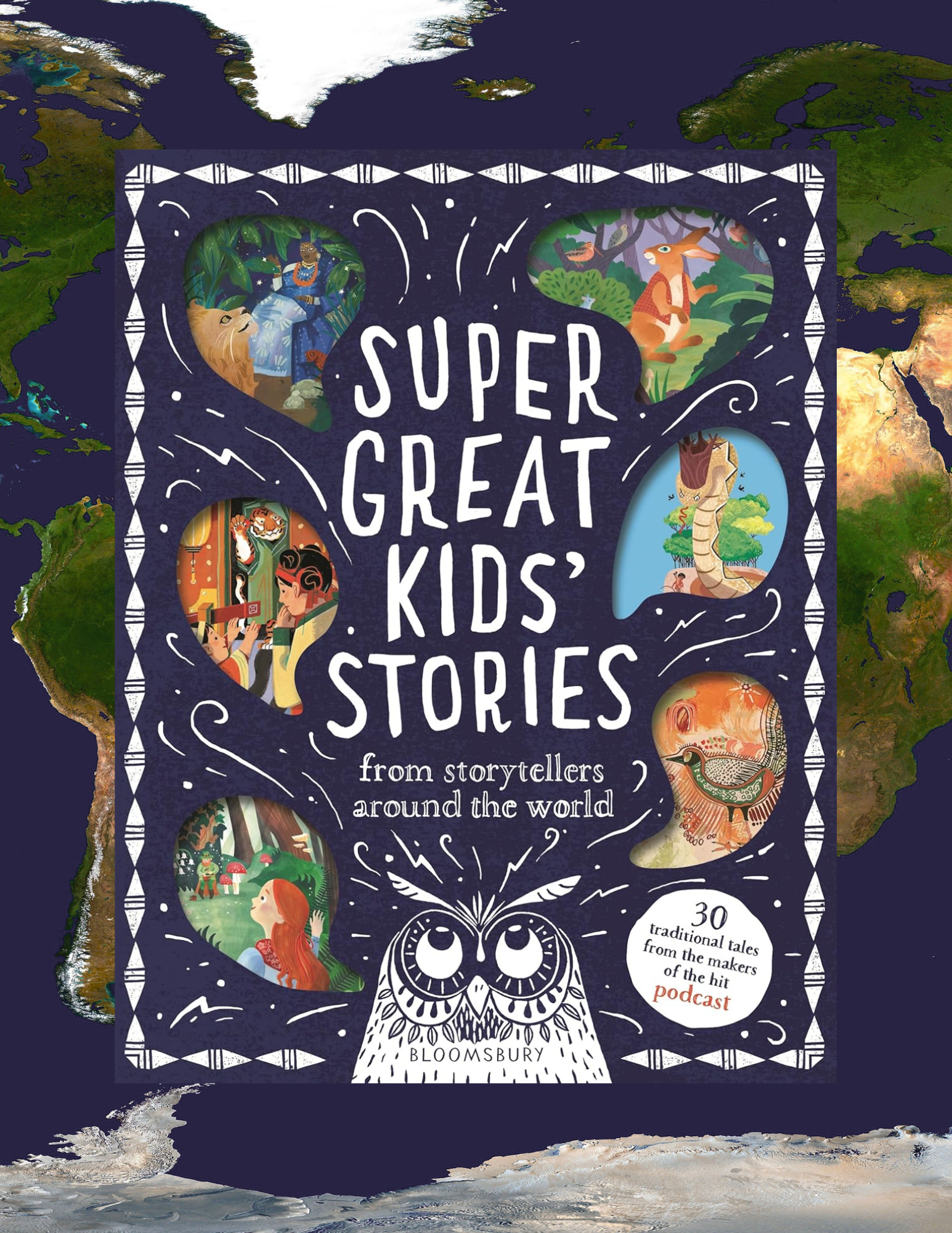
Super Great Kids’ Stories: From Storytellers Around the World

Stories curated by Kim Normanton


Would you like to take your kids on a global adventure this year? How about taking that trip without ever leaving home? You can do it with Super Great Kids’ Stories, a new companion book to the popular Super Great Kids’ Stories podcast. Through the thirty tales in this collection, families can travel through North America, South America, Africa, Europe, Asia, and Oceania while enjoying glimpses into the culture and traditions of a wide range of countries. 

Young readers will gain a sense of camaraderie with their peers around the world as they read or listen to stories with familiar characters and themes that just undergo a tweak here and a name change there. For example, kids who know the Cinderella story will be excited to recognize similar aspects in “Keeya and the Purple Fish,” an intriguing tale from Eswatini, a country in southern Africa.
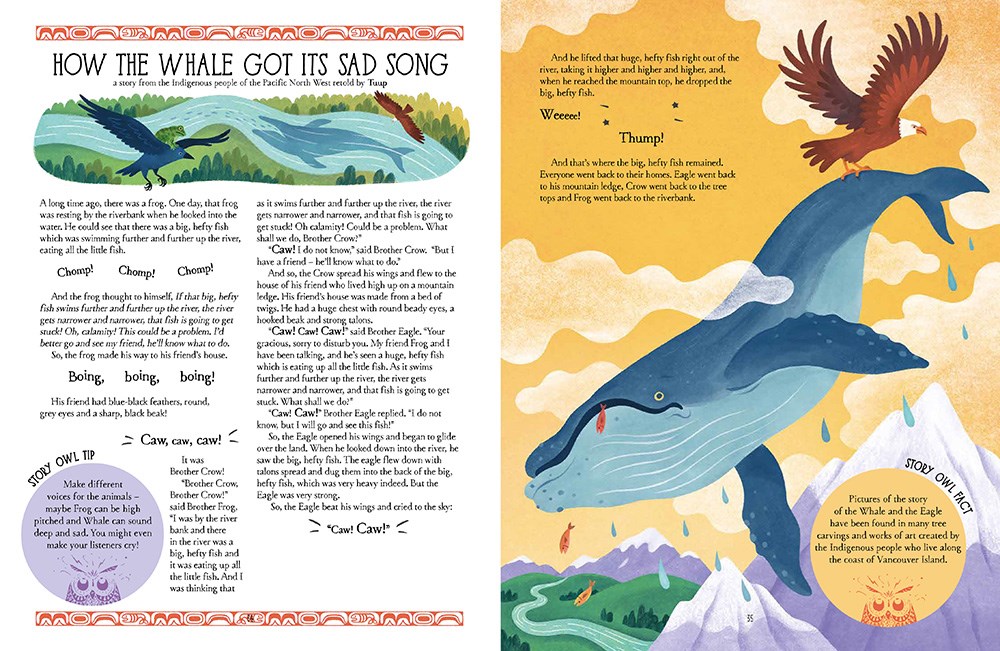
Illustration © 2025 by Kaley McKean, text © 2025 by Tuup. Courtesy of Bloomsbury Children’s Books.

For kids who can’t make up their mind between hearing a ghost story or a funny story, there’s “The Ghost of the Bloody Finger,” a tale from the United States retold by Tiernan Douieb, which if read with the spookiest and most dramatic voice, will have them shaking . . . with laughter! Children will also travel to South America to discover “How Snakes Got Their Poison,” a story of a sly trade from the Indigenous people of the Amazon rainforest retold by Tuup, and two other stories.  

Visiting Asia, readers find six stories, including “Inch Boy,” a story from Japan, retold by Masako Carey that offers a thrilling twist on a tale many may recognize as “Thumbelina.” They’ll also marvel at “The Boy Who Used His Head,” a story from South Korea retold by Pamela Marr. Wending their way to Europe, children will be engaged by “Molly and the Leprechaun,” an Irish story perfect for Saint Patrick’s Day retold by Kate Corkery. They’ll also love “Little Half Chick,” a story from Spain retold by Rebecca Lemaire that they’ll remember whenever the wind changes, plus four more delightful tales.
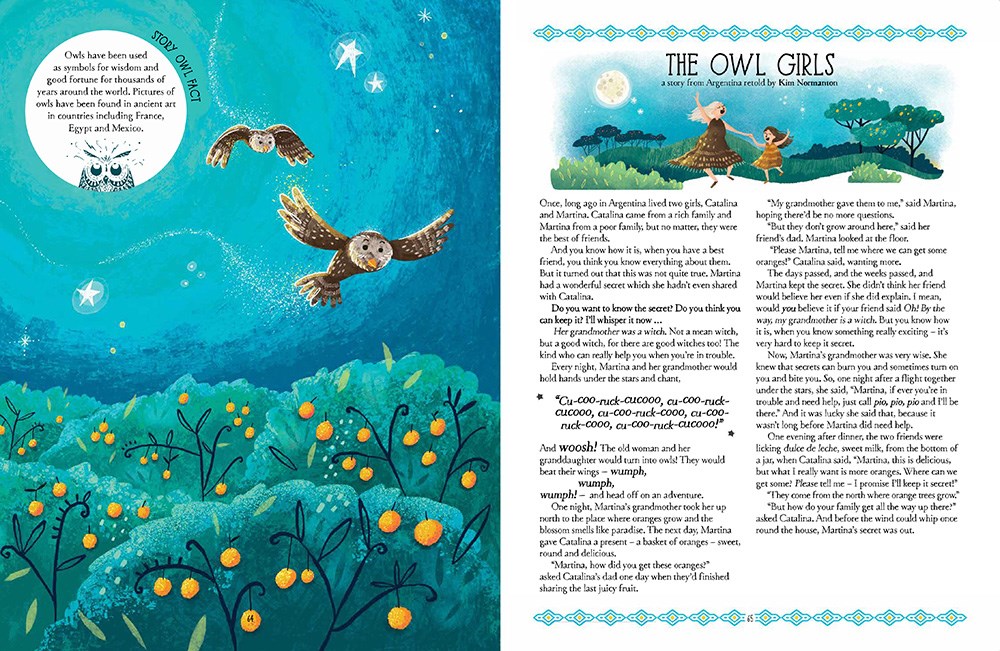
Illustration © 2025 by Camila Carrossine. Text © 2025 by Kim Normanton. Courtesy of Bloomsbury Children’s Books.

Leaving Europe kids land in Oceania, where they learn two First Nations stories from Australia retold by Warren Foster, one about Bungoo the flying fox who jumps from friend to friend, and the next about how the Lyrebird got its voice. Two Māori stories from New Zealand retold by Emmy Bidois follow—the first about the trickster demigod Māui, and the second a legend about how the kiwi lost its wings.

To enhance listeners’ experience each story is visited by the Story Owl, who offers interesting tips on how the story can be made interactive with sounds or motions and provides facts about an aspect of the story. Back matter includes short biographies of the book’s storytellers and illustrators as well as quotes from each storyteller about where they first heard the story they tell here.

Illustration © 2025 by Camila Carrossine. Courtesy of Bloomsbury Children’s Books.

You can’t help but be pulled into the intrigue, twists, and surprises of the tales curated by Kim Normanton in this beautiful book. Each story sings with the unique voice of the storyteller and stunning illustrations that bring the action and characters to life. Super Great Kids’ Stories provides a perfect way for families to spend rainy or snowy days together, send kids off to dreamland, or spark a child’s imagination. Teachers, homeschoolers, and other educators or group leaders will find the stories in this book to be a high-interest way to introduce world cultures to students or to inspire meaningful writing or presentation projects.

Ages 5 – 7

Bloomsbury Children’s Books, 2025 | ISBN 978-1547619283

Kim Normanton is the curator of this collection and presenter of the podcast Super Great Kids’ Stories. She has been telling traditional stories in schools and museums around the world for 20 years. Kim uses rhymes and singing and has a wide repertoire, from African fables to Indian fairytales. She also produces social documentaries for BBC Radio. To learn more visit www.supergreatkidsstories.com.

Stories retold by

Sheila Arnold, Emmy Bidois, Masako Carey, Kate Corkery, Peter Chand, Tiernan Douieb, Amy Douglas, Warren Foster, Wangari Grace, Emily Hennessey, Rebecca Lemaire, Juliana Marin, Pamela Marre, Daniel Morden, Kim Normanton, Winston Nzinga, Baden Prince Junior, Gayle Ross, Simone Shüemmelfeder, Wendy Shearer, and Tuup.

Stories illustrated by

Sally Agar, Camila Carrosine, Tinuke Fagborun, Melissa Greenwood, Kaley McKean, and Terri Po.

Global Family Day Activity

Draw Your Family Coloring Page


Kids can celebrate Global Family Day by drawing their family in this snow globe.

Global Family Day Coloring Page in Blue | Global Family Day Coloring Page in Black and White
You can purchase Super Great Kids’ Stories from these booksellers

Amazon | Barnes & Noble | Bookshop

Picture Book Review

October 11 – Celebrating the Book Birthday of Madani’s Best Game

celebrate-picture-books-picture-book-review-madani's-best-game-cover

Thanks to Eerdmans Books for Young Readers for sharing a copy of Madani’s Best Game with me for review consideration. All opinions on the book are my own.

Madani’s Best Game

Written by Fran Pintadera | Illustrated by Raquel Catalina | Translated from the Spanish by Lawrence Schimel


“Our whole neighborhood knows it: no one plays soccer like Madani does.” Thus, a teammate of Madani’s begins the story about this friend who captivates the neighborhood (and sometimes it seems the whole world) with his barefoot ball-handling prowess. Madani has elevated the team’s game to “the best soccer we’ve ever seen.” After Madani has scored a “Gooooal!” the sound of the cheers soars above the playing field and “…crosses through doorways, rushes past the magazine stand, slips down alleyways, swirls around the fountain, and, growing fainter and fainter, climbs the steps up to Madani’s house.” 

celebrate-picture-books-picture-book-review-madani's-best-game-bare-feet

Image copyright Raquel Catalina, 2022, text copyright Fran Pintadera, 2022. Courtesy of Eerdmans Books for Young Readers.

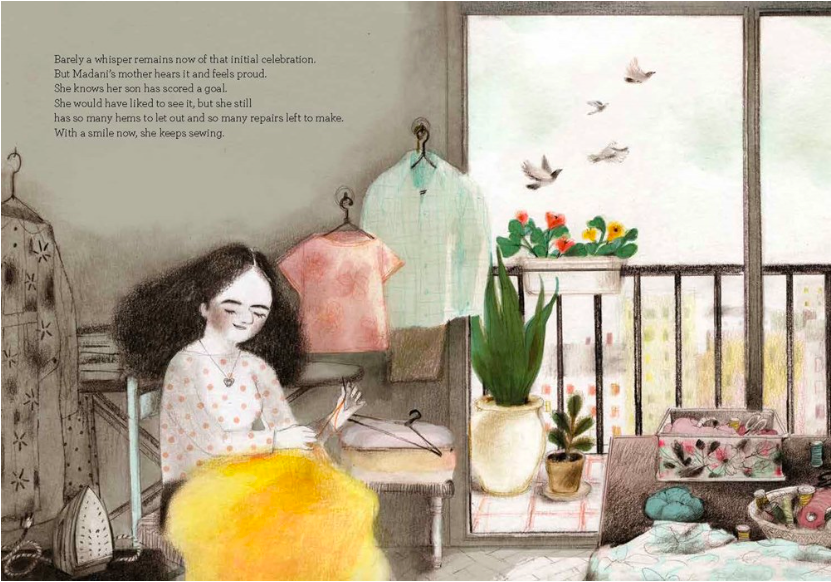
There, his mother hears it and knows the cheers are for Madani. She wishes she could attend his games, but she’s a seamstress and has so many garments to sew by hand. After the game, Madani’s teammates can only imagine how much better he would play if he only had a good pair of cleats. Their team might even be able to beat the Southside team—their biggest rival.

celebrate-picture-books-picture-book-review-madani's-best-game-madani's-moves

Image copyright Raquel Catalina, 2022, text copyright Fran Pintadera, 2022. Courtesy of Eerdmans Books for Young Readers.

The members of the team know that Madani’s saving up money in a special tin that gets heavier every time he declines to buy a snack, walks to away games instead of riding the bus, and makes other sacrifices. They know that when the box is full, Madani’s going shopping. “…then our games will be better than ever!’” he says, and they all dream of the day Madani buys his new cleats.

celebrate-picture-books-picture-book-review-madani's-best-game-listening

Image copyright Raquel Catalina, 2022, text copyright Fran Pintadera, 2022. Courtesy of Eerdmans Books for Young Readers.

The big game against Southside is only a day away, but Madani doesn’t come to practice. Instead, his friends watch him head downtown with the tin under his arm. Without Madani at practice, the team falls apart, but they don’t worry. Finally, they thought, their dreams of new cleats and beating Southside would come true!

When Madani shows up at the game the next day, “he looks radiant,” but he’s still barefoot. His teammates question him about his new cleats, but Madani doesn’t know what they’re talking about. The money wasn’t for shoes but for a present for his mother so that “‘she’ll be able to finish her work faster and come watch me play every Saturday.’”

celebrate-picture-books-picture-book-review-madani's-best-game-mother

Image copyright Raquel Catalina, 2022, text copyright Fran Pintadera, 2022. Courtesy of Eerdmans Books for Young Readers.

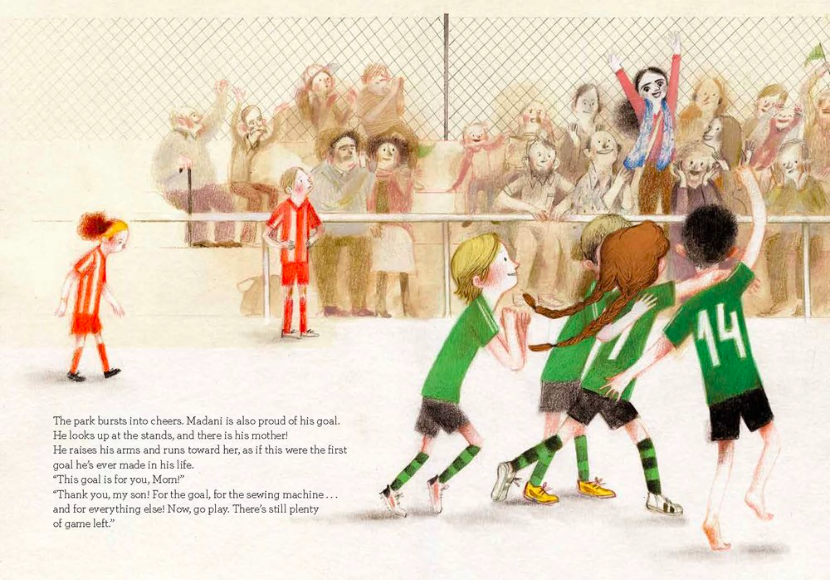
Madani’s friends still don’t quite get it, but the game begins, and in moments Madani has already stolen the ball away from the Southside players, run downfield and scored. He looks into the stands, sees his mother, and shouts “‘This goal is for you, Mom!’” Madani makes another goal, but Southside scores too, and the game ends in a tie. It’s okay, though, Madani’s teammate says, “‘because now more than ever, everyone in the neighborhood knows … There’s no player like Madani!’”

Back matter consists of notes from Fran Pintadera and Raquel Catalina that reveal their creative journeys and connections to this story.

celebrate-picture-books-picture-book-review-madani's-best-game-mother-at-game

Image copyright Raquel Catalina, 2022, text copyright Fran Pintadera, 2022. Courtesy of Eerdmans Books for Young Readers.

Fran Pintadera, who based Madani’s Best Game on his experiences as a social educator in new immigrant housing, tells his story with open-hearted affection for his subject as well as the relationships between teammates and mother and child. Through his perceptive and humorously observed details and lyrical language, Pintadera captures the wide-eyed wonder of children in awe of a great player (or artist, singer, scientist, or other talent). When Madani gets the ball, readers will hold their breath along with the neighbors, traffic, and even pigeons while he entertains the crowd and scores a goal. Then the action begins again, but this time the suspense revolves not around the game but on what Madani will buy. The answer is joyous, affirming family devotion and revealing the pure giving nature of a child’s heart.

From their first introduction to Madani, smiling out from the page, his bare foot on a soccer ball, readers will be captivated by him, his teammates, his neighborhood, and the game. Raquel Catalina’s endearing pencil, gouache, and colored pencil illustrations charm with realistic images of kids on the soccer field surrounded by city onlookers. Catalina creates not only gorgeous visuals of Madani’s supportive neighborhood, but an almost auditory experience as well.

Readers can almost hear the players’ running feet, the sudden cheers, the flap of the rising pigeons’ wings, and – as the celebration reaches Madani’s mother’s ears – even the whisper of her sewing needle through the fabric on her knees. Catalina deftly weaves the theme of friendship, between people both young and old, throughout the pages, enhancing the bond between Madoni and his mom as well as Madani’s teammates’ understanding of the true importance of that long-awaited game.

A beautiful poignant, joyful, and affirming story of family and friendship, Madani’s Best Game is a read aloud that adults and kids will love to share over and over. The book is a must for all home, classroom, school, and public libraries.

Ages 5 – 9

Eerdmans Books for Young Readers, 2022 | ISBN 978-0802855978

You can discover more about Fran Pintadera and his work on his website and connect with him on Instagram.

To learn more about Raquel Catalina, her books, and her art, visit her website. You can also connect with her on Instagram.

You can connect with Lawrence Schimel and learn more about his writing and his translating work on Instagram and Twitter.

celebrate-picture-books-picture-book-review-madani's-best-game-cover

You can find Madani’s Best Game at these booksellers

Amazon | Barnes & Noble | Books-a-Million

To support your local independent bookstore, order from

Bookshop | IndieBound

Picture Book Review

Picture Book Revi

December 15 – International Tea Day

celebrate-picture-books-picture-book-review-teatime-around-the-world-cover

About the Holiday

Established in 2005 in New Deli, India, International Tea Day was created to raise awareness within the governments of tea-growing countries of the rights of tea workers, their conditions, and their economic contributions. Today, the holiday is commemorated widely in tea-growing nations. Some of the issues the day focuses on include wages, medical care, and education for women tea workers, who make up fifty percent of of the workforce on tea plantations. Following water, tea is the most widely drunk beverage in the world. To celebrate today, enjoy a cuppa with a cookie, a scone, or another favorite treat. 

Teatime Around the World

Written by Denyse Waissbluth | Illustrated by Chelsea O’Byrne


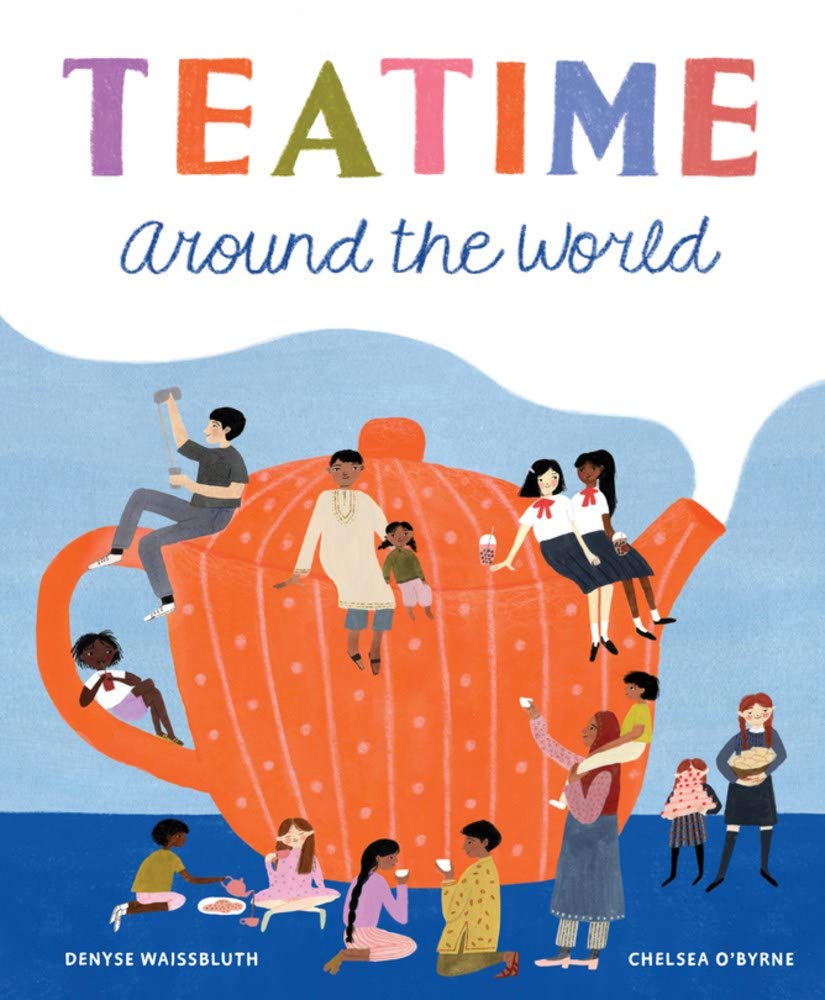
Two women sit at a table with steaming cups of tea in front of them, talking. “Tea for one. Tea for two.” To the side sits a teapot, its contents still warm. At their feet a child is having a tea party with a bear, jauntily clad in a feathered hat. Cookies, strawberries, and croissants fill out this feast served from a special tea set. “Tea for me. Tea for you.” Tea time continues in Morocco, where a father and child kneel on pillows. The father pours out three cups of mint tea. Made with green tea, mint, and sugar, each cup of tea will have “a slightly different taste.”

celebrate-picture-books-picture-book-review-teatime-around-the-world-sugar

Image copyright Chelsea O’Byrne, 2020, text copyright Denyse Waissbluth, 2020. Courtesy of Greystone Books.

In India a street vendor sells a cup of masala chai to a woman, who’s looking for a peaceful break during her day. The “strong tea and spices like cinnamon, ginger, cloves, cardamom, and pepper…boiled with milk and sweetened” will hit the spot. Hot tea is relaxing, but on a hot day there’s nothing more refreshing than a glass of iced tea. In Thailand, locals and tourists enjoy cha yen, sold from street vendors’ carts. This “strongly brewed sweet tea is poured over ice and drunk from a bag through a straw. Indigenous people in North America soothe fevers, colds, sore muscles, and even sleepless nights with tea made from “berries, plants, and roots.”

celebrate-picture-books-picture-book-review-teatime-around-the-world-russia

Image copyright Chelsea O’Byrne, 2020, text copyright Denyse Waissbluth, 2020. Courtesy of Greystone Books.

Special tea times—like chanoyu, the Japanese tea ceremony during which matcha, a powdered green tea is served, and afternoon tea, enjoyed with trays of treats world wide—bring people together for comforting respites. You’ll be interested to discover the origins of afternoon tea too! Tea can be served quietly or dramatically, like “teh tarik, or pulled tea…the national drink of Malaysia,” is “poured from up high, or ‘pulled’ between two mugs, to make it frothy.”

celebrate-picture-books-picture-book-review-teatime-around-the-world-poured

Image copyright Chelsea O’Byrne, 2020, text copyright Denyse Waissbluth, 2020. Courtesy of Greystone Books.

Tea is as old as its discovery thousands of years ago in China and as new as bubble tea, created in Taiwan in the 1980s. In Argentina, Chile, and Uruguay, yerba maté tea is served in hollowed-out gourds with a “special straw called a bombilla,” while in Jamaica sorrel, made from roselle hibiscus buds, “spiced with ginger, cloves, and sugar,” is perfect for any festive occasion. No matter where you live, what flavors of tea you enjoy, or how you serve it, you can always count on “tea for one. / Tea for two. / Loved by all / the whole world through.”

celebrate-picture-books-picture-book-review-teatime-around-the-world-for-group

Image copyright Chelsea O’Byrne, 2020, text copyright Denyse Waissbluth, 2020. Courtesy of Greystone Books.

With a lilting poem that flows from page to page, Denyse Waissbluth introduces unique flavors, special brew methods, and the comforting feeling a cup of hot or iced tea infuses into a day. The shared experience of tea drinking provides a fascinating touchstone for Waissbluth’s travelogue that takes kids around the world to experience the rituals, recipes, and traditions from each country that makes their tea unique. Waissbluth’s conversational style will appeal to kids looking to learn how global cultures are similar to and different from their own.

Chelsea O’Byrne’s lovely matte illustrations take children to cities, the countryside, and the seaside around the globe, revealing not only diverse scenes of how tea is made, served, and enjoyed, but homes, food, and clothing as well. Children will be excited to see such homey and intimate portraits of their peers around the world.

Sure to spur readers to learn more about the countries featured and entice them to try their signature teas, Teatime Around the World would enhance geography, history, and multicultural lessons for school and homeschooling and is highly recommended for school and public library collections.

Ages 3 – 7

Greystone Books, 2020 | ISBN 978-1771646017

You can connect with Denyse Waissbluth on Instagram.

To learn more about Chelsea O’Byrne, her books, and her art, visit her website.

International Tea Day Activity

celebrate-picture-books-picture-book-review-tea-word-search-puzzle

Tea for You! Word Search


Can you find the names of eighteen delicious teas from around the world in this printable puzzle?

Tea for You! Word Search Puzzle | Tea for You! Word Search Solution

celebrate-picture-books-picture-book-review-teatime-around-the-world-cover

You can find Teatime Around the World at these booksellers

Amazon | Barnes & Noble | Books-a-Million

To support your local independent bookstore, order from

Bookshop | IndieBound

Picture Book Review
April 29 – International Dance Day

celebrate-picture-books-picture-book-review-feel-the-beat-cover

About the Holiday

International Dance Day was founded in 1982 by the Dance Committee of the International Theater Institute. This date was chosen to commemorate the birthday of Jean-Georges Noverre, who was born in 1727 and is credited with creating modern ballet. Today’s holiday encourages people to celebrate dance and “revel in the universality of this art form.” There are so many styles of dance to watch and participate in. Today, enjoy a performance or find a venue where you can kick up your heals in your favorite kind of dance!

Feel the Beat: Dance Poems that Zing from Salsa to Swing

Written by Marilyn Singer | Illustrated by Kristi Valiant


The rhythms of dance and the cadence of poetry create a natural pairing as these seventeen poems that celebrate the moves, music, and thrill of dances from around the world demonstrate with toe-tapping joy.

In Cha-Cha a boy attending his Uncle Nate’s birthday party learns the cha-cha from his grandma. At first he says “I don’t / know these moves. / My fee / feel like hooves.” But then “something clicks! / Okay, it’s old school. / I say, / cha-cha’s cool!”

celebrate-picture-books-picture-book-review-feel-the-beat-hip-hop

Image copyright Kristi Valiant, 2017, courtesy of kristivaliant.com

While the kids at school brag about their parents’ jobs, one boy has them beat in Hip-Hop: “No fumbling, no bumbling, / my pops is tops at tumbling. / He’s elastic, so fantastic. / Papa’s so gymnastic!” But while Dad “will swipe and windmill” and “slide on his knees, / do lots of flares and coin-drops” and “boomerang and freeze,” the boy adds “…wait / until you see my mom!”

Is it meringue or Merengue? Maybe a bit of both…because doing it right means “Moving sideways, / turning wrists, / while we do / our pretzel twists. / We sway our hips, we shift our legs, like we’re whipping / lots of eggs.”

celebrate-picture-books-picture-book-review-feel-the-beat-swing-dance

Image copyright Kristi Valiant, 2017, text courtesy of Marilyn Singer. Courtesy of kristivaliant.com

It’s fun to let go when learning the Salsa. All you need is to “Feel the beat / in your feet, / in your heart. / Then you start.” So “Don’t be shy. / Come on try. / In this class, / show some sass.” If only shopping could be so entertaining…. But, wait! Maybe Conga is the solution. “We’re at the MALL. / I’m very BORED. / I hate the STORES, / I hate the HORDE…. / ‘Just one more SHOP’ / turns into FOUR. / I’m gonna SCREAM, / I’m gonna ROAR.” Then music starts and a line grows long—“Uh uh uh, KICK! / You cannot WHINE / when you are ON / a conga LINE! / Uh uh uh, KICK! / A flash mob BALL! / Keep shopping, MOM! / I love the MALL!”

celebrate-picture-books-picture-book-review-feel-the-beat-hora

Image copyright Kristi Valiant, 2017, courtesy of kristivaliant.com

The library may be a quiet, staid place most of the time, but Swing Dance takes over one special library. “On the plaza in July, / underneath the summer sky / where you can get to hear good bands, / kick your feet, wave your hands, / we’re gonna swing. / That’s our new thing / We’re gonna swing!” A boy and his mom have joined lots of other dancers having fun on the square— “We step…step… / rock step. / we’re full… / of pep. / We Lindy hop. / Bibbidy-bop! / We Lindy hop!”

And for those kids who look at the Square Dance unit in PE with trepidation, this girl feels the same: “Got a partner, lost my shoe. / Allemande left? I haven’t a clue….Did that caller give a cue? / Don’t promenade me. Shoo, boy, shoo!…Bow to Francisco, bow to Sue. / One more swing. It’s over! Whew! / I tried real hard, but alas, it’s true. / I’m flunking out of square dance!”

celebrate-picture-books-picture-book-review-feel-the-beat-wedding

Image copyright Kristi Valiant, 2017, courtesy of kristivaliant.com

Other poems introduce the Foxtrot, Hora, Samba, Two-Step, Argentine Tango, Waltz, Bhangra, and Polka. Notes about each dance, giving a description, a bit of history, and basic rhythms and steps, follow the text. A CD of dance music is also included.

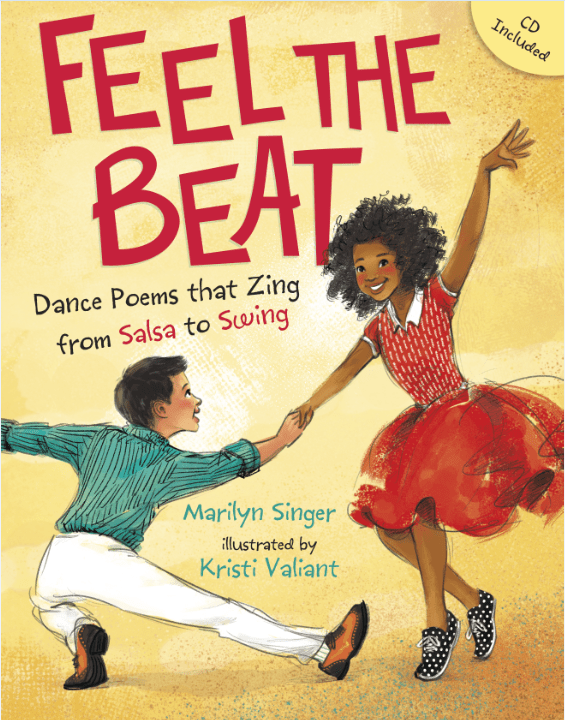
Marilyn Singer begins her exuberant celebration of dances from around the world with a pair of the reverso poems for which she is well known: All Over the World, Dancing is Joy and Joy is Dancing All Over the World. With this start, Singer invites readers to put on their dancing shoes and enter ballrooms, classrooms, and outdoor spaces filled with music. From birthdays to bar mitzvahs to weddings to spontaneous parties, Singer imbues each experience with the beats, steps, and sometimes missteps of dance with expressive vocabulary and humorous asides. Reading the poems aloud offers its own special treat as the meter of each poem reflects the rhythm of the dance described.

Kristi Valiant’s vibrant two-page spreads put kids in the center of the action where individuals, couples, and groups enjoy groovin’ to the music in their own style. Dancers swirl, stomp, hop, twirl, sway, dip, and kick up their heels on sunny days and under glowing nighttime light. So join in—no experience or partner necessary!

For kids who love music and dance and for those who love poetry of all kinds, Feel the Beat; Dance Poems that Zing from Salsa to Swing is a fun addition to home libraries—and may spark an interest in learning how to perform these dances.

Ages 5 – 9

Dial Books for Young Readers, 2017 | ISBN 978-0803740211

Discover more about Marilyn Singer and her books on her website!

View a portfolio of artwork by Kristi Valiant on her website!

International Dance Day Activity

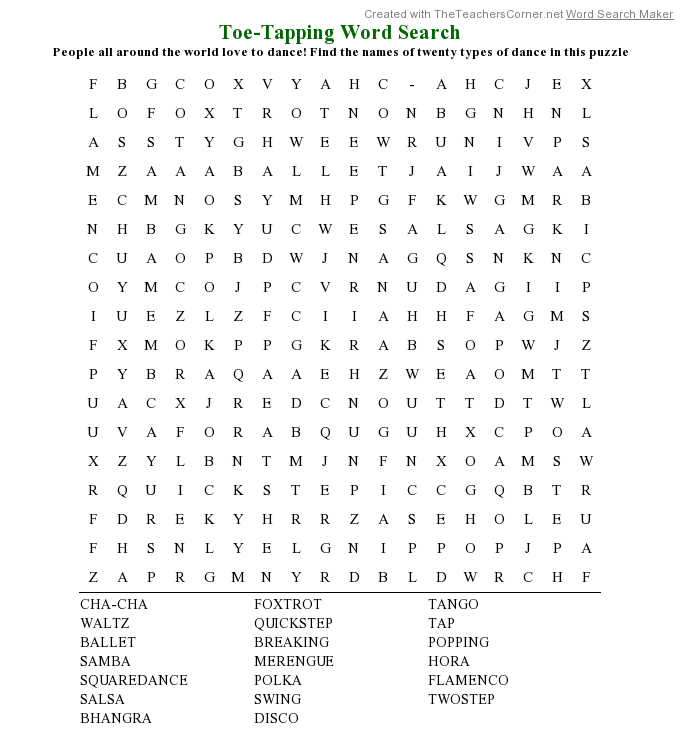
celebrate-picture-books-picture-book-review-dance-word-search

Toe-Tapping Word Search Puzzle


People all around the world love to dance! Can you find the names of twenty types of dances in this printable Toe-Tapping Word Search Puzzle? Here’s the Solution!

Picture Book Review


April 18 – It’s Celebrate Diversity Month

celebrate-picture-books-picture-book-review-W-is-for-welcome-cover

About the Holiday

Established in 2004, Celebrate Diversity Month encourages people to learn more about the world’s cultures and religions. Learning more about our global family and celebrating our differences and our similarities can lead to better relationships between people, more inclusion, and a happier future for the world’s children.

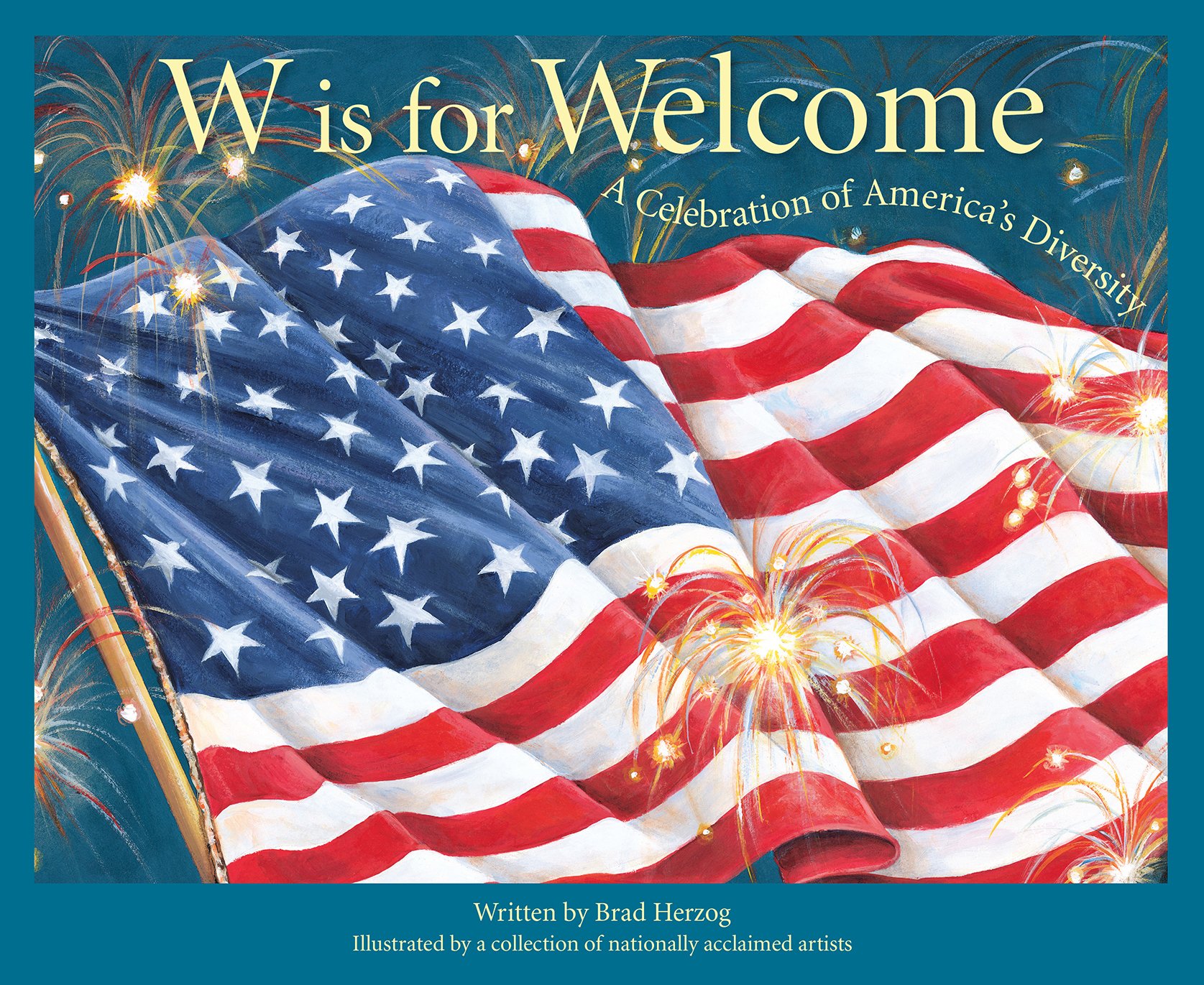
W is for Welcome: A Celebration of America’s Diversity

Written by Brad Herzog | Illustrated by nationally acclaimed artists


A journey around America impresses with its natural grandeur of rocky shores, majestic mountains, quilts of fertile fields, and wide-open prairies. More inspiring than these, however, is our diverse population that lends a wealth of knowledge, traditions, language, celebrations, food, music, and experiences to our country, making it a vibrant place to live and work.

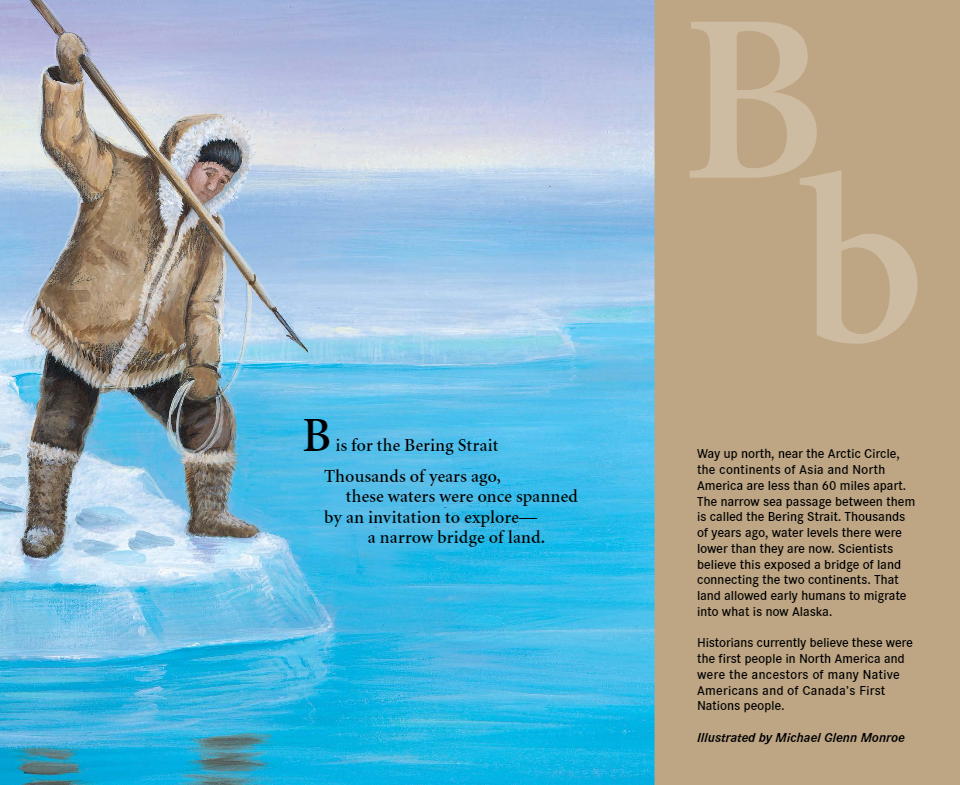
celebrate-picture-books-picture-book-review-W-is-for-welcome-Bering-Strait

Image copyright Michael Glenn Monroe, 2018, text copyright Brad Herzog. Courtesy of Sleeping Bear Press.

Brad Herzog has collected twenty-six words to describe the United States and has used them to create lyrical verses and a full compendium of information about the immigrants and their experiences that have molded America from her earliest days and continue to do so today. Starting off, A is for America—that “dreamer’s destination,” and readers learn a bit about the millions of people who have come to our shores.

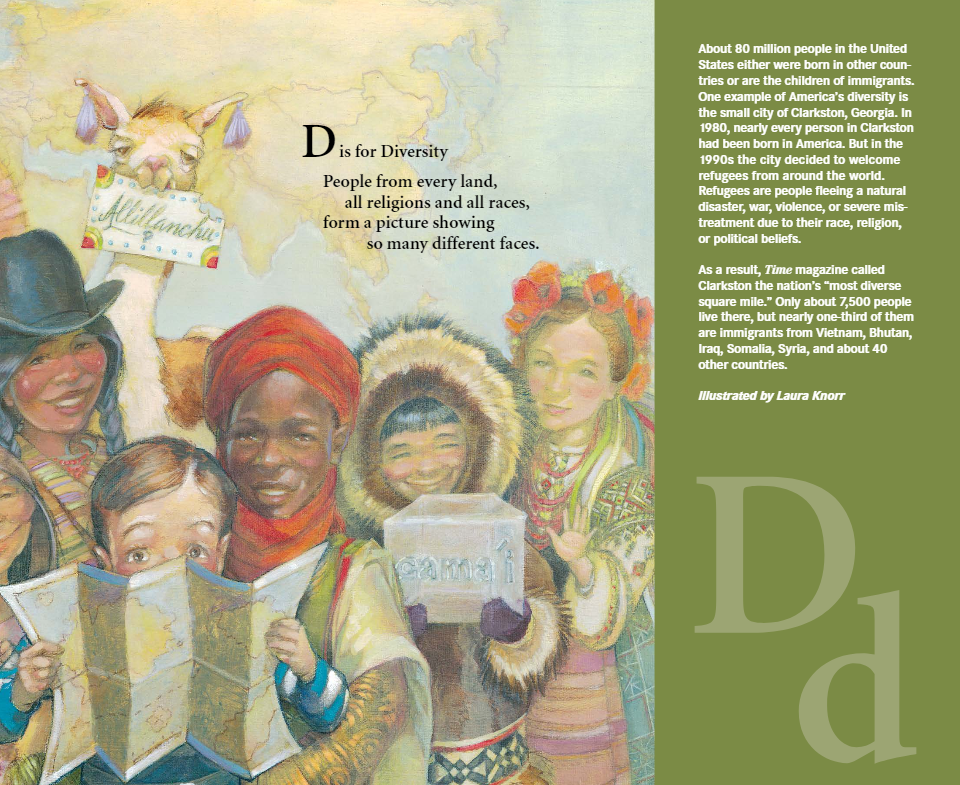
At C for Culture and D for Diversity, children learn about food, clothing, musical instruments, and even sports that have come to be favorites and were brought here or invented by people from other countries as well as “‘the most diverse square mile’” in America. Because of our country’s innovative spirit, “K is for Knowledge. “From all over the globe, / in a quest to know much more, / brilliant thinkers come here / and continue to explore.” Want to know more? Just check out Y for how immigrants continue to advance our knowledge.

celebrate-picture-books-picture-book-review-W-is-for-welcome-cultures

Image copyright Laura Knorr, 2018, text copyright Brad Herzog. Courtesy of Sleeping Bear Press.

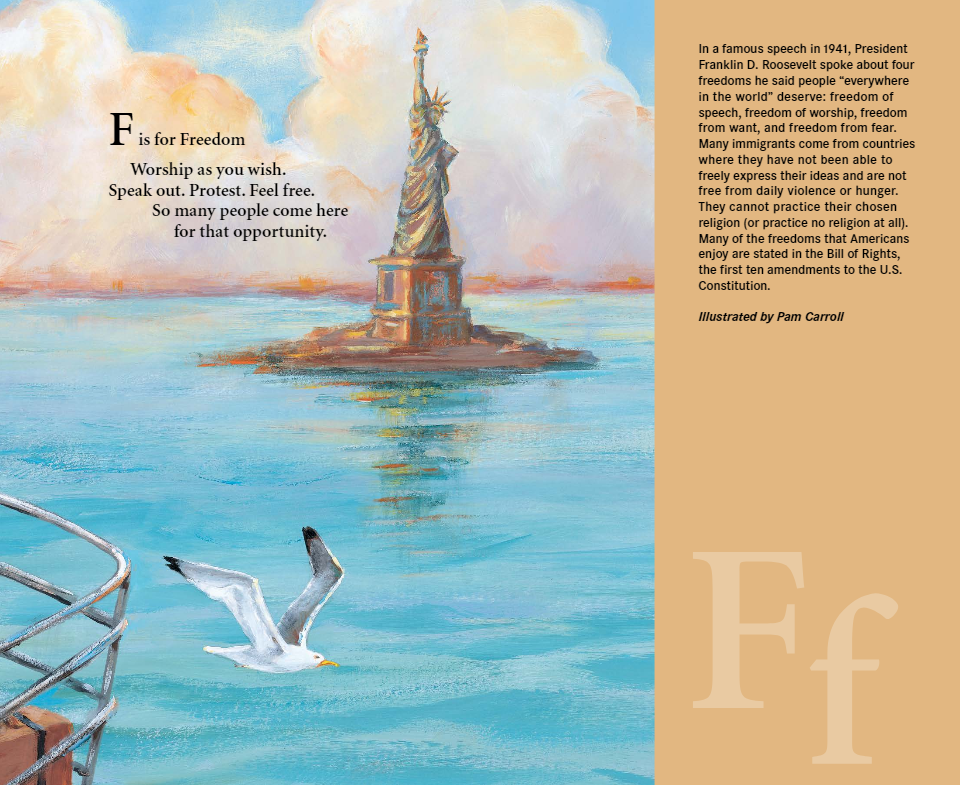
When immigrants want to make the United States their new home, they learn about N, Naturalization, and O, the Oath they take. And P is for the Poem by Emma Lazarus that has “come to define America’s long tradition of welcoming immigrants”: “A ‘world-wide welcome’ states, / ‘Give me your tired, your poor.’ / And then it adds, ‘I lift my lamp / beside the golden door!’”

All those who have taken comfort from that poem make up the narrative of our land, which is why V is for Voices: “Each immigrant has a tale to tell / about how and why they came / to live in the United States. / No two stories are the same.”

Along the way from A to Z young readers learn more about the people, ideas, and places that define America in verses and fascinating information that expands on the history and future of the United States in letter-perfect fashion.

celebrate-picture-books-picture-book-review-W-is-for-welcome-Ellis-Island

Image copyright Pam Carroll, 2018, text copyright Brad Herzog. Courtesy of Sleeping Bear Press.

Brad Herzog has created a compelling look at immigration, its history, and all the ways America has benefited from her philosophy of welcome. His fascinating informative passages and inspiring verses enlighten readers about past and present contributions by immigrants and also educate children about the law and processes involved in adopting America as a new home.

Thirteen illustrators lend their talents to interpreting Herzog’s verses with images full of color and vitality that are as diverse as America itself. Beautiful scenery from around the country reminds readers of the beauty of this vast land. It is the happy, hopeful, and expressive faces of those who have come and continue to journey here looking for a better life that most inspire and reveal that we are all neighbors.

W is for Welcome is an excellent book to use for leading discussions about American history and immigration at home or in the classroom.

Ages 6 – 9

Sleeping Bear Press, 2018 | ISBN 978-1585364022

Discover more about Brad Herzog and his books on his website.

You can learn about these illustrators of W is for Welcome on their websites:

Doug BowlesMaureen K. BrookfieldPat CarrollDavid C. Gardner | Barbara Gibson  | Renée GraefSusan GuyVictor JuhaszLaura KnorrMichael Glenn MonroeGijsbert van Frankenhuyzen | Ross B. Young 

Celebrate Diversity Month Activity 

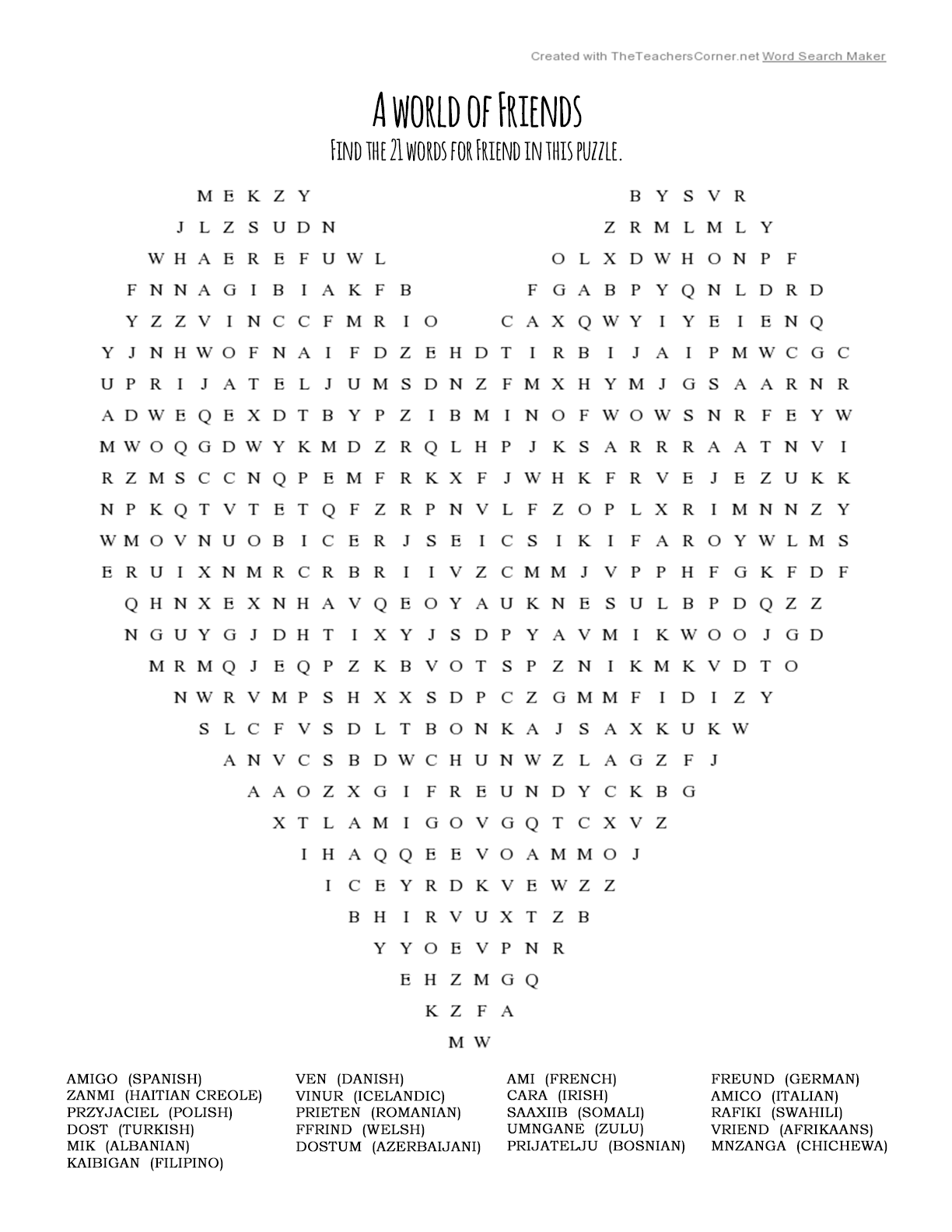
friendwordsearch

A World of Friends! Word Search


There are people all over the world just waiting to be friends! Learn how to say “friend” in twenty-one languages with this printable word search.

A World of Friends! Word Search Puzzle | A World of Friends! Word Search Solution

Picture Book Review
April 13 – National Make Lunch Count Day

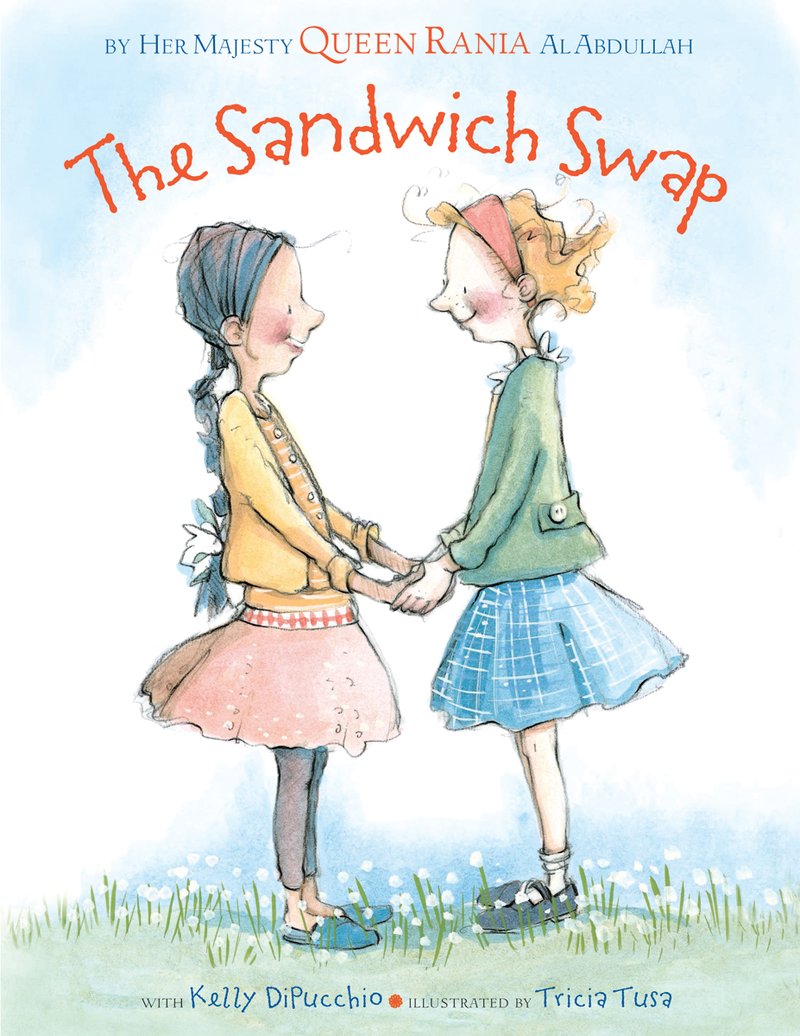
celebrate-picture-books-picture-book-review-the-sandwich-swap-cover

About the Holiday

Today’s holiday was established to encourage American workers to get away from their desk and eat lunch out with friends and coworkers. Taking a break from the office and spending lunchtime having a little fun or over a stimulating conversation can rejuvenate you for the rest of the day. Many people have also embraced the holiday as a way to remind themselves and others to eat healthy and make what they make (or order) nutritious and beneficial. To celebrate, make lunch an adventure today. You might even decide to try something new—like the little girls in today’s book!

The Sandwich Swap

Written by Queen Rania Al Abdullah of Jordan and Kelly DiPucchio | Illustrated by Tricia Tusa 


Salma and Lily were best friends. At school they did everything together in the classroom and on the playground. They also ate lunch together every day. They loved all the same things—until it came to what was packed in their lunchboxes. Lily always had a peanut butter and jelly sandwich, and Salma always had a hummus and pita sandwich.

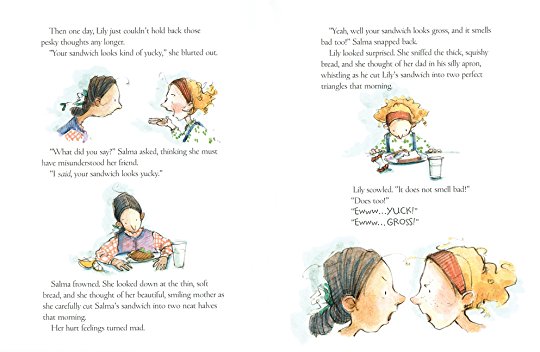
While Lily never said so, she thought Salma’s sandwich looked yucky, and Salma kept quiet about her opinion that Lily’s sandwich seemed gross. But one day, Lily did say what she’d been thinking. Salma couldn’t believe her ears. She frowned and “looked down at the thin, soft bread. She thought of her beautiful smiling mother as she carefully cut Salma’s sandwich into two neat halves that morning.” First she felt hurt; then she felt mad.

celebrate-picture-books-picture-book-review-the-sandwich-swap-argument

Image copyright Tricia Tusa, 2010, text copyright Queen Rania Al Abdullah of Jordan and Kelly DiPucchio. Courtesy of Disney-Hyperion.

Salma let Lily know just how gross and icky-smelling she thought Lily’s sandwich was. “Lily looked surprised. She sniffed the thick, squishy bread, and she thought of her dad in his silly apron whistling” as he cut her sandwich into triangles. After that the two girls did not play or draw together. And the next day, they ate at separate tables. The story of Salma and Lily’s argument had spread, and the other kids chose sides. In the cafeteria, they lobbed insults, calling each other “jelly heads” and “chick pea brains.”

Pretty soon there were shouts of “you’re weird” and “you dress dumb.” It wasn’t long before someone yelled “Food Fight!” and peanut butter, hummus, and all types of sandwiches flew through the air. “They stuck to the walls. They stuck to the ceiling. They stuck to the lunch lady.” Before anyone knew it, pudding cups and applesauce and carrot sticks were soaring through the air.

Lily and Salma gazed at each other across the mess and “felt ashamed by what they saw.” After they helped clean it all up and were sent to the principal’s office, they felt even worse. The next day, Lily and Salma once again sat across from each other during lunch. At last Lily said, “‘Would you like to try a bite of my peanut butter and jelly?” Salma said that she would and offered Lily a nibble of her hummus sandwich. Lily agreed.

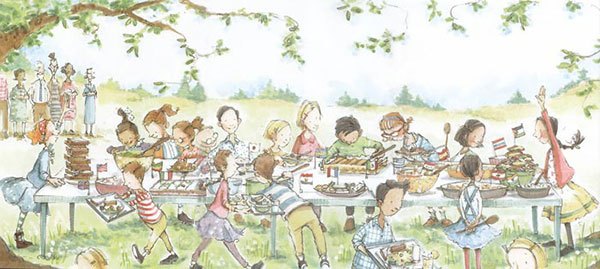
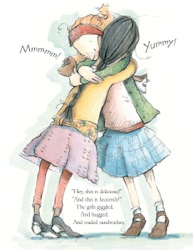
On the count of three, Lily and Salma tried each other’s sandwiches. “Yummy! Mmmmm!” they both said, and then they traded sandwiches. After lunch they met with the principal again to tell her an idea they’d had. And on a sunny day, the school held a picnic where everyone shared their favorite lunch from their native country.

celebrate-picture-books-picture-book-review-the-sandwich-swap-picnic

Image copyright Tricia Tusa, 2010, text copyright Queen Rania Al Abdullah of Jordan and Kelly DiPucchio. Courtesy of Disney-Hyperion.

The school lunchroom with its unique dynamics is a perfect setting for Queen Rania Al Abdullah and Kelly DiPuccio’s story that highlights the kinds of prejudice children can encounter whether for food choices or other differences. The inclusion of Salma’s and Lily’s thoughts about their parents is a poignant reminder of how profound and complex children’s emotions are. The humor and honesty in the girls’ relationship, thoughts, and argument as well as the food fight will resonate with readers. Salma’s and Lily’s decision to renew their friendship and try each other’s lunches and to share their revelation with their classmates leads to the kind of growth we all want for our kids.

celebrate-picture-books-picture-book-review-the-sandwich-swap-hug

Tricia Tusa’s delicate and soft-hued mixed-media illustrations portray the joys of being best friends as Lily and Salma draw, swing, jump rope, and eat lunch together in beautiful two-page spreads. When their true feelings about each other’s sandwiches comes out, the girls are clearly reflective and then hurt and angry as they scowl nose to nose. The food fight is a double-spread free-for-all that will make kids laugh as the lunch lady seems to take the brunt of the flying food. The final gate-fold scene of the multicultural picnic is heartwarming.

The Sandwich Swap is a terrific read at home and in the classroom, especially near the beginning of the school year. The book is also a wonderful prelude to a classroom or school-wide multicultural day or food fair.

Ages 3 – 7

Disney-Hyperion, 2010 | ISBN 978-1423124849

Learn more about Queen Rania Al Abdulla of Jordan and her global advocacy on her website.

Discover more about Kelly DiPucchio and her books on her website.

Get to know Tricia Tusa and view a portfolio of her books and art on her website.

Make Lunch Count Day

celebrate-picture-books-picture-book-review-lunch-container

Personalized Lunch Container


Take your lunch to school or work in style with this quick and easy craft! All you need is a plastic sandwich or food container, some permanent markers, and your creativity!

Picture Book Review
March 10 – It’s National Women’s History Month

celebrate-picture-books-picture-book-review-maya-lin-artist-architect-of-light-and-lines-cover

 About the Holiday

This month we celebrate the accomplishments of women in the past who have broken barriers and forged paths for today’s women and who still inspire the leaders of tomorrow. To honor women this month, learn more about the influential woman in your own field or in areas you enjoy as hobbies and teach your children about the women who made incredible contributions to the world long ago and those who are changing the way we live today.

Maya Lin: Artist-Architect of Light and Lines

Written by Jeanne Walker Harvey | Illustrated by Dow Phumiruk


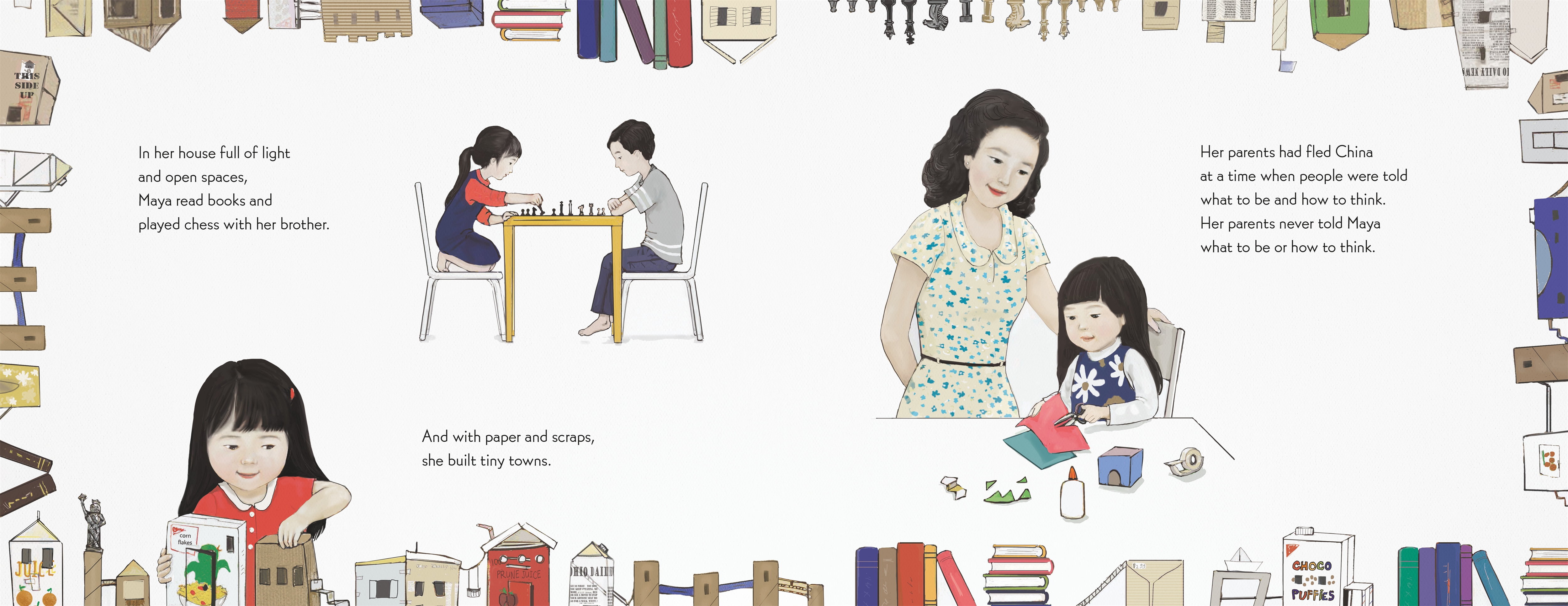
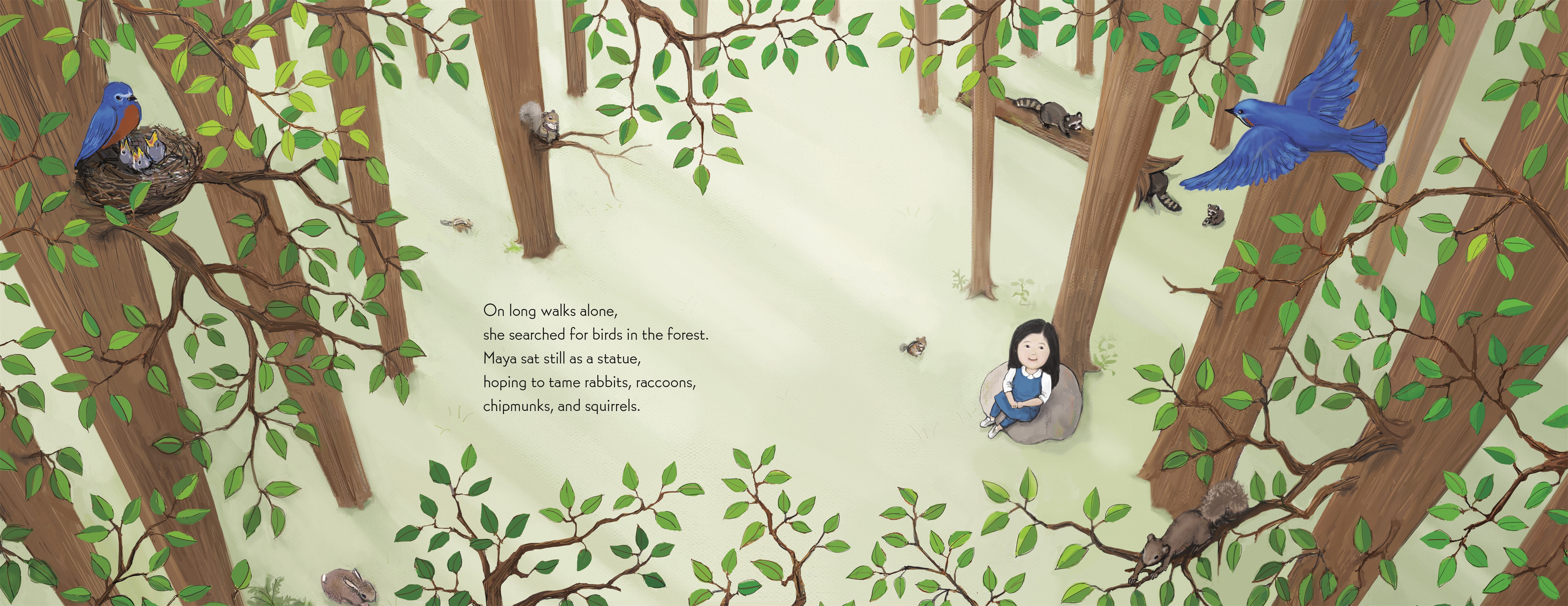
As a child, Maya Lin loved playing and interacting with nature near her home. She and her brother liked to run over what Maya had named “the Lizard’s Back”—a hill behind her house—and into the woods. Sometimes Maya went into the woods alone and “sat as still as a statue, hoping to tame rabbits, raccoons, chipmunks, and squirrels.” She liked to play chess with her brother and build towns from scraps of paper, boxes, books, and other things she found around the house.

celebrate-picture-books-picture-book-review-maya-lin-artist-architect-of-light-and-lines-in-forest

Image copyright Dow Phumiruk, 2017, text copyright Jeanne Walker Harvey, 2017. Courtesy of us.macmillan.com.

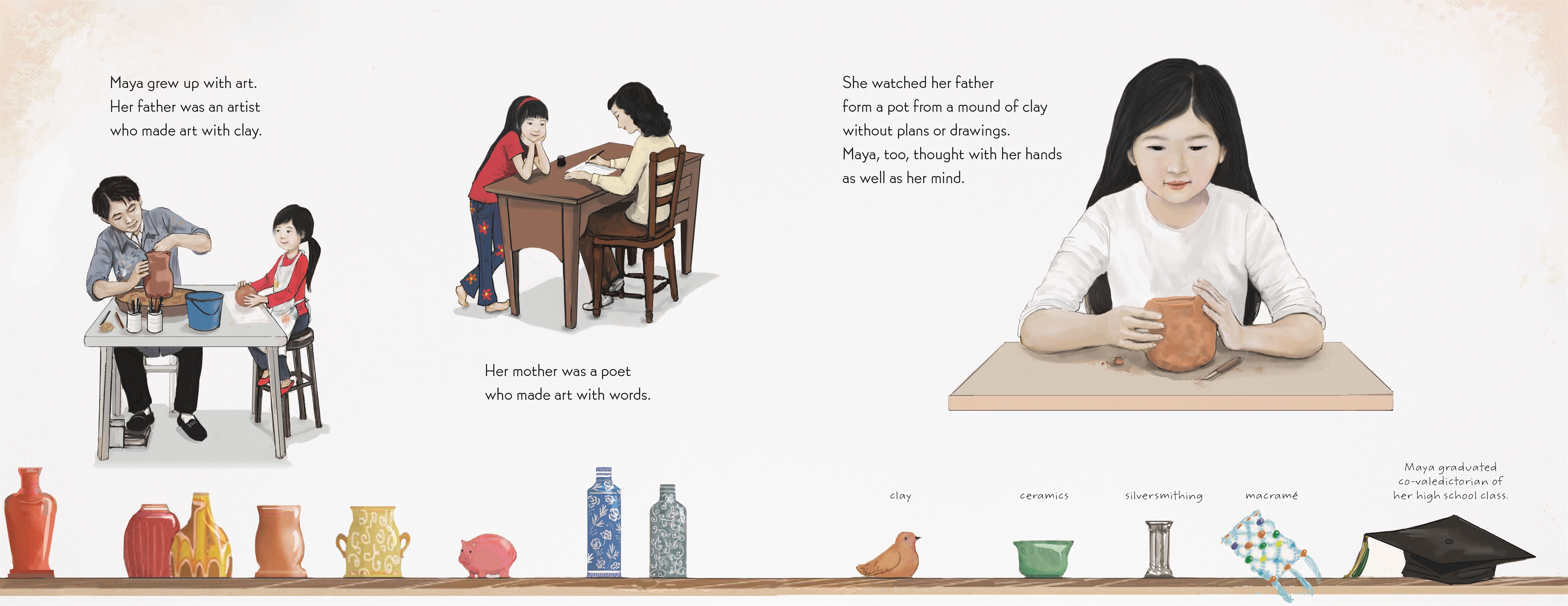
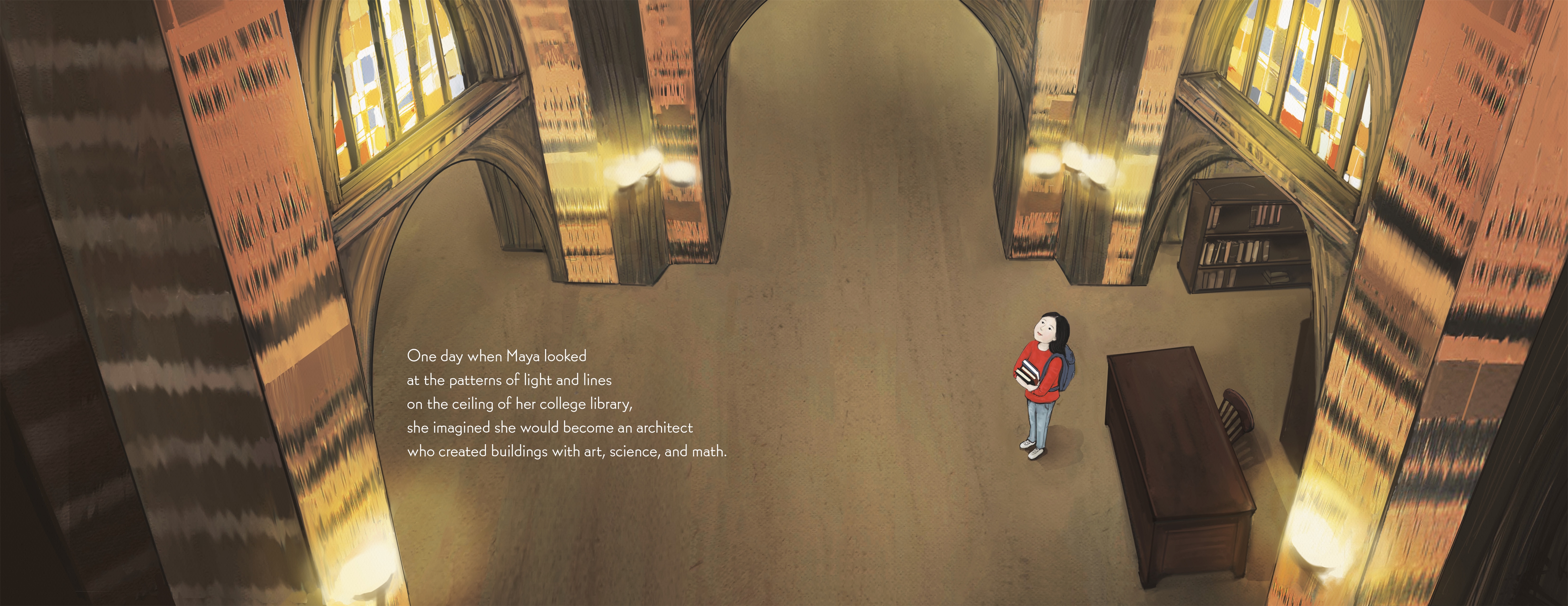
Maya’s “parents had fled China at a time when people were told what to be and how to think.” They did not want the same for their children and always encouraged Maya to be and think what she wanted. Maya grew up surrounded by art. Her father worked with clay, and her mother was a poet. Maya also liked to make things with her hands. The beautiful library where she went to college inspired Maya to become an architect.

To learn about different buildings, Maya traveled all over the world. When she was only a senior in college, “Maya entered a contest to design a memorial to honor soldiers who died during the Vietnam War.” The contest stated two rules: the memorial had to fit in with a park-like setting, and it had to include the 58,000 names of the soldiers who had died in the war. These rules resonated with Maya. She “believed that a name brings back all the memories of a person, more than a photo of a moment in time.”

celebrate-picture-books-picture-book-review-maya-lin-artist-architect-of-light-and-lines-as-young-girl

Image copyright Dow Phumiruk, 2017, text copyright Jeanne Walker Harvey, 2017. Courtesy of us.macmillan.com.

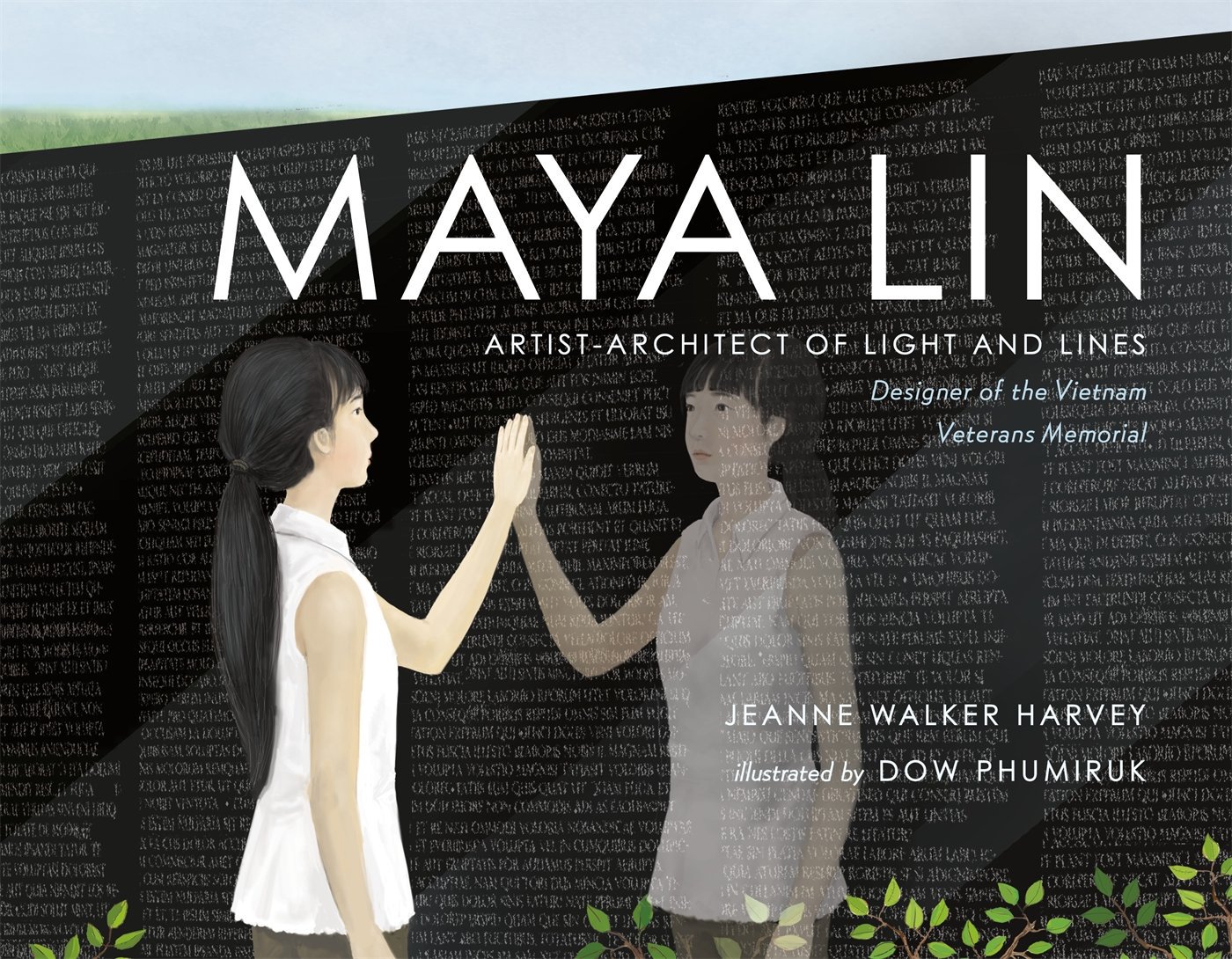
Maya visited the site where the memorial would be built. As she looked at the gently rolling hill, she envisioned a simple cut in the earth that would support a polished wall covered in names. Not only would the wall reflect those who died, but also those who came to visit and the surrounding nature. At school, Maya worked with mashed potatoes and then with clay to help her create the perfect monument. When she had finished her drawings and plans, she wrote an essay to accompany them. She wrote that her monument would be “a place to be experienced by walking down, then up past names that seemed to go on forever.”

celebrate-picture-books-picture-book-review-maya-lin-artist-architect-of-light-and-lines-with-parents

Image copyright Dow Phumiruk, 2017, text copyright Jeanne Walker Harvey, 2017. Courtesy of us.macmillan.com.

More than 1,400 artists and architects—many of them famous—entered the contest. The designs were hung in an airplane hangar anonymously for judging. Finally, the day came for the announcement of the winner. When the judges called out Maya Lin’s name and she came forward, they were surprised to find that she was so young. Maya was excited to have won, but then some people began to object to her design. Some said her “design looked like a bat, a boomerang, a black gash of shame.”

celebrate-picture-books-picture-book-review-maya-lin-artist-architect-of-light-and-lines-library

Image copyright Dow Phumiruk, 2017, text copyright Jeanne Walker Harvey, 2017. Courtesy of us.macmillan.com.

Maya was hurt by these comments, but she defended her design and, finally, it was approved. Maya worked with the architects and engineers who excavated the land and built the wall. As each granite panel was polished, engraved with the soldiers’ names, and set in place, Maya looked on. The memorial opened on Veterans Day in 1982. Thousands of people came to see it and to find the names of loved ones they had lost. As Maya approached the wall, “she searched for the name of the father of a friend. When she touched the name, she cried, just as she knew others would.” Every day since then visitors come to the wall to remember.

Maya Lin has gone on to design many more works of art and architecture that can be seen inside and outside. Each piece has a name and a particular vision. Maya wants people to interact with her art—to touch it; read, walk, or sit near it; or think about it. After each piece is finished, Maya thinks about her next work and how she can inspire the people who will see it.

celebrate-picture-books-picture-book-review-maya-lin-artist-architect-of-light-and-lines-Vietnam-War-Memorial

Image copyright Dow Phumiruk, 2017, text copyright Jeanne Walker Harvey, 2017. Courtesy of us.macmillan.com.

An Author’s Note about Maya Lin and the Vietnam War Memorial follows the text.

Jeanne Walker Harvey has written an inspiring biography of Maya Lin that reveals not only her creativity but the importance of creative freedom for children. Lin’s confidence that led her to enter the contest and then defend her winning design will encourage readers to pursue their dreams. Harvey’s lyrical storytelling reflects Maya Lin’s quiet, introspective nature, the influences that nurtured her creative spirit, and her dedication to inviting others to be part of her art.

Dow Phumiruk’s graceful, soft-hued illustrations allow children to follow Maya Lin as she grows from a girl discovering nature, constructing cardboard cities, and learning the arts from her parents to a young woman who draws inspiration from the world’s buildings and relies on her own sensitivity to guide her. Back-to-back pages of the landscape of Vietnam and the site of the memorial connect the two places for children’s better understanding. Phumiruk’s depictions of the Vietnam War Memorial also give children an excellent view of this moving monument. Her images of Lin’s other architectural work will entice young readers to learn more about her and to explore where each of these pieces can be found.
Ages 4 – 8

Henry Holt & Company Books for Young Readers, 2017 | ISBN 978-1250112491

Discover more about Jeanne Walker Harvey and her books on her website!

Learn more about Dow Phumiruk, her art, and her books on her website!
National Women’s History Month Activity

 celebrate-picture-books-picture-book-review-maya-lin-coloring-page

Maya Lin Coloring Page

Maya Lin’s accomplishments are inspirational for all children! Here’s a printable coloring page that you can personalize and hang in your room or locker to remind you that you can reach your goals too!

Maya Lin Coloring Page

Picture Book Review