January 20 – Penguin Awareness Day

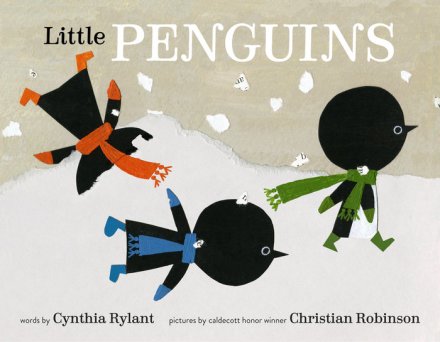
celebrate-picture-books-picture-book-review-little-penguins-cover

About the Holiday

Who can resist those little black-and-white waddlers from a frozen realm? Today’s holiday gives us a chance to enjoy and learn more about one of the world’s favorite animals. To celebrate, research penguins or visit an aquarium, and, of course, read a great penguin book!

Little Penguins

Written by Cynthia Rylant | Illustrated by Christian Robinson


A tiny penguin stands at the window star-struck by the snowflakes floating gently down. Four more penguins join her to see this marvelous sight. There are so “many snowflakes.” Gathered around the window in their igloo home, the penguins are excited that “Winter is coming!” They rush to collect their cold-weather supplies. Out of the basket they pull mittens—a pair for each, red, blue, green, yellow, sage—“and matching scarves.”
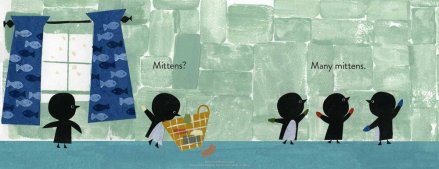
celebrate-picture-books-picture-book-review-little-penguins-mittens

Image copyright Christian Robinson, text copyright Cynthia Rylant. Courtesy of Schwartz & Wade

With abandon the penguins raid the bureau, scattering socks like colorful confetti. Warm, dry boots get to leave their cubbies after a looong nap. Bundled up, the penguins tumble out into the winter wonderland. They sled and slide on the deep snow. In places they find the snow is top-of-their-boots deeper, and then suddenly waist-high, “very deep.”

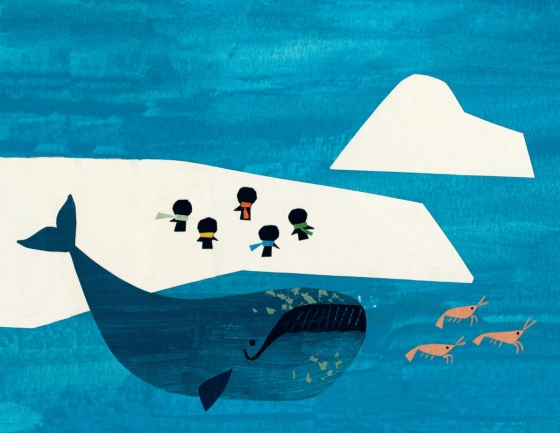
Uh-Oh! Suddenly the landscape is blank-page white! Four of the little penguins look in all directions. “Where’s Mama?” No need to fret—Mama’s coming, skimming down the hill on her belly with the fifth tiny penguin. But the sky is darkening and it’s time to head for home. “In the door and off, off, off, off, off!”
celebrate-picture-books-picture-book-review-little-penguins-whale

Image copyright Christian Robinson, courtesy of Schwartz & Wade

On go the jammies then warm cookies and filled “sippies” satisfy the tummy. Finally, it’s time to snuggle tight under colored blankets and watch the flurries fly because “Winter is here.”

Cynthia Rylant captures the exhilaration kids feel upon the first snow of winter in her delightful concept book. The flurry of activity to dig out the accoutrements of winter provide little readers the perfect opportunity to learn or—in the case of a bit older kids—to show their knowledge of cold-weather apparel, colors, counting skills, and other ideas. Rylant’s gifted way with even the simplest words turns the question-and-answer format of Little Penguins into a lyrical frolic little ones will love.
celebrate-picture-books-picture-book-review-little-penguins-walruses

Image copyright Christian Robinson, courtesy of Schwartz & Wade

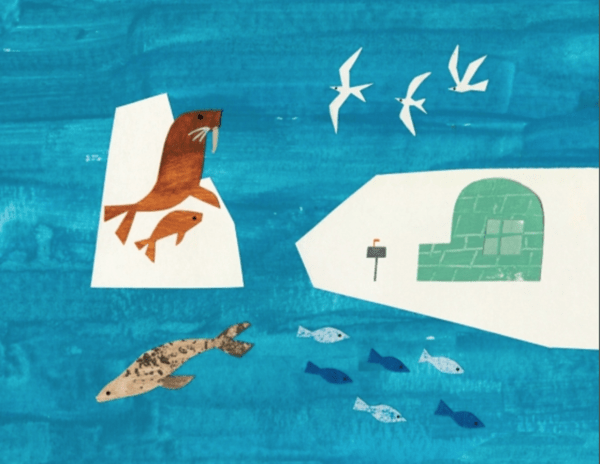
In Christian Robinson’s cozy igloo, the eager brightness of the little penguins is highlighted against the mottled textures of sage walls and reflected in the gleaming gray-blue floor. The little home with its fish weather vane and tall chimney sits at the edge of an icy peninsula, perfectly placed for winter play. The five penguins joyfully don their mittens, wave their scarves and toss socks to and fro in their hurry to get dressed and get outside and enjoy the fat, fluffy snowflakes.

Once there, the penguins become tiny dots on the vast, white hill as they sink waist deep, glide on their bellies, and welcome Mama, who’s joined the fun. As the penguins remove their snow gear back home, Robinson cleverly stripes the two-page spread in the favorite colors of the individual penguins, creating a striking counterbalance to the snug kitchen to come. An old-fashioned stove, retro accents, and fish, whale, and boat décor wrap up the comfy charm of this superb book for young readers.

With its sweet characters and beautiful illustrations, Little Penguins would be a happy and often-asked-for addition to any child’s bookshelf.

Ages 2 – 7

Schwartz & Wade, 2016 | ISBN 978-0553507706

To learn more about Cynthia Rylant and her books, visit her website!

View a gallery of illustration art by Christian Robinson on his website!

Penguin Awareness Day Activity
celebrate-picture-books-picture-book-review-spice-bottle-penguin-craft

Copyright Celebrate Picture Books, 2017

Spicy Cool Penguins

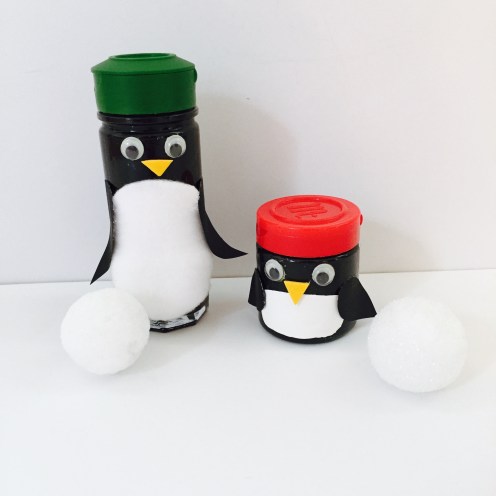
Don’t throw away those empty spice bottles—instead make these cute penguins with their colorful hats who are just waiting to play!

Supplies

  • Empty glass or plastic spice bottle with cap
  • Black paint
  • White paint OR White fleece or felt
  • Black paper
  • Yellow foam or heavy paper
  • Googly eyes
  • Styrofoam ball (optional)
  • Glue
  • Paint brush
  • Scissors

Directions

  1. Paint the inside of the glass or plastic bottle with the black paint, let dry
  2. From the white fleece, cut an oval for the penguin’s belly and glue it on. Alternatively, paint a white oval on the jar to make a belly. Fleece may be a better option for younger children, as the paint can scratch off glass and plastic surfaces.
  3. Glue googly eyes near the top of the jar, but below the cap
  4. Cut a triangle of yellow foam or paper for the beak and glue it on
  5. Cut two tear shapes for the wings from the black paper. Glue the top of the shape to the body of the penguin, overlapping the belly a little. Fold the tips up
  6. Give your penguins Styrofoam ball snowballs to play with!

Picture Book Review

January 19 – It’s Creativity Month

celebrate-picture-books-picture-book-review-painting-pepette

About the Holiday

As the cold and snowy weather keeps us inside more and more, what are we to do? Why not create?! Whether you like writing, drawing, cooking, woodworking, gardening, photography, dance, or other pursuits, January is the perfect time to begin a new project. Stock up on supplies, get those ideas going, and create!

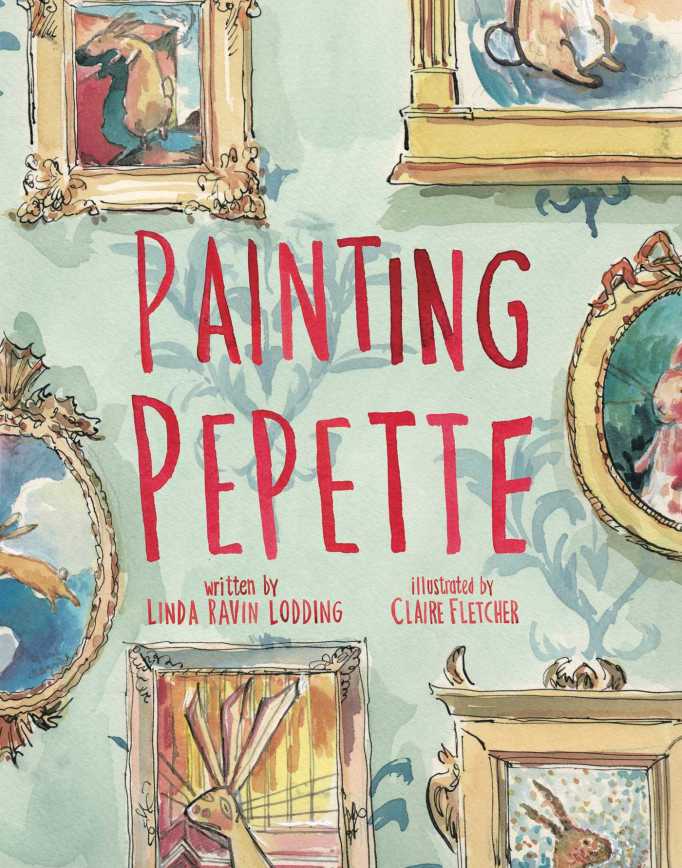
Painting Pepette

Written by Linda Ravin Lodding | Illustrated by Claire Fletcher


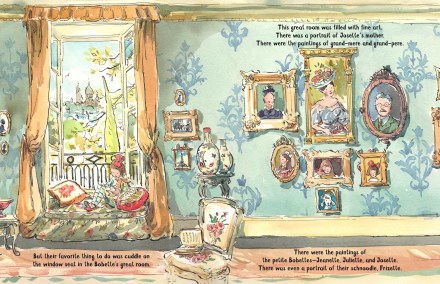
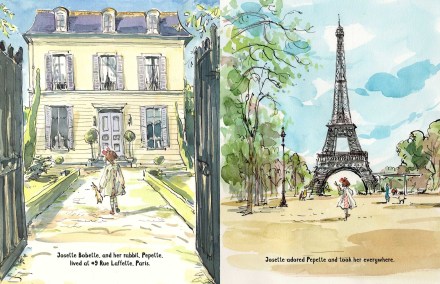
If you were to peek in the great room window of the grand yellow house at #9 Rue Laffette in Paris, you would most likely see Josette Bobette and her beloved stuffed rabbit Pepette cuddled together on the comfortable seat. It was their favorite place. Looking past them you would see that on the walls hung portraits of the family—Josette’s mother was there as well as grand-mère and grand-père, the three Bobette sisters, and even their schnoodle Frizette.

celebrate-picture-books-picture-book-review-painting-pepette-great-room

Image copyright Claire Fletcher, text copyright Linda Ravin Lodding. Courtesy of simonandschuster.com

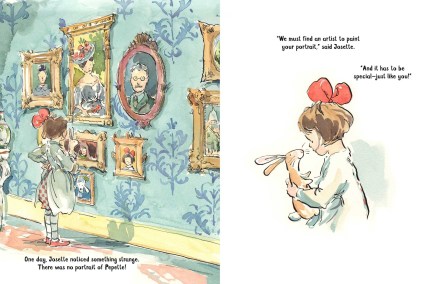
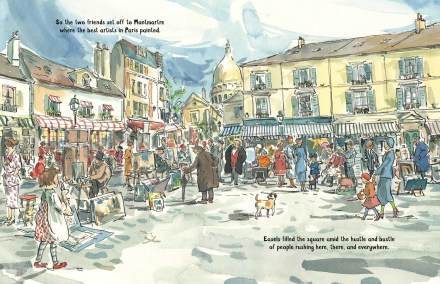
“One day Josette noticed something strange. There was no portrait of Pepette!” Josette at once determined to find an artist to paint a special portrait of her best friend. The pair head out to Montmartre, where all of the best artists set up their easels to paint and sell their work. It didn’t take long for a man in a striped shirt to stop them.

“‘Those ears!’” he cried. “‘Never have I seen such majestic ears. I must paint this rabbit’s portrait!’” Pepette blushed at such an effusive compliment, and Josette exclaimed, “‘Magnifique!’” It appeared that Josette had found just the artist to create Pepette’s portrait. The painter waved his brush with a flourish, “declared his painting a ‘masterpiece,’” and held it up for inspection. Josette gazed at a Pepette with two noses and three ears. Diplomatically, she proclaimed the picture “‘nice’” but not quite Pepette. Her best friend agreed.

celebrate-picture-books-picture-book-review-painting-pepette-pepette-with-bunny

Image copyright Claire Fletcher, text copyright Linda Ravin Lodding. Courtesy of simonandschuster.com

Just then a man with a thin, curved handlebar mustache spied the pair. Admiring Pepette’s whiskers, the artist begged to capture “‘the very essence of her rabbitness!’” He immediately set to work, and in no time a most unusual portrait emerged. Pepette seemed to melt from atop a tall red wall. Josette considered it—and her reaction—carefully. “‘It’s imaginative,’” she said. “‘But you’ve painted Pepette quite, well, droopy.’” Pepette agreed.

As Josette and Pepette enjoyed a Parisian snack on the curb of Montmartre, a rakish young man happened along. He was arrested by Pepette’s nose, which he likened to “‘a faint star twinkling in a misty, velvet night.’” Josette had a good feeling about this artist and followed him across the square to his easel. Pepette posed on a red tufted stool as the artist painted a rabbit soaring through the clouds. He proclaimed the finished portrait “‘one of my best works’” as he displayed it to the crowd. Josette liked the clouds but told the painter that Pepette is afraid of heights and not fond of flying. Pepette agreed.

celebrate-picture-books-picture-book-review-painting-pepette-pepette-at-home-and-in-paris

Image copyright Claire Fletcher, text copyright Linda Ravin Lodding. Courtesy of simonandschuster.com

By now Pepette was the most sought-after model in Paris, and another artist rushed up, captivated by her beauty. The balding man in a dapper suit and round spectacles peered at Pepette. “‘What a colorful lady—balloon blue, pansy pink, and radish red!’” Although a little suspicious of his vision, Josette allowed him to paint Pepette. “‘Ta da!’” the man exclaimed, revealing the magic of his brush. Josette studied the canvas with its vibrant dots, dashes, and splashes. While she admired the colors, she reminded the artist that Pepette isn’t pink.

“‘Ah, yes,’” nodded the painter. “‘But through art we can see the world any way we want.’”

With the sun setting low in the sky, Josette politely said thank-you and goodbye to the artists. She and Pepette had enjoyed their day, but it was time to go home. Curled up once more on the window seat, Josette sighed. She had so hoped to have the perfect portrait of Pepette—one that showed her velvety grey listening ears, her heart-shaped nose, and her soft arms that give tight hugs. Suddenly, Josette had an idea! After gathering all of her art supplies, she created the perfect likeness—one as special as Pepette herself!

celebrate-picture-books-picture-book-review-painting-pepette-pepette-at-montmartre

Image copyright Claire Fletcher, text copyright Linda Ravin Lodding. Courtesy of simonandschuster.com

An author’s note on the last page describes the creative atmosphere of 1920s Paris, home to writers, artists, musicians, and fashion designers, that gives a frame to her story. The artists that Josette meets are inspired by Pablo Picasso, Salvador Dalí, Marc Chagall, and Henri Matisse.

In Painting Pepette Linda Ravin Lodding has written a multi-layered story of love, friendship, and unique vision. Through the sweet relationship between Josette and Pepette and with a sprinkling of humorous self-congratulation by the artists, Lodding nudges readers to appreciate that while art can reveal and obscure, reflect or transcend reality, ultimately the success of a piece—complex or simple—lies within the viewer’s heart. Children will also see that their creative endeavors, undertaken with love, are just as meaningful and appreciated as those of professional artists. Lodding’s lyrical language trips off the tongue and is a joy to read—as if readers are following Josette as she skips happily through Paris.

Claire Fletcher’s striking pen-and-ink illustrations pay delicate homage to cityscapes of a bygone Paris. Adorable Josette and her enchanting rabbit are the perfect tour guides through crowded Montmartre and this introduction to art history. Soft tones of yellow, rose, and green illuminate the apartments and cafes of the square, where colorful shoppers and artists mingle. Fletcher’s renderings of Pepette’s various portraits will not only make kids giggle, but entice them to learn more about each artistic style. The final endpapers reveal that the four fine-art portraits now hang in the Muse of Paris, while readers already know that Josette’s perfectly perfect portrait of her well-loved friend has taken its rightful place on the wall in the Bobette’s great room!

Painting Pepette is a beautiful addition to any child’s bookshelf and a lovely way for teachers to initiate a discussion of art history and get kids excited about artists and different art styles.

Ages 4 – 9

little bee books, 2016 | ISBN 978-1499801361

Follow Josette through Paris as she searches for just the right artist to paint a portrait of her best friend Pepette and comes to a surprising discovery in this beautiful Painting Pepette book trailer:

Discover more books by author Linda Ravin Lodding on her website.

Illustrator Clair Fletcher invites you to find more of her artwork by visiting her online gallery.

Creativity Month Activities

celebrate-picture-books-picture-book-review-painting-pepette-activity-guide

Painting Pepette Reading and Activity Guide


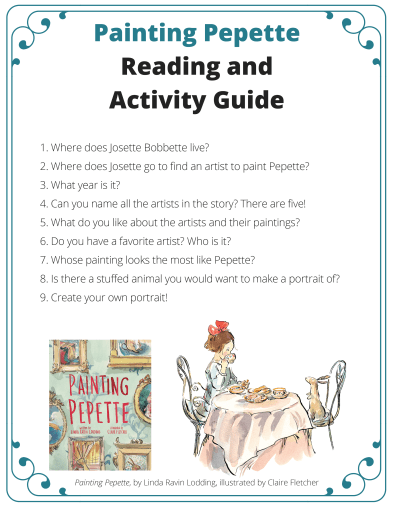
little bee books has created an interactive activity so you can continue to explore Josette’s world and your own artistic talent! Just click here—Painting Pepette Reading and Activity Guide—to start having fun!

Stuck on You Magnets or Picture Hanger


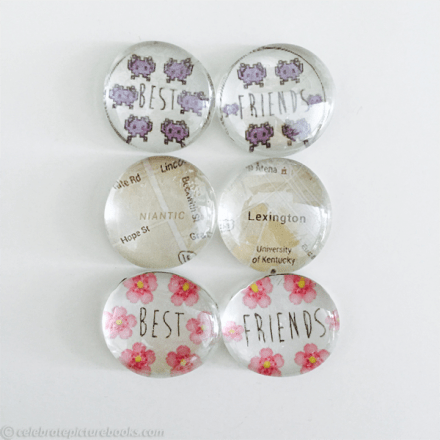
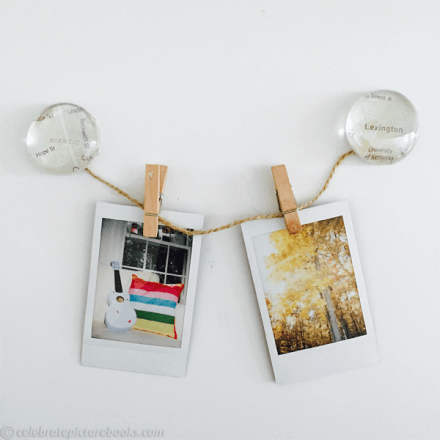
Creativity is meant to be shared! Here’s an easy craft that you can make to give to your friends whether they live close by or far away. These magnets can used by themselves or to hold a picture-hanging wire. Use inside jokes, favorite characters, or shared experiences to make these  crafts personal!

celebrate-picture-books-picture-book-review-friends-magnets-craft

For Magnets

Supplies

  • To get you started, here are two printable Best Friends Templates! Template 1 Template 2
  • Poster board
  • Large, 1 ½-inch clear glass stones (decorative fillers), available in craft stores
  • Markers or colored pencils OR find images online to print out
  • Medium to large flexible magnets, available in craft stores
  • Super glue
  • Toothpicks
  • Scissors

Directions

  • Place the glass stone on the poster board and trace around it
  • Draw your design in the circle on the poster board
  • Cut out the circle
  • With the toothpick, apply glue around the very edge of the design side of the circle
  • Attach the circle to the flat side of the stone, let dry
  • Trim the cardboard circle if needed
  • Attach the magnet to the back of the cardboard with glue

celebrate-picture-books-picture-book-review-friends-picture-hanger-craft

For Map Picture Holder

Supplies

  • Use a mapping program to find a map of your town and your friend’s town
  • Poster board
  • Large, 1 ½-inch clear glass stones (decorative fillers), available in craft stores
  • Twine
  • Super Glue
  • Toothpicks
  • Scissors
  • Heavy duty mounting squares

Directions

  1. Find maps of your and your friend’s towns
  2. Zoom in so the name of your and your friend’s towns are displayed well. You will be using about a 1-inch area around the towns’ names.
  3. Take a screen shot of the maps
  4. Print the maps
  5. Place the glass stone on the map and trace around it
  6. Place the glass stone on the poster board and trace around it
  7. Cut out the circles on the map and poster board
  8. With the toothpick, glue the map to the poster board, let dry
  9. With the toothpick, apply glue around the very edge of the map side of the circle
  10. Attach the circle to the flat side of the glass stone, let dry
  11. Trim the cardboard circle if needed
  12. Repeat with the other map
  13. Attach a length of twine to the back of each glass stone
  14. Attach heavy duty mounting squares to the back of each glass stone
  15. Attach stones to the wall and hang pictures on the twine

Picture Book Review

January 18 – Thesaurus Day

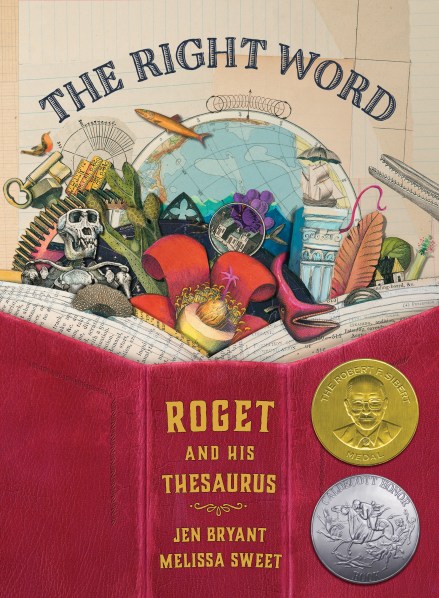
celebrate-picture-books-picture-book-review-the-right-word-roget-cover

About the Holiday

Today we celebrate that most marvelous, stupendous, spectacular, cool, awe-inspiring, remarkableand—one from my early youth—groovy book, the thesaurus! Without its incredible cross-referenced lists of synonyms and antonyms, the world would be much more boring, dull, lackluster, monotonous place. Today, spice up your speech and writing with the perfect word to express all the nuances of life!

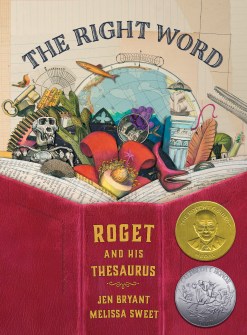
The Right Word: Roget and His Thesaurus

Written by Jen Bryant | Illustrated by Melissa Sweet


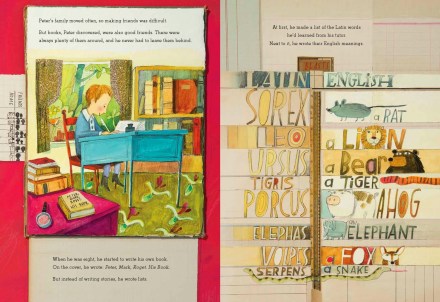
While just a young child, Peter, along with his mother, his uncle, and his baby sister Annette, travel to their new home following the death of his father. It would not be his first move, and in the absence of long-time friends, Peter found companionship in books. When he was eight years old, he began writing his own book titled: Peter, Mark, Roget. His Book. But this was not a book of stories or even one story; it was a book of lists. The first list was divided in two. On one side were the Latin words he knew; on the other were their definitions.

celebrate-picture-books-picture-book-review-the-right-word-roget-peter-starts-his-book

Image copyright Melissa Sweet, 2014, text copyright Jen Bryant, 2014. Courtesy of Eerdmans Books for Young Readers.

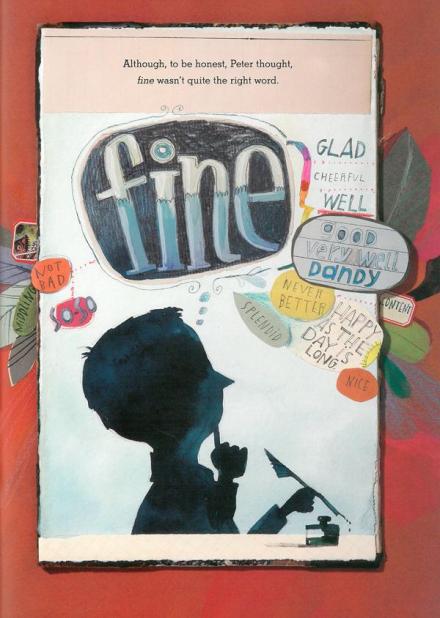
Peter’s mother hovered and worried over her son, and he always told her he was “fine.” “Although, to be honest, Peter thought, fine wasn’t quite the right word.” As the years went by, Peter added lists to his book, prompting his mother to complain about his constant “scribbling.” But Peter looked at his lists differently. “Words, Peter learned, were powerful things. And when he put them in long, neat rows, he felt as if the world itself clicked into order.”

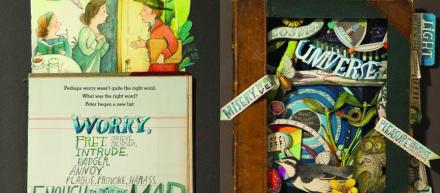
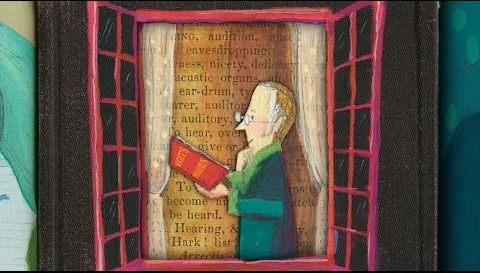
As a teenager Peter was shy, preferring to wander the London gardens alone, “making lists of all the plants and insects,” as in one of his favorite science books by Linnaeus. His “mother didn’t approve, and Peter told her not to worry—but “perhaps worry wasn’t quite the right word. What was the right word? Peter began a new list: Worry, fret, grieve, despair, intrude, badger, annoy, plague, provoke, harass. Enough to drive one mad. How wonderful it felt to find just the right word.”

celebrate-picture-books-picture-book-review-the-right-word-roget-fine

Image copyright Melissa Sweet, 2014, text copyright Jen Bryant, 2014. Courtesy of Eerdmans Books for Young Readers.

An idea crept into Peter’s mind for a book where “all the ideas in the world could be found in one place,” and people could “find the best word, the one that really fit.” When Peter was 14 he entered medical school in Edinburgh, Scotland. Upon graduation at 19, his uncle told him that patients would be wary of a doctor so young. To gain a bit of experience and maturity, Peter became a tutor to two teenage boys.

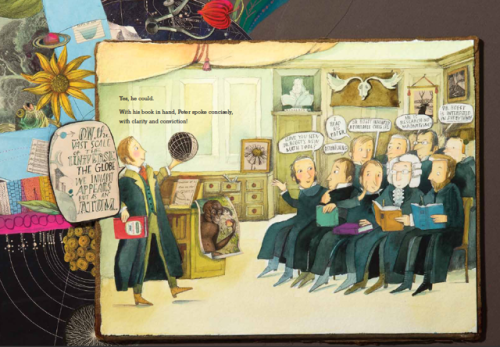
At last Peter set up his medical practice in Manchester, England, where he took care of the factory workers, who “were poor and often sick.” At night Peter worked on his book of lists, and in 1805 he declared it finished. “It had about one hundred pages, one thousand ideas, and listed more than fifteen thousand words!” Eventually, Peter moved back to London where he joined science societies and attended lectures. “Before long, he was asked to give lectures too,” and once-shy Peter astonished his audiences with his knowledge of math, magnetism, and other scientific subjects. He even invented a portable chess set.

celebrate-picture-books-picture-book-review-the-right-word-mother-worries

Image copyright Melissa Sweet, 2014, text copyright Jen Bryant, 2014. Courtesy of Eerdmans Books for Young Readers.

When Peter was 45 years old, he married Mary Hobson, and they had two children, Kate and John. As he grew older, he visited fewer patients, but he continued to take walks and work on his lists. While some other writers had published their own word lists to help people “to speak and to write more politely,” Kate and John “thought their father’s book was much better. Peter agreed.” For three years he rewrote his book. “He made it larger, more organized, and easier to use. Long ago Peter had discovered the power of words. Now he believed that everyone should have this power—everyone should be able to find the right word whenever they needed it.”

celebrate-picture-books-picture-book-review-the-right-word-roget-lecturing

Image copyright Melissa Sweet, 2014, text copyright Jen Bryant, 2014. Courtesy of Eerdmans Books for Young Readers.

“In 1852, Roget published his Thesaurus, a word that means ‘treasure house’ in Greek.” It was an instant best seller, and Peter became a popular author. But he never stopped making lists.

Following the text, a timeline of principal events in Peter’s life as well as world events allow readers to better understand the historical period in which Peter worked. Extensive Author’s and Illustrator’ Notes also expand on Roget’s biography, and resources for further reading and research are included.

Jen Bryant’s biography of a brilliant boy who grew up to give the world its most fascinating and comprehensive collection of word lists, is a spritely telling of Roget’s life and revelation into his personality, which was perfectly suited to his scientific and written accomplishments. Children will appreciate Roget’s reactions to his mother’s worries as well as the message in his well-rounded pursuit of science and writing. Through Bryant’s captivating and lyrical storytelling, children will be inspired by Roget’s journey from shy child to much-accomplished adult.

celebrate-picture-books-picture-book-review-the-right-word-roget-at-home

Image copyright Melissa Sweet, 2014, courtesy of Eerdmans Books for Young Readers.

Melissa Sweet beguiles readers with her mixed media, collage, and watercolor illustrations that are as jam-packed with ideas, images, portraits, and typography as Roget’s thesaurus is full of words. In the early pages describing Peter’s childhood, the pages contain simple framed pictures of Roget and his family. As he grows, however, his lists of words are transformed into vibrant artwork that jostles for position from corner to corner of the pages. In the midst of these, delicate watercolors portray Peter as he strolls through a garden, takes his young charges to Paris, treats his patients, lectures, marries, and finally publishes his thesaurus. A special mention must be made of the typography, which at times in the text runs down the center of the page in one- or two-word lines, mirroring Roget’s love of lists, and in the illustrations presents the myriad synonyms in a mixture of colorful block letters, fine print, and calligraphy.

For bibliophiles, wordsmiths, scientists, and history buffs, The Right Word: Roget and His Thesaurus is just the right book for home libraries.

Ages 6 – 18

Eerdmans Books for Young Readers, 2014 | ISBN 978-0802853851

Discover more about Jen Bryant and her books as well as news, contests, and events, visit her website!

Learn more about Melissa Sweet and her books and have fun with the downloadable activities you’ll find on her website!

Watch this The Right Word: Roget and His Thesaurus book trailer!

Thesaurus Day Activity

celebrate-picture-books-picture-book-review-synonyms-word-search

Word Words Word Search Puzzle


When you’re looking for just the right word, where do you go? To the thesaurus of course! Can you find the 25 synonyms for “Word” in this printable Word Words Word Search Puzzle? Here’s the Solution!

celebrate-picture-books-picture-book-review-the-right-word-roget-cover

You can find The Right Word: Roget and His Thesaurus at these booksellers

Amazon | Barnes & Noble | Books-a-Million | IndieBound

Picture Book Review

January 17 – Kid Inventors’ Day

celebrate-picture-books-picture-books-review-the-hole-story-of-the-doughnut

About the Holiday

Today’s holiday celebrates all those ingenious kids who have improved the world with their inventions. This date was chosen to commemorate another child inventor—Benjamin Franklin—who designed the first swim fins when he was just 12 years old! (Seriously, is there nothing this man didn’t or couldn’t do?). With their supple minds and can-do attitudes, kids have changed the ways things are done in the fields of medicine, technology, communications, and even food—as today’s book shows! To learn more about the day and find resources for young inventors, visit the K.I.D website.

The Hole Story of the Doughnut

Written by Pat Miller | Illustrated by Vincent X. Kirsch


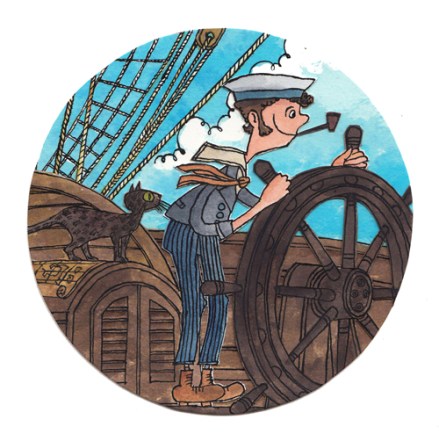
In 1844 at the tender age of 13, Hanson Gregory left the family farm and went to sea as a cabin boy on the schooner Isaac Achorn. He quickly became the cook’s assistant and also learned how to rig the sails and “steer a ship over trackless waves by sun and stars.” By the age of 19 Gregory had become the captain of the schooner Hardscrabble, and within a few more years was racing “his cargo from Maine to California as commander of a clipper, the fastest ship on any ocean.”

celebrate-picture-books-picture-book-review-hole-story-of-the-doughnut

Image copyright Vincent X. Kirsch, courtesy of vincentxkirsch.com

Hanson Gregory may have been one of the best captains to sail the seas—once awarded a medal for heroism for rescuing seven shipwrecked Spanish sailors even though his own ship and crew were endangered. But his greatest achievement was not attained because of his seafaring skills—it was his ingenuity in the galley that people remember.

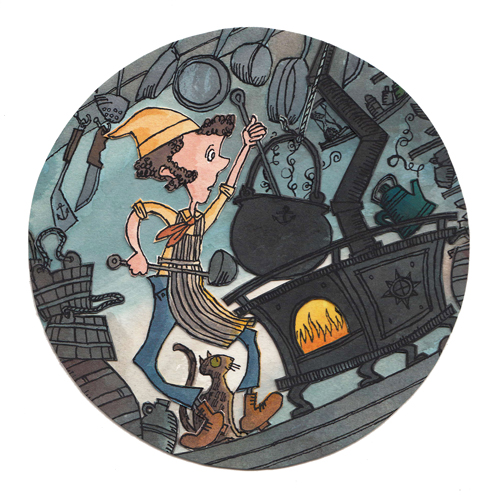
On June 22, 1847 as a 16-year-old cook’s assistant, Hanson was rustling up the crew’s breakfast—coffee and fried cakes, the same as every morning. While the pot of lard bubbled on the stove, Gregory formed balls of sweetened dough and dropped them in. They sizzled and crisped—at least around the edges. The centers were raw, heavy with grease, and they dropped like cannonballs in the stomach. “Sailors called them Sinkers.” But this morning Gregory had an idea. He removed the lid from the pepper can and cut out the center of the balls. “Then he tossed the rings into the bubbling lard.”

celebrate-picture-books-picture-book-review-hole-story-of-the-doughnut

Image copyright Vincent X. Kirsch, courtesy of vincentxkirsch.com

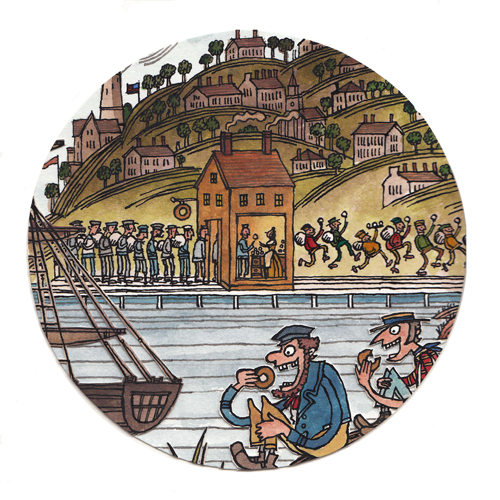
The cook and the sailors took one look at this odd concoction and…ate them up! “The cakes were brown, and sweet, and fully cooked. Sighs of delight rose above the noisy sea. A new breakfast tradition was born.” Gregory told his mom about his invention, and she fried up large batches of these ‘holey cakes’ that became a sensation at a friend’s store and on the docks.

You might think this is a pretty interesting tale in itself, “but sailors like their stories bold” and so they “spun legends worthy of such a delicious treat.” One tale had Captain Gregory inventing the doughnut while he saved his ship from disaster. Another told how Gregory, distraught over the drowning of five sailors pulled to the ocean floor by their “sinker” breakfast, punched holes in every cake to make them look like life rings and vowed, “‘Never again!’”

Captain Gregory had a sense of humor about his accomplishment. During an interview he once stated that “he had invented ‘the first hole ever seen by mortal eyes.’” Gregory lived to be 89 and is buried “overlooking the sea where stormy weather can be spotted as readily as it once was from the quarterdeck of the Hardscrabble.”

An author’s note expanding on the story of Captain Gregory, the doughnut, doughnut shops, a timeline, and a selected bibliography follow the text.

celebrate-picture-books-picture-book-review-hole-story-of-the-doughnut

Image copyright Vincent X. Kirsch, courtesy of vincentxkirsch.com

Doughnuts have never been so evocative! In Pat Miller’s humorous, informative history of this favorite pastry treat, readers can smell the salt air, feel the ocean swell and roll under their feet, and even ache a little for those poor sailors forced to eat “sinkers.” Seamlessly interwoven into this foodography is a fascinating look at the early days of sail. Miller’s language is immediately stirring: the Ivanhoe bucks and plunges, the sea becomes a monster, and Captain Gregory spears a sinker on the wheel spoke. Kids will marvel at a 13-year-old going off to sea and becoming an inventor at 16.

Vincent X. Kirsch provides just the right touch to this captivating true story with his cartoon-inspired watercolor and cut paper artwork. Ingeniously incorporating Hanson Gregory’s innovation of removing the center of the fried cakes, Kirsch’s illustrations are “cored” to allow for text, while the extracted section appears on the facing page as a glimpse through a porthole. The maritime atmosphere—from ship to shore—of the mid-1800s is beautifully represented in the folk-style sketches, and the humor that is so intrinsic to this story is wonderfully embraced.

The Hole Story of the Doughnut will delight foodies and history buffs alike and would make a fun gift and a delectable addition to personal libraries for all ages.

Ages 5 – 12

Houghton Mifflin Harcourt, 2016 | ISBN 978-0544319615

Vincent X. Kirsch’s website is full of illustrations from his books for children—take a look at his portfolio!

Spend some time with Pat Miller on her website that offers activities, tips, resources and many more books!

Kid Inventors’ Day Activity

celebrate-picture-books-picture-book-review-cd-doughnut-craft

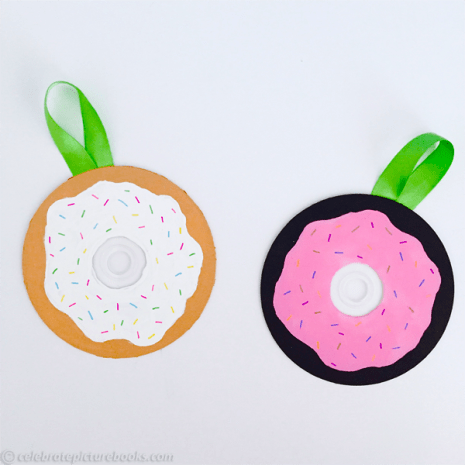
CD (Compact Doughnuts) Decoration


Are some of  your CDs a little passé? Not if you can turn them into cute décor like this doughnut hanging.

Supplies

  • Unused CDs
  • Craft paint in tan, black, pink, yellow, white (or any colors you want for the doughnut and the icing)
  • Ribbon, any color and length you want
  • Fine-tip markers in bright colors
  • Glue
  • Glue dots (optional)
  • Paint brush

Directions

  1. Paint a wavy edge around the CD, let dry
  2. Paint the center of the CD, leaving the clear circle unpainted
  3. When the icing paint is dry, draw sprinkles on the icing with the markers
  4. With the ribbon make a loop hanger and attach it to the back of the CD with glue or glue dots
  5. Hang your decoration

Picture Book Review

January 16 – Martin Luther King Jr. Day

celebrate-picture-books-picture-book-review-i-am-martin-luther-king-jr-cover.png

About the Holiday

Martin Luther King Jr. Day celebrates the life and legacy of the man who dedicated his life and work to teaching—as Coretta Scott King stated—“the values of courage, truth, justice, compassion, dignity, humility and service” and led a non-violent Civil Rights movement to enact racial equality and justice throughout state and federal law. President Ronald Reagan signed the holiday into law in 1983, setting it on the third Monday of January to coincide with Martin Luther King, Jr.’s birthday on January 15. The holiday was officially observed in all 50 states in 2000. Today, learn more about the life and work of Martin Luther King and how you can help promote justice and equality for all. Consider volunteering in your community where help is needed.

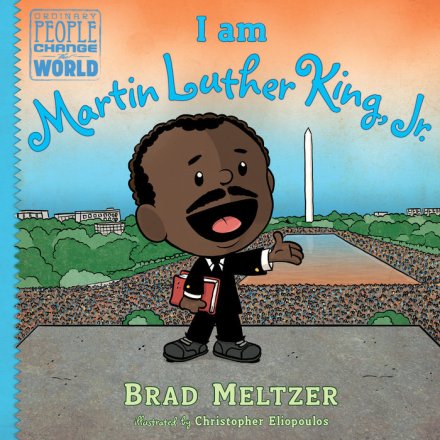
I am Martin Luther King, Jr.

Written by Brad Meltzer | Illustrated by Christopher Eliopoulos


Standing inside a church, Martin Luther King, Jr. introduces himself with two anecdotes from his childhood that demonstrate his world outlook. “When I was little,” he says, “I used to get into a lot of accidents.” He was hit in the head by a baseball bat, knocked down by cars and once even “tumbled over our banister, then bounced through an open door into the basement.” While these incidents could have made him cautious, Martin instead was determined to keep “getting back up.” His second influence were the books in which he could find “big words.” Even as a child Martin recognized that “there is power in words.”

celebrate-picture-books-picture-book-review-i-am-martin-luther-king-jr-as-a-child

Image copyright Christopher Eliopoulos, text copyright Brad Meltzer. Courtesty of Dial Books for Young Readers

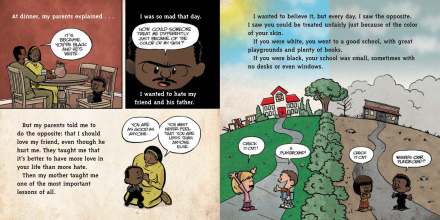
Before he went to school, Martin relates, his best friend was a white boy whose father owned a nearby store. They did everything together until school started. Then Martin went to a school with only black students while his friend went to a white-students-only school. Soon, Martin’s friend told him his father didn’t want them to play together anymore. Martin was confused. When his parents told him the reason was that they had different colored skin, Martin felt angry. He wanted to hate his friend and his father, but Martin’s parents taught him to love his friend, and his mother told him, “you must never feel that you are less than anyone else.”

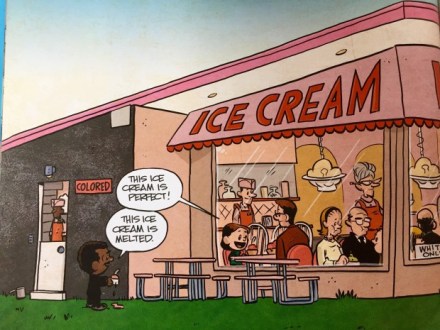
It was a difficult lesson when all around him he saw inequality. White schools had better equipment, there were different elevators, bathrooms, water fountains, and other facilities for black people and white people, on buses black riders had to give up their seats to white riders. Everywhere black people and white people were segregated.

celebrate-picture-books-picture-book-review-i-am-martin-luther-king-jr-ice-cream

Image copyright Christopher Eliopoulos, text copyright Brad Meltzer. Courtesty of Dial Books for Young Readers

When Martin was only 15 he was admitted to college. At 19 he entered the seminary where he learned about civil disobedience and nonviolent resistance—ways to use “love and peaceful methods to change unfair things in society.” These were lessons Martin wanted to share with others. His chance to put his thoughts into action came when Rosa Parks was arrested for refusing to relinquish her seat to a white man. Martin advocated a peaceful protest—a boycott of public buses. He reasoned that without the money from black riders, the bus companies would change their policies.

As the boycott began working, Martin gave a speech in Montgomery, Alabama, motivating people to continue their peaceful protest. Martin was put in jail and his house was bombed, but the boycott continued for more than a year. Eventually, the bus companies changed their rules. Other peaceful protests began to take place in restaurants and other public places.

One protest took place in Birmingham, Alabama.  Martin was again put in prison, where he wrote one of his most famous speeches. Children also took part in the Birmingham protest. The Children’s Crusade attracted more than 1,000 kids. On the first day 900 of them were arrested, but that only inspired the children more. On the second day 2,500 children showed up. They stood firm while they were sprayed with water hoses and attacked by police dogs. People—both black and white—watching the news reports were aghast. Three months later the rules began to change.

celebrate-picture-books-picture-book-review-i-am-martin-luther-king-jr-i-have-a-dream-speech

Image copyright Christopher Eliopoulos, text copyright Brad Meltzer. Courtesty of Dial Books for Young Readers

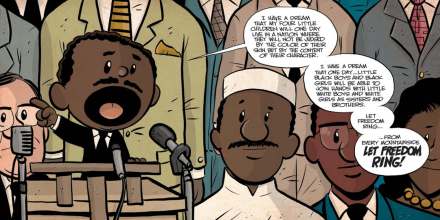
“By the summer of 1963, an estimated one million Americans held their own protests in cities across the country.” Then A. Philip Randolph suggested a single huge march to convince “Congress and the president to pass laws so that no one in America can treat people differently based on skin color.” On August 28, 1963 the March on Washington for Jobs and Freedom took place. Martin gave what may now be considered his most famous speech in which he talked about his dreams for the country, for the people, and for their children.

Although Congress began passing new laws, the ability and right to vote in elections still eluded black people. To change the voting rules another march was organized to walk 54 miles from Selma to Montgomery Alabama. The 600 walkers were met by police who stopped them. Two days later 2,500 activists tried again but could not get through. On the third try 8,000 marchers showed up. This time, with the world watching on television, the activists made it to Montgomery, protected by troops sent by President Johnson.

celebrate-picture-books-picture-book-review-i-am-martin-luther-king-jr-montgomery-march

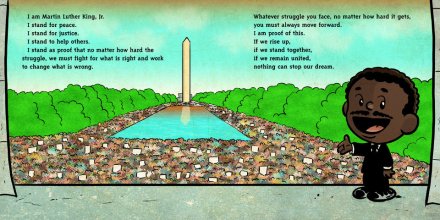
Martin continued to speak out, relating his philosophy and dreams for the nation. “To reach our goals, we must walk the path of peace,” he said. “We must lock arms with our brothers and sisters. We must march together. When we do…Our voices will be heard, and freedom will ring.” The lessons Martin Luther King taught still resonate today. He stands “as proof that no matter how hard the struggle, we must fight for what is right and work to change what is wrong.…if we stand together, if we remain united, nothing can stop our dream.”

celebrate-picture-books-picture-book-review-i-am-martin-luther-king-jr

Brad Meltzer’s Ordinary People Change the World: I am… series of biographies are well-known for showing young readers that they can achieve their dreams and make a difference no matter what those hopes may be. In his biography of Martin Luther King, Jr., Meltzer depicts several incidents from King’s childhood and early adulthood that influenced his future work. These help readers understand not only the types of prejudice King and other African Americans experienced, but also the people who inspired his philosophy of peace.

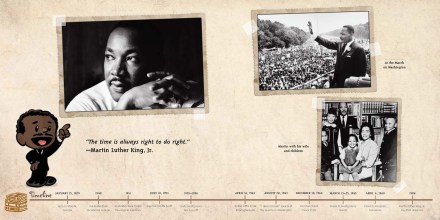
Meltzer’s inclusion of King’s imprisonments and the violence that met the peaceful protesters deepens the understanding of the dangers King and other protesters faced, and provides an opportunity to open a discussion between adults and children about those times and what they now see in the news. Meltzer’s description of the Children’s Crusade will inspire readers, making them proud of children in the past and stirring them to actions of their own. Sections from King’s Letter from Birmingham Jail and his most famous speeches are presented in speech bubbles. The text is followed by photographs of Martin Luther King, Jr. with his family and at the March on Washington as well as a timeline of his life. Sources and resources for further reading are also included.

celebrate-picture-books-picture-book-review-i-am-martin-luther-king-jr-timeline

In keeping with the style of all of Meltzer’s and Christopher Eliopoulos’s Ordinary People Change the World: I am… biographies, the illustrations are vibrant and cartoon-inspired. Martin Luther King, Jr. is depicted with the size of a child but the features of an adult, reinforcing the idea contained in the text of the dual nature of the future adult residing in the child and the ideals of the child remaining in the adult that appeals to ambitious young readers. Speech bubbles highlight text that carry emotional dialogue. Settings, including churches, Birmingham jail, Washington DC, the Edmund Pettus Bridge in Alabama, and the Martin Luther King, Jr. monument give children a look at the cities and places described in the text.

For young readers, I am Martin Luther King, Jr. offers a comprehensive biography of the man who was a national and world leader in the fight for equal rights for all people and makes an excellent starting place for classroom lessons and personal discussions.

Ages 5 – 8

Dial Books for Young Readers, 2016 | ISBN 978-0525428527

Discover more about Brad Meltzer and his books for adults and children as well as other goodies on his website!

Learn more about Christopher Eliopoulos, his books, and his comics on his website!

Martin Luther King Jr. Day Activity

celebrate-picture-books-picture-book-review-martin-luther-king-jr-coloring-page

Martin Luther King, Jr. Portrait


Color this printable Martin Luther King, Jr. Portrait and then hang it in your room or locker to inspire you!

Picture Book Review

January 15 – National Hat Day

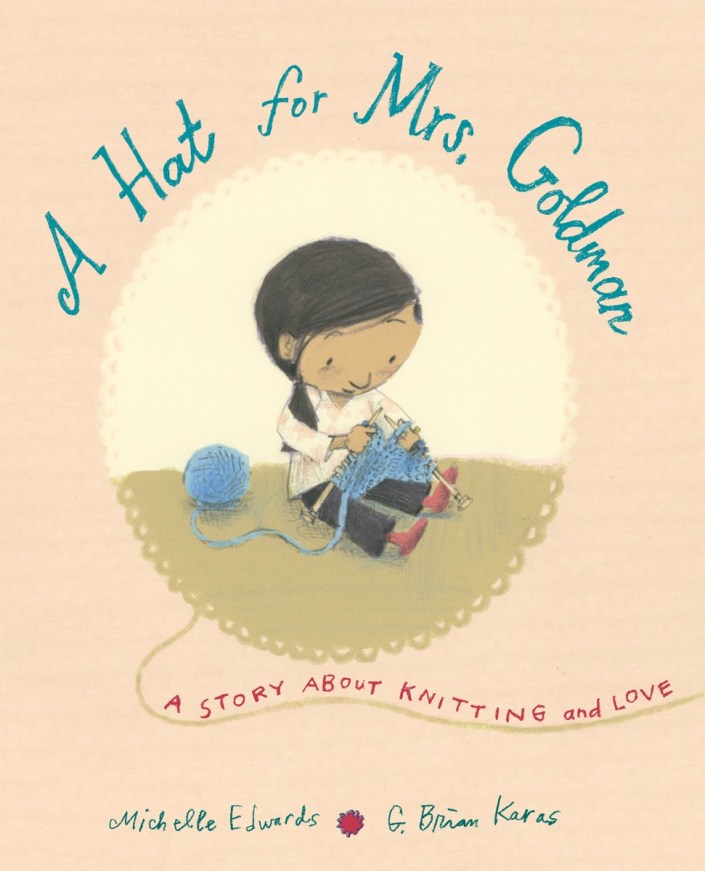
celebrate-picture-books-picture-book-review-a-hat-for-mrs.-goldman-cover

About the Holiday

Hats are always stylish, and during this time of year they can be a necessity for keeping warm! No matter if you make your own hat or buy it in a shop, whether you like stocking hats, felt hats, hats with earflaps, or hats that just hide a bad hairdo, this is the perfect season to indulge your fashion fancies!

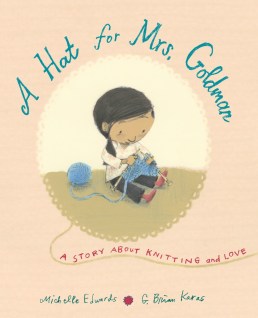
A Hat for Mrs. Goldman: A Story about Knitting and Love

Written by Michelle Edwards | Illustrated by G. Brian Karas


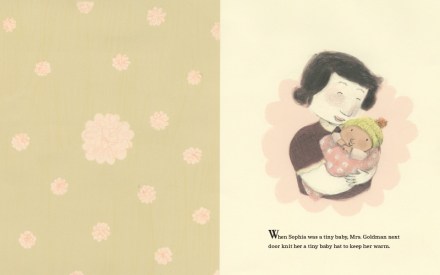
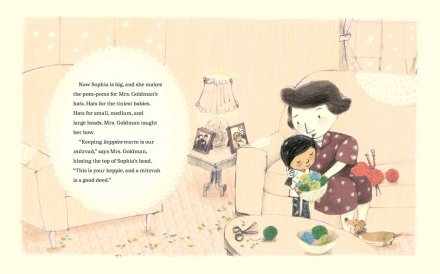
One of the first gifts Sophia received when she was a baby was a knitted hat from her neighbor Mrs. Goldman. Now that Sophia is more grown up, she helps Mrs. Goldman make pom-poms for the hats she knits for other babies, friends, and neighbors. “‘Keeping keppies warm is our mitzvah,’ says Mrs. Goldman, kissing the top of Sophia’s head. ‘This is your keppie, and a mitzvah is a good deed.’”

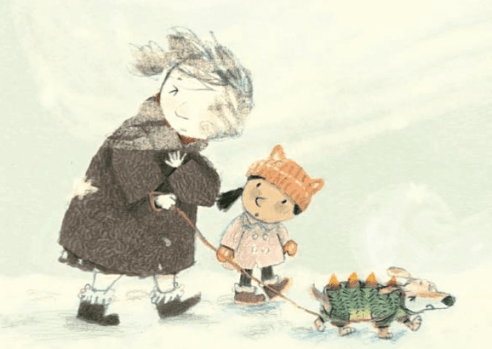
One day in late autumn Sophia and Mrs. Goldman walk Mrs. Goldman’s dog Fifi. While Fifi is kept warm in a dinosaur sweater and Sophia is cozy in the fuzzy kitten hat and mittens that Mrs. Goldman made them, Mrs. Goldman’s head and ears are unprotected in the icy wind. When Sophia asks her friend why she doesn’t have a hat, Mrs. Goldman tells her “‘I gave it to Mrs. Chen.’”

celebrate-picture-books-picture-book-review-a-hat-for-mrs.-goldman-sophia-as-a-baby

Image copyright G. Brian Karas, 2016, text copyright Michelle Edwards, 2016. Courtesy of Schwartz & Wade.

Sophia begins to worry about Mrs. Goldman. Who will knit a hat for her? “Not Mrs. Goldman. She’s too busy knitting for everyone else.’” Last year Mrs. Goldman had tried to teach Sophia to knit, but it was too hard and took too long, so she decided to stick with making pom-poms. But Sophia thinks maybe it’s time to try again. She goes to her knitting bag and pulls out the hat they had started together. “The stiches are straight and even. The soft wool smells like Mrs. Goldman’s chicken soup.”

celebrate-picture-books-picture-book-review-a-hat-for-mrs.-goldman-pom-poms

Image copyright G. Brian Karas, 2016, text copyright Michelle Edwards, 2016. Courtesy of Schwartz & Wade.

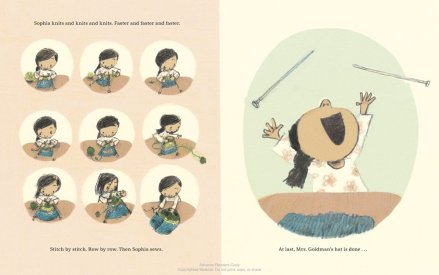
Holding the needles, Sophia thinks about what she was taught. Even though she drops stitches, she continues to knit. “She wants to make Mrs. Goldman the most special hat in the world.” The next day snow falls on Mrs. Goldman’s head as they walk Fifi. Sophia frets, and at home she begins knitting morning, noon, and night to finish her hat. Winter has set in and one day when the pair walk Fifi, “Mrs. Goldman wraps Mr. Goldman’s scarf around her head like she’s a mummy.” But the wind grabs it and rips it away. Sophia catches it, but shivers at the thought of how cold Mrs. Goldman must be.

celebrate-picture-books-picture-book-review-a-hat-for-mrs.-goldman-sophia-and-mrs-goldman

Image copyright G. Brian Karas, 2016, text copyright Michelle Edwards, 2016. Courtesy of Schwartz & Wade.

At home Sophia knits in a frenzy, adding row after row of stitches until the hat is finished. When Sophia looks at it, though, she finds holes where they shouldn’t be and lumpy and bumpy areas. She thinks what she has made looks more like a monster than a hat. Sophia takes out the box containing all the hats Mrs. Goldman has made for her, but they are much too small for Mrs. Goldman to wear. While Sophia’s mama and papa have hats made by Mrs. Goldman, she knows she can’t give those away.

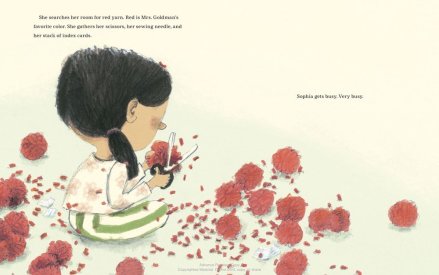
Sophia imagines all the hats she makes with her neighbor and how Mrs. Goldman always tells her that her pom-poms add beauty, and that “‘that’s a mitzvah too.’” Sophia’s heart swells. She finds red yarn—Mrs. Goldman’s favorite color—and her pom-pom making supplies and goes to work. When she is finished and the pom-poms are attached, “Mrs. Goldman’s hat is the most special hat in the world.”

celebrate-picture-books-picture-book-review-a-hat-for-mrs.-goldman-sophia-finishes-hat

Image copyright G. Brian Karas, 2016, text copyright Michelle Edwards, 2016. Courtesy of Schwartz & Wade.

Sophia runs next door and surprises Mrs. Goldman with her gift. Mrs. Goldman hugs Sophia and tears come to her eyes. “‘Don’t you like it?’” Sophia asks, but she needn’t worry. “‘I more than like it, I love it,’ declares Mrs. Goldman. ‘Gorgeous. Like Mr. Goldman’s rosebushes. And you know how I love his roses.’” With a kiss for Sophia, Mrs. Goldman begins counting the twenty pom-poms on her hat—“each one made with love.” Mrs. Goldman slips the hat on her head. Now when she and Sophia take Fifi for a walk, Fifi wears her dinosaur sweater, Sophia wears her kitty hat and mittens, and “Mrs. Goldman wears her Sophia hat. Her keppie is toasty warm. And that’s a mitzvah.”

celebrate-picture-books-picture-book-review-a-hat-for-mrs.-goldman-giving-hat

Image copyright G. Brian Karas, 2016, text copyright Michelle Edwards, 2016. Courtesy of Schwartz & Wade.

Michelle Edwards’ heartwarming story of a little girl who sees that her friend is in need and determines to help draws on children’s natural generosity and shows readers that their efforts are recognized and appreciated. Edward’s gentle and well-paced storytelling allows readers to understand the events and thoughts that bring Sophia to once again attempt knitting. Sophia’s solution to use the pom-poms she knows she makes well (and with love) to cover the holes demonstrates not only the ingenious creativity of kids, but also the idea that love can fill the voids in life.

celebrate-picture-books-picture-book-review-a-hat-for-mrs-goldman-snow

Image copyright G. Brian Karas, 2016,  courtesy of Schwartz & Wade.

Brian Karas imbues the story of Sophia and Mrs. Goldman with a magical wonder that floats from page to page like the fluffy snowflakes that are the catalyst for Sophia’s mitzvah. A combination of full-page illustrations and snapshot images show days spent with Mrs. Goldman as well as the moments, hours, and days that adorable Sophia spends knitting her special hat. Sophia, tongue sticking out in determination, wields her knitting needs; she ponders her holey hat while imagining a frightened Fifi; and scraps of red yarn dot the floor and even sit atop Sophia’s head as she creates pom-pom after pom-pom. When Mrs. Goldman pulls the hat over her own head, kids will feel cheered, while adults may feel a small lump in their throat.

A Hat for Mrs. Goldman is a gem. Its tender portrayal of kindness, love, and close personal relationships makes it an outstanding choice for any child’s home library.

Ages 4 – 8

Schwartz & Wade, 2016 | ISBN 978-0553497106

Discover more about Michelle Edwards and her books, plus activities, recipes, and information on knitting on her website!

Enter a gallery of books, sketches, blog essays, and more by G. Brian Karas on his website!

National Hat Day Activity

celebrate-picture-books-picture-book-review-winter-hat-match-puzzle

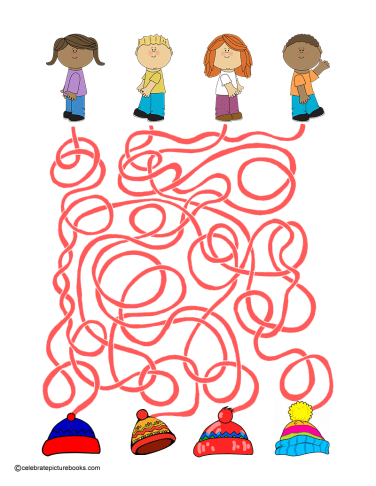
Winter Hat Match Puzzle


These kids have all lost their hats! Can you follow the paths in this printable Winter Hat Match Puzzle to reunite each child with the right hat?

celebrate-picture-books-picture-book-review-a-hat-for-mrs.-goldman-cover

You can find A Hat for Mrs. Goldman at these booksellers

Amazon | Barnes & Noble | Books-a-Million | IndieBound

Picture Book Review

January 14 – International Kite Day

celebrate-picture-books-picture-book-review-kite-day-a-bear-and-mole-story-cover

About the Holiday

International Kite Day originated in India in the state of Gujarat to commemorate the last day of winter and the first day of summer as well as the coming harvest season. The kites represent the spirits of the gods who are awakened from their winter sleep. The people of Gujarat begin making kites months in advance to accommodate the numerous festivals and the millions of people from around the world who attend them.

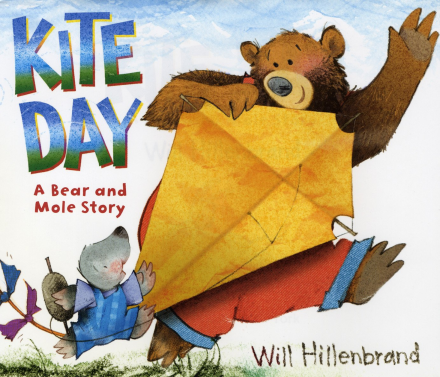
Kite Day: a Bear and Mole Story

By Will Hillenbrand


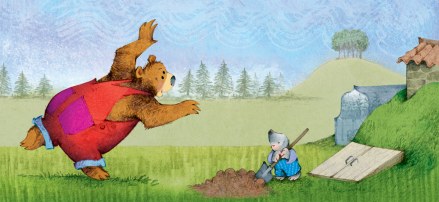
Bear sensed a familiar aroma in the air. He pointed his nose toward the sky and took a big whiff. “He smiled and then shouted, ‘Kite day!’” He dashed home and announced the news to Mole, who was digging in his garden. While Mole researched in a stack of books, Bear gathered supplies. While “Bear measured and cut, Mole drew.” Then “they both constructed.”

celebrate-picture-books-picture-book-review-kite-day-a-bear-and-mole-story-mole-digging

Image copyright Will Hillenbrand, courtesy of Holiday House

With their beautiful yellow creation in hand, “they raced outside into the meadow.” Mole ran with the string while Bear threw the kite high above him. The breeze picked up the kite and sent it’s rainbow bowtie tail fluttering “Zoom. Zoom. Zoom.” The kite soared higher and higher—into a graying sky. “Then dark, heavy clouds rolled in. Rumble. Rumble. Rumble.”
celebrate-picture-books-picture-book-review-kite-day-a-bear-and-mole-story-flying-kite

Image copyright Will Hillenbrand, courtesy of Holiday House

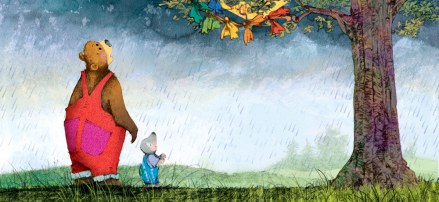
Suddenly, a gust of wind snapped the kite string, and it spun “Away, away, away.” “‘Oh no!” screamed Mole and Bear” as the kite dove downward. The two ran as fast as they could to catch up with it. They came to a stop under a huge tree. Caught in the branches was their kite. “Splat. Splat, Splat. Rain pelted the broken kite.” Then Mole and Bear saw something amazing. “‘Look!’ cried Bear. ‘Oh,’ sighed Mole.” The kite was sheltering a nest of chicks! “‘Chirrup, chirrup, chirrup’” they cheaped. “‘Thank you!’ sang the mother bird.”

celebrate-picture-books-picture-book-review-kite-day-a-bear-and-mole-story-kite-in-tree

Image copyright Will Hillenbrand, courtesy of Holiday House

Will Hillenbrand’s sweet friends Bear and Mole never fail to bring a smile to young reader’s faces as they share both joyful and scary experiences together. Little ones will love the repeated words that invite them to read along, and active verbs—such as snatched, plunged, and pelted—provide lyrical and advanced vocabulary. Kite Day offers gentle suspense and a cheerful resolution that will enchant young readers. Hillenbrand’s adorable, expressive characters, vibrant colors, and lovely pastel backgrounds will fully engage kids during any story time.

Children would love to add Kite Day, along with the Hillenbrand’s three other Bear and Mole Stories, to their home bookshelf.

Ages 3 – 6

Holiday House, 2013 | ISBN 978-0823427581

Discover more about Will Hillenbrand and his books as well as book-related activities and a gallery of illustations on his website!

Fly with this Kite Day book trailer!

International Kite Day Activity

celebrate-picture-books-picture-book-review-kite-coloring-page

Cool Kite Decorating Page


Part of the fun of making your own kite is decorating it! Use this printable Cool Kite Page to create the perfect flier! Try colored pencils, markers, glitter, tissue paper, stickers, or other decorations to make it uniquely yours!

Picture Book Review