If you like to take a break from the routine or pressures of the work day and sew, garden, or read, play music, dance, or draw, or if you’ve always wanted to learn a new skill or develop a talent, then this month is for you! During National Hobby Month take some time to research a skill, art, or discipline that strikes your fancy and get started!
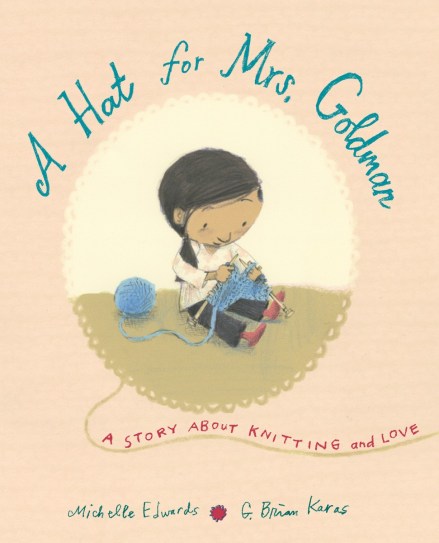
A Hat for Mrs. Goldman: A Story about Knitting and Love
Written by Michelle Edwards | Illustrated by G. Brian Karas
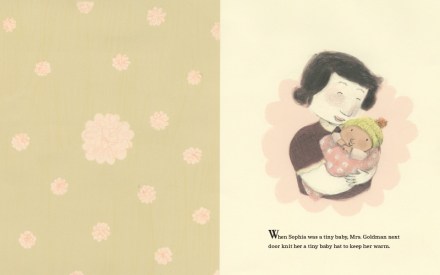
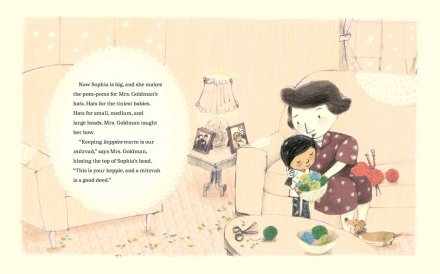
One of the first gifts Sophia received when she was a baby was a knitted hat from her neighbor Mrs. Goldman. Now that Sophia is more grown up, she helps Mrs. Goldman make pom-poms for the hats she knits for other babies, friends, and neighbors. “‘Keeping keppies warm is our mitzvah,’ says Mrs. Goldman, kissing the top of Sophia’s head. ‘This is your keppie, and a mitzvah is a good deed.’”
One day in late autumn Sophia and Mrs. Goldman walk Mrs. Goldman’s dog Fifi. While Fifi is kept warm in a dinosaur sweater and Sophia is cozy in the fuzzy kitten hat and mittens that Mrs. Goldman made them, Mrs. Goldman’s head and ears are unprotected in the icy wind. When Sophia asks her friend why she doesn’t have a hat, Mrs. Goldman tells her “‘I gave it to Mrs. Chen.’”
Image copyright G. Brian Karas, 2016, text copyright Michelle Edwards, 2016. Courtesy of Schwartz & Wade
Sophia begins to worry about Mrs. Goldman. Who will knit a hat for her? “Not Mrs. Goldman. She’s too busy knitting for everyone else.’” Last year Mrs. Goldman had tried to teach Sophia to knit, but it was too hard and took too long, so she decided to stick with making pom-poms. But Sophia thinks maybe it’s time to try again. She goes to her knitting bag and pulls out the hat they had started together. “The stiches are straight and even. The soft wool smells like Mrs. Goldman’s chicken soup.”
Image copyright G. Brian Karas, 2016, text copyright Michelle Edwards, 2016. Courtesy of Schwartz & Wade.
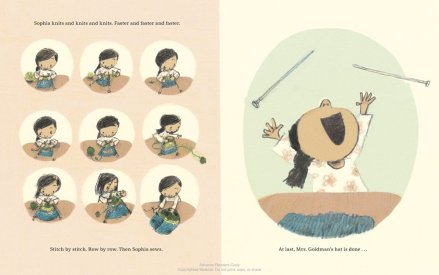
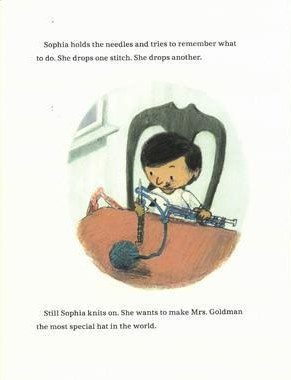
Holding the needles, Sophia thinks about what she was taught. Even though she drops stitches, she continues to knit. “She wants to make Mrs. Goldman the most special hat in the world.” The next day snow falls on Mrs. Goldman’s head as they walk Fifi. Sophia frets, and at home she begins knitting morning, noon, and night to finish her hat. Winter has set in and one day when the pair walk Fifi, “Mrs. Goldman wraps Mr. Goldman’s scarf around her head like she’s a mummy.” But the wind grabs it and rips it away. Sophia catches it, but shivers at the thought of how cold Mrs. Goldman must be.
Image copyright G. Brian Karas, 2016, text copyright Michelle Edwards, 2016. Courtesy of Schwartz & Wade.
At home Sophia knits in a frenzy, adding row after row of stitches until the hat is finished. When Sophia looks at it, though, she finds holes where they shouldn’t be and lumpy and bumpy areas. She thinks what she has made looks more like a monster than a hat. Sophia takes out the box containing all the hats Mrs. Goldman has made for her, but they are much too small for Mrs. Goldman to wear. While Sophia’s mama and papa have hats made by Mrs. Goldman, she knows she can’t give those away.
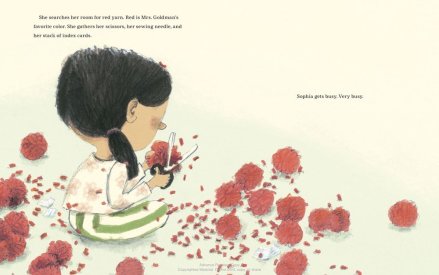
Sophia imagines all the hats she makes with her neighbor and how Mrs. Goldman always tells her that her pom-poms add beauty, and that “‘that’s a mitzvah too.’” Sophia’s heart swells. She finds red yarn—Mrs. Goldman’s favorite color—and her pom-pom making supplies and goes to work. When she is finished and the pom-poms are attached, “Mrs. Goldman’s hat is the most special hat in the world.”
Image copyright G. Brian Karas, 2016, text copyright Michelle Edwards, 2016. Courtesy of Schwartz & Wade
Sophia runs next door and surprises Mrs. Goldman with her gift. Mrs. Goldman hugs Sophia and tears come to her eyes. “‘Don’t you like it?’” Sophia asks, but she needn’t worry. “‘I more than like it, I love it,’ declares Mrs. Goldman. ‘Gorgeous. Like Mr. Goldman’s rosebushes. And you know how I love his roses.’” With a kiss for Sophia, Mrs. Goldman begins counting the twenty pom-poms on her hat—“each one made with love.” Mrs. Goldman slips the hat on her head. Now when she and Sophia take Fifi for a walk, Fifi wears her dinosaur sweater, Sophia wears her kitty hat and mittens, and “Mrs. Goldman wears her Sophia hat. Her keppie is toasty warm. And that’s a mitzvah.”
Image copyright G. Brian Karas, 2016, text copyright Michelle Edwards, 2016. Courtesy of Schwartz & Wade.
Michelle Edwards’ heartwarming story of a little girl who sees that her friend is in need and determines to help draws on children’s natural generosity and shows readers that their efforts are recognized and appreciated. Edward’s gentle and well-paced storytelling allows readers to understand the events and thoughts that bring Sophia to once again attempt knitting. Sophia’s solution to use the pom-poms she knows she makes well (and with love) to cover the holes demonstrates not only the ingenious creativity of kids, but also the idea that love can fill the voids in life.
Image copyright G. Brian Karas, 2016, text copyright Michelle Edwards, 2016. Courtesy of Schwartz & Wade.
Brian Karas imbues the story of Sophia and Mrs. Goldman with a magical wonder that floats from page to page like the fluffy snowflakes that are the catalyst for Sophia’s mitzvah. A combination of full-page illustrations and snapshot images show days spent with Mrs. Goldman as well as the moments, hours, and days that adorable Sophia spends knitting her special hat. Sophia, tongue sticking out in determination, wields her knitting needs; she ponders her holey hat while imagining a frightened Fifi; and scraps of red yarn dot the floor and even sit atop Sophia’s head as she creates pom-pom after pom-pom. When Mrs. Goldman pulls the hat over her own head, kids will feel cheered, while adults may feel a small lump in their throat.
A Hat for Mrs. Goldman is a gem. Its tender portrayal of kindness, love, and close personal relationships makes it an outstanding choice for any child’s home library.
Ages 4 – 8
Schwartz & Wade, 2016 | ISBN 978-0553497106
Discover more about Michelle Edwards and her books, plus activities, recipes, and information on knitting on her website!
Enter a gallery of books, sketches, blog essays, and more by G. Brian Karas on his website!
National Hobby Month Activity
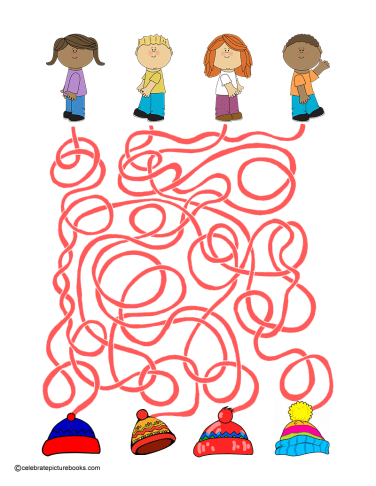
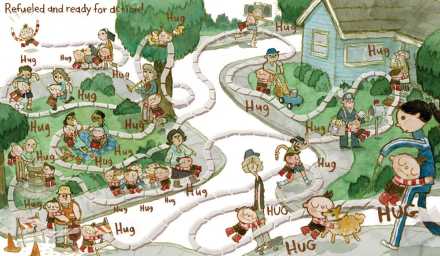
Winter Hat Match Puzzle
These kids have all lost their hats! Can you follow the paths in this printable Winter Hat Match Puzzle to reunite each child with the right hat?
It’s Opposite Day! If you hear that the sky’s blue, it’s probably gray, if you’re told dinner’s yucky, that’s a compliment, and if your boss says that report is due today—well, you better finish it because not everyone plays along. Kids are especially fond of today’s holiday, and why not? Challenging yourself to think differently is fun! Of course there’s one emotion that can make us act a little turned upside down and backwards every day—as you’ll see in today’s book!
When an Elephant Falls in Love
Written by Davide Cali | Illustrated by Alice Lotti
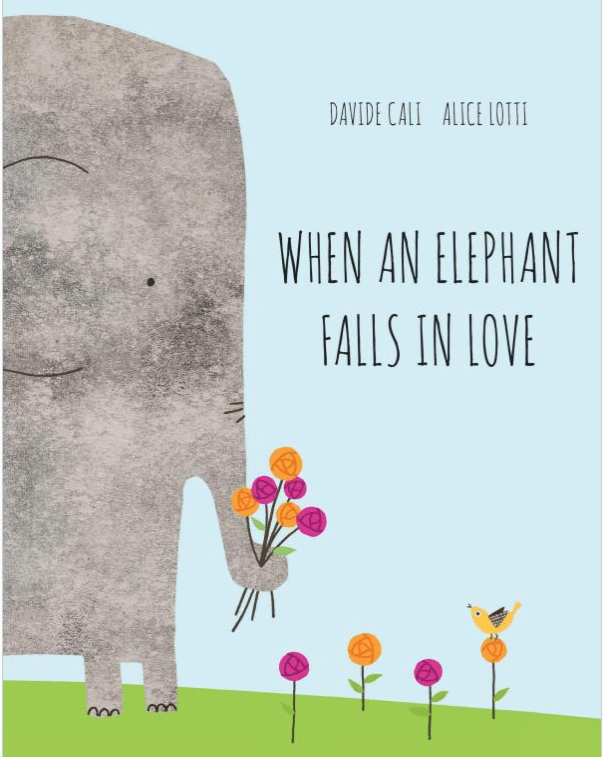
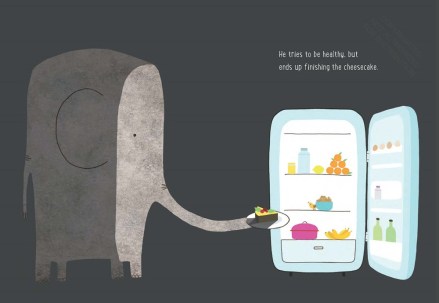
“When an elephant falls in love, he does many foolish things.” He takes unusual risks and hides when he sees the apple of his eye. Instead of sloughing off in the hygiene department, he “takes a bath every day, and even washes behind his ears.” Even though he knows it’s better to eat nutritious foods, there’s that yummy dessert in the fridge that calls to him.
Image copyright Alice Lotti, 2014, text copyright, 2014. Courtesy of Chronicle Books.
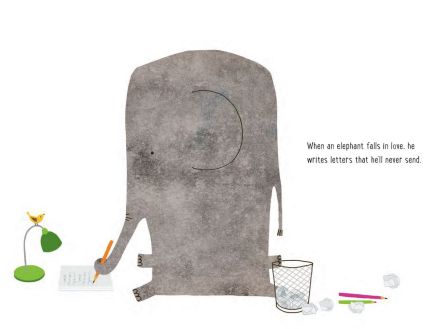
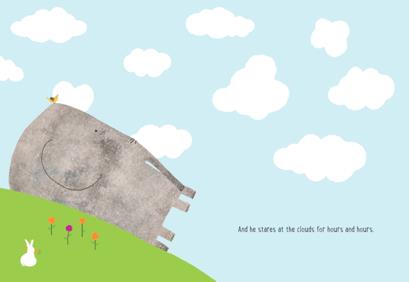
While his appearance never seemed to concern him before, now “he dresses with care” even though deciding which tie to wear is difficult. Letters to his beloved get written and then crumpled up and tossed away. And his work is abandoned in favor of “staring at the clouds for hours and hours.”
Image copyright Alice Lotti, 2014, text copyright, 2014. Courtesy of Chronicle Books.
When he gathers his courage, the elephant in love will get close to his loved one—well, close enough to leave flowers, but not so close that he stays after ringing the bell. Sometimes that happy, in-love feeling turns into sadness when the elephant thinks, “‘If only she knew I existed!’” There comes a day, however, when it all comes together—the natty dressing, the nice, clean scent, the words in the letters, and those flowers that are discovered before the elephant has fully disappeared. What happens then? “It’s love!”
Copyright Alice Lotti, 2014, courtesy of Chronicle Books.
Davide Cali’s sweetly honest look at what it’s like to fall in love—for the first time or any time—will charm young readers and resonate with adults. The story is enchanting in its unapologetic presentation of the “foolish” things the elephant does—all things that are just part of growing up. Readers will see that with a few steps forward (and a few steps back), they will achieve their heart’s desire.
Image copyright Alice Lotti, 2014, text copyright, 2014. Courtesy of Chronicle Books.
Alice Lotti’s little boulder of an elephant is as adorable as they come. With a tiny dot of an eye and simple lines accenting his ears, toes, and trunk, the elephant expressively goes about his days with her on his mind. Lotti’s white background highlights the elephant as he walks a tightrope holding a tiny pink umbrella, showers himself while immersed in a claw-foot bathtub, and searches the mirror for the answer between the green and orange tie. Lotti’s color palette is fresh and vibrant, and her clean lines give the illustrations a sophisticated look. The elephant’s beautifully textured, mottled hide lends a soft vulnerability to her sensitive pachyderm. Readers will have fun spotting the little yellow bird that is the elephant’s constant companion, a special cloud floating into view, and the flowers that bring the two elephants together.
Ages 4 – 8
Chronicle Books, 2016 | ISBN 978-1452147277
Learn more about Alice Lotti and view a portfolio of her artwork on her website.
Opposite Day Activity
Fall in Love with Dot-to-Dots
Dot-to-Dot pictures offer a little bit for everyone—a little mystery, a little counting, a little bit to color, and a lot of fun! Since it’s Opposite Day, why not work from the last number to the first in this printable Fall in Love with Dot-to-Dots.
If there’s one thing that unites us all, it’s laughter. A good belly laugh is good for your soul and your health! Today’s holiday encourages and celebrates smile, laughs, and all the things that bring us joy. It’s also a day to think about and thank those who share their funny stories, fun times, and laughter with us. So spend a happy day being with friends, watching a funny movie or show, and reading a laugh-out-loud book like…
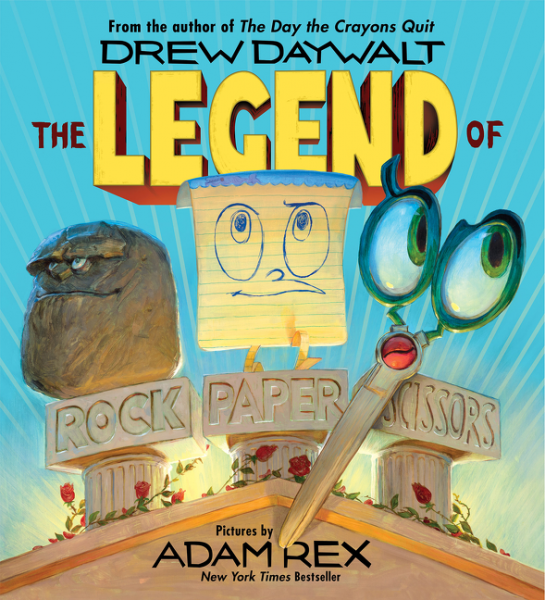
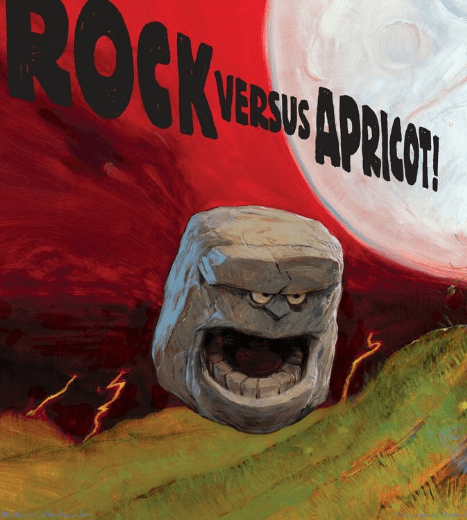
The Legend of Rock Paper Scissors
Written by Drew Daywalt |Illustrated by Adam Rex
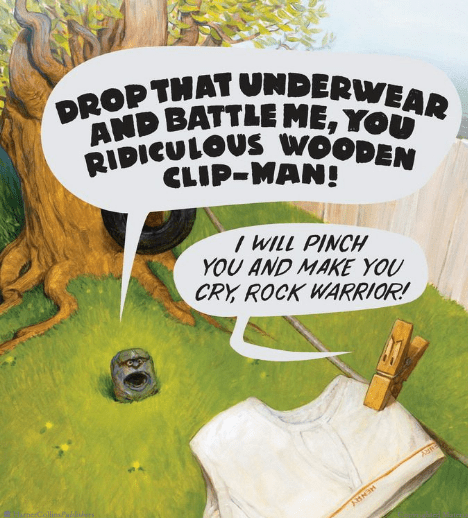
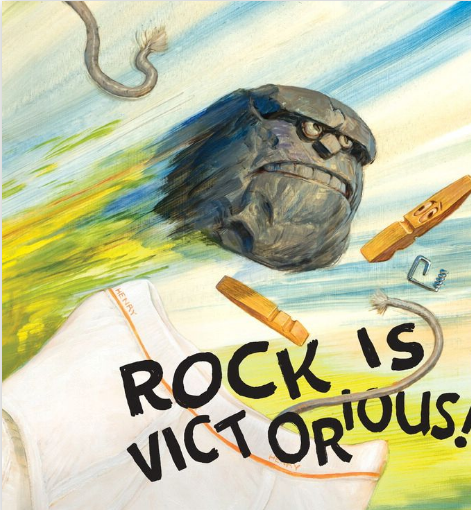
“Long ago in an ancient and distant realm called the Kingdom of Backyard,” Rock ruled. There was just one problem. There was no one left who could challenge this mighty warrior. Rock traveled far and wide, even to the “Forest of Over by the Tire Swing.” Here, on a line strung between two trees, he spied a tiny opponent with super strength “holding a giant’s underwear.” The trash talking began as Rock called out Clip Man to fight him. Clip Man was not intimidated and threatened to pinch Rock until he cried. The battle was on! With a smash and a crack, Rock easily defeated Clip Man.
Image copyright Adam Rex, 2017; text copyright Drew Daywalt, 2017. Courtesy of Balzar + Bray.
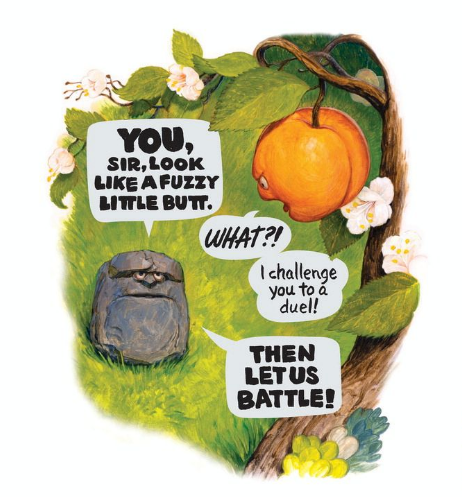
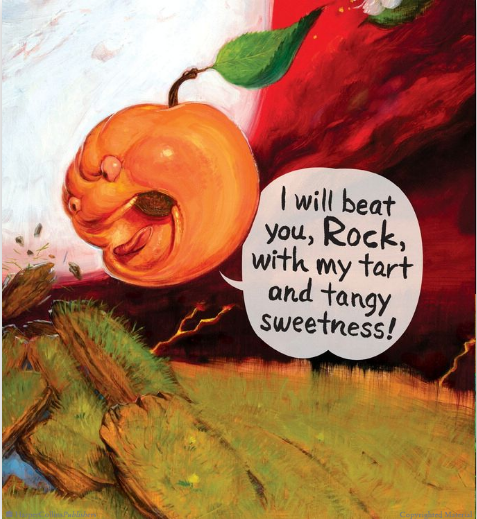
Rock’s win just whet his appetite for victory, so he moseyed over to “the Mystical Tower of Grandma’s Favorite Apricot Tree.” There he encountered a small, orange fruit. Rock told the Apricot exactly what he thought of him. Apricot couldn’t let the dis go unchallenged, so the battle was on! Although Apricot gave it his all, his “tart and tangy sweetness” was no match for Rock’s smooshing power. While Rock took some pleasure in his win, it did not bring him the joy he sought. He decided to leave the Kingdom of Backyard in search of a worthy opponent.
Image copyright Adam Rex, 2017; text copyright Drew Daywalt, 2017. Courtesy of Balzar + Bray.
“Meanwhile, in the Empire of Mom’s Home Office, on lonely and windswept Desk Mountain, a second great warrior sought the glory of battle.” Paper was smart and so clever that “no one could outwit him.” As he roamed across the vast desk, Paper met up with Computer Printer, who vowed to gobble him up and spit him out. The battle was on! But within seconds Computer Printer realized he was in a jam—a Paper jam! Flush with victory Paper rappelled over the side into the “Pit of Office Trash Bin,” where the menacing “Half-Eaten Bag of Trail Mix” awaited him. Paper leapt! Paper blocked the light! The Trail Mix fled! Disheartened by this easy win, Paper also left his kingdom in search of a worthy opponent.
Image copyright Adam Rex, 2017; text copyright Drew Daywalt, 2017. Courtesy of Balzar + Bray.
Back in “the Kitchen Realm in the tiny village of Junk Drawer, there lived a third great warrior. They called her Scissors.” She too was looking for a challenging adversary. She was happy to take on the “tacky and vaguely round monstrosity” who confronted her, but Roll of Tape’s “adhesive and tangling powers” were no match for Scissors’ sharp blades. She sauntered across her kingdom to Refrigerator/Freezer, where the breaded-chicken dinosaurs lived. They were ready to fight, and the battle is on! At first it looks as if the “kid-pleasing shapes and flavors” will vanquish Scissors, but it’s just a plot twist! Scissors is victorious again!
Image copyright Adam Rex, 2017; text copyright Drew Daywalt, 2017. Courtesy of Balzar + Bray.
Scissors knew it was time to move on, so she left the Kitchen Realm for the “Great Cavern of Two-Car Garage.” There she came face-to-face with Rock. They sized each other up, and Scissors threw down the gauntlet: “I hope you’re wearing your battle pants, rock warrior.” Rock answered: “If by ‘battle pants’ you mean ‘no pants but I’m willing to fight you,’ then yes…yes, I am wearing my battle pants, weird scissory one.” The battle was on!
Rock versus Scissors! The battle raged, until…Rock defeated Scissors. Suddenly, Scissors knew the happiness of having a worthy opponent, but Rock was still unsatisfied. Just then Paper floated onto the scene, and with the well-known fighting words, “Hi there,” the battle was on! Brought down and wrapped up by Paper’s flexible forces, Rock was joyful. But what about Paper? Who could defeat him?
Image copyright Adam Rex, 2017; text copyright Drew Daywalt, 2017. Courtesy of Balzar + Bray.
Scissors stood on her tippy toes and faced Paper. With one smooth slice, she cut a hole in his win record. Now Paper knew the thrill of defeat. The three warriors became fast friends and battled each other over and over. Their story became legend and their legend became the stuff of “backyards, playgrounds, and yes, even classrooms” as kids around the world play Rock, Paper, Scissors!
Get ready for plenty of dramatic reading, out loud laughs, and ringing cheers the moment you open Drew Daywalt’s The Legend of Rock, Paper, Scissors. This worthy spoof on the warrior genre from Medieval knights to the wrestling ring is a hilarious take down of challenges, trash talking, and bravado with a good bit of truth about the nature of competition and friendship: true friends are open to challenges and supportive when the other guy wins. Daywalt’s freewheeling conversational tone, inspired kingdoms, and cunning choices of opponents will have readers looking at their homes in a whole new light.
Employing the same thrilling spectacle as action movies, Adam Rex brings to life the adrenaline-pumping swagger of three brave warriors. Bold typefaces invite spirited reading, and the details of the realms overseen by Rock, Paper, and Scissors will enthrall kids. Both young and adult readers will want to linger and laugh over every page to check out all the anthropomorphized items that populate these kingdoms.
The Legend of Rock Paper Scissors is sure to be a champion in any child’s home library. It would make a perfect gift and a much-asked-for book for exuberant story times.
Ages 4 – 9
Balzer + Bray, HarperCollins, 2017 | ISBN 978-0062438898
Check out books, art, and other fun stuff by Adam Rex on his website!
Global Belly Laugh Day Activity
Rock Paper Scissors Extravaganza
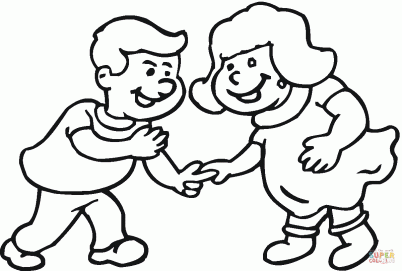
Come on! You know that a few rounds of Rock Paper Scissors will make you laugh! Find someone or many someones and challenge them to the battle of all rock, paper, scissors battles just like the two kids in this printable Laugh Along with Rock Paper Scissors Coloring Page!
Established in 1977, National Handwriting Day commemorates the act of putting thoughts to paper with a pen or pencil. In this age of computer writing programs, email, and texting, the art and joy of penmanship is waning. Handwriting, though, is unique to each individual and should be celebrated and encouraged! One of the best ways for kids to develop handwriting skills is by writing letters to friends and family. Finding a pen pal either close to home or from another country is another fantastic way to make new friends that can bring joy, broaden horizons, build empathy and respect for others, and promote a lifetime love of learning about our world—just as today’s book that celebrates the ideals of Multicultural Children’s Book Day shows!
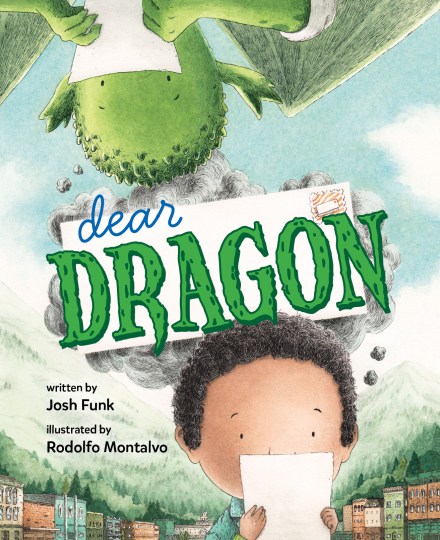
Dear Dragon: A Pen Pal Tale
Written by Josh Funk | Illustrated by Rodolfo Montalvo
Teachers know that when their students get to know other kids from nearby or far away, they gain an understanding of different traditions and cultures and develop the kinds of caring, empathy, and kindness that make the world a better place for all. Add in some poetry and the fun of sending—and receiving—letters, and you’ve got…Dear Dragon: A Pen Pale Tale—a clever tribute to creative communication and friendship.
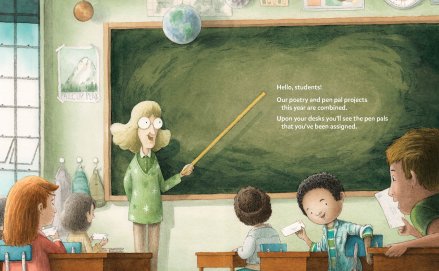
As the story opens, George and his classmates are learning about their new project. Elsewhere, Dragomir and his classmates are getting the details on their new project. And what is this new assignment? This year in each classroom the poetry and pen pal projects are being combined, so all correspondence must be written in rhyme.
Image copyright Montalvo Rodalfo, 2016, text copyright Josh Funk, 2016. Courtesy of Viking Books for Young Readers.
On each student’s desk is an envelope with the name of the pen pal they’ve been given. George Slair opens his envelope to discover that he’s been matched with Blaise Dragomir, and Blaise pulls George’s name from his envelope. What George doesn’t know—but readers do—is that Blaise is a dragon; and what Blaise doesn’t know—but readers do—is that George is a boy.
In his first letter, George begins with honesty and a bit about himself: “Dear Blaise Dragomir, / We haven’t met each other, and I don’t know what to say. / I really don’t like writing, but I’ll do it anyway. / Yesterday my dad and I designed a giant fort. / I like playing catch and soccer. What’s your favorite sport? / Sincerely, George Slair.”
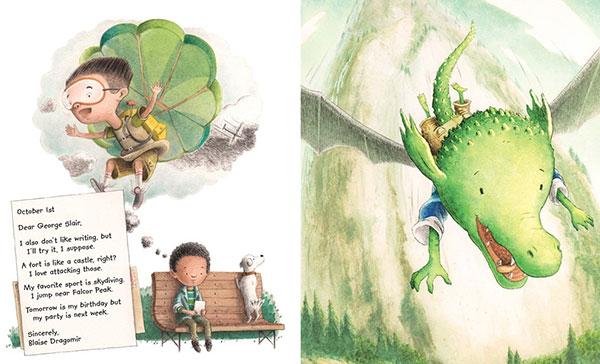
Image copyright Montalvo Rodalfo, 2016, text copyright Josh Funk, 2016. Courtesy of Viking Books for Young Readers.
As Blaise reads the letter he pictures George’s fort as a medieval stone fortress with an iron gate and whittled-to-a-point log fencing instead of the cardboard box, blanket, and umbrella that it actually was. Blaise writes back: “Dear George Slair, / I also don’t like writing, but I’ll try it, I suppose. / A fort is like a castle, right? I love attacking those. / My favorite sport is skydiving. I jump near Falcor Peak. / Tomorrow is my birthday, but my party is next week. / Sincerely, Blaise Dragomir.”
In his next letter, dated October 31, more earth-bound George tells Blaise that parachuting is awesome, that his dog destroyed his fort, and that he is trick-or-treating as a knight—a revelation to which Blaise has a visceral response. But what is scary to one pal is tame to the other. On November 14th Blaise relates: “Knights are super scary! I don’t like trick-or-treat. / Brushing teeth is such a pain, I rarely eat a sweet. / My pet’s a Bengal Kitten and tonight she needs a bath. / What’s your favorite class in school? I’m really into math!”
Image copyright Montalvo Rodalfo, 2016, text copyright Josh Funk, 2016. Courtesy of Viking Books for Young Readers.
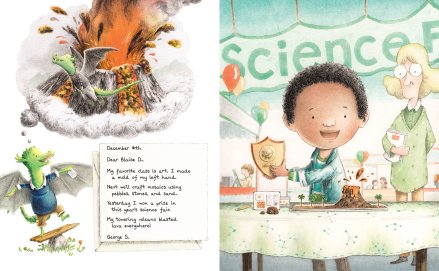
Reading December’s letter, Blaise learns that George likes art and imagines the table-top volcano science project George writes about as a roaring, lava-spewing mountain. In January George is impressed to learn that Blaise’s father is a fire-breather. He conjures up images of a dad in a fancy, caped costume creating fire out of nothing, but the truth is a lot more explosive. February brings word that George’s mom and dad are teachers and that a pen-pal picnic is planned for June.
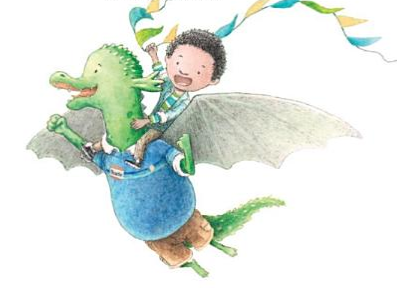
When Blaise writes back in March, he reveals that his dad’s into learning too: “…every night we read a book / or pick a game to play.” Then he tells George about a special outing he’s looking forward to with his dad: “Soon he’s gonna take me flying, once it’s really spring. / It’s such a rush to ride the air that flows from wing to wing.”
Image copyright Montalvo Rodalfo, 2016, text copyright Josh Funk, 2016. Courtesy of Viking Books for Young Readers.
On April 11th George expresses his wonder at Blaise’s parents: “Hi, Blaise! / Skydiving and flying? Wow, your parents rock! / I’m lucky if my father lets me bike around the block.” Then George asks a question that shows this project’s worth: “Once the school year’s over and this project is complete, / should we continue writing? ‘Cause it could be kind of neat….” Signing off, George abandons the formal “Sincerely, George” for “Your friend.”
Blaise is all in for continuing this friendship. In his May letter, he writes, “Hey, George! / I’m psyched about the picnic and I can’t wait to attend. / Who’d have thought this pen pal thing would make me a new friend? / Writing more sounds awesome. I was gonna ask you, too! / I’ve never liked to write as much as when I write to you.”
Image copyright Montalvo Rodalfo, 2016, text copyright Josh Funk, 2016. Courtesy of Viking Books for Young Readers.
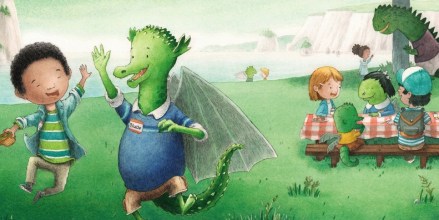
With a growing sense of anticipation, readers know that with a turn of the page June will come, and that June brings the long-awaited picnic. How will George and Blaise react when they see each other? As the children approach the Pen Pal Picnic spot and see the friends they’ve been writing to all year, their mouths hang open and their eyes grow wide. And as the dragons peek out from behind the trees to see the friends they’ve been writing to all year, their mouths hang open and their eyes grow wide.
“‘Blaise?’” a surprised George ventures, as a slice of tomato drops from his hamburger. “‘George?’” an astonished Blaise guesses, while nervously holding his tail. “‘My pen pal is a dragon?’” says George. “‘My pen pal is a human?’” echoes Blaise.
For a moment the celebration stops, but with the turn of the page, huge grins burst out on both George and Blaise as they exchange high fives (and fours). The other kid-and-dragon pals are having a blast too! And what do the teachers have to say? “‘Our plan was a success, my friend, or so it would appear!’ / ‘The Poetry and Pen Pal Project! Once again next year?’”
Image copyright Montalvo Rodalfo, 2016, text copyright Josh Funk, 2016. Courtesy of Viking Books for Young Readers.
In his inventive story that celebrates friendship, diversity, and the joy of discovering different viewpoints, Josh Funk shows the power of writing and communication to unite people of all backgrounds. Through the alternating letters from George and Blaise, Funk deftly demonstrates that many experiences are universal—like pets, school, hobbies, and parents—while others are just waiting to be shared. Blaise Dagomir and George Slair’s names are inspired, and may introduce kids to the ancient legends of Saint George and the Dragon and the poem St George and the Dragon by Alfred Noyes. This shout out to this well-known poem of the past further highlights the importance of reading all types of literature for both children and adults in connecting us as global citizens.
Following the alternating sequence of the letters, Rodolfo Montalvo depicts each pen pal’s perception of the message—along with the reality—in his illustrations that are, as George exclaims, “as awesome as it gets.” There is a special delight in seeing how sweet, earnest, and happily supportive of each other’s lifestyle Blaise and George are as they react to every letter. The full-bleed pages and vibrant colors dazzle with excitement, humor, and ingenious details. The final spreads build suspense as to how George and Blaise will react to each other, and the resolution is cheerfully satisfying.
One striking aspect of both the text and the illustrations is the similarity between the two pen pals. While their activities and experiences may be on different scales, they are comparable and understandable to each child. Likewise, in each painting Montalvo uses complementary colors to unite George and Blaise. This cohesiveness in both words and pictures beautifully represents the theme of inclusiveness.
Dear Dragon: A Pen Pal Tale is a fantastic read-aloud with multiple applications for fun and discussion at home and during classroom and library story times.
Ages 4 – 8
Viking Books for Young Readers, 2016 | ISBN 978-0451472304
Discover more about Josh Funk and his books and find plenty of fun activities to enjoy on his website.
Learn more about Rodolfo Montalvo and his artwork on his website
National Handwriting Day Activity
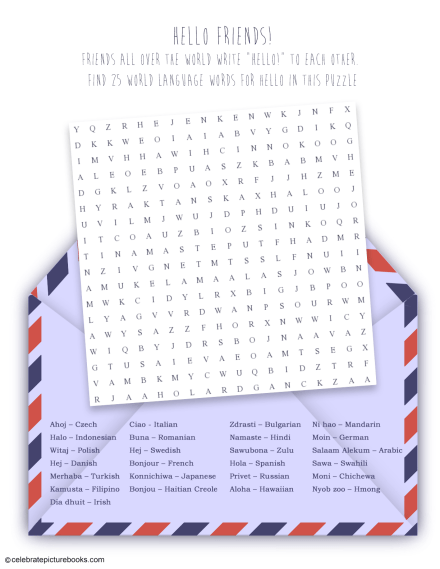
Hello, Friends! Word Search Puzzle
Friends say and write “hello” to each other all over the world. You can learn how to say “hello” in twenty-five languages as you look for them in this printable Hello, Friends Word Search Puzzle!
Multicultural Children’s Book Day 2017 (1/27/18) is in its 5th year and was founded by Valarie Budayr from Jump Into A Book and Mia Wenjen from PragmaticMom. Our mission is to raise awareness of the ongoing need to include kids’ books that celebrate diversity in home and school bookshelves while also working diligently to get more of these types of books into the hands of young readers, parents and educators.
We’d like to also give a shout-out to MCBD’s impressive CoHost Team who not only hosts the book review link-up on celebration day, but who also works tirelessly to spread the word of this event. View our CoHosts: http://multiculturalchildrensbookday.com/about/co-hosts/
TWITTER PARTY Sponsored by Scholastic Book Clubs: MCBD’s super-popular (and crazy-fun) annual Twitter Party will be held 1/27/18 at 9:00pm.
Today’s holiday is all about celebrating the children and grandchildren in our lives and what makes each one truly unique. When you watch your own children or those in your care grow and develop their own personalities, talents, and dreams, you realize that each one is an individual with a bright future ahead of them. Take the opportunity of this special holiday to encourage your children, support them, and—most of all—tell them how much you love them every day.
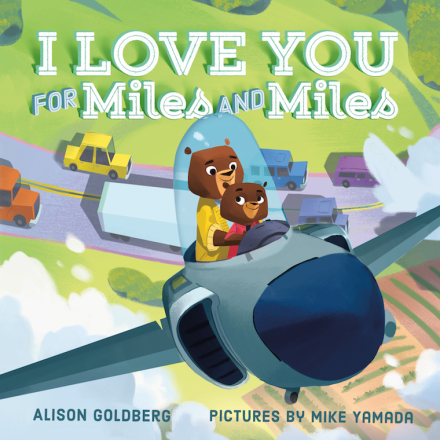
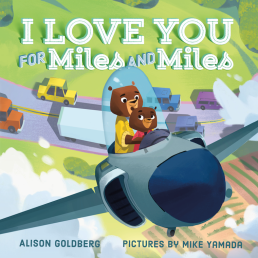
I Love You for Miles and Miles
Written by Alison Goldberg | Illustrated by Mike Yamada
Love—like air—is one of those things that everyone needs. People wonder about it, write about it, and talk about it. But, like air, love can’t been seen—how do you measure it? How do you weigh it? How do you let kids see it? I Love You for Miles and Miles shows you! Opening the cover, you read “My love for you is / Longer than the longest train / Linking engine to caboose, / Winding for miles and miles.”
Image copyright Mike Yamada, 2017, text copyright Alison Goldberg, 2017. Courtesy of us.macmillan.com.
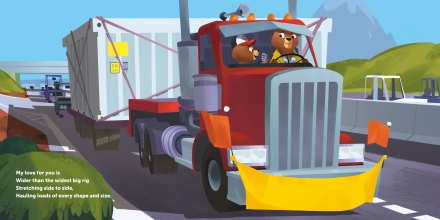
If love is long, can it be wide? Sure! How wide? “It is wider than the widest big rig” on the highway. When you hug your child with all your might, they know that your love for them is continuous and “stronger than the strongest excavator / Scooping heap after heap….” Such strong love runs “deeper than the deepest drill / digging down, down, down, uncovering mysteries.”
Image copyright Mike Yamada, 2017, text copyright Alison Goldberg, 2017. Courtesy of us.macmillan.com.
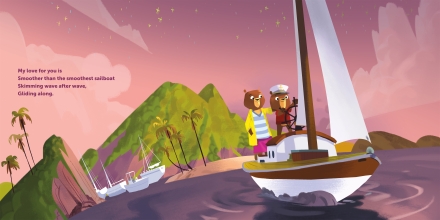
Since love burrows deep, it makes sense that it can soar as well. How high? Look up at cranes on a construction site and imagine a love that goes beyond higher, a love that “reaches toward the sun.” While some days may hold hardships, you can assure your child that your love always remains “smoother than the smoothest sailboat” navigating the waves and changing winds.
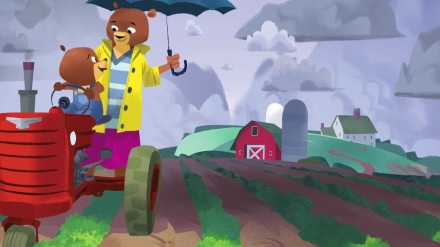
When your child needs a hug, a kiss, or some special attention now, you can reassure them that you will be there “faster than the fastest fire truck / Hurrying faster, faster, / Rushing to you, anywhere you are.” If your child wonders if love can handle anything that comes along, remind them of the tractor, “planting crop after crop, / Helping through mud and muck.”
Image copyright Mike Yamada, 2017, text copyright Alison Goldberg, 2017. Courtesy of us.macmillan.com.
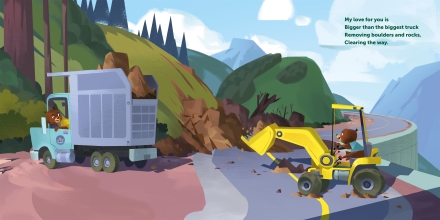
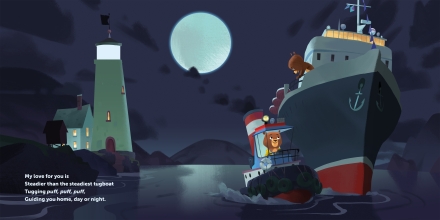
The obstacles that life throws our way are manageable, you can tell your child, because like the biggest dump truck, you can help remove them and fly “above all the rain” like an airplane. And at the end of the day, your love guides them “home, day or night” with the steadiness of a tugboat.
And for the days and years ahead, when your child sees that long, long train, they will understand when you say that is “my love for you… / Riding from station to station, / Traveling with you always.”
Image copyright Mike Yamada, 2017, text copyright Alison Goldberg, 2017. Courtesy of us.macmillan.com.
In her sweet tribute to a parent’s or caregiver’s love, Alison Goldberg gives concrete shape and weight to that feeling of love which can be so hard to describe. Little ones awed by the size and power of vehicles and machines, will readily recognize and understand the comparisons and be excited to share their own abundant love. Goldberg’s short verses are composed of words most young readers know, and by using comparative and superlative forms of the adjectives, she fosters a deeper comprehension of how love transcends even the biggest, longest, strongest, or toughest things a child can imagine. The first-person perspective allows not only the adults reading to express their love but also the children listening to say, “yes, I feel this way too.”
Image copyright Mike Yamada, 2017, text copyright Alison Goldberg, 2017. Courtesy of us.macmillan.com.
Mike Yamada’s stunning two-page spread illustrations, full of vivid color and dramatic perspectives, will delight little readers. A cub and adult are at the controls of each vehicle, the little one driving or guiding when possible, or being helped if needed. Young readers will love lingering over each page to view all of the realistic elements on every vehicle or machine. The sweet, happy looks between adult and cub reinforce the strong bond between them. Gender-neutral clothing and first-person point of view makes this a universal book.
I Love You for Miles and Miles is an adorable and meaningful book for adults and children to share and would make a great addition to home and classroom libraries. Besides fun at bedtime, it would make a terrific take-along book for car trips or waiting times, and the theme can easily be extended to an “I-Spy” type of activity while out driving or walking around the neighborhood and beyond.
Ages 2 – 6
Farrar, Straus and Giroux Books for Young Readers, 2017 | ISBN 978-0374304430
Discover more about Alison Goldberg and her work on her website
Learn more about Mike Yamada and view a gallery of his artwork on his website.
Enjoy this I Love You for Miles and Miles book trailer!
Celebration of Life Day Activity
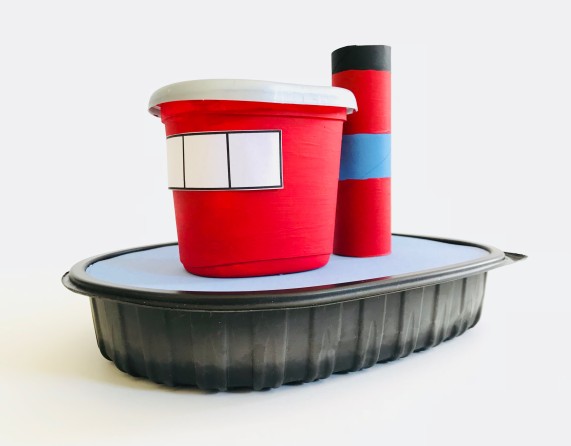
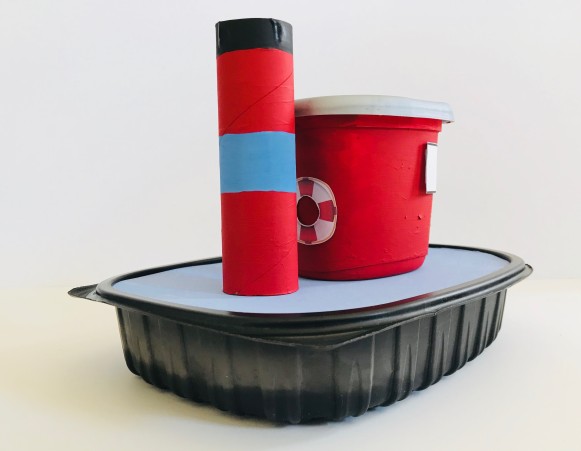
Tugboat Bathtub Toy Craft
Tugboats are always there when a ship needs help or guidance—just like a parent or caregiver. With a few recycled materials, adults and children can have fun making this Tugboat Bathtub Toy that you’ll love to play with in the tub or pool.
One 16-ounce cream cheese container with lid (or other such container)
Paper towel tube
Cardboard (can use a cereal box)
Foam sheet in whatever color you would like the deck to be. (optional, see To Make the Deck options)
Two colors of paint in whatever colors you would like your cabin and deck (if painting it) to be
Paint brush
Glue gun
Tape
Directions
To Make the Deck
Trace the deck template on the cardboard, cut out and trim if necessary.
Trace the deck template on the foam sheet, cut out and trim if necessary. The foam sheet gives waterproofing to the cardboard deck.
To Make the Boat
Wash and dry rotisserie chicken container. The curved part of the container will be the front of the boat.
Set the cardboard into the rim of the rotisserie chicken container. If needed glue with hot glue gun.
Set the foam sheet on top of the cardboard
To Make the Cabin
Print and cut out the windows, life ring, and deck template
Wash and dry cream cheese container
Paint the cream cheese container in the color chosen, let dry
Put the lid on the cream cheese container to make the roof of the cabin
Glue or tape the windows to one curved side of the cream cheese container
Glue or tape the life ring to the opposite side of the cream cheese container
With the glue gun attach the bottom of the cream cheese container to the deck, a little forward of half-way
To Make the Steam Pipe
Cut a 5-inch section from the paper towel tube
Paint alternating stripes of the deck color and the cabin color, let dry
With the glue gun, attach the steam pipe to the deck close behind, but not touching, the cabin
Enjoy floating your tugboat in the bathtub or pool!
Meet Alison Goldberg
Today, I’m excited to be talking with Alison Goldberg about how her children inspired her book, her collaborative blog M is for Movement, and what kind of vehicle she would most like to be.
What inspired you to write I Love You for Miles and Miles?
When my children were in preschool, they adored trucks and trains. In addition to setting up long and windy train tracks in our living room each day, we planned many family outings with vehicles in mind: train rides, a tractor parade, a visit to a friend’s construction business. My son was so obsessed with trucks that the teachers from an older classroom at his preschool invited him to present to their class as a “guest expert” on the topic.
At bedtime, the “How much do you love me?” game turned into a comparison of our love to the size, strength, length, and other characteristics of all things that go. After many nights of coming up with these examples for my own children, I thought this could be a fun take on a love book.
What was your favorite picture book when you were a child?
One of my favorite picture books as a child was Alexander and the Wind-Up Mouse by Leo Lionni. I’ve always been a rock collector and the magic in this story depends on Alexander finding a purple pebble. The collage is gorgeous—I love multimedia art. Rereading it as an adult, I’m still drawn to the story’s theme of empathy.
Before writing for children, your work centered on economic justice. You’ve lived on the Northern Cheyenne Reservation in Montana and the eastern region of Ghana, Can you talk a little about your work?
For several years I worked for non-profit organizations focused on social and economic justice. In the Northern Cheyenne Reservation, I learned from strong community leaders who expanded out-of-school-time opportunities for kids. In Ghana, I met remarkable organizers who built community infrastructure, improving access to clean water, nutrition, and schools. And in a variety of communities in the United States, I’ve been inspired by amazing activists who are challenging inequality through a variety of strategies.
Have these experiences influenced your writing for children?
When my daughter was born, I sought out books that would help to educate her about the problems of inequality and injustice. I knew I wanted to start early conversations about the history of social movements and the potential we all have to create change. Picture books felt like an important part of framing this. I found a small number of powerful books that helped guide our discussions and also inspired me to write manuscripts along these lines. So from the start, my work on social and economic justice issues has been at the center of my motivation for writing for children. And while I Love You for Miles and Miles is not focused on these issues, a portion of the proceeds from the book will support the Campaign to End Childhood Hunger.
You began blogging about activism in children’s literature in 2012 and in 2017 established M is for Movement, a website that presents authors and illustrators blogging about a variety of social issues. Can you talk about this work briefly? What kinds of changes have you seen in the years since you began and today?
In 2012 when I first started writing for kids, blogging about books with activism themes was a way to dive into the literature and interview like-minded children’s book creators. I learned so much from these conversations, and though I wasn’t able to blog consistently, I always hoped that someday it could grow into something more.
Then in 2017, through conversations with Innosanto Nagara (A is for Activist), Janine Macbeth (Oh, Oh, Baby Boy!), and other collaborators, together we decided it was time to start a group blog on this topic. Certainly the events of the past year underscored why it’s so important for kids to learn about social justice issues and how they have agency to create change. M is for Movement launched in October. We’ve been grateful to connect with a number of other children’s book creators and librarians who are creating content, and hope that the blog will be a space for a variety of articles, interviews, and reviews. We recently did a roundup of some recommended 2017 activist kids’ books and it was powerful to see how many books with this theme were published. I don’t know if there’s been an increase in recent years or not, but my hope is that those who want to explore these topics in their writing will find a community of children’s book creators to help support that work.
If you were one of the vehicles in I Love You for Miles and Miles, which one would you be and why?
If I could choose to be one of the vehicles, I think I’d go with the crane (“My love for you is/Taller than the tallest crane/Rising up, up, up,/Reaching toward the sun.”). I enjoy rock climbing and mountaintop views so I’d be curious to see things from the perspective of a crane.
Do you have a favorite place you like to write?
I usually write at home, but once in a while I travel about a half hour away to a magical library in Concord, Massachusetts for a mini writing retreat.
As a New England coastal resident, I couldn’t help but notice that you have an ocean theme to your website—a beautiful image of a whale on your Homepage and a collection of shells on your About page. Do you have a special affinity for the sea? If so, do you connect the sea to your work?
Thank you! I love the ocean, and in addition to rocks I’ve collected many shells and other found objects over the years. The ocean-related images are all connected to the middle grade novel I’m working on. Since I started that story I’ve photographed, drawn, and collaged my characters in a variety of materials.
What’s up next for you?
More picture manuscripts and draft #4 of my middle grade novel.
Since Celebrate Picture Books is a holiday-themed blog, I can’t let you go without asking a couple of holiday-related questions, so…
What is your favorite holiday?
A new favorite holiday of mine is Valentine’s Day. This is not only because I’m sharing my new picture book about a parent’s or grandparent’s love for a child, but also because my kids and I took part in an event last year that expanded my idea of the holiday. Students from a nearby school organized a Valentine’s Day “Love March” to take a public stand opposing discriminatory policies and express what love means to kids. They carried signs about inclusiveness, respect, kindness, and solidarity. I found this to be a meaningful way to celebrate the holiday and I hope to join their march again this year.
Thanks so much Alison! It’s been terrific getting to know more about you and your work. I wish you all the best with I Love You for Miles and Miles and your future projects!
You can find I Love You for Miles and Miles at these booksellers
Today’s holiday is as simple as it sounds. Established to encourage people to show more emotion in public, National Hugging Day lets you show the people you love just how much you love them—with a nice, big hug!
Hug Machine
By Scott Campbell
A little boy comes over the hill, robot-long arms raised and hands ready to do some serious hugging. “Whoa! Here I Come! I am the Hug Machine!” he announces. He hugs his mom around the knees while she’s cooking. His dad is reading the newspaper when his knees are squeezed. And his sister keeps talking on the phone while she gets her hug from “the hug machine.”
Copyright Scott Campbell, 2014, courtesy of simonandschuster.com.
Then the little boy goes out into his neighborhood where he hugs a policeman, a woman watering her plants, a businessman waiting for the bus, two unsuspecting women, and a little girl. He even hugs (very gently) the girl’s helium balloon. In fact, the boy hugs everything in his path—trees, fire hydrants, park benches, and mailboxes. “No one escapes the Hug Machine.”
Copyright Scott Campbell, 2014, courtesy of simonandschuster.com.
The boy’s hugs make everyone feel just right. It doesn’t matter if the things are big or small, soft or hard, square or long, the Hug Machine embraces them all. When he spies a crying baby, the Hug Machine goes to work. In a moment the “hug’s accomplished,” and the baby is smiling. But “what about me?” the porcupine asks. “No one ever hugs me.” Outfitted in a baseball catcher’s mask, with a pillow tied around his middle, and sporting oven mitts, the boy gives the porcupine a great big cuddle. “They are missing out!” the boy exclaims.
Copyright Scott Campbell, 2014, courtesy of simonandschuster.com.
A whale thinks it is too big to be hugged, but the boy finds a ladder, climbs to the top and gives a sliding hug all the way to the whale’s tail. How does the Hug Machine stay in prime hugging shape with lots of energy? Pizza, of course! And after a couple of slices, the Hug Machine is ready to get back out there! He runs through his neighborhood hugging everyone and everything in sight. There’s even a huge hug for you!
Copyright Scott Campbell, 2014, courtesy of simonandschuster.com.
After that spurt of hugging, the Hug Machine is tuckered out. “Hug Machine can hug no more,” the boy says as he lies on the floor. But a pair of hands reaches out. “Why, yes,” the boy says, as his mom scoops him up into a hug of his own. “The Hug Machine is always open for business.”
Copyright Scott Campbell, 2014, courtesy of simonandschuster.com.
Scott Campbell’s Hug Machine is as adorably irresistible as little ones’ enthusiastic and spontaneous demonstrations of love. Readers will giggle when they see all the people and things this Hug Machine embraces without question and sometimes with creativity. Kids will also love the double spread, wide-armed hug just for them. The repeated phrases make this a perfect read aloud and read along for even the youngest readers.
Copyright Scott Campbell, 2014, courtesy of simonandschuster.com.
Campbell’s illustrations are always endearing. The surprised recipients of the little boy’s hugs are left with a smile on their face, and even the inanimate objects seem to gain a stronger sense of purpose after being hugged. The little boy’s wide eyes and always-ready arms and hands mirror the eagerness of children to find and react to any recognized needs. And pizza, of course, is the perfect kid fuel.
With plenty of opportunities for laughs and lots of hugs, as well as offering a fantastic way to talk about emotions, empathy, and kindness, Hug Machine is a terrific book to add to home and classroom bookshelves.
Discover more about Scott Campbell and a portfolio of his work on his website.
National Hugging Day Activity
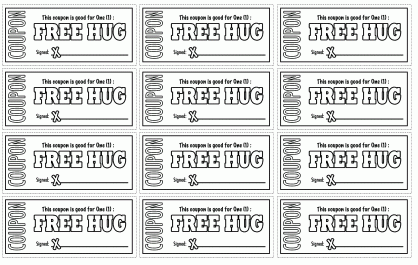
Free Hug Coupons
Everyone needs a hug now and then! With these printable Free Hug Coupons you can be sure that all of your favorite people get a sweet hug when they need it most.
National Disc Jockey Day commemorates the death of Albert James Freed, or Moondog, who was an influential disc jockey in the 1950s and is credited with popularizing the term “rock-and-roll.” The idea of using recorded music instead of live performances over the airwaves was tested in 1909, when sixteen-year-old Ray Newby, a student of Charles “Doc” Herrold at Herrold College of Engineering and Wireless in San Fernando, California, became the first to play records on the radio. The idea took off and soon radio broadcasters across the country followed suit. The term Disc Jockey was the brainstorm of radio commentator Walter Winchell in 1934. The 1970s and 1980s saw the rise of Hip-Hop DJs who began using multiple turntables and turntables as instruments to change the music.
When the Beat Was Born: DJ Kool Herc & the Creation of Hip Hop
Written by Laban Carrick Hill | Illustrated by Theodore Taylor III
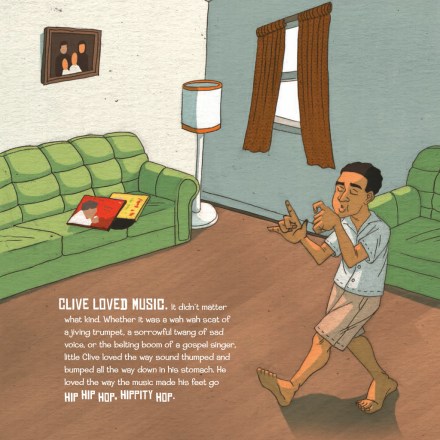
Even as a child “Clive loved music”—all kinds of music. He loved the way it made him feel inside and “the way it made his feet go hip hip hop, hippity hop.” Clive lived on Somerset Lane in Kingston, Jamaica. One of his neighbors was a DJ nicknamed “King George,” who threw the “biggest and baddest” house parties every Saturday night. Clive was too young for parties, but he liked to watch King George and his crew setting up. Clive had never seen so many records in one place.
Image copyright Theodore Tayler III, 2013, text copyright Laban Carrik Hill, 2013. Courtesy of Roaring Brook Press.
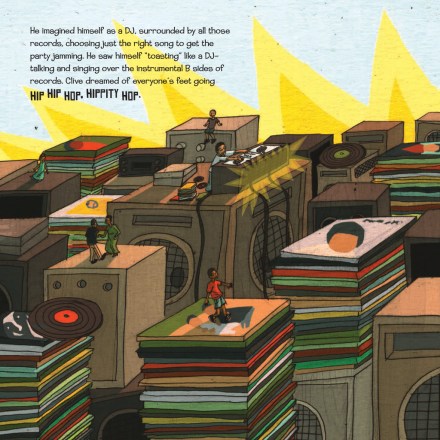
“Clive imagined himself as a DJ surrounded by all those records.” He longed to choose just the right one to get the party started. He pictured himself toasting—rapping over the instrumental B side of records and getting people’s feet going hip hip hop, hippity hop, like his did. When Clive was thirteen he moved to Brooklyn, New York with his mom. At first he wasn’t sure he liked his new neighborhood, but then he discovered sports—track, weightlifting, and especially basketball. Clive grew to be six feet, 5 inches tall.
Image copyright Theodore Tayler III, 2013, text copyright Laban Carrik Hill, 2013. Courtesy of Roaring Brook Press.
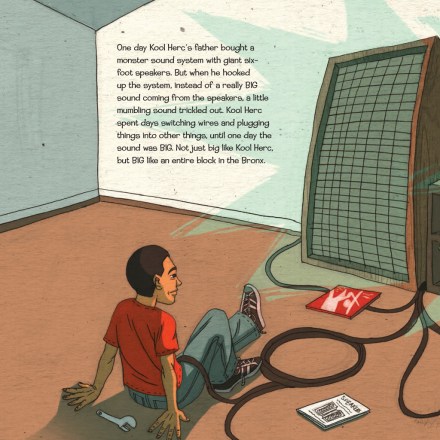
He took to calling “himself ‘cool as Clyde’ after his favorite basketball player, Walt Clyde Frazier.” But to the other kids, Clive was “Hercules.” Clive shortened it to Herc and added “‘Kool’ to make it just right. Kool Herc.” Because of his size, he was able to go to house parties with his mother and listen to the music. One day Kool Herc’s father bought a “giant sound system” with six-foot-tall speakers. But when it was turned on, the sound was puny. Kool Herc worked on it until the sound came blasting out.
Image copyright Theodore Tayler III, 2013, text copyright Laban Carrik Hill, 2013. Courtesy of Roaring Brook Press.
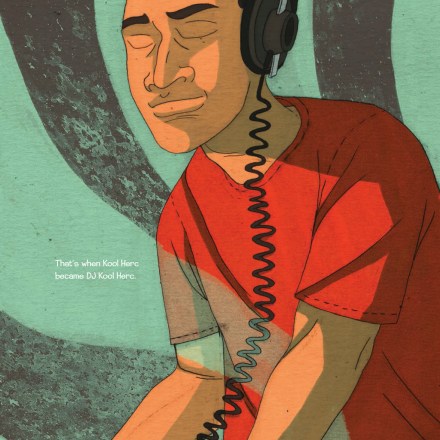
Kool Herc and his younger sister Cindy were ready to put on a party. They rented a rec room in their housing project, posted invitations, and set up the huge sound system. The night of the party, “everybody who was anybody made their way to Sedgewick Avenue for Kool Herc’s hot dance party. That’s when Kool Herc became DJ Kool Herc.”
Image copyright Theodore Tayler III, 2013, text copyright Laban Carrik Hill, 2013. Courtesy of Roaring Brook Press.
DJ Kool Herc noticed that people danced harder during the instrumental breaks. Kool Herc set up another turntable and put the same record on this turntable too. This way, when one record ended its break, he could play it again on the other. He was able to stretch a ten-second break into 20 minutes or more. Remembering how DJs toasted in Jamaica, DJ Kool Herc began shouting out the names of his friends, compliments about the dancers, and rhymes over the beat.
Image copyright Theodore Tayler III, 2013, text copyright Laban Carrik Hill, 2013. Courtesy of Roaring Brook Press.
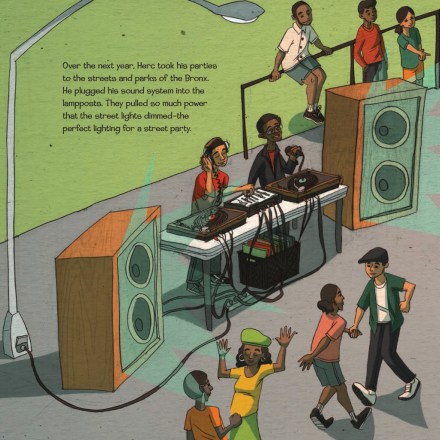
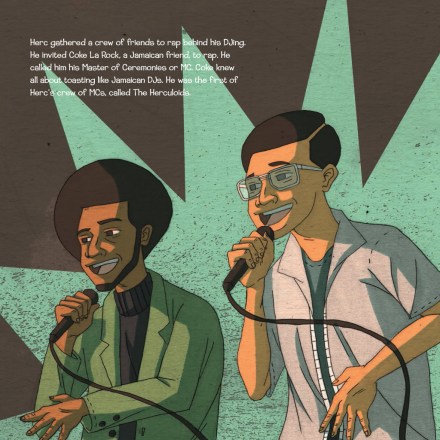
Over the next year, DJ Kool Herc moved his dance parties into the street. When he plugged the sound system into the street lamps, it pulled so much power, the lights dimmed. DJ Kool Herc’s music even turned some of the city’s gang members into the smoothest break dancers in the neighborhood. Kool Herc then invited friends to rap behind the DJ-ing. He called these friends the “Master of Ceremonies” or MCs.
Soon kids were coming from all over New York city to attend DJ Kool Herc’s “biggest, baddest dance parties.” Many “wanted to be DJs just like Kool Herc. Herc didn’t just rock the block. He put the hip hip hop, hippity hop into the world’s heartbeat.”
Image copyright Theodore Tayler III, 2013, text copyright Laban Carrik Hill, 2013. Courtesy of Roaring Brook Press.
Laben Carrick Hill’s modern biography of a Hip Hop pioneer invites young readers to discover the early years of and influences on the music they love today. Hill superbly structures his story so through the formative details of DJ Kool Herc’s life from childhood into adulthood, readers understand that they too can follow their hearts to achieve their dreams. When the Beat Was Born is inspirational in its depiction of an “ordinary kid” with ingenuity and self-confidence who changed the face of music by combining his multicultural experiences, being open to experimentation, including his friends, and sharing his vision. Straightforward storytelling is punctuated with verses of rap that make reading aloud fun and will engage listeners.
Image copyright Theodore Tayler III, 2013, text copyright Laban Carrik Hill, 2013. Courtesy of Roaring Brook Press.
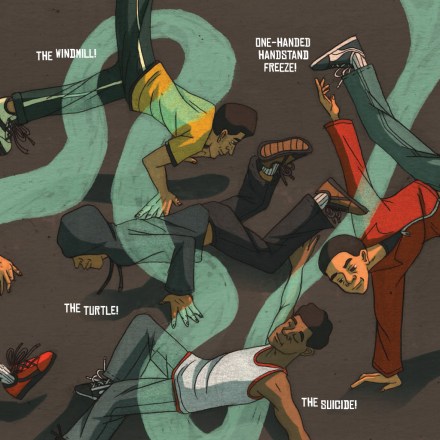
In his bold, vibrant illustrations, Theodore Tayler III lets kids in on the not-so-distant past that saw the rise of Hip Hop music, celebrity DJs, and new dance styles. Keeping the focus on DJ Kool Herc—just as Clive kept his eye on his future goals—Taylor reinforces the theme of the book. Scenes of kids lining up to attend DJ Kool Herc’s parties and dancing in the street give the book an inclusive feel. Images of skyscraper-tall stacks of records mirrors Kool Herc’s ambitions, and depictions of breakdancing moves will get kids wanting to try them for themselves.
When the Beat Was Born is a terrific biography for all children, whether they like music and dancing or quieter pursuits. In the classroom, the book would be a great addition to music, history, or biography units.
To view a portfolio of artwork, book illustration, videos and more by Theodore Taylor III, visit his website.
National Disc Jockey Day Activity
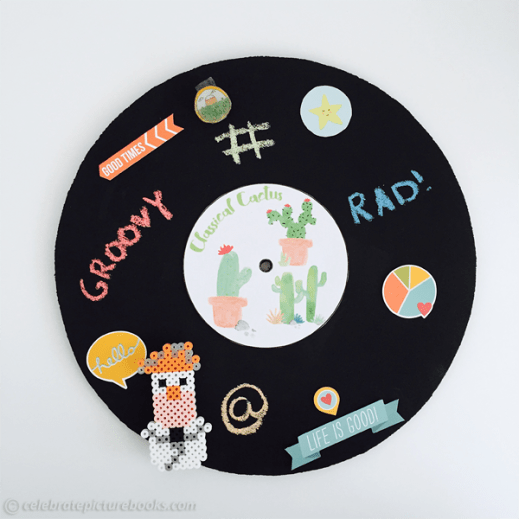
Groovy Record Chalkboard & Bulletin Board
Do you play the piano or another instrument? Would you like to make a record some day? Why wait? In this fun craft you can create your own record bulletin board—and even create your own label art! While this record may not spin on turntables around the world, it will drop in a more important place—your very own room!