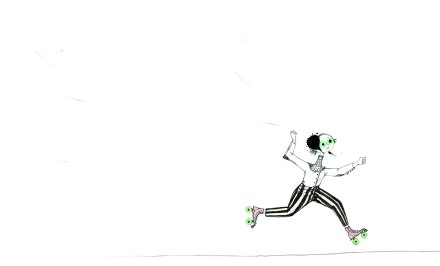
January 21 – National Hugging Day

celebrate-picture-books-picture-book-review-hug-machine-cover

About the Holiday

Today’s holiday is as simple as it sounds. Established to encourage people to show more emotion in public, National Hugging Day lets you show the people you love just how much you love them—with a nice, big hug!

Hug Machine

By Scott Campbell

A little boy comes over the hill, robot-long arms raised and hands ready to do some serious hugging. “Whoa! Here I Come! I am the Hug Machine!” he announces. He hugs his mom around the knees while she’s cooking. His dad is reading the newspaper when his knees are squeezed. And his sister keeps talking on the phone while she gets her hug from “the hug machine.”

celebrate-picture-books-picture-book-review-hug-machine-over-the-hill

Copyright Scott Campbell, 2014, courtesy of simonandschuster.com.

Then the little boy goes out into his neighborhood where he hugs a policeman, a woman watering her plants, a businessman waiting for the bus, two unsuspecting women, and a little girl. He even hugs (very gently) the girl’s helium balloon. In fact, the boy hugs everything in his path—trees, fire hydrants, park benches, and mailboxes. “No one escapes the Hug Machine.”

celebrate-picture-books-picture-book-review-hug-machine-path

Copyright Scott Campbell, 2014, courtesy of simonandschuster.com.

The boy’s hugs make everyone feel just right. It doesn’t matter if the things are big or small, soft or hard, square or long, the Hug Machine embraces them all. When he spies a crying baby, the Hug Machine goes to work. In a moment the “hug’s accomplished,” and the baby is smiling. But “what about me?” the porcupine asks. “No one ever hugs me.” Outfitted in a baseball catcher’s mask, with a pillow tied around his middle, and sporting oven mitts, the boy gives the porcupine a great big cuddle. “They are missing out!” the boy exclaims.

celebrate-picture-books-picture-book-review-hug-machine-porcupine

Copyright Scott Campbell, 2014, courtesy of simonandschuster.com.

A whale thinks it is too big to be hugged, but the boy finds a ladder, climbs to the top and gives a sliding hug all the way to the whale’s tail. How does the Hug Machine stay in prime hugging shape with lots of energy? Pizza, of course! And after a couple of slices, the Hug Machine is ready to get back out there! He runs through his neighborhood hugging everyone and everything in sight. There’s even a huge hug for you!

celebrate-picture-books-picture-book-review-hug-machine-baby

Copyright Scott Campbell, 2014, courtesy of simonandschuster.com.

After that spurt of hugging, the Hug Machine is tuckered out. “Hug Machine can hug no more,” the boy says as he lies on the floor. But a pair of hands reaches out. “Why, yes,” the boy says, as his mom scoops him up into a hug of his own. “The Hug Machine is always open for business.”
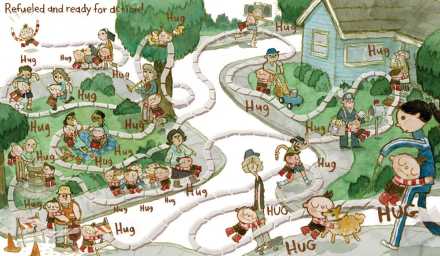
celebrate-picture-books-picture-book-review-hug-machine-neighborhood

Copyright Scott Campbell, 2014, courtesy of simonandschuster.com.

Scott Campbell’s Hug Machine is as adorably irresistible as little ones’ enthusiastic and spontaneous demonstrations of love. Readers will giggle when they see all the people and things this Hug Machine embraces without question and sometimes with creativity. Kids will also love the double spread, wide-armed hug just for them. The repeated phrases make this a perfect read aloud and read along for even the youngest readers.

celebrate-picture-books-picture-book-review-hug-machine-fire-hydrants

Copyright Scott Campbell, 2014, courtesy of simonandschuster.com.

Campbell’s illustrations are always endearing. The surprised recipients of the little boy’s hugs are left with a smile on their face, and even the inanimate objects seem to gain a stronger sense of purpose after being hugged. The little boy’s wide eyes and always-ready arms and hands mirror the eagerness of children to find and react to any recognized needs. And pizza, of course, is the perfect kid fuel.

With plenty of opportunities for laughs and lots of hugs, as well as offering a fantastic way to talk about emotions, empathy, and kindness, Hug Machine is a terrific book to add to home and classroom bookshelves.

Ages 4 – 8

Atheneum Books for Young Readers, 2014 | Hardcover ISBN: 978-1442459359 | Paperback, 2017 ISBN: 978-1338255423 | Board book, 2017 ISBN: 978-1338255423

Discover more about Scott Campbell and a portfolio  of his work on his website.

National Hugging Day Activity
celebrate-picture-books-picture-book-review-hug-coupons

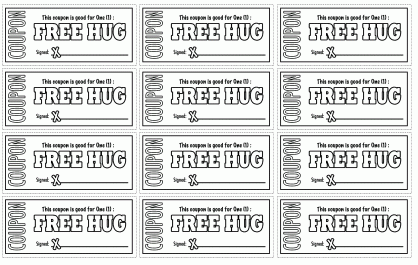
Free Hug Coupons

Everyone needs a hug now and then! With these printable Free Hug Coupons you can be sure that all of your favorite people get a sweet hug when they need it most.

Supplies

Directions

  1. Print the Free Hug Coupons
  2. Color the coupons (optional)
  3. Hand out the coupons to your friends and family members and tell them that each coupon is good for one free hug from you.
  4. When someone hands in a ticket to you, give them your best biggest hug!

Picture Book Review

January 20 – National Disc Jockey Day

celebrate-picture-books-picture-book-review-when-the-beat-was-born-cover

About the Holiday

National Disc Jockey Day commemorates the death of Albert James Freed, or Moondog, who was an influential disc jockey in the 1950s and is credited with popularizing the term “rock-and-roll.” The idea of using recorded music instead of live performances over the airwaves was tested in 1909, when sixteen-year-old Ray Newby, a student of Charles “Doc” Herrold at Herrold College of Engineering and Wireless in San Fernando, California, became the first to play records on the radio. The idea took off and soon radio broadcasters across the country followed suit. The term Disc Jockey was the brainstorm of radio commentator Walter Winchell in 1934. The 1970s and 1980s saw the rise of Hip-Hop DJs who began using multiple turntables and turntables as instruments to change the music.

When the Beat Was Born: DJ Kool Herc & the Creation of Hip Hop

Written by Laban Carrick Hill | Illustrated by Theodore Taylor III


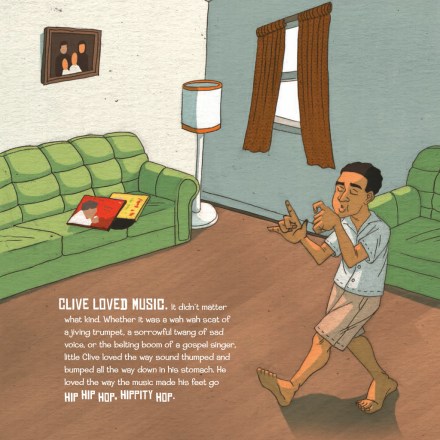
Even as a child “Clive loved music”—all kinds of music. He loved the way it made him feel inside and “the way it made his feet go hip hip hop, hippity hop.” Clive lived on Somerset Lane in Kingston, Jamaica. One of his neighbors was a DJ nicknamed “King George,” who threw the “biggest and baddest” house parties every Saturday night. Clive was too young for parties, but he liked to watch King George and his crew setting up. Clive had never seen so many records in one place.

celebrate-picture-books-picture-book-review-when-the-beat-was-born-clive-loved-music

Image copyright Theodore Tayler III, 2013, text copyright Laban Carrik Hill, 2013. Courtesy of Roaring Brook Press.

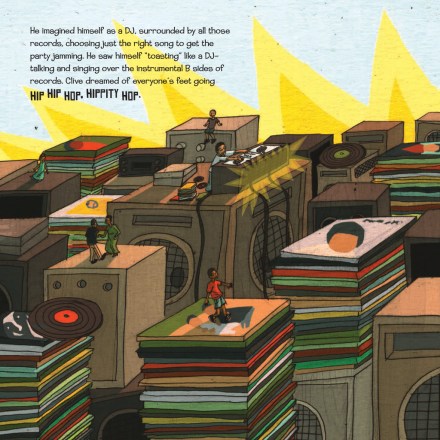
“Clive imagined himself as a DJ surrounded by all those records.” He longed to choose just the right one to get the party started. He pictured himself toasting—rapping over the instrumental B side of records and getting people’s feet going hip hip hop, hippity hop, like his did. When Clive was thirteen he moved to Brooklyn, New York with his mom. At first he wasn’t sure he liked his new neighborhood, but then he discovered sports—track, weightlifting, and especially basketball. Clive grew to be six feet, 5 inches tall.

celebrate-picture-books-picture-book-review-when-the-beat-was-born-stacks-of-records

Image copyright Theodore Tayler III, 2013, text copyright Laban Carrik Hill, 2013. Courtesy of Roaring Brook Press.

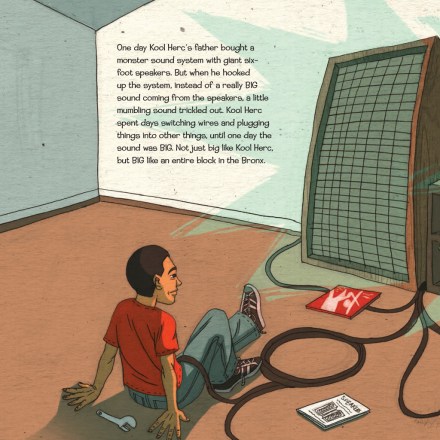
He took to calling “himself ‘cool as Clyde’ after his favorite basketball player, Walt Clyde Frazier.” But to the other kids, Clive was “Hercules.” Clive shortened it to Herc and added “‘Kool’ to make it just right. Kool Herc.” Because of his size, he was able to go to house parties with his mother and listen to the music. One day Kool Herc’s father bought a “giant sound system” with six-foot-tall speakers. But when it was turned on, the sound was puny. Kool Herc worked on it until the sound came blasting out.

celebrate-picture-books-picture-book-review-when-the-beat-was-born-sound-system

Image copyright Theodore Tayler III, 2013, text copyright Laban Carrik Hill, 2013. Courtesy of Roaring Brook Press.

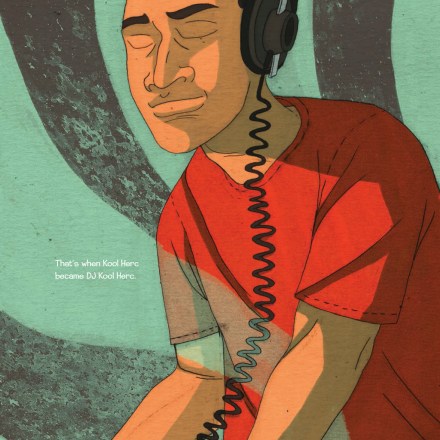
Kool Herc and his younger sister Cindy were ready to put on a party. They rented a rec room in their housing project, posted invitations, and set up the huge sound system. The night of the party, “everybody who was anybody made their way to Sedgewick Avenue for Kool Herc’s hot dance party. That’s when Kool Herc became DJ Kool Herc.”

celebrate-picture-books-picture-book-review-when-the-beat-was-born-DJ-Kool-Herc

Image copyright Theodore Tayler III, 2013, text copyright Laban Carrik Hill, 2013. Courtesy of Roaring Brook Press.

DJ Kool Herc noticed that people danced harder during the instrumental breaks. Kool Herc set up another turntable and put the same record on this turntable too. This way, when one record ended its break, he could play it again on the other. He was able to stretch a ten-second break into 20 minutes or more. Remembering how DJs toasted in Jamaica, DJ Kool Herc began shouting out the names of his friends, compliments about the dancers, and rhymes over the beat.

celebrate-picture-books-picture-book-review-when-the-beat-was-born-dance-party

Image copyright Theodore Tayler III, 2013, text copyright Laban Carrik Hill, 2013. Courtesy of Roaring Brook Press.

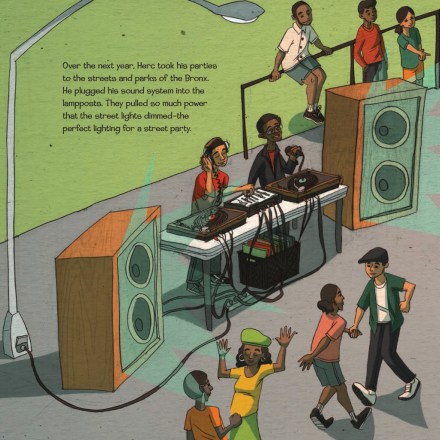
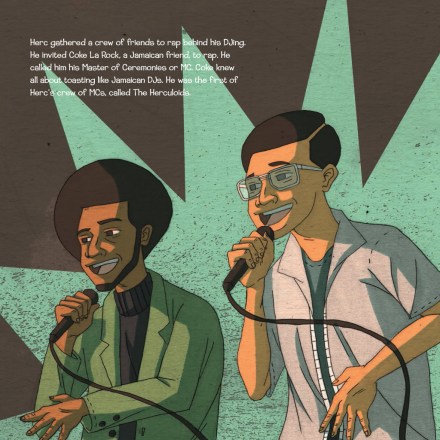
Over the next year, DJ Kool Herc moved his dance parties into the street. When he plugged the sound system into the street lamps, it pulled so much power, the lights dimmed. DJ Kool Herc’s music even turned some of the city’s gang members into the smoothest break dancers in the neighborhood. Kool Herc then invited friends to rap behind the DJ-ing. He called these friends the “Master of Ceremonies” or MCs.

Soon kids were coming from all over New York city to attend DJ Kool Herc’s “biggest, baddest dance parties.” Many “wanted to be DJs just like Kool Herc. Herc didn’t just rock the block. He put the hip hip hop, hippity hop into the world’s heartbeat.”

celebrate-picture-books-picture-book-review-when-the-beat-was-born-the-turtle

Image copyright Theodore Tayler III, 2013, text copyright Laban Carrik Hill, 2013. Courtesy of Roaring Brook Press.

Laben Carrick Hill’s modern biography of a Hip Hop pioneer invites young readers to discover the early years of and influences on the music they love today. Hill superbly structures his story so through the formative details of DJ Kool Herc’s life from childhood into adulthood, readers understand that they too can follow their hearts to achieve their dreams. When the Beat Was Born is inspirational in its depiction of an “ordinary kid” with ingenuity and self-confidence who changed the face of music by combining his multicultural experiences, being open to experimentation, including his friends, and sharing his vision. Straightforward storytelling is punctuated with verses of rap that make reading aloud fun and will engage listeners.

celebrate-picture-books-picture-book-review-when-the-beat-was-born-friends

Image copyright Theodore Tayler III, 2013, text copyright Laban Carrik Hill, 2013. Courtesy of Roaring Brook Press.

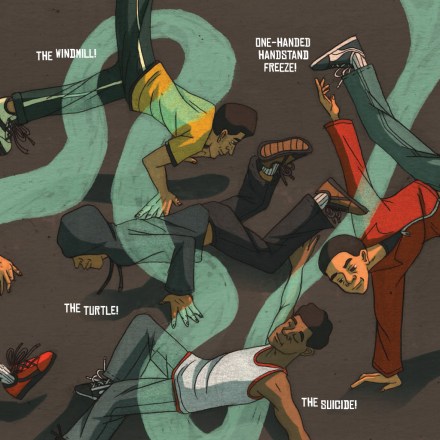
In his bold, vibrant illustrations, Theodore Tayler III lets kids in on the not-so-distant past that saw the rise of Hip Hop music, celebrity DJs, and new dance styles. Keeping the focus on DJ Kool Herc—just as Clive kept his eye on his future goals—Taylor reinforces the theme of the book. Scenes of kids lining up to attend DJ Kool Herc’s parties and dancing in the street give the book an inclusive feel. Images of skyscraper-tall stacks of records mirrors Kool Herc’s ambitions, and depictions of breakdancing moves will get kids wanting to try them for themselves.

When the Beat Was Born is a terrific biography for all children, whether they like music and dancing or quieter pursuits. In the classroom, the book would be a great addition to music, history, or biography units.

Ages 6 – 10

Roaring Brook Press, 2013 | ISBN 978-1596435407

Discover more about Laben Carrick Hill and his books on his website

To view a portfolio of artwork, book illustration, videos and more by Theodore Taylor III, visit his website.

National Disc Jockey Day Activity

celebrate-picture-books-picture-book-review-groovy-record-chalkboard-blackboard-craft

Groovy Record Chalkboard & Bulletin Board 


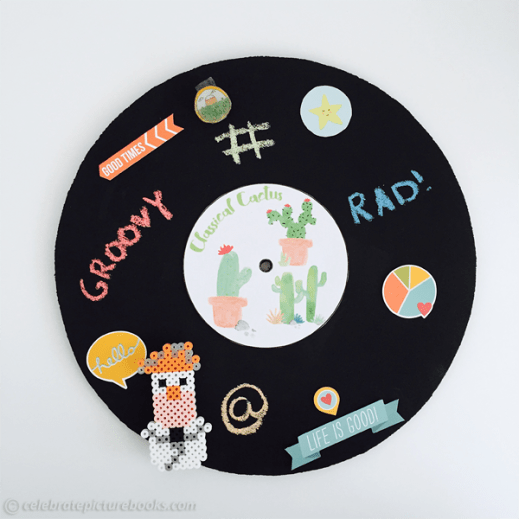
Do you play the piano or another instrument? Would you like to make a record some day? Why wait? In this fun craft you can create your own record bulletin board—and even create your own label art! While this record may not spin on turntables around the world, it will drop in a more important place—your very own room!

Supplies

  • Printable Record Label for you to design
  • Foam board, or a corkboard at least 12-inches x 12-inches square
  • Adhesive cork
  • A 12-inch round plate, record, or other round object to trace OR a compass
  • Chalkboard paint, black
  • X-acto knife
  • Paint brush or foam paint brush
  • Mounting squares

Directions

  1. Cut a section from the adhesive cork a little larger than 12 inches by 12 inches
  2. Affix the cork to the foam board
  3. Trace the 12-inch round object onto the cork/foam board OR use the compass to make a 12-inch circle
  4. With the x-acto knife, carefully cut out the circle (adult help needed for children)
  5. Cut out a ¼ -inch circle in the center of the record bulletin board
  6. Paint the cork, sides and inside the spindle hole with the black chalkboard paint. Let dry
  7. Print the label template and design your own record label
  8. When the paint is dry, glue your label to the center of the bulletin board
  9. Hang your bulletin board with the mounting squares
  10. Decorate!

Picture Book Review


January 19 – National Popcorn Day

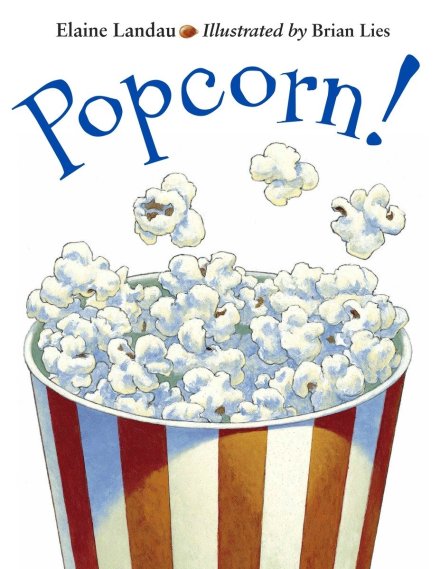
celebrate-picture-books-picture-book-review-popcorn!-elaine-landou-and-brian-lies-cover

About the Holiday

National Popcorn Day commemorates a snack that is enjoyed around the world—and why not?! It’s tasty, the perfect finger food, and fun to make! The history of popcorn may surprise you. Records of this favorite treat go back to the Aztecs and beyond. Early explorers of the 1500s wrote about native peoples+ roasting corn until it popped and described it as looking like a “white flower.” Indigenous peoples ate popcorn and strung it to use for decoration.

Most people now eat popcorn with salt and butter or a variety of flavorings, but can you imagine having it with milk? Way before Corn Flakes and Cheerios came on the scene, people ate it as cereal! And popcorn really became popular during the Great Depression, when it was one of the only inexpensive treats people could afford. Why not pop up a batch and snuggle in to learn more about popcorn with today’s book.

Popcorn!

Written by Elaine Landau | Illustrated by Brian Lies

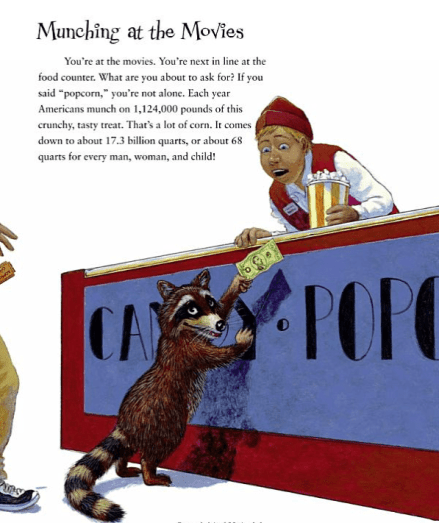
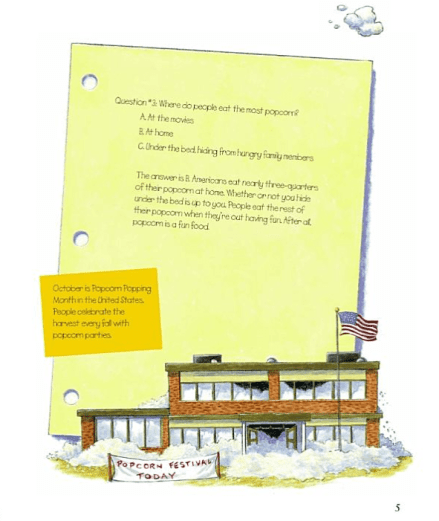
Popcorn catches our fancy whether we’re at home, at the movies, at a carnival or at an amusement park. How much do we like it? Well, “each year Americans munch on 1,124,000 pounds” of the crunchy stuff! That’s about “68 quarts for every man, woman, and child!” Wondering if that corn on the cob you enjoy all summer could make popcorn if you cooked it just right? The answer to that is: nope! “Farmers grow all kinds of corn. But popcorn is the only corn that pops. It’s got to do with just the right combination of water, starch, and a hard, airtight shell, called a hull.” You can learn a few more interesting facts like this one when you take the short quiz!

celebrate-picture-books-picture-book-review-popcorn!-elaine-landou-and-brian-lies-movies

Image copyright Brian Lies, 2003, text copyright Elaine Landau, 2003. Courtesy of Charlesbridge.

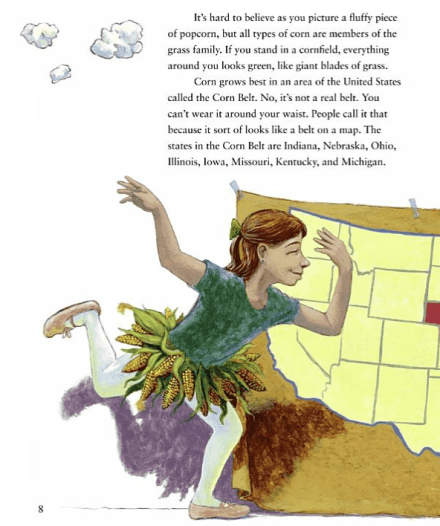
Where does popcorn grow? In the Corn Belt, of course! That’s not something you wear, but an area of Midwest America that had just the right soil and weather conditions to raise the different kinds of corn you love to eat. How long has popcorn been around? Would you believe that “researchers have found 1,000-year-old grains of popcorn?” Or that “the kernels still popped?” They did! But popcorn has an even longer history than that. The oldest ears of popcorn discovered were 5,600 years old and were found “in a cave in New Mexico.” These ears were tiny, though—only “about the size of your pinky finger.”

celebrate-picture-books-picture-book-review-popcorn!-elaine-landou-and-brian-lies-corn-skirt

Image copyright Brian Lies, 2003, text copyright Elaine Landau, 2003. Courtesy of Charlesbridge.

These days, we just pop a bag of kernels in the microwave and in a few minutes it’s ready, but early popcorn eaters had some ingenious ways of cooking their treat. “The Iroquois of the Great Lakes region popped popcorn in special jugs that they placed in heated sand.” The jugs worked like a convection oven and kept the popcorn in one place. How did the Iroquois enjoy their popcorn? They made soup with it! Some Native Americans cooked their popcorn on the cob in the husks, while others put the ear on a stick and held it over a fire to roast.

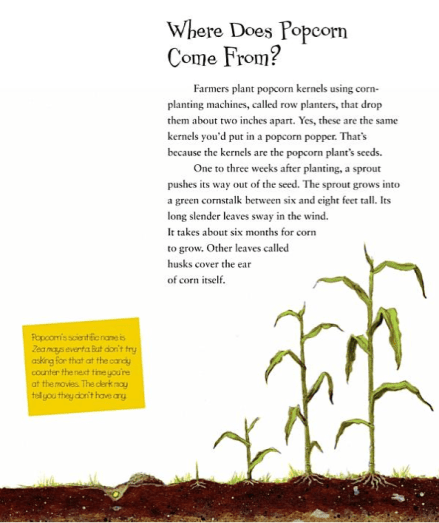
celebrate-picture-books-picture-book-review-popcorn!-elaine-landou-and-brian-lies-corn-stalks

Image copyright Brian Lies, 2003, text copyright Elaine Landau, 2003. Courtesy of Charlesbridge.

Some Native Americans also had stories to tell about popcorn. One such tale relates that “spirits lived inside each popcorn kernel.” The spirits were quiet and happy as long as they weren’t disturbed. But if the house grew hot, the spirits became angry. If the house became too hot, the spirits would get so angry that “they would burst out of their houses and fly off into the air as annoyed puffs of steam.” The Aztecs used popcorn in ceremonies, and, because of its resemblance to hailstones, it was used as tribute to the water god Tlaloc to ask for protection for fishermen during storms.

So how did popcorn become so popular? A little creative advertising helped that along. In 1885 the first popcorn machines were developed. These little carts with the enticing glass windows that allowed people to watch the popping process were great hits. “Men were hired to pop popcorn in front of stores to draw in customers.” Can you imagine what these men were called? Right! Poppers!

celebrate-picture-books-picture-book-review-popcorn!-elaine-landou-brian-lies-raccoon-in-field

Image copyright Brian Lies, 2003, text copyright Elaine Landau, 2003. Courtesy of Charlesbridge.

Two world events also helped popcorn sales. During the Great Depression, popcorn was an inexpensive treat, and during World War II, delicious popcorn took the place of candy, which could not be produced since all the sugar was used to supply soldiers overseas. When a television set became common in most homes and people stopped going to the movies as much, popcorn sales plummeted. But creative companies came up with ways to make popping popcorn at home easy and fun. Popcorn and TV became a favorite pastime.

Popcorn is a healthy snack, too! As a good source of protein, iron, carbohydrates, and fiber while being low-calorie, popcorn is a treat parents can’t say “no” to! To learn more fascinating facts about popcorn—including the answer to that big question: What makes popcorn pop?—you’ll want to pop over to your favorite bookseller or library and pick up this book!

celebrate-picture-books-picture-book-review-popcorn!-elaine-landou-and-brian-lies-corn-school

Image copyright Brian Lies, 2003, text copyright Elaine Landau, 2003. Courtesy of Charlesbridge.

With wit and an easy conversational style, Elaine Landau cooks up an engaging look at popcorn. Short sections answer the questions kids have about popcorn while offering new and intriguing tidbits that will make kids feel pretty smart about one of our favorite snack foods.

Brian Lies lends his distinctive art style to illustrations that echo Landou’s humor while also enhancing the text with visual guides for deeper understanding. Along the way, young readers can follow a rascally, popcorn-loving raccoon as he enjoys popcorn on the cob in the field, moves a jar of popcorn from the fridge to the cabinet with—almost—no mishaps, roasts popcorn over a fire pit, and runs off with a full bowl of popcorn.

For kids (or adults) who love popcorn, food history, or cooking and to inspire fun classroom science and history lessons, Popcorn! can’t be beat!

Ages 6 – 9

Charlesbridge, 2003 | ISBN  978-1570914430

Discover more about Brian Lies and check out all of his great books and art on his website.

National Popcorn Day Activity

celebrate-picture-books-picture-book-review-popcorn-toss-up-puzzle

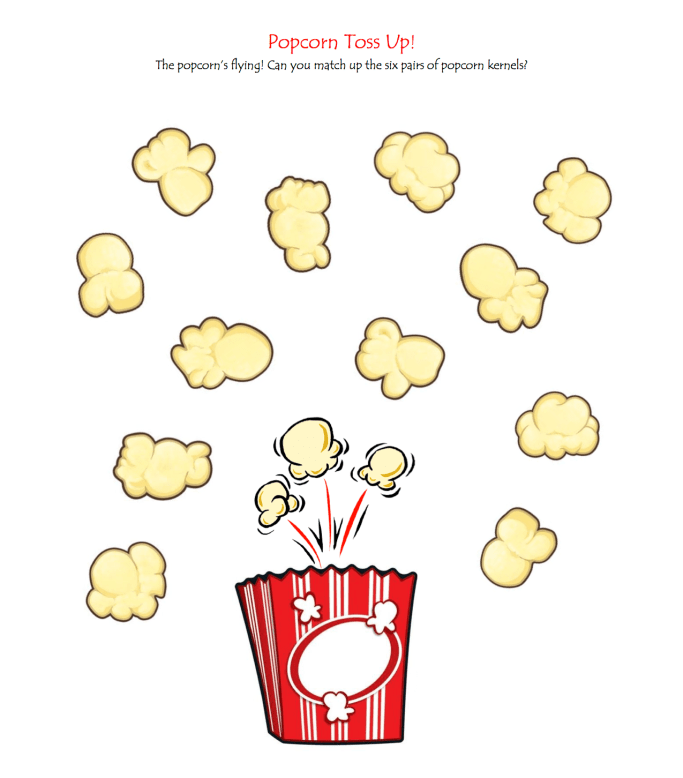
Popcorn Toss Up! Matching Puzzle

The popcorn’s flying! Can you match the six pairs of kernels so you can enjoy a tasty snack in this printable Popcorn Toss Up! Matching Puzzle?

You can find Popcorn!

Picture Book Review

January 18 – It’s International Quality of Life Month

celebrate-picture-books-picture-book-review-car-cowboy-hay-bales

About the Holiday

Enjoying a good quality of life means being happy where you live and in your relationships, your job, and your situation in general. Finding the right balance can be hard, but with perseverance and support from friends and family, you can discover and attain the best lifestyle for you.

Cowboy Car

Written by Jeanie Franz Ransom | Illustrated by Ovi Nedelcu


“Ever since he was knee-high to his daddy’s hubcaps, Little Car wanted to be a cowboy.” He watched cowboy movies on the TV in his city garage and loved everything about cowboy life. Little Car lived in the city, squeezed in between lanes and lanes of cars and unable to see the sky for the soaring skyscrapers. He dreamed of sleeping under the stars and roaming the wide open plains. But everyone told Little Car, “‘Cars Can’t Be Cowboys.’”

Little Car’s dad wanted him to be a city taxi, like him; his mom hoped he’d be “a family car and settle down in a garage close to home.” Neither of those futures, however, offered the excitement of “herding cattle by day” and the camaraderie of “circling up around the campfire at night,” so when Little Car grew up he headed out West. First, he needed to look the part, but where would he find a hat big enough? He pulled up at a cowboy supply depot, and there on the roof sat the perfect 50-gallon hat!

celebrate-picture-books-picture-book-review-car-cowboy-hay-bales

Image copyright Ovi Nedelcu, text copyright Jeanie Franz Ransom. Courtesy of Two Lions.

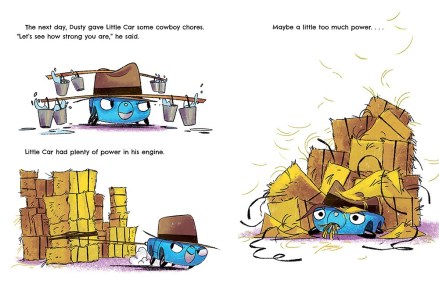
With the hat settled firmly on his roof, Little Car drove on to the Circle R. Ranch. There he met Dusty, who listened to Little Car’s dream of being a cowboy and gave him a bit of bad news: “‘Cars can’t be cowboys. They can’t ride horses!’” Little Car was disappointed, and so was Dusty—the ranch really needed extra help. Little Car wanted to prove his mettle, so Dusty agreed to let him try a few cowboy tests. The next morning, Little Car “zoomed around the barrels in no time. He was used to making quick turns around tight corners in the city.” He was also strong enough to carry heavy loads and move bales of hay. He could even round up li’l doggies in the dark in the beam of his headlights.

The next day Dusty promised to take Little Car to the rodeo. When they got there, though, Little Car was told he couldn’t participate because he didn’t ride a horse. Still, he was excited to watch Dusty ride Double Trouble, the biggest, meanest bull on the circuit. With Dusty hanging on tight, Double Trouble bucked and snorted and leaped. In a minute Dusty was thrown to the ground, and Double Trouble was headed straight toward him.

“With tires squealing, horn honking, and the radio blasting, Little Car got everyone’s attention—including the bulls.” He zipped right and left, “swerved, stopped, backed up, and drove around and around until the bull’s snorts turned into snores.” Afterward, a news reporter wanted to know if he was a cowboy at the Circle R. Ranch. “‘He sure is,’ Dusty said. ‘In fact, he’s my pardner!’”

Watching the report on the garage TV, Little Car’s mom and dad proudly exclaimed, “‘That’s our cowboy!’” And “Little Car drove off into the sunset, home on the range at last.”

celebrate-picture-books-picture-book-review-car-cowboy-hay-bales

Image copyright Ovi Nedelcu, text copyright Jeanie Franz Ransom. Courtesy of Two Lions.

Li’l pardners enamored of the cowboy life will be charmed by Little Car and his dreams to leave the big city for the freedom of cowboy life. With clever turns of phrase and a sprinkling of puns, Jeanie Franz Ransom takes readers on an endearing ride through the ups and downs, disappointments and successes of navigating life on one’s own. When Little Car uses his city experience, smarts, and courage to save Dusty and earn a spot at the ranch, despite not being able to ride a horse, kids will see that they too can overcome obstacles and accomplish their goals.

Children will love adorable Little Car as he snuggles next to his mom and taxicab dad in the garage. With wide headlight eyes and a grill with an ever-present grin, Little Car makes his way out West, where kids will giggle at the 50-gallon hat atop an old general store, whoop as Little Car completes his cowboy tests, and cheer when he outwits Double Trouble to save the day. As Little Car drives off into the sunset, readers will know that he—and they—have a bright future ahead.

Car and cowboy or cowgirl enthusiasts, as well as kids new to school and other activities will find a friend in Little Car and ask to hear his story again and again. Cowboy Car would make a sweet addition to story time and bedtime reading.

Ages 3 – 7

Two Lions, 2017 | ISBN 978-1503950979

Discover more about Jeanie Franz Ransom and her books on her website!

You’ll find a portfolio of books and illustration work by Ovi Nedelcu on his website!

International Quality of Life Month Activity

celebrate-picture-books-picture-book-review-follow-the-open-road-mazeFollow the Open Road Maze


These four kids are ready to head out and enjoy the day! Match each child to the right car in this printable Follow the Open Road Maze to get them on their way!

Picture Book Review
January 17 – It’s Hobby Month

celebrate-picture-books-pciture-book-review-prudence-the-part-time-cow-cover

About the Holiday

Hobbies are great! They give us the chance to explore our creative side, form friendships, travel, and get away from the stresses of daily life. Sometimes hobbies can even lead to better and more satisfying careers. This month celebrate your hobby! Throw a party for others who share your passion, consider signing up with an online site to sell your wares, or join a group of like-minded people. It’s also a wonderful time to share your talents with others—like the protagonist of today’s story! 

Prudence the Part-Time Cow

Written by Jody Jensen Shaffer | Illustrated by Stephanie Laberis


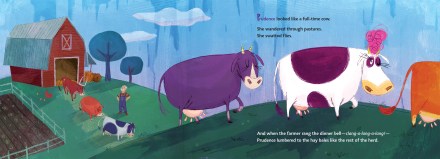
Out in the pasture swatting flies with her tail and lumbering along with the rest of the herd, “Prudence looked like a full-time cow.” But when she had a little time off from her bovine duties, Prudence “was a part-time cow.” While being milked she was a scientist, reading a book on the milking process that she found “udderly amazing.” The salt licks were perfect blocks for architect Prudence’s wondrous structures. And engineer Prudence experimented with automatic lighting, even if the results in the water trough were a bit electrifying.

celebrate-picture-books-pciture-book-review-prudence-the-part-time-cow-farm

Image copyright Stephanie Laberis, 2017, text copyright Jody Jensen Shaffer, 2017. Courtesy of Henry Holt & Co,

The other cows didn’t like it. They wanted Prudence to be more like them. She would never fit into the herd, they whispered to each other. Prudence fretted. She wanted to have friends and fit in, so “she decided to try to be like the others.” Dutifully, she went down to the pond with the rest of the herd for a little refreshment and was doing fine until… “she calculated the water temperature and wind speed. ‘Sixty-eight degrees and four miles per hour.’”

celebrate-picture-books-pciture-book-review-prudence-the-part-time-cow-tree-huddling

Image copyright Stephanie Laberis, 2017, text copyright Jody Jensen Shaffer, 2017. Courtesy of Henry Holt & Co,

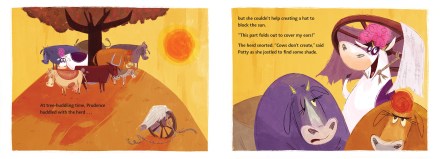
The other cows were miffed, especially Bessie, who said “‘Cows don’t calculate,’” while carefully counting her calves as she called them from the pond. Another day as the herd lazed under a tree, Prudence joined them, leaving only once to create a hat from an old wagon wheel, scrap of cloth, and piece of rope she found nearby. The other cows snorted. “‘Cows don’t create,’ said Patty as she jostled to find some shade.”

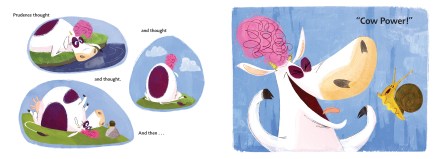
Even sleeping the same way as the others was difficult for Prudence. When she had a brainstorm in the middle of the night she just had to explore it—no matter how noise she made. The herd had given up. Alone and sad, Prudence thought and thought of ways to make the others like her. Then it hit her! “‘Cow Power!’” That night the barn rang with the sounds of her idea. But it wasn’t only one idea! When the herd woke and saw yet another contraption, they rolled their eyes and said “‘Not again, Prudence! What is this mess?’” Until…

celebrate-picture-books-pciture-book-review-prudence-the-part-time-cow-cow-power

Image copyright Stephanie Laberis, 2017, text copyright Jody Jensen Shaffer, 2017. Courtesy of Henry Holt & Co,

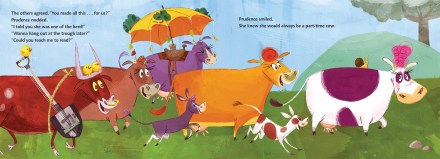
Bessie saw the “cow-culator” Prudence had made to help her keep track of her calves. Patty was thrilled with the “portable shade tree” made from an umbrella, a saddle, and some dangly adornments. And Spotz thought his new guitar made from a shovel and fishing line was “gnarly.” Prudence was suddenly pretty popular! Even though “she knew she would always be a part-time cow,” she was happy to feel like a “full-time member of the herd.”

celebrate-picture-books-pciture-book-review-prudence-the-part-time-cow-happy-animals

Image copyright Stephanie Laberis, 2017, text copyright Jody Jensen Shaffer, 2017. Courtesy of Henry Holt & Co,

Jody Jensen Shaffer’s moooving and funny story of a cow with a scientific bent will delight kids. Little ones who think differently will empathize with Prudence’s wish to be herself while also fitting in with the herd. As the cows stand around in a pond and huddle under a tree, Shaffer offers a wink to the crowd mentality and peer pressure that can foster inaction and clone-like behavior. Prudence makes a gentle, but determined role model as a thinker who won’t be cowed by others’ opinions.

Stephanie Laberis’s cartoon-inspired illustrations of a herd of very distinct cows are a perfect accompaniment to this humorous story with a meaningful message. Prudence, with her fluff of pink hair, is happiest when fulfilling her creative visions. As the other cows disparage her efforts and isolate her from the herd, Prudence’s sad eyes and droopy tail and ears make the effect of their words obvious. Each page offers an opportunity for readers to discuss diversity, individuality, and what it means to be a friend.

Prudence the Part-Time Cow would be a wonderful addition to school and classroom libraries as well as to home bookshelves.

Ages 4 – 8

Henry Holt and Co, 2017 | ISBN 978-1627796156

Find out all about Jody Jensen Shaffer and her books and magazine writing for children on her website!

Discover a gallery of illustration and craft work by Stephanie Laberis on her website!

Hobby Month Activity

celebrate-picture-books-picture-book-review-cow-mug-craftMooo Mug


Milk—regular or chocolate!—will taste so much better in a Mooo Mug  you make yourself! 

Supplies

  • White ceramic mug, available at craft stores
  • Black permanent marker or paint for ceramics
  • Pink permanent marker or paint for ceramics
  • Brown permanent marker or paint for ceramics

celebrate-picture-books-picture-book-review-cow-mug-craft-back

Directions

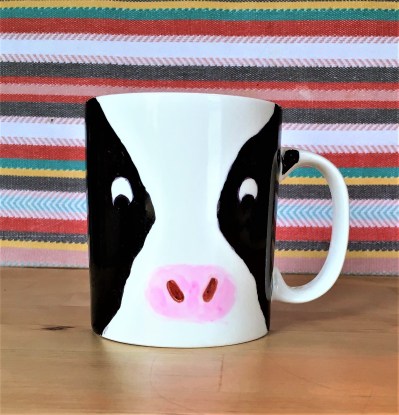
  1. With the pink marker or paint, draw an oval shape for the nose near the bottom of the mug. Let dry.
  2. With the brown marker or paint, draw two angled nostrils inside the pink oval and color them in. Let dry.
  3. Color in the nose with the pink marker or paint.
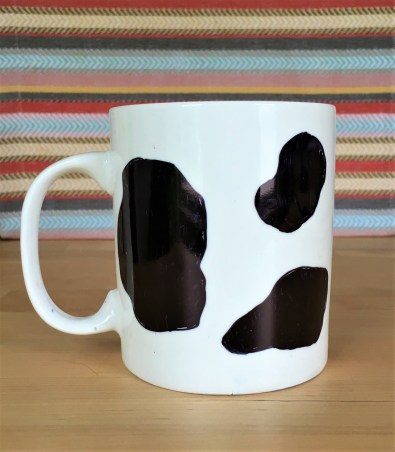
  4. With the black marker, color the top tip of the handle where it meets the mug to make the tail.
  5. With the black marker or paint, draw two wavy lines on either side of the face starting at the top, angling toward the middle and returning to the bottom of the mug. Leave white space between the lines.
  6. Draw circles for eyes within the black lines. Add black pupils at the bottom of the eyes.
  7. Color inside the black lines and around the eyes to make the face markings.
  8. With the black marker or paint, make two or three splotches on the back of the mug.
  9. Let the mug dry and follow the directions for the markers or paint to set the color.
  10. Pour yourself a mooo mug of milk and enjoy!

Picture Book Review

January 16 – Nothing Day

celebrate-picture-books-picture-book-review-on-a-magical-do-nothing-day-cover

About the Holiday

Newspaper columnist Harold Coffin established Nothing Day in 1973 to satirize the proliferation of daily holidays. His purpose was to give people a day to do absolutely nothing. Sounds good to me! Still, does celebrating this holiday constitute doing something? This may be the most baffling holiday on the calendar! Why not find something—or nothing—to do with today’s book?

On a Magical Do-Nothing Day

By Beatrice Alemagna


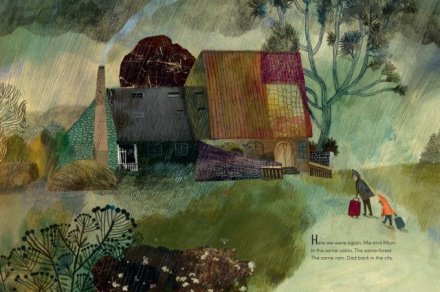
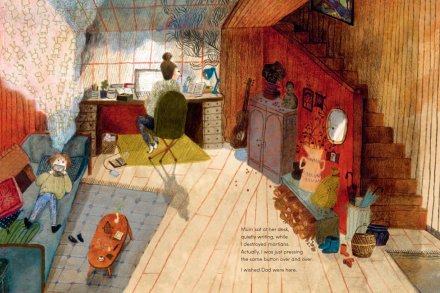
A little girl and her mom are “back again” at the cottage—even trudging up the walk in “the same rain”—while Dad is working back at home in the city. While Mom works at her computer, the girl destroys Martians, but she says, “Actually, I was just pressing the same button over and over.” She wishes that her dad were there.

celebrate-picture-books-picture-book-review-on-a-magical-do-nothing-day-cabin

Copyright Beatrice Alemanga, 2017, courtesy of HarperCollins.

Mom turns away from her writing and watches her daughter playing her video game. “Is this going to be another day of doing nothing?” she growls. Mom takes the device and hides it—“as usual”—and the little girl finds it—“as usual.” But this time she takes it outside. As the rain pelts down from gloomy skies it looked as if everything in the “garden was hiding from the sun.”

celebrate-picture-books-picture-book-review-on-a-magical-do-nothing-day-playing-video-games

Copyright Beatrice Alemanga, 2017, courtesy of HarperCollins.

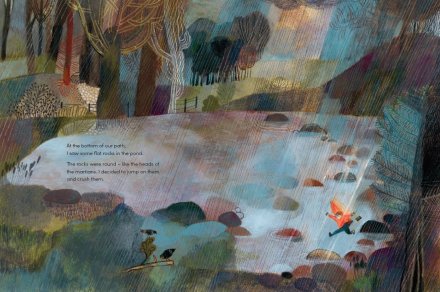
In the pond at the bottom of the hill she finds a line of flat stones. She hops from one to another, crushing them like the Martians in her game. While jumping, though, her game falls out of her pocket and into the pond. The water is so icy cold that she can’t grab it before it sinks out of sight. Oh no! she thinks, “Without my game, I have nothing to do.” The rain strikes her “like rocks,” and she feels “like a small tree trapped outside in a hurricane.”

celebrate-picture-books-picture-book-review-on-a-magical-do-nothing-day--jumping-on-rocks

Copyright Beatrice Alemanga, 2017, courtesy of HarperCollins.

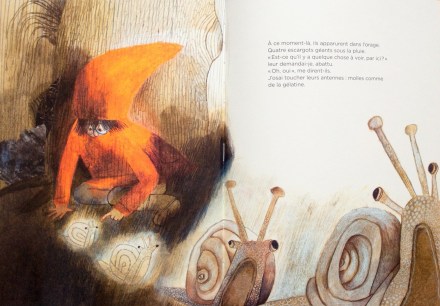
Just then she spies four giant snails slithering by. She asks them if there is anything to do around there, and they tell her yes. She gently feels one of the snail’s antennae. It is “as soft as jello” and makes her smile. She follows the snails and discovers a field filled with mushrooms. Their damp musky smell reminds her of her grandparents’ basement—her “cave of treasures.” She walks on and finds a spot in the earth where she digs her hand into the ground. She feels “thousands of seeds and pellets and kernals, grains and roots and berries touch “her fingers and hand.” When she looks up the sun is shining “through a giant strainer” and blinds her.

celebrate-picture-books-picture-book-review-on-a-magical-do-nothing-day-snails

Copyright Beatrice Alemanga, 2017, courtesy of beatricealemanga.com.

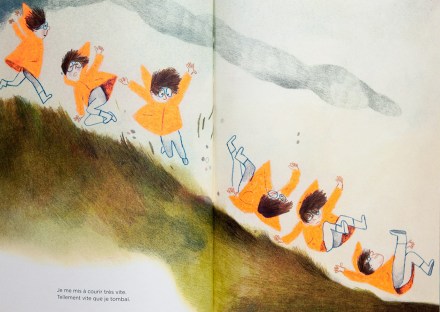
Her heart starts beating fast with energy. She takes off running and runs so quickly that she tumbles down the hill. She lands on her back with a flop, and when she opens her eyes, the world is topsy-turvy new. Energized, she climbs a tree and gazes out at the horizon, breaths deeply in the fresh air, drinks raindrops as they fall from a leaf, and notices bugs she’s never seen before. She talks to a bird, splashes in a puddle, and watches the world through stones as clear as glass.

celebrate-picture-books-picture-book-review-on-a-magical-do-nothing-day-tumbling

Copyright Beatrice Alemanga, 2017, courtesy of beatricealemanga.com.

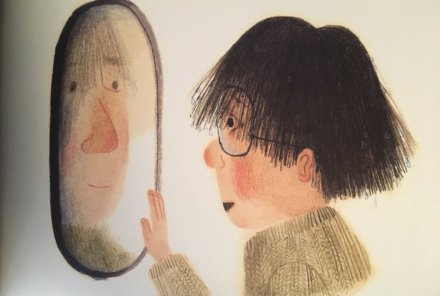
She hurries home and takes off her raincoat. When she glances in the mirror, for a moment she thinks she “sees her dad smiling at [her].” Her mom is still writing, but now she looks different to the little girl—“like one of the creatures outside.” Her mom notices how soaked she is and takes her to the kitchen to dry her off in a big, soft towel. The little girl feels like giving her mom a big hug. For a moment she wants to tell her about all the things she saw and did, but she doesn’t.

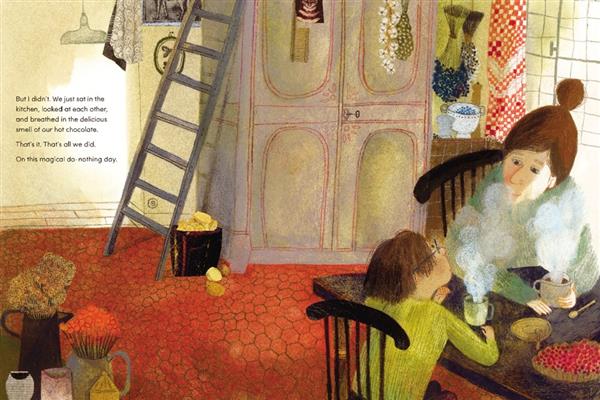
Instead, they enjoy their hot chocolate quietly together. “That’s it,” she says. “That’s all we did. On this magical do-nothing day.”

celebrate-picture-books-picture-book-review-on-a-magical-do-nothing-day-hot-chocolate

Copyright Beatrice Alemanga, 2017, courtesy of HarperCollins.

While the protagonist of A Magical Do-Nothing Day may never have looked at the world outside closely, Beatrice Alemagna certainly has. Alemagna’s exquisite illustrations portray the beauty of our environment—both indoors and out—and our connections to it with novel descriptions and stunning color and perspectives. As the girl ventures outside, video game clutched tightly, her face registers sadness and wariness. The Martians from the game crawl over and surround her, even when the game is off, seeming to fill any space that might be open to exploration, and, indeed, her first forays into the wild are taken game-style, hopping from platform to platform, rock to rock.

celebrate-picture-books-picture-book-review-on-a-magical-do-nothing-day-mirror

Copyright Beatrice Alemanga, 2017, courtesy of HarperCollins.

When the gaming device sinks into frigid water (as cold and impersonal as the gaming experience itself?), the child quickly comes out of her shell with the help of snails that lead her to greater discovery. The story gives readers much to ponder in the relationships between the child and parents and the child’s newfound appreciation for the natural world.

On a Magical Do-Nothing Day is a fantastic book to add to home and classroom libraries to spur children’s exploration—both in the natural world and within. While I used the feminine pronoun in my review, the story is told from the first person point of view and the child is drawn with gender neutral clothing and hairstyle, making this a book with universal appeal.

Ages 4 – 8

HarperCollins, 2017 | ISBN 978-0062657602

Discover more about Beatrice Alemanga, her books, and her art on her website.

Nothing Day Activity

celebrate-picture-books-picture-book-review-rainy-day-with-mushroom-and-cricket-coloring-pageNothing To Do Coloring Pages


Rainy days are perfect “do-nothing” days. The next time you have an indoor day, grab your crayons or colored pencils and enjoy these printable coloring pages

Splashing in the Rain Coloring Page | Cricket Hiding from the Rain Coloring Page

Picture Book Review

January 15 – It’s International Creativity Month

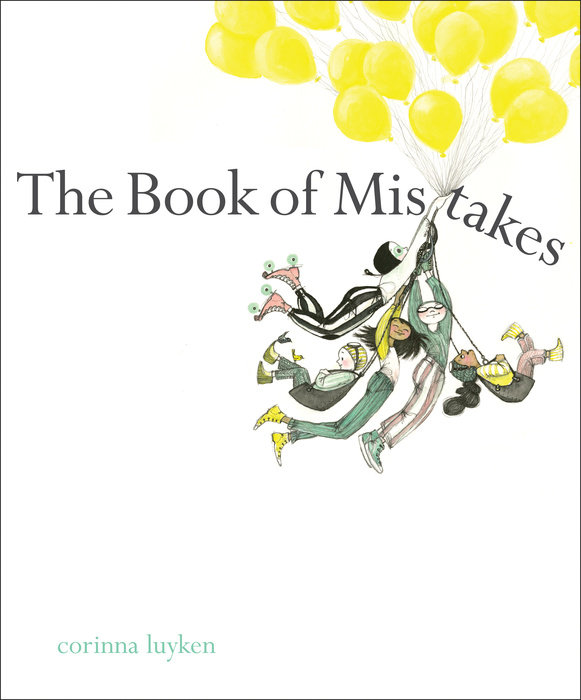
celebrate-picture-books-picture-book-review-the-book-of-mistakes-cover

About the Holiday

Do you value craft store coupons more than the ones from the grocery store? When you look at math formulas, do you see brand new applications? Can you make a gourmet meal out of three leftover ingredients? If you think outside the box then you have a bright future! Whether you work in a traditionally creative field or not, the ability to think differently is a valuable asset.  This month explore your creative side and share your ideas! 

The Book of Mistakes

By Corinna Luyken


The whole thing started while drawing a picture. The head of the child looks good—nice little ear and nose, a dot for the left eye. The hair goes on pretty well—a swoop on the right side, straight on the left. The eyebrows are tiny dashes, and the mouth the size of a chocolate sprinkle. Just have to add the right eye…Oh, no! The right eye is too big!! Okay, okay, this mistake can be fixed. The left eye just needs to be a liiittle bigger…Oh, good grief! “Making the other eye even bigger was another mistake.”

celebrate-picture-books-picture-book-review-the-book-of-mistakes-splotch-on-head

Copyright Corinna Luyken, 2017, courtesy of Dial Books for Young Readers.

Maybe…the perspective might just be right for…Yes! “the glasses—they were a good idea.” Okay on to the body. Hmmm… “The elbows and the extra-long neck? Mistakes. But the collar—ruffled, with patterns of lace and stripes—that was a good idea.” And elbow patches make the arms look a little less pointy.

Moving on to the background, a thick and leafy bush is just the thing to hide the animal. Animals? It could be a cat, a cow, or a frog. “Another mistake.” And why is the ground so far below the girl’s feet anyway? Oh! Because she’s wearing roller skates. Nice save! “Those were definitely not a mistake.” Let’s see, the “second frog-cat-cow thing made a very nice rock.” Now, what about the other girl with long hair and one very long leg? Got it! She “looks like she always meant to be climbing that tree” on the side of the page.

celebrate-picture-books-picture-book-review-the-book-of-mistakes-leaves

Copyright Corinna Luyken, 2017, courtesy of Dial Books for Young Readers.

The ink smudges at the top of the paper can be leaves, but back to the roller-skating girl. What to do with those awkwardly positioned arms? Oh dear—the pen should not have been hovering over the page. How to fix the splotch on the side of her head? Ah-hah! An old-fashioned aviator’s helmet. Or is it a swimming cap? No matter…she’s now holding a yellow balloon in her left hand and lots of strings in her right. Wow, tons of yellow balloons are at the ends of those strings!

She’s skating toward the tree with the long-legged girl, and there are a bunch of other kids playing in it too. Cool! They’re all wearing aviator helmets/swimming caps too. Some are wearing roller skates—good—and they’re erecting some kind of tent over a big branch. Wow! Look at the pink balloons and the green ones! There’s a kid riding a hot-air unicycle through the sky and a skateboarder is floating down to a ramp supported by springs in the top of the tree. Someone’s even tatting a lace banner.

celebrate-picture-books-picture-book-review-the-book-of-mistakes-tree

Copyright Corinna Luyken, 2017, courtesy of Dial Books for Young Readers.

“Do you see?” They’re all waiting for the roller-skating girl to bring the yellow balloons. But let’s step back a little. “Do you see—how with each mistake she is becoming?” If we back up some more, she and the tree look so tiny and there’s a big, dark forest in the foreground. “Do you see—” Looking from way far away, doesn’t that forest look a bit like curly hair or…Oh! The top of the roller-skating girl’s cap! She’s so big now, and she’s gazing out of those green glasses at the white page where she’s drawing a small head with a nice little ear and nose and a dot for the left eye. “Do you see—who she could be?”

celebrate-picture-books-picture-book-review-the-book-of-mistakes-girl-as-artist

Copyright Corinna Luyken, 2017, courtesy of Dial Books for Young Readers.

Kids will be charmed by the start of the little head on the first page, begin giggling at the one too-big eye on the third page, and laugh out loud at the even bigger eye on the fifth in Corinna Luyken’s magically inventive The Book of Mistakes. As each mistake is adjusted for or inspires a new twist in the story, young readers will appreciate how creatively right the fix is and look forward to the next mistake and the next. The final pages presenting the tree full of children are so enticing that readers will want to linger over each one to find all the details. Luyken’s minimally colored drawings are funny and endearing and lead readers to question their own perspective and give free reign to their imagination.

The Book of Mistakes is a must for classrooms and highly recommended for home libraries for all those times when mistakes can be perfect conversation starters or the inspiration for…anything!

Ages 4 – 8 and up

Dial Books for Young Readers, 2017 | ISBN 978-0735227927

To find a portfolio of artwork and more information about Corinna Luyken and her books visit her website.

International Creativity Month Activity

celebrate-picture-books-picture-book-review-magnetic-can-craft (2)Creativity is Magnetic! Fun Cantainer


A can with a lid can make a creative kit if you fill it with magnetic pieces that can be used to make scenes, faces, or even poems. Make the magnets yourself and you can create a kit that is uniquely yours! Make a kit to put in the car too!

Supplies

  1. Can with a lid, available at craft stores or with various types of tea
  2. Small craft magnets and/or magnetic strips
  3. A variety of small items such as:
  • Foam or felt shapes
  • Scrap booking stickers 
  • Googly eyes in various sizes
  • Felt or heavy paper
  • Small charms
  • Small toys

Directions

To Make Scenes

  1. Attach magnets to shapes, stickers, or small items
  2. Arrange them into a scene or design on the side of the can

To Make Faces

  1. Attach magnets to googly eyes
  2. Make noses and mouths out of the felt or heavy paper
  3. Attach magnets to facial features

To Make Poems 

  1. Use Magnetic Sheets, leaving the white paper on
  2. Write words on the white paper
  3. Cut out words
  4. Arrange them into a poem on the side of the can

Store your magnetic pieces inside the can

Picture Book Review