During the month of November we’ve celebrated picture books—those wonderful stories and works of art that open the world to children and adults in surprising and amazing ways. Creating home libraries for children as well as reading together every day is an important part of improving language development and literacy. The close bond formed between parents and other caregivers and children during quiet or boisterous reading times last a lifetime. If you have young children or even older kids who love the beauty of picture books, make every month Picture Book Month!
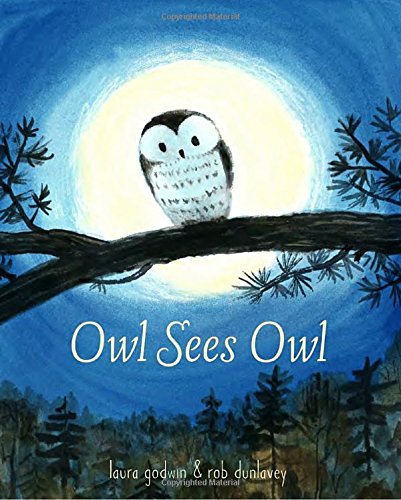
Owl Sees Owl
Written by Laura Godwin | Illustrated by Rob Dunlavey
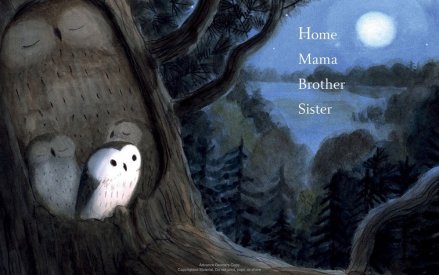
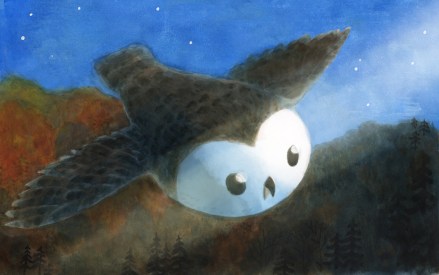
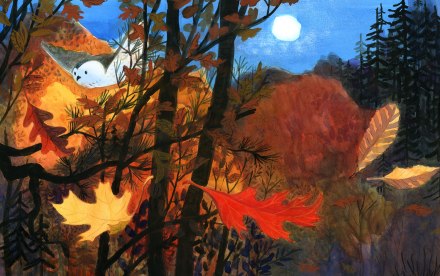
An adorable baby owl, wide awake in the full moonlight while its family sleeps, gazes out from its nest in a tree at the surrounding forest. The night is filled with “Home / Mama / Brother / Sister.” The little owl ventures out onto a sturdy limb. It knows “Tree / Nest / Hop / Look.” From its perch with a “Jump / Flutter / Flap / Fly” the owlet soars through the deep blue sky, its white face shining like the stars. It floats over autumn leaves while in the “Moon / Beam / Eyes / Gleam.”
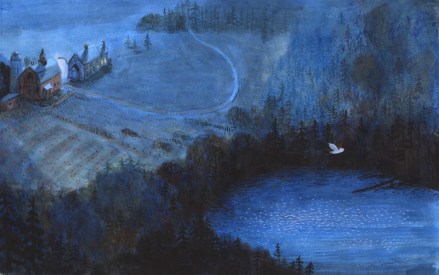
Down below other nocturnal animals have come out to play. On the farm the barn is quiet and dark while someone is stirring in the house. The baby owl passes them by with a “Soar / Glide / Swoop / Swoosh.” Something glistens in the midst of the forest, and the owl descends to investigate. “Owl… / Sees / Owl” in the rippled rings of the small pond.
Image copyright Laura Godwin, courtesy of Rob Dunlavey, robd.com
After a moment the owlet takes off with a quick “Swoosh / Swoop / Glide / Soar,” reversing its nighttime flight. Once more the curious baby passes over the star- and moonlit field, feeling bolder: “Scamper / Mice / Twinkle / Stars.” Deer perk up their ears and stare alert to the nearly silent woosh of the owl’s wings above. “Yellow / Red / Leaves / Fall as the owl zooms with a “Fly / Flap / Flutter / Jump toward “Sister / Brother / Mama / Home,” where Mama waits wide awake.
Image copyright Laura Godwin, courtesy of Rob Dunlavey, robd.com
Inspired by reverso poetry, Laura Godwin’s lovely Owl Sees Owl is a language- and emotionally rich story to share with young children. With only four words per two-page spread, Godwin tells the detailed adventure of an inquisitive baby owl who leaves home for a nighttime caper through woods and over farmland to a pond where it sees itself reflected in the mirror-like surface. In a minute the owl is back in the air for the trip home, reversing its path and also the order of the words. Godwin’s dynamic, lyrical words are joyful to read and allow for readers to linger over each page and talk about what they see, what the little owl is doing, and even whether a sentence such as “Fall / Leaves / Red / Yellow” is active or descriptive. The reverse nature of the story brings the baby owl’s adventure to a sweet, satisfying conclusion that children will love.
Image copyright Laura Godwin, courtesy of Rob Dunlavey, robd.com
Rob Dunlavey’s illustrations transfer the most beautiful clear, moonlit night to the page, creating a perfect quiet time or bedtime book for young children. The lush, dark woods rendered in deep olives, rusts, browns, grays, and blacks as well as the indigo sky highlight the gleaming moon, twinkling stars, and white feathers of the owl. In one spread deer appear in silhouette in the background as mice scamper over pumpkins in the foreground; in another fiery red, yellow, and orange autumn leaves make a spectacular backdrop to the owl’s outstretched wings. The central spread in which the owl sees its own reflection offers readers much to talk about. Is the owl startled? Wondering? Happy? Is the owlet going home for comfort or to tell of its amazing discovery? Kids will love lingering over each page to think and talk about all that is there.
Owl Sees Owl makes a wonderful gift for young children or children who love poetry and art. The book would be a welcome and often read addition to home libraries.
Ages 2 – 7
Schwartz & Wade Books, 2016 | ISBN 978-0553497823
To see a gallery of illustration work for picture books, nature sketches, and other artwork by Rob Dunlavey, visit his website!
Picture Book Month Activity
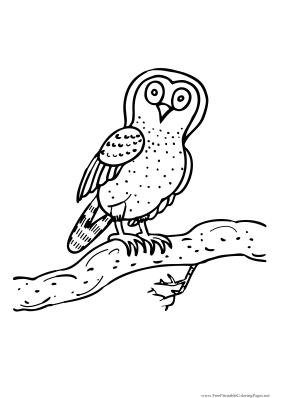
Barn Owl Coloring Page
This little guy looks ready for an adventure! Grab your pencils or crayons, color this printable cute Barn Owl Coloring Page, and give him a background to start his journey!
Established in 1999 by UNESCO, Mother Language Day celebrates cultural diversity and promotes the protection of endangered languages. Events include multicultural festivals where all voices are heard and social cohesion, cultural awareness, and tolerance are honored.
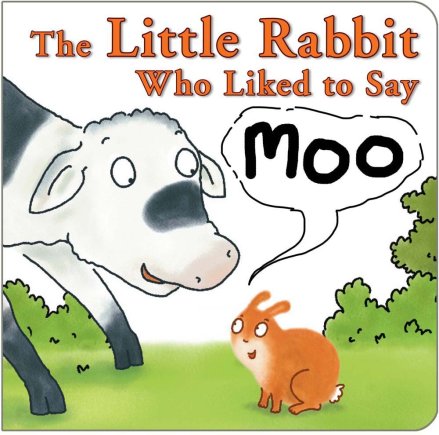
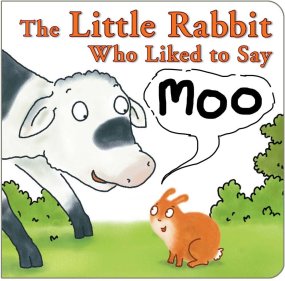
The Little Rabbit Who Liked to Say Moo
By Jonathan Allen
Little Rabbit sits in the farmer’s field listening to the animals talk and learning their languages. “Moo,” Little Rabbit repeats, “Moo.” A calf responds and questions Little Rabbit. It turns out that Little Rabbit knows and likes many languages. Calf joins Rabbit in the fun. “Baa,” they say together, which summons Lamb. The three friends decide to try “Oink.” With each new noise, the group expands and enthusiastically continues their linguistic experiment.
Copyright Jonathan Allen, 2008, courtesy of Boxer Books Ltd.
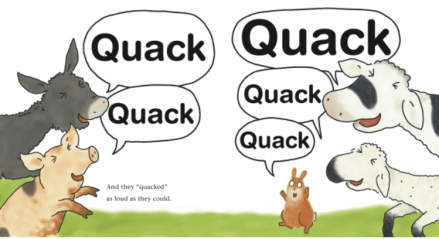
Finally, after a rousing chorus of “Quack,” Duckling asks , “Why are you all saying quack? You’re not ducks.” Baby Donkey is the first to answer. “I like Quack.” “So do I…Me too,” the other young animals pipe up. “Is quack your favorite animal sound?” Duckling asks. Each animal then reveals with pride that, while they like other noises, they prefer their own. But what about Little Rabbit, who doesn’t “have a big noise?” Will Rabbit’s answer begin the game again?
The wide-eyed, smiling animals in this adorable picture book by author-illustrator Jonathan Allen perfectly captures the joyous camaraderie of good friends discovering the world together. The book is a wonderful introduction for young children to the ideas of inclusiveness and self-esteem. Kids will love the repetition as each new animal joins the group, and will have as much fun saying each sound as Little Rabbit and the other farmyard friends.
Ages 2 – 5
Boxer Books Limited, 2015 (Board Book) | ISBN 978-1910126257
International Rabbit Day Activity
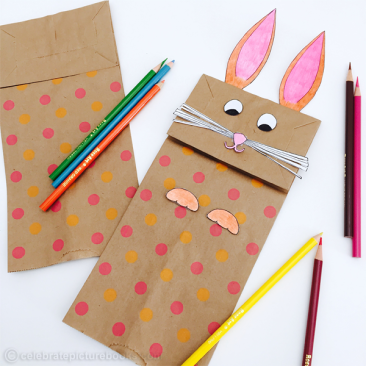
Paper Bag Rabbit Puppet
With this easy and fun craft you can make your own little rabbit who likes to play with you and talk in other languages! Make up stories of your own – what does your little rabbit like to do?
Place the flat paper bag on a table with the bottom flap facing you. Glue or tape the eyes, and the nose and whiskers to the bottom flap. Attach the ears, placing the tabs behind the top of the bottom flap. Attach the paws to the body below the bottom flap. Attach the cotton ball tail to the opposite side of the bag.
When it’s dry, use your puppet to read The Little Rabbit Who Liked to Say Moo again and play along, making the other animals’ sounds.
Then let your Little Rabbit try saying “Hi” in the languages below.
Learn to Say “Hello” in Other Languages
Spanish: Hola (oh-la)
French: Bonjour (bon zhur)
German: Hallo (hă-lo)
Chinese: Nin Hao (nee hah)
Filipino: Kamusta (ka-muh-stah)
Italian: Ciao (chi-ow)
Japanese: Kon’nichiwa (ko-nee-chee-wah)
Turkish: Merhaba (mĕr-hah-bah)
You can find The Little Rabbit Who Liked to Say Moo at these booksellers
In the early 1970s Marion McQuade had the idea for a special day of the year when grandparents and grandchildren could show their love for one another. She further wanted it to be a day when grandparents could pass down the wisdom they had gained over their lifetime as well as share a bit of family history. Of course the same goes for grandparents learning the latest and greatest from the kids in their lives—from new technology to current fads. When all generations share their experiences, we’re all a lot smarter—and have closer relationships!
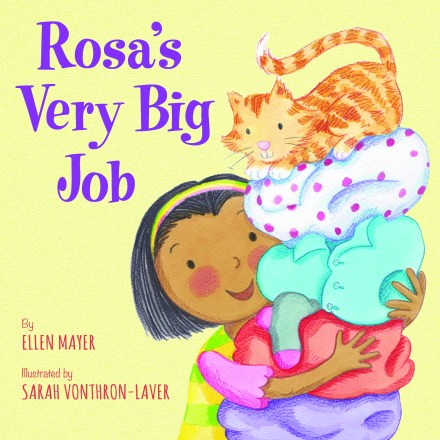
Rosa’s Very Big Job
Written by Ellen Mayer | Illustrated by Sarah Vonthron-Laver
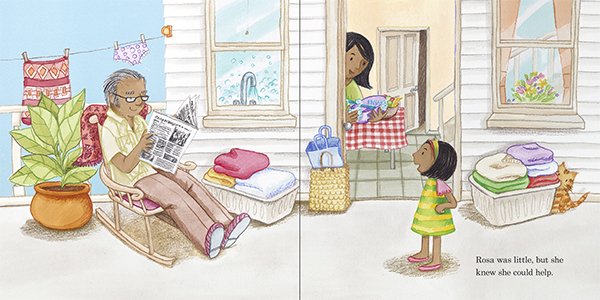
Rosa may be little, but she has big ideas about how to help. While Mama is out shopping for groceries for that night’s dinner, Rosa decides to surprise her by folding and putting away the laundry. The basket is piled high with fluffy dry clothes, sheets, and towels. Rosa watches her grandpa reading the newspaper. “‘Please help me, Grandpa!’” she says. She tugs on her grandpa’s hands, trying to pull him out of his chair. “‘Come on, Grandpa! Get up.”
Image copyright Sarah Vonthron-Laver, text copyright Ellen Mayer, courtesy of Star Bright Books, starbrightbooks.com
Grandpa seems to have a little trouble managing: “‘It’s difficult to carry these enormous piles,’” he sighs. But Rosa knows that smaller armloads work better. Grandpa’s clothes come unfolded as he puts them in the drawer. “‘Be neat. Like me,” Rosa says, showing him her tidy stack. Poor Grandpa! He has to keep hanging up the same jacket over and over. “‘It’s difficult to keep this jacket from sliding off the hanger,” he says. Rosa has the answer: “‘Zip it up,’” she explains. “‘Then it stays on.’”
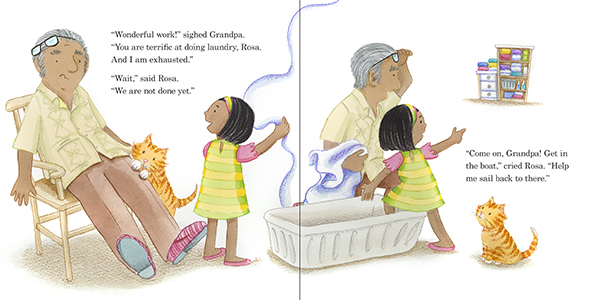
Grandpa sinks back into his chair. “‘You are terrific at doing laundry, Rosa. And I am exhausted,’” he says. But this is no time to quit—Rosa has big plans. As she steps into the now empty laundry basket, she exclaims, “‘Come on, Grandpa! Get in the boat. Help me sail back to there.’” Rosa points to the linen closet.
Image copyright Sarah Vonthron-Laver, text copyright Ellen Mayer, courtesy of Star Bright Books, starbrightbooks.com
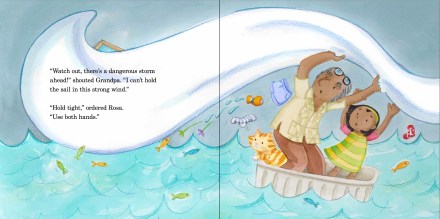
Suddenly, the floor swells with ocean waves teeming with fish. Grandpa channels his inner sailor as he holds aloft a sheet as a sail. As the wind billows and they come perilously close to the kitchen table, he says, “‘It’s difficult to sail around this enormous rock!’” Contemplating the rising sea, he exclaims, “‘It’s difficult to sail over this enormous wave!’”
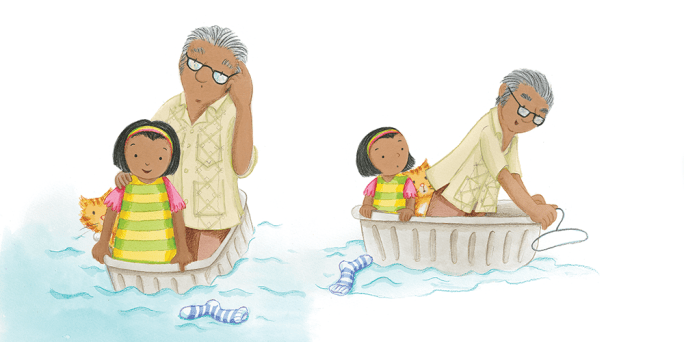
There’s a dangerous storm ahead, warns Grandpa, “‘I can’t hold the sail in this strong wind.’” Rosa is there to help and grabs one side of the sheet. “‘Hold tight,’” she orders. “‘Use both hands.’” At last the seas die down and Grandpa is ready to steer the laundry basket back to port, but Rosa has a more entertaining thought. Spying a sock on the floor, Rosa wants to catch the “enormous fish.” Grandpa obliges and picks up a hangar for a fishing pole. He holds Rosa as she stretches out over the edge of the laundry basket to land her fish.
Image copyright Sarah Vonthron-Laver, text copyright Ellen Mayer, courtesy of Star Bright Books, starbrightbooks.com
Just as Rosa nabs the fish, Mama comes home with her bags of groceries. She’s surprised to see that the laundry is not in the basket. Rosa runs to her and proudly explains, “‘We put all the laundry away. It was a very big job. We carried enormous piles. Grandpa dropped things. And I picked them up. It was very difficult for Grandpa. He got exhausted. But not me. I am terrific at laundry!’” Mama agrees that Rosa is a terrific helper. Then Rosa leads her mother to see the most surprising thing of all—the fish she has caught for dinner!
In her series of Small Talk Books® Ellen Mayer presents exciting stories for preschoolers full of imagination and rich language learning. Rosa’s Very Big Job introduces Rosa, a sweet girl bubbling with enthusiasm and the desire to help. The close relationships between Rosa, her mother, and her grandpa promote cooperation as well as effective modeling of speech patterns and a way to introduce larger words in an organic manner through play and common chores. Rosa’s inventive idea to turn the laundry basket into a boat is delightfully enhanced by her grandpa’s willingness to share in the story and expand on it. Humor, cheerful banter, and the easy camaraderie between Rosa and Grandpa invite young readers to join in the fun as they build confidence in their language learning.
Sarah Vonthron-Laver depicts Rosa’s afternoon with her Grandpa with joy and the spirited energy young children bring to everything they do. Grandpa is happy to spend time with his granddaughter, yet shows honest feelings of tiredness and frustration that spur on the plot. The transition from doing laundry to using the basket as a boat is as seamless as a child’s imagination, and the way Rosa and her grandpa use household items to create “sails,” “rocks,” “fish,” and “fishing poles” will give readers great ideas for post-reading play. Bright colors, an adorable kitten, and familiar surroundings welcome young children into the world of reading and expanded vocabulary.
Rosa’s Very Big Job would be a welcome addition to a young child’s bookshelf, not only for its fun story that kids will want to hear again and again, but for its leap into imagination that kids will want to replicate.
Dr. Betty Bardige, an expert on young children’s language and literacy development, provides tips for parents, grandparents, and caregivers following the text.
Ages 2 – 6
Star Bright Books, 2016 | ISBN 978-1595727497
Discover more about Ellen Mayer and her books as well as book-related activities and literacy initiatives she’s involved with on her website!
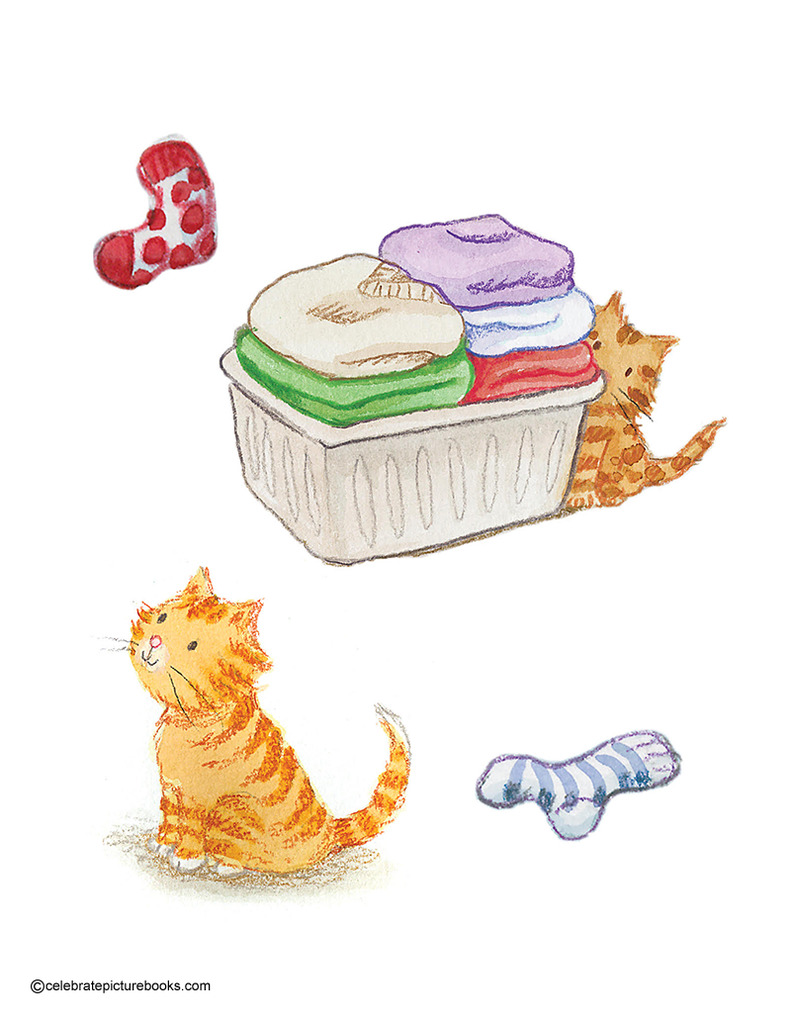
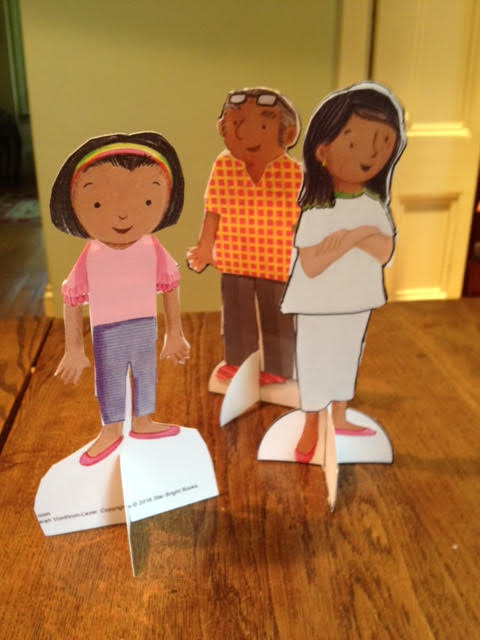
Rosa loves helping out at home. She’s terrific at doing laundry – folding and putting away the family’s clothes, socks, and linens. You are terrific at helping too! Can you help Rosa, Mama, and Grandpa get dressed and ready for the day with these printable paper dolls? You’ll even find a laundry basket, socks, and Rosa’s sweet kitty to play with!
Print dolls on regular paper or heavy stock paper. Dolls printed on heavy stock paper may stand on their own with the supplied stand cross piece. For dolls printed on regular paper, you can cut the supplied stand templates from poster board or card stock and glue the dolls to the backing.
Rosa’s kitty and the laundry basket can also be attached to the supplied template if needed
Print clothes for each figure
Color the blank clothes templates any way you’d like
Cut out clothes and extra items
Fit outfits onto dolls
Make up your own stories about Rosa, Mama, and Grandpa!
Interview with Author Ellen Mayer
Today, I’m happy to present a fascinating interview with Ellen Mayer, a writer and expert in early literacy, in which she discusses her involvement with various organizations and programs, her baby granddaughter, why Hug Your Cat Day is at the top of her list of holidays, and gives us a peek at a very special sugar egg.
I’m really interested in your work in the education and literacy fields. Could you talk a little bit about your job as an education researcher and an early literacy home visitor, and how you got into those fields?
I got into these fields after leaving a Sociology PhD program right near the end. I didn’t want to be an academic and teach, I wanted to do applied research – to solve practical problems out in the world and to make a difference in the lives of those who were struggling. At the Harvard Family Research Project at Harvard’s Graduate School of Education, I studied the ways that families from underserved communities were engaged in supporting their children’s learning and education, and created research-based materials for families and schools to promote effective engagement. One of these was the Family Involvement Storybook Corner—curated picture book selections with family engagement themes. That got me interested in early literacy and picture books.
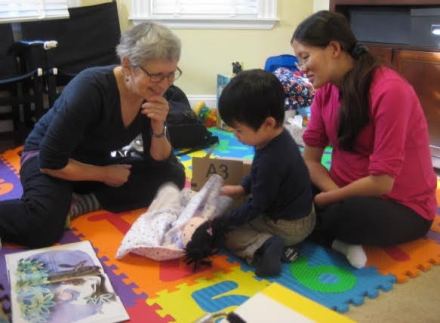
After researching family engagement in children’s learning for many years, I decided I wanted to go out into the field and be a practitioner and work directly with families on this topic. I worked as an early literacy home visitor with diverse families with the Parent-Child Home Program, modeling ways to share stories with little ones to build early language. I actually got paid to read picture books and play with families in their homes!
At the same time, I was pitching my Small Talk Books®, a collection of playful stories about everyday activities that provide fun for kids and ideas for adults – Rosa’s Very Big Job is one. The adults in the stories are engaged with children’s learning, modeling conversational ways to build young children’s language.
I read that your book Red Socks, another of the Small Talk Books®, is being used in a program to turn wash time at Laundromats into talk time for literacy development. Could you discuss this early literacy initiative?
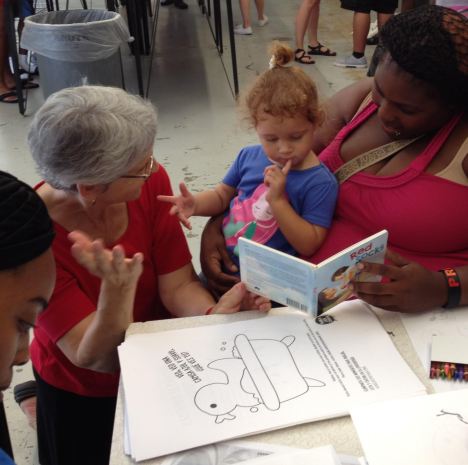
Yes! Wash Time/Talk Time is a terrific campaign led by Too Small To Fail, a joint initiative of the Clinton Foundation and the Opportunity Institute teaming up with a host of partners to turn Laundromats in underserved areas into venues for early literacy. This campaign distributes free books and information to families in Laundromats about building early language to help close what’s called the “word gap” by promoting parent conversation with babies and young children. Almost 60% of children in our country start kindergarten behind in their language development and this then sets them on a downward path and they get even further behind in school.
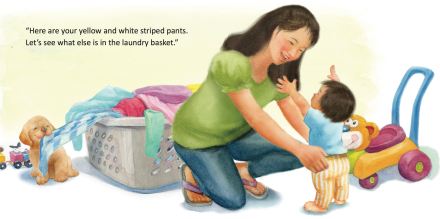
Red Socks was a natural fit for this program. In it a Mama narrates what she is doing for her little pre-verbal child as she folds the laundry and dresses the child—and as they search for a missing sock!
I have to say that it’s a dream come true that Too Small To Fail is using my book.
Wash Time/Talk Time is really reaching the families on the other side of the word gap who most need the ideas and inspiration in Red Socks. When I began writing the Small Talk Books® I wanted to include stories about doing laundry, as it’s something we all do as parents and provides lots of things to talk about with children. (Like the color of socks!) In fact, I used to sit in Laundromats and observe families when I was thinking up ideas for stories. I guess that’s the sociologist in me.
We just had the opportunity to visit one of the Laundromats in the campaign—at the Free Laundry Day in Tampa, FL hosted byThe Laundry Project—and share Red Socks with families. You can see some of the fun illustrator Ying-Hwa Hu and I had here:
What inspired you to begin writing picture books?
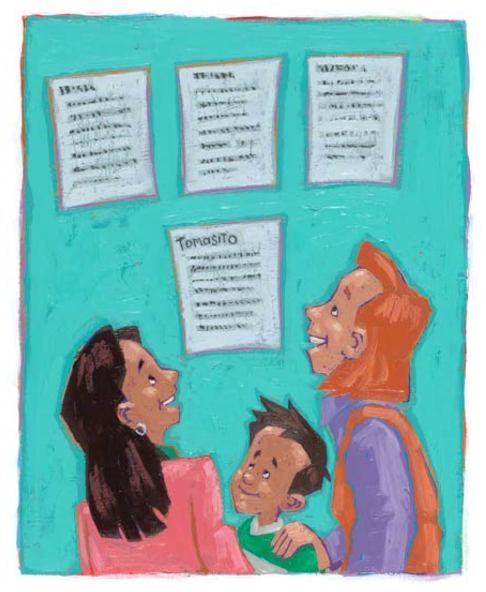
I came to picture book writing through a backdoor. When I was at Harvard Family Research Project, I was thinking about new ways to convey our ideas from research into practice for parents, and it occurred to me that a read-aloud picture book could address an audience of parents, as well as the primary one of children. My boss was enthusiastic about the idea, and so I enrolled in an adult ed class on writing for children. Then I turned one of our research case studies about challenges an immigrant Latino family had in communicating with their son’s teacher into a picture book,Tomasito’s Mother Comes to School/La mamá de Tomasito visita la escuela. Joe Cepeda did the art for it, and we made it downloadable for free.
Some new things! I have a fellowship with the Storytelling Math Project that’s funded by the Heising-Simons Foundation and coordinated by TERC, a not-for profit STEM research and development organization here in Cambridge, MA. I’ll be a member of a group that’s identifying, creating, and promoting math-infused storybooks for diverse young children and I hope to create a couple of Small Talk Books® along these lines—probably about supermarket shopping! I also was asked to help out the Highlights magazine editorial team that creates HELLO magazine for 0-2 years and be an outside reviewer for issues before they go to publication. And then I’ll be volunteering as a visiting children’s book author to the Somerville Family Learning Collaborative, the family engagement and early childhood hub of the Somerville, MA Public Schools, sharing my books with playgroups and new parent groups.
But mostly, I plan to write! I have a bunch of picture book manuscripts in various states, and ideas for new ones. These manuscripts are different from the Small Talk Books®; they don’t have a deliberate educational underpinning to them. They are fun, and just fun. One, for example, is called What To Do With Ruby-Lou and it’s about a baby who doesn’t laugh, no matter what her family does. Who is going to be able to get a laugh out of Lou? Well, it’s a surprise and it just might require some audience participation. I’ve had an agent in the past and hope to find a new one to rep me with these picture books.
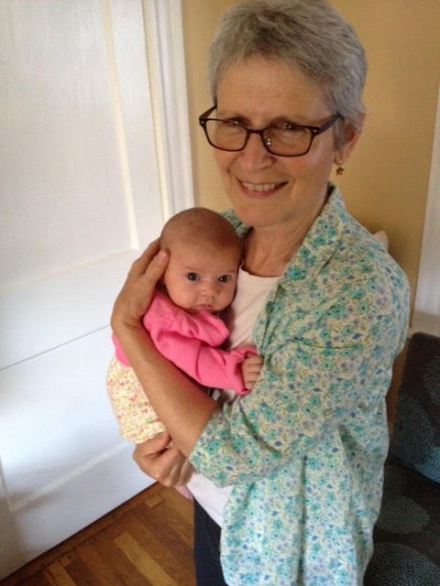
You recently became a grandmother. Can you tell me a little about your granddaughter?
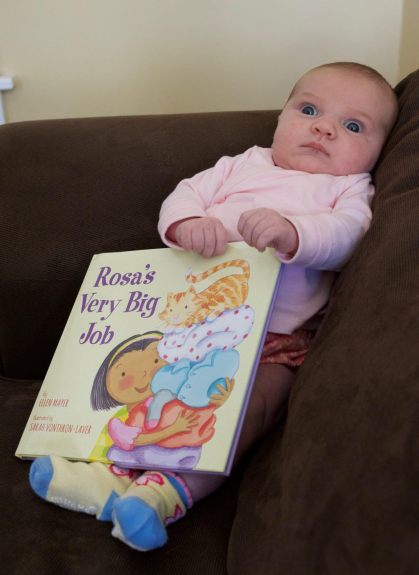
I thought our granddaughter was the most wonderful and expressive baby in the world when was she born – of course! She and my advance copy of the new Rosa book arrived into the world at just about the same time.
At three months now my granddaughter is a big reader and is riveted on the B&W hi-contrast board book genre, especially one board book about cars and trucks. She moves her head back and forth, from one end of the spread to the other, scanning the images on the page like a studious scholar of some ancient text.
What is the best part about being a grandmother?
For me the best part about being a grandmother is being able to simply enjoy my granddaughter and play with her and watch her develop, and not have to worry about taking care of her daily needs. I didn’t have to stress when she refused to take the bottle before starting full-day childcare. That wasn’t my job. (She did take it – of course!) They live nearby, and seeing her once or twice a week, I love noticing small changes on each visit. I also love seeing our daughter and son-in-law parent.
Have you given thought to what you’d like your granddaughter to call you?
Our daughter asked us ahead of time what we’d like to be called when we became grandparents. I thought it was a wise idea to be proactive and select a name immediately, to avoid being named by the grandchild something like “Grandma GA-GOO-GA.” My great aunt Jane is called “Nini” as a grandmother, and I’ve always loved that, but I didn’t want to steal it. So I chose “Mimi.”
It sounds as if Grandparents Day may be one of your top holidays! Do you have another favorite?
When I was little, I liked Easter a lot because it combined a lot of my favorite things: crafts, springtime, running around outside, candy. Also, we didn’t dress up much as kids, but I do remember Easter bonnets!
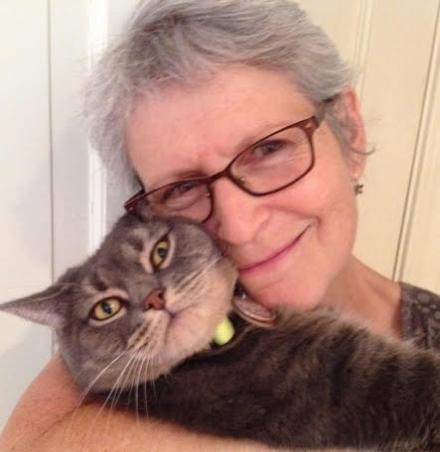
When our children were little, their birthdays became my favorite holiday celebrations. Now that they are grown, maybe I need to pick a new favorite holiday? I see that June 4th is Hug Your Cat Day. That might be just right: we have a rather large and ferocious cat and when she actually lets you hug her, well, it’s a cause for celebration.
Do you have an anecdote from any holiday that you’d like to share?
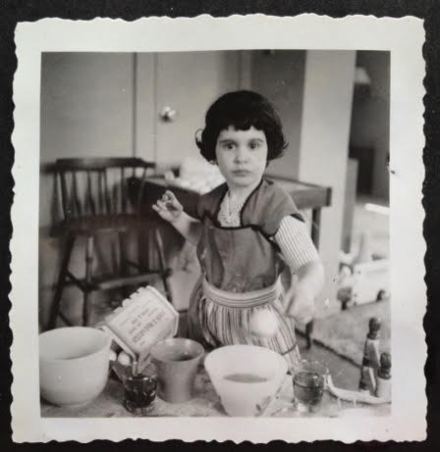
When I was six years old, I saw the Easter Bunny. I was staying at my Grandparents’ house, and I looked down the stairwell, and there he was, crossing the landing at the foot of the stairs. He was quite tall, wore a yellow slicker that was too small for him, and he was carrying a large Easter basket. I’m afraid I didn’t have my Brownie camera with me at the time to snap a photo.
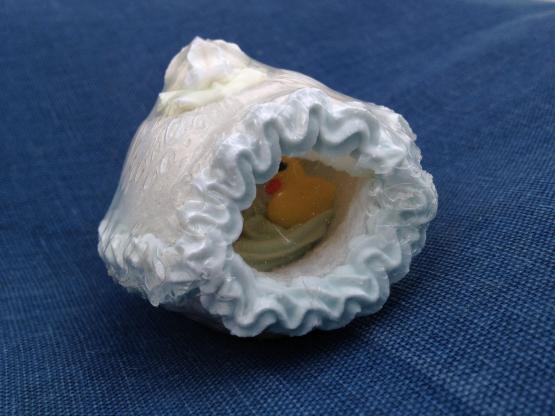
But I do have an unwrapped sugar Easter egg that I’ve saved from that era.
Thanks for sharing so much about your work and life, Ellen! I wish you all the best with Rosa’s Very Big Job, your other Small Talk Books®, and of all your other ventures!
Other Small Talk Books® available from Ellen Mayer and Star Bright Books include Cake Day, Red Socks, and A Fish to Feed and can also be found at the above booksellers.
Today celebrates the poet—that special person who looks at the world and transforms it into lines of rhyme, rhythm, metaphor, and meaning that make readers experience life and sometimes even the most common occurrence in a whole new way. Some poetry is poignant, some evocative, and some silly, but it all provides different perspectives and enriches our lives—even the youngest among us!
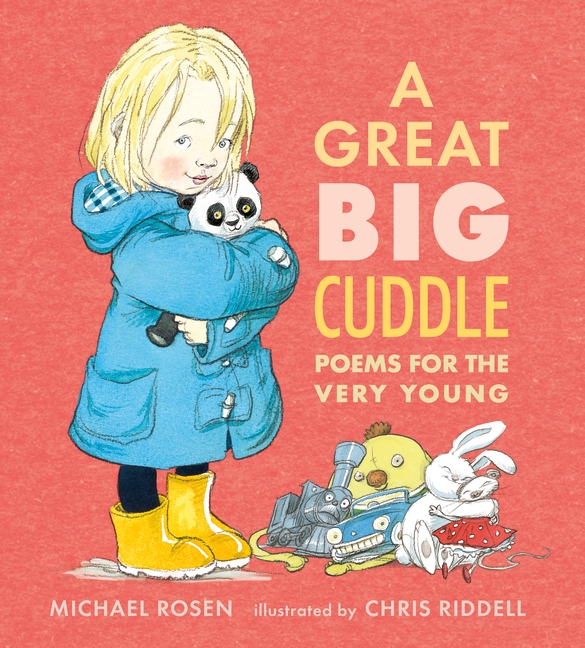
A Great Big Cuddle: Poems for the Very Young
Written by Michael Rosen | Illustrated by Chris Riddell
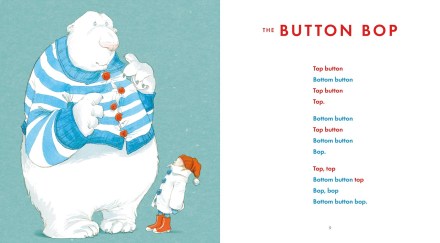
Before children learn to speak and in order for them to become literate and proficient readers, they discover the sounds of language. The poems in A Great Big Cuddle: Poems for the Very Young are all about those snappy, rhyming, musical syllables that make up speech and text. The collection’s 35 poems replicate the progression of language learning from the first offering—Tippy-Tappy, with its staccato repetition of “ippy, appy, eppy, oppy, uppy sounds—to Gruff and Dave and The Slow Train that provide longer, more detailed storytelling.
Image copyright Chris Riddell, courtesy of Candlewick Press
The subjects are familiar to even tiny children whose worlds include the buttons, parties, pets, music, and other topics treated with innovation in this collection. The juxtaposition of words, concepts, questions, and nonsense, will keep kids laughing even as they are (probably) unconsciously soaking in the rich learning.
I Went is an example in which multiple concepts combine to create a funny travelogue with double meaning twists:
“I went to Lapland / I saw a reindeer on the loose. / I went to Canada / I saw a chocolate mousse. I went to the river / I saw a big green frog. / I went to New York / I saw a hot dog.”
Bendy Man describes a rather unique fellow with special talents that kids would love to get to know. It starts like this:
“Bendy Man, Bendy Man / He’s a long leggy man. / Bendy Man, Bendy Man / In a baked-bean can. Bendy Man, Bendy Man / Wraps round trees / Bendy Man, Bendy Man / Can’t find his knees.”
Along the way there are also poems to validate kids’ emotions, which come in shades of happiness, bounciness, anger, satisfaction, and frustration among others, as well as to comfort them when they get hurt or scared as in the poem Mo: “Mo’s in a muddle / She slipped in a puddle / Mommy gives Mo / A great big cuddle.”
Image copyright Chris Riddell, courtesy of Candlewick Press
Let Me Do It is an exuberant tribute to a child’s eagerness to help: “Let me do it, let me do it / Let me blow up the balloon / Let me do it, let me do it / Let me go to the moon. Let me cook the beans / Let me lick the jar / Let me kick the ball / Let me drive the car.” But as often happens with inexperience, the tasks become a bit confused later in the poem: “Let me drive the beans / Let me kick the jar / Let me lick the ball / Let me cook the car.”
Michael Rosen’s love of language and quirky, kid-like personality are on full display in A Great Big Cuddle, much to the benefit of his young fans. Rosen is able to tap into and capture those fleeting ideas and “wouldn’t it be cool if…” moments that fuel kids’ imaginations and actions. Life is much too long and much too short not to spend some of it in absurd hilarity, and Rosen provides a book full of that respite here.
Chris Riddell infuses each of the poems with the personalities of enthusiastic children, adorable monsters, familiar animals, and high-spirited action. The large, full-bleed pages allow for full-size fun and a variety of typography. The bold colors will attract even the smallest reader and keep them riveted to the sounds and sights of this excellent poetry collection for young children.
Image copyright Chris Riddell, courtesy of Candlewick Press
Older kids will also find much to enjoy in the humorous spirals taken by the lines in A Great Big Cuddle. Some poems, such as I Am Hungry, in which a bear in a bib states everything he will eat, would make a great teaching tool about what can and cannot logically be consumed.
Because A Great Big Cuddle: Poems for the Very Young is perfect for dipping into again and again, you’ll be happy to have it close it hand on your shelves.
Ages Birth – 6
Candlewick, 2015 | ISBN 978-0763681166
Visit Michael Rosen’s website to see his amazing range of books, poems, events, TV and radio programs and more!
Follow the Cycling Fish through a tour of Chris Riddell’s artwork!
Poet’s Day Activity
A Pair of Bears (Pear of Bears? Pair of Bairs?) Coloring Pages and Poem Prompts
The two bears in these coloring pages are having different days—one is grumpy while the other is happy. Color the printable A Pair of Bears Coloring Pages and then write one or two poems about them!
Is there anything as delicious as a perfectly ripe peach? Native to China and classified with the almond, the peach is peachy in pies, tarts, fruit salads, and just on its own. To celebrate today pick some peaches from a local farm, farmer’s market, or grocery store and enjoy!
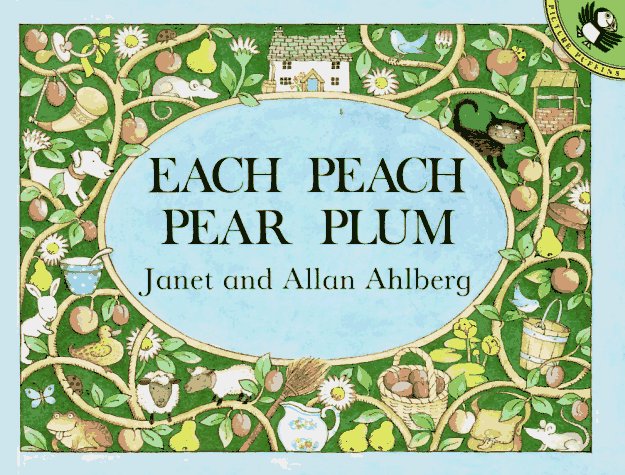
Each Peach Pear Plum
By Janet and Allan Ahlberg
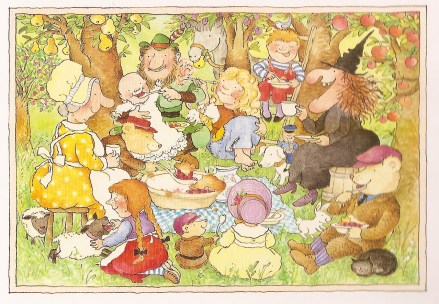
This perennial children’s favorite “I spy” nursery rhyme book is a perfect read any time, but especially during the summer when it can be tucked away in a travel bag or picnic basket and enjoyed on the go. After the first introduction of “Each peach pear plum / I spy Tom Thumb,” in which readers are invited to find Tom who is happily reading high in a peach tree nearly hidden by leaves and fruit, every page offers another double challenge.
Building on the discovery in the preceding page, kids are given a hint as to the current whereabouts of the previous character and are also urged to find another nursery rhyme or literary favorite: “Tom Thumb in the cupboard / I spy Mother Hubbard” followed by “Mother Hubbard down the cellar / I spy Cinderella.” This structure creates anticipation in even the youngest readers as they begin to recognize the pattern and wonder who is coming next.
Copyright Janet and Allan Ahlberg, 1999, courtesy of Viking Books for Young Readers
Besides Tom Thumb, Old Mother Hubbard, and Cinderella, the Three Bears, Baby Bunting, Little Bo-Peep, Jack and Jill, the Wicked Witch, Robin Hood, and a deliciously plump Plum Pie are hidden in the book. What makes Each Peach Pear Plum a classic is the Ahlberg’s artistic magic, which is on gorgeous display in every illustration. The vivid, fine-line drawings spare no details in bringing the short text fully to life.
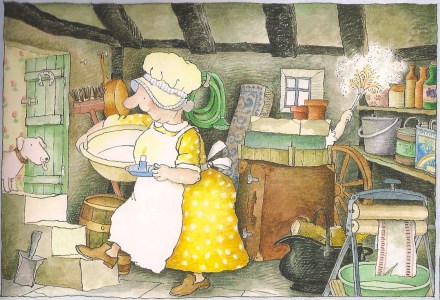
Humor abounds, especially in the depiction of the “hidden” character or characters, whose only appearance is an arm dusting a shelf, faces at a window, feet sticking out of tall grass, a camouflaged archer, and more. And perhaps the clumsy baby bear could use a bit of assistance! Kids will love pointing out the birds and bunnies, dog, cat, and other animals that also follow from page to page.
Copyright Janet and Allan Ahlberg, 1999, courtesy Viking Books for Young Readers
Each Peach Pear Plum is also a wonderful introduction to the literature alluded to and will entice kids to hear all the stories contained in this forever favorite. Each Peach Pear Plum makes a fantastic gift for new babies or young readers and belongs on every child’s bookshelf.
Ages Birth – 5 and up
Viking Books for Young Readers, Penguin, 1999 | ISBN 978-0670882786 (Board Book Edition)
It’s National Peach Month Activity
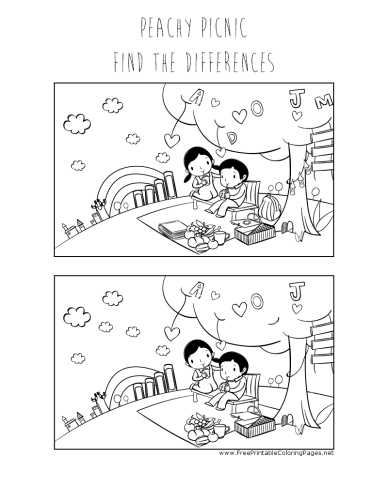
Peachy Picnic Find the Differences Puzzle
These two friends are enjoying a picnic and took two selfies. Can you spot the 12 differences between the two pictures in this printable Peachy Picnic Find the Differences Puzzle?
The recipe—the step-by-step recitation of the ingredients and process for making any dish—is the heart of the culinary arts. Following along, improvising in just the right places, and inventing completely new tastes is its own special kind of literacy. Today we say goodbye to Culinary Arts Month, but hope that the joy of cooking delicious treats and reading fabulous books together remain common, fun activities with which to explore life and love—as shown with today’s book!
Cake Day
Written by Ellen Mayer | Illustrated by Estelle Corke
An adorable little boy runs to his grandma, excited that it’s “Cake Day!” “That’s right,” his grandma agrees, “Today we’re going to bake a cake!” The boy, hardly able to see over the counter, wants to be picked up and see what’s in the cabinet. His grandma happily obliges, and the pair carefully pick the ingredients for their cake.
“‘Hmmm…we need flour, salt, baking powder, and sugar to make a cake,’ says Grandma.” With all the ingredients set on the table, the two start measuring. The little chef is eager and curious: “Cake Day! How much, Grandma? As the flour pours into the cup, a soft, powdery cloud envelops them. “Too much, Grandma!” the delighted boy laughs. The two work side by side, Grandma adding the eggs while her grandson pours in the milk.
Image copyright Estelle Corke, courtesy of Star Bright Books
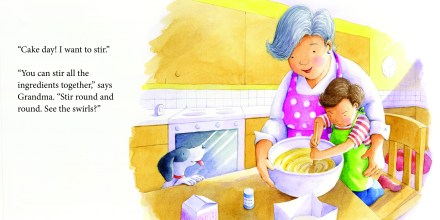
As the ingredients start to mesh, Grandma exclaims, “‘Look! What’s happening to the batter?’” The little boy wants to help it along and takes up the wooden spoon. Round and round he stirs, creating swirls in the yellow batter until it’s ready for the oven. “‘Bake day! Your turn, Grandma!” the boy stands wide-eyed as his grandma slides the deep pan into the oven.
The little boy and his dog settle in front of the oven to watch the cake bake. With eagerness the boy asks, “‘Cake day! Ready, Grandma?” Grandma encourages her grandson’s inquisitiveness and explains the process: “‘We have to wait until the cake rises. The heat makes it rise. When you hear the timer go BEEP BEEP it will be ready.’” At last the cake comes out of the oven, but it’s not ready to be decorated yet. First, they must wait for it to cool.
In a short time the high, golden cake can be iced and decorated. The little boy vigorously shakes a jar of sprinkles over the top, scattering a rainbow of colors across the white frosting. The cake is beautiful and just the right complement to the little boy’s Cake Day, Bake Day, Shake Day—Birthday!
Ellen Mayer’s language-rich and playful story of a small child and his grandmother baking together is a wonderful introduction not only to reading but to the type of full-sentence conversational modeling that improves and increases literacy. The steps to baking the birthday cake flow organically and lyrically through the loving relationship between the little boy and his grandma, enticing young readers to learn more about the world around them and how it works. The repeated phrases “Cake day! Bake day!,” and “Ready, Grandma?” as well as the boy’s short statements offer opportunities for kids to read along and learn new vocabulary as they develop important language skills.
Estelle Corke’s cheery illustrations glow with enthusiasm and the close bond between grandmother and grandson. The grandmother lifts, steadies, and holds the boy while still allowing him to perform all the tasks he can. The little boy, in his green apron, delights in every aspect of the baking process, his eagerness expressed in his animated smile and keen participation. The homey kitchen is awash in inviting colors and objects that children will recognize. The clearly drawn boxes and jars of ingredients, kitchen tools, and furnishings offer readers a chance to practice their vocabulary and learn new words.
Ages Birth – 5
Star Bright Books, 2016 | ISBN 978-1595727466
To see more books by Ellen Mayer as well as language development and reading strategies for young children, visit her website!
Visit Estelle Corke’s website to view a gallery of her artwork!
Star Bright Books publishes fiction nonfiction, and bilingual “great books for great kids” and provides literacy resources for readers.
Culinary Arts Month Activity
Image copyright Ellen Mayer
Grandma’s Cake
Grandma and her grandson baked a delicious, special cake—and now you can too! Here’s the full recipe that Grandma uses. Recipe courtesy of Ellen Mayer.
A Simple Sponge Cake Recipe
Ingredients
1 stick unsalted butter, softened, plus a little to grease cake pan.
1 1/2 cups sugar
2 cups all-purpose flour
1/4 teaspoon salt
2 teaspoons baking powder
3 large eggs at room temperature
2 teaspoons vanilla extract
3/4 cup milk
You will need: 3 mixing bowls:
1 to cream butter and sugar
1 to mix flour, baking powder and salt
1 in which to beat the eggs
A 7-inch diameter, deep cake pan
Directions
Butter pan and dust with flour.
Set the rack at the middle of the oven.
Preheat oven to 350 degrees.
Sift flour, baking powder, and salt into a bowl and set aside.
In large mixing bowl, beat butter and sugar until light and fluffy. In the third bowl, beat the eggs and add milk.
Add 1/3 of the flour mixture to butter mixture then alternate with the egg and milk mixture. Continue to alternate ending with flour mixture. Scrape bowl and beater often.
Add vanilla and mix well.
Pour batter into prepared pan and smooth top with a spatula.
Bake cake about 45 minutes. Insert knife or wooden skewer into the center. If it emerges clean, the cake is done. If not, bake for 5 more minutes.
Remove cake from oven and allow to set for 5 minutes.
Turn cake out onto a cake rack and leave to cool.
Grandma’s Favorite Frosting
8 oz cream cheese
1 1⁄2 cups confectioners’ sugar
1⁄4 stick butter
1 teaspoon vanilla extract
Blend all ingredients together with a mixer until smooth
Farmers’ Markets are bursting with fresh produce during the summer months, and that is especially true for blueberries, those little round morsels of sweetness. The United States Department of Agriculture recognized July as National Blueberry Month in 2003, and it’s been delicious eating ever since! Blueberries are the perfect accompaniment to muffins, pancakes, bread, fruit salads, and of course they’re delectable just on their own! So visit a farmers’ market today and pick up a peck.
More Blueberries!
Written by Susan Musgrave | Illustrated by Esperança Melo
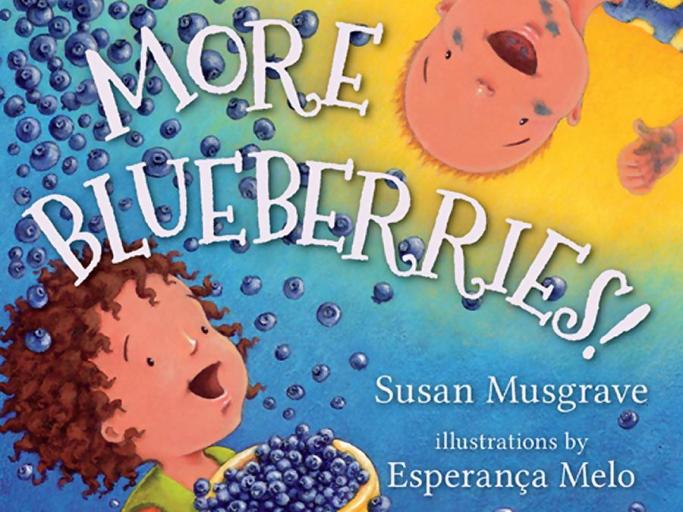
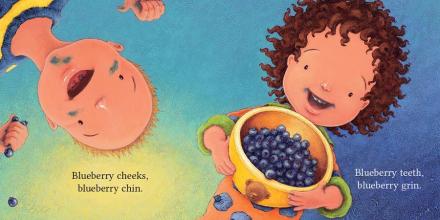
When the blueberries are ripe, the siblings in this adorable picture book live in a blueberry world. The brother and sister are all smiles with their bowl full of berries, and soon they have “Blueberry cheeks, blueberry chin. / Blueberry teeth, blueberry grin. / Blueberry fingers, blueberry nose. / Blueberry lips, blueberry toes.” Oops! After all that yummy, tasty blueberry gobbling, the bowl is empty, eliciting a call for “More Blueberries!”
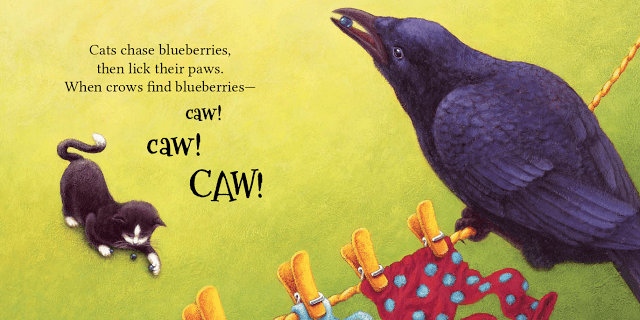
The scrumptious berries find their way into pancakes, muffins, mush, and slush, ice cream, cake—and even cause a bit of an ache. But with a small burp, the cry goes out for MORE BLUEBERRIES! The kids aren’t the only ones who love the season’s fruit—a cat chases them as they roll away, and a cawing crow carries one in its beak like the finest of pearls.
Frogs hop on blueberries with a pop and a splat while teddy bears gulp them down in no time flat. “Meow,” says the cat. “Caw,” says the crow. “Ribbit,” says the frog, and “Grrrrrrr,” says the bear as they all shout for MORE BLUEBERRIES!
But the day is waning and while bath time beckons there’s still more time to turn bathwater blue, sail berries in a tug, wash with blueberry soap and blueberry shampoo. Finally it’s nightime with “Blueberry jammies, / blueberry yawn. / Blueberry bedtime, / blueberries gone.” As the little girl and boy drift off to sleep to dream about blueberries, they snuggle with their teddy bear and froggy toys, leave their crow book until tomorrow, and sleep peacefully under the watchful eye of their cat.
Image copyright Esperança Melo, courtesy of esperancamelo.blogspot.ca
Susan Musgrave’s irresistibly catchy rhymes burst with flavor and will make More Blueberries a favorite story time read for young children. The repeated “blueberry” (such a wonderfully alliterative word!) will capture kids’ imagination and give them the pleasure of reading along even at very early ages. Beyond the fun of the blueberry theme, this book makes an entertaining concept book to teach parts of the body, food, and clothing.
Esperança Melo’s endearing illustrations perfectly depict the messy, delicious, enthusiasm small children develop for certain foods or objects. The sister with her curly mass of brown hair and her brother with spiky blond hair are human canvases of blueberry-painted faces, hands, and feet while their infectious grins display stained teeth and tongues. Their household surroundings are appropriately blue, and even their pets and toys get in on the action.
More Blueberries is a book to add to children’s shelves as it will be asked for again and again!
Ages Birth – 4
Orca Book Publishers, 2015 | ISBN 978-1459807075
Visit Esperança Melo’s website to view her illustrations and paintings portfolio!
To learn more about Susan Musgrave’s books for children and adults visit her website!
National Blueberry Day Activity
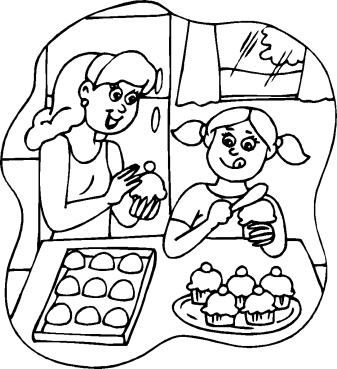
Baking Blueberry Cupcakes Coloring Page
Blueberries make everything better! So get out your blue crayons, pencils, or markers (and some other colors too) and create something berry special with this printable Baking Blueberry Cupcakes coloring page!












 celebratepicturebooks.com