November 3 – It’s Picture Book Month

celebrate-picture-books-picture-book-review-a-head-full-of-birds-cover

About the Holiday

November is all about picture books thanks to Picture Book Month founder author and storyteller Dianne de Las Casas and co-founders author/illustrators Katie Davis, Elizabeth O. Dulemba, Wendy Martin, and author Tara Lazar. This month-long international literacy initiative celebrates print picture books and all that they offer to young (and even older) readers. With gorgeous artwork and compelling stories, picture books open the world to children in surprising ways as they entertain, explain, excite, and help children learn empathy and understanding.

I’d like to thank Eerdman’s Books for Young Readers for sending me a copy of A Head Full of Birds for review consideration. All opinions on the book are my own.

A Head Full of Birds

Written by Alexandra Garibal | Illustrated by Sibylle Delacroix | Translated from the French by Vineet Lal


Nanette is a little girl with “a head full of birds.” She mixed strange foods together, can spend hours looking at an empty spider’s web and “rocks back and forth, to and fro, fluttering her fingers like butterflies.” The kids at school taunt her, calling her “stupid” and treating her meanly. But Nanette doesn’t pay attention to them. One boy in her class, Noah, joins in. But one day while tossing paper airplanes during class, the teacher catches him and makes him sit up front.

celebrate-picture-books-picture-book-review-a-head-full-of-birds-butterflies

Image copyright Sibylle Delacroix, 2022, text copyright Alexandra Garibal, 2022. Courtesy of Eerdmans Books for Young Readers.

This means sharing a table with Nanette, which makes him angry. While pulling out his chair, “he pushes her out of irritation,” which causes her pencil to slide across her drawing of a bird. Nanette is disappointed, whispering “Oh. He won’t fly anymore.” Noah finds this ridiculous and tells her that drawings of birds can’t fly, but Nanette already knows. “‘The drawing doesn’t fly, the bird does,'” she answers.

That day after school, Noah watches as Nanette sets colorful little origami boats to sail down the rain-washed curb. He thinks it looks “so pretty.” The next day, it’s still raining, and during recess Noah sees Nanette standing in the middle of the school yard without her boots catching raindrops. His friends are calling him stupid, but he grabs her shoes and rushes out to bring her back in. But Nanette is happy. She takes her boots and fills them with water running off the roof. They both hide a boot in their coats and run back inside for class.

celebrate-picture-books-picture-book-review-a-head-full-of-birds-boats-on-curb

Image copyright Sibylle Delacroix, 2022, text copyright Alexandra Garibal, 2022. Courtesy of Eerdmans Books for Young Readers.

On the stairs, someone bumps into Noah, spilling his boot. Noah is angry that their plan is ruined, but Nanette tells him it’s okay, that one is enough. She passes him a tiny origami boat, and he drops it into her boot. “The boat twists and twirls, dancing merrily across the water. And it’s so pretty.” Now Noah and Nanette are friends, and “together, they look after the birds that nest in their heads.”

celebrate-picture-books-picture-book-review-a-head-full-of-birds-boot

Image copyright Sibylle Delacroix, 2022, text copyright Alexandra Garibal, 2022. Courtesy of Eerdmans Books for Young Readers.

While quietly straightforward, Alexandra Garibal’s story affects poignancy on multiple levels. Readers are first introduced to Nanette, a girl with neurodiversity who is happy in her observations and interactions with the world while also self-confident enough to ignore the comments of her classmates. Readers see Noah participating in the ridicule, but when he is moved to sit next to Nanette, readers begin to understand that it is he who needs to see the world differently, not Nanette. Children may feel that Noah already embodies this empathy as it doesn’t take long before he appreciates the beauty Nanette brings to their world. 

While he at first feels he must protect her, running out with her boots and aiming to take her back inside from the rain, he again learns that her actions have meaning, and when the boot he’s carrying spills on the way back to class, he now feels the same disappointment of a project ruined that Nanette felt with her bird drawing. With Nanette and Noah’s conspiratorial goofing off in class (and, bravely, in the front row!), Garibal brings the story full circle while infusing it with growth and joy for both characters as they go forward as friends.

celebrate-picture-books-picture-book-review-a-head-full-of-birds-filling-boot

Image copyright Sibylle Delacroix, 2022, text copyright Alexandra Garibal, 2022. Courtesy of Eerdmans Books for Young Readers.

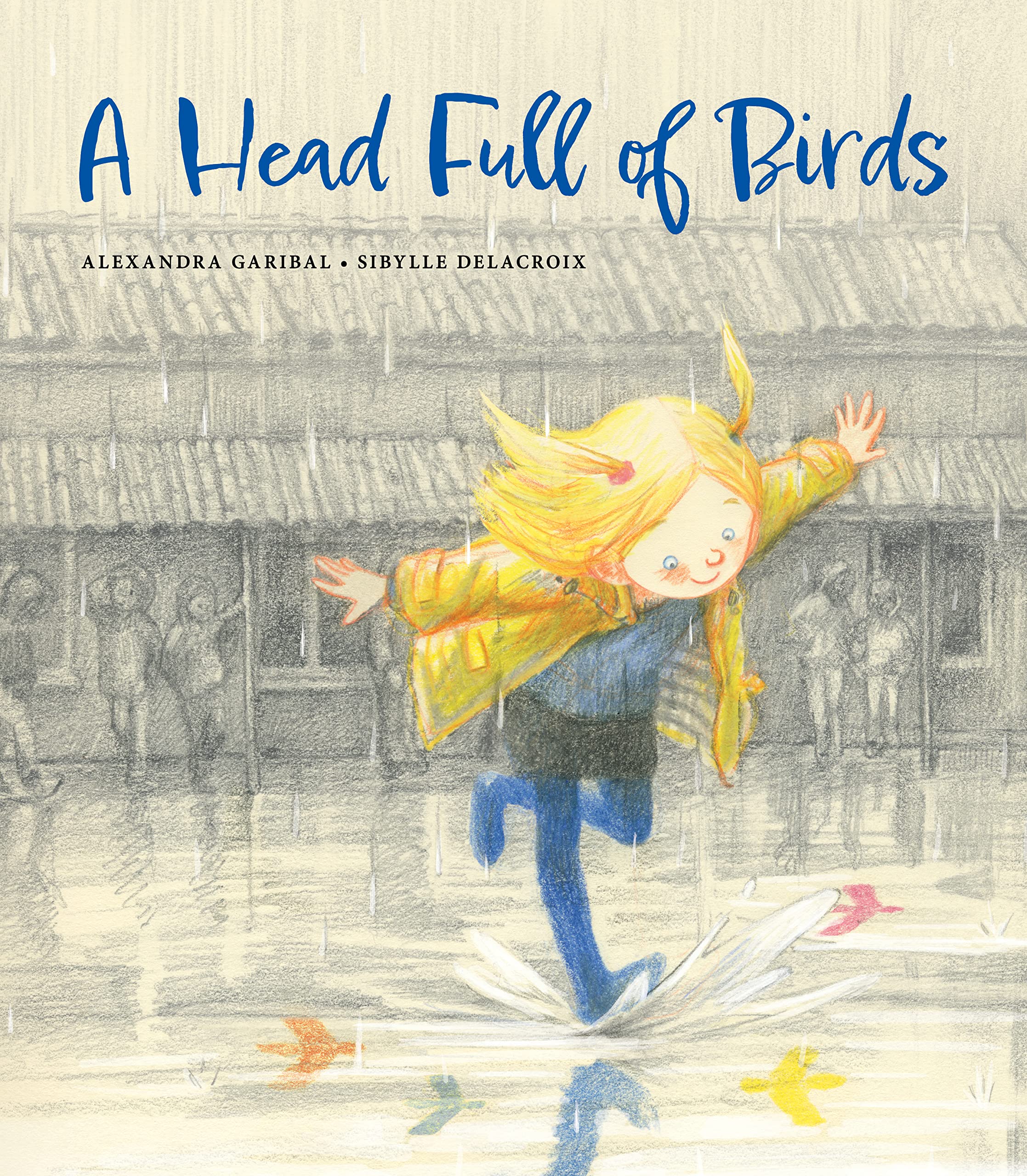
Sibylle Delacroix’s lovely colored-pencil illustrations reveal Nanette as a shining light in the world and in her classroom. She is first shown gazing upward as if the sun is on her face, next with colorful butterflies, and then at school in a bright yellow raincoat, while the background is drawn in gray and the other kids in a single shade of red, all except Noah, who has brown hair and blue glasses, signifying to readers that perhaps he is a bit different as well. 

The two children’s growing friendship takes place against a gray-scale background, putting the focus on both their separation from their environment as well as their similarity to each other. Other visual clues in clothing and other elements also point to Nanette and Noah’s similarity, which can invite kids to find and talk about them. A particularly moving spread comes as the two children watch the little boat float in the boot, their two smiling faces reflected in the water. Turning the page, readers see the imagination Nanette and Noah share as they ride in an origami boat pointing out paper bird above.

This beautiful friendship story speaks not only to the acceptance and understanding of neurodiversity but of all the creative and different ways in which people see the world. A Head Full of Birds will fill your heart and resonate long after the story is over. The book invites multiple re-readings and will generate much thought and discussion. It is a must for all home, classroom, school, and public libraries.

Ages 4 – 8

Eerdmans Books for Young Readers, 2022 | ISBN 978-0802855961

About the Author

Alexandra Garibal is a French children’s author and editor. She has written over sixty picture books, novels, and magazine articles, and her titles have been translated for Chinese and Spanish readers. A Head Full of Birds is Alexandra’s English-language debut. Follow her on Instagram @alexandragaribal.

About the Illustrator

Sibylle Delacroix is the illustrator of Tears, Prickly Jenny, Grains of Sand, and Blanche Hates the Night (all Owlkids). She graduated from the ERG Saint-Luc School of Graphic Research in Brussels and worked for many years as a graphic designer before becoming a full-time illustrator. Sibylle lives in France. Follow Sibylle on Instagram @sibylledelacroix.

About the Translator

Vineet Lal is a literary translator of books from French to English, including A Perfect Spot (Eerdmans) and The Secret Life of Writers (Weidenfeld & Nicholson). He studied French at Princeton University and the University of Edinburgh. Vineet lives in Scotland. Follow him on Twitter @vineet_uk.

celebrate-picture-books-picture-book-review-a-head-full-of-birds-cover

You can find A Head Full of Birds at these booksellers

Amazon | Barnes & Noble | Books-a-Million

To support your local independent bookstore, order from

Bookshop | IndieBound

Picture Book Review

October 25 – Celebrating the Book Birthday of Herbert on the Slide

celebrate-picture-books-picture-book-review-herbert-on-the-slide-cover

Thanks to Hippo Park Books and Deborah Sloan for sending me a copy of Herbert on the Slide for review consideration. All opinions about the book are my own.

Herbert on the Slide (A Hippo Park Pals Book)

By Rilla Alexander


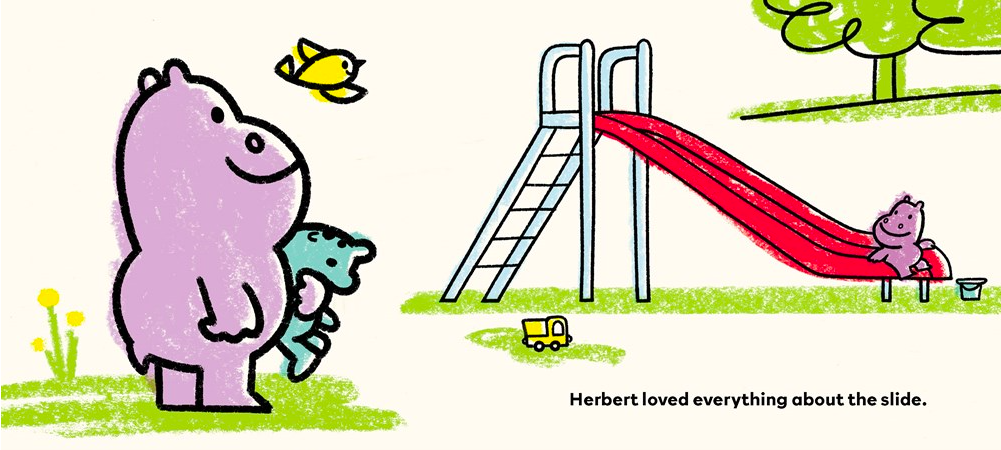
“Herbert loved everything about the slide.” Rilla Alexander’s first sentence speaks directly to the hearts of little ones who fully understand its simple, lovely truth. As Herbert climbs to the top, his teddy bear and truck in tow; settles in on his high perch; launches his “test run” with first Teddy and then truck—”clanky-clank-clank”—and finally counts down to his turn, kids will follow along, entranced by Herbert’s adventure and memories of their own.

celebrate-picture-books-picture-book-review-herbert-on-the-slide-love

Copyright Rilla Alexander, 2022, courtesy of Hippo Park.

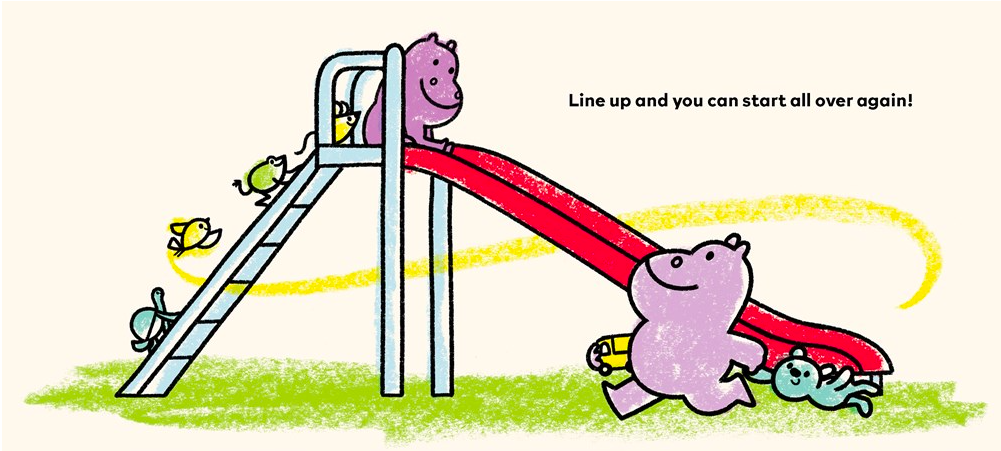
Of course, a slide is never just a slide, and Herbert goes “…again! And again! … sliding down, down, down…into his imagination!” One time, on his belly, “Herbert and Teddy are diving into a deep, purple sea!” Next time, “Herbert is a truck climbing up, up, up a mountain. Chug-chug-chug!” But Herbert isn’t the only one at the playground. His little sister is ready for her turn—and so is mouse and frog and turtle. There’s just one thing to do. “Line up and you can start all over again!”

celebrate-picture-books-picture-book-review-herbert-on-the-slide-over-again

Copyright Rilla Alexander, 2022, courtesy of Hippo Park.

Rilla Alexandra’s endearing story for little ones, matched page-by-page by her adorable, “awww”-inspiring art is snuggle-up story time reading at its best. Perfectly reflective of a child’s playfulness and imagination, Herbert on the Slide is not only a story that will captivate them time and time again but a wonderful entry into the world of literature.

A subtle subplot involves Herbert’s younger sister, Fiona (soon to be the star of her own Hippo Park Pals book, Fiona in the Sandbox, coming February 7, 2023). She is at first unidentified and only seen in the distance, heading to the sandbox with her pail, a detail sure to pique kids’ interest. She’s later heard telling Herbert—who, mesmerized by an imagined chase and its successful conclusion, is resting on the bottom of the slide—that it’s her turn. Turning the page, kids see that she’s sitting atop the slide with a line of other wanna-be sliders waiting behind her. Alexander’s encouragement for Herbert to get in line and start again is a gentle and reassuring life lesson.

Sweet smiles and a sunny ambiance welcome readers on every clean, slide-focused page. Each scene is colored with the texture of crayons in bright shades and with the “messy” enthusiasm of children’s art.

A Special Note: The book’s small size (5 1/4-inches by 4 3/4-inches) makes it a perfect take-along, easily slipped into a backpack, diaper bag, or even a pocket for picnics, snack time, or just reading-time fun at the playground, park, beach, farmers market, or anywhere waiting may be required.

Cute as a button and perfectly reflecting the excitement and imagination of children’s free play, Herbert on the Slide is a must for any baby’s or preschooler’s home bookshelf as well as for school and public library collections. The book would be a favorite story time read aloud for daycare, preschool, and kindergarten classrooms as well as for public libraries’ preschool programs. It would also make a much-loved gift for baby showers, new siblings, birthdays, and the holidays. 

Ages 2 – 5

Hippo Park Books, 2022 | ISBN 978-1662640117

Discover more about Rilla Alexander, her books, and her art on her website.

Herbert on the Slide Book Birthday Activity

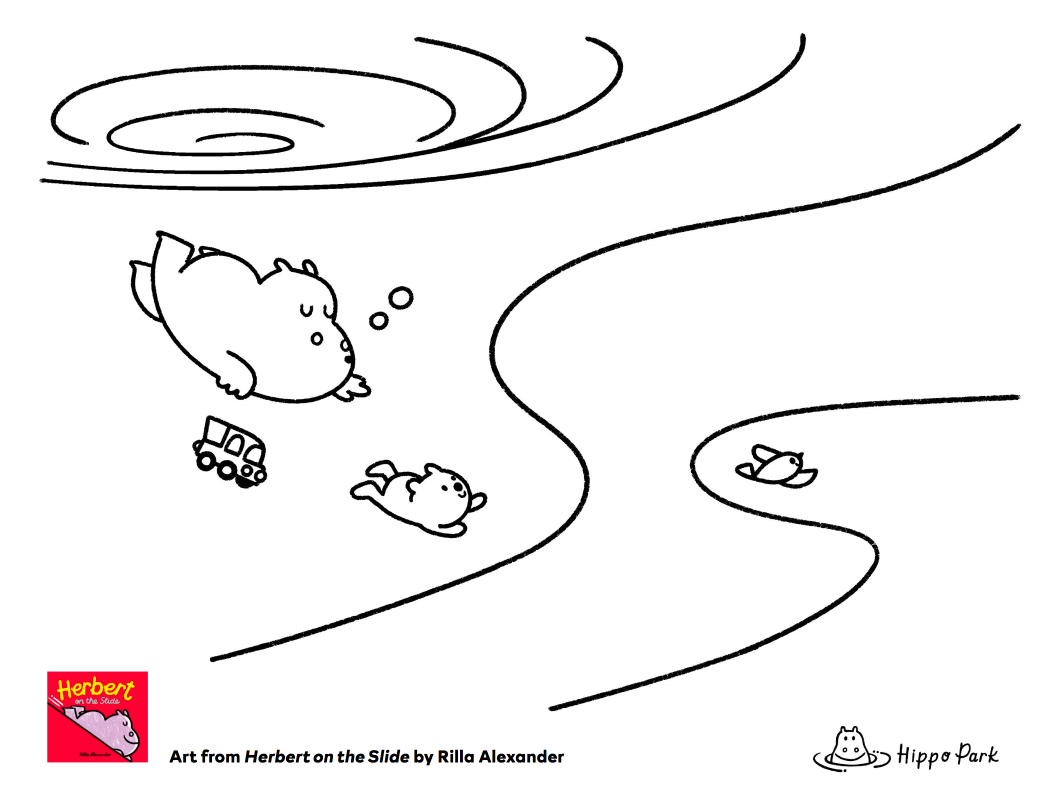
celebrate-picture-books-picture-book-review-herbert-on-the-slide-coloring-page

Herbert on the Slide Coloring Pages


You can find three fun coloring pages from Herbert on the Slide to print on the Hippo Park homepage at Astra Publishing House or here.

celebrate-picture-books-picture-book-review-herbert-on-the-slide-cover

You can find Herbert on the Slide at these booksellers

Amazon | Barnes & Noble | Books-a-Million

To support your local independent bookstore, order from

Bookshop | IndieBound

Picture Book Review
September 6 – It’s Friendship Month

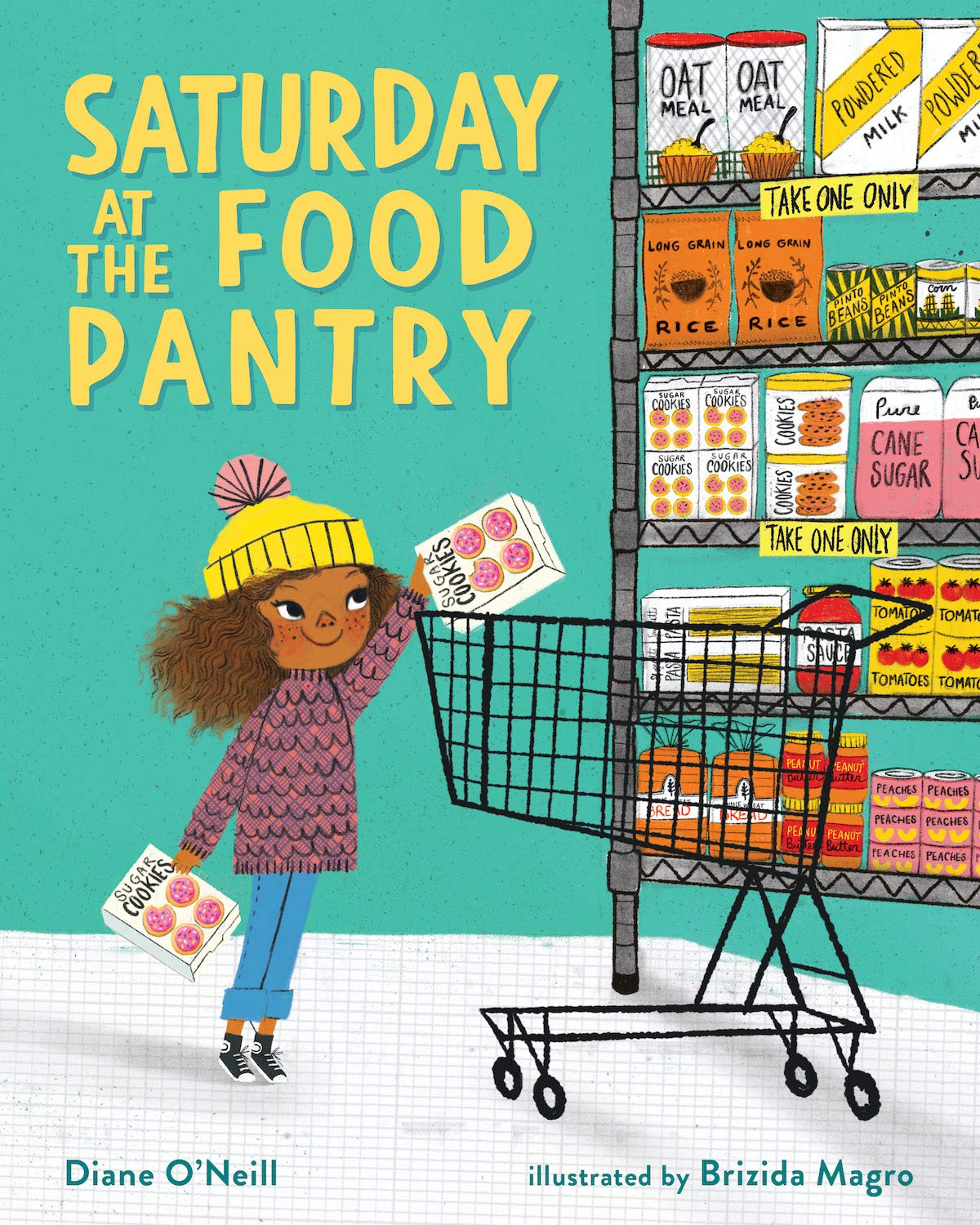
celebrate-picture-books-picture-book-review-big-bear-and-little-fish-cover

About the Holiday

Friendship Month was established by the Oddfellows (shortened from The Grand United Order of Oddfellows Friendly Society (GUOOFS)), an international fraternity that dates back to 1730s England with the hope of encouraging people to make friends. Now dedicated to philanthropy and charity, the Oddfellows still promote Friendship Month each September to urge people to spend more time with their friends, get in touch with those they haven’t seen or talked to in a while, and, especially, to reach out to others who are alone or need a friend. As school gets underway, there are plenty of opportunities for kids to meet new people and form friendships – some of which may last a lifetime.

I’d like to thank Carolrhoda Books and Blue Slip Media for sharing a copy of Big Bear and Little Fish with me for review consideration. All opinions on the book are my own.

Big Bear and Little Fish

Written by Sandra Nickel | Illustrated by Il Sung Na


At the fair, Bear approached the basketball game booth, where the grand prize was a huge teddy bear. It was almost as big as Bear, herself. But Bear took away the consolation prize: a goldfish. “It was small. It was very small. It was so small it lived in a bowl.” Bear peered into the bowl, but when Fish woke up and said “‘Hello, Bear. Is this my new home?'”, Bear only nodded, afraid her big voice would scare little Fish.

celebrate-picture-books-picture-book-review-big-bear-and-little-fish-teddy-bear

Image copyright Il Sung Na, 2022, text copyright Sandra Nickel, 2022. Courtesy of Carolrhoda Books.

When lunchtime came, Bear made herself a sandwich with syrup that was as gold as she was. Bear didn’t know what to feed Fish, who was orange and probably liked “carrot muffins … or tangerines and pumpkins.” After lunch, Bear always measured herself. Today, she was over nine feet big! Bear didn’t know how she could measure Fish, so she left home for her regular afternoon walk, wishing – and not for the first time – that Fish was a teddy bear.”

While walking, Bear contemplated how inconvenient Fish might find the outdoors. Things could fall into her bowl and get caught in her tail. If she had a teddy bear Bear thought again, she wouldn’t have to worry about such things as tails. Bear began to regret ever bring Fish home from the fair. When Bear got home again, Fish greeted her with a “‘Hello” and a comment on how much she liked their porch.

celebrate-picture-books-picture-book-review-big-bear-and-little-fish-bowl

Image copyright Il Sung Na, 2022, text copyright Sandra Nickel, 2022. Courtesy of Carolrhoda Books.

In response, Bear gave Fish the bad news that she couldn’t stay. When Fish asked why, Bear laid out her reasons: Fish was orange and ate orange foods; Fish had a tail that made it impossible for her to go on walks with Bear; and finally that Fish was too small. Fish was undaunted. She pointed out that Bear was orange too, and when Bear inspected her belly, she agreed that it “was an orangey sort of gold” kind of “like a carrot muffin.” Fish then added that Bear had a tail, and when Bear looked over her shoulder, she saw a tiny tuft. As to the assertion that she is “small,” Fish was surprised. 

celebrate-picture-books-picture-book-review-big-bear-and-little-fish-hello

Image copyright Il Sung Na, 2022, text copyright Sandra Nickel, 2022. Courtesy of Carolrhoda Books.

“Am I?” she asked then welcomed being measured. She stretched herself out, and Bear measured her: three inches long. Fish was happy with this result; she wasn’t so small after all. “‘I am not one inch. I am not two inches. I am three inches,'” she said proudly. Still, Bear couldn’t get over the idea that Fish was so tiny she had to live in a bowl. 

But Fish was philosophical. “‘Don’t you live in a bowl too?'” she asked. Bear had never thought of it that way before, and as she looked around at the big, blue sky, she suddenly felt small too. Fish reassured her and offered another perspective on physical size compared to how big one could feel inside. Bear considered this and then decided she’d like to take another walk – this time accompanied by Fish. And so they set off in search of a very big carrot muffin.

celebrate-picture-books-picture-book-review-big-bear-and-little-fish-sandwich

Image copyright Il Sung Na, 2022, text copyright Sandra Nickel, 2022. Courtesy of Carolrhoda Books.

In her seemingly odd “fellows” friendship story, Sandra Nickel presents a multi-layered look at what it means to be a true friend. She cleverly offers readers a variety of lenses for them to engage in perspective, from the character’s viewpoints to their own. Bear, alone at home and on her walks, focuses only on herself. At the fair, she wants to win a teddy bear that is a twin to herself but for which she would not need to be responsible in any real sense.

Fish, however, immediately wants to interact with Bear. She talks to him and asks questions. At first, it may seem that Bear will simply ignore Fish, but the idea of her has begun to make Bear think and even worry (here, Nickel creates a complex mix of emotions that invites discussion). Equally thought-provoking are Fish’s counter arguments when Bear tells her she can’t stay. While promoting how similar they are, Fish prompts Bear to reevaluate her view of herself and the world she lives in. Once Bear realizes that she, too, can be considered small and that the full measure of a person (or Fish or Bear) is found inside oneself, she embraces Fish – responsibilities, friendship, muffins, and all.

Il Sung Na plays with perspective and color to subtly guide readers through the stages of this endearing friendship. As Bear walks home from the fair, dejectedly carrying Fish in her bowl, the hilly landscape is washed in shades of blue and the twiggy, leafy, mushroomy vegetation replicates an ocean bottom. This evocative effect continues throughout the book, prompting kids to find other similarities between Bear and Fish and their environments. Readers will also enjoy pointing out examples and comparisons of big and small.

An endearing and thought-provoking story that boosts self-confidence while promoting friendship, empathy, and new perspectives, Big Bear and Little Fish will become a quick favorite on home bookshelves, a go-to book for classrooms, and a must for school and public library collections.

Ages 4 – 8

Carolrhoda Books, 2022 | ISBN 978-1728417172

Discover more about Sandra Nickel and her books on her website.

To learn more about Il Sung Na, her books, and her art on her website.

Dive in to this book trailer for Big Bear and Little Fish!

Friendship Month Activity

celebrate-picture-books-picture-book-review-beanstalk-craft-with-top


Measuring Stick Craft


Bear and Fish loved getting measured. If you’re looking for a unique way to measure how big you are, here’s a craft for you! This nature-inspired measuring stick can keep track of your big and small growth spurts whenever you sprout up. You can even add leaves to record thoughts, favorite things, and other ideas as you age! 

Supplies

  • 50-inch wooden stake, available at craft stores
  • Dark and light green foam sheets or 45 – 50 small wooden leaves, available at craft stores
  • Green paint, light and dark
  • Black marker
  • Paint brush
  • Strong glue
  • Flower pot
  • Oasis or clay
  • Ruler
  • Pencil

celebrate-picture-books-picture-book-review-beanstalk-craft-closeup

Directions

  1. Paint the wooden stake with the green paint, let dry
  2. With the ruler mark the stake in 1-inch increments along the edge of the stake

How to Make the Leaves

  1. If using wooden leaves, paint half light green and half dark green
  2. If using foam, cut 1 3/4-inch-long tear-drop shaped leaves (half from light green foam, half from dark green foam), 45 – 50 or as needed
  3. Cut two larger leaves, one from each color to decorate the top of the stake
  4. Draw a line down the center of each leaf

For Measuring Growth: Write the inch 1 through 45 or higher on each leaf with the black marker, alternating colors

For Recording Ideas: You can write favorite ideas, hobbies, or hopes on the leaves too and measure your growth that way!

How to Attach the Leaves

  1. Glue the leaves to the stake, attaching the odd-numbered inch leaves to the left side of the stake and the even-numbered leaves to the right side of the stake.
  2. Attach half of the leaf to the stake, letting the tip stick out from the side
  3. Glue the two larger leaves to the top of the stake

How to Store Your Yardstick

  1. Put the oasis or clay in the flower pot
  2. Stick the stake into the flower pot to keep it handy

celebrate-picture-books-picture-book-review-big-bear-and-little-fish-cover

To get a copy of Big Bear and Little Fish personalized by Sandra Nickel

Visit Watermark Books to request a signed and personalized copy. When ordering, simply note your desired dedication in the Comments section. Sandra will sign on September 24, 2022, so be sure to order in plenty of time.

You can also find Big Bear and Little Fish at these booksellers

Amazon | Barnes & Noble | Books-a-Million

To support your local independent bookstore, order from

Bookshop | IndieBound

Picture Book Review
September 2 – National Food Bank Day

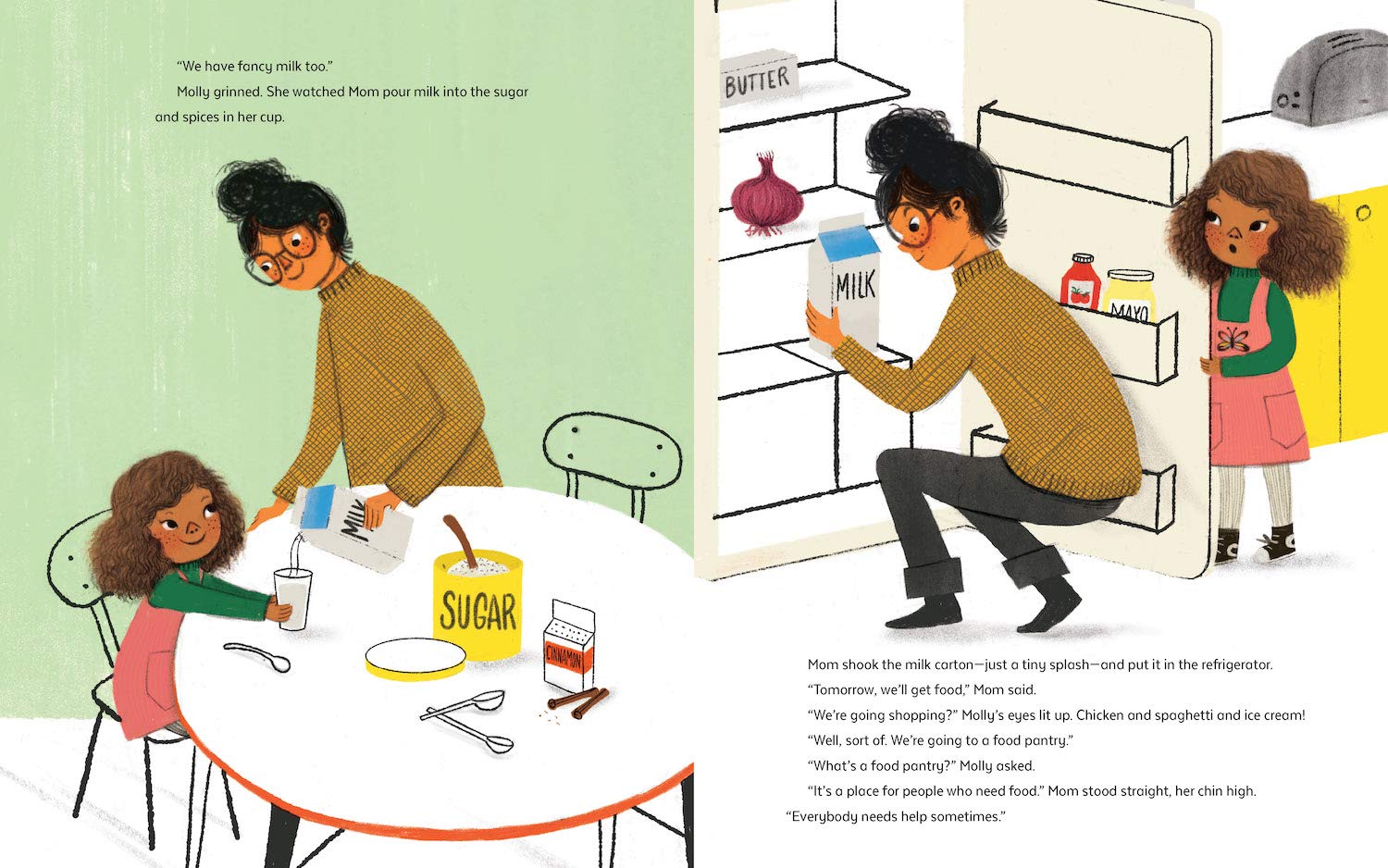
celebrate-picture-books-picture-book-review-saturday-at-the-food-pantry-cover

About the Holiday

National Food Bank Day was established by St. Mary’s Food Bank, the world’s first food bank, which was founded by John van Hengel in Phoenix, Arizona in 1967. The idea spread throughout the country, and now St. Mary’s Food Bank distributes 250,000 meals daily with the help of staff, volunteers, and partner agencies, making it one of the largest food banks in the United States. This year, a record number of families (nearly 150,000 in August alone) have sought help. Food banks across the country help millions of men, women, and children who live with food insecurity due to job loss, illness, and other circumstances. Many food banks offer educational opportunities that help people change their situation and begin anew. Often, those who have benefited from the programs return to volunteer and contribute to the very food bank that helped them. To learn more about St. Mary’s Food Bank, visit their website. To find a food pantry in your area to get help for yourself, to donate, or to volunteer, visit the Ample Harvest website.

I’d like to thank Albert Whitman & Company for sharing a copy of Saturday at the Food Bank with me for review consideration. All opinions on the book are my own.

Saturday at the Food Pantry

Written by Diane O’Neill | Illustrated by Brizida Magro


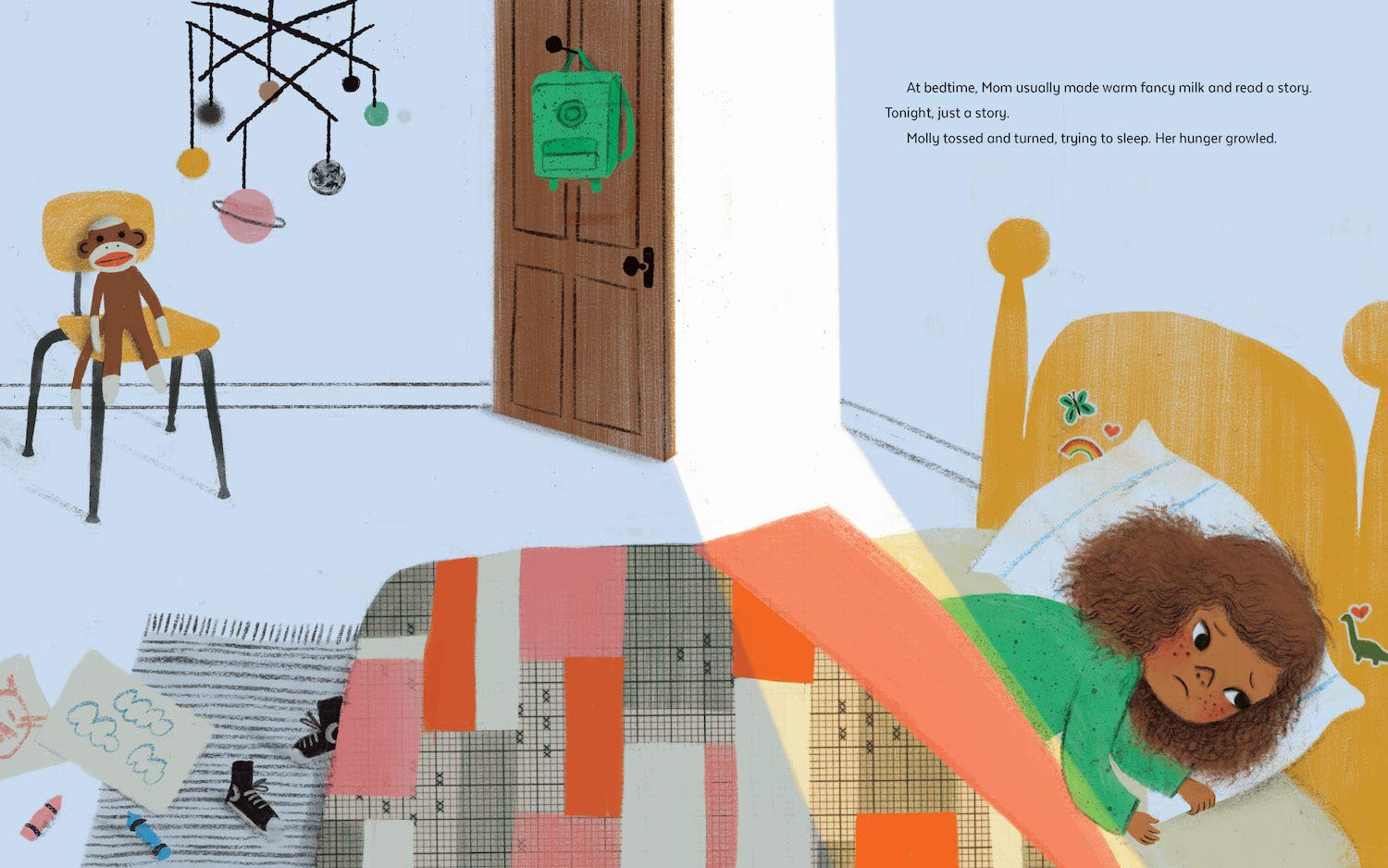
When Molly came to the table for dinner, she saw that they were having chili—again. She and her mom had eaten chili for two weeks straight. But there was “fancy milk too.” Molly smiled as her mom measured sugar and cinnamon into her glass and added milk.” There was only a splash of milk left when Mom put it back into the almost-empty refrigerator.

Tomorrow, Mom said, they’d go shopping. “Molly’s eyes lit up” as she imagined “chicken and spaghetti and ice cream.” But Molly’s mom tempered her expectations, saying that they’d be going to a food pantry. A food pantry, she explained, is “‘a place for people who need food…. Everybody needs help sometimes,’” she added. That night there was no warm milk before Molly went to bed and her stomach growled.

celebrate-picture-books-picture-book-review-saturday-at-the-food-pantry-milk

Image copyright Brizida Magro, 2021, text copyright Diane O’Neill. Courtesy of Albert Whitman & Company.

In the morning when Molly and her mom got to the food pantry there was already a line waiting for it to open. Molly had brought paper and crayons and sat down to draw. Then she saw a girl who was in her class at school. She called out a hello, but “Caitlin looked away.” When Molly ran over, Caitlin told her she didn’t want anyone to know that she and her grandmother needed help.

Molly went back to her mom, wondering if there was “something wrong with needing help.” She wanted to go home, but she was also hungry. Molly’s mom suggested she draw a picture, and the woman in front of them asked if she’d draw one for her too. Then everyone in line seemed to want a picture. Molly ran back to Caitlin to ask for help. Caitlin sat down and began to draw too.

celebrate-picture-books-picture-book-review-saturday-at-the-food-pantry-hungry

Image copyright Brizida Magro, 2021, text copyright Diane O’Neill. Courtesy of Albert Whitman & Company.

When the door opened, Molly and Caitlin each had a picture for the woman who welcomed them in too. Molly noticed that her mom had to sign in before she got a cart and they could begin shopping. They didn’t do that at the grocery store. The shelves at the food pantry were stocked with items she recognized from the store they usually shopped with. She ran over and took a box of sugar cookies off the shelf, but her mom told her “‘They—the people in charge—they’ll want us to take sensible stuff.’” Molly felt embarrassed and couldn’t understand why the cookies were there if they couldn’t take them. She sadly returned them to the shelf. As they went to look for food, Molly thought her mom didn’t want to be seen there, either—just like Caitlin. In a whisper, Molly reminded her that everyone needs help sometimes.

They went through the store taking one can, bag, or box of the food they needed. Then Molly’s mom reached for a box of powdered milk. They could have fancy milk that night. When they got to the checkout desk, Molly and Caitlin found their drawings hanging on the wall. The man at the counter bagged their groceries and then handed Molly’s mom a box of sugar cookies. “‘Saw your little girl looking at these. She can have them, if that’s okay with you, ma’am,’” he said. Molly noticed that her mom looked like she might cry.

celebrate-picture-books-picture-book-review-saturday-at-the-food-pantry-line

Image copyright Brizida Magro, 2021, text copyright Diane O’Neill. Courtesy of Albert Whitman & Company.

As they were walking home, Molly saw Caitlin and her grandmother coming the same way. They were all happy to discover that they were neighbors. Molly’s mom explained that she’d been looking for work since the factory closed, and Caitlin’s grandma said she’d been sick. Caitlin understood, but wished they didn’t have to shop at a food pantry. But then Molly told her that “everybody needs help sometimes” and reminded her that they had helped make the man at the checkout counter feel happy with their drawings. Caitlin hadn’t thought about it that way. She smiled. Then Molly invited her and her grandmother to have lunch with them—with sugar cookies for dessert.

Following the text, a note for parents, teachers, and other caregivers from Kate Maehr, the Executive Director and CEO of the Greater Chicago Food Depository, reveals more information about food insecurity, including recent statistics and a resource where people can find help and more information.

celebrate-picture-books-picture-book-review-saturday-at-the-food-pantry-shopping

Image copyright Brizida Magro, 2021, text copyright Diane O’Neill. Courtesy of Albert Whitman & Company.

Diane O’Neill’s well-executed story about two families who need the help of a food pantry is a poignant reminder of the many people—perhaps even readers’ classmates—who face food insecurity every day. Through the experiences of Molly and her mother and Caitlin and her grandmother, readers discover what it’s like to go to bed hungry, miss out on treats, and feel ashamed to ask for help. As this is Molly and her mother’s first trip to a food pantry, Molly’s questions and observations well reflect children’s own or reassures those who are familiar with these important resources.

O’Neill’s straightforward storytelling emphasizes the fact that at one time or another everyone needs help and demonstrates simple ways that children make things better through their generosity, optimism, and acceptance. Molly and Caitlin’s budding friendship makes for an uplifting and hopeful ending and may spur readers to recognize need in their midst and extend kindness.

Through her realistic illustrations of two families in need of assistance from a food bank, Brizida Magro helps children see and understand what food insecurity and food pantries look like. At home, Molly and her mom eat small portions of leftover chili and the last full glass of milk. When Molly’s mom puts the carton in the refrigerator, the shelves are nearly empty, and Molly lies awake in bed, too hungry to fall asleep.

The line outside the food pantry is made up of people from all walks of life, and inside the displays of food replicate a grocery store with the exception of signs asking shoppers to take one item only. These images can lead to meaningful discussions on the enormity of the issue. When Molly and Caitlin draw pictures that cheer up everyone in line as well as the food pantry workers, kids will recognize not only different ways of helping but their own role in making the world a kinder place.

Empathy shines on every page of O’Neill’s necessary and welcome story. Saturday at the Food Pantry is timely, heartfelt, enlightening and a must-buy addition to home, classroom, and school and public library collections.

Ages 4 – 7

Albert Whitman & Company, 2021 | ISBN 978-0807572368

Discover more about Diane O’Neill and her work on her website.

You can connect with Brizida Magro on Instagram.

celebrate-picture-books-picture-book-review-saturday-at-the-food-pantry-cover

You can find Saturday at the Food Pantry at these booksellers

Amazon | Barnes & Noble | Books-a-Million

To support your local independent bookstore, order from

Bookshop | IndieBound

Picture Book Review
September 1 – It’s Read a New Book Month

celebrate-picture-books-picture-book-review-the-boy-and-the-mountain-cover

About the Holiday

The beginning of a new school year is a terrific time to celebrate Read a New Book Month—especially for kids. Whether their reading tastes have broadened, their reading level has changed, or they’ve discovered new and fascinating topics to explore over the summer months, there are new books just waiting for them! The books may be recently published—like today’s book—or just new to your child, there are countless fictional stories and nonfiction books ready to inspire learning, to laugh or cry with, and to share with friends. This month visit your local bookstore and library and stock up on books for your kids and everyone in the family! 

The Boy and the Mountain

Written by Mario Bellini | Illustrated by Marianna Coppo


“There once was a boy who always looked at a mountain.” It was the first thing he looked at in the morning and the last thing he said good night to before going to bed. The boy loved to draw, and one day he “decided to draw the mountain.” His first attempt didn’t look anything like the mountain he saw out his window. When he looked closer, he realized “the mountain was covered with trees,” so he added trees. 

celebrate-picture-books-picture-book-review-the-boy-and-the-mountain-drawing

Image copyright Marianna Coppo, 2022, text copyright Mario Bellini, 2022. Courtesy of Tundra Books.

Still, his picture wasn’t quite right. Next, he noticed the sky and clouds around the mountain and drew those, but his picture “still didn’t look the same as the real thing.” He tried drawing the mountain at different times of day and in different weather, but “he was never happy with what he had drawn.” 

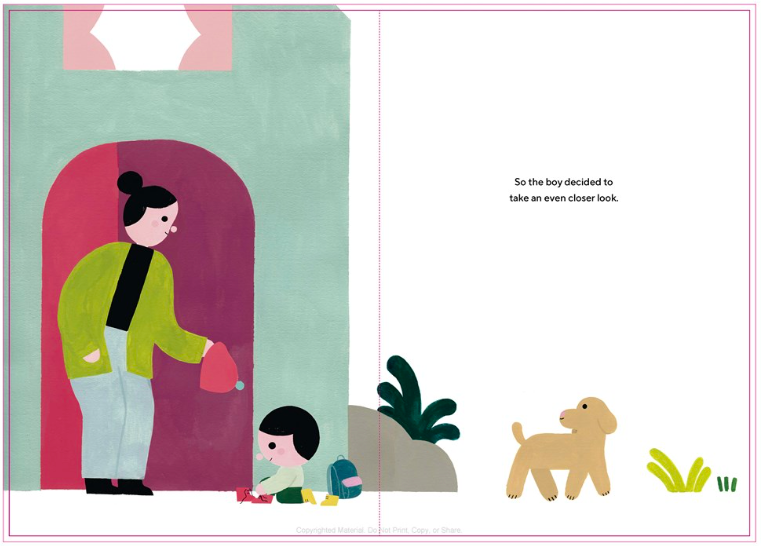
One day, the boy decided to get a closer look. He took his dog and headed out. One the way, he met a goat and drew a picture of it in his sketchbook. The goat decided to come along. When a flock of birds flew by, the boy drew those too. One bird left the flock to follow the boy and his dog and the goat. When they stopped at a stream for a drink of water, the boy drew that too.

celebrate-picture-books-picture-book-review-the-boy-and-the-mountain-trees

Image copyright Marianna Coppo, 2022, text copyright Mario Bellini, 2022. Courtesy of Tundra Books.

It was fall, and the ground was covered in leaves. The boy “wanted to draw them all,” but even though he drew many of them, there was no way they would all fit on the page. He continued on up and up into the forest and beyond. Along the way, he picked up other followers, including a frog, a bear, and a beaver. When he had left the trees behind, there was very little to draw “until he looked more closely” and saw a tiny white flower poking up between some rocks. He drew it.

celebrate-picture-books-picture-book-review-the-boy-and-the-mountain-hike

Image copyright Marianna Coppo, 2022, text copyright Mario Bellini, 2022. Courtesy of Tundra Books.

At last he came to the mountain’s peak. He sat down and flipped through his sketchbook, but he still wasn’t satisfied with his drawings. It was then that he became aware of the goat, the bear, the frog, the bird, the beaver, and a snail who had joined him. “‘Ohhh … hello!'” he said. They played until it was time to go home. The bear gave the boy a ride home on his shoulders. Once home, the boy promised that he would see them all again soon. That night before going to sleep, the boy drew the mountain again with his new perspective. This time his drawing was complete—and the boy was completely satisfied with it.

celebrate-picture-books-picture-book-review-the-boy-and-the-mountain-goat

Image copyright Marianna Coppo, 2022, text copyright Mario Bellini, 2022. Courtesy of Tundra Books.

Mario Bellini’s thoughtful and well-paced adventure gently guides readers to consider not only their perspective on big and small topics of life but where and how they fit into the wider world. Just as children observe the world from their vantage points of home, school, and activities, the boy in the story looks at the mountain and tries to make sense of it by drawing it. Then, like kids slowly adding bits of what the world has to offer to their lives, the boy includes trees, clouds, and different times of day to his drawing. But he thinks there must be something more, and, now braver and more knowledgeable, he ventures out to get a better look. 

Along the way he sees more of the world and interacts with what he encounters in the way that means the most to him. Some of these experiences turn out well, and others don’t, but he persists. When it appears that he’s finally come to the end of his journey, he sits down (alone, or so he thinks) and ponders his single-subject, disjointed pictures. When he finally notices all of the animals who have joined him on his trek and embraces them as friends, the boy discovers an interconnectedness that has been missing for him all along. At last, with his final drawing, the boy is able to be satisfied with his knowledge, understanding, and place in his world.

Marianna Coppo’s delightful rounded illustrations lend a quiet elegance to the story while allowing readers to view the boy’s drawings for themselves and then join him on his journey to see the mountain up close. Kids will enjoy noticing the animals that begin to populate the boy’s sphere, even while he is unaware that they are following him. The boy’s drawings of the river, the leaf-strewn forest floor, and the hidden mountain peak give kids and adults an opportunity to talk about times when things go wrong, when life seems overcrowded or overwhelming, and when goals seem elusive. Coppo also helps kids see that surprises can be found in the most unlikely of places as well as when you least expect them. 

A multi-layered story that invites thought, observation, conversation, and discovery (of both the self and the world), The Boy and the Mountain would be a favorite read for quiet story times or as a prelude to any new experience at home or in school. The book is highly recommended for home bookshelves as well as classroom, school, and public libraries.

Ages 3 – 7

Tundra Books, 2022 | ISBN 978-0735270251

You can connect with Marianna Coppo on Instagram and Twitter.

Read a New Book Month Activity

celebrate-picture-books-picture-book-review-take-a-bookworm-trek-maze

Take a Bookworm Trek! Maze


These two friends love reading! Can you help them through the maze to meet the bookworm? 

Take a Bookworm Trek! Maze Puzzle | Take a Bookworm Trek! Maze Solution

celebrate-picture-books-picture-book-review-the-boy-and-the-mountain-cover

You can find The Boy and the Mountain at these booksellers

Amazon | Barnes & Noble | Books-a-Million

To support your local independent bookstore, order from 

Bookshop | IndieBound

Picture Book Review

July 20 – It’s Get Ready for Kindergarten Month

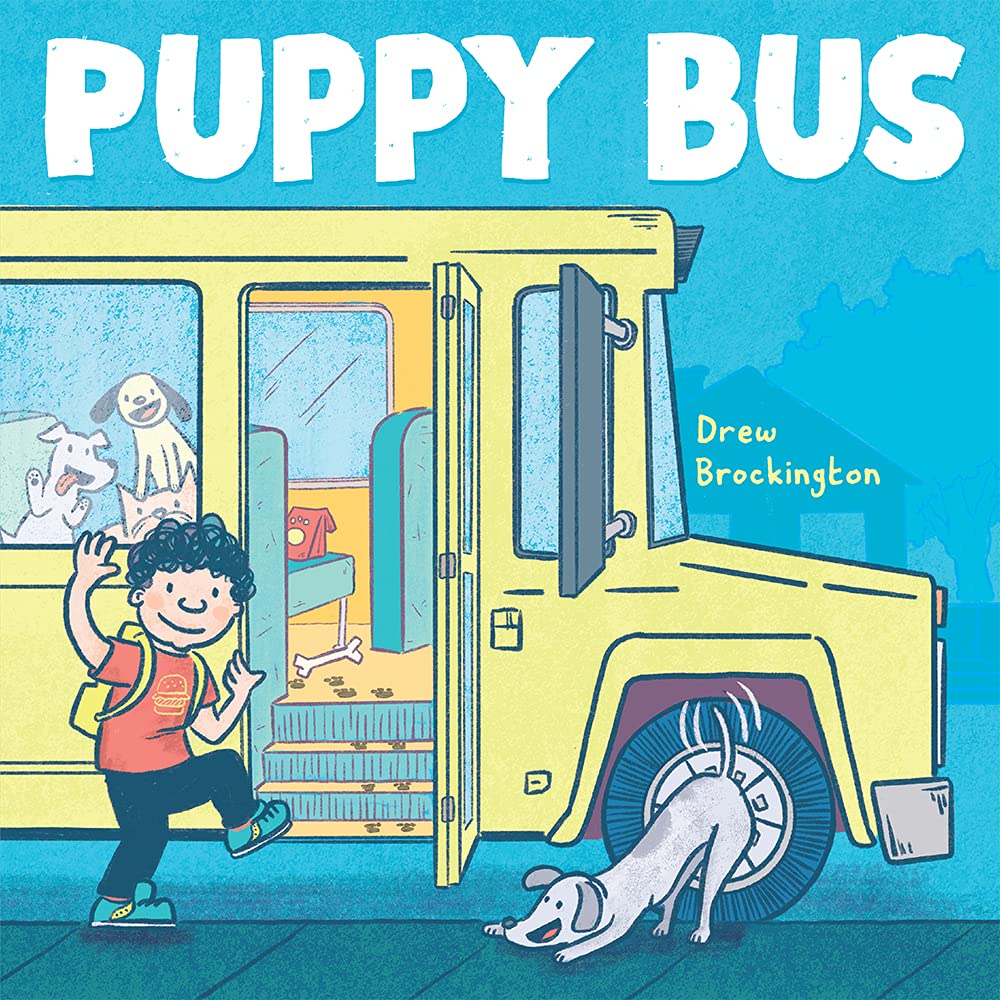
celebrate-picture-books-picture-book-review-puppy-bus-cover

About the Holiday

Starting Kindergarten is a major milestone in any child’s life and ushers in exciting growth in knowledge, friendships, and experiences. But children don’t all perceive and process the world in the same way. Being sensitive to individual differences and talking about issues as they arise are just two of the ways that kids can making navigating school or any new experience easier. Sharing picture books like today’s book can help too! 

Thanks to Harry N. Abrams for sending me a copy of Puppy Bus for review consideration. All opinions on the book are my own.

Puppy Bus

By Drew Brockington


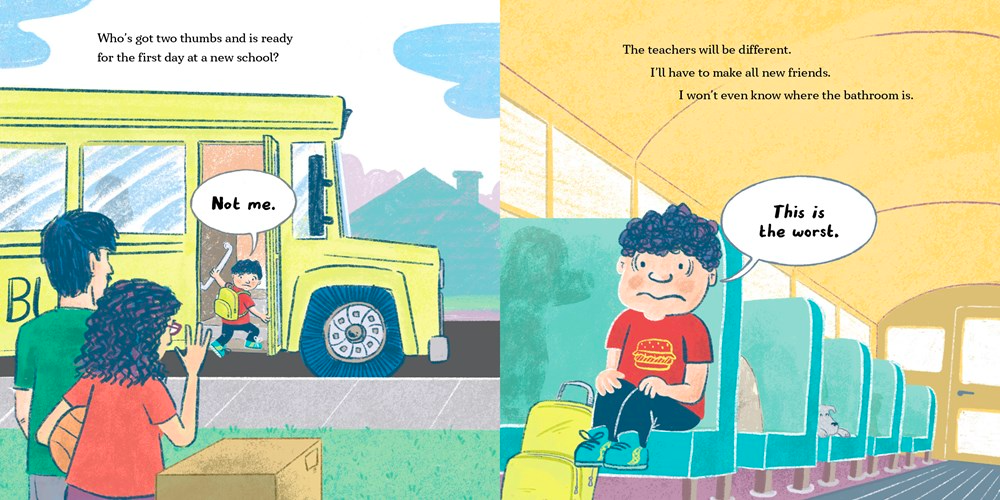
As a boy’s parents unload the moving truck, he heads up the steps of the school bus with an anxious backward glance. once on the bus, his nerves take over and his mind races with all the new things he will encounter: “The teachers will be different. I’ll have to make new friends. I won’t even know where the bathroom is.” But in a minute, he gets a friendly lick of reassurance. Wait, what? That’s right, a big, slobbery lick of friendship. His seatmate even offers the boy his paw to shake. 

celebrate-picture-books-picture-book-review-puppy-bus-first-day

Copyright Drew Brockington, 2022, courtesy of Harry N. Abrams.

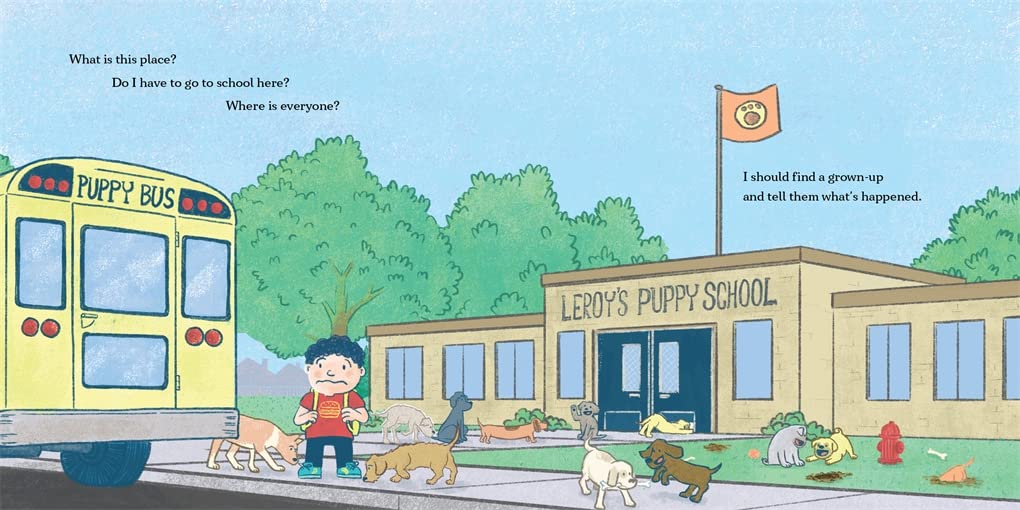
It’s just about this moment that the boy realizes he’s made a mistake. “I’m on the wrong bus!” he shouts with an attendant “AUGHHH!!!” Well, it’s too late to do anything about it now. The boy gets off at Leroy’s Puppy School with all the other students and decides to find an adult to talk to. He finds the principal’s office only to find that the principal is also a dog. “Woof! Woof! Bark! Bark!” The principal does his best to help, but there’s a definite communication problem.

celebrate-picture-books-picture-book-review-puppy-bus-school

Copyright Drew Brockington, 2022, courtesy of Harry N. Abrams.

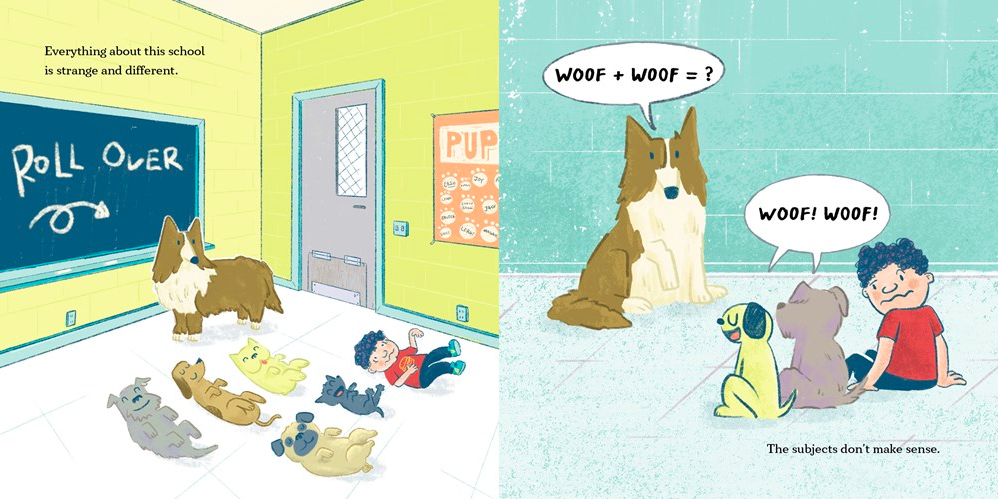
The boy’s just wondering what he’s going to do now, when one of his fellow classmates gets a chomp on his shirt and drags him toward a doggie door leading to a classroom. Once everyone’s inside, the lessons begin. As the collie leads the class in learning how to roll over, the boy thinks, “Everything about this school is strange and different.” Math class doesn’t really add up. The bowlfuls of dry food are gross. And remember how the boy was worried about wondering where the bathroom was? Well, that’s not the worst of it! In the stall, he finds a fire hydrant next to the toilet paper roll. 

celebrate-picture-books-picture-book-review-puppy-bus-classroom

Copyright Drew Brockington, 2022, courtesy of Harry N. Abrams.

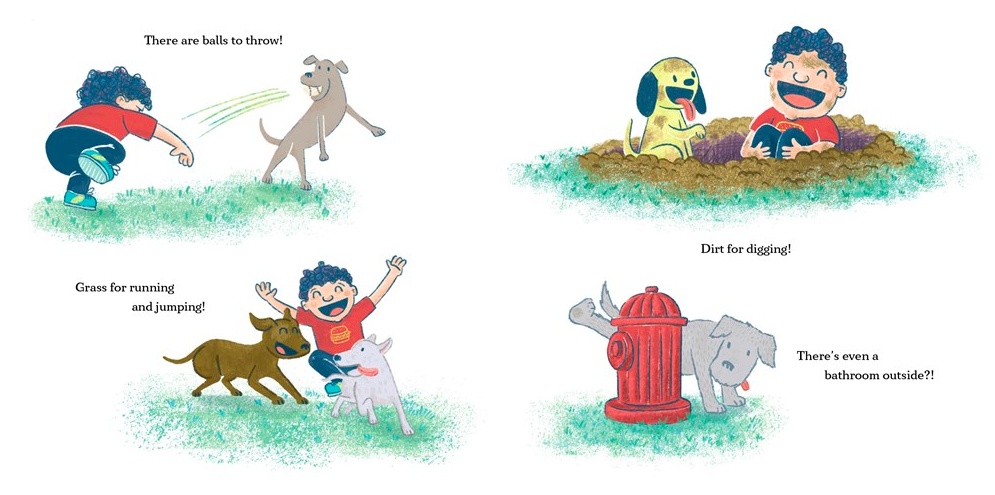
It all makes the boy miss his old school and friends even more. But then his puppy seatmate from the bus comes over to give him a cuddle, and the pup that sits next to him in math joins in, along with a couple of other “soft and fuzzy” students. Just then the recess bell rings, and they’re all off to have fun playing catch, digging in the dirt, running around and jumping, and just general piling on. The day ends with a song and a story, and by the time the boy gets on the bus home, he’s even speaking a little dog: “Arf! Arf!”

He gets home enthusiastic about his new school and the friends he’s made. He’s even excited to go back tomorrow. His parents are thrilled with his change of heart and send him off the next morning with big smiles and waves. There’s just one thing… could he be on the wrong bus again?

celebrate-picture-books-picture-book-review-puppy-bus-recess

Copyright Drew Brockington, 2022, courtesy of Harry N. Abrams.

Funny and relatable, Drew Brockington’s Puppy Bus is sure to reassure and delight all kids, whether they’re starting a new school or just a new grade. Being nervous about making new friends, meeting a new teacher, and navigating a school building is a universal emotion, even though it can often feel singularly personal. Brockington exposes the doubts kids have in a way that will make them laugh while discovering that friendships made and extended can make all the difference. His comical twist ending reminds kids that change is part of life and adapting is a valuable skill to have.

Brockington’s hilarious cartoon illustrations—well-known to his CatSronauts fans—depict the boy’s full range of emotions from panicky to uncertain to grossed out to perplexed. When he’s at his lowest point of the day, a group of canine classmates take notice and do what they do best—become enthusiastic and comforting best friends. As the boy and his new friends romp on the playground, kids get the message that reaching out to someone new or hesitant (or, conversely, accepting an invitation to join in) has benefits for all.

A terrific story to share as school starts up again or for any time a child is beginning a new activity or encountering change, Puppy Bus will be a favorite on home, classroom, or public library bookshelves.

Ages 4 – 8 

Harry N. Abrams, 2022 | ISBN 978-1419751912

To learn more about Drew Brockington, his books, and his art, visit his website.

Get Ready for Kindergarten Month Activity

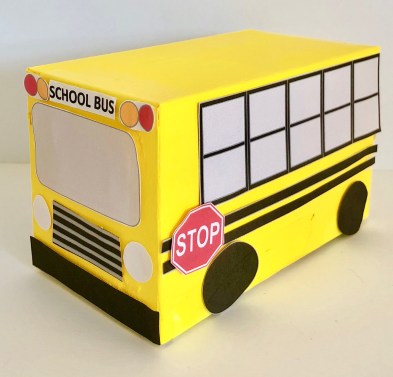
celebrate-picture-books-picture-book-review-school-bus-craft

Small Box School Bus 


With a small tea box, some paint, and the printable template, kids can have fun making a model school bus (or Puppy Bus!) to play with or display. Make your bus as detailed or simple as you’d like!

Supplies

Directions

  1. Print 2 copies of the School Bus Template
  2. Carefully take the tea box apart at the seams, invert it, and glue or tape it back together

celebrate-picture-books-picture-book-review-school-bus-craft

To Make the Passenger Side of the Bus

  1. Cut the Door from the template
  2. Glue the door to the box near the front
  3. Cut out and trim the row of windows from the template
  4. Glue the windows near the top of the box
  5. Cut out and trim two of the solid black lines from the template
  6. Glue the stripes onto the side of the box below the windows
  7. Cut out two tires from the template and glue them to the box

To Make the Front of the Bus

  1. Cut out two of the red and orange paired lights
  2. Glue one on each side of the box near the top with the red light on the outside
  3. Add a School Bus sign between the lights
  4. Cut out the windshield in the lower corner of the template and glue it in place
  5. Cut and trim grill and glue it beneath the windshield
  6. Cut and glue white circles for headlights on either side of the grill
  7. Cut, trim, and glue the wide black strip to the bottom as the bumper.

To Make the Driver’s Side of the Bus

  1. Cut and trim the row of windows from the template
  2. Glue the windows near the top of the box
  3. Cut out and trim two of the solid black lines from the template
  4. Glue the stripes onto the side of the box below the windows
  5. Cut out two tires from the template and glue them to the box
  6. Cut out and glue the Stop sign over the two stripes near the front of the bus

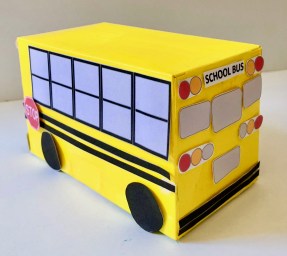
celebrate-picture-books-picture-book-review-school-bus-craft

To Make the Back of the Bus

  1. Cut out two of the red and orange paired lights
  2. Glue one on each side of the box near the top with the red light on the outside
  3. Add a School Bus sign between the lights
  4. Cut out the two small rounded corner windows
  5. Glue them underneath the lights close to the edge of the box
  6. Cut out and glue the bigger rounded corner window between the smaller windows
  7. Cut out and glue the yellow, red, and white lights underneath the small windows with the yellow light on the outside
  8. Cut out and glue the black rounded corner window centered beneath the lights
  9. Cut and trim the wide black stripe and glue it near the bottom of the box for the bumper

celebrate-picture-books-picture-book-review-puppy-bus-cover

You can find Puppy Bus at these booksellers

Amazon | Barnes & Noble | Books-a-Million

To support your local independent bookstore, order from

Bookshop | IndieBound

Picture Book Review

July 12 – Cow Appreciation Day

celebrate-picture-books-picture-book-review-where's-my-cow-cover

About the Holiday

The brainstorm of the Chik-Fil-A Company as a clever advertising ploy to herd customers toward eating chicken, Cow Appreciation Day, also gives us an opportunity to really think about the importance of cattle. They have sustained humankind throughout history and even played an integral part in the defeat of small pox. Cows, with their gentle demeanor and soft, brown eyes, also appear as beloved characters in picture books, poems, and songs, making them one of children’s favorites. Today’s book continues that tradition in witty fashion.

Thanks to Sleeping Bear Press for sharing a copy of Where’s My Cow? with me for review consideration. All opinions on the book are my own.
Where’s My Cow?

Written by Susan Blackaby | Illustrated by Scott Brundage


In a seaside pasture, a flock of egrets and a herd of cows lived in perfect symbiosis. When the sun rose each morning, the birds would fly off toward the ocean. All but one little egret who preferred his perch atop his cow. “So much hubbub made him woozy. And the beach seemed so far.” As the cow went about her day, she and the little egret talked about all the places the cow had been and all that she had seen. She’d heard ukulele music and watched kites in the sky. She’d even tasted a toasted marshmallow. At night, the egret dreamed of the ocean while “snuggled into the cow’s neck.”

celebrate-picture-books-picture-book-review-where's-my-cow-morning

Image copyright Scott Brundage, 2022, text copyright Susan Blackaby, 2022. Courtesy of Sleeping Bear Press.

One morning, the little egret announced that he “‘might try flying.'” His cow was encouraging, reminding his trepidatious friend that she would be right there when he got back (which, the egret promised would be very soon). The egret took off and was soaring along, exhilarated by the view when he caught sight of the cows moving down below. Suddenly anxious, he wondered, “‘Where’s my cow?'” The egret swooned, then “spluttered”, then fell with a thud in front of his cow.
The egret confessed he was afraid he wouldn’t be able to find his cow if he left, but the cow suggested he just look for her ears. With such assurance, the egret took off again, and this time he made it to the beach, where he picked up a shell. When he got back to the herd, though, all of the cows’ ears looked the same. Feeling panicky, he flew back and forth thinking “Where’s my cow? WHERE’S MY COW?” At last egret found her and explained the situation. Next time, the cow said, she’d flick her tail.
celebrate-picture-books-picture-book-review-where's-my-cow-stick

Image copyright Scott Brundage, 2022, text copyright Susan Blackaby, 2022. Courtesy of Sleeping Bear Press.

The next morning, egret made the trip to the beach again and found a ribbon from the tail of a kite. Upon returning, though, all the cows were flicking their tail, and he was filled with the same dread: “Where’s my cow? WHERE’S MY COW?” By the time he found her, “the egret felt wobbly and weepy.” They agreed that the next day, the egret would shout and his cow would shout back. Then the egret showed his cow the ribbon he’d found. She thought it was lovely.

After the next day’s adventure, the egret found a gnarled stick, but when he shouted for his cow to look, all the cows answered back. Some trial and error later, the egret and the cow reunited and agreed that they needed a better system. The the egret had an idea. From the shell and the ribbon and the stick, he fashioned a flag that couldn’t be missed. Now, the little egret never has to worry “Where’s my cow? WHERE’S MY COW?” because she’s always right there, next to the flag and all the egret’s gifts.

celebrate-picture-books-picture-book-review-where's-my-cow-ribbon

Image copyright Scott Brundage, 2022, text copyright Susan Blackaby, 2022. Courtesy of Sleeping Bear Press.

Highly original and filled with heart, Susan Blackaby’s funny and reassuring story gently reminds young readers that their parents, grandparents, caregivers, and whoever they rely on are always there to guide them home. Blackaby perfectly captures the emotions of both children and adults navigating separation or new experiences—from the little egret’s initial fear of flying out with the flock to his growing confidence to his ingenious solution to their problem. The cow’s enthusiastic encouragement and continued support of the egret’s ideas shows kids that leaving their comfort zone can be a positive and exciting adventure. Blackaby’s storytelling shines with lovely imagery and humorous, realistic dialogue, and her clever frame, revealing one of nature’s most complimentary relationships, will charm readers of all ages.

Sweet, supportive, and trusting, Scott Brundage’s egret and cow are enchanting hosts for Blackaby’s story. From the first spread, where little egret perches on cow’s neck as the rest of the flock flies towards the rising sun, readers see that these two have a special relationship. Turn the page, and egret has decided that he will try flying. His courage and fear are clearly evident, as is the cow’s steadfast encouragement and reassurance. As the young egret discovers the fun of flying and is excited to bring back souvenirs from his travels, his eager posture and happy expressions show kids the benefits of independence and self-confidence.

Sure to be a reassuring story and discussion-starter for kids experiencing separation anxiety or venturing into new experiences as well as an often-asked-for read-aloud for story time, Where’s My Cow? is highly recommended for all home, school, and public library collections.

Ages 5 – 8

Sleeping Bear Press, 2022 | ISBN 978-1534111073

To learn more about Scott Brundage, his books, and his art, visit his website.

Cow Appreciation Day Activity

celebrate-picture-books-picture-book-review-cow-mug-craft

Moo Cow Mug


Milk, hot chocolate, or tea will taste so much better in a Moo Cow Mug you make yourself! 

Supplies

  • White ceramic mug, available at craft stores
  • Black permanent marker or paint for ceramics
  • Pink permanent marker or paint for ceramics
  • Brown permanent marker or paint for ceramics

celebrate-picture-books-picture-book-review-cow-mug-craft-back

Directions

  1. With the pink marker or paint, draw an oval shape for the nose near the bottom of the mug. Let dry.
  2. With the brown marker or paint, draw two angled nostrils inside the pink oval and color them in. Let dry.
  3. Color in the nose with the pink marker or paint.
  4. With the black marker, color the top tip of the handle where it meets the mug to make the tail.
  5. With the black marker or paint, draw two wavy lines on either side of the face starting at the top, angling toward the middle and returning to the bottom of the mug. Leave white space between the lines.
  6. Draw circles for eyes within the black lines. Add black pupils at the bottom of the eyes.
  7. Color inside the black lines and around the eyes to make the face markings.
  8. With the black marker or paint, make two or three splotches on the back of the mug.
  9. Let the mug dry and follow the directions for the markers or paint to set the color. Pour yourself a mug of milk and enjoy!

celebrate-picture-books-picture-book-review-where's-my-cow-cover

You can find Where’s My Cow? at these booksellers

Amazon | Barnes & Noble | Books-a-Million

To support your local independent bookstore, order from

Bookshop | IndieBound

Picture Book Review