Instituted by People for the Ethical Treatment of Animals (PETA),which was established by Ingrid Newkirk in 1949, Hug a Vegetarian Day promotes awareness of a meat-and animal- products-free diet. Over the years millions of people world wide have embraced the vegan and vegetarian lifestyle, giving rise to alternative diets and products that support this healthy choice. To celebrate today whip up a vegetarian meal – why not Rainbow Stew?!
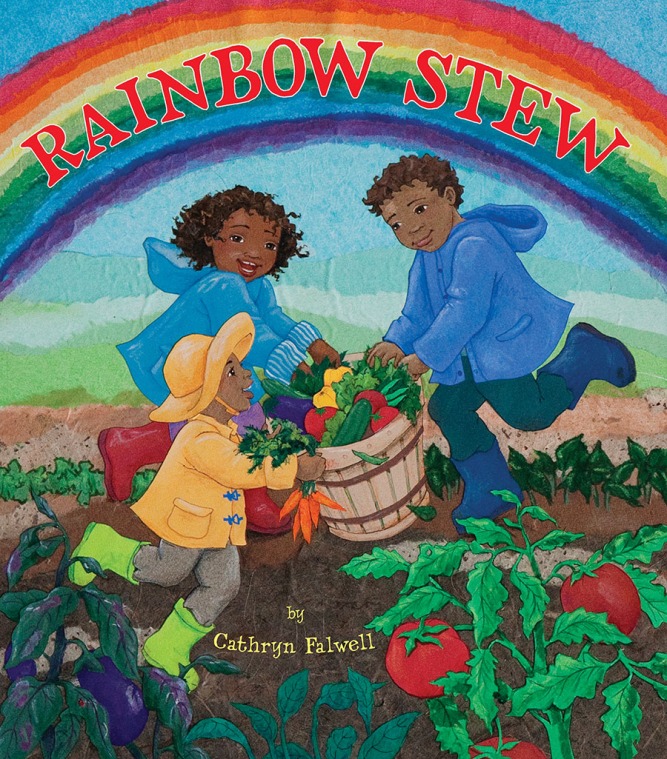
Rainbow Stew
By Cathryn Falwell
Grandpa’s making pancakes for his three favorite kids—his granddaughter and two grandsons. The kids are excited to be visiting their grandpa where they can play outside all day long. On this particular day, however, rain spatters the windows, and the kids are disappointed: “Whimper, sigh, / cloudy sky, / is it too wet to play? / We don’t want to stay inside / because of rain today.” But their grandpa knows just what to do! “Let’s go and find some colors for my famous Rainbow Stew!” he suggests.
Image copyright Cathryn Falwell, courtesy of rainbowstewbook.com
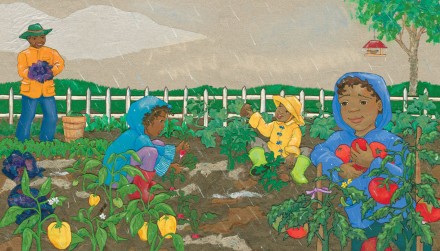
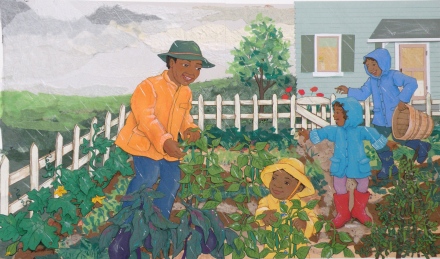
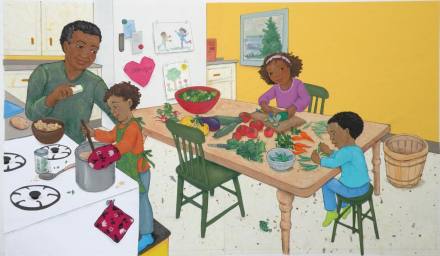
Out to the garden they run in their raincoats and hats. “Splish, splash, / puddle dash, / We bounce right out the door. / We’re off to find some red and green, / some yellow, orange, and more. / Grandpa shows us how to move / Between each garden row. / Lifting up the drippy leaves, / we see what colors grow.” They collect green spinach, kale, and zucchini; yellow peppers, purple cabbage and eggplant, red radishes and tomatoes; brown potatoes; and orange carrots. After some muddy fun among the plants, the kids go inside, get dried off, and begin to prepare their colorful stew.
Image copyright Catherine Falwell, courtesy of rainbowstewbook.com
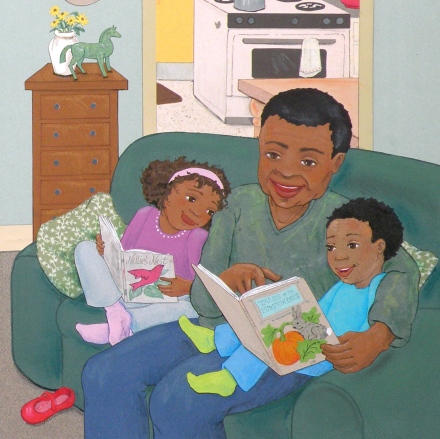
“Peel, slice / chop and dice, / colors fill the pot. / Stir in herbs and water / and then wait till it gets hot.” While the pot simmers on the stove, Grandpa and the kids snuggle on the couch with favorite books, reading together until the stew has simmered to perfection. The family then sits down to a homemade, colorful, delicious lunch of Rainbow Stew.
Image copyright Cathryn Falwell, courtesy of rainbowstewbook.com
Cathryn Falwell’s Rainbow Stew is a wonderful book to share with young children on many levels, offering opportunities for learning as well as playing. Introducing colors through familiar and delicious vegetables can get kids excited about gardening, cooking, even going to the grocery store. The rhyming verses each begin with an energetic couplet that kids will enjoy repeating or acting out. The bright colors of Grandpa’s house mirror the vividness of the garden vegetables, and young readers may enjoy matching the vegetables to items in the kitchen, living room, and more.
Children will identify with the disappointment of the three siblings when they learn it’s too wet to spend the day outside as well as their glee at squishing in the mud. The close bond between the kids and their grandfather as they cook and read together is a strong anchor for this story and promotes early literacy.
Image copyright Cathryn Falwell, courtesy of rainbowstewbook.com
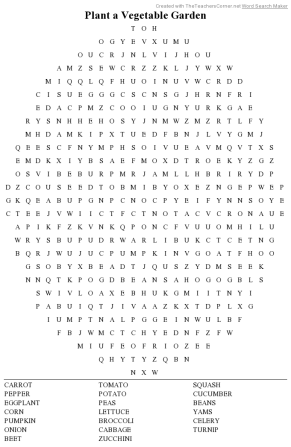
A recipe for Rainbow Stew follows the story. Reading Rainbow Stew, preparing the delicious dish, and doing the puzzle below makes for a fun rainy – or sunny – day!
Ages 4 – 7
Lee & Low Books, 2013 | ISBN 978-1600608476
Learn more about Cathryn Falwell and her books and art on her website!
To discover more about Rainbow Stew as well as activities to accompany the book, head over to rainbowstewbook.com!
In the early 1970s Marion McQuade had the idea for a special day of the year when grandparents and grandchildren could show their love for one another. She further wanted it to be a day when grandparents could pass down the wisdom they had gained over their lifetime as well as share a bit of family history. Of course the same goes for grandparents learning the latest and greatest from the kids in their lives—from new technology to current fads. When all generations share their experiences, we’re all a lot smarter—and have closer relationships!
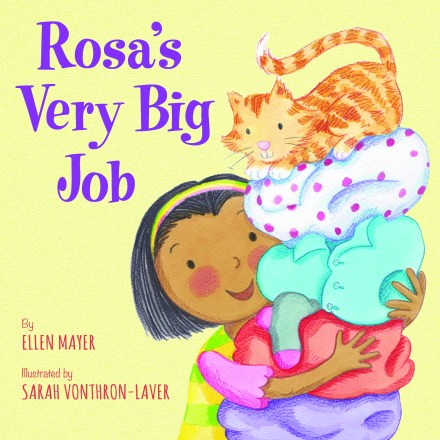
Rosa’s Very Big Job
Written by Ellen Mayer | Illustrated by Sarah Vonthron-Laver
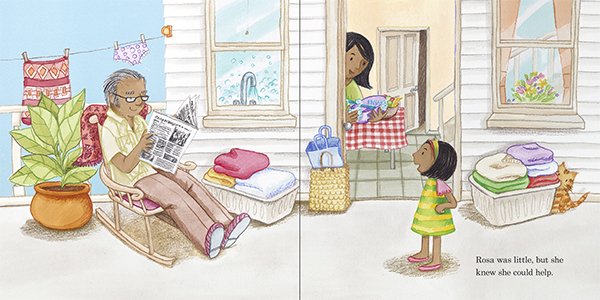
Rosa may be little, but she has big ideas about how to help. While Mama is out shopping for groceries for that night’s dinner, Rosa decides to surprise her by folding and putting away the laundry. The basket is piled high with fluffy dry clothes, sheets, and towels. Rosa watches her grandpa reading the newspaper. “‘Please help me, Grandpa!’” she says. She tugs on her grandpa’s hands, trying to pull him out of his chair. “‘Come on, Grandpa! Get up.”
Image copyright Sarah Vonthron-Laver, text copyright Ellen Mayer, courtesy of Star Bright Books, starbrightbooks.com
Grandpa seems to have a little trouble managing: “‘It’s difficult to carry these enormous piles,’” he sighs. But Rosa knows that smaller armloads work better. Grandpa’s clothes come unfolded as he puts them in the drawer. “‘Be neat. Like me,” Rosa says, showing him her tidy stack. Poor Grandpa! He has to keep hanging up the same jacket over and over. “‘It’s difficult to keep this jacket from sliding off the hanger,” he says. Rosa has the answer: “‘Zip it up,’” she explains. “‘Then it stays on.’”
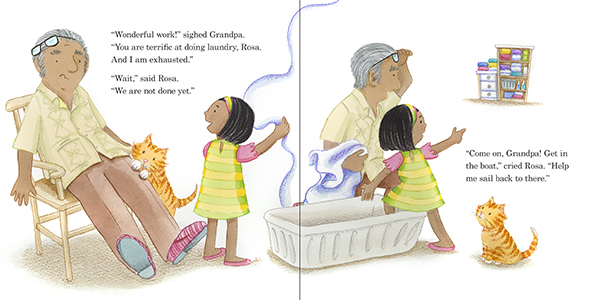
Grandpa sinks back into his chair. “‘You are terrific at doing laundry, Rosa. And I am exhausted,’” he says. But this is no time to quit—Rosa has big plans. As she steps into the now empty laundry basket, she exclaims, “‘Come on, Grandpa! Get in the boat. Help me sail back to there.’” Rosa points to the linen closet.
Image copyright Sarah Vonthron-Laver, text copyright Ellen Mayer, courtesy of Star Bright Books, starbrightbooks.com
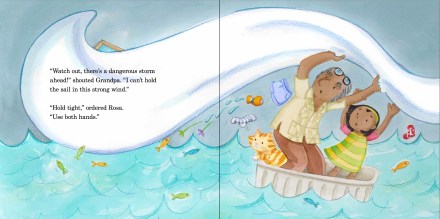
Suddenly, the floor swells with ocean waves teeming with fish. Grandpa channels his inner sailor as he holds aloft a sheet as a sail. As the wind billows and they come perilously close to the kitchen table, he says, “‘It’s difficult to sail around this enormous rock!’” Contemplating the rising sea, he exclaims, “‘It’s difficult to sail over this enormous wave!’”
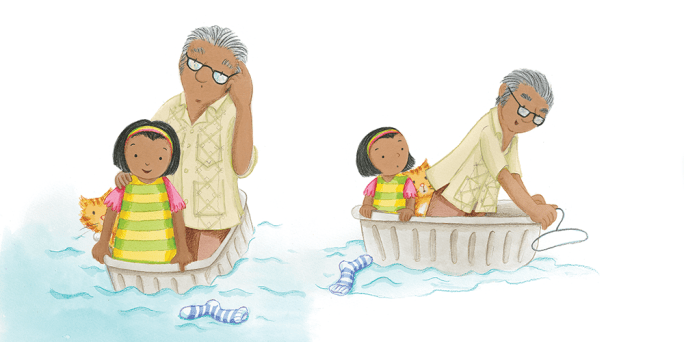
There’s a dangerous storm ahead, warns Grandpa, “‘I can’t hold the sail in this strong wind.’” Rosa is there to help and grabs one side of the sheet. “‘Hold tight,’” she orders. “‘Use both hands.’” At last the seas die down and Grandpa is ready to steer the laundry basket back to port, but Rosa has a more entertaining thought. Spying a sock on the floor, Rosa wants to catch the “enormous fish.” Grandpa obliges and picks up a hangar for a fishing pole. He holds Rosa as she stretches out over the edge of the laundry basket to land her fish.
Image copyright Sarah Vonthron-Laver, text copyright Ellen Mayer, courtesy of Star Bright Books, starbrightbooks.com
Just as Rosa nabs the fish, Mama comes home with her bags of groceries. She’s surprised to see that the laundry is not in the basket. Rosa runs to her and proudly explains, “‘We put all the laundry away. It was a very big job. We carried enormous piles. Grandpa dropped things. And I picked them up. It was very difficult for Grandpa. He got exhausted. But not me. I am terrific at laundry!’” Mama agrees that Rosa is a terrific helper. Then Rosa leads her mother to see the most surprising thing of all—the fish she has caught for dinner!
In her series of Small Talk Books® Ellen Mayer presents exciting stories for preschoolers full of imagination and rich language learning. Rosa’s Very Big Job introduces Rosa, a sweet girl bubbling with enthusiasm and the desire to help. The close relationships between Rosa, her mother, and her grandpa promote cooperation as well as effective modeling of speech patterns and a way to introduce larger words in an organic manner through play and common chores. Rosa’s inventive idea to turn the laundry basket into a boat is delightfully enhanced by her grandpa’s willingness to share in the story and expand on it. Humor, cheerful banter, and the easy camaraderie between Rosa and Grandpa invite young readers to join in the fun as they build confidence in their language learning.
Sarah Vonthron-Laver depicts Rosa’s afternoon with her Grandpa with joy and the spirited energy young children bring to everything they do. Grandpa is happy to spend time with his granddaughter, yet shows honest feelings of tiredness and frustration that spur on the plot. The transition from doing laundry to using the basket as a boat is as seamless as a child’s imagination, and the way Rosa and her grandpa use household items to create “sails,” “rocks,” “fish,” and “fishing poles” will give readers great ideas for post-reading play. Bright colors, an adorable kitten, and familiar surroundings welcome young children into the world of reading and expanded vocabulary.
Rosa’s Very Big Job would be a welcome addition to a young child’s bookshelf, not only for its fun story that kids will want to hear again and again, but for its leap into imagination that kids will want to replicate.
Dr. Betty Bardige, an expert on young children’s language and literacy development, provides tips for parents, grandparents, and caregivers following the text.
Ages 2 – 6
Star Bright Books, 2016 | ISBN 978-1595727497
Discover more about Ellen Mayer and her books as well as book-related activities and literacy initiatives she’s involved with on her website!
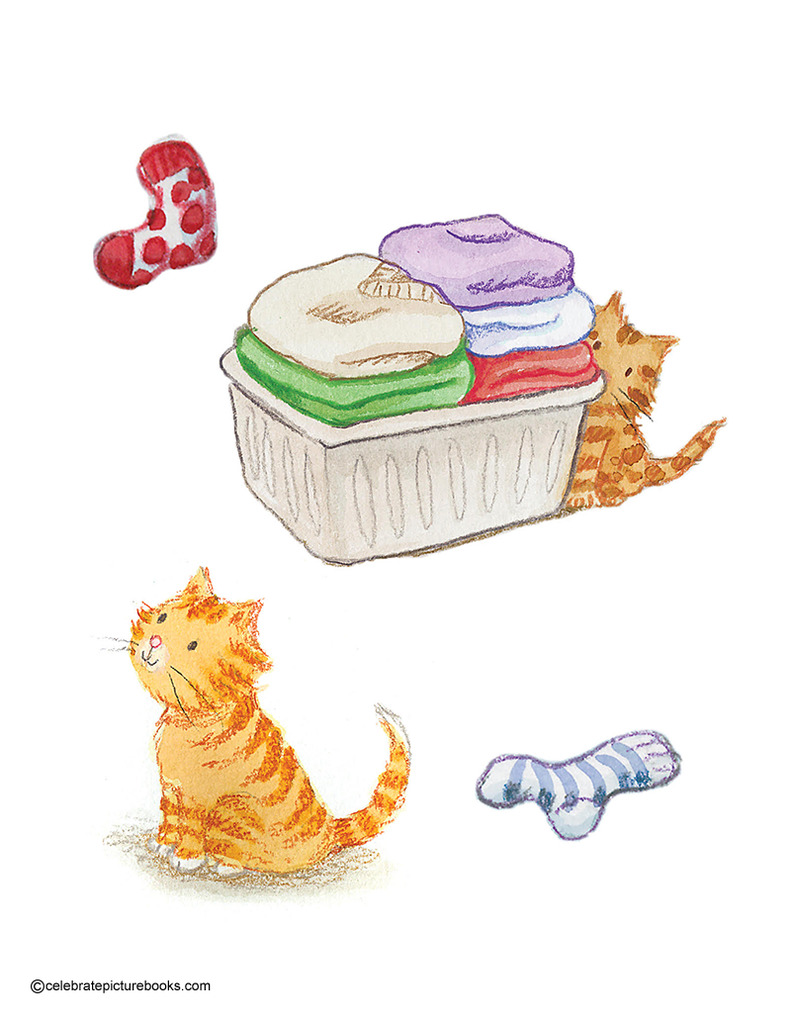
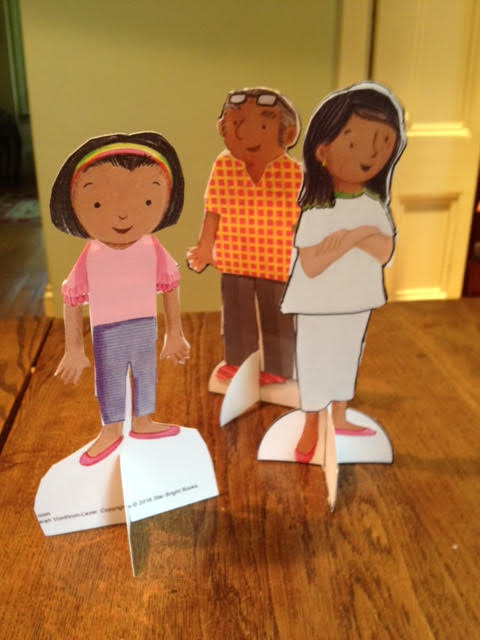
Rosa loves helping out at home. She’s terrific at doing laundry – folding and putting away the family’s clothes, socks, and linens. You are terrific at helping too! Can you help Rosa, Mama, and Grandpa get dressed and ready for the day with these printable paper dolls? You’ll even find a laundry basket, socks, and Rosa’s sweet kitty to play with!
Print dolls on regular paper or heavy stock paper. Dolls printed on heavy stock paper may stand on their own with the supplied stand cross piece. For dolls printed on regular paper, you can cut the supplied stand templates from poster board or card stock and glue the dolls to the backing.
Rosa’s kitty and the laundry basket can also be attached to the supplied template if needed
Print clothes for each figure
Color the blank clothes templates any way you’d like
Cut out clothes and extra items
Fit outfits onto dolls
Make up your own stories about Rosa, Mama, and Grandpa!
Interview with Author Ellen Mayer
Today, I’m happy to present a fascinating interview with Ellen Mayer, a writer and expert in early literacy, in which she discusses her involvement with various organizations and programs, her baby granddaughter, why Hug Your Cat Day is at the top of her list of holidays, and gives us a peek at a very special sugar egg.
I’m really interested in your work in the education and literacy fields. Could you talk a little bit about your job as an education researcher and an early literacy home visitor, and how you got into those fields?
I got into these fields after leaving a Sociology PhD program right near the end. I didn’t want to be an academic and teach, I wanted to do applied research – to solve practical problems out in the world and to make a difference in the lives of those who were struggling. At the Harvard Family Research Project at Harvard’s Graduate School of Education, I studied the ways that families from underserved communities were engaged in supporting their children’s learning and education, and created research-based materials for families and schools to promote effective engagement. One of these was the Family Involvement Storybook Corner—curated picture book selections with family engagement themes. That got me interested in early literacy and picture books.
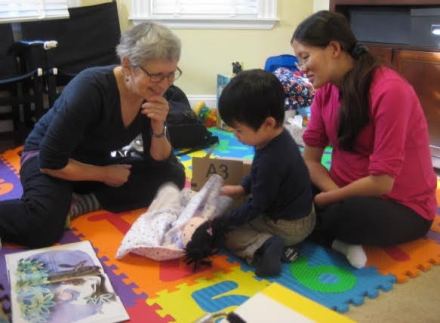
After researching family engagement in children’s learning for many years, I decided I wanted to go out into the field and be a practitioner and work directly with families on this topic. I worked as an early literacy home visitor with diverse families with the Parent-Child Home Program, modeling ways to share stories with little ones to build early language. I actually got paid to read picture books and play with families in their homes!
At the same time, I was pitching my Small Talk Books®, a collection of playful stories about everyday activities that provide fun for kids and ideas for adults – Rosa’s Very Big Job is one. The adults in the stories are engaged with children’s learning, modeling conversational ways to build young children’s language.
I read that your book Red Socks, another of the Small Talk Books®, is being used in a program to turn wash time at Laundromats into talk time for literacy development. Could you discuss this early literacy initiative?
Yes! Wash Time/Talk Time is a terrific campaign led by Too Small To Fail, a joint initiative of the Clinton Foundation and the Opportunity Institute teaming up with a host of partners to turn Laundromats in underserved areas into venues for early literacy. This campaign distributes free books and information to families in Laundromats about building early language to help close what’s called the “word gap” by promoting parent conversation with babies and young children. Almost 60% of children in our country start kindergarten behind in their language development and this then sets them on a downward path and they get even further behind in school.
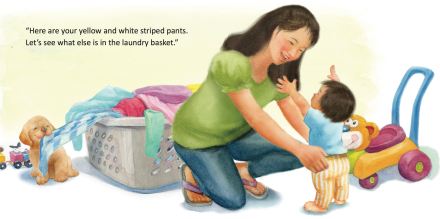
Red Socks was a natural fit for this program. In it a Mama narrates what she is doing for her little pre-verbal child as she folds the laundry and dresses the child—and as they search for a missing sock!
I have to say that it’s a dream come true that Too Small To Fail is using my book.
Wash Time/Talk Time is really reaching the families on the other side of the word gap who most need the ideas and inspiration in Red Socks. When I began writing the Small Talk Books® I wanted to include stories about doing laundry, as it’s something we all do as parents and provides lots of things to talk about with children. (Like the color of socks!) In fact, I used to sit in Laundromats and observe families when I was thinking up ideas for stories. I guess that’s the sociologist in me.
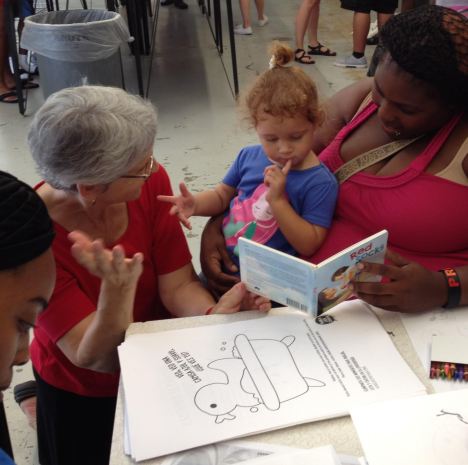
We just had the opportunity to visit one of the Laundromats in the campaign—at the Free Laundry Day in Tampa, FL hosted byThe Laundry Project—and share Red Socks with families. You can see some of the fun illustrator Ying-Hwa Hu and I had here:
What inspired you to begin writing picture books?
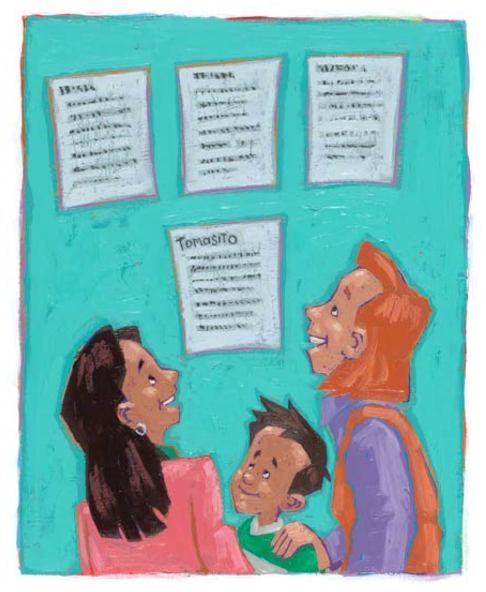
I came to picture book writing through a backdoor. When I was at Harvard Family Research Project, I was thinking about new ways to convey our ideas from research into practice for parents, and it occurred to me that a read-aloud picture book could address an audience of parents, as well as the primary one of children. My boss was enthusiastic about the idea, and so I enrolled in an adult ed class on writing for children. Then I turned one of our research case studies about challenges an immigrant Latino family had in communicating with their son’s teacher into a picture book,Tomasito’s Mother Comes to School/La mamá de Tomasito visita la escuela. Joe Cepeda did the art for it, and we made it downloadable for free.
Some new things! I have a fellowship with the Storytelling Math Project that’s funded by the Heising-Simons Foundation and coordinated by TERC, a not-for profit STEM research and development organization here in Cambridge, MA. I’ll be a member of a group that’s identifying, creating, and promoting math-infused storybooks for diverse young children and I hope to create a couple of Small Talk Books® along these lines—probably about supermarket shopping! I also was asked to help out the Highlights magazine editorial team that creates HELLO magazine for 0-2 years and be an outside reviewer for issues before they go to publication. And then I’ll be volunteering as a visiting children’s book author to the Somerville Family Learning Collaborative, the family engagement and early childhood hub of the Somerville, MA Public Schools, sharing my books with playgroups and new parent groups.
But mostly, I plan to write! I have a bunch of picture book manuscripts in various states, and ideas for new ones. These manuscripts are different from the Small Talk Books®; they don’t have a deliberate educational underpinning to them. They are fun, and just fun. One, for example, is called What To Do With Ruby-Lou and it’s about a baby who doesn’t laugh, no matter what her family does. Who is going to be able to get a laugh out of Lou? Well, it’s a surprise and it just might require some audience participation. I’ve had an agent in the past and hope to find a new one to rep me with these picture books.
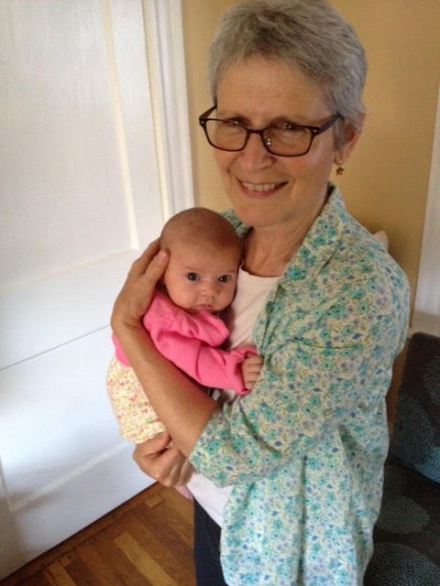
You recently became a grandmother. Can you tell me a little about your granddaughter?
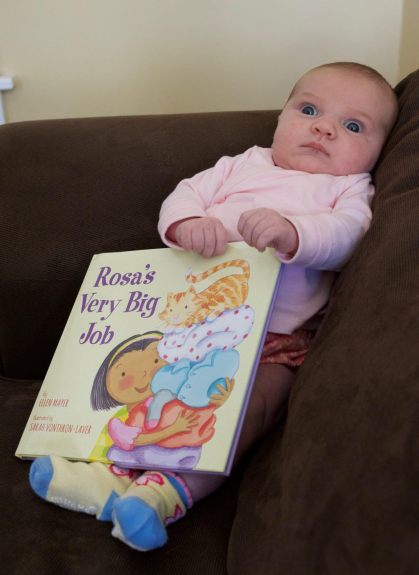
I thought our granddaughter was the most wonderful and expressive baby in the world when was she born – of course! She and my advance copy of the new Rosa book arrived into the world at just about the same time.
At three months now my granddaughter is a big reader and is riveted on the B&W hi-contrast board book genre, especially one board book about cars and trucks. She moves her head back and forth, from one end of the spread to the other, scanning the images on the page like a studious scholar of some ancient text.
What is the best part about being a grandmother?
For me the best part about being a grandmother is being able to simply enjoy my granddaughter and play with her and watch her develop, and not have to worry about taking care of her daily needs. I didn’t have to stress when she refused to take the bottle before starting full-day childcare. That wasn’t my job. (She did take it – of course!) They live nearby, and seeing her once or twice a week, I love noticing small changes on each visit. I also love seeing our daughter and son-in-law parent.
Have you given thought to what you’d like your granddaughter to call you?
Our daughter asked us ahead of time what we’d like to be called when we became grandparents. I thought it was a wise idea to be proactive and select a name immediately, to avoid being named by the grandchild something like “Grandma GA-GOO-GA.” My great aunt Jane is called “Nini” as a grandmother, and I’ve always loved that, but I didn’t want to steal it. So I chose “Mimi.”
It sounds as if Grandparents Day may be one of your top holidays! Do you have another favorite?
When I was little, I liked Easter a lot because it combined a lot of my favorite things: crafts, springtime, running around outside, candy. Also, we didn’t dress up much as kids, but I do remember Easter bonnets!
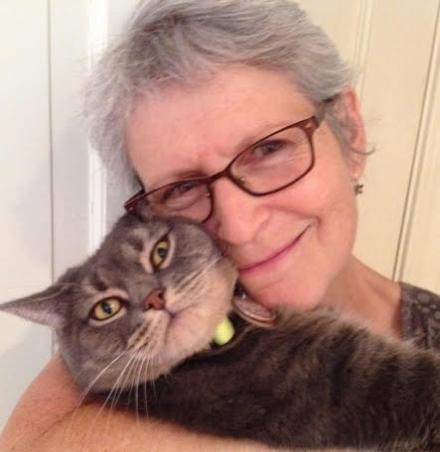
When our children were little, their birthdays became my favorite holiday celebrations. Now that they are grown, maybe I need to pick a new favorite holiday? I see that June 4th is Hug Your Cat Day. That might be just right: we have a rather large and ferocious cat and when she actually lets you hug her, well, it’s a cause for celebration.
Do you have an anecdote from any holiday that you’d like to share?
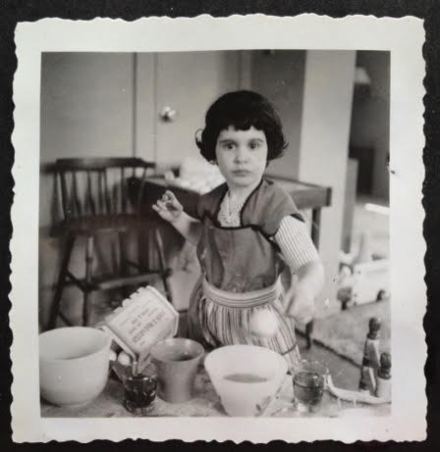
When I was six years old, I saw the Easter Bunny. I was staying at my Grandparents’ house, and I looked down the stairwell, and there he was, crossing the landing at the foot of the stairs. He was quite tall, wore a yellow slicker that was too small for him, and he was carrying a large Easter basket. I’m afraid I didn’t have my Brownie camera with me at the time to snap a photo.
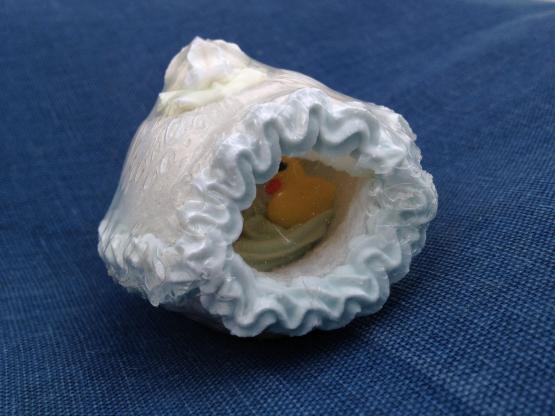
But I do have an unwrapped sugar Easter egg that I’ve saved from that era.
Thanks for sharing so much about your work and life, Ellen! I wish you all the best with Rosa’s Very Big Job, your other Small Talk Books®, and of all your other ventures!
Other Small Talk Books® available from Ellen Mayer and Star Bright Books include Cake Day, Red Socks, and A Fish to Feed and can also be found at the above booksellers.
It’s not often someone wishes you a rainy day. Today, though, I’m doing just that because you can’t see a rainbow without a little of the wet stuff. This early spring month was chosen for this special day because, as we all know, April showers bring May flowers. Those same April showers lead to beautiful rainbows—even double rainbows sometimes! So, I hope you have a bad (weather) day and good luck finding a rainbow today! By the way—what do May flowers bring? Right! Pilgrims!
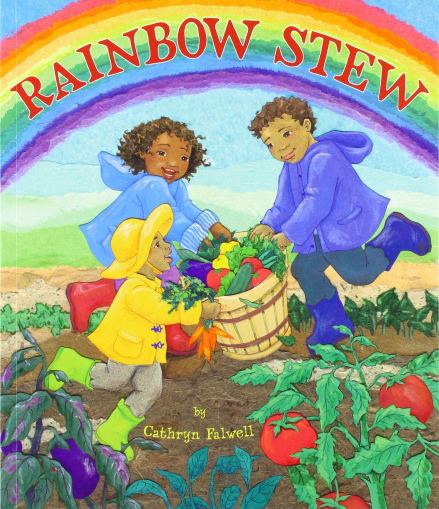
Rainbow Stew
By Cathryn Falwell
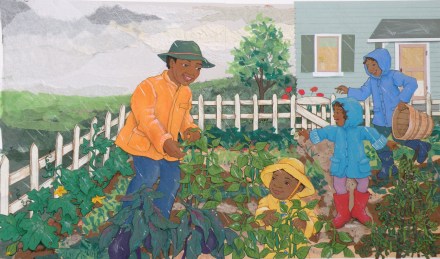
Grandpa’s making pancakes for his three favorite kids, and his granddaughter and two grandsons are excited to be visiting where they can play outside all day. Through the window the kids see that it’s a rainy day. Does this mean they’ll have to stay inside? Their grandpa knows just what to do! “Let’s go and find some colors for my famous Rainbow Stew!” he says.
Image copyright Catherine Falwell, 2013, courtesy of rainbowstewbook.com
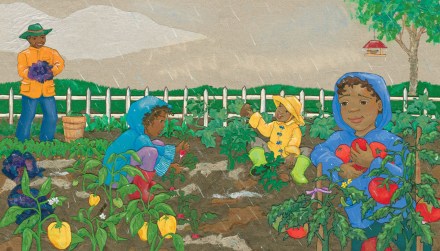
Out to the garden they run in their raincoats and hats. “Splish, splash, / puddle dash, / We bounce right out the door. / We’re off to find some red and green, / some yellow, orange, and more. / Grandpa shows us how to move / Between each garden row. / Lifting up the drippy leaves, / we see what colors grow.” They collect green spinach, kale, and zucchini; yellow peppers, purple cabbage and eggplant, red radishes and tomatoes; brown potatoes; and orange carrots. After some muddy fun among the plants, the kids go inside, get dried off, and begin to prepare their colorful stew.
Image copyright Catherine Falwell, 2013, courtesy of rainbowstewbook.com
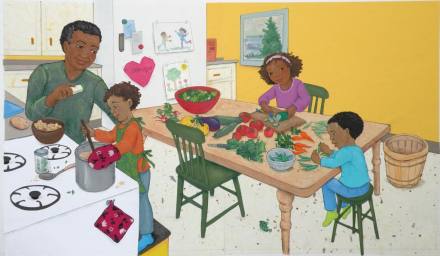
“Peel, slice / chop and dice, / colors fill the pot. / Stir in herbs and water / and then wait till it gets hot.” While the pot simmers on the stove, Grandpa and the kids snuggle on the couch with favorite books, reading together until the stew has simmered to perfection. The family then sits down to a homemade, colorful, delicious lunch of Rainbow Stew.
Image copyright Catherine Falwell, 2013, courtesy of rainbowstewbook.com
Cathryn Falwell’s Rainbow Stew is a wonderful book to share with young children on many levels. The bright colors of Grandpa’s house mirror the vividness of the garden vegetables in his stew, which could be made into a matching game for extra fun. The rhyming verses—each begun with an energetic couplet that would be fun for kids to repeat or act out—draw listeners into the story. Introducing colors through familiar and delicious vegetables can get kids excited about gardening, cooking, even going to the grocery store.
Children will identify with the disappointment of the three siblings when they learn it’s too wet to spend the day outside as well as their glee at squishing in the mud. The close bond between the kids and their grandfather as they cook and read together is a strong anchor for this story.
Image copyright Catherine Falwell, 2013, courtesy of rainbowstewbook.com
A recipe for Rainbow Stew follows the story. Combined with the craft below, the book and recipe could make for a fun rainy-day get-together!
Ages 4 – 7
Lee & Low Books, 2013 | ISBN 978-1600608476 (Hardcover) | ISBN 978-1643790572 (Paperback, 2019)
National Find a Rainbow Day Activity
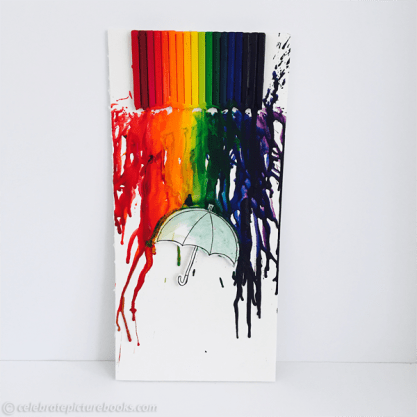
Crayon Rainbow Art
With this cool project you can create an art piece that’s as colorful as a rainbow and as unique as you are! Adult help is needed for children.
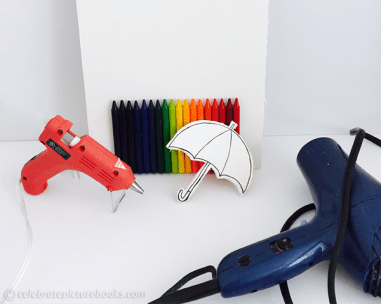
Supplies
Box of 24 crayons
White foam board or thick poster board, 8 inches by 17 inches
A small piece of corrugated cardboard, about 5 inches by 5 inches (a piece of the foam board can also be used for this step)
A small piece of poster board, about 5 inches by 5 inches
Scissors
X-acto knife (optional)
Hot glue gun
Hair dryer
Old sheets or towels, newspapers, a large box, or a trifold display board
Directions
Remove the various red, orange, yellow, blue, indigo, and violet hued crayons from the box of crayons
Strip the paper from the crayons by slicing the paper with the x-acto knife, or removing it by hand
Line them up in order at the top of the white foam board
Glue the crayons with their tips facing down to the board with the hot glue gun
Cut an umbrella or other shape of your choice from the poster board
Trace the umbrella or other shape onto the corrugated cardboard or a piece of the foam board and cut out
Glue the poster board shape onto the corrugated cardboard, let dry
Glue the umbrella or other shape to the foam board, about 4 ½ inches below the crayons
Set up a space to melt the crayons. The wax will fly, so protect the floor and walls by placing the art piece in a large box or hanging newspapers, old sheets or towels on the walls and placing newspapers on the floor. A trifold display board and newspapers works well.
Stand the art piece upright with the crayons at the top
With the hot setting of the hair dryer, blow air at the crayons until they start to melt
Move the hair dryer gently back and forth across the line of crayons from a distance of about 6 to 12 inches away. The closer you are to the crayons, the more they will splatter
The crayons will begin to melt and drip downward
You can experiment with aiming the hair dryer straight on or at an angle to mix colors
Wax that drips onto the umbrella or other shape can be chipped off after it dries or wiped off to create a “watercolor” effect on the shape
Once the hair dryer is turned off, the wax cools and dries quickly
Noodle on this: what’s the difference between noodles and most other dry pastas? Noodles contain eggs! It’s just this kind of fascinating fact you can learn during noodle month. Whether you like spinning the long strands around your fork or slurping them right from the bowl, noodles make the perfect comfort food whether they’re mixed with sauce, pesto, or meat and veggies. People make some pretty awesome crafts from them too! Did you know that 13th century bakers made their dough into birds, stars, words, and other shapes? Too bad Pinterest wasn’t around then! So boil up some water and get cookin’ on a delicious day!
Noodle Magic
Written by Roseanne Greenfield Thong | Illustrated by Meilo So
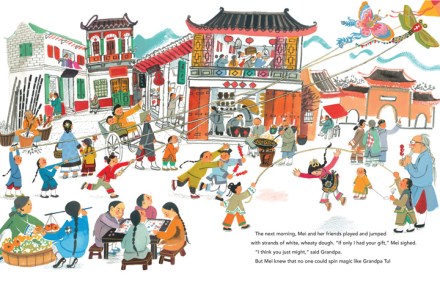
The emperor’s birthday is coming, and everywhere excitement fills the air. Mei’s Grandpa Tu will no doubt be making his famous noodles for the celebration. Mei loves to watch her grandfather work, slapping and kneading the dough and pulling the strands of noodles. He is so creative with his cooking that everyone marvels, even the Moon Goddess. In fact, Grandpa Tu is such an extraordinary artist that he makes noodle jump ropes and kite strings for Mei and her friends. They are as “simple as a sunflower” and as “easy as a sea breeze” to make, says Grandpa Tu.
Image copyright Meilo So, text copyright Roseanne Thong. Courtesy of meiloso.com
But Mei thinks there is more to his talent and wishes that she had his magic. Her grandfather believes she does possess it. One afternoon the pair watch animal-shaped clouds fill the sky, and Mei asks if her grandpa can catch them with noodles. That night he makes a batch of noodles, and in the morning the two collect clouds as the sun appears.
On the day before the emperor’s birthday, everyone is busy making something special—everyone except Grandpa Tu. The villagers are perplexed. On such an important day, they will all want to enjoy noodles—and what about the special long-life noodles for the emperor? It is time, Grandpa Tu tells Mei, for her to make the noodles.
Mei is surprised and terrified. She slaps and kneads the dough as she has seen her grandfather do, but it remains ordinary. Where is the magic? “‘Trust in yourself,’” Grandpa Tu tells her, but Mei is doubtful. She decides that perhaps if she gives the Moon Goddess a gift, she will get magic in return. “‘You have all the magic you need,’” her grandfather assures her. Still, he helps Mei make enough dough to form an enormous ball of noodles.
Image copyright Meilo So, text copyright Roseanne Thong. Courtesy of meiloso.com
Mei throws the ball to the Moon Goddess and calls out for the Goddess to give her magic. Wisely, the Goddess reminds Mei that magic must come from inside. Mei closes her eyes and thinks very hard. She tussles with the Moon Goddess in a noodle tug-of-war, and suddenly…Snap!…the noodles break. The sky rains noodles of all shapes and sizes, Mei has discovered the magic that was in her all along!
With the charm of a Chinese folktale, Roseanne Greenfield Thong tells the universal tale of self-discovery. Her lyrical language adds a magic of its own to the tale, as when Mei watches her grandfather make dough: “she loved the powdery flakes that hung in the air and freckled the morning light.” The relationship between the little girl and her grandfather is lovingly portrayed, offering a gentle depiction of the wisdom and reassurance provided by extended family members.
Meilo So brings the story to vibrant life with her colorful paintings of village life, Mei and Grandpa Tu’s home, and the Moon Goddess. The magic of Grandpa Tu’s noodles is cleverly shown in the transparent animals, dragons, and birds outlined in noodles that frolic across the pages. The two-page spreads of Mei’s village are particularly captivating, as packed with interesting scenes and details as any bustling town.
Ages 4 – 8
Orchard Books, 2014 | ISBN 978-0545521673
Noodle Day Activity
Noodle on This Puzzle
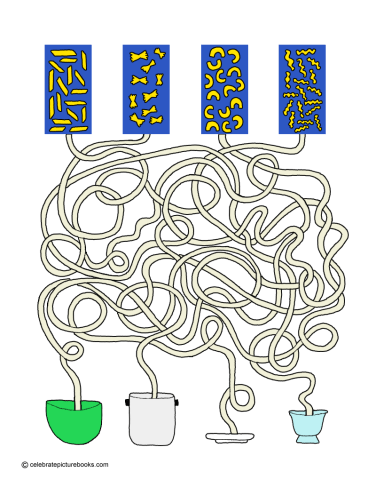
Everyone has their favorite kind of noodles! Help these noodles get to the right plate, bowl, or pot in this printable Noodle on This puzzle that’s as wiggly as a wet noodle!










 celebratepicturebooks.com