March 23 – National Puppy Day

The Octopuppy by Martin McKenna Picture Book Review

About the Holiday

National Puppy Day was founded in 2006 by Colleen Paige to recognize the joy and companionship that puppies bring to people. The day also promotes puppy rescue and adoption as well as education about puppy mills, and is quickly becoming an international observance. To celebrate consider donating to your local animal shelter or if you have room in your life for a new friend, adopt a puppy!

The Octopuppy

By Martin McKenna


Edgar wants a puppy for his birthday, but what he gets is so NOT a puppy. Out of the gift box pops Jarvis, a goggle-eyed octopus ready to party. Disappointing doesn’t even begin to describe it. Jarvis can’t do anything a dog could do. Sure, he might be clever—Jarvis buys Edgar an ice-cream cone instead of staying on his leash tied to the lamppost, for example—but Edgar wants a pet he can enter in the upcoming dog show.

celebrate-picture-books-picture-book-review-the-octopuppy-dog-show

Copyright Martin McKenna, courtesy of http://www.storycorner.scholastic.com

Perhaps with training Jarvis can learn to be more like a dog. But when Edgar tells him to lie down, Jarvis goes to sleep wearing PJs and socks, holding a teddy bear and surrounded with books. Edgar’s command to “play dead” elicits a surprise lunge from a wardrobe in a toilet-paper mummy costume. It’s just too much, and drives Edgar crazy! Finally, however, Jarvis learns to sit like a dog, and off they go to the dog show.

celebrate-picture-books-picture-book-review-the-octopuppy-lie-down

Copyright Martin McKenna, courtesy of http://www.storycorner.scholastic.com

At the dog show things go…well…Jarvis just can’t help being himself. He wears a tutu, plays the piano, does card tricks, and plays the drums—all at the same time. The other entrants are not amused, and Edgar is sooo embarrassed.

celebrate-picture-books-picture-book-review-the-octopuppy-sleeping

Copyright Martin McKenna, courtesy of http://www.storycorner.scholastic.com

Jarvis decides to leave, and after penning a note apologizing for being a bad dog, he slips down the toilet and out to sea. When Edgar discovers Jarvis is missing, he realizes he has been wrong. He remembers all the great things Jarvis did and thinks that Jarvis was the best Octopuppy in the world! Suddenly, he wants his pet back. He looks everywhere, but Jarvis is nowhere to be found.

As a last resort Edgar yells his apology into Jarvis’s escape route. His message is carried through the plumbing by various pipe and underground creatures until Jarvis hears it. Before Edgar can turn around, Jarvis is back! To celebrate his being home, Edgar’s family and friends throw Jarvis the kind of wild party he was looking for all along.

celebrate-picture-books-picture-book-review-the-octopuppy-edgar-has-change-of-heart

Copyright Martin McKenna, courtesy of http://www.storycorner.scholastic.com

This endearing story has just the right mix of craziness and sincerity to make it a favorite on any child’s bookshelf. Martin McKenna hits all the right notes in his tribute to friendship and the idea that true friends accept and appreciate each other the way they are. Jarvis is a sweetie doing very un-doglike things. He rescues a cat instead of chasing it, cooks sausages instead of stealing them, and performs surgery instead of biting the mailman. These vignettes make Edgar’s rejection all the more heartrending and his ultimate realization very satisfying. McKenna’s illustrations are loaded with silly and profound details that kids will want to linger over, and the two-page spread of Edgar leading Jarvis home after the dog show is an emotional marvel.

Ages 3 – 6

Scholastic Press, 2015 | ISBN 978-0545751407

National Puppy Day Activity

CPB - Dog Toy

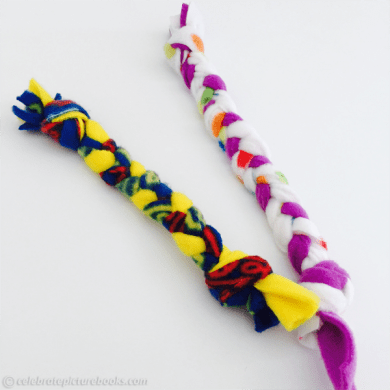
Braided Puppy Toy


Your puppy or full-grown dog will love playing with you and this easy-to-make toy that’s perfect for tug-of-war, fetch, or any kind of fun.

Supplies

  • Fleece in two or three colors or patterns
  • Scissors

CPB - Dog Toy II

Directions

  1. Cut 3 strips of fleece 15 inches to 20 inches long. You can use just one color, two, or three!
  2. Holding all three strips of fleece together, make a knot by looping them at the top, feeding the ends through the loop, and pulling tight.
  3. Braid the 3 strands of fleece until there are 3” to 4” left at the end
  4. Holding all three strands together, knot them as before
  5. Your puppy or dog toy is ready to play with! (Cats and kittens like these too, just don’t tell your puppy—Shhh!)

Picture Book Review

March 15 – National Shoe the World Day

Shoes by Elizabeth Winthrop Illustrated by William Joyce Picture Book Review

About the Holiday

Today’s observance was begun in 2014 by Donald Zsemonadi and the United Indigenous People in Fontana, California to raise awareness of the more than 500 million people around the world who have no shoes to wear. These children, teenagers, and adults must walk barefoot wherever they go, enduring harsh terrain and long distances without relief or protection. Such conditions lead to further problems, which can be lifelong and life-threatening.

Some national and international organizations and companies provide ways you can help by donating new and gently worn shoes or through buy one/give one programs.

Shoes

Written by Elizabeth Winthrop | Illustrated by William Joyce

Kids love shoes—especially if their squeaky new or completely destroyed. In this classic picture book by Elizabeth Winthrop and William Joyce, an incredible array of feet coverings are introduced in a jaunty, bubbling perfectly rhymed poem that makes the reader look at shoes in a new and appreciative way.

Kids who are often stuck behind tall adults or seemingly sky-high counters will recognize “shoes too low.” And all kids know that wearing “Shoes to skate in, shoes to skip in, shoes to turn a double flip in” or “shoes for fishing, shoes for wishing, rubber shoes for muddy squishing” means the day is going to be awesome.

A fun-to-read rhyme at the end of the book sprints to an unexpected and completely satisfying twist.

Interpreting all of these shoes is William Joyce in his inimitable style. The rakish children ponder tangled laces; tower over friends with stilts; tumble, jump, and turn somersaults; skate, climb, and perform for an audience all while shod in the finest of shoes. Joyce’s adorable children make this a book kids will want to read and/or hear again and again.

Ages 4 – 8

Harper Collins, 1988 | ISBN 978-0064431712

National Shoe the World Day Activity

CPB - Shoe Day Maze

Tangled Laces Shoe Match

Four kids think today’s a perfect day to go swimming, stomping in the mud, roller skating, and climbing trees. But they can’t find the right shoes for their favorite activity! Can you untangle the shoelaces and help each kid have a fantastic day? Print the Tangled Laces Shoe Match puzzle and get started!

March 9 – Learn What Your Name Means Day

The Name Jar by Yangsook Choi Picture Book Review

About the Holiday


American onomotology enthusiast Jeffery Hill established Clelbrate Your Name Week in 1997. Each day of the first ful week of March is dedicated to self discovery and the fun of learning more about names and your name in particular. Today’s holiday encourages people to learn not only what your name means, but also to reach out to parents or other and discover why you were given the name you have. 

The Name Jar

By Yangsook Choi


Unhei has recently moved to the United States from Korea. Although Unhei is excited about the first day of school, on the bus ride she misses her former home and looks at the wooden name stamp her grandmother gave her. A boy sitting behind Unhei notices the unfamiliar object and asks about it. Then other kids notice Unhei. They ask what her name is, and when she answers, they mispronounce it, laughing and making jokes.

celebrate-picture-books-picture-book-review-the-name-jar-on-the-bus

Image copyright Yangsook Choi, courtesy of Random House

Unhei is embarrassed and glad that those kids head to a different classroom than hers. As Unhei enters her own room, her classmates smile and greet her—it is obvious that their teacher has prepared them for a new student, and they are excited.

Of course, they first question her about her name, and remembering the experience on the bus, Unhei is reluctant to answer. She quickly says that she hasn’t picked a name yet, but will tell them next week. At home, Unhei tells her mother that she wants an American name, a name that is easy to pronounce.

Her mother is dismayed; Unhei’s name was chosen by a master so that it would describe her uniqueness. But Unhei doesn’t want to be different, she just wants to fit in. Later while she and her mother are at a Korean grocery store, she introduces herself to the owner, who exclaims that her name is beautiful and means “grace” in English. 

celebrate-picture-books-picture-book-review-the-name-jar-mom

Image copyright Yangsook Choi, courtesy of Random House

At home Unhei tries out American names in front of the mirror—Amanda, Laura, Susie—but they don’t feel or sound right. The next day at school Unhei finds a jar on her desk with pieces of paper in it. On each piece of paper is a name—suggestions from each of her classmates. Her new friends have chosen these names thoughtfully. Daisy is the nickname of one girl’s baby sister; Tamela is a smart and brave heroine from a story; and Wensdy is the day Unhei joined their class.

At the end of the school day, a classmate named Joey comes to her. He knows she actually does have a name, and Unhei, while not wanting to say it out loud, shows him the characters on her wooden stamp. Joey thinks it is beautiful and asks to keep the paper. Day by day the glass jar fills up with names. Unhei will have to choose soon.

One Saturday Unhei returns to the Korean grocery store. When Mr. Kim calls her by name, the one other customer turns around. It’s Joey! Carefully and slowly he says Unheis name until he gets it right. On Monday when Unhei enters the classroom, she discovers that the jar is missing. It’s all right, though, Unhei has chosen her name.

celebrate-picture-books-picture-book-review-the-name-jar-friend

Image copyright Yangsook Choi, courtesy of Random House

She walks to the chalkboard and writes her real name in English and Korean. She tells the class that her name means “grace.” Other kids reveal the meaning of their names, and they all practice saying Unhei’s name. That evening Joey comes to visit. He explains that he took the jar because he wanted Unhei to keep her original name. He suggests putting Korean nicknames into the jar for their classmates to pick—just as he already has. Mr. Kim helped him choose the prefect nickname: Chinku, which means “friend.”

Ages 3 – 8

Random House, Dragonfly Books,  New York, 2003 | ISBN  978-0440417996

Discover more about Yangsook Choi, her books, and her art on her website!

Yangsook Choi’s The Name Jar is as timely now as when it was first written. Through compelling and detailed storytelling, Choi explores the themes of identity, empathy, family, friendship, and more  with sometimes heartbreaking honesty. Unhei’s varied experiences at school, at home, and at the market provide an opportunity for adults and children to discuss and embrace the diversity of our multicultural world. Choi’s warm-toned illustrations reveal the conflicts that Unhei encounters and her growing confidence as she makes friends with Mr. Kim and Joey who accepts her as she is. 

Learn What Your Name Means Day Activity

CPB - Name Jars standing

Love Your Name Organizer Jar


Everyone needs a place to store their special stuff! Here’s a way to recycle a plastic jar and make a cool organizer jar with your or your friend’s name on it.

Supplies

  • A large plastic jar, such as a peanut butter jar or mayonnaise jar with the label removed
  • Acrylic multi-surface paint or markers
  • Chalkboard paint
  • Paint brush
  • Chalk

CPB - Name Jars on sides

Directions

  1. Paint a rectangle on the front of the jar with chalkboard paint
  2. Decorate the rest of the jar with paint, markers, or paper


February 25 – National Chili Day

Armadilly Chili picture book review

About the Holiday

What could be more satisfying on a mid-winter day than a spicy bowl of chili?  Whether made with meat or veggies, combined with macaroni, or served in potato skins, the simmered flavors make for a scrumptious meal. Although the origins of chili are lost to history, it’s believed that the dish is a southwestern, specifically Texan, concoction. It began to attract attention in the early 1800s, and by the 1880s”Chili Queens” were selling “bowls o’red” at chili stands throughout San Antonio. In 1893 the San Antonio Chili Stand made an appearance at the Chicago World’s Fair. It’s popularity took off across Texas and throughout the west by the 1920s. When the Great Depression hit, chili became one of the only affordable meals for the hungry population.

Armadilly Chili

Written by Helen Ketteman | Illustrated by Will Terry


What a hoot! The knee-slappin’, root-a-tootin’ phrasing in Hellen Ketteman’s Armadilly Chili is shor ‘nuf gonna make this a favorite on any child’s bookshelf. While the plot may be familiar, the southwest setting and Miss Billie Armadilly put a fresh, funny twist on it.

celebrate-picture-books-picture-book-review-armadilly-chili-gathering-ingredients

Image copyright Will Terry, courtesy of willterry.com

Miss Billie Armadilly is gathering ingredients for her hot armadilly chili as a blue norther blows in. She’s gathering beetles when her friend Tex, a many eyed tarantula tip taps by. When Billie asks him to help her collect beetles, he tells her he can’t because he’s going dancing. Miss Billie harrumphs and does it herself. Next Miss Billie is picking peppers, and when Mackie the bluebird flies in she thinks she has some help. Once again, though, she’s left on her own since Mackie is going to the movies. Her friend Taffy, the horned toad, begs off from chopping prickly pear, saying he’s got plans to go skating.

celebrate-picture-books-picture-book-review-armadilly-chili-Mackie-flies

Image copyright Will Terry, text copyright Helen Ketteman, courtesy of willterry.com

At home, Miss Billie stirs her chili to a scrumptious bubble. The aroma entices first Tex, then Mackie, and finally Taffy to come a’knockin’ at her door looking for a bowlful. Billie has something to say about that—specifically, “no workin’ with Billie, no sharin’ the chili!”

Billie’s friends hurry away, and Billie sits down to her feast. But after all that work, the chili tastes as “flat as a Texas prairie.” What’s wrong? She realizes what the missing ingredient is just as the doorbell rings. She opens the door to find her friends standing there with bags in their hands. What’s in those sacks? Apologies! And hot apple cider, jalapeno biscuits, and homemade chocolate fudge. Now that the friends are all together, the chili tastes just right, and they laugh and talk and eat throughout the blustery night.

celebrate-picture-books-picture-book-review-armadilly-chili-tex

Image copyright Will Terry, text copyright Helen Ketteman, courtesy of willterry.com

Helen Ketteman’s fast-paced Armadilly Chili is a welcome take on what it means to be a good friend. Her Western setting, lively language, and fast pacing will keep kids laughing and rooting for Billie and her pals. Will Terry’s bright illustrations washed with a palette of deep reds, oranges, greens, and yellows firmly sets the story in the Southwest. Billie’s facial expressions as each of her friends abandon her to her chores are priceless, and their final camaraderie is highly satisfying.

Ages 4 – 8

Albert Whitman & Company, 2008 | ISBN 978-0807504581

Discover more about Helen Ketteman and her books on her website!

View a gallery of illustration work, drawings, and picture books by Will Terry on his website!

National Chili Day Activity

CPB - Chili Pepper Game

Hot, Hot, Hot! Chili Pepper Chili Game


Chili just isn’t chili without a little heat! But can you take 15 chili peppers in your bowl? If you want to win the Hot, Hot, Hot! Chili Pepper Chili Game you’ll have to!

Object of the Game

The object of the game is to collect 15 chili peppers in your bowl before any other player.

Supplies

Rules

  1. Any number of players can play at one time. Print 1 Chili Bowl game board and 1 set of 15 Chili Pepper cards for each player
  2. Give 1 Chili Bowl Game Board to each player
  3. Place the Chili Pepper Cards in a pile or in a bowl
  4. Roll the die to see who goes first. The person with the highest roll goes first
  5. To begin play, the first player must roll a 1, 2, or 3. They should roll until they get one of these numbers.
  6. Players roll the die and collect or lose chili pepper cards by the number of dots on the die. If you roll a:
  • 1 – Pick up 1 chili pepper card and place it on your chili bowl game board
  • 2 – Pick up 2 chili pepper cards and place them on your chili bowl game board
  • 3 – Pick up 3 chili pepper cards and place them on your chili bowl game board
  • 4 – Get a chili pepper card from the player on your left
  • 5 – Give a chili pepper card to the player on your left
  • 6 – Lose a turn

     7. If a player does not have chili pepper cards to give to another player or if the player on           their left has no cards to give, the player rolls again.

    8. Continue play until one player has filled their Chili Bowl with chili peppers!

February 21 – International Mother Language Day

CPB - The Little Rabbit Who Liked to Say Moo

About the Holiday

Established in 1999 by UNESCO, Mother Language Day celebrates cultural diversity and promotes the protection of endangered languages. Events include multicultural festivals where all voices are heard and social cohesion, cultural awareness, and tolerance are honored.

The Little Rabbit Who Liked to Say Moo

By Jonathan Allen


Little Rabbit sits in the farmer’s field listening to the animals talk and learning their languages. “Moo,” Little Rabbit repeats, “Moo.” A calf responds and questions Little Rabbit. It turns out that Little Rabbit knows and likes many languages. Calf joins Rabbit in the fun. “Baa,” they say together, which summons Lamb. The three friends decide to try “Oink.” With each new noise, the group expands and enthusiastically continues their linguistic experiment. Finally, after a rousing chorus of “Quack,” Duckling asks if quack is their favorite animal sound. Each animal then reveals with pride that, while they like other noises, they prefer their own. But what about Little Rabbit, who doesn’t “have a big noise?” Will Rabbit’s answer begin the game again?

The wide-eyed, smiling animals in this adorable picture book by author-illustrator Jonathan Allen perfectly captures the joyous camaraderie of good friends discovering the world together. The book is a wonderful introduction for young children to the ideas of inclusiveness and self-esteem. Kids will love the repetition as each new animal joins the group, and will have as much fun saying each sound as Little Rabbit and the other farmyard friends.

Ages 2 – 6

Boxer Books Limited, 2008  ISBN 978-1910126257

International Mother Language Day Activity

CPB - Rabbit Puppet made

Make a Rabbit Puppet

Supplies

  • Rabbit Puppet Template
  • A paper lunch bag
  • Markers, crayons, or colored pencils
  • Cotton Ball
  • Scissors
  • Glue or tape

Directions

  1. Print the Rabbit Puppet template.
  2. Color the parts of the rabbit and cut them out.
  3. Place the flat paper bag on a table with the bottom flap facing you. Glue or tape the eyes, and the nose and whiskers to the bottom flap. Attach the ears, placing the tabs behind the top of the bottom flap. Attach the paws to the body below the bottom flap. Attach the cotton ball tail to the opposite side of the bag.  
  4. When it’s dry, use your puppet to read The Little Rabbit Who Liked to Say Moo again and play along. Let your Little Rabbit try saying “Hi” in the languages below.

Learn to Say “Hello” in Other Languages

  • Spanish: Hola (oh-la)
  • French: Bonjour (bon zhur)
  • German: Hallo (hă-lo)
  • Chinese: Nin Hao (nee hah)
  • Filipino: Kamusta (ka-muh-stah)
  • Italian: Ciao (chi-ow)
  • Japanese: Kon’nichiwa (ko-nee-chee-wah)
  • Turkish: Merhaba (mĕr-hah-bah)


February 17 – Random Acts of Kindness Day

celebrate-picture-books-picture-book-review-ordinary-mary's-extraordinary-deed-covers

About the Holiday

Random Acts of Kindness Day originated in New Zealand, where the holiday is celebrated nation wide every September 1st. In the U.S. the popularity of this day continues to grow, as people discover the pleasure of doing nice things for friends and strangers alike. Connecting with others and paying forward kind deeds can be infectious, making the world a better place for all!

Ordinary Mary’s Extraordinary Deed

Written by Emily Pearson | Illustrated by Fumi Kosaka

One day an ordinary girl named Mary begins her ordinary day. On her way home she spies ordinary blueberries in a field and picks them. She knows Mrs. Bishop would like them, so Mary leaves them in an ordinary bowl on her porch. Mrs. Bishop is so happy with the berries that she uses them to make blueberry muffins. But who gave her the blueberries? Mrs. Bishop can think of five people who might have, and she divides the muffins between them.

celebrate-picture-books-picture-book-review-Ordinary-Mary's-Extraordinary-Day-blueberries

Image copyright Fumi Kosaka, 2002, text copyright Emily Pearson, 2002. Courtesy of Gibbs Smith.

One of the five is Mrs. Bishop’s paperboy. He is so delighted with the muffins that he kindly hand delivers the newspapers to the next five people on his route. One of these is Mr. Stevens, who is so happy he spends the next 10 hours smiling on an airplane and helps five people lift heavy bags.

celebrate-picture-books-picture-book-review-Ordinary-Mary's-Extraordinary-Day-mrs-bishop

Image copyright Fumi Kosaka, 2002, text copyright Emily Pearson, 2002. Courtesy of Gibbs Smith.

One of these is Maria, who later does nice things for five other people. One of these cheers up the next five people she sees, who in turn brightens the day of five people. By now these random acts of kindness have spread through town and farther. People everywhere are watching out for others, being generous, smiling, becoming friends, and more! And in a surprising happenchance, ordinary Mary’s original act of kindness comes back to her!

celebrate-picture-books-picture-book-review-Ordinary-Mary's-Extraordinary-Day-joseph

Image copyright Fumi Kosaka, 2002, text copyright Emily Pearson, 2002. Courtesy of Gibbs Smith.

What Mary doesn’t know, though, is that her extraordinary deed actually changes the whole world for the better—because each person touched by kindness shares it with five others, who share it with five more until the one act of leaving blueberries on Mrs. Bishop’s porch multiplies to 6 billion other people!

celebrate-picture-books-picture-book-review-Ordinary-Mary's-Extraordinary-Day-world

Image copyright Fumi Kosaka, 2002, text copyright Emily Pearson, 2002. Courtesy of Gibbs Smith.

Emily Pearson’s story is a delightful tale of how one person can make a positive difference in the lives of others. The thread of simple deeds shared from one character to the next demonstrates to young and old alike how just a smile, a compliment, or an unexpected act can transform another person’s day and even the way they view themselves and the world. This is a perfect book for spurring random acts of kindness, and its straightforward treatment of the way random acts build on each other makes it a great reminder for all ages.

Fumi Kosaka has populated Mary’s world and beyond with people whose wide smiles and twinkling eyes make you want to share the excitement of giving right along with them. Her simple, colorful drawings focus on the people affected and highlight the simple acts that bring them so much pleasure.

Ages 4 and up

Gibbs Smith Publishers, Reprint edition, 2017 | ISBN 978-1423648871 Paperback

Random Acts of Kindness Day Activity

CPB - Random Acts of Kindness cards

Random Acts of Kindness Cards to Share

It’s fun to surprise someone with an unexpected gift or compliment! It makes the other person and you feel happier! Here are some printable Random Acts of Kindness Cards that you can give to anyone you meet today—or any day. If you’d like to write your own, here is a set of Blank Cards. You can give one to your teacher, librarian, favorite store clerk, your postal worker, your neighbors and friends, the person next to you on the bus or train. Or why not brighten someone’s day by leaving a note where they might find it—in a book at the library or bookstore, in a friend’s lunchbox, in your mailbox, on a store shelf, or anywhere you go!

Picture Book Review

February 13 – World Radio Day

CPB - Radio Man

About the Holiday

The radio has provided entertainment, news, comfort, and information and has united people both near and far ever since Guglielmo Marconi invented  it in 1895. Today, radio continues to be an important part of people’s lives around the world. February 13 was established as World Radio Day “to celebrate radio as a medium, improve international cooperation among broadcasters, and to encourage both major networks and community radio to promote access to information, freedom of expression and gender equality across the airwaves.” This year’s UNESCO theme is “Radio in times of emergency and disaster” and highlights the crucial role of radio and its journalists in times of crisis.

Radio Man

By Arthur Dorros | Translated by Sandra Marulanda Dorros


“Radio man” is Diego, a boy in a family of migrant workers who pick fruit and vegetables from the Southwest to as far north as Washington state. Although his family moves frequently, Diego has close relationships with his parents, sister, grandparents, cousins, and especially a friend named David.

Throughout the story, as his family moves from town to town searching for work, Diego listens to the radio. Stations broadcasting in both English and Spanish keep the family company, and Diego measures the distance of upcoming towns along their route by the clarity of the DJs’ voices. The radio also provides entertainment for end-of-picking season parties among the workers and serves as a catalyst for the grandfather’s stories of growing up in Mexico.

While Diego’s family is close-knit, their nomadic lifestyle separates Diego from his best friend, David, who is also the son of migrant workers. As the story begins Diego and David are leaving Texas and know they won’t see each other for a while. As Diego travels to different towns, going to school during the day and picking crops in the afternoon, he meets up with his cousins and other friends, but he never finds David. Finally, in Sunnyside, Washington Station KMPO allows people to send messages to others. Diego calls in and sends a message: “Hello, David! This is Diego. Are you here?”

And David, listening to his own radio, is there! Seeing David’s smile, children will identify with the pleasure that communicating with friends brings.

Each page of Radio Man is presented in English and Spanish, translated by Sandra Marulanda Dorros. The landscape and farms of the American southwest, the festive celebrations, the reality of driving from town to town, and the tight relationships among family members are all vividly illustrated by Arthur Dorros, giving children a glimpse into the life of migrant workers as well as the heart of friendship.

Ages 4 – 8

Trophy Picture Books, 1997 | ISBN 978-0064434829

World Radio Day Activity

CPB - Radio Man box radios from side

Box Radio Desk Organizer

With a recycled box and the provided printable templates  you can make a desk organizer that looks like a radio with this fun craft!

Supplies

  • Cardboard box – Use an empty cube-shaped tissue box, pasta box, or any small box
  • Wooden chopstick
  • Printable Radio Face Template
  • Aluminum foil
  • Glue – a hot-glue gun works well on the cardboard; regular glue for the buttons and tape for the station tuner window
  • Paint – any color you like
  • Paint brush
  • Scissors

Directions

1. Prepare the box:

  • Choose a box to be your radio. In the pictures I used a cube-shaped tissue box and a penne pasta box with a cellophane window in it.
  • If you are using a box without an opening in the top, cut the top or bottom flaps off of one end of the box, depending on where you want the station tuner window to go.

2. Paint the box:

  • You can paint the printed front, back and sides of the box.
  • OR if you want a plain box to use “as-is” or to paint: take the recycled box apart at the seams and turn it “inside out.”
  • If you are using a pasta box with a window in it, tape the stations tuner template to the cellophane window before gluing the seams
  • Glue the original seam and flaps (a hot-glue gun works well). Let the glue dry. Then paint.

3. Let the box dry

4. Cut out the radio dials, speaker, and stations tuner window

5. Glue the parts of the radio to the box 

6. To make the antenna, wrap the wooden chopstick in a strip of aluminum foil: lay the stick on the foil and fold a foil flap (about 1 inch long) over each end of the stick. Roll the foil around the stick and press gently to close seam.

7. Attach the antenna to your box:

  • For pasta boxes tape the antenna to the inside corner of the box
  • For cube tissue boxes, make a hole in the right hand corner and push antenna in

8. Use your Radio Desk Organizer to hold pencils, rulers, bookmarks, anything!