April 16 – Record Store Day

The Bear and the Piano by David Litchfield picture book review

About the Holiday

Vinyl has made a resurgence—and why not?! Records have so much to offer music lovers, from the awesome album art to extras like posters, lyrics, photos and more. Those special packages are all about the relationship between the artists and their fans. All over the world Record Store Day celebrates this art form and the shops—both large and small—where you can find albums by your favorite musicians. Entering a record store is an adventure in itself. Flipping through the bins you might discover a new artist, an old album you don’t have, or an intriguing concept you just have to experience for yourself. Today, visit a record store near you and see how what once seemed old is new again!

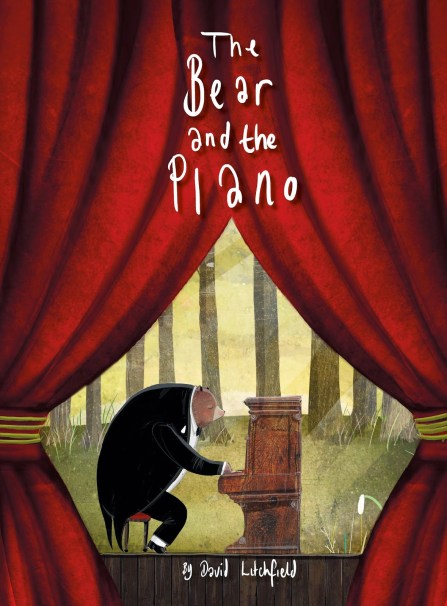
The Bear and the Piano

By David Litchfield


One day a bear cub happens upon a piano in a clearing in the middle of the forest. Wondering what it could be, he approaches and lays his paw on the keys. The strange thing goes PLONK!—such an awful sound. The bear cub leaves, but is drawn back again and again for days, months, and years. Over time the bear grows up and learns to play the piano. The music is beautiful and transports him to strange and wonderful places.

Other bears soon gather in the clearing to hear the “magical melodies” the bear plays. The bear is happy entertaining his friends. One night a girl and her father hiking in the forest come to the clearing. They listen and then tell the bear what his strange instrument is. They invite him to move to the city with them, where he will be able to play grand pianos for hundreds of people. The music he will play and hear “will make your fur stand on end,” they tell him.

The bear is conflicted. One on paw he knows that leaving the forest will make the other bears sad; on the other he longs to explore the world, to play the piano better, and master more intricate music. He decides to go with the girl and her father.

In the city the bear is a sensation! He quickly becomes a celebrity with his name on marquees and playing to sold-out crowds. The bear records albums that go platinum, he appears on the covers of magazines, and wins awards. His experience is everything he could ever wish for. But deep in his heart there is another longing. He misses the forest and his friends there.

He decides to leave the city and rows a boat across the expanse of water to his old home. Excitedly he runs to the clearing, but when he arrives everything has changed. His piano is gone and there are no friends to greet him. The bear worries that everyone is angry at him for leaving, or worse—that they have forgotten him.

Suddenly an old friend peeks around the trunk of a tree. The bear hails him with a hearty “Hello!”, but the other bear remains silent then turns and runs into the trees. The bear follows plunging deeper and deeper into the forest. Suddenly he stops. In front of him is a sight that makes his fur stand on end.

There, protected in the shade of a tree and surrounded by the albums, magazines, t-shirts, and other mementos of the bear’s success sits the old piano. The bear’s friends have not forgotten him and they are not angry. They are proud and welcoming. The bear tells them all about his adventures, and then he sits down to play again—for the most important audience of all.

David Litchfield’s very original and moving story is such a wonderfully conceived microcosm of the changes life brings. Stumbling upon a talent, cause, or inspiration; opening up to other influences; and acting on hard decisions are all part of growing up. These concepts are honestly and sensitively presented, and the reassuring ending brings comfort as well as a tear to the eye.

Litchfield’s touching illustrations—rendered in gorgeous hues of browns, greens, yellows, and blues—brim with yearning and mystery. The piano sits in a misty glow, silent and draped with vines, when the cub discovers it. While the bear grows and learns to play, the air clears and the colors become brighter. As the bear moves to the city, the pages glint and swirl with his enormous achievements. But as the bear sits on a rooftop one night looking out toward his old home, the lights around him are the elements of normal life—lamps, stars, the moon glimmering on the water. His nostalgia to be home will resonate with both kids and adults. The Bear and the Piano makes a wonderful gift for any age—especially as a graduation or new-job gift—and is a must-have for anyone’s personal library.

Clarion Books, Houghton Mifflin Harcourt, 2016 | ISBN 978-0544674547

Record Store Day Activity

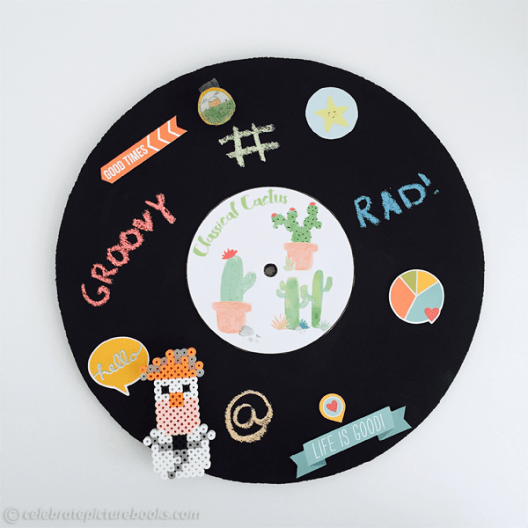
CPB - Record Bulletin Board

Make a Record Chalkboard Bulletin Board


Would you love to make a record some day? Why wait? In this fun craft you can create your own record bulletin board—and even create your own label art! While this record may not spin on turntables around the world, it will drop in a more important place—your very own room!

Supplies

  • Printable Record Label for you to design
  • Foam board, or a corkboard at least 12-inches x 12-inches square
  • Adhesive cork
  • A 12-inch round plate, record, or other round object to trace OR a compass
  • Chalkboard paint, black
  • X-acto knife
  • Paint brush or foam paint brush
  • Mounting squares

Directions

  1. Cut a section from the adhesive cork a little larger than 12 inches by 12 inches
  2. Affix the cork to the foam board
  3. Trace the 12-inch round object onto the cork/foam board OR use the compass to make a 12-inch circle
  4. With the x-acto knife, carefully cut out the circle (adult help needed for children)
  5. Cut out a ¼ -inch circle in the center of the record bulletin board
  6. Paint the cork, sides and inside the spindle hole with the black chalkboard paint. Let dry
  7. Print the label template and design your own record label
  8. When the paint is dry, glue your label to the center of the bulletin board
  9. Hang your bulletin board with the mounting squares
  10. Decorate!

April 7 – International Beaver Day

The Flying Beaver Brothers and the Crazy Critter Race by Maxwell Eaton III

About the Holiday

Beavers are pretty amazing creatures. With their prominent teeth these largest members of the rodent family cut down large trees. They use the bark, buds, and small twigs for food then gnaw the trunk and branches into smaller parts and build dams that are just about as strong as anything people can construct. These dams can help prevent floods, clean the water supply, and restore wetlands. The largest beaver dam is in Wood Buffalo National Park in Alberta, Canada.

Beaver Day is celebrated to bring awareness to the declining beaver population and to promote their protection.

The Flying Beaver Brothers and the Crazy Critter Race

By Maxwell Eaton III


The flying Beaver brothers are back in a vine-popping, lasso-swirling adventure! Bub is reading Penguin Giant to Bob and Bob when Ace comes home with an intriguing ad for The Crazy Critter Race. The winner will receive—not pancakes as the penguins hope—but a free houseboat. The house Bob and Bob built for the Beaver brothers is a little less than desirable, so Ace and Bub swim over to Critter Houseboat Sales and Service to sign up.

There they meet the yeehawin’ cowboy hat-wearin’ crazy critter who has organized this unusual event. They also encounter the rope-snapping Raccoon sisters, and the competition is on! Crazy Critter explains the rules of the race: It seems the islands’ trees have been destroyed by ornery baboons, so the object of the race is to replant trees from a jar of seeds Crazy Critter gives them. The first team to reach the top of each mountain must plant one seed. The team who completes the race and rings the bell at the finish line will win a houseboat.

The racers take off, but the Beaver brothers and Raccoon sisters soon leave the rest of the competition in their wake. They both run to the top of the first mountain and plant their seeds. With a Rugga Rugga and a loud Brorg! two enormous vines break the earth and thunder toward the sky! In all the mayhem Ace and Bub’s jar of seeds opens and spills its contents on the beach.

In the blink of an eye, vines are shooting out of the ground and grabbing everything in sight. In fact, “Everything Vine” is the name of this Kudzu cousin because it covers everything. Ace and Bub go to work with their gnawing teeth, but even they are no match for the vine. Unaware of the disastrous consequences, the Beaver sisters use some pretty impressive moves to get ahead even as they continue planting seeds.

Now vines are erupting willy-nilly, threatening every land mass and even Beaver Island. Crazy Critter denies all knowledge of the fatal seeds, but has a solution of his own—if the islands are uninhabitable, he will sell houseboats to all the ex-habitants. Crazy Critter finally fesses up to his evil plan, but what can anyone do now? The vines are taking over!

The Beaver brothers look at the Raccoon sisters and the Raccoon sisters look at the Beaver brothers. They know that by working together they can save the islands. The Raccoon sisters use their awesome roping skills to gather the vines while the Beaver brothers chomp them in half, destroying them. Beaver Island is saved!

But who wins the houseboat? Let’s just say Crazy Critter isn’t so crazy after all.

This graphic novel-style book—the 6th in the series—will appeal to reluctant readers as  well as kids who enjoy a wild, humorous adventure. The quick pace of the story, teamed with action-packed drawings, will keep fans of the series cheering for their familiar friends in this race that just doesn’t seem right. Kids will laugh out loud at the funny asides and sound effects. A light-hearted lesson on competition and cooperation ties the story together in a satisfying finish.

Ages 6 – 9

Knopf Books for Young Readers, 2015 | ISBN 978-0385754699

International Beaver Day Activity

CPB - Beaver craft picture (2)

Make a Spool Beaver


Do you have a gnawing need to have a beaver of your own? Make one with this Spool Beaver craft!

Supplies

  • Printable Ears and Nose Template
  • 2-inch wooden spool, available at craft stores
  • 1 6-inch long x ¾ inch wide craft stick
  • Small piece of foam board
  • Brown “chunky” yarn
  • Brown felt, small piece for ears and tail
  • Black felt, small piece for nose
  • Acorn top for hat (optional)
  • Brown craft paint
  • Black craft paint
  • Black marker
  • Strong glue
  • Paint brush
  • Scissors

CPB - Beaver craft picture with tail

Directions

  1. Print the Ears and Nose template
  2. Paint the spool with the brown paint, let dry
  3. Cut the ears from the brown felt
  4. Cut the nose from the black felt
  5. Cut a piece from the end of the craft stick
  6. Paint the craft stick brown or black, let dry
  7. Cut two small pieces from the foam board, ½-inch long x 3/8 inch wide
  8. When the spool is dry, glue the ears to the spool, leaving the ears sticking up over the rim of the spool
  9. Glue one end of the yarn to the spool
  10. Holding the spool horizontally, wind the rest of the yarn around the spool back and forth from front to back. Glue the end to the body of yarn. This will be the bottom of the beaver.
  11. Glue the nose over the hole in the spool
  12. Glue the teeth below the nose
  13. Glue the flat edge of the craft stick to the back of the spool to make the tail


April 4 – National School Librarian Day

The Midnight Library by Kazuno Kohara Picture Book Review

About the Holiday

One of the best parts of going to school is visiting the school library! Whether you go to the library to listen to a story or do research, the librarian is there to help you discover amazing books! School librarians thoughtfully read hundreds of books a year to choose just the right ones. Many school librarians are also involved in multimedia education and programs for school assemblies, morning news programs, and special meetings.

Today, thank your school librarian and tell them how much they mean to you!

The Midnight Library

By Kazuno Kohara


A little librarian opens the doors to her library only as the sun goes down. Working with her three assistant owls, she helps the forest animals find the perfect book. The animals read quietly and the library is peaceful until one night when a band of squirrels begins playing their instruments in the reading room. The little librarian shushes the squirrels and they apologize, saying they’re just working on a new song. The librarian has the perfect solution and shows the band to the upstairs activity room. Peace reigns once more in the library,

Later that night it begins to rain—inside! The little librarian climbs the ladder to look at the roof, but instead of a leak she finds a wolf sobbing away. Her book is so sad, she says, that she can’t read on. Gently, the librarian takes her to the storytelling corner where she, the owls, and Miss Wolf read the story together. The wolf discovers the book has a happy ending, something the library workers knew all along.

All too soon the sun peeks over the horizon, and it’s time for the library to close. The patrons file out one by one, but who is left plodding along with his book in the corner? It’s a tortoise who says he is not leaving until he finishes his book—only 500 pages to go! Once again the little librarian has the answer! She gives the tortoise a library card and reveals that he can take the book home with him and finish it there. The tortoise leaves happy and feeling lucky with the book strapped to his shell.

The owls and the librarian tidy up the shelves and grab one last book—bedtime stories for the sleepy owls.

The Midnight Library is a perfect bedtime—or daytime—book for budding bibliophiles and library lovers. While simply written, Kazuno Kohara’s story has a dreamy quality and is as inviting as a favorite library reading nook. Just as libraries are comforting in their hushed rooms and neatly organized shelves, the little librarian of the story is reassuring as she quickly and calmly resolves the issues that arise in her domain. 

The characters are sweetly drawn, smiling with pleasure at being in their favorite place, and the picture of the owls holding Miss Wolf’s hands as they read her book together is particularly touching. The pages are composed of three colors—the structures inside the library are the black of night’s shadows; the walls and characters are the gold of starlight and moonlight; and the beloved books are the violet blue of the deep night sky. As you reach the end of the story, you will look forward to the next night when you can visit the midnight library again.

Ages 3 – 6

Roaring Brook Press, 2014 | ISBN 978-1596439856

National School Librarian Day Activity

CPB - Librarian Thank You card

Create a Thank You Card


Today’s a perfect day to make a card to thank your school librarians or the librarians at your local town library. Here’s one that you can use to tell your librarians why you love them and what you like best about the programs they create for you! Print the Thank You! card, draw a picture on the front and/or inside, sign your name, and write a message. Then fold it and give it to your favorite librarian. Get the Thank You! card here.

March 30 – National Pencil Day

The Pencil by Allan Ahlberg and Bruce Ingman Picture Book Review

About the Holiday

Writers and artists, this day is for you! On this date in 1858 Hymen Lipman received a patent for the very first graphite pencil with an eraser attached. Lipman must have been an optimist because the pencil he created was ¾ graphite and ¼ India rubber eraser. The user would sharpen both ends to expose the material. There are conflicting reports on why most pencils sport that familiar yellow hue, but both agree that the color was associated with grandeur. One fascinating fact about this most noble instrument is that a single one can pen pencil 45,000 words or draw a line 35 miles long!

So sharpen those pencils—whatever color they are—and spend this day creating something wonderful!

The Pencil

Written by Allan Ahlberg | Illustrated by Bruce Ingman


Even before the title page readers learn of a little pencil, alone in the world. One day the pencil quivers and begins to draw. The pencil draws a boy, who asks for a name, and receives “Banjo” in reply. The boy wants a dog, and the pencil obliges. Bruce is the dog’s name, and he wants a cat. Mildred is immediately created, and of course Bruce chases Mildred. Banjo chases Bruce. They need a place to run, so the pencil draws a house, a town, and a park.

All this excitement makes the trio hungry and tired. Banjo demands the pencil draw him an apple, Bruce wants a bone, and Mildred really wants a mouse but settles for cat food. There’s just one problem—the food is so unappetizing in black and white. The pencil thinks for a bit and comes up with a solution. He draws a paintbrush named Kitty. Kitty colors the food, the boy, the dog, the house, the town, and the park. Mildred is left as created – she’s a black-and-white cat anyway.

The team of Pencil and Paintbrush create a family, a friend for Bruce, a ball (Sebastian) for Banjo, and a kitten for Mildred. But all these extra characters cause trouble. Sebastian breaks a window, and the mom, dad, sister, and grandpa aren’t completely satisfied with their traits. What’s a pencil to do? Draw an Eraser, of course!

The eraser takes care of the problems, but grows fond of his power to rub things out. He erases the table, chair, front door—the whole house. And that’s not all! Nothing the Pencil and Paintbrush have created is safe. Eraser rubs everything out until all that’s left is the pencil and the eraser locked in opposition.

The pencil draws a wall, a cage, a river and mountains with fierce animals but none of it is a match for the eraser. Then the pencil has a brainstorm and draws…another eraser! The two erasers engage in an epic battle, and in the end they rub each other out.

The Pencil recreates everything he had before, and Kitty colors it all in, including a new picnic with a runaway boiled egg named Billy and 10 A-named ants to clean up the crumbs. As the day fades into night, a moon appears in the sky along with a cozy box for Pencil and Paintbrush to sleep in.

Allen Ahlberg’s endearing story of a little pencil who creates himself a world full of friends and excitement as well as the inevitable conflict will appeal to kids for whom the imagination looms large and even competes with and enhances reality. On a subtle metaphorical level, as the eraser rubs out everything in its path, kids may see that simply getting rid of problems can sometimes cause more, and that resolution is a better tact.

Bruce Ingman’s illustrations deftly depict the friendship and collaboration between Pencil and Paintbrush. Graphite lines outline the characters and objects that Pencil draws, and the colorful accents from Paintbrush are vivid and joyful.

Ages 4 – 8

Candlewick Press, 2012 | ISBN 978-0763660888

National Pencil Day Activity

CPB - Pencil Maze

Pencil It In! Maze


Line up here to test your skills against this printable Pencil It In! pencil-shaped maze. Solution included. Sharpen your pencil and start having fun!

Picture Book Review

March 29 – Smoke and Mirrors Day

The King and the Magician by Jorge Bucay and Gusti Picture Book Review
About the Holiday

Abracadabra! With a puff of smoke and a few mirrors, I have made this blog post appear out of thin air! Okay, so maybe that’s not quite true, but today is the perfect day to try a little magic. On Smoke and Mirrors Day we celebrate the practitioners of this most mysterious art, who often extend and retract mirrors within a cloud of smoke to accomplish their deceptions. The term is also used generally whenever someone is trying to pull the wool over another person’s eyes. Whether you like sleight of hand, disappearing acts, or the magic of a soothing cup of tea, have fun, make a little mischief, and enjoy the day!

The King and the Magician

Written by Jorge Bucay | Illustrated by Gusti


In a faraway land there once lived a King who was very powerful. Not only does he love power, he commands that everyone in his kingdom obey and admire him. Trembling, his subjects reassure him every day that he is the most powerful man in the kingdom.

One day, however, the King hears a rumor that down in the village lives a Magician who can predict the future. The King fears that this man will become more powerful than he, and he sends his spies to learn more. The spies return and reveal that not only can the Magician tell the future, he is loved and admired by everyone.

The King becomes terribly jealous and plots to do away with his most hated enemy. He devises a plot to trick the Magician. He will host a party, and at the end will ask the Magician if he can truly predict the future. If the Magician says “No,” he will be exposed as a fraud, and the king will kill him. If the Magician answers “Yes,” the King will ask him to predict the date of the Magician’s death and will then kill him. The King is pleased with his scheme because either way, he will be rid of his rival.

On the night of the party, the King summons the Magician and asks him the fatal question. The Magician is more than just a seer or a sorcerer—he is wise. He looks at the King and states, “the Magician of this kingdom will die the exact same day as his King.

Now the King is in a terrible quandary. He does not want to risk the possibility that this old man’s prediction is true. He must now protect the Magician in order to save his own life. He quickly concocts a ruse and asks the Magician to stay the night in the castle, saying he wants to consult with him about some royal matters. In fact, he just wants to keep an eye on him.

The Magician agrees. The next morning the King goes to the Magician and asks his advice on some kingly decisions. The Magician offers good suggestions, and the king accepts them. As the months go by, the King continues to rely on the Magician for guidance, and slowly the King learns to be fair and wise. He becomes the respected and admired ruler he always wanted to be.

The King realizes that not only is the Magician a trusted advisor, he is a loyal and beloved friend. One day, wracked with guilt over his one-time plot to kill the Magician, the King reveals the story. The Magician listens to the King’s secret, and shares one of his own.

He relates that when the king questioned him on the night of the party, he saw the king reach for the hilt of his sword and realized his intentions. He then divulges that he made up the prediction of their shared death date to teach the King a lesson—one the King has learned. He says, “It is our lives that have become entwined, not our deaths.”

For many more years the King and the Magician live as friends and confidants. The kingdom grows stronger and the King kinder and more loved by his people. One day the Magician dies. The King is sad, and realizes he is no longer afraid of his own death. The King has learned the Magician’s lesson well, and even though his advisor is gone, he continues to make wise and beneficial decisions.

Ten years later the King writes a letter to his son and heir. In his letter, the King cautions his son that during his life he may come across someone or something that “will arouse fear and jealousy in your soul” and will want to destroy them or it to alleviate his fear. Instead, says his father, “open  your heart or your home” because “what you thought was your most feared enemy, is really your most powerful friend.”

Jorge Bucay has written a classic tale of wisdom verses power wrapped around a clever psychological trick that initiates the kind of thought which leads to true enlightenment. The straightforward storytelling and the pacing of the plot build suspense, while lyrical descriptions create a beautiful flow that depicts both the quandary of the King and the kindness of the Magician.

Gusti’s lavish illustrations, reminiscent of hieroglyphics and Medieval tapestries, are rendered in dark, rich brown, rust, black, olive and blue hues that gorgeously portray the splendor of the King and his castle, but also signal the somber weight in his soul. The regal tone even extends to the gilded text. The King is drawn as an imposing rounded figure, towering over everyone else in his kingdom, but his feet and hands are tiny, lending him a bit of a comical yet vulnerable air. The King’s eyes narrow with cunning as he plots his evil deed but widen in doubt and despair as the Magician works his special brand of magic.

Ages 4 – 8

Abbeville Kids, 2014 | ISBN 978-0789212047

Smoke and Mirrors Day Activity

CPB - Magic Word Scramble II


Say the Magic Word! Word Scramble


Magic is all about mystery—and so is this scrambled word puzzle! Print the Say the Magic Word! word scramble. Then unscramble each magic-related word and, using the letters in the circles, discover the mystery phrase. Here’s the Solution!

March 28 – Music in Our Schools Day

Music Class Today by David Weinstone and Vin Vogel

About the Holiday

The National Association for Music Education sponsors Music in Our Schools Month each March to promote greater awareness of the benefits and enjoyment high-quality music education brings to students and the community. Beginning in 1973 as a single Advocacy Day in New York, this celebration grew to include the entire month in 1985.

During the month special music programs, education, concerts, and classes take place to get kids and adults excited about the joys of music in schools.

Music Class Today

Written by David Weinstone | Illustrated by Vin Vogel


A little boy and his froggy toy join a music class full of other boys and girls led by a guitar-strumming teacher. The class starts with a song welcoming everyone by name and a verse inviting all to shake their musical eggs high and shake the eggs low. “One rolls away—where did it go?”

The new boy peeks around his mom’s back to watch the action, and when it’s time for a song he says, “I think I’ll just watch…But I’m listening!” The teacher gently sings, “That’s all right, that’s okay. / Whenever you’re ready, / come on over and play. / That’s all right, there’s no rush. / Whenever you’re ready, / come play with us!” These verses become a chorus repeated throughout the book, reassuring the little boy that he’s welcome, but that his own speed of acclimation is okay too.

The class continues with the kids kicking up their feet, drumming, and moving around the room in time with the music. The little boy comes out from behind his mom to sit on her lap and watches the fun. The teacher’s chorus brings the boy a little closer—to the edge of his mom’s feet—while clinging tightly to his froggy. He giggles as the kids swirl with scarves, getting dizzy, and falling down.

Now everyone’s dancing, being silly, and having a ball. Froggy joins in, dangling and wiggling at the ends of the boy’s hands. As dancing evolves into free-play time, the little boy accepts the teacher’s invitation to “come join the fun,” and leaves froggy at his mom’s feet with one more request for assurance—“Wait here till I’m done!”

“Good for you, that’s the way. / Everybody’s in the band!” the teacher sings as the little boy takes up the cymbals and leads the parade behind him. All too soon it’s clean-up time and class ends with a good-bye song. The boy is having so much fun that he tells the teacher he and froggy want to stay. The instructor knows just what to say to his happy, excited student: “That’s all right, that’s okay. / We’ll see you soon another day!”

In this cross-genre picture book, David Weinstone brings the musicality and movement of a toddler and preschool music class to the page. His song, also available as a free download, serves as the text of the story about a reluctant joiner who overcomes his apprehension to become a member of the group. The repeated chorus, that calmly and sincerely explains that it is okay for children to wait and watch until they feel comfortable, can be used for many situations and is a welcome message.

Vin Vogel’s sweet illustrations of a wide mix of kids kicking up their heels (literally, as a flying shoe bonks the instructor on the head in one giggle-inducing scene) and having fun are inspired in their focus on the children. The kids play instruments, dance, and cavort across the pages, filling the white space with joy. The view of the classroom changes from page to page to show other mother-child pairs, which helps emphasize that hesitant children are common, as well as baby siblings, toys, instruments, storage bins, and other sights familiar to children.

Ages 1 – 4

Farrar, Straus and Giroux, 2015 | ISBN 978-0374351311

Music in Our Schools Day Activity

CPB - Music in Schools Day game

It’s Instrumental! Game


Play this fun game to gather all the instruments you need to create a music group. The first person to collect all 6 instrument cards is the winner!

Supplies

Directions

  1. Print the Paper Cube Template, cut it out and assemble the cube die.
  2. Print the Musical Instruments cards, cut out cards, and separate the instruments into piles
  3. Players take turns rolling the die cube to collect musical instrument cards
  4. The first player to collect all 6 instrument cards is the winner


March 25 – International Waffle Day

Lady Pancake and Sir French Toast by Josh Funk and Brendan Kearney Picture Book Review

About the Holiday

When someone made a spelling error, turning the Swedish holiday “Our Lady’s Day” (Vårfrudagen) into Waffle Day (Våffeldagen), a brand new culinary celebration began! Waffle Day also ushers in spring and offers the perfect excuse to enjoy these crispy concoctions whether you like them sweet, with syrup or confectioner’s sugar, or savory, as a base for meat and other toppings. So mix up some batter and pull out your favorite waffle maker and enjoy a delicious day!

Lady Pancake and Sir French Toast

Written by Josh Funk | Illustrated by Brendan Kearney


You know those strange noises you sometimes hear coming from your refrigerator? And how you could have sworn the leftovers were on the top shelf? Well, Josh Funk’s Lady Pancake and Sir French Toast may solve those mysteries and more in this rambunctious tale about what happens when relationships grow frosty.

One day Lady Pancake and Sir French Toast are hanging out at the back of the fridge when they learn the syrup is almost gone. Lady Pancake claims it as her own, but Sir French Toast replies, “Not if I get there first!” And so off they race! “Through Broccoli Forest, past Orange Juice Fountain, they climbed to the top of Potato Mash Mountain.” But the race takes a turn as the two meet obstacles that are no fun at all: at the edge of a shelf “Toast couldn’t quite stop, plummeting down into jam with a plop.” And “Chili Lagoon slathered Pancake in muck and then at a fork in the road she got stuck.”

celebrate-picture-books-picture-book-review-lady-pancake-and-sir-french-toast-interior-art

The one-time friends call each other names and taunt each other with boasts of being the best breakfast food. As their competition upends the peace of the whole refrigerator from shelf to shelf, Lady Pancake and Sir French Toast find their energy wilting, and by the time they reach that sweet sought-after prize, they are “battered and soggy, exhausted and crumbling, too tired to push, they were limping and stumbling.”

With the bottle in sight, they are shocked to discover that the last drop of syrup is already gone. Who could have done this dastardly deed? None other than the sneaky Baron Von Waffle! With nothing to gain, Lady Pancake and Sir French Toast no longer have a reason to fight. In fact they realize that they lost out on the syrup because they were fighting. When they see that there is a little butter left, they decide to use the lesson they learned and share it.

celebrate-picture-books-picture-book-review-lady-pancake-and-sir-french-toast-interior-art

There are so many fantastic rhymes in this book that kids will want to hear again and again. One of my favorites comes as Sir French Toast catches up to Lady Pancake: “He scraped himself off and yelled up, / ‘You’re a meanie!’ / as Pancake rappelled / down a rope of linguini.” With such laugh-inducing verses, kids may never look at food the same way again. Josh Funk has created a tale about friendship that is both boisterous and unique and sure to quickly become a favorite.

The refrigerator world as envisioned by Brendan Kearney is as colorful as the food rainbow and as active as a playground in summer. It’s also stacked with the cutest array of legumes, yogurt, cake, juices, fruit, and veggies you’ll find anywhere. The final fold-down page of the entire refrigerator is a delight that kids of all ages will want to linger over even after the story of The Great Race between Lady Pancake and Sir French Toast is over.

Ages 5 and up

Sterling Children’s Books, 2015 | ISBN 978-1454914044

Visit Josh Funk’s Website to download a free Lady Pancake and Sir French Toast Activity Kit and to learn about more upcoming titles!

Discover more art and books by Brendan Kearney on his website!

Watch the trailer for this amazing race – you’ll be singing the Lady Pancake & Sir French Toast theme song in no time!

International Waffle Day Activity 


celebrate-picture-books-picture-book-review-lady-pancake-and-sir-french-toast

Sweet as Syrup Figure


Fun shouldn’t be kept bottled up! Well…maybe just this once. Make your own figure to display or play with from a syrup bottle with this craft. It’s sure to be as sweet as you are!

Supplies

  • Small plastic syrup bottle with a narrow squeeze fliptop and without a handle, empty
  • 1 ½-inch wooden ball with ½-inch hole in bottom
  • 16-inch to 18-inch square piece of cloth
  • Ribbon or strip of material
  • 12 to 14-inch long medium-gauge craft wire
  • Gel pens, black, blue, brown, red (Gel pens work well on the wood as the ink doesn’t bleed into the wood and are easy to control)
  • Poly fill or needle-felting wool
  • Scissors
  • Strong glue

CPB - Syrup Bottle Figure II

Directions

To prepare the bottle

  1. Remove labels from syrup bottle
  2. Cut the flip top in half, keeping the narrow nozzle part

To make the head

  1. Holding the wooden ball with the hole at the bottom, draw a face on the wooden ball with the gel pens
  2. Glue a small handful of poly fill or needle-felting wool to the top of the wooden ball for hair. You can make the hair has long, short, or poofy as you wish.

To make the dress

  1. Cut a 16-inch diameter circle from the material

To assemble the figure

  1. To make the arms, wrap the wire around the neck of the syrup bottle, crossing it in the back and pulling tight
  2. Center the material over the opening of the syrup bottle
  3. Cut tiny slits in the material at the location of the wire on each side of the bottle, and pull the arms through the material
  4. Bend the ends of the wire into a small loop to form hands
  5. Screw the cap with the narrow nozzle over the material
  6. Tie the ribbon or strip of material around the narrow part of the bottle to make the figure’s waist
  7. Place the hole in the wooden ball over the nozzle in the cap and glue into place

Make up your own story with your new figure!