April 2 – Peanut Butter and Jelly Day

celebrate-picture-books-picture-book-review-peanut-butter-and-brains-cover

About the Holiday

Those Aztecs! Is there nothing they couldn’t invent? Culinary aficionados from kindergarten to gourmet chefs have the Aztecs to thank for peanut butter—that smooth (or chunky, or super chunky) concoction that is perfect by itself or as an ingredient in complex dishes. The Aztecs created their version by grounding roasted peanuts into a paste.

Peanut butter and jelly sandwiches are thought to have originated during the American Civil War, when soldiers combined their peanut butter ration with their jelly ration and slathered it all on bread. After the war peanut butter sales skyrocketed as everyone discovered what a delicious and nutritious delight this simple meal was. To celebrate today, make yourself a PB & J sandwich!

Peanut Butter & Jelly Brains: A Zombie Culinary Tale

Written by Joe McGee | Illustrated by Charles Santoso


Reginald was surrounded by culinary boredom. All “the other zombies wanted brains for breakfast, lunch, and dinner,” but Reginald really dug peanut butter and jelly sandwiches. The people of Quirkville weren’t too keen on the zombies’ preferred meal either. Whenever the zombies lumbered through town groaning “BRAINSSSSS,” everyone ran away screaming.

celebrate-picture-books-picture-book-review-peanut-butter-and-brains-reginald-hungry

Image copyright Charles Santoso, text copyright Joe McGee. Courtesy of Harry N. Abrams

Poor Reginald didn’t join the herd. His stomach was too rumbly and grumbly, “and all he could do was dream about a peanut butter and jelly sandwich. ‘Sweet jelly…,’ moaned Reginald. ‘Sticky peanut butter…’” Sakes alive! The other zombies couldn’t understand. “‘No BRAINSSSSS?’” they asked. Reginald tried to explain how delicious peanut butter and jelly was, but the other zombies wouldn’t listen.

Reginald tried to satisfy his craving at the local café, but the man behind the counter just pointed to a sign that said “No Zombies Allowed.” In the school cafeteria, the lunch lady just plopped “a hunk of meatloaf” on his plate that looked disturbingly like brains. Reginald even went to the store to buy the ingredients himself, but when he got to the cash register, he had no money. No money meant no peanut butter, no jelly, and no bread.

celebrate-picture-books-picture-book-review-peanut-butter-and-brains-no-brains

Image copyright Charles Santoso, text copyright Joe McGee. Courtesy of Harry N. Abrams

Then Reginald spied Abigail Zink with a lunch bag in her grasp. He “recognized the familiar jelly stain that was seeping through the paper bag” and made his move. At the same time, the “zombie horde shuffled and shambled around the corner” straight for Abigail, who had her nose in a book and took no notice of the danger. The other townspeople froze, and in that moment Reginald dashed forward and grabbed Abigail’s sack. He could practically taste the deliciousness inside.

celebrate-picture-books-picture-book-review-peanut-butter-and-brains-reginald-grabs-bag

Image copyright Charles Santoso, text copyright Joe McGee. Courtesy of Harry N. Abrams

“Little Abigail Zink let out a shriek, the mayor’s poodle yipped and yapped, and the townspeople all screamed, ‘ AHHHHH!’” Reginald knew that if the other zombies had just one taste of peanut butter and jelly, they would change their minds about brains. Reginald held Abigail’s sandwich aloft and yelled, “‘BRAINS!’” The zombies crowded around as Reginald tossed the sandwich in the air.

Reginald had been right. With one taste, the zombies declared peanut butter and jelly “‘better than brains.’” Suddenly, the townspeople realized that the zombies were just hungry. With peanut butter and jelly sandwiches in their tummies, the zombies became valued parts of Quirkville. The townspeople were happy, the zombies were happy, and Reginald? Well, he was still a little different. While the zombies now enjoyed PB and J, he “had moved on to…PIZZA.”

celebrate-picture-books-picture-book-review-peanut-butter-and-brains-zombie-horde

Image copyright Charles Santoso, text copyright Joe McGee. Courtesy of Harry N. Abrams

Joe McGee’s tradition-bucking zombie offers a sweet wake-up call to anyone sleepwalking through life doing and liking the same things over and over while they follow the herd (or horde). McGee’s humorous descriptions of the marauding zombies and the townspeople’s reactions will have kids giggling all the way through the story. The resolution to Quirkville’s predicament is deliciously “brainy,” and Reginald’s continued individuality makes for a surprising and satisfying ending.

Charles Santoso knows that most families have one or two zombies of their own who latch onto a favorite food and won’t let go. His stitched up, shaggy haired, raggedy clothed child zombies are adorable, and kids will love finding their favorite among the horde. Clever touches, such as a pirate zombie and a zombie cat, as well as the screaming townspeople will make readers laugh.

For the walking hungry, Peanut Butter & Jelly Brains: A Zombie Culinary Tale is sure to be ordered from the book cupboard again and again for fun story times.

Ages 4 – 8

Harry N. Abrams, 2015 | ISBN 978-1419712470

Discover more about Joe McGee and his books on his website!

View a gallery of work by Charles Santoso on his website!

Peanut Butter and Jelly Day Activity

celebrate-picture-books-picture-book-review-erica's-sweet-tooth-peanut-amd-butter-and-jelly-muffins

Peanut Butter and Jelly Muffins, recipe from Erica’s Sweet Tooth, ericasweettooth.com.

Peanut Butter and Jelly Muffins from Erica’s Sweet Tooth


Searching for a delicious alternative to a peanut butter and jelly sandwich—one that’s perfect for breakfast, lunch, or as an in between sweet? Look no further than this scrumptious recipe from Erica’s Sweet Tooth! Made with creamy peanut butter, your favorite berry preserves, and a luscious crumble, these muffins will satisfy your PB & J cravings.

Click here for Erica’s Sweet Tooth Peanut Butter and Jelly Muffins

Picture Book Review

March 26 – It’s Umbrella Month

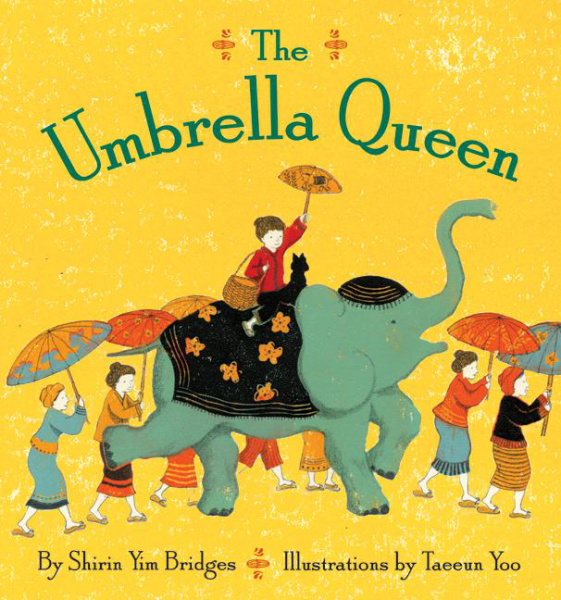
celebrate-picture-books-picture-book-review-the-umbrella-queen-cover

About the Holiday

This month we celebrate umbrellas, those perky protective accessories that have been around since earliest times. Ancient civilizations used palmetto fronds for shade and during inclemet weather. The first waterproof umbrellas were created by the Chinese, who waxed or lacquered their paper parasols. Umbrellas were strictly women’s accessories until Jonas Hanway, a Persian travel writer, used one in public in England in the 1700s. English men then took up the practice, calling their version a “Hanway.” The first collapsible umbrella was designed in 1710, and in 1928 the folding pocket umbrella appeared. Since then, umbrellas have become fashionable and necessary accessories for all.

The Umbrella Queen

Written by Shirin Yim Bridges | Illustrated by Taeeun Yoo


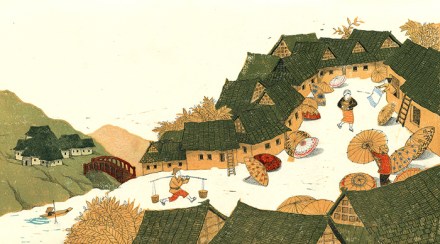
The residents of a small village in Thailand are well known for the beautiful paper umbrellas they make and sell in the local shops. The umbrellas are colorful, but always decorated with flowers and butterflies. Every New Year’s Day the villagers hold an Umbrella Parade, and the woman who has painted the most beautiful umbrella is chosen as the Umbrella Queen.

Noot is a little girl who longs to paint her own umbrellas and partake in the parade. One day her mother gives her an umbrella to paint and shows her how to copy her design. Noot is a natural artist, and her finished umbrella is nearly indistinguishable from her mother’s. She is given her own painting spot in the garden and five umbrellas to decorate.

celebrate-picture-books-picture-book-review-the-umbrella-queen-village

Image copyright Taeeun Yoo, courtesy of taeeunyoo.com

Noot paints the familiar butterflies and is about to start on the flowers when she is inspired to draw elephants instead. She covers all five umbrellas with elephants doing handstands, playing and squirting water, walking trunk-to-tail, and just being silly. When her mother sees these umbrellas, she is unhappy. Flowers and butterflies sell in the local shops, not elephants. Noot understands the importance of the money made from the umbrellas to her family. For the next year she paints the large umbrellas with the traditional design. At night, however, using bits and pieces, she fashions tiny umbrellas. These she paints with elephants, and displays them on her windowsill.

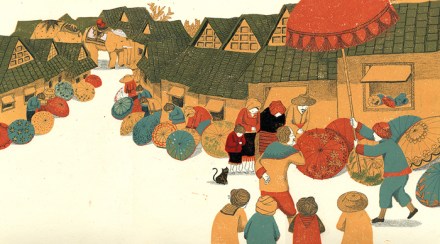
celebrate-picture-books-picture-book-review-the-umbrella-queen-emperor-visits

Image copyright Taeeun Yoo, courtesy of taeeunyoo.com

As New Year approaches there is much excitement in the village. It is rumored that the king will be visiting and will choose the Umbrella Queen himself. One day the villagers receive the message that the king will indeed arrive. The villagers spruce up their town and each woman displays her umbrellas in front of her home.

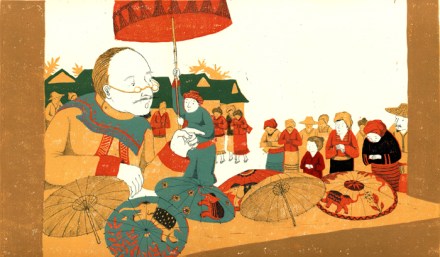
The king walks the length of the street, considering each umbrella until he comes to Noot’s house. He is very impressed with the umbrellas painted by Noot’s mother, but his gaze wanders to Noot’s windowsill, and he asks who painted the “strange” umbrellas.

celebrate-picture-books-picture-book-review-the-umbrella-queen-emperor-judges-umbrellas

Image copyright Taeeun Yoo, courtesy of taeeunyoo.com

A bit embarrassed by the attention, Noot shyly answers the king’s questions about the size of the small umbrellas and the unusual designs. In trying to explain herself, she forgets to look at the ground when talking to the king, and when her eyes meet his she realizes that, instead of judging her, he is charmed. “I like elephants,” she tells him, and he laughs. The king then takes Noot’s hand and names her the Umbrella Queen because “she paints from her heart.”

Shirin Yim Bridges has written a unique story that effectively and engagingly presents the often conflicting dilemma of responsibility to others while staying true to yourself. Noot’s journey from an observer in her family’s business to a valued artist is told straightforwardly, and the familial love and support are clearly emphasized. The king’s recognition of Noot’s talent and heart will be highly satisfying for young readers or listeners.

Taeeun Yoo’s delicate illustrations in gold, red, black, and green set the story firmly in Thailand and perfectly demonstrate the close-knit village and relationships as well as the intricate beauty of the umbrellas and the pride the villagers take in them.

The Umbrella Queen is a wonderful story about family, discovering your talents, and self-expression that would find a welcome spot on any child’s bookshelf.

Ages 4 – 8

Greenwillow Books, Harper Collins, New York, 2008 | ISBN 978-0060750404

Learn more about Taeeun Yoo, her books, and her art on her website!

Umbrella Month Activity

CPB - Umbrella Matching Game

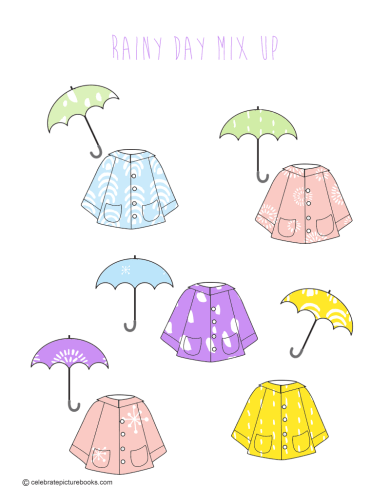
Rainy Day Mix Up Matching Game


A sudden storm scattered all the umbrellas and raincoats! Can you put the pairs together again? Draw a line to connect the umbrella and the raincoat that have the same pattern. Print the Rainy Day Mix Up Game here!

Picture Book Review
March 10 – International Day of Awesomeness

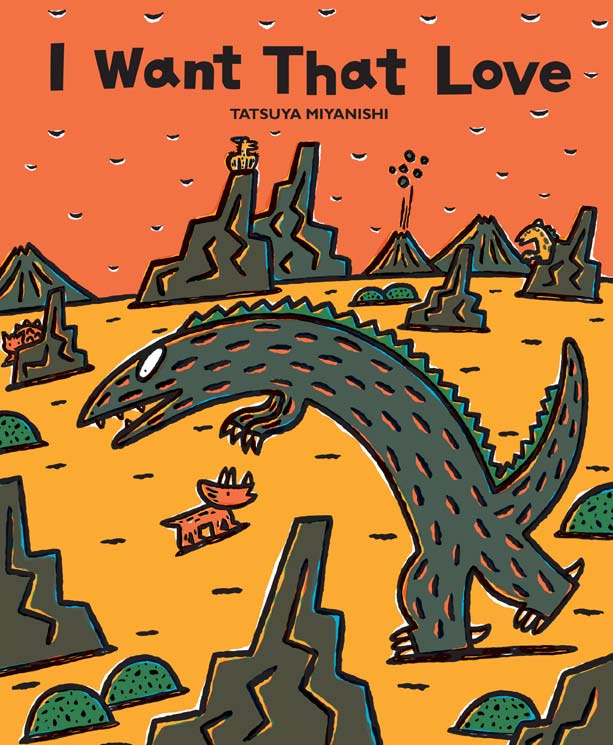
celebrate-picture-books-picture-book-review-i-want-that-love-cover

About the Holiday

Okay, so it’s Friday and the end of a long work and school week. Maybe everything didn’t go as planned this week—maybe not even close. But who cares. Why? Because you are still awesome! Begun as a kind of inside joke among coworkers, International Day of Awesomeness continues to grow, attracting more and more awesome individuals around the world. To celebrate get creative and perform feats of awesomeness—whatever that might mean to you. Sometimes that just means having and showing an awesome amount of love—as you’ll soon see!

I Want That Love

By Tatsuya Miyanishi


Long ago Tyrannosaurus ruled the earth. His philosophy was “In this world, strength means everything. The strongest wins. The strongest rules. And I am the strongest!” Tyrannosaurus stomped across the landscape crushing and eating the “worthless weaklings” in his path. The other dinosaurs quaked whenever they heard him roar. They hid and were quiet, and never opposed him. Soon this led to some skewed thinking—they also began to believe that “Tyrannosaurus could do anything he wanted to because he was the strongest.”

celebrate-picture-books-picture-book-review-i-want-that-love-sleeping

Text and image copyright Tatsuya Miyanishi, courtesy of museyon.com

As time passed, however, the Tyrannosaurus grew old and feeble. One day he happened upon a Masiakasaurus who mocked him for moving so slowly. The Tyrannosaurus threatened him, but could do little else. Another Masiakasaurus bit the Tyrannosaurus’s tail. “‘Ouch…stop,’ the Tyrannosaurus cried.” But it did no good; no one was afraid of him anymore.

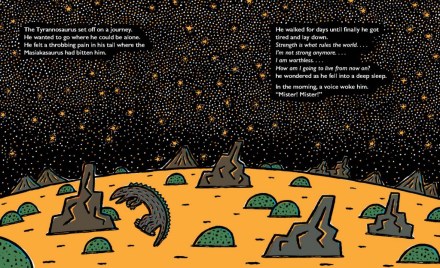
The Tyrannosaurus just wanted to be alone. He traveled for days, and when he was exhausted he lay down and went to sleep. Now that he was no longer strong, he felt he was worthless and wondered how he was “going to live from now on.” He was awakened by a voice. “He opened his eyes and saw a yummy-looking baby Triceratops right in front of him.” He had every intention of eating this little snack, but his tail was so sore he couldn’t move.

celebrate-picture-books-picture-book-review-i-want-that-love-hugging-triceratops

Text and image copyright Tatsuya Miyanishi, courtesy of museyon.com

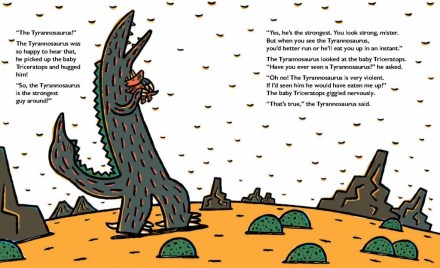
The little Triceratops noticed his swollen tail and stroked the injury to help it feel better. He also warned the Tyrannosaurus that sleeping in the open was dangerous because the “strong, scary Tarbosaurus” would eat him. The Tyrannosaurus scoffed, saying that there was someone much stronger than the Tarbosaurus. The Triceratops suggested the Gorgosaurus, but Tyrannosaurus disagreed. “‘I’m thinking of someone who is much, much stronger,’” he said. Oh, yes! The Triceratops remembered. “‘The Tyrannosaurus!’” Tyrannosaurus was so happy to hear his name that “he picked up the baby Triceratops and hugged him.” The baby warned the dinosaur to run away if he saw Tyrannosaurus because he would surely be eaten.

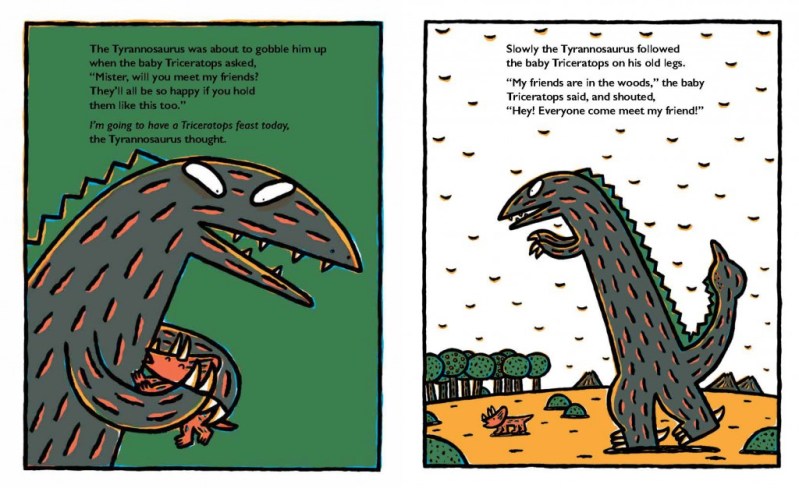
The giant dinosaur was surprised that the baby had never seen Tyrannosaurus before, and was just about to gobble him up when the little one asked if he would meet his friends and hug them too. The Tyrannosaurus eagerly followed the Triceratops, imagining the feast he was about to have. When they reached the woods all the little Triceratops came out to play and begged to be picked up and hugged.  “‘No, no, guys!’ said one little Triceratops. ‘Even a mighty man like Mr. Rhabdodon can get tired.’”

celebrate-picture-books-picture-book-review-i-want-that-love-following-triceratops

Text and image copyright Tatsuya Miyanishi, courtesy of museyon.com

The Tyrannosaurus was insulted. Rhabdodon was stupid, a weakling, and an herbivore. But before he could protest, the other little Triceratops discovered his wound. They all began tending carefully to his injury and gathered red berries to help him heal even though it hurt their horns to ram the tree and dislodge the berries. Suddenly, Tyrannosaurus understood their sacrifice on his behalf. Tears sprang to his eyes, and he grabbed a trunk in his teeth and shook it. The youngsters were amazed as red berries rained down on them.

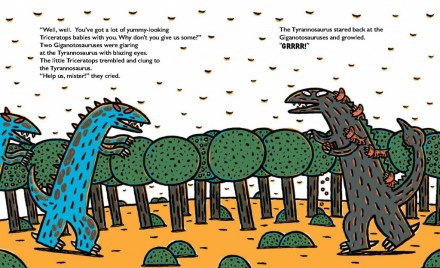
They cheered and said they wanted to be just like Mr. Rhabdodon. They bet that he could even beat mean Tyrannosaurus. The Tyrannosaurus mumbled his old slogan, and began to tell the little ones that strength wasn’t so important when they were interrupted by two Giganotosauruses who wanted a Triceratops snack. The Tyrannosaurus growled at the newcomers. But the Giganotosauruses attacked, biting the Tyrannosaurus to get at the babies in his arms. The Tyrannosaurus curled his body around them and promised to protect them.

celebrate-picture-books-picture-book-review-i-want-that-love-playing-with-triceratops

Text and image copyright Tatsuya Miyanishi, courtesy of museyon.com

As the Giganotosauruses continued to bite him, the Tyrannosaurus “murmured, ‘I finally understand…Remember this, kids. It’s not being strong that is important. What’s most important is…’” At last, unsuccessful in their quest, the Giganotosaurus went away, and the Tyrannosaurus fell over. The little Triceratops crawled safely away and headed home when the Tyrannosaurus told them  he was tired. Before he left, the first Triceratops asked what the most important thing was, but the Tyrannosaurus didn’t reply.

Many years later a father Triceratops and his babies were spotted by two Giganotosauruses looking for food in the woods. They jumped on the family, but the father hid his children under his body and endured the attack. “He remembered how the Tyrannosaurus had protected him and his friends.” Finally, the Giganotosauruses gave up and went away. His little ones were impressed but asked why he hadn’t beaten up the Giganotosauruses.

celebrate-picture-books-picture-book-review-i-want-that-love-giganotosaurus

Text and image copyright Tatsuya Miyanishi, courtesy of museyon.com

With tears in his eyes, the father said, “‘Violence isn’t the answer. There is something more powerful than strength, and more precious too. That is love…A truly strong guy who broke this tree once gave me that love….’ One baby looked at his father and said, “‘Will you give me that love? I want that love.’”

Originally published in Japan, Tatsuya Miyanishi’s story of what constitutes true strength and how love can transform even the most hardened heart will resonate with kids and adults on many levels. Children’s familiarity with and love of dinosaurs allows them to easily understand the complexities of the actions and emotions revealed in the story. Ambiguity in the wording after the Tyrannosaurus defeats the Giganotosauruses allows for various interpretations of his fate depending on the age and sensitivity of the child, and a bit of humor when the Triceratops does not recognize Tyrannosaurus adds levity to the plot. The innocence and generosity of the Triceratops babies as an agent of change within the Tyrannosaurus is poignant and realistic. Likewise, the long-term effects of experiencing awesome love when young is well demonstrated as the father Triceratops later gives back to his own family.

The harsh dinosaur-eat-dinosaur landscape is effectively portrayed in Miyanishi’s bold green, gold, and orange illustrations in which the stylized Tyrannosaurus towers over trees, angular rock formations, and especially the tiny, unsuspecting Triceratops. Images of the Tryannosaurus and Triceratops father guarding the babies are touching and demonstrate a parent’s or caregivers love.

I Want That Love is the third book in the Tyrannosaurus series, along with You Look Yummy and You Are My Best Friend, and will reward readers who love dinosaurs as well as those looking for books on kindness and acceptance.

Ages 5 – 7

Museyon, 2016 | ISBN 978-1940842141

Day of Awesomeness Activity

celebrate-picture-books-picture-book-review-awesomeness-cards

Awesomeness Cards


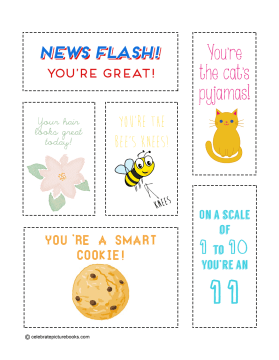
Do you have some awesome people in your life? Give them one of these printable Awesomeness Cards and watch them smile!

Picture Book Review
March 9 – It’s Read Aloud Month

celebrate-picture-books-picture-book-review-rosa's-very-big-job-cover

About the Holiday

From the moment babies are born, they are learning. Talking and reading aloud to babies from the very beginning are crucial parts of helping their developing brain learn language and improves literacy in the years to come. Reading aloud to babies and older children for only 15 minutes a day makes a tremendous and beneficial difference to their future. Make reading time a special time with your kids, and with so many wonderful books available—like today’s book—you’ll have as much fun as they do!

Rosa’s Very Big Job

Written by Ellen Mayer | Illustrated by Sarah Vonthron-Laver

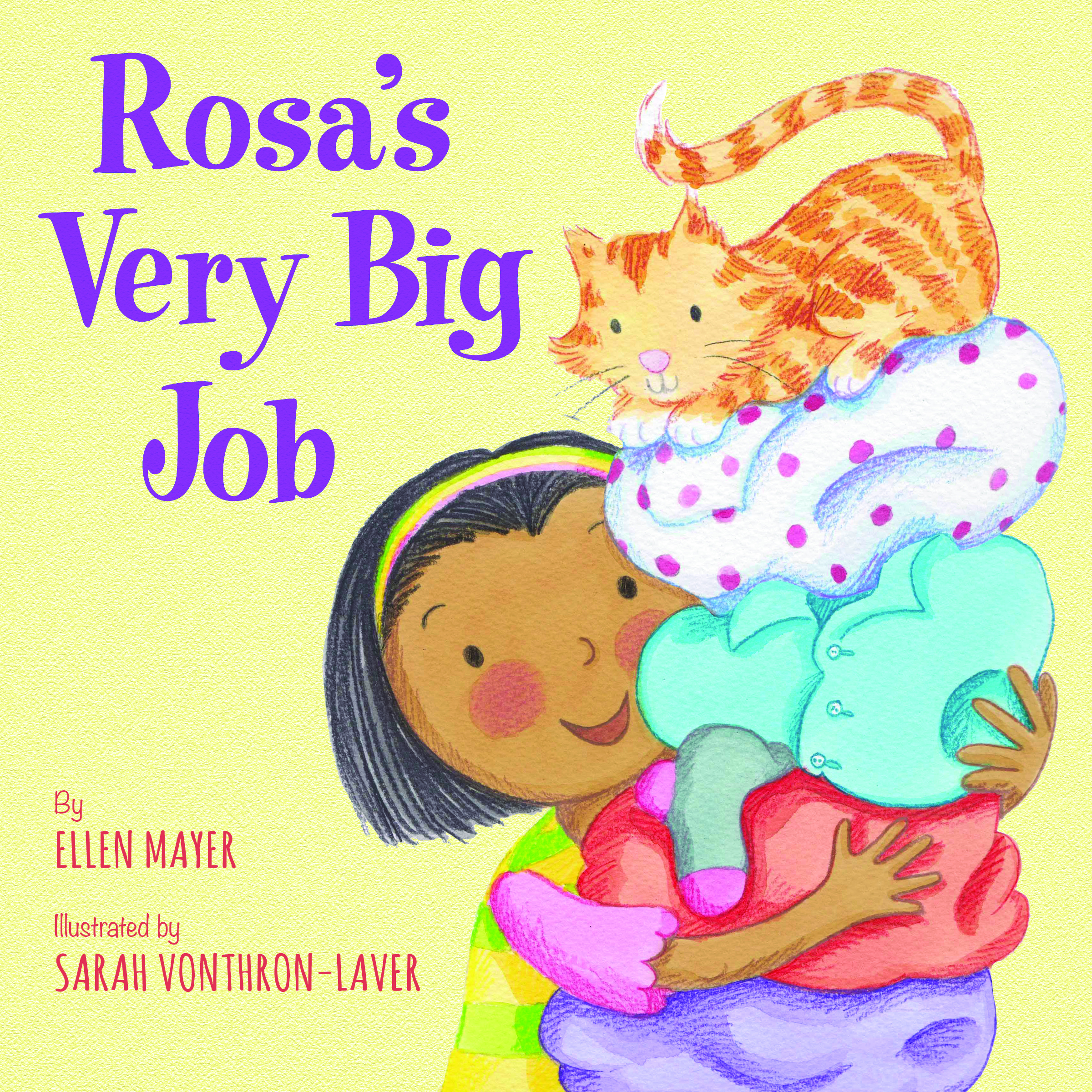
Rosa may be little, but she has big ideas about how to help. While Mama is out shopping for groceries for that night’s dinner, Rosa decides to surprise her by folding and putting away the laundry. The basket is piled high with fluffy dry clothes, sheets, and towels. Rosa watches her grandpa reading the newspaper. “‘Please help me, Grandpa!’” she says. She tugs on her grandpa’s hands, trying to pull him out of his chair. “‘Come on, Grandpa! Get up.”

celebrate-picture-books-picture-book-review-rosa's-very-big-job-rosa-likes-to-help

Image copyright Sarah Vonthron-Laver, text copyright Ellen Mayer, courtesy of Star Bright Books, starbrightbooks.com

Grandpa seems to have a little trouble managing: “‘It’s difficult to carry these enormous piles,’” he sighs. But Rosa knows that smaller armloads work better. Grandpa’s clothes come unfolded as he puts them in the drawer. “‘Be neat. Like me,” Rosa says, showing him her tidy stack. Poor Grandpa! He has to keep hanging up the same jacket over and over. “‘It’s difficult to keep this jacket from sliding off the hanger,” he says. Rosa has the answer: “‘Zip it up,’” she explains. “‘Then it stays on.’”

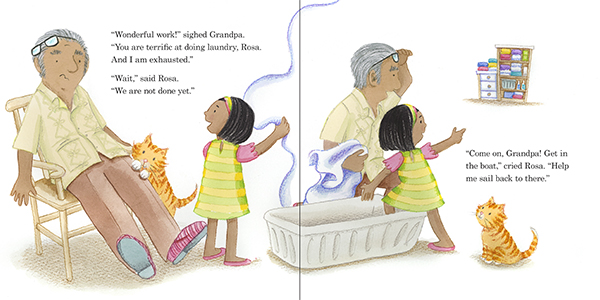
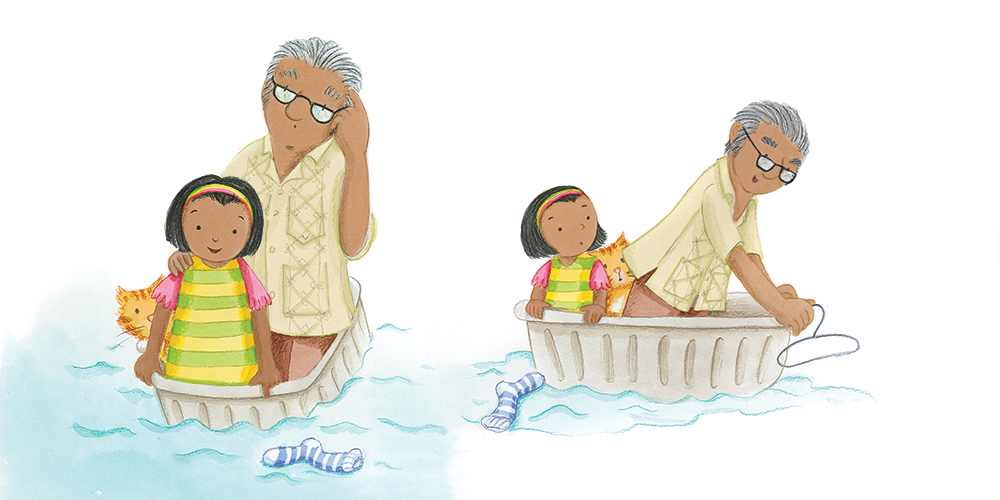
Grandpa sinks back into his chair. “‘You are terrific at doing laundry, Rosa. And I am exhausted,’” he says. But this is no time to quit—Rosa has big plans. As she steps into the now empty laundry basket, she exclaims, “‘Come on, Grandpa! Get in the boat. Help me sail back to there.’” Rosa points to the linen closet.

celebrate-picture-books-picture-book-review-rosa's-very-big-job-rosa-uses-basket-as-boat

Image copyright Sarah Vonthron-Laver, text copyright Ellen Mayer, courtesy of Star Bright Books, starbrightbooks.com

Suddenly, the floor swells with ocean waves teeming with fish. Grandpa channels his inner sailor as he holds aloft a sheet as a sail. As the wind billows and they come perilously close to the kitchen table, he says, “‘It’s difficult to sail around this enormous rock!’” Contemplating the rising sea, he exclaims, “‘It’s difficult to sail over this enormous wave!’”

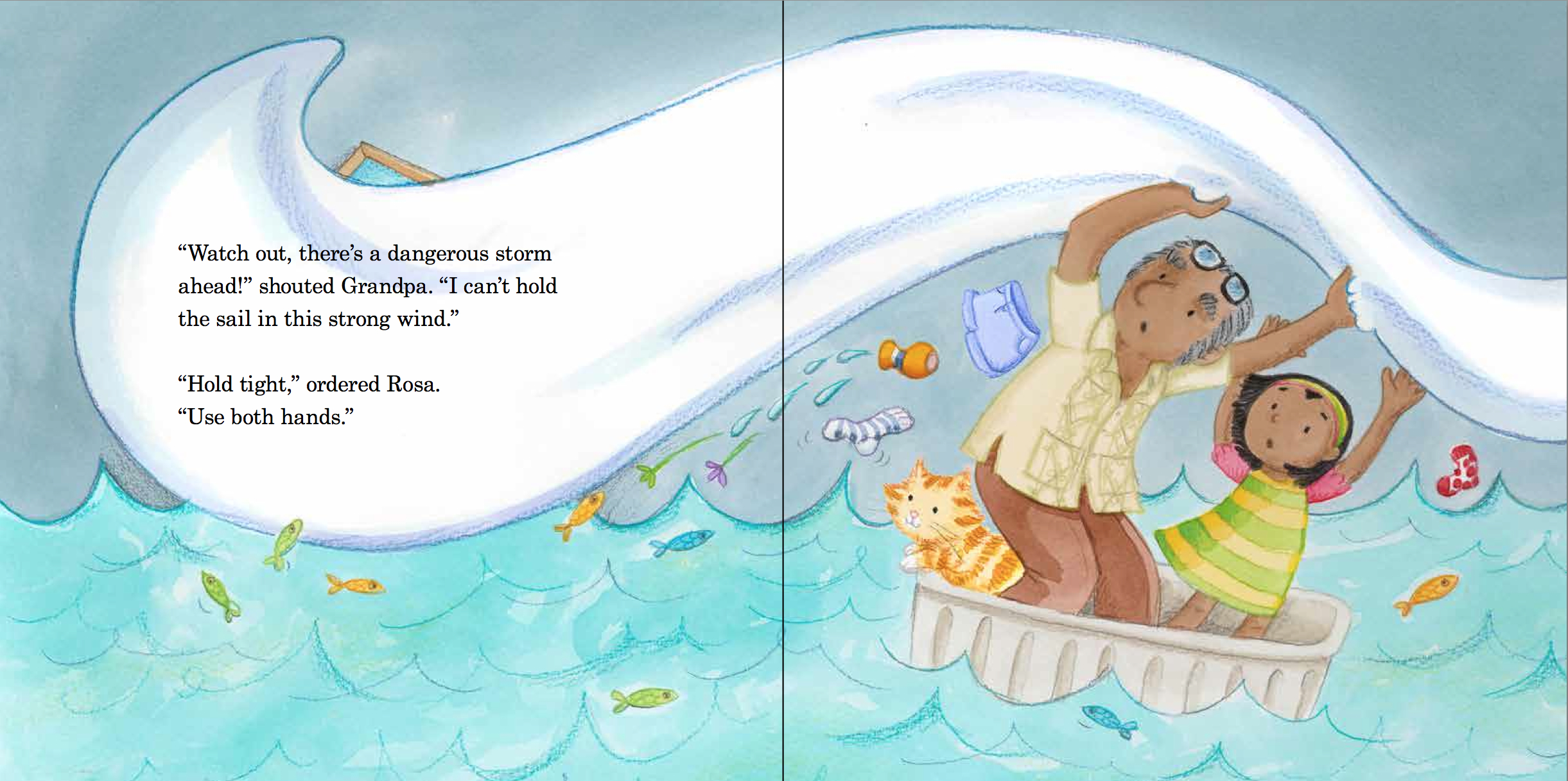
There’s a dangerous storm ahead, warns Grandpa, “‘I can’t hold the sail in this strong wind.’” Rosa is there to help and grabs one side of the sheet. “‘Hold tight,’” she orders. “‘Use both hands.’” At last the seas die down and Grandpa is ready to steer the laundry basket back to port, but Rosa has a more entertaining thought. Spying a sock on the floor, Rosa wants to catch the “enormous fish.” Grandpa obliges and picks up a hangar for a fishing pole. He holds Rosa as she stretches out over the edge of the laundry basket to land her fish.

celebrate-picture-books-picture-book-review-rosa's-very-big-job-sailing-with-sheet

Image copyright Sarah Vonthron-Laver, text copyright Ellen Mayer, courtesy of Star Bright Books, starbrightbooks.com

Just as Rosa nabs the fish, Mama comes home with her bags of groceries. She’s surprised to see that the laundry is not in the basket. Rosa runs to her and proudly explains, “‘We put all the laundry away. It was a very big job. We carried enormous piles. Grandpa dropped things. And I picked them up. It was very difficult for Grandpa. He got exhausted. But not me. I am terrific at laundry!’” Mama agrees that Rosa is a terrific helper. Then Rosa leads her mother to see the most surprising thing of all—the fish she has caught for dinner!

celebrate-picture-books-picture-book-review-rosas-very-big-job-rosa-and-grandpa-fishing

In her series of Small Talk Books® Ellen Mayer presents exciting stories for preschoolers full of imagination and rich language learning. Rosa’s Very Big Job introduces Rosa, a sweet girl bubbling with enthusiasm and the desire to help. The close relationships between Rosa, her mother, and her grandpa promote cooperation as well as effective modeling of speech patterns and a way to introduce larger words in an organic manner through play and common chores. Rosa’s inventive idea to turn the laundry basket into a boat is delightfully enhanced by her grandpa’s willingness to share in the story and expand on it. Humor, cheerful banter, and the easy camaraderie between Rosa and Grandpa invite young readers to join in the fun as they build confidence in their language learning.

Sarah Vonthron-Laver depicts Rosa’s afternoon with her Grandpa with joy and the spirited energy young children bring to everything they do. Grandpa is happy to spend time with his granddaughter, yet shows honest feelings of tiredness and frustration that spur on the plot. The transition from doing laundry to using the basket as a boat is as seamless as a child’s imagination, and the way Rosa and her grandpa use household items to create “sails,” “rocks,” “fish,” and “fishing poles” will give readers great ideas for post-reading play. Bright colors, an adorable kitten, and familiar surroundings welcome young children into the world of reading and expanded vocabulary.

Rosa’s Very Big Job would be a welcome addition to a young child’s bookshelf, not only for its fun story that kids will want to hear again and again, but for its leap into imagination that kids will want to replicate.

Dr. Betty Bardige, an expert on young children’s language and literacy development, provides tips for parents, grandparents, and caregivers following the text.

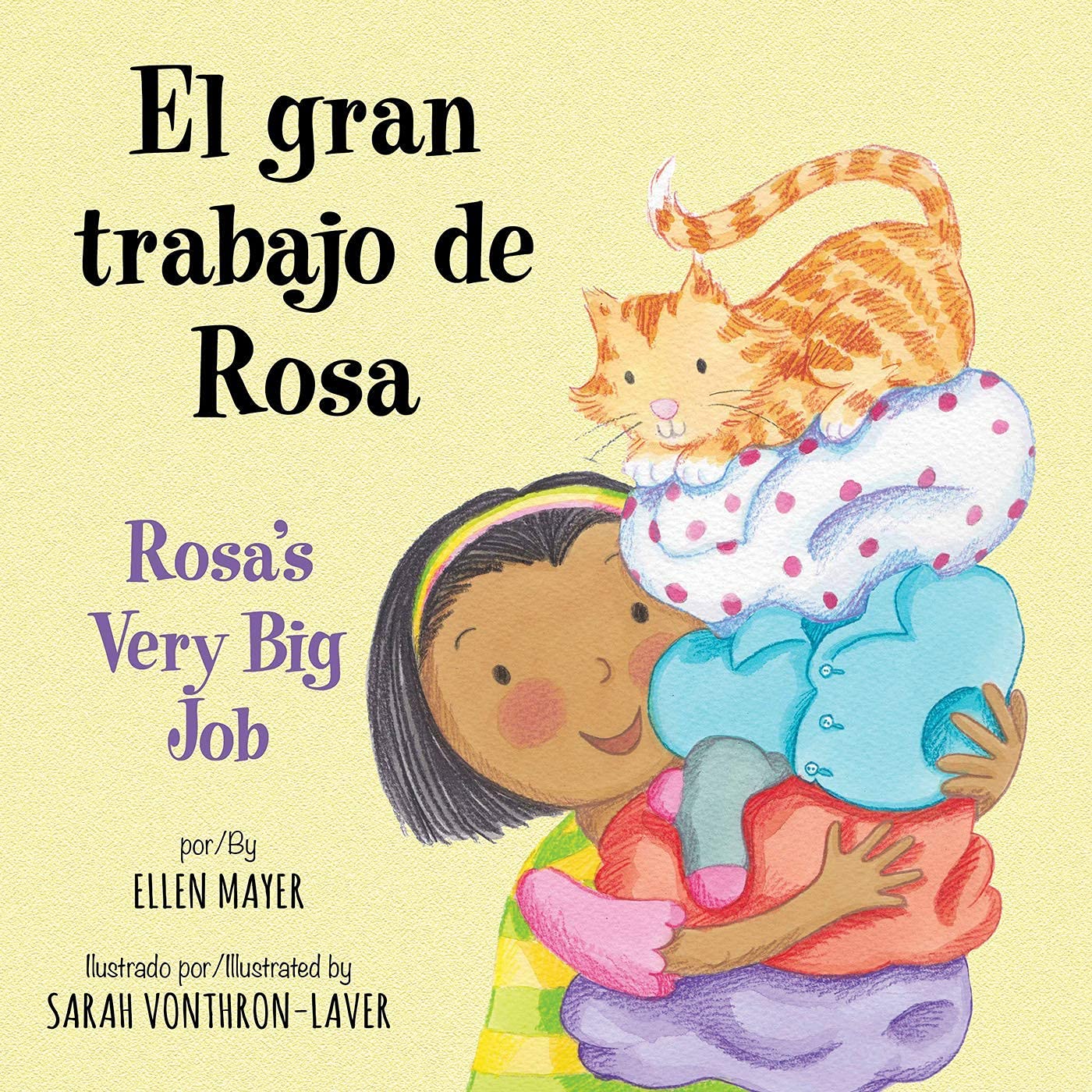
celebrate-picture-books-picture-book-review-rosa's-very-big-job-spanish-cover

A bilingual Spanish/English edition is also available from Star Bright Books!

Ages 2 – 6

Star Bright Books, 2016 | ISBN 978-1595727497 (English edition) | ISBN 978-1595728500 (Spanish/English bilingual edition)

Discover more about Ellen Mayer and her books as well as book-related activities and literacy initiatives she’s involved with on her website!

To read an interview with Ellen Mayer about her books and her work, click here!

Find Sarah Vonthron-Laver on Facebook!

Read Aloud Month Activity

celebrate-picture-books-picture-book-review-rosa's-big-job-paper-dolls-made

Original illustrations by Saran Vonthron-Laver, Copyrights © 2016 Star Bright Books. Paper dolls created by AislingArt and Celebrate Picture Books, copyrights © 2016

Rosa’s Very Big Job Paper Dolls

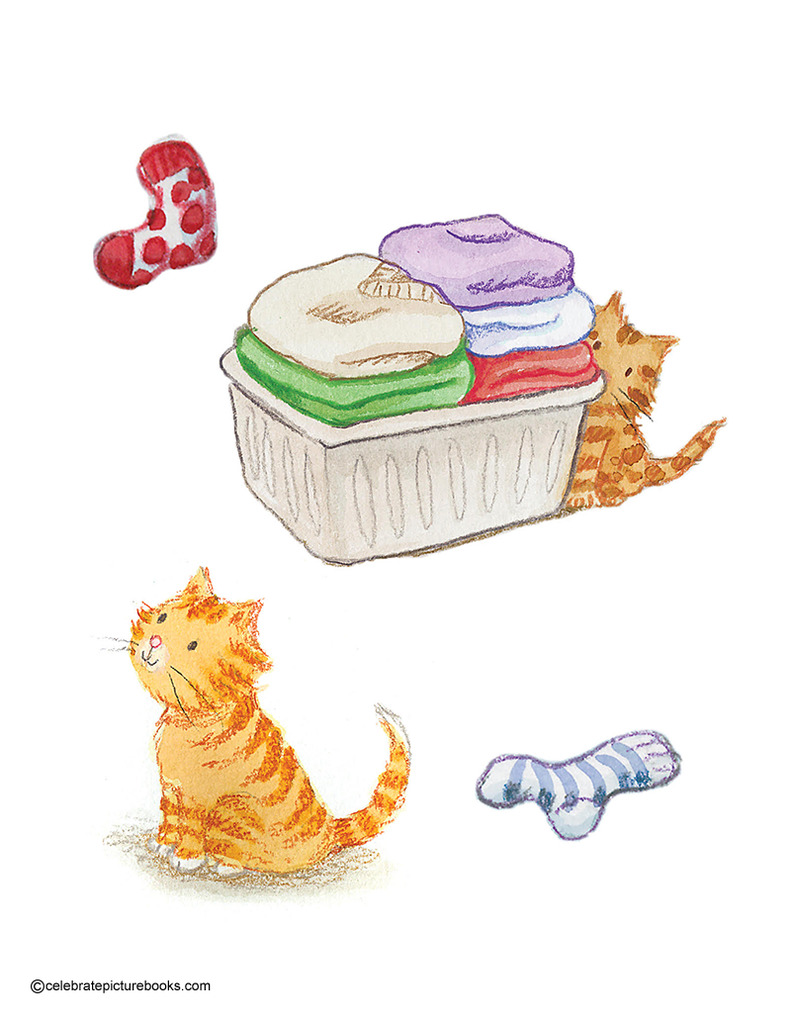
After you read the story, you can continue the fun with these Rosa and family paper dolls! Rosa loves helping out at home. She’s terrific at doing laundry – folding and putting away the family’s clothes, socks, and linens. You are terrific at helping too! Can you help Rosa, Mama, and Grandpa get dressed and ready for the day with these printable paper dolls? You’ll even find a laundry basket, socks, and Rosa’s sweet kitty to play with! 

Supplies

Printable Paper Dolls, Clothes, and Extras

  • Card stock paper and/or poster board
  • Scissors
  • Glue

Directions

  1. Print dolls on regular paper or card stock paper. Dolls printed on card stock paper may stand on their own with the supplied stand cross piece. For dolls printed on regular paper, you can cut the supplied stand templates from poster board or card stock and glue the dolls to the backing.
  2. Rosa’s kitty and the laundry basket can also be attached to the supplied template if needed
  3. Print clothes for each figure
  4. Color the blank clothes templates any way you’d like
  5. Cut out clothes and extra items
  6. Fit outfits onto dolls
  7. Make up your own stories about Rosa, Mama, and Grandpa!

celebrate-picture-books-picture-book-review-rosa's-very-big-job-cover

YOU CAN FIND ROSA’S VERY BIG JOB AT THESE BOOKSELLERS

Amazon | Barnes & Noble | Books-a-Million

To support your local independent bookstore, order from

Bookshop | IndieBound

celebrate-picture-books-picture-book-review-rosa's-very-big-job-spanish-cover

You can find El gran trabajo de Rosa at Amazon 

Picture Book Review
March 7 – Unique Names Day

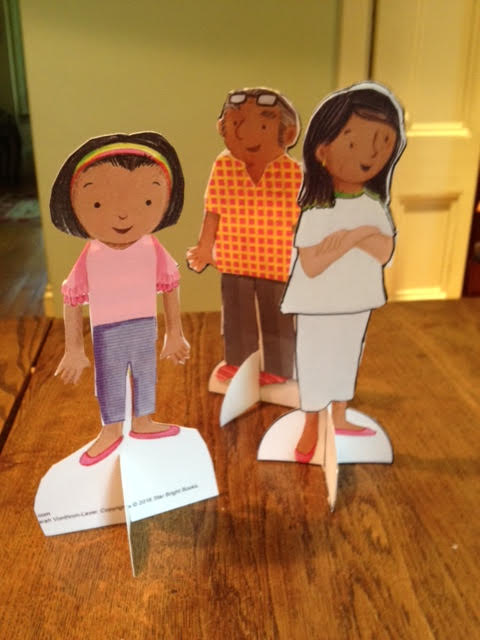
The Name Jar by Yangsook Choi Picture Book Review

About the Holiday

Established in 1997 as part of Celebrate Your Name Week, Unique Names Day celebrates uncommon or uncommonly spelled names and encourages those with unique names to always take pride in their name. One way to celebrate is to find out more about your name and how or why your parents chose it.

The Name Jar

By Yangsook Choi


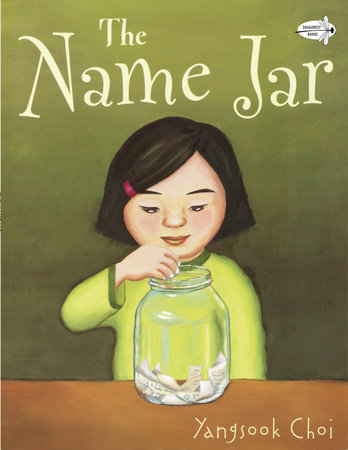
Unhei has recently moved to the United States from Korea. Although Unhei is excited about the first day of school, on the bus ride she misses her former home and looks at the wooden name stamp her grandmother gave her. A boy sitting behind Unhei notices the unfamiliar object and asks about it. Then other kids notice Unhei. They ask what her name is and when she answers, they mispronounce it, laughing and making jokes.

celebrate-picture-books-picture-book-review-the-name-jar-on-the-bus

Image copyright Yangsook Choi, courtesy of Random House

Unhei is embarrassed and glad that when the bus drops them off that those kids head to a different classroom than hers. As Unhei enters her own room, her classmates smile and greet her—it is obvious that their teacher has prepared them for a new student, and they are excited.

Of course, they first question her about her name, and remembering the experience on the bus, Unhei is reluctant to answer. She quickly says that she hasn’t picked a name yet, but will tell them next week. When she gets home, Unhei tells her mother that she wants an American name, a name that is easy to pronounce.

Her mother is dismayed; Unhei’s name was chosen by a master so that it would describe her uniqueness. But Unhei doesn’t want to be different, she just wants to fit in. Later while she and her mother are at a Korean grocery store, she introduces herself to the owner, who exclaims that her name is beautiful and means “grace” in English. 

celebrate-picture-books-picture-book-review-the-name-jar-mom

Image copyright Yangsook Choi, courtesy of Random House

That evening Unhei tries out American names in front of the mirror—Amanda, Laura, Susie—but they don’t feel or sound right. The next day at school Unhei finds a jar on her desk with pieces of paper in it. On each piece of paper is a name—suggestions from each of her classmates. Her new friends have chosen these names thoughtfully. Daisy is the nickname of one girl’s baby sister; Tamela is a smart and brave heroine from a story; and Wensday is the day Unhei joined their class.

At the end of the school day, a classmate named Joey comes to her. He knows she actually does have a name, and Unhei, while not wanting to say it out loud, shows him the characters on her wooden stamp. Joey thinks it is beautiful and asks to keep the paper. Day by day the glass jar fills up with names. Unhei will have to choose soon.

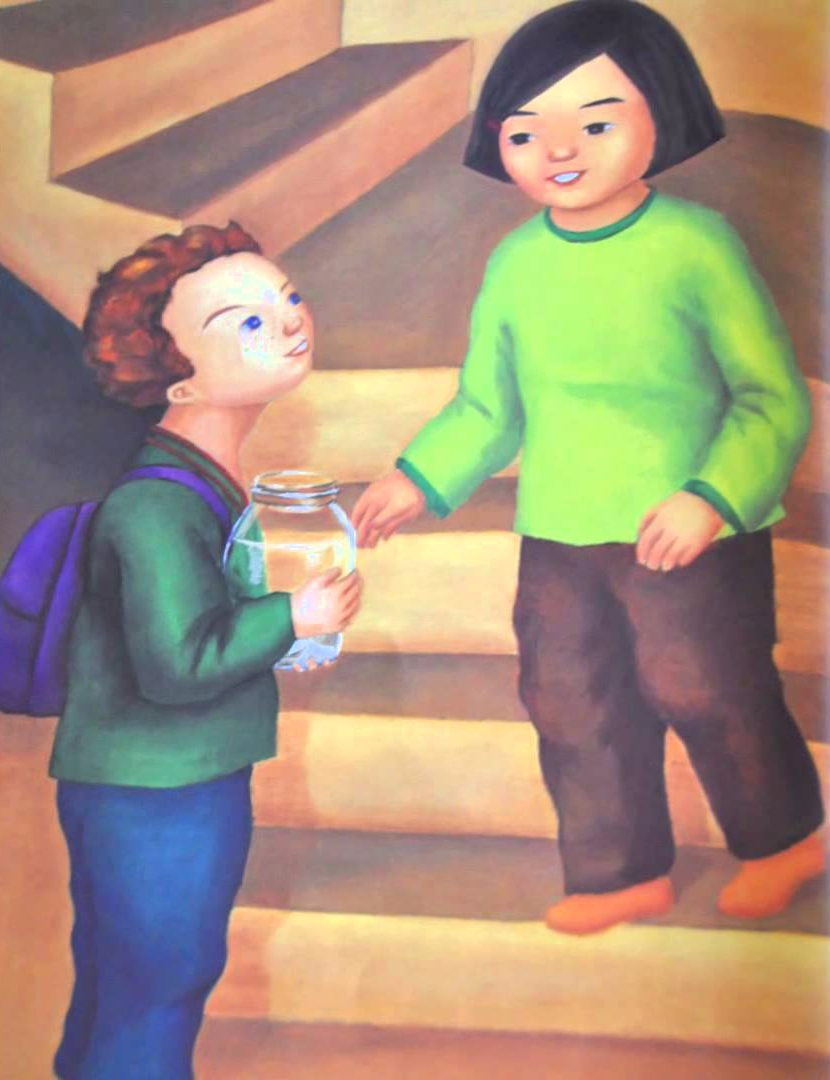
One Saturday Unhei returns to the Korean grocery store. When Mr. Kim calls her by name, the one other customer turns around. It’s Joey! Carefully and slowly he says Unheis name until he gets it right. On Monday when Unhei enters the classroom, she discovers that the jar is missing. It’s all right, though, Unhei has chosen her name.

celebrate-picture-books-picture-book-review-the-name-jar-friend

Image copyright Yangsook Choi, courtesy of Random House

She walks to the chalkboard and writes her real name in English and Korean. She tells the class that her name means “grace.” Other kids reveal the meaning of their names, and they all practice saying Unhei’s name. That evening Joey comes to visit. He explains that he took the jar because he wanted Unhei to keep her original name. He suggests putting Korean nicknames into the jar for their classmates to pick. He has already chosen his Korean name with the help of Mr. Kim. It is the prefect nickname: Chinku, which means “friend.”

Ages 3 – 8

Random House, Dragonfly Books, 2003 | ISBN  978-0440417996

Discover more about Yangsook Choi, her books, and her art on her website!

Yangsook Choi’s The Name Jar is as timely now as when it was first written. Through compelling and detailed storytelling, Choi explores the themes of identity, empathy, family, friendship, and more  with sometimes heartbreaking honesty. Unhei’s varied experiences at school, at home, and at the market provide an opportunity for adults and children to discuss and embrace the diversity of our multicultural world. Choi’s warm-toned illustrations reveal the conflicts that Unhei encounters and her growing confidence as she makes friends with Mr. Kim and Joey who accepts her as she is. 

Unique Names Day Activity

CPB - Name Jars standing

Love Your Name Organizer Jar


Everyone needs a place to store their special stuff! Here’s a way to recycle a plastic jar and make a cool organizer jar with your name on it. This organizer jar also makes a great gift for your friends!

Supplies

  • A large plastic jar, such as a peanut butter jar or mayonnaise jar, cleaned out and with the label removed
  • Acrylic multi-surface paint or markers
  • Chalkboard paint
  • Paint brush
  • Chalk

CPB - Name Jars on sides

Directions

  1. Paint a rectangle on the front of the jar with chalkboard paint
  2. Decorate the rest of the jar with paint, markers, or paper just the way you want! My green jar sports a friendly dinosaur!

Picture Book Review
March 3 – World Wildlife Day

celebrate-picture-books-picture-book-review-lotus-and-feathers-cover

About the Holiday

In December of 2013 the United Nations General Assembly proclaimed March 3rd as World Wildlife Day to promote awareness of our environment and the dangers to it. This year’s theme is “Listen to the Young Voices.” Nearly one-quarter of the world’s population is between the ages of 10 and 24. With a crucial stake in the preservation of the world’s animals and plants and their habitats, more and more young people are getting involved in the preservation of the environment. Today, find a way to get involved in your community or donate to a wildlife cause. A clean, healthy, and protective environment benefits all.

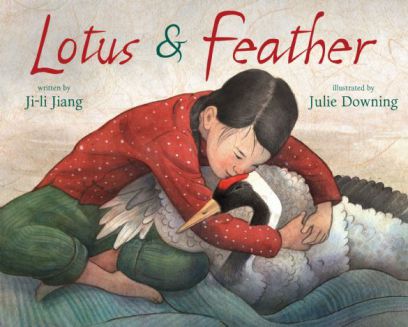
Lotus & Feather

Written by Ji-li Jiang | Illustrated by Julie Downing

Lotus was lonely since her winter illness had left her without a voice. The children at school “treated her like a strange creature,” and she was left without playmates or someone to keep her company on the walk home. She lived with her grandfather who made reed baskets and found solace when he took her to ride in his boat on the nearby lake. As he poled the boat through the still water, Lotus’ grandfather sadly pointed out how the lake had changed. No longer did the lotus flowers, fish, birds, or animals thrive. Instead, the landscape had “‘been ruined by greedy fishermen and hunters, and by ignorant people who took over the land where animals once lived.’”

celebrate-picture-books-picture-book-review-lotus-and-feather-lotus-meets-feathers

Image copyright Julie Downing, courtesy of Disney Hyperion

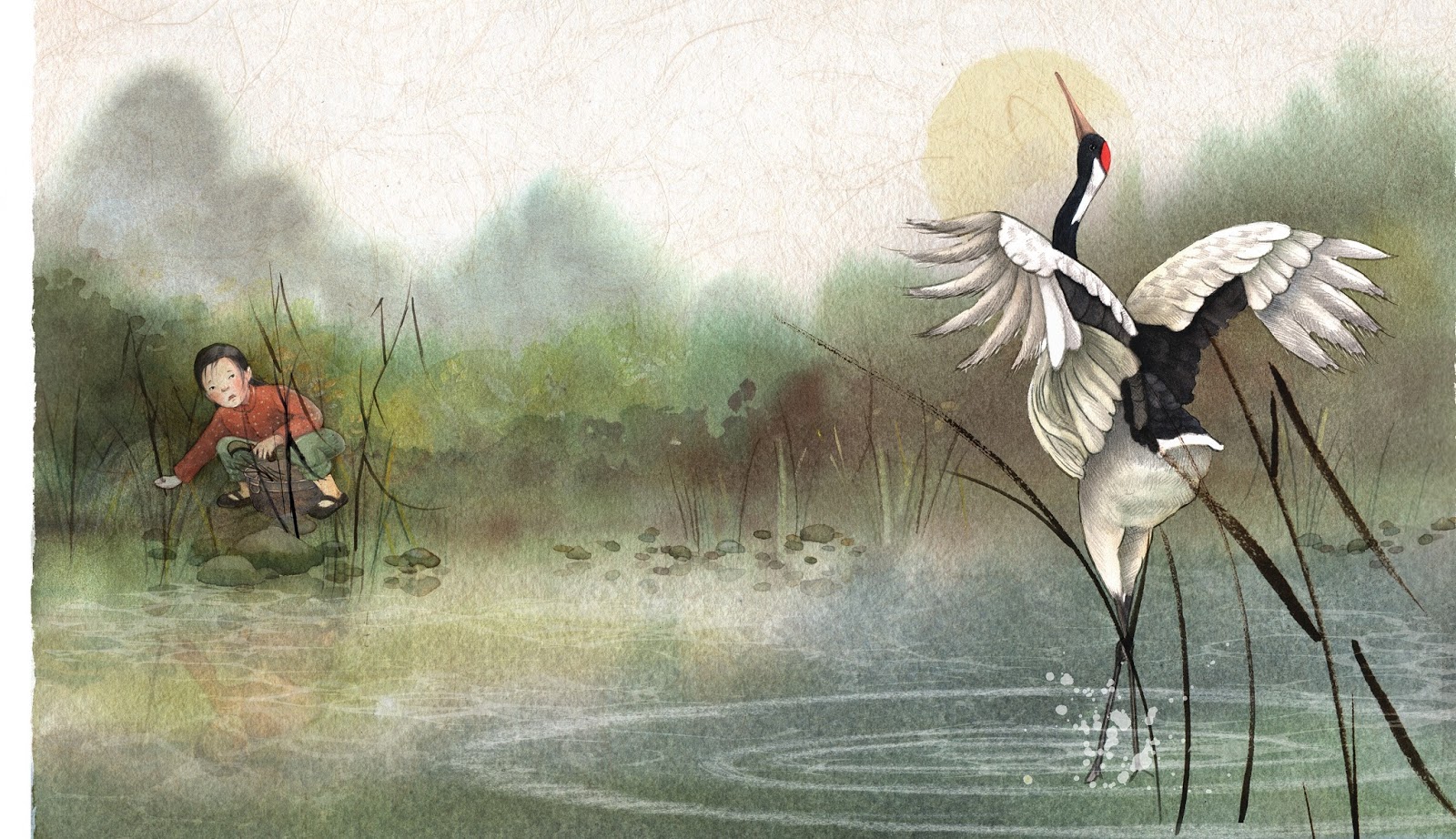
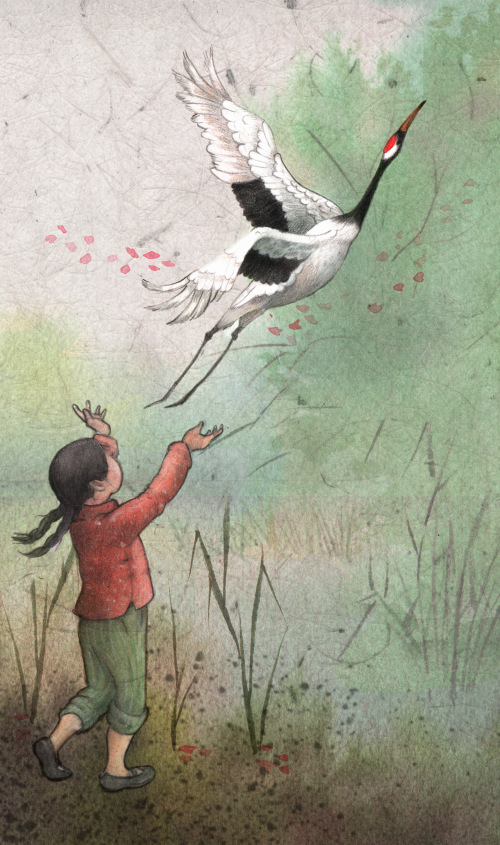
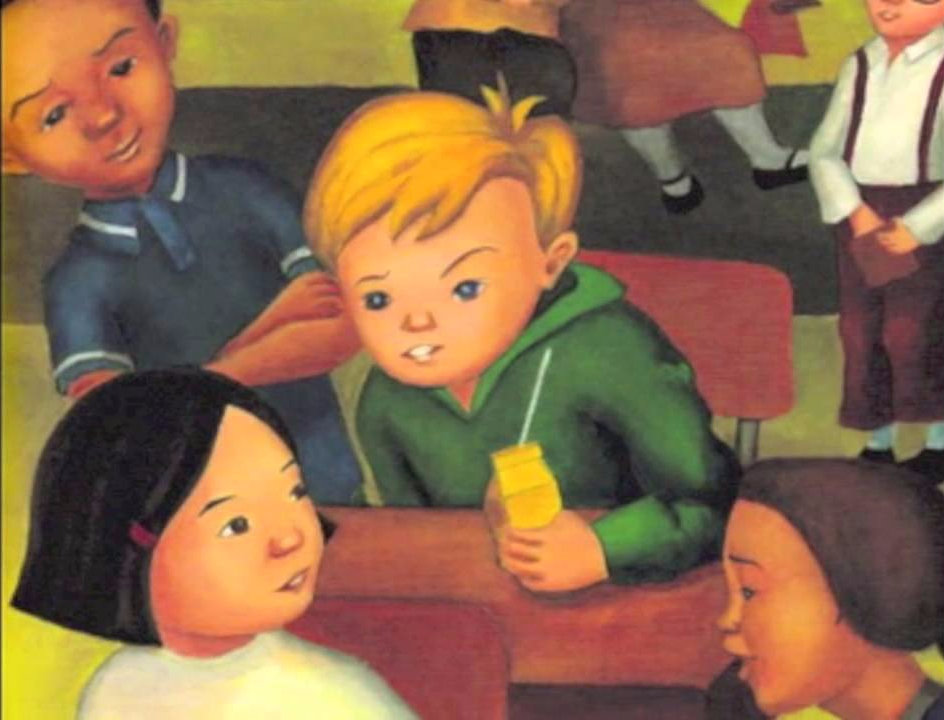
One morning while Lotus was out collecting reeds for her grandfather she spied a rare crane. It’s wide white “wings were edged with black feathers, like lace on a dress”…and “its head was crowned with a red top like a dazzling ruby.” As she watched a gunshot rang out. Unable to alert the hunter by shouting, Lotus banged on her bucket, frightening him away. Lotus rushed toward the wounded bird, picked it up and carefully brought it home to Grandpa.

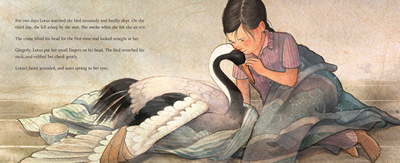
Grandpa tended to the crane’s injury and fed him rice soup while Lotus stroked the soft head. For two days, Lotus hardly slept as she took care of the crane. On the third day she fell asleep next to the crane, waking when he stirred and nestled her cheek. “Lotus’s heart pounded, and tears sprang to her eyes.” Lotus named the crane Feather. As it grew stronger she gathered food for it, and on the day Feather took his first steps, “Lotus jumped and swirled and hugged Grandpa blissfully.”

celebrate-picture-books-picture-book-review-lotus-and-feather-lotus-comforts-feather

Image copyright Julie Downing, courtesy of Disney Hyperion

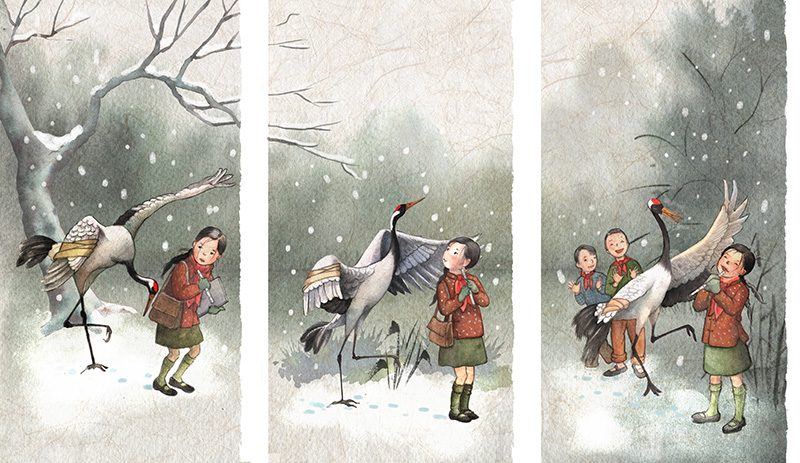
Soon Feather was following Lotus everywhere—even to school. After class Lotus would blow her whistle and Feather would come running and dance as Lotus played. The other children joined in, dancing and playing along every day. One night Lotus heard Feather crowing and woke to find that the village was flooded. Poling his boat through the streets, Grandpa shouted, Lotus banged her pail, and Feather crowed to alert the neighbors. “Over three hundred villagers were saved. Feather was the hero.” He became famous, and people wanted to hear his story again and again.

celebrate-picture-books-picture-book-review-lotus-and-feather-lotus-dancing

Image copyright Julie Downing, courtesy of Disney Hyperion

When Spring arrived Feather was still too weak to fly but he looked longingly at the birds migrating north. Lotus was frightened that her friend might want to leave them, but she “knew she would never separate him from his home and family.” One day Feather spread his wings and leaped into the air. Lotus realized that he had healed and knew it was time for him to leave. Grandpa and Lotus took Feather to the lake. Grandpa tossed Feather into the air, but he returned again and again. Grandpa gave Feather to Lotus. Lotus hugged Feather one more time and threw him into the sky.  

celebrate-picture-books-picture-book-review-lotus-and-feather-lotus-lets-feather-go

Image copyright Julie Downing, courtesy of Disney Hyperion

Holding back tears, Lotus watched as “Feather flapped his big wings and soared north, disappearing into the horizon.” Lotus and the other children missed Feather. They gathered together listening to Lotus play her whistle, imagining that Feather could hear them. One autumn morning, Lotus heard a familiar crow and rushed outside. There stood Feather with his family. Then Lotus gasped. The sky was filled with hundreds of cranes coming to the lake. Lotus blew her whistle, and the notes, “accompanied by the birds’ singing, echoed far, far away in the golden sky.”

celebrate-picture-books-picture-book-review-lotus-and-feather-lotus-waves-goodbye

Image copyright Julie Downing, courtesy of Disney Hyperion

Ji-li-Jiang’s tender story resonates on every page with love and friendship. The relationship revealed in Jiang’s tale exists not only between Lotus and Feather, but between readers and their environment. Beautifully interwoven throughout the plot, the idea of responsibility between friends, to the earth, and to ourselves makes Lotus & Feather a compelling book to read and discuss. Through lyrical passages and detailed storytelling, Jiang develops a deep, emotional bond between Lotus and Feather that readers will respond to. The heartwarming connection between Lotus and her grandfather brings comforting and another level of family commitment to the story.

Julie Downing’s stunning illustrations allow readers to walk, sit, worry, and cheer with Lotus as she finds and cares for Feather. Her sadness is palpable as she walks home from school past a group of classmates playing ball; in the corner of the dark lake, children will find bottles, cans, and other debris floating among the reeds; and Feather makes his debut with a graceful ballet. Readers will love watching the progression of Feather’s healing and Lotus’ reintegration into her circle of friends and will applaud when Feather and his family and friends return to the lake.

Lotus & Feather is a multi-layered story that will captivate readers. It is a must for public and school libraries and would make a beautiful addition to home libraries as well.

Ages 5 – 9

Disney Hyperion, 2016 | ISBN 978-1423127543

Discover more about Ji-li Jiang and her books on her website!

View a portfolio of artwork as well as other books by Julie Downing on her website!

World Wildlife Day Activity

celebrate-picture-books-picture-book-review-world-wildlife-day-word-scramble

Endangered Species Word Scramble

Can you find the names of 15 animals in this printable Endangered Species Word Scramble? Here’s the Solution.

Picture Book Review
February 27 – International Polar Bear Day

celebrate-picture-books-picture-book-review-little-polar-bear-cover

About the Holiday

Today we celebrate polar bears, the largest member of the bear family and a critical part of the Arctic ecosystem. These beautiful creatures spend much of their time at the edge of ice packs, from which they hunt for food. Their excellent sense of smell allows them to sense food up to a mile (1.6 km) away. Increasingly polar bears are under threat from changes in climate which are shrinking their habitat and affecting their quality of life. In honor of today’s holiday take time to research polar bears and consider donating to a cause for their protection.

Little Polar Bear

By Hans de Beer

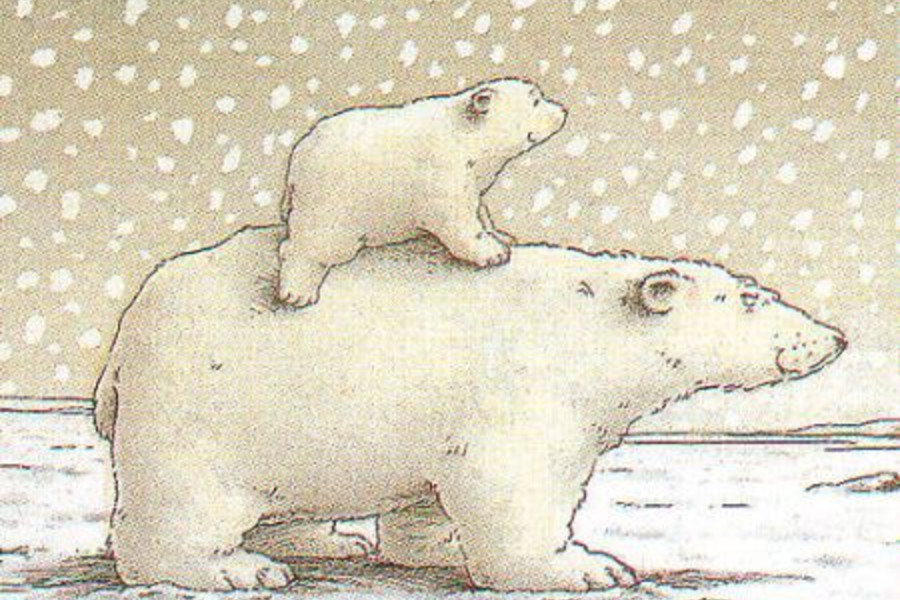
At last little Lars is old enough to go hunting with his father, and they head out into the white, frozen expanse to find the perfect fishing spot. While Lars watched from the edge of an ice pack, his dad disappeared underwater for so long that Lars began to worry. When he finally surfaced, however, he brought with him a large fish for dinner. After dinner it was time to sleep. Lars’ father showed him how to build a wall of snow to lie behind that would protect him from the wind.

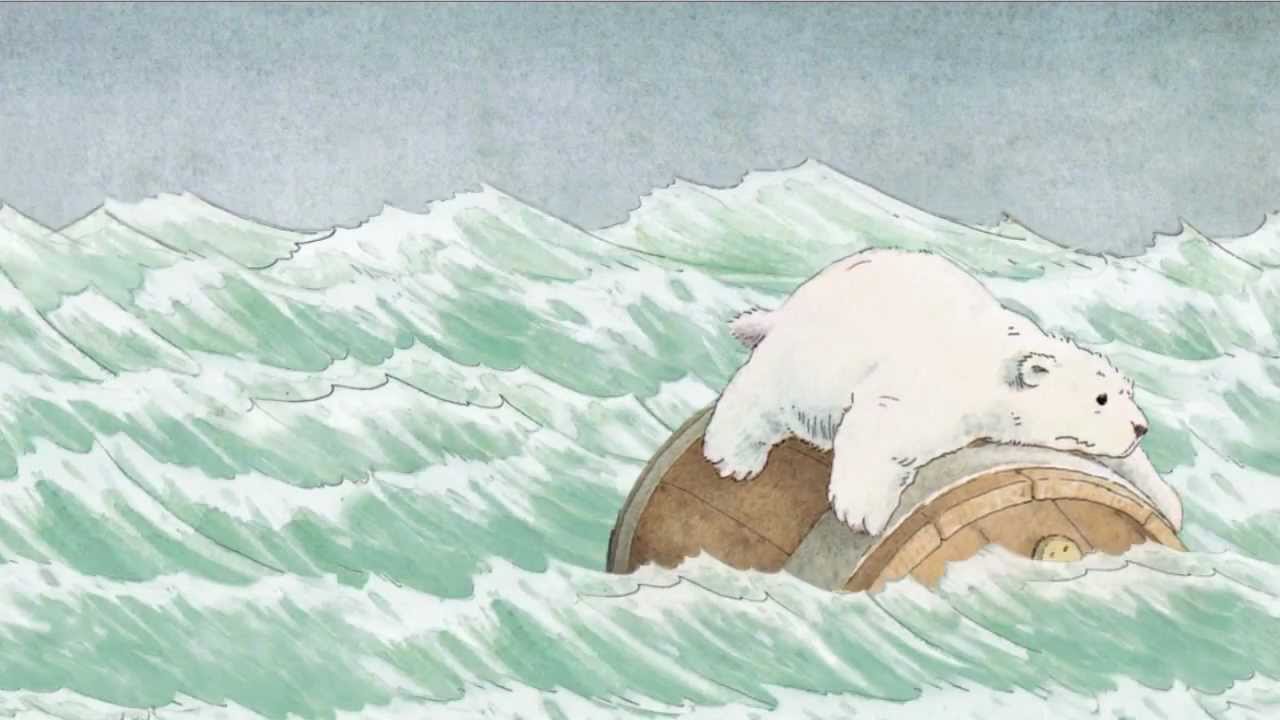
During the night as Lars and his father slept, the ice cracked between them, sending Lars floating away by himself. When Lars woke in the morning, he discovered that he was alone and that the warm sun was melting his ice floe little by little. Just as the ice threatened to disappear entirely, a barrel floated by and Lars crawled on top of it. “Then a storm began to rage. As Lars clung to his bobbing barrel he missed his father and his pile of snow more and more.”

celebrate-picture-books-picture-book-review-little-polar-bear-lars-and-father

Image copyright Hans de Beer, courtesy of NorthSouth Books

By the time the storm subsided Lars was far from home. He found himself in a place with no snow or ice; instead “almost everything was green and the sun was very warm.” Lars left the barrel and padded onto the sandy beach. The hot sand burned Lars’ paws, and he ran to the nearby river to cool them. “But just as he was about to plunge in, a very big, tan animal sprung out of the water.” Frightened, Lars ran away, but the hippopotamus followed him and introduced himself. Henry had never seen a white bear, and Lars had never seen a tan animal.

Lars told Henry about his trip and how he wanted to find father. Henry didn’t know how to help, but he figured that Marcus the eagle would know what to do. With Lars on his back Henry started the long journey across the river, through the jungle, and over the mountains. On the way, Lars loved seeing all the different colors, creatures, and vegetation. He climbed trees, met a chameleon, and sniffed at a butterfly. When they came to the mountains, Henry had trouble climbing, but Lars scampered ahead and showed him where to step.

celebrate-picture-books-picture-book-review-little-polar-bear-lars-on-barrel

Image copyright Hans de Beer, courtesy of NorthSouth Books

Finally, Henry couldn’t go any farther. He and Lars found a place to rest for the night. The view of the water made Lars homesick, but Henry reassured him. The next day, high on the mountain, Lars and Henry found Marcus. “The eagle looked at Lars and then said, ‘Well, well, a polar bear in the tropics! You’re a long way from home aren’t you, young man?’”
Marcus explained that he could indeed help Lars get home, but they would need the assistance of Samson. In the morning a gray whale swam near shore, and Lars climbed on his back. While Henry was happy that Lars could find his way home, he was also sad to see him go. He and Lars said goodbye to each other. As Henry looked on, Samson and Lars swam out into the open ocean with Marcus flying “along a bit to set them on their way.”

After Samson had swum a long distance, icy cliffs once again appeared on the horizon. As they drew closer, Lars spotted his father standing at the edge of the ice scanning the sea. Lars called out to him, and Lars’ father couldn’t believe his eyes. In thanks for bringing back his son, Lars’s father caught a big fish and gave it to Samson. Lars and his father started toward home, and as they walked “Lars talked about all of the amazing things he had seen.” His father was astonished. “‘You didn’t meet anyone who was white?’” he asked. “‘Nobody, except a chameleon,’ said Lars, ‘but that doesn’t count.’” Lars laughed, but his dad couldn’t understand the joke.

celebrate-picture-books-picture-book-review-little-polar-bear-lars-and-henry

Image copyright Hans de Beer, courtesy of NorthSouth Books

Hans de Beer’s sweet, adventurous little polar bear has been long beloved by young readers who have followed his journeys and escapades through many books. This favorite introduction to Lars, his father, and the North Pole was reissued in 2016 and is as timely now as when it was first published. De Beer’s straightforward story of a young bear suddenly taken away from home, surviving by instinct, and discovering new places, friends, and ideas, is at once exciting and comforting. As Lars finds himself in unfamiliar territory populated with animals and creatures he’s never seen before, he doesn’t shy away from the experience, but embraces the diversity of what he sees just as the tropical animals accept him. The kindness and camaraderie shared among the animals is a universal lesson for all.

Little ones love de Beer’s expressive animals and the caring interactions between them. Kids will laugh when Henry pops out of the river to say “boo!” and giggle to see Lars and the chameleon sticking out their tongues together. The soft pastel palette invites kids to linger over the pages and experience both the frozen tundra and lush jungle with the same awe as Lars. Readers will cheer when Lars is reunited with his father, but will also look forward to traveling with their new friend again in his other adventures.

Ages 3 – 8

NorthSouth Books, 2016 (Hardcover) | ISBN 978-0735842649

International Polar Bear Day Activity

CPB - Polar Bear scarf

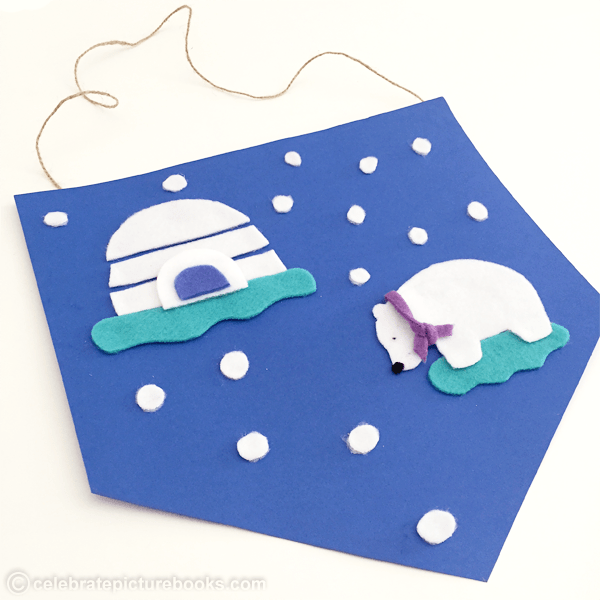
CPB - Polar Bear Banner

Polar Bear Scarf or Banner

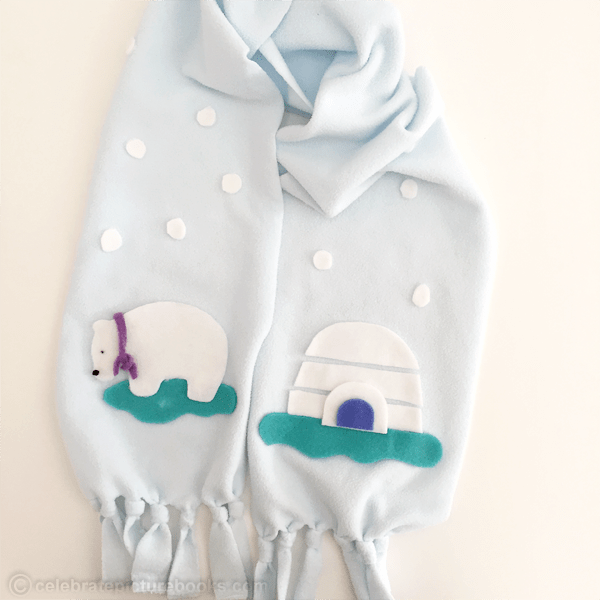
Polar bears aren’t cold in the winter—and neither should you be! Here are directions and printable templates for making a cute scarf to keep you warm, or—if you’d rather—a banner to warm up your room.

Supplies

  • Printable Polar Bear and Igloo Template
  • 1 Strip of blue fleece 4 ½ feet long x 7 inches wide for the scarf
  • 1 Piece of blue scrapbooking paper for a banner
  • Pieces of white, black, blue, and purple fleece or scrapbooking paper to make the polar bear, igloo, snowflakes, and ice floes.
  • String or twine for banner
  • Scissors
  • Fabric or paper glue

Directions for Scarf

To make the fringe at each end of the scarf

  1. Make 7 cuts about 4 inches long
  2. Tie a knot at the top of each fringe section

To make the pieces for the scarf or banner

  1. Trace the polar bear and igloo sections from the Printable Template onto white fleece and cut out
  2. Trace the two ice floes onto blue fleece and cut out
  3. Trace the door of the igloo onto blue fleece and cut out
  4. Trace the polar bear’s scarf onto purple (or any color) fleece and cut out
  5. Cut out round snowflakes
  6. Cut out a small circle from black fleece for the Polar Bear’s nose

On one end of the scarf

  1. Glue the smaller ice floe on one end of the scarf
  2. Tie the bear’s scarf around its neck before gluing the bear to the scarf
  3. Glue the polar bear onto the scarf with its feet on the ice floe
  4. Glue on the polar bear’s nose
  5. Make a small dot for the polar bear’s eye with a marker
  6. Glue snowflakes above polar bear

On the other end of the scarf

  1. Glue the bigger ice floe to the scarf
  2. Glue the three pieces of the large igloo to the scarf, leaving a little space between sections
  3. Glue the small white door of the igloo on top of the last two igloo sections
  4. Glue the small blue door onto the white door
  5. Glue snowflakes above the igloo

Directions for Banner

  1. Cut a point at the bottom of your banner
  2. Follow the directions above to trace the pieces of the polar bear and igloo from the printable template onto scrapbooking paper
  3. Follow the directions above to glue the pieces of the polar bear and igloo to your banner
  4. Attach string or twine to back of banner to make a hanger

Picture Book Review