The month of March is a reading lover’s favorite! Why? Because from the 1st to the 31st, every day is dedicated to reading. Special events for adults and children take place at libraries, bookstores, community centers, and schools, bringing authors, illustrators, educators, and readers together to get them excited about this favorite past time. A love of reading is a life-long pleasure with so many benefits.
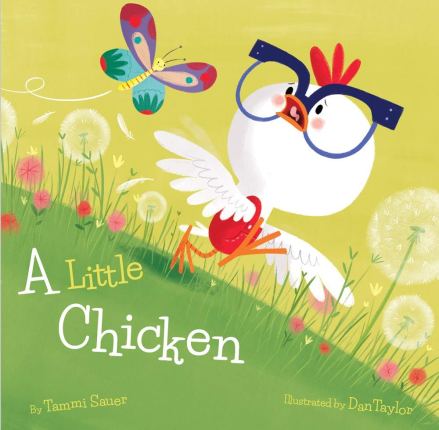
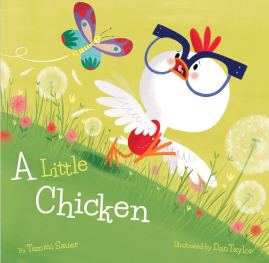
A Little Chicken
Written by Tammi Sauer | Illustrated by Dan Taylor
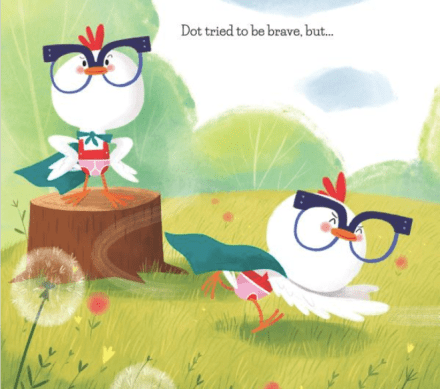
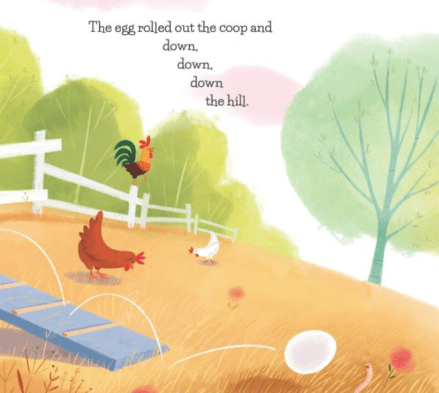
“Dot was a little chicken…who, let’s face it, was a little chicken.” There weren’t many things Dot wasn’t afraid of, including garden gnomes. Even though “Dot tried to be brave,” even the simplest things and the gentlest creatures frightened her. One day, though, while she was adding making their coop more secure, Dot knocked one of her siblings off the nest. All she could do was watch it roll away.
Image copyright Dan Taylor, 2019, text copyright Tammi Sauer, 2019. Courtesy of Sterling Children’s Books.
Or was there something else she could do? She plucked up her courage and ran after it. The egg was just within reach when it bounced away and took two hops across lily pads into the middle of the pond. Dot swung over the egg on a tall strand of grass and was just about to grab it when it was catapulted into a tall tree.
Dot climbed the tree and inched out onto a long branch. “She was this close when…” the branch broke and the egg broke away too—”into the deep…dark…woods.” She took one look and…decided “this was no time to be a little chicken.” She ran down the path in pursuit of her little brother or sister and finally caught that egg just as it began to crack. These days, while Dot is still afraid of many things, her little sister and the other chickens think she’s a hero—just “a big hero” who’s “just a little chicken.”
Image copyright Dan Taylor, 2019, text copyright Tammi Sauer, 2019. Courtesy of Sterling Children’s Books.
Tammi Sauer’s upbeat story of a timid chicken who overcomes her fears in order to save her sibling is suspenseful, fast-paced, and sprinkled with humor. The story will have even the most cautious little ones cheering Dot on her quest and finding their own brave along the way. Dot’s sense of responsibility sparks the action and serves as a second gentle lesson in this well-conceived story. The ending, which embraces Dot’s wary nature while also revealing her heroic accomplishment, is a welcome message for hesitant children who are courageous in their own way.
Dan Taylor’s sweet Dot, with her oversized glasses and bright red overalls, will charm children looking for a hero who’s just their size. As Dot sets in motion her unhatched sibling and the story while installing a huge security camera and monitor in the coop, kids will alternately gasp and giggle at the suspenseful and humorous details on each page. The other chickens are delightfully supportive of Dot, which lends a sense of inclusiveness as they all rush out to cheer her heroic catch. Dot scrambles over a green meadow, hangs perilously over a lily pad covered pond, scurries up a tall tree, and flaps her way through a dark forest populated with a wolf, bears, and—most frightening of all—three garden gnomes.
A story of finding one’s courage at eggs-actly the right moment, A Little Chicken would be a heartening addition to home, classroom, and public libraries.
Ages 3 – 7
Sterling Children’s Books, 2019 | ISBN 978-1454929000
Discover more about Tammi Sauer and her books on her website.
To learn more about Dan Taylor, his books, and his art, visit his website.
National Reading Month Activity
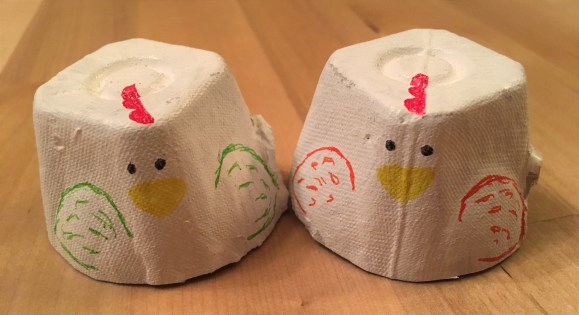
Egg Carton Chickens and a Basket Full of Games
With twelve little chickens you can come up with lots of games to play! This fun craft and game activity is eggs-actly what you need to start hatching some real fun!
Supplies
Cardboard egg carton
White craft paint
Markers: red, yellow, black for the face; any colors you’d like for wings and eggs
Paint brush
Scissors
Glue
Construction or craft paper in white and a color of your choice
Directions
Cut the notched flap off the egg carton and set aside
Cut the top off the egg carton
Cut apart all the egg cups and trim slightly so they sit flat
Paint the egg cups with the white paint, let dry
Add the face, comb and wings to the chicken with the markers. Make six chickens with one color wings and six chickens with another color wings.
From the egg carton flap cut thirteen small egg-shaped playing pieces
With the markers, decorate twelve of the eggs in pairs—each egg in the pair with the same design
Color one egg yellow and add a beak, eyes, and wings to make it a chick
Games to Play
Tic-Tac-Toe (2 players)
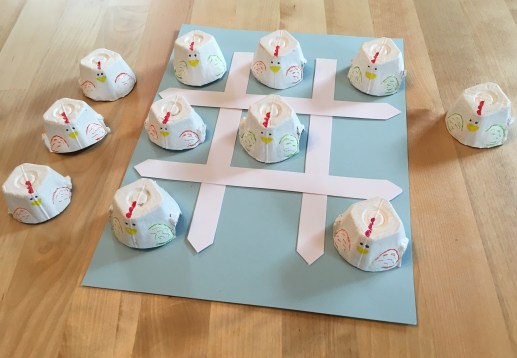
On a 8 ½” x 11” piece of paper draw a regular tic-tac-toe board or make it fancy – like the picket fence-inspired board in the picture
To make the fence-inspired board on a colored background, cut 2 9-inch-long x 3/4-inch wide strips of white paper, cutting a pointed tip at one or both ends. Cut 2 white 8-inch x 3/4-inch strips of paper with a pointed tip at one or both ends. Glue the strips to the background.
Each player chooses a set of chickens with the same colored wings
Play the game as you usually do
Find the Matching Eggs (2 or more players)
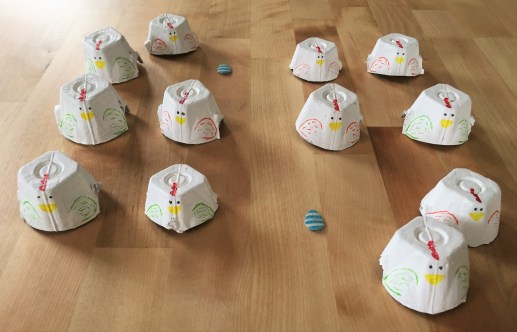
Have one player hide one egg under each chicken
Shuffle the eggs around and form them into three lines of 4 chickens each
Another player lifts one chicken at a time to find matching eggs. If the eggs don’t match, put both chickens back and start again
Where’s the Chick?
Use as many chickens and eggs as you want (fewer for younger children, more for older)
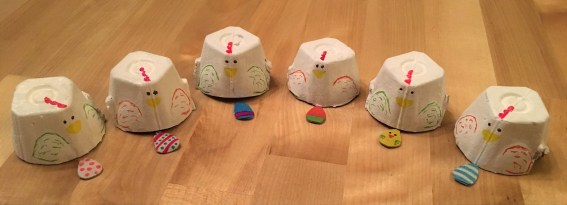
One player hides the chick under one of the chickens and eggs under the others.
Another player has three chances to find the chick
I’m sure you can also design your own games for your adorable chickens to play! With more chickens you can even make a checkers set or replicate another of your favorite board games!
You can find A Little Chicken at these booksellers
Today’s holiday was established in 1997 by the National Education Association. Celebrated across the country, the day encourages children to discover a love of reading that will follow them throughout their life. Reading is one of life’s greatest pleasures and, begun early, it can be a powerful force for future success. Through reading, kids learn about the world, meet different people, laugh, cry, and are always entertained. To commemorate the day, authors, illustrators, politicians, athletes, librarians, and families hold special reading events in schools, libraries, bookstores, and community centers. Celebrate today by reading with a child or on your own. Visit your local bookstore or library and find some new books to share—or grab some favorites from your own shelf and enjoy them again!
I received a copy of Cavekid Birthday from Charlesbridge to check out. All opinions are y own. I’m excited to be partnering with Charlesbridge in a giveawy of Cavekid Birthday. See details below.
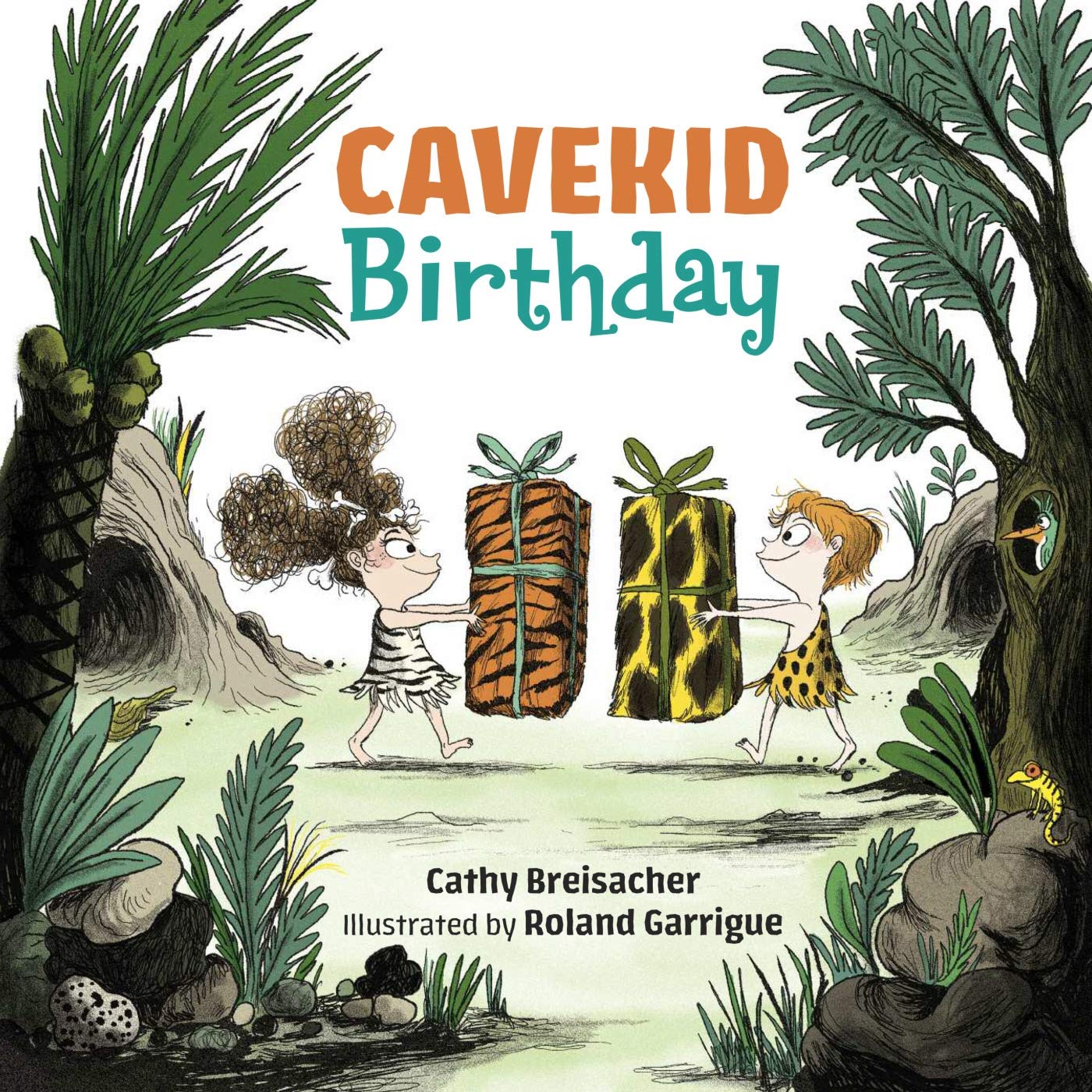
Cavekid Birthday
Written by Cathy Breisacher | Illustrated by Roland Garrigue
In two neighboring caves on the very same day, Caveboy and Cavegirl were born. They did everything together and grew to be best friends. “Eventually Caveboy discovered that he loved…rocks!” He showed Cavegirl his collection of shiny, spiny, smooth, and colorful rocks to Cavegirl and even taught her how “to play stone toss.” Cavegirl developed a love of tools—tools that she could dig, build, and paint with. She shared her tools with Caveboy and “taught him how to create masterpieces on cave walls.”
Image copyright Roland Garrigue, 2019, text copyright Cathy Breisacher, 2019. Courtesy of Charlesbridge.
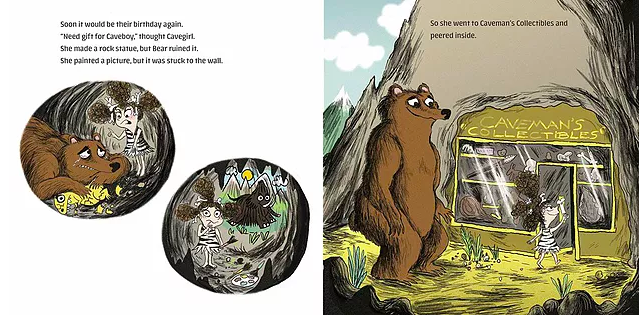
As their birthdays neared, Cavegirl tried making Caveboy a present, but her efforts failed. She decided to go to Caveman’s Collectibles to see what she could find. There, she spied a “‘Box for Caveboy’s rocks!’” Caveman was happy to make a trade. Cavegirl said, “‘Have nothing to trade except…tools!’” It took all ten of Cavegirl’s tools to get the box, but she knew Caveboy would love it.
Image copyright Roland Garrigue, 2019, text copyright Cathy Breisacher, 2019. Courtesy of Charlesbridge.
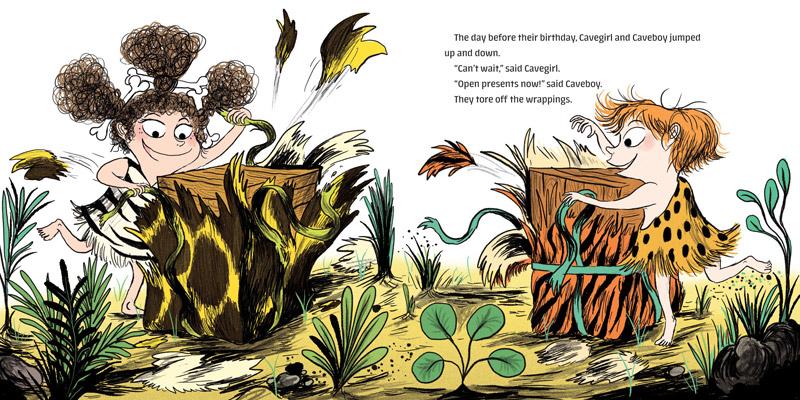
Meanwhile, Caveboy was making a present for Cavegirl. He had no luck either, so he hurried down to Caveman’s Collectibles. Inside, he spied the perfect gift: “‘Box for Cavegirl’s tools,’” he told Caveman. This box cost twenty rocks—all that Caveboy had—but he knew Cavegirl would love it. When they exchanged gifts, they ripped off the wrapping and…. Without tools or rocks to keep in the boxes, they found other uses for them. They were great for playing hide-and-seek and making carts to race in, but they began to miss their old favorite things.
They went back to Caveman Collectibles and told Caveman their dilemma. “‘Make trade?’ they asked.” For their rocks and tools, Caveboy and Cavegirl gave Caveman a shiny polished and painted store. And Cavegirl and Caveboy? They had best birthday ever!
Image copyright Roland Garrigue, 2019, text copyright Cathy Breisacher, 2019. Courtesy of Charlesbridge.
Cathy Breisacher knows how much kids love to rock their birthdays. In her original story set in a precociously prehistoric time, Breisacher chisels a funny and touching tale about the true meaning of friendship. Cavegirl and Caveboy only pause for a moment before trading their most precious belongings to get a gift for the other. Without things to put inside the boxes, Caveboy and Cavegirl—like kids of all eras—find other creative ways to use them. When they begin to miss their rocks and tools, instead of feeling regret they work together to devise an innovative way to get them back—and make Caveman happy too. Kids will be wrapped up in the suspense and enjoy hearing—and repeating—Breisacher’s cavespeak, and in the end will take the ever-timely lesson to heart.
There are plenty of hairy moments in Cavekid Birthday, and Roland Garrigue takes full advantage to create wild and wooly (mammoth) illustrations to accompany the story. Caveboy and Cavegirl play hide-and-seek among dinosaur bones, race their bear and elephant ancestor pets, and may be the world’s first collector and artist. Hilarious modern-primitive mash-ups—like furry, animal skin wrapping paper—will have kids laughing and pointing out the anachronisms.
Children would love finding Cavekid Birthday among their gifts, and adding the book to home, classroom, and library shelves will ensure a sweet and timeless story time.
Ages 4 – 8
Charlesbridge, 2019 | ISBN 978-1580898768
Discover more about Cathy Breisacher and her books on her website.
To learn more about Roland Garrigue, his books, and his art, visit his website.
Book trailer good! Watch. Fun!
Meet Cathy Breisacher
Thank you for having me! I love your questions. They were a lot of fun to answer. I’m excited to have an opportunity to share a bit about myself and my books.
I love the prehistoric setting of your book. What was it about this time period and these characters that attracted you?
One day, I spotted an adorable clipart image of a cavegirl and a caveboy. That image got me thinking about how fun it would be to write a story with cavekids as the main characters. I’m glad I chose them, especially once I decided to write a story with a Gift of the Magi twist. Using the prehistoric setting for this theme seemed like a great idea since cavekids had no money, and they really wouldn’t have had many possessions. I’m sure cavekids had a few items they treasured, so thinking along these lines helped me to craft the story.
Roland Garrigue, the illustrator, shared with me that he loved the idea of kids having a Mammoth and a Cave Bear as pets. His art work is so detailed and charming. I adore the caves, the animals, and the cavekids that he drew. Cave art intrigues me and I enjoyed researching and learning about places such as the Cave of Lascaux in France. It’s been educational for me to work on this book because I have been imagining what life would have been like a long, long time ago. And, in my libraries, it’s been fun talking to students about prehistoric life as well.
Which would you collect—rocks or tools—and why?
I would definitely collect tools. I enjoy painting, just like Cavegirl! And even though I’m not much of a gardener, I do think I’m pretty handy whenever my husband and I take on home projects. I have a makerspace in my library and I enjoy making things. My husband, on the other hand, is a rock collector. He studied Geology in college and he is always picking up rocks and bringing them home.
What were a few of your favorite books when you were a child? Do you have a special memory related to any of the books you liked?
I loved Ramona Quimby. I read all the Ramona books, and the rest of Beverly Cleary’s books, too. For picture books, I read and reread the Frances books by Russell Hoban. I also loved Madeline and Alexander and the Terrible, Horrible, No Good, Very Bad Day.
Did you always like to write? What inspired you to write picture books?
I have always enjoyed writing. When I was in elementary school, I liked to draw and write, and my teachers always complimented me and encouraged me to keep at it. I was drawn to the magic of picture books when I was in graduate school studying to become an Elementary School Counselor. At the campus library, there was a room for Education majors filled with picture books. It was wonderful. I would get caught up in the stories (ones that I remembered from my childhood and new ones that I wanted to use in the classroom). I started thinking about how fun it would be to write my own books someday. But I didn’t actually pursue this idea until several years later. One day, I received a brochure in the mail about a Children’s Book Writing Conference in Chautauqua, New York put on by the Highlights Foundation. I was so intrigued. The conference was absolutely amazing. I left that conference feeling inspired to write picture book stories that would someday be in kids’ hands.
One of the best parts about being an elementary school librarian must be reading books with students. Do you have any memorable anecdote about story time you’d like to share?
Story time is so special. Kids’ reactions are the best and they say the funniest things. Recently I read Tammi Sauer’s book Knock Knock (illustrated by Guy Francis). After the story, kids eagerly began raising their hands and telling their own knock knock jokes. As soon as one student told a joke, the next kid’s hand went up, and on and on it went. Very few of their jokes made any sense, but they were cracking themselves up and it made me smile. You never know what will happen during story time.
Probably my favorite story to read during story time is Sam and Dave Dig a Hole (written by Mac Barnett and illustrated by Jon Klassen). Kids are so amazed at how Sam and Dave keep digging around the diamonds. The students start yelling at the characters as the story is being read. It’s fantastic. The page turns in this book work so well. The storytelling is brilliant.
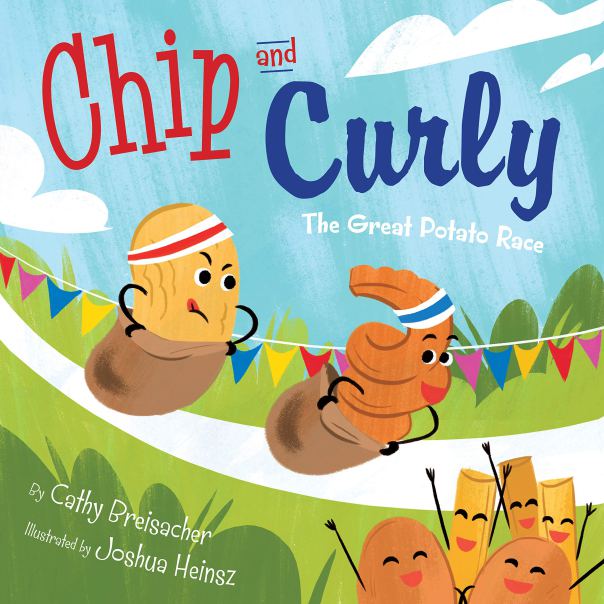
Congratulations on your second picture book—Chip and Curly: The Great Potato Race—which is being released in May! This looks like another fun and original story full of humor. Can you talk a little more about this book and how it came to be?
This book is a story about two potatoes, Chip and Curly, who compete against each other in Spud City’s Annual sack race. Chip has his heart set on winning the Golden Bushel Award, but when Curly shows up with a spring in his step, Chip is worried. He practices and gains admiration from the other taters in town, but he wonders if he will be able to get this win in the bag or if his dreams of winning will be mashed.
I had such a fun time coming up with a list of all of the kinds of potatoes there are, and generating a list of words and phrases associated with potatoes. There is an Annual Potato Festival close to where I live, and I enjoy going to it. That event was really the inspiration for this book. While strolling alongside the craft booths one year, I felt inspired to write a book with potatoes as the characters. After some thought, I knew I wanted the story to address competition. Following several drafts of this story, it occurred to me that a sack race would be the perfect situation for potato characters to be in.
I wanted to have fun with this story and fill it with potato puns to make both adults and kids chuckle. I hope readers will see how enjoyable it can be to play with words and language. The illustrations by Joshua Heinsz are colorful and bright, and readers will want to keep their eyes peeled for the variety of potato characters that appear on the pages. Finally, and probably most importantly, this book touches on the themes of friendship, competition, and the idea that winning isn’t everything. I want readers to think about how good it feels when we practice good sportsmanship. This is a meaningful topic to discuss with children, especially in light of today’s climate. Chip and Curly, the Great Potato Race will release on May 15, 2019 and is published by the incredibly talented team at Sleeping Bear Press.
What are you most looking forward to about being a published author?
I am looking forward to meeting new people—young readers as well as adults: parents, authors, illustrators, bookstore owners, librarians, teachers, and folks in the publishing industry. I can’t wait to make these wonderful connections. I am also looking forward to writing new stories and sharing them with the world.
What’s up next for you?
I have two manuscripts I’m working on right now, and my agent has a couple of my other stories out on submission. I will be traveling a bit this spring and summer to promote my two books. I will be posting the list of events on my website at www.cathybreisacher.com.
Since Celebrate Picture Books is holiday based, I have to ask—what’s your favorite holiday and why?
Christmas is my favorite holiday. I love being around family and celebrating the true reason for the season. There is always an extra skip in people’s step between Thanksgiving and New Year’s Day. It’s not just a one-day celebration. The festivities last for a month and get-togethers and fun activities bring people together. It’s a time of the year when there is so much joy, love, and hope. Interesting note: the earliest drafts of my cavekid story were called Cavekid Christmas, but after a series of revisions, it became Cavekid Birthday.
Do you have any anecdote from a holiday that you’d like to share?
Many years ago, I had a chance to spend Thanksgiving in New York City and watch the Macy’s Thanksgiving Day Parade in person instead of watching it on TV. I watch the parade every year, but to see it in person was truly magical.
Thanks, Cathy! I’ve really enjoyed our chat and getting to know you better! I wish you all the best with Cavekid Birthday and, along with all of your readers, can’t wait to meet Chip and Curly!
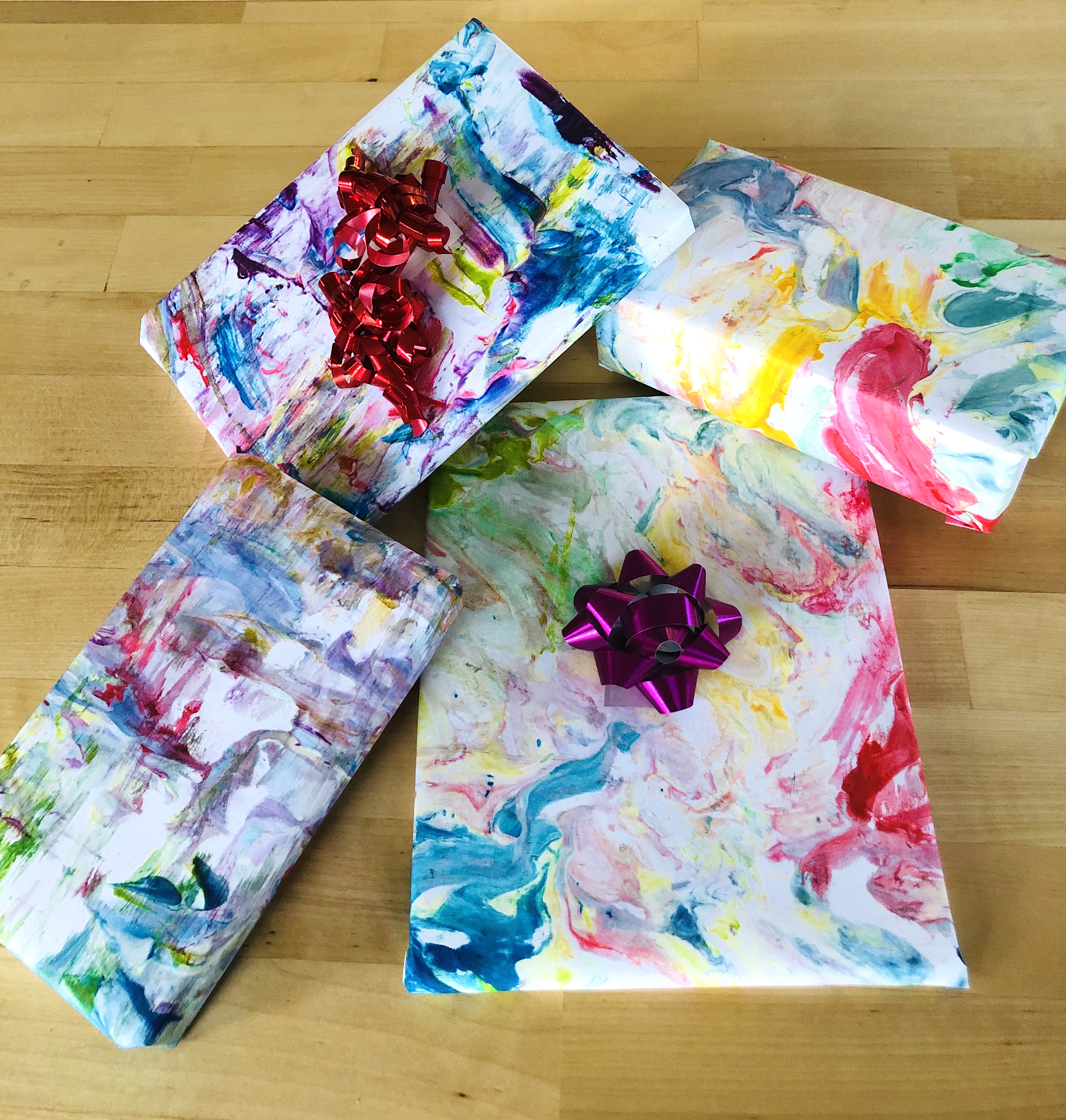
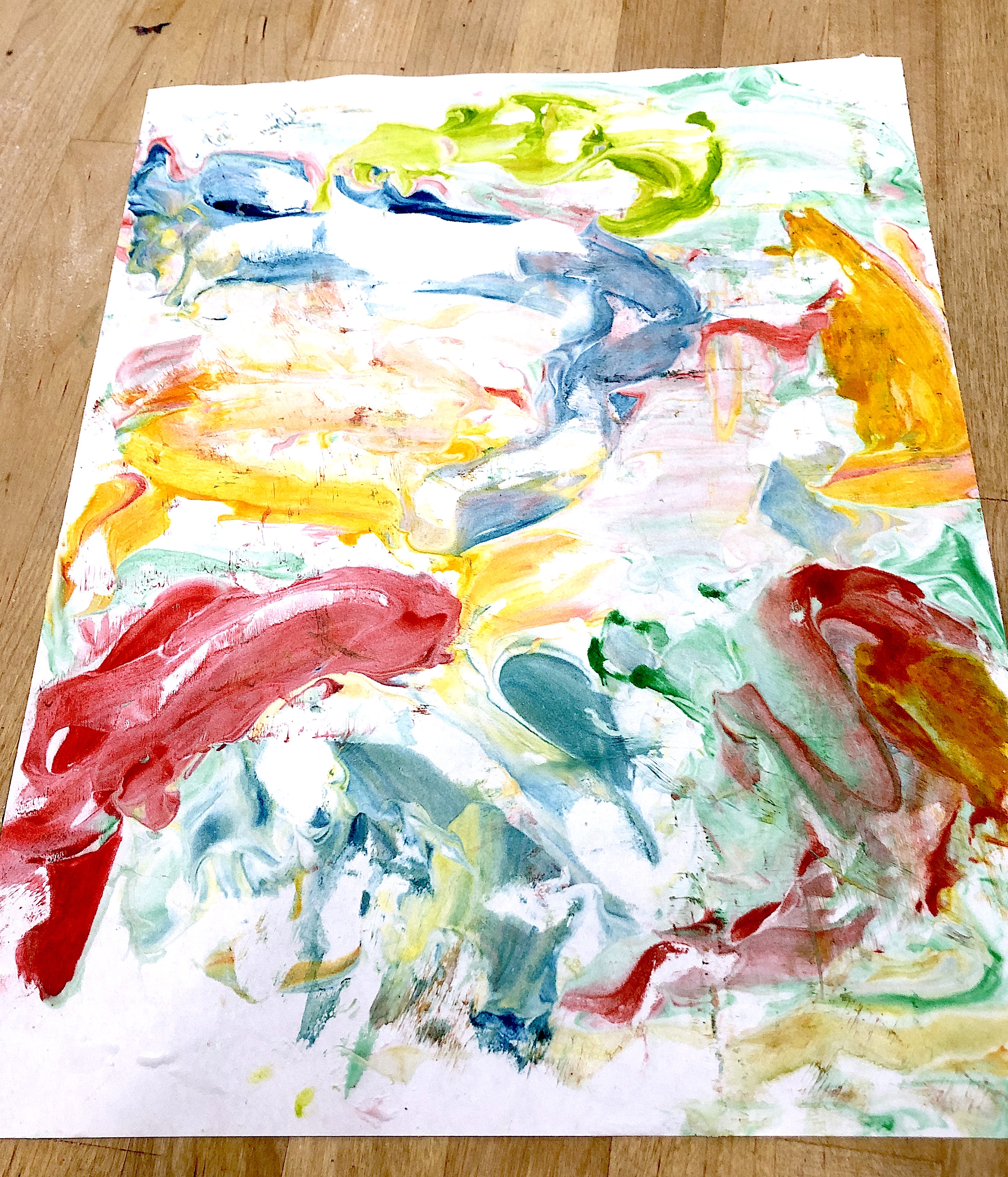
If you have birthdays coming up or plans to give a book or two for Read Across America Day, grab the kids and have fun making this wrapping paper that has a high hands-on coolness factor.
Supplies
1 can of shaving cream
Food coloring
Shallow baking tray
Frosting spatula or regular spatula
Toothpicks or skewer for swirling food coloring
White paper, computer paper works well
Directions
Squirt the shaving cream onto the tray in small amounts and spread into a thin layer with the spatula
Squeeze a few drops of different colored food coloring onto the shaving cream
With the toothpick or skewer gently swirl the colors. Alternately, gently smooth the colors around and together with the icing spatula.
Lay a piece of white paper on top of the shaving cream
Gently pat the paper all over. Do not submerge the paper in the shaving cream.
Lift the paper up and place on the table
Let sit for a few minutes
Scrape the shaving cream off the paper and let the paper dry
To wrap larger boxes, tape several pieces of paper together
You can find Cavekid Birthday at these booksellers
Today we celebrate polar bears, the largest member of the bear family and a critical part of the Arctic ecosystem. These beautiful creatures spend much of their time at the edge of ice packs, from which they hunt for food. Their excellent sense of smell allows them to sense food up to a mile (1.6 km) away. Increasingly polar bears are under threat from changes in climate which are shrinking their habitat and affecting their quality of life. In honor of today’s holiday take time to research polar bears and consider donating to a cause for their protection.
Little Polar Bear
By Hans de Beer
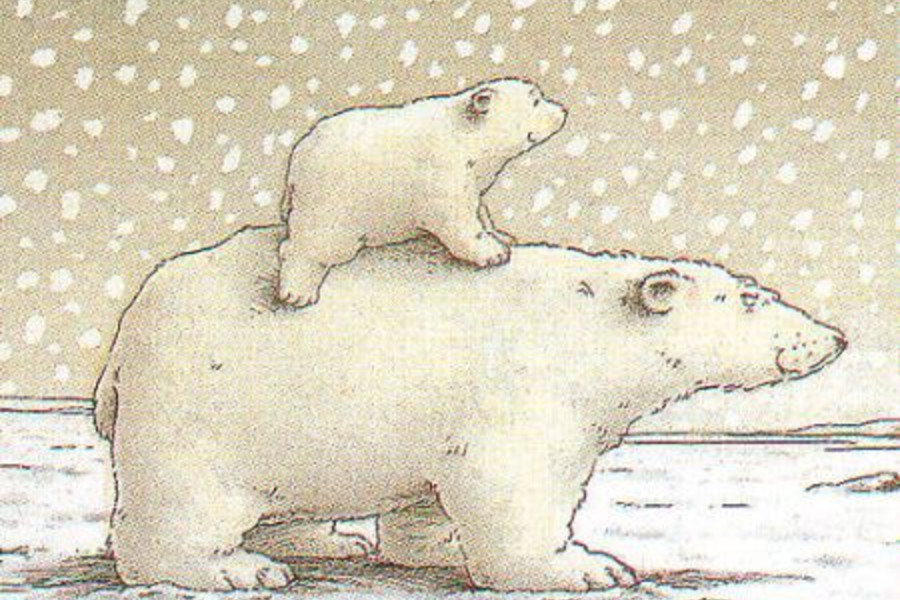
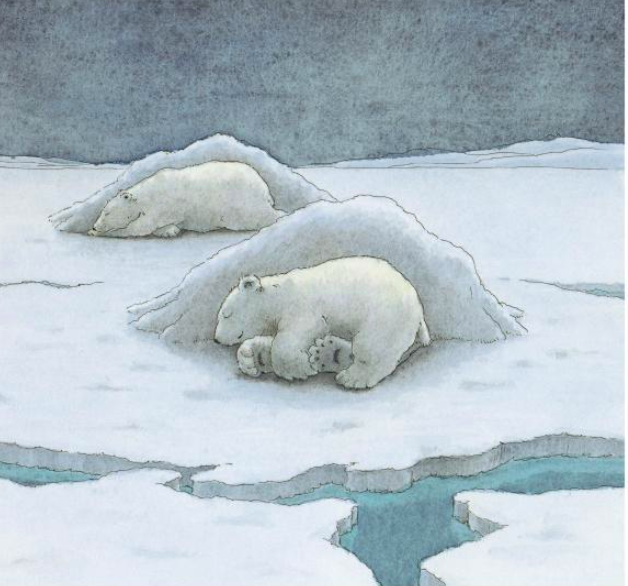
At last little Lars is old enough to go hunting with his father, and they head out into the white, frozen expanse to find the perfect fishing spot. While Lars watched from the edge of an ice pack, his dad disappeared underwater for so long that Lars began to worry. When he finally surfaced, however, he brought with him a large fish for dinner. After dinner it was time to sleep. Lars’ father showed him how to build a wall of snow to lie behind that would protect him from the wind.
Copyright Hans de Beer, 2016, courtesy of NorthSouth Books.
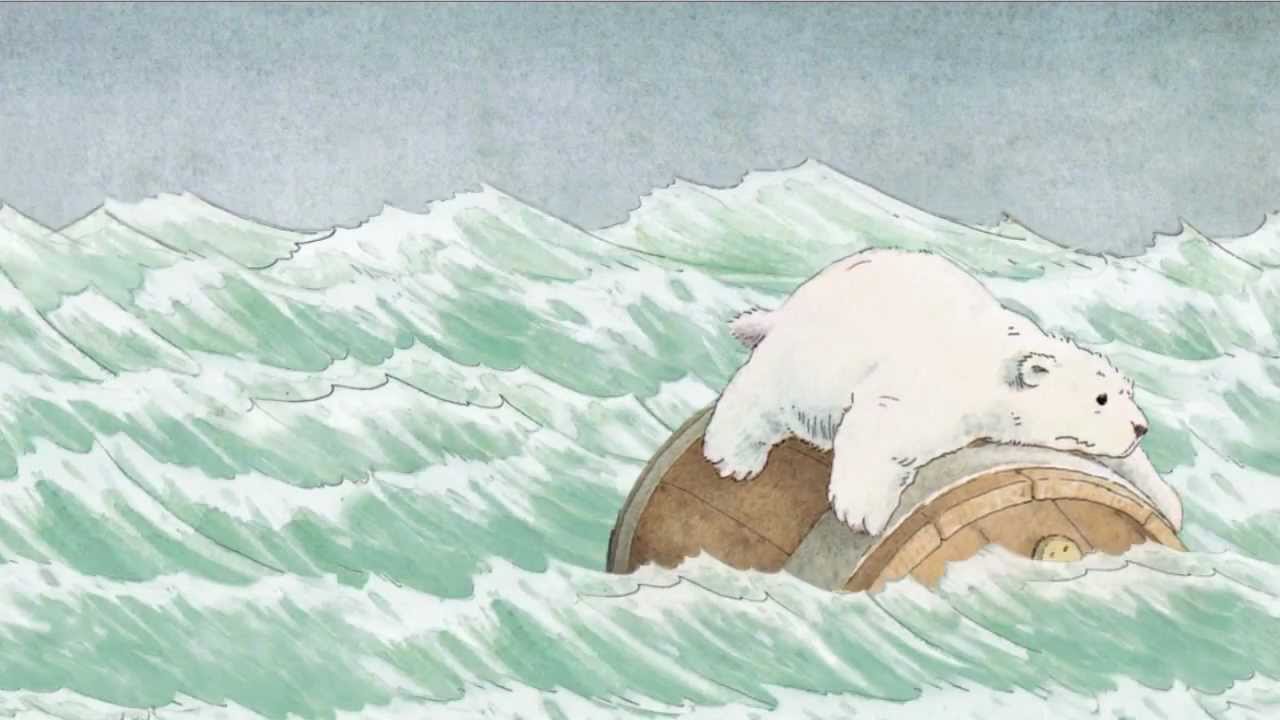
During the night as Lars and his father slept, the ice cracked between them, sending Lars floating away by himself. When Lars woke in the morning, he discovered that he was alone and that the warm sun was melting his ice floe little by little. Just as the ice threatened to disappear entirely, a barrel floated by and Lars crawled on top of it. “Then a storm began to rage. As Lars clung to his bobbing barrel he missed his father and his pile of snow more and more.”
Copyright Hans de Beer, 2016, courtesy of NorthSouth Books.
By the time the storm subsided Lars was far from home. He found himself in a place with no snow or ice; instead “almost everything was green and the sun was very warm.” Lars left the barrel and padded onto the sandy beach. The hot sand burned Lars’ paws, and he ran to the nearby river to cool them. “But just as he was about to plunge in, a very big, tan animal sprung out of the water.” Frightened, Lars ran away, but the hippopotamus followed him and introduced himself. Henry had never seen a white bear, and Lars had never seen a tan animal.
Lars told Henry about his trip and how he wanted to find father. Henry didn’t know how to help, but he figured that Marcus the eagle would know what to do. With Lars on his back Henry started the long journey across the river, through the jungle, and over the mountains. On the way, Lars loved seeing all the different colors, creatures, and vegetation. He climbed trees, met a chameleon, and sniffed at a butterfly. When they came to the mountains, Henry had trouble climbing, but Lars scampered ahead and showed him where to step.
Image copyright Hans de Beer, 2016, courtesy of NorthSouth Books.
Finally, Henry couldn’t go any farther. He and Lars found a place to rest for the night. The view of the water made Lars homesick, but Henry reassured him. The next day, high on the mountain, Lars and Henry found Marcus. “The eagle looked at Lars and then said, ‘Well, well, a polar bear in the tropics! You’re a long way from home aren’t you, young man?’”
Marcus explained that he could indeed help Lars get home, but they would need the assistance of Samson. In the morning a gray whale swam near shore, and Lars climbed on his back. While Henry was happy that Lars could find his way home, he was also sad to see him go. He and Lars said goodbye to each other. As Henry looked on, Samson and Lars swam out into the open ocean with Marcus flying “along a bit to set them on their way.”
Image copyright Hans de Beer, 2016, courtesy of NorthSouth Books.
After Samson had swum a long distance, icy cliffs once again appeared on the horizon. As they drew closer, Lars spotted his father standing at the edge of the ice scanning the sea. Lars called out to him, and Lars’ father couldn’t believe his eyes. In thanks for bringing back his son, Lars’s father caught a big fish and gave it to Samson. Lars and his father started toward home, and as they walked “Lars talked about all of the amazing things he had seen.” His father was astonished. “‘You didn’t meet anyone who was white?’” he asked. “‘Nobody, except a chameleon,’ said Lars, ‘but that doesn’t count.’” Lars laughed, but his dad couldn’t understand the joke.
Copyright Hans de Beer, 2016, courtesy of NorthSouth Books.
Hans de Beer’s sweet, adventurous little polar bear has been long beloved by young readers who have followed his journeys and escapades through many books. This favorite introduction to Lars, his father, and the North Pole was reissued in 2016 and is as timely now as when it was first published. De Beer’s straightforward story of a young bear suddenly taken away from home, surviving by instinct, and discovering new places, friends, and ideas, is at once exciting and comforting. As Lars finds himself in unfamiliar territory populated with animals and creatures he’s never seen before, he doesn’t shy away from the experience, but embraces the diversity of what he sees just as the tropical animals accept him. The kindness and camaraderie shared among the animals is a universal lesson for all.
Little ones love de Beer’s expressive animals and the caring interactions between them. Kids will laugh when Henry pops out of the river to say “boo!” and giggle to see Lars and the chameleon sticking out their tongues together. The soft pastel palette invites kids to linger over the pages and experience both the frozen tundra and lush jungle with the same awe as Lars. Readers will cheer when Lars is reunited with his father, but will also look forward to traveling with their new friend again in his other adventures.
Ages 3 – 8
NorthSouth Books, 2016 (Hardcover) | ISBN 978-0735842649
International Polar Bear Day Activity
Polar Bear Scarf or Banner
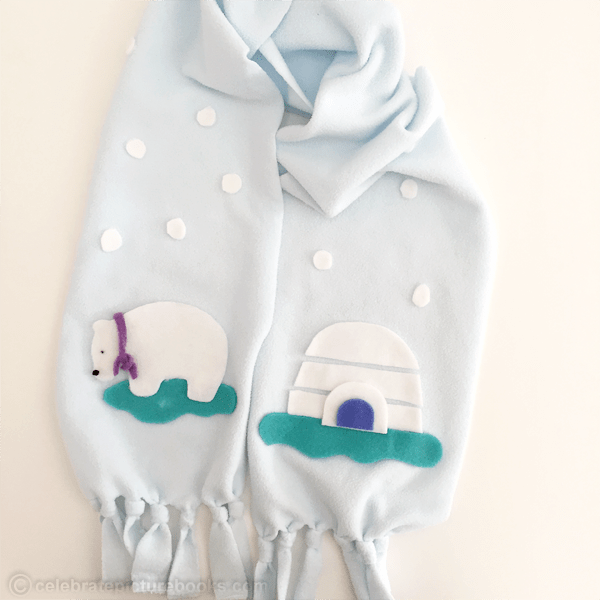
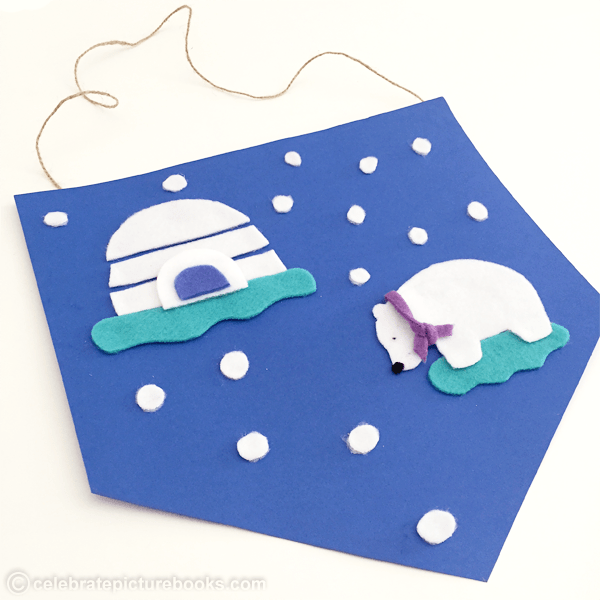
Polar bears aren’t cold in the winter—and neither should you be! Here are directions and printable templates for making a cute scarf to keep you warm, or—if you’d rather—a banner to warm up your room.
Great things come in small packages, right? Just look at your incredible kids! It’s the same with poetry! The haiku may be the smallest form of poetry, but its three little lines contain enormous heart and insight. Traditionally written with nature themes, haiku now touches on every subject. Poets the world over have designated February as National Haiku Writing Month—also known as NaHaiWriMo. The challenge is to write one haiku a day with a goal to improve their art and share their work. To celebrate this month, try your hand at writing haiku and introduce your littlest readers to these little verses.
H is for Haiku: A Treasury of Haiku from A to Z
Written by Sydell Rosenberg | Illustrated by Sawsan Chalabi
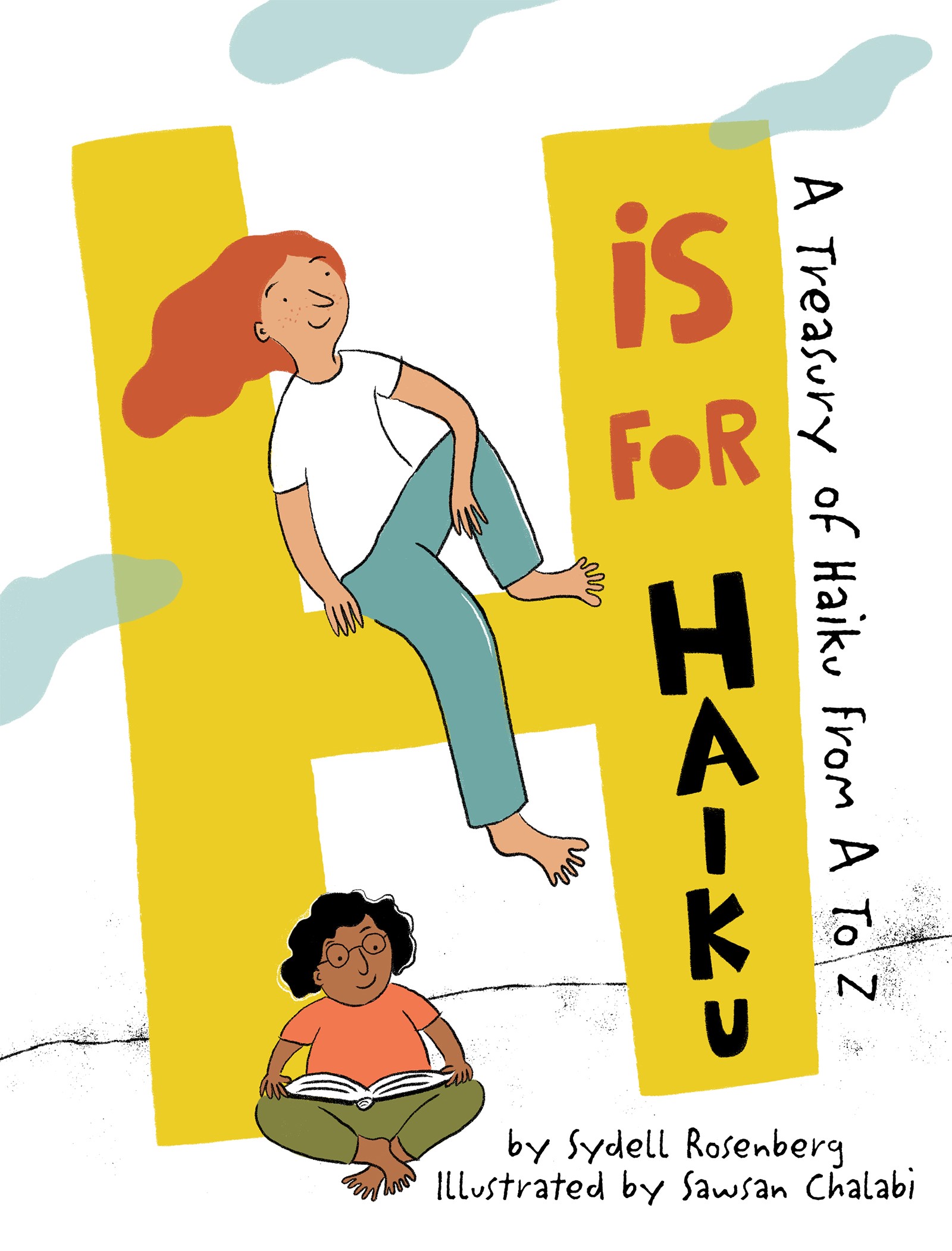
In her lovely and delightfully whimsical poems, Sydell Rosenberg holds moments in the palms of her hands, letting readers immerse themselves in the tender, humorous, and wistful flashes of a day before they shift, evolve, or fade away. H is for Haiku begins, appropriately, with Adventure and its dreamy memory for a worn-out kitten as he slumbers.
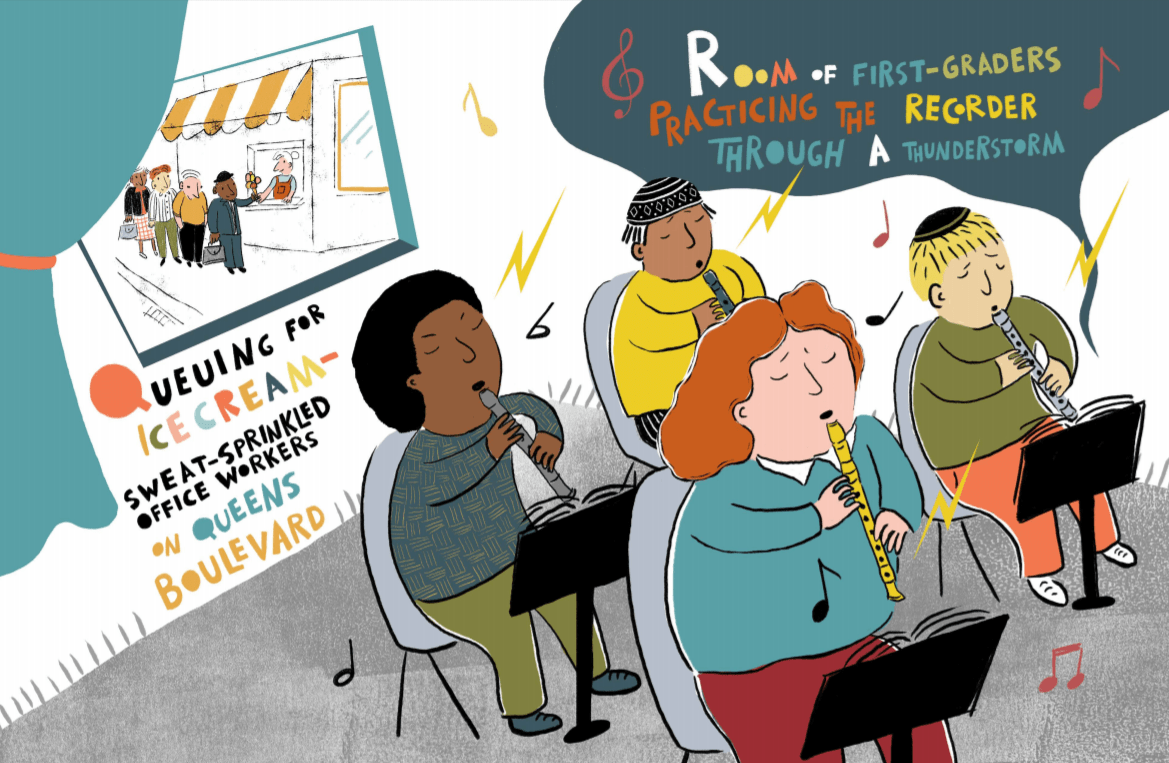
Image copyright Sawsan Chalabi, 2018, text copyright Sydell Rosenberg, 2018. Courtesy of Penny Candy Books.
The journey continues as readers meander along a city sidewalk and see a “Boy on a mailbox / perched like a solitary bird / watching the sunset.” Walking on, readers peek into car backseats, queue for ice-cream on a sweaty summer day, and visit a barbershop where you always ask for Xavier. Down country lanes, you’ll spy a pale moon, turn the heads of sunflowers, share bike rides and car rides, and watch as “Munching on acorns / a squirrel sweeps up sunbeams / with her transparent tail.”
Rosenberg’s studied eye for connections makes her poems especially enchanting. Leaves and flowers, birds and insects, rain and thunder interact with those in their midst, adorning hair, scurrying away, playing musical backup, meeting danger, and creating transformations like the one at Y: “Yesterday’s cool rain / left this flat puddle smoothing / the wrinkled leaves.” A trip to the fish market is infused with humor, and an optical illusion makes you look twice at the flamingos in a pond.
Even in her observations of the routine, Rosenberg remind readers that there is music and poetry in common actions. For example, at U we hear: “Up and down the block / homeowners mate the covers / of gusted trash cans.” As a teacher sits grading papers to close out the book, readers can’t be faulted for wishing our alphabet had a few more letters.
Image copyright Sawsan Chalabi, 2018, text copyright Sydell Rosenberg, 2018. Courtesy of Penny Candy Books.
As a teacher Sydell Rosenberg was attuned to the spirit of children, and her sophisticated and fun haiku are particularly accessible for young readers. Touching on a wide range of subjects, Rosenberg invites kids to look and look again. Her keen observations and lilting imagery will inspire them to do just that.
Sawsan Chalabi’s charmingly quirky illustrations and stylized lettering present each poem with dash and personality that will enchant kids. Her delicately lined drawings are infused with vibrancy from a gorgeous color palette. Just like Rosenberg’s haiku, Chalabi’s pages are animated with a love for life that will resonate with kids—and adults.
H is for Haiku would make a terrific gift for poetry lovers and a wonderful addition to home, school, and public library collections.
Ages 5 – 11 (and up)
Penny Candy Books, 2018 | ISBN 978-0998799971
Discover more about Sawsan Chalabi and view a portfolio of her work on her website.
Read an interview about Sydell Rosenberg with her daughter Amy Losak, who compiled H is for Haiku and brought it to publication.
Haiku Poetry Day Activity
Haiku Wall Art
The haiku you write deserves to be shared with others! With this easy craft you can display your poem in style.
Supplies
Colorful heavy stock paper, 2 or three colors
Ribbon
Glue or glue dots, or double-sided tape
Dowel or wire for hanging
Paint to paint the dowel (optional)
Directions
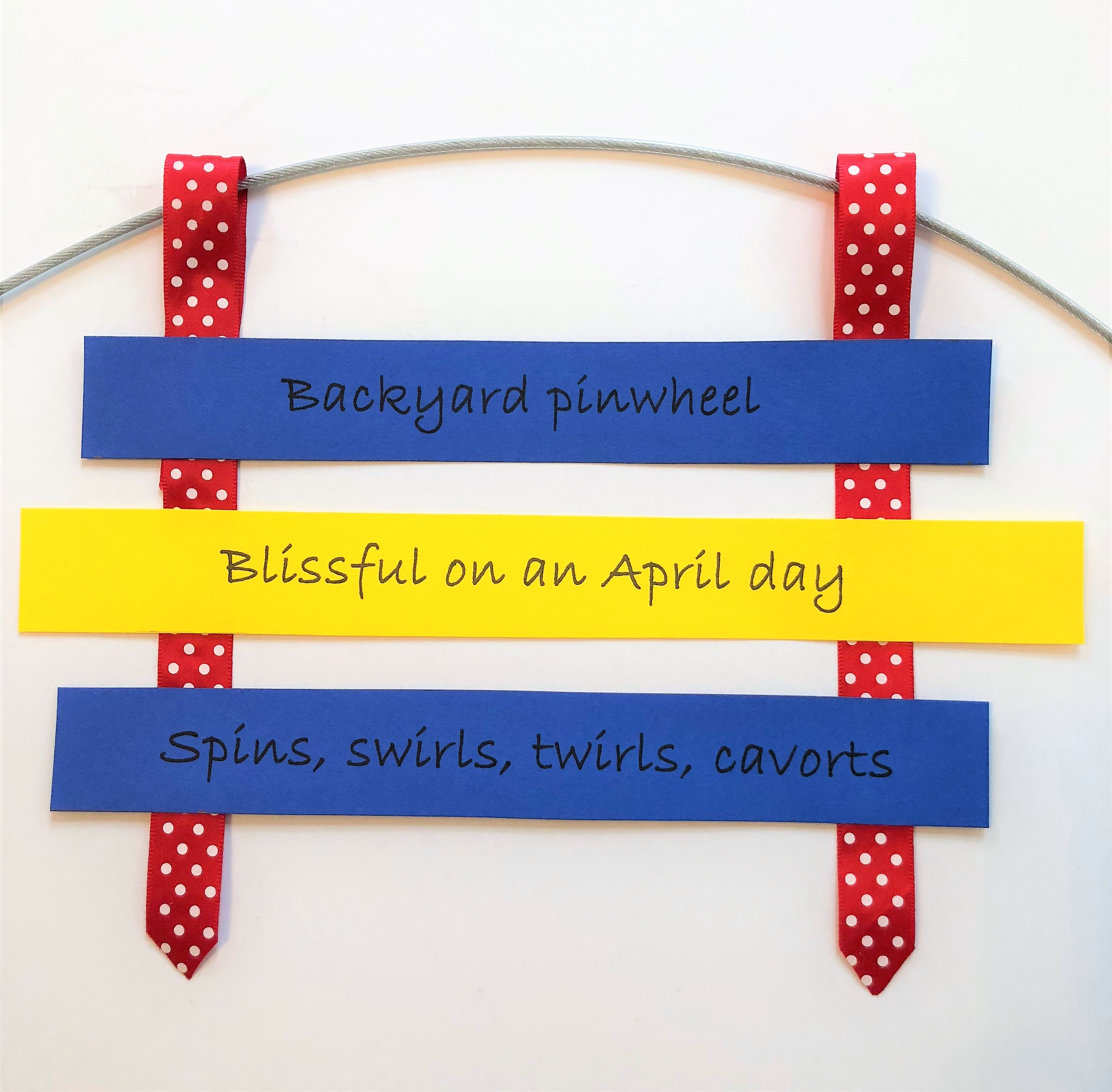
Write a haiku and print the lines on colored paper
Cut the lines apart, making the first and third line shorter than the second line
Glue or tape the lines to the ribbon, leaving about a half inch between them
To make the hangers, fold the tops of the ribbon over and glue or tape it closed
If using a dowel to hold the poem, you can paint it to match or contrast with the paper
Friends make our lives better! They’re there to share in life’s adventures with a laugh, a shoulder to cry on, and an understanding ear. Friends feature in our best memories and are always up to making new ones. Today, look around and see who you might add to your list of friends then introduce yourself, invite them for a coffee or a chat, and start a friendship that may last a lifetime!
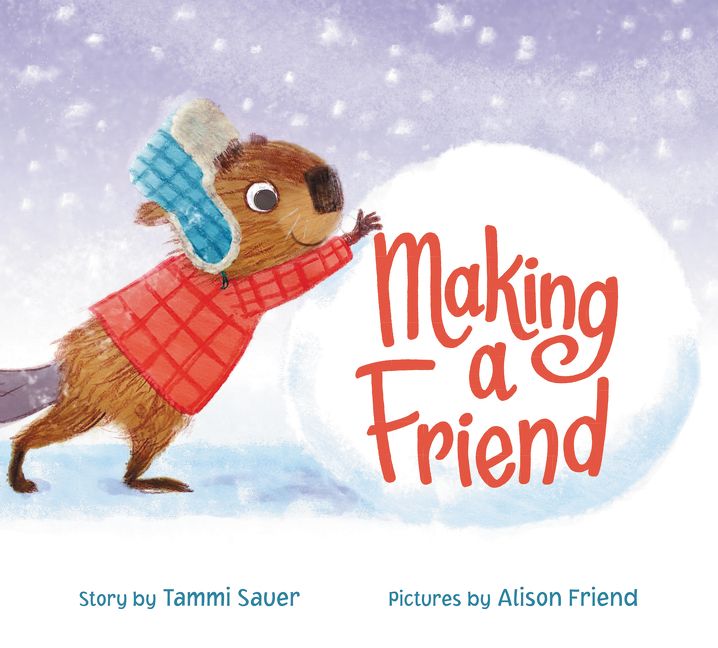
Making a Friend
Written by Tammi Sauer | Illustrated by Alison Friend
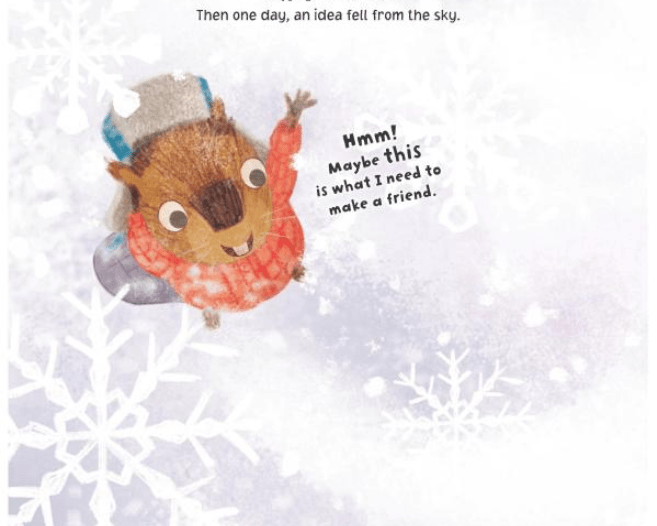
“Beaver was good at making lots of things.” He could build, he could knit, and he knew a bit about engineering. But he was not so good at making friends. He tried hard to do nice things, but something always seemed to go wrong. Then, one day, the snowflakes falling from the sky gave Beaver an idea. “Hmm! Maybe this is what I need to make a friend,” he thought.
Image copyright Alison Friend, 2018, text copyright Tammi Sauer, 2018. Courtesy of HarperCollins.
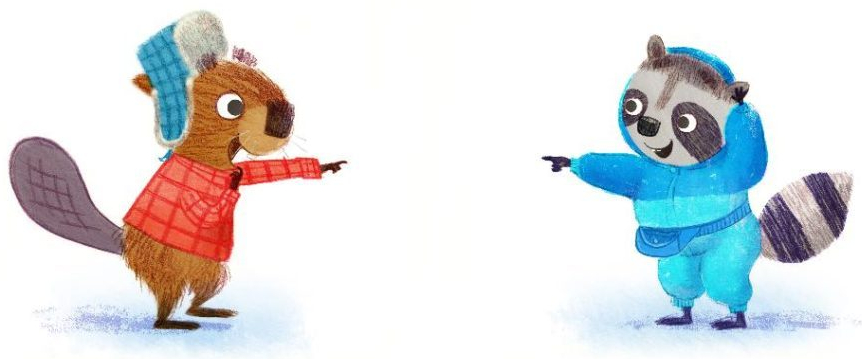
He began rolling a huge snowball. While he was working, Raccoon came by to watch. When Beaver told him that he was making a friend, Raccoon said that it “takes two to make a friend.” Beaver was a bit disappointed until Raccoon did some math and showed him that Raccoon plus Beaver made two.
Working together Beaver and Raccoon made a cute snow friend. They added eyes, a nose, a smile, and two stick arms. But something was still missing. Raccoon said that thing was “pizzazz.” So they added a hat, a boa, some socks, and even a swim mask until their friend looked just right. But their friend just stared back at them. “This friend was not much of a friend at all. In fact, he seemed rather cold.”
Image copyright Alison Friend, 2018, text copyright Tammi Sauer, 2018. Courtesy of HarperCollins.
Then Beaver and Racoon looked at each other. They talked about what fun they’d had building the snow friend together. And they realized that they had become friends. Now they make lots of things to share, but they agree—“the best thing they made was a friend.”
Image copyright Alison Friend, 2018, courtesy of HarperCollins
Tammi Sauer unlocks the secret to friendship in her clever story in which making a friend leads to making a true friend. While Beaver tries to extend the hand of friendship and do nice things for others in the forest, his efforts miss the mark. But when he meets Raccoon, their personalities, talents, and ideas of fun click and they build a real friendship. Young readers will understand Beaver’s feelings of disappointment and confusion when his overtures of friendship are not reciprocated and see that collaborating with someone—either in play or toward a common goal—often brings friends together naturally.
Image copyright Alison Friend, 2018, courtesy of HarperCollins.
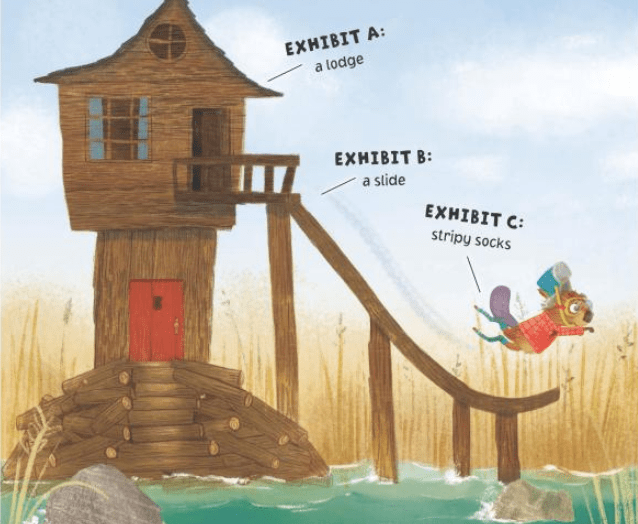
Little readers will fall in love with Alison Friend’s adorable Beaver who’s so good at creating a playhouse complete with water slide but has trouble making friends. Cheerful and enthusiastic, Beaver is a sweetheart as he begins rolling the snow into a ball. When Raccoon comes by, Beaver quickly shares the fun. Kids will enjoy seeing and learn from the images of companionship and give-and-take as Beaver learns a little math and a new word from Raccoon and Raccoon discovers that he likes the raisons Beaver offers him on their way to creating their snowman. Full of color, smiles, and endearing moments, Friend’s pages are sure to delight kids.
Making a Friend is a charming read aloud, a celebration of creativity, and a gentle lesson on friendship all rolled into one. To share with children learning to navigate new friendships and those who love doing everything with their best buddy, the book makes a sweet addition to home, classroom, and public library bookshelves.
Ages 4 – 8
HarperCollins, 2018 | ISBN 978-0062278937
Discover more about Tammi Sauer and her books on her website.
Make a Friend Day Activity
Snow Buddies
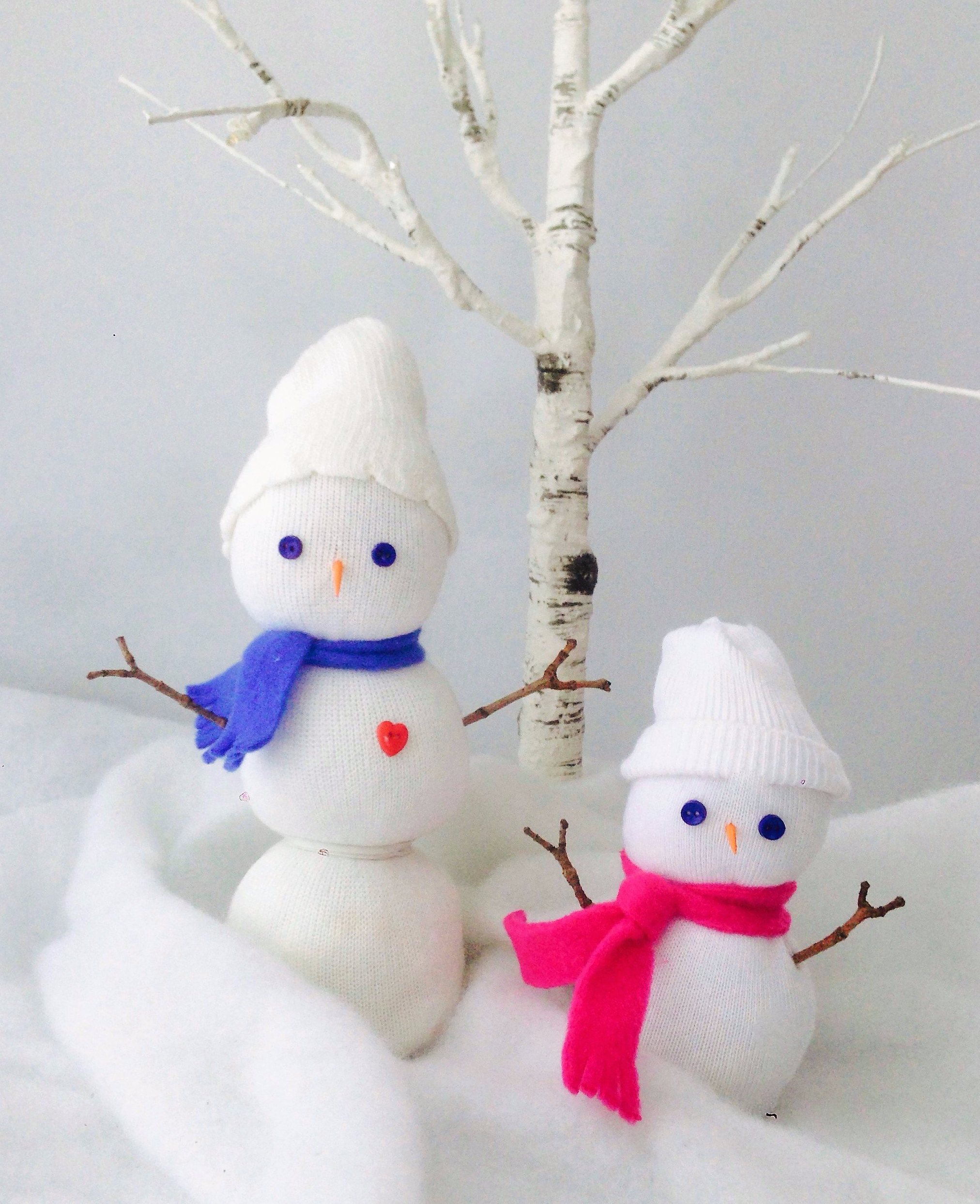
This is a great craft for kids to share with a friend. Grab a pair of socks and have fun making these snow buddies!
Supplies
White dress ankle socks
Polyester Fiber Fill
Tiny buttons
Fleece or ribbon, enough for a little scarf
Toothpicks
Twigs
Orange craft paint
Cardboard
White rubber bands, one or two depending on the size of the snowman
Fabric or craft glue
Small hair band (optional)
Directions
To Make the Snowman
Cut a circle from the cardboard about 2 inches in diameter for the base
Place the cardboard circle in the bottom of the sock
Fill the sock with fiber fill about ¾ full or to where the ribbed ankle cuff begins. Pack tightly while making a sausage shape. You can make your snowman different shapes with the amount of fill you use.
Stretch out the cuff of the sock and tie it off near the top of the fill either with a loop knot or with the hairband.
Fold the cuff down around the top of the filled sock to make the hat.
Wrap a rubber band around the middle of the sock to make a two-snowball snowman. For a three-snowball snowman, use two rubber bands. Adjust the rubber bands to make the “snowballs” different sizes.
To Make the Scarf
Cut a strip of fleece or ribbon 8 to 10 inches long by ½ inch wide
Tie the fleece or ribbon around the neck of the snowman
To Make the Nose
Dip one end of the toothpick into orange paint, let dry
Cut the toothpick in half
Stick the toothpick into the head or top portion of the snowman
To Make the Arms
Insert small twigs into each side of the body of the snowman
You can also use wire or cardboard to make the arms
Attach two mini-buttons to the face for eyes with the fabric or craft glue
With its deliciously soft, doughy inside and crusty outside, the boiled-then-baked bagel is a favorite for breakfast, lunch, and snacks! Bagels come in all sorts of flavors and varieties and with toppings for every taste, there’s no denying that the bagel is comfort food at its best. To celebrate today’s holiday, visit your favorite bakery and enjoy!
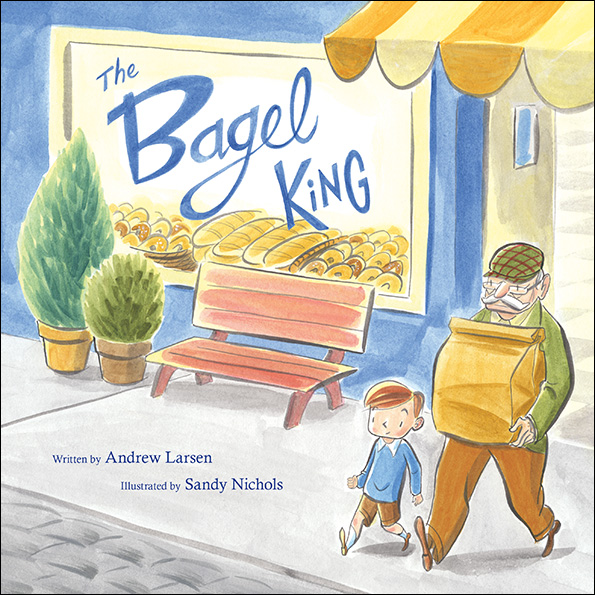
The Bagel King
Written by Andrew Larsen | Illustrated by Sandy Nichols
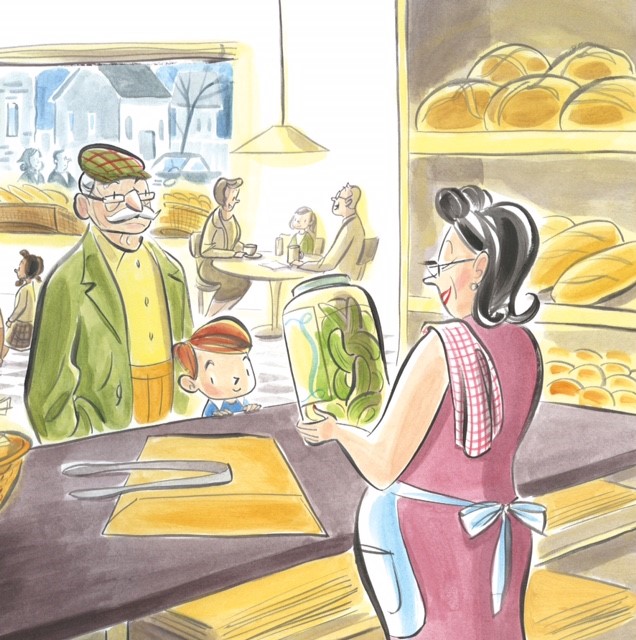
“Every Sunday morning Zaida went to Merv’s Bakery for bagels.” Sometimes his young grandson, Eli, went with him. When he did, Mrs. Rose always gave him a pickle from the big jar behind the counter. When he didn’t, “Zaida delivered his bagels right to his door.” Zaida went to Merv’s every Sunday no matter what the weather. The “warm, chewy, salty bagels were the best thing about Sunday.”
Image copyright Sandy Nichols, 2018, text copyright Andrew Larsen, 2018. Courtesy of Kids Can Press.
One Sunday, though, the familiar knock on the door never came. Later, Zaida called Eli and told him he had “slipped on some schmutz at Merv’s” and had gone to the doctor. Zaida had hurt his tuches and was ordered to relax at home for two weeks. Eli ran right over. As they sat together, both Eli’s and Zaida’s stomach rumbled with missing the usual bagels.
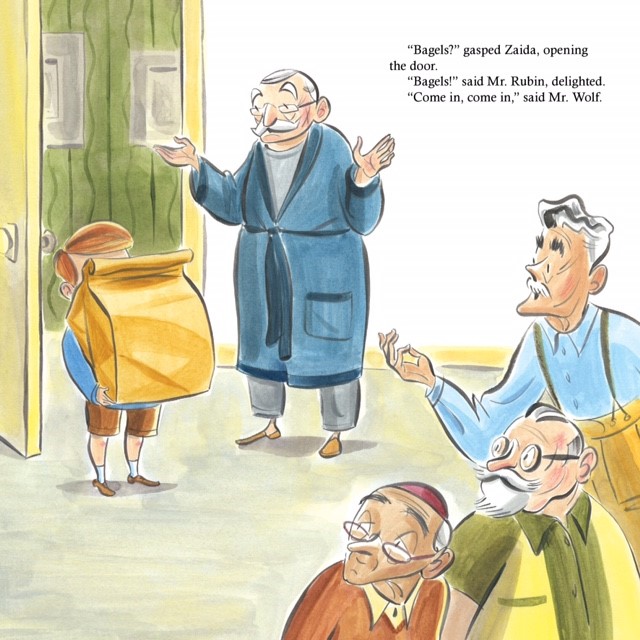
Pretty soon there was a knock on the door and three of Zaida’s elderly neighbors came in. All three were just as hungry as Eli and Zaida. It turned out that Zaida had been hosting a bagel feast for the four of them for years. When Zaida told them about his tuches, they said “‘Oy! Are you all right?’” But they were all disappointed about the bagels.
Image copyright Sandy Nichols, 2018, text copyright Andrew Larsen, 2018. Courtesy of Kids Can Press.
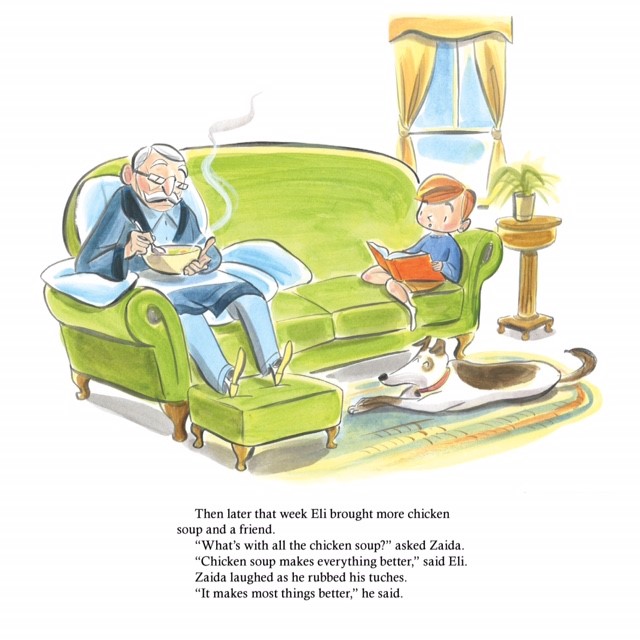
As the week went on, Eli visited his grandfather every day. He brought chicken soup one day, another day he brought chicken soup and a book, and on yet another day, he brought chicken soup and a canine friend for company. On Saturday night, though, it wasn’t chicken soup Eli was thinking about, but bagels. “Even the moon looked like a bagel all smothered with cream cheese.”
Image copyright Sandy Nichols, 2018, text copyright Andrew Larsen, 2018. Courtesy of Kids Can Press.
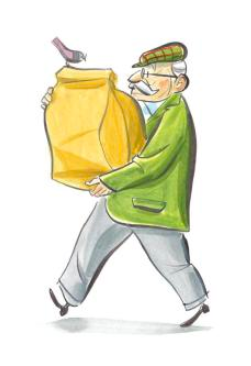
The next morning, Eli woke up early and walked down to Merv’s with a list in his hand. When he reached the counter, he handed Mrs. Rose the list. As she read it, she said, “‘This looks very familiar. Except for the last item.” Eli told her that it was a surprise. With the big bag hugged close, Eli left Merv’s and went to Zaida’s. When Zaida saw the big bag of bagel, he was surprised! His friends were delighted. “‘The boy’s a prince,’” said Mr. Goldstck, but “Zaida proudly declared, ‘He’s the Bagel King!’”
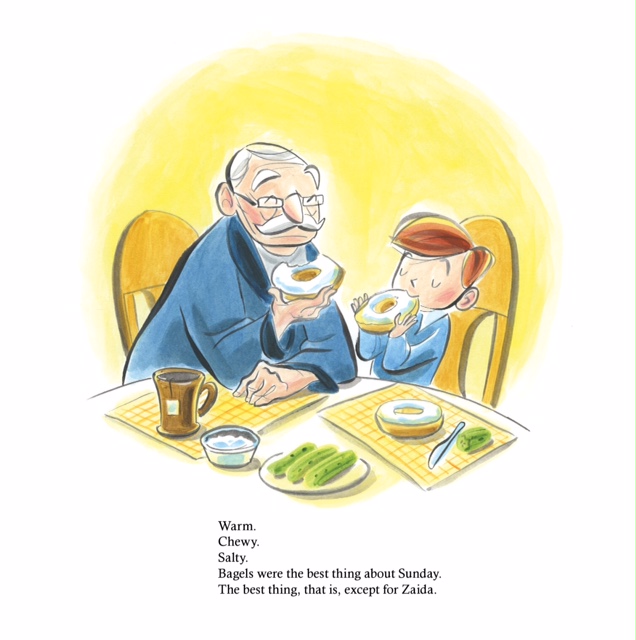
Then Eli reached in and brought out his surprise—a jar of Merv’s pickles. As Eli ate his “warm, chewy, salty” bagels, he knew “bagles were the best thing about Sunday. The best thing, that is, except for Zaida.”
A glossary of the Yiddish words used in the story and a bit about bagels and chicken soup precede the text.
Image copyright Sandy Nichols, 2018, text copyright Andrew Larsen, 2018. Courtesy of Kids Can Press.
With a sprinkling of Yiddish words and an old neighborhood atmosphere, Andrew Larsen depicts a close relationship between a grandfather and grandson who bond over bagels, pickles, and a deep love for one another. While Zaida is the one who begins the Sunday bagel tradition, this is Eli’s story as he takes it upon himself to help his grandfather recuperate and makes sure that he, Zaida, and Zaida’s friends don’t miss their favorite day for a second time. Young readers will find in Eli a peer role model for showing care and concern for family members and friends. Larsen’s straightforward storytelling peppered with realistic and humorous dialogue is as warm and cozy as sitting down to a Sunday family breakfast.
Sandy Nichols’ fresh, retro illustrations stylishly bridge the generations while also reveling in the friendly city neighborhood feeling that provides a backdrop and context for Eli’s emotional growth within the story. Images of Eli hanging over the arm of his grandfather’s sofa in boredom and disappointment, wistfully dreaming of bagels on Saturday night, and proudly making his list, buying the bagels, and delivering them—complete with a surprise—to Zaida and his friends will delight readers.
The Bagel King is an uplifting, joyful for all kids coming into their own and desiring to make a difference. The book would make a sweet gift for grandparents or grandkids, a snug family story to add to home libraries, and a terrific choice for classroom or library storytimes.
Ages 4 – 8
Kids Can Press, 2018 | ISBN 978-1771385749
Discover more about Andrew Larsen and his books on his website.
National Bagel Day Activity
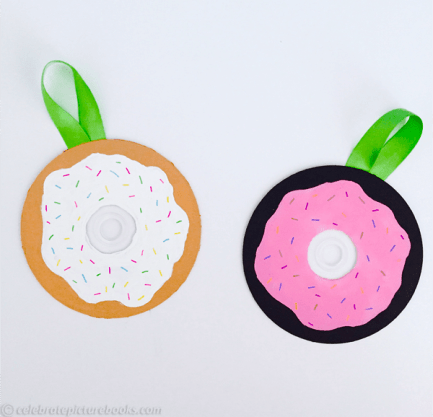
CD (Compact Doughnuts) Decoration
Do you have an old CD that could use an upgrade? With this easy craft, you can turn it into a cute doughnut (or bagel) hanging.
Supplies
Unused CDs
Craft paint in tan, black, pink, yellow, white (or any colors you want for the doughnut and the icing)
Ribbon, any color and length you want
Fine-tip markers in bright colors
Glue
Glue dots (optional)
Paint brush
Directions
Paint a wavy edge around the CD, let dry
Paint the center of the CD, leaving the clear circle unpainted
When the icing paint is dry, draw sprinkles on the icing with the markers
With the ribbon make a loop hanger and attach it to the back of the CD with glue or glue dots
Black History Month, also known as National African American History Month, celebrates the achievements and contributions of African Americans in United States History. Originally a week-long observance commemorating the birthdays of Abraham Lincoln on February 12 and Frederick Douglass on February 14, Black History Month was officially established in 1976 by then president Gerald Ford. The holiday is now celebrated across the country with special events and commemorations in schools, churches, and community centers.
I received a copy of A Song for Gwendolyn Brooks from Sterling Children’s Books for review consideration. All opinions are my own. I’m excited to be partnering with Sterling in a giveaway of the book. See details below.
A Song for Gwendolyn Brooks
Written by Alice Faye Duncan | Illustrated by Xia Gordon
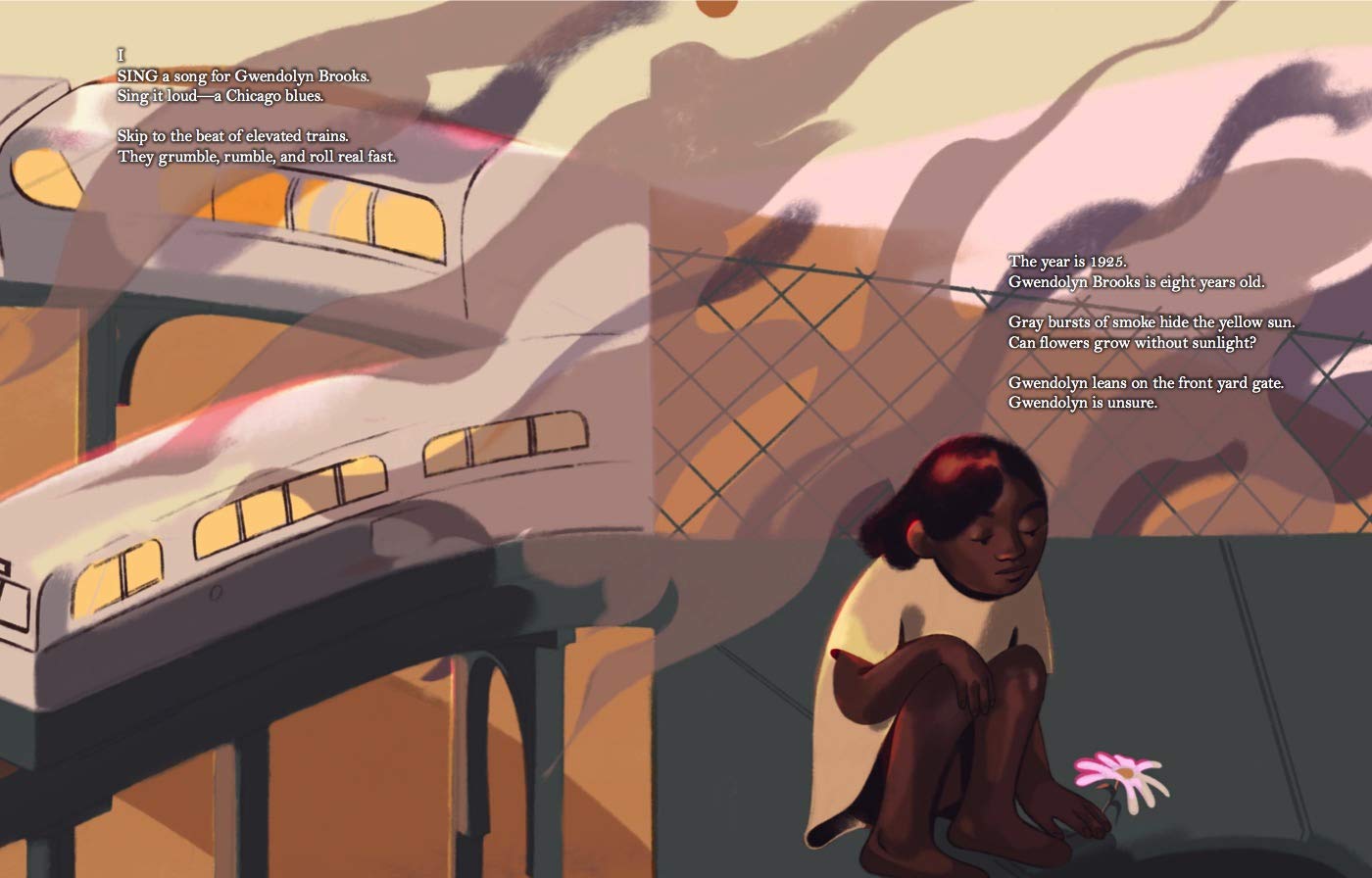
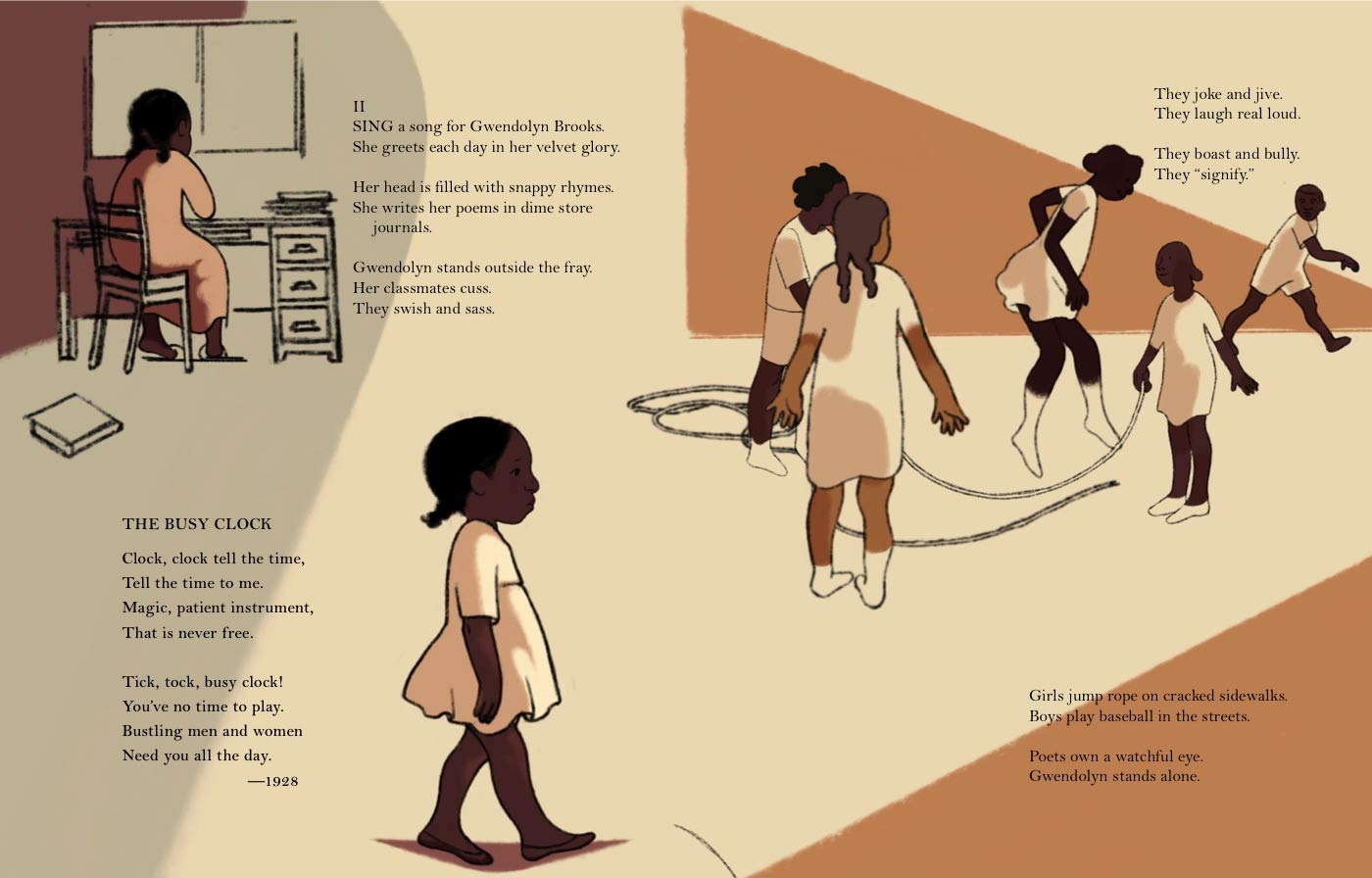
“SING a song for Gwendolyn Brooks. / Sing it loud—a Chicago blues.” This remarkable biography of the Pulitzer Prize-winning poet opens with these soaring lines which introduce eight-year-old Gwendolyn who, seeing a flower in the midst of the city, wonders how it will grow. Already she was observing the world with insight and originality. “Her head is filled with snappy rhymes. / She writes her poems in dime store journals.” Even something as “simple” as a clock does not escape Gwendolyn’s consideration. In The Busy Clock she writes, in part: “Clock, clock tell the time, / Tell the time to me. / Magic, patient instrument, / That is never free.”
Image copyright Xia Gordon, 2019, text copyright Alice Faye Duncan, 2019. Courtesy of Sterling Children’s Books.
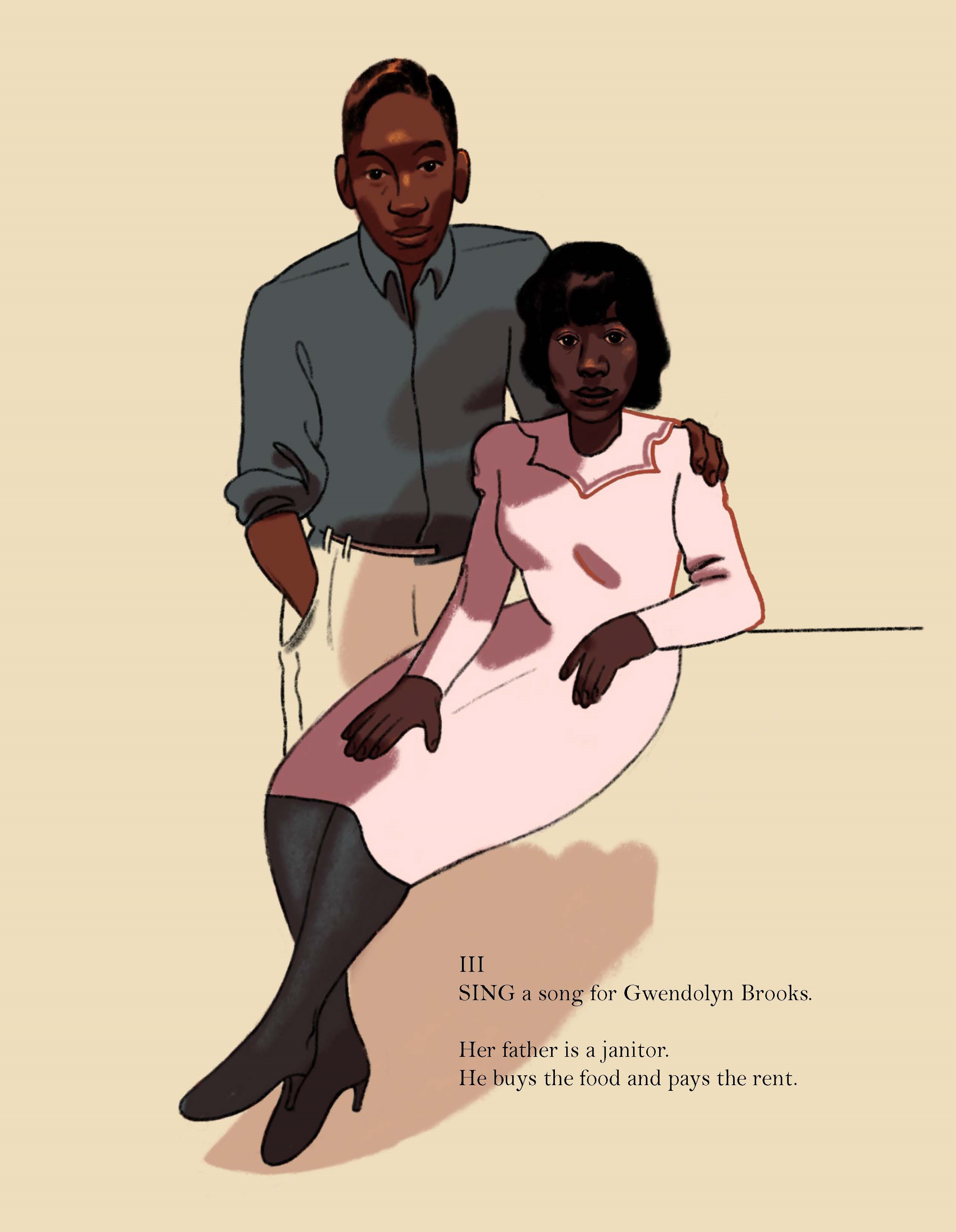
Out in the neighborhood, she stands quietly and watches the other kids laughing and playing—girls jumping rope and boys playing basketball. Gwendolyn’s father is a janitor and her mother stays at home with her and her brother, who is also her best friend. Gwen spends her time sitting on her porch, looking and listening to the sounds and the conversations of the neighborhood women and men. The “children call Gwen—‘ol’ stuck-up heifer!’”
Image copyright Xia Gordon, 2019, text copyright Alice Faye Duncan, 2019. Courtesy of Sterling Children’s Books.
“SING a song for Gwendolyn Brooks. / Her mother believes. / Her father believes. / But sometimes—Gwendolyn doubts her radiance, / When jarring, crashing, discordant words, / Splotch and splatter her notebook paper.” And what does Gwen do with these poems that just don’t work? She buries them under the snowball bush in the backyard. Once, unbelieving, a teacher accuses Gwendolyn of plagiarism. Her mother takes her daughter back to school, and there on the spot, she composes a poetic answer to the charges: Forgive and Forget. It makes Gwen feel proud, she believes in herself and feels the sun shining on her.
Image copyright Xia Gordon, 2019, text copyright Alice Faye Duncan, 2019. Courtesy of Sterling Children’s Books.
During the Great Depression, when jobs and money are scarce, Gwendolyn’s “parents are wise and see her light.” They give her time to write and she hones her words and her craft through draft after draft. With each completed poem, Gwen’s confidence grows. The Chicago Defender publishes some of Gwendolyn’s poems, and now she has an audience. Her parents believe that one day their daughter will be a famous poet.
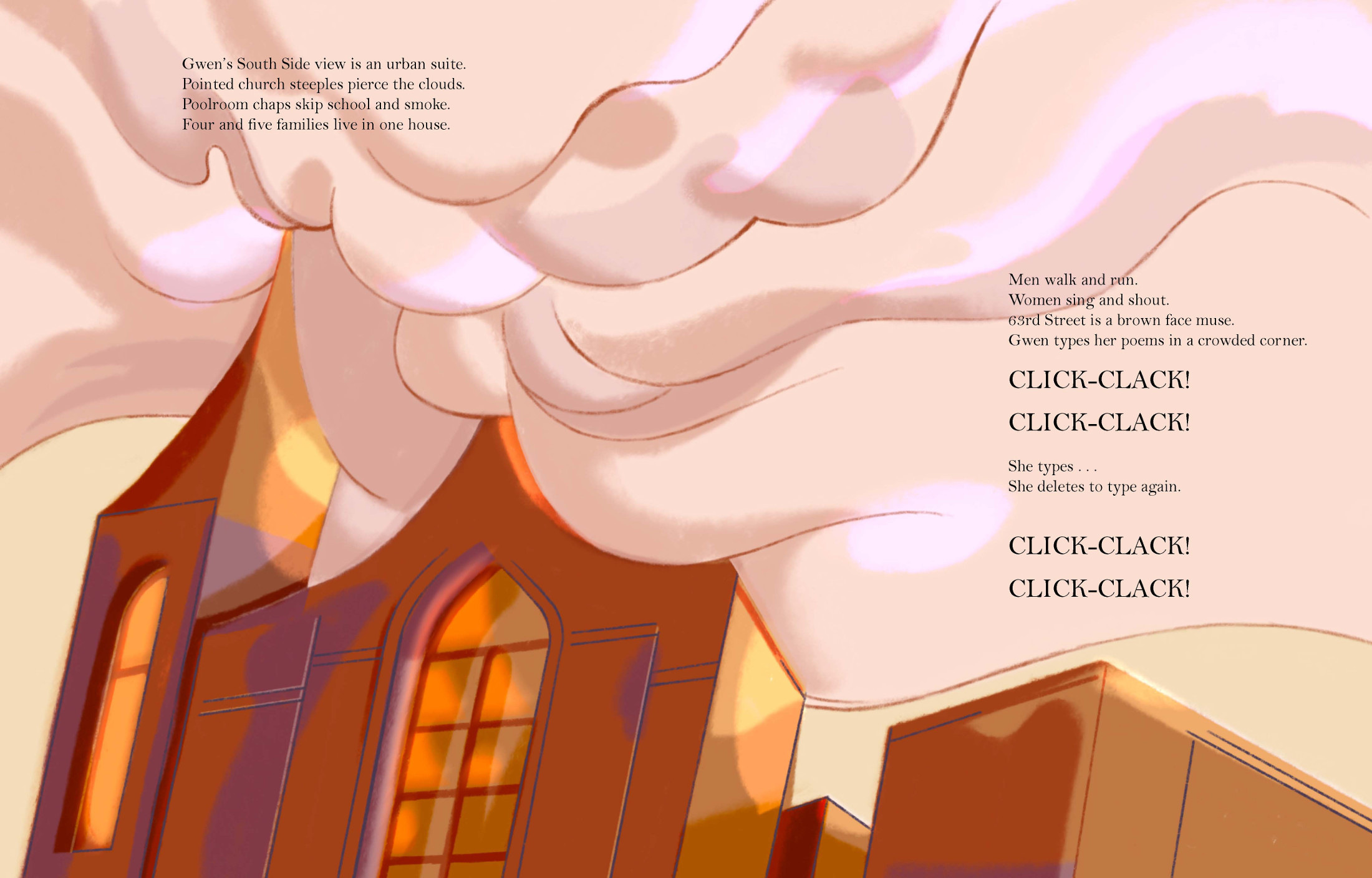
Soon, Gwendolyn finds her way to a group of poets who meet in a South Side community center. She studies under Inez Stark and meets Henry Blakely, who will become her husband. She enters her poems in contests and wins first place over and over. When she and Henry move into their own two-room apartment, Henry goes to work, leaving Gwendolyn to translate the neighborhood into poetry that she types “in a crowded corner.”
Image copyright Xia Gordon, 2019, text copyright Alice Faye Duncan, 2019. Courtesy of Sterling Children’s Books.
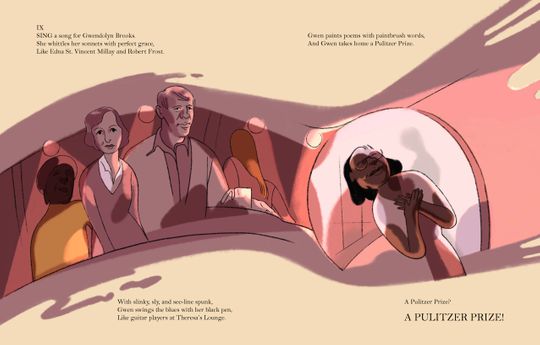
Readers swarm to buy her books. “Gwen paints poems with paintbrush words, / And Gwen takes home a Pulitzer Prize.” Henry and their son celebrate, and Gwen’s parents “…cry tears of joy. / They praise her shine.” For they had always known and had “…Planted love and watered it. / Gwendolyn believed. / She found her light. / And— / A furious flower / GREW!”
An extensive Author’s Note detailing more about the life of Gwendolyn Brooks and her work as well as a timeline and suggested readings follow the text.
Image copyright Xia Gordon, 2019, text copyright Alice Faye Duncan, 2019. Courtesy of Sterling Children’s Books.
With her own sterling verses, Alice Faye Duncan celebrates the life of Gwendolyn Brooks—the first African American to win the Pulitzer Prize for Literature—taking readers to the Chicago neighborhoods that informed and inspired Brooks’ ideas and the words and rhythms with which she defined them. Along an arc that takes Gwendolyn from a child contemplating the potential of a flower to becoming that blossom herself, Duncan pays tribute to those who recognized Gwen’s genius and helped her fulfill her talent. For readers who themselves may be poets, writers, or other types of artists, Duncan’s beautifully crafted phrases about the artistic process of revision are inspirational and welcome. Standing side-by-side with Duncan’s storytelling are four of Brooks’ poems—The Busy Clock, Forgive and Forget, Ambition, and the children of the poor—Sonnet #2. From cover to cover, Duncan’s book sings with Gwendolyn Brooks’ positivity, confidence, uniqueness, and love for life that made her a unique voice for her time and always.
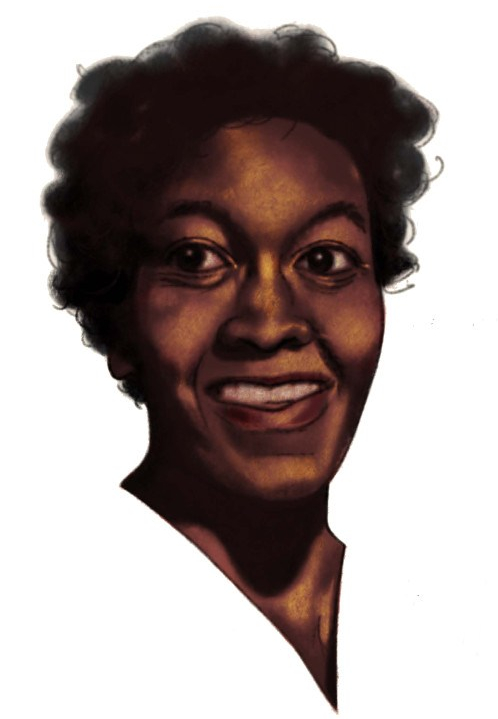
From the portrait of Gwendolyn Brooks that graces the title page and throughout the book, Xia Gordon’s distinctive artwork creates a masterpiece of motion and stillness that mirrors Brooks’ penchant for watching and listening to the sounds and sights that filled her mind and ultimately her notebooks. Downy swoops of violets, pinks, browns, and grays provide backdrops to images of Gwendolyn as a young girl and an adult rendered in lines that show her as down to earth but soaring in her thoughts. Her intelligence and spark shine through on every page. Gwendolyn’s parents appear often, always watchful and supportive. Her friends, her husband, her son, and her readers also populate the pages, giving the book an embracing warmth.
A Song for Gwendolyn Brooks is a must for school, classroom, and public library collections, and for children who are discovering their talents and the parents who nurture them, the book would be an inspirational and invaluable addition to home bookshelves.
Ages 4 and up
Sterling Children’s Books, 2019 | ISBN 978-1454930884



















 celebratepicturebooks.com