For generations the cliff swallows of San Juan Capistrano, California have been famous for their annual autumn migration that takes place near the Day of San Juan, celebrated on October 23. This swirling, soaring cloud of birds inspires those lucky enough to witness it with its power and beauty. The swallows are headed for their winter home 6,000 miles south in Goya, Corrientes, Argentina. Their return around St. Joseph’s Day on March 19th is typically celebrated with a parade and festivities.
Jacob’s Fantastic Flight
By Philip Waechter
You may find this hard to believe, but Jacob could fly. The first time Jacob flew, he soared right out of this stroller. Jacob skipped the whole crawling stage and the first step thing. “He just few off instead.” Although at first his parents were concerned, “they soon got used to him flying and figured, ‘So be it—he’s our son, and he’s perfect just the way he is!’” One winter his parents decided to take a vacation to the Mediterranean. His mom and dad booked airplane tickets, but Jacob was going to fly there himself.
Copyright Philip Waechter, 2020, courtesy of Blue Dot Press.
Jacob filled his backpack, waved goodbye to his parents and took off. Along the way, Jacob counted animals down below. He even shared his sandwiches with a group of squirrels. It was then that he saw “eighty-three birds on their way to Africa.” Jacob decided to go with them. Their route took them over mountains and valleys, past lakes and fields of wheat and wildflowers.
Jacob loved dipping, swooping, and soaring through urban obstacle courses, taking breaks in the birds’ favorite rest stops, and having “lots of pleasant conversations.” It was a wonderful trip. But then one of their flock was captured in Mr. Mortar’s net. Mr. Mortar was a birdcatcher, and his home was filled with the birds he’d caught just so he could hear their chirping.
Copyright Philip Waechter, 2020, courtesy of Blue Dot Press.
When Jacob and the birds stopped for lunch, they immediately noticed that Hubert was missing. It didn’t take long for them to find out where he was. Jacob knew just what to do. With some feathers from his friends and a beak made from paper in his backpack, Jacob fashioned a costume and then flew in front of Mr. Mortar’s window where he was sure to see him.
Jacob was just the “rare specimen” Mr. Mortar had been looking for. He rushed out with his net, leaving the front door wide open. The flock swarmed in and removed not just Hubert but all of the caged birds. They met up in the woods at a cool pond. Birds from all over soon heard of how “the birdcatcher had finally be bamboozled” and flew in to celebrate. It was time for Jacob to meet up with his parents, so he waved goodbye.
Copyright Philip Waechter, 2020, courtesy of Blue Dot Press.
Except for little Hubert who wanted to take a vacation too. Jacob found his parents on a golden beach. They hugged and kissed and then spent the time “the way a vacation is supposed to be.” When it was time to leave, Jacob went home with his parents on the plane—and Hubert got the window seat.
Quirky in the very best way, Jacob’s Fantastic Flight soars with themes of individuality and independence, friendship and family. Philip Waechter’s buoyant storytelling shines with acceptance born from love and understanding by both Jacob’s parents and the birds, and Jacob’s parents’ trust in their son’s abilities and judgement is a highlight. As a natural flyer, Jacob is part of two worlds, and children will recognize his joy in joining and learning from the flock of birds, just as they experience when discovering their own world.
Copyright Philip Waechter, 2020, courtesy of Blue Dot Press.
Perfectly paced, Waechter’s story benefits from the bird’s and Jacob’s quickly devised plan to rescue Hubert. Today’s kids are incredibly smart, and they’ll happily see themselves in this turn of events too. Jacob’s reunion with his parents is sweet and uplifting; every vacation should be like theirs. As Jacob accompanies his parents on the plane, kids will feel that reassurance that no matter where they roam, they will always find open hearts and arms at home.
Waechter’s delicate line drawings enhance the sense of freedom and lightheartedness inherent in his story. Jacob is first introduced as a regular kid, surrounded by toys, snacks, and posters that any child might have. It is only on the second page that readers notice his singular talent. Images of Jacob flying from his stroller in front of his astonished parents and then helping out by picking apples from the top of a tree show how quickly his parents accepted his ability.
Copyright Philip Waechter, 2020, courtesy of Blue Dot Press.
Spreads of Jacob flying with the flock over a field and a city are lovely, and what child wouldn’t love to sit on a park statue with the happy birds? Mr. Mortar (an inspired name), hiding in the bushes with his net while dressed in green and sporting a leafy hat, reminds kids that there are always obstacles to watch out for. The two-page spread of the celebratory bird party will awe readers, and with the verve of all kids on vacation or in the car, readers will love counting the birds and squirrels Jacob meets on his way.
Supportive and uplifting, Jacob’s Fantastic Flight will inspire children to take wing and is a must-have for home, school, and public libraries.
You can also find a detailed Teacher’s Guide on the Blue Dot Press website that will get students at school and at home excited to learn about close reading and interact with the story to discuss themes, cause-and-effect relationships, character, illustration, and do some writing of their own.
Swallows Depart from San Juan Capistrano Day Activity
Jacob’s Fantastic Flight Coloring Page
Celebrate birds with this beautiful printable coloring page perfect for kids and adults!
Squirrels elicit emotions on both sides of the spectrum. On one hand you can’t help but say “Awww!” when you see their tiny little paws and crafty antics. On the other hand their voracious appetites at bird feeders and penchant for darting into traffic is more likely to make you say “Arrgghhh!” This month is set aside, however, for enjoying the squirrels in your yard, park, or city. And really, don’t they make life just a little more fun?
Girl Versus Squirrel
Written by Hayley Barrett | Illustrated by Renée Andriani
Pearl built three birdhouses and put them in and near the tree in her backyard. One was shaped like a house, one was a tube, and the other was a tea cup atop a tall stand. After filling the house with suet, the tube with seeds, and the teacup with peanuts, Pearl settled in with her binoculars to wait. Soon cardinals, flickers, finches, and chickadees swooped in. But none of them wet for the peanuts.
Image copyright Renée Andriani, 2020, text copyright Hayley Barrett, 2020. Courtesy of Margaret Ferguson Books, Holiday House.
Happily sitting next to the teacup was a squirrel with a peanut in its paws. Pearl scared the squirrel away and then went to work to win this contest of wits. She used her hockey stick to raise the teacup’s stand higher and “watched, breathless with anticipated success, but was soon disappointed” as the squirrel easily climbed to the top. Pearl added a mop to make the pole even higher.
But still the squirrel had no trouble getting to the top. “The squirrel stared at Pearl and seized an especially plump peanut.” Just then the “pole began to teeter and totter until…It toppled to the ground,” breaking the handle off the teacup. As the squirrel dashed up a nearby oak tree, Pearl shouted, “‘You’re a bird-feeder-crashing, teacup-smashing, peanut-poaching pest!’” A pest Pearl was not about to lose out to.
Image copyright Renée Andriani, 2020, text copyright Hayley Barrett, 2020. Courtesy of Margaret Ferguson Books, Holiday House.
While Pearl fixed her teacup, she devised a plan. She gathered supplies and started creating. Soon, a “network of obstacles emerged, each more squirrel-challenging than the last.” The squirrel may have been fast and determined, but the course ensured that “teacup triumph will require nerves of squirrely steel,” Pearl fixed her binoculars on the squirrel and waited.
It didn’t take long before the squirrel was headed in the right direction. He scampered over the rope, spun around the big spool, leaped to the swing, and scrambled through the rest of the course. Until… “CRUNCH!” Pearl was astounded. Then she saw the squirrel head for a nest in the oak tree with three baby kits in it. That’s when Pearl realized the squirrel was a mother. “‘I proclaim your victory,’ cheered Pearl, ‘ and I salute you, fearless, fluffy sister!’” Immediately, Pearl wanted to help this family grow and learn. Now her backyard is a birds’… and squirrels’… and contraption-lovers’ paradise.
“Some Squirrely Facts” about our favorite nature nemesis follows the story.
Image copyright Renée Andriani, 2020, text copyright Hayley Barrett, 2020. Courtesy of Margaret Ferguson Books, Holiday House.
For anyone who has done battle with a squirrel at their birdfeeder, Hayley Barrett’s story is a delight. Her nimble alliterative phrasing and fun-to-read action verbs will make any story time a joy. Add in Pearl’s can-do attitude and the squirrel’s unstoppable energy and you have the makings of an epic battle—one that readers are sure to want to replicate in their own yards. Barrett nails the experimental nature of children’s building projects, a detail that kids will appreciate and that will endear Pearl to them. Barrett’s nod to girl power provides a strong, uplifting ending. Factual information about birds, bird food and squirrel behavior is interwoven organically throughout the story. That and the fascinating back matter make this a terrific book to pair with classroom lessons.
Renée Andriani’s vibrant, action-packed illustrations will wow kids and have them on the edge of their seats for each page turn. Realistic depictions of the cardinals, finches, chickadees, and flickers that swarm Pearl’s bird feeders will entice readers to learn more about these birds. When Pearl raises her teacup feeder higher and higher, Andriani presents clear images of how Pearl tapes the stand, stick, and mop together as well as the crashing result when the squirrel hops on. As Pearl gathers items from her garage and begins building her obstacle course, readers will be in suspense, waiting to see the final result.
Presented in a wild, two-page spread, Andriani’s portrayal of Pearl’s obstacle course rewards readers with bold, expressive typography and images of the squirrel making her way from station to station with style. The final two-page spread of Pearl’s backyard, is a riot of color as feeders, birds, and mama and baby squirrels nosh to their hearts’ content. Kids will want to linger to catch every detail.
Imaginative, humorous, and educational, Girl Versus Squirrel will become a favorite and will inspire kids to create their own obstacle course. The book would also be a high-interest accompaniment to STEM lessons in the classroom and at home. It would make a terrific addition to home, school, and public library collections.
Ages 4 – 8
Margaret Ferguson Books, Holiday House, 2020 | ISBN 978-0823442515
Discover more about Hayley Barrett and her books on her website.
To learn more about Renée Andriani, her books, and her art, visit her website.
Squirrel Awareness Month Activity
Squirrely Activity Pages
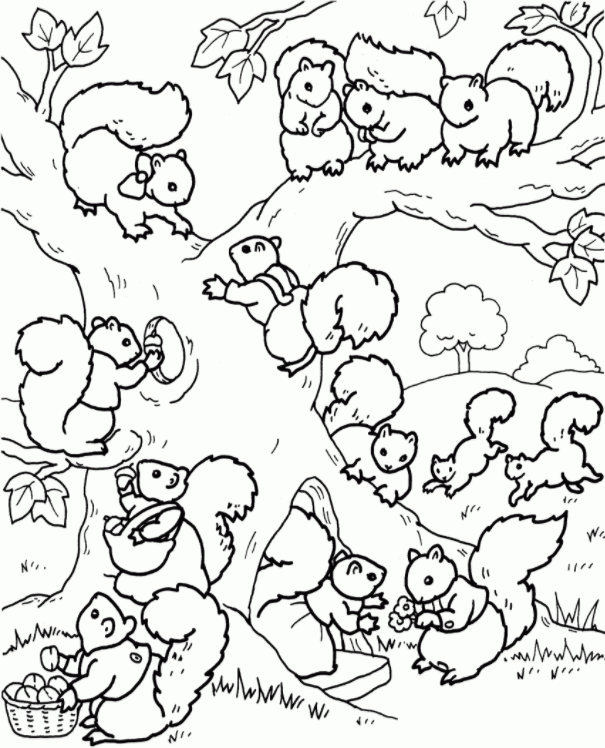
You can join a girl who’s watching squirrels, find a whole squirrel community to color, see a squirrel enjoying a snack, and follow the numbers to discover… with these printable Squirrely Activity Pages
Today I’m celebrating the book birthday of a tender board book that when shared between an adult and a child can help build strong loving bonds that can lead little ones to become happy and self-confident children. These are qualities that are also honored today during National Youth Confidence Day, which encourages us to connect with and inspire today’s youth to succeed tomorrow. National Youth Confidence Day celebrates the energy, spirit, and potential of young people. The day is an acknowledgment of all they will accomplish, and kids can accomplish anything when they know they’re loved.
Thanks go to Chronicle Books for sending me a copy of Love Can Come in Many Ways for review consideration. All opinions about the book are my own. I’m excited to be teaming with Chronicle in a giveaway of the book. See details below.
Love Can Come in Many Ways
Written by Terry Pierce | Illustrated by Suzy Ultman
How do you share your love for your little one; young grandchild, niece, nephew, or cousin; student; or other child of your heart? With a kiss, a hug, a smile? Or maybe you have a secret signal that only the two of you know. In this adorable board book, animal families of all kinds reveal that “nose to nose or gaze to gaze. / Love can come in many ways.”
Image copyright Suzy Ultman, 2020, text copyright Terry Pierce, 2020. Courtesy of Chronicle.
Elephants snuggle their kids behind an ear or hug them with their trunk. Swans hold them close with their wings, and froggies feel love “through lively songs that Mama sings.” Whether their held tight in paws or jaws, panda cubs know their loved. Some babies ride on Mama’s back or within her furry coat. While penguin chicks are warmed with love “atop a papa’s sturdy feet.”
Each animal—and person—has a special way to say that “you are loved.” But no matter if it’s a “helpful hand” or “a gentle squeeze. / Love is kindness, comfort, peace.”
Image copyright Suzy Ultman, 2020, text copyright Terry Pierce, 2020. Courtesy of Chronicle.
Terry Pierce’s lilting verses, as gentle as a lullaby, will warm a little one’s heart as they cuddle up with an adult to hear—and see—how various animals embrace their own babies. Pierce wraps readers in cozy, comforting words and a soothing rhythm that are perfect for naptime, bedtime, or when a little extra snuggle is needed. Little ones will be surprised, delighted, and full of giggles as they learn about the ingenuity of nature.
With stylish flair and softly rounded shapes, Suzy Ultman creates original and eye-catching pages that will charm little readers and adults. Whimsical touches, such as jaunty hats, round eyeglasses, and potted plants, go hand-in-paw with Ultman’s lovely color palette to make pages that are as adorable as they are enchanting. And no little fingers will be able to resist lifting the vibrant felt flaps to take a peek at the sweet baby animals snuggling with their mom or dad.
Endearing to the max, Love Can Come in Many Ways is a board book will be a treasured gift for baby showers and new babies, and is a must for home, school, and public libraries.
Ages Birth – 3
Chronicle Books, 2020 | ISBN 978-1452172606
Discover more about Terry Pierce and her books on her website.
To learn more about Suzy Ultman, her books, and her art, visit her website.
Love Comes in Many Ways Giveaway
I’m thrilled to be teaming up with Chronicle Books in a giveaway for two lucky winners. Each winner will win
One (1) copy of Love Can Come in Many Ways, written by Terry Pierce | illustrated by Suzy Ultman
Bonus: Reply with your child’s favorite animal for extra entry. Each reply earns you one extra entry
This giveaway is open from October 20 to October 26 and ends at 8:00 p.m. EST.
A winner will be chosen on October 27.
Giveaway open to U.S. addresses only. | Prizing provided by Chronicle Books
Love Can Come in Many Ways Book Birthday Activity
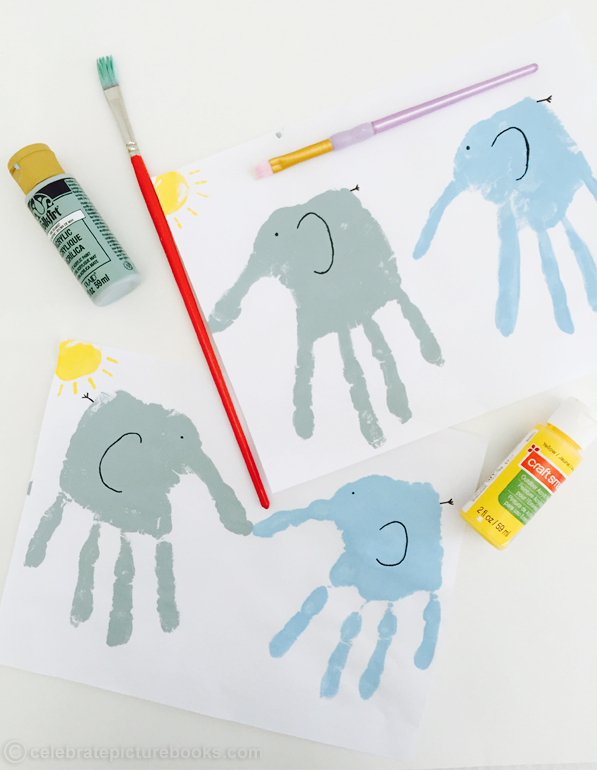
Elephant Handprint Painting
This easy craft is fun for adults and kids to do together and can make a nice decoration for a child’s room and reminder of a parent’s, grandparent’s, or caregiver’s love.
Supplies
Craft paint in two colors of the children’s choice
Yellow craft paint
Black fin-tip marker
Crayons, markers, or colored pencils to make a background
Paper
Paint brush
Directions
Paint one child’s hand and press it on the paper. The thumb is the truck and the fingers the legs.
Paint the second child’s hand and press it on the paper near the other “elephant.” A couple of examples are: the elephants standing trunk to trunk or trunk to tail
After the paint has dried, draw on ears and an eye
Add a sun with the yellow paint
Add grass, trees, or other background features
You can find Love Can Come in Many Ways at these booksellers
Fall is a time when the cooler weather and beautiful scenery entice people to get outside to enjoy farms, farmers markets, pumpkin picking and carving, scarecrow making, and lots of walks and biking. Inside, it’s time for pie and bread baking, cozy blankets, and snuggly story times. Today’s book is a perfect match for the season!
Fun Fall Day: A Touch and Feel Board Book
Written by Tara Knudson | Illustrated by Juliana Motzko
The bright blue skies and warm sun of fall is here, and the little animals are at the fair having fun in this sweet touch-and-feel board book. Bear cub takes a pony ride while Raccoon and Bird visit the petting zoo. Kids can pet the baby goat, too, while he nibbles the oats Bird offers. At the craft table, Fox, Chicken, and Elephant are coloring, making banners, and decorating pumpkins.
Then it’s time for “harvest treats, lots to buy—donuts, bread, apple pie.” The sprinkled doughnuts feel sugary sweet! There’s nothing more fun than jumping in a pile of leaves, and the fair even has a play area where Duckling, Tiger, Lamb, and Bunny “shuffle through, stomp the ground, crackle, crunch, hear the sound.” Scratch the leaf and feel how crisp it is. The afternoon is waning and the sky is streaked as orange and red as the autumn leaves. The air’s turned chilly, but there’s still time for a hayride through the pumpkin patch! Look at that big, deep orange pumpkin. Feel how smooth it is! Now, it’s time to go, but it’s been a wonderful day at the fair!
Image copyright Juliana Motzko, 2020, text copyright Tara Knudson, 2020. Courtesy of Zonderkidz.
Tara Knudson’s playful rhymes will charm little ones as they join in on the fall fair excitement. Along the way, kids meet many different animals and engage with shapes and colors. Knudson’s lyrical verses perfectly reflect the fun and cozy atmosphere of fall. Sensory patches invite eager fingers to pet the horse and goat, touch grainy sugar, enjoy the woody texture of a fallen leaf, and feel the smoothness of a pumpkin shell.
Juliana Motzko’s fall fair enchants with adorable animals and the bright colors of the autumn season. Delighted smiles abound as the young fair-goers visit the petting zoo, craft table, baked goods display, play area, and pumpkin patch. Motzko’s textured illustrations of golden hay, rich soil, whole grain bread and apple pie as well as crunchy leaves and a straw-filled scarecrow blend well with the touch-and-feel patches and enhance the opportunity for adults and kids to talk about sensory awareness.
Fun Fall Day, a nicely sized board book—not too small or too big for little hands—is a story that’s a joy to read aloud and one that kids will want to hear again and again. It would make a much-appreciated gift for babies and toddlers and a favorite on home, preschool, and public library bookshelves.
Ages Baby – 4
Zonderkidz, 2020 | ISBN 978-0310770213
Discover more about Tara Knudson and her books on her website.
To learn more about Juliana Motzko, her books, and her art, visit her website
Celebrating Fall Activity
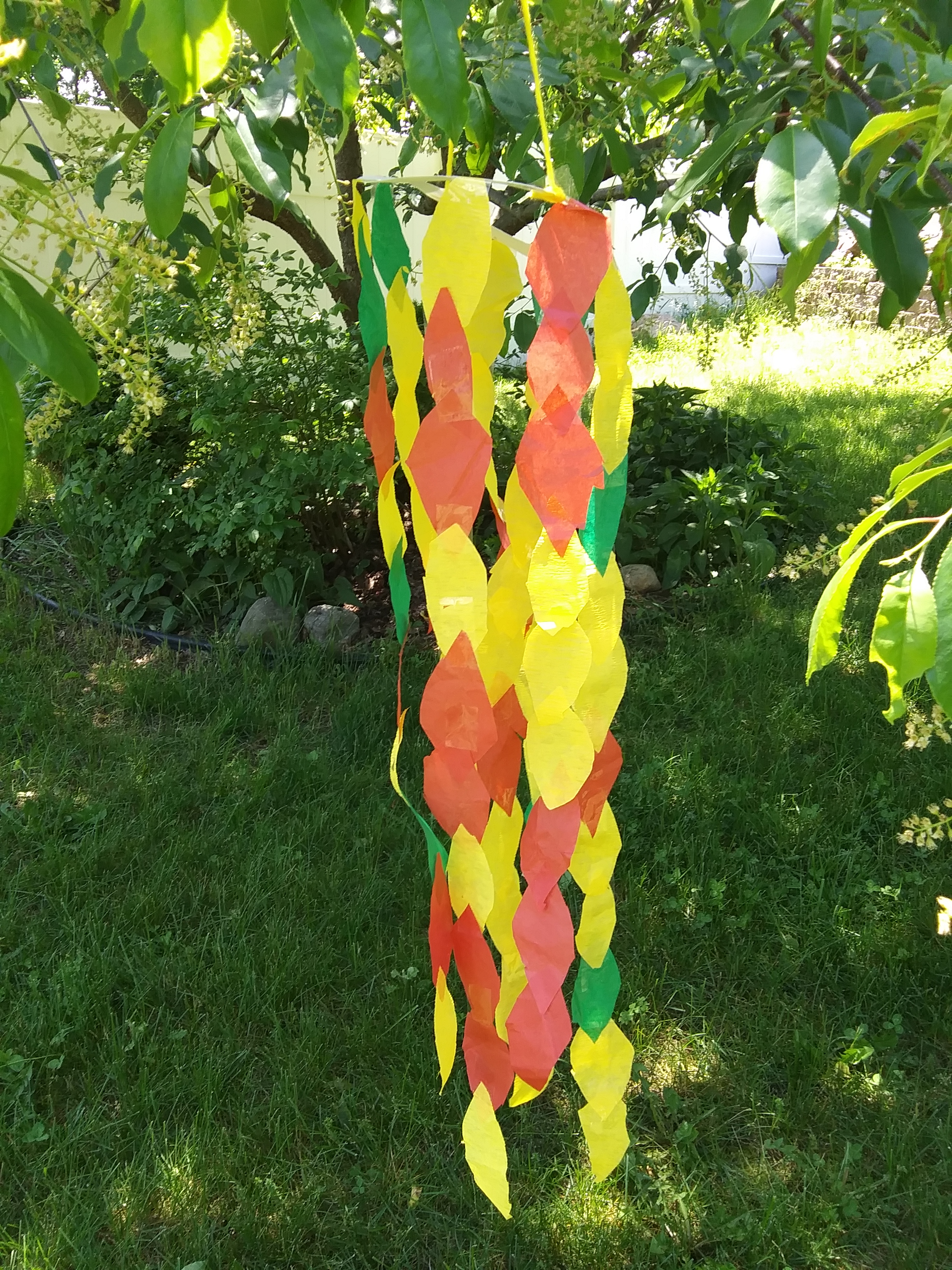
Autumn Leaf Mobile
You can bring the beauty of autumn leaves into your home with this fun-to-make mobile. Use tissue paper, construction paper, or even real leaves to make this mobile, that makes a great pattern and counting activity to do with young children too.
Supplies
Paper Plate
Scissors
Tissue Paper/Crepe Paper
Tape
String/ Yarn
Directions
Cut out the center circle of the paper plate and use the outside ring as the top of your mobile
Have children pick out colors. We did a fall theme, but you can really let the kids be creative here.
Cut out tissue paper or crepe paper into leaf shapes. Adults will have to cut out the bulk of leaves. My six year old was able to cut the leaf shapes out, but was tired after 5. I used about 60-70 leaves.
Have children organize leaves into patterns.
Tape leaves together so they overlap.
Tape chain to paper plate ring
Tie String or yarn to the top of the mobile
You can find Fun Fall Day: A Touch and Feel Board Book at these booksellers
Black Poetry Day was established in 1985 and commemorates the birth of Jupiter Hammon, the first published African American poet in the United States. Hammon was born into slavery on Long Island, New York, on October 17th, 1711. His poem “An Evening Thought” was first published on Christmas Day when he was 49 years old. Hammon is considered one of the founders of African-American literature. Today’s holiday honors all black poets, past and present. To celebrate today, enjoy poetry from some of our greatest poets, including Maya Angelou, Rita Dove, Langston Hughes, Nikki Giovani, Derek Walcott, and, of course, Gwendolyn Brooks – the subject of today’s book.
I received a copy of A Song for Gwendolyn Brooks from Sterling Children’s Books for review consideration. All opinions are my own.
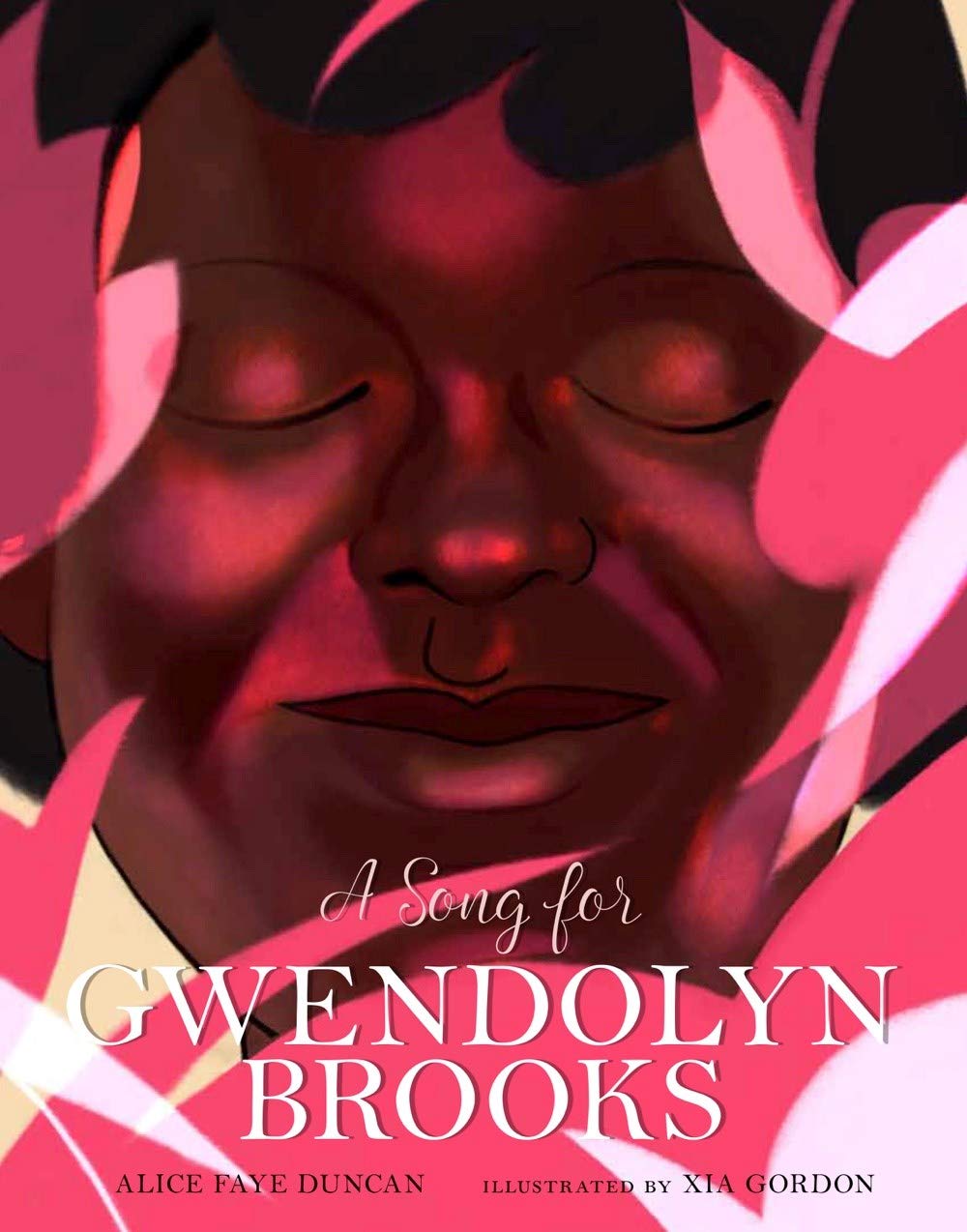
A Song for Gwendolyn Brooks
Written by Alice Faye Duncan | Illustrated by Xia Gordon
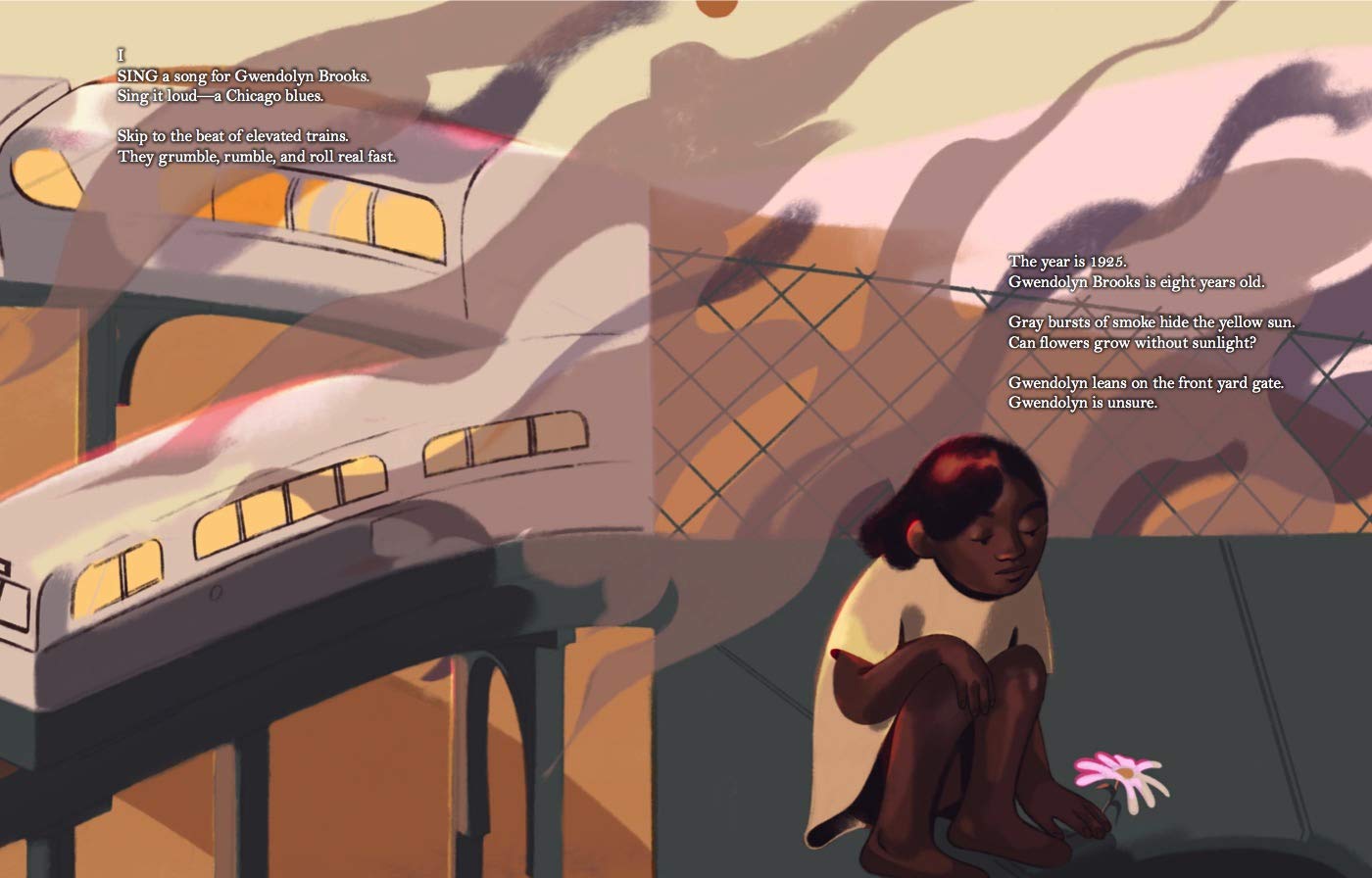
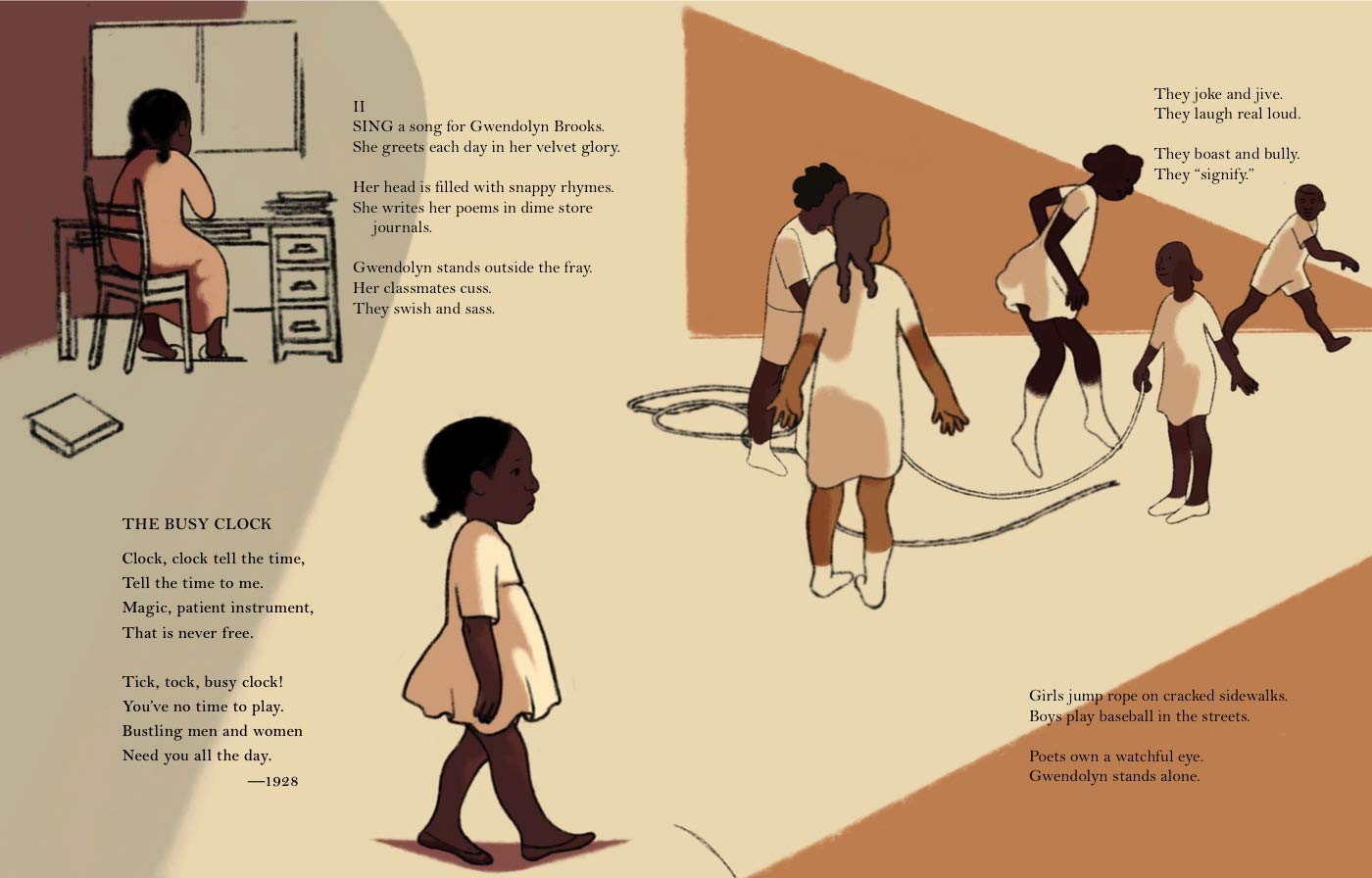
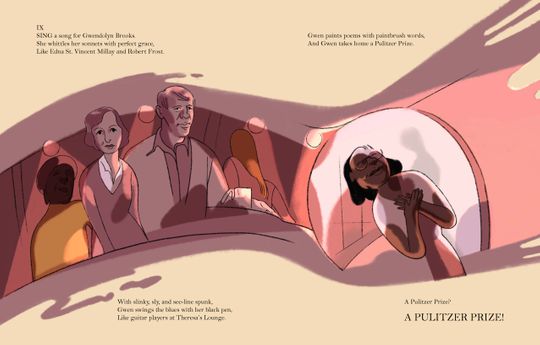
“SING a song for Gwendolyn Brooks. / Sing it loud—a Chicago blues.” This remarkable biography of the Pulitzer Prize-winning poet opens with these soaring lines which introduce eight-year-old Gwendolyn who, seeing a flower in the midst of the city, wonders how it will grow. Already she was observing the world with insight and originality. “Her head is filled with snappy rhymes. / She writes her poems in dime store journals.” Even something as “simple” as a clock does not escape Gwendolyn’s consideration. In The Busy Clock she writes, in part: “Clock, clock tell the time, / Tell the time to me. / Magic, patient instrument, / That is never free.”
Image copyright Xia Gordon, 2019, text copyright Alice Faye Duncan, 2019. Courtesy of Sterling Children’s Books.
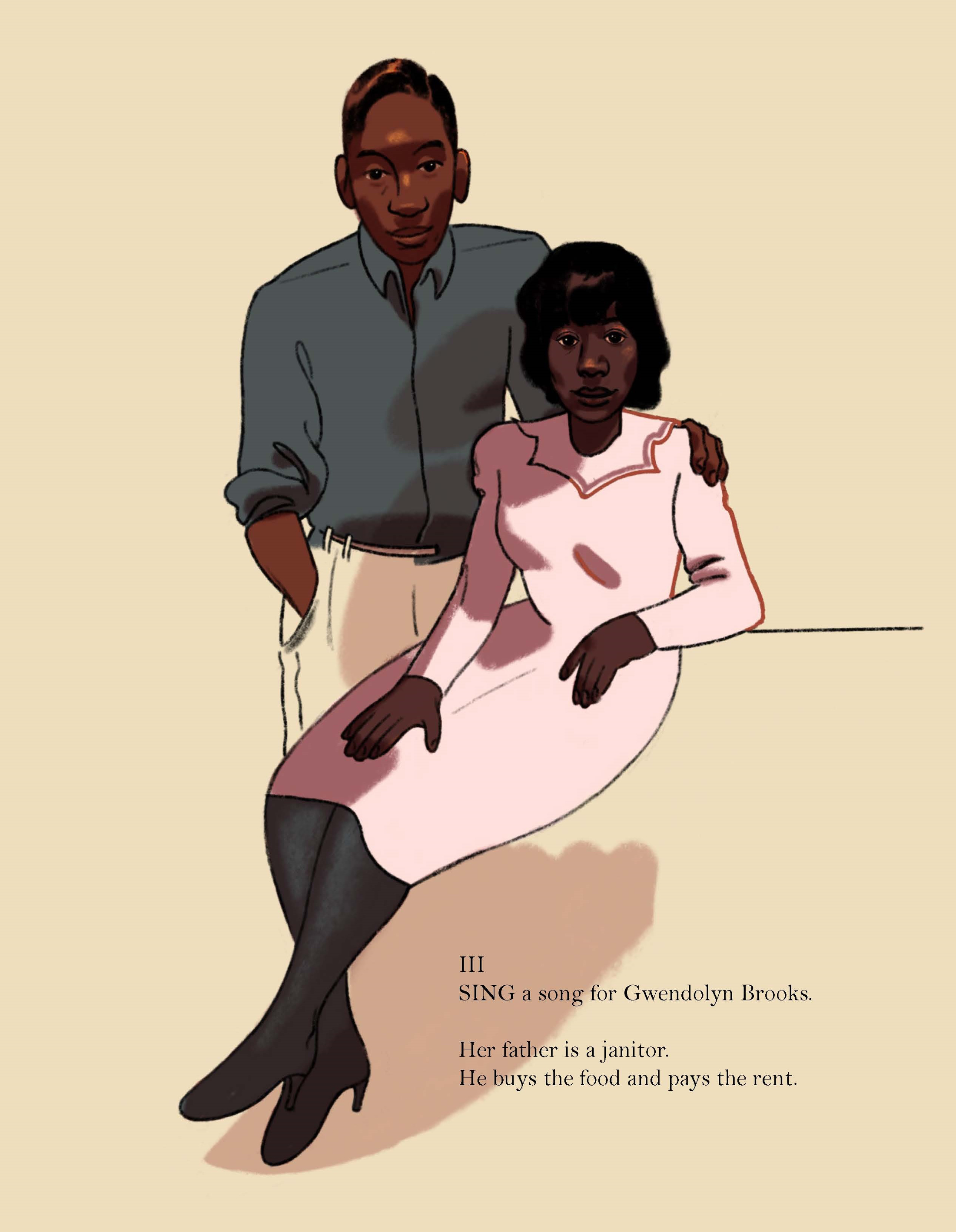
Out in the neighborhood, she stands quietly and watches the other kids laughing and playing—girls jumping rope and boys playing basketball. Gwendolyn’s father is a janitor and her mother stays at home with her and her brother, who is also her best friend. Gwen spends her time sitting on her porch, looking and listening to the sounds and the conversations of the neighborhood women and men. The “children call Gwen—‘ol’ stuck-up heifer!’”
Image copyright Xia Gordon, 2019, text copyright Alice Faye Duncan, 2019. Courtesy of Sterling Children’s Books.
“SING a song for Gwendolyn Brooks. / Her mother believes. / Her father believes. / But sometimes—Gwendolyn doubts her radiance, / When jarring, crashing, discordant words, / Splotch and splatter her notebook paper.” And what does Gwen do with these poems that just don’t work? She buries them under the snowball bush in the backyard. Once, unbelieving, a teacher accuses Gwendolyn of plagiarism. Her mother takes her daughter back to school, and there on the spot, she composes a poetic answer to the charges: Forgive and Forget. It makes Gwen feel proud, she believes in herself and feels the sun shining on her.
Image copyright Xia Gordon, 2019, text copyright Alice Faye Duncan, 2019. Courtesy of Sterling Children’s Books.
During the Great Depression, when jobs and money are scarce, Gwendolyn’s “parents are wise and see her light.” They give her time to write and she hones her words and her craft through draft after draft. With each completed poem, Gwen’s confidence grows. The Chicago Defender publishes some of Gwendolyn’s poems, and now she has an audience. Her parents believe that one day their daughter will be a famous poet.
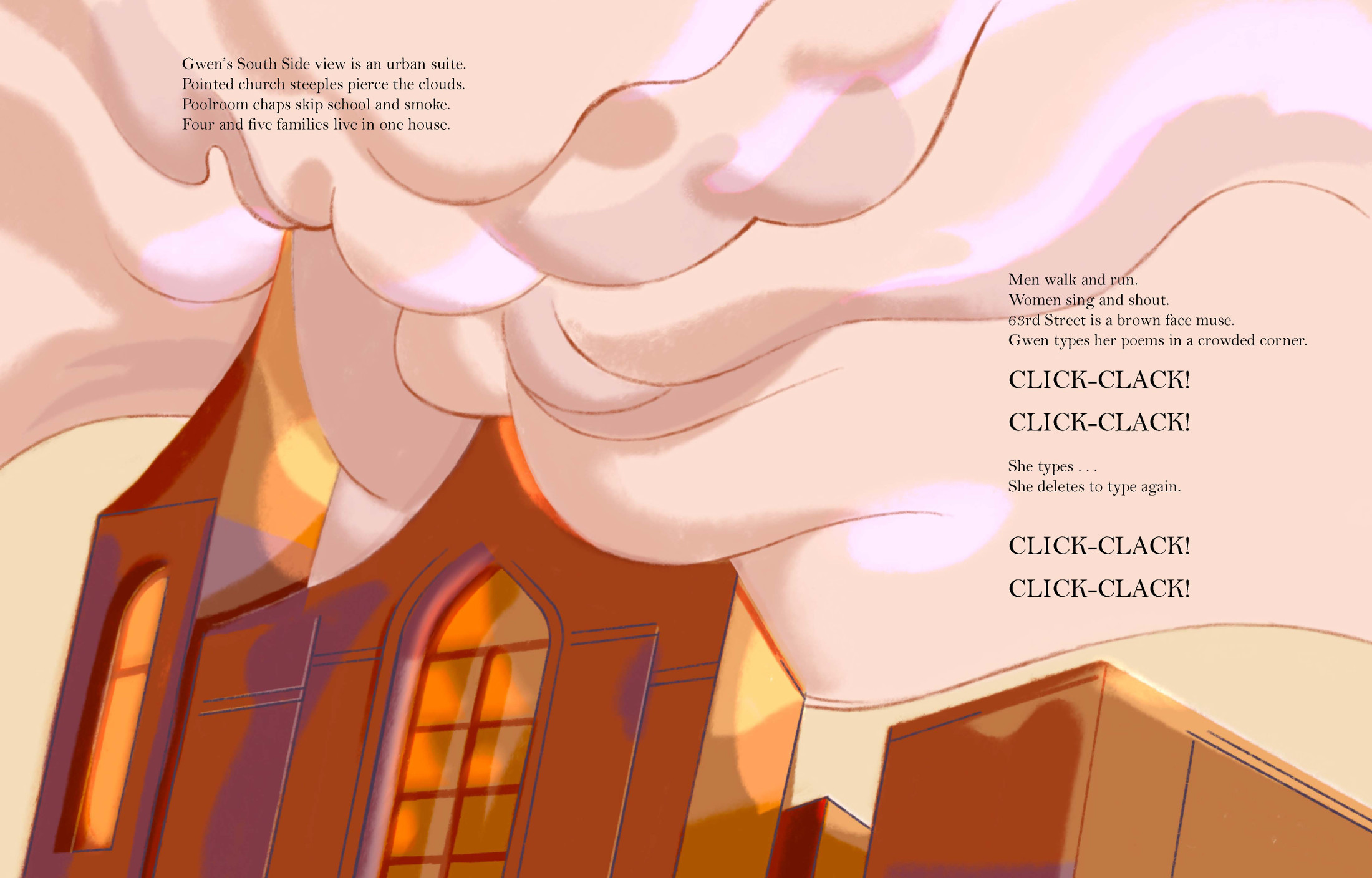
Soon, Gwendolyn finds her way to a group of poets who meet in a South Side community center. She studies under Inez Stark and meets Henry Blakely, who will become her husband. She enters her poems in contests and wins first place over and over. When she and Henry move into their own two-room apartment, Henry goes to work, leaving Gwendolyn to translate the neighborhood into poetry that she types “in a crowded corner.”
Image copyright Xia Gordon, 2019, text copyright Alice Faye Duncan, 2019. Courtesy of Sterling Children’s Books.
Readers swarm to buy her books. “Gwen paints poems with paintbrush words, / And Gwen takes home a Pulitzer Prize.” Henry and their son celebrate, and Gwen’s parents “…cry tears of joy. / They praise her shine.” For they had always known and had “…Planted love and watered it. / Gwendolyn believed. / She found her light. / And— / A furious flower / GREW!”
An extensive Author’s Note detailing more about the life of Gwendolyn Brooks and her work as well as a timeline and suggested readings follow the text.
Image copyright Xia Gordon, 2019, text copyright Alice Faye Duncan, 2019. Courtesy of Sterling Children’s Books.
With her own sterling verses, Alice Faye Duncan celebrates the life of Gwendolyn Brooks—the first African American to win the Pulitzer Prize for Literature—taking readers to the Chicago neighborhoods that informed and inspired Brooks’ ideas and the words and rhythms with which she defined them. Along an arc that takes Gwendolyn from a child contemplating the potential of a flower to becoming that blossom herself, Duncan pays tribute to those who recognized Gwen’s genius and helped her fulfill her talent. For readers who themselves may be poets, writers, or other types of artists, Duncan’s beautifully crafted phrases about the artistic process of revision are inspirational and welcome. Standing side-by-side with Duncan’s storytelling are four of Brooks’ poems—The Busy Clock, Forgive and Forget, Ambition, and the children of the poor—Sonnet #2. From cover to cover, Duncan’s book sings with Gwendolyn Brooks’ positivity, confidence, individuality, and love for life that made her a unique voice for her time and always.
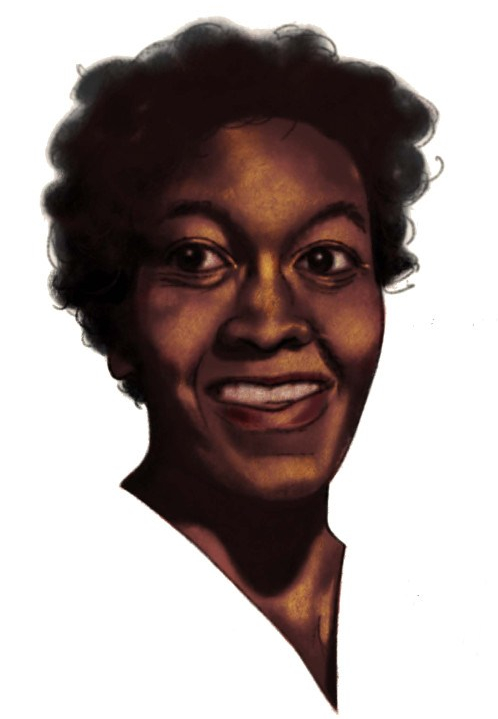
From the portrait of Gwendolyn Brooks that graces the title page and throughout the book, Xia Gordon’s distinctive artwork creates a masterpiece of motion and stillness that mirrors Brooks’ penchant for watching and listening to the sounds and sights that filled her mind and ultimately her notebooks. Downy swoops of violets, pinks, browns, and grays provide backdrops to images of Gwendolyn as a young girl and an adult rendered in lines that show her as down to earth but soaring in her thoughts. Her intelligence and spark shine through on every page. Gwendolyn’s parents appear often, always watchful and supportive. Her friends, her husband, her son, and her readers also populate the pages, giving the book an embracing warmth.
A Song for Gwendolyn Brooks is a must for school, classroom, and public library collections, and for children who are discovering their talents and the parents who nurture them, the book would be an inspirational and invaluable addition to home bookshelves.
Ages 4 and up
Sterling Children’s Books, 2019 | ISBN 978-1454930884
Today I’m celebrating three books for the Halloween holiday and beyond that are rollicking reads with excitement and heart. These books from favorite authors and illustrators offer distinctly different stories that bring the magic, wonder, and fun of Halloween and lovable ghouls to life. They include a new adventure for a favorite Little Monster, a spooky neighborhood that’s getting a surprising new neighbor, and a construction crew that builds haunted houses at night.
Thanks go to Blue Slip Media and Two Lions Publishing for sending me the books for review consideration. All opinions on the books are my own. I’m thrilled to be teaming with Blue Slip Media and Two Lions in a giveaway of all three books. See details below.
It’s Halloween, Little Monster
Written by Helen Ketteman | Illustrated by Bonnie Leick
It’s Little Monster’s first Halloween and time to for him to put on his costume to go trick-or-treating. He looks out the window with a bit of trepidation at all of the other creatures on his block—a bunny, a bee, a unicorn, a witch, a tiger, and a penguin. Papa puts the finishing touches on Little Monster’s Martian costume and they head outside. Little Monster grabs Papa’s hand and he reassures his little one: “All set to go! / You see things that are scary? / A pirate, a witch, a creature that’s hairy? // Don’t fret, Little Monster. / See there in the street? / That’s not really a ghost— / it’s a kid in a sheet!”
Little Monster and Papa make the rounds of neighbor’s houses as kids howl into the dark night. Papa tells Little Monster there’s nothing to fear, but is there just the tiniest bit of wariness in his own eyes? At one house a witch is “offering cups / of warm, bubbly worm juice!” Papa says, “Yum! Drink it up!” They pass a vampire and get in the middle of a group of “zombies in chains,” but Papa has a plan to fool them and make their escape.
Image copyright Bonnie Leick, 2020, text copyright Helen Ketteman, 2020. Courtesy of Two Lions.
On one porch four ghosts are floating around, but Little Monster doesn’t seem scared. Papa asks, “No shivers and shakes? / Oh, I see why you’re brave— / spider cupcakes!” Trick-or-treat is almost done, but there’s one final house—the scariest one of all. Papa points out: “The yard’s full of graves. / This could be tough. / Shall we trick-or-treat here? / Will you be brave enough?” But Papa’s gung-ho and he marches right through the graveyard where fanged creatures lurk. Then “Boooooooooo!!!” a skeleton jumps with a shout. Who screams? Who laughs? Read and find out!
Helen Ketteman’s third book in the Little Monster series shines with bouncy rhymes that are full of spooky prowling and highlight the excitement of Halloween while reassuring kids that all the frights are just for fun. Little readers will find all of their favorite monsters here enjoying treats and only a few tricks, which will bring giggles instead of shivers. Ketteman’s perfect rhythm creates a story that’s perfect for dramatic read alouds, and the sweet relationship between Little Monster and Papa will have kids asking to hear the story again and again.
Kids will love spending Halloween with Little Monster and Bonnie Leick’s enchanting, not-too-scary illustrations where—among the witches, vampires, and ghosts—bunnies, chickens, fairies, and other cute-as-a-button characters trick-or-treat under a full moon. Little Monster’s street and the neighbor’s houses are cleverly decorated for the holiday, and readers will want to linger over each page to see all the fun. The spooky graveyard, especially, invites a careful look, as the inscriptions on the stones show that those who lie beneath were more monstrously kind than monstrous.
A sure hit for fans of Little Monster and any child looking forward to their first Halloween or who already know what this holiday is all about, it’s Halloween, Little Monster would be a lively addition to home and public library collections.
Discover more about Helen Ketteman and her books on her website.
To learn more about Bonnie Leick, her books, and her art, visit her website.
Ages 3 – 7
Two Lions, 2020 | ISBN 978-1542092081
You can find It’s Halloween Little Monster at these booksellers
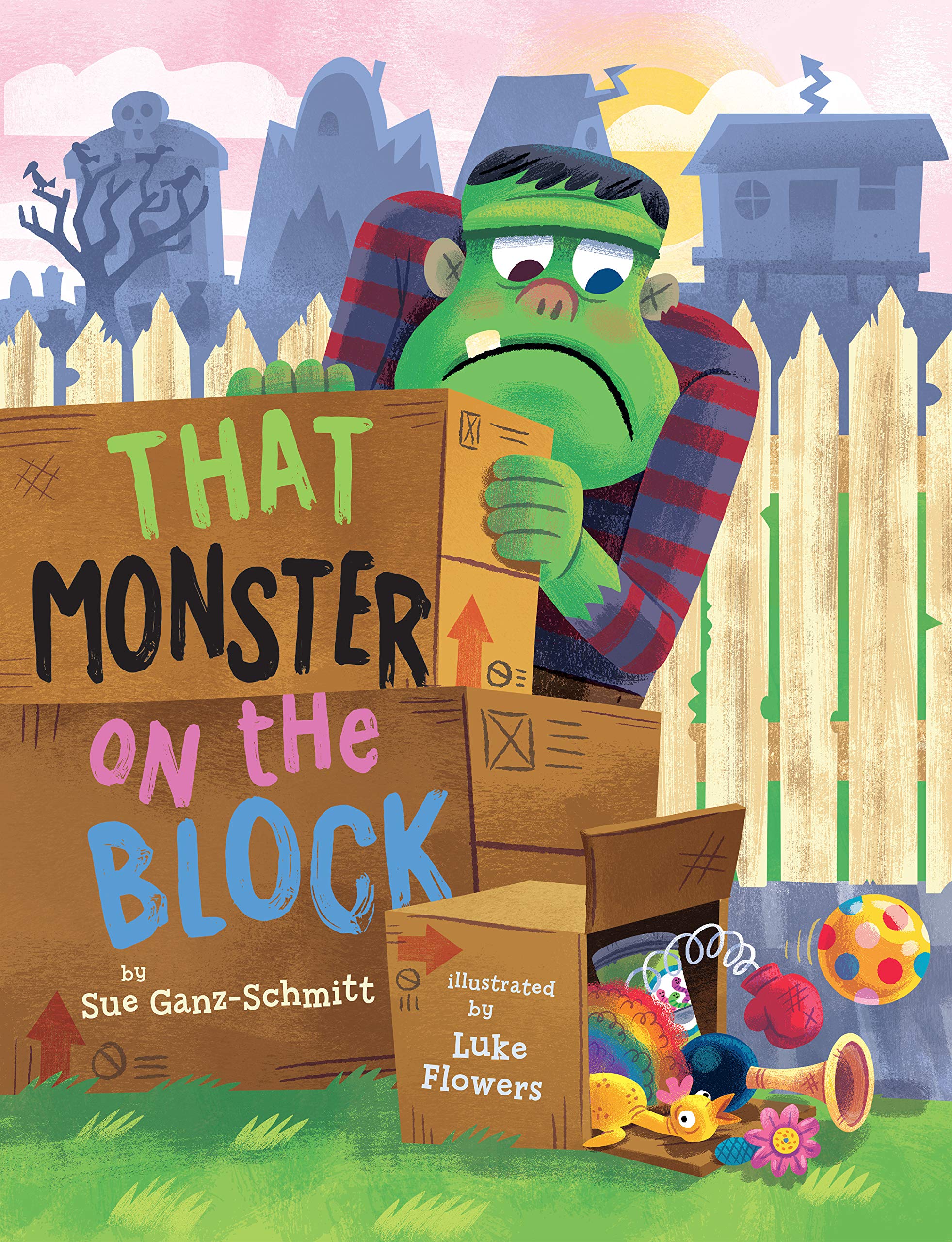
Written by Sue Ganz-Schmitt | Illustrated by Luke Flowers
Someone was finally moving into Vampire’s old house. Monster, who lived next door wondered who it might be. He hoped it might be an ogre who would invite him “to swim in his mucky, murky swamp.” Or maybe it would be a “greedy goblin with piles of gold to jump into.” Perhaps it would be a dastardly dragon who would throw greasy barbecues. As Monster practiced how he would say hello to his new neighbor, he watched the movers carrying a trampoline, a unicycle, and lots of trunks.
At last his new neighbor emerged. He was wearing “big floppy shoes” and had “wild orange hair” and “a round, red nose. It was…a clown?” Monster couldn’t believe it. He immediately called the neighbors. “‘Unnnnnhhh, unnnnnhhh, unnnnnhhh,’” said Zombie when he heard the news. Mummy shrieked, and Yeti roared. They all agreed that the neighborhood would never be the same again. None of the neighbors welcomed Clown to their block, so he went around to each house to introduce himself. But no one answered the door. Clown left notes and surprises at each house and went back home. When monster found his gift gummy worms, he threw them in the trash. Clown, meanwhile, sat on his porch “and waited. And waited and sat. No one came around.”
But Clown was naturally happy, so he perked up his dreary house, played a happy tune, and erected a tent. “Monster called a neighborhood meeting. ‘This is out of control!’” he shouted. But Zombie was busy delighting some neighbors with the brain cake Clown had left him, and Mummy was having fun scaring up laughs with the mummy in the box she’d gotten. Yeti was enjoying tricking others into smelling her trick flowers and then spritzing them with water.
Image copyright Luke Flowers, 2020, text copyright Sue Ganz-Schmitt, 2020. Courtesy of Two Lions.
No one was listening to Monster, so he decided to do something about the interloper himself. At midnight, he rattled chains and banged on a garbage can lid. But Clown didn’t hear it. He was out doing good deeds to help his new neighbors. In the morning Monster was awakened by circus music. He immediately picked up the phone, but no one answered his calls. “‘It’s time for me to have a word with that bozo!’” he said. He stomped over, but on the way he couldn’t help but find the music catchy, the smell of popcorn enticing, and Clown’s invitation to cartwheeling class at his circus school at least a little intriguing.
Inside the tent, he discovered all of his friends having doing circus tricks. When he learned that Clown was “zero percent creepy” and lots of fun, he decided to him a chance. He enjoyed the day so much that Monster even invited him to tea on Sunday. As Monster poured out the tea and passed around sludgeberry swirl scones, a moving van rolled up the block. Out popped a…well, you’ll have to welcome them yourself, just like all the other neighbors!
Sue Ganz-Schmitt turns somersaults with the usual tropes involving diversity in her story as it honestly portrays truisms about prejudice and how both injustice on one hand and understanding on the other spreads through a community. While Monster’s reaction to immediately alert the neighbors and hold a meeting seems to get a big response, readers will see that by the time the meeting takes place, most of the neighbors welcome the newcomer and the positive changes he’s brought. Ganz-Schmitt’s well-paced and superb storytelling is loaded with personality, puns, and the perfect light touch that will have readers taking her story and lesson into their hearts.
Luke Flowers does wonders with larger-than-life characters, and his depictions of Monster, Clown, and all the neighbors are pitch-perfect. Flowers sets up his visual delights early with the image of Vampire’s old house, which is gray and foreboding with detailing that subtly turns the stone structure into a bat. Later Clown converts these same details into clown faces that will charm kids. Just as in the circus, Clown makes a surprise entrance, one that little readers will guess at with glee. Snapshots of Monster calling up his neighbors appear to show that Mummy, Zombie, and Yeti are on board with his dismay, but Ganz-Schmitt’s monster-sound reactions are cleverly noncommittal. Add in the neighbors’ obvious delight with the gifts Clown leaves (a full-page jack-in-the-box image will bring shrieks of laughter), and readers will happily be in on the vibe at the meeting-turned-party.
Contrasting illustrations of Monster trying to bully Clown into leaving and Clown helping out around the neighborhood give kids and adults opportunities to talk about important issues that arise at school and in the news. While images of Monster having fun at circus school show his changing attitude toward Clown, when his displeasure seems to rise again with the entry of another unexpected neighbor, readers will see that this time he has a different and more welcoming reaction. (Added note: Make sure to inspect each page carefully for added visual humor.)
A clever story that delivers important messages about preconceptions, discrimination and acceptance with humor and respect for the intelligence and awareness of children, That Monster on the Block is a must for home, school, and public library story times all through the year.
Ages 4 – 8
Two Lions, 2020 | ISBN 978-1542005333
Discover more about Sue Ganz-Schmitt and her books and find That Monster on the Block coloring pages on her website.
To learn more about Luke Flowers, his books, and his art on his website.
Scare up some fun with this book trailer!
You can find That Monster on the Block at these booksellers
Written by Frank Tupta | Illustrated by Kyle Beckett
Ghost town is getting a new family, and they need a house built lickety split. There’s just one catch—the house must be built before the sun comes up. The neighbors are game to get it done. The lot is cleared by “werewolf loggers on the prowl.” First, the foundation must be made, but how will it get done? “Over the hill, / a handy rig! / Frankenstein’s / here to dig.” Cyclops and witches help out to prepare the ground. Once it’s ready, Frankenstein’s bride pours concrete. When the concrete’s hard, the skeleton crew is called in to build the frame. Soon the “frame’s up— / it’s a brand-new house. / They’re almost done, but… / Eek! A mouse! The mouse chases round and round. “Hammer falls, nails splash. Bones crunch, toes smash.” The skeletons are scattered here and there—good thing the mummy doctor is on his way.
Image copyright Kyle Beckett, 2020, text copyright Frank Tupta, 2020. Courtesy of Two Lions.
The sun is peeking over the hill, but the house is not quite done. With a lightning strike, the power’s on, and the witches bring their magic spells to bring the house alive just in time for the vampire family to move in. The vampires love their spacious house “‘complete with dungeon!’ / ‘And trapdoors, too!’ / ‘The scariest place!’ / ‘With the spookiest view!’” The monsters are proud of the job they’ve done. Their “big trucks rumble off the site…and sleepy monsters say Good Night.”
Frank Tupta’s energetic story about building a haunted house for a very particular family will have kids in suspense as all their favorite monsters race the sun to construct the house in one night. Clever monster-talent match-ups, puns sprinkled throughout, and a mischievous mouse will have kids laughing as the monsters work together to build the house with all the trappings of a true haunted house.
With a palette of purples, greens, and golds, Kyle Beckett creates a ghost town where enthusiastic monsters get to work clearing and smoothing a graveyard by the light of a very large full moon. Kids will love the monster trucks these eager neighbors use to fell trees, dig the basement, and stir concrete. As Frankenstein digs a hole with the help of an enormous hand, the ground is appropriately filled with arms and legs and a few errant bones. While the mummy can’t put the skeletons back together, the witches chime in with a fiery bubbling brew that saves the night just in the nick of time. With a group hug, the monsters celebrate their success before driving their machines out of Vampire Valley and getting some much-needed sleep.
Kids who love construction, big machinery, and helpful monsters will be charmed by the jaunty rhymes of the exuberant How to Build a Haunted House that’s perfect for Halloween or any gently spooky story time.
Ages 3 – 7
Two Lions, 2020 | ISBN 978-1542005432
Discover more about Frank Tupta and his books on his website.
To learn more about Kyle Beckett, his books, and his art on his website.
You can find How to Build a Haunted House at these booksellers
Bonus: Reply with your favorite monster for extra entry. Each reply earns you one extra entry
This giveaway is open from October 16 to October 23 and ends at 8:00 p.m. EST.
A winner will be chosen on October 24.
Prizing provided by Two Lions and Blue Slip Media
Giveaway open to U.S. addresses only. | No Giveaway Accounts
Triple Treat Halloween Book Tour Activity
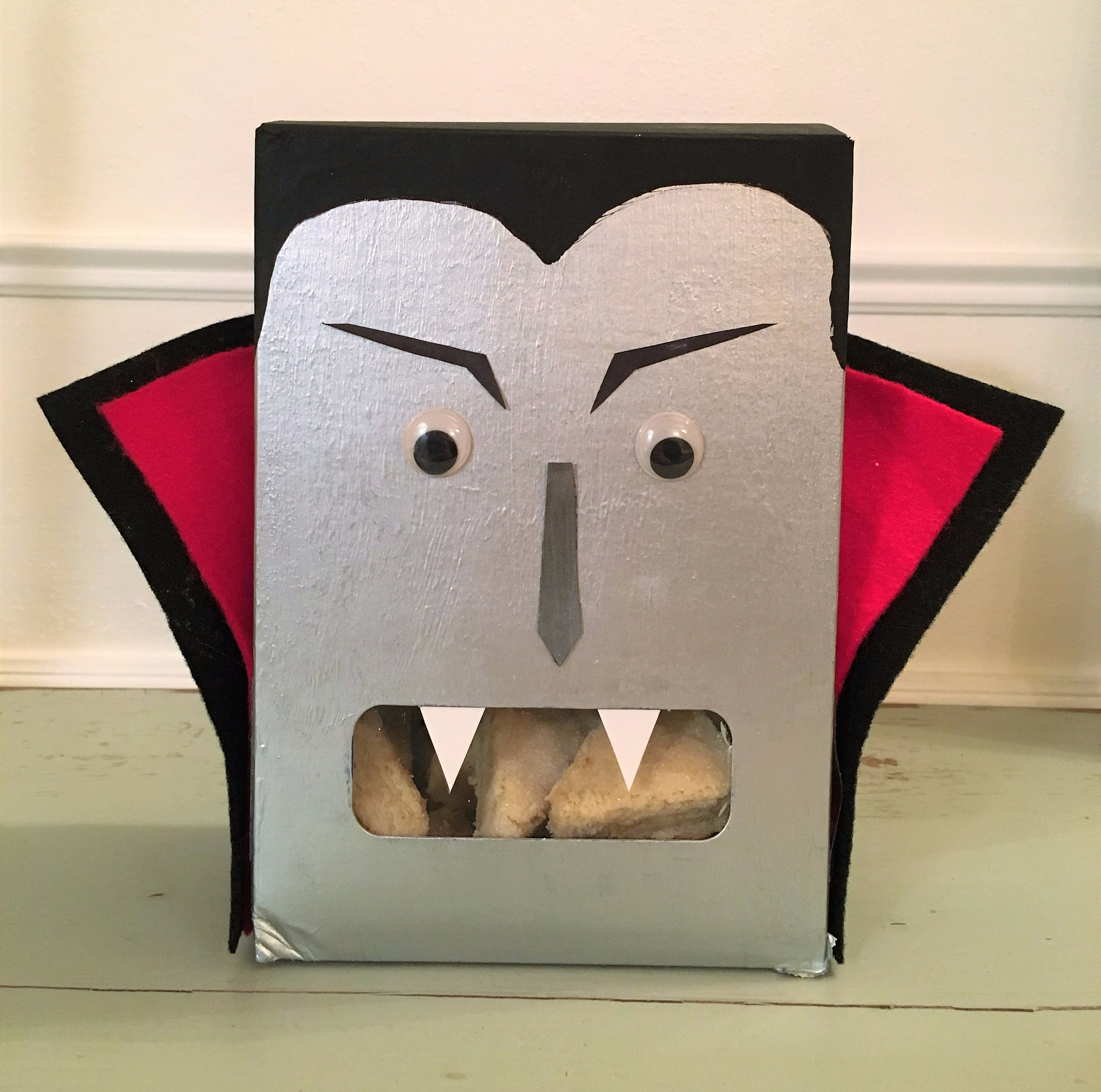
Vampire Goodie Box
Would you like your gift of homemade or store-bought cookies, candy, or other treats to have a little bite to it? Deliver them in this vampire box you can make yourself!
Supplies
Recycled pasta box (or any box with a cellophane window in it)
Black Paint
Silver Paint
Black felt, 8 ½ x 11 sheet or heavy stock paper
Red felt, 8 ½ x 11 sheet or heavy stock paper
Googly eyes
Black paper, heavy stock or construction paper
Fabric glue
Regular glue or double stick tape
Hot glue gun (optional)
Paint brush
Scissors
Directions
Paint the entire box silver, leaving the window unpainted, let dry
With the black paint create the pointy hairstyle, with the point descending about 1 inch from the top of the box and the curves ending about 1 ½ – 1 ¾ inches from the side of the box (see picture).
Paint around the sides and back of the box in line with the ends of the curves
From the black paper make eyebrows—these can be pointy or rounded
From the index card make the nose and teeth
I painted the nose darker silver by combining silver and a little black paint
With the glue or double stick tape, attach the eyebrows and nose to the box
With the glue or double stick tape, attach the teeth to the window, fitting them slightly up into the rim of the window.
Attach the googly eyes
To make the cape
Holding the black felt or paper horizontally, cut a piece about 4/5 as tall as the box
Holding the red felt or paper horizontally, cut a piece of red felt so that there will be a ½-inch border of black along the top and sides
With the fabric glue attach the red felt to the black felt. Use craft glue on paper. Let dry
With the hot glue gun, fabric glue, craft glue, or double stick tape, attach the felt or paper to the back of the box
Fold the felt or paper around the sides of the box and attach along the bottom edge with tape or glue
Fold the top of the felt or paper back to make the collar
Attach the bottom portion of the collar to the box near the front edge with the tape or glue.
Fill with your favorite treat!
Giveaway open to U.S. addresses only. | Prizing provided by Two Lions
Welcome to the 11th anniversary of National Fossil Day! Today’s holiday puts a spotlight on paleontology and its value in the scientific community and for education. The day raises awareness of the importance of preserving fossils for future generations. To celebrate today and Earth Science Week all this week, learn more about the prehistory of your area, or read up on fossils and prehistoric creatures. Visit the National Park Service Website to learn more about today’s holiday and find many resources for classrooms, homeschooling, and family fun. There you’ll find to download a Junior Paleontology Activity Book that can help kids explore the ways paleontologists work and learn about Earth’s history, ancient plants and animals as well as changes to past climate and environments. You’ll also find 20 ideas for digging into paleontology with links to museums and national parks, a site where you can view fossils in 3D, coloring pages, and even learn your state’s fossil.
Thanks to Abrams Books for Young Readers for sending me a copy of When Sue Found Sue for review consideration. All opinions about the book are my own.
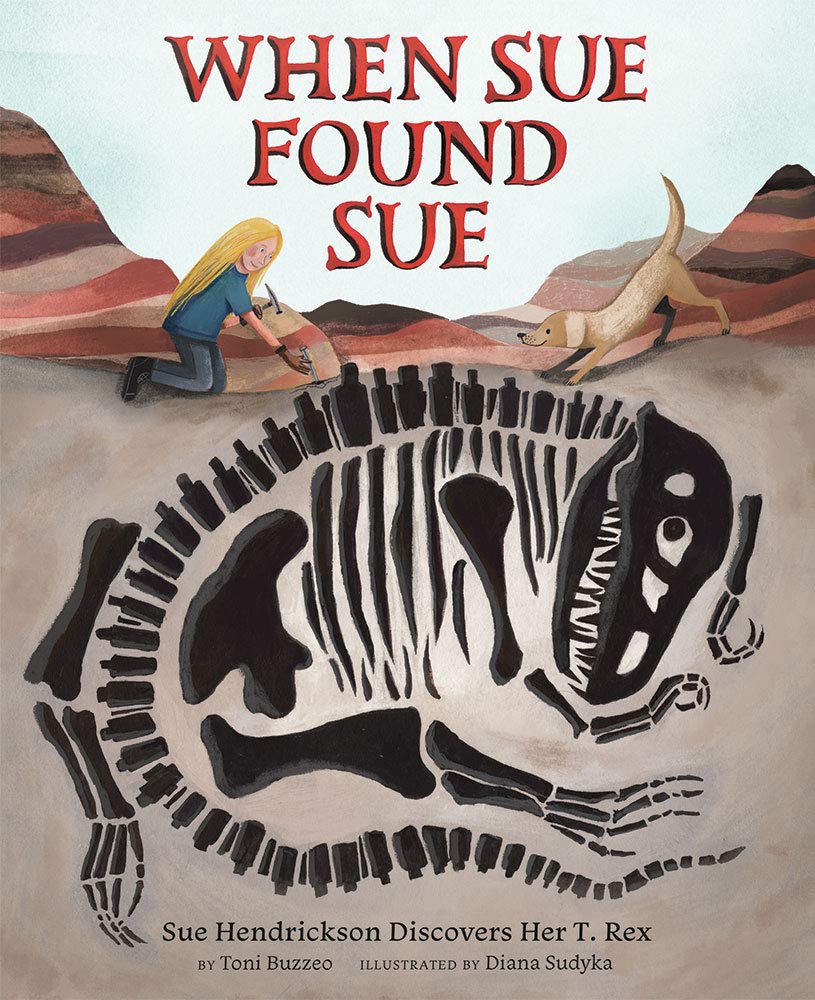
When Sue Found Sue: Sue Hendrickson Discovers Her T. Rex
Written by Toni Buzzeo | Illustrated by Diana Sudyka
Sue Hendrickson was an expert at finding things. The lure of buried or lost treasures kept her busy in her hometown of Munster, Indiana. “Born shy and incredibly smart,” Sue devoured books, discovering everything she could about the things that interested her. One of her favorite places was the Field Museum of Natural History in Chicago. There, she reveled in the treasures others had found and dreamed of the day when she could “search the wide world for hidden treasure on her own.”
Image copyright Diana Sudyka, 2019, text copyright Toni Buzzeo, 2019. Courtesy of Abrams Books for Young Readers.
When she was seventeen, Sue began her life of treasure hunting, joining teams that searched for sunken boats, airplanes, and even cars. She went to Dominican amber mines looking for prehistoric butterflies and deserts of Peru searching for whale fossils. Finally, she headed to South Dakota to dig for dinosaurs.
She spent four summers unearthing duck-billed dinosaurs, using more and more delicate tools to expose the bones. But near the end of her fourth summer, “Sue Hendrickson felt pulled to a sandstone cliff far off in the distance.” When she had the opportunity, she took her golden retriever and hiked the seven miles to the rock.
Image copyright Diana Sudyka, 2019, text copyright Toni Buzzeo, 2019. Courtesy of Abrams Books for Young Readers.
Walking around the perimeter, she noticed what looked like bones lying on the ground. When she looked up, she was astonished to see “three enormous backbones protruding from the cliff.” The size told her they must be from a Tyrannosaurus rex. Sue hurried back to her campsite and told her team the exciting news. They “immediately named the dinosaur Sue the T. rex.”
Image copyright Diana Sudyka, 2019, text copyright Toni Buzzeo, 2019. Courtesy of Abrams Books for Young Readers.
It took five full days for the team to expose the skeleton. Then they mapped the location of each bone, photographing and drawing them. At last they began removing them, and after three weeks the bones were trucked to the Black Hills Institute. Eventually, Sue the T. rex was moved to the Field Museum in Chicago. If you visit the museum today, you will see Sue towering over you. “She is the world’s largest, most complete, best-preserved Tyrannosaurus rex fossil discovered so far”—discovered by a woman who was born to find things.
An Author’s Note about Sue Hendrickson and the battle over the T. rex skeleton as well as resources for further study and a photograph of Sue the T. rex follow the text.
Image copyright Diana Sudyka, 2019, text copyright Toni Buzzeo, 2019. Courtesy of Abrams Books for Young Readers.
Toni Buzzeo’s inspiring story of how Sue Hendrickson discovered the most complete and best-preserved T. rex fossil delves into more than the finding and excavating of the skeleton. Buzzeo also emphasizes Hendrickson’s personality and long-held love of treasure hunting, qualities that informed and aided her career choice. Readers who also harbor dreams outside the mainstream and have a steady focus will find much to admire in Buzzeo’s storytelling and Sue’s example. Kids will be awed by Sue’s early treasure-hunting exploits and fascinated by the painstaking process of unearthing fossils. When Sue follows her intuition to the cliff—without explanation or facts—readers will be reminded that they can rely on their own curiosity, experience, and ideas to carry them forward. With nods toward the value of teamwork and sprinkled with Sue’s own words about her moment of discovery, the story exposes the bones of a life well-lived and points children in the right direction.
Diana Sudyka opens the story of Sue Hendrickson with a lovely collage of the treasures she found and studied as a child and that led to her life-long love of discovery. As Sue grows, she visits the Field Museum, with its exhibits of a Triceratops and Hadrosaurus. Fast-forward several years and she’s swimming in a sea dotted with colorful coral toward an old sunken ship. But the centerpiece of the story takes place in the South Dakota hills, the layers of rock painted in stripes of earthy brown, rust, rose, and ivory. As the team works late nights to excavate the bones, a T. rex constellation appears above the team in the starry sky, urging them on. A two-page spread of how Sue the T. rex fossil appeared in its entirety in the ground is sure to elicit plenty of “Wows!,” and a rendition of Sue on exhibit in the Field Museum will no doubt inspire some travel wishes.
A book about a modern-day scientist that will engage and inspire children with scientific aspirations of their own as well as a celebration of individuality and big dreams and a must for dinosaur lovers, When Sue Found Sue would be a T. riffic addition to home, school, and public library collections.
Ages 4 – 8
Abrams Books for Young Readers, 2019 | ISBN 978-1419731631
Discover more about Toni Buzzeo and her books on her website.
To learn more about Diana Sudyka, her books, and her art, visit her website.
National Dinosaur Day Activity
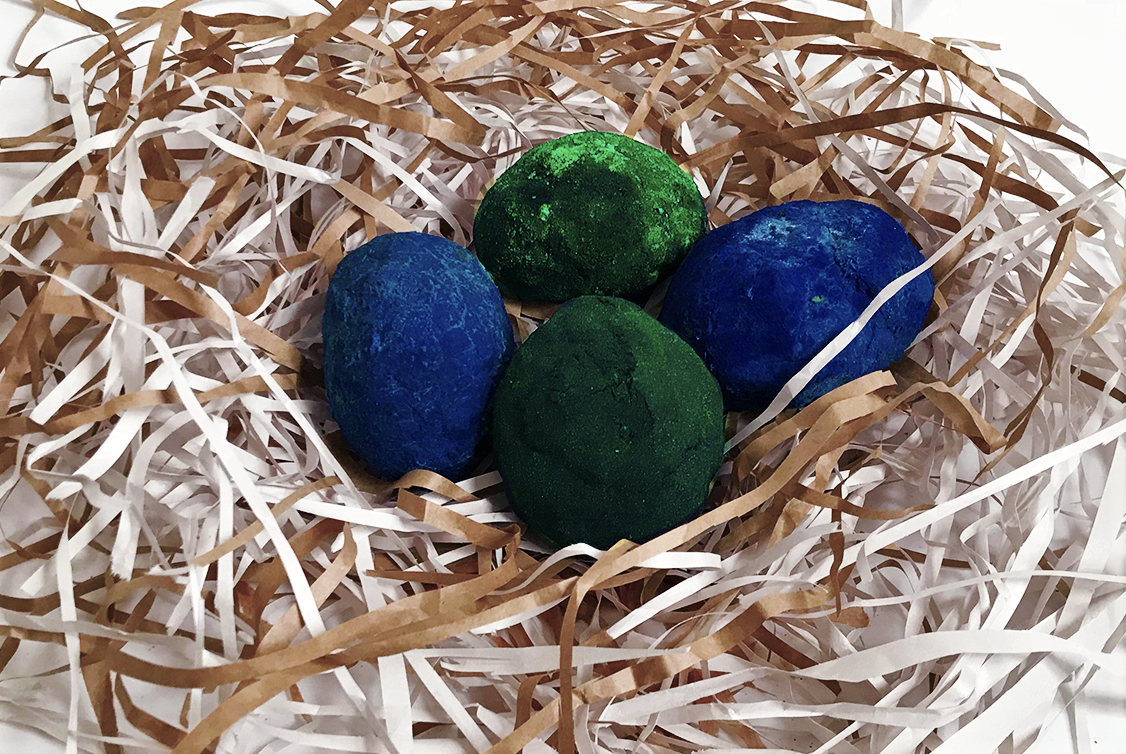
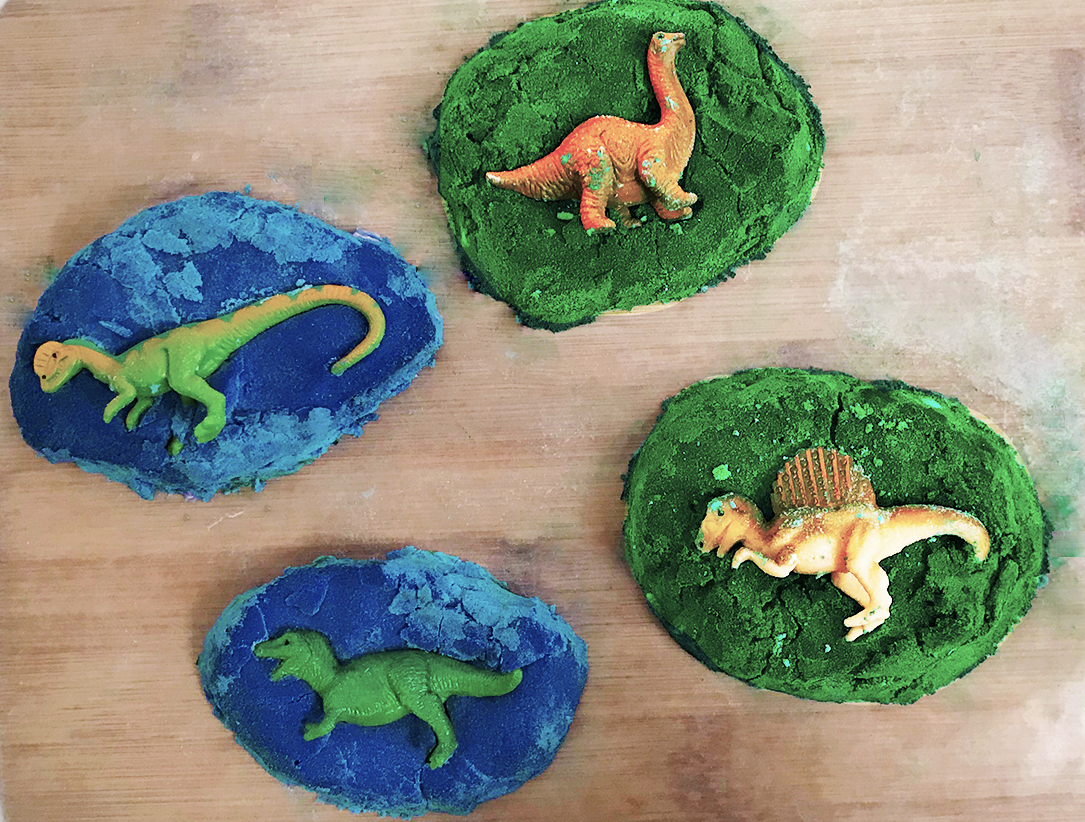
Hatch Your Own Dinosaur Eggs
Think there are no more dinosaur eggs to be found? Think again! You can make your own with this easy craft that will have you hatching some T.-rex-size fun! All you need are a few simple ingredients!
Supplies
Old clothes or apron
Large box of baking soda (makes between 6 and 8 eggs)
Food coloring
Water
Plastic dinosaur toys
Bowl
Fork
Spoon
Wax paper
Baking sheet
Foil
Vinegar
Spray bottle (optional)
Plastic or metal spoon, stick, popsicle stick, or other implement to chisel with
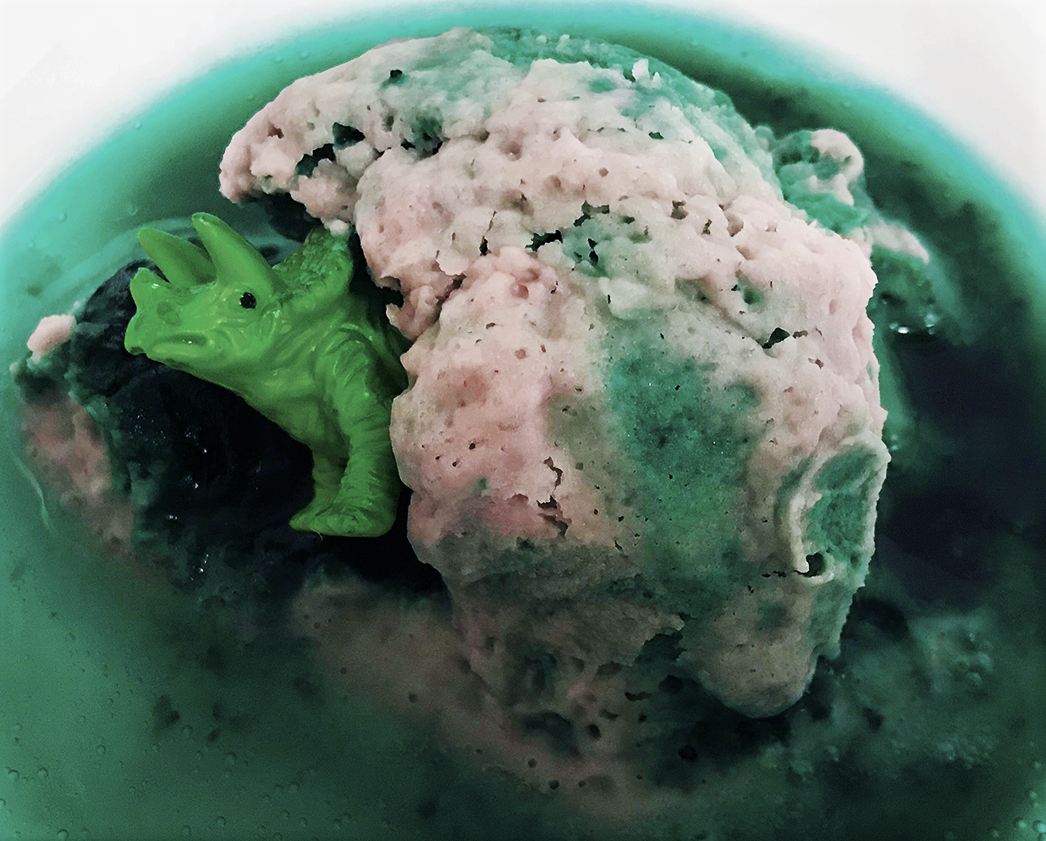
Spray the egg with vinegar to hatch your dinosaur
Directions
Wear old clothes or an apron
Cover work surface with wax paper, parchment paper, newspaper, or other protection. Food coloring can stain some surfaces
Pour baking soda into the bowl
Add drops of food coloring in whatever color you’d like your eggs to be. The eggs will darken when baked.
Mix in the food coloring with the fork. You may want to use your hands, too
When the baking soda is the color you want it, begin adding water a little at a time
Add water until the baking soda holds together when you squeeze it in your hand
When the baking soda is the right consistency, spoon some out into your hand or onto wax paper
Push one plastic dinosaur into the middle
Cover the dinosaur with more of the baking soda mixture
Carefully form it into an egg shape
Repeat with other dinosaurs
Chisel the egg open to hatch your dinosaur
To Bake the Eggs
Set the oven or toaster oven to 200 to 225 degrees
Set the eggs on a baking sheet lined with foil
Bake the eggs for 15 minutes, check
Turn the eggs over and bake for 10 to 15 more minutes
Remove from oven and let cool
To Hatch the Eggs
Eggs can be hatched by chiseling them with a spoon, stick, or other implement
Eggs can also be hatched by spraying or sprinkling them with vinegar
You can find When Sue Found Sue: Sue Hendrickson Discovers Her T. Rex at these booksellers