December 14 – It’s Read a New Book Month

celebrate-picture-books-picture-book-review-eye-by-eye-comparing-how-animals-see-cover

About the Holiday

For kids who love nonfiction, this year has brought a bumper crop of creative, fascinating, and informative books on all topics from biographies to history to science and beyond. Innovative, interactive, and humorous, these books for all ages – even babies – open up the world for children in ways that resonate and make learning exciting and fun. Today’s book will have kids looking at the animals around them in a whole new way.

Eye by Eye: Comparing How Animals See

Written by Sara Levine | Illustrated by T.S Spookytooth


“Have you ever wondered what it would be like to see the world through someone else’s eyes?” Let’s make that musing even more intriguing—How would the world look if you gazed out at it through the eyes of an animal, insect, or bird (you know… a bird’s eye view)? Say, for instance, you had eight eyes dotting your face. “What kind of animal would you be, then?” Hmmm… With “four big eyes on the front of its face…” and “four smaller eyes on the top of its head,” the jumping spider can see what’s above and in front of it.

What if your eyes weren’t on your face at all, but on your arms instead? who would that be? Or how would you like it if your eyes were on “long stalks sticking out of the top of your head?” That might come in handy in a crowded movie theater or museum, but the animal with these eyes doesn’t really frequent those kinds of places. It’s more of an outdoorsman. Can you guess? While you’re contemplating that, you’re also going to want to learn about the animals whose eyes move to other parts of their face and the animals whose eyes are fixed in place.

Now, look deeeep into your eyes. What do you see? A pupil! What shape is it? Would it surprise you to learn that there are animals whose pupils are oval or even rectangular? Cat lovers know that their fav animals have oval pupils, but so do other “predators that hide and then ambush their prey.” Their unique eyes help them “judge distance and plan its attack without making any movements that might scare away its meal.” Animals with rectangular eyes use their peepers to stay safe. Which animals do you think those would be?

celebrate-picture-books-picture-book-review-eye-by-eye-comparing-how-animals-see-eight-eyes

Image copyright T.S Spookytooth, 2020, text copyright Sara Levine, 2020. Courtesy of Millbrook Press.

Some animals, including some humans, can’t see the colors red and green. You know this as color-blindness, but have you ever wondered exactly how color-blind people or animals view the world? Side-by-side pages show you! And that bird’s-eye-view? Because of the way birds’ eyes are constructed, their world is even more colorful than ours! How much more? “We have no idea… since our eyes can’t give us this information. But it’s pretty cool to know that there are things that exist out there that humans can’t see at all.”

One last question: What kind of animal could read the words in this book? If you know the answer, “you are a human who is using your eyes to read.” While other animals can’t read words, they can read the signs other animals and even plants provide. What are some of these? The answers plus even more fascinating information can be yours in the blink of an eye.

Back matter includes hands-on activities kids can do to “see” the way two animals do, a close-up examination of a human’s pupil, and a glossary as well as a list of books and websites for further research.

Sara Levine’s eye-opening guide to how a wide variety of creatures in the animal kingdom see will enthrall kids. In the fourth book of her Animal by Animal series, Levine continues her kid-enticing combination of humor and science to teach children about the specialized eyes that help animals navigate their particular environments. Her conversational storytelling, sprinkled with questions, will have kids engaged in the kind of predicting that reinforces learning. Levine’s detailed answers to the questions, including benefits of particular eye shapes or placement, physiological characteristics and adaptations, and the names of additional animals that share the same types of eyes, are enlightening will inspire young scientists to discover more about their world. 

A highlight of the Animal by Animal series is the artwork by T.S Spookytooth, who excels at translating Levine’s vision into illustrations that get kids giggling and learning. The first page starts off in familiar territory: a glasses-wearing girl stares eye-to-eye with the little wiener dog she’s holding in her hands. But turn the page and this same girl now sports eight eyes and two cleverly constructed pairs of glasses while other kids—and clues for discussions to come—stand by. On the next pages, eyeballs jut from the ends of six arms, peer out from long, wiggly stalks, and migrate across a girl’s face. These images will have kids laughing and riveted to the pages, while Spookytooth’s realistic depictions of the animals these eyes belong to will long remain in their memory. Insets of enlarged eyes allow kids to see the particular formation of eyes and pupils up close. The side-by-side page spread showing full-color human vision and the vision of someone who is color-blind is enlightening. Kids will enjoy following the pet crocodile from page to page and discussing all the reasons for its distinctive eyes. The diverse group of kids are charming companions on this educational journey.

An exciting and fascinating way to spur children to explore and learn about animals, nature, and themselves, Eye by Eye: Comparing How Animals See is a top pick for home, school and public library collections.

Ages 5 – 10

Millbrook Press, 2020 | ISBN 978-1541538382

Discover more about Sara Levine and her books on her website.

To learn more about T.S Spookytooth, his books, and his art, visit his website.

celebrate-picture-books-picture-book-review-eye-by-eye-comparing-how-animals-see-cover

You can find Eye by Eye: Comparing How Animals See at these booksellers

Amazon | Barnes & Noble | Books-a-Million

To support your local independent bookstore, order from

Bookshop | IndieBound

Picture Book Review

December 12 – Get Ready for Christmas

celebrate-picture-books-picture-book-review-a-christmas-carol-lit-for-little-hands-cover

About the Holiday

It just isn’t Christmas without reading favorite traditional stories. Familiar characters, heartfelt themes, and feelings of warmth and excitement are tucked inside the pages just waiting to be released again after a long year. Today’s book allows you to share one of the oldest and most beloved Christmas classics with the youngest members of your family.

Thanks to Familius for sending me a copy of A Christmas Carol: Lit for Little Hands for review consideration. all opinions of the book are my own. This post contains an affiliate link.

A Christmas Carol: Lit for Little Hands

Adapted by Brooke Jorden | Illustrated by David Miles


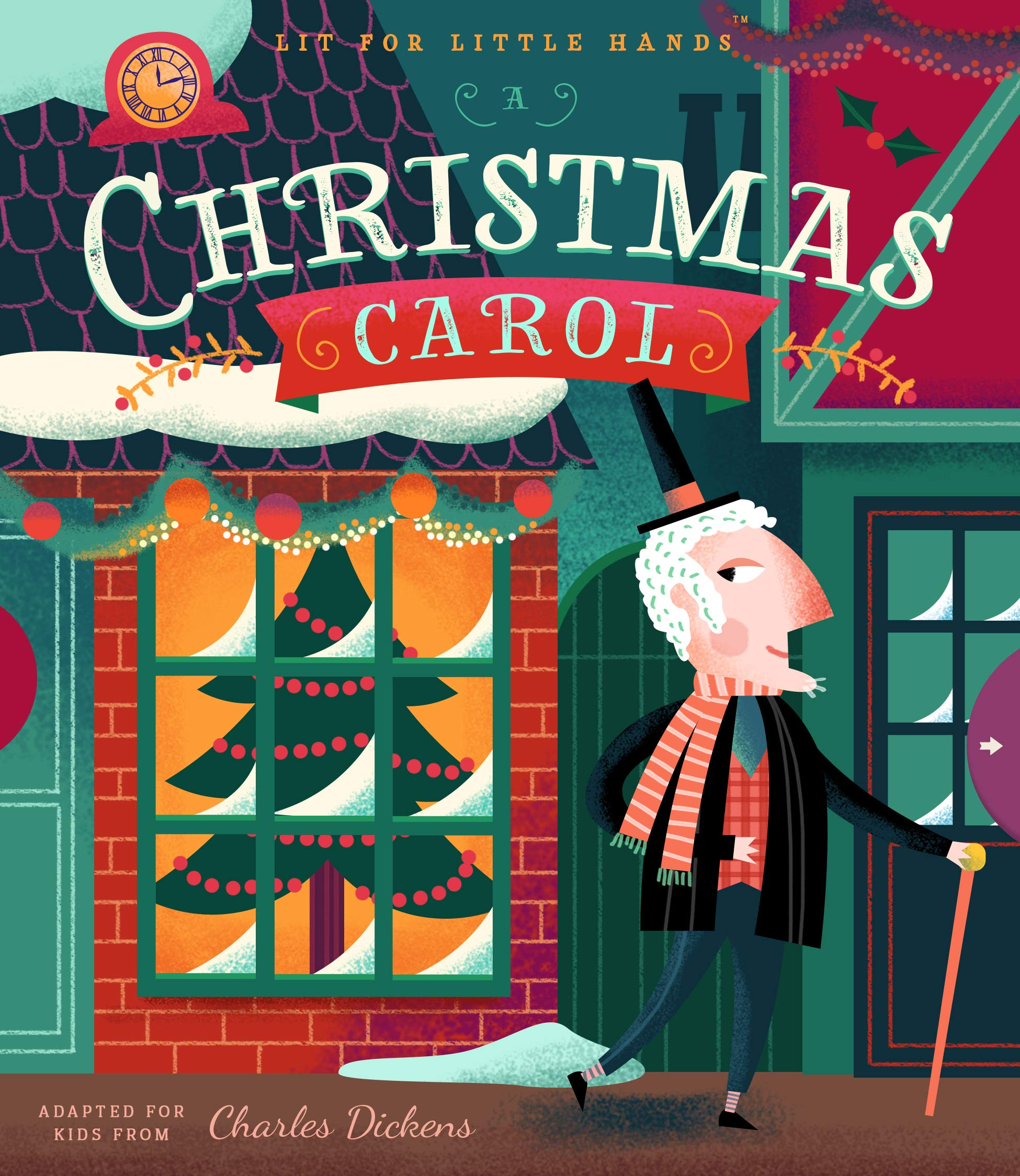
One of the world’s most recognizable novels, Charles Dickens’ A Christmas Carol has thrilled readers ever since it was published on December 19, 1843. The novel’s combination of spooky ghosts, a loving family, and a lost soul in need of redemption keeps readers and listeners enthralled no matter how many times they’ve read it. But why should adults and older kids have all the fun? Now, with this Lit for Little Hands board book, even the youngest readers can enjoy all the intrigue of A Christmas Carol.

celebrate-picture-books-picture-book-review-a-christmas-carol-lit-for-little-hands-counting-house

Image copyright David Miles, 2019, text copyright Brooke Jorden, 2019. Courtesy of Familius.

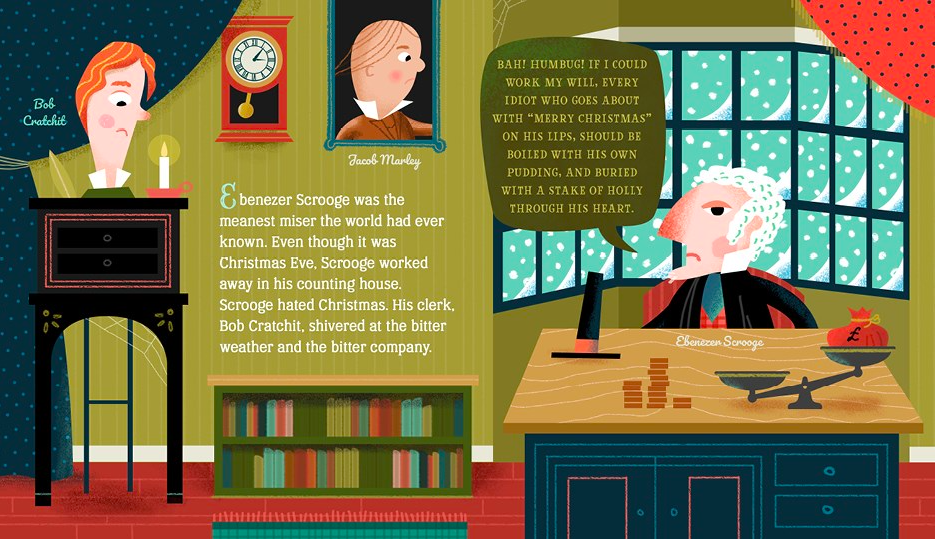
Brooke Jorden’s nimble adaptation loses none of the snap of the original. Turn to the first page and there is Bob Cratchit toiling away under the gaze of a stern Ebenezer Scrooge who “was the meanest miser the world had ever known.” The counting house is as cold as Scrooge’s hatred of Christmas. On a pull-out tab kids even see him send away a little boy who’s come caroling. That night at home “a terrible clanking noise” interrupts Scrooge’s meager meal. What we know—but little ones might not—is what lurks on the other side of Scrooge’s door. With the pull of a tab, kids slide open the door to reveal the ghostly figure of Jacob Marley “surrounded by a heavy iron chain: punishment for all the cruel things Marley had done while he was alive.” He tells Scrooge he’s in for the same unless he changes his ways and tells him to expect three more ghosts.

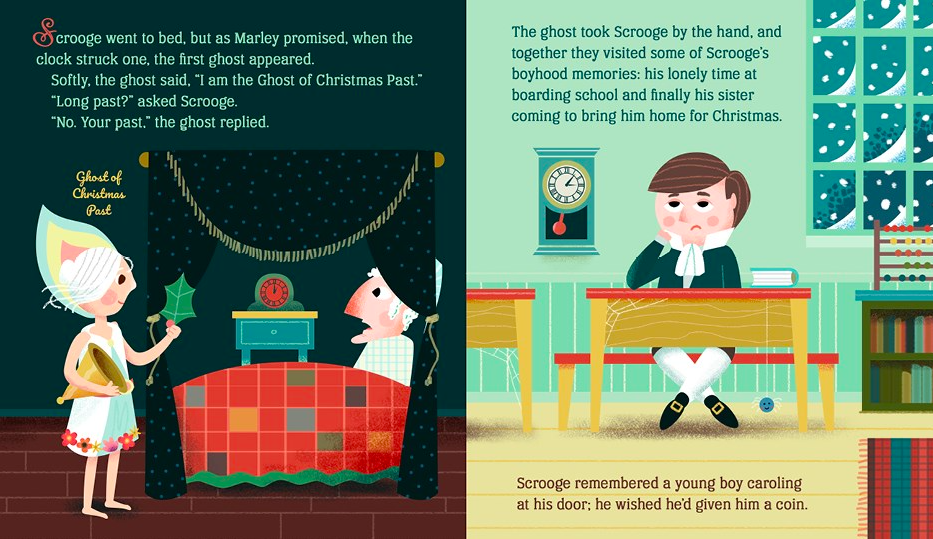
Another turn of the page brings the Ghost of Christmas past. When kids pull the tab, the ghost and Scrooge fly from the window into the night sky and to the boarding school where Scrooge spent lonely Christmas’s alone. It makes Scrooge think of the boy who’d come caroling and sorry that he hadn’t given him a bit of money. As you may remember, the Ghost of Christmas Past also takes Scrooge to a party given by his former boss Mr. Fezziwig. Kids can spin a wheel and set old Scrooge dancing round and round with his younger self and his former colleagues and friends. “Scrooge remembered the joy he used to feel around Christmas, surrounded by friends and a kind employer.” He realizes that when money became the most important thing to him, he became sad and friendless.

celebrate-picture-books-picture-book-review-a-christmas-carol-lit-for-little-hands-christmas-past

Image copyright David Miles, 2019, text copyright Brooke Jorden, 2019. Courtesy of Familius.

When the clock strikes two, the Ghost of Christmas Present appears in the midst of an enormous feast, Nearby a fire quivers and crackles as kids spin the wheel. The ghost transports Scrooge to the window of Bob Cratchit’s house, where he sees the large family having dinner. With a toggle, readers can set Tiny Tim’s famous cheery toast in motion as Scrooge “marveled that the Cratchit family has so little and yet were so happy.”

Scrooge didn’t have long to wait until the Ghost of Christmas Yet to Come visited. In a cemetery, Scrooge saw Mr. and Mrs. Cratchit crying at Tiny Tim’s gravestone. The sight broke his heart, but then the ghost pointed Scrooge to another stone. Who’s is it? Children pull a tab that reveals the engraved name: Ebenezzer Scrooge. When he woke up the next morning, “Scrooge knew he must change.” He went out into town spreading Christmas cheer and “became as good a man as the world had ever known.”

celebrate-picture-books-picture-book-review-a-christmas-carol-lit-for-little-hands-christmas-present

Image copyright David Miles, 2019, text copyright Brooke Jorden, 2019. Courtesy of Familius.

Quotations from Dickens’ original novel are sprinkled throughout the text, giving it the Old-World atmosphere that contributes so much to the effect of the story. With each visit of a ghost, Brooke Jorden includes a lesson that Scrooge learns or a memory he has of a recent time when he could have been generous or happy and chose not to, allowing young readers to understand how the ghosts affect Scrooge and how he changes in that night. Jorden chooses evocative language that kids will enjoy hearing and learning. Jorden’s board book version of A Christmas Carol demonstrates anew the genius of Charles Dickens in this story that touches all ages and is ever timely.

Using fresh tones of red and green, David Miles brings 1800’s England to life for kids. Bob Cratchit scratches away in his ledger with a quill pen and only a candle for light as thick snow falls outside the window. At home, Scrooge sits in a darkened room where the eerie, translucent ghost of Jacob Marley, wrapped in a chain, is sure to impress. Miles’ image of the feast surrounding the Ghost of Christmas Present contrasts sharply with the small turkey and plum pudding on the Cratchit’s table, a detail that will resonate with today’s children just as it did when the novel was first published. The Ghost of Christmas Yet to Come is appropriately spooky, but not too frightening for young children. When Scrooge wakes up a changed man, the dark shades of Miles’ pages give way to bright pinks and cheery aqua, and the icy blizzard has ended.

Terrific fun and a fabulous way to share this classic with kids (adults will get a kick out of it too), Lit for Little Hands: A Christmas Carol would be a quick favorite on home, school, and public library bookshelves.

Ages 3 – 6

Familius, 2019 | ISBN 978-1641701518

You can find more books from Familius that joyfully reflect the habits of happy families, including reading, talking, laughing, eating, working, loving, healing, learning, and playing together as well as the Familius blog The Habit Hub here.

Get Ready for Christmas Activity

celebrate-picture-books-picture-book-review-snowflake-matching-puzzle

It’s Snowing! Matching Puzzle


If you’re wishing for a white Christmas, you’ll enjoy finding the pairs of identical snowflakes in this printable puzzle.

It’s Snowing! Matching Puzzle

celebrate-picture-books-picture-book-review-a-christmas-carol-lit-for-little-hands-cover

You can purchase Lit for Little Hands: A Christmas Carol at Familius

Picture Book Review


December 11 – Read a New Book Month

celebrate-picture-books-picture-book-review-snow-falls-cover

About the Holiday

There’s nothing better than spending the chilly days of winter snuggled up with new books. Kids love cuddling up and sharing laughs, poignant moments, fascinating facts, and the changes seasons bring through books. If you’re looking for a way to celebrate Read A New Book Month, check out the new titles at your favorite bookstore and buy one, two, or a whole stockingful to wrap up for the holidays. After all, a looong winter’s ahead!

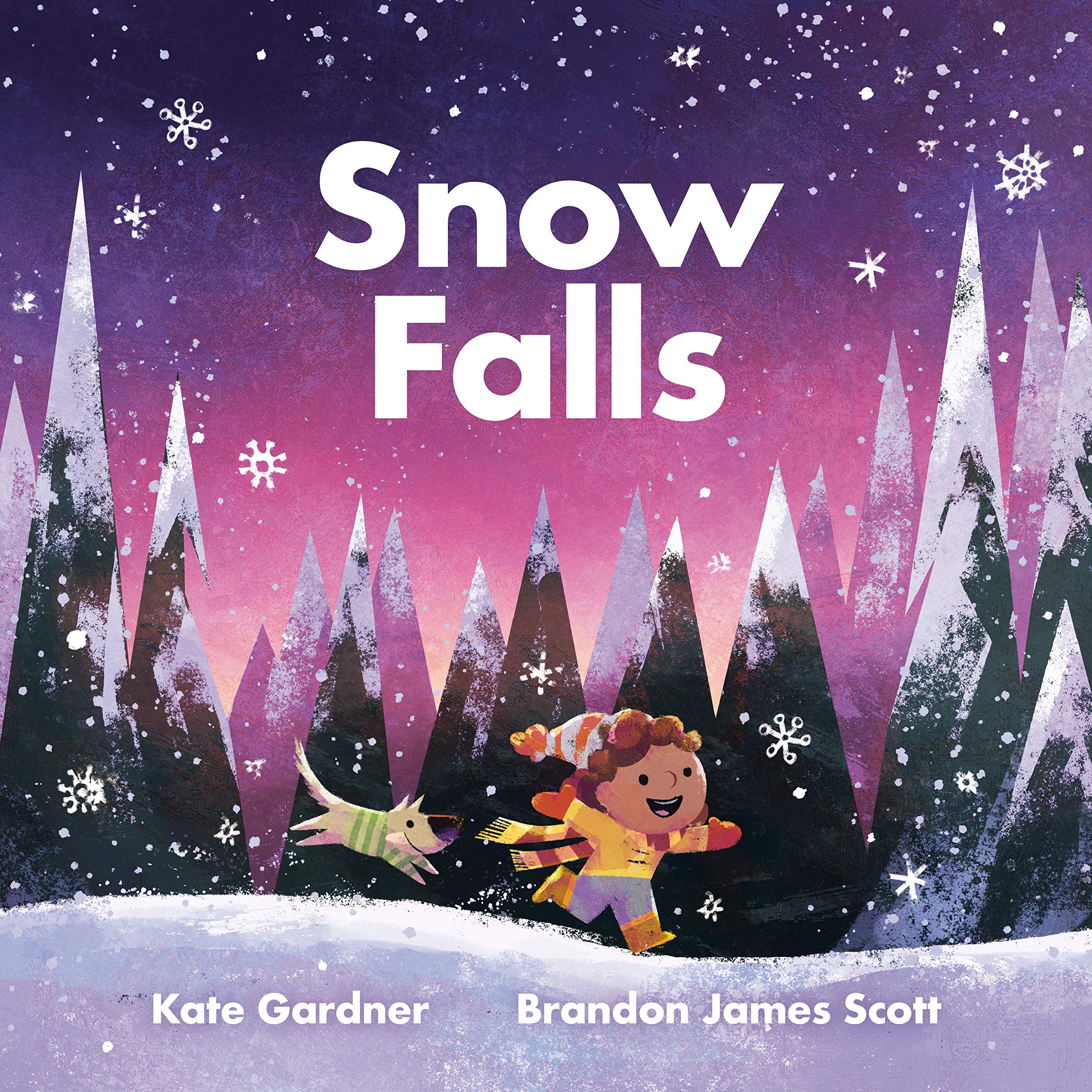
Snow Falls

Written by Kate Gardner | Illustrated by Brandon James Scott


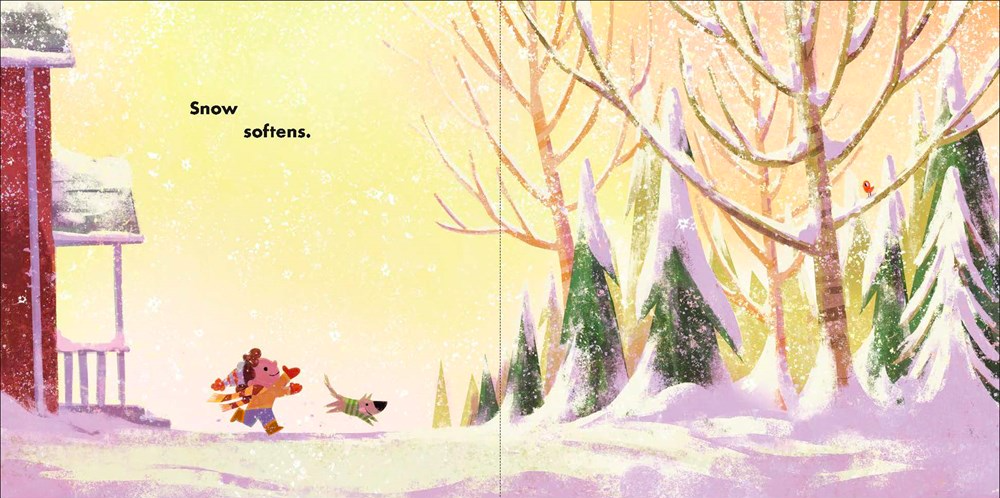
Through three seasons of the year when rain falls outside our windows, we keep on working, playing, watching TV, or using our computers or phones. But add colder temperatures and those raindrops turn to snowflakes that have us up and at the windows marveling at their beauty. Little ones become especially wide-eyed and excited to get outside as “snow softens” sturdy tree branches, angled rooftops, flat ground, and even the sounds in the air.

celebrate-picture-books-picture-book-review-snow-falls-softens

Image copyright Brandon James Scott, 2020, text copyright Kate Gardner, 2020. Courtesy of Tundra Books.

The white-blanketed earth becomes an adventurer’s paradise as “snow tracks,” allowing wanderers to retrace their footsteps and find their way home. Of course, kids with sleds know that “snow slides,” turning every hill into a challenge that beckons and sometimes—at the bottom—becomes topsy-turvy fun where, maybe, “snow hides” a lost mitten, hat, or scarf.

celebrate-picture-books-picture-book-review-snow-falls-tricks

Image copyright Brandon James Scott, 2020, text copyright Kate Gardner, 2020. Courtesy of Tundra Books.

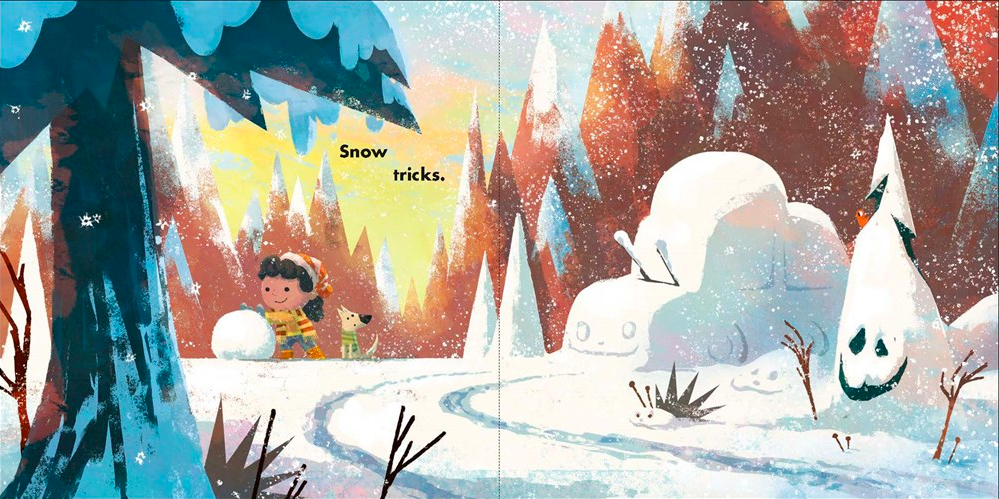
There are days where “snow snows… and snows… and snows.” Then there’s enough white, fluffy, perfectly sticky fluff to make snowmen where “snow smiles” or soft balls so “snow flies.” But then there come the days where the sun is warm and the snow slowly slips away, revealing the world again until the next snowy day.

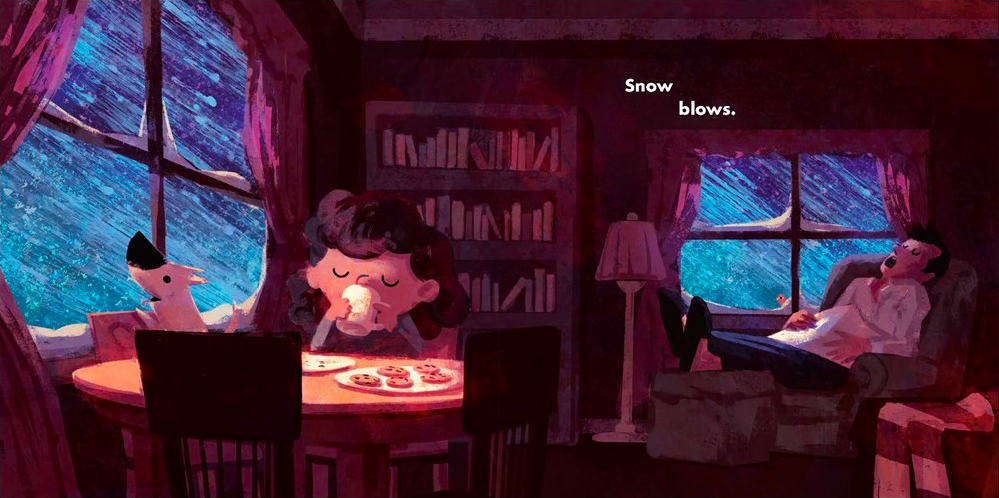
celebrate-picture-books-picture-book-review-snow-falls-blows

Image copyright Brandon James Scott, 2020, text copyright Kate Gardner, 2020. Courtesy of Tundra Books.

As wonder-filled and enticing as the first snow of the season, Kate Gardner’s lyrical ode to kids’ favorite winter playmate highlights the ways snow transforms the world, from the way it looks to the activities it allows even to the cozy moments it creates inside. Garner’s two-word sentences drift from page to page on alliteration, rhymes, consonance, and assonance as smoothly as a sled on a hill. Children will love reading along and talking about their own memories of snowy day fun.

Brandon James Scott’s soft, textured scenes, “painted digitally in the evenings of a snowy Canadian winter,” begin—as most snows do for kids—seen from just above the windowsill as the first flakes fall. Looking into a cozy house, readers see a little girl peeking out. On hooks hang a striped scarf, knitted hat, and dog sweater that will feature in the pages to come. As the little girl runs out into the winter wonderland, the white world is punctuated with a tiny red bird that kids will love searching for from page to page. 

Various perspectives give children different views of the snow-covered neighborhood. Scott also captures a glorious gold, pink, and violet sunset as well as the way snow swirls into the air, buffeted by icy gusts. When the girl lands head first into the snow at the bottom of the sledding hill, Scott begins a storyline for the scarf that kids will eagerly follow. Hot chocolate and cookies, a forest of snowmen, snowball fights, and the mercurial melting that forms islands, paths, and monster footprints are all chronicled too in Scott’s lovely pages, which are wrapped in a sparkling jacket that gives way to the girl and her dog making snow angels underneath.

A book adults and children will want to share again and again throughout the winter and when hot weather calls for relief, Snow Falls would make a wonderful gift and is highly recommended for home, school, and public library collections.

Ages 3 – 7

Tundra Books, 2020 | ISBN 978-1101919217

To learn more about Brandon James Scott, his books, and his art, visit his website.

Read a New Book Month Activity

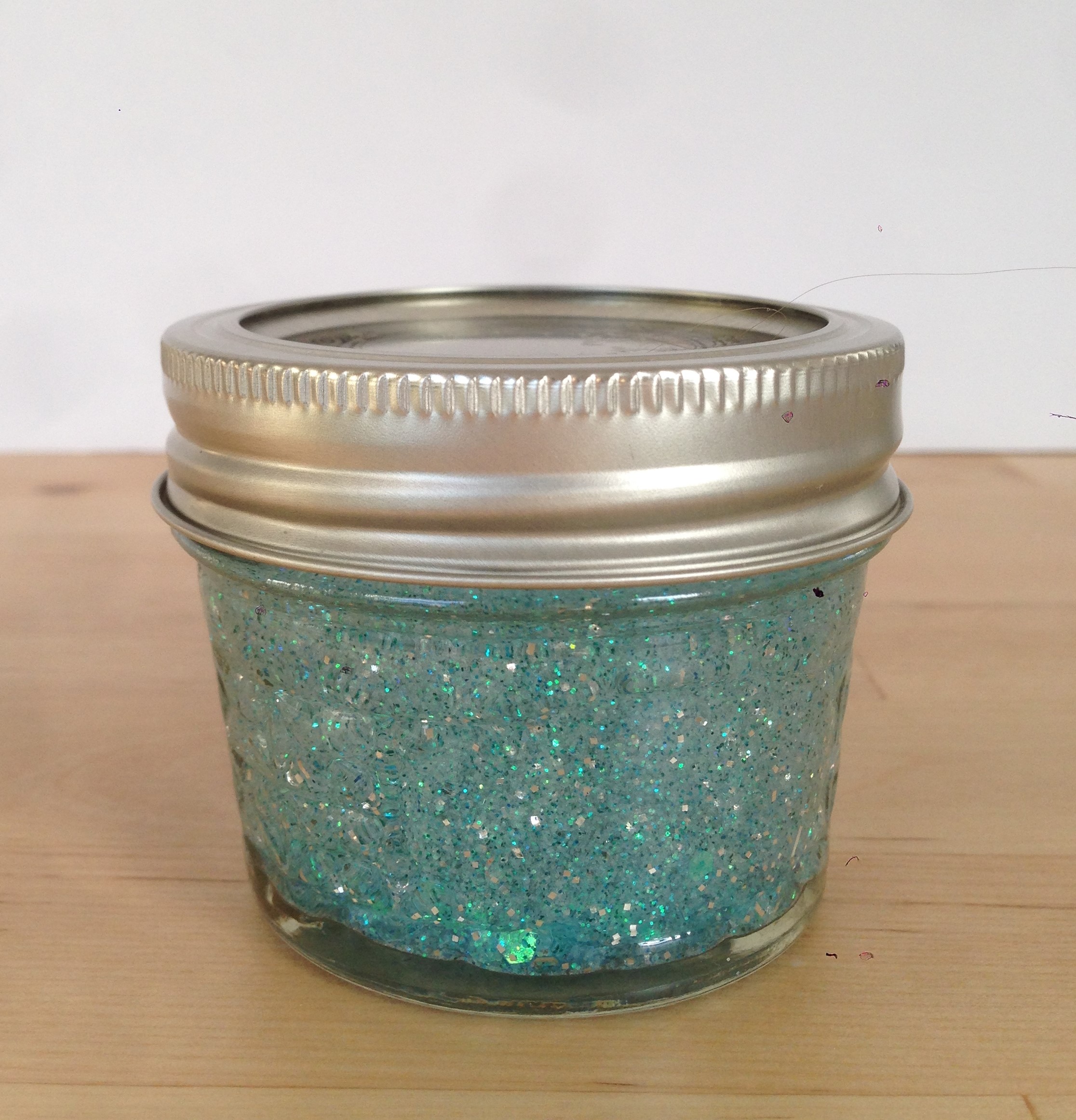
celebrate-picture-books-picture-book-review-mind-jar

Snowy Day Mindfulness Jar

You can capture the beauty of a glittering snowfall in this easy craft—that also makes a special gift for a friend!

Supplies

  • Small to medium mason jar or other decorative jar with a tight lid
  • White glitter glue,
  • Light blue glitter glue,
  • Fine white and/or blue glitter
  • Large white and/or blue glitter
  • Warm water

Directions

1. For every 1/2 cup of warm water add:

  • 1 1/2 teaspoons white glitter glue
  • 1/2 teaspoon blue glitter glue
  • 2 teaspoons fine glitter glue
  • 1/2 teaspoon large glitter

2. Close lid tightly

3. Shake

As glue dissolves, the liquid will become clearer and the glitter will remain suspended in it

celebrate-picture-books-picture-book-review-snow-falls-cover

You can find Snow Falls at these booksellers

Amazon | Barnes & Noble | Bookshop 

Picture Book Review

December 10 – National Dewey Decimal System Day

celebrate-picture-books-picture-book-review-melvil-dewey-cover

About the Holiday

Today, library lovers and readers of all kinds honor Melvil Dewey who was born on this date in 1851 and at the age of twenty-one revolutionized the way libraries organized their collections with an elegant numerical system that gave each book their own place on the shelf. Dewey went on to make more changes within libraries from whom they served to who ran them even to the amount of noise that was allowed inside—Shhh! To celebrate today, show your local librarians and library staff how much you appreciate them by sending them a thank you email or leaving an encouraging comment on their social media. To learn more about Melvil Dewey, kids will also want to check out today’s book.

The Efficient, Inventive (Often Annoying) Melvil Dewey

Written by Alexis O’Neill | Illustrated by Edwin Fotheringham


Melvil Dewey is one organized kid! He spends his free time labeling his mother’s pantry and then the basement. He records all of his pertinent personal information and balances his finances in a ledger. And when he has enough money he heads to the bookstore—on foot—ten miles away. “Melvil loves books.” What do you imagine he buys there? If you guessed Webster’s American Dictionary of the English Language—unabridged version—you’re right!

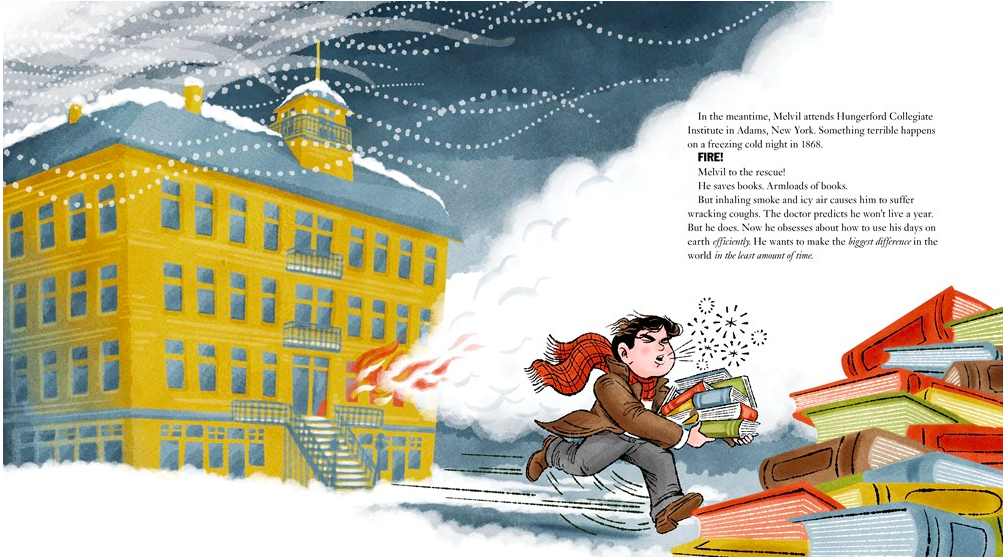
At night before going to sleep, Melvil wonders what he’ll do with his life. He wants to do something valuable, something meaningful. But what? A fire at Hungerford Collegiate Institute in Adams, New York, where Melvil goes to school, gives him a new perspective. While rescuing books, smoke inhalation causes damage to his lungs. The doctors say he won’t live a year, but he proves them wrong. Now, however, he wants to word “efficiently. He wants to make the biggest difference in the world in the least amount of time.”

celebrate-picture-books-picture-book-review-melvil-dewey-fire

Image copyright Edwin Fotheringham, 2020, text copyright Alexis O’Neill, 2020. Courtesy of Calkins Creek.

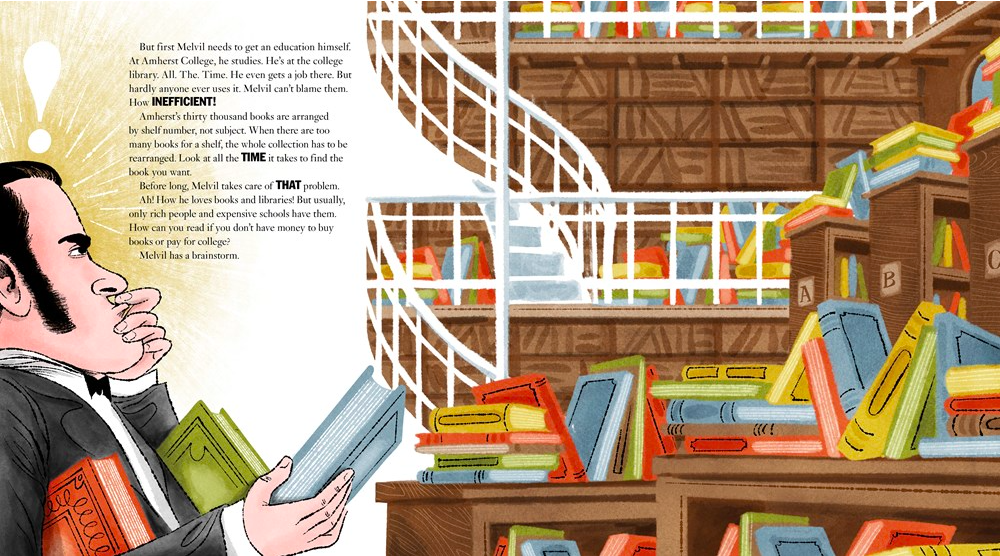
Noticing the large number of immigrants entering the country, Melvil decides he want to help them learn English and get an education as quickly as possible. Books would do that. After all, Melvil believes that steam power and electricity pale in importance to reading. First, though, Melvil needs to go to college. He chooses Amherst College and spends copious amounts of time at the library. “He even gets a job there.” But he notices that the library is woefully underused. Melvil can understand it. Instead of grouped by subject, the books—all 30,000 of them—are organized by shelf number, which requires frequent rearranging as new books are added.

Melvil loved libraries, but only rich institutions and wealthy people could afford to have them. Melvile believes in free public libraries for everyone. But as Melvil studies the problems of libraries, he discovers that no two libraries organize their books the same way. And some don’t even seem to bother with orgnainzation—they just stack the “books from floor to ceiling.” In addition to books and libraries, Melvil loves decimals. He ponders and muses, and then, suddenly, he has it! “He gets the idea of using numbers and decimals to organize library books.”

celebrate-picture-books-picture-book-review-melvil-dewey-disorganization

Image copyright Edwin Fotheringham, 2020, text copyright Alexis O’Neill, 2020. Courtesy of Calkins Creek.

After extensive research, “Melvil assigns numbers to ten broad classes of knowledge. He divides these into divisions and the divisions into sections and subclasses. When displayed on the spine of the books and the books neatly tucked away on shelves, finding what you want becomes “totally efficient!” The trustees at Columbia College in New York invite Melvil to become their head librarian. Once installed, Melvil begins to think bigger. He wants to open a whole school dedicated to training librarians, and… he thinks women would be perfect for this profession. Their qualifications in his eyes? “…clear heads, strong hands, and great hearts. (Also, they will work for less money than men.)” But Columbia College’s trustees are aghast. Women are not welcome on their campus. Melvil is not to be dissuaded.

He secretly opens his school in a storeroom across the street from Columbia with twenty students, seventeen of which are women. He rushes through his lessons for best efficiency, then back at his job tinkers with the rules of the library. He instates a strict quiet policy—even going to far as to put rubber tips on chair and table legs and rubber wheels on book carts. Librarians and staff are given slippers to wear. And, of course, there is NO talking.

celebrate-picture-books-picture-book-review-melvil-dewey-train

Image copyright Edwin Fotheringham, 2020, text copyright Alexis O’Neill, 2020. Courtesy of Calkins Creek.

Melvil’s flood of ideas, constant changes, and insistent personality upsets people, but he barrels on. He becomes the State Librarian for New York, “organizes the New York State Library Association… provides books for the blind…and launches a traveling library system.” He even helps establish the Children’s Library Association, among other work. People were still divided in their opinions of Melvil, but one thing they all could agree on was that he fulfilled the wishes he had as a boy to “make a difference in the world.”

Extensive back matter includes an Author’s Note with an honest assessment of his successes and faults that in itself can prompt discussions of the legacy people leave behind, a timeline of his life, a discussion on other reforms he championed, a quick overview of how Dewey’s classification system works, and a list of selected sources.

celebrate-picture-books-picture-book-review-melvil-dewey-dual-personality

Image copyright Edwin Fotheringham, 2020, text copyright Alexis O’Neill, 2020. Courtesy of Calkins Creek.

No fusty, dusty story of the Dewey Decimal System this! Alexis O’Neill’s present-tense storytelling sweeps readers up in a whirlwind of the ideas, dreams, quirks, and persuasive, even steamrolling personality of Melvil Dewey. (And if you wonder about that unusual spelling, the answer is here too.)  Her wry delivery masterfully straddles the divide between the numerous contributions he made to the library system and the anger his convictions and obsessions often caused. She invites kids into Dewey’s mind and actions as ideas spark, flame, and fuel innovation. The details O’Neill includes about the times, the pre-Dewey system of library organization, and Dewey’s hand in expanding the reach of libraries as well as his often abrasive personality gives adults and children plenty to unpack, discuss, and research.

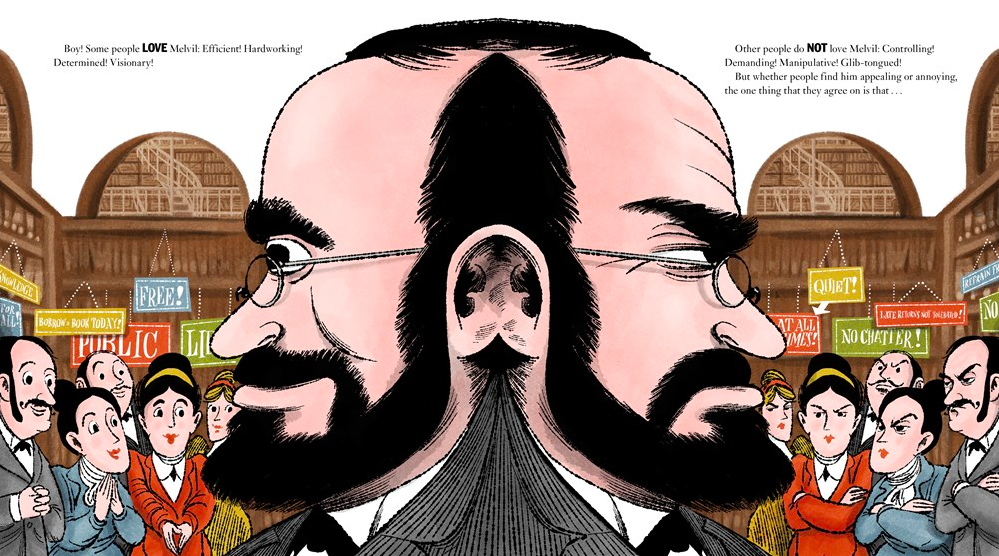
Edwin Fotheringham matches O’Neill’s robust storytelling with action-packed illustrations that seem to sprint across the pages as quickly as notions raced through Melvil Dewey’s mind. Striking images—such as a speeding train hurtling into a tunnel made from an overturned book and later smashing through a mountain of books; the moment when Dewey is struck with the decimal-system answer to his problem; and a class lecture given at 180 words per minute—reveal the whirlwind pace of Dewey’s life. A two-page spread in which two profiles of Dewey—one smiling and one scowling—meet in the middle demonstrate the dual nature of this complex man and the contrasting reactions to his beliefs. Fotheringham brings the shotgun quality of Dewey’s thoughts to life with bold, emphatic typography that highlights concepts important to him while hinting at the conviction he had in his own ideas and solutions. 

The Efficient, Inventive (Often Annoying) Melvil Dewey is a compelling biography which can be read to inform children of all ages about a man who wished to make an impact on the world and succeeded in ways that nearly all people recognize. The book can also be used to stimulate important discussions about difficult and current issues with older children when used with the back matter and further research. The book will be fascinating and eye-opening for library lovers unfamiliar with the early history of libraries. It well deserves a place on school and public library shelves.

Ages 7 – 10 and up

Calkins Creek, 2020 | ISBN 978-1684371983

Discover more about Alexis O’Neill and her books on her website.

To learn more about Edwin Fotheringham, his books, and his art, visit his website.

National Dewey Decimal System Day Activity

celebrate-picture-books-picture-book-review-book-love-word-search-puzzle

Book Love! Word Search


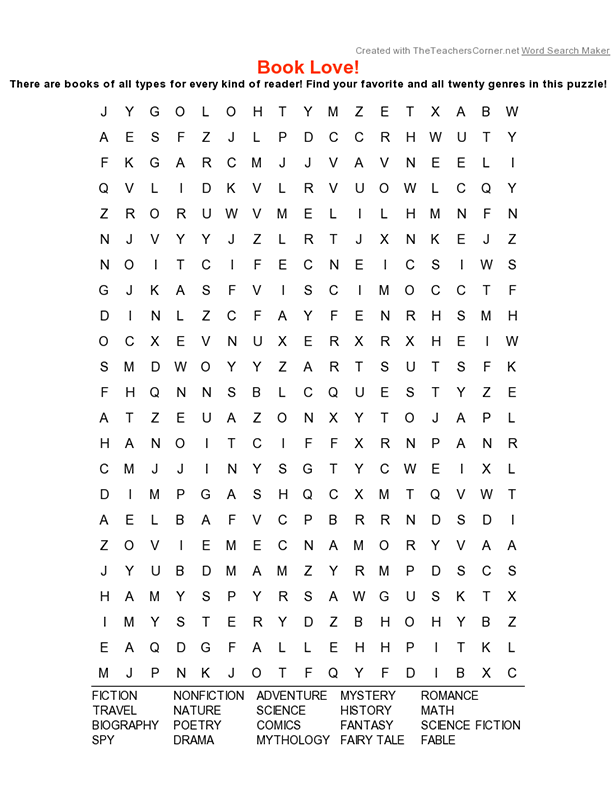
There are all kinds of books for every reader. Find your favorite along with twenty favorite genres in this printable puzzle.

Book Love! Word Search Puzzle | Book Love! Word Search Solution

celebrate-picture-books-picture-book-review-melvil-dewey-cover

You can find he Efficient, Inventive (Often Annoying) Melvil Dewey at these booksellers

Amazon | Barnes & Noble | Books-a-Million

To support your local independent bookstore, order from

Bookshop | IndieBound

Picture Book Review


December 9 – Read a New Book Month

celebrate-picture-books-picture-book-review-the-polio-pioneer-cover

About the Holiday

The month of December is a gift-giver’s delight and looking at the long winter ahead there’s no better gift for everyone on your list than a book (or two or…). With so many new books hitting bookstore shelves, there really is a perfect book to fit everyone’s taste. Young children, especially, benefit from reading a wide range of picture books from laugh-out-loud or touching stories to nonfiction that introduces them to influential people, science, history, and—in a case like today’s book—to all three! Today’s reviewed book also has the distinction of being timely and inspirational. If you’re still looking for gifts to give, it’s not too late to head to your local bookstore or their online shop to find books that will make kids’ eyes light up.

Thank you to Knopf Books for Young Readers for sending me a copy of The Polio Pioneer for review consideration. All opinions about the book are my own. I’m happy to be teaming with Knopf in a giveaway of the book. See details below.

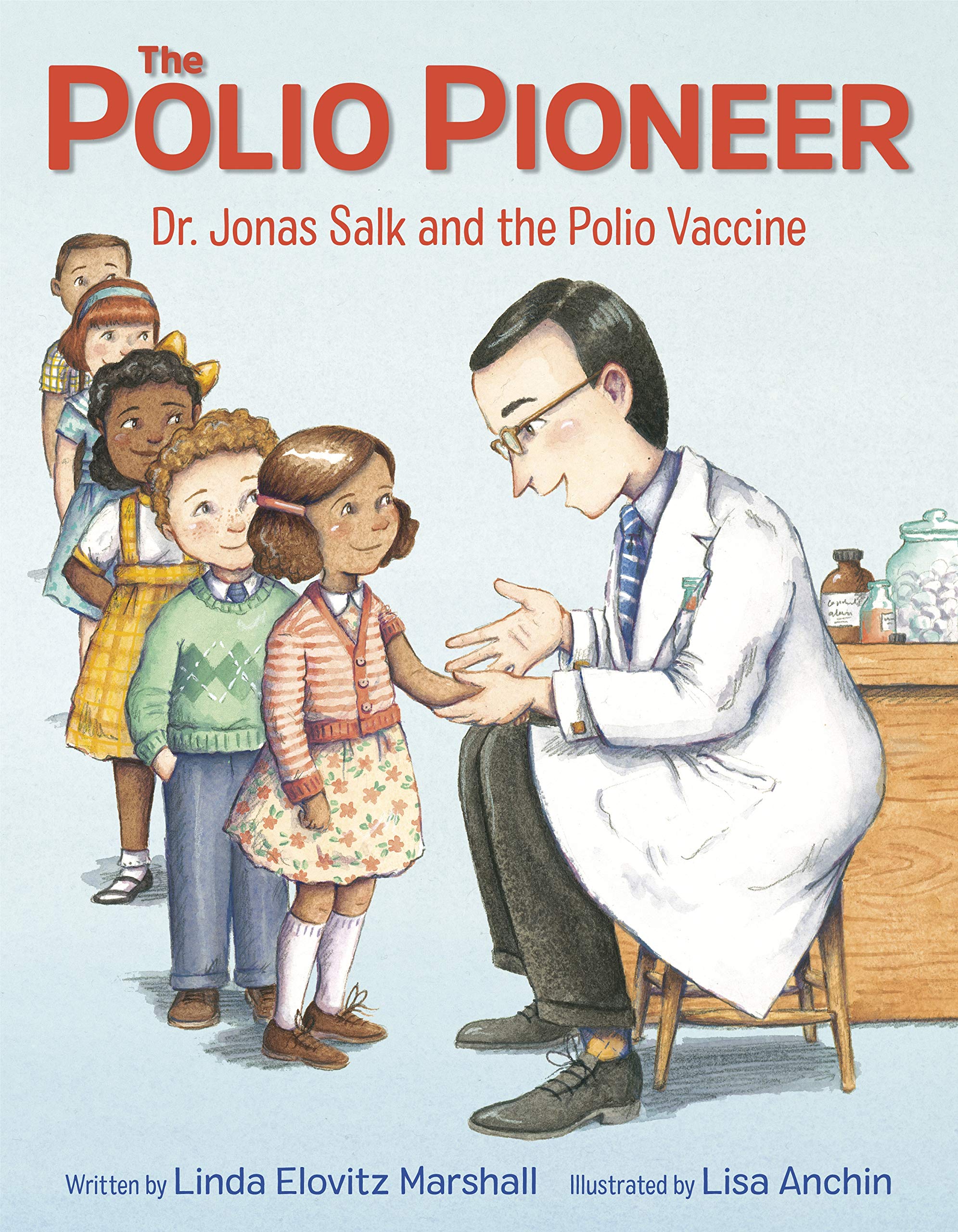
The Polio Pioneer: Jonas Salk and the Polio Vaccine

Written by Linda Elovitz Marshall | Illustrated by Lisa Anchin


Even at the tender age of four, “Jonas Salk was a kid who saw things differently.” As he watched the soldiers marching in the victory parade in New York City following World War I, instead of cheering, he was saddened by all of the injured and wounded men he saw. In his free time, instead of playing ball or games with his friends, he read book after book, and yet he was the one the other kids came to when they needed a fair and knowledgeable referee. Jonas’s family had moved to America, fleeing religious persecution of Jews in Russia and Lithuania. Money was short, yet Jonas’s parents “taught their children the importance of education, of kindness, and of doing good works. Jonas prayed that he might, someday, help make the world a better place.”

celebrate-picture-books-picture-book-review-the-polio-pioneer-parents

Image copyright Lisa Anchin, 2020, text copyright Linda Elovitz Marshall, 2020. Courtesy of Knopf Books for Young Readers.

In college Jonas became enthralled with the study of chemistry and its use in making medicines. He went on “to medical school to become a doctor and researcher.” After graduation, he joined Dr. Thomas Francis in developing a flu vaccine. They had an idea for a new kind of vaccine that could help a “person’s body ‘practice’ fighting the flu” with the hope that the person’s body would “learn to fight the flu virus… and WIN.” After much research and work, they succeeded.

But there was a disease worse than the flu that was paralyzing or killing thousands every year—“including many babies and small children.” Even future President Franklin Delano Roosevelt was affected and required a wheelchair to get around. Not fully knowing how the polio virus spread, public swimming pools and beaches were closed. “Parents kept children away from movie theaters, sleepovers, and crowds.”

celebrate-picture-books-picture-book-review-the-polio-pioneer-roosevelt

Image copyright Lisa Anchin, 2020, text copyright Linda Elovitz Marshall, 2020. Courtesy of Knopf Books for Young Readers.

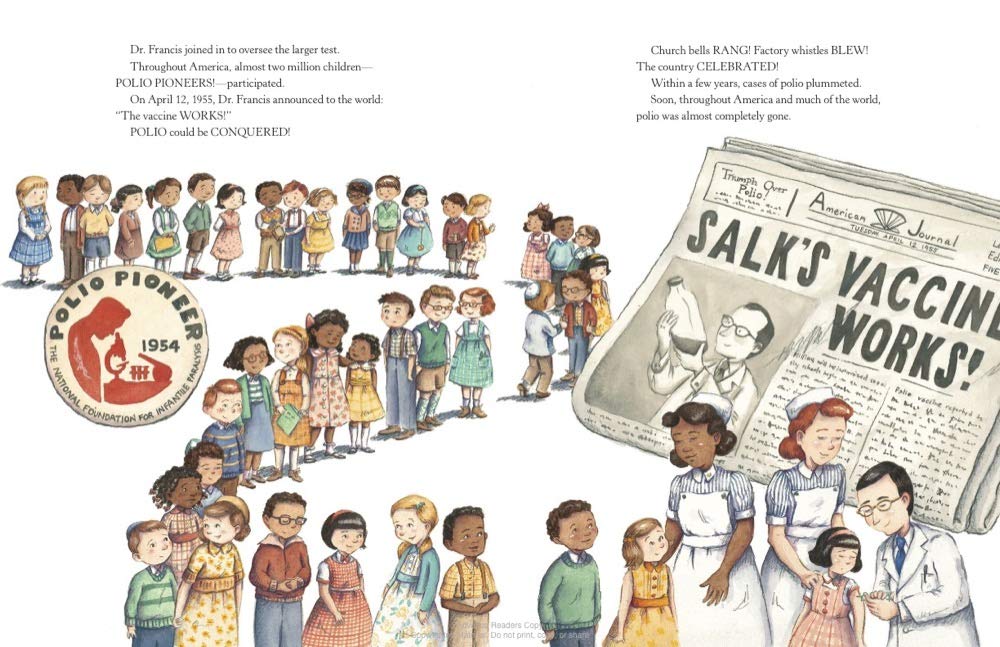
Dr. Salk believed a polio vaccine could prevent the disease. He and his team of scientists worked tirelessly to develop one. When a viable vaccine was made, they tested it on children in Pittsburg, Pennsylvania. Dr. Salk gave “many of the shots himself.” The vaccine did seem to help defend the body from polio, but could it prevent it? To learn the answer to that question, a larger trial was needed. “Throughout America, almost two million children—POLIO PIONEERS!—participated.” Then on April 12, 1955 the world learned that Dr. Salk’s vaccine could indeed conquer polio.

“Within a few years, cases of polio plummeted,” and soon it was nearly eradicated from America and most areas of the world. But polio was not the only disease that Dr. Salk wanted to eliminate. He continued to work and test and dream. Then in California, Jonas Salk established the Salk Institute for Biological Studies, where “researchers question and discover, seeking cures for cancer, HIV/AIDS, diabetes, multiple sclerosis, and many other diseases.” All of this good stemmed from a little boy “who saw things differently.” Perhaps you know a child like that too.

An Author’s Note from Linda Elovitz Marshall follows the text and describes her own experiences as a young child growing up with the fear of polio as well as what inspired her biography of Jonas Salk. Images of letters children sent to Dr. Salk thanking him for his life-changing vaccine are also included.
celebrate-picture-books-picture-book-review-the-polio-pioneer-vaccine-trial

Image copyright Lisa Anchin, 2020, text copyright Linda Elovitz Marshall, 2020. Courtesy of Knopf Books for Young Readers.

Linda Elovitz Marshall’s compelling biography of Jonas Salk, begun many years before the COVID-19 pandemic, reminds young readers—many of whom may also be dreamers like Dr. Salk—that their impressions, feelings, and unique view of the world can make valuable, even indispensable, contributions to the world. Marshall’s introduction of Jonas Salk as a serious, curious, intelligent, and caring child—even very young child—will impress readers with his life-long commitment to helping others and inspire their own good works. Her straightforward storytelling reveals to children a time with fears and hopes similar to their own recent experiences—an eye-opening history that offers context and hope and demonstrates the value of science not only for today but as a glimpse into the past and a light for the future. Through excellent pacing and well-chosen details, Marshall gives readers a sense of the urgency researchers, parents, and the public felt as polio raged and intensifies the suspense as Dr. Salk and his team race to find a vaccine for this dreaded disease. 

The parallels of today’s COVID-19 pandemic to the ravages of polio make The Polio Pioneer a unique teaching tool for parents, teachers, librarians and other caregivers for discussing viruses, how epidemics and pandemics occur, the role of doctors and researchers around the world in developing vaccines to combat them, and the importance of getting vaccinated.

Children curious about their peers from the past as well as how science and new ideas in history have transformed today’s medicine will find much to marvel at in Lisa Anchin’s realistic illustrations. Readers, familiar with modern scientific technology and laboratories, may be astonished at illustrations of a lab in the 1950s, where simple bottles, plastic tubing, and stacks of test tubes were the latest tools of the trade. They’ll enjoy comparing these earlier illustrations to a later spread showing scientists currently at work at the Salk Institute. Readers will empathize with images of children restricted to their homes, and a later illustration of a diverse group of children lined up to receive an experimental vaccine as part of the country-wide trial will impress them with the knowledge that kids just like them were instrumental in conquering polio for themselves and future generations.

The Polio Pioneer: Dr. Jonas Salk and the Polio Vaccine is a superb and timely book for teachers and parents to introduce children to one of the world’s great scientific thinkers and lifesaving doctors. The story also gives adults a way to discuss the COVID-19 pandemic and how vaccines are developed and work that will resonate with kids. A superb addition to STEM curriculum that will inspire future researchers and doctors, the book is a highly recommended for home libraries and a must for school and public libraries.

Ages 4 – 9

Knopf Books for Young Readers, 2020 | ISBN 978-0525646518

Discover more about Linda Elovitz Marshall and her books on her website.

To learn more about Lisa Anchin, her books, and her art, visit her website.

Meet Linda Elovitz Marshall

4I9A0399_final2 MPL FNL small

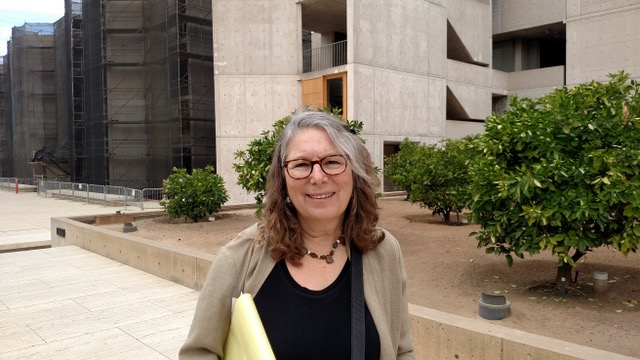
Linda Elovitz Marshall grew up near Boston, graduated from Barnard College, and raised four children and a flock of sheep on a farm in the Hudson River Valley. The author of several picture books, Linda still lives on the farm with her husband, Bob. To learn more, visit LindaMarshall.com.


I’m thrilled to be talking with Linda Elovitz Marshall today about this year’s cornucopia of books, her personal connection with The Polio Pioneer and how the book came to be, and her love of research.

2020 has been an amazing year for you with five books published—Saving the Countryside: Beatrix Potter and Peter Rabbit, Shalom Bayit, Have You Ever Zeen a Ziz?, Anne Frank: The Girl Heard Round the World, and The Polio Pioneer! Can you talk a little about each of your books? Did you conceive of them around the same time or have some been percolating longer than others?

Thank you very much for interviewing me, Kathy. What a year this has been! Hopefully, we’ll have a vaccine widely available soon and can return to being with people we love and doing things we love to do.

Still, in this midst of it all, having all these books come out has definitely kept me busy and kept my spirits up. I’m very thankful for that. I’m thankful, too, to be part of the wonderful community of children’s writers.

About the books…

The idea for THE POLIO PIONEER: DR JONAS SALK AND THE POLIO VACCINE came because Jonas Salk, who lead the team that discovered the polio vaccine, was a hero to me and many in my generation. That, coupled with the realization that people would soon forget about the once-dreaded disease polio – inspired me to write the book.
celebrate-picture-books-picture-book-review-the-polio-pioneer-linda-elovitz-marshall-interview-salk-institute

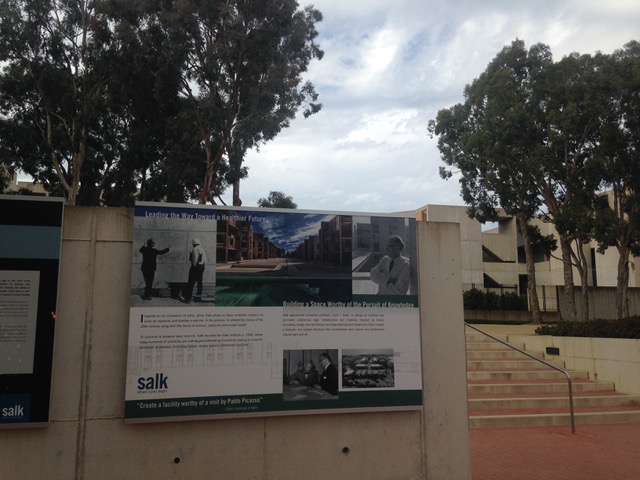
The Salk Institute for Biological Studies, La Jolla, California
celebrate-picture-books-picture-book-review-the-polio-pioneer-linda-elovitz-marshall-headshot

My research began back in 2016 when I’d told a friend of mine—a scientist who had just moved east from California—that we were planning a trip to La Jolla. I asked him what to do there. When he mentioned the Salk Institute, I told him that Salk was one of my heroes. That conversation led to my getting a tour of the Institute. The people at the Salk Institute were so very helpful… and helped me get my research off to a wonderful beginning.

celebrate-picture-books-picture-book-review-shalom-bayit-coverSHALOM BAYIT: A PEACEFUL HOME (KarBen/Lerner 2020) was inspired by a project I did decades ago about how people live. I’ve come to believe that each home, whether small or grand, has the potential to be sacred space in its own way. A few years ago, a project that my synagogue did called the Jewish Home Project gave me the impetus to write the story. The book may have a specifically Hebrew title—the words mean “Peace in the Home”—but the concept in universal. We all need a sacred space, a place to feel safe, warm, and well-fed.
celebrate-picture-books-picture-book-review-have-you-ever-zeen-a-ziz-cover

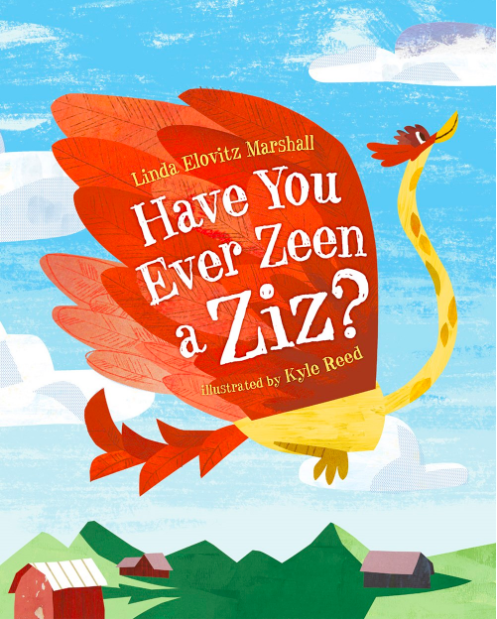
HAVE YOU EVER ZEEN A ZIZ? – This story about a mythological Jewish bird just seemed to fly into my mind. I really don’t remember how it began. I heard the word ZIZ and chuckled…and made up a poem that later became this book. In a way, it really was magical!

celebrate-picture-books-picture-book-review-anne-frank-the-girl-heard-around-the-world-cover

ANNE FRANK: THE GIRL HEARD AROUND THE WORLD was suggested to me by my friend and editor (who was formerly) at Scholastic, Orli Zuravicky. She asked if I’d take on the challenge of writing about Anne Frank and how she became a writer. I was honored, but also frightened. Could I do it? Dare I try? That was back in 2017. I re-read Anne’s diary…and cried. I thought and thought about Anne and when, at last, I could feel Anne, I began writing.

celebrate-picture-books-picture-book-review-saving-the-countryside-cover

SAVING THE COUNTRYSIDE: THE STORY OF BEATRIX POTTER AND PETER RABBIT was inspired by a trip I took to England in 2018 with 11 other children’s writers and illustrators. As preparation, we each chose a writer or illustrator that we would become an “expert” on. As we visited the different writers’ homes, we shared our expertise. I chose Lewis Carroll but, in the end, it was Beatrix Potter whom I found so fascinating that I had to write about her. Beatrix was restrained by the many constraints of her day, and yet she broke loose and did what she wanted to do! She became a writer, an artist, a scientist, a sheep farmer, land conservationist, a helper to many in the countryside. She was AMAZING! I couldn’t stop myself from writing about her!

Three of your new books are biographies. What drew you to these particular people? What do you like best about writing biographies?

I love, love, love research. Also, I like to learn about a person so that I can feel what makes them tick. I want to identify—in some way—with that person about whom I’m writing.

Shortly after leaving my (not-completed) Ph.D. in Cultural Anthropology program, I began to interview people, tape-record the interviews, and write their as-told-to autobiographies. Following the interviews, I would personally transcribe each recording. It took hours! However, playing the tapes over and over would help me feel their voice and get a better sense of the interviewee. And when, at last, I had a good sense of them, I’d begin to write.

As for my choice of subjects… Anne came via a friend. Jonas Salk was a hero to me. Beatrix plopped herself in my lap.

What kind of research did you do for each of your biographies? What is one surprising thing you learned about each of your subjects while writing the books?

I’m a leave-no-stone-unturned researcher. I immerse myself in all things related to that person: books (non-fiction and fiction), movies, articles, everything. I try to get to know the time period, the sensibilities, issues, the problems of the time…I try to learn as much as I can so that I can feel that person and, for a while, carry that person inside me.

I learned that Beatrix Potter was a bit of a rebel but that she (somehow) did her rebelling quite graciously. If she had a pet that died, she boiled the animal, removed its skin, reassemble its bones, and studied its anatomy. She was a brilliant scientist and an amazing entrepreneur, too!
celebrate-picture-books-picture-book-review-the-polio-pioneer-linda-elovitz-marshall-interview-salk-institute

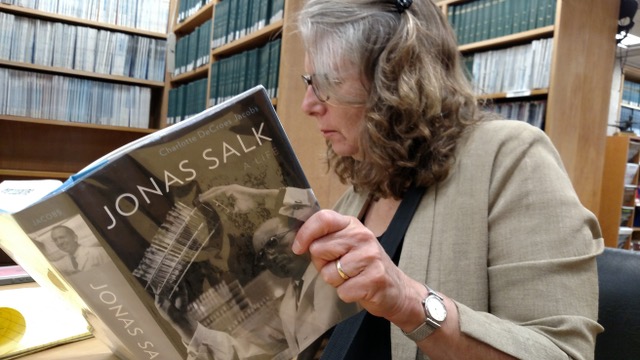
Linda Elovitz Marshall researching Jonas Salk at the Salk Institute.

I learned that, as a child, Jonas Salk thought about becoming a rabbi. Later, he decided to go into government. It was in college that he discovered chemistry…and fell in love with it! And when he and his wife were first married, he cut his own wood for the woodstove/fireplace that heated their cabin.

I also learned that Anne Frank was a lively, boisterous kid with a twinkle in her eye who loved making jokes and liked making a bit of mischief, too.

I’d like for you to talk a little more in depth about today’s reviewed book. Can you take readers on its journey from idea to publication? Why do you think it’s important for children to know about Jonas Salk?

Thank you for asking. As I mentioned earlier, Dr. Salk was a hero to me and to many of my generation. There was even a stamp issued in his honor! It was part of the Distinguished Americans series of postage stamps. When I decided to write picture book biographies in addition to my other writing, Dr. Salk—my hero—was one of the first people I chose to write about. He was someone who saw a problem, wanted to fix it, and did. He was such a hero to me and my husband that when our first son (who grew up to become a doctor) was born, my husband (also a doctor) and I named him Jonah.

When I started researching this book, years before COVID-19 came on the scene, Americans had all-but-forgotten how deadly and devastating a communicable disease could be. Sure, there was fear with recent outbreaks of diseases like Ebola, Zika, and H1N1. But with good fortune and quick action, those diseases were (temporarily, at least) brought under control and, consequently, swept off the radar. It seemed the United States had become a fairly safe place regarding communicable diseases. Then came COVID-19.

The first vaccine that Dr. Salk worked on was the flu vaccine. Worldwide, the Spanish flu had killed millions of people. More people were killed from flu than died during all of World War I. The flu vaccine that Dr. Salk and his mentor, Dr. Francis, developed is the basis of the vaccine we still use. It has saved millions of lives!

Then Dr. Salk saw another problem: polio. He wanted to solve that problem… and he did! But he didn’t stop there. After that, he opened the Salk Institute—a place to identify, study, and solve problems. As we are seeing first-hand with COVID-19, the first step is to recognize a problem. The second is to have the desire to solve them. The third is to get to work. I hope this book inspires people to do all three!

Your experiences with polio outbreaks when you were a child and today’s restrictions in response to the pandemic have direct correlations. What do you remember about those times? What would you tell children today?

I was quite young, but I remember not being allowed to go to lakes or swimming pools or even to the movies. There were many restrictions, much as there are now. Polio, however, was thought to be a disease that struck mostly young children and babies. I don’t remember not being allowed to see or hug my grandparents. On the other hand, we lived quite far from them and didn’t see them often.

What would I tell children today? Wear a mask. Wear a mask. Wear a mask. A mask helps keeps the wearer safe. It helps keep people around the wearer safe. It’s a little thing and it doesn’t hurt.

I would also like to start a public service announcement campaign about masks. Inspired by the words of former U.S. President John Fitzgerald Kennedy, “Ask not what your country can do for you; ask what you can do for your country,” this public announcement campaign would be:

MASK:

What YOU can do for your country!

Anyone want to come up with a graphic? Anyone want to help get the word out?

If we all wear masks and all work together—for our country—we can help stop this pandemic. We can each do our part. MASK: what YOU can do for your country.

And when the vaccine is ready for us to take, we need to be ready to take it…for ourselves, for our communities, for our country.

The announcement of a successful vaccine for COVID-19 has generated excitement and hope. Your descriptions of the research Jonas Salk and his team did on a flu vaccine and on the polio vaccine can inform children’s understanding of the world’s current search to develop a vaccine for COVID-19. How can adults use your biography of Jonas Salk to discuss this topic with their kids or students?

At last, we are seeing rays of sunshine, glimmers of hope. It looks like there will soon be a COVID-19 vaccine readily available. Maybe soon, COVID-19, like polio (and diphtheria, measles, pertussis, etc.), will be a preventable disease. But for that to happen, people need to take the vaccine.

This book is a wonderful teaching tool—especially with its soothing 1950’s retro look—for teaching about how a vaccine solved a problem in a previous epidemic. I’m hoping that teachers, parents, librarians, and caregivers will see the parallel and use it during COVID-19 (and, ugh, in the event that there’s yet another pandemic down the road…).

Adults can read The Polio Pioneer: Dr. Jonas Salk and the Polio Vaccine with their kids or students and talk about it. Read and talk about children around the country who took the shots. Those children, those “polio pioneers,” were heroes! By taking the vaccine, they helped save themselves—and many other people—from a devastating, communicable disease. Dr. Salk was so positive that his vaccine was safe and effective that he gave the shots to his own children!

Speaking of his children, I contacted them while I was researching this book. They’re grown up with children and grandchildren of their own. They were wonderfully helpful! If any of Dr. Salk’s children are reading this, thank you, again!

celebrate-picture-books-picture-book-review-the-polio-pioneer-linda-elovitz-marshall-interview-letter-from-child-1.  

celebrate-picture-books-picture-book-review-the-polio-pioneer-linda-elovitz-marshall-interview-letter-from-child-5

celebrate-picture-books-picture-book-review-the-polio-pioneer-linda-elovitz-marshall-interview-letter-from-child-3  

celebrate-picture-books-picture-book-review-the-polio-pioneer-linda-elovitz-marshall-interview-letter-from-child-4

Thank you letters to Dr. Salk from children who received the polio vaccine.

While you were raising your children, you lived on a farm. I’d love to hear a little more about your farm. Did the experience influence any of your books?

I raised my children on a small sheep farm in New York State’s Hudson River Valley. We had sheep, chickens, rabbits, and an occasional goat. We had dogs in the house and cats in the barn. My book, The Passover Lamb, was inspired by something that took place on our farm. The middle grade novel I’m working on is set on the farm. I also have several stories I’m working on, none of which are yet sold, that are also set on – or inspired by – the farm.

In doing a little research for this interview, I saw that you wrote a book about your father, Jerry Ellis (Gerald Elovitz), who founded Building #19—described as “New England’s laziest, messiest department store.” One joke that your dad incorporated into the store caught my eye. It was a sign at the door that read: “Wipe your feet before leaving this store.” Several of your books are based in humor. Did you inherit your sense of humor from your dad? How would you describe the humor in your books for kids?

I wish I could attribute my sense of humor to my father—he was a genius at humor and at making lemonade out of lemons. When he was completely bankrupt with three small children, a new house, and a new mortgage, he started a business that eventually became quite successful. Before that, he’d tried another business venture (selling TV’s and appliances) that failed miserably and depleted his (and the family’s) resources. When he started the new business—selling overstocked, imperfect goods, and damaged items from insurance losses—he wrote his own ads, saying he couldn’t afford to pay anyone else to write them. He even filmed his own TV commercials—using puppets because actors were too expensive! His humor helped make “America’s laziest and messiest department stores” a great success. The business eventually grew to 12 stores…and lasted almost 50 years!

Like my father, I try to add gentle humor to some of my writing. Have You Ever Zeen a Ziz? and The Mitzvah Magician are good examples of that type of humor. Sometimes, I’m serious, too. Mostly, though, I like to play with words. I also need to keep myself amused. That’s important! When I read what I wrote the day (or week or month) before and laugh out loud (assuming it was supposed to be funny), I know it’s good.

Are you working on any new projects now? Would you like to give readers a hint for what’s to come?

I’ve just put (what I hope are) the finishing touches on a picture book biography that will come out in 2022. I have another picture book bio coming out in 2023. I’ve also got another picture book coming out in 2022 or 2023. Covid-19 has changed some of the dates and the illustrators haven’t yet been selected, so I won’t say more about them yet.

I’m also working on several projects, including a middle grade novel. I’ve just completed a wonderful poetry course (taken online, of course) through Highlights. Now I have several poems brewing. I have a long list of projects as well as a list of things that are just twinkles-of-ideas, ranging from board books to adult novels. There’s no way I’ll ever finish even half of what I’m interested in doing. And the list grows longer every day!

Thanks, Linda, for this wonderful talk! Your enthusiasm for your subjects is inspiring! I wish you all the best with The Polio Pioneer and all of your books!

You can connect with Linda Elovitz Marshall on

Her website | Facebook | Twitter

The Polio Pioneer: Dr. Jonas Salk and the Polio Vaccine has been named to these “Best Books” lists!

The National Science Teaching Association Best STEM books for 2021

 The Jewish Journal Best Non-Holiday books 2020

And Kirkus calls it “An exciting, informative introduction to medical research, the work of Jonas Salk, and the man himself.”

The Polio Pioneer: Dr. Jonas Salk and the Polio Vaccine Giveaway

I’m happy to be teaming up with Knopf Books for Young Readers in a giveaway of

  • One (1) copy of The Polio Pioneer: Dr. Jonas Salk and the Polio Vaccine, written by Linda Elovitz Marshall | illustrated by Lisa Anchin

To enter:

  • Follow Celebrate Picture Books
  • Retweet a giveaway tweet
  • Reply with your hero or person you admire for an extra entry. Each reply earns one extra entry.

This giveaway is open from December 9 to December 15 and ends at 8:00 p.m. EST.

A winner will be chosen on December 16. 

Giveaway open to U.S. addresses only. | Prizing provided by Knopf Books for Young Readers

celebrate-picture-books-picture-book-review-the-polio-pioneer-cover

You can find The Polio Pioneer: Dr. Jonas Salk and the Polio Vaccine at these booksellers

Amazon | Barnes & Noble | Books-a-Million

To support your local independent bookstore, order from

Bookshop | IndieBound

Picture Book Review


December 8 – Comet the Unstoppable Reindeer Book Tour Stop

celebrate-picture-books-picture-book-review-comet-the-unstoppable-reindeer-cover

About the Holiday

I was honored to host the cover reveal of Comet the Unstoppable Reindeer on March 11 and am thrilled to be part of Jim Benton’s book tour as this story about the beloved Comet is launched around the world, just in time for Christmas. This funny and poignant book will light up Christmas-season story times with joy and themes that will be remembered all year round.

Thanks goes to Two Lions and Blue Slip Media for sharing Comet the Unstoppable Reindeer with me for review consideration. All opinions about the book are my own. I’m also thrilled to be teaming up with them in a giveaway of the book. You can find details below.

Comet the Unstoppable Reindeer

By Jim Benton


“’Twas the Night Before Christmas….” We know how this one goes, right? Or do we? Let’s see…

“’Twas the Night Before Christmas,” (so far, so good) / “a tense situation.” / “The elves had worked the whole year / without a vacation.” (Oh, rein-deer!)

It seems all this work, work, work, had left the elves in bad moods, especially Stinky and Stanky who got into it over wrapping a present. Seeing that their argument might escalate, Comet hoofed in to break it up, only to be knocked out colder than a North Pole winter. While Comet’s intervention worked as he’d hoped, when he woke up, his arm didn’t. The doctor set Comet’s broken arm in a cast. When Comet jumped up to get back to work, though, the doc gave him the bad news: “‘No dashing, no dancing, / your arm, it needs fixin’. / It will be a long time / before you’re prancing with Vixen.’” Comet was sad to miss out on the big night, but he went down to the launch anyway,  only to see that his replacement was a “rookie named Freddy.” Although the other reindeer were skeptical about Freddie’s flying prowess, they took off into the sky as usual.

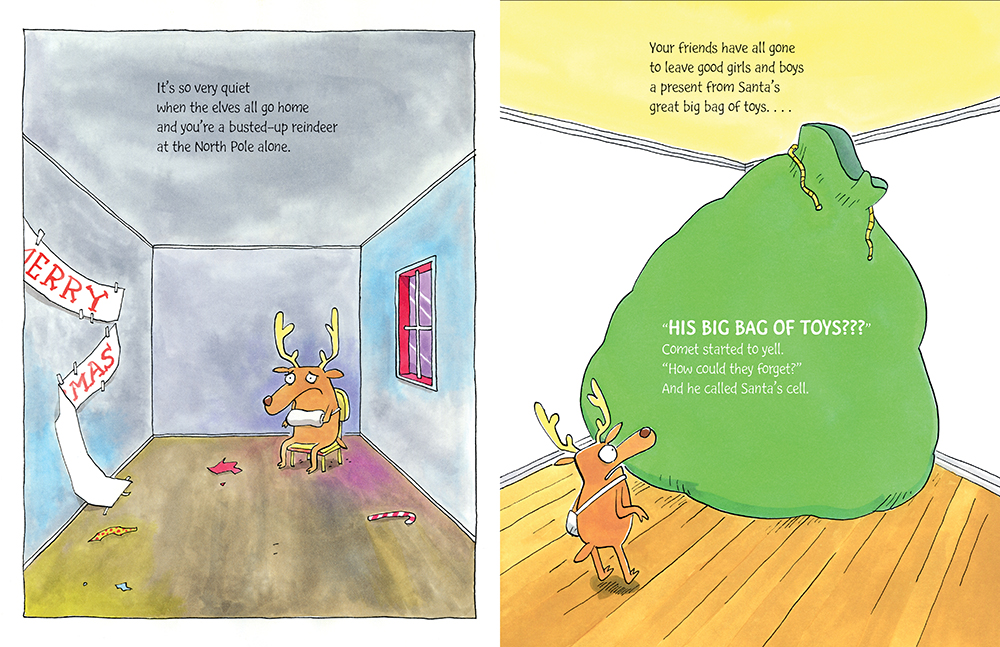
Finished for the night, the elves headed to their homes, leaving Comet in the workshop all alone. But what was THIS? There in the corner and reaching up to the ceiling was Santa’s bag of toys! Comet did what any conscientious reindeer would do: “he called Santa’s cell.” Getting no response, Comet knew Christmas was all up to him.

celebrate-picture-books-picture-book-review-comet-the-unstoppable-reindeer-toys-left

Copyright Jim Benton, 2020, courtesy of Two Lions.

Try as he might, though, Comet couldn’t lift that bag of toys. He was about to give up when he noticed a letter lying on the floor. He sat down with a mug of hot chocolate and a few plates of cookies and began to read. He was expecting the usual, but this letter was from a little boy asking for something for his sister. It said: “‘She’s too small to write, / but I know what she’d like: / a little green pig / on a little pink bike.’”

But the letter writer didn’t stop there. He added that he knew there were a lot of deserving kids in the world and told Santa it would be all right if he couldn’t bring his sister the pig, ending with “‘She won’t cry a bit. / She won’t even pout. / Just don’t wear yourself / or your poor reindeer out.’” By the time he’d finished reading, Comet had tears in his eyes. No one had ever considered the reindeer before. Comet looked up, up, up at that heavy, heavy bag and saw at the top… “that little green pig.” Comet thought about that bag and his broken arm, and then, with only one reservation, “he hefted that bag / like a brave little fighter. / ‘Would it kill kids to ask / for some toys that are lighter?’”

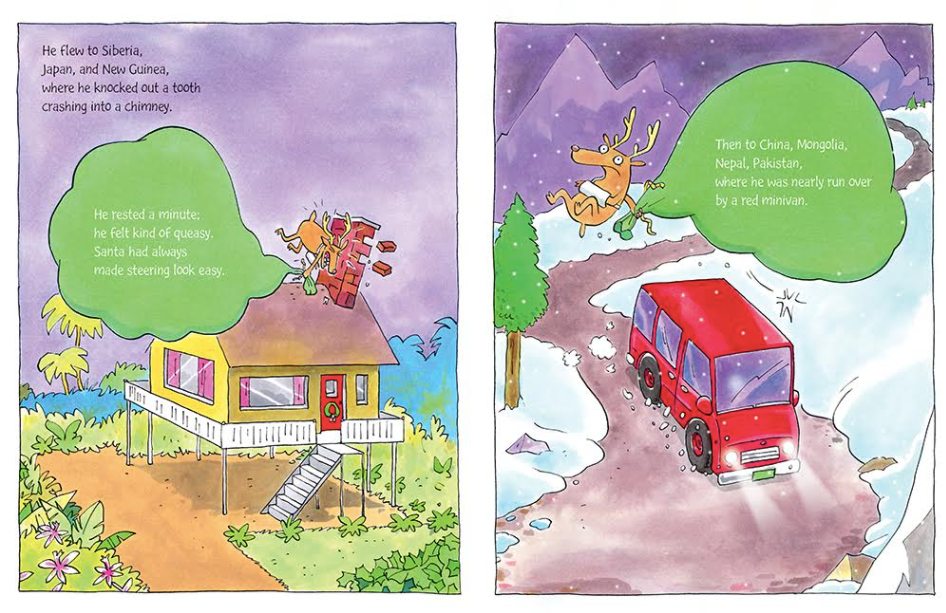
So Comet took to the sky, carrying that sackful of toys, and touched down in countries from East going West. His travels were fraught with mishaps aplenty. After losing a tooth and getting nearly run over, he flew “on to Egypt and Sweden, / Italy and France, / where he scraped up his butt / (‘cause he didn’t wear pants).” Trips to every city in the world, along with a few more painful encounters, brought Comet no closer to finding the yellow house with a blue roof where the boy and his sister lived.

Comet consulted his map once more and a single tear dropped onto a place he realized he’d missed. He reached the yellow house just as the sun was rising over the horizon and slipped down the chimney. There he was met by the little boy and his sister. Just as he was handing them their gifts, the “phone gave a jingle. / ‘I’ll get it,’ said Comet. / ‘I’ll bet it’s Kris Kringle.’” And it was with many thank-yous and “‘a vacation,’ said Santa. / ‘Can the elves have one too?’ / asked Comet, who knew that’s / the right thing to do.’”

celebrate-picture-books-picture-book-review-comet-the-unstoppable-reindeer-chimney

Copyright Jim Benton, 2020, courtesy of Two Lions.

Laugh-out-loud funny and with a message about going above and beyond for family and friends, Comet the Unstoppable Reindeer will become a kid-favorite in any house for Christmas and throughout the year. Comet’s misadventures on his travels around the globe are slapstick gems kids will want to hear over and over. Adults will also find themselves “Ho-ho-hoing” at Jim Benton’s bouncy rhymes and funny wordplay as well as Comet’s hilarious thoughts that echo ones we’ve all had at one time or another. Amidst all the fun, too, is a heartfelt story about thinking of others, kindness, and the true meaning of giving that will impress and cheer kids.

Benton’s expressive, madcap cartoon illustrations will have kids giggling at the overworked elves wrapping presents with fatigued, bored expressions, the goofy reindeer (especially Freddy), and Comet’s valiant efforts to lift the enormous bag. Images of Comet’s accidents and near misses will be met with guffaws. Benton’s illustrations also show many examples of empathetic kindness, deep appreciation, and unstoppable perseverance that will resonate with kids beyond the holiday season.

Sure to be asked for again and again on its way to becoming a Christmas tradition, Comet the Unstoppable Reindeer would make a perfect pre-holiday gift for your own family or any child. The book will be a favorite addition to home, school, and public library collections.

Ages 3 – 8

Two Lions, 2020 | ISBN 978-1542043472

Jim Benton Photo

Jim Benton is the award-winning creator of the New York Times bestselling series Dear Dumb Diary and Franny K. Stein as well as the popular It’s Happy Bunny brand. His books have sold more than fifteen million copies in twenty-five countries and have garnered numerous honors. Like Comet, Jim knows what it’s like to hobble around in a cast; however, he is still learning to fly. Find out more about him at www.jimbenton.com.

You can connect with Jim Benton on Facebook | Instagram | Twitter

Comet the Unstoppable Reindeer Book Tour Activity

celebrate-picture-books-picture-book-review-reindeer-puzzle

Reindeer Teams Match-Up Puzzle


Match the two-member reindeer teams so they can help Santa in this printable puzzle!

Reindeer Teams Match-Up Puzzle

celebrate-picture-books-picture-book-review-comet-the-unstoppable-reindeer-cover

You can find Comet the Unstoppable Reindeer at these booksellers

Amazon | Barnes & Noble | Books-a-Million

To support your local independent bookstore, order from

Bookshop | IndieBound

Picture Book Review


December 7 – It’s Read a New Book Month

celebrate-picture-books-picture-book-review-latkes-for-santa-claus-cover

About the Holiday

With so many gift-giving opportunities this month, December is the perfect time to discover new books for any age! Whether you’re sharing the fun or traditions of a holiday, adding to a favorite series, looking to inspire with nonfiction, or buying a baby their first book, the delight, wonder, and shared experiences of reading offers is one of the best presents you can give. This month visit or order from your local independent bookstore to pick out special books for the loved ones on your list. (And don’t forget to treat yourself!)

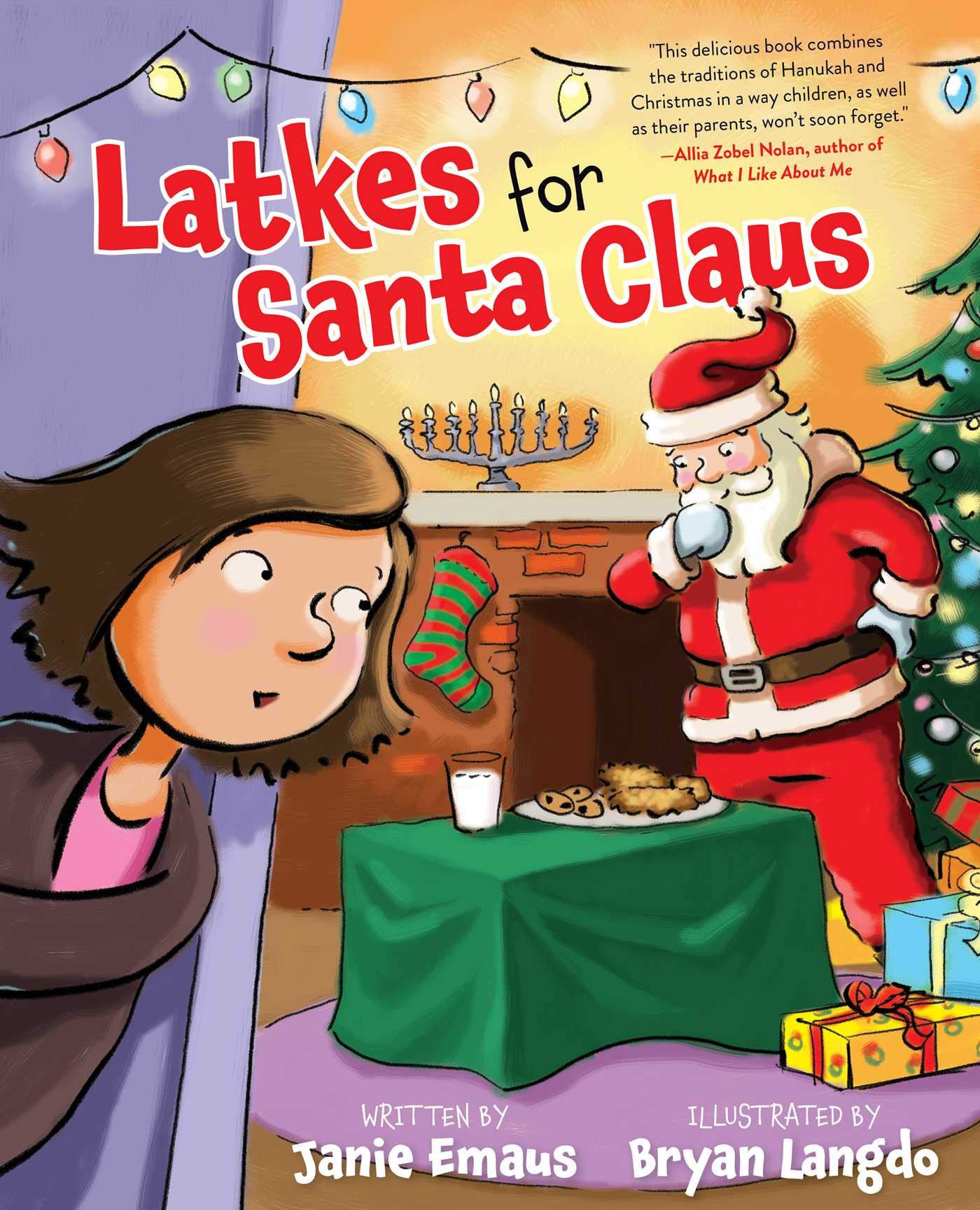
Latkes for Santa Claus

Written by Janie Emaus | Illustrated by Bryan Langdo


Anna was composing an email to Santa, letting him know her house would be a new stop on his route since her new dad and stepbrother celebrated Christmas. She promises him that she’s going to leave him “the best Santa treat ever.” Hearing this, Anna’s brother Michael countered that his cookies were “the best Santa treat ever.” In the kitchen, Michael invited Anna to help him bake, but she was trying to think of something better than cookies.

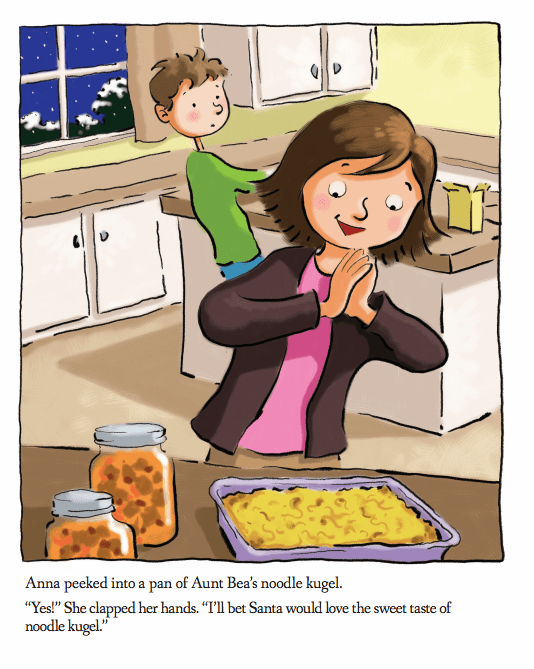
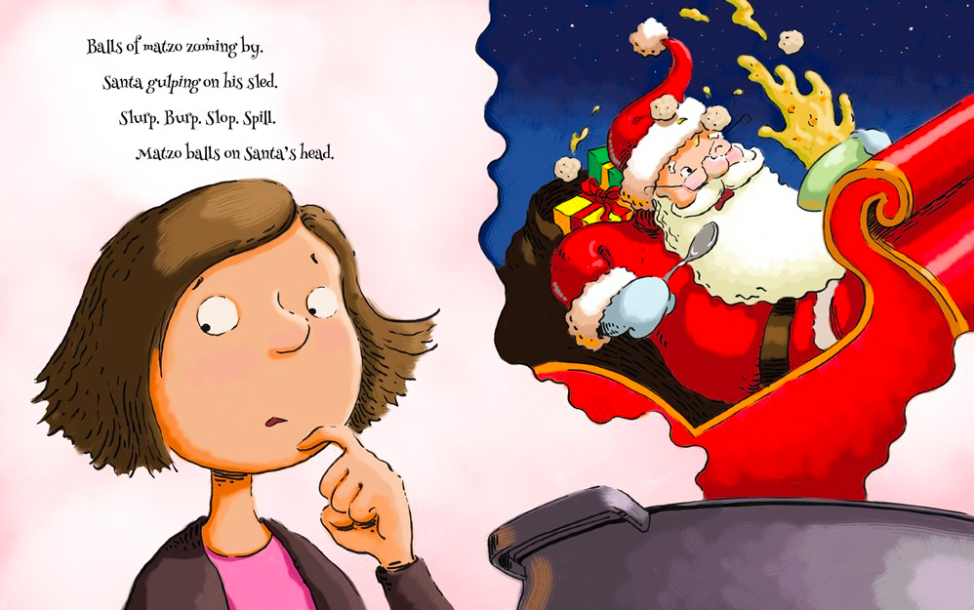
Her mom was making Bubbe Sadie’s. matzo ball soup, and the aroma made Anna think this would make the perfect snack for Santa. But Michael reminded her that Santa needed finger food, and she imagined “Santa gulping on his sled. / Slurp. Burp. Slop. Spill. / Matzo balls on Santa’s head.” That would never do, she thought. Then she spied Aunt Bea’s noodle kugel on the counter and knew the “sweet taste of noodle kugel” would be just the thing.

His sugar cookies finished, Michael had moved on to making the oatmeal cookies he said Santa loved. He mentioned that Santa wouldn’t be able to eat kugel with his fingers, and Anna pictured him trying with disastrous results. How about Aunt Sarah’s delicious tzimmes root vegetable stew. But was it finger food? Michael didn’t think so. And Santa so loved his chocolate chip cookies. “Anna imagined— A bowl of stew zipping by. / Santa spooning on his sled. / Slurp. Burp. Slop. Spill. / Gobs of stew on Santa’s head.”

celebrate-picture-books-picture-book-review-latkes-for-santa-claus-noodle-kugel

Image copyright Bryan Langdo, text copyright Janie Emaus, 2020. Courtesy of Sky Pony.

Anna went off to think about the perfect treat, and finally it came to her. In fact, her mom had just made a batch. She went to the kitchen, put some on a plate, and hid them for later. That night she stayed awake until the house was silent. Then she snuck into the pantry and placed four latkes on the plate with Michael’s cookies. This time she imagined Santa happy and satisfied as he nibbled on the latkes. “The wind whistled Christmas songs. The stars twinkled like Hanukkah lights” as Anna waited to hear Santa’s reindeer land on the roof. She just closed her eyes for a second… and then Michael was waking her up on Christmas morning.

They ran downstairs and were excited to find that not only had Santa taken all of Michael’s cookies, he’d also grabbed all of Anna’s Latkes. Just then there was a familiar bing from the computer. Anna found an email from Santa saying how much he’d loved her latkes and was already looking forward to next year’s treat. He’d boasted about them so much, in fact, that Mrs. Clause wanted Anna’s recipe.

Reading this, Michael decided that maybe cookies were kind of boring after all, and suggested Grandma Linda’s lemon jello. Was that a finger food? Anna didn’t think so, but she was sure they could come up with something Santa would love. After all, they had a whole year to think about it.

Recipes for Grandma Sylvia’s Potato Latkes and Santa’s Sprinkled Sugary Shapes follow the story.

celebrate-picture-books-picture-book-review-latkes-for-santa-claus-matzo-ball-soup

Image copyright Bryan Langdo, text copyright Janie Emaus, 2020. Courtesy of Sky Pony.

Janie Emaus’s original story focused on a favorite part of Christmas Eve traditions—Santa’s snack—presents a clever and inclusive way for blended families to celebrate the joys of Hanukkah and Christmas together. Through Anna’s humorous imaginings of Santa trying to eat matza ball soup, kugel, and tzimmes, Emaus offers readers funny rhyming verses with repeated phrasing that kids will love to chime in on, especially “Slurp. Burp. Slop. Spill.” Michael and Anna’s sibling rivalry over the snack is good-natured and shows how this new brother and sister pair are quickly becoming a team. The list of traditional Jewish dishes will excite kids who already love them and entice those who aren’t to try them. Anna’s impressions of the world outside her window on this special night invite readers to embrace both of these meaningful holidays and those who observe them.

In Bryan Langdo’s vibrant and engaging illustrations, Hanukkah and Christmas reside side-by-side, just as Anna and Michael do. A menorah is prominently displayed on the fireplace mantle and Michael spins a dreidel while Christmas lights line the walls and a Christmas tree stands lit and decorated nearby. When the kids take to the cozy kitchen, Anna’s grandmother stands at the stove stirring a large pot of matza ball soup. The banter between Michael and Anna over Santa’s treat ushers in vivid and giggle-inducing images of Santa trying to spoon up splashing soup, dodging flying bowls of kugel, and finally wearing the bowl of stew on his head all while attempting to steer his sleigh. Sketched with a light touch, Langdo’s characters are charming and warm, and Anna and Michael are delightful siblings to carry this story about acceptance and family love.

A fun and inclusive story for Hanukkah and Christmas celebrations and to celebrate the joys of family, Latkes for Santa Claus would make an excellent gift for pre-holiday story times and baking and a charming addition to home, school, and public libraries for any time of the year.

Ages 3 – 6

Sky Pony, Simon & Schuster, 2020 | ISBN 978-1510759886

Discover more about Janie Emaus and her books on her website.

To learn more about Bryan Langdo, his books, and his art, visit his website.

Read a New Book Month Activity

Screen Shot 2020-12-06 at 7.29.26 PM

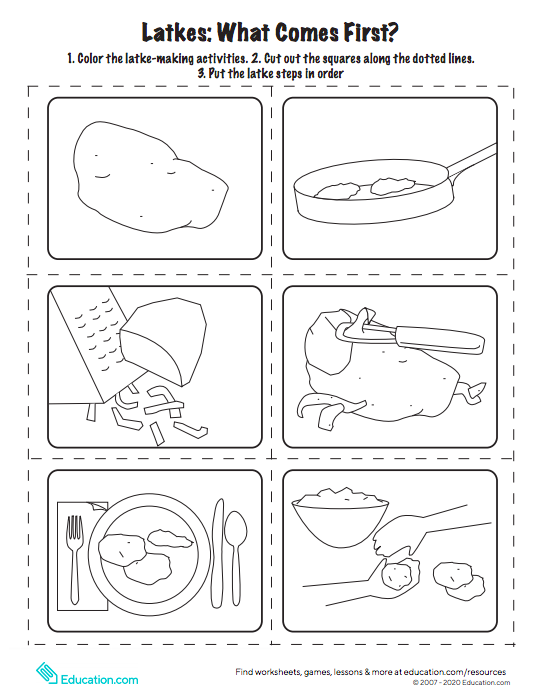
Make Latkes for Santa


With this coloring sheet and puzzle, you can put together a plate of latkes for Santa – or yourself!

Make Latkas for Santa Coloring Page

celebrate-picture-books-picture-book-review-latkes-for-santa-claus-cover

You can find Latkes for Santa Claus at these booksellers

Amazon | Barnes & Noble | Books-a-Million

To support your local independent bookstore, order from

Bookshop | IndieBound

Picture Book Review