March 3 – World Wildlife Day

celebrate-picture-books-picture-book-review-galapagos-girl-cover

About the Holiday

In December of 2013 the United Nations General Assembly proclaimed March 3rd as World Wildlife Day to promote awareness of our environment and the dangers to it. Every year a different theme is chosen to spotlight an area of the world, a particular species, or a group of activists. This year’s theme is “life below water for people and planet” and focuses on marine species, the importance of marine wildlife, and the issues affecting the health and survival of the ocean and ocean creatures. The day also celebrates successful conservation and sustainability initiatives. To learn more about the day, special events, and how you and your kids can get involved today and throughout the year, visit the World Wildlife Day website.

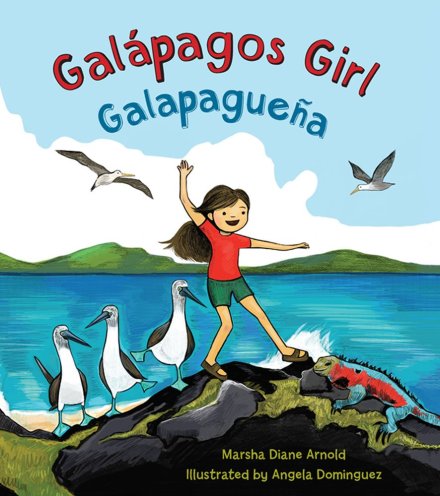
Galápagos Girl / Galapagueña

Written by Marsha Diane Arnold | Illustrated by Angela Dominguez | Translated by Adriana Dominguez


On the day when baby Valentina joined Mamá, Papá, and eleven brothers and sisters, even the sea lions, blue-footed boobies, and iguanas seemed to welcome her to the “island formed by fire.” Valentina loved growing up on the Galápagos Island of Floreana. She explored the lava rocks, where Sally Lightfoot crabs scuttled back and forth. She swam with dolphins and manta rays, and even played with penguins.

celebrate-picture-books-picture-book-review-Galápagos-Girl-crabscelebrate-picture-books-picture-book-review-Galápagos-Girl-crabs

Image copyright Angela Dominguez, 2018, text copyright Marsha Diane Arnold, 2018. Courtesy of Lee & Low Books.

“Valentina watched pink flamingoes wading near mangroves. Blue butterflies fluttering on the breeze. Red-and-green iguanas sneezing salt like tiny geysers.” The crashing waves, albatross, and finches created a symphony as Valentina stopped to rest on a grassy cliff overlooking the ocean. The lava lizards, blue-footed boobies, and twirling sea lions provided young Valentina with a variety of dance partners.

celebrate-picture-books-picture-book-review-Galápagos-Girl-iguana

Image copyright Angela Dominguez, 2018, text copyright Marsha Diane Arnold, 2018. Courtesy of Lee & Low Books.

At home, Valentina’s family shared their home with two giant tortoises—Carlitos and Isabella. One day Papá told Valentina their story as they fed the tortoises plums that had fallen from their backyard trees. Papá had gotten Carlitos and Isabella from a friend when he first moved to Floreana. Although it was nearly impossible to imagine now that the tortoises were grown, at the time they were so small that they fit into Papá’s pockets.
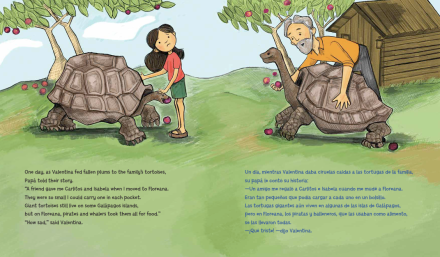
celebrate-picture-books-picture-book-review-Galápagos-Girl-tortoises

Image copyright Angela Dominguez, 2018, text copyright Marsha Diane Arnold, 2018. Courtesy of Lee & Low Books.

There was also a sad note to Papá’s story. He said that while giant tortoises still lived on other Galápagos islands, pirates and whalers had wiped out the population on Floreana. Papá went on to tell Valentina that many Galápagos animals were in danger. They were “threatened by other animals that don’t belong here. Threatened by people who don’t understand how to care for our islands.” Valentina promised that she would always protect them.

When she was older, Valentina left the island to go to school. She didn’t want to leave her beautiful home, but Mamá told her that she was “ready to learn about the world beyond.” And Papá reminded her that “like our islands, you have a heart full of fire.” On school vacations, Valentina always came back to study the wildlife on the Galápagos islands. She had not forgotten her promise to keep them safe.
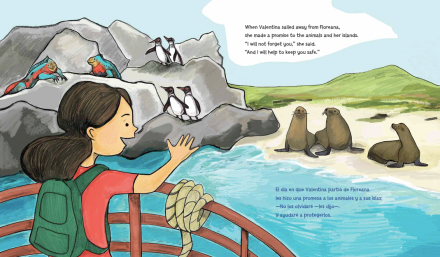
celebrate-picture-books-picture-book-review-Galápagos-Girl-going-to-school

Image copyright Angela Dominguez, 2018, text copyright Marsha Diane Arnold, 2018. Courtesy of Lee & Low Books.

After she graduated with a degree in biology, Valentina returned to the islands as a nature guide to teach visitors about the beauty and uniqueness of the Galápagos. Some visitors were even lucky enough to meet Carlitos and Isabella when the plums dropped from the trees and the two old tortoises returned from exploring Floreana to eat them. Because of Valentina’s commitment to the Galápagos, her visitors also made a promise to always remember and protect them.

Extensive backmatter includes an Author’s Note about Valentina Cruz, the tortoises Carlitos and Isabella, and the history of tortoises on Floreana. There is also information on the Galápagos as well as fun facts about all of the animals in the story. A bibliography of sources invites readers to learn more.

Each two-page spread presents the text in English and translated into Spanish by Adriana Dominguez.

celebrate-picture-books-picture-book-review-Galápagos-Girl-guiding-visitors

Image copyright Angela Dominguez, 2018, text copyright Marsha Diane Arnold, 2018. Courtesy of Lee & Low Books.

Marsha Diane Arnold’s lyrical and buoyant passages sing with the carefree joy Valentina felt as a girl exploring her beloved Galápagos and which brought her back home as a biologist to protect them. After seeing Valentina playing and swimming with the native animals and feeding Carlitos and Isabella, readers will also feel Valentina’s sadness at the dangers they face and want to make a positive difference to the environment and the world around them. Arnold’s dialogue-rich storytelling highlights the personal nature of the subject and will draw children into Valentina’s world.celebrate-picture-books-picture-book-review-Galápagos-Girl-blue-footed-booby
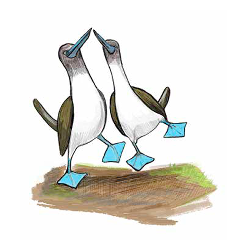
Saturated with glorious color, each of Angela Dominguez’s illustrations is a celebration of the splendor of the Galápagos. Playful sea lions, high-stepping blue-footed boobies, scampering crabs, and even a sneezing iguana will captivate young readers and inspire them to learn more about these creatures and the islands. Images of Valentina camping out to study the animals during school breaks will excite environmentally conscious kids, and pictures of Carlitos and Isabella happily munching on plums will generate smiles and “awwws.”

Galápagos Girl / Galapagueña will excite kids to learn more not only about the Galápagos region but about their own local environment, and the call to action will spark an enthusiasm for protecting the earth’s animals. The book would make an inspiring addition to home bookshelves and an excellent way to begin classroom discussions on environmental issues and science lessons. The engaging Spanish translation will delight Spanish-speaking and bilingual families.

Ages 4 – 8

Lee & Low Books, 2018 | ISBN 978-0892394135

Discover more about Marsha Diane Arnold and her books on her website.

Read an interview with Marsha Diane Arnold here.

To learn more about Angela Dominguez, her books, and her art, visit her website.

World Wildlife Day Activity
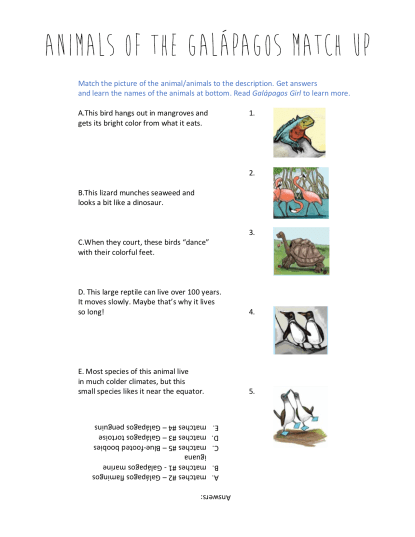
celebrate-picture-books-picture-book-review-animals-of-the-galapagos-match-up-puzzle

Animals of the Galápagos Match Up Puzzle


There are so many fascinating animals that live in the Galápagos! Can you match the picture of each animal to its description in this printable Animals of the Galápagos Match Up Puzzle? You can find and download the activity sheet from the Lee & Low Books website:

Animals of the Galápagos Match Up Puzzle

celebrate-picture-books-picture-book-review-galapagos-girl-cover

You can find Galápagos Girl / Galapagueña at these booksellers

Amazon | Barnes & Noble | Books-a-Million | IndieBound

Picture Book Review


February 19 – It’s Bird-Feeding Month

celebrate-picture-books-picture-book-review-paddle-perch-climb-cover

About the Holiday

Have you been noticing more bird activity in your yard or neighborhood? Maybe you’ve been awakened by birdsong that you haven’t heard in many months. During February, as temperatures creep up, birds begin returning to their homes to nest and mate. But the effects of the long winter still make it hard for these little creatures to find enough to eat. Recognizing a need, John Porter created a Congressional resolution in 1994 recognizing February as National Bird-Feeding Month. One-third of Americans have backyard feeders that provide the sustenance birds need to survive when natural resources are scarce. To celebrate this month, if you have feeders make sure they are well stocked. If you don’t have a feeder in your yard, consider hanging one and enjoy the beauty and songs of the birds in your area. 

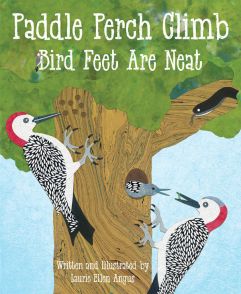
Paddle Perch Climb: Bird Feet Are Neat

By Laurie Ellen Angus


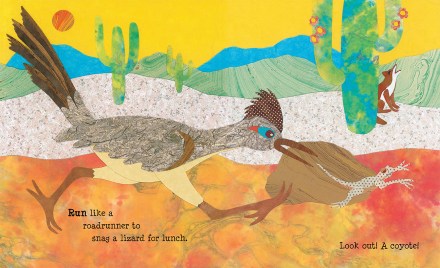
All birds get hungry, but not all birds eat the same thing, of course. Did you know that a bird’s feet are important in determining what they eat? Let’s find out how different kinds of feet help birds find the right food for them. “If you had webbing between your toes, you could… Paddle like a swan to dabble for pond plants.” Long legs and toes could help you “wade like a heron to sneak up on a school of fish.”

celebrate-picture-books-picture-book-review-paddle-perch-climb-heron

Copyright Laurie Ellen Angus, 2018, courtesy of Dawn Publications.

Birds who have long, strong legs can run and catch their dinner, and birds whose feet have sharp claws can climb tree trunks and hunt for insects in the bark. Birds with “small flexible toes” find their feet handy for perching on branches of trees and bushes to pick berries or—like towhees—to scratch in the dirt for bugs. There are also those birds that have “powerful feet with sharp talons” to snatch a meaty meal for themselves or their babies.

celebrate-picture-books-picture-book-review-paddle-perch-climb-roadrunner

Copyright Laurie Ellen Angus, 2018, courtesy of Dawn Publications.

There are many kinds of birds in the world, and each one has just the right kind of feet that help them move through their environment, find or catch food, and survive.

Extensive back matter that offers many opportunities to extend STEM learning in the classroom or at home includes

  • a detailed and illustrated exploration of each bird mentioned in the text, complete with a description of their feet and how they help the bird procure food. Kids will also enjoy learning the fun fact about each
  • A description of the bird that inspired the book
  • A discussion of adaptations, with a chart categorized with facts on habitat, feet, and beaks for seven birds and suggestions for a creative activity 
  • Common characteristics of birds
  • A discussion on predators
  • Bird-watching tips
  • More resources for further learning
celebrate-picture-books-picture-book-review-paddle-perch-climb-back-matter

Copyright Laurie Ellen Angus, 2018, courtesy of Dawn Publications.

In her engaging text, Laurie Ellen Angus takes kids out to the pond, desert, forest, and backyard to watch as a variety of birds catch or gather their dinner. Using evocative verbs, Angus reveals not only the action of getting a meal, but the way each bird goes about it—through stealth, quick motion, pecking, scratching, and more. Specific examples of bird/feet combinations give readers a starting point for further exploration. Each category also includes a partially hidden predator, such as a fox, bobcat, snake, and hawk, that the particular bird is warned about and which readers will want to join in pointing out.

celebrate-picture-books-picture-book-review-paddle-perch-climb-cardinals

Copyright Laurie Ellen Angus, 2018, courtesy of Dawn Publications.

Angus beautifully employs collage-style illustrations to give her birds and environments texture, color, and movement. Her use of various perspectives, lets readers wade into the pond with the heron, chase after the roadrunner that is trotting off the edge of page, cling to a tree trunk with a woodpecker, and come in for a landing with an owl. 

A visually stunning book, Paddle Perch Climb: Bird Feet Are Neat is a science book that will attract the attention of young learners and excite them to learn more about the wonders of the natural world.

Ages 4 – 8

Dawn Publications, 2018 | | ISBN 978-1584696131 (Hardcover) | ISBN 978-1584696148 (Paperback) 

To learn more about Laurie Ellen Angus, her books, and her art on her website.

Wild Bird Feeding Month Activity

celebrate-picture-books-picture-book-review-let's-go-birding-word-search

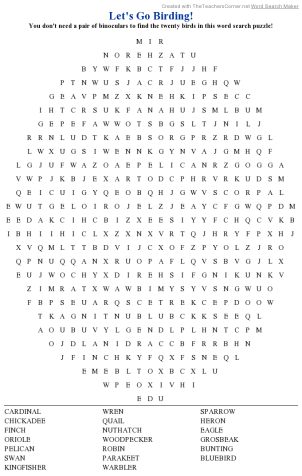
When you put up a bird feeder in your yard, you’ll see so many different types of birds come to visit! Find the names of twenty types of birds in this printable Let’s Go Birding! Word Search Puzzle.

Let’s Go Birding! Word Search Puzzle | Let’s Go Birding! Word Search Solution

celebrate-picture-books-picture-book-review-paddle-perch-climb-cover

You can find Paddle Perch Climb: Bird Feet Are Neat at these booksellers

Amazon | Barnes & Noble | Books-a-Million | IndieBound

Picture Book Review

February 7 – National Periodic Table Day

celebrate-picture-books-picture-book-review-Marie-Curie-little-people-big-dreams-cover

About the Holiday

Today’s holiday was established in 2016 by David T. Steineker, an author, inventor, and – as you might imagine – chemistry teacher at Jefferson County Public Schools in Kentucky. He devised the holiday to honor the work of categorizing the elements begun by John Newlands, who published the first periodic table on February 7, 1863, and continued into the early 20th century as new elements were discovered. While the modern periodic table has undergone few changes since then, new discoveries and different ways of approaching the table may bring fresh changes in the years to come.

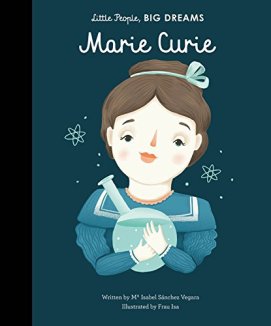
Marie Curie (Little People, Big Dreams)

Marie: My First Marie Curie (Board Book)

Written by Isabel Sánchez Vegara | Illustrated by Frau Isa


From the time when Marie was a little girl, she knew she wanted to be a scientist. Marie was very smart. “At school, she won a gold medal for her studies, which she kept in her drawer like a treasure.” Because women were not allowed to go to college in her country, she moved to France to go to the university there. Even though French was not her first language, Marie was soon the top math and science student in Paris.

celebrate-picture-books-picture-book-review-Marie-Curie-little-people-big-dreams-dreaming

Copyright Frau Isa, 2018, courtesy of Frances Lincoln Children’s Books.

One day Marie met Pierre, who loved science as much as she did. They got married and worked together in their own laboratory, where they discovered radium and polonium. “It was such a thrilling moment for science!” Marie and Pierre even won the Nobel Prize. Marie was the first woman ever to be awarded this honor. When Pierre later had an accident, Marie was left alone to continue their work.

celebrate-picture-books-picture-book-review-Marie-Curie-little-people-big-dreams-marie-and-pierre

Copyright Frau Isa, 2018, courtesy of Frances Lincoln Children’s Books.

All her research and experiments paid off when she was awarded her second Nobel Prize. When war broke out, “Marie’s discoveries were used by doctors to help injured soldiers.” Marie inspired many girls who studied science at her own institute in Paris. Besides science, Marie taught her students that there was nothing to fear, “many things to learn, and many ways to help those in need.”

A timeline and brief, yet detailed biography of her life follows the story.

celebrate-picture-books-picture-book-review-Marie-Curie-little-people-big-dreams-marie-with-noble-prize

Copyright Frau Isa, 2018, courtesy of Frances Lincoln Children’s Books.

With thrilling recognition that even in the youngest hearts beat future writers, artists, adventurers, designers, and scientists, the Little People, Big Dreams series introduces preschoolers to inspiring women role models. In Marie Curie: Little People, Big Dreams, Isabel Sánchez Vegara reveals the life and work of Marie Curie with straightforward storytelling that illuminates while affirming the intelligence of her young audience. Uplifting, life-determining personality traits that carried Marie over obstacles and to the top of her profession—such as not taking no for an answer, treasuring your accomplishments, working hard, and helping others—are highlighted for little ones to learn from.

Frau Isa’s stylish illustrations in a striking, subdued color palette will entice the youngest readers to listen and learn. While the spotlight is always on Marie, each page also focuses on one or two main images, such as Marie and Pierre’s lab table, a wounded soldier’s X-ray, and Marie holding her Nobel Prize, that help little ones see and understand the important aspects of the story.

Encapsulating both history and the timeless persistence that drives people to achieve their full potential, Marie Curie—available in both picture book and board book editions—is a must for preschool classrooms and would be a rousing addition to home bookshelves.

Ages 3 – 5

Frances Lincoln Children’s Books, 2018 | ISBN 978-1847809629 (Picture Book); 978-1786032539 (Board Book)

You can check out more about Isabel Sánchez Vegara on Instagram.

Discover more about Frau Isa and her art on her website.

National Periodic Table Day Activity

celebrate-picture-books-picture-book-review-green=pennies-experiment

Green Pennies Chemistry Experiment


You know what color pennies are! They’re those brownish coins amid all the silver. But what if you could turn those pennies green—like dollar bills? You can with this easy and way cool chemistry experiment!

Supplies

  • 10 – 12 dull pennies
  • Vinegar
  • Lemon juice
  • Salt
  • 2 small bowls
  • ¼ cup measuring cup
  • 1 teaspoon
  • Paper towels

Directions

IMG_6569

Experiment 1

  1. Pour ¼ cup vinegar into a bowl
  2. Add 1 teaspoon salt
  3. Mix thoroughly until salt has dissolved
  4. Place a few pennies in the bowl and leave for five minutes.
  5. Take the pennies out and place them on the paper towel.
  6. Let the pennies dry and watch what happens. The reaction becomes more dramatic over time, so check on your pennies at different times throughout the day

Extra Observation:

  1. To see the chemical reaction at work, dip one penny half way into the vinegar/salt solution and wait a minute
  2. Lift the penny out of the solution and see the result

IMG_6588

Experiment 2

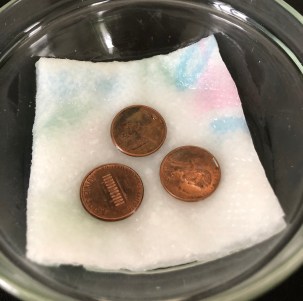
  1. Fold a paper towel to several thicknesses and place in bowl
  2. Place a few pennies on top of the paper towel
  3. Pour enough vinegar over the pennies to saturate the paper towel
  4. Wait two to three hours and see what happens
  5. You can leave the pennies in the bowl and continue to add vinegar as the paper towel dries. Flip the pennies over to create a chemical reaction on both sides

IMG_6590

Experiment with other acids, such as the lemon juice.

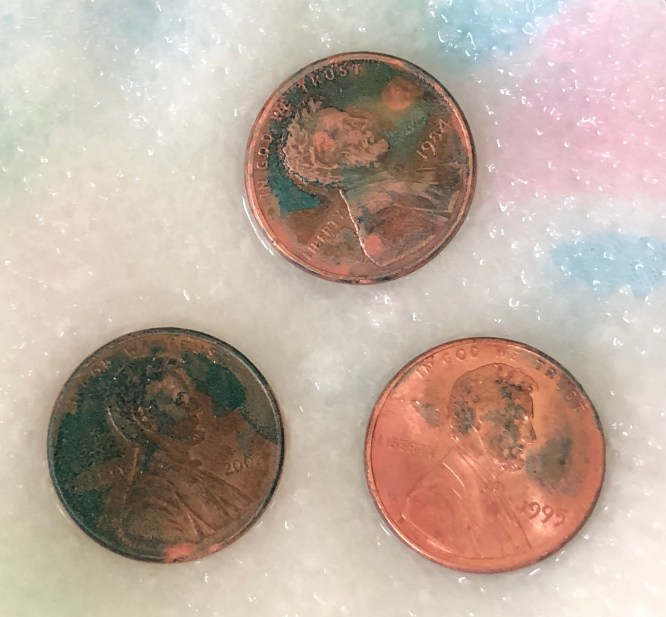
Why do the pennies turn green?

Pennies are made of copper. The vinegar and salt solution helps the copper react with oxygen in the air to form the blue-green patina of malachite on the surface of the penny. This chemical reaction is called oxidation. You can see the same green color on other things made of copper like plumbing pipes and many statues—even the Statue of Liberty!

If you’d like to record your observations of your pennies like a chemist does, download and print this lab sheet.

celebrate-picture-books-picture-book-review-Marie-Curie-little-people-big-dreams-cover

You can find Marie Curie (Little People, Big Dreams) at these booksellers

Amazon | Barnes & Noble | Books-a-Million | IndieBound

You can find the board book edition, Marie: My First Marie Curie here

Amazon | Barnes & Noble | Books-a-Million | IndieBound

YouPicture Book Review

January 17 – Kid Inventors’ Day

celebrate-picture-books-picture-book-review-the-girl-who-thought-in-pictures-cover

About the Holiday

Today’s holiday celebrates all those ingenious kids who have improved the world with their inventions. This date was chosen to commemorate another child inventor—Benjamin Franklin—who designed the first swim fins when he was just 12 years old! (Seriously, is there nothing this man didn’t or couldn’t do?). With their supple minds and can-do attitudes, kids have changed the ways things are done in the fields of medicine, technology, communications, and even food—as today’s book shows! To learn more about the day and find lots of resources, including a list of books, contests, tips, and teachers’ guides, visit the K.I.D website.

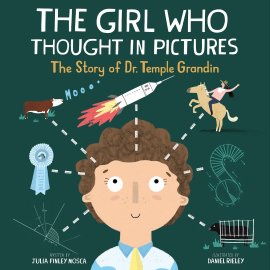
The Girl Who Thought in Pictures: The Story of Dr. Temple Grandin

Written by Julia Finley Mosca | Illustrated by Daniel Rieley


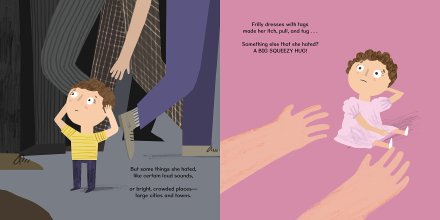
If you feel different and sometimes discouraged, the story of Temple Grandin may help you see that everyone has a talent and their own place in the world. Temple was born in Boston and “unique from the start, / an unusual girl, / she loved spinning in circles / and watching things twirl.” Loud sounds, big crowds, bright lights, and scratchy clothes disturbed her. And she did not like to get a “big squeezy hug.”

celebrate-picture-books-picture-book-review-the-girl-who-thought-in-pictures-too-loud

Image copyright Daniel Rieley, 2017, text copyright Julia Finley Mosca, 2017. Courtesy of The Innovation Press.

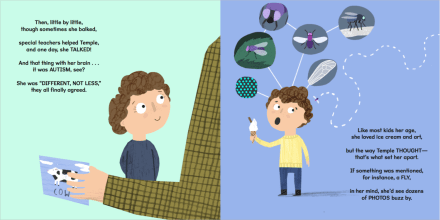
When she became overloaded with stress and frustration, Temple was known to “kick, holler, bang, shrieeeeek! Yet, still, by age three, not one word did she speak.” People told Temple’s parents that she’d never be normal and to send her away, but her mother would not hear of it. With a lot of work, special teachers helped Temple learn to talk. “And that thing with her brain… / it was AUTISM, see? / She was ‘different not less,’ / they all finally agreed.”

celebrate-picture-books-picture-book-review-the-girl-who-thought-in-pictures-doctor

Image copyright Daniel Rieley, 2017, text copyright Julia Finley Mosca, 2017. Courtesy of The Innovation Press.

While Temple was like her peers in many ways, she interacted with words differently. “If something was mentioned, / for instance, a fly, / in her mind, she’d see dozens / of PHOTOS buzz by.” Her different view point made it hard for her at school. The other kids chased her and teased her for the way that she acted and for “…saying things / over and over. / and over… / and over… / AND over.” When she had finally had enough, “she threw a book at a kid / and was kicked out of school!” No one understood Temple and Temple couldn’t understand them.

celebrate-picture-books-picture-book-review-the-girl-who-thought-in-pictures-fly

Image copyright Daniel Rieley, 2017, text copyright Julia Finley Mosca, 2017. Courtesy of The Innovation Press.

Her mother then sent her to visit her aunt, who lived on a ranch out west. Here, among the animals, Temple felt better. Her favorites were the cows, so silent and sweet. “At a NEW school that fall, / Temple found more support / said a teacher who taught her: / ‘You’ll never fall short.” That teacher was right, and at engineering and science she felt right at home.

Her first invention—made from memory—was “a machine / like she’d seen on some farms, / an INVENTION that hugged her / with boards, and not arms.” In this device she felt snug and calm, just like the cows. As she began to succeed, Temple came to see that her attention to detail was a benefit, and she began to feel special. Then she learned about farms where the cows were not treated kindly and resolved to change that.

celebrate-picture-books-picture-book-review-the-girl-who-thought-in-pictures-cows

Image copyright Daniel Rieley, 2017, text copyright Julia Finley Mosca, 2017. Courtesy of The Innovation Press.

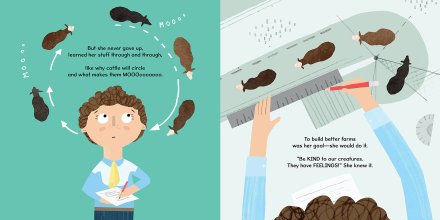
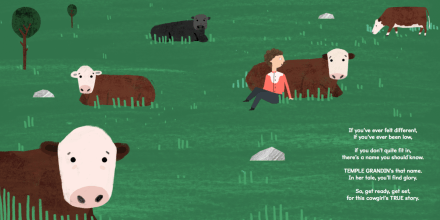
She went on to college and became an expert on farms, earning three degrees. Telling people about her ideas for farming improvements was sometimes scary because they ignored her and, well…weren’t very sweet. But she didn’t give up. She learned more about cattle, like why they circle and moo. “To build better farms / was her goal—she would do it. / ‘Be KIND to our creatures. / They have FEELINGS!’ She knew it.”

It took time, but people began to see that Temple was right, and farm after farm implemented her ideas. She won awards for this work and other ideas, a movie was made about her life, and she now travels the world telling her story and teaching: “‘Each person is special– / so UNIQUE are our minds. / This world needs YOUR ideas. / It takes brains of ALL kinds!”

celebrate-picture-books-picture-book-review-the-girl-who-thought-in-pictures-letter

Image copyright Daniel Rieley, 2017, text copyright Julia Finley Mosca, 2017. Courtesy of The Innovation Press.

A letter from Temple Grandin to young readers, extensive information about Temple and tidbits from her interview with the author, a timeline of her life, and resources follow the text.

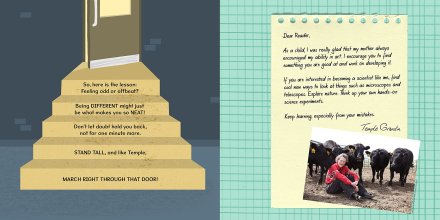
Julia Finley Mosca’s insightful biography of Temple Grandin offers inspiration and encouragement to children at those times when life seems difficult or if they feel misunderstood. Childhood can be filled with moments—both small and large, short or long—when comfort and reassurance are needed. Mosca’s rhyming verses make Temple’s story accessible to a wide age range of readers while providing an inclusive way to show how autism creates a different way of experiencing the world. Temple’s supportive teachers are role models for all educators. Temple Grandin’s fascinating life demonstrates that there is a niche for everyone and that through understanding, perseverance, and acceptance, all children can go far.

celebrate-picture-books-picture-book-review-the-girl-who-thought-in-pictures-cows-in-field

Image copyright Daniel Rieley, 2017, text copyright Julia Finley Mosca, 2017. Courtesy of The Innovation Press.

Daniel Rieley’s cartoon-style illustrations will resonate with readers as Temple takes in everything she sees with wide-open eyes and interprets it in her own way—even before she can speak. The separation between Temple and the other students at her first school is poignantly communicated in a two-page spread in which pointing hands and a lobbed ball of paper appear from the left-hand margin and Temple reads alone on the far side of the right-hand page. Temple’s ability to think in pictures is demonstrated throughout the book with inset images. Readers see some of the farming practices Temple wanted to change, her original drawings, and the resulting equipment now used on farms to improve the conditions of the animals raised there.

The Girl Who Thought in Pictures: The Story of Dr. Temple Grandin is a moving and motivational story for all children and is a must for school and public libraries.

Ages 5 – 10

The Innovation Press, 2017 | ISBN  978-1943147304 (Hardcover) | ISBN 978-1943147618 (Paperback), 2018

Discover more about Julia Finley Mosca and her Amazing Scientists series on the Amazing Scientists website.

Learn more about Daniel Rieley, his books, and his art on his website.

Kid Inventors’ Day Activity

celebrate-picture-books-picture-book-review-kid-inventors-coloring-page

Inventing Is Fun! Coloring Page


If you love to invent as much as these kids do, grab your crayons, markers, or pencils and give their lab a bit more color in this printable Inventing Is Fun! Coloring Page!

celebrate-picture-books-picture-book-review-the-girl-who-thought-in-pictures-cover

You can find The Girl Who Thought in Pictures: The Story of Dr. Temple Grandin at these booksellers

Amazon | Barnes & Noble | Books-a-Million | IndieBound

Picture Book Review

January 7 – Old Rock Day

celebrate-picture-books-picture-book-review-a-rock-is-lively-cover

About the Holiday

Do you love rocks? Are your eyes captured by the colors and patterns on the stones you see while out walking? Today’s holiday celebrates these wonders of nature and encourages geologists—both professionals and amateurs—to indulge their passion and maybe even teach others about the history and formation of rocks. To celebrate, take a walk in your area or even in your own backyard, pick up a few rocks, and research a little more about them.

A Rock is Lively

Written by Dianna Hutts Aston | Illustrated by Sylvia Long


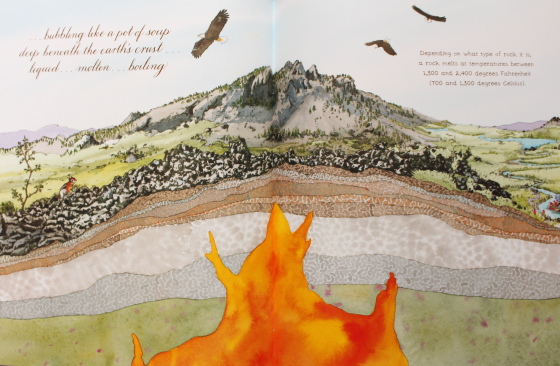
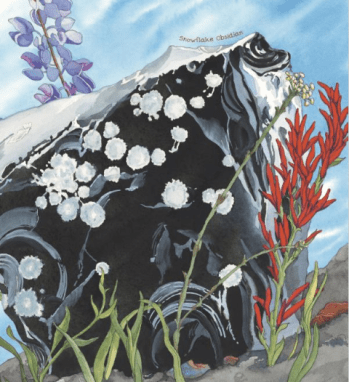
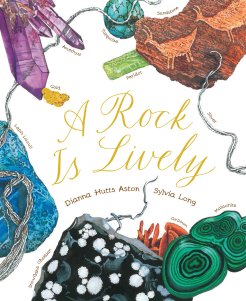
Open the cover of A Rock is Lively and before the text—even before the title—readers are treated to an array of fifty-one gemstones that dazzle the eyes. How enticing to learn about all of these natural works of art! “A rock is lively…” the text begins, arching over a shining piece of snowflake obsidian—an ebony-colored rock dotted with lacy blots. These lively rocks bubble “like a pot of soup deep beneath the earth’s crust…liquid…molten…boiling.” How hot does it need to be to melt a rock? Anywhere “between 1,300 and 2,400 degrees Fahrenheit (700 and 1,300 degrees Celsius).”

celebrate-picture-books-picture-book-review-a-rock-is-lively-lava

Image copyright Sylvia Long, 2012, text copyright Dianna Hutts Aston, 2012. Courtesy of Chronicle Books.

What happens at these temperatures? Well, like your favorite cookie recipe, “a rock is mixed up. All rocks are made of a mix of ingredients called minerals.” Take the recipe for Lapis Lazuli, for instance: “Mix the mineral lazurite with a dash of sodalite and a pinch of both calcite and pyrite. Heat within the earth until a brilliant blue.”

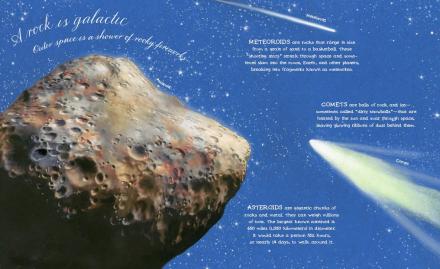
Rocks don’t exist just here on earth. Rocks are also galactic. “Outer space is a shower of rocky fireworks” made of meteoroids, comets, and asteroids. You’ll learn the differences among them here too. You probably already know that rocks are old, but how old? Billions of years old! “The oldest rocks ever found are nearly 4.5 billion years old.” Rocks are “huge…and tiny.” They are as big as a mountain reaching for the sky and as small as the grains underneath your feet.

“A rock is helpful.” Animals use rocks in many amazing ways. Some birds swallow stones to help with digestion, and some sea creatures ingest them to help keep them balanced in the water. Other animals use rocks to crack open shellfish and nuts so they can get to the goodness inside. Some rocks look plain on the outside but hold a beautiful surprise inside. Some rocks are full of colorful rainbows, others look like a starry night sky, while still others look like a white chrysanthemum or a red-and-green watermelon.

celebrate-picture-books-picture-book-review-a-rock-is-lively-galactic

Image copyright Sylvia Long, 2012, text copyright Dianna Hutts Aston, 2012. Courtesy of Chronicle Books.

From humans’ earliest days rocks have been chiseled into arrow heads and spear points, axe blades, and hammers. They’ve become mortars and pestles and are ground up today to “make cement and bricks, paper and pencils, glass, and toothpaste.” But rocks aren’t only useful, they’re creative too. Ancient peoples made paints from minerals and created colorful “pictographs on cave walls, rock shelters, and ledges.” Petroglyphs were made by chipping and pecking away at rock surfaces. As civilizations developed, so did their buildings and artwork made from stone. The pyramids were made from limestone, Stonehenge is formed from “sandstone, dolerite, and others,” the Taj Mahal and Michelangelo’s “David” are marble marvels, and Mt. Rushmore was carved from Granite.

“A rock is recycled.” Formed in three different ways, rocks are categorized as sedimentary, metamorphic, or igneous. “Over thousands of millions of years, [a rock] changes from one form to another. This is called the rock cycle,” and it keeps rocks very lively!

celebrate-picture-books-picture-book-review-a-rock-is-lively-surprising

Image copyright Sylvia Long, 2012, text copyright Dianna Hutts Aston, 2012. Courtesy of Chronicle Books.

Dianna Hutts Aston’s inventively and conversationally accessible discussion of the rocks that make up our earth and universe will enthrall any rock hound or entice the curious. Aston’s lead-in heads make for clear classification of and intriguing introductions to the various types of rocks, how they’re formed, what they look like, and how they’ve been used through history.  Her pages contain short, but very informative paragraphs that teach children about rocks through time and size comparisons they’ll understand, descriptions with familiar references, and evocative verbs and adjectives. Aston’s dynamic look at this subject will excite kids to learn more.

celebrate-picture-books-picture-book-review-a-rock-is-lively-snowflake-obsidian

Image copyright Sylvia Long, 2012, text copyright Dianna Hutts Aston, 2012. Courtesy of Chronicle Books.

Accompanying Aston’s text are Sylvia Long’s stunning illustrations that open readers eyes to the incredible beauty of each type of rock. To begin, young readers see a cut away of the rock layers beneath earth’s crust as well as the rocks that shoot across the sky. Aston shows animals using rocks in a myriad of ways as well as the tools, art, and buildings created by humans throughout history. The showstoppers are her depictions of the interior of different types of geodes, with their electric blues, reds, purples, and oranges and figures that lend the rocks their names. The double-spread pages containing fifty-one rocks with their name that introduce and end the book are a young geologist’s dream come true and will send them scurrying to discover and collect them all.

A fantastic reference, A Rock is Lively makes a terrific addition to home and classroom libraries  or a gift (pair it with a geode or small boxed rock collection) for young nature lovers and scientists.

Ages 7 – 12

Chronicle Books, 2012 (Hardcover; 2015 Paperback) | ISBN 978-1452106458

Discover more about Dianna Hutts Aston and her books on her website.

To learn more about Sylvia Long, her books, and her art, visit her website.

Old Rock Day Activity

CPB - Nasty Bugs magnet II (2)

Rock This Craft!


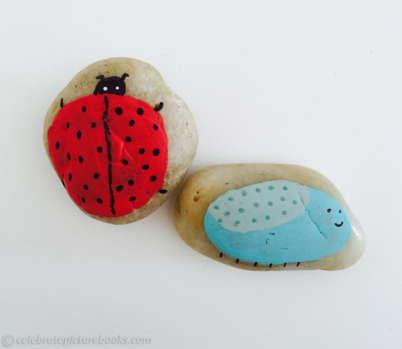
Smooth stones can give you a natural canvas for your creativity! With a little bit of paint, pins or magnets, and some imagination, you can make refrigerator magnets, jewelry, paper weights, and more!

Supplies

  • Smooth stones in various sizes
  • Paint or markers
  • Small magnets, available at craft stores
  • Jewelry pins, available at craft stores
  • Paint brush
  • Strong glue

Directions

To make magnets

  1. Design and paint an image on the stone
  2. Attach a magnet to the back with strong glue, let dry
  3. Use to hang pictures, notes, or other bits of important stuff on your refrigerator or magnetic board

To make jewelry

  1. Using a smaller, flatter stone, design and paint an image on the stone
  2. Attach a jewelry pin to the back with the strong glue, let dry
  3. Wear your pin proudly

To make a paper weight

  1. Using a large stone, design and paint an image on the stone
  2. Let dry
  3. Display and use on your desk to keep those papers in place

celebrate-picture-books-picture-book-review-a-rock-is-lively-cover

You can find A Rock is Lively at these booksellers

Amazon | Barnes & Noble | Books-a-Million | IndieBound

Picture Book Review
 

January 4 – World Hypnotism Day

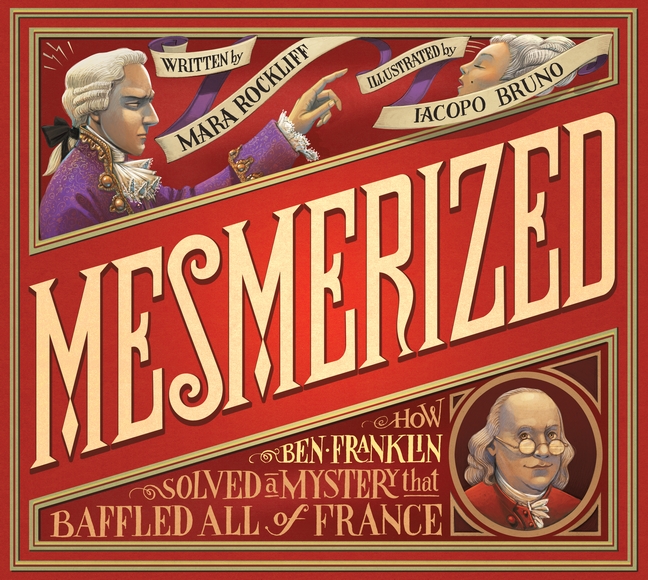
celebrate-picture-books-picture-book-reviews-mesmerized-cover

About the Holiday

Today’s holiday was established in 2006 to honor Dr. Jack Gibson, an Irish hypnotherapist who used hypnosis extensively in his practice. Its purpose is to dispel the myths surrounding hypnosis as “mind control,” which is a popular misconception perpetuated by movies and other types of entertainment. To celebrate, learn more about hypnotism and check out local special events, including free hypnotherapy sessions.

Mesmerized: How Ben Franklin Solved a Mystery that Baffled All of France

Written by Mara Rockliff | Illustrated by Iacopo Bruno


During the colonists’ war with England, the rag-tag American army needed France’s help. Who better to send than Benjamin Franklin, the charming and experienced statesman? Ben hoped to convince King Louis the Sixteenth and Queen Marie Antoinette to send money and soldiers to America, “but it turned out that they needed Ben’s help too….” At the time, Paris was enthralled by Science. This “new” discipline was introducing new materials, new inventions, and new ideas into society.

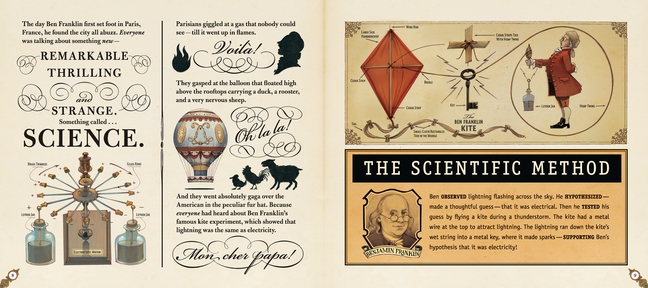
One of these notions was Ben Franklin’s own—and when the people of Paris saw him “they went absolutely gaga over the American in the peculiar fur hat. Because everyone had heard about Ben Franklin’s famous kite experiment, which showed that lightning was the same as electricity.” Soon, however, even Ben couldn’t hold a candle to Dr. Mesmer—the “elegant and mysterious” man who wielded “an astonishing new force.” “Dr. Mesmer said this force streamed from the stars and flowed into his wand. When he stared into his patients’ eyes and waved the wand, things happened. Women swooned. Men sobbed. Children fell down in fits.”

celebrate-picture-books-picture-book-reviews-mesmerized-science

Image copyright Iacopo Bruno, 2015, text copyright Mara Rockliff, 2015. Courtesy Candlewick Press

Dr. Mesmer seemed to do the impossible. He could make the same glass of water taste like strawberries or vinegar just by telling his patient what to taste. He said he could use this force to help people who were sick, and indeed, after a session with Dr. Mesmer “in a room hidden behind heavy drapes covered with signs and symbols” many people emerged saying they had been cured. Those rich enough paid 100 gold louis to learn his secrets, and everyone considered Dr. Mesmer’s force the “most remarkable thing that science had discovered yet!”

Everyone that is, except the city’s doctors, who “griped, and groused, and fussed, and fumed” because their patients only wanted to be treated by Dr. Mesmer. The doctors went to the King to complain. They even suggested that Dr. Mesmer’s force didn’t exist at all. Louis didn’t know what to think, but he did know who to consult—Ben Franklin! Ben wanted to observe this force in action for himself. As he watched, Dr. Mesmer’s helper, Charles, made a group of patients gasp, groan, twitch, and tremble. Some even fainted.

celebrate-picture-books-picture-book-reviews-mesmerized-ben-franklin

Image copyright Iacopo Bruno, 2015, text copyright Mara Rockliff, 2015. Courtesy Candlewick Press

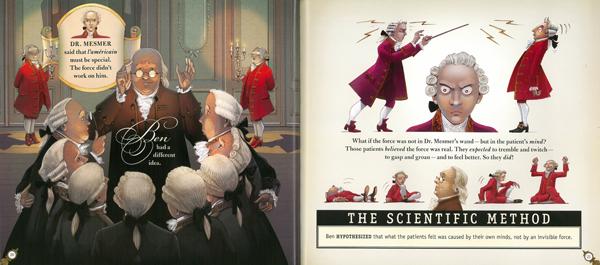
When it came time for Ben Franklin’s turn, “He didn’t gasp and groan or twitch and tremble. And he didn’t faint. In fact…he didn’t feel a thing.” Dr. Mesmer said that Ben must be “special” and that’s why the force didn’t work on him. Ben hypothesized a different reason. He said that instead of the force being “in Dr. Mesmer’s wand…it was in the patient’s mind.” They acted and felt the way they did because they expected to.

To test his theory, Ben had Charles wave his fingers near a woman’s face. She screamed and “said she felt a burning flame.” Next Ben told Charles to perform the same routine, but with the woman blindfolded. This time when Charles waved his fingers near her stomach, “she said she felt the heat—IN HER EAR. When he “moved behind her back, the woman shrieked that she felt burning—IN HER LEG!” Ben brought in another patient, blindfolded him, and told him he was being mesmerized. He said he could feel it—even though “Charles was not even in the room.” When Charles came back and waved his fingers and wand, the patient felt nothing.

“Ben tested patient after patient, but it was always the same. If the patient believed something would happen, something did—even without the force! If the patient did not expect anything to happen, nothing did—even with the force!” He revealed his observations to the king, and soon all of Paris was talking—and laughing. And Dr. Mesmer? He took his wand and ran. Ben Franklin soon returned to America—with the help from France he had sought and to his scientific work.

celebrate-picture-books-picture-book-reviews-mesmerized-blind-test

Image copyright Iacopo Bruno, 2015, text copyright Mara Rockliff, 2015. Courtesy Candlewick Press

The world benefited greatly from the meeting between Ben Franklin and Dr. Mesmer. Ben’s blind test is still used today when new medicines are being developed, and Dr. Mesmer’s force brought to light what we call the placebo effect and also the state of hypnosis, two powerful abilities of the brain that scientists are still studying.

Throughout Mesmerized Ben Franklin studies Dr. Mesmer and his force, using the scientific method. As Franklin observes, hypothesizes, tests, and finds his theory supported, each particular step of the scientific method applied appears highlighted and explained on the page. An extensive Author’s Note about the events of the story also follows the text

Mara Rockliff’s—dare I say it?—mesmerizing true tale of a meeting between two of the most fascinating figures of the late 1770s is the type of nonfiction that can get kids excited about science and history. Intrigue, mystery, charismatic personalities, wit, and a familiar topic are blended together to reveal the uses and steps of the scientific method and to highlight one event in time that still resonates today. Rockliff’s story crackles with fabulous vocbulary—doctors gripe, grouse, fume, are peeved; the king is in a quandary; patients twitch and tremble; plain Ben Franklin is an “apple pie” while elegant Dr. Mesmer a “layered torte.” Rockliff’s story flows at an enthralling pace, keeping readers riveted to discover Dr. Mesmer’s secret.

Iacopo Bruno’s sumptuous illustrations are nothing short of astounding. If the Oscars gave out awards to books, Bruno would certainly win for best costume and set. Every page is gilded with the opulence of the French court as gold buttons, collars, candle sticks, and drawing rooms glint with a polished sheen. Period dress is depicted in the women’s full flowing gowns of red, purple, and green, and in men’s top coats, breeches, lace cuffs, and high buckle shoes. Powdered wigs curl at men’s ears and climb high above women’s heads, festooned with flowers, ribbons, and pearls while Ben’s white, wavy locks fall naturally on his shoulders. In addition to setting the historical scene, Bruno depicts the effects of Dr. Mesmer’s force and the scientific methods Franklin used to debunk it with just the right amount of humor to entice kids and allow them to fully understand and appreciate Dr. Mesmer’s impact on society.

Ages 6 – 10

Candlewick, 2015 | ISBN 978-0763663513

To learn more about Mara Rockliff and her books, visit her website!

View a gallery of book jacket and other illustration work by Iacopo Bruno on his blog!

World Hypnotism Day Activity

celebrate-picture-books-picture-book-review-hypnosis-maze


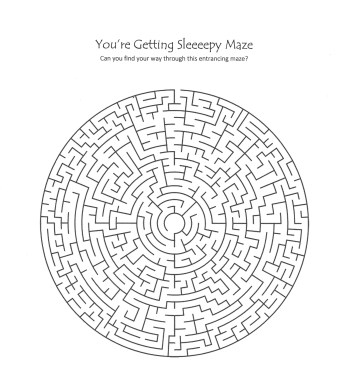
You Are Getting Sleeeepy Maze


The roundabout pattern of this printable You’re Getting Sleeeepy Maze may make you feel as if you’re in a trance, but don’t zone out before you solve it! Quick! Here’s the Solution!

celebrate-picture-books-picture-book-reviews-mesmerized-cover

You can find Mesmerized: How Ben Franklin Solved a Mystery that Baffled all of France at these booksellers

Amazon | Barnes & Noble | Books-a-Million | IndieBound

Picture Book Review

December 7 – It’s Computer Science Education Week

celebrate-picture-books-picture-book-review-doll-E-1.0-cover

About the Holiday

Computer Science Education Week was launched in 2009 to raise awareness of the importance of computer coding in all careers and to invite people to learn how to code. Students from kindergarten to grade 12 are especially encouraged to take an interest in computer science and learn coding skills and also to take part in Hour of Code programs at school and elsewhere. The holiday is celebrated in December to honor computing pioneer Admiral Grace Murray Hopper, who was born December 9, 1906 and went on to become a United States Navy rear admiral. Her work with machine-independent programming languages led to the development of COBOL, and she was instrumental in many other early computer-related advancements. To celebrate this week, check out the Computer Science Education Week website and Hour of Code and try coding for yourself!

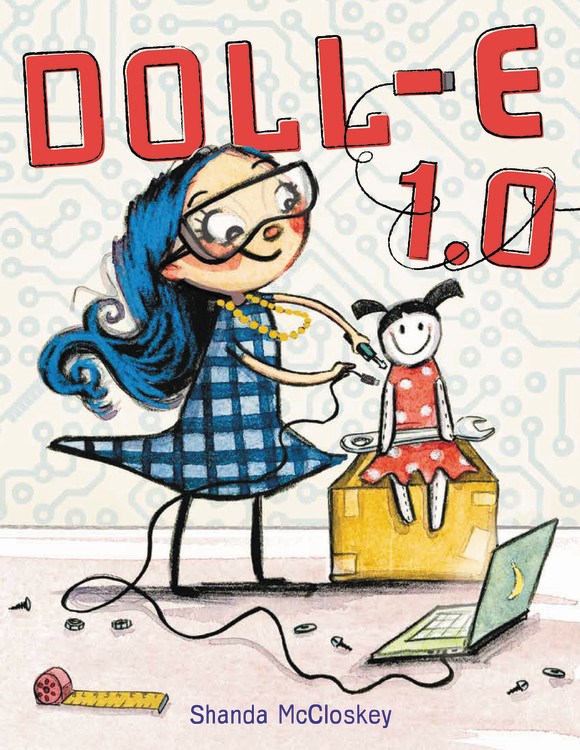
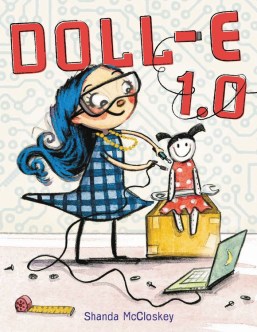
Doll-E 1.0

By Shanda McCloskey


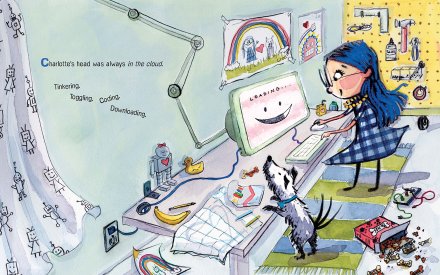
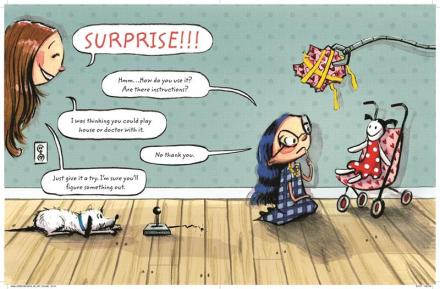
“Charlotte’s head was always in the cloud.” She knew everything about computers and was plugged in to the (virtual) realities of each day. One day her mother bought her a present. Charlotte wondered at what kind of electronic marvel might lie underneath the wrapping. When the robotic arm she’d build untied the bow and tore off the paper, Charlotte gazed at the cloth doll in the little stroller uncertainly.

celebrate-picture-books-picture-book-review-doll-E-1.0-lab

Copyright Shanda McCloskey, 2018, couirtesy of Little, Brown Books for Young Readers.

She wasn’t sure how to play with it; where was the instruction manual? Charlotte took the doll to her lab and tried to engage it in her favorite video game and to get it to dance under the revolving disco ball, but the doll just sat on the floor and stared at her. Suddenly, the doll said “Ma-ma.” Charlotte didn’t think she was Mama material, but then she had a thought: “If the doll could talk, then it must have a power supply.”

Sure enough when she opened the back, she found two batteries. This was more like it! Since the doll’s only word seemed to be “Ma-ma,” Charlotte ran an update on it to increase its vocabulary. But before she could finish, her dog grabbed the doll by the leg and ran off with it. Before Charlotte could stop him, Blutooth had ripped the doll apart.

celebrate-picture-books-picture-book-review-doll-E-1.0-virtual-games

Copyright Shanda McCloskey, 2018, couirtesy of Little, Brown Books for Young Readers.

Charlotte collected the doll’s arms, legs, and head, gathered some more supplies, and went to work in her lab. “With a few spare parts and a bit of code, Charlotte changed the doll.” It looked at Charlotte with its bright eyes and smile and said, “H-e-l-l-o m-y n-a-m-e i-s D-o-l-l-E 1.0.” “And the doll changed Charlotte too.” Charlotte loved Doll-E. She read to it, and played with it, and took it outside, where its fast stroller and new remote-controlled robotic arms were perfect for walking Blutooth.

celebrate-picture-books-picture-book-review-doll-E-1.0-gift

Copyright Shanda McCloskey, 2018, couirtesy of Little, Brown Books for Young Readers.

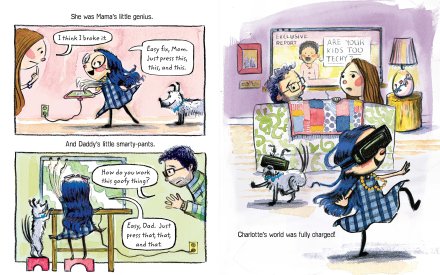
Shanda McCloskey wonderfully inventive doll story for a new generation will delight children and remind adults that while toys may change, the feelings associated with them never do. Sprinkled with puns and led off with a just-right first line, McCloskey’s smart story shines. Charlotte shows heart and intelligence as she embraces her new doll and makes it a reflection of her own life—just as children have always done with their toys. Charlotte, as a computer whiz, makes a captivating role model for kids, especially girls who code or would like to.

There’s so much to admire in McKloskey’s illustrations, from Charlotte’s dedicated work space/lab outfitted with hand tools, spare parts, and craft supplies to her sweet determination to understand her new, simple doll. Clever details, such as a light bulb hanging over Charlotte’s head when she gets a brilliant idea and a Frankenstein-esque scene as Charlotte repairs her doll add depth and fun to the story’s theme.

A spirited story, Doll-E 1.0 clicks all the buttons as a must for home and classroom bookshelves.

Ages 4 – 7

Little, Brown Books for Young Readers, 2018 | ISBN 978-0316510318

Discover more about Shanda McCloskey, her books, and her art on her website.

Computer Science Education Week Activity

celebrate-picture-books-picture-book-review-internet word-based-word-search--puzzle

Trendy Trending Word Search Puzzle


The Internet has added many new words to our language as well as redefining old ones. Search for twenty-two Internet-based words in this printable word search puzzle.

 Trendy Trending Word Search Puzzle | Trendy Trending Word Search Solution!

celebrate-picture-books-picture-book-review-doll-E-1.0-cover

You can find Doll-E 1.0 at these booksellers

Amazon | Barnes & Noble | Books-a-Million | IndieBound

Picture Book Review

Picture Book Review