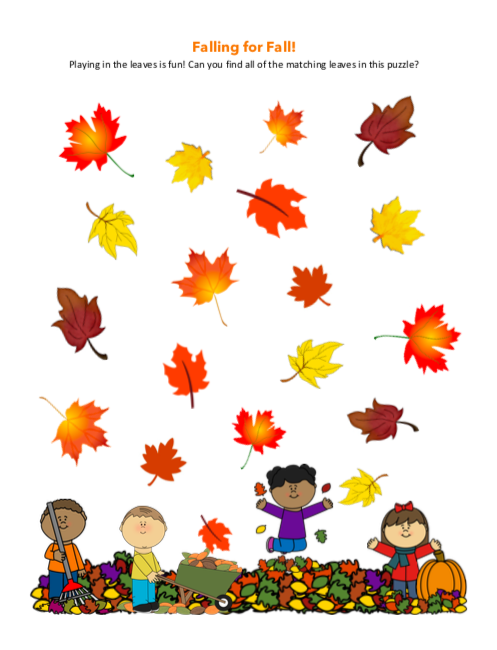
If you live in the Northern Hemisphere, fall has arrived! If you live in the Southern Hemisphere, welcome to spring! Today, daytime and nighttime will be equal, ushering in a changing of the seasons. For some that means cooler weather, shorter days, and a slowing down in nature which leads to our being able to see the brilliant reds, yellows, and oranges in the leaves of certain trees. The phenomenon featured in today’s book. For others nature is just awakening, with all the beauty warm weather and new growth bring. Wherever you live, enjoy the activities and events the change in season brings!
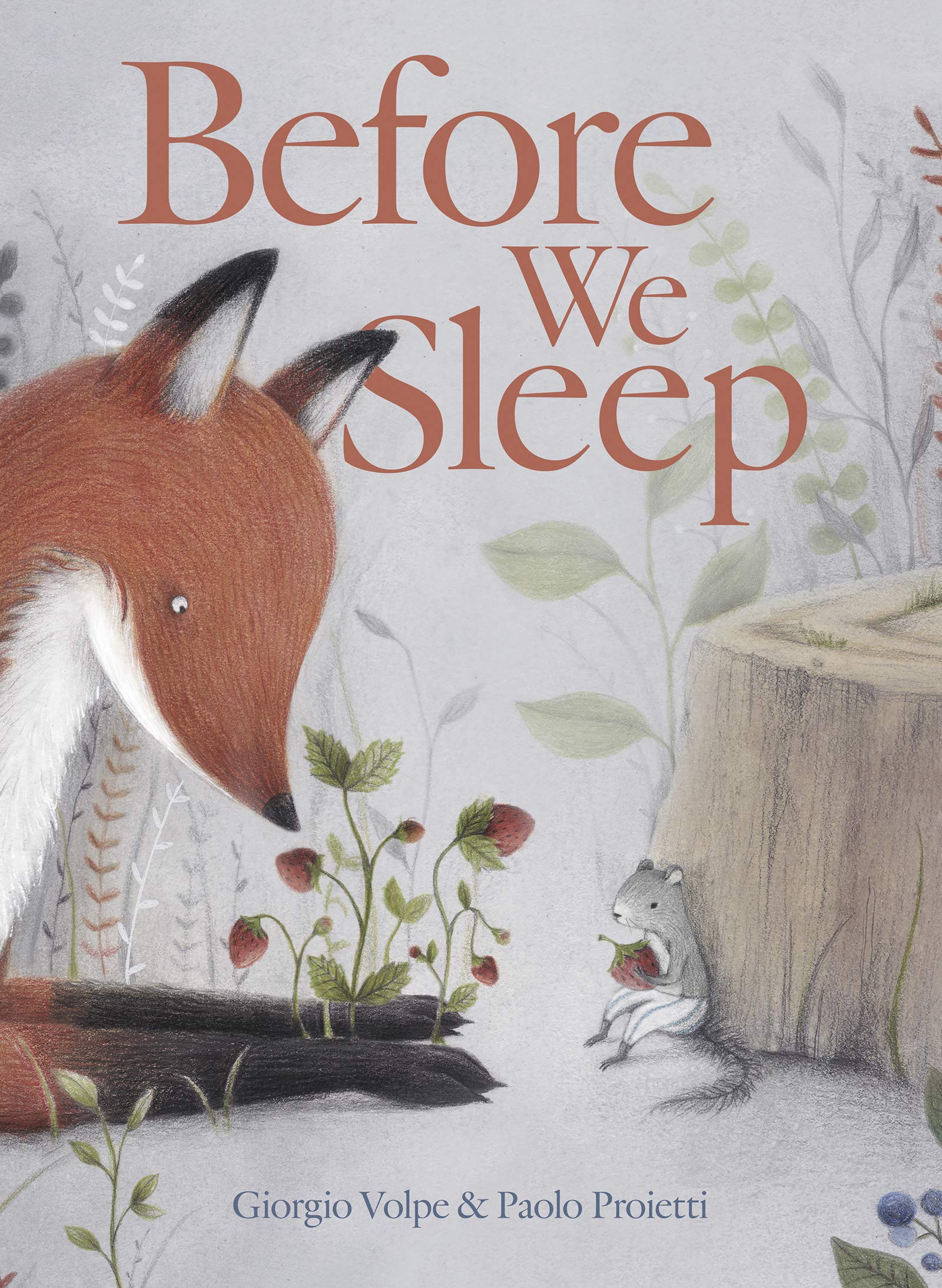
Before We Sleep
Written by Giorgio Volpe | Illustrated by Paolo Proietti
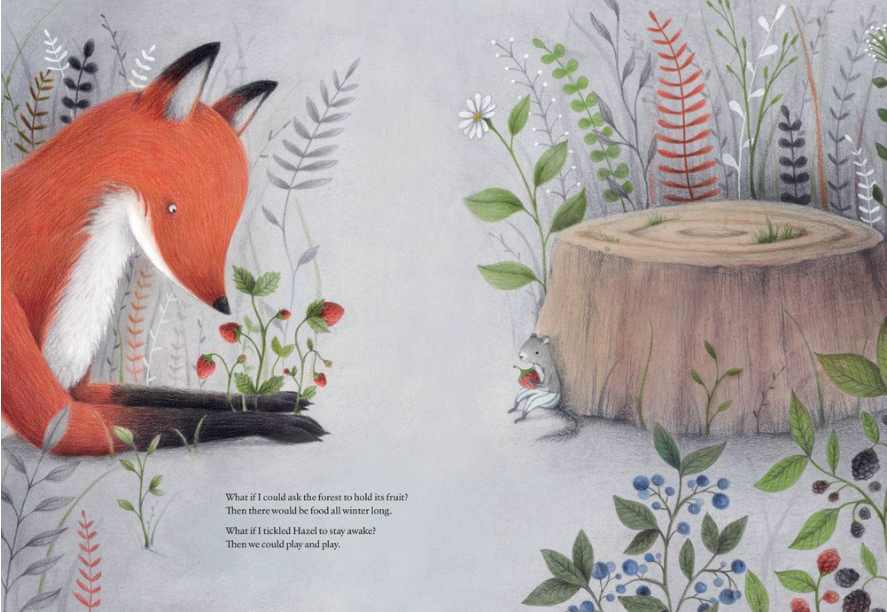
“As the season turned, the forest was dressed in new colors of rich amber, burned orange, and chestnut brown.” Little Red, the fox couldn’t wait to play hide-and-seek with his friend Hazel the dormouse because he would be so much harder to find. Little Red and Hazel also enjoyed jumping in the crisp, rustling leaves. “‘The leaves are laughing with us,’ said Hazel joyfully.” But there was one thing about autumn that Little Red did not like. He knew that soon winter would come and he would be lonely.
Image copyright Paolo Proietti, 2021, text copyright Giorgio Volpe, 2021. Courtesy of Red Comet Press.
Hazel was already getting ready to hibernate in her warm burrow. Little Red thought maybe this year Hazel would take a shorter sleep, but Hazel reminded her friend that, although she would like to keep him company, she couldn’t. Little Red thought of ways the earth could stay warm and nurturing, but his ideas, he knew, were just wishes. In fact, Hazel was already growing tired. She promised Little Red that come spring she would be back to play with him again.
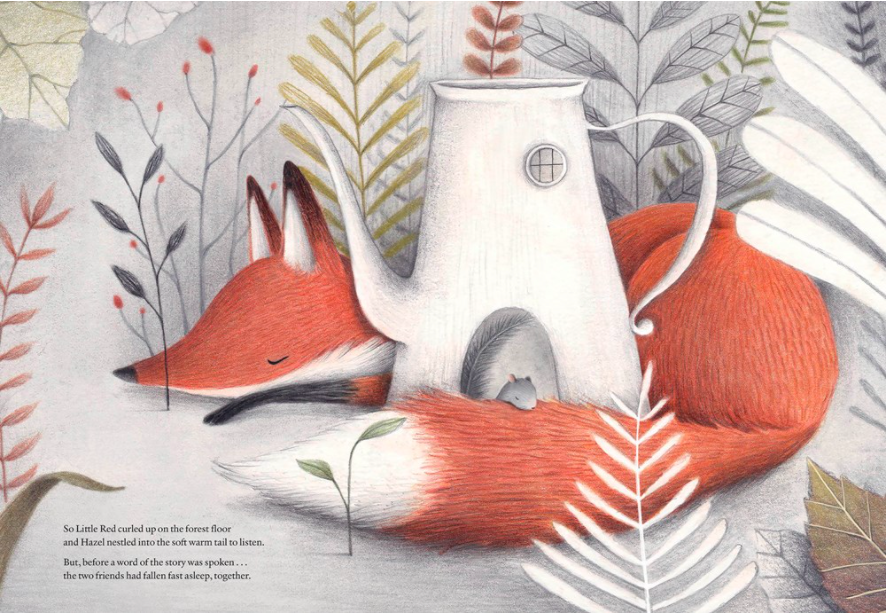
Little Red wanted just a few more minutes with his friend and asked if he could tell her a story. Little Red curled up next to her cozy burrow, and Hazel nestled into his soft tail to listen. “But before a word of the story was spoken . . . the two friends had fallen fast asleep, together.”
Note: Only first-person pronouns are used in this story, making the characters gender-neutral.
Image copyright Paolo Proietti, 2021, text copyright Giorgio Volpe, 2021. Courtesy of Red Comet Press.
Tranquil and soothing, Giorgio Volpe’s autumn friendship story floats on beautiful, evocative language that stirs memories of the fun fall offers while also reassuring readers that no matter what changes take place, love between friends always remains. Volpe’s story also touches on how friendships are built despite—or because of—individual differences. The sweet and comforting ending makes Before We Sleep not only a perfect fall read but a cozy bedtime story as well.
Paolo Proietti’s lush illustrations of a woodland dressed for autumn fuse realistic images of nature with delightful whimsy that mirrors the wistful tone of Volpe’s story and will charm readers. Proietti’s rich illustrations of fiery Little Red, adorable Hazel, and the plants, berries, nuts, and wildlife of the forest are set against lovely muted gray, blue, and sage backgrounds and invite readers to visit again and again.
A quiet and enchanting story for cozy fall days and dozy nights, Before We Sleep is highly recommended as a gift for family or friends and as an addition to home, school, and public library collections.
Ages 3 – 7
Red Comet Press, 2021 | ISBN 978-1636550046
To download a Before We Sleep Activity Kit and find video resources, visit Red Comet Press.
National Live Creative Day was established to encourage people to embrace their innovative side. There are so many ways to be creative from the arts, to science and math, to what you make for dinner. Kids seem to know this inherently as they go about exploring and interacting with all the new things they see, hear, and do every day. Introducing kids to all kinds of hobbies, subjects, and professions expands their definition of creativity and their outlook on the future. Encouraging them to use their particular talent or talents, helps them build confidence and find thier place in the world. Reading today’s book with them is a great way to start! To celebrate today, take time to share your talents with others. You may be surprised at how creative you really are!
Thanks to Red Comet Press and Barbara Fisch at Blue Slip Media for sharing a copy of Mister Fairy with me for review consideration. All opinions on the book are my own.
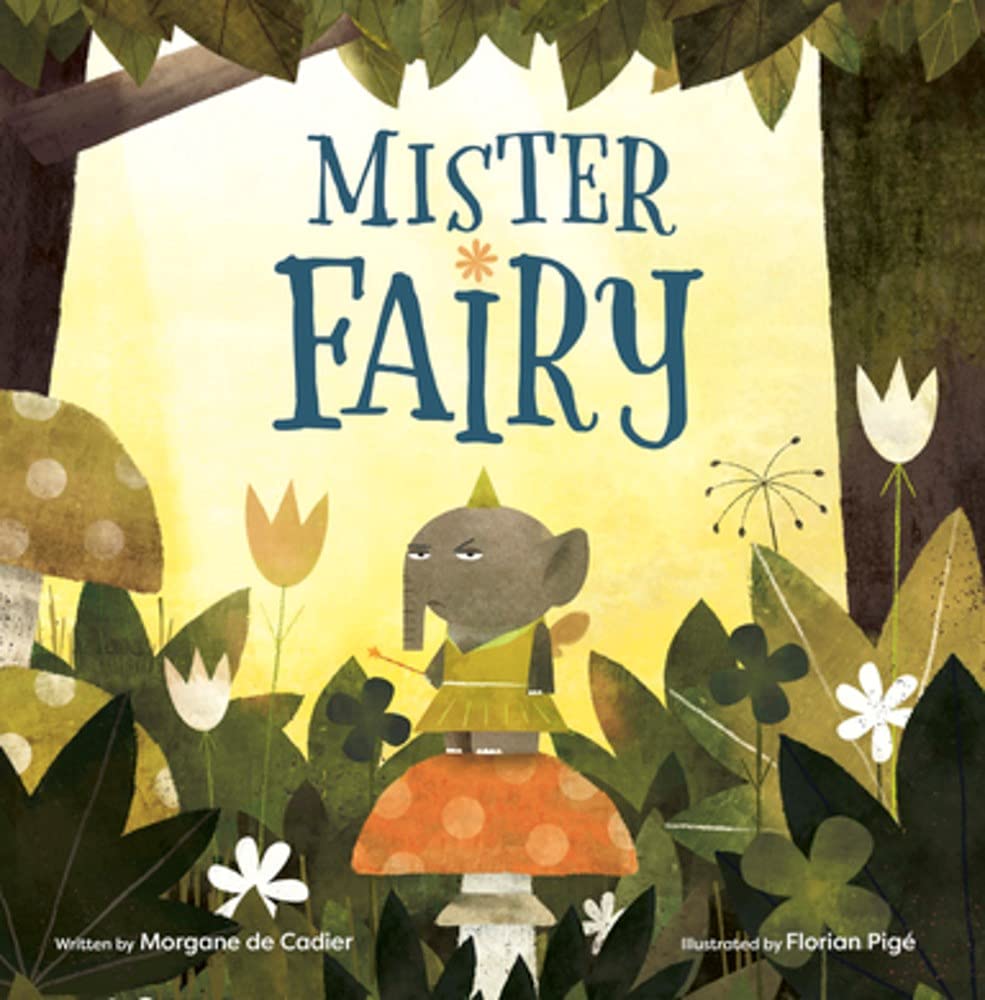
Mister Fairy
Written by Morgane de Cadier | Illustrated by Florian Pigé
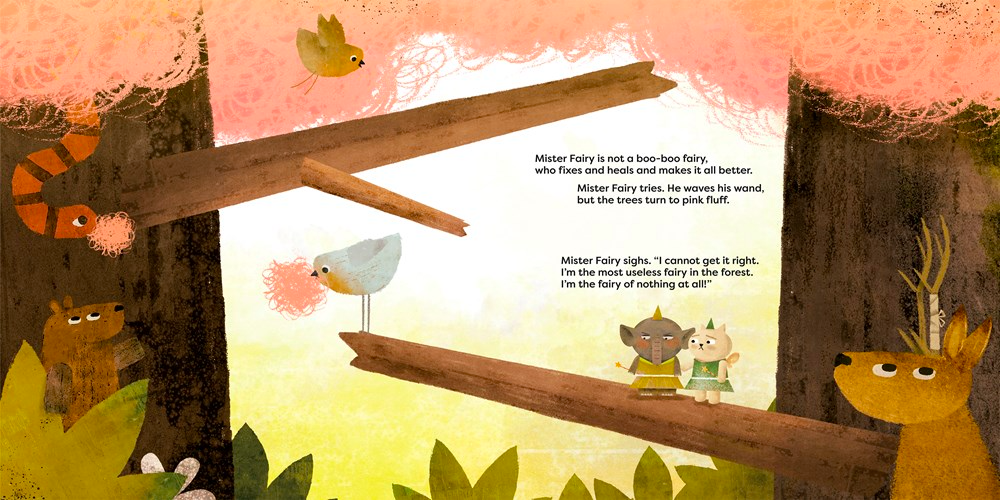
All sorts of fairies lived in the forest. There are “morning fairies, brave fairies, sleepy-time fairies, and even fairies that clean. There is also Mister Fairy. Mister Fairy doesn’t seem able to do anything right. He isn’t a morning fairy. His attempt to be a kissing fairy turns ticklish. And when he tries to heal a boo-boo, he only turns the leaves on the trees to pink fluff. “‘I’m the most useless fairy in the forest,’” he says. “‘I’m the fairy of nothing at all!’”
Image copyright Florian Pigé, 2021, text copyright Morgane de Codier, 2021. Courtesy of Red Comet Press.
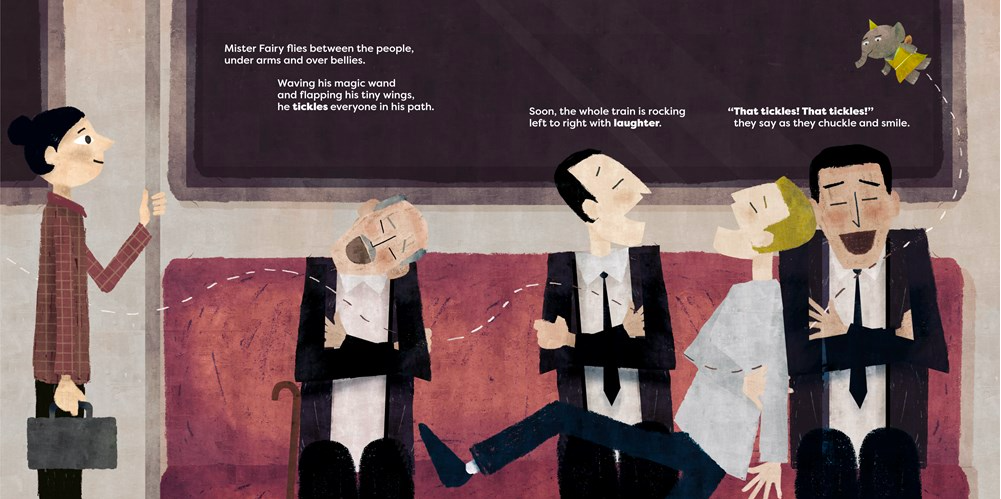
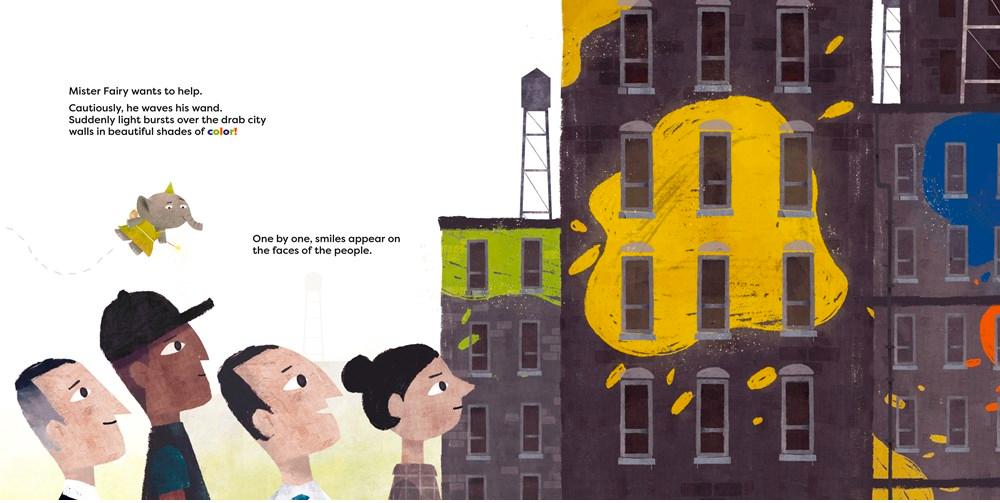
Mister. Fairy decides to find a different home. He comes to a city shadowed in gloom, where everyone seems “sad and unhappy too.” Mister. Fairy wants to help. “Cautiously, he waves his wand. Suddenly light bursts over the drab city walls in beautiful shades of color!” He watched the people begin to smile. Next he enters the subway. On a train, Mister Fairy weaves in and out and around, tickling the riders and making them laugh.
Image copyright Florian Pigé, 2021, text copyright Morgane de Codier, 2021. Courtesy of Red Comet Press.
Excited to have made so many people happy, Mister Fairy flies off to see where else he can help. He passes by an outdoor café and turns all the table umbrellas into cotton candy. These balls of pink fluff remind him of home, and he begins to worry. He leaves the city and flies back to the forest. When he gets there, he discovers that all the color has faded to gloomy gray. He calls out to his friends and they respond. Since he left, they tell him, they “‘lost the gift of laughter.’” No matter what they tried, they couldn’t find their smiles.
“Without a word, Mister Fairy confidently waves his wand…” and instantly “color and laughter return to the forest.” Mister Fairy then realizes that far from being useless, he fills the forest with smiles, happiness, and joy “in his own special way.”
Image copyright Florian Pigé, 2021, text copyright Morgane de Codier, 2021. Courtesy of Red Comet Press.
This enchanting book is the sixth collaboration between Morgane de Cadier and Florian Pigé and the first to be translated from French into English. Morgane de Cadier’s whimsical realism plumbs feelings of self-doubt, disappointment, and failure as well as confidence, fulfillment, and joy as Mister Fairy tries to be like others before discovering his true gift. Told in the present tense, the story immediately feels contemporary and fresh as it draws readers into this unique community of fairies. Mister Fairy’s discouragement is palpable and all the more moving since it is joy that he creates with a wave of his wand.
On his own in the city, not comparing himself to the other fairies, and with only his own aspirations and empathy to guide him, he bravely brandishes his wand and does what he can. That he gets instant and positive feedback is a gamechanger. As his particular talent alters the city and its residents, Mister Fairy grows in confidence and, although not explicitly stated, he seems to consider that he did add value to the forest. When he returns, Mister Fairy and children see that the forest is not the same without him—just as the reader’s family, friends, school, and the world are not the same without them. de Cadier’s final sentiment about the irreplaceable importance of Mister Fairy echoes priceless acknowledgement of every child’s worth.
Kids will fall in love with Florian Pigé’s tiny fairies and especially the endearing Mister Fairy. Mister Fairy, with his dejected trunk and disconsolate frown and eyes, but prim fairy dress or pajamas instantly reveals his talent, but smiling readers—who will be smiling—don’t know it yet. As Mister Fairy gives vent to his frustration, an empathetic fairy offers a paw of comfort while kids can see that the animals of the forest are enjoying the pink fluff he’s conjured up. Like a hummingbird against the open sky, Mister Fairy takes off for the city, where the people look as downtrodden as he feels.
With the first splash of paint, though, things begin looking up, and kids see what a difference one tiny fairy—or person—can make. When Mister Fairy leaves the city, the once-gray buildings are a rainbow of colors, and the people, sporting grins, are aware of each other and looking up from their phones. Mister Fairy returns to a now-gray forest a changed elephant, and the final two-page spread of the home he restores will cheer kids and adults alike.
Mister Fairy transcends the fairy story genre to offer a humorous and poignant look at self-discovery and finding one’s place in the world. It’s a book you and your kids will find yourselves returning to again and again and is enthusiastically recommended for all home, classroom, school, and public libraries.
Ages 4 – 8
Red Comet Press, 2021 | ISBN 978-1636550008
Discover more about Morgane de Cadier, her books, and her art on her website.
To learn more about Florian Pigé, his books, and his art, visit his website.
National Live Creative Day Activity
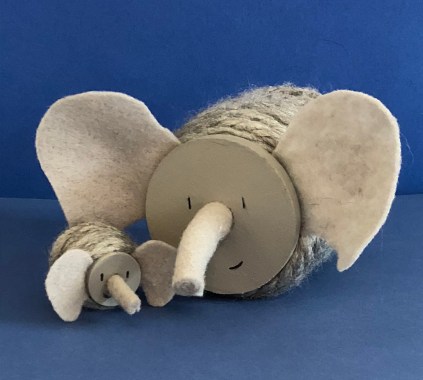
Spool Elephant and Baby
You can make your own elephant fairy or friend to keep you company with this easy craft !
Today’s holiday honors those who through choice, illness, medication, or heredity sport bald heads. Baldness for both men, women, and children can show courage, beauty, and an independent spirit. To commemorate today, give a shout out or support to your friends who are bald.
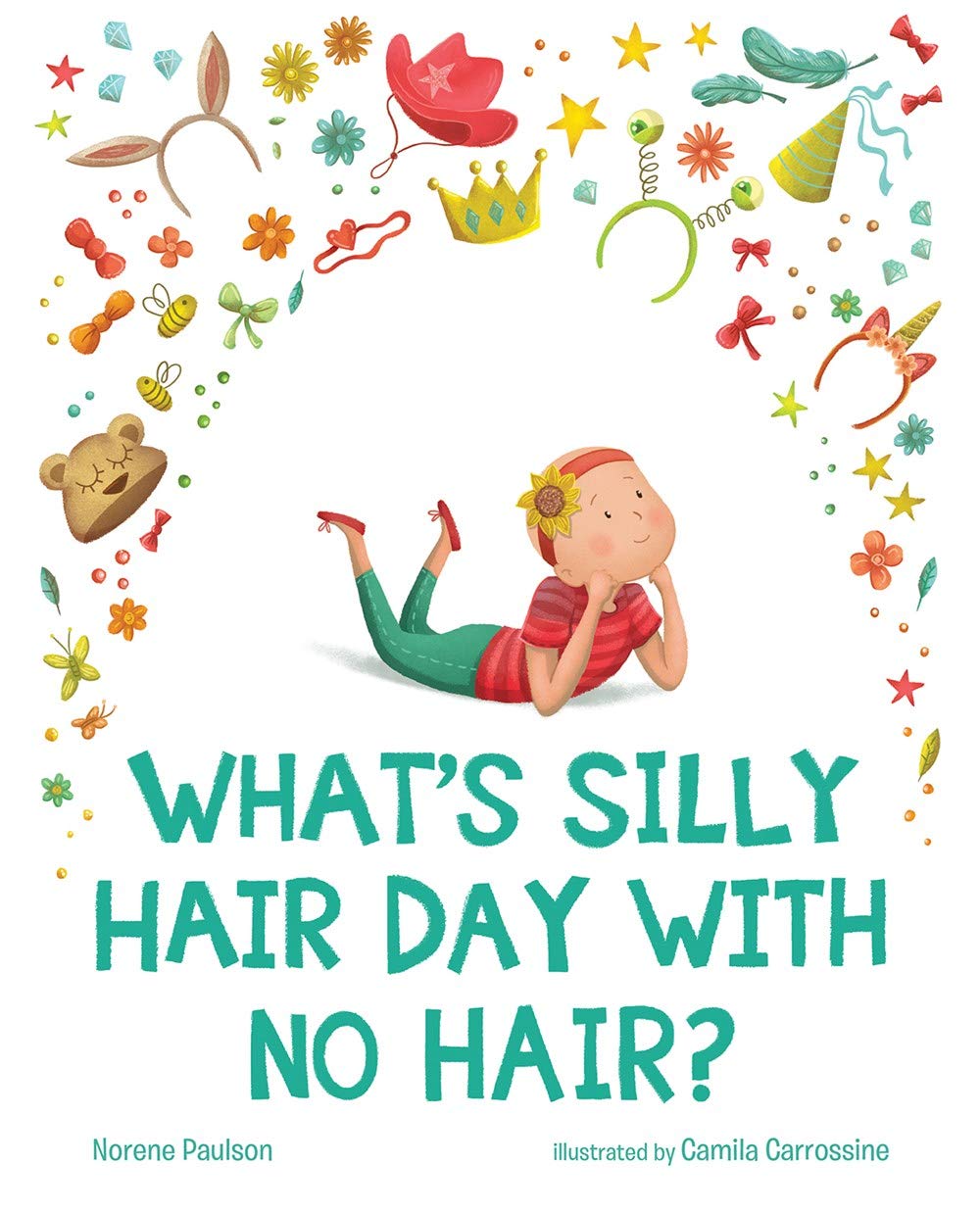
What’s Silly Hair Day With No Hair?
Written by Norene Paulson | Illustrated by Camila Carrossine
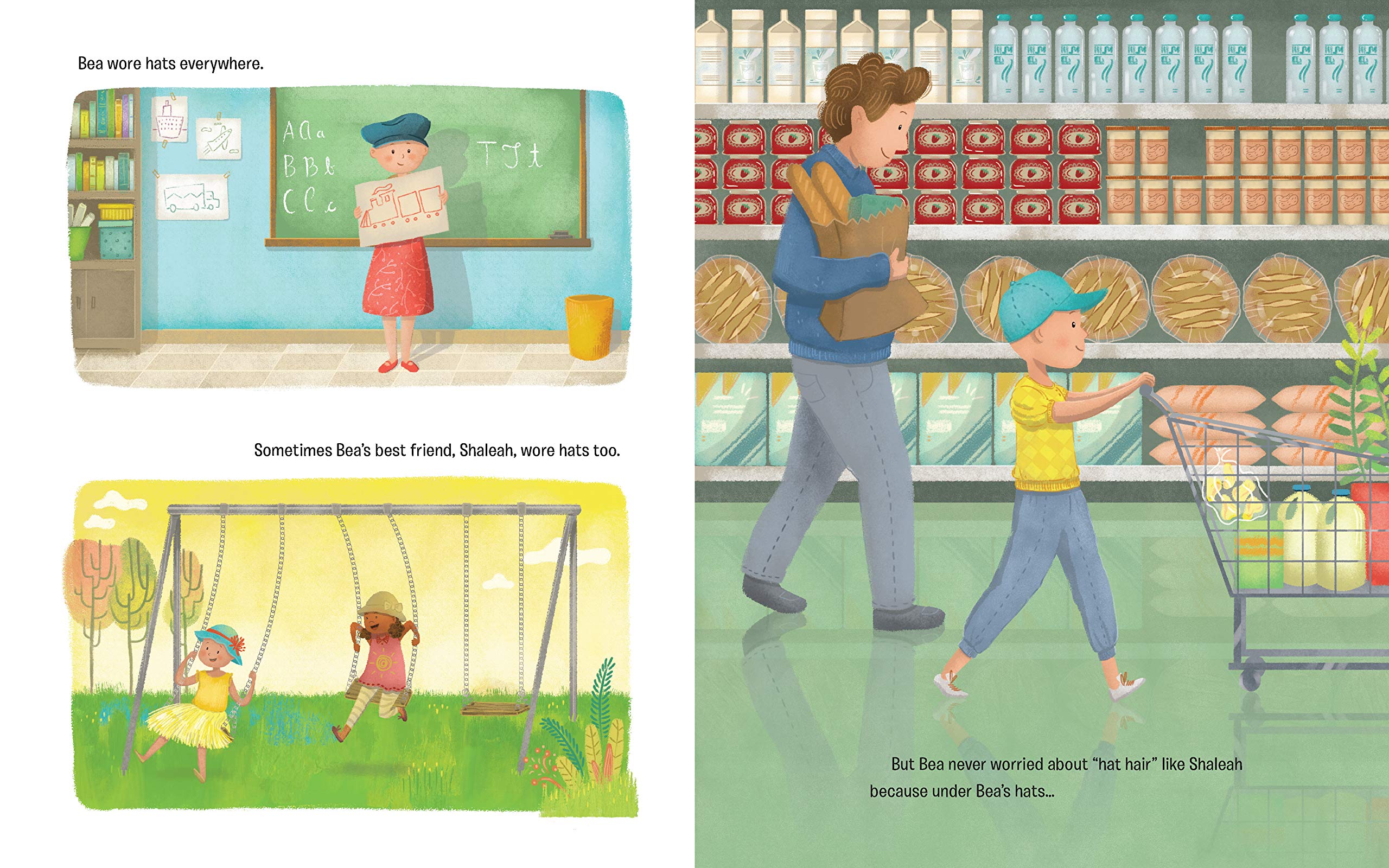
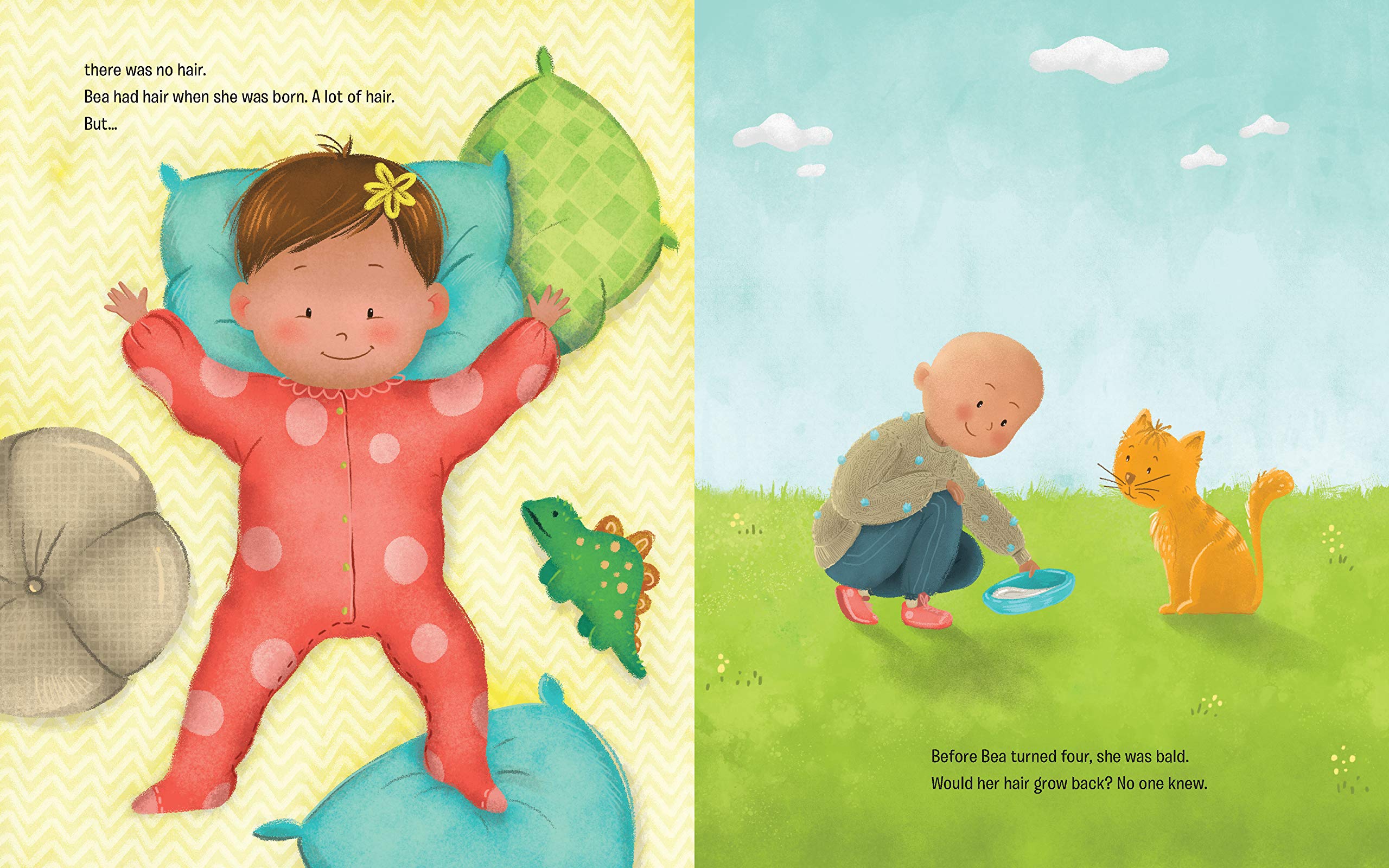
“Bea wore hats everywhere.” But unlike her friend Shaleah, who sometimes wore hats too, she didn’t have to worry about “hat hair.” Why? Well, while Bea had been born with hair, she began losing it and “before Bea turned four, she was bald.” Bea didn’t remember having hair, and her family and friends loved her, so she just took it in stride—usually.There were times when she wished she could style her hair like Shaleah and felt sad when “a classmate called her a mean name.” And then there was Silly Spirit Week at school. Friday was Silly Hair Day. Bea wondered how she could participate. Shaleah reassured her that they’d think of something.
Image copyright Camila Carrossine, 2021, text copyright Norene Paulson, 2021. Courtesy of Albert Whitman & Company.
Shaleah’s first thought was a wig, so on Saturday Bea’s mom took them to a costume shop and Bea tried on lots of different wigs—but none seemed right. The next day they tried crafting hair with yarn and pompoms. It was silly, but still not right. Bea was getting discouraged. Maybe, she said, she should just stay home on Friday. But Shaleah reminded her that if she did she’d miss the Spirit Week picnic. And Shaleah vowed that if Bea stayed home, she’d stay home. Bea didn’t want Shaleah to miss the picnic, so they started thinking again.
For Monday’s Silly Costume Day and Tuesday’s Silly Backwards Day, Bea had great ideas. “On Wednesday Bea won the Wackiest Hat Award,” but she still didn’t have an idea for Silly Hair Day. Then during Silly Feet Day, she saw a temporary tattoo on the principal’s leg that gave her an idea. But first, she needed to get Shaleah and the principal’s approval. When they both said Yes, Bea was excited.
Image copyright Camila Carrossine, 2021, text copyright Norene Paulson, 2021. Courtesy of Albert Whitman & Company.
After school and late into the night, Bea and Shaleah worked on the idea. The next day they got to school early and put up a new sign. It read “FRIDAY: Silly Hair or Head Day.” The kids wondered what that was all about. Then Bea and Shaleah approached in hoodies and lowered the hoods to reveal colorful tattooed and bejeweled designs on Bea’s head and a skullcap for Shaleah. “‘Because now everyone can participate!’ Bea and Shaleah said together. Even the principal joined in with her own decorated cap. And all the kids—including Bea—enjoyed the Silly Spirit Week picnic.
An Author’s Note discussing hair loss due to Alopecia—as Bea has—and some cancer treatments, including online resources that can provide more information follows the text. Bea also offers readers some fun tips on applying temporary tattoos.
Image copyright Camila Carrossine, 2021, text copyright Norene Paulson, 2021. Courtesy of Albert Whitman & Company.
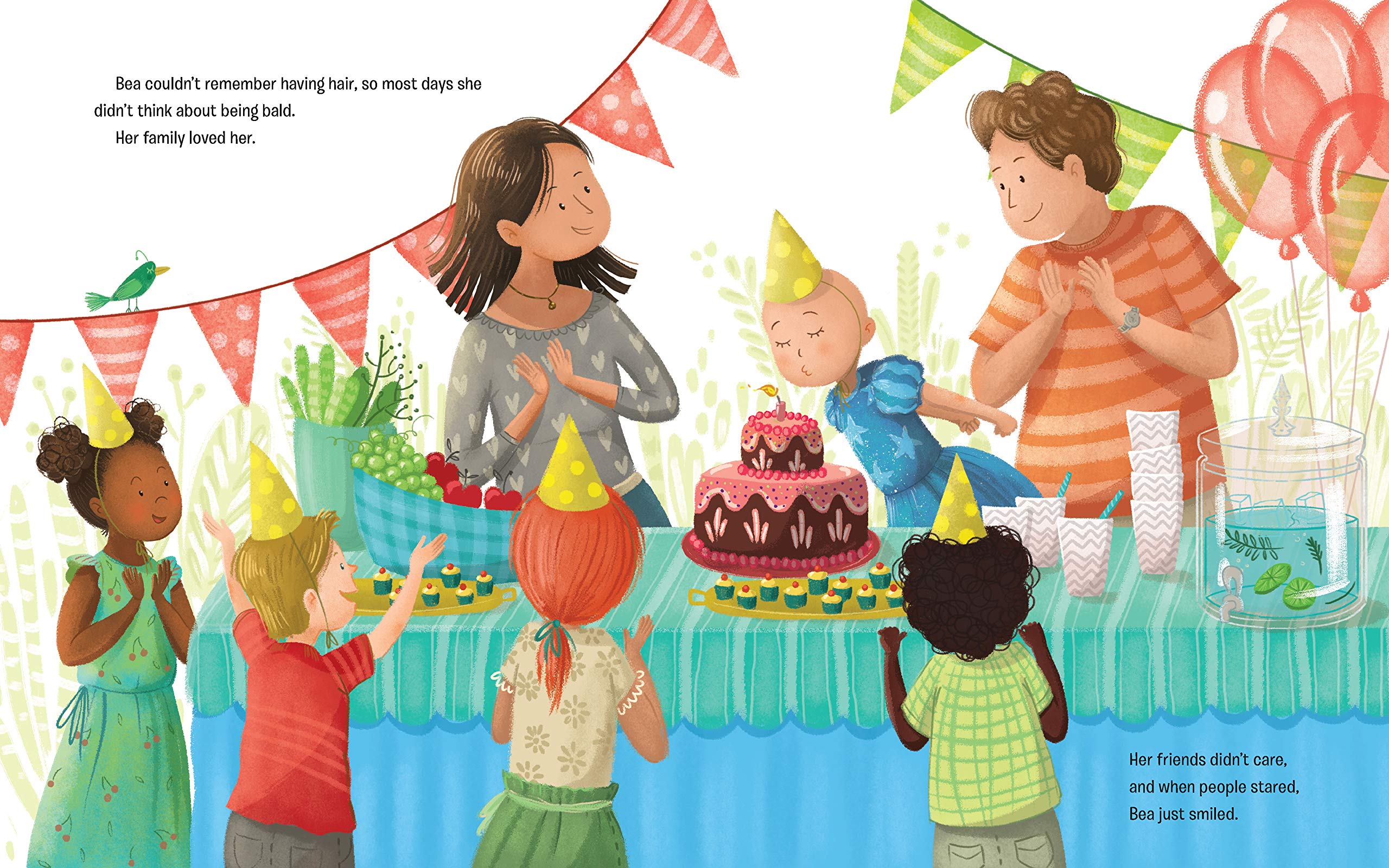
Norene Paulson addresses childhood alopecia and hair loss due to cancer treatments or other causes in her sensitive and uplifting story. While briefly mentioning bullying, Paulson focuses on a common school spirit week event that leaves Bea out. By empowering Bea and her best friend Shaleah to devise a solution, Paulson invites young readers to both empathize with Bea and see how true friends support each other. Two foundations of Bea’s strong self-confidence and positive self-esteem are revealed in two short, important, and instructive sentences: “Her family loved her.” And “Her friends didn’t care.” Underlying the mystery of how Bea will solve her problem, Paulson provides an excellent way for parents, teachers, school administrators, and other caregivers to discuss inclusivity, acceptance, and friendship.
Camilla Carrossine’s engaging illustrations mirror Paulson’s story, allowing readers to understand and empathize with Bea’s experience and join in on Bea and Shaleah’s close friendship. Children will love the silly wigs Bea tries on, the playful updo of yarn Bea and Shaleah create, and the vibrant tattoos that Bea, Shaleah, and the principal all sport.
A unique and welcome book that allows children with alopecia and/or undergoing cancer treatment to be seen with new understanding from their peers, What’s Silly Hair Day with No Hair? is highly recommended for home bookshelves and for all school and public libraries.
Ages 4 – 7
Albert Whitman & Company, 2021 | ISBN 978-0807506080
Discover more about Norene Paulson and her books on her website. You’ll also find reading questions, a curriculum guide, and other resources for the book on her site here.
To learn more about Camilla Carrossine, her books, and her art, visit her website.
You can find What’s Silly Hair Day With No Hair? at these booksellers
As kids go back to school and will be interacting with other students, teachers, coaches, group leaders, and others, this month is dedicated to the kinds of manners that promote good relationships and cohesive gatherings. Thinking about how one’s actions will affect others is part of being a great friend, teammate, or participant in any activity. Family life with parents and siblings is also better when everyone treats each other with good manners and respect.
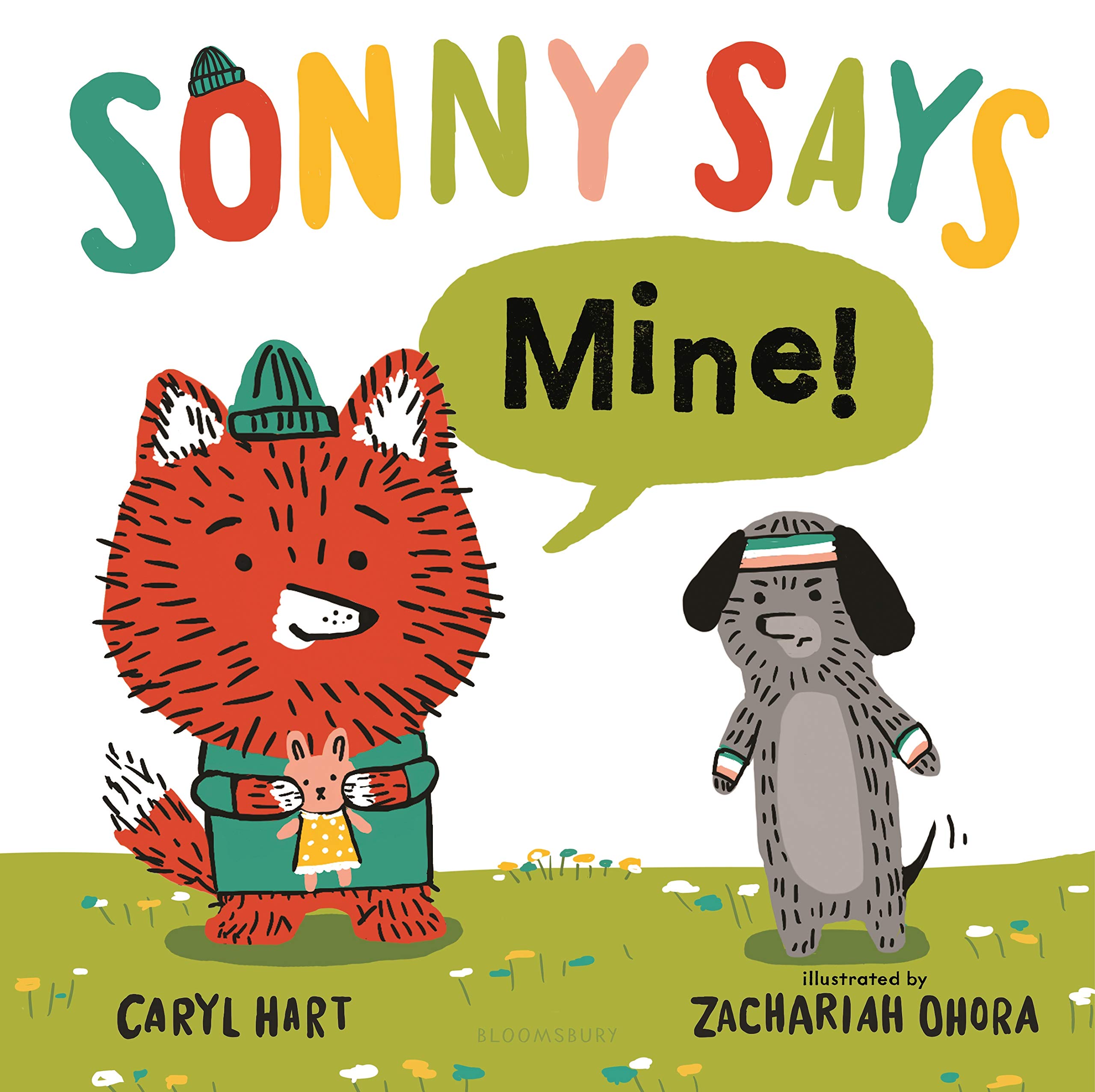
Sonny Says Mine!
Written by Caryl Hart | Illustrated by Zachariah OHora
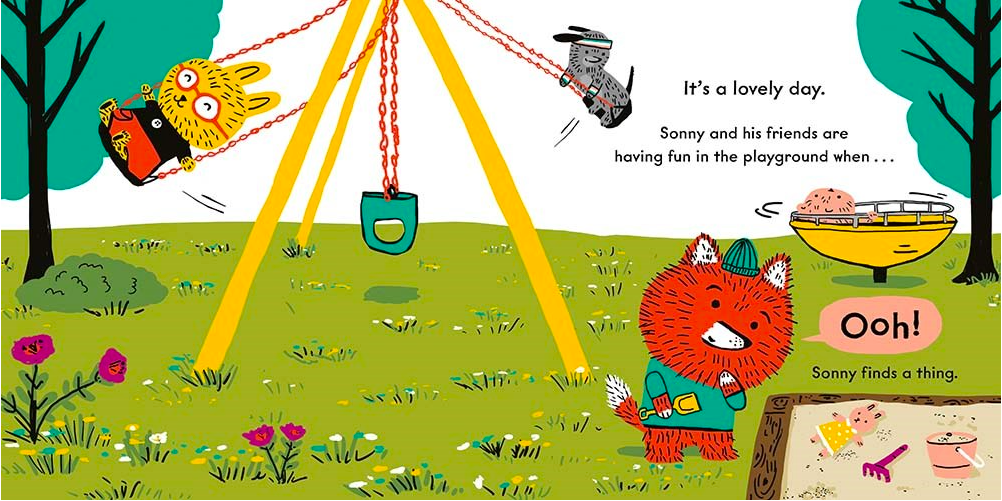
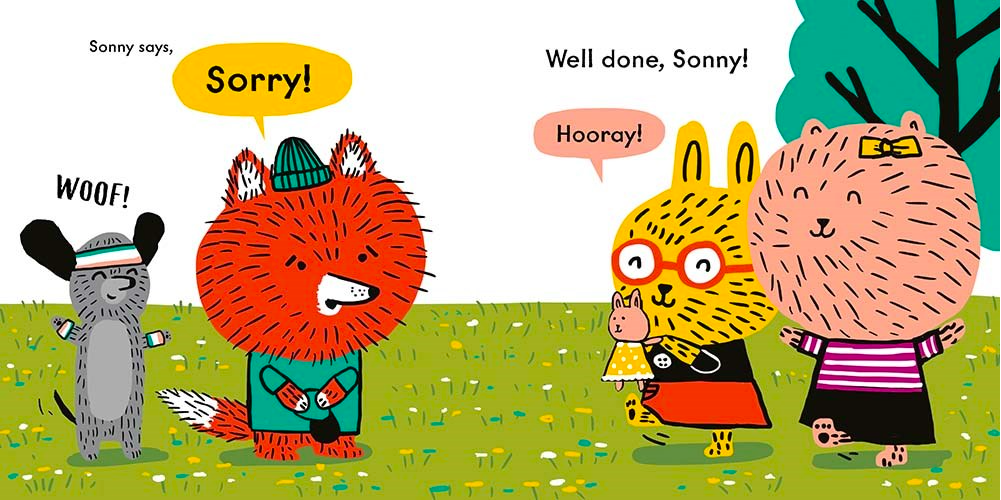
Sonny and his friends are playing on the playground when he spies a stuffed pink bunny in the sandbox. “Ooh! SO soft. SO cute. SO cuddly. I’ll call you Bun-Bun!’ he says.” But Meemo runs up to Sonny, interested in the bunny too, but Sonny pulls Bun-Bun away with a determined, “Mine!” Sonny plays with Bun-Bun, feeding her, dancing with her, reading her a story, and finally putting her to bed under a sand blanket.
Image copyright Zachariah OHora, 2021, text copyright Caryl Hart, 2021. Courtesy of Bloomsbury Children’s Books.
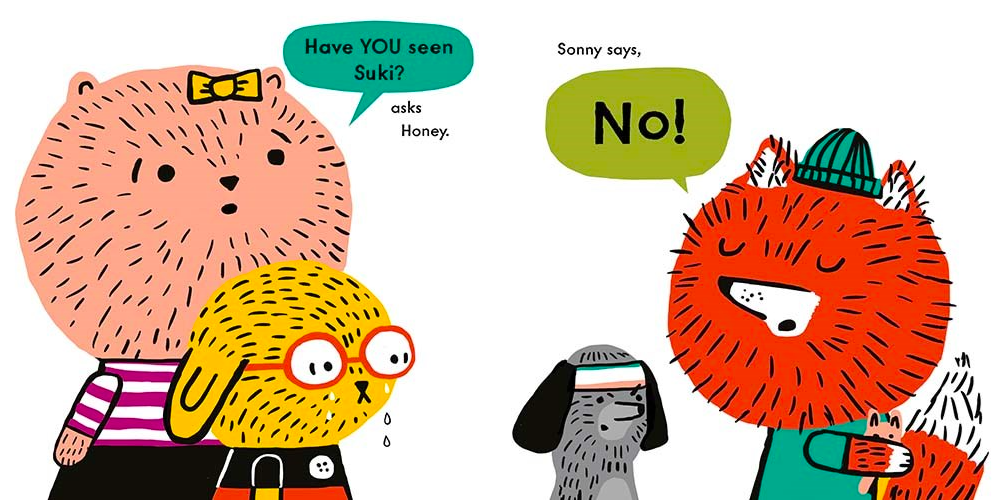
But then Honey and Boo come over and Boo is crying because she’s lost her bunny doll Suki. While Boo sits sadly on the bench, Honey looks all over for Suki. Sonny says nothing and tells Meemo to stop barking. Then Honey directly asks Sonny if he’s seen Suki. “No!” he says, hiding the doll behind his back. Honey and Boo go back to their search. Sonny is so happy with Bun-Bun. “He LOVES Bun-Bun SO much.”
Image copyright Zachariah OHora, 2021, text copyright Caryl Hart, 2021. Courtesy of Bloomsbury Children’s Books.
But Meemo scolds Sonny and tries to take Suki. Sonny hides Bun-Bun and goes to play with Boo and Honey. But Boo is too sad to play pirates or to eat chocolate cake. “Now Sonny feels sad too.” What will he do? He goes to his hiding place and retrieves Bun-Bun. He hides Bun-Bun behind his back as he walks near Honey and Boo. Then he gives Bun-Bun to Boo and apologizes. Now everyone is happy! “Woof!” says Meemo. “Hooray!” says Boo. And what does Sonny say? He wants you to “Come back soon!”
Image copyright Zachariah OHora, 2021, text copyright Caryl Hart, 2021. Courtesy of Bloomsbury Children’s Books.
Sharing something can be hard. Giving back something you’ve found and LOVE to its rightful owner can be even harder. Caryl Hart understands these strong tugs on the heart and in her tender and realistic tale shows little ones the other side of the story—the sadness a friend experiences over losing a beloved toy or other object. Each of the characters demonstrate different actions and emotions providing adults and kids opportunities to discuss feelings and various roles of friendship. With their natural empathy, kids will identify with both Sonny and Boo and learn how in this type of situation real happiness and peace of mind are found.
Zachariah OHora’s instantly recognizable illustrations bring a cute, comforting, and completely relatable vibe to the story. Sonny’s instant love for Bun-Bun is palpable and little ones will know exactly what’s at stake when he’s asked to give the bunny up. On the other side, Boo’s grief is also evident as tears stream from her eyes and the usual fun of playtime and snacks offer no cheer. Meemo and Honey have their own reactions too, which give kids more perspectives to consider. As Sonny contemplates what to do, children will empathize with both Sonny and Boo as they know one of them will be left unhappy. But Through OHora’s touching illustrations, they’ll see that Sonny makes the right choice—and how it really makes him feel.
The first in the new Sonny Says series, which introduces preschoolers and kindergarteners to universal experiences, Sonny Says Mine! is a multilayered story that is as adorable as it is encouraging and educational. The book will captivate young readers just beginning to venture out into the world and make friends and is highly recommended for home, classroom, and library shelves.
Ages 3 – 6
Bloomsbury Children’s Books, 2021 | ISBN 978-1547605804
Discover more about Caryl Hart and her books on her website.
To learn more about Zachariah OHora, his books, and his art, visit his website.
You can find Sonny Says Mine! at these booksellers
In 2004 Colleen Paige established International Dog Day to remind people – especially those who may be looking for a new pet – of all the dogs in shelters that need forever homes. The day also celebrates dogs of all breeds and honors the work of these faithful friends, whether they are family pets or specially trained as service dogs, police dogs, or search-and-rescue dogs. If you’re thinking of adding a new family member of the furry kind, or if you’d just like to make a difference to animals in shelter care, call or visit your local humane society or other shelter.
Thanks go to Beach Lane Books and Blue Slip Media for sending me a copy of Pug & Pig and Friends for review consideration. All opinions on the book are my own.
Pug & Pig and Friends
Written by Sue Lowell Gallion | Illustrated by Joyce Wan
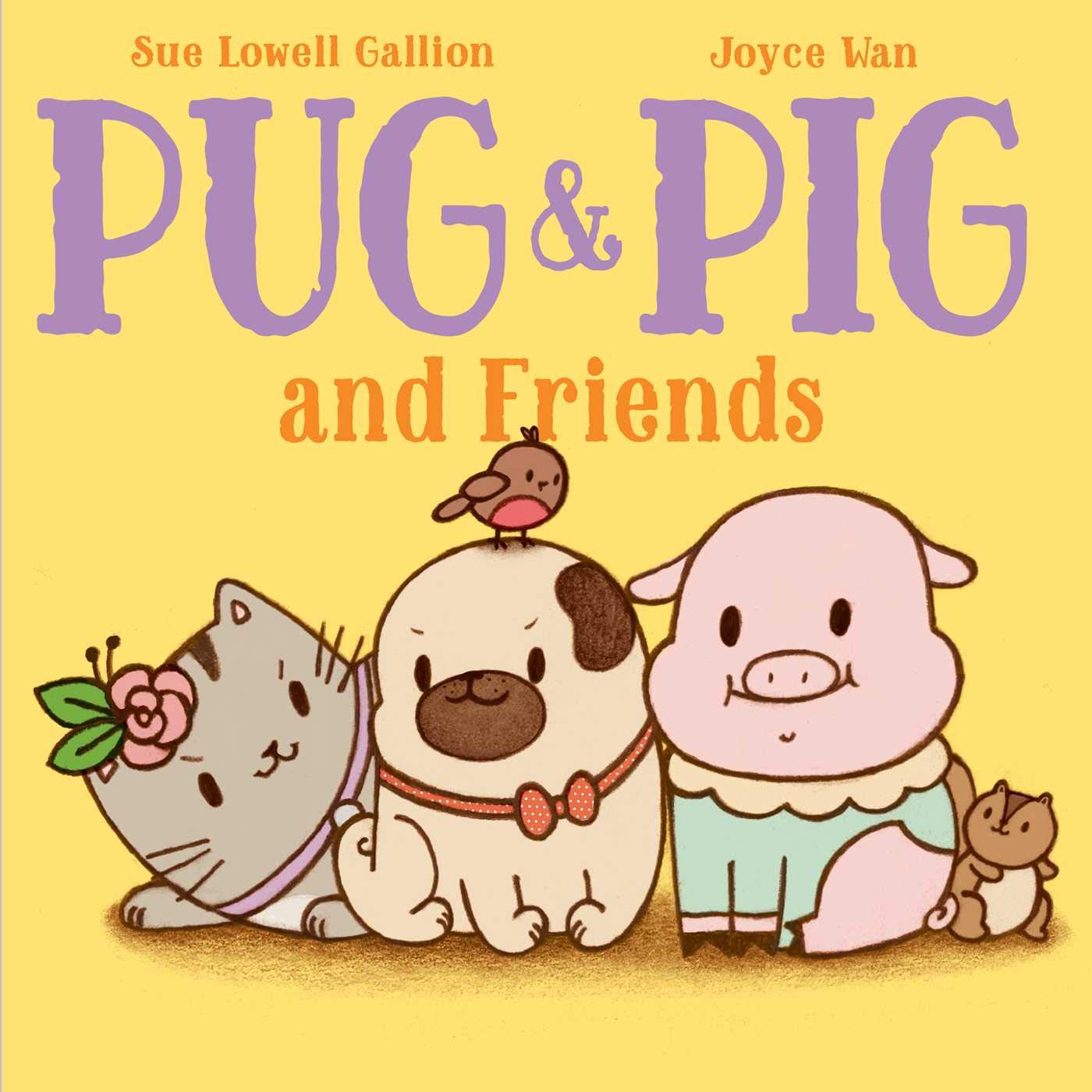
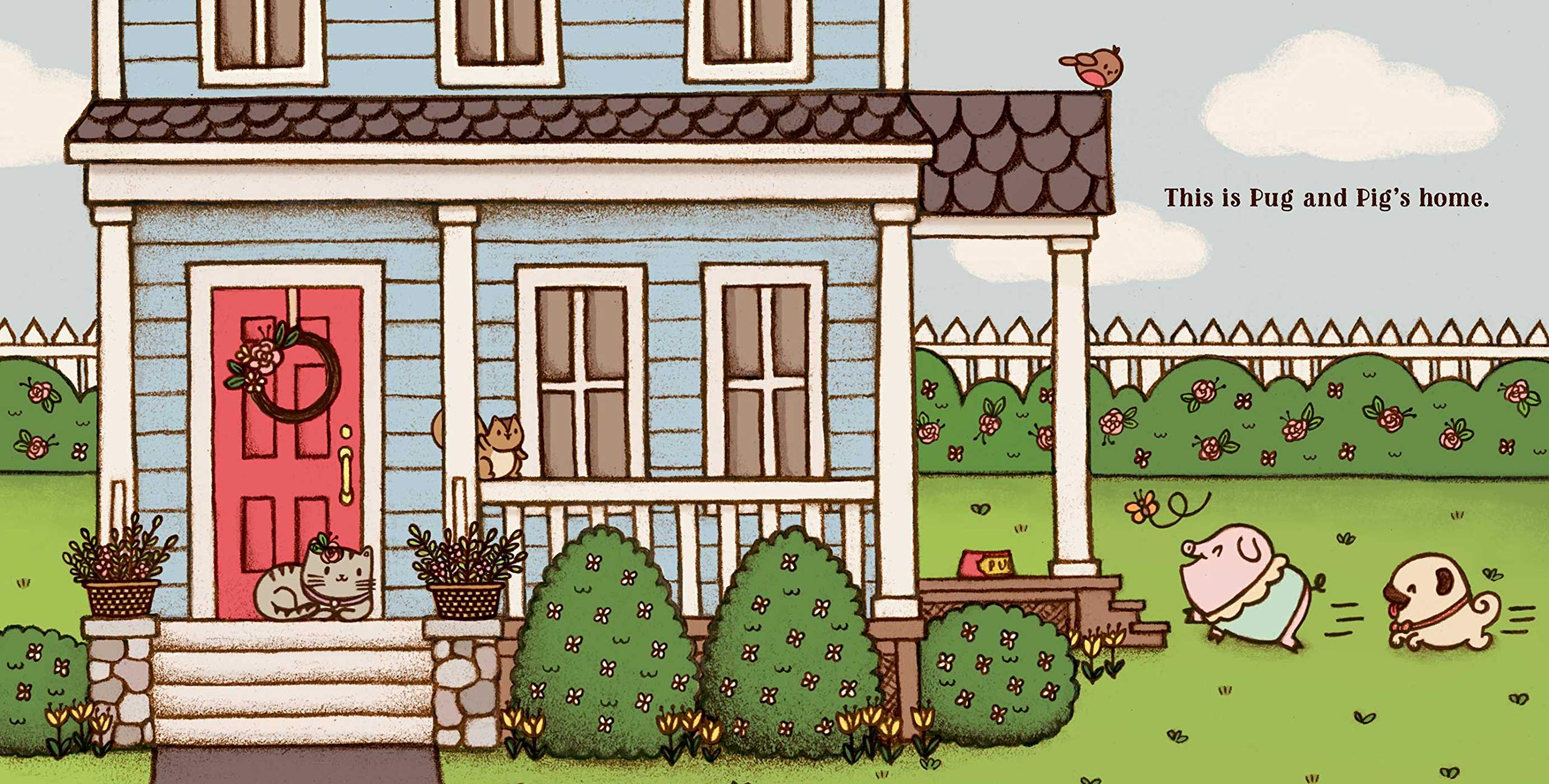
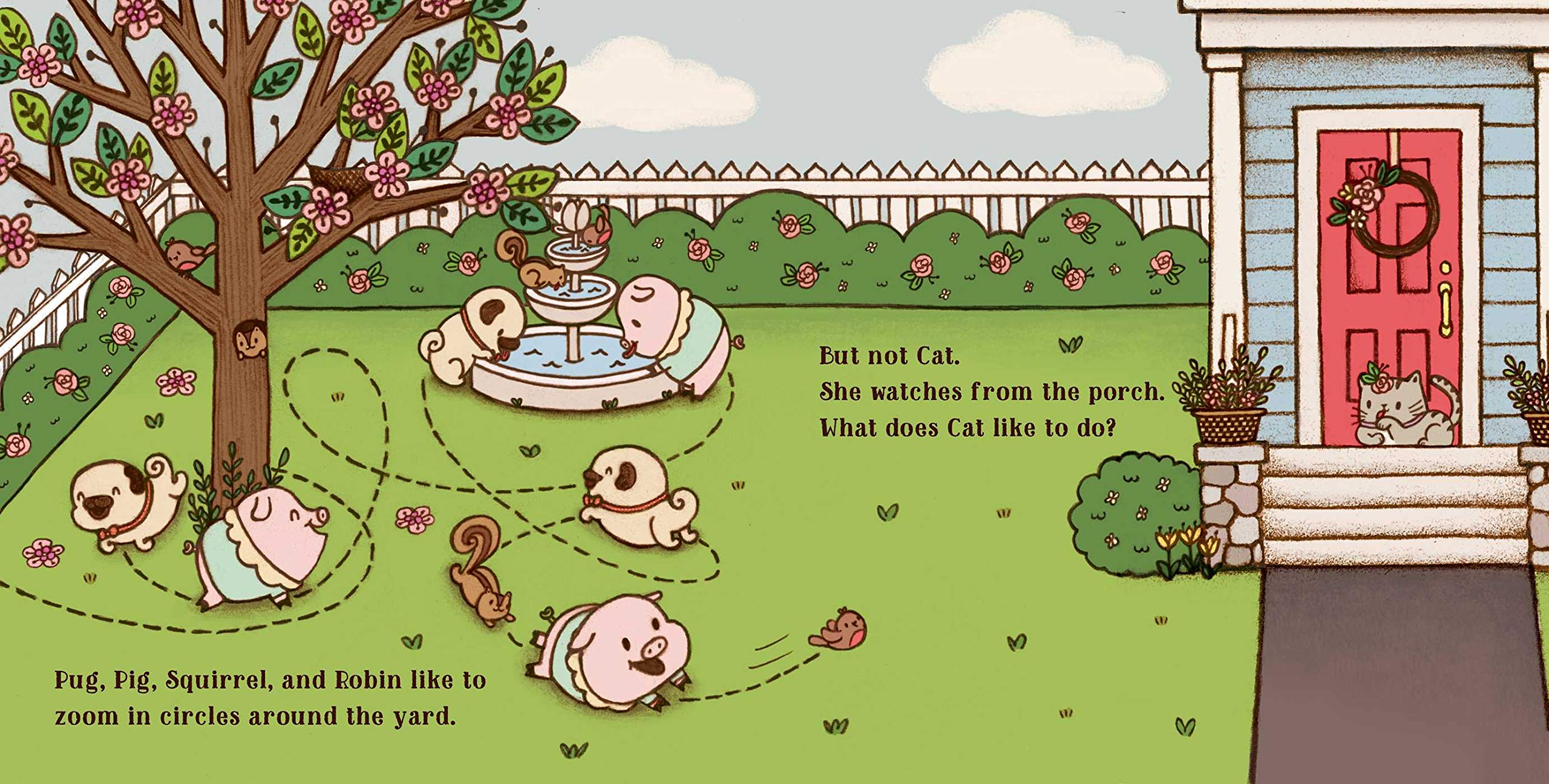
Whether fans of Pug and Pig or new readers, kids will be delighted with the invitation to spend time with Pug, Pig, Squirrel, Robin, and Cat at their trim blue-and-white home. These friends like to play together, but not all of them have the same idea of what fun is.
Image copyright Joyce Wan, 2021, text copyright Sue Lowell Gallion, 2021. Courtesy of Beach Lane Books.
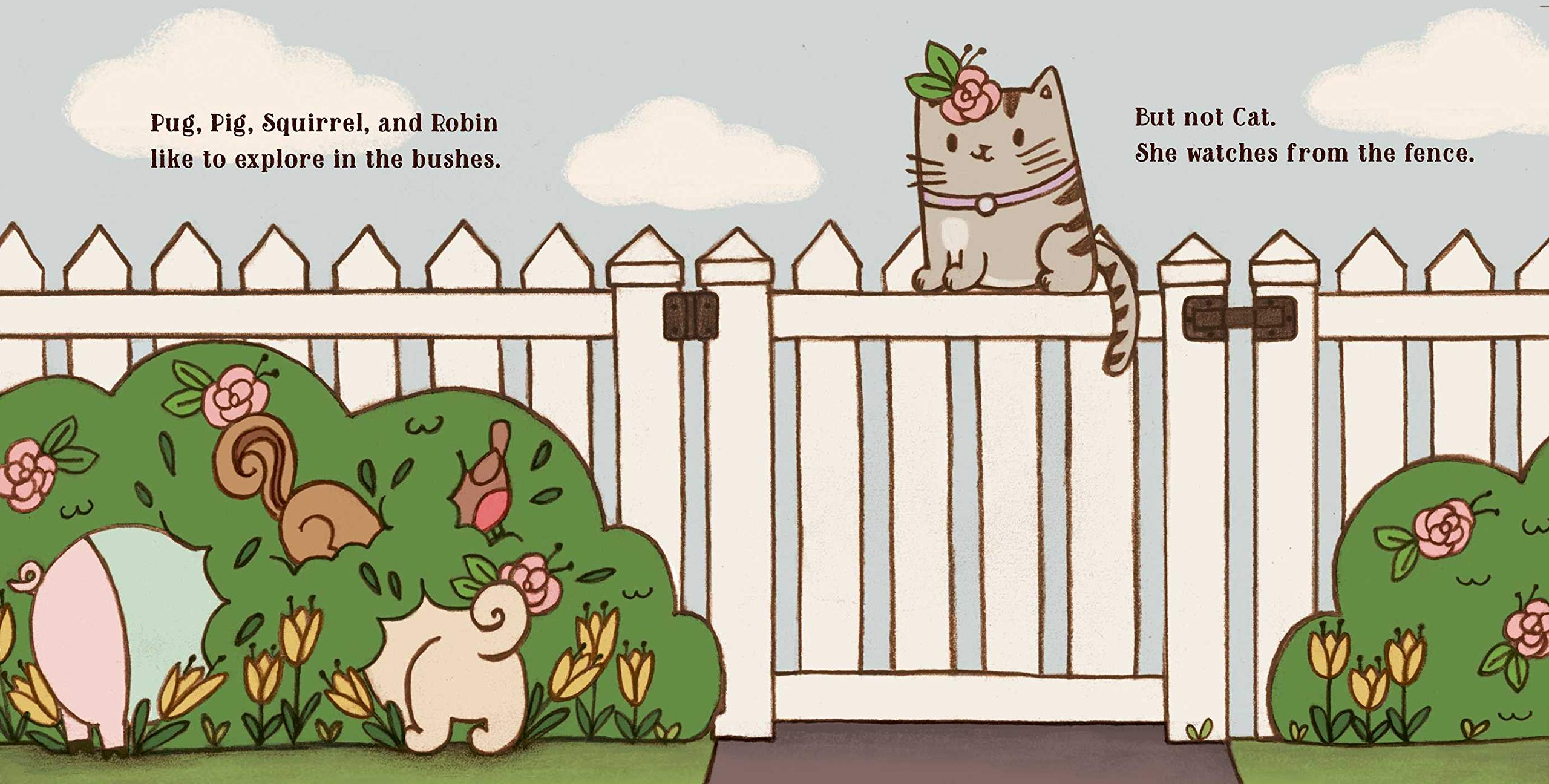
While Pug, Pig, Squirrel, and Robin “like to explore in the bushes,” Cat “watches from the fence.” Pug, Pig, Squirrel, and Robin like to chase each other around the yard. “But not Cat. She watches from the porch. What does Cat like to do?” Cat thinks surprises are fun. She likes to sneak up on Pug, especially when he’s snoozing. With a loud “MRROW!” Cat startles Pug and makes him jump. Then Cat and Pig laugh. But Pug, Squirrel, and Robin do not. “They do not like surprises at all.”
Image copyright Joyce Wan, 2021, text copyright Sue Lowell Gallion, 2021. Courtesy of Beach Lane Books.
Suddenly, the sky grows dark and rain begins to fall. Pug and Pig run to their little house, while Squirrel and Robin scurry to their nests. But where can Cat go? Thunder rumbles and lightning flashes. Cat quickly climbs into the tree and holds on tight. When the rain turns to sprinkles, Robin, Squirrel, and Pig try to get Cat to come down, but she’s too afraid. “Pug has an idea.”
Pug curls up on the welcome mat and closes his eyes. Cat sees him and has an idea of her own. She climbs down from the tree and sneaks up to the front porch. Suddenly, there’s a sound. But who surprises who? And who gets the giggles afterward?
Image copyright Joyce Wan, 2021, text copyright Sue Lowell Gallion, 2021. Courtesy of Beach Lane Books.
Kids are sure to want to giggle along with Sue Lowell Gallion’s latest Pug & Pig story again and again as surprises abound and these fast friends care for each other despite their small differences. Gallion’s gentle reminder that not all kids like surprises becomes a clever plot twist when Pug helps Cat while showing her that he can enjoy her favorite game too.
With her adorable, brightly colored illustrations, Joyce Wan once again brings to life Gallion’s story in ways that are both familiar and fresh and will enchant little ones. The sweetly smiling faces of the characters and their sheer joy of playing together is captivating and will put a smile on the faces of kids and adults. As the sky turns from blue to rainy gray, kids will love getting caught up in the excitement as the friends make their mad dash for cover. As the sun returns so do the shenanigans and the belly laughs.
Whether you’re adding to your collection of the Pug & Pig series or just getting started, the charming Pug & Pig and Friends is a must for home, classroom, and public library bookshelves.
Ages Baby – 8
Beach Lane Books, 2021 | ISBN 978-1534463004
You can read a fun interview with Sue, Joyce, Pug, and Pig here.
To learn more about Joyce Wan, her books, and her art, visit her website.
International Dog Day Activity
Pug & Pig and Friends Activity Kit
Kids can have lots of fun with Pug, Pig, Squirrel, Robin, and Cat with the puppets, puzzles, and craft in this printable Activity Kit found on Sue Lowell Gallion’s website! You’ll also find Activity Kits for Pug Meets Pig and Pug & Pig Trick-or-Treat plus extra coloring pages!
Happiness doesn’t have to be something we plan for, schedule into our calendars, or spend money on. In fact enjoying special moments during each day, doing something spontaneous with friends or family, taking time for a favorite activity, or even savoring a cup of tea may be all you need to feel happier every day! If anxiety, anger, or other emotion is getting in the way of your happiness, this month can provide an impetus to try soothing activities or mend relationships as today’s book shows.
Thanks to Page Street Kids for sending me a copy of Clovis Keeps His Cool for review consideration. All opinions about the book are my own.
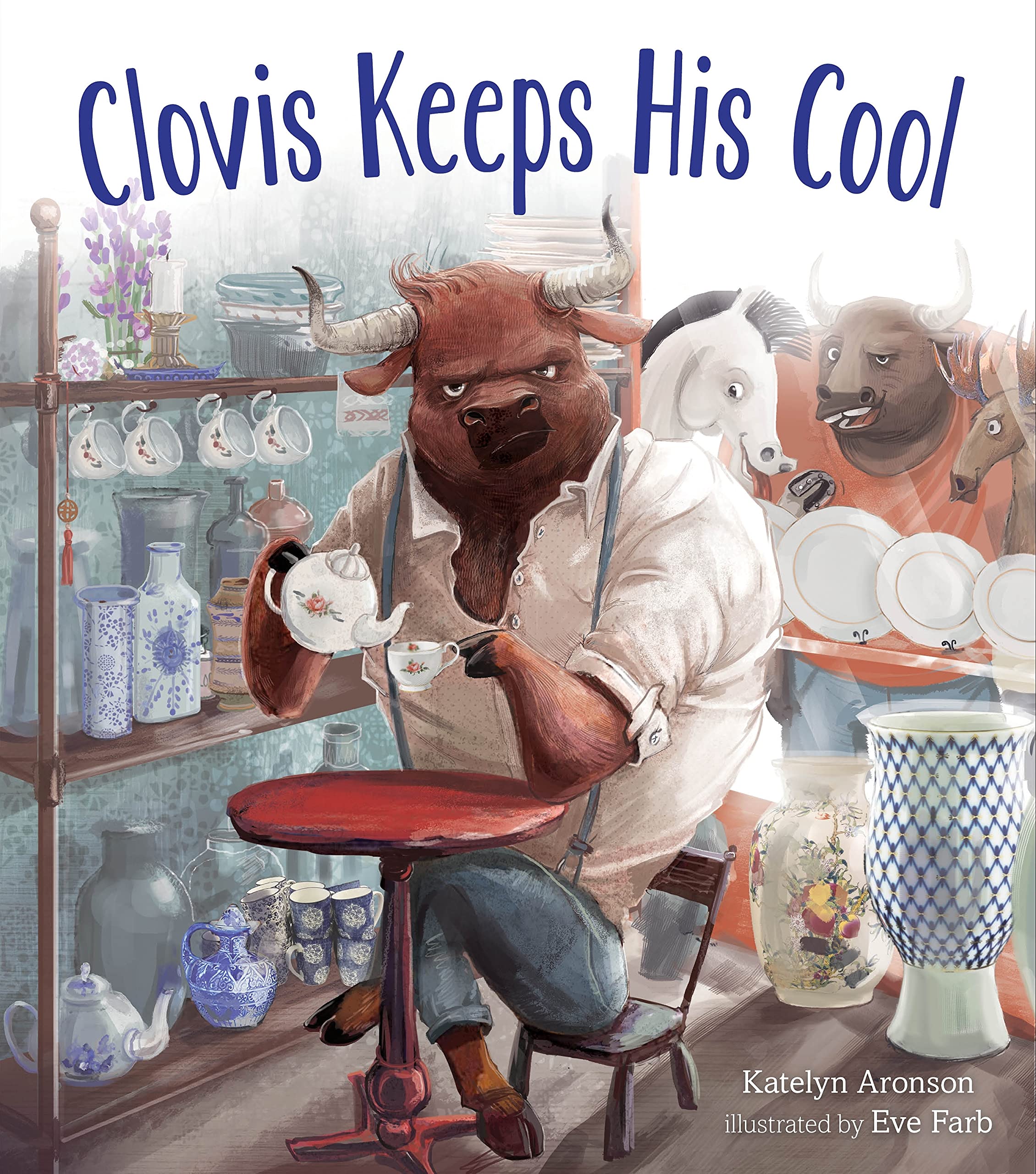
Clovis Keeps His Cool
Written by Katelyn Aronson | Illustrated by Eve Farb
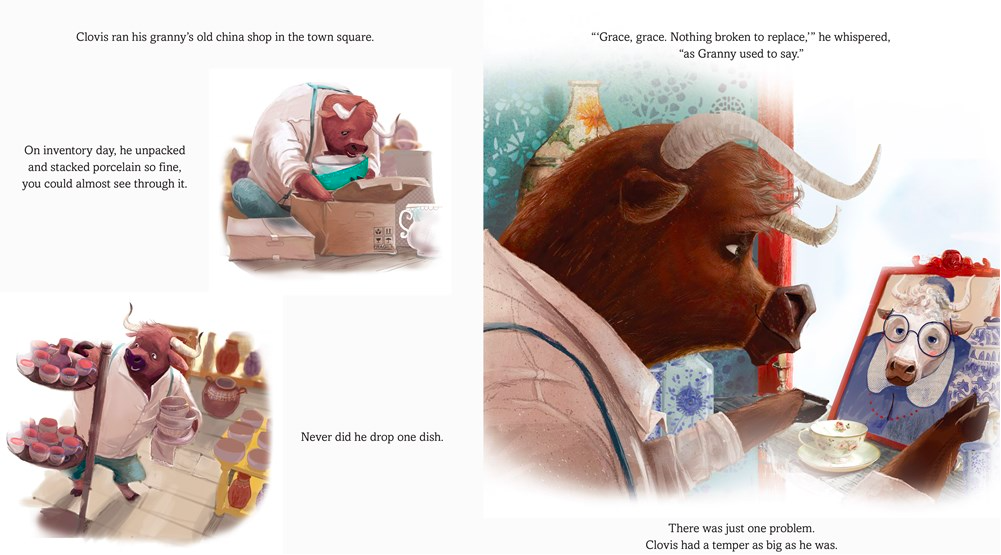
Clovis, a bull and former linebacker for the Cloverdale Chargers football team, had inherited his granny’s china shop. As he delicately unpacked and filled the shelves on inventory day, he reminded himself of his granny’s mantra, “‘Grace, grace. Nothing broken to replace.’” But below the surface, “there was just one problem. Clovis had a temper as big as he was.” Running Granny’s shop made him feel calmer, but one day when three of his old rivals came by, they mocked him, calling him a wimp and teasing him about his apron. One said, “‘Well looky here! The bull in the china shop!’” Clovis felt his anger rising. He breathed in and out and counted to ten, and when his hecklers didn’t get a quick response, they walked away.
Image copyright Eve Farb, 2021, text copyright Katelyn Aronson, 2021. Courtesy of Page Street Kids.
Before he got to work on dusting day, Clovis did yoga and listened to calming music. Carefully he polished each piece until it gleamed, but then he heard the voices of his rivals once again. “Clovis clenched his teeth. There it was again—that urge to charge.” But instead, he picked up his cat and stroked her soft fur. Bored by Clovis’s silence, the trio moved on. On the day he created a new display in the front window, Clovis filled the shop with the gentle aroma of a lavender candle and made himself a cup of chamomile tea. As he placed the fragile items in the window, he chanted Granny’s saying. “‘Grace. Grace. Nothing. Broken. To replace.’” But suddenly his rivals were back, smearing the window with their noses.
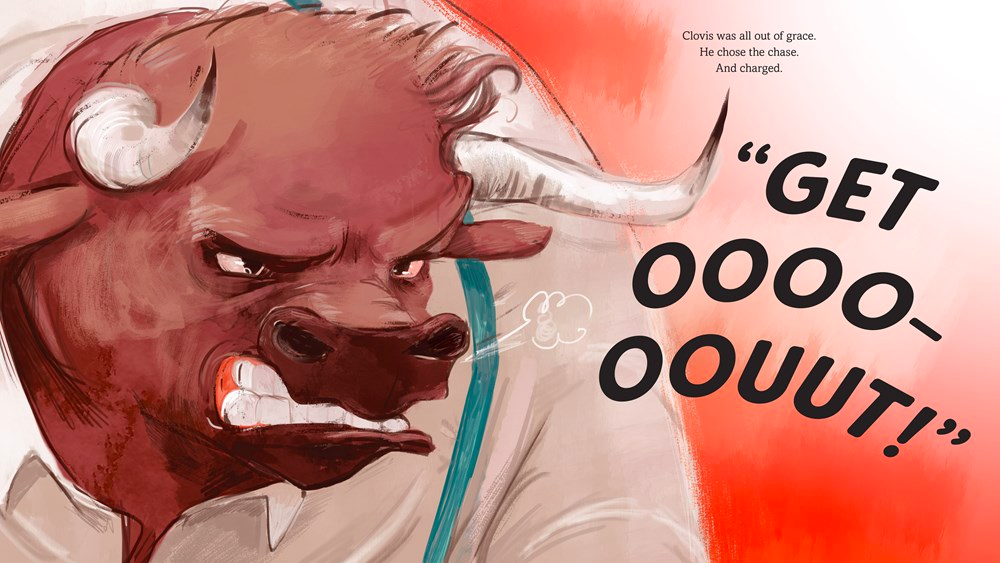
This time they didn’t stay outside but barged in and began insulting the picture of Granny. Clovis restrained himself until one of his rivals picked up Granny’s favorite teacup and threw it at Clovis, taunting him to catch it like in his old football days. But Clovis couldn’t turn in time and the cup sailed past him and smashed on the floor. “Clovis was all out of grace. He chose the chase. And charged. ‘GET OOOOOOUUT!’” he shouted.
He stormed through the shop pushing them out as china crashed and smashed around him. He chased the three through town, finally cornering them in an alley. This was a Clovis they recognized, and they shook in fear. Clovis was preparing to strike when a teabag that had become tangled on one horn swung into view. With a tear in his eye he thought of Granny and all that had been broken: her teacup, her shop.
Image copyright Eve Farb, 2021, text copyright Katelyn Aronson, 2021. Courtesy of Page Street Kids.
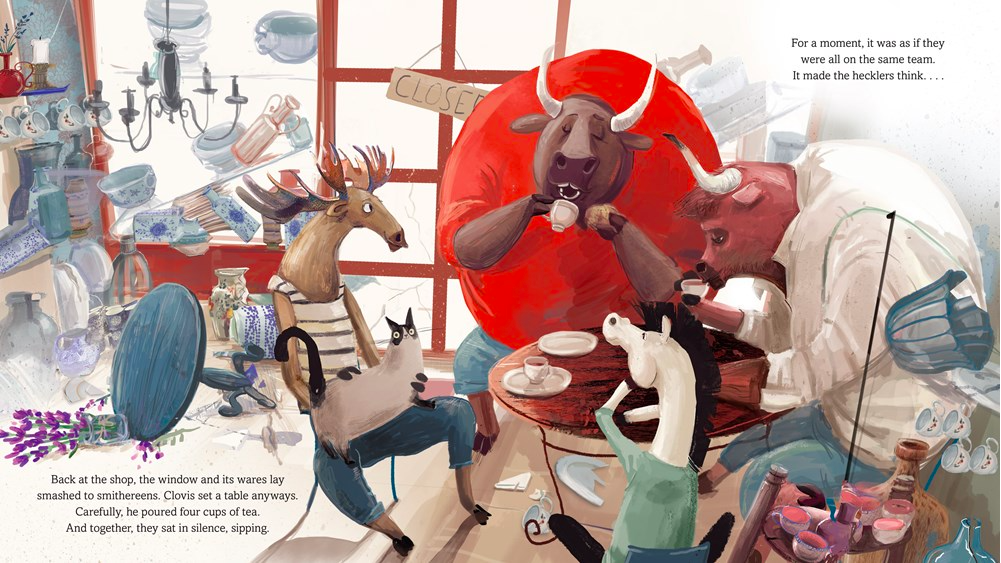
But then, “from somewhere deep in Clovis’s memory, Granny’s voice answered: My dear…Grace. Grace. What is broken can be replaced.” He looked at his cowering rivals and told them who he was: “‘Look, I may be a bull. But I’m no bully.’” Then he offered them a cup of tea. Back at the shop, Clovis set up a table and served tea surrounded by the broken china. “For a moment, it was as if they were all on the same team. It made the hecklers think…”
The next day they were back. But they weren’t there to heckle Clovis as he feared. They were there to help. And “they came back the next day and the next.” Each day, Clovis served tea as they put the shop back together. Now Clovis enjoys playing football and practicing yoga with his new friends, and he always has “plenty of grace to go around” while he serves high tea for all.
Image copyright Eve Farb, 2021, text copyright Katelyn Aronson, 2021. Courtesy of Page Street Kids.
Katelyn Aronson’s clever take on the idiom “like a bull in a china shop” provides readers with a profound and heartwarming look at issues of anger management, bullying, graciousness, friendship, and being oneself. Through her rich storytelling, kids meet a bull with an outsized temper who uses his granny’s influence and strategies to calm his anger. They also are introduced to a gang of bullies who think it’s funny and/or permissible to torment Clovis past his tipping point and end up breaking a precious family heirloom.
Aronson’s thoughtful pause in her narrative before what seems will be an inevitable fight lets Clovis—and by association, readers—decide to take control of who he really is. His choice propels the story to a poignant lesson. Aronson’s characters give adults and children an opportunity to discuss how Clovis ultimately chooses to treat his rivals with kindness, and—although not presented in the text—what the bullies may have thought about and regretted when Clovis invited them to tea instead of fighting them. Her gracious ending shows kids that just like broken objects, relationships can be mended when both sides work at it.
Eve Farb’s stunning images of Clovis’s China Shop packed with intricately decorated vases, delicate tea sets, and gleaming dishware are gorgeous backdrops to Clovis’s delicate touch in pouring a cup of tea, stocking and cleaning the fragile giftware, and performing his morning yoga ritual. Interposed with these are snapshots of Clovis in his more rough-and-tumble persona. When the bullies show up, they are depicted from Clovis’s (and readers’) point of view through the shop window.
A highlight of Farb’s illustration is her command of the emotional impact of Aronson’s story. The animals’ facial expressions and body language clearly reveal their actions and emotions, and when Granny’s favorite teacup crashes to the floor, the next page spread demonstrates Clovis’s anger in a powerful closeup. As Clovis corners his rivals in the alley, readers once again see them through Clovis’s point of view, but this time the bullies’ eyes hold fear. Another compelling page spread follows this as the teabag—glowing with Granny’s grace—refocuses Clovis’s thinking. Farb’s next bold pages compare and contrast notions of brokenness, connection, and even redirection of energy—all served up with tea and scones.
A unique and emotionally resonant story that will captivate kids and can spark important discussions, Clovis Keeps His Cool is highly recommended for home, school, and public libraries.
Ages 4 – 8
Page Street Kids, 2021 | ISBN 978-1645672135
Discover more about Katelyn Aronson and her books on her website.
Happiness is all around you! Grab one or more friends to play a game that reveals what things make you happy.
Like the “Geography” game: the first player names something that makes them happy, the next player must think of something that starts with the last letter of the word the previous player said. The game continues with each player continuing the pattern. Players drop out as they cannot think of a word. The last player left is the winner.
You can find Clovis Keeps His Cool at these booksellers
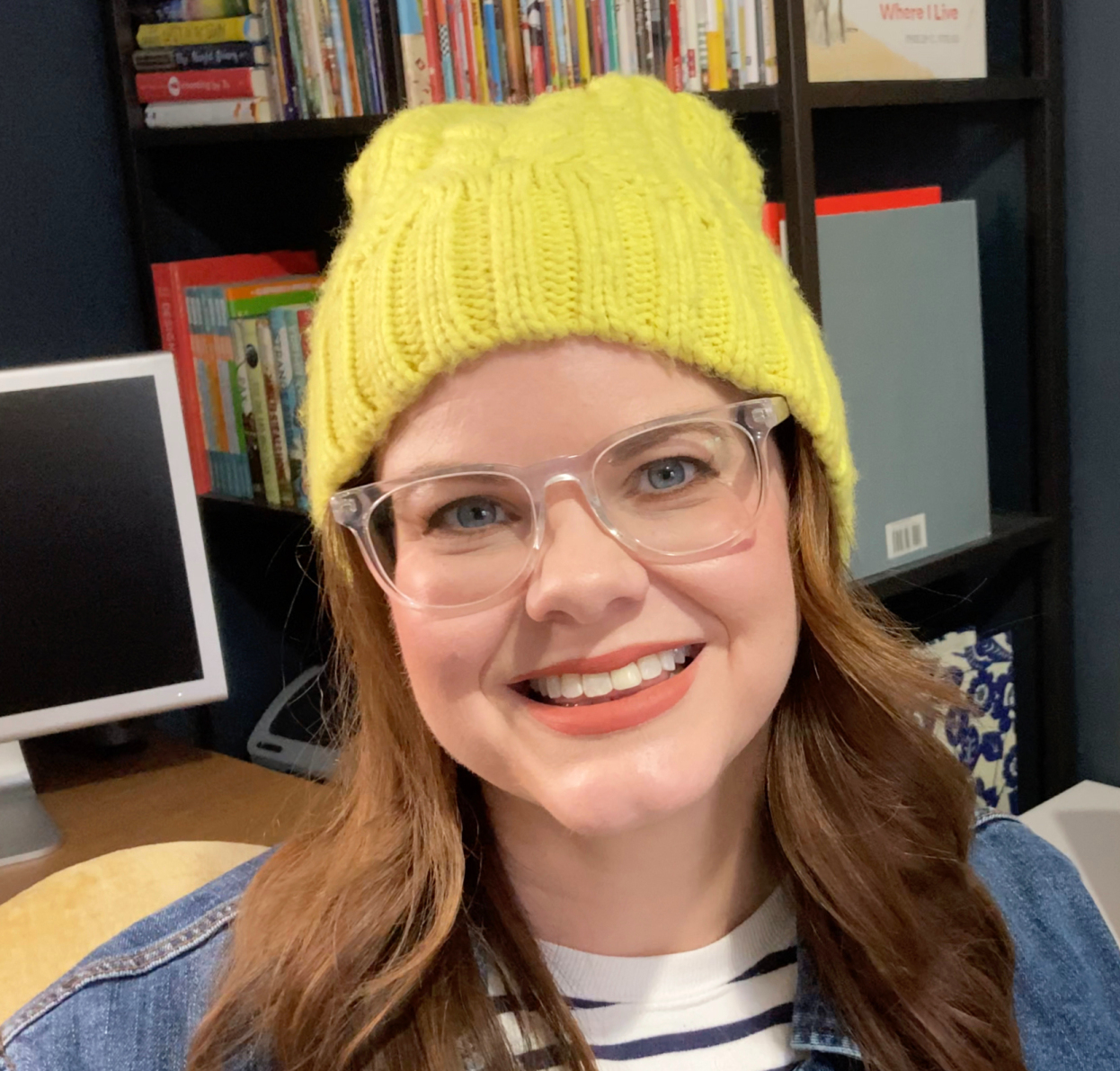
Shelley Johannes is the author-illustrator of the Beatrice Zinker, Upside Down Thinker chapter-book series. A former architectural designer, she has a fondness for tracing paper, process, and accidental discoveries. She and her family live in Michigan with two feathered friends, Max and Alex, who make every day sunny and birdy. More Than Sunny is her debut picture book.
Hi Shelley! I love how you describe all sorts of weather days in your new picture book More than Sunny, so I just couldn’t pass up a chance to share Rain Day with you! Rainy days have their own special fun, and you certainly celebrate that in your book! Of course, when the sun comes out, rainy days also bring rainbows – those beautiful symbols of optimism, something we can all use every day and which shines on every page ofMore than Sunny. Can you talk about what inspired the story?
Thank you, Kathy! And thank you so much for having me here today. Optimism is always in season, but metaphorical sunshine definitely feels even more precious these days.
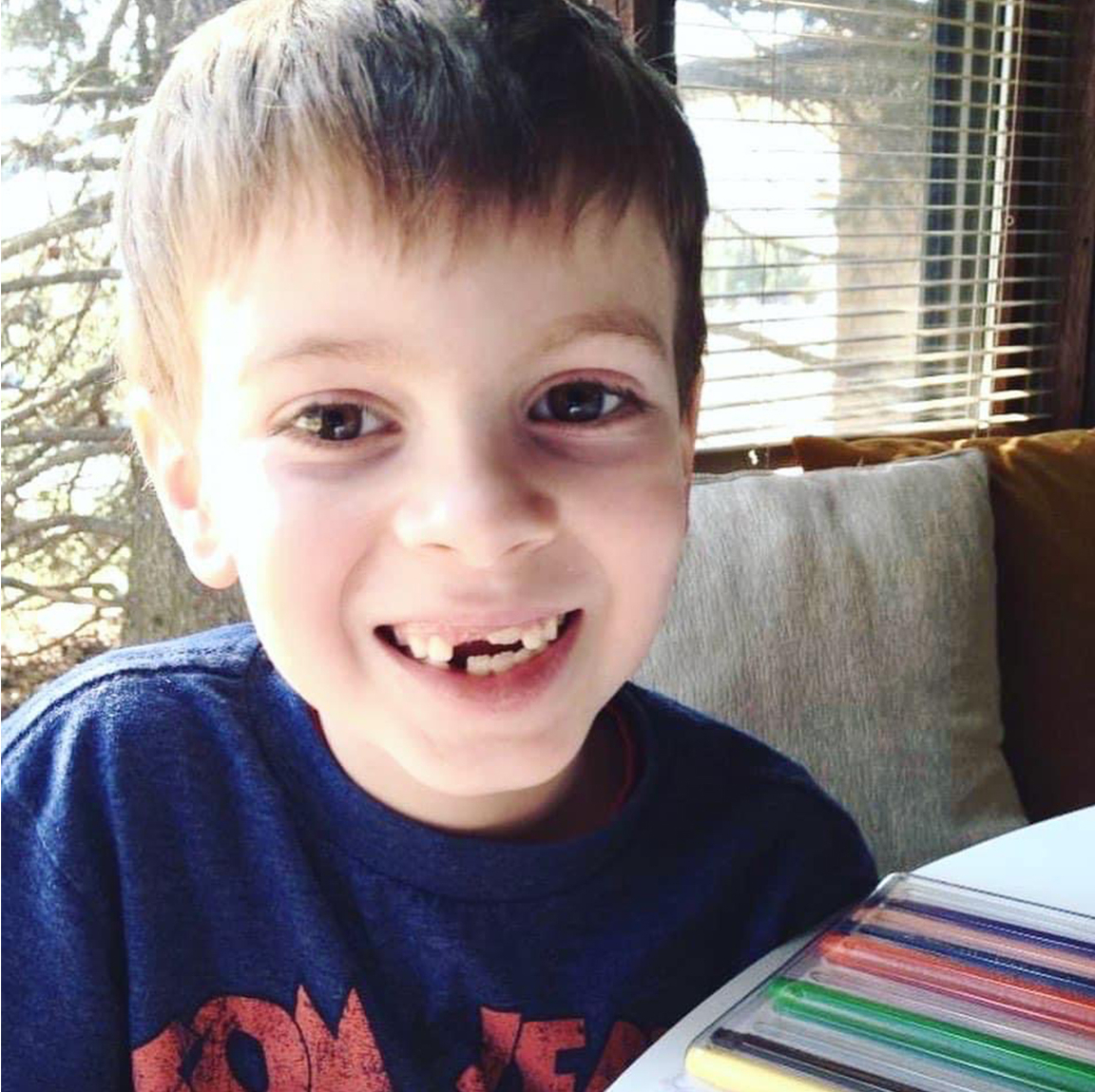
Matthew Johannes
More Than Sunny was inspired by my son Matthew and a first-grade weather project. I’d viewed his daily weather chart—the kind with columns for sunny, cloudy, rainy, windy, snowy—as a mundane task to check off our list, but on the first day, he looked outside and enthusiastically declared, “It’s sunny and birdy today!” When he called the next day “windy and squirrelly”, I knew it had to become a book someday. He turned a routine assignment into something fresh and exciting, and made me pay attention to the beauty I’d forgotten to see. That’s always book-worthy.
In More than Sunny, you describe days with nuances that delight in everything a day can possess. Using your story structure, what would your favorite day have been as a child? How about now as an adult?
I love this question! As a kid, I loved rainy days, and any excuse to curl up with my dog and our special Rainy Day Art Book. So maybe I’d say . . . Dreary and Doggy were my favorite kind of days back then. Rain is so relaxing.
As an adult, it’s a tough call between Springy and Birdy (because May is the most cheerful month, and we are huge bird nerds around here) and Autumn and Squirrelly (because the crisp, colorfulness of fall makes me happy, and we’re huge squirrel nerds too!).
Before writing children’s books, you worked as an architect. Can you talk about that a little? Do you think being an architect influences your writing and art in any way? If so, how?
There was a time I felt bad about my winding path to making books. I felt bad that I didn’t have the guts to go after my dreams sooner. But these days, I’m so grateful for each part of my life and how it shaped me into the person I am today. My years in architecture helped me find my voice and gain the courage to use it. I also learned so much about my love for creative process and collaboration, and the type of people who inspire me. The desire to create, and to make something meaningful, is the motivational underpinning of both fields, so the transition to books felt very natural. The process of designing a building and building a story are surprisingly similar.
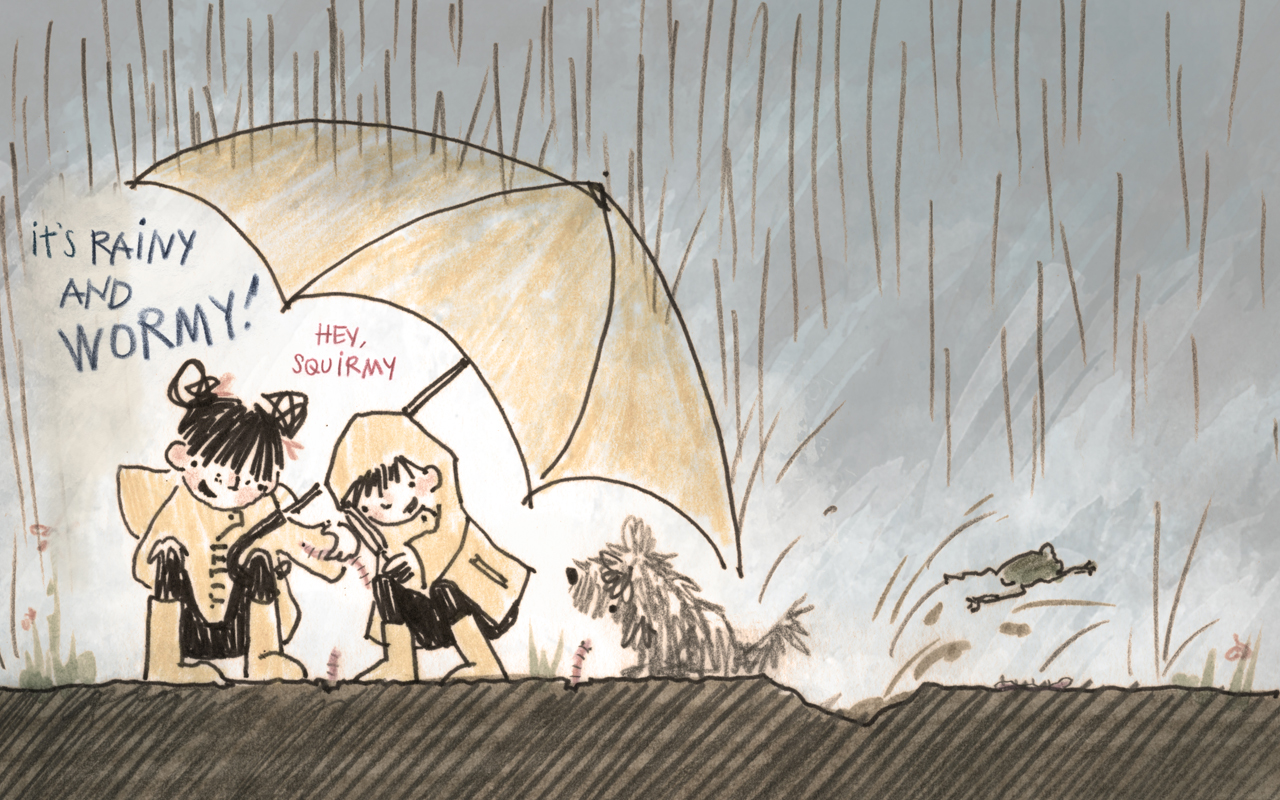
A rainy and wormy day from More than Sunny by Shelley Johannes, 2021, courtesy of Harry N. Abrams.
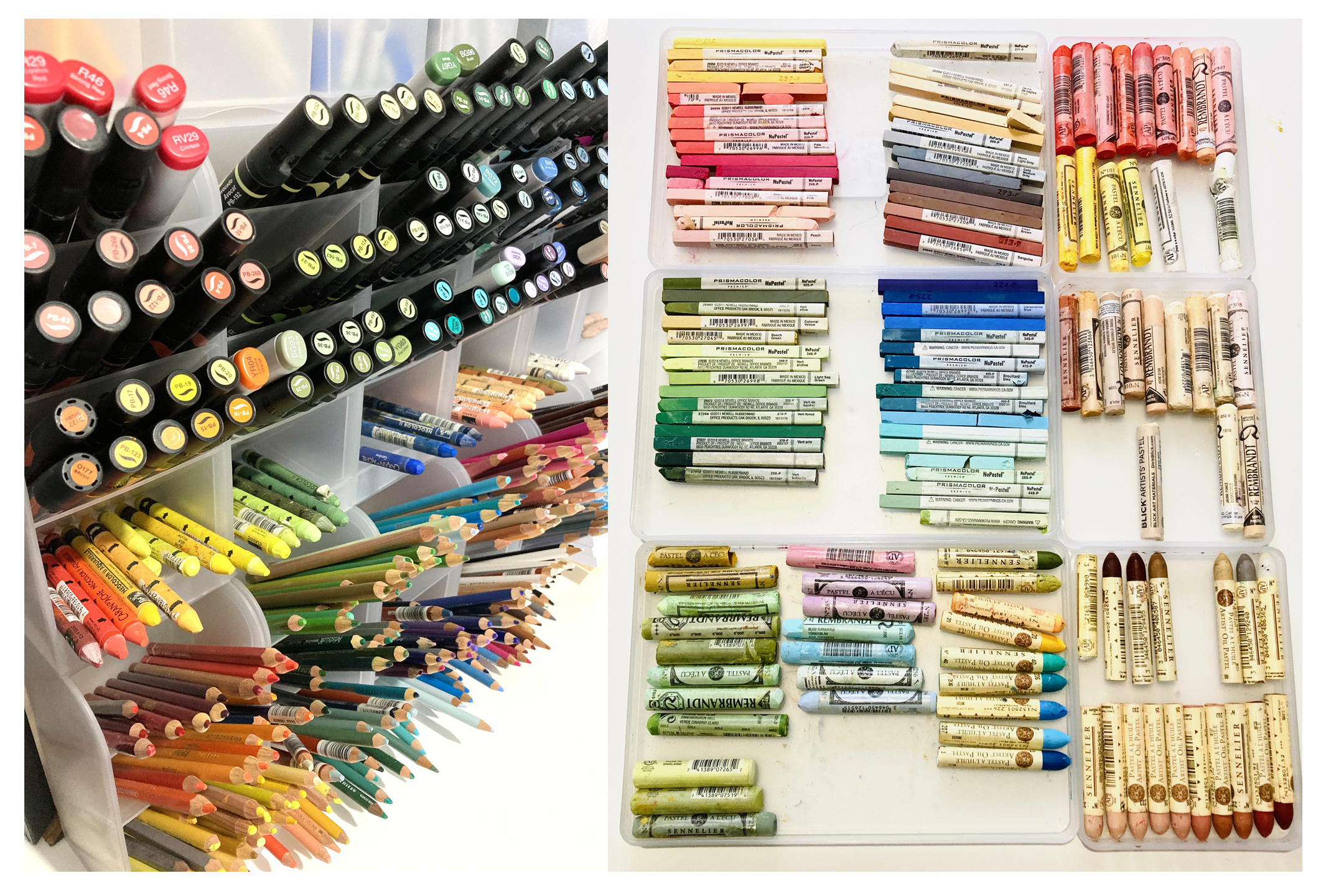
There’s also a direct connection in the way I work. I fell in love with tracing paper and felt-tip pens in my early days in architecture, and I’ve only fallen more in love as time passes. I’ve always loved how a loose sketch or a stray line can capture an idea on paper, and that wonder continues to bring me joy in new ways.
Your son Nolan narrates your wonderful book trailer and his pride and love for you and the More than Sunny really shine through. How great is it to share your writing journey with your kids?
Aw, thank you! We loved making that trailer together! And it was so special to capture his sweet voice just before it shifts into a grown-up one. It’s been so wonderful to share each step of the journey with my kids. I first realized I wanted to make picture books while reading to them as toddlers. They’ve been there for all the ups and downs and in-betweens of the creative process ever since, and enjoyed LOTS of celebratory pizza along the way! So much of each them—and they joy they bring into my life— is woven into everything I make. They inspire so many book moments, and are my most treasured critics and art buddies. I hope being part of this process empowers them to go after all the things they dream of doing, too!
What was your favorite place to read (or write or draw) as a child? What is your favorite place now and why?
As a kid, I loved to read and draw in the quiet privacy of my room, because it was personal and I was shy. These days, I like to mix things up. I write best in a crowded place, with headphones on and music blaring, because it’s easier for me to concentrate when I’m surrounded by stimuli and happy hustle-and-bustle. I also enjoy writing on the go as ideas randomly come to me, and use my Notes app like it’s another piece of my brain. I read anywhere and everywhere, and love listening to audiobooks while riding my bike around my neighborhood!
Though I doodle in sketchbooks all over my house, my studio is still my favorite place to make art. Having a place that’s dedicated to being creative, and filled with my favorite things, makes getting into the zone a bit easier.
What is your favorite season and seasonal activity?
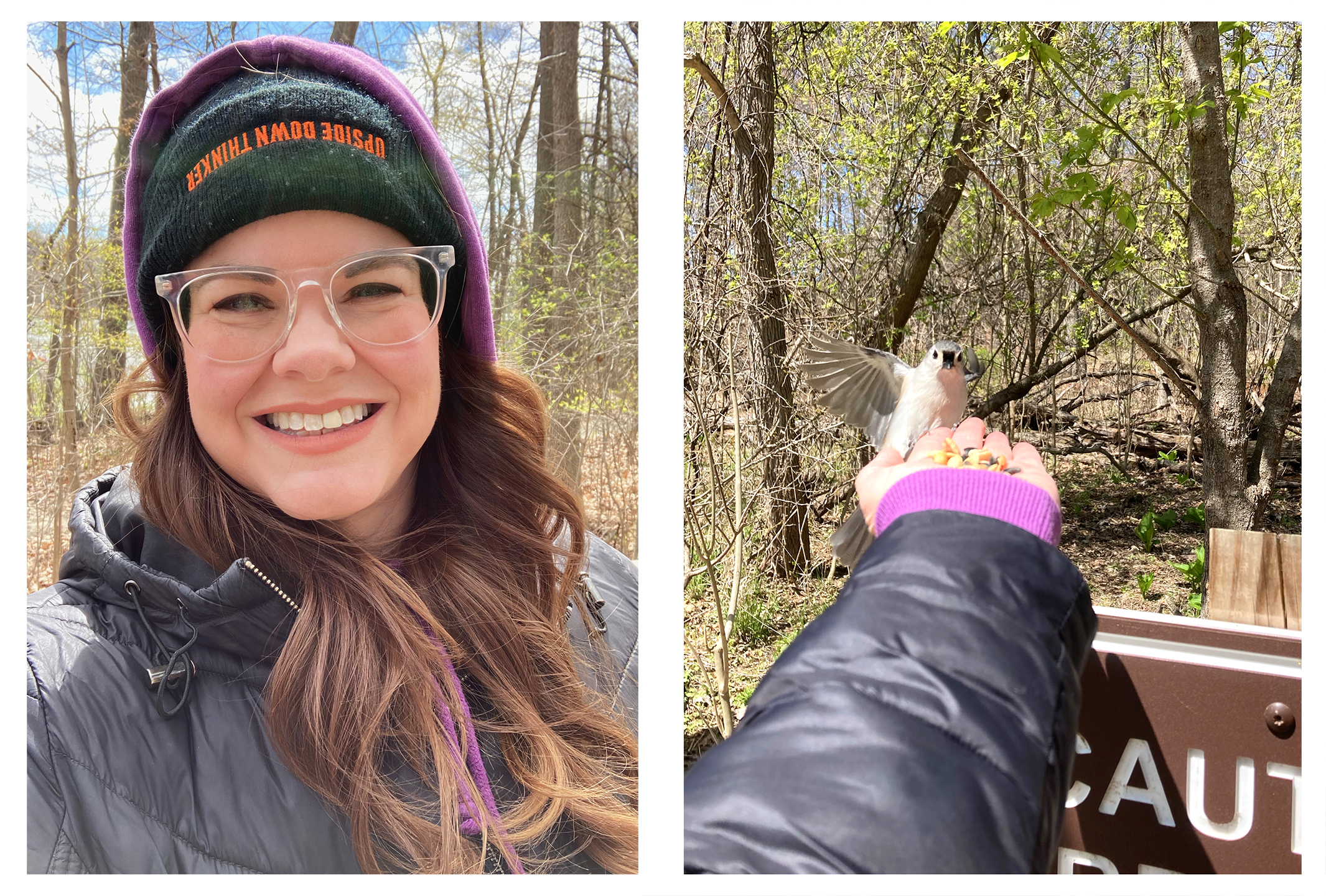
I’m torn between Fall and Spring. It’s hard to beat a cider mill on a crisp Autumn day, especially here in Michigan. Fresh donuts. Crisp apples. Bubbling steam running through the colorful trees. It’s pretty perfect. But then this Spring, we found a nature trail at a local park where wild birds fly down and eat out of your hands, and now we’re addicted to the wonder of that experience too.
Will you be doing any book events this summer that you’d like to tell readers about?
It’ll be a fairly quiet summer (see the answer to the next question!), but I’m doing a virtual event with wonderful Belmont Books on August 26th at 6:30pm ET, and I’d love for everyone to join us! We also had an amazing virtual launch event for More Than Sunny as part of Literati Bookstore’s At Home with Literati series. Jarrett Lerner and I talked about creative process, seeing the world with fresh eyes, and the making of the book. You can watch our conversation here anytime:
What’s up next for you?
This week I am starting the final artwork for my second picture book! I can’t wait to start experimenting with materials and see where it leads me!
Thanks for this wonderful chat and for sharing so many insights. I wish you all the best with More than Sunny and am really looking forward to your next book!
National Rain Day Review
About the Holiday
Today, we celebrate rainy days—but not just any rainy days. Rain Day commemorates an odds-busting record that began in 1874 in Waynesburg, Pennsylvania when one resident remarked to William Allison, the pharmacist at JT Rogers & Co drug store, that it always rained on his birthday—July 29. After that, Allison began keeping an annual record, and all eyes have been on Waynesburg to see if the remarkable run—115 years out of 147—continues. Now weather reporters around the country keep track of this remarkable statistic and broadcast “yes” or “no” to their audiences. As for the people of Waynesburg, they celebrate their notoriety with a huge festival that includes live musical entertainment, arts and crafts and food booths, kids’ games, and, of course, an umbrella-decorating contest. To learn more visit the Rain Day Website. And don’t forget to watch the skies!
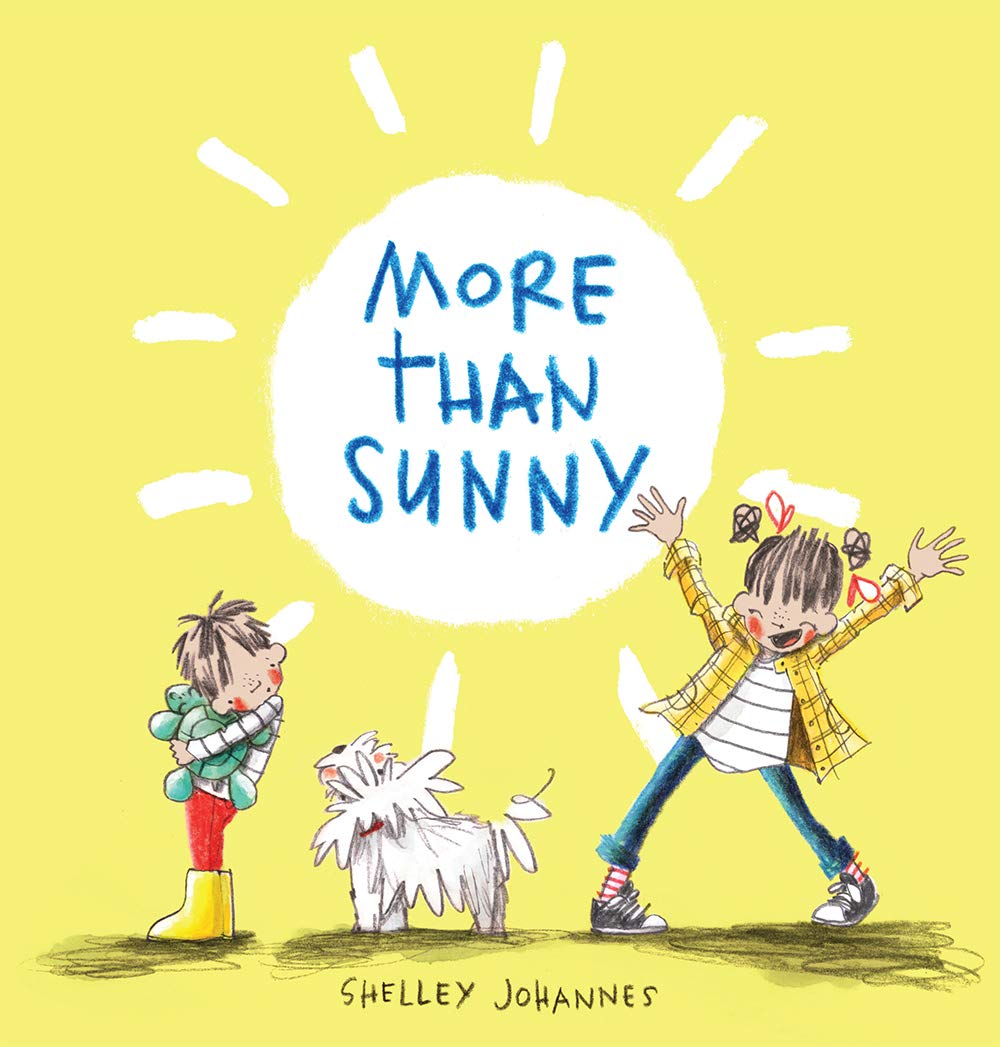
More than Sunny
By Shelley Johannes
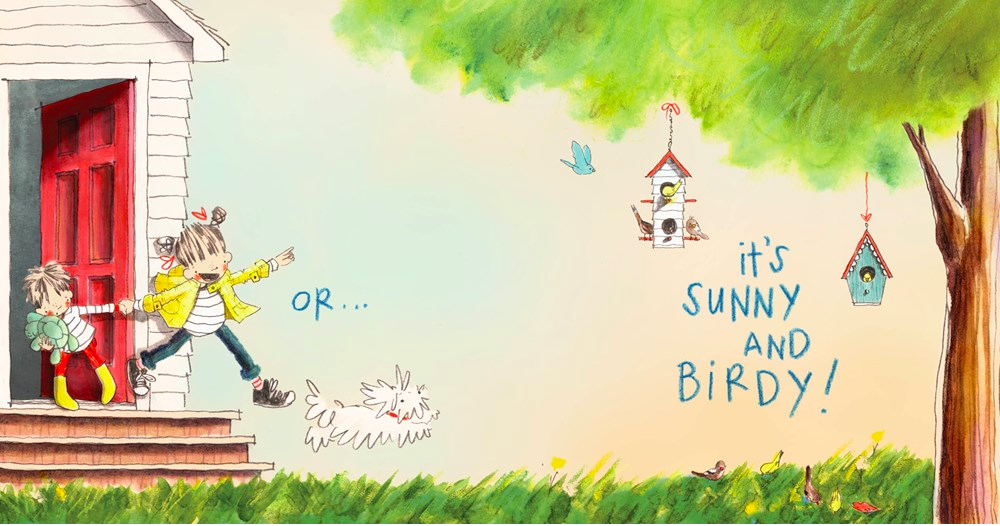
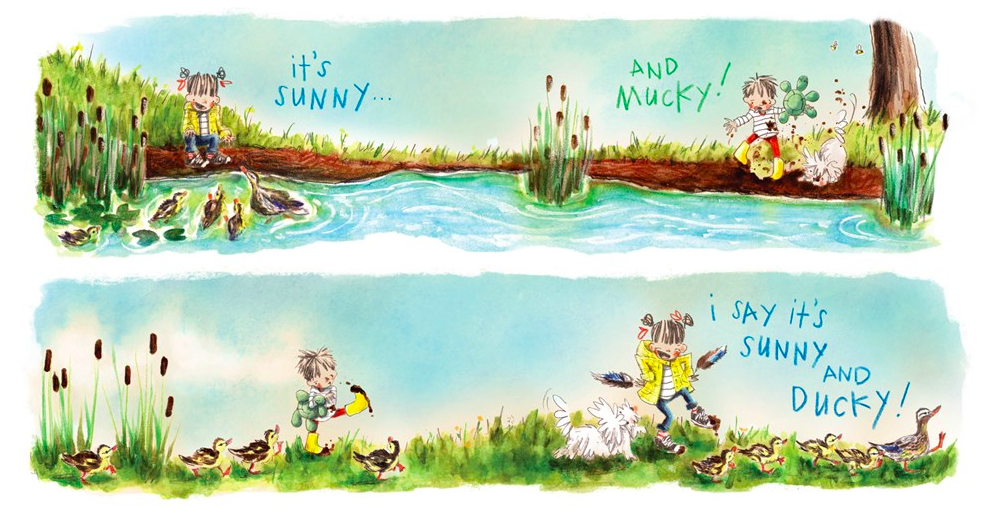
A girl knocks on her brother’s door and, before he’s even fully awake, she bursts in and announces with exuberance that this spring day is “sunny.” Yawning and rubbing his eyes, her brother adds “and early.” But his big sis pulls him outside to show him all the birds at the feeder and birdhouse. It’s not only sunny, she tells him “it’s sunny and birdy!” They head down to the pond, where the siblings have different ideas of what the day’s like. Little brother finds the day “sunny…and mucky!” But his sister, with feathers in her “wings,” states, “I say it’s sunny and ducky!”
Copyright by Shelley Johannes, 2021, courtesy of Harry N. Abrams.
On another day, these two compatible siblings head outside to discover what summer brings besides heat. The sunny day takes them to a field, a tree, and a dock, where they explore, relax, and use their imaginations. But not all summer days are sunny, and that’s okay because being inside when it’s “stormy” these kids make it cozy. And when the storm tapers off a bit, they grab their raincoats and big umbrella and go outdoors, where the girl exclaims, “it’s rainy and wormy!” and her brother inspects the mud and greets a small worm, “Hello squirmy.” The rainy day brings lots of fun with Mom and their dog too.
Copyright by Shelley Johannes, 2021, courtesy of Harry N. Abrams.
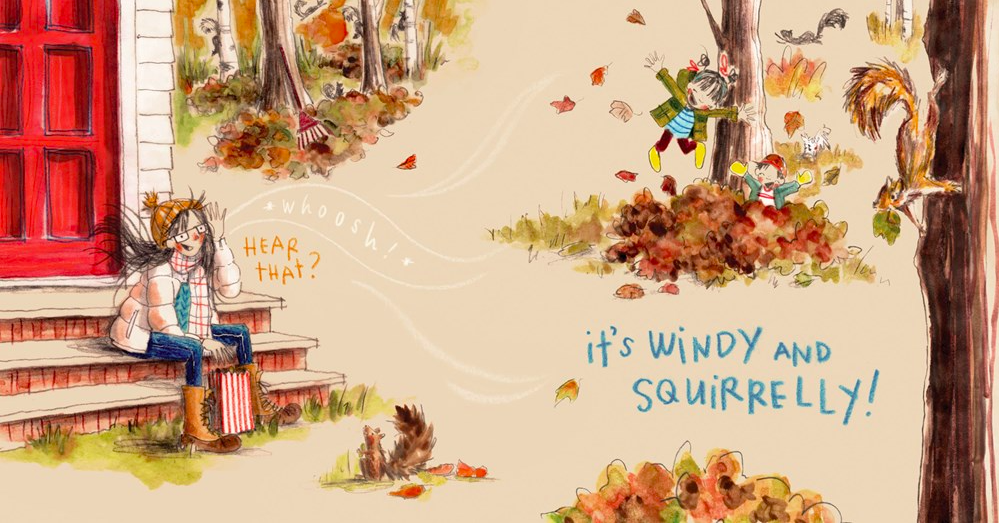
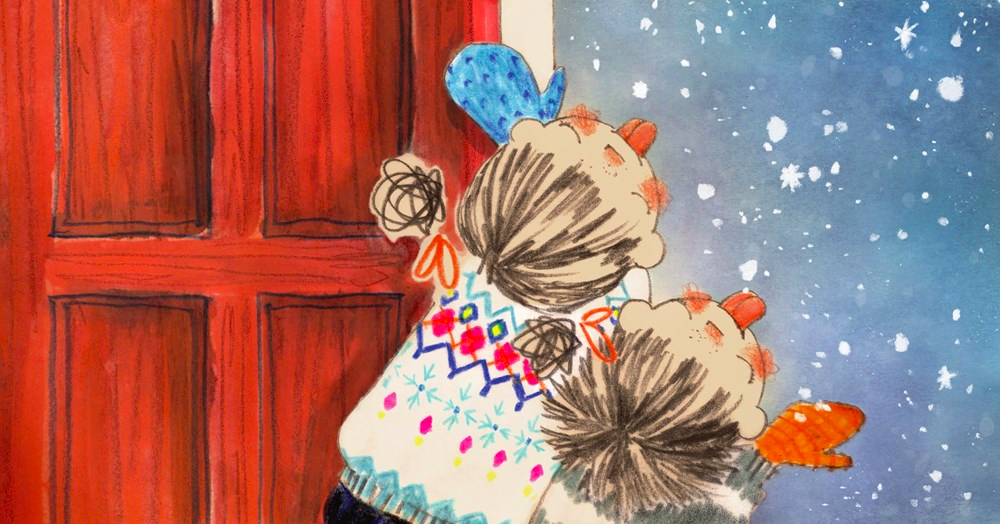
But summer days turn into autumn days with wind and squirrels and piles of leaves to jump in. The kids read and make paper snowflakes, waiting for winter to come. And, finally, the flakes fall. They taste so good. “Can we? Can we?” the siblings ask, eager to be out in the snow. “But I’m warm and socksy,” says Mom. But her kids, tiptoeing and playing, lure her out with “Let’s be snowy and foxy!”
Copyright by Shelley Johannes, 2021, courtesy of Harry N. Abrams.
They take a walk in the woods and, while sledding, see Daddy coming home. “Are you ready and sleddy?!” they ask, but there’s shoveling to be done. That’s all right; there are other ways to have fun in the snow. Tired out and chilly, the family goes inside for bedtime. Now there’s a knock at the sister’s door. Yawning and rubbing her eyes, she goes to see who it is. It’s her brother, and he has something magical to show her.
Copyright by Shelley Johannes, 2021, courtesy of Harry N. Abrams.
Shelley Johannes’s exuberant call to play and explore is a perfect jumping off place for kids to look at and interact with their surroundings with new eyes, imagination, and creativity. Hopping from season to season, Johannes touches on moments of freedom and wonder and those happy discoveries so formative in childhood. Her playful rhymes and bouncy rhythm echo kids’ delighted banter, and her sprightly adjectives invite readers to come up with their own descriptions of their day.
Johannes’s bright, energetic, and cheery illustrations dazzle with lively depictions of the siblings playing outside in all weather. Her smile-inducing portrayals of the siblings mirror real kids and each page is loaded with details readers will love lingering over. Mom and Dad make warm cameos to create a book the whole family will enjoy.
More than Sunny is a generously sized picture book that kids and adults will find themselves joyfully sharing throughout the year. For teachers and homeschoolers, Johannes’s storytelling provides a spark for writing prompts, grammar lessons, and observational skills. Sure to become a quick favorite, More than Sunny is highly recommended for home, classroom, and public library collections.
Ages 4 – 8
Harry N. Abrams, 2021 | ISBN 978-1419741814
Discover more about Shelley Johannes and her books on her website.
One of the best simple pleasures is looking up at the clouds and imagining what shapes you see. Bring those fluffy, white clouds into your room with this craft!
Supplies
White girls’ dress bobby socks in various sizes
Fiber fill, 20-ounce bag
Fishing line, different lengths
Needle
Clear adhesive mountable hooks or clips
Directions
Stuff the socks with fiber fill, pushing it far into the sock and adding more here and there to make various lumps and give it a rounded, cloud-like shape
When the sock is full, tuck the end of the sock in to close it
Cut lengths of fishing line. The lengths will depend on how and where you will hang the clouds
With the needle or by hand, feed one end of the fishing line into the top of the sock and out to attach the line for hanging.
Knot the fishing line
Attach the mountable hooks or clips to the ceiling










 celebratepicturebooks.com