March 12 – It’s International Ideas Month

celebrate-picture-books-picture-book-review-the-floating-field-cover

About the Holiday

This month we celebrate something that you can’t see or hold but which is real all the same. What is it? An idea! Ideas are amazing things. Sometimes seemingly conjured up out of thin air; sometimes borne out of necessity as in today’s book; and sometimes the “Eureka!” result of long, hard work, ideas fuel our arts, sciences, education, and home life. So today, write down those ideas you have while driving or commuting to work, while in the shower, when you’re daydreaming, or just as you turn off the light to go to sleep. You never know what they might become!

The Floating Field: How a Group of Thai Boys Built Their Own Soccer Field

Written by Scott Riley | Illustrated by Nguyen Quang and Kim Lien


Like all of the villagers living on the small island of Koh Panyee, Prasit Hemmin’s home was built on stilts. His father was a fisherman, and every morning Prasit helped him load his boat before school. Today was an exciting day, and Prasit hurried to meet his friends at Uncle’s coffee shop. They had big decisions to make: “Who will carry the poles? Who’s on which team? Who gets to kick off first?” The full moon had come and later the tide would go out.
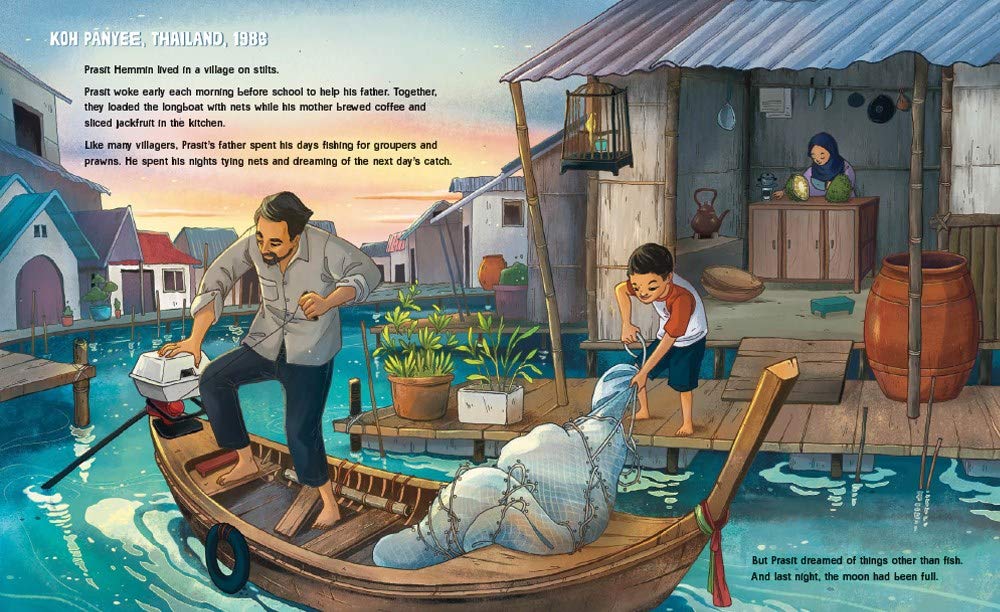
celebrate-picture-books-picture-book-review-the-floating-field-koh-panyee

Image copyright Nguyen Quang and Kim Lien, 2021, text copyright Scott Riley, 2021. Courtesy of Millbrook Press.

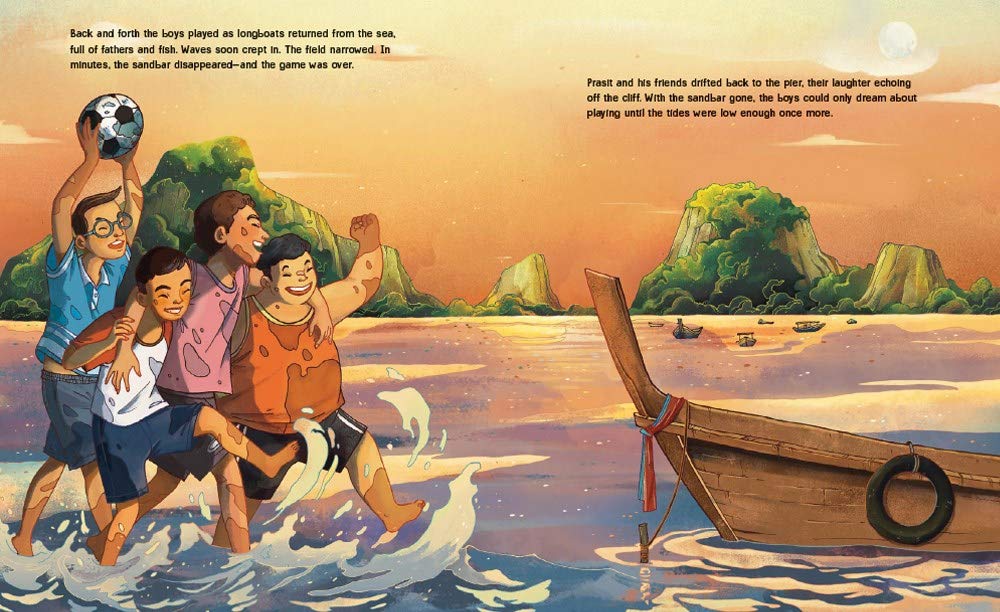
By the time school was over, the sandbar with its glittering sand was ready, beckoning to the boys to come play. They set up their goal and dropped the ball then “they dug in their toes and chased it across the hard-packed ripple of sand. They weaved in between other players to get open. And when they got close, they took a shot. GOAL!” The boys played until the sun went down and the fisherman’s longboats returned home. Then they “could only dream about playing until the tides were low enough once more.”

Fortunately, the World Cup was being held this month, and the boys watched the games on the small TV at Uncle’s coffee shop—“the only one on the island.” The boys decided that they needed a team of their own. But where would they play? Prasit looked around at their floating village and had an idea. They could build their own field. The next day, they collected materials and got to work. With planks and barrels, they built a platform. When it was ready, they tethered it in place, painted the lines, and put up goals.
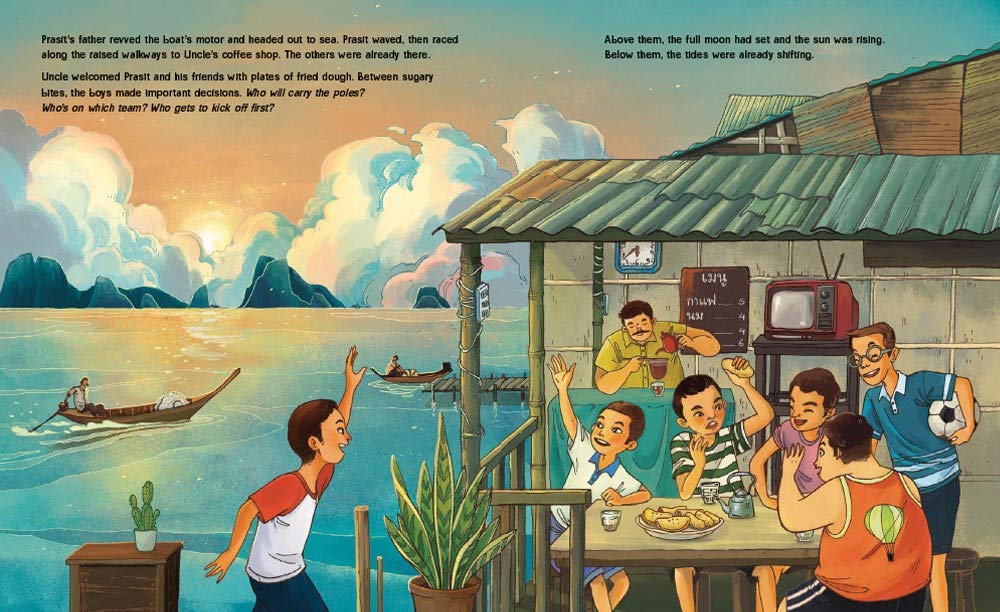
celebrate-picture-books-picture-book-review-the-floating-field-coffee-shop

Image copyright Nguyen Quang and Kim Lien, 2021, text copyright Scott Riley, 2021. Courtesy of Millbrook Press.

Every day, Prasit and his friends played on their floating field, learning some fancy footwork to avoid rough spots on the boards. The villagers who once thought they were crazy for building the field now stopped to watch. One day the boys heard about a tournament being held on the mainland, and they signed up. On the morning of the tournament, just before they left for the mainland, the villagers surprised them with new uniforms and “the Panyee Football Club was born.”

The boys stood nervously on the field before their first game began, but once the ball was in play, they knew just what to do. “They passed it down the field. They weaved in between other players to get open. And when they got close, the took a shot. GOAL!” The Panyee Football Club won several games, but by the afternoon, the weather had turned and rain pelted the field. While their opponents knew how to play on the soggy field, the Panyee boys didn’t. At halftime they were down 2 – 0. Prasit had an idea.
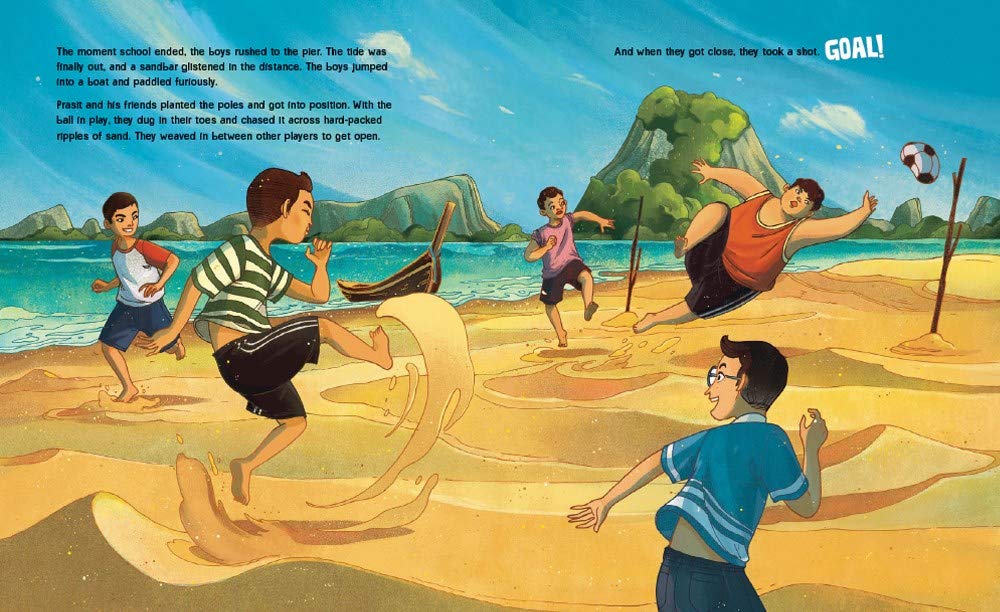
celebrate-picture-books-picture-book-review-the-floating-field-beach

Image copyright Nguyen Quang and Kim Lien, 2021, text copyright Scott Riley, 2021. Courtesy of Millbrook Press.

Back on the field, the boys ran barefoot, just as they did at home. They were quicker and more agile, and they were able to tie the score. But with only minutes left in the game, the other team scored—and won. “But that day, in their very first tournament, the Panyee Football Club came in third place.” On the boat ride home, the boys celebrated, eager to get back on their floating field “where they could play the game they loved, whenever they wanted.”

Extensive backmatter includes an Author’s Note, complete with photographs, reveals some unusual places soccer is played and more about how this story came to be; a note from Prasit Hemmin about his childhood experiences and the future success of the football club he and his friends started; and a glossary of soccer vocabulary in English and Thai with pronunciation tips. There is also a list of resources for further reading.
celebrate-picture-books-picture-book-review-the-floating-field-sandbar

Image copyright Nguyen Quang and Kim Lien, 2021, text copyright Scott Riley, 2021. Courtesy of Millbrook Press.

Soccer fans and sports lovers of all kinds will find the story of Prasit Hemmin and the soccer field he and his friends designed enthralling. The idea that these boys could only play their favorite game twice a month will be eye-opening for kids used to daily or weekly practice, and their ingenious solution will inspire them to greater problem-solving. Through Scott Riley’s detailed storytelling, readers gain knowledge about life on the small island of Panyee as well as how the boys built their floating field. Riley also showcases the camaraderie between the boys and the pride of the villagers, making this a beautiful story of community.

Through various perspectives, Nguyen Quang and Kim Lien’s gorgeous and vibrant illustrations introduce readers to the island of Panyee with its dense collection of homes and businesses that left no room for a soccer field. The blue ocean water shimmers under the sun and ripples where longboats skim over the surface. Immersive images take kids into the Hemmin home and Uncle’s coffee shop, where Prasit’s mother makes breakfast while Prasit and his father ready the fishing boat for the day. Depictions of the boys playing soccer on the sandbar and later on the floating field they built are exciting and full of action. Soccer players may be fascinated by the proportions of the floating field and its goals and appreciate the precision with which Prasit and his friends scored. The contrast between the island and the mainland soccer field will also give readers an appreciation for the Panyee Football Club’s accomplishment in winning third place in their first tournament.

A stellar addition to any child’s library as well as to classroom and homeschool geography, STEM, and multicultural lessons, The Floating Field: How a Group of Thai Boys Built Their Own Soccer Field is highly recommended for home, school, and public library bookshelves.

Ages 7 – 11

Millbrook Press, 2021 | ISBN 978-1541579156

Discover more about Scott Riley and his book on his website.

To learn more about Nguyen Quang and Kim Lien, their books, and their art, visit their website, Kaa Illustration.

International Ideas Month Activities

celebrate-picture-books-picture-book-review-soccer-maze

Kick It In!


Use some fancy footwork to move the soccer ball down the field and score in this printable puzzle!

Kick It In Maze Puzzle | Kick It In Maze Solution

Visit Koh Panyee

Learn more about this unique village with this video about Koh Panyee!

celebrate-picture-books-picture-book-review-the-floating-field-cover

You can find The Floating Field: How a Group of Thai Boys Built Their Own Soccer Field at these booksellers

Amazon | Barnes & Noble | Books-a-Million

To support your local independent bookstore, order from

Bookshop | IndieBound

Picture Book Review

February 25 – It’s Bake for Family Fun Month

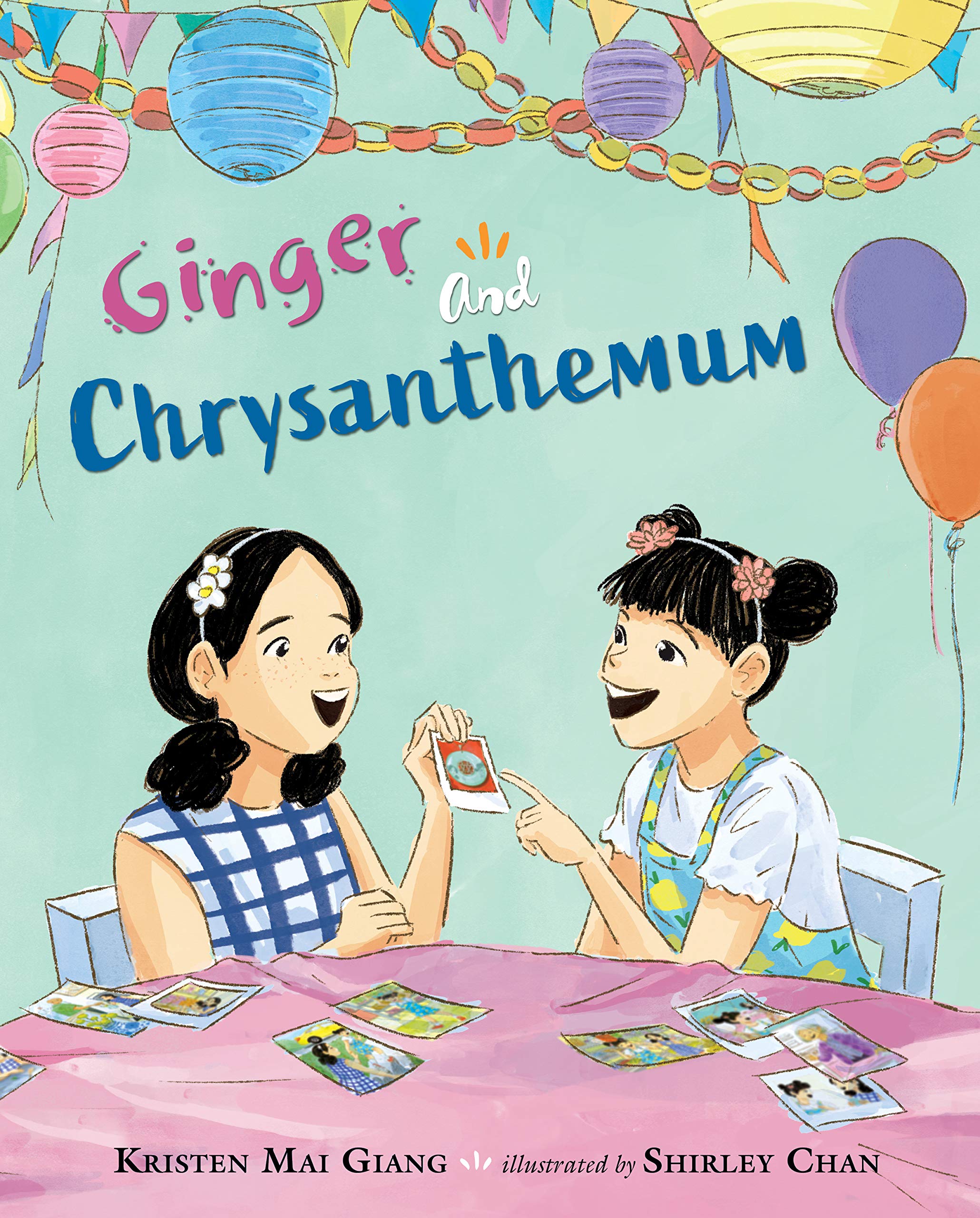
celebrate-picture-books-picture-book-review-ginger-and-chrysanthemum-cover

About the Holiday

Whether you and your family have always liked to bake together or you’ve found a new hobby in the past year, February is a great time to scour cookbooks or find recipes online and add some new taste sensations to your traditional favorites. Baking together teaches valuable cooking skills and is a creative way to engage with math. It can also bring your family closer as you talk about old memories that revolve around baking or cooking and make memories for the future. Of course the best part of baking together is eating the delicious treats afterward!

Ginger and Chrysanthemum

Written by Kristen Mai Giang | Illustrated by Shirley Chan


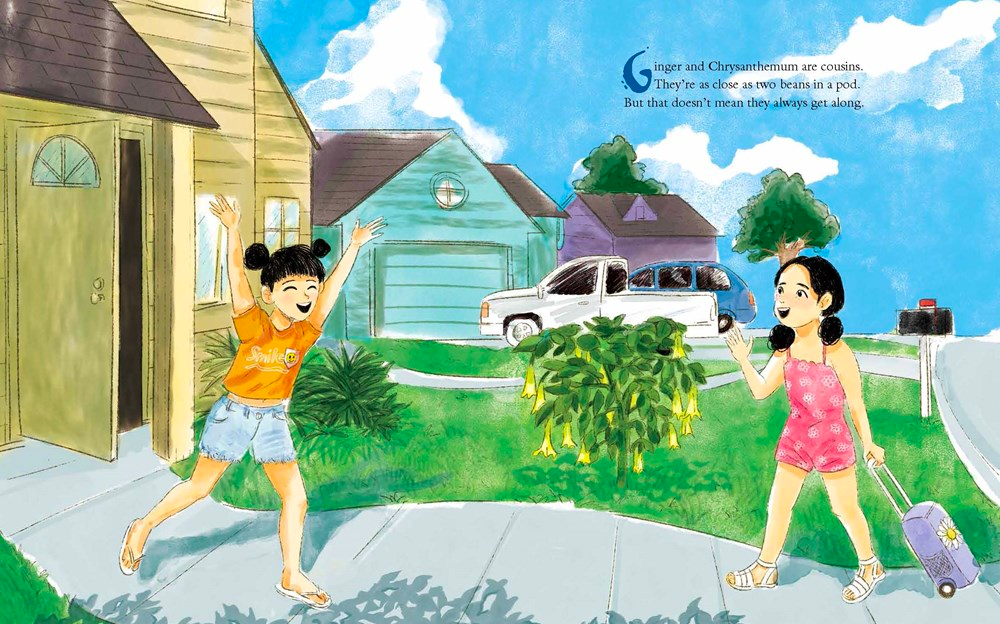
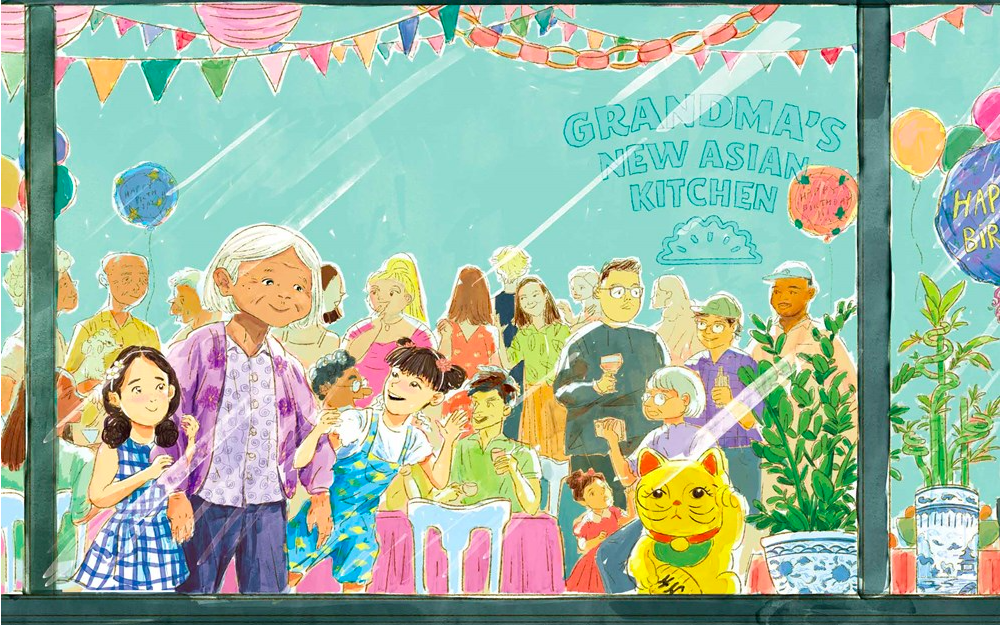
Ginger has come to visit her cousin Chrysanthemum. “They’re as close as two beans in a pod,” but they don’t always see things the same way. Today is their grandmother’s birthday, and they want to make it perfect. Chrysanthemum has made a list of things they must do. First, she says they must dress up. While Chrysanthemum puts on the tidy checked dress she brought along and slips on a matching headband and cool, white sandals, Ginger tries on everything in her closet.

celebrate-picture-books-picture-book-review-ginger-and-chrysanthemum-visiting

Image copyright Shirley Chan, 2020, text copyright Kristen Mai Giang, 2020. Courtesy of Levine Querido.

When Ginger’s ready, Chrysanthemum consults her list again and finds it’s time to shop for decorations and a gift and then head to Grandma’s New Asian Kitchen restaurant to decorate. Ginger doesn’t want to take time to read a list, though, and pulls her cousin out the door. They hurry to the market to do their shopping. Ginger finds paper lanterns in every color and thinks it’s fun to balance a stack of them on her head. Chrysanthemum knows Grandma loves flowers and chooses ginger and chrysanthemum flowers for the party. For Grandma’s gift, they buy a jade pendant.

One thing the cousins do agree on is that they love to help out at the grandmother’s restaurant. While each girl has their own favorite job to do, today they are decorating together. Ginger is running around hanging lanterns and Chrysanthemum  is carefully placing flowers on the tables when Grandma asks which of them would like to bake the birthday cake. Ginger has visions of making “an AMAZING cake with BLAZING candles” while Chrysanthemum says, “‘I’ll make a cake light and cool as a cloud.’” Grandma suggests they work together to make her green tea cake.

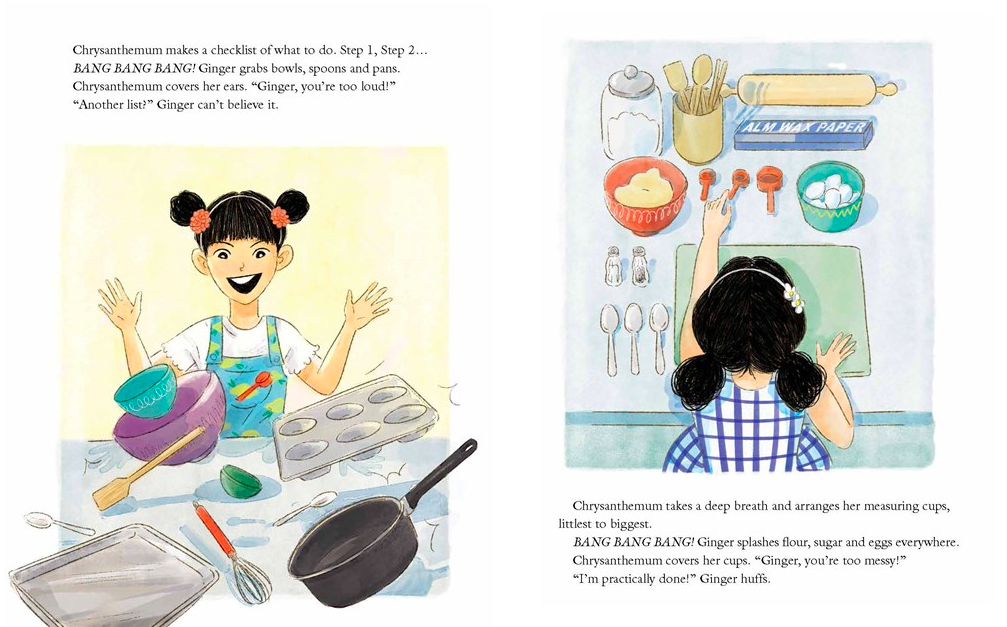
celebrate-picture-books-picture-book-review-ginger-and-chrysanthemum-utensils

Image copyright Shirley Chan, 2020, text copyright Kristen Mai Giang, 2020. Courtesy of Levine Querido.

Ginger rushes around the kitchen, banging pans and rattling bowls; Chrysanthemum makes another list and patiently lays out all of her utensils and ingredients. Ginger is mixing the flour, eggs, and sugar with such vigor that the batter splashes everywhere. “‘Ginger, you’re too messy,’” Chrysanthemum tells her. Ginger is upset with how slowly Chrysanthemum is working. “Chrysanthemum steams like a teapot.”

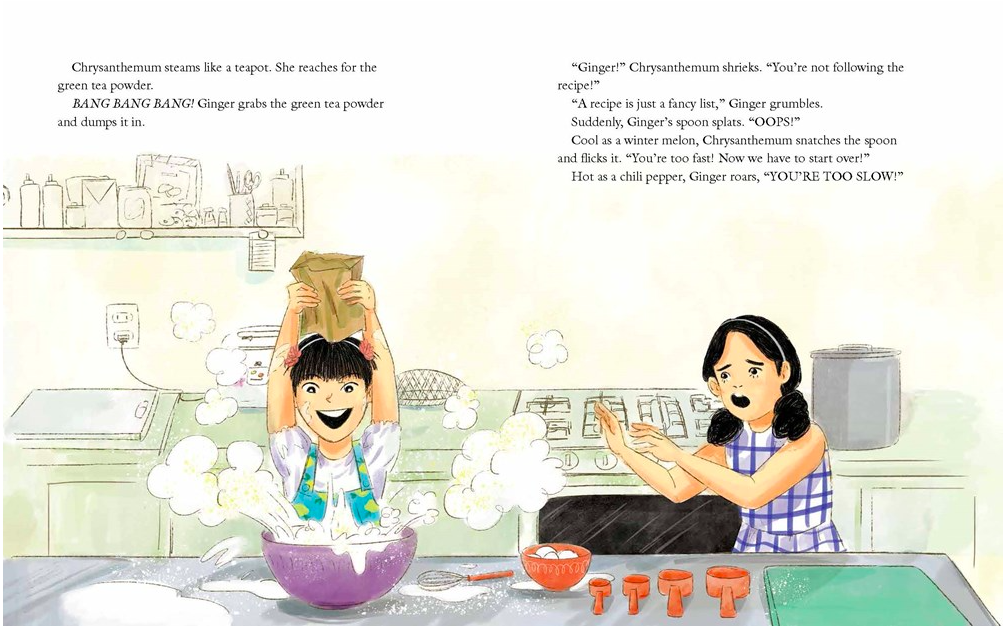
Both girls reach for the green tea powder at the same time, but Ginger’s faster and dumps it in the bowl. Chrysanthemum yells at her cousin that she’s not following the recipe, but Ginger grumbles that “‘a recipe is just a fancy list.’” With the cake ruined, the girls take a break and decide to make another cake. But there’s no more green tea powder. They mull over the problem then Ginger suggests using chrysanthemum tea instead of green tea, and Chrysanthemum thinks of using ginger ice cream for the frosting. Ginger cleans up the mess while Chrysanthemum measures out the ingredients. “Ginger mixes. Chrysanthemum pours.” When they lick the spoon, the batter tastes delicious.

celebrate-picture-books-picture-book-review-ginger-and-chrysanthemum-baking

Image copyright Shirley Chan, 2020, text copyright Kristen Mai Giang, 2020. Courtesy of Levine Querido.

At the party, Chrysanthemum and Ginger take Grandma by the arms and lead her over to show her their cake. “The cake looks a little lopsided, the color slightly strange…. Ginger and Chrysanthemum hold hands – and their breath” as Grandma takes a bite. “She loves it!” She hugs her “little soybeans.” Then Ginger and Chrysanthemum share a slice. “Warm cake, cool icing. Perfect together. Like two beans in a pod.”

An Author’s note explaining the traditional Chinese belief that foods have warming or cooling characteristics and should, ideally, create a balance follows the text.

celebrate-picture-books-picture-book-review-ginger-and-chrysanthemum-party

Image copyright Shirley Chan, 2020, text copyright Kristen Mai Giang, 2020. Courtesy of Levine Querido.

In her entertaining story of two cousins with opposite personalities, Kristen Mai Giang cleverly uses the Chinese concept of warm and cool foods to create impulsive Ginger and precise Chrysanthemum. As the girls dress and shop for Grandma’s party, readers will be charmed by the cousins while giggling at their differences. When mishaps while baking Grandma’s cake fray their nerves and lead to angry words, Giang introduces a gentle lesson on how to get back on track and cooperation. While taking a break, Ginger and Chrysanthemum rely on their close relationship to come up with a solution that pleases them both. Kids will appreciate the ingenuity in their new recipe that combines both of their personalities and may be inspired to try making up a cake recipe of their own.

Shirley Chan clearly sketches out Ginger and Chrysanthemum’s opposite personalities in the first pages as Ginger stands in the middle of her messy room sporting a mix-and-match outfit appropriate for a rock star while Chrysanthemum channels a runway model in her perfectly accessorized dress. Spontaneous kids will identify with Chan’s depictions of Ginger playing around at the market while careful children will admire Chrysanthemum’s thoughtfulness in choosing just the right flowers. Chan’s images of the two spirited girls in the kitchen will enchant young readers, and the party scene is vibrant and inviting.

A creative and relatable story to inspire teamwork and a celebration of individuality, Ginger and Chrysanthemum would be an engaging addition to home, school, and public library collections.

Ages 4 – 7

Levine Querido, 2020 | ISBN 978-1646140015

Discover more about Kristen Mai Giang and her books on her website.

To learn more about Shirley Chan, her books, and her art, visit her website.

Bake for Family Fun Month Activity

celebrate-picture-books-picture-book-review-bake-up-some-fun-word-search

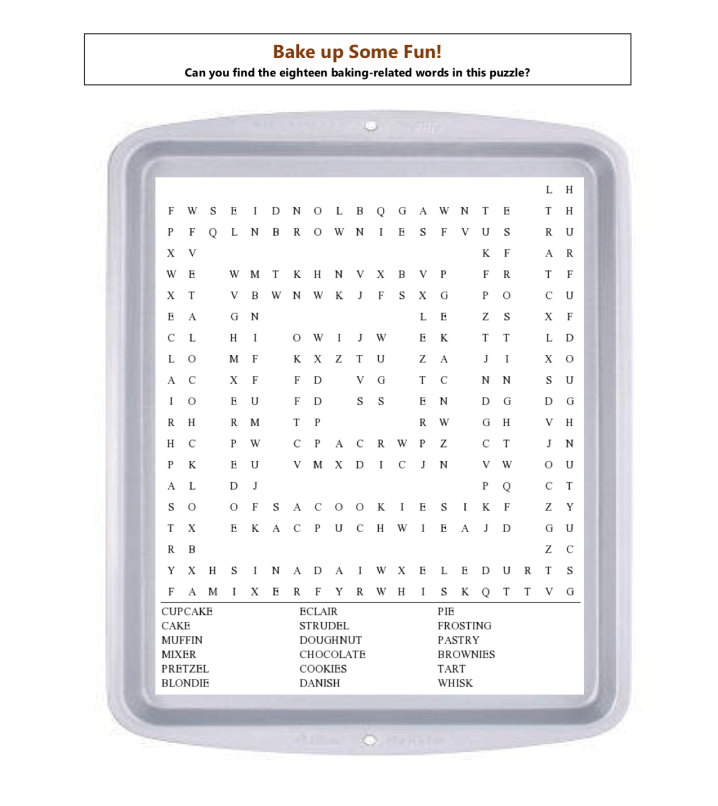
Bake up Some Fun! Word Search Puzzle


Before this pan goes into the oven, can you find the eighteen baking-related words in this printable word search puzzle?

Bake up Some Fun! Word Search PuzzleBake up Some Fun! Word Search Solution

celebrate-picture-books-picture-book-review-ginger-and-chrysanthemum-cover

You can find Ginger and Chrysanthemum at these booksellers.

Amazon | Barnes & Noble | Books-a-Million

To support your local independent bookstore, order from

Bookshop | IndieBound

Picture Book Review
February 22 – It’s Bake for Family Fun Month

celebrate-picture-books-picture-book-review-little-calabash-cover

About the Holiday

Mid-winter is a perfect time to get out your favorite recipes, gather delicious ingredients, and bake with your kids! Not only does baking together teach valuable cooking skills, but it can bring a family closer. Talk about old family recipes and find new favorites. Of course the best part of baking together is eating the scrumptious treats afterward!

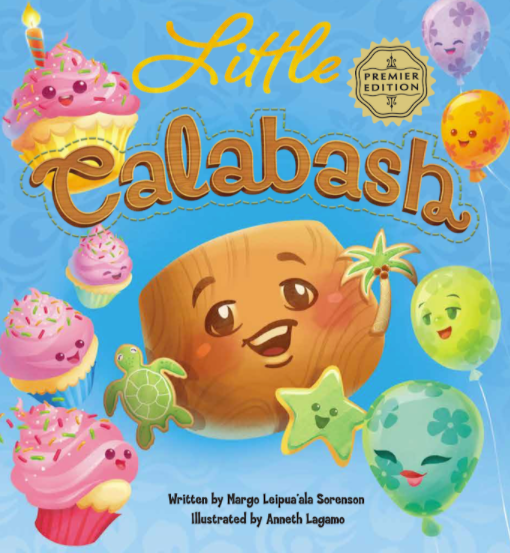
Little Calabash

Written by Margo Leipua’ala Sorenson | Illustrated by Anneth Lagamo


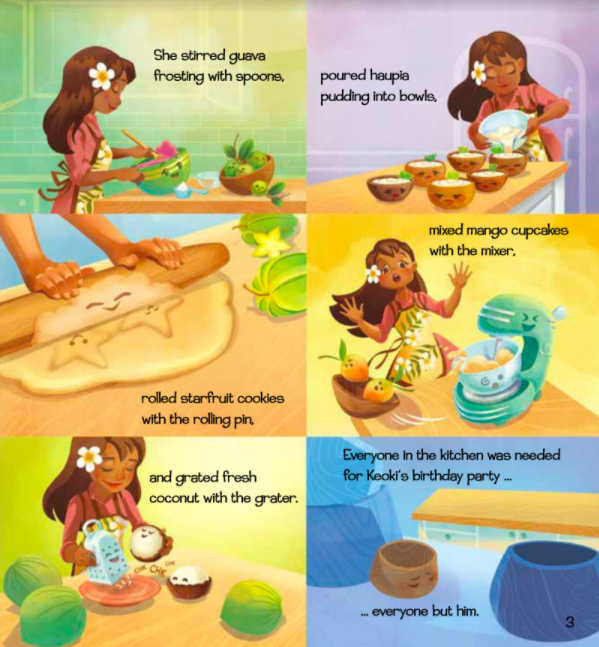
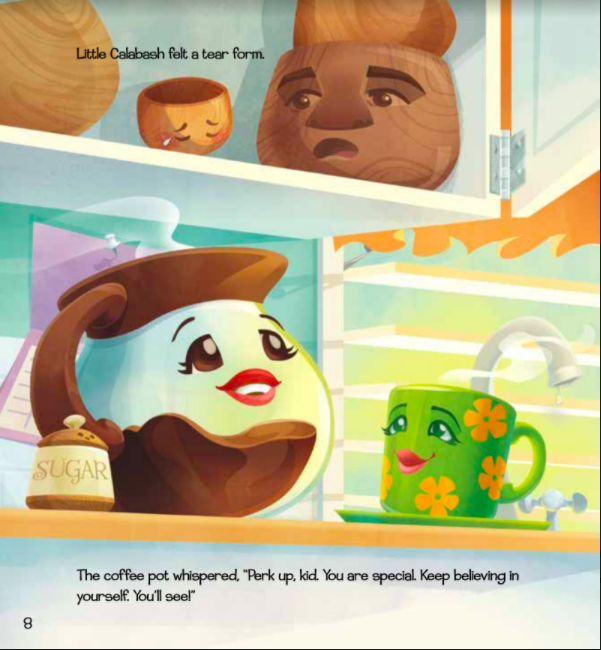
As Keoki’s mom rushed around the kitchen making mango cupcakes, guava frosting, haupia pudding, and starfruit cookies for her son’s birthday party, Little Calabash sat hidden behind the big calabash bowls on the shelf and sighed. The mixer, spoons, rolling pin, and even other bowls were needed. Everyone had a part to play in Keoki’s party… “everyone but him.”

celebrate-picture-books-picture-book-review-little-calabash-cooking

Image copyright Anneth Lagamo, text copyright Margo Leipua’ala Sorenson. Courtesy of Island Heritage.

Little Calabash asked when it might be his turn, but the cocoa mug just told him, “‘get a handle on yourself,’” and the refrigerator said, “‘You need to chill out.’” Little Calabash just wanted to be special, to be useful. One of the large calabashes said that he just wasn’t big enough to help out. When the coffee pot saw how sad Little Calabash was, she reassured him and told him to keep believing in himself.

But Little Calabash didn’t know how Keoki’s mom would ever see him stuck behind the other items on the shelf. None of the other kitchen tools seemed to want to help, so he began rocking himself side-to-side and finally, he “wiggled his way from behind all the big calabashes.” Even though he had found his way to the edge of the shelf, some in the kitchen didn’t think he had what it took to be part of the birthday celebration.

celebrate-picture-books-picture-book-review-little-calabash-coffee-pot

Image copyright Anneth Lagamo, text copyright Margo Leipua’ala Sorenson. Courtesy of Island Heritage.

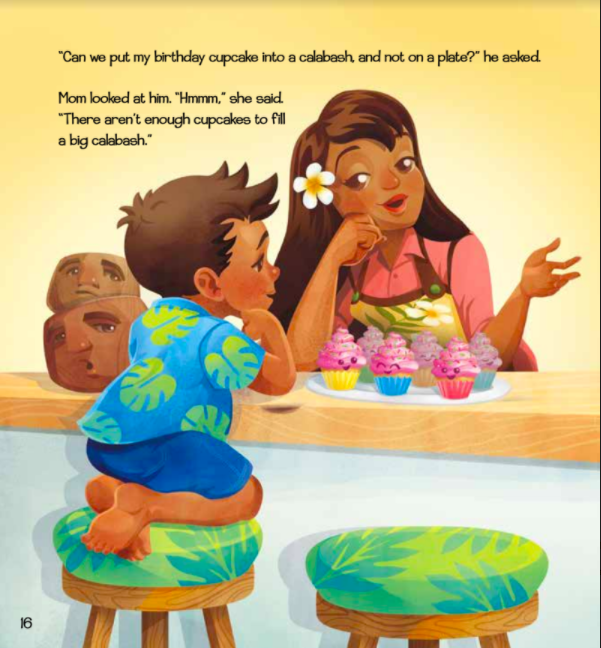
When Keoki’s mother came towards the cupboard, Little Calabash hoped she’d see him. Instead “she took two big calabashes off the shelf.” Soon, it was almost party time. When Keoki saw the cupcakes, he asked if his could be put in a calabash. His mom wasn’t sure they had one the right size. Then Keoki reminded her that they had a little calabash. When she went to look, there was Little Calabash, nearly tipping off the edge. Keoki placed his special cupcake into the bowl and Little Calabash beamed. He’d always known he could be a big part of Keoki’s special day.

A Glossary describing the foods served at Keoki’s birthday party follows the story.

celebrate-picture-books-picture-book-review-little-calabash-cupcakes

Image copyright Anneth Lagamo, text copyright Margo Leipua’ala Sorenson. Courtesy of Island Heritage.

With charm and plenty of puns to keep kids giggling throughout the story, Margo Leipua‘ala Sorenson’s Little Calabash reminds readers that even though they may be small, they still have much to offer. Kids will empathize with Little Calabash’s wish to be given a job on this important family day and will cheer on his confidence and initiative when the other kitchen utensils and appliances try to hold him back.

Anneth Lagamo’s vibrant kitchen will engage kids as the utensils, appliances, and dishware get ready to celebrate Keoki’s birthday. Readers will enjoy scanning the pages to match the speakers of Sorenson’s clever puns with the characters. Kids can also clearly see Little Calabash’s sadness at being overlooked, determination to be noticed, and happiness at being chosen at last. Infused with the colors of the Hawaiian Islands, where the story is set, the illustrations will entice kids to learn more about this beautiful area.

Ages 4 – 8

Island Heritage, 2021 | ISBN 978-1617104459

Discover more about Margo Sorenson and her books on her website.

Bake for Family Fun Month Activity

celebrate-picture-books-picture-book-review-hawaii-fruit-coloring-page

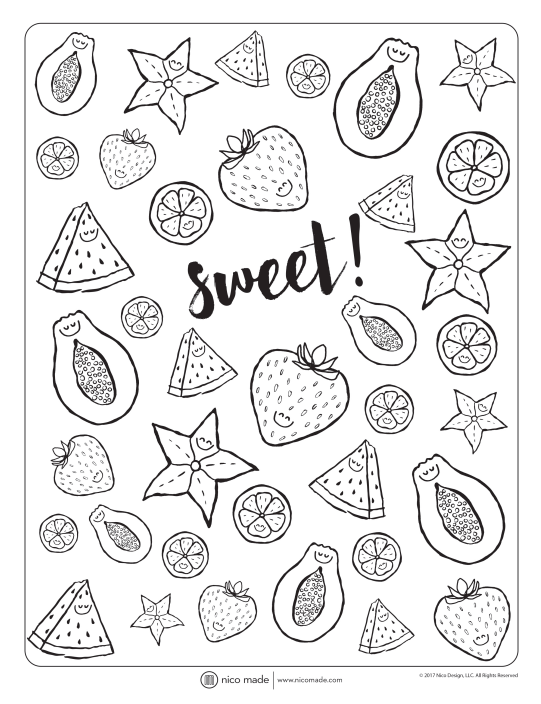
Sweet Hawaiian Fruit Coloring Page


From watermelon to strawberries to starfruit, the treats are sweet in Hawaii! Enjoy this printable coloring page then find more from Nico Made and Honolulu Family.

Sweet Fruit Coloring Page 

celebrate-picture-books-picture-book-review-little-calabash-cover

You can order Little Calabash from Island Heritage

Picture Book Review
February 18 – It’s Black History Month

celebrate-picture-month-picture-month-review-the-teachers-march-cover

About the Holiday

Black History Month was instituted by Dr. Carter G. Woodson in 1926 to celebrate the achievements and contributions of African Americans in United States History. The holiday began as a week-long observance taking place during the second week of February to commemorate the birthdays of Frederick Douglass and Abraham Lincoln. In 1976 President Gerald Ford officially established Black History Month. The holiday is now celebrated across the country with special events in schools, churches, and community centers. The theme for 2021 is “Black Family: Representation, Identity and Diversity.” Online events will explore the African diaspora and the spread of Black families across the United States through multiple perspectives. For more information about Black History Month, visit the ASALH website and africanamericanhistorymonth.gov.

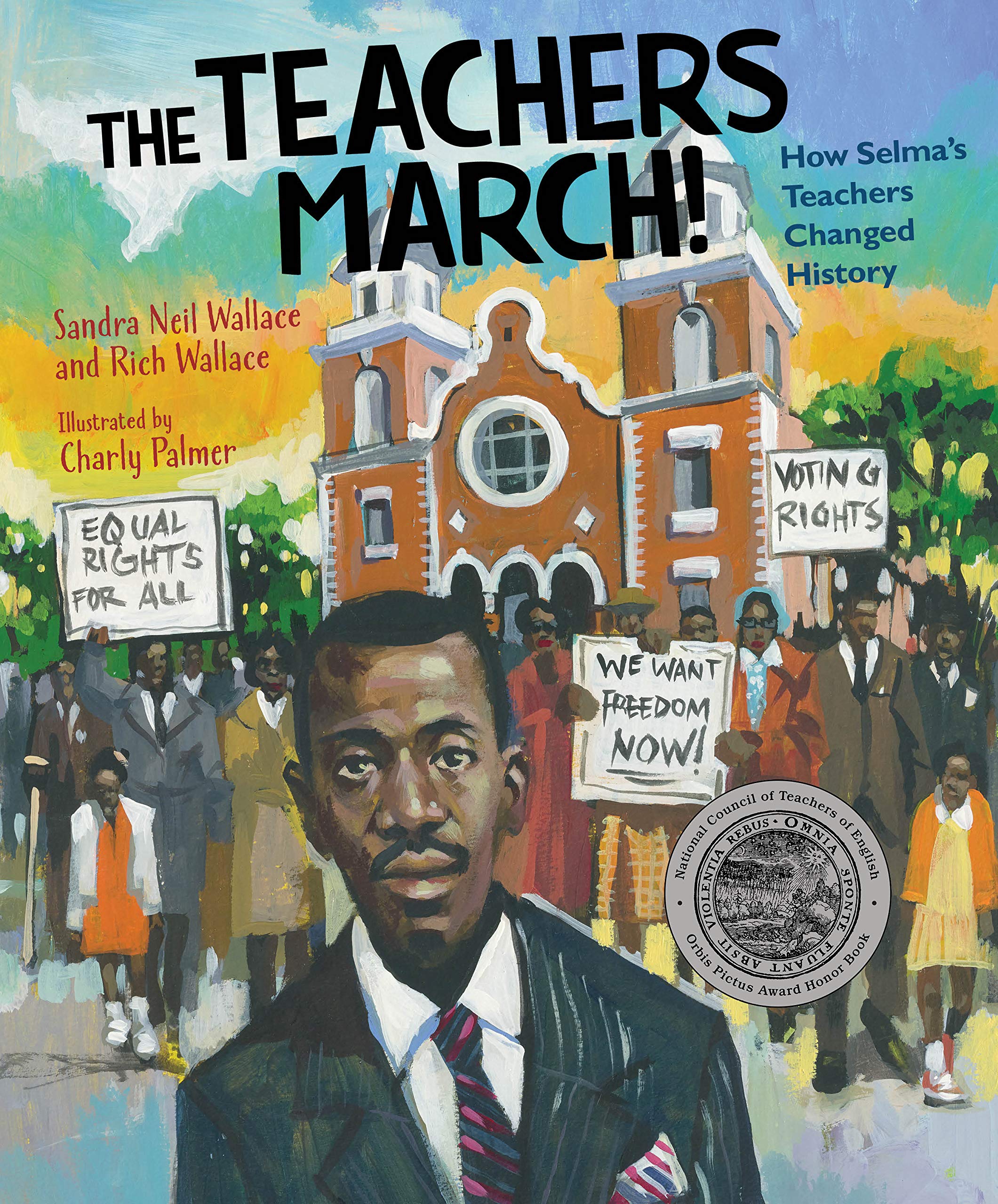
The Teachers March! How Selma’s Teachers Changed History

Written by Sandra Neil Wallace and Rich Wallace | Illustrated by Charly Palmer


Reverend F. D. Reese taught science at R. B. Hudson High School, but his favorite subject was freedom…. To be treated as less than equal, that just wasn’t right.” Reverend Reese led marches to register Black voters. The police called them “troublemakers” and used billy clubs to stop them from voting. If the people did make it inside the courthouse to register, they faced a test they had to pass—a test with impossible questions, such as “How many drops of water are in the Alabama River?” Reverend Reese decided he needed a “‘triumphant idea’” to change things.

It came to him that the teachers—leaders and respected in the community—should march for freedom. But a judge had made it illegal to march and even talk about voting rights. Most people were too afraid to march, so Reverend Reese looked for a “‘glorious opportunity’” to come his way. It came when he watched Dr. Martin Luther King Jr. speak on television and wrote him a letter inviting him to come to Selma to “help convince the teachers to march.”

celebrate-picture-month-picture-month-review-the-teachers-march-toothbrushes

Image copyright Charly Palmer, 2020, text copyright Sandra Neil Wallace and Rich Wallace, 2020. Courtesy of Calkins Creek.

Dr. King agreed and spoke to a crowd of 700 people at Brown Chapel. He told the group that everyone should march and “go to jail by the thousands to defend the right to vote.” Two of the people listening to Dr. King were fifteen-year-old Joyce Parrish and her mother, “Two Sweet.” When Reverend Reese asked for teachers to sign up to march, he said that if both parents in a family were teachers, only one should march so that the other could take care of the children if the first went to jail. For Two Sweet it was a difficult decision. She was a teacher and also a single parent. More than 100 teacher signed up, including “Two Sweet.”

On January 22, the day of the march, Two Sweet packed a toothbrush and a sandwich—things she’d need in jail—and hugged Joyce goodbye. That afternoon as Reverend Reese waited alone outside the school alone, he wondered if the teachers would show up. Then one-by-one the teachers emerged from the building, holding their toothbrushes aloft. Reverend Reese called Coach Huggins to the front of the line and they started walking to the courthouse. People gathered along the street to watch, and Joyce paced nervously, wondering what would happen to her mother.

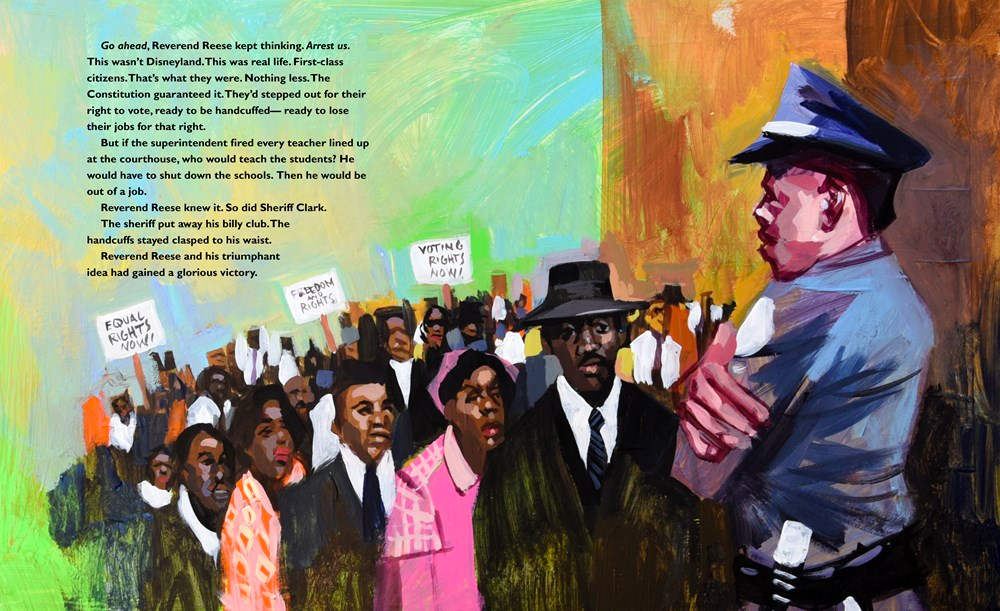
As the teachers crossed into the white section of town, the dirt roads became paved and people swarmed from shops to glare at the marchers, hoping to intimidate them. When they reached the courthouse, the sheriff and his deputies stood atop the steps. Reverend Reese announced that they were there to register to vote, but the sheriff said, “‘You can’t make a plaything out of the corridors of this courthouse.’” He gave the teachers one minute to disperse or face arrest. The teachers stayed put.

celebrate-picture-month-picture-month-review-the-teachers-march-courthouse

Image copyright Charly Palmer, 2020, text copyright Sandra Neil Wallace and Rich Wallace, 2020. Courtesy of Calkins Creek.

When the time was up, the police grabbed their billy clubs. They pushed Coach Huggins and Reverend Reese, causing the teachers to fall backward. When they got up, the police pushed them harder. Then the school superintendent came out of the courthouse. He had the power to fire every teacher. But Reverend Reese and the teachers stood firm for the right the Constitution guaranteed. The superintendent looked out over the crowd. He knew that if he fired them all, there would be no one to teach at the schools and he would lose his job.

The teachers had won the day. They went back to Brown Chapel, where young people were singing freedom songs. The kids were proud of their teachers, and Joyce hugged her mother. That night, Dr. King preached at Brown Chapel. “He praised Reverend Reese and the teachers for making civil rights history” by being the first leaders to risk their jobs by marching. Now other shop keepers and business people were emboldened to march for the right to vote. Kids and young people marched too. These Selma marchers were arrested by the thousands. Across America people took notice. Why, they wondered, were “respectable citizens in suits and dresses, and school kids carrying books” put in jail.

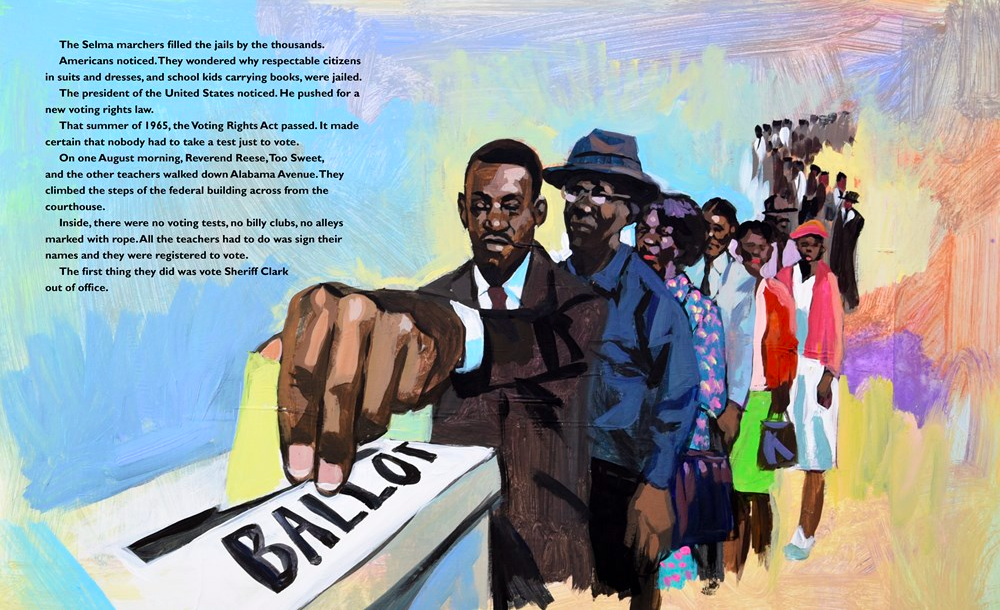
The president of the United States also noticed. In the summer of 1965, Congress passed the Voting Rights Act, ensuring that no test was required to register to vote. In August, Reverend Reese, Two Sweet, and other teachers walked to the federal building and registered to vote. With their first ballot, they voted the sheriff out of office.

Following the text are an extensive Author’s Note about the Teachers’ March and its leaders, with photographs as well as an Illustrator’s Note explains how the illustrations were created. A Timeline follows the 1965 Voting Rights Movement in Selma, Alabama from 1936 to 2018. A photograph of Dr. Martin Luther King Jr., Coretta Scott King, and Reverend Reese leading the 1965 voting rights march from Selma to Montgomery is also included. A selected bibliography of resources used in writing the book, as well as websites where readers can learn more, close out the excellent backmatter.

celebrate-picture-month-picture-month-review-the-teachers-march-ballot

Image copyright Charly Palmer, 2020, text copyright Sandra Neil Wallace and Rich Wallace, 2020. Courtesy of Calkins Creek.

Compelling and comprehensive, Sandra Neil Wallace and Rich Wallace’s story about the teachers march of 1964 is exhilarating reading. Powerful for its personal focus on Reverend Reese, Joyce, and Two Sweet and their fears, doubts, and courage, the story includes vital details that reveal inequalities of the time beyond the issue of voting rights and which will resonate with children aware of continuing inequalities, protests, gerrymandering, and other current issues in the news. Sandra and Rich Wallace build suspense through evocative descriptions to draw children in and immerse them in a reading experience that will have emotional impact.

Charly Palmer’s acrylic on board illustrations capture the motion and emotion of the teachers’ march and the events leading up to that day. All the more moving for their abstract quality, the images portray telling glances (on the first page a student looks out at the reader as Reverend Reese lectures about equal rights at the chalkboard); seminal moments, such as when Dr. Martin Luther King Jr. strides into Brown Chapel and Coach Huggins signs his name, promising to march; and the moments when the sheriff and his deputies confront the teachers with billy clubs raised. The reunion between a worried Joyce and her mother is poignant, and the final illustration of Reverend Reese putting his ballot into the box, reminds all readers of the successes of the past, but also that vigilance and action continues to be needed.

Superb for social studies, American history, homeschooling, and civics lessons, The Teachers March! How Selma’s Teachers Changed History  is highly recommended for home bookshelves and a must for school and public library collections.

Ages 7– 10 and up

Calkins Creek, 2020 | ISBN 978-1629794525

Discover more about Sandra Neil Wallace, and her books on her website. You can also find a downloadable Educator’s Guide for The Teachers March! and other books by Sandra.

You can learn more about Rich Wallace and his books on his website.

To learn more about Charly Palmer and view a portfolio of his art, visit his website.

Watch the trailer for The Teachers March!


Black History Month Activity

celebrate-picture-books-picture-book-review-Black-History-Month-Coloring-Pages-Martin-Luther-King-Jr

Role Model Coloring Pages


Whether you’re interested in law and politics, science, sports, or the arts, you can find a role model in the people in the printable coloring pages below. 

Dr. Mae Jemison | Jackie Robinson | Maya Angelou  | Louis Armstrong | Garrett Morgan | Rosa Parks

celebrate-picture-month-picture-month-review-the-teachers-march-cover

You can find The Teachers March! at these booksellers

Amazon | Barnes & Noble | Books-a-Million

To support your local independent bookstore, order from

Bookshop | IndieBound

Picture Book Review

January 21 – Luna’s Yum Yum Dim Sum Blog Tour Stop

celebrate-picture-books-picture-book-review-luna's-yum-yum-dim-sum-cover

About the Holiday

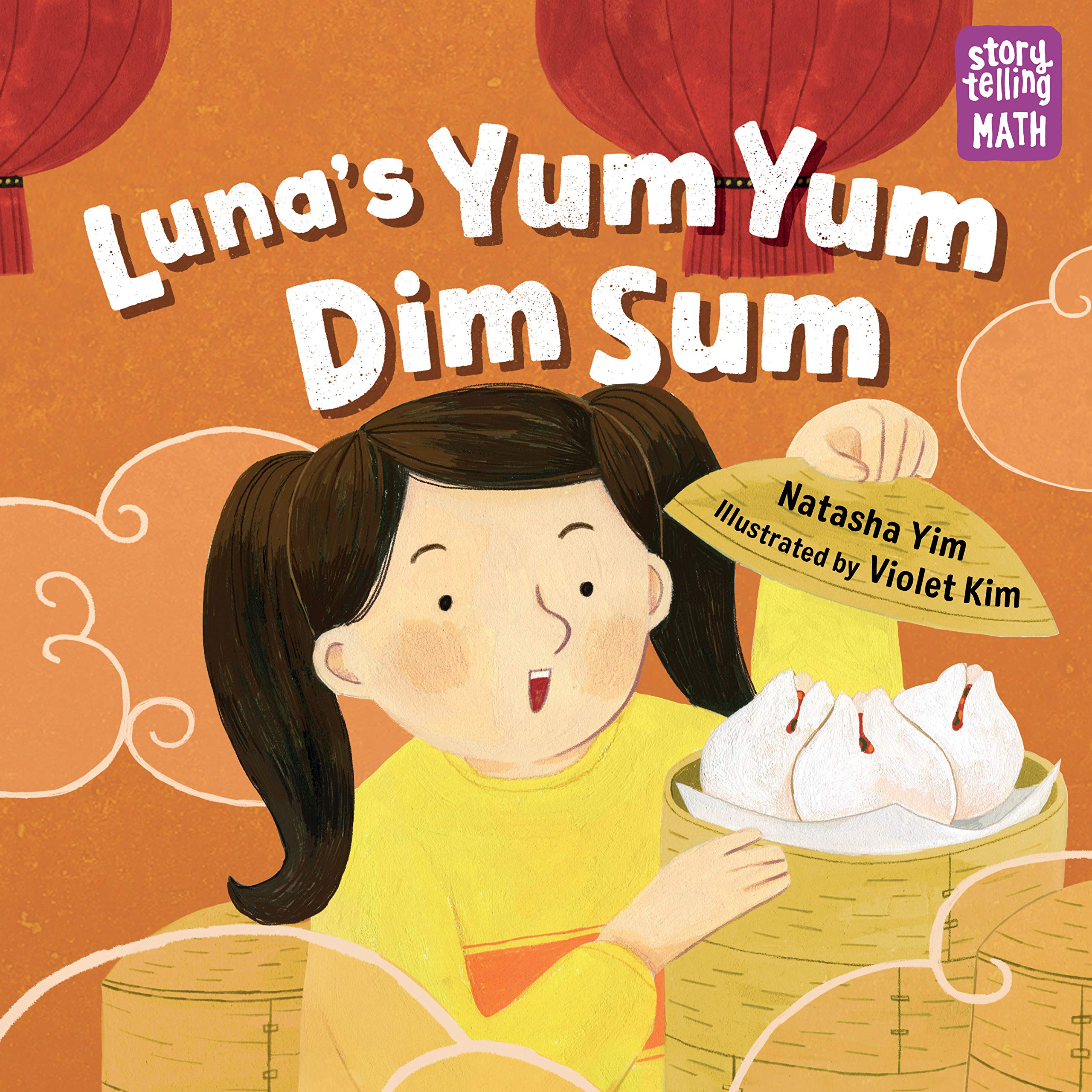
Today I’m excited to be a part of Natasha Yim and Violet Kim’s blog tour to share Luna’s Yum Yum Dim Sum, another engaging book in the Storytelling Math series from Charlesbridge that shows children how math occurs naturally in all aspects of their life and invites them to explore and experiment. 

Thanks to Charlesbridge for sending me a digital copy of Luna’s Yum Yum Dim Sum for review consideration. All opinions of the book are my own.

Luna’s Yum Yum Dim Sum (Storytelling Math)

Written by Natasha Yim | Illustrated by Violet Kim


For Luna’s birthday, Ma Ma and Ba Ba take Luna and her brothers to a dim sum restaurant. They join the sound of happy voices and chopsticks that go “click, clickety, clack.” Servers wheel trolleys piled with plates and “baskets of dim sum. Warm smells of dumplings, buns, and sweet desserts tickle Luna’s nose.” Ba Ba asks the kids what they would like and Luna exclaims that she wants pork buns. Her older brother calls for two baskets, and her little brother Benji agrees. When the server brings two baskets of char siu bao to the table, the kids open the tops to find three buns in each.

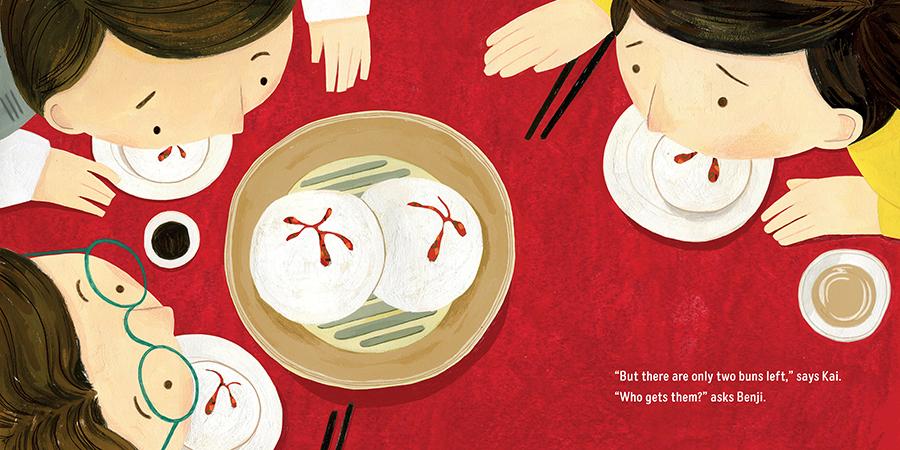
Two buns for each of them, Benji proclaims. They each take a bun from the first basket, but just as Luna lifts hers up, it slips from her hand and falls to the floor— “Splat!” “‘Oh no!’” She takes a bun from the second basket. “‘That’s all you get,’ says Kai, and Benji seconds that. But Luna protests that it’s her birthday and she should get another bun. Benji and Kai gaze into the basket sadly, wondering what to do. Then Kai reminds his siblings that their mom always says they should respect their elders. But Benji remembers her saying “‘older kids should take care of younger kids,’” so he should get one too. And Luna? She exclaims that she’s the “‘birthday girl!’”

celebrate-picture-books-picture-book-review-luna's-yum-yum-dim-sum-two-buns-left

Image copyright Violet Kim, 2020, text copyright Natasha Yim, 2020. Courtesy of Charlesbridge.

The three kids stare each other down. Finally, Luna suggests cutting the two buns in half, and they do. But who will get the extra half, Benji wonders. Kai and Benji both have reasons they should get it. And Luna? She exclaims that she’s the “‘birthday girl!’” Kai thinks they should divide the half in half, but Luna tells him they’d just be back to the beginning. Kai and Benji like the idea of using their animals from the lunar calendar to choose who gets the pieces, but each has a valid claim to a half. Luna has one more suggestion that makes the division fair but the pieces tiny. Then Luna looks around and sees a hungry little boy at the next table and knows just what to do with the extra half.

Backmatter includes a description of Dim Sum and the Chinese Zodiac as well as a paragraph that explores the math found in the story and four activities to get kids working with math.

Natasha Yim’s charming tale will captivate readers with her funny and realistic competition between the siblings for the remaining two pork buns after Luna drops one. Her pitch-perfect dialogue invites kids to try and figure out how to divide the buns along with Luna, Kai, and Benji. Yim’s storytelling organically incorporates important concepts of one and two while also introducing the idea of one half in a way that they can—and will want to—replicate at home. Through Kai, Luna, and Benji’s  challenges to each other, kids also learn about superlatives and comparatives “oldest and older” and “tallest and shortest” as well as “bigger” and “bravest.” Luna’s solution to their dilemma is sweet and will entice kids to enjoy dim sum themselves.

Violet Kim’s vibrant illustrations take kids into a bustling dim sum restaurant, where they can see—and almost hear—happy diners and busy servers with their carts. By changing the perspective of her images, Kim allows kids to clearly see the buns in the baskets and take part in deciding how they can be divided. Children can also count chopsticks, tea cups, and other items on the table as well as the contents of baskets stacked on carts. Kim envisions the siblings’ competitions in humorous images that also demonstrate superlatives and comparatives that provide both math and language lessons. Readers will also empathize with Luna, Kai, and Benji as they debate, their facial expressions depicting their thought processes, doubts, and frustrations.

An enchanting read that combines math with familiar family dynamics, Luna’s Yum Yum Dim Sum is a story that will spark mathematical experimentation and understanding both at home and in the classroom, making the book an excellent choice for family, school, and public libraries.

Ages 3 – 6

Charlesbridge, 2021 | ISBN 978-1623541996

Discover more about Natasha Yim and her books on her website.

celebrate-picture-books-picture-book-review-Luna's-Yum-Yum-Dim-Sum-Tour-Graphic-Covers

To learn more about Violet Kim, her books, and her art, visit her website.

Storytelling Math Chat

You’re invited to listen to authors Natasha Yim, Sara Levine, and Ana Crespo as well as Charlesbridge editor Alyssa Mito Pusey and math expert Marlene Kliman talk about the math, diversity, and importance of storytelling in Storytelling Math..

celebrate-picture-books-picture-book-review-luna's-yum-yum-dim-sum-cover

You can find Luna’s Yum Yum Dim Sum at these booksellers

Amazon | Barnes & Noble | Books-a-Million

To support your local independent bookstore, order from

Bookshop | IndieBound

Picture Book Review 

January 14 – World Logic Day

celebrate-picture-books-picture-book-review-lia-&-luís-who-has-more-cover

About the Holiday

World Logic Day, sponsored by UNESCO in association with the International Council for Philosophy and Human Sciences aims to raise awareness and appreciation of the intellectual history, significance, and practical uses of logic to the broad community of scientists as well as the public. Celebrations of the holiday center on promoting international cooperation, supporting the development and activities of logic within universities, research facilities, and schools, and enhancing the understanding of logic and its implications for science, technology, and innovation.

Lia & Luís: Who Has More? (Storytelling Math)

Written by Ana Crespo | Illustrated by Giovana Medeiros


When Luís and his sister Lia were playing together, Luís worked quickly and bragged about the rickety tower he’d built. Lia didn’t really mind because she liked to take her time. Lia’s tower may have been shorter, but it stayed up longer. After playing, they ran “downstairs to their family’s store [to] pick their favorite Brazilian snacks.” Luís told his father, “I want biscoito de polvilho, Papai!” while Lia said, “Coxinhas de galinha, please!”

celebrate-picture-books-picture-book-review-lia-&-luís-who-has-more-bragging

Image copyright Giovana Medeiros, 2020, text copyright Ana Crespo, 2020. Courtesy of Charlesbridge.

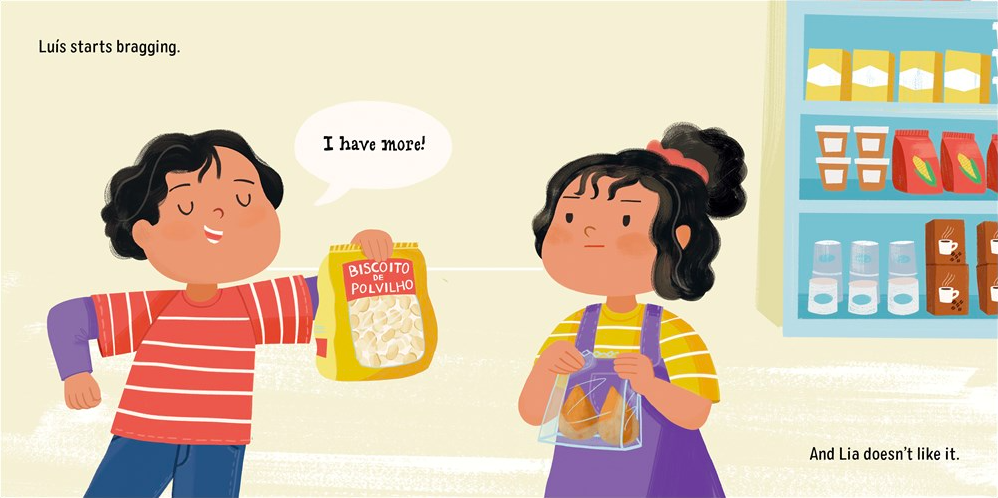
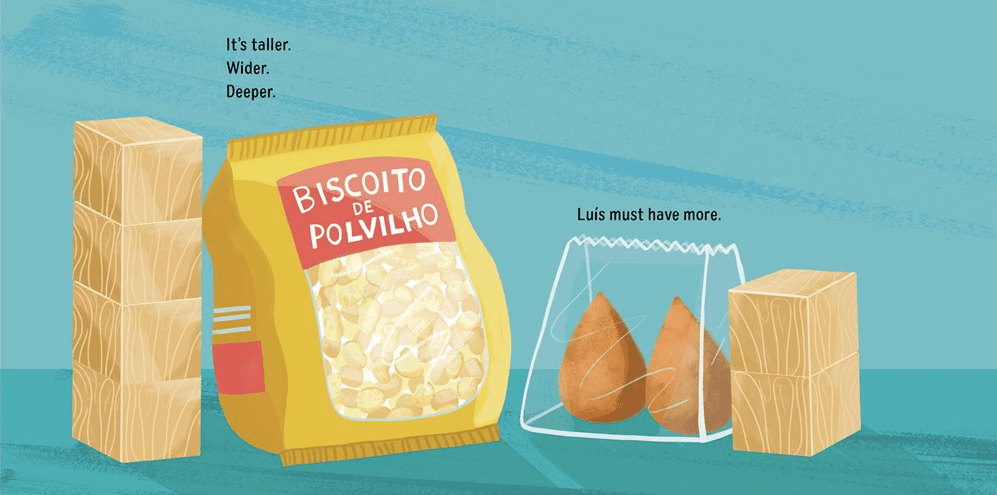
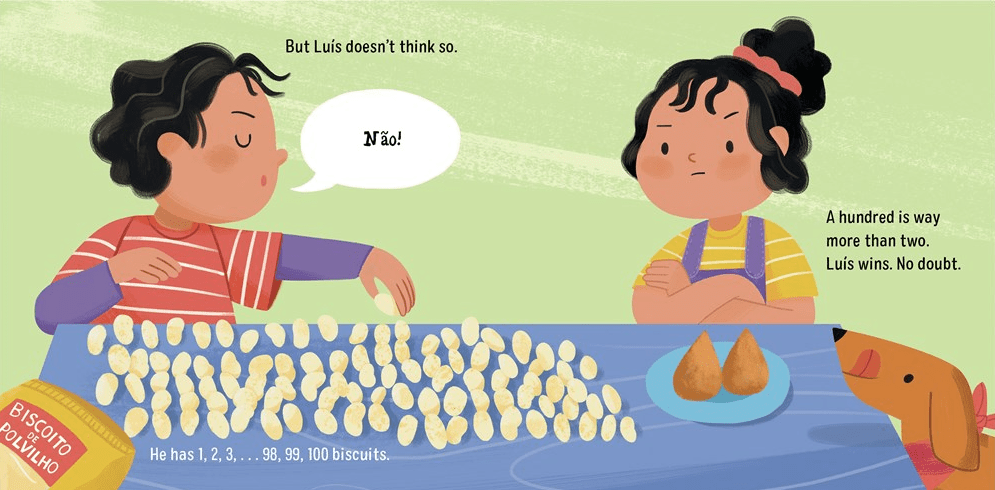
Papai handed Luís a bag of little nuggets and put two pear-shaped treats in a bag for Lia. Again, Luís began bragging, showing his sister that he had more than she did. This time Lia didn’t like it. But was Luís right? His bag was bigger than Lia’s. It was four blocks high and Lia’s bag was only two blocks high. Luís’s bag was also wider and deeper than Lia’s.

But Lia noticed something else. “Can’t you count?” she says then points out that she has two croquettes while her brother has only one bag. Could she be right about having more? Luís can’t leave this challenge unanswered, so he opens his bag and spills out the contents on the table. Lia looks at all of the tiny nuggets but is still unconvinced. She picks up a biscuit and a croquette. They are definitely different sizes and weights.

celebrate-picture-books-picture-book-review-lia-&-luís-who-has-more-biscuit-bag-taller

Image copyright Giovana Medeiros, 2020, text copyright Ana Crespo, 2020. Courtesy of Charlesbridge.

Luís begins to put a biscuit in his mouth, but Lia wants him to wait. “Para!” she tells him. Lia takes some time thinking about the problem. Finally, she has an idea. She gets the scale from the family store and puts her croquettes on one side and Luís’s biscuits on the other. The scale dips toward Lia; “she wins.” Lia doesn’t like seeing her brother so sad. She thinks again and has another idea. She breaks off a bit of a croquette and adds it to Luís’s biscuits. The scale balances! They eat up all their snacks. Will Papai give them mais?

Following the text readers will find a Glossary of Portuguese words used in the story and an Exploring the Math page, which describes the math concepts contained in the story as well as activities kids and adults can do to reinforce the math learning.

celebrate-picture-books-picture-book-review-lia-&-luís-who-has-more-one-hundred-biscuits

Image copyright Giovana Medeiros, 2020, text copyright Ana Crespo, 2020. Courtesy of Charlesbridge.

In her charming Storytelling Math book, Ana Crespo effectively uses siblings’ natural competitive spirit to explore concepts of comparing and measurement. These include size (and the comparatives taller, wider, deeper), quantity, and weight. As the story opens, Luís has built a taller tower than his sister, the image of which is later used to compare Lia’s snack to Luís’s. Crespo combines an engaged narrator plus dialogue sprinkled with Portuguese words that are organically defined to create a lesson in math that will keep readers turning the pages to see who actually does have more. As Lia and Luís try various methods to find an answer, kids can take time too to think about how they would solve the problem and discuss the idea of “more” and how they would define it. Lia and Luís may be competitive, but they’re also cooperative, making this a sweet sibling story as well.

Giovana Medeiros’s bright, crisp illustrations of these enthusiastic twins clearly depicts the math concepts discussed while also portraying the distinct personalities of Lia and Luís, inviting readers to root for one or the other or to just wait and see who wins. Medeiros includes lots of other opportunities to interact with math through counting the twins’ blocks, items on the shelves and in the display case of the family’s store, and the biscuits poured out on the table. Images of the balance scale allows kids to see how Lia’s croquettes weigh more and how adding a bit of one gives Luís the same amount by weight that Lia has. Speech bubbles and the characters’ actions help readers translate the Portuguese words themselves.

Sure to inspire kids to explore the cabinet, fridge, or classroom and engage with the math of comparing and measuring for themselves, Lia & Luís: Who Has More? would be a fun book to add to home, classroom, and public library collections to spark observations and experimentation that lead to deeper STEM learning.

Ages 3 – 6

Charlesbridge, 2020 | ISBN 978-1623541279 (Hardcover) | ISBN 978-1623541859 (Paperback)

Discover more about Ana Crespo and her books on her website.

To learn more about Giovana Medeiros, her books, and her art, visit her website.

World Logic Day Activity

Screen Shot 2021-01-13 at 4.21.02 PMcelebrate-picture-books-picture-book-review-lia-&-luís-who-has-more-activity-guide

Lia & Luís: Who Has More? Activity Kit


You can have fun experimenting with math using your toys, snacks, and other household items with the downloadable Activity Kit available on the Charlesbridge website!

celebrate-picture-books-picture-book-review-lia-&-luís-who-has-more-cover

You can find Lia & Luís: Who Has More? at these booksellers

Amazon | Barnes & Noble | Books-a-Million

To support your local independent bookseller, order from

Bookshop | IndieBound

Picture Book Review

December 29 – National Tick Tock Day

celebrate-picture-books-picture-book-review-ticktock-banneker's-clock-cover

About the Holiday

As the year winds down Tick Tock Day reminds us of the passage of time and encourages us to examine our life and find opportunities to accomplish the things we really want to. While a day only has 24 hours, a little creative scheduling, letting go of those tasks that aren’t so important, and even saying “no,” can help us achieve the things that matter.

Ticktock Banneker’s Clock

Written by Shana Keller | Illustrated by David C. Gardner


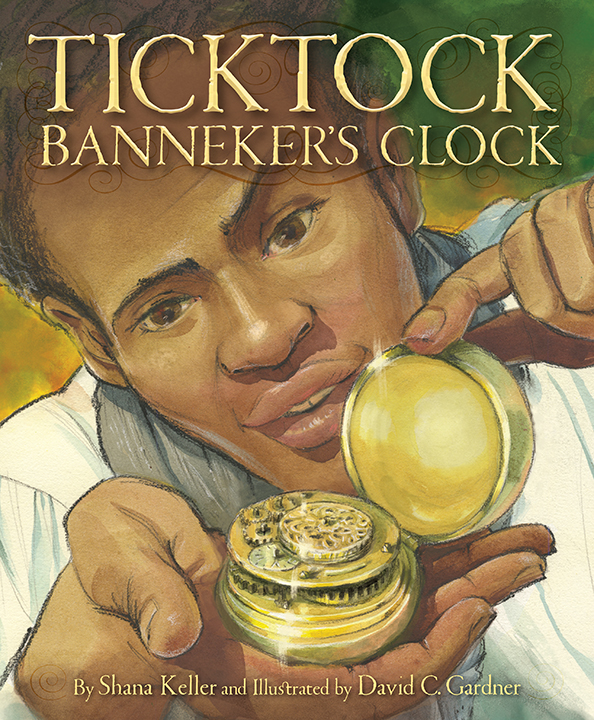
With winter approaching Benjamin Banneker has finished up his autumn chores and is looking forward to time to indulge his creative dreams. He finds his favorite spot under the chestnut tree—the place where during the summer he plays his violin and flute, “blending his soft music with the bird’s songs”—and pulls out a pocket watch he has borrowed from a gentleman. Benjamin is fascinated by the ticking and the movement of the small hands. He carefully opens the back of the watch and discovers “a world of wonderful whirls. There were gears of all shapes and sizes. Such a tiny maze!”

celebrate-picture-books-picture-book-review-ticktock-banneker's-clock-studying-pocket-watch

Image copyright David C. Gardner, courtesy of flyingdogstudio.com

The miniature timepiece is mesmerizing, but Benjamin’s mind holds a challenge—a big challenge. He envisions a large clock, one that chimes to tell the time. Remembering his math skills, Benjamin mulls over the scale needed to turn “something small into something big.” As the snow falls, Benjamin goes to work. First, he dismantles the pocket watch and draws careful diagrams of the gears and workings. Then he begins transposing these into larger drawings.

celebrate-picture-books-picture-book-review-ticktock-banneker's-clock-flute

Image copyright David C. Gardner, courtesy of flyingdogstudio.com

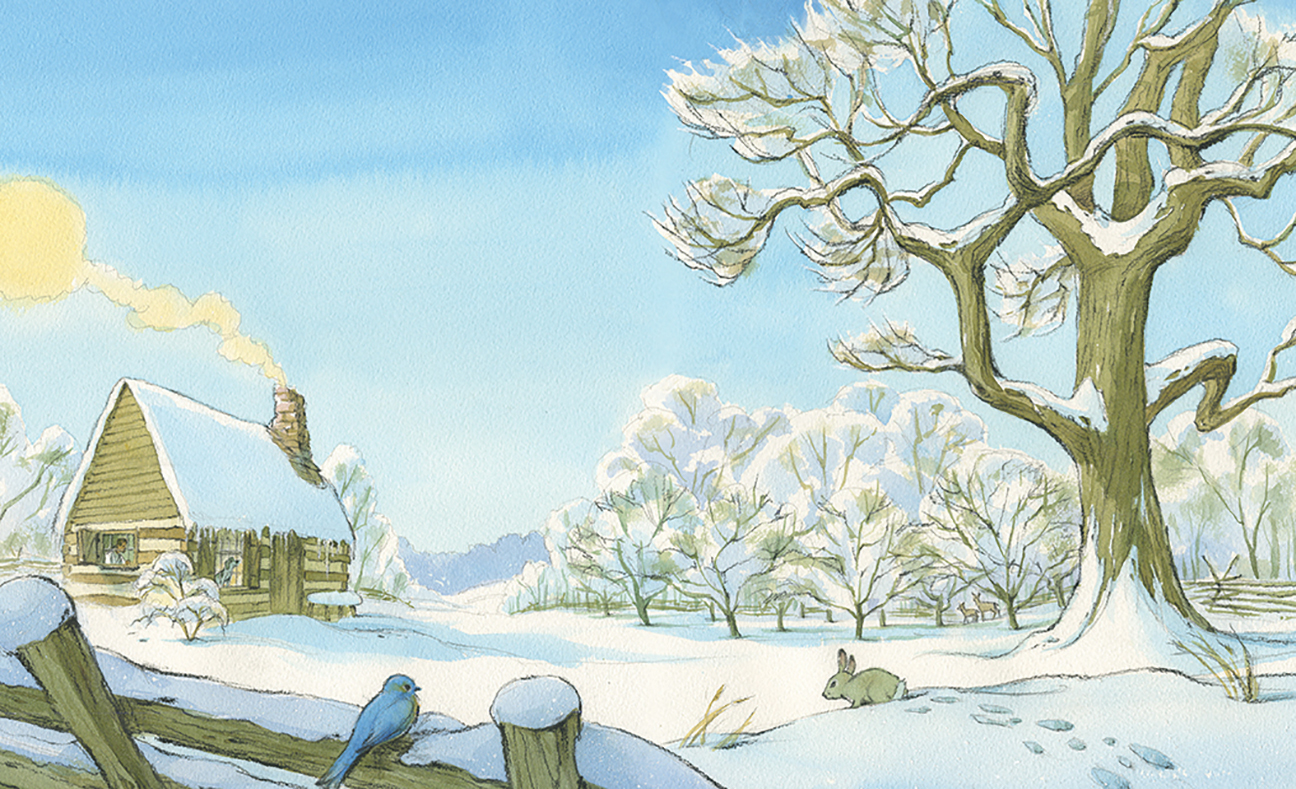
With the coming of spring and his drawings finished, Benjamin plans how he will build his clock. While the little pocket watch is made of metal, that material is much too expensive for a large version. As he ponders the problem under his favorite tree, Benjamin looks around him. Suddenly he knows! The answer is “right in front of him, even in his hands! The very instrument he played was made of wood!” There is a forest of trees on his farm, and this material is free.

During the summer between farm chores, Benjamin uses “every spare moment he had to find the perfect pieces of wood.” Once he has enough he begins to convert his drawings into carvings, whittling the gears and other pieces he will need. Soon, however, he becomes discouraged. The wood begins to split and come apart. Benjamin thinks about how his family cures tobacco leaves—drying them out until all the moisture evaporates. Perhaps, he thinks, he can do the same with wood to make it stronger. The process would take months, but Benjamin is patient.

celebrate-picture-books-picture-book-review-ticktock-banneker's-clock-carving

Image copyright David C. Gardner, courtesy of flyingdogstudio.com

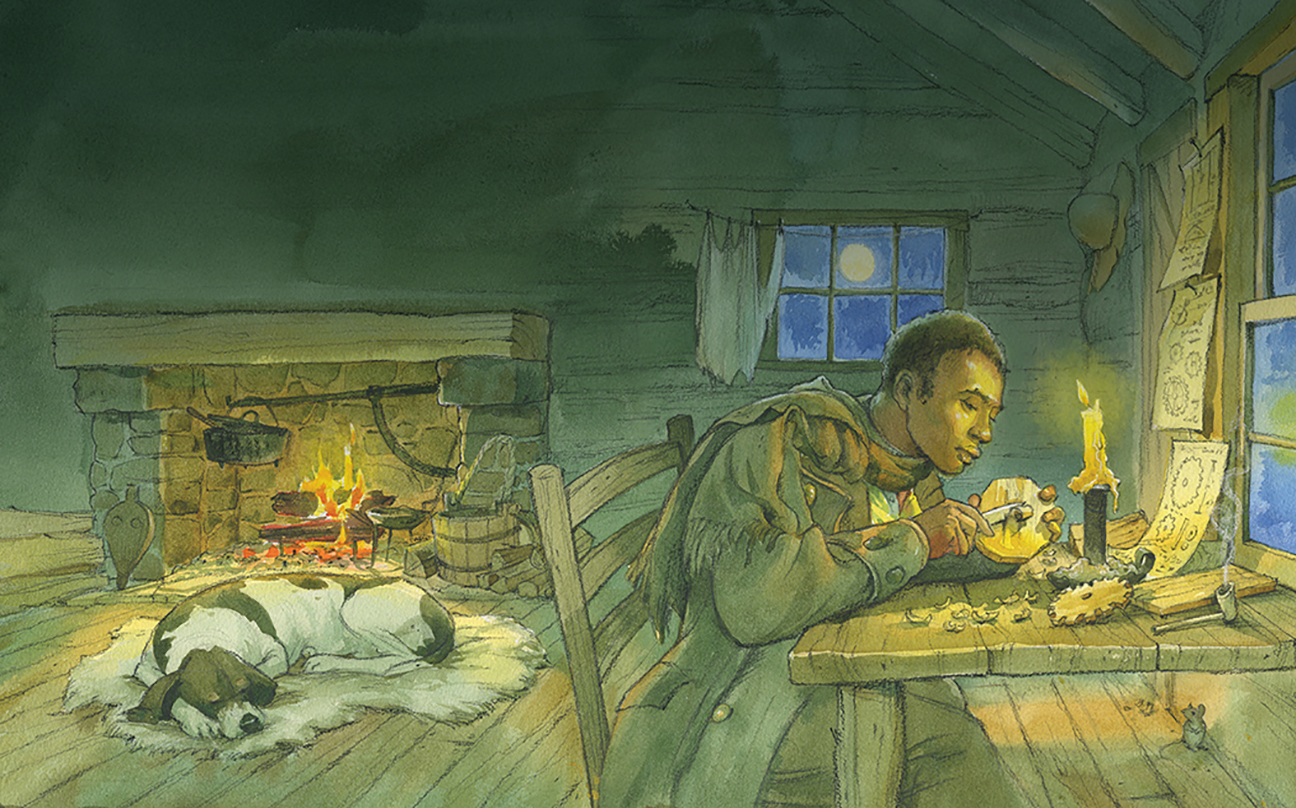
Winter has come around again, and the wood is finally ready. In his warm house Benjamin sets about carving again. During the day he carves near the sunny window, and at night he works by candlelight. At last he has all the parts he needs to build his clock. Gears, wheels, tiny pins, and the boards that will become the case are scattered across Benjamin’s work table. There is only one piece missing. A piece that cannot be made of wood—the bell!

Benjamin buys a bell from a metalsmith, and back home begins to build his clock. With his drawings to guide him, he fits the gears together and then sets the hands to “match up perfectly with the second, minute, and hour of each day. It took more than one try, but Benjamin had learned to be patient.” Using the sun to determine the correct time, Benjamin positions the hands and steps back. His clock works! “The little iron bell chimed every hour, on the dot, for the next forty years.” Benjamin becomes famous, and neighbors from near and far come “to see his amazing invention.”  

An Author’s Note expanding on Benjamin Banneker’s life and work follows the text.

celebrate-picture-books-picture-book-review-ticktock-banneker's-clock-winter

Image copyright David C. Gardner, courtesy of flyingdogstudio.com

With lyrical language that glides as smoothly as a well-oiled timepiece, Shana Keller reveals the remarkable story of Benjamin Banneker, born free during the time of slavery, who possessed exceptional math and scientific skills and used them to help his friends and neighbors and to make real his vision of a striking clock. Keller’s detailed and descriptive storytelling animates this life story, allowing readers to take the journey with Banneker as he experiences excitement, setbacks, and ultimately success. Banneker, embodying determination, persistence, and creativity, is an excellent role model for kids with big dreams of their own.

celebrate-picture-books-picture-book-review-ticktock-banneker's-clock-studying-fall-chores

Image copyright David C. Gardner, courtesy of flyingdogstudio.com

David C. Gardner’s lovely full-page and two-page-spread illustrations gloriously portray Benjamin Banneker’s farm and home as well as his dedicated commitment to building a striking clock despite—or perhaps spurred on by—the challenges he faced. Gardner’s detailed images set the biography firmly in its time period, letting children experience farm and home life in the 1750s. Banneker carries wooden buckets to feed the animals, tobacco leaves hang in a dry shed, a fire blazes in a large, open fireplace, and a candle flickers as Banneker whittles wheels and gears with his pocket knife. The realistic paintings that depict Banneker’s emotions as he imagines creating a large clock, overcomes obstacles, and studiously works on his drawings and carvings will inspire readers to attempt their own inventions—whatever they may be.

For any would-be inventors, history lovers, tinkerers, and science buffs, Ticktock Banneker’s Clock is a stirring biography that would make an inspirational addition to home, school and public libraries.

Ages 6 – 10

Sleeping Bear Press, 2016 | ISBN 978-1585369560

Learn more about Shana Keller and her work on her website!

Discover a portfolio of picture book art, fine art, animation, and videos by David C. Gardner on his website!

Tick Tock Day Activity

celebrate-picture-books-picture-book-review-cuckoo-clock-coloring-page

Cuckoo Clock Coloring Page


The chirp of a cuckoo clock keeps you on time—or at least aware of the passing of time! If you like coloring, you’ll enjoy spending time with this printable Cuckoo Clock Coloring Page!

celebrate-picture-books-picture-book-review-ticktock-banneker's-clock-cover

You can find Ticktock Banneker’s Clock at these booksellers

Amazon | Barnes & Noble | Books-a-Million

To support your local independent bookstore, order from

Bookshop | IndieBound

Picture Book Review