August 28 – It’s Family Fun Month and Interview with Author Robie H. Harris

celebrate-picture-books-picture-book-review-look-babies-head-to-toe-coverAbout the Holiday

This month-long holiday encourages families to spend time together having fun, learning, and getting to know each other on an all-new level. Having a baby in the family means there are plenty of joyous moments and new experiences to enjoy as the little one learns about the world and their place in it. For children any moment—whether while playing, shopping, or doing chores—can become an exciting and enjoyable opportunity for discovery. Reading together is one of the best ways to nurture a baby’s development—as you’ll see in today’s book!

I received a copy of LOOK! Babies Head to Toe from Abrams Appleseed for review consideration. All opinions are my own. I’m happy to be teaming with Abrams Appleseed in a giveaway of the book. See details below.

LOOK! Babies Head to Toe

Written by Robie H. Harris | Illustrated by Anoosha Syed


With a baby on your lap or cuddled up beside you, you can open the world of self-awareness for your child as you open the cover of this engagingly written and adorably illustrated board book. Little readers will be immediately entranced by the baby who smiles out at them from the first pages as adults exclaim, “Look! A baby!,” show them the baby “Head to toe! Toe to head!” and share a greeting: “Hi, baby!”

celebrate-picture-books-picture-book-review-look-babies-head-to-toe-hi-baby

Image copyright Anoosha Syed, 2019, text copyright Robie Harris, 2019. Courtesy of Abrams Appleseed, Abrams Books for Young Readers.

What baby doesn’t love playing peek-a-boo? Here, babies learn about eyes by playing along with the enthusiastic baby in the book who hides his eyes and then reveals them with a happy smile. What are ears for? Listening, of course! And as the sweet baby on the page listens to her mom play the ukulele, your baby hears “Look! Baby’s ears!” and can be encouraged to repeat “La-la-la!”

Noses are for smelling, but sometimes they’re for sneezing too—“Ah-choo!” Turn the page again and “Look! A baby! Look! Baby’s mouth” is puckered up for a kiss. Moving on, babies “clap-clap-clap” with their hands, discover their tummy, try out their strong legs, and, for a last bit of fun, wiggle their toes.

celebrate-picture-books-picture-book-review-look-babies-head-to-toe-achoo

Image copyright Anoosha Syed, 2019, text copyright Robie Harris, 2019. Courtesy of Abrams Appleseed, Abrams Books for Young Readers.

With her delightful, lively text, Robie H. Harris provides parents and caregivers a dynamic way to not only introduce little ones to parts of their body but to help with the development of  language and motor skills. The repeated phrases “Look!,” “A baby!” and mention of particular parts of the body, accompanied with pointing to the baby on the page as well the little reader, orient children to these often-heard words and give them concrete meaning. Active words that echo familiar sounds and motions offer opportunities for little ones to vocalize and play.

celebrate-picture-books-picture-book-review-look-babies-head-to-toe-babies

Image copyright Anoosha Syed, 2019, text copyright Robie Harris, 2019. Courtesy of Abrams Appleseed, Abrams Books for Young Readers.

Anoosha Syed’s charming babies are bright-eyed and smiley, sweet friends who are ready to play. Their enthusiasm is infectious as they make direct eye contact with young readers—an important aspect of communicating with children. Each of the ten diverse babies are highlighted on two-page spreads with plenty of white space that allows readers to focus attention on the child and the part of the body being introduced. In each image the children demonstrate a different expression—from welcome and surprise to love and joy to contemplation and uncertainty. Adding this range of emotions reflects studies which have found that looking at pictures such as these can help children form feelings of empathy and understanding.

A cheerful, enchanting book for sharing fun and quality time with babies and toddlers, LOOK! Babies Head to Toe makes a wonderful new baby or shower gift, an engaging take along for outings or times when waiting is expected, and a go-to read at home, in preschool classrooms, and for public library collections.

Ages Birth to 3

Abrams Appleseed, 2019 | ISBN 978-1419732034

Discover more about Robie H. Harris and her books on her website.

To learn more about Anoosha Syed, her books, and her art, visit her website.

Meet Robie H. Harris

celebrate-picture-books-picture-book-review-Robie-Harris-headshot

Today, I’m thrilled to be talking with Robie H. Harris about her board books for youngest readers and the importance of reading with babies and toddlers.

You’re well known for your books about growth and development for children and teens. Your recent books with Abrams Appleseed, Who? A Celebration of Babies and LOOK! Babies Head to Toe highlight the development of babies and very young children.

I have always been fascinated by babies and toddlers and how amazing and interesting they are. I have always wanted to write board books for them, especially books with which they could connect and that would engage them. Thanks to Abrams Appleseed, LOOK! and WHO? are out in the world. The words I wrote for each of these books are my way of talking with babies and toddlers and having a conversation with them and, hopefully, drawing them into the book.

Here’s what a mother of an 11-month-old baby emailed me this morning about her infant’s reaction when she shared LOOK! with her baby: “My baby giggled as soon as I opened the first page (a rare reaction, typically he’s either serious or squirmy for story time these days) and giggled right through ‘til the end.” Another parent of a six-month-old infant emailed me: “My baby looked and listened the whole time I read the book to her. She also gurgled and cooed and at times reached and gently touched some of the drawings of the babies that are in LOOK! After I read it to her, she grabbed the book and hugged it and gave it a kiss.” This kind of engagement these infants had with LOOK! was what I was hoping for as I was writing WHO? and LOOK!

Do you feel that there is now more attention being paid to these important early years?

Yes, there is a lot more attention to the early years, and that’s wonderful and can be helpful to authors writing for our youngest children. Thank goodness, the notion that a baby is not a person yet or is just a “blob” has been discarded by most. The abundance of infant and toddler research that is now available and that is continuing to gallop forward has fueled my board books and tells us how powerful babies’ thinking and emotions and brains are. When I am writing, I need to understand what is going on emotionally with an infant or toddler. From my own observations of infants and toddlers and also from research, I try to create words and/or a story that will strike a responsive chord in them. When I finish writing, an artist, such as Anoosha Syed, the illustrator of LOOK!, can find even more ways through art to connect our book with the babies and toddlers for whom I was writing.

What research has contributed to our deeper understanding of babies’ learning?

I will cite one of many studies that deals with shared reading as an example of the type of research that informs my thinking when writing a board book. The principal researcher of this recent study is Alan Mendelsohn, MD, pediatrician, New York University School of Medicine. “The study identifies pathways by which parent-child interactions in shared reading and play can improve child behavioral outcomes.” In addition, as a children’s book author, I continue to have the good fortune of consulting with pediatricians, child development and infancy specialists, child psychologists and analysts about what I am writing to make sure that it will ring true for an infant, toddler, or young child.  

Why is it important for parents and other caregivers to read books to babies, even before they can talk? How can age-appropriate books, like these from Appleseed, help?

This statement from the American Academy of Pediatrics site says it all: “​In 2014, the American Academy of Pediatrics (AAP) issued a policy statement recommending parent-child home reading beginning at birth and continuing at least through kindergarten. Behavioral evidence has shown that children who are read to, especially before school entry, experience stronger parent-child relationships and learn valuable language and literacy skills.” I would add the following statement of my own: Board books are one way our very youngest children begin to understand not only themselves, but also the people and the world around them. It is also a way for our youngest children and a significant adult in their lives, be it a parent or caregiver, to have a moment together away from the bustle of their everyday lives.

Story time is a time to build a loving relationship with each other and, yes, have some fun together while sharing a book. Additionally, make sure you read to your child once a day, every single day. Find a quiet time to do so, if possible, and don’t be interrupted by a call on your phone or anything else. Just enjoy your special time together. Start early and keep on reading books to them. Have a basket of board books on the floor with just board books in it—nothing else. And it’s okay if your infant or toddler sits on a book, chews on it, puts it on top of their head, drools on it, or opens it and is looking at the book upside down. This is one of the ways books become part of their lives and will continue to be part of their lives as they grow up and grow older. 

Look! Babies Head to Toe includes repetitive phrases and onomatopoeia such as “La-la-la” and “Achoo!” How do these aspects of the story benefit a baby’s developing language skills? How can adults expand on that type of learning?

I purposely use repetitive phrases such as “La-la-la, Achoo!, Kiss-kiss. Clap-clap-clap” and others in LOOK! because they are sounds that infants have heard and may have uttered out loud. While writing LOOK!, I believed infants and toddlers would mimic these sounds and words and have fun doing it while at the same time expanding the words they learned and could eventually use to communicate with others. I felt it could also be a way of engaging infants and toddlers in the  book. I purposely use repetitive sounds and words in WHO? for the very same reasons. Adults can expand on that type of learning by continuing to share a book with a child each and every day.

What are the long-term benefits of engaging babies in language and activities?

There are many. Here are two: Sharing a board book such as LOOK! is early literacy in the making and helps to create a love of language, art, and books for years to come. Reading a book with an infant or toddler also gives that child and their parent or caregiver the chance to spend time together, which can help to build a loving and caring bond between them and with others in the years ahead.

Anoosha Syed’s illustrations of babies are adorable while also being realistic. She also includes actions and gestures, such as crawling, hiding and revealing eyes, and smiling. Can you talk a little about how babies and toddlers react to seeing photographs or illustrations of children and how that helps their physical and emotional development?

Anoosha’s pitch-perfect drawings of babies do draw infants and toddlers into the book. Parents and caregivers have told me that while reading LOOK! babies gurgle and coo and often touch the drawings of babies in the book. They’ve also said that their toddlers sometimes kiss the drawings or pat their tummies or clap their hands just as the babies in the book do. The fact that this happens delights me as an author and as a person who feels that infants, toddlers, and young children are true learners.

You love to meet your readers of all ages! Have you held readings or events for parents and caregivers of babies and toddlers? What do these consist of? Do you have an anecdote from any event that you’d like to share?

I have held some readings for parents and have given talks at conferences for infant and toddler professionals. These revolve around the benefits of sharing board books such as WHO? and LOOK! with infants and toddlers as well as the benefits of sharing picture books with young children. I show a video of a parent reading WHO? to a six-month-old infant, who is responding to the book in many ways both verbally and physically. The response from the parents and professionals who watched that video surprised me. Here’s why: Many parents and professionals were amazed to find out that sharing a board book with a baby does engage the infant at such an early time in their life. Many told me that they would now start sharing board books with babies.   

Do you have any other books for this age group in the works?

Yes. I can’t seem to keep myself from coming up with yet more ideas for another board book. One is almost fully written. I am just fiddling with the end of the book and need some more time to work on that. I read it out loud to myself this morning. This is something I do often to hear whether the words or the story I wrote work. Work for whom? Work for the age-range of the children who would be the audience for that particular book. I also have extensive notes on another board book idea. I have written only a few words for that book and am just at the beginning of my process of writing it. A lot more work is needed to move this book along. But I’m too busy with other books under contract to spend much time on it now.

Thanks, Robie, for this fascinating talk! I wish you the best with Look! and Who? and all of your books!

LOOK! Babies Head to Toe Giveaway

I’m excited to partner with Abrams Appleseed in a Twitter giveaway of:

One (1) copy of LOOK! Babies Head to Toe, written by Robie H. Harris | illustrated by Anoosha Syed

To enter Follow me @CelebratePicBks on Twitter and Retweet a giveaway tweet.

This giveaway is open from August 28 through September 3 and ends at 8:00 p.m. EST.

A winner will be chosen on September 4.

Prizing provided by Abrams Appleseed

Giveaway open to U.S. addresses only. | No Giveaway Accounts 

Family Fun Month Activity

celebrate-picture-books-picture-book-review-sensory-board

Child’s Sensory Board


Toys or objects that provide many opportunities for sensory experimentation and observation stimulate a baby and young child to learn while having fun. You can make a sensory board for your own child using household items and that have a variety of textures, sizes, shapes, and movement. When you create your own sensory board, you can personalize it for your child by adding their name, pictures of family members, and other special items. While you play with your child, take time to talk about all of the objects on the board, what they do, and how they work. Count the objects. If you include words or your child’s name, spell them outloud and say them. There are so many ways to use a sensory board. Even if children can’t yet talk, they are listening and soaking in the rich language learning you are providing!

**When making your board always ensure that you use items that are not a choking hazard or can catch tiny fingers. Make sure that items are firmly attached to the board. Never leave a baby unattended while playing.**

Supplies

  • A board large enough to hold the items you want to attach. Boards that can be used include: those found at hardware stores or craft stores; large cutting boards; shelves; old table tops; etc.

Sample items for your sensory board can be age appropriate and include:

  • Large swatches of various textured material. (I used fur, a scrubbing sheet, and a piece of carpeting)
  • Wooden or thick cardboard letters and numbers, painted in a variety of colors. Letters can be used to add a child’s name to the board.
  • Figures cut from sheets of foam or wooden figures found at craft stores in a variety of numbers that you can count with your child (I used sets of 1, 2, and 3 fish cut from foam to go along with the numbers 1, 2, and 3)
  • Mirror
  • Push button light
  • Chalk board to write on
  • Castor or other wheel
  • Door latches
  • Door knockers
  • Mop heads
  • Paint rollers
  • Cranks
  • Drawer handles
  • Hinges (I attached a tennis ball to a hinge that children can push back and forth)
  • Pulleys
  • Paint in various bright colors
  • Paint brushes
  • Scissors
  • Screws
  • Nuts and bolts
  • Velcro
  • Super glue

Directions

  1. Assemble your items
  2. Paint wooden or cardboard items
  3. Arrange item on the board so that your baby or child can easily reach or manipulate each one
  4. Attach items with screws, nuts and bolts, or super glue
  5. Push button lights or other objects that take batteries can be attached with strong Velcro. Ensure items attached with Velcro are large and not a choking hazard.
  6. Set up board where you and your baby or child can enjoy playing with it together

celebrate-picture-books-picture-book-review-look-babies-head-to-toe-cover

You can find LOOK! Babies Head to Toe at these booksellers

Amazon | Barnes & Noble | Books-a-Million | IndieBound

Picture Book Review


August 27 – It’s Happiness Happens Month

celebrate-picture-books-picture-review-twins-cover

About the Holiday

It’s all up to you to make his month-long holiday happen. It offers an opportunity for each person to ask: What makes me happy? As the summer comes to a close and the hustle-bustle of school and extracurricular activities starts up again, be sure to include those things that truly bring you and your children joy. Spending more time with siblings and friends may be at the top of the list—just like in today’s book!

Twins

By Mike Ciccotello

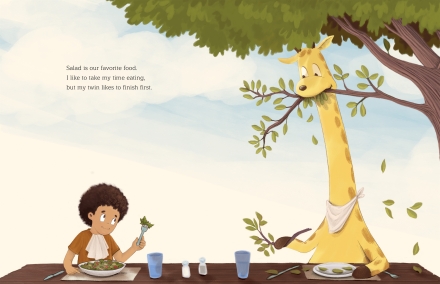
A little boy and a giraffe love being twins. In fact, they are so alike, the boy says, that “sometimes our friends can’t tell us apart.” Having a twin means there’s always someone to play games—“and piano duets”—with. While it’s true that twins like many of the same things, the way they do activities is way different. Take the little boy and his giraffe twin, for instance. The boy’s tricycle is short, while his twin’s is looong, and the snowman the boy makes has three sections while the giraffe’s snowman has six—and antlers.

celebrate-picture-books-picture-review-twins-bowtie

Copyright Mike Ciccotello, 2019, courtesy of Farrar Straus Giroux.

As you might imagine, salad is high on the list of favorite foods. Other faves include dancing, reading, and drawing. But who does these best? That question sometimes causes squabbles. And when there’s, say, only one tool to share or a big issue like “who is stronger,” sometimes that “disagreement…might last all afternoon, and turn into a big, rotten fight.”

celebrate-picture-books-picture-review-twins-salad

Copyright Mike Ciccotello, 2019, courtesy of Farrar Straus Giroux.

But after a little alone time, the boy and his twin and the giraffe and his twin “can never stay mad for very long.” Then they end up compromising because they know that they “work best together.” Yes, “it’s great being a twin, knowing there’s someone who’s just like you.”

celebrate-picture-books-picture-review-twins-activities

Copyright Mike Ciccotello, 2019, courtesy of Farrar Straus Giroux.

Mike Ciccotello’s sweet tribute to twins, whether they’re siblings, best friends, or even pet-and-people pairs will have kids giggling at the juxtapositions of the little boy and his extra-tall twin as they play and work together. The two are exuberant partners, smiling, laughing, and making knowing eye contact, as they dress the same, share the same activities, and talk in their bunk beds before going to sleep. When the inevitable quarrels come, readers will recognize the mixed emotions that ultimately bring these two best friends back together. Ciccotello’s emphasis on resolving disputes, compromise, and staying mindful of all the benefits to having a twin or “near twin” gives the story deeper resonance for building bonds between siblings and friends.

Ciccotello’s vibrant illustrations are clever and cheerful, touching on kid-favorite year-round events and everyday routines. They also give a sly wink to the idea that twins are always identical and highlight the individuality of not only these twins but each reader too. The wide-open pages and spotlighted vignettes allow the youngest readers to focus on the relationship between the boy and the giraffe and offer opportunities for adults and kids to talk about that special bond.

A funny book with a lot of heart, Twins would be an endearing addition to home, classroom, and public library bookshelves.

Ages 2 – 6

Farrar Straus Giroux Books for Young Readers, 2019 | ISBN 978-0374312121

To learn more about Mike Ciccotello and his work, visit his website.

Happiness Happens Month Activity

CPB - Happiness typography

Happiness Is…Game


Happiness is all around you! Grab one or more friends to play a game that reveals what things make you happy. Here are two ways to play:

  1. Like the “Geography” game: the first player names something that makes them happy, the next player must think of something that starts with the last letter of the word the previous player said. The game continues with each player continuing the pattern. Players drop out as they cannot think of a word. The last player left is the winner.
  2. Using a time limit (depending on age): players must think of something that makes them happy. Players drop out if they cannot think of a word within the time limit. The last player left is the winner.

celebrate-picture-books-picture-review-twins-cover

You can find Twins at these booksellers

Amazon | Barnes & Noble | Books-a-Million | IndieBound

Picture Book Review

August 26 – International Dog Day

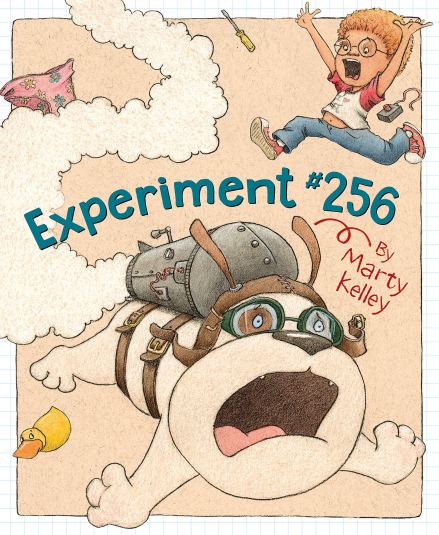
celebrate-picture-books-picture-book-review-experiment-#256-cover

About the Holiday

International Dog Day was established in 2004 by Colleen Paige to raise awareness of all the dogs who need forever homes. The day also celebrates dogs of all breeds and honors the work of these faithful friends, whether they are family pets or specially trained as service dogs, police dogs, or search-and-rescue dogs. The month of August is also Inventor’s Month—a time when we celebrate those creative types who think differently and put their imagination to work to design new products and services we may not even know we need until we have them. The mashup of these two holidays brings us…well…today’s book!

Experiment #256

By Marty Kelley


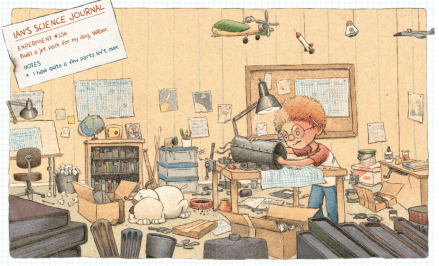
Ian is working on Experiment #256—a jet pack for his dog Wilbur. Ian’s room doubles as his lab, as the tools, supplies, and (especially) loose parts scattered all over attest to. Ian may be a bit messy, but with the methodical mind of any good inventor, he is taking detailed notes about his experiment in his Science Journal. While he has completed the jet pack, the entry on the fire-tinged journal page reveals: “I have quite a few parts left over.” Still, it’s time to try this marvel out.

celebrate-picture-books-picture-book-review-experiment-#256-jet-pack

Copyright Marty Kelley, 2019, courtesy of Sleeping Bear Press.

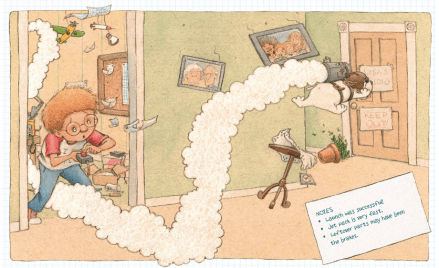
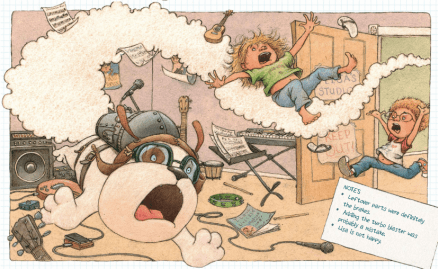
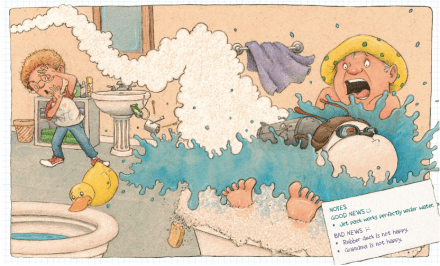
Ian straps it onto Wilbur, pushes the remote button, and… Wilbur is flying—straight for Lisa’s Studio, where a large “Keep Out!” sign greets visitors to her room. Ian jots down thoughts about the successful launch, but also a fear about those missing parts. As Wilbur bursts through the door, Ian’s sister and all of her sheet music go flying. Thanks to the turbo booster, Wilbur only stays a moment, but is still zooming… right into Grandma’s bubble bath. This turns out to be one of those good news (the jet pack works under water)/bad news (rubber duck and Grandma are not happy) situations, which Ian dutifully notes in his journal.

celebrate-picture-books-picture-book-review-experiment-#256-launch

Copyright Marty Kelley, 2019, courtesy of Sleeping Bear Press.

But Wilbur’s flight isn’t over yet. On his way out the window and into the backyard, he grazes Mom, who’s practicing yoga. Ian learns one important fact from this part of the experiment: “Yoga pants are surprisingly flammable.” As Wilbur crashes through the garden there’s more good news in that the broccoli has suffered irreparable losses and more bad news in that the peas have not. Wilbur’s trajectory next takes him into the neighbor’s yard, where he gets “tangled up in the undies that Mrs. Marino was hanging on the line,” and then skyward.

celebrate-picture-books-picture-book-review-experiment-#256-lisa

Copyright Marty Kelley, 2019, courtesy of Sleeping Bear Press.

By the time Ian catches up with him, Wilbur is only a speck at the top of a very high contrail. Ian is distressed. He documents in his journal that not only did he launch his “best friend into space,” Wilbur “doesn’t have a space helmet” and “he didn’t even bring a snack.” Meanwhile, back on earth, Mrs. Marino is still giving Ian a piece of her mind when he is suddenly cast in a saucer-shaped shadow. He looks up to find Wilbur parachuting home clinging to a pink-and-flowered pair of Mrs. Marino’s undies. Ian faithfully notes: “straps on jet pack not secure.”

Gazing into Wilbur’s goggled, angry eyes, Ian concludes that maybe Experiment #256 was not the best idea. But as any good inventor will tell you, a failed experiment is not a flop but merely an inspiration. So, while Lisa, Grandma, Mom, and Mrs. Marino may still be unhappy, Wilbur is thrilled with his new Snack Blaster. And Ian is hard at work on another, more securely strapped jet pack for….

celebrate-picture-books-picture-book-review-experiment-#256-grandma

Copyright Marty Kelley, 2019, courtesy of Sleeping Bear Press.

Marty Kelley’s inventive story—told entirely through Ian’s science journal notes and hilarious illustrations—will keep readers giggling from the first page to the last. Before the story even gets going, kids are treated to a collage of laugh-out-loud photos showing thirteen of Ian’s previous experiments, providing a bit of foreshadowing about #256. Ian’s cryptic observations in his journal lead kids to follow defenseless Wilbur from room to room, yard to yard, and Earth to outer space and back while discovering the chaos wrought by Ian’s runaway jet pack. Flying objects, shocked faces, and, of course, those undies will have readers lingering over the pages to find all the comic details. Kelley’s vivid, textured, two-page spreads are full of action and give the story a retro feel while including timeless visual jokes and a kid-pleasing ending.

An imagination booster for story times when adults and kids want to share a laugh and a bit of science, Experiment #256 would be a funny addition to home, classroom, and library bookshelves.

Ages 5 – 7

Sleeping Bear Press, 2019 | ISBN 978-1534110137

Discover more about Marty Kelley, his books, and his art, visit his website.

International Dog Day Activity

celebrate-picture-books-picture-book-review-i-love-dogs-wordsearch-puzzle-shorter-size

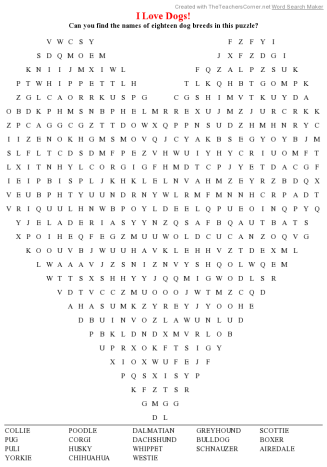
I Love Dogs! Word Search Puzzle


If you love dogs, you’ll have fun discovering the names of eighteen dog breeds in this printable word search puzzle!

I Love Dogs! Word Search Puzzle | I Love Dogs! Word Search Solution

celebrate-picture-books-picture-book-review-experiment-#256-cover

You can find Experiment #256 at these booksellers

Amazon | Barnes & Noble | Books-a-Million | IndieBound

Picture Book Review


August 22 – National Tooth Fairy Day

celebrate-picture-books-picture-book-review-tallulah-the-tooth-fairy-ceo-cover

About the Holiday

Today’s holiday celebrates the mythical (shhhh!) fun of the Tooth Fairy. When a child loses a tooth, they put it under their pillow and that night the Tooth Fairy comes, takes the tooth, and leaves money. What the sprite does with the teeth is a mystery and many theories abound. The mystery of how the whole thing got started is explained here! I had never heard this story, so was excited to find it in my research!

In 1927 Esther Watkins Arnold wrote an eight-page play called The Tooth Fairy. In the same year none other than Sir Arthur Conan Doyle claimed that fairies and gnomes were real and by proof published pictures of two girls surrounded by “verified” fairies. In 1928 schools began performing Esther Arnold’s play, and kids took it to heart, leaving their teeth under their pillows. The rest of the story is, as Sherlock Holmes would say, “Elementary!”

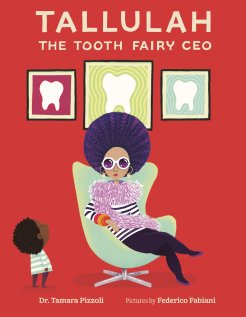
Tallulah the Tooth Fairy CEO

Written by Dr. Tamara Pizzoli | Illustrated by Federico Fabiani


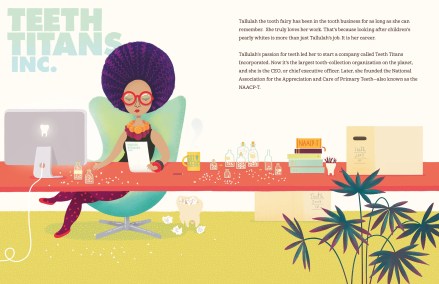
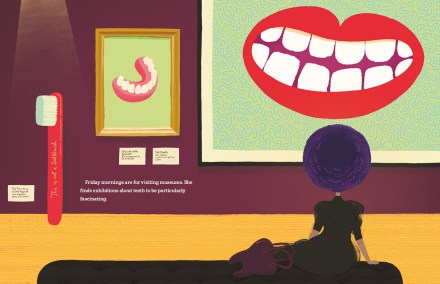
Tallulah the tooth fairy loves her work so much that she was inspired to start her own company—Teeth Titans Incorporated, which is “the largest tooth-collection organization on the planet.” As the company’s CEO, Tallulah feels many demands on her time, but she handles them by reminding herself of what she calls “the three Ps: her passion, her purpose, and what pays.” Her week is divided into time for herself (coffee or tea and a workout on Mondays, therapy on Wednesdays, “yoga, Pilates, and errands” on Tuesdays and Thursdays, and museum visits on Fridays) and work-related tasks like training new tooth fairies for all of those world-wide collection duties.

celebrate-picture-books-picture-book-review-tallulah-the-tooth-fairy-CEO-office

Image copyright Federico Fabiano, 2019, text copyright Dr. Tamara Pizzoli, 2019. Courtesy of us.macmillan.com.

She tells her story on late-night talk shows and scouts for talent at glitzy recruitment events. In addition to all of this, she completes her nightly rounds. “Sure, she could afford to sit around counting teeth and money, but nothing gives Tallulah quite the same thrill as sliding a shiny tooth out from under a child’s pillow and inserting something gleaming and jingly or crisp and easily folded in exchange.”

celebrate-picture-books-picture-book-review-tallulah-the-tooth-fairy-CEO-museum

Image copyright Federico Fabiano, 2019, text copyright Dr. Tamara Pizzoli, 2019. Courtesy of us.macmillan.com.

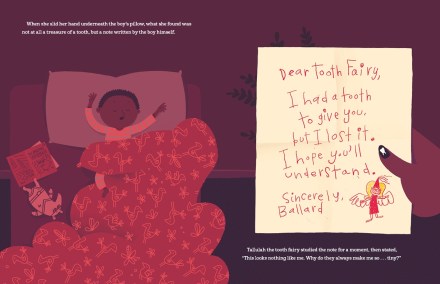
Usually, things go as planned, but one night, at Tallulah’s last stop, instead of a tooth under young Ballard Burchell’s pillow, she pulled out a note. She was a bit disappointed to find the typical picture of a tooth fairy drawn at the bottom, but she continued reading and learned that Ballard had well and truly lost his tooth and had nothing to give her. He hoped she would understand.

celebrate-picture-books-picture-book-review-tallulah-the-tooth-fairy-CEO-board

Image copyright Federico Fabiano, 2019, text copyright Dr. Tamara Pizzoli, 2019. Courtesy of us.macmillan.com.

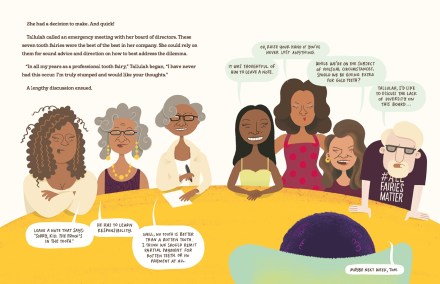
This conundrum was a first for Tallulah. She consulted “her Teeth Titans Incorporated Employee Manual for reference,” but found no help there. “Though she’d written the manual herself, Tallulah hadn’t made provisions for such a rare occurrence.” There was only one thing to do. Tallulah quickly met with the seven members of her board of directors and asked for advice. Two members thought Ballard should learn a lesson in responsibility and get nothing. One thought partial payment was in order. Two more thought it was polite of Ballard to leave a note and to give the kid a break since everyone loses things now and again. And Tom, as the only male board member, wanted to talk about diversity on the board.

celebrate-picture-books-picture-book-review-tallulah-the-tooth-fairy-CEO-ballard

Image copyright Federico Fabiano, 2019, text copyright Dr. Tamara Pizzoli, 2019. Courtesy of us.macmillan.com.

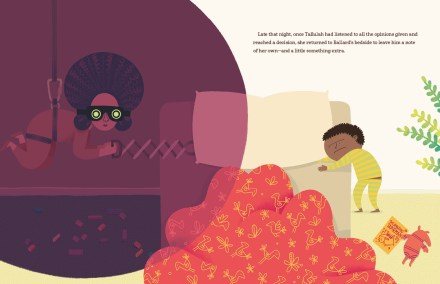
Later that night, with her decision made, Tallulah returned to Ballard’s room “to leave him a note of her own—and a little something extra.” In the morning Ballard discovered the note letting him off the hook this time for misplacing his tooth plus a “patented Teeth Titans Incorporated tooth compartment lanyard,” which usually “retails for $9.95” and is available on the company website, but is his as a gift. The note is even signed by The Tooth Fairy herself.

Ballard couldn’t believe it. He ran to show his mom, and then when he opened the little tooth box on the end of the lanyard, he discovered “one more surprise from Tallulah the Tooth Fairy CEO: the shiniest gold coin you ever did see.”

celebrate-picture-books-picture-book-review-tallulah-the-tooth-fairy-CEO-rappelling

Image copyright Federico Fabiano, 2019, text copyright Dr. Tamara Pizzoli, 2019. Courtesy of us.macmillan,com.

Dr. Tamara Pizzoli gives the tooth fairy a fresh, funny, and sophisticated update for today’s savvy kids. With wry, snappy descriptions of Tallulah’s life in and out of the office, Pizzoli riffs on the topics of self-care, home décor, the media, corporate culture, product placement, and even Mrs. Santa Clause (who finally gets a name—Charlene). Along the way, she shines a spotlight on stereotypes, celebrity, diversity, and kindness. Kids will love this take-charge tooth fairy who’s also not adverse to asking for help and taking advice. And who needs wings when there is rappelling gear and night goggles?

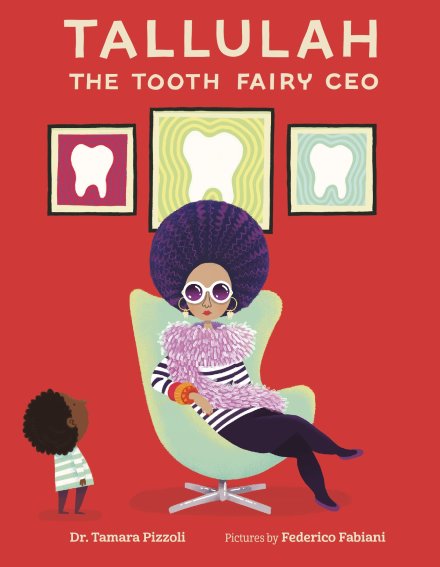
Federico Fabiani’s Tallulah, with her stunning purple-tinged afro, round glasses, and tooth-inspired fashions, is a confident, trend-setting leader with a single focus on excellence. Fabiani’s jazzy color palette lends eye-popping excitement to the illustrations that are stylishly modern with a retro feel. Kids will love finding all the clever references to teeth in Tallulah’s clothing, jewelry, and office and household items. Adults will appreciate with a laugh the nods to today’s culture from veganism to security details to media and social media.

A smart, funny book that goes far beyond its tooth fairy roots to offer opportunities to discuss diversity, social movements, and even empathy, Tallulah the Tooth Fairy CEO would be a favorite addition to home, classroom, and public libraries to share when teeth wiggle out or anytime. 

Ages 4 – 8 

Farrar, Straus, and Giroux Books for Young Readers, 2019 | ISBN 978-0374309190

You can discover more about Dr. Tamara Pizzoli, her books, and her publishing house on The English Schoolhouse website.

To learn more about Federico Fabiani and see a portfolio of his art, visit his website.

National Tooth Fairy Day Activity

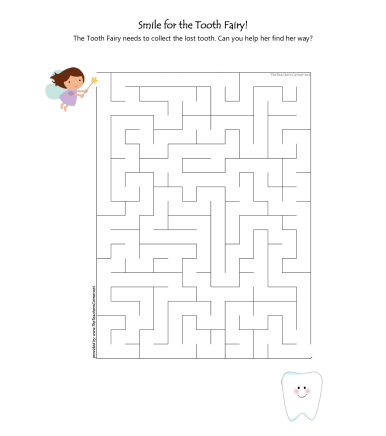
celebrate-picture-books-picture-book-review-Smile-for-the-tooth-fairy-mazeSmile for the Tooth Fairy! Maze


The Tooth Fairy is trying to collect a lost tooth! Can you help her find her way in this printable maze?

Smile for the Tooth Fairy! Maze | Smile for the Tooth Fairy! Maze Solution

celebrate-picture-books-picture-book-review-tallulah-the-tooth-fairy-ceo-cover

You can find Tallulah the Tooth Fairy CEO at these booksellers

Amazon | Barnes & Noble | Books-a-Million | IndieBound

August 21 – It’s Back to School Month

celebrate-picture-books-picture-book-review-truman-cover

About the Holiday

For many children across the country August is the month for going back to school—or just starting on that journey. Some children eagerly look forward to spending the day in a classroom with other kids and learning new things from their teacher or teachers. For others the transition from home to school is a little more daunting. Finding ways to reassure hesitant students can go a long way toward happiness and success in school. Books can help! Through the experiences and feeling of all types of children and characters in picture books, chapter books, and middle grade and young adult novels, kids can share their feelings, whether they are excited or more uncertain about the school year ahead.

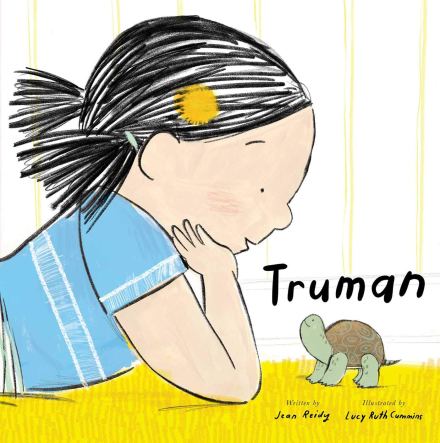
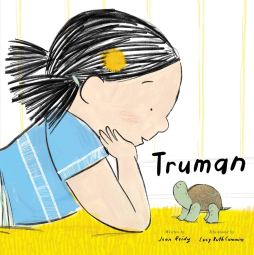
Truman

Written by Jean Reidy | Illustrated by Lucy Ruth Cummins


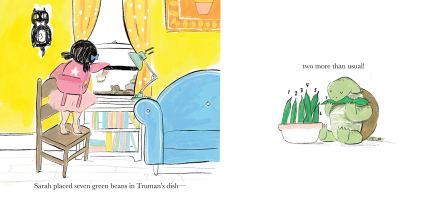
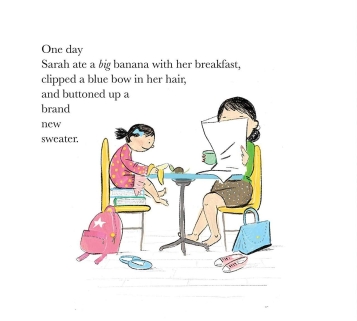
Truman was a little round tortoise “the size of a donut—a small donut—and every bit as sweet.” He lived with “his Sarah,” who was just as quiet and thoughtful as he was, in an apartment above a busy street. One day, Sarah ate an extra-big banana, wore a new sweater, and strapped on an enormous backpack. She even gave Truman extra green beans for breakfast. Then before she left, “she kissed her finger and touched it to his shell and whispered, ‘Be brave.’”

celebrate-picture-books-picture-book-review-truman-coloring

Image copyright Lucy Ruth Cummins, 2019, text copyright Jean Reidy, 2019. Courtesy of Atheneum Books for Young Readers.

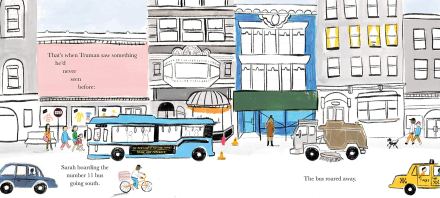
Truman got to thinking about all the new things he’d seen that morning. He looked out the window and saw Sarah getting on the number 11 southbound bus. She had never done that before. Truman waited and waited and waited for Sarah to return. At last, we could wait no longer and decided he would go after her, even if it meant catching the bus “amid the honking and the growling and the shrieking” of the street below. Of course, his tank might be a problem, but there was that nice rock pile….

celebrate-picture-books-picture-book-review-truman-green-beans

Image copyright Lucy Ruth Cummins, 2019, text copyright Jean Reidy, 2019. Courtesy of Atheneum Books for Young Readers.

In a moment he was out and traversing the soft pillows and rubber boots, wooden floor and “endless rug. Without Sarah, their home seemed vast and uncharted and unsettling.” But as Truman reached the window, he realized that he couldn’t see the street at all and that he didn’t even know which way was south. Truman was beginning to lose heart. Then he heard, amid all the other sounds, the number 11 bus and Truman felt brave.

celebrate-picture-books-picture-book-review-truman-kiss

Image copyright Lucy Ruth Cummins, 2019, text copyright Jean Reidy, 2019. Courtesy of Atheneum Books for Young Readers.

“He was just about to slip under the door” when it opened and Sarah walked in. She saw him immediately and was so full of wonder at his amazing feat. She gently put him back in his tank. Truman felt proud. Later, Sarah read him a story she’d written and he couldn’t wait for that day when Sarah would take him with her south where they would “see new sights and hear new sounds and think new thoughts…together.”

celebrate-picture-books-picture-book-review-truman-bus

Image copyright Lucy Ruth Cummins, 2019, text copyright Jean Reidy, 2019. Courtesy of Atheneum Books for Young Readers.

Jean Reidy’s sweet and surprising tale of a tiny tortoise with a big heart has everything you’d want in a story of friendship and new experiences. This adorable pair are two of a kind, ready to explore and meet new challenges. Truman’s trek from his tank to the front door is as daring as any grand adventure, and Sarah’s recognition of her pet’s bravery is reassuring and affirming for all those facing journeys of their own. Reidy’s gentle storytelling sparkles with evocative vocabulary and the kinds of perfect little details that draw kids in. As Sarah tells Truman to “be brave,” she could be encouraging herself as well, and their day, each successful in its own way, is something both can take pride in. Readers will relate to Reidy’s touches of humor and Truman’s indefatigable spirit.

celebrate-picture-books-picture-book-review-truman-backpack

Lucy Ruth Cummins’ stylish illustrations, rendered in a bright yet soothing color palette have a wonderful welcoming feeling as readers are introduces to Sarah, who has a delightful affinity for tutu-like skirts, and Truman, who likes nothing better than being close to “his Sarah.” Kids will fall in love with this tiny, adorable tortoise as he nibbles green beans, contemplates the differences in the morning routine, and makes his way across the rug and past scary toys to the front door. Kids will enjoy keeping an eye on the Sarah’s little yellow flower from page to page. The moment when Sarah finds Truman at the front door shines with their mutual love for each other, and their tender story time will captivate any child.

Endearing from beginning to end, Truman will be an often-asked-for addition to home, classroom, and public library collections.

Ages 4 – 8

Atheneum Books for Young Readers, 2019 | ISBN 978-1534416642

Discover more about Jean Reidy and her books on her website.

To learn more about Lucy Ruth Cummins, her books, and her art, visit her website.

Back to School Month Activity

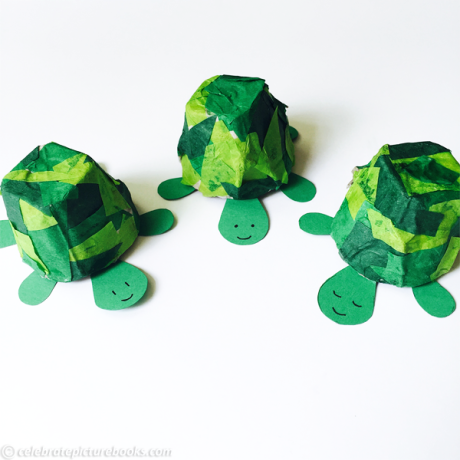
celebrate-picture-books-picture-book-turtle-shell-game

Follow the Turtles! Game


You can make this fun game from recycled materials and a little creativity! When you’re finished making the turtle shells, have fun guessing where the marble, bead or bean is hiding!

Supplies

  • Cardboard egg carton
  • Green tissue paper in different hues
  • Green construction or craft paper
  • A marble, bead, or bean
  • Glue
  • Scissors

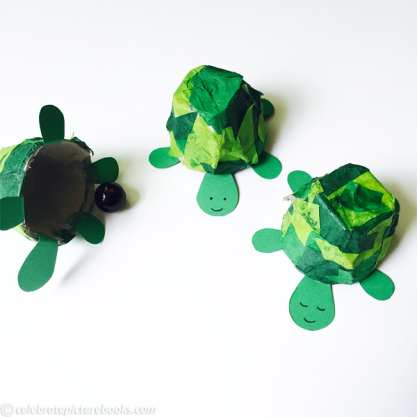
celebrate-picture-books-picture-book-turtle-game

Directions

  1. Cut the egg carton apart into individual cups. You will need 3 cups for each game made.
  2. Cut the rims of the cups so they sit flat on a table.
  3. If the cups have open sides, fit two cups inside one another to fill the gaps
  4. Cut the tissue paper into small shapes
  5. Brush glue on a cup (I used a paper towel to apply glue)
  6. Cover the egg cup with pieces of tissue paper. Repeat with other cups.
  7. Let dry
  8. Cut a head and feet from the green craft paper
  9. Tape or glue the edges of head and feet to the inside of the cups
  10. Add a face to the head

To play the game:

  1. Line up the cups on a table
  2. Put a bead, bean, or marble under one of the cups
  3. Show the other player which cup the object is under
  4. Quickly move the cups around each other several times
  5. Ask the other player which cup they think the object is under
  6. Take turns playing

Extra Game: Make three more and play turtle tic-tac-toe! 

celebrate-picture-books-picture-book-review-truman-cover

You can find Truman at these booksellers

Amazon | Barnes & Noble | Books-a-Million | IndieBound

Picture Book Review
August 20 – It’s National Sandwich Month

celebrate-picture-books-picture-book-review-hannahs-tall-order-an-a-to-z-sandwich-cover

About the Holiday

Did you know there are regulations to determine just what is and is not a sandwich? I didn’t either! It seems that the US Department of Agriculture has determined that for a… thing… to be considered a sandwich, it must contain at least 35% cooked meat and no more than 50% bread. So what about peanut butter? Or grilled cheese? Have we been playing fast and loose with the word “sandwich?” Oh well…. This month is dedicated to those delicious meals between bread that kids and adults take to school and the office, to picnics, and for quick noshes any time. To celebrate, there’s only one thing to do: build yourself the perfect sandwich—just like the little girl in today’s book!

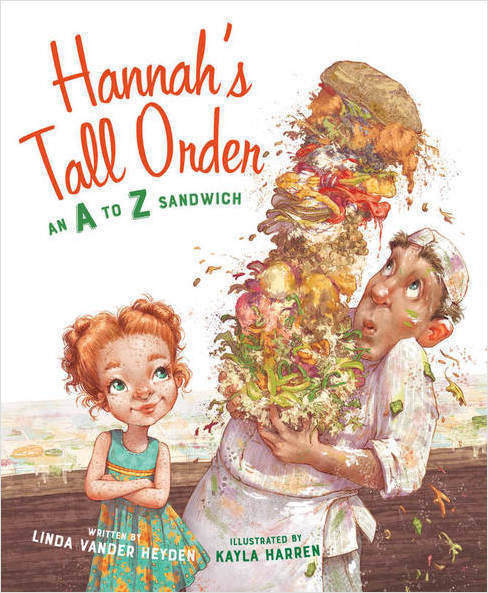
Hannah’s Tall Order: An A to Z Sandwich

Written by Linda Vander Heyden | Illustrated by Kayla Harren


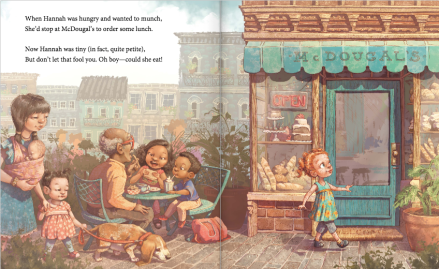
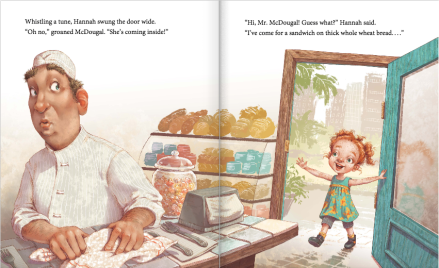
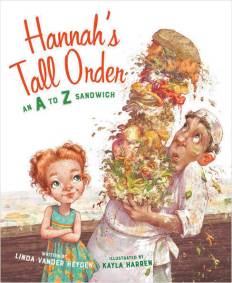
“When Hannah was hungry and wanted to munch, / She’d stop at McDougal’s to order some lunch. / Now Hannah was tiny (in fact, quite petite), / But don’t let that fool you. Oh boy—could she eat!” When McDougal saw Hannah come through the door and order an “A to Z sandwich,” he wondered. And then, as Hannah recited the ingredients for her sandwich, he started to chop, mince, peel, and grate.

celebrate-picture-books-picture-book-review-hannahs-tall-order-an-a-to-z-sandwich-mcdougals

Image copyright Kalya Harren, 2018, text copyright Linda Vander Heyden, 2018. Courtesy of Sleeping Bear Press.

The first six ingredients were prepared and laid on the bread, then Hannah inspected it closely. “‘Green peppers,’ said Hannah. ‘Sliced thin, if you please. / And drizzle on lots of sweet honey from bees. / “‘Add ice cream and jelly—then ketchup (two plops), / A freshly squeezed lemon—just ten tiny drops.’” The sandwich grew taller and wider as Hannah looked around McDougal’s for more ingredients. She wanted a dollop of this, and “lots of nuts, too,” but she wasn’t too hungry, so she told him “one olive will do.”

celebrate-picture-books-picture-book-review-hannahs-tall-order-an-a-to-z-sandwich-hannah-comes-in

Image copyright Kalya Harren, 2018, text copyright Linda Vander Heyden, 2018. Courtesy of Sleeping Bear Press.

She directed more layers be added on top that included “‘a ride red tomato picked fresh off the vine. / And ugli fruit chopped up especially fine.’” Poor McDougal was working up such a sweat that he ended up with food in his hair. Was it done? the chef wondered, but Hannah wanted more. Just three little more additions for X, Y, and Z. Could McDougal do it? Could he finish that treat and give Hannah a sandwich she’d love to sit down and eat? You’ll see!

celebrate-picture-books-picture-book-review-hannahs-tall-order-an-a-to-z-sandwich-hannah-and-mcdougal

Image copyright Kalya Harren, 2018, text copyright Linda Vander Heyden, 2018. Courtesy of Sleeping Bear Press.

Linda Vander Heyden’s hilarious tribute to the sandwich—and the alphabet—will delight kids who love to experiment with food, kids who will eat anything, and even kids who are a little more discriminating in their diet choices. Heyden’s bouncy rhyme is a joy to read aloud, and kids will giggle and laugh out loud as each of the 26 ingredients are added to the towering sandwich. The combination of ingredients will produce plenty of fun “ewwws” as well as cheers as favorite foods are mentioned. A few foods that fill out the alphabetic order and are perhaps unfamiliar to readers will have kids doing a little research. The surprise ending will have kids and adults laughing, and you can bet that post-reading activities will include building a unique sandwich of their own.

Screen Shot 2018-08-08 at 8.11.36 PM

Kayla Harren’s red-haired, freckled Hannah is a mischievous cutie who knows exactly what she likes. As Hannah points out ingredients on the chef’s well-stocked shelves or “helps out” in the kitchen, McDougal’s skills are put to the test as he chops, minces, and grates with intensity surrounded by flying ingredients. As he adds just the perfect dollops of condiments to his masterpiece or gingerly places one olive on the slippery slope the sandwich has become, his eyes grow wide. Taking center stage, of course, is Hannah’s sandwich—an abstract work of art of various colors and textures. Watching this most unusual order come together is a full house of diverse customers, including a girl in a wheelchair. Various perspectives, the use of motion, and the exaggerated-but-spot-on facial expressions add to the exuberant fun.

Hannah’s Tall Order: An A to Z Sandwich will be happily devoured by young readers. The book makes a terrific addition to home and classroom bookshelves and would be a rib-tickling back-to-school gift for kids or teachers.

Ages 5 – 8

Sleeping Bear Press, 2018 | ISBN 978-1585363827

Discover more about Linda Vander Heyden and her books on her website.

To learn more about Kayla Harren, her books, and her art, visit her website.

National Sandwich Month Activity

celebrate-picture-books-picture-book-review-sandwich-scramble-puzzle

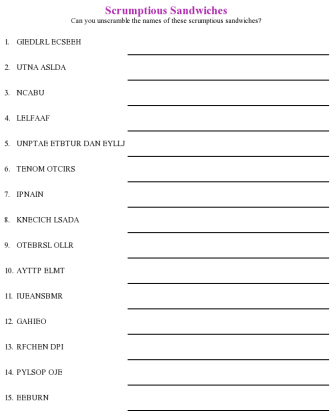
Scrumptious Sandwiches Word Scramble 


Sandwiches are fun to build and delicious to eat! The only hard part is trying to figure out which kind to have. Maybe this list will help! Print this Scrumptious Sandwiches Puzzle and unscramble the names to pick your favorite. Here’s the Solution!

celebrate-picture-books-picture-book-review-hannahs-tall-order-an-a-to-z-sandwich-cover

You can find Hannah’s Tall Order: An A to Z Sandwich at these booksellers

Amazon | Barnes & Noble | Books-a-Million | IndieBound

Picture Book Review

August 19 – World Photography Day

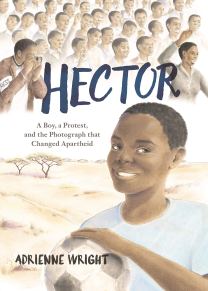
celebrate-picture-books-picture-book-review-Hector-cover

About the Holiday

Photography is all about providing information through images. A picture really can be worth a thousand words in capturing a moment of surprise, joy, danger, or sadness. Well-placed photographers, videographers, and cinematographers have given voice to some of society’s pivotal moments, allowing the whole world to witness change, sometimes as it happens. Today we celebrate the “art, craft, science, and history of photography,” as well as those photographers who often put themselves in danger to get the story as well as those who bring us much-needed lighter moments. To learn more visit the World Photography Day website.

Hector: A Boy, a Protest, and the Photograph that Changed Apartheid

By Adrienne Wright

This powerfully emotional book opens with a recollection by Sam Nzima, the photojournalist who captured this pivotal event and a brief history of South Africa and the segregation and governmental restrictions that led up to the protest in 1976 which resulted in Hector Zolile Pieterson’s death. The compelling story, illustrated in graphic novel style, is broken up into three “chapters.”

celebrate-picture-books-picture-book-review-Hector-Hector

Copyright Adrienne Wright, 2019, courtesy of Page Street Kids.

The first introduces Hector, a twelve-year-old boy who loved playing soccer, watching movies, and visiting family. After his normal weekend chores, Hector would run errands for his neighbors to make a little money. Hector was happy, but things were changing at his school. The government had passed a law that instead of the international language English, black students must be taught half of their subjects in Afrikaans, a language derived from Dutch and spoken by descendants of the early Dutch settlers. This “added hardship to students and teachers in an already oppressive education system.” As he counted the money he’d made, his mother reminds him to count in Afrikaans, since that is what will be required in school.

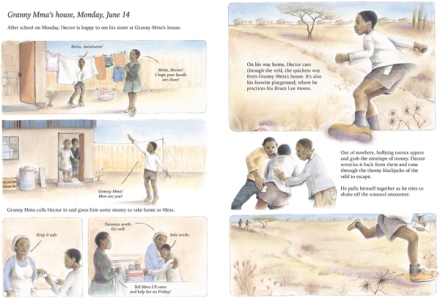
On June 14, 1976 Hector visited his granny Mma. When he left, she gave him some money for his mother. On the way home, he was waylaid by men trying to steal the money. Hector was able to escape with the money and decides not to worry his Mma by telling her. On June 16, Hector heads off to school, but when he gets there, he sees the students “chanting and singing” as they all march toward Orlando Stadium to protest the new Afrikaans law. “More students join in, and soon hundreds, then thousands of people are marching. Hector is swept up in the excited activity of the growing crowd.”

celebrate-picture-books-picture-book-review-Hector-june-14

Copyright Adrienne Wright, 2019, courtesy of Page Street Kids.

Ahead on the road the protesters see the police and a blockade. The students begin marching down another street. They wave signs and sing the “government-banned anthem, ‘Nkosi Sikelel’ iAfrica’—’God Bless Africa.’” The police confront the students, blowing their whistles, shouting, and throwing tear gas. Suddenly, Hector hears his sister, Antoinette’s voice warning him to run home. Shots ring out.

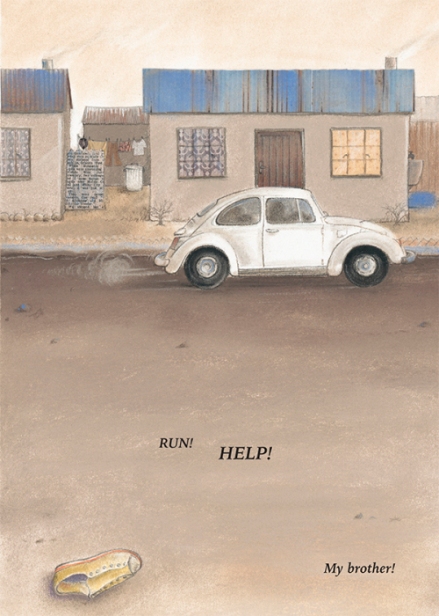
The second chapter introduces Antoinette, who on June 16 is leaving for school from Granny Mma’s house. She knows about the planned protest but says nothing to Granny Mma. She joins the crowd waving signs and chanting. Then “POW! Tear gas explodes in the air. Students scatter in all directions,” and Antoinette sees Hector. As they run for cover, they become separated. Shots ring out all around them. When the smoke dissipates, Antoinette sees a teenager running towards a car with a boy in his arms. “She can’t see the child’s face, but when she sees his shoe…”

celebrrate-picture-books-picture-book-review-Hector-protest-group

Copyright Adrienne Wright, 2019, courtesy of Page Street Kids.

Chapter three takes readers behind the lens of Sam Nzima’s camera. On assignment for The World newspaper, Sam is documenting the protest through his photographs. “The protest begins. / The students march. / Sam snaps photos…. / The police barricades go up. / The children sing. / Sam snaps photos. / The police shoot! / Sam snaps.”

The police see Sam taking pictures and confiscate his film. But Sam has hidden the most important roll in his sock. “His picture of Hector, Antoinette, and another student runs on the front page of the newspaper.” At Granny Mma’s house, Hector’s family grieves his loss; around the world “Hector lives on as a compelling symbol of the cost of apartheid and the change sparked by students that day.”

The final spread shows the black-and-white photograph of Mbuyisa Makhubu carrying Hector with Antoinette running alongside. Back matter includes a short discussion that expands on the events of June 16, 1976 and the years that followed in the fight against Apartheid. An Author’s Note; short biographies of Hector, Antoinette, Sam Nzima, and Mbuyisa Makhubu; and a glossary also follow the story.

celebrate-picture-books-picture-book-review-Hector-help

Copyright Adrienne Wright, 2019, courtesy of Page Street Kids.

Adrienne Wright’s gripping storytelling and evocative illustrations go hand-in-hand to present a full portrait of young Hector, his life, his sweet nature, and his dreams. His family’s close bonds and their concern for each other is evident in the dialog that accompanies images of Hector playing, helping Mma and Granny Mma, running errands, and interacting with his sisters. As June 16 dawns, Wright sketches a normal day, with Hector joking with his mother at home and his friend on the way to school.

As it did for Hector, the protest comes as a surprise for readers, sweeping them up into the action just as Hector was. Antoinette’s chapter is the shortest but gripping in its pacing that mirrors the turmoil of the day and her tragedy. As readers enter Sam’s viewpoint, they see, blocked off in vertical and horizontal frames, the pictures of celebrating and happy, yet serious students marching to make a difference. The moment of the shot is seen through Sam’s lens and clouded in smoke.

Wright’s use of overlapping storylines as she transitions from Hector’s account to Antoinette’s and then to Sam’s adds to the tension, drawing readers in and reinforcing their understanding of the atmosphere and what the students were protesting. The final, nearly full-page reproduction of the actual photograph is an unflinching look at the reality of that day, what it stands for, and its personal cost.

A profound narrative for teaching children about South African history, the costs of discrimination, and the personal stories involved in any conflict, Hector is an important book to add to school and public library collections.

Ages: The book is targeted for children from eight to twelve, but adults should be mindful of the maturity and sensitivity of readers. Hector would also be a compelling inclusion in middle school and even early high school social studies and history classes.

Page Street Kids, 2019 | ISBN 978-1624146916

To learn more about Adrienne Wright and her work, visit her website.

World Photography Day Activity

CPB - New Professionals Picture

News Professionals Clothespin Figures


Photojournalists and journalists cover the news and sometimes put themselves in danger to bring readers true stories of events happening around the world. With this craft, you can make these clothespin figures that honor the men and women who work to keep us all informed.

Supplies

Directions

  1. Draw a face and hair on the clothespin
  2. Cut out the clothes you want your journalist or photographer to wear
  3. Wrap the clothes around the clothespin. The slit in the clothespin should be on the side.
  4. Tape the clothes together
  5. Cut out the camera
  6. Tape one end of a short length of thread to the right top corner of the camera and the other end of the thread to the left corner. Now you can hang the camera around the figure’s neck.

Idea for displaying the figures

  • Attach a wire or string to the wall and pin the figure to it
  • Pin it to your bulletin board or on the rim of a desk organizer

celebrate-picture-books-picture-book-review-Hector-cover

You can find Hector: A Boy, a Protest, and the Photograph that Changed Apartheid at these booksellers

Amazon | Barnes & Noble | Books-a-Million | IndieBound

Picture Book Review