March 4 – It’s National Reading Month

celebrate-picture-books-picture-book-review-a-way-with-wild-things-cover

About the Holiday

National Reading Month is a book-lover’s delight! Designed to encourage children and adults to read every day, the holiday gives you the perfect excuse to hurry out to your local bookstore or library to stock up! The month is only beginning, so gather the kids and discover some new books to enjoy together. Today’s new book is a natural to start with. And when you’ve finished reading, visit the Reading is Fundamental website to join the celebration by adding the books you read to the tally of the Million Book March.

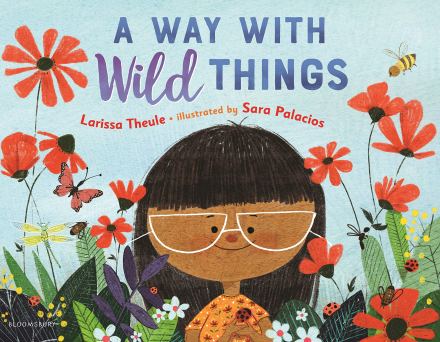
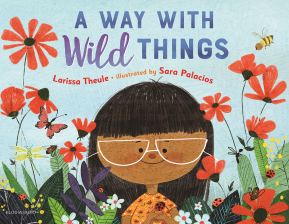
A Way with Wild Things

Written by Larissa Theule | Illustrated by Sara Palacios


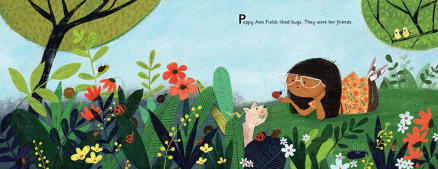
Poppy Ann Fields made friends with lots of bugs. She appreciated all of their natural talents—the way the cicadas formed a symphony, the way the ants marched in perfect lines, the way the shy roly poly said hello, and the “magnificent art” the spider wove. She could spend all day outside among these friends, “but when people came around, Poppy preferred to disappear into the background.”
celebrate-picture-books-picture-book-review-a-way-with-wild-things-bugs

Image copyright Sara Palacios, 2020, text copyright Larissa Theule, 2020. Courtesy of Bloomsbury Children’s Books.

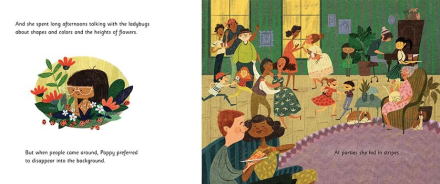
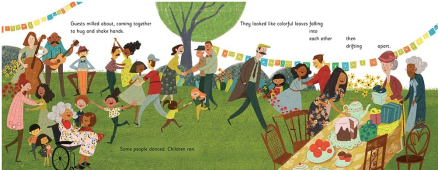
At parties she dressed to blend in with the wallpaper or the brightly flowered rug. She could disappear into the framed landscape on the wall or behind the tree in the corner. To celebrate Grandma Phyllis’s 100th birthday, there was a big party. Poppy watched from behind the flowers and bushes. She watched as people strolled about, meeting and hugging, dancing and running. “They looked like colorful leaves falling into each other then drifting apart.”

A shimmering dragonfly drifted on the breeze and landed on the cake. “Her whole heart glad, Poppy clapped her hands.” She came over to look and that’s when Uncle Dan spotted her. His voice boomed, “‘Poppy Ann Fields, you wallflower, you. So that’s where you’ve been hiding this time.’” Everyone turned to look at Poppy. She froze. The dragonfly took off… “and landed in her hand.” No one could believe it; they smiled and stared in wonder. Then they moved in to get a closer look.
celebrate-picture-books-picture-book-review-a-way-with-wild-things-party

Image copyright Sara Palacios, 2020, text copyright Larissa Theule, 2020. Courtesy of Bloomsbury Children’s Books.

Poppy wished she could run away. She didn’t know where to look, so she gazed at the dragonfly. “She knew the dragonfly had come here for her.” She listened to the cicadas’ music wafting through the air and took a breath. Then she spoke, telling everyone the dragonfly’s scientific name. Grandma Phyllis clasped her hands and gave Poppy a hug. “‘You wildflower, you,’” she whispered. In her heart Poppy knew Grandma Phyllis was right. She was not a wallflower, but “a wildflower.”

An illustrated glossary of Poppy’s bug friends, along with their scientific name and a brief description follows the story.
celebrate-picture-books-picture-book-review-a-way-with-wild-things-birthday

Image copyright Sara Palacios, 2020, text copyright Larissa Theule, 2020. Courtesy of Bloomsbury Children’s Books.

Larissa Theule’s quietly comforting story is balm for those thoughtful, introverted children who interact with the world through observation, contemplation, and gentle interactions. With the soul of a poet, Poppy listens to, watches, and connects with nature, feeling its rhythms and wonder with her whole heart. Theule’s carefully chosen verbs and play on the idea of nature embrace Poppy’s personality. Poppy “preferred” to observe large, noisy gatherings from the sidelines while she “became” things that most people find lovely: landscapes, trees, rain, a group of animals.

When Uncle Dan’s loud voice turns everyone’s attention to Poppy, Theule’s simply stated “she was scared down to her toes” validates the feelings of kids who’d rather not be in the spotlight and gives children and adults an opportunity to talk about these emotions. The party-goers’ enthusiasm to hear what Poppy has to say and Grandma Phyllis’s loving and apt nickname for her granddaughter will reassure introverted readers that they are seen and appreciated for their unique strengths.

Sara Palacios festival of flowers—found outside, in Poppy’s home décor, and on party-goers’ clothing––surrounds Poppy and reveals that she is a part of and does fit in everywhere. One of the joys of A Way with Wild Things is finding Poppy on each page and appreciating Palacio’s creative genius in how she uses camouflage similar to nature. Her vivid, textured illustrations are joyous and full of love for nature, for life, and especially for Poppy who tenderly takes it all in and makes it uniquely hers.

Ages 3 – 6

Bloomsbury Children’s Books, 2020 | ISBN 978-1681190396

Discover more about Larissa Theule and her books on her website.

To learn more about Sara Palacios, her books, and her art, visit her website.

National Reading Month Activity
celebrate-picture-books-picture-book-review-reading-bug-book-plate

Catch the Reading Bug Bookmark, Bookplate, and Books-to-Read List


If National Reading Month is one of your favorite holidays, show it with these printable Reading Bug book accessories!

I’ve Got the Reading Bug Bookmark | I’ve Got the Reading Bug Bookplate | Books-to-Read List 
celebrate-picture-books-picture-book-review-a-way-with-wild-things-cover

You can find A Way with Wild Things at these booksellers

Amazon | Barnes & Noble | Books-a-Million | IndieBound

Picture Book Review

March 3 – World Wildlife Day

celebrate-picture-books-picture-book-review-extinct-cover

About the Holiday

This United Nations-sponsored holiday was established in 2013 to celebrate the world’s wild animals and plants and to raise awareness of the perils they face. Since that time, World Wildlife Day has grown to be the most important global event dedicated to wildlife. Each year, the organizers adopt a theme addressing a pressing wildlife issue. This year’s theme is Sustaining All Life on Earth and encompasses raising awareness of the importance of biodiversity to the environment and to humans as well. The world relies on its biodiversity for clean air and water, food, energy, and materials of all types. But our biodiversity is in danger through unsustainable human activities. It is up to us to decide and act now for the future. Today’s book gives readers a good place to start in seeing species we’ve recently lost and how we can help. To learn more visit the World Wildlife Day website.

I received a copy of Extinct from Phaidon Press for review consideration. All opinions of the book are my own.

Extinct: An Illustrated Exploration of Animals That Have Disappeared

Written by Lucas Riera | Illustrated by Jack Tite


When most people hear the word extinct, they picture T-rex, brontosaurus, or maybe a mastodon. Images of bones long buried and museum exhibits of fossils come to mind. But Extinct: An Illustrated Exploration of Animals That Have Disappeared introduces young readers to the fact that “species become extinct all the time—in fact, it’s happening right now.” Lucas Riera and Jack Tite focus on 90 species that have been lost recently, specifically from the 20th century to today. These animals from all habitats are familiar to children and provide examples of how and why certain species are disappearing. For young conservationists, the stories and facts included offer a roadmap to future action and protective measures while honoring these beautiful animals.

celebrate-picture-books-picture-book-review-extinct-predators

Image copyright Jack Tite, 2019, text copyright Lucas Riera, 2019. Courtesy of Phaidon Press.

Turning to the first page, readers meet six big cats that have disappeared from their homelands due to habitat destruction or hunting. The Formosan clouded leopard, a great climber native to Taiwan and named for the “distinctive shape of their spots,” succumbed to the loss of their natural habitat through logging. “The species was declared extinct in 2013. However, in 2019, two unconfirmed sightings have given hope that they may still be out there.” Also on this page, children are introduced to Tibbles—a house cat (or lighthouse cat, to be more precise) that single-pawedly wiped out the population of New Zealand’s Stephens Island wrens.

Next, children learn about the Thylacine (aka Tasmanian tiger or Tasmanian wolf). Striped like a tiger, carnivorous like a wolf, and the size of a large dog, Thylacines were actually marsupials, capable of hoping on their back legs. Their population dwindled to one by 1933 because of hunting by settlers and through their dogs, which killed the Thylacine’s prey and introduced diseases. “The last specimen was captured in 1933 and lived out its lonely life in an Australian zoo until September 7, 1936.

celebrate-picture-books-picture-book-review-extinct-athletes

Image copyright Jack Tite, 2019, text copyright Lucas Riera, 2019. Courtesy of Phaidon Press.

Speaking of marsupials, Riera highlights seven of these distinctive creatures, ranging from mouse-sized to about three feet tall, that once hopped their way across grasslands and deserts. Many fell victim to foxes, other predators, and habitat change. These include the crescent nail-tail wallaby, the yallara, and the pig-footed bandicoot, which was the size of a cat, had the streamlined face of a bird and whose front feet resembled pigs’ hooves while their back feet were more like horses’ hooves.

Twelve species of reptiles, including three types of giant tortoise, a turtle, skinks, lizards, and snakes, as well as nine species of amphibians, including toads, newts, salamanders, and frogs will fascinate kids. One of these—the gastric brooding frog—may have been one of the most unusual creatures in the forest. What made them unique? “The females swallowed their eggs during gestation. The eggs grew inside her belly! After six weeks, her developed babies would emerge from her mouth. Sadly, these wonderful weirdos have been extinct since 2002.”

celebrate-picture-books-picture-book-review-extinct-the-swimmers

Image copyright Jack Tite, 2019, text copyright Lucas Riera, 2019. Courtesy of Phaidon Press.

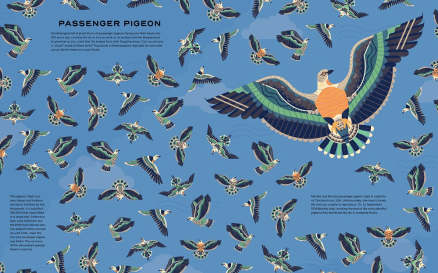
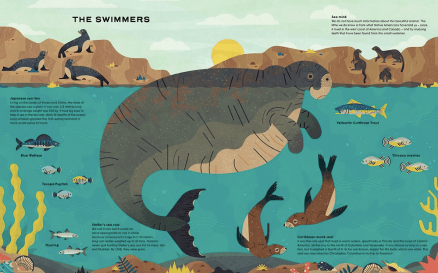
Two-page spreads are also dedicated to Amazing Athletes, Superb Swimmers, Big and Beautiful rhinos and hippo, Powerful Pack wolves, Birds, Primates, and Fantastic Foragers, including the Caucasian wisent, a bison that once thrived in the cold mountains of Eastern Europe. “In the 19th century, their population numbered in the thousands, but then humans settled in the mountains and hunting ensued. In 1927, poachers killed the last three individuals that lived in the wild.” In addition to the Thylacine, Riera highlights three other individual animals—the passenger pigeon, the great auk, and the California Grizzly.

celebrate-picture-books-picture-book-review-extinct-big-and-beautiful

Image copyright Jack Tite, 2019, text copyright Lucas Riera, 2019. Courtesy of Phaidon Press.

Following the species profiles, Riera presents an extensive discussion of extinction today, including the fact that currently “the rate of extinction is estimated to be much faster than the natural rate—by as much as 1,000 times”—and that “it’s the sixth time in billions of years that levels of extinction have been extremely high.” He also reveals causes of extinction, wildlife organizations and examples of positive results, and summaries of work to protect three critically endangered animals. On the next page, Jack Tite depicts more critically endangered animals being tracked by the International Union for Conservation of Nature. Finally, concerned children and adults will find resources for getting involved on local and international levels as well as tips for being more environmentally conscious.

celebrate-picture-books-picture-book-review-extinct-passenger-pigeon

Image copyright Jack Tite, 2019, text copyright Lucas Riera, 2019. Courtesy of Phaidon Press.

Lucas Riera introduces readers to this wide variety of animals through fascinating, conversational, and descriptive paragraphs that reveal tidbits about their distinctive features, where they lived, and how they became extinct. Dates of extinction are eye-opening, especially those for creatures that have disappeared within the lifetime of many young readers. Pages packed with reptiles, birds, amphibians and more, invite children to explore these animals further and present jumping off points for nature and environmental science classes for a wide age range of students.

In this stunning oversized book, Jack Tite accompanies the text with vibrant, eye-catching imagery of animals prowling, leaping, swimming, running, and otherwise on the move that gives readers an up-close view of their beautiful markings and distinguishing traits. Textured backgrounds place the animals in their natural environments from sun-drenched deserts to deep seas to tropical forests and beyond. In what may be a plea for the future, most of the animals gaze out from the page directly at readers, seeming to invite them to learn more and engage them in conservation efforts.

Full of information about environmental science, extinction, and animals that once roamed our planet, Extinct: An Illustrated Exploration of Animals That Have Disappeared is a lush and deep resource for young nature lovers and conservationists at home, in schools, and for public libraries.

Ages 5 and up

Phaidon Press, 2019 | ISBN 978-1838660376

To learn more about Jack Tite, his books, and his art, visit his website.

National Wildlife Day Activity

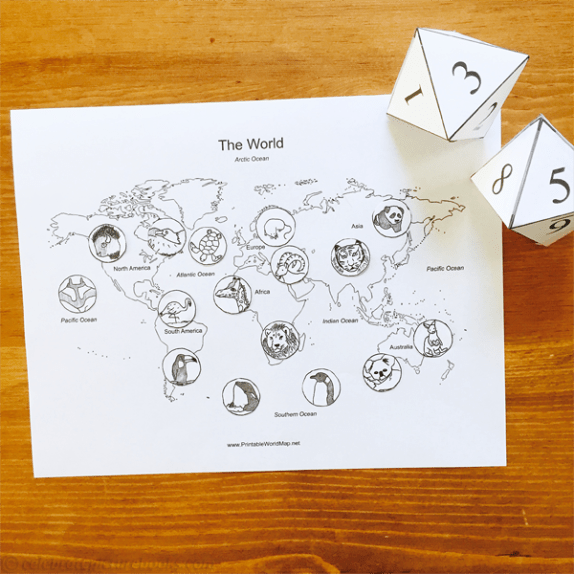
celebrate-picture-books-picture-book-review-wonderful-wildlife-board-game

Fascinating animals are found in every part of the world. Play this fun printable Wonderful Wildlife Board Game to match each animal to the area where it lives.

Supplies

Directions

  1. Print a World Map for each player
  2. Print one set of 16 Wildlife Tokens for each player
  3. Print two copies of the 8-sided die, fold, and tape together
  4. If you would like, color the map and tokens
  5. Choose a player to go first
  6. Each player rolls both dice and places an animal on their map according to these corresponding sums of the dice as shown on printable guide
  7. The first player to fill their map is the winner!

celebrate-picture-books-picture-book-review-extinct-cover

You can find Extinct: An Illustrated Exploration of Animals That Have Disappeared at these booksellers

Amazon | Barnes & Noble | Books-a-Million | IndieBound

Picture Book Review

March 2 – Read Across America Day

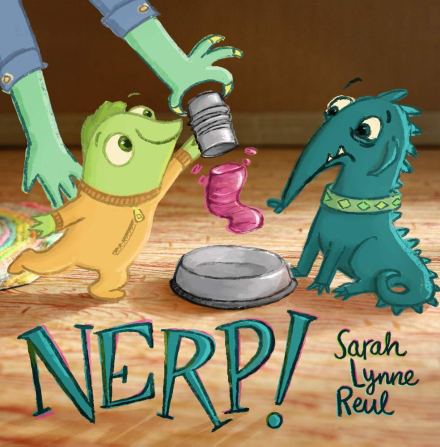
celebrate-picture-books-picture-book-review-nerp!-cover

About the Holiday

Today’s holiday, established by the National Education Association in 1997, encourages children all across the country to celebrate reading and all of its joys and benefits. To commemorate the day, authors, illustrators, politicians, athletes, librarians, and families hold special reading events in schools, libraries, bookstores, and community centers. A love of reading is one of life’s greatest pleasures and begun early can be a powerful force for future success. Celebrate today by reading with a child or on your own. There are fabulous worlds and stories waiting to be discovered.

Nerp!

By Sarah Lynne Reul


If you want to serve up a giggle-feast for your kids, you only need to open Nerp! To have them gobbling up the big slice of silliness Sarah Lynne Reul has whipped up. Part reptile, part fish, and completely adorable, the family conjured up by Reul—a mom, a dad, a baby, and their pet—are just getting ready to enjoy dinner.

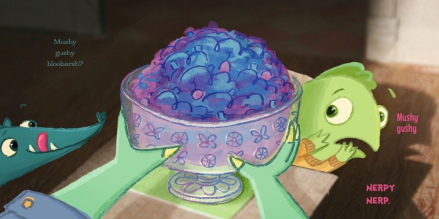
celebrate-picture-books-picture-book-review-nerp!-mushy

Copyright Sarah Lynne Reul, 2020, courtesy of Sterling Children’s Books

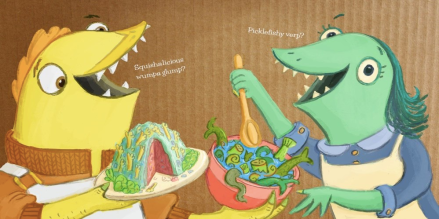
The baby has just helped Mom plop out their pet’s food into its dish and is pointing out how delicious that pink wiggly blob it. But the little family friend looks aghast and lets out a very decided “NERP.” Just then, though, all attention turns to Dad who proudly holds aloft the bowl of jelly-bean colored “Frizzle frazzle hotchy potch!” The baby gazes at his dad pleadingly while pointing at the bowl. “Hotchy-potch?” he asks. Then, giving the bowl the side-eye as if it might jump up and bite him, the tyke pushes it away with a decided “NERP.”

Another bowl appears, this one full of “Mushy gushy bloobarsh.” This bowl is even more ominous than the first, and the baby gasps. Their long-snouted pup, however, is licking its lips. Mom and Dad were apparently ready for these first rejections and have two more dishes on hand, but now Baby—his eyes closed—cannot even stand to sit at the table. “NERPITY NERPITY NERPITY NERP!” he says.

celebrate-picture-books-picture-book-review-nerp!-picklefishy

Copyright Sarah Lynne Reul, 2020, courtesy of Sterling Children’s Books

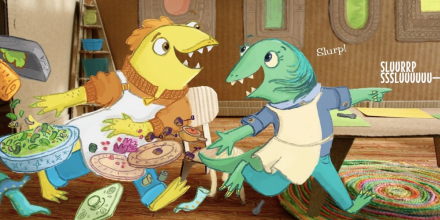
Perhaps Mom and Dad have a personal chef stashed away somewhere because six more scrumptious meals—one even holding its own fork—emerge from the kitchen to entice the little one to eat. But where is Baby? His chair’s empty and his bib discarded. And yet there is a very welcome “ssluuurrrrrrrpppppp” sound coming from somewhere. Mom and Dad are so delighted, happy, thrilled to hear this sound of happy scarfing that they drop all of those carefully prepared and plated meals and rush to find out where it’s coming from.

But Whhhaaaaatttt!!!?? do they see? Their precious tot is down on all fours guzzling…pet food. Oh, well, shrugs Mom as Baby burps, but Dad is none too happy as he scrapes all of their hard work onto an enormous plate for a very happy pup who lets out a decided “YERP!” And with full bellies these two lay back with a “Yerpetty yerpetty yerpy yerp.”

celebrate-picture-books-picture-book-review-nerp!-slurp

Copyright Sarah Lynne Reul, 2020, courtesy of Sterling Children’s Books

Clever mashups of foodie words, tasty adjectives, and nonsense words that are fun to say make reading Nerp! aloud––and with verve––a joy.  Combining this entertaining dialogue with charming mixed-media illustrations set in a diorama made of cardboard, Sarah Lynne Reul creates a wholly original story that will keep children and adults laughing all the way through. Reul addresses that age-old food fight between finicky kids and frantic caregivers with hilarious dishes and facial expressions that perfectly reflect the emotions on both sides. Her pitch-perfect ending will delight kids and have adults nodding in appreciation.

Perfect for both reluctant and adventurous eaters as well as for all book lovers, Nerp! belongs on the reading menu at home, school, and public libraries.

Ages 3 – 7

Sterling Children’s Books, 2020 | ISBN 978-1454934028

To learn more about Sarah Lynne Reul, her books, and her art, visit her website.

Read Across America Day Activity

celebrate-picture-books-picture-book-review-book-bag-craft

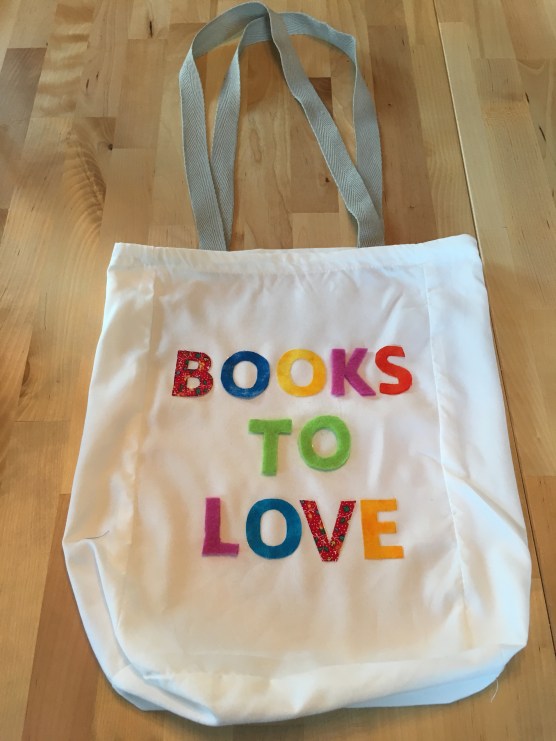
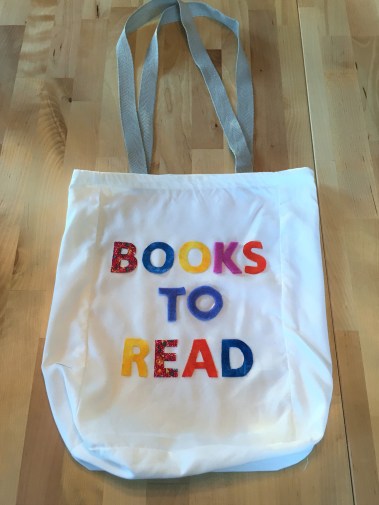
Books to Love, Books to Read Book Bag


True book lovers can’t go anywhere without a book (or two or three) to read along the way. With this easy craft you can turn a cloth bag into a kid-size book bag!

Supplies

  • Printable Templates: Books to Read Template | Books to Love Template or iron-on letters found at craft stores
  • Small cloth bag, available from craft or sewing stores—Recyclable Idea: I used the bag that sheet sets now come in
  • Cloth trim or strong ribbon, available from craft or sewing stores—Recyclable Idea: I used the cloth handles from shopping bags provided from some clothing stores
  • Scraps of different colored and patterned cloth. Or use quilting squares, available at craft and sewing stores
  • Pen or pencil for tracing letters onto cloth
  • Scissors
  • Fabric glue
  • Thread (optional)
  • Needle (optional)

celebrate-picture-books-picture-book-review-books-bag-craft

Directions

  1. Print the sayings and cut out the letters
  2. Trace letters onto different kinds of cloth
  3. Cut out cloth letters
  4. Iron cloth bag if necessary
  5. Attach words “Books to Read” to one side of bag with fabric glue
  6. Attach words “Books to Love” to other side of bag with fabric glue
  7. Cut cloth trim or ribbon to desired length to create handles
  8. Glue (or sew) handles onto the inside edge of bag

celebrate-picture-books-picture-book-review-nerp!-cover

You can find Nerp! at these booksellers

Amazon | Barnes & Noble | Books-a-Million | IndieBound

Picture Book Review

February 26 – It’s Black History Month

celebrate-picture-books-picture-book-review-what-do-you-do-with-a-voice-like-that-cover

About the Holiday

Black History Month is a celebration of the achievements of African Americans and the contributions they have made to the United States History. Appropriately for this election year, the theme for 2020 is “African Americans and the Vote,” which recognizes the struggle for both black men as well as women throughout American history. This year marks the 150th anniversary of the Fifteenth Amendment, which was ratified in 1870 and gave black men the right to vote after the Civil War. It has also been one hundred years since women gained the right to vote. For more information about Black History Month, visit the ASALH website and africanamericanhistorymonth.gov.

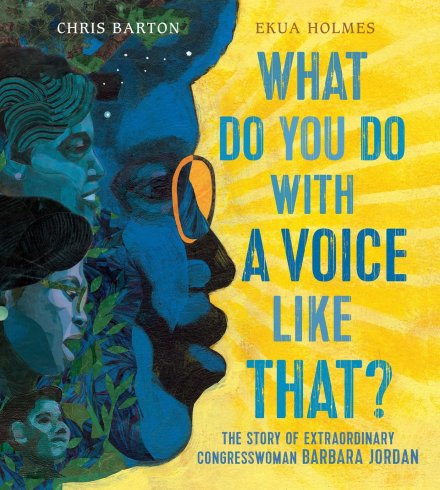
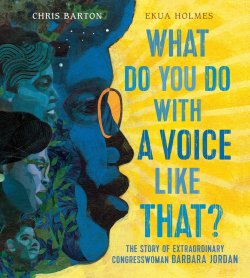
What Do You Do with a Voice Like That? The Story of Extraordinary Congresswoman Barbara Jordan

Written by Chris Barton | Illustrated by Ekua Holmes


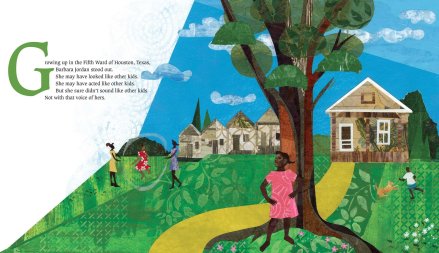
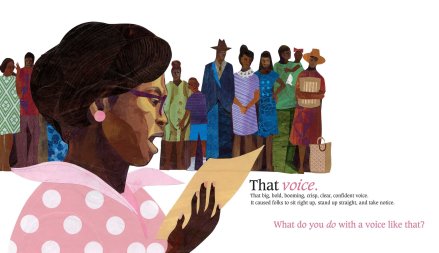
As a child growing up in the Fifth Ward of Houston, Texas, Barbara Jordan was known for her distinctive voice. “That voice. That big, bold, booming, crisp, clear, confident voice. It caused folks to sit right up, stand up straight, and take notice. What do you do with a voice like that?” Barbara recited poetry, gave speeches, and in 1952 won an oratory contest with a trip to Chicago as the prize. She was proud of herself and where her voice was leading her. But where would that be?

celebrate-picture-books-picture-book-review-what-do-you-do-with-a-voice-like-that-child

Image copyright Ekua Holmes, 2018, text copyright Chris Barton, 2018. Courtesy of Beach Lane Books.

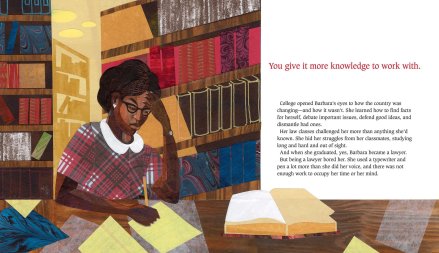
She considered becoming a preacher, a teacher, and a lawyer. When a black woman lawyer gave a speech at Barbara’s high school, Barbara thought she had found her calling. She attended college where she “learned how to find facts for herself, debate important issues, defend good ideas, and dismantle bad ones.” She graduated with a law degree, but practicing law became boring. She wrote more than she spoke, and the work was not demanding enough.

celebrate-picture-books-picture-book-review-what-do-you-do-with-a-voice-like-that-studying

Image copyright Ekua Holmes, 2018, text copyright Chris Barton, 2018. Courtesy of Beach Lane Books.

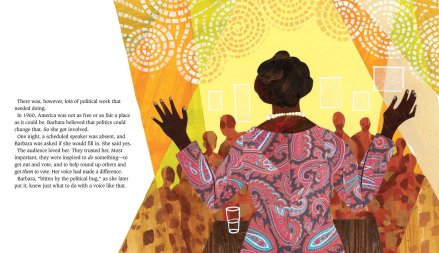
It was 1960, and Barbara decided to lend her voice to causes she believed in. She became involved in politics, and on one pivotal night, she filled in for a speaker who was absent. “The audience loved her. They trusted her. Most important they were inspired to do something—to get out and vote” and to persuade others to vote. Barbara decided to run for office. She lost her first two elections, but the third one she won.

Barbara Jordan was now a Texas state senator, representing the people she grew up with. She believed in making changes from within the political system through debating issues on the Senate floor. She also got to know her colleagues outside of work, and they got to know her. They listened to each other, and positive changes were the result. In 1972, Barbara ran for Congress and won a seat in the U.S. House of Representatives in Washington DC.

celebrate-picture-books-picture-book-review-what-do-you-do-with-a-voice-like-that-politics

Image copyright Ekua Holmes, 2018, text copyright Chris Barton, 2018. Courtesy of Beach Lane Books.

In 1973, the Watergate scandal broke. “President Nixon, it seemed, had broken the law, and Congress had to decide what to do about it.” Once again, as a member of the House Judiciary Committee, Barbara used her voice to remind Congress and the American people that “the Constitution is the document governing all the laws in the United States and applies to all of its people.” Then “in her big, bold, booming, crisp, clear, confident tone” she said, “‘My faith in the Constitution is whole…. And I am not going to sit here and be an idle spectator to the diminution, the subversion, the destruction of the Constitution.’” Barbara said that the president must go. President Nixon resigned in 1974.

celebrate-picture-books-picture-book-review-what-do-you-do-with-a-voice-like-that-campaign

Image copyright Ekua Holmes, 2018, text copyright Chris Barton, 2018. Courtesy of Beach Lane Books.

Barbara became a star, shining “like a bright light in a dark place.” She became the voice for those battling discrimination, for those “who had less power…who possessed quieter strengths than her own…who did not want to be limited by their weaknesses.” People talked about Barbara becoming a Senator, a Supreme Court Justice, or possibly Vice President.

But Barbara, unknown even to herself, had been struggling with multiple sclerosis, and now her inner voice told her that the place she belonged was home. Back in Texas, she became a college professor, where she taught her students not only to “do something, but to do the right thing.” Her students are still working today, striving to make the world a better place and to inspire everyone to make their voices heard.

An Author’s Note, a detailed timeline of Barbara Jordan’s life, and other recommended resources follows the text.

celebrate-picture-books-picture-book-review-what-do-you-do-with-a-voice-like-that-speaking

Image copyright Ekua Holmes, 2018, text copyright Chris Barton, 2018. Courtesy of Beach Lane Books.

Chris Barton’s stirring biography of Barbara Jordan introduces children to a woman whose voice is just as relevant today as it was when she was a state senator, US representative, and professor. Barton clearly and lyrically depicts Jordan’s trajectory while showing readers what it takes to succeed: practice, perseverance, learning, and wisdom. For young readers Barton briefly but cogently outlines the core of the case against Richard Nixon then allows readers to hear, in her own words, Jordan’s rousing defense of the Constitution. His inclusion of Jordan’s seventeen years of teaching after her diagnosis of MS is a poignant reminder that her influence is still heard through her students and admirers, and Barton’s final exhortation to readers to speak out honors Barbara Jordan’s life and will impel both children and adults to follow her lead.

Ekua Holmes stunning mixed-media illustrations will set readers’ hearts soaring in this over-sized picture book that beautifully reflects Barbara Jordan’s influence in politics and beyond. Holmes’ collages, rendered in lush colors and textured with intricate patterns and images from nature, take children on Jordan’s journey from sun-drenched Texas to law school to Washington DC, giving them a glimpse of her childhood and her growing stature as a stateswoman. Today’s savvy readers will be interested in the examples of campaign materials and images of Jordan’s building relationships with diverse voters and her fellow senators and representatives. Several photographs of Jordan from her graduation, campaigns, and televised appearances during the Watergate hearings join Holmes’ realistic portraits and will inspire readers to learn more about this influential and unforgettable woman.

What Do You Do with a Voice Like That? is a stirring and empowering biography that belongs in every home, school, and public library collection.

Ages 4 – 8 and up

Beach Lane Books, 2018 | ISBN 978-1481465618

Discover more about Chris Barton and his books on his website.

To learn more about Ekua Holmes, her books, and her art, visit her website.

Black History Month Activity

celebrate-picture-books-picture-book-review-barbara-jordan-activity

Barbara Jordan Inspirational Poster


If you have ideas about how to make the world better, print this poster of Barbara Jordan and write how you would like to use your voice on the back. This can be through speech, writing, art, community involvement, or any way that uses your talents.

celebrate-picture-books-picture-book-review-what-do-you-do-with-a-voice-like-that-cover

You can find What Do You Do with a Voice Like That? at these booksellers

Amazon | Barnes & Noble | Books-a-Million | IndieBound

Picture Book Review


February 26 – National Tell a Fairy Tale Day

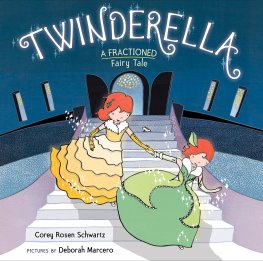
celebrate-picture-books-picture-book-review-twinderella-cover

About the Holiday

Today we celebrate the long tradition of oral and written stories that have captivated both children and adults since earliest times. While many of the fairy tales we love began as lessons in good manners or avoiding danger, they have remained popular and a part of our culture that we pass down to children through the generations. These tales stand up to traditional treatments as well as variations that turn the familiar plots on their heads.

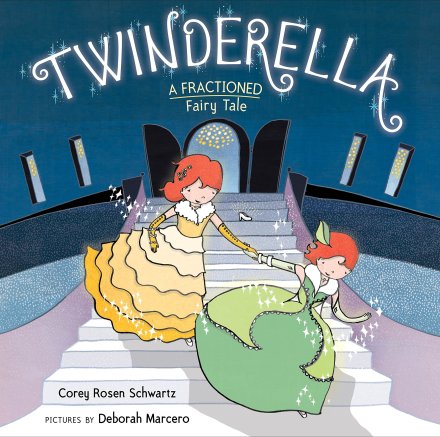
Twinderella, A Fractioned Fairy Tale

Written by Corey Rosen Schwartz | Illustrated by Deborah Marcero

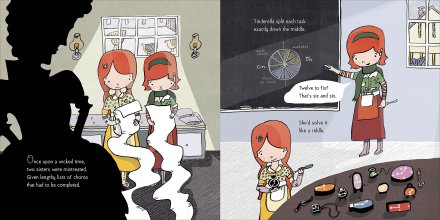
You, of course, know the story of Cinderella, but did you know that she had a twin named Tinderella? Here’s how the whole story goes…. When the two girls were given their long list of chores by their wicked stepmother, “Tinderella split each task / exactly down the middle. / Twelve to fix? / That’s six and six. / She’d solve it like a riddle.” And, thus, Cinderella and Tinderella went to work on fixing the household’s clocks.

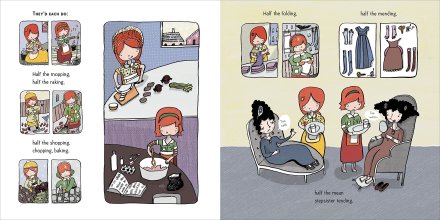
The girls also split the mopping, shopping, baking, mending, and “the mean stepsister tending.” Left with only leftovers to eat at the end of the day, the two even shared half a piece of bread and half the scraps before collapsing into their half of the bed. In their  dreams, Cinderella kept her eye on marriage while Tinderella calculated what having twice the room would be.

celebrate-picture-books-picture-book-review-twinderella-chores

Image Copyright Deborah Marcero, 2017, text copyright Corey Rosen Schwartz, 2017. Courtesy of G. P. Putnam’s Sons.

Then one day, the sisters saw an open invitation by the prince to a ball where he hoped to find his princess. Cinderella was excited that her dream could come true, but her stepmother told them they had to stay home to clean. “So Cinderella grabbed a broom, / but as she started sweeping, / she felt her dreams all turn to dust / and couldn’t keep from weeping.” But suddenly their fairy godmother appeared, and with her magic wand she created two beautiful gowns, two pairs of slippers, and lots of other bling. Tinderella split all of this between them, and as they each climbed into their half of a fabulous car, they listened to the fairy godmother’s warning to be back by midnight.

As soon as the prince saw Cinderella and Tinderella, he was enchanted. “No other girl stood half a chance—he danced with them all night.” Taking turns with the Prince, the girls danced the night away until they heard the clock begin to chime. They ran away from the ball, leaving the saddened prince—and a shoe—behind. He tried the shoe on all the girls in the village until he found that it fit Cinderella and Tinderella.

celebrate-picture-books-picture-book-review-twinderella-half-the-chores

Image Copyright Deborah Marcero, 2017, text copyright Corey Rosen Schwartz, 2017. Courtesy of G. P. Putnam’s Sons.

The prince didn’t know what to do and told the girls they had to choose. But Tinderella had a brilliant idea. She summoned their fairy godmother and asked if she could make the prince a twin. Before she did, though, Cinderella reminded the prince that he’d have to share his kingdom and all its wealth. “Prince Charming crossed his heart and swore / to split things even steven. / ‘I’d gladly give up all my stuff. / It’s love that I believe in.’”

With that the fairy godmother waved her wand and Whoosh! an exact double of the prince appeared. It turned out that he was just as much a whiz at math as Tinderella, and within moments he had neatly “divvied up the royal wealth” and won Tinderella’s heart. While Cinderella and Prince Charming ruled the kingdom, Tinderella and her prince ruled the math world. Later, Cinderella had a baby boy. And Tinderella? Well, “against all odds” she “delivered quads,” and everyone lived “happ’ly ever half-ter.”

An included poster allows kids and teachers to extend the math learning with entertaining activities on the back.

celebrate-picture-books-picture-book-review-twinderella-prince-charming

Image Copyright Deborah Marcero, 2017, text copyright Corey Rosen Schwartz, 2017. Courtesy of G. P. Putnam’s Sons.

Fans of Corey Rosen Schwartz and her fractured fairy tales know all about her awesome storytelling and rhyming abilities. In Twinderella, A Fractioned Fairy Tale, she uses her multiple talents to give a favorite fairy tale a double dose of magic while engaging kids in a bit of math fun. Her always-clever verses shine with evocative vocabulary that gives the two girls distinct personalities while also ingeniously introducing the concept of one half and division. Schwartz doesn’t stop at a purely mathematical definition of these ideas, though. When Tinderella suggests making a double of the prince, Cinderella ensures Prince Charming is up to splitting his kingdom, in this way passing on her well-earned sense of empathy and sharing to readers. The sweet ending offers quadruple the delight of the original tale and prompts readers to dip into the story again to see how the girls’ fancy dress accessories and the princes’ kingdom along with other items in the story could be divided into fourths.

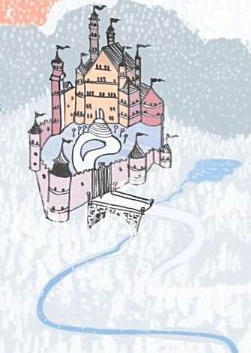
celebrate-picture-books-picture-book-review-twinderella-castle

Deborah Marcero’s mixed media illustrations are as charming as the prince himself. As red-haired Cinderella and Tinderella go about their copious chores, thumbnail portraits of the girls splitting the work demonstrate the idea of one half. A larger image of the girls baking reveals the opportunities for math learning in this everyday activity. A pie chart that Tinderella draws on a chalkboard is clearly labeled and corresponds to the clocks on the table, introducing kids to this graphing system and allowing them to make connections. Similarly, the concept of area is portrayed as Tinderella dreams of a bigger bed. A careful look on every page will reward readers with many chances for counting and dividing at various levels depending on the age of the reader. Marcero’s color palette is fresh and vibrant while infusing the pages with a royal ambience that hints at the girls’ enriched future.

A joy to read aloud, Twinderella, A Fractioned Fairy Tale is an enchanting story that doubles as inspired math learning. The book would be a favorite addition to any home, classroom, and public library collection.

Ages 4 – 8

P. Putnam’s Sons, 2017 | ISBN 978-0399176333

You’ll discover more about Corey Rosen Schwartz and her books plus Twinderella activities to download on her website.

To learn more about Deborah Marcero, her books, and her art, visit her website.

National Tell a Fairy Tale Day Activity

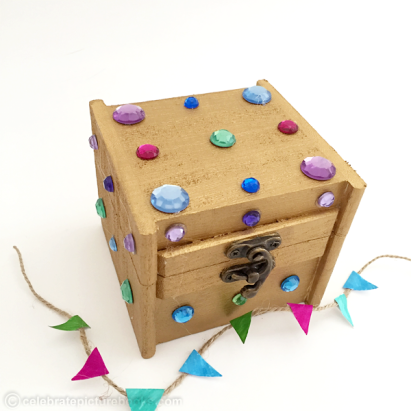
CPB - Fairy Tale box

Treasure Box of Imagination

Fairy tales are treasure troves of imagination and dreams. With this craft, kids can make a treasure box to save the ideas and tidbits that spark their own imaginations.

Supplies

  • 1 small wooden box, available at craft stores
  • Gold acrylic craft paint
  • Craft gems
  • Paint brush
  • Hot glue gun or strong glue

Directions

  1. Paint your wooden box with the gold paint
  2. Let the box dry
  3. Decorate your Treasure Box of Imagination with gems

celebrate-picture-books-picture-book-review-twinderella-cover

You can find Twinderella: A Fractioned Fairy Tale at these booksellers

Amazon | Barnes & Noble | Books-a-Million | Indiebound

February 25 – Honoring Katherine Johnson

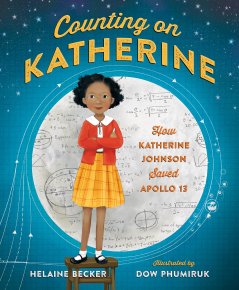
celebrate-picture-books-picture-book-review-counting-on-katherine-cover

About Katherine Johnson

Katherine Johnson passed away yesterday at the age of 101. Recognized from an early age for her brilliance, Katherine went on to become a pivotal mathematician for NASA as the space race led to the first manned missions and lunar landings. She continued working for NASA on the space shuttle and other technological advancements. Fearless in asking the kinds of probing questions that fueled her imagination and precise calculations and in standing up for her rights, Katherine was a trail-blazer for women and people of color. She was awarded the Presidential Medal of Freedom in 2015. Her influence and inspiration continue to shine, especially for children, through books like Counting on Katherine.

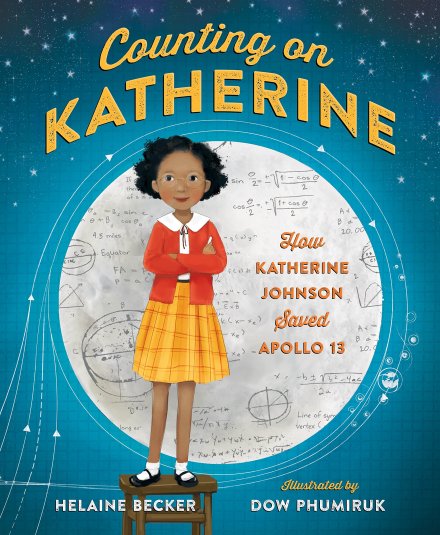
Counting on Katherine: How Katherine Johnson Saved Apollo 13

Written by Helaine Becker | Illustrated by Dow Phumiruk


Katherine may have been born counting. She counted every step she took and every step she climbed. She counted the dishes and silverware as she washed them, and although she may have wanted to count all the stars in the sky, she knew that was beyond anyone’s ability. “Even so, the stars sparked her imagination…. Katherine yearned to know as much as she could about numbers, about the universe—about everything!”

celebrate-picture-books-picture-book-review-counting-on-katherine-school

Image copyright Dow Phumiruk, 2018, text copyright Helaine Becker, 2018. Courtesy of Henry Holt and Company.

Katherine was so smart that she skipped three grades, even passing up her older brother. Katherine graduated from elementary school when she was 10 and was ready for high school, but “her town’s high school didn’t admit black students—of any age. Her father, though, said, “‘Count on me.’” He worked until the family could afford to move to another town where she could attend a black high school.

In high school, Katherine loved all of her classes, but her favorite subject was math. She wanted to become a research mathematician, “making discoveries about the number patterns that are the foundations of our universe.” But there were no jobs like that for women, so Katherine taught elementary school.

celebrate-picture-books-picture-book-review-counting-on-katherine-calculations

Image copyright Dow Phumiruk, 2018, text copyright Helaine Becker, 2018. Courtesy of Henry Holt and Company.

Then in the 1950s, the National Advisory Committee on Aeronautics began hiring new employees. When Katherine applied all the positions had been filled, but the next year she got a job. A few years later when NASA was formed, Katherine became what was known as a human “‘computer.’” She and the other computers––all of whom were women––calculated long series of numbers, contributing to the “space race.”

Katherine asked lots of questions about how high the rocket ship would go and how fast it would travel before beginning her calculations. Her job was to make sure that the earth and the rocket were in the same place when the rocket needed to land. Katherine’s calculations were so precise and her leadership so inspiring that she was promoted to Project Mercury, “a new program designed to send the first American astronauts into space.

celebrate-picture-books-picture-book-review-counting-on-katherine-trajectory

Image copyright Dow Phumiruk, 2018, text copyright Helaine Becker, 2018. Courtesy of Henry Holt and Company.

The engineers and astronauts knew that the missions were going to be dangerous, and John Glenn, distrusting the computer-generated numbers, refused to fly until Katherine approved the numbers. “‘You can count on me,’” she told him. Glenn’s mission was successful and Katherine earned another promotion. Her new job was to “calculate the flight paths for Project Apollo—the first flight to the moon.” She calculated the trajectories that took Apollo 11 and Apollo 12 to the moon and back in 1969. But as Apollo 13 soared through space on its way to the moon, there was an explosion. There were questions about whether the spaceship could reach the moon or make it back to Earth.

celebrate-picture-books-picture-book-review-counting-on-katherine-explosions

Image copyright Dow Phumiruk, 2018, text copyright Helaine Becker, 2018. Courtesy of Henry Holt and Company.

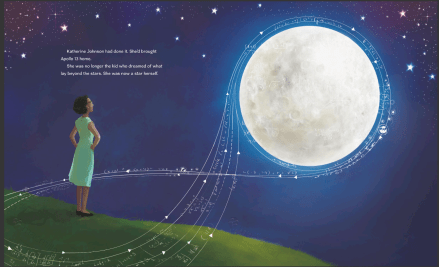
Katherine was again called to make new calculations. In only a few hours, Katherine had a new flight plan that “would take the ship around the far side of the moon. From there, the moon’s gravity would act like a slingshot to zing the ship back to Earth.” But for the plan to work, the astronauts had to follow it exactly. There was no room for a mistake. Katherine and all of the NASA engineers waited nervously to find out if the plan would succeed. Finally, the astronauts reported that they were back on track. “Katherine Johnson had done it…. She was no longer the kid who dreamed of what lay beyond the stars. She was now a star herself.”

An Author’s Note following the text tells more about Katherine Johnson’s life and work, which went on to impact the space shuttle program and satellite projects.

celebrate-picture-books-picture-book-review-counting-on-katherine-moon

Image copyright Dow Phumiruk, 2018, text copyright Helaine Becker, 2018. Courtesy of Henry Holt and Company.

Helaine Becker’s captivating storytelling captures Katherine Johnson’s genius for math and talent for applying it to even the most complex problems in a ground-breaking field. Her self-confidence, curiosity, and love of learning as well as her trajectory at NASA will impress readers, many of whom may also be dreaming of making a mark in new ways. A highlight of Becker’s text is her clear explanations of how Katherine’s calculations for NASA were used and what was at stake when her help was needed most. Becker’s repeated phrase “You can count on me” and her stirring ending weave together the numerical and lyrical aspects of Katherine’s life to inspire a new generation of thinkers.

celebrate-picture-books-picture-book-review-counting-on-katherine-skips-dreaming

Image copyright Dow Phumiruk, 2018, text copyright Helaine Becker, 2018. Courtesy of Henry Holt and Company.

From the first page, readers can see Katherine’s intelligence and inquisitiveness that shined whether she was walking to school, doing chores, or, later, making sure our astronauts made it to the moon and back safely. Dow Phumiruk’s artwork is always thrilling, and here blackboards covered in formulas as Katherine stands on tiptoe as a child and on a ladder as an adult to complete them will leave readers awestruck with her understanding of and abilities with numbers. Illustrations of school rooms and offices give children a realistic view of the times, and her imagery pairs perfectly with Becker’s text in demonstrating the concepts of sending a rocket ship into space and bringing it home again. Phumiruk’s lovely images of space are uplifting reminders that dreams do come true.

A stellar biography that will enthrall children and inspire them to keep their eyes on their goals and achieve their dreams, Counting on Katherine: How Katherine Johnson Saved Apollo 13 is highly recommended for home bookshelves and is a must for school and public library collections.

Ages 5 – 9

Henry Holt and Company, 2018 | ISBN 978-1250137524

Discover more about Helaine Becker and her books on her website.

To learn more about Dow Phumiruk, her books, and her art, visit her website.

Watch the Counting on Katherine book trailer!

celebrate-picture-books-picture-book-review-counting-on-katherine-cover

You can find Counting on Katherine: How Katherine Johnson Saved Apollo 13 at these booksellers

Amazon | Barnes & Noble | Books-a-Million | IndieBound

Picture Book Review
February 24 – It’s the Book Birthday of Eat the Cake!

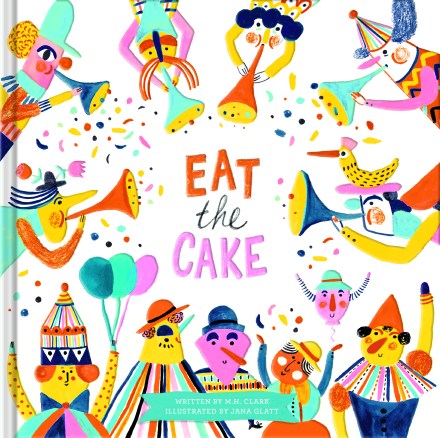
celebrate-picture-books-picture-book-review-eat-the-cake-cover

About the Holiday

You’re invited to a party! When: Today! Where: Right here! Who: Compendium’s newest picture book – Eat the Cake! But if you’re thinking you need a gift…no worries. As you’ll soon discover, this book is all about showing you that you’re a gift! So, give a cheer and and read on and help me welcome Eat the Cake to bookstore and library shelves.

I received a copy of Eat the Cake from Compendium for review consideration. All opinions are my own. The lovely and generous people at Compendium also invited me to become a member of their affiliate program. This post contains an affiliate link.

Eat the Cake

Written by M.H. Clark | Illustrated by Jana Glatt


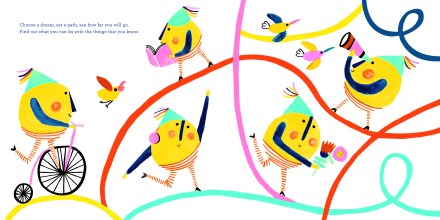
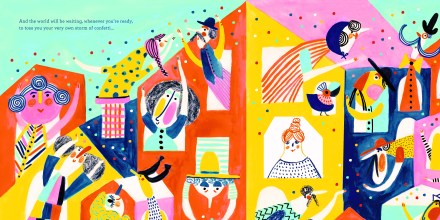
A cast of colorful and whimsical characters welcomes the reader with smiles and shouts and horns that blow confetti. There’s also a heartening promise that “so many good things will be coming your way!” Turning the page, more members of this fanciful community urge kids to bask in the sun that’s shining on them while deciding just what they might like to do and when they would like to begin: “Choose a dream, set a path, see how far you will go. / Find out what you can do with the things that you know.”

celebrate-picture-books-picture-book-review-eat-the-cake-spread-paths

Image copyright Jana Glatt, 2020, text copyright M.H. Clark, 2020. Courtesy of Compendium.

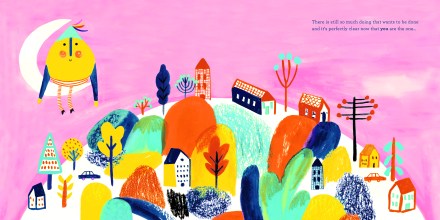
Now that kids are rarin’ to go, they’re reminded about those ideas they may have stashed away and are encouraged to consider them again with their “new, daring self.” No matter where their talents lie, children are cheered on to show their brilliance and invite the world to join in as they make their mark. When should this jubilation take place? Why not now? Today! After all, “It’s your day to be wild and fearless and free. / It’s your day for becoming the next thing you’ll be.” The party can roar for a day, a week, or even a year as the world celebrates with confetti and streamers and lots of balloons and shouting “your name when you walk in the room.”

celebrate-picture-books-picture-book-review-eat-the-cake-spread-confetti

Image copyright Jana Glatt, 2020, text copyright M.H. Clark, 2020. Courtesy of Compendium.

So, embrace it all—everything you want to get done. Make your big plans, break records, and take those chances that come your way. And in the midst of this celebration of you, don’t forget: “whatever you do, eat the cake.”

celebrate-picture-books-picture-book-review-eat-the-cake-spread-more-to-do

Image copyright Jana Glatt, 2020, text copyright M.H. Clark, 2020. Courtesy of Compendium.

M.H. Clark’s joyful jamboree of a book will inspire any child to embrace all that they are and all they want to do today and in the future with upbeat rhyming couplets that spark confidence, happiness, and a sense of independence and carefree spontaneity. The idea that good things await those who use their talents, aren’t shy about tooting their own horn, share experiences with others, and, of course, always take the opportunity to “eat the cake” is reassuring and will embolden readers to dive into life.

celebrate-picture-books-picture-book-review-eat-the-cake-spread-stars

Image copyright Jana Glatt, 2020, text copyright M. H. Clark, 2020. Courtesy of Compendium.

Exhilarating in their quirky inventiveness, Jana Glatt’s people, creatures, and animals gleefully take center stage, reveling in their uniqueness and inviting the “you” of the story—a sun-shaped cutie in striped pants and sporting a party hat—to join them. On the first page, children are greeted by a man whose wavy beard hosts a steamship, a person who’s all legs and arms and head, a woman with a mushroom skirt, and a color-block block of a guy whose looong feet may be the only things keeping him upright.

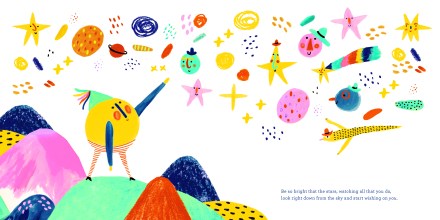
Kids will identify with the sunny celebrant who goes page to page soaking up the good wishes, exploring meandering paths, dancing with three distinctive friends, and flying, flitting, and floating here and there on the way to the festive party where the cake awaits. A rainbow of bold, fresh colors, topsy-turvy perspectives, and lots and lots of smiles make every page as joyful as the message.

A perfect gift for birthdays or graduations, Eat the Cake is also a stirring book for any time of the year. A sunburst of inspiration, the book would be an often-reached-for addition to home, school, and public library collections.

Ages 4 – 8

Compendium, 2020 | ISBN 978-1946873842

Discover more books by M.H. Clark on Instagram.

To view a portfolio of artwork by Jana Glatt, visit her on Instagram and tumblr.
Eat the Cake Book Birthday Activity

celebrate-picture-books-picture-book-review-cake-maze

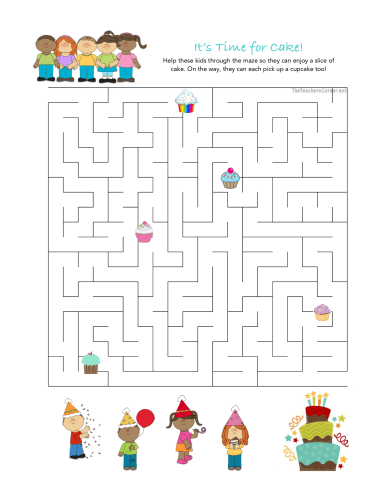
It’s Cake Time! Maze


Help the kids make their way through this printable maze so they can enjoy a piece of cake. Make sure each one picks up a cupcake too!

It’s Cake Time! Maze | It’s Cake Time! Maze Solution

celebrate-picture-books-picture-book-review-eat-the-cake-cover

This post contains an affiliate link. If you make a purchase from Compendium through the link below, I’ll earn a small commission which I will use to keep celebrating wonderful picture books––and, maybe, for a small piece of cake.

You can purchase Eat the Cake at Compendium


Picture Book Review