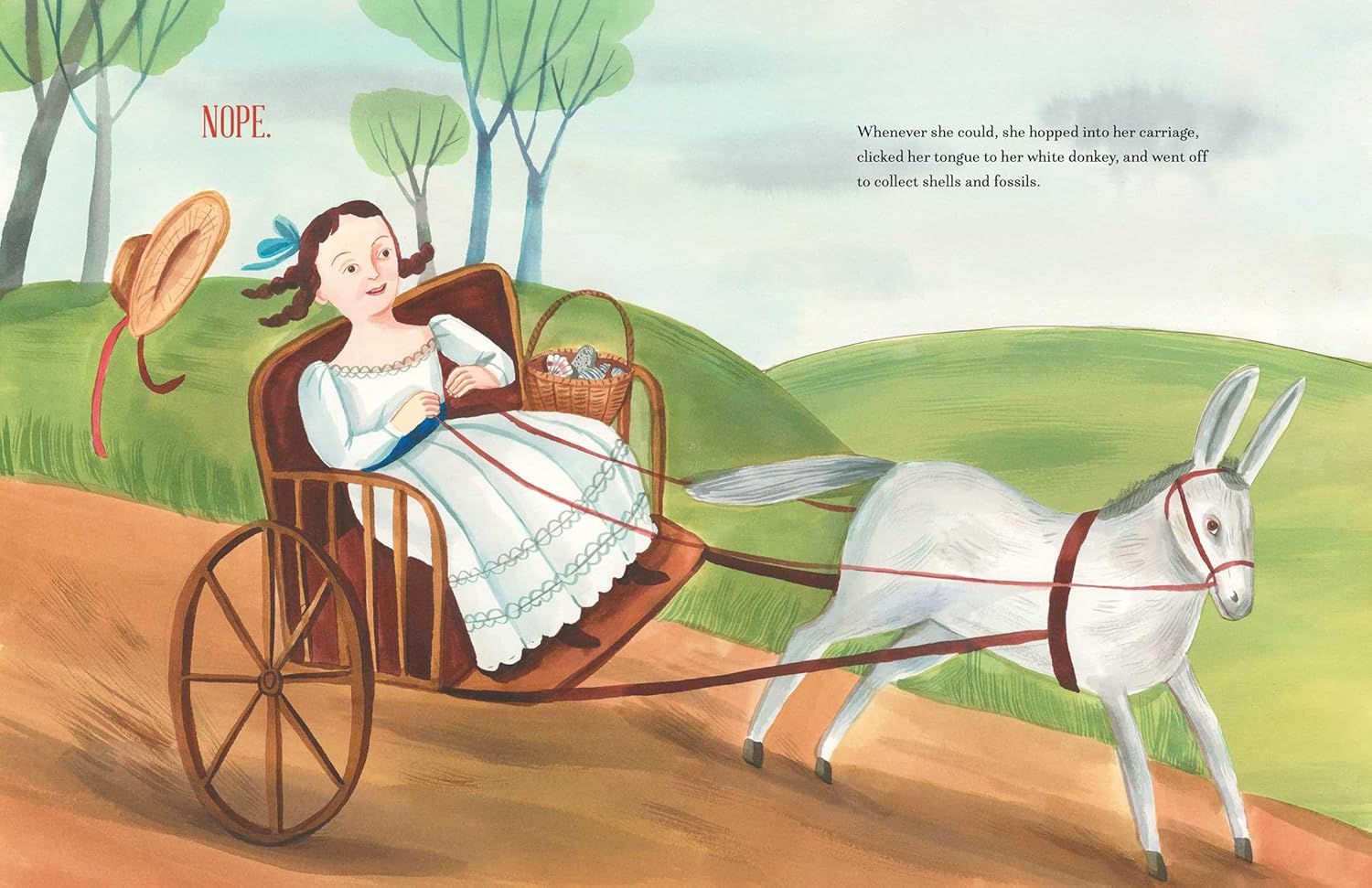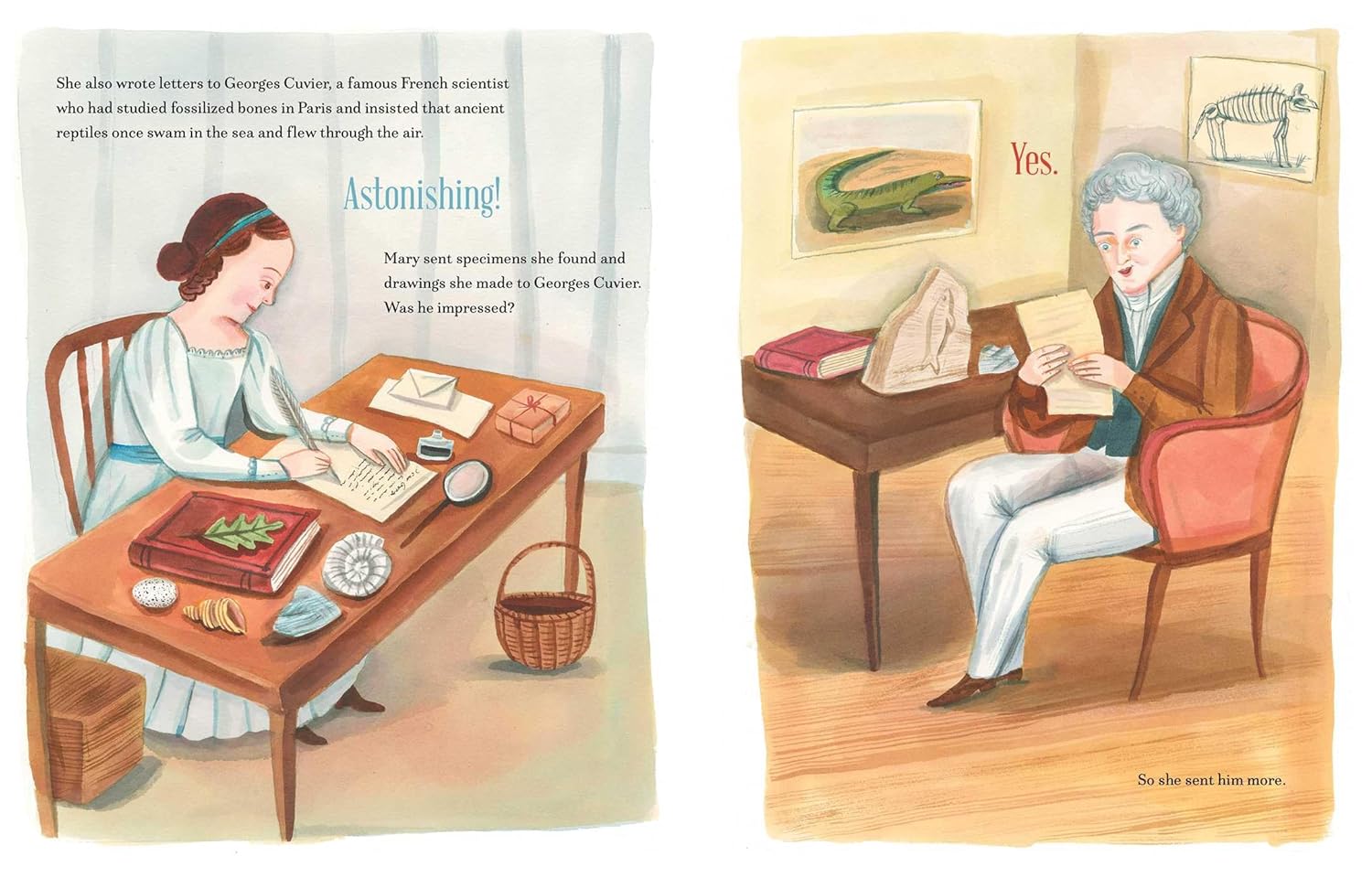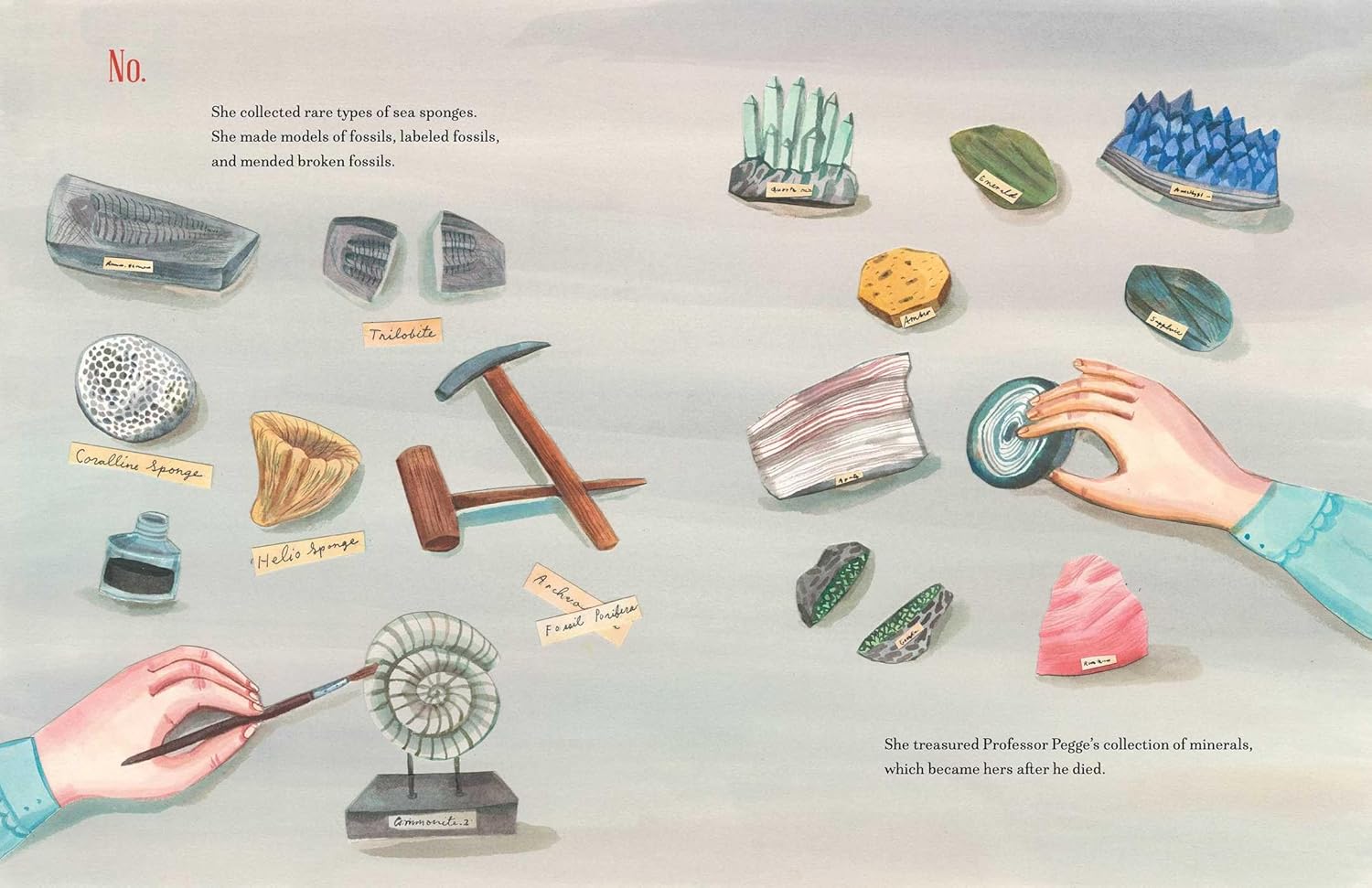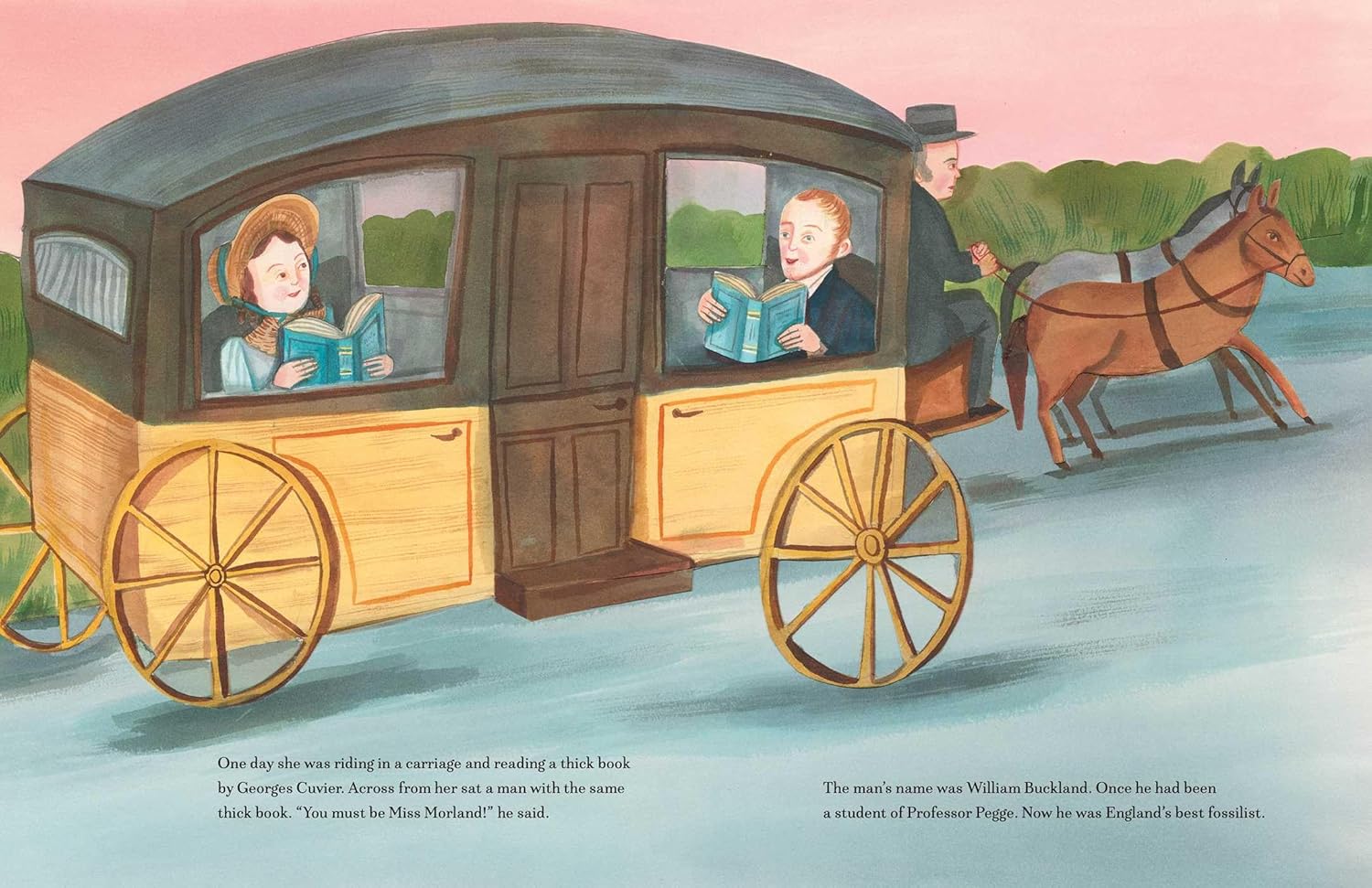
July 1 – National Watercolor Month

About the Holiday

Today, I’m celebrating World Watercolor Month with a biography of a woman artist born in 1861 who not only worked in watercolors but brought the delicately blended beauty of the art form to the solid medium of glass as the creator of iconic Tiffany designs. World Watercolor Month was begun in 2016 by Charlie O’Shields, the creator of Doodlewash®, host of the Sketching Stuff podcast, and founder of a social artist movement dedicated to promoting and connecting watercolor artists from all over the world. The holiday also raises awareness of the global importance of art and creativity. Everyone from amateurs to professionals are welcome to participate—and if you’ve never painted with watercolors before, now’s a great time to try! If you’d like prompts to inspire your work and other ways to enjoy the month and take your love of watercolor painting into next month and beyond, visit Doodlewash.

Thank you to Peachtree and Barbara Fisch of Blue Slip Media for sending me a copy of this book for review!

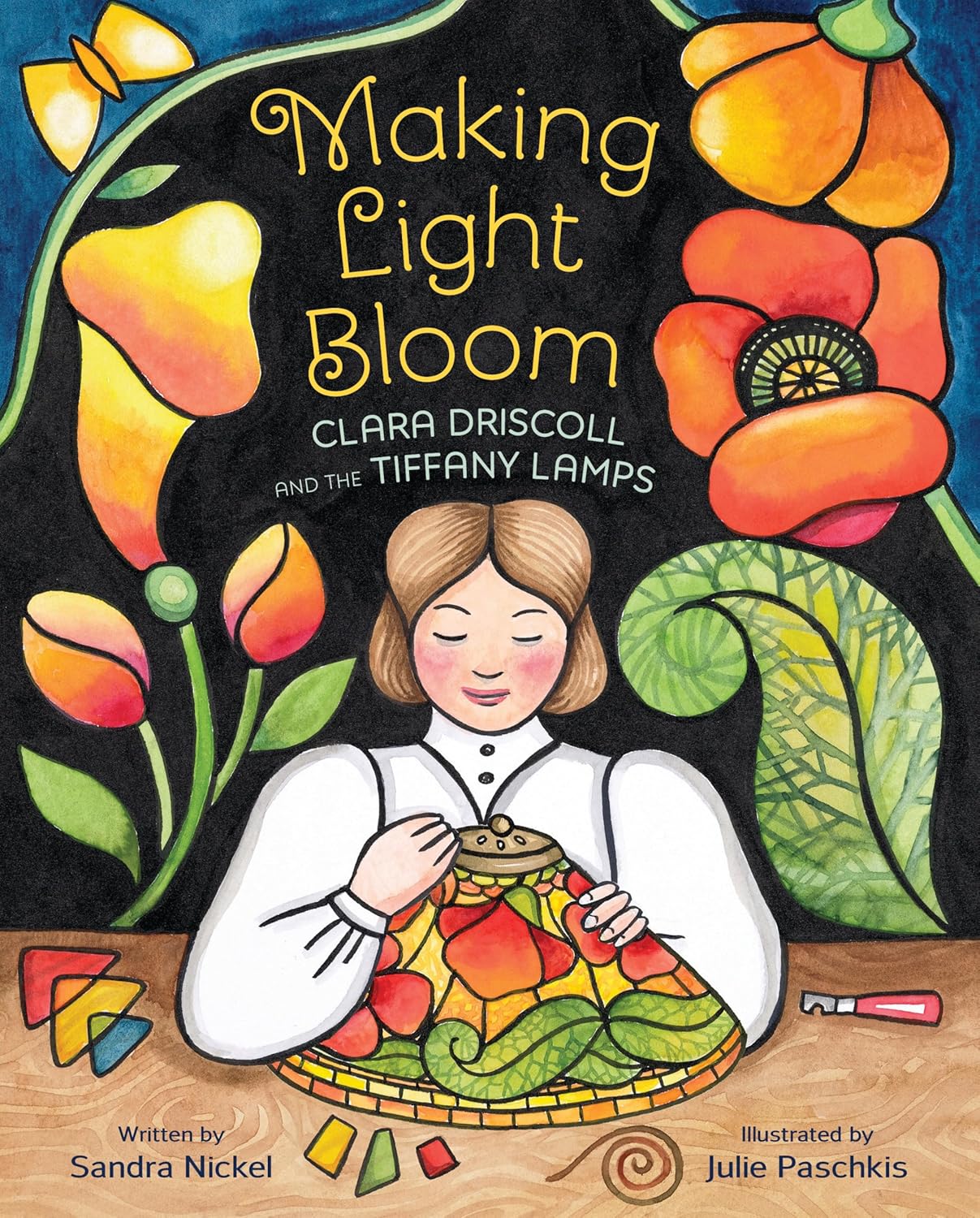
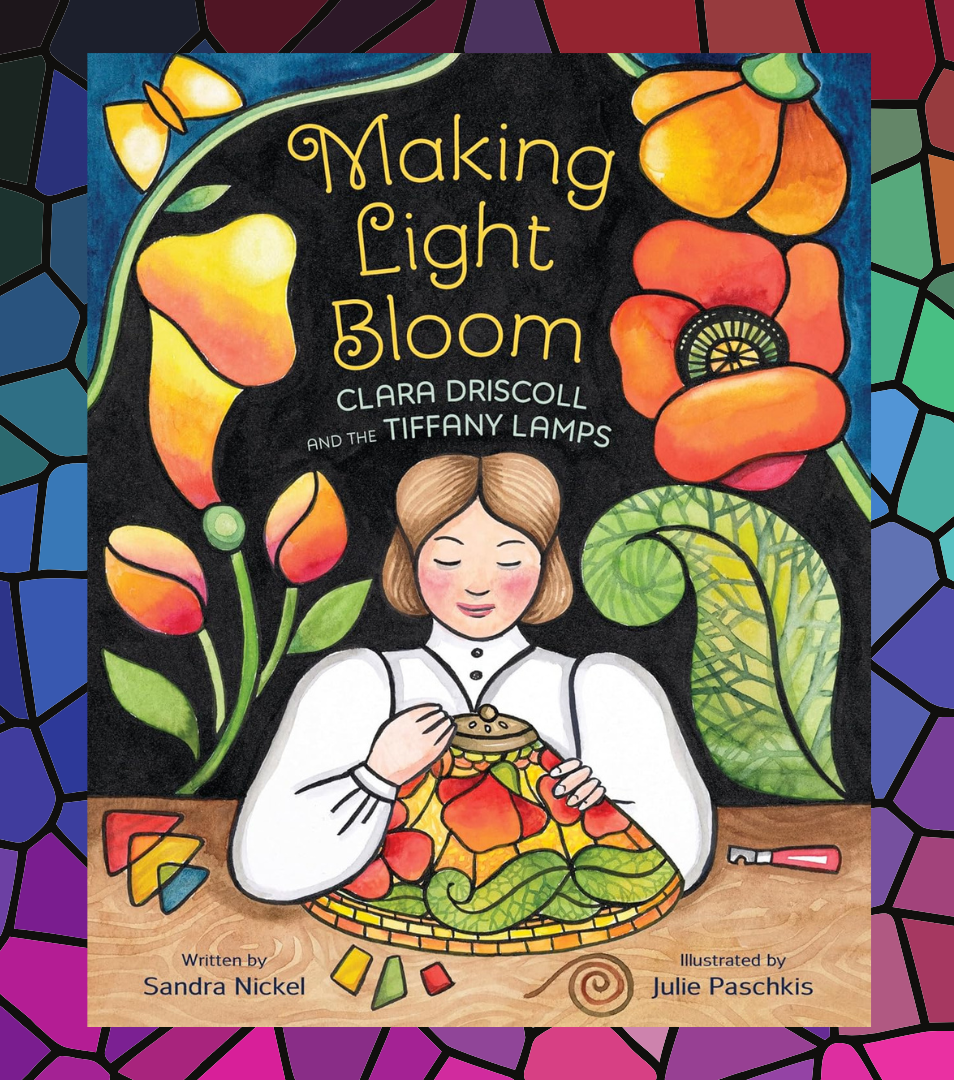
Making Light Bloom: Clara Driscoll and the Tiffany Lamps

Written by Sandra Nickel | Illustrated by Julie Paschkis


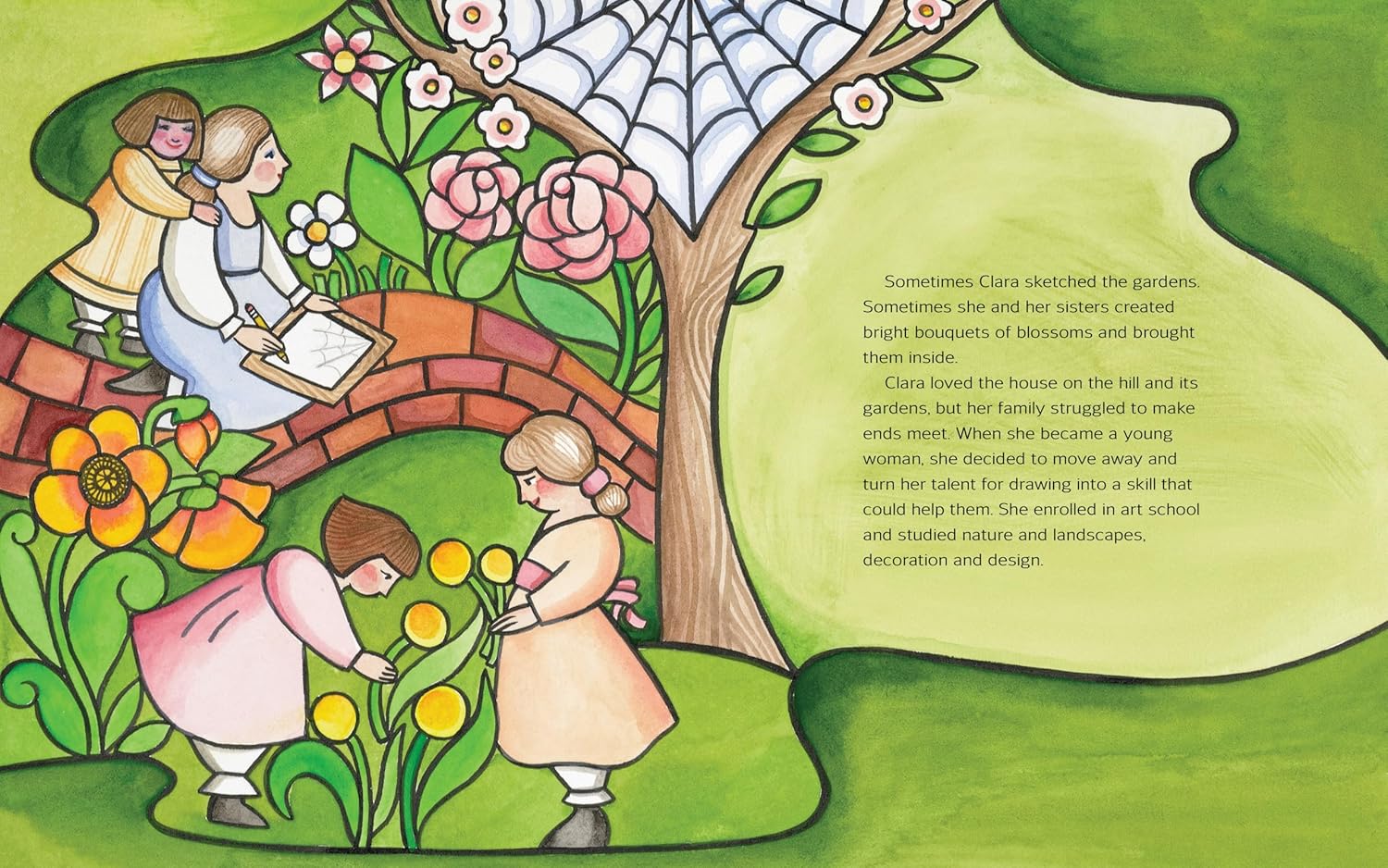
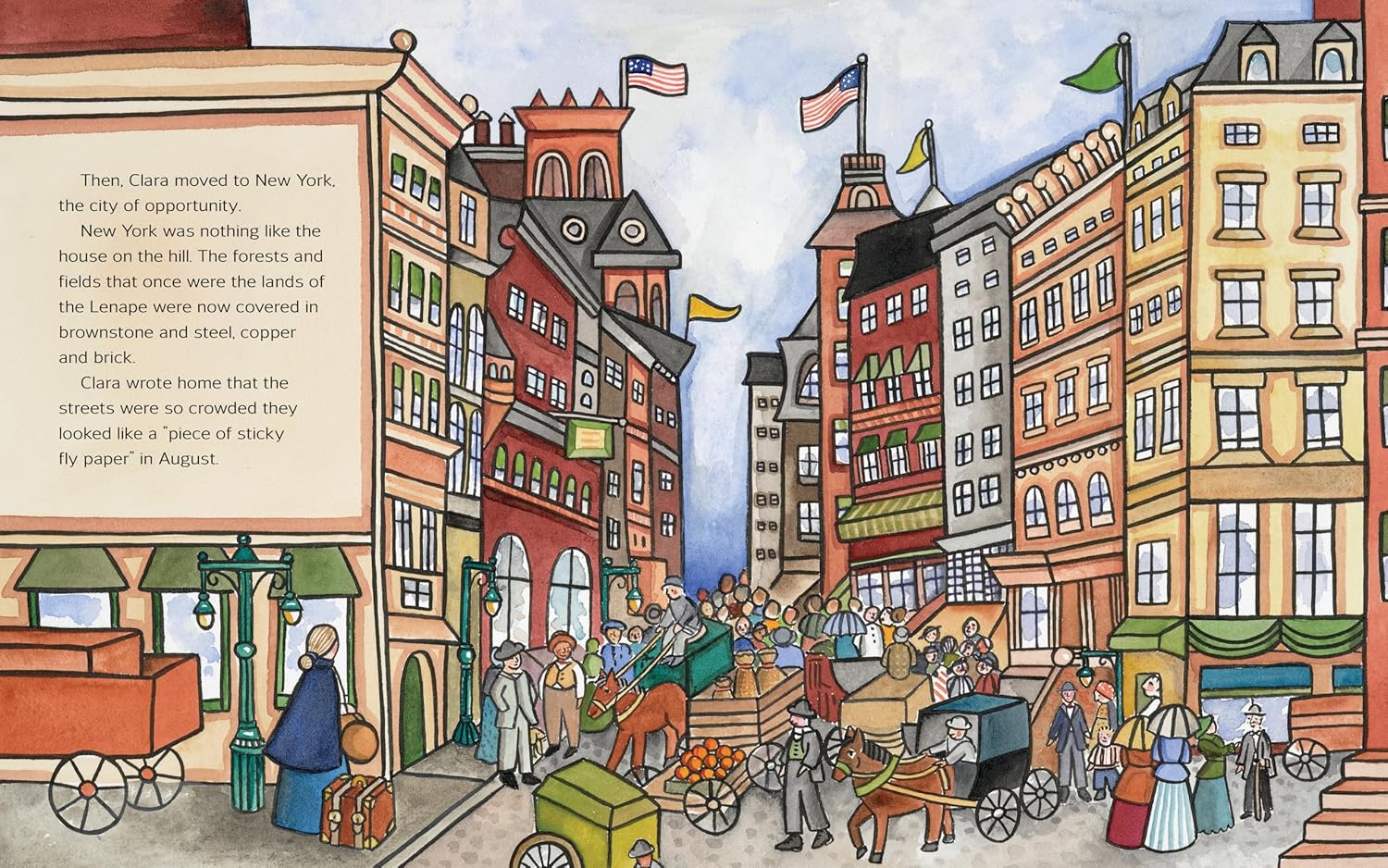
As a young girl, Clara Driscoll grew up surrounded by glorious gardens blooming with morning glories, apple blossoms, and wildflowers and shimmering with the dragon flies they attracted. Clara often sketched the gardens, and when she grew older, she enrolled in art school, hoping to turn her talent for drawing into a job that could help her financially struggling family. After graduation, Clara moved to New York City and took a job working for glassmaker Louis C. Tiffany.

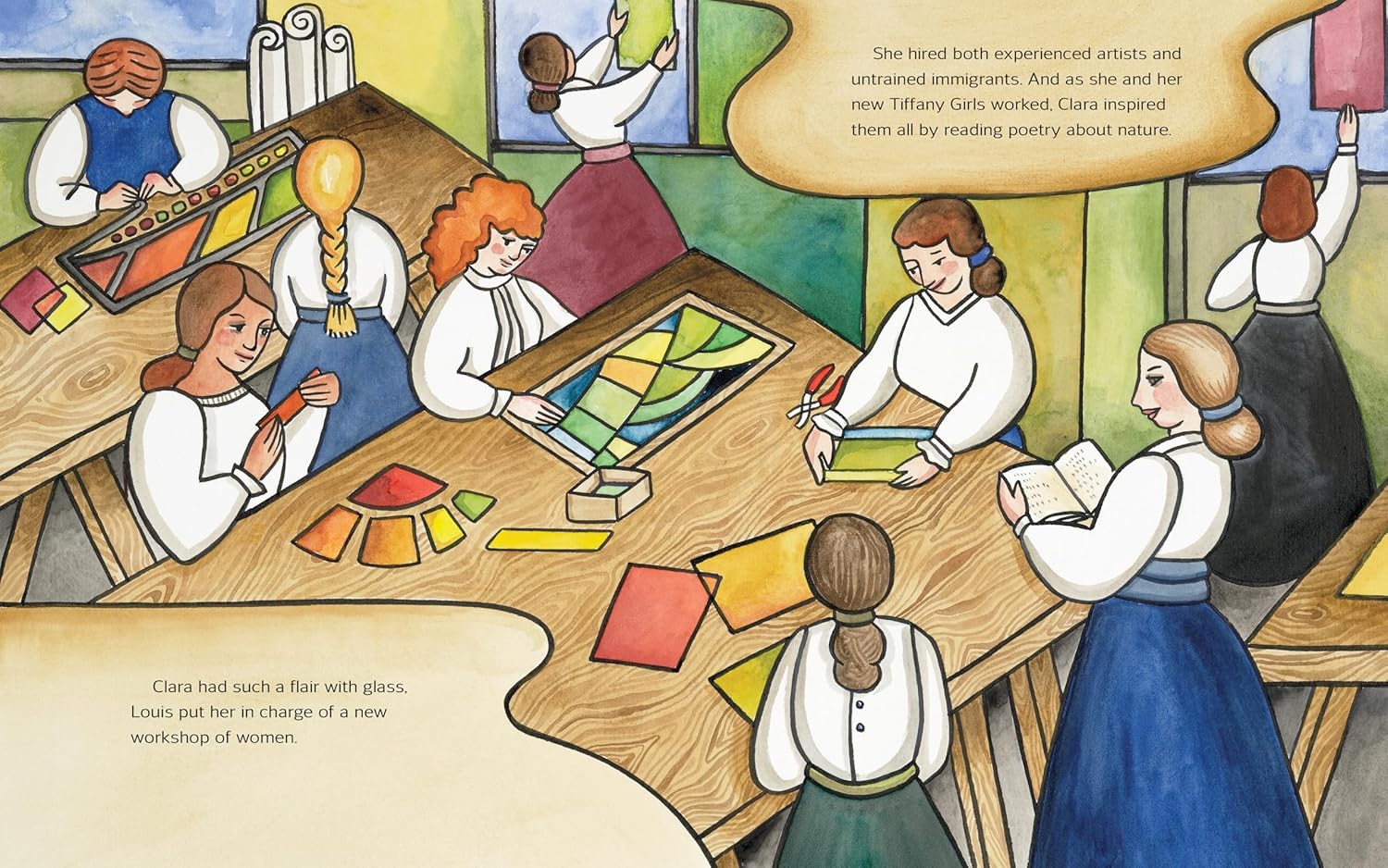
Clara’s task was to choose and cut pieces of glass for the craftsmen to join together with metal ridges to make beautiful stained glass windows. She used her creative eye to “‘paint’ robes, halos, and great wings of angels” with “dappled and streaked, shaded and shimmering” glass. It didn’t take long for Louis to recognize Clara’s talent, and soon she was overseeing her own group of women known as Tiffany Girls. Missing her gardens back home, Clara had the idea to make a lamp from the delicate glass that would bring the beauty of a garden inside.

Illustration © 2025 by Julie Paschkis, text © 2025 by Sandra Nickel. Courtesy of Peachtree.

She and the Tiffany Girls cut small pieces of glass to make butterfly wings, and then “together with the craftsmen, she formed the butterfly wings into a lampshade.” Once the kerosene wick was lit, “light bloomed as never before.” Next, Clara wanted to bring the brilliance of dragonflies to her new creation. But cutting and forming the glass into the intricate wings of a dragonfly was time consuming, and one of the managers said that “she could never make another.”

That, however, was before Louis Tiffany saw the lamp and asked Clara “to make another to display at the World’s Fair in Paris.” At the fair, Clara’s lamp won the bronze medal. The lamp’s success “astounded” Louis. He put Clara and the Tiffany Girls in charge of making lamps and windows representing the beauty of natural landscapes.

Feeling shut out, the craftsmen announced a strike unless Louis fired the women. But Louis knew the value of Clara’s imagination and work, so he compromised with the men: Clara’s workshop would not get bigger, but “Clara would be in charge of lamp-making from that day forward.”

Illustration © 2025 by Julie Paschkis, text © 2025 by Sandra Nickel. Courtesy of Peachtree.

Elated, Clara began creating new designs inspired by the gardens she’d sketched at home as well as  nature she found within the city, all informed by her meticulous research. In the basement storage room, she searched for pieces of glass that were just the right hues to bring to life each petal, flower, leaf, and stem. In one astonishing design, she recreated wisteria with 2,000 tiny petals.

While Clara’s work was recognized inside the studio, because her lamps were only known as “Tiffany lamps,” no one else knew they were Clara’s creation. It was only after both Louis and Clara passed away and Clara’s letters to her sisters were discovered that people learned the truth about how Clara made light bloom “throughout the world.”

Back matter includes an Author’s Note that goes into more detail about Clara’s letters home, Louis C. Tiffany’s reaction to her initial idea, and Clara’s long, intricate process for designing each lamp; a list of museums where you can see Tiffany Lamps; and the names of two archives where Clara’s letters can be read; a bibliography; and dates and quotes for references found in the book.

Illustration © 2025 by Julie Paschkis, text © 2025 by Sandra Nickel. Courtesy of Peachtree.

Sandra Nickel’s fascinating and eye-opening story about Clara Driscoll, one of the world’s most innovative artists, is both inspirational and uplifting. Nickel’s heartfelt, straightforward storytelling about Clara’s early years allows readers to see how youthful experiences and interests can influence their later endeavors—creative and otherwise. Nickel also emphasizes Clara’s remarkable vision for ways to expand the use of stained glass in the 1890s as well as her advocacy for herself and her ideas, making her an excellent role model for all children. And while Clara was not recognized for her work during her lifetime, art lovers can be grateful that Louis C. Tiffany knew brilliance when he saw it and valued her contributions—another aspect of Clara’s story to celebrate. 

Julie Paschkis’s dazzling, folk-style illustrations bring the intricate and delicate beauty of stained glass to the page, telling Clara’s story visually in a way similar to the windows she often worked on. Taking kids into the Tiffany studio, Paschkis demonstrates how Clara, the Tiffany Girls, and the craftsmen chose, cut, and pieced together to create complex scenes that glow with life still today. Paschkis faithfully recreates Clara’s iconic dragonfly lamp, an image that will wow kids. 

A vibrant biography of a visionary artist, Making Light Bloom: Clara Driscoll and the Tiffany Lamps is an inspiring book to share with creatives of all types at home, in the classroom, and for art and crafts programs. The book is a must addition to any library collection.

Ages 7 – 10

Peachtree, 2025 | ISBN 978-1682636091

About the Author

Sandra Nickel is an award-winning author of picture books and has two new books out this Spring: Seven, A Most Remarkable Pigeon, an uplifting tale that celebrates differences, and Making Light Bloom, Clara Driscoll and the Tiffany Lamps, in which Sandra continues her mission to celebrate extraordinary individuals who have been nearly forgotten by history. She is honored to be the winner of a Christopher Award, the winner of the Society of Children’s Book Writers & Illustrators Crystal Kite Award, a finalist for the Golden Kite Award for Nonfiction for Younger Readers, a Junior Library Guild Gold Selection honoree, and a Charlotte Huck Award Recommended author. She holds a Master of Fine Arts in Writing for Children and Young Adults and has presented workshops on writing for children and young adults throughout the United States and Europe. Visit her at sandranickel.com. You’ll also find her on Bluesky, Facebook, Instagram, and Twitter/X

About the Illustrator

Julie Paschkis is an award-winning illustrator of more than 25 books for children. A graduate of Cornell University and the School for American Craftsmen at Rochester Institute of Technology, she taught art to grade school children for a number of years before turning her full attention to painting, textile design, and creating illustrations for her books. Visit her at juliepaschkis.com to see more of her work and download whimsical and nature-inspired coloring pages for kids and adults. You’ll also find her on Facebook.

World Watercolor Month Activity

Tiffany Window Coloring Page


Create your own brilliant vision with this Tiffany Window Coloring Page!

You can purchase Making Light Bloom: Clara Driscoll and the Tiffany Lamps from these booksellers.

Amazon | Barnes & Noble | Bookshop

Picture Book Review

March 22 – It’s Women’s History Month

celebrate-picture-books-picture-book-review-cactus-queen-cover

About the Holiday

National Women’s History Month is all about celebrating women who broke barriers with their intelligence, creativity, courage, persistence, and unwavering confidence in their abilities. In every discipline, women have brought and continue to bring new perspectives, experiences, and talents to make contributions toward a better world. The theme for Women’s History Month 2024 celebrates “’Women Who Advocate for Equity, Diversity and Inclusion.’ This theme recognizes women who understand the need to eliminate bias and discrimination from individuals’ lives and institutions.”

Today’s book celebrates a visionary woman who made it her life’s work to protect a unique ecosystem, educate people on the importance of the environment and conservation, and provide the US with one of its most stunning national parks. 

I’d like to thank Calkins Creek/Astra Books for sharing a copy of Cactus Queen” Minerva Hoyt Establishes Joshua Tree National Park with me for review consideration. All opinions on the book are mt own.

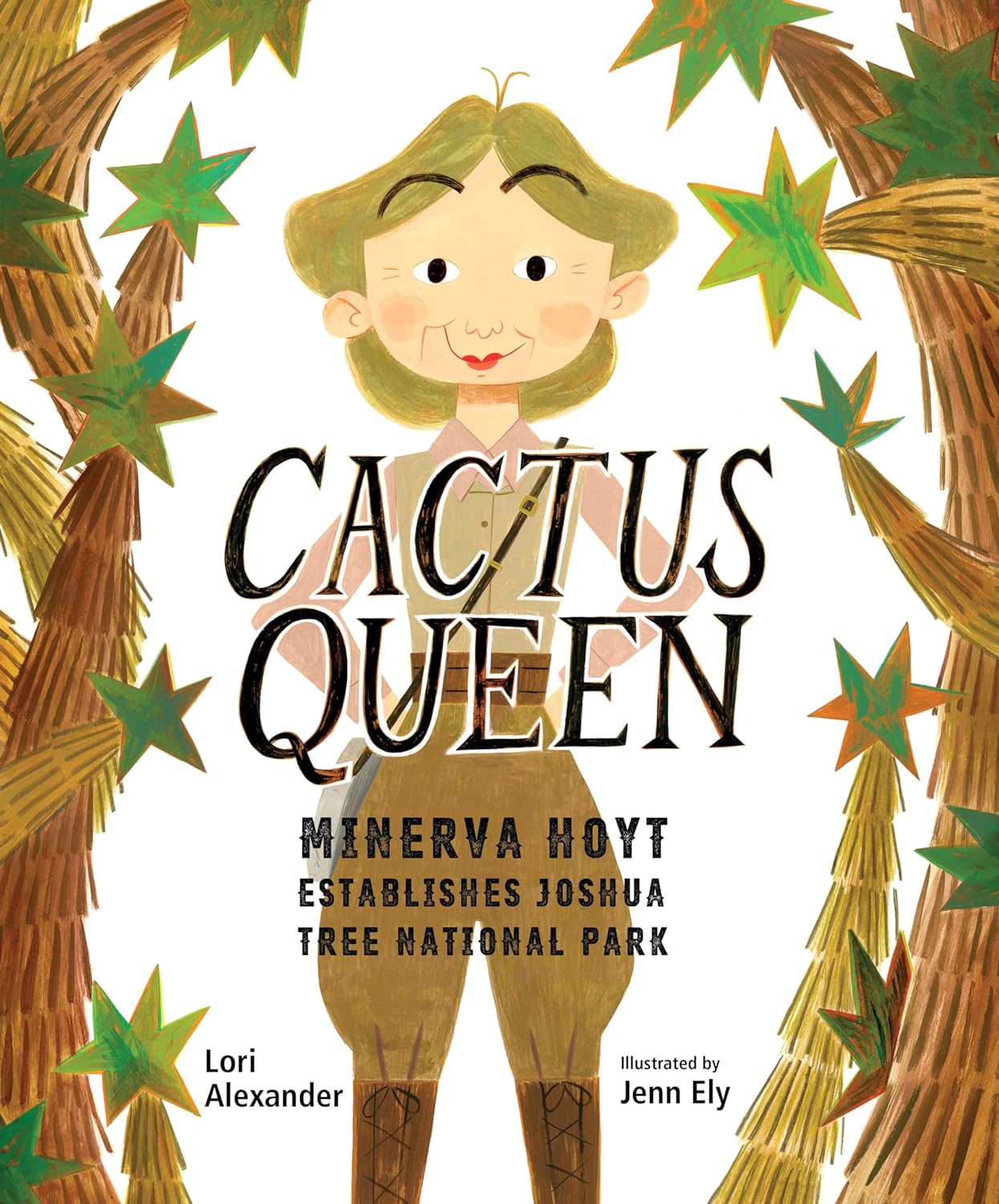
Cactus Queen: Minerva Hoyt Establishes Joshua Tree National Park

Written by Lori Alexander | Illustrated by Jenn Ely


Even as a child, Minerva loved the outdoors, was eager to share her thoughts and opinions, and enjoyed “long chats with friends.” When she grew up she married Dr. Albert Hoyt. In 1897 Minerva and her husband moved from Mississippi to Pasadena, California, close to Los Angeles. To meet new friends, Minerva hosted a backyard party, complete with games, food, and, of course, long chats.

Settled into her new city, Minerva took to making trips to the Mojave Desert. She was awed by the Joshua trees, which grew nowhere else but here. After the death of her husband in 1918, Minerva spent more time in the desert, even camping out while “the wind whistled through the Joshua trees,” and “bright constellations swirled overhead.”

celebrate-picture-books-picture-book-review-cactus-queen-garden-party

Illustration copyright Jenn Ely, 2024, text copyright Lori Alexander, 2024. Courtesy of Calkins Creek, Astra Books for Young Readers.

As Los Angeles grew and grew, with more buildings, more cars, and more noise, people began to visit the desert frequently. They didn’t just visit, though, they wanted to take it home. People dug up the “… fuzzy cholla, spiky yucca, and barrel cacti to keep in their backyards.” They even dug up Joshua trees and carted them away. Many of these desert plants didn’t survive their new city surroundings. The Joshua trees were also cut down for construction materials, and motorists lost in the desert set them afire to communicate with other drivers.

By the late 1920s little remained of Minerva’s beloved desert. She wanted to save it . . . but how? Suddenly, “Minerva had a wild idea.” She would show the rest of the country just how special the desert was. With help from garden clubs, artists, taxidermists, and friends, she gathered samples of desert flora and fauna and took them east—by train.

celebrate-picture-books-picture-book-review-cactus-queen-camping

Illustration copyright Jenn Ely, 2024, text copyright Lori Alexander, 2024. Courtesy of Calkins Creek, Astra Books for Young Readers.

At the 1928 International Flower Show in New York City, Minerva erected a display of the desert. Crowds were thrilled to discover this “strange landscape,” and reporters took pictures for magazines and newspapers. Minerva won a gold medal for her exhibit, The Spirit of the Desert. Minerva also won awards in Boston and London for exhibits there. But more important than these accolades was that people were really listening to her and beginning to love the desert. When she donated her exhibits to museums, more people became interested in the desert.

By 1933, Minerva was ready to move on to the next stage in her plan. She wanted 1,000,000 acres of the desert to be declared a national park, protected by federal laws. Minerva garnered an audience with President Franklin D. Roosevelt and brought photographs to show him. She convinced the President—now it was up to Roger W. Toll, superintendent of Yellowstone National Park, to inspect Minerva’s desert and agree.

celebrate-picture-books-picture-book-review-cactus-queen-museum-exhibit

Illustration copyright Jenn Ely, 2024. Courtesy of Calkins Creek, Astra Books for Young Readers.

As Roger Toll stood in the middle of the desert on a rainswept day, he asked, “where are the lush trees, the waterfalls, and lakes?” When he later filed his report, he rejected the desert for National Park status. Minerva was disappointed but did not give up. She began a letter-writing campaign, convincing “scientists, teachers, politicians, and friends” to write to the National Park Service. Letters poured in—enough to convince the Service to send out a new inspector.

This time Assistant Director Harold C. Bryant, who lived in California, was sent. “He knew all about desert plants and animals.” When he arrived, Minerva and more than one hundred supporters greeted him. After touring the desert for three days, Bryant announced his decision: Yes! “Minerva’s desert was worth saving.”

celebrate-picture-books-picture-book-review-cactus-queen-park

Illustration copyright Jenn Ely, 2024, text copyright Lori Alexander, 2024. Courtesy of Calkins Creek, Astra Books for Young Readers.

Extensive backmatter, accompanied by photographs, offers more biographical information about Minerva, points about wildlife in Joshua Tree National Park, facts about other national parks in the United States, tips for how young people can help the environment through easy-to-implement actions, and a bibliography. In Lori Alexander’s Author’s Note, she relates the dangers and destruction that the fragile environment of Joshua Tree National Park and the surrounding desert continues to suffer from “vandalism, urban development, and the effects of climate change,” a report that demonstrates the need for continued education and care taking of our natural resources.

In Cactus Queen, Lori Alexander has created a compelling biography of a remarkable woman as well as a call to action for readers to stand up for the environmental or other causes that are important to them. Alexander highlights Minerva Hoyt’s love of the desert, her dedication, and her unflagging determination to overcome setbacks. Hoyt’s creativity, pragmatism, and lifelong focus serves as an inspirational roadmap for accomplishing goals for children, teens, and even the adults who read with them.

The first thing readers may notice upon opening Cactus Queen is Jenn Ely’s beautiful color palette that mirrors the unique hues of the desert. Her stunning images of the desert and Minerva’s ingenious ways of rallying the country and the President to her cause transport children from Hoyt’s earliest days through her long-fought success. Ely’s charming illustrations reveal not only the special plants and creatures of the Mojave Desert but Minerva’s distress at its destruction and her tenacity to enact change to protect it. 

Both a fascinating biography of Minerva Hoyt and an in-depth look at the multifaceted workings of conservation efforts, Cactus Queen: Minerva Hoyt Establishes Joshua Tree National Park will inspire readers to advocate for causes that are important to them. For educators the book would make an excellent addition to science and language arts curriculum. Cactus Queen would also be an engaging accompaniment to museum visits or field trips for families and teachers.

Cactus Queen is a top pick for classrooms, public and school libraries, museum shops, and families.

Ages 7 – 10

Calkins Creek, 2024 | ISBN 978-1662680212

About the Author

Lori Alexander is the award-winning author of several children’s books, including All in a Drop: How Antony van Leeuwenhoek Discovered an Invisible World, which won a Robert F. Sibert Honor, and A Sporting Chance: How Ludwig Guttmann Created the Paralympic Games, an NCSS Notable Book. Her work has received several starred reviews from KirkusSchool Library Journal, and Horn Book Magazine, has made the NSTA Outstanding Science Trade Book list, and has been selected by the Junior Library Guild. Visit Lori Alexander at lorialexanderbooks.com.

About the Illustrator

Jenn Ely is an artist and animator, who has worked on the movies The Boxtrolls and Guillermo Del Toro’s Pinocchio. In her recent foray into children’s books, she illustrated The Gardener of Alcatraz and If You Were a Kid Building a Pyramid. Visit Jenn Ely at jennely.com.

Women’s History Month Activity

celebrate-picture-books-picture-book-review-joshua-tree-national-park-wildlife

Become a Joshua Tree National Park Junior Ranger

How would you like to become a Joshua Tree National Park Junior Ranger? You can your badge with this online program full of fun and educational activities for all ages! You can learn how to draw a Joshua Tree, create your own constellation, learn all about desert tortoises, create your own rock formation, learn about adaptable plants and design your own, and more.

To earn your badge kids ages 5 – 7 are asked to complete 2 activities; kids ages 8 – 10 are asked to complete 3 activities; and kids ages 10 and above are asked to complete 4 or more. After finishing projects, you just need to send images of your work to receive your badge in the mail!

Simply visit the official Joshua Tree National Park website and learn more about their Junior Ranger program! Learn more about the park and view lots of pictures and videos here.

Joshua Tree National Park Coloring Page

celebrate-picture-books-picure-book-review-joshua-tree-national-park-coloring-page

Enjoy this activity page by filling it with all the colors of the desert.

Joshua Tree National Park Coloring Page

celebrate-picture-books-picture-book-review-cactus-queen-cover

Order from Bookshop to support your local independent bookstore.

You can also find Cactus Queen: Minerva Hoyt Establishes Joshua Tree National Park at these booksellers

Amazon | Barnes & Noble | Books-a-Million

Picture Book Review
February 1 – World Read Aloud Day

celebrate-picture-books-picture-book-review-love-is-loud-cover

About the Holiday

Now in its 14th year World Read Aloud Day, founded by global non-profit LitWorld, encourages adults to read aloud to children not only today but every day. Reading aloud to children from birth is one of the best ways to promote language development, improve literacy, and enjoy bonding time together. Millions of people celebrate today’s holiday all across the United States and in more than one hundred countries around the world. Special events are held in schools, libraries, bookstores, homes, and communities, and authors and illustrators hold readings and visit classrooms in person and virtually. To learn more about World Read Aloud Day, visit LitWorld and check out their Activity Hub to find live events, virtual read alouds, downloadable bookmarks, posters, games, and more!

I would like to thank Simon & Schuster and Barbara Fisch at Blue Slip Media for sharing a copy of Love Is Loud with me for review consideration. All opinions on the book are my own.

Love Is Loud: How Diane Nash Led the Civil Rights Movement

Written by Sandra Neil Wallace | Illustrated by Bryan Collier


Raised on Chicago’s South Side, Diane Nash is sheltered by her parents from the segregation of the South that they had grown up in. During the Second World War, Diane is taken care of by her grandmother while her father joins the army and her mother takes a job. Her Grandmother Bolton is from Tennessee and showers her with love. “You are ‘more precious than all the diamonds in the world,'” she told Diane, and growing “up in the rhythm and glow of her love” Diane knew “it must be true.”

celebrate-picture-books-picture-book-review-love-is-loud-baby

Image copyright Bryan Collier, 2023, text copyright Sandra Neil Wallace, 2023. Courtesy of Simon & Schuster/Paula Wiseman Books.

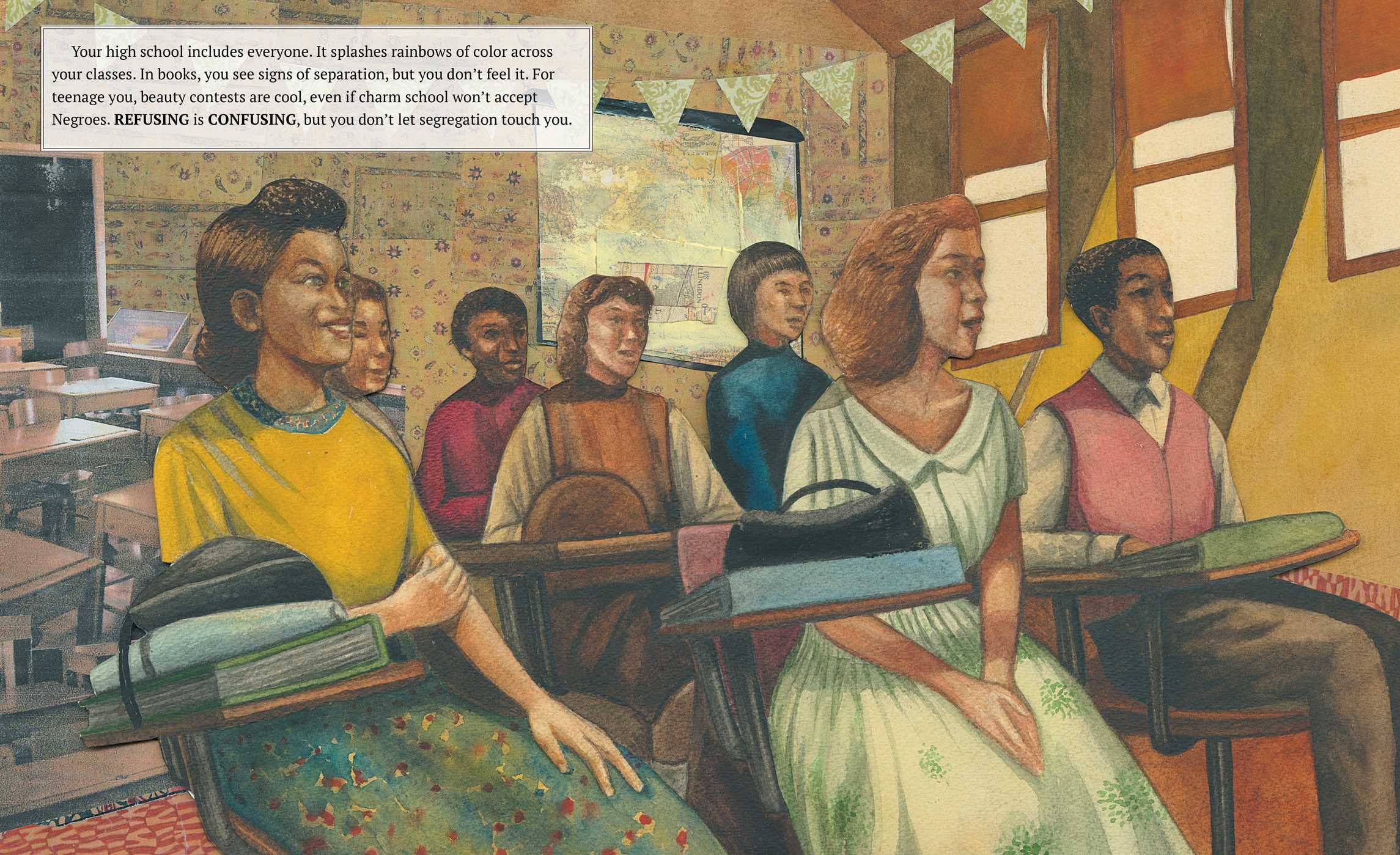
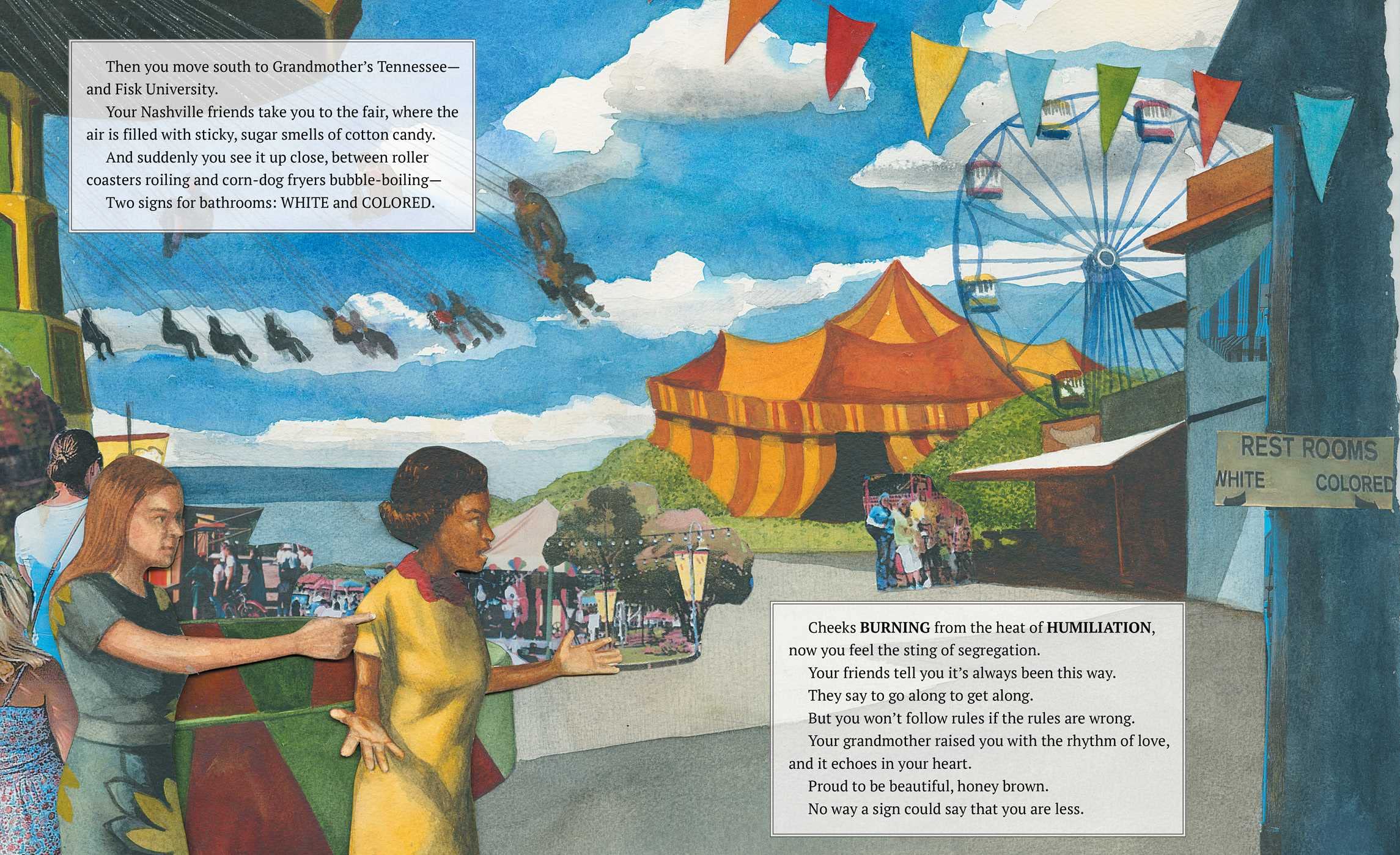
In high school kids of all colors learn together. Diane reads about segregation in textbooks, but it didn’t really touch her. Then she moves to Tennessee to attend Fisk University. Here, when her friends take her to a fair, Diane is confronted with the “sting of segregation” when she sees there are two restrooms: one labeled WHITE and the other COLORED. Her friends have grown up in this system; they tell her “to go along to get along,” but Diane “won’t follow rules if the rules are wrong.” The rhythms of her grandmother’s love and her pride in being “beautiful, honey brown” will not allow her to feel less than others.

In Nashville, Diane experiences the full indignation of segregation that demands separate water fountains and schools, back-of-the-bus seating, and—the worst for Diane—no eating at the lunch counter. She doesn’t want to be arrested for eating at a lunch counter, but neither does she want to let it go. Before each day of college classes, Diane and other students “pray and learn about change in a peaceful way.” They practice calmly sitting and ordering at a lunch counter, knowing that people may be rude, may push them off their stool, may throw sugar in their hair.

celebrate-picture-books-picture-book-review-love-is-loud-school

Image copyright Bryan Collier, 2023, text copyright Sandra Neil Wallace, 2023. Courtesy of Simon & Schuster/Paula Wiseman Books.

In February of 1960, Diane, now at twenty-one years old, leads a group of students to a lunch counter in Nashville. Their presence shocks the cooks and waitress, who drops plate after plate from her shaking hands. “Inside [Diane shakes] too. Hands sweating, never forgetting the danger, the fear of being arrested for ordering a sandwich.” Bravely, despite coffee burns and thrown sugar, Diane and the students hold sit ins at lunch counters across the city. And when Diane is arrested, there are hundreds of others to fill her seat.

After a bombing in April Diane, “quietly walking, without any talking… silently leads six-thousand marching feet to the beat of love” to meet the mayor, who at first says there is nothing he can do. Looking him in the eye, Diane asks him questions he cannot deny, and he admits that prejudice and segregation are wrong—even at the lunch counter. “At that moment, love scores. It soars as six thousand loving hands roar with applause.” And in May—Diane has just turned twenty-two—Nashville’s lunch counters are fully integrated. Martin Luther King Jr. congratulates her on her peaceful victory as she moves on to change the rules of bus travel with Freedom Rides, to uphold the “law of the land [that] says everyone is free to sit or stand together in a bus traveling across America.”

celebrate-picture-books-picture-book-review-love-is-loud-fair

Image copyright Bryan Collier, 2023, text copyright Sandra Neil Wallace, 2023. Courtesy of Simon & Schuster/Paula Wiseman Books.

While the movement makes progress, even attracting the attention of the president, a Mississippi judge charges Diane “with putting Freedom Riders on a bus.” Before her trial, Diane, pregnant with her first child, writes a letter heard around the world that said “‘I believe that if I go to jail now, … it may help hasten that day when my child and all children will be free.'” Her case rivets the world as she chooses to go to jail instead of paying bail. 

After she is released, Diane turns her attention to the issue of voting rights and the state of Alabama, where four young girls are killed in a bombing in a Birmingham church and “where Black people are denied the right to vote.” Following Diane’s example, thousands of adults and children choose jail over bail in protest of the injustice until the Civil Rights Act is signed by President Johnson in 1964 and a year after that when he “signs the 1965 Voting Rights Act to legally end racial discrimination that prevented Black people from voting.” But Diane Nash doesn’t stop there. She takes her message of peace and peaceful change across the country for fifty years, teaching young people “how love creates change.”

Image copyright Bryan Collier, 2023, text copyright Sandra Neil Wallace, 2023. Courtesy of Simon & Schuster/Paula Wiseman Books.

Image copyright Bryan Collier, 2023, text copyright Sandra Neil Wallace, 2023. Courtesy of Simon & Schuster/Paula Wiseman Books.

Extensive back matter includes an Author’s Note and an Illustrator’s Note about the work of Diane Nash; a detailed timeline from her birth to 2022, when she was awarded the Presidential Medal of Freedom; a list of video interviews with Diane Nash, four other books for young readers; sources for quotes found in the story; and a selected bibliography. A photograph of Nash and three other students integrating a lunch counter in Nashville and another of Nash leading demonstrators to meet the mayor of Nashville are also included.

celebrate-picture-books-picture-book-review-love-is-loud-love

Image copyright Bryan Collier, 2023, text copyright Sandra Neil Wallace, 2023. Courtesy of Simon & Schuster/Paula Wiseman Books.

Compelling and moving, Sandra Neil Wallace’s lyrical storytelling about the life and work of Diane Nash rivets readers to this young woman’s courage, confidence, and conviction to overturn the injustice of segregation and inequality for Blacks. Punctuated with often-rhyming phrases, and sharp, short sentences Wallace’s text flows with a rhythm of urgency that perfectly conveys not only Nash’s resolve, but the stakes for the peaceful demonstrators and the atmosphere of the times.

Written in the third person, the story directly addresses Nash, but the repeated “you” also builds a chorus that reverberates in each reader’s heart, telling them that they are brave, that they are strong, and that they too can change the world with love. This format poignantly culminates on the last page. Here, Wallace changes the dynamic with a subtle turn of phrase that now directly embraces each reader, letting them know that Diane Nash worked for freedom “because she loved you even before you were born” and reminding them that “Love is fierce. Love is strong. Love is loud!”

Bryan Collier’s rich watercolor-and-collage illustrations draw readers in with their realistic depictions of Diane Nash as a baby and young girl cherished by her family, as a high school and university student, at the fair that changed the trajectory of her life,  leading peaceful demonstrations at lunch counters and across the South, and crossing the country to bring her message to young people. Nash’s self-assurance, courage, and determination are evocatively expressed, and a full-page portrait of Diane looking out at the reader mirrors Wallace’s invitation for them to look into her eyes and see her love there.

Scraps of photographs are sprinkled here and there among the pages, providing a spark of recognition of the time and places depicted. But it is the cut paper elements that make certain images of people and objects jump off the page, working powerfully with Wallace’s text to make readers feel that they too are at the fair, at the lunch counter, joining the throng of marchers. Each page is a masterpiece of history and story that invites study, thoughtful contemplation, and action.

Absorbing, eloquent, and impactful, Love Is Loud: How Diane Nash Led the Civil Rights Movement is biography at its best: a moving tribute Diane Nash set amid a far-reaching immersion in the time period. Love Is Loud belongs in every home, classroom, school, and public library collection to teach children about the contributions of Diane Nash as well as to remind them that vigilance and the work for freedom is an ever-ongoing pursuit.

Ages 4 – 8 

Simon & Schuster | Paula Wiseman Books, 2022 | ISBN 978-1534451032

About the Author

Sandra Neil Wallace writes about people who break barriers and change the world. She is the author of several award-winning books for children, including Between the Lines: How Ernie Barnes Went from the Football Field to the Art Gallery, illustrated by Bryan Collier, which received the Orbis Pictus Book Award and was an ALA Notable Book. A former ESPN reporter and the first woman to host an NHL broadcast, she is the recipient of the Outstanding Women of New Hampshire Award and creates change as cofounder of The Daily Good, a nonprofit bringing twenty thousand free, culturally diverse foods to college students each year through its Global Foods Pantries. Visit Sandra at SandraNeilWallace.com.

About the Illustrator

Bryan Collier is a beloved illustrator known for his unique style combining watercolor and detailed collage. He is a four-time Caldecott Honor recipient for Trombone ShortyDave the PotterMartin’s Big Words, and Rosa. His books have won many other awards as well, including six Coretta Scott King Illustrator Awards. His recent books include By and By, ThurgoodThe Five O’Clock Band, and Between the Lines. He lives in New York with his family. Visit him at BryanCollier.com.

Watch the Book Trailer for Love Is Loud!

World Read Aloud Day Activities 

2022 Presidential Medal of Freedom Ceremony


Watch as Diane Nash is awarded the Presidential Medal of Freedom in this White House video from July 7, 2022. You can find President Joe Biden’s remarks about Diane Nash at the 5:50 mark, and see her receive her medal at the 41:29 mark.

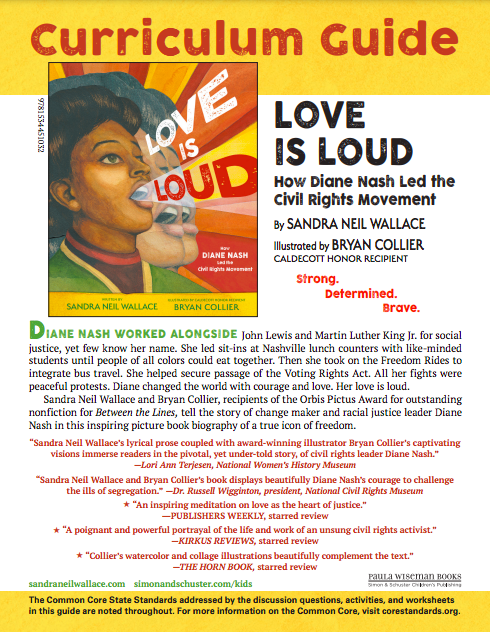
celebrate-picture-books-picture-book-review-love-is-loud-curriculum-guide-cover

Love Is Loud Curriculum Guide


Teachers, educators, and homeschoolers can download an in-depth, 6-page Curriculum Guide for Love Is Loud full of a variety of ways for students to connect with the book and history from Sandra Neil Wallace’s website here.

celebrate-picture-books-picture-book-review-love-is-loud-cover

You can find Love Is Loud: How Diane Nash Led the Civil Rights Movement at these booksellers

Amazon | Barnes & Noble | Books-a-Million

To support your local independent bookstore, order from

Bookshop | IndieBound

Picture Book Review

September 23 – It’s National Sewing Month

celebrate-picture-books-picture-book-review-dressing-up-the-stars-cover

About the Holiday

Sewing is one of the most popular hobbies around and has historically been one of the most important industries in this country and around the world. National Sewing Month was established in 1982 to encourage people to learn more about this craft and to try their hand at picking up a needle or sitting down at a sewing machine. To celebrate read up on the history of sewing and the textile industry and consider taking a sewing class or learning on your own. Sewing can be a fun and rewarding activity for adults and children. Who knows? It may even become a career that can send you to the Oscars, as you’ll see in today’s book!

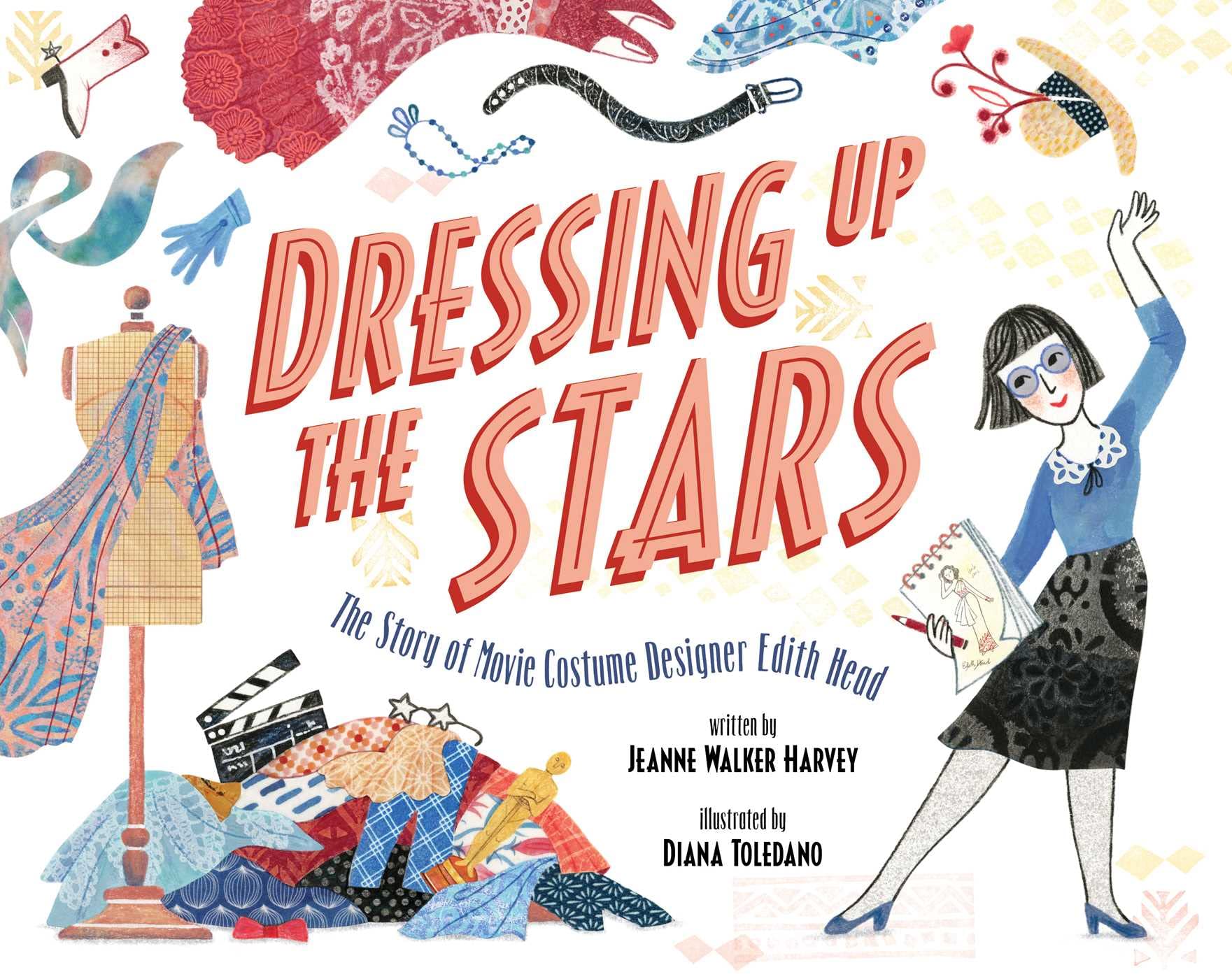
Dressing Up the Stars: The Story of Movie Costume Designer Edith Head

Written by Jeanne Walker Harvey | Illustrated by Diana Toledano


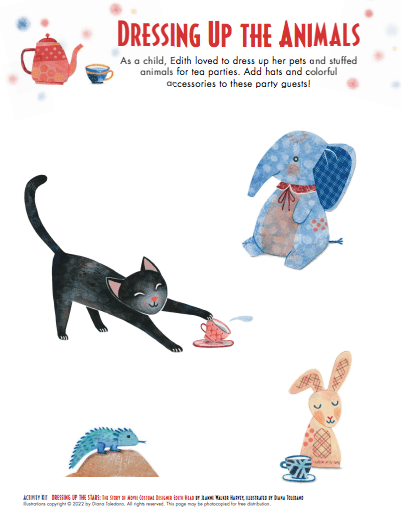
As a child, living in a dry, barren mining town, Edith felt like she didn’t belong. She dreamed of living “in a place full of people and sounds and dazzling lights.” She liked hosting pretend tea parties with colorful china and sweet treats for her stuffed animals and imaginary guests. She also dressed up her pet cat, dog, rabbit, horned toad, and two mules in scarves, clothes, and fancy hats that she made just for them.

celebrate-picture-books-picture-book-review-dressing-up-the-stars-doll-house

Image copyright Diana Toledano, 2022, text copyright Jeanne Walker Harvey, 2022. Courtesy of Beach Lane Books.

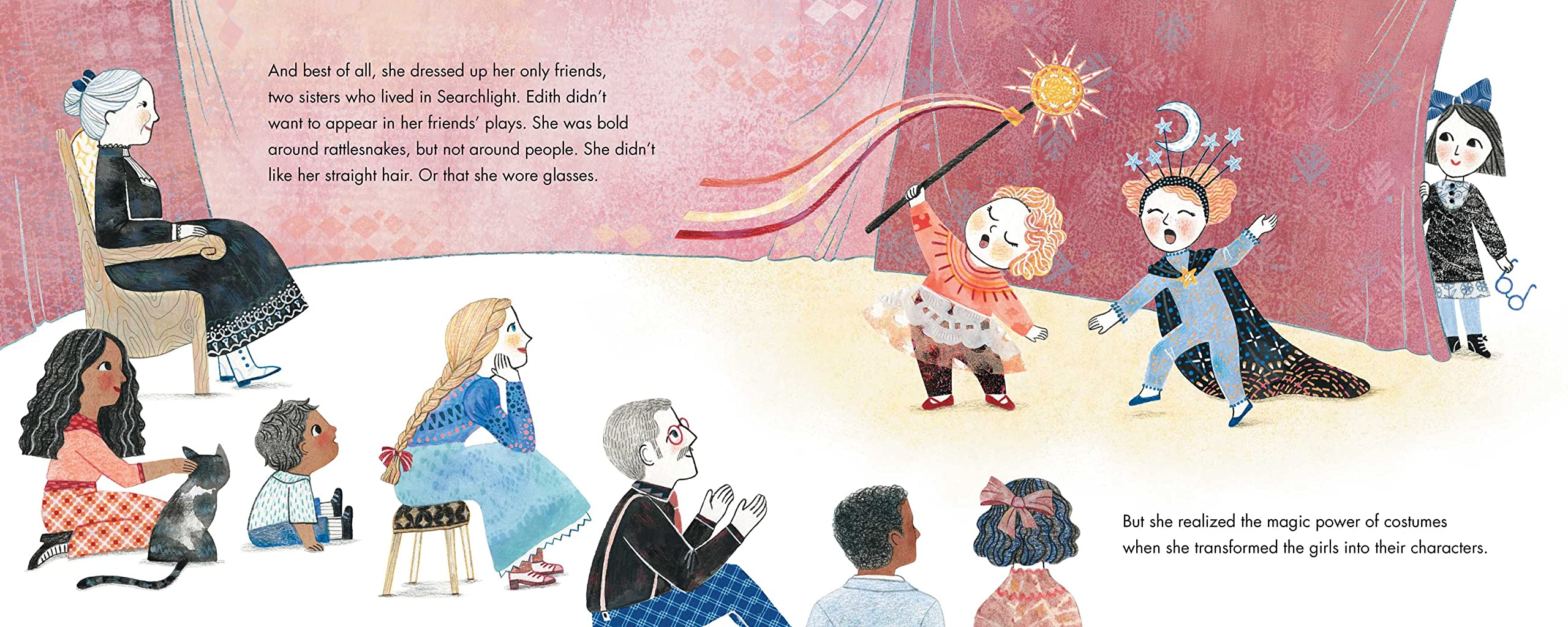
“Edith’s greatest treasure was her bag of fabric scraps,” which she added to by going door to door collecting cloth whenever she and her family visited Searchlight, Nevada, a few miles away. With these scraps she made furniture, rugs, and tablecloths for her dollhouse and clothes for her little dolls. But her favorite thing to do was make costumes for her two friends, who liked to perform and make up plays for their families and friends. Edith preferred staying behind the curtain, self-conscious about her straight hair and gasses.

celebrate-picture-books-picture-book-review-dressing-up-the-stars-friends

Image copyright Diana Toledano, 2022, text copyright Jeanne Walker Harvey, 2022. Courtesy of Beach Lane Books.

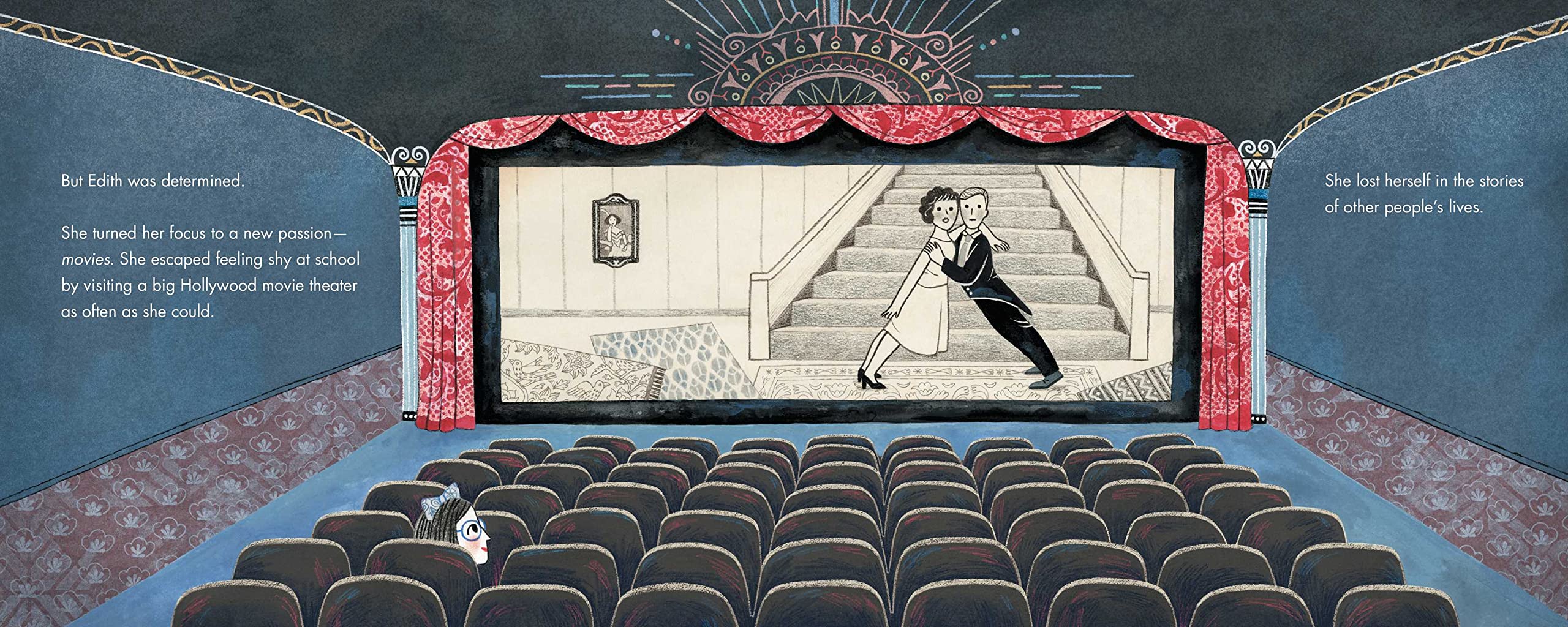
Every night, Edith wished on the stars that she could move away and transform her life. Her chance came when her mother enrolled her in high school in Los Angeles. Here, Edith set about trying to figure out what kind of career she would pursue. She tried piano and gymnastics, but finally found her passion at the movie theater. Watching actors on the screen, Edith was able to escape “feeling shy at school.”

celebrate-picture-books-picture-book-review-dressing-up-the-stars-movies

Image copyright Diana Toledano, 2022, text copyright Jeanne Walker Harvey, 2022. Courtesy of Beach Lane Books.

While Edith initially chose to become a teacher, after a few years “the allure of movies drew her back.” Without any formal art training, she found “a job as a sketch artist in a costume department of a movie studio.” When her boss discovered her lack of training, instead of firing her, he began teaching her how to draw costumes himself.

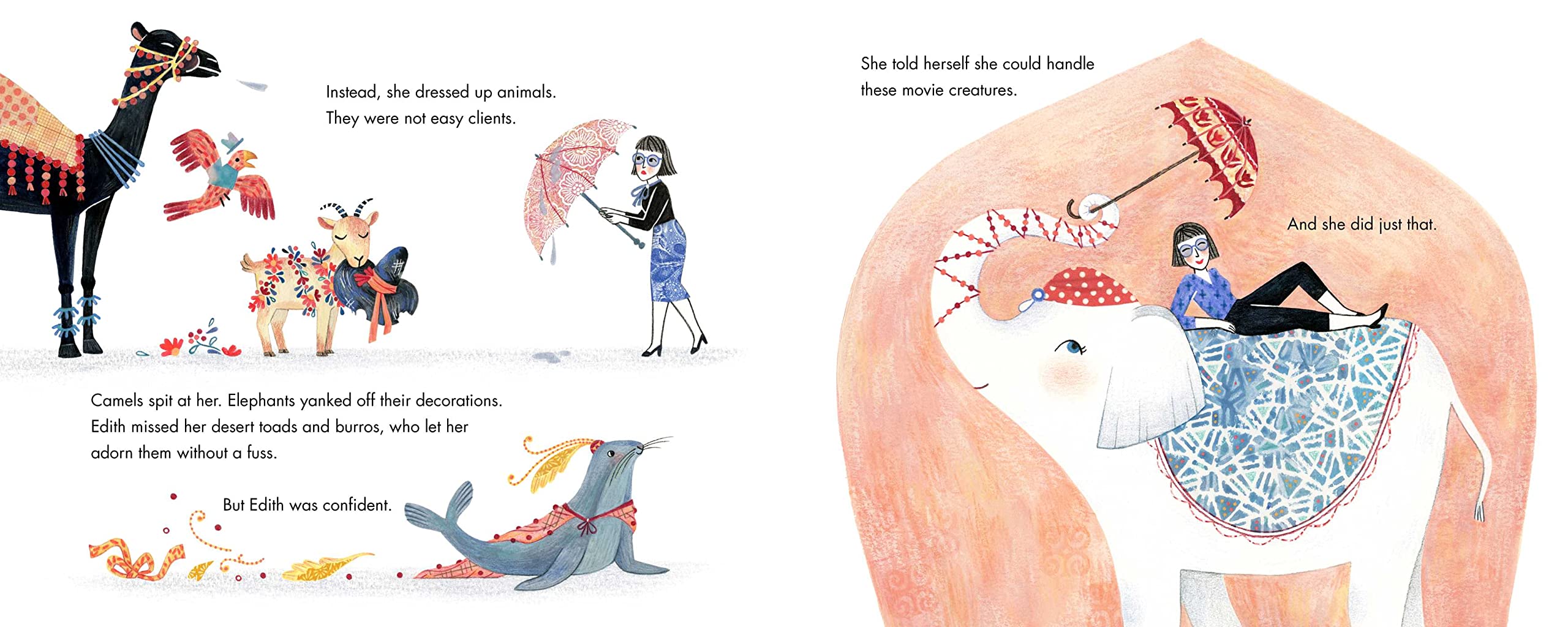
It took time and many rejections of her designs until Edith was finally entrusted with making costumes. But these weren’t for actors. “Instead, she dressed up animals. They were not easy clients.” But Edith was determined and soon she had a shot at dressing dancers as candy, but her designs, while creative, melted, cracked, and . . . flopped. But Edith got another chance.

celebrate-picture-books-picture-book-review-dressing-up-the-stars-animals

Image copyright Diana Toledano, 2022, text copyright Jeanne Walker Harvey, 2022. Courtesy of Beach Lane Books.

She worked hard for many years, gained experience, and was finally asked to “design costumes for famous movie stars.” Edith came to work on hundreds of movies, transforming actors into their characters and becoming famous herself. Then one night at the Oscars, Edith sat listening to the presenter announce the name of the winner for Best Costume Design. She was thrilled to hear her name, and “she climbed the stairs to the stage to accept her award” wearing a gown she’d designed herself.

Back matter includes an extended biography of Edith’s life, teaching, and work in Hollywood and includes photographs of Edith at work at her easel and dressing Dorothy Lamour in 1938 as well as a sketch for a costume worn by Grace Kelly in To Catch a Thief.

celebrate-picture-books-picture-book-review-dressing-up-the-stars-red-carpet

Image copyright Diana Toledano, 2022, text copyright Jeanne Walker Harvey, 2022. Courtesy of Beach Lane Books.

Jeanne Walker Harvey’s biography of Edith Head highlights this famous behind-the-scenes creator’s early life and dreams, her perseverance, and the self-confidence that spurred her on despite setbacks. Young readers will be interested to see how Edith’s childhood love for imaginary play, creating clothes for her pets and toys, and collecting cloth ultimately led to her career as a movie costume designer even though she pursued other jobs before recognizing her true passion. As she becomes involved in the movie industry, Edith’s receptiveness to learning and to learning from her mistakes provides a valuable lesson for all children. 

Diana Toledano’s charming illustrations show Edith at her creative and courageous best as she holds a tea party for her toys, dresses her bevy of unusual pets, and strikes out into the desert to play. Depictions of the small town of Searchlight, Nevada, Edith’s enchanting dollhouse, and a Los Angeles street orient readers to the time period, while the ornate movie theater and black-and-white film Edith watches show how the movies offered Edith escape from her shyness. Toledano’s textured images follow Edith as she practices, fails, practices some more, and finally achieves her goals. The final illustrations showing Edith at the Academy Awards ceremony, walking the red carpet and winning an Oscar shows kids that dreams really can come true.

An inspirational biography of a woman who broke barriers in Hollywood, Dressing Up the Stars will appeal to kids who are interested in the movies and all creative endeavors and encourage them to pursue their true passions.

Ages 3 – 8

Beach Lane Books, 2022 | ISBN 978-1534451056

Discover more about Jeanne Walker Harvey and her books on her website.

To learn more about Diana Toledana, her books, and her art, visit her website.

National Sewing Month Activity

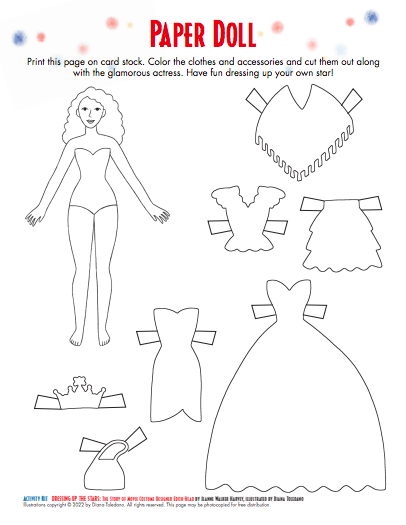
celebrate-picture-books-picture-book-review-Dressing-Up-the-Stars-activity-kit-dressing-animals celebrate-picture-books-picture-book-review-Dressing-Up-the-Stars-activity-kit-paper-doll

Dressing Up the Stars Activity Kit


With this Dressing Up the Stars Activity Kit, kids can create their own costumes for Edith’s pets, a paper doll, and a character dressed as candy! They can even write the acceptance speech they’d give if they won an Oscar for their work on a movie!

celebrate-picture-books-picture-book-review-dressing-up-the-stars-cover

You can find Dressing Up the Stars: The Story of Movie Costume Designer Edith Head at these booksellers

Amazon | Barnes & Noble | Books-a-Million

To support your local independent bookstore, order from

Bookshop | IndieBound

Picture Book Review

September 14 – Live Creative Day

celebrate-picture-books-picture-book-review-ANNETTE-FEELS-FREE-cover

About the Holiday

National Live Creative Day was established to encourage people to embrace their innovative side. There are so many ways to be creative from the arts to science to sports to how you express yourself. Kids seem to know this inherently as they go about exploring and interacting with all the new things they see, hear, and do every day. Introducing kids to all kinds of hobbies, subjects, and professions expands their definition of creativity and their outlook on the future. Encouraging them to use their particular talents, helps them build confidence and find their place in the world. Reading today’s book with them is a great way to start! To celebrate today, take time to share your talents with others. You may be surprised at how creative you really are!

Thanks go to Beach Lane Books and Blue Slip Media for sharing a copy of Annette Feels Free with me for review consideration. All opinions on the book are my own.

Annette Feels Free: The True Story of Annette Kellerman, World-Class Swimmer, Fashion Pioneer, and Real-Life Mermaid

Written by Katie Mazeika


It was early 1900 and teenage Annette Kellerman was making a splash at Australia’s Melbourne Aquarium. She “was a real-life mermaid swimming and dancing with the fish…” to entertain visitors. The newspapers wrote about her, and people flocked to watch. Annette had always loved the freedom she felt while dancing, but when she was six, her legs became too weak for her to dance or to run or even to walk without braces. Sitting at home, Annette was no longer the happy little girl she had been.

Then one day, her father took Annette to swim in Lavender Bay. “She laughed and danced in the waves, kicking her legs. Splash, splash!” Annette swam so much that “she became the strongest swimmer in New South Wales” and no longer needed her leg braces. In addition to performing, Annette raced and soon she had broken all of Australia’s long-distance swimming records. She then moved to London and thrilled audiences there.

celebrate-picture-books-picture-book-review-ANNETTE-FEELS-FREE-aquarium

Copyright Katie Mazeika, 2022, courtesy of Beach Lane Books.

Annette and her father then traveled throughout Europe and America, where Annette performed her water dancing and raced against other swimmers—men included—and won. But there was one thing that was holding her back from even greater success—her swim costume. “Because she was a woman, she still had to perform and compete in a full skirt and pantaloons.” Why, she thought, did she have to wear something different and so cumbersome?

Annette decided to sew her own swim costume. Her new one-piece suit with short legs was so liberating. She felt as she had as a girl first learning to swim and dance in Lavender Bay. But not everyone saw her swimsuit in the same light. When she wore it to the beach in Boston, the crowd was shocked, and she was even arrested for “not wearing enough clothing!” Arguing her case in front of a judge, Annette showed the court the difference in men’s and women’s swimwear and stated that she should have the same freedom as men. The judge agreed, but with a caveat: she had to remain covered up all the way to the water’s edge. Her new swimwear became a hit with other women, who even called it the Annette Kellerman.

celebrate-picture-books-picture-book-review-ANNETTE-FEELS-FREE-dancing

Copyright Katie Mazeika, 2022, courtesy of Beach Lane Books.

Annette’s career continued to take her all over the world and even made her a movie star! She trained other women in “ornamental swimming”, which later became known as “synchronized swimming.” Now called “artistic swimming”, Annette Kellerman’s revolutionary style is a recognized sport at the Summer Olympics.

Back Matter includes an expanded biography of Annette Kellerman, complete with photographs, and an Author’s Note about Katie Mazeika’s own experiences with a physical disability and how these life-changing occurrences shape who someone is and the careers they pursue.

celebrate-picture-books-picture-book-review-ANNETTE-FEELS-FREE-diving

Copyright Katie Mazeika, 2022, courtesy of Beach Lane Books.

A comprehensive and compelling biography of a woman who broke barriers while advocating for women and changing fashion mores forever, Annette Feels Free is historical storytelling at its best. Katie Mazeika clearly links Annette’s early disability, her perseverance, and her recovery to her recognition of her unique talent. Mazeika’s conversational narrative draws readers into Annette’s emotions and passion for swimming. Historical points of interest—women’s swim costumes, hot cocoa sipped mid-swim across the English Channel, Annette’s success in court, and her continued influence on swimming, for example—will amaze children and spark a desire to investigate more about Annette Kellerman and her times.

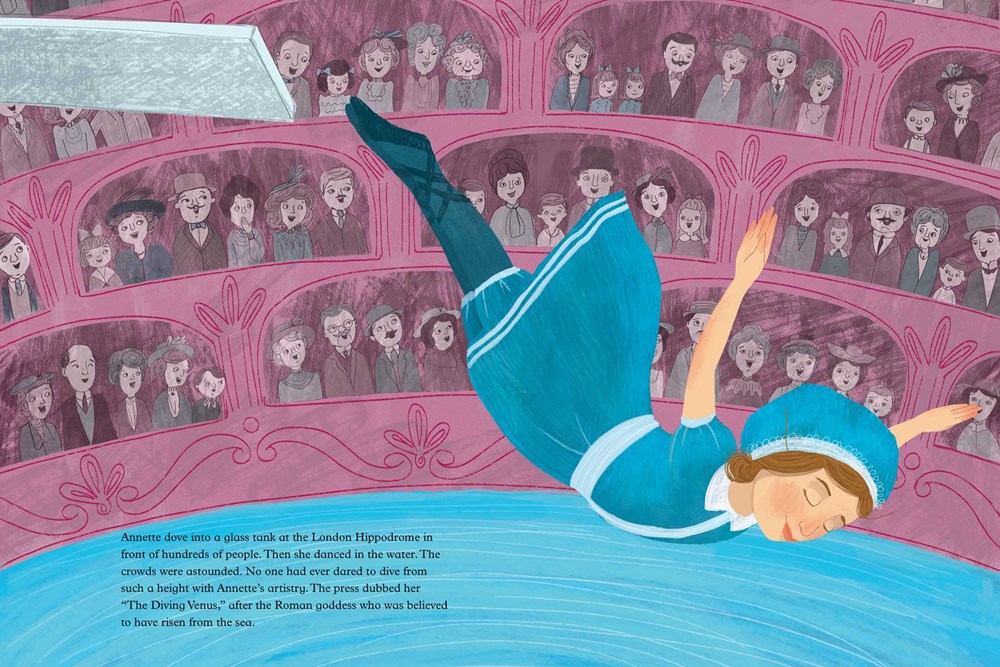
Mazeika’s full-bleed illustrations in this slightly oversized book lend grandeur to the pages, bringing readers into the aquarium’s fish tank to watch spectators’ reactions as Annette becomes “the original mermaid”; depicting her early love of dancing and distress at her braced legs; and falling with her as she thrills London audiences with graceful dives. Children will be particularly fascinated by images of Annette swimming, diving, and dancing in the proscribed swimming costume for women that included a cap and dress trimmed in lace, pantaloons, tights, and ballet-flat type shoes tied to her ankles. Her self-confidence and indomitable spirit grace each spread and are sure to inspire readers. 

For young readers, Annette Kellerman’s long, prolific, and creative career has the power to inspire their own creative endeavors. Annette Feels Free offers multilevel opportunities for lessons in history, the arts, and even math and science (how much did that swim costume weigh, anyway?). The book is highly recommended for home, school, and public libraries.

Ages 4 – 8

Beach Lane Books, 2022 | ISBN 978-1665903431

Katherine Mazeika is an author and illustrator with a BFA from the Columbus College of Art and Design. When she isn’t in the studio, she likes to spend time at the theater, in her garden, or getting lost in a good book. She lives in Ohio with her husband, two kids (Lillian and Jack), and two dogs.

celebrate-picture-books-picture-book-review-ANNETTE-FEELS-FREE-curriculum-guide-cover

To learn more, and download a free curriculum guide, visit her website at katiemazeika.com. You can connect with Katie on Facebook: Katie Mazeika Illustration | Instagram: @kdmazart | Twitter: @kdmaz

Live Creative Day Activity


Video of Annette Kellerman’s “Ornamental Swimming”


Watch Annette Kellerman swim her water ballet in this rare footage from MermaidFX.

Million Dollar Mermaid Movie Scene


Now watch a thrilling scene from the movie Million Dollar Mermaid, the 1952 biopic about Annette Kellerman’s life starring Esther Williams, whose career was inspired by Kellerman.

celebrate-picture-books-picture-book-review-ANNETTE-FEELS-FREE-cover

You can find Annette Feels Free at these booksellers at

Amazon | Barnes & Noble | Books-a-Million

To support your local independent bookstore, order from

Bookshop | IndieBound

Picture Book Review
February 11 – International Women and Girls in Science Day

celebrate-picture-books-picture-book-review-code-breaker-spy-hunter-cover

About the Holiday

Gender equality around the world has always been a core issue for the United Nations. As such, on December 22, 2015 the United Nations General Assembly established an International Day to recognize the critical role women and girls play in science and technology. This year’s theme is “Equity, Diversity, and Inclusion: Water Unites Us.” As described in UN reports, by 2030 “billions of people around the world will be unable to access safely managed household drinking water, sanitation, and hygiene services unless access progress rates quadruple. Rising demand, poor management, and failure to conserve water resources, compounded by climate change, represent key challenges, urgently requiring a new sustainable holistic approach to support aligning strategies on water.”

Today’s celebration will bring together women in science and experts from around the world and government officials as well as representatives of international organizations and the private sector to discuss the importance of water in achieving the three pillars of sustainable development – economic prosperity, social justice, and environmental integrity. The program will also feature, for the first time, a unique Ebru Water Art Performance to celebrate the 7th Anniversary of the #February11 Global Movement. To access the virtual assembly, visit womeninscienceday.org. To learn more about today’s initiative as well as videos about past observances, visit the UN website

Thanks to Abrams Books for Young Readers and Blue Slip Media for sending me a copy of Code Breaker, Spy Hunter for review consideration. All opinions of the book are my own. I’m excited to be teaming with them for a giveaway of the book. See details below.

Code Breaker, Spy Hunter: How Elizebeth Friedman Changed the Course of Two World Wars

Written by Laurie Wallmark | Illustrated by Brooke Smart


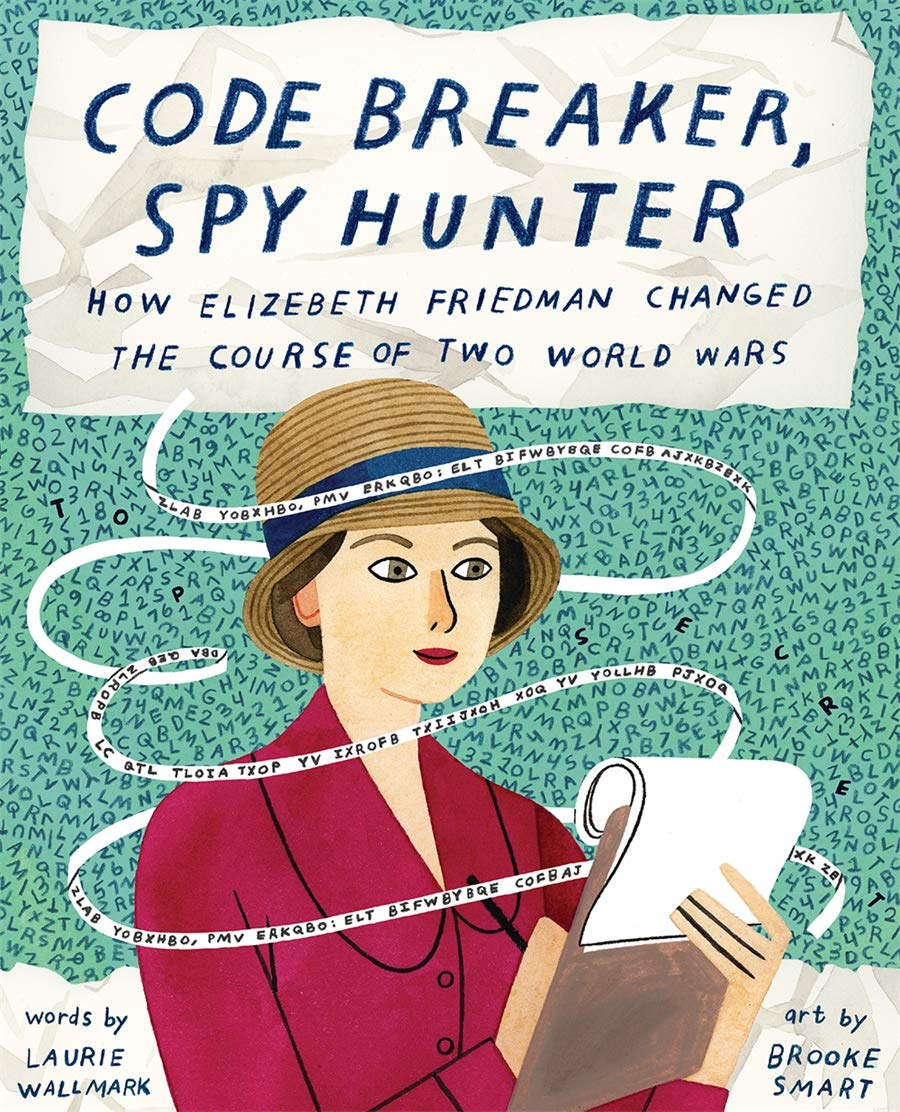
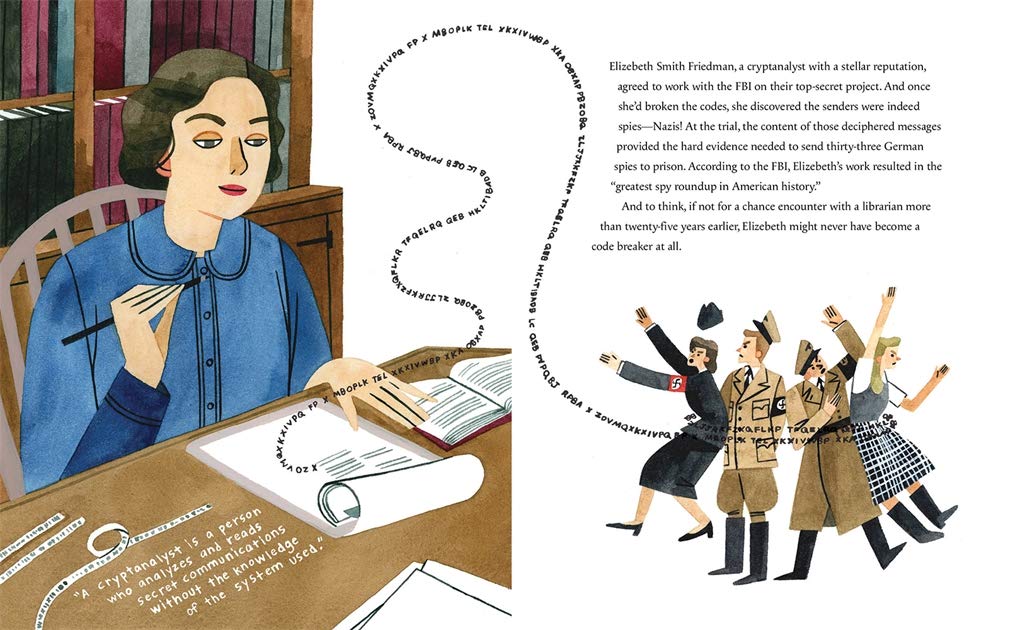
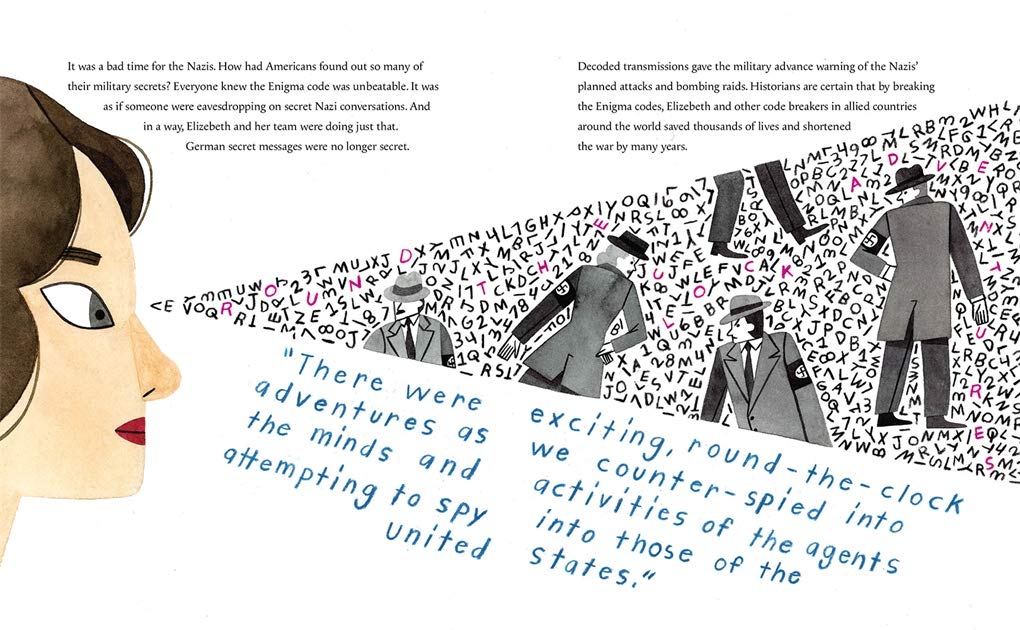
In Code Breaker, Spy Hunter, readers open the cover to an intriguing question: “Could it be? Had enemy spies sneaked into the United States?” World War II was raging, but the United States had not yet joined the effort. And yet the “FBI had intercepted hundreds of coded messages from a secret base in New York.” The problem was no one could read them. Who did the FBI turn to? Elizebeth Smith Friedman, who broke the codes, discovered a cadre of Nazi spies, and provided the evidence “to send thirty-three German spies to prison.” Who was Elizebeth Friedman? Children are about to find out!

celebrate-picture-books-picture-book-review-code-breaker-spy-hunter-cryptanalyst

Image copyright Brooke Smart, 2021, text copyright Laurie Wallmark, 2021. Courtesy of Abrams Books for Young Readers.

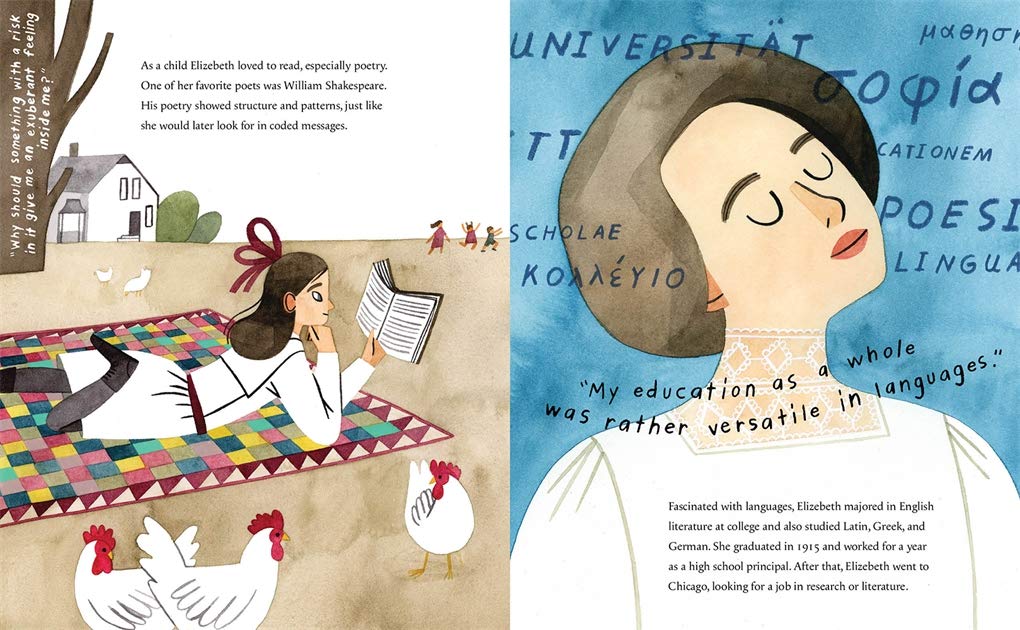
As a child, Elizebeth loved poetry and especially the work of William Shakespeare, with its structure and patterns. In college, she studied English literature, Latin, Greek, and German. While looking for a job in Chicago in 1916, she met the eccentric George Fabyan, who was trying to prove that Francis Bacon was the true writer of Shakespeare’s plays. He hired Elizebeth to “find secret messages Bacon had supposedly hidden in the plays. But the more she explored the plays, the more convinced she became that there were no hidden messages.”

Elizebeth shared her thoughts with a friend, William Friedman, who also loved puzzles and secret codes. Over a year’s time, their discussions resulted in a stronger friendship and finally marriage. In 1917, the US entered World War I and Fabyan asked Elizebeth and William to establish “the country’s first code-breaking unit, the Riverbank Department of Cyphers…. Their methods are now considered the basis for the modern science of cryptology, the study of secret codes.”

celebrate-picture-books-picture-book-review-code-breaker-spy-hunter-childhood

Image copyright Brooke Smart, 2021, text copyright Laurie Wallmark, 2021. Courtesy of Abrams Books for Young Readers.

In 1921, Elizebeth and William moved to Washington D.C., where they worked as code breakers for the Army. At the time, the Army used a large, cumbersome machine to convert messages into code, which precluded soldiers in the field from sending intelligence back. Elizebeth and William invented a complex code that used “only pencil and paper.” After the war, Elizebeth settled down to write books and raise a family, but still the entreaties came to decode messages for court cases sometimes thousands of miles away.

In 1925 with Prohibition the law of the land, smugglers were running rampant. The Coast Guard summoned her, and within three months Elizebeth had cracked “two years of backlogged messages.” Her work and court testimony that helped to convict smugglers made Elizebeth a recognized expert in the new field of cryptology, and when the work became overwhelming for just two people, she created the Coast Guard’s first code-breaking unit.

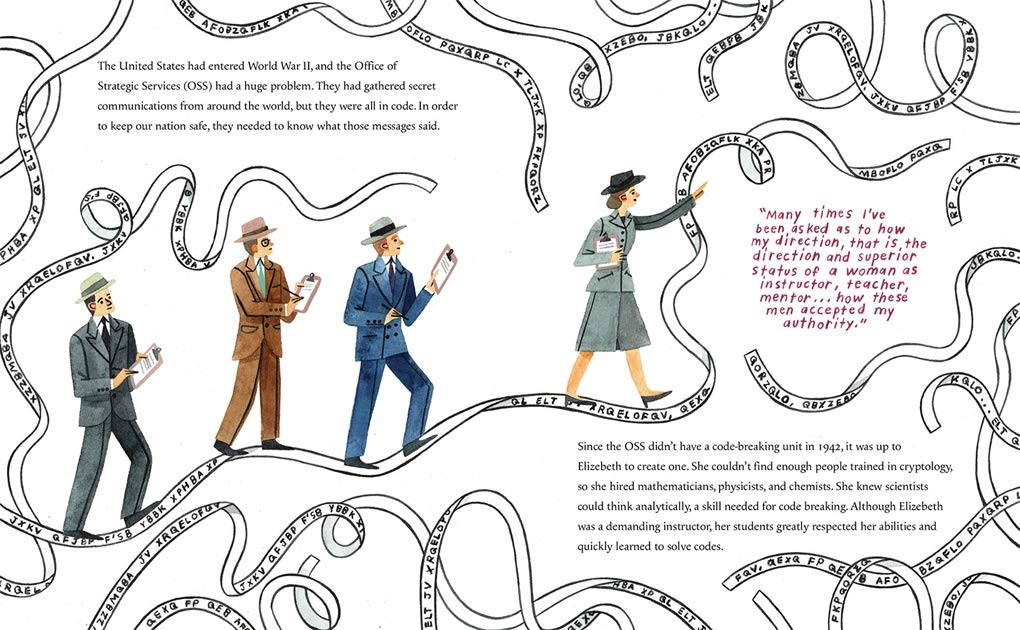
With the entry of the US in World War II, Elizebeth’s expertise was once again needed. Again, she needed to create a code-breaking unit, and in 1942 she hired and taught “mathematicians, physicists, and chemists” the skills of cryptology. Now, Elizebeth’s team was learning important war information about the Nazi’s movements and plans. When the FBI director wanted to nab the spies, Elizebeth recommended waiting “until the military could learn more of the enemy’s secrets.” But he disagreed and raided their hiding place. The spies that escaped quickly changed their codes, making their communications harder to decipher. The FBI director took all the credit for breaking the codes and catching the spies.

celebrate-picture-books-picture-book-review-code-breaker-spy-hunter-world-war-II

Image copyright Brooke Smart, 2021, text copyright Laurie Wallmark, 2021. Courtesy of Abrams Books for Young Readers.

As the war progressed, Elizebeth helped capture an American spy working for the Japanese, and when the Germans developed Enigma, a powerful code-making machine that could “create billions of different cipher alphabets, it was Elizebeth’s team that broke the code for the United States. In Allied countries around the world, other cryptologists were also decrypting Enigma messages. The Nazis were now at a disadvantage, their planned attacks thwarted. Historians believe the work of these code breakers “saved thousands of lives and shortened the war by many years.”

Throughout her life Elizebeth could not speak a word about her work, even to her family. It was classified as Top Secret Ultra by the government and kept locked in the National Archives. At last, in 2015, Elizebeth’s work was declassified. “She is now considered one of the most gifted and influential code breakers of all time.”

celebrate-picture-books-picture-book-review-code-breaker-spy-hunter-counter-spied

Image copyright Brooke Smart, 2021, text copyright Laurie Wallmark, 2021. Courtesy of Abrams Books for Young Readers.

Compelling and wonderfully detailed, Laurie Wallmark’s biography of Elizebeth Friedman immerses children in the world of war-time spies, where cracking codes equaled saved lives and battles won. Wallmark’s storytelling of Elizabeth’s trajectory from Shakespeare scholar to ultra-secret code cracker reads like a thriller and is sprinkled throughout with quotes from Elizebeth that give kids a sense of her personality and the demands of her career. By including several cases Elizebeth was instrumental in solving, Wallmark provides readers with historical context on the broad range of nefarious activity that relied on secret codes to inform their knowledge of today’s uses of encryption as well as international spy networks. Each page is a celebration of Elizebeth’s talent, intelligence, and accomplishments, and her incredible story will enthrall readers.

Brooke Smart’s watercolor and gouache illustrations offer enticing glimpses into the past while following Elizebeth as she meets George Fabyon who shows her around his museum-like house while carrying a small monkey on his shoulder, establishes the United States’ first code-breaking unit, testifies in court, and thwarts the Nazis’ war plans. Interspersed with Smart’s realistic depictions of Elizebeth’s life are images in which lines of coded messages snake across the page, giving readers a look at the kinds of unreadable text Elizebeth and her teams cracked. In addition to presenting a visual representation of the tangled communications that eventually nabbed our enemies, two of these clever illustrations contain messages of their own.

A superlative biography that would enhance any history, social studies, language arts, or STEM curriculum as well as captivate kids who love spy, military, and detective stories, Code Breaker, Spy Hunter: How Elizebeth Friedman Changed the Course of Two World Wars is highly recommended for home bookshelves and is a must for school and library collections.

Ages 7 – 11

Abrams Books for Young Readers, 2021 | ISBN 978-1419739637

Discover more about Laurie Wallmark and her books on her website.

To learn more about Brooke Smart, her books, and her art, visit her website.

International Women and Girls in Science Day Activity

celebrate-picture-books-picture-book-review-pig-pen-cipher

Send a Secret Message


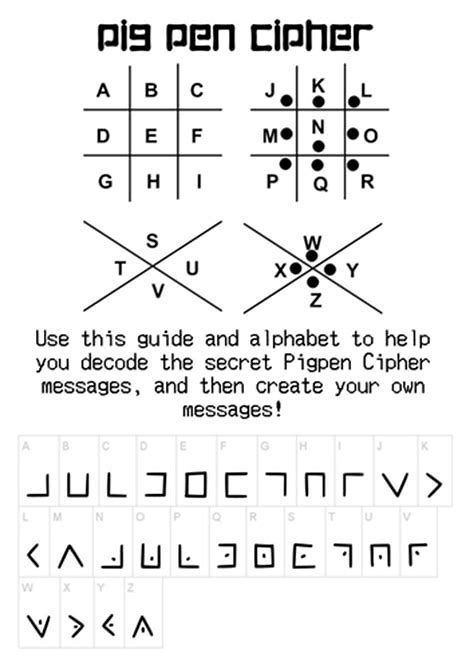
Would you like to be a code breaker – or a spy? Get started with this Pigpen Cipher that makes sending secret messages to friends, siblings, and other family easy and fun. This ancient code is called the Pigpen Cipher because each letter is in its own “pen.” Use it as originally developed then try mixing the letters and pens to create new codes. 

Pigpen Cipher Key

celebrate-picture-books-picture-book-review-code-breaker-spy-hunter-cover

You can find Code Breaker, Spy Hunter at these booksellers

Amazon | Barnes & Noble | Books-a-Million

To support your local independent bookstore, order from 

Bookshop | IndieBound

Picture Book Review

January 27 – International Holocaust Remembrance Day

celebrate-picture-books-picture-book-review-anne-frank-the-girl-heard-around-the-world-cover

About the Holiday

International Holocaust Remembrance Day was officially declared in November 2005 by the United Nations General Assembly. Every year on January 27th, “UNESCO pays tribute to the memory of the victims of the Holocaust and reaffirms its unwavering commitment to counter antisemitism, racism, and other forms of intolerance that may lead to group-targeted violence.” The date marks the day that the Nazi Concentration and Extermination Camp of Auschwitz-Birkenau was liberated by Soviet troops in 1945. This year commemorates the 77th anniversary of the liberation. This year UNESCO is presenting a series of mostly online events, including a commemoration ceremony, a panel discussion on the legacy of Jewish artists who died during the Holocaust and the United Nations, and a photography exhibition titled Generations: Portraits of Holocaust Survivors by the Royal Photographic Society of Great Britain, showcasing over 50 contemporary photos of Holocaust survivors and their families. To learn more about how to watch the events, visit the UNESCO International Holocaust Remembrance Day website. You can also find many excellent resources and personal stories on the United States Holocaust Museum website.

Anne Frank: The Girl Heard Around the World

Written by Linda Elovitz Marshall | Illustrated by Aura Lewis


“All her life, Anne Frank wanted to be heard. Really, truly heard.” But sometimes no matter how loudly or entertainingly she talked, no one listened or seemed to understand. Anne’s family, “like many other Jewish families, had lived in Germany for centuries,” but when Adolf Hitler began to govern the country, Jewish families were in danger. When Anne was four years old, her family, hoping to find safety, moved to Amsterdam in the Netherlands. Here, Anne lived happily, “making mischief with her friends, telling jokes, and having fun. “In school, she talked and talked.”

celebrate-picture-books-picture-book-review-anne-frank-the-girl-heard-around-the-world-portrait

Image copyright Aura Lewis, 2020, text copyright Linda Elovitz Marshall, 2020. Courtesy of Orchard Books.

But in 1940, Hitler and his Nazi’s took over the Netherlands too, and life for Jewish people living there was no longer safe. Anyone who talked against the Nazis could be arrested, but Anne needed to express her opinions. On her 13th birthday Anne received a red plaid diary; she named it “Kitty.” In Kitty, Anne could share all of her thoughts and feelings about what was happening in her country. She wrote about the rules that restricted Jews from normal life, that made all Jews wear a yellow star that distinguished them from others. But Anne also wrote about school and other subjects. “Anne realized that by writing, she could speak her mind in a new way. She could really, truly be heard.”

celebrate-picture-books-picture-book-review-anne-frank-the-girl-heard-around-the-world-childhood

Image copyright Aura Lewis, 2020, text copyright Linda Elovitz Marshall, 2020. Courtesy of Orchard Books.

Then on a morning in 1942, Anne’s mother woke her, telling her that they needed to leave quickly and hide. Anne “packed her most treasured things.” Her diary was the first thing she packed. She and her family as well as four other people hid in a secret room in the warehouse where Anne’s father worked. Non-Jewish friends who also worked in the warehouse brought them food and supplies. While Anne tried to make the best of her life in hiding, she was lonely and always careful to whisper and tiptoe so the other workers in the factory did not discover them.

celebrate-picture-books-picture-book-review-anne-frank-the-girl-heard-around-the-world-writing

Image copyright Aura Lewis, 2020, text copyright Linda Elovitz Marshall, 2020. Courtesy of Orchard Books.

Now, Anne’s diary was even more important to her. In Kitty she wrote about her fears and feelings, her days and the things she missed. “She wrote about wishing people could live together, in peace,” and Kitty “was always there to listen, always there to understand.” Anne also wrote stories about a teddy bear, a fairy, and a caring grandmother. Once, water seeped in and soaked her diary. Anne rushed to hang the pages to dry. Anne wrote and wrote for two years. She hoped to publish a book about her experience.

celebrate-picture-books-picture-book-review-anne-frank-the-girl-heard-around-the-world-crying

Image copyright Aura Lewis, 2020, text copyright Linda Elovitz Marshall, 2020. Courtesy of Orchard Books.

“But on August 4, 1944, Nazi police discovered the secret hiding place.” Anne, her family, and all of the people living in the warehouse room were taken away. “One of their non-Jewish friends found Anne’s diary and writings and kept them safe,” hoping to return them to her. But just weeks before the war ended in 1945, Anne died. Anne’s father was the only one to survive. After the war ended, Anne’s father fulfilled her dream and published Anne Frank: The Diary of a Young Girl. Anne’s book has been read by people around the world and continues to speak for her in the hearts of readers everywhere.

Back matter includes more about Anne, her family, the Nazis and how Anne’s diary was saved; a timeline of Anne’s family, the rise of Hitler, and the war years; an Author’s Note; and lists of sources, suggested further reading, and websites.

celebrate-picture-books-picture-book-review-anne-frank-the-girl-heard-around-the-world-world-reads

Image copyright Aura Lewis, 2020, text copyright Linda Elovitz Marshall, 2020. Courtesy of Orchard Books.

Linda Elovitz Marshall’s moving telling of Anne Frank’s life and dreams, focusing on her beloved diary will resonate with children, who, like Anne, want to be heard. In her evocative storytelling, Marshall creates a rich portrait of Anne as a vivacious child who was also smart and thoughtful. Mirroring the devastating disruptions in Anne’s and her family’s life, Marshall intersperses pages of straightforward text which describes the rise of Hitler and the Nazis and emphasizes ways in which they restricted and silenced the Jewish population, reinforcing her book’s theme. The examples Marshall gives—riding bikes, going to the movies, having to wear an identification star—will impress upon children the changes in Anne’s life.

When Anne and her family move to the Secret Annex, Marshall superbly reveals the conditions of their confinement through Anne’s writing and how her diary was her lifeline and her confidant. The family’s eventual discovery is written factually but with sensitivity, fitting for picture book readers. The final spread honors the influence Anne Frank has had on the world with her diary—her voice that could not be silenced.

In Aura Lewis’s emotionally resonant illustrations, readers first meet Anne Frank in a snapshot that shows her as kind, thoughtful, and seemingly wise beyond her years. Vibrant scenes of Anne with her family in Germany and later with family and friends in Amsterdam give way to somber, gray-toned images that reflect Hitler’s takeover and the dangers Anne, her family, and all Jewish people faced. Lewis clearly sketches Anne’s childhood enthusiasms and hope and, especially, her pleasure at receiving her diary. Also, readily recognizable are Anne’s feelings of fear, frustration, and sadness. Lewis portrays Anne in signature orange and plaid, reflecting the deep interconnection between Anne and her diary. This visual metaphor is then carried onto the final spread, where a variety of people of all ages read Anne Frank: The Diary of a Young Girl.

An excellent book to introduce young children to Anne Frank, a most influential and inspiring young girl, Anne Frank: The Girl Heard Around the World would be a meaningful addition to home bookshelves and is a must for school and public library collections.

Ages 6 – 8

Orchard Books, 2020 | ISBN 978-1338312294

Discover more about Linda Elovitz Marshall and her books, visit her website.

To learn more about Aura Lewis, her books, and her art, visit her website.

National Dear Diary Day Activity

celebrate-picture-books-picture-book-review-anne-frank-word-search

Anne Frank and Her Diary Word Search


Find the twenty words associated with Anne Frank, her life, and her diary in this printable puzzle

Anne Frank and Her Diary Word Search Puzzle | Anne Frank and Her Diary Word Search Solution

celebrate-picture-books-picture-book-review-anne-frank-the-girl-heard-around-the-world-cover

You can find Anne Frank: The Girl Heard Around the World at these booksellers

Amazon | Barnes & Noble | Books-a-Million

To support your local independent bookstore, order from

Bookshop | IndieBound

Picture Book Review