June 15 – It’s National Shark Week

celebrate-picture-books-picture-book-review-i-am-the-shark-cover

About the Holiday

It’s Shark Week – one of the most anticipated holiday’s of the year! Kids and adults are fascinated by these denizens of the deep, and especially the Great White, which sports fearsome teeth and intimidates with their imposing size. But there are many more sharks in the sea – about 500 species! – and they are an important part of the world’s ecosystem. If Shark Week is your favorite week of the summer, you’re no doubt enjoying a full schedule of shark-related shows on the Discovery Channel. To learn more information about sharks, including statistics from this year’s coastal shark survey, a chance to cast your vote for “freakiest shark,” a line-up of top videos, and more, visit the National Oceanic and Atmospheric Administration’s Shark Week page. To celebrate sharks and the wonders of the ocean every day, you’ll want to put today’s book at the top of your reading list.

Thanks to Joan Holub for sharing a copy of I Am the Shark with me for review consideration. All opinions on the book are my own. I’m excited to be teaming with Joan in a giveaway package that kids will love. See details below.

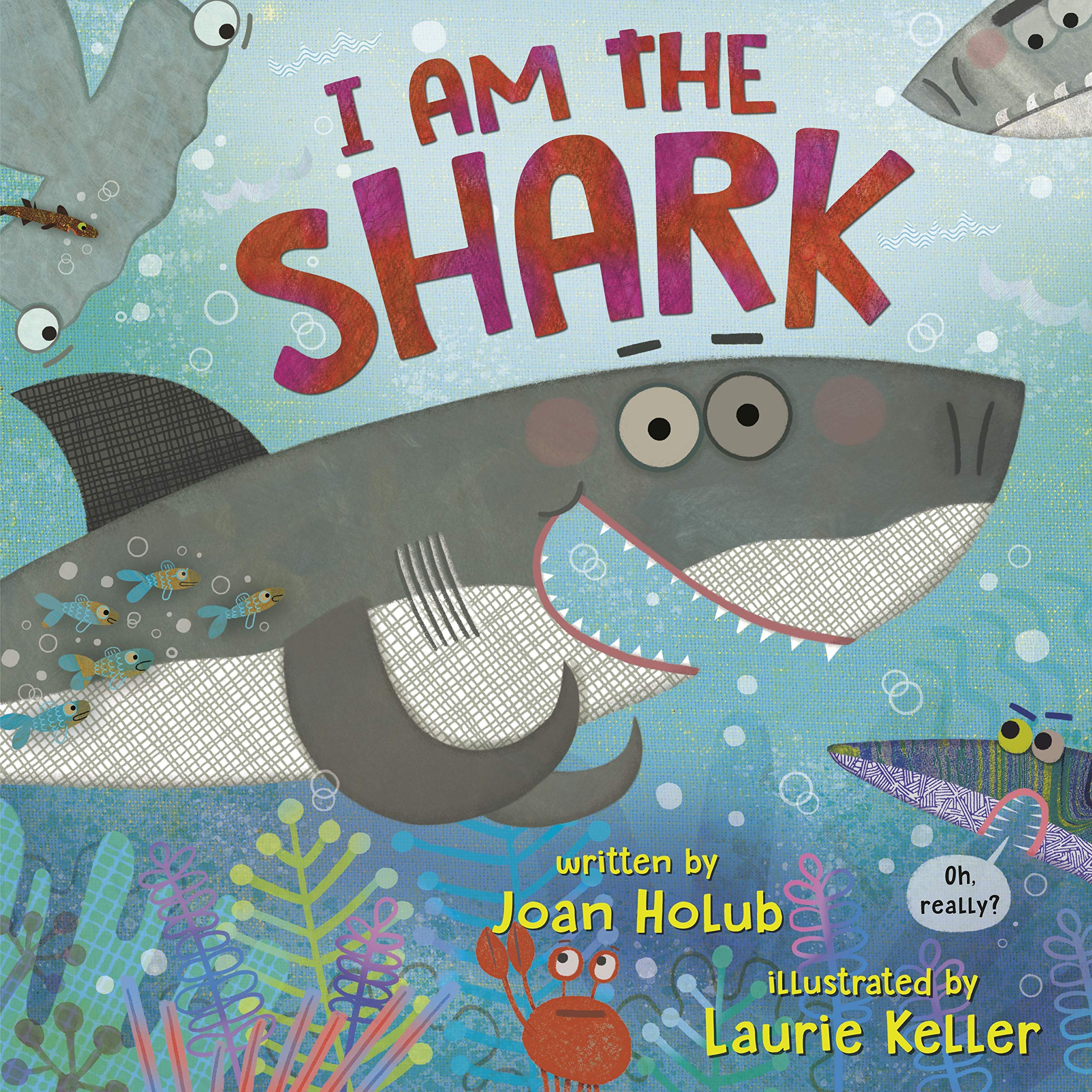
I Am the Shark

Written by Joan Holub | Illustrated by Laurie Keller


Great White Shark is excited to introduce himself, especially since he is “the GREATEST SHARK in this book.” But a voice contradicts Great White. Who begs to differ? It’s Whale Shark, and she loses no time in demonstrating why she is “the greatest shark in this book” due to her enormous size, which can’t be matched anywhere in the undersea world. And if that weren’t enough, she adds this bite: “Compared to me, you are small.”

celebrate-picture-books-picture-book-review-i-am-the-shark-great-white

Image copyright Laurie Keller, 2021, text copyright Joan Holub, 2021. Courtesy of Crown Books for Young Readers.

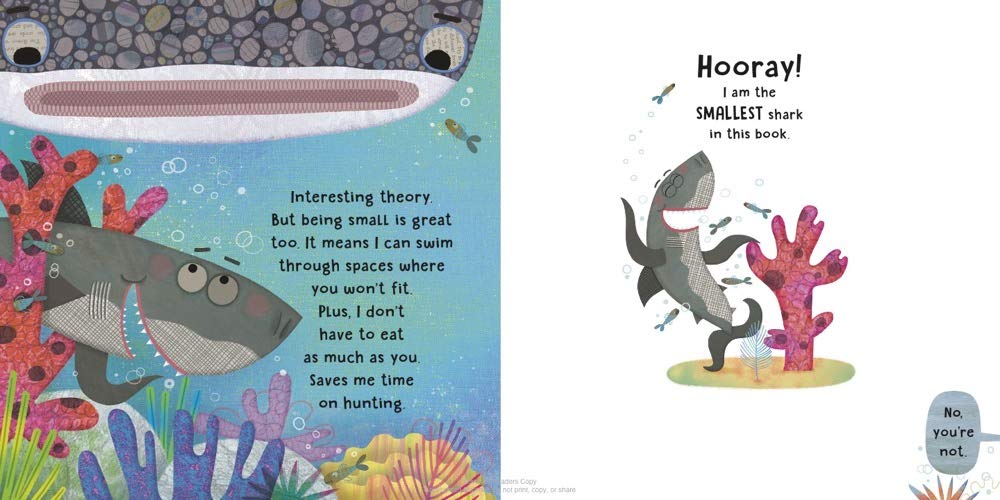
But Great White takes it in stride. If he isn’t the greatest shark, that’s okay because being the smallest has some pretty great perks too. So he’s in the middle of a “smallest shark” victory dance when a voice calls out, “No, you’re not.” It seems there’s a much smaller shark in the sea—Dwarf Lantern Shark, who, besides being the tiniest shark has a rather enlightening ability too. After the long take down from Whale Shark, this time Great White pivots quickly, thinking about how “smart and curious” he is. Could he be “the smartest shark in this book?”

Well, that would be a no. Hammerhead Shark has that one nailed down as well as a unique view of their colorful world. This time, Great White is a little intimidated. “Whoa!” he exclaims. “How can I top that?” But being smart (just not as smart as Hammerhead), Great White has another idea. This one, though, is quashed just like the others in a sneak attack. Turns out Great White isn’t the best hunter, the oldest, or even the “fishiest” shark in this book.

celebrate-picture-books-picture-book-review-i-am-the-shark-whale-shark

Image copyright Laurie Keller, 2021, text copyright Joan Holub, 2021. Courtesy of Crown Books for Young Readers.

Undeterred, Great White decides to do a little research in other books to “figure out the greatest thing about [him]. He learns all about his different body parts and even shares a labeled diagram (on graph paper and everything) with you. And he doesn’t stop there. He’s discovered all sorts of awesome facts about their skeletons, senses, teeth, skin, and other cool tidbits that he lets you know about. Great White could probably go on and on, but suddenly there’s a “snack alert” and all the sharks take off at top speed after their prey. Great White’s fast! He’s in the lead! Great White’s the fast..est… “Crumbs.” Great White’s passed up by a faster shark. Who is that anyway?

By this time Great White is feeling pretty down in the dumps. “Maybe I should change my name to Just-Okay White Shark or Not-So-Great White Shark,” he bemoans. But then Dwarf Lantern Shark swims up to him and enlightens him with some perspective and sage advice: “Just be happy being you.” Great White takes it to heart. In fact, it helps him think of a new, can’t-miss quality that finally gives him a “GREATEST in this book” status.

Backmatter includes more details on the eight sharks introduced in the story as well as books and links about sharks for kids wanting to learn more.

celebrate-picture-books-picture-book-review-i-am-the-shark-smallest

Image copyright Laurie Keller, 2021, text copyright Joan Holub, 2021. Courtesy of Crown Books for Young Readers.

Kids are always fascinated by the superlative—the fastest, the biggest, the smallest, the silliest, the best—and Joan Holub makes superlative use of this fact in her highly entertaining and educational romp. As Great White goes on a rollercoaster of emotions, one moment thinking he’s the best at something while the next moment having his hopes dashed, readers learn eye-opening details about eight sharks, described in engaging ways that will wow kids. Great White’s boundless optimism is infectious while setting up his disappointment for maximum comic effect. Kids will eagerly await the chance to chime in on the “No, you’re not.” asides that are sure to bring plenty of giggles. But this story isn’t all about sharks. Holub masterfully weaves in an important message for kids about self-acceptance, true happiness, and finding their unique qualities and talents.

Laurie Keller uses her prodigious talent for humor in her up-close images (and is there any other way kids would want to see them?) of these competitive sharks. Loaded with attitude, each shark swims onto the pages to demonstrate their “greatest” trait in ways that will stick with kids and have them excited to learn more. Expressive faces and silly antics add personality and laughs to each page spread. Keller’s vivid, textured, and collage-style illustrations are eye-catching, and funny details, such as Tiger Shark’s tattoos, chain bangle, band-aid, and gold tooth, will have kids lingering over the pages. While they’re there, they’ll want to keep a look out for the Dwarf Lantern Shark who finally lets Great White in on a great secret.

Full of facts, action-packed, and loaded with laughs, I Am the Shark is creative non-fiction at its GREATEST. Kids who love learning about sharks, nature, and the ocean or who just love a fantastic read will want to sink their teeth in this charmer. I Am the Shark is a can’t-miss must for homes, classrooms, and public libraries.

Ages 4 – 8

Crown Books for Young Readers, 2021 | ISBN 978-0525645283

celebrate-picture-books-picture-book-review-joan-holub-headshot

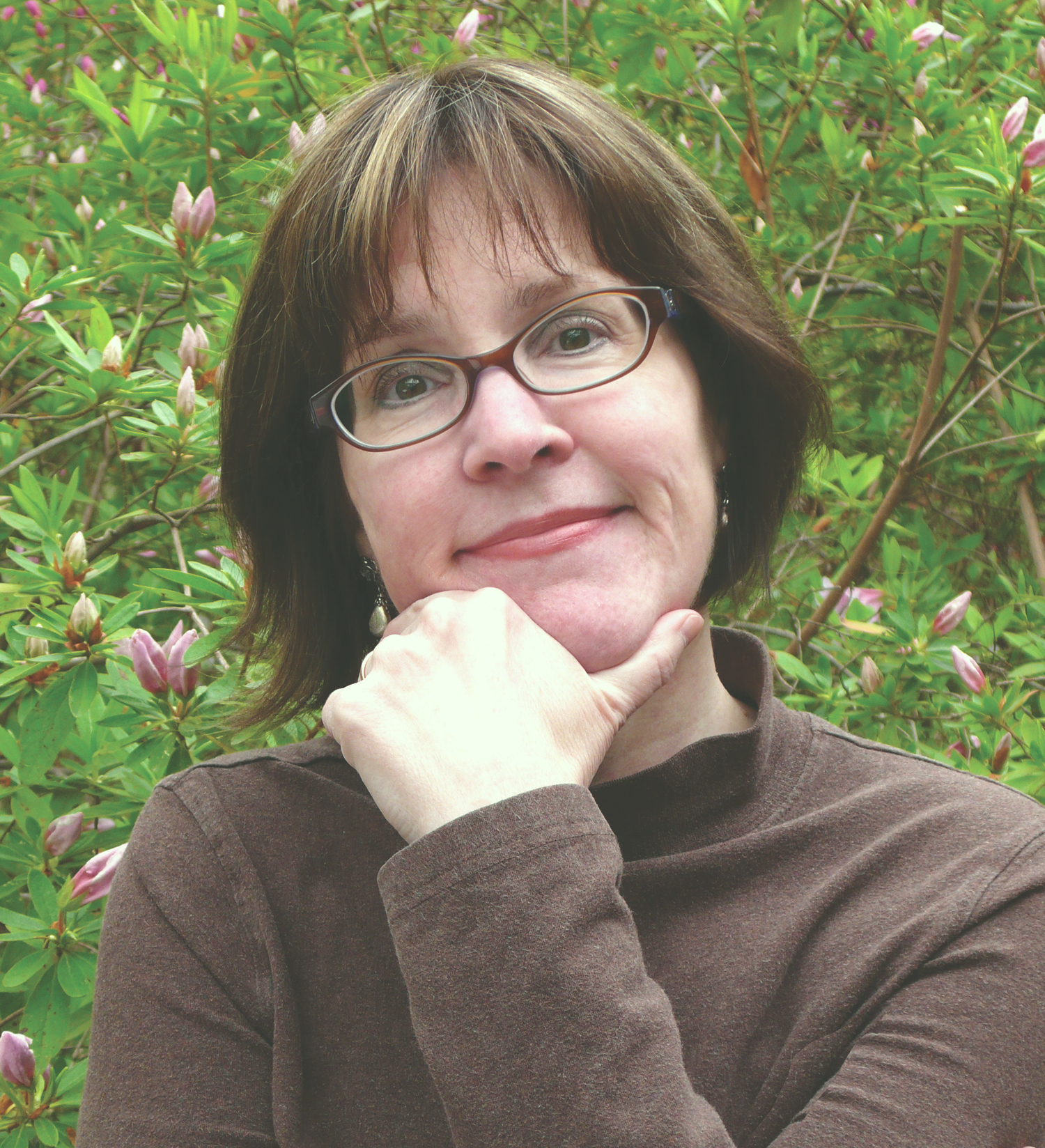
Joan Holub has authored and/or illustrated over 150 children’s books, including the Goddess Girls series and the Heroes in Training series (with Suzanne Williams); the New York Times bestselling picture book Mighty Dads, illustrated by James Dean; Little Red Writing, illustrated by Melissa Sweet; and Zero the Hero, illustrated by Tom Lichtenheld. Her board & novelty books include This Little Trailblazer and Fa la la Llama. Joan adores line dancing to the Jaws theme, reading Sharkspeare, and vacationing in Finland.

You can connect with Joan Holub on Her website | Instagram | Twitter

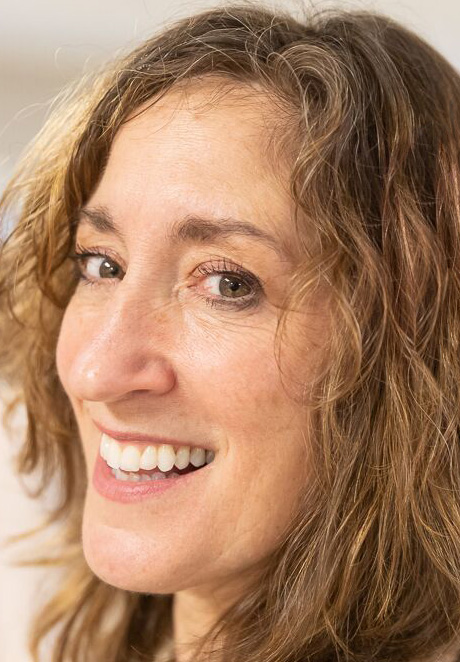
celebrate-picture-books-picture-book-review-laurie-keller-headshotLaurie Keller is the author and illustrator of many books, including The Scrambled States of America, Potato Pants!, Arnie the Doughnut, Do Unto Otters: A Book About Manners, the Adventures of Arnie the Doughnut chapter book series, and We Are Growing!, part of the Elephant & Piggie Like Reading! series and winner of the Theodor Seuss Geisel Award. When Laurie isn’t busy making books, she enjoys playing the banjo, traveling, cross-country skiing, and splashing in Lake Michigan, where as far as she knows, there is not a single shark.

You can connect with Laurie Keller on Her website | Instagram | Twitter

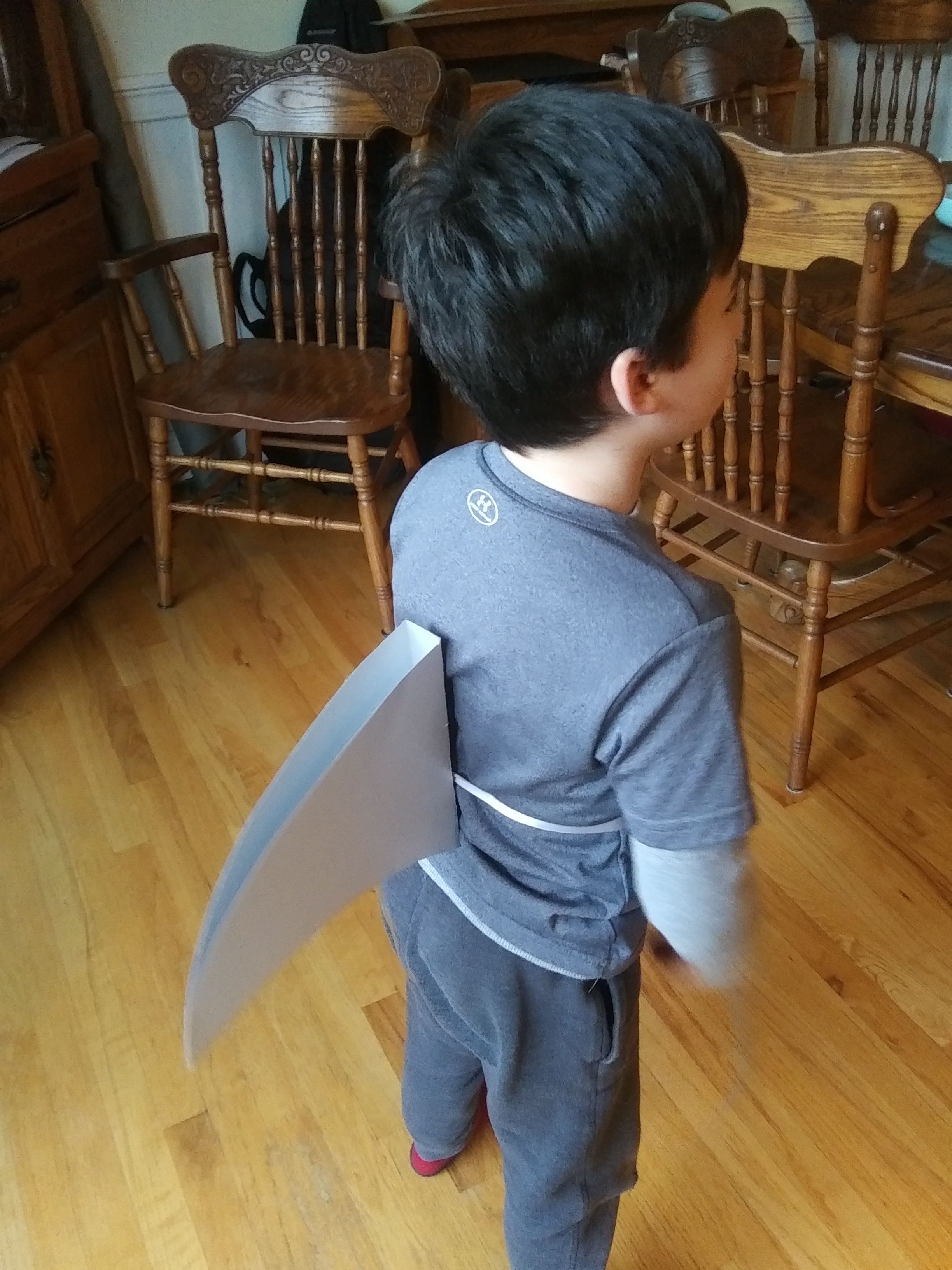
Shark Week Activity

celebrate-picture-books-picture-book-review-shark-fin-craft

Fin-tastic Shark Fun


Your kids can make a splash during Shark Week and all year around with this easy-to-make craft! 

Supplies

  • 2 pieces of 8.5 x 11 gray card stock paper
  • Ribbon
  • Tape
  • Scissors
  • Pencil

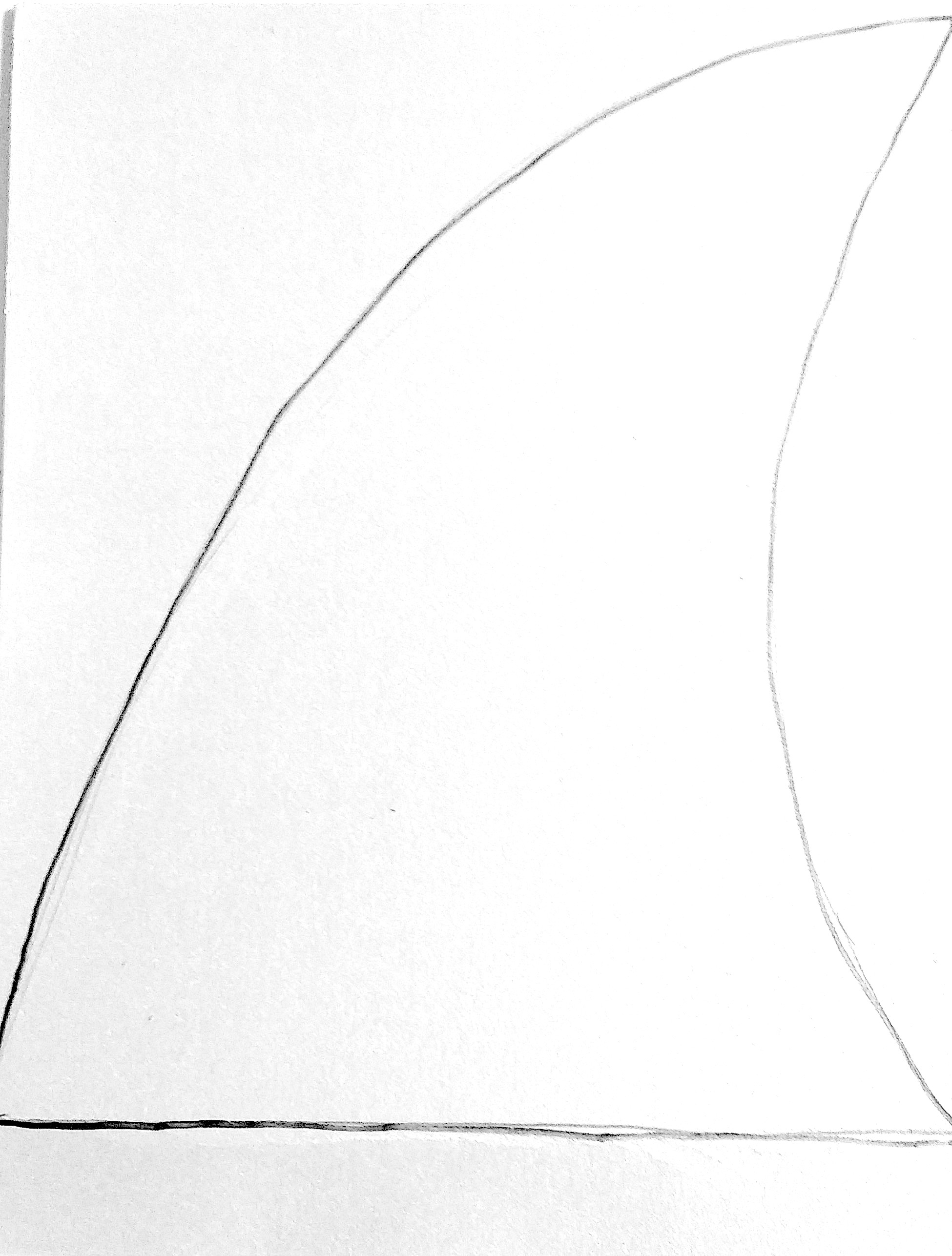
fin outline white

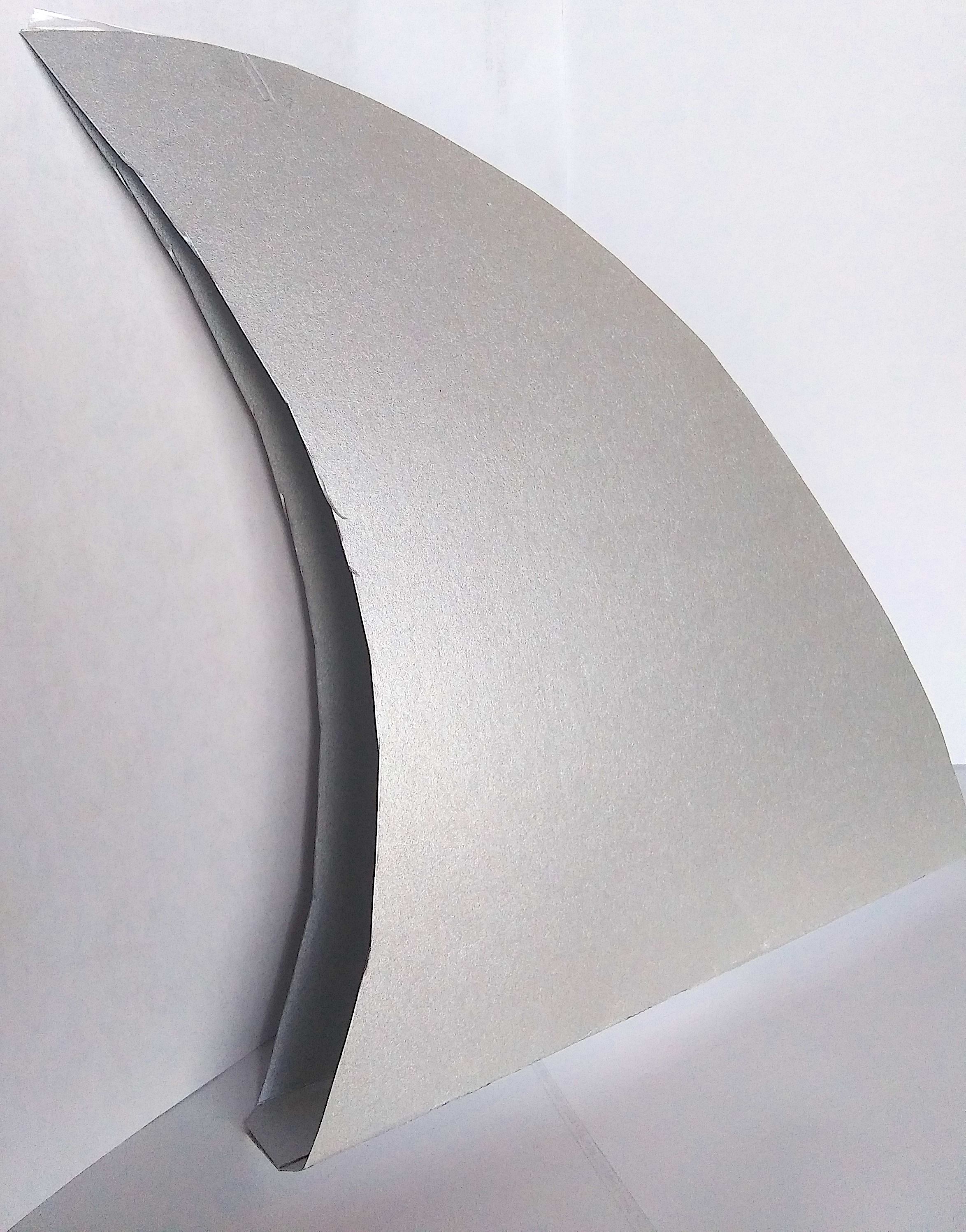
celebrate-picture-books-picture-book-review-shark-fin

Directions

  1. Tape the top of the two pieces of paper together
  2. Fold them back together
  3. Measure an inch up from the bottom of the papers (the un-taped side) and trace a straight line across both papers
  4. Trace a shark fin outline onto your paper. The shark outline should stop an inch above the bottom
  5. Cut out the fin on both pieces of paper. If you should cut through the tape, re-tape the tops together
  6. Fold along the lines of both papers so the folds face towards each other.
  7. Tape the folds so the fin becomes a triangle
  8. Cut two slits parallel to the folded lines
  9. Thread ribbon through slits

celebrate-picture-books-picture-book-review-i-am-the-shark-cover

You can find I Am the Shark at these booksellers

Amazon | Barnes & Noble | Books-a-Million

To support your local independent bookstore, order from

Bookshop | IndieBound

Picture Book Review
July 8 – Math 2.0 Day

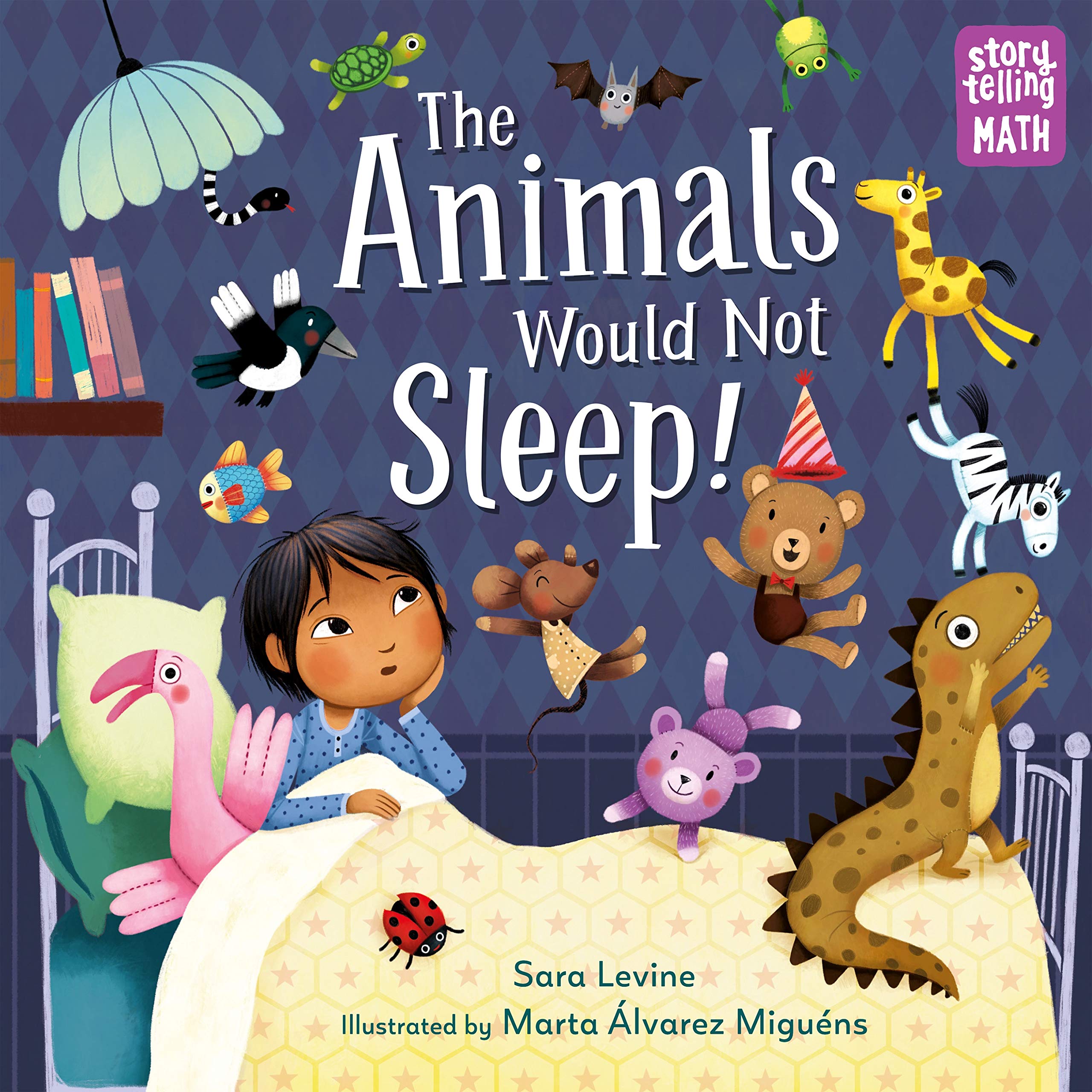
celebrate-picture-books-picture-book-review-the-animals-would-not-sleep-cover

About the Holiday

Established in 2009, Math 2.0 Day celebrates math and technology and how these two disciplines complement each other. The day was conceived to bring together mathematicians, programmers, engineers, educators, and managers to raise awareness of the importance of math literacy at all levels of education. For kids a love of math and technology begins early as they experiment and explore every day during playtime, family time and even, as today’s book shows, at bedtime.

Thank you to Charlesbridge for sending me a copy of  The Animals Would Not Sleep! for review consideration. All opinions about the books are my own.

The Animals Would Not Sleep!

Written by Sara Levine | Illustrated by Marta Álvarez Miguéns


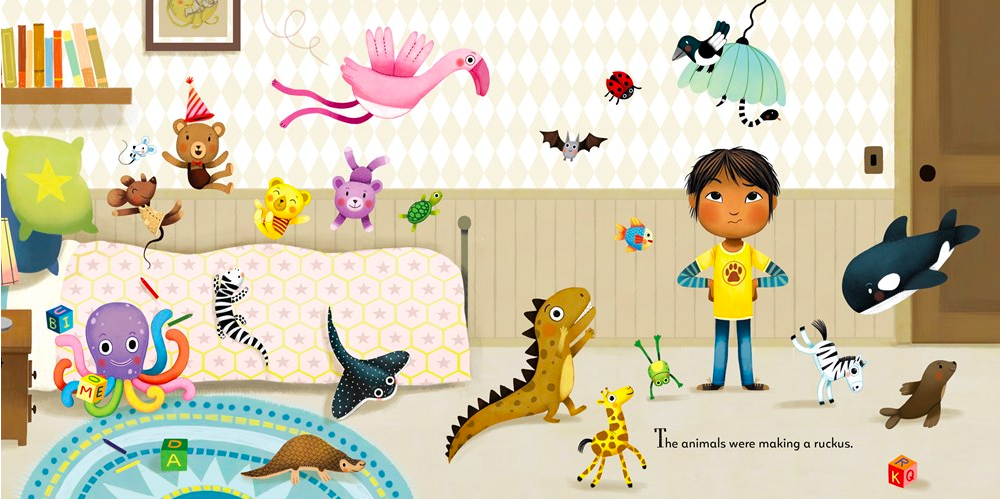
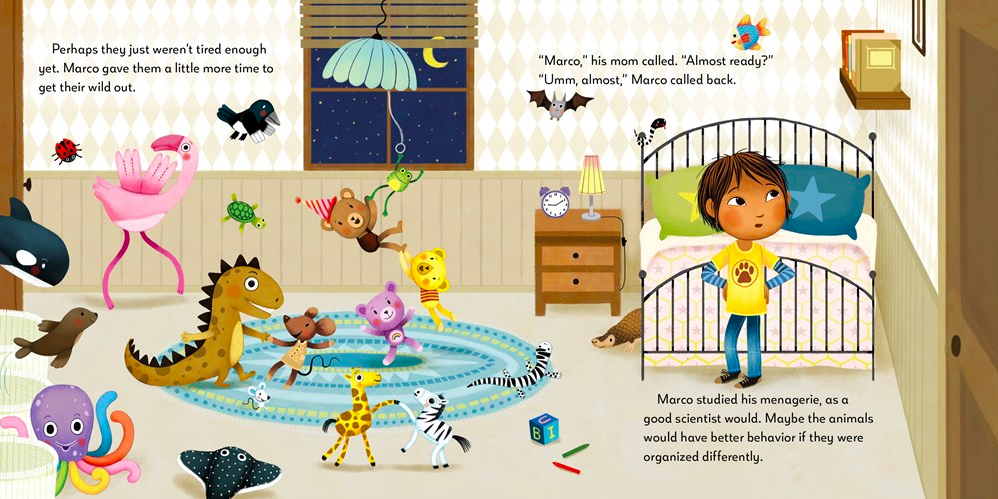
All of Marco’s stuffed “animals were making a ruckus” when his mom told him it was time to get cleaned up and ready for bed. She wanted to see all the toys put away, so Marco, who thought like a scientist, got to work. He wanted to sort his animals like a scientist would, so he got out three baskets and made signs for Flying Animals, Swimming Animals, and Animals That Move on Land. Then he picked up his dancing flamingo, bird, bat, and ladybug and put them in the first basket. He placed his octopus, stingray, frog, fish, whale, and seal in the second basket, and his dinosaur, giraffe, bears, snake, pangolin, gecko, mice, and zebra in the third basket.

But the animals were still wide awake, and “they egged one another on until not one remained in its container.” Marco thought they would settle down, but when his mom called the second time, he reconsidered his strategy. This time he made signs that sorted the animals by color, but zebra started to cry. He was afraid being in such close quarters with black-and-white snake and stingray, plus he missed his friend giraffe.

celebrate-picture-books-picture-book-review-the-animals-would-not-sleep-ruckus

Image copyright Marta Álvarez Miguéns, 2020, text copyright Sara Levine, 2020. Courtesy of Charlesbridge.

Marco decided to try again. He took all of his animals out and made signs that read Small, Medium, and Large. Things seemed to quiet down, so Marco began to put on his pajamas. But then he heard moaning and groaning coming from the Large basket. When he went to check, Dinosaur and Dancing Flamingo complained about being too cramped. Plus, Dancing Flamingo missed Rainbow Bear. Then he heard noises from the Small basket. Those animals weren’t happy either.

Marco’s mom gave him two minutes to get it all sorted out. Fortunately for Marco, being a scientist meant “he was used to coming up with ideas and thinking outside the box.” The animals were getting tired, and Yellow Bear had just burst into tears for no apparent reason. Like a good scientist, Marco cared about his animals and wanted them to be happy. He had one more sorting idea. With the large animals, medium-sized animals, and small animals all tucked in with plenty of room and their friends nearby on Marco’s bed, Marco got under the cozy covers. He got a goodnight kiss from Mom and then they all fell happily to sleep.

Back matter includes an illustrated Author’s Note about the way scientists sort, or classify, animals by their characteristics as well as a discussion that explores the math in the story. “Try This!” tips provided by Karen Economopoulos, co-director of the Investigations Center for Curriculum and Professional Development at TERC, give adults ideas for various ways to engage children in sorting.

celebrate-picture-books-picture-book-review-the-animals-would-not-sleep-marco

Image copyright Marta Álvarez Miguéns, 2020, text copyright Sara Levine, 2020. Courtesy of Charlesbridge.

Perfectly capturing the way young children interact with their toys, Sara Levine combines imagination and scientific thinking in her inventive story, part of the Storytelling Math series from Charlesbridge. In Marco, who’s proud of his scientific thinking, Levine shows readers that they, too, already think like a scientist. Marco’s empathy for his animals’ complaints will get kids thinking about classification and the various ways they might sort the animals. Levine’s use of realistic dialogue that echoes bedtime routines in many homes and gives each character—human and animal—distinct personalities will draw kids in to this charming story that is organically infused with strong math lessons. Levine gives Marco a sweet final solution to his problem that will please kids and have them wanting to extend the lessons in the story to their own toys and/or household objects while they think like a scientist too.

Marta Álvarez Miguéns opens the story with an enchantingly wild two-page spread where Marco stands in the middle of his room as his toys bounce on the bed, climb blocks, juggle, fly, and cause a ruckus. Turn the page, though, and these animals now lie motionless around the room as Mom peeks in to check on Marco. When Marco sorts his animals into the baskets, readers can clearly see which animals go where and why. Kids will knowingly giggle when the just-sorted animals spring from their resting places to prolong bedtime. Miguéns also plainly depicts Marco’s and the animals’ facial expressions from happy and playful to sad and crying to peaceful and satisfied. These images give adults and children an opportunity to discuss emotions and how to recognize various clues in faces, a skill important for social-emotional learning. Vivid colors, adorable animals, details such as alphabet blocks that stack or are turned to spell words, and kid-appealing décor will have kids wanting to come back again and again.

A book that’s sure to become a favorite at bedtime or to enhance classroom or homeschooling curriculum, The Animals Would Not Sleep! will spark mathematical and scientific thinking and recognition in all young learners. The book offers an irresistible invitation to experiment and interact with math and science and is a must for home, school, and public library collections.

Ages 3 – 6

Charlesbridge, 2020 | ISBN 978-1623541286 (Hardcover) | ISBN 978-1623541972 (Paperback) 

Discover more about Sara Levine and her books on her website.

To learn more about Marta Álvarez Miguéns, her books, and her art, visit her website.

About Storytelling Math

Storytelling Math offers books that celebrate children using math in their daily lives as they play, build, collaborate, compromise, and discover the world around them. Each story features characters of color who are empowered to solve problems, enjoy activities, and help out using their knowledge of and experimenting with math. Free downloadable hands-on activity kits are available for each book on the Charlesbridge website. Sharing these joyful stories with your littlest ones and older kids will make them eager to explore, use, and learn more about math every day. You can learn more about Storytelling Math on the Charlesbridge website

Storytelling Math: Math, Diversity, and the Power of Story was developed with Marlene Kliman at TERC—a nonprofit dedicated to STEM education—under a grant from the Heising-Simons Foundation.

Enjoy this The Animals Would Not Sleep! trailer with Author Sara Levine!

National Book Month Activity

celebrate-picture-books-picture-book-review-the-animals-would-not-sleep-activity-logo

The Animals Would Not Sleep! Activity Kit


You can have fun sorting and exploring math with your class or family with the Activity Kit for The Animals Would Not Sleep on the Charlesbridge website. Download it here!

The Animals Would Not Sleep Activity Kit

celebrate-picture-books-picture-book-review-the-animals-would-not-sleep-cover

You can find The Animals Would Not Sleep! at these booksellers

Amazon | Barnes & Noble | Books-a-Million

To support your local independent bookstore, order from

Bookshop | IndieBound

Picture Book Review
May 27 – Rachel Carson Day and Interview with Shana Keller

celebrate-picture-books-picture-book-review-fly-firefly-cover

About the Holiday

Today’s holiday commemorates the birthday, on May 27, 1907, of Rachel Carson, the famous ecologist who launched the modern environmental movement with her 1962 book Silent Spring, which documented the dangers of pesticides to the environment. Silent Spring and Carson’s continued advocacy for the environment ultimately resulted in the banning of the pesticide DDT. To honor the day, learn more about the life and legacy of this influential woman whose work continues to impact our world. To learn more about Rachel Carson, visit rachelcarson.org.

I received a copy of Fly, Firefly! from Sleeping Bear Press for review consideration. All opinions about the book are my own.

Fly, Firefly!

Written by Shana Keller | Illustrated by Ramona Kaulitzki


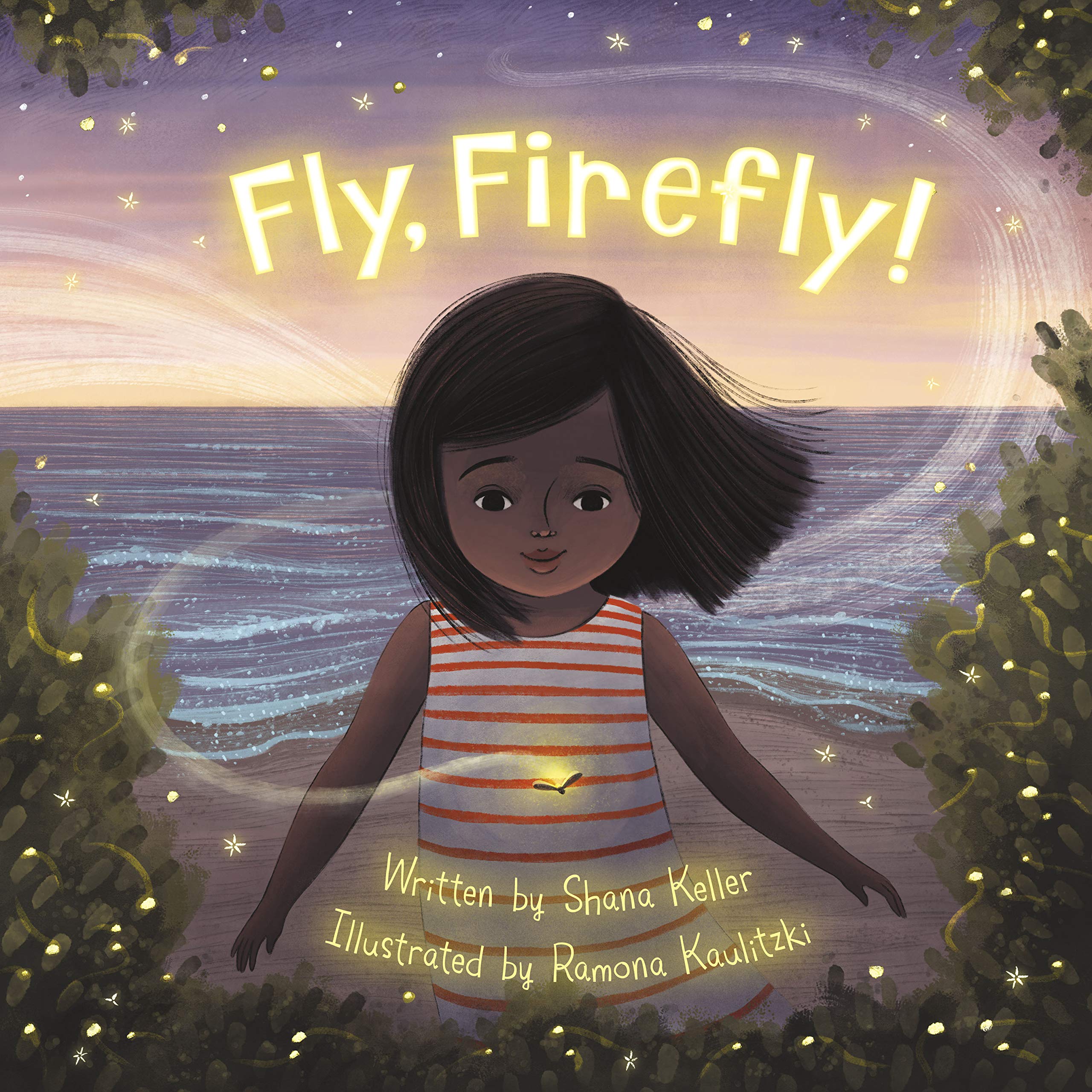
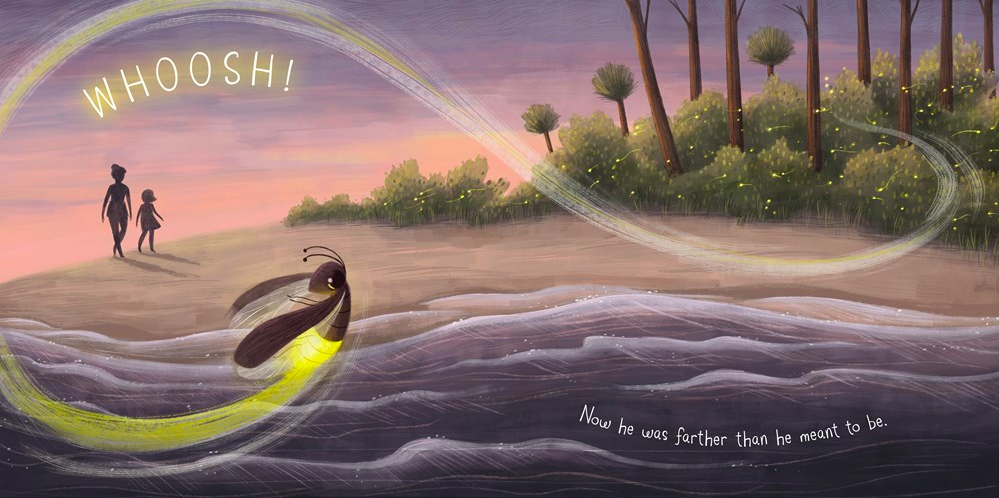
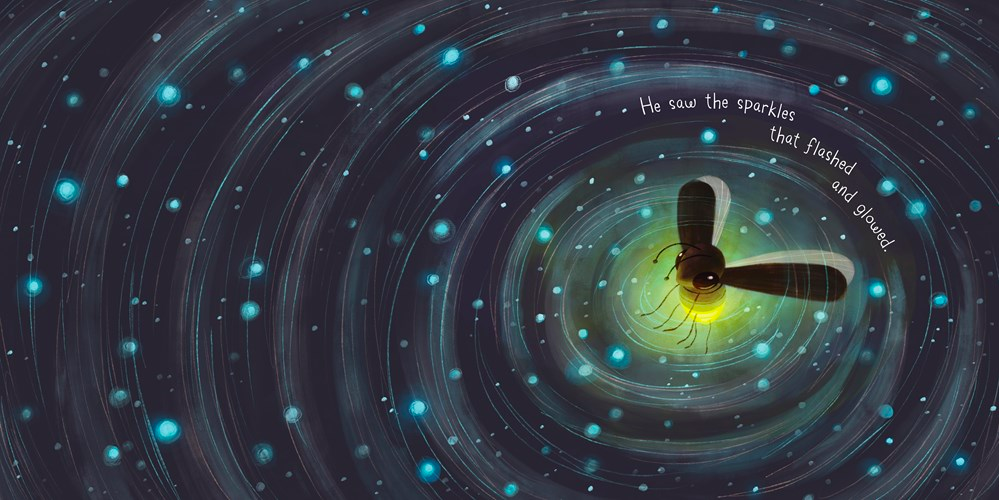
As the wind curled through the forest on a breezy night, a little firefly was blown out to sea. “WHOOSH! Now he was farther than he meant to be.” Floating on the current, “he saw the sparkles that flashed and glowed.” He dove in search of the twinkling lights, but deep water was not the place for him.

celebrate-picture-books-picture-book-review-fly-firefly-whoosh

Image copyright Ramona Kaulitzki, 2020, text copyright Shana Keller, 2020. Courtesy of Sleeping Bear Press.

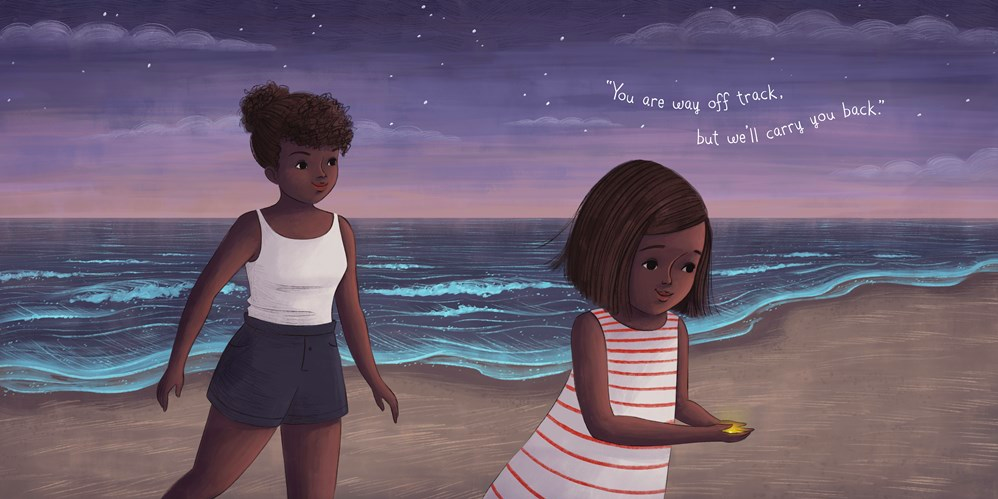
A woman and her niece, strolling along the beach, saw him sinking. The woman scooped him up and gently placed him in her niece’s hand. “‘Little firefly,’ Marjie said. / ‘It’s not flies that you see! / That’s bioluminescence swirling / and twirling through the great sea!’” Marjie carried her treasure up the beach to the edge of the woods, where hundreds of glittering friends and family were waiting to welcome him back, and she set him free.

Following the story, Shana Keller includes a discussion about Rachel Carson—scientist and author of Silent Spring and other books whose experience inspired this story­­—and a description of fireflies and bioluminescence.

celebrate-picture-books-picture-book-review-fly-firefly-marjie

Image copyright Ramona Kaulitzki, 2020, text copyright Shana Keller, 2020. Courtesy of Sleeping Bear Press.

Shana Keller’s glowing and lyrical story about one misdirected firefly that sparks an act of compassion and discovery will inspire children to learn more about both fireflies and the bioluminescent sea creatures that attracted him. The fact that the story is based on an actual event in the life of Rachel Carson will also appeal to readers, who may enjoy sharing one of their favorite marvels of summer with this influential environmentalist and author. Told in the first person, the story directly invites children to observe nature around them and lend a hand in protecting it.

celebrate-picture-books-picture-book-review-fly-firefly-sparkles

Image copyright Ramona Kaulitzki, 2020, text copyright Shana Keller, 2020. Courtesy of Sleeping Bear Press.

Ramona Kaulitzki’s illustrations are as beautiful as a summer sunset. Under the pink and lavender sky, dots of light flit among the bushes and low-standing trees. Children first meet the firefly at the center of the story as he’s tumbling head over tail in the wind toward the rippling ocean. As the firefly mistakenly dives into the waves, kids will empathize with his plight and be cheered when Marjie and her aunt rescue him. Kaulitzki’s gorgeous underwater images highlight the diversity of marine creatures found close to shore as well as those that glitter with bioluminescence. The brilliant glow of the firefly on the dusky pages glimmers like a precious jewel and serves as a beacon of the hope and promise of nature.

A unique book for kids who love nature and to inspire studies of bioluminescence, Fly, Firefly! would be a shining addition to home, school, and public library collections.

Ages 5 – 7

Sleeping Bear Press, 2020 | ISBN 978-1534110335

Discover more about Shana Keller and her books as well as extensive teacher and homeschool resources and readalouds of her books on her website.

To learn more about Ramona Kaulitzki, her books, and her art and find free coloring pages to download in her shop, visit her website.

Meet Shana Keller

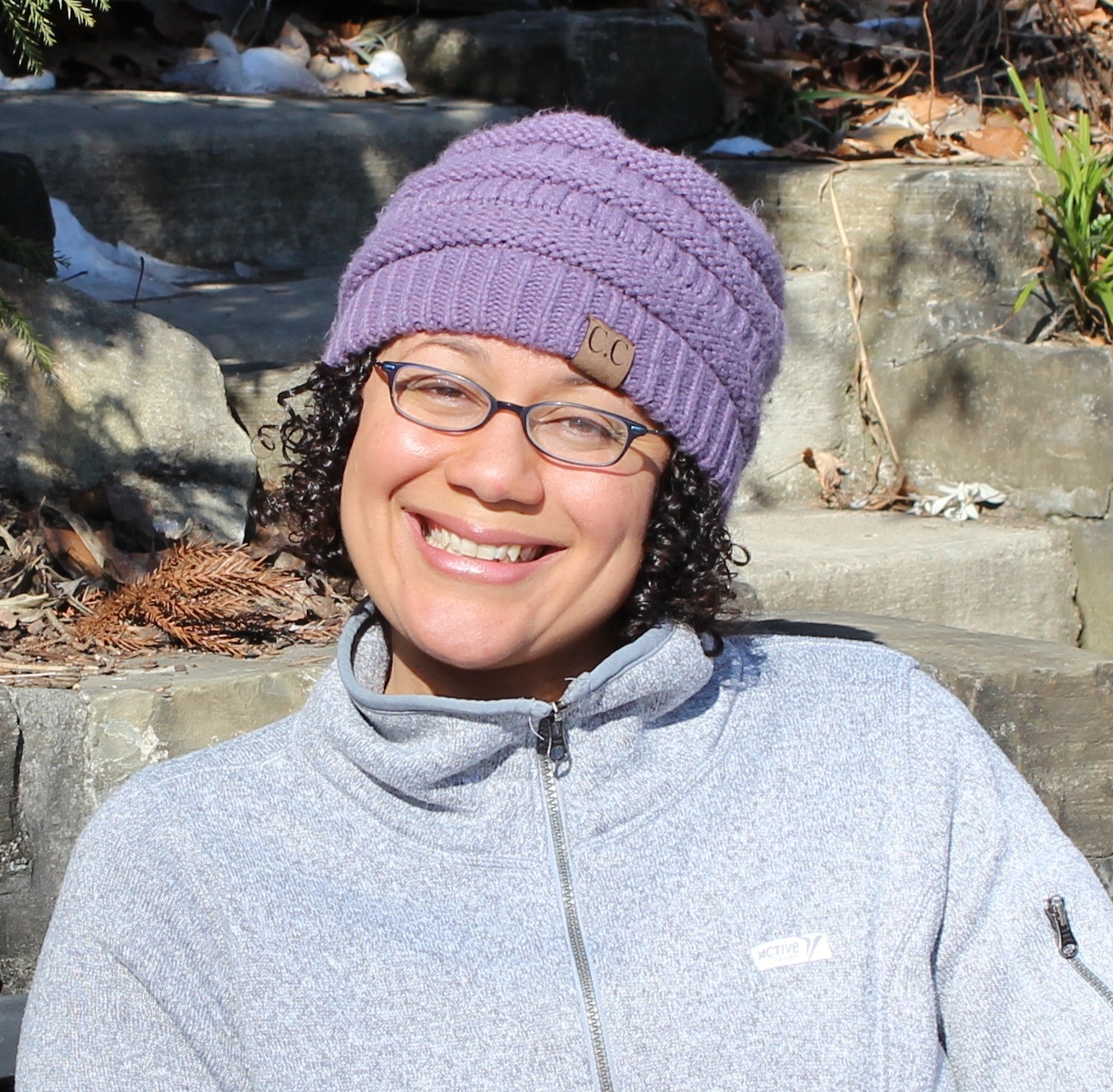
celebrate-picture-books-picture-book-review-shana-keller-headshot

Shana Keller grew up a middle child in Middle America wondering exactly how clouds stayed in the air. She’s traveled all over the country and some parts of Europe with her family and moved too many times to count. She’s settled in Pittsburgh for now, a city built just for kids and one that she finds secretly inspiring. One of her favorite quotes is from Benjamin Banneker. “Every day is an adventure in learning.” That said, she graduated from the University of Miami, Florida, with a degree in Communications, from UCLA’s screenwriting program, and took a course in songwriting from Berklee College of Music. Her goal is to never stop learning.

You can connect with Shana Keller on

Her website | Twitter | Instagram

I’m excited to talk with Shana today about her books, her inspirations, and her extensive travels. My writing partner Jakki’s sons Steve and Jack also loved Fly, Firefly! and had some questions for Shana.

Steve asked: We like to capture fireflies. Did you capture fireflies as a kid?

I did! My brother and sister and I would compete to see if we could get one of them to land on us.

Jack wondered: Did you watch real fireflies to write your story?

I was so lucky and grateful to live close to where Rachel Carson lived in Pennsylvania while I wrote this story, and to have a pond in our yard. We had frogs, fish, birds, and a good number of fireflies. I watched them every night in the summer when the weather was warm. There was so much wildlife in our backyard! We had chipmunks, groundhogs, wild turkeys, voles, and woodpeckers.

celebrate-picture-books-picture-book-review-shana-keller's-backyard

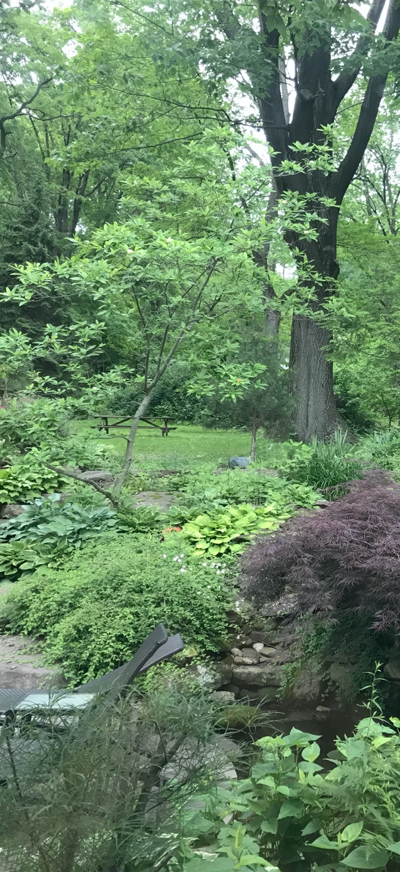
Our back yard in Pittsburgh. On the bottom right is the pond. Our cat loved to sleep on the picnic table up the small hill. Can you see it behind the little tree? Back there is where the groundhog moseyed around.

celebrate-picture-books-picture-book-review-Shana-Keller-Koi-Image

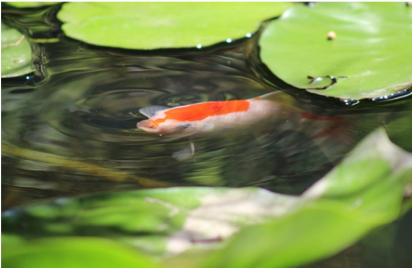
One of the koi fish in our pond surrounded (and protected) by lily pads.

celebrate-picture-books-picture-book-review-Shana-Keller-groundhog-Image

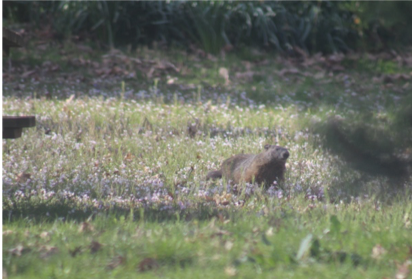
A groundhog just past the picnic table in our (former) backyard.

CBP Shana Keller Toad Image

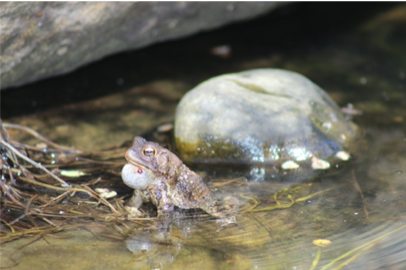
A picture of our frog in the same pond as the koi. Lots of critters lived in it and used it for water.

We don’t live in Pittsburgh anymore and I really miss that yard. Sadly, I haven’t seen any fireflies in my new neighborhood in North Carolina.

Jack and Steve said: We’ve brought frogs back to a pond. Have you ever rescued an animal?

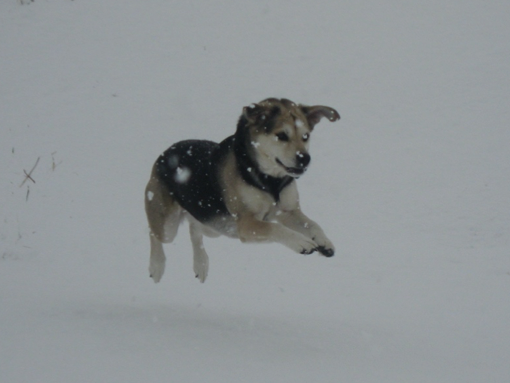
Yes! In the traditional sense, our last dog Abby, was a pound puppy. (Though she has passed, I included a photo.) She always stayed up with me while I wrote, no matter how late it was. I still miss her, so it was the neatest surprise for me to see a beagle in the illustrations for Ticktock Banneker’s Clock. Abby was part beagle.

celebrate-picture-books-picture-book-review-Shana-Keller-Dog-Image

Abby running in the snow. She always looked like a deer or rabbit the way she bounded and jumped!

celebrate-picture-books-picture-book-review-Shana-Keller-cat-Image

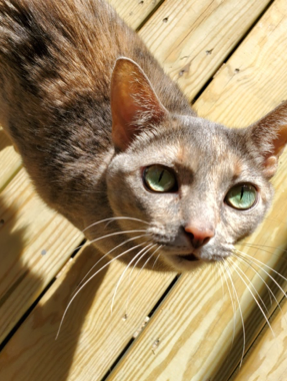
Jazzy standing outside on our deck.

Today, one of our cats is also a rescue. Her name is Jasmine, but we call her Jazzy. And yes, in the literal sense I have rescued a handful of animals! My most memorable one was when I was about ten or eleven years old and I rescued a squirrel from my aunt’s swimming pool.

The little squirrel had tried to jump from one tall tree to the next and missed. He fell into their round pool. The water was too low, and the ledge was too high for him to climb out. I didn’t want him to drown, so I looked around the yard and grabbed a tree branch to see if he would climb onto it. He didn’t. Then, I ran into the shed and grabbed the biggest (which was also the heaviest) shovel I could find. The squirrel swam away from me even faster than before! I chased after him wielding the long shovel and tried not to rip the lining of the pool. Round and round we went until he finally slowed down long enough, I was able to scoop him out.

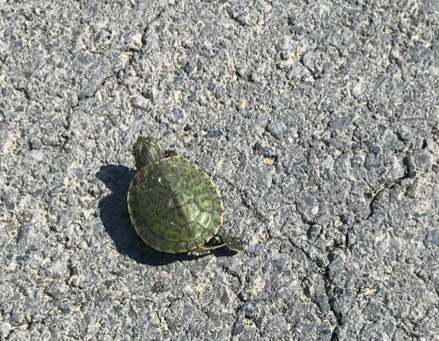
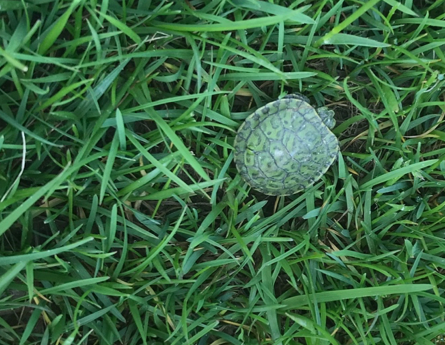
I’ve also stopped to scoot turtles along if I see them in the middle of the street. This one (photos are of the same turtle) was the littlest and also brightest green turtle I have ever seen in nature.  

celebrate-picture-books-picture-book-review-Shana-Keller-turtle-pavement-Image

A little turtle crossing the street.

celebrate-picture-books-picture-book-review-Shana-Keller-turtle-grass-Image

A picture of the same little green turtle after I moved him. It looked like he was headed toward a pond. I helped him cross the street so he could get there.

Hi, Shana! What fantastic stories about your love of nature and your pets! Thanks so much for sharing all of these beautiful pictures with us. I can see that nature has really been a life-long inspiration. What sparked your idea to write this particular story?

A few years ago, I read a letter Rachel Carson wrote to her friend Dorothy Freeman in a book called Always, Rachel. In her letter, Rachel and her niece, Marjorie (nicknamed Marjie), came across a firefly while at her summer home in Southport, Maine. Around midnight, Rachel and Marjie headed down to the shore to secure Marjie’s son’s raft.

On the shore, they turned their flashlights off and saw a sea filled with “diamonds and emeralds.” The sparkling was bioluminescence, a (likely) form of marine plankton called Dinoflagellates. Rachel joked with her niece how one gem “took to the air!” Of course, it was a firefly! Well, further in the letter, Rachel tells her friend that she had already thought of a children’s story based on her experience. That sentence is what sparked the idea! 

What kind of research did you do in writing Fly, Firefly! and the back matter about bioluminescence that follows the story? What was the most surprising thing you learned about fireflies?

With this story, I headed to the library first to learn as much about the area Rachel was located in (Maine), and the insects and bioluminescence there. Once I sorted through all of my facts, I reached out to an entomologist here in North Carolina, the director of the Rachel Carson Homestead in Springdale, Pennsylvania, and a marine biologist who studied at the very same Marine Biology Lab Rachel did.

I also read Rachel’s books to get a sense of her voice and style. It filters through in her letters, but her books definitely have a poetic aura about them.

The most inspiring thing I learned was the importance and prominence bugs have in our world. We take them for granted. We call many of them pests. But the truth is, they are an important part of our ecological system. As I discovered with fireflies, when you have them, it is a good indication that your ecosystem is in great health.

What inspired you to write Fly, Firefly! in verse?

While I was researching, I discovered Rachel Carson had a love of poetry. Though this is not pertaining (that I know of) to the children’s story she discusses; in another letter written to her, she was quoted by her friend Dorothy (regarding Rachel’s poetic aims), as having said, “I just want it to be simple and clean and strong and sharp as a sword—for it has work to do!”

I did my best to honor her vision in that way, so I kept it lyrical, simple, and clean!

In your bio, you describe how you’ve traveled and lived all over the country and in parts of Europe. What took you to all of these places? Can you name a favorite place in the US? In Europe? Why are those places special to you?

People always assume I was a military brat when I’m asked about the places I’ve lived. Family and school took me/us to Oklahoma (my birth state), Kansas, Florida, Pennsylvania and Texas. Adventure and jobs took me/us to Colorado, New Mexico, Virginia, Germany, & North Carolina.

My mom simply said she had wanderlust and gypsy blood. I definitely got my love of travel from her. Although now, with my kids in school we have settled down. At least until they graduate. J

My absolute favorite place in the United States is Big Bend national park. My mom and I camped there the year before I left for college. It’s right on the border of Texas and Mexico in a NO-FLY zone which means zero light pollution. Seeing the vast Milky Way at night is something I will carry with me forever. I wish every kid could see the sky that I saw.

My favorite place in Europe was in Berlin. It was the bombed Kaiser Wilhelm Memorial Church left as it was after the war and converted into a museum. When I first saw this monument of destruction but also of hope, it impacted me in a strong way. My photo from over ten years ago is on the left and does not do it justice. The photo on the right is what it originally looked like. It is definitely worth a Google search to see more pictures of it and compare the before and after.

celebrate-picture-books-picture-book-review-Shana Keller-Kaiser-William-Memorial-Church-after-Image

My photo of the Kaiser Wilhelm Memorial Church. Notice the top tower is broken.

celebrate-picture-books-picture-book-review-Shana Keller-Kaiser-William-Memorial-Church-Before-Image

An online photo of the Kaiser Wilhelm Memorial Church. See how big it was before the bombing?

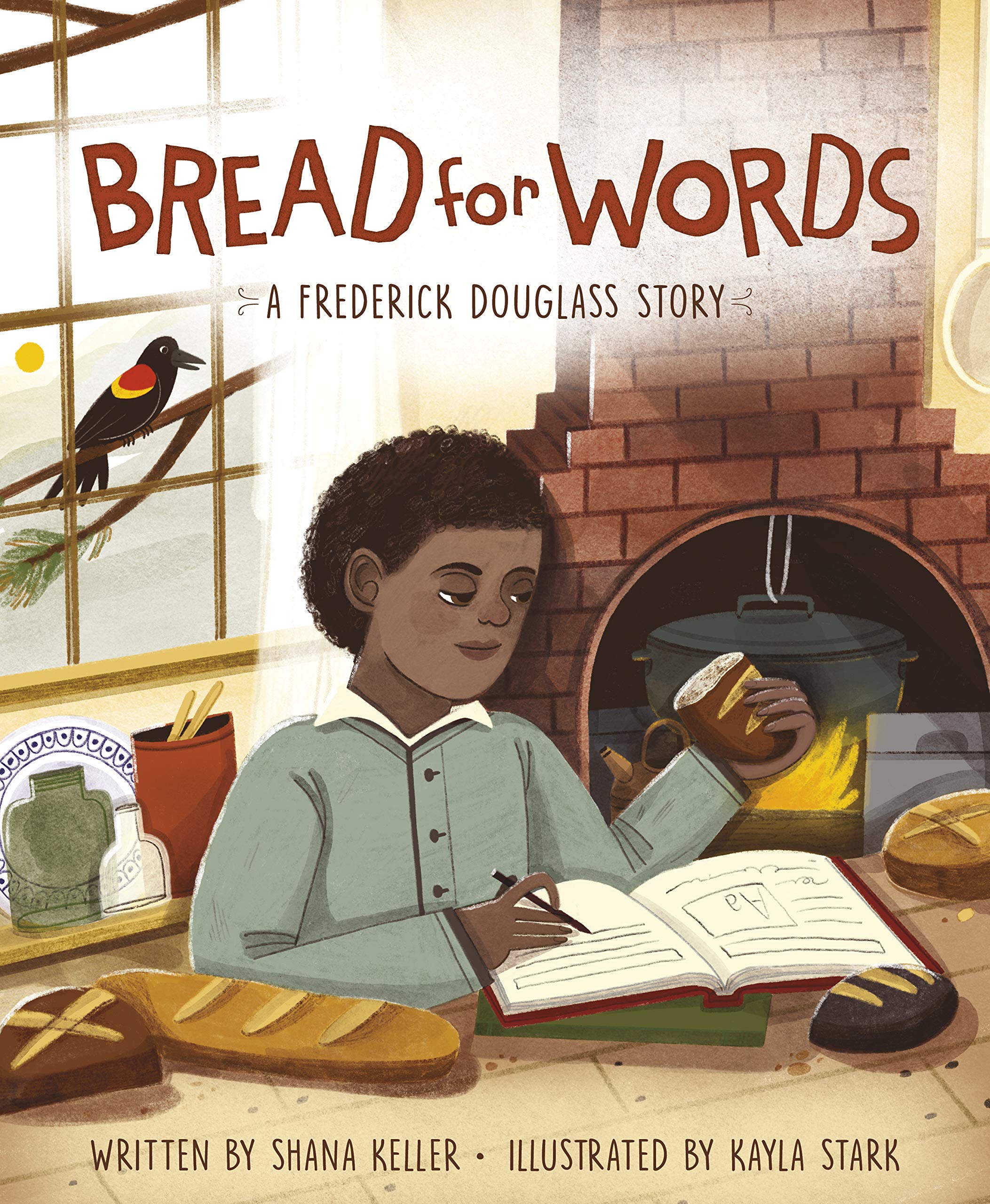
You’ve also recently released Bread for Words: A Frederick Douglass Story from Sleeping Bear Press that relates how Douglass, born into slavery, taught himself to read and write despite overwhelming challenges. Your powerful telling of this story is written in first person. Why was writing Douglass’s story in first person important to you?

I was first introduced to Douglass’s autobiographies in college. I thought this was way too long of a wait to learn about someone who was the most photographed person in 19th century America and considered one of the greatest orators in our nation.

Frederick struggled for years in a hostile environment while he learned to read and write. To honor his accomplishment, one he was clearly proud of, I wanted to present this story in the same format he had and give children direct access to his own words.


celebrate-picture-books-picture-book-review-bread-for-words-cover

Can you describe a little about your process in writing Bread for Words?

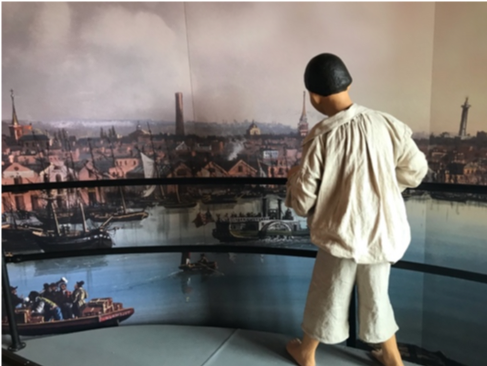
I read Douglass’s autobiographies of course, but I also studied his speeches. I was able to take a trip to Baltimore and meet with Urban Ranger and docent, Bradley Alston thanks to the folks at Baltimore National Heritage Area. His insight and knowledge not just of Frederick Douglass but of the Baltimore Douglass grew up in was incredible. Touring the Frederick Douglass–Isaac Myers Maritime Park and museum (a place I highly recommend) with Bradley Alston rounded out my research. I’ve included a few photos from that trip!

celebrate-picture-books-picture-book-review-Shana-Keller-Frederick-Douglass-Museum-Image-1

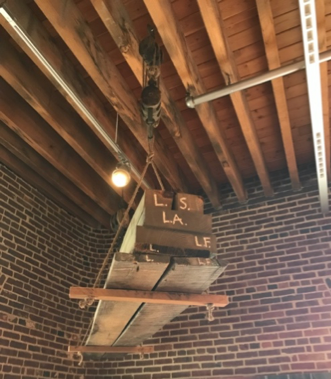
A recreation of Frederick Douglass arriving in Baltimore. (Photo taken at the Frederick Douglass-Isaac Myers Maritime Park and Museum.)

celebrate-picture-books-picture-book-review-Shana-Keller-Frederick-Douglass-Museum-Image-2

A recreation of the letters Frederick Douglass saw carved into the wood. (Photo taken at the Frederick Douglass-Isaac Myers Maritime Park and Museum.)

celebrate-picture-books-picture-book-review-Shana-Keller-Frederick-Douglass-Museum-Image-3

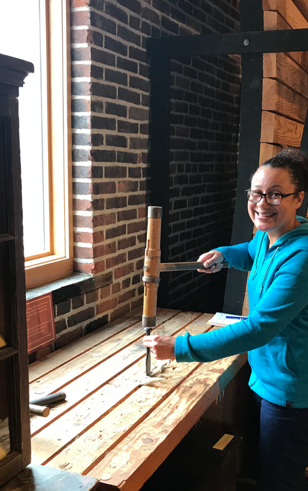
This is me learning what it was like to caulk a ship, a job Douglass had. They took long rope, dipped it into tar and used the hammer and tool to wedge it in for a watertight seal. (Photo taken by Bradley at the Frederick Douglass-Isaac Myers Maritime Park and Museum.)

celebrate-picture-books-picture-book-review-Shana-Keller-Frederick-Douglass-Museum-Image-4

What Baltimore Harbor looks like today.

Did you always want to write for children? How did you get started?

I didn’t expect to, not at first. I always thought I would write screenplays. I got started when my oldest daughter came home with a small paragraph from school about a man named Benjamin Banneker. It was during Black History Month, and I was amazed that I had never heard of this scientist and astronomer. Curious, I began to research him. When I discovered he built a strike clock using only a pocket watch and a pocketknife, that was the story I shared with my daughter, and that’s when the idea to put it in picture book format took place. I haven’t stopped writing picture books since.

You’re really enthusiastic about connecting with readers. What’s your favorite part of book events and meeting kids? Do you have an anecdote from any event you’d like to share?

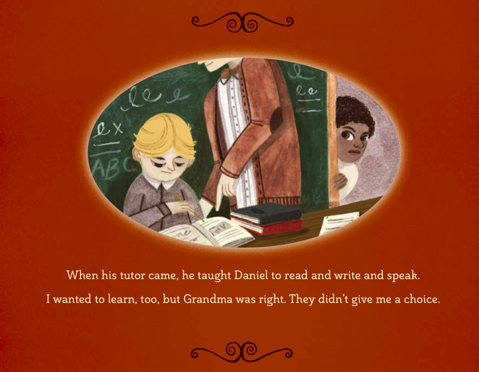
Yes! In fact, before all the quarantines, I had such a special moment with a group of fourth graders on the day I shared Bread for Words with them. A student referred to the picture that’s on the back of the cover and said, “See how Frederick wants to be with his friend?” The kids interpreted that image as Frederick waiting for his friend to finish with his tutoring so that they could play and hunt and eat together. But also waiting, so that his friend could teach him.

It seems so obvious now that they mentioned it, but my original interpretation was one of exclusion, not simply waiting. To them, all Fred had to do (which Fred actually did) was ask his friend for help. One of the 4th grade boys even said, “I’m glad he had a friend that could help him.” I agreed and said, “It’s amazing how all the kid’s helped each other, isn’t it?!” And there was the real ‘lesson’ which another student pointed out and said, “We have to help each other if we can.” That kind of interaction is my favorite part about school and library visits!

It does make me wonder how other students will interpret this image.

celebrate-picture-books-picture-book-review-Shana Keller Bread for Words Back Cover Image

Bread for Words – back cover. Courtesy of Sleeping Bear Press.

What’s up next for you?

Hopefully more picture books! I’m working on a WWI story, as well as a picture book that highlights the effects of light pollution on migratory birds. I also just finished a very cool Coast Guard story that I can’t wait to share with my editor.

Thank you, so much, Shana for this wonderful talk and your generous pictures! I wish you all the best with all of your books and am really looking forward to reading them as I’m sure kids are too!

You can connect with Shana Keller on

Her website | Twitter | Instagram

Rachel Carson Day Activity

celebrate-picture-books-picture-book-review-firefly-maze

Firefly Flight Maze


This little firefly wants to join her friends in the forest. Can you help her through the maze to find them in this printable maze?

Firefly Flight Maze Puzzle| Firefly Flight Mage Solution

celebrate-picture-books-picture-book-review-fly-firefly-cover

You can find Fly, Firefly! at these booksellers

Amazon | Barnes & Noble | Books-a-Million

To support your local independent bookstore, order from

Bookshop | IndieBound

Picture Book Review
May 20 – World Bee Day

celebrate-picture-books-picture-book-review-how-to-build-an-insect-cover

About the Holiday

Today is World Bee Day! These top-notch pollinators work hard to transport pollen from one flower to the next, so that plants can make their seeds, grow fruit, and launch the next generation of plants! In a larger sense, they keep the world spinning smoothly, by helping plants grow. World Bee Day was created by Slovenian beekeeper Bostjan Noc, president of the Slovenian Beekeepers Association, who first proposed the idea to the United Nations in 2014. The international holiday is meant to show appreciation for bees and other pollinators, and to acknowledge that some bee species are endangered. Make sure to respect and celebrate our bee friends today by reading books about bees, planting a pollinator garden, or installing a sustainable beekeeper. Visit https://www.worldbeeday.org/en/ and http://pollinator.org to learn about the importance of bees and the holiday. To summarize: bee friendly and keep reading.

Thanks to Millbrook Press for sharing a copy of How to Build an Insect for review consideration. All opinions about the book are my own.

Review by Dorothy Levine

How to Build an Insect

Written by Roberta Gibson | Illustrated by Anne Lambelet 


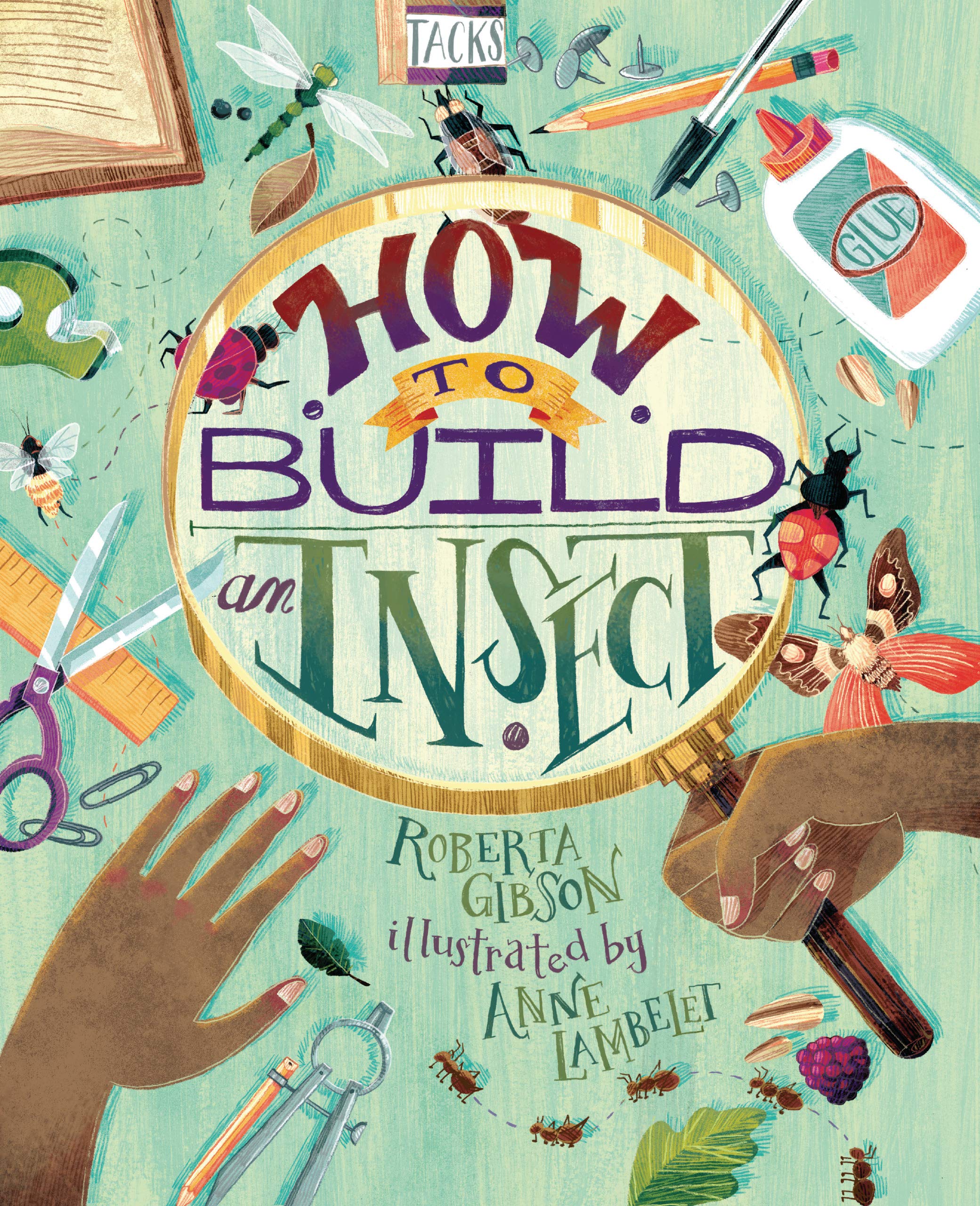
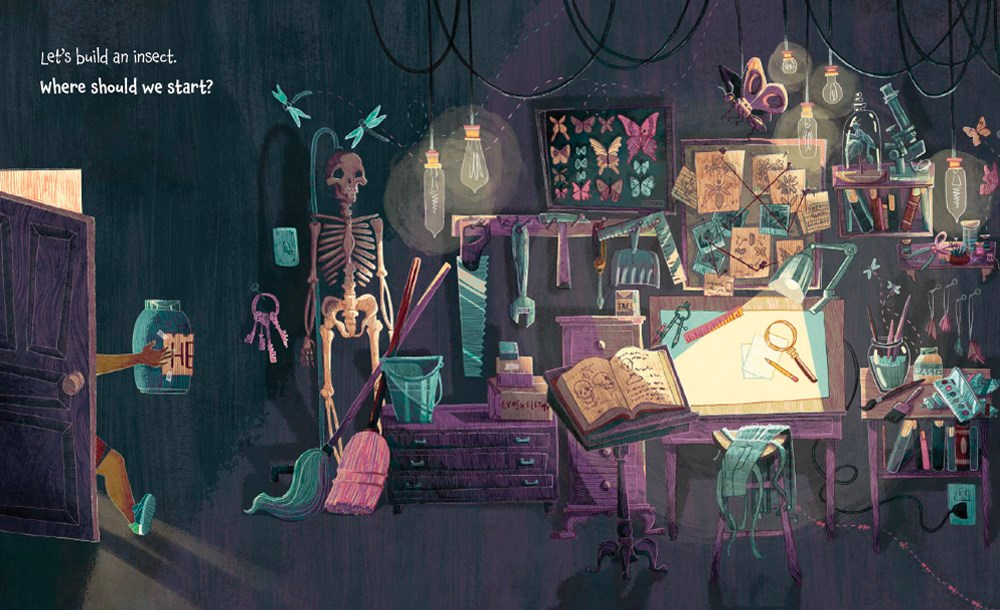
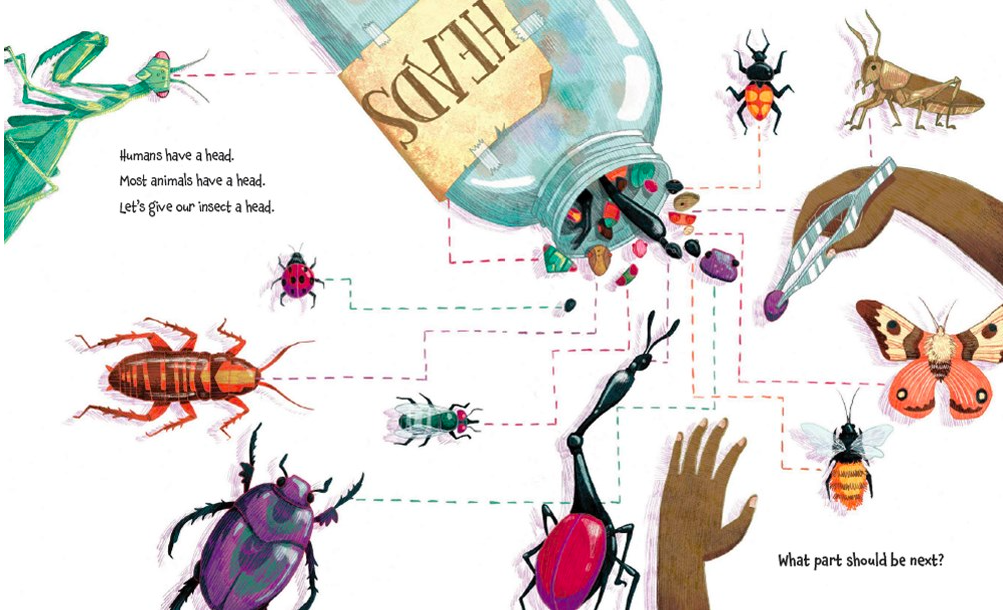
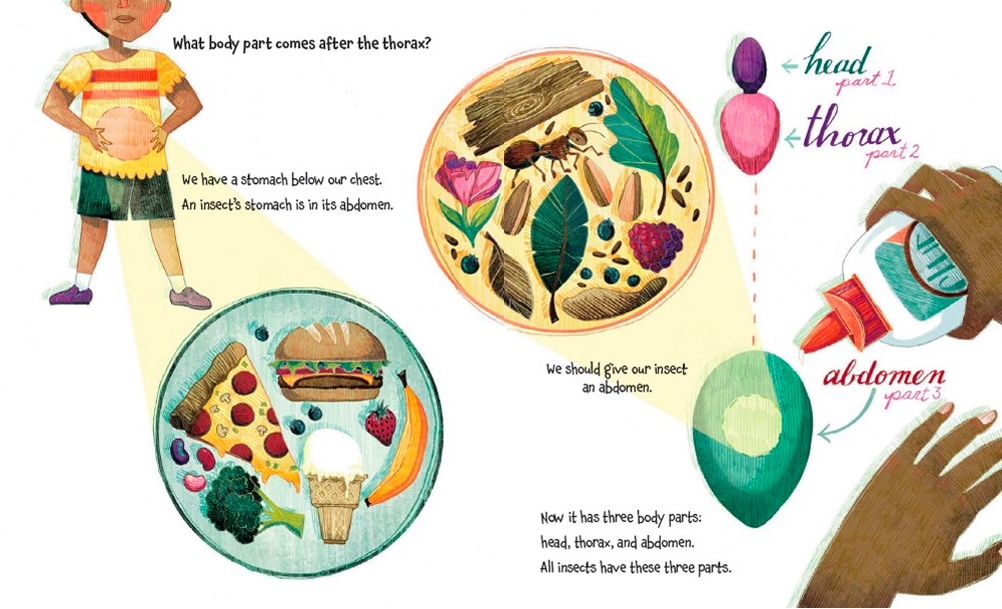
Have you ever wondered how to build an insect? Well, wonder no longer! Get ready to discover the world of creepy-crawlies with this hands-on, information-packed, quirky instruction-book! Ready to begin? First, gather your supplies. Got your “HEADS” jar? Great! Nearly every living creature has a head, and each one has a head that’s just right for them. So, pick a head from the jar and let’s get building. Next add a thorax and an abdomen to your creation. “What else should we add?” you may wonder. “What about bones like ours? Should we give it a skeleton? No. There isn’t any room for big bones inside a small insect. An insect has its skeleton on the outside. It is called an exoskeleton. The exoskeleton keeps the inside stuff in and the outside stuff out.” 

celebrate-picture-books-picture-book-review-how-to-build-an-insect-studio

Image copyright Anne Lambelet, 2021, text copyright Roberta Gibson, 2021. Courtesy of Millbrook Press.

After the correct number of legs and wings go on, the critical (and funky) five senses are added. “How will our insect see? Let’s give it some eyes! How many? Two? Guess again. Five!” The fun facts continue as sensory elements are added. Did you know, “An insect can have its ears anywhere”? This is “music to my knee ears!” a grasshopper chirps in, adding a comedic flare.

Finally, after adorning insects with “hair, or horns, or spikes, or spots” the builder is instructed to finally give their creation “a place to live and a snack.” The completion of the insect and its release into its habitat is followed by an detailed spread of a fly up close that contains further information about different insect body parts. The book also includes a glossary and information on how to create critters out of art materials and recycled parts.  

celebrate-picture-books-picture-book-review-how-to-build-an-insect-heads

Image copyright Anne Lambelet, 2021, text copyright Roberta Gibson, 2021. Courtesy of Millbrook Press.

The young narrator of How to Build an Insect leads readers on a journey of how to build an anatomically correct insect, with a new body part detailed on each spread. Readers will learn about comparative anatomy, what exactly classifies an insect as an insect, and how insect bodies compare to those of humans and other animals. With intricate illustrations detailing bug bits and parts, leaves, berries, skeletons, exoskeletons and a map of “how to” instructions, the book reads like a super-cool science scavenger hunt. The how-to pages are filled with scientific vocabulary that allows readers of all ages to learn the names of insect body parts, from thorax to mandibles, proboscis, cerci, spiracles, and more. 

celebrate-picture-books-picture-book-review-how-to-build-an-insect-abdomen

Image copyright Anne Lambelet, 2021, text copyright Roberta Gibson, 2021. Courtesy of Millbrook Press.

Roberta Gibson cleverly constructs a creative non-fiction storyline jam packed with enchanting scientific facts. Gibson pulled from her knowledge working as an entomologist and research specialist in crafting this fantastic premiere nonfiction picture book. Her well-crafted writing puts complex terms into digestible and interesting explanations that are accessible for kids and adults alike. The writing is snappy, humorous, educational and engaging, featuring silly insect dialogue, and questions bolded for readers to ponder. What more could one possibly ask for?

Anne Lambelet’s masterful illustrations not only provide visually entertaining content to accompany the story, but also provide further information and humor for curious, detail-oriented readers. Insects watch as a brown-skinned, unseen narrator assembles their own insect in their very own science learning space. Sometimes the insects pop in with silly dialogue or engage in human activities, all while maintaining their scientifically accurate appearances. The artwork matches the narrator’s curiosity and close attention to detail perfectly, while maintaining a funky, beautiful art style that is consistent throughout. Spreads are backed by beautiful bursts of purples and greens and feature labeled insect and human anatomy charts; intricate bug- and art-making tools are scattered throughout.

How to Build an Insect is a perfect book for science lovers, outdoorsy individuals, bug enthusiasts, and worm savers of all ages! Also, a good read for those who are less insect-lover-inclined to learn more about how these creatures are not all that different from us humans. A worthwhile addition to libraries, classrooms, and home collections. 

Ages 5 – 9

Millbrook Press, 2021 | ISBN 978-1541578111

Discover more about Roberta Gibson and her books on her website.

To learn more about Anne Lambelet, her books, and her art, visit her website.

World Bee Day Activities

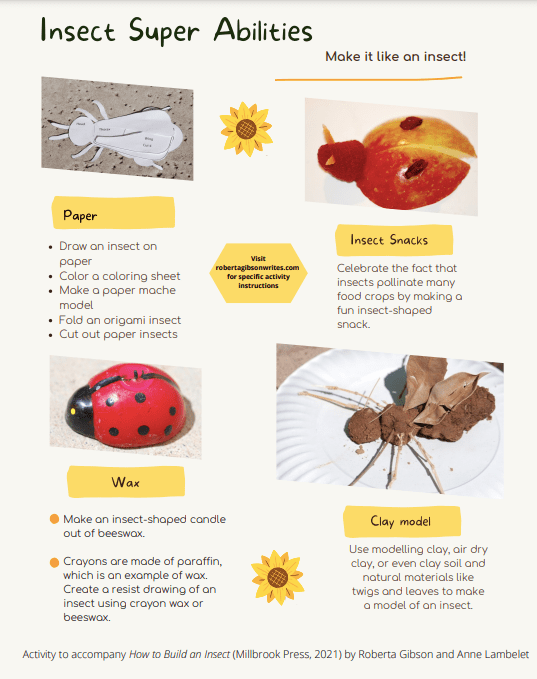
celebrate-picture-books-picture-book-review-how-to-build-an-insect-activities

Bee an Insect Lover Activities


Enjoy these fun and creative How to Build an Insect Activities and Experiments from Millbrook Press!

How to Build an Insect Activities

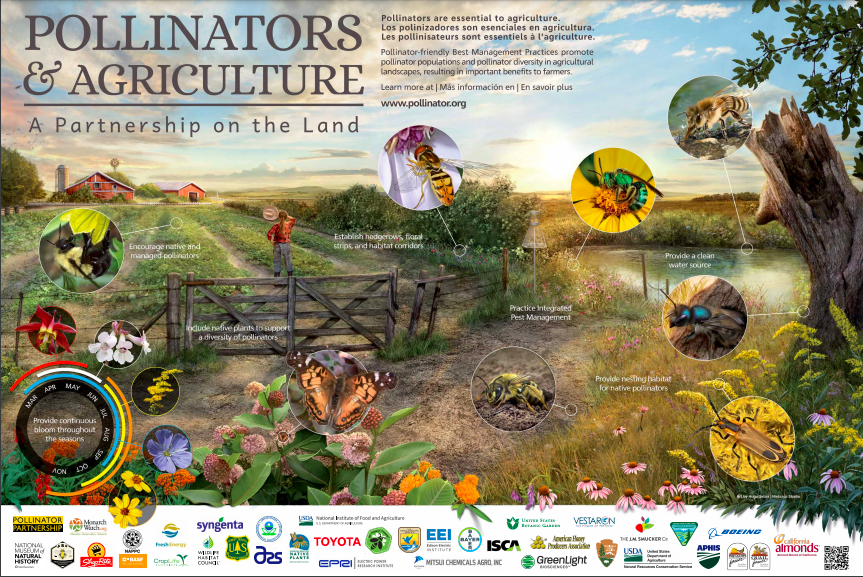
celebrate-picture-books-picture-book-review-how-to-build-an-insect-pollinators-poster

Download this Pollinators and Agriculture Poster that artfully teaches about how pollinators work in harmony with agricultural landscapes.

Pollinators Poster

celebrate-picture-books-picture-book-review-how-to-build-an-insect-cover

You can find How to Build an Insect at these booksellers

Amazon | Barnes & Noble | Books-a-Million

to support your local independent bookstore, order from

Bookshop | IndieBound

Picture Book Review
May 10 – It’s Garden for Wildlife Month

celebrate-picture-books-picture-book-review-a-garden-for-the-birds-cover

About the Holiday

As May’s warm weather and rain creates a perfect environment for growing a garden, today’s month-long holiday, established by the National Wildlife Federation, encourages people to plant a garden that will benefit birds, butterflies, bees, and other insect pollinators. This is easier than it may sound and can be accomplished in a variety of ways and sizes from a single pot or container to a dedicated “meadow” plot. Planting native flowering species makes a positive impact on your local area. To watch a video with five tips to help you garden for wildlife, find plants native to your region, and learn how to have your space recognized as a Certified Wildlife Habitat, visit the National Wildlife Federation website and Garden for Wildlife. Sharing today’s reviewed book is another wonderful way to learn how to make their yards, front gardens, and even whole neighborhoods inviting to wildlife.

A Garden to Save the Birds

Written by Wendy McClure | Illustrated by Beatriz Mayumi


One day while Callum and his sister Emmy were eating breakfast, a bird hit their window. They and their mom rushed outside to check on bird. It was okay and flew away, but that’s when Callum noticed that the window glass reflected the sky, and the birds couldn’t tell the difference. Later, Callum, Emmy, and their mom read about birds and learned lots of things they didn’t know – like how there are fewer birds now and how lights at night affect their migration. 

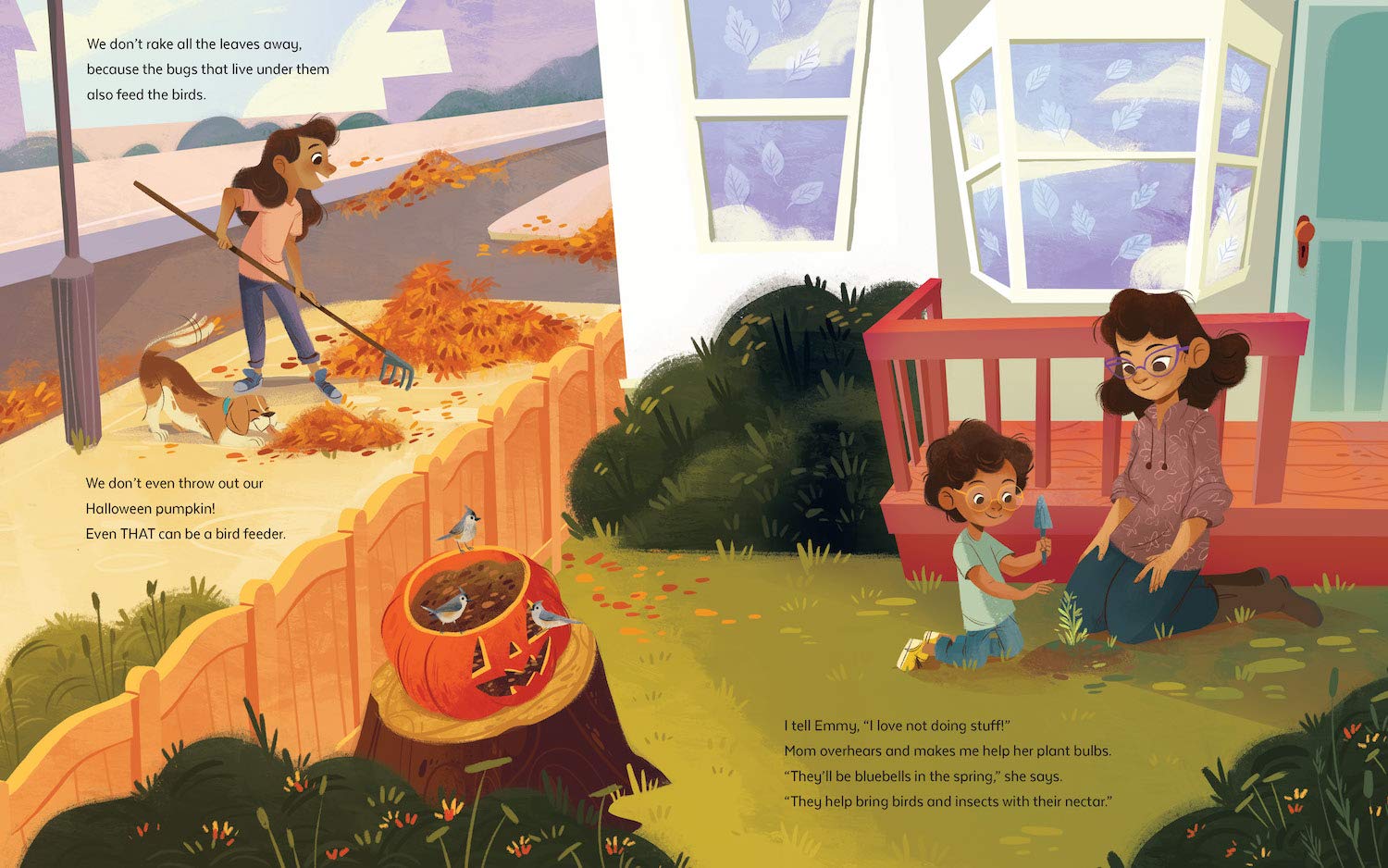
celebrate-picture-books-picture-book-review-a-garden-to-save-the-birds-raking

Image copyright Beatriz Mayumi, 2021, text copyright Wendy McClure. Courtesy of Albert Whitman & Company.

They decide to do things around their house to help the birds. They put out feeders and add decals to the windows. “But some of the things we do to help the birds,” Callum says, “are the things we don’t do.” In the fall, they’re mindful of where birds can find food. Even the Halloween Jack-o-lantern plays a part. And they plant bulbs to prepare for spring. It doesn’t take long before they attract a lot of different kinds of birds.

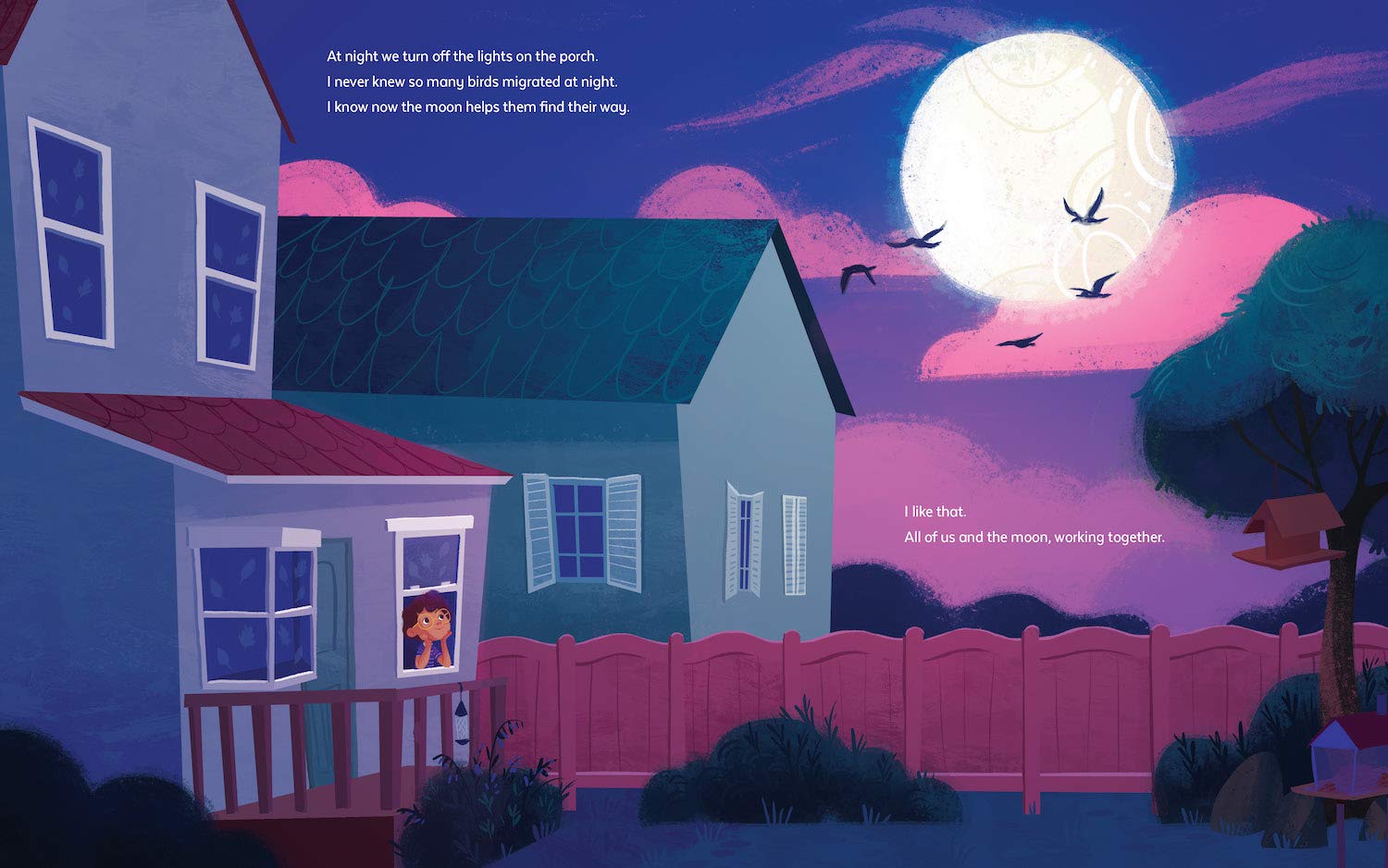
At night they take to turning off the porch lights and lowering the blinds so as not to confuse the birds. Callum looks up at the sky to see dark silhouettes flying by. “I never knew so many birds migrated at night,” he says. “I know now the moon helps them find their way.” He likes that now they and “the moon are working together.”

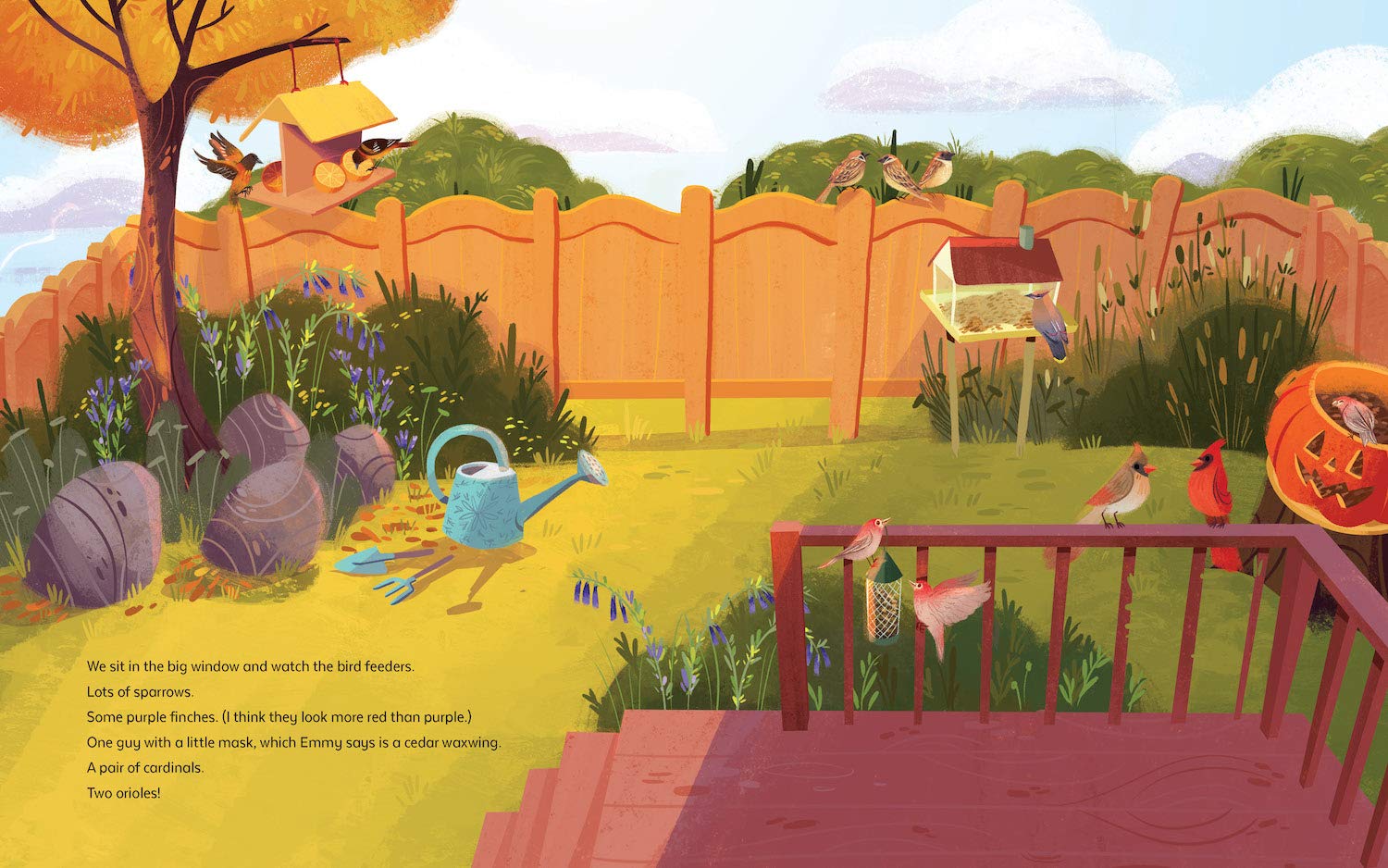
celebrate-picture-books-picture-book-review-a-garden-to-save-the-birds-feeders

Image copyright Beatriz Mayumi, 2021, text copyright Wendy McClure. Courtesy of Albert Whitman & Company.

During the winter, Callum and Emmy make sure the birds have shelter and fresh water. They also talk to their neighbors about the birds and some of the changes they could make to help them. At first Callum thinks their next door neighbor isn’t interested in helping, but then they notice that he’s turned off his porch light too. It turns out that everyone on the block is making positive changes.

When spring and summer roll around again and all the flowers and grasses are blooming, Callum discovers that they’re not only helping the birds, but that bees, butterflies, and other pollinators are attracted to the neighborhood too. In fact, the neighborhood has made such an impact that it is recognized with a sign as a certified wildlife habitat. Callum is glad that they have all worked together to make their block a welcoming home for birds and other wildlife.

Backmatter includes a discussion on the decreasing bird population, how kids and their families can create welcoming environments around their homes, and online resources for more information.

celebrate-picture-books-picture-book-review-a-garden-to-save-the-birds-night

Image copyright Beatriz Mayumi, 2021, text copyright Wendy McClure. Courtesy of Albert Whitman & Company.

In her charming and educational story, Wendy McClure strikes just the right tone to engage kids in learning about birds and how they can make changes around their homes to attract and help nurture birds and pollinators. Her storytelling is friendly and kid-centric, and readers will be drawn to Callum’s perspective and concern for wildlife and want to get involved in local environmental activism themselves. Adults will also find helpful and interesting tips on simple ways to make a yard or even a small area bird– and pollinator-friendly. 

Beatriz Mayumi’s lovely and detailed illustrations depict the variety of backyard birds that visit inviting landscapes as well as the beauty of garden plantings. She also clearly and realistically portrays the kinds of feeders, water bowls, nesting boxes, and natural vegetation that attract birds year round. In her images, Mayumi also reminds readers about light pollution and where it comes from in a neighborhood setting. Her beautiful illustrations of the gardens created with such care as well as her depictions of Callum and his family and the whole neighborhood working together will inspire readers to get involved in helping to save the birds.

A charming and inspirational story as well as an excellent guide to turning any area into a sanctuary for birds and pollinators, A Garden to Save the Birds is a book that families and classrooms will turn to again and again. It is highly recommended for all kids and for public library collections.

Ages 4 – 8 

Albert Whitman & Company, 2021 | ISBN 978-0807527535

Discover more about Wendy McClure and her books on her website.

To learn more about Beatriz Mayumi, her books, and her art, visit her website.

Garden for Wildlife Activity

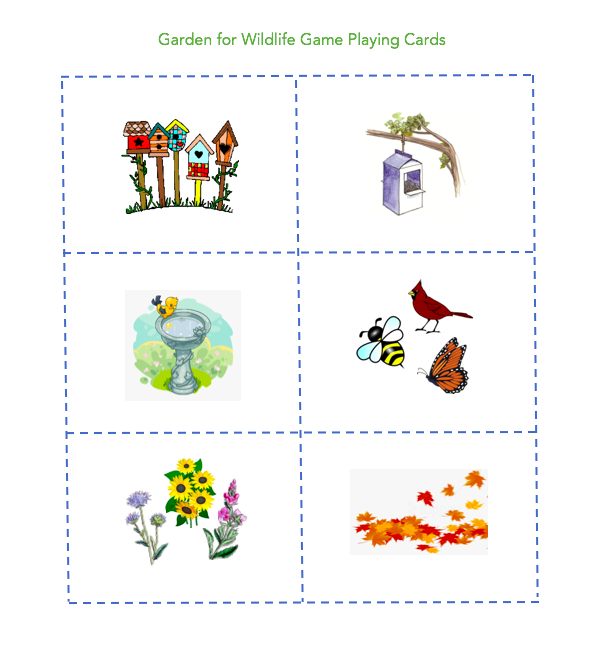
celebrate-picture-books-picture-book-review-garden-for-wild-life-playing-cards

Garden for Wildlife Board Game


Plant flowers, install a bird feeder and birdbath, build some birdhouses, and leave a layer of leaves then invite the birds, butterflies, and bees to your garden plot to win the game!

Supplies

Directions

  1. Print one set of playing cards and garden plot (if using) for each player
  2. Print playing die
  3. Color garden plot, paper, or paper plate (optional)
  4. Choose someone to go first.
  5. Each player gets one roll of the die per turn.
  6. Roll the die and place the face-up object in your garden plot. If the player rolls the bird, butterfly, and bee before they’ve added all the other elements, play passes to the next player 
  7. Players continue rolling the die and adding objects to their garden plots. After a player collects them all, they must roll the bird, butterfly, and bee to win.  

celebrate-picture-books-picture-book-review-a-garden-for-the-birds-cover

You can find A Garden to Save the Birds at these booksellers

Amazon | Barnes & Noble | Books-a-Million

To support your local independent bookstore, order from

Bookshop | IndieBound

Picture Book Review
April 26 – National Audubon Day

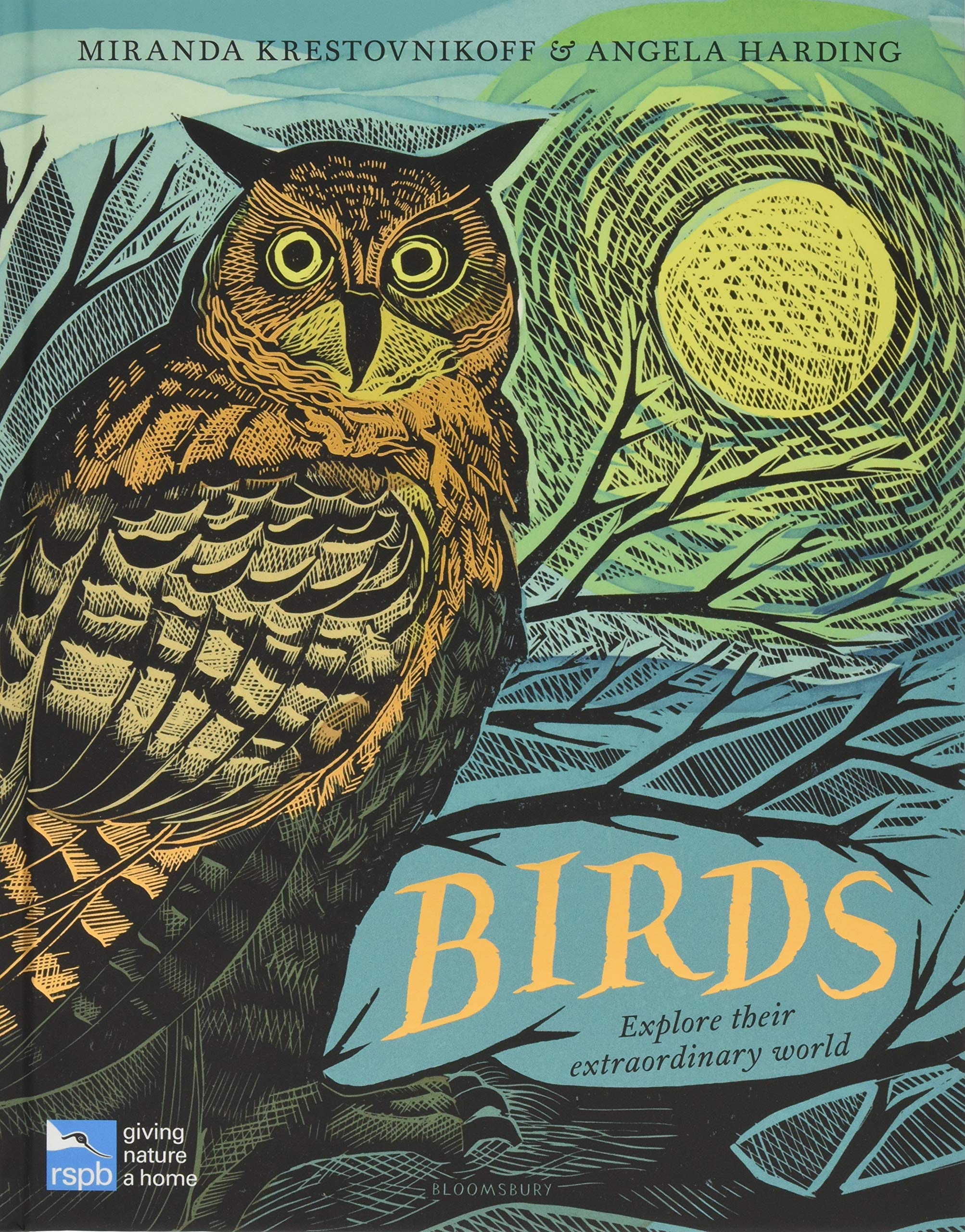
celebrate-picture-books-picture-book-review-birds-explore-their-extraordinary-world-cover

About the Holiday

Today’s holiday honors John James Audubon, who was born on this date in 1785. Audubon was a French-American ornithologist, naturalist, and painter who traveled across America, documenting the birds he found in his detailed illustrations of them in their natural habitats. Audubon’s greatest work was The Birds of America, which is considered one of the finest ornithological works ever completed. This book contains more than 700 North American bird species with 435 hand-colored, life-size prints of 497 bird species. The Audubon Society is a far-reaching organization dedicated to conservation and education and is actively involved in issues that threaten bird populations. To learn more about the Audubon Society and its work, visit the organization’s website.

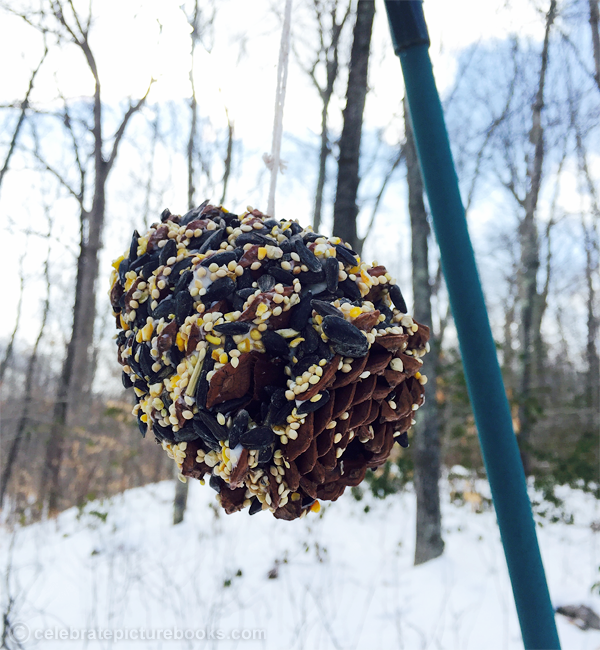
To celebrate today’s holiday, take a walk in your area or even your backyard and take special note of the birds you see. If you’d like to attract more birds to your backyard, consider hanging a bird feeder or making a temporary feeder from a pinecone, peanut butter, and seed as in the activity below. 

Thanks to Bloomsbury Children’s Books for sending me a copy of Birds: Explore their extraordinary world for review consideration. All opinions on the book are my own.

Birds: Explore their extraordinary world

Written by Miranda Krestovnikoff | Illustrated by Angela Harding


To love birds is to marvel over everything about them from their smooth gliding flight and beautiful songs to their colorful plumage and intricate nests that protect fragile eggs from the elements and predators. With a stunning number of species, birds are found around the world and living in every kind of climate. In Miranda Krestovnikoff and Angela Harding’s eye-catching compendium, readers learn about seven families of birds – birds of prey, seabirds, freshwater birds, flightless birds, tropical birds, tree dwellers, and passerines. 

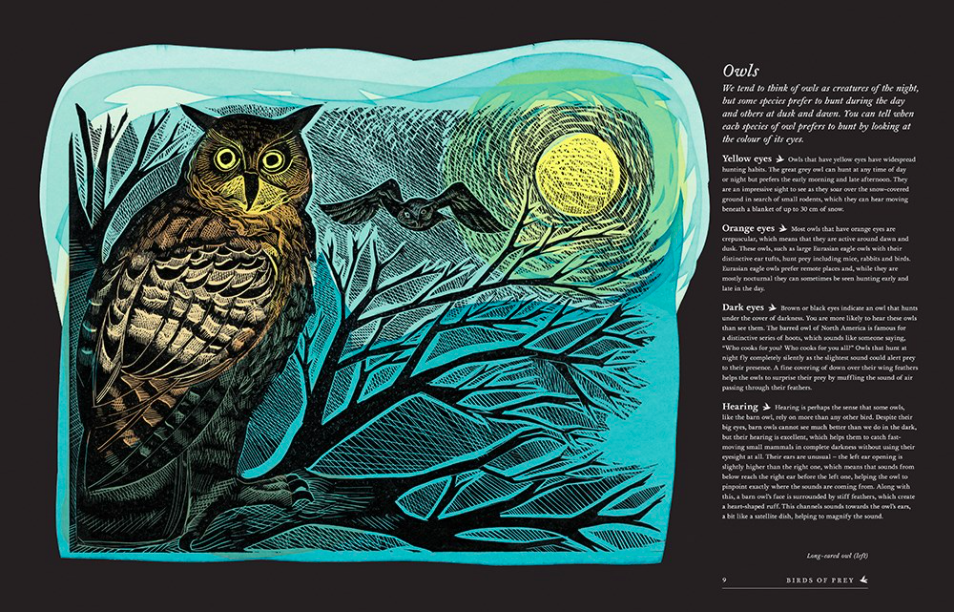
Each chapter opens with general facts on the behavior, anatomical features, and habitat that determine the order in which a bird is categorized. Integrated with this information are descriptions of specific birds within the order. In the section on Birds of Prey, for instance, readers learn about sparrowhawks; fish-eating ospreys; and golden eagles, which can “spot a rodent from over a mile away and a rabbit from nearly double that distance.” Children also learn about extreme birds of prey: the fastest, largest, smallest, tallest, and baldest and how their distinctive feature helps them thrive. Kids also discover how they “can tell when each species of owl prefers to hunt by looking at the color of its eyes.”

celebrate-picture-books-picture-book-review-birds-explore-their-extraordinary-world-owls

Image copyright Angela Harding, 2020, text copyright Miranda Krestovnikoff, 2020. Courtesy of Calkins Creek.

The next chapter takes readers to coastal areas to learn about the seabirds that scour the water from the sky, searching for food and waders, that are found along the water’s edge and “feed on the variety of high-protein invertebrates that lie hidden in the mud.” Children learn about the birds that populate warmer waters, such as blue-footed boobies, terns, and frigatebirds as well as those who survive in colder waters, such as gulls, and kittiwakes. Readers will also find a fascinating description of the gannet and learn how it can safely “dive into the sea at speeds of 60 miles an hour from an impressive height of up to 100 feet” to feed.

From sea birds, readers move on to freshwater birds like ducks, swans, grebes, and Canada geese. Even the bright flamingo is here with its distinctive scoop-shaped beak that is “uniquely designed to be used upside down and helps them to filter out tiny brine shrimps and blue-green algae from the water, which, when digested, give them their pink color.” The flamingo isn’t the only bird with an unusual way to acquire their prey, and kids will discover the clever ways pelicans, herons, and kingfishers (which use “objects such as sticks, feathers, and even discarded popcorn as lures”) find food.

And then there are the “more than 50 bird species across the world [that] stay firmly on the ground (or on water)” or just “choose not to fly very often.” These flightless birds include kiwis, kākāpōs, southern cassowaries, ostriches, and Penguins. Penguins vary in size, from the “little penguin (also known as the fairy or blue penguin)” which comes to shore to nest only at night and stave off predators with their oversized voices, to the emperor penguin. Occasional fliers include great bustards, domestic chickens, and tinamous.

celebrate-picture-books-picture-book-review-birds-explore-their-extraordinary-world-penguin

Image copyright Angela Harding, 2020, text copyright Miranda Krestovnikoff, 2020. Courtesy of Calkins Creek.

When you hear about extravagant birds, you most likely think of tropical birds. “Rainforests are packed with a range of incredible species with dazzling plumage and bizarre courtship displays.” Readers will learn about the appearance and mating rituals of scarlet macaws, Raggiana birds of paradise, and the Andean cock-of-the-rock. A detailed description of the bowerbird and the male bird’s careful and artistic nest (or bower) building is funny, poignant, and even a little bit human. Then readers are treated to some tropical bird extremes: smallest bird, longest bill, and smelliest as well as a poisonous species and one that makes its own musical instrument.

Of course, woodlands are the home of many bird species, and in the chapter on Tree Dwellers, readers learn about acorn woodpeckers and great hornbills that use trees for food and shelter; tawny frogmouths and potoos that use trees for camouflage; and nuthatches, greater honeyguides, and yellow-bellied sapsuckers, which find all the food they need among the bark, leaves, and branches of trees.

celebrate-picture-books-picture-book-review-birds-explore-their-extraordinary-world-chickens

Image copyright Angela Harding, 2020, text copyright Miranda Krestovnikoff, 2020. Courtesy of Calkins Creek.

Next up are passerines, or perching birds, which make up the “largest group of birds, with over half of all known species falling into this category.” Corvids, a group that includes the common raven, crows, magpies, and rooks, are considered to be the most intelligent birds. “These birds have a remarkable ability to solve problems in order to find food, in some cases performing better than young children or chimpanzees!” Readers will be impressed with their tricks and clever use of tools (that even include cars). Children learn about cooperative breeders, which rely on their extended family to help raise the young from year to year. Passerines also include many of the garden birds we find in our backyards and which fill the air with song. Readers discover facts about blue tits, robins, and finches in this section.

The next sections give detailed and interesting information on the features we most associate with birds: their feathers, beaks, eyes, nesting habits, eggs, migration patterns, and birdsong. The book ends with perhaps the most adaptable birds in the world: those that make their homes on glaciers, mountain tops, and in the Arctic snow as well as urban birds, which live among people in crowded cities, nesting on tall cathedrals and skyscrapers and foraging for food in garbage cans and on the street.

celebrate-picture-books-picture-book-review-birds-explore-their-extraordinary-world-woodpeckers

Image copyright Angela Harding, 2020, text copyright Miranda Krestovnikoff, 2020. Courtesy of Calkins Creek.

For young ornithologists, Miranda Krestovnikoff, a wildlife expert, offers a compelling, eye-opening, and accessible introduction to a wide variety of birds, placing them in their natural environments and revealing intriguing facts and tantalizing tidbits that inform and will spark a continued interest in learning more about the world’s feathered creatures. Krestovnikoff’s engaging writing style will captivate readers and keep them turning the pages to discover birds that are both familiar and new to them. The comprehensive nature of the book allows kids in all parts of the world to learn more about their native birds while creating a global connection with these most recognized and widely distributed creatures.

Accompanying Krestovnikoff’s text are Angela Harding’s beautiful linocuts that depict birds in mid-flight, capturing prey on land and water, engaging in mating rituals, and building and protecting their nests and young. Harding’s use of natural colors and exquisitely etched landscapes set off each bird in breathtaking illustrations that invite readers to linger to enjoy their full impact. Each illustration is captioned with the bird’s species.

A gorgeous and educational book that readers of all ages will love dipping into again and again, Birds: Explore their extraordinary world is a must for bird lovers and highly recommended for home, school, and public libraries.

Ages 7 and up

Bloomsbury Children’s Books, 2020 | ISBN 78-1408893913

Discover more about Miranda Krestovnikoff and her books on her website.

To learn more about Angela Harding, her books, and her art on her website.

National Audubon Day Activities

celebrate-picture-books-picture-book-review-beautiful-birds-word-search

Beautiful Birds Word Search Puzzle


It’s fun to watch for different kinds of birds when you take a walk or in your own backyard. Can you find the names of twenty types of birds in this printable Beautiful Birds Word Search Puzzle? Here’s the Solution!

cpb-bird-feeder-i

Pinecone Bird Feeder


Pinecone bird feeders are quick to make and great for your backyard fliers. The combination of peanut butter, lard, or vegetable shortening and a quality seed mixture provide birds with the fat and nutrition they need to stay warm and healthy during the winter.

Supplies

  • Pinecones
  • Peanut butter, vegetable shortening, or lard
  • Birdseed
  • String
  • Knife or wooden spreader
  • Spoon

Directions

  1. Tie a long length of string around the middle of the pinecone
  2. Spread the peanut butter, vegetable shortening, or lard on the pinecone
  3. Sprinkle a thick coating of birdseed on the pinecone, pressing it into the covering so it will stick
  4. Tie the pinecone feeder onto a tree branch or other structure
  5. Watch the birds enjoy their meal!

celebrate-picture-books-picture-book-review-birds-explore-their-extraordinary-world-cover

You can find Birds: Explore their extraordinary world at these booksellers

Amazon | Barnes & Noble | Books-a-Million

To support your local independent bookstore, order from

Bookshop | IndieBound

Picture Book Review
April 21 – It’s Global Astronomy Month

celebrate-picture-books-picture-book-review-the-little-spacecraft-that-could-cover

About the Holiday

Instituted by Astronomers Without Borders, a group who sees in our shared sky an opportunity to create “a global community that appreciates, studies, and shares the wonders of the universe, to broaden perspectives, transcend borders, and improve lives,” The group’s goals are twofold: to inspire and empower a worldwide community of astronomy enthusiasts and educators through astronomy-related programs and to cultivate a diverse, international community dedicated to sharing the Earth’s resources equitably. To try to accomplish these goals, Global Astronomy Month brings people together with arts activities, parties, and special events. To find resources, such as April sky maps in English and Spanish, and more information on how you can participate, visit the Astronomers Without Borders website.

The Little Spacecraft That Could: New Horizons’ Amazing Journey to Pluto and Arrokoth

Written by Joyce Lapin | Illustrated by Simona Ceccarelli


As the little spacecraft blasted away from the launch pad on January 19, 2006, she thought that her name—New Horizons—“was a brave-sounding name. And you had to be brave to fly to the edge of the solar system.” New Horizons was on her way to Pluto—the first spacecraft to do so. Zooming through space, her engines dropped away in stages. Free of these engines the little spacecraft, “no bigger than a small piano… streaked through space at more than 10 miles per second.”

While she soared, New Horizons wondered what she would find when she finally reached Pluto. She knew that everyone was counting on her to provide answers about this mysterious planet. People had a lot of questions, and New Horizons had a lot of time to ponder them. In fact, it would take her “nearly 10 years to reach Pluto.” Things were going well for New Horizons. She was on track and jogging along at 36,000 miles an hour… but then on August 24, 2006, astronomers decided Pluto wasn’t big enough to be considered a planet and demoted it to dwarf planet status.

celebrate-picture-books-picture-book-review-the-little-spacecraft-that-could-launch

Image copyright Simona Ceccarelli, 2021, text copyright Joyce Lapin, 2021. Courtesy of Sterling Publishing.

Planetary scientists didn’t and don’t agree with this change, and New Horizons? She just wanted to complete her mission, and she had to concentrate on what came next—meeting up with Jupiter at just the right time to take advantage of this giant planet’s gravitational pull to speed up her trajectory toward Pluto. Carefully, New Horizons got into position. She sped faster and faster and was flung into space, heading toward her destination at “nearly a million miles per day.”

Now and for the next eight years, New Horizons would fly on autopilot while she took a well-deserved nap that would conserve fuel as well as her computers and instruments. Periodic wake-ups by the scientists on Earth made sure everything was going well. Finally, on December 6, 2014 it was time for New Horizons to wake up and go to work. She wouldn’t be landing on Pluto but doing a “flyby” 7,800 miles away from the surface of Pluto. At this distance the photographs she took would be clear and her other instruments for listening, smelling, feeling, and measuring other aspects of Pluto and its atmosphere would work too.

celebrate-picture-books-picture-book-review-the-little-spacecraft-that-could-robotic

Image copyright Simona Ceccarelli, 2021, text copyright Joyce Lapin, 2021. Courtesy of Sterling Publishing.

New Horizons couldn’t wait to get started and began snapping pictures “from half a million miles out.” What people saw when she sent back her photos “sent the internet on fire.” It appeared that Pluto was holding a white heart—a valentine for Earth. “Everybody loved the dwarf planet with a heart!” This heart is actually a glacier made of nitrogen, which on Pluto’s cold surface forms ice instead of gas like on Earth

On July 14, 2015, New Horizons at last reached her optimal distance, and what wonders she uncovered! Towering ice mountains, valleys deeper than the Grand Canyon, “‘ice blades’ the height of New York City skyscrapers,” and “‘ice volcanoes’…that spew out icy slush instead of lava.” This was only the beginning of what scientists discovered. Measurements also showed that Pluto was larger than was thought—bumping it up “from second-largest dwarf planet to the largest.”

celebrate-picture-books-picture-book-review-the-little-spacecraft-that-could-control-room

Image copyright Simona Ceccarelli, 2021, text copyright Joyce Lapin, 2021. Courtesy of Sterling Publishing.

New Horizons also took pictures and measurements of Pluto’s moons and, after snapping one last picture: Pluto “‘crowned’ with the hazy blue glow of its atmosphere” while lit from behind by the Sun, New Horizons was off for Arrokoth, an object in the Kuiper Belt that hadn’t even been discovered when she blasted off from Earth all those years ago. A billion miles later, New Horizons reached Arrokoth on January 1, 2019. New Horizons continues to send information about this fascinating body, and because she’s still so “robust…her team wants [her] to visit an even more distant Kuiper Belt world in the 2020s. No one doubts she can do it.

In addition to the story about New Horizons’ journey, each page contains illustrated insets with detailed facts and information about the New Horizons spacecraft, Pluto, our solar system, how the planets were named, and more.

Back matter includes a timeline of New Horizons’ journey, an extensive glossary, a list of books for further reading and research, and a list of internet resources where readers can see videos and learn more about New Horizons and her mission.

celebrate-picture-books-picture-book-review-the-little-spacecraft-that-could-pluto-heart

Image copyright Simona Ceccarelli, 2021, text copyright Joyce Lapin, 2021. Courtesy of Sterling Publishing.

Joyce Lapin’s thrilling true tale of New Horizons’ mission to Pluto and beyond lends pep and personality to this little spacecraft that the world watched blast off with the heart and anticipation of a parent sending their child off on their first day of school. Her engaging storytelling helps kids understand and appreciate the magnitude of New Horizons’ flight and all it has accomplished. Lapin’s clear descriptions of the various stages of the mission, scientists’ expectations, and the tricky maneuvering necessary to put New Horizons at the right place at the right time are delivered smoothly and concisely.

Scientific vocabulary and definitions are woven seamlessly throughout, enhancing the reader’s understanding without their losing any of the suspense. Kids will identify with the childlike nature of New Horizons’ confidence in herself and commiserate with her dismay when Pluto is demoted. Readers will cheer on this little spacecraft as her mission is expanded and will be excited to learn more about what New Horizons has already discovered and what she will find in the future.

Simona Ceccarelli’s illustrations are nothing short of phenomenal. Photographic in detail, Ceccarelli’s vibrant images take kids from the launchpad with the fiery rocket boosters produce clouds of smoke as the spacecraft climbs into the sky, into outer space, where they see how the engines disengaged to set New Horizons free to navigate past Mars, pick up speed from Jupiter (shown in its colorful, striped glory) and rocket past Saturn (the rocky debris of its icy rings clearly visible) to become just a dot in the black sky.

Ceccarelli also takes readers into the control room where graphs, screens, coordinates, and more line the walls and computers stand side-by-side on the desks and carefully observed by the mission’s directors. Images of the heart on Pluto include internet snapshots that will remind some readers of how the world reacted to the first images sent back by New Horizons.

The final images of Pluto, showing a landscape of ice blades, deep canyons, mountains, and swirling patterns of color and then backlit by the Sun, are breathtaking. The spacecraft itself is lightly anthropomorphized with expressive eyes and mouth and cable-thin arms. Drawn from all sides, the images of New Horizons give kids a good a look at this amazing spacecraft.

A sensational achievement in presenting the scientific and human accomplishments involved in the New Horizons mission as well as an exhilarating overview of our solar system, The Little Spacecraft That Could would be a stimulating addition to science units for elementary and high school students to spark a love for astronomy, engineering, research, and other related subjects. The book will be a favorite and is a must for home, classroom, and public library collections.

Ages 7 and up

Sterling Children’s Books, 2021 | ISBN 978-1454937555

Discover more about Joyce Lapin and her books, visit her website.

To learn more about Simona Ceccarelli, her books, and her art, visit her website

Global Astronomy Month Activity

celebrate-picture-books-picture-book-review-rocket-to-the-moon-tic-tac-toe-game

Out-of-This-World Tic-Tac-Toe Game


You can launch your own Tic-Tac-Toe Game with this set you make yourself! With just a couple of egg cartons, some crayons, and a printable game board, you’ll be off to the moon for some fun! Opposing players can be designated by rockets and capsules. Each player will need 5 playing pieces. 

SUPPLIES

  • Printable Moon Tic-Tac-Toe Game Board
  • 2 cardboard egg cartons
  • Heavy stock paper or regular printer paper
  • Crayons
  • Black or gray fine-tip marker

DIRECTIONS

To Make the Rockets

  1. Cut the tall center cones from the egg carton
  2. Trim the bottoms of each form so they stand steadily, leaving the arched corners intact
  3. Pencil in a circular window on one side near the top of the cone
  4. Color the rocket body any colors you like, going around the window and stopping where the arched corners begin
  5. With the marker color the arched corners of the form to make legs
  6. On the cardboard between the legs, color flames for blast off

To Make the Capsule

  1. Cut the egg cups from an egg carton
  2. Color the sides silver, leaving the curved section uncolored. (If your egg cup has no pre-pressed curve on the sides of the cup, draw one on each side.)
  3. Color the curved section yellow to make windows
  4. With the marker, dot “rivets” across the capsule

Print the Moon Game Board and play!

celebrate-picture-books-picture-book-review-the-little-spacecraft-that-could-cover

You can find The Little Spacecraft That Could at these booksellers

Amazon | Barnes & Noble | Books-a-Million

To support your local independent bookstore, order from

Bookshop | IndieBound

Picture Book Review