There are many ways to be smart—and they are all very cool! The world needs people who can think differently about all issues to solve problems, create art and literature that reflects our times and present alternate viewpoints, and just to make life funnier, more poignant, more beautiful,more livable. Today, celebrate your particular way of being smart and share it with others!
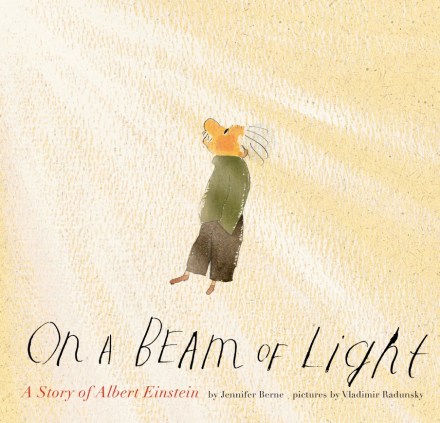
On a Beam of Light: A Story of Albert Einstein
Written by Jennifer Berne | Illustrated by Vladimir Radunsky
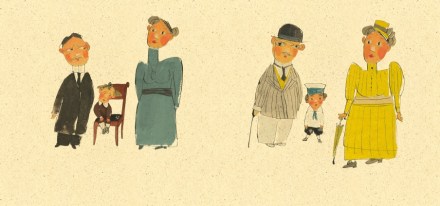
More than 100 years ago on a windy March day, a baby boy was born—Albert was his name. Albert turned one without saying a word. When Albert had his second birthday, he still hadn’t said a word. By the age of three Albert had only said a few words. “He just looked around with his big, curious eyes. Looked and wondered. Looked and wondered.” Albert’s parents were a bit worried because he was so different from other kids. But “they loved him…no matter what.”
Image copyright Vladimir Radunsky, courtesy of chroniclebooks.com
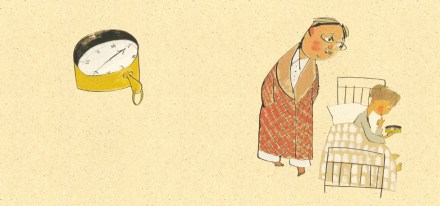
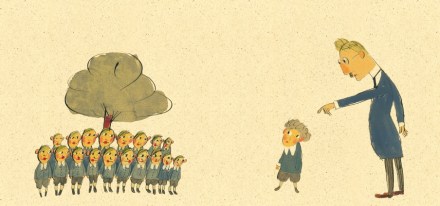
Once when Albert was sick, his father brought him a compass. As he watched the needle automatically spin to point north, “Albert was so amazed his body trembled. Suddenly he knew there were mysteries in the world—hidden and silent, unknown and unseen.” Albert began asking questions wherever he went. His teachers told him he was a “distraction” and that “he would never amount to anything if he didn’t behave like all the other students.” But Albert didn’t want to be like other kids.
Image copyright Vladimir Radunsky, courtesy of chroniclebooks.com
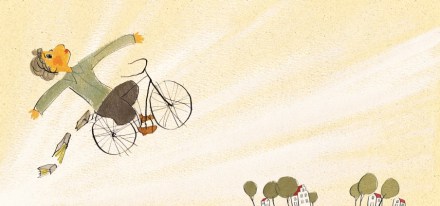
While on his bicycle one afternoon, Albert wondered what it would be like to ride a beam of sunlight. He was excited by this idea and it filled him with questions. He began to study light and sound, heat, magnetism, and gravity. He also read about numbers, which to him were like a secret language. Still, Albert had many more questions. After college he wanted to teach the subjects he loved, but he couldn’t find a job.
Instead, he went to work for the government. His job left him a lot of time to ponder his questions. He watched sugar dissolve in tea and smoke disperse in the air and wondered how that happened. Albert realized that everything is made of tiny particles. While many people didn’t believe it, Albert’s work helped prove the existence of atoms.
Image copyright Vladimir Radunsky, courtesy of chroniclebooks.com
Next Albert considered motion and how everything is always moving. “Even sound asleep we’re moving, as our planet circles the sun, and our lives travel into the future. Albert saw time and space as no one ever had before.” He wrote about his theories and sent the articles to magazines that published them all. Scientists asked him to join their research and teach with them. People began to call Albert a genius. Now he could spend all his time thinking, wondering, and imagining—doing what he loved.
His ideas took in huge things—like planets—and infinitesimal things—like the particles inside atoms. To help him think, Albert sailed his little boat and played his violin. Even the kinds of clothes he wore—or didn’t wear—affected his thinking. He loved baggy pants, over-sized sweaters, and NO socks! He was easily recognized around town by his long, white hair.
Image copyright Vladimir Radunsky, courtesy of chroniclebooks.com
During all these years Albert never forgot about that beam of light he once wanted to ride. He “figured out that no person, no thing, could ever zoom through space as fast as a beam of light.” If that could occur “crazy things” would happen. While only minutes would pass for the traveler, years would go by for those left on earth. This sounded like a ridiculous idea, but since then it has been proven true.
Albert Einstein continued reflecting on the world until the day he died. He asked and answered many questions that had never been posed before. But he also left many, many questions for other generations—maybe even you!—to discover and solve.
Jennifer Berne’s engaging biography of Albert Einstein is a charming and absorbing look at one of the most unique thinkers in history. Her uplifting, conversational storytelling and well-chosen anecdotes from Albert’s childhood and adulthood will keep kids riveted to the story and show them that while Albert Einstein’s ideas may have been out of this world, he was also very much down to earth. On a Beam of Light introduces readers to this fascinating scientist and will also inspire them to find the genius inside themselves.
Image copyright Vladimir Radunsky, courtesy of chroniclebooks.com
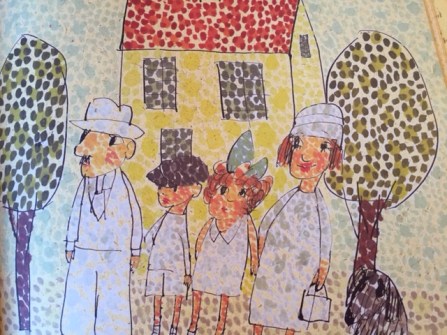
The childlike, offbeat goache, pen, and ink illustrations of Vladimir Radunsky lend the right amount of lightness and movement to each page, depicting not only Albert and his surroundings but also the endless musings that filled his mind and his days. As Albert grows from a baby to a child, his loving and understanding parents stand by and encourage his gifts; he and his bicycle rocket off on a beam of light; and numbers swirl through the air as Albert rests his head on a stack of books. In a restaurant other patrons are portrayed as simple line drawings, putting the focus on Albert as he ponders a dissolving sugar cube, a device that is used to also depict Albert’s thoughts and scientists of the future who have proven his theories correct. When Albert discovers atoms, he and a family portrait are rendered in dots. The muted colors, mottled paper, and period details allow readers to fully appreciate Albert’s Einstein’s story and contributions.
An Author’s Note and further paragraphs about Einstein’s thought experiments, playful nature, pacifism, and most famous equation, as well as a list of resources follow the text.
On a Beam of Light is a wonderful addition to home libraries for children interested in science, math, ideas, history, and creativity in general. Jennifer Berne’s emphasis on the support Albert received from his parents and his ultimate acceptance within the science community is also welcome comfort for kids who do think differently.
Ages 4 – 9
Chronicle Books, 2016 (paperback) | ISBN 978-1452152110
To view more books by Jennifer Berne, plus pictures by her readers and more, go to her website!
Visit Vladimir Radunsky’s website to see a gallery of his books with pictures!
Smart is Cool Day Activity
I’m Smart Because…
In what way are you smart? Draw a picture or write about your special talent on this printable I’m Smart Because…page.
Today’s holiday hosts the largest formalized jumping event in the world and celebrates BASE jumpers, those intrepid souls who test their mettle against the highest points, including buildings, antennas, cliffs, and bridges. Recognized since 1980 Bridge Day is a world-wide event, and while it may not officially be about the bridges, it brings attention to these beautiful architectural marvels while extreme sports aficionados and their fans gather on spans across the globe to have fun.
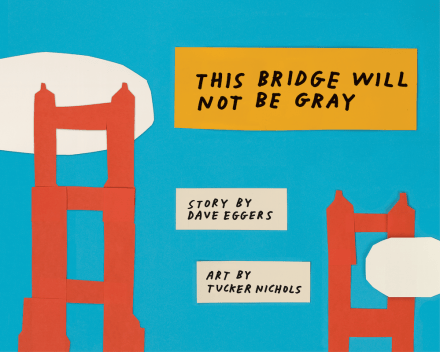
This Bridge Will Not Be Gray
Written by Dave Eggers | Illustrated by Tucker Nichols
“In the beginning there was a bridge.” Well, to back up a bit there was a bay that led to the Pacific Ocean. The opening between the two shores that enclosed the bay was called the Golden Gate. “On one side of the Golden Gate was the Presidio, a military base at the top of the city of San Francisco. On the other side there were only hills, green and yellow, rising high above the sea.” Beyond these hills towns dotted the coastline.
People traveled between these shores by boat or by driving way out of their way. Many times people had thought about building a bridge across the bay, but they were afraid it would ruin the beauty of the land. At last it was decided that a bridge should be built. The year was 1928 and Joseph Strauss, an expert on bridges, was hired to design it. What he came up with looked more like the skeleton of a roller coaster, and while it would be strong, it would also be ugly.
Image copyright Tucker Nichols, courtesy of mcsweeneys.net
People agreed that for such a beautiful spot, a beautiful bridge was needed. Joseph Strauss then asked for help in developing a plan for the bridge. Leon Moisseiff, known for designing the Manhattan Bridge in New York, came on board. Leon’s idea was for “a suspension bridge, one with swooping lines and tall towers.” The drawings were light and airy and…beautiful. People liked it very much.
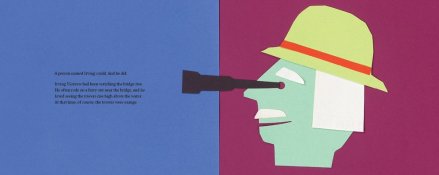
“But still the bridge appeared a bit stern in style. So Joseph and Leon asked another person, named Irving Morrow, to help out.” Irving and his wife Gertrude had a different idea about what the bridge could be. With vertical fluting, “art deco flourishes,” pedestrian walkways, and curved lamps lighting the way, “the bridge could be both a bridge and something like art.”
Steelworkers in Maryland, Pennsylvania, and New Jersey built the pieces of the bridge. They were shipped to California by train and by boat. Finally, it was time to construct the bridge. Men had to dive deep into the icy waters of the Pacific Ocean and climb high into the sky while constructing it. It was estimated that it would take 4 years and thousands of workers to finish it.
Image copyright Tucker Nichols, courtesy of mcsweeneys.net
First the tall towers were constructed. The day they were finished was one of “jubilation” and awe as“sometimes the things humans make baffle even the humans who make them. One aspect of the bridge that had not been decided was the color, and many people had opinions on that. “The Navy thought it should be yellow and black so that ships and planes could easily see it.”
“The Army wanted it to look like a candy cane for the same reason the Navy wanted it to look like a tiger with jaundice: so that it would be easily seen by planes and ships.” Most people, though, thought the bridge should be painted black, white, or gray like most other monuments, towers, and buildings. Right now, the bridge was orange—coated with a special anti-rust paint. As Irving Morrow watched the bridge go up, he thought this orange was a beautiful color.
He suggested that the bridge be allowed to stay this color. Others thought he was “nuts.” Never had there been an orange bridge before, “and for a good portion of the human race, because something has not already been, that is a good reason to fear it coming to be.” But the people of San Francisco began to see things Irving’s way. Still, gray seemed to be the safe choice.
Image copyright Tucker Nichols, courtesy of mcsweeneys.net
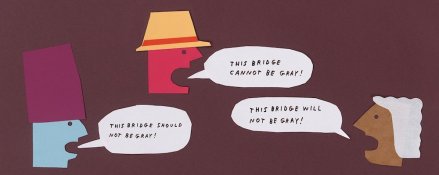
Irving, who was usually a shy and quiet sort, began to get vocal about his color preference as the completion date of the bridge came closer. Other’s began to echo his thoughts and arguments. “This bridge will not be gray!” they said. At last “the powers that be” agreed with Irving. The bridge remained orange: International Orange, in fact.
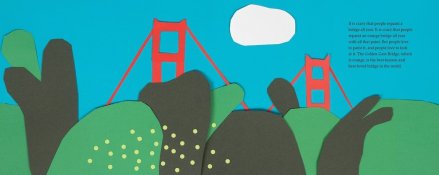
But because the wind, rain, and sun are harsh on the orange bridge, it needs to be repainted every year. Every day some part of it is being painted by dedicated workers. Is that crazy? Maybe, “But people love to paint it, and people love to look at it. The Golden Gate Bridge, which is orange, is the best-known and best-loved bridge in the world” because it is “bold and courageous and unusual and even strange.”
Image copyright Tucker Nichols, courtesy of mcsweeneys.net
San Francisco resident Dave Eggers has written a loving tribute not only about the very distinctive Golden Gate Bridge but to the equally distinctive, quirky, and even courageous Irving Morrow, other architects, and people of the Bay area who saw and championed art where others may only have seen function. Passages of straightforward narration are joined by rivets of whimsically inserted dialogue, soaring description, and moving insight to construct a lyrical story of vision and inspiration that both kids and adults will find fascinating.
Tucker Nichols’ paper cut illustrations are as playful and full of imagination as a kindergarten classroom. Using simple shapes and a gorgeous palette Nichols crafts portraits, collages, and landscapes that are movingly effective in depicting the San Francisco Bay area, the rising Golden Gate Bridge, and the personalities involved in this fun history of a beloved monument.
This Bridge Will Not Be Gray is a must for school and public libraries, a wonderfully inspiring addition to children’s bookshelves, and a colorful coffee table book for any home.
Ages 4 – 10 and up
McSweeney’s, 2015 | ISBN 978-1940450476
Click here to learn more about Tucker Nichols and his work.
Today we remember the woman who is regarded as “the first computer programmer.” A mathematician, inventor, and scientific pioneer, Ada Lovelace wrote and was the first to publish an algorithm to generate Bernoulli numbers. Her notes published in Taylor’s Scientific Memoirs in 1842 inspired Alan Turing to design the first modern computers 100 years later. Today’s holiday celebrates all women in the science, technology, mathematics, and engineering fields. To learn more about Ada Lovelace Day visit findingada.com.
Ada Byron Lovelace and the Thinking Machine
Written by Laurie Wallmark | Illustrated by April Chu
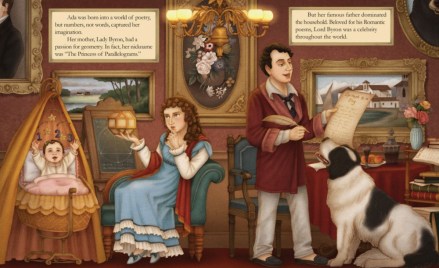
Ada was the daughter of two very distinguished—and distinct—parents. Her mother loved geometry and was known as “‘The Princess of Parallelograms.’” Her father was a world-renowned poet, “beloved for his Romanic poems.” When Ada was still a baby, however, her mother left Lord Byron and his “scandalous behavior” behind, and “Ada never saw her father again.”
Image copyright April Chu, text copyright Laurie Wallmark. Courtesy of crestonbooks.com
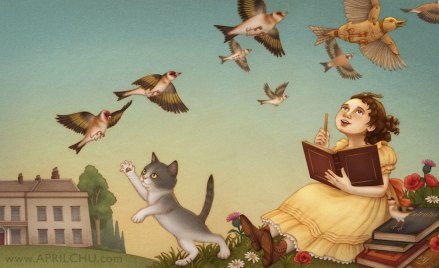
As was common in Ada’s time she was often left on her own while her mother traveled. Ada filled the hours and days writing, sketching, and inventing in her journal. When she was still a little girl, she built a set of wings for a flying machine she had imagined. To discover if her wings could actually fly, “Ada needed to compute the wings’ power. She broke the problem into steps—surface area and weight, wind speed and angles.” She had to multiply and divide again and again, and while she loved calculating numbers, Ada wondered if there wasn’t an easier way to find the answers.
As she sat at her desk one day a storm blew up, sending the curtains around her open window flapping. They reminded Ada of sails and she suddenly realized that sails were like wings. She grabbed her toy sailboat and headed out to a nearby pond to test her theories. She launched her boat over and over, and “each time she adjusted the sails and studied the effect on the little boat’s speed. A storm of numbers and calculations whirled in her mind and spilled onto her pages.” She stayed by the pond until dark, and “returned home muddy, dripping wet, and triumphant.” Her nanny was not pleased. She didn’t agree with Ada’s mother, instead believing that girls “should not waste their time with math and science and experiments and other such nonsense.”
Image copyright April Chu, courtesy of aprilchu.com
Overnight, Ada developed a high fever, and the doctor diagnosed measles. Ada’s mother was sent for. She hurried home and spent the days and nights at Ada’s bedside reading to her. Ada’s “fever finally broke, but the measles left her paralyzed and blind. To keep Ada’s mind sharp, Mama quizzed her on math problems,” asking her harder and harder questions. The numbers kept her company, and in her imagination Ada used her flying machine to travel to London.
While Ada regained her sight in a few weeks, it was three years before she could walk again. During this time Ada’s mother hired tutors to teach her higher and higher level math. One of her tutors was Mary Fairfax Somerville, a famous scientist and mathematician. Somerville invited Ada and her mother to a gathering of other influential scientists, mathematicians, and inventors. There Ada met Charles Babbage. Babbage, a mathematician and inventor, was impressed by 17-year-old Ada’s knowledge and understanding and invited her to visit his laboratory.
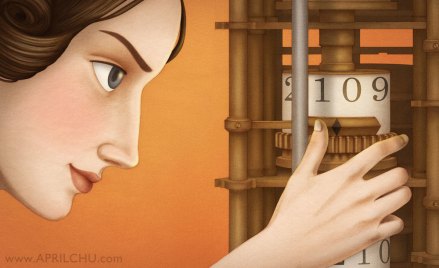
Image copyright April Chu, courtesy of aprilchu.com
Ada brought her journal and shared with Charles Babbage her own work. He didn’t treat Ada as a child but as a fellow scientist and engineer. Babbage showed Ada a mechanical calculator he had designed. With the turn of a handle cylinders of numbers on the three columns of his Difference Engine spun toward the answer to a math problem Ada posed: what is 15 x 12? The machine gave the right answer: 180!
Babbage also had an idea for a mechanical computer—and Analytical Engine—that “would solve harder problems by working through them step by step.” It was an amazing concept, but Babbage hadn’t built it yet. He gave Ada his notebooks and she studied Babbage’s descriptions of how the machine might work. She realized that the Analytical Engine could work if numbers told it how.
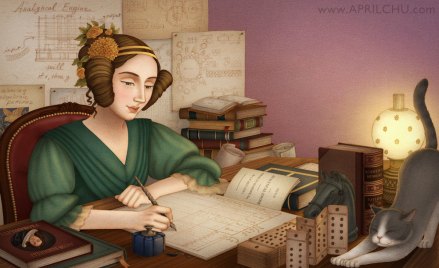
Image copyright April Chu, courtesy of aprilchu.com
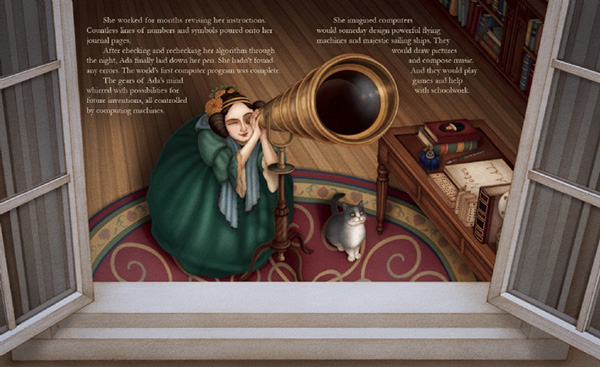
Over several months Ada created an algorithm—a set of mathematical instructions. Her journal was filled with lines and lines of numbers and symbols. At last she checked her work for errors and found none. Ada had developed the world’s first computer program! With her creative imagination she could see that someday computers would “design powerful flying machines and majestic sailing ships. They would draw pictures and compose music. And they would play games and help with schoolwork.”
Unfortunately, Charles Babbage never finished building his Analytical Machine, and Ada never saw her program in action. But future generations remembered her and her contributions to computer programming. There is even a computer program named for her. We can imagine that the little girl who wanted to fly would be very pleased to know that Ada helps guide modern flying machines.
An extensive Author’s Note, a timeline of Ada’s life as well as a partial bibliography and resources follow the text.
Image copyright April Chu, text copyright Laurie Wallmark. Courtesy of crestonbooks.com
Laurie Wallmark’s compelling biography of Ada Lovelace is perfectly aimed at her young audience, highlighting Ada’s childhood dreams, obstacles, and events that led her to become an influential mathematician and inventor. Wallmark’s fast-paced text, which beautifully merges lyrical and technical language to tell Ada’s story, is uplifting in its revelation that from even a young age, Ada was respected and acknowledged for her intelligence and mathematical gifts. Illuminating Ada’s predictions for future uses of the computer forms a bridge between her foresight and the experience of today’s children, bringing history alive for readers.
Gorgeous, detailed illustrations set Ada Byron Lovelace and the Thinking Machine firmly in its 19th-century time period. Lush greens, reds, and golds welcome readers into Ada’s home, where her wooden and paper wings lay among blueprints for other inventions as Ada sits at her desk jotting notes in her journal. A mural in her home cleverly depicts Ada’s imaginings while she recovered from the measles, and the gathering that Ada and her mother attend is a stimulating portrait of the scientists and new inventions of the day. Kids will be amazed to see one of the first “calculators” as built by Charles Babbage. Included on the pages are images of an early loom and punch cards that influenced the development of our computers. It is fitting that the last page shows how far we have come—and how forward thinking Ada was—with an illustration of Space technology in action.
Ada Byron Lovelace and the Thinking Machine is an important biography that should be included in every public and school library. For children interested in history, biographies, and the science and math fields, Laurie Wallmark’s and April Chu’s book would make a beautiful gift and addition to home bookshelves as well.
Ages 5 – 10
Creston Books, LLC, 2015 | ISBN 978-1939547200
Discover more about Laurie Wallmark and download curriculum and activity guides on her website!
View a portfolio of artwork and learn more about April Chu’s books on her website
This is one book trailer that really computes!
Ada Lovelace Day Activity
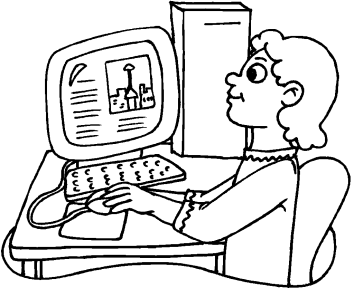
Love Your Computer! Coloring Page
What would we do without our computers? Here’s a fun printable Love Your Computer! coloring page for you to enjoy!
We love animals, but do we take care of them the way we should? Today’s holiday was established in 1931 to promote global awareness of animals and the issues surrounding their welfare. From pets to domesticated animals to wild creatures, humans must protect and advocate for their companions and fellow travelers on this earth. Issues such as pollution, habitat destruction, and poaching threaten the world’s wide variety of species, while closer to home spaying and neutering controls the population of feral animals that often suffer from a lack of resources.
The wildlife kingdom is majestic and awe-inspiring. Today celebrate the world’s animals by taking a trip to a zoo, aquarium, or animal preserve, consider adopting a shelter animal, or donating your time or talents to your favorite animal cause.
Pink is for Blob Fish: Discovering the World’s Perfectly Pink Animals
Written by Jess Keating | Illustrated by David DeGrand
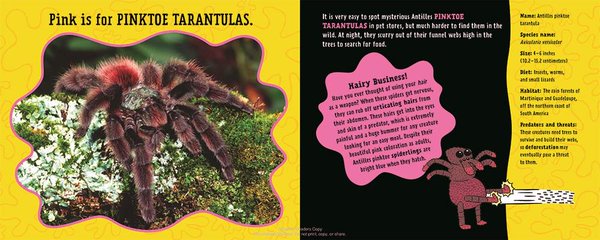
Pink is sweet like cotton candy, right? Pink is pretty like a rose, isn’t it? Pink is quiet like twightlight, don’t cha think? Well…yes, and…maybe not so much. You’d be pardoned for squirming in the presence of a pinktoe tarantula which is found in the rain forests of Matinique and Guadeloupe and can defeat predators with their spiky hairs, and if you can’t make heads or tails of the Pink Fairy Armadillo, which looks like a cross between a lobster tail and a shag rug, no one will blame you.
Text copyright Jess Keating, illustration copyright David DeGrand, courtesy of Penguin Random House
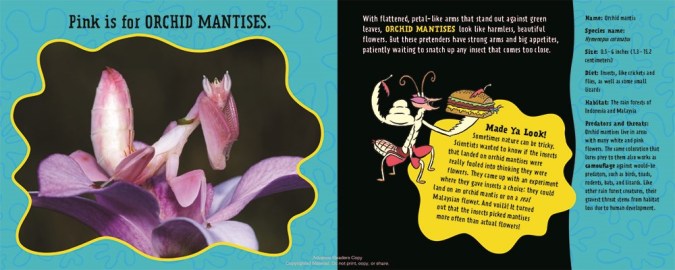
But the world is full of pink, and for each of these grimace-inducing bubble-gum-hued creatures there are plenty who simply take your breath away with their beauty. Imagine watching a duo-toned light-and-dark-pink Roseate Spoonbill take off and soar over marshland along America’s Gulf Coast or a river in South America or the West Indies like a valentine on the wind. You will likewise marvel when you see the delicate form of the Orchid Mantis. This variety of praying mantis found in the rain forests of Indonesia and Malaysia is so identical to real orchids that other insects can’t tell the difference and often land in the grasp of their tricky predator.
Text copyright Jess Keating, illustration copyright David DeGrand, courtesy of Penguin Random House
Seas and rivers also teem with pink wildlife. Pygmy Seahorses swimming in the waters of the South Pacific blend in to their coral surroundings like a spiky ball among hedgehogs. With white-and-pinkish bodies dotted with strawberry-colored knobs, these seahorses are perfectly camouflaged against predators. The rose-colored Amazon River Dolphin hunts for piranhas, crustaceans and bottom dwelling fish with its long snout in the freshwater rivers of South America. The rivers, lakes, and swamps of sub-Sahara Africa are home to Hippopotamuses, which “ooze thick pink oil all over their skin. This pink ‘sweat’ acts like an antibiotic sunscreen, so hippos can stay out in the sun all day without getting burned.” Imagine if you could do that!
Of course, there is also the Blobfish, recently voted as the world’s ugliest animal. But isn’t this little glob of gelatinous goo really so ugly it’s cute? Found in deep waters off the coasts of Australia and New Zealand, this fish survives where others cannot by simply opening its mouth and gobbling down whatever floats by.
With many more examples of pink wildlife in this captivating book, it’s guaranteed that after flipping through the pages of Pink is for Blobfish you will never look at pink the same way again!
Text copyright Jess Keating, illustration copyright David DeGrand, courtesy of Penguin Random House
Jess Keating highlights a host of fascinating pink animals in this volume that is sure to delight kids and get them excited about the world less seen. The first in the World of Weird Animals series, Pink is for Blobfish is loaded with scientific facts, remarkable trivia, and humorous asides to pique the interest of readers’ inner zoologist. Each two-page spread provides a spectacular up-close photograph of the animal, insect, or fish described as well as its common name, species name, size, diet, habitat, and predators or threats. Keating also taps into her audience’s love of the unique and even the bizarre with conversational paragraphs that reveal unusual habits, traits, survival mechanisms, and more for each creature featured.
David DeGrand lends his unique illustration style to the pages with funny cartoon portrayals of the creatures and one of their signature traits. These humorous depictions will not only make kids and adults laugh but will promote better understanding of each unique animal.
Pink is for Blobfish is a perfect addition to personal libraries for budding environmental scientists or anyone interested in the wider, wilder animal world and is an exciting title for school libraries and classrooms, where it could inspire scientific study.
Ages 5 – 10
Knopf Books for Young Readers, Penguin/Random House, 2016 | ISBN 978-0553512274
You’ll discover books, videos, creature features, resources, and lots more on Jess Keating’s website!
You will find the world of David DeGrand‘s art and comics on his website!
Pink is for book trailers—at least this one!
World Animal Day Activity
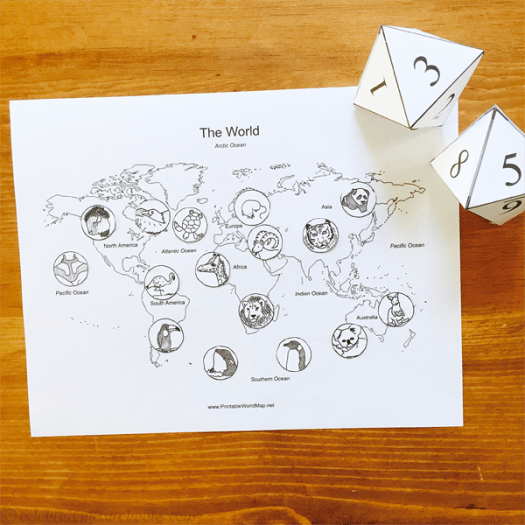
Play the Wonderful Wildlife Board Game! Animal tokens images copyright Conor Carroll
Wonderful Wildlife Board Game
Fascinating animals are found in every part of the world. Play this fun printable Wonderful Wildlife Board Game to match each animal to the area where it lives.
Print one set of 16 Wildlife Tokens for each player
Print two copies of the 8-sided die, fold, and tape together
If you would like, color the map and tokens
Choose a player to go first
Each player rolls both dice and places an animal on their map according to these corresponding sums of the dice below
The first player to fill their map is the winner!
1 = Flamingo – South America
2 = Emperor Penguin – Antarctica (Southern Ocean)
3 = Giraffe – Africa
4 = Bald Eagle – North America
5 = Ibex – Europe
6 = Kangaroo – Australia
7 = Panda – Asia
8 = Orca – Antarctica (Southern Ocean)
9 = Toucan – South America
10 = Buffalo – North America
11 = Koala – Australia
12 = Lion – Africa
13 = Etruscan Shrew – Europe
14 = Manta Ray – Pacific Ocean
15 = Sea Turtle – Atlantic Ocean
16 = Tiger – Asia
Q&A with Author Jess Keating
Today I’m tickled pink to talk to Jess Keating about her work as a zoologist and an author, her favorite animals, and a very cool holiday tradition.
In your work, your books, and your online presence, you bring kids and adults closer to the animal kingdom. What in your early years inspired you to become a zoologist?
I wish there was one poignant answer to this question! The truth is, all my life I’ve been enamored with animals. A physicist I admire once said this: The world is beautiful to look at, but it’s even more beautiful to understand. To me, that sums it all up perfectly.
As a kid, animals sparked my curiosity, my imagination, and even my creativity. The diversity they represent is so amazing to me—they all live their lives so differently, with different senses, abilities, and environments, yet it works perfectly for them. I instantly felt a kinship with them, and as a kid, I wanted to know everything about them.
As I got older and was able to really get into zoology, my goal shifted. The world of animals is so endlessly fascinating, and I now I want to take every opportunity to share it with others, especially young readers.
All animals are amazing, but do you have a soft spot for one particular animal or species? If so, why?
Now this is such a hard question! My favorite animal has always been the wolf. I was lucky enough to see one in the wild once, and it’s pretty hard to come away from that experience without believing in magic!
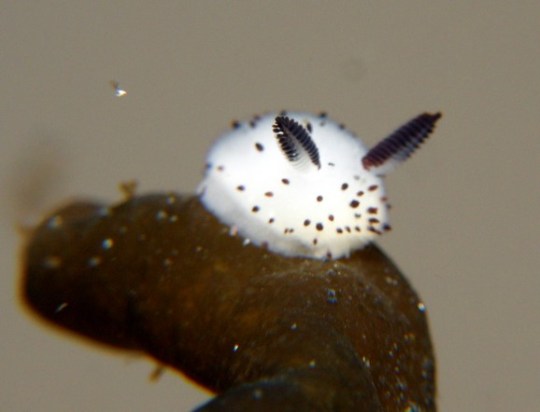
Lately, I also have a soft spot for nudibranchs! I included one (the Hopkins’ rose nudibranch) in my last book, but there are so many other species that we know so little about! As I mentioned above, it’s the diversity that takes my breath away. Some of them look like bunnies:
Image courtesy of crawl_ray on flickr.com
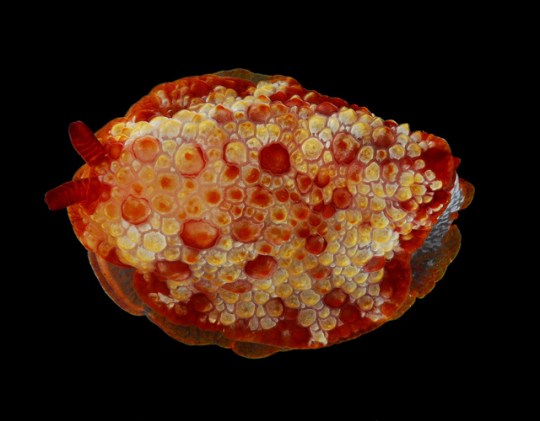
Some even look like pizzas!
Image courtesy of Arthur Anker on flickr.com
You do such a great job of reaching out to kids through videos, KeatingCreature on Twitter, your YouTube Channel: Animals for Smart People, personal appearances, and Skype visits. Can you describe a funny or favorite anecdote from one of your events?
Thank you for the Youtube shout out! I really hope teachers find my videos useful! As for a favorite event, when you mix animals and kids, the results are often hilarious. Usually, my visits involve a lot of dead things. I bring a collection of skulls, animal bones, and animal track castings with me. Every so often, we get lucky with some live specimens.
One of my favorite events was a library visit that involved a 10+ foot python. I had her resting on my shoulders (as you do), and I remember laughing because almost all of the adults in the room were skittish, backing off toward the door.
When I asked who else wanted to hold this lovely python, every adult shook their head. There was no way they were going near it! But then, a tiny six year old girl rushed up to the front, with a massive smile on her face. She wasn’t afraid at all as she held that snake—and I’m pretty sure that her big moment meant as much to me as it did to her!
What inspired you to write Pink is for Blobfish?
Pink is for Blobfish is a book so close to my heart! I know that sounds strange, because it’s essentially a book filled with weirdos!
As you can probably guess, I’ve been reading animal books my whole life. I loved them all, but what I really wanted was to write something that says as much about us as it does about the wild animals on each page. A book that not only shares amazing animals with kids, but also gets them thinking critically about how they view the world, especially regarding their assumptions and judgments. Pink is for Blobfish is my way of getting readers to look at gender expectations, while (hopefully) instilling them with a little wonder about the natural world.
There’s so much humor in your writing and videos. How does your love of comedy help you connect to readers?
The short answer is, I’m just a big ham and love making people laugh. There’s also the added bonus with nonfiction: we’re much more likely to remember something if we connect with it emotionally. My way of accomplishing that is to be funny and get kids laughing. Fiction or nonfiction, one of the easiest ways for me to reach readers is through a well-timed joke.
But, you can also get a little deeper with it. I once heard that Jim Carrey doesn’t think of his job as “making people laugh.” Instead, he views it as “freeing people from concern.” The minute I heard that, it resonated with me. For those few moments, when you’ve got a reader laughing, they’re free from any concern in their lives. It’s a reprieve, a bright moment. It’s true for us as adults too—it’s pretty much impossible to be stressed out when you’re reading about a pigeon that wants to drive a bus!
Now, when I approach my writing, I look for those moments. If I can make myself laugh, that’s half the battle.
What’s the best part about writing books for kids?
For both fiction and nonfiction, my favorite part is seeing the look on a kid’s face when you open a door for them into a whole new world. Sometimes, it’s the ridiculously colorful world of nudibranchs. And sometimes, it’s helping them to the realization that they aren’t alone, no matter how weird they feel.
What’s up next for you?
I’m so glad you asked! I just received F&Gs of the second book in the World of Weird Animals series! I can’t give away the title just yet, but I can say we are going to look at MONSTERS. This isn’t just going to be a book of creepy creatures. We’re going to dig into why we see certain animals as monsters, and how those judgments and assumptions affect how we think of them. I was blown away with the discussions that Pink is for Blobfish prompted with kids, and I can’t wait to see how they respond to this book!
I also have my first picture book biography, SHARK LADY, coming out next year! I’ve always been a fan of sharks, and I was thrilled to tell the story of Eugenie Clark, one of the world’s first female shark scientists. Eugenie is one of those incredible women that changed the world just by being her fearless self, and I am so eager to share this book with everyone. Look for it around June!
I can’t let you get away without asking you a few holiday-themed questions, so…
You told me that World Animal Day is one of your favorite holidays. Can you talk a little about that?
What could be better than a day devoted to animals!? World Animal Day is a day to chat about animals all over the world, and how we can best protect them and their futures. A funny thing happens when you start talking about animals in the global sense—you can’t help them without also helping us. Education and awareness can accomplish so much!
Do you have an anecdote from any holiday that you’d like to share?
I have one that ties in really well here! When I was a teen, I had a really cool Christmas tradition that I highly recommend to parents of animal lovers. On Christmas morning (or any special holiday morning for you!) I would go to my local humane society, bring treats, and walk the dogs. Usually, these centers have lots of volunteers, but busy holidays are often pretty slow for them and there’s not a lot of help. I guarantee the dogs will love the company, and you’ll get to spend an hour surrounded by wagging tails! You can’t lose.
Has a holiday ever influenced your work?
Yes! A very savvy bookstore (DDG Books!) organized a “Valentine for Blobfish” event when Pink is for Blobfish came out. So many young readers felt bad that the blobfish was voted the world’s “Ugliest Animal” (true story!) and they wanted to send him valentine cards to make him feel better!
Thank you, Jess! It’s been so much fun! I wish you all the best with all of your books and your other ventures!
Learn more about Jess Keating!
As a zoologist turned middle grade and picture book author, Jess Keating has been sprayed by skunks, bitten by crocodiles, and been a victim to the dreaded paper cut. Her MY LIFE IS A ZOO series earned two Kirkus stars, a Red Maple nomination, a Rocky Mountain Book Award nomination, and a spot on the LA Times Summer Book Pick List.
Her quirky nonfiction picture book series kicked off with PINK IS FOR BLOBFISH, with a sequel to follow in 2017. Her first picture book biography, SHARK LADY, will also be published in 2017.
Jess is also the creator, writer and host of Animals for Smart People, a Youtube series about animals, science, and nature. Subscribe today and bring Jess into your classroom!
Connect with Jess Keating:
You can find Jess on Twitter @Jess_Keating and on Facebook @JessKeatingBooks!
Pink is for Blobfish can be found at these booksellers
Avid readers, rejoice! Today is your day – a whole 24 hours dedicated to the fine pursuit of perusing an old favorite or a newly discovered book! To celebrate visit a local bookstore or library then find a cozy nook or shady spot and settle in for a good, long read.
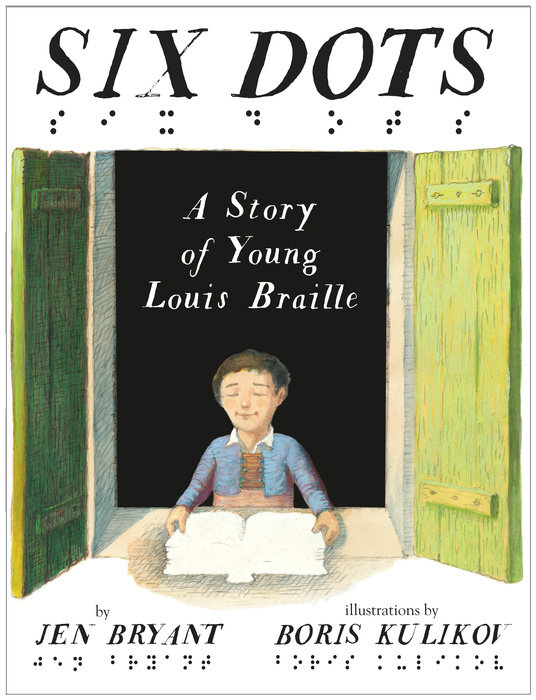
Six Dots: A Story of Young Louis Braille
Written by Jen Bryant | Illustrated by Boris Kulikov
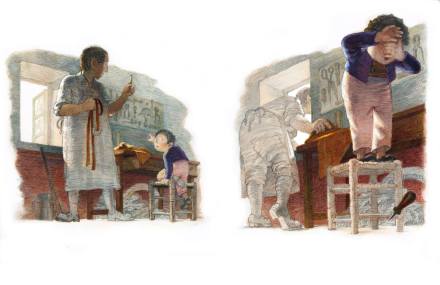
When Louis Braille was born he was so small that no one in town expected him to live. But he did! Louis thrived and with his curious eyes took in everything around him. Louis was smart, too, with a prodigious memory for names and stories. His father worked with leather, making harnesses and bridles. Louis wanted to be just like him and often reached for the sharp tools on the workbench, but his father always warned him away.
One terrible day, however, when Louis’ father glanced away, Louis grabbed an awl and tried to work it into the smooth leather, but it slipped. Louis’ damaged eye was bandaged and he was told not to touch it. But when the bandage began to itch, young Louis couldn’t help himself and spread the infection to his other eye. By the age of five, Louis was left in darkness, unable to see the faces of those he loved or the attractions of home.
Image copyright Boris Kulikov, courtesy Alfred A. Knopf
Louis learned the sounds of the world. He discovered the number of steps around his house, to the outbuildings, and eventually to the shops and businesses in town. His brother taught him how to whistle and use the reverberations to avoid obstacles. He also learned to feel the shapes of letters made of straw, leather, or nailed replicas made by his family. He played dominoes by feeling the dots with his fingers.
While Louis listened to others read to him, he longed to be able to read on his own. Whenever he asked if there were books for blind people, however, the answer was always, “No.” A noblewoman who lived nearby heard of Louis and invited him to study at the Royal School for the Blind in Paris. At the age of 10 he moved to the boarding school.
The Royal School was anything but sumptuous. Louis’ room was crowded, damp, and dark. His uniform itched, and meals were meager and cold. He so wanted to return home, but the promise of books for the blind kept him there. Those books were reserved for the best students, and Louis vowed to be one. Finally, Louis was led to the library. A book thudded onto the table in front of him. “‘Voila! There it is,’” the guide said.
Louis opened the book. To read it he had to feel the raised letters, but the letters were huge and a page only held a few sentences. To make matters worse, the book consisted of only a few pages. “‘Is that all?’” Louis asked. The guide told him there were others but that they were all the same. More than ever Louis wanted to go home.
Image copyright Boris Kulikov, courtesy Alfred A. Knopf
In the morning Louis was shaken awake; the headmaster had an important announcement. It seemed that a French army captain had devised a secret code read by touch instead of sight. This code could be used at the school, the headmaster said. The code consisted of raised dots set in patterns that represented various sounds. The boys learned the new code then learned how to write it, using an awl-like implement that punched dots into paper.
While the code was a breakthrough, it was hard to learn and all the other boys in the school had given up—but not Louis. Still, reading the code was not like reading a book with letters, words, and sentences. Louis asked the headmaster if the army captain would work with him to improve the code, but when the headmaster asked, the answer was “No.”
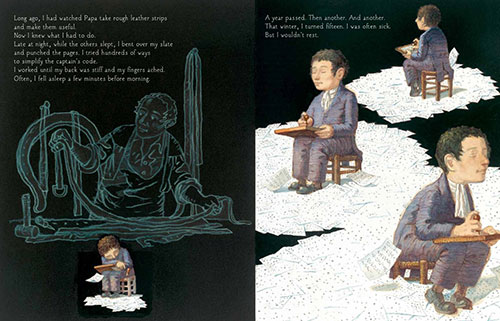
Louis knew what he had to do. Night after night he punched dots into paper with the awl-like tool—just as he had watched his father do with leather. He tried “hundreds of ways to simplify the captain’s code.” Three years passed, and Louis turned 15. Finally, he had a workable solution. He asked the headmaster to read to him a book he had never heard. As the headmaster read, Louis copied his words, punching letters onto paper. Louis’ “new code used just six dots, arranged in two columns, like dominoes. Each dot pattern stood for a letter of the alphabet.”
Image copyright Boris Kulikov, courtesy Alfred A. Knopf
When the headmaster finished reading chapter 1, Louis turned his pages over and “reading by touch, recited the entire chapter.” After that “word spread quickly. The other students rushed to try it. Si facile! ‘So easy!’ Et si vite! ‘And so fast!’ ‘We can read words and write letters like everyone else,’” the other boys exclaimed.
As Louis watched his friends read he remembered watching his “Papa in his shop, bent over rough strips of leather, making them useful. I had become like him, after all,” Louis thought.
An Author’s Note, more fascinating biographical information about Louis Braille’s life and other inventions, resources, and the Braille alphabet follow the text.
In her Author’s Note Jen Bryant says she wanted to express what it felt like to be Louis Braille. In Six Dots she succeeds in bringing the story of this very young inventor and genius to life with details of his accidental blindness, family support, school experiences, and ultimate victory. Told from Louis Braille’s point of view, the story has an immediacy that presents Braille’s frustrations, challenges, and achievements sensitively and honestly. His perseverance against all odds will inspire readers and give them a new perspective on the unique person Braille was, the importance of books for all, and what children not much older than the readers of Six Dots can accomplish.
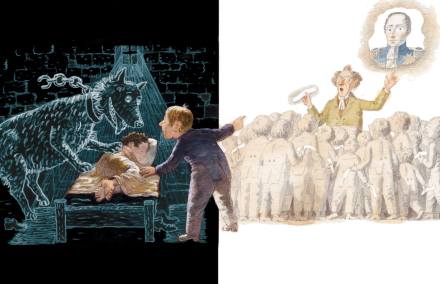
Boris Kulikov’s mixed media illustrations take readers back to the France of the early 1800s, depicting with soft colors and period details the town, people, and influences in Louis Braille’s life. Braille’s initial accident is treated with thoughtful consideration of the book’s audience, and his blindness and dreams are portrayed with transparent outlines on a black background. Readers will be interested to see how Louis’s family and friends supported and helped him (an unusual occurrence of the time). As Louis grows, readers discover his other talents for music and sewing, and the tools Louis used to produce his Braille pages are clearly shown.
Ages 4 – 9
Alfred A. Knopf, 2016 | ISBN 978-0449813379
View Jen Bryant’s website for activities, videos, and links related to Six Dots—you’ll also discover more of her books too!
To see a gallery of images by Boris Kulikov for books and other illustration work, visit his website!
Read a Book Day Activity
I Love the Library! Coloring Page
Today is a perfect day to visit your library and check out some awesome books! Here’s a printable I Love the Library! Coloring Page for you to enjoy too!
With their bald pink heads and dusty brown feathers vultures and turkey vultures may not be the peacocks of the bird kingdom, but they play a crucial role in the environmental cycle. These scavengers live on carrion, clearing away and “recycling” the carcasses of dead animals. Because of the vulture’s appearance and stereotypical depictions, their plight as an endangered species goes largely unnoticed. Environmental groups in South Africa and England established today’s holiday (also known as International Turkey Vulture Day) to promote awareness f the declining number of vultures, a cause that has been picked up by zoos and other conservation groups around the world.
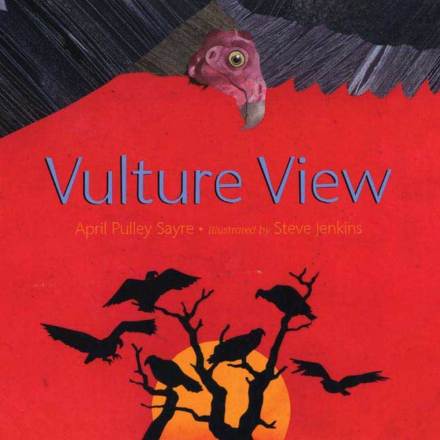
Vulture View
Written by April Pulley Sayre | Illustrated by Steve Jenkins
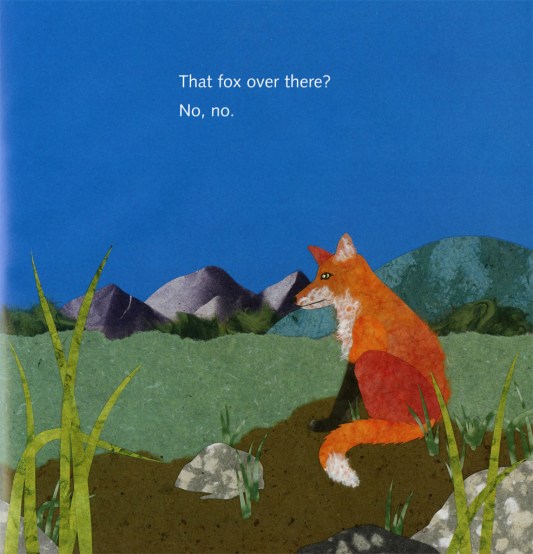
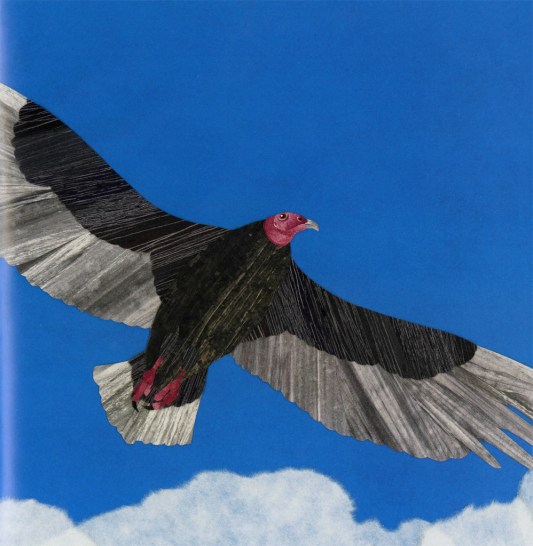
In the clear blue morning sky the vultures soar. “Wings stretch wide / to catch a ride / on warming air / Going where?” One turkey vulture scans the ground, dipping and tilting as it searches for its breakfast. A snake rattles and hisses in the rocks. The vulture passes it by. A golden fox gazes silently into the distance, but the vulture flies away. A bear half-way up a tree would be easy prey, but the vulture lets him continue his climb.
Image copyright Steve Jenkins, courtesy of us.macmillan.com
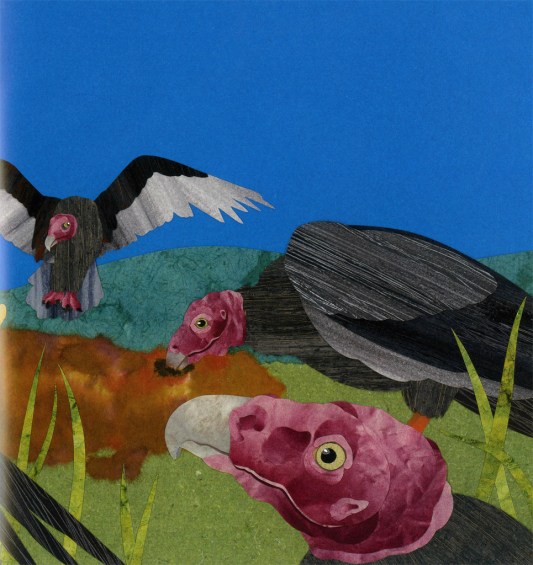
The turkey vultures are searching for a particular meal. They “smell the air. / They sniff, search, seek / for foods that… / REEK! The aromas of the landscape rise to the vultures. Are they attracted by the “fragrant flowers? / No, no.” “That spicy smoke? No, no.” Maybe “that stinky dead deer? Yes, yes!”
The vultures descend to dine on their “rotten” meal. Afterward they clean themselves in the nearby water and preen their feathers. Still hungry, “they hop, flap, soar / to look for more.” As the sun sets the vultures’ “wings glide, wings ride / through cooling air.” They come from all over to vulture trees—beautiful, bare silhouettes on the sky—to “settle and sleep, like families.”
Image copyright Steve Jenkins, courtesy of us.macmillan.com
With the rising sun and the warmer air, the vultures take to the sky again in search of their singular meal.
Intriguing facts about how vultures fly, the seven species of vultures, why and how vultures feed on carrion, nesting behaviors, and vulture festivals around the United States follow the text.
In this Theodor Seuss Geisel Honor Book, April Pulley Sayre brings a poet’s sensibility to the misunderstood vulture. In her lyrical lines the sights and smells of the vulture’s terrain and the vulture’s flight patterns are elevated to educate young readers of the actual beauty of this distinctive species. The benefits vultures provide to the environment as well as their familial attachments make these birds some of the most fascinating animals in the wild kingdom. Who among us doesn’t look up at the circling majesty of birds of prey? Sayre’s text gives readers the bird’s eye Vulture View.
Image copyright Steve Jenkins, courtesy of us.macmillan.com
With his signature cut-paper collage illustrations, Steve Jenkins gives shape to the vulture’s world. The mottled dark body and the wings and tail fringed with white meet layers of pink that form the vulture’s wrinkled head. The rattlesnake is a smooth combination of greens and browns while the fox is brilliantly orange and soft. Hills and mountains jut from the bottom of pages, and a bony carcass lays amid tall grass, decaying and attracting a vulture. As the birds streak through wispy fiber clouds to descend upon the vulture tree in the shadowy evening, readers will come to appreciate the life and role of the vulture.
Ages 4 – 8
Henry Holt and Company, 2007 | ISBN 978-0805075571
Wow! You will find a wealth of information on April Pulley Sayre‘s website which includes her many books, educators’ resources, and much more information on natural history topics.
Even just hovering over the icon links on Steve Jenkins‘ website is fun—and there’s so much more to discover once you click on them!
International Vulture Awareness Day Activity
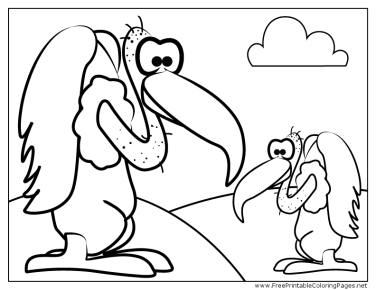
Valuable Vultures Coloring Page
Vultures are a valuable part of our ecosystem. Here’s a printable Valuable Vultures Coloring Page for you to enjoy. Why not try your hand at using cut or torn paper like Steve Jenkins does in Vulture View to fill in the design?
Today’s holiday celebrates the mythical (shhhh!) fun of the Tooth Fairy. When a child loses a tooth, they put it under their pillow and that night the Tooth Fairy comes, takes the tooth, and leaves money. What the sprite does with the teeth is a mystery and many theories abound. The mystery of how the whole thing got started is explained here! I had never heard this story, so was excited to find it in my research!
In 1927 Esther Watkins Arnold wrote an eight-page play called The Tooth Fairy. In the same year none other than Sir Arthur Conan Doyle claimed that fairies and gnomes were real and by proof published pictures of two girls surrounded by “verified” fairies. In 1928 schools began performing Esther Arnold’s play, and kids took it to heart, leaving their teeth under their pillows. The rest of the story is, as Sherlock Holmes would say, “Elementary!”
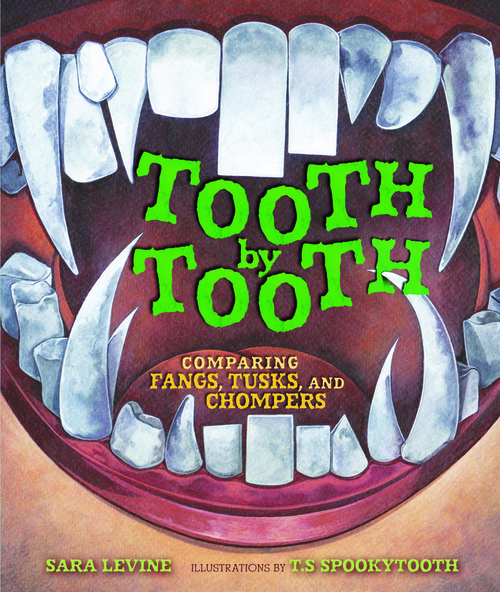
Tooth By Tooth: Comparing Fangs, Tusks, and Chompers
Written by Sara Levine | Illustrated by T. S. Spookytooth
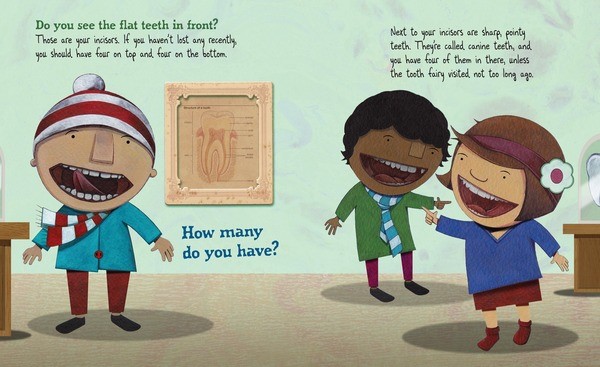
“Open wide!” a little girl with a good set of teeth herself encourages on the first page of this fun nonfiction book. “Look at all the chompers in there.” Mirror in hand she proceeds to reveal that human teeth are unusual because we are mammals, and mammal teeth come in different shapes and sizes. In fact there are three distinct types. A little boy takes over to describe them. Incisors are the four flat teeth in a person’s mouth—two on the top and two on the bottom right in front.
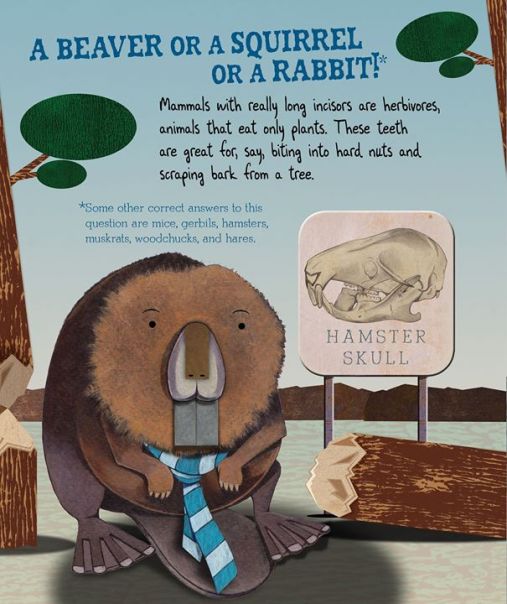
The four pointy teeth next to the incisors are canines, and the rest of the teeth are molars. Other mammals also have these teeth, and you can tell what an animal eats by which type is largest. For example, say your incisors were bigger than all your other teeth and they were so big they stuck out of your mouth even when it was closed, then you would be a beaver…or a squirrel…or a rabbit. These animals are herbivores and their oversized incisors help them break into nuts and scrape bark from trees.
Image copyright T. S. Spookytooth, courtesy of Lerner Books
From here on Tooth by Tooth offers up amusing illustrations and “what kind of animal would you be if…” questions to spark kids’ powers of recognition. How about if your canines were so long they poked out of your mouth? Well, then you could be a “seal or a cat or a dog or a bear!” All these animals eat meat and need the sharp teeth to do it.
What if you had really tall molars? Then you’d be a “horse or a cow or a giraffe!” These guys use their molars to grind up grass. And if all your teeth were the same height? Come on…you know! You’d be you! Because humans eat plants and meat, we “need teeth that do many different jobs.”
But there are a lot more wacky teeth out there waiting for us to brush up on. So let’s get started. What if “two of your top incisors were so long that they grew out of your mouth and pointed to the sky? What if they were so long you could use them to carry your school bag?” You’ve probably guessed this one—you’d be an elephant. While an elephant’s tusks aren’t used for eating, they are used to procure the bark, roots, and other plant material that make up the elephant’s diet.
Image copyright T. S. Spookytooth, courtesy of Lerner Books
What if you could almost trip over your canine teeth? Yep, you’d be a walrus, and you would use those sharp bad boys to poke holes in the ice to grab your favorite oysters and clams. But after eating they’re not done using their teeth. “After diving down for a meal, walruses can use their tusks to pull themselves back up onto the ice for a nap. Imagine if “your top and bottom canine teeth curled up out of your mouth so you had two pairs of tusks?” Or if your one upper canine grew through your upper lip and kept on growing? Or if you had no teeth at all? Yikes! The remarkable answers are just a read away!
Fish, amphibians, and reptiles also have teeth of a sort, but because they are all the same shape and size, they don’t get special names—that doesn’t mean you can ignore them, though, because sharks are among this group, and you know what they can do!
More information about mammals, mammal teeth, a glossary, and a list of online and print references follow the text.
There’s nothing like the Wow! factor to capture kids’ attention, and Sara Levine uses it to humorous and fascinating effect in Tooth by Tooth: Comparing Fangs, Tusks, and Chompers. After giving a solid description of each kind of tooth and what it is used for in language that kids use and will relate to, Levine begins her guessing game that leads to even more discovery. We’ve all seen elephants and walruses with their mighty tusks, but how many know what they are really used for? And what about warthogs and narwhals? It’s all here in this creative nonfiction title.
T. S. Spookytooth took a big bite out of the “how to make kids laugh” manual in illustrating each question and type of tooth. Pictures of girls and boys with enormous teeth jutting this way and that will make readers glad to be human. And while the animals that belong to each molar, incisor, or canine sport the scarf, bow, or head band of its human counterpart, they are clearly and scientifically drawn to provide full understanding. Animal skulls also demonstrate the placement of teeth. The cover, with its close enough to eat you view of a very scary mouth is a show stopper and will attract kids as soon as they see it.
Ages 5 – 9
Millbrook Press, Lerner Books, 2016 | ISBN 978-1467752152
Check out Sara Levine’s website for more books, stuff for kids, teachers’ resources, and more!
View a gallery of T. S. Spookytooth’s art and read his biography (?!) on his website!













 celebratepicturebooks.com