October 24 – National Food Day

celebrate-picture-books-picture-book-review-now-you-know-what-you-eat-cover

About the Holiday

Established in 2011 by the Center for Science in the Public Interest, National Food Day aims to raise awareness of nutrition issues and encourage people to “Eat Real.” Eating real means “cutting back on sugary drinks, overly salted packaged foods and fatty, factory-farmed meats in favor of vegetables, fruit, whole grains, and sustainably raised protein.” Prominent food activists help people discover where they can find food that is healthy and affordable. Another goal is to promote food production that is mindful of the environment, farm animals, and farmers. The efforts of National Food Day continue year round and culminate on October 24 with special events.

I received a copy of Now You Know What You Eat from Orchard Books for review consideration. All opinions are my own. I’m excited to be teaming with Orchard Books in a giveaway of the book. See details below.

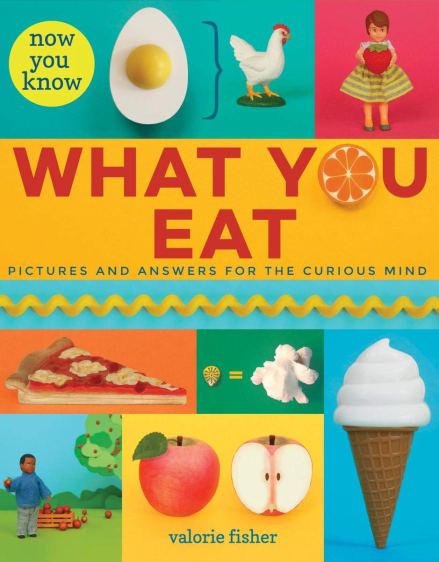
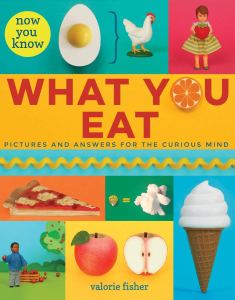
Now You Know What You Eat: Pictures and Answers for the Curious Mind

By Valorie Fisher

As you lick an ice cream cone, dip your spoon into a bowl of macaroni and cheese, or crunch on a pickle, do you ever think about all of the ingredients that go into it or where those ingredients come from? That’s the fascinating premise behind Now You Know What You Eat. Valorie Fisher presents this information in bright graphic form with an inviting vintage touch. Her clearly marked pages make connections that even the youngest readers can follow.

celebrate-picture-books-picture-book-review-now-you-know-what-you-eat-milk

Copyright Valorie Fisher, 2019, courtesy of Orchard Books.

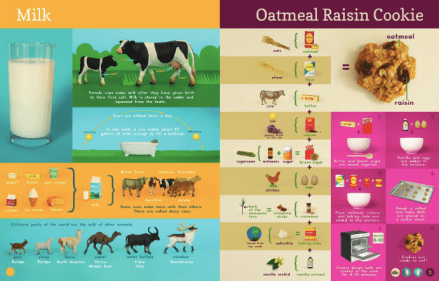
First up is that delicious summer treat—the ice cream cone. For kids this may look like cone + vanilla ice cream, but that pointy (or flat bottom) cup is made up of “flour + sugar + eggs + butter.” And the scoop? That’s made from “cream + milk + sugar + eggs + vanilla extract.” But where does all that stuff come from, a curious kid may wonder. Fisher has that covered too. Running along the bottom of the page is a pictorial which shows that eggs come from a chicken, flour comes from wheat, milk, cream, and butter come from a cow, sugar comes from sugarcane, and vanilla extract comes from the vanilla orchid.

celebrate-picture-books-picture-book-review-now-you-know-what-you-eat-maple-syrup

Copyright Valorie Fisher, 2019, courtesy of Orchard Books.

Children will be amazed to see what a collage the Oatmeal Raisin Cookie is and where the ground cinnamon that gives them their spice and the baking soda that helps the dough rise come from. There’s even a little tutorial on how the cookies are made once the dough is mixed. That seemingly simple peanut butter sandwich is another work of art. Among other things, kids learn how jelly is thickened, the difference between whole wheat bread and white bread, and the role of yeast in bread making. They may also find it interesting that the peanut, despite its name, is not a nut at all, but a legume.

celebrate-picture-books-picture-book-review-now-you-know-what-you-eat-macaroni-and-cheese

Copyright Valorie Fisher, 2019, courtesy of Orchard Books.

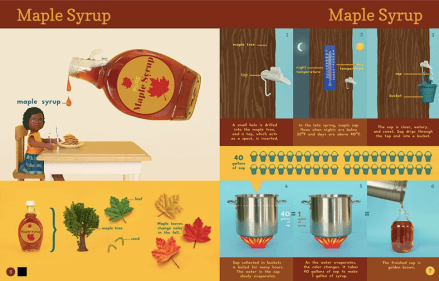
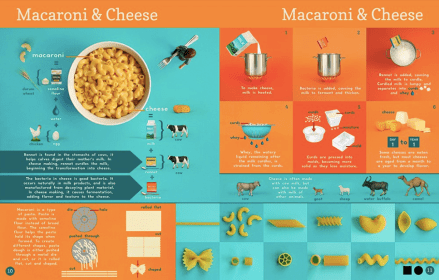
We all know mac ‘n’ cheese is scrumptious comfort food, but there’s a lot more to it than that—and readers will discover some surprising ingredients that go into the making of cheese. A short primer on macaroni dishes up some favorite shapes. Want to know how chocolate’s made? There’s a two-page spread for that too. From the cacao pod to the oven to the mold and every step in between, children discover how this favorite comes to be as well as the fact that “dark chocolate = milk chocolate – milk” and “white chocolate = milk chocolate – cocoa mass. The makings of maple syrup, dill pickles, lemonade, yogurt, vegetable soup, pizza, honey, and potato chips are also explored. A few ingredients, like milk, eggs, corn, and apples, are given an entire page to explain how it is grown or produced.

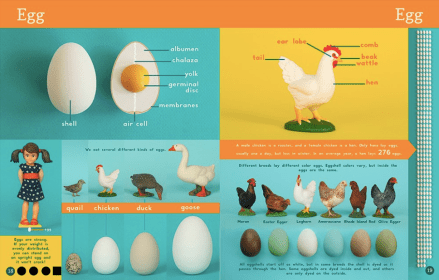
celebrate-picture-books-picture-book-review-now-you-know-what-you-eat-egg

Copyright Valorie Fisher, 2019, courtesy of Orchard Books.

Valorie Fisher combines symbols, such as addition and subtraction signs, brackets, and equal signs to show how separate ingredients are combined to become a favorite food. She also includes easy-to-understand text that explains more about each ingredient or finished dish and where base ingredients come from and/or how they are grown. Fisher also talks about the variety of milk-producing animals, kinds of corn, and types of apples and citrus fruits around the world. Noteworthy facts, such as how much milk one cow produces each week and that a person could stand on an egg without cracking it, will captivate kids.

Graphics-loving kids will immediately gravitate toward Fisher’s pages that use readily recognizable, but generic, images to deconstruct food into its individual parts. Presented on alternating colored squares, strips and blocks, the steps are easy to follow. Her vibrant choices highlight the food and draw readers in to linger over each page and its absorbing content. Illustrated pages also contain a guide to the makeup of a healthy plate; a chart outlining the minerals and vitamins in the foods presented and how they help the body; and a glossary.

Now You Know What You Eat: Pictures and Answers for the Curious Mind will entice readers of all ages to dig deeper into learning what goes into the food they eat and is an excellent accompaniment to cookbooks and nutrition guides at home and in school and public library collections.

Ages 4 – 8

Orchard Books, 2019 | ISBN 978-1338215465

To learn more about Valorie Fisher, her books, and her art, visit her website.

National Food Day Activity

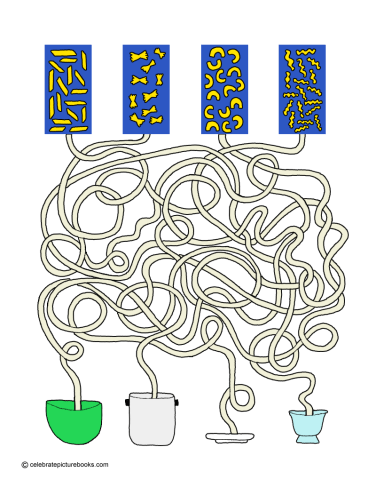
CPB - Noodle Puzzle

Noodle on This! Puzzle

Pasta is a perennial favorite! Help these noodles get to the right plate, bowl, or pot in this printable Noodle on This puzzle that’s as wiggly as a wet noodle!

celebrate-picture-books-picture-book-review-now-you-know-what-you-eat-cover

You can find Now You Know What You Eat: Pictures and Answers for the Curious Mind at these booksellers

Amazon | Barnes & Noble | Books-a-Million | IndieBound

Picture Book Review

September 4 – National Wildlife Day

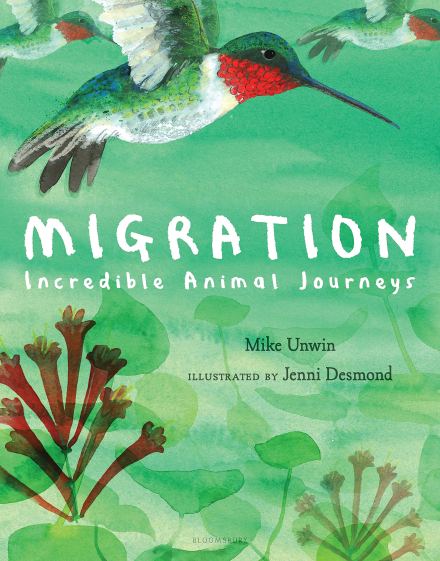
celebrate-picture-books-picture-book-review-migration-incredible-animal-journeys-cover

About the Holiday

National Wildlife Day was established in 2005 by author and pet lifestyle expert Colleen Paige in memory of conservationist Steve Irwin. The day promotes awareness of the importance of conservation of animals, habitats, and the environment worldwide and offers education on the number of endangered and threatened species across the globe. To honor today’s holiday, visit a local zoo, aquarium, or other nature preserve and take some time to learn about what you can do to help protect the environment.

I received a copy of Migration: Incredible Animal Journeys from Bloomsbury Children’s Books for review consideration. All opinions are my own.

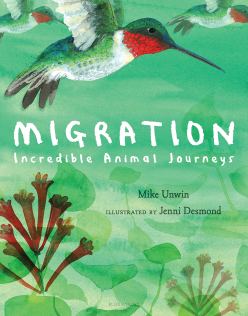
Migration: Incredible Animal Journeys

Written by Mike Unwin | Illustrated by Jenni Desmond


In their stunning book, Mike Unwin and Jenni Desmond take readers along as twenty diverse animals complete their annual travels to safer, warmer, or more fertile feeding grounds guided by inborn instincts. With compelling and conversational storytelling, Unwin introduces each creature, divulging fascinating and endearing facts about the adults and babies that undertake these epic trips—the shortest, 60 miles; the longest, a breathtaking 60,000 miles!

celebrate-picture-books-picture-book-review-migration-incredible-animal-journeys-whales

Image copyright Jenni Desmond, 2019, text copyright Mike Unwin, 2019. Courtesy of Bloomsbury Books.

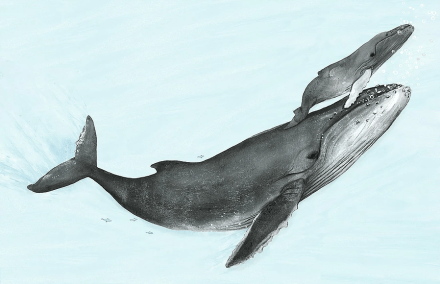
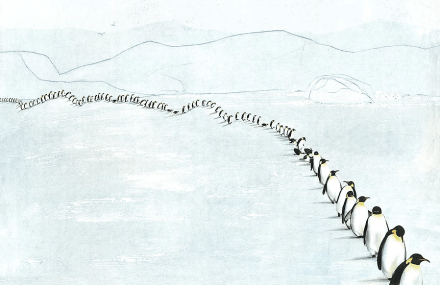
Readers will meet a humpback whale and her baby who stick together for more than 15,000 miles—“the longest swim of any animal on Earth”—as they head from the Pacific Ocean off the coast of Australia to the Antarctic and back in search of krill. As the baby eats, it “will start building up the thick layer of blubber that it needs to keep out the cold.” When it is ten years old, this baby will be fully grown and can look forward to many migrations to come.

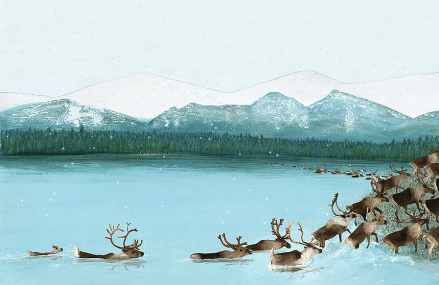
If you were stuck waiting at a caribou crossing, you’d want a good, long book on hand. More than 100,000 adults and their young swim across icy rivers and trek over grasslands of the frosty Arctic “inland toward the forests [where] the trees will help protect them when winter comes” and delicious moss and lichen await under snowy blankets.

celebrate-picture-books-picture-book-review-migration-incredible-animal-journeys-caribou

Image copyright Jenni Desmond, 2019, text copyright Mike Unwin, 2019. Courtesy of Bloomsbury Books.

Meanwhile in a warmer part of the world, a passenger cries, “Stop the car quick! There’s a red river flowing right across the road…. But look closer. It’s not water: it’s crabs. Big red ones. There are thousands of them. They pour across the road in an army of pincers, then scuttle down the bank on the other side, heading for the sea.” Where does this awesome sight take place? On Christmas Island in the Indian Ocean northwest of Australia as millions of red crabs move from the forests to the sea, en masse.

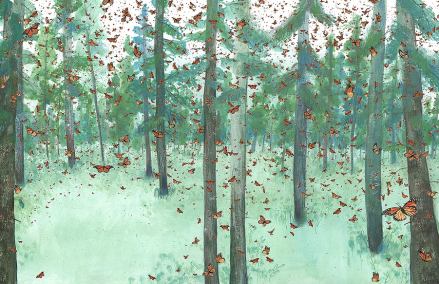
One of the most mysterious and intricately sequenced migrations is that of the monarch butterfly. Each year it takes four generations and four stops to lay eggs and breed along the way for these stained-glass-gorgeous insects “that can weigh less than a paperclip” to complete their journey from the northern United States and Canada to Mexico.

celebrate-picture-books-picture-book-review-migration-incredible-animal-journeys-butterflies

Image copyright Jenni Desmond, 2019, text copyright Mike Unwin, 2019. Courtesy of Bloomsbury Books.

And which creature has the stamina for that 60,000-mile voyage? That honor goes to the appropriately named wandering albatross, who “five to ten years ago…left the small rocky island where it was born. Ever since then it has been wandering, covering more than 60,000 miles a year—over a quarter of the distance from the Earth to the Moon. Never once has it touched land, though the birds often roost on the surface of the water.” In one or two years, this solitary traveler will return to land to breed and become a stay-at-home parent until its only child is ready to depart.

celebrate-picture-books-picture-book-review-migration-incredible-animal-journeys-wildebeasts

Image copyright Jenni Desmond, 2019, text copyright Mike Unwin, 2019. Courtesy of Bloomsbury Books.

Other creatures presented include the emperor penguin, arctic tern, whooping crane, barn swallow, globe skimmer dragonfly, southern African pilchard, ruby-throated hummingbird, bar-headed goose, great white shark, African elephant, pacific salmon, osprey, blue wildebeest, straw-colored fruit bat, and green turtle.

A map of the world—with each animal’s migratory journey outlined—orients children to the geographic locations and distances involved as well as a few more facts on migration and how pollution and habitat destruction affect migratory patterns follows the text.

celebrate-picture-books-picture-book-review-migration-incredible-animal-journeys-penguins

Image copyright Jenni Desmond, 2019, text copyright Mike Unwin, 2019. Courtesy of Bloomsbury Books.

Mike Unwin’s accessible, descriptive, and sensory snapshots turn this science-based book into an enthralling page-turner. As one astounding true story leads to another, readers will be eager to see which animal comes next and continue learning about this wildlife phenomenon. Well-known for his nature books for children and adults, Unwin captures the spirit of each animal as they take on the formidable challenges of their annual migration and in the process teaches a love and respect for nature.

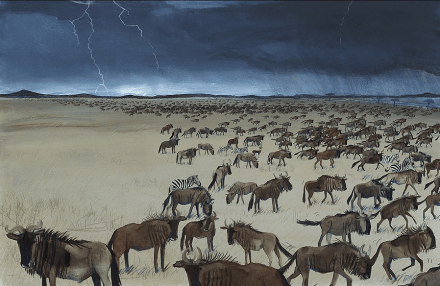
Accompanying Unwin’s text are Jenni Desmond’s gorgeous mixed-media illustrations, made all the more impressive by the book’s large format. The textured pages dazzle with the movement and grandeur of nature, transporting readers to far-flung parts of the world and showing them the beauty of each animal up close. Icy blues and greens lend images of the Arctic a frosty feel, while vibrant greens set off the brilliant oranges of the monarch butterflies and jeweled feathers of the ruby-throated hummingbird. Wildebeest are menaced by storm clouds and elephants parade along a brown, dusty road. The book concludes with first a dusky and then a moonlit night that welcome bats and turtles to begin their travels.

An excellent choice for home, classroom, homeschool, and public library collections, Migration: Incredible Animal Journeys will be a favorite of both kids and adults for lessons and more casual reading.

Ages 5 – 8 and up

Bloomsbury Children’s Books, 2019 | ISBN 978-1408889916

To learn more about Jenni Desmond, her books, and her art, visit her website.

National Wildlife Day Activity

celebrate-picture-books-picture-book-review-wonderful-wildlife-board-game

Wonderful Wildlife Board Game


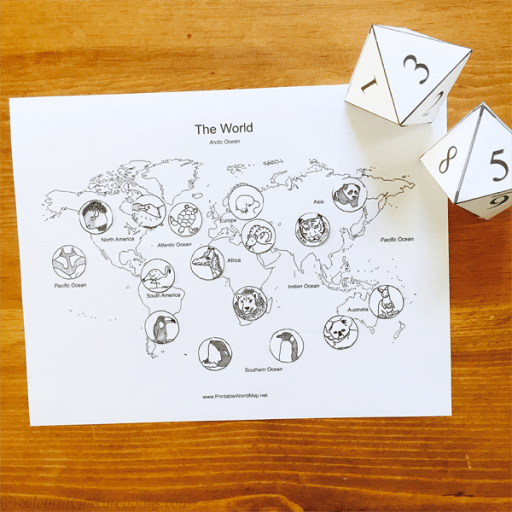
Fascinating animals are found in every part of the world. Play this fun printable Wonderful Wildlife Board Game to match each animal to the area where it lives.

Supplies

Directions

  1. Print a World Map for each player
  2. Print one set of 16 Wildlife Tokens for each player
  3. Print two copies of the 8-sided die, fold, and tape together
  4. If you would like, color the map and tokens
  5. Choose a player to go first
  6. Each player rolls both dice and places an animal on their map according to these corresponding sums of the dice below
  7. The first player to fill their map is the winner!
  • 1 = Flamingo – South America
  • 2 = Emperor Penguin – Antarctica (Southern Ocean)
  • 3 = Giraffe – Africa
  • 4 = Bald Eagle – North America
  • 5 = Ibex – Europe
  • 6 = Kangaroo – Australia
  • 7 = Panda – Asia
  • 8 = Orca – Antarctica (Southern Ocean)
  • 9 = Toucan – South America
  • 10 = Buffalo – North America
  • 11 = Koala – Australia
  • 12 = Lion – Africa
  • 13 = Etruscan Shrew – Europe
  • 14 = Manta Ray – Pacific Ocean
  • 15 = Sea Turtle – Atlantic Ocean
  • 16 = Tiger – Asia

celebrate-picture-books-picture-book-review-migration-incredible-animal-journeys-cover

You can find Migration: Incredible Animal Journeys at these booksellers

Amazon | Barnes & Noble | Books-a-Million | IndieBound

Picture Book Review

August 26 – International Dog Day

celebrate-picture-books-picture-book-review-experiment-#256-cover

About the Holiday

International Dog Day was established in 2004 by Colleen Paige to raise awareness of all the dogs who need forever homes. The day also celebrates dogs of all breeds and honors the work of these faithful friends, whether they are family pets or specially trained as service dogs, police dogs, or search-and-rescue dogs. The month of August is also Inventor’s Month—a time when we celebrate those creative types who think differently and put their imagination to work to design new products and services we may not even know we need until we have them. The mashup of these two holidays brings us…well…today’s book!

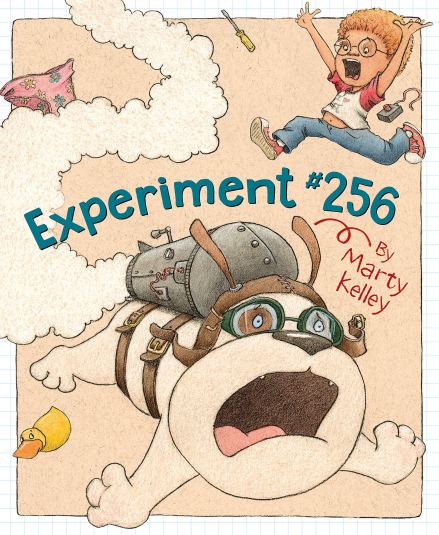
Experiment #256

By Marty Kelley


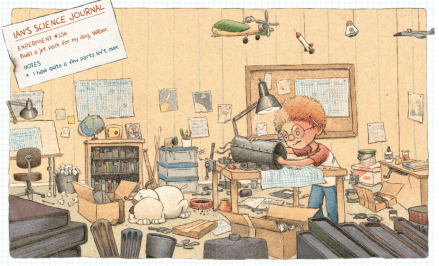
Ian is working on Experiment #256—a jet pack for his dog Wilbur. Ian’s room doubles as his lab, as the tools, supplies, and (especially) loose parts scattered all over attest to. Ian may be a bit messy, but with the methodical mind of any good inventor, he is taking detailed notes about his experiment in his Science Journal. While he has completed the jet pack, the entry on the fire-tinged journal page reveals: “I have quite a few parts left over.” Still, it’s time to try this marvel out.

celebrate-picture-books-picture-book-review-experiment-#256-jet-pack

Copyright Marty Kelley, 2019, courtesy of Sleeping Bear Press.

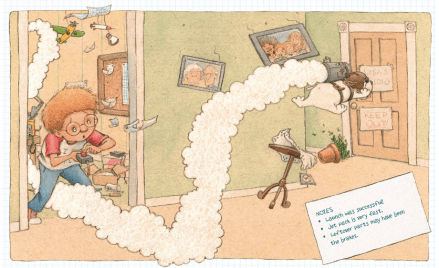
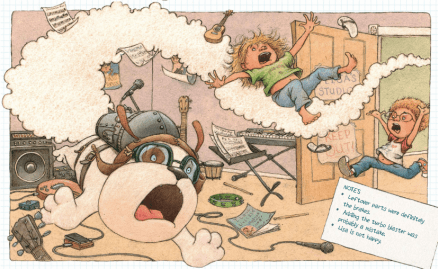
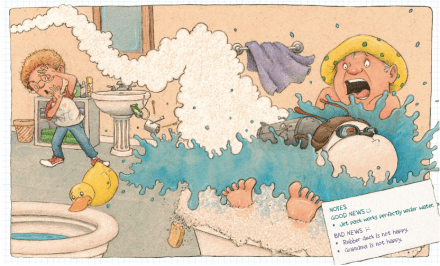
Ian straps it onto Wilbur, pushes the remote button, and… Wilbur is flying—straight for Lisa’s Studio, where a large “Keep Out!” sign greets visitors to her room. Ian jots down thoughts about the successful launch, but also a fear about those missing parts. As Wilbur bursts through the door, Ian’s sister and all of her sheet music go flying. Thanks to the turbo booster, Wilbur only stays a moment, but is still zooming… right into Grandma’s bubble bath. This turns out to be one of those good news (the jet pack works under water)/bad news (rubber duck and Grandma are not happy) situations, which Ian dutifully notes in his journal.

celebrate-picture-books-picture-book-review-experiment-#256-launch

Copyright Marty Kelley, 2019, courtesy of Sleeping Bear Press.

But Wilbur’s flight isn’t over yet. On his way out the window and into the backyard, he grazes Mom, who’s practicing yoga. Ian learns one important fact from this part of the experiment: “Yoga pants are surprisingly flammable.” As Wilbur crashes through the garden there’s more good news in that the broccoli has suffered irreparable losses and more bad news in that the peas have not. Wilbur’s trajectory next takes him into the neighbor’s yard, where he gets “tangled up in the undies that Mrs. Marino was hanging on the line,” and then skyward.

celebrate-picture-books-picture-book-review-experiment-#256-lisa

Copyright Marty Kelley, 2019, courtesy of Sleeping Bear Press.

By the time Ian catches up with him, Wilbur is only a speck at the top of a very high contrail. Ian is distressed. He documents in his journal that not only did he launch his “best friend into space,” Wilbur “doesn’t have a space helmet” and “he didn’t even bring a snack.” Meanwhile, back on earth, Mrs. Marino is still giving Ian a piece of her mind when he is suddenly cast in a saucer-shaped shadow. He looks up to find Wilbur parachuting home clinging to a pink-and-flowered pair of Mrs. Marino’s undies. Ian faithfully notes: “straps on jet pack not secure.”

Gazing into Wilbur’s goggled, angry eyes, Ian concludes that maybe Experiment #256 was not the best idea. But as any good inventor will tell you, a failed experiment is not a flop but merely an inspiration. So, while Lisa, Grandma, Mom, and Mrs. Marino may still be unhappy, Wilbur is thrilled with his new Snack Blaster. And Ian is hard at work on another, more securely strapped jet pack for….

celebrate-picture-books-picture-book-review-experiment-#256-grandma

Copyright Marty Kelley, 2019, courtesy of Sleeping Bear Press.

Marty Kelley’s inventive story—told entirely through Ian’s science journal notes and hilarious illustrations—will keep readers giggling from the first page to the last. Before the story even gets going, kids are treated to a collage of laugh-out-loud photos showing thirteen of Ian’s previous experiments, providing a bit of foreshadowing about #256. Ian’s cryptic observations in his journal lead kids to follow defenseless Wilbur from room to room, yard to yard, and Earth to outer space and back while discovering the chaos wrought by Ian’s runaway jet pack. Flying objects, shocked faces, and, of course, those undies will have readers lingering over the pages to find all the comic details. Kelley’s vivid, textured, two-page spreads are full of action and give the story a retro feel while including timeless visual jokes and a kid-pleasing ending.

An imagination booster for story times when adults and kids want to share a laugh and a bit of science, Experiment #256 would be a funny addition to home, classroom, and library bookshelves.

Ages 5 – 7

Sleeping Bear Press, 2019 | ISBN 978-1534110137

Discover more about Marty Kelley, his books, and his art, visit his website.

International Dog Day Activity

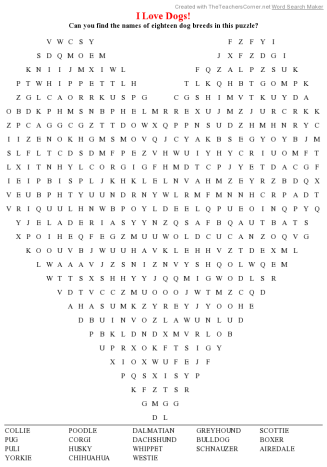
celebrate-picture-books-picture-book-review-i-love-dogs-wordsearch-puzzle-shorter-size

I Love Dogs! Word Search Puzzle


If you love dogs, you’ll have fun discovering the names of eighteen dog breeds in this printable word search puzzle!

I Love Dogs! Word Search Puzzle | I Love Dogs! Word Search Solution

celebrate-picture-books-picture-book-review-experiment-#256-cover

You can find Experiment #256 at these booksellers

Amazon | Barnes & Noble | Books-a-Million | IndieBound

Picture Book Review


July 29 – Rain Day

celebrate-picture-books-picture-book-review-I-am-the-rain-cover

About the Holiday

Here we are in the middle of the hot, hot summer. In many places the grass is turning brown and the plants are wishing for a little relief.  Are you wishing for rain to cool things off too? Well, today may be your lucky day, and if you live in Waynesburg, Pennsylvania the odds are with you! The holiday got its start back in 1874, when a local resident remarked to William Allison, the pharmacist at JT Rogers & Co drug store that it always rained on his birthday—July 29. Allison began keeping an annual record. Since that time all eyes have been on Waynesburg to see if the remarkable run—115 years out of 144—continues. The people of Waynesburg celebrate their notoriety with a festival that includes live entertainment, arts and crafts and food booths, kids’ games, and, of course, an umbrella decorating contest. So, watch the skies—and get your umbrella ready!

I Am the Rain

By John Paterson


“Sometimes I’m the rain cloud and sometimes I’m the rain.” So starts John Paterson’s lyrical and thoughtful tribute to the water cycle paired with beautiful illustrations that invite readers along to discover all the ways that water changes and affects our lives. From the flowing aftermath of a storm as “a roadside rapid roaring down a drain” to the creator of a rainbow “in mist or morning dew.” Water takes on various colors, shapes, and forms as the weather changes throughout the year.

celebrate-picture-books-picture-book-review-I-am-the-rain-rapid

Copyright John Paterson, 2018, courtesy of Dawn Publications.

Paterson’s short, yet compelling verses reflect the interconnectedness of the world’s water systems in poetic language that reveals the living, driving force of nature. In spring, water narrates: “Waiting, I’m the ocean bay that searching rivers seek.” He also recognizes the imagination that water inspires when, in summer, water rises “in rumbling thunderheads like castles in the haze.”

celebrate-picture-books-picture-book-review-I-am-the-rain-pool

Copyright John Paterson, 2018, courtesy of Dawn Publications.

But water is not just an Earthly phenomenon. Turning the book vertical to peer through a narrow canyon where a glowing object soars across the night sky, readers learn that water is found “in the comet high circling the stars. / I’m also carving canyons deep on Earth and cousin Mars.” And, finally, the most personal link with water is revealed: “All of life depends on me. I’m even part of you.”

Five detailed and illustrated pages of back matter explain the water cycle; the science behind Paterson’s poetry, including explanations of the three forms of water, why water flows downhill, the science of rainbows, the color of water, and more; STEM experiments for teachers to perform with students; and how people can preserve and protect the world’s water. A list of other books on water published by Dawn Publications rounds out this educational content.

celebrate-picture-books-picture-book-review-I-am-the-rain-waterfall

Copyright John Paterson, 2018, courtesy of Dawn Publications.

Paterson’s lovely, textured illustrations expose the power and splendor of water rushing in swirling streams, muddy slides, and roaring waterfalls; decorating the sky with colorful arcs and a spider’s web with crystal pearls; and resting in a rock pool and on a snowy bank. In a particularly atmospheric spread, low rolling fog creeps across a pumpkin patch on a frosty autumn morning.

A striking resource for classrooms, homeschoolers, and families, I Am the Rain makes a charming read aloud for story times as well as a captivating supporting text for science lessons. The book would be a welcome addition to any home, school, or library collection.

Ages 3 – 7

Dawn Publications, 2018 | ISBN 978-1584696155

Rain Day Activity

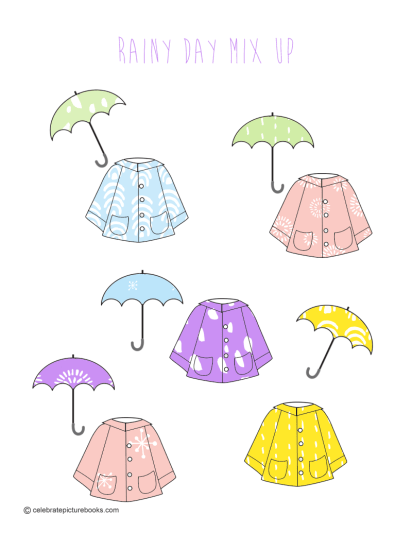
celebrate-picture-books-picture-book-review-rainy-day-match-up-puzzle

Rainy Day Match-Up Puzzle


On a rainy day you need just the right raincoat and umbrella to stay dry! These matching umbrellas and raincoats have gotten separated. Can you find the matching pairs? There may be more than one way to do it. How do you match them up? 

Rainy Day Match-Up Puzzle

celebrate-picture-books-picture-book-review-I-am-the-rain-cover

You can find I Am the Rain at these booksellers

Amazon | Barnes & Noble | Books-a-Million | Dawn PublicationsIndieBound

Picture Book Review

July 24 – It’s National Moth Week

celebrate-picture-books-picture-book-review-moth-an-evolution-story-cover

About the Holiday

National Moth Week celebrates the beauty and diversity of moths, their habitats, and their life cycles. Scientists estimate that there are anywhere from 150,000 to 500,000 species of moths in the world, with varying markings and sizes. During the week people are encouraged to learn more about these fascinating insects and to join in on mapping moth distribution by observing and reporting moth sightings in parks, woods, neighborhood, and their own backyards. To get involved and learn more about today’s holiday, visit nationalmothweek.org.

I received a copy of Moth for review consideration. All opinions are my own.

Moth

Written by Isabel Thomas | Illustrated by Daniel Egnéus


“This is a story of light and dark. Of change and adaptation, of survival and hope. It starts with a little moth.” Long ago a peppered moth wiggled out of its cocoon, unfurled its “salt and pepper” wings, its legs, and its antennae and took to the air to avoid predators. It met up with other peppered moths flitting and fluttering among the trees in the night sky. Most of these moths “had speckled, freckled wings,” but some had “wings as dark as charcoal.”

During the day, the peppered moths rested, flattening themselves against the speckled bark of the trees, camouflaged from birds and other animals. But the black-winged moths weren’t so lucky. Easy to spot against the light bark, they began to vanish as birds nipped them up for themselves and their chicks. As the speckled peppered moths had more and more babies, they also sported a mottled pattern.

e-books-picture-book-review-moth-an-evolution-story-child-reading

Image copyright Daniel Egnéus, 2019, text copyright Isabel Thomas, 2019. Courtesy of Bloomsbury Children’s Books.

Over many years, the speckled moths became dominant while the dark-winged variety dwindled. But then, factories, trains, and other machines that burned coal were built. They spewed dark clouds of soot into the air. The soot settled everywhere, turning buildings and trees black. Now, the lighter-colored moths became the meals of birds and other predators, and the black-winged peppered moths had better camouflage. “Now they lived long enough to lay eggs of their own…and their wing color passed on to their offspring…and their offspring’s offspring.”

After decades of pollution and adaptation, the peppered moth population was still strong, but now most of the moths were dark, while the lighter moths were rare. But then, people came together to clean up the pollution. Less coal was burned as new ways to fuel machines were found. In time, the air cleared, the sky was again blue and the clouds white. “The trees shed their sooty bark.” Modern life brought many changes to the landscape, providing places for both dark and speckled peppered moths to hide. Today, a mix of peppered moth can be found flittering and fluttering in the night sky, offering their “story…of survival…and hope.”

celebrate-picture-books-picture-book-review-moth-an-evolution-story-book

Image copyright Daniel Egnéus, 2019, text copyright Isabel Thomas, 2019. Courtesy of Bloomsbury Children’s Books.

Isabel Thomas’s superlative nonfiction picture book masterfully combines lyricism with clear descriptions of the science of adaptation and natural selection to create a story that touches on natural history, human history, and the interactions of the two. Thomas’s conversational tone and direct address to the reader makes this a personal story and will captivate children sensitive to nature and the world around them. Her excellent pacing serves to show the passage of time involved in the evolutionary changes within the moth community. Thomas begins and ends her story with a note of hope that living things will adapt to today’s changing world. The underlying lesson may also encourage readers to find ways in which humans can adapt to promote the survival of all living things.

celebrate-picture-books-picture-book-review-moth-an-evolution-story-trains

Image copyright Daniel Egnéus, 2019, text copyright Isabel Thomas, 2019. Courtesy of Bloomsbury Children’s Books.

Exquisite mixed-media illustrations by Daniel Egnéus will immediately draw readers—both children and adults—into the nighttime forest where peppered moths take wing, silhouetted against the golden moon and the deep blues and purples of the midnight sky before finding a hiding place from hungry bats and birds. The story’s theme of light and dark in its variations is powerfully presented. In the early pages, images are set against bright, open backgrounds; foliage is vibrant green; and birds dazzle with color. As a bird brings a charcoal-winged moth back to her nest while speckled moths hide, children can easily see natural selection at work.

As the Industrial Revolution alters the skyline and the quality of the air, the images become denser and the hues of the sky, trees, and birds muted. For children who have not grown up with the air pollution of the past—even the near past—double spreads of smog-churning factories and trains will make a strong impression. The introduction of the child at the beginning and end of the story reminds readers of two things: that we owe it to our children to treat the world with kindness and that our children are the hope this story builds on.

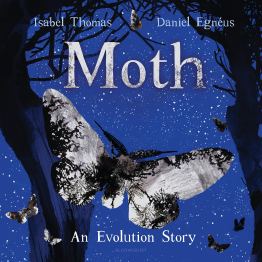
Special mention must be made of the magnificent and poignant illustrations of the speckled peppered moths. Looking closely at their outstretched wings, you will see nature—trees, water, dappled sunlight—reflected in them. The stunning cover—with its foil-embossed lettering, stars, and moth—reflects the importance of each reader to our world: touch or look into the shining silver and you will find yourself mirrored there.

A beautiful book to enhance nature and science studies and help children develop an understanding of the impact of change, Moth is a must for school, public library, and home collections.

Ages 6 – 10

Bloomsbury Children’s Books, 2019 | ISBN 978-1547600205

Discover more about Isabel Thomas and her books on her website.

To learn more about Daniel Egnéus and his work, visit his website.

Take a look inside Moth with this beautiful book trailer.

National Moth Week Activity

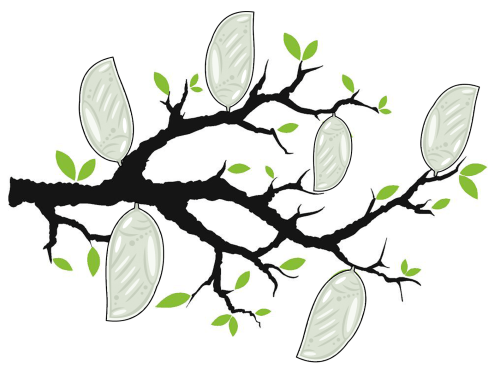
celebrate-picture-books-picture-book-review-tree-branch-with-white-cocoons

Beautiful Moths Game


Moths go through many stages of metamorphosis—from egg to caterpillar to cocoon— before they finally emerge as a moth. In this game, help six moths emerge from their cocoons to win!

Supplies

celebrate-picture-books-picture-book-review-moth-cards

Directions

  1. Print a Tree Branch Game Board and set of Moth Cards for each player
  2. Print one Moth Playing Die
  3. Choose a player to go first
  4. The first player rolls the die and places the matching moth card on one of the cocoons on the Tree Branch Game Board
  5. Play then moves to the player on the left
  6. Players continue to roll the die and place moths on each cocoon
  7. If a player rolls a moth that they already have placed on their game board, they pass the die to the next player and wait for their next turn.
  8. The player who fills their Tree Branch with moths first is the winner

celebrate-picture-books-picture-book-review-moth-an-evolution-story-cover

You can find Moth at these booksellers

Amazon | Barnes & Noble | Books-a-Million | IndieBound

Picture Book Review


July 3 – Apollo 11 Moon Landing Anniversary Month

celebrate-picture-books-picture-book-review-marty's-mission-cover

About the Holiday

On July 20, 1969 Neil Armstrong, watched by millions of people around the world, became the first person to step foot on the moon. This month we celebrate the fiftieth anniversary of that monumental moment. Since then we have developed a deeper understanding of our universe, but there is still so much more to discover. Who knows how far today’s children will go in exploring the great unknowns of the cosmos.

I received a copy of Marty’s Mission: An Apollo 11 Story from Sleeping Bear Press for review consideration. All opinions are my own. I’m delighted to be teaming with Sleeping Bear Press in a giveaway of the book. See details below.

Marty’s Mission: An Apollo 11 Story  (Tales of Young Americans Series) 

Written by Judy Young | Illustrated by David Miles


Ten-year-old Marty and his friend Tomás listened eagerly to the radio broadcast of the Apollo spacecraft liftoff from Marty’s home near NASA’s Tracking Station in Guam. The boys wished they could watch the historic flight, but there was no television reception. Marty and his family had moved to Guam a year ago when Marty’s dad took a job at the tracking station. Although Marty was excited to hear the announcer’s voice counting down to liftoff and then “‘Neil Armstrong talking from inside the spacecraft,’” he wished he could share the experience with his dad. But Marty’s father was busy at the tracking station and would be there for eight days.

celebrate-picture-books-picture-book-review-marty's-mission-home

Image copyright David Miles, 2019, text copyright Judy Young, 2019. Courtesy of Sleeping Bear Press.

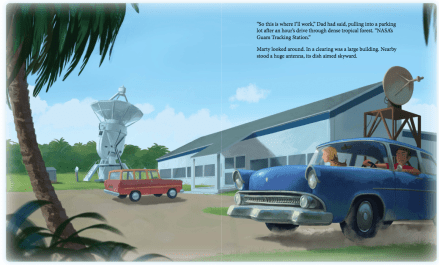
The tracking station, with its huge antenna facing skyward, fascinated Marty. “‘That,’” his dad had told him, “‘is what will pick up communication signals from the spacecraft. And inside the operations building is equipment to rely the signals back and forth between the astronauts and Mission Control in Houston, Texas.’” Marty thought it was awesome that his dad would get to hear everything the astronauts said. Marty wished he could visit the tracking station to hear them too, but he understood that his dad would be too busy and that there was “‘a lot at stake. If communications go down, the astronauts might not make it home,’” his dad had explained.

When Apollo 11 finally entered the moon’s orbit, Marty and Tomás were glued to the radio waiting for the Eagle to land. Then they got a call that the tracking station had set up a TV and was sending a bus to collect family members so they could watch the landing. Marty and Tomás rushed to board the bus. Marty, Tomás, and the rest of the families watched the Eagle touch down on the moon and Neil Armstrong descend the ladder to become the first person to set foot on the moon. They watched as the Armstrong and Buzz Aldrin “bounced around on the moon, taking photos and collecting lunar rocks.”

celebrate-picture-books-picture-book-review-marty's-mission-tracking-station

Image copyright David Miles, 2019, text copyright Judy Young, 2019. Courtesy of Sleeping Bear Press.

The next day the Eagle connected with the Columbia and began the trip back to Earth. “On the last night of the mission,” Marty was suddenly woken up by his mother. She said that his father needed him. Something was wrong. He was driven to the tracking station and met up with his dad and other men outside the huge antenna. “‘The antenna is stuck,’ Dad told Marty,” If they couldn’t get it moving again, Mission Control would lose contact with Apollo 11. It was vital that the antenna work, and time was running out.

But why did they need him? Marty wondered. His dad explained that they thought the problem was in a bearing—”‘a ring with metal balls encased inside it…. The balls have to roll for the antenna to move, but they’re stuck.’” The men thought that if the bearing could be packed with grease, it might move again. But their arms were too big to reach into the tight space. “‘Do you think you can do it?’” Marty’s dad asked. “‘You bet!’ Marty exclaimed.”

celebrate-picture-books-picture-book-review-marty's-mission-antenna

Image copyright David Miles, 2019, text copyright Judy Young, 2019. Courtesy of Sleeping Bear Press.

Marty learned what they wanted him to do and crawled into the space where the motor was. He took a glob of grease in one hand and reached in, “but even his arm was too big.” Marty knew he had to find a way to do it. The lives of the three astronauts depended on it. He thought a while and then smiled. “Quickly, Marty smeared grease all over his arm.” Although the space was still tight, his arm slipped in. Marty filled the bearing with grease. When he was finished, his dad called out to try starting the antenna again.

Slowly, it creaked back to life. “Instantly a voice called out from the building. ‘Communications with Apollo 11 intact. All systems working!’” The men cheered and congratulated Marty. Marty joined them in the operations building and listened as a voice from Houston announced, “‘Successful splashdown—task accomplished! Welcome back to Earth, Apollo 11.’” Marty’s father gave him a hug and said, “‘The world wouldn’t have heard those words if it weren’t for you, son.’”

celebrate-picture-books-picture-book-review-marty's-mission-Marty

Image copyright David Miles, 2019, text copyright Judy Young, 2019. Courtesy of Sleeping Bear Press.

Based on true events, Judy Young’s compelling story of a child who played a crucial role in one of history’s most astounding accomplishments will thrill young readers. As the first moon landing, the Apollo 11 mission was fraught with danger, excitement, and a level of uncertainty that had people glued to their televisions and radios for the length of the mission. Communication with the astronauts was paramount, and when the link was lost many feared for the three men. Young’s straightforward storytelling  realistically portrays the excitement and fascination of a child for a favorite subject while also demonstrating their pride in and understanding of their parents’ jobs. Through dialogue that always rings true, Young builds the strong relationship and trust Marty and his dad enjoy. Marty’s confidence and quick thinking also mirror the serious nature of the book’s target audience.

celebrate-picture-books-picture-book-review-marty's-mission

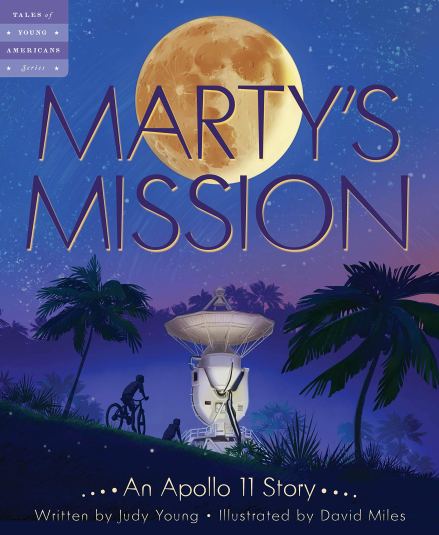
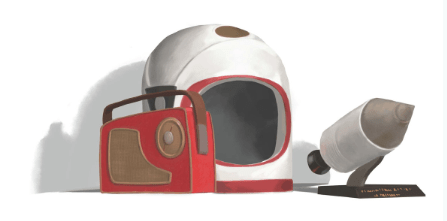
In his realistic and atmospheric paintings, David Miles offers readers a glimpse at a unique part of the Apollo 11 mission: NASA’s tracking station in Guam. As Marty and Tomás hang on every word from the radio, the moon hangs low in the twilight sky and serves as a backdrop to the waving palm trees. Kids interested in engineering, science, and communications will want to linger over the views of the huge antenna that provided the connection between Earth and the astronauts. Period details include images of radios, cars, televisions, and even the grainy broadcast seen by millions. As Marty’s father explains the problem to his son, readers can clearly see what a bearing looked like and where in the antenna Marty had to work. As the men in the operations building celebrate a successful mission, today’s children can feel a sense of kinship with the boy who made a difference in 1969.

Part of the Tales of Young American Series from Sleeping Bear Press, Marty’s Mission: An Apollo 11 Story is an absorbing true story that has impact for young readers today. For children interested in space, science, STEM, history, biographies, news, communications, and a well-told story, Marty’s Mission makes an inspirational addition to home, school, classroom, and public libraries.

Ages 6 – 10

Sleeping Bear Press, 2019 | ISBN 978-1534110144

Discover more about Judy Young and her books on her website.

To learn more about David Miles, his books, and his art, visit his website.

Marty’s Mission Giveaway

I’m excited to be teaming with Sleeping Bear Press in a giveaway of

One (1) copy of Marty’s Mission: An Apollo 11 Story written by Judy Young | illustrated by David Miles

To enter Follow me @CelebratePicBks and Retweet a giveaway tweet.

This giveaway is open from July 3 through July 7 and ends at 8:00 p.m. EST.

A winner for each prize will be chosen on July 8.

Prizing provided by Sleeping Bear Press.

Giveaway open to U.S. addresses only. | No Giveaway Accounts. 

Apollo 11 Moon Landing Anniversary Activity

celebrate-picture-books-picture-book-review-apollo-11-coloring-page-astronauts

Apollo 11 Moon Landing Coloring Pages


With these printable coloring pages you can follow some of the steps of the historic moon landing and the astronauts’ return home..

Blast Off! | Landing! | Astronauts on the Moon | Module Separates | Fiery Reentry

celebrate-picture-books-picture-book-review-marty's-mission-cover

You can find Marty’s Mission: An Apollo 11 Story at these booksellers

Amazon | Barnes & Noble | Books-a-Million | IndieBound

Picture Book Review


June 28 – It’s Great Outdoor Month

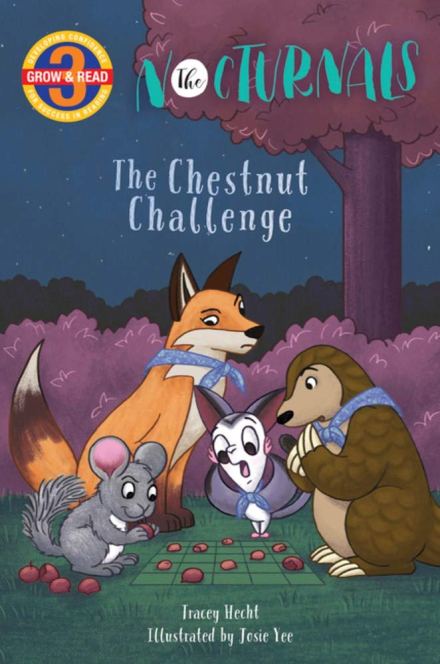
celebrate-picture-books-picture-book-review-the-chestnut-challenge-cover

About the Holiday

The warmer weather begs to be enjoyed—whether you’re playing, working, or just lounging around. Established in 1998 as Great Outdoors Week, the holiday expanded to a month-long celebration in 2004. There’s so much to see and do outside as the wonders of nature are always changing and challenging you in new and surprising ways.

The Nocturnals Series

The Nocturnals series of books—early readers and middle grade novels—brings together a trio of friends for adventures and learning. The three main characters are Dawn, a gentle, kind, and wise red fox; Tobin, a shy, hesitant, and loyal pangolin; and Bismark, a chatty, romantic, impetuous sugar glider. Their distinct personalities serve them well as they meet up with various other woodland animals in mysterious, dangerous, and surprising ways. No matter what challenges they face, however, Dawn, Bismark, and Tobin support each other as best friends should.

Whether children meet the Nocturnal Brigade as an beginning reader or as an established reader, they will love following the friends’ adventures and be charmed by their close relationship, even when squabbles arise. As with any favorite series, kids will look forward to catching up with what this unique group of nighttime animals are doing next.

Grow & Read Early Reader Level 2 Books
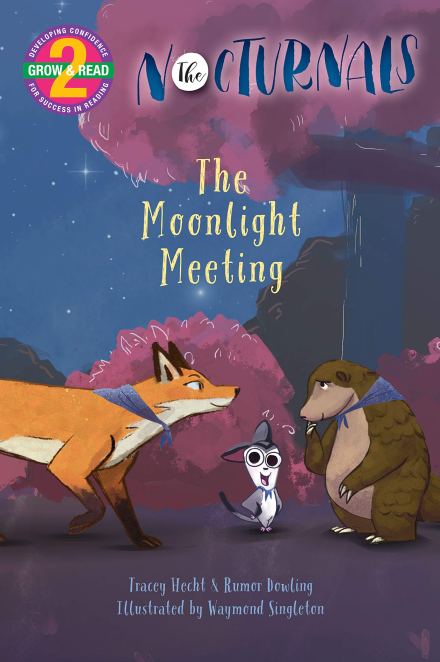
celebrate-picture-books-picture-book-review-the-moonlight-meeting-cover

The Moonlight Meeting

Written by Tracey Hecht and Rumur Dowling | Illustrated by Waymond Singleton


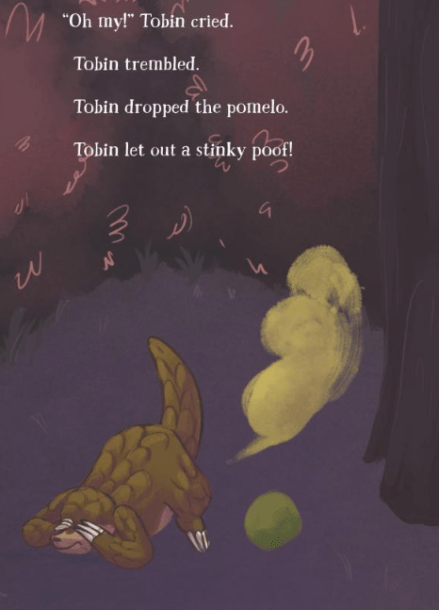
As the twinkling stars began to appear in the sky, a sweet pangolin by the name of Tobin woke up. “‘Oh my, Tobin said. ‘I smell something delicious!’” He yawned and stretched and went in search of that wonderful smell. It didn’t take long before he bumped into a pomelo—the perfect thing for breakfast. But before he could dig in, he heard a screech from the tree above. “‘Thief!’ it cried.” Tobin was so frightened that he “let out a stinky poof!”
celebrate-picture-books-picture-book-review-the-moonlight-meeting-tobin

Image copyright Waymond Singleton, 2017, text copyright Tracey Hecht, 2017. Courtesy of Fabled Films Press.

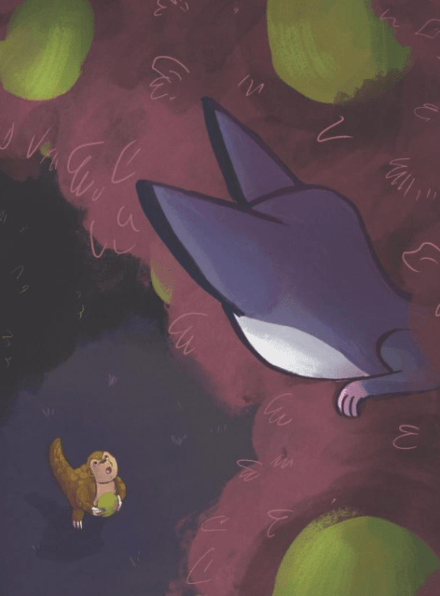
The small creature in the tree covered his nose. “‘That stench! That odor! That tang!’” he exclaimed. “‘This calls for the flaps!’” In a moment the animal leaped out of the tree and glided to the ground. Although a little scared, Tobin was curious. He wondered if perhaps this creature could become a friend. But it didn’t seem he was interested in anything but the pomelo. As he grabbed the green fruit, he introduced himself. “‘I am Bismark! Sugar glider spec-tac-u-lar! And the owner of this pomelo.’” But before Tobin could reply, a red fox emerged from the bushes.

She had smelled Tobin’s spray of fear and wondered if help was needed. The fox had “kind eyes” and “a warm smile.” Bismark spoke up and told the fox about Tobin and the pomelo and the thievery. The fox asked if all of this was true. “Tobin was shy, but the fox made him feel brave.” He answered that he was not stealing the fruit, but Bismark said he had seen it first.
celebrate-picture-books-picture-book-review-the-moonlight-meeting-pomelo

Image copyright Waymond Singleton, 2017, text copyright Tracey Hecht, 2017. Courtesy of Fabled Films Press.

The fox thought over the problem and…sliced the pomelo into three pieces. She gave a piece to Tobin and Bismark and kept one for herself. “‘Mmm,’ Tobin said. The pomelo was sweet! ‘Burp,’ Bismark belched. The pomelo was juicy. ‘Perfect,’ the fox declared. The pomelo was delicious!” It seemed the little sugar glider liked more than just the pomelo. After smoothing his hair and giving a deep bow, he introduced Tobin and himself. The fox smiled and told them her name was Dawn. Tobin was smitten.

Suddenly, they all realized that each of them slept during the day and were awake at night. Bismark exclaimed that they would be “a moonlight trio… a nocturnal brigade”… a…. Dawn broke in. “‘We will be friends,’” she said. Tobin and Bismark were happy. They were friends.

Facts about the nocturnal animals in the book and their favorite food, the pomelo, follows the story.
celebrate-picture-books-picture-book-review-the-moonlight-meeting-bismark

Image copyright Waymond Singleton, 2017, text copyright Tracey Hecht, 2017. Courtesy of Fabled Films Press.

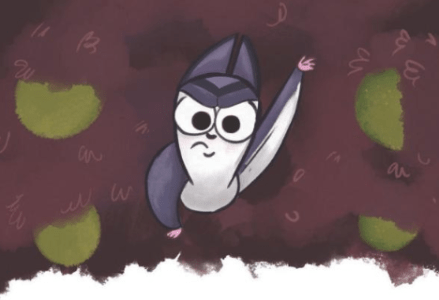
Tracey Hecht introduces her unique band of friends in this story that brings a diverse group of animals together over the disputed ownership of a pomelo. The strong personalities of the characters lend humor and intrigue to their quarrel over this favorite fruit, and as Dawn raises her sharp claws to decide the issue, readers may join Tobin and Bismark in a moment of wide-eyed suspense. The fox’s solution, however, is one of inclusion and sharing and sets the tone for the rest of the series. Hecht’s short sentences are composed of active, high-interest vocabulary, and the story moves along at a quick pace, carried by realistic and funny dialogue.

Screen Shot 2019-06-27 at 7.56.43 PM


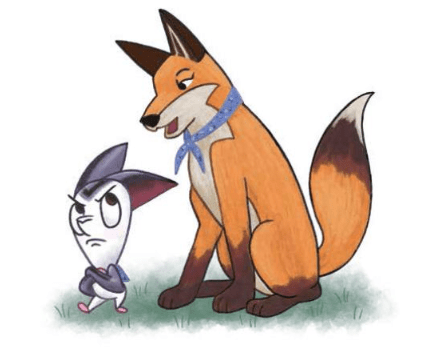
Kids will love meeting Dawn, Bismark, and Tobin through the illustrations on each page that convey their personalities and the storyline clearly. Tiny Bismark, with his big eyes, dramatic expressions, and energetic attitude is always ready for action. Tobin, the scaly pangolin with long claws, an anxious demeanor, and an inherent sweetness, is devoted and trustworthy. And Dawn, with her sleek red coat and gentle eyes, is caring, intelligent, and the glue that holds the three together. As readers get to know each character better, they’ll look forward to each one’s individual reactions to whatever adventure they encounter.

Ages 5 – 7 

Fabled Films Press, 2017 | ISBN 978-1944020149

You can find The Moonlight Meeting at these booksellers

Amazon | Barnes & Noble | Books-a-Million | IndieBound
celebrate-picture-books-picture-book-review-the-slithery-shakedown-cover

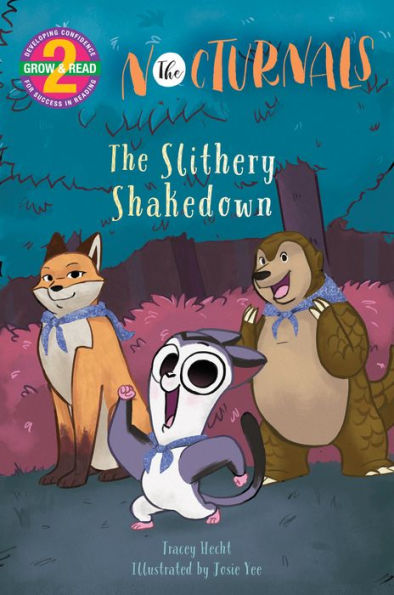
The Slithery Shakedown

Written by Tracey Hecht | Illustrated by Josie Yee


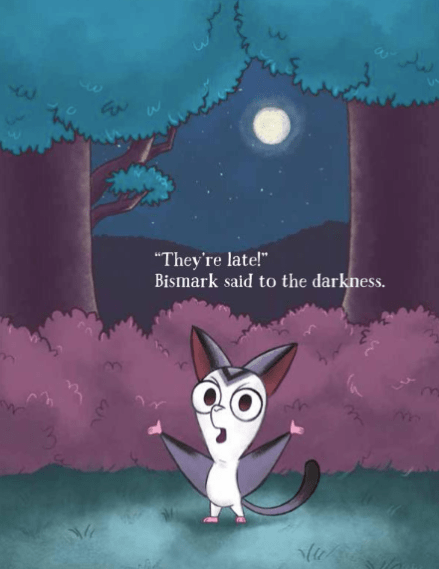
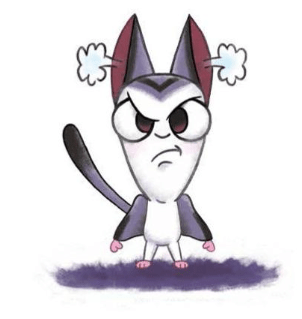
Although nighttime had come, Bismark was still waiting for his friends to arrive. “Bismark tapped his foot. Bismark put his fists to his hips. Bismark scrunched his tiny pink nose. This sugar glider was peeved!” Still, he was more relieved than angry when Tobin, the pangolin, came through the reeds. It wasn’t long before Dawn, a red fox, joined them. Bismark jumped on top of a rock and declared that he was going to take them on an adventure. After all he was “‘Bismark the Brave.’” Tobin and Dawn giggled at their tiny friend.
celebrate-picture-books-picture-book-review-the-slithery-shakedown-late

Image copyright Josie Yee, 2018, text copyright Tracey Hecht, 2018. Courtesy of Fabled Films Press.

Before they could get started, though, Dawn noticed something lurking in the bushes. It was a snake—a snake who seemed to have designs on eating Bismark for breakfast. “The snake slithered closer. ‘Sss-scrumptious!’ the snake said. ‘A sss-scrawny, little sss-sugar glider.’” Bismark ran and hit behind Dawn’s legs. Dawn stepped forward and confronted the snake. “Tobin summoned his courage” and joined her.

The snake prepared to attack. “Dawn snarled…. Tobin raised a sharp, taloned claw.” The snake took a look at the stalwart friends and decided it was time to “‘sss-skedaddle.’” Biskmark was trembling as he watched the snake slither away, but he would not admit that he had been scared. Dawn and Tobin reassured him that “‘You can be scared and brave, too.’” In fact, they told him, they had also been afraid of the snake.
celebrate-picture-books-picture-book-review-the-slithery-shakedown-peeved

Image copyright Josie Yee, 2018, text copyright Tracey Hecht, 2018. Courtesy of Fabled Films Press.

Just then something blue and shiny in the bushes caught Bismark’s eye. He went closer. The thing was long and thin, but it did not slither. “‘By the moon!’ Bismark said. ‘Look here! That snake slithered right out of its skin.’” He picked it up and tore it into three pieces. He gave a piece to Tobin and Dawn. They each tied the piece of snakeskin around their neck like a cape and admired themselves. Dawn thought it was the perfect symbol for their brigade. “‘The Nocturnal Brigade!’ Tobin cheered, and Bismark added, “‘Bold in adventure. And best of all, brave!’”

Information about the nocturnal animals in the book and their favorite food, the pomelo, follows the story.

When the three are threatened by a snake, will they be brave enough to send him packing? Even though Bismark considers himself the bravest of the brave, he turns out to be the one most frightened by the slithery bully. With his new friends behind him, Biskmark learns that fear and bravery often go hand in hand. Here, the three solidify their friendship with a physical symbol of the brigade, and their blue snakeskin capes become a regular feature of the series. Using lots of alliteration, dialogue and some sss-snakey onomatopoeia, Tracey Hecht weaves a fast-moving story that shows that sticking together and standing up for others is the best way to defeat a bully.

Josie Yee further develops her characters in this story that sees the usually uber-confident Bismark experience fear that he can’t hide. Tobin demonstrates another level of self-assurance by swallowing his usual shyness to confront the snake, and Dawn, true to her nature, serves as strong example to her friends and readers.

Ages 5 – 7 

Fabled Films Press, 2018 | ISBN 978-1944020170

You can find The Slithery Shakedown at these booksellers

Amazon | Barnes & Noble | Books-a-Million | IndieBound
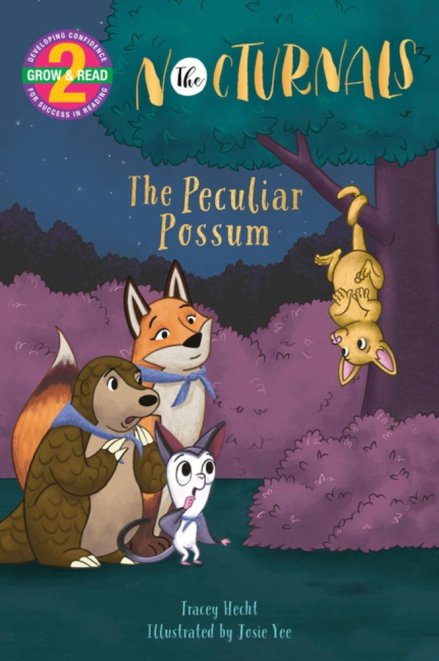
celebrate-picture-books-picture-book-review-the-peculiar-possum-cover

The Peculiar Possum

Written by Tracey Hecht | Illustrated by Josie Yee


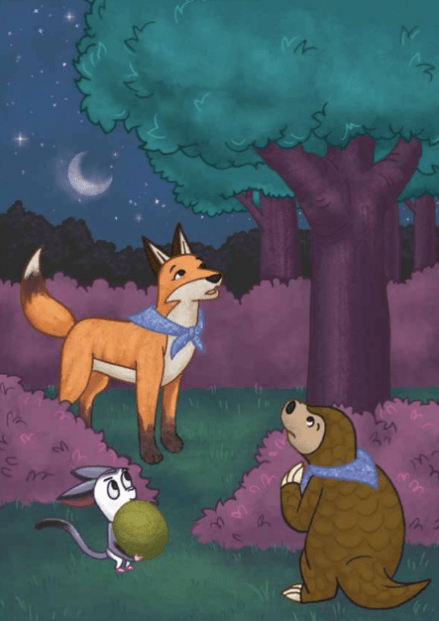
It was a bright, beautiful night when Dawn, a fox; Bismark, a sugar glider, and Tobin, a pangolin met under the pomelo tree. Bismark was dismayed because while the tree was usually full of fruit, tonight he could only find one. Just then they heard a strange “cluck cluck clatter! Chit chit chatter!” Bismark was sure it was a prowler who’d come for his pomelos. “Suddenly, the wind blew. The shadows shifted. A strange smell filled the air.”

Dawn looked up into the tree and saw “two shiny, brown eyes. And a paw, holding a pomelo! ‘Popping peepers!’ Bismark bellowed. ‘There is a prowler! And it has one of my precious pomelos!’” Quickly, the eyes disappeared and the pomelo came soaring out of the swaying branches. With a few more clucks and clatter, chits and chatter, the prowler plunked down in front of them. The three friends recognized the interloper as a possum. They gathered around it, but it lay motionless on the ground.
celebrate-picture-books-picture-book-review-the-peculiar-possum-brigade

Image copyright Josie Yee, 2018, text copyright Tracey Hecht, 2018. Courtesy of Fabled Films Press.

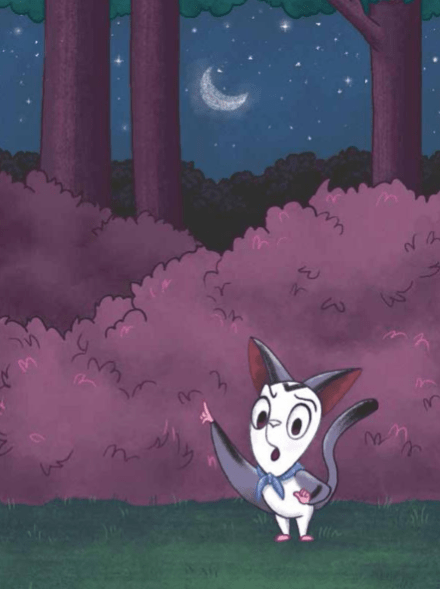
Dawn prodded it with her paw. “‘Perhaps this possum is feeling a bit peaky,’” she said. But the possum opened one eye and told them it was just playing possum. The possum got up and introduced herself as Penny. “‘Pleased to meet you,’” she said, sticking out her paw. But Bismark was not pleased to meet her. He did not like that she “prowls and pillages.” As evidence he pointed to the wayward pomelo.

Dawn gazed at her friend and said, “‘Bismark, these pomelos belong to everyone.’” Well, what about the way Penny chits and chatters? Bismark asked. He thought her way of speaking was strange. Dawn reminded him that he too had a unique way of speaking. Then Bismark pointed out the unusual hairless patch on Penny’s tail. “Dawn smiled gently. She looked down at Bismark’s bald spot. ‘Bismark, Penny is not the only one with a hairless patch.’” Still, Bismark wasn’t keen on Penny’s smell or the way she played possum.
celebrate-picture-books-picture-book-review-the-peculiar-possum-bismark

Image copyright Josie Yee, 2018, text copyright Tracey Hecht, 2018. Courtesy of Fabled Films Press.

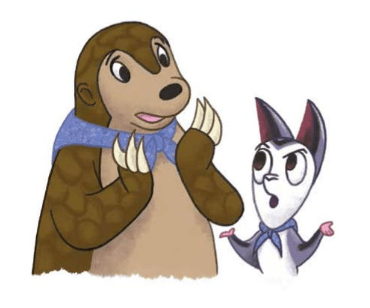
Tobin hurried to Penny’s side to defend her. “‘Penny, I spray a terrible odor when I get scared,’” he reassured her, reaching for her paws. Dawn told Bismark that no one is exactly like someone else. That everyone is unique. Then Penny told Bismark that she was proud of who she is. Bismark looked at Penny, and even though it was hard to admit he’d been wrong, he apologized to her and proclaimed, “‘You are your own possum. And that makes you perfect.’” Then Bismark split the pomelo into four sections and they all had a pomelo picnic.

Fun facts about pangolins, red foxes, sugar gliders, brushtail possums, and pomelos follow the text. Back matter also includes a Language Glossary showing forms of five words in the story as well as the translations of these words into Spanish, Portuguese, Mandarin, French, and Arabic.
celebrate-picture-books-picture-book-review-the-peculiar-possum-tobin

Image copyright Josie Yee, 2018, text copyright Tracey Hecht, 2018. Courtesy of Fabled Films Press.

When Bismark encounters Penny, a possum and an animal he’s never seen before, his adverse reaction to her disappoints Dawn and Tobin, who show him the errors in his thinking. Through her story, Tracey Hecht demonstrates that everyone has more similarities than differences and that what makes one person distinctive should be celebrated. Along the way, readers learn how to welcome a new friend.

Ages 5 – 7 

Fabled Films Press, 2018 | ISBN 978-1944020194

You can find The Peculiar Possum at these booksellers

Amazon | Barnes & Noble | Books-a-Million | IndieBound

Grow & Read Early Reader Level 3 Book

celebrate-picture-books-picture-book-review-the-chestnut-challenge-cover

The Chestnut Challenge

Written by Tracey Hecht | Illustrated by Josie Yee


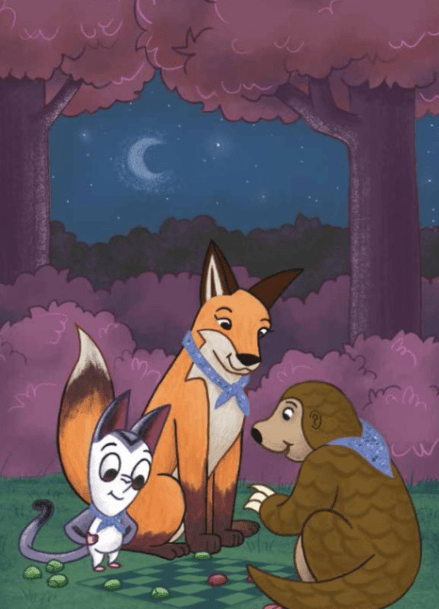
After sundown, while other animals slept, Dawn, a red fox; Bismark, a sugar glider; and Tobin, a pangolin “were playing a game of chestnut checkers.” Bismark thought Tobin was taking too long to move his chestnut. He snapped his fingers, tapped his foot, and finally said, “‘Hurry up!’” But Dawn chided Bismark and said Tobin should take the time he needed. At last Tobin moved his piece. Bismark was delighted. Tobin, it seemed, had set him up to win. Bismark moved one of his chestnuts. Now it was Tobin’s turn to be delighted. “Tobin jumped a chestnut across the board—and captured all of Bismark’s chestnuts.” Bismark was crushed. Tobin chuckled and said that it was only a game.
celebrate-picture-books-picture-book-review-the-chestnut-challenge-playing

Image copyright Josie Yee, 2019, text copyright Tracey Hecht, 2019. Courtesy of Fabled Films Press.

Suddenly, a voice called out and Chandler, a chinchilla, popped out from a nearby bush. He said that he was “‘the real chestnut champion.’” Bismark warned his friends against playing chestnuts with Chandler. He seemed to boastful to the little sugar glider, but Dawn wanted to give him a chance. Chandler chose Tobin to play first. Tobin didn’t like playing competitively; he just liked to have fun.

Bismark was all for Tobin taking up Chandler’s challenge, while Dawn said it was up to him to play or not. Chandler wanted an answer. Tobin decided to play—but just for fun. “Chandler and Tobin started to play. Chandler’s brow wrinkled. Tobin’s jaw tightened. No one seemed to be having fun.” Just then, Chandler shouted and pointed to the bushes. Tobin, Bismark, and Dawn all turned to look. “That’s when Chandler reached forward—and moved one of Tobin’s chestnuts!” When the three friends turned back, Chandler took his turn and Tobin’s chestnut that he had moved.
celebrate-picture-books-picture-book-review-the-chestnut-challenge-bismark

Image copyright Josie Yee, 2019, text copyright Tracey Hecht, 2019. Courtesy of Fabled Films Press.

Dawn thought something looked suspicious. Bismark begged Tobin to win against the “cheeky challenger.” Tobin was nervous. Suddenly, Chandler sneezed right in their faces. While their eyes were closed, he moved two chestnuts. He laughed when he saw that no one had seen him. Chandler only grew bolder. When Tobin closed his eyes for a moment, the chinchilla stole one of his pieces. This time Bismark caught him. He called on Dawn and Tobin, but Chandler denied it. Dawn, however, had also seen him steal the piece. She looked directly into his eyes and asked if he had stolen Tobin’s chestnut.

Now it was Chandler’s turn to be nervous. His cheeks reddened, his teeth chattered, “and then from Chandler’s paw, out dropped the chestnut.” With tears in his eyes, he admitted that he was a cheater. Dawn told him that champions don’t use tricks, and Tobin told him no one wins all the time and practice helps. Then they offered Chandler a second chance. So with Tobin cheering him along and Bismark keeping an eye on the board, “the four friends settled into a cheerful game of chestnut checkers.”

Fun facts about pangolins, red foxes, sugar gliders, chinchillas, and chestnuts follow the story.

celebrate-picture-books-picture-book-review-the-chestnut-challenge-game

Image copyright Josie Yee, 2019, text copyright Tracey Hecht, 2019. Courtesy of Fabled Films Press.

As the three friends meet a chinchilla with competitive streak, Tracey Hecht shows readers that cheating to win deprives all participants—even the champion—of the fun and pleasure of playing a game. In today’s super-charged world of competition at all levels, Hecht’s reminder that good sportsmanship wins out is welcome, and Tobin, Bismark, and Dawn, with their various personalities and generous offer to give him Chandler a second chance, make good companions as developing readers increase their skills while learning to play fair and for fun.

Josie Yee’s nighttime illustrations, rendered in dark blues, plums, and deep greens, take kids to the heart of a heated chestnut checkers match where they watch as Chandler concocts false alarms to cheat his way to victory. When Chandler is caught red-handed, readers see the positive effect his confession and the brigade’s offer of another chance have on him.

Ages 6 – 8 

Fabled Films Press, 2019 | ISBN 978-1944020231

You can find The Chestnut Challenge at these booksellers

Amazon | Barnes & Noble | Books-a-Million | IndieBound

You can learn more about The Nocturnals series; watch videos of games, face painting, and other activities; find educational language arts and science guides; download activity kits; and even join the Brigade by visiting The Nocturnals website.

You can find information about the Grow & Read program, Educator’s Guides, and The Nocturnals Book Club Kits with printable coloring pages and masks at Grow & Read.

Picture Book Review