September 2 – National Food Bank Day

celebrate-picture-books-picture-book-review-saturday-at-the-food-pantry-cover

About the Holiday

National Food Bank Day was established by St. Mary’s Food Bank, the world’s first food bank, which was founded by John van Hengel in Phoenix, Arizona in 1967. The idea spread throughout the country, and now St. Mary’s Food Bank distributes 250,000 meals daily with the help of staff, volunteers, and partner agencies, making it one of the largest food banks in the United States. This year, a record number of families (nearly 150,000 in August alone) have sought help. Food banks across the country help millions of men, women, and children who live with food insecurity due to job loss, illness, and other circumstances. Many food banks offer educational opportunities that help people change their situation and begin anew. Often, those who have benefited from the programs return to volunteer and contribute to the very food bank that helped them. To learn more about St. Mary’s Food Bank, visit their website. To find a food pantry in your area to get help for yourself, to donate, or to volunteer, visit the Ample Harvest website.

I’d like to thank Albert Whitman & Company for sharing a copy of Saturday at the Food Bank with me for review consideration. All opinions on the book are my own.

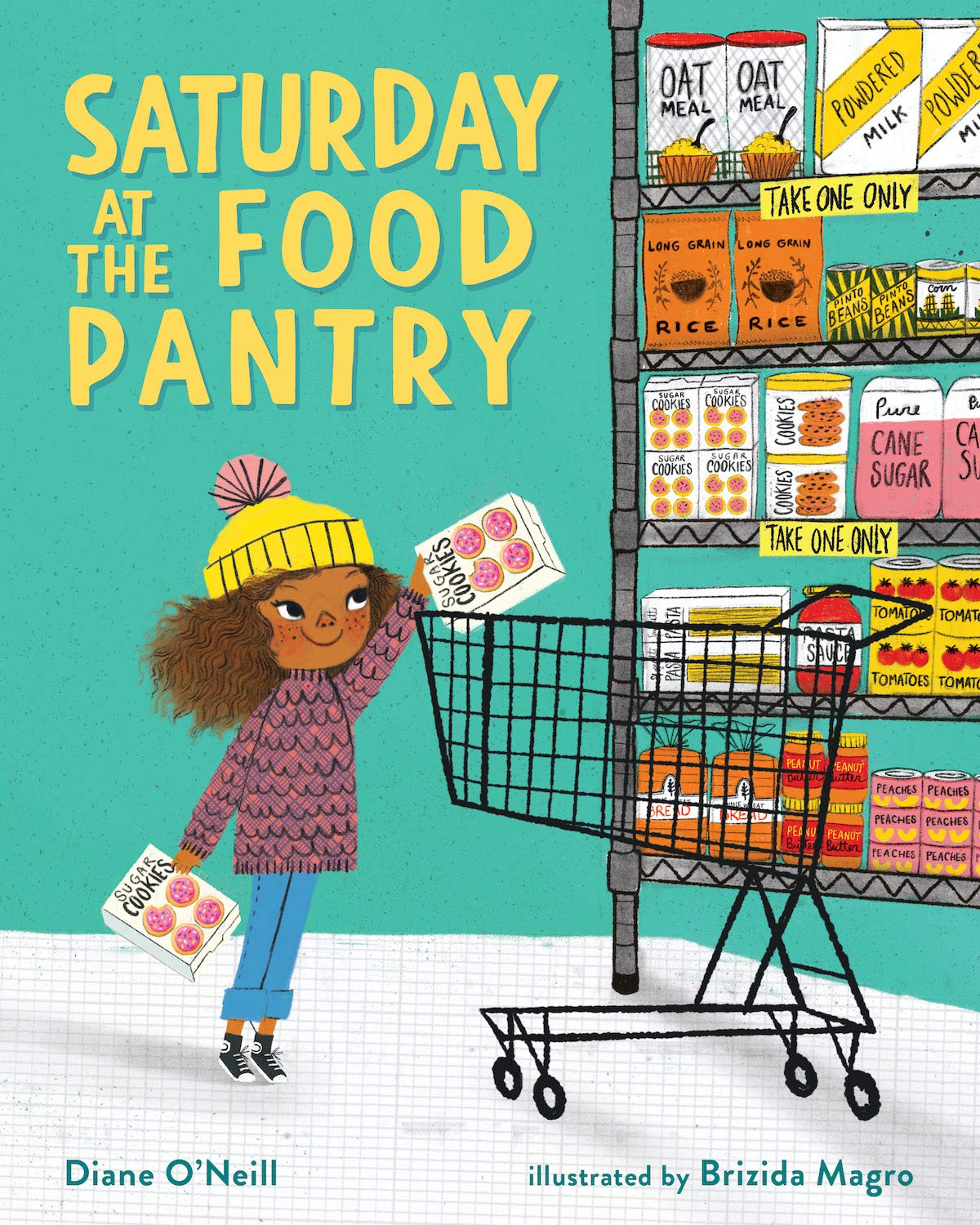
Saturday at the Food Pantry

Written by Diane O’Neill | Illustrated by Brizida Magro


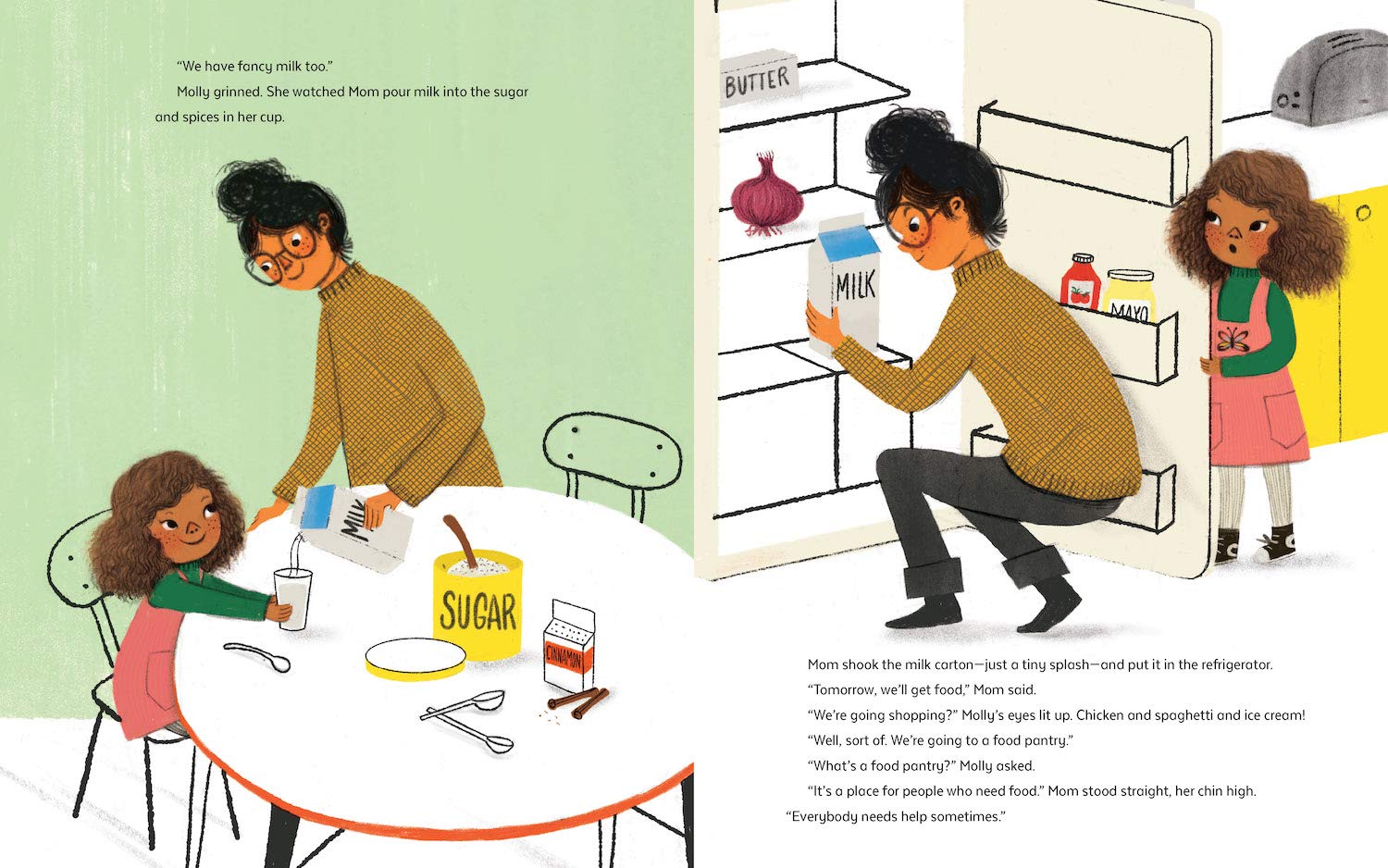
When Molly came to the table for dinner, she saw that they were having chili—again. She and her mom had eaten chili for two weeks straight. But there was “fancy milk too.” Molly smiled as her mom measured sugar and cinnamon into her glass and added milk.” There was only a splash of milk left when Mom put it back into the almost-empty refrigerator.

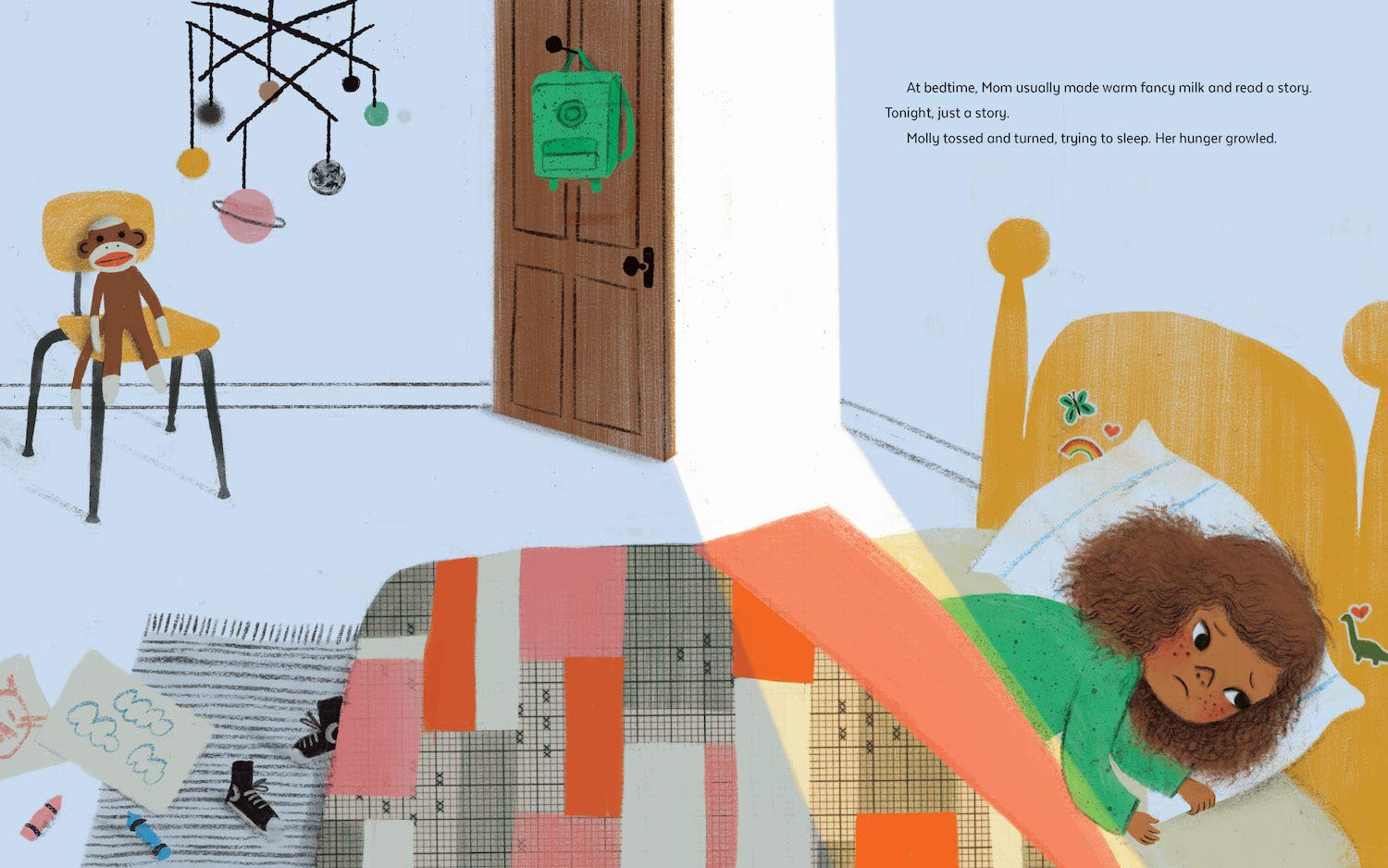
Tomorrow, Mom said, they’d go shopping. “Molly’s eyes lit up” as she imagined “chicken and spaghetti and ice cream.” But Molly’s mom tempered her expectations, saying that they’d be going to a food pantry. A food pantry, she explained, is “‘a place for people who need food…. Everybody needs help sometimes,’” she added. That night there was no warm milk before Molly went to bed and her stomach growled.
celebrate-picture-books-picture-book-review-saturday-at-the-food-pantry-milk

Image copyright Brizida Magro, 2021, text copyright Diane O’Neill. Courtesy of Albert Whitman & Company.

In the morning when Molly and her mom got to the food pantry there was already a line waiting for it to open. Molly had brought paper and crayons and sat down to draw. Then she saw a girl who was in her class at school. She called out a hello, but “Caitlin looked away.” When Molly ran over, Caitlin told her she didn’t want anyone to know that she and her grandmother needed help.

Molly went back to her mom, wondering if there was “something wrong with needing help.” She wanted to go home, but she was also hungry. Molly’s mom suggested she draw a picture, and the woman in front of them asked if she’d draw one for her too. Then everyone in line seemed to want a picture. Molly ran back to Caitlin to ask for help. Caitlin sat down and began to draw too.
celebrate-picture-books-picture-book-review-saturday-at-the-food-pantry-hungry

Image copyright Brizida Magro, 2021, text copyright Diane O’Neill. Courtesy of Albert Whitman & Company.

When the door opened, Molly and Caitlin each had a picture for the woman who welcomed them in too. Molly noticed that her mom had to sign in before she got a cart and they could begin shopping. They didn’t do that at the grocery store. The shelves at the food pantry were stocked with items she recognized from the store they usually shopped with. She ran over and took a box of sugar cookies off the shelf, but her mom told her “‘They—the people in charge—they’ll want us to take sensible stuff.’” Molly felt embarrassed and couldn’t understand why the cookies were there if they couldn’t take them. She sadly returned them to the shelf. As they went to look for food, Molly thought her mom didn’t want to be seen there, either—just like Caitlin. In a whisper, Molly reminded her that everyone needs help sometimes.

They went through the store taking one can, bag, or box of the food they needed. Then Molly’s mom reached for a box of powdered milk. They could have fancy milk that night. When they got to the checkout desk, Molly and Caitlin found their drawings hanging on the wall. The man at the counter bagged their groceries and then handed Molly’s mom a box of sugar cookies. “‘Saw your little girl looking at these. She can have them, if that’s okay with you, ma’am,’” he said. Molly noticed that her mom looked like she might cry.

celebrate-picture-books-picture-book-review-saturday-at-the-food-pantry-line

Image copyright Brizida Magro, 2021, text copyright Diane O’Neill. Courtesy of Albert Whitman & Company.

As they were walking home, Molly saw Caitlin and her grandmother coming the same way. They were all happy to discover that they were neighbors. Molly’s mom explained that she’d been looking for work since the factory closed, and Caitlin’s grandma said she’d been sick. Caitlin understood, but wished they didn’t have to shop at a food pantry. But then Molly told her that “everybody needs help sometimes” and reminded her that they had helped make the man at the checkout counter feel happy with their drawings. Caitlin hadn’t thought about it that way. She smiled. Then Molly invited her and her grandmother to have lunch with them—with sugar cookies for dessert.

Following the text, a note for parents, teachers, and other caregivers from Kate Maehr, the Executive Director and CEO of the Greater Chicago Food Depository, reveals more information about food insecurity, including recent statistics and a resource where people can find help and more information.

celebrate-picture-books-picture-book-review-saturday-at-the-food-pantry-shopping

Image copyright Brizida Magro, 2021, text copyright Diane O’Neill. Courtesy of Albert Whitman & Company.

Diane O’Neill’s well-executed story about two families who need the help of a food pantry is a poignant reminder of the many people—perhaps even readers’ classmates—who face food insecurity every day. Through the experiences of Molly and her mother and Caitlin and her grandmother, readers discover what it’s like to go to bed hungry, miss out on treats, and feel ashamed to ask for help. As this is Molly and her mother’s first trip to a food pantry, Molly’s questions and observations well reflect children’s own or reassures those who are familiar with these important resources.

O’Neill’s straightforward storytelling emphasizes the fact that at one time or another everyone needs help and demonstrates simple ways that children make things better through their generosity, optimism, and acceptance. Molly and Caitlin’s budding friendship makes for an uplifting and hopeful ending and may spur readers to recognize need in their midst and extend kindness.

Through her realistic illustrations of two families in need of assistance from a food bank, Brizida Magro helps children see and understand what food insecurity and food pantries look like. At home, Molly and her mom eat small portions of leftover chili and the last full glass of milk. When Molly’s mom puts the carton in the refrigerator, the shelves are nearly empty, and Molly lies awake in bed, too hungry to fall asleep.

The line outside the food pantry is made up of people from all walks of life, and inside the displays of food replicate a grocery store with the exception of signs asking shoppers to take one item only. These images can lead to meaningful discussions on the enormity of the issue. When Molly and Caitlin draw pictures that cheer up everyone in line as well as the food pantry workers, kids will recognize not only different ways of helping but their own role in making the world a kinder place.

Empathy shines on every page of O’Neill’s necessary and welcome story. Saturday at the Food Pantry is timely, heartfelt, enlightening and a must-buy addition to home, classroom, and school and public library collections.

Ages 4 – 7

Albert Whitman & Company, 2021 | ISBN 978-0807572368

Discover more about Diane O’Neill and her work on her website.

You can connect with Brizida Magro on Instagram.

celebrate-picture-books-picture-book-review-saturday-at-the-food-pantry-cover

You can find Saturday at the Food Pantry at these booksellers

Amazon | Barnes & Noble | Books-a-Million

To support your local independent bookstore, order from

Bookshop | IndieBound

Picture Book Review

September 1 – It’s Read a New Book Month

celebrate-picture-books-picture-book-review-the-boy-and-the-mountain-cover

About the Holiday

The beginning of a new school year is a terrific time to celebrate Read a New Book Month—especially for kids. Whether their reading tastes have broadened, their reading level has changed, or they’ve discovered new and fascinating topics to explore over the summer months, there are new books just waiting for them! The books may be recently published—like today’s book—or just new to your child, there are countless fictional stories and nonfiction books ready to inspire learning, to laugh or cry with, and to share with friends. This month visit your local bookstore and library and stock up on books for your kids and everyone in the family! 

The Boy and the Mountain

Written by Mario Bellini | Illustrated by Marianna Coppo


“There once was a boy who always looked at a mountain.” It was the first thing he looked at in the morning and the last thing he said good night to before going to bed. The boy loved to draw, and one day he “decided to draw the mountain.” His first attempt didn’t look anything like the mountain he saw out his window. When he looked closer, he realized “the mountain was covered with trees,” so he added trees. 

celebrate-picture-books-picture-book-review-the-boy-and-the-mountain-drawing

Image copyright Marianna Coppo, 2022, text copyright Mario Bellini, 2022. Courtesy of Tundra Books.

Still, his picture wasn’t quite right. Next, he noticed the sky and clouds around the mountain and drew those, but his picture “still didn’t look the same as the real thing.” He tried drawing the mountain at different times of day and in different weather, but “he was never happy with what he had drawn.” 

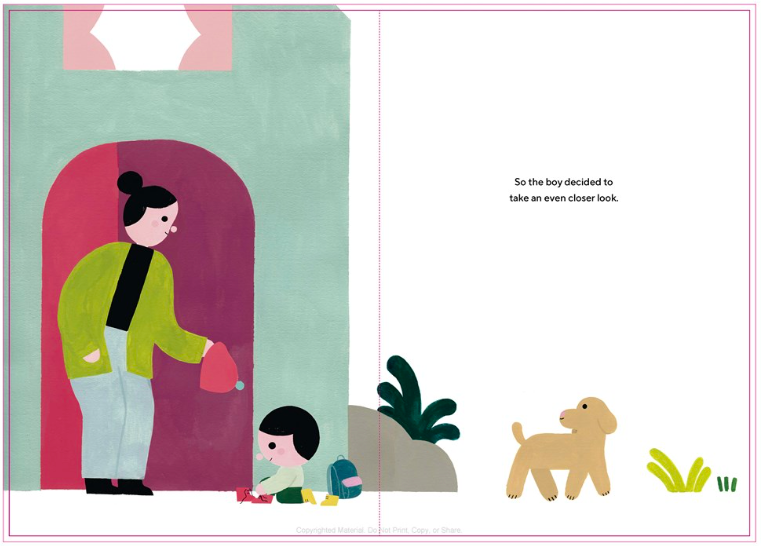
One day, the boy decided to get a closer look. He took his dog and headed out. One the way, he met a goat and drew a picture of it in his sketchbook. The goat decided to come along. When a flock of birds flew by, the boy drew those too. One bird left the flock to follow the boy and his dog and the goat. When they stopped at a stream for a drink of water, the boy drew that too.

celebrate-picture-books-picture-book-review-the-boy-and-the-mountain-trees

Image copyright Marianna Coppo, 2022, text copyright Mario Bellini, 2022. Courtesy of Tundra Books.

It was fall, and the ground was covered in leaves. The boy “wanted to draw them all,” but even though he drew many of them, there was no way they would all fit on the page. He continued on up and up into the forest and beyond. Along the way, he picked up other followers, including a frog, a bear, and a beaver. When he had left the trees behind, there was very little to draw “until he looked more closely” and saw a tiny white flower poking up between some rocks. He drew it.

celebrate-picture-books-picture-book-review-the-boy-and-the-mountain-hike

Image copyright Marianna Coppo, 2022, text copyright Mario Bellini, 2022. Courtesy of Tundra Books.

At last he came to the mountain’s peak. He sat down and flipped through his sketchbook, but he still wasn’t satisfied with his drawings. It was then that he became aware of the goat, the bear, the frog, the bird, the beaver, and a snail who had joined him. “‘Ohhh … hello!'” he said. They played until it was time to go home. The bear gave the boy a ride home on his shoulders. Once home, the boy promised that he would see them all again soon. That night before going to sleep, the boy drew the mountain again with his new perspective. This time his drawing was complete—and the boy was completely satisfied with it.

celebrate-picture-books-picture-book-review-the-boy-and-the-mountain-goat

Image copyright Marianna Coppo, 2022, text copyright Mario Bellini, 2022. Courtesy of Tundra Books.

Mario Bellini’s thoughtful and well-paced adventure gently guides readers to consider not only their perspective on big and small topics of life but where and how they fit into the wider world. Just as children observe the world from their vantage points of home, school, and activities, the boy in the story looks at the mountain and tries to make sense of it by drawing it. Then, like kids slowly adding bits of what the world has to offer to their lives, the boy includes trees, clouds, and different times of day to his drawing. But he thinks there must be something more, and, now braver and more knowledgeable, he ventures out to get a better look. 

Along the way he sees more of the world and interacts with what he encounters in the way that means the most to him. Some of these experiences turn out well, and others don’t, but he persists. When it appears that he’s finally come to the end of his journey, he sits down (alone, or so he thinks) and ponders his single-subject, disjointed pictures. When he finally notices all of the animals who have joined him on his trek and embraces them as friends, the boy discovers an interconnectedness that has been missing for him all along. At last, with his final drawing, the boy is able to be satisfied with his knowledge, understanding, and place in his world.

Marianna Coppo’s delightful rounded illustrations lend a quiet elegance to the story while allowing readers to view the boy’s drawings for themselves and then join him on his journey to see the mountain up close. Kids will enjoy noticing the animals that begin to populate the boy’s sphere, even while he is unaware that they are following him. The boy’s drawings of the river, the leaf-strewn forest floor, and the hidden mountain peak give kids and adults an opportunity to talk about times when things go wrong, when life seems overcrowded or overwhelming, and when goals seem elusive. Coppo also helps kids see that surprises can be found in the most unlikely of places as well as when you least expect them. 

A multi-layered story that invites thought, observation, conversation, and discovery (of both the self and the world), The Boy and the Mountain would be a favorite read for quiet story times or as a prelude to any new experience at home or in school. The book is highly recommended for home bookshelves as well as classroom, school, and public libraries.

Ages 3 – 7

Tundra Books, 2022 | ISBN 978-0735270251

You can connect with Marianna Coppo on Instagram and Twitter.

Read a New Book Month Activity

celebrate-picture-books-picture-book-review-take-a-bookworm-trek-maze

Take a Bookworm Trek! Maze


These two friends love reading! Can you help them through the maze to meet the bookworm? 

Take a Bookworm Trek! Maze Puzzle | Take a Bookworm Trek! Maze Solution

celebrate-picture-books-picture-book-review-the-boy-and-the-mountain-cover

You can find The Boy and the Mountain at these booksellers

Amazon | Barnes & Noble | Books-a-Million

To support your local independent bookstore, order from 

Bookshop | IndieBound

Picture Book Review

August 27 – It’s National Inventors Month

celebrate-picture-books-picture-book-review-how-was-that-built-cover

About the Holiday

While dates for this holiday may vary – some say May while others celebrate in August, National Inventors Month was established in 1998 by the United Inventors Association of the USA, the Academy of Applied Science, and Inventors’ Digest magazine. This month-long holiday recognizes the imagination and talent of individuals who dare to think differently to create new products, services, and ways of doing things that make a positive contribution to the world. Today, I’m sharing a book that highlights those who reach for the sky, dive under the sea, and look for opportunities to better help and connect people through the structures we use and live in. If you harbor dreams of being an inventor—on a large or small scale—look for opportunities to share your ideas!

How Was that Built?

Written by Roma Agrawal | Illustrated by Katie Hickey


They seem to have sprung from the ground, they soar into the clouds, they cross vast waterways—over and under the ripples and waves, and they come in all shapes and sizes. What are they? Buildings! For lovers of architecture, engineering, and just the marvels that people can construct, Roma Agrawal’s compendium of some of the world’s most incredible buildings will leave them enthralled—and much more knowledgeable on how these structures came to be.

In fifteen chapters, Agrawal reveals all the nuts and bolts about how buildings are secured on difficult sites (such as on sinking ground, in the sea, underground, and on ice); constructed to be tall, long, or able to move; and made to serve civic purposes. In addition to detailed explanations of the conditions architects and engineers must take into consideration when designing and constructing a building, bridge, or other structure, Agrawal clearly describes the materials used, how they are made, and why each is chosen for a particular job.

celebrate-picture-books-picture-book-review-how-was-that-built-emily-warren

Image copyright Katie Hickey, 2022, text copyright Roma Agrawal, 2022. Courtesy of Bloomsbury Children’s Books.

Rounding out each chapter, Agrawal goes in depth on one world building that demonstrates her topic. For example, In the first chapter she introduces readers to the Metropolitan Cathedral in Mexico City, which was built on top of an old Aztec pyramid in the middle of a filled-in lake. When it began sinking and tilting, engineers in the 1990s devised an intriguing way to save it. If you’re a fan of skyscrapers and wonder just how they’re built, a chapter on The Shard in London, which “is over 1,000 feet tall…and has 11,000 glass panels” (and for which Roma Agrawal worked as an engineer) reveals the secrets of a strong core and the incredible machinery that allows workers to keep going up and up.

Readers who love bridges will find two chapters on these beautiful and intricate structures. One reveals the fascinating story of how the construction of the Brooklyn Bridge overcame many challenges under the direction of Emily Warren, a woman who broke barrios for women in the engineering field. Another describes six different types of bridges as well as where they are used and why.

Readers also learn about concrete and how arches and domes work. They then explore the Pantheon and discover how it has stood for nearly 2,000 years. Other concrete structures from around the world are also discussed. You may not think too much about sewers, but imagine living without them! You’ll get a good (and stinky) idea about the conditions in London hundreds of years ago before Joseph Bazalgette designed and built the first sewer system. How did he do it? Agrawal breaks it down and then talks about today’s modern sewers.

celebrate-picture-books-picture-book-review-how-was-that-built-the-shard

Image copyright Katie Hickey, 2022, text copyright Roma Agrawal, 2022. Courtesy of Bloomsbury Children’s Books.

You’ll also find chapters on dams, tunnels, and buildings with moveable parts—or buildings like the Halley VI research station in Antarctica that can be moved easily in their entirety to avoid snow or ice that may crack beneath them. Then there are the challenges of building under the sea and in outer space. While astronauts now rely on the International Space Station, “some engineers and scientists are studying how to build structures on the Moon! Then researchers could live there for a long time to carry out their experiments and learn more about outer space.” What considerations must engineers take into account and what materials will they use? Agrawal fills readers in. She then closes her book with a look toward the future and talks about new materials and methods of building that may transform our world.

Sprinkled throughout the book are “Try It At Home” prompts for experiments that readers can easily do at home to visually interact with the concepts Agrawal lays out, such as using malted milk balls and raisins to understand “how carbon atoms make steel stronger” and making a pneumatic caisson with just a few household items.

Back matter includes a glossary of terms found in the book and brief biographies of ten influential engineers from the past and present.

celebrate-picture-books-picture-book-review-how-was-that-built-outer-space

Image copyright Katie Hickey, 2022, text copyright Roma Agrawal, 2022. Courtesy of Bloomsbury Children’s Books.

Readers of all ages will be engrossed by Roma Agrawal’s guide through the architecture and engineering that go into housing, moving, connecting, and supporting the world’s population. Every page contains fascinating details and interesting tidbits culled from Agrawal’s extensive experience as an engineer. These go far beyond an introduction to landmark buildings to show readers exactly how each type of building works. Relayed in a simple-to-understand, conversational style, her text is also broken up into short paragraphs that are easily digestible and invite further research, making this a superb resource for schools, homeschooling, and enthusiasts of all things engineering and architectural. Agrawal’s inclusion of structures from the past reveal the ingenuity of our ancestors and how they still influence today’s engineers and architects. Kids who love geography, archaeology, astronomy, and learning about all the intricate workings of the world will be enthralled with this book.

Katie Hickey gives readers an insider’s view of these phenomenal buildings with her stylish and incredibly detailed illustrations. Cityscapes allow children to understand the scale of skyscrapers from around the world and the beauty and breadth of New York City’s Brooklyn Bridge. Hickey whisks readers off to London to see The Shard; to New Zealand to view Te matau ā pohe, a bascule bridge whose shape was inspired by a fish hook; to Japan, where the Sapporo Dome accommodates soccer and baseball games with a moveable field of natural turf; and to Africa to stand on the edge of the Katse Dam and look 600 feet down into its reservoir. Along with this world tour, Hickey helps readers visualize the intricate working parts of certain buildings and bridges with interior views and small insets that demonstrate the physics of each design. Images of various types of cranes, pulleys, and other machinery also reveal the science behind building each structure.

A rich and comprehensive resource on the intricate engineering that goes into designing and building complex structures while also sharing the stories behind them, How Was that Built? will captivate readers of all ages. The book is a must for any STEM, science, art, or archaeology lover and belongs in all school and public library collections. 

Ages 6 and up

Bloomsbury Children’s Books, 2022 | ISBN 978-1547609291

Roma Agrawal is a structural engineer who builds big. From footbridges and sculptures, to train stations and skyscrapers – including The Shard – she has left an indelible mark on London’s landscape. She is a tireless promoter of engineering and technical careers to young people, particularly under-represented groups such as women. She has advised policymakers and governments on science education, and has given talks to thousands around the world at universities, schools and organizations, including two for TEDx. Roma has been awarded international awards for her technical prowess and success in promoting the profession, including the prestigious Royal Academy of Engineering’s Rooke Award. 

Discover more about Roma Agrawal and her work on her website, and connect with her on Instagram | Twitter. You can read an interview with Roma Agrawal in Publishers Weekly here.

To view a portfolio of work by Katie Hickey, visit Pickled Ink. You can connect with Katie Hickey on Instagram | Twitter 

National Inventors Month Activity

celebrate-picture-books-picture-book-review-spaghetti-box-bridge-craft

Build a Remarkable Recycled Bridge


You don’t need fancy blocks and construction materials to build a bridge! Little ones will be fascinated to put together a bridge made out of items you already have at home or that may even be slated for the recycle bin. Spaghetti boxes make great roadways, and cut-up egg cartons can be used as supports.

Build a Whole Town

Want to give your bridge a town with a river to span – or maybe two towns to connect? Cereal boxes and pasta boxes make great skyscrapers, apartment buildings, fire stations, and more. Need a farm silo? Grab a peanut butter jar, oatmeal container, or aluminum can. Cut a meandering river for your bridge to span from paper or cardboard. You can use them as is or—if your kids are sticklers for a little more detail—add some paint and details! So look around at the raw materials around you, use your imagination, and get creative!

celebrate-picture-books-picture-book-review-how-was-that-built-cover

You can find How Was that Built? at these booksellers

Amazon | Barnes & Noble | Books-a-Million

To support your local independent bookstore, order from

Bookshop | IndieBound

Picture Book Review

August 23 – National Sponge Cake Day

celebrate-picture-books-picture-book-review-sonny-says-sorry-cover

About the Holiday

There’s nothing like a light and airy cake embellished with fruit, whipped cream, or chocolate to put a fine finishing touch on a summer day, and that’s why the world celebrates the sponge cake today. What makes the sponge cake distinctive is that it is made without yeast or leavening agent, instead relying on whipped egg whites to give it its delectable texture. The recipe dates back to 18th century Italy and a special commission by a wealthy member of the Pallavicini family of Genoa. It is perhaps better known as a treat enjoyed by Victorian Britons with their tea. Today, sponge cake is a favorite everywhere, and it might just taste better when its baked and eaten together with friends—as you’ll see in today’s book!

Sonny Says Sorry!

Written by Caryl Hart | Illustrated by Zachariah OHora

While playing hide and seek in the park, Sonny finds a box wrapped with a bow. Intrigued, he inspects it and finds a tag that reads “For Honey.” Sonny is suddenly overcome by curiosity about what is inside. He smells a delicious aroma just as Boo and Meemo find him. Sonny shows them the box.

celebrate-picture-books-picture-book-review-sonny-says-sorry-playing

Image copyright Zachariah OHora, 2022, text copyright Caryl Hart, 2022. Courtesy of Bloomsbury Children’s Books.

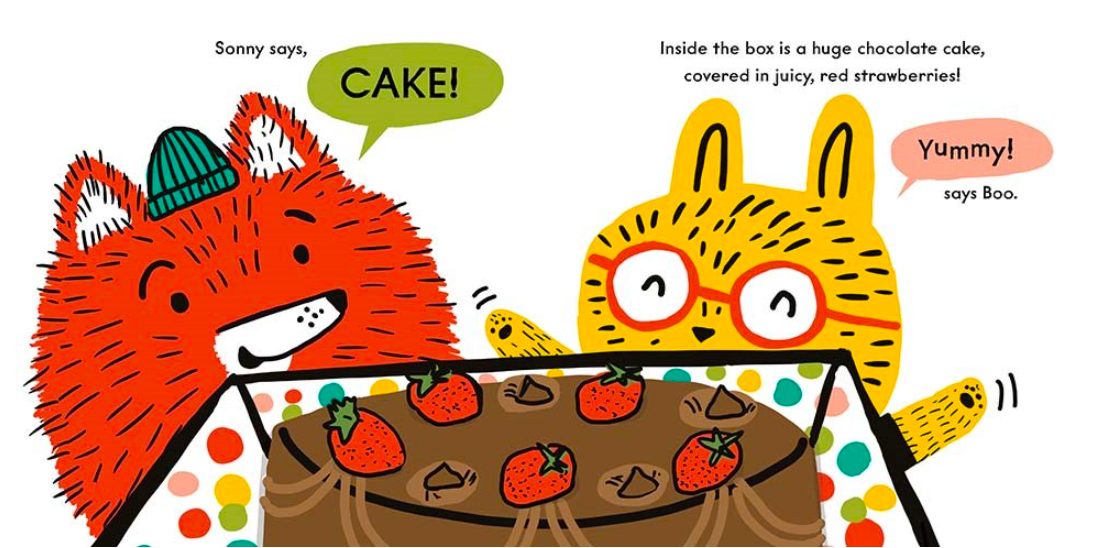
Then, despite Meemo’s protesting “Woof! Woof!”, Sonny opens the box. Meemo tries to remind Sonny and Boo that the box is for Honey, but they “peek inside” anyway. “Inside the box is a huge chocolate cake, covered in juicy, red strawberries!” There are chocolate drops on top too. “Woof!” says Meemo more emphatically as Sonny and Boo eat two strawberries. Then, after looking around, Sonny sneaks a chocolate drop. And Boo takes one too.

celebrate-picture-books-picture-book-review-sonny-says-sorry-sonny-finds-cake

Image copyright Zachariah OHora, 2022, text copyright Caryl Hart, 2022. Courtesy of Bloomsbury Children’s Books.

Sonny and Boo’s nibbling expands to gobbling. Just then Honey shows up. “Found you!” she says. But then she finds something else: “. . . Sonny’s chocolaty hands. . . . Boo’s chocolaty face. Then Honey sees the open box . . .” and she “starts to cry.”  Now Sonny and Boo feel terrible too. Even though they both try to make it up to Honey in their own way, and “Sonny says Sorry!”, Honey keeps crying. Then Sonny has another idea. Back home, “Sonny, Honey, and Boo bake a new cake . . .” to enjoy “TOGETHER!”

celebrate-picture-books-picture-book-review-sonny-says-sorry-sonny-honey

Image copyright Zachariah OHora, 2022, text copyright Caryl Hart, 2022. Courtesy of Bloomsbury Children’s Books.

The sequel to Sonny Says Mine!, Caryl Hart’s Sonny Says Sorry! addresses that itchy curiosity that can often lead kids to break barriers and disappoint and upset their friends and others. In her quickly paced story, Hart lets readers be part of the group as Sonny, Boo, and Meemo gather around Honey’s enticing box and think for themselves whether they would join Sonny and Boo or side with Meemo. As Sonny and Boo’s eating escalates, so does the suspense. When Honey discovers her decimated cake, Hart needs only four words and a stream of tears to show little ones how devastated she feels. Sonny and Boo are similarly affected, and readers will see how decisions like the one Sonny made hurts everyone involved. Sonny’s sincere apology is a good start at making things right. His idea to include everyone in replacing the cake shows true, enduring friendship.

Zachariah OHora’s distinctive and familiar illustrations will endear these four friends to little readers. Blocks of vibrant colors help kids focus on the action and the characters’ expressive faces. When, on the second page, Sonny discovers a box on the picnic blanket next to his hiding place, the tag “For: Honey” is prominently displayed, giving kids and adults a hint of what might be coming up and what’s at stake. When Boo and Meemo arrive, Meemo’s barking and wagging tale provide readers with another opportunity to predict what he will do. As the story progresses, Meemo’s facial expressions become more and more disapproving, a balancing counterpoint to Sonny and Boo’s delight. OHora also does an excellent job of clearly showing Sonny and Boo’s remorse as well as their heartfelt apologies.

Sonny Says Sorry! is a smart and effective way to introduce young readers to the important concept of respecting others’ belongings and feelings as well as of making amends when a mistake is made. Straightforward and accessible language teamed with evocative illustrations create a poignant story that will make an emotional impact with children in the target audience. Sonny Says, Sorry! would be a go-to book on home and classroom bookshelves and is a must for school and public library collections. 

Pair Sonny Says Sorry! with Sonny Says Mine!, a story about sharing to talk with your kids or students about these seminal topics of childhood. You can read my review of Sonny Says Mine! here.

Ages 3 – 6

Bloomsbury Children’s Books, 2022 | ISBN 978-1547609031

Discover more about Caryl Hart and her books on her website.

To learn more about Zachariah OHora, his books, and his art, visit his website.

National Sponge Cake Day Activity

celebrate-picture-books-picture-book-review-cat-eating-cake-coloring-page

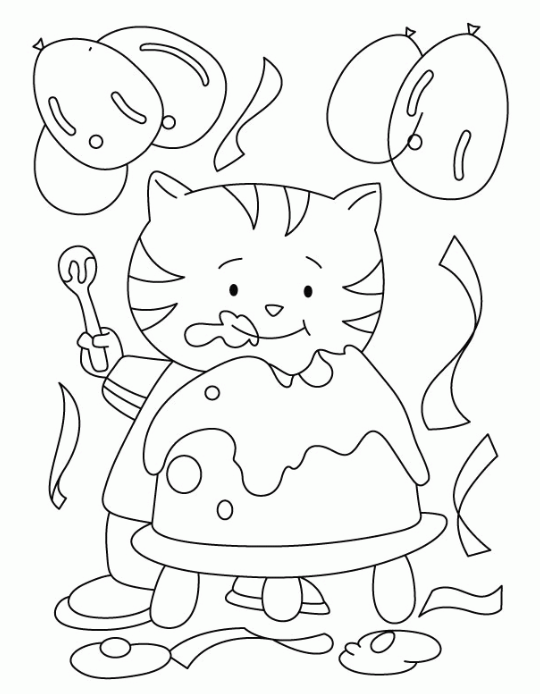
Yummy Cake Coloring Pages

Cakes are fun to decorate and delicious to eat! These two coloring pages let you enjoy a bit of both!

Tall Cake to Decorate Coloring Page | Cat Eating Cake Coloring Page

celebrate-picture-books-picture-book-review-sonny-says-sorry-cover

You can find Sonny Says Sorry at these booksellers

Amazon | Barnes & Noble | Books-a-Million

To support your local independent bookstore, order from

Bookshop | IndieBound

Picture Book Review

August 16 – Celebrating the Book Birthday of A Case of the Zaps

celebrate-picture-books-picture-book-review-a-case-of-the-zaps-cover

Thanks to Abrams Books for Young Readers for sending me a copy of A Case of the Zaps for review consideration. All opinions on the book are my own.

A Case of the Zaps

Written by Alex Boniella and April Lavalle | Illustrated by James Kwan


On Robot-Earth there lived a robot named 3.14159… (“or Pi, for short”). Pi liked doing things most young robots did, like “playing music, walking their dog, and hanging out with their Parental Units and friends. Pi also liked sports, science, camping, and exploring, and their favorite food was DW-40. One day at school, their teacher announced that in a month the class would be going on a field trip to Olde Silicon Valley.

celebrate-picture-books-picture-book-review-a-case-of-the-zaps-parental-units

Image copyright James Kwan, 2022, text copyright Alex Boniello and April Lavalle, 2022. Courtesy of Abrams Books for Young Readers.

All of Pi’s classmates were excited about the trip, and “Pi felt their circuit board BUZZ with anticipation.” Pi couldn’t stop thinking about the trip. But along with all the fun things they would do, thoughts about what could go wrong crept into his consciousness. And then, unexpectedly, while walking home from school with their friends, Pi experienced a tingle in their arms and then their “defense mechanisms JOLTED on.” Pi’s friends asked if they were all right.

celebrate-picture-books-picture-book-review-a-case-of-the-zaps-hobbies

Image copyright James Kwan, 2022, text copyright Alex Boniello and April Lavalle, 2022. Courtesy of Abrams Books for Young Readers.

Pi wasn’t sure and took off for home, “feeling zaps all around. Feeling afraid for reasons they didn’t quite understand.” The intrusive thoughts kept Pi awake that night, and during the next few days, even though Pi tried to act calm, they felt anything but. Trying not to think about the field trip just made things worse. One night they couldn’t even eat their DW-40, and then… ZAP! 

Pi ran to their room and shut the door. Pi’s “Mother-Board and Father-Board followed their robo-kid upstairs. When they asked through the door what was wrong, Pi admitted that they didn’t want to go on the field trip anymore. They they explained that “something feels wrong” and how all their gears and sensors seemed to be in overdrive. Pi confessed “‘I’m scared I might be . . . broken.'”

celebrate-picture-books-picture-book-review-a-case-of-the-zaps-school

Image copyright James Kwan, 2022, text copyright Alex Boniello and April Lavalle, 2022. Courtesy of Abrams Books for Young Readers.

Pi was surprised to find that just telling their parents made them feel better. Pi’s Father-Board told them that they had had the zaps when he started his new job and that “‘cousin Cosine Tangent has had them for years.'” Pi was surprised because Cosine Tangent had recently won a major science award. Mother-Board suggested that they visit the doctor the next day.

Doctor Bleep Bloop was very friendly and welcoming. The doctor explained to Pi that the Zaps can happen to anyone and at any time and acknowledged that they can be scary. When Pi asked if there was any cure for the Zaps, Doctor Bleep Bloop was honest and told them “‘There isn’t a simple cure.'” The doctor went on to say, though, that there were ways of managing the Zaps and that they could work together to find strategies to help Pi.

celebrate-picture-books-picture-book-review-a-case-of-the-zaps-anxiety

Image copyright James Kwan, 2022, text copyright Alex Boniello and April Lavalle, 2022. Courtesy of Abrams Books for Young Readers.

By the time the field trip to Olde Silicone Valley came around, Pi was ready to go, and they had a lot of fun. Even after the trip, Pi sometimes felt the Zaps. “When that happened, Pi used the tools that Dr. Bleep Bloop had shared with them, and then the Zaps didn’t feel quite so scary.” 

Back matter includes an Authors Note explaining how both Alex and April have experienced anxiety in their lives as well as online resources where parents and caregivers can find more information and help from professionals in the areas of anxiety, depression, and other mental health issues.

celebrate-picture-books-picture-book-review-a-case-of-the-zaps-Dr.-Bleep-Bloop

Image copyright James Kwan, 2022, text copyright Alex Boniello and April Lavalle, 2022. Courtesy of Abrams Books for Young Readers.

Experiencing anxiety can be scary and confusing, and without the language to describe what is happening to them, children can feel isolated and alone. Alex Boniello and April Lavalle’s A Case of the Zaps provides kids and adults with a straightforward way to comfortably talk about anxiety while offering reassurance and a road map to discovering coping strategies that can help. Descriptions of the physical and mental effects of anxiety on Pi give kids direct examples to point to when talking about their own emotions and experiences with their parents, caregivers, or doctors. Pi’s parents’ suggestion to visit the doctor gives adults a starting point on the journey to helping their children. 

James Kwan’s vibrant illustrations, incorporating elements of comics and graphic novels, will enchant kids as they learn about Pi’s hobbies, family life, and excitement to visit Olde Silicone Valley. As Pi’s enthusiasm for the field trip turns to trepidation, kids can watch the robot’s expressive face change from happy to worried and fearful. They also see that anxiety causes physical effects, sleeplessness, depleted energy, and the body’s fight-or-flight mechanism to kick in. After the family’s visit with Dr. Bleep Bloop, Kwan’s depictions of calming activities Pi does with their mother-board and father-board, friends, and the doctor show readers that therapy can be found in many places from play to sports to yoga and more.

Honest, accessible, sprinkled with humor, and written in partnership with Child Mind Institute to ensure that the book can serve as a social-emotional tool, A Case of the Zaps is an outstanding book for talking about anxiety with any child. The book is highly recommended for home libraries and a must for classroom, school, and public library collections.

Ages 4 – 8

Abrams Books for Young Readers, 2022 | ISBN 978-1419756726

You can connect with writer, actor, musician, singer, and Tony award-winning producer Alex Boniella on Twitter and Instagram.

Connect with writer, comedian, actor, and Tony award-winning producer April Lavalle on her website and Twitter.

You’ll find James Kwan on Instagram.

celebrate-picture-books-picture-book-review-a-case-of-the-zaps-cover

You can find A Case of the Zaps at these booksellers

Amazon | Barnes & Noble | Books-a-Million

To support your local independent bookstore, order from

Bookshop | IndieBound


Picture Book Review

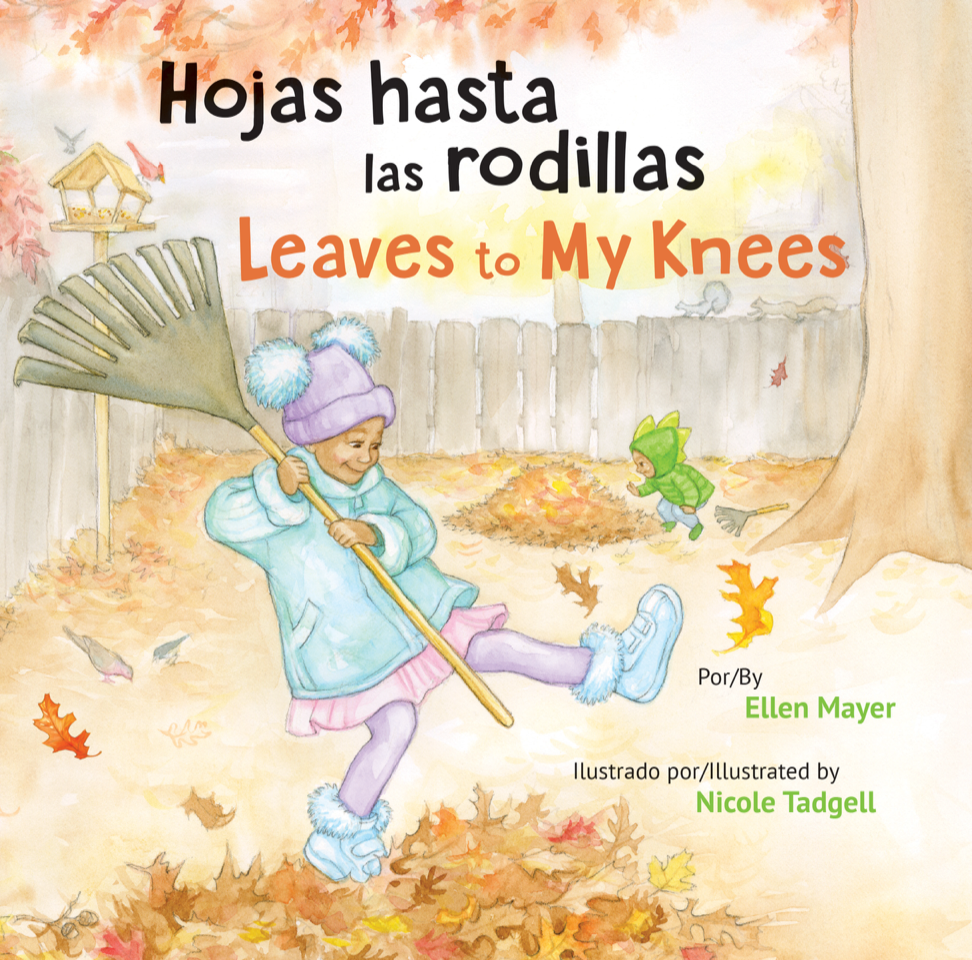
August 12 – Cover Reveal of Leaves to My Knees plus Interview with Ellen Mayer and Nicole Tadgell

  • celebrate-picture-books-picture-book-review-leaves-to-my-knees-cover
  • celebrate-picture-books-picture-book-review-leaves-to-my-knees-spanish-english-cover

Leaves to My Knees 

Hojas hasta las rodillas/Leaves to My Knees

Written by Ellen Mayer | Illustrated by Nicole Tadgell


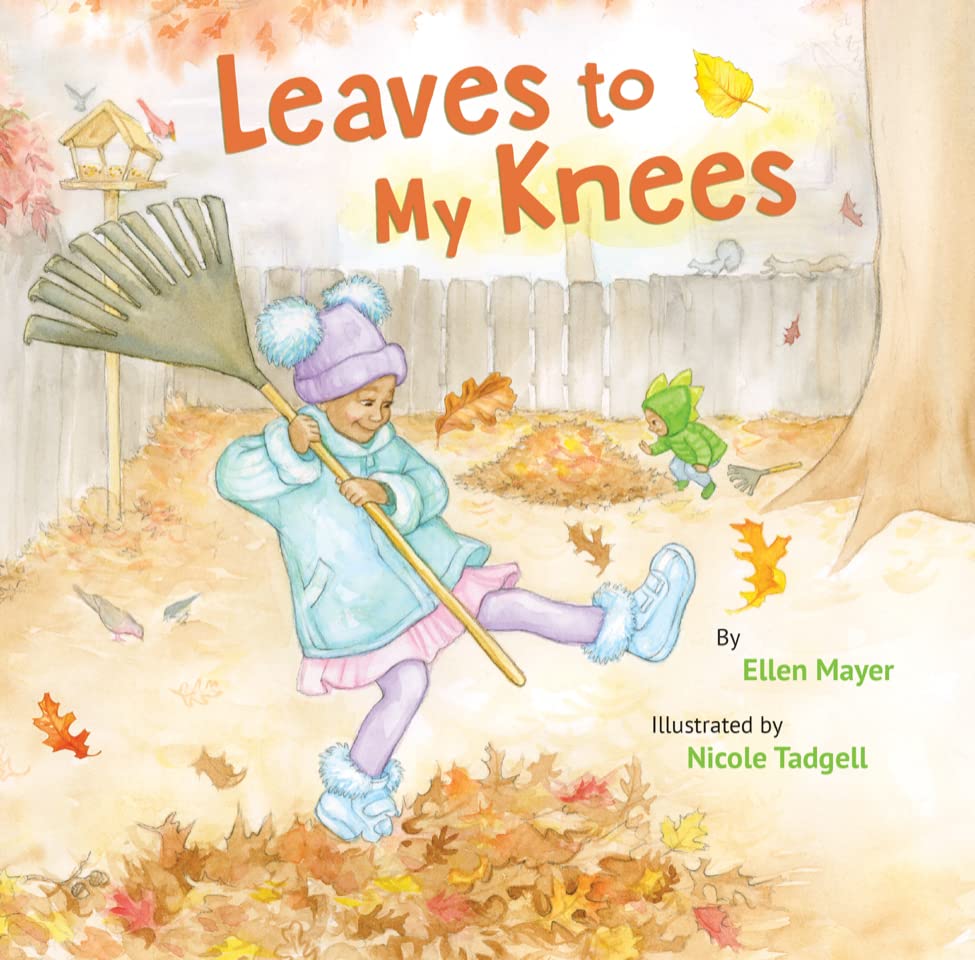
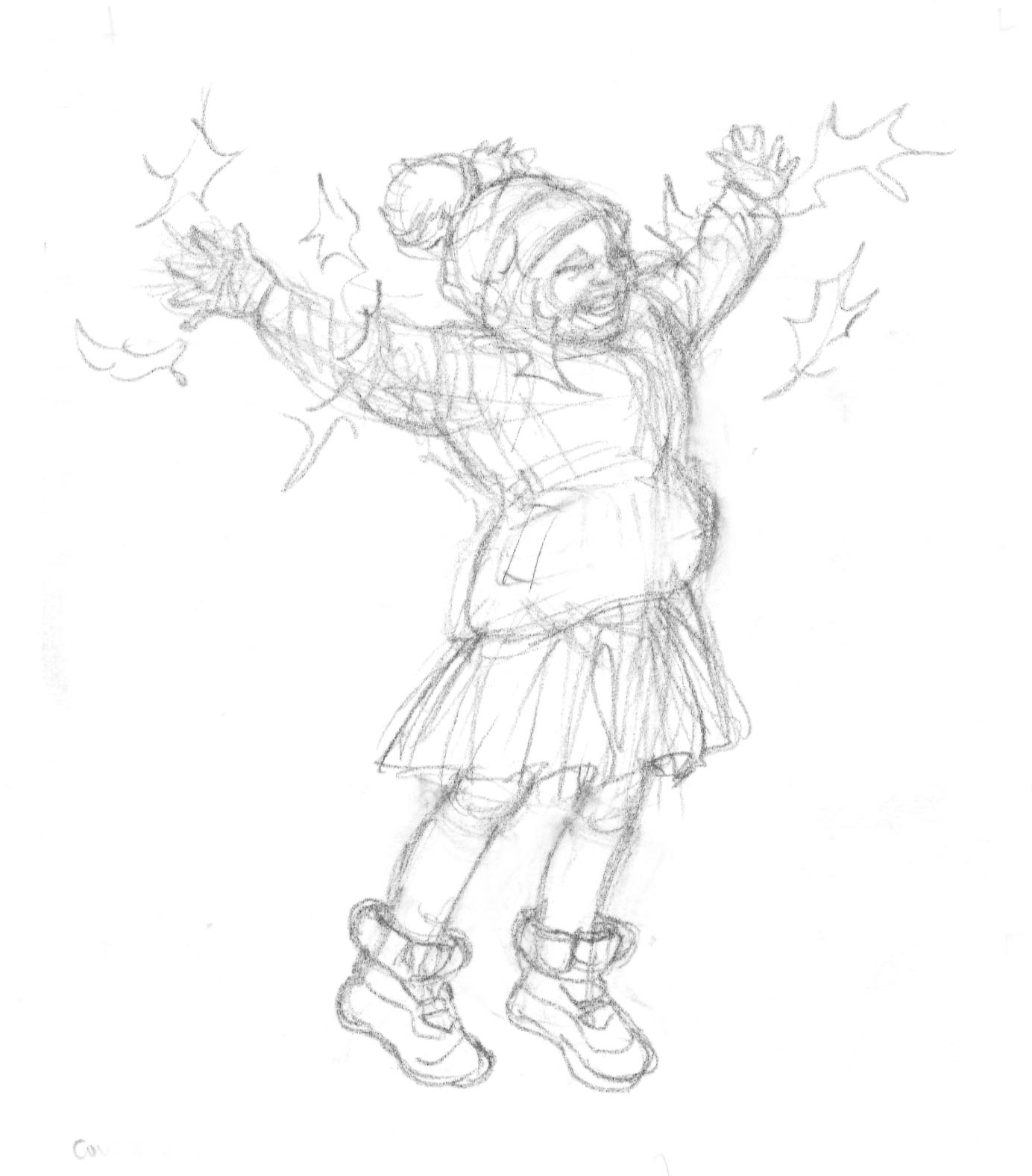
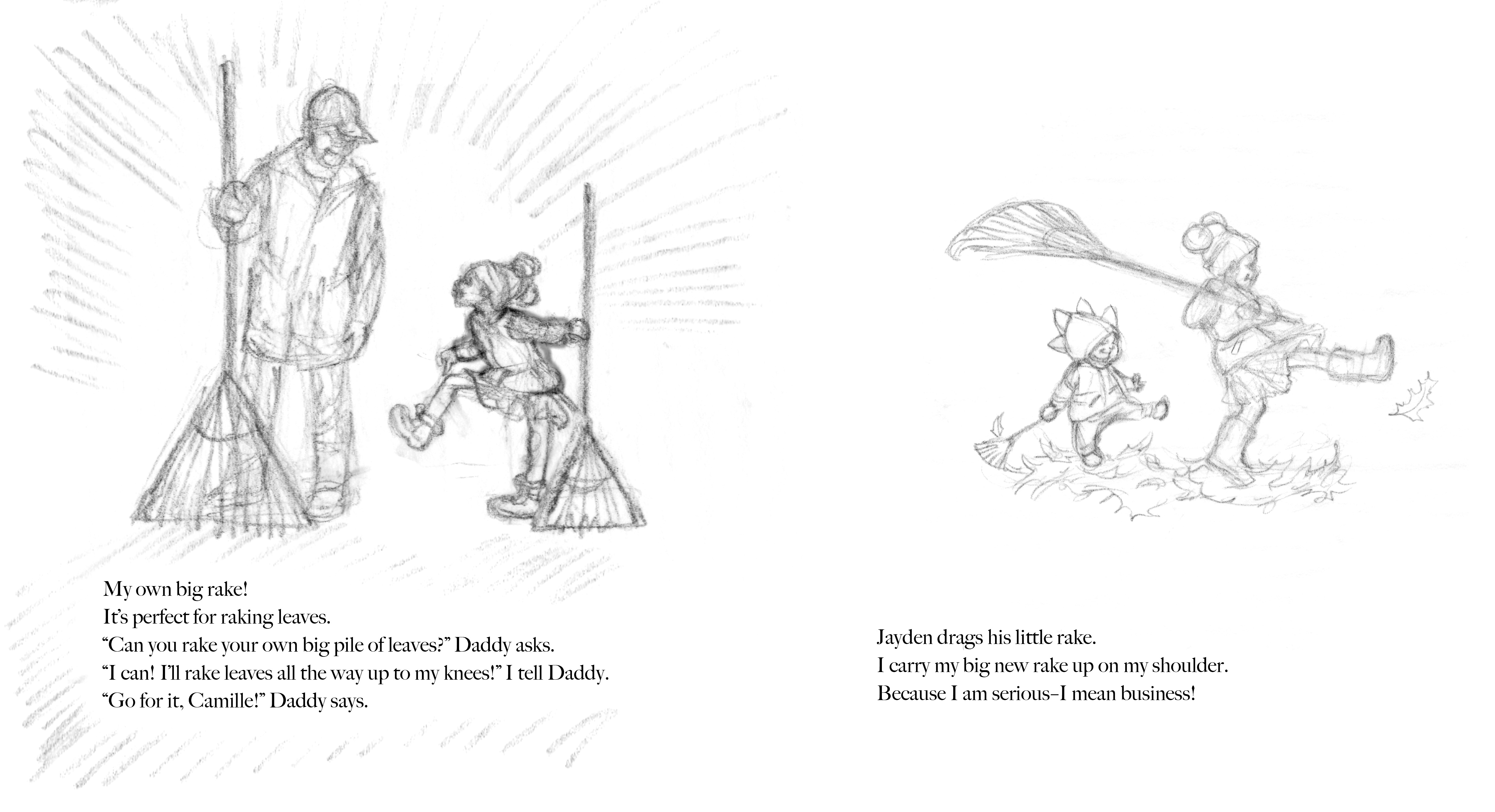
Camille is determined to rake her own pile of leaves―all the way up to her knees! She swishes leaves to and fro, watching her pile grow bigger alongside the piles made by Daddy and her little brother, Jayden. WHOOSH! After raking leaves to the top of her boots, a giant breeze blows the pile back down to her ankles. But Camille won’t be stopped until she gets the job done––a knee-high pile, the perfect size for… jumping in!

Leaves to My Knees and Spanish/English bilingual Hojas hasta las rodillas/Leaves to My Knees are playful introductions to the early math concepts of size comparison and measurement. A note by researcher and mathematics learning expert Marlene Kliman explains how parents and caregivers can use the book to help young children explore different sizes and measurement in everyday environments.

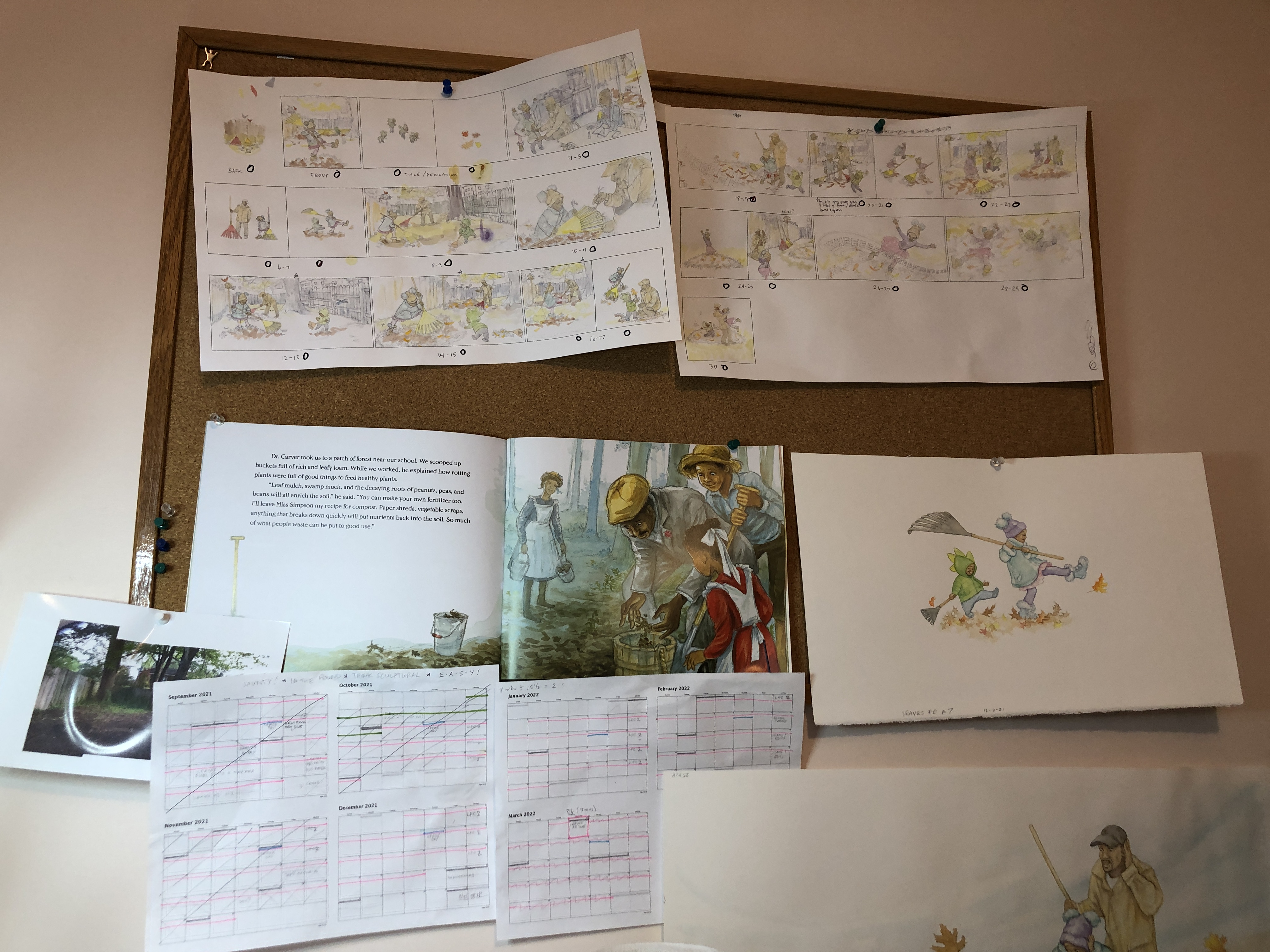
I’m thrilled to be talking with Ellen Mayer and Nicole Tadgell today about this gorgeous cover and their adorable—and educational—book that will be available this fall, just in time for leaf-raking season!

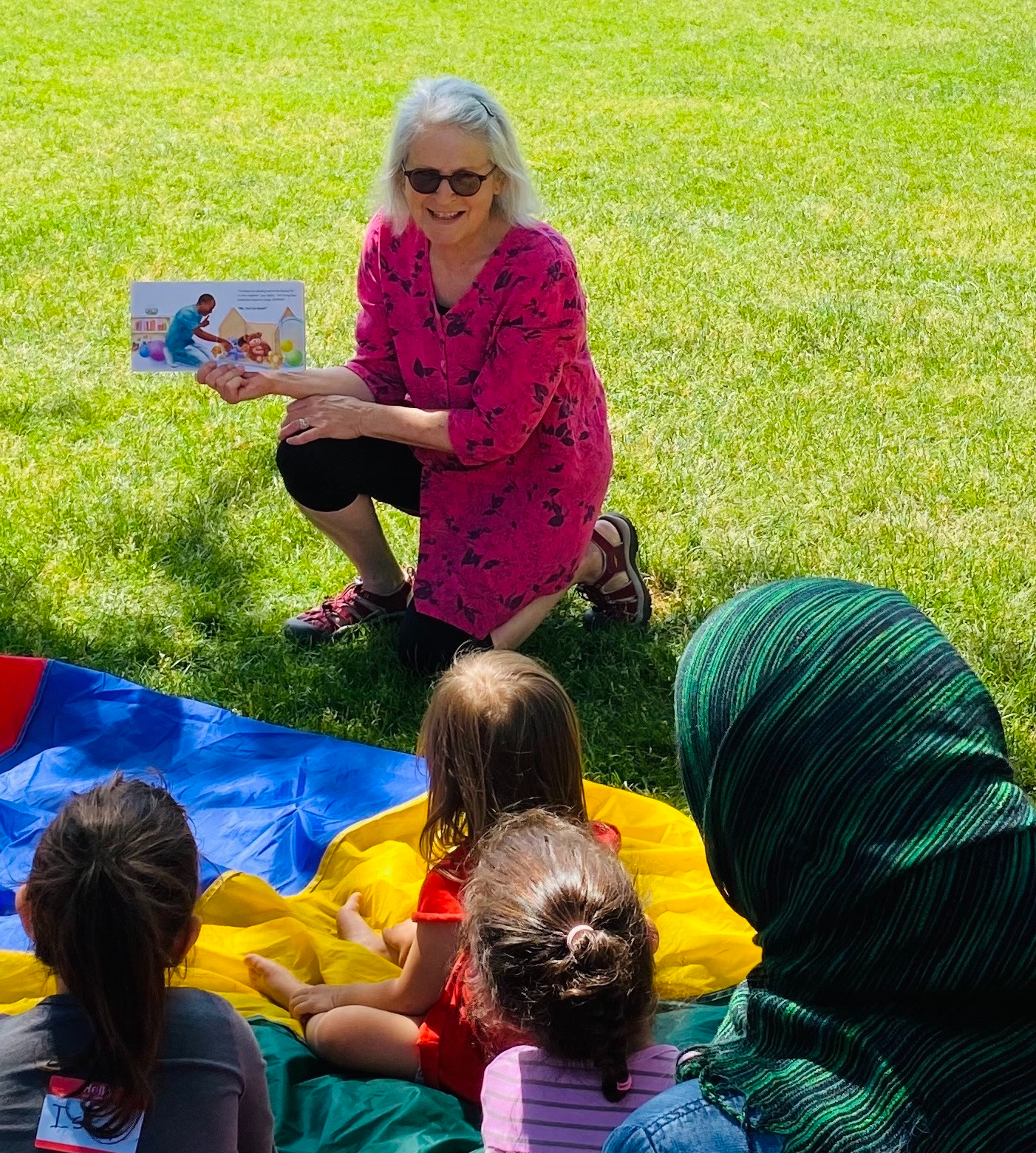
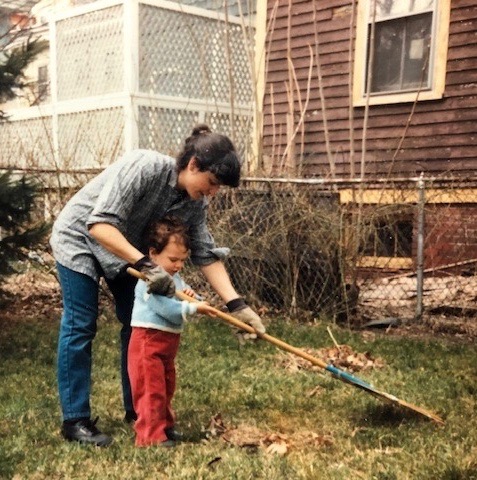
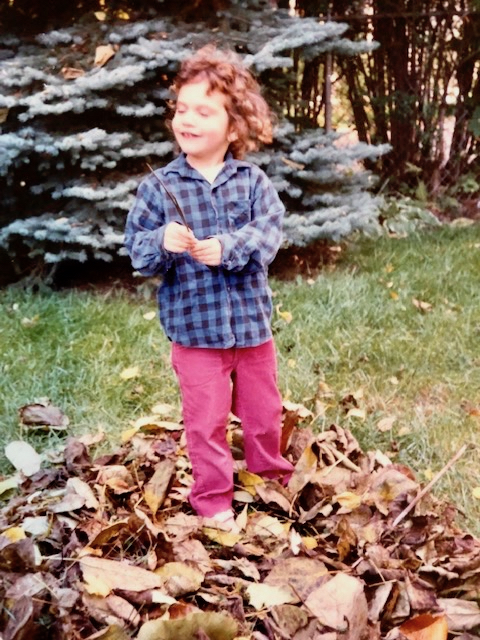
Meet Ellen Mayer

celebrate-picture-books-picture-book-review-ellen-mayer-reading-headshot

To preorder from Amazon

Leaves to My Knees: Hardcover | Paperback

 Hojas hasta las rodillas/Leaves to My Knees

To order from Star Bright Books and be notified when the books become available click here: 

Leaves to My Knees: Hardcover | Paperback

Hojas hasta las rodillas/Leaves to My Knees 

Picture Book Review

August 11 – Play in the Sand Day

celebrate-picture-books-picture-book-review-a-beach-chase-cover

About the Holiday

Is there any better way to spend a summer day than playing on a sandy beach? That wet, compact surface is perfect for running on, digging in, and, of course, building sandcastles with. And the soft, dry areas are great for beachcombing, wiggling toes in, playing volleyball, and simply strolling along. So head out to your favorite beach and have some family fun! 

A Beach Chase: An A – Z Alphabet book

By Sarah Downie


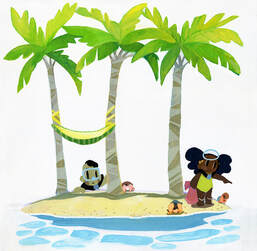
Holly and Logan love playing at the beach. Today, Holly is looking “for shells to add to her collection.” She spies something “among the anemones” and rushes into the water, where she discovers an anchor. Holly also finds a conch shell and, as she’s admiring it, a girl floats by on a buoy and asks her what she’s going to do with it. But this is no ordinary girl—Holly realizes that she’s a mermaid. A mermaid who quickly grabs Holly’s new shell and takes off, diving deep into the ocean.
celebrate-picture-books-picture-book-review-a-beach-chase-letter-wading

Image copyright Sarah Downie, 2020, courtesy of Leaning Rock Press.

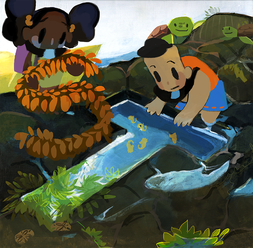
And so begins a wet and wild chase to recover Holly’s shell. Logan and Holly swim past various sea creatures, come to an island, and mistake “just a jumble of jellyfish” for the mermaid they’re looking for. Undeterred, they swim on until they see a kayak in the distance. “They kick, kick, kick towards” it and then paddle out to sea through a mass of kelp. On their way, they spot other creatures and seaside landmarks—even freeing an octopus from a net—before spying a tell-tail flick in a tide pool. 

celebrate-picture-books-picture-book-review-a-beach-chase-letter-e

Image copyright Sarah Downie, 2020, courtesy of Leaning Rock Press.

Jumping in, they discover another world, one where mermaids and mermen are having a party. But where is the mermaid who took Holly’s shell? Holly and Logan swim through the party and a zig-zag-y tunnel before finally spotting her near an outcropping of rocks at the ocean floor. The mermaid shows Holly and Logan the very special reason she needed the conch shell. She didn’t want it for herself, but for a hermit crab that “was in need of a home.” 

Immediately, Holly offers to bring more shells from her collection for other hermit crabs if the mermaid will let her and Logan come again. The mermaid enthusiastically agrees and invites her new friends to stay and join the party.
celebrate-picture-books-picture-book-review-a-beach-chase-letter-h

Image copyright Sarah Downie, 2020, courtesy of Leaning Rock Press.

Back matter includes a visual dictionary that depicts each illustration in the book and lists words for the objects or creatures corresponding to each letter found there. Kids may also spy other, unlisted letter-appropriate creatures (such as sand dollars on the “S” page) or actions (like Logan’s being nice to the octopus on the “N” and “O” spreads or the octopus peeking above the waves on the “P” page).

celebrate-picture-books-picture-book-review-a-beach-chase-letter-t

Image copyright Sarah Downie, 2020, courtesy of Leaning Rock Press.

In her eye-catching art, Sarah Downie cleverly incorporates the letters of the alphabet while inviting readers to join Holly and Logan on their search for the mermaid. From the shallows of the seashore to the far depths of the ocean, kids will eagerly follow this quick-paced story while feeling pride and excitement in spotting all the hidden objects. Well-conceived for its target audience, the illustrations contain a range of difficulty so that little ones as well as older children will enjoy the search-and-find aspects of this book.

Downie’s engaging storytelling includes plenty of alliteration that reinforces the sound of each letter while promoting letter recognition throughout the book. She also infuses her story with themes of kindness, sharing, and care for the environment that will resonate with young readers.

A charming and clever story that transcends its alphabet roots to engage readers on many levels, A Beach Chase: An A – Z Alphabet book is playful fun that kids will want to dip into again and again. The book would make a terrific take-along on seaside or lakeside beach trips, where kids could extend the story’s search-and-find to their own experience. It could also spark creative cross-curricular lessons for teachers and homeschoolers and would be a welcome addition to any home library to enjoy throughout the year.

Ages 3 – 8

Leaning Rock Press, 2020 | ISBN 978-1950323241

You can learn more about Sarah Downie, her books, and her art on her website.

Play in the Sand Day Activity

celebrate-picture-books-picture-book-review-a-beach-chase-activity

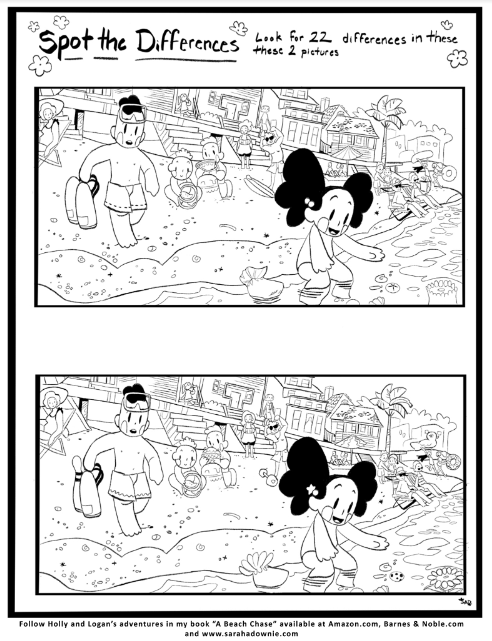
A trip to the beach can inspire all kinds of games and puzzles! Sarah Downie has created an activity pack with 15 challenges to get you searching and having fun just like Holly and Logan. You can download it here:

A Beach Chase Activity Pack

celebrate-picture-books-picture-book-review-a-beach-chase-cover

You can find A Beach Chase: An A – Z Alphabet book at these booksellers

Amazon | Barnes & Noble | Books-a-Million

To support your local independent bookstore, order from

Bookshop | IndieBound

Picture Book Review