Instituted by People for the Ethical Treatment of Animals (PETA),which was established by Ingrid Newkirk in 1949, Hug a Vegetarian Day promotes awareness of a meat-and animal- products-free diet. Over the years millions of people world wide have embraced the vegan and vegetarian lifestyle, giving rise to alternative diets and products that support this healthy choice. To celebrate today whip up a vegetarian meal – why not Rainbow Stew?!
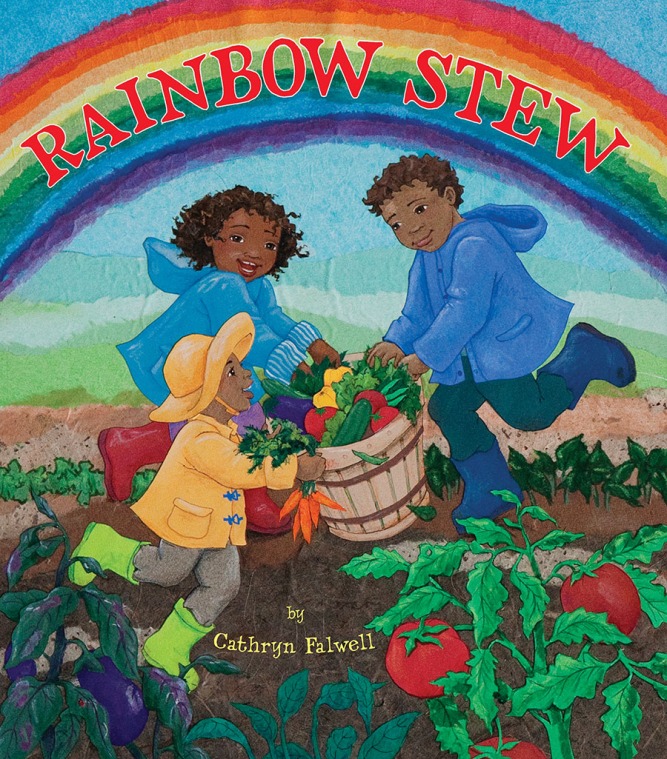
Rainbow Stew
By Cathryn Falwell
Grandpa’s making pancakes for his three favorite kids—his granddaughter and two grandsons. The kids are excited to be visiting their grandpa where they can play outside all day long. On this particular day, however, rain spatters the windows, and the kids are disappointed: “Whimper, sigh, / cloudy sky, / is it too wet to play? / We don’t want to stay inside / because of rain today.” But their grandpa knows just what to do! “Let’s go and find some colors for my famous Rainbow Stew!” he suggests.
Image copyright Cathryn Falwell, courtesy of rainbowstewbook.com
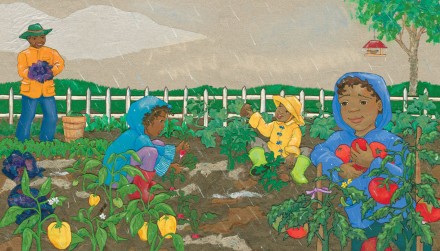
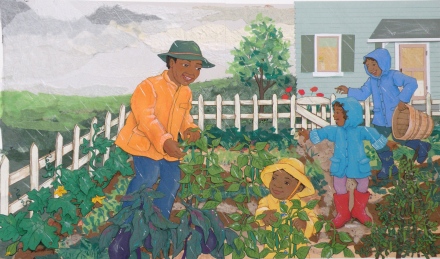
Out to the garden they run in their raincoats and hats. “Splish, splash, / puddle dash, / We bounce right out the door. / We’re off to find some red and green, / some yellow, orange, and more. / Grandpa shows us how to move / Between each garden row. / Lifting up the drippy leaves, / we see what colors grow.” They collect green spinach, kale, and zucchini; yellow peppers, purple cabbage and eggplant, red radishes and tomatoes; brown potatoes; and orange carrots. After some muddy fun among the plants, the kids go inside, get dried off, and begin to prepare their colorful stew.
Image copyright Catherine Falwell, courtesy of rainbowstewbook.com
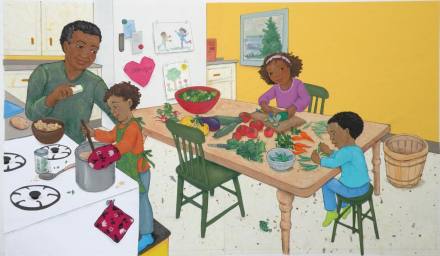
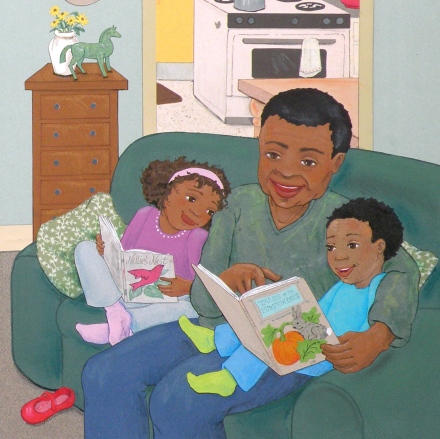
“Peel, slice / chop and dice, / colors fill the pot. / Stir in herbs and water / and then wait till it gets hot.” While the pot simmers on the stove, Grandpa and the kids snuggle on the couch with favorite books, reading together until the stew has simmered to perfection. The family then sits down to a homemade, colorful, delicious lunch of Rainbow Stew.
Image copyright Cathryn Falwell, courtesy of rainbowstewbook.com
Cathryn Falwell’s Rainbow Stew is a wonderful book to share with young children on many levels, offering opportunities for learning as well as playing. Introducing colors through familiar and delicious vegetables can get kids excited about gardening, cooking, even going to the grocery store. The rhyming verses each begin with an energetic couplet that kids will enjoy repeating or acting out. The bright colors of Grandpa’s house mirror the vividness of the garden vegetables, and young readers may enjoy matching the vegetables to items in the kitchen, living room, and more.
Children will identify with the disappointment of the three siblings when they learn it’s too wet to spend the day outside as well as their glee at squishing in the mud. The close bond between the kids and their grandfather as they cook and read together is a strong anchor for this story and promotes early literacy.
Image copyright Cathryn Falwell, courtesy of rainbowstewbook.com
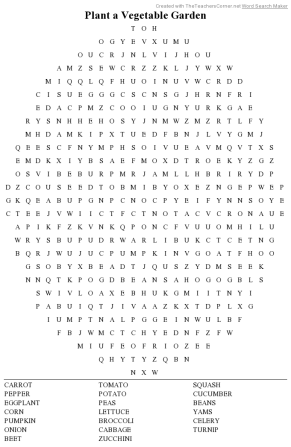
A recipe for Rainbow Stew follows the story. Reading Rainbow Stew, preparing the delicious dish, and doing the puzzle below makes for a fun rainy – or sunny – day!
Ages 4 – 7
Lee & Low Books, 2013 | ISBN 978-1600608476
Learn more about Cathryn Falwell and her books and art on her website!
To discover more about Rainbow Stew as well as activities to accompany the book, head over to rainbowstewbook.com!
While today’s holiday was established in 1996 by Mission Media and its owner Wayne Hepburn because of Hepburn’s love for elephants, the day has garnered official recognition and deserves wide acknowledgement. These gentile, giant animals need our protection from environmental and human dangers. To celebrate today’s holiday visit a zoo or animal preserve, watch a documentary on elephants, or consider donating to their cause.
Strictly No Elephants
Written by Lisa Mantchev | Illustrated by Taeeun Yoo
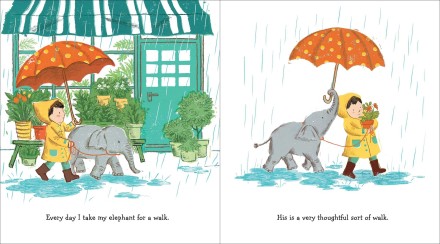
A little boy, his adorable pet elephant by his side, kneels on his bed and gazes out the window at the brownstones across the street. There he sees other kids with their—more conventional—pets: a bird, a cat, a fish, and dogs. “The trouble with having a tiny elephant for a pet is that you never quite fit in,” the boy reveals. Every day the boy takes his elephant for a walk, but even in this common pet-owner activity, the boy and the elephant show their special relationship. The elephant is thoughtful—protecting the boy with an umbrella on rainy days—and the boy is considerate—carrying his elephant over cracks in the sidewalk that frighten it. Why? Because “that’s what friends do: lift each other over the cracks.”
Image copyright Taeeun Yoo, courtesy of simonandschuster.com
On this particular day the boy winds a red scarf around his elephant’s neck and joins the parade of kids on their way to Number 17 where the Pet Club meets. The elephant is reluctant, but the boy is reassuring, even carrying his pet on his back the last few feet. “‘It’ll be fine,’” he says. But when they reach the apartment, there’s a sign on the door that reads “Strictly No Elephants.” There’s even a picture of a crossed out elephant on the sign.
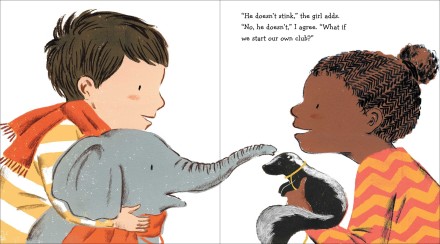
The elephant understands all too well and leads the boy back onto the sidewalk, now ignoring the cracks. “‘That’s what friends do: brave the scary things for you,’” the boy says. The day has suddenly become rainy, and they are caught on the sidewalk without an umbrella. Taking shelter under an awning, the two find a little girl holding her pet skunk. “‘Did you try to go to the Pet Club meeting too?’” she asks. “‘Yes,’” the boy says, “‘But they don’t allow elephants.’”
Image copyright Taeeun Yoo, courtesy of simonandschuster.com
While the sign may not explicitly forbid skunks, the little girl says that the other members didn’t want to play with her and her skunk either. Wisely, the boy tells her “‘They don’t know any better.’” The elephant reaches out its trunk toward the skunk with the girl’s reassurance that he doesn’t stink. The two new friends decide to start their own pet club and head down the sidewalk to find a venue. The boy makes sure that his elephant follows because friends “‘never leave anyone behind.’”
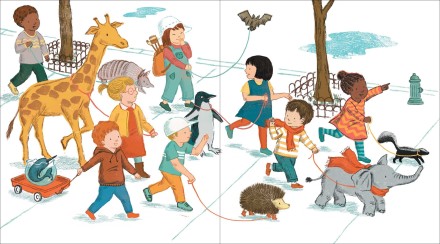
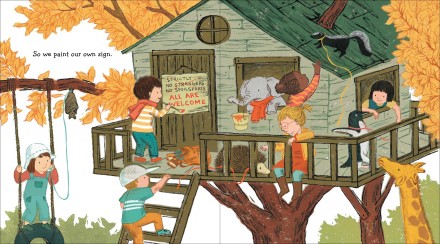
On the way the boy, girl, elephant, and skunk encounter a whole crowd of kids with unusual pets—a tiny giraffe, a mini narwhal, an armadillo, a bat, a hedgehog, and a penguin. They come to a park, complete with tree house, that is perfect for their club. The kids and pets eagerly adopt their new play space—swinging on the tire swing, waddling around the balcony, exploring the roof, playing tag, reading, and more. The boy quickly does the most important thing of all: he paints a new sign for the clubhouse door. “Strictly No Strangers, No Spoilsports ALL ARE WELCOME” it reads. And if you need directions to the club, the boy’s tiny elephant will give them to you “‘because that’s what friends do.’”
Image copyright Taeeun Yoo, courtesy of simonandschuster.com
Lisa Mantchev has written a story addressing the types of isolation and rejection that kids (and adults) can face sometimes because of a single perceived difference in an uplifting and productive way. With gentle honesty and thoughtfulness, Mantchev invites kids—on both sides of this “elephant in the room” issue to consider their actions, attitudes, and responses to others. As Mantchev reveals, more inclusiveness leads to more understanding and better relationships. Her lyrical language and sweet reminders of “what friends do” elevate this tribute to camaraderie and companionship and make it a story kids will want to hear again and again.
Image copyright Taeeun Yoo, courtesy of simonandschuster.com
Taeeun Yoo’s adorable illustrations of the boy, his tiny pet elephant, and the other animal-and-owner pairs are irresistible. Any reader would want pets as cute and adaptable as these, which may lead to questions about why and how they could be excluded from the club. As the boy and his elephant are turned away from the Pet Club door, the day turns dark and stormy. The two-page spread is rendered in somber shades, except for the little boy with his yellow-striped shirt and red scarf, the elephant sporting a matching red scarf, and the soon-to-be-met African-American girl who wears a red and yellow-striped dress, emphasizing the connections between these two children. The final pages in which the new friends meet and play together are joyful, inviting all readers to “join the club.”
Strictly No Elephants gives readers so much to see, think about, and discuss. The book is a must for school and classroom libraries and would be a very welcome addition to children’s home bookshelves.
Ages 4 – 8
Simon & Schuster, 2015 | ISBN 978-1481416474
Discover Lisa Mantchev’s books for children, young adults, and adults on her website.
See a gallery of books by Taeeun Yoo on her website!
Elephant Appreciation Day Activity
Image copyright Celebrate Picture Books, 2016
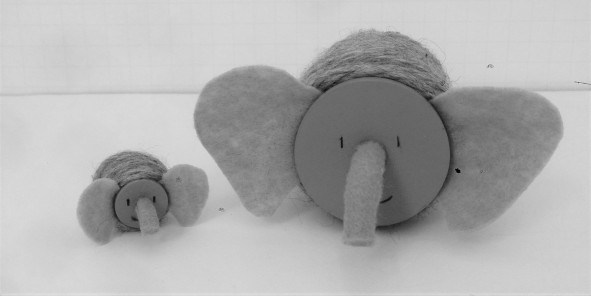
Spool Elephant
Who wouldn’t like a tiny elephant for a pet?! With this easy craft you can make your own little pal to keep you company.
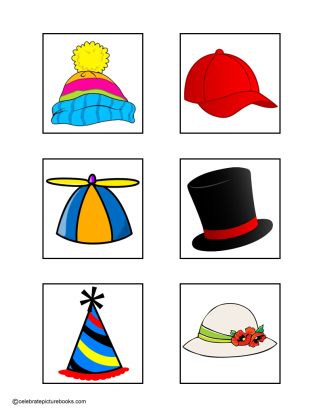
Hats are great for cold days, days when you want to dress up or express a certain fashion statement, or to cover up a bad do or bedhead. Today’s holiday may spur you to learn how to knit a hat or inspire you to invite your friends to a crazy hat-designing party! Make a Hat Day also shares the spotlight with Felt Hat Day, which exhorts people to rediscover an old and cherished fashion accessory.
Hooray for Hat!
By Brian Won
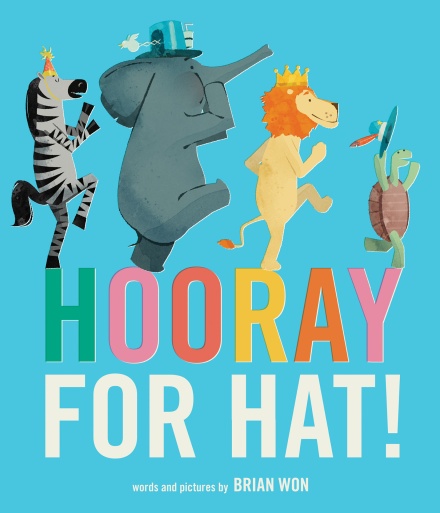
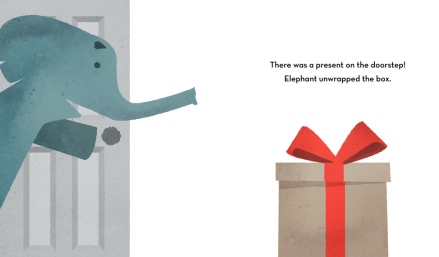
Elephant wakes up on the wrong side of the bed. He’s hardly had a chance to fully shake off sleep when the doorbell rings. He clomps down the stairs yelling, “‘Go away! I’m grumpy!’” But there’s no one at the door. Instead Elephant finds a prettily wrapped present on his doorstep. Unwrapping it Elephant finds the grandest hat he’s ever seen. It has everything – A pompom, a star, a feather, a mortar board with a tassel, a crown, a coo-coo clock bird, and even a cup holder! Elephant puts it on. How can he be grumpy with such a hat on his head? He can’t! “‘Hooray for Hat!’” he cheers and goes off to show Zebra.
Image copyright Brian Won, courtesy of brianwon.com
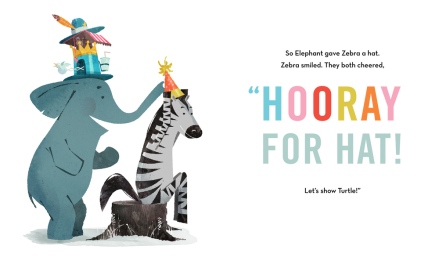
Elephant finds Zebra sitting alone on a tree stump. She doesn’t even turn around when her friend approaches. “‘Go away! I’m grumpy!’” she states. Elephant removes the top hat from his own new chapeau—a party hat with the pompom—and gently places it on Zebra’s head. Zebra can’t help but smile. “‘Hooray for Hat!’” they both cheer and head out for Turtle’s house.
Image copyright Brian Won, courtesy of brianwon.com
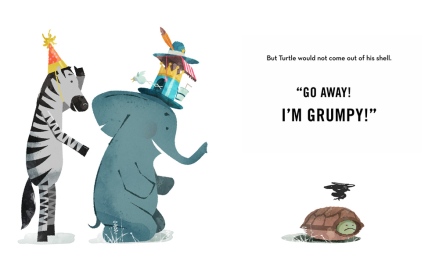
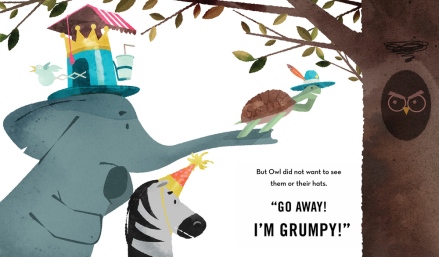
Oh, but Turtle is so grumpy that they won’t even come out of their shell. Elephant lifts down the cowboy hat with the star and feather from his own towering hat and gives it to his pal. Out pops Turtle who proudly joins the parade. “‘Hooray for Hat!’” they all cheer and march off to show Owl. “But Owl did not want to see them or their hats. “‘Go Away! I’m grumpy!’” she hoots from her tree trunk hole.
Image copyright Brian Won, courtesy of brianwon.com
But Elephant is as wise as Owl, and thinks the striped mortar board is just the thing to change her mood. “‘Hoo-Hoo-Hooray for Hat!’” Owl says, leading the way to find Lion. But Lion’s frowning face peers out at them from his den, and he shoos the group away with the familiar “‘Go Away! I’m Grumpy!’” Down comes the golden crown from Elephant’s hat and while Lion loves it, he’s more concerned with their friend Giraffe who isn’t feeling well. “‘What can we do?’” Lion asks the group.
They all know exactly what to do. They pack up the very special hat and take it to Giraffe, who is standing with her head hidden in a treetop. “Do Not Disturb” reads the sign hanging on the trunk. But as soon as Giraffe dons that hat, a toothy smile breaks out, and the six best buddies cheer, “‘Hooray for Friends!’”
Image copyright Brian Won, courtesy of brianwon.com
Brian Won’s joyful celebration of the power of surprise, friendship, and a great hat is a day brightener for anyone, whether they wake up grumpy or feeling fine. His adorable animal friends don’t mind a little grumpiness—they’ve experienced it themselves—but only want to make each other happier. The repeated phrasing throughout the story invites kids to read along, and the absence of pronouns offers open interpretation and inclusiveness. The confetti-colored hats will make kids smile and the tribute to friendship will have them cheering along with this fun picture book.
A cheer-ful book, Hooray for Hat! would make a happy addition to children’s libraries for those days when they need a little more encouragement or inspiration. Kids will want to get together with Elephant, Zebra, Turtle, Owl, Lion, and Giraffe again and again and will no doubt love to create a magnificent hat of their own!
Ages 3 – 7
Houghton Mifflin Harcourt Publishers, 2014 | ISBN 978-0544159037
Instituted in 2007 by the Encouragement Foundation at Harding University in Searcy, Arkansas, today’s holiday entreats us to cheer on our friends, coworkers, and even those we don’t know as they attempt to reach goals or start new endeavors. A pat on the back, a simple “you can do it!,” or a reassuring “great job!” boosts people’s self-confidence and makes the world a happier place.
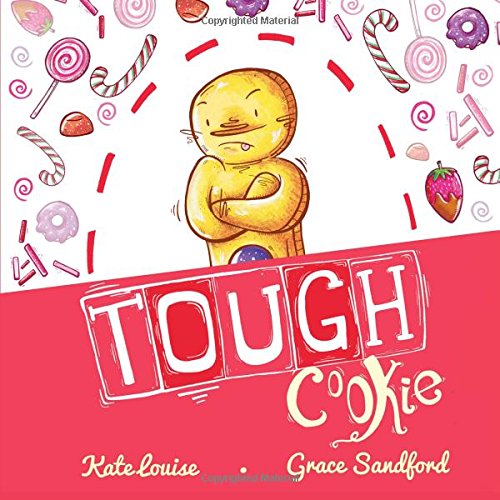
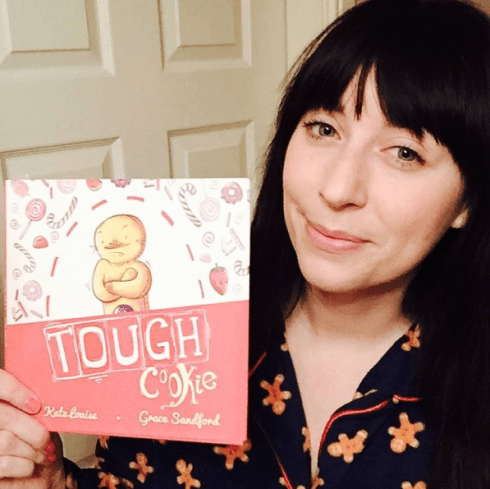
Tough Cookie
Written by Kate Louise | Illustrated by Grace Sandford
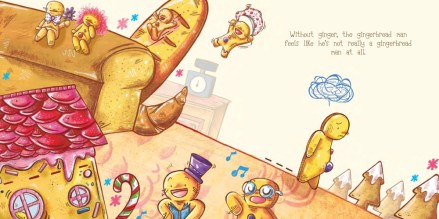
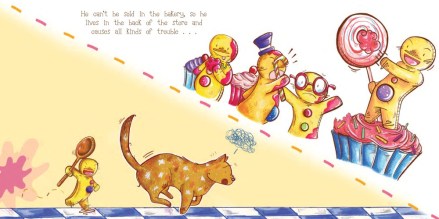
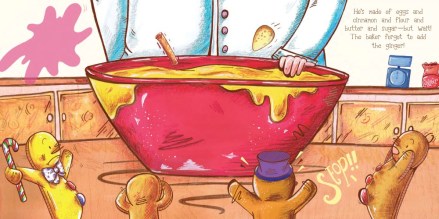
Although one gingerbread man in the bakery looks like all the others, there is one important difference. Yes, the batter had “eggs and cinnamon and flour and butter and sugar—but wait! The baker forgot to add the ginger!” Without this signature ingredient the gingerbread man just doesn’t feel like a gingerbread man at all. In fact his whole life has been turned upside down. He’s different from his friends, and what’s worse, he can’t be sold. Instead, he lives in the back of the bakery and in his sadness makes all kinds of mischief.
Image copyright Grace Sandford, text copyright Kate Louise, courtesy of Sky Pony Press
The gingerbread man chases the cat, splatters icing on other cookies, and squirts icing on the walls. “‘I need that for my cupcakes!’” the baker yells, but the gingerbread man just laughs. He moves on to the decorative candies, stuffing them in his mouth as fast as he can even though the baker needs them for his other treats and stands by tapping his foot. Next the gingerbread man scatters sprinkles all over the counter and slips and slides along on his belly—“‘woohoo!’” But the baker is not amused. “‘I need those for the donuts!’” he shouts.
Image copyright Grace Sandford, text copyright Kate Louise, courtesy of Sky Pony Press
Finally, the baker has had enough. Not only is the gingerbread man upsetting the other gingerbread men and women, he is ruining the business. The baker orders the gingerbread man to leave the store. But this is one gingerbread man that does not want to run away. “‘I don’t want to leave!’” he cries. The baker relents. He takes the little cookie in hand and teaches him that even though he is missing an ingredient he can still be kind. The baker shows him by being nice he can become one of the group.
Now, the little gingerbread man is happy. Instead of gobbling up all the candy, he helps create the other cookies. He no longer shoots icing on the walls or flings sprinkles around the kitchen. Rather, he helps the baker decorate the cupcakes and the donuts. He’s even learned how to sift flour and roll out dough, and he uses the cookie cutter to make new friends. And he never forgets to add the ginger!
Image copyright Grace Sandford, text copyright Kate Louise, courtesy of Sky Pony Press
In her sweet story, Kate Louise reminds readers that true happiness comes from within and that each person can decide for themselves how to perceive the world around them. While each of us is human, we all have different ingredients that make us unique. We can use those qualities to be kind and make positive changes in the world. Kids will recognize and giggle at the mischief the little gingerbread man makes with icing and sprinkles, but will also realize that friendships are built by using that same energy to help others. Sometimes tough cookies are actually softies at heart.
Grace Sandford’s bakery gleams with the golden hues of fresh-baked bread, the festive colors of sprinkles and icing, and the sparkle of sugar. Kids will love the vibrant pictures of cupcakes; lollypops; stacks of cakes, donuts, and candy; and decorated gingerbread houses surrounded by cookie forests. Her expressive gingerbread men and women register dismay at the wayward gingerbread man’s shenanigans and joy at his kindness. And the hero of the story? When he leaves behind his impish pranks he becomes a charming baker’s companion, sifting clouds of flour, running on the rolling pin to flatten dough, and passing out sugar-shiny gumdrop buttons to his new friends.
Young children will ask for this fun and funny read over and over. Tough Cookie makes an especially delicious accompaniment to an afternoon of baking or decorating gingerbread houses!
View the colorful world and signature style of Grace Sandford’s artwork on her website!
Gobble up this Tough Cookie book Trailer!
National Day of Encouragement Activity
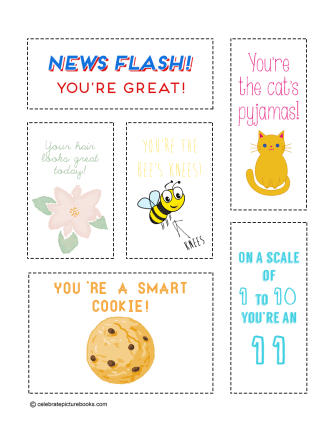
Kindness Cards
Encourage your friends – and even strangers with these printable Kindness Cards! You can hand them to people and tell them how much they mean to you or slip them into a lunch bag, locker, shelf, backpack or other place and let the person discover a secret day brightener!
Q&A with Author Kate Louise & Illustrator Grace Sandford
Today I am happy to include a double Q & A with both author Kate Louise and illustrator Grace Sandford in which they share their inspirations, their other work, and the joys of creating picture books as well as reveal a favorite place for tea and cake and a ghostly pastime!
Meet Kate Louise
What were some of the books you most enjoyed as a child?
I loved Funny Bones and Winnie the Witch! And I was a big fan of Roald Dahl (especially Matlida) – I still am!
What influenced you to write Tough Cookie?
I had the idea at Christmastime. I was measuring ingredients for a batch of gingerbread cookies and wondered what a cookie character without sugar would do because they’d be unable to fulfill their cookie purpose without an important ingredient! I later changed the missing sugar to missing ginger, which is the most important ingredient of all for a gingerbread man.
You write picture books as well as young adult novels. Which came first? What is the biggest challenge in writing each? What is the biggest joy?
When I started writing, I knew I wanted to write young-adult fiction. So that came first. Writing picture books kind of felt like starting over again. It was scary, but exciting, too. And I could learn a lot from both and apply new skills to different projects.
Both have their charms and their tough moments. Writing novels can be really hard going at times when I get the feeling that I’m never going to make it to the end, or if I get myself tangled up somewhere along the way. I don’t get that feeling quite as much with picture books, though I would say they’re harder to write! To tell a story with a much, much smaller word count and to get used to letting the illustrations tell it too.
The biggest joy for me is always seeing the finished work. After putting so much into each project, getting it back as something I can hold in my hands and feel proud of is a great feeling.
Can you describe your writing space a little?
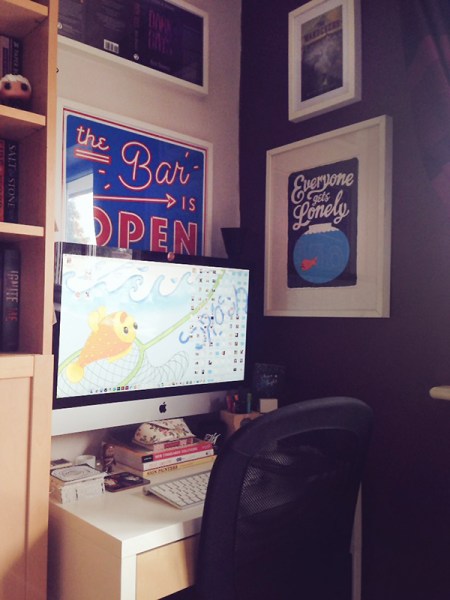
I can answer with a photo! Though, it depends when you catch me and how busy I am. Sometimes it can be piled up with books or notepads or pieces of paper and mugs of tea! My screen desktop (as you can see) can get pretty hectic sometimes too.
Since Tough Cookie is set in a bakery, I’m wondering if you have a favorite bakery and if so what is special about it?
Oh, nice question! My fave place to visit for tea and cake is a little farm shop tea room, where the cake is made by my friend Bethany at Picture Frame Puds and is seriously delicious! It has a lovely vibe and I can take my dog!
What are you working on next?
I’m working on The Pack, which is the sequel to my YA shape-shifter circus novel The Wanderers that came out last year.
Since this is a holiday-themed blog, I can’t let you get away without asking you a few holiday-related questions, so…
What is your favorite holiday?
It would have to be Christmas. But Halloween is a very close second.
Do you have an anecdote from any holiday you’d like to share?
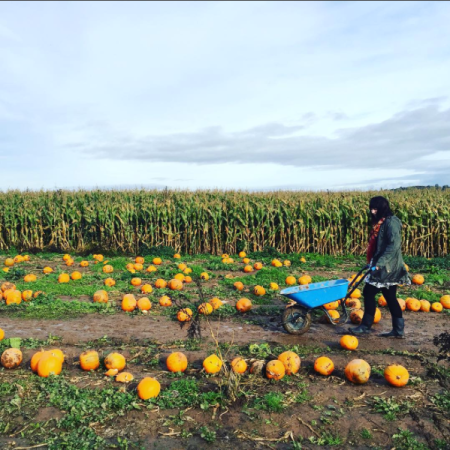
I like to make a big deal about Halloween with movies, decorating, pumpkin carving, and themed baking. We’ve just started going to a pumpkin farm to pick the pumpkins ourselves too. There’s a corn maze and little wheelbarrows and the field stretches on forever. It’s a new tradition and a fun extra activity for us at Halloween.
Meet Grace Sandford
What inspired you to become an illustrator and a picture book illustrator specifically?
Growing up, I loved drawing and creating characters from my imagination. I believe a lot of that stemmed from picture books and animated film and television. I love Disney and Pixar and as a teenager I was fascinated with the concept art from Pixar films. I always knew that I wanted a career in art of some form but it’s hard discovering what jobs are out there when you’re at school! I did some studying in Graphic Design and eventually went to university to study Illustration, which is where I got truly passionate about picture books. I always admired the art of picture books and they have been a huge part of my life but having a reason to dissect them and create your own really made me want to be a children’s illustrator.
What were some of the books and/or artists you liked most as a child?
The Very Hungry Caterpillar by Eric Carle, I am a Bunny illustrated by Richard Scarry and when I was 16 I stumbled across Catherine Rayner’s debut Augustus and his Smile. I think that book was a huge influence in wanting to be a children’s book illustrator, both the writing and illustrations are perfect!
Can you describe your process when illustrating a picture book?
It usually begins with the editor sending you the story/text. Then I start to do lots of sketches of the main character, the secondary characters and the environment around them. Pinterest is a godsend during this bit as you can flick through and look at photos of certain animals or buildings for reference to make sure you’re creating characters that will look believable (even if it is a walking, talking gingerbread man!)
Then I create roughs for each spread showing how the pages will look and which parts I have chosen to illustrate. This gives the editor a rough idea of how the final artwork is going to look and this is where most of the edits happen until it’s approved. Once all edits are approved I can create the final artwork which is my favourite part seeing all the hard work come together!
Can you describe your work space a little?
I now have a studio where I live, but when I worked on Tough Cookie I lived in a one bed apartment with my boyfriend straight after university and I had to work on the kitchen table! I’m so glad I have my own room to work in now (and I’m sure my boyfriend is too!)
My work space now involves a desk, my iMac, an A3 scanner, a windowsill with lots of pens and paints (and most importantly plants!) and I have a space that alternates between a lightbox and a graphics tablet. I also have a bad habit of putting all projects I’m working on into separate piles around the room until they are done!
You say in your bio that you like ghost hunting. How did you get involved in that? What is your favorite place to hunt ghosts?
Haha, this is the best question! I love Ghost Hunting although it’s been a while since I’ve been on a walk. It started off when I was a teenager living in a small village in England, being bored with friends and wandering around abandoned churches at night, hunting for things that go bump in the night, and it grew over time into a huge interest. When I went to University in Lincoln, a historical city, I got very interested in the social history of the place. Ghost stories are ultimately another fantastic way of storytelling. There are some very scary but interesting stories about Lincolnshire if you’re ever interested! Fun fact, Tom Hank’s bodyguard tripped over a phantom ghost head rolling down Steep Hill in Lincoln during a Professional Ghost Tour!
What are you working on next?
This year I’ve been working on a four book series based on Minecraft which has been a complete joy to be a part of! It’s been hard work as I knew very little about the franchise before this and knowing how loyal the fans are, I’ve wanted to draw everything right whilst staying faithful to my style! I just finished some more colouring books for a Spanish publisher and I have also been writing a picture book that I have a good feeling about (fingers crossed!)
What is your favorite holiday?
I personally love Christmas just because I get to spend time with my family and chill out but I love Mexico’s Day of the Dead holiday too. It is such a vibrant and beautiful celebration of something that we all sadly experience in life.
Do you have an anecdote from any holiday you’d like to share?
Every Christmas it’s become a tradition to be at home with my family playing Jigsaws, watching films and eating a little bit too much!
Thanks, Kate and Grace, for sharing about your work and your favorite places and pursuits! I wish you all the best with Tough Cookie and your other projects!
In the early 1970s Marion McQuade had the idea for a special day of the year when grandparents and grandchildren could show their love for one another. She further wanted it to be a day when grandparents could pass down the wisdom they had gained over their lifetime as well as share a bit of family history. Of course the same goes for grandparents learning the latest and greatest from the kids in their lives—from new technology to current fads. When all generations share their experiences, we’re all a lot smarter—and have closer relationships!
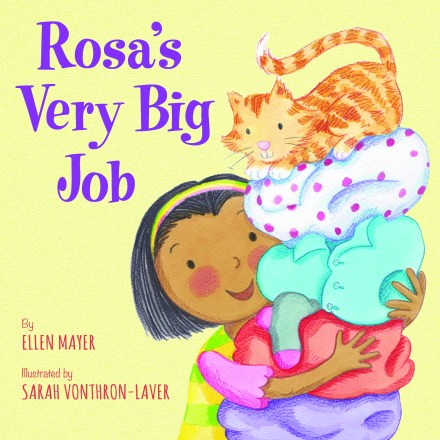
Rosa’s Very Big Job
Written by Ellen Mayer | Illustrated by Sarah Vonthron-Laver
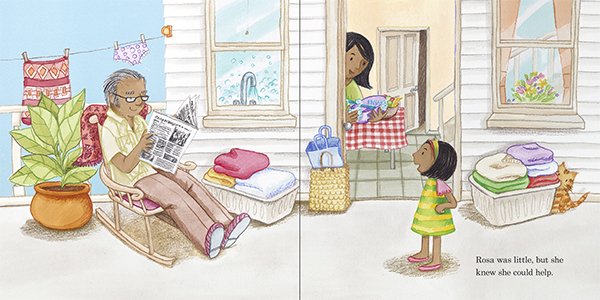
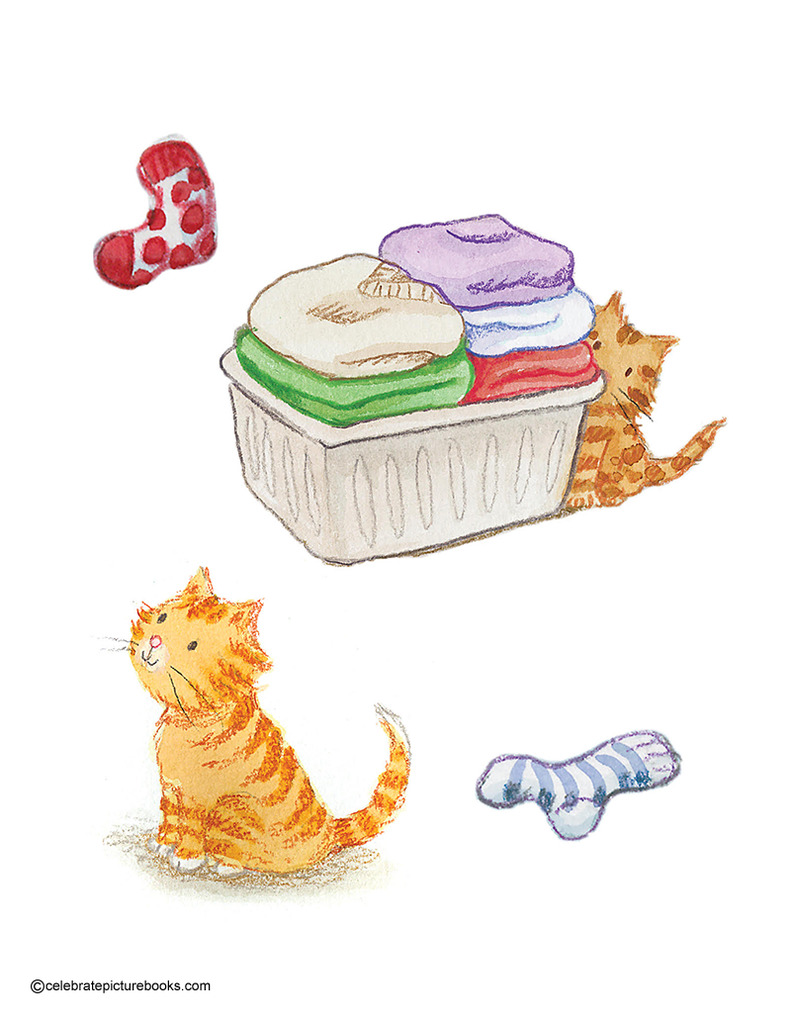
Rosa may be little, but she has big ideas about how to help. While Mama is out shopping for groceries for that night’s dinner, Rosa decides to surprise her by folding and putting away the laundry. The basket is piled high with fluffy dry clothes, sheets, and towels. Rosa watches her grandpa reading the newspaper. “‘Please help me, Grandpa!’” she says. She tugs on her grandpa’s hands, trying to pull him out of his chair. “‘Come on, Grandpa! Get up.”
Image copyright Sarah Vonthron-Laver, text copyright Ellen Mayer, courtesy of Star Bright Books, starbrightbooks.com
Grandpa seems to have a little trouble managing: “‘It’s difficult to carry these enormous piles,’” he sighs. But Rosa knows that smaller armloads work better. Grandpa’s clothes come unfolded as he puts them in the drawer. “‘Be neat. Like me,” Rosa says, showing him her tidy stack. Poor Grandpa! He has to keep hanging up the same jacket over and over. “‘It’s difficult to keep this jacket from sliding off the hanger,” he says. Rosa has the answer: “‘Zip it up,’” she explains. “‘Then it stays on.’”
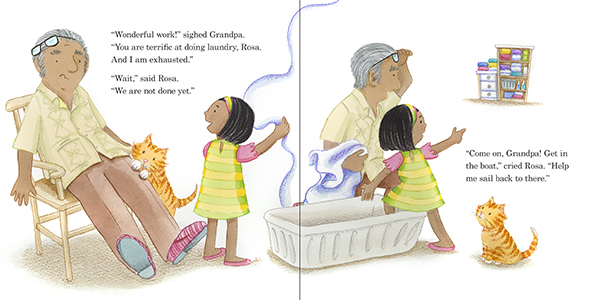
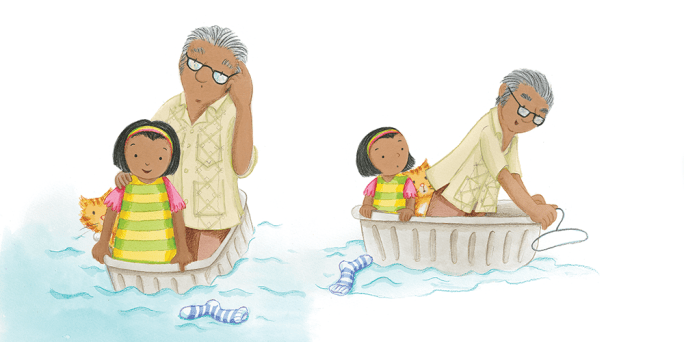
Grandpa sinks back into his chair. “‘You are terrific at doing laundry, Rosa. And I am exhausted,’” he says. But this is no time to quit—Rosa has big plans. As she steps into the now empty laundry basket, she exclaims, “‘Come on, Grandpa! Get in the boat. Help me sail back to there.’” Rosa points to the linen closet.
Image copyright Sarah Vonthron-Laver, text copyright Ellen Mayer, courtesy of Star Bright Books, starbrightbooks.com
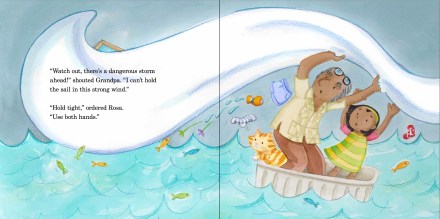
Suddenly, the floor swells with ocean waves teeming with fish. Grandpa channels his inner sailor as he holds aloft a sheet as a sail. As the wind billows and they come perilously close to the kitchen table, he says, “‘It’s difficult to sail around this enormous rock!’” Contemplating the rising sea, he exclaims, “‘It’s difficult to sail over this enormous wave!’”
There’s a dangerous storm ahead, warns Grandpa, “‘I can’t hold the sail in this strong wind.’” Rosa is there to help and grabs one side of the sheet. “‘Hold tight,’” she orders. “‘Use both hands.’” At last the seas die down and Grandpa is ready to steer the laundry basket back to port, but Rosa has a more entertaining thought. Spying a sock on the floor, Rosa wants to catch the “enormous fish.” Grandpa obliges and picks up a hangar for a fishing pole. He holds Rosa as she stretches out over the edge of the laundry basket to land her fish.
Image copyright Sarah Vonthron-Laver, text copyright Ellen Mayer, courtesy of Star Bright Books, starbrightbooks.com
Just as Rosa nabs the fish, Mama comes home with her bags of groceries. She’s surprised to see that the laundry is not in the basket. Rosa runs to her and proudly explains, “‘We put all the laundry away. It was a very big job. We carried enormous piles. Grandpa dropped things. And I picked them up. It was very difficult for Grandpa. He got exhausted. But not me. I am terrific at laundry!’” Mama agrees that Rosa is a terrific helper. Then Rosa leads her mother to see the most surprising thing of all—the fish she has caught for dinner!
In her series of Small Talk Books® Ellen Mayer presents exciting stories for preschoolers full of imagination and rich language learning. Rosa’s Very Big Job introduces Rosa, a sweet girl bubbling with enthusiasm and the desire to help. The close relationships between Rosa, her mother, and her grandpa promote cooperation as well as effective modeling of speech patterns and a way to introduce larger words in an organic manner through play and common chores. Rosa’s inventive idea to turn the laundry basket into a boat is delightfully enhanced by her grandpa’s willingness to share in the story and expand on it. Humor, cheerful banter, and the easy camaraderie between Rosa and Grandpa invite young readers to join in the fun as they build confidence in their language learning.
Sarah Vonthron-Laver depicts Rosa’s afternoon with her Grandpa with joy and the spirited energy young children bring to everything they do. Grandpa is happy to spend time with his granddaughter, yet shows honest feelings of tiredness and frustration that spur on the plot. The transition from doing laundry to using the basket as a boat is as seamless as a child’s imagination, and the way Rosa and her grandpa use household items to create “sails,” “rocks,” “fish,” and “fishing poles” will give readers great ideas for post-reading play. Bright colors, an adorable kitten, and familiar surroundings welcome young children into the world of reading and expanded vocabulary.
Rosa’s Very Big Job would be a welcome addition to a young child’s bookshelf, not only for its fun story that kids will want to hear again and again, but for its leap into imagination that kids will want to replicate.
Dr. Betty Bardige, an expert on young children’s language and literacy development, provides tips for parents, grandparents, and caregivers following the text.
Ages 2 – 6
Star Bright Books, 2016 | ISBN 978-1595727497
Discover more about Ellen Mayer and her books as well as book-related activities and literacy initiatives she’s involved with on her website!
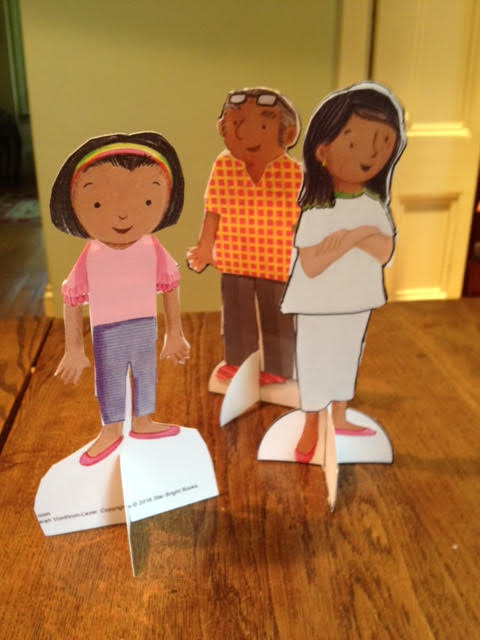
Rosa loves helping out at home. She’s terrific at doing laundry – folding and putting away the family’s clothes, socks, and linens. You are terrific at helping too! Can you help Rosa, Mama, and Grandpa get dressed and ready for the day with these printable paper dolls? You’ll even find a laundry basket, socks, and Rosa’s sweet kitty to play with!
Print dolls on regular paper or heavy stock paper. Dolls printed on heavy stock paper may stand on their own with the supplied stand cross piece. For dolls printed on regular paper, you can cut the supplied stand templates from poster board or card stock and glue the dolls to the backing.
Rosa’s kitty and the laundry basket can also be attached to the supplied template if needed
Print clothes for each figure
Color the blank clothes templates any way you’d like
Cut out clothes and extra items
Fit outfits onto dolls
Make up your own stories about Rosa, Mama, and Grandpa!
Interview with Author Ellen Mayer
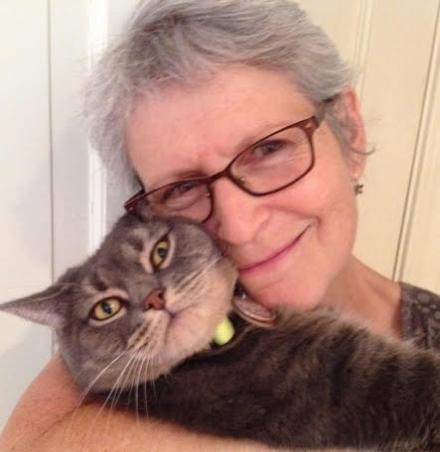
Today, I’m happy to present a fascinating interview with Ellen Mayer, a writer and expert in early literacy, in which she discusses her involvement with various organizations and programs, her baby granddaughter, why Hug Your Cat Day is at the top of her list of holidays, and gives us a peek at a very special sugar egg.
I’m really interested in your work in the education and literacy fields. Could you talk a little bit about your job as an education researcher and an early literacy home visitor, and how you got into those fields?
I got into these fields after leaving a Sociology PhD program right near the end. I didn’t want to be an academic and teach, I wanted to do applied research – to solve practical problems out in the world and to make a difference in the lives of those who were struggling. At the Harvard Family Research Project at Harvard’s Graduate School of Education, I studied the ways that families from underserved communities were engaged in supporting their children’s learning and education, and created research-based materials for families and schools to promote effective engagement. One of these was the Family Involvement Storybook Corner—curated picture book selections with family engagement themes. That got me interested in early literacy and picture books.
After researching family engagement in children’s learning for many years, I decided I wanted to go out into the field and be a practitioner and work directly with families on this topic. I worked as an early literacy home visitor with diverse families with the Parent-Child Home Program, modeling ways to share stories with little ones to build early language. I actually got paid to read picture books and play with families in their homes!
At the same time, I was pitching my Small Talk Books®, a collection of playful stories about everyday activities that provide fun for kids and ideas for adults – Rosa’s Very Big Job is one. The adults in the stories are engaged with children’s learning, modeling conversational ways to build young children’s language.
I read that your book Red Socks, another of the Small Talk Books®, is being used in a program to turn wash time at Laundromats into talk time for literacy development. Could you discuss this early literacy initiative?
Yes! Wash Time/Talk Time is a terrific campaign led by Too Small To Fail, a joint initiative of the Clinton Foundation and the Opportunity Institute teaming up with a host of partners to turn Laundromats in underserved areas into venues for early literacy. This campaign distributes free books and information to families in Laundromats about building early language to help close what’s called the “word gap” by promoting parent conversation with babies and young children. Almost 60% of children in our country start kindergarten behind in their language development and this then sets them on a downward path and they get even further behind in school.
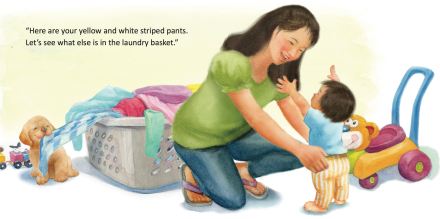
Red Socks was a natural fit for this program. In it a Mama narrates what she is doing for her little pre-verbal child as she folds the laundry and dresses the child—and as they search for a missing sock!
I have to say that it’s a dream come true that Too Small To Fail is using my book.
Wash Time/Talk Time is really reaching the families on the other side of the word gap who most need the ideas and inspiration in Red Socks. When I began writing the Small Talk Books® I wanted to include stories about doing laundry, as it’s something we all do as parents and provides lots of things to talk about with children. (Like the color of socks!) In fact, I used to sit in Laundromats and observe families when I was thinking up ideas for stories. I guess that’s the sociologist in me.
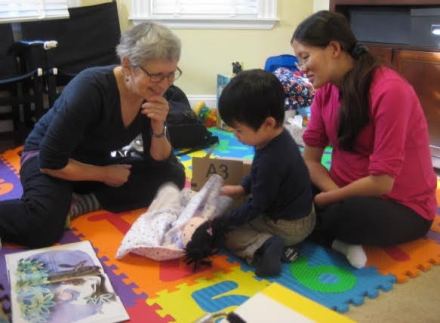
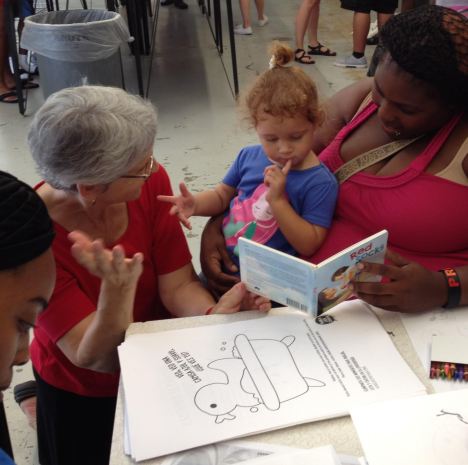
We just had the opportunity to visit one of the Laundromats in the campaign—at the Free Laundry Day in Tampa, FL hosted byThe Laundry Project—and share Red Socks with families. You can see some of the fun illustrator Ying-Hwa Hu and I had here:
What inspired you to begin writing picture books?
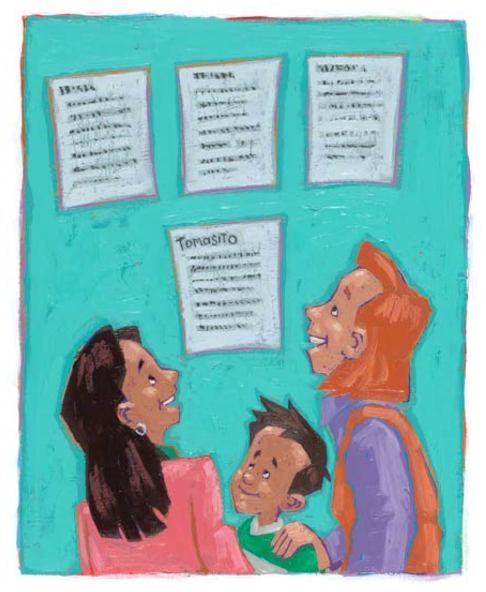
I came to picture book writing through a backdoor. When I was at Harvard Family Research Project, I was thinking about new ways to convey our ideas from research into practice for parents, and it occurred to me that a read-aloud picture book could address an audience of parents, as well as the primary one of children. My boss was enthusiastic about the idea, and so I enrolled in an adult ed class on writing for children. Then I turned one of our research case studies about challenges an immigrant Latino family had in communicating with their son’s teacher into a picture book,Tomasito’s Mother Comes to School/La mamá de Tomasito visita la escuela. Joe Cepeda did the art for it, and we made it downloadable for free.
Some new things! I have a fellowship with the Storytelling Math Project that’s funded by the Heising-Simons Foundation and coordinated by TERC, a not-for profit STEM research and development organization here in Cambridge, MA. I’ll be a member of a group that’s identifying, creating, and promoting math-infused storybooks for diverse young children and I hope to create a couple of Small Talk Books® along these lines—probably about supermarket shopping! I also was asked to help out the Highlights magazine editorial team that creates HELLO magazine for 0-2 years and be an outside reviewer for issues before they go to publication. And then I’ll be volunteering as a visiting children’s book author to the Somerville Family Learning Collaborative, the family engagement and early childhood hub of the Somerville, MA Public Schools, sharing my books with playgroups and new parent groups.
But mostly, I plan to write! I have a bunch of picture book manuscripts in various states, and ideas for new ones. These manuscripts are different from the Small Talk Books®; they don’t have a deliberate educational underpinning to them. They are fun, and just fun. One, for example, is called What To Do With Ruby-Lou and it’s about a baby who doesn’t laugh, no matter what her family does. Who is going to be able to get a laugh out of Lou? Well, it’s a surprise and it just might require some audience participation. I’ve had an agent in the past and hope to find a new one to rep me with these picture books.
You recently became a grandmother. Can you tell me a little about your granddaughter?
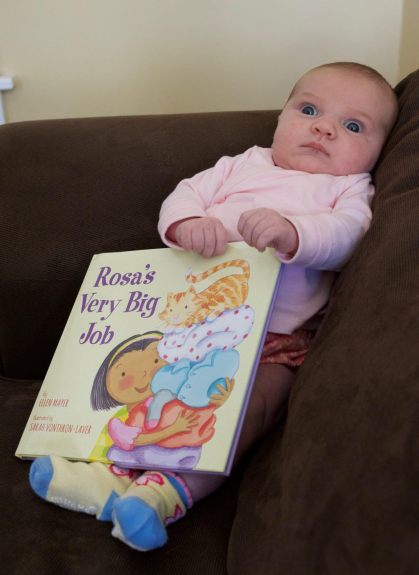
I thought our granddaughter was the most wonderful and expressive baby in the world when was she born – of course! She and my advance copy of the new Rosa book arrived into the world at just about the same time.
At three months now my granddaughter is a big reader and is riveted on the B&W hi-contrast board book genre, especially one board book about cars and trucks. She moves her head back and forth, from one end of the spread to the other, scanning the images on the page like a studious scholar of some ancient text.
What is the best part about being a grandmother?
For me the best part about being a grandmother is being able to simply enjoy my granddaughter and play with her and watch her develop, and not have to worry about taking care of her daily needs. I didn’t have to stress when she refused to take the bottle before starting full-day childcare. That wasn’t my job. (She did take it – of course!) They live nearby, and seeing her once or twice a week, I love noticing small changes on each visit. I also love seeing our daughter and son-in-law parent.
Have you given thought to what you’d like your granddaughter to call you?
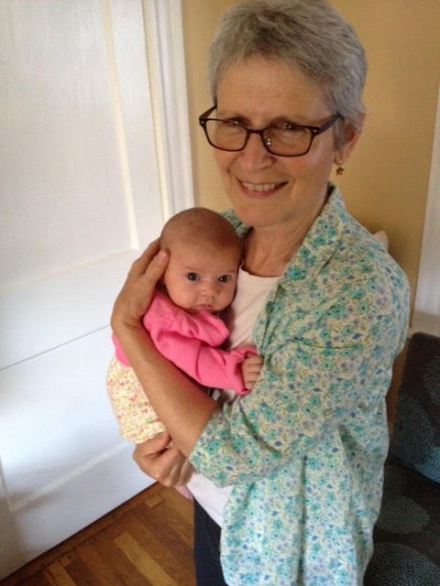
Our daughter asked us ahead of time what we’d like to be called when we became grandparents. I thought it was a wise idea to be proactive and select a name immediately, to avoid being named by the grandchild something like “Grandma GA-GOO-GA.” My great aunt Jane is called “Nini” as a grandmother, and I’ve always loved that, but I didn’t want to steal it. So I chose “Mimi.”
It sounds as if Grandparents Day may be one of your top holidays! Do you have another favorite?
When I was little, I liked Easter a lot because it combined a lot of my favorite things: crafts, springtime, running around outside, candy. Also, we didn’t dress up much as kids, but I do remember Easter bonnets!
When our children were little, their birthdays became my favorite holiday celebrations. Now that they are grown, maybe I need to pick a new favorite holiday? I see that June 4th is Hug Your Cat Day. That might be just right: we have a rather large and ferocious cat and when she actually lets you hug her, well, it’s a cause for celebration.
Do you have an anecdote from any holiday that you’d like to share?
When I was six years old, I saw the Easter Bunny. I was staying at my Grandparents’ house, and I looked down the stairwell, and there he was, crossing the landing at the foot of the stairs. He was quite tall, wore a yellow slicker that was too small for him, and he was carrying a large Easter basket. I’m afraid I didn’t have my Brownie camera with me at the time to snap a photo.
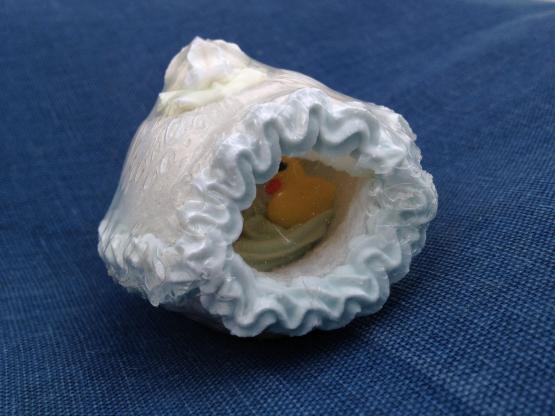
But I do have an unwrapped sugar Easter egg that I’ve saved from that era.
Thanks for sharing so much about your work and life, Ellen! I wish you all the best with Rosa’s Very Big Job, your other Small Talk Books®, and of all your other ventures!
Other Small Talk Books® available from Ellen Mayer and Star Bright Books include Cake Day, Red Socks, and A Fish to Feed and can also be found at the above booksellers.
September has been designated as National Courtesy Month to remind us that good manners and watching out for others, goes a long way toward making the world a more cooperative and happy place. Sometimes common courtesy is as black and white as directly following the rules…but sometimes…well, I’ll let you decide…
The Black and White Factory
Written by Eric Telchin | Illustrated by Diego Funck
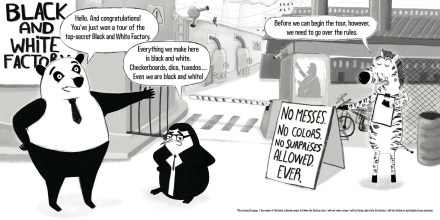
You are one lucky reader! You have won a tour of the Black and White Factory where the employees are hard at work making products like checkerboards, dice, tuxedos…you know the stuff. Even the bosses—a panda and a penguin—are in black and white. Before you start your tour, you’re met by a zebra foreman who goes over the rules of the factory. And they are these:
“No Messes, No Colors, No Surprises Allowed.” When? “Ever.”
As you proceed inside your first stop is the billiard ball machine—8 balls only, of course! It doesn’t take you long to be ushered into the “top-secret Experiment Room,” where innovative products are being developed. You may be the first ever to see “trick dominoes that are impossible to knock over” and new black-and-white-paint in either checkerboard or polka-dot. Another prototype displayed on a wall chart is “never-melting vanilla ice cream.” Also prominently displayed are the factory’s rules: “No Messes, No Colors, No Surprises Allowed. Ever.”
Image copyright Diego Funck, text copyright Eric Telchin, courtesy of simonandschuster.com
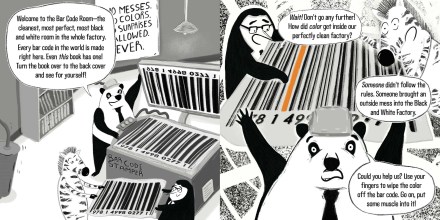
Moving on you push the button leading to the Animal Room. Housed here are white Dalmatians, dairy cows, and skunks who are being sprayed with their distinctive black marks. An elevator takes you to the Bar Code Room. While waiting for your car, you are exhorted to remember the rules: “No Messes, No Colors, No Surprises Allowed. Ever.” The Bar Code Room is “the cleanest, most perfect, most black and white room in the whole factory. Every bar code in the world is make right here.” Even the one for the book you’re reading! Turn it over and see!
Image copyright Diego Funck, text copyright Eric Telchin, courtesy of simonandschuster.com
“Wait!” Wait!! Turn the book back! A stripe of yellow has seeped into the factory! “Someone didn’t follow the rules. Someone brought an outside mess into the Black and White Factory.” The bosses need your help! Can you “use your fingers to wipe the color off the bar code?” Oh, no, no, no! That just made it worse—now it’s smudged yellow and orange! “Quick! Do something! Rub the colors with your sleeve. Or your elbow. Something.”
We interrupt this review to remind you of the RULES: “No Messes, No Colors, No Surprises Allowed. Ever.” Right, then, back to our dilemma. Now the colors are dripping! It’s such a mess! Suddenly, the zebra has an idea. He asks you to “hold the book upright and tilt it so the color drips down the bottom of the page.” Okay—phew!—great job!
Oh, no!! More colors are creeping in! “Swirl the book so the colors fly off the page,” the penguin orders. You are one strong swirler—the zebra, penguin, and panda are all topsy-turvy, and now the factory looks like an abstract painting! This definitely is not good. “What a mess! The Black and White Factory is ruined.” But the panda may have an idea. Everyone, “back to the top-secret Experiment Room.” There the panda, zebra, and penguin, splattered in paint, stand in front of the “Air-powered comprehensive cleaning contraption.” They just need your help in getting it started. Can you blow into the nozzle? Harder? Come on, put some oomph into it! All right!
Image copyright Diego Funck, text copyright Eric Telchin, courtesy of simonandschuster.com
The machine’s at 100% power! The machine shakes and whirrs with a color overload. It explodes with a rainbow of colors that covers everything in the factory. The panda, zebra, and penguin stand in the midst of it. “Everything is so…different,” says the panda. “It’s…colorful…,” adds the penguin. “And wonderful!” concludes the zebra. There’s just one problem…The RULES: “No Messes, No Colors, No Surprises Allowed. Ever.” Hmmmm….
How about: “No Messes, No Colors, No Surprises Allowed. ForEver.”
Yes! Much better! So “that concludes the Best. Tour. Ever!” Off you go—just don’t forget the rules: “Messes, Colors, Surprises Allowed. Forever.”
Eric Telchin’s The Black and White Factory will have kids tipping, tilting, swinging, and even reading this fun and funny interactive picture book. Directly addressing the reader, the three staid and rule-abiding managers of a very focused factory, play straight-man to the child’s laugh inducing and unintentional “mistakes” that lead to a brighter future. With the pacing of a favorite theme-park ride, the story has a suspenseful “Oh, no! What’s going to happen?” feeling as readers progress from page to page until the first tinge of yellow precipitates the humorous chaos to come.
Diego Funck’s sly illustrations riff on the black-and-white theme, as he designed a clever product line in line with “the rules.” Kids will want to linger over the pages to catch all the jokes and visual puns. The reactions of the three employees of The Black and White Factory will make readers laugh too as they endeavor to hang on to their beloved rules in the midst of their changing world. The bold colors of the transformed factory are as refreshing as the sun after a dark, rainy day.
The theme that creativity and expression come from making messes and allowing surprises to happen is a welcome idea and one that leads to innovation and personal freedom. The Black and White Factory is sure to be asked for again and again!
Avid readers, rejoice! Today is your day – a whole 24 hours dedicated to the fine pursuit of perusing an old favorite or a newly discovered book! To celebrate visit a local bookstore or library then find a cozy nook or shady spot and settle in for a good, long read.
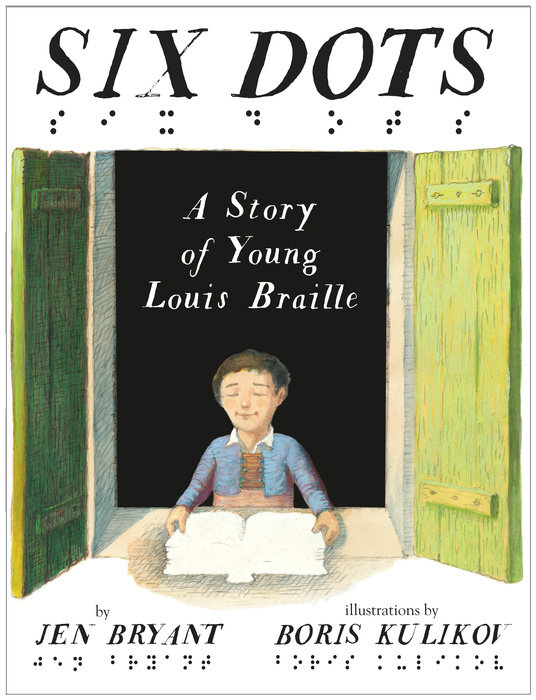
Six Dots: A Story of Young Louis Braille
Written by Jen Bryant | Illustrated by Boris Kulikov
When Louis Braille was born he was so small that no one in town expected him to live. But he did! Louis thrived and with his curious eyes took in everything around him. Louis was smart, too, with a prodigious memory for names and stories. His father worked with leather, making harnesses and bridles. Louis wanted to be just like him and often reached for the sharp tools on the workbench, but his father always warned him away.
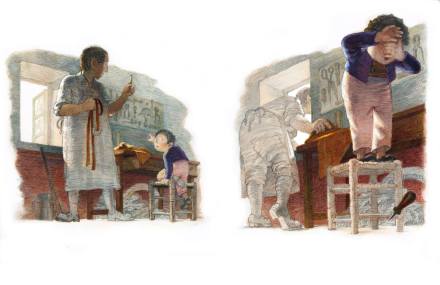
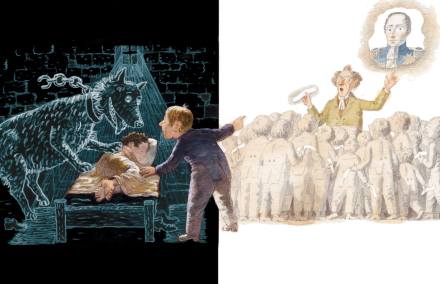
One terrible day, however, when Louis’ father glanced away, Louis grabbed an awl and tried to work it into the smooth leather, but it slipped. Louis’ damaged eye was bandaged and he was told not to touch it. But when the bandage began to itch, young Louis couldn’t help himself and spread the infection to his other eye. By the age of five, Louis was left in darkness, unable to see the faces of those he loved or the attractions of home.
Image copyright Boris Kulikov, courtesy Alfred A. Knopf
Louis learned the sounds of the world. He discovered the number of steps around his house, to the outbuildings, and eventually to the shops and businesses in town. His brother taught him how to whistle and use the reverberations to avoid obstacles. He also learned to feel the shapes of letters made of straw, leather, or nailed replicas made by his family. He played dominoes by feeling the dots with his fingers.
While Louis listened to others read to him, he longed to be able to read on his own. Whenever he asked if there were books for blind people, however, the answer was always, “No.” A noblewoman who lived nearby heard of Louis and invited him to study at the Royal School for the Blind in Paris. At the age of 10 he moved to the boarding school.
The Royal School was anything but sumptuous. Louis’ room was crowded, damp, and dark. His uniform itched, and meals were meager and cold. He so wanted to return home, but the promise of books for the blind kept him there. Those books were reserved for the best students, and Louis vowed to be one. Finally, Louis was led to the library. A book thudded onto the table in front of him. “‘Voila! There it is,’” the guide said.
Louis opened the book. To read it he had to feel the raised letters, but the letters were huge and a page only held a few sentences. To make matters worse, the book consisted of only a few pages. “‘Is that all?’” Louis asked. The guide told him there were others but that they were all the same. More than ever Louis wanted to go home.
Image copyright Boris Kulikov, courtesy Alfred A. Knopf
In the morning Louis was shaken awake; the headmaster had an important announcement. It seemed that a French army captain had devised a secret code read by touch instead of sight. This code could be used at the school, the headmaster said. The code consisted of raised dots set in patterns that represented various sounds. The boys learned the new code then learned how to write it, using an awl-like implement that punched dots into paper.
While the code was a breakthrough, it was hard to learn and all the other boys in the school had given up—but not Louis. Still, reading the code was not like reading a book with letters, words, and sentences. Louis asked the headmaster if the army captain would work with him to improve the code, but when the headmaster asked, the answer was “No.”
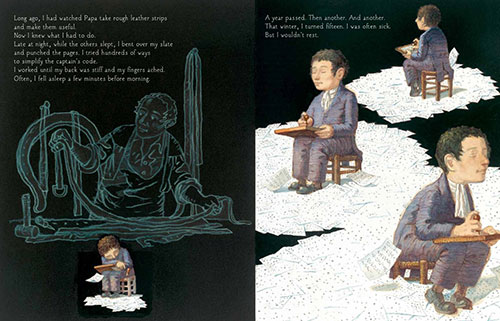
Louis knew what he had to do. Night after night he punched dots into paper with the awl-like tool—just as he had watched his father do with leather. He tried “hundreds of ways to simplify the captain’s code.” Three years passed, and Louis turned 15. Finally, he had a workable solution. He asked the headmaster to read to him a book he had never heard. As the headmaster read, Louis copied his words, punching letters onto paper. Louis’ “new code used just six dots, arranged in two columns, like dominoes. Each dot pattern stood for a letter of the alphabet.”
Image copyright Boris Kulikov, courtesy Alfred A. Knopf
When the headmaster finished reading chapter 1, Louis turned his pages over and “reading by touch, recited the entire chapter.” After that “word spread quickly. The other students rushed to try it. Si facile! ‘So easy!’ Et si vite! ‘And so fast!’ ‘We can read words and write letters like everyone else,’” the other boys exclaimed.
As Louis watched his friends read he remembered watching his “Papa in his shop, bent over rough strips of leather, making them useful. I had become like him, after all,” Louis thought.
An Author’s Note, more fascinating biographical information about Louis Braille’s life and other inventions, resources, and the Braille alphabet follow the text.
In her Author’s Note Jen Bryant says she wanted to express what it felt like to be Louis Braille. In Six Dots she succeeds in bringing the story of this very young inventor and genius to life with details of his accidental blindness, family support, school experiences, and ultimate victory. Told from Louis Braille’s point of view, the story has an immediacy that presents Braille’s frustrations, challenges, and achievements sensitively and honestly. His perseverance against all odds will inspire readers and give them a new perspective on the unique person Braille was, the importance of books for all, and what children not much older than the readers of Six Dots can accomplish.
Boris Kulikov’s mixed media illustrations take readers back to the France of the early 1800s, depicting with soft colors and period details the town, people, and influences in Louis Braille’s life. Braille’s initial accident is treated with thoughtful consideration of the book’s audience, and his blindness and dreams are portrayed with transparent outlines on a black background. Readers will be interested to see how Louis’s family and friends supported and helped him (an unusual occurrence of the time). As Louis grows, readers discover his other talents for music and sewing, and the tools Louis used to produce his Braille pages are clearly shown.
Ages 4 – 9
Alfred A. Knopf, 2016 | ISBN 978-0449813379
View Jen Bryant’s website for activities, videos, and links related to Six Dots—you’ll also discover more of her books too!
To see a gallery of images by Boris Kulikov for books and other illustration work, visit his website!
Read a Book Day Activity
I Love the Library! Coloring Page
Today is a perfect day to visit your library and check out some awesome books! Here’s a printable I Love the Library! Coloring Page for you to enjoy too!