April 15 – National Rubber Eraser Day

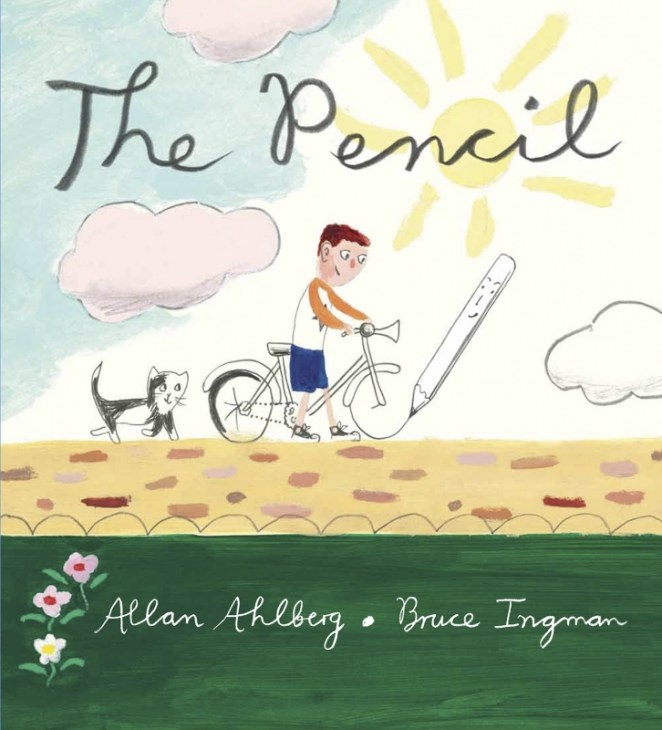
The Pencil by Allan Ahlberg and Bruce Ingman Picture Book Review

About the Holiday

Today we celebrate that little item at the end of the pencil or near at hand that gives us second (or third…or fourth…or…) chances. The rubber eraser has been around since 1770, when Joseph Priestly invented a vegetable gum that could remove pencil marks and Edward Nairne developed it into an eraser that could be widely marketed. In 1839 Charles Goodyear’s work with vulcanization made erasers more durable, and Hyman Lipman put pencil and eraser together in 1858. What did people do before the rubber eraser? They still made mistakes, but wax and even crustless bread were the remedies of choice. To celebrate today, draw or write with abandon and feel free to erase as often as you want!

The Pencil

Written by Allan Ahlberg | Illustrated by Bruce Ingman


Even before the title page readers learn of a little pencil, alone in the world. One day the pencil quivers and begins to draw. The pencil draws a boy, who asks for a name, and receives “Banjo” in reply. The boy wants a dog, and the pencil obliges. Bruce is the dog’s name, and he wants a cat. Mildred is immediately created, and of course Bruce chases Mildred. Banjo chases Bruce. They need a place to run, so the pencil draws a house, a town, and a park.

celebrate-picture-books-picture-book-review-the-pencil-boy

Image copyright Bruce Ingman, 2012, text copyright Allan Ahlberg, 2012. Courtesy of Candlewick Press.

All this excitement makes the trio hungry and tired. Banjo demands the pencil draw him an apple, Bruce wants a bone, and Mildred really wants a mouse but settles for cat food. There’s just one problem—the food is so unappetizing in black and white. The pencil thinks for a bit and comes up with a solution. He draws a paintbrush named Kitty. Kitty colors the food, the boy, the dog, the house, the town, and the park. Mildred is left as created – she’s a black-and-white cat anyway.

celebrate-picture-books-picture-book-review-the-pencil-black-and-white

Image copyright Bruce Ingman, 2012, text copyright Allan Ahlberg, 2012. Courtesy of Candlewick Press.

The team of Pencil and Paintbrush creates a whole family, a friend for Bruce, a ball (Sebastian) for Banjo, and a kitten for Mildred. But all these extra characters cause trouble. Sebastian breaks a window, and the mom, dad, sister, and grandpa aren’t completely satisfied with the traits they’ve been given. What’s a pencil to do? Draw an Eraser, of course!

The eraser takes care of the problems, but he grows fond of his power to rub things out. He erases the table, chair, front door—the whole house. And that’s not all! Nothing the Pencil and Paintbrush have created is safe. Eraser rubs everything out until all that’s left is the pencil and the eraser locked in opposition.
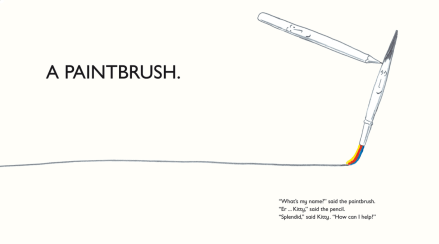
celebrate-picture-books-picture-book-review-the-pencil-paintbrush

Image copyright Bruce Ingman, 2012, text copyright Allan Ahlberg, 2012. Courtesy of Candlewick Press.

The pencil draws a wall, a cage, a river and mountains with fierce animals but none of it is a match for the eraser. Then the pencil has a brainstorm and draws…another eraser! The two erasers engage in an epic battle, and in the end they rub each other out.

Pencil recreates everything he had before, and Kitty colors it all in, including a new picnic with a runaway boiled egg named Billy and ten A-named ants to clean up the crumbs. As the day fades into night, a moon appears in the sky along with a cozy box for Pencil and Paintbrush to sleep in.

celebrate-picture-books-picture-book-review-the-pencil-rubs-out-everything

Image copyright Bruce Ingman, 2012, text copyright Allan Ahlberg, 2012. Courtesy of Candlewick Press.

Allen Ahlberg is a master at tapping into children’s unbridled imagination and silly side. His endearing story of a little pencil who creates himself a world full of friends and excitement—as well as the inevitable conflict—will keep kids laughing with its word play, topsy-turvy names, and mad-dash action. As the eraser rubs out everything in its path, kids will also understand the gentle, underlying  lesson that simply getting rid of a problem can sometimes just create more and that resolution is a better tact.

Bruce Ingman’s sly, childlike illustrations are the perfect accompaniment to Ahlberg’s story, deftly depicting the friendship and collaboration between Pencil and Paintbrush as they create house and its family with a mom sporting a crazy hat, a dad with large ears, and a grandpa smoking a pipe he doesn’t want. As Eraser begins his rampage, readers will enjoy the giddy suspense of how it will all end and will be happy to see that Paintbrush once again fills the pages with joyous and vivid color.

Ages 4 – 8

Candlewick Press, 2012 | ISBN 978-0763660888

National Rubber Eraser Day Activity
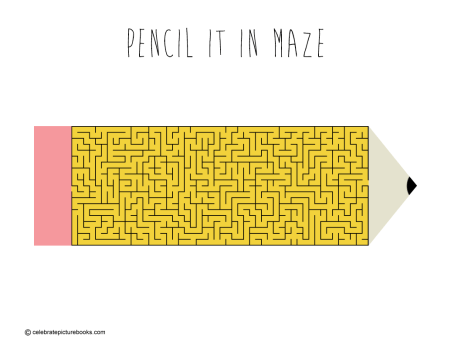
CPB - Pencil Maze

Pencil It In! Maze


Sharpen your pencil and start having fun with this printable pencil-shaped maze. 

Pencil It In Puzzle!  | Pencil It In! Solution

Picture Book Review

April 4 – National Walking Day

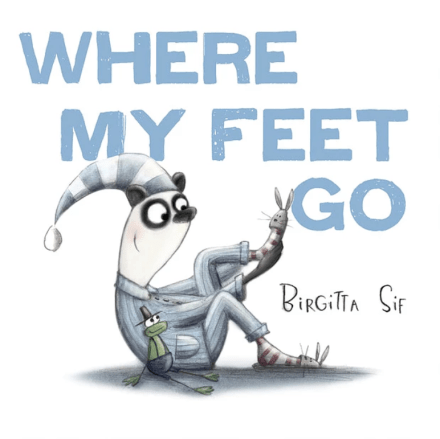
celebrate-picture-books-picture-book-review-where-my-feet-go-cover

About the Holiday

Walking is one of the best ways to get out of the house, get some fresh air, and get fit! Sitting in a cubicle, at a desk, or in front of a computer all day can take a toll on your health and even happiness. Begun in 2007 and sponsored by the American Heart Association, today’s holiday encourages people to take to a sidewalk, hiking trail, or boardwalk near you and stretch your legs. Being outside can give you a new appreciation for your town or city and refresh your sense of community!

Where My Feet Go

By Birgitta Sif


Little Panda wistfully gazes out the window with a question to pique your curiosity: “Do you know where my feet go in the morning?” It seems that after putting on very special socks and shoes, Panda heads right outside. But Panda doesn’t walk “a normal walk down a normal street”—in fact, his feet don’t even touch the ground!

celebrate-picture-books-picture-book-review-where-my-feet-go-walking-on-hands

Copyright Birgitta Sif, 2016, courtesy of Knopf Books for Young Readers.

Sometimes Panda and his froggy companion walk through the “thick jungle” of a carrot patch. Other times, they trudge up mountainous mole hills or tightrope walk across the thinnest log bridge. When they jump in a puddle, those moon boots send up an ocean of spray.

celebrate-picture-books-picture-book-review-where-my-feet-go-bath-time

Copyright Birgitta Sif, 2016, courtesy of Knopf Books for Young Readers.

When morning turns into afternoon, where do you think Panda’s feet go? They can wander into dangerous territory where Panda feeds the “little dinosaurs” that fly to him. Then it’s time for Panda’s feet to fly. They go so high that they “get tickled by the clouds.” When his feet land in a box of quicksand, Panda gets a sinking feeling that he’s in a sticky situation. Once freed, Panda continues on his trek over a seaside desert to find the perfect locale to build a castle.

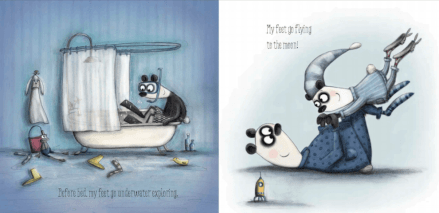
At night, Panda’s feet take extra-special adventures like scuba diving in a warm, soapy sea, blasting off to the moon, and “shooting for the stars.” Now Panda has another question for you: Is there somewhere that you would like to go? “Cause Panda’s feet are ready “to go to some very magical places….”

celebrate-picture-books-picture-book-review-where-my-feet-go-nighttime

Copyright Birgitta Sif, 2016, courtesy of Knopf Books for Young Readers.

Birgitta Sif’s adorable bowling-pin shaped Panda may have his eyes on his feet, but his mind is filled with imagination as he turns walks through everyday places into spectacular adventures. Little ones will happily accompany him with their own imaginations, and be ready to make up more dreamy escapades with Panda from the toys, pictures, plants, and knick-knacks in his room. Sif depicts the reality of Panda’s journeys in soft-hued, two-page spreads while his unique interpretation of each location is revealed through his conversation with the reader.

A fun read aloud that can spur exuberant journeys—both real and imaginative—with creative little ones, Where My Feet Go makes a terrific choice for story time or bedtime.

Ages 2 – 5

Knopf Books for Young Readers, 2016 | ISBN 978-0553511642

To learn more about Birgitta Sif and view a portfolio of her books and art, visit her website.

National Walking Day Activity

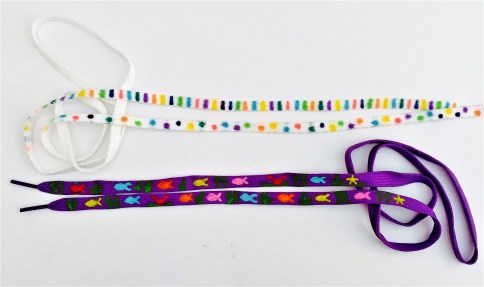
celebrate-picture-books-picture-book-review-shoe-laces

Make Your Own Shoelaces


With some plain shoelaces and a bit of creativity, you can make unique shoelaces just perfect for each of your journeys! These make great gifts or party treats too!

Supplies

  • Plain white or colored shoe laces
  • Fabric paint or markers
  • Paintbrush

Directions

  1. Create a pattern or design
  2. Paint or draw your design along the shoelaces, let dry
  3. Wear your shoes proudly as you make your own path in life!

Picture Book Review

March 29 – It’s International Ideas Month

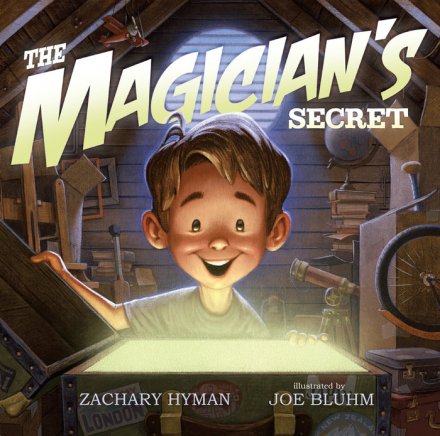
celebrate-picture-books-picture-book-review-the-magician's-secret-cover

About the Holiday

This month we celebrate something that you can’t see or hold but which is real all the same. What is it? An idea! Ideas are amazing things. Sometimes seemingly conjured up out of thin air and sometimes the “Eureka!” result of long, hard work, ideas fuel our arts, sciences, education, and home life. So today, write down those ideas you have while driving or commuting to work, while in the shower, when you’re daydreaming, or just as you turn off the light to go to sleep. You never know what they might become!

Tundra Books sent me a copy of The Magician’s Secret to check out. All opinions are my own. 

The Magician’s Secret

Written by Zachary Hyman | Illustrated by Joe Bluhm


When Mom and Dad dropped Charlie off at his grandfather’s for an overnight visit, they pleaded with him to make sure his grandson went to bed early. “‘No more hocus-pocus!’” his daughter said. That wasn’t just some phrase she conjured up, because her father had once been a magician and was still “like a big kid who never grew up.” He loved to play games with Charlie and “also knew the most amazing tricks.” But he never told Charlie his secrets.

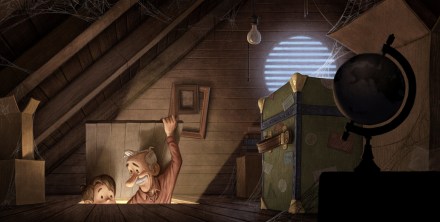
celebrate-picture-books-picture-book-review-the-magician's-secret-attic

Copyright Joe Bluhm, 2018, courtesy of joebluhm.com.

What Charlie loved best were Grandpa’s stories. Whenever Grandpa told a story, he and Charlie went up to the “most cobwebby corner of the attic” where a big green trunk full of special things from Grandpa’s adventures sat. Grandpa would pull out an item and begin to talk. This night he showed Charlie an hourglass filled with sand that Grandpa said came from the tomb of King Tut.

Another time, he pulled out a scarf that had belonged to the World War I Red Baron fighter pilot. Grandpa had plucked it from the Red Baron’s neck during a dogfight in which Grandpa left the Baron and his plane floating in a French sea. One summer evening the story revolved around a coconut shell that he found on a tropical beach. He had fallen asleep under a palm tree only to be awakened by a roaring T-Rex intent on eating him. Just in the nick of time, “dozens of rocks rained down through the air, scaring the nasty dinosaur away.” Who had saved him? Grandpa never told, saying that was for Charlie to figure out.

celebrate-picture-books-picture-book-review-the-magician's-secret-red-baron

Copyright Joe Bluhm, 2018, courtesy of joebluhm.com.

Charlie loved Grandpa’s stories, but his father said that they were just “things Grandpa’s made up.” Charlie couldn’t believe it. He felt like he “had lived every one of those adventures with Grandpa. How could they not be true?” When Charlie asked his grandfather about it, Grandpa sighed. He said the problem with grown-ups was that they didn’t “have faith in make-believe” but that if you “use your imagination, you can turn a dream into something real.”

celebrate-picture-books-picture-book-review-the-magician's-secret-twilight

Copyright Joe Bluhm, 2018, courtesy of joebluhm.com.

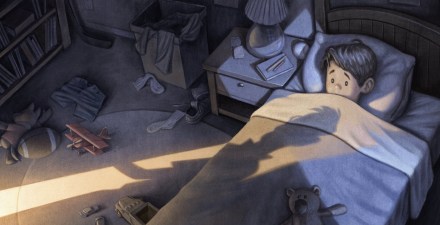
Charlie wasn’t so sure, but Grandpa assured him: “‘We’ve done it over and over again, with cameras and computers, automobiles and airplanes…. Magic is all around us, kiddo—in me and in you.’” Then Grandpa waved his hands in the air and produced a…rock. He said it was the philosopher’s stone that could do magical things, but the secret was that “‘You have to see it, you have to believe it.’” That night Charlie fell into a deep sleep with the rock under his pillow. When he woke up, he heard an earth-shattering roar. He looked and saw a T-Rex threatening his grandpa. He looked at the rock in his hand and knew what to do….

celebrate-picture-books-picture-book-review-the-magician's-secret-in-bed

Copyright Joe Bluhm, 2018, courtesy of joebluhm.com.

Zachary Hyman makes magic with traditional storytelling combined with the wonder of imagination and the encouragement to make dreams come true. As Grandpa talks about his daring feats, Charlie believes him, but more importantly, Charlie believes that he could do such marvelous things too. Hyman’s reminder that all great discoveries and achievements began as someone’s seemingly impossible idea is well aimed at his young audience whose boundless imaginations may just be our next realities. Hyman’s evocative language and conversational tone  will keep children enthralled until the surprise ending.

Joe Bluhm lends a mysterious enchantment to Hyman’s story with his atmospheric depictions of the cobwebby attic, darkened, creature-infested tomb, and twilit skies. Turning from the setup to the heart of Grandpa’s stories, readers are immersed in vibrant colors and dazzling light, representative of that flash of ingenuity or creativity in each of us. In a nice cyclical set of images, Charlie is first seen watching TV and playing aviator, spaceman, explorer, artists, and magician with Grandpa in sepia-toned snapshots. Near the end of the book when Grandpa talks about the power of imagination, these same scenes are presented in full color with Charlie as a pilot, astronaut, movie director, mountain climber, race car driver, and explorer.

Like the best magic trick, The Magician’s Secret will captivate readers but will also tell them what they really want to know: the answer to how they can do wondrous things themselves. The book would make a terrific addition to home, classroom, and school libraries.

Ages 5 – 8

Tundra Books, 2018 | ISBN 978-1770498945

To learn more about Joe Bluhm, his books, and his art, visit his website.

It’s no secret that you’ll love this The Magician’s Secret book trailer!

International Ideas Month Activity

celebrate-picture-books-picture-book-review-share-your-bright-idea-activity

Share Your Bright Idea! Page


Do you sometimes have a lightbulb moment when an idea seems just right? Use this printable Share Your Bright Idea! Page to write about or draw your idea!

Picture Book Review
March 22 – National Goof Off Day

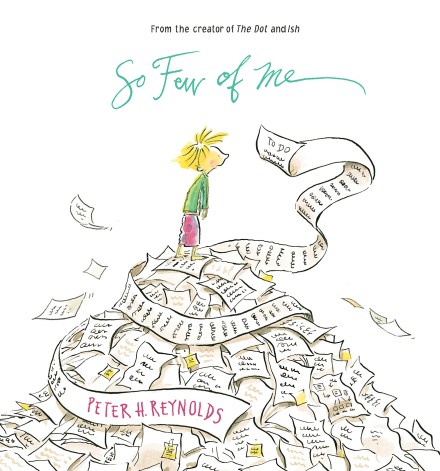
celebrate-picture-books-picture-book-review-so-few-of-me-cover

About the Holiday

Just as the name sounds, today is a day to relax, let some things slide, and goof off! When the stresses and strains of everyday life get to be a little too much, letting go and having fun can put you in a better frame of mind and give you new perspectives. The holiday was established in 1976 by Monica Moeller Dufour of Davidson, Michigan. Now that you have permission to goof off and a whole twenty-four hours to do it in, plan some wacky events – or just snuggle in with a good book. There are no rules—so enjoy!

So Few of Me

By Peter H. Reynolds


Leo knew how to multitask. He could mop the floor and feed the bird at the same time (so…well… maybe the seed did miss the cage by a bit). But “no matter how hard he worked, there was always more to do.” Leo thought making a list would be a good idea. But once he started writing, the “list of things to do grew and grew.” For a moment, Leo wished there two of him. Suddenly, there was a knock at the door.

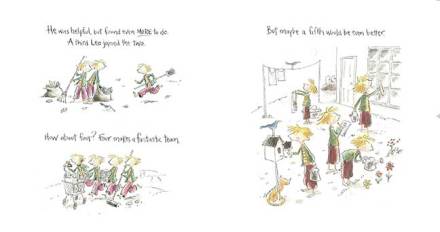
celebrate-picture-books-picture-book-review-so-few-of-me-four-leos

Copyright Peter H. Reynolds, 2006, courtesy of Candlewick Press.

When Leo opened the door, he, himself, was standing on the other side. The new Leo was keen to get started on the list. Two Leos was helpful, but the new Leo noticed more things to be done, so “a third Leo joined the two.” Three was fine, but four was even better. They shopped, swept up, went to the library for more books, and made important phone calls.

If four could get so much done, just imagine how productive five would be. The Leos did imagine it, and a fifth Leo joined the group. The Leos could now wash the windows, make a birdhouse, water the flowers, do the laundry, and make some notes. Those notes became a more organized job chart when the sixth Leo appeared. “After meeting for hours, they decided they needed a seventh.”

celebrate-picture-books-picture-book-review-so-few-of-me-nine-leos

Copyright Peter H. Reynolds, 2006, courtesy of Candlewick Press.

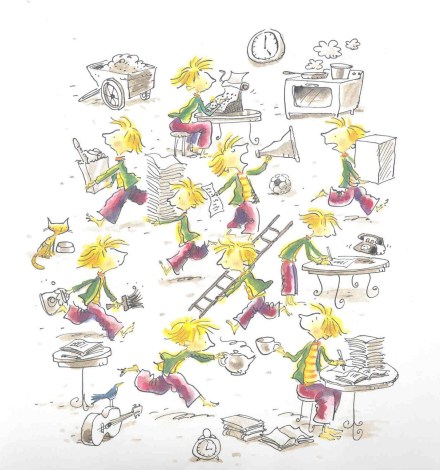
But it didn’t quite work out that way. “With seven Leos, there was seven times as much work!” Leo decided they needed one more just to stay afloat. These eight Leos mopped and baked, played soccer and carted laundry, organized and took notes that led to needing another Leo. Surely, these boys could get it all done. So one typed while another played soccer and another washed the cat. The fourth Leo swept while the fifth walked the dog and the sixth practiced violin. The seventh made important phone calls and the eighth checked the list while the ninth went grocery shopping.

Things were getting done and yet there was still more to do. So one more Leo was added, and each was “busier than the next.” At last, the ten Leos stopped for a minute to take stock. They reviewed the list and the progress they were making. They discovered that there was “no time to stop, no time to rest!” The first Leo, though, “was exhausted. He slipped away to take a nap.”

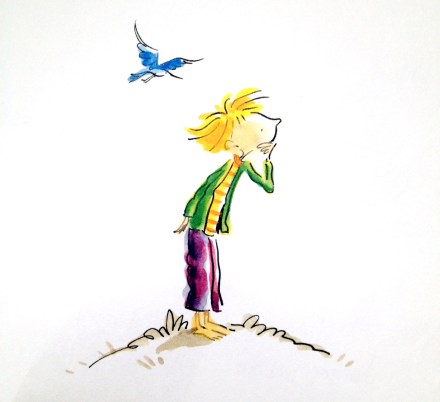
When Leo opened his eyes, he saw eighteen other eyes staring back at him. “‘What were you doing/’” The nine Leos demanded. When they heard that Leo had been dreaming, “they roared, ‘Dreaming is NOT on the list!’” But Leo only smiled, and “the Leos disappeared one by one.” Leo had a new thought. He wondered what would happen if he did less, but did his best. This solution made him happy, and with the list abandoned, Leo ran and played and became “just me, just one…with time to dream.’”

celebrate-picture-books-picture-book-review-so-few-of-me-one-leo

Copyright Peter H. Reynolds, 2006, courtesy of Candlewick Press.

Peter H. Reynolds’ books for young readers celebrate the wonders of childhood—those years that are so important in the development of the adult to come. Always encouraging of the interior voice of creativity and individuality, here Reynolds adds a tribute to time—the time needed to think, dream, contemplate, devise, and become.

With his usual flair, Reynolds uses watercolor, ink, and tea to show readers—both kids and adults—what all that over-scheduled running around looks like from the outside. As the Leos proliferate, the pages go from sparse to full to packed until one page isn’t enough, and the list and the Leo’s spill over into a double spread. When Leo wakes from his nap and realizes one is enough, the white space around him provides a sense of freedom and lightness. As the pages of the list fly out of Leo’s hands and he plops down in a grassy spot, the end papers reflect Leo’s liberation. Whereas the opening endpapers of college-rule notebook pages are full of chores, meetings, and exhortations to do more, the final  notebook-page endpapers are blank, giving readers a sense of Ahhhhh!

Adding So Few of Me to home or classroom bookshelves and reading often can be a good reminder that time relaxing is time well spent.

Ages 5 and up

Candlewick, 2006 | ISBN 978-0763626235

Learn more about Peter H. Reynolds, his books, his art on his website

National Goof Off Day Activity

celebrate-picture-books-picture-book-review-chore-matching-card-game

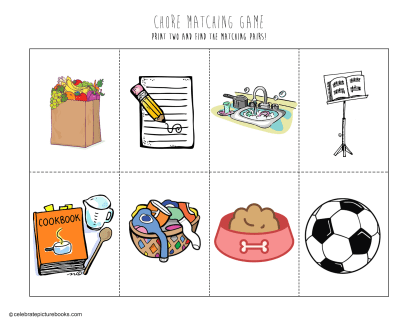
Sweep Away Your Chores! Matching Game


Match the chores to get them done. See how quickly you can pair up these chores and get them finished so you can run off to play.

Supplies

Directions

  1. Print two copies of the Chore Cards for each player
  2. Cut the Chore Cards apart’
  3. Lay them face down and scramble them
  4. Turn over one card and try to find its match by turning over another card
  5. If the cards match, put them aside
  6. If the cards do not match, lay them face down again and pick another card
  7. You win when all the cards have been matched

Picture Book Review
March 15 – It’s National Craft Month

celebrate-picture-books-picture-book-review-sister-day-cover

About the Holiday

Does just walking through the door of Michael’s or A.C. Moore make your heart beat faster? Do your cabinets overflow with bottles of paint, glitter, ribbon, lace, and empty bottles and boxes? If so, then March is the month for you! This month we celebrate the creative energy and unique perspectives that result in beautiful, one-of-a-kind decor or clothing, fun group projects for kids and adults, and successful home-based businesses. Homemade love is also one of the best ways to show friends or family members how you feel—as you’ll see in today’s book. There are so  many reasons and ways to indulge your love of all things crafty this month—so what are you waiting for?!  

Sister Day!

Written by Lisa Mantchev | Illustrated by Sonia Sánchez


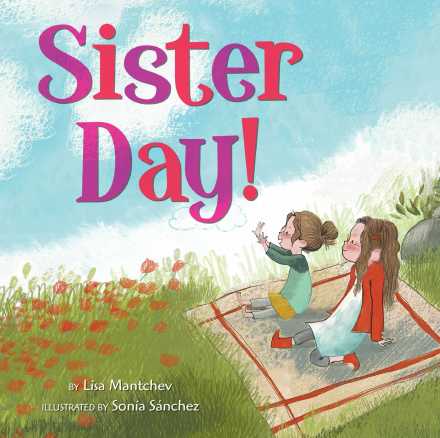
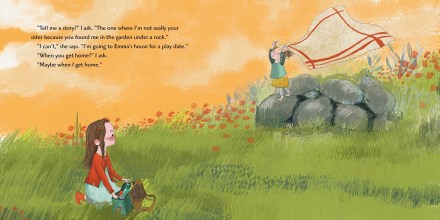
As Lizzie and her big sister, Jane, sit on a quilt watching the clouds, Lizzie tells how she loves that Jane has “the best imagination” and “can make up all kinds of things in her very own head.” Lizzie wants to play dress up, but Jane says, “not now.” How about telling a story? Jane can’t do that either because she’s going to her friend Emma’s house soon. “‘Maybe when you get home?’” Lizzie asks. “‘Maybe,’” says Jane.

celebrate-picture-books-picture-book-review-sister-day-picnic

Image copyright Sonia Sánchez, 2017, text copyright Lisa Mantchev, 2017. Courtesy of simonandschuster.com.

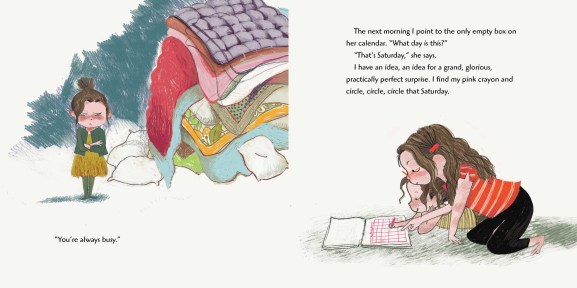
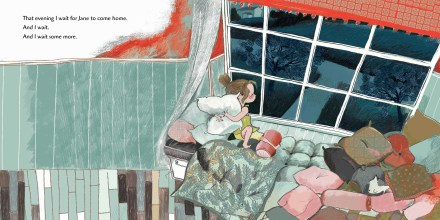
Jane is gone all day. Night falls and still Jane isn’t home. Lizzie waits in the window seat and watches and watches. Finally, Jane is home! Lizzie shows her the fort she made using all the blankets. It will be perfect for telling stories under, but now Jane has to do her homework. “‘You’re always busy.’” Lizzie says. The next day the sisters look at the calendar. It’s almost full except for one Saturday. Suddenly, Lizzie has an idea for a wonderful surprise. She takes the pink crayon and “circles, circles, circles that Saturday.”

celebrate-picture-books-picture-book-review-sister-day-waiting

Image copyright Sonia Sánchez, 2017, text copyright Lisa Mantchev, 2017. Courtesy of simonandschuster.com.

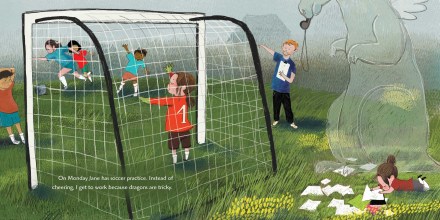
On Monday while Jane has soccer practice, Lizzie works on a dragon referee. On Tuesday instead of copying Jane’s jumps and twirls at ballet, Lizzie puts “tutus on sugarplum fairies.” On Wednesday during Jane’s piano lesson, Lizzie tunes up her imaginary orchestra. Thursday is karate day, and while Jane does her moves, Lizzie “sneaks, sneaks, sneaks to a quiet corner to finish up [her] surprise.” On Friday Jane goes to Emma’s again after school, and Lizzie gets help from Mom baking Jane’s favorite treat.

celebrate-picture-books-picture-book-review-sister-day-soccer

Image copyright Sonia Sánchez, 2017, text copyright Lisa Mantchev, 2017. Courtesy of simonandschuster.com.

Early Saturday morning, Lizzie grabs her sketchbook, her scissors, and some tape. It takes an hour and the whole roll of tape to make the surprise. Then Lizzie goes to Jane’s room. She knocks on the door. When there’s no answer, Lizzie opens the door. Jane’s room is empty. Lizzie runs “downstairs, yelling, ‘Mom, have you seen Jane?’” When Lizzie enters the kitchen, she finds Jane “wearing a T-shirt covered in glittery glue.” She made them at Emma’s house, Jane says as she hands one to Lizzie. 

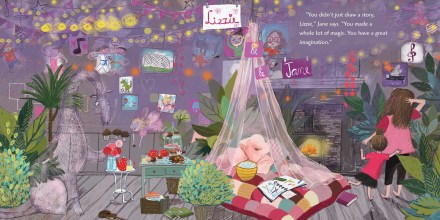
Lizzie puts it on and pulls Jane into the living room. Pictures and decorations cover the walls, and delicious cupcakes and drinks are on the table. “‘Surprise! I wrote you a story!’” Lizzie says. “‘Happy Sister Day!’” As Jane looks around, she tells Lizzie, “‘You didn’t just draw a story, Lizzie. You made a whole lot of magic.’” Lizzie hugs her big sister. “‘It runs in the family,’” she says.

celebrate-picture-books-picture-book-review-sister-day-surprise

Image copyright Sonia Sánchez, 2017, text copyright Lisa Mantchev, 2017. Courtesy of simonandschuster.com.

Lisa Mantchev captures the happiness and disappointments of sibling relationships in her sweet story. In today’s busy family life, sisters—and brothers—don’t always get to spend as much time together as they might like. Mantchev reveals, however, that close bonds remain in the heart. Young readers will be enchanted by this loving sister duo and the surprise ending that shows a shared understanding and devotion between them. Sister Day! may inspire families to hold special sister and or brother days to let siblings connect and develop their unique relationship.

celebrate-picture-books-picture-book-review-sister-day-calendar

Image copyright Sonia Sánchez, 2017, text copyright Lisa Mantchev, 2017. Courtesy of simonandschuster.com.

In her beautiful, light illustrations, Sonia Sánchez replicates the positive, happy relationship between Lizzie and Jane. As each day brings a new activity for Jane, readers will recognize the reality of a younger sibling waiting for the older one to finish. As Lizzie uses this time to draw her story, children will see that even though Lizzie and Jane aren’t together, they are thinking of each other. Lizzie’s imagination is creatively shown through transparent fantasy creatures who keep Lizzie company during Jane’s absence. Sánchez’s lovely color palette and delicate, detailed drawings invite children to spend time with these best-friend sisters.

Sister Day! would make a wonderful gift and a charming addition to sisters’ home libraries

Ages 4 – 8

Simon & Schuster/Paula Wiseman Books, 2017 | ISBN 978-1481437950

Discover more about Lisa Mantchev and her books for children, young adults, and adults on her website!

National Craft Month Activity

celebrate-picture-books-picture-book-review-heart-jar

I Love You Jar


Show your friends or family members how much they mean to you with this jar full of love!

Supplies

  • Small to medium size decorative jar or a recycled jar
  • Red felt or heavy paper
  • Scissors

Directions

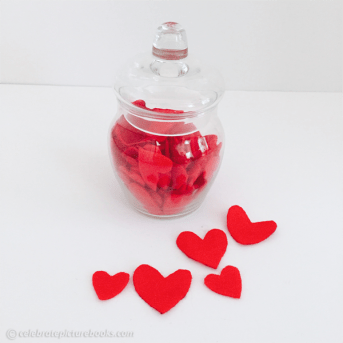
  1. Cut enough small hearts from the red felt or paper to fill the jar one-half to three-fourths full
  2. Fill the jar with the hearts
  3. Give it to your friend, sister, brother, mom, dad—anyone you love—and watch them smile!

Picture Book Review
March 10 – It’s National Women’s History Month

celebrate-picture-books-picture-book-review-maya-lin-artist-architect-of-light-and-lines-cover

 About the Holiday

This month we celebrate the accomplishments of women in the past who have broken barriers and forged paths for today’s women and who still inspire the leaders of tomorrow. To honor women this month, learn more about the influential woman in your own field or in areas you enjoy as hobbies and teach your children about the women who made incredible contributions to the world long ago and those who are changing the way we live today.

Maya Lin: Artist-Architect of Light and Lines

Written by Jeanne Walker Harvey | Illustrated by Dow Phumiruk


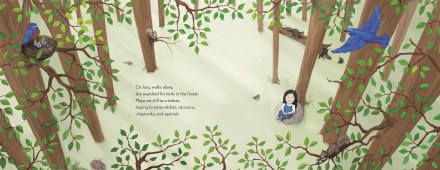
As a child, Maya Lin loved playing and interacting with nature near her home. She and her brother liked to run over what Maya had named “the Lizard’s Back”—a hill behind her house—and into the woods. Sometimes Maya went into the woods alone and “sat as still as a statue, hoping to tame rabbits, raccoons, chipmunks, and squirrels.” She liked to play chess with her brother and build towns from scraps of paper, boxes, books, and other things she found around the house.

celebrate-picture-books-picture-book-review-maya-lin-artist-architect-of-light-and-lines-in-forest

Image copyright Dow Phumiruk, 2017, text copyright Jeanne Walker Harvey, 2017. Courtesy of us.macmillan.com.

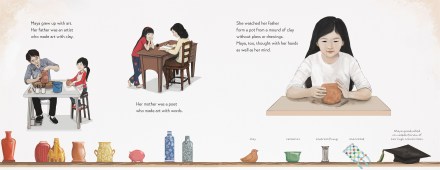
Maya’s “parents had fled China at a time when people were told what to be and how to think.” They did not want the same for their children and always encouraged Maya to be and think what she wanted. Maya grew up surrounded by art. Her father worked with clay, and her mother was a poet. Maya also liked to make things with her hands. The beautiful library where she went to college inspired Maya to become an architect.

To learn about different buildings, Maya traveled all over the world. When she was only a senior in college, “Maya entered a contest to design a memorial to honor soldiers who died during the Vietnam War.” The contest stated two rules: the memorial had to fit in with a park-like setting, and it had to include the 58,000 names of the soldiers who had died in the war. These rules resonated with Maya. She “believed that a name brings back all the memories of a person, more than a photo of a moment in time.”

celebrate-picture-books-picture-book-review-maya-lin-artist-architect-of-light-and-lines-as-young-girl

Image copyright Dow Phumiruk, 2017, text copyright Jeanne Walker Harvey, 2017. Courtesy of us.macmillan.com.

Maya visited the site where the memorial would be built. As she looked at the gently rolling hill, she envisioned a simple cut in the earth that would support a polished wall covered in names. Not only would the wall reflect those who died, but also those who came to visit and the surrounding nature. At school, Maya worked with mashed potatoes and then with clay to help her create the perfect monument. When she had finished her drawings and plans, she wrote an essay to accompany them. She wrote that her monument would be “a place to be experienced by walking down, then up past names that seemed to go on forever.”

celebrate-picture-books-picture-book-review-maya-lin-artist-architect-of-light-and-lines-with-parents

Image copyright Dow Phumiruk, 2017, text copyright Jeanne Walker Harvey, 2017. Courtesy of us.macmillan.com.

More than 1,400 artists and architects—many of them famous—entered the contest. The designs were hung in an airplane hangar anonymously for judging. Finally, the day came for the announcement of the winner. When the judges called out Maya Lin’s name and she came forward, they were surprised to find that she was so young. Maya was excited to have won, but then some people began to object to her design. Some said her “design looked like a bat, a boomerang, a black gash of shame.”

celebrate-picture-books-picture-book-review-maya-lin-artist-architect-of-light-and-lines-library

Image copyright Dow Phumiruk, 2017, text copyright Jeanne Walker Harvey, 2017. Courtesy of us.macmillan.com.

Maya was hurt by these comments, but she defended her design and, finally, it was approved. Maya worked with the architects and engineers who excavated the land and built the wall. As each granite panel was polished, engraved with the soldiers’ names, and set in place, Maya looked on. The memorial opened on Veterans Day in 1982. Thousands of people came to see it and to find the names of loved ones they had lost. As Maya approached the wall, “she searched for the name of the father of a friend. When she touched the name, she cried, just as she knew others would.” Every day since then visitors come to the wall to remember.

Maya Lin has gone on to design many more works of art and architecture that can be seen inside and outside. Each piece has a name and a particular vision. Maya wants people to interact with her art—to touch it; read, walk, or sit near it; or think about it. After each piece is finished, Maya thinks about her next work and how she can inspire the people who will see it.

celebrate-picture-books-picture-book-review-maya-lin-artist-architect-of-light-and-lines-Vietnam-War-Memorial

Image copyright Dow Phumiruk, 2017, text copyright Jeanne Walker Harvey, 2017. Courtesy of us.macmillan.com.

An Author’s Note about Maya Lin and the Vietnam War Memorial follows the text.

Jeanne Walker Harvey has written an inspiring biography of Maya Lin that reveals not only her creativity but the importance of creative freedom for children. Lin’s confidence that led her to enter the contest and then defend her winning design will encourage readers to pursue their dreams. Harvey’s lyrical storytelling reflects Maya Lin’s quiet, introspective nature, the influences that nurtured her creative spirit, and her dedication to inviting others to be part of her art.

Dow Phumiruk’s graceful, soft-hued illustrations allow children to follow Maya Lin as she grows from a girl discovering nature, constructing cardboard cities, and learning the arts from her parents to a young woman who draws inspiration from the world’s buildings and relies on her own sensitivity to guide her. Back-to-back pages of the landscape of Vietnam and the site of the memorial connect the two places for children’s better understanding. Phumiruk’s depictions of the Vietnam War Memorial also give children an excellent view of this moving monument. Her images of Lin’s other architectural work will entice young readers to learn more about her and to explore where each of these pieces can be found.

Ages 4 – 8

Henry Holt & Company Books for Young Readers, 2017 | ISBN 978-1250112491

Discover more about Jeanne Walker Harvey and her books on her website!

Learn more about Dow Phumiruk, her art, and her books on her website!

National Women’s History Month Activity

 celebrate-picture-books-picture-book-review-maya-lin-coloring-page

Maya Lin Coloring Page

Maya Lin’s accomplishments are inspirational for all children! Here’s a printable coloring page that you can personalize and hang in your room or locker to remind you that you can reach your goals too!

Maya Lin Coloring Page

Picture Book Review
January 31 – Inspire Your Heart with Art Day

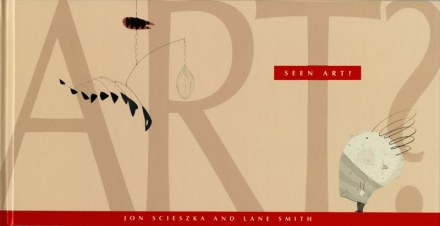
celebrate-picture-books-picture-book-review-seen-art-cover

About the Holiday

Celebrating art is always a great thing! Today we champion that feeling you get inside when you create or experience art—no matter what kind is your favorite. Paintings, books, music, sculpture, quilts, photography, and other arts show you a bit of the world in a new way—a way, perhaps, you’ve never thought of before. Art can inspire, gladden,  sadden, anger, teach, and compel action. Today, let your heart be inspired by art by visiting a museum, bookstore, library, concert, or gallery. Or, if you’re creative, take some time to give your imagination full reign. And what if you’re friends with someone named Art? Well, that’s a lucky thing for today too—as today’s book shows!

Seen Art?

Written by Jon Scieszka | Illustrated by Lane Smith


A little boy has arranged to meet his friend Art at the corner of Fifth Avenue and Fifty-third Street in New York City. When he arrives, however, Art isn’t there. The boy asks a woman nearby, “‘Have you seen Art?’” The lady points him in the direction of a beautiful new building further down the street. When he gets there, the boy doesn’t see Art, but he does meet an official-looking gentleman. “‘You seen Art?’” the boy inquires.

celebrate-picture-books-picture-book-review-seen-art-woman

Image copyright Lane Smith, 2005, text copyright Jon Scieszka, 2005. Courtesy of Viking Books for Young Readers.

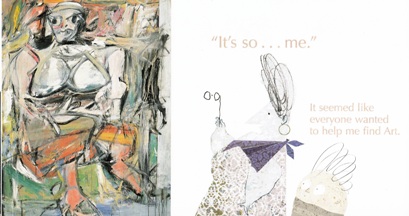
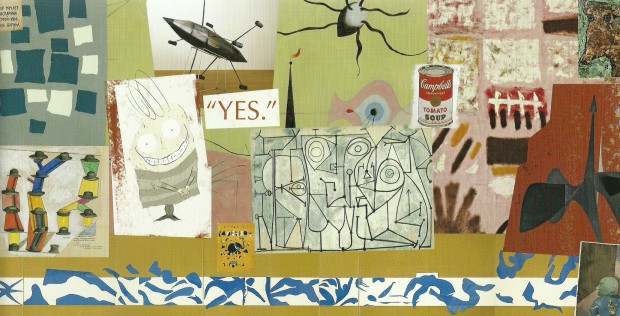
“‘MoMA?” the man asks. The boy remembers that the lady asked the same thing and, figuring it’s some kind of code word, answers, “‘Yes.’” Great news! The building is just opening, the man tells him. After giving a woman at a desk the code word, the boy is led upstairs. The woman stops in front of a painting with blue swirls, writhing trees, and a moon glowing over a quiet village. “‘Can’t you just feel the restlessness? The color? The emotion?’” The boy can feel it, but he’s more interested in finding Art.

celebrate-picture-books-picture-book-review-seen-art-collage

Image copyright Lane Smith, 2005, text copyright Jon Scieszka, 2005. Courtesy of Viking Books for Young Readers.

A little man standing nearby seems to know where to go, and he leads the boy through a room filled with more paintings and sculpture. The man stops in front of a painting. “‘Look at that red! Look at that open box of crayons inviting us in. The grandfather clock? It has no hands. Time is suspended.’” The boy sees all this too. But, really, what he wants to know is—“‘is Art here?’”

A little girl across the room knows what he means. She can show him art. She takes him past a fur-covered teacup and spoon to a painting of an eye. But this is no ordinary eye. Instead of blue, brown, or green, this eye is made of clouds. “‘Your dream can be what is real,’” she explains. They see another painting with a melting clock in which time is messed up too, but it’s still not Art.

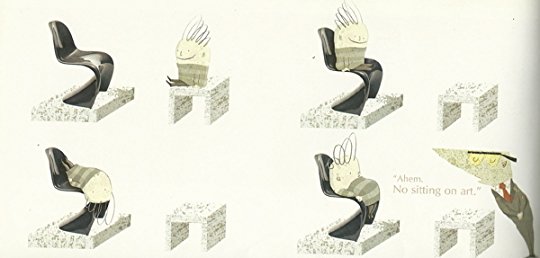
celebrate-picture-books-picture-book-review-seen-art-chair

Image copyright Lane Smith, 2005, text copyright Jon Scieszka, 2005. Courtesy of Viking Books for Young Readers.

Suddenly, a painter hugs the boy for his astute observation. He asks, is art “‘trying to capture dreams? Or is it making images everyone can recognize?’” He presents a painting covered in the letters of the alphabet—or “‘are they something more?’” The boy has to admit that “‘they could be both.’” Next, the boy meets a baby who points out a picture of a brown “‘moo moo’” cow. In fact, in every corner someone is expounding on a painting in front of them: “‘The pain! The mystery!….the constellation of shapes.’”  And there’s the composition, the color, and the atmosphere to consider too.

celebrate-picture-books-picture-book-review-seen-art-dejected

Image copyright Lane Smith, 2005, text copyright Jon Scieszka, 2005. Courtesy of Viking Books for Young Readers.

But each time the boy answers, “‘Not exactly the Art I was looking for.’” Perhaps, he is interested in the Bell-47D1 helicopter hanging from the ceiling. Is it art? The boy strides past more pieces; they are puzzling, personal, playful, provocative, and powerful. Art is not just paintings, he is told. Finally! They seem to be getting it. He begins to ask one more time about his friend, but then he’s shown photographs, sculpture, objects, and films.

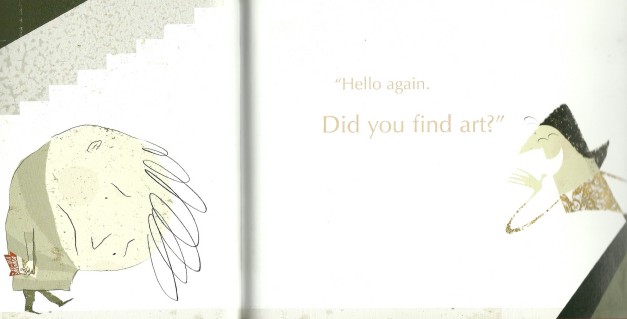
The boy decides he needs to find Art on his own. He discovers a majestic painting as long as two rooms, a slippy-slidey chair, images of soup cans that make him hungry and lead him to the café, and sculptures of a family and a goat. Soon it’s time to leave. Feeling dejected, the boy thinks he’ll never find his friend. “‘Hello, again,’” he hears. It’s the lady he met that morning. “‘Did you find art?’” she asks.

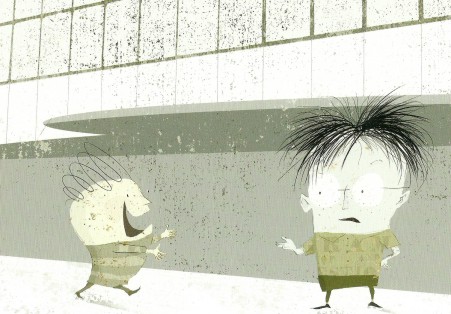
The boy is about to say no, but he remembers everything he has seen. “‘Yes,’” he answers as he walks out the door. And there, he finds Art waiting for him! What else is there do to but go through MoMA again?!

celebrate-picture-books-picture-book-review-seen-art-friend

Image copyright Lane Smith, 2005, text copyright Jon Scieszka, 2005. Courtesy of Viking Books for Young Readers.

Notes on each piece along with thumbnail images follow the text.

With clever word play, a humorous nod to the juxtaposed ideas “I know what I like/I like what I know,” and a wink at the world of art criticism, Jon Scieszka takes readers on a tour of the art collection at New York’s Museum of Modern Art. The simple misunderstanding of the word Art in the story introduces children to the nature of interpretation and the variety of forms it can take. Through the many people the little boy meets, Scieszka presents a fabulous opportunity for adults and children to talk about opinions and how each person can have their own while accepting those of others. Scieszka’s rich language is as enticing as the art presented and gives kids and adults a vast vocabulary to use in talking about what art—and life—has to offer.

Lane Smith’s simple line-drawn and abstract figures are the perfect tour guides to the reproductions of famous paintings, sculpture, installations, and other art found at MoMA. Printed in full, vibrant color, the artwork dazzles, drawing readers in to stop and explore each image. An excellent survey of classic and modern pieces, Seen Art? will delight and fascinate kids and adults.

For art lovers and those just discovering the world of creativity, Seen Art? is an absorbing book that will entice both children and adults to learn more about art. The book would be a welcome addition to home libraries and a fun and engaging addition to school art programs or units.

Ages 3 – 8 and up

Viking Books for Young Readers, 2005 |ISBN 978-0670059867

Discover more about Jon Scieszka, and his books, as well as other fun stuff on his website.

View a gallery of book illustration and other artwork by Lane Smith on his website.
Inspire Your Heart with Art Day Activity

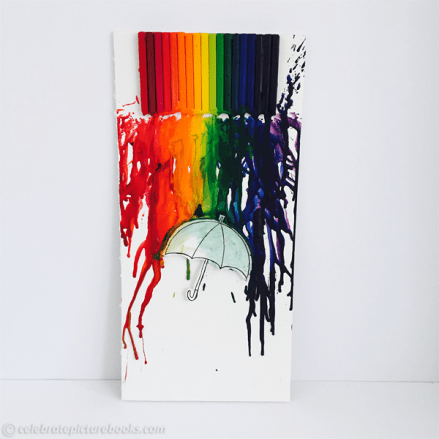
celebrate-picture-books-picture-book-review-rainbow-crayon-craft

Rainbow Crayon Art
 

With this cool project you can create an art piece that’s as colorful as a rainbow and as unique as you are! Adult help is needed for children.

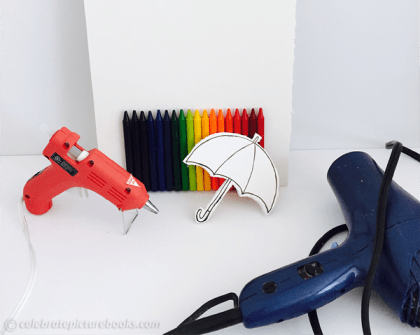
Supplies

  • Box of 24 crayons
  • White foam board or thick poster board, 8 inches by 17 inches
  • A small piece of corrugated cardboard, about 5 inches by 5 inches (a piece of the foam board can also be used for this step)
  • A small piece of poster board, about 5 inches by 5 inches
  • Scissors
  • X-acto knife (optional)
  • Hot glue gun
  • Hair dryer
  • Old sheets or towels, newspapers, a large box, or a trifold display board

celebrate-picture-books-picture-book-review-rainbow-crayon-craft

celebrate-picture-books-picture-book-review-rainbow-crayon-craft

Directions

  1. Remove the various red, orange, yellow, blue, indigo, and violet hued crayons from the box of crayons
  2. Strip the paper from the crayons by slicing the paper with the x-acto knife, or removing it by hand
  3. Line them up in order at the top of the white foam board
  4. With the hot glue gun, attach the crayons to the board with their tips facing down 
  5. Cut an umbrella or other shape of your choice from the poster board
  6. Trace the umbrella or other shape onto the corrugated cardboard or a piece of the foam board and cut out
  7. Glue the umbrella or other shape to the foam board, about 4 ½ inches below the crayons, let dry
  8. Set up a space where you can melt the crayons. The wax will fly, so protect the floor and walls by placing the art piece in a large box or by hanging newspapers, old sheets or towels on the walls and placing newspapers on the floor. A trifold display board and newspapers works well.
  9. Stand the art piece upright with the crayons at the top
  10. With the hot setting of the hair dryer, blow air at the crayons until they start to melt
  11. Move the hair dryer gently back and forth across the line of crayons from a distance of about 6 to 12 inches away. The closer you are to the crayons, the more they will splatter.
  12. The crayons will begin to melt and drip downward
  13. You can experiment with aiming the hair dryer straight on or at an angle to mix colors
  14. Wax that drips onto the umbrella or other shape can be chipped off after it dries or wiped off to create a “watercolor” effect on the shape
  15. Once the hair dryer is turned off, the wax cools and dries quickly
  16. Hang or display your art!

Picture Book Review