July 28 – It’s Culinary Arts Month

celebrate-picture-books-picture-book-review-cake-day-cover

About the Holiday

The recipe—the step-by-step recitation of the ingredients and process for making any dish—is the heart of the culinary arts. Following along, improvising in just the right places, and inventing completely new tastes is its own special kind of literacy. Today we say goodbye to Culinary Arts Month, but hope that the joy of cooking delicious treats and reading fabulous books together remain common, fun activities with which to explore life and love—as shown with today’s book!

Cake Day

Written by Ellen Mayer | Illustrated by Estelle Corke


An adorable little boy runs to his grandma, excited that it’s “Cake Day!” “That’s right,” his grandma agrees, “Today we’re going to bake a cake!” The boy, hardly able to see over the counter, wants to be picked up and see what’s in the cabinet. His grandma happily obliges, and the pair carefully pick the ingredients for their cake.

“‘Hmmm…we need flour, salt, baking powder, and sugar to make a cake,’ says Grandma.” With all the ingredients set on the table, the two start measuring. The little chef is eager and curious: “Cake Day! How much, Grandma? As the flour pours into the cup, a soft, powdery cloud envelops them. “Too much, Grandma!” the delighted boy laughs. The two work side by side, Grandma adding the eggs while her grandson pours in the milk.
celebrate-picture-books-picture-book-review-cake-day-cover

Image copyright Estelle Corke, courtesy of Star Bright Books

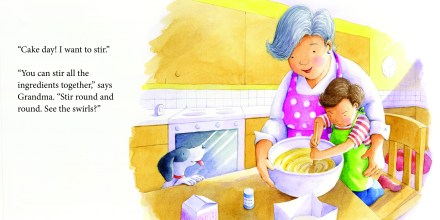
As the ingredients start to mesh, Grandma exclaims, “‘Look! What’s happening to the batter?’” The little boy wants to help it along and takes up the wooden spoon. Round and round he stirs, creating swirls in the yellow batter until it’s ready for the oven. “‘Bake day! Your turn, Grandma!” the boy stands wide-eyed as his grandma slides the deep pan into the oven.

The little boy and his dog settle in front of the oven to watch the cake bake. With eagerness the boy asks, “‘Cake day! Ready, Grandma?” Grandma encourages her grandson’s inquisitiveness and explains the process: “‘We have to wait until the cake rises. The heat makes it rise. When you hear the timer go BEEP BEEP it will be ready.’” At last the cake comes out of the oven, but it’s not ready to be decorated yet. First, they must wait for it to cool.

In a short time the high, golden cake can be iced and decorated. The little boy vigorously shakes a jar of sprinkles over the top, scattering a rainbow of colors across the white frosting. The cake is beautiful and just the right complement to the little boy’s Cake Day, Bake Day, Shake Day—Birthday!

Ellen Mayer’s language-rich and playful story of a small child and his grandmother baking together is a wonderful introduction not only to reading but to the type of full-sentence conversational modeling that improves and increases literacy. The steps to baking the birthday cake flow organically and lyrically through the loving relationship between the little boy and his grandma, enticing young readers to learn more about the world around them and how it works. The repeated phrases “Cake day! Bake day!,” and “Ready, Grandma?” as well as the boy’s short statements offer opportunities for kids to read along and learn new vocabulary as they develop important language skills.

Estelle Corke’s cheery illustrations glow with enthusiasm and the close bond between grandmother and grandson. The grandmother lifts, steadies, and holds the boy while still allowing him to perform all the tasks he can. The little boy, in his green apron, delights in every aspect of the baking process, his eagerness expressed in his animated smile and keen participation. The homey kitchen is awash in inviting colors and objects that children will recognize. The clearly drawn boxes and jars of ingredients, kitchen tools, and furnishings offer readers a chance to practice their vocabulary and learn new words.

Ages Birth – 5

Star Bright Books, 2016 | ISBN 978-1595727466

To see more books by Ellen Mayer as well as language development and reading strategies for young children, visit her website!

Visit Estelle Corke’s website to view a gallery of her artwork!

Star Bright Books publishes fiction nonfiction, and bilingual “great books for great kids” and provides literacy resources for readers.

Culinary Arts Month Activity

celebrate-picture-books-picture-book-review-cake-day-grandma's-cake

Image copyright Ellen Mayer

Grandma’s Cake


Grandma and her grandson baked a delicious, special cake—and now you can too! Here’s the full recipe that Grandma uses. Recipe courtesy of Ellen Mayer.

A Simple Sponge Cake Recipe

Ingredients

  • 1 stick unsalted butter, softened, plus a little to grease cake pan.
  • 1 1/2 cups sugar
  • 2 cups all-purpose flour
  • 1/4 teaspoon salt
  • 2 teaspoons baking powder
  • 3 large eggs at room temperature
  • 2 teaspoons vanilla extract
  • 3/4 cup milk
  • You will need: 3 mixing bowls:
  1. 1 to cream butter and sugar
  2. 1 to mix flour, baking powder and salt
  3. 1 in which to beat the eggs
  • A 7-inch diameter, deep cake pan

Directions

  1. Butter pan and dust with flour.
  2. Set the rack at the middle of the oven.
  3. Preheat oven to 350 degrees.
  4. Sift flour, baking powder, and salt into a bowl and set aside.
  5. In large mixing bowl, beat butter and sugar until light and fluffy. In the third bowl, beat the eggs and add milk.
  6. Add 1/3 of the flour mixture to butter mixture then alternate with the egg and milk mixture. Continue to alternate ending with flour mixture. Scrape bowl and beater often.
  7. Add vanilla and mix well.
  8. Pour batter into prepared pan and smooth top with a spatula.
  9. Bake cake about 45 minutes. Insert knife or wooden skewer into the center. If it emerges clean, the cake is done. If not, bake for 5 more minutes.
  10. Remove cake from oven and allow to set for 5 minutes.
  11. Turn cake out onto a cake rack and leave to cool.

Grandma’s Favorite Frosting

  • 8 oz cream cheese
  • 1 1⁄2 cups confectioners’ sugar
  • 1⁄4 stick butter
  • 1 teaspoon vanilla extract
  1. Blend all ingredients together with a mixer until smooth
  2. Spread on the top and sides of cake
  3. Decorate with sprinkles or your favorite topping

Picture Book Review

July 13 – National Culinary Arts Month

celebrate-picture-books-picture-book-review-the-hole-story-of-the-doughnut-cover

About the Holiday

July is a great month for celebrating culinary arts. With kids home from school it’s fun to spend time together in the kitchen learning new skills and making experimental or favorite recipes. On-the-go meals or vacations can also take you to new and enticing restaurants, where you may try regional cuisine and discover exciting flavors.

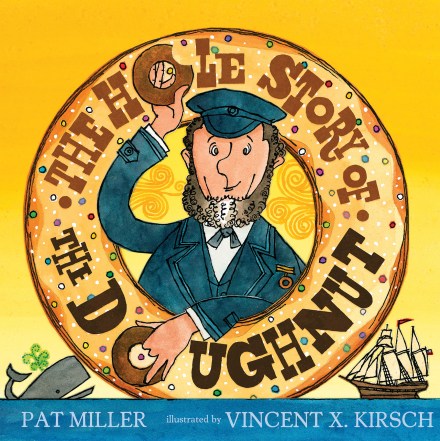
The Hole Story of the Doughnut

Written by Pat Miller | Illustrated by Vincent X. Kirsch


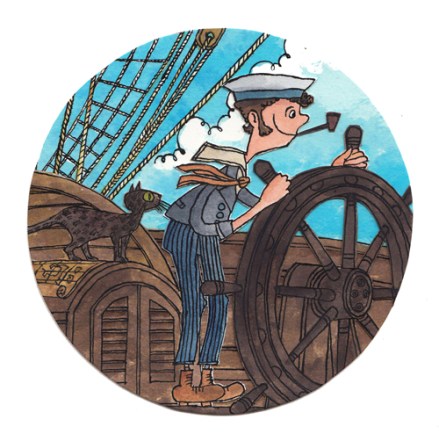
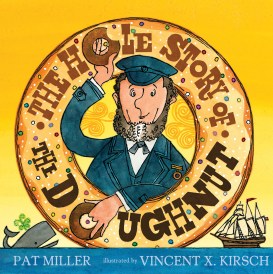
In 1844 at the tender age of 13, Hanson Gregory left the family farm and went to sea as a cabin boy on the schooner Isaac Achorn. He quickly became the cook’s assistant and also learned how to rig the sails and “steer a ship over trackless waves by sun and stars.” By the age of 19 Gregory had become the captain of the schooner Hardscrabble, and within a few more years was racing “his cargo from Maine to California as commander of a clipper, the fastest ship on any ocean.”

celebrate-picture-books-picture-book-review-hole-story-of-the-doughnut

Image copyright Vincent X. Kirsch, courtesy of vincentxkirsch.com

Hanson Gregory may have been one of the best captains to sail the seas—once awarded a medal for heroism for rescuing seven shipwrecked Spanish sailors even though his own ship and crew were endangered. But his greatest achievement was not attained because of his seafaring skills—it was his ingenuity in the galley that people remember.

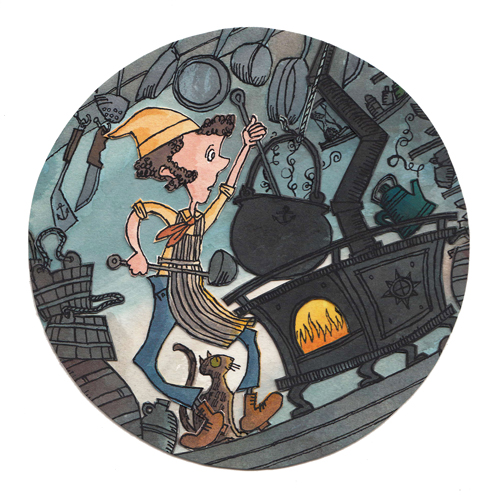
On June 22, 1847 as a 16-year-old cook’s assistant, Hanson was rustling up the crew’s breakfast—coffee and fried cakes, the same as every morning. While the pot of lard bubbled on the stove, Gregory formed balls of sweetened dough and dropped them in. They sizzled and crisped—at least around the edges. The centers were raw, heavy with grease, and they dropped like cannonballs in the stomach. “Sailors called them Sinkers.” But this morning Gregory had an idea. He removed the lid from the pepper can and cut out the center of the balls. “Then he tossed the rings into the bubbling lard.”

celebrate-picture-books-picture-book-review-hole-story-of-the-doughnut

Image copyright Vincent X. Kirsch, courtesy of vincentxkirsch.com

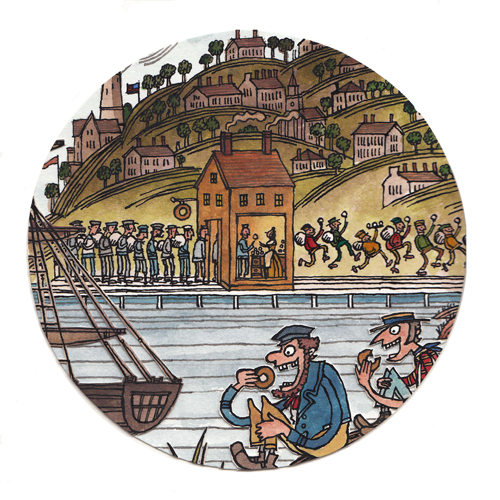
The cook and the sailors took one look at this odd concoction and…ate them up! “The cakes were brown, and sweet, and fully cooked. Sighs of delight rose above the noisy sea. A new breakfast tradition was born.” Gregory told his mom about his invention, and she fried up large batches of these ‘holey cakes’ that were a sensation at a friend’s store and on the docks.

You might think this is a pretty interesting tale in itself, “but sailors like their stories bold” and so they “spun legends worthy of such a delicious treat.” One tale had Captain Gregory inventing the doughnut while he saved his ship from disaster. Another told how Gregory, distraught over the drowning of five sailors pulled to the ocean floor by of their “sinker” breakfast, punched holes in every cake to make them look like life rings and vowed, “‘Never again!’”

Captain Gregory had a sense of humor about his accomplishment. During an interview he once stated that “he had invented ‘the first hole ever seen by mortal eyes.’” Gregory lived to be 89 and is buried “overlooking the sea where stormy weather can be spotted as readily as it once was from the quarterdeck of the Hardscrabble.”

An author’s note expanding on the story of Captain Gregory, the doughnut, doughnut shops, a timeline, and a selected bibliography follow the text.

celebrate-picture-books-picture-book-review-hole-story-of-the-doughnut

Image copyright Vincent X. Kirsch, courtesy of vincentxkirsch.com

Doughnuts have never been so evocative! In Pat Miller’s humorous, informative history of this favorite pastry treat, readers can smell the salt air, feel the ocean swell and roll under their feet, and even ache a little for those poor sailors forced to eat “sinkers.” Seamlessly interwoven into this foodography is a fascinating look at the early days of sail. Miller’s language is immediately stirring: the Ivanhoe bucks and plunges, the sea becomes a monster, and Captain Gregory spears a sinker on the wheel spoke. Kids will marvel at a 13-year-old going off to sea and becoming an inventor at 16.

Vincent X. Kirsch provides just the right touch to this captivating true story with his cartoon-inspired watercolor and cut paper artwork. Ingeniously incorporating Hanson Gregory’s innovation of removing the center of the fried cakes, Kirsch’s illustrations are “cored” to allow for text, while the extracted section appears on the facing page as a glimpse through a porthole. The maritime atmosphere—from ship to shore—of the mid-1800s is beautifully represented in the folk-style sketches, and the humor that is so intrinsic to this story is wonderfully embraced.

The Hole Story of the Doughnut will delight foodies and history buffs alike and would make a fun gift and a delectable addition to personal libraries for all ages.

Ages 5 – 12

Houghton Mifflin Harcourt, 2016 | ISBN 978-0544319615

Vincent X. Kirsch’s website is full of illustrations from his books for children—take a look at his portfolio!

Spend some time with Pat Miller on her website that offers activities, tips, resources and many more books!

Culinary Arts Month Activity

celebrate-picture-books-picture-book-review-cd-doughnut-craft

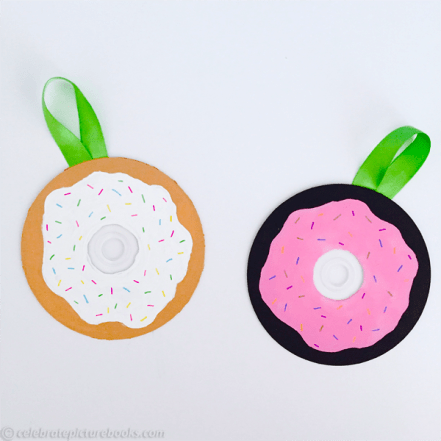
CD (Compact Doughnuts) Decoration


Are some of  your CDs a little passé? Not if you can turn them into cute décor like this doughnut hanging.

Supplies

  • Unused CDs
  • Craft paint in tan, black, pink, yellow, white (or any colors you want for the doughnut and the icing)
  • Ribbon, any color and length you want
  • Fine-tip markers in bright colors
  • Glue
  • Glue dots (optional)
  • Paint brush

Directions

  1. Paint a wavy edge around the CD, let dry
  2. Paint the center of the CD, leaving the clear circle unpainted
  3. When the icing paint is dry, draw sprinkles on the icing with the markers
  4. With the ribbon make a loop hanger and attach it to the back of the CD with glue or glue dots
  5. Hang your decoration

celebrate-picture-books-picture-book-review-the-hole-story-of-the-doughnut-cover

You can find The Hole Story of the Doughnut at these booksellers

Amazon | Barnes & Noble | Books-a-Million | IndieBound


July 5 – It’s National Culinary Arts Month

celebrate-picture-books-picture-book-review-how-to-bake-a-book

About the Holiday

July is designated as a time to recognize the creativity and dedication of professional chefs and anyone who makes the world a more delicious place. The way to celebrate this month is a no-brainer! Visit your favorite restaurants, cafes, and bakeries—and discover new ones!

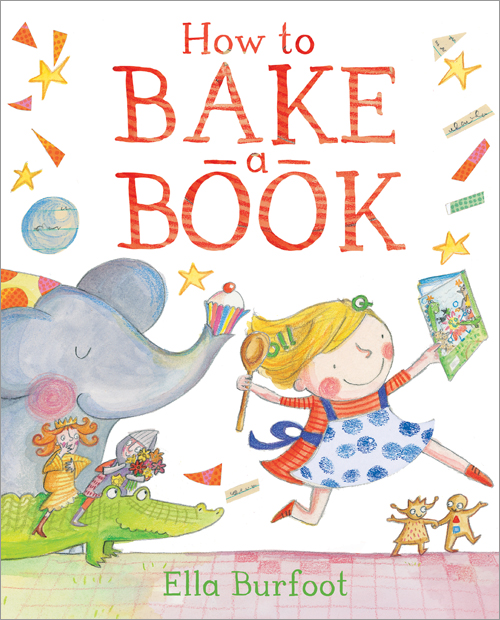
How to Bake a Book

By Ella Burfoot


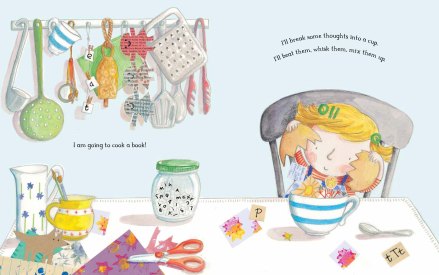
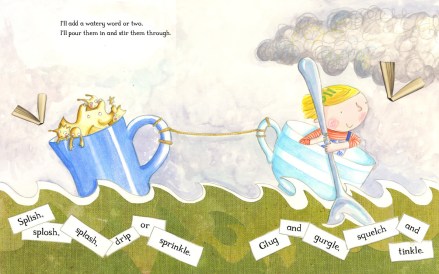
A little girl decides to bake a book. She gathers her ingredients and begins: “I’ll break some ideas into a cup. / I’ll beat them, whisk them, mix them up.” To the dough she adds words both small and big then feelings, colors, and pictures for flavor. To set the scene she drops in “watery words,” choosing from “splish, splosh, splash, or sprinkle”—or would “glug and gurgle” or “squelch and twinkle” be better? She cuts out characters of all kinds and sets them aside to play.

celebrate-picture-books-picture-book-review-how-to-bake-a-book

Image copyright Ella Burfoot, courtesy ellaburfoot.co.uk

With the dough set, the girl puts the lid on the bowl and waits while it rises. When it’s ready, she rolls it out, finding out what her story is all about. She lays the crust in the pan, letting her characters jump right in. Next she stirs up “the middle, the action, the filling” and adds a “spoonful of good and a pinch of bad” to get the pot bubbling and the plot to thicken.

A dash of good grammar finishes it up, and then the ending is pressed down tight. A cover design and a glaze of happiness are brushed on to make the book shine. Finally, the book is ready for baking. It comes out of the oven baked looking tasty. The little girl cuts a big slice and gets to reading her delicious book.

celebrate-picture-books-picture-book-review-interior-art-watery-words

Image copyright Ella Burfoot, courtesy ellaburfoot.co.uk

Ella Burfoot’s delightful recipe for writing a captivating book will enchant children who love to read and may spark an interest in writing a story themselves. The rhyme is as light and fun as chiffon and the homey ideas as satisfying as a warm chocolate cookie. Kids will love poring over Burfoot’s bright, colorful illustrations. The girl’s baked-up pages burst with dragons, knights, princesses, animals, kites, and more. There’s even a witch who’s having a tough time staying on her broom. The kitchen is a cook’s and crafter’s paradise with pantry shelves well stocked with jars of periods and capital letters among the monster flakes, alphabet spaghetti, porridge oats, and other writerly puns and ingredients.

A reading of How to Bake a Book would be a fun lead-in to getting out the pots, pans, and paper and creating an original recipe/story.

Ages 3 – 6

Sourcebooks Jabberwocky, 2014 | ISBN 978-1492606512

To discover more books by Ella Burfoot visit her website!

National Culinary Arts Month Activity

celebrate-picture-books-picture-book-review-whisk-bookmark

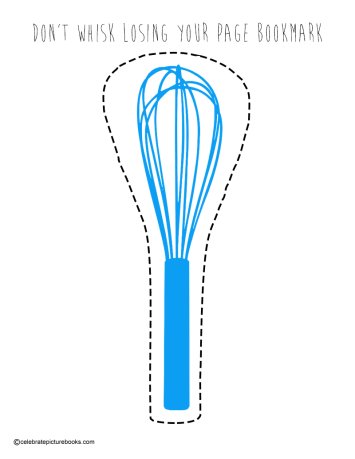
Don’t Whisk Losing Your Page Bookmark


The author’s of your favorite books have cooked up such fantastic stories that you don’t want to risk missing a word! To make sure that doesn’t happen, use this culinary-themed bookmark!

Supplies

Directions

  1. Print your bookmark
  2. Glue it to the poster board
  3. Cut out the bookmark
  4. Slip it into the book you’re reading now!

Picture Book Review

May 18 – International Museum Day

celebrate-picture-books-picture-book-review-homer-henry-hudson

About the Holiday

International Museum day was created in 1977 by the International Council of Museums to raise awareness that “museums are an important means of cultural exchange, enrichment of cultures and development of mutual understanding, cooperation and peace among peoples.” The theme for this year is Museums and Cultural Landscapes. Both nature and history comprise the cultural landscape that links museums to their surrounding neighborhood, towns, and beyond. As museums become more involved in their communities, they acquire the responsibility to protect, conserve, and interpret the cultural heritage inside and outside their walls. International Museum Day is growing—in 2015 more than 35,000 museums in 145 countries participated. Today visit one of your favorite museums and learn more about your cultural landscape.

Homer Henry Hudson’s Curio Museum

By Zack Rock


Everything has a story, the narrator tells readers, especially the Homer Henry Hudson Curio Museum, which he says has been described as “a colossal collection of curios, discovered, described, and displayed by that eccentric explorer extraordinaire: Homer Henry Hudson.”

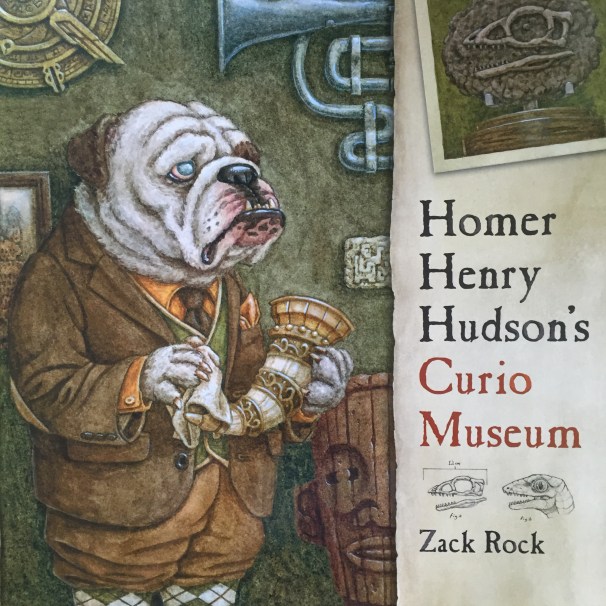
Come in and experience the wonders inside. A dignified bulldog dressed in a dapper tweed suit and leaning on a crooked cane will greet you. His job is to keep the place clean and dusted. Although the museum is stuffed floor to ceiling, he knows the placement of every object, knick-knack, and curiosity. As you explore the museum’s holdings—its portraits, musical instruments, ancient artifacts, taxidermy animals, and other treasures, the caretaker sits silently, hoping you will read the display cards that Homer Henry Hudson has lovingly written out with a description and personal note. He even has his favorite “bits and bobs” that he would like you to see.

One of these is Item #0001, the Conausaurus Skull of a small dinosaur from the late Jurassic Period that HHH found in the soil of his family’s farm. This bony discovery made Homer Henry wonder what else the world held and sparked his love of exploration. Another is Item #0023, a Radial Tide Diviner once used by Calypsonian seers to predict the future based on tidal patterns. It was the discovery of the lost Calypsonian civilization with its valuable artifacts that funded Homer’s further explorations.

Item #3412, a Temple Montepaz Choir Finch with a C sharp trill that chanted to accompany the parrot priest, was a most unusual gift, bestowed on HHH for convincing the Parrot Priest to release a piece of wood stripped from the temple wall. This shard turned out to lead Homer Henry Hudson into his future—for better or worse. With renewed fire, HHH charged toward the promise of riches only to fly his plane into a mammoth stone figurehead, which resulted in injury and his life-long limp.

Item #3415, The Manneken Mort of King Ingmar, is perhaps Homer Henry’s most treasured possession. Composed of fabric bands that represent the stories friends and family tell when someone dies, this Manneken Mort contains hundreds of bands relating the life of King Ingmar. This object HHH acquired for bravery and self-sacrifice when he was younger and still full of enthusiasm for life.

The old bulldog thinks of this curio most. He wonders what his Manneken will look like and whether all the bands of his life been woven. He likes to think his Menneken Mort “would be  hundreds—thousands—of feet tall. It’d tower over the Taj Mahal, shame the Sphinx!” But he knows “few memorable tales are told of rusty old codgers who spent their days…leaning upon fear like a crutch.”

Though blind in one eye and nagged by trepidation, the old bulldog packs his suitcase, dons his hat and throws away his cane. As he walks out the door, past pictures of himself on his early expeditions of discover, he knows he might “meet with catastrophe,” be “swallowed by quicksand,” or “gnawed on by piranhas.” But he also knows “there’s no success without failures,” and he has had many successes.

Homer Henry Hudson boards the cruise liner Phoenix and sets out for adventure once more. After all, he well knows that everything has a story. So if you come by the Homer Henry Hudson Museum today, you will see a sign hanging on the door: The Curio Museum is CLOSED Until Further Notice.

Zack Rock has written a compelling and unique picture book for adventurers of all types and ages. Part motivation and part cautionary tale, this story of the once intrepid explorer turned tremulous caretaker has a mysterious, treasure-around-every-corner quality that will appeal to kids. The life of Homer Henry Hudson is told through the display cards that accompany some of the museum’s curios. As the story develops through the cards’ personal notes, readers learn of the museum’s true owner and the life-altering decision he makes.

Rock’s illustrations in greens and parchment-paper golds and browns have a high “Oh, Cool!” factor, as the odd, ancient, and unusual objects of the museum invite kids to explore every nook and cranny of the pages. The exhibits serve not only to fill the museum, however, they remind us how easily the future can get overshadowed and crowded out by the past.

Ages 6 – 10

Creative Editions, 2014 | ISBN 978-1568462608

International Museum Day Activity

celebrate-picture-books-picture-book-review-cookies

Peanut Butter-M&M Cookies


A good cookie is like a museum—full of interesting flavors, colors, and taste. Here’s a cookie recipe adapted from Cookies & Cups that exhibits all these traits! 

Ingredients

  • 2 cups all purpose flour
  • 1/2 tsp baking soda
  • 1/2 cup butter
  • 1/4 cup peanut butter
  • 1 cup light brown sugar, packed
  • 1/4 cup granulated sugar
  • 1 whole egg
  • 1 egg yolk
  • 1 Tbsp vanilla
  • 1/2 tsp cinnamon
  • 1/4 tsp ground ginger
  • 3/4 cups m&ms
  • 1/4 cup chocolate chips (for extra chocolate)

Instructions

  1. Preheat oven to 325 degrees
  2. Combine butter and peanut butter in microwave safe bowl and melt together for 30 seconds. Remove and stir. Continue in 15-second increments until mixture is melted and smooth.
  3. In a separate large bowl whisk together flour and baking soda. Set aside.
  4. Combine eggs, egg yolks, vanilla, and sugar. Mix on medium until combined and smooth. Turn mixer to low and slowly pour in your butter/peanut butter mixture. Continue stirring until combined.
  5. With mixer still on low, gradually add your flour mixture until just combined. Batter will be thick.
  6. Now add in your candies and stir until they are evenly distributed.
  7. Now form your batter into “golf ball” sized dough balls. You can also use a 3-Tablespoon scooper.
  8. Place on baking sheet about 2 inches apart
  9. Bake for 10 to 12 minutes
  10. Cookies will be puffy, but should be golden around the edges
  11. Let cool on baking sheet for 2 -3 minutes and then transfer to a wire rack to continue cooling.

Cookies & Cups has lots of creative and delicious goodies for special occasions or for just those times when you want to be good to yourself!

Picture Book Review
May 16 -National Biographer’s Day

celebrate-picture-books-picture-book-review-the-noisy-paint-box

About the Holiday

On this day in 1763 James Boswell walked into a London bookshop and met Samuel Johnson—poet, critic, journalist, and writer of the first dictionary. They became friends, and 30 years later Boswell wrote a spirited biography of his companion that fully described Johnson’s feelings, quirks, opinions, and details of his life in a warm, conversational, unstinting way. The Life of Samuel Johnson changed forever the way biographies were written and is still popularly read today. Why not spend some time today with that fascinating biography or one on a favorite personality—or start writing the story of your own life!

The Noisy Paint Box: The Colors and Sounds of Kandinsky’s Abstract Art

Written by Barb Rosenstock | Illustrated by Mary Grandpré


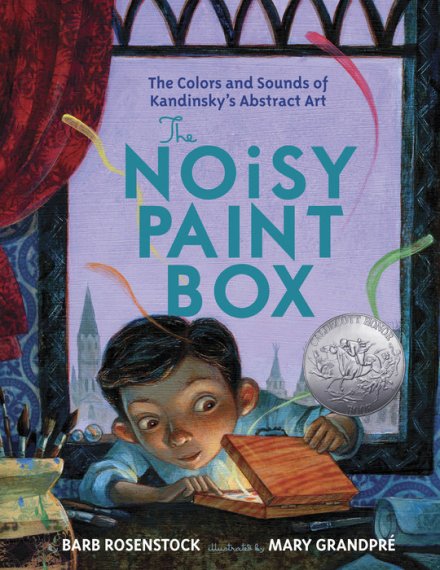
As a Russian child Vasya Kandinsky spends his days absorbed in learning math, science, and history. He takes piano lessons and attends formal dinners where the adults drone on and on. His life is polite, stiff, and colorless until the day his aunt gives him a small wooden paint box. “Every proper Russian boy should appreciate art,” Vasya’s aunt tells him while explaining how to mix colors.

Vasya takes up the brush and combines red with yellow then red with blue. As the colors change to orange and purple, Vasya hears a whisper that grows into a noisy hiss. “‘What is that sound?’” he asks, but no one else hears anything. “The swirling colors trilled like an orchestra tuning up for a magical symphony,” and “Vasya painted the sound of the colors.” A lemon yellow “clinked like the highest notes on the keyboard; a navy blue “vibrated deeply like the lowest cello strings.” Crimsons “blared” and greens “burbled.”

Vasya runs downstairs to show his family what he has created. His mother, father, and Auntie look at the canvas with its swoops, shapes, and angles. “What is it supposed to be?” they ask, and send him off to art school to learn how “to draw houses and flowers—just like everyone else.” Vasya finishes school and becomes a lawyer. He leaves his paint box untouched and lives the way he is expected, but the sounds of the colors are always with him.

One evening as he listens to an opera, the music surrounds him with color—“stomping lines of vermilion and coral; caroling triangles in pistachio and garnet; thundering arches of aqua and ebony…” Vasya can hear the colors and see the music. He knows then what he must do. He quits his job teaching law and moves to Germany to be a painter. He surrounds himself with artists and takes classes with famous teachers, and yet people still look at his canvases and asked, “What is it supposed to be?”

Once again he paints what is expected. His teachers love his houses and flowers, but Vasya does not. His friends understand. They too want to expand the meaning of art. They agree with Vasya when he says, “‘Art should make you feel.’” In his studio Vasya continues to paint the sounds he hears, to give music color and color sound. Bravely, he invites the public to view his paintings, which are named after musical terms—Composition, Accompaniment, Fugue, and more.

This is a new kind of art—abstract art—and it takes a long time before people understand. They look and still ask, “What is it supposed to be?” “It is my art,” Kandinsky replies “How does it make you feel?” 

An author’s note telling more about Kandinsky’s life and synesthesia, a genetic condition in which one sense triggers another, follows the story.

In the spirit of full disclosure, Kandinsky is one of my favorite artists, so I was excited to read this biography—I was not disappointed! With so many great artists, their work speaks for itself, but viewers wonder, “How did it come about?” “What influenced the artist?” Barb Rosenstock, with lyrical language and beautifully chosen descriptions, reveals the emotions and passion that fueled Kandinsky’s art from his earliest ages: as he walks through Moscow he can’t ignore “the canary-colored mailbox whistling as he rode to work. The scarlet sunset haze ringing above the ancient Kremlin walls.” Rosenstock’s inclusion of the conflicts and opposition Kandinsky faced and overcame will inspire children to listen to their inner voice and makes readers and lovers of his abstract art glad he never gave up.

Mary Grandpré’s unique style brilliantly depicts Kandinsky’s singular vision, allowing readers to experience the way he wielded his paint brush like a conductor’s baton. Vasya’s early life is painted in muted blues and grays, and the boredom on his face as he studies his schoolwork is obvious. Kids will appreciate his one-finger plinking at the piano and the rolled-eyed drowsiness of the formal dinner. Once Vasya is introduced to the paint box, however, Grandpré’s illustrations become vibrant, with swirling colors overlaid with the musical notes that Kandinsky associated with them. His uninhibited painting is gloriously shown as the young boy’s shirt comes untucked and the colors burst from the canvas upon his first painting.

As the adults look at his work, the room is again swathed in somber colors. The text revealing that Vasya attended regular art classes to learn to draw houses and flowers is set above a single wilting flower in a vase. The personal tug-of-war Kandinsky experienced even into adulthood is wonderfully rendered: Colors flow into his ears at the opera; he studies his own landscape and still life paintings with misgiving in a hazy studio, and the joy and freedom of his abstract art is demonstrated with wild abandon while a dove escapes its cage. The final image of a child sitting in front of a Kandinsky painting reinforces the idea that his art lives for all and for all time.

Ages 4 – 9

Alfred Knopf, Random House Children’s Books, 2014 | ISBN 978-0307978486

National Biographer’s Day Activity

celebrate-picture-books-picture-book-review-recipe-box-label

Recipe Box Label and Recipe Cards


People’s stories are written in all different ways: in the objects they surround themselves with, their activities, and the talents they exhibit. Today’s activity will help you tell your stories in the foods you bake! Or try this Recipe Card Writing Idea: Create a very short story and write it on one of the recipe cards! Read it to your family or teacher.

Supplies

celebrate-picture-books-picture-book-review-recipe-cards

Directions

  1. Glue the My Family’s Recipes label to the box you made
  2. Print out the recipe cards. Use them for your favorite dish and prepare for tomorrow’s treat to bake!

Picture Book Review
May 15 – International Day of Families

celebrate-picture-books-picture-book-review-families-families-families

About the Holiday

This United Nations sponsored observance was initiated in 1993 to reflect the importance of families worldwide. The day provides an opportunity to promote issues affecting families, including social, economic, educational and demographic topics. This year’s theme is Families, Healthy Lives and Sustainable Futures and focuses on ending poverty, promoting shared economic prosperity, social development, and health while protecting the environment. The holiday is marked with workshops, educational opportunities, publications, and special community events.

Families, Families, Families

Written by Suzanne Lang | Illustrated by Max Lang


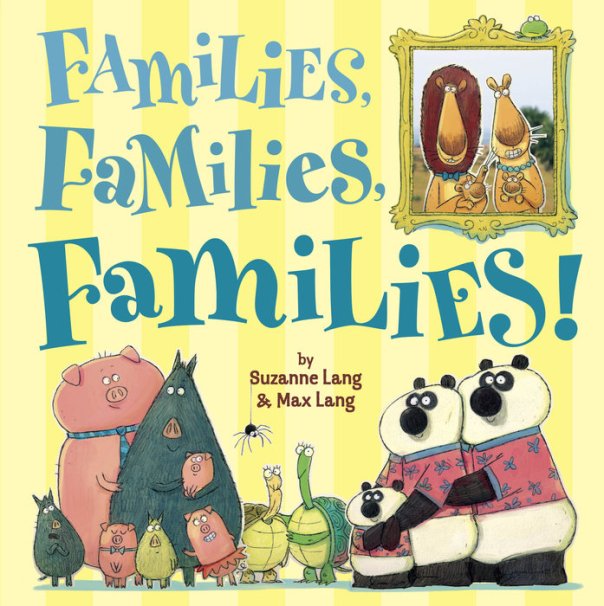
Families—haven’t they always come in all shapes and sizes? With all different customs and traditions? Families, Families, Families delves into this most enduring—and endearing—structure of life in a way that makes sense to kids in a funny and honest way. “Some children have lots of siblings. Some children have none” the book starts. “Some children have two dads. Some have one mom. Some children live with their grandparents…and some live with an aunt.”

Lang does an excellent job of presenting all types of familial arrangements within the pages of the book. Nearly every child will happily find themselves here. Interspersed among the varieties of households, humorous comparisons and rhymes (“some children have many pets…and some just have a plant!”) elevate this book to a tribute to understanding, acceptance, and inclusion. After all…“if you love each other, then you are a family.”

Max Lang hit on an inspired way—during this era of selfies, snapchat, and the like—to illustrate the concepts of family. More than 17 animal families pose for portraits in which comic drawings of smiling moms, dads, kids, and relatives are superimposed onto photographed backgrounds. The portraits are framed with another touch of humor: A chicken family photo sits in a frame made of hay, an octopus and her four children smile from a frame made of seashells, and the Tigers are displayed in a frame of bones. The photos hang on wallpapered, barn, and underwater cave walls; sit on fireplace mantels; are pinned to bulletin boards; and fill scrapbook pages.

Families, Families, Families brilliantly demonstrates how every child takes pride in his or her family—just as the readers take pride in theirs.

Ages 3 – 7

Random House Books for Young Readers, 2015 | ISBN 978-0553499384

International Day of Families Activity

celebrate-picture-books-picture-book-review-recipe-box

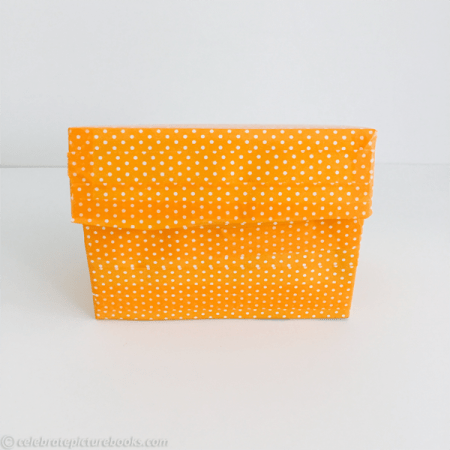
Make Your Own Recipe Box


One of the best ways to spend time together is to bake up a favorite recipe and enjoy the results! World Baking Day is celebrated this week, so for the next few days, I’ll be offering baking-related activities for you to have fun with! With a small box you can make your own recipe organizer to keep tasty recipes close at hand!

Supplies

  • A small box with a hinged lid or separate lid, at least 5 inches by 3 1/3 inches (fits a small index card). A Twinings Tea Box works well as does a small wooden box available from craft stores
  • Washi tape or paint
  • Paint brush

Directions

  1. Cover your box with washi tape or paint your box
  2. Decorate your box with your unique style

Picture Book Reviews

April 3 – National Find a Rainbow Day

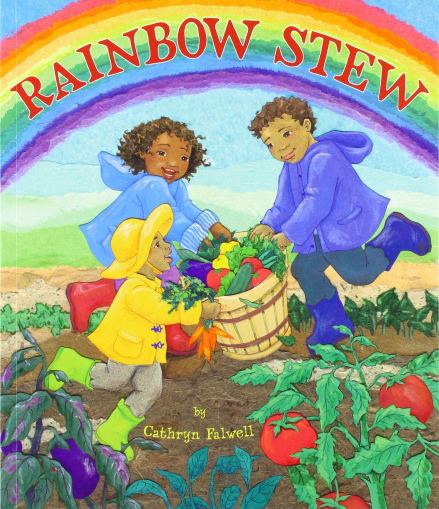
celebrate-picture-books-picture-book-review-rainbow-stew-cover

About the Holiday

It’s not often someone wishes you a rainy day. Today, though, I’m doing just that because you can’t see a rainbow without a little of the wet stuff. This early spring month was chosen for this special day because, as we all know, April showers bring May flowers. Those same April showers lead to beautiful rainbows—even double rainbows sometimes! So, I hope you have a bad (weather) day and good luck finding a rainbow today! By the way—what do May flowers bring? Right! Pilgrims!

Rainbow Stew

By Cathryn Falwell


Grandpa’s making pancakes for his three favorite kids, and his granddaughter and two grandsons are excited to be visiting where they can play outside all day. Through the window the kids see that it’s a rainy day. Does this mean they’ll have to stay inside? Their grandpa knows just what to do! “Let’s go and find some colors for my famous Rainbow Stew!” he says.

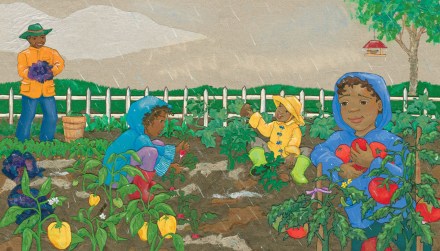
celebrate-picture-books-picture-book-review-rainbow-stew-interior-art-picking-vegetables

Image copyright Catherine Falwell, 2013, courtesy of rainbowstewbook.com

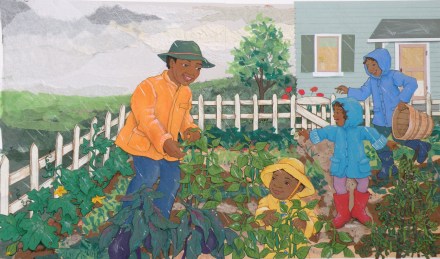
Out to the garden they run in their raincoats and hats. “Splish, splash, / puddle dash, / We bounce right out the door. / We’re off to find some red and green, / some yellow, orange, and more. / Grandpa shows us how to move / Between each garden row. / Lifting up the drippy leaves, /  we see what colors grow.” They collect green spinach, kale, and zucchini; yellow peppers, purple cabbage and eggplant, red radishes and tomatoes; brown potatoes; and orange carrots. After some muddy fun among the plants, the kids go inside, get dried off, and begin to prepare their colorful stew.

celebrate-picture-books-picture-book-review-rainbow-stew-interior-art-in-the-garden

Image copyright Catherine Falwell, 2013, courtesy of rainbowstewbook.com

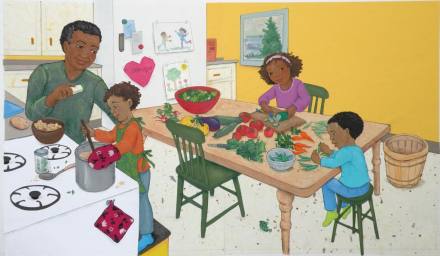
Peel, slice / chop and dice, / colors fill the pot. / Stir in herbs and water / and then wait till it gets hot.” While the pot simmers on the stove, Grandpa and the kids snuggle on the couch with favorite books, reading together until the stew has simmered to perfection. The family then sits down to a homemade, colorful, delicious lunch of Rainbow Stew. 

celebrate-picture-books-picture-book-review-rainbow-stew-interior-art-cooking-together

Image copyright Catherine Falwell, 2013, courtesy of rainbowstewbook.com

Cathryn Falwell’s Rainbow Stew is a wonderful book to share with young children on many levels. The bright colors of Grandpa’s house mirror the vividness of the garden vegetables in his stew, which could be made into a matching game for extra fun. The rhyming verses—each begun with an energetic couplet that would be fun for kids to repeat or act out—draw listeners into the story. Introducing colors through familiar and delicious vegetables can get kids excited about gardening, cooking, even going to the grocery store.

Children will identify with the disappointment of the three siblings when they learn it’s too wet to spend the day outside as well as their glee at squishing in the mud. The close bond between the kids and their grandfather as they cook and read together is a strong anchor for this story.

celebrate-picture-books-picture-book-review-rainbow-stew-interior-reading-together

Image copyright Catherine Falwell, 2013, courtesy of rainbowstewbook.com

A recipe for Rainbow Stew follows the story. Combined with the craft below, the book and recipe could make for a fun rainy-day get-together!

Ages 4 – 7

Lee & Low Books, 2013 | ISBN 978-1600608476 (Hardcover) | ISBN 978-1643790572 (Paperback, 2019)

National Find a Rainbow Day Activity

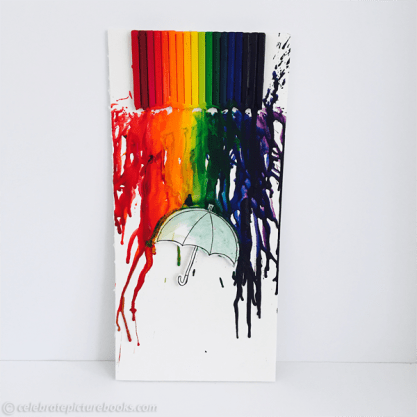
CPB - Rainbow Crayon Art 3

Crayon Rainbow Art


With this cool project you can create an art piece that’s as colorful as a rainbow and as unique as you are! Adult help is needed for children.

Supplies

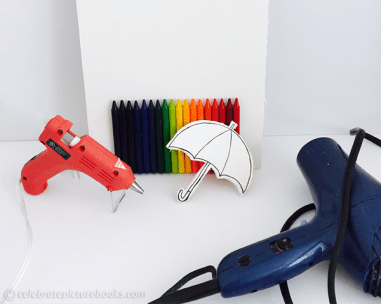
  • Box of 24 crayons
  • White foam board or thick poster board, 8 inches by 17 inches
  • A small piece of corrugated cardboard, about 5 inches by 5 inches (a piece of the foam board can also be used for this step)
  • A small piece of poster board, about 5 inches by 5 inches
  • Scissors
  • X-acto knife (optional)
  • Hot glue gun
  • Hair dryer
  • Old sheets or towels, newspapers, a large box, or a trifold display board

CPB - Rainbow Crayon Art 2

CPB - Rainbow Crayon Art 1 (2)

Directions

  1. Remove the various red, orange, yellow, blue, indigo, and violet hued crayons from the box of crayons
  2. Strip the paper from the crayons by slicing the paper with the x-acto knife, or removing it by hand
  3. Line them up in order at the top of the white foam board
  4. Glue the crayons with their tips facing down to the board with the hot glue gun
  5. Cut an umbrella or other shape of your choice from the poster board
  6. Trace the umbrella or other shape onto the corrugated cardboard or a piece of the foam board and cut out
  7. Glue the poster board shape onto the corrugated cardboard, let dry
  8. Glue the umbrella or other shape to the foam board, about 4 ½ inches below the crayons
  9. Set up a space to melt the crayons. The wax will fly, so protect the floor and walls by placing the art piece in a large box or hanging newspapers, old sheets or towels on the walls and placing newspapers on the floor. A trifold display board and newspapers works well.
  10. Stand the art piece upright with the crayons at the top
  11. With the hot setting of the hair dryer, blow air at the crayons until they start to melt
  12. Move the hair dryer gently back and forth across the line of crayons from a distance of about 6 to 12 inches away. The closer you are to the crayons, the more they will splatter
  13. The crayons will begin to melt and drip downward
  14. You can experiment with aiming the hair dryer straight on or at an angle to mix colors
  15. Wax that drips onto the umbrella or other shape can be chipped off after it dries or wiped off to create a “watercolor” effect on the shape
  16. Once the hair dryer is turned off, the wax cools and dries quickly
  17. Hang or display your art!