January 24 – It’s National Hobby Month

celebrate-picture-books-picture-book-review-more-igami-cover

About the Holiday

The idea of hobbies—something useful, purposeful, and fun done in one’s spare time—has been around at least since 1676 when Sir Matthew Hale wrote in Contemplations Moral and Divine that “Almost everyone hath some hobby horse or other wherein he prides himself.” Later, in the mid-1800s when work ceased to consume every hour of the day, and people had more time for leisure pursuits, hobbies became more popular. Today, it may be interesting to consider that many of our current hobbies—knitting, sewing, woodworking, candle making, etc.—were once the work of our ancestors. To celebrate this month’s holiday, try a new activity—it may turn into a favorite!

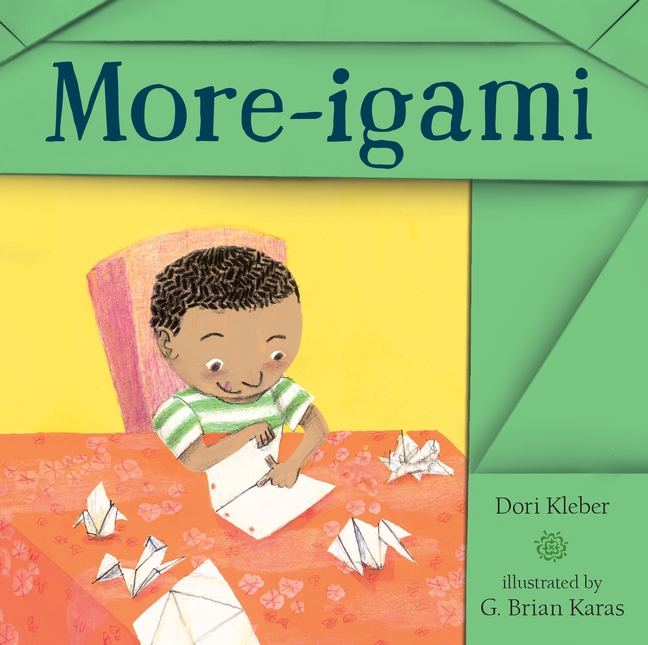
More-igami

Written by Dori Kleber | Illustrated by G. Brian Karas


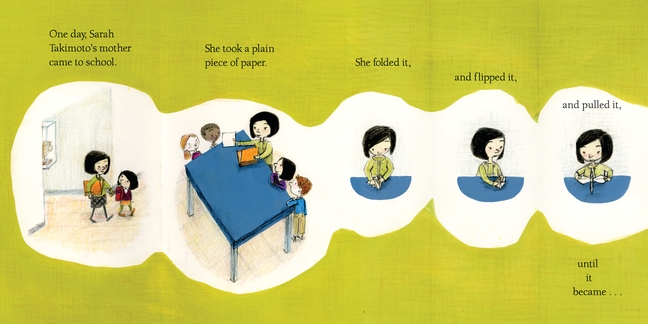
Joey was a little boy with a particular fascination. He was captivated by all things folded. At home he had a collection of “old road maps,” the bellows on an accordion made it his favorite instrument, and he even tucked himself into a foldaway bed at night. One day Joey witnessed the most amazing thing at school. Sarah Takimoto’s mother came to his class, and—right before the students’ eyes—folded, flipped, and pulled a plain white piece of paper “until it became…a crane.”

celebrate-picture-books-picture-book-review-more-igami-mrs-takimoto

Image copyright G. Brian Karas, text copyright Dori Kleber. Courtesy of Candlewick Press

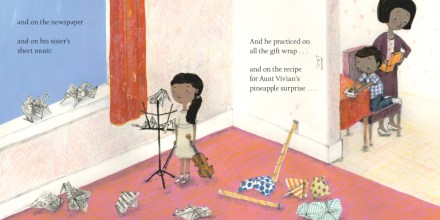
“Joey’s eyes popped. His jaw dropped. Mrs. Takimoto called it origami.” Joey was smitten. “‘I want to make origami,’” Joey told Sarah’s mother. “‘Will you teach me?’” Mrs. Takimoto  answered that while she could teach him the right folds, it would take practice and patience to become an origami master. Joey raced home that afternoon and began folding. When he ran out of notebook paper and construction paper, he used his homework…the newspaper…his sister’s sheet music…gift wrap… even “Aunt Vivian’s pineapple surprise” recipe card. But when he folded up all thirty-eight dollars in his mom’s purse, she put her foot down.

“Joey drooped.” His cranes were still coming out wrinkled and crooked, and he’d never be able to become an origami master without practicing. To soothe his disappointment, he headed next door to Muy Mexicana for some fajitas. Right away Mr. Lopez noticed Joey’s disgruntlement. When Joey explained that everyone was losing patience with him, Mr. Lopez said, “‘Many artists are misunderstood, amigo.’ Especially when they are just learning.’” Mr. Lopez went into the kitchen, and when he came out with the sizzling fajitas, he was delighted to see a napkin pyramid sitting on the table.

celebrate-picture-books-picture-book-review-more-igami-folding-sheet-music

Image copyright G. Brian Karas, text copyright Dori Kleber. Courtesy of Candlewick Press

Joey apologized, but Mr. Lopez thought it made the table look fancy. In fact, he liked it so much that he had Joey fold every napkin on every table. After that, Joey went to Muy Mexicana each day following school and folded the napkins into decorative shapes. One day he made fans, the next candlesticks, and the day after that, crowns. He patiently worked until each one was perfect.

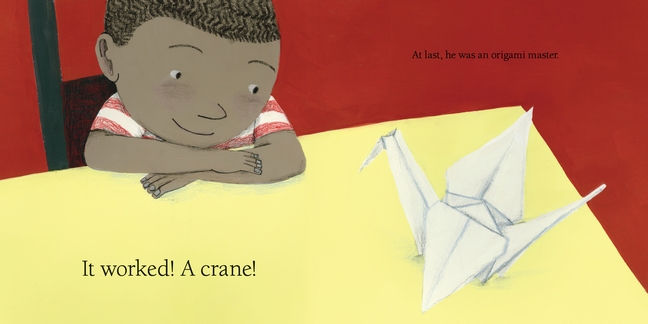
Finally, he felt ready to attempt his original challenge. “He took a crisp napkin. He folded. He flipped. He pulled.” When he was finished, a perfect crane sat in front of him. Just then a girl with a paper fan walked in. Her eyes widened as they zeroed in on Joey’s crane. Joey offered to show her how to make it, but warned, “‘It takes practice—and lots of patience!’”

celebrate-picture-books-picture-book-review-more-igami-crane

Image copyright G. Brian Karas, text copyright Dori Kleber. Courtesy of Candlewick Press

Dori Kleber’s unique multicultural story of a little boy who finds the perfect creative outlet for his singular interest will captivate kids who are just beginning to try their own hands at favorite hobbies, schoolwork, or other pursuits. With humor and honest depictions of Joey’s frustration and persistence, Kleber shows readers that practice and patience really do pay off. As Joey meets another folding enthusiast, kids will see that there are always others with whom to share favorite pastimes.

Opening More-igami to the first page where Joey sits gazing lovingly at a taco with a folded napkin next to his plate, readers will know they are in for something special. As always, G. Brian Karas’s characters are enthusiastic, encouraging, and adorable. Readers will empathize with Joey as they watch him folding and folding, and giggle at the many, many practice cranes that litter his home, even perching atop his sister’s music stand and appearing in his mom’s purse.

Karas makes full creative use of the origami theme in his clever page designs and illustrations, beginning with the square shape of the book itself and the origami paper-styled endpapers. Vivid, solid-color background pages are divided diagonally, vertically, or horizontally with subtle changes in hue or nearly invisible lines. In depictions of Joey’s school, home, and favorite restaurant, diagonals, angles, and sharp edges predominate: tables and floors create triangles on the page; windows, walls, and doors divide pages into shapes associated with the steps of origami’s folded creations; and floor tiles, the sidewalk, and even Joey’s shirt portray grid lines. The color schemes of each page, inspired by the patterns and shades of origami paper, are dazzling and unite the varied aspects of this special book.

For any child undertaking a new activity or venture, More-igami is a charming and encouraging companion on the way to proficiency—one that would make a wonderful home library addition.

Ages 4 – 8

Candlewick Press, 2016 | ISBN 978-0763668198

To learn more about Dori Kleber and her writing, visit her website!

G. Brian Karas has a whole gallery of illustrations, books, information, and “what nots” on his website!

National Hobby Month Activity

celebrate-picture-books-picture-book-review-origami-penguin-template

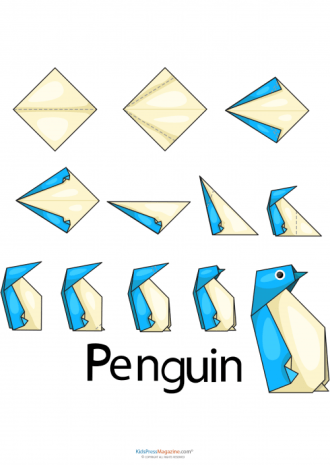
Origami Pets


Origami is a fun hobby that can grow in complexity as you gain skill. Here are two templates to get you started! All you need is a square piece of paper and—if you’d like to decorate your piece—some markers or colored pencils.

Puppy Template | Penguin Template

Picture Book Review

January 21 – Hugging Day

celebrate-picture-books-picture-book-review-hug-it-out-cover

About the Holiday

This is one of those lovely, simple holidays that’s just what it seems. So go ahead and hug someone today.

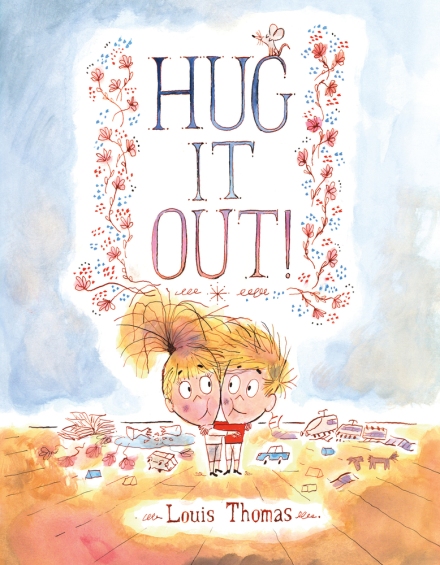
Hug it Out!

By Louis Thomas


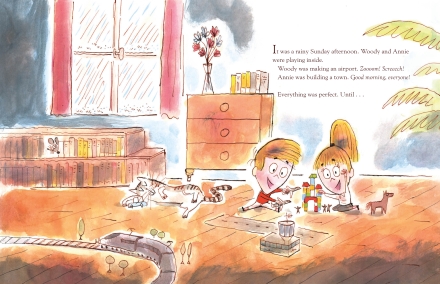
With rain pelting the windows, brother and sister Woody and Annie were playing inside. Woody was building an airport while Annie was creating a town from blocks. Everything was going great “until…they both reached for the car.” Then a tug-of-war began. Woody “wanted the car to pick up travelers from his airport” and Annie needed a little traffic in her town. They both yelled for Mom, who made them promise to be better sharers. Woody and Annie agreed with a pinky swear.

celebrate-picture-books-picture-book-review-hug-it-out-playing-happily

Image and text copyright Louis Thomas, courtesy of us.macmillan.com

But the sharing didn’t last long. Time with the car seemed unfair, and then there was the name-calling: Annie called Woody a “‘dumb-dumb,’” and Woody retaliated with “‘ding-dong,’” and they both called for “‘Mommm….’” Mom returned with coffee in hand and requested that Annie and Woody apologize to each other. A couple of mumbles later, Mom proclaimed it “‘Good enough’” until little feet started getting involved, and cries of “‘Ow!’” and “‘Quit it!’” filled the air. And…oh yeah… “‘Mommmm!’”

Mom had had enough! This time she laid down the law, and Woody and Annie—eyes wide in and hands to their cheeks in horror—heard her say, “From now on, any time you argue, you’re going to have to…HUG IT OUT.’” Annie and Woody were flummoxed, confused, perplexed. Mom pushed them together cheek to cheek to demonstrate, and with frowny faces and stiff arms, they hugged.

celebrate-picture-books-picture-book-review-hug-it-out-fighting-over-car

Image and text copyright Louis Thomas, courtesy of us.macmillan.com

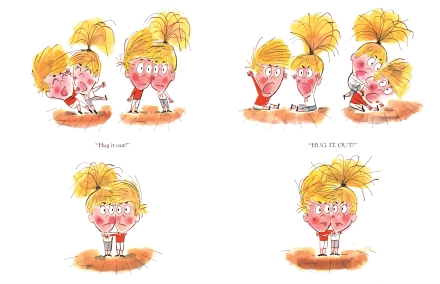
Still, the chasing— “‘Hug it out!’” —the hair pulling— “‘Hug it out!’” —the squabbling— “‘Hug it out!’” —and the wrestling— “‘HUG IT OUT!’” (this time with stuck-out tongues) continued. Finally, Annie confessed that she couldn’t “‘take one more hug,’” and Woody agreed. The two went back to playing—apart. Woody flew his planes, and Annie took care of her town. “And they both found a way to play with the car.”

After a while they looked at each other with an unexpected realization. “‘Mommmm!’ Annie screamed. ‘Mommmm!’ Woody screamed louder.” And their mom answered “‘HUG IT OUT!’” And with big smiles, “they did.”

celebrate-picture-books-picture-book-review-hug-it-out-wrestling

Image and text copyright Louis Thomas, courtesy of us.macmillan.com

Louis Thomas is onto something in this timely, sibling-rivalry story. Kids—and adults—will recognize the realistic dialogue and circumstances that makes Hug It Out! a laugh-out-loud tug at the heart. Thomas’s positive “punishment” is a clever solution to those sister and brother squabbles and might inspire parents and caregivers to give it a try. Readers will love shouting out “Mommm!” and “Hug it Out!” in this perfect—and perfectly fun—read-along. Thomas’s bright-eyed, straw-haired siblings are adorable, and kids will giggle to see the two smooshed together in a forced hug that becomes closer and closer with every attempt to make up and later becomes a sought-out part of the day.

With it’s wry take on the daily travails of sister- and brotherhood, Hug It Out! would make an amusing addition to home bookshelves—one that might reached for with every “Mommm!” 

Ages 3 – 7

Farrar, Straus and Giroux, 2017 | ISBN 978-0374303143

To view galleries of illustration work by Louis Thomas, visit his blog and tumblr!

Hugging Day Activity

celebrate-picture-books-picture-book-review-sock-and-mitten-neck-warmer-and-pillow

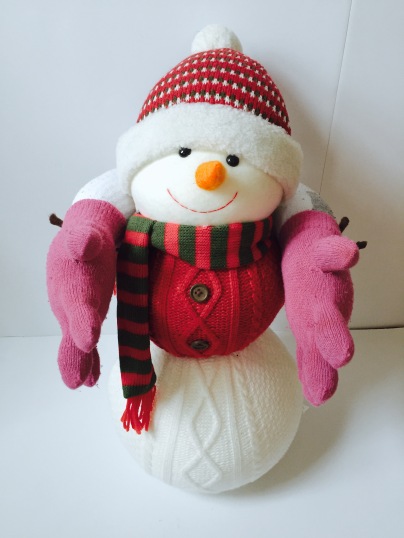
Warm Hugs Neck Warmer or Pillow

Supplies

  • Knee sock or tall crew sock
  • 2 knit gloves
  • Fiber Fill (for pillow and mittens)
  • Uncooked rice (for neck warmer)
  • Thread
  • Needle

celebrate-picture-books-picture-book-review-sock-and-mitten-neck-warmer-and-pillow

Directions

For Pillow

  1. Fill knee sock or crew sock with fiber fill
  2. Sew open end of sock closed 
  3. Fill knit gloves with fiber fill
  4. Sew one mitten to each end of the sock 
  5. Curve sock pillow around neck and relax!

For Neck Warmer

  1. Fill knee sock with uncooked rice
  2. Sew open end of sock closed
  3. Fill knit mittens with fiber fill
  4. Sew one mitten to each end of the sock
  5. Heat in microwave for 1 minute and then in 30-second increments until desired warmth

Picture Book Review


January 20 – Penguin Awareness Day

celebrate-picture-books-picture-book-review-little-penguins-cover

About the Holiday

Who can resist those little black-and-white waddlers from a frozen realm? Today’s holiday gives us a chance to enjoy and learn more about one of the world’s favorite animals. To celebrate, research penguins or visit an aquarium, and, of course, read a great penguin book!

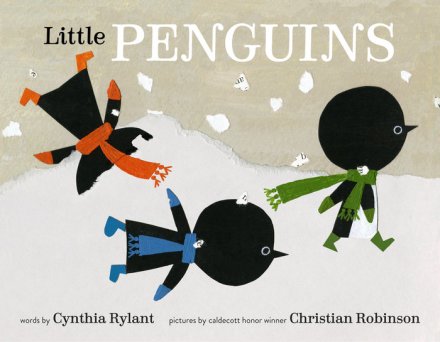
Little Penguins

Written by Cynthia Rylant | Illustrated by Christian Robinson


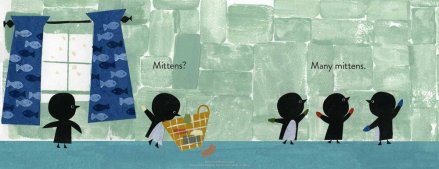
A tiny penguin stands at the window star-struck by the snowflakes floating gently down. Four more penguins join her to see this marvelous sight. There are so “many snowflakes.” Gathered around the window in their igloo home, the penguins are excited that “Winter is coming!” They rush to collect their cold-weather supplies. Out of the basket they pull mittens—a pair for each, red, blue, green, yellow, sage—“and matching scarves.”

celebrate-picture-books-picture-book-review-little-penguins-mittens

Image copyright Christian Robinson, text copyright Cynthia Rylant. Courtesy of Schwartz & Wade

With abandon the penguins raid the bureau, scattering socks like colorful confetti. Warm, dry boots get to leave their cubbies after a looong nap. Bundled up, the penguins tumble out into the winter wonderland. They sled and slide on the deep snow. In places they find the snow is top-of-their-boots deeper, and then suddenly waist-high, “very deep.”

Uh-Oh! Suddenly the landscape is blank-page white! Four of the little penguins look in all directions. “Where’s Mama?” No need to fret—Mama’s coming, skimming down the hill on her belly with the fifth tiny penguin. But the sky is darkening and it’s time to head for home. “In the door and off, off, off, off, off!”

celebrate-picture-books-picture-book-review-little-penguins-whale

Image copyright Christian Robinson, courtesy of Schwartz & Wade

On go the jammies then warm cookies and filled “sippies” satisfy the tummy. Finally, it’s time to snuggle tight under colored blankets and watch the flurries fly because “Winter is here.”

Cynthia Rylant captures the exhilaration kids feel upon the first snow of winter in her delightful concept book. The flurry of activity to dig out the accoutrements of winter provide little readers the perfect opportunity to learn or—in the case of a bit older kids—to show their knowledge of cold-weather apparel, colors, counting skills, and other ideas. Rylant’s gifted way with even the simplest words turns the question-and-answer format of Little Penguins into a lyrical frolic little ones will love.

celebrate-picture-books-picture-book-review-little-penguins-walruses

Image copyright Christian Robinson, courtesy of Schwartz & Wade

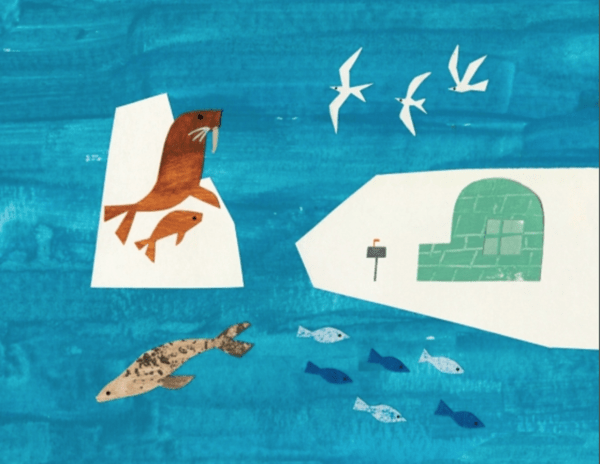
In Christian Robinson’s cozy igloo, the eager brightness of the little penguins is highlighted against the mottled textures of sage walls and reflected in the gleaming gray-blue floor. The little home with its fish weather vane and tall chimney sits at the edge of an icy peninsula, perfectly placed for winter play. The five penguins joyfully don their mittens, wave their scarves and toss socks to and fro in their hurry to get dressed and get outside and enjoy the fat, fluffy snowflakes.

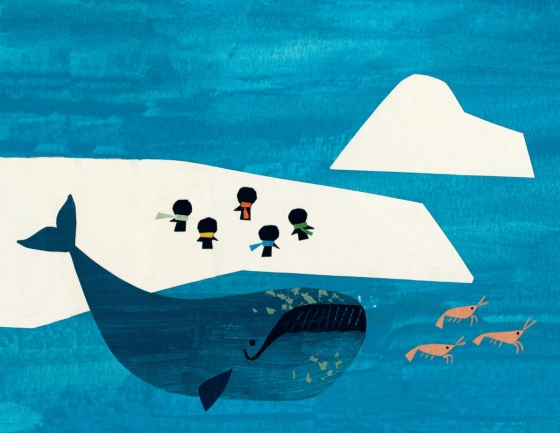
Once there, the penguins become tiny dots on the vast, white hill as they sink waist deep, glide on their bellies, and welcome Mama, who’s joined the fun. As the penguins remove their snow gear back home, Robinson cleverly stripes the two-page spread in the favorite colors of the individual penguins, creating a striking counterbalance to the snug kitchen to come. An old-fashioned stove, retro accents, and fish, whale, and boat décor wrap up the comfy charm of this superb book for young readers.

With its sweet characters and beautiful illustrations, Little Penguins would be a happy and often-asked-for addition to any child’s bookshelf.

Ages 2 – 7

Schwartz & Wade, 2016 | ISBN 978-0553507706

To learn more about Cynthia Rylant and her books, visit her website!

View a gallery of illustration art by Christian Robinson on his website!

Penguin Awareness Day Activity

celebrate-picture-books-picture-book-review-spice-bottle-penguin-craft

Copyright Celebrate Picture Books, 2017

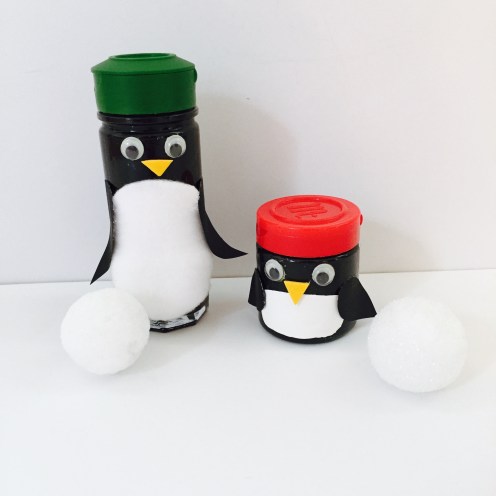
Spicy Cool Penguins

Don’t throw away those empty spice bottles—instead make these cute penguins with their colorful hats who are just waiting to play!

Supplies

  • Empty glass or plastic spice bottle with cap
  • Black paint
  • White paint OR White fleece or felt
  • Black paper
  • Yellow foam or heavy paper
  • Googly eyes
  • Styrofoam ball (optional)
  • Glue
  • Paint brush
  • Scissors

Directions

  1. Paint the inside of the glass or plastic bottle with the black paint, let dry
  2. From the white fleece, cut an oval for the penguin’s belly and glue it on. Alternatively, paint a white oval on the jar to make a belly. Fleece may be a better option for younger children, as the paint can scratch off glass and plastic surfaces.
  3. Glue googly eyes near the top of the jar, but below the cap
  4. Cut a triangle of yellow foam or paper for the beak and glue it on
  5. Cut two tear shapes for the wings from the black paper. Glue the top of the shape to the body of the penguin, overlapping the belly a little. Fold the tips up
  6. Give your penguins Styrofoam ball snowballs to play with!

Picture Book Review

January 19 – It’s Creativity Month

celebrate-picture-books-picture-book-review-painting-pepette

About the Holiday

As the cold and snowy weather keeps us inside more and more, what are we to do? Why not create?! Whether you like writing, drawing, cooking, woodworking, gardening, photography, dance, or other pursuits, January is the perfect time to begin a new project. Stock up on supplies, get those ideas going, and create!

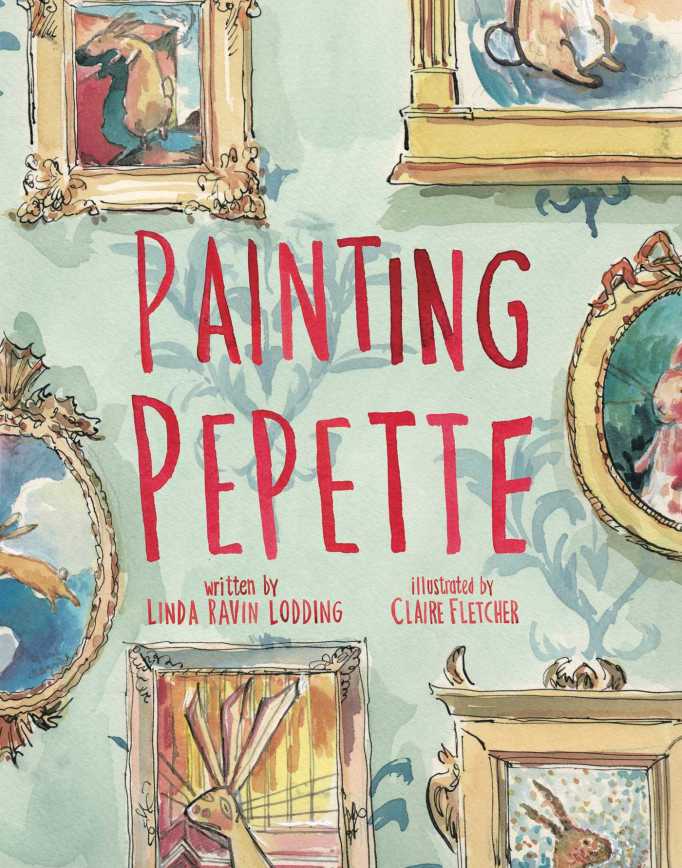
Painting Pepette

Written by Linda Ravin Lodding | Illustrated by Claire Fletcher


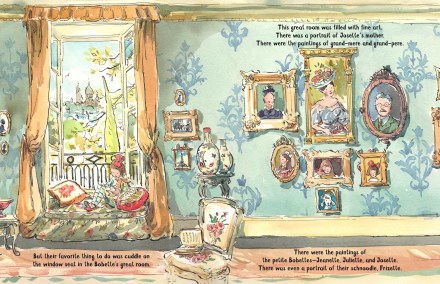
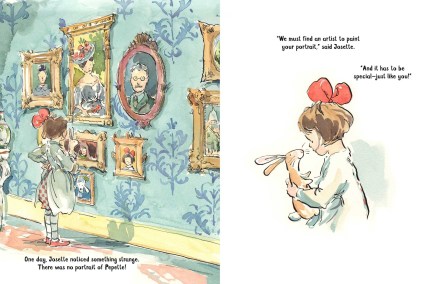
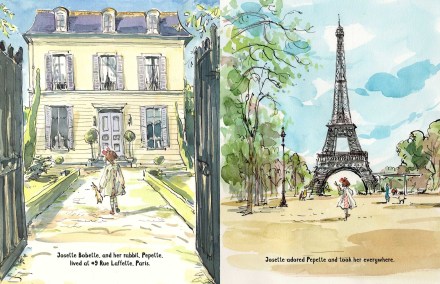
If you were to peek in the great room window of the grand yellow house at #9 Rue Laffette in Paris, you would most likely see Josette Bobette and her beloved stuffed rabbit Pepette cuddled together on the comfortable seat. It was their favorite place. Looking past them you would see that on the walls hung portraits of the family—Josette’s mother was there as well as grand-mère and grand-père, the three Bobette sisters, and even their schnoodle Frizette.

celebrate-picture-books-picture-book-review-painting-pepette-great-room

Image copyright Claire Fletcher, text copyright Linda Ravin Lodding. Courtesy of simonandschuster.com

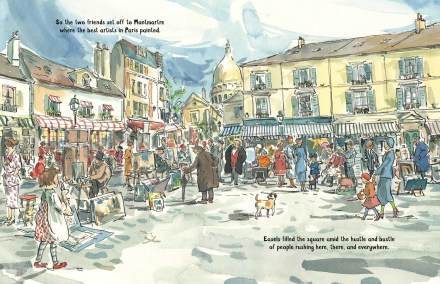
“One day Josette noticed something strange. There was no portrait of Pepette!” Josette at once determined to find an artist to paint a special portrait of her best friend. The pair head out to Montmartre, where all of the best artists set up their easels to paint and sell their work. It didn’t take long for a man in a striped shirt to stop them.

“‘Those ears!’” he cried. “‘Never have I seen such majestic ears. I must paint this rabbit’s portrait!’” Pepette blushed at such an effusive compliment, and Josette exclaimed, “‘Magnifique!’” It appeared that Josette had found just the artist to create Pepette’s portrait. The painter waved his brush with a flourish, “declared his painting a ‘masterpiece,’” and held it up for inspection. Josette gazed at a Pepette with two noses and three ears. Diplomatically, she proclaimed the picture “‘nice’” but not quite Pepette. Her best friend agreed.

celebrate-picture-books-picture-book-review-painting-pepette-pepette-with-bunny

Image copyright Claire Fletcher, text copyright Linda Ravin Lodding. Courtesy of simonandschuster.com

Just then a man with a thin, curved handlebar mustache spied the pair. Admiring Pepette’s whiskers, the artist begged to capture “‘the very essence of her rabbitness!’” He immediately set to work, and in no time a most unusual portrait emerged. Pepette seemed to melt from atop a tall red wall. Josette considered it—and her reaction—carefully. “‘It’s imaginative,’” she said. “‘But you’ve painted Pepette quite, well, droopy.’” Pepette agreed.

As Josette and Pepette enjoyed a Parisian snack on the curb of Montmartre, a rakish young man happened along. He was arrested by Pepette’s nose, which he likened to “‘a faint star twinkling in a misty, velvet night.’” Josette had a good feeling about this artist and followed him across the square to his easel. Pepette posed on a red tufted stool as the artist painted a rabbit soaring through the clouds. He proclaimed the finished portrait “‘one of my best works’” as he displayed it to the crowd. Josette liked the clouds but told the painter that Pepette is afraid of heights and not fond of flying. Pepette agreed.

celebrate-picture-books-picture-book-review-painting-pepette-pepette-at-home-and-in-paris

Image copyright Claire Fletcher, text copyright Linda Ravin Lodding. Courtesy of simonandschuster.com

By now Pepette was the most sought-after model in Paris, and another artist rushed up, captivated by her beauty. The balding man in a dapper suit and round spectacles peered at Pepette. “‘What a colorful lady—balloon blue, pansy pink, and radish red!’” Although a little suspicious of his vision, Josette allowed him to paint Pepette. “‘Ta da!’” the man exclaimed, revealing the magic of his brush. Josette studied the canvas with its vibrant dots, dashes, and splashes. While she admired the colors, she reminded the artist that Pepette isn’t pink.

“‘Ah, yes,’” nodded the painter. “‘But through art we can see the world any way we want.’”

With the sun setting low in the sky, Josette politely said thank-you and goodbye to the artists. She and Pepette had enjoyed their day, but it was time to go home. Curled up once more on the window seat, Josette sighed. She had so hoped to have the perfect portrait of Pepette—one that showed her velvety grey listening ears, her heart-shaped nose, and her soft arms that give tight hugs. Suddenly, Josette had an idea! After gathering all of her art supplies, she created the perfect likeness—one as special as Pepette herself!

celebrate-picture-books-picture-book-review-painting-pepette-pepette-at-montmartre

Image copyright Claire Fletcher, text copyright Linda Ravin Lodding. Courtesy of simonandschuster.com

An author’s note on the last page describes the creative atmosphere of 1920s Paris, home to writers, artists, musicians, and fashion designers, that gives a frame to her story. The artists that Josette meets are inspired by Pablo Picasso, Salvador Dalí, Marc Chagall, and Henri Matisse.

In Painting Pepette Linda Ravin Lodding has written a multi-layered story of love, friendship, and unique vision. Through the sweet relationship between Josette and Pepette and with a sprinkling of humorous self-congratulation by the artists, Lodding nudges readers to appreciate that while art can reveal and obscure, reflect or transcend reality, ultimately the success of a piece—complex or simple—lies within the viewer’s heart. Children will also see that their creative endeavors, undertaken with love, are just as meaningful and appreciated as those of professional artists. Lodding’s lyrical language trips off the tongue and is a joy to read—as if readers are following Josette as she skips happily through Paris.

Claire Fletcher’s striking pen-and-ink illustrations pay delicate homage to cityscapes of a bygone Paris. Adorable Josette and her enchanting rabbit are the perfect tour guides through crowded Montmartre and this introduction to art history. Soft tones of yellow, rose, and green illuminate the apartments and cafes of the square, where colorful shoppers and artists mingle. Fletcher’s renderings of Pepette’s various portraits will not only make kids giggle, but entice them to learn more about each artistic style. The final endpapers reveal that the four fine-art portraits now hang in the Muse of Paris, while readers already know that Josette’s perfectly perfect portrait of her well-loved friend has taken its rightful place on the wall in the Bobette’s great room!

Painting Pepette is a beautiful addition to any child’s bookshelf and a lovely way for teachers to initiate a discussion of art history and get kids excited about artists and different art styles.

Ages 4 – 9

little bee books, 2016 | ISBN 978-1499801361

Follow Josette through Paris as she searches for just the right artist to paint a portrait of her best friend Pepette and comes to a surprising discovery in this beautiful Painting Pepette book trailer:

Discover more books by author Linda Ravin Lodding on her website.

Illustrator Clair Fletcher invites you to find more of her artwork by visiting her online gallery.

Creativity Month Activities

celebrate-picture-books-picture-book-review-painting-pepette-activity-guide

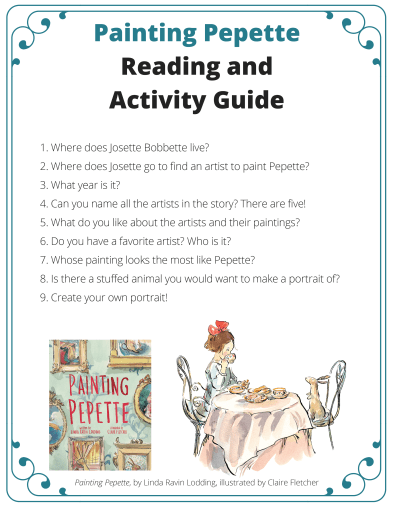
Painting Pepette Reading and Activity Guide


little bee books has created an interactive activity so you can continue to explore Josette’s world and your own artistic talent! Just click here—Painting Pepette Reading and Activity Guide—to start having fun!

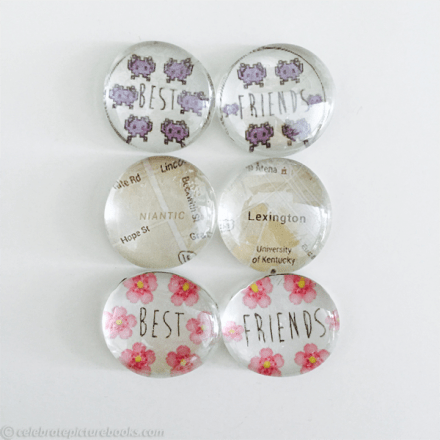
Stuck on You Magnets or Picture Hanger


Creativity is meant to be shared! Here’s an easy craft that you can make to give to your friends whether they live close by or far away. These magnets can used by themselves or to hold a picture-hanging wire. Use inside jokes, favorite characters, or shared experiences to make these  crafts personal!

celebrate-picture-books-picture-book-review-friends-magnets-craft

For Magnets

Supplies

  • To get you started, here are two printable Best Friends Templates! Template 1 Template 2
  • Poster board
  • Large, 1 ½-inch clear glass stones (decorative fillers), available in craft stores
  • Markers or colored pencils OR find images online to print out
  • Medium to large flexible magnets, available in craft stores
  • Super glue
  • Toothpicks
  • Scissors

Directions

  • Place the glass stone on the poster board and trace around it
  • Draw your design in the circle on the poster board
  • Cut out the circle
  • With the toothpick, apply glue around the very edge of the design side of the circle
  • Attach the circle to the flat side of the stone, let dry
  • Trim the cardboard circle if needed
  • Attach the magnet to the back of the cardboard with glue

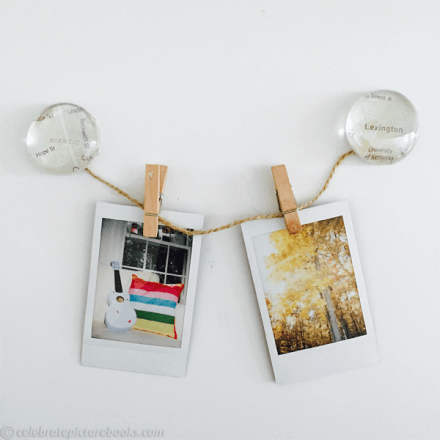
celebrate-picture-books-picture-book-review-friends-picture-hanger-craft

For Map Picture Holder

Supplies

  • Use a mapping program to find a map of your town and your friend’s town
  • Poster board
  • Large, 1 ½-inch clear glass stones (decorative fillers), available in craft stores
  • Twine
  • Super Glue
  • Toothpicks
  • Scissors
  • Heavy duty mounting squares

Directions

  1. Find maps of your and your friend’s towns
  2. Zoom in so the name of your and your friend’s towns are displayed well. You will be using about a 1-inch area around the towns’ names.
  3. Take a screen shot of the maps
  4. Print the maps
  5. Place the glass stone on the map and trace around it
  6. Place the glass stone on the poster board and trace around it
  7. Cut out the circles on the map and poster board
  8. With the toothpick, glue the map to the poster board, let dry
  9. With the toothpick, apply glue around the very edge of the map side of the circle
  10. Attach the circle to the flat side of the glass stone, let dry
  11. Trim the cardboard circle if needed
  12. Repeat with the other map
  13. Attach a length of twine to the back of each glass stone
  14. Attach heavy duty mounting squares to the back of each glass stone
  15. Attach stones to the wall and hang pictures on the twine

Picture Book Review

January 17 – Kid Inventors’ Day

celebrate-picture-books-picture-books-review-the-hole-story-of-the-doughnut

About the Holiday

Today’s holiday celebrates all those ingenious kids who have improved the world with their inventions. This date was chosen to commemorate another child inventor—Benjamin Franklin—who designed the first swim fins when he was just 12 years old! (Seriously, is there nothing this man didn’t or couldn’t do?). With their supple minds and can-do attitudes, kids have changed the ways things are done in the fields of medicine, technology, communications, and even food—as today’s book shows! To learn more about the day and find resources for young inventors, visit the K.I.D website.

The Hole Story of the Doughnut

Written by Pat Miller | Illustrated by Vincent X. Kirsch


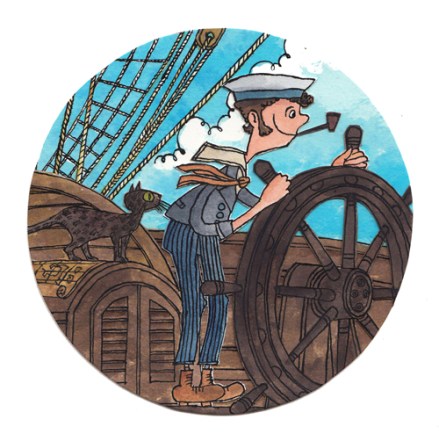
In 1844 at the tender age of 13, Hanson Gregory left the family farm and went to sea as a cabin boy on the schooner Isaac Achorn. He quickly became the cook’s assistant and also learned how to rig the sails and “steer a ship over trackless waves by sun and stars.” By the age of 19 Gregory had become the captain of the schooner Hardscrabble, and within a few more years was racing “his cargo from Maine to California as commander of a clipper, the fastest ship on any ocean.”

celebrate-picture-books-picture-book-review-hole-story-of-the-doughnut

Image copyright Vincent X. Kirsch, courtesy of vincentxkirsch.com

Hanson Gregory may have been one of the best captains to sail the seas—once awarded a medal for heroism for rescuing seven shipwrecked Spanish sailors even though his own ship and crew were endangered. But his greatest achievement was not attained because of his seafaring skills—it was his ingenuity in the galley that people remember.

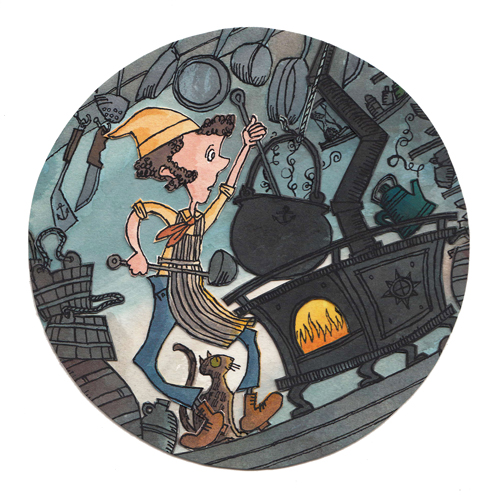
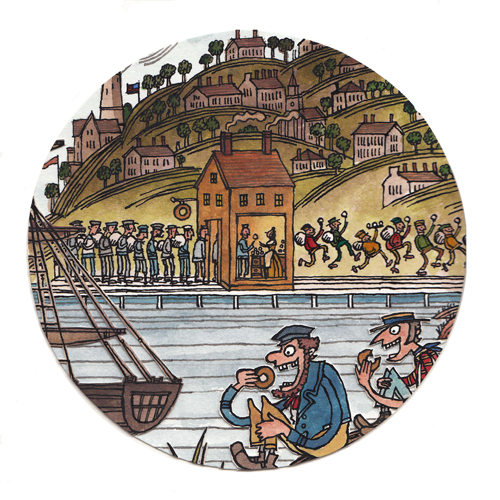
On June 22, 1847 as a 16-year-old cook’s assistant, Hanson was rustling up the crew’s breakfast—coffee and fried cakes, the same as every morning. While the pot of lard bubbled on the stove, Gregory formed balls of sweetened dough and dropped them in. They sizzled and crisped—at least around the edges. The centers were raw, heavy with grease, and they dropped like cannonballs in the stomach. “Sailors called them Sinkers.” But this morning Gregory had an idea. He removed the lid from the pepper can and cut out the center of the balls. “Then he tossed the rings into the bubbling lard.”

celebrate-picture-books-picture-book-review-hole-story-of-the-doughnut

Image copyright Vincent X. Kirsch, courtesy of vincentxkirsch.com

The cook and the sailors took one look at this odd concoction and…ate them up! “The cakes were brown, and sweet, and fully cooked. Sighs of delight rose above the noisy sea. A new breakfast tradition was born.” Gregory told his mom about his invention, and she fried up large batches of these ‘holey cakes’ that became a sensation at a friend’s store and on the docks.

You might think this is a pretty interesting tale in itself, “but sailors like their stories bold” and so they “spun legends worthy of such a delicious treat.” One tale had Captain Gregory inventing the doughnut while he saved his ship from disaster. Another told how Gregory, distraught over the drowning of five sailors pulled to the ocean floor by their “sinker” breakfast, punched holes in every cake to make them look like life rings and vowed, “‘Never again!’”

Captain Gregory had a sense of humor about his accomplishment. During an interview he once stated that “he had invented ‘the first hole ever seen by mortal eyes.’” Gregory lived to be 89 and is buried “overlooking the sea where stormy weather can be spotted as readily as it once was from the quarterdeck of the Hardscrabble.”

An author’s note expanding on the story of Captain Gregory, the doughnut, doughnut shops, a timeline, and a selected bibliography follow the text.

celebrate-picture-books-picture-book-review-hole-story-of-the-doughnut

Image copyright Vincent X. Kirsch, courtesy of vincentxkirsch.com

Doughnuts have never been so evocative! In Pat Miller’s humorous, informative history of this favorite pastry treat, readers can smell the salt air, feel the ocean swell and roll under their feet, and even ache a little for those poor sailors forced to eat “sinkers.” Seamlessly interwoven into this foodography is a fascinating look at the early days of sail. Miller’s language is immediately stirring: the Ivanhoe bucks and plunges, the sea becomes a monster, and Captain Gregory spears a sinker on the wheel spoke. Kids will marvel at a 13-year-old going off to sea and becoming an inventor at 16.

Vincent X. Kirsch provides just the right touch to this captivating true story with his cartoon-inspired watercolor and cut paper artwork. Ingeniously incorporating Hanson Gregory’s innovation of removing the center of the fried cakes, Kirsch’s illustrations are “cored” to allow for text, while the extracted section appears on the facing page as a glimpse through a porthole. The maritime atmosphere—from ship to shore—of the mid-1800s is beautifully represented in the folk-style sketches, and the humor that is so intrinsic to this story is wonderfully embraced.

The Hole Story of the Doughnut will delight foodies and history buffs alike and would make a fun gift and a delectable addition to personal libraries for all ages.

Ages 5 – 12

Houghton Mifflin Harcourt, 2016 | ISBN 978-0544319615

Vincent X. Kirsch’s website is full of illustrations from his books for children—take a look at his portfolio!

Spend some time with Pat Miller on her website that offers activities, tips, resources and many more books!

Kid Inventors’ Day Activity

celebrate-picture-books-picture-book-review-cd-doughnut-craft

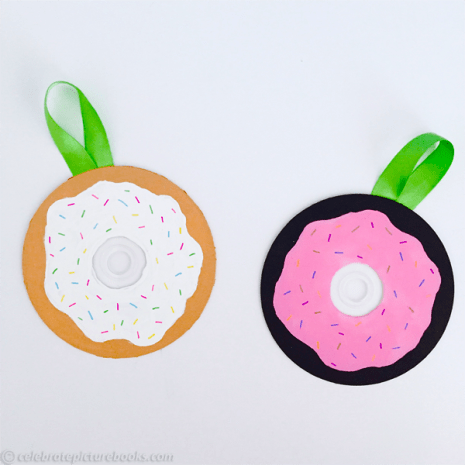
CD (Compact Doughnuts) Decoration


Are some of  your CDs a little passé? Not if you can turn them into cute décor like this doughnut hanging.

Supplies

  • Unused CDs
  • Craft paint in tan, black, pink, yellow, white (or any colors you want for the doughnut and the icing)
  • Ribbon, any color and length you want
  • Fine-tip markers in bright colors
  • Glue
  • Glue dots (optional)
  • Paint brush

Directions

  1. Paint a wavy edge around the CD, let dry
  2. Paint the center of the CD, leaving the clear circle unpainted
  3. When the icing paint is dry, draw sprinkles on the icing with the markers
  4. With the ribbon make a loop hanger and attach it to the back of the CD with glue or glue dots
  5. Hang your decoration

Picture Book Review

January 12 – Poetry at Work Day

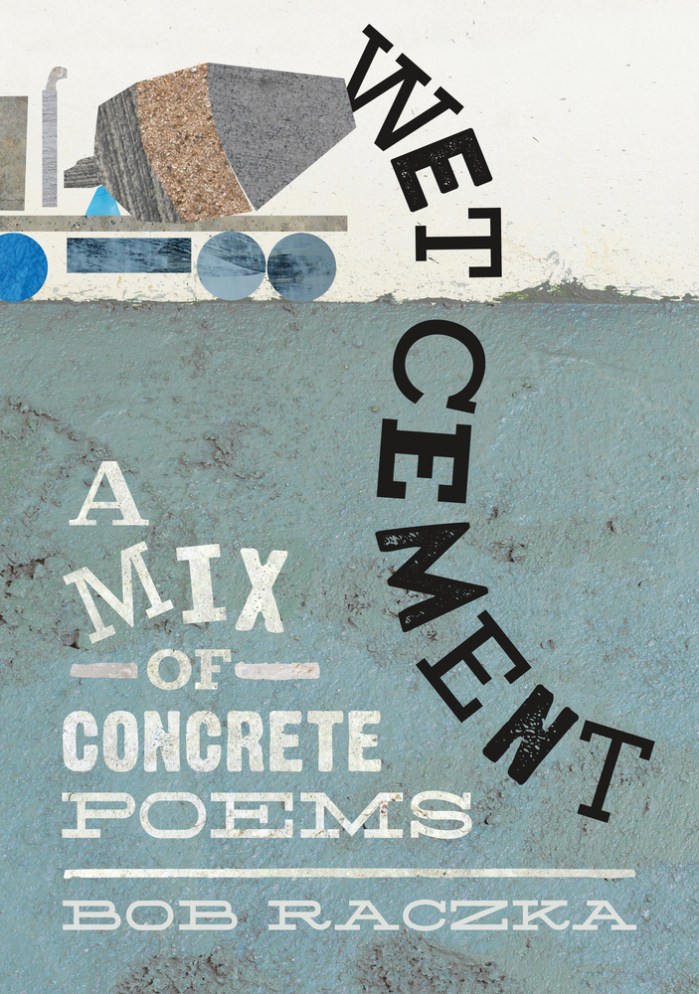
Wet Cement: A Mix of Concrete Poems by Bob Raczka picture book review

About the Holiday

Sometimes your work in school, in the office, outside, or at home inspires you to translate what you’re doing into writing. What better way to express the fun—and folly—of homework, room cleaning, report writing, lunchtime, tests, and all the work that makes up a day than in a poem?! To celebrate today’s holiday try to put the rhythms of your work into poetry! 

Wet Cement: A Mix of Concrete Poems

By Bob Raczka


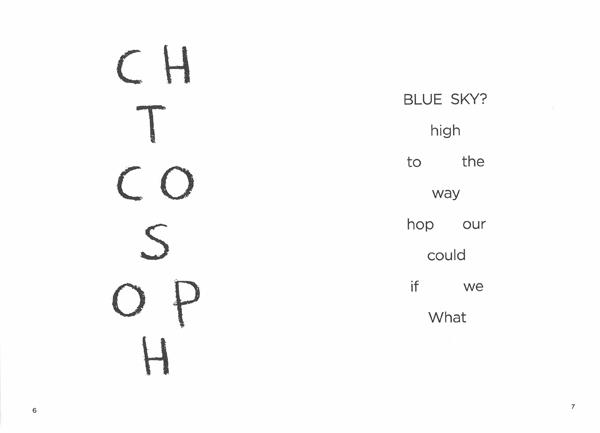
When you envision a poem in your head, what do you see? A block of lines? A square or a rectangle? Well, sweep that image from your mind because in Bob Raczka’s Wet Cement: A Mix of Concrete Poems, verses become actions, objects, puzzles, and natural phenomena. Not only are the poems shaped to illustrate their theme, the titles use clever imagery as well.

celebrate-picture-books-picture-book-review-wet-cement-a-mix-of-concrete-poems-hopscotch

Text and image copyright Bob Raczka, courtesy of Roaring Brook Press

As you encounter the poem hanger you’ll see that “han” has broken away and is dangling from the hook of g in “ger.” The words of the poem itself are shaped like a hanger and contain a giggle-invoking twist: “I hang out in blue jeans and comfy old shirts. I hang out in blouses and long frilly skirts. I hang out in sport coats and sweaters and shawls. I even hang out with no clothes on at all!”

You might want to get your baseball mitt out before you read homer, in which the first line zooms straight as a pitch and the second—written backwards and at an upward angle—soars like a homerun hit: “The pitcher hurls his hummer toward the slugger squeezing lumber CRA / CK! The slugger slams the hummer toward the bleachers for a homer.”

celebrate-picture-books-picture-book-review-wet-cement-a-mix-of-concrete-poems-takeoff

Text and image copyright Bob Raczka, courtesy of Roaring Brook Press

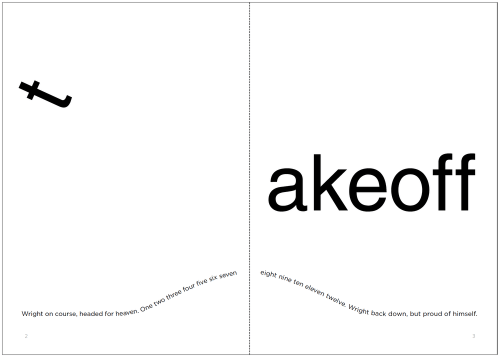
But don’t put that mitt away just yet! You may need to catch the o, which has escaped from the title p p-up. And if you’ve ever played t-ball, baseball, softball, or even wiffleball, you’ll cringe in recognition of this short but pointed poem.

The sky darkened by night in Dipper and by clouds in Lightning holds two poems expressing very different thoughts. In the title Dipper, the second p has floated to the top of the page where it hangs like a miniature reflection of the dipper-shaped poem, which reads: “Way down there on earth you hold firefly jars, filled up to their lids with light. Up here in the sky, I’m a vessel of stars, my brim overflowing with night.” In the title LIGHTNING, the L strikes the I to create the familiar jagged crack echoed in the shape of the verse: “from a bad mood sky, / tears, / then a jag- / ged slash- / ing flash of anger, / ear- / splitting, / obnoxious, / a cloud tantrum”

celebrate-picture-books-picture-book-review-wet-cement-a-mix-of-concrete-poems-eracer

Text and image copyright Bob Raczka, courtesy of Roaring Brook Press

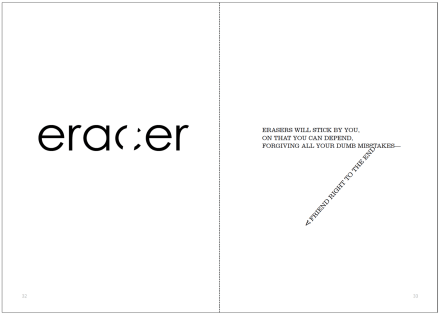
Any writer will love poeTRY which is such a clever take on the word as well as the revision and editing process:

“poetry is about taking away the words you don’t need

poetry is taking away words you don’t need

poetry is words you need

poetry is words

try”

Put simply, Bob Raczka’s concrete poems will make you smile. Even more than that, you’ll find yourself wanting to carry this book around, saying “Look at this!” to everyone you meet. Raczka calls these poems “word paintings”—because a poet “uses words like colors to paint pictures inside your head.” If creativity is the talent to present the world in new and surprising ways, making connections that enhance life, then Wet Cement is creativity at its best!

Wet Cement: a Mix of Concrete Poems is one poetry book that belongs on your child’s bookshelf! The combination of subjects, expression, and images will make it an often-read favorite.

Ages 5 – 9 and up (adults will enjoy these poems as much as kids)

Roaring Brook Press, 2016 | ISBN 978-1626722361

Discover a full bookshelf of books by Bob Raczka on his website!

Poetry at Work Day Activity

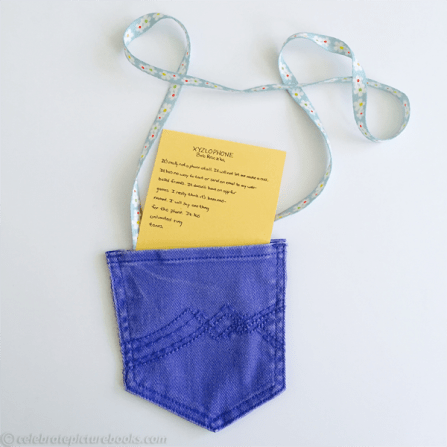
CPB - Pocket Poem Craft

Pocket Poem Carrier


Choose a part of your school or work day and write a poem about it. You can even try writing a concrete poem to give more shape to your thoughts! Then make this pocket poem carrier so you can tote your favorite poem with you to show your friends and family—today and every day!

Supplies

  • An old pair of pants or shorts with back pockets
  • A decorative shoelace
  • Thread or fabric glue
  • Needle
  • Paper
  • Your favorite poem or a poem you write yourself
  • Pen

Directions

  1. Cut one back pocket out of an old pair of pants or shorts, including the back of the pocket
  2. Use the shoelace at its full length or cut to desired length
  3. Inside each edge of the pocket sew or glue the ends of the shoelace to make a strap
  4. Print your favorite poem on the paper
  5. Insert the poem into the pocket poem carrier
  6. Take your poem with you and share it with your friends!

Picture Book Review

January 10 – It’s International Quality of Life Month and Q & A with Deborah Sosin

celebrate-picture-books-picture-book-review-charlotte-and-the-quiet-place-noisy-neighborhood

About the Holiday

How one achieves their definition of a good quality of life may differ for every person, but in general it encompasses being happy and satisfied with one’s relationships, work, living conditions, and self. Whether you find happiness and quality of life in outdoor or indoor pursuits, with others or alone, at work or at home, this month’s holiday gives you time to get in touch with your inner quiet place and reflect on changes or improvements to bring you more peace and happiness in life.

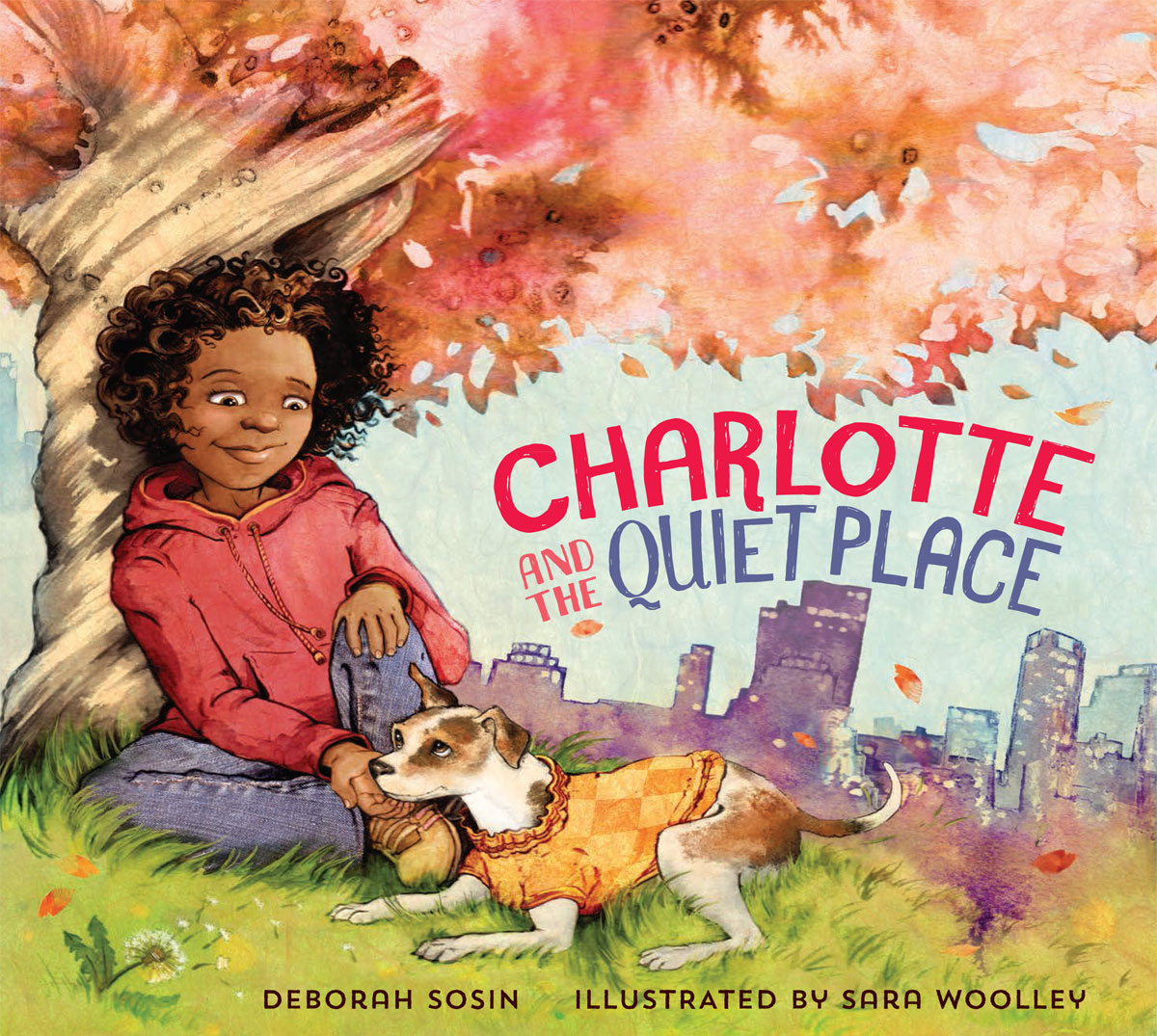
Charlotte and the Quiet Place

Written by Deborah Sosin | Illustrated by Sara Woolley


Charlotte is a girl who likes quiet who lives in a noisy world. Everywhere she goes, it seems, it’s impossible to escape from sounds that disturb her peace. At home the hallway creaks where “the floorboards groan,” the living room is like an arcade where the “TV bellows and blares,” and the kitchen is filled with Otto’s barks for his dinner. Even in Charlotte’s bedroom, “which is supposed to be a quiet place, the old steam radiator hisses, whistles, and whines. Where can Charlotte find a quiet place?”

celebrate-picture-books-picture-book-review-charlotte-and-the-quiet-place-noisy-home

Image copyright Sara Woolley, text copyright Deborah Sosin, Courtesy of sarawoolley.com

When Charlotte goes to school, things are no better. In the classroom kids are boisterous and bells ring; the lunchroom echoes with clattering trays and scuffing chairs; and the playground blares with big voices and stomping feet but also with the little squeaks and rattle of the swings. “Even in the library, which is supposed to be a quiet place, the children giggle, yammer, and yell. Where can Charlotte find a quiet place?”
celebrate-picture-books-picture-book-review-charlotte-and-the-quiet-place-noisy-subway

Image copyright Sara Woolley, text copyright Deborah Sosin, Courtesy of sarawoolley.com

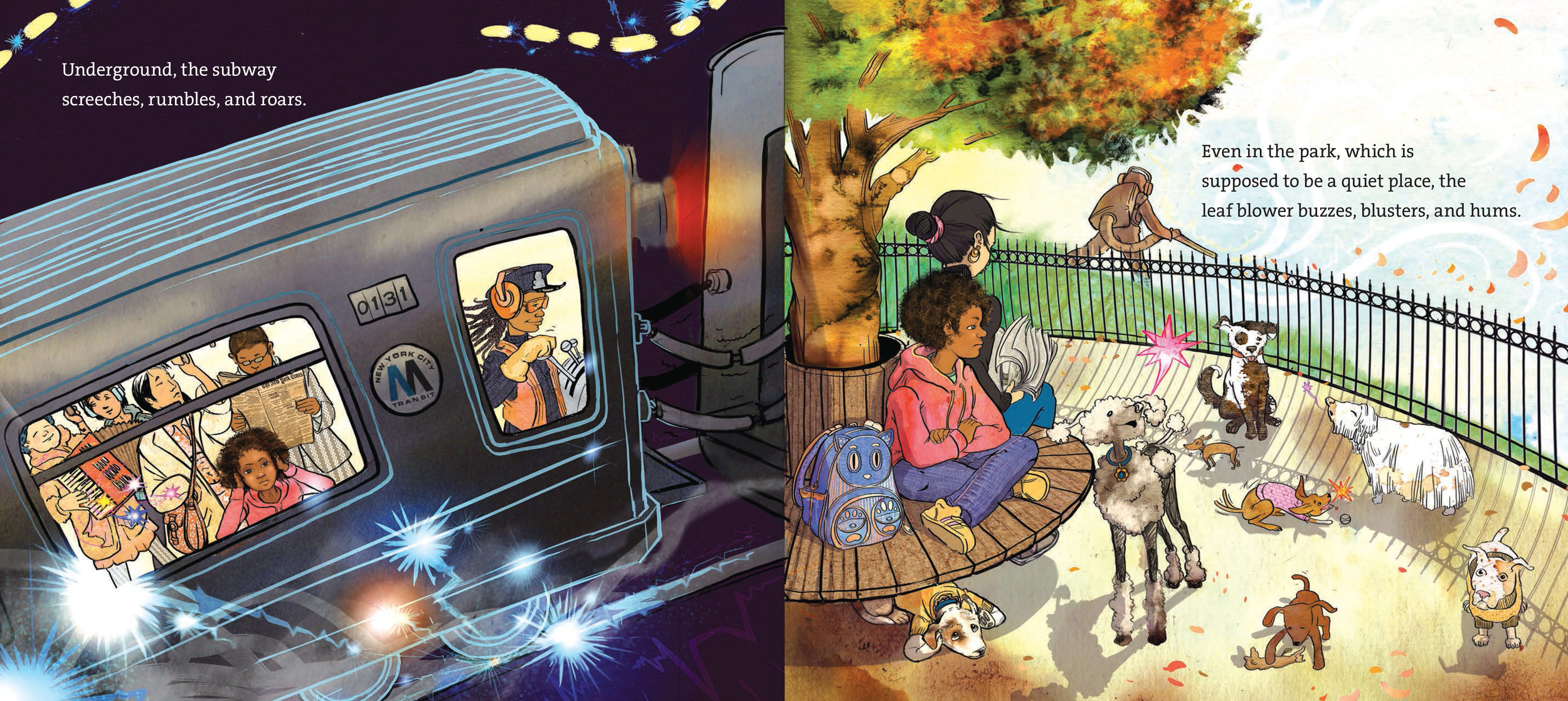
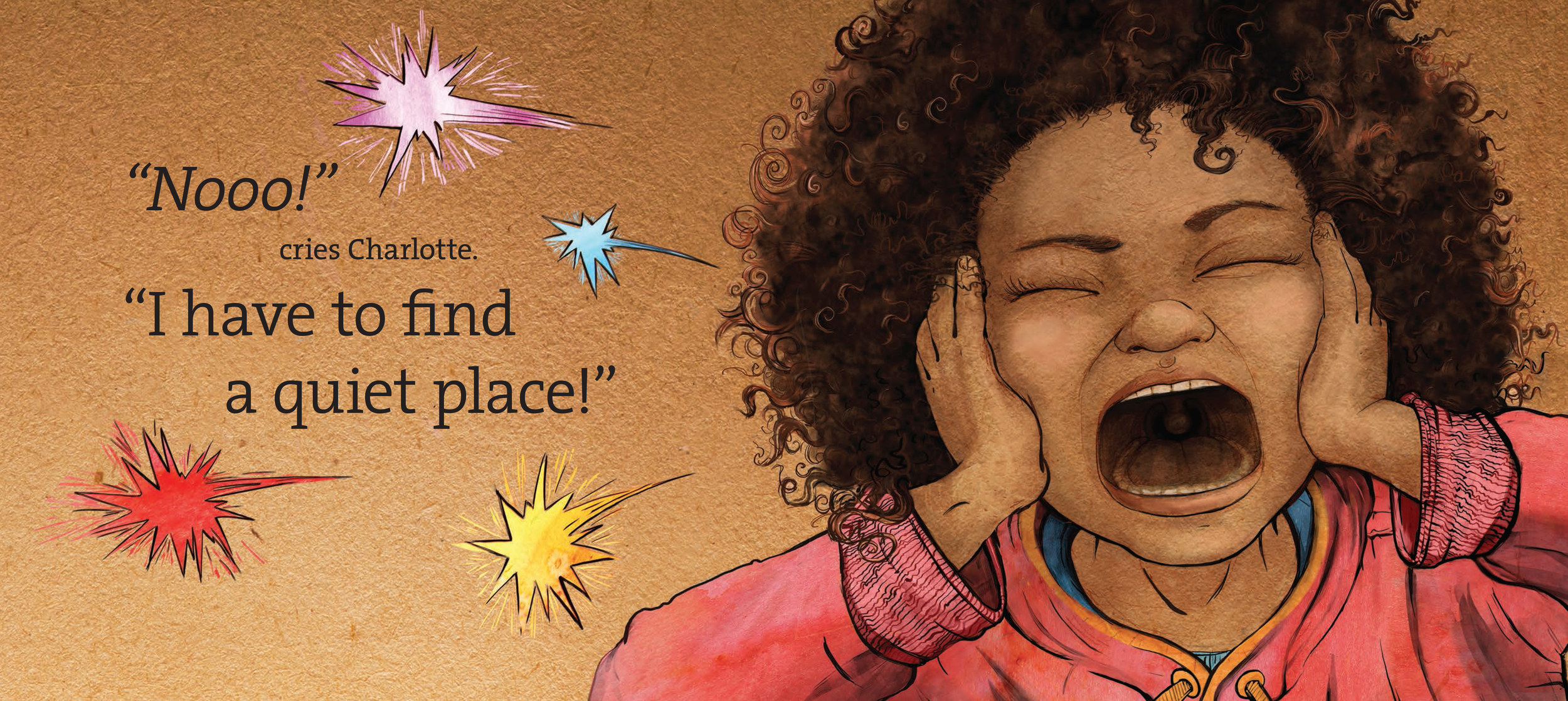
The outside world resounds with the din of jackhammers, horns, sirens, shouts, cars, music, and the “screeches, rumbles, and roars” of the subway. “Even in the park, which is supposed to be a quiet place, the leaf blower buzzes, blusters, and hums.” Charlotte puts her hands to her ears. “‘Nooo!’” she cries, “‘I have to find a quiet place!’”
celebrate-picture-books-picture-book-review-charlotte-and-the-quiet-place-nooo!-charlotte-cries

Image copyright Sara Woolley, text copyright Deborah Sosin, Courtesy of sarawoolley.com

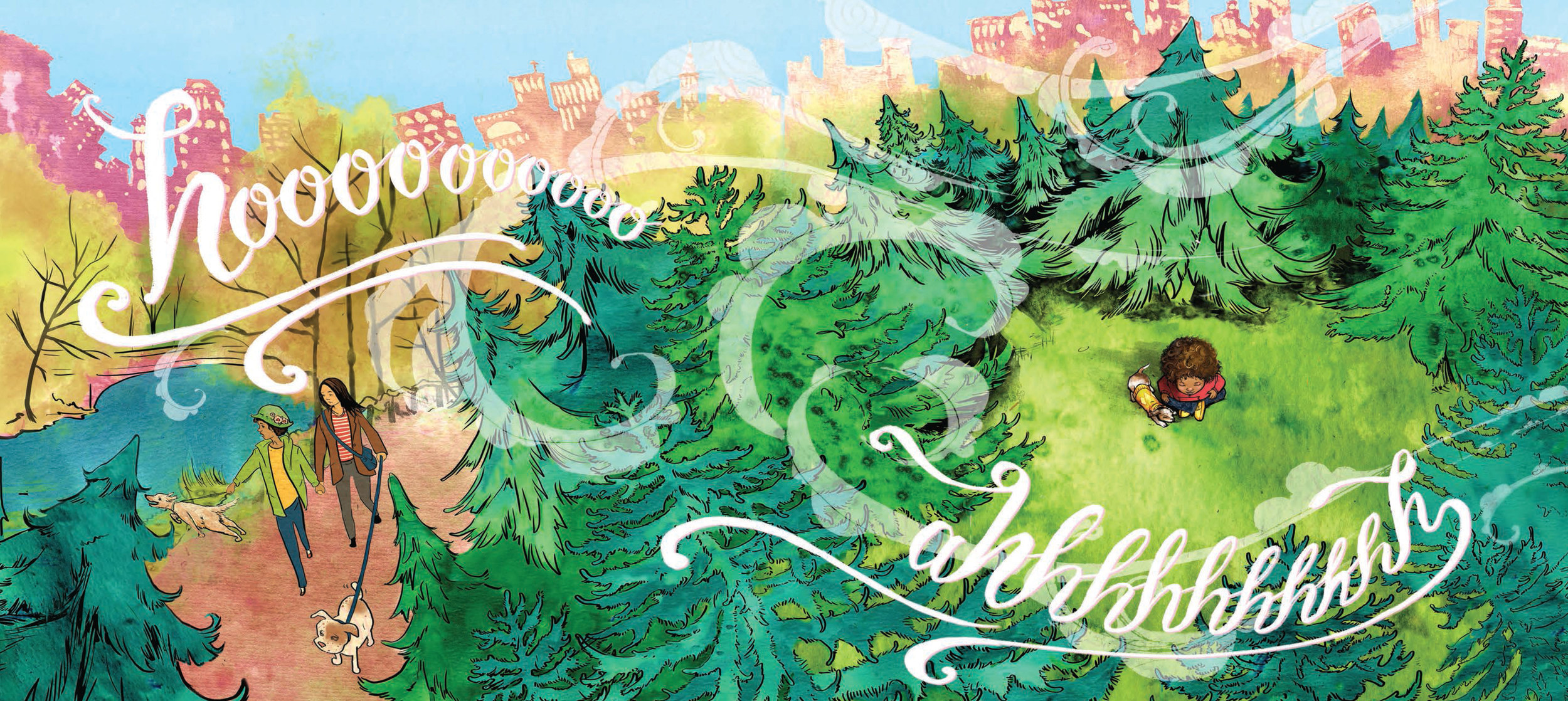
On Saturday Charlotte takes her dog for a walk in the park. Suddenly, Otto spies a squirrel and takes off running, wrenching his leash out of Charlotte’s hand. She chases after him down a hill, over a bridge, into the middle of a grove of trees. Out of breath, Charlotte and Otto sit beneath a tree. Gasping, Charlotte’s “belly rises up and down, up and down. Her breath goes in and out, in and out. Hooooo ahhhhh. Hooo ahhh.”

Slowly, Charlotte’s breath comes easier and “her mind slows down.” In this state, she discovers another, even quieter place. It is a place deep inside where her breath is soft and her “thoughts are hushed and low.” It is “a place as quiet as the small silence on the very last page of her favorite book, the silence right after ‘The End.’”
celebrate-picture-books-picture-book-review-charlotte-and-the-quiet-place-quiet-woods

Image copyright Sara Woolley, text copyright Deborah Sosin, Courtesy of sarawoolley.com

In a little while, Charlotte and Otto leave the grove, but now whenever home or school or the neighborhood is too loud, Charlotte remembers where she can find a quiet place. She simply closes her eyes and pays attention to that place deep in her belly and deep in her mind—“that quiet place inside.”

For so many children the world is a blaring, clattering place where their thoughts are drowned out by the noises around them. Deborah Sosin’s award-winning Charlotte and the Quiet Place validates these feelings and offers children a way to discover inner peace wherever they are. As a tonic to today’s hyper-stimulated environment, kids and adults alike will benefit from the method of mindful reflection Sosin presents. Sosin’s combination of evocative verbs and repetition makes the story fresh and an excellent read-aloud while also mirroring the sounds that are a part of our everyday life.

celebrate-picture-books-picture-book-review-charlotte-and-the-quiet-place-noisy-neighborhood

Image copyright Sara Woolley, text copyright Deborah Sosin, Courtesy of sarawoolley.com

Sara Woolley’s beautiful watercolor illustrations vividly depict not only Charlotte’s world but the sounds that disturb her peace. Amid the fully realized home, school, and neighborhood environments, complete with realistic details kids will recognize, sharp cracks of equipment, blaring bells and whistles, high-pitched voices, and other noises spark the page. Portrayals of Charlotte, her hands over her ears and her eyes sad, express her distress in a way kids will understand. When Charlotte finds the grove of trees in which she first experiences inner peace, Woolley’s color palette turns softer, with peaceful tones of green, blue, and yellow where, previously, “louder” purples, reds, and golds predominated.

Charlotte and the Quiet Place is a very welcomed book for those times when peace seems elusive and will give comfort to children who prefer quiet places and have more introverted natures. The book would make a wonderful addition to all children’s book shelves as well as to school and public library collections.

Ages 4 – 8

Parallax Press, 2015 | ISBN 978-1941529027

Visit Charlotte and the Quiet Place on her own website! You’ll find resources, images and videos, news about events, and more!

Discover more about Deborah Sosin, her writing for children and adults, writing workshops, mindfulness services, and more on her website!

View a gallery of artwork for books, comics,  and other illustration work by Sara Woolley on her website!

International Quality of Life Activity
celebrate-picture-books-picture-book-review-smile-cards-craft

Share a Smile Cards


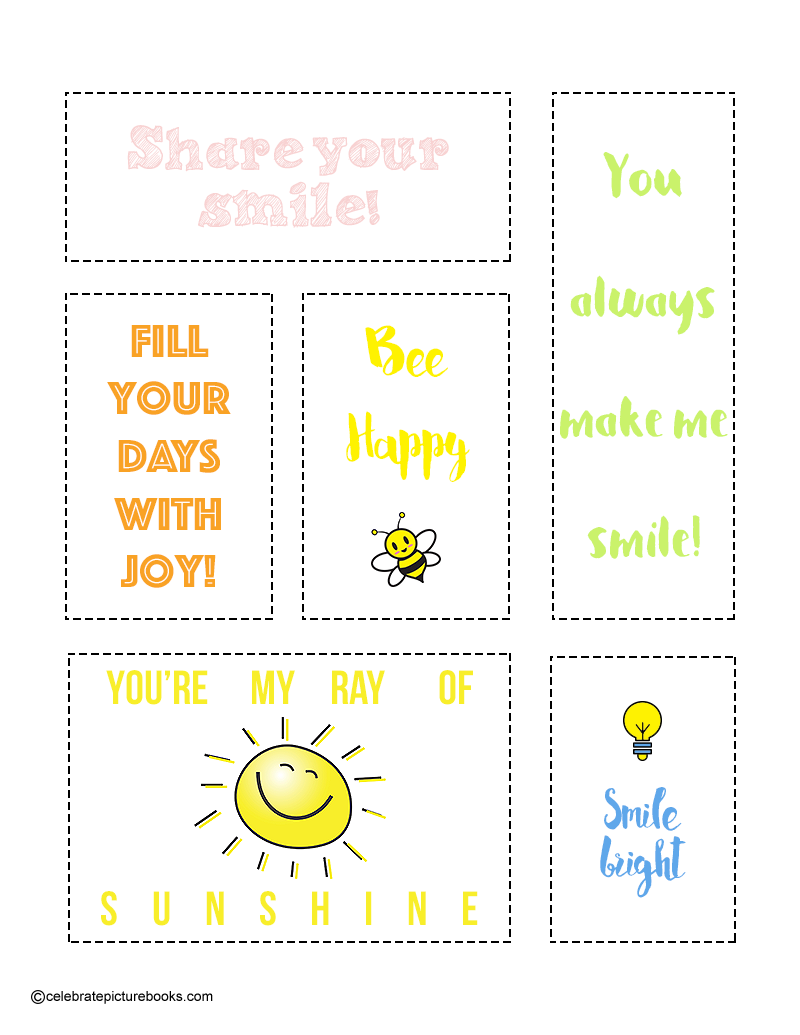
Life is better when you share smiles with those you know—and those you don’t! Try it! When you’re out today at school or other places, look someone in the eye and smile. You’ll probably get a smile back—and you can be sure that you will have made the other person’s and your day better!

Here are some Smile Cards that you can share. Why not slip one into your dad’s pocket or your mom’s purse, put one in your friend’s backpack, or sneak one onto your teacher’s desk? You can even leave one somewhere for a stranger to find! Have fun sharing your smiles, and see how much better you and the others around you feel!

Click here to print your Share a Smile Cards.

celebrate-picture-books-picture-book-review-interview-with-author-deborah-sosin

Photo by Kevin Day Photography

Q&A with Author Deborah Sosin


Today, I’m thrilled to talk with Debbie Sosin, a writer, editor, and clinical social worker who specializes in mindfulness-based psychotherapy, about her first picture book, her choral singing, and how kids respond to her presentations.

In your career you write for adults and children, work within the publishing industry, provide publicity services, and teach. How did you get started? Did you always want to write?

I kept a diary starting at around age ten and always loved writing for school or for fun. I started getting more serious about writing for publication in the past ten years, studied at GrubStreet, attended the Kenyon Review Writers Workshop, and eventually went back to school to get an MFA in Creative Writing. I wish I had started earlier, but it’s been rewarding to finally follow my true passion.

What influenced you to write Charlotte and the Quiet Place?

I wrote the book as an independent project as part of my MFA studies at Lesley University. They say “write what you know,” so I thought about my childhood growing up in kind of a noisy house, where my brother played the piano, my father had a radio and TV on simultaneously, and my mother was on the phone a lot. And then I thought about my longtime meditation practice and how tuning in to my breathing has helped me find a quiet place inside. So I wanted to write a story about children finding their own quiet place inside themselves.

You give school presentations on mindfulness and your picture book Charlotte and the Quiet Place for various ages. Is there an experience from any of these that you would like to share?

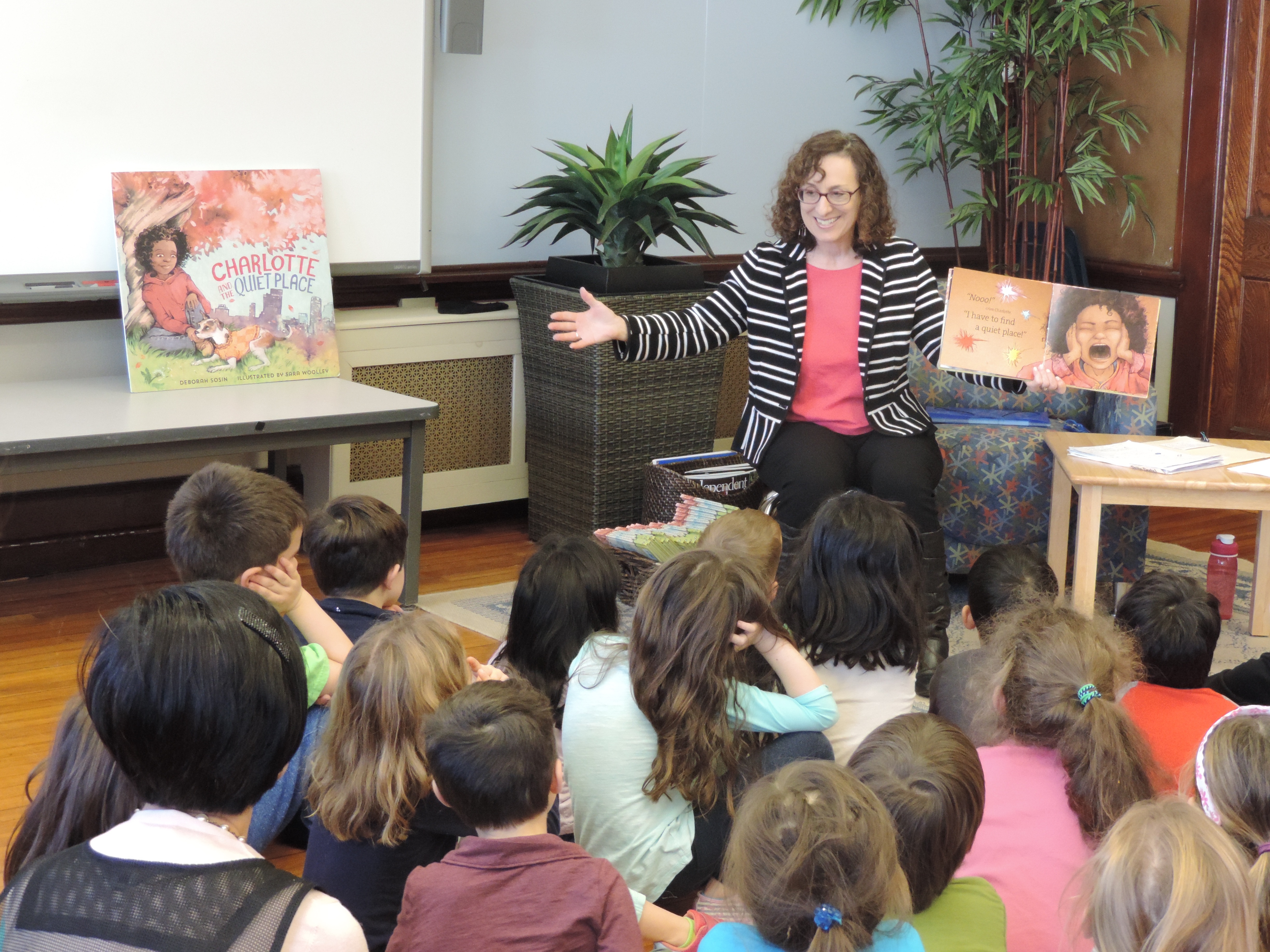
School visits are my favorite part of being an author! No matter what age the students are, they love to help me tell the story by repeating the “noisy” sounds and the “hoo ahh” breathing sounds. We usually do a few calming/breathing exercises together and, without fail, even the squirmiest group will settle into a beautiful, shared, often profound silence. Once, when asked where Charlotte finds her quiet place, one kindergarten girl said, “In her belly and in her brain, where it’s calm.” Many kids get that idea. What could be better? I also love showing them my early scribbles and illustrator Sara Woolley’s wonderful sketches and storyboards, and sharing the step-by-step process of publishing the book, from concept to completion
celebrate-picture-books-picture-book-review-author-deborah-sosin-visits-Newton-Monetssori-School

Deborah Sosin reads Charlotte and the Quiet Place to students at Newton Montessori School. Photo courtesy of Newton Montessori School.

Can you talk a little about mindfulness and how it can benefit children?

Mindfulness has become a catchword these days, but my favorite definition is from Dr. Amy Saltzman: “Noticing what’s happening right here and now, with a friendly, curious attitude, then choosing what to do next.” Many top-notch scientific studies show that mindfulness can help kids with concentration, attention, self-soothing, anxiety, depression, sleep, mood, compassion, confidence…I could go on. Compared with adults, most kids are naturally mindful, that is “in the moment,” but kids do get stressed out and worried about the past or the future, so mindfulness helps. I sometimes worry that parents and teachers might use it for disciplinary reasons (“Enough! Go be mindful in the corner!”), which is not the point. It’s a whole-life practice, not a technique or intervention. And, as the book shows, mindfulness can lead us to a quiet place inside that we can access whenever we want.
celebrate-picture-books-picture-book-review-interview-with-deborah-sosin-debbie-at-cottage-montessori-school

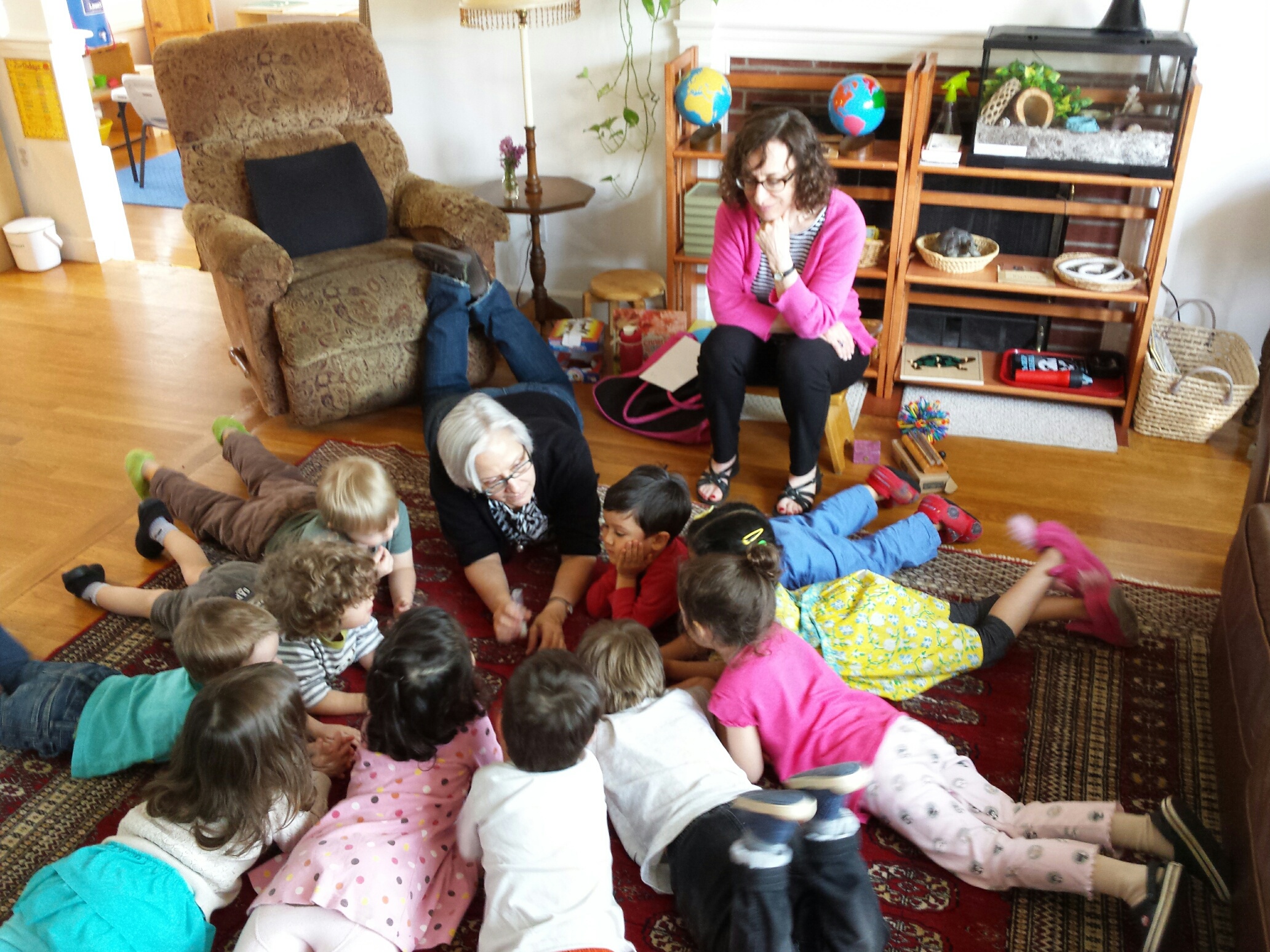
Students at the Cottage Montessori School in Arlington, Massachusetts play the Silence Game with director Karen Wagner, watching the sand in the hourglass. Photo courtesy of Stacey Moriarty.

Can you tell me a little about your work with Grub Street, a creative writing center in Boston?

I started taking classes at GrubStreet in 2008; my first class was “Six Weeks, Six Essays,” and from that class, I helped form a longtime regular writing group. I started blogging soon after and then submitted personal essays for publication, with some good luck. GrubStreet is a fantastic, inclusive community, with excellent faculty and a huge range of motivated, smart, and enthusiastic students, from beginners to veterans. After a few years, I applied to teach classes there and am proud to be on their instructor and consultant rosters now.

You are an accomplished choral singer, having performed at Lincoln Center, the United Nations, Boston’s Symphony Hall, and on an international tour. When did you begin choral singing? Do you have an anecdote you’d like to share from any of your experiences?

I’ve been singing my whole life and have been in choruses since elementary school. Singing with other people is extremely gratifying and, after all the “verbal”-type things I do, including my work as a psychotherapist, it’s a lovely change of pace. I spent about 15 years in the Zamir Chorale of Boston, which specializes in Jewish choral music. Our tours to Eastern Europe, Italy, and Israel were extraordinary. In 1999, when we sang at Auschwitz and Terezin, the sites of former concentration camps, it was hard to keep our emotions in check, but it felt important to revive the voices of the Jewish people that the Nazis had attempted to quell. A PBS documentary film, “Zamir: Jewish Voices Return to Poland,” chronicled our tour that summer. I think it’s still available through the Zamir Chorale website.

What’s the best part about writing for children?

After having focused almost exclusively on nonfiction for most of my writing career, it’s been wonderful to work in the very precise and rich world of picture-book writing with so many lovely, funny, imaginative, and supportive fellow writers I’ve met through SCBWI and the amazing Writers’ Loft in Sherborn, Mass.
celebrate-picture-books-picture-book-review-interview-with-deborah-sosin-debbie-at-The-Oblong-Bookstore-event

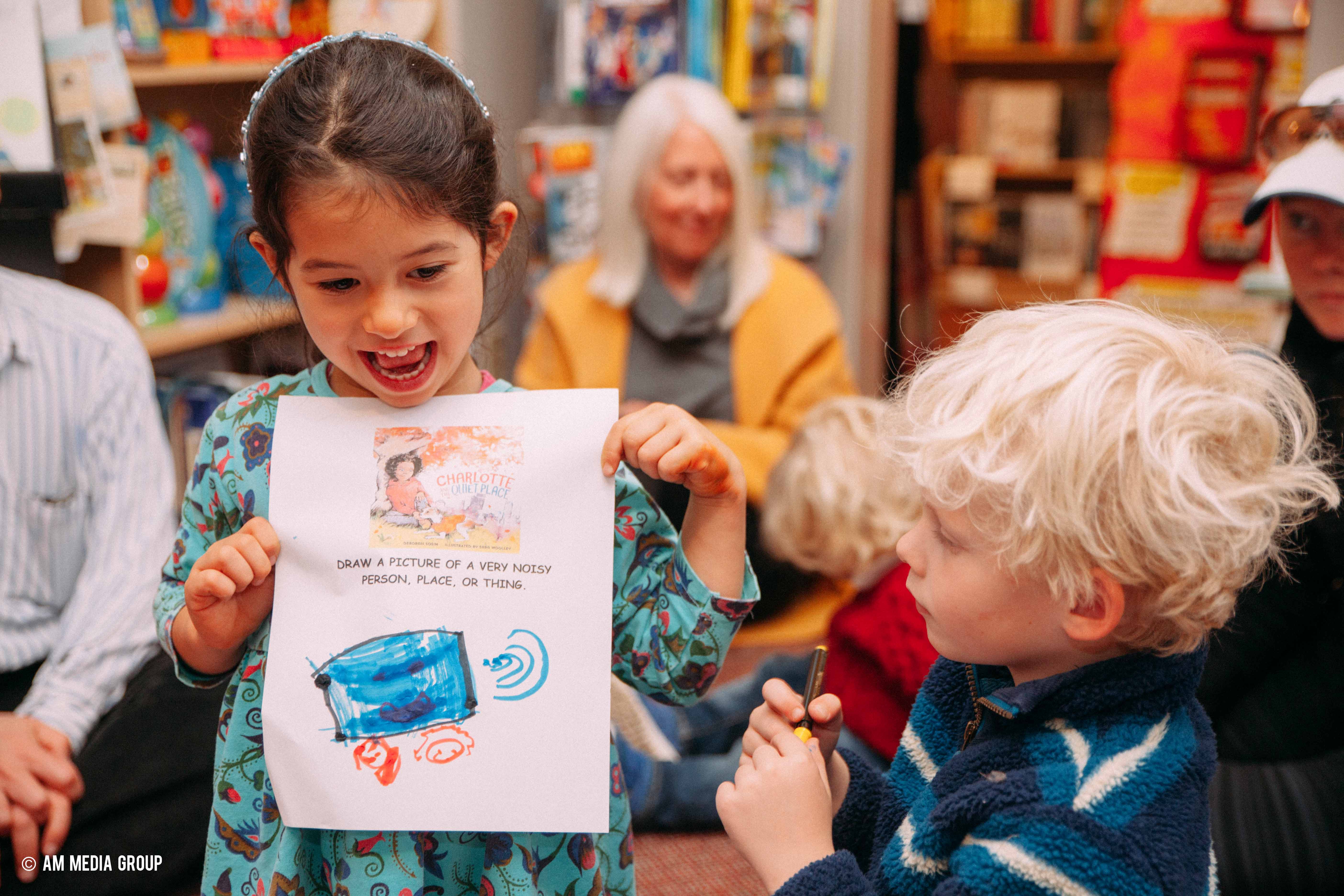
Children enjoy drawing their noisy and quiet places at an Oblong Bookstore event in NY. Photo courtesy of AM Media Group

What’s up next for you?

I have a couple of Picture Book manuscripts in progress and I’m participating in Storystorm (formerly PiBoIdMo) this month, so I hope to generate more ideas and get some new work out there soon.
Since this is a holiday-themed blog, I’d be remiss if I didn’t ask you at least one question about holidays, so…

What is your favorite holiday and why?

Thanksgiving is probably my favorite, as it means getting together with my family, which is now spread far and wide, and having an opportunity to express our gratitude.
Thanks, Debbie, for stopping by and chatting! I wish you all the best with Charlotte and the Quiet Place and all of your future endeavors!

You can connect with Deborah Sosin on

Her Website | charlotteandthequietplace.com | Facebook | Twitter

celebrate-picture-books-picture-book-review-charlotte-and-the-quiet-place-noisy-neighborhood


You can find Charlotte and the Quiet Place at these booksellers

Amazon | Barnes & Noble | Books-a-Million | IndieBound | Parallax Press |Porter Square Books (signed copies available)

Picture Book Review