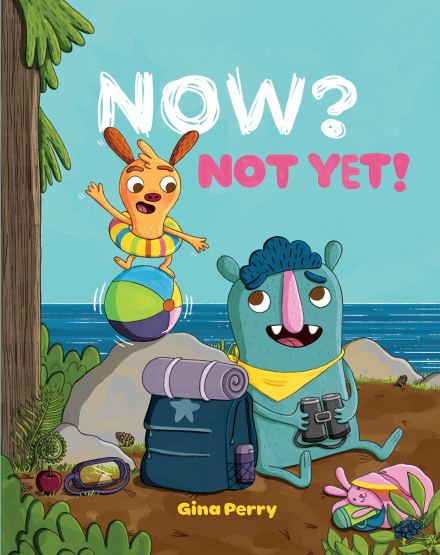
June 4 – It’s National Camping Month and Interview with Author/Illustrator Gina Perry

celebrate-picture-books-picture-book-review-now-not-yet-cover

About the Holiday

For some, camping is the best way to spend a vacation. This month’s holiday celebrates that love of adventure and encourages people to explore some of the gorgeous national parks, campsites, and trails all across the country. Of course, there’s giddy excitement for kids in just setting up a tent in the backyard too. So, whether you camp with an RV, pack up the car with tents and other gear, or just enjoy a different vista at home, enjoy camping this summer – and don’t forget the marshmallows!

Tundra Books sent me a copy of Now? Not Yet! for review consideration. All opinions are my own. I’m thrilled to be teaming with Tundra and Gina Perry in a giveaway of Now? Not Yet! See details below.

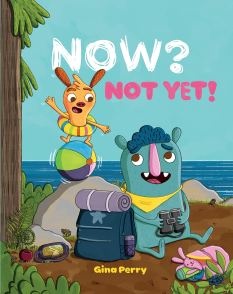
Now? Not Yet!

By Gina Perry


Geared up for camping, Moe and Peanut head down the path that leads into the woods. They’re still within sight of home (only a few steps away, in fact) when Peanut asks, “‘Can we go swimming now?’” But Moe, with his stout walking stick wants to hike a bit first and answers, “‘Not yet.’” Turn the page and Peanut has spied a glimpse of blue water. Now must be the time for swimming, but Moe has his binoculars trained on an owl, so “‘not yet.’”

When they stop for a snack, Peanut unpacks his swim fins, beach ball, floating ring, and bunny toy on the way to finding his apple and banana, while Moe neatly nibbles trail mix from a baggie. A little farther on, Peanut’s so antsy to swim that he’s doing handstands in his swim fins, but the time’s not right now either because Moe thinks they’re lost.
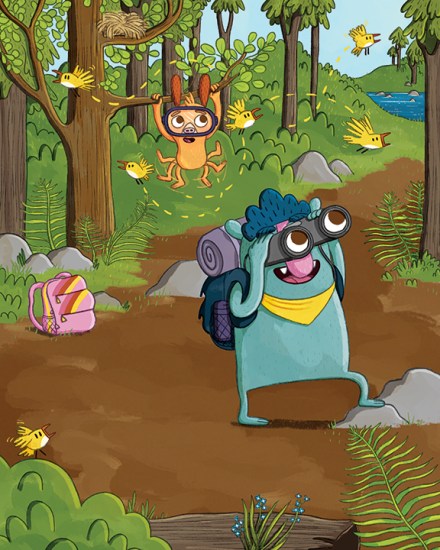
celebrate-picture-books-picture-book-review-now-not-yet-eating-bird-watching

Image copyright Gina Perry, 2019, courtesy of Tundra Books.

Poor Peanut, he falls and comes up covered in pinecones and prickly pine needles, which unfortunately get transferred to Moe. Phew! They’ve found their campsite by the lake, and Peanut begs on his knees to go swimming. “‘Now?’ said Peanut. ‘Not yet,’ said Moe. ‘It’s time to make camp.’” This camp-making is kind of fun, Peanut thinks as he hangs the tent poles between two trees and plays limbo, uses a tent pole to draw a picture of Moe in the dirt, and then toddles on tent-pole stilts. Certainly the campsite must be ready by now. Why can’t they just go swimming? Moe says they “need to set up the tent.”

Peanut is starting to lose his patience, and Moe is starting to lose his patience plus he’s being attacked by mosquitoes. There’s just so much to do before swimming. The backpacks need unpacking, the campfire needs to be built, and… “‘where are the tent poles?’” Peanut has a breakdown—“Now! Now! Now!” And Moe has a breakdown—“NOT YET!”

Moe walks off to cool down while Peanut looks around the toy-strewn campsite sadly. He knows what he has to do. He sets up the tent, hangs up the towels and sets out the teapot and mugs, gathers firewood, and misses Moe. But Moe isn’t far away. He peeks over the tent and stealthily puts on Peanut’s swim mask. “NOW!” he announces while running and leaping into the lake. Peanut cannonballs in after him. They play and splash and finally dry off. Warm and cozy in their PJs next to a crackling fire, they happily eat beans from a can. The sky grows dark and Peanut figures it’s time for bed. But “‘Not yet,’” Moe says. They have one s’more thing to do.
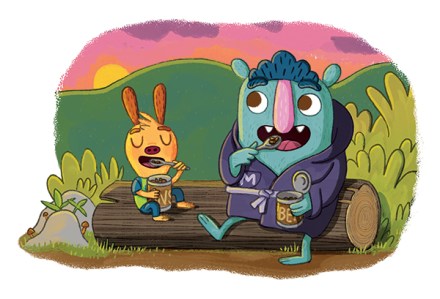
celebrate-picture-books-picture-book-review-now-not-yet-eating-beans

Image copyright Gina Perry, 2019, courtesy of Tundra Books.

In their second story, Moe and Peanut are heading out on an adventure, and like many kids, Peanut is focused on one thing, and one thing only, about the trip—swimming. Meanwhile, Moe is the keeper of all things practical and logistical. As we all know from our own kids or memories, a minute can feel like an hour, an hour like several, and a day like for…ev…er. Gina Perry taps into that feeling with verve and humor drawing out the trip to the campsite with such adult preoccupations as bird watching, map watching, splinter pulling, and the rigors of actually setting up camp. And it’s not that Peanut means to be a bother, he’s just brimming with excitement for fun, fun, fun!

Perry moves these two forces along at a brisk pace with her well-timed traded choruses of “Now?” and “Not yet.” When the clash comes in a two-page spread where each loses their cool in nearly mirror images, both kids and adults will laugh at the truth of it all. As Moe walks off and Peanut takes up the work of setting up camp, adults will understand that their kids are watching, learning, and empathetic, and kids will feel empowered to take control of their feelings and help out. The final pages showing Moe and Peanut swimming and enjoying the campfire offer reconciliation and that fun, fun, fun, Peanut (and Moe) were looking for.

Perry’s art is always bright and inviting and full of clever details. Kids will love Peanut’s antics, toy-laden backpack, and talent with tent poles, while adults will sympathize with Moe who suffers the slings and arrows of mosquitoes, sunburn, and passed-off splinters. The front endpaper depicts Moe and Peanut’s hike from home, through the woods, and to the campsite; the back endpaper portrays Peanut’s drawing of the same hike.

A funny, sweet-natured story that adults and kids will love to share, Now? Not Yet! is an endearing summer read and a must to join Too Much? Not Enough! on home, classroom, and library bookshelves.

Ages 3 – 7

Tundra Books, 2019 | ISBN 978-1101919521

To learn more about Gina Perry, her books, and her art, visit her website.

Meet Gina Perry

GPerry_HeadShotGREENsm

I’m so thrilled to be chatting with Gina Perry about her inspirations for Moe and Peanut, this duo’s inclusion in Dolly Parton’s Imagination Library, her early work in the scrapbooking market, and so much more!

Both Moe and Peanut are so sweet-natured. They just have different priorities sometimes. What or who inspired these characters and their particular adventures at home (Too Much! Not Enough!) and while camping (Now? Not Yet!)?

I think that is a lovely way to sum up Moe and Peanut. Their base personalities formed long ago from a lot of playing in my sketchbook. Moe is rooted in myself and other adults who do love play, but in a structured way. Peanut is rooted in all the little energetic kids I knew before having my own children, particularly my niece and nephew.  Their specific adventures are definitely inspired by my own kids. Indoor messes on rainy days, bubble faces, block towers—I had plenty of inspiration for that while raising my son and daughter. And I dedicated NOW? NOT YET! to Piper because of her super-charged love of play and swimming.

Are you a Moe, a Peanut or a little of both? In what way?

I am far more like Moe because I don’t leave home without the map, enjoy looking at birds, and also get a red face when dealing with mosquitos and stress. But the Peanut side of me also loves lakes and drawing in the dirt. I think because I was the youngest and my sisters were four and eight years older, I really remember feeling like a pesky little sister when I was the age of my readers.

In Now? Not Yet! Moe and Peanut go camping. Do you like camping? If so, are you a glamper or a traditional camper? What’s your favorite part of camping?

Camping confession: I have never slept outside! I found bear droppings in our backyard last month so I’m not sure I’ll check the box on backyard camping anytime soon, either. I do love going for day hikes and fondly remember lots of family vacations at rustic cabins on lakes in New Hampshire and Maine. I’ve definitely experienced all parts of Peanut and Moe’s adventure—note how we end the story before bedtime! My favorite part when I’m on a hike is spotting animals. I’m still waiting to see a moose in real life, but I snuck one in the book as an homage to a childhood dream.

Your artistic style is so distinctive—I immediately recognize an illustration as yours before I see your name on it. Can you talk a little about how you developed your style? What changes did Peanut and Moe go through as you worked on Too Much! Not Enough!?

That is a lovely compliment – thank you! I’ve been through lots of experimenting with my illustration style. I think always being willing to try new approaches and following lots of other illustrators and artists has helped me land where I am now. I really enjoy creating very simple but distinct characters and then letting the colors take over. The basic character design for Peanut and Moe was pretty solid early on (and many years before they were published!) but I do appreciate that I had time and confidence to try some bolder color choices that I think made their story shine.
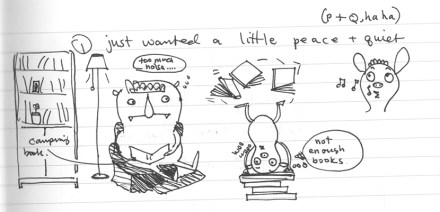
GPerry_oldsketch

My editor smartly suggested that we up the level of mess from my dummy. The addition of all those block, glitter, and car elements really improved the book, and the narrow color palette made it still feel friendly even at its messiest. In their first book, I wanted to maintain a cheerful, bold color palette despite the rainy day. In their second book I worried how I would continue that color story in the outdoors. I chose to keep their environment in bright, but natural colors and played up that first color palette in their gear and clothing. I loved designing their evening attire!

This year Too Much! Not Enough! was selected for Dolly Parton’s Imagination Library. Can you tell readers about this program and how your book was chosen? What does it mean for Moe and Peanut?
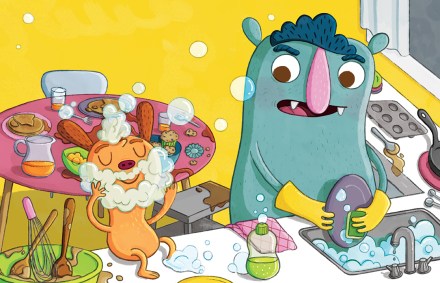
celebrate-picture-books-picture-book-review-too-much-not-enough-washing-dishes

Moe and Peanut do the dishes in Too Much? Not Enough!

I am so thrilled that TOO MUCH! was chosen for this amazing book gifting program that delivers a new book each month for a child from birth to school age. Imagination Library now has programs across the US, UK, Canada, Australia, and Ireland and has mailed over 120 million books at no cost to families. Their Blue Ribbon Committees review and select titles based on their themes and concepts and aligned to one of five age groups. The website does an amazing job describing the program and how books are chosen and I hope all new or expecting parents look into this opportunity for their child. It means that this year, Peanut and Moe will be heading to thousands of young children (2-3 years of age) across Canada. Having so many new readers meet Moe and Peanut is exciting!

Before you concentrated on writing and illustrating books for children, you worked in animation and as an art director for the scrapbooking market. I’ve always wondered how some patterns of paper come to be. What is the process behind creating scrapbook paper and how certain subjects, colors, and designs are chosen.

When I started at that first scrapbooking company they were transitioning from a stencil-based business. The scrapbooking market was booming back then and it was a great opportunity for me to learn a totally new area and get experience as an illustrator. There was a lot of trial and error in figuring out how to make appealing and usable patterns that could be mixed and matched. We tracked fashion and illustration trends by going to trade shows and even shopping trips. Some collections were fashion based, others revolved around the events you would put in a scrapbook – birthdays, weddings, holidays, etc. It was a collaborative process involving designers, art directors, and the sales teams. My favorite job was finding new illustrators to work with, giving them a brief, then seeing the magic they sent back.

I saw on your blog that this year you participated in World Read Aloud Day by having Skype calls with students in New York, Connecticut, Texas, Florida, and Ukraine! That’s a lot of kids to reach! They must be thrilled! Can you talk a little about what you like about Skype calls, what you do during the calls, and how the kids react?
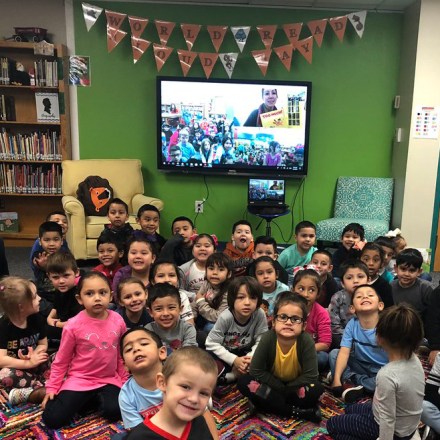
celebrate-picture-books-picture-book-review-too-much-not-enough-Gina-Perry-Skype-visit

A class listens to Gina Perry on World Read Aloud Day.

World Read Aloud Day is amazing. I encourage all authors to participate. I spend so much time working alone (especially in the winter!), that it’s a real gift to open up Skype and connect to a classroom full of enthusiastic readers. It’s usually a 20-minute call and most authors follow this formula: read one of your books, take questions from students, then share a few favorite books by other authors. But the variation is in the kids! How do they react to my book and what interesting questions do they have? Kids are so creative and often think of things I haven’t or share personal connections to a character or even to my story about being an illustrator and author.

What’s up next for you?

I have been squirreling away on some fun new projects that I can’t say too much about at the moment. I will say that one book was very much inspired by my school visits and drawing with kids. Another is inspired by welcoming a new puppy into our home this year.

What’s your favorite holiday and why?

I don’t know how you can compete with Halloween. The candy, creative costumes, spooky decorations, all-are-welcome and low-pressure vibe really make it a winner. And did I mention candy?

Thanks, Gina for joining me today! Happy Book Birthday to Moe and Peanut and Now? Not Yet! I wish you all the best with this series and all of your books and can’t wait to see what comes next!

You can connect with Gina Perry on

Her website | Facebook | Instagram | Pinterest | Twitter

National Camping Month Activity
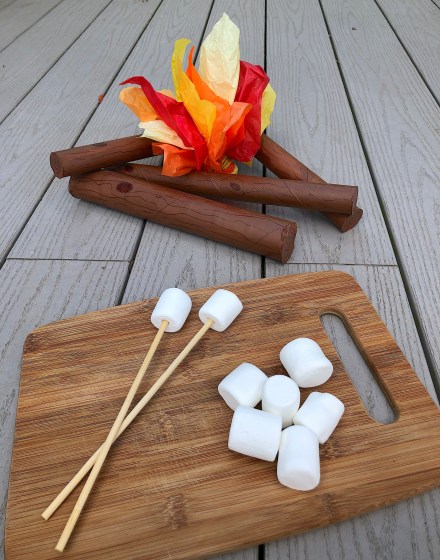
CPB - campfire craft 2

A Fun In-Home Campfire


Kids and their friends and family can enjoy the cozy fun of a campfire in their own family room with this craft that’s easy to make from recycled materials. While the supplies might make the campfire artificial, kids will love it if the marshmallows are the real thing!

Supplies

  • Three or four paper or cardboard tubes
  • Cylindrical bread crumbs or oatmeal container
  • Tissue paper in red, orange, and yellow
  • Brown craft paint
  • Brown marker
  • Brown construction paper or white paper
  • Strong glue or hot glue gun
  • Chopsticks (one for each person)
  • Marshmallows

CPB - campfire craft container

Directions

To Make the Logs

  1. Cover the ends of the tubes with circles of brown construction paper or white paper and glue into place
  2. Paint the tubes and the ends if needed, let dry
  3. Paint the sides of the cylindrical container with the brown paint, let dry
  4. With the marker draw tree rings on the ends of the tubes. Decorate the sides with wavy lines, adding a few knot holes and swirls.

To Make the Fire

  1. Cut 9 squares from the tissue paper (3 in each color, about 8 to 6-inch square)
  2. Layer the colors and gather them together at one tip. Fold over and hold them together with a rubber band.
  3. To Assemble the Campfire
  4. Stack the tube logs
  5. Put the tissue paper fire in the middle of the logs

To “Roast” Marshmallows

  1. Stick marshmallows on chopsticks for “roasting” and eating!

You can keep your logs and fire in the cylindrical log until the next time!
celebrate-picture-books-picture-book-review-now-not-yet-cover

You can find Now? Not Yet! at these booksellers

Amazon | Barnes & Noble | Books-a-Million | IndieBound

Picture Book Review

May 31 – Web Designer Day

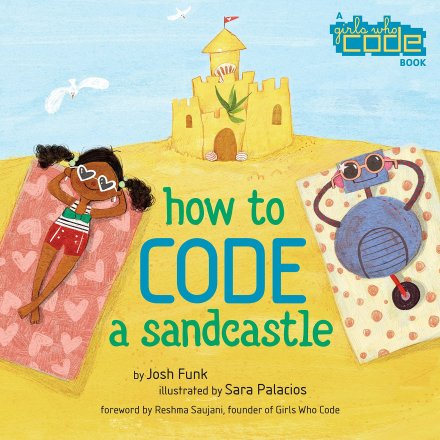
celebrate-picture-books-picture-book-review-how-to-code-a-sandcastle-cover

About the Holiday

With Memorial Day just past, it’s officially summer. Soon kids will be getting out of school and enjoying the beach and/or camp. A favorite summer past time is computer camp, which is a perfect mashup of fun and learning. Today’s holiday celebrates all of the inventive web designers who create clear, workable, and enjoyable sites where we can shop, get the latest news, watch videos, play games, and so much more. Our computers, phones, and tablets are so interwoven with our daily routine that we can’t even imagine life without them anymore. All that designing and coding takes specialized knowledge, education, and skill. If you know a web designer, thank them for their hard work—and if you know a child (or perhaps even yourself) who would like a career in coding or web design, get them started with a class or two—and today’s book!

How to Code a Sandcastle

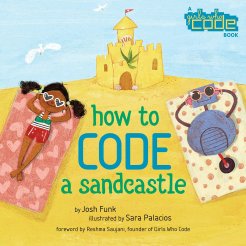
Written by Josh Funk | Illustrated by Sara Palacios


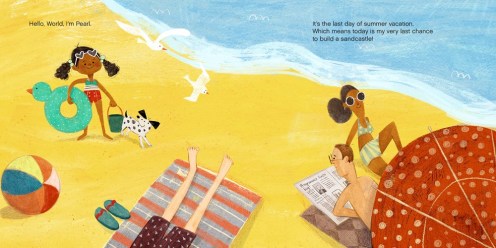
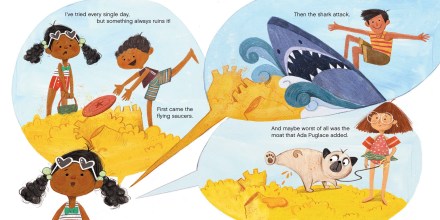
It’s the last day of Pearl’s summer vacation, and she’s hit the beach with her parents. Her goal is to build a sandcastle. It’s not like she hasn’t tried on other beach days, but there was always something that destroyed it. There was the frisbee that landed on top of it, then a surfer glided right into it, and another girl’s dog, Ada Puglace, thought it needed a moat. But today, Pearl brought her robot, Pascal, to build her sandcastle.

celebrate-picture-books-picture-book-review-how-to-code-a-sandcastle-ruined-sandcastles

Image copyright Sara Palacios, 2018, text copyright Josh Funk, 2018. Courtesy of Viking Books for Young Readers.

As Pearl explains, “He’ll do whatever I tell him—as long as I tell him in code. It’s not a secret code—it’s special instructions that computers understand.” Pearl points out the perfect spot on the beach for her sandcastle and tells Pascal to build it. But Pascal doesn’t move. Pearl realizes that she must break down the one big request into smaller problems for Pascal to solve. Easy-Peasy, Pearl thinks.

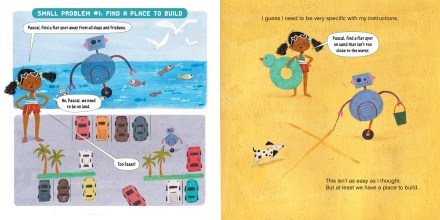
The first problem Pearl gives Pascal is: “find a place to build.” First Pascal travels out to sea, but Pearl tells him they must build on land. So Pascal rolls out into the parking lot. Hmmm…that’s not right either. Pearl decides she must be “very specific with my instructions.” When she tells Pascal to “find a flat spot on sand that isn’t too close to the water,” he marks an X on a perfect sandy spot. Great!

celebrate-picture-books-picture-book-review-how-to-code-a-sandcastle-small-problem-1

Image copyright Sara Palacios, 2018, text copyright Josh Funk, 2018. Courtesy of Viking Books for Young Readers.

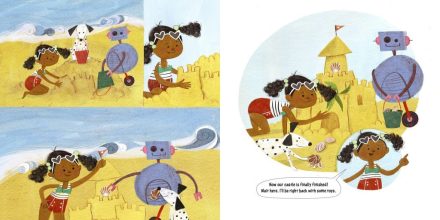
The second problem Pearl gives Pascal is to “gather up sand.” She’s learned to be very particular in her instructions, so she gives her robot a three-step process: “Fill the pail with sand, dump the sand on our spot, pat the sand down.” This works just right, so Pearl continues telling Pascal the directions, until she grows tired of speaking.

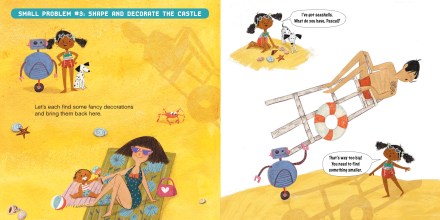
There must be a better way, Pearl thinks. How about a loop? Pearl directs Pascal to “loop through this sequence,” and just like that Pascal is off and rolling and Pearl gets to relax. A while later, Pearl discovers that Pascal had built a pyramid-high pile of sand, so Pearl tells him to stop. Next, they will “shape and decorate the castle.” Pearl comes back with pretty seashells to add to the castle, while Pascal brings back the lifeguard—in his chair. Pearl orders Pascal to bring back something smaller. When he comes back with a crab, she tells him it must be something that doesn’t move, and when he shows up with a baby’s pacifier, Pearl knows she must do a better job of explaining.

celebrate-picture-books-picture-book-review-how-to-code-a-sandcastle-small-problem-3

Image copyright Sara Palacios, 2018, text copyright Josh Funk, 2018. Courtesy of Viking Books for Young Readers.

She decides to give him “if—then—else” instructions. With these detailed directions, Pascal returns with a shell and some seaweed. Finally, it’s time to shape the castle. They use their buckets and hands to build a beautiful castle that even has a turret. The shells, rocks, and seaweed are the perfect finishing touches. With the castle finally finished, Pearl runs off to get her toys.

But when she gets back, Pearl discovers that the rising tide has washed their sandcastle out to sea. And to make matters worse, Ada Puglace is back to add another moat. Hmmm… a moat? Pearl thinks. That’s what she needed the first time. Pearl really wants to rebuild, but it took her half a day to make the first one. Then she realizes that the code is already written. All she has to do is use it again. In no time a new sandcastle stands gleaming on the beach.

There’s just one more problem to solve. Quickly, Pearl gives Pascal a new looped sequence to dig the moat. Now it’s time to play—or “code an entire kingdom!”

celebrate-picture-books-picture-book-review-how-to-code-a-sandcastle-finished-castle

Image copyright Sara Palacios, 2018, text copyright Josh Funk, 2018. Courtesy of Viking Books for Young Readers.

A Foreward written by Reshma Saujani, the founder of Girls Who Code, introduces readers to this organization that is “working to close the gender gap in technology” and get girls of all ages excited about coding and future opportunities in science and technology. 

Pearl and Pascal’s Guide to Coding with brief discussions of Code, Sequence, Loops, and If-Then-Else follows the text.

With his infectious enthusiasm and talent to reach kids in new and innovative ways, Josh Funk, a computer programmer by day and super writer by night, is a perfect guide to the joys of coding for young learners. Taking kids out to the beach for a bit of sandcastle building—an endeavor that is often fraught with dangers—is a terrific way to show the procedures and power of coding. Pearl’s initial missteps in programming Pascal provide laugh-out-loud moments while also demonstrating that computer programs work with precise instructions. Her inexperience but quick learning will give readers confidence in their own abilities to code and where to look for problems if their program does not run as smoothly as they’d like. When high tide washes Pearl and Pascal’s sandcastle out to sea, readers may groan in empathy, but the opportunity to do it all again—only bigger and better—will make them cheer.

celebrate-picture-books-picture-book-review-how-to-code-a-sandcastle-last-day

Image copyright Sara Palacios, 2018, text copyright Josh Funk, 2018. Courtesy of Viking Books for Young Readers.

Sara Palacios’s golden beach is a wide-open and inviting platform to introduce the world of computer programming to young readers. Sunny and enthusiastic, Pearl, in her heart-shaped sunglasses, is persistent and smart in figuring out just how to make Pascal do what she wants. Pascal is a round, rolling cutie, perpetually happy to perform its duties. Series of panels and speech bubbles depict each instruction Pearl gives Pascal, clearly showing readers how coding and a computer’s response to its instructions work. Sequence loops are cleverly portrayed with typeface that creates a circle around Pearl’s floating ring and later around the trench that will surround the castle and become the moat. The final image of Pearl and Pascal celebrating their successful day together is powerful encouragement that a new day of girls and women in technology and science is on the horizon.

Coding a Sandcastle is a motivating combination of lighthearted fun and accessible education that will encourage girls—and boys—to get involved with computer coding just for their own enjoyment or as a future profession. It’s a must for school media and computer class libraries, and with this book on home bookshelves, kids won’t want to just play on the computer—they’ll be asking to program too.

Ages 4 – 8

Viking Books for Young Readers, 2018 | ISBN 978-0425291986

Discover more about Josh Funk and his books and find lots of fun activities to do too on his website.

To learn more about Sara Palacios, her books, and her art, visit her website.

Web Designer Day Activity

celebrate-picture-books-picture-book-review-bringing-the-outside-in-painted-pails-craft

Personalized Painted Pail


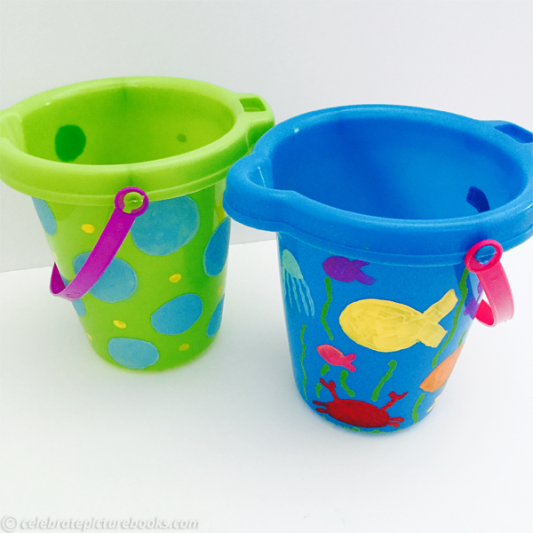
A trip to the beach or park isn’t complete without a pail to collect shells, seaweed, sea glass, pebbles, sticks, nuts, or other things in. But why should all the cool stuff be on the inside? With this craft you can decorate your pail to show your unique personality!

Supplies

  • Plastic or metal pail
  • Craft paint in various colors
  • Crystal Clear Acrylic Coating, for multi-surface use
  • Paint brush

Directions

  1. Paint designs on the pail
  2. When paint is dry spray with acrylic coating to set paint
  3. Let dry

celebrate-picture-books-picture-book-review-how-to-code-a-sandcastle-cover

You can find How to Code a Sandcastle at these booksellers

Amazon | Barnes & Noble | Books-a-Million | IndieBound

Picture Book Review
May 30 – National Water a Flower Day

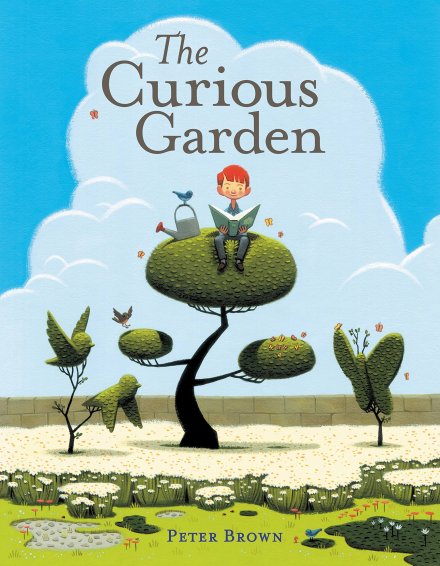
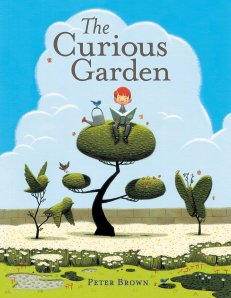
celebrate-picture-books-picture-book-review-the-curious-garden-cover

About the Holiday

If the showers of April have dried up where you are and the May flowers are getting a bit thirsty, today’s holiday makes the perfect reminder to fill the watering can or turn on the sprinkler and give them a drink. Colorful flowers are some of the joys of summer and provide food for birds and insects all season long. If you haven’t begun your garden yet, it’s not too late! Grab a packet of seeds or visit your local nursery and see what a wonderful, wild patch you can grow!

The Curious Garden

By Peter Brown


“There once was a city without gardens or trees or greenery of any kind.” People didn’t notice because they spent most of their time inside—working, going to school, or at home. “As you can imagine, it was a very dreary place.” There was one boy, though, who loved being outside. One rainy day Liam discovered a stairway leading to a bridge that held unused railway tracks. Of course, he was curious, and when he reached the top he discovered a scrawny patch of wildflowers. They needed water; they needed a gardener.

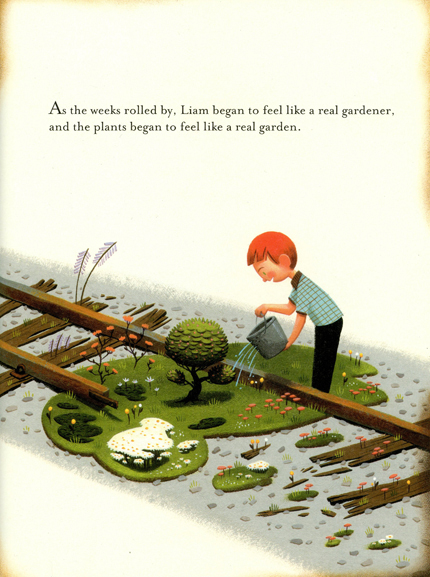
celebrate-picture-books-picture-book-review-the-curious-garden-railway-tracks

Copyright Peter Brown, 2009, courtesy of Little, Brown Books for Young Readers.

Liam wasn’t officially a gardener, “but he knew that he could help.” After a few false starts and a mis-snip here and there, the plants began to look better. After several weeks, “Liam began to feel like a real gardener, and the plants began to feel like a real garden.” Now that the garden was healthy, it began to be curious about what lay up and down the railway track. The weeds and mosses crept down the tracks while the “more delicate plants” plucked up their courage and followed. During the next few months, Liam and the garden explored all the nooks and crannies of the railway bridge. Liam looked out over his city with a new perspective.

When winter came, the garden lay under a blanket of snow and Liam stayed below, sledding and preparing for spring. With warmer weather, Liam gathered his new shovel, hoe, pruners, and watering can in his red wheelbarrow and went back to the railway. “Winter had taken a toll on the garden.” The grass and moss were brown, the flowers were just brittle twigs, and the little tree was dull and unkept. But Liam watered, snipped, and even sang to the plants, and soon they “awoke from their winter sleep.”

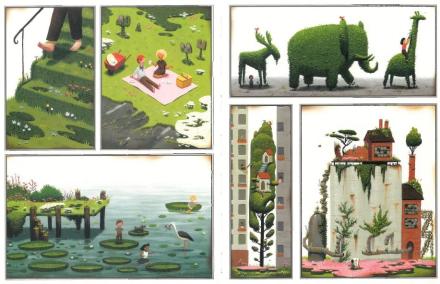
celebrate-picture-books-picture-book-review-the-curious-garden-garden-spreads

Copyright Peter Brown, 2009, courtesy of Little, Brown Books for Young Readers.

Now the garden was even more curious about the rest of the city, and the brave weeds and mosses led the way. “They popped up farther and farther from the railway and were closely followed by the more delicate plants.” They explored “old, forgotten things,” wiggled their way into sidewalk cracks, and even poked their heads out of broken basement windows. When some plants planted themselves where they didn’t belong, Liam moved them. He also began leaving them in surprising spots around town.

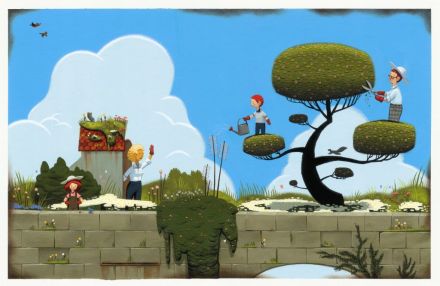
This led to an even more surprising thing: new gardeners also popped up all over the city. Now there were rooftop gardens, backyard gardens, and even gardens that climbed walls. Plants created soft carpets for stairs, huge lily pad boats, an animal parade, and high-rise tree houses for neighbors to share. “Many years later, the entire city had blossomed.” But Liam still loved his patch on the railway line the best.

An Author’s Note following the text reveals the true-life inspiration for the story.

celebrate-picture-books-picture-book-review-the-curious-garden-years-later

Copyright Peter Brown, 2009, courtesy of Little, Brown Books for Young Readers.

Peter Brown’s classic story about a little boy who brings new life to a city that has shut itself off from the natural world, reminds readers of the importance of the environment and getting outside to enjoy it and participate in its survival and growth. But Brown’s story is about so much more too. As Liam’s garden begins to branch out, readers see how one person can be instrumental in spreading ideas, happiness, good news, kindness, in fact any number of life-changing events. In the title and the description of the garden, Brown taps into a dual nature of “curious.” What may seem odd or new or even forgotten sparks interest and exploration and new, often better, perspectives that can bring people together.

Brown opens the story with a two-page, aerial-view spread of the drab city dotted in only two places with a bit of color and giving readers a bit of foreshadowing of the transformation to come. The scrubby patch of greenery next to the rotted tracks includes a tiny tree, cleverly imbued with personality. As the garden spreads, kids will love hunting for the itty-bitty birds, bees, and beetles that appear among the colorful flowers. Kids will “ooh” and “ahh” over the pages that show how and where the garden has spread (a parking lot reclamation is a bright spot) and its influence on new gardeners. The final spread completes the promise held in the first and is a true showstopper.

Ages 4 – 9

Little, Brown Books for Young Readers, 2009 | ISBN 978-0316015479

To learn more about Peter Brown, his books, and his art, visit his website.

National Water a Flower Day Activity

celebrate-picture-books-picture-book-spoon-flowers

Spoon Flowers Craft


Plastic spoons aren’t just for enjoying yummy treats, they make cute flowers too! With this easy and quick craft, you can give everyone you love a bouquet!

Supplies

  • Colorful plastic spoons
  • Heavy stock paper or construction paper in various colors, including green for leaves
  • Multi-surface glue or hot glue gun

Directions

  1. Cut petals from the heavy stock paper or construction paper
  2. Glue the petals to the bowl of the spoon
  3. Cut leaves from the green paper (optional)
  4. Glue leaves to the handle of the spoon (optional)

celebrate-picture-books-picture-book-review-the-curious-garden-cover

You can find The Curious Garden at these booksellers

Amazon | Barnes & Noble | Books-a-Million

To support your local independent bookstore, order from

Bookshop | IndieBound

Picture Book Review


May 16 – National Love a Tree Day

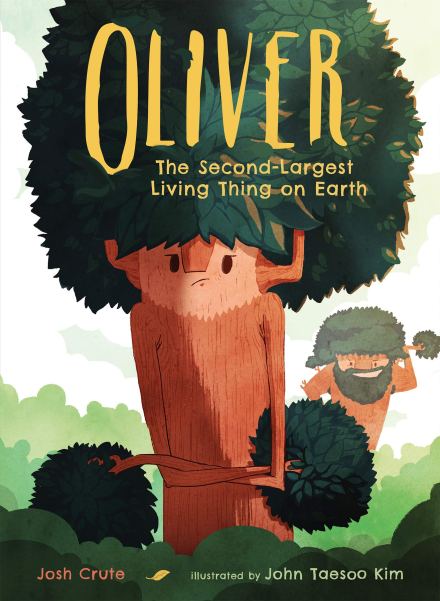
celebrate-picture-books-picture-book-review-oliver-the-second-largest-living-thing-on-earth-cover

About the Holiday

Trees are some of the most majestic, surprising, and giving things on Earth. The glorious beauties that make up our forests provide shelter, shade, and food to countless birds and animals and fruit trees around the world provide nutrition all year long. Trees’ root systems hold soil in place, and their leafy branches work as wind breaks on flat prairie land. The foliage of trees and plants provide us with oxygen and clean our air. Today, we celebrate all of these benefits and more. To participate, consider planting a tree in your own yard or contributing to an organization dedicated to protecting our forestland.

Oliver, The Second-Largest Living Thing on Earth

Written by Josh Crute | Illustrated by John Taesoo Kim


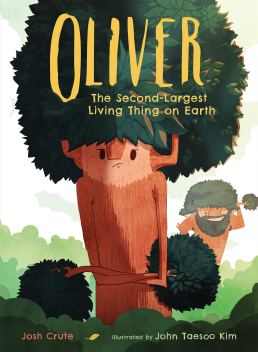
Sherman towers over all the other trees in the forest. In fact, “he is the largest living thing on Earth, and, boy does he know it.” A sign at the base of his trunk even proves it. People from all over the world come to see him, take pictures, stretch their arms around a tiiiny part of him, and even eat their lunch nestled next to his roots.

celebrate-picture-books-picture-book-review-oliver-the-second-largest-living-thing-on-earth-sherman

Image copyright John Taesoo Kim, 2019, text copyright Josh Crute, 2019. Courtesy of Page Street Kids.

There’s another tall tree in the forest—Oliver. “He is the second-largest living thing on Earth, but there isn’t a sign for that.” Visitors to the forest hardly give him the time of day, and even though he’s 268.1 feet tall, “he often feels invisible.” One day, he decides he was going to change the dynamics. All year long, he worked on growing bigger—and he did. Unfortunately, Sherman had also grown.

celebrate-picture-books-picture-book-review-oliver-the-second-largest-living-thing-on-earth-work-out

Image copyright John Taesoo Kim, 2019, text copyright Josh Crute, 2019. Courtesy of johntaesookim.com.

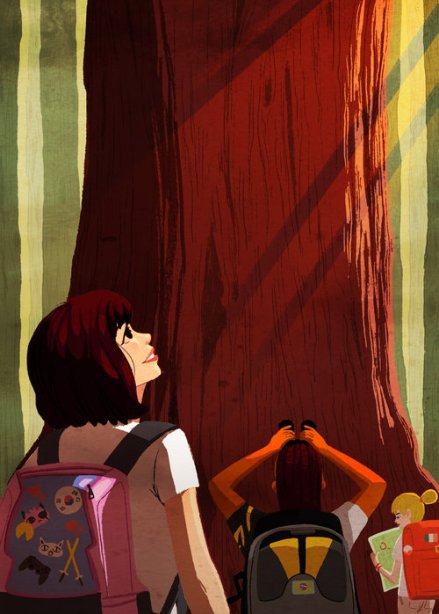
“Oliver wilted.” And while he was bent over, he noticed Agnes. Agnes “is the third-largest living thing on Earth” and stands 240.9 feet tall. But she wasn’t all Oliver saw. There was also Gertrude, Peter, Guadalupe, and Lars—all in descending order. “Oliver waved shyly.” Suddenly, Oliver had a change in perspective. Now, he stands proud and happy because he realizes “he is part of something larger”— the Sequoia National Forest.

Back matter reveals that even General Sherman isn’t the largest living thing on Earth—that distinction goes to the Humongous Fungus in Oregon. It also includes a discussion about sequoias as well as several other first- and second-largest things on Earth.

Image copyright John Taesoo Kim, 2019, text copyright Josh Crute, 2019. Courtesy of johntaesookim.com.

Image copyright John Taesoo Kim, 2019, text copyright Josh Crute, 2019. Courtesy of johntaesookim.com.

In his spare, but compelling story, Josh Crute reveals a truth that often gets overlooked in the competitive nature of the world today: no matter how hard one works to be the best, the biggest, or the most renowned, there is usually someone or an up-and-comer who can or will best them. Crute ingeniously uses the example of the Sequoia National Forest to show readers that true happiness comes from doing their best, being true to themselves, and recognizing that they are an important part of something bigger, which might include their group of friends, their class, a team, an organization, and definitely their family and the world at large.

John Taesoo Kim’s anthropomorphic trees include the actual General Sherman Sequoia, here with a muscular-looking trunk and sporting a leafy hairdo and beard along with bushy hands and several offshoots. Images of people with arms outstretched and sitting at the base of Sherman will impress kids with this tree’s grandeur. Oliver, with striking foliage of his own, appears thinner even though he too towers over the other trees. His work-out routine shows results, encouraging children to develop their own talents and personal style. When Oliver notices all the other tall trees in the forest, this confident crew—made up of all different sizes and personalities—shows him that they all have their place and role in the forest.

A straightforward and reassuring look at how readers can consider their place in the world, Oliver: The Second-Largest Living Thing on Earth would be a welcome addition to home, classroom, and public library collections.

Ages 4 – 8

Page Street Kids, 2019 | ISBN 978-1624145773

To learn more about John Taesoo Kim, his art, and his animation, visit his website.

National Love a Tree Day Activity

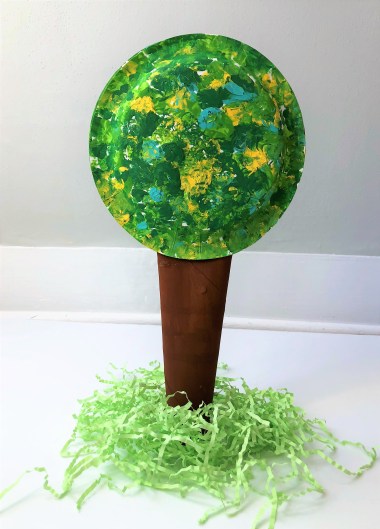
celebrate-picture-books-picture-book-review-paper-plate-tree-craft-2

Paper Plate Tree


On Earth Day children love planting trees in their yard or as part of a community project. With this easy craft, they can also plant a tree on their wall or bulletin board.

Supplies

  • Two paper plates 
  • Paper towel tube
  • Brown craft paint
  • Green craft paint (using a variety of green paints adds interest)
  • Paintbrush, cork, or cut carrot can be used to apply paint
  • Glue or hot glue gun or stapler

Directions

  1. Paint the paper towel tube brown, let dry
  2. Paint the bottoms of the two paper plates with the green (or other color) paints, let dry
  3. Flatten about 4 inches of the paper towel tube 
  4. Glue or tape the flat part of the paper towel tube to the unpainted side of one paper plate
  5. Glue the edges of the two paper plates together, let dry.
  6. Straighten the tree so that it can stand up, or hang your tree on a wall, bulletin board, in a window

celebrate-picture-books-picture-book-review-oliver-the-second-largest-living-thing-on-earth-cover

You can find Oliver: The Second-Largest Living Thing on Earth at these booksellers

Amazon | Barnes & Noble | Books-a-Million | IndieBound

Picture Book Review
May 15 – National Dinosaur Day

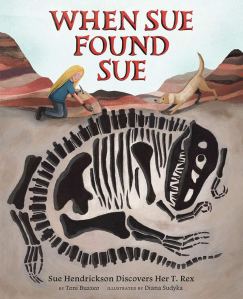
celebrate-picture-books-picture-book-review-when-sue-found-sue-cover

About the Holiday

Today, we celebrate dinosaurs—those beasts that, although they are of a distant past, remain ever present in our hearts. Their size, diversity, and shear awesomeness make them a favorite of kids, and ongoing discoveries continue to fascinate adults as well. Dinosaurs, in fact, are so huge that Dinosaur Day takes place twice—today and on June 1. To celebrate, visit a national history museum, watch your favorite dinosaur movies or TV shows, join your kids in playing with their dinos (you know you want to!), and pick up today’s book!

When Sue Found Sue: Sue Hendrickson Discovers Her T. Rex

Written by Toni Buzzeo | Illustrated by Diana Sudyka


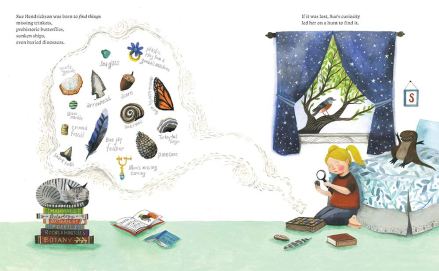
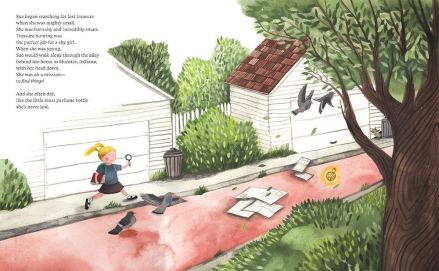
Sue Hendrickson was an expert at finding things. The lure of buried or lost treasures kept her busy in her hometown of Munster, Indiana. “Born shy and incredibly smart,” Sue devoured books, discovering everything she could about the things that interested her. One of her favorite places was the Field Museum of Natural History in Chicago. There, she reveled in the treasures others had found and dreamed of the day when she could “search the wide world for hidden treasure on her own.”

celebrate-picture-books-picture-book-review-when-sue-found-sue-collection

Image copyright Diana Sudyka, 2019, text copyright Toni Buzzeo, 2019. Courtesy of Abrams Books for Young Readers.

When she was seventeen, Sue began her life of treasure hunting, joining teams that searched for sunken boats, airplanes, and even cars. She went to Dominican amber mines looking for prehistoric butterflies and deserts of Peru searching for whale fossils. Finally, she headed to South Dakota to dig for dinosaurs.

She spent four summers unearthing duck-billed dinosaurs, using more and more delicate tools to expose the bones. But near the end of her fourth summer, “Sue Hendrickson felt pulled to a sandstone cliff far off in the distance.” When she had the opportunity, she took her golden retriever and hiked the seven miles to the rock.

celebrate-picture-books-picture-book-review-when-sue-found-sue-alley

Image copyright Diana Sudyka, 2019, text copyright Toni Buzzeo, 2019. Courtesy of Abrams Books for Young Readers.

Walking around the perimeter, she noticed what looked like bones lying on the ground. When she looked up, she was astonished to see “three enormous backbones protruding from the cliff.” The size told her they must be from a Tyrannosaurus rex. Sue hurried back to her campsite and told her team the exciting news. They “immediately named the dinosaur Sue the T. rex.”

celebrate-picture-books-picture-book-review-when-sue-found-sue-ocean

Image copyright Diana Sudyka, 2019, text copyright Toni Buzzeo, 2019. Courtesy of Abrams Books for Young Readers.

It took five full days for the team to expose the skeleton. Then they mapped the location of each bone, photographing and drawing them. At last they began removing them, and after three weeks the bones were trucked to the Black Hills Institute. Eventually, Sue the T. rex was moved to the Field Museum in Chicago. If you visit the museum today, you will see Sue towering over you. “She is the world’s largest, most complete, best-preserved Tyrannosaurus rex fossil discovered so far”—discovered by a woman who was born to find things.

An Author’s Note about Sue Hendrickson and the battle over the T. rex skeleton as well as resources for further study and a photograph of Sue the T. rex follow the text.

celebrate-picture-books-picture-book-review-when-sue-found-sue-excavating

Image copyright Diana Sudyka, 2019, text copyright Toni Buzzeo, 2019. Courtesy of Abrams Books for Young Readers.

Toni Buzzeo’s inspiring story of how Sue Hendrickson discovered the most complete and best-preserved T. rex fossil delves into more than the finding and excavating of the skeleton. Buzzeo also emphasizes Hendrickson’s personality and long-held love of treasure hunting, qualities that informed and aided her career choice. Readers who also harbor dreams outside the mainstream and have a steady focus will find much to admire in Buzzeo’s storytelling and Sue’s example. Kids will be awed by Sue’s early treasure-hunting exploits and fascinated by the painstaking process of unearthing fossils. When Sue follows her intuition to the cliff—without explanation or facts—readers will be reminded that they can rely on their own curiosity, experience, and ideas to carry them forward. With nods toward the value of teamwork and sprinkled with Sue’s own words about her moment of discovery, the story exposes the bones of a life well-lived and points children in the right direction.

Screen Shot 2019-05-14 at 4.33.48 PM

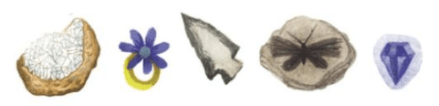
Diana Sudyka opens the story of Sue Hendrickson with a lovely collage of the treasures she found and studied as a child and that led to her life-long love of discovery. As Sue grows, she visits the Field Museum, with its exhibits of a Triceratops and Hadrosaurus. Fast-forward several years and she’s swimming in a sea dotted with colorful coral toward an old sunken ship. But the centerpiece of the story takes place in the South Dakota hills, the layers of rock painted in stripes of earthy brown, rust, rose, and ivory. As the team works late nights to excavate the bones, a T. rex constellation appears above the team in the starry sky, urging them on. A two-page spread of how Sue the T. rex fossil appeared in its entirety in the ground is sure to elicit plenty of “Wows!,” and a rendition of Sue on exhibit in the Field Museum will no doubt inspire some travel wishes.

A book about a modern-day scientist that will engage and inspire children with scientific aspirations of their own as well as a celebration of individuality and big dreams and a must for dinosaur lovers, When Sue Found Sue would be a T. riffic addition to home, school, and public library collections.

Ages 4 – 8

Abrams Books for Young Readers, 2019 | ISBN 978-1419731631

Discover more about Toni Buzzeo and her books on her website.

To learn more about Diana Sudyka, her books, and her art, visit her website.

National Dinosaur Day Activity

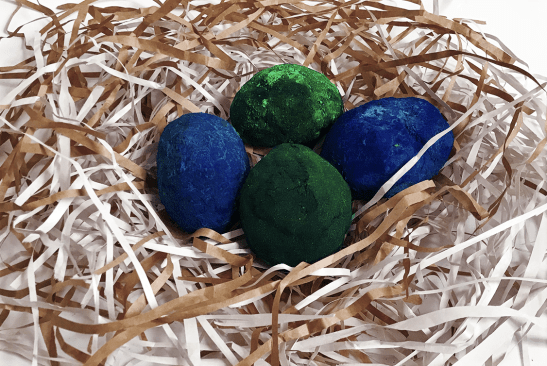
celebrate-picture-books-picture-book-review-dinosaur-eggs-craft-nest

Hatch Your Own Dinosaur Eggs


Think there are no more dinosaur eggs to be found? Think again! You can make your own with this easy craft that will have you hatching some T.-rex-size fun! All you need are a few simple ingredients!

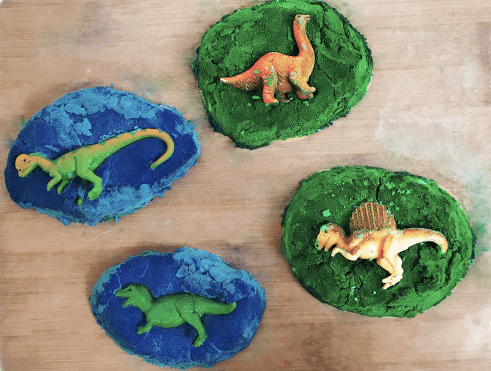
celebrate-picture-books-picture-book-review-dinosaur-eggs-craft-open-eggs

Supplies

  • Old clothes or apron
  • Large box of baking soda (makes between 6 and 8 eggs)
  • Food coloring
  • Water
  • Plastic dinosaur toys
  • Bowl
  • Fork
  • Spoon
  • Wax paper
  • Baking sheet
  • Foil
  • Vinegar
  • Spray bottle (optional)
  • Plastic or metal spoon, stick, popsicle stick, or other implement to chisel with
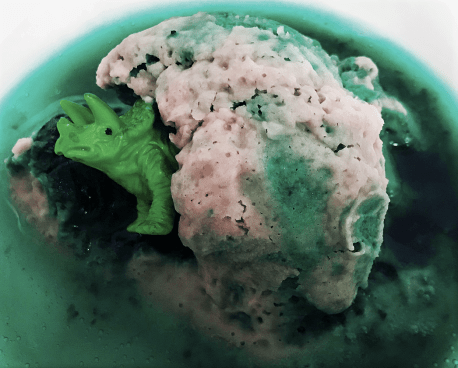
celebrate-picture-books-picture-book-review-dinosaur-eggs-craft-vinegar-egg-open-darker

Spray the egg with vinegar to hatch your dinosaur

Directions

  1. Wear old clothes or an apron
  2. Cover work surface with wax paper, parchment paper, newspaper, or other protection. Food coloring can stain some surfaces
  3. Pour baking soda into the bowl
  4. Add drops of food coloring in whatever color you’d like your eggs to be. The eggs will darken when baked.
  5. Mix in the food coloring with the fork. You may want to use your hands, too
  6. When the baking soda is the color you want it, begin adding water a little at a time
  7. Add water until the baking soda holds together when you squeeze it in your hand
  8. When the baking soda is the right consistency, spoon some out into your hand or onto wax paper
  9. Push one plastic dinosaur into the middle
  10. Cover the dinosaur with more of the baking soda mixture
  11. Carefully form it into an egg shape
  12. Repeat with other dinosaurs
celebrate-picture-books-picture-book-review-dinosaur-eggs-craft-chiseled -darker

Chisel the egg open to hatch your dinosaur

To Bake the Eggs

  1. Set the oven or toaster oven to 200 to 225 degrees
  2. Set the eggs on a baking sheet lined with foil
  3. Bake the eggs for 15 minutes, check
  4. Turn the eggs over and bake for 10 to 15 more minutes
  5. Remove from oven and let cool

To Hatch the Eggs

  1. Eggs can be hatched by chiseling them with a spoon, stick, or other implement
  2. Eggs can also be hatched by spraying or sprinkling them with vinegar

celebrate-picture-books-picture-book-review-when-sue-found-sue-cover

You can find When Sue Found Sue: Sue Hendrickson Discovers Her T. Rex at these booksellers

Amazon | Barnes & Noble | Books-a-Million | IndieBound

Picture Book Review
May 13 – It’s National Egg Month

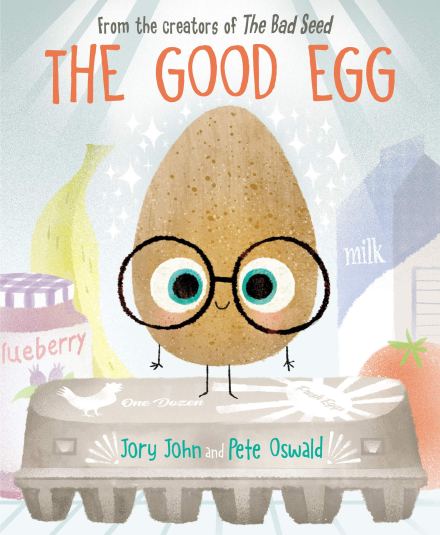
celebrate-picture-books-picture-book-review-the-good-egg-cover

About the Holiday

This month we celebrate the amazing egg! Since ancient days people have relied on eggs for protein and other nutrients as part of a healthy diet. Eggs also provide delicate canvases for incredible works of art. If you’re fond of eggs—on their own or whipped up into a quiche, frittata, or other delicacy—crack a few open and enjoy your favorite recipe!  

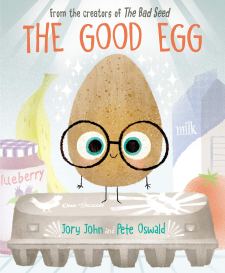
The Good Egg

Written by Jory John | Illustrated by Pete Oswald


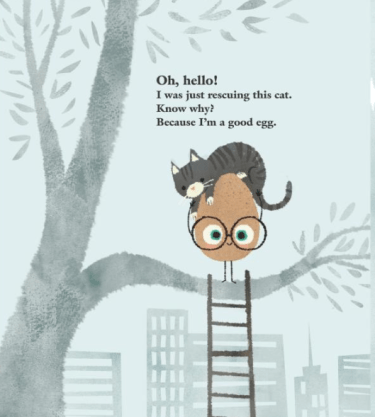
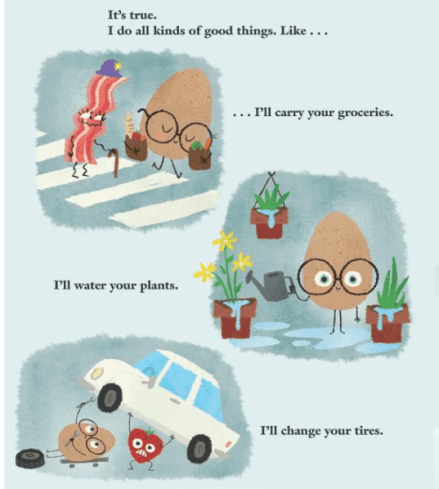
Have you ever met an egg that was so good he would rescue a cat from a tree, “…carry your groceries, …water your plants,” or “paint your house?” Well, you have now! And this isn’t some fly-by-night goodness, this little egg has always been this way even though all the other eggs in the carton exhibited less-than-stellar behavior.

celebrate-picture-books-picture-book-review-the-good-egg-good-deeds

Image copyright Pete Oswald, 2019, text copyright Jory John, 2019. Courtesy of HarperCollins.

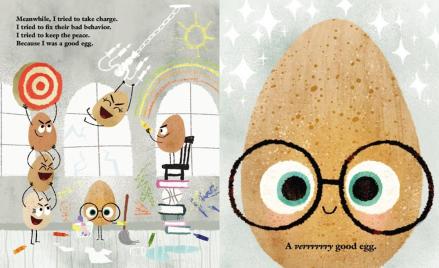
What did they do? Are you ready for this? “They ignored their bedtime. They only ate sugary cereal.” There were tantrums…and it only got worse. The good egg tried to help—after all, he was “a verrrrrry good egg,” but no one paid any attention. Eventually, the good egg cracked under the pressure of  trying to make his carton buddies as good as he was.

The good egg decided to leave the market and the other eggs behind. Did they care? It didn’t seem like it. The egg traveled far and wide and into his very own heart. The egg “took walks” and “read books.” He took up writing, painting, and meditation. Slowly, the cracks began to heal. Feeling better, the egg made a big decision. He decided to go back to the market and his friends. But this time, he would “try not to worry so much” and he’d be good to the other eggs and himself.

celebrate-picture-books-picture-book-review-the-good-egg-carton

Image copyright Pete Oswald, 2019, text copyright Jory John, 2019. Courtesy of HarperCollins.

The good egg had discovered that he missed the other eggs, but how would they feel about his come back? He needn’t have worried. They welcomed him home with egg-citement. It seems that while the good egg was gone, the other eggs became a little better behaved. And now? Here’s what the good egg “realized: The other eggs aren’t perfect, and I don’t have to be, either.” The whole experience gave the good egg a whole new perspective, and he’s glad to be home.

celebrate-picture-books-picture-book-review-the-good-egg-target

Image copyright Pete Oswald, 2019, text copyright Jory John, 2019. Courtesy of HarperCollins.

Behavior studies have never been as bewitching as in Jory John and Pete Oswald’s The Good Egg, a sequel of sorts to The Bad Seed. Everywhere he looks, the good egg finds ways to be helpful, peaceful, and…well…good. But his friends are a rowdy bunch, given to messes, tears, destruction—badness. When the good egg’s perfectionism meets this unruliness, he cracks. When the good egg leaves the carton in search of healing, John invites readers to consider the line between fun and rotten behavior from both sides.

Children prone to perfectionism see that it’s okay to give themselves a break and let go at times, while those who tend to be wild learn that reigning in some impulses can lead to more enjoyment. John’s clever egg names, funny examples of good and rotten behavior, and pun-filled wordplay will have kids giggling from the first page while his nod to self-care practices and the empowering ending give them moments for thoughtful contemplation.

celebrate-picture-books-picture-book-review-the-good-egg-cat

Image copyright Pete Oswald, 2019, text copyright Jory John, 2019. Courtesy of HarperCollins.

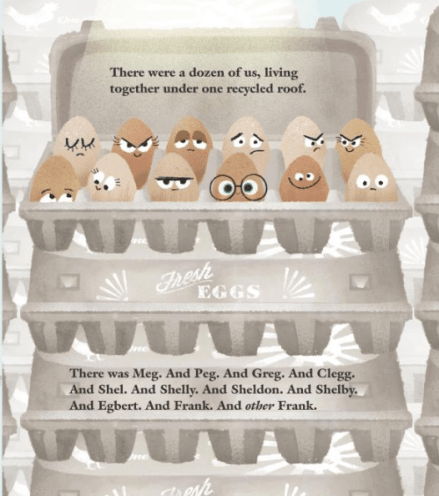
Pete Oswald dishes up a full menu of visual jokes from the wrinkled bacon slice getting help with her groceries to the intravenous yolk drip the good egg gets on his trip to the doctor to the stack of books with eggs-centric titles that are part of the good egg’s recovery. The dozen eggs—all with distinct personalities—may be “fresh” as the carton proclaims, but they make for eggsellent companions on this journey of self-discovery.

Witty and ingenious, The Good Egg will be an often-asked for addition to home, school, and public libraries for perfectly fun-filled story times.

Ages 4 – 8

Harper Collins, 2019 | ISBN 978-0062866004

Discover more about Jory John and his books on his website.

To learn more about Pete Oswald, his books, and his art, visit his website.

Take a crack at The Good Egg book trailer!

National Egg Month Activity

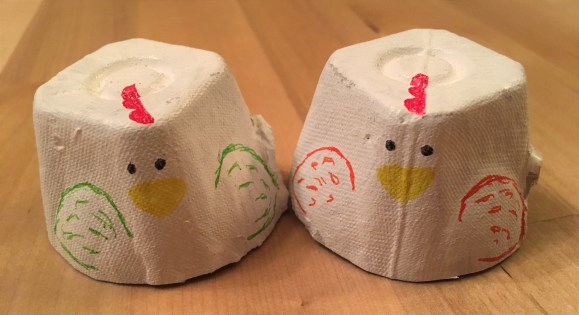
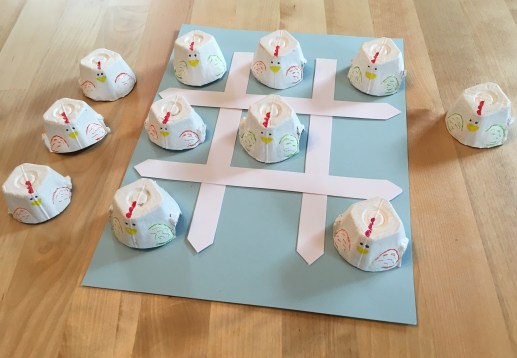
celebrate-picture-books-picture-book-review-egg-carton-chicken-double-chickens

Egg Carton Chickens and a Basket Full of Games


With these cute egg-carton chickens you can come up with lots of games to play! This fun craft and game activity is eggs-actly what you need to start hatching some real fun!

Supplies

  • Cardboard egg carton
  • White craft paint
  • Markers: red, yellow, black for the face; any colors you’d like for wings and eggs
  • Paint brush
  • Scissors
  • Glue
  • Construction or craft paper in white and a color of your choice

Directions

  1. Cut the notched flap off the egg carton and set aside
  2. Cut the top off the egg carton
  3. Cut apart all the egg cups and trim slightly so they sit flat
  4. Paint the egg cups with the white paint, let dry
  5. Add the face, comb and wings to the chicken with the markers. Make six chickens with one color wings and six chickens with another color wings.
  6. From the egg carton flap cut thirteen small egg-shaped playing pieces
  7. With the markers, decorate twelve of the eggs in pairs—each egg in the pair with the same design
  8. Color one egg yellow and add a beak, eyes, and wings to make it a chick

Games to Play

Tic-Tac-Toe (2 players)

  1. On a 8 ½” x 11” piece of paper draw a regular tic-tac-toe board or make it fancy – like the picket fence-inspired board in the picture
  2. To make the fence-inspired board on a colored background, cut 2 9-inch-long x 3/4-inch wide strips of white paper, cutting a pointed tip at one or both ends. Cut 2 white  8-inch x 3/4-inch strips of paper with a pointed tip at one or both ends. Glue the strips to the background.
  3. Each player chooses a set of chickens with the same colored wings
  4. Play the game as you usually do

celebrate-picture-books-picture-book-review-egg-carton-chicken-tic-tac-toe

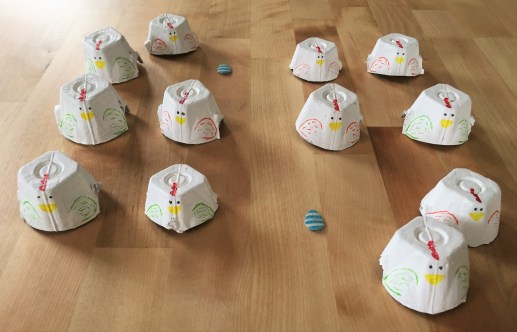
Find the Matching Eggs (2 or more players)

  1. Have one player hide one egg under each chicken
  2. Shuffle the eggs around and form them into three lines of 4 chickens each
  3. Another player lifts one chicken at a time to find matching eggs. If the eggs don’t match, put both chickens back and start again

celebrate-picture-books-picture-book-review-egg-carton-chicken-matching

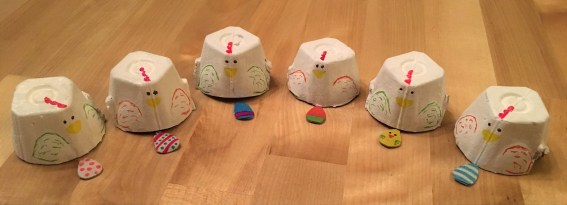
Where’s the Chick?

  1. Use as many chickens and eggs as you want (fewer for younger children, more for older)
  2. One player hides the chick under one of the chickens and eggs under the others.
  3. Another player has three chances to find the chick

celebrate-picture-books-picture-book-review-egg-carton-chicken-where's-the-chick

I’m sure you can also design your own games for your adorable chickens to play! With more chickens you can even make a checkers set or replicate another of your favorite board games!

celebrate-picture-books-picture-book-review-the-good-egg-cover

You can find The Good Egg at these booksellers

Amazon | Barnes & Noble | Books-a-Million | IndieBound

Picture Book Review
 

May 9 – It’s National Inventors Month

celebrate-picture-books-picture-book-review-magnolia-mudd-and-the-super-jumptastic-launcher-deluxe-cover

About the Holiday

Today we celebrate the creative minds who devise new products, better ways of performing tasks, faster methods of communication, and all kinds of innovative ways to interact with our world. Established in 1998 by the United Inventors Association of the USA, the Academy of Applied Science, and Inventors’ Digest magazine, this month’s holiday encourages people to embrace their creativity and go that extra step toward producing their invention. If you’re a tinkerer, who knows—your product or service could make the world a better place!
Magnolia Mudd and the Super Jumptastic Launcher Deluxe

Written by Katey Howes | Illustrated by Valerio Fabbretti


Every Friday, Magnolia Mudd’s favorite adult—her uncle Jamie—visited and spent time inventing with her. He always encouraged Magnolia to think big. One day, Magnolia and Uncle Jamie created their “greatest invention—the Super Jumptastic Launcher Deluxe,” which ran on Mudd Power. Later, after just one experimental launching, Magnolia discovered that she had to build it all over again. When she called her uncle and told him they’d have to repair it next Friday, though, he said she would have to wait. Instead, he was bringing Miss Emily over because they “had ‘something to talk about.’”

celebrate-picture-books-picture-book-review-magnolia-mudd-and-the-super-jumptastic-launcher-deluxe-uncle-jamie

Image copyright Valerio Fabbretti, 2018, text copyright Katey Howes, 2018. Courtesy of Sterling Books.

Magnolia didn’t want her time with Uncle Jamie taken up by Miss Emily. As far as Magnolia was concerned Uncle Jamie and Miss Emily had nothing in common, so on Friday when they told her they were getting married, Magnolia was surprised. When Miss Emily asked Magnolia to be their flower girl and showed her the fancy dress she’d wear, Magnolia thought, “no way!” Later, Uncle Jamie said maybe they could find a different way for her to be involved in the wedding.

Magnolia researched all the different things she could do, and experimented with some of them. She read that in India women decorate their hands with henna tattoos. She devised a henna tattoo-painting machine, but it went a little haywire. In Sweden, she learned, guests scared off trolls by bringing bouquets of stink weed. Magnolia built a troll trap, but only caught herself. And in a German tradition, guests throw plates at the couple’s door for good luck, but when Magnolia retooled her “Fantastic Frisbee Flinger,” she only caused a mess of broken pottery.
celebrate-picture-books-picture-book-review-magnolia-mudd-and-the-super-jumptastic-launcher-deluxe-friday

Image copyright Valerio Fabbretti, 2018, text copyright Katey Howes, 2018. Courtesy of Sterling Books.

Magnolia resigned herself to being “doomed to ruffles and roses.” She was just wishing she could launch the rose petals instead of scattering them when she had an idea. She showed Miss Emily her brainstorm for a bouquet-launcher that worked on Mudd Power. Miss Emily loved it. Together they began to invent. On the day of the wedding, they revealed their “new-and-improved Dual-Directional Super-Jumptastic Flower Launcher Deluxe (with Confetti Blaster),” and as Magnolia and Miss Emily jumped on the launch pad together, Magnolia realized that with Aunt Emily in the family, there was “way more Mudd Power” for inventing.

celebrate-picture-books-picture-book-review-magnolia-mudd-and-the-super-jumptastic-launcher-deluxe-miss-emily

Image copyright Valerio Fabbretti, 2018, text copyright Katey Howes, 2018. Courtesy of Sterling Books.

Katey Howes’ humorous and clever story is as dual-purpose as Magnolia’s super launcher deluxe. Young readers will love seeing Magnolia’s gizmos that fire rockets, squirt paint, capture trolls, fling plates, and toss the bouquet (maybe a little too far!) while learning about some wedding traditions around the world. The heart of Howes’ story, however, lies in the ideas of family, relationships, communication, and acceptance. Readers will understand that Magnolia’s initial dislike of Miss Emily has more to do with her fear of a changing relationship with Uncle Jamie than with Emily’s dangly earrings or preference for sushi over pizza.

When Magnolia balks at being a flower girl, the adults allow her to be herself and work with her to find a job that makes everyone happy. As Magnolia gets to know Emily better, she takes a chance in suggesting a bouquet launcher and is rewarded when Emily (literally) jumps in with both feet (the fact that Miss Emily works at an art gallery hints at her ability to think creatively too). The final image of Magnolia, Uncle Jamie, and Aunt Emily hard at work in their lab reminds kids of the adage, “the more, the merrier”—or in this case, “the more Mudd power, the merrier.

celebrate-picture-books-picture-book-review-magnolia-mudd-and-the-super-jumptastic-launcher-deluxe-thinking

Image copyright Valerio Fabbretti, 2018, text copyright Katey Howes, 2018. Courtesy of Sterling Books.

Valerio Fabbretti’s bright, cartoon-style artwork is ideally suited to bring out the humor and emotions in Howes’ action-packed story. Magnolia’s and Uncle Jamie’s love of science is on display in both Jamie’s office and Magnolia’s room, where diagrams, chemical equations, test tubes and beakers, and retrofitted home appliances create an eclectic décor. Kids will laugh as Magnolia’s inventions go awry, and cheer when Magnolia and Miss Emily discover the perfect wedding job for Magnolia and complete it together. 

An entertaining and endearing story, Magnolia Mudd and the Super Jumptastic Launcher Deluxe is an inventive book to launch fun story times as well as discussions on individuality, inclusion, change, and family.

Ages 3 and up

Sterling Children’s Books, 2018 | ISBN 978-1454921745

Discover more about Katey Howes and her books on her website.

To learn more about Valerio Fabbretti, his books, and his art, visit his website.

National Inventors Month Activity

celebrate-picture-books-picture-book-review-sparkle-test-tubes-II

Sparkle Test Tubes


Kids love inventing and experimenting, and these sparkle test tubes give children a fun way to be creative while making a cool way to relax and on those hectic days.

Supplies

  • Plastic test tubes with tight-fitting screw cap, available at craft or science supply stores. Having two or three will allow for more experimentation
  • Glitter glue
  • Hot water
  • Fine glitter
  • Chunky glitter
  • Small glass beads (optional)
  • Neon food coloring (optional)
  • Test tube stand (optional)
  • Whisk
  • Mixing bowl
  • Teaspoon

Directions

  1. Fill a test tube 1/3 full of hot water and pour the water into the mixing bowl
  2. Add 1 – 2 teaspoons of glitter glue (the more glitter glue that is added the thicker the liquid will be and the more the objects will be suspended in the liquid. To allow the objects to flow more freely when the test tube is shaken, add less glue
  3. Whisk the water and glitter glue together
  4. Add chunky glitter, glass beads, or try other small objects
  5. Pour into test tube
  6. Add more water to within a ½ – 1 inch of the top to allow for shaking
  7. Experiment with amount of glitter glue, glitter, and colors

celebrate-picture-books-picture-book-review-magnolia-mudd-and-the-super-jumptastic-launcher-deluxe-cover

You can find Magnolia Mudd and the Super Jumptastic Launcher Deluxe at these booksellers

Amazon | Barnes & Noble | Books-a-Million | IndieBound


Picture book review