About Today’s Post
Following the recent events that have unfolded this past week, I feel it is important to celebrate Black leaders today, rather than another holiday. The biographies included in this list will educate and inspire readers with the stories of prominent Black leaders within the arts and sciences, as well as music, sports, politics, civil rights, and across society.
With their combination of compelling storytelling and powerful imagery, picture books provide a unique vehicle to invite discussion between adults and children about the inequity and injustices faced by many in this country and around the world. This list reflects books I have reviewed over the years. Please look it over and spend time reading these books with your children. Each title provides a link to the full review.
If you are in the position to buy any of the books on this list or other reviews that you may see, please consider supporting black-owned bookstores and/or your local booksellers. You can also support Black authors and illustrators as well as these books and others by asking your local library to carry them.
After today’s post, this list will appear in my sidebar. I’ll continue to add to it as I review more books.
Every day I am reading, listening, watching, and learning. I know I can never understand, but I stand with you.
Artists and Writers
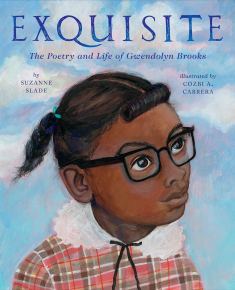
Exquisite: The Poetry and Life of Gwendolyn Brooks
Written by Suzanne Slade | Illustrated by Cozbi A. Cobrera
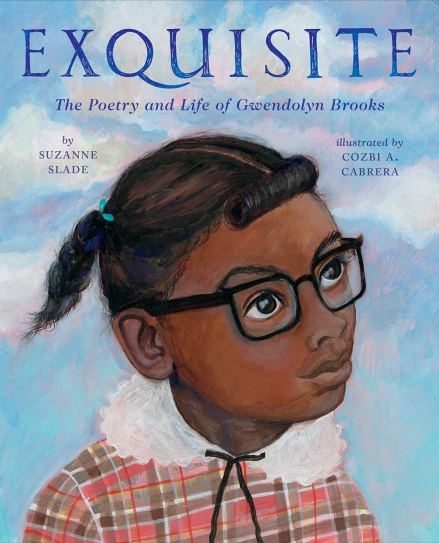
In her outstanding biography, Suzanne Slade highlights the prodigious talent of Gwendolyn Brooks, illuminating the influences, continual study, and inborn voice that informed and created her poetry. Gwendolyn’s self-confidence, unique perspective, and the support she received throughout her youth and career are strong themes that will inspire readers. Slade focuses on the awe Brooks found in her subjects, demonstrating her singular vision and how poetry is found in the everyday aspects of life. Beginning with Gwendolyn’s childhood, Slade links the events of Brooks’ life with beautiful imagery of the clouds she once likened to her exquisite future. Quotes are sprinkled throughout Slade’s lyrical text, allowing children to hear Brooks’ own voice and the dreams and pride had for her work.
Cozbi A. Cabrera’s acrylic paintings are stunning representations of Gwendolyn’s life. Her family life with her well-read and supportive family comes alive with images of their home, where the large glass bookcase has pride of place, portraits hang on the walls, Gwendolyn practices the piano while her mother exclaims over her poetry, and the family gathers for a meager dinner during hard times. For young readers, Cabrera visualizes the parts of Gwendolyn’s life that fed her imagination and work and the copious amounts of poetry that she created—even as a child. Images of Gwendolyn’s early publishing successes give way to the changes brought by the Depression, school, marriage, and motherhood, but a pen, paper, and books are still her constant companions. Scenes from Chicago give children a look at the city that inspired Gwendolyn’s poetry, and intermittent views of the pastel clouds let readers dream along with her.
A stirring biography to inspire the dreams of any child, Exquisite: The Poetry and Life of Gwendolyn Brooks is a story that children will want to hear again and again. On its own or paired with Gwendolyn Brooks’ poetry, the book also makes an impactful lesson for homeschooling. The book is highly recommended for home, school, and public library collections.
Ages 6 – 9
Abrams Books for Young Readers, 2020 | ISBN 978-1419734113
Fancy Party Gowns: The Story of Fashion Designer Ann Cole Lowe
Written by Deborah Blumenthal | Illustrated by Laura Freeman
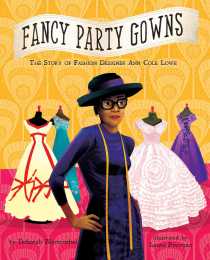
With straightforward storytelling adorned with lyrical passages, Deborah Blumenthal reveals Ann Cole Lowe’s lifelong love of fashion design, her struggles, and her ultimate acclaim. Lowe’s natural talent, single focus, self-confidence, courage, and persistence come through as she overcomes obstacles and prejudice to become the first African American couture designer. Children interested in fashion and history will find much to spark their curiosity and desire to know more about the woman and her times. Blumenthal’s repetition of Lowe’s philosophy to think about what she could do instead of what she couldn’t change will inspire readers to push past difficulties and find solutions.
Laura Freeman’s full-bleed illustrations are as bold and vivacious as Ann Cole Lowe herself. Beginning with the endpapers, which are scattered with drawings of Lowe’s one-of-a-kind gowns, Freeman takes readers on a tour of the workrooms and salons stocked with the fabrics that gave form to Lowe’s creativity. While the backgrounds are typically brilliantly colored and patterned, twice Freeman places Lowe on a completely white page—after her mother has recently died and she is left alone to finish dresses and when she is segregated from the other students in design school. These pages make a moving and effective statement. Children fascinated by fashion will love seeing the beautifully depicted gowns, and may be stirred to create styles of their own.
Ages 4 – 8
little bee books, 2017 | ISBN 978-1499802399
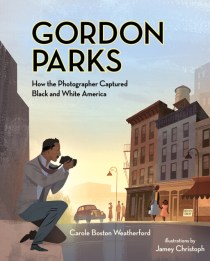
Carole Boston Weatherford’s portrayal of Gordon Parks’ life is as starkly revealing as her subject’s photographs. With her writer’s skills, however, she deftly contrasts the facts of his life and turns his story into a universal metaphor for freedom and the struggle to attain it: “When young Gordon crosses the prairie on horseback, nothing seems beyond reach. But his white teacher tells her all-black class, you’ll all wind up porters and waiters. What did she know?” Weatherford’s pacing also adds to the story’s power. Although Parks attained wide acclaim, this biography ends with one of his earlier photographs—a picture of Ella Watson, a cleaning lady, who inspired Parks and came to symbolize the hopes of her generation and beyond. This is not only Parks’ story, but the story of millions of others.
Jamey Christoph continues and strengthens the metaphorical force of this biography in his illustrations. Readers first see Gordon Parks as a much-loved, smiling infant. He goes to school and grows up, his expression changing, slightly but importantly. He acquires his camera, and the pages are filled with drawn representations of his black-and-white photographs. Alternating dark and light pages further emphasize Parks’ world. The darkroom contrasts with Parks’ new bright office and prospects; the shadowed back alleys of Washington DC contrast with the city’s gleaming white marble monuments. Later photographs are also depicted, and “American Gothic” is represented on two pages. Christoph provides readers with much to see and ponder.
Ages 5 – 8
Albert Whitman & Company, 2015 | ISBN 978-0807530177
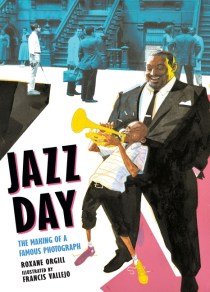
Jazz Day: The Making of a Famous Photograph
Written by Roxane Orgill | Illustrated by Francis Vallejo
Roxane Orgill recreates the syncopation of jazz and the exhilaration of the photo shoot in twenty poems that capture the sights, sounds, conversations, horseplay, and vibe of that special day that forever commemorated the Golden Age of Jazz. The smooth, cool lines of Orgill’s free verse poetry are a joy to read aloud. Full of personality, captivating details, history, and nostalgia, the poems reawaken the past for a new generation.
Working from the actual black-and-white photograph, Francis Vallejo vividly reimagines the scene on 126th Street as well-known and lesser-known jazz musicians came together to represent themselves and their art for Esquire magazine. Vallejo’s acrylic and pastel illustrations bring to life the surprise, camaraderie, and expressions of the men, women, and boys as they mingle, rest, and pass the time until the pose and lighting is right for the shot. As the book opens, readers get a bird’s-eye view of the street and quiet neighborhood, but as the musicians begin arriving the illustrations move in, allowing readers to rub shoulders with the greats of jazz.
For children (and adults) who love photography, jazz, biographies, history, and/or poetry, Jazz Day: The Making of a Famous Photograph is a marvelous choice for home libraries and is highly recommended for school and public libraries.
Ages 8 – 12 and up
Candlewick, 2016 | ISBN 978-0763669546
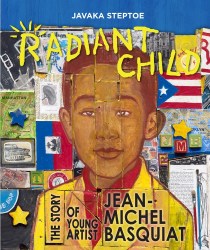
Radiant Child: The Story of Young Artist Jean-Michel Basquiat
By Javaka Steptoe
Javaka Steptoe’s compelling biography of this complex, brilliant artist who people called “radiant, wild, a genius child” beautifully brings to life the inspirations and motivations that fueled his unique and intense talent. Steptoe delivers the story in staccato and flowing sentences, using consonance, assonance, and repetition—the rhythms of a poet. He shows how Basquiat maintained his focused determination, self-confidence, and persistence from childhood into adulthood. This perseverance reveals to readers that success is not a matter of luck, but of belief in oneself despite obstacles. Steptoe sensitively addresses the serious injury Basquiat suffered, his mother’s mental illness and Basquiat’s continued love for her, and his unsettled teenage years to complete this far-reaching life story.
Steptoe’s mixed-media paintings were created on found wood from neighborhoods across New York City. While Steptoe does not reproduce any of Basquiat’s work, he states that readers will find “original pieces that were inspired by him and my interpretations of his paintings and designs.” As befitting his subject, Steptoe offers pages that burst with vibrant color and intricate details and beat with the pulse of the city, the people, the dreams, and the imagination that Basquiat transcribed onto paper, walls, and canvas. Part collage, part fine art, Steptoe’s illustrations will fascinate children and entice them to linger and take in the emotion and meaning in each. The final spread, a crowd scene made up of photographs, sets Basquiat in the midst of people whom he and his art continue to inspire.
Radiant Child: The Story of Young Artist Jean-Michel Basquiat offers children an inspirational model of creativity, compassion, and confidence no matter where their talents lie. The book is an excellent choice for school, public, and home libraries.
Ages 6 – 10
Little, Brown Books for Young Readers, 2016 | ISBN 978-0316213882

A Song for Gwendolyn Brooks
Written by Alice Fay Duncan | Illustrated by Xia Gordon
With her own sterling verses, Alice Faye Duncan celebrates the life of Gwendolyn Brooks—the first African American to win the Pulitzer Prize for Literature—taking readers to the Chicago neighborhoods that informed and inspired Brooks’ ideas and the words and rhythms with which she defined them. Along an arc that takes Gwendolyn from a child contemplating the potential of a flower to becoming that blossom herself, Duncan pays tribute to those who recognized Gwen’s genius and helped her fulfill her talent. For readers who themselves may be poets, writers, or other types of artists, Duncan’s beautifully crafted phrases about the artistic process of revision are inspirational and welcome. Standing side-by-side with Duncan’s storytelling are four of Brooks’ poems—The Busy Clock, Forgive and Forget, Ambition, and the children of the poor—Sonnet #2. From cover to cover, Duncan’s book sings with Gwendolyn Brooks’ positivity, confidence, uniqueness, and love for life that made her a unique voice for her time and always.
From the portrait of Gwendolyn Brooks that graces the title page and throughout the book, Xia Gordon’s distinctive artwork creates a masterpiece of motion and stillness that mirrors Brooks’ penchant for watching and listening to the sounds and sights that filled her mind and ultimately her notebooks. Downy swoops of violets, pinks, browns, and grays provide backdrops to images of Gwendolyn as a young girl and an adult rendered in lines that show her as down to earth but soaring in her thoughts. Her intelligence and spark shine through on every page. Gwendolyn’s parents appear often, always watchful and supportive. Her friends, her husband, her son, and her readers also populate the pages, giving the book an embracing warmth.
A Song for Gwendolyn Brooks is a must for school, classroom, and public library collections, and for children who are discovering their talents and the parents who nurture them, the book would be an inspirational and invaluable addition to home bookshelves.
Ages 4 and up
Sterling Children’s Books, 2019 | ISBN 978-1454930884
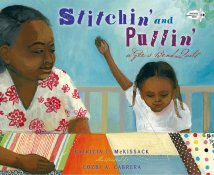
Stichin’ and Pullin’: A Gee’s Bend Quilt
Written by Patricia McKessack | Illustrated by Cozbi A. Cabrera
Patricia McKessack’s free verse poems capture the close relationships and camaraderie of the generations of women who join around the quilting frame to share and pass down their art and their heart. McKessack’s conversational verses, connected page after page like the patches of a quilt, reveal the complexity of this handmade art form in the way intimate talks between friends unveil a life. Readers learn not only about the little girl and her own thoughts, but the history and influence of her immediate family, world events, inspirational figures, and deeply held beliefs that make her who she is and ties her to the other Gee’s Bend women.
Cozbi A. Cabrera’s stunning acrylic paintings take readers inside the heart of the Gee’s Bend women, depicting the girl’s home, the table-sized quilting frame where the women collectively work, the plantations, the protests, and the changes that came but did not unravel the convictions, values, and love of the little girl’s family. Readers can almost hear the talking and singing of the Gee’s Bend women as they stitch their quilts, and the comforting, embracing environment is evident on every page. Cabrera’s portraits of the little girl, her mama, and her grandma are particularly moving. For What Changed, Cabrera depicts a yellow school bus appearing on the dirt road from the right hand corner of the page. In the driver’s side mirror, a dot of a house is reflected, reminding readers that no matter how far these women are from home, Gee’s Bend is always with them.
Children—and adults—will find Stitchin’ and Pullin’: A Gee’s Bend Quilt inspirational and uplifting. This volume of poetry can be read at one sitting or delved into again and again, making it a wonderful choice for home libraries and a must for school and public libraries.
Ages 5 – 12
Dragonfly Books, Random House, 2016 (paperback edition) | ISBN 978-0399549502
Culinary Arts
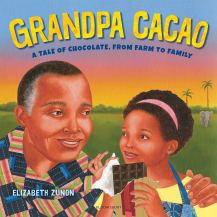
Grandpa Cacao: A Tale of Chocolate from Farm to Family
By Elizabeth Zunon
Elizabeth Zunon’s celebration of family and pride in one’s heritage is a compelling read that shines with a strong father – daughter relationship, shared memories, and the joys of working together. The warmth shared by the girl and her daddy is evident as she revels in hearing the story of Grandpa Cacao and identifying with him even though he lives far away. Zunon’s smooth delivery of Grandpa Cacao and Daddy’s story imparts fascinating details of how cacao is grown, harvested, and prepared for sale. While the little girl may wish for a new dress or a puppy, she is happier with the surprise of meeting her grandfather at last.
Zunon’s mixed-media, collage style illustrations beautifully meld the world inside the family kitchen with the girl’s imagining of life in Africa on Grandpa Cacao’s farm. The opaque screen-printed images of Grandpa Cacao, the girl’s father as a child and young man, and the other villagers, are powerful reminders to readers that their family and family history is always with them and supporting them.
A unique book to share during family story time, in the classroom, or during a library program, Grandpa Cacao: A Tale of Chocolate, from Farm to Family would be a much-loved addition to home, school, and public library collections. And don’t forget to include cake!
Ages 3 – 8
Bloomsbury Children’s Books, 2019 | ISBN 978-1681196404
Music

Birth of the Cool: How Jazz Great Miles Davis Found His Sound
Written by Kathleen Cornell Berman | Illustrated by Keith Henry Brown
Kathleen Cornell Berman’s lyrical passages reveal a boy, a teenager, and a man who embodied music, listening to and absorbing the various sounds around him and incorporating them into his own, unique sound. Her evocative vocabulary (swirl, rollicking, croon, rumbling, far-out, rippling, blizzard of notes, itching to play) and phrasing that blends short staccato lines with longer sentences echoes the rhythm of jazz and will keep readers riveted to the story. Berman emphasizes the listening, practice, and experimentation that informed Miles Davis’s original sound, showing children that innovation is built on hard work, dedication, and even history. Her inclusion of Davis’s setbacks also demonstrates that perseverance is part of the success of any endeavor.
Keith Henry Brown’s gorgeous, detailed pen-and-ink and watercolor illustrations take readers from Miles Davis’s living room, where he listens to the radio as images of Louis Armstrong and Duke Ellington swirl through his imagination, to an overlook on the Mississippi River and its paddlewheel steam ships to the clubs and jam sessions of New York and finally, to the Newport Jazz Festival. Brown’s color palette of cool blues, greens, purples, and browns, punctuated with Davis’s ever-present gleaming brass trumpet, brings Davis’s country and city experiences to life while mirroring the tone and feel of his unique sound. Quotes from Miles Davis are sprinkled throughout the story and set apart with type that looks handwritten, giving his words a personal touch.
Sure to inspire readers to learn more about Miles Davis and listen to his music, Birth of the Cool: How Jazz Great Miles Davis Found His Sound would be an excellent accompaniment to school music programs, an inspiring book for biography lovers and young musicians of all types, and a beautiful addition to home, school, and public library collections.
Ages 8 – 12
Page Street Kids, 2019 | ISBN 978-1624146909
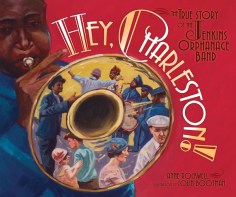
Hey, Charleston! The True Story of the Jenkins Orphanage Band
Written by Anne Rockwell | Illustrated by Colin Bootman
Anne Rockwell succinctly and clearly relays the story of the Jenkins Orphanage Band while also retaining all the heart and soul of this fascinating group of children and their dedicated caregiver. The true-life tale is mesmerizing, not only for the historical details of the growth of ragtime music and the Charleston dance but for the accomplishments of the orphans once given love, acceptance, and education. Rockwell’s conversational tone contributes to the story’s smooth, flowing pace, which will keep listeners or readers rapt from beginning to end.
Colin Bootman’s bold two-page spreads illuminate the sights and sounds of the early 1900s for readers. Emphasizing the personal connections between Reverend Jenkins and the orphans as well as the band and their audiences, Bootman’s vibrant paintings are full of people watching, dancing, marching, and celebrating these boys’ awesome gifts.
Ages 6 – 10
Carolrhoda Books, 2013 | ISBN 978-0761355656
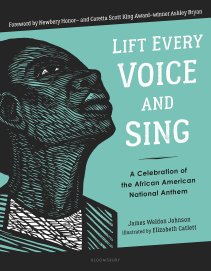
Lift Every Voice and Sing: A Celebration of the African American National Anthem
Written by James Weldon Johnson | Illustrated by Elizabeth Catlett
It has been more than 120 years since James Weldon Johnson, a principal at Stanton Elementary School in Jacksonville, Florida, wrote a poem to be used in the school’s commemoration ceremony of Abraham Lincoln’s birthday. His brother, composer John Rosamond Johnson, set the poem to music. On February 12, 1900, five hundred students performed the song. From that celebration, the song spread, gaining in popularity throughout the South and then throughout the country.
In 1949 the National Association for the Advancement of Colored People adopted Lift Ev’ry Voice and Sing as the official African American anthem. The song continues to inspire as it is sung and heard in churches and schools and during times of celebration and protest. This new edition of Lift Every Voice and Sing brings together Johnson’s stirring poem with stunning black-and-white linocuts by Harlem Renaissance artist Elizabeth Catlett, who created them in the 1940s as part of a series of artworks focusing on black women.
An emotionally moving presentation of James Weldon Johnson and John Rosamond Johnson’s poem and song, Lift Every Voice and Sing: A Celebration of the African American National Anthem would make a beautiful thought-provoking and inspirational addition to school, home, and public library collections.
Ages 6 – 12 and up
Bloomsbury Children’s Books, 2019 | ISBN 978-1681199559
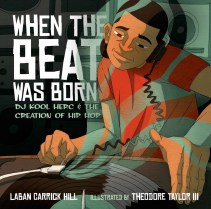
When the Beat Was Born: DJ Kool Herc & the Creations of Hip Hop
Written by Laben Carrick Hill |Illustrated by Theodore Tayler III
Laben Carrick Hill’s biography of a Hip Hop pioneer invites young readers to discover the early years of and influences on the music they love today. Hill superbly structures his story so through the formative details of DJ Kool Herc’s life from childhood into adulthood, readers understand that they too can follow their hearts to achieve their dreams. When the Beat Was Born is inspirational in its depiction of an “ordinary kid” with ingenuity and self-confidence who changed the face of music by combining his multicultural experiences, being open to experimentation, including his friends, and sharing his vision. Straightforward storytelling is punctuated with verses of rap that make reading aloud fun and will engage listeners.
In his bold, vibrant illustrations, Theodore Tayler III lets kids in on the not-so-distant past that saw the rise of Hip Hop music, celebrity DJs, and new dance styles. Keeping the focus on DJ Kool Herc—just as Clive kept his eye on his future goals—Taylor reinforces the theme of the book. Scenes of kids lining up to attend DJ Kool Herc’s parties and dancing in the street give the book an inclusive feel. Images of skyscraper-tall stacks of records mirrors Kool Herc’s ambitions, and depictions of breakdancing moves will get kids wanting to try them for themselves.
When the Beat Was Born is a terrific biography for all children, whether they like music and dancing or quieter pursuits. In the classroom, the book would be a great addition to music, history, or biography units.
Ages 6 – 10
Roaring Brook Press, 2013 | ISBN 978-1596435407
Civil Rights and Politics
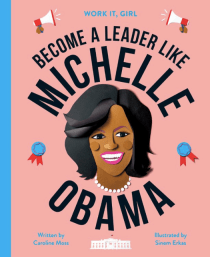
Become a Leader Like Michelle Obama
Written by Caroline Moss | Illustrated by Sinem Erkas
Encouraging, supportive, and always smiling, Michelle Obama inspired millions of kids across the country during her eight years as First Lady and continues to motivate children to be and become the best version of themselves. Through her fast-paced, engrossing biography, Caroline Moss creates a reading experience that gives children the opportunity to get to know their idol the way friends do: by talking together. In ten short, but information-packed chapters, Moss captures Michelle’s voice and spirit through snapshots of formative events that influenced and changed her life, all told in a conversational style with plenty of dialogue and fascinating details.
Sprinkled throughout the text are inspirational quotes from Michelle Obama that are called out in eye-catching blocks and soaring illustrations. Back matter includes ten key lessons from Michelle Obama’s life on how to become a leader, questions to prompt kids to think about what is important to them, and resources for further reading and exploration.
Accompanying this personal narrative are Sinem Erkas’s stunning 3-D cut paper artwork. Bold colors, stirring imagery, and portraits that follow Michelle through times of happiness, sadness, and change reveal to readers Michelle’s intelligence, spark, hard work, and enthusiasm for life that fuels her vision and success.
Emphasizing family, community, self-confidence, and the importance of seizing opportunities to make a difference, Become a Leader Like Michelle Obama is highly recommended for home, school, and public libraries to hearten and embolden young readers to listen to their inner voices and take action for what they believe in.
Ages 8 – 12 and up
Frances Lincoln Children’s Books, 2020 | ISBN 978-0711245181
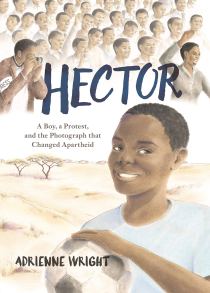
Hector: A Boy a Protest and the Photograph that Changed Apartheid
By Adrienne Wright
Adrienne Wright’s gripping storytelling and evocative illustrations go hand-in-hand to present a full portrait of young Hector, his life, his sweet nature, and the dreams he had before he was killed in a protest against Apartheid. His family’s close bonds and their concern for each other is evident in the dialogue that accompanies images of Hector playing, helping Mma and Granny Mma, running errands, and interacting with his sisters. As June 16 dawns, Wright sketches a normal day, with Hector joking with his mother at home and his friend on the way to school.
As it did for Hector, the protest comes as a surprise for readers, sweeping them up into the action just as Hector was. Hector’s sister, Antoinette’s chapter is the shortest but gripping in its pacing that mirrors the turmoil of the day and her tragedy. As readers enter Sam’s viewpoint, they see, blocked off in vertical and horizontal frames, the pictures of celebrating and happy, yet serious students marching to make a difference. The moment of the shot is seen through Sam’s lens and clouded in smoke.
Wright’s use of overlapping storylines as she transitions from Hector’s account to Antoinette’s and then to Sam’s adds to the tension, drawing readers in and reinforcing their understanding of the atmosphere and what the students were protesting. The final, nearly full-page reproduction of the actual photograph is an unflinching look at the reality of that day, what it stands for, and its personal cost.
A profound narrative for teaching children about South African history, the costs of discrimination, and the personal stories involved in any conflict, Hector is an important book to add to school and public library collections.
Ages: The book is targeted for children from eight to twelve, but adults should be mindful of the maturity and sensitivity of readers. Hector would also be a compelling inclusion in middle school and even early high school social studies and history classes.
Page Street Kids, 2019 | ISBN 978-1624146916
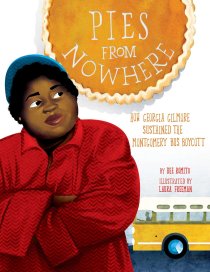
Pies from Nowhere: How Georgia Gilmore Sustained the Montgomery Bus Boycott
Written by Dee Romito | Illustrated by Laura Freeman
Dee Romito’s inspiring biography delves into the crucial role individuals can make in supporting people and causes they believe in. By focusing on unsung historical hero Georgia Gilmore and using her own words and thoughts, Romito reveals how those with strong beliefs can use their talents and courage to fight for change behind the scenes and still make an important difference. Her conversational storytelling brings a personal touch to this biography, drawing young readers in to learn the details of this early battle in the Civil Rights movement—also begun by an act of a solitary person. Bookended by the radio reports that Georgia hears, the story is well-paced to show how Georgia’s contribution grows over nearly a year. This timely biography is made even more resonant perhaps in that Georgia’s cooking and selling of meals and baked goods is an activity that many children will recognized from their own involvement in bake sales and other food-related fund raisers. The open ending invites readers to learn more about the Civil Rights movement and Georgia Gilmore.
Laura Freeman’s boldly colored, realistic artwork allows children to embrace the historical context of Romito’s biography through her expressive portraiture that introduces Georgia Gilmore, Rosa Parks, Dr. Martin Luther King Jr., and the members of Georgia’s Nowhere Club. A double-spread of the National Lunch Company’s segregated counter is visually striking as the divide comes at the book’s gutter, creating the side for white customers on the left and the side for black customers on the right. The injustice of this separation is expressed in the similar red clothing and dark hair of the woman on the right and the man on the left. Illustrations of crowds walking as buses go empty, attending the boycott strategy meetings, secretly buying pies, and filling Georgia’s home place readers at these scenes of the resistance movement. Freeman uses action, media coverage, and Georgia’s courtroom appearance to great effect. Knowledgeable readers will understand that making a positive difference continues across all generations.
Pies from Nowhere is a stunning book of empowerment for children and adults. The theme of using ones talents to make a difference is a timely lesson that kids will respond to. The book belongs in all classroom, school, and public libraries and is a top choice for home bookshelves as well.
Ages 6 – 9
little bee books, 2018 | ISBN 978-1499807202
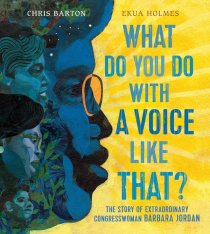
What Do You Do with a Voice Like That? The Story of Extraordinary Congresswoman Barbara Jordan
Written by Chris Barton |Illustrated by Ekua Holmes
Chris Barton’s stirring biography of Barbara Jordan introduces children to a woman whose voice is just as relevant today as it was when she was a state senator, US representative, and professor. Barton clearly and lyrically depicts Jordan’s trajectory while showing readers what it takes to succeed: practice, perseverance, learning, and wisdom. For young readers Barton briefly but cogently outlines the core of the case against Richard Nixon then allows readers to hear, in her own words, Jordan’s rousing defense of the Constitution. His inclusion of Jordan’s seventeen years of teaching after her diagnosis of MS is a poignant reminder that her influence is still heard through her students and admirers, and Barton’s final exhortation to readers to speak out honors Barbara Jordan’s life and will impel both children and adults to follow her lead.
Ekua Holmes stunning mixed-media illustrations will set readers’ hearts soaring in this over-sized picture book that beautifully reflects Barbara Jordan’s influence in politics and beyond. Holmes’ collages, rendered in lush colors and textured with intricate patterns and images from nature, take children on Jordan’s journey from sun-drenched Texas to law school to Washington DC, giving them a glimpse of her childhood and her growing stature as a stateswoman. Today’s savvy readers will be interested in the examples of campaign materials and images of Jordan’s building relationships with diverse voters and her fellow senators and representatives. Several photographs of Jordan from her graduation, campaigns, and televised appearances during the Watergate hearings join Holmes’ realistic portraits and will inspire readers to learn more about this influential and unforgettable woman.
What Do You Do with a Voice Like That? is a stirring and empowering biography that belongs in every home, school, and public library collection.
Ages 4 – 8 and up
Beach Lane Books, 2018 | ISBN 978-1481465618
Science
 Blast Off into Space Like Mae Jemison
Written by Caroline Moss | Illustrated by Sinem Erkas
Focused, intelligent, courageous, and giving, astronaut Mae Jemison is an inspiration to millions of kids and adults around the world. Through her captivating biography, Caroline Moss introduces readers to this accomplished woman in ten engrossing chapters that, through pivotal events, dialogue, and thoughts, reveal Mae’s dreams, motivations, and triumphs. Paced in short, impactful chapters, this biography reads like a novel yet imparts factual information that will entice readers to learn more about Mae Jemison and careers in science.
Sinem Erkas punctuates this personal narrative with her stirring 3-D cut paper artwork. Vivid colors and action-packed imagery, take readers along on Mae’s journey from childhood dreams of “sailing off into space on a rocket ship” to the day she fulfills that dream and beyond. Images of Mae completing experiments in college and medical school as well as detailed depictions of Mae inside the space shuttle working and interacting with other astronauts will have children lingering over the pages.
Compelling and personal, Blast off into Space Like Mae Jemison is a biography young readers won’t be able to put down. The book is highly recommended for homeschooling and home libraries as well as for school and public library collections.
Ages 8 – 12
Frances Lincoln Children’s Books, 2020 | ISBN 978-0711245150
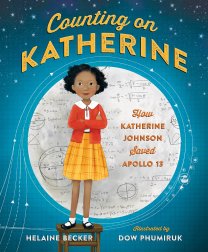 Counting on Katherine: How Katherine Johnson Saved Apollo 13
Written by Helaine Becker | Illustrated by Dow Phumiruk
Helaine Becker’s captivating storytelling captures Katherine Johnson’s genius for math and talent for applying it to even the most complex problems in a ground-breaking field. Her self-confidence, curiosity, and love of learning as well as her trajectory at NASA will impress readers, many of whom may also be dreaming of making a mark in new ways. A highlight of Becker’s text is her clear explanations of how Katherine’s calculations for NASA were used and what was at stake when her help was needed most. Becker’s repeated phrase “You can count on me” and her stirring ending weave together the numerical and lyrical aspects of Katherine’s life to inspire a new generation of thinkers.
From the first page, readers can see Katherine’s intelligence and inquisitiveness that shined whether she was walking to school, doing chores, or, later, making sure our astronauts made it to the moon and back safely. Dow Phumiruk’s artwork is always thrilling, and here blackboards covered in formulas as Katherine stands on tiptoe as a child and on a ladder as an adult to complete them will leave readers awestruck with her understanding of and abilities with numbers. Illustrations of school rooms and offices give children a realistic view of the times, and her imagery pairs perfectly with Becker’s text in demonstrating the concepts of sending a rocket ship into space and bringing it home again. Phumiruk’s lovely images of space are uplifting reminders that dreams do come true.
A stellar biography that will enthrall children and inspire them to keep their eyes on their goals and achieve their dreams, Counting on Katherine: How Katherine Johnson Saved Apollo 13 is highly recommended for home bookshelves and is a must for school and public library collections.
Ages 5 – 9
Henry Holt and Company, 2018 | ISBN 978-1250137524
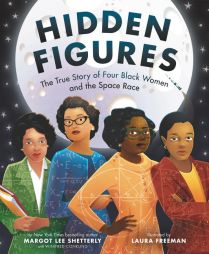
Hidden Figures: The True Story of Four Black Women and the Space Race
Written by Margot Lee Shetterly | Illustrated by Laura Freeman
Margot Lee Shetterly brings her compelling story Hidden Figures to children in this exceptional picture book that skillfully reveals the talents and dreams of Dorothy, Mary, Katherine, Christine as well as the work atmosphere and social injustices of the time period. While acknowledging the struggles and obstacles the four women faced, Shetterly keeps her focus on the incredible achievements of these brilliant women and the positive changes and opportunities for others they created. Brief-yet-detailed descriptions and explanations of math, science, and computer terms flow smoothly in the text, allowing all readers to understand and appreciate the women’s work.
As Dorothy, Mary, Katherine, Christine each begin their work at Langley as young women, Laura Freeman establishes their dreams and their particular field of expertise through richly colorful illustrations that highlight the schematics, tools, equipment, and models they used. In one particularly affecting spread, Dorothy, Mary, Katherine, and Christine go off to their offices on the left-hand side, and their white counterparts head out to theirs on the right-hand side while the blueprint of their building lies under their feet. Dorothy, Mary, Katherine, and Christine’s clothing is also mirrored in color by the women on the other side of the fold. Period dress and electronics show progression through the years, and kids may marvel at the size of early computers. The final image of Dorothy, Mary, Katherine, and Christine as older women is moving and inspirational.
Hidden Figures: The True Story of Four Black Women and the Space Race is an outstanding biography of four women who contributed their gifts for math as well as their self-confidence not only to science but to dreamers in their own and future generations. The book would be a stirring choice for classroom and home libraries.
Ages 4 – 8
HarperCollins, 2018 | ISBN 978-0062742469
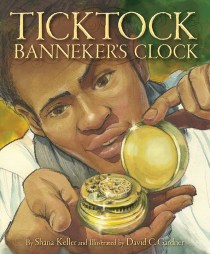
Ticktock Banneker’s Clock
Written by Shana Keller | Illustrated by David C. Gardner
With lyrical language that glides as smoothly as a well-oiled timepiece, Shana Keller reveals the remarkable story of Benjamin Banneker, born free during the time of slavery, who possessed exceptional math and scientific skills and used them to help his friends and neighbors and to make real his vision of a striking clock. Keller’s detailed and descriptive storytelling animates this life story, allowing readers to take the journey with Banneker as he experiences excitement, setbacks, and ultimately success. Banneker, embodying determination, persistence, and creativity, is an excellent role model for kids with big dreams of their own.
David C. Gardner’s lovely full-page and two-page-spread illustrations gloriously portray Benjamin Banneker’s farm and home as well as his dedicated commitment to building a striking clock despite—or perhaps spurred on by—the challenges he faced. Gardner’s detailed images set the biography firmly in its time period, letting children experience farm and home life in the 1750s. Banneker carries wooden buckets to feed the animals, tobacco leaves hang in a dry shed, a fire blazes in a large, open fireplace, and a candle flickers as Banneker whittles wheels and gears with his pocket knife. The realistic paintings that depict Banneker’s emotions as he imagines creating a large clock, overcomes obstacles, and studiously works on his drawings and carvings will inspire readers to attempt their own inventions—whatever they may be.
For any would-be inventors, history lovers, tinkerers, and science buffs, Ticktock Banneker’s Clock is a stirring biography that would make an inspirational addition to home, school and public libraries.
Ages 6 – 10
Sleeping Bear Press, 2016 | ISBN 978-1585369560
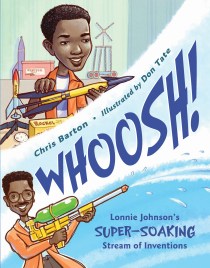
Whoosh! Lonnie Johnson’s Super-Soaking Stream of Inventions
Written by Chris Barton | Illustrated by Don Tate
Chris Barton’s biography of Lonnie Johnson is a fascinating look at a man who succeeds in turning “No” into “Yes” by the power of his intelligence, ideas, and determination. Kids will love hearing about how one of their favorite toys came to be and will be inspired to chase their own dreams despite challenges and setbacks. Barton’s detailed narration provides a full picture of Lonnie Johnson and his times, specifics that attract and inform like-minded kids. Including the results of Lonnie’s exam should encourage kids who think differently. The story is enhanced by the conversational tone that makes it accessible to kids of all ages.
Don Tate illuminates Lonnie Johnson’s life story with his bold, full-bleed paintings that follow Lonnie from his being a child with big ideas to becoming a man who has seen these ideas through to success. With an eyebrow raised in concentration, young Lonnie demonstrates confidence and skill as he works on an invention, and kids will love seeing the tools of his trade laid out on the kitchen table. As Lonnie grows older and designs systems for NASA, the illustrations depict the schematics of the Galileo power package and Lonnie’s surprise at the strength of the water stream in his prototype cooling design. As all kids know, the spurt of a Super Soaker is awesome, and this fact is demonstrated in a “Wowing” fold-out page.
WHOOSH! Lonnie Johnson’s Super-Soaking Stream of Inventions is a superb biography of the man who designs systems for the greater world but has never lost his youthful enthusiasm to invent. The book would be an inspirational addition to home, school, and public libraries.
Ages 5 – 10
Charlesbridge, 2016 | ISBN 978-1580892971
Slavery
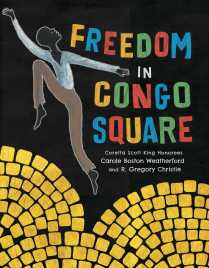
Freedom in Congo Square
Written by Carole Boston Weatherford | Illustrated by Gregory Christie
Through powerful rhythmic couplets, as spare and austere as the work they describe yet ending in a focal point of hope, Carole Boston Weatherford recreates the steady thrum that resonated in the hearts of slave and free men and women as they anticipated each afternoon in Congo Square. As the days remaining until Congo Square are counted off, Weatherford’s predominantly one-syllable words form a staccato beat, the pounding of hard, physical work. When Sunday comes and people find joy in their shared music and dance, Weatherford’s phrasing within the same structured couplets rises, employing multi-syllable words that give the verses a pulsing flow that echoes the freedom they find in Congo Square.
Gregory Christie’s vivid folk-art illustrations are a perfect complement to Weatherford’s verses. The elongated figures stand tall and proud amidst the fields and workrooms of the plantation. In some scenes the slaves’ angled bodies, leaning over to pick cotton, wash floors, or lift baskets may be bent, but they are not broken, and while two men work on building a wall, they seem to kneel prayerfully as they add another brick. In a moving two-page spread set at night, brown wood-grain houses superimposed with rows of sleeping slaves float on a blue-toned ground below a red sky, reminiscent of ships laden with Africans sailing the Middle Passage of the Atlantic slave trade. As the men and women congregate in Congo Square, Christie’s lithe figures raise their arms and kick their legs in dance. The fiery backgrounds swirl with color as the celebrants jump, stretch, play instruments and move with exultation.
Freedom in Congo Square is both a heartrending and jubilant book that would make a wonderful and meaningful addition to any home, school, and public library.
Ages 4 – 8
little bee books, 2016 | ISBN 978-1499801033
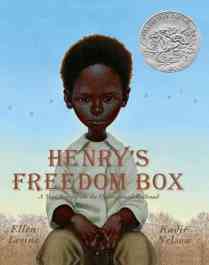
Henry’s Freedom Box: A True Story from the Underground Railroad
Written by Ellen Levine | Illustrated by Kadir Nelson
Based on an actual story of The Underground Railway, Henry’s Freedom Box is written and illustrated to stunning effect. Ellen Levine’s lyrical and metaphorical language combines with the excellent pacing of the pages to enhance the emotional impact of this powerful and original true story. Children will be inspired by this man who suffered devastating loss, but persevered and through cunning, bravery, and the help of friends, obtained freedom.
Kadir Nelson took inspiration for his illustrations from an antique lithograph of Henry Brown, created by Samuel Rowse in 1850. Through a combination of watercolor and oils crosshatched with pencil lines, Nelson’s richly hued paintings capture the poignancy of Henry’s struggles and ultimate freedom. His characters’ facial expressions are particularly moving.
Henry’s Freedom Box: A True Story from the Underground Railroad is a riveting story of slavery and one man’s fight for freedom that would make an excellent addition to children’s libraries.
Ages 4 – 8
Scholastic Press, 2007 | ISBN 978-043977733
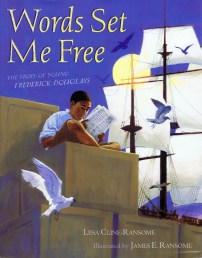
Words Set Me Free: The Story of Young Frederick Douglass
Written by Lesa Cline-Ransome | Illustrated by James Ransome
Lesa Cline-Ransome has written a compelling biography of Frederick Douglass for children in Words Set Me Free. In straightforward language and through first-person point of view, Cline-Ransome reveals the brutal truth of Douglass’s life as a slave and his fight against injustice. As the title suggests, the book focuses on Frederick’s desire to become educated and the obstacles he overcame to succeed. This universally important message continues the work Douglass engaged in long ago.
James Ransome’s stirring paintings realistically highlight pivotal scenes of Frederick’s life, beginning with the tender moments he spends with his mother as a very young child. With an unstinting eye Ransome reveals the hardship and cruelty Frederick endured as a slave. His moving illustrations also demonstrate hope as Frederick, with blossoming intellect, resolves to educate himself and find a means of escape.
Ages 5 and up
Simon & Schuster, New York, 2012 | ISBN 978-1416959038
Sports
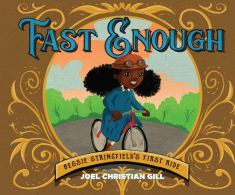
Fast Enough: Bessie Stringfield’s First Ride
By Joel Christian Gill
Joel Christian Gill introduces children to Bessie, a determined, brave, and pioneering woman at a formative time in her life. Told that girls don’t ride bikes and that she wasn’t good enough or fast enough anyway, Bessie Stringfield wrestled with self-doubt, but she took control of what she wanted and ultimately proved to herself and others that she was more than capable. Gill’s first pages set the stage for readers to contemplate ways in which they may doubt themselves, before encouraging them to find inspiration and confidence in Bessie’s story.
Gill’s vivid illustrations clearly show Bessie’s sadness as she internalizes the boy’s taunts, her tenacity, and finally her jubilation is besting them and achieving her goal. Images of Bessie’s dream and its resulting reality creatively play on the dual meaning of the word dream while a change in Bessie’s room décor while she sleeps is a clever touch.
A singular story about a trailblazing black woman, Fast Enough: Bessie Stringfield’s First Ride encourages children to embrace their own identity instead of letting others define them. The book would be a welcome addition to home, school, and public library collections.
Ages 5 – 9
Oni Press, 2019 | ISBN 978-1549303142
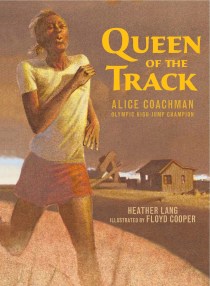
Queen of the Track: Alice Coachman, Olympic High Jump Champion
Written by Heather Lang | Illustrated by Floyd Cooper
Heather Lang brings an athlete’s appreciation for the in-born talent and hard practicing that creates a world-class Olympian. Her story reveals not only the details of Alice’s physical training but also the social and economic hurdles she overcame in her quest to compete in the Olympics. Lang’s graceful and evocative prose carries readers down dirt roads and over obstacles, to the halls of the Tuskegee Institute, and into Wembley Stadium as they learn about the singular focus Alice Coachman dedicated to her sport. Children will feel as if they are sitting in the stands watching with suspense as the bar is raised again and again, pushing Coachman to a world record.
Floyd Cooper sets readers in the hot, dusty, sun-burned South, where Alice Coachman—as a little girl and then a teenager—runs barefoot on dirt roads, jumps over homemade bars, leaps to tip the basketball from her brothers’ hands, and delivers food to tornado victims. The golden-brown-hued illustrations catch Dorothy Taylor and Alice Coachman as they soar over the high bar in their fierce competition and capture Coachman’s hopes, dreams, and anticipation as she waits—hands clasped—to hear the judges’ final decision in the 1948 Olympic Games. Readers will cheer to see Coachman standing on the first-place podium, ready to receive her well-deserved gold medal.
A compelling and inspiring biography for children pursuing any talent, Queen of the Track: Alice Coachman, Olympic High Jump Champion would be a welcome addition to home, school, and public libraries.
Ages 5 and up
Boyds Mills Press, 2012 | ISBN 978-1590788509

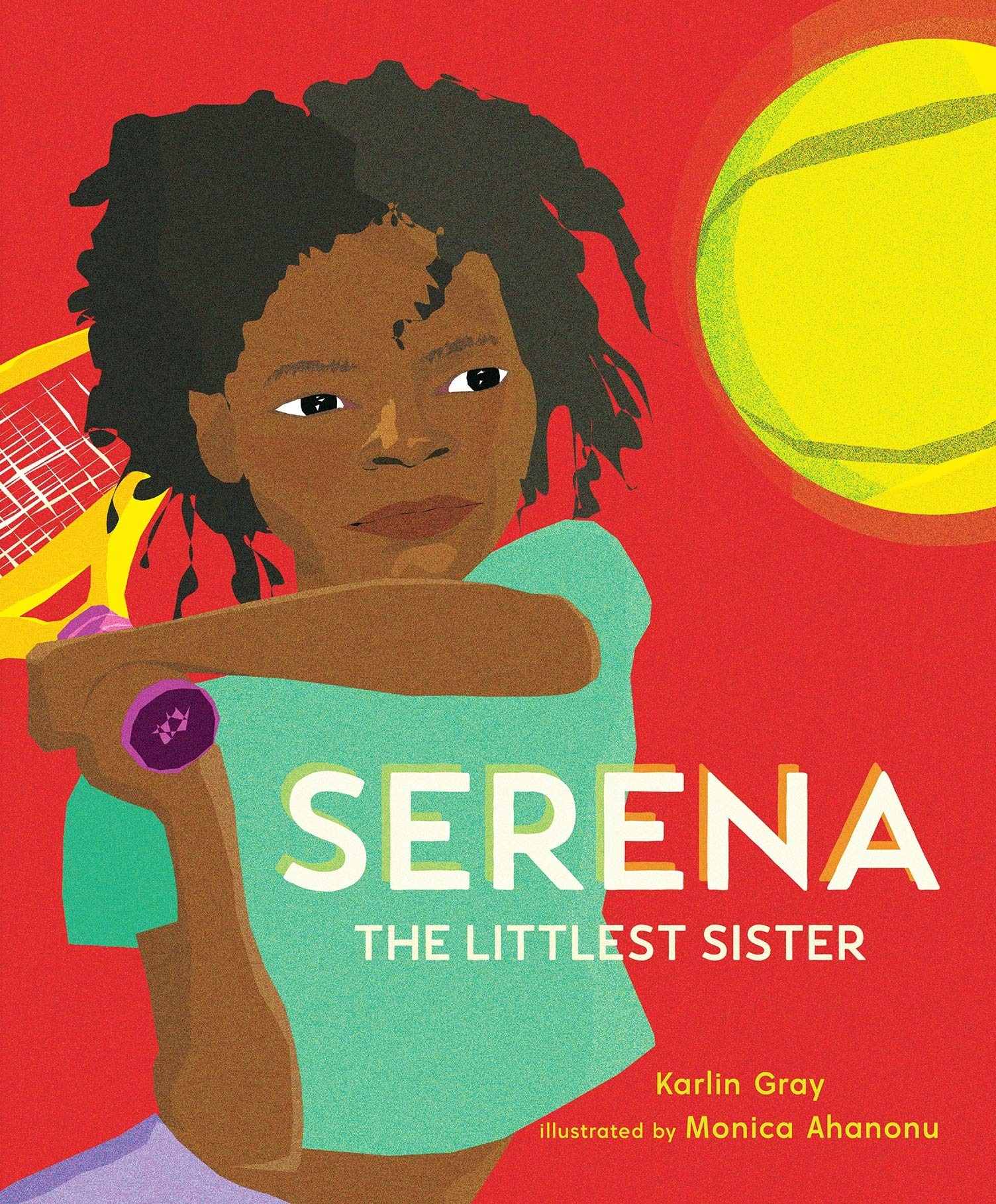
Serena: The Littlest Sister
Written by Karlin Gray | Illustrated by Monica Ahanonu
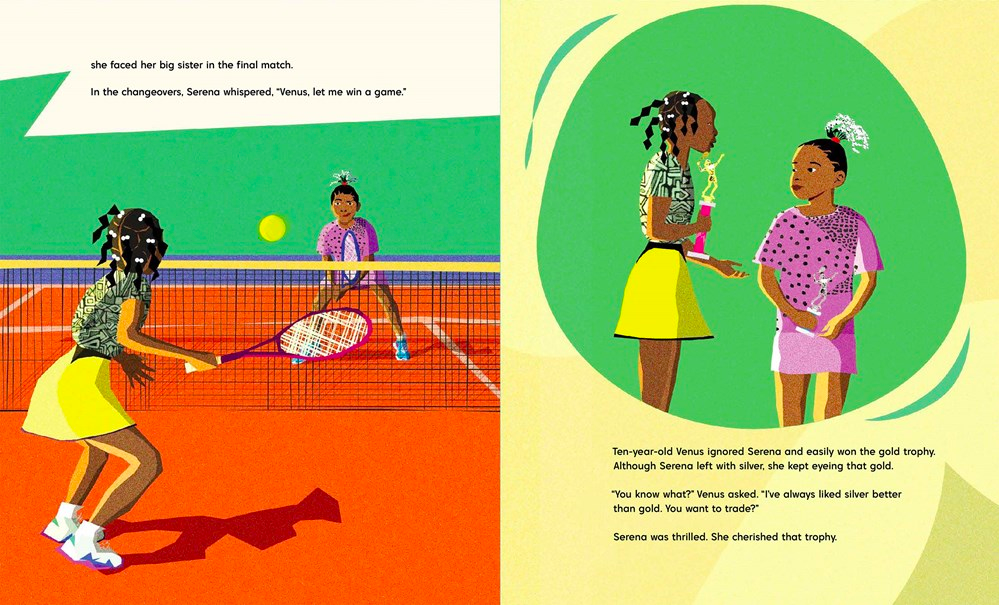
Karlin Gray’s masterful biography of Serena Williams shows young readers the determination, confidence, and strong familial bond that followed Serena through her life and made her one of tennis’s most influential women players. The family’s remarkable life and focus on what one can achieve will inspire all kids, no matter what their dream is. Choosing seminal events in Serena’s and Venus’s life, Gray follows Serena’s reputation on the court as she loses and wins matches, building suspense until that day when she accomplishes her goal and wins the US Open. Her inclusion of articles and comments that cast doubt on Serena’s future success, demonstrates that even the greats face opposition and naysaying, and Serena’s sister’s advice to ignore it is sound.
Monica Ahanonu’s textured, collage-style illustrations leap off the page with vibrant images full of action and the girls’ personalities. As the girls race onto a court for practice, their eager expressions show their love of the game and being together. Even as a four-year-old Serena has the steely eyed gaze of a champion as she watches the bouncing ball and lines up for her swing. Ahanonu’s use of various perspectives and shadowing create dynamic scenes on the court, and tennis lovers will be thrilled at the many illustrations of Venus and Serena playing their sport. The bond between the sisters is evident in images of Serena interacting with one or more of her sisters. Those who remember Serena’s win at the 1999 US Open will recognize her joyous win.
Perfectly aimed at young readers who are the same age as Serena and Venus when they began developing their skills and sport, Serena: The Littlest Sister is an inspirational biography of a present-day role model that is sure to spark an “I can” attitude. Adults who have followed the Williams sisters’ rise to tennis stardom will be equally enthralled with this beautiful biography. The book would make a stirring addition to home, classroom, and library collections.
Ages 8 – 11
Page Street Kids, 2019 | ISBN 978-1624146947
To order books from black-owned bookstores, you’ll find a list in this article by the African American Literature Book Club.
To support your local independent bookstore, order from: Bookshop | IndieBound
Picture Book Review