November 29 – It’s National Family Literacy Month

celebrate-picture-books-picture-book-review-a-fish-to-feed-red-socks-covers-image

About the Holiday

Today’s observance was established in 1994 to promote family and community involvement in teaching and supporting children to read more. Family members can make reading a priority at home by sitting down together every day with a wide range of books and other reading material. By taking trips to the library and bookstores, children will also naturally pick up a love of reading. But families can’t do it alone. Kids acquire a drive to read when they see connections between books and their wider world. Fun book-related activities at schools, libraries, science centers, museums, and other places capture children’s attention and make them curious about reading more. Whether children are attracted by fiction or nonfiction, picture books or chapter books, novels or graphic novels, they should be encouraged to read. Universal literacy is a goal that can be accomplished.

About Small Talk Books®

Ellen Mayer’s Small Talk Books® feature young children and adults conversing (or adults speaking to children who are not talking yet) while they have fun, do chores, shop, and bake together. Their conversations demonstrate the kind of excitement and close relationships that encourage learning and language advancement. Each Small Talk Book® includes an accompanying note from Dr. Betty Bardige, an expert on young children’s language and literacy development and the author of Talk to Me, Baby! How You Can Support Young Children’s Language Development. The introduction discusses how children connect actions, words, and meaning as adults speak to them while doing particular jobs or actions.

Other titles in the Small Talk Books® series include Cake Day and Rosa’s Very Big Job. Each book makes a wonderful gift for baby showers, new parents, or anyone with young children in the family. They would be a welcome addition to any young child’s bookshelf as well as libraries and preschool classrooms.
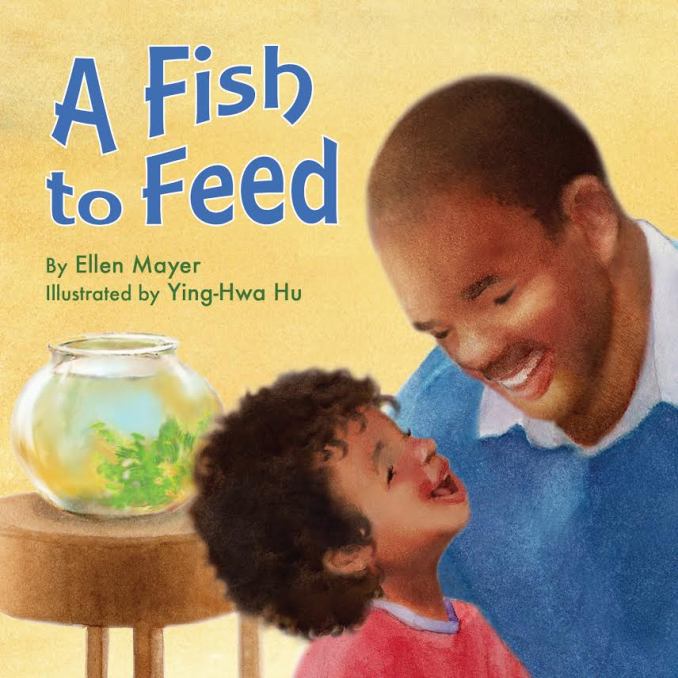
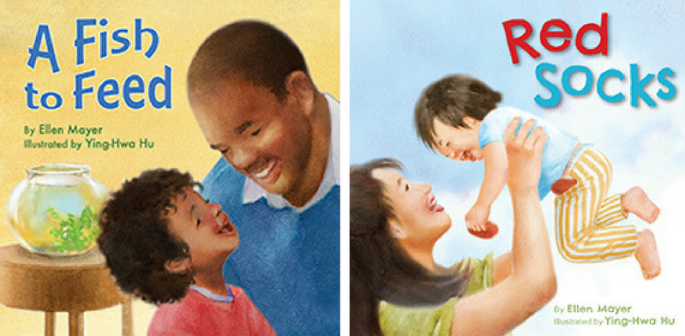
celebrate-picture-books-picture-book-review-a-fish-to-feed-coverA Fish to Feed

Written by Ellen Mayer | Illustrated by Ying-Hwa Hu


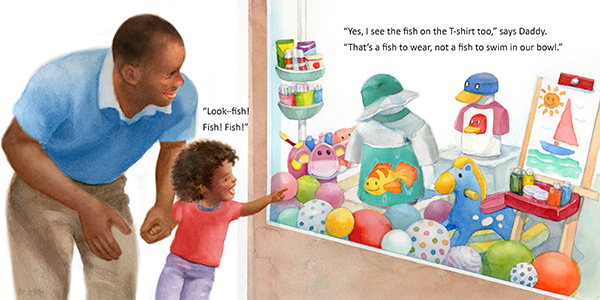
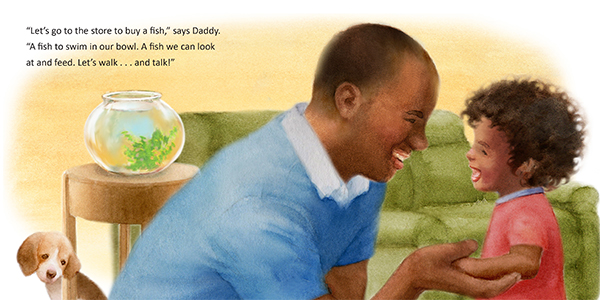
Dad plans a fun trip into town with his young child to buy a pet fish. He says, we will get “a fish to swim in our bowl. A fish we can look at and feed.” The pair are excited to go together and have time to “walk…and talk.” The two head out and soon pass a store. In the window the child sees a T-shirt with the picture of a fish on it and points. “Look—fish! Fish! Fish!” Dad reinforces the observation—“Yes, I see the fish on the T-shirt too.”—and further explains: “That’s a fish to wear, not a fish to swim in our bowl.”
celebrate-picture-books-picture-book-review-a-fish-to-feed-t-shirt

Image copyright Ying-Hwa Hu, text copyright Ellen Mayer. Courtesy of starbrightbooks.com

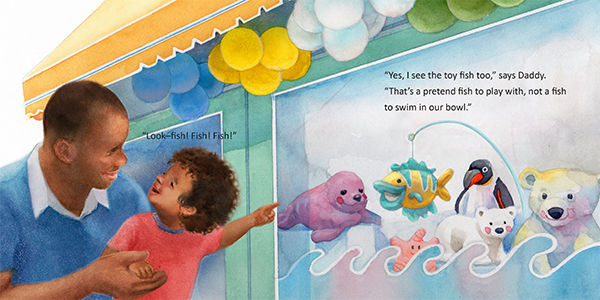
Going into the store, Dad and his youngster find another item with a fish on it. On a shelf is a backpack with a picture of a gold-and-yellow fish on the front pocket. This is a “fish to wear on your back,” Dad says, before going in search of a “fish to feed.” Next, the two come to a toy store. The child points to another fish—a fish on a mobile. “Look—fish! Fish! Fish!” the toddler exclaims. Dad affirms his child’s remark and expands on it using complete sentences that model conversation and increase vocabulary. They linger in the shop, finding other examples of fish.
celebrate-picture-books-picture-book-review-a-fish-to-feed-mobile

Image copyright Ying-Hwa Hu, text copyright Ellen Mayer. Courtesy of starbrightbooks.com

“‘Now let’s go find a fish to feed,’ says Daddy.” They head out of the store and continue down the street. As they come to the Pet Shop, the little one shouts, “‘Look—fish! Fish swim!” Daddy echoes the excitement while praising his child. “‘You found a fish that swims!’” They take the goldfish home, where it swims happily in their bowl—a pet they “can love and feed.”

A Fish to Feed contains die-cut holes in the pages that kids will love peering through as they shop along on this adventure to find a special pet.
celebrate-picture-books-picture-book-review-a-fish-to-feed-dad-and-child

Image copyright Ying-Hwa Hu, text copyright Ellen Mayer. Courtesy of starbrightbooks.com

Ellen Mayer’s story of a dad and his child out for an afternoon together as they look for a pet to love offers adults and children such a sweet way to spend time with one another. The story, set in the familiar environments of home and stores and revolving around a close parent-child relationship, will engage even the youngest readers. The back-and-forth conversation between Dad and his child as they shop models ways in which adults can follow a child’s lead while providing language and literacy development. The abscence of gender-specific pronouns makes this a universal story.

Ying-Hwa Hu’s illustrations are vibrant and joyful. When Dad bends down to be at eye-level with his toddler as they talk, the close bond between them is obvious in their smiling and laughing faces. The shops are full of colorful toys, clothes, backpacks, and other items that will capture kids’ attention. Spending time looking at each page allows adults and children to point at the various items, name them, and talk about them.

Ages Birth – 5

Star Bright Books, 2015 | ISBN 978-1595727077
celebrate-picture-books-picture-book-review-red-socks-coverRed Socks

Written by Ellen Mayer | Illustrated by Ying-Hwa Hu


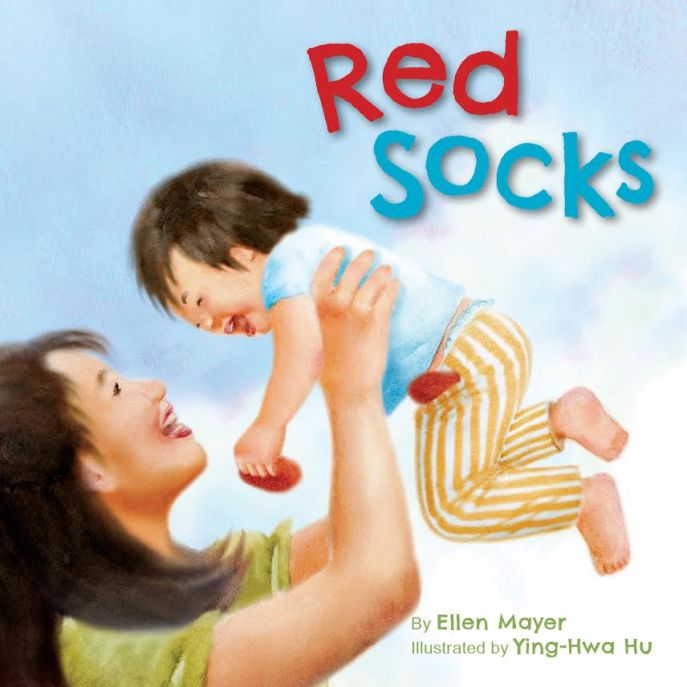
It’s laundry day and the clothes are all dried and soft and ready to wear. “‘Here is your blue shirt, with the goldfish on it,’” Mama says, pulling the top out of the basket and bending down to eye level to show it to her baby. Next, Mama describes the “yellow and white striped pants” she puts on her child. “‘Let’s see what else is in the laundry basket,’” she says.

celebrate-picture-books-picture-book-review-red-socks-shirt

Image copyright Ying-Hwa Hu, text copyright Ellen Mayer. Courtesy of starbrightbooks.com

Mama pulls a tiny red sock from the basket, but—“UH-OH!—where is the other red sock?’” Now it’s the baby’s turn to help. With a look down, the toddler shows Mama where the sock is. “‘You found the other red sock. Yay!’” she says, giving words to the baby’s action. She continues explaining while pointing to the sock poking out of the baby’s pocket: “‘It was hiding in your pants pocket!” Once the laundry is folded, Mama tells her child exactly what they will do next while she playfully slips the other red sock on the baby’s wiggling feet. “‘Let’s put that other sock on your foot. Then we can go play outside.’” As the baby flies in the swing outside, the red socks are brilliant dots against the blue sky.

celebrate-picture-books-picture-book-review-red-socks-pants

Image copyright Ying-Hwa Hu, text copyright Ellen Mayer. Courtesy of starbrightbooks.com

Ellen Mayer’s simple and charming story of a particular moment in a mother and child’s day will immediately appeal to even the youngest reader. Familiar words coupled with clear, vivid illustrations will engage toddlers who are pre-talking and just learning language and concept development. The mother’s use of complete sentences as well as step-by-step descriptions of the activities the child sees and is involved in demonstrates how adults can converse with their babies and young children to encourage strong language and literacy skills. Free of gender-specific pronouns, Red Socks is a universal story.

Ying-Hwa Hu’s illustrations show a mother and child interacting on a typical day while they complete common chores and go outside to play. The mother and child portray a range of emotions and gestures, giving further depth to the understanding of the ideas and conversation presented. Kids will giggle at the adorable puppy who causes a bit of mischief on each page.

Ages Birth – 5

Star Bright Books, 2015 | ISBN 978-1595727060

To learn more about Ellen Mayer and her Small Talk Books® (including other titles: Cake Day and Rosa’s Very Big Job) as well as to find activities to accompany each book, visit her website!

Discover more about Ying-Hwa Hu and view a portfolio of her illustration work on her website!

Red Socks and Too Small to Fail

Red Socks was chosen by Too Small to Fail, an early literacy initiative of The Clinton Foundation to feature in their Wash Time is Talk Time project. Wash Time is Talk Time serves underserved communities and provides resources to turn time spent at the laundromat into an opportunity for families to talk together, read together, and learn together. Language-rich literacy resources will be delivered to more than 5,000 laundromats across the country.

Here’s a video from one fun afternoon with families,  Ellen Mayer, and Ying-Hwa Hu during wash time!

National Family Literacy Month Activity
celebrate-picture-books-picture-book-review-sensory-board

Child’s Sensory Board


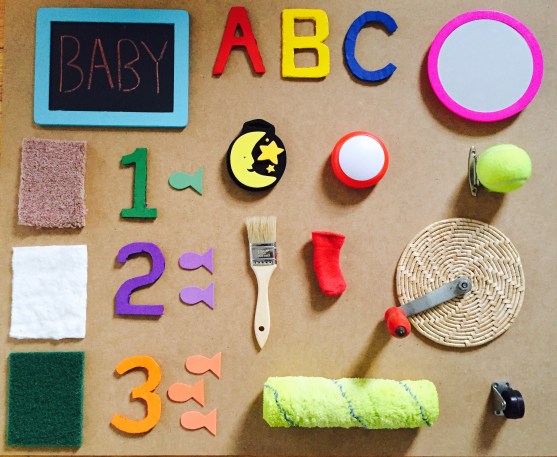
Toys or objects that provide many opportunities for sensory experimentation and observation stimulate a baby and young child to learn while having fun. You can make a sensory board for your own child using household items and that have a variety of textures, sizes, shapes, and movement. When you create your own sensory board, you can personalize it for your child by adding their name, pictures of family members, and other special items. While you play with your child, take time to talk about all of the objects on the board, what they do, and how they work. Count the objects. If you include words or your child’s name, spell them outloud and say them. There are so many ways to use a sensory board. Even if children can’t yet talk, they are listening and soaking in the rich language learning you are providing!

**When making your board always ensure that you use items that are not a choking hazard or can catch tiny fingers. Make sure that items are firmly attached to the board. Never leave a baby unattended while playing.**

Supplies

  • A board large enough to hold the items you want to attach. Boards that can be used include: those found at hardware stores or craft stores; large cutting boards; shelves; old table tops; etc.

Sample items for your sensory board can be age appropriate and include:

  • Large swatches of various textured material. (I used fur, a scrubbing sheet, and a piece of carpeting)
  • Wooden or thick cardboard letters and numbers, painted in a variety of colors. Letters can be used to add a child’s name to the board.
  • Figures cut from sheets of foam or wooden figures found at craft stores in a variety of numbers that you can count with your child (I used sets of 1, 2, and 3 fish cut from foam to go along with the numbers 1, 2, and 3)
  • Mirror
  • Push button light
  • Chalk board to write on
  • Castor or other wheel
  • Door latches
  • Door knockers
  • Mop heads
  • Paint rollers
  • Cranks
  • Drawer handles
  • Hinges (I attached a tennis ball to a hinge that children can push back and forth)
  • Pulleys
  • Paint in various bright colors
  • Paint brushes
  • Scissors
  • Screws
  • Nuts and bolts
  • Velcro
  • Super glue

Directions

  1. Assemble your items
  2. Paint wooden or cardboard items
  3. Arrange item on the board so that your baby or child can easily reach or manipulate each one
  4. Attach items with screws, nuts and bolts, or super glue
  5. Push button lights or other objects that take batteries can be attached with strong Velcro. Ensure items attached with Velcro are large and not a choking hazard.
  6. Set up board where you and your baby or child can enjoy playing with it together

Picture Book Review

November 10 – World Science Day for Peace and Development

celebrate-picture-books-picture-book-review-how-the-meteorite-got-to-the-museum-cover

About the Holiday

This annual, internationally observed day highlights the importance of science in and for society and is sponsored by the United Nations. Its aim is to promote education and awareness of scientific issues that affect the world and its sustainability as well as to underscore the role that scientists play in improving our lives and developing solutions for the future. This year the theme is “Celebrating Science Centers and Science Museums.” To celebrate, grab the kids (or go alone!) and head out to your local science center!

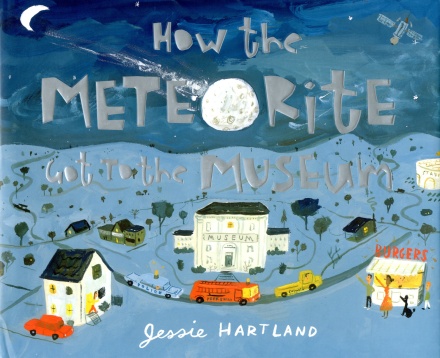
How the Meteorite Got to the Museum

By Jessie Hartland


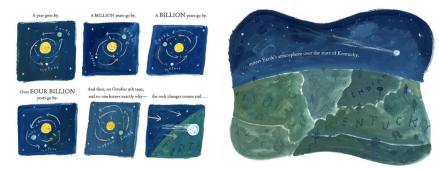
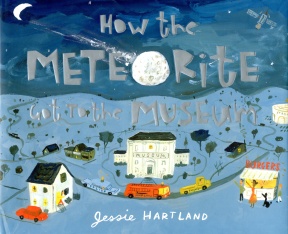
A science teacher leading her students through a science museum stops at the display for the Peekskill Meteorite that fell to Earth in New York state on October 9, 1992. As she explains a bit about meteorites, one student raises his hand and asks, “But how did the meteorite get here—to the museum?” With that question the students—as well as readers—are off and running on an adventure of astro-nomical proportions as the teacher begins: “Hundreds of mllions of miles from Earth, in deep, dark, cold outer space, there are vast fields of space debris flying around.” The smaller rocks are called meteors, and a meteor that falls to Earth is called a meteorite.

celebrate-picture-books-picture-book-review-how-the-meteorite-got-to-the-museum-meteors

Image copyright Jessie Hartland, 2013, courtesy of Blue Apple Books.

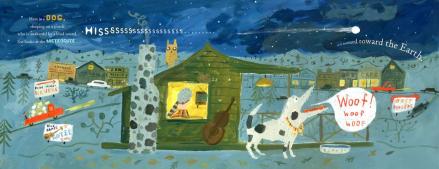
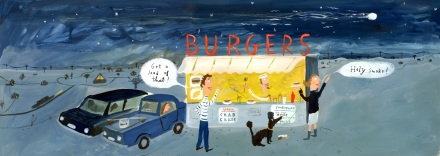
The teacher sets the scene: “Here in outer space is a meteor…flying around and around and around”—for over four billion years! Then for some unknown reason the meteor changed direction and entered “Earth’s atmosphere over the state of Kentucky.” With a Hissssss and a Crack! the zipping meteor alerts a sleeping dog, who begins to bark at it. The space rock, trailing a fiery tail, zooms over a burger stand in Virginia, attracting the attention of some late-night snackers.

In Pennsylvania, a few seconds later, a high school football game suddenly turns historic as the meteorite, hissing and crackling through the sky attracts the attention of video cameras throughout the stands. Yes, this is the same celestial body “which was spotted by the Virginians, and yelped at by the dog as it zipped toward the Earth.”

celebrate-picture-books-picture-book-review-how-the-meteorite-got-to-the-museum-dog-barks

Image copyright Jessie Hartland, 2013, courtesy of Blue Apple Books.

With a Crash, Bang, Boom, the rock hurtles downward. “Here is the teenager, who had been watching late-night TV at her house in Peekskill, NY, when she heard a tremendous CRASSHHH! She has rushed outside and discovered a huge dent in the trunk of her car and a smoking ‘rock’ nearby.” Wanting to discover the culprit of this vandalism, the teenager calls the police who summon firefighters to cool down the “rock.”

After hosing down the ‘rock’ the firefighters “start to suspect that the rock may really be a meteorite.” A geologist is called from Columbia University to examine the rock. “He confirms that what smashed the car is, indeed, a meteorite, which was cooled by Firefighters, investigated by Police, found by the Teenager, gawked at by Sports fans, buzzed about by Virginians, and arfed at by a dog as it raced toward the Earth.”

celebrate-picture-books-picture-book-review-how-the-meteorite-got-to-the-museum-burger-joint

Image copyright Jessie Hartland, 2013, courtesy of Blue Apple Books.

Next, the Curator of Meteorites from the Museum of Natural History in New York City visits the geologist, hoping to obtain this special specimen for the museum. Soon, a Cosmologist develops a program about the meteorite that she presents at a museum symposium, explaining how this 26-pound meteorite crossed over 400-500 miles in just 40 seconds and collided with a car—a-one-in-a-billion chance. The Museum of Natural History secures the meteorite for its collection, and the Exhibits Team designs the “lighting, signage, and diorama for their newest acquisition.”

Which brings us back to the Ross Hall of Meteorites at the museum and the complete story of “the Peekskill Meteorite, which was…barked at tby the Dog, witnessed by Virginians, filmed by Sports Fans, found by a Teenager, poked at by Police, sprayed with water by Firefighters, validated by the Geologist, obtained by the Curator of Meteorites, summed up by the Cosmologist, presented by the Exhibits Team, and explained by the Science Teacher who says: ‘…and that’s how the meteorite got to the museum.’”

An Author’s Note following the text explains more about meteors and introduces Dr. Mark Anders, the Geologist mentioned in the book. A photograph of the car hit by the meteorite offers fascinating viewing.

In her entertaining and informative telescoping text, Jessie Hartland reveals in easy-to-understand steps the people and actions involved in bringing together a museum exhibit for a meteorite. The repetition of the important characters in this true, history-making drama combined with Hartland’s deft command of a vast array of synonyms makes reading each page a joy. Suspense grows as each stage of the meteorite’s trajectory from space rock to “star” exhibit builds on the previous one, exciting kids not only for the tale of the meteorite, but also for the displays they see when visiting a museum.

celebrate-picture-books-picture-book-review-how-the-meteorite-got-to-the-museum-meteorite

Image copyright Jessie Hartland, 2013, courtesy of Blue Apple Books.

Hartland’s folksy two-page spreads are a perfect match for the rhythmic text—both humorous and educational in their details. The meteor—zipping through the dark blue night sky dotted with stars, over a small town, above an out-of-the-way burger joint, and through the cheering sounds of a football game—leads readers on a page-turning chase until it crash lands on the bumper of the teenager’s car. Here, as the police write up their investigation on the left-hand page, the firetruck can be seen hurrying to the scene, siren blaring, on the right, even as raccoons and a cat take the opportunity of the distraction to make mischief.

Hartland’s depictions of the geologist’s office as well as the American Natural History Museum give readers a peek behind the scenes at the tools and displays used by scientists and museum workers. For kids who love museums, science, and fun wordplay, How the Meteor Got to the Museum is an absorbing addition to home bookshelves as well as school, classroom, and other libraries. Jessie Hartland’s other titles in this series—How the Dinosaur Got to the Museum and How the Sphynx Got to the Museum—are also highly recommended.

Ages 4 – 9

Blue Apple Books, 2013 | ISBN 978-1609052522

Discover many more books by Jessie Hartland as well as other artwork on her website!

World Science Day for Peace and Development Activity

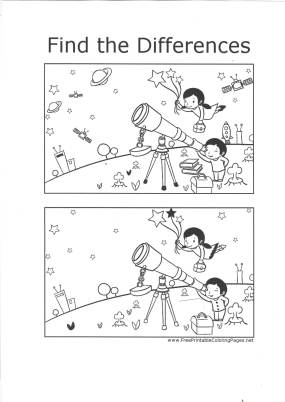
celebrate-picture-books-picture-book-review-astronomy-find-the-differences

Astronomy Buffs Find the Differences Puzzle


These kids are looking for stars and planets, but can you find the 15 differences between the two pictures in this printable Astronomy Buffs Puzzle?

celebrate-picture-books-picture-book-review-how-the-meteorite-got-to-the-museum-cover

You can find How the Meteorite Got to the Museum at these booksellers

Amazon | Barnes & Noble | IndieBound

Picture Book Review


November 9 – National Aviation History Month

celebrate-picture-books-picture-book-review-wind-fliers-cover

About the Holiday

If you look back in history you see that people have always been fascinated with flight. The first kite was invented in 1000 BCE in China; around 400 BCE Archytas of Tarentum developed a steam-powered pigeon; and most people are familiar with the designs of flying machines that Leonardo de Vinci created in the late 1400s. An important discovery that led inventors in the right direction came in 1680 when an Italian mathematician determined that human muscles were incompatible with flight.

Zip ahead about 100 years and the first hot-air balloon flight was undertaken, which led to more and more complex technology, resulting in Wilbur and Orville Wright’s flight in 1903. From there, it seemed, the sky was the limit. Amelia Earhart became the first woman to complete a trans-Atlantic Ocean solo flight in 1932, and in 1947 Charles Yeager broke the sound barrier. But it’s astounding to think that from that modest 12-second first flight by the Wright Brothers to the first man in space—Soviet cosmonaut Yuri Gagarin—it took only 58 years! Today astronauts from countries around the world live and work in the International Space Station, and spacecraft are traversing deep space.

Wind Flyers

Written by Angela Johnson | Illustrated by Loren Long

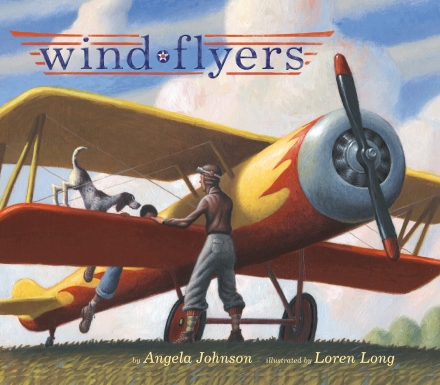
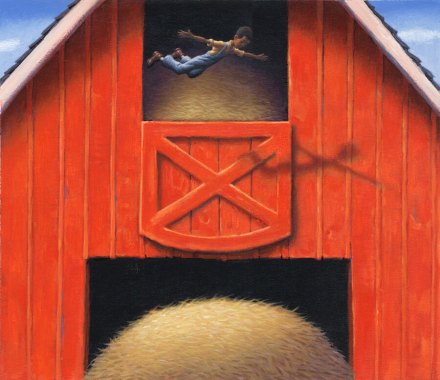
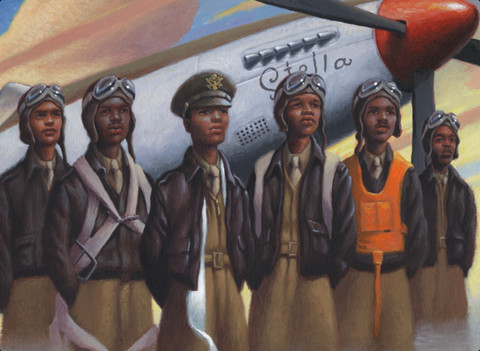
With pride a young African-American boy tells the story of his great-great-uncle who was a Tuskegee Airman in World War II. His uncle was “a smooth wind flyer. A Tuskegee wind flyer…,” the boy says. He knows well his uncle’s history—how like a bird, his uncle believed he was born to fly. “With his arms flapping, he jumped off a chicken coop at the age of five,” and when he was only seven he soared from a lofty barn into a pile of hay. His first real flight came at the age of eleven, when he paid 75 cents to be a passenger with a barnstormer.

celebrate-picture-books-picture-book-review-wind-fliers-jumping-from-hayloft

Image copyright Loren Long, courtesy of Simon & Schuster

Flying over lakes and fields, his uncle felt as if he were in Heaven, among clouds “like soft blankets, saying, ‘Come on in, get warm. Stay awhile and be a wind flyer too.’” The experience changed him forever. In fact he “cried when they landed because then he knew what it was like to go into the wind, against the wind, beyond the wind.” As a young adult his uncle contributed his dream and his skills to the World War II effort, becoming a Tuskegee Airman, one of the first black pilots in the United States military.

celebrate-picture-books-picture-book-review-wind-fliers-tuskegee-arimen

Image copyright Loren Long, courtesy of Simon & Schuster

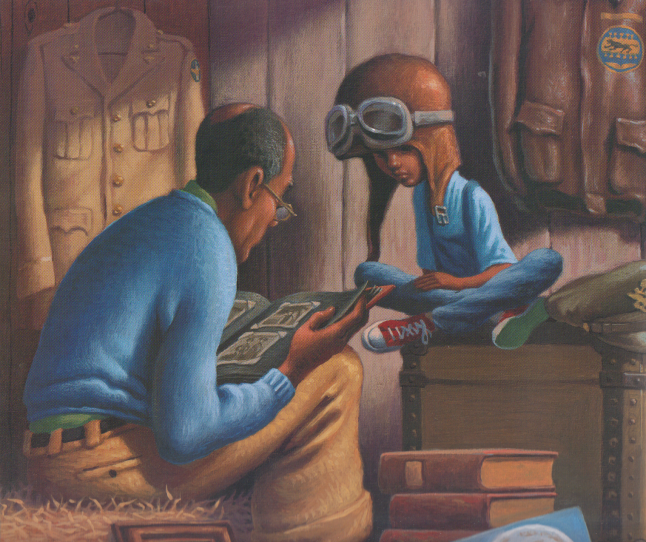
As the pair sit in the uncle’s barn, surrounded by his military uniform, leather jacket, and other memories of his flying career—after the war to continue flying he became a crop duster—the pair look through old photographs, seeing once more those young and brave pilots—the Tuskegee wind flyers. Planes are different now, Uncle says, but the clouds remain the same. The boy and his uncle climb to the highest point of the uncle’s barn to watch the jets—and in those moments they once more become the smooth wind flyers, flying into the wind and beyond.

celebrate-picture-books-picture-book-review-wind-fliers-grandfather-and-grandson

Image copyright Loren Long, courtesy of Simon & Schuster

In her soaring, rhythmic language, Angela Johnson captures the dreams and yearning of a young boy whose greatest desire is to fly among the clouds. Her combination of straight narration with lyrical lines as he joins the Tuskegee Airman in World War II enhances the sense of achievement and pride the young pilots felt. The structure of the story is well chosen, as relating the uncle’s life from childhood through old age through the eyes of his nephew strengthens the themes of strong familial relationships as well as shared dreams across generations.

Loren Long gives Wind Flyers additional power with his strong, vibrant paintings. Two-page spreads provide a sense of the vastness of the skies that so enticed the young would-be pilot. Even the clouds echo the emotion of the page—fluffy, floating, and alive in the flight scenes while linear, flat, and stationary when the plane and the uncle are earthbound. Realistic portrayals of the boy, his uncle, and the other Tuskegee Airmen are reminiscent of the WPA murals of the 1940s while still setting this book firmly in today for a new generation.

Wind Flyers is a wonderful book to share with aviation buffs, budding historians, and dreamers of all types and would make a welcome thoughtful book for quiet story times.

Ages 4 – 9

Simon & Schuster Books for Young People, 2007 | ISBN 978-0689848797

To learn more about Angela Johnson‘s books for all ages, visit her website!

View a gallery of artwork for picture books and other media by Loren Long, visit his website!

National Aviation History Month Activity

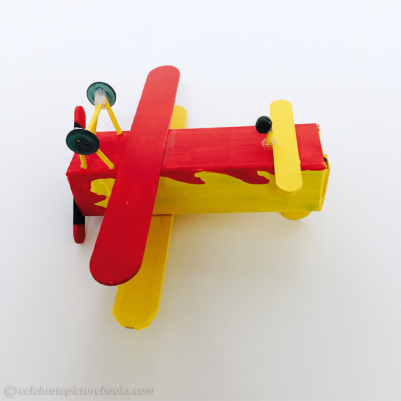
CPB - Biplane side

Head in the Clouds Box Biplane

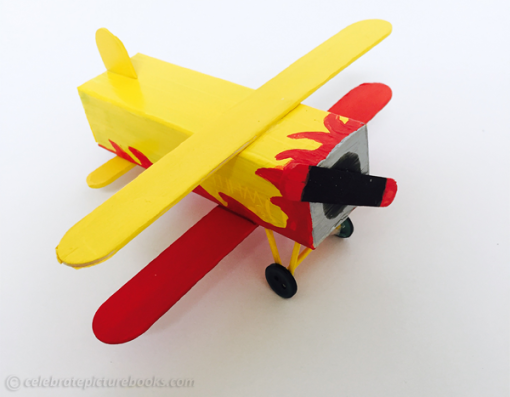
If you love airplanes and flying, you’ll have fun making your own plane from recycled materials! Use your creativity to decorate your plane while you imagine yourself flying through the clouds on a beautiful day. Younger children will have fun sharing this activity with an adult or older sibling too!

Supplies

  • Travel-size toothpaste box
  • 3 6-inch x 1/2-inch craft sticks
  • 2  2 1/2-inch x 7/8-inch mini craft sticks
  • 5 Round toothpicks, with points cut off
  • Paint in whatever colors you like for your design
  • 4 small buttons 
  • 2 mini buttons
  • Paint brushes
  • Strong glue or glue gun

CPB - Biplane front

Directions

  1. Empty toothpaste box
  2. Paint toothpaste box and decorate it
  3. Paint the craft sticks and 5 toothpicks
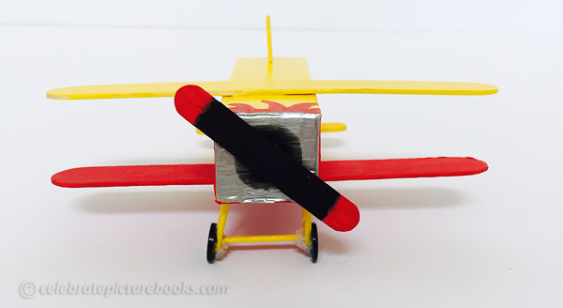
  4. Paint one small craft stick to be the propeller
  5. Let all objects dry

To assemble the biplane

  1. For the Bottom Wing – Glue one 6-inch-long craft stick to the bottom of the plane about 1 inch from the end of the box that is the front of the plane
  2. For the Top Wing – Glue the other 6-inch-long craft stick to the top of the plane about 1 inch from the front of the plane
  3. For the Tail – Glue one mini craft stick to the bottom of the box about ¾ inches from the end that is the back of the plane
  4. For the Vertical Rudder – Cut the end from one of the painted 6-inch-long craft sticks, glue this to the back of the box, placing it perpendicular against the edge and half-way between each side

CPB - Biplane bottom

To assemble the front wheels

  1. Cut 4 painted toothpicks to a length of ¾-inches long
  2. Cut one painted toothpick to a length of 1-inch long
  3. Glue 2 of the 3/4-inch toothpicks to the back of 1 button, the ends of the toothpicks on the button should be touching and the other end apart so the toothpicks form a V
  4. Repeat the above step for the other wheel
  5. Let the glue dry
  6. Glue the 1-inch long toothpick between the wheels at the center of each wheel to keep them together and give them stability. Let dry

To make the back wheel

  1. Cut two ¼-inch lengths of painted toothpick and glue them together. Let dry
  2. Glue two mini buttons together to form the back wheel. Let dry
  3. Glue the ¼-inch toothpicks to the mini buttons. Let dry
  4. Glue these to the bottom of the plane in the center of the box directly in front of and touching the tail

Display your biplane!

Picture Book Review
Picture Book Review
October 31 – Halloween

celebrate-picture-books-picture-book-review-shivery-shades-of-halloween-cover

About the Holiday

Carving jack-o-lanterns from pumpkins, dressing up in spooky or funny costumes, and receiving candy just by ringing doorbells and calling out “Trick or Treat!” all make Halloween the favorite holiday of many. Thought to have originated around the ancient Celtic festival of Samhain, during which people lit bonfires and wore costumes to ward off ghosts, Halloween—or All Hallows Eve—later ushered in the November observation of All Saints Day which honors all saints and martyrs. The holiday was later embraced as a community event and has been transformed into the celebration we know today. However you celebrate, enjoy this night when a shivery chill is just for fun.

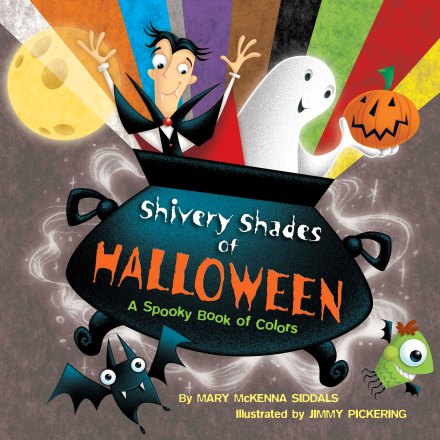
Shivery Shades of Halloween: A Spooky Book of Colors

Written by Mary McKenna Siddals | Illustrated by Jimmy Pickering


Have you ever thought, “What color is Halloween?” Sure, we all know it’s orange and black—but what about the rest of the color wheel? Tell me—what’s your favorite color? Purple? Let me look through Shivery Shades of Halloween…Yes! Halloween is purple—“Twilight, / Shadows, / Monsters lurking, / Secret potion— / Poof! It’s working! Dusky-musky, bruisy-oozy, cruelish-ghoulish / Blotch of purple.”

Hey! This is fun! Give me another one! Gray, you say? Hang on…. Yes! Halloween is Gray! “Tombstone, gargoyle, / Dungeon wall, / Rats and rubble, / Haunted hall, / Dusty-fusty, dimly-grimly, shady-fraidy / Shroud of gray.”

celebrate-picture-books-picture-book-review-shivery-shades-of-halloween-blue

Image copyright Jimmy Pickering, text copyright Mary McKenna Siddals. Courtesy of Random House Books for Young Readers

Okay, now it’s my turn. I’m choosing…Red. Yep! Halloween is also Red: “Tip of fang, / Flash of cape, / Horns and tail, / A gash, a gape, Bloody-ruddy, burning-churning, blushing-gushing / Stain of red.”

Wild! And that’s just the beginning! There are also spirited, spooky rhymes about brown, yellow, blue, white, green, and, of course, orange and black.

celebrate-picture-books-picture-book-review-shivery-shades-of-halloween-black

Image copyright Jimmy Pickering, text copyright Mary McKenna Siddals. Courtesy of Random House Books for Young Readers

Mary McKenna Siddals brings joy and a love of words—their sounds and their effects—to her verses that transport kids to the throbbing heart of Halloween on the broomsticks of color. In Shivery Shades of Halloween, Siddals presents all the spine-tingling  places, characters, and objects that make this holiday, and any mystery, so much chilling, thrilling fun. With giggles, ewwws, and a few shivers, kids will delight in the original and imaginative phrasing in this clever concept book.

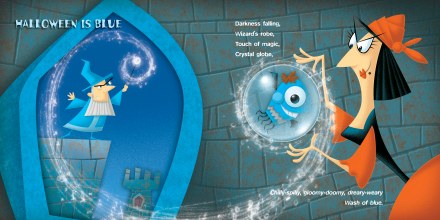
Jimmy Pickering’s vibrant, full-bleed illustrations ooze, flash, and swirl with the colors of Halloween. For Green, a “queasy-peasy” web-eared reptile slurps a “vile brew” from a test tube as an evil scientist looks on and the walls seep with a thick green sludge. Purple zaps and sparks as the reptile is transformed into a smiling goblin with bats’ wings and five legs. This goblin then leads readers from page to page where they meet a tricky ghost, a haunted graveyard, a spell-casting wizard and crystal-ball-reading witch, a floating candlestick in a haunted house, a howling werewolf, a dancing caldron, a clumsy demon, and a trio of trick-or-treaters. Each painting incorporates touches of the other colors introduced, creating eye-catching and suspense-building pages.

Shivery Shades of Halloween is a book that kids will want to hear and you will want to read over and over. For teachers, the book makes a wonderful resource for writing lessons and the power of evocative words not only around Halloween, but at any time of the year. Shivery Shades of Halloween is one concept book that transcends its holiday theme and would be a welcome addition to home bookshelves as well as school and other libraries.

Ages 2 – 7

Random House Books for Young Readers, 2014 | ISBN 978-0385369992

Take a peek at Victoria scaring up some fun by reading Shivery Shades of Halloween!

To learn more about Mary McKenna Siddals and her other books, visit her website! You’ll also find lots of activities as well as activity sheets to extend your enjoyment of Shivery Shades of Halloween: A Spooky Book of Colors as well as her other books.

Here’s a link to Shivery Shades of Halloween Activity Sheets.

You can also connect with Mary McKenna Siddals on her Shivery Shades of Halloween Facebook Page, where you’ll find more fun and a whole community of readers.

Discover more about Jimmy Pickering and view a gallery of his illustrations, paintings, sculpture and more on his website. You can also find him on Facebook!

Halloween Activity

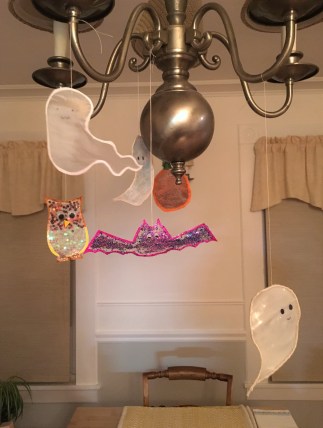
celebrate-picture-books-picture-book-review-halloween-mobile-craft

Spooky Halloween Mo-BOO-ile


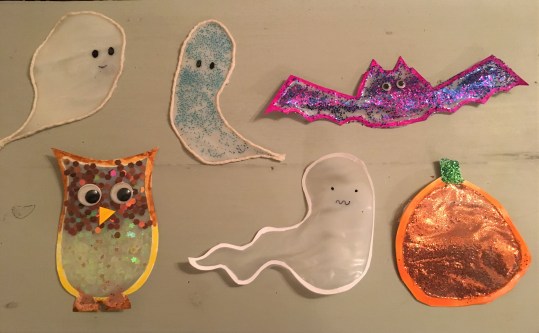
With glue, glitter, and your imagination you can make your love of Halloween and its ghosts, ghouls, pumpkins, and more colorfully transparent to all!

Supplies

  • Printable Halloween figure templates | Template 1 | Template 2
  • Poster board or other heavy stock paper or cardboard
  • White glue
  • Glitter in a variety of colors
  • Googly eyes (optional)
  • Scissors
  • Wax paper
  • Popsicle or craft sticks
  • Needle
  • White thread (or any color)
  • Fine-tip permanent marker
  • Hot glue gun or regular glue

celebrate-picture-books-picture-book-review-halloween-mobile-craft

Directions

  1. Print the Halloween Figures templates
  2. Cut out the figures
  3. Trace the figures onto the poster board
  4. Cut out the figures around the outside edge and also along the inside edge
  5. Lay out the figure templates on the wax paper
  6. Gently pour some white glue into the center of the figure template
  7. Smooth the glue completely to the edges of the figure template, adding glue if needed
  8. Sprinkle glitter on the glue, as much or as little as you’d like

To dry the glue

  1. Let the figures sit overnight OR:
  2. Place the figures on the wax paper in a warm oven. Turn the oven on to 200 – 250 degrees and let it come up to heat. Then turn the oven off and place the figures inside. Check after 15 minutes and check frequently until dry.

After the glue is dry

  1. Add faces to the ghosts with a permanent marker
  2. Add googly eyes with the hot glue or regular glue
  3. If desired, color the edge of the template to match the color of the glitter

To hang figures

  1. Thread a needle with the desired length of thread and gently push the needle through the glue near the top of the figure.
  2. Tie the thread around a chandelier, curtain rod, or any other place you would like to decorate

Picture Book Review

October 7 – Random Acts of Poetry Day

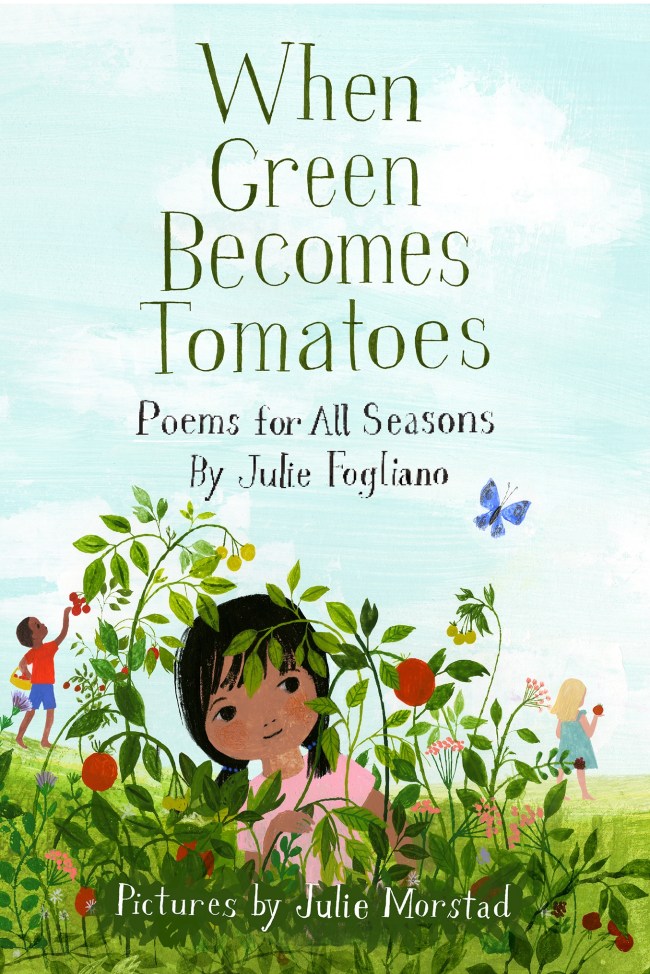
When Green Becomes Tomatoes by Julie Fogliano and Julie Morstad

About the Holiday

Today is the day to unleash your inner poet – without thinking twice about it. What are the words in your heart or in your imagination? Write them down! You don’t have to be Shakespeare for your words, lines, thoughts, jottings – your poems – to have meaning and value. Then share them with family, friends, or even strangers. To celebrate today’s holiday you can also attend a poetry reading or enjoy a volume of verse – like today’s book!

When Green Becomes Tomatoes: Poems for All Seasons

Written by Julie Fogliano | Illustrated by Julie Morstad


Sometimes you wish for just the right words to express a moment in time, a skip of the heart, or a glimpse of color that truly captures the elation, sadness, or awe you feel. Those words live on every page of When Green Becomes Tomatoes: Poems for All Seasons. Each month of the year is represented by three to five dated poems that expose a nugget of inspiration or a spark of recognition about the natural world and our place in it.

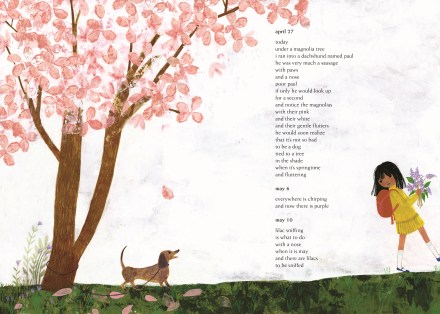
Spring begins its reawakening in the poem dated march 20, on which “from a snow covered tree / one bird singing / each tweet poking / a tiny hole / through the edge of winter / and landing carefully / balancing gently / on the tip of spring.”

celebrate-picture-books-picture-book-review-when-green-becomes-tomatoes-spring

Image copyright Julie Morstad, text copyright Julie Fogliano. Courtesy of us.mcmillan.com

Spring is slow in shaking off its winter coat, however, and march 22 finds “just like a tiny, blue hello / a crocus / blooming in the snow” Even though the days continue to dawn chilly and rainy, early flowers long to see the sun. On march 26: “shivering and huddled close / the forever rushing daffodils / wished they had waited.”

With the onset of April and no reprieve from the weather, everyone it seems is tired of the persistence of winter, which sticks around like a party guest who doesn’t know when to go home. On april 3 “today / the sky was too busy sulking to rain / and the sun was exhausted from trying / and everyone / it seemed / had decided / to wear their sadness / on the outside / and even the birds / and all their singing / sounded brokenhearted / inside of all that gray.”

celebrate-picture-books-picture-book-review-when-green-becomes-tomatoes-summer

Image copyright Julie Morstad, text copyright Julie Fogliano. Courtesy of us.mcmillan.com

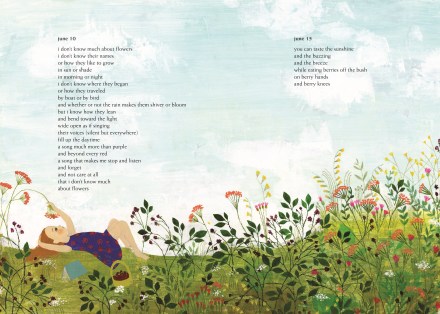
At last summer comes and on june 15 “you can taste the sunshine / and the buzzing / and the breeze / while eating berries off the bush / on berry hands / and berry knees.” The warm days also bring swimming holes and fireflies, and by july 10 “when green becomes tomatoes / there will be sky / and sun / and possibly a cloud or two…” and summer bursts with all the wonder that makes it such a yearned for season. 

Then as summer wanes and the nights grow dark, september 10 makes you look into that deep vast space and think “a star is someone else’s sun / more flicker glow than blinding / a speck of light too far for bright / and too small to make a morning”

celebrate-picture-books-picture-book-review-when-green-becomes-tomatoes-fall

Image copyright Julie Morstad, text copyright Julie Fogliano. Courtesy of us.mcmillan.com

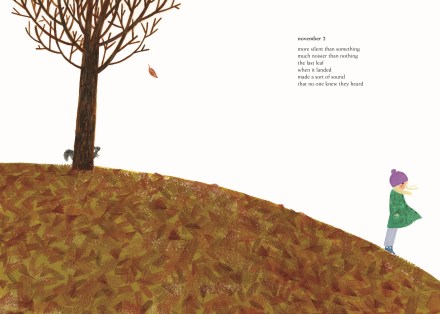
A nip in the air means Fall has come around again. It’s time for sweaters and pumpkins, and for the trees to rest. If you listen carefully, you may hear on november 2 “more silent than something / much noisier than nothing / the last leaf / when it landed / made a sort of sound / that no one knew they heard.”

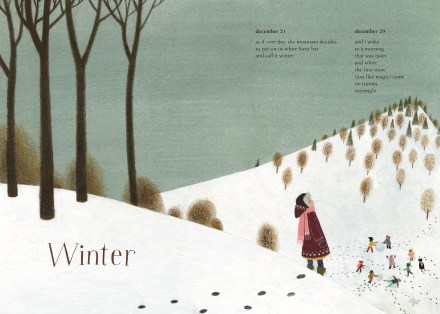
Then on december 21 “as if one day, the mountain decides / to put on its white furry hat / and call it winter” the season has changed, bringing with it crackling, cozy fires and snow, snow, snow. But this too offers its own enchantment on december 29: “and i woke / to a morning / that was quiet / and white / the first snow / (just like magic) came / on tiptoes / overnight.”

celebrate-picture-books-picture-book-review-when-green-becomes-tomatoes-winter

Image copyright Julie Morstad, text copyright Julie Fogliano. Courtesy of us.mcmillan.com

When Green Becomes Tomatoes begins and ends with a poem dated the same day—March 20, the vernal equinox—giving this book a cyclical form that echoes the passing of time. Julie Fogliano’s delicate and gentle poems are a perfect tonic for the busy, non-stop days the year becomes. Instead of letting the surprising, profound, or beautiful moments pass us by Fogliano gives readers a reason and a way to stop and fully enjoy them.  

In Julie Morstad’s gorgeous watercolors of nature and the changing seasons, readers can almost feel the warm sunshine that feeds the vivid spring and summer blooms, the icy breeze that loosens the last leaf of autumn, and the fluffy blanket winter tucks around the earth. The multiethnic children in Morstad’s paintings are thoughtful, charming, and enchanted with the world around them, actively experiencing the marvels of each changing day. 

When Green Becomes Tomatoes contains such lovely verses that readers will want to revisit them over and over – the way the seasons recur and we are always glad to welcome each one back. This volume of poetry would make a wonderful gift and a terrific addition to anyone’s bookshelf.

Ages 6 and up (adults will enjoy these poems too)

Roaring Brook Press, 2016 | ISBN 978-1596438521

You can connect with Julie Fogliano on Facebook!

You’ll find a gallery of picture books, prints, and other illustrations on Julie Morstad‘s website!

Random Acts of Poetry Day Activity

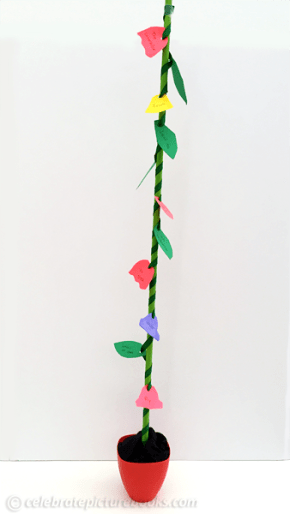
CPB - Plant Poem


Grow a Poem Craft


A poem often grows in your imagination like a beautiful plant—starting from the seed of an idea, breaking through your consciousness, and growing and blooming into full form. With this craft you can create a unique poem that is also an art piece!

Supplies

  • Printable Leaves Template, available here and on the blog post
  • Printable Flower Template, available here and on the blog post
  • Wooden dowel, ½-inch diameter, available in craft or hardware stores
  • Green ribbon
  • Green craft paint
  • Green paper if leaves will be preprinted
  • Colored paper if flowers will be preprinted
  • Flower pot or box
  • Oasis, clay, or dirt
  • Hole punch
  • Glue
  • Markers or pens for writing words
  • Crayons or colored pencils if children are to color leaves and flowers

Directions

  1. Paint the dowel green, let dry
  2. Print the leaves and flower templates
  3. Cut out the leaves and flowers
  4. Punch a hole in the bottom of the leaves or flowers
  5. Write words, phrases, or full sentences of your poem on the leaves and flowers (you can also write the poem after you have strung the leaves and flowers)
  6. String the leaves and flowers onto the green ribbon (if you want the poem to read from top to bottom string the words onto the ribbon in order from first to last)
  7. Attach the ribbon to the bottom of the pole with glue or tape
  8. Wrap the ribbon around the pole, leaving spaces between the ribbon
  9. Gently arrange the leaves and flowers so they stick out from the pole or look the way you want them to.
  10. Put oasis or clay in the flower pot or box
  11. Stick your poem pole in the pot
  12. Display your poem!

Picture Book Review
February 15 – Susan B. Anthony Day

celebrate=picture-books-picture-book-review-heart-on-fire-cover

About the Holiday

On February 15, 1820 in Adams, Massachusetts a girl was born who would grow up to set the world afire with her belief in women’s rights. Her name was Susan Brownell Anthony. An early feminist, her father believed it was as important for his five daughters to receive an education as for his two sons. After graduating from school, Susan Anthony became a teacher—at the age of 14—making $2.50 a week compared to the $10.00-per-week salary of the male teachers. Anthony later became active in the abolition and temperance movements. She recognized that the inability to vote limited women’s influence in these causes and began promoting women’s rights. She worked tirelessly to change the voting laws until her death on March 13, 1906 without seeing her greatest wish fulfilled. It was not until 1920, with the ratification of the 19th Amendment, that women were allowed to vote.

Susan B. Anthony has been honored for her dedication with commemorative stamps, and her portrait appears on the dollar coin. We also remember her work on behalf of all women on her birthday with memorial services at her gravesite in Rochester, NY and in Washington DC. Susan B. Anthony Day is a legal holiday in Florida, West Virginia, Wisconsin, New York and California.

Heart on Fire: Susan B. Anthony Votes for President

Written by Ann Malaspina | Illustrated by Steve James


It’s November 1, 1872 and only four days until the presidential election. Everywhere people are being urged to register to vote. Knowing how important voting is, Susan B. Anthony races to the registration office with her sister and a friend in tow. The men in the office stare at her in confusion.

They know that women can’t vote—only men! What is Susan B. Anthony trying to do? But Anthony argues that the new 14thAmendment, which says “all persons born in the United States have the same rights as citizens,” gives women the right to vote. Some inspectors think she is right, some disagree. Finally they allow Anthony to sign the registration card.

celebrate=picture-books-picture-book-review-heart-on-fire-susan-goes-to-vote

Image copyright Steve James, courtesy of Albert Whitman & Company

On November 5, Voting Day, Anthony and 15 other women cast their ballots. Thirteen days later, however, a deputy federal marshal shows up at Anthony’s door with a warrant for her arrest. The charges? Voting illegally! The other women and the men who had allowed them to register and vote are also arrested.

In January word comes that unless Anthony pays a $1,000 fine, she will have to spend the time until her trial in prison. Anthony is adamant about not paying, but her lawyer sends the money. People in the country are split over whether she is right or not, but Anthony knows she’s right. Without being able to vote, women will have no voice in government.

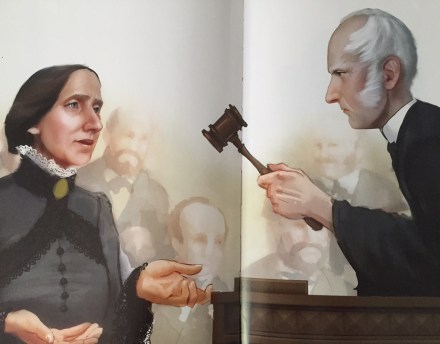
She gives speeches, trying to rally people to her cause, and when her trial begins on June 17, 1873 the courtroom is packed. After Anthony’s lawyer and the prosecutor speak, the judge decides that Anthony has broken the law. He proclaims her guilty. When the judge asks if she has anything to say, Anthony answers, “You have trampled under foot every vital principle of our government. My natural rights, civil rights, political rights….” The judge stops her and does not allow her to continue speaking. He fines her $100, plus court costs. Susan B. Anthony refuses to pay, and she never did.

celebrate=picture-books-picture-book-review-heart-on-fire-susan-pleads-case

Image copyright Steve James, courtesy of Albert Whitman & Company

Through action, dialogue, and the metaphorical theme of fire, Ann Malaspina has written an exciting biography of Susan B. Anthony. Readers will understand and, more importantly, feel the opinions and determination that fueled Anthony’s crusade for women’s rights. The final pages follow the history of the women’s suffrage movement until the ratification of the 19th Amendment in 1920 and provide photographs from the time. The text of the 14th and 19th Amendments is also included.

Opening the pages of Heart on Fire is like walking into a city of the 1800s. The lush colors and intricate details of Steve James’ illustrations immediately immerse readers in the time and place of Susan B. Anthony’s world, depicting the reality of her struggles. This is a perfect book to share with children, especially in this election year when they can see how far women have come—from being denied the vote to running for president.

Ages 5 – 9

Albert Whitman & Company, Chicago, 2012 | ISBN 978-0807531884

Learn more about Ann Malaspina and her books on her website!

View a gallery of illustration by Steve James on his website!

Susan B. Anthony Day Activity

CPB - Vote For Me round (2)

Vote For Me! Campaign Poster and Frame


If you were running for President, what would be important to you? Here’s a Vote For Me! Poster and Picture Frame to get your campaign started!

Supplies

Directions

  1. Print Vote For Me! Poster and Picture Frame templates
  2. Take a selfie or use your school picture
  3. Cut out the Picture Frame and the circle or rectangle in the middle
  4. Tape or glue your picture in the circle or rectangle
  5. If you are using a clear magnetic frame, slip the template inside and hang on your refrigerator or any metal object.
  6. If you are using a magnetic sheet, peel the paper off the adhesive side. Stick the Vote For Me! Picture Frame template with your picture attached to the adhesive. Cut around the edges. Hang!
  7. On the Vote For Me! Poster, list the things you would do if you were President. Talk to your family and see if you might be able to do some of them now! Hang your poster in your room or in the house where others can see it.

February 1 – National Freedom Day

celebrate-picture-books-picture-book-review-henry's-freedom-box-cover

About the Holiday

National Freedom Day was created by a former slave named Major Richard Robert Wright Sr. and was established as a national holiday on June 30, 1948 by President Harry S Truman. The observance commemorates the day in 1865 when Abraham Lincoln signed a resolution that would become the thirteenth amendment to the U.S. Constitution. The amendment was ratified almost one year later by each state and outlawed slavery.

Today, people often celebrate National Freedom Day by laying a wreath at the Liberty Bell, which is located in Philadelphia, Pennsylvania.

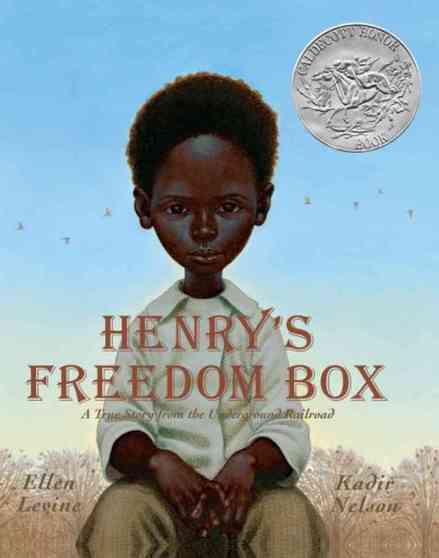
Henry’s Freedom Box: A True Story from the Underground Railroad

 Written by Ellen Levine | Illustrated by Kadir Nelson


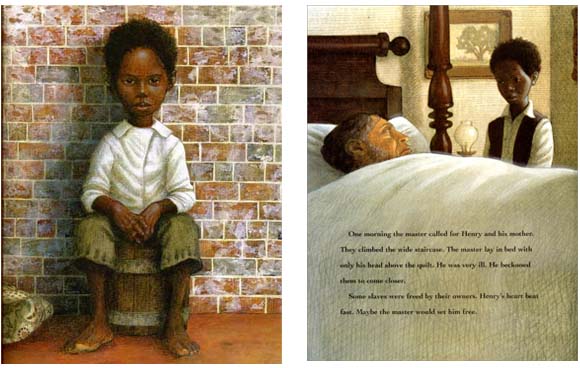
Henry Brown was born a slave. He didn’t know his birthday and he never knew security. “Like autumn leaves are torn from the trees,” his mother tells him, “slave children can be torn from their families.” When Henry’s master calls him to his sickbed, Henry hopes to be freed, but instead, his mother’s fear comes true. Henry is taken away and grows up far from his family, learning to be careful not to make mistakes that will bring severe punishment.

celebrate-picture-books-picture-book-review-henry's-freedom-box-henry

Image copyright Kadir Nelson, text copyright Ellen Levine. Courtesy of Scholastic Press

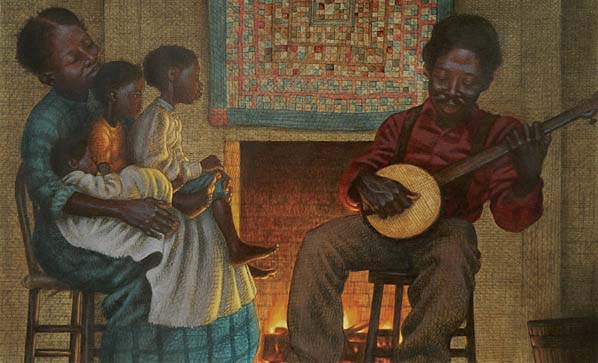
One day Henry, now a young man, falls in love with Nancy, a slave on another plantation. Henry and Nancy marry and are allowed to live together despite being owned by separate masters. Henry and Nancy have three children and are living happily.

But one day Nancy tells Henry that her master’s plantation is in financial trouble. She is afraid her master will sell their children to make money. The idea strikes fear into Henry’s heart. The next day Henry learns that indeed Nancy and his children have been sold. He knows he can show no emotion, but “his heart twisted in his chest.”

celebrate-picture-books-picture-book-review-henry's-freedom-box-henry-plays-music-for-his-family

Image copyright Kadir Nelson, courtesy of Scholastic Press

Henry runs to the town square and sees his children and Nancy being driven away. Henry is devastated. Time passes and Henry thinks about freedom. Lifting a crate used for shipping tobacco gives him an ingenious idea. He will mail himself to the North, where he can be free.

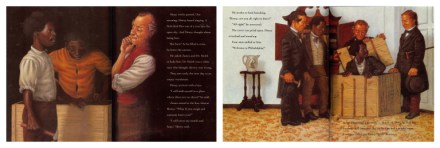
Henry’s friends agree to help him, and although they’re afraid he will be discovered, they seal him into a wooden box, address it to people in Philadelphia, and send him off. The crate is handled roughly throughout the journey north, and Henry must endure pain for many hours. Henry finally arrives safely in Philadelphia on March 30, 1849. Known from then on as Henry “Box” Brown, he became one of the most famous runaway slaves in America.

celebrate-picture-books-picture-book-review-henry's-freedom-box-henry-comes out of box

Image copyright Kadir Nelson, text copyright Ellen Levine. Courtesy of Scholastic Press

Based on an actual story of The Underground Railway, Henry’s Freedom Box is written and illustrated to stunning effect. Ellen Levine’s lyrical and metaphorical language combines with the excellent pacing of the pages to enhance the emotional impact of this powerful and original true story. Children will be inspired by this man who suffered devastating loss, but persevered and through cunning, bravery, and the help of friends, obtained freedom.

Kadir Nelson took inspiration for his illustrations from an antique lithograph of Henry Brown, created by Samuel Rowse in 1850. Through a combination of watercolor and oils crosshatched with pencil lines, Nelson’s richly hued paintings capture the poignancy of Henry’s struggles and ultimate freedom. His characters’ facial expressions are particularly moving.

Henry’s Freedom Box: A True Story from the Underground Railroad is a riveting story of slavery and one man’s fight for freedom that would make an excellent addition to children’s libraries.

To view a gallery of books and other illustration work by Kadir Nelson, visit his website!
Ages 4 – 8

Scholastic Press, 2007 | ISBN 978-043977733

National Freedom Day Activity

CPB - Freedom Stamp template (2)

Create Your Own Freedom Stamp


If you were going to create a postage stamp representing freedom, what would it look like? Think about what freedom means to you, then grab some colored pencils and design your own stamp!

Supplies

Directions

  1. Print the Freedom Stamp template
  2. Draw your own design about what freedom means to you
  3. Cut out the stamp and display it in your room or in a common area of your home

OR:

  1. Inside the stamp template write a letter to:
  • Someone in the Military: Thank them for their service to the United States to help keep our country free. You can learn how to send letters to members of the military here.
  • Your Teacher: Thank your teacher for all of her or his hard work. Only through education can we really be free.
  • Someone else who inspires you: Tell this person why they inspire you and thank them for their work.
  1. Give your Freedom Stamp letter to the person it is written to

Picture Book Review