May 12 – It’s Gifts from the Garden Month

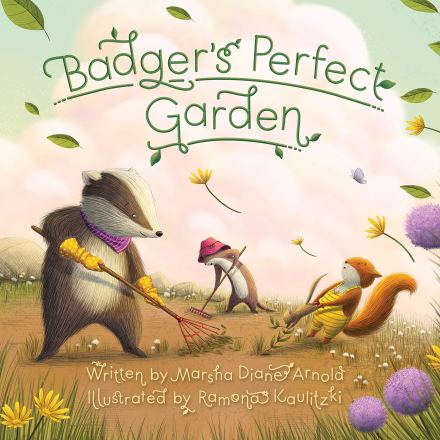
celebrate-picture-books-picture-book-review-badger's-perfect-garden-cover

About the Holiday

If you’re into gardening then you know what a joy it is to harvest your vegetables and fruit or cut a beautiful bouquet of flowers. But gardens provide so many more gifts than these. Digging the dirt, planting the seeds, and even keeping the weeds at bay can be a mindful, relaxing experience as well as good exercise. Watching plants sprout and grow gives an appreciation for the wonder of nature. And a garden beautifies the view whether it’s a large plot or a window box. So, celebrate this month by enjoying all the gifts of your garden.

I received a copy of Badger’s Perfect Garden from Sleeping Bear Press for review consideration. All opinions are my own. 

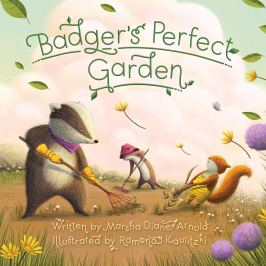
Badger’s Perfect Garden

Written by Marsha Diane Arnold | Illustrated by Ramona Kaulitzki


On a spring morning, Red Squirrel watched as Badger brought out all of his jars of the seeds he had collected and kept safe all winter. He was planning on planting a perfect garden. Red Squirrel noticed that all the seeds looked different. Badger explained that they were “‘all kinds. Green and brown. Flat and round, Bumpy and smooth. Whirly-curly and straight as my whiskers.’”
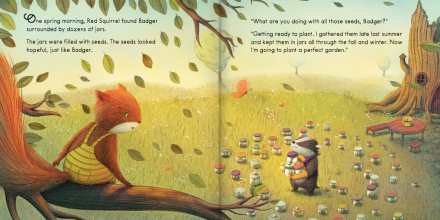
celebrate-picture-books-picture-book-review-badgers-perfect-garden-seeds

Image copyright Ramona Kaulitzki, 2019, text copyright Marsha Diane Arnold, 2019. Courtesy of Sleeping Bear Press.

Red Squirrel wanted to help plant them. As Badger carefully studied his garden plan, Weasel showed up with his rake and Dormouse gathered string. Everyone helped Badger weed and rake his garden plot until it was smooth. Then they set up stakes on each side and ran string between them to make perfect rows. After that Weasel poked holes in the dirt for the seeds. Badger directed where each seed should go so that each type stayed together. That evening the friends had a party with muffins and mulberry juice, and Badger “imagined the plants that would grow in perfect rows in his perfect garden.”

The next morning, just in time, it began to rain. But the next day the rain turned heavy, and the day after that it became a deluge. Badger ran out into the storm to try to save his garden, but the strings collapsed and the soil washed away. Badger sniffled as he thought of his ruined garden. His friends tried to cheer him up by telling him they’d help gather new seeds in the summer, but Badger despaired of not having his perfect garden this year.
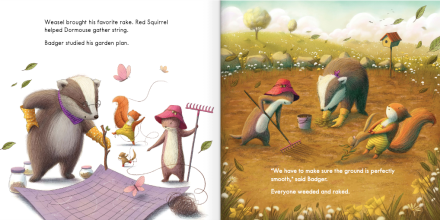
celebrate-picture-books-picture-book-review-badgers-perfect-garden-plan

Image copyright Ramona Kaulitzki, 2019, text copyright Marsha Diane Arnold, 2019. Courtesy of Sleeping Bear Press.

To ward off the sadness, Badger kept busy reading, cleaning, exercising, and sleeping. One summer day, he heard a knock on his door. It was Red Squirrel, Weasel, and Dormouse. They grabbed Badger’s hand and pulled him outside to a glorious field of wildflowers. Badger gazed at it in wonder. “‘Those can’t be my seeds,’ said Badger, rubbing his eyes. They’re all mixed up.’” But they were! The wild garden  was a “jumble-tumble of shapes and sizes. They made him feel jumbly and tumbly, too.” Badger thought it was “the most perfect garden of all,” and the friends raced into it for a perfect summer celebration.
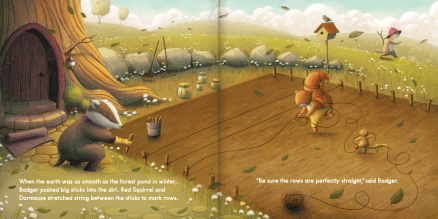
celebrate-picture-books-picture-book-review-badgers-perfect-garden-planting

Image copyright Ramona Kaulitzki, 2019, text copyright Marsha Diane Arnold, 2019. Courtesy of Sleeping Bear Press.

Marsha Diane Arnold fills Badger’s Perfect Garden with sprightly, lyrical language that makes the story a delight to read. Little gardeners will relish the descriptions of Badger’s seeds and enjoy the precision of planting day. As the rains come, kids will empathize with Badger’s disappointment, knowing how it feels when plans don’t work out quite right. But the riotous results will spark their own happy, “jumbly-tumbly” excitement for Badger, his friends, and even their own endeavors. in the beauty of the wild, carefree, mixed-up garden can see the joy that can be found in new experiences outside one’s comfort zone.

Ramona Kaulitzki’s charming illustrations are a perfect mix of the whimsical and the realistic and will captivate readers. With soft colors and flowing textures, Kaulitzki depicts early spring with its light green grasses and mellow, cloud-filled skies. When stormy days come, the sky turns purple and rain whips through Badger’s garden, leaving things topsy-turvy and Badger’s plans uprooted. Late summer brings a series of show-stopping two-page spreads, where flowers of all kinds and colors mix with vegetable plants to attract bees and butterflies and, of course, provide the perfect spot for a summer party.

Beautiful through and through, Badger’s Perfect Garden plants the seeds of gentle encouragement, heartening friendship, and cheerful celebration. The book would be a favorite addition to home, classroom, and public library collections.

Ages 5 – 8

Sleeping Bear Press, 2019 | ISBN 978-1534110007

Discover more about Marsha Diane Arnold and her books on her website.

To learn more about Ramona Kaulitzki, her books, and her art, visit her website.

Q & A with Marsha Diane Arnold
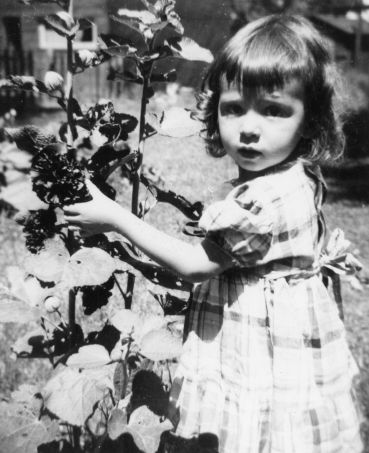
celebrate-picture-books-picture-book-review-marsha-diane-arnold-childhood-photo

Called a “born storyteller” by the media, Marsha Diane Arnold’s award-winning picture books have sold over one million copies and been called, “whimsical,” “inspiring,” and “uplifting.” Marsha was raised on a Kansas farm, lived most of her life in Sonoma County, California, a place Luther Burbank called “the chosen spot of all this earth as far as Nature is concerned,” and now lives with her husband, near her family, in Alva, Florida. Nothing makes her happier than standing in her backyard in the midst of dragonflies, listening to cardinals sing.

I’m so glad to be chatting with you, Marsha, about her newest book, Badger’s Perfect Garden! This story seems to have a close personal connection for you. Can you talk a little bit about what inspired you to write this book?

Having a father who was a farmer and gardener and a mother who was a perfectionist, must have had something to do with it! I grew up surrounded by nature, animals, and gardens. Growing up with so many animals around me, I talked with them all the time and I felt they talked back, so anthropomorphism comes easily to me. Illustrations of animal characters are so often enchanting, drawing young children into a book. They can create a strong emotional connection for children to learn from and remember.

Can you tell me more about what it was like growing up on a farm? What kind of farming did your family do?

My father was most proud of being a dairy farmer, but he, his father before him, and his five brothers also grew wheat and corn. I often stayed with my grandmother during the day; I loved being on the farm. Grandmother had to feed 8 children, Grandpa Henry, and herself, so she had a huge vegetable garden and did home canning. But her heart was with her flower gardens. There was spirea, yards and yards of bearded iris, a line of lilacs from the house to the outhouse, petunias, Bachelor buttons, hollyhocks, and more. Badger and Grandmother would have been fast friends.

As a child, what was your favorite part of farming or the farm? What do you appreciate more now as an adult?

I most loved being around the farm animals, although I was a bit frightened of those protective hens when I had to collect the eggs, and I enjoyed helping my father with the calves. One of our neighbors had a pet raccoon that I have fond memories of “hanging out” with, often in my friend’s tree house. (Remember, it was a long time ago and there were no wild animal rehabilitation centers near us.)
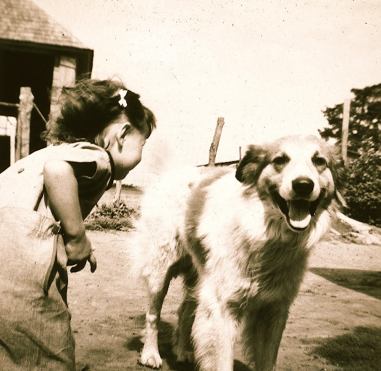
celebrate-picture-books-picture-book-review-Marsha-Diane-Arnold-and-dog

Marsha having fun with her dog.

celebrate-picture-books-picture-book-review-Marsha-Diane-Arnold-and-calf

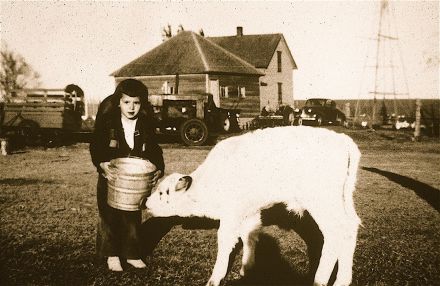
Marsha hanging out with a calf on her family’s farm.

I think I always appreciated the freedom of big spaces and gardens to play in and trees and barns (don’t tell) to climb on, but now I realize even more how very lucky I was.

Have you continued the family farming tradition?

I had a spectacular garden in Sonoma County, California. Mostly I grew flowers and a small plot of fruit trees. My favorite part of creating the gardens was designing them, using the land as my canvas. I collected over 50 heirloom roses, selecting plants for their fragrance and color. I loved the stories that came with them, like, “This one was collected from an old farm house in Windsor.” I had over 30 sweet pea varieties. There’s nothing better than a home filled with the fragrance of sweet peas. Most of my fruits were “antique” varieties. There was a Spitzenburg, reputed to have been Thomas Jefferson’s favorite apple, and a Calville Blanc, traced back to 1598 France. The fruit from my trees was unique and absolutely delicious. The stories behind them were delicious too.
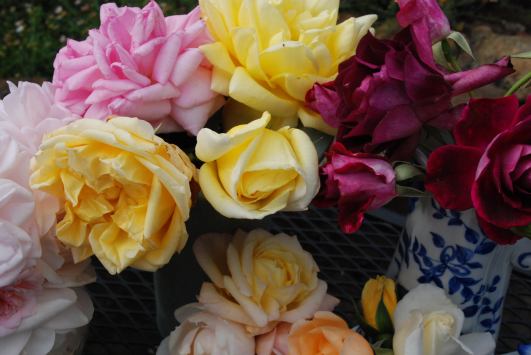
celebrate-picture-books-picture-book-review-flowers

Roses from Marsha’s flower garden.

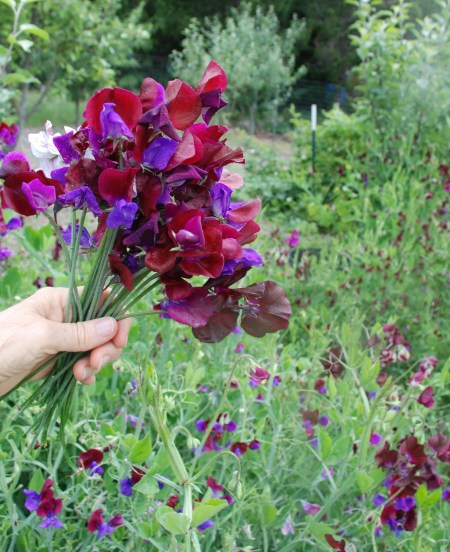
celebrate-picture-books-picture-book-review-sweetpeas

A beautiful bouquet of sweet peas.

How have your experiences with nature influenced your writing for children?

When a child grows up surrounded by nature, he or she grows to understand it and respect it. I learned to see the small things in nature, like my father before me. His neighbors said he knew the name of every wildflower or “weed” in the county. When you pay attention to something in that way, you come to love it and it becomes part of you. So, nature is what I write about, from my first book Heart of a Tiger, about a small kitten who had a dream to give himself a name like that of the Magnificent Bengal Tiger, to Galápagos Girl, about the unique animals of the Galápagos Islands, to the jumble tumble beauty of Badger’s Perfect Garden.
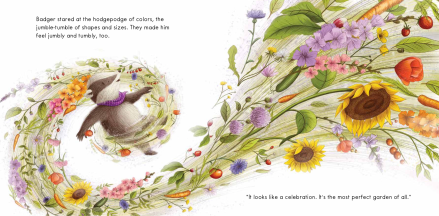
celebrate-picture-books-picture-book-review-badgers-perfect-garden-swirl

Image copyright Ramona Kaulitzki, 2019, text copyright Marsha Diane Arnold, 2019. Courtesy of Sleeping Bear Press.

What is your favorite wildflower and why?

Wild rose! At our California home, there was a wild rose growing in our gully. Every spring I would walk down the hill to see if it was still blooming. When I was diagnosed with breast cancer, I looked carefully for it each year, telling myself that if it was still in bloom, in the shade of our oak forest, alone and straggly, I would still be well. I’m sure it’s blooming still.

Thank you for sharing so much about your passion for nature and what joy living fully within it can bring. I wish you all the best with Badger’s Perfect Garden and all of your wonderful books!

You can connect with Marsha Diane Arnold on

Her website | Facebook | Twitter | Instagram

Spring Equinox Activity

celebrate-picture-books-picture-book-review-flower-garden-game

Plant a Flower Garden Game


With this fun game you and your family and friends can grow gardens inside! Roll the dice to see whose garden will fully blossom first!

Supplies

Directions

Object: The object of the game is for each player to fill their garden or garden rows with flowers. Depending on the ages of the players, the game can be adjusted to fill all of the rows, some or all rows, or just one.           

  1. Print one Game Board for each player
  2. Print one or more sets of Flower Playing Cards for each player, depending on how  (for sturdier playing items, print on card stock)
  3. Cut the flowers into their individual playing cards
  4. Print one Flower Playing Die and assemble it (for a sturdier die, print on card stock)
  5. Color the “dirt” on the Garden Plot with the crayon (optional)
  6. Choose a player to go first
  7. The player rolls the die and then “plants” the flower rolled in a row on the game board
  8. Play moves to the person on the right
  9. Players continue rolling the die and “planting” flowers until each of the number of determined rows have been filled with flowers or one row has been filled with all six flowers.
  10. The first person to “grow” all of their flowers wins!
celebrate-picture-books-picture-book-review-badger's-perfect-garden-cover

You can find Badger’s Perfect Garden at these booksellers

Amazon | Barnes & Noble | Books-a-Million | Sleeping Bear Press

Support your local independent bookstore with these book sellers

Bookshop | IndieBound 

Picture Book Review
 

March 31 – National Crayon Day

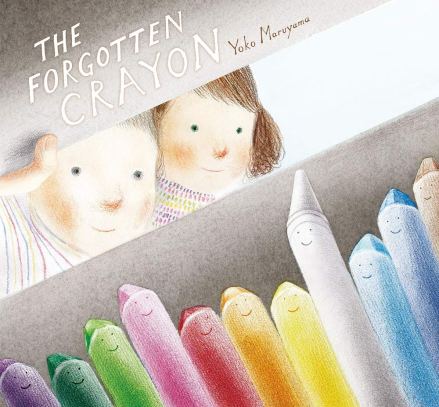
celebrate-picture-books-picture-book-review-the-forgotten-crayon-cover

About the Holiday

If the aroma of crayons takes you back to your childhood or means that you know your kids are having fun and being creative, then today’s holiday is for you! Invented in 1902 by Edwin Binney, the Crayola crayon is a staple of young artists everywhere. With 120 different colors. many with imaginative names, everyone has a favorite color. What’s yours?

I received a copy of The Forgotten Crayon from Minedition for review consideration. All opinions on the book are my own.

By Jakki Licare

The Forgotten Crayon

By Yoko Maruyama


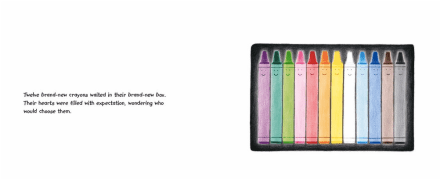
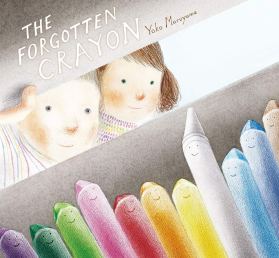
Twelve brand new crayons are waiting at the store for someone to choose them. They are excited to find out who their new owner will be. The crayons are thrilled when they feel their box moving. They are finally going home. In his room, their new owner, Lucas, opens the lid and smiles down at the crayons.

celebrate-picture-books-picture-book-review-the-forgotten-crayon-box

Copyright Yoko Maruyama, 2020. Courtesy of minedition.

Lucas uses a light green crayon to color grass. Then, he uses a brown crayon to draw a tree. Using the dark green and pink crayons, he adds in flowers and leaves for a springtime picture. “Those three crayons returned to the box a little shorter, but they seemed very happy.”

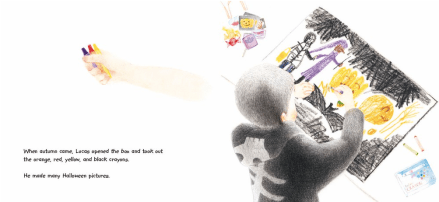
When summer comes, Lucas draws an ocean with a light blue crayon and makes a sail boat with the dark blue crayon. Even though the crayons are shorter, they return to the box happy. Fall comes and Lucas makes a Halloween picture using the orange, red, yellow, and black crayons. Happy to have been chosen, the crayons return to their box. “Day after day Lucas colored picture after picture, but he never chose the white crayon.”

celebrate-picture-books-picture-book-review-the-forgotten-crayon-halloween

Copyright Yoko Maruyama, 2020. Courtesy of minedition.

Around winter time, Lucas tells his mom that he would like a new box of crayons. The white crayon, towering over his shorter boxmates is very upset that he was never used. One day Lucas’s family holds a yard sale, and the old box of crayons is put out with the rest of the unwanted items. People come by taking this and that, but nobody is interested in the crayons. Lucas’s mother tells him that if no one takes them then they will throw away the crayons. 

“As it grew later and darker, the crayons started to feel so sad they were near to tears.” Just when they feel certain they are going to be thrown out, a little girl opens them up. She is so excited. There is a brand-new white crayon in the box! “She cradled the old crayon box all the way home.”

celebrate-picture-books-picture-book-review-the-forgotten-crayon-white-crayon

Copyright Yoko Maruyama, 2020. Courtesy of minedition.

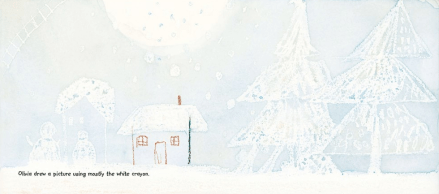
Their new owner, Olivia, always starts her pictures with a white crayon. Then, using water colors, she paints the paper. The white crayon’s wax prevents the watercolors from sticking to it. So, wherever Olivia had used the white crayon, it remains white. She paints white stars in the sky, blue seas with white jellyfish, and forests with white unicorns. When the first snow of the year comes, “Olivia drew a picture using mostly the white crayon.” Returning to the box, the white crayon is now much shorter and all the crayons are happy.

celebrate-picture-books-picture-book-review-the-forgotten-crayon-olivia's-drawing

Copyright Yoko Maruyama, 2020. Courtesy of minedition.

 Yoko Maruyama’s soft-toned illustrations nicely complement her gentle narrative. The story starts off in a dark, quiet box where the colorful, tall, and happy crayons are waiting to be bought at the store. Her hopeful words, “Their hearts were filled with expectation,” start the story off on a happy and peaceful note.  The book ends with the crayons in the dark box once again, but this time they are all shorter and happy to have been chosen. 

The message of inclusivity is a beautiful theme woven throughout the book. Maruyama returns to the inside of the box several times, illustrating how the white crayon is the only crayon that doesn’t get used. The tall white crayon sticks out compared to the more colorful and shorter crayons. The white crayon’s simplistic sad face makes it easy for young readers to understand that the white crayon is sad from being excluded. Then, later Maruyama shows the white crayon smiling along with the rest of the crayons, shorter and happier from being included.

While a third of the book’s illustration take place inside the crayon box, Maruyama has created a beautiful tale about thinking outside the box. Olivia’s unique way of using the white crayon’s wax is very different from the way Lucas had created his drawings. Maruyama’s clever illustrations displaying crayon-resistant art can easily be replicated by young readers. The illustrations throughout the book play on the use of white space as well. The dark interior of the crayon box contrasts with bright light that appears when Olivia or Lucas open the box. This technique is also featured in the human world. For example, in Olivia’s house the dark interior contrasts sharply with the white snow outside.

My son loves this book! It has been in nightly rotation since we first read it a week ago. The Forgotten Crayon is a great book for helping children understand the importance of inclusivity and makes a creative addition for home, school, and public libraries.

Ages 5-8

minedition,  2020 |  ISBN 978-9888341986

National Crayon Day Activity

CPB - Jellyfish-Painting-(2)

Jellyfish Painting

Have fun recreating Olivia’s jellyfish painting from your own crayon box! 

Supplies

Directions

  1. Print out stencil template
  2. Starting in the center of each figure cut out the jellyfish and the fish
  3. Place template on paper. Using your white crayon, trace and color in your jellyfish and fish
  4. Use blue watercolors and paint your paper
  5. Let dry

celebrate-picture-books-picture-book-review-the-forgotten-crayon-cover

You can find The Forgotten Crayon at these booksellers

Amazon | Barnes & Noble | Books-a-Million | IndieBound

Picture Book Review
March 25 – National Little Red Wagon Day

celebrate-picture-books-picture-book-review-red-wagon-cover

About the Holiday

In 2016 Radio Flyer established today’s holiday in anticipation of its 100th anniversary in 2017. That’s one hundred years of children enjoying the imaginative outdoor play a little red wagon provides! Whether kids are transporting their siblings, giving their pets or toys a ride, helping out in the garden, or participating in a community parade, the red wagon has been at the center of the action and a plaything that gets passed down from parent to child as a family grows. If you have little ones in your family, celebrate today by taking a little red wagon – or any wagon – for a spin.

Red Wagon

By Renata Liwska


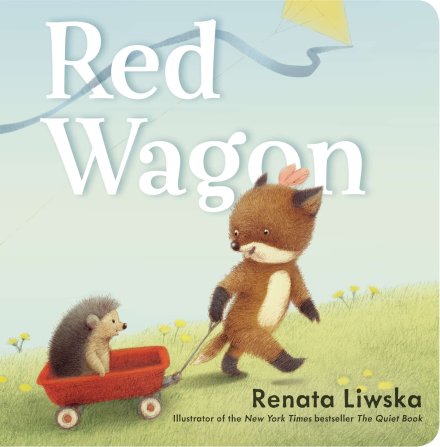
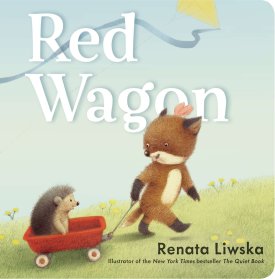
When Lucy got a new red wagon, “she wanted to play with it immediately.” Her mother thought she could take her wagon to the market. That didn’t sound like much fun to Lucy, but she headed to the market with a list anyway.

When she came to the big hill, her friends Hedgehog and Squirrel jumped in. That made the wagon “pretty heavy.” Fortunately, Rabbit came along to help push. At the top of the hill, they stopped for a snack with Bird and Raccoon, but “it started to rain! Oh, brother.” Lucy pushed the wagon to the bottom of the hill, but by now the rain was a torrent. That was okay, though, as the wagon had transformed into a ship, and Raccoon, in his umbrella, had become a pirate captain.

celebrate-picture-books-picture-book-review-red-wagon-conestoga-wagon

Copyright Renata Liwska, 2013, courtesy of Philomel Books.com.

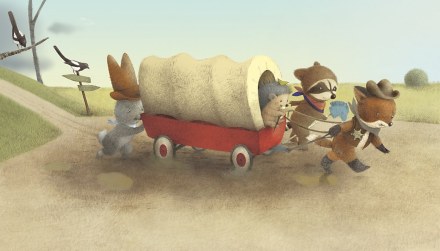
When the rain stopped, the friends went on their way in their red Conestoga wagon. Bunny, in his ten gallon hat, pushed while Sheriff Lucy pulled. Hedgehog held the reins, and Raccoon road her horse alongside. “At last Lucy arrived at the market.” As Hedgehog rolled their circus wagon into the center, Bunny toddled tall on stilts, Lucy juggled rings, and Raccoon blew a horn.

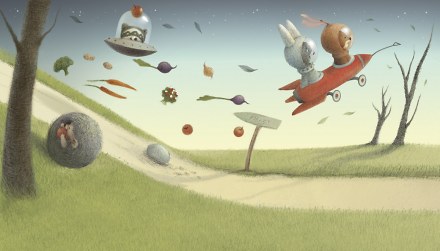
Lucy gathered all the vegetables on her mother’s list and started toward home. The train engine chugged, pulling the vegetable car up the steep hill. They were almost home “when the wagon hit a rock” and rocketed into space amid vegetable planets. When they landed, Lucy “gathered the vegetables and put them back into her wagon.

Lucy’s mom was happy to see her when she got home and thanked her happily for helping. “Finally, Lucy was free to play with her wagon,” which now made a perfect spot for a nap.

celebrate-picture-books-picture-book-review-red-wagon-rocket-ship

Copyright Renata Liwska, 2013, courtesy of Philomel Books.com.

Snuggling up with your little one and Renata Liwska’s Red Wagon is such a sweet way to spend story time. As young children so often do, adorable Lucy turns a chore into imaginative playtime as she and her friends rapidly use mishaps, bumps, and their changing surroundings as springboards for their supple creativity.  Liwska’s simple story is the perfect frame for her beautiful, soft-hued, and detailed art as this group of cute friends become cowboys and cowgirls, sailors, pioneers, circus performers, and mom’s helpers.

A rich story for the youngest readers, Red Wagon would be a perfect baby gift and a much-loved addition to any toddler’s bookshelf.

Ages 1 – 3

Philomel Books, 2013 | ISBN 978-0399162398 (Board Book)

To view a portfolio of books by Renata Liwska, visit her website.

National Little Red Wagon Day Activity

celebrate-picture-books-picture-book-review-little-red-wagon-maze

Take a Ride in the Little Red Wagon Maze


Everyone wants to ride in the wagon. Can you help these friends find their way in this printable maze?

Take a Ride in the Little Red Wagon Maze | Take a Ride in the Little Red Wagon Maze Solution

celebrate-picture-books-picture-book-review-red-wagon-cover

You can find Red Wagon at these booksellers

Amazon | Barnes & Noble | Books-a-Million | IndieBound

Picture Book Review
December 17 – Celebrating Read a New Book Month with Art

celebrate-picture-books-picture-book-review-frank-lloyd-wright-cover

About the Holiday

Today, I’m featuring another interactive book that will get young readers excited about learning more about art—or in this case—architecture. A great book can help kids find role models from the past or today that they can connect with philosophically and creatively. A book that touches on, validates, and encourages a child’s talent or dream is a gift that lasts a lifetime.

Meet the Architect! Frank Lloyd Wright

By Patricia Geis


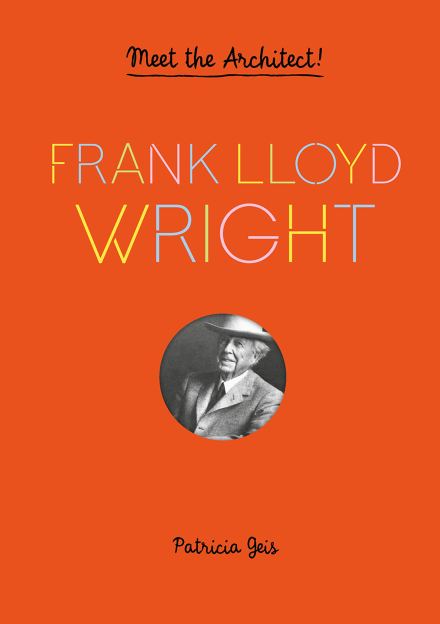
Artists can be endlessly fascinating not only for their work but for their lives, which influence where they get their ideas, how they create each piece, and what made them an artist in the first place. In Meet the Architect! Frank Lloyd Wright, readers get an opportunity to discover the backstory, the influences, the three architectural rules, the clients, and, of course, the buildings of this master architect, whose mother predicted his profession before he was even born and “surrounded his crib with drawings of cathedrals.” This deep dive into Frank Lloyd Wright’s life is accomplished not only through text, but with little fold-outs that are themselves illustrated booklets, 3D popups, illustrated panels that extent the pages, tabs, a portfolio of postcards, and more.

celebrate-picture-books-picture-book-review-frank-lloyd-wright-getting-started

Copyright Patricia Geis, 2019, courtesy of Princeton Architectural Press.

But let’s get started! Young readers may wonder what Frank was like as a kid. Learning that his grandfather, Richard Lloyd Jones, a Welsh milliner who made “‘black cone-shaped hats that ended in a point, worn as much by witches when they flew on their broomsticks as by other Welshmen,” will only whet their appetite to know more, and they won’t be disappointed. In addition to the text that briefly outlines Wright’s ancestry and earliest work experiences and defines what an architect is, a child asks a few questions.

celebrate-picture-books-picture-book-review-frank-lloyd-wright-getting-started-2

Copyright Patricia Geis, 2019, courtesy of Princeton Architectural Press.

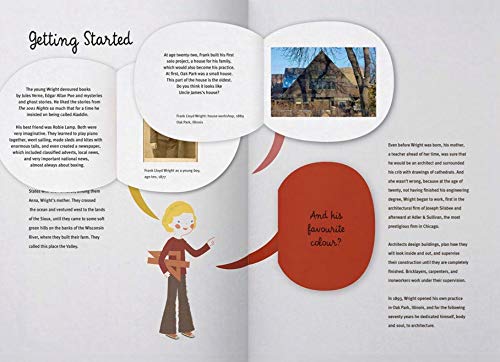
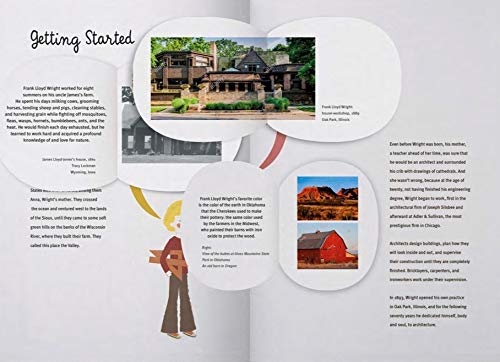
The first speech bubble asks, “How was he as a kid?” Readers open it up to see a photograph of Frank at age 10 accompanying a description of the books he read, the activities he and his best friend did, the newspaper he created, and even why “he called himself Aladdin” for a while. Readers next meet him at 16 in a photo of his very large extended family, and they also get to see his Uncle James’ house where he spent eight summers working on the farm. The exterior photo of the house Wright made for his family. Two other speech bubbles introduce children to the house Wright designed and built for his family and a discussion of his favorite color, complete with full-color photographs.

celebrate-picture-books-picture-book-review-frank-lloyd-wright-getting-started-3

Copyright Patricia Geis, 2019, courtesy of Princeton Architectural Press.

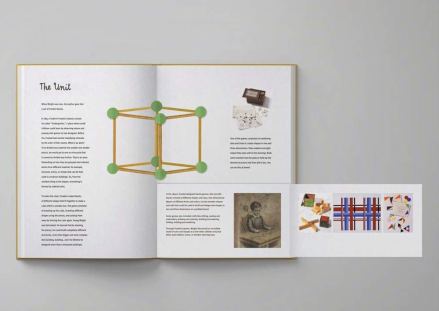
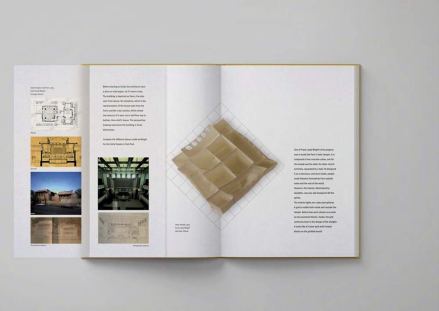
No artist is created in a vacuum, so author Patricia Geis includes a discussion of Friedrich Froebel, the creator of kindergarten and designer of twenty games that engaged children in geometry, creating dimensional shapes, building, and crafts and were influential in Wright’s development as well as in that of many well-known “artists, philosophers, and architects who would invent the abstract language of modern art.” A popup on the page replicates one of Froebel’s games.

celebrate-picture-books-picture-book-review-frank-lloyd-wright-the-unit-2

Copyright Patricia Geis, 2019, courtesy of Princeton Architectural Press.

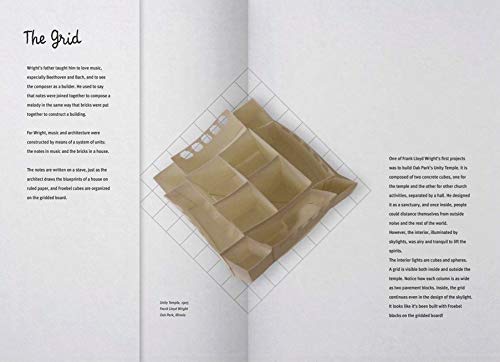
Wright’s father was also influential in his son’s education. He taught him to love music and “see the composer as a builder. For Wright, music and architecture were constructed by means of a system of units: the notes in music and the bricks in a house.” Just as notes are written on a staff, an architectural drawing is created on a grid. A detailed popup of Unity Temple built in 1908 in Oak Park, Illinois demonstrates how the building is positioned on a grid while a fold-out panel presents images of a floor plan, a cross section, a perspective drawing, and two photographs—one of the exterior and one of the interior of this beautiful temple.

celebrate-picture-books-picture-book-review-frank-lloyd-wright-the-unit

Copyright Patricia Geis, 2019, courtesy of Princeton Architectural Press.

Wright is well-known for setting his buildings in harmony with their surroundings. In her chapter “The Landscape,” Geis explains that Wright believed all buildings should adhere to “‘organic architecture,’” which meant they should “be in harmony with the landscape, respect the materials of construction, and respond to the need of the client.” She goes on to talk about Taliesin, the house, studio, and farm where he opened a school of architecture in 1932,, and Taliesin West in Arizona. These two landmarks are presented first with small framed photos (which cleverly mirror pictures on an art gallery wall) that open up to show how the buildings blend in with the environment and second with foldouts that include interior and exterior photographs as well as accompanying text.

celebrate-picture-books-picture-book-review-frank-lloyd-wright-the-grid

Copyright Patricia Geis, 2019, courtesy of Princeton Architectural Press.

Fallingwater, built in 1936, is one of Wright’s most famous designs, and with the pull of a tab, readers can transform the waterfall that hosts this house into the showstopper it became. More photographs and text present Wright’s philosophy about the house and land as well as the level of detail that went into building it—even to his choice to paint “the upper part the same color as the underside of a rhododendron leaf.”

celebrate-picture-books-picture-book-review-frank-lloyd-wright-the-grid-2

Copyright Patricia Geis, 2019, courtesy of Princeton Architectural Press.

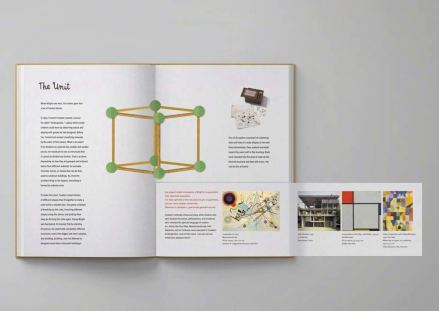
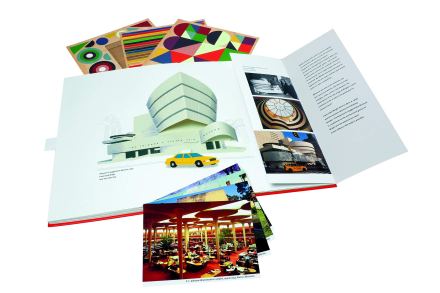
“Wright believed that every house should fit its inhabitants, like a made-to-measure suit.” To see just how he accomplished creating one-of-a-kind houses, readers can flip through a portfolio of five postcards, each of which presents a color photograph of the exterior of the house on the front and a description and interior photographs on the back. Visitors to the Guggenheim Museum in New York have experienced how Wright brought “the forms of nature to the city.” Shaped with the spiral of a snail’s shell, the museum showcases the art collection of Solomon r. Guggenheim, who bought “the works of such avant-garde artists as Kandinsky, Klee, Picasso, and Mondrian. Perhaps Wright’s connection with some of these artists through their common adoption of Froebel’s games early in their development is one reason the museum and the art work so well together.

A natural teacher, Wright would no doubt invite readers of this book to do some architectural exploration of their own, and so Geis has included sheets of card stock blocks, shapes, cubes to build, and other elements as well as a grid for children to play with.

celebrate-picture-books-picture-book-review-frank-lloyd-wright-postcards

Copyright Patricia Geis, 2019, courtesy of Princeton Architectural Press.

Patricia Geis is an engaging and compelling tour guide on this absorbing survey of Frank Lloyd Wright’s life that spanned from 1867 to 1959 taking in Reconstruction, “the Industrial Revolution, the coming of electricity, two world wars, and the invention of television.” Her clear and straightforward storytelling draws readers in with intriguing details, information about his childhood, and sprinkled-in direct appeals for them to look closer at or notice something in the photographs. Geis does an excellent job of connecting Wright’s early influences to his later work and his architectural philosophies to his finished projects. Each two-page spread creates a chapter of sorts, making it easy for kids and adults to dip into the book as they wish or to read it all in one sitting. Charming illustrations of wanna-be architects on various pages invite kids along on this beautiful and beautifully done journey of discovery.

A stunning book that any child—or adult—would cherish, Meet the Architect! Frank Lloyd Wright is highly recommended for anyone interested in architecture or any of the arts. I would also encourage readers to check out the other books in this series, including Meet the Artist! books about Henri Matisse, Pablo Picasso, Alexander Calder, Vincent van Gogh, and Leonardo da Vinci. If you are looking for a unique gift for a teacher or someone on your list, you can’t go wrong with this book.

Ages 7 – 12 and up

Princeton Architectural Press, 2019 | ISBN 978-1616895938

You can learn more about Patricia Geis, her books, and her art here.

celebrate-picture-books-picture-book-review-frank-lloyd-wright-cover

You can find Meet the Architect! Frank Lloyd Wright at these booksellers

Amazon | Barnes & Noble | Books-a-Million | IndieBound

Picture Book Review
December 16 – Celebrating Read a New Book Month with Art

celebrate-picture-books-picture-book-review-art-this-way-cover

About the Holiday

Discovering new books about a favorite subject or one that presents a topic in a new and interactive way is one of the joys of reading. Today and tomorrow, I am featuring two new books that engage kids in the study of art in interactive and exciting ways. Getting to see the world in unique and creative ways is one of the purposes of art, and these books get readers thinking about the whys and hows of some of the world’s influential artists.

Art this Way

By Tamara Shopsin and Jason Fulford


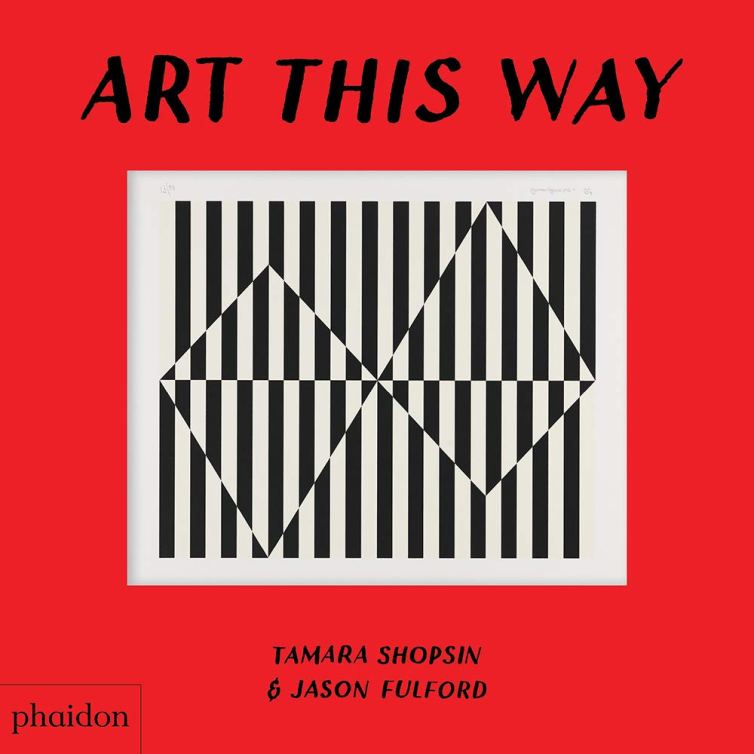
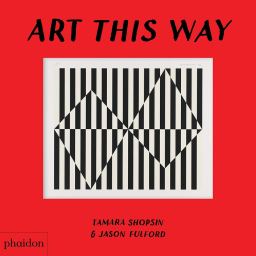
As children—who are naturally creative—know, art is not static but interactive and thought-producing. In Art This Way, author-artists Tamara Shopsin and Jason Fulford invite readers to “see like artists” by introducing them to twelve works of art in the collection of the Whitney Museum of American Art. The eye-catching cover with a cut-out window that frames Carmen Herrera’s Black and White screen print—a black-and-white-striped optical illusion—that, as children discover when they open the cover, looks the same upside down.

celebrate-picture-books-picture-book-review-art-this-way-women-and-dog

Copyright Tamara Shopsin and Jason Fulford, 2019. Courtesy of Phaidon.

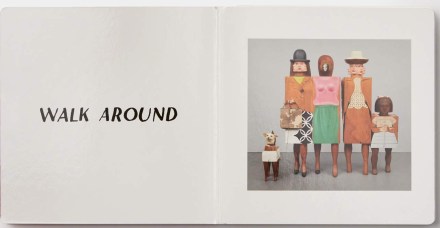
One photograph of Marisol’s sculpture Women and Dog—in which “each of the women is a self-portrait of the artist—can’t fully represent this piece, so readers are presented with three. These fold-out images allow children to “walk around” the sculpture to see the intriguing (and humorous) back and get an up-close view of one of the women’s head, which appears to be looking in all directions.

celebrate-picture-books-picture-book-review-art-this-way-look-up-open

Copyright Tamara Shopsin and Jason Fulford, 2019. Courtesy of Phaidon.

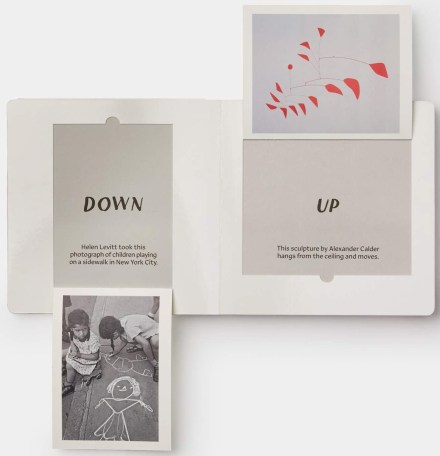
Five screen prints from Andy Warhol’s portfolio Flowers demonstrate the impact of identical images of flowers rendered in different colors. Folding out the pages puts these paintings side-by-side so that kids can choose their favorite or discuss the differences. Sometimes art isn’t at eye level, but below our feet or above our heads. Two doors—one that opens down and one that opens up—reveal two such examples. A photograph by Helen Levitt of children creating chalk drawings on a sidewalk and a whimsical mobile by Alexander Calder will captivate readers.

celebrate-picture-books-picture-book-review-art-this-way-look-close

Copyright Tamara Shopsin and Jason Fulford, 2019. Courtesy of Phaidon.

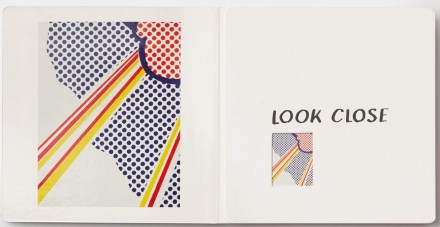
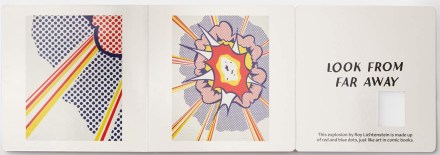
Lovers of comics and graphic novels will be drawn to the close-up and far-away views of an explosion by Roy Lichtenstein, which is composed of solid-color blasts and rays amidst clouds of red and blue dots. Cindy Sherman showed the personal side of art with photographs of “herself pretending to be different characters.” Kids get to try out their own artistic side with the mirror that beckons them to “look in” and try on the round glasses for size. Finally, one of the wrapped objects that have made Christo well-known around the world awaits readers, enticing them to guess what might be inside.

celebrate-picture-books-picture-book-review-art-this-way-look-far-away

Copyright Tamara Shopsin and Jason Fulford, 2019. Courtesy of Phaidon.

Each of the works of art presented here have been well-chosen by Tamar Shopsin and Jason Fulford to encourage young readers to discover art not only in museums but all around them and to explore their own creativity. Each page invites readers to talk about the piece and to try their hand at using it to inspire a piece of their own.

A wonderful and fun way to introduce youngest readers to the joys of creativity, Art This Way makes a unique addition to home, classroom, and public library board book collections.

Ages 2 – 4

Phaidon, 2019 | ISBN 978-071487721

To find a portfolio of work by Tamara Shopsin and in collaboration with her husband Jason Fulford, visit her website.

Celebrating New Book Month with Art Activity

celebrate-picture-books-picture-book-review-motivation-and-inspiration-day-craft

Make Art from Found Objects


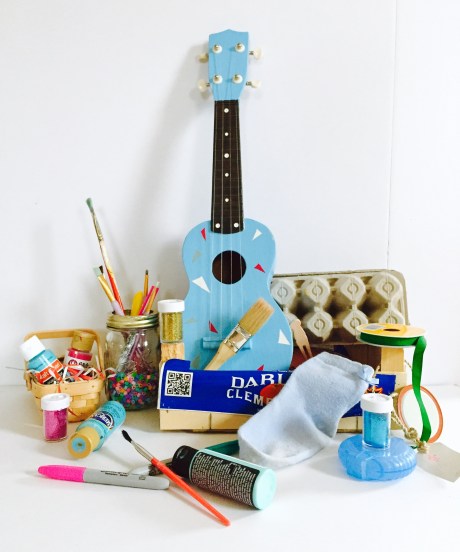
Each person finds inspiration in different things, places, and people. Today, try to create something new from the materials around you. Boxes, bottles, wire, magazines, cloth, wood, sponges—almost anything—can be transformed with some imagination. With those old socks, corks, flower pots, candle stubs, bits of ribbon, clementine crate, paint, glitter, beads, and more, you can make something useful, a decoration for your room, or even a gift for a friend!

celebrate-picture-books-picture-book-review-art-this-way-cover

You can find Art This Way at these booksellers

Amazon | Barnes & Noble | Books-a-Million | IndieBound

Picture Book Review
November 27 – It’s National Knit a Sweater Month

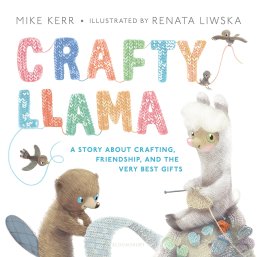
celebrate-picture-books-picture-book-review-crafty-llama-cover

About the Holiday

Inspired by NaNoWriMo, or National Novel Writing Month, knitters have designed their own challenge – NaKniSweMo. At the beginning of the month, dedicated knitters got out their needles and yarn with the idea of creating a 50,000-stitch—or sweater-size—garment. As the month comes to a close, knitters are finishing up their last stitches on a new sweater that will keep them cozy this winter.

Crafty Llama

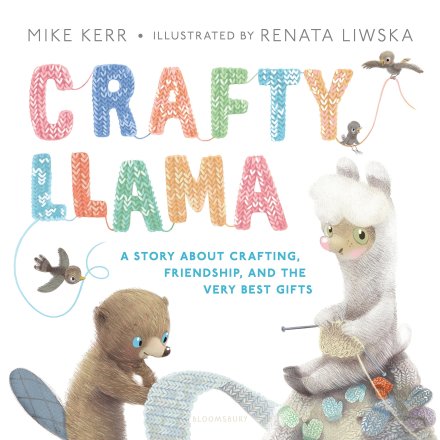
Written by Mike Kerr | Illustrated by Renata Liwska


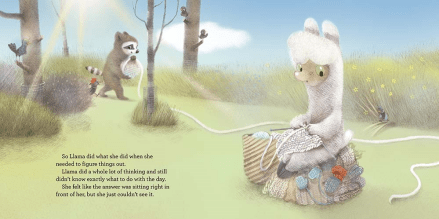
It was a gorgeous day and Llama knew she should concentrate on her “chores, this, that, and whatever,” but that big mound of fluff was calling to her. And because “it was such a beautiful day,” she wanted to do “something lovely.” So she took herself outside, and while she decided what to do with the day, she kept her hands busy with her knitting needles. “She felt like the answer was sitting right in front of her, but she just couldn’t see it.”

celebrate-picture-books-picture-book-review-crafty-llama-knitting

Image copyright Renata Liwska, 2018, text copyright Mike Kerr, 2018. Courtesy of Bloomsbury Children’s Books.

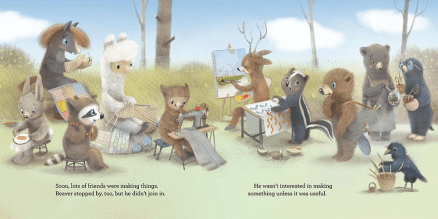
Pretty soon Raccoon dropped by with a string and beads, and then Rabbit came over with her embroidery, and Pony with the quilt he was stitching. It didn’t take long for almost all of Llama’s friends to join in with their own projects. When Beaver stopped by, he only wanted to make something that was useful. He studied Llama’s long stretch of knitting and wanted to know what it was. Llama hadn’t really thought about it. “She had just been having fun making.” She asked Beaver what he would do with it, but he didn’t know. Raccoon suggested a sail, Pony thought it would make a great rocket, and Rabbit opted for a hot-air balloon basket. But Beaver wasn’t convinced.

celebrate-picture-books-picture-book-review-crafty-llama-painting

Image copyright Renata Liwska, 2018, text copyright Mike Kerr, 2018. Courtesy of Bloomsbury Children’s Books.

By now more of Llama’s friends had shown up, and they all found bits of her knitting very useful. Lion found a hairband, Elephant discovered a neat way to carry his trunk, and there was even “something for Turtle when he came out of his shell.” Llama was excited to see that “if you have fun making something, others are bound to enjoy it too.” All of Llama’s friends were sporting new, knitted somethings that were just right for them—“everyone but Beaver.”

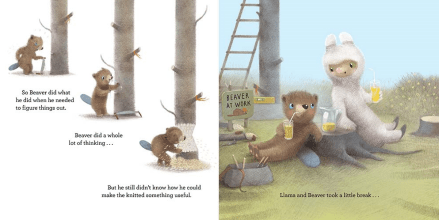
Beaver wanted something…but what? What would be useful? He decided to do what always helped him think. He gnawed and gnawed and chewed and chewed on some trees while mulling over his options. At last, he and Llama took a break. Beaver’s break turned into a much-deserved sleep, because while Beaver was “‘thinking,’ he had made something special for everyone too.” Suddenly, Llama knew what her “crafty something” was useful for. She slipped a bit under Beaver’s head and covered him with a bit more, and Beaver continued snoozing cozily. Now when Llama and her friends get together for crafting, they love their brand new place to do it in!

celebrate-picture-books-picture-book-review-crafty-llama-beaver

Image copyright Renata Liwska, 2018, text copyright Mike Kerr, 2018. Courtesy of Bloomsbury Children’s Books.

Mike Kerr’s sweet tribute to the joys of crafting and imagination will delight little artists and makers of all kinds. Thoughtful Beaver and more free-wheeling Llama make good foils—and friends—in this story that introduces a full studio of artistic endeavors as well as different thought patterns that make each person unique. While many of Llama’s friends immediately recognize how to use the “crafty something” they choose, Beaver is more precise, wondering about logistics, practicality, and even safety. It turns out that Beaver is more like Llama than he might think as he also crafts a perfect gift for all of his friends.

Renata Liwska’s well-known adorable animals make the cutest crafting companions ever. Llama’s HGTV-worthy kitchen lets the sun shine in on her big ball of wool that’s just waiting to be spun into yarn. As one lovable friend after another joins the crafting party, young readers will be enticed to try all of their arts—from sewing to painting, stamping to terrarium making, basket weaving to needle crafts, and more. Little ones will wish they were in the midst of all the fun as Llama’s friends pick out just the right clever gift for their needs. They’ll want to linger over every page to see how each “crafty something” is used and to catch all of the details. When children spy Beaver’s beautiful pavilion, they’ll understand that giving is an art of its own.

For children enthusiastic about making things or who are looking to experiment with their own creative talent, as well as for anyone who is thoughtfully precise, Crafty Llama is an engaging story. The book would be a welcome addition to home libraries classroom bookshelves to accompany art and other creative lessons. 

Ages 4 – 8

Bloomsbury Children’s Books, 2018 | ISBN 978-1681191218

Discover more about the art and writing of Mike Kerr and Renata Liwska on their website, RandMCollective.com.

To view a portfolio of work by Renata Liwska, visit her website

National Knit a Sweater Month Activity

celebrate-picture-books-picture-book-review-knitting-sheep-coloring-page

Stand Out from the Flock! Coloring Page


You’ll always stand out from the flock in a hand-knit sweater! Give this unique sheep your own personal touch in this printable coloring page.

Stand Out from the Flock! Coloring Page
celebrate-picture-books-picture-book-review-crafty-llama-cover .

You can find Crafty Llama at these booksellers

Amazon | Barnes & Noble | Books-a-Million | IndieBound

Picture Book Review

September 27 – Read a New Book Month
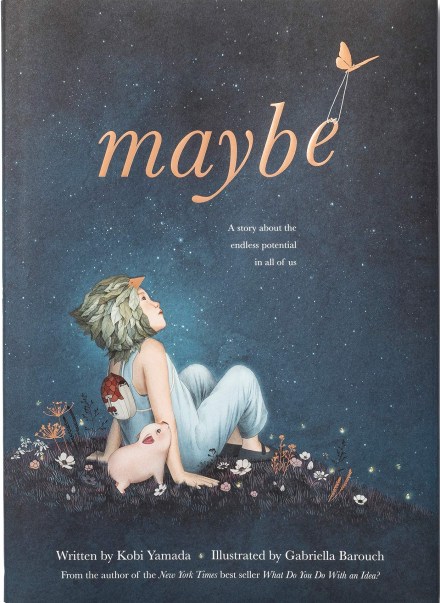
celebrate-picture-books-picture-book-review-maybe-cover

About the Holiday

As September winds down, there’s still time to feature one more new book for this month’s special holiday. Searching for and sharing new books—whether they are recently published or just new to you—is not only a fun way to spend a day together with kids, but an experience that pays big benefits now and in the future. Make a plan to add a few new books to your home library or visit your local library today!
Maybe

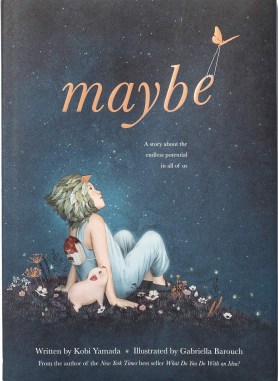
Written by Kobi Yamada | Illustrated by Gabriella Barouch


“Have you ever wondered why you are here?” Not why are you HERE? But why are YOU here? There is a very special reason, you know. “You are the only you there ever has been or ever will be,” and because of this “you have so much to offer.” You might discover or design something completely new. But first, you should experiment and explore, guided by your hopes and dreams.

celebrate-picture-books-picture-book-review-maybe-mushroom

Image copyright Gabriella Barouch, 2019, text copyright Kobi Yamada, 2019. Courtesy of Compendium.

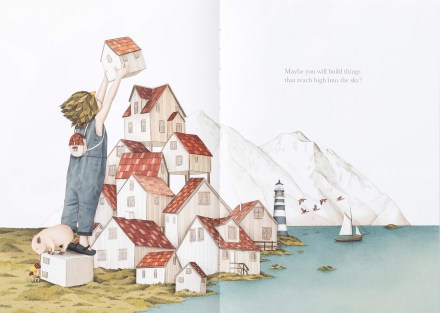
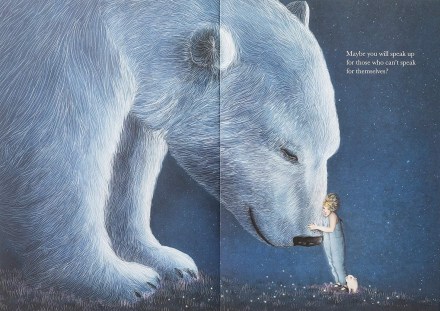
Perhaps your talent lies in helping “others to see the beauty in each day?” or maybe you will be the one that people cheer for. No matter what you do, do it with your whole heart and follow where that leads. It could be that you’ll be a light in the darkness. Or “maybe you will speak up for those who can’t speak for themselves?”This is not to say that life will always be easy. There will be struggles and fears and even failures, but each one will make you stronger and smarter.

celebrate-picture-books-picture-book-review-maybe-houses

Image copyright Gabriella Barouch, 2019, text copyright Kobi Yamada, 2019. Courtesy of Compendium.

You have more courage than you might think, and the world is waiting for you. Just think—maybe “you are only scratching the surface of what you can do and who you can be?” But even now everything you need to do great things is inside of you. “Maybe you have no idea just how good you really can be” or “how much you matter?” But just your presence means that “anything is possible.”

celebrate-picture-books-picture-book-review-maybe-polar-bear

Image copyright Gabriella Barouch, 2019, text copyright Kobi Yamada, 2019. Courtesy of Compendium.

Like all parents and caregivers, Kobi Yamada understands that from day one children exhibit unique talents, personalities, and ideas that they will use to make their mark on the world. In Maybe, he beautifully expresses the ideals every adult wants their children to know and embrace. Yamada addresses that essential question that everyone asks themselves, starting in childhood and continuing throughout life. He offers reassurance that discovering one’s gift, place, or method of influence is not a one-time thing or quickly and easily found, and he encourages readers to take their time, explore, think, and keep their eyes and hearts open.

Kamada’s phrasing throughout the story is designed to uplift and also to promote thought and discussion. By ending lines that speak to what the reader might be or become with question marks, he invites children and adults to reflect on each suggestion. Sentences composed of self-esteem building ideas end with a period, reinforcing the wisdom in them. Yamada’s use of the word Maybe is also ingenious. Not only is it an adverb, prompting consideration, but deconstructed, May be becomes a verb bursting with promise. Sharing this book with their children, adults will also appreciate the sentiments—for as we know, life is ever-changing and we are too.

celebrate-picture-books-picture-book-review-maybe-sewing

Image copyright Gabriella Barouch, 2019, text copyright Kobi Yamada, 2019. Courtesy of Compendium.

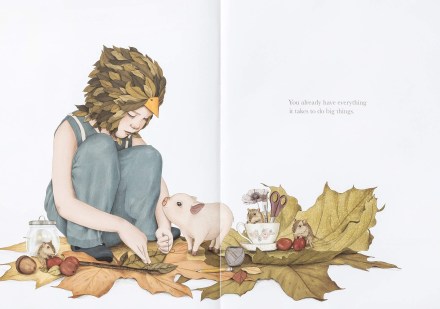
Gabriella Barouch’s breathtaking illustrations immediately draw readers into the world of this story and the world of childhood with its mix of wonder, concreteness, imagination, and potential. The child’s striking cap made of leaves, coupled with their overalls, creates a clever way for Barouch to make the book gender-neutral while piquing readers’ interest in what they are doing from page to page. This child of nature quietly coexists with a fawn, bunny, birds, and squirrels and has, as a companion, one of the cutest piglets ever seen. Barouch’s use of various perspectives contributes to a fluid fluctuation between elements of fantasy and realism. As the story progresses, kids watch the child gathering supplies that she assembles in the final scenes to send her piglet off on its own adventure.

No maybe’s about it, Maybe is a book you’ll  want to add to your home, classroom, or public library collection.

Ages 5 and up

Compendium, 2019 | ISBN 978-1946873750

You can discover more about Kobi Yamada and his books on the Compendium website.

To learn more about Gabriella Barouch, her books, and her art, visit her website.

Read a New Book Month Activity

celebrate-picture-books-picture-book-review-book-bag-craft

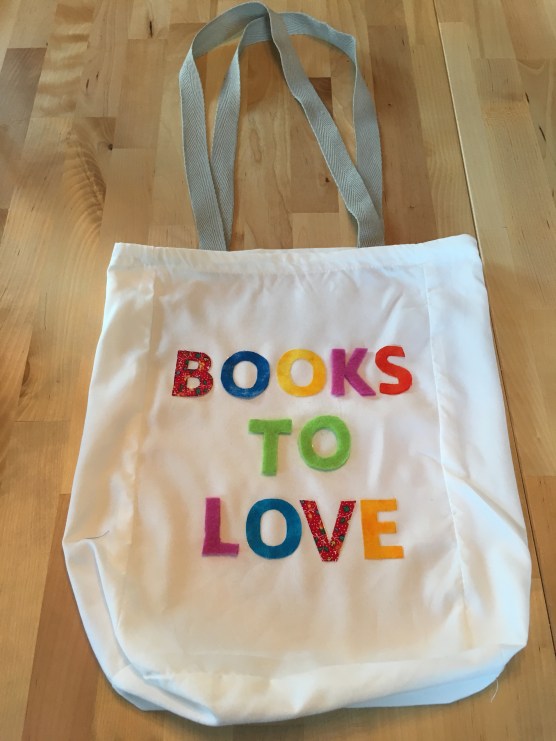
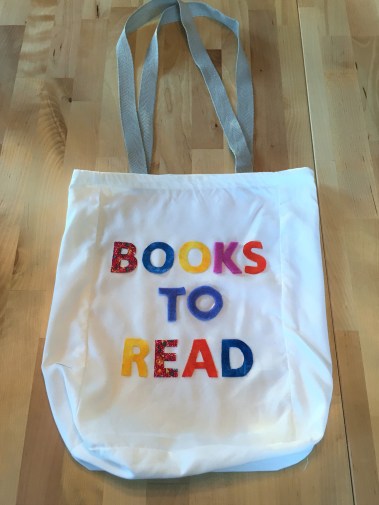
Books to Love, Books to Read Book Bag


True book lovers can’t go anywhere without a book (or two or three) to read along the way. With this easy craft you can turn a cloth bag into a kid-size book bag!

Supplies

  • Printable Templates: Books to Read Template | Books to Love Template
  • Small cloth bag, available from craft or sewing stores—Recyclable Idea: I used the bag that sheet sets now come in
  • Cloth trim or strong ribbon, available from craft or sewing stores—Recyclable Idea: I used the cloth handles from shopping bags provided from some clothing stores
  • Scraps of different colored and patterned cloth. Or use quilting squares, available at craft and sewing stores
  • Pen or pencil for tracing letters onto cloth
  • Scissors
  • Small sharp scissors (or cuticle scissors) for cutting out the center of the letters
  • Fabric glue
  • Thread (optional)
  • Needle (optional)

celebrate-picture-books-picture-book-review-books-bag-craft

Directions

  1. Print the sayings and cut out the letters
  2. Trace letters onto different kinds of cloth
  3. Cut out cloth letters
  4. Iron cloth bag if necessary
  5. Attach words “Books to Read” to one side of bag with fabric glue
  6. Attach words “Books to Love” to other side of bag with fabric glue
  7. Cut cloth trim or ribbon to desired length to create handles
  8. Glue (or sew) handles onto the inside edge of bag

celebrate-picture-books-picture-book-review-maybe-cover

You can find Maybe at these booksellers

Amazon | Barnes & Noble | Books-a-Million | IndieBound

Picture Book Review