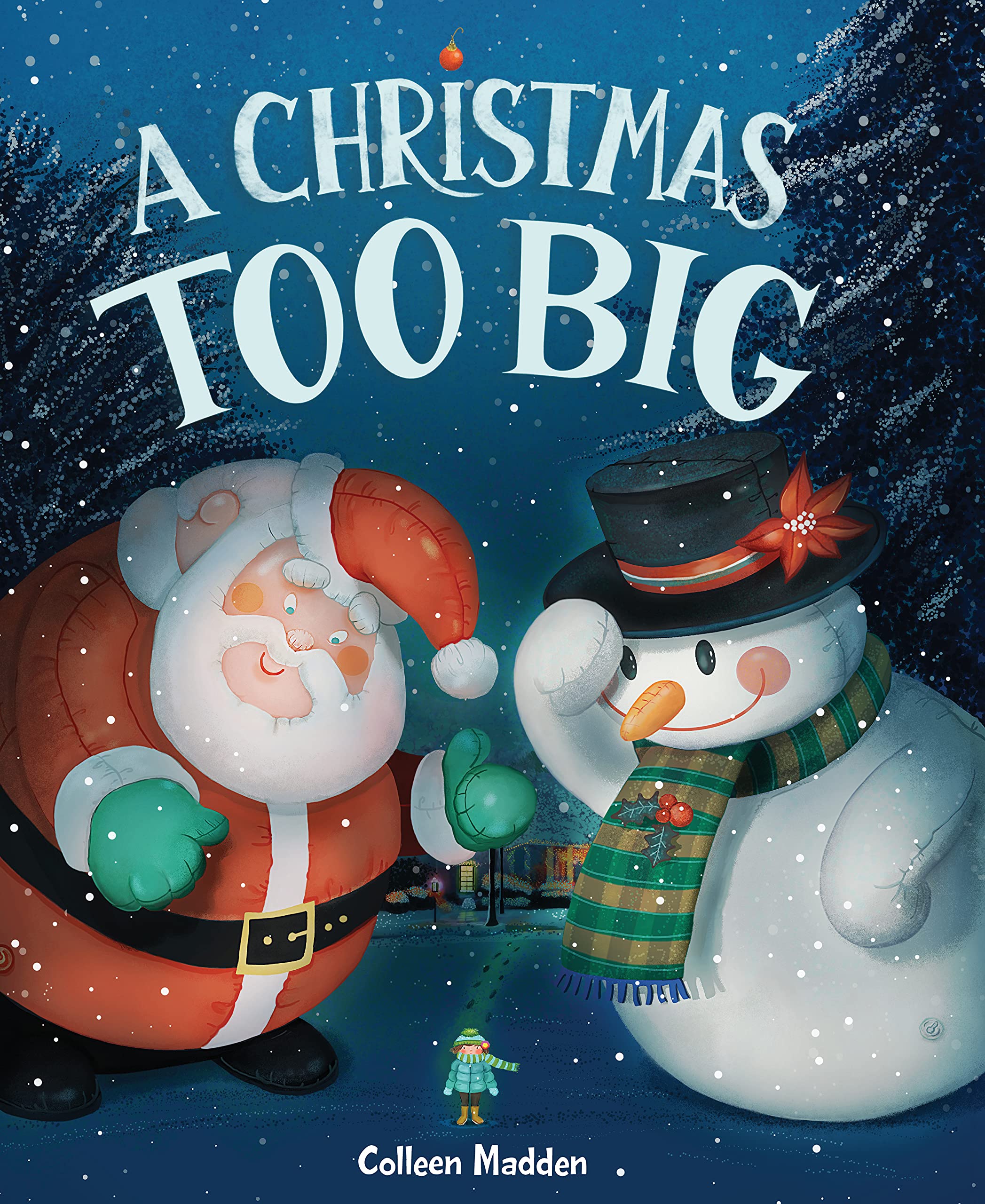
November 16 – A Book Tour Stop for A Christmas Too Big

celebrate-picture-books-picture-book-review-a-christmas-too-big-cover

About the Holiday

While it may seem a wee bit early for Christmas decorations at the mall, Christmas candy in the grocery stores, and Christmas songs on the radio 24-hours a day, it’s never too early to begin reading Christmas stories with kids! Today, I’m thrilled to be part of the book tour for A Christmas Too Big – a funny family story enriched with an endearing intergenerational friendship that will become a quick favorite for holiday story times.

Thank you to Two Lions and Barbara Fisch at Blue Slip Media for sharing a copy of A Christmas Too Big for review consideration. All opinions on the book are my own.

A Christmas Too Big

By Colleen Madden


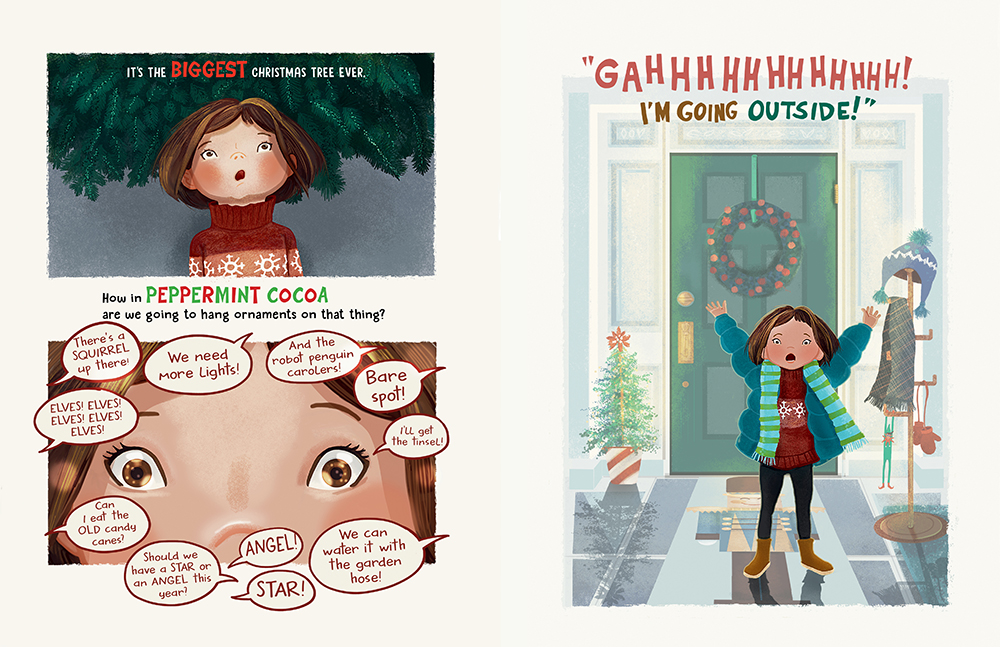
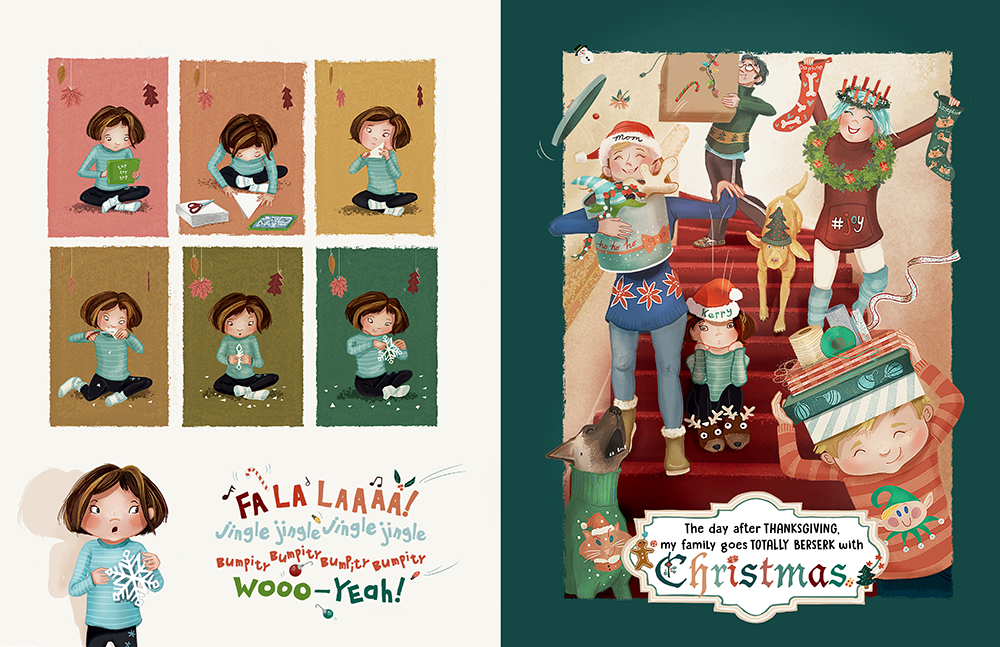
For Kerry and her family, Christmas begins the day after Thanksgiving. That’s when her mom, dad, and siblings go “TOTALLY BERSERK with Christmas.” Her dad gets out the strings of Christmas lights; her mom sings Christmas carols (filling in her own words where she can’t quite remember the real ones) while doing chores; her big sister bakes, bakes, bakes; and her little brother hides and rehides elves all over the house. At night, of course, they “watch every. Single. Christmas. Special. On every. Single. Christmas. Channel.”

A week before Christmas, they go to the cut-your-own Christmas tree farm and choose the biggest tree they see. The bring this behemoth inside and begin to decorate it. But there aren’t enough lights to cover it, there are squabbles over putting a star or an angel at the top, and someone finds a squirrel resting in the top. “O.M. Gingerbread,” Kerry says. She can’t take any more and heads outside.

celebrate-picture-books-picture-book-review-a-christmas-too-big-berserk

Image copyright Colleen Madden, 2021, courtesy of Two Lions.

There, her neighbors houses sport enormous decorations, flashing lights, and one has even provided a target on their lawn to show Santa where to drop the presents. Kerry thinks “that everybody is having a Christmas Too Big. Then, across the street, Kerry sees Mrs. Flores struggling with her grocery cart in the snow and goes over to help. After dislodging the cart from the snowbank and picking up the dropped groceries, Kerry walks with Mrs. Flores to her house.

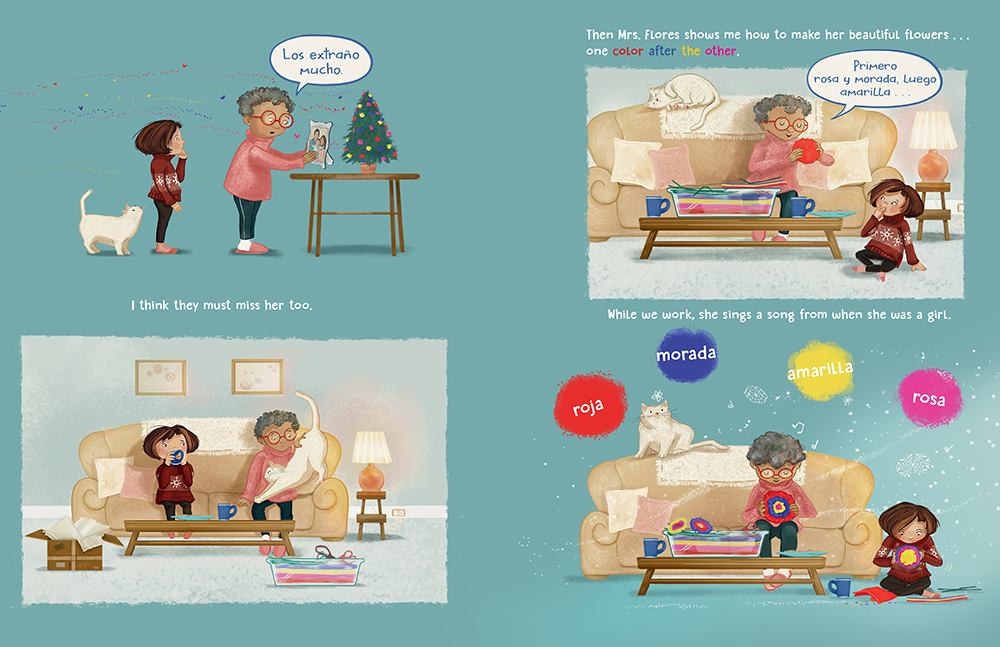
¿Te gustaria un poco de cacao, querida? Mrs. Flores asks Kerry. Kerry would love some cocoa and answers “Yes, please! ¡Sí, por favor!” Kerry looks around Mrs. Flores house. It’s neat and tidy, and her tabletop Christmas tree is decorated in handmade tiny paper flowers. “And that’s it. NO singing penguins or peppermint candy canes…or a zillion lights.” Next to the tree is a picture of her son, daughter-in-law, and grandson who live in Mexico. Mrs. Flores says, “Los extraño mucho,” and Kerry is sure “they must miss her too.”

After they drink their cocoa, Mrs. Flores teaches Kerry how to make paper flowers and sings a song she remembers from when she was young: “En invierno, / Las flores no crecen, / esperan a que LLeguen La primavera y el sol! In winter the flowers / aren’t blooming. / They wait for the spring / and the sun! //Ellas desean besos / cálidos de mariposa, They wish for warm / butterfly kisses, Luego ellas bailan! then they dance! ¡Sí! ¡Sí! ¡Sí! / Yes! Yes! Yes! / La! La! La!” They dance and then decorate Mrs. Flores’s house with the flowers they’ve made. Finally, Mrs. Flores lights a single candle in her window for her family.

celebrate-picture-books-picture-book-review-a-christmas-too-big-mrs-flores

Image copyright Colleen Madden, 2021, courtesy of Two Lions.

Kerry helps Mrs. Flores open the gift her family sent her. It’s a tablet, but Mrs. Flores doesn’t know how to use it. Kerry shows her how and makes a call with it. Suddenly, Mrs. Flores’s son appears, then her daughter-in-law. Then she gets to see her grandson Andrew, who calls her “Na-na.”

Nighttime had fallen and it was time for Kerry to go home. Out in the snow, Kerry thinks about the day: “What a different kind of Christmas. Small and quiet, yet BIG all the same.” Back home, Kerry looks for a way to have “my own kind of Christmas in in my own crazy Christmas house.” She makes flowers—lots of flowers—and decorates the shelves, stairway, mirrors, and even their dogs.

When Kerry lights a single candle for Mrs. Flores, her mom suggests inviting her for Christmas dinner. While her family puts the finishing touches on the tree, Kerry sends Mrs. Flores an invitation to her tablet. On Christmas day, Kerry and her family and Mrs. Flores all enjoy a festive dinner with all the trimmings and a lot of cheer.

celebrate-picture-books-picture-book-review-a-christmas-too-big-tree

Image copyright Colleen Madden, 2021, courtesy of Two Lions.

Whether you like to celebrate Christmas in big or small ways, Colleen Madden’s heartwarming story reflects the true spirit of the holiday as a day for family, friends, togetherness, and kindness. While Kerry’s parents and siblings believe in a bigger-is-better philosophy, when Kerry finds another way of celebrating with Mrs. Flores, she realizes that “big” doesn’t need to come with a huge tree, lots of lights, hundreds of cookies, or even a month of preparations, but can simply mean warm feelings inside their heart. Madden’s organic integration of Mrs. Flores’ conversation in Spanish is very welcome.

Madden’s straightforward, non-judgmental, inviting, and humorous storytelling welcomes kids all along the spectrum, from HUGE to tiny, to enjoy Christmas and its lead-in in the way that is most meaningful to them. The story can also spur talks within a family about the ways each member likes to celebrate and to incorporate those ideas into their yearly traditions.

Madden’s winning illustrations will keep kids riveted to the pages as Kerry’s family joyously retrieves the Christmas decorations and gets to work. Madden depicts their over-the-top love of the holiday in illustrations that are jam-packed, frenetic, and definite showstoppers that kids will love poring over—especially the title screens for seventeen comical Christmas specials, Mom’s “so close” renditions of holiday classic songs, and the cutaway of Kerry’s house, where they can search for the elves hidden in each room. The image of the Christmas tree bent in half because it’s too tall to fit in the room is particularly funny as is the two-page spread of the neighborhood where inflatable Santas, snowmen, and candy canes as well as billboard-sized lighted signs dominate each yard.

In contrast, Mrs. Flores one-story house has no outdoor decorations and the inside is sparsely furnished, allowing the focus to be on her small tree. As you turn from pages where you don’t know where to look next to these simple spreads, you can almost hear yourself sigh as the frenzy fades and a calm, quiet simplicity takes over. Back home, there’s no denying the beauty of the family’s fully decorated tree, and readers (maybe the adults even more than the kids) will appreciate the matching candy cane-striped onesie pajamas they’re wearing. The final image of Kerry’s family sharing dinner with Mrs. Flores is cheerful and festive. Spanish labels name all of the food, decorations, and other items on and around the dinner table.

Instructions on how to create the flores de Navidad that Mrs. Flores taught Kerry to make follow the story. The back endpapers name more objects, food, and clothing associated with Christmas and winter in Spanish. The English translations are found on the front endpapers.

An excellent story for sharing the fun and meaning of the Christmas season that will resonate with all kids and be asked for again and again, A Christmas Too Big would make a much-appreciated gift and a new family favorite on home bookshelves. The book is also highly recommended for school and public library collections.

Ages 4 – 8

Two Lions, 2021 | ISBN 978-1542028004

Colleen Madden grew up in a crazy Christmas house and, like Kerry, she found a break by spending time with her neighbor who was from another country. She has illustrated many children’s books, including the bestselling What If Everybody? series, written by Ellen Javernick, and the picture-book adaptation of All I Want for Christmas Is You, by Mariah Carey. She recently published Monkey Walk, her debut as both author and illustrator, and is currently working on her first graphic novel. She lives in the Philadelphia area with her husband and two sons. 

A Christmas Too Big Book Tour Activity

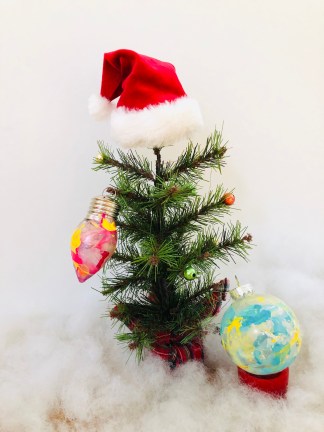
celebrate-picture-books-picture-book-review-christmas-ornaments-craft

Nail Polish-Dipped Ornaments


These plastic ornaments swirled with colorful nail polish make the perfect decorations for your tree. Make some to give to friends too!

Supplies

  • Plastic ornaments, available at craft stores
  • Nail polish in various colors
  • Plastic bowl or container, deep enough to dip the ornament into the water
  • Drying stand – I used a clear, plastic egg carton, or string for hanging ornaments to dry

Directions

Fill the plastic container with warm to hot water

  1. Using two or three colors, gently “paint” the water with the nail polish, using the brush or a toothpick in dots and swirls
  2. Slowly dip the plastic ornament into the water and turn it to pick up the nail polish floating on the top of the water
  3. To dry, place the ornament on a stand or hang with a paper plate, wax paper, or other paper to catch drips

celebrate-picture-books-picture-book-review-a-christmas-too-big-cover

You can find A Christmas Too Big at these booksellers

Amazon | Barnes & Noble | Books-a-Million

To support your local independent bookstore, order from

Bookshop | IndieBound

Picture Book Review
November 9 – Happy Book Birthday to A Sari for Ammi

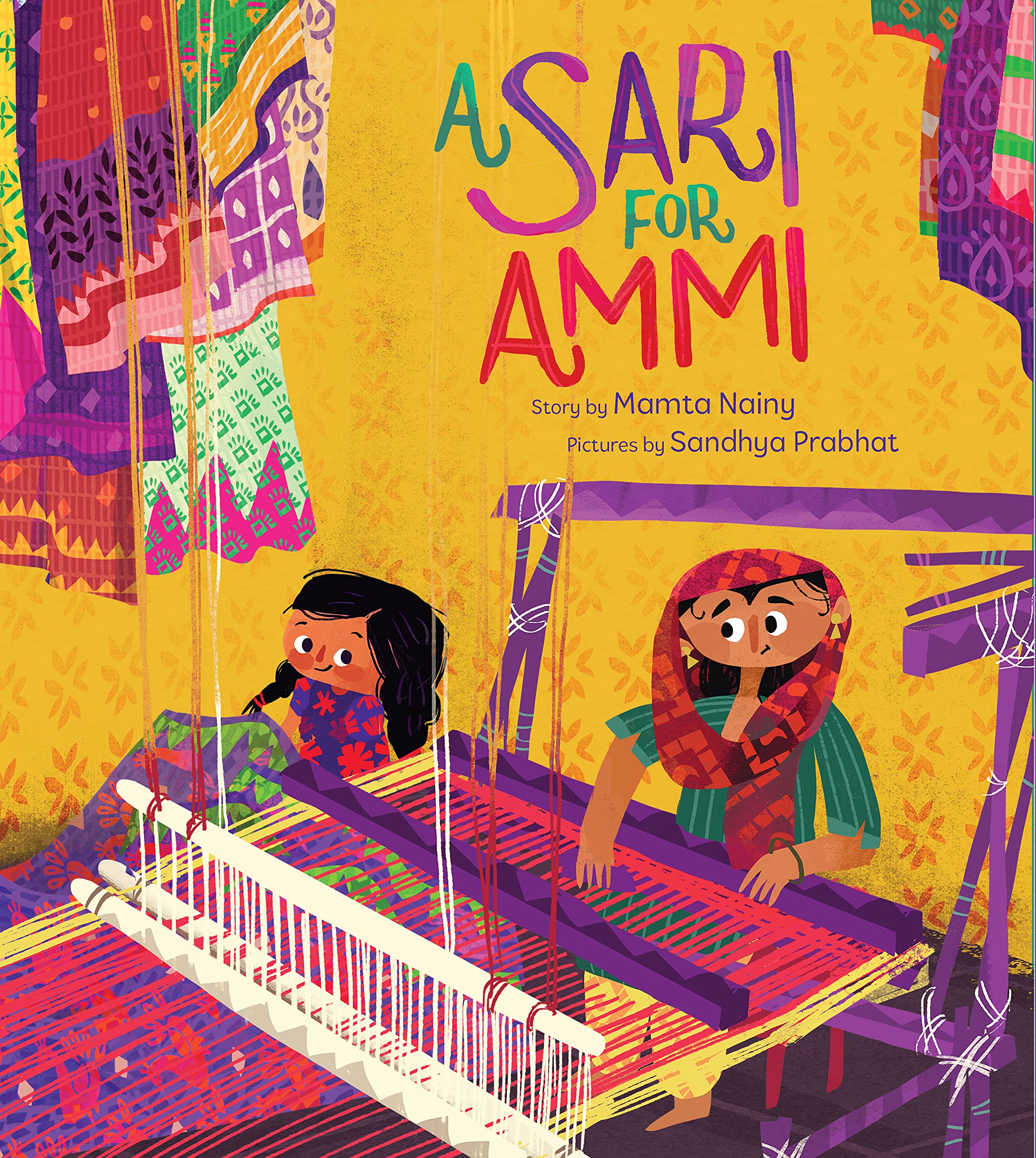
celebrate-picture-books-picture-book-review-a-sari-for-ammi-cover

About the Holiday

November is Picture Book Month and Family Stories Month! Taken together, I couldn’t wish for a better time to introduce today’s sweet and uplifting book about a loving family to readers! So gather ’round – today may be A Sari for Ammi‘s book birthday, but this lovely story is a gift for you!

Thanks go to Amazon Crossing Books and Barbara Fisch at Blue Slip Media for sharing a copy of A Sari for Ammi with me for review consideration. All opinions of the book are my own.

A Sari for Ammi

Written by Mamta Nainy | Illustrated by Sandhya Prabhat


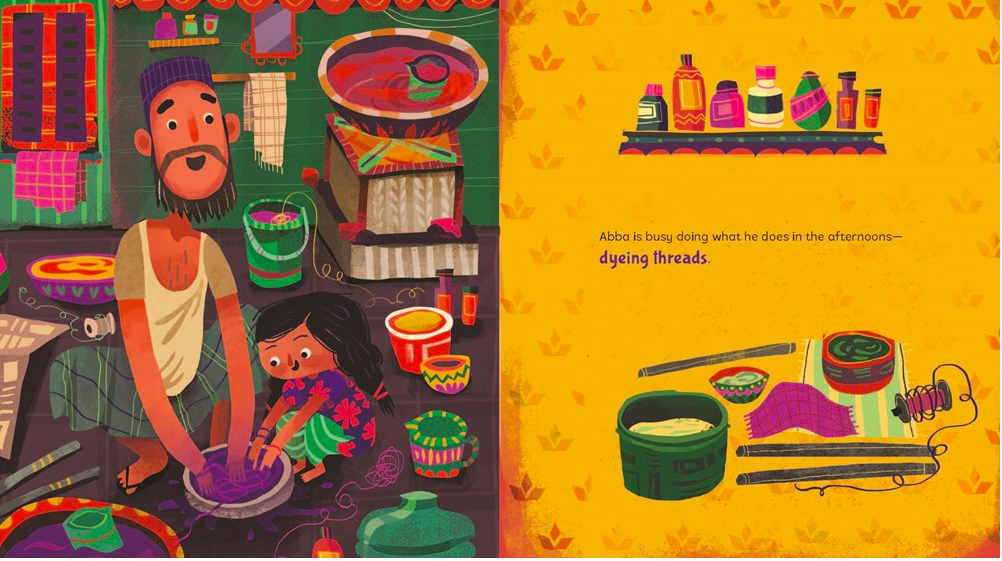
It’s afternoon and a little girl tiptoes past her sister, Sadaf, who’s dozing on the front porch, and the buffalo, who are napping after their “good wash in the village pond.” She’s on her way to help her dad, her Abba, dye threads for the saris that her Ammi, her mom, weaves. After the threads are dyed, the girl visits Ammi at her loom. “Ammi weaves the most wonderful saris in the world, in pinks and yellows and greens, with prints of mangoes, peacocks, birds, leaves, and flowers,” she says.

celebrate-picture-books-picture-book-review-a-sari-for-ammi-abba

Image copyright Sandhya Prabhat, 2021, text copyright Mamta Nainy, 2021. Courtesy of Amazon Crossing Kids.

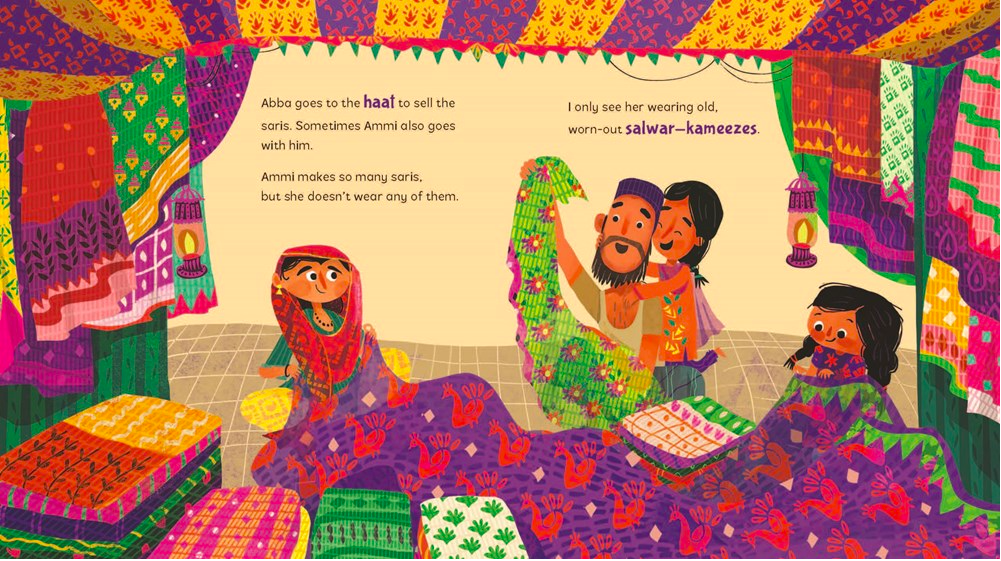
Making saris has been a family business going back to her great-great grandparents. Now, she and Sadaf, Abba and Ammi work on the saris – some even take months to create. Abba takes Ammi’s finished saris to the haat, the market, to sell. The little girl feels sad that Ammi never gets to wear one of the beautiful sari’s herself. Instead Ammi always wears “old, worn-out salwar-kameezes” – traditional pants and tunics.

One day, the girl asks Ammi to keep a particularly beautiful sari for herself, but Ammi says it is to sell. “‘If we keep the saris, how will we eat?'” she says. The girl doesn’t quite understand, but she wants Ammi to be able to wear a sari that she makes, but to do that, she and Sadaf would have to buy her one. Then she thinks about her and Sadaf’s bank. “‘Let’s break our gullak!'” she tells Sadaf. “‘We can use the money to buy Ammi a sari.'”

celebrate-picture-books-picture-book-review-a-sari-for-ammi-haal

Image copyright Sandhya Prabhat, 2021, text copyright Mamta Nainy, 2021. Courtesy of Amazon Crossing Kids.

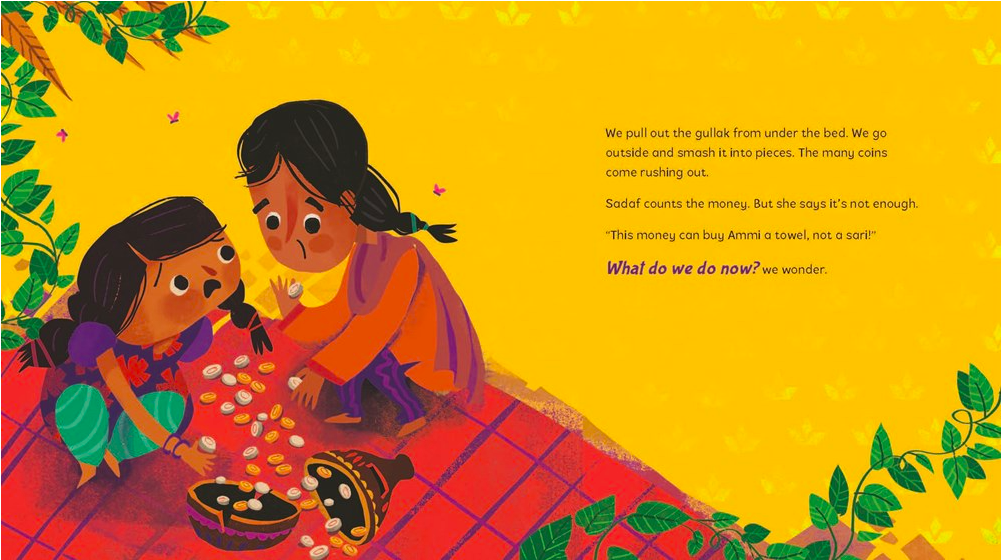
Sadaf about the list of things she and her sister have been saving for, but her little sister asks “‘What matters more to you: Ammi or ‘the things’?…Sadaf makes a face and mumbles, ‘Ammi.'” But when they break the gullak and count their change, it’s only enough to buy a towel. What can they do? Sadaf has the idea to sell all of their old junk to Jhammu Kaka, who owns the scrap shop. When they do that they have more money, but only enough for a dupatta, a head scarf.

celebrate-picture-books-picture-book-review-a-sari-for-ammi-money

Image copyright Sandhya Prabhat, 2021, text copyright Mamta Nainy, 2021. Courtesy of Amazon Crossing Kids.

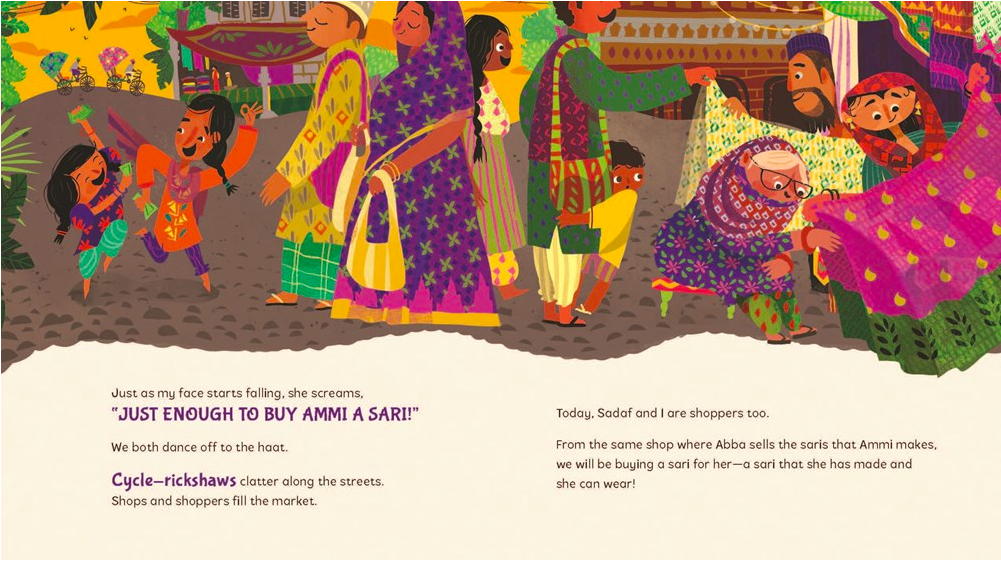
On the way home, the little girl thinks of another way to earn money. They go to their neighbor’s house and help her dye threads for the saris she makes. When she gives them money for their help, Sadaf counts it. Her sister is ready for disappointment, but instead she hears, “‘This money is… just enough to buy Ammi a sari!'” They run to the haat and look at all the saris before picking one. What, they wonder, will Ammi say when they give it to her. But they don’t have “to wait long to find out.” They rush home and with big hugs and the sari in hand, they “bring the biggest smile to Ammi’s face!”

Back matter includes a discussion about the saris of Kaithoon, where the story is set, the history of this town in India as a center for the weaving of saris made from a special fabric called “‘kota doria'” and the women of the Muslim Ansari community who create these works of art. A Glossary also defines words found throughout the story.

celebrate-picture-books-picture-book-review-a-sari-for-ammi-shopping

Image copyright Sandhya Prabhat, 2021, text copyright Mamta Nainy, 2021. Courtesy of Amazon Crossing Kids.

Mamta Nainy’s heartening story charms with a close-knit family and two sisters who want their mother to enjoy the saris she works so hard to create. As they pool their resources and think up other ways to make money to buy a sari, the girls show a kind of love for family and excitement for giving that will resonate with readers. Nainy’s flowing and detailed storytelling seamlessly educates and enchants with humor, emotion, and the tender enthusiasm of the young narrator’s voice. The final spread in which the two girls give Ammi the sari they’ve chosen is sure to bring a smile – and maybe a tear – to adults and kids alike.

Sandhya Prabhat fills her pages with glorious color and warm tones that bring the beauty of the kota doria saris alive for readers. Kids and adults will see traditional methods of dyeing threads, the setup of a loom on which these treasures are created, and the intricate patterns and vibrant hues that grace these sought-after saris. Just as compelling are images of the family happily working together to make the cloth and stock their market stall as well as illustrations of the narrator and her sister selflessly giving up their money and devising ways to make more. A two-page spread showing the haat is a showstopper that will entice readers to choose their own favorite sari. 

A moving, feel-good family story with deep roots, both culturally and in the heart, A Sari for Ammi is a story that adults and kids will love sharing again and again. The book is highly recommended as a gift or an addition to home, school, and public library collections.

Ages 4 – 8 

Amazon Crossing Kids, 2021 | ISBN 978-1542035071

You can connect with Mamta Nainy on Instagram.

To learn more about Sandhya Prabhat, her books, and her art, visit her website.

A Sari for Ammi Book Birthday Activity


You can watch one of these beautiful saris being woven and hear more about them with this video!

You can view a longer video, in which the women weavers talk about and demonstrate their art, here


celebrate-picture-books-picture-book-review-a-sari-for-ammi-cover

You can find A Sari for Ammi at these booksellers

Amazon | Barnes & Noble | Books-a-Million

To support your local independent bookstore, order from

Bookshop | IndieBound

Picture Book Review

November 5 – It’s Family Stories Month

celebrate-picture-books-picture-book-review-niki-nakayama-a-chef's-tale-in-13-bites-cover

About the Holiday

Children benefit in many ways from close relationships to grandparents, aunts, uncles, cousins, and other extended family members. This month and next, as family gathers together for special holiday events, it’s a terrific time for adults to share family history and their own stories of growing up with the younger generation. Letting kids know how much they’re loved by everyone in the family helps them develop a sense of belonging, a good self-image, and confidence. Reading together is a perfect way to spend time together and get conversations started. 

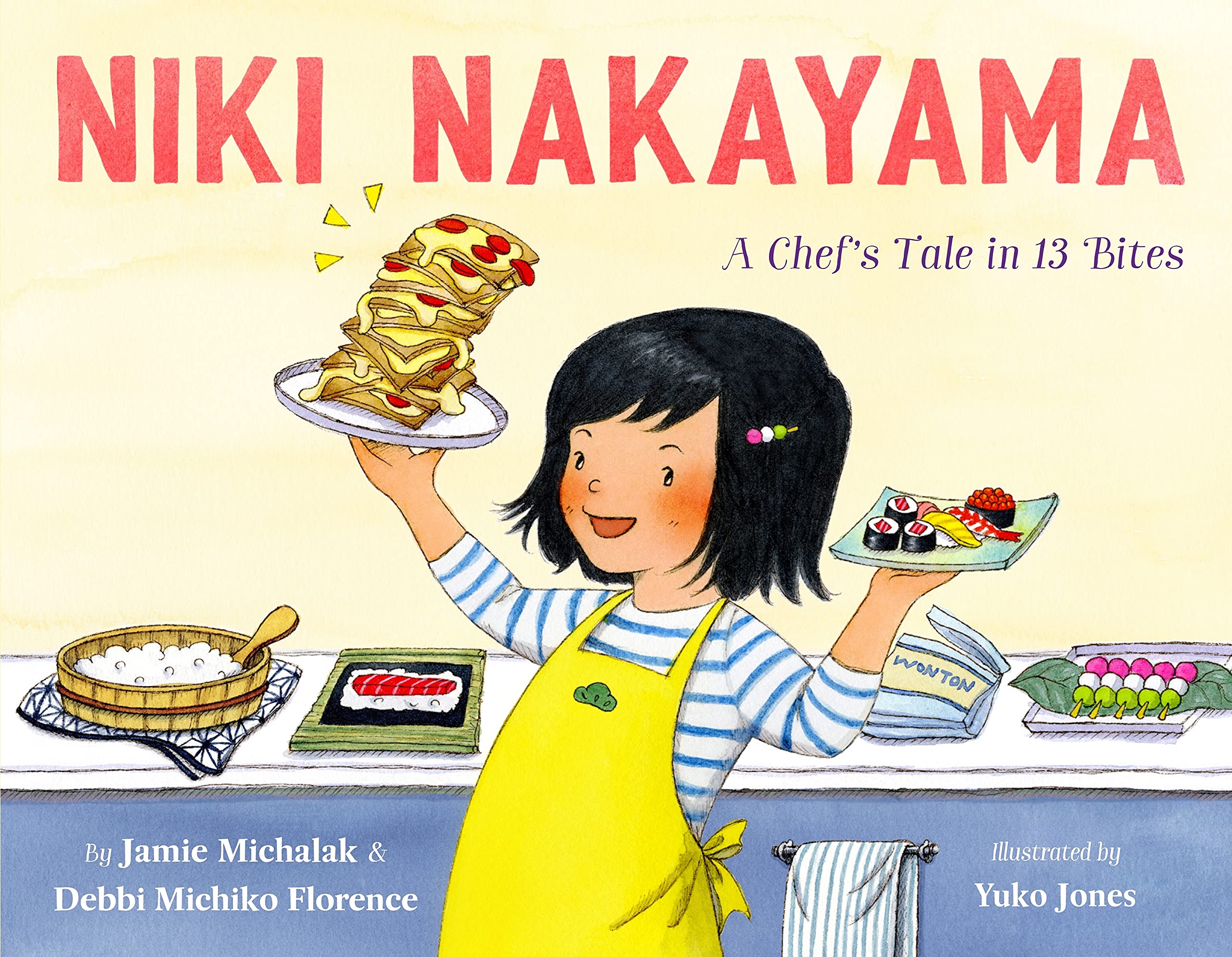
Niki Nakayama: A Chef’s Tale in 13 Bites

Written by Jamie Michalak and Debbi Michiko Florence | Illustrated by Yuko Jones


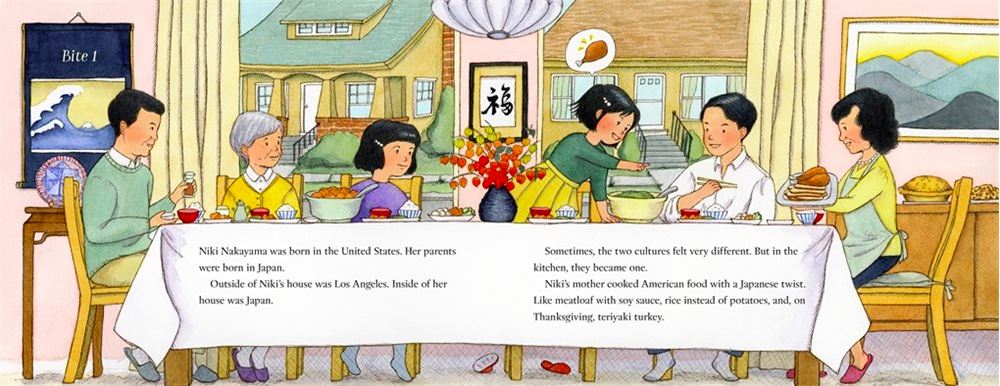
This true story opens with an invitation to listen as Niki Nakayama talks about her journey to becoming a chef in thirteen bites. “Come. Sit. Taste…” Bite 1: Niki was born in California but her parents were born in Japan. “Outside of Niki’s house was Los Angeles. Inside of her house was Japan.” While the two cultures often felt disparate, in Niki’s family’s kitchen “they became one.” Niki’s mother always put a Japanese twist on American dishes, with soy sauce or rice or teriyaki.

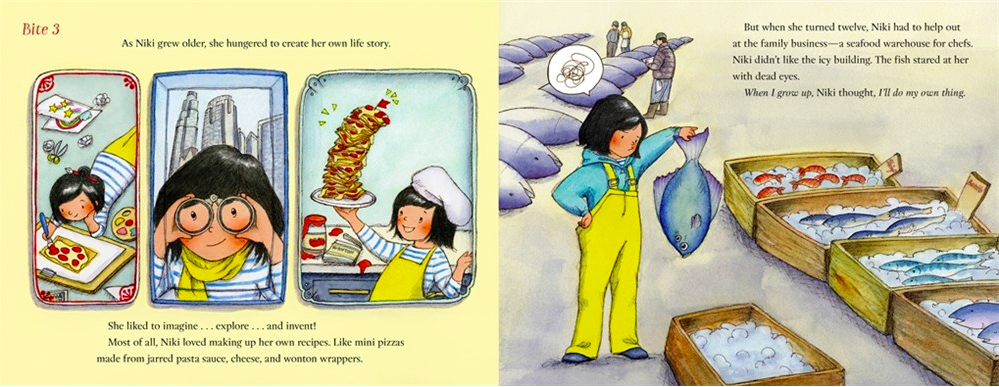
Bite 2: Close to New Year’s Eve, Niki’s grandmother took her to the grocery store to shop for the holiday dinner. Niki was excited. She loved buying all the ingredients for the feast to come: an opportunity to share “a table of love and laughter” in addition to the food. As Niki grew older, she created her own recipes and determined that she would get away from her family’s seafood-selling business and do her own thing.

celebrate-picture-books-picture-book-review-niki-nakayama-a-chef's-tale-in-13-bites-family-table

Image copyright Yuko Jones, 2021, text copyright Jamie Michalak and Debbi Michiko Florence, 2021. Courtesy of Farrar Straus Giroux.

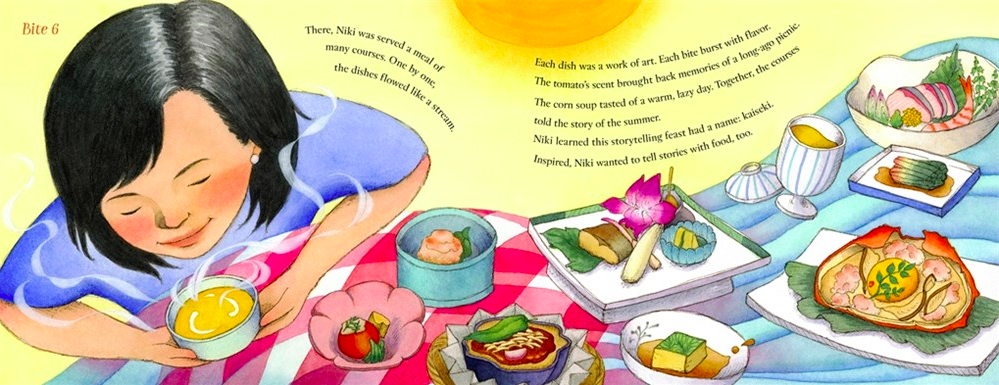
Niki’s dreams seemed to get little attention from her parents, who doted on their son and encouraged his success. But Niki new she could be successful too. “Kuyashii! Niki thought. ‘I’ll show them!’” After high school, Niki traveled to Tokyo, Japan, tasting all the delicious food on offer. Later she took the train to where her cousins owned an inn. There she was served a meal comprised of many dishes, each “a work of art” and each with a delicious memory attached or story to tell. “Niki learned this storytelling feast had a name: kaiseki.”

When Niki returned home, she told her mother she wanted to go to school to become a chef. Her mother discouraged her, but Niki went anyway. “She began to see food as art—a carrot as a mountain.” And while her family thought her cooking was just a hobby, Niki thought “Kuyashii! ‘I’ll show them!’” Niki got a job at a sushi restaurant. “Female sushi chefs were rare,” and the head chef didn’t think she could handle the work. “‘You’re just playing chef,’ he joked.” But Niki told him she wasn’t playing.

celebrate-picture-books-picture-book-review-niki-nakayama-a-chef's-tale-in-13-bites-fish-market

Image copyright Yuko Jones, 2021, text copyright Jamie Michalak and Debbi Michiko Florence, 2021. Courtesy of Farrar Straus Giroux.

After working there and learning all she could, Niki decided to travel back to her cousins’ inn to study kaiseki. But there was a big obstacle. “As far as she knew, female kaiseki chefs didn’t exist. In Japan recipes and training was only handed down to males. People told Niki her dream was impossible, but she thought she could do it. Niki studied for three years and then returned to Los Angeles to open a sushi restaurant of her own.

Instead of being happy for her, her family was dismissive. At last she convinced them to give her a loan—but it came with the stipulation that “if the restaurant failed, she would have to close it and say goodbye to her dream forever.” Instead of the kaiseki dishes she wanted to serve, her mother thought sushi would be a better choice. Against her own wishes, she agreed. In a year, customers were lining up for her food. But making sushi was not what she really wanted to do.

celebrate-picture-books-picture-book-review-niki-nakayama-a-chef's-tale-in-13-bites-bite-6

Image copyright Yuko Jones, 2021, text copyright Jamie Michalak and Debbi Michiko Florence, 2021. Courtesy of Farrar Straus Giroux.

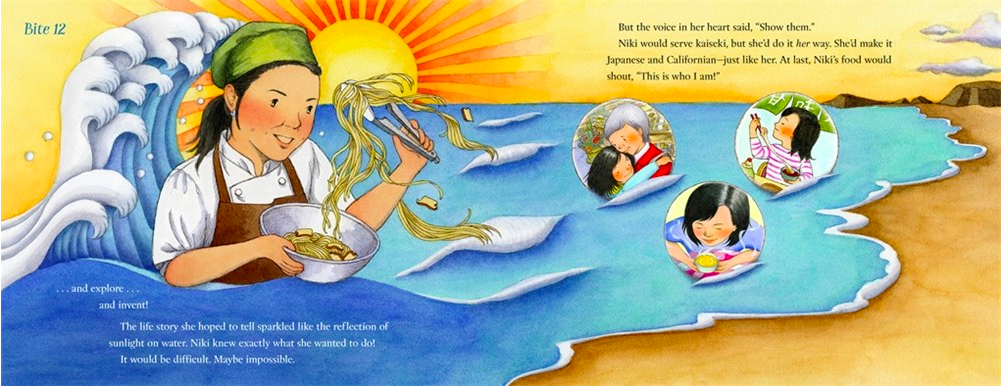
She closed her restaurant and wondered what to do next. Then, after much thought and exploration, she had her answer. She wanted to serve kaiseki that told her story—both Japanese and Californian. “Niki called her new restaurant n/naka. Naka means ‘inside’ in Japanese. Finally, Niki was inside her dream.” Through thirteen courses she told her stories—never serving customers the same meal twice. Now, every night tables are full of love and laughter, and Niki showed everyone that she could be a master chef.

Back matter includes a timeline of Niki Nakayama’s life from her birth in Los Angeles in 1974 to the awarding of two Michelin stars for her restaurant n/naka in 2019; a discussion of the words kuyashii and kaiseki; and a recipe for wonton pizza.

celebrate-picture-books-picture-book-review-niki-nakayama-a-chef's-tale-in-13-bites-kaiseki

Image copyright Yuko Jones, 2021, text copyright Jamie Michalak and Debbi Michiko Florence, 2021. Courtesy of Farrar Straus Giroux.

Jamie Michalak and Debbi Michiko Florence’s biography of Niki Nakayama is an enthralling story of self-confidence, obstacles overcome, and success that will inspire readers to stay true to the voice inside themselves. Telling Nakayama’s story through thirteen bite-sized vignettes that reveal formative moments in her life that informed her journey is a captivating and effective way to show Niki’s growth as a chef as well as to explain the meaning and experience of kaiseki.

Readers will respond to Michalak’s and Florence’s straightforward text and the details of the hurdles placed in her way. One take-away for adult readers is the importance of recognizing, encouraging, and supporting their children’s dreams and talents—an awareness that can lead to ongoing discussions with kids as they grow, learn, and get involved in activities.

Yuko Jones’ lovely illustrations take readers into Niki Nakayama’s home to see her interacting with her family and the foods that so inspired her life’s work. Jones’ images of Japanese delicacies are particularly beautiful, giving kids a strong understanding of the courses served during a kaiseki meal. Niki’s self-assurance in the face of her family’s protests and her male-dominated culinary school class as well as the rarity of female sushi chefs is stirring for all readers. Jones’ final page spreads reveal the gorgeous dishes Niki serves and the inviting atmosphere at her restaurant n/naka.

A captivating and impactful biography of a contemporary chef and role model, Niki Nakayama: A Chef’s Tale in 13 Bites is a must for home, classroom, school, and public library collections to inspire all kids who are contemplating their place in the world now and in the future.

Ages 4 – 10

Farrar, Straus, and Giroux, 2021 | ISBN 978-0374313876

Discover more about Jamie Michalak and her books on her website.

You can learn more about Debbi Michiko Florence and her books on her website.

To learn more about Yuko Jones and see a portfolio of her work, visit her website.

You can learn more about n/naka and view a gallery of Niki Nakayama’s spectacular dishes on the n/naka website.

Family Stories Month Activity

celebrate-picture-books-picture-book-review-niki-nakayama-a-chef's-tale-in-13-bites-coloring-page

Niki Nakayama: A Chef’s Tale in 13 Bites Activity Kit


Educators and families can find an extensive Activity Kit and coloring pages to accompany classroom or homeschool lessons or just for fun on Jamie Michalak’s website and Debbi Michiko Florence’s website.

celebrate-picture-books-picture-book-review-niki-nakayama-a-chef's-tale-in-13-bites-cover

You can find Niki Nakayama: A Chef’s Tale in 13 Bites at these booksellers

Amazon | Barnes & Noble | Books-a-Million

To support your local independent bookstore, order from

Bookshop | IndieBound

Picture Book Review

November 2 – It’s Historic Bridge Month

celebrate-picture-books-picture-book-review-sonny-rollins-plays-the-bridge-cover

About the Holiday

Bridges can do so much more than just take vehicles and people over waterways or highways. Many are beautiful structures that enhance the skyline or environment in which they’re found. Covered bridges, stone bridges, and soaring steel and cable bridges all have their own stories to tell and inspire awe in their own way. Unfortunately, many older bridges are slated for destruction or replacement. To honor this month’s holiday, visit a historic bridge in your area or research famous bridges of the past and present. On November 6, we also celebrate National Saxophone Day! To get in the swing of this holiday, why not listen to music by Sonny Rollins? You can find his jazz classics on YouTube. To get started, you can listen to The Bridge here.

Thanks go to Nancy Paulsen Books for sharing a copy of Sonny Rollins Plays the Bridge with me for review consideration. All opinions on the book are my own.

Sonny Rollins Plays the Bridge

Written by Gary Golio | Illustrated by James Ransome


“The Bridge / leaps / spreads its wings / joyfully / joining shore to shore”

“Steel towers / standing tall / reaching high / touching / sky” as people – walking and riding bikes – and cars and trucks move above “the River / stretched out below / a shiny / endless / song”

celebrate-picture-books-picture-book-review-sonny-rollins-plays-the-bridge-apartment-building

Image copyright James Ransome, 2021, text copyright Gary Golio, 2021. Courtesy of Nancy Paulsen Books, Penguin.

In another part of New York City, Sonny Rollins, already a jazz great, is trying to find a place to play his saxophone – to become a better musician and a better person. The neighbors in his apartment building complain from their windows as he practices on the fire escape, so he takes to the sidewalks to find a more accommodating spot. He wanders the busy streets until he sees, towering above the tall buildings, the Williamsburg Bridge and wonders…. He listens to “that / small voice / inside / which says / you need to do this

celebrate-picture-books-picture-book-review-sonny-rollins-plays-the-bridge-city

Image copyright James Ransome, 2021, text copyright Gary Golio, 2021. Courtesy of Nancy Paulsen Books, Penguin.

He climbs the stairs to the walkway high above the noisy, busy city and takes his saxophone from its case. Here, alone, Sonny finds the place where he can play as loud as he wants. But he’s not really alone. Around him the “clanking clanging” subway trains lend rhythm to his music, and the “tugboats / blowing bass notes / back / and forth” are answered “note-for-note / with / low moans” from Sonny’s sax while seagulls are “echoing / Sonny’s funny / squeaks / & / squawks.”

Here, this jazz great “can play / anything / EVERYTHING / that comes into his mind.” With his “mind opened wide,” Sonny finds the sound he’s been looking for and “the Bridge / leaps / spreads its wings / just like / Sonny.”

celebrate-picture-books-picture-book-review-sonny-rollins-plays-the-bridge-playing

Image copyright James Ransome, 2021, text copyright Gary Golio, 2021. Courtesy of Nancy Paulsen Books, Penguin.

Back matter includes more about the life and career of Sonny Rollins; a history of the Williamsburg Bridge and The Bridge – a series of songs inspired by his experience, recorded in 1962; and Sonny’s words about how he lives his life and what he thinks is important. Sonny’s website and recommended songs found on YouTube round out these informative pages.

Gary Golio’s story floats on the jazz rhythms of his poetic verses, enveloping readers in the musicality of Sonny Rollins’s life and the sounds of the city. In addition to relaying the facts of this seminal period in Rollin’s career, Golio emphasizes Rollin’s belief in the importance of listening to your own internal voice on the road to self-discovery. Lyrical descriptions of the impromptu “band” that accompanied Rollins on the bridge are both beautifully evocative and inspirational reminders for readers that they too can shine while working with or playing off of others. 

James Ransome’s glorious watercolor and collage paintings give readers a sense of the time period as well as the scale of the bridge as it soars above the high-rise buildings, providing a practice room and stage for Sonny Rollins’ talent. Textured and patterned details along with a variety of perspectives echo Golio’s lyrical verses. Gold accents on each page mirror Rollins’ shiny saxophone and visually represent the notes that rise and float away over the city.

A gorgeous and jazz-infused snapshot of a stirring and influential time in Sonny Rollins’ life,  Sonny Rollins Plays the Bridge will delight any music lover and inspire all readers to search for the best in themselves. The book is highly recommended for home, school, and public library collections.

Ages 4 – 8

Nancy Paulsen Books, Penguin Random House, 2021 | ISBN 978-1984813664

Discover more about Gary Golio and his books on his website.

To learn more about James Ransome, his books, and his art, visit his website.

Historic Bridge Awareness Month Activity

celebrate-picture-books-picture-book-review-spaghetti-box-bridge-craft

Build a Remarkable Recycled Bridge


You don’t need fancy blocks and construction materials to build a bridge! Little ones will be fascinated to put together a bridge made out of items you already have at home or that may even be slated for the recycle bin. Spaghetti boxes make great roadways, and cut-up egg cartons can be used as supports.

Want to build a whole town? Cereal boxes and pasta boxes make skyscrapers, apartment buildings, fire stations, and more. Need a farm silo? Grab a peanut butter jar, oatmeal container, or aluminum can. You can use them as is or—if your kids are sticklers for a little more detail—add some paint and details! So look around, use your imagination, and get creative!

celebrate-picture-books-picture-book-review-sonny-rollins-plays-the-bridge-cover

You can find Sonny Rollins Plays the Bridge at these booksellers

Amazon | Barnes & Noble | Books-a-Million 

To support your local independent bookstore, order from

Bookshop | IndieBound

Picture Book Review
October 14 – It’s Hispanic Heritage Month

celebrate-picture-books-picture-book-review-without-separation-cover

About the Holiday

From September 15th through October 15th National Hispanic Heritage Month celebrates the contributions of those who come from or whose ancestors immigrated from Spain, Mexico, the Caribbean, Central America, and South America. Each year the holiday adopts a particular theme. This year’s theme is “Esperanza: A Celebration of Hispanic Heritage and Hope.” From business and industry to culture, sports, and entertainment, Hispanic and Latinx Americans have made an important and indelible imprint on our country. You can learn more about the holiday and find cross-curricular resources for classrooms and homeschooling, videos, exhibitions, and much more from the Smithsonian, the Library of Congress, the National Park Service, the National Gallery of Art, the Nationla Archives and more to use not only this month but throughout the year on the official Hispanic Heritage Month website.

Without Separation: Prejudice, Segregation, and the Case of Roberto Alvarez

Written by Larry Dane Brimmer | Illustrated by Maya Gonzalez

On January 5, 1931 twelve-year-old Roberto Alvarez was happy to be going back to Lemon Grove Grammar School after the Christmas vacation. But when he got there “the principal told Roberto and the other Mexican and Mexican American children that they did not belong there.” He told them to go to the new Mexican school on Olive Street, and when they arrived, their teachers and desks were already waiting for them.

This had all come about stealthily after the school district’s board of trustees received a letter from the parent-teacher association complaining that “the Mexican children didn’t understand English,” which “held back the white students.” The letter also said that the “Mexican children were unclean and endangered the health of every other student in the school.” The board decided to construct a separate school—but without telling the Mexican parents, fearing “trouble.”

But as the Olive Street school was being built, Mexican parents understood it true purpose of segregation and instructed their children not to attend, but to come home. Most of the kids, including Roberto did as their parents told them. “That January morning the Olive Street School stood almost empty, except for two teachers, three students, and many unoccupied desks.” Roberto believed he didn’t need a different school. While his parents had come from Mexico, he had been born in California and spoke English as well as any of the white students.

celebrate-picture-books-picture-book-review-without-separation-trouble

Image copyright Maya Gonzalez, 2021, text copyright Larry Dane Brimmer, 2021. Courtesy of Calkins Creek.

The Mexican parents formed the “Comité de Vecinos de Lemon Grove—the Lemon Grove Neighbors Committee”—to talk about the situation. They knew the new school had not been built to “help their students learn the English language and American customs, as the school board and newspapers claimed.” The only deciding factor of which school a child attended was the color of their skin.

The Comité de Vecinos acquired two lawyers, and on February 13, 1931 “Roberto brought the situation in Lemon Grove to the attention of the California Superior Court in San Diego” by filing a law suit against the Lemon Grove School board of trustees. His lawsuit asked that the school district stop discriminating against the Mexican students and allow them to return to the Lemon Grove School. The school board falsely stated that the students’ strike was “organized by Mexico or by groups in Mexico,” and the president told a reporter he knew that the district attorney of San Diego was on the school’s side.

In fact the San Diego district attorney represented the school board in its dealings with the court, saying that the Olive Street School was for “‘better instruction,’” a claim that was different from the minutes from the school board’s summer meetings. He then went on to say that having a school in their own neighborhood was safer since they didn’t have to cross the railroad tracks. But Roberto wanted to go to school with all of his friends—”brown and white.”

celebrate-picture-books-picture-book-review-without-separation-roberto

Image copyright Maya Gonzalez, 2021, text copyright Larry Dane Brimmer, 2021. Courtesy of Calkins Creek.

The trial began on March 10, 1931 in San Diego. The lawyers for the school board insisted that the new school was to “benefit the Mexican pupils…not to separate” them. Roberto’s lawyers countered this with the minutes from the board’s summer meetings.

The trial ended the next day, and the decision was handed over to the judge. Two days later, the judge handed down his ruling. He stated that “in the eyes of the law the Lemon Grove School District had no power to set up a separate school for Mexican children.” On April 16, 1931, the judge’s ruling became official and the school board was ordered to immediately admit Roberto Alvarez and all of the other Mexican students “‘without separation or segregation.’” Roberto knew he had to stand up for what was right, and as he and the other Mexican students returned to school, “this time all were welcomed.”

An extensive Author’s Note, complete with photographs of Roberto Alvarez, his third- and fourth-grade classmates in 1928, Roberto’s mother, Lemon Grove Grammar School and its principal, and Roberto in 1999, reveals more about this historical event, the people involved, and the political and social atmosphere in the US at the time. Larry Dane Brimmer also discusses other cases of school segregation and follows up with the consequences for Lemon Grove principal Jerome Green and the successful career enjoyed by Roberto Alvarez as an entrepreneur. Resources used in researching the book are also included.

celebrate-picture-books-picture-book-review-without-separation-school

Image copyright Maya Gonzalez, 2021, text copyright Larry Dane Brimmer, 2021. Courtesy of Calkins Creek.

Larry Dane Brimmer’s compelling history of this landmark case and biography of Roberto Alvarez and all of the students and their parents who stood up for equal access to schooling is instructive and empowering. The fact that this issue and similar others continue to roil schools, workplaces, and communities, makes Without Separation a vital resource to educate children and adults on system racism and how it spreads.

Brimmer highlights the courage, intelligence, and acceptance that children display and inspires them to lend their voices to change injustice wherever they find it. Brimmer’s clear and precise storytelling allows children to understand the actions and discussions involved in the school board meetings, neighborhood committee meetings, and the trial without losing any of the story’s emotional impact.

Maya Gonzalez’s lovely folk-art illustrations present stylized-yet-realistic depictions of the citrus groves, the school, and the courtroom. Fashions and décor set the time period while also appearing appropriate today. Another portrayal of universality is accomplished in Gonzalez’s two-page spread of the board of trustees’ meeting, in which she pictures the members sitting at a table with only their feet and upper body showing. Not only is this group representative of the 1930 school board, but of the “faceless” masses and committees that often drive policy today. Many images of the Mexican community supporting each other shows readers what can be accomplished when people work together.

An important book that will resonate with its target audience, Without Separation: Prejudice, Segregation, and the Case of Roberto Alvarez is a must-addition to any home, classroom, school, and public library.

Ages 7 – 10 and up

Calkins Creek, 2021 | ISBN 978-1684371952

Discover more about Larry Dane Brimmer and his books on his website.

To learn more about Maya Gonzalez, her books, and her art, visit her website.

celebrate-picture-books-picture-book-review-without-separation-cover

You can find Without Separation: Prejudice, Segregation, and the Case of Roberto Alvarez at these booksellers

Amazon | Barnes & Noble | Books-a-Million

To support your local independent bookstore, order from

Bookshop | IndieBound

Picture Book Review
September 9 – It’s Family Meals Month

celebrate-picture-books-picture-book-review-the-whole-world-inside-nans-soup-cover

About the Holiday

This month-long holiday got its start in 2015 and was designed as a way to support families in enjoying more meals made with fresh ingredients together. Over the years National Family Meals Month™ has gained recognition and grown into a social movement that promotes family bonding and education. Studies show that children who eat meals as a family are happier, less likely to get into trouble, and do better in school. To learn more about the Family Meals Movement and how you can celebrate this month and all year around, visit the Family Meals Movement website.

The Whole World Inside Nan’s Soup

Written by Hunter Liguore | Illustrated by Vikki Zhang


A little girl stands at the stove watching her Nanni stir a big metal pot. She asks her Nanni what’s in the pot and learns that there are seeds inside. How can that be? She wonders. They are the “‘seeds that grew up to vegetables,’” Nanni tells her and then reveals that “‘there are also gardeners in the pot.’” That seems impossible the girl thinks. How can that be? So her grandmother tells her about the gardeners that raised the vegetables, the soil and rain, and the sun, the moon, and the stars that are also in the pot.

celebrate-picture-books-picture-book-review-the-whole-world-inside-nans-soup-kitchen

Image copyright Vikki Zhang, 2021, text copyright Hunter Liguore, 2021. Courtesy of Yeehoo Press.

The little girl is catching on. She sees them all too and can hear the buzz of the bees that “pollinate the flowers, that grow up to be vegetables, planted by the gardeners, with their gentle hands.” She stands on tiptoe to see what else is in the pot. It swirls with the farm workers who “make footprints in the rich soil, carrying boxes full of vegetables to the, delivery trucks, boats, and trains.”

You might think that’s all the pot can hold, but there’s more. There are the merchants who “work in teams to bring the baskets of farm vegetables to the market” and the onlookers, “‘curious to see what they bought.’” The little girl thinks that must be everything, but Nanni takes another look and discovers a bus inside the pot. “‘A BUS, Nan! How can there be a bus inside the pot?’”

celebrate-picture-books-picture-book-review-the-whole-world-inside-nans-soup-farm-workers

Image copyright Vikki Zhang, 2021, text copyright Hunter Liguore, 2021. Courtesy of Yeehoo Press.

This is the bus Nanni took to the market. And what’s more, the bus driver, all the passengers, and everything they passed in all the neighborhoods they drove through on their way to the market are inside the pot too. “‘Wow, Nan!’” the girl exclaims. Could there be anything else? Nanni thinks and then a beaming smile crosses her face. Her granddaughter catches her excitement and asks “‘What, Nanni? What else did you see inside the pot?’”

“‘Love,’” Nan answers. The love of all the grandmothers and mothers who passed the recipe down through the generations just so she could make the soup for her own granddaughter. The little girl wants to learn the recipe too. But Nan tells her she must be able to remember everything that goes into the pot. I do know, the girl assures her. “‘The whole world.’”

celebrate-picture-books-picture-book-review-the-whole-world-inside-nans-soup-photos

Image copyright Vikki Zhang, 2021, text copyright Hunter Liguore, 2021. Courtesy of Yeehoo Press.

Little ones will listen wide-eyed to Hunter Liguore’s whimsical tale that gently educates while building page upon page to a tender climax with plenty of humor along the way. The sweet and playful relationship between the girl and her Nanni will charm children and the idea of how the world is connected will resonate with kids beyond the soup pot and inform their view of the world. Liguore’s dialogue-rich text that reflects the cadences of real conversations with kids makes the story a perfect read aloud.

Juxtaposing illustrations with a retro vibe next to lovely fanciful drawings, Vikki Zhang mirrors the intergenerational theme of the story while more than satisfying readers curiosity about all of the quirky ingredients in Nanni’s soup. Kids are first invited into Nanni’s kitchen, a wonder that combines both old world and modern touches. In three clever illustrations, Zhang imagines the gardeners and a café inhabiting stylized cooking pots, and other “ingredients,” such as farm workers, modes of transportation, and nearby neighborhoods are presented in intricately detailed fantastical watercolors that kids and adults will want to linger over. A final image of Nan and the little girl’s heritage told through photographs, fine china, and jewelry is a loving look at all of the Nan’s, mothers, and daughters who have left a lasting legacy in their recipe.

A beautiful and fun book for adults—and especially grandparents—to share with children, The Whole World Inside Nan’s Soup would make a meaningful gift and a welcome addition to home, school, and public libraries.

Ages 4 – 7

Yeehoo Press, 2021 | ISBN 978-1953458063

Discover more about Hunter Liguore and her books on her website. You can find a Teaching Guide and Lesson Plan Activity Kit for teachers, homeschoolers, or just to enjoy at home on Hunter’s site here.

To learn more about Vikki Zhang, her books, and her art, visit her website.

Family Meals Month Activity

celebrate-picture-books-picture-book-review-souper-maze

Souper Maze!


You can’t eat soup without a spoon! Can you help the spoon get through the maze to the bowl in this printable puzzle?

Souper Maze Puzzle  | Souper Maze Solution!

celebrate-picture-books-picture-book-review-the-whole-world-inside-nans-soup-cover

You can find The Whole World Inside Nan’s Soup at these booksellers

Amazon | Barnes & Noble | Books-a-Million

To support your local independent bookstore, order from

Bookshop | IndieBound

Picture Book Review
 

July 14 – Isabel and Her Colores Go to School Blog Tour Stop

celebrate-picture-books-picture-book-review-isabel-and-her-colores-go-to-school-cover

About the Holiday

Today I’m happy to be joining the blog tour for Isabel and Her Colores Go to School, a beautiful picture book about starting a new school year, making friends, and finding a way to share what’s in your heart – even when it’s difficult. I also had a chance to talk briefly with Alexandra and Courtney!

Thanks to Sleeping Bear Press for sharing a digital copy of Isabel and Her Colores Go to School with me for this review. All opinions on the book are my own.

Isabel and Her Colores Go to School

Written by Alexandra Alessandri | Illustrated by Courtney Dawson


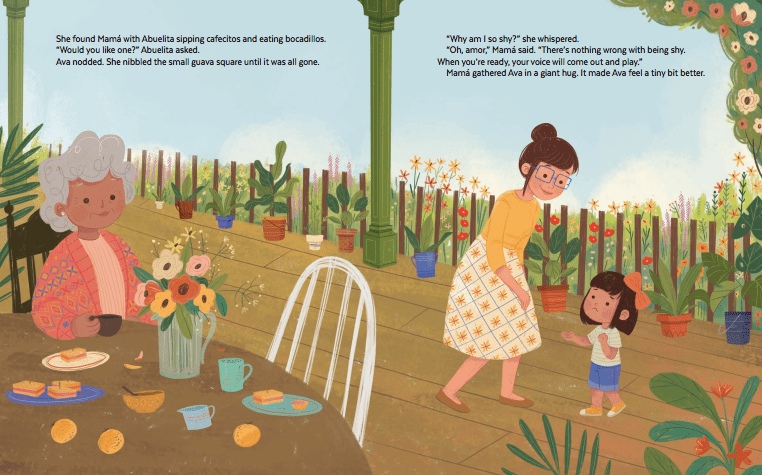
It’s the night before Isabel’s first day of school, and she’s sitting “cross-legged on her bed, coloreando with her favorite crayons: rojo, verde, azul, rosado, morado, violeta.” Isabel was ready for the next day, but there was something that worried her. She “didn’t speak much inglés. English sounded wrong, like stormy blues and blizzard whites. Isabel preferred the pinks and yellows and purples of español.”

celebrate-picture-books-picture-book-review-isabel-and-her-colores-go-to-school-coloreando

Image copyright Courtney Dawson, 2021, text copyright Alexandra Alessandri, 2021. Courtesy of Sleeping Bear Press.

In the morning, Isabel didn’t want to go to school, but Mami drove her there anyway. At the door, she kissed Isabel on the head and reminded her: “‘Al mal tiempo, buena cara. To bad times, a good face.’” But Isabel’s face showed sadness and worry. As class started, Isabel followed along, unsure of what it all meant. During stretching time, the kids counted “‘One, two, three.’” Instinctively, Isabel repeated “‘Uno, dos, tres.’” The colors of their voices “[crashed] against each other.” All the kids stared at Isabel, and she could feel her face getting hot.

celebrate-picture-books-picture-book-review-isabel-and-her-colores-go-to-school-Sarah

Image copyright Courtney Dawson, 2021, text copyright Alexandra Alessandri, 2021. Courtesy of Sleeping Bear Press.

When it was story time, all the kids took their regular spots on the rug, which left no room for Isabel. Then a girl told her she could sit “‘here’” next to her. Isabel understood the word “here” and sat down. “‘I’m Sarah,’” the girl said. “‘Me llamo Isabel,’” Isabel told her. Then Sarah asked Isabel if she’d like to be friends. The harsh words filled her brain and she shook her head to clear them. She blushed again. “‘No entiendo,’” she said. Misunderstanding herself, Sarah looked as if she might cry. Isabel felt that way too.

celebrate-picture-books-picture-book-review-isabel-and-her-colores-go-to-school-Sarah

Image copyright Courtney Dawson, 2021, text copyright Alexandra Alessandri, 2021. Courtesy of Sleeping Bear Press.

When lunchtime came, Isabel sat alone and tried to make herself feel better by coloring on her napkin, but tears came anyway. Back in the classroom, Isabel’s teacher announced that it was “coloring time.” Isabel looked up. “Coloring sounded very much like colorear.” When she got a blank sheet of paper and crayons, “Isabel knew she had understood.” As she worked on her picture, she used all of her favorite colors and she remembered Mami’s advice.

celebrate-picture-books-picture-book-review-isabel-and-her-colores-go-to-school-drawing

Image copyright Courtney Dawson, 2021, text copyright Alexandra Alessandri, 2021. Courtesy of Sleeping Bear Press.

When she was finished, she showed Sarah. She had drawn herself and Sarah holding hands and surrounded by hearts and stars. “‘Amigas,’” Isabel said, pointing from girl to girl. Sarah understood. “‘Friends,’” she said. When their teacher showed Isabel’s picture to the other kids, all of her classmates were impressed. Their smiles and compliments softened the stormy colors of English “to a brilliant aguamarina—just like home,” and Isabel thought school might be okay after all.

Simultaneous translations of the English story are presented in colorful boxes on each page. A Spanish-to-English translation glossary of words typeset in bold throughout the book is found at the end of the story.

celebrate-picture-books-picture-book-review-isabel-and-her-colores-go-to-school-amigas

Image copyright Courtney Dawson, 2021, text copyright Alexandra Alessandri, 2021. Courtesy of Sleeping Bear Press.

Alexandra Alessandri’s emotionally resonant story shines with her unique invitation to readers to understand how language barriers feel from the perspective of a native Spanish-speaking child as well as her English-speaking classmate who wants to be friends. Children’s fondness for drawing and favorite colors gives Alessandri the perfect palette to present initial feelings of worry, disappointment, and frustration as well as a meaningful way for children to bridge differences and discover hope, encouragement, and common ground. Alessandri’s dialogue and interactions between Isabel and Mami as well as between Isabel and Sarah ring true with honesty and the types of small moments that can lead to unintentional misunderstandings and others that unite. Isabel’s love for and descriptions of the rhythms and beauty of her native language are a highlight and can give teachers, parents, and other adults an excellent way to talk to their children about languages, diversity, and communication.

Courtney Dawson’s vibrant illustrations enliven the pages as swoops of color swirl around Isabel and through the classroom, depicting her feelings from moment to moment as well as how English sounds to her and how English and Spanish together clash in her ears. Readers will recognize the colorful elements of a classroom and the routines of a day. Dawson clearly depicts the characters’ emotions as well as how excitement and confidence can change to embarrassment and uncertainty with a word or in a moment—and, happily, vice versa.

Lovely, poignant, and with a unique perspective on themes of language, fitting in, and friendship that will resonate with all kids, Isabel and Her Colores Go to School is a must for home, classroom, and public library bookshelves.

Ages 5 – 8 

Sleeping Bear Press, 2021 | ISBN 978-1534110632

A Chat with Alexandra and Courtney

Hi Alexandra and Courtney! I’m thrilled to be part of your blog tour for your gorgeous book! Thanks so much for stopping by for a quick chat!

celebrate-picture-books-picture-book-review-alexandra-alessandri-headshot

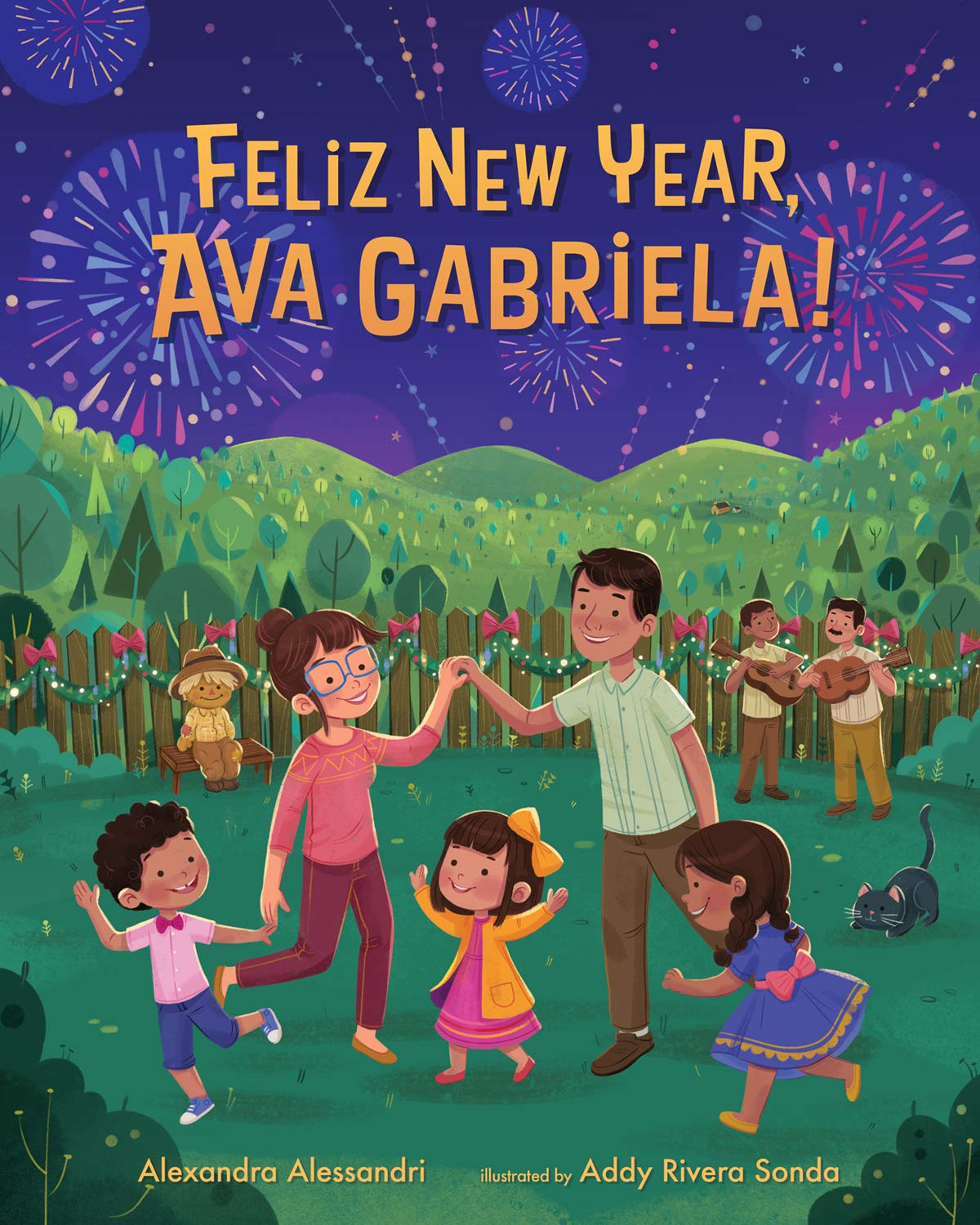
Alexandra Peñaloza Alessandri is a Colombian American poet, children’s author, and Associate Professor of English at Broward College. She received her BA and MA degrees in English from Florida International University, as well as a Certificate of Fiction from UCLA Extension. Her poetry has appeared in The Acentos Review, Rio Grande Review, YARN, and Atlanta Review, where her poem “Inheritance” was a Finalist in the 2017 International Poetry Competition. She is the author of Feliz New Year, Ava Gabriela!(Albert Whitman, Oct. 2020) and Isabel and Her Colores Go to School(Sleeping Bear Press, 2021). 

You can connect with Alexandra Alessandri on her website | Facebook | Instagram | Twitter

What is a favorite summer memory from your childhood?

My favorite summer memories are from the years I went to Colombia in the summer. We didn’t go every year because we couldn’t afford it, but the years we did go were always spent seeing family and cousins across several cities—Medellín, Manizales, Cali, Bogotá—and farms. Several family members had farms in different towns. Of those, one of my favorite memories is from the year my parents sent me to Colombia on my own to stay with family and close friends. I was nine.

celebrate-picture-books-picture-book-review-Alexandra-Alessandri-interview
Alexandra in Colombia visiting family when she was nine years old.


celebrate-picture-books-picture-book-review-Alexandra-Alessandri-interview
Alexandra riding horses in Colombia when she was nine years old.

There were many adventures that summer, but my favorite consisted of riding in the back of a jeep to my tío’s farm near Manizales, playing with cousins, riding horses to the edge of a forest, hiking down to a creek, and following that to a wonderful lagoon and waterfall. It was such a wonderful time!

If you weren’t a writer, what job would you like to have and why?

If I wasn’t a writer (or a teacher!), I would be a librarian. I still remember playing librarian as a kid with my dad’s old pencil mic. I would take my library books and “scan” the barcode with the mic, stacking them up and handing them off to my invisible guests. Libraries held a special place in my heart, as I spent many days there with my mom, looking through books, finding nooks in which to read, and participating in library events. Now, I love connecting readers with books and helping them find the right book to foster that same excitement I remember feeling as a child. Being a librarian would be a natural extension of this!

celebrate-picture-books-picture-book-review-courtney-dawson-headshot

Courtney Dawson is an illustrator with a great love for drawing, reading, and most kinds of ice cream. She lives with her family in Ventura, California. Picture books she has recently illustrated include Help Wanted, Must Love Books (Capstone, 2020), A Vote is a Powerful Thing (Albert Whitman & Company, 2020), and The Stars Beckoned: Edward White’s Amazing Walk in Space (Philomel Books, 2021).

You can connect with Courtney Dawson on her website | Instagram

What’s your favorite non-book summer activity?

Spending time with my two kids and my partner is my favorite summertime thing to do! We love riding bikes and having picnics at the park. My favorite alone time activity during the summer though, is drawing outdoors and listening to music.

Thanks, Alexandra and Courtney! I hope you both have a wonderful summer and I wish you all the best with Isabel and Her Colores Go to School!

celebrate-picture-books-picture-book-review-isabel-and-her-colores-go-to-school-cover

You can order signed copies of Isabel and Her Colores Go to School from Books and Books


You can find Isabel and Her Colores Go to School at these booksellers

Amazon | Barnes & Noble | Books-a-Million

To support your local independent bookstore, order from

Bookshop | IndieBound

Picture Book Review