Initiated in 1999 and sponsored by the Association of American Publishers, Get Caught Reading Month inspires people of all ages to discover or rediscover the joys of reading. No matter what types of books you like best—from fiction to nonfiction, mystery to humor, picture books to novels—there are stories on bookstore and library shelves that will enhance your life! This month take the opportunity to read a new book or an old favorite and get caught up in the magic!
The Old Lion and the Little Rabbit
By Keiko Kaichi
Once King of the Plains, Old Lion had given up his place in the herd to his sons and now lived a quiet life alone. One day while napping, he felt a tickle in his mane and smelled a tantalizing aroma nearby. Old Lion discovered a tiny baby rabbit sleeping peacefully in the soft fur of his mane. “‘Hey,’ Old Lion thought, ‘this little one won’t fill my belly. But if I let him eat enough, he’ll grow up to be big and delicious!’” So Old Lion gathered as much grass as he could and fed the baby rabbit well, all the while feeling hunger growing in his stomach.
Copyright Keiko Kaichi, 2017, courtesy of minedition.
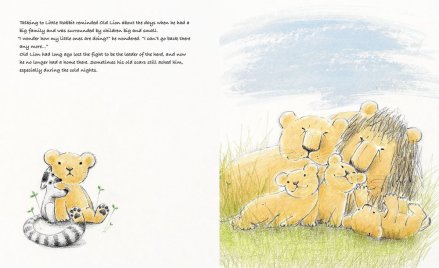
To pass the time between feedings, Old Lion told Little Rabbit about his younger days on the savanna. “Little Rabbit crinkled up his nose with joy when he listened to Old Lion’s stories.” When other animals saw Old Lion and Little Rabbit together, they couldn’t believe it. As Old Lion talked to Little Rabbit, he remembered his big family and the joy of having children around him. He wondered how they were doing. But he knew that he couldn’t go back once he had “lost the fight to be the leader of the herd. Sometimes his old scars still ached him, especially during the cold nights.”
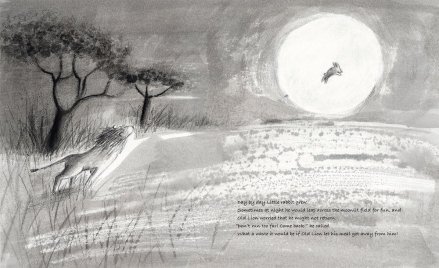
Now that Little Rabbit was growing bigger, he sometimes hopped far into the field, exploring just for fun. Then Old Lion worried that he might not come back, fearful that all his time and hard work would be wasted. He would call after Little Rabbit, reminding him to come back, and Little Rabbit always did.
Copyright Keiko Kaichi, 2017, courtesy of minedition.
They spent their days watching the other animals, Little Rabbit perched on top of the lion’s head in order to see better. As time went by, Old Lion began to wish he could be satisfied with a diet of plants and wondered about the unfamiliar feeling in his heart. “Could it be that he was starting to care about this little creature who trusted him so blindly? Such a thing made no sense. Still, he had to admit that something warm stirred in him when he saw Little Rabbit each morning.”
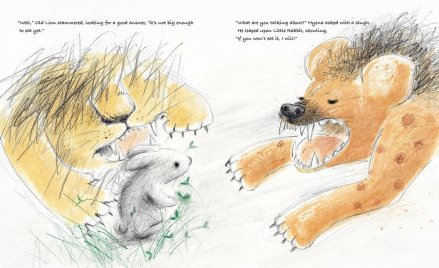
One day as Little Rabbit played among the weeds while Old Lion rested, Hyena came calling. When he saw the little bunny, he immediately asked to share in the delicious meal as he often did. Old Lion was taken off guard and stammered that Little Rabbit was not nearly big enough to make a meal of. Hyena protested and pounced. Old Lion found his former quick reflexes and “with one gulp he snatched up Little Rabbit into his jaws.”
Copyright Keiko Kaichi, 2017, courtesy of minedition.
With a bit of regret but admiration for his old friend, Hyena turned and skulked away. When they were alone, Old Lion opened his mouth wide and let Little Rabbit climb out. He saw that his tiny friend had suffered a cut on his paw and bandaged it carefully. Then he placed Little Rabbit on his head and began to walk in the direction of the wind. “He could no longer deny that he loved Little Rabbit.”
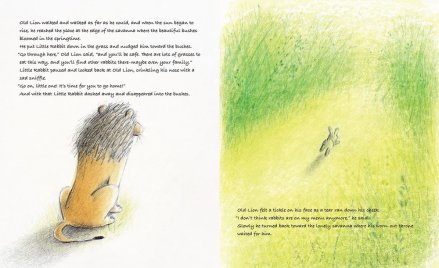
Old Lion walked and walked to the edge of the savanna, where bushes and tall grasses blossomed. He set Little Rabbit down gently and nudged him forward. “You’ll be safe” there, Old Lion told him. “You’ll find other rabbits there—maybe even your family.” Little Rabbit gazed at Old Lion sadly, but the lion reassured him that it was time to go home. Old Lion watched Little Rabbit bound away and “felt a tickle on his face as a tear ran down his cheek.” Then he turned and walked back to where his throne waited.
Copyright Keiko Kaichi, 2017, courtesy of minedition.
Keiko Kaichi’s books masterfully tug at readers’ heartstrings with poignant stories populated with adorable characters that immediately inspire love and empathy. In Old Lion and Little Rabbit, the lion’s history is revealed naturally and at a pace that makes his transformation believable and all the more emotional. Just as do children within a family, Little Rabbit alters Old Lion’s life simply through trust and dependence. Children will respond to the growing love between Old Lion and Little Rabbit. They will also find the solution to the mystery established at the beginning both surprising and satisfying. Adult readers cannot be faulted for feeling a small lump in their throat when Old Lion unselfishly protects Little Rabbit from Hyena and then takes him to safety.
Kaichi’s acrylic and pencil drawings are both evocative of the golden savanna and filled with tender sentiments. Old Lion may once have been a fierce predator, but he is now a contemplative and caring elder statesman while Little Rabbit is a wee nubbin of cuteness. As he sits next to the much bigger lion, his tiny paw touching Old Lion’s arm, or collects a bouquet of weeds under Old Lion’s watchful gaze, Little Rabbit swells readers hearts.
Superb in every way, Old Lion and Little Rabbit would make a wonderful choice for home bookshelves as well as for public and school libraries.
Ages 3 – 7
minedition, 2017 | ISBN 978-9888341245
Get Caught Reading Month Activity
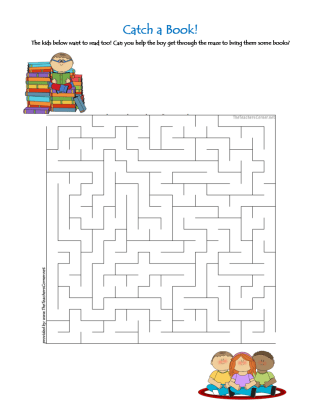
Catch a Book! Maze
One boy has a whole stack of books to share with his friends! Can you help him through this printable Catch a Book! Maze? Here’s the Solution!
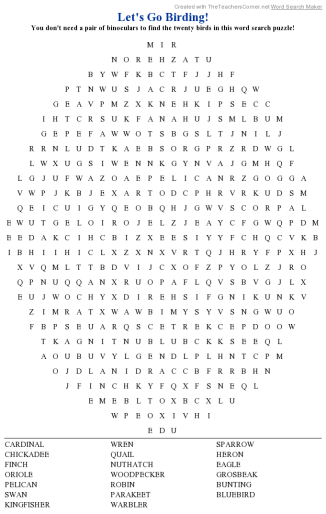
With all the bird activity going on right now as these little creatures build nests, lay eggs, and take care of new families, it’s a perfect time to go bird watching. The weather promises to be warm, and with a little stealth, a good sense of observation, and perhaps some binoculars, you should be able to spot quite a few lovely species. As the subject of today’s book found, if your home—or your hat—is inviting, feathered friends will come! So head out to a park, forest, beach—or even your backyard—and enjoy the beauty of the birds in your area.
Mr. Brown’s Fantastic Hat
By Ayano Imaí
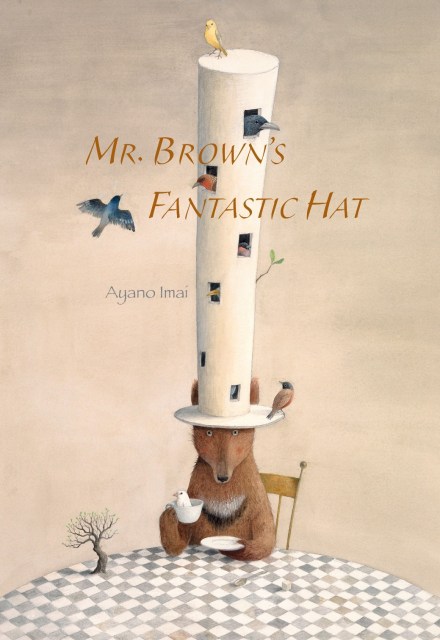
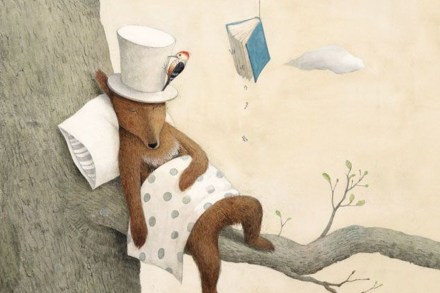
Mr. Brown lived alone and, if you asked him, he’d tell you he liked it that way. He “had no friends and he didn’t want any.” If you were privy to his secret thoughts, however, you’d learn that Mr. Brown was actually very lonely. Mr. Brown liked to take long walks, and when he went out, he always wore his “smart,” distinctive hat. “One day while Mr. Brown was sleeping, a woodpecker flew down and started tapping a hole in his hat, thinking, ‘What a wonderful nest this hat would make!’”
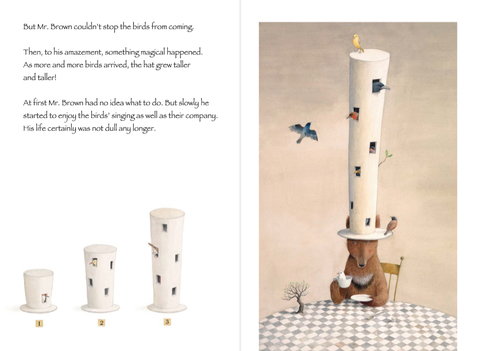
When Mr. Brown woke up he was shocked to discover that a bird had moved into his hat. Someone living this close to him was not what Mr. Brown had in mind at all. Then to Mr. Brown’s dismay the “woodpecker soon told all his friends about the wonderful new home and invited them all to join him.” Soon Mr. Brown’s hat was full of holes—and birds! You might think a regular hat would not have enough room for so many residents—but Mr. Brown’s hat was no ordinary one. As more and more birds moved in, his hat grew taller and taller!
Image copyright Ayano Imaí, courtesy of minedition, 2014
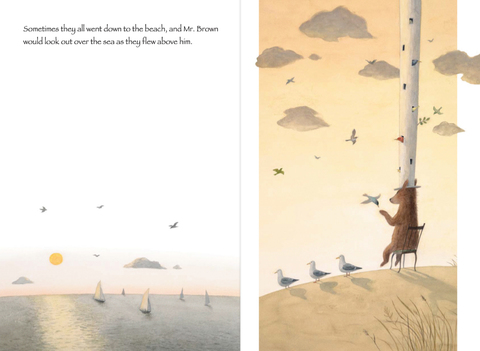
As the days went on Mr. Brown discovered that he was beginning to enjoy the birds’ singing and their company. Now Mr. Brown had renewed purpose in his daily walks: “He loved to show off his hat. Everywhere he went it was full of the music of singing birds.” People on the street took notice and wanted to emulate Mr. Brown. All over town people began wearing tall hats, “but the birds preferred to stay with Mr. Brown no matter how hard people tried to persuade them.”
One day as autumn settled in, Mr. Brown noticed that all the birds had flown away. He was sad and didn’t understand where they had gone or why they had left him. He wondered if he would see them again. The idea of a quiet life no longer held the appeal it once did, and Mr. Brown missed his friends. He tried to convince himself that he didn’t care that the birds had left, but he continued to fill the feeders and watch out for them every day.
Image copyright Ayano Imaí, courtesy of minedition, 2014
Even though it was time for Mr. Brown to take a long winter’s nap, he tried to stay awake, worried that there would be no one to care for the birds if they returned. But nature took its course, and Mr. Brown fell into a deep sleep. One morning after a particularly vivid dream in which Mr. Brown could hear the birds singing, he woke to a tapping sound. He went to the door and peered out.
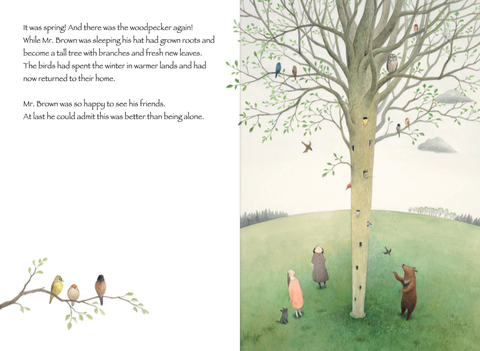
Spring had come and with it Mr. Brown’s hat had grown roots and sprouted branches and leaves. The old holes were filled with their previous tenants. The sight filled Mr. Brown with joy, and he finally could admit to himself that sharing his life with friends “was better than being alone.”
Image copyright Ayano Imaí, courtesy of minedition, 2014
Ayano Imaí’s gloriously beautiful book plumbs the nature of solitude and loneliness as well as the value of friendship with an honesty that is at once heartrending and uplifting. For so many quiet, introspective people—children and adults alike—navigating the world of small talk, casual relationships, and making friends is similar to traveling uncharted territory, where the language and mores are foreign. It can become easier to tell oneself that it doesn’t matter, when in reality it matters a great deal. Many times happiness comes when one finds their niche or, in some surprising way, a niche finds them.
Image copyright Ayano Imaí, courtesy of midedition, 2014
Imaí tells the story of Mr. Brown and his fantastical hat in straightforward narration, but more profound meaning is revealed in her illustrations. Mr. Brown, it is discovered, is a brown bear who has taken on the aspects of humans. He walks upright, carries an umbrella and bag, owns a home, and wears a hat. His fur is even the same color as the townspeople’s clothing. But while he may be among people, he is not of them. His home has a grass floor which sprouts mushrooms and weeds; another weed pokes out from the bristles of his brush; a tree branch juts from a wall; and mushrooms share space with the laundry on the drying line.
Mr. Brown comes from nature and belongs with nature, so it is no surprise that the birds flock to him and prefer him to humans, who in an ironic twist long to be like Mr. Brown. Mr. Brown’s hat is also symbolic of one’s heart, in that as a person embraces friends, their ability to accept and love others continues to grow.
I especially like the ending of Mr. Brown’s Fantastic Hat, in which Mr. Brown stays true to himself. He does not suddenly discover his “wild” side and become someone that he is not. He is able to remain a quiet, introspective bear while also embracing his friends, his love for them, and his place in the world. He finds inner happiness and loved ones to share it with.
The Week of the Young Child is an annual initiative hosted by the National Association for the Education of Young Children to celebrate learning, young children, their families, and their teachers. Daily themes focus on ways that children learn. This year those included Music Monday, Tasty Tuesday, Work Together Wednesday, Artsy Thursday, and today—Family Friday, in which people are encouraged to share their family stories. Today’s book also takes a look at a common childhood topic through which kids learn about themselves and others.
I Want to Grow
By Ged Adamson
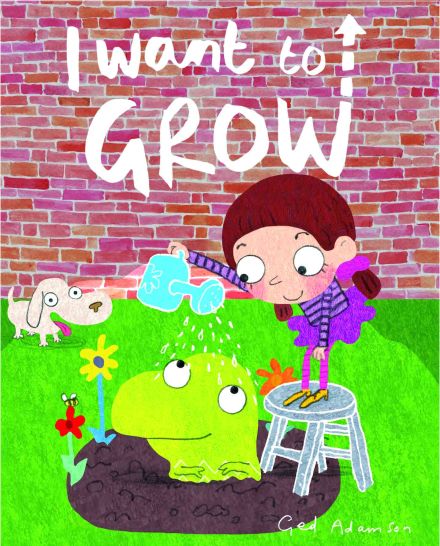
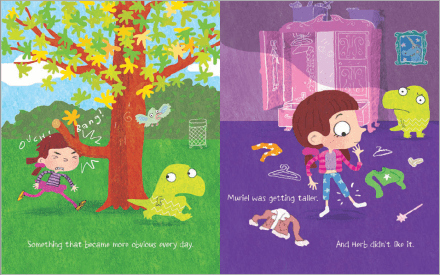
One day while Herb and Muriel were strolling through the neighborhood, Herb noticed something a little different. Every day this disturbing trend continued. The fact was impossible to ignore—“Muriel was getting taller. And Herb didn’t like it.” He didn’t mind that she could now see over the fence or reach things on high shelves, it was just that…well… “he wasn’t getting any taller himself.”
Copyright Ged Adamson, 2017. Courtesy of Boyds Mills Press
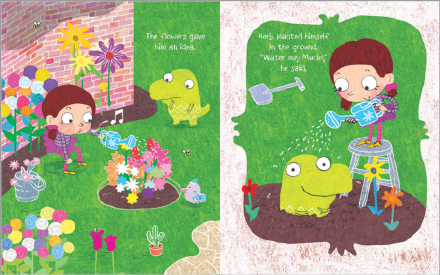
So Herb looked around for a way to rectify the situation. The flowers in Muriel’s garden were reaching for the sky. Perhaps planting himself in the ground would make him grow. But no matter how much Muriel watered him, nothing happened. He shook off the dirt and went to find Muriel. She was in the kitchen working with clay. Herb watched her roll a small piece of clay into a looong piece. That looked promising, so Herb asked for Muriel’s help. “She rolled him back and forth until her arms ached. But he didn’t get any longer. Just dizzy and a little queasy.”
Copyright Ged Adamson, 2017. Courtesy of Boyds Mills Press
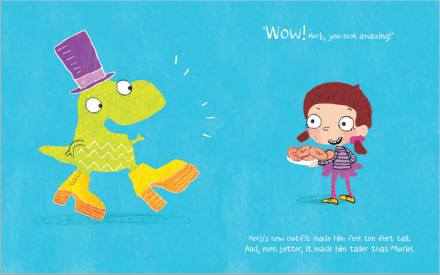
Maybe if he just willed himself to grow, he would, Herb thought. He stressed and strained until he was red in the face, but he remained as short as ever. Muriel knew Herb was having a hard time, so she made him a special treat of tea and doughnuts. When he approached, Muriel immediately recognized a difference. Herb was tall top and bottom. Both Herb and Muriel loved the new look—the high wedge shoes and top hat looked amazing! But standing and walking proved to be perilous.
Copyright Ged Adamson, 2017. Courtesy of Boyds Mills Press
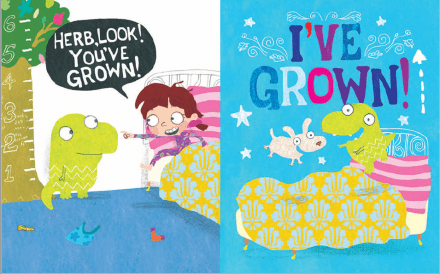
Herb went to bed feeling a little dejected. In the morning, though, Herb had a pleasant surprise. When he went to wake up Muriel, she noticed something right away. Herb had grown! He was so excited that he “jumped and cheered.” Suddenly, Muriel realized that she had grown too. Herb could see that something was on her mind and asked. It’s “nothing, Herb. Nothing at all,” she said. “Let’s celebrate your new tallness!” And that is just what they did. After that Herb didn’t “worry about catching up with Muriel because he was growing!”
Copyright Ged Adamson, 2017. Courtesy of Boyds Mills Press
Ged Adamson’s wit and whimsy go a long way in assuaging childhood doubts and worries in his funny book. The issue of growth is a common one as siblings, friends, and classmates often compare themselves and watch as those around them grow taller or they themselves begin to outpace the rest. The uncertainty of being different can be troubling and set up unnecessary anxiety.
Adamson’s I Want to Grow offers kids reassurance that nature will take its course while also making them laugh at Herb’s attempts to speed the process. Muriel’s empathy and kindness toward Herb is another wonderful life lesson for readers navigating the quirks and changes of childhood. Adamson’s distinctive illustrations combine vibrant colors, sketched-in details, and sweet, round-eyed characters to enchant kids and boost both the humor and sweetness factor of this heartening story.
I Want to Grow is a great book to share with kids who may be feeling unsure about their height—or any such issue.
Ages 4 – 8
Boyds Mills Press, 2017 | ISBN 978-1629795850
Check out more about Ged Adamson, his books, and his art on his website!
Week of the Young Child Activity
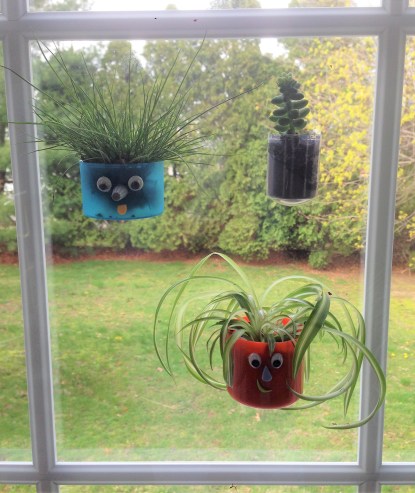
Window Pane Terrarium
With this easy craft for spring and summer that combines creativity, recycled materials, a little science, and an opportunity to watch your efforts grow, you can turn a window pane into a little garden.
Supplies
Small, light recycled plastic containers with no lip – small cups or colorful tops from shaving cream or other such cans
Googly eyes, foam, paint or other materials to decorate the container
Soil
Seeds or small plants (small succulents, air plants, spider plants, and grass work well)
Adhesive Velcro mounting strips in an appropriate weight category
Spoon
Directions
Clean and dry containers
Decorate containers with eyes and foam to make faces, or in any way you wish
Fill container with soil
Add seeds or plants
Attach Velcro strips to back of container
Attach firmly to window pane
Alternately: line up containers on a window sill for a colorful indoor garden
Today’s holiday was established in 1982 by the International Council of Monuments and Sites to celebrate the joint history and heritage of the human race. World Heritage Day invites us to honor all of the world’s cultures and promotes awareness of important cultural monuments and sites in order to preserve these valuable historical places. Nearly 10,000 members from more than 150 countries, including architects, engineers, artists, geologists, civil engineers, and architects, work tirelessly to protect the world’s cultural achievements.
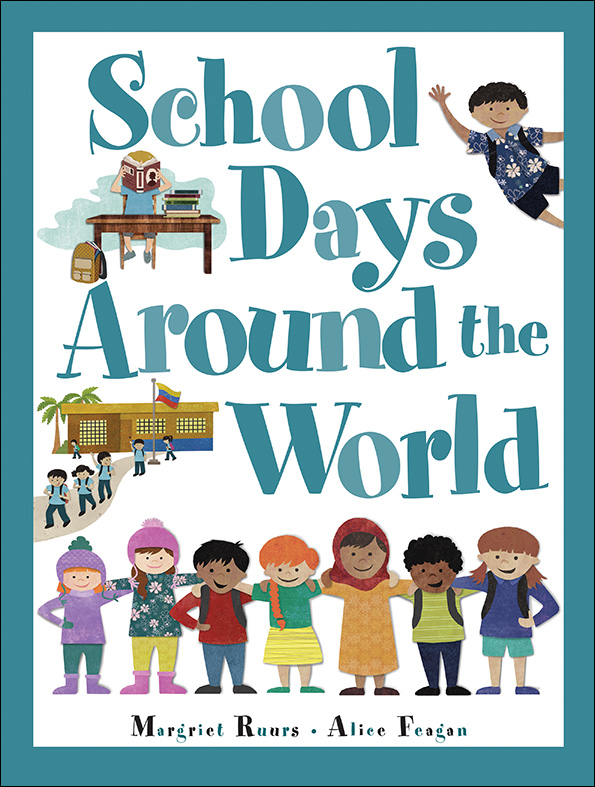
School Days Around the World
Written by Margriet Ruurs | Illustrated by Alice Feagan
Every day millions of children around the world go to school, but schools can vary from place to place. Some classes are held in large buildings with libraries, science labs, and computer rooms while others gather in small buildings or even outside. “Schools around the world may be very different, but children everywhere like to have friends and learn new things.” In School Days Around the World, readers meet children from thirteen countries to learn what their educational day is like.
First, children meet Tamatoa, who attends school on Rarotonga, one of the Cook Islands in the South Pacific. Tamatoa arrives to school on a scooter just as the “thang-Thong-thang! of the wooden slit drum calls students inside. Tamatoa’s teacher is wearing flowers in her hair as she does every day. She teaches the children their Ura language, and in the afternoon they dance the hupa, the island’s traditional dance. In Singapore Raphael goes to an international school where the students speak many languages. Raphael knows Dutch, English, and Spanish. His best friend Aamon speaks Hindi, Chinese, and English. Raphael likes to read and write stories on the computer. Sometimes they “have a craft fair to raise money to help children in other parts of the world.”
Image copyright Margriet Ruurs, text copyright Alice Feagan. Courtesy of alicefeagan.com
Marta walks to her school in Azezo, Ethiopi, even though she is blind. Her friend Ayana holds her hand tightly to help “her around potholes and cow patties.” There are so many students that there are two different sessions. Marta goes in the morning with 500 other children. There are 70 students in her class. They learn Amharic and about Ethiopia. At noon Ayana and Marta “hurry home to help feed the ox and cow and to fetch water from the village well.”
Camilla is from Germany. Her older brother Johannes lives at a boarding school during the school year. He shares his room in an old stone house with three boys. Everyone eats together and cleans up afterward—just like in a family. In class he learns “about nature and science. They also learn how to sail.” Camilla can’t wait until it’s her turn to go to school.
If you visited Annika at school in Copenhagan, Denmark, you would probably spend most of the day outside. Some days the students take a bus to their forest school. There the “run and climb on an old boat.” They “play on swings and with a ball.” Outside they also listen to birds and learn about plants and insects and other parts of nature. While Annika enjoys spending cold days outside, Ana’s days are usually warm. She lives in San Luis, Honduras and walks an hour from her home in the hills to her new school. Inside, two teachers show the children how to read and write. Sometimes, Ana says, “a nurse visits our school. She teaches us how to brush our teeth and stay healthy.” One day a van delivers backpacks full of school supplies, books, and even running shoes.
In Alberta Canada, Shanika goes to a First Nations school where she learns her traditional Cree language along with math and language arts. After lunch, they hear stories, and elders teach them “powwow dances, drumming and how to raise a teepee. They also hold feasts where there are prayers, and the whole community shares tea, soup, bannock loaded with beans and cheese, and berries.
Image copyright Margriet Ruurs, text copyright Alice Feagan. Courtesy of alicefeagan.com
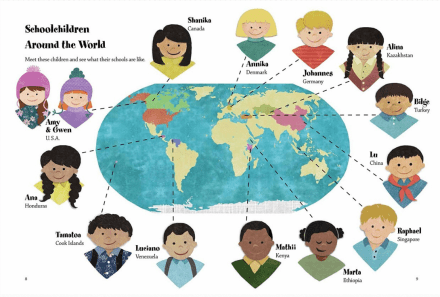
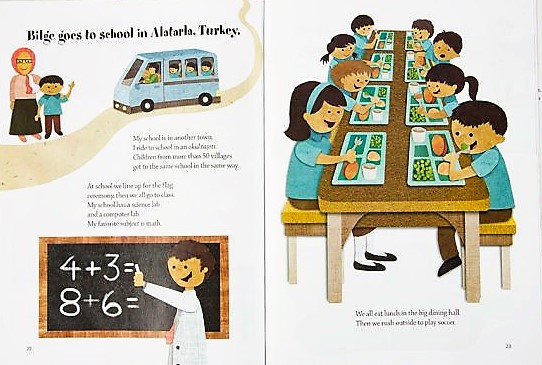
You can also spend school days with Lu in China, Alina in Kazakhstan, Mathii in Kenya, Bilge in Turkey, Luciano in Venezuela, and Amy and Gwen in Alaska, USA.
In her short, engaging stories based on the lives of real families, Margriet Ruurs takes readers globe-trotting with new friends to show readers a typical school day in cities big and small. The details of each child’s experience—both familiar and unique—help readers learn more about their peers, promoting greater empathy and understanding now and for a better future.
Alice Feagan’s cut paper collages are full of joy and personality as kids dance, play, read, and study together. While the students’ clothing, lunches, and school buildings may differ from country to country, readers will see that the enthusiasm to learn is universal. A world map at the beginning of the book points out where each featured child lives.
A discussion following the text gives teachers, homeschoolers, and individuals tips on using the book to expand on the stories told. A glossary provides definitions and a pronunciation key for the native words found throughout the book. School Days Around the World offers a wonderful opportunity to jumpstart lessons on world customs and geography.
Ages 3 – 8
Kids Can Press, 2015 | ISBN 978-1771380478
Discover more about Margriet Ruurs and her books as well as activities for teachers and readers on her website!
You’ll find more about Alice Feagan and a portfolio of her illustration work on her website!
World Heritage Day Activity
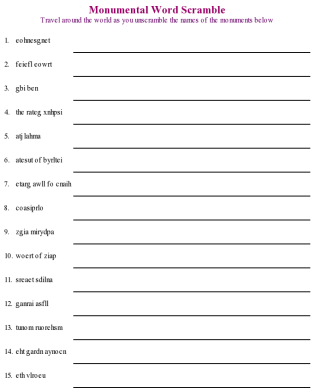
Monumental Word Scramble
You’ll travel the world as you unscramble the names of 15 world monuments in this printable Monumental Word Scramble Puzzle.
One of the wonderful activities of spring and summer is gardening. As the sun warms, farmers and gardeners till their land and plant seeds with eager anticipation of the harvest to come. April is Gardening Month, and the second week is designated especially for vegetable gardening. Our meals would not be as tasty and nutritious without carrots, squash, peas, beans, peppers, potatoes, and all the rest of these colorful foods. Today’s container gardens give even reluctant gardeners great ways to grow their own—without the work of a large plot. Whether you enjoy gardening on a large or small scale, take the opportunity of this month to start planting the seeds of a rewarding hobby!
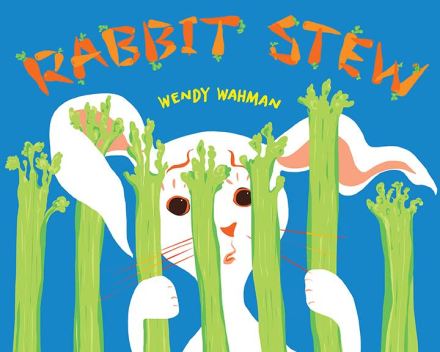
Rabbit Stew
By Wendy Wahman
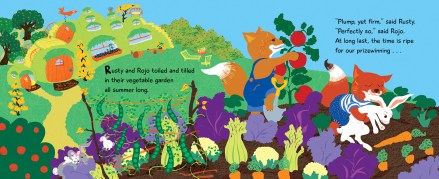
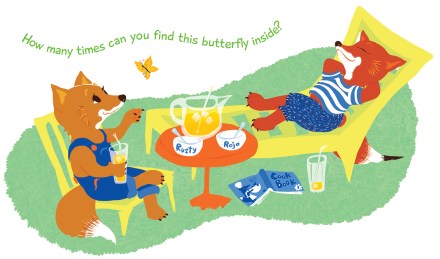
“Rusty and Rojo toiled and tilled in their vegetable garden all summer long.” But now the crops have ripened, and the two foxes are ready to enjoy the bounty of their hard work—so are their neighbors, the Rabbits. As Mommy Rabbit and the bunnies nibble away in a corner of the garden, Rusty gently squeezes the tomatoes and finds them “plump, yet firm.” “Perfectly so,” Rojo agrees as he lifts Daddy Rabbit from the carrot patch. “At last,” Rusty and Rojo exclaim, “the time is ripe for our prizewinning Rabbit Stew!”
Image copyright Wendy Wahman, 2017. Courtesy of wendywahman.com.
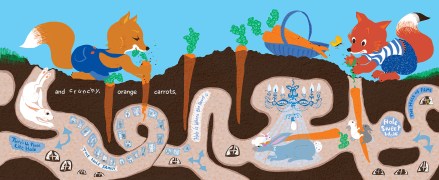
While Rojo picks “lean, green runner beans,” the Rabbits look on worriedly. Daddy tries to hide, but Rusty spies him in the wheelbarrow full of purple kale. Then, when the family dives back into their cozy “hole sweet hole,” they find that their convenient carrot snacks are being abruptly snatched away—only to be added to the pot of “splendid Rabbit Stew.”
Image copyright Wendy Wahman, 2017. Courtesy of wendywahman.com.
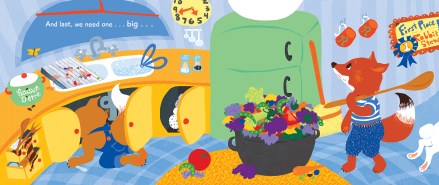
Next come raisins and celery “and roly-poly blueberries.” But what about those white and gray bits of fluff? Will they end up in the foxes’ buckets too? Of course “juicy red tomatoes, fresh sprigs of parsley, and sweet yellow peppers” are also musts for the foxes’ “finest-ever Rabbit Stew.” With the pot overflowing with colorful veggies, only one more thing is needed—“one…big…round…white…bowl…for our favorite Rabbit, Stew—and his family too!”
Image copyright Wendy Wahman, 2017. Courtesy of wendywahman.com.
With her fertile imagination and a clever play on words, Wendy Wahman offers up a delightful story that will have readers guessing until the very end. Along with the mystery and the yummy descriptions of each ingredient, Wahman presents a counting game for readers. As Rusty and Rojo pick their vegetables, children can count the ten runner beans on the trellis, nine purple kale leaves in the wheelbarrow, eight carrots from the burrow, and all of the other ingredients on down to one. But do Rusty and Rojo need one big white rabbit or something else? Kids will love the twist at the end and cheer to see Daddy Stew, Mommy Strudel, and their little bunnies—Dumpling, Biscuit, and Ragu—dining on the special meal grown and created just for them.
Everyone’s garden should look as deliciously vibrant as Wahman’s riotous patch of vegetables! The vivid colors jump off the page while providing texture and nuance to the illustrations. They also give kids another concept to learn and talk about. Little details, such as the tiny caterpillar and the yellow butterfly that follow the bunnies from page to page, as well as the fancy burrow lined with photos of friends and family will enchant readers.
Image copyright Wendy Wahman, 2017, courtesy o f Wendy Wahman.
Welcome themes of friendship, diversity, and inclusiveness can also be found within the illustrations and the story.
Rabbit Stew is a bright, humorously sly story that would be a wonderful addition to any child’s library. The book also makes a perfect companion for trips to the farmers market, on picnics, or to spur interest in home gardening. The attention to the details of what rabbits can safely eat, as well as the number and color concepts provided in the illustrations, makes Rabbit Stew a great choice for school story times and spring lessons.
Discover more about Wendy Wahman, her art, and her books on her website!
You’ll dig this Rabbit Stew book trailer!
Meet Author/Illustrator Wendy Wahman
Today, I’m really happy to be chatting with Wendy Wahman about her art, her books, her inspirations, and a really sweet school visit she had recently.
Your bio mentions that you worked for the Seattle Post-Intelligencer until 2009. Can you describe your work there?
I worked in the art department doing maps, graphics, info-graphics and illustrations for every section of the newspaper. Ninety percent of the work was on deadline, so I learned to think and draw fast.
Our poor beloved P-I. It was 146 years old when Hearst closed it down. About 150 of us went down with the ship. Best job I ever had. I miss the variety and culture and importance — and honesty — of journalism. I miss my P-I family, very much.
How did you get started illustrating and writing books for children?
I was really just snooping around for illustration work. I had an idea for a book on dog body language I wanted to do, but imagined ‘a real writer’ should write it. I sent out some of the dog body-language art samples and heard back from four major publishers. Laura Godwin at Henry Holt called me, and was so passionate about dogs and kids—and my art. She asked to see a dummy. What dummy, right? I had no dummy, just an idea and some art samples. I took two weeks off from the P-I and put together a dummy. Laura helped me tremendously, as did my brilliant writer husband, Joe Wahman.
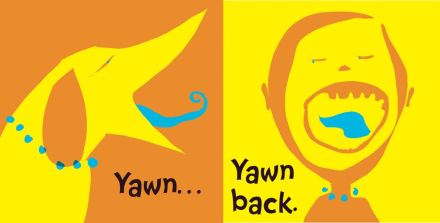
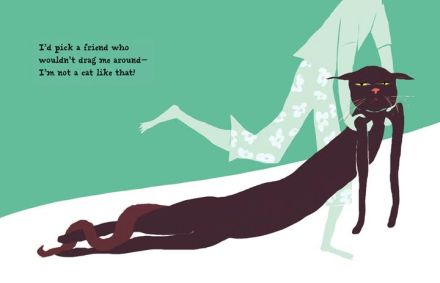
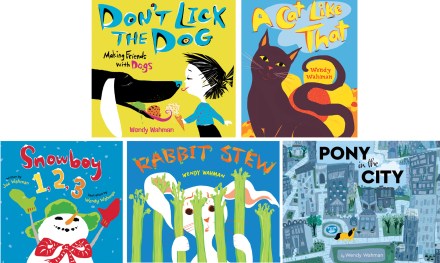
Don’t Lick the Dog is a how-to primer on being safe with dogs. We followed with the companion book, A Cat Like That. We never did do my dog body-language book. It’s sitting here patient as can be. “Good dog, book.”
Image copyright Wendy Wahman, Don’t Lick the Dog. Courtesy of Wendy Wahman.
Image copyright Wendy Wahman, A Cat Like That. Courtesy of Wendy Wahman.
Your art is so varied—from humorous to infographics to striking, serious editorial work. You also work with crisp, clean lines and beautiful textures. Can you talk about your process and inspirations?
Thank you so much, Kathy. Well. I sit and think and read a lot. Mostly I just look and try to distract myself from thinking too hard. I like to thumb through my Thesaurus. When I’m stuck, I try to remember to move away. This can be physically—exercise or a walk; mentally—read or look through books; or emotionally—play with my dogs or call somebody. I say, try, because too often I sit rooted, thinking, thinking. Better to get up and move.
What was the inspiration for Rabbit Stew?
I feed my dogs a homemade stew of meat & veggies. Long ago, I was stirring up an enormous batch of dog food, when “rabbit stew” fluttered to mind. Rabbit Stew is also a counting book, counting down veggies from ten to one. It’s also a color book. It was a challenge to find ingredients safe for rabbits, in different colors and not give it away. Like, rabbits love dandelions and they’re very good for them, but I only know a couple of people who would knowingly toss dandelions into the pot. No potatoes; they are toxic to bunnies, and cabbage isn’t good for them either.
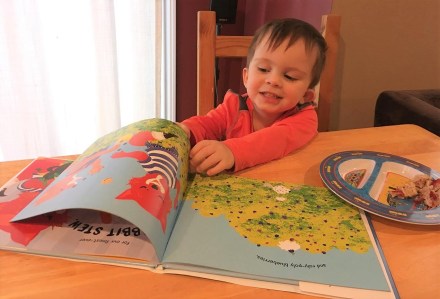
A happy fan enjoys reading “Rabbit Stew” with lunch! Photo courtesy of Wendy Wahman.
You give presentations at schools and libraries. Do you have an anecdote you’d like to share?
I did a school visit recently in southern California and got to take my mom to a presentation for 4th graders. I introduced her to the students, and they gave her a loud round of applause! Even more tender, when I was signing books (and the other stuff kids want signed), they asked if my mother would also give them an autograph. Is that the sweetest or what? Children can be so inspiring, healing, and wise.
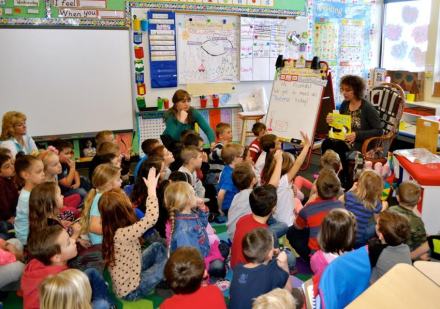
Wendy reads “Don’t Lick the Dog” to enthusiastic kindergarteners in Kennewick, WA. Photograph courtesy of Wendy Wahman
You also teach bookmaking to kids. That sounds fun and fascinating! Can you tell me a little bit about these classes?
I’m so glad you asked about these little books, Kathy. I love making them and sharing the process. Anyone can make one. I’ve taught them to kindergarteners through seniors. I call them “Insight Books,” because what comes out can be surprising, revealing, and often cathartic. Random lines inspire images and ideas. Some people write, others write and draw. Sometimes we collage. Even if you do nothing at all put look, the lines may stimulate ideas. These book are fun to make with a partner too.
What’s up next for you?
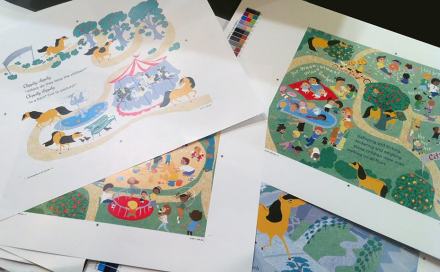
I’m very excited about my next book, Pony in the City (Sterling Publishers). Kevan Atteberry’s book, Swamp Gas, releases the same day, Sept. 9th, and we’re talking about having a co- launch party.
Image copyright Wendy Wahman. Proofs of “Pony in the City” (Sterling, releasing Sept. 9 this year) courtesy of Wendy Wahman.
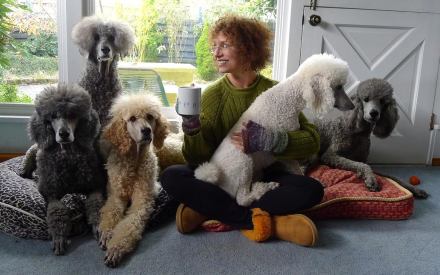
I’m working on Nanny Paws (Two Lions), a book inspired by my little white poodle, LaRoo, and the children next door. Here’s a picture of LaRoo and my other dog Jody with my friend Vikki Kaufman‘s poodles. Vikki is a breeder of beautiful silver and blue standard poodles. Vikki took the picture, can you tell? Her dogs are staring straight at her. Poor LaRoo. She is a shy girl and just wants to get away from the masses.
Wendy with LeRoo and Jody and Vikki’s TinTin, Nickel and Eureka.
I’m also working on a dummy for a beautiful story written by Joe, “One Bird” (www.joewahman.com). I’m doing the art for both Nanny Paws and Joe’s story in a new/old style for me: pencil and watercolor.
Image from “One Bird,” written by Joe Wahman, illustrated by Wendy Wahman. Courtesy of Wendy Wahman
Do you have a favorite holiday?
Thanksgiving.
Do you have an anecdote from a holiday you would like to share
If you come over for Thanksgiving, prepare yourself for a vegetarian feast. We don’t eat animals here — but we do make them big, round, splendid bowls of stew.
Thanks so much, Wendy! It’s been a lot of fun! I wish you all the best with all of your books!
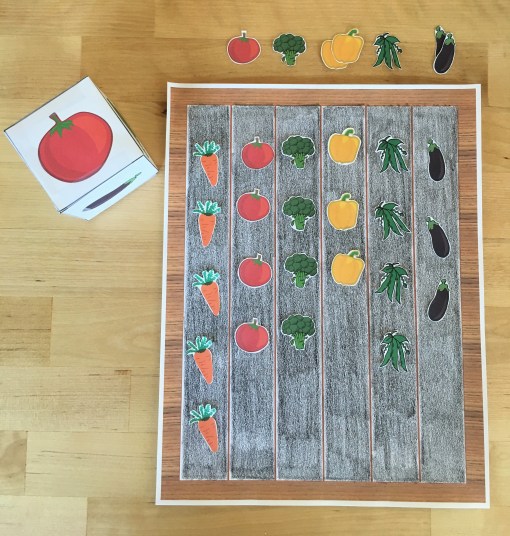
Object: The object of the game is for each player to fill their garden rows with vegetables. Depending on the ages of the players, the required winning number of rows to fill and the number of vegetables to “plant” in each row can be adjusted.
Print one Game Board for each player
Print one set of Playing Cards for each player (for sturdier playing items, print on card stock)
Print one Vegetable Playing Die and assemble it (for a sturdier die, print on card stock)
Cut the vegetables into their individual playing cards
Color the “dirt” on the Garden Plot with the crayon (optional)
Choose a player to go first
The player rolls the die and then “plants” the facing vegetable in a row on the game board
Play moves to the person on the right
Players continue rolling the die and “planting” vegetables until each of the number of determined rows have been filled with the determined number of vegetables.
The first person to “grow” all of their veggies wins!
Today we say Ooh-La-La for one of the world’s most striking and recognizable monuments—the Eiffel Tower. The tower was erected in 1889 for the International Exhibition of Paris, which celebrated the 100th anniversary of the French Revolution. Construction took 2 years, 2 months, and 5 days. This iconic landmark was named for the chief engineer, Gustave Eiffel, and has inspired generations of locals and visitors alike.
Antoinette
Written by Kelly DiPucchio | Illustrated by Christian Robinson
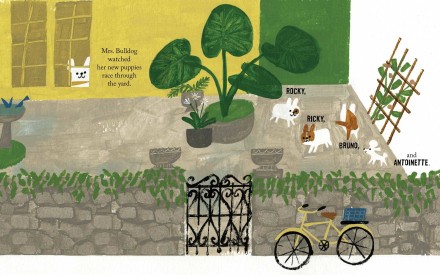
On a day which seemed like most others, Mrs. Bulldog spied out the window at her puppies playing in the yard. Rocky, Ricky, Bruno, and Antoinette scrambled around, chasing each other back and forth. They darted through the door and dashed around the kitchen. They are always so energetic “and ridiculously cute, but please don’t tell them that.”
Image copyright Christian Robinson, text copyright Kelly DiPucchio. Courtesy of simonandschuster.com.
When Mrs. Bulldog looked at her children, she knew that each was special. The boys had already demonstrated some of their talents. “Bruno was strong, Rocky was clever, and Ricky was fast.” Antoinette was still pondering her unique talent, but her mother was not worried. “‘You have something extra special. I can feel it in my bones!’” she told her daughter, but Antoinette had some doubts.
“Every day the family went to the park to play with their doggy friends,” and this day was no different. When they got there, Antoinette was happy to see Fi-Fi, Foo-Foo, Ooh-La-La, and especially Gaston. The puppies frolicked on the lawn, racing around after balls and butterflies and enjoying tasty biscuits. Suddenly, though, everyone noticed a problem. One of the puppies seemed to be missing!
Image copyright Christian Robinson, text copyright Kelly DiPucchio. Courtesy of simonandschuster.com.
The little ones lined up to be counted. There were Rocky, Ricky, Antoinette, Fi-Fi, Foo-Foo, and Gaston—but no Ooh-La-La! Mrs. Poodle was frantic, but Mrs. Bulldog reassured her. “‘We will find her!’ she insisted.” Clever Rocky followed some footprints he found in the mud, but they did not lead to Ooh-La-La. Ricky ran around the lake, but only found a family of ducks. With his super strength, Bruno checked under boulders, but Ooh-La-La was not hiding under any of them.
“In that moment Antoinette felt a tug in her heart and a twitch in her nose.” She followed the scent from sidewalk cafes to street vendors to sign posts. She hurried past “buggies and bicycles and broomsticks.” Nothing could deter her. Her nose led her to the Louvre, where Antoinette barked excitedly, but the guard would not let her through the door. In a dizzying dash, she wound round and around the guard, skirted past him, and sprinted into the museum.
Image copyright Christian Robinson, text copyright Kelly DiPucchio. Courtesy of simonandschuster.com.
Antoinette scurried passed the crowds admiring the art and leaped to the top of a tall sculpture just in time “to save Ooh-La-La from a perilous fall” as she chased a butterfly. Mrs. Poodle was overwhelmed with gratitude. Mrs. Bulldog beamed with pride at her brave daughter, and the two shared a knowing look. Gaston looked on with a special smile of his own.
That is a story from long ago. Today, Antoinette and Gaston are raising a family of their own, and Antoinette is “one of the most famous police dogs ever to patrol the streets of Paris.” If you’d like, you can visit her statue in the park!
Image copyright Christian Robinson, text copyright Kelly DiPucchio. Courtesy of simonandschuster.com.
Antoinette gets her own adventure and discovers her special talent in Kelly DiPucchio’s sequel to Gaston. With three bounding brothers, Antoinette feels a little lost in the shuffle, wondering when she’ll discover what she’s good at. Young readers with precocious siblings or friends will empathize with Antoinette’s feelings and be bolstered by her shining moment, which demonstrates that abilities often appear at the most unexpected—and crucial—times. The delightful ending provides a clever and satisfying answer to the story’s main question.
Christian Robinson’s jaunty illustrations of Antoinette and her brothers and friends will cheer fans of Gaston and enchant new readers. Kids will love following the bouncy puppies through the park, where an artist paints the fountain, a woman feeds the pigeons, and a man creates enormous bubbles to float in the air. As Antoinette races through Paris to find Ooh-La-La, readers can track her from page to page through the charming streets and finally to the Louve. Robinson’s soothing, muted blues, greens, and browns lend sophistication to this sweet blended family tale.
Antoinette is an adorable story that is sure to become a favorite of little ones. On its own or paired with Gaston, Antoinette would make a wonderful addition to home bookshelves.
Ages 4 – 8
Atheneum Books for Young Readers, Simon & Schuster, 2017 | ISBN 978-1481457835
Discover more about Kelly DiPucchio and her books on her website!
Check out Christian Robinson’s books and learn more about him and his artwork on his website!
Eiffel Tower Day Activity
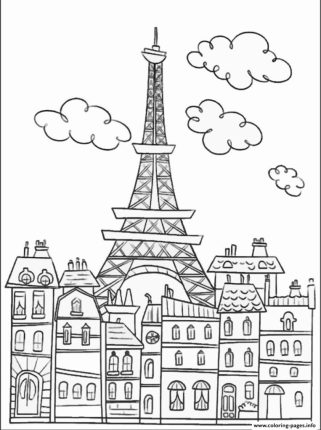
Eiffel Tower Over Paris Coloring Page
Paris is a gorgeous city, full of color and light. Grab your pencils, markers, or crayons and enjoy this printable Eiffel Tower Over Paris Coloring Page.
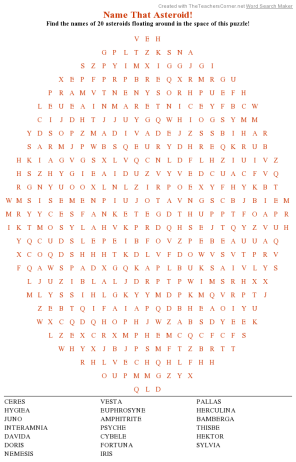
Today’s holiday commemorates a most auspicious moment in history that never happened! On March 23, 1989 a huge asteroid missed hitting Earth by only 500,000 miles. Did you feel the breeze as it blew by? Yeah, me too! I think we can all remember exactly where we were when we happily escaped suffering the same fate as the dinosaurs. So drink a toast to serendipity and the gravity of natural forces.
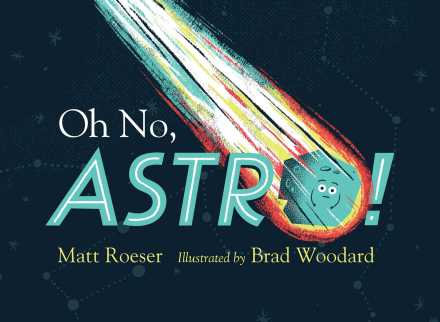
Oh No, Astro!
Written by Matt Roeser | Illustrated by Brad Woodard
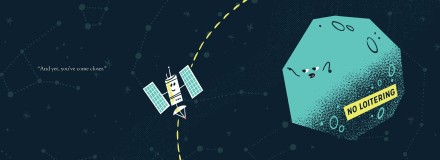
Astro was not a typical asteroid. Instead of zooming around crashing into obstacles, he believed in “personal outer space” and had for millions of years. One day when Astro spies an approaching satellite, he greets him cordially and lays down the rules: “please keep your distance” and “stay in your orbit.” But the satellite ignores him and comes closer and closer until…
Image copyright Brad Woodard, courtesy of Simon & Schuster
“‘Good gravity! You’ve struck me!” Astro exclaims. He’s just about to “point out to the satellite that it had done considerable damage to one of his favorite craters” when he discovers that he is spinning out of his orbit and out of control. How humiliating! The usually unflappable space rock suddenly finds himself hurtling past Mars. At the same time young astronomer, Nova, is “enjoying a quiet night of stargazing” through her telescope. She catches sight of Astro as he zips past an astronaut, rushes past the Moon, and finds himself on an inevitable collision course with Earth.
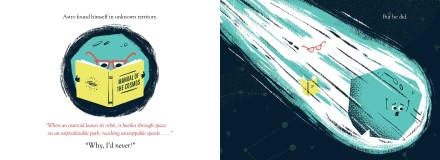
As he enters Earth’s atmosphere he begins to break apart, shedding bits of the past, as the universe watches. He lands on Earth with a SMASH! Reeling from the impact Astro slowly opens one eye and then the other. He finds that he’s smaller but in one piece. Standing by is Nova, waiting to welcome him to his new home. “‘My stars,’” he mutters. “‘Dare I say that was…FUN?!’”
And as Astro gazes at the night sky from a fresh perspective with Nova by his side, he asks, “‘What on Earth shall we do next?!’”
Image copyright Brad Woodard, courtesy of Simon & Schuster
For anyone stuck in the rut of their own orbit, Matt Roeser’s story of the unwitting space traveler is a humorous invitation to explore the universe around them. Roeser’s language—from calling asteroids “rambunctious” and the satellite a “celestial wanderer” to exclamations of “good gravity!” and “Pluto’s revenge!”—is an inspired treat. Kids and adults will laugh at Astro’s attempts to handle his undesirable predicament with dignity. Complacent Astro with his dry-as-space-dust wit and sparkling puns makes a stellar guide on this journey to more self-discovery and life enjoyment.
In the hands of Brad Woodard, deep space is a very cute and cool place! Rendered in flat tones of black, aqua, yellow, red, and white, Woodard’s illustrations give Oh No, Astro! a retro feel for a space-savvy audience. The oblivious satellite floats through Astro’s orbit with wide eyes and a sweet grin, while angular Astro with his stick arms, expressive face, and boldly displayed “No loitering” banner would be a welcome alien intruder in any back yard. Inquisitive and inclusive Nova, in her ponytails and Saturn-patterned dress, is the perfect companion to greet him! The night sky abounds with constellations, but Astro is the real star!
In the final pages, Astro leads readers in a “A Selection of Space Facts” from the very Manual of the Cosmos, 2nd edition that he used to sort things out in his own life. A short list of suggested reading is also included.
Kids would love to find Oh No, Astro! on their bookshelf for story times of cosmic fun!
Ages 4 – 8
Simon & Schuster Books for Young Readers, 2016 | ISBN 978-1481439763













 celebratepicturebooks.com